Chapter III · FROM TEWKESBURY TO THE SEA.
Reading edition
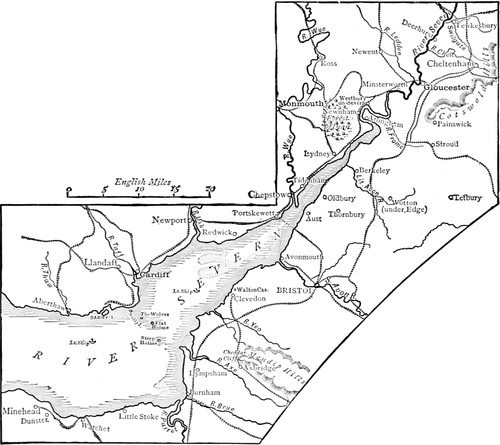
Deerhurst—Gloucester—The “Bore”—May Hill—Minsterworth—Westbury-on-Severn—Newnham—Berkeley Castle—Lydney—Sharpness—The Severn Tunnel—The Estuary—A Vanished River.
BELOW Tewkesbury several pleasant places, country-houses, parks and quiet villages are situated on the lowland, or on the gentle undulations which diversify the width of the valley, but few are of special interest, except the little church of Deerhurst, standing near the waterside, which was built, as an inscription now preserved at Oxford has recorded, in the year 1056. The greater part of the comparatively lofty tower, with some portions of the body of the church, belongs to this age; but the latter to a considerable extent has been rebuilt at various dates, and its plan altered. There was a priory of earlier foundation, but of this nothing of interest remains.
But for some miles a great tower has been rising more and more distinctly above the lush water-meadows, as did that of Worcester on the higher reaches of the Severn. It is another cathedral, on a scale yet grander than the former one, the centre of the old city of Gloucester, which for not a few years has been rapidly increasing; but all about the precincts and in the original streets are many picturesque remnants of the last and preceding centuries, while its churches surpass those of Worcester.
Gloucester, as it guards the Severn, and is one of the natural approaches to Wales, very early became a place of mark. An important station for the Roman troops, it was in the days of Bede a very notable town, not only in the Mercian kingdom, but also in all Britain. At Gloucester the first of its Christian kings founded a monastery about eighty years after the landing of Augustine; and when the Dane began to harry England the town had not seldom to fight and sometimes to suffer. Saxon and the earlier Norman kings often visited it. Probably in few cathedrals out of London—except, perhaps, Winchester—were royal worshippers so frequent. Henry III., a boy of ten, was crowned here, and had a particular affection for the town. Hither the murdered Edward II. was brought for burial; Parliaments were held in the city; and most of the kings up to the sixteenth century paid it at least one visit. But when the great Civil War broke out, Gloucester took the side of the Parliament. So, presently, the Royal troops and Charles himself appeared before its walls. For about four weeks it was closely invested, and its defenders were in sore straits, till Essex raised the siege. As a penalty the walls were destroyed after the Restoration. That did no real harm; the city was quietly prosperous, till it was quickened to a more active life by becoming a railway junction, when the “break of gauge” provided many a subject for Punch.
THE SEVERN, FROM TEWKESBURY TO THE SEA.
The cathedral stands well within the old city, a good quarter of a mile from the Severn. One rose on this site before the Norman Conquest, but that was destroyed by fire—the crypt beneath the choir being the only relic—and another building was erected in the last dozen years of the eleventh century. Notwithstanding great and conspicuous alterations, the shell of this structure is comparatively intact. The nave has undergone the least change, and is a very fine example of the earlier work in that style. It resembles Tewkesbury in the increased height of the piers and consequent dwarfing of the triforium, thus differing from, and not improving on, the great Norman cathedrals of Eastern England; the choir is also of the same age, though the older work is often almost concealed beneath a veil of Perpendicular tracery; and the east window, of the latter date, is the largest in England. The roof also is a magnificent piece of vaulting. In fact, all the eastern part, including the transept, was remodelled between the years 1337 and 1377, but the roof of the nave had been already replaced nearly a century earlier than the former date. The latest conspicuous changes in the cathedral were the additions of the grand Lady Chapel and of the central tower. The former was grafted on to its little Norman predecessor in the last forty years of the fifteenth century, and its great Perpendicular east window still preserves the stained glass with which it was filled on the completion of the structure. The east window of the choir also contains the original glass, which is a yet finer specimen of the art, and is older by nearly a hundred and fifty years. The central tower was begun at the same time, but was not completed till some thirty years later. It has few rivals in Britain; some prefer that in the same position at Lincoln, others Bell Harry Tower at Canterbury. Gloucester, at any rate, is the most ornate, even if it be not the most beautiful.
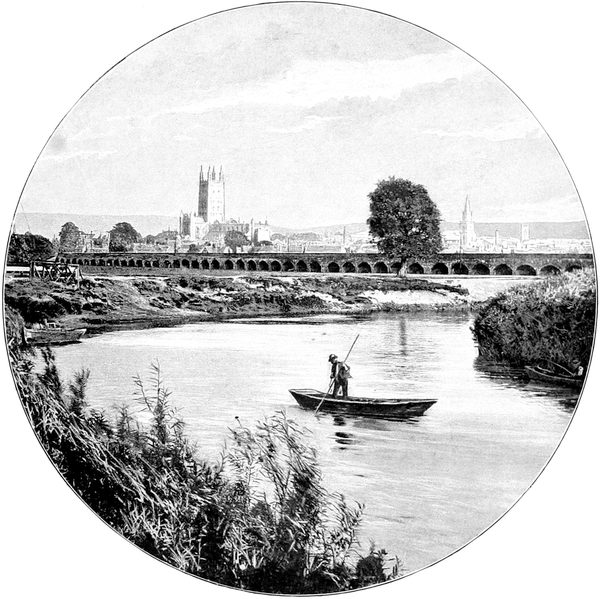
Photo: H. W. Watson, Gloucester.
GLOUCESTER.
The old stained glass, the exquisite tracery of its windows, walls and roof, give exceptional richness to the eastern half of the cathedral, but in addition to this, it possesses several remarkable monuments. The luckless Robert Courthose, eldest son of the Conqueror, who died a prisoner at Cardiff Castle, was buried before the high altar. His tomb and effigy, contrary to the usual custom, are of wood (Irish oak), but whether they are contemporaneous is uncertain. The yet more luckless Edward II. was brought from Berkeley Castle to lie under the central arch on the north side of the choir. There his son and successor raised a memorial, which is not surpassed by any in England. Despised in life, this Edward was honoured in death—such is the irony of fate. A constant stream of pilgrims flocked to his grave as to that of an uncanonised saint, and the magnificent reconstruction of the choir was the fruit of their offerings.
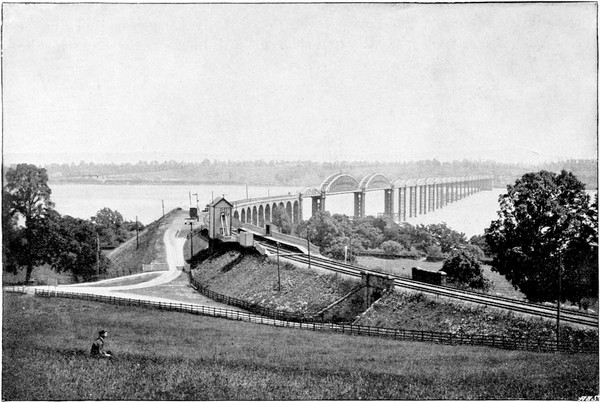
Photo: Hudson.
THE SEVERN BRIDGE, SHARPNESS (p. 123).
Telford spanned the Severn with an arch of stone 150 feet in diameter, and below Gloucester the railway runs on a viaduct across the meadows, Alney Island, and the river. The valley now is becoming very wide, and seems to hint that before long the Severn will broaden into an estuary. The river begins to swing in huge curves through the level meadows. The tidal wave, called “the bore,” sometimes attains a considerable height, and is one of its “wonders.” The Malvern Hills have receded into the background, and their place is taken by May Hill, famous among geologists; on the opposite side the scarp of the Cotswolds continues, though with a rather more broken outline; but outlying hills come nearer to the city.
The Severn ebbs and flows by Minsterworth, where Gwillim is buried, whose heraldry was beloved by country squires. The main high road, when possible, keeps away from the stream, for the land lies low and is liable to floods. Westbury-on-Severn is the first place of mark—a small town with a rather large church noted for having a separate steeple, the spire of which is of wood. The Severn here has pressed against higher ground and has carved it into a low cliff, which affords sections well known to every geologist; and in the neighbourhood iron ore is worked, as it has been for many a century. Newnham comes next, a market-town, and an outlet for the important mining district of the Forest of Dean, which lies a few miles away to the west. It still preserves a sword of state given to it by King John, and there is some old Norman work in its church.
The Severn is now changing from a river to an estuary. No places of importance lie near the riverside, and its scenery is becoming marshy and monotonous; but some distance away to the east is Berkeley, an old town with an old castle, memorable for the murder of the hapless Edward; and on the other side is Lydney, a quaint little town with a small inland harbour, a market cross, and a fine old church. In the adjacent park, on a kind of elevated terrace overlooking the valley, are the remains of a group of Roman villas, from which many coins, pieces of pottery, and other relics have been unearthed.
At Sharpness, above Lydney, a railway crosses the Severn by a long bridge of twenty-eight arches, a magnificent work; but below it ferryboats were the only communication from shore to shore till in 1886 the completion of the Severn Tunnel linked Bristol and the West more closely to the eastern part of South Wales. At this point the river is more than two and a quarter miles across; but the tunnel itself is about double that length. This, the greatest work of its kind in Britain, was completed by the late Sir John Hawkshaw.
The banks become yet farther apart, the water is salt, the tide ebbs and flows, as in the sea. The estuary, indeed, continues for many a mile, still retaining the form of a river-valley. Very probably there was a time when a Severn flowed along a broad valley, where now the Bristol Channel parts England from South Wales, to join another stream which had descended over land, now sunk beneath the Irish Sea, and the two rivers discharged their united waters into a more distant Atlantic Ocean; but that was very long ago, so that our task is now completed. We have followed the Severn from its source to its ending—till our brook has become a river, and our river has become a sea.
T. G. BONNEY.
A BEND OF THE WYE.