THE USK.
Reading edition
The Black Mountains—Trecastle—The Gaer—Brecon—The Brecknock Beacons—Crickhowell—Abergavenny—Usk—Caerleon and the Arthurian Legend—Christchurch—Newport.
THE wild and inclement Black Mountains, “Fforest Fawr,” between Carmarthenshire and Brecknockshire, collect the first drops that, trickling down the side of the hills, gather volume and strength and in time become rivers that are the delight and pride of a country. Three springs, clear and tiny, away up the dark mountain side, where Talsarn towers to an altitude of more than 2,500 feet, are the fountain-heads of a river that, after an extended course of seven-and-fifty miles in the general shape of a bow, joins the sea at Newport—the USK.[9] Not far away are the sources of many another river—the Tawe and the Neath, to name but two; but of all the streams that are born in this cheerless region the Usk is by far the most important.
Hurrying on its way with the leaps and falls that are characteristic of mountain streams, our river is first joined by the Henwen brook, a tiny stream that has the honour of forming a part of the boundary-line between two shires. Beyond the wooded vale of Cwm Wysc the Usk receives the Hydfer, and at length comes to Trecastle, once a place of rare show and importance, but now modest enough in all conscience. Here may still be seen a mound and large earthworks of Bernard Newmarch’s Castle. Below this village the Usk receives the waters of Drayton’s “Cray,” the first stream of real importance that flows into the greater river; and, after leaping a ledge of rock in a beautiful fall, continues its way through a tract of country once the hiding-place of a swarm of determined robbers and outlaws—the Forest of Brecon. At one time this region lay at the mercy of these desperadoes; and it seems to have been necessary for Edward III. to build castles for the protection of people compelled to journey through the forest. Henry IV. sojourned in one of these fortresses in 1403, and thence issued a general pardon to all the rebels who would cease from troubling; but the chances are that this wild and well-nigh inaccessible district offered more attractions to the turbulent robbers than did the prospect of hard and honest work, coupled with the king’s pardon. The Usk now receives a goodly contribution from the Yscir; and between the two streams are the remains of a Roman camp, the Gaer, rectangular in form and believed to have been in command of Ostorius Scapula. The ruins of this fort are remarkably well preserved, the walls in places standing six feet high, although partly overgrown with bush. Many valuable coins and other curiosities belonging to the Roman period have here been excavated. Inclining to the south, the Usk now flows through a lovely bit of wooded country, and reaches the village of Llanspyddid, where an attractive view is to be had of the river, still in its youth, running with merry song over shallows and between high picturesque banks.
Brecon, occupying a highly picturesque situation, is the first place of any importance that the Usk comes to in its flight from the mountains. Two streams join the river at this point, the Tarel and the Honddu; and, as the town is ringed completely round with high mountains, it may be said to lie in the bottom of a huge bowl. Near by, the Beacons, twin peaks, the highest mountains in South Wales, tower to the sky, and add grandeur to the beauty of the neighbouring hills. In the reign of good Queen Bess, Churchyard was moved to verse at the sight of Brecon and its surroundings. Thus he sings:—
“The towne is built as in a pit it were By waterside, all lapt about with hill; You may behold a ruinous castle there, Somewhat defaste, the walles yet standeth still. Small narrowe streetes through all the towne ye have, Yet in the same are sundrie houses brave; Well built without, yea trim and fayre within, With sweete prospect, that shall your favour win. The river Oske and Hondie runnes thereby, Fower bridges good, of stone stands on each streame.”
Though a town of great antiquity, Brecon, when compared with many places in Wales, is almost modern, for it seems to have first come into prominence in the days of the Normans, who out of the ruins of the old Roman fortress already referred to built the first stronghold here. It was, of course, a walled town, with ten turrets and five gates, and traces of this old wall still exist. The castle was a strong one, occupying a commanding position. In one of its towers Morton, Bishop of Ely, lay in prison, given into the custody of the Duke of Buckingham by Richard III., who was jealous of the bishop’s power; and here the gaoler and prisoner, neither of them well disposed towards the king, plotted to marry Henry of Richmond with the Lady Elizabeth, and thus heal the breach between the rival houses of York and Lancaster. So Morton was allowed to escape, while Buckingham, marching against the king, fell into his enemy’s hands and lost his head at Salisbury. The Castle of Brecon met its fate in sorry manner. When the great Civil War broke out, and king and Parliament came to blows, the people of the town, fearing that the fortress would be garrisoned by one party or the other, and that the place would be besieged and themselves visited with all the danger and suffering that waits upon active war, took matters into their own hands by demolishing the stronghold, of which only some ivy-clad walls, with the Ely tower, now remain, overlooking the Honddu. Charles I., in his feverish flight, after the disastrous battle of Naseby, put up for a time at Priory House; and in a humble hostelry in High Street, then known as “The Shoulder of Mutton,” Mrs. Siddons, queen of actresses, was born in 1755, her parents being temporarily resident here.
The chief glory of the town in these days is the Priory Church of St. John, founded by Bernard Newmarch, in the reign of Henry I., in the hope of atoning for the murders and other crimes that he had committed in hewing his way to the place of power he occupied in this part of Wales. It is a building of unusual interest, predominantly Norman in style, but with Early English and Decorated additions. Another feature of Brecon is the massive bridge of seven strongly buttressed arches which spans the Usk.
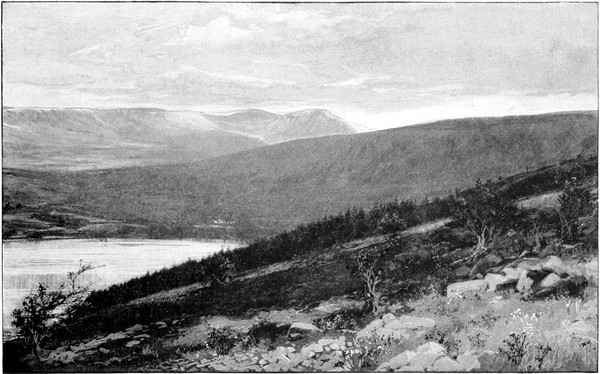
Taking a south-easterly direction, the Usk flows away from the county town, and soon receives a tiny river that comes from the towering heights of the Beacons, locally called “Arthur’s Chair,” and forming one of the finest of the sights which Wales offers to her lovers. “Artures Hille,” says Leland, “is three good Walche miles south-west from Brekenok, and in the veri toppe of the hille is a faire welle spring. This Hille of summe is countid the hiest Hille of Wales, and in a veri cleere day a mannne may see from hit a part of Malvern hilles, and Glocester, and Bristow, and part of Devenshire and Cornwale. There be divers other hilles by Artures Hille, the wich, with hit, be communely caullid Banne Brekeniane.” Wood, in his “Rivers of Wales,” declares that “the well here mentioned does not exist,” so that it would have been better, perhaps, if Leland had done as Churchyard did, who wrote of nothing he had not seen—if his verse is to be taken quite literally. He says:—
“Nere Breaknoke Towne, there is a mountaine hye, Which shewes so huge, it is full hard to clime. The mountaine seemes so monstrous to the eye, Yet thousands doe repayre to that sometime. And they that stand right on the top shal see A wonder great, as people doe report; Which common brute and saying true may bee, But since, in deede, I did not there resort, I write no more, then world will witnesse well.”
From the Brecknock Beacons there is a truly remarkable view; and for those unable or unwilling to climb, there is the sight of the mountains themselves.
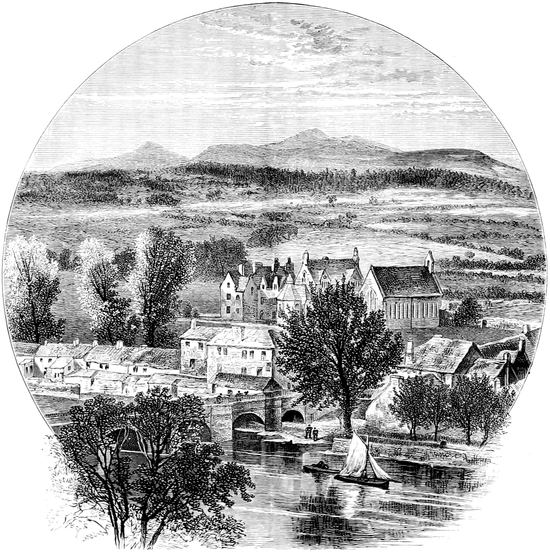
THE USK AT BRECKNOCK.
Continuing its course to the east and south, the Usk passes on, skirting Bwlch, a mountain over which the main road runs, offering glimpses on one hand of the valley of the Wye, and on the other of the valley of the Usk. Presently, our stream passes by the meagre remains of Dinas Castle, which had the honour of being stormed by Alfred the Great’s daughter, Ethelfleda, and taken too, although garrisoned at the time by three-and-thirty valiant Welsh women; for the men were all fighting far afield. Through a lovely valley the Usk reaches its second town of consequence—Crickhowell. This “preatie tounlet stondith as in a valley upon Wisk,” Leland says; and, indeed, its situation on the north-east bank of the river is beautiful. Whichever way one looks, the scenery is charming in its attractiveness and rich in the romantic and the picturesque. Close to the Abergavenny road stand the ruins of what once must have been a castle of very considerable dimensions, which covered as much as eight acres of ground. Even in the days of Elizabeth this castle was nothing more than a ruin. No great distance from Crickhowell is the Well of St. Cenau, eagerly sought for by the newly-married, for to drink its waters first was to secure command of the house for life:—
“‘You drank of the well, I warrant, betimes,’ He to the countryman said; But the countryman smiled as the stranger spoke, And sheepishly shook his head. ‘I hasten’d as soon as the wedding was done, And left my wife in the porch; But, i’ faith, she had been wiser than me, For she took a bottle to church.’”
Farther down stream is Llangattoc Park, with its roomy cave, known as Eglwys Faen, “the stone church”; and beyond is Llangwryney, where Richard, Earl of Clare, passing through the wood, preceded by pipers, was set upon by the Welsh and murdered. Here the Gwryney joins the Usk, which, flowing through scenery that has been called the “Garden of Wales,” and passing from Brecknock into Monmouth, reaches the ancient town of Abergavenny, lying in the shadow of the Sugar-Loaf Mountain at the junction of the Usk and the Gavenny—“the brook that christneth Abergeney.” As is the case with so many Welsh towns, Abergavenny is wholly surrounded by high hills, but here the valley is spacious and fruitful. Of this place Churchyard, whose poetry is met with at every turn, says:—
“Aborganie, behind I kept in store, Whose seat and soyle with best may well compare. The towne somewhat on steepe and mounting hill, With pastor grounds and meddowes great at will: On every side huge mountaines hard and hye, And some thicke woods, to please the gazer’s eye.”
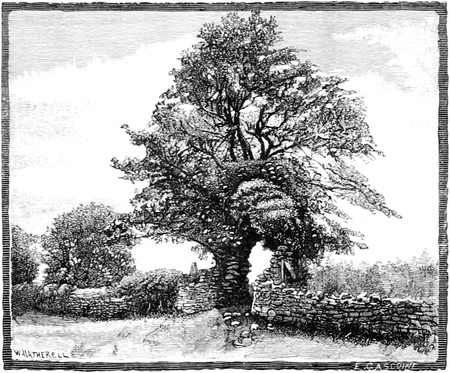
BIT OF THE ROMAN WALL AT CAERLEON (p. 155).
“Hard and hye” the mountains do rise and tower above the luxurious valley of “pastor grounds.” Not so long ago all the streets of Abergavenny were narrow and crooked, but of late years there has been a great display of public enterprise. Whether the changes that have been effected are to be regarded as improvements is questionable; for with the widening of the thoroughfares and the building of a new town hall and markets, and so forth, the individuality of a town is apt to disappear; but the residents may be pardoned for thinking themselves to be much better off than were their forefathers. To be sure, the town has scanty remains of a castle rising from a tree-clad hill to overlook the houses and the river. Part of the castle area is covered with houses, and another part has been converted into public gardens. The associations of the fortress are none of the noblest, for historians tell us that “it was dishonoured by treason oftener than any other castle in Wales.” It seems to have been the practice of the Norman lords of Abergavenny Castle to invite neighbouring Welsh chiefs to feasts within the walls of the stronghold, and then treacherously murder them. Wood tells of one of the most dastardly of these deeds. “Soon after the murder of Trahaern Vechan, at Slansavaddon lake, by William de Braose (lord of Abergavenny Castle), the Welsh, inflamed with resentment and revenge, commanded by Sitsylt ap Dyfnwald and other Welsh chieftains, surprised the Castle of Abergavenny, and took the whole garrison prisoners. William de Braose recovered his castle by composition; and after the reconciliation of the Welsh lords to King Henry, A.D. 1175, he invited Sitsylt, his son Geofrey, and other men of note to a feast, under pretence of congratulation upon the late peace; when, contriving cause for dispute, he called upon his men, who were ready for that purpose, and most treacherously murdered the unsuspicious and unarmed Welsh; then proceeded to Sitsylt’s house, slew his son Cadwallader in his mother’s presence, and, setting fire to the house, carried her away to his castle.”
Once upon a time Abergavenny was noted for flannels, but this industry has been wrested from it by more enterprising competitors, while the manufacture of wigs, for which it was once noted, has succumbed to change of fashion. St. Mary’s Church, a fine fourteenth-century church, occupying the site of a Norman church which was attached to a Benedictine priory, contains many ancient monuments, amongst others that of Sir Richard Herbert of Coldbrook, who, together with his brother, was beheaded, after the Battle of Banbury, in 1469; and in the Herbert chapel is “a Jesse tree,” of which Murray’s “Handbook” says that it is “perhaps one of the most perfect extant.”
Leaving this lovely town, the Usk makes more directly for the sea. A few miles away to the east, in the valley of one of its tributaries, are the ruins of Raglan Castle, standing on a richly-wooded eminence not far from the village of the same name. It was begun not earlier than the reign of Henry V., and apparently not finished until the time of Charles I.; and so strong was it that it had the distinction of being one of the last fortresses in the kingdom to surrender to Cromwell’s men. It would be interesting to recall the story of the siege which it endured, and to describe the lovely remains of it; but it lies too far out of our course, and we must return to our river and follow it through the pretty scenery it traverses to the town to which it has lent its name. In days long gone by, Usk had to bear many a sore blow from Owen Glendower, but now it has no more alarming invaders than the placid, contemplative wielders of the rod—for here the Usk is famous for its salmon and its trout. Standing upon a tongue of land formed by the confluence of the Olwey with the main stream, Usk has been identified with a Roman station; and though the evidences are external rather than internal, the theory has been almost universally accepted of antiquaries. Of its castle, occupying a commanding site near the river, and still retaining its outer walls in very fair preservation, with the gateway, towers, and keep, the precise origin is not known; but in the reign of Henry III. it was in the hands of Robert de Clare, Earl of Gloucester. From this family it passed to the Mortimers, Earls of March, and in the reign of Henry VI. was granted to Richard, Duke of York, as nephew of the last of the Mortimers. It became a favourite residence of this personage, and is believed to have been the birthplace of Edward IV. and other princes. Of the scathe which Owen Glendower had wrought at Usk we have already spoken, but it remains to add that the citizens were at last avenged, for here he sustained a crashing defeat and had to flee to the mountains.
Flowing beneath the ancient stone bridge shown in our view (page 156), the river passes on, through scenery that is never less than pleasant, to Caerleon, prettily placed on the right bank; and here the Usk takes toll of the Afon. Caerleon is one of the most interesting spots in all this part of Wales. Here was quartered the second Augustan legion, and this was the principal Roman town in the country of the Silures. In those days it must have been a place of great magnificence and refinement as well as of war, for Giraldus Cambrensis, writing in the twelfth century, tells of the remains of splendid palaces, baths, theatres, and other public buildings; and though these have all vanished, an abundance of Roman relics has been unearthed, which are treasured in a museum that has been built by an antiquarian society; and bits of the wall are still to be seen in situ. But the legendary associations of Caerleon are even more memorable than its history; for here it was, according to one version of the Arthurian myth, that the British prince, when, after the withdrawal of the legions, the land was laid waste by the “heathen hosts” and by the warfare of the native princes—
“Thro’ the puissance of his Table Round Drew all their petty princedoms under him, Their king and head, and made a realm and reigned.”
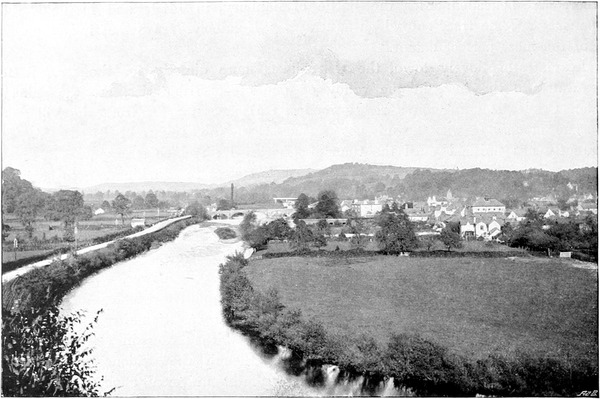
Photo: A. Dunning, Usk.
USK (p. 155).
The Roman amphitheatre consists of a grassy hollow enclosed by a bank, lying just outside the wall on the east; “Arthur’s Round Table” is a bank of earth some sixteen feet high. There is no reason to doubt that after the Roman era Caerleon became the centre of one of the British kingdoms. At a later time it was “threatened by the fleet of Alfred, which, however, was recalled home before making an attack. In early days it had its martyrs—St. Julius and St. Aaron—and afterwards it became the seat of a bishopric, which for some time enjoyed the honour of being the Metropolitan See of Wales. After the Norman Conquest Caerleon was a frequent bone of contention between the Welsh and the invaders, and was alternately taken and retaken. A castle was built here by one of the Norman barons; but it was not until the reign of Edward I. that the English obtained undisturbed possession of the town, which, prior to the building of a castle at Newport, was a place of considerable strategic importance.”[10]
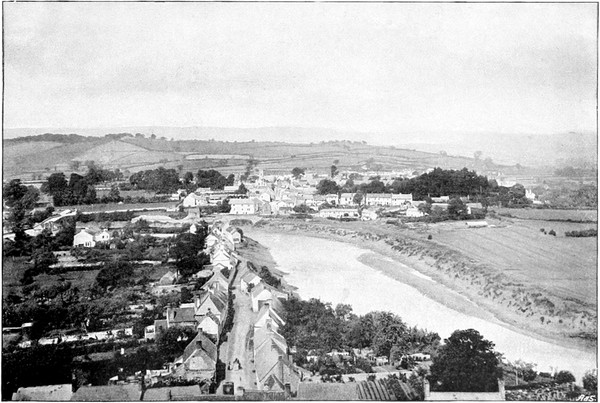
Photo: Frith & Co., Reigate.
CAERLEON.
By this time the Usk has become a tidal stream with a rapidly widening valley; and now it follows a devious course through rich meadows with wooded hills on either hand. A tomb in Christchurch, on the road connecting Caerleon and Newport, was long believed to have miraculous powers of cure for sick children who touched the sepulchre on the eve of the Ascension; and in 1770 as many as sixteen children were laid upon it to pass the night. Newport, four miles from the mouth of the river, owes its prosperity mainly to the great output of iron and coal from the interior of Wales that comes here for shipment. It has many railways to wait upon it, and its facilities in this kind have been greatly increased by the construction of the Severn Tunnel; and it is also furnished with abundant dock accommodation. Of the castle, built by Robert, Earl of Gloucester, a natural son of Henry I., to command the Usk, some of the walls and towers still remain, close to the famous bridge of five arches, reared at the beginning of the century and widened and improved in 1866; but the greater part of the stronghold has been either demolished or converted into business premises. The record of the town is, for the most part, one of peace and commercial development, and contains few episodes of violence, except the attack upon it by the Chartists led by John Frost in the year 1839. The tower of the church of St. Woollos, standing on an eminence overlooking the valley of the Usk and the Bristol Channel, is said by Wood to have been built by Henry III. in gratitude to the inhabitants of this place and surrounding districts, who, by a victory over his enemies, relieved him from captivity. Newport may not have great attractions to offer to the tourist, but in these later days it has not been mindful only of money-making, as one may see from the many public buildings with which it has provided itself.
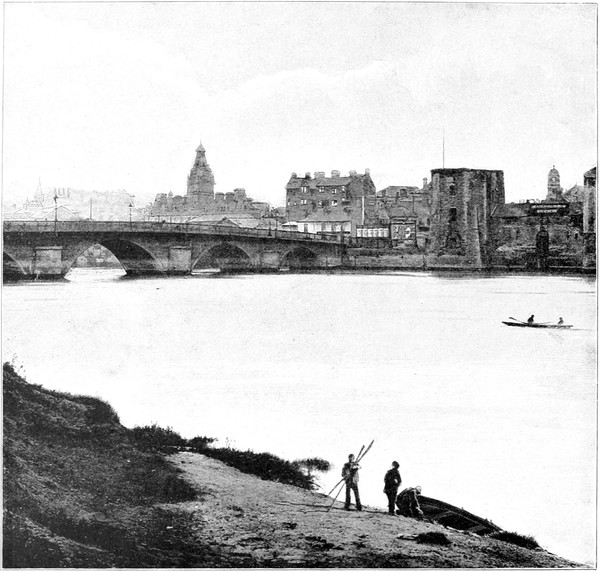
Photo: Hudson.
THE BRIDGE AND CASTLE.
Leaving Newport, the Usk wanders through a plain of no particular interest, scenically speaking, and almost at its embouchure is joined by the river Ebbw, which, rising on the border of Brecknockshire in two headstreams that unite near Llanhilleth, has run a course some twenty-four miles long. Thus reinforced, Usk merges itself in the larger life of the Bristol Channel.
E. W. SABEL.
THE BRECKNOCK BEACONS, FROM THE TAFF.