Chapter V
Reading edition
THE WARS OF SCOTLAND, NORTHUMBERLAND, AND WALES.[1] 1093–1098.
THE year of Anselm’s appointment to the archbishopric, Events of the year 1093. that part of the year which passed between the day when the bishop’s staff was forced into 4 his hand and the day when he received consecration from Thomas of Bayeux, was a time full of stirring and memorable events of quite another kind. Relations between England and Scotland. War of 1093. It was now that some of the events of former years were to bring forth fruit. The relations between England and Scotland were of a kind which might lead to open warfare at any moment.[2] This year the open warfare came. And it was a warfare which was far more important in its direct results than mere plundering inroads on either side of the border commonly were. Its results. The direct results of the warfare of this year were in truth the crowning result of causes which had been working for a whole generation. Growth of the English power It was a singular irony of fate which made William the Red in some sort a missionary, not only of the political power of the English kingdom, but of the ascendency of the English blood and speech. He began the later position of England as an European power. He extended the boundaries of the kingdom of England within his own island. and of the English nation under William Rufus. And, more than this, he gave decisive help to a work which wrought one of the greatest of victories, not so much for England as a power as for the English-speaking folk in their English-speaking character. That he gave kings to Scotland was a small matter; that was done by other rulers of England before and after him. What specially marks his reign is that in his day, and largely by his agency, it was ruled that, of the three elements in Northern Britain, British, English, and Scottish or Irish, the English 5 element should have the upper hand. The Scottish kingdom becomes English. It was ruled that the kingdom of Scotland, whatever might be its relations towards the kingdom of England, whether separate or united, whether dependent or independent, whether friendly or hostile, should be itself truly an English kingdom, a kingdom which was for some generations more truly English than the southern England itself.
Summary of Scottish affairs. The Scottish affairs with which we shall have to deal in the present chapter begin with the controversy between William Rufus and Malcolm which led to the death of Malcolm in his last invasion of England. Death of Malcolm; first reign of Donald. 1093. On this follows that first outburst of the true Scottish nationality which led to the election of Donald, followed by his overthrow and the establishment of Duncan by the power of England. Reign of Duncan. Then, after a short interval, comes the second national uprising, and the restoration of Donald. After a longer interval comes the second overthrow of Donald, and the establishment of the younger Eadgar by the arms of the elder. Second reign of Donald. 1094. Establishment of Eadgar. 1097. The question was now decided in favour of the line of Malcolm and Margaret and of the form of English influence which was represented by that line. And between these two last revolutions we may record, as a kind of episode for which it is not easy to find a place in the general run of any other narrative, Revolt of Robert of Mowbray. 1095. the revolt and overthrow of the great earl of Northern England which forms at least a poetical sequence to the overthrow of Malcolm. Between the second establishment and the second overthrow of Donald, I propose to tell, in its chronological order, the tale of the slayers of Malcolm, of Earl Robert of Mowbray and his kinsman Morel. There is little doubt that their revolt was connected with movements in Normandy also; but it would have been hard to describe it in a chapter in which Anselm is the chief actor. It 6 comes better in its moral and geographical relation towards the affairs of Scotland.
But Scotland was not the only land within the four seas of Britain with which the kingdom of England has much to do, especially in the way of fighting, within the few years of this memorable reign. Affairs of Wales. The affairs of Wales are still more constantly coming before our eyes. While the Red King is on the throne, Welsh warfare supplies, year after year, no small part of the events which the chronicler of England has to record. The Welsh history of this time is one of deep interest on many grounds. But it is specially important as giving us an example of a third type of conquest in our own island, a conquest differing widely both from the English Conquest of Britain and from the Norman Conquest of England. Comparison between Wales and Scotland. Nor do the affairs of Wales fail to supply us with some instructive contrasts as compared with the affairs of Scotland. Scotland and the other dominions of the Scottish king seem throughout this time to act as a whole, at least as regards England. The land is conquered, or it wins back its freedom; it receives foreign influences, or it casts them out; but it seems to do all these things as a whole. The union was perhaps very much on the surface, but the events of this time bring whatever there was of union to the front. Disunion in Wales. The British story, on the other hand, is the story of disunion in its strongest form. Alike in victory and in defeat, all is local and personal; common action on the part of the whole nation seems impossible. The result of English dealings with Wales during these years may be summed up as immediate loss and final success, as defeat in detail leading to substantial conquest. Effects of the reign on the union of Britain. It is to this reign more than to any other that we may trace up the beginning of the chain of events which has gradually welded together England, Scotland, and Wales, into the thoroughly united island of 7 Great Britain. The remote causes begin far earlier; now we begin to enter on the actual story itself. And from that story we may perhaps draw another lesson. Its causes. Three nations, differing in blood and speech, once parted by bitter enmities, have been worked together into one political whole, while still keeping so much of old diversity as is really healthy, so much as hinders a dull and lifeless uniformity, so much as sometimes kindles to wholesome rivalry in a common cause. But this has been because the facts of geography allowed and almost compelled their union; it has been because the nature of the old enmities was such as did not hinder union. England, Scotland, and Wales, have at various times done one another a good deal of mischief; there has been no time when any one of the three held either of the others in abiding Turkish bondage. But these very facts may teach us that the same result cannot be looked for in a land where the undying laws of nature and the events of past history alike forbid it. Such union cannot be where the boundaries of land and water on the map, where the memory of abiding Turkish bondage in days not long passed by, join to hinder the same process of welding together which has so happily taken place among the three nations of the isle of Britain. Comparison with Ireland and Normandy. William the Red did much for the final union of Britain, because nature favoured that union. He brought Normandy under the same rule as England, but only for the two lands to be again parted asunder, because nature forbad their union. And if it be true that from the rocks of Saint David’s he looked out on the dim outline of distant Ireland, he did well to turn away from the prospect, to bluster and threaten, it may be, but to keep the practical exercise of his warfare and his policy for other lands. He did well to keep it, as far as the island world was concerned, for those lands which, as the event has shown, nature did 8 not forbid to be, in course of ages, fully united with his kingdom.
§ 1. The Last Year of Malcolm. 1093.
We should be glad of a clearer account than we have of the immediate causes which led to the open breach between William and Malcolm in the year which followed the restoration of Carlisle. Complaints made by Malcolm. It is certain that Malcolm complained through an embassy that the King of the English had failed to carry out the provisions of the treaty made two years before. Nothing is more likely; it was not the manner of William Rufus to carry out his treaties with other princes, any more than his promises to his subjects. Both alike, being parts of his everyday duty, and not lighted up with the rays of chivalrous honour, were reckoned by him under the head of those promises which no man can carry out. But we should be well pleased to know whether the alleged breach of treaty had anything to do with William’s Cumbrian conquest. Effects on Scotland of the restoration of Carlisle. The strengthening of Carlisle, the annexation of its district, could in no case have been agreeable to the King of Scots. And if, as there seems every reason to believe, the land had been held by its late lord Dolfin as a vassal of the Scottish crown, what William had done was a distinct aggression on the rights of that crown. Probable wrong to Scotland. The superiority of the English crown over both Scotland and Cumberland would in no way justify the act; it would have been a wrong done to the Duke of the Normans if the King of the French had annexed Ponthieu and strengthened Saint Valery against Normandy. Other grounds of offence. But we are not told whether this was the ground of offence, or whether William had failed to carry out any of the clauses of the treaty, those for instance which secured to the King of Scots certain payments 9 and possessions in England.[3] What followed may perhaps suggest that, however much the occupation of Carlisle may have rankled in the mind of Malcolm, the formal ground of complaint was something of this last kind. Scottish embassy at Gloucester. March, 1093. Whatever were his wrongs, the Scottish king sent to complain of them, and the answer which he received was one which shows that, at this first stage, Rufus was not disposed to slight the complaint. We are not told the exact date of this first Scottish embassy. It may very well have come during the short season of William’s reformation; his seeming readiness to deal reasonably with the matter, as contrasted with his conduct a few months later, may pass as one of the fruits of his temporary penitence, along with the appointment of Anselm and the promise of good laws. Malcolm summoned to Gloucester. He sent an embassy to Scotland, inviting or summoning the Scottish King to Gloucester, and giving hostages for his safety. This looks very much as if the ground of complaint was the refusal of some of the rights which had been promised to Malcolm whenever he came to the English court. The Scottish King agreed to come on these terms. William, in his present frame of mind, was seemingly anxious to do all honour to the prince with whom he was dealing. Eadgar sent to bring him. The Scottish ambassadors were sent back to bring their king, and with them, as the most fitting of mediators, was sent the man who had himself for a moment been a king, the brother-in-law of Malcolm, the favoured guest of William, the Ætheling Eadgar.[4]
Eadgar in favour with William. We last heard of Eadgar somewhat more than a year before, when Robert left England in anger, and Eadgar went with him.[5] This seems to imply that the relations between William and Eadgar were at that moment unfriendly. 10 We have no account of Eadgar’s return to England; but the duty on which he was now sent implies that he was now not only in William’s formal favour, but in his real confidence. His mission to Scotland. He who had lately been Malcolm’s representative in a conference with William now acts as William’s representative in a conference with Malcolm. Eadgar, like his friend Duke Robert, was clearly one of those men who can act better on behalf of others than on behalf of themselves.[6] In his present mission he seems to have acquitted himself to William’s full satisfaction; the King of Scots was persuaded to come to the English court. If his coming did not prove specially lucky either to himself or to the over-lord to whom he came, that was at all events not the fault of Eadgar.
Events of the year 1093. While Eadgar was away on his mission to Scotland, he left behind him a busy state of things in England. His embassy came in the midst of the long delays between Anselm’s first nomination and his investiture, enthronement, and consecration. It came in the time when William of Eu was plotting,[7] and when, as we shall presently see, seeming conquest was going on throughout Wales. Meeting at Gloucester. August 24, 1093. The place and day for which Malcolm was summoned to the King’s court was Gloucester on the feast of Saint Bartholomew. This can hardly have been a forestalling of the regular Christmas Gemót, for which, by the rule of the last reign, Gloucester was the proper place. But this year, like most years when William Rufus was in England, was a year of meetings. This cannot be the meeting at which Anselm was invested and did homage, for that, as we have seen, was at Winchester.[8] But, if Winchester was near to the New Forest, Gloucester was near to the Forest of Dean, and would on that account not be without its attractions for the Red King.[9] Or it 11 may well be that the presence of the King at Gloucester, both now and earlier in the year, may have been caused by the convenience of that city for assemblies in which action against the Britons might have to be discussed.[10] Malcolm sets forth. August, 1093. Malcolm accordingly set forth, “with mickle worship,” in the beginning of August as it would seem, to go to the court of the over-lord by the Severn.
He stops at Durham. On his way he tarried to take part in a great ecclesiastical ceremony, his share in which was not without a political meaning. Rebuilding of the abbey. The Bishop of Durham, William of Saint-Calais, now again the King’s chief counsellor, already his partisan in the opening strife with Anselm,[11] was ready to begin his great work of rebuilding Saint Cuthberht’s abbey. The church of Ealdhun, which had escaped the flames on the day of Robert of Comines,[12] could not really have been ruinous beyond repair; but, after the fashion of the time, it was doomed to make way for a building, built not only on a vaster scale, but in an improved form of art surpassing every contemporary building.[13] Malcolm lays a foundation stone. August 11, 1093. Of the mighty pile which still stands, the glory of the Northern Romanesque, King Malcolm now laid one of the foundation-stones, along with Bishop William and Prior Turgot.[14] The invitation to take part in such 12 a work was clearly meant as a mark of honour and friendship on both sides. But it must surely have meant more. The King of Scots could not on any showing have claimed any authority at Durham. But he was something more than a mere foreign visitor. As ecclesiastical geography was understood at Durham, Malcolm was no stranger there; he was rather quite at home. At York he might have been told that the whole of his dominions owed spiritual allegiance to that metropolis. But the Bishops of Durham, practically the only suffragans of the see of York and suffragans almost on a level with their metropolitan, were at no time specially zealous for the rights of the Northern Primate. Much of Malcolm’s dominions in Durham diocese. But, as they drew the ecclesiastical map, a great part of Malcolm’s dominions, his earldom of Lothian, his Castle of the Maidens, perhaps even lands beyond those borders, all came within their own immediate spiritual charge. To the counsellor of King William Malcolm came as the highest vassal of the English crown; to the Bishop of Durham he came as the highest layman in his own diocese. As such, he was fittingly asked to take a share in a work which concerned the kingdom and the church of which he was one of the chief members. Import of the ceremony. His consent, besides being a mark of friendship alike towards King William and Bishop William, was doubtless taken as an acknowledgement that he belonged to the temporal realm of the one and to the spiritual fold of the other. And if Malcolm had learned any of the subtleties of some of his contemporaries and of some of his successors, he might have comforted himself with the thought that, whatever the laying of the stone implied, it was laid only by the Earl of Lothian and not by the King of Scots.
From Durham and its ceremonies Malcolm, Earl and 13 King, went on to the court of the over-lord at Gloucester. Malcolm at Gloucester. August 24, 1093. He had evidently come disposed to make the best of matters, as William himself had been during his time of sickness and penitence. But now in August Rufus was himself again; he had repented of his repentance; he was more than ever puffed up with pride and with the feeling of his own power. Rufus refuses to see Malcolm. Out of mere insolence, it would seem, in defiance of the advice of his counsellors who wished for peace, he refused to have any speech with, or even to see, the royal vassal and guest who had made such a journey to come to his presence.[15] Whatever passed between the kings must have passed by way of message through third parties. Dispute between the kings. In one account we read generally that Rufus would do nothing of what he had promised to Malcolm.[16] In another version we are told, with all the precision of legal language, that William Question of “doing right.” demanded that Malcolm should “do right” to him by the judgement of the barons of England only, while Malcolm maintained that he was bound by ancient custom to “do right” only on the borders of the two kingdoms, where the kings of Scots were wont to “do right” to the kings of the English, and that by the judgement of the great men of both kingdoms.[17] The meaning of these words is plainly open to dispute, and it has naturally given rise to not a little.[18] Probable pretensions of Rufus. Their most natural meaning seems to be that William wished to deal with the kingdom of Scotland as with an ordinary fief. Such a claim would have been against all precedent, and it would be specially dangerous when William Rufus was king and when Randolf Flambard was his minister. On the other hand, Malcolm in no way denies the superiority of the English crown; he stands simply on the ground of 14 ancient custom. He is ready to “do right,” a process clearly to be done by an inferior to a superior; but he will do it only as by ancient custom it was wont to be done. Because a kingdom acknowledged the external superiority of another kingdom, it did not at all follow that its king was bound to submit himself to the judgement of the barons of the superior kingdom. The original commendation had been made, not only by the King of Scots, but by the whole Scottish people,[19] and their king might fairly claim that he should have the advice and help of his own Wise Men in making answer to any charge that was brought against him. This is one of the cases in which the use of technical language, without any full explanation of the circumstances, really makes a matter darker; and we must perhaps be content to leave the exact point at issue unsettled. William in the wrong. But it is plain from the English Chronicle that William was in the wrong; he refused to do something for Malcolm which he had promised to do. The obligations of a treaty sat lightly on the Red King; but on one point his honour was pledged. Malcolm had come under a safe-conduct—the sending of hostages, if nothing else, shows it. William observes his safe-conduct. And a safe-conduct from Rufus might always be trusted. We cannot say that the two kings parted in wrath, seeing they did not meet at all. But Malcolm naturally went away in great wrath, and he left Rufus behind him in great wrath also. He reached his own kingdom in safety; what he did with the hostages we are not told.[20]
Edwᵈ. Weller
For the Delegates of the Clarendon Press.
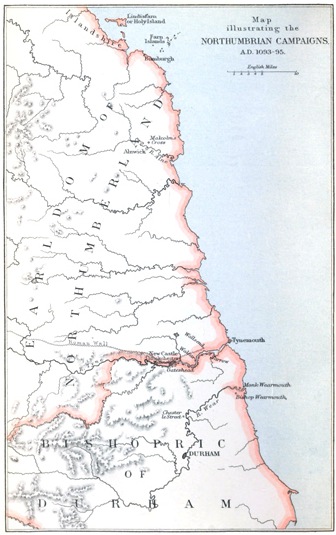
Map illustrating the NORTHUMBRIAN CAMPAIGNS A.D. 1093–95.
The silly pride shown by William Rufus at Gloucester led to a series of events of the highest importance both as to the relations between England and Scotland, and as to the internal affairs of the northern kingdom. 15 Malcolm’s last invasion of England. As soon as Malcolm reached Scotland, he gathered together his forces, and began his fifth, and, as it happened, his last, invasion of England. He entered the earldom of Northumberland, and harried after his usual fashion as far as some point which, there is no reason to doubt, was in the near neighbourhood of Alnwick. He draws near to Alnwick. We may fairly accept the tradition which carries him to the spot known as Malcolm’s Cross, where a commemorative rood once stood, and where the ruins of a Romanesque chapel may still be seen. The spot is on high ground overlooking the river Alne, while on the opposite side of the stream a lower height is crowned by the town of Alnwick castle. Alnwick, and by such remains of its famous castle as modern innovation has spared. The neighbourhood of Alnwick and the Percies. that castle, the fame of the historic house which once held it, has caused every place and every act into which the name of Alnwick or of Percy can be dragged to be surrounded by an atmosphere of legend. The first Percy at Alnwick. 1309. It needs some little effort to take in the fact that, as the Percies of history have long passed away from Alnwick, so in the days of Malcolm some centuries had to pass before the Percies of history reached Alnwick. It needs some further effort to take in the further fact that the true Percy, The true Percies. the Percy of Domesday, the Percy of Yorkshire, never had anything to do with Alnwick or with Northumberland at all. And it perhaps needs a further effort again to take in the fact that it is by no means clear whether in the days of Malcolm there was any castle of Alnwick in being. One may guess that the site had been fortified at some earlier time; The Vescies at Alnwick. but the known history of Alnwick, castle and abbey, begins with the works of the elder lords of Alnwick, the house of Vescy, in the next century.[21] Of that date a noble gateway has still been spared, which may 1174. well have looked on the captivity of the Scottish William 16 in the days of Henry the Second, but which assuredly did not look on the death of Malcolm in the days of the Red King. The height to which Malcolm’s harryings reached may have looked down on some earlier fortress beyond the Alne, or it may simply have looked down on the town of Alnwick, which was doubtless already in being. But whatever was there at that time in the way of artificial defence, there were stout hearts and a wary leader ready to meet the king who was invading England for the fifth time.
English feeling about Malcolm. It is certainly strange that in not a few English writers, generally indeed those who are parted from the event by some distance of time and place, the overthrow of the invaders which now followed is told with a certain feeling for the invader and with a certain feeling against those who overthrew him. Malcolm perhaps drew to himself some share of the national and religious halo which gathered round his wife, while there was nothing attractive, either on national or on personal grounds, in the men who at that time stood forth as the champions of England. Yet it must have been the “good men” of two years past[22] who now went forth under the cunning guidance of Earl Robert of Mowbray. By some ambush or other stratagem, that skilful captain led his forces on the Scottish King unawares, under circumstances which are not detailed, but which have led even English writers to speak of the attack as treacherous.[23] Death of Malcolm. November 13, 1093. Malcolm was killed; and with him died his son and expected heir Eadward. They fell on the day of Saint Brice, ninety-one years after the great slaughter of the Danes which has made that day memorable in the kalendar of England.[24] Malcolm slain by Morel. The actual slayer of Malcolm was his gossip Morel, Earl Robert’s nephew 17 and steward, guardian of the rock and fortress of Bamburgh. From him it would seem that Alnwick, or perhaps rather the dale between Alnwick and Malcolm’s Cross, took the name of Moreldene.[25] Morel was, it was noticed, the gossip, the compater, of Malcolm, as William Malet was of Harold;[26] and it seems almost to be implied, by writers far away from Alnwick, that this spiritual affinity made the slaughter of the invader a crime.
Burial of Malcolm at Tynemouth. The body of Malcolm, like the bodies of Harold and Waltheof, received a first burial and a later translation. It was first borne to the church of Saint Oswine at Tynemouth, a place which was growing into great reputation under the special favour of Earl Robert. History of Tynemouth. Through his bounty the walls of a new minster were rising within his fortress which crowned the rocky height on the left bank of the mouth of the great Northumbrian river. That fortress and that minster will again play a memorable part in the chequered history of their founder. But the church of Saint Oswine, the martyred King of Deira, did not owe its first origin to Robert of Mowbray or to any other stranger.[27] Martyrdom of King Oswine. The body of the sainted king, slain by the practice of the Bretwalda Oswin, was laid in a church which was said to have been first built of wood by the Bretwalda Eadwine, and then rebuilt of stone by the sainted Bretwalda Oswald. First church of Tynemouth. The position of Tynemouth marked it out as a special point for attack and defence in the days of the Danish invasions; but, after the havoc which they caused, the holy place had been neglected and forgotten. Invention of Saint Oswine. March 15, 1065. In the days of Earl Tostig 18 and Bishop Æthelwine the pious care of the Earl’s wife Judith had led to the invention of the martyr’s relics, and to the beginning of a new church. Of that Tostig begins the new church. church Tostig laid the foundations in the year of his fall, but men of another speech were to finish it. The unfinished church was granted by Earl Waltheof to the monks of the newly restored house of Jarrow, and his gift was confirmed by the Norman Earl Alberic. Tynemouth granted to Jarrow by Waltheof. A gift to Jarrow proved, as events turned out, to be the same thing as a gift to Durham; but, before the change of foundation at Durham, the monks of Jarrow had removed the relics of Saint Oswine from Tynemouth to their own church. Earl Robert grants Tynemouth to Saint Alban’s. With the reign of Earl Robert a change came. Out of devotion, and at the heavenly bidding, as was believed at Saint Alban’s—out of a quarrel with Bishop William, as was believed at Durham—but at all events out of a feeling for the memory of Oswine which showed that he had learned some reverence for the worthies of the land in which he had settled—Earl Robert deprived the church of Durham of this possession, and refounded Tynemouth as a cell to the distant abbey of Saint Alban. Death of Abbot Paul. 1093. Abbot Paul came in person to take possession, in defiance of all protests on behalf of Durham, where it was believed that his death which soon followed was the punishment of this wrong. Translation of Saint Oswine. August 23, 1103. Saint Oswine himself was not translated back to Tynemouth till the power of Robert of Mowbray had passed away. But the church on the rock became famous, and it fills a considerable place in the local history of Saint Alban’s. There, in the chosen sanctuary of his conqueror, the body of Malcolm lay for awhile. Malcolm translated to Dunfermline. He was afterwards moved to his own Dunfermline[28] , where the pillars of his minster, in their deep channellings, bear witness to an 19 abiding tie, at least of the artistic kind, between the royal abbey of Scotland and the great church of Northern England of which a Scottish king laid the foundation-stone.
But, if English writers in later times, and even men who wrote at the time in distant parts of England, found some flowers to strew on the tomb of the husband of the saintly daughter of the old kingly line, no such feelings were shared by those who had seen Malcolm and his invading host at their own doors. Local estimate of Malcolm’s death. The chronicler who wrote nearest to the spot stops, as he records the death of Malcolm, to mark the judgement of God which cut off the merciless enemy of England. He stops to reckon up all the times that Malcolm had laid waste the fields of Northumberland, and had carried away the folk of Northumberland into bondage.[29] He tells with glee how the invading host utterly vanished; how they were either cut down by the sword of the avenger, or swept away by the floods of Alne, swollen by the winter’s rain beyond its wonted depth and strength.[30] He records the burial at Tynemouth; but he takes care to tell how none of the Scottish host was left to bury the Scottish king, but how the charity of two men of the land bore him on a wain to the place of burial.[31] And he adds the moral, equally applicable to all ambitious kings, that he who had deprived so many of life and goods and 20 freedom now, by God’s just judgement, lost his life and his goods together.[32]
The invading king was dead, and with him the son whom he had designed to wear his crown after him was dead also. The saintly wife of Malcolm and mother of Eadward was soon to follow her husband and her son. Character of Margaret. Of the true holiness of Margaret, of her zeal, not only for a formal devotion, but for all that is morally right, none can doubt.[33] A woman evidently of great natural gifts and of a cultivation unusual in her time, she deeply impressed all whom she came across, her own husband most of all. Malcolm’s devotion to her. To Malcolm his Margaret was indeed a pearl of great price, to be cherished, almost to be worshipped, as already a saint on earth. She taught him to share her devotions, till men wondered at such piety in a man of this world.[34] It is touching to read how the unlettered king loved to look with wonder on the books in which his queen delighted; how those which she delighted in more than others he would cherish and kiss like holy relics, how he would have them adorned with gold and gems, and would then bring them back to his wife in their new splendour, as sacred offerings.[35] 21 Her prayers, her fasts, her never-failing bounty to the poor, stand out in her biography even more conspicuously than her gifts to churches, to distant Iona among them.[36] Margaret’s education of her children. It is perhaps a rarer merit that the influence of her personal example hindered the slightest approach to foul or profane speech in her presence,[37] and that her careful education of her children handed on her virtues to another generation. For Margaret was not one of those who sought for their own soul’s health in neglecting the most obvious duties of the state of life to which God had called them. In the petty and selfish devotion of her great-uncle she had no share; called to be wife, mother, and queen, it was by doing her duty as wife, mother, and queen that she won her claim to a higher saintship than that of Æthelthryth at Ely or of Eadgyth at Wilton. The witness of Margaret is in her children, children many of whom bore the great and kingly names of her own house. The careful training which the Conqueror gave to his children showed its fruits in his daughters only; the teaching of Margaret lived in her sons as well. Her sons; Eadward died with his father; but in 22 Eadgar and Alexander and the more renowned David, she gave three kings to Scotland, of whom the two latter were kings indeed, while all three inherited the gentleness and piety of their mother, along with the virtue so rare among the princes of that day, the strictest purity of personal life.[38] David; David, son-in-law of Waltheof, who gave Scotland worthy heirs to succeed him, surely ranks higher on the roll of royal saints than Eadward, son-in-law of Godwine, who left England to the chances of a disputed succession. One child only of this goodly stock is spoken of as falling away from the bright example of his parent.[39] Eadmund. Yet Eadmund, alone of the children of Margaret, lived to become a cloistered monk; and he was perhaps deemed degenerate only because he fell back on the character of a Scottish patriot of an older type.
Had Margaret confined her cares to bringing up her own children in strict piety and virtue, one of her sons would in all likelihood have mounted his father’s throne immediately after the bloody day of Alnwick. Margaret’s reforms. But in Malcolm’s kingdom she came, in her own eyes at least, as the representative of a higher morality, a purer religion, and a more advanced civilization, and she felt specially called on to play the part of a reformer. State of religion in Scotland. The ecclesiastical condition of Scotland was by no means perfect, according to the standard which Margaret had 23 brought with her. The Scots still kept Easter at a wrong time; they said mass in some way which at Durham was deemed barbarous;[40] they cared not for the Lord’s day; and they are said to have neglected the most ordinary Christian rules in the matter of marriage. They took to wife, after Jewish models, the widows of their brothers, and even, after old Teutonic models, the widows of their fathers. All these evils, ecclesiastical and moral, Margaret set herself zealously to root out. Councils were gathered to work the needful reforms, and Malcolm acts as his wife’s interpreter. Margaret found her husband an useful interpreter. For the king who had been placed on the Scottish throne by the will of Eadward and the arms of Siward naturally spoke the English tongue as readily as that of his own people.[41] But Margaret was a queen as well as a saint; and she either took a personal pleasure in the pomp of royalty or else she deemed royal state to be wholesome in its effects on the minds of the barbarous people. She increases the pomp of the Scottish court. The King of Scots was taught to show himself in more gorgeous apparel, to ride with a greater and more stately train, than his forefathers had been wont to do. But the righteous queen knew something of the evils which might come of a king’s great and stately following, and she took care that the train of King Malcolm should not, like the train of King William, pass among the fields and households of his people like a blight or a pestilence[42] . That Margaret should innovate in the 24 direction of state and ceremony was not wonderful. Her early associations. Daughter of kings, kinswoman, perhaps daughter, of Cæsars, she had, in her childhood and youth, seen something of many lands. She may have seen the crown of Saint Stephen, still in its freshness, on the brow of a Magyar king, and the crown of Charles and Otto on the brow of an Imperial kinsman. She had assuredly seen King Eadward, King Harold, and King William, in all the glory of the crown to which her husband’s crown owed homage. And we may be sure that the kingly state of Scotland was mean besides that of Germany, of England, and even of Hungary. Margaret might well think it a duty to herself and to her husband to raise him in outward things nearer to a level with his brother kings both of the island and of the mainland. Feeling of the Scots. But the policy of such a course, among such a people as the Scots of that age, may well be doubted. A fierce race, hard to control at any time, may well have had no great love for an outward show of kingship, which would be taken, and rightly, as the sign of a growth of the kingly power such as agreed neither with their customs nor with their wishes.
English influence in Scotland. Margaret moreover was a stranger in Scotland. One can well believe that the native Scots were already beginning to be jealous of English influence in any shape. Before Margaret came, they must have felt that the English element in the triple dominion was growing into greater importance than their own. Lothian was becoming greater than the true Scottish land beyond the Scots’-water. Fife, it may well be, was already becoming as Lothian. Malcolm himself had been placed on the throne 25 by English arms; he had become the man of two kings who were politically English, though they held England as a conquered realm. His five invasions of England must have been quite needful to keep up even Malcolm’s character among his own people. Scottish feeling towards Margaret. And his English queen, bringing in English ways, trying to turn Scotland into another England, stopping good old Scottish customs and good old Scottish licence, tricking out the King of Albanach in some new devised foreign garb, English, Norman, German, or Hungarian, must have been looked at in her own time, by the Scots of her own day, with very different feelings towards the living queen from those with which they soon learned to look towards the national saint. English and Norman settlers. She came too with her English following, and her English following was only the first wave of many which came to strengthen the English element which was already strong in the land. While Malcolm and Margaret reigned, Scotland, the land which had sheltered Margaret and her house in their days of banishment, stood open to receive, and its king’s court stood open to welcome, every comer from the south. Native Englishmen flying from Norman oppression and Norman plunder,—Normans who thought that their share in the plunder of England was too small—men of both races, of both tongues, of every class and rank among the two races,—all found a settlement across the Scottish border. The King spoke English; the Queen most likely spoke French also; Englishmen and Normans alike seemed civilizing elements among the people whom Margaret had to polish and to convert. Both Normans and English kept Easter at the right time, and neither Normans nor English thought of marrying their step-mothers. Scotland and the court of Scotland were crowded with English and Norman knights, with English and Norman clerks. They got benefices, temporal and 26 spiritual, in the Scottish land. They may have converted; they may have civilized; but conversion and civilization are processes which are not always specially delighted in by those who are to be converted and civilized. Anyhow they were strangers, brought into the land by kingly favour, to flourish, as men would naturally deem, at the cost of the sons of the soil. Jealousy of the native Scots. The national spirit of the Scottish people arose; the jealousy of the strangers established in the land waxed stronger and stronger. It might be in some measure kept down as long as novelty was embodied in the persons of the warrior king and the holy queen. As soon as they were gone, the pent-up torrent burst forth in its full strength.
The news of Malcolm’s death brought to Margaret. November 17, 1093. The first to bring the news of the death of her husband and son to the ears of Margaret was another of her sons, the future King Eadgar. As the tale reached Peterborough, Worcester, and Saint Evroul, the Queen, when she heard the tidings, became as one dead at heart; she settled her temporal affairs; she gave gifts to the poor; then she entered the church with her chaplain; she communicated at the mass which he sang; she prayed that her soul might pass away, and her prayer was granted.[43] English version of her death. This is a version which has already received a legendary element. It is not, strictly speaking, miraculous, but is on the way to become so. A person, seemingly in health, is made to die in answer to prayer on the receipt of ill news. The tale, as told by an eye-witness, is different. The Queen had long been expecting death; for half a year she had never mounted 27 a horse, and had but seldom left her bed.[44] On the fourth day after her husband’s death, feeling somewhat stronger, Turgot’s version. she went into her private oratory; she heard mass, and communicated. Her sickness increased; she was taken back to her bed, holding and kissing a relic known as the Black Cross of Scotland,[45] and waiting for her end. She prayed and repeated the fifty-first psalm,[46] with the cross in her hand. The agony was already near when Eadgar came from the war. She was able to ask after his father and brother. Fearing to distress his mother yet more, Eadgar said that they were well.[47] Margaret conjured him as her son, and by the cross which she had in her hand, to speak the truth. He then told her the grievous tale. She murmured not, nor sinned with her lips.[48] She could even give thanks for her sorrows, sent, as she deemed, to cleanse her from her sins.[49] As one who had just 28 partaken of the holy rite, she began the prayer which follows communion, and, as she prayed, her soul left the world. The deadly paleness passed away from her face, and she lay, red and white, as one sleeping.[50] Her burial at Dunfermline. The place of her death was Edinburgh, the castle of maidens;[51] her body was borne to Dunfermline and buried there, before the altar of the church of the Holy Trinity of her own rearing.[52]
We read the touching tale with different feelings from those with which it was heard at the moment by Scots who clave to old Scottish ways, good or bad. We have even hints that the funeral of the sainted queen could not go from Edinburgh to Dunfermline without danger. Scottish feeling towards her. It needed either a miracle or the natural phænomena of the country to enable the body of the English lady to be carried out of one gate of the Castle of the Maidens, while the champions of the old times of Scotland were thundering at another.[53] Such a story may be legendary in its details, but it is clearly no legend, but true tradition, as regards the national feeling of the times which it describes. Scotland, at the time of Malcolm’s death, was still torn by local and dynastic factions;[54] but all parties in the old Scottish realm were 29 agreed on one point. A Scottish king to be chosen. They would have no more innovations from England or from Normandy; they would have no more English or Norman strangers to eat up their land in their own sight. They would have no son of Margaret, no son even of Malcolm, to reign over them; they would again have a king of the true stock of Albanach, who should reign after the old ways of Albanach and none other. The settled English element south of the Scots’-water would be weak against such a movement as this; or indeed it may be that the men of Lothian were no more eager to be reformed after Margaret’s fashion than the men of Scotland and Strathclyde. Election of Donald. Such a king as was needed was soon found in the person of Donald Bane, Donald the Red—Scotland had her Rufus as well as England—the brother of the late king and son of that Duncan who had been cut off in his youth in the civil war between his house and the house of Macbeth.[55] He was at once raised to the Scottish crown as the representative of Scottish nationality. He drives out the English. His first act was emphatic; “he drave out all the English that ere with the King Malcolm were.”[56]
Meaning of the words. This is of course no more to be understood of a general driving out of the settled English inhabitants of Lothian than the massacre of Saint Brice is to be understood of a general slaughter of the settled Danish inhabitants of Lincolnshire and Yorkshire.[57] The driving out was 30 confined to the newly come English, who filled the court of Malcolm and Margaret, and who doubtless kept, or seemed to keep, many a true-born Scot from the favour of his king. For these there was to be no longer a place in the Scottish realm or in the other dominions of its sovereign. They had to go and seek shelter in their own land. The language of our guides suggests that they were mainly English in the strictest sense; though we cannot but fancy that some Normans or other strangers may have crept in among them.[58] One thing is certain; among the English that ere with the King Malcolm were his own children by his English wife held a place. Margaret’s children driven out. Of his sons Eadmund and Æthelred we cannot speak with certainty; but Eadgar, Alexander, and David, had to flee, and the Scottish story describes their uncle the Ætheling Eadgar as in some way helping their escape. He did it, we are told, by stealth, that he might not kindle any suspicion in the Norman King of England.[59] Action of the elder Eadgar. It is hard to see what Eadgar, who could not have been in Scotland at the time of his sister’s death, could have done for her children till they were at least within the English border, and there is nothing to make us think that Eadgar had in any way lost that full favour with William Rufus which he had enjoyed at the beginning of the year. But the mere use of his name witnesses to the belief that he who could do so little for himself was able to do a good deal for others. In this 31 story he is said to have sheltered his sister’s daughters as well as her sons. Malcolm’s daughters; More trustworthy accounts say that Eadgyth and Mary had already been sent by their parents to be brought up in the abbey of Romsey, where their aunt Christina was a nun.[60] Mary; Mary in time married the younger Eustace of Boulogne, and was the mother of a Queen of the English, that valiant Matilda who strove so well to keep the English crown for her husband Stephen.[61] Eadgyth or Matilda; Eadgyth, in her loftier destiny, will meet us again under the new name which she had to share with her niece and to hand on to an Imperial daughter.[62] The second Queen Matilda of our story, the good Queen Maud of tradition, had been designed to be the bride of the Breton Count Alan.[63] That was not to be her fate; neither was it to be her fate to embrace the holy calling which her aunt Christina strove to force upon her. her sojourn at Romsey. For the present she remained unprofessed, loathing the veil which her aunt ever and anon put upon her head, to shield her, as she said, from Norman outrage.[64] When Christina’s back was turned, the lively girl tore the veil from her head and trampled on it.[65] Malcolm at Romsey. Her father too, on some visit to England—could he have turned aside to Romsey before or after his memorable visit to Gloucester?—saw the veil on her head with anger; he had not designed her for that, but for the bridal of Count Alan. Her relations with Henry. It seems plain that her marriage with Henry was a marriage of old affection on both sides, and one version even makes the Ætheling seek for her as his 32 wife in her father’s lifetime. Tale of Eadgyth and William Rufus. One version, strange indeed, but perhaps the more likely to have some truth in it because of its strangeness, gives her an unlooked-for lover. We are told that, for once, in the person of Eadgyth of Scotland, female charms kindled in the heart of the Red King a passion which in his case might be called virtuous.[66] He came to Romsey with a body of his knights; the wily abbess, dreading his purpose, caused Eadgyth to put on the veil. She then drew the King into the cloister to see her roses and other flowers; but he caught a glimpse of the nuns as they passed by; he saw the veil on the head of Eadgyth, and turned away. She was then twelve years old. Presently her father came; he saw her veiled; he tore the veil from her head, he trampled it under his feet, and took away his daughter. Such a tale must be taken for what it is worth; but the picture of William Rufus contemplating either maidens or roses at least puts him in a light in which we do not meet him elsewhere.
A series of events now follow which our guides seem to place within the year of Malcolm’s death, but for which room can hardly have been found in the few weeks of it which were still to come. Christmas, 1093–1094. The winter of that year, it will be remembered, was a stirring winter. It saw the consecration of Anselm; it saw the Gemót at Gloucester at which William received the challenge from his brother in Normandy;[67] it saw the first beginnings of fresh disputes between the King and the Archbishop.[68] Events of 1094. The next year was the year of William’s second Norman expedition, and it is clear that his absence from England had an influence on the affairs of Scotland, as it undoubtedly had on those of Wales. Order of Scottish events. The election of 33 Donald and the driving out of the English from Scotland may have followed as swiftly on the deaths of Malcolm and Margaret as the election of Harold followed on the death of Eadward or the election of Henry on the death of William Rufus. But we can hardly find room for an English expedition to Scotland, for the establishment of a new king, and for a domestic revolution limiting his powers, between the driving out of the English and the last day of the year. One is inclined to think that the Gemót of Gloucester saw a discussion of the affairs of Scotland as well as of the affairs of Normandy, and that the results of that discussion, direct consequences as they were of the death of Malcolm and the election of Donald, were set down under the year in which the chain of events began, though some of them must, almost in the nature of things, have really happened in the year which followed.
Gemót of Gloucester. Christmas, 1093–1094. I am inclined therefore to think that it must have been at the Christmas assembly which decreed the war with Robert that a claimant appeared to demand the Scottish crown at the hands of the southern over-lord. This was Duncan, the son of Malcolm and Ingebiorg. Duncan claims the Scottish crown. He was in truth the eldest of Malcolm’s children, and, though, under the influence of a new set of ideas, it became usual to speak of him as a kind of Ishmael, he was most likely as lawful an heir to the Scottish throne as any of the three kings who were sons of the English saint.[69] In itself the succession of Duncan would have seemed an intermediate course between the succession of Donald and the succession of Margaret’s son Eadgar. But Duncan, 34 given years ago as a hostage to William the Great,[70] had long been a follower of William the Red. Duncan’s Norman education. He lived in his court, and did him faithful service as his man and his knight. He must have been unknown in Scotland, and his feelings and habits must have been those of a Norman rather than those of a Scot. He represented neither the old Scottish traditions which were embodied in Donald nor yet the new foreign reformation which was embodied in Margaret and her sons. It was no wonder then that no party in his father’s kingdom thought of his claims at his father’s death. He receives the crown from William. But he now came to the King’s court; he set forth the usurpation of his uncle Donald and his own rights; he demanded the crown of his father, and did homage for it to the Monarch of Britain.[71] The event is singularly like the earlier event which had placed Duncan’s own father on the Scottish throne; 1054. it is still more like the later event which gave Scotland a momentary king in Edward Balliol. 1332. The King’s designs on Normandy hindered him from either marching himself to the help of Duncan or sending any part of the regular forces of his kingdom. He wins it by the help of Norman and English volunteers. 1094. But Duncan was allowed to get together a body of volunteers, English and French—doubtless of any nation that he could find—at whose head he marched into Scotland. He overthrew his uncle Donald, and took possession of 35 the throne by the help of his new allies.[72] Details are lacking; the Scots must have been overthrown for a moment by some sudden attack. Second revolution; the foreigners driven out. What follows is instructive. The reign of Duncan, as a king surrounded by a Norman and English following, was but for a moment. May? 1094. But there was clearly no feeling in Scotland against allowing him to reign, if he were willing to reign as a national Scot. The people, startled for a moment, took heart again. A new movement broke forth; the King was surrounded, and the foreigners who accompanied him were this time, not driven out, but slaughtered. He himself escaped with a few only.[73] But, this work once done, the son of Malcolm was not less willingly received than his brother. Donald was not restored; but Duncan was accepted as King of Scots on condition of his allowing no English or French settlers within his realm.[74]
We may perhaps suspect that this national movement in Scotland was timed so as to grasp the favourable moment when the King of the English, with the mass of his forces, was beyond the sea. This is more clearly marked in the next revolution, which took place towards the end of the year. While King William was still in Normandy, while the Welsh were in 36 triumphant revolt, a powerful confederacy was formed against Duncan. Donald now leagued himself with Malpeter, the Mormaor of Mærne, the representative of the old party of Macbeth, and also with Eadmund, son of Malcolm and Margaret. This last, their only degenerate son, as he is called, joined with his uncle against his half-brother. He was lured, it is said, by the promise of half the kingdom.[75] Death of Duncan and restoration of Donald. November? 1094. Duncan was slain, by treachery, we are told, and Donald began a second reign.[76] This revolution was perhaps among the causes which brought William back from Normandy.[77] But both English and Welsh affairs were in a state which forbade any immediate intervention in Scotland. William had to put up with the insults which he had received, the driving out of his subjects and the slaughter of the king to whom he had given the kingdom. Second reign of Donald. 1094–1097. Donald was allowed to reign without disturbance for three years.
§ 2. The Revolt of Robert of Mowbray. 1095–1096.
Events contemporary with Donald’s second reign. The three years of Donald’s second reign were contemporary with much that we have already told, with the whole dispute between William and Anselm, with the preaching of the crusade, with the acquisition of Normandy. They were contemporary with stirring events in Wales 37 which we shall speak of in another section. And they were contemporary with events in England which, as I have said, have a kind of connexion with the fate of Malcolm which makes it seem on the whole most natural to speak of them at this point. We will now therefore go on to the chief English event of the year which followed the second accession of Donald, namely the revolt of Robert Earl of Northumberland.
Conspiracy against William Rufus. It is not the least strange among the strange events of this reign that the only rebellion against William Rufus within his kingdom, after that which immediately followed his accession, was directly occasioned by one of the few good deeds which are recorded of him. The King did a simple act of justice; one of his greatest nobles at once openly rebelled, and the open rebellion of one brought to light the hidden conspiracy of many more. We may be sure that there had long been a good deal of lurking discontent which was waiting for even a slight opportunity to break forth into a flame. The conspiracy was devised among men of the highest rank and power, some of them near of kindred to the King; and the open rebel was certainly the foremost man of his own generation in the kingdom. There were in the days of Rufus grounds enough for discontent and revolt among any class, and there were special grounds which specially touched the men of highest rank. They are said to have been offended by the King’s general harshness, and, above all, by the strictness of his hunting-code.[78] The head 38 and author of the seditious movement was the stern guardian of the northern frontier of the kingdom, Robert of Mowbray Earl of Northumberland. He is said to have been specially puffed up to rebellion by his successes against Malcolm and his Scots.[79] But, great as he deemed himself, he held that he might become greater by a powerful alliance. The gloomy Earl, with whom speech and laughter were so rare, thought to help his projects by taking a wife. Robert of Mowbray marries Matilda of Laigle. He married Matilda of Laigle, the daughter of that Richer who died so worthily beneath the keep of Sainte-Susanne,[80] the sister of that Gilbert whom we have seen foremost in the work of slaughter among the seditious citizens of Rouen.[81] Her mother Judith was the sister of Earl Hugh of Chester; and Robert seems to have entangled his new uncle in his rebellious schemes. His dealings with the Earl of Chester and the Bishop of Durham. One would have thought that Bishop William of Durham had had enough of rebellion. He was now as high in the King’s favour and counsels as any man in the realm. He was, or at least had been, on bad terms with his neighbour Earl Robert;[82] and it is hard to see what can have been his temptation to join in any seditious movement. Yet we know that there were churchmen concerned in the conspiracy;[83] it is certain that Bishop William lost the King’s favour about this time; and there seems little doubt that he was at least suspected of being in league with the Earl. Other conspirators. Others concerned are said to have been Philip of Montgomery, son 39 of the late Earl of Shrewsbury,[84] Roger of Lacy, great in Herefordshire and in several other shires,[85] and one nearer to the royal house than all, William of Eu. William of Eu, the late stirrer up of strife between the King and his brother. Conspiracy in favour of Stephen of Aumale. The object of the conspiracy was said to be to put the King to death, and to give the crown to Stephen of Aumale, the son of Adelaide, whole sister of the Conqueror, by her third husband, Odo Count of Champagne and lord of Holderness.[86]
In short, the two men who had been the first to put castles into the King’s hands in Normandy were now plotting against him in England. Stephen of Aumale was to receive the English crown at the bidding of William of Eu. No general support for the plot. Such a conspiracy as this must have been merely the device of a few discontented nobles; it could have met with no broad ground of general support among men of any class. No doubt many men of all ranks and of all races would have been well pleased to get rid of William; but there must surely have been few who seriously hoped to set up Stephen of Aumale as his successor. No ground for Stephen’s claim. By a solemn treaty only five years old, the reigning Duke of the Normans was marked out as the successor to the English crown.[87] And if that arrangement was held to be set aside by later warfare between the brothers, there was nothing to bar the natural claims of Henry. Neither Norman nor English feeling could have endured that the man who was at once Norman and English should be set aside for a stranger from Champagne. Neither Norman nor English 40 feeling could have endured that all the sons of the Conqueror should be set aside in favour of the son of his sister. Truly men of any rank or any race had good reason to revolt against William Rufus. But this was like the revolt of the Earls in the days of the elder William,[88] a purely personal and selfish revolt, which called forth no sympathy, Norman or English. Still a large party was ready to revolt on any occasion. And the occasion was presently found.
It was found, as far as Earl Robert was concerned, in a wanton breach of common right and of the law of nations, which it was assumed that the King would treat as an act of defiance against his authority. Four Norwegian trading ships had peacefully anchored in some Northumbrian haven. Earl Robert plunders the Norwegian ships. Earl Robert, his nephew Morel, and their followers, wantonly plundered the ships, and took away their whole cargoes. And the tale is told as if the act of plunder was meant directly as an act of rebellion against the King, whose peace was certainly broken in the most outrageous way.[89] The merchants complain to the King. The merchants, despoiled of all that they had, made their way to the King and laid before him their complaint against the Earl of the Northumbrians.[90] Had such an act been done by any of William’s own following, the injured men would most likely have met with no redress. But plunder done by anybody else on his own account was an outrage on the royal authority—one might perhaps say an encroachment on the royal monopoly of oppression—with which the Red King was not minded 41 to put up. William straightway sent the strictest and sternest orders to Earl Robert to restore at once all that had been taken from the Norwegian merchants. Robert refuses redress. The Earl scornfully took no notice. The King then asked the amount of the merchants’ losses, and made it good to them from his own hoard. He is summoned to the King’s court. He then summoned the Earl to his court; but he refused to come.[91]
Such is the story which reached the cloister of Saint Evroul, a story altogether likely in itself, and which well fits in with and explains the entries in our own Chronicle. These bring us into the thick of the regular assemblies of this year of assemblies. The gathering at Rockingham dealt wholly with the affairs of Anselm; Gemót of Winchester. March 25, 1095. to the regular Easter assembly at Winchester which so soon followed it, Earl Robert, though specially summoned, refused to come. The King was very wroth against him, and sent word that, if he did not wish to be altogether put out of the King’s peace, he must come to the court to be held at Pentecost.[92] Signs in the heavens seem to have foretold that something was coming. The falling stars. April 4. It was now, on the night of the feast of Easter and again ten days later, that a crowd of stars was seen to fall from heaven, not one or two, but so thickly that no man could tell them.[93] If the stars fought against 42 Malcolm on the day of Saint Brice, it was only in their courses, and no chronicler has recorded the fact. But it looks as if this special Easter shower, of which we have elsewhere heard other meanings,[94] was by some at least held to portend the fall of the great earl of the North. Messages between the King and Robert. The time between Easter and Pentecost, the time so busily occupied in another range of subjects by the coming of Cardinal Walter and the acknowledgement of Pope Urban,[95] was no less busily occupied by an exchange of messages between the King and his undutiful subject. Robert, like Godwine two-and-forty years before, demanded hostages and a safe-conduct, before he would risk himself before the Assembly.[96] This the King refused; Robert, arraigned on a definite charge of open robbery, had no such claim to hostages as Godwine, as King Malcolm, or even as his own neighbour Bishop William. Whitsun Gemót. Windsor, May 13, 1095. The Whitsun-feast was held; the King was at Windsor—not at Westminster—and all his Witan with him. Anselm was there, to be received into the King’s favour, and to engage to observe the customs of the realm.[97] But the Earl of the Northumbrians was not there.[98] The two accounts fit in perfectly without contradiction or difficulty. One gives us the cause of the special summons of Earl Robert to the Gemót; the other gives us its exact date and form.
The King’s march. Rufus, thus defied, at once took to arms. It would seem that he did not wholly rely on his mercenaries, but called out the national force of the kingdom.[99] He 43 was again the King of the English, marching at the head of his people. He was marching against the rebel fortresses of the North, as he had once marched against Tunbridge, Pevensey, and Rochester. His motives. But these great preparations were not made simply to avenge the wrongs of the Norwegian merchants. Their wrongs were the outward occasion, and that was all. The refusal of Earl Robert to come to the King’s court was the counterpart of the more general refusal of the Norman nobles to come to the Easter Assembly seven years earlier.[100] The King knew, or had good reason to suspect, that there was again a wide-spread conspiracy afloat to deprive him of his crown and life. Of this conspiracy the open disobedience of Earl Robert was simply the first outward sign; the affair of the Norwegian merchants had merely brought matters to a head. Rufus may even have made use of their wrongs as a pretext for proving Robert’s doubtful loyalty. Robert was as yet the only open rebel. When the King drew the sword, he met with no resistance anywhere save where the Earl of the Northumbrians was in possession. Robert’s accomplices remained accomplices and conspirators; they did not dare to risk the chances of open rebellion. The Earl may have thought that the strength which had twice overcome a King of Scots might defy a King of the English also.[101] Robert resists. At all events, Robert of Mowbray withstood the King in arms, and a stirring and varied campaign followed.
It appears however from an incidental notice that 44 Earl Robert and his fellows by no means trusted only to movements within the realm. Help expected from Normandy. It is certainly strange that a conspiracy in which William of Eu could be even suspected of taking a part should have found any support in Normandy; yet in those times men changed sides so easily that it is not impossible that he might have been again intriguing with Duke Robert himself. It is still more likely that some intrigue was going on, not with the Norman Duke but with the enemies of Rufus in Normandy as well as in England. It is certain that an invasion of south-eastern England was at this time daily dreaded;[102] and it is perhaps more likely that William of Eu, Stephen of Aumale, and the rest, were planning an expedition at their own risk than that Duke Robert was designing anything with the regular forces of Normandy. The invasion was plainly looked on as a serious danger; but there is no reason to think that it ever took place. The King thought it needful to take special means for guarding the coast. The King marches to Nottingham. He had gone on his northern march as far as Nottingham, accompanied not only, as we might expect, by many of his nobles, but what we might less have looked for, by both the archbishops and by the Cardinal Bishop of Albano.[103] Anselm’s command in Kent. One might almost think that some special news was brought to the King at this point; for it was now that Anselm, in this his short season of renewed favour with the King, was sent back to guard his city and diocese. He received the trust from the King’s own mouth; he went back to Canterbury, whither a 45 writ from the King followed him bidding him stay in care of the city, ready at any moment, when news should be brought from the threatened havens, at once to gather together horse and foot for the defence of the land.[104] Anselm went back to his metropolis, and there stayed, as we have seen, ready to discharge these unusual duties, which, as the expected invasion never came, did not in the end involve any military action on his part.
Meanwhile the King went on, taking with him the Archbishop of York, who at Nottingham was already in his own province and diocese. The King draws near to Northumberland. When the march had gone on somewhat further, when the King and his host were drawing near to the borders of the Northumbrian earldom, that is, we may suppose, when they were near the banks of the Tyne, an incident happened which showed that the enemies of Rufus had other schemes besides those of open warfare either at home or abroad.[105] Gilbert of Clare or of Tunbridge, of whom we have already heard as a rebel in earlier days,[106] and who seems now to be looked on as a traitor in the King’s camp, calls the King aside, and, to his amazement, falls at his feet and craves his pardon for his offences. Confession of Gilbert of Clare. Let the King promise him forgiveness, and he will do something which shall deliver him from a great danger.[107] 46 Rufus wonders and hesitates, but, after a little debate in his own mind, he promises the pardon that is asked for. Gilbert then warns the King not to enter a certain wood—have we again the tale of the hunting-party as the scene of assassination?[108] He was himself one of a body who had plotted the King’s death, and a party of them were now in the wood ready to slay him. He told the King their number and names;[109] but the story reads as if no immediate action was taken against them. The conspirators are baulked of their prey, and the King’s host marches on to attack the fortresses of the rebel Earl.[110]
Defence of Robert’s fortresses. Robert of Mowbray had made good preparations for defence. The main body of his followers, among them the men highest in rank and most trusted in valour, guarded the great frontier fortress of his earldom, The New Castle. the New Castle which Duke Robert had reared to guard the way to the further north by the old line of the Ælian Bridge.[111] Placed opposite the scene of Walcher’s slaughter at Gateshead,[112] it rose above the Tyne with far more of the usual position of a fortress than would be dreamed by one who merely passes so strangely near to it on the modern railway, or who lights almost by chance on gateway and castle imbedded in the streets of the modern town. The gateway, even the keep as it now stands, are both of later date than the time of our story. But the days of Monkchester were passed; the New Castle was already a place of arms, a strong post standing right in the way of the King’s advance against the rebellious land. Lower down the tidal stream, beyond the relics—they 47 were then still something more than relics—of the great Roman rampart which left its name at Wallknol, at Wallcar, and at Wallsend[113]—fast by the mouth of the estuary whose shores and whose waters are now so thickly set with the works of modern industry—the Tynemouth. Earl’s castle of Tynemouth at once sheltered the rising monastery of Saint Oswine and guarded the approach to the river and to all to which the river led. Tynemouth was held by the Earl’s brother; Bamburgh. Robert himself, far to the north, kept the great stronghold of all, the old seat of Northumbrian power, which frowns over land and sea from the basaltic rock of Bamburgh. The King’s first attack was lucky; we have no details; but we read that the New Castle was taken, and that all the men that were in it were kept in ward. Taking of the New Castle. The choicest men of Earl Robert’s following were thus in the King’s hands; the inland centre of his power was lost; but he and his brother still held out in their fastnesses by the Ocean.
Tynemouth and Bamburgh both stood long sieges. The strong site of the monastic stronghold enabled it to bear up for two months, while the fortress of Ida remained, as far as any strictly military operation was concerned, untaken during the whole war. Siege of Tynemouth. Tynemouth, which had so lately seen the burial of Malcolm, had now to endure the assaults of the royal force in the cause of Malcolm’s chief enemy. The holy place of Saint Oswine was strong alike by nature and art. Description of the site. At the mouth of the great Northumbrian river, on that bank of it which lay within Robert’s earldom, two headlands, divided by a small bay, stand forth boldly 48 to meet the waves of the German Ocean. In later times the fortified precinct took in both points. Both came within the wall and ditch which cut off the peninsulas from the mainland. The castle of Tynemouth, strictly so called, covered the southern height immediately above the river. The northern promontory was crowned by the church and the monastic buildings, themselves sheltered by a vast gatehouse, which itself grew into a castle. Such, there is reason to believe, was the arrangement in the days of Malcolm and William. The castle of Robert of Mowbray rose sheer above the estuary, on its left bank. To the north, on the other headland, protected by a smaller fortress, stood the church and monastery which were growing up at his bidding, a tribute paid by the conquerors to the ancient worthies of the land. The monastic peninsula. The peninsula crowned by the monastic stronghold stretches forth into the waters, like a miniature of that which is at once the oldest and the newest Syracuse, since the art of man joined the island of Ortygia to the mainland of Sicily. While the neck is strengthened by works of defence, the rocky headland rises boldly from the waves on two sides. To the south the ground rises more gently above the bay between the two peninsulas, the bay to which the monastery above it gave the name of the Prior’s haven. The town which grew up in after times sprang up directly to the west of the approach to the northern headland; it now spreads itself on all sides save only on the two headlands themselves. Taking of Tynemouth. July? 1095. The first attack must have been made from the older site of the town; the small fortress, that most likely which guarded the neck of the monastic headland, was taken. The main castle to the south fell at the end of two months, and the Earl’s brother and the knights who defended it shared the fate of the defenders of the New Castle.
49 And now came the hardest struggle of all, the struggle for the old home of Ida and Bebbe. The castle of Bamburgh. Bebbanburh, Bamburgh—the royal city of Bernicia, which its founder had fenced first with a hedge and then with a wall or earthwork—the city small but strong, with its steep height approached only by steps[114]—though its main purpose was military and not religious, contained within its walls a sanctuary and a relic as worshipful as aught that was sheltered by Tynemouth or Jarrow or Durham itself. The relic of Saint Oswald. The ancient church of Bamburgh was honoured by the presence of the wonder-working hand of the martyred Bretwalda Oswald. That relic had in earlier days helped, along with the prayers of Aidan, to save Bamburgh from the fires of Penda; we are not told whether it was by the favour of the martyr that the elder Waltheof sheltered himself within the impregnable walls, while his valiant son marched forth to victory. The city, the small city which took in the space only of a few fields, had doubtless by this time given way to the Norman fortress, strengthened by all the arts which the Norman had brought with him. The castle precincts, in their widest extent, clearly cover the whole of the ancient site; at the south-western end they are still approached by steps which doubtless represent those which in the days of the old Northumbrian chronicler were the only means of mounting the height. At Bamburgh, as elsewhere, we are met by the never-failing difficulty which besets the student of the castles of that age. Can any of the work at Bamburgh which bears the impress of Norman art be safely assigned to the eleventh century? The keep. Or must we give up all to the twelfth, and believe that no part of the great centre of the building, the keep “huge and square,” was already in being when Robert of Mowbray defied the Red King from 50 his rock? On such a point it is dangerous to be over-positive. The surrounding walls are of all dates down to the basest modern imitations; the chapel which guarded the relic of Saint Oswald, standing apart in the great court with its eastern apse overlooking the sea, was clearly, when perfect, no mean work of the next age. But whatever was the character or the material of the defences of Robert’s day, they were doubtless as strong as any skill within the Northumbrian earldom could make them. There, from the castle raised on the land side on the bulwarks of the rock out of which its walls and bastions grow, rising on the sea side over deep and shifting hills of sand, the eye might take in the long indented coast, the sea dotted with islands of which many play a part in the sacred story of northern England,[115]—Farn and its fellows hard by, hallowed by the abode and death of Saint Cuthberht—Holy Island itself further to the north-west, the landscape bounded in the far distance by the border hills of the two British kingdoms, beyond which Malcolm no longer stood ready to ravage the pastures of Northumberland. Robert defends Bamburgh against the King. Within that ancient fortress, rich with so many earlier associations, the proud and gloomy Earl now kept his ground, adding a new and stirring page to the long history of Bamburgh. His brother and his best knights were the King’s prisoners; but, strong on his rocky height, the Earl of the Northumbrians, heedless of the lesson of seven years earlier, dared to bid defiance 51 to the King of the English and to the whole strength of his kingdom.
Strength of the position. And in truth the event proved that the rebellious daring of Robert of Mowbray had better grounds than the daring of those who had held Rochester and Pevensey, Tynemouth and the New Castle, against their sovereign. The well of the purest water, hollowed out on the highest point of the rock, and then, or at some later day, taken in within the massive walls of the huge keep, made Robert safe from all such dangers as threatened the Ætheling Henry when he held out on the rock of Saint Michael.[116] Direct attacks fail. All the power and skill of the Red King was brought to bear upon the ancient stronghold; but all was in vain; the castle of Bebbe was not to be taken by any open attack. William therefore took to slower means of warfare. Making of the Malvoisin. He made one of those towers which were so often made in such cases, to act as a check on the besieged castle, to form in fact an imperfect kind of blockade. This tower must have stood on the land side, to cut off all hope of help from any friendly quarter. It therefore could not have stood very far from the site of the present village; and in the fields nearly south of the castle some faint traces of earthworks seem not unlikely to mark the site of the tower to which the King gave the significant name of Malvoisin. Its effects. The new work is described as exercising all the energies of the royal army, and as striking such fear into the hearts of the besieged that many of Robert’s party now forsook him and entered the King’s service. Alleged despair of Robert. We are even told that the fierce Earl looked out from the height of Bamburgh in all fear and sadness, crying out to his accomplices by name to be mindful of the traitorous oaths which they had sworn to him. The King and his friends were merry as they heard, 52 and none of those who were appealed to, tormented as they were with fear and shame, went back to share the Earl’s waning fortunes. Be this as it may, as far as open force went, Bamburgh and its lord remained unsubdued. The castle still not taken. To bring either of them under his power, the King and his followers were fain to have recourse to false promises and cruel threats.
The Evil Neighbour of Bamburgh was built; it was well stocked with guards, arms, and victuals. But Bamburgh itself was not taken any the more. William did not in this case, as he did in some of his continental enterprises, throw up the whole undertaking, because he did not succeed in the first or second attack. So to have done would have been pretty much the same as throwing up his crown; it would have been to unteach the great lesson of his reign, and to declare that the Earl of the Northumbrians was stronger than the King of the English. He might turn away in wilfulness from this or that Norman or Cenomannian fortress which he had attacked in wilfulness; but he knew the art of reigning better than to leave Bamburgh in the possession of a rebel earl. The King goes away. The work was to go on; but he was so far tired of it that he left it to be done by others. When the Malvoisin was well strengthened, the King turned away, and appeared no more before Bamburgh during the rest of the campaign.
Michaelmas, 1095. When Rufus left Bamburgh, he went southward; he then went to the war in Wales, and left the garrison of the Malvoisin to keep watch over their besieged neighbour. It may be left to casuists in chivalry to judge whether the knightly king approved of the means which were now taken in order to entrap the besieged earl. Robert entrapped by a false message. The garrison of the New Castle, doubtless not without the knowledge of the garrison of the Malvoisin, sent a false message to Robert, saying that, if he came thither privily, he would be received into the castle. 53 The Earl, naturally well pleased at such a prospect of winning back his lost stronghold, set forth by night for the New Castle at the head of thirty knights. The men from the Malvoisin watched and followed him, and sent to the men of the New Castle to say that he was on the way. Knowing nothing of what was going on, Earl Robert drew near to the New Castle on a Sunday, expecting, it would seem, to be received there with welcome. His hopes were vain; he was taken, and the more part of his followers also were taken, killed, or wounded. He flees to Tynemouth. The version which goes most into detail says that, when he saw that he was betrayed by the garrison of the New Castle, he fled, with a part at least of his following, to his own monastery at Tynemouth. It is not easy to see how this could be, unless he was able either to win back the small fortress on the neck of the monastic peninsula, or else to climb up from the seaside at some less steep or less strongly defended point of the height. But the tale is so told that there must be at least some kernel of truth in it. He is besieged in the monastery, We read that the Earl stood something like a siege in his own monastery. He was able, with his small party, to defend himself in it for six days, and to kill and wound many of his assailants. At last, on the sixth day, he himself received a severe wound in the leg; the whole of his followers were taken, some of them also as wounded men. The Earl, himself among the latter, contrived to drag himself to the church of his own rearing, where still lay the body of the Scottish King whom some looked on as his victim. If claims of sanctuary were thought of, they were not allowed, and one who had turned the consecrated precinct into a castle had perhaps little claim to plead such privileges, even within his own foundation. taken, and imprisoned. Earl Robert was dragged away from his own church, and was kept in prison to await the King’s pleasure.
54 Bamburgh defended by Matilda of Laigle. A tale of twenty years back now repeats itself in our story. A strong castle is again defended by a valiant bride. As Norwich, after the revolt and flight of Ralph of Wader, was defended by Emma of Breteuil, so Bamburgh, after the revolt and capture of Robert of Mowbray, was defended by Matilda of Laigle. Married just as the revolt broke out, she had had, we are told, but little taste of joyful or peaceful wedlock; but she was at least zealous in the cause of her husband. She had Morel to her counsellor and captain, and the two held out in the ancient stronghold against all attacks. November, 1095. It was now winter, and King William had come back from Snowdon, not covered with much glory. He felt no mind to renew the siege of Bamburgh in his own person; but he bade that the captive Earl should be taken thither, and led before the walls, with the threat to his wife and nephew that, if the castle was not at once given up, the eyes of its lord should be then and there seared out in their sight. She yields to save her husband’s eyes. To this threat Matilda and Morel yielded, and the gates of the unconquered fortress were thrown open to the King’s forces. The valiant Countess thus saved her husband’s eyes; but his eyes were all that she could save. Robert was sent back to prison at Windsor, to live in bonds, at least for a season, and in no case to return to the rights and duties of an earl or a husband. Later history of Robert; two versions. But there are two widely different stories as to his later fate. The local history of Saint Alban’s told how one who, however guilty towards others, was at least a benefactor to that house, was allowed to spend his remaining days as a monk within its walls. At Saint Evroul a widely different tale was believed. It was there recorded by the contemporary writer that Robert survived his capture thirty years, but that the whole of that time was passed in hopeless imprisonment. If so, he must have been looked on as dangerous by the calm prudence of Henry 55 no less than by the wrath or the revenge of Rufus. The story indeed runs that his imprisonment was deemed so irrevocable that it was held to amount to a civil death. The once proud Earl of Northumberland was counted to have passed away from among men as much as if the grave had closed over him alongside of Malcolm in his own Tynemouth. Later history of Matilda; her second marriage and divorce. By a special permission from Pope Paschal, Matilda was allowed to marry again, as though she had been his widow and not his wife. Nigel of Albini became her second husband; but, after the death of her brother Gilbert of Laigle, he thought he could better himself by marriage in another quarter. His marriage with Matilda was declared void, not on the ground that Robert was alive, but because of some kindred, real or alleged, between Robert and Nigel. The papal dispensation must have been badly drawn, if it did not provide for the lesser irregularity as well as for the greater. Of Matilda we hear no more; Nigel took him another wife of the house of Gournay. Gerard had by that time died on his way to the crusade;[117] his widow Eadgyth had married again, and their son Hugh was lord of Gournay. Their daughter, who inherited the name of Gundrada from her mother’s mother, took the place of the forsaken Matilda, who was thus left in a strange plight, as the widow, so to speak, of two living husbands.
Morel turns King’s evidence. Meanwhile her partner in the defence of Bamburgh, Morel, the nephew and steward of the fallen Earl, made his peace with the King by naming all who had any share in the late conspiracy. Not a few men of high rank, clerical and lay, were accused by him.[118] The time of the Midwinter Gemót drew nigh, at which the offenders would 56 regularly be brought for trial. The King’s prisons were full,[119] and he determined that the gaol delivery should be a striking and a solemn one. Christmas Gemót of 1095–1096. The Assembly of that Christmas-tide was to be a Mickle Gemót indeed, a Gemót like those which had gathered in King Eadward’s day beneath the walls of London and in King William’s day upon the plain of Salisbury. A summons of special urgency went forth, bidding all men who held any land of the King, if they wished to be deemed worthy of the King’s peace, to come to his court at the appointed time.[120] The call was answered. The appointed place of meeting was Windsor, and there the Assembly came together. But the business to be done needed a longer time than the usual twelve days of Christmas, and the gathering was greater than the royal castle and its courts could hold. Adjourned from Windsor to Salisbury. January 13, 1096. The work began at Windsor; but an adjournment was needed, and on the octave of the Epiphany in the opening year we find the King and his Witan at Salisbury.[121] The wide fields which had seen the great review and the great homage in the days of the elder William could alone hold the crowd which came together to share in the great court of doom which was now holden by the younger.
Constitutional importance of the meeting. The Gemót of this winter, and specially the strict general summons sent forth by the King, are of high constitutional importance. They show how, even under such a king as Rufus, the old constitutional forms went 57 on. They show how great is the error of those who dream that the Norman kingship in England was as thorough a despotism in form as it undoubtedly was in substance. Continuance of the old forms. In the eleventh century, as in the sixteenth, the whole future of English history turned on the fact that constitutional forms still went on, that assemblies were still brought together, even if they came together for little more than to register the edicts of the King.[122] So now Rufus himself, when about to make a great display of kingly power, specially summons no small part of the nation to take a share in his acts. Import of the summons. On the one hand, the need of the summons shows that, unless at some specially exciting moment, men did not flock eagerly to such gatherings.[123] On the other hand, the fact of the summons shows that kings then knew, that Rufus himself knew, that the gathering of such an assembly was both a sign and a source, not of weakness but of strength, on the part of the kingly power.[124] But in the form of the summons we may see that the assembly, though still large, is gradually narrowing. Tenants-in-chief only summoned. The summons goes, not to all freemen, not to all land-owners, but only to the King’s tenants-in-chief. Their great number. These, it must be remembered, were a very large body, including land-owners on every scale, from the greatest to the smallest. And it must be further remembered that in this body a vast majority of the influential members were strangers by birth, but that a great numerical proportion, most likely a numerical majority, were natives. The King’s thegn, who had kept a scrap of his old estate, was as much a member of the court as Earl Hugh of Shrewsbury or Earl Walter of Buckingham, though he was not so likely to be listened to in any debate that might arise as Earl Hugh or Earl Walter was. Still 58 the special summons to the King’s tenants-in-chief marks a change; it marks the growth of the new ideas. The immediate reason was doubtless to be found in the main object for which the Assembly came together. The main work of the earlier Gemót of Salisbury was that all men in the realm, of whatever lord they held, should become the men of the King. Comparison with the Conqueror’s Gemót at Salisbury. William the Great therefore summoned the men of other lords, who had not up to that moment been his own men, who owed obedience to him as head of the kingdom, but who was not bound to him by any more personal tie. He summoned them in order that they might bind themselves to him by that personal tie, that they might become his men as well as his subjects. But the main work of the present Gemót was to sit in judgement on a crowd of offenders, of various ranks and orders, but all of whom were likely to be tenants-in-chief of the King. According to the notions which were coming in, the right court for their trial was the court of their peers, their fellow tenants-in-chief. The King, who could summon whom he would, who sometimes summoned few and sometimes many, this time, for this special purpose, summoned the whole body of his tenants-in-chief, great and small, and summoned no others. Effects of the practice of summons. But, as every summons tends practically to the exclusion of those who are not summoned, this summons of a particular class marks a stage in the process by which the Assembly shrank up from the crowd which decreed the restoration of Godwine to a House of Lords of the reign of Henry the Eighth.[125] Still the actual gathering, even of the summoned members only, must have been very great. Action of the Assembly. When it came together, the Assembly must have followed the same law as all other assemblies of that age. Practically it decreed as the King willed; only a few of the great men were likely to 59 say anything to guide the King’s will; the mass of the assembly were not likely to do more than to make the King’s acts their own by crying Yea, Yea. We must however remember that they had not the slightest temptation to cry Nay, Nay. No general sympathy with the accused. The mass of the inhabitants of the land, Norman and English alike, were not likely to have the faintest sympathy with any one who really had a share in the late treason. The only question was whether any were accused who had no share in it. In the case of those who were charged only with conspiracy and not with open revolt, this might easily be. Otherwise the Red King, in the vengeance which he now took, did no more than justice, as justice was deemed in his day. But his justice was far sharper than the justice of the old kings, far sharper than the justice of his father. And the tone in which the story is told implies that men at the time felt that it was so.