Chapter V · (continued 3)
Reading edition
Estimate of the story. I see no reason to doubt the main outline of this story, which rests on the evidence of undesigned coincidences. Men of no special renown, about whom there was no temptation to invent fables, are made to act in a way which exactly agrees with what we know from the surest of witnesses to have been their real position. Without pledging ourselves to the details of the combat, which have a slightly legendary sound, we may surely believe that we have here the record of a real wager of battle, like those which happened at no great distance of time in the cases of William of Eu and Arnulf of Hesdin. Its general truth. Englishmen under Rufus. We may surely believe that Eadgar was wrongfully accused, and that Godwine cleared his lord in the duel. We see then that in the Red King’s day there was nothing to hinder men of Old-English 118 birth, exceptionally lucky men doubtless, from holding an honourable rank and a high place in royal favour. But we learn also, as we might expect to find, that such Englishmen found that it suited their purposes to adopt Norman fashions. Robert son of Godwine. Of Godwine we hear no more; but his son, as I have noticed elsewhere, bears, according to a very common rule, the Norman name of Robert.[298] Had we chanced to hear of him without hearing the name of his father, we might not have known that the hero and martyr was a man of our own blood.
The Eadgars march to Scotland. September, 1097. We now follow the Ætheling to a warfare in which Robert the son of Godwine is his companion. Eadgar set out about Michaelmas to place his nephew and namesake on the Scottish throne. He had a bright comet and a shower of falling stars to light him on his way.[299] But Donald was hardly of importance enough for the heavenly powers to foretell his fall; The comet. the shining and departure of the comet was rather understood to mark the approaching day when Anselm, the light of England, turned away from our land and left darkness behind him.[300] The force of the Ætheling seems to have been of much the same kind as the force which 119 Duncan had led on the same errand three years before. He went with the King’s approval and support, but certainly without the King’s personal help, perhaps without any part of the royal army.[301] That army, as we have lately seen, was just then coming together for another errand.[302]
Vision of the younger Eadgar. The host then marched northward. On the way, we are told, the younger Eadgar was honoured by a vision of Saint Cuthberht, who bade him take his banner from the abbey at Durham—the abbey now without a bishop—and he should have victory in the battle.[303] The banner was borne before the army; the fight in which it was unfurled was long and hard; but the valour of the men who fought under its folds was not to be withstood. Exploits of Robert son of Godwine. Without binding ourselves to details which may well be legendary, we may believe that Robert son of Godwine was foremost in the fight, and that the victory in which Defeat and blinding of Donald. Donald was the second time overthrown was largely owing to his personal prowess.[304] Little mercy was shown to the vanquished; Donald spent the rest of his days blinded and a prisoner;[305] Fate of Eadmund; he becomes a monk at Montacute. his confederate Eadmund lived 120 to become somewhat of a saint. He put on the garb of Clugny in the priory of Montacute, at the foot of that hill of Saint Michael where the castle of Robert of Mortain now covered the spot which had beheld the finding of England’s Holy Cross.[306] But as that house did not arise till some years later, at the bidding of Count William the son of Robert,[307] we may gather that Eadmund spent the intermediate time in some harsher captivity. When he died, he was buried, at his own request, in chains, as a sign of penitence for his share in his half-brother’s death.[308]
Eadgar King of Scots. The younger Eadgar now reigned over Scotland as the sworn liegeman of King William of England.[309] The elder Eadgar went back to England, to end there a year of heavy time, a year of evil weather, Character of the year 1098. a year in which men could neither till the earth nor gather in its tilth, and when the folk was utterly bowed down by unrighteous gelds.[310] His valiant comrade abode for a while in the dominions of the Scottish King. Eadgar was grateful to all who had helped him in heaven or in earth. The battle had been won by Saint Cuthberht and Robert son 121 of Godwine. Saint Cuthberht, in the person of the monks of his abbey, received the lands of Coldingham, the seat in ancient times of a house of nuns famous in the days of Danish warfare.[311] Eadgar’s gifts to Durham and to Robert son of Godwine. A little later—for it was when Durham had again a bishop—he received, in the person of his own successor, the greater gift of the town of Berwick.[312] Robert, by the leave of his own sovereign, received a fief in the same land of Lothian, and began the building of a castle. Action of Eadgar, Robert, and Randolf Flambard; after 1099. But, while King Eadgar went to do service to his over-lord in England, the bishop—it was already Randolf Flambard—and the barons of the bishopric, whom Robert’s fortress seems in some way to have offended, attacked it and made its lord a prisoner.[313] King Eadgar came back with letters from his over-lord, ordering the release of their common subject. The Bishop and his barons obeyed; but the King of Scots withdrew his gift of Berwick from the bishopric, as a punishment for the wrong done to the man to whom he owed his crown.[314]
Eadgar and Robert go to the Crusade. Robert the son of Godwine was presently called to a nobler work. His lord the Ætheling went to the Holy War. Eadgar was not one of those who marched first of all with the two Roberts of Normandy and Flanders. He was one of that second party who set forth about the time of the siege of Antioch, 1099. and joined the Norman 122 Duke in his ignoble retreat at Laodikeia.[315] Robert the son of Godwine, if he stayed in Britain long enough to have any dealings with Flambard in his character of Bishop of Durham, must have set out later still. He could have had no share in the leaguer of Nikaia or of Antioch; most likely he had no share in the rescue of the Holy City. Robert in Palestine. He could hardly have reached Syria till Jerusalem was again a Christian kingdom under its second king. Godfrey, the mirror of Christian knighthood, was gone. His successor was his less worthy brother Baldwin, he who had told the dream of his calling to Dame Isabel in the hall of Conches.[316] But there was still work to be done; the land which had been won had to be defended. King Baldwin was besieged in Rama by the misbelievers.[317] 1103. The King, attended by five knights only, made a sally to cut his way through the besiegers. His exploits and death. The valiant Englishman rode in front of him, cutting down the infidels on each side with his sword. As Robert pressed too fiercely on, his sword fell from his hand; he stooped to grasp it again; he was overpowered by numbers, and was carried off a prisoner.[318] He was led to the Egyptian Babylon; he was offered his choice of death or apostasy; he clave to his faith; placed as a mark in the market-place, like the East-Anglian Eadmund, he died beneath the arrows of his merciless captors.[319] Such men could England, even in 123 her darkest day, send forth for the relief and defence of Christendom in the Eastern world. Modern parallels and contrasts. Such men she could send forth even in the days of our fathers, to draw the sword for right in the haven of Pylos or beneath the akropolis of Athens. Now the men who go forth from England to the same quarter of the world seem to share more of the spirit of another Robert who, a century later, went forth from the same shire as the son of Godwine on another errand. In our own story we come across no renegade or traitor save the single name of Hugh of Jaugy.[320] But in the course of the twelfth century we see the forerunners of a class of men whose names stain the annals of our own time. Robert of Saint Alban’s. The glory of Robert son of Godwine is balanced by the shame of Robert of Saint Alban’s, English by birth and blood, the apostate Templar who joined the host of Saladin and mocked the last agonies of the defenders of the Holy City.[321] Of the earlier Robert our century has seen the true successors in the honoured names of Gordon and Church and Hastings. Of the later Robert it has seen the successor in the Englishman who sells his soul and his sword to keep down the yoke of the barbarian on the necks of his Christian brethren. It has seen him in the Greek who sells his soul and his glib tongue to argue in the councils of Europe against the deliverance of his own people.
Reign of Eadgar in Scotland. 1097–1107. With the accession of Eadgar to the Scottish crown the direct connexion between English and Scottish affairs comes to an end, as far as concerns the period with which we have immediately to do. Eadgar reigned in peace, as far as his own kingdom was concerned, for ten years, 124 earning the doubtful praise of being in all things like to his remote uncle the Confessor.[322] At his death the Scottish dominions were divided between his two more energetic brothers. Alexander. 1107–1124. Alexander took the kingdom; David, by a revival of an ancient custom,[323] held as an appanage that part of Strathclyde or Cumberland which still belonged to the Scottish crown. Friendship of the Scottish kings for England. Both princes maintained strict friendship with England, and both sought wives in England. Alexander married a natural daughter of King Henry, Sibyl by name;[324] the wife of David was, more significantly, the widowed daughter of Waltheof.[325] Alexander had to strive against revolts in the North,[326] and his reign marks a great period in the ecclesiastical history of Scotland. Turgot and Eadmer. It is the time in which we meet with the familiar names of Turgot and Eadmer, the one as bishop, the other as bishop-elect, of the first see in Scotland.[327] The influence of the reign of Eadgar told wholly in favour of the process by which Scotland was becoming an English kingdom. The reign of Alexander told perhaps less directly in favour of things specially English,[328] but it 125 worked strongly towards the more general object of bringing Scotland into the common circle of western Christendom. Effects of the reign of David. 1124–1153. The succession of David reunited the Scottish dominions, and his vigorous rule of twenty-nine years brought to perfection all that his parents had begun. That famous prince was bound to England by every tie of descent, habit, and affinity. His English position; Brother of her Queen, uncle of her Imperial Lady,[329] David was an English earl in a stricter sense than any king of Scots who had gone before him. his earldoms. He was not only Earl of Lothian, which was becoming fast incorporated with Scotland—or more truly was fast incorporating Scotland with itself—nor yet only of Northumberland and Cumberland, with which the same process might easily have been carried out.[330] He was Earl also of distant and isolated Huntingdon, an earldom which could not be held except on the same terms as its fellows of Leicester or Warwick. English influence in Scotland. Under David, the great reformer, the great civilizer, but at the same time the king who made the earlier life of Scotland a thing of the past, all that was English, all that was Norman, was welcomed in the land which was now truly a northern England. His invasion of England. If David, like his father, appeared as an invader of England, if, in so doing, he made England feel that he had subjects who were still far from being either English or Norman,[331] he did so only as a benevolent mediator in the affairs of England, as the champion of the claims of one of his nieces against the claims of the other. The Scottish kings of the second series. With the three sons of Malcolm and Margaret begins the line of those whom we may call the second series of Scottish kings, those who still came in the direct line of old Scottish royalty, but under whom Scotland was a disciple of England, and on the whole friendly to England. They stand distinguished alike from the purely Celtic kings who went before them, 126 and from the kings, Norman or English as we may choose to call them by natural descent, who were politically more hostile to England than the old Malcolms and Kenneths. Eadgar and Alexander died childless; the later kings were all of the stock of David. The English or Norman candidates for the Scottish crown. Of that stock—and thereby of the stock of Waltheof and Siward and their forefathers of whatever species—came that motley group who in after days wrangled for David’s crown. Bruce, Balliol, Hastings, Comyn, all came by female descent of the line of David and Matilda. In every other aspect all of them were simply English nobles of the time. It is an odd destiny by which, according as they supported or withstood the rights of their own prince over the kingdom which they claimed, some of them have won the name of Scottish traitors and others the name of Scottish patriots.
§ 5. The Expedition of Magnus. 1098.
Events of the year 1098. The events of the year which followed the last revolution in Scotland amount to a general stirring of all the lands which could in ordinary times have any influence on the affairs of England. Their wide geographical range. We shall see in the next chapter that it was the busiest of times in the Gaulish mainland, where the designs of Rufus, now undisputed master of Normandy, spread far beyond anything that had been dreamed of by any earlier holder of the Norman duchy. For warfare or for alliance, the range of our story during this most stirring year stretches from the fiords of Norway to the gorges of the Pyrenees. In the present section we have to look to the northern side of this tangled drama, and to take the specially British aspect of it as our centre. A mighty undertaking, which moved the whole of north-western Europe, which touched England, Scotland, Ireland, Wales, and the smaller islands which lie between and around them, comes home to us 127 mainly as it touches that one among those islands which might almost pass for a part of the mainland of southern Britain. Magnus of Norway. The great warfare of Magnus of Norway mainly concerns our story so far as it almost casually became a part of warfare in Wales, and specially of warfare in Anglesey. Anglesey the centre of the story. And, as regards England itself, the most important aspect of a movement which stirred every northern land was that it indirectly lifted one man who was already great beyond endurance in Normandy and its border lands into a place of greatness even less endurable in England and its border lands. The Earls of Shrewsbury. We have to tell a tale spreading over many lands and seas, a tale full of personal pictures and personal exploits. To Englishmen of the last years of the eleventh century and the first years of the twelfth, its most practical aspect was that it took away Earl Hugh of Shrewsbury and set his brother Robert in his place.
The winter of 1097. We must now look back to the moment, late in the last year, when the Welsh seemed to have completely won back their freedom, except in Glamorgan and at the single point covered by the unconquered fortress of Pembroke.[332] It is startling to find in our next notice that the Britons, without any mention of any fresh loss, are beginning to stand on the defensive, and to seek out as it were a last shelter. The war of Anglesey. 1098. The war is now shifted to a quarter of which we have hitherto heard less than of some other parts of Wales, and it becomes connected with movements in other parts of the world which carry us back a generation. The island off the north-west corner of Wales, that Mona or Mevania to which half-forgotten English conquests had given the name of Anglesey,[333] became now, as in the days of 128 Roman invasion, the chief—at the time it may have seemed the last—stronghold of British resistance. The island, parted from the British mainland by the narrow strait—the Hellespont—of Menai, lying within sight of the fortress of Robert of Rhuddlan at Dwyganwy, seems for the last four years to have been left untouched by any Norman invader. Schemes of Cadwgan and Gruffydd. But now we read that the princes of Gwynedd, Cadwgan son of Bleddyn, their worthiest elder, and Gruffydd the slayer of Robert, with the general assent of the Britons of the north, agree in council, as one of their own chroniclers puts it, to save Mona.[334] This form of words seems to imply less trust in their own resources than we might have looked for in the elders of the Britons after their late successes. If Mona needed to be saved, one would think that they must already have found that there was little real chance of saving Gwynedd or Dyfed. And the way by which they sought to save Mona was hardly a wise one, though it was one which might have been defended by many precedents. The Welsh take wikings from Ireland into pay. Just as Gruffydd had done ten years before, they took into their pay a fleet of pirates from Ireland, wikings doubtless from the Scandinavian settlements, whom one Welsh writer, perhaps more from habit than as meaning his words to be taken in their full force, speaks of as heathens.[335] With these allies, and with the main body of their own forces, the British leaders withdrew into Anglesey.
129 The two Earls Hugh, of Chester and Shrewsbury. The news of this alliance was thought serious enough to call for vigorous action on the part of the two earls of the border. Both now bore the same name. Hugh of Avranches still ruled at Chester—we last heard of him as counselling the cruel punishment of William of Eu; Hugh of Montgomery was drawing near to the end of his short dominion over Shropshire. The Scandinavian writers couple the two Hughs together, and they distinguish the elder by the well-earned surname of Hugh the Fat, and the younger by that of Hugh the Proud.[336] They gathered their forces, Norman and English, and crossed over to Anglesey. The first step towards the occupation of the island was the usual Norman means, the building of a castle. In this case they had not to build for the first time, but to build up afresh what the Welsh had destroyed in the moment of victory. It will be remembered that, four years before, the Britons in their great revolt had won back Anglesey and broken down the castle.[337] Rebuilding of the castle of Aberlleiniog. There seems no reason to doubt that the site of the old work was the site of the new, and that that site marks at once the landing-place of the two earls and the scene of the fall of one of them. It lies on the eastern side of the island, quite free from the strait, and nearly due west from the scene of the Marquess Robert’s death at Dwyganwy.[338] It lies about half way between the priory of Penmon—the head of Mona—parts of whose simple and venerable church must be nearly contemporary 130 with our times,[339] and the great fortress of later days at Beaumaris, the head of the island shire. A small expanse of flat and marshy ground marks the spot where the small stream of Lleiniog, mere brook as it is, makes its independent way into the sea. Traces of the castle. On its left bank the careful enquirer will find, what he will certainly not see at a glance, a castle-mound with its ditches, now, after the usual senseless and provoking fashion, masked with trees. But he who makes his way within will find, not only the mound, but the square tower crowning it, though he will hardly deem this last to be a work of the two earls. In front of the castle, immediately above the sea, a slight natural height seems to have been improved by art into a smaller mound. The earthworks at least the earls doubtless found ready to their hand, whether they had been thrown up in the earlier invasion of the island, or whether the invaders had then taken advantage of mounds thrown up by men of earlier times. Here we have beyond doubt the remains of the castle of Aberlleiniog, the castle which Hugh the Fat and Hugh the Proud designed to hold Anglesey in check.[340] But it was not only to the craft of the engineer that the two Hughs trusted. The earls bribe the wikings. The earls of the Red King’s day had learned to practise the special arts of their master. The wikings were bribed with the gold of England to betray the cause of their British allies, and they gave the earls 131 valuable help in making good their entrance into Anglesey.[341]
Cadwgan and Gruffydd flee to Ireland. It was in strange contrast with the vigour which for several years had been shown by the Welsh leaders, and with the success which had commonly waited on their arms, but quite in harmony with their last action of all, when Cadwgan and Gruffydd, seeing the turn which things had taken, threw up the common cause altogether and fled to Ireland to secure their own safety.[342] Anglesey was now left to the mercy of the two earls. The character for gentleness which Hugh of Shrewsbury bears, and which he may have deserved in the government of his own earldom, brought no lessening of suffering to British enemies. Wherever the two Hughs marched, men were slaughtered, or were, in modern eyes at least, worse than slaughtered. Cruel treatment of the Welsh captives. They were blinded, deprived of hands and feet, or made to undergo the other mutilations usual at the time.[343] In some cases at least the earls trampled on every privilege of holy places and holy persons. Desecration of the church of Saint Tyfrydog. It may be deemed a lesser matter that one of them caused his hounds to pass a night in the church of Saint Tyfrydog, and found them all mad in the morning.[344] The privileges of the Church could not 132 shelter even her human and priestly servants. One special victim was an aged priest, who is said to have taken a leading part in the war by the advice which he gave to the Welsh. Mutilation of Cenred. His name Cenred bespeaks English birth; the form of the name is Mercian; if he had passed from the earldom of either Hugh to the side of the Welsh, he would naturally be looked on as a traitor, and his treason would explain the excessive harshness with which he was treated. The old man was dragged out of a church; besides more shameful suffering, one eye was torn out, and his tongue was also cut out.[345] This last form of mutilation seems to have been confined to himself, and it may have been meant as specially befitting one who had used that dangerous member to give counsel to the enemy. Restoration of his speech. And now, according to our story, happened one of those signs and wonders which were at the time naturally deemed miraculous, but for which modern times have supplied, if not an explanation, at least a parallel. Cenred fared like the victims of Gelimer of old, like the victims of Djezzar in modern times; three days after the loss of his tongue, his speech came back to him.[346] Four days later again, so men deemed at Worcester, came vengeance on one at least of the two earls for the cruel deed which they had wrought on him.[347]
Expedition of Magnus Barefoot. If wikings from Ireland had betrayed the cause of the 133 Britons, a far mightier wiking was now afloat, if not to give help to the Britons, at least to act as a minister of wrath upon their enemies. The tale of Stamfordbridge seems to come over again on the western, instead of the eastern, side of the British islands. For a grandson of Harold Hardrada shows himself at the head of a power almost equalling that of his grandfather; he brings a grandson of Godwine in his train, he overcomes two Mercian earls, and finds his own doom, not indeed in Yorkshire, but in Ireland. But the enterprise which recalls so many points in the enterprise of two-and-thirty years earlier was not in any strict sense an invasion of England. Character of his reign. 1093–1103. Magnus, the son of that peaceful Olaf of whom we have heard in the Conqueror’s day,[348] now reigned in Norway in the spirit of his grandfather rather than in that of his father. His surnames. He bore various surnames, as the Tall and the Lover-of-Strife; but his name has gone down in history with the special epithet of Magnus Barefoot—more strictly it would seem Bare-leg—a name which is said to have been given to him as one of the results of the enterprise of which we have now to speak. 1093–1098. After showing himself for five years as a mighty warrior in his own peninsula, Magnus set forth to bring more western lands under his obedience. He professes friendship for England. Against England he professed to have no designs, and the little that we casually hear of him in connexion with England seems to imply friendly relations. His son Sigurd, afterwards famous as the Crusader, was the child of an English captive. Her name of Thora witnesses to her Scandinavian descent;[349] but her captivity could not have been the work 134 of the arms of Magnus. His treasure at Lincoln. Either now or at some later time, he entrusted a great treasure, twenty thousand pounds of silver, to the keeping of a rich citizen of Lincoln,[350] a sign of the high place which was still held by the city of the Danish Lawmen, and of the connexion which its citizens still kept up with the kingdoms of the North.[351]
Harold son of Harold in his fleet. But, peaceful as might be the professions of Magnus toward England, there was one in his fleet whose presence could not fail to call up thoughts of deeds which had been done, or which might again be done, on English ground. We learn from one of the most casual of notices that Magnus had with him a man who, if the course of things had gone otherwise a generation earlier, might then himself have been the wearer of the English crown, who would at least have stood nearer to it than either the Ætheling of the blood of Cerdic or the Ætheling of the blood of Rolf. It could hardly have been without an object that the grandson of Harold the son of Sigurd brought with him the son of Harold the son of Godwine. Strange indeed was the fate of the twin sons of the doubly widowed Ealdgyth.[352] Each flashes across our sight for a moment, and only for a moment. Ulf we have seen the prisoner of the Conqueror; we have seen him sent forth by the Conqueror’s son to go in freedom and honour, but to go we know not whither.[353] And now, for once in the course of a life which must have been a chequered one, we hear the name of his brother. Some ship in the fleet of Magnus bore, as its guest or as its captain, Harold the son of Harold King of the English.[354] 135 Whence he came, whither he went, before and after that one voyage to the shores of Britain, we know not. Grandson of Godwine, grandson of Ælfgar, begotten, but not born, to the kingship of England, the child of the widow did not see the light in the City of the Legions till his father had found his cairn upon the rocks of Hastings, perhaps his tomb before the altar at Waltham. What friendly hand saved him, when his brother came into the Conqueror’s power, we know not, any more than we know the later fortunes of his mother. But now the younger Harold came, the guest of one whose grandfather had felt the might, as his father had felt the mild-heartedness, of the elder Harold.[355] His voyage brought him not near to either the most glorious or the most mournful memories of his father. The fleet of Magnus kept aloof alike from the shores of Yorkshire and from the shores of Sussex. But the younger Harold came to look for a moment on the land where his mother had dwelled as a queen, and which his father had filled with the trophies of his conquest.[356] He came to see the British shores lined with English warriors, but to see them under the rule of the Norman leaders who had divided between them so great a part of the earldom of his mother’s house, and the elder of whom reigned as all but a king in the city of his own birth. Son and nephew of the three who died on Senlac, he saw from the Norwegian ship the fall of the son of the man who led the charge which first broke down the English palisade upon that hill of doom.[357] And then, his name once spoken, he passes away into utter darkness. Of Ulf, the knight of the Norman duke, 136 of Harold the comrade of the Norwegian king, we have no tale to tell save that they were such.
Magnus’ designs on Ireland. One version of our tale speaks of Ireland as the main object of the expedition of Magnus, as it certainly was the object of his last expedition some years later. His alleged Irish marriage. He had, it is said, married the daughter of an Irish king, but his father-in-law had failed to carry out the marriage-contract.[358] There is nothing of this in the Norwegian account, which speaks only of a later marriage between Sigurd son of Magnus Irish marriage of his son Sigurd. and a daughter of King Murtagh.[359] But it seems clear from a comparison of the various accounts that Magnus did, at some stage of the present voyage, make an attack on Ireland; it seems reasonable therefore to suppose that Irish enterprise formed part of his scheme from the beginning.[360] His voyage among the islands. Our own narrative is more concerned with his course along the shores of our own island, in which however he seems to have barely touched Britain itself, in either its Scottish or its English regions. His exploits lay among the smaller islands of the British seas, most of which had at that moment more to do with Ireland than with either England or Scotland. It is not easy to call up from among many conflicting statements an exact picture of the state of things at the time. Dominion of Godred Cronan. In the interval between the expedition of Harold Hardrada and the expedition of his grandson, Godred the son of Harold, surnamed Cronan, he whom we have heard of at Stamford bridge,[361] 1075–1091. had raised up a considerable dominion of which Man was the centre. 1078. He ruled over Dublin and the greater part of Leinster, and over 137 the Sudereys or Hebrides; and, if the chronicle of his own island may be believed, he drove the Scots to a singular treaty, the object of which must have been to hinder Scotland from becoming a naval power.[362] We may guess that some of the piratical adventurers of whom we have heard once or twice in our Welsh notices, as for instance in the story of Robert of Rhuddlan and again in the tale which we have just told, were in truth subjects of Godred. But the dominion of Godred was one of those powers which seem as it were casually founded, and which seldom long outlive the reign of their founder. His Irish dominion did not last even so long as his own life. Godred driven out of Dublin. 1094. After seventeen years of possession, he was driven out of Dublin by Murtagh, and in the next year he died, leaving three sons, Lagman, Harold, and Olaf, of whom Lagman succeeded to his island dominion. His death. 1095. His sons, Lagman and Harold. In the Manx version of the tale, Lagman, disturbed by a rebellion of his brother Harold, took a frightful revenge by inflicting on him the usual cruel mutilations. Then, smitten with remorse, he made the pilgrimage to Jerusalem and died there.[363] The chief men of the Sudereys, hearing of his death, asked King Murtagh for a ruler during the minority of Olaf. Donald sent by Murtagh to the Sudereys. This would almost look as if Murtagh had not only driven Godred out of Ireland, but had established some kind of supremacy over Man itself. But the ruler sent, Donald by name, proved a tyrant, and was 138 driven out.[364] Ingemund sent by Magnus. Then we are told that Magnus himself sent one Ingemund to take the crown of the Isles, that the chief men came together in Lewis to make him king but that his outrages on their wives and daughters made them change their purpose. Instead of crowning him, they burned him in his house, and slew all his followers with fire and sword.[365] Civil war in Man. Directly after, we read of a civil war in the isle of Man itself, in which the leaders of both parties were killed.[366] The Norwegian story tells us nothing of all this; it conceives Godred as still living at the time of the expedition of Magnus, and Lagman as acting under his father.[367] The Manx version, though confused in its chronology and mixed up with some legendary details, gives the more intelligible story of the two. We see a time of confusion in Man, Ireland, and the Sudereys, which the Norwegian King tries to turn to his own advantage. The slaughter of his candidate for the island crown might have been looked on as ground for war by princes more scrupulous in such matters than Magnus Barefoot.
Signs and wonders. A King of the Northmen could hardly set out on a great enterprise without signs and wonders; but the 139 signs and wonders which marked the expedition of Magnus are of a different kind from those which marked the expedition of Harold Hardrada. Or rather, one of the two elements which we see in the tale of Harold had, in the thirty years which had passed, waxed strong enough to drive out the other. In the days of Harold the omens and visions still savour of the old times of Scandinavian heathendom. Saint Olaf indeed appears in his character of a Christian martyr, to remind us that we are reading the deeds of baptized men; but the general tone is that of the worshippers of Thor and Odin.[368] But the tale which is now told of Magnus is a mere piece of every-day mediæval hagiology. It reminds us of some of the tales which are told of William the Great and of others.[369] Legend of Magnus and Saint Olaf. Magnus, great-nephew of Saint Olaf, is seized with an irreverent longing to test the truth of the boast that the body of his martyred kinsman had not seen corruption. The body, first buried in a sandhill near Nidaros or Trondhjem, was soon, like those of our own Harold and Waltheof, translated to a worthier place in the great church of Nidaros. Its incorruption had been already proved, and in their new place the holy remains wrought wonders of healing and deliverance.[370] But now, heedless of the remonstrances of the bishop and his clergy, Magnus bade that the shrine should be opened, that he might see whether it was even as the tale went. He saw and believed; and he not only believed but trembled. He rushed out of the church, smitten with sudden fear. In the night the martyr appeared to him and gave him his choice of two forms of punishment. He must either lose his kingdom and his life within thirty 140 days, or else he must set forth from Norway and never see the land again. His fleet. Magnus gathered together his wise men; he told them the vision, and by their advice, he chose the second alternative, by far the less terrible to a king of the seas.[371] He set forth, but it was on an errand of conquest, at the head of a fleet of a hundred and sixty ships, a number far less than that of the mighty armada which had come together at the bidding of his grandfather.[372]
The teller of this tale has either misplaced the date of the real or supposed vision, or else he has mixed up the present voyage of Magnus with a later one. Magnus certainly saw Norway again after that one of his expeditions which alone directly touches English history. Magnus at Orkney. He first sailed to the Orkneys, where the brother earls, the sons of Thorfinn and Ingebiorg, the half-brothers of Duncan of Scotland, still reigned.[373] Their reign now ended. He seizes the earls. On what ground we are not told, Paul and Erling, the allies of his grandfather, were dealt with by Magnus as enemies. They were made prisoners, and were sent to Norway, where they afterwards died.[374] He gives the earldom to Sigurd. His own young son Sigurd was established in the rule of the earldom, with a council to advise him.[375] Magnus then sailed among the Sudereys, plundering, burning, and slaying. Magnus among the Sudereys; His minstrels and sagamen boast of his doings in this way in the islands of Lewis, Uist, 141 Skye, Mull, and Islay. But he spared—the new faith of the Northmen prevailed thus far—the holy island of Saint Columba, all whose inhabitants were freely received to his peace.[376] in Cantire; The only part of the isle of Britain itself which he seems to have touched was the long peninsula of Cantire, which might pass rather for another island than for part of the mainland, and which in truth formed a part of the insular realm. Thence, we are told, he plundered such parts of the Irish and Scottish coasts as lay within reach.[377] his dealings with Galloway. We read also in other versions that he made the men of Galloway become hewers of wood for fortresses to be raised, perhaps along their own shores.[378] His fruitless design on Ireland. We read too that at this stage he designed a more deliberately planned attack on Ireland, but that he shrank from carrying it out when he saw how strongly the Irish coasts were guarded.[379] He occupies Man. His next point was Man, which one narrator of his exploits strangely describes him as finding forsaken, and as peopling with inhabitants, from what quarter we are not told.[380] The local chronicler tells us, doubtless with far greater truth, that he landed on the island of Saint Patrick,--Holm Peel, the place of the famous castle and cathedral church—that he was pleased with the land, and built fortresses therein, meaning—so at 142 least it was believed in Man—to make the island his own dwelling-place.[381] His designs. Man, once established as the seat of a great Northern empire, would certainly have been a standing menace to all the regions and races of the British islands. But the dominion of Magnus over Man was not handed on to any successor of his own house, and during the few years which he still lived, he did not make Man the centre of his power.
Version of Orderic. We now come near to that point in the expedition which brings it immediately within the range of our present history. The writer who gives us most detail deems the exploits of Magnus so great that he lashes himself up to his highest flight of classical rhetoric. He paints the Norwegian king as the conqueror of the Kyklades—not those Kyklades of the Ægæan which his grandfather may well enough have visited, but the other Kyklades in the great sea, lying as it were outside the world.[382] To match this unlooked-for definition of the Western islands, the winds which filled the sails of Magnus are honoured with unusual names; and, by a sad relapse into paganism Amphitritê seems to be called up as a special guardian of the English shore.[383] Of the two islands which bore the name of Mevania, both of which had 143 obeyed the Bretwalda Eadwine, Magnus was already master of one; he now drew near to the other. He approaches Anglesey. We are told that he sent a small part of his fleet, consisting of six ships, to some unnamed point of the more strictly English shore, bearing a red shield as a sign that their purposes were peaceful.[384] Preparations for resistance. But the people of Britain of all races seem to have put little faith in the peaceful purposes of the Northmen. A vast host, French and English, presently came together from all parts of the dominions of the two Mercian earls. The meeting-place is said to have been at Dwyganwy on the peninsula opposite Anglesey, the scene of the fall of Robert of Rhuddlan.[385] The fleet off Aberlleiniog. But there can be no doubt that the scene of the tale which we have to tell lies on the opposite shore of Anglesey, and seemingly hard by the newly restored castle of Aberlleiniog. Most likely the sea then came in further over the low and marshy ground, and nearer to the castle-mound, than it does now. Both the earls were on the spot; the younger Hugh of Shrewsbury had been the first to come, and he had had to wait some days for his allies. At last the Norwegian ships were seen at sea near the coast, and the inhabitants were running to and fro for fear. By this time the forces of Hugh of Chester must have come up; but it is Hugh of Shrewsbury, the younger and more active of the pair, who plays the chief part in the story. He mounted his horse, and rode backwards and forwards along the shore, bringing his followers together, lest the invaders should land and overcome them piecemeal.[386] In his zeal he rode so near to the water 144 as to come within reach of the advancing tide and within bow-shot of the Norwegian ships. Two archers on the ship of King Magnus spied him out, and took aim. His body was so well guarded by his coat of mail that it was his face only that supplied a mark for the archers. Of these one was King Magnus himself; the other was a warrior from Halagoland, the most northern part of the strictly Norwegian shore. The arrow shot by the King’s comrade struck and turned aside from the nose-piece of the Earl’s helmet. The shaft sent by the King’s own hand went yet more truly to its mark; it pierced the eye of Hugh and went through his head. Hugh the Proud sank, and perished amid the advancing waves.[387] He died by a stroke like that by which the elder Harold fell on Senlac; and we could almost wish that it had been the hand of the younger Harold that sent the shaft.
Norwegian and Welsh versions. That shaft was, according to the monk of Saint Evroul, sent by the hand of Magnus, but by the special instigation of the devil. To the minstrels of Norway the death of Earl Hugh seemed a worthy exploit. They sang, not of a single shot, but of a fierce battle, in which the Norwegian king, lord of the islands, met the Welsh earls[388] face to face. They told how the arrows rattled on the coats of mail, and how the King’s own arrow overthrew Earl Hugh the Proud by the waters of Anglesey.[389] The British chronicler too tells us, if not of the fierce struggle described by the Northern poet, yet of arrows shot on both sides, alike from the ships and by the defenders of the land.[390] All agree that it was by the royal hand that the Earl fell. But it is only from Saint Evroul that we hear that Magnus shot Hugh unwittingly, and that he mourned when he knew who it was whom he had slain. Peace between Magnus and Hugh of Chester. It is added that he at 145 once made full peace with the surviving Earl Hugh of Chester, declaring that he had no hostile purposes against England, but that he only wished to wage war with Ireland, and to assert his dominion over the islands.[391] The body of Earl Hugh of Shrewsbury was sought for with pains by Normans and English, and was found at last, as the tide went back.[392] The only gentle one among the sons of Mabel[393]—gentle, we may easily believe, to all but the Britons, perhaps cruel to them only under the evil influence of his elder namesake—was mourned by all, Burial of Hugh of Shrewsbury. and was buried the seventeenth day after his death in the cloister of his father’s abbey at Shrewsbury.[394]
The words which we have just seen put into the mouth of Magnus are words of doubtful meaning, and they might imply a claim to Anglesey, as well as to the other islands. Designs of Magnus on Anglesey. That Magnus came thither with purposes of conquest we may set down as certain; it is less clear whether those purposes were carried out, even for a moment. In Norway it was believed that the overthrow of Earl Hugh put the King of the Northmen in possession of Anglesey, which is strangely spoken of as a third of the British land.[395] In Man it was said that Magnus, having slain one earl and put another to flight, occupied Anglesey, but that he was persuaded by the Welsh, on 146 the payment of a heavy ransom, to leave the island and sail back to Man.[396] Certain it is that, if Magnus took any real possession of Anglesey, it was a momentary possession indeed. According to the British chroniclers, he sailed away at once, so that his coming and the death of one of the earls did not really hinder the joint work of the two. Anglesey and North Wales subdued by Hugh. For a moment Anglesey, and with it seemingly the greater part of North Wales, was brought more thoroughly than ever under Norman or English rule. The phrase by which the Welsh writer sets forth the result has a strange sound; but it does not badly describe the final work of these endless wars. The French, he says, made the people become Saxons.[397] But for the present this work was done only for a moment. In the course of the next year, Anglesey was again, neither in French nor in Saxon, but in British hands.[398]
We shall hear again of Magnus in the revolutions both of Anglesey and of other parts of North Wales. For the present, satisfied with the glory of having carried the Norwegian arms further south in the British islands than any of his predecessors had done,[399] he seems to have sailed, first to Man and then to Ireland. There he made a truce with Murtagh, and, at a later time, he married the daughter of the Irish king to his own son Sigurd. Sigurd’s kingdom. This youth was now entrusted with the rule of all the Orkneys and Hebrides, and that with the kingly title.[400] Of his kingdom Cantire formed a part; 147 the peninsula had been formally taken possession of by the Norwegian king. Occupation of Cantire. This was done by a symbolic rite, which well expressed the dominion of a king of the seas over the land. Magnus was drawn in a ship across the isthmus which joins Cantire to the mainland. Dealings of Magnus with Scotland. The occupation of Cantire was, according to the Norwegian writer, the result of a treaty with Malcolm King of Scots;[401] but the expedition of Magnus took place during the reign of Eadgar. Magnus then went back to Norway, to receive his surname from the dress of the islanders, the use of which he and his followers brought into their own land. He then occupied himself for a while with Scandinavian affairs, till his restless spirit again brought him within the range of our story.
§ 6. The establishment of Robert of Bellême in England. 1098.
Of the two earls who had crossed over to Anglesey to meet with such singular ups and downs of fortune, it was the elder who came back alive. Hugh of Chester, Hugh the Fat, had still to rule for a few years longer till he died a monk at Saint Werburh’s. Effects of the death of Hugh of Shrewsbury. But the short-lived reign of Hugh the Proud at Shrewsbury and Arundel had come to an end, and his death led to important changes in all those parts of England with which he had had to deal, but above all in his own earldom on the Welsh border. Robert of Bellême Earl of Shrewsbury. 1098. A large part of that district, a district the most important of all in a military point of view, passed under the rule of the man who was at once the most merciless of oppressors and the most skilful of military 148 engineers. The Red King and his minister had now an opportunity of carrying out their doctrines with regard to the redemption of lands on a grand scale. The King was doubtless ready to be the heir of Earl Hugh, as of all other men; but, as in the case of other men, he was willing to allow the next kinsman to redeem the inheritance, if he offered a becoming price. He buys his brother’s possessions. So now, when Robert of Bellême claimed the earldom and lands of his deceased brother, he obtained a grant of them on a payment of three thousand pounds.[402] This was nearly half the sum for which William Rufus had made himself master of all Normandy; but it was perhaps not too great a price to pay for the great earldom of Shropshire with its endless castles and lordships, for Arundel and Chichester and the other South-Saxon lands of Roger of Montgomery, and for the rest of his possessions scattered over many English shires. Extent of his estates. Robert of Bellême, specially so called as the son of his mother, but who was no less Robert of Montgomery as the son of his father, and who now became no less Robert of Arundel and of Shrewsbury, thus joined together in his own person three inheritances, any one of which alone might have set him among princes. Doubtful policy of the grant. One might doubt whether William the Conqueror would have been tempted by any price to allow the accumulation of such vast powers in the hands of one man, and that a man whose homage was not due to himself only. But with William the Red the services and the payments of Robert of Bellême together outweighed any thought of the policy which might have led him rather to bestow the vacant earldom and other lands on some other among the sons of Earl Roger. Robert was now at 149 the height of his power and his fame—such fame as his was—beyond the sea. Position of Robert on the continent. We shall read in the next chapter of his doings in Maine this very year, the doings of which he now received the reward. To the Norman heritage of his father, to the marchlands which he had inherited from his mother, to the lands which mother and son had snatched from so many Norman and Cenomannian holders, Robert now added all that his father had received from the Conqueror’s grant among the conquered English, and all that his father had won for himself among the half-conquered Welsh.
His new position in England. The establishment of Robert of Bellême in England marks an epoch in our story. Though we have already so often heard of him, not only in continental affairs but in the affairs of our own island, he had not yet, as far as we can see, held any English possessions at all; certainly he had none which put him on a level with the great Norman land-owners. From this time he is something more than merely one among them; he at once begins to play the part of the foremost among them, foremost alike in power and in ambition. His namesake, Robert of Mortain and of Cornwall, had held as great a number of English acres, and his death had handed over the vast heritage to his son. Comparison with the Counts of Mortain. But neither of the Counts of Mortain had any personal gifts which could win for them the personal position which was held by Robert of Bellême. The father was sluggish; the son was turbulent; neither of them was the peer of the great captain and engineer who was now to lord it over the British march. Nor did the nature and position of his estates give to the grandson of Herleva the same advantages which belonged to the son of Mabel. The one was, bating the title of Earl, as great in Cornwall as the other was in Shropshire; but the lord of Cornwall might, if he chose, sleep idly, while the lord of Shropshire was driven to constant 150 action against a restless enemy. Each had a great position in Sussex; but the position of the lord of Arundel and Chichester was practically higher than that of the lord of Pevensey. The vast scattered possessions held by the Count of Mortain throughout England added more to his wealth than to his political power. Comparison of Robert of Bellême and Hugh of Chester. Earl Hugh of Chester was in his own earldom even greater than Robert was in his; but Earl Hugh was growing old, and ambitious as he was, he seems to have kept his ambition within certain geographical bounds, in those regions of Normandy and of Britain which destiny seemed to have set before him. Unique position of Robert. There can be no doubt that, at this moment, Robert of Bellême held a position in England which he shared with no rival in the island, and which was backed by a power beyond sea which put him rather on a level with sovereign dukes and counts than with ordinary nobles.
Effects of his coming. To the men of the borderland, of whatever race, the change of masters was a frightful one. To the settled inhabitants, Norman and English, it must have been like yet another foreign conquest. The change is marked in the change of name; the surname of the new lord comes from the lands of his mother which lay beyond the bounds either of England or of Normandy. Hugh of Montgomery is exchanged for Robert of Bellême. Robert a stranger in England. The new master from the march of Normandy and Maine must, twenty-nine years after the conquest of Shropshire, have seemed a stranger, not only to Englishmen, but to Normans of the first settlement, still more so to men who were of Norman parentage but of English birth. In its personal aspect the change of lords must have been a matter of shuddering. The rule of Earl Roger had been tolerable; the four years of Earl Hugh we have seen spoken of as a reign of special mildness, at least for his own people. But now they had a lord of another kind. English and 151 Welsh, we are told, had smiled at the tales of the deeds of Robert in other lands; Cruelty of the new earl. they listened to them as to the song of the bard or the gleeman, deeming that, if such things were done, they were at least done far away from themselves. But now they found in their own persons that those tales were true, when, in the strong words of a writer of those times, they were flayed alive by the iron claws of Earl Robert.[403] The Earl himself, great as he was in power and wealth, was only puffed up by what he had to hanker after yet more. His spoliations. He spared no man, of whatever race or order, whose lands lay conveniently to his hand, nor did he scruple to take away from the saints themselves what the men of the elder time had given to them.[404]
But Robert of Bellême was something more than an ordinary plunderer; he was a man of genius in his way; whatever he either inherited or seized on was sure to be strengthened by the best engineering skill of his time.[405] His skill in castle-building. In the gradual work of planting both England and Normandy with castles he had no small share; and his skill is nowhere more to be admired than in the way in which he adapted his designs to the varying circumstances of different places. He built at Bridgenorth and he built at Gisors; there is little that is alike in the two fortresses, because there is little that is alike in the position of the two points which those fortresses severally had to defend. The former, Robert of Bellême’s great creation on English 152 ground, held a most important place in the defences of the middle course of the Severn. His defence of Shropshire. The Welsh wars of this reign had brought that whole line of country into renewed importance. If the power of England under her Norman masters was stretching further and further over the British lands, that very advance laid the English lands more and more open to passing and occasional British ravages. The experience of such warfare within the English border was quite fresh. 1094. When Robert of Bellême took his earldom, four years only had passed since Shropshire and Herefordshire had been laid waste,[406] just as in the old days when Gruffydd smote the Saxon at Rhyd-y-Groes.[407] The new Earl of Shropshire therefore found it needful to strengthen the whole line of defences of the Severn. Early history of the Shropshire fortresses. Strong as was the capital of his earldom on its peninsular height, it was well to have, in the rear of Shrewsbury, another great fortress on a lower point of the river, a point whose importance is witnessed by its name; it is emphatically the Bridge. The whole region had been carefully fortified, perhaps in earlier days still, certainly in the days when the Dane as well as the Briton had to be guarded against. 896. In the last campaign of Ælfred, the Danes, finding it expedient to leave the neighbourhood of London, had marched across the whole breadth of England from Thames to Severn, and had wrought a work beside that river at Quatbridge.[408] Æthelflæd fortifies Bridge (north). 912. Sixteen years later, the victorious Lady, the guardian of the Mercian land, had timbered the burh at Bridge. At a somewhat lower point, the enemy against whom Ælfred and his daughter had to strive has left his memory in the name of Danesford. The Bridge was the site 153 of the chosen stronghold of Robert of Bellême. But when his discerning eye marked the spot for a great military centre, he did but do afresh what had been already done by the native guardian of England. The fortress of Robert of Bellême was but a calling into fresh being, a strengthening with new works, of the older fortress of Æthelflæd.[409]
Edwᵈ. Weller
For the Delegates of the Clarendon Press.
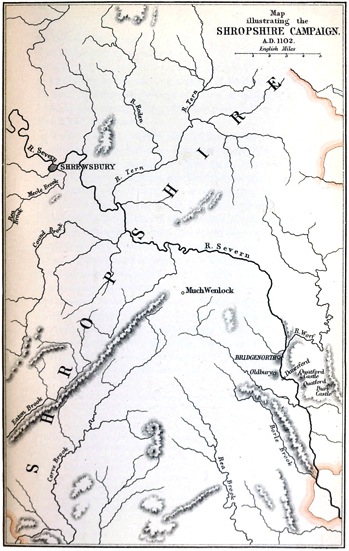
Map illustrating the SHROPSHIRE CAMPAIGN. A.D. 1102.
It is somewhat singular that in the line of defence traced by Robert’s father so commanding a site as that of the Bridge did not hold the first place. The strong place of Roger of Montgomery lies between three and four miles lower down the river. Older mound of Quatford. There, on the left, the English, side of the Severn, we meet with the first—first to one going up the stream—of our present group of fortresses. A bold height, of no very great positive elevation, marks the position of the church and mound of Quatford, standing side by side, as is so often seen both in our own island and beyond sea. The mound is a natural height rising close above the river, ditched and scarped as was needed, but raised only slightly above its original height. Quatford Castle. This elder fortification, the dwelling-place of some English thegn of the old time, seems to have given way, either before or after the coming of the Norman, to a stronghold a little way further up the river, which still bears the name of Quatford 154 Castle. A sandstone hill, standing isolated, near to the river but not immediately on its banks, was, like the smaller and older post, improved and raised into a castle mound, perhaps by Earl Roger himself, perhaps by some earlier holder. Earl Roger’s house. There the Survey records his new house and his borough; and we may fairly see his work in the well which still remains bored deep in the heart of the rock.[410] In the days of King Eadward the lordship of Eardington had been held by Saint Mildburh of Wenlock. His chapel. But, if Earl Roger, who passes for the refounder of that house,[411] did any wrong to its patroness, he may be held to have atoned for it by the collegiate chapel which he raised at Quatford. It was founded at the request of his wife, not the proud and cruel Mabel, but her pious and gentle successor Adeliza. A pleasing legend is told of the origin of the chapel and of the house, a legend which, if it contains any kernel of truth, points to Earl Roger as having been the first to occupy Quatford Castle as a dwelling, and which may account for the restoration of the far more tempting site of the old fortress of the Lady being left to be the work of his son.[412]
155 The new rule now began, and the home of Roger and Adeliza was forsaken by Earl Robert for the far stronger point higher up the river, and on the opposite, the right or Welsh bank.[413] Robert of Bellême removes to Bridge (north). Here, in contrast to the mere fords at other points, to Quatford itself and to the Danesford above it, stood the bridge which still forms so marked a feature, and which had given the spot its name. Bridge then, the stronghold of Æthelflæd, became the stronghold of Robert of Bellême; and now, perhaps from its position with regard to his father’s dwelling at Quatford, it came to be specially distinguished as Bridgenorth. A steep cliff overhangs the river at a point where the opposite ground is high, where the stream is far wider than it again becomes lower down, and where the channel is divided by an island, such as those by which the Danes loved to anchor, whether in the Seine or in the Severn. Oldbury. And, as the Danes are recorded to have wrought a work in clear distinction from the burh which the Lady afterwards timbered, we are tempted to see that work in a mound not far from the bridge, and on the same side as the river, but not rising immediately above the river’s banks. A natural height has been ditched, scarped, and raised to a level somewhat lower than that of the cliff immediately above the stream, the cliff which was chosen for the fortress, first of the Lady and then of the rebel Earl. It is plainly in opposition to this last that the place had, before the time of Domesday, received the name of Oldbury, which is still borne by the parish in which it stands.[414] The cliff itself, the site of the castle and town of Bridgenorth, has a peninsular shape so strongly marked that it is hard to believe that the river runs on one side of it only, and that Bridgenorth and Oldbury are divided, not 156 by a stream, but by a dry valley, in those days doubtless not dry, but marshy. Oldbury and Bridgenorth. The sites of the older and the newer fortress still look on one another, though the older has again become only a grassy mound, while the younger grew into a fortress, parish, and town, and still remains a parliamentary borough.
The position of the great fortress of the oppressor is a noble one. The mere height of the cliff at Bridgenorth is so much lower than many of the surrounding hills of that lovely region that it makes less show than might have been looked for in the general view. But, as we stand close under it on the other side of the river, we feel that Bridgenorth needs only buildings of equal majesty on its height to make it rank with Lincoln, with Le Mans, almost with Laon itself. But against the proud minsters of those cities Bridgenorth has nothing to set in its general view save two church towers, one of them modern, whose ugliness is not relieved by the fact that it represents the castle church, the college of Bridgenorth, transferred thither by Robert of Bellême, when he moved castle, church, and everything from their older home at Quatford. Bridgenorth castle; But Bridgenorth still keeps one object of surpassing interest in our present story, that which is of a truth the very cradle and kernel of the place, the shattered keep of Robert of Bellême. Robert’s keep. There we have the good luck which we enjoy but seldom in examining the military remains of this age, the strongholds of the men of the Conquest and their immediate successors. Most commonly we light on little more than the mere site, or the works of earlier or of later times; it is only now and then that we actually see, in however imperfect a state, some piece of genuine masonry belonging to the time with which we are dealing. This satisfaction we have in no small measure at Bridgenorth. There is the square keep of the terrible founder of the 157 fortress, broken down, riven asunder by some explosion in the warfare of later times—what is left of it driven to overhang its base like the tower of Caerphilly or the Muro Torto of Rome—but still keeping its main and distinctive features, still showing, in its flat pilasters, its double-splayed windows,[415] the traces of its double-sloped roof with the deep gutter,[416] what that stern, hard, tower was when the Devil of Bellême first called it into being. We can just trace the gateway which the keep commanded between the inner and outer courts of the castle, and we can see the ruins of the advanced building which sheltered the actual entrance of the keep itself. The square tower, so characteristic of Norman military work, is after all so rare in this its earlier form that every such fragment as this of Bridgenorth calls for most attentive study. Here we see the highest advances in the art of defence, as practised by the man whose name makes us shudder through almost every page of our story. At Bridgenorth nature had done almost everything. The tall and steep cliff called for nothing to be done in the way of mounds and ditches. It was enough to fence in the height—that the Lady had doubtless done after the fashion of her age—and to raise the keep—the distinctive feature of Earl Robert’s age—as the last shelter in case of attack from the land side. The churches and town of Bridgenorth. We can trace the inner and outer courts, the latter containing the unsightly church which represents the college within the castle. The other church stands nearly on a level with the castle, parted from the castle hill by a dip which takes the form of a steep road--Cartway is the name it 158 still keeps—leading down from the town to the river. Few stronger or more striking sites of its own scale could have been found. The Castle by the Bridge is not a mountain fortress; far higher hills than the hill of Bridgenorth or the hill of Quatford come within the general view. But the stronghold of Æthelflæd and Robert served better than any loftier point could have done for its own immediate work. No other point could have served so well to guard the most important point of the river, and to shelter the older borders of England against any desperate attempt of the Britons to carry their endless warfare far within her later borders. The group of fortresses. The whole group, Bridgenorth, Oldbury, the two Quatfords, are a succession of strongholds which form a whole. All are within sight of one another, though it might be hard to find a point which directly commands all four at once. Burf Castle. A little further inland, on the Quatford side of the river, a broad hill, fenced in by a slight earthwork, and known as Burf Castle, commands the widest and most striking view of all, the round back of the Wrekin, the sharp rise and fall of the Titterstone, with a boundless view over the lower country to the north-east. This is undoubtedly the site of an early stronghold, which may have played its part in the days of the Lady or in the old time before her. But there is no sign that it entered into the military reckoning of Roger of Montgomery or of Robert of Bellême.
The great engineering works at Bridgenorth seem to have occupied the mind of Earl Robert during the whole of the few remaining years of his English career. We shall find that they were not fully finished four years later. Robert builds the castle of Careghova. At the same time, while he fenced in Bridgenorth in the rear of the capital of his earldom, he raised another stronghold in advance of it, within the later 159 Welsh border, at Careghova, immediately on Offa’s Dyke.[417] And he was at the same time extending his possessions in a more peaceful region, where no inroads of Britons or Northmen were to be feared. His Yorkshire and Nottinghamshire estates. On the borders of Yorkshire and Nottinghamshire stood a chief seat of one who, in the extent of his possessions, ranked as one of the foremost men in England. This was Roger of Bully, who took his name from a Norman lordship in the land of Braye, lying west of what was to be the New Castle of King Henry, on the high ground which overlooks the forest of Saint-Saen, the home of the faithful Helias. Roger of Bully. The name of Roger of Bully—the spellings of the name are endless—is less commonly mentioned in our tale than we might have looked for. He was a great land-owner in Yorkshire; he was one of the greatest land-owners in Nottinghamshire, and he held considerable estates in other parts of England. He had supplanted two English earls in their special homes; he sat by the hearth of Eadwine and by the hearth of Waltheof; in another spot, the holdings of ten English thegns had been rolled together into a single lordship to enrich the fortunate stranger.[418] His Yorkshire estates. Among his Yorkshire 160 estates he held the exceptionally favoured lands of Sprotburgh and Barnburgh, which had remained untouched in the general harrying of Northumberland.[419] He seems to have won the special favour of the greatest ladies of the Conqueror’s court; if he held the hall of Hallam, the hall of Waltheof, it was by the gift of Waltheof’s widow Judith;[420] and an estate which he held in distant Devonshire is set down as the gift of Queen Matilda herself.[421] Yet this man, who holds so great a place in the Survey, plays no visible part in history; he lives only in the record of Domesday and in his still abiding work in a minster and a castle of his own rearing. Just within the borders of Yorkshire, at no great distance from the shires both of Nottingham and Lincoln, Roger had occupied an English dwelling-place, entered in the Survey as Dadesley, but which afterwards grew into greater note by the name of Tickhill.[422] Position of Tickhill. Like many other dwelling-places of English lords, Dadesley or Tickhill must have been chosen simply as a convenient centre for the estates of its owner. It is no natural stronghold; the post seems to have no special military advantages; it crowns no steep, it commands no river, it bars the entrance to no valley. The castle. A low hill of sandstone was improved by art into one of the usual mounds, and it had been in King Eadward’s day the 161 possession of Ælfsige and Siward. The mound, as in other places, was in after time taught to bear a polygonal keep, and its sides were themselves strengthened by masonry. The keep, of which the foundations only are left, was of later date than the days with which we are concerned. And we may fully believe that parts at least of the circuit wall of the castle, and still more, that the elder parts of the gatehouse, with a face of ornaments and sculptures which almost remind us of the work of the great Emperor’s day at Lorsch, are due to the taste, such as it was, of the first Norman lord of Tickhill.
The nomenclature of the lands of Roger of Bully has been singularly shifting. Dadesley gave way to Tickhill. But Tickhill is not the only name borne by Roger’s stronghold. It not uncommonly takes the name of a more certain memorial of him which lies only a few miles off, but within the bounds of another shire. The priory of Blyth, founded 1088. In the year of the first rebellion of the Red King’s reign, Roger of Bully had founded a monastery dependent on the abbey of the Holy Trinity at Rouen. It was reared on a point of his possessions known as Blyth, lying within the borders of Nottinghamshire, and near a river which joins the old historic stream of the Idle.[423] The nave of Roger’s church still stands; there is no mistaking the distinguishing marks of the earliest Norman style, even in a building whose loftiness and narrowness have more in common with later forms of art.[424] Blyth became at 162 least as famous as Tickhill. Name of Blyth and Tickhill used indiscriminately. The castle, with the honour of which it formed the head, is called by both names, and we shall find as we go on that the same incident in our story is placed by some of our authorities at Blyth and by others at Tickhill.[425] Death of Roger of Bully. Roger, founder of both castle and monastery, seems to have died about the time when Robert of Bellême was strengthening himself at Bridgenorth and Careghova. His lands went at once to swell the possessions of the terrible Earl. On some plea of kindred, Robert demanded them of the King. The lands of Roger of Bully granted to Robert of Bellême. William was as ready to grant him the lands of Blyth and Hallam as he had been to grant him the earldom of Shropshire and the other possessions of his father. But he was no more inclined than he was then to grant anything without a consideration. Earl Robert was allowed to redeem the heritage of his kinsman, but to redeem it only on payment of a great sum.[426] Impolicy of the grant. We may again doubt whether William the Great would have 163 allowed such a redemption, even in the days when he had fallen into covetousness and greediness he loved withal. With the Conqueror neither greediness nor anything else ever came before policy. He whose policy it had been to separate Norman and English estates in the second generation, who had taken care that no son of his own chosen friend should hold Breteuil and Hereford in a single hand,[427] would surely never have allowed any one man to have reached the gigantic height of wealth and power which was now reached by Robert of Bellême. Greatness of Robert of Bellême. The gathering together of such vast possessions in Normandy and England in the hands of one who had some pretensions to rank as a prince beyond the bounds of Normandy and England almost amounted to a direct challenge to their owner to dispute the great lesson of Rochester, and to see whether there was not at least one subject in England whom the King of England could not control.
That question had yet to be tried, and to be tried in the person of the new lord of Tickhill. But it was not raised during the short remnant of the days of William the Red. The two powers of evil contrived to pull together in friendly guise as long as the days of unlaw and unright lasted. And the longer those days lasted, the blacker and the bitterer they grew. The greater the power and wealth which was gathered together in the hands of Robert of Bellême, the greater, we are told, was the pride and cruelty of that son of Belial.[428] He may by this time have grown weary of oppression in the familiar scenes of his evil deeds on both sides of the sea. The death of Robert of Bully 164 opened to him a new and wide human hunting-ground in Nottinghamshire and Yorkshire. But his hold on all that he had within our island was fated to be short. We are drawing near to the end of the reign and the life of William Rufus, and, when the reign and life of William Rufus were over, the English power of Robert of Bellême did not last long.
But before we come to the last days of the Red King in his island kingdom, we must again cross the sea, to follow the warlike campaigns of his latest days, to trace out the wide-reaching schemes of dominion which filled his restless soul, his fitful energy in beginning enterprises, his strange waywardness in leaving them half done. And now will come the living contrast between unright, as embodied in William Rufus, and right, as embodied this time, not in a man of the church and the cloister, but in a man of his own order, a layman, a prince, a soldier. We have had one chapter where the main interest has gathered round Anselm of Aosta; we are now coming to another in which the main interest will gather round Helias of La Flèche.
165