Chapter V · (continued 2)
Reading edition
Sickness of the Bishop of Durham. One of the great men of the realm, who, whether guilty or not, seems to have been at least suspected, died, while the Assembly was in session, before any formal charge had been brought against him. Before the Bishop of Durham came to Windsor, it was known in his own diocese that he had not long to live. Portents foretelling his death. One of his knights, Boso by name, had, while lying under a dangerous sickness, been favoured with trances and visions, which told him much that was comforting about the monks of Durham, and much that was fearful about other folk. He saw the old inhabitants of the land, he saw the new French settlers, above all, he saw the priests’ wives—these seem to be looked on as three classes of offenders, gradually increasing in blackness—suffering each a grievous doom.[126] His visions about the 60 Bishop himself might perhaps point to an intermediate destiny; at all events they were understood as implying his speedy death.[127] His work at Durham. 1083. 1093. His work perhaps was done. Thirteen years before he had filled the church of Durham with monks;[128] three years before he had begun the great work of its rebuilding; and, by pressing it on with almost incredible speed, he had carried it on so far as to set an example of unsurpassed grandeur in its own style, an example which his own monks could not follow, but which Randolf Flambard could.[129] He is summoned to take his trial. William of Saint-Calais came to the Gemót, and was summoned by the King to appear to take his trial.[130] He pleaded sickness 61 as his excuse for not appearing. Rufus declared, with his usual oath, that the excuse was a feigned one.[131] He sickens and dies. December 25, 1095-January 1, 1096. It was however thoroughly real. Bishop William was sick, and sick unto death. He was smitten on the day of the Nativity, and died on the day of the Circumcision.[132] His death-bed. He was comforted in his sickness by the presence and exhortations of several of his brother bishops who had come together for the business of the Assembly. There was Anselm whom he had withstood at Rockingham; there was his own metropolitan Thomas; there was Walkelin of Winchester; there was John of Bath, born, like himself and Anselm, beyond the bounds either of England or of Normandy. Debate as to his burying-place. These prelates debated concerning the place of his burial. They argued that he who had done such great things for Saint Cuthberht’s abbey should be buried in the place of highest honour within its walls. He himself declined any such place. He would be no party to any breach of Saint Cuthberht’s own rule, which forbade that any man should be buried within his minster.[133] The bishops therefore ruled that he should be buried in the chapter-house, so that his monks, when they came together, should have the tomb of their founder ever before their eyes.[134] So it was; 62 He is buried in the chapter-house. he was borne to Durham, and there laid in the place which the bishops had chosen for him, among the tears and wailings of the brotherhood which he had founded, any one of whom, we are told, would gladly have died for him.[135]
This touching picture of the death which ended the varied life of William of Saint-Calais comes as an episode in the middle of the stern doings of the Gemót of Windsor and Salisbury. The Red King did not bear the sword in vain. Sentences of the Gemót. Yet, if his justice was sharp towards those whom it did smite, it was certainly somewhat capricious, or at least guided by expediency, with regard to those whom it smote and those whom it failed to smite. Some of the offenders were men of the highest rank, some even, it is implied, of the rank of Earl. But these powerful rebels, ashamed and weakened by the fall of their brother of Northumberland, were now deemed fitting objects of mercy. By the advice of the Wise Men, they were spared a public trial;[136] but some of them were made to pay a heavy price for being left safe in life, limb, and estate. Hugh of Shrewsbury buys his pardon. One is mentioned by name. Earl Hugh of Shrewsbury, who was at least suspected of a share in the plot, was dealt with privately by the King 63 as his father had been at Arundel.[137] He bought his restoration to favour at the high price of three thousand pounds.[138] Roger of Lacy. Roger of Lacy lost his lands and was banished, as he would have been in the days of King Eadward, and his possessions were given to his loyal brother Hugh. But heavier penalties, unknown in King Eadward’s days, were in store for others of the conspirators, including one of the loftiest descent. January 13, 1097. At the adjourned meeting at Salisbury, Geoffrey of Baynard, bearing a name famous in London city, appealed no less a man than William of Eu of treason against the King, of conspiring to slay him, and to give his crown to Stephen of Champagne.[139] Combat of Geoffrey of Baynard and William of Eu. The charge was denied, and, as both parties were Frenchmen, the trial was, by the law of the Conqueror, referred to the wager of battle. The judicial combat which followed is memorable in the history of the time, and forms one of the landmarks in our early jurisprudence.
Defeat of William of Eu. On the plain of Salisbury the combatants met, and William of Eu was overthrown.[140] By the laws of the combat his defeat was full evidence of his guilt. But what was to be his punishment? Save the case of the 64 beheading of Waltheof, there was no precedent in the ordinary jurisprudence either of England or of Normandy for any sentence harsher than banishment, forfeiture, and imprisonment.[141] The older English precedents went for banishment and forfeiture. The precedents of Normandy and of Norman rule in England went for imprisonment, such an imprisonment, it might be, as that of Robert of Mowbray. For the course actually taken there was no precedent in either land, unless it were the dealings of Harold the son of Cnut with the Ætheling Ælfred.[142] Sentence of mutilation on William of Eu. The punishment decreed was that of bodily mutilation. Urged by Hugh of Chester. It is said that this course was proposed by Earl Hugh of Chester, and that on a singular ground. William of Eu was the husband of the Earl’s sister—her name is not mentioned. He had neglected his wife, while he had three children by a mistress.[143] If this was to be ground for the loss of eyes or limbs, the brothers of the Countess Ermentrude would have had a right to demand that the portly person of Earl Hugh should be cut down to a shapeless trunk.[144] Feeling with regard to mutilation. Mutilation, it should be remembered, was a familiar punishment, a punishment which in that generation aroused no horror when the persons so dealt with were held to be real criminals.[145] But, with that common inconsistency which reverses the sound rule of smiting the leaders and sparing the commons, mutilation, death, or any heavy punishment, seems always to have aroused horror, or at least amazement, when it was inflicted on any criminal of lofty rank. Such things had been done in the isle of Britain and out of it, but hardly by the 65 solemn sentence of the King of the English at the head of his Witan. But now William of Eu was blinded, and underwent a fouler mutilation as well.[146] His sentence was seemingly carried out at Salisbury, perhaps in sight of the assembly. Are we to infer that any show of indignation was called forth by the bloody sight, when we read directly afterwards that some of the lord of Eu’s fellow-sufferers were taken to London, and were blinded or otherwise mutilated there?[147]
Story of Arnulf of Hesdin. If we may trust a tale to be found in one of those secondary writers who often preserve scraps of truth, another accused man appealed to the wager of battle with better luck than William of Eu. This was Arnulf of Hesdin, a man whose name is familiar enough to us in Domesday, though it does not call up any distinct personal idea like the King’s unlucky kinsman.[148] He is set before us as a man of great bodily stature, brave and active, and in the enjoyment of large possessions, out of which he and his wife Emmeline had made gifts to the abbey of Gloucester.[149] He was charged, unjustly and enviously we are told, with the same crime as the rest.[150] His innocence proved by battle. He defended himself by his champion, who proved his lord’s innocence by overthrowing a man of the King’s who was matched against him.[151] But Arnulf 66 was so stirred up with wrath and grief at the unjust charge, that, notwithstanding the King’s entreaties to stay, he threw up all the lands that he held of him, and left England for ever.[152] He goes to the Crusade, Before the end of the year, the Crusade offered him worthy occupation elsewhere. He marched with the Christian host as far as Antioch; he there fell sick, and declined all medical help; none should heal him save Him for whose sake he had gone on pilgrimage. and dies. Arnulf, professing the opposite doctrine to Asa of Judah, fared no better than that king. Antioch was the last stage reached by the armed pilgrim of Hesdin.[153]
Confiscation of lands. Arnulf, according to this story, became landless, as far as England was concerned, by his own act. Others underwent the same loss by sentence, it seems, of the Assembly. Count Odo of Champagne and many others lost their lands.[154] In one case only does death seem to have been inflicted. William of Alderi is condemned to death. William of Alderi, cousin and steward of William of Eu, was, as the Chronicle tells us, “hanged on rood.”[155] This somewhat startling formula doubtless means nothing but ordinary hanging; but it seemingly marks hanging of any kind as something which was not ordinary. As to the guilt or innocence of William of Alderi we have contradictory accounts. One weighty authority declares him to have been a sharer in the plot.[156] Others class him among many brave and 67 guiltless men who were ruined by the charges brought by Morel and by Geoffrey of Baynard.[157] Guilty or innocent, he was, we are told, a man of high birth, goodly presence, and lofty spirit.[158] He was moreover the King’s gossip, bound to him by the same tie which bound Morel to Malcolm. We thus incidentally learn that there were those whom William Rufus had held at the font, and for whose Christian faith and Christian life he had pledged himself. But the spiritual kindred went for nothing with the Red King. The King refuses to spare him. Many of the great men are said to have earnestly begged for the life of William of Alderi, and to have striven to move the King’s greed by a mighty bribe. The Conqueror had refused Harold’s weight in gold as the price of his Christian burial; his son refused three times the weight of William of Alderi, both in gold and in silver, as the price of his life.[159] Why Rufus was so bent on his death does not appear; but nothing could move him. It marks the way in which the King’s will practically ordered everything, even in so great an assembly of the realm as that which had now come together, that William of Alderi was condemned and hanged without any attempt to rescue him, though many believed him to be guiltless, and though powerful men were eager to save him. His pious end. When hope was gone, he made an ending at once as pious and, according to the ideas of other ages, more manly than the ending of Waltheof. He confessed his sins to 68 Bishop Osmund, and was, seemingly at his own asking, scourged in the new-built minster and the other churches of the city on the waterless hill.[160] Then he gave away his clothes to the poor, and went naked or slightly clad to the place of hanging, staining his limbs with blood by often kneeling on the rough stones.[161] The Bishop and a crowd of people followed him to the place. He then made the most solemn protestations of his innocence. The Bishop sprinkled him with holy water, said the commendatory prayer, and then withdrew.[162] It was not for Osmund of Salisbury, whatever it might have been for Odo of Bayeux or Geoffrey of Coutances, to look on what was next to come. The work of death was then done, and all who beheld wondered that not a groan escaped the victim as death drew near, and not a sigh in the act of dying.[163]
Last days of William of Eu. There was thus a marked difference in the fate of the kinsmen and chief officers of the two leaders, if leaders they both were, in the conspiracy. The steward and cousin of William of Eu was done to death, while his master underwent a fate which to modern ideas seems worse than death. We are not told how long William of Eu lived on in blindness and misery; but his punishment did not involve forfeiture, at all events not corruption of blood; for a few years later we find his son Henry in possession of his county.[164] End of Morel. The steward and nephew of Robert of Mowbray seems to have gained but little by 69 the act which, if it were formally allowed to be loyalty to the King, was likely to be far more commonly looked on as treason to his immediate lord. When he saw that his kinsman and master was condemned to life-long bonds, he left England, and died in banishment, poor and hated of all men.[165]
§ 3. The Conquest and Revolt of Wales. 1093–1097.
Relations with Wales. These years, so rich in events in Scotland and on the English lands nearest to the Scottish border, were at least equally rich in events on the other border of the English kingdom, towards the lands which were still held by the remnant of our British predecessors. Wars with the Welsh may be looked for, as a matter of course, in every reign during this period; but in the reign of William Rufus such wars form a special feature, and the position which they hold is a little singular. Nature of the Welsh wars of Rufus. It is plain from the records of the time, it is still plainer from the results, that this reign was a time of great and lasting advance at the cost of the Britons. It was the time when large parts of Wales were more or less fully brought under the authority of the English crown. Territorial advance and military ill-success. It is still more distinctly the time when Norman adventurers, subjects of the English crown, carved out for themselves, as its vassals, possessions and lordships within the British land. Yet the first impression which we draw from the writers who record the British warfare of this reign is that it was a time of ill success on the English side, especially in those campaigns in which the King himself took a part. The Chronicler records an expedition, and he sends up a wail at its ill luck. Nothing came of 70 it; horses and men not a few were lost; the Welsh escaped to their moors and mountains where no man might come at them. One chief is put to flight in a battle, but the others go on doing mischief all the same.[166] The same story comes almost every year; one would think that the warfare of the Red King with the Welsh was a warfare than which none was ever more bootless. And a historian who aspires to more of critical and philosophical insight sums up the whole British warfare of the reign as a distinct case of failure.[167] Yet it is clear from the result that it was not so. And one passage in the Chronicle seems to give us the key to the whole matter. “When the King saw that he could there further nothing of his will, he came back into this land, and took rede that he might let make castles on the borders.”[168] Effect of the building of castles. An expedition which seemed mere failure, in which many men and horses were lost, while the Welsh escaped to moors and mountains with hardly any loss at all, was really successful in the long run, if it led to the building of a border castle. The Britons fled unhurt to their mountains; but while they lurked in the fastnesses where none might come at them, the most valuable part of their land was taken from them bit by bit. When they came down again from the mountains, they found a castle built, they found so much land as the castle could protect 71 changed into a settlement of strangers. The lands might be harried; the castle might at some favourable moment be broken down; but it was sure to spring up again and again to do its work. The lasting possession of the fertile land had passed away to the invaders; the moors and mountains alone were left to the sons of the soil.
Welsh campaigns of Harold and of William Rufus. The mention of these Welsh wars naturally carries us back to the thought of the great Welsh campaign of a generation earlier. We see how true, from one point of view, was the saying of the next century that none since Harold had known how to deal with the Welsh as Harold had known.[169] As a matter of military success, the failures of William Rufus stand out in marked contrast to the victories of Harold. The Red King had no pillars to set up to mark where he had overcome the Briton in open fight.[170] A single word helps us to at least one part of the cause. Use of horses. Harold, in his victorious campaign, must have undergone some loss of men, but he underwent no loss of horses. He found that the English tactics were not suited for British warfare, and he made his housecarls turn themselves into light-armed Welshmen.[171] But the Norman tactics were still less suited for British warfare than the English. There were places in the moors and mountains which the mailed housecarl might reach, if with difficulty, but which the mounted knight could not reach at all. But William Rufus does not seem to have suited his tactics to the country as Harold had done; the mention of horses suggests that he repeated the old mistake of Ralph the Timid in a worse shape.[172] Immediate defeat and lasting success. As a matter of fighting then, Rufus failed where Harold had succeeded; but as a matter of enduring conquest, the failures of Rufus did more than the successes of Harold. Harold 72 indeed had no general schemes of Welsh conquest. Different objects of Harold and Rufus. He overthrew the Welsh; but, except in the districts which were definitely ceded to England,[173] he made no attempt to occupy Wales. He gave back the land whose people he had overcome to princes of their own blood, bound to him simply by their oath of homage.[174] But wherever Rufus or his lords planted a castle, there was at once a piece of Welsh soil occupied, and a centre made ready for occupying more. The object of Harold in short was simply the defence of England; the object of William Rufus was the conquest of Wales.
Comparison of the conquest of Wales with the English and Norman Conquests. The conquest which now began, that which we may call either the English or the Norman Conquest of Wales, differed widely both from the English Conquest of Britain and from the Norman Conquest of England. It wrought far less change than the landing at Ebbsfleet; it wrought far more change than the landing at Pevensey. The Briton of those lands which in the Red King’s day were still British was gradually conquered; he was gradually brought under English rule and English law; but he was neither exterminated nor enslaved nor wholly assimilated. He still abides in his ancient land, still speaking his ancient tongue. The English or Norman Conquest of Wales was not a national migration, like the English Conquest of Britain. Nor was it a conquest wrought under the guise of an elaborate legal fiction, like the Norman Conquest of England. William Rufus did not ask the people of Wales to receive him as their own lawful king; he did not give himself out to all mankind as the true heir of Gruffydd the son of Llywelyn, defrauded of his rights by perjured usurpers. Europe had passed the stage at which a conquest of the earlier kind was possible; and there was in this case no excuse or opportunity for a conquest of the later kind. William 73 Rufus was not a man to seek, like his father, to justify his acts by legal fictions; nor had he the same room for devising them as his father had. He had doubtless, with the crown of the Old-English kings, inherited their claims to Imperial supremacy over the whole island; he called himself “Monarch of Britain” no less than the kings who had gone before him.[175] But that monarchy gave him no claim to bring the lands of his subordinate princes under his immediate rule. If an invasion of Wales needed any justification in the eyes of William Rufus and his barons, that justification would take the shape of reprisals. We may be sure that there was no moment when the men on the border, either on the English or the Welsh side, could not have brought some complaint against the other side which might have been deemed to justify reprisals by a more scrupulous prince than the Red King. But for men like the Norman adventurers of his day it was enough that a land adjoining to the land which they had made their own lay open to be conquered. Geographical conditions of the conquest. Therein lay another great difference between this conquest and either of the other two conquests with which we have compared it, in the fact that the land to be won lay adjoining to the land which was already won. The Angles and Saxons wholly forsook their old homes beyond the sea, and, if the Normans in England did not in the same way wholly forsake theirs, the sea at least rolled between the old home and the new. But the Norman whose lot was cast on the Welsh frontier of England had nothing to do but to press on from the point where he already was. He had simply to add on the next field to his own field, subject to such resistance as the actual occupiers of the next field might be able to make. From this geographical cause, while the 74 Norman Conquest of England was in no sense an extension of Normandy, the English or Norman Conquest of Wales was in every sense an extension of England. Extension of England by conquest and settlement. The Normans in England did not bring Normandy with them; they had from the very beginning to put on more or less fully the character of Englishmen, and to live according to English law. But the Norman who from England went on into Wales had no thought of putting on the character of a Welshman or of living according to Welsh law. Wherever he settled, he most truly carried England with him, such as England had been made through his own coming. But then for a long time he settled only here and there in the British land. Where he did settle, the speech, the laws, the national life, of the Briton passed away in such sort as the speech, the laws, the national life, of the Englishman never at any moment passed away from England. But alongside of these conquered districts there long remained independent districts, where the natives under their native princes still bade defiance to the invaders. England had already an uniform aspect; it was the old England with certain changes; its laws were the laws of King Eadward with the amendments of King William. Wales, for a long while after the time with which we are now dealing, was as far from uniformity as any land east of the Hadriatic. Various elements in Wales. Here was the castle of the Norman lord, with his following, Norman, English, Flemish, anything but British. Here was the newly-founded town, with its free burghers, again Norman, English, Flemish, anything but British. Here again was a whole district from which the Briton had passed away as thoroughly as he had passed away from Kent or Norfolk, but which the Norman had not taken into his own hands. The Flemings. He had found that it suited his purpose to leave it in the hands of the hardy and industrious Fleming, the last wave of Low-Dutch occupation in the 75 isle of Britain. And alongside of all, there was the still independent Briton, still keeping his moors and mountains, still ready to pour down from them upon the richer lands which had been his fathers’, but which had passed into the stranger’s grasp. Those days have long passed away; for three centuries and more Briton and Englishmen have been willing members of a common state, willing subjects of a common sovereign. But the memory of those days has not passed away; it abides in the most living of all witnesses. Endurance of the Welsh language. England has for ages spoken a single tongue, her own ancient speech, modified by the coming of the conquerors of eight hundred years ago. But in Wales the speech of her conquerors, the speech of England, is still only making its way, slowly and fitfully, against the abiding resistance of that stubborn British tongue which has survived three conquests.[176]
Local nomenclature of Wales. The results of this state of things, where so many contending elements so long stood side by side, are still to be seen on the face of the British land. The local nomenclature of Wales tells a wholly different tale from that of England. Contrast with that of England. In England the nomenclature is everywhere essentially Teutonic; we might say that it is everywhere essentially English; for the names given by the Danes form one class along with those given by the Angles and Saxons, as opposed either to Celtic survivals or to Romance intruders. Both these two last classes are in England mere exceptions to the general law of Teutonic nomenclature. Teutonic and French names. But in Wales, while the great majority of the names are Celtic, the Teutonic names are somewhat more than exceptions. In some districts, as I have already said, they are the all but invariable rule. French names, too, though not very common, are, I think, less rare than in England. Places bearing two names. Nothing is more 76 common than for a place to bear different names, according as English or Welsh is spoken. And these names sometimes translate one another, and sometimes do not. All this is natural in a land where distinct and hostile races so long dwelled side by side, each one a thorn in the side of the others. It marks a kind of conquest different alike from the conquest where the conquered vanish from the soil and from the conquest where they swallow up their conquerors.
The Welsh castles. There is again a visible feature, one so characteristic of the scenery of Wales as to be all but a natural feature, which arises out of the nature of the conquest with which we have now to deal. The traveller who comes back, I will not say from the land of the Grey Leagues, but from that nearer land of Maine with which our tale will soon have so much to do, to one of the hilly districts of England, feels something missing in the landscape, or in the memories called up by the landscape. On the isolated hill, on the bluff which ends the long ridge, he comes instinctively to look for the shattered castle or for the lines which show that the castle once stood there. Lack of castles in England. It is one of the special signs of what English history has been, one of the signs which should make us thankful that it has been what it has been, that in England those bluffs, those island hills, on which the castle or its traces can still be seen, are in truth few and far between. After all that we hear of castles and castle-builders, the castle was, at any moment of English history save the nineteen years of anarchy, a rare thing in England compared to what it was in other lands. Houses in England. Save where there was a town to protect or to keep in obedience, save where there was some special post of military strength that needed to be guarded, the lord of an English lordship, in whichever host his forefather had fought on Senlac, found that a simple manor, sheltered perhaps by some slight defence, 77 served his purpose as well as the threatening tower. Border castles. On all the borderlands it was otherwise; the pele-tower of the north is but the Norman keep on a miniature scale. And, above all, Wales is, as every one knows, pre-eminently the land of castles. Through those districts with which we are specially concerned, castles, great and small, or the ruins or traces of such castles, meet us at every step. It was needful to strengthen every height, to guard every pass, while the moors and mountains, the Asturias or the Tzernagora of the Cymry, still remained unsubdued. The castles are in truth the leading architectural features of the country; the churches, mostly small and plain, might themselves, with their fortified towers, almost count as castles. The Welsh towns. The towns, almost always of English foundation, were mostly small; they were military colonies rather than seats of commerce. As Wales had no immemorial cities like Exeter and Lincoln, so she had no towns which sprang up into greatness in later times, like Bristol, Norwich, and Coventry. Every memorial of former days which we see in the British land reminds us how long warfare remained the daily business alike of the men of that land and of the strangers who had made their way into it at the sword’s point.
Advance before the accession of Rufus. We have seen that neither the days of Eadward nor the days of the elder William were days of peace along the Welsh border. The English frontier had advanced during both reigns. Rhuddlan,[177] Montgomery,[178] Cardiff,[179] had become border fortresses of England. An indefinite tract of North Wales was held by Robert of Rhuddlan;[180] Radnor was an English possession;[181] the followers of Earl 78 Roger of Montgomery had harried as far as the peninsula of Dyfed.[182] The whole land seems to have made some kind of submission to William the Great at the time when he made his pilgrimage to Saint David’s, and set free so many of his captive subjects.[183] Robert of Rhuddlan. But real conquest does not seem to have gone very far beyond the border fortresses, as within the march of the Marquess of Rhuddlan it did not go very far from the coast. In the days of the rebellion we have seen that the hearts of the Cymry rose again, and that they again ventured on offensive warfare with no small effect. They and their Scandinavian allies had broken the power and taken away the life of the man who had so long kept their northern tribes in awe. Rhys ap Tewdwr. In that work we have seen that Rhys ap Tewdwr, the King of Deheubarth, whose dominions took in the greater part of South Wales, had a hand.[184] Under him Cedivor seems to have been the vassal prince of Dyfed. The reign of Cedivor ended in a time of misfortune, ominous of greater misfortunes to come. Saint David’s robbed by pirates. 1091. The shrine of Saint David was robbed. The holy bishop Sulien died, and presently his church and city, the holy place of Saint David, were again sacked by the pagans of the isles.[185] Is this simply a traditional way of speaking of Scandinavian invaders, or were there still any wild wikings who avowedly clave to the faith of Odin? Then Cedivor himself died, and his sons revolted against their over-lord Rhys, but were again overthrown.[186] This was the year of the Red King’s siege of Saint Michael’s Mount, the 79 year of his journey to the North; and one account hints that the movements in Wales as well as in Scotland had a share in bringing him back from the mainland.[187] But it is not till two years later that Welsh warfare began to put on enough of importance for its details to be recorded by English writers.
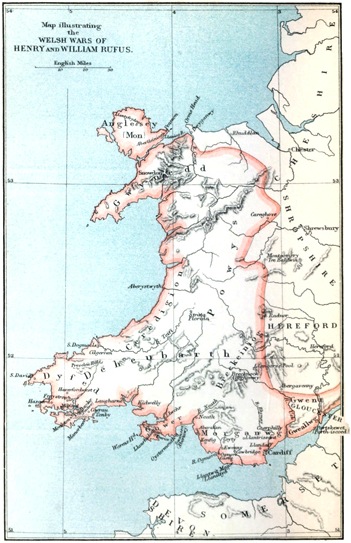
Edwᵈ. Weller
For the Delegates of the Clarendon Press.
Map illustrating the WELSH WARS OF HENRY AND WILLIAM RUFUS.
Beginning of the Conquest of South Wales. 1093. It seems to have been in the year of Anselm’s appointment, the year of Malcolm’s death, that the conquest of South Wales began in earnest. It seems now to have been for the first time taken up by the King as part of the affairs of his kingdom. But the geography of the campaign shows that a gradual advance must have already begun along the south coast. Our public entries are concerned only with the land stretching nearly due west, from the mountains of Brecknock and Abergavenny to the Land’s End of Saint David’s. This leaves out the sea-land which, with the bold curve of its coast, projects to the south, the land of Morganwg or Glamorgan. Yet it may be taken as a matter of course that this land was not left to be won later than inland Brecheiniog and far distant Dyfed. Legend of the conquest of Glamorgan. The unlucky thing is that, while the conquest of Brecheiniog and Dyfed is recorded in notices which, though meagre enough, are fully trustworthy as far as they go, the conquest of Morganwg, strangely left out in all authentic records, has become the subject of an elaborate romance which has stepped into the empty place of the missing history. The romance is, as usual, the invention of pedigree-makers, working, after their manner, to exalt the glory and increase the antiquity of this and that local family. This is perhaps the meanest of the many forms of falsehood against which the historian has to strive; but it is also one of 80 the strongest and most abiding, and one which is specially strong and abiding on the northern coast of the Bristol Channel.[188]
The legend pieces itself on to that point of the genuine history when the sons of Cedivor were defeated by Rhys ap Tewdwr. Story of Jestin and Einion. A brother of Cedivor, Einion by name, who had been in the service of either the elder or the younger William, and had served the King in his continental wars, now flees to another enemy of Rhys, Jestin son of Gwrgan, described as prince of Gwent and Morganwg.[189] Jestin promises his daughter to Einion with an ample estate, if he can obtain help from England against the common enemy Rhys. This, it is supposed, Einion’s friendship with the King and his knights will enable him to do. Nor was Jestin’s hope disappointed. Story of Robert Fitz-hamon and his knights. No less a man than Robert Fitz-hamon hearkened to the invitation of Einion; he set out at the head of a company of twelve knights and their followers to give help to the prince of Morganwg. Their joint forces overcame Rhys in a battle on the borders of Brecheiniog, and Rhys himself, flying from the field, was taken and beheaded. His kinsmen and followers seem to have been killed or dispersed, and we are told that Robert Fitz-hamon and his companions, being well paid for their services by Jestin, went away towards London. Then Einion demands his reward; but Jestin says that he will not give either his daughter or his land to a traitor. Einion recalls Robert. Then Einion persuades Robert and his companions to come back, and take Jestin’s dominions for themselves. They are of course in no way unwilling; and they are joined by some of Jestin’s Welsh enemies. Jestin is driven out, and his land is partitioned. The rough mountain land is assigned to Einion and his Welsh companions, and Einion also marries Nest the daughter of Jestin. 81 Robert Fitz-hamon and his twelve knights divide the fertile vale of Glamorgan among them. Division of Glamorgan. Each man establishes himself in a lordship and castle, and all do homage to Robert as lord of Glamorgan, holding his chief seat in his castle of Cardiff. Share kept by the children of Jestin. But, while the traitor Einion obtains so sorry a portion, a son of Jestin is admitted to a share in the rich vale, and is allowed to hand on his lordship to his descendants. Another of the family, a grandson of Jestin, Gruffydd son of Rhydderch, refuses to submit, withstands the invaders in arms, contrives to defend Caerleon, and to hand on to his son Caradoc a principality in Gwent, seemingly east of the Usk.
Estimate of the story. Now how much of this story is to be believed? Jestin is a most shadowy being, of whom personally nothing is recorded. But there is evidence enough for the existence of his descendants, and for their retention of an important lordship in Glamorgan.[190] This may make us inclined to put some faith in the account of the transactions between Jestin, Einion, and Robert Fitz-hamon. Elements of truth. The general outline of the tale is perfectly possible, except the very unlikely story that Robert or any other Norman, when once standing in arms on British or any other ground, simply marched out again after receiving a fair day’s wages for a fair day’s work. Settlement of Robert Fitz-hamon at Cardiff. That Robert Fitz-hamon did conquer Glamorgan and establish himself at Cardiff cannot be doubted. The settlement of some of his followers is equally historical; but the list of them as given in the legend is untrustworthy, Legendary names in the list. as containing names of families which did not 82 appear in the district till later. That the Normans were invited by a Welsh prince to help him against his enemies, and that they then took his lands to themselves, is quite possible, though the story rests on no certain evidence. That the Norman invaders took the valuable land, the fertile vale, to themselves, and left the rugged mountains to the Britons, is doubtless a true description of the general result, though it is not likely to have been caused by any formal division. The only thing to suggest such a division is the portion which was kept by the descendants of Jestin. But such an anomaly as this last might be accounted for in various ways. The defeat and death of Rhys in Brecheiniog is beyond doubt, and it is not unlikely that Robert Fitz-hamon may have had a hand in it; but at all events the date is utterly wrong.[191] Question of Jestin’s descendants. The most unlikely part of the story is that which describes a grandson of Jestin as founding a principality in that part of Gwent which had already long been an English possession. This story might almost seem to be a confusion with an event of earlier times. We are tempted to think that the Caradoc son of Gruffydd and grandson of Rhydderch, who now settles himself in Gwent, is a mythical repetition of the Caradoc son of Gruffydd and grandson of Rhydderch who destroyed King Eadward’s hunting-seat at Portskewet.[192]
Robert Fitz-hamon; Robert Fitz-hamon, conqueror of Glamorgan—for of his right to that title there is no doubt—has his place in the history of this reign and of the early years of the next. other notices of him. We have already heard of him as one of the few faithful among the Normans in England at the time of the great rebellion against the present King.[193] Son or grandson of the famous rebel of Val-ès-dunes,[194] he had an elder brother of his father’s name, 83 who appears, with the title of Dapifer, among the land-owners of eastern England.[195] He holds the lands of Brihtric. He had himself, at one time in the present reign, received those lands which had once been Brihtric’s, which had then been Queen Matilda’s, and which had been afterwards held or claimed by the Ætheling Henry.[196] These made him great in the shires of Gloucester and Somerset, shires from which he might look with a longing eye towards the lands beyond the Severn and the Severn sea. To these, it appears, was added the honour of Gloucester, or rather the lands of Brihtric were made into an honour of Gloucester for his benefit.[197] He marries Earl Roger’s daughter. He married a daughter of Earl Roger, Sibyl by name,[198] and so had the privilege of being brother-in-law to Robert of Bellême. Marriage of his daughter to Robert of Gloucester. His daughter Mabel, heiress of her uncle as well as of her father,[199] became, as we have often had occasion to notice, the wife of King Henry’s son Robert, 84 with whom Gloucester became an earldom. His works at Gloucester and Tewkesbury. He founded the abbey of Tewkesbury, one of the line of great religious houses along the Severn, where his work may still be seen in the vast pillars and mysterious front of his still surviving minster.[200] To the older abbey of Gloucester he was a bountiful benefactor. And the nature of his gifts to these two favoured houses would be almost enough of itself to enable us to set down Robert Fitz-hamon as conqueror of Glamorgan. Grant of Welsh churches to English monasteries. Gloucester and Tewkesbury were enriched at the cost of the churches of Glamorgan, proof enough that he who could thus enrich them had won great possessions in Glamorgan. The holy places of the Briton, Llantwit and Llancarfan, with a crowd of churches of lesser note, supplied the conqueror with an easy means of being bountiful with no cost to himself.[201] So again the mere fact that a man who held such a position as that of Robert Fitz-hamon, one who, though not an earl, ranked by possessions and connexions alongside of earls, plays so small a part as he does in the recorded history of the reign, might almost of itself suggest that he was busy on some enterprise of his own, such as that which legend assigns to him. Conquest of Glamorgan. When the mound by the swift and shallow Taff was crowned by the shell-keep of Cardiff, the progress of invasion was not likely to tarry. The fertile 85 lowlands from the mouth of the Taff to the mouth of the Neath were a natural accession to the lowlands of Gwent which were already won. They were won; they were guarded by a crowd of castles. Building of castles. And the winning of the land, the building of the castles, events about which the genuine local history is strangely silent, were, there is not the slightest reason to doubt, the work of Robert Fitz-hamon and of the men who shared with him in that work.
Distinction between Morganwg and Glamorgan. In strict geographical accuracy the names Morganwg and Glamorgan do not answer to one another.[202] Morganwg in the wider sense is said to have taken in a vast district from the Severn to the Towy, while Glamorgan, said to be called from a prince named Morgan in the tenth century, was less than the present county, taking in only the vale. The distinction between the two was preserved in the style of the lords of “Morgania and Glamorgania.” Extent of Glamorgan. But the country with which we have now to deal may be practically looked on as answering to the present county, somewhat cut short to the west and somewhat lengthened to the east. It takes in the present Monmouthshire between Usk and Rhymny; it does not take in the peninsula of Gower. This last, with the town of Swansea on its isthmus, still forms no part of the diocese of Glamorgan or Llandaff; it marks its formerly distinct character by still belonging to the diocese of Saint David’s. Within this district Robert Fitz-hamon and his successors the Earls of Gloucester held a position like that of the Earl of Chester or the Bishop of Durham. Without bearing their lofty titles, the Lord of Glamorgan practically held, like them, a vassal principality of the crown. Like the other lords marchers, he held most of the powers of kingship within his lordship, and the position of his lordship enabled 86 him to carry out those powers more thoroughly than most of his fellows.[203] Cardiff castle. The chief seat of the lord was at Cardiff on the Taff, where the castle had been, as we have seen, founded in the Conqueror’s day.[204] Bishopric of Llandaff. A little higher up the river was the seat of the bishopric of Glamorgan at Llandaff, with its church, most unlike Le Mans or Durham, nestling by the river at the foot of the hill. Under the chief lord settled several lesser lords, tenants-in-chief, we may almost venture to call them, within Glamorgan, who founded castles and families, and under whom the land was again divided among a crowd of smaller tenants. Some of these lesser lords held within their own lordships powers almost equal to those of the lord of Glamorgan himself. William of London. First perhaps among them was the house founded by William of London, better known under the French form of Londres.[205] The name suggests some thoughts. Who was a William of London in the days of William Rufus? A Norman doubtless, but hardly a Norman of any very lofty rank in his own land. May we follow the analogy of the great bearer of the same name in the next age, and see in him the son of a Rouen citizen settled in London in the very first days of the Conquest, or even in the days of the Confessor? Kidwelly and Ogmore. The house of London spread beyond the bounds of Glamorgan; their chief seat was at Kidwelly; but within the lordship of Fitz-hamon the square keep of Ogmore and the fortified priory of Ewenny, one of the most precious specimens of the Norman minster on the smallest scale, still remain as memorials of their presence. Richard Siward. But the name of Siward—its first bearer appears in the legend as Richard Siward—bespeaks English or Danish descent, and we are tempted to see in the colonist of 87 Glamorgan a son or grandson of Thurkill of Warwick.[206] Pagan of Turberville at Coyty. Pagan of Turberville held Coyty, married a Welsh heiress, and became the founder of a house whose feelings became British rather than Norman or English. Aberafan held by the children of Jestin. Aberafan, the fortress at the mouth of the Glamorgan Avon, remained in the hands of the descendants of Jestin, the only native line which, like such Englishmen as Thurkill, Eadward of Salisbury, Coleswegen and Ælfred of Lincoln, abode on its own ground on equal terms with the conquerors. They alone shared the fertile plain with the strangers; the rest of their countrymen, even those who held acknowledged lands and lordships, were confined to the barren hills.[207]
The lords and their castles. These few families have each something in their name and history which entitles them to special notice. A few others were of really equal eminence from the first, and the legend, to make up the full tale of twelve peers, adds on several names of later date. These great lords, and a crowd of smaller land-owners as well, built each man his castle; in Glamorgan the peaceful manor-house, soon to become the rule in England, seems to have been the reform of a much later day. The castles with which we are to deal are of course for the most part castles of the older and simpler type; it was not till long after the times with which we are dealing that Caerphilly, with its mighty gateway-towers, its princely hall, its lake wrought by the hand of man, became the proudest of South-Welsh fortresses, the peer of Caernarvon itself. Caerphilly lies indeed beyond our immediate range, in the land still left to the natives, parted off by hills from Cardiff and from the rich plain which the conquerors kept for themselves. Not a few others of the famous castles of the district belong to times far too 88 late for us. The South-Welsh churches. From the castles the churches also caught a military air, and kept it during the whole time of mediæval architecture. The fortified towers of Glamorgan have the military character less strongly marked than the towers of Pembrokeshire; but it is marked quite strongly enough to strike the English visitor as something altogether in harmony with the endless traces of castles which meet him at every step. He sees at once that a state of things which in England existed only during the first years of the Conquest, or which more truly, unless during the nineteen years of anarchy, never existed at all, went on in the half conquered British land for ages.
Saxon settlements in South-Wales. The leaders in the settlement were of course mainly Norman. It has been acutely remarked that they mostly came, as followers of Robert Fitz-hamon most naturally would come, from the old lands of Brihtric in Gloucestershire and Somerset. They doubtless brought with them an English following, a strictly Saxon invasion of South Wales. Among the Teutonic settlers in this district, it is not easy to distinguish the Saxon from the Fleming. The Flemings in Pembrokeshire. It must always be remembered that, while the Flemish settlement in Pembrokeshire is matter of history, the Flemish settlements in Gower and Glamorgan are merely matters of inference.[208] Foundation of boroughs. The English and Flemish settlers were doubtless the chief inhabitants of the boroughs which now began to arise under the shadow of the castles. Cardiff, Kenfig, Aberafan, and Neath, arose on the coast or on the rivers from which some of them took their names. Cowbridge and Llantrissant lay in the inland part of the vale; the last, a borough mainly British, was the only one which held at all a commanding site among the hills. In later times these towns sank into insignificance—Kenfig indeed well nigh perished under heaps of sand. 89 But some of them have in later times been called up to a new life by the wonderful development of mineral wealth which has changed the barren hills which were left to the Briton into one of the busiest regions of our whole island.
Ecclesiastical affairs. In ecclesiastical matters the conquest of this district was for awhile chiefly marked, as has been mentioned, by the spoliation of the ancient British foundations, to the behoof of the conqueror’s favourite monasteries at Gloucester and Tewkesbury. Llandaff. The bishopric of Llandaff or Glamorgan kept its place, though it never became, either in the extent of its possessions or in the fabric of its church, at all the peer of Saint David’s. Ewenny. Cistercian foundations. Ewenny arose, if not in the very first days of the conquest, yet within the first or second generation. The Cistercian movement reached this district early. Neath. 1130. The abbey of Neath arose in King Henry’s time, under the patronage of Earl Robert;[209] and in the last year of his life, while the anarchy still raged, the same earl, the most renowned of the lords of Glamorgan, Margam. 1147. found means to found the more famous abbey of Margam.[210]
The conquest of Glamorgan thus stands out as an event which is altogether unrecorded in authentic history, but of which it is not hard to put together a picture from its results. Other parts of the conquest of South Wales are more clearly entered in both British and English annals. Conquest of Brecknock. The mountain land of Brecheiniog must have been occupied early in the reign of Rufus, if not earlier still. Bernard Newmarch. Its conqueror, Bernard of Neufmarché, better known in the English form of Newmarch, has already figured in our story;[211] and he was clearly 90 in possession when William Rufus lay sick and penitent at Gloucester. His followers are then spoken of as the French who inhabited Brecheiniog. By that time then the upper valley of the Usk, from Abergavenny westward, must have been already subdued. The rich land of the holy King Brychan, with his twenty-four sainted daughters—the church where the worship of one of them turned the people of the land into frenzies which offended the soberer devotion of the Norman[212]—the rivers full of fish, the lake of marvels, the whole pleasant valley cut off by its hills from the extremes of heat and cold[213]—all had passed away from British rule. The castle of Brecknock. Bernard had doubtless by this time reared on the hill of Aberhonwy at least some rude forerunner of the castle of Brecknock, the fragments of which still stand, facing the southern mountains, alongside of the massive church of his own priory, the church which he made his far-off offering to Saint Martin of the Place of Battle.[214] Bernard’s gifts to Battle Abbey. We know not whether Bernard had by this time striven to confirm his power on British soil by a marriage which connected him with the noblest blood, alike British and English. His wife Nest. His wife Nest united the blood of Gruffydd with the blood of Ælfgar. We are not told the name or race of her father;[215] but her mother was Nest the daughter of Gruffydd and Ealdgyth, the stepdaughter of Harold, the half-sister of 91 his twin wanderers, the granddaughter of Ælfgar and his perhaps Norman Ælfgifu.[216] Nest thus came on the spindle-side from Godgifu the mirror of English matronhood; but the woman who shamelessly avowed to King Henry that her son was not the son of her husband Bernard hardly walked in the steps of her renowned ancestress.[217] During that memorable Lent, while King William lay sick at Gloucester, the new lord of Brecknock found it needful to gather his strength to withstand an attack from the people whom he had despoiled. Defeat and death of Rhys at Brecknock. 1093. The Britons came together under Rhys the son of Tewdwr, the king of whom we have often heard, and who must have been at this time the most powerful prince of South Wales.[218] He invaded the invaders; and in the very Easter week, while matters were busy between William and Anselm on the one hand, between William and Malcolm on the other hand, a battle took place near Brecknock. There Rhys was killed, by the help, according to the Glamorgan legend, of Robert Fitz-hamon. According to the same legend, Rhys did not fall in open fight, but as a prisoner to whom quarter was refused. Another account describes him as being slain by the treachery of his own men. His death was marked as an epoch in the history of Wales. End of “the kingdom of the Britons.” With him, the native historian writes, fell the kingdom of the Britons, a phrase which an English writer seems to have misunderstood as meaning that after him no Welsh prince bore the kingly 92 title.[219] The overthrow of Rhys led to great movements in other parts of South Wales. Effect of the death of Rhys. We can hardly doubt that, whether Robert Fitz-hamon had a hand in the fight at Brecknock or not, his settlement in Glamorgan was at any rate already begun. But the fall of Rhys laid the lands to the south-west, the lands of Ceredigion and Dyfed, open to invasion; and two sets of invaders were equally ready to make the most of the chance which was now laid open to them. The British enemy came first. Cadwgan harries Dyfed. April 30, 1093. Cadwgan son of Bleddyn, who had once before driven Rhys from his throne,[220] seized the moment of his death to carry a wasting inroad into Dyfed.[221] He was presently followed by invaders who were to do something more than make a wasting inroad. Norman conquest of Ceredigion and Dyfed. July 1, 1093. “About the kalends of July the French for the first time held Dyfed and Ceredigion, and set castles in them, and thence occupied the whole land.”[222]
These words of the British annalist mark a most important stage in the occupation of his country. The campaign of this summer completed the conquest of South Wales, so far as a land could be said to be conquered which was always revolting, and where native chiefs still kept, sometimes by their own strength, sometimes by formal acknowledgement, such parts of the land as the invaders could not or did not care to occupy. But it was now 93 that a land was planted with castles which is still pre-eminently the land of castles; Pembrokeshire. it was now that a land was brought under the power of those who bore rule in England which was itself to become a new England beyond the line of the Briton. Ceredigion, the land of Cardigan, the vale of Teifi with its still abiding beavers,[223] the sites of the castles of Aberystwyth and Cilgerran, of the abbey of Strata Florida and the priory of Saint Dogmael, were added to the dominion of the conquerors. Thence they pressed on to the extreme south-western land, and added Dyfed by a new name to the possessions of the English crown. Tale of Rufus’ threats against Ireland. A tale has been told how the Red King himself made his way to the most western point of all, to the headland of Saint David’s; there, from the treeless rocks, he looked over the sea to the land beyond, which may now and then be seen on a cloudless evening. Then he boasted that, lord as he was of Britain, he would be lord of Ireland too, how he would gather round that headland the fleets of his whole kingdom, and would make of them a bridge by which he might pass over and win the great island for himself. The tale goes on to tell how, when the threatening words were brought to King Murtagh,[224] he asked whether the King of the English had added to his threat the words, “If God will?”[225] The Red King had not used 94 the formula which he hated to hear even from the lips of others,[226] and the Irish prince at once answered that he did not fear the coming of one who meant to come only in his own strength, and not in that of the Most High.[227]
Estimate of the story. The tale is eminently characteristic of William Rufus; yet it sounds somewhat like an echo of the real visit and the real schemes of the great William translated into the boastful language of his son. The Conqueror did visit Saint David’s;[228] he did plan the conquest of Ireland;[229] but it is not likely that he threw the expression of his designs into such a shape as that which William Rufus would have been likely enough to choose. The younger William may have made his way to Saint David’s; but it is not easy to find a time for his coming, either in this year or in any other. Acquisition of Saint David’s. But, whether through his coming or not, Saint David’s itself passed under the obedience of the conquerors. Bishop Wilfrith. We presently find its bishop, a bishop spoken of as a Briton, but bearing the English name of Wilfrith, acting in their full confidence.[230] But the holy place, deep in its hollow, was left to be guarded by its own holiness. No castle of king or earl or sheriff invaded its precincts; the home of its bishop did not, as at Llandaff, take the form of a castle looking down upon the minster, but that of a peaceful palace resting by 95 its side. The conquerors pressed on, through the land of Cemaes and Emlyn and by the hills of Preseleu, till they reached the south-western land, the land of creeks and peninsulas, where the tides of Ocean rise and fall beneath the walls of far inland towns and fortresses. Milford Haven. In those waters the wandering wiking had seen the likeness of his own fiords, and he had left his mark here and there on a holm, a gard, a thorp, a ford, some of them bearing names which seem to go back to the gods of Scandinavian heathendom.[231] The Norman won the land, to hand it over in the next reign to the Flemish settlers, who rooted out whatever traces of the Cymry Northmen and Normans had left. Two of the chief towns, Pembroke and Tenby, kept their British names in corrupt forms.[232] Milford and Haverford would seem to have been already named by the Northmen. The Pembrokeshire castles. On every tempting point overlooking the inland waters, sometimes on points overlooking the Ocean itself, castles arose, some of which grew into the very stateliest of their own class. Tenby, Haverfordwest—Manorbeer, birthplace of Giraldus[233]—Caerau, connected with so many famous names of later date[234]—and a crowd of castles of lesser note, witness the means by which the conquerors knew how to hold down the land which they had won.
At the head of all stands the great fortress which 96 gave its name to a town, a shire, and a long line of earls, and in our own time to a great workshop of the naval strength of the land. Pembroke Castle. Pen bro, the head of the sealand, grew into Pembroke, with its vast castle rising on a peninsula above two arms of the inland sea—with its stately hall looking down on the waters—with the deep cave underneath its walls, with the huge mass of the round tower—with the one hill-side covered by the houses and churches of the town, the other crowned by the long line of the priory of Monkton, with its stern square tower and its now roofless choir. Pembrokeshire buildings. The character of military strength and simplicity, which is stamped in a lesser measure on the churches and houses of Glamorgan, comes out in all its fulness in the churches and houses of Pembrokeshire. Of all this the days of which we are speaking saw the beginnings, but only the beginnings. The castle begun by Arnulf of Montgomery. On the tongue of land between the two creeks a fortress was raised by Arnulf of Montgomery, son of Roger and Mabel, a man of whom we have already heard and shall hear again. But his defences were as yet small and feeble as compared with what was to follow; the first castle of Pembroke was a mere earthwork with a palisade.[235] Second building of Gerald of Windsor. 1105. Arnulf placed his work under the care of a valiant knight named Gerald of Windsor, who afterwards was the beginner of a castle 97 of greater strength on the same spot.[236] His wife Nest. In after times he married a wife of the noblest British blood, yet another Nest, the daughter of Rhys son of Tewdwr, and grandchild through her mother of that Rhiwallon who had received a kingdom at the hands of Harold.[237] Before her marriage she was the mother of one of the sons of King Henry, though assuredly not of the great Earl of Gloucester.[238] In later days, through another marriage, she became the grandmother of Giraldus Cambrensis.
The course of events in North Wales during these years is less easy to mark with exact dates. But it is plain that the death of Robert of Rhuddlan had been only a momentary triumph for the Cymry, and that it had not given any real check to the Norman power. Hugh of Chester in Anglesey. Earl Hugh of Chester, strong on the border of the continental Britons, still held a hand no less firm on their island kinsfolk. Castle of Aberlleiniog. He even pressed on into Anglesey, and there built a castle, most likely at Aberlleiniog on the eastern coast of the island, a spot of which we shall have to speak again more fully in recording a memorable day later in our story. Advance of Earl Roger in Powys. Earl Roger meanwhile, from his capital at Shrewsbury and his strong outpost at his new British Montgomery,[239] pushed on his dominion into Powys. The King at least approved, if he did not at this stage help in the work; Castle of Rhyd-y-gors. the castle of Rhyd-y-gors was built at the royal order by William son of Baldwin.[240]
98 The conquest of Wales was thus, to all appearance, nearly complete. Seeming conquest of Wales. The two great earls were going on with their old work in the north, while in the south the tide of conquest was advancing with such speed as it had never advanced before. In the south-east Gwent and Morganwg seemed to be firmly held, while in the south-west the torrent of Norman invasion had rushed by a single burst from the hill of Brecknock to the furthest coast of Dyfed. In the south at least the only independent region left was that which lies between the conquest of Robert Fitz-hamon and the conquest of Arnulf of Montgomery. Gower and Caermarthen unsubdued. Gower, with its caves, its sands, its long ridge, where the name of Arthur has made spoil of a monument of unrecorded times—with its Worm’s Head looking out in defiance at the conquered land beyond the bay—the whole range too of coast with its sandy estuaries, from the mouth by Llwchr to the mouth by Laugharne—Kidwelly also, not yet crowned by the gem of South-Welsh castles—Caermarthen and the whole vale of Towy—were still unsubdued. Otherwise the Britons might truly say with their chronicler that on the death of Rhys their kingdom passed away from them. 1093–1094. So things slept while Anselm received his archbishopric, while Malcolm pressed on to die at Alnwick, while King William was kept by the winds at Hastings. Effects of William’s absence. But when the king was beyond the sea, when he and the great men of England were busy with Norman affairs—when Argentan bowed to Robert and Philip and when the brother of the conqueror of Pembroke was a prisoner[241]—when the great Earl, the father of both of them, had died with the cowl on his head at Shrewsbury—then the Britons deemed that the hour of deliverance was come. The English 99 Chronicler, though he does not at this stage help us to the names of British men or of British places, paints the general picture in his strongest colours; Revolt of the Welsh. 1094. “The Welshmen gathered themselves together, and on the French that were in Wales or the nighest parts and had ere taken away their lands, they upheaved war, and castles they broke and men they offslew, and as their host waxed, they todealed themselves into more. With some of those deals fought Hugh Earl of Shropshire and put them to flight. And none the less the others all this year never left off from none evil that they might do.”[242]
In this version the Norman or English champion stands clearly forth. We see that Earl Hugh had sharp work upon his hands from the moment that he stepped into his father’s earldom. The British writers give us a clearer sight of the geographical extent of the movement, and they help us to the name of its chief leader. Cadwgan son of Bleddyn. This was Cadwgan son of Bleddyn, whom we last heard of as harrying Dyfed, and who even now seems at least as anxious to make Dyfed a land subject to Gwynedd as to drive Normans, English, or Flemings, out of either. Thus the Britons were, as ever, in the words of the Chronicler, todealed; they were divided into local and dynastic parties. Divisions of the Welsh. Yet, as he puts it, even this division, if it did not give strength, at least delayed subjection. If Earl Hugh or any other leader of a regular force was able to overthrow one deal, another deal was ready all the same to do as much evil as before. But it was in 100 Gwynedd and under Cadwgan that the work began. General revolt of Wales. The Britons could not bear the yoke of the French; they rose, they broke down the castles, and, as men commonly do in such cases, they did by the invaders as the invaders had done by them. It is not very wonderful if, in their hour of victory, they revenged the reavings and slaughters done on them by the French with new reavings and slaughters done on the French themselves.[243] And, as our Chronicler hints, it was not only on the French within Wales, but on those also in the nighest parts that they rose. By this time the whole land had risen; South-Welsh and West-Welsh—that is now no longer the men of the peninsula of Cornwall, but the men of the peninsula of Dyfed—were in arms no less than the men of Gwynedd. Invasion of England. Gruffydd and Cadwgan burst into the neighbouring shires, Cheshire, Shropshire, and Herefordshire; they burned towns, carried off plunder, and slew Frenchmen and Englishmen alike.[244] The Saxon, 101 the old enemy, had not become less an enemy, because he had, through his own conquest, become an accomplice in the invasions of his conquerors. Deliverance of Anglesey. Gwynedd was now free; the deliverers crossed into Anglesey; Aberlleiniog castle broken down. they broke down the castle at Aberlleiniog or elsewhere, and put an end for a while to the foreign dominion in the island.[245]
The Britons now seemed to have altogether undone the work of the invaders. It was now time for vigorous action on the other side. The French—Hugh of Chester, Hugh of Shrewsbury, or any other—entered Gwynedd with a regular force; but if one deal was put to flight, another, under Cadwgan himself, claims to have overcome the invaders at Yspwys.[246] The path was now open for a march of the Britons to the south. Late in the year a general attack was made on all the castles throughout Ceredigion and Dyfed. Two only held out; Gerald of Windsor successfully defended Pembroke; William the son of Baldwin successfully defended Rhyd-y-gors.[247] Action of Cadwgan in Dyfed. But the warfare of Cadwgan was waged in the interest of Gwynedd, not in that of Dyfed. By a harsh, though possibly prudent policy, he enforced a migration somewhat in the style of an Eastern despot. The men and the cattle of Ceredigion and Dyfed—we must take so general a statement with those deductions which the laws of possibility imply—were transported to the safer region, and south-western Wales was made, so far as Cadwgan could make it, a wilderness.[248] Pembroke holds out. Gerald, in his castle among the 102 creeks, was left to lord it over whom he might find, and to feed himself and his followers how he might, in the wasted land. As far as we can see, Gwent, Morganwg, and Brecheiniog, remained in the hands of the conquerors. The rest of the British land, from the isthmus of Gower to the furthest point of Mona, was either free or a wilderness.
Question of a winter campaign. It is almost past belief that William Rufus could have found time for a winter campaign against the Welsh in the few weeks, or rather days, which passed between his return from Normandy at the end of December and his interview with Anselm at Gillingham in the middle of January.[249] December 28,1094-January, 1095. But there was plenty of fighting in the course of the year in Wales and elsewhere. The Britons seem to have kept their independence in the newly liberated districts, while the Norman conquerors of Glamorgan made a successful attack on the intermediate lands which had not yet been subdued. Conquest of Kidwelly, Gower, and Caermarthen. “The French laid waste Gower, Kidwelly, and the vale of Towy;” and we are further told that those lands, as well as Dyfed and Ceredigion, remained waste.[250] But if Normans laid waste, they did not simply lay waste, like the Welsh. What they found it expedient to lay waste for a season they meant to put in order some day for their own advantage. This was no doubt the time when William of London established himself at Kidwelly, and made the first beginnings of castle, church, borough, and haven.[251] It was now too that the way was at least opened for the work of colonization 103 which made Gower a Teutonic land. 1099. According to an authority to which we turn with a certain doubt, the actual settlement dates from five years later. Swansea Castle. The castles of Gower. Castles were built, Abertawy or Swansea guarding its own bay and the approach to the peninsula, Aberllwchr guarding the sandy estuary between the peninsula and the opposite coast to the north, Oystermouth, Penrice, Llanrhidian, on points within the peninsula itself.[252] Alleged West-Saxon settlement of Gower. And in this version the settlement is made, not by Flemings, according to the common tradition, but by West-Saxons brought across the channel from Somerset.[253] It is certain, as has been already said, that there is not the same historical evidence for Flemings in Gower which there is for Flemings in Pembrokeshire. But it is perhaps less important to fix the exact origin of each Teutonic settlement along this coast than to insist on the fact that, as compared with the native Cymry, any two branches of the Nether-Dutch stock, whether Flemish or Saxon, came to very much the same thing.
Along with this territorial advance on the part of the invaders, we hear, from the same somewhat doubtful quarter, of a movement among the invaders themselves which turned to the advantage of the natives. It is characteristic of the outwardly legal nature of the Norman Conquest of England that it gave no opportunity for a character not very rare in less regular invasions, the invading chief who finds it to his interest to separate 104 himself from his own fellows and to place himself at the head of those whom he has helped to subdue. In the conquests both of Wales and of Ireland there was room for such a part to be played, and the story sets before us one of the Norman conquerors of Glamorgan as playing it with some effect. Pagan of Turberville joins the Welsh. The lord of Coyty, Pagan of Turberville, married to a wife of the house of Jestin, took the side of his wife’s countrymen, and, we are told, went so far as to attack Cardiff on their behalf. The result, it is said, was a confirmation of the ancient laws of Wales on the part of the lord of Glamorgan. This, it is added, led many to transfer their dwellings from the disturbed parts of the country to the more settled lands under his rule.[254]
North Wales keeps its independence. Meanwhile in the northern parts of Wales the Britons still kept the independence that they had won by the struggle of the last year. They had got the better of the local powers on their own borders, and the King, busied with the peaceful opposition of Anselm and the armed opposition of Robert of Mowbray, had little time to spare from councils and sieges within his kingdom. Autumn, 1095. At last, towards autumn, while the siege of Bamburgh was going on, after he had himself turned away from it, and left the Evil Neighbour to do its work, William heard a piece of news from the British border which at once stirred him to action. One of the great fortresses of the march had fallen. In vain had Earl Roger made his nest on the rock to which he gave the name of his own Norman home.[255] The Welsh take Montgomery. Montgomery, Tre Baldwin, 105 was in the hands of the Britons, and all Earl Hugh’s men within it were slain.[256] William was wroth at the tidings, and he at once called out the fyrd of his realm, so much of it as was not needed for the lingering leaguer-work in Northumberland.[257] William’s invasion of Wales. Michaelmas, 1095. Soon after Michaelmas he entered Wales at the head of his host. He divided it into parties, and caused them to go thoroughly through the land. He reaches Snowdon. November 1. At last, by the feast of All-hallows, the whole army met together by Snowdon. If merely marching through a country could subdue it, William Rufus had now done a good deal towards the conquest of Gwynedd. But William Rufus was not Harold; the master of continental chivalry could not bring himself to copy Harold’s homely tactics. While the royal army scoured the dales, the Welsh betook them to the moors and mountains where no man might come at them.[258] Harold had found out the way to come at them; but the Red King knew it not. Ill-success of the campaign. All that he could do was to go homeward, when he saw that he there in the winter might do no more.[259] The British annalists, with good right, rejoice as they tell how God their people sheltered in the strong places of their land, and how the King and his host went away empty, having taken nothing.[260]
106 1096. The next year saw the bloody Gemót at Salisbury; it saw Europe pour forth its forces for the deliverance of Eastern Christendom; it saw the Red King become master of the Norman duchy. Among such cares, William had no time, perhaps he felt no strong call, for another Welsh campaign, either in winter or summer. But the lords of the marches could not be thus idle; with them the only choice was to invade or to be invaded. The year seems to have begun with another gain on the part of the Britons. The Welsh gain Rhyd-y-gors. 1096. William son of Baldwin, who had kept the castle of Rhyd-y-gors safe through all perils up to this time, now died. His spirit did not abide in his garrison; they left the castle empty, a prey to the enemy.[261] The spirit of the Britons, even in the lands which seemed most thoroughly subdued, now rose. Within the bounds of the present Glamorgan the favourable composition of the last year seems to have kept men quiet; but the lands to the east, parts of which had been so long under English rule, were now encouraged to strike another blow for independence. Revolt of Gwent and Brecknock. The natives were in arms along the whole line of the Usk; Brecheiniog, Gwent, and Gwenllwg, the land between Usk and Wye and the land between Usk and Rhymny, threw off, as their own writers say, the yoke of the French.[262] The marchers had now to act in earnest. English feeling towards the war. Our own Chronicler says mournfully how “the head men that this land held ofttimes sent the fyrd into Wales, and many men with that sorely harassed, and man there sped not, but man-marring and fee-spilling.”[263] We see that the old duty 107 of every man to fight for the land when called on had come to awaken some of the feelings which attach to a conscription. Men were, we may believe, ready for a campaign in Normandy or Maine, where plunder was to be had, and where there was most likely still some satisfaction felt in fighting against French-speaking enemies, even under French-speaking captains. To drive back Malcolm would come home to every man’s heart as a national duty; to dispose of Malcolm’s crown under the leadership of an English Ætheling might call up long-forgotten feelings of national pride. But who could be tempted by the prospect of a march to Snowdon, even in the fairest weather? What interest had the men of perhaps far-off English shires in rivetting the dominion of a Norman lord on the men of Brecknock or Pembroke? No doubt every Englishman was ready to drive back the Briton from Shropshire and Herefordshire; but it was an irksome and bootless work to go and attack him in his own land, a land from which even conquerors could draw so little gain. Even to win back Gwent, the conquest of Harold, was an enterprise which would lead mainly to man-marring and fee-spilling. Vain attempt to recover Gwent. Into Gwent however they were marched; but nothing was done; the land was not subdued; the army was even attacked on its retreat, and after great slaughter put to flight.[264] A second greater attempt came to nothing more. The grandsons of Cadwgan, Gruffydd and Ivor, attacked this army too on its return, and cut it also off at Aberllech.[265]
108 The British chronicler here makes a comment which fully explains the final issue of these wars. The Normans or English, whichever we are to call the hosts of England under the Red King, had thus for three years met with nothing but defeat. Yet they had in truth won the land. “The folk stayed in their homes, trusting fearlessly, though the castles were yet whole, and the castlemen in them.”[266] Effects of the castle-building. The fortresses might be hemmed in for a moment; but, as long as they stood whole with the castlemen in them, the newly won freedom of the open country was liable to be upset at any moment. In Gwent and Brecheiniog at least the natives might for the moment stay fearlessly in their homes; they might at some favourable point surprise and cut to pieces the armies that were sent against them; they might withdraw to moors and mountains when the invading force was too strong for them; but, as long as the castles stood firm, the real grasp of the stranger on the land was not loosened. How long a castle could stand out we see by the example of this very year’s campaign. Pembroke castle holds out. All the castles of Dyfed and Ceredigion had been destroyed two years before, save Pembroke and Rhyd-y-gors; and Rhyd-y-gors was now in the hands of the Britons. Pembroke, the castle of earth and wood, the outpost cut off from all help, still stood through the whole of these two years, the one representative of Norman dominion in the whole region of which it had become the head. No wonder that the Britons, victorious everywhere else, resolved on one great attack on this still unconquered stronghold of the enemy. The Welsh attack Pembroke. 1096. A host led by several chieftains of the house of Cadwgan, Uhtred son of Edwin,--one whom we should rather have looked for in Northumberland,--and Howel son of Goronwy, set forth and fought against Pembroke. Gerald of Windsor was hard pressed. One night, fifteen 109 of his knights, despairing of resistance, made their escape from the castle in a boat. Resistance of Gerald of Windsor. Their esquires were more faithful, and Gerald at once gave them the arms of knighthood, and also granted—or professed to grant to them—the fiefs of their recreant lords.[267] His devices. We read too how Gerald, to hide his real plight from the enemy, betook himself to some of those simple devices of which we hear in so many times and places. He had four swine in the castle; he cut them in pieces, and threw them over to the besiegers.[268] The next day he wrote or caused letters to be written sealed with his seal, saying that there was no need to trouble Earl Arnulf—he is made to bear the title—for any help for four months to come. His dealings with Bishop Wilfrith. These letters he took care should be found near a neighbouring house of Bishop Wilfrith of Saint David’s, as if they had been lost by their bearer.[269] They were read out in the Welsh army. The Britons, we are told, having no mind for a four months’ siege, marched away.[270] They claim to have marched away without loss, 110 with much booty, especially with all the cattle belonging to the castle.[271] Offensive action of Gerald. 1097. But the castle was not taken; it stood there to do its work; and early in the next year Gerald was harrying in his turn as far as the borders of Saint David’s.[272] Friendship for the Bishop perhaps kept him from harrying the holy soil of Dewisland itself.
This year, the King, as he had done two years before, deemed the affairs of Wales to call for his own presence, and for a greater effort on his part than ever. He had come back from taking possession of the mortgaged land of Normandy; Easter, 1097. he had held the Easter Assembly at Windsor somewhat after the regular time.[273] At that Assembly Welsh affairs must have formed a subject of discussion, as the King presently set out for Wales with a great host. This was the time when the knights sent by the Archbishop were deemed so unfit for their duty.[274] William’s second Welsh campaign. The King’s coming appears to have led to a seeming, perhaps a pretended, submission. Led by native guides, he passed through the whole country,[275] Seeming conquest. and he clearly believed that he had brought Wales to a state of peace. So he deemed when he came back to hold the Whitsun Assembly, the assembly in which Anselm for the first 111 time that year craved leave to go to the Pope.[276] But he was called back by a fresh revolt. Fresh revolt. The Welsh, in the emphatic phrase of our Chronicler, “bowed from the King.”[277] They had once bowed to him; now they bowed from him; they cast away his authority; perhaps they formally defied him in the strict feudal sense; certainly they defied him in the more general sense which that word has now come to bear. And now, for the first time in these wars, the English Chronicler gives us the name of a Welsh leader, a name which from British sources has long been familiar to us. Cadwgan. “They chose them many elders of themselves; one of them was Cadwgan hight, that of them the worthiest was; he was brother’s son of Gruffydd the King.”[278] The name of the great prince who had ruled all Wales, who had won the battle by the Severn,[279] who had put Earl Ralph to flight[280] and burned Hereford town and minster,[281] the prince whom it needed all the strength and all the arts of Harold to overthrow, was still famous even among Englishmen. The nephew of Gruffydd had this time too to dread no such tactics as had worn down his uncle on his own soil. William’s third campaign. June-August, 1097. King William set forth with a host of horse as well as of foot, vowing to put to death every male of the rebel nation.[282] Again the pomp and pride of Norman 112 chivalry was shivered against the natural defences of the land which was so rashly attacked. The Britons seem, by their own account, to have made the war a religious one; perhaps, like the Irish king, they deemed that higher powers would fight for them against the blasphemer. The King’s ill-success. Strengthened by prayers, fastings, and other pious exercises, the Welsh took to their woods and rocks and mountains, while the Red King’s host marched and rode bootlessly through the valleys and plains.[283] “Mickle he lost in men and in horses, and eke in many other things.”[284] This state of things went on from midsummer to August.[285] Then the King came back to hold two assemblies at unusual times, in the second of which he and Anselm met for the last time.[286] And now it was that he took that wise resolution which I have quoted above.[287] He determines to build castles. October, 1097. As invasions by mounted knights led to nothing but losing both the knights and their horses, he would build castles on the borders. This Harold, who knew so much better than William Rufus how to carry on a Welsh campaign, had not done. But then the objects of Harold and the objects of William Rufus were not the same.
We should have been well pleased to know what was the immediate result of the resolve for the building of 113 the border-castles. What were the fortresses which were built, as surely some must have been built, in obedience to it? This is the last entry which connects Rufus personally with Welsh affairs. But we can hardly help connecting this resolve with the building, a little time later, of several fortresses in the lands threatened by the Welsh, specially of one, the greatest of them all. Action of Robert of Bellême. 1098–1102. In the next year one part of the British land becomes the scene of a series of events of far-reaching interest and importance, but also of a local interest quite as great in its own way. We shall then see that, if the Red King did not do much in the way of building border-castles himself, much was done by others, of course with his approval, most likely by his order. Our next year’s tale brings Robert of Bellême to the Welsh border, and, where he was lord, castle-building went on with all vigour.
Affairs of Scotland. But before we enter on a branch of our story which touches all parts of the British islands, and many lands beyond the British islands, it may be well to take up the thread of our Scottish narrative at a point where the affairs of Scotland and those of Wales seem again to be brought into some measure of connexion. The year which saw that wise resolution of the Red King with regard to the Welsh castles, a resolution which really meant the final union of Wales with the English realm, saw also the end of those revolutions whose final result was, not the union of Scotland with the English realm—that was not to come about till long after, and by other means—but the extension of English influence within the kingdom of Scotland till it might be looked on as in truth a second English realm.
114 § 4. The Establishment of Eadgar in Scotland. 1097–1098.
Decree for action in Scotland. August, 1097. It must have been at one of the later assemblies of the year which we have now reached, most likely at the August gathering,[288] that the resolution was taken for vigorous action in Scotland. The King himself had had enough of Welsh warfare; he must have been already looking forward to those French and Cenomannian campaigns which form the main feature of the next year; he was in the middle of his final dispute with Anselm. But William Rufus seems always to have been well pleased to set others in motion, even on enterprises in which he did not share himself. Designs of the Ætheling Eadgar. So he gladly hearkened to the proposals of the Ætheling Eadgar for an expedition into Scotland. Its object was to overthrow the usurper Donald, as the chosen of Dunfermline was deemed at Winchester, to restore the line of Malcolm and Margaret, and to bring the Scottish kingdom once more into its due obedience to the over-lord in England.
Relations between Eadgar and the King. Our last certain notice of Eadgar sets him before us as enjoying the fullest confidence on the part of the reigning King, as sent by him on the important errand of negotiating with Malcolm and bringing him to William’s court at Gloucester.[289] Story of Godwine and Ordgar. One hardly knows what to make of the tale which describes him as awakening a certain amount of suspicion in the King’s mind later in the same year;[290] but that, either before or after this time, he was in some such danger appears from another tale in the details of which there may or may not be a legendary element, but which undoubtedly brings before us real persons and a real state of things. To this tale I have 115 already referred elsewhere, as having that kind of interest which belongs to every story in which we see any one of those who are recorded in the Great Survey as mere names stand forth as a living man, playing his part in the world of living men. However obscure the man, however small his deeds, there is always an interest in finding any part of the dry bones of Domesday clothed with flesh and blood. And the interest becomes higher when the man thus called forth out of darkness is a man of native English birth, and the father of one whom England may well be glad to reckon among her worthies.[291]
Eadgar accused by Ordgar. The story runs then that a knight of English birth, Ordgar by name, seeking favour with the King, brought a charge against the English Ætheling. He told William that Eadgar, trusting to his own descent from ancient kings, was seeking to deprive the reigning king of his crown. William hearkened to the accuser, and some grievous doom—would it have been the doom of William of Eu?--was in store for Eadgar, if his guilt—his ambition or patriotism—could be proved. The ordeal and the battle. But how was the charge to be proved or disproved? By Old-English law the appeal to the judgement of God in doubtful cases was by the ordeal; and, as between Englishman and Englishman, this rule had not been changed by the laws of the Conqueror.[292] But we can well believe that Englishmen who were admitted to a place in the Red King’s court had largely put on the ideas and feelings of Normans. They would doubtless look down on the ancient practice of their fathers, and they would be more inclined to follow the fashion of their Norman companions in better liking the more chivalrous test of the wager of battle. It seems in the present story to be taken for granted that the trial will be by wager of battle. But who will do battle 116 for Eadgar, when the royal favour is so clearly shown on behalf of Eadgar’s accuser? The Ætheling was sad at heart, forsaken, as it seemed, of all men. Godwine volunteers to fight for Eadgar. But at last one stepped forward who was ready to dare the risk on behalf of a man to whom he was bound by a double tie. As an Englishman he was stirred to come to the help of the descendant of the ancient kings, and he was further bound to Eadgar by the special tie which binds a man to his lord. He was a knight of noble English descent, known as Godwine of Winchester. Notices of him in Domesday. We know him in Domesday as a tenant of the Ætheling for lands in Hertfordshire, and the Survey further suggests that he may have had a private grudge against the opposite champion. There were lands in Oxfordshire which were held by an Ordgar, and which had been held by a Godwine. Duel of Godwine and Ordgar. The matter is to be decided by the hand-to-hand fight of the two English knights. For they so far cleave to the customs of their fathers that they fight on foot and deal handstrokes with their swords. Ordgar comes forth in splendid armour, surrounded by a crowd of courtiers.[293] Godwine has nothing to trust to but his sword and his good cause. But there was at least no attempt made to hinder a fair fight—so to do would have been altogether foreign to the spirit of the chivalrous king. The herald and the umpire do their duty;[294] the knights take their oath to forbear the use of all weapons but those which were needed in the knightly duel. A long and hard fight follows, the ups and downs of which are described with 117 Homeric minuteness. Victory of Godwine, and acquittal of Eadgar. Ordgar at last, sorely wounded, is pressed to the ground, with the foot of the victorious Godwine upon him.[295] As a last resource, he strives, but in vain, to stab Godwine with a knife which, in breach of his oath, he had treacherously hidden in his boot.[296] Godwine snatches the knife from him; Ordgar confesses the falsehood of his charge, and presently dies of his wounds.[297] Godwine now becomes an object of universal honour, and receives from the King the lands of the slain Ordgar, while Eadgar rises higher than ever in the King’s favour.