Chapter VI
Reading edition
THE LAST WARS OF WILLIAM RUFUS.[429] 1097–1099.
THE latter years of the reign of the Red King, Character of the last years of Rufus. 1097–1100. beginning from the departure of Anselm, are far richer in foreign than in domestic events. Even within the isle of Britain we have, as we have already seen, chiefly to deal with the lands which lie beyond the actual English kingdom. Scotland has received a king at the bidding of the over-lord in England. A deep plan has been laid for the better subjugation of the seemingly unconquerable Welsh. A Norwegian king has slain an earl of England in strife on the shore of a Welsh island. But within England itself the greatest event which we have had to record has been the immediate result of that distant strife in the succession to an English earldom. When Robert of Bellême became the most powerful subject in England, it was undoubtedly an event of no small importance both at the moment and in its results. It added perceptibly to the evils even of the reign of 166 unlaw. Still it was not in itself an event on the same scale as the rebellion of Odo or the rebellion of Robert of Mowbray, or as the beginning or the ending of the dealings between Anselm and the King. Little to record at home, and much abroad. And the same character of the time goes on to the end. There is in England itself nothing to record besides the great architectural works of the King, a few ecclesiastical deaths and appointments, and those natural portents and phænomena which are characteristic of the whole time, and which come thicker upon us as we draw nearer to the end. Beyond sea, on the other hand, this time of less than three years is the most stirring time of the whole reign. King of England, over-lord of Scotland, not in form Duke of the Normans, but master of Normandy as his brother never was, the Red King goes on to greater schemes. Rufus seems to have been always puffed up by success, but never cast down by bad luck. His personal failure in Wales was really a marked contrast to the success of Eadgar in Scotland. Temper and schemes of Rufus. But Rufus seems to have had the happy gift of plucking out of all states of things whatever tended to gratify his pride, and of forgetting all that looked the other way. He, or others in his name, had set up a king at Dunfermline. This was enough to make him put out of sight all thought that he had in his own person marched to Snowdon and taken nothing by his march. He felt himself more than ever Monarch of Britain, King of kings within his own island. We can believe that it rankled in his soul that, outside that island, he was less than a king. The lord of Normandy had in any case a formal over-lord in the French King, and William Rufus was lord of Normandy only by an anomalous and temporary title. He held the duchy only as a merchant holds a pledge. We can well understand how such a man would chafe at the thought that he had anywhere even a nominal superior. 167 Such an one as William deemed himself was dishonoured by being, even in the most nominal way, the man of such an one as Philip. His designs on France. And the noblest way of escaping from the acknowledgement of a superior was by himself taking that superior’s place. The Monarch of Britain would be also Monarch of Gaul, of so much at least of Gaul as in any sense admitted the over-lordship of Paris. The lord of Winchester and Rouen would be lord of Paris also. William wished for a war with France, and a war with France could at any moment be had. The eternal question of the Vexin stood always awaiting its solution.
Wars with France and Maine. But a war with France was not the only war which William Rufus had now to wage on the Gaulish mainland. He had to strive against a noble city, a valiant people, ruled by a prince worthy of his city and his people. Besides striving with France and Philip, he had to strive against Maine, he had to strive against Helias. The war with France was doubtless the object with which he crossed the sea; but mischief had long been brewing in the troublesome land to the south of Normandy, and about the time when the French war began, the standing Cenomannian difficulty grew into open war also. William had thus two wars to wage at once. These two wars, with France and with Maine, are told in our narratives as if they were altogether distinct, and had no bearing on one another. Yet the two were going on at the same time at no great distance from one another, and some of the chief actors on one side were flitting to and fro between the two. Beginning of war. 1097–1098. It is hard to say in which region the first actual fighting took place. In both it must have begun in the winter after Anselm had gone on one errand into Burgundy and Eadgar on another into Scotland. William crosses the sea. It was then that King William crossed the sea also, with the object doubtless of making war on France. The Cenomannian war was thrown in 168 as something incidental. The war with Maine has in itself, as a tale, by far the greater charm of the two. But it is needless to say that far higher interests were, or might have been, at stake in the war with France. Of the wide-reaching schemes of William Rufus, and of their remarkable position among those things which might have been but which were not, I have spoken at some length elsewhere.[430] But it is only in its latest stage that the war showed even any likelihood of growing beyond the scale of a border struggle. It was, in profession at least, a war for the Vexin, and it was in the Vexin that it was mainly waged.
Comparison of the two wars. The result of the war was widely different in the two cases. We may sum it up by saying that Maine was subdued and that France was not. Maine was at least held to be subdued. In the first Cenomannian war the capital was taken; the prince was made a prisoner; so much of the land as was really attacked was subdued. In the second war the capital was taken and the prince was driven out. But against France no real advantage at all seems to have been gained. To modern ideas this difference may seem no wonderful result of the difference between the invasion of a county and the invasion of a kingdom. Comparative position of France and Maine. But in the eleventh century the resources of Maine could not have been very greatly inferior to the resources of France. In one sense indeed the resources of Maine were by far the greater of the two, Helias and Philip. inasmuch as Helias reigned at Le Mans and Philip reigned at Paris. But in truth the comparison between a county and a kingdom is not a fair one. The France of those days was not a kingdom; it was simply that small part of a great kingdom which was held to obey—which under Philip certainly did not obey—the nominal king of the whole. The king was simply that one among the 169 princes of the kingdom who always claimed, and who sometimes received, the homage of the others. Advantage of the kingly dignity. We must never underrate the vast moral advantage which the king drew from his kingly dignity;[431] but, on the other hand, we must not be thereby led to overrate the material strength of the king’s actual dominion. Supposing that the resources of Maine and of France had been positively equal, if Helias had the advantage over Philip that the one was Helias and that the other was Philip, this advantage was far more than counterbalanced by the fact that Philip was a king while Helias was only a count. That he was a count of doubtful title, always threatened by a neighbour more powerful than himself, was of course a further incidental disadvantage; but the essential difference is inherent in the position of the two princes and their dominions. The king, even though the king was Philip, was a king, and men had scruples about personally attacking one who was at once their own lord on earth and the anointed of the Lord of Heaven. William Rufus doubtless had no such scruples about that or about any matter; but such scruples had been felt by his father; they were to be felt in times to come by Henry of Le Mans and of Anjou, of Normandy and of England.[432] Such scruples would not be felt by Normans withstanding French aggression on their own land; we may remember how a lance from the Côtentin had laid Philip’s father on the ground at Val-ès-dunes.[433] They would not be felt by native Englishmen, to whom Normandy, France, and Maine, were all alike foreign and hostile lands. But we may suspect that there was many a knight in William’s host who, when he went forth to invade the lands of the lord of his lord in an utterly unprovoked quarrel, did 170 not go forth with quite so light a heart as that with which he went forth to win back for his lord a land of which his lord had some shadow of ground for professing that he had been robbed by one of his own men.
Maine then was, in a sense, conquered; France was not conquered in any sense. Le Mans was taken; Paris was hardly threatened. And this, we may believe, was at least partly owing to the fact that Le Mans was only the city of a count, while Paris was the city of a king. Both lands had a champion in whom we may feel a personal interest. Lewis son of Philip. While we follow the steps of an old acquaintance in Count Helias, we gladly watch the beginnings of a new acquaintance, not indeed in King Philip himself, but in his gallant son the Lord Lewis.[434] He has his special biographer, and we only wish that the minute detail in which we can read his actions in dealing with the immediate vassals of the French duchy had been extended to the greater though shorter strife which he had to wage against the sovereign of Normandy and England.
It is not easy to tell the story of these two wars in exact chronological order. Beginning of the war of Maine. January, 1098. The early part of the French war is told without any dates, while we know when the actual fighting began in Maine. This was in the January which followed William’s crossing to the continent, the January of the year in which Earl Hugh was killed in Anglesey. Whether there was any fighting on the French border earlier than that we cannot tell. For a later stage of the French war we have dates, and its dated stage clearly follows the end of the first Cenomannian war. If we go back to the causes of the two struggles, it is equally hard to find the beginning. In both cases there was a standing quarrel, which might 171 have broken out into war at any time. But the French war has a certain right to precedence, inasmuch as it was doubtless rather to attack France than to attack Maine that William Rufus crossed the sea. It may therefore be our best course, first to trace out the earlier undated part of the French war down to the point where there is a clear break in the story. We may then follow the fortunes of Le Mans and Maine, till we reach the later dated part of the French war which followed their first momentary conquest.
§ 1. The Beginnings of the French War. 1097–1098.
King Philip; Of Philip King of the French, the fourth king of the house of Paris, we have often heard already, and from what we have heard we shall hardly expect him to take any leading part either in war or in council. his adulterous marriage with Bertrada of Montfort. He is chiefly memorable for his adulterous marriage with Bertrada of Montfort, the wife of Fulk Rechin of Anjou. He had got rid of his first wife, the daughter of Count Florence of Friesland and step-daughter of that Count Robert of Flanders who bore the Frisian name. He puts away his first wife. The mother of his son Lewis and his daughter Constance was put away by Philip on some plea of kindred, and was shut up in the castle of Montreuil.[435] Some years later 172 Bertrada became her successor. Of her and Fulk we shall hear again in our Cenomannian story; she was in some sort given to Fulk as the price of Cenomannian bondage. But, as Fulk had at least one wife living, the validity of the marriage might have been fairly called in question. Philip and Bertrada; If the scandal of the time may be trusted, Bertrada, wearying of Fulk, and fearing that he might deal by her as he had dealt by others, offered herself to King Philip to supply the place which he had made vacant.[436] She won his heart, so far as he had any, and she seems to have been the only thing that he really cared for. But she who had been a countess at Angers would not be less than queen at Paris, and a ceremony of marriage was gone through. More than one prelate was charged with the uncanonical deed. their alleged marriage by Odo. 1092. The version which most concerns us is that which tells how, when no prelate in France would thus profane the sacraments of the Church, the King looked beyond the border, and found one less scrupulous in the person of the Bishop of Bayeux. The churches of Mantes, it is said, were Odo’s reward for his thus pandering to the misdeeds of his royal neighbour.[437]
173 Scandal occasioned by the marriage. Much scandal and searching of heart followed on the pretended marriage, scandal which spread throughout all France, throughout all Gaul, throughout all Christendom. Opposition of Ivo and Hugh of Lyons. The famous Bishop Ivo of Chartres protested in many letters to the King and others.[438] If a council of the prelates of France, gathered by the King’s authority at Rheims, was inclined to deal gently with the royal sinner, there were higher ecclesiastical powers who were more unbending. Archbishop Hugh of Lyons, Primate of all the Gauls, no subject of Parisian dukes or kings, but a prince of that Imperial Burgundy which knew no king but Cæsar, gathered an assembly which spoke in another voice. The friend of Anselm, the friend of Urban, called together the bishops of the Gauls at Autun, and their voice denounced the offence which the bishops of France alone had been inclined to pass over.[439] Higher powers still spoke at Piacenza and at Clermont. Excommunication of Philip and Bertrada. Philip and Bertrada were excommunicated often and absolved now and then. None would eat at their table; the dogs were said to refuse the morsels which fell from it. Wherever they went, the public exercise of Christian worship stopped, though, by a somewhat inconsistent 174 indulgence, they were allowed to have a low mass said before them in a private chapel.[440] It would seem as though, in spiritual as well as in temporal things, subjects were to suffer from the crimes of kings, while the kings themselves went unscathed. But when Philip and Bertrada left any town, the bells at once struck out. Then, with allusion no doubt to the supposed power of the bells to chase away thunder and pestilence, the King would say to his companion, “Do you hear, my beauty, how they drive us away?”[441] For fifteen years, allowing perhaps for occasional times of reconciliation, the King of the French never wore his crown or his kingly robes or appeared in royal state at any public ceremony.[442]
Sons of Philip and Bertrada. By this second marriage or adultery, which was held to be in no way done away by the death of the lawful Queen in prison,[443] Philip had two sons, Philip and Florus. Bertrada’s schemes against Lewis. Bertrada wished to be the mother of a king, and in after times the lawful heir Lewis was said to have been the object of not a few plots on the part of his step-mother, if even step-mother she is to be called. But at this stage Philip seems to have kept sense enough to see the merits of his son, and to place full trust in him. By the consent 175 of his realm, he made Lewis the immediate ruler and defender of the exposed frontier of the royal dominions. He granted him in fief the towns of Mantes and Pontoise, and the whole French Vexin.[444] Philip invests Lewis with the Vexin. 1092. But Lewis was made more than this. Practically, whether by any formal act or not, Lewis became the ruler of France, so far as France just then had any ruler. Philip, scorned and loathed of all men, with the curses of the Church hurled over and over again against him, withdrew from ruling, fighting, or anything else but his own pleasures, and threw the whole burthen of the government and defence of his kingdom on the shoulders of his young and gallant son.
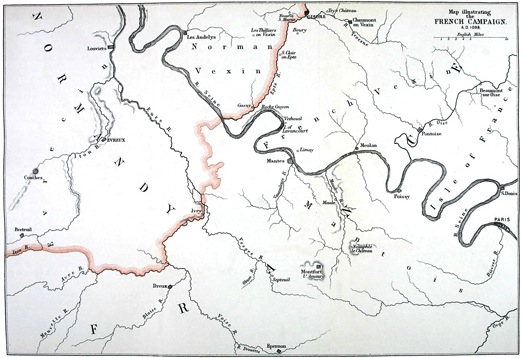
Question of the Vexin. We are not told at what exact moment the old question of the Vexin was again first stirred. Philip was not likely to stir it, neither was Robert; William Rufus might not care to stir it while he was lord only of part of Normandy, and not of the whole. But when all Normandy became his, the old dispute naturally came up again in his mind. He would not have been William Rufus if he had not sought to win all that his father had held, all that his father had claimed, and among the rest the place where his father found his death-wound. Grounds of offence on the part of Rufus. The special acts of authority exercised by Philip in the Vexin, the grant of the land as his son’s fief, the grant of the churches of Mantes, the churches which were rebuilding out of his father’s dying gifts, to his own rebellious uncle Odo, would be likely to stir him up still more to put forward his old claim. William demands the French Vexin. 1097. At last, after reflecting, we are told, on the wars and the fate of his father in that region, he sent, in the year of the departure of Anselm, solemnly to demand the cession of the whole 176 Vexin, specially naming the towns and fortresses of Pontoise, Chaumont, and Mantes.[445] Of these Mantes and Chaumont were in the strictest sense border fortresses; Pontoise—the bridge on the Oise, as its name implies—lies far nearer the heart of the King’s territory; Pontoise in an enemy’s hand would indeed be a standing menace to Paris. The demands of the Red King almost amounted to a demand for the surrender of the independence of the French kingdom.
Edwᵈ. Weller
For the Delegates of the Clarendon Press.
Map illustrating the FRENCH CAMPAIGN. A.D. 1098.
The demand is refused. It is needless to say that the demand was refused. Lewis and his counsellors declined to give up the Vexin or any of its fortresses.[446] King William accordingly crossed the sea to assert his rights, and the French campaign possibly began before the end of the year. It is wonderful, when we remember that it is chiefly from our own writers that we get the details of William Rufus’ Norman campaigns, how little they tell us about his French campaigns. Of the war of Maine to which we shall presently come they tell us little enough. Still the name of Maine does appear in their pages, while the name of France at this stage does not. William crosses to Normandy. November 11–30, 1097. We learn indeed that in the November of this year the King crossed into Normandy, but with what object we are not told.[447] What we are told is eminently characteristic of the Red King and his reign. Excesses of the King’s followers. As so often happened, his crossing was delayed by the weather; meanwhile his immediate followers carried out to the full that licence 177 which the King’s immediate followers were wont to allow themselves till Henry and Anselm found sharp means to check them.[448] “His hired in the shires there they lay the most harm did that ever hired or here in frithland should do.”[449] If the army at large is meant, the expression is a strange one. The hired is the King’s household, taking in doubtless household troops in personal attendance on the King, like the old housecarls, but not surely the whole force, national or mercenary. But it was the King’s household whose excesses were specially complained of; and this casual outburst of bitterness is a speaking comment on the general pictures of their misdoings which we have already come across.[450] But it is only of damage done in England by the King’s household that our Chronicler tells us anything. Silence of English writers as to the French war. Of warlike exploits on the other side of the Channel neither he nor any other English writer tells us at this stage a single word.[451]
If from the silence of our own writers we turn to our chief authority on the French side, we shall find a vivid general picture of the war, but hardly any account of particular events. We get indeed one of the most striking of personal contrasts. Though the war which was now waged by Rufus was in every sense a war waged against France, yet it could hardly be called a war personally waged against the nominal ruler of France. It was a war for the Vexin, waged against the lord of the Vexin, and, in its first stages at least, mainly confined to 178 the Vexin. William and Lewis. The struggle between William and Lewis, as it is set forth by the biographer of the French prince, was an unequal one. William had his old weapons at command—the wealth of England, the traitors whom that wealth could bribe, the mercenaries whom that wealth could hire.[452] He had his own experience in war; he had his veteran troops and their veteran commanders. Chief men on William’s side. Next under the King, comparatively young in years, but first of all in daring as in wickedness, was Robert of Bellême. Then came the King’s brother Henry, and the well-known names of Count William of Evreux, Earl Hugh of Chester, and the old Earl Walter of Buckingham.[453] These were formidable foes for an untried youth like Lewis; the aged warrior who was old on the day of Senlac must have been a strange contrast indeed to the gallant lad on whom the fortune of France now rested. Difficulties of Lewis. Lewis had, we are told, neither men nor money nor allies; he had to pick up all where and how he could. Whenever, often by running to and fro as far as the borders of Berry or Auvergne or Burgundy, he had got together three hundred, or perhaps five hundred, knights, he met King William of England marching against him with ten thousand.[454] Here was little room for pitched 179 battles; Lewis could not risk a meeting with such an enemy in the open field. He had often to retire, sometimes openly to fly.[455] And the different state of the hoards of the two princes showed itself in an effect on their military operations which is characteristic of the time. Fate of the captives on each side. When warriors on the English side—we must use the language of our French informant—fell into French hands, the price of their ransom was speedily paid. When French warriors were made prisoners by the forces of Rufus, there was no money to ransom them. They had to languish in bonds with only one hope of deliverance. Those only were set free who were willing to become the men of the King of England and to bind themselves by oath to fight against their own natural lord.[456]
Some then at least of the native subjects of the French crown, who had no conflicting engagements to plead, did not scruple, in the extremities in which they found themselves, to take service on behalf of the invader against their own lord. It is therefore the less wonderful if another class of men, whose interests and whose duties were more doubtful, deemed, when they had to choose between two lords, that Rufus was the lord to be chosen. French traitors. Others again were found of baser mould, who simply took the money of the Red King, and for its sake turned against their own people on behalf of strangers. Among 180 these one is specially marked, one who by his geographical position was called on to be among the foremost champions of France against Norman invasion. This was one of the lords who commanded the fortresses on the Seine, a man whose possessions lay close to the Norman border, Guy of the Rock. Guy of the Rock, the Rock which has taken its name from him and which still is known as La Roche Guyon.[457] The position of his chief stronghold made his adhesion of no small importance. Norman possessions beyond the Epte. The stream of Epte, flowing during a great part of its course through a deep valley, seems designed by nature to part Normandy and France; but, as we have seen, the frontier was ever disputed, and here and there the Norman held small portions of territory on the left bank of the river. One of these Norman holdings on the French side lies by the small village of Gasny, where the boundary, surviving in that of the modern department, is still marked at some distance up the opposite hill. A slight further ascent brings the traveller in sight of one of the noblest bends of the Seine, where the great river, with all its islands, runs immediately below a long line of chalk hills, with their white spurs jutting out in endless fantastic shapes. The windings of the Seine have in fact left at this point little more than a narrow isthmus between itself and its lowlier tributary. Roche Guyon. Just within the French territory at this point, and commanding this important sweep of the great French river, lay the domains of the lord of the Rock. The ridge on which 181 the traveller stands ends in a bluff to the south-east. There, where the hills open for another tributary of the Seine, close by the island of Lavancourt, stood Guy’s now vanished fortress of Vetheuil. But, as we now gaze, by far the most prominent object in the whole curved line of the hill, placed like the imperial seat in the centre of an ancient amphitheatre, rising over the church, the more modern castle, the town, and the airy bridge which modern art has thrown across the river, soar the relics of the fortress which still bears Guy’s name. A spur of the hill is crowned by a small keep, with a round tower attached to a square mass within its compass. But in the days of the Red King, the Guy’s Cliff of the Vexin, now the site of a castle so preeminently visible, was specially known as the site of the stronghold that was invisible. The castle bored in the rock. The lords of the rock had, like the Kenite of old, literally made their nest in the rock itself. The chalk is to this day habitually bored to make houses, churches,[458] any kind of excavation that may be needed. In days before our time this custom had been applied to a more dangerous use; the plundering chiefs of the rock had scooped themselves out a castle in its side. More than one of the chambers remain—comfortless to our eyes, but perhaps not more comfortless than the chambers within many a tower of timber or masonry—whence these troglodyte barons looked out to mark the craft upon the Seine, and to exact, by a custom which lingered on till late times, a toll from every passer by. Guy submits to Rufus. Guy of the Rock now submitted to the island king, and his submission supplied a new fetter to pen up the king of the mainland within his havenless realm. At the very entrance of the French territory on this side, Guy’s Rock, Vetheuil, and all that is implied in the 182 possession of Vetheuil and of the Rock, passed from the obedience of the lord of Paris to the obedience of the lord of Winchester and Rouen.
While Guy thus sold to the invader the very entrance-gate of the French kingdom, the Red King found another ally in a far more famous man who held a position of at least equal importance higher up the Seine. Policy of Robert of Meulan. At the head of the nobles who held lands of both kings stood the acknowledged master of all subtle policy, Count Robert of Meulan. We have been so long familiar with his name, whether as the youthful warrior of Senlac or as the experienced counsellor of the Red King, that we may have almost forgotten that the title by which we call him is French, and that he was as great a lord in France as he was in England or in Normandy. We find it hard to think of him as one of those who had thus to choose between two lords, and that he might conceiveably have chosen the cause of Philip—or rather of Lewis—against William. We cannot fancy that he took long to decide. He may have argued that William, lord both of Normandy and of England, had two parts in him, while Philip of France had only one. He receives William’s troops. He received the troops of the Red King into his castles, and his adhesion was held to have been of special help to his undertaking. He opened, we are told, a clear path for the English into France.[459] The words sound as if they belonged to the fourteenth, fifteenth, or sixteenth century rather than to the last years of the eleventh. And they are clothed with a strange significance when we remember that the man who now opened a way into France for the combined host of Normandy and England 183 was the same man who, two-and-thirty years before, had opened a way into the very heart of England for the combined host of Normandy and France.[460] But in a geographical point of view the expression is fully justified. Importance of the position of Meulan. In a war between the lord of Rouen and the lord of Paris, no man’s friendship could be more valuable to either side than the friendship of the Count of Meulan. A man weaker in fight and less wary in council than the Achitophel of his day might, if he kept the Seine barred as the lord of Meulan could bar it, have gone far to hold the balance between the contending kings. As at Mantes, as at Rouen, as at Paris itself, the islands so characteristic of the Seine are at Meulan also brought into play for purposes of habitation and defence. Description of Meulan. Meulan indeed is, what neither Paris nor Rouen is, at once a hill-fortress and a river-fortress. At a point of the river lying between Mantes, the seat of the Conqueror’s death-wound, and Poissy, the spot where he went to crave help of his lord before the day of Val-ès-dunes, a hill which the surrounding valleys gird as with a natural fosse rises from the right bank of the river. A group of islands is formed at this spot by the branches of the winding stream, fit places for the landing of the forefathers of the Normans in their pirate days. The spot was seized on for defence. A castle arose on the side of the hill, with a town at its foot sloping swiftly down to the river. There a bridge of some antiquity joins the right bank to a central island, which is joined again to the left bank by another bridge. The island, once strongly fortified, still keeps the significant name of the Fort. The bridge which joins the island to the left bank of the river, where lies the suburb known as Les Mureaux, was, at least in later times, defended by a tower bearing the name of La Sangle. A considerable extent of the outer walls of the 184 castle may be traced, and a specially diligent inquirer may thread his way to a small fragment of the castle itself, and may there mark work of a somewhat later date than the time with which we have to do. It is more easy to trace out a large part of the defences of the Fort, and to mark the churches, surviving and desecrated, one of which, high on the hill side, also belongs, like so many others, to the age next following. As in so many other places, so at Meulan, we cannot lay our hand on anything which we can positively affirm to be the work of its most famous lord. But we can well see that the strength of the spot, a spot which in later times played no small part in the wars of the League, was well understood in the days of our story, and that so important a position was strengthened by all the art of the time. When Count Robert received the forces of Normandy and England on the height and in the island of Meulan, he did indeed open a way for those forces into the heart of France. It was a way which might have been expected to lead them straight to the city which then, as ever, might be deemed to be more than the heart of France, to be France itself.
William’s prospects. Count Robert was doubtless guided, then and always, by policy. Many of his neighbours who found themselves in the like case followed his lead. They could not serve two masters; so they made up their minds to serve the master who was strongest either to reward or to punish, him whose purse was the deeper and whose spirit was the fiercer.[461] Altogether the odds seemed frightfully against the French side. Rufus might indeed have small chances of carrying out his grand scheme of 185 uniting Paris—perhaps Poitiers and Bourdeaux—under the same lord as Winchester and Rouen; but things at least looked as if the conquest of the disputed lands was about to advance the Norman frontier most dangerously near to the French capital. Above all, when the Seine was barred both at Roche Guyon and at Meulan, we ask how things stood in the border town which lay between them, the town which was one of the special subjects of William’s demands on Philip. How fared it at Mantes when the stream both above and below was in the hands of the enemy? To this question we get no answer; but we see that, in any case, the King of the French was more closely shut up than ever in the central prison-house of his nominal realm.
Failure of William’s plans. But, small as seemed young Lewis’s means of defence, weakened as he further was by treason among his own or his father’s vassals, the resistance made by the French to the Norman or English invasion was valiant, stubborn, and, we may add, successful. William Rufus was much further from conquering France than Henry the Fifth, or even than Edward the Third, was in after times. With all his wealth, all his forces, he could not conquer the land; he could not even take the fortresses to which he specially laid claim. He could not conquer the Vexin; he could not take either Pontoise or Chaumont. Pontoise and Chaumont not taken. While we hear nothing of Mantes, we know that both these two last-named fortresses successfully withstood his attacks. Of the three fortresses which were the special objects of the war, one, that of Chaumont, became in some sort its centre. Castle of Chaumont. The Chaumont with which we have to deal is still distinguished from other places of the same name as Chaumont-en-Vexin. It stands about five miles east of the Epte, at the point where the frontier stream of Rolf is joined by the smaller stream of the Troesne, and makes a marked turn in its course from nearly due south 186 to south-west. The region is a hilly one, though it contains no heights of any remarkable elevation. The Bald Mount itself, which—unluckily for the inquirer—is bald no longer, is a wide-spreading hill crowned with a mound which stands out prominently to the eye on every side. The line of the wall which it supported may still be easily traced, and in a few places it is actually standing. On the steep north-eastern side of the hill the small town of Chaumont nestles at its foot, while the stately church of the later days of French architecture soars above the town as the castle again soars above the church. Of the part played in the war by this stronghold we shall hear a little later.
The height of Chaumont commands a vast prospect on all sides; the eye stretches far away over the friendly land to the south, towards the hills bordering on the Seine; but the special rival of Chaumont, the fortress at the junction of the Epte and Troesne, is shut out from sight by a near range of hills which follow the line of the smaller stream. Where the two rivers join, the Epte, like the greater Seine, divides to form a group of islands at the foot of a low hill on the right, the Norman, bank. The castle of Gisors. Here stands the town and fortress of Gisors, the chief bulwark of Normandy towards the north-eastern corner of the Vexin. Once a dependency of the neighbouring Neauflé, whose mound and square tower form a prominent object in the landscape, Gisors had now become a stronghold indeed. Its first defences. 1096. It had been first fenced in about two years before by Pagan of Gisors, a man of whom we shall hear in the course of the war.[462] Somewhat later William gave orders that 187 the border post should be made into a fortress of the greatest possible strength, and he committed the work to the most skilful engineer at his command. Strengthened by Robert of Bellême. All the craft and subtlety of the Devil of Bellême were employed to make Gisors a stronghold which might shelter the eastern frontier of Normandy against all enemies. As far as one can see, the islands in the Epte and the hill which rises above them near to the right bank of the main river were united in one common plan of defence. The town itself, taking in the islands, was walled, either now or at a later time, and defended with a ditch throughout those parts of its circuit which were neither sheltered by the river nor by the castle hill. In the great defences of this last we see the fruit of the engineering skill of Robert of Bellême, and we better learn what in those days was deemed a specially strong fortress. On all sides save that where town and castle join, the hill is girded by a deep ditch, and on the north, the side which lies away from both town and river, the ditch is doubled, and the chief entrance on this side is defended by an outpost between the two. The ditch fences in a vast walled space, in the middle of which art has improved nature by piling up a vast artificial mound crowned by a shell keep. The earthworks are most likely older than either Robert of Bellême or Pagan of Gisors. The outer wall and the shell keep may well be part of Robert’s design, if they are not actually his work; but the towers which now rise so proudly over Gisors, not only the round tower, precious in local legend, but the vast octagon on one side of the keep which bears the name of the martyr of Canterbury, must all be of later date than our time. A graceful chapel within the keep, where the visitor is told with special emphasis that 188 Saint Thomas once said mass, has thus much to show in favour of the legend that it is clearly a work of Henry the Second’s days. Gisors under Henry the Second. His days were stirring days at Gisors as well as the days of Rufus, and a hundred years of sieges had brought new improvements into the art of fortification. All in short that strikes the eye as the traveller draws near to Gisors, Present appearance of Gisors. the castle towers, no less than the strange and striking outline of one of the stateliest of those churches which boasted no bishop or abbot at their head, belongs to later days than those of the Red King’s campaign of Chaumont. Of the defences of the town below little can now be traced, and that part of the defences of the castle on which the historian looks with the deepest interest is carefully hidden from distant view. The tower of Saint Thomas and its lower fellow both seem to rise from the midst of a wood—a wood artificially planted, seemingly for the express purpose of robbing Gisors of its characteristic feature, of shutting out from sight the mighty motte and keep which Robert of Bellême made ready at the Red King’s bidding to be the strongest bulwark of the Norman land.
Castle of Trye. Near as Gisors stands to Chaumont, another fortress barred the way between them. The road between the two towns passes through Trye—distinguished from its neighbour Trye-la-Ville as Trye-Château—which appears in our story along with Chaumont as one of the French fortresses which Gisors was specially meant to keep in check. Yet Trye must have been itself specially meant as an outpost against Gisors. Close by Gisors is one of the points where the Norman frontier overlaps the Epte; so that Trye, lying between two and three miles from Gisors, is yet nearer than Gisors to the actual frontier. Trye does not lie, like Chaumont, hidden behind the hills; it stands boldly in the teeth of the enemy, 189 clearly seen from the hill of Gisors, and barring the main road between Gisors and Chaumont, a road which led over level ground and neither over hill nor swamp. Otherwise the site has not, like Gisors and Chaumont, any marked advantages of ground, nor, at present at least, are any earthworks visible. In our time, though a gate and a tower of later date than our story recall the days of the military importance of Trye, the attractions of the spot are chiefly of other kinds. Primæval and later antiquities. Between Trye and Chaumont a cromlech, known as the Three Stones, calls up the thought of days and men which were as mysterious in the time of Rufus as they are now. More than one fragment of mediæval architecture may be lighted on by the way, and Trye itself stands conspicuous for the singular and beautiful Romanesque work—again too late for our immediate time—to be found both in its ecclesiastical and its secular buildings.
Chaumont and Trye may practically be looked on as one piece of defence. Castle of Boury. A third fortress, that of Boury,[463] lay further apart to the south-west, hidden from Gisors, like Chaumont, by another line of hills. All three castles seem to have remained unsubdued through the whole war. The valour of the French resistance is dwelled on with pleasure by our Norman or English guide. Did the monk of Saint Evroul, the young scholar of the Severn side, remember that, after all, his father belonged neither to the land of his birth nor to the land of his adoption, but was in truth a Frenchman from Orleans?[464] National feeling in the French Vexin. The French Vexin was inhabited by a valiant race, in whom, if we are not pressing too far the words of our story, a distinct feeling of French nationality 190 was strong. They were ready to run all risks—it is not said for their King, but for the defence of their country, for the glory of their nation, for the honour of the French name.[465] Valiant men, mercenaries it would seem—but who was to pay them?--from all parts of Gaul, or at least of France, pressed to their help, and a brave and successful defence was made. Prisoners on both sides. Prisoners on both sides underwent the two different fates which were already spoken of. The name on the Norman side which is best known to us is that of the fierce Gilbert of Laigle; Gilbert of Laigle. with him we hear of the former lord and fortifier of Gisors.[466] Among the captives on the French side the national historian records one who bore a far loftier name, but one which at that moment was hardly a name of honour. Simon of Montfort. Two of the long line of Simons of the French Montfort are heard of in the course of our story, father and son, father and brother of her who in our authorities appears commonly as the woman from Anjou, but who on the Strong Mount of her fathers may have been deemed a Queen of the French. One Simon is now spoken of as a prisoner; both are found somewhat later fighting stoutly in the cause of France. We have heard that the Red King let none free who would not undertake to fight on his side. Are we to infer that a forefather of our own deliverer had learned the lesson of Harold, that an extorted oath is of no strength?
191 § 2. The First War of Maine. 1098.
Dates of the French war. November, 1097–September, 1098. These events on the French side, of which thus far we have but a vague account, would seem to have happened during the first half of the year with which we are dealing. But all that we can say for certain is that they happened between the November of one year and the September of the next. Of the struggle which was going on at the same time in Maine, the dates are far more clear. War of Maine. January—August, 1098. It began in January and it was deemed to be over in August. But its immediate occasion arose the year before, and its general causes go much further back. Fully to understand the war of William and Helias, more truly the war of Helias and Robert of Bellême, we must trace out the events of several years. History of Maine. 1089–1098. While we have been following the fates of England, Normandy, Scotland, and Wales, much of high interest has been going on in Maine which had no connexion with the affairs of any part of Britain, and which had but little influence on Norman affairs either. But now that England and Normandy have again a common ruler, the affairs of England, or at least the affairs of her King, have again a close connexion with the affairs of Maine. We have now therefore to take up the tale of that noble city and county from the days when we had to tell of Duke Robert’s campaign before Ballon and Saint Cenery.[467]
Robert suspects the loyalty of Maine. 1089. The submission of Maine to the Norman Duke which then took place lasted only till the next favourable opportunity for asserting the old independence of the city and county. No great time after he had taken 192 possession, Robert began to suspect the loyalty of his Cenomannian subjects. A strange story follows, which connects itself in a way yet stranger with the tale of the royal household of France which we have lately been telling. Robert, it seems, was sick at the moment when he, or some one else for him, thought it needful to take action against impending revolt in Maine. He asks help of Fulk of Anjou. He sent messengers and gifts to Count Fulk of Anjou, the famous Rechin, praying him to come to him.[468] Fulk, it will be remembered, claimed the over-lordship of Maine, and Robert himself had, long before, at the peace of Blanchelande, done a formal homage to Fulk for the county.[469] The Angevin Count was supposed to have influence with the people of Maine, influence which might be enough to hinder them from revolting. That influence Robert now prayed Fulk to use. The Angevin agreed on one condition, namely that the Norman would use his own influence in quite another quarter, for quite another purpose. Fulk asks for Bertrada of Montfort. Fulk wanted a wife. As the story is told us, he is said to have had two living wives already; but that seems not to have been the case.[470] His first wife, the daughter of a lord of Beaugency, died, leaving a daughter. He then married Ermengarde of Bourbon—a description not to become royal for some ages—the mother of his son Geoffrey Martel. Her he put away on the usual plea of kindred, and now it was that he appeared as the wooer of that Bertrada of whom we 193 have already spoken of in her later character. The daughter of Simon of Montfort was the niece of Count William of Evreux, through her mother Agnes, Count William’s sister. Bertrada brought up by Heloise. Her mother would seem to have been dead, and she was brought up in her uncle’s house, under the schooling of Countess Heloise.[471] The Count of Anjou, no longer young, driven to strange devices as to his shoes,[472] and burthened with a former wife whose divorce might be called in question, felt that he was hardly likely to win favour as a lover in the eyes either of Bertrada herself or of her guardians. But the Rechin was skilful at a bargain. He would engage to keep Maine in the Duke’s obedience, if the Duke would get him the damsel of Montfort to wife.[473] Robert set off for Evreux in person, and pleaded Fulk’s cause with Count William. The Count of Evreux was duly shocked, and set forth the obvious objections to the marriage. William of Evreux’s bargain about his niece. But he too was open to a bargain; he would get over his scruples if the Duke would restore to him certain lordships to which he asserted a right, and would grant certain others to his nephew William of Breteuil. These lands had been the possession of his uncle Ralph of Wacey, guardian of the Great William in his early days, who it seems was sportively known as Ralph with the Ass’s Head.[474] Let 194 the Duke give him and his nephew back their own, and Bertrada should be, as far as the Count of Evreux was concerned, Countess of Anjou.
Robert consents. The Duke did not venture to answer without the advice of his counsellors. His counsellors. But the combined wisdom of Robert of Bellême, lately a rebel but now again in favour,[475] of the Ætheling Eadgar, and of that monastic William of Arques of whom we have already heard,[476] advised the acceptance of Count William’s terms. The whole county of Maine was of more value than the lordships which the Count of Evreux demanded as the price of his niece.[477] The power and the will of Fulk to do what he promised about Le Mans and Maine seems not to have been doubted. The double bargain was struck, and it was carried out for a season. Count William and his nephew got all that they asked, except that one lordship passed to Gerard of Gournay. Fulk marries Bertrada. Fulk too got what he asked, namely Bertrada, till such time as King Philip took her away. She had time to quarrel with her stepson Geoffrey, and to become the mother of Fulk, afterwards Count of Anjou and King of Jerusalem, and grandfather of the first Angevin King of England. Maine kept quiet for a year. And Count Fulk was able, by whatever means, to keep the Cenomannian city and county in a formal allegiance to the Norman Duke, till such time as the temptations to revolt became too strong to be withstood.
Movements in Maine. Our story however seems to imply that the submission of Maine to Robert was wholly on the surface, and that all this while schemes were going on for shaking off the hated Norman yoke. The present movement took the 195 same form which had been taken by the movement in the Conqueror’s day.[478] The avowed object of Cenomannian patriotism was now, as then, the restoration of the ancient dynasty. The valour and energy of the citizens of Le Mans are constantly spoken of; but we hear nothing this time of the commune. The rule of some prince seems to be assumed on all hands, and for a while all seem to have agreed in seeking that prince in the same quarter in which they had sought a prince already. Hugh son of Azo sent for. 1090. Little indeed of good for Le Mans or Maine had come of the former application to Azo and Gersendis; but their son Hugh had now reached greater years and experience, and the men of Maine again sent into Italy to ask for him to reign over them.[479] Union of Geoffrey and Helias. The application was supported both by Geoffrey of Mayenne, of whom we have so often heard during the last thirty years, and by Helias of La Flèche, who might well have asserted his own claims against those of the distant house of Este.[480]
Helias of La Flèche. Helias now becomes the hero of the Cenomannian tale. He is one of the men of his time of whom we can get the clearest idea. We see him alike in his recorded acts and in his elaborately drawn portrait; and by the light of the two we can hail in him the very noblest type of the age and class to which he belonged. We see in him a no less worthy defender of the freedom of Maine than Harold was of the freedom of England. His character He stands 196 before us with his tall stature, his strong, thin, and well-proportioned frame, his swarthy complexion, his thick hair cropped close after Norman or priestly fashion.[481] Brave and skilful in war, wise and just in his rule in peace, ready and pleasant in speech, gentle to the good and stern to the evil, faithful to his word, and corrupted neither by good nor evil fortune, a man withal of prayer and fasting, the bountiful friend of the Church and the poor, Helias stands forth within the narrow range of a single county of Gaul as one who, on a wider field, might have won for himself a place among the foremost of mankind.[482] With the house of the old Counts of Maine he had a twofold connexion. and descent. The male line of Herbert Wake-dog had come to an end; but in the female line Helias came of it in two descents, while Hugh came in one only. Not only was his mother Paula one of the sisters of the younger Herbert, but his father John of La Flèche was son of a daughter of Wake-dog himself.[483] His castles. To his father’s Angevin fief of La Flèche, among the islands of the Loir, his marriage with Matilda, a grand-niece of Archbishop Gervase of Rheims, known to us better as Bishop of Le Mans,[484] had added a string of castles in the south of Maine. Two of these, Mayet and the one which is specially called the Castle of the Loir, fill a prominent 197 place in our story.[485] Helias was plainly the greatest lord of eastern Maine, the modern department of Sarthe, as Geoffrey of Mayenne was the greatest in western Maine, the modern department which still bears the name of his own fortress.[486] His possible claim on the county. One might have thought that the position of Helias as a great local chief might, when the elders of Maine were called on to choose a prince, have outweighed any slight genealogical precedence on the part of the stranger Hugh. But the great men of the county may not have been disposed to place one of themselves over their own heads. He accepts the succession of Hugh. Anyhow Helias, like his father before him,[487] waived his own claim to the succession. Along with the lord of Mayenne and the great mass of the people of the city and county, he welcomed the Ligurian prince—such is the geography of our chief guide—when he came to take possession of the dominion to which the voice of the Cenomannian people had called him a second time.[488]
Negotiations with Hugh. We are to suppose that the negotiations with the house of Este were going on during the year when Count Fulk contrived to keep Maine outwardly quiet. But when the quarrel between William and Robert broke out, when Normandy was divided and dismembered, the Angevin over-lord’s influence gave way. The time for action was clearly come. Revolt of Maine. 1090. Le Mans and all Maine now openly rose against the Norman dominion. Duke Robert’s garrisons were driven out;[489] the Cenomannian 198 land was again free. Invitation to Hugh. But the first act of restored freedom was to invite Hugh of Este, descendant of the ancient counts, to come at once to take possession, and to rule in the palace on the Roman wall which fences in the Cenomannian hill.
Opposition of Bishop Howel. The chief opponent of the movement for independence was, as before, the Bishop. The throne of Saint Julian was still filled by the Breton Howel, the nominee of the Conqueror, and he stood firm in his loyalty to his patron’s eldest son.[490] He withstood the revolt by every means in his power, and scattered interdicts and anathemas against the supporters of the newly-elected Count.[491] Hugh had not yet come, and the opposition of the Bishop was felt to be dangerous. Howel imprisoned by Helias. Helias therefore, whose piety did not lead him to any superstitious reverence for ecclesiastical privileges, dealt with Howel as an enemy, or at least as one whom it was well to keep out of the way for a season. As the Bishop was going through his diocese with a train of clergy, in the discharge of some episcopal duty, Helias seized him, carried him off, and put him in ward at La Flèche.[492] The great 199 grievance seems to have been that Howel was denied the company of his attendant clergy, and was allowed the services only of one unlettered rustic priest. The fear was lest the Bishop and his more learned companions would, in their Latin talk, plot something which their keepers would not understand.[493] This very complaint shows that the Bishop’s imprisonment was not of a very harsh kind. But the cause of the captive prelate was zealously taken up by his clergy. Interdict of Le Mans. Le Mans and its suburbs were put under a practical interdict; divine worship ceased; the bells were silent; the doors of the churches were stopped up with thorns.[494] Great, it is said, was the joy when the Bishop was set free and came back to his city. Liberation of Howel on Hugh’s coming. We are told by a writer in the episcopal interest that Helias set him free in a fit of penitence, in answer to many intercessions from nobles, clergy, and neighbouring bishops. Howel was gracious and forgiving, and let his wrongs be forgotten 200 on the restoration of whatever had been taken from him.[495] All this is possible; but the more definite statement that Howel was kept in ward till Hugh came shows that his captivity was a matter of policy, and that he was set free as soon as it seemed that no object could be gained by prolonging it.
Hugh reaches Le Mans. Meanwhile Hugh was on the road. At the border fortress of La Chartre he was met by the magistrates of Le Mans—the city seems, as often in Cenomannian history, to act for the whole county—who swore oaths to him, counting, it is added, their former oaths to Duke Robert for nought.[496] Howel flees to Robert. The Bishop, determined not to acknowledge the revolution, fled to the court of the prince whom he did acknowledge. But he found little help there. Robert’s carelessness as to his loss. The idle and luxurious Robert seemed not to care, he seemed almost to rejoice, that so noble a part of his dominions had fallen away from him.[497] One thing only he would not give up; he would at all hazards cleave to his rights over the Cenomannian bishopric.He cleaves to his rights over the bishopric. Robert bade Howel to go back to Le Mans, but to do nothing which could be taken as an admission of Hugh as temporal lord of the bishopric.[498] Howel went home, and found the new Count, for whatever reason, quartered in the episcopal palace. He had himself to live in the 201 abbey of Saint Vincent, just outside the city. Dispute between Hugh and Howel. A long dispute followed between the Breton Bishop and the Italian Count, and then came a still fiercer dispute between the Bishop and a party in his own Chapter. One or two points are of constitutional interest, and remind us of questions which we have just before heard of in our own land. Howel refuses to acknowledge Hugh as advocatus. The Count called on Howel to acknowledge himself as his feudal superior for the temporalities of the bishopric.[499] He refused and left the city, on which Hugh seized the temporalities of the bishopric. Howel and his Chapter. Worse even than the Count were the Bishop’s clerical enemies, one Hilgot at their head. By a cruel subtlety they had persuaded him to appoint as Dean a mere boy from his own land, Geoffrey by name, of the age of twelve years only—so it is said. Disputes about the deanery. Now they turned about, found fault with the appointment, and set up an anti-dean of their own.[500] The Bishop crossed over to England for help, and, strange to say, he found a friend in the King.[501] Howel comes to England. But meanwhile all kinds of wrongs were done to 202 his people, even to branding an innocent boy in the face.[502] At last a reconciliation between the Count and the Bishop was brought about, partly because of the turn taken by public feeling. Saint Julian’s, in the absence of its chief pastor, was forsaken, while crowds flocked to keep the feasts of the Church at the Bishop’s monastic retreat. This was at the priory of Solêmes, near Sablé, lying south-west of the city, towards the Angevin border.[503] Return of Howel. June 28, 1090. At last the prelate came back amidst universal joy, and the Count made good all wrongs and losses that he had undergone.[504]
Unpopularity of Hugh. But happier days were to come for the Bishop and the people of Maine. It was not only to Howel and his clergy that the Italian Count had made himself hateful. He had none of the qualities which were needed in the ruler of a high-spirited people in a time of danger. Idle, timid, weak of purpose, he had no power among the men over whom he was set; and he had not, as seems to have been hoped for, brought with him any store of money from the south.[505] His wife, a daughter of Robert Wiscard, a woman of a lofty spirit, was too much for him. He put her away, and was excommunicated by Pope Urban for so doing.[506] Despised of all men, he was thinking of flight.[507] February, 1091. It was now moreover the moment when 203 the Norman power had again become specially dangerous to Maine. Danger of Maine. The sons of the great William, lately at variance, were now reconciled, and the subjugation of Maine was one of the terms of their agreement.[508] Helias saw his opportunity. He set forth the dangers of the land to his cousin. Hugh said that he wished to sell his county and be off.[509] Helias argued that, in that case, he ought to sell it to no one but himself. He set forth his right by birth; he said that it was no easy place that he was seeking. But his just rights and a love for the freedom of the land called him to it, and he trusted that God would help him in his post of danger.[510] A bargain was soon struck. Helias buys the county. For a sum of ten thousand Cenomannian shillings Hugh agreed to abdicate in favour of his cousin. The coronet of Maine passed from the son of Gersendis to the son of Paula. Hugh went back into Italy with his money, and Helias was received without opposition as Count of Maine.[511]
First reign of Helias. 1091–1098. The reign of Helias over Le Mans and Maine lasted for about twenty years, with a break of three years of warfare of which we shall presently have to speak. First came a time of seven or eight years, during which the Cenomannian people might indeed be objects of envy to the people either of Normandy or of England. The new 204 prince, by every account of his actions, showed himself the model of a ruler of those times. His strong and just rule. He did justice and made peace; as far as a prince of those days could do so, he sheltered the weak from the oppressions of the strong.[512] His personal piety was not lessened, nor was his devotion to the Church less zealous, now that the ecclesiastical power was no longer a political enemy. His friendship for Howel. Strong in the friendship of his late gaoler, Bishop Howel could rule his diocese in peace, and could carry on his works of building, both in the city itself and in his neighbouring lordship of Coulaines.[513] Peace of the land. And these happy years were years of peace without as well as within. The rule of Helias was undisputed; Maine saw neither revolt within her own borders nor invasion from any power beyond them. Whatever designs either Robert or William may have cherished against the independence of Maine, those designs did not for the present take the shape of any overt act. Robert seems to have done absolutely nothing; the first signs of impending evil showed themselves soon after William’s acquisition of Normandy; 1096. but there was no open warfare for two years longer.
Translation of Saint Julian. October 17, 1093. In these times of exceptional quiet there is little to record beyond ecclesiastical ceremonies. It was a bright day at Le Mans when Bishop Howel was able to translate the body of the venerated patron of the city to the place of honour in his new building.[514] That was the time when Anselm, already enthroned, was waiting for consecration, and when Malcolm had turned away from Gloucester to plan his last invasion of Northumberland.[515] 205 In these years too Howel must have finished the two stately towers of Saint Julian’s minster, of which we shall before long have a tale to tell. But Le Mans presently saw a greater day than all, as it seemed at least in the eyes of the biographer of her bishops. Visit of Pope Urban to Le Mans. November or December, 1095. After the days of Piacenza and Clermont, Pope Urban honoured the Cenomannian city with his presence. For three days the sovereign Pontiff was the guest of Howel, and we are told that, though it was a year of scarceness, yet the Bishop of Le Mans was able to entertain the Pope and his following right bountifully.[516] Howel, it is said, appeared among his fellow-bishops conspicuous for the gifts of both mind and body. Men rejoiced with him on the happiness of receiving such a guest, and deemed from his health and vigour that he might long enjoy his honours.[517] Sickness of Howel. 1095–1097. Before long he fell sick, and his sickness was unto death, although his end did not come till nearly two years after the preaching at Clermont. The visit of Urban, the death of Howel, led to important events in the history of Maine.
The preaching of the crusade, above all the presence, and doubtless the preaching, of the crusading Pope in his own city, stirred up the same impulse in the heart of Helias which was stirred up in the hearts of so many other men of his day. Helias takes the cross. 1095–1096. Young and strong, devout and valiant, he would go and fight to win back the sepulchre of his Lord from the misbelievers and to deliver his Christian brethren in other lands from their cruel bondage. By the counsel of the Pope, the Count of Maine 206 took the cross, and made ready to go on the armed pilgrimage along with his neighbours, with Robert of Normandy and Stephen of Chartres.[518] Estimate of his action. Our feeling perhaps is that Helias, like Saint Lewis, had a stronger call to stay at home than to go on the crusade. A certain part of mankind, a small part certainly, but that part among which his immediate duty lay, was peaceful and happy under his rule as they were not likely to be under the rule of any other. Could it be right, we might argue, for him to leave a work which none could do but himself, a work which he had taken on his shoulders of his own free will, for another work, however noble, which others could do as well as himself? Let Robert go and win honour abroad instead of dishonour at home. Normandy was in such a case that the coming even of Rufus was a happy change. Let Stephen of Chartres go; he left his royal-hearted Adela behind him. Let King Philip go, if he could go; his son Lewis would rule his realm far better than he. But let Helias stay, and keep for his land and city that well-being which he had given and which another might take away. Sigurd and Eystein. An argument nearly the same as this was actually pressed on the crusading Sigurd by his stay-at-home brother Eystein. While Sigurd was warring far away, Eystein had done a great deal of good to his own people in Norway.[519] But there are moments in the world’s history, moments when all has to be sacrificed to a great cause, when arguments like these, so sound against ordinary warfare, sound above all against the utterly purposeless warfare of those days, cannot be listened to. Argument in favour of the Crusade. If Western Christendom was to arm for a crusade, 207 it was well that that crusade should be headed by the noblest men in Western Christendom. The work would not be done, if it were only left to lower souls. If Godfrey was to march, it was fit that Helias should march beside him. Godfrey went; Helias did not go. He had now a neighbour who made it vain for him to think of leaving his own land in jeopardy, even to carry out his promise to Pope Urban and to go on the holy war.
William in Normandy. August (?), 1096. The bargain between William and Robert had just been struck. The two brothers were together at Rouen. Robert was about to set out for Jerusalem; William had come to take possession of Normandy. It would have been the height of rashness for Helias to join in the enterprise of Robert, unless he could make his county safe during his absence against any aggression on the part of William. Danger to Maine. According to Norman doctrines, Maine was simply a rebellious province. Robert had done nothing to stop the rebellion, but he had never acknowledged either Hugh or Helias as lawful Prince of the Cenomannians. Where Robert had done nothing, William would be likely to act with vigour. The claims which Robert had simply not acknowledged William might be inclined to dispute with the sword. Importance of Norman neutrality. It was therefore of the utmost moment for the Count of Maine to secure the friendship, or at least the neutrality, of the new ruler of Normandy. Helias doubtless knew that, if William bound himself by his knightly promise, that promise would be faithfully kept, and he perhaps hoped that towards one who was bound on a holy errand, an errand during which he would be harmless and powerless as far as Maine and Normandy were concerned, the chivalrous king might be disposed to pledge such a promise. He therefore went to Rouen, and sought interviews with both brothers. Helias and Robert. He first took counsel with the Duke.[520] Helias and William. Robert, we know, could 208 give counsel to others,[521] and he had no temptation at this moment to give unfriendly counsel to Helias. By his advice, the Count of Maine went to the King; He professes himself William’s vassal. he addressed him reverently, and, if his words be rightly reported, acknowledged himself his vassal. So to do was no degradation, and the acknowledgement might turn the King’s heart towards him. He set forth his purpose of going to the crusade; he said that he wished to go as the King’s friend and in his peace.[522] Answer of Rufus; he demands the cession of Maine. Then Rufus burst forth in a characteristic strain. Helias may go whither he thinks good; but let him give up the city and county of Maine; whatever his father held it was William’s will to hold also.[523] Helias answers that he holds his county by lawful inheritance from his forefathers, and that he hopes by God’s help to hand it on to his children. But if the King has a mind to try the question in a peaceful pleading, he is ready to maintain his right before kings, counts, and bishops, and to abide by their judgement.[524] Rufus tells him that he will plead against him with swords and spears and countless arrows.[525] Challenge of Helias. Then Helias spoke his 209 solemn challenge. He had wished to fight against the heathen in the name of the Lord, but he had found the enemies of Christ nearer to his own doors. The county which he held was his by the gift of God;[526] he would not lightly give it up, nor leave his people to the wolves as sheep without a shepherd. Let the King and all his nobles hear. He bore the cross of a pilgrim; that cross he would not lay aside; he would bear it on his shield, on his helmet, on the saddle and bridle of his horse. Under the protection of that sign he would go forth to defend himself against all who might attack him, that all might know that those who were fighting against him were fighting against a warrior of the cross. He trusted in Him who ruled the world and who knew the secrets of his heart, that a day would come when he would be able to discharge his vow according to the letter.[527] Rufus lets Helias go with a defiance. The Red King bade him go whither he would and do what he would; he had no mind to fight against crusaders, but he would have the city which his father had once won.[528] Let Helias get together workmen to repair his broken walls.[529] He would presently visit the citizens of Le Mans, and would show himself before their gates with a hundred thousand pennoned lances.[530] He would send cars drawn by oxen, and laden with arrows and javelins. But before the oxen could reach Le 210 Mans, he would be there with many legions of armed men.[531]
Such was the threatening message which Helias was bidden to receive as the most certain truth and to go back and tell his accomplices—that is, we may understand, his faithful subjects. Helias makes ready for defence. He went back to his capital, and began to put his dominions into a state fit to withstand an attack. But as yet no attack came; for a year or more neither king nor legions nor oxen were seen before the gates of Le Mans. William delays his attack. 1096–1097. William was busy with many matters, with the dispute with Anselm, with the Welsh war, with the affairs of Scotland. We are told, characteristically enough, that in the midst of all these affairs he forgot Maine altogether. Helias meanwhile remained in actual possession of the county, not attacked or disturbed by Rufus, but in no way acknowledged by him, with the King’s threats hanging over him, and knowing that an attack might come at any moment. At last this armed neutrality came to an end. An event happened which called the King’s mind back to Cenomannian affairs in a manner specially characteristic of Cenomannian history.
Affairs of the bishopric. Again, as so often in our story, the bishopric of Le Mans becomes the centre of the drama and the subject of dispute among the princes of the world. Death of Howel July 29, 1097. In the middle of the summer, shortly before the council of Winchester, Bishop Howel died, seemingly of the same sickness which had come upon him soon after the visit of Pope Urban. Helias, like Hugh, deemed himself, as the reigning Count, to be the temporal lord of 211 the bishopric, and he at once nominated to the vacant see. Helias nominates Geoffrey. His choice was the Dean of Saint Julian’s, that same Geoffrey who had been placed by Howel in the deanery in his childhood, and who, if the dates be right, must still have been wonderfully young for a bishop.[532] The canons choose Hildebert. But the canons of Saint Julian’s stood upon their right of free election, and chose a man of greater name, their Chancellor and Archdeacon, the famous Hildebert.[533] They placed him at once, seemingly against his own will, on the episcopal throne.[534] At first Helias was wroth, and was minded to set aside this direct slight to his authority. Helias accepts the election. But the rights of the Chapter were set before him, and, unlike our own Confessor under less provocation, he yielded, and accepted the election.[535] The Dean, deeming himself sure of the bishopric, had made ready a great feast; but his dainties were spread and eaten to no purpose.[536] Geoffrey Archbishop of Rouen. 1111. His time of promotion was only deferred. Fourteen years later, Geoffrey succeeded William the Good Soul in the archbishopric of Rouen. So 212 his now more successful competitor was not fated always to remain in the second rank of prelacy. Hildebert Bishop of Le Mans. 1097–1126. One of the great scholars of his day, renowned for his writings both in prose and verse, a diligent writer of letters and thereby one of the authorities for our history, a builder, a reformer, an enemy of heresy who could yet deal gently with the heretic,[537] a model in short, we are told, of every episcopal virtue, Hildebert ruled the church of Le Mans for more than twenty-nine years, Archbishop of Tours. 1126–1134. and then for the last nine years of his long life was removed to the metropolitan throne of Tours.[538]
All the elements of the Cenomannian state, prince, clergy, and people, had joined in the elevation of Hildebert. But there was one to whom any free election or nomination by any of the local powers was in its own nature distasteful. Claims of the Norman Dukes over the bishopric. It was perhaps because their claim was very doubtful that the princes of the Norman house clave with such special obstinacy to their rights over the temporalities of the see of Le Mans. The bishopric was the one thing in Maine which even the careless Robert cared about.[539] And to William Rufus, who so deeply cherished his father’s memory, it would seem a crowning indignity that a bishop appointed by his father, a special and loyal friend of his father, should be succeeded by any one, whether the choice of count, chapter, 213 or commune, in whose election he himself had no share. Anger of Rufus at the election of Hildebert. When the King heard of the election of Hildebert, he was very wroth. He forbade his consecration, seemingly under threats of open war.[540] Hildebert was consecrated none the less, and the war which Rufus had hitherto planned in his heart, broke out in action.[541]
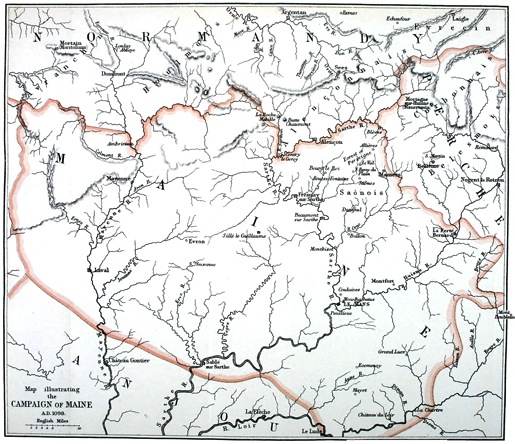
William in Normandy. November, 1097. When William crossed the sea in the November following the election of Hildebert, we may believe that the wrong which he held to have been done to him in the matter of that election was in his mind as a secondary cause of action, along with his demand of the Vexin from the King of the French. His designs on Maine. He came for war with France; he was ready for war with Maine also. But we do not hear of any actual military operations till the next year had begun. And, when warfare began, it was at first warfare carried on, just as often happened in Wales and even in Scotland, by the King’s licence indeed, but not by the King himself. Robert of Bellême attacks Maine. The immediate danger lay on the side of the county which was threatened by the constant enemy of Maine and of Helias, Robert of Bellême. From him came the first acts of warfare. It was against him that Helias now found it needful to strengthen his castle of Dangeul.[542] Helias strengthens the castle of Dangeul. Its position. This point lies to the north-east of Ballon, at only a few miles’ distance. The castle stands on a height nearly equal to that of Ballon, though Dangeul does not take the same 214 marked form of a promontory, but rather stands on the edge of a wide expanse of high ground sinking by stages down to the plain below. The fortress has wholly vanished; but its site may be traced within the grounds of the modern château which has taken its place, and which represents, in a figure, the stronghold of Helias. The view which the spot commands shows how well the site was chosen. The eye ranges as far as the height of Sillé-le-Guillaume on one side, as far as the Norman Chaumont on the other. Dangeul stood right in the way of an advance of the arch-enemy, whether from his own home at Bellême or from any of his Norman or Cenomannian fortresses.
Geographical character of the war; waged chiefly with Robert of Bellême. The war of Maine is largely a war between Helias and Robert of Bellême. This gives the war its special geographical character. The immediate possessions of Helias lay in the south-eastern part of the county; the fortresses of the enemy threatened him from the north-east. The capital lay between them. The result is that the seat of war is confined to the eastern part of Maine, the modern department of Sarthe, and that Le Mans itself is its special centre. Of western Maine, the modern department of Mayenne, we hear nothing. There is no news from the old battle-field of Domfront, Ambrières, and Mayenne itself, though of the lord of Mayenne we still continue to hear. There is nothing this time to tell of Sainte-Susanne or of Sillé-le-Guillaume.[543] The war takes up such an area as is natural when the strife is waged mainly for the city of Le Mans, when it is waged between the lord of La Flèche and the lord of Bellême. The enemy advances from Alençon and Mamers; he is checked by the fortification of Dangeul.
Edwᵈ. Weller
For the Delegates of the Clarendon Press.
Map illustrating the CAMPAIGN OF MAINE A.D. 1098.
Effects of the occupation of Dangeul. The occupation of this last strong post by Helias was not without effect. He did not indeed win back any of 215 the castles which were held by Robert of Bellême; but the garrison of Dangeul kept the invader in check, and hindered him from carrying his accustomed ravages through the whole country. This move of Helias seems even to have convinced Robert that the conquest of Maine was an undertaking too great for his own unassisted power. Robert of Bellême invites the King. January, 1098. In January he went to the King, and stirred him up to a direct attack on Helias. With a lover of warfare like Robert winter went for nothing; it would be just the time to take the enemy by surprise, while they were not expecting any attack. The King, we are told, was unwilling. It is hard to understand why this should be, unless he was too busily occupied with the war in the Vexin. He was ashamed however—the chivalrous feeling again comes in—to shrink from any warlike enterprise which was proposed to him.[544] William and Robert against Helias. The King and the Count of Bellême set forth; but they found the Count of Maine fully their match. He knew how war was to be carried on in his own land against an enemy stronger than himself. Guerrilla warfare of Helias. He planted detachments at every convenient post; he lined the hedges and defences of every kind with men; he guarded the passages of the streams, and the difficult approaches of the woods. Against this kind of skirmishing warfare the mighty Rufus and all his knights were able to do as little as they were able to do against the light-armed Welsh.[545] The King waxed fiercer than ever against the 216 men of Maine and their Count; William leaves Maine. but he withdrew his own personal presence, betaking himself doubtless to the other seat of war.
Robert of Bellême continues the war. Meanwhile Robert of Bellême was left to carry on the struggle with Helias. He was ordered by Rufus to bring together as large a force as he could in his own fortresses, nor did the King forget to supply him with abundance of money for that purpose.[546] On such a bidding as this, Robert of Bellême, Robert the Devil on Cenomannian lips, set to work with a will which fully bore out his surname. He built new fortresses, he strengthened the old ones with deep ditches.[547] He had already occupied nine castles, besides fortified houses, on Cenomannian ground.[548] Castles held by him in Maine. The list is given as Blèves, Perray, Mont-de-la-Nue, Saônes, Saint Remy-du-plain, Lurçon, Allières, Motte de Gauthier-le-Clincamp, and Mamers. All these lie in the north-eastern part of the county, the part immediately threatened from Alençon and Bellême. They occupy nearly the whole of the land between the Cenomannian Orne and the upper course of the Sarthe above Alençon, lying on each side, north and south, of the great forest of Perseigne. The line of the Sarthe from Alençon to Le Mans remained untouched, while Ballon stood as the advanced guard of the capital, and Dangeul was a yet further outpost of Helias, in the very teeth of the invader from Bellême. Perray, alone 217 among the points held by Robert, stands as far south as the lower course of the Orne.
Several of the castles on this list occupied marked sites, and have left considerable traces. Mamers and Blèves were strictly border fortresses, points which Robert had seized just within the Cenomannian border; the others were more advanced points in the heart of the Cenomannian land. Mamers. Mamers, with its streets sloping down to the young Orne, is the only one of the places on our list which is now at all a considerable town. But the only signs of its fortifications which are to be seen are found in the names of its streets, which suggest the former presence of a fort by the river and of a castle on somewhat higher ground. Mamers, due west from Bellême, may well have been Robert’s first conquest, and its occupation may have marked his first advance into the dominions of his neighbour. But he must also, early in his career, have made himself master of Blèves. Blèves. This is a point which has no natural advantages of height, but which, standing in the very north-east corner of Maine, separated from Perche by a small tributary of the Sarthe, is important from its border position and as commanding a bridge. A mound which once stood there has been levelled; a graceful Renaissance house near its site is the present representative of the castle; but parts of the ditches may still be seen; the church, near but not within the enclosure, contains work which may have been looked on by Hildebert and Helias, and ancient masonry still remains at the manorial mill. Blèves lies north of the forest of Perseigne; Allières. at Allières, on its eastern verge, all actual traces of the castle have vanished; but the church again contains some small parts which seem contemporary with our story, and the site of the fortress may well be marked by the modern château on the hill-side commanding a wide view to 218 the south. But more speaking witnesses of this war may be seen at two points lying south of the forest and directly west of Mamers. Saint Remy-du-plain. Saint Remy, distinguished as Saint Remy du Plain from a namesake to the south-east known as Saint Remy du Mont, stands, not indeed in the plain, but on the edge of the high ground. It commands an extensive view, reaching to the point which bounds most of the views in northern Maine, the butte of Chaumont. Saônes. A site of the like kind, but with a less wide prospect, is held by Saônes at a short distance to the south, hard by that unusual feature in these lands, a small lake. Saônes is now a small village, but it was once of importance enough to give its name to the surrounding district of Saosnois or Sonnois. In both these cases the castle-mound rises immediately to the west of the church, the latter at Saint Remy being a late building of more pretension than is usual in the neighbourhood. Each mound has its surrounding ditch, which at Saint Remy is of most striking depth; each has its encircling wall; each has its inner tower, that at Saônes of an irregular four-sided shape, that of Saint Remy octagonal without and round within. Here are two unmistakeable and most striking sites of the fortresses which the invader from Perche rent away from the Cenomannian county. But, with such small remains of walls as are still left, it is hard to say in each case how much may be the work of Robert of Bellême himself. The mounds—natural hills improved by art—and their ditches are doubtless far older than his day; the walls must often be far later. Small architectural remains of the eleventh century. There is little architectural detail left to decide such points; we are left to the less certain evidence of masonry. Some of the masonry in the inner building at Saônes certainly has the air of work of the eleventh century. In any case, whatever may be the exact amount of his work among the 219 existing remains, everything bears witness to the impression which Robert’s invasion made on the district and to the reputation which he left behind him. Not far from Saônes, some remains of dykes, of the age or object of which it would be rash to speak with certainty, still keep the name of Robert the Devil.
Nature of the country and of the war. A visit to the scene of this war, a look-out from any of the chief fortified points, brings forcibly home to us the nature of that kind of struggle with which we are dealing. Nothing but an actual sight of Italy and Greece fully brings home to the mind the state of things when each city was a sovereign commonwealth, armed with all the powers of war and peace. Till we take in the fact with our own eyes, we do not thoroughly understand how men felt and acted when they constantly lived with rivals, rivals who might at any moment become enemies, within sight of their own territory. Teaching of the landscapes in Maine. The out-look from any of the Cenomannian heights, the out-look from the home and centre of mischief on the hill of Bellême, brings home to us another state of things with equal force. Had the commune of Le Mans lived on, had other neighbouring cities followed its example, the older Greek, the later Italian, model might have been seen in all its fulness on the soil of northern Gaul. And warfare between Le Mans and Tours, between Le Mans and Alençon, carried on with that mixture of lofty and petty motives which is characteristic of warfare between rival cities, would have been ennobling compared with the state of things which actually was. The castles. For here we see every available point seized on to make what, at least in the hands of Robert of Bellême, was a mere den of robbers.[549] From his own scarped mound at 220 Bellême the destroyer could see far enough into the Cenomannian land to give a keen whet to his appetite for havoc. Within the land which thus lay open to his attack, we see from every height the sites, not of one or two only, but of a whole crowd of strongholds which have passed away. A very few only of these strongholds could ever have been needed for the protection of any town or for the general defence of the country. Their object private war. They were strongholds which had been first raised for the purpose of private war, and which, in the hands of their present master, were turned to the purpose of general oppression. One wonders how, in such a state of things, when almost every village was overshadowed by its robber’s nest, a single husbandman could till his field, or a single merchant carry his wares from town to town. Contrast with England. And we must remember that, unless during the nineteen years of anarchy, this state of things never existed in England. Our forefathers raised their wail over the building of the castles and over the evil deeds which were wrought by those who built them. Comparative rarity of castles in England. But at no time in England, save on the borders which were exposed to the foreign enemies of the kingdom, did castles stand so thick on the ground as they did in the land on which we now look. The eye which has been used to track out the scenes of the Cenomannian war comes back to an English landscape of the same kind, to mark the steep bluff or the isolated mount, which seems designed to be girt with a ditch and crowned with a donjon, and almost to wonder that no ditch or donjon ever was there. And, as we gaze on the land where they crowned every tempting site, we better understand 221 the joy and thankfulness with which men hailed the reign of any prince who put some curb on the pride and power of the knightly disturbers of the peace and gave to smaller men some chance of possessing their own in safety. We can understand how in such a prince this overwhelming merit was held to outweigh not a few vices and crimes in his own person. We can understand how, at the beginning of every period of restored order, a general sweeping away of castles was as it were the symbolic act of its inauguration. State of the Cenomannian castles. And perhaps the thought comes all the more home to the mind, because the Cenomannian castles are, to so great an extent, a memory and not a presence. They are not like those castles by the Rhine which have come to take their place as parts of a picturesque landscape. As a rule, it is not the castles themselves, but the sites where we know that they once stood, which catch the eye as it ranges from Mamers to Sillé, from Ballon to Alençon. But when we see how many spots within that region had been made the sites of these dens of havoc—when we think how many of them had, in the hands of Robert of Bellême, become dens of havoc more fearful than ever—we shall better understand how men cherished the names of William the Great and of his youngest son; we shall better understand the work which had now to be done in the Cenomannian land by one nobler than either the son or the father.