THE SEA ISLANDS HURRICANE.
Reading edition
Coast of South Carolina.

It is probable that there are few instances on record where a movement toward relief of such magnitude, commenced under circumstances so new, so unexpected, so unprepared and so adverse, was ever carried on for such a length of time and closed with results so entirely satisfactory to both those served and those serving, as this disaster, which, if remembered at all at the present day, is designated as the “Hurricane and Tidal Wave of the Sea Islands off the Coast of South Carolina.” The descriptions of this fearful catastrophe I shall leave to the reports of those who saw, shared its dangers and lived within its tide of death. They will tell how from 3,000 to 5,000 human beings (for no one knew the number) went down in a night; how in the blackness of despair they clung to the swaying tree tops till the roots gave way, and together they were covered in the sands or washed out to the reckless billows of the great mad ocean that had sent for them; of the want, woe and nothingness that the ensuing days revealed when the winds were hushed, the waters stilled and the frightened survivors began to look for the lost home and the loved ones, and hunger presaged the gaunt figure of famine that silently drew near and stared them in the face. How, with all vegetable growth destroyed, all animals, even to fowls, swept away, all fresh water turned to salt—not even a sweet well remaining—not one little house in five hundred left upright, if left at all; the victims with the clothing torn and washed off them, till they were more nearly naked than clothed—how these 30,000 people patiently stood and faced this silent second messenger of death threatening them hour by hour. Largely ignorant, knowing nothing of the world, with no real dependencies upon any section of its people, they could only wait its charity, its pity, its rescue and its care—wait and pray—does anyone who knows the negro characteristics and attributes doubt this latter? Surely, if angels do listen, they heard pleading enough in those hours of agony to save even the last man and woman and the helpless babe. Something saved them, for there is no record of one who died of starvation or perished through lack of care.
I have promised to leave these descriptions to those who saw. I will also leave the descriptions of the work of relief done at the field to those who so faithfully performed it, the members of my working staff and the volunteer workers of other fields who came to their assistance on this.
I place here the more important of the reports made to me at the time, but which have until now remained under seal, no general report of that field having been made. The main interest of these reports will consist in showing the methods of work adopted, not only to preserve so many people in life with so small means as we had at hand, but to preserve them as well from habits of begging and conditions of pauperism; to teach them self-dependence, economy, thrift; how to provide for themselves and against future want, and help to fit them for the citizenship which, wisely or unwisely, we had endowed them with. I will then, with the reader’s kind permission, simply show the open doorway through which we were called to enter that field and introduce the nationally renowned advocates and escorts who personally conducted us and placed its work in our hands.
About the twenty-eighth or twenty-ninth of August, 1893, the press commenced to give notice, such as it could get over wrecked roads and broken wires, of a fearful storm coming up from the West Indies that had struck our coast in the region of South Carolina, sweeping entirely over its adjacent range of islands, known as the Old Port Royal group, covering them from the sea to a depth of sixteen feet, with the wind at a rate of one hundred and twenty miles an hour—that its destructive power was so great that it had not only swept the islands, but had extended several miles onto the mainland of the State.
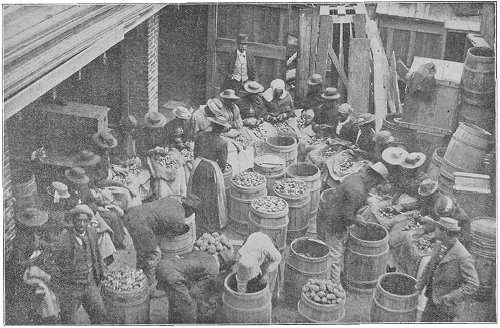
Copyright, 1898, by Clara Barton.
WOMEN CUTTING POTATOES FOR PLANTING—SEA ISLAND RELIEF, S.C., FEBRUARY, 1894.
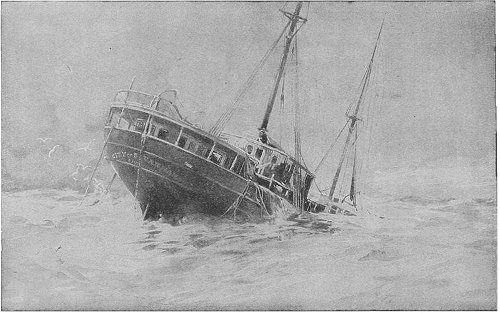
Copyright, 1894, by Charles Scribner’s Sons.
A WINDFALL FOR ST. HELENA.—WRECK OF THE “CITY OF SAVANNAH.”
I chanced to be familiar with the geography and topography of that group of islands, having lived on them in the capacity of war relief many months during the siege of Charleston in 1863–64. Knowing that they scarcely averaged four feet rise above the sea level, with no mountains, not even hills that could be called such, that the soft, sandy soil could not be trusted to hold its tree roots firm, that the habitations were only huts, to be washed away like little piles of boards—I thought I saw no escape for the inhabitants and that all must have perished; and so replied to all inquiries at first made as to whether this were not a disaster for the Red Cross to relieve, “No, there was nothing left to relieve.” Later and more reliable news brought the astonishing fact that it was estimated that from thirty to forty thousand had survived and were in the direst need. Was not this a call for the Red Cross? Still more emphatically, “No; if that is the case, it is beyond the Red Cross. Only the State of South Carolina or the general government can cope with that;” and again we closed our ears and proceeded with our work.
But the first week of September brought pitiful paragraphs from various Southern sources—one I recall from the governor of the State, in which he proclaimed his perplexity and great distress at the condition of these poor people, needing everything, and who, at that season of the year, with crops all destroyed, would continue to need; and closed by wondering “if the Red Cross could perhaps do anything for them.”
It would not do to close our ears or eyes against this suggestion, and I at once sought our congressional neighbor, General M.C. Butler, of South Carolina, then in the Senate, now on the Cuban Commission, asking his views. The response was such as would not have been looked for in that busy, hard-worked Senator, surrounded by a network of political wires, some of them only too likely to be “live;” he dropped all business, telegraphed at once to Governor Tillman at Columbia to learn the conditions and urgently requested us to go, and he would even leave his seat and go with us as soon as we could be ready. Time is never a question with the Red Cross, and the next night, in a dark cheerless September mist, with only two assistants, I closed a door behind me for ten months, went to the station to meet General Butler, prompt and kind, and proceeded on our way. At Columbia we were joyfully surprised at meeting Governor Tillman, prepared to accompany us, with a member of his staff, and thus powerfully reinforced we made our entrance into Beaufort.
The work of relief had been wisely placed at first in the hands of committees from both Beaufort and Charleston, comprising the best business men of each city—its lawyers, merchants, bankers, all men of prominence and known practical ability. They had done and were doing all possible for them to do, with hearts full of pity, hands full of work, themselves large losers by the storm, business nearly wrecked, and needing every remaining energy for the repairing of their own damages and those of the citizens about them.
The governor, at whose request they had formed, realizing the necessities of the case, sought to release them, calling them together in each city and successively relieving them, placing the Red Cross in full charge of the relief. With the little knowledge we had of the conditions and surroundings, it would have been madness to accept, at least until both more knowledge and more numerical force were gained, and the refusal was as prompt as the proffer had been. We however promised to remain in Beaufort, meet with the committee each day, advise with them, study the situation and report our conclusions when we could safely arrive at them.
Thus we remained until the first day of October, when, realizing that the relief coming in from outside would soon diminish, as the excitement should wear away, that the sum in hand was painfully small, that the number of destitute was steadily increasing, that the winter was approaching and they must be carried through in some manner till the next year’s crops could grow; and that, in order to do this a fixed system of relief must be adopted, a rigid economy enforced and every person who could do so must be made to work for his food and receive food and raiment only in return for labor; that this could only come from persons who had no interests but these to subserve and with the light of all experience that could be called to the task. Even then a successful result was questionable; but there was no question of the fatal result of any other course, and after a thoughtful council of our official board (which had meanwhile become nearly filled) on the night of September thirtieth it was decided that the Red Cross would accept the appointment of the governor and enter upon its duties the following day.
Accordingly, at the meeting of the next day, October 1, 4 p. m., the Beaufort Relief Commission, as appointed by the governor, was formally released as a committee and immediately re-elected by the Red Cross as its “advisory board,” to meet and advise with us as we had done with them.
Through all these years the tenderness springs to my heart and gathers in my eyes as I recall the kindly and affectionate intercourse of months, without one break, that grew up between us. And although some have been called to higher service and greener fields, I am confident that none of us will ever seek on this side a better, more trusted, kindlier association than were found in these.
I desire to supplement the foregoing allusions to the storm by the full and ably rendered account of commodore, now admiral, Beardslee, then in command of the naval forces of that section, with headquarters at Paris Island. The admiral and his charming wife were our neighbors, and most efficient helpers through all our work:
Admiral Beardslee’s Description of the Hurricane.
Mrs. Beardslee and I were participators in the events and shared the dangers brought to the inhabitants of the Sea Islands of South Carolina by the terrific West India hurricane, with accompanying tidal wave, which desolated those unfortunate islands in August, 1893.
Since our recent return and while on the journey, and at New York, friends whom we have met, and new acquaintances, have almost universally exhibited much interest in the description of the situation of affairs on those islands, before, during and after the storm, and to many the simple details which were to us but household words, brought the first realizing sense of the magnitude of the calamity.
Miss Clara Barton, the president of the American branch of the International Organization of the Red Cross, who has the management of contributions and of the dispensing of aid among the Sea Islands now, and had occupied a similar position at Johnstown, made us her agents to dispense on one of the islands, where weekly we feed over four hundred persons, and I know we are but doing as she would wish, in continuing so to act, during our brief respite from our work.
Therefore I most cheerfully comply with the request, and trust that my efforts to interest and revive interest will not be in vain.
Geography of the Coast.
I will premise with a bit of geography: The coast of South Carolina is bordered for over a hundred and fifty miles by an archipelago consisting of hundreds of islands and islets from a hundred square miles to as many yards in area. These are nearly all well wooded with pine, oak, magnolia and gum trees. Many of them consist largely of arable land, which, before the war of the rebellion, was divided by hedges into great plantations, whereon the rich planters, aided by their hundreds of slaves, cultivated, besides vegetables of all kinds, the famous long staple “Sea Island cotton.” The islands are separated from each other and from the main land by arms of the sea, here called rivers, or creeks, according to their width and depth, some, as Beaufort, Broad and Coosaw rivers, from one to three miles in width and thirty feet in depth, and others, which, at low tide, are but marshes, with a thread of water.
After the War.
After the war the large plantations were subdivided into five, ten and twenty-acre farms, which were by the government distributed among the “heads of families,” generally of the slaves who were left on them, and these negroes, with their descendants, still occupy these farms, living in comfortable cabins, each plantation having its own hamlet or colony. After the first shock of change was over, these negroes developed into orderly, industrious, thriving Christian communities. Each farm was thoroughly cultivated, and there was produced every year good crops of potatoes, sweet and Irish, peas, corn, melons and one or two bales of cotton, which, mortgaged to the local storekeeper, generally a white man, furnished them with groceries. All raised and owned horses, mules, hogs, cattle, turkeys, domestic fowls and ducks. All were owners of one or more buggies, carts, plows and other agricultural implements, and those who lived near the sea owned one or more boats, with outfit of nets and fishing gear, and from spring until winter the sea yielded abundant harvest of good fish, turtles, crabs, shrimps, prawns, clams and oysters, and the marshes furnished terrapin, which sold at very remunerative figures, as I well know, for the storm took from me nearly three hundred of them. Every cabin was comfortable, from their point of view, furnished, and in many were sewing machines, house organs and melodeons, and for every member of the family, however slightly attired on week days, a fine, often gorgeous, suit of Sunday clothes—and they are all church-goers.
The great barn-like structures that they build for churches are presided over by preachers of their own race—“reverence doctor” is the title—and are crowded. They have also smaller places of worship, called “praise houses,” where they assemble once or twice a week in the evening to indulge in “shouting” a mingled prayer, responding, singing, and when “spirit dun come pow’ful,” a wild, waltzing sort of a dance, such as I have seen in Africa. They have schools which troops of well-dressed children attend daily. There are lots of children, and but a very small portion of those under twenty have not quite a fair common school education. Said an old aunty to a lady friend of mine: “Has yer children, honey?” “Yes, aunty, I have three boys and one girl.” “Is dat all?” “Yes, isn’t it enough?” “Dat’s as the Lord wills, honey; to some He sends little litters and to some big ones. I’se got thirteen head and I’se dun loss four head.”
The Disastrous Storm.
The climate is perfect, very little labor produces good results, and I think that without going more into detail you will all admit that the Sea Islanders were a happy, contented, very comfortably fixed set of people. So it was at the going down of the sun on the twenty-seventh day of August, 1893. When the sun rose the next morning, hundreds of those cabins had been swept from the earth, with all they contained. Over thirty thousand of those people were homeless, clotheless, foodless, with no resources. Over eight hundred were dead (the figures are from actual census). A hurricane on its way from the Gulf of Mexico to the north had swerved somewhat from the usual course of these storms, its centre, instead of following the Gulf Stream, had come in over the land, and the great uprising of the surface of the sea, which always occurs at the calm centre of these storms, caused by the low atmospheric pressure, as shown by low barometer, had, instead of dissipating itself on the surrounding ocean, inundated our islands to depths varying from one to ten feet according to the height of the land, the average height of the tidal wave, above high water, being about seven feet. Thus the surface of each island was a sea, and driven by the tremendous force of the wind over a hundred miles per hour, as recorded at Charleston, north of us, and at Savannah, south, into death-dealing waves.
The houses, all built on posts two to four feet above ground, came down like card houses. Some collapsed and crushed their inmates on the spot; others went drifting off with men, women and children clinging to them, until falling to pieces they dropped their living freight into eternity. Some escaped by seeking shelter amid the branches of the giant pines and oaks; some were so saved, but others had but found death traps, for yielding to the force of the wind, many were thrashed to death by the whipping branches, or knocked off into the raging sea below. And among the thousands of these trees which were uprooted, or twisted off, were many on whose branches people were clinging. I knew nothing of what was occurring on other islands than the one we were dwelling on, Paris Island, where I am in command of the naval station; for, deprived of every means of communication with the outer world by the destruction of all railroads and steamers that connected with us, telegraph and telephone lines down, and all of my boats either sunk or wrecked, our own affairs had my entire time and attention.
A Work of Rescue.
I have been a sailor for forty-five years, and as such have battled with many tempests, but on my own ship, with plenty of sea room, I have known what to do to increase safety and lessen danger. But in this case I was nearly helpless. Fortunately I alone knew this, for I was now surrounded by those who looked to me for help. I was forced to “keep a stiff upper lip,” but the task was not a slight one. My house is a two-story frame, built on brick piers, about sixty rods from the beach. Between it and the water were six negro cabins and two quite large houses. Shortly after sunset the weaker of them succumbed, but the tide was not yet so high but that my men succeeded in saving from the wrecks the women and children, all of whom were carried first to the largest of the two houses. About 11 p.m. the tide was at its height, and there came driving onto my lawn and under my house great timbers, wrecks of houses, wharves, and boats, and fortunately a large flat boat, called a lighter. Some of the braver of my men captured this boat by plunging in up to their necks and pushed and pulled it to the house where the refugees had gathered, at which the screams told us there was trouble. They got there just in time to rescue about fifty and brought them to my house.
During all this time the rain was falling in torrents and every person was soaked through, and as the wind was from the northeast, the rain was cold, and they were chilled through. An attempt to get up a fire in my kitchen stove disclosed the fact that my woodshed was gone and there was no wood. Some empty packing boxes in the garret were utilized; then a big pot was put on to make coffee. We then found that excepting in a few pitchers there was no fresh water. My cistern had been overflowed by the sea. Fifty men were put to bailing and pumping, and weather boards from my shed and servants’ quarters were quickly extemporized into gutters and pipes—then the rain proved a blessing, and we were saved from water famine. But there were chances of a food famine. My storerooms and those of my only white neighbor, the civil engineer of the station, held all of the food on the island, and there were hundreds to feed. Fortunately it was Sunday. Saturday is our marketing day, and we had a week’s supply under ordinary circumstances, but with such a lot of boarders we had to handle it very sparingly.
The Next Day.
By daylight the storm had modified and the sea subsided. Then came work. First of all my mules and carts were started with search parties for drowned people. Before night there were nine such laid out in my coal shed. To those we gave Christian burial, but to twelve others found during the next forty-eight hours, guided by the buzzards that had begun their feasts, we for sanitary reasons had to treat them as we did the many carcasses of animals, bury them at once where we found them. On the second day I captured a passing sailboat, one of the very few left, and obtained from Port Royal a big load of provisions, with which I started a store, paying the big gang of laborers that I had employed with checks on the store, where food was furnished at cost.
Red Cross to the Rescue.
On the fifth there came to us a great blessing. The Red Cross Association had been appealed to and had responded. Miss Barton, its president with her staff of physicians, nurses and other trained people, came, investigated and took charge of us, and under their systematic, business-like methods, taught them by much experience in many great calamities, are now keeping, and will keep, as long as the good people of the country will furnish the means, starvation away from this miserable mass of humanity.
It may be that in this favored part of the country, where cyclones and earthquakes do not occur, many of your readers know little of this organization. I will tell them a little and close. During our war, in 1863, a congress composed of representatives of the leading nations of Europe met at Geneva, Switzerland, its object being to make such international rules as would tend to lessen the horrors of war and alleviate the suffering. The United States was invited to participate, and Miss Clara Barton, a woman even then well known for her career of charitable deeds, and for her abilities, was afterward selected to bring in the United States to the treaty. Miss Barton secured for the United States the privilege of adding to its war relief that of sufferings from storms, earthquakes, floods and other calamities due to natural causes. This addition is known as the American amendment. An American branch was formed, of which Miss Barton was elected president. She has a large and able corps of experienced assistants scattered throughout the Union, ready to respond at once to her call and hurry to place their services, free of cost, at her disposal. This corps of helpers take nothing for granted; they investigate for themselves and learn accurately just who need help, and how much, and what kind. Books are kept, and every penny or penny’s worth accounted for. The Red Cross does not, as a body, give charity—it dispenses intelligently that of others. The body is your and my agent to see that what we choose to give shall be honestly and intelligently put where it will do the most good. Its members, from principle, do not beg. It is their business to present facts to the public and let every man, woman and child act on his or her unbiased judgment. She has done me the honor to accept my service as an amateur. I am not quite so strictly bound by the rules as are the members, therefore if anyone detects a little tendency to beg in this article it is my fault, not that of the Red Cross.
Present Headquarters.
At this present time Miss Barton has her headquarters in Beaufort, where she has chartered a large warehouse, over which she and her staff camp out, living, although I am told she is well off, in the plainest of styles. Her desk is a dry goods box, with a home-made drawer; her bed, a cot. Her agents are distributed on the various islands, living in negro cabins and tents. The Red Cross flag floats in their midst, and the food, clothing and other articles are served to the crowds of negroes, and trained nurses and physicians are caring for the sick and wounded. Hundreds of men are laboring digging drains to get clear of the brackish swamp water left by the mingling of sea water and rain, building houses and boats for the helpless, and the colored women, made beggars by the storm, have been organized into sewing societies, which repair all ragged garments sent, turn ticking into mattress covers, homespun into garments.
Detail of the Work.
There is now being served out, once a week, the following rations, which is all that her stock of stores allows: To a family of seven persons for one week, one peck of hominy, one pound of pork. To those who work for the community, double the above. To sick people, a small portion of tea or coffee, sugar and bread. She would gladly double or quadruple this allowance, but she has not the material.
Thus it stands. There are 30,000 American citizens who must be almost entirely supported by charity until they get a spring crop in April or May. Unless they are furnished with food they will starve, without bedding they will die from exposure; without medicines, of fever. Everything not perishable is needed, especially money to buy lumber, nails, bricks and hardware to rebuild the houses, cast-off and warm clothing, cooking utensils, pans, pots, spoons, etc. Most of the express companies send free all articles directed to:
Miss Clara Barton, President Red Cross Association, Beaufort, S.C. For storm sufferers.
White Sufferers.
In response to further inquiries Admiral Beardslee furnishes us the following:
There is a very small population of whites living on the Sea Islands, and of them the greater number are storekeepers, supplying the negroes and taking mortgages on their growing crops, principally the cotton. As nearly all of the crops, including the cotton, which was nearly ready for picking, were ruined, these storekeepers, in addition to great direct loss by the flood, which swept away their storehouses, have lost largely by unrecoverable debts, thus they are not able to do much toward the relief of the sufferers. * * * Among the sufferers there are a few white families, generally descendants of the old-time planters, who, having recovered by purchase small portions of their family property, have made their living by hard work as farmers and truck growers. They are, in some cases, reduced to abject poverty.
The merchants of the city of Beaufort lost heavily. Most of the principal stores were on Bay street, their storehouses stretching out on the wharf. All of these with the back buildings on them were swept away, and the merchants are not in position to give much help. Nearly all of the old Southern families were impoverished by the war and can do little, and that little is to a great extent very naturally bestowed upon the negroes and their descendants, who were at one time their slaves.
What is Needed.
The State of South Carolina is poor, one of its greatest sources of revenue, the phosphate business, which paid in royalties nearly $600 per day into its treasury, and expended thousands of dollars weekly, in payment of labor, was badly crippled and temporarily, at least, ruined. All of the dredges, lighters and most of the tugs and many of the “mines,” the great establishments where the phosphate rock is dried, crushed and prepared for export, were destroyed. * * * *
While anything or everything eatable, wearable or usable in any shape will do good, I would suggest as most valuable, money with which to buy lumber and hardware to rebuild houses, and food, hard bread, hominy, pork and cheap groceries, warm cast-off clothing, thick underclothing, cooking utensils, such as frying pans, tea kettles, pots, pans, etc., second hand as good as any, and children’s clothing, of which but a limited supply has been received.
There will be no necessity to mend up clothing, the sewing societies will do that and prepare for use bedticking, homespun and cloth of all kinds.
RELIEF WORK SOUTH OF BROAD RIVER.
Next to the account of Admiral Beardslee, I desire to place that of Mr. John MacDonald, who, from having faced death in the rigging of the ill-fated “Savannah” for three days, enduring every privation and danger that could be endured, still lived to come to us, and to generously volunteer his services to the Red Cross as one knowing how to feel for those with whom he had suffered in common. After a visit to the northern end of the islands, and a full verbal report to us of their conditions and needs, he went in a like capacity to the southern end, and finding less likelihood of other assistance there, decided to take this as his field and accordingly made headquarters at Hilton Head, where he did most efficient and praiseworthy work, drawing from the supplies at Beaufort such as could be spared from the needs of the other hundreds of distributing points.
The work of Mr. MacDonald and his capable wife (for he married while there Miss Ida Battell, a charming trained nurse from Milwaukee) was intelligent and comprehensive to an uncommon degree, not only relieving the colored population of the entire island, but raising them to a higher degree of industrial intelligence and self-help than they had ever dreamed of. I desire to tender in behalf of friendless humanity my grateful tribute of thanks to Mr. and Mrs. MacDonald for faithful and efficient service.
Report by Mr. McDonald.
On the night of August 27, 1893, while en route from Boston to Savannah on the steamer “City of Savannah,” the terrible devastating cyclone, which swept over the Sea Island Coast of South Carolina, was experienced by me in all its awfulness, terminating in the wreck and complete break up of that magnificent ship, and the terrible suffering and endurance of three days lashed to the rigging, without food or water and facing and hourly expecting death. Where could help come from? All the boats and ships in these waters had probably met the same fate as ours. All hope of help from nearby was abandoned, and our eyes were fastened on the North with anxious watchfulness. On the third night, when all hope had died out, in the darkness shot up a bright signal light—the last we had on board—and in a few moments another light shot out into the sky about two miles away; our cry for help was answered! Out of the North came help to us, and after the perilous work of rowing from one ship to the other, trip after trip, through breakers and high-running seas, we were saved and carried into port.
On arriving in Savannah and seeing from the papers, as the reports slowly came in, the awful wreckage which had been wrought on the islands, my sympathies were naturally aroused, for who could better know what these people must have passed through? When, a few days later, the call was issued for the Red Cross to assume control of the relief work, I abandoned the plans which had brought me South and joined Miss Barton’s forces.
A first inspection of the devastated district was appalling, and even as the scenes of distress, sickness and destitution became more familiar, its sadness did not wear away. Here were pretty islands, where, a few days before, cotton had been in its full luxuriance, corn almost ready for harvesting waving in the breeze, a bounteous harvest smiling in the faces of a contented people, their little homes intact and comfortable and each one congratulating himself and each other on a prosperous season as the fruits of their labors. Yes, prosperous, for to these colored people, whose needs are small, whose ambition receives no stimulus, fifty or sixty bushels of corn is a bounteous harvest. But the storm came! In a few hours neat cottages were a heap of ruins, scattered perhaps miles away; giant trees lay across the roads, twisted and knotted into almost impossible shapes; corn and cotton gone, and human beings—missing. Roads flooded with water, almost impassable, but still alive with people—here a mother looking for her children, a husband for his wife, children for their parents. There in the marsh, a dark object is seen lying prostrate. Onward they push, waist deep in water and mud, till they grasp the inanimate object, and after a moment’s silence a piercing wail announces another loved one found, dead. Go with them as they carry their dead home. Home! where is it? Gone! A few boards or branches of trees have been put together, tent fashion, covered with corn stalks and mud, and into this the family crowd, wet (for it rained incessantly nearly two weeks after the storm), hungry, sick, ragged and helpless, unable to think or act for themselves, dazed by the calamity which had befallen them; they looked around for some hand to lead them out of their pitiable condition, but everywhere the same wreckage and destitution faced them. But where should they look?
As we on the wreck amidst the breakers looked northward, so these people cast their eyes thither and sent out a plea for help. Hoping against hope, they lingered on, until, when everything seemed darkest, a gleam of light shot out of the Northern sky and help came quickly; they were saved from starvation. They grasped at the finger of help extended to them, as a drowning man at a straw, and with a supreme effort dragged themselves out of a listless, apathetic condition and endeavored out of chaos to bring order. With such a vast territory, and so many thousands of destitute people to care for, the task of systematizing the work was a heavy one. It was, however, divided into districts, and each willing helper entered on his labor with very little to encourage him, but with obstacles innumerable. How to get from island to island—boats all wrecked; how to get supplies to them; how to pick out the most needy cases to serve first when all were needy and the supplies scanty. The steam launch from the United States navy-yard was placed at my service and provisioned for a week.
I started out to the district assigned me, comprising the following named islands: Hilton Head, Pinkney, Harry Young, Savage, Hunting, Bull’s, Spring, Barataria and Dawfuskie, with Bluffton on the mainland south of Broad River, a treacherous stream, four miles wide, which received the full fury of the Atlantic and renders navigation by small craft hazardous. To prevent as far as possible any imposition on the part of applicants for relief, who were not in absolute necessity, I made my inspection from house to house, going into their corn cribs and estimating from their supply on hand how long they could exist without assistance. The condition of their houses, clothing and sickness in their families was also carefully noted. The stagnant water lying on the land, with no outlet, the hot sun, beating down on decaying animal and vegetable matter, the drinking water all polluted, had caused malaria in its worst form to be general amongst the people. With my medicine case constantly with me, scantily provided with quinine and other simple remedies, I relieved the cases as I met them, sending the worst cases to Beaufort, where they could be attended to by one of the doctors on the staff of the Red Cross located at headquarters.
After examining some three hundred families on Hilton Head Island, after driving from one end of the island to the other—fifteen miles—and being met on every hand with appeals for aid of every description, from young and old, from strong, healthy, able-bodied men to weak, tottering old uncles and aunties, I concluded that issuance of relief, without requiring some work from those able to work, would be demoralizing, and act as an incentive to people outside to flock to the islands, claiming assistance. What work should be organized was the next question. There were no ditches on the islands. Those which had been dug in ante-bellum times had become filled up. Had there been any outlet or drainage of any description, so that the waters could have run off the land, the loss of crops consequent on the heavy rains which followed the storm would not have been so serious. I therefore put those who were able to work digging ditches, those refusing to work I refused assistance. The result of this was that a total length of about thirty-seven miles of ditches, varying from two to four feet wide and from two to six feet deep, were dug. The benefit of this work was apparent during the summer and fall following, which was an unusually wet season, and in the bottom lands, but for these ditches, the crops would have been inundated. As it was, exceptionally good crops were produced, the health of the island was improved and a large area of otherwise waste land was reclaimed and rendered tillable.
After visiting my district I concluded to make Hilton Head my headquarters. There was no building available so tents had to be brought over for our use as storage, hospital, sewing and living accommodations. What willing hands to help make our camp comfortable! Some making cupboards, desks, stools, benches, bedsteads, out of old packing boxes, some gathering moss to lay on the floor as a carpet, and finally unfurling the Red Cross flag to the breeze and we were established. To simplify the work of issuing supplies weekly, I gave each family a card. On this I marked everything to be issued and each issue was crossed off, preventing it being presented twice in one week. It also enabled the old and sick to send by children or any one else, and receive the supplies without coming themselves.
How shall I describe our daily work? No regular hours, no routine, no system apparently, and yet everything went along in the twenty-four hours of duty as smoothly as possible. No regular hours? No; unless from sunrise to sunrise may be counted regular. No routine—no system? No; unless attending to everything as soon as it presented itself may be called system. At daylight the applicants would be around the tents waiting to see “Mr. Red Cross,” and from then on a steady stream of people, some sick, wanting medicine; some hungry, wanting food; some ragged, wanting clothes; some loafers, wanting anything they could get. As soon as this stream could be stemmed, and a little breakfast eaten hastily, came visits to the sick who were unable to come to us; and in all sorts and conditions of vehicles, from a shaky cart with an ox as motive power, to a roadcart behind a mule, we went wherever we were called. On returning to camp, deputations of applicants from other islands would be in waiting, and while eating dinner, these would be attended to. After this the men working on the ditches would be visited. When it became dark and everyone had gone home, we would visit our hospital tents, make patients comfortable for the night, and retire to our own tents, hoping to sleep, hoping against hope, for “the poor ye have always with you:” and this case was no exception, for at all hours of the night we were called out to go anywhere from one to six or seven miles, to attend someone who was sick or dying. In the midst of this work visits had to be paid periodically to the other islands in my district (where I had local committees to look after the distribution of supplies) often taking up two or three days. And what a scene of bustle our camp presented every Friday when the supplies came! Thirty or forty carts in line at the landing—the boat arrives—all hands help unload, and then load the carts, the number of sacks or boxes in each cart being marked down against the driver, and away they go to the camp, three miles away. As soon as they arrive, the crowd of waiting recipients hand in their cards, and as they are called in one by one, their bags ready opened, the “weekly ration” is quickly measured, dropped in, the card returned marked, and away they go. While all this is being done, a flotilla of small boats from the other islands in the district, is at the landing, and as each “captain” presents his order issued by me, my storekeeper gives him the supply for his island, and away he goes home, to enact the same scene with cards and empty bags and hungry people. Nor was this all. Houses must be built, lumber and nails measured and distributed (tents being provided for the houseless temporarily). Those whose houses were not damaged were required to help others rebuild. Their clothing had to be brought over, repaired and distributed. How this was done is shown in Mrs. Macdonald’s report.
This seems very simple to write about now after a year’s lapse of time, but it does not convey to the mind of the reader the constant anxiety resting on the mind of the Red Cross officer, with, as I had, 2,554 people in absolute need of all the necessaries of life; separated from Beaufort, the source from which I had to draw all my supplies, by Broad River, with the majority of the boats in this district rendered helpless by the storm—it was a matter of constant anxiety how I should get my weekly supplies for this large number of people, scattered over so large a territory, with so many rivers to cross. If the supplies were not here on time, think of these people having to tramp home empty-handed to hungry children, who could not understand that “it was too rough to cross Broad River.” With this difficulty constantly before me, it is a satisfaction now to put on record the self-sacrificing zeal of one colored man on Hilton Head Island—Ben Green—who placed his boat and the services of himself and men at my disposal and, without fee or reward of any kind, for several months, during good and bad weather, brought over the large amount of supplies required for this district. Another anxiety was, whether, when the boat went to Beaufort, sufficient supplies would be on hand to satisfy the demands of all the districts, or whether I should be put on “half rations.” Amid all this anxiety, there were occasional gleams of sunshine to cheer us in our arduous work, as, when I received from Miss Sarah S. Monroe, of 13 W. Ninth street, New York, two boxes of delicacies for the sick, and, after Mrs. Macdonald had cooked beef tea, corn starch, etc., and sent it round by little girls to the old and sick, how they would “tank de good Lawd fer sendin’ de buckra to look after us po’ cull’d folks;” how the name of “Miss Cla’ Ba’ton” was on everybody’s tongue, the infant girls named Clara Barton and the boys “Red Cross.” The self-appointed “Red Cross Deacons,” with an enormous Red Cross stitched on a piece of white cotton and worn on the left arm, were conspicuous in showing their gratitude for the bounty received. Then, when planting time came and seeds of every description and in large quantities were distributed to them, how eagerly they worked in their gardens, planting garden “yarbs” (herbs) and then their corn, cotton, etc. Our thanks are due to the J.C. Vaughan Seed Store of New York and Chicago (through Mr. Burt Eddy, their Southern Agent), for a large supply of potatoes and other seeds sent direct to me.
A brief summary of food supplies issued in my district shows:
Meat7,440lbs.
Grits16,410pecks.
Beef Milk Coffee Sugar 395 192 143 120 lbs. cans lbs. lbs For the sick.

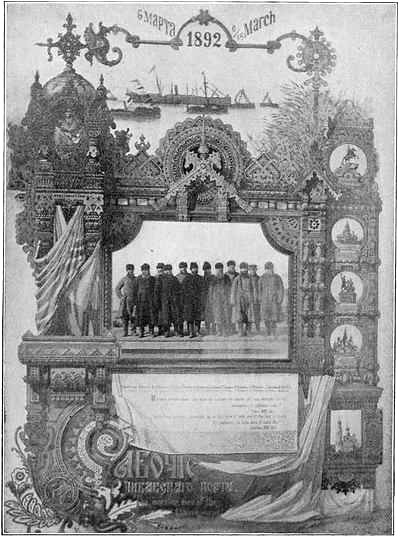
TESTIMONIAL FROM RUSSIAN WORKMEN FOR AMERICAN HELP AND SYMPATHY IN THE FAMINE OF 1892.
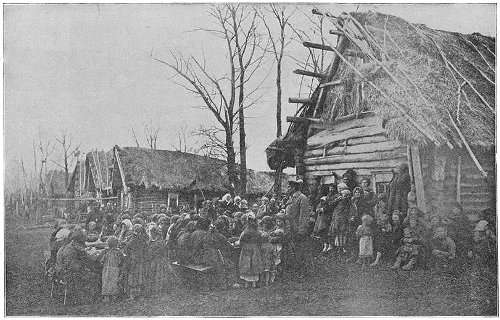
Copyright, 1898, by Clara Barton.
A RUSSIAN PEASANT VILLAGE
Scene taken during the famine
There were 454 cases of sickness treated at the camp and 75 visits made to the sick at home. In May, with the vegetables and wild fruits in good supply and marketable, their crops all growing well, I asked the people, “Can you manage to get along now without further help?” They answered “Yes; we are thankful for what has been done for us, and will try to pull through till harvest, alone.” On the twentieth of May I issued a month’s supply to each family, took down the Red Cross flag and closed the relief work for this district. A year has passed since then. I am now a permanent resident on Hilton Head Island. I watched the crops grow, saw a good harvest gathered in, the people resumed their old-time cheerful tone, and the storm became a memory. With the exception of a very few old people who are hardly able to totter, and have no one to plant or work for them, the people of this island are again prosperous and happy. Occasionally some kind friend enables me still to make some old uncle or auntie happy with a little help, and so they totter down to “where the storms shall cease to roll.”
CLOTHING BRANCH, HILTON HEAD DISTRICT. REPORT BY MRS. MACDONALD.
Accustomed as I had been, in Chicago and other large cities, to see a miscellaneous assortment of rags worn under the name of clothing, I was little prepared for the sight of the almost nude condition of the great mass of people, which came to my notice on first entering on the relief work of the Sea Island Sufferers. After a couple of days and nights spent in the clothing room in Beaufort, packing barrels and boxes for the Hilton Head District, we proceeded there and amid loud exclamations of “closen” had the freight hauled to our camp. Before an hour had passed we were besieged with applicants, but as our present supply was limited, we could only attend to a few of the worst cases, and these were told to come at ten o’clock the next morning. Having already procured the information regarding the families—ages, sex and number of children—we spent the time in putting into bundles suitable clothing for such as had been told to come. Fearful of being late, they began to assemble by daylight, and as each man or woman was seen emerging, “toting” the bundle, a hum of voices would assail the lucky one with “Bress de Lawd; what ye done get?” The experience with this first installment showed that some work must be expended on the clothing before distribution, to make it more serviceable. As the men were put to work in the ditches, so the women who were able to leave their families were called on for a week’s work each in the sewing tents; a sewing machine was borrowed from one, and Miss Mary Clark (who was put in charge) assorted the garments, giving to some patching to do, to others buttons to sew on, to others apparently useless garments to make into children’s clothing. When all got steadily to work, one would commence a patter song, the rest would quickly join in, and, to the accompanying rattle of the sewing machine, work and music blended. To hear them sing, one would hardly think they had just passed through a great calamity; but it was the calm which follows the storm—they knew their troubles were over, and they were going to get “kiverin” for the “chilluns.” How they worked! Garment after garment was quickly mended, examined by Miss Clark for faults, and then placed in its proper barrel, ready for giving away. When all the clothing had been repaired, the list of needy ones was examined, and, as before, the most needy told to come the next day. But the “most needy” generally included half the island, for telegrams never flew faster than did the news that clothes were going to be issued. Then, when the last garment had been issued, some happy, some dejected, they would go away to await the next issue. So week by week, a constant stream of barrels, boxes and bundles would be received, mended and given away to those who, many of them, hardly knew what a whole garment was. Occasionally one, more crafty than the rest, would try to excite extra sympathy by producing a goodly array of “motherless chilluns,” borrowed for the occasion, in the hope of getting an extra supply, not knowing that we already knew the full number and ages of each family. The system adopted by the Red Cross of first quietly getting its information complete, and then going to work, knowing what to do and how to do it, showed its value in preventing imposition, which must always be met with to some extent, in all charitable work. In this way 3,400 garments were repaired and given away in this district, besides shoes, hats, etc.
While the sewing was in progress in one tent, I helped attend the cases in the hospital tents, and made daily calls when necessary on patients who were unable to come to me. My experience in Hahnemann Hospital, Chicago, fitted me for this part of the work. In all this work the lack of suitable supplies had to be overcome. As soon as our busiest season had passed and the sickness had abated, I opened a free school in one room of our house, expecting to teach reading, writing and arithmetic to ten pupils. The attendance rose almost immediately to forty and we gave up another room to the use of the school, and I had one of the older pupils assist me with the younger ones. To Mr. Proudfit, of Morristown, N.J., are due our thanks for his generous contributions, enabling us to purchase slates, books and other school supplies.
WAREHOUSE AND SHIPPING DEPARTMENT.
In introducing the dual reports of Dr. E.W. Egan, I imagine that I realize something of the feeling of the Queen of Sheba when she proclaimed that the half had not been told. The practical, unswerving and unique method of procedure pursued by Dr. Egan with these thousands of ignorant, hungry wards and waifs would constitute an interesting study for the most advanced philanthropist. The problem, as he tersely states it, of how to make thirty thousand dollars feed and shelter thirty thousand people a year, was not easily solved; and yet, largely under his original calculation and undeviating faithfulness to his own plans, it was solved, and how successfully, all the years from that time to this have testified. The medical aid which he established among these poor, deluded sufferers was as if an advanced clinic from his Alma Mater, Jefferson College, or the University of Pennsylvania, had been suddenly opened in their midst. The old dislocated joints, broken bones, tumors, internal diseases, carried about and dragged on through years of pain, disappeared; they literally took up their beds and walked. Their faithful hearts, like their eyes, followed him in admiring confidence, as with hurried step and quick glance he passed among the distributers of the warehouse; and if he told them that a pound of meat and a peck of grits was enough for a week—all they could have and must be supplemented either by work, if obtainable, or fish or game, if it could be caught—there was no complaint, no demur: “The doctor said so, and it was all right.”
It is a comfort to me as I write to know that his skillful hand is now on the keys that have for such weary months locked in the untold agonies of the terrible dens in western Cuba, designated, for the lack of some more appropriate term, as “hospitals.”
Report by E. Winfield Egan, M.D.
The first official word of the Port Royal Relief Field, ambiguously called the Sea Island Relief Field, came to Dr. J.B. Hubbell, the general field agent of the American National Red Cross, with whom it was my privilege to be at Indianapolis, attending the annual reunion of the Grand Army, where, for the first time in the history of that organization, the Red Cross of Geneva took its place upon the arms of the surgeons, the ambulances and the tents which were regularly distributed along the line of march. Twenty-four hours found us en route to Beaufort, S.C., which was to be the headquarters of the American National Red Cross, through its year of effort to take care of 30,000 human beings living upon the islands, known as the “Sea Island” or Old Port Royal group, as they were called during the war, lying off the coast of South Carolina, between Charleston and Savannah, and which had been devastated by that memorable cyclone of August 27, 1893.
I reported to the president, at headquarters, for duty the twenty-eighth day of September, 1893. Upon arrival I found the president and field secretary quartered in an unused club house, using parts of billiard tables for dining purposes, desks made of dry goods boxes, crude furniture made in a day and nicely upholstered with manila paper—in short, it was camping out indoors.
The local relief committee was still in charge, Miss Barton and her staff meeting with them by invitation as an advisory board.
The Red Cross headquarters was the scene of busy census takers; men from every part of the field were constantly coming and going, bringing reports of the number of people, their condition, the condition of their homes and their needs.
Their reports were being carefully indexed and entered upon one great book for future reference, a record of the greatest relief field America has ever known.
October 2, came my “marching orders” which were, “Take charge of the warehouse and stores, make an inventory of them, disperse these men and rid this city of the demoralizing influence of idle people.” The doors were closed and preparations for an inventory begun.
The manner of distribution previous to November 2, though performed by willing workers, was not, could not be, that systematic distribution which comes only after years of experience.
The warehouse had to be cleaned, partitioned, shelved and made ready for the repacking, separating heavy from light goods, and getting ready for receiving and shipping. The inventory showed not enough food to keep ten families two weeks.
On November 9, the doors of all the departments at headquarters were opened. The question of remuneration for workmen’s services must be determined upon and a standard adopted. There were at headquarters twenty-five workmen in-doors—white and colored—beside the cartmen and out-door laborers.
A standard of fifty cents in value was adopted for a day’s work and was given in flour, meal, grits, pork, or whatever there was in the storeroom at the end of each day, and the next day an entirely new set of men was employed, and this daily change lasted over a month, thus distributing to over a thousand people something beside the regular weekly distribution.
Women were engaged to sew sacks and other light work (just as necessary as heavier), and they were paid in the same manner and at the same rate as men. Will some of my readers think that these women, some with large families to support, and all having some one depending upon them, should receive less than the men, because they were women?
Shovels, spades and axes came in a few days in response to an order from our president, and men were put upon the public roads to clear and improve their condition and repair the damage which the storm had done.
The tools were all marked before they left headquarters with a Greek cross—on the steel or iron part they were stamped with a steel die and the wood handles were burned with an iron die.
This marking served many purposes. There was an indescribable respect for the Red Cross among the people it served and its insignia was its representative which meant a great deal for them.
It removed a temptation; they were instructed that those implements were only loaned and must not see idle days, and were to be passed on to the next workmen when their labors were finished. The marking made them undesirable property and none were lost, though hundreds were at work all the time. Many were broken, and the pieces were returned to headquarters, mended and put into circulation again.
Other sets of workmen were those who opened old drains and made new ones through the low farming portions of the islands. These men generally worked one week in relays of twelve. (A more detailed account of these drains will be found in the general field agent’s report.) Six months later, when the high water came, a few who had refused to go into these relays of workmen and open the drains, lost much of their crop—could a rebuke have been more eloquent?
All the workmen were paid from headquarters through their overseer, who received the clothing, grits and meat, and proportioned it to each man. In all cases where a man worked, he received the regular weekly allowance of one peck of grits and one pound of meat, in addition to what he received for his work.
The spirit shown by these people, after they had been instructed in the demoralizing effect of free and plenteous distribution, was remarkable: they did not beg for food, they asked for work, and the Red Cross made work for them.
The relief supply was received at three points: the railroad station, about one and a quarter miles from headquarters, the steamer “Pilot Boy,” bringing goods from Charleston, and the “Alpha,” bringing a few goods from Savannah. Freight was brought to headquarters in small carts drawn by horses or cattle of any kind, and it was always an interesting sight to the stranger: the animals were driven with a bit, with ropes for harness, and in most instances the bend of a tree had been sawed out and used as saddles, on which were ropes or wire holding up the shafts, with burlap or crudely made cushions to protect the animal’s back—all indications of the primitive condition of a people who were to be the wards of the Red Cross for a year, but who were also to be given an object lesson in practical life which was more to them, more to the country, than the little allowance of grits and meat to which they must add something more to support their families. “They must not eat the bread of idleness,” said our president. “We must not leave a race of beggars, but teach them the manliness of self-support, and methods of self-dependence.”
The distributing was done through sub-committee men, representing anywhere from five people into the hundreds. They were the appointees of the local relief committee and retained to the end of the field, with but few exceptions. They came weekly, tri-monthly and monthly; those who came thirty and forty miles in crude boats were given supplies enough to last a month, for it was a long and sometimes difficult journey.
Each sub-committee man presented himself at headquarters and was referred, in his turn, to the main office, where an order was issued for whatever the notes of the investigating committee called for—grits, meat, nails, hatchets, saws, lumber and clothing the most frequent.
These orders were brought to the shipping room, where they were filled, marked with name of sub-committee man, his address and a Red Greek Cross, the insignia which would entitle it to protection and many times free transport to its destination. A complete record of this was made in the shipping room.
A most important step was the uniform issue to each person on the Red Cross books. How was it to be done? What could be done? All important questions were as familiar to each officer as his own department questions. The president would call her staff together (and many times it was in the small hours of the morning) and present the question for consideration. It was at one of these meetings the fact had been presented that the prime problem was “How to feed 30,000 people with $30,000 for one year?” It was evident that they must be provided with a way to produce something themselves, and to this end all assistance was given.
One peck of grits and one pound of pork to a family of seven for one week was the regular Red Cross supply, and this was given to all who needed assistance, and the laboring men received one peck and one pound for their work.
The description given us of the negro on our arrival was not flattering. “He cannot be trusted!” “He’ll steal anything he can get!” “You can’t make him work!” and similar expressions came from all sides. But Miss Barton had seen the negro before and knew the best way to lift him up, and her wisdom was manifest all through that field, as the splendid gardens (producing more than the people could eat or sell), the mended condition of the clothing, the division of cottages into rooms, the carefully selected, bottled and labeled seeds for next year’s planting, and the general elevation of their habits proved beyond argument.
They were treated like gentlemen and they felt the responsibility. They were trusted and told so, and they lived up to the trust. They were shown the necessity of work, and they worked like men and women. No race of people could have borne their affliction better, more cheerfully (they are pre-eminently a cheerful, happy people) and with less record of crime than did these 30,000 people, the vast majority of whom were negroes.
One important and erroneous impression among some of the less intelligent was that seeds were of little account which they raised in their own garden, and the proper procedure was to buy each year from the merchants “new and good seeds,” and that practice was common.
One day one of the sub-committee men brought in a very large, magnificent onion, and with some pride presented it as a result of his work, and said, “Miss Barton, if I could git some ob dat y’ar seed, I reckon I could raise onyun ’nough to pay fo a critter nex’ year.”
“Well,” said Miss Barton, “do you think you could not raise seeds enough from those onions?”
“Oh, bress you, no marm. You see dem ain’ good what we raise; we has to buy de seed.”
Then followed a long explanation and agricultural logic such as Jack Owen (for that is his name) had never heard before, and when he left he said: “To tink dat I could’n know befo’ dat a good onyun mus’ bring good seed, and dat good seed mus’ bring good onyun. I sabe my seed now, sho.”
When he returned to his plantation, he called his neighbors together and gave them as many of the instructive points as he could remember, and they now plant seeds of their own raising and have established, in a very crude way, an exchange of seeds from “up country” and neighboring islands.
An early crop was of great importance to the wards of the Red Cross, and our president began to look around for white potatoes, knowing their early productiveness. The merchants said the soil would not raise them; the negro would not take care of them; they did not know what they were, and if they did raise them, they would not eat them.
Inquiry showed them to cost $5.00 per barrel, and was it any wonder they did not eat them?
In the face of all this opposition Miss Barton ordered over one thousand bushels of white potatoes for planting. These were brought to headquarters and cut into small pieces (each having an eye or sprout)—a novel sight, the forty women cutting potatoes for seed. These were distributed from headquarters and from the two Red Cross sub-stations—Wadmalaw Island and Hilton Head Island—representing respectively the northern and southern end of the district. It is almost needless to add that the potatoes were planted, from which a fine crop was raised and eaten, and the people were grateful.
Corn for planting was another important distribution; 2200 bushels of corn were distributed, and a second crop raised by many who had never asked mother earth for more than one crop. There were many doubts among the people as to the possibility of a second crop, so a second planting was urged to get the fodder for their cattle, and the full corn in the ear rewarded their second planting.
MEDICAL AND SANITARY REPORT. BY E. WINFIELD EGAN, M.D.
The storm had left the sanitary condition of the islands in a very unhealthy state, and it became necessary to establish a medical and surgical department at headquarters.
Dr. Magruder of the United States Marine Hospital Service had done very efficient work in the vicinity of Beaufort, but many of the wells refilled with a brackish red-colored water and there were many cases of illness, two-thirds of which were fever, which, in the healthiest times, exists upon the islands.
It required many emptyings of the wells to get good water and many wells had to be abandoned, as good water could not be brought into them.
A clinic and dispensary was opened from 12 till 2 daily, at headquarters, and patients were required to see a local physician before they applied to the Red Cross, and if they could not get medical aid from any other source they were admitted and treated.
This precaution was taken to protect the local physicians, who were themselves heavy losers by the cyclone and could not afford to do as much as they wished to. There were some noble-hearted men among them who counted no sacrifice too great to relieve their fellow beings.
It is always the policy of the Red Cross to protect the merchants and people who have goods to sell, and giving in the way it does, it not only protects, but improves their business after the first effects of the calamity have passed off—say two or three months (according to the field) and it is conceded at every field where the Red Cross has worked, that it has left the locality more prosperous than even before its calamity.
The average number of patients treated daily between November ninth and April 2d at this clinic was seventy-three. Nights were devoted to seeing those patients who were unable to leave their beds, and this “out-patient” service was only made possible by the tireless, faithful and competent nurses who had volunteered their services to the cause of humanity and had been assigned to the medical department by Miss Barton.
Patients came from all parts of the field, and as there was no hospital, they were placed in families who were on the supply list, and something additional given for the care of the sick.
Sunday was given wholly to surgical cases and the operating room was often opened at daylight and not closed till dark; operations varying from a simple incised wound to a laperotomy were performed and the crude appliances often made the surgeon wish for a moderately well equipped operating room in one of our hospitals.
It would be difficult to write a very clear medical history of the majority of cases from a subjective examination, and I insert one as an example:
“I got a lump in de stomach here, sir” (pointing just above the pubic bone), “and he jump up in de t’roat and den I gits swingness in de head. Dat lump he done gone all over sometime; I fine him here and den he go way down in de leg.”
April 2. A telegram from our president (who was in Washington, D.C.), ordered me to the northern end of the district, with headquarters on James Island, and on April 4 the scarlet banner of humanity waved over a hastily arranged office where for two weeks from forty to fifty patients were seen every day, when it became evident the trouble was in their drinking water. A tour of the island showed wells only twelve inches deep and draining the surface for rods around. These were curbed, cleaned, dug deeper and in many instances filled up and new ones dug. Three barrels were generally sunk for curbing.
This labor was performed without a promise to pay, willingly and well, and it was not long before the daily number of applicants for medical aid on James Island was reduced to ten or twelve.
Medicines and surgical dressings were provided for the work in this district by Mr. E.M. Wister, of Philadelphia, Mr. John Wright, of Greenfield, Mass., and others. These gentlemen not only contributed, but came personally to the field to lend their aid, the former spending a week at a time in the Cumbahee River district, in a small crude boat, among the unhealthiest parts of the islands.
Many rough places were smoothed by Mr. W.G. Hinson, of James Island, who did much to lighten the work of the Red Cross representatives in his locality, and it is always a pleasure to look back upon his efforts to help the people in their affliction.
One of the great evils existing upon the islands is the charlatanism practiced upon the ignorant.
“Traveling doctors,” who never saw a materia medica, infest the country and sell every imaginable cure, as well as cures which are not imaginable.
Removing lizards, toads and various other things from various parts of the body is one form and perhaps the highest type of medical fraud. The “doctor” will declare the patient “conjured,” and at once contract to remove the offending spirit, the usual fee being five dollars; in 90 per cent of such cases, he takes a lien on a cow, horse, or pig, and finally, by foreclosure, gets the animal, for by the present unjust system of trial justices, almost any verdict may be rendered.
I was asked to see a case one evening which was described to be a sore arm. It was four miles distant, but the husband of the patient had driven over for me because “de pain is powerful bad, sir.”
I found the woman sitting in a chair, her right arm resting on a barrel that had been rolled in for the occasion, an immense poultice of bread, meal, feathers and numerous other ingredients wrapped around the arm, the whole weighing about three pounds. As I lifted the cloth I found a mass of the ordinary ground worms dead upon the surface. With a cry of pleasure, the couple said, “Dat ’em! Dat ’em! He tole us dat arm full of worm and sho’ ’nuf he come out.”
Could anything appeal more piteously; could it be more pathetic? Think, at our very doors exists such barbarity, while each year thousands upon thousands of dollars go as many miles to help a people far beyond some of the people of our own country.
I removed the poultice, washed the arm, and found a compound communicated fracture of both bones of the forearm.
Who could stand by such a picture with an unmoved heart or an unmoistened eye! Tell her the error? No; only asked her not to let strangers treat her when she was ill and advised her to go to some doctor she knew in the future.
Dried green peas coated with sugar was one of the staple drugs, and others as useless, but not as harmless.
I found there a grateful people. They would bring eggs, chickens, berries and all kinds of gifts, including money, and when told that the Red Cross never received pay for its work, it was hard for them to understand; but as weeks passed, they learned it and tried to help each other as they had been helped. On the first of June the medical distributing department of the American National Red Cross was closed and all the officers were ordered to headquarters, where the field was closed and the president and staff left for Charleston, to repack and ship to the northern district, June 7, 1894. Then came a few weeks at the Charleston Headquarters. Through the courtesy of Mr. Kaufman, his long warehouse (150 feet by 40 feet) was at the disposal of the Red Cross from the time it received the Charleston Committee to the close of its field, with privilege of occupying it as long as they wished.
Tents were pitched in this room and Miss Barton and her staff lived there until June 30, when the field was officially closed.
Miss Barton and her party went to Washington, leaving Dr. Hubbell, the general field agent and myself.
Crops of vegetables and corn, building and ditching were in progress and instruction was necessary, and this instruction was given as follows:
Each day we would meet from fifty to three or four hundred people and give them a good practical talk, with about these headings for notes:
“Owe no man anything.”
How to keep out of debt.
Don’t sell cotton before it is picked.
Plant more vegetables, and why.
Divide cottages into rooms.
Don’t mortgage, which was a continuation of the instruction given daily from the beginning of the field.
These talks were of much help and the islanders would drive miles to get the advice which they knew was given unselfishly.
RELIEF METHODS IN THE FIELD.
However brilliant may be the scintillations lighting up the descriptions of the worker who sees a field for the first or the first few times, it is always to the steady-burning flame of the veteran of all the fields from the earliest to the latest, that we look for the steady light, by which we shall see the calm facts, and so far as possible, the machinery that moves the whole.
It will be remembered that Dr. Hubbell was the agent of the Red Cross in the Michigan fires of the North in 1881. We saw him in the snows of Russia, and now find him at the Islands. The doctor’s reports are always an unknown quantity. They may be but a few sentences; they may be many pages, but never too much. I will ask of him that he give his report independently, and not to me. The various topics which he will touch, render this preferable:
Dr. Hubbell’s Report.
On this field there were many first things to be done. Among these were the feeding of the people, rebuilding the houses, cleaning out the wells, draining the land of salt water, clothing and placing the people in ways to help themselves; half a million feet of lumber to be rafted down to accessible points, from the mills on the rivers which emptied into the waters of these island inlets. While this was being floated down, the well men and women were instructed in different kinds of work: to take care of the helpless, rebuild their homes, and to provide shelter and food for themselves.
While the people of these islands, in great measure, own their little tracts of land, they retain the old plantation name for their home. These plantations usually contain from twenty to forty families. The inhabitants of each plantation were directed to select a representative from their own number who should be the representative and committeeman for that plantation, whose duty it should be to communicate with the Red Cross, receive and distribute supplies for his people, and be the director of the various kinds of work that should be carried on among his people. These committeemen from all over the islands would come to headquarters to receive their instruction—food, seeds, tools, clothing, and learn the methods of work.
These committeemen were received at headquarters by Miss Barton personally as well as by her officers, and careful explanations given to them that the supplies and the help that we were to give were in no way from the government, as many supposed from their memory of the old “Freedmen Bureau” days, but that they were the contributions very largely of poor people from over the country, who themselves had little to give, for the times were hard, but these had heard of the pitiable condition of the storm sufferers, and were willing and glad to divide the little they had to help them into their homes again. The funds we had in hand, they were made to understand, were very small, far less than we could wish, not likely to be much increased, and we should depend upon them to help us to use them to the very best advantage, and we would do our best in the same way to help them.
Among the early contributions were a quantity of garden seeds. More were sent for, particularly of those vegetables that would grow there profitably during the late autumn and winter. It may not be generally known that it was not the custom of these people to plant anything but cotton, corn, sweet potatoes and rice. Hence they knew almost nothing about the raising of other field or garden products.
These committeemen were carefully instructed and directed how to prepare the ground and plant the various kinds of new seeds which were put up in packages for families, which he would take home and in turn instruct his people what to do with them; in this way lettuce, onions, and garden peas were planted, and in a few weeks these plantings began to supply them with a vegetable food to go along with their grits and meat.
From among those who could handle tools, building committees were formed whose duty it was to repair and rebuild the houses, first, of widows and the infirm, and afterward, their own. These committees were furnished with nails, lumber, and the necessary hardware; tools were purchased, marked with the insignia, and loaned until their work should be finished, when they would be returned and another committee would take these same tools and begin work on another plantation.
At the same time a foreman for ditching would be elected from a plantation, who would select his force of men, clean out the wells and ditch the lands of his plantation, working jointly with adjoining plantations, so that the ditching of one piece of land should not flood his neighbor. Spades, shovels, axes, hoes, mattocks, were furnished these men, who, when their work was finished, would return the tools to headquarters for others to take and work with in the same way.
Men acquainted with the building of flood gates, or “trunks,” as they are called, and dams, built and put these in to protect the openings of the ditches from the incoming tides.
Through their committees each man was instructed to split out palings from the fallen timber and fence in a large garden, so that it should be secure from his chickens and pigs. Nails and tools were likewise furnished for this work, frows, crosscut saws, axes, hatchets, hammers, etc.
As the season advanced, in February, the planting time, seedmen of New York and Philadelphia, as well as other cities, hearing of the success of these amateur gardeners through the winter season, sent generously from their stores, and the Congressmen of several districts joined them in directing the seeds in the Agricultural Department apportioned for their distribution to be sent direct to the Red Cross for the Sea Islanders. Again these committeemen, as formerly, were called and instructed in the manner of preparing the ground and planting each kind of seed, with instructions to communicate what he had learned to his neighbors, as before. As these people had never before made gardens, even the leading business men and merchants laughed at the idea of attempting to “make truck gardeners out of these people.” Notwithstanding this, Miss Barton bought nine hundred bushels of Early Rose potatoes. Women were set at work carefully cutting these into one or two eyes each for planting. This provision also removed any possible temptation, with their scant provisions, to use them at once for food.
The seed corn, like everything else in all this vicinity, had been destroyed by the storm. Again Miss Barton sent to the Ohio valley for two carloads of seed corn. This was distributed over the entire storm-swept section, and many of these people at harvest time said that if the storm had brought them nothing but this new variety of seed corn, it would have been a blessing, for their crop was double what it had ever been before.
In order to preserve the quality of the famed “sea island cotton,” which is a special variety, with long, silky fibre, used for making thread, the furnishing of this seed was given to the care of the local cotton merchants, who were directly interested in preserving its high standard and market value.
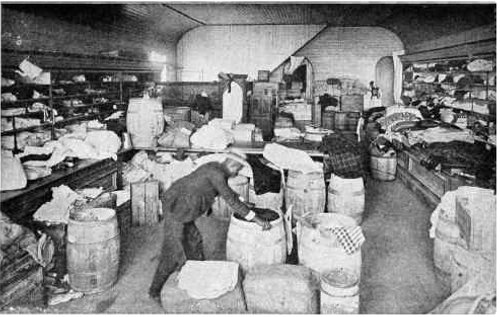
Copyright, 1898, by Clara Barton.
RECEIVING ROOM FOR CLOTHING, S.C. ISLAND RELIEF, 1893–94.
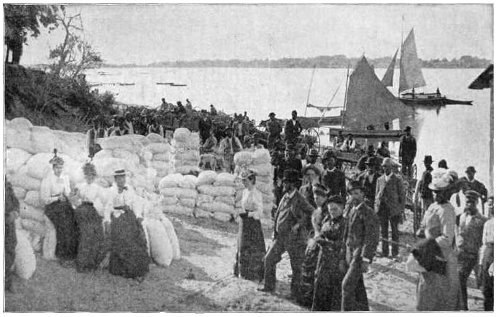
Copyright, 1898, by Clara Barton.
SOUTH CAROLINA SEA ISLAND RELIEF.
Distributing day for St. Helena and Ladies’ Island at Massey’s Ferry opposite Beaufort. Beaufort in the distance at the right.
In the feeding and “rationing” of these people they were as carefully instructed in the principles of economy and care as in other lines of work. Where a fisherman could be found, he was furnished with a boat or net to supply his people with fish to help out with the living, and this was a great aid. The living ration for a family of seven was half a peck of grits a week and a pound of pork, simply as an insurance against starvation for those not having work. Those who were at organized work under a regular foreman received double that amount, i.e., two pecks of grits or meal and two pounds of pork a week for each man.
At all times these people were cautioned about going into debt for any purpose, and so faithfully did they follow these suggestions that when we questioned them in their churches when their corn was ready to use, no more than one in thirty had contracted debts for food or living supplies,—a matter of special interest in view of the fact that it has always been the custom of the country, to go into debt for food supplies until the crop should be ready for market. True, on some of these islands additional help was received from other sources, notably on St. Helena, Ladies and Port Royal, through the influence of some of the resident merchants and other friends—local merchants rebuilding their stores and warehouses gave employment to some, shipping to others, and later, a partial reopening of the phosphate industry brought labor to others.
It will be remembered that these people were constantly receiving lessons in practical economy, and suggestions in improvising and turning to best account what they might have at hand. These instructions, coming from Miss Barton direct made a deep impression on the minds of these people, and they were faithfully followed up by her representatives, who had received their lessons beforehand in practical, common sense economy. I recall an incident. After showing a number of the committeemen through the office and living apartments at headquarters, where they saw desks, working tables, book shelves, washstands, wardrobes, commodes, all neatly covered with manila paper or hung with tasty calico curtains or draperies, with neat and attractive effect—and then when shown the constructions they were amazed to find that nearly every piece of furniture before them was made from various sizes of dry goods boxes (that are usually broken up for kindlings) with shelves inside or on top, as occasion required. One of these committeemen made the practical remark that this half-hour observation and instruction was worth just seventy-five dollars to him, for it showed him how for the present he could save that amount of debt, which he considered necessary to make his house furnishing comfortable for his family.
Careful reports of tools borrowed and returned, of work done each week, as the basis of additional food support, encouraged accuracy, system and responsibility.
I hope it may not prove too tedious if a few average reports of committees are here given from different sections of the field and a sample “labor sheet” to more clearly show some of the kinds of work done, and the character and spirit of the people. The labor sheet is intended to be a record of the tools given out and returned, the number of men at work, the kind of work done—whether ditches, bridges, roads, dams, repairing wrecked houses, or building new ones, digging wells, building chimneys, fencing gardens, splitting boards or shingles, etc., and also the record of the condition as observed by the visitor or inspector of the work.
The following sample is the work of Committeeman Jackson Gillison, of Stuart Point, Port Royal Island, being one of the first who began work:
Labor on Port Royal Island.
Committee, Jack Gillison.
Stuart’s Point, Place.
BUILDING AND REPAIRING.
Tools Taken Out. Tools Returned. Number Number of men. Description
1893 Dec. Sandy Brown’s House, 12 x 18, Rebuilt.
1 15 12 Abby Hamilton’s ” 12 x 15, ”
Shalcot Mack’s ” 10 x 15, ”
Thomas Devoe’s ” 10 x 15, ”
Robert Marshall’s ” 15 x 15, ”
August Dunkin’s ” 12 x 18, ”
Storm Jackson’s ” Shingled.
Sanford Howard’s ” All except shingles.
Thomas Williams’ ” ” ” ”
Tissey Small’s ” Rebuilt.
Sibby Robinson’s ” moved 200 feet on hill and blocked up.
April Alfred Davis’ ” finished to the shingles.
27 12 24 Dick Bright’s ” finished after frame has been put up.
DITCHING.
1894 Feb. Width Depth Length.
16 24 24 1 Dike 15 3 400
1 ” 15 4 700
1 ” 6 4 500-1600 feet Dikes.
16 24 24 1 Ditch 2 3 1500
1 ” 2 3 700
1 ” 3 2 800
1 ” 2 1 600
1 ” 2 2 400
1 ” 2 2 700
1 ” 2 3 500
1 ” 2 2 400
1 ” 3 2 400
1 ” 2 3 600
1 ” 2 1 300
1 ” 3 2 200
2 Ditches 3 2 600
2 ” 2 3 800
2 ” 2 2 150-8650 Ditches.
April 1 Trunk (Tide Gate), repaired
27 24 24 2 Trunks (” ” ), made 3 Trunks.
On Ladies Island George Barnwell, foreman for Eustis Place and Hazel Farm, reports four houses built, ten repaired, 87,870 feet of ditching, fifty feet of dam, three miles of road across the island, thirty feet wide, cleared up and repaired; this latter required seventy-five men at work three weeks cutting out fallen trees, rebuilding bridges, and filling in washed places. Barnwell says, in closing his report:
The improvement of the land that is redeemed and put in good order for the farmers on Eustice Place, including the houses, is worth about three thousand dollars. July 20th, 1894.
At that time we endorsed on this report the following:
August 4th we inspected this work and found all well done, but we found several buildings that Barnwell had begun were not mentioned in his report because they were not finished when he made it. Houses and ditches give evidence of good practical work.
From two plantations on St. Helena’s Island Rev. D.E. Washington’s report shows 32,331 feet of ditching, two houses built, four repaired. The close of his report has this:
To the Red Cross officers: We, the undersigned sufferers, return a vote of thanks to you for the goodness you have done for us by giving us ditches to save our crops. The value to us is $2000.
D.E. Washington, Agent of the Mary Ann Chaplin, Tom Fripp and Village Plantations.
I find this observation on the back of this report, after a visit to look at his work and to speak to his people:
August 13th, 1894, went over this work in part. The ditches are doing excellent service and have been of great value to the plantations during the wet season. It may be that the width of the ditches is hardly sufficient in all places, but the condition of the people is most gratifying, and the work of Reverend Washington has been markedly unselfish.
On reaching his place we learned for the first time that his own house, a large plantation building of former years, had been burned just before the storm, and he has since been living in his stable. This personal loss he has never mentioned to the Red Cross people, although his duties as committeeman brought him in contact with them every week for nearly a year.
From the mainland Rev. Wade Hampton, in returning his tools, after making nearly one mile of canal and ditches, and 330 feet of causeway, says:
We, the committee on said places (Chaplin, Fripp, Toomer, and Tom Rhodes), return our sincere thanks to you for the rations and the tools to work with, for it was just the same as if you had given us a hundred dollars apiece. This is to the Red Cross, by your committee. Most respectfully,
Wade Hampton, Agent Chaplin Plantation.
From another section of the mainland, William Grant, of Pocotaligo, reports nearly two miles of canal eight feet wide, and about the same amount of ditches, and the building of four houses.
Jack Snipe, a young man, almost a boy, after building 5 chimneys, getting out over 4000 shingles and clapboards, and repairing 11 houses, began and made 2000 feet of ditches, and we find this endorsement on his paper. “July 27, I went over part of Jack Snipe’s work to-day. He was a hard working, conscientious man, but not very strong physically. After his work of building and repairing as the leader of his men, he took charge of the ditching; got sick from working in the water, and died soon after. Mrs. Barker, one of our volunteer trained nurses, worked faithfully during all his illness to save him, but in vain.”
Ben Watkins, on Baker Place, shows 19,562 feet of ditches, 1 house built, 2 repaired, 3 large gardens fenced, 7 wells dug. “July 24, 1894, inspected this work, both buildings and ditches, and found the work well done, the ditches being new and important, carrying the water from three large ponds. One main ditch is from four to seven feet deep, equally wide at the top. The crops are in excellent and promising condition, and Watkins’ work is more than he has claimed for it, besides being practical and well done. The Gregorys and Browns on Baker Place have attractive homes, neat and orderly, with appearances of thrift and industry.”
These quotations taken at random from a list of a hundred reports serve to give an idea of the kind and quality of the work done over the entire field, as well done in one district as another from Charleston to Savannah, a distance of 150 miles, including a large area of the mainland as well.
While these people are in large measure cut off from the advantages that come from travel and contact with the outside world, they have a peculiar style of expression, and a musical sweetness of voice that is unusually attractive. They are of different origin and type from the Virginia or “upland people;” many are good scholars, due largely to the schools of Miss Batoum and Miss Murray on St. Helena, and others established soon after the war. Nearly all read and write. Still, there are some that retain the old-time style of expression, as in the following: “We’s de bes garden I eber seen sence I was a man grown.” “All de squash, de tomaty and de watermillion seed gone died, but de Lo’d’s will must be done.”
“All de house (houses) is done ractified.” “I couldn’t tell a lie, for I’z deacon in de chuch. I has to be respectable.” Another says: “I’v ben dar from de fust upstartment, and dar ain’t ben de fust rag gin to dose people.”
Another: A man who had seen the Red Cross staff getting on the boat to go to Charleston said: “I tell you, doctor, when I see Miss Barton gettin’ on the boat to go away I just felt so, my eyes couldn’t help leakin’ water, for you all have saved us people.”
After the general relief had closed, and the body of the Red Cross staff had left, Dr. Egan remained with me to help finish the distribution of a remnant of supplies and tools that could be kept in use, and to encourage the continuance of the general improvements so well begun. Considerable attention was given to visiting the work, and the people on the different islands in their churches, where practical suggestions were made on the line of the instructions they had received from headquarters at first. These talks were always preceded by an inspection of the fields, gardens, buildings and work which had been done on the place, for the purpose of better judging what kind of suggestions would be of most profit to the people; but the subjects usually taken up would be headlined thus:
Prosperity.
Keep out of debt. Debt is a burden and a hindrance to prosperity, the cause of much trouble and bad feeling. “Owe no man anything.”
How to keep out of debt. Keep the garden producing something to live on the entire year. The climate here will allow this to be done.
Then a list of vegetables suitable for the soil and the climate that experience has shown can be raised with success.
On the farm keep some kind of profitable crop growing the entire year, both for profit and for feed for the stock. Follow the regular corn crop with a second one for fodder, or with some of the root crops, as turnips, beets, rutabagas, cabbage or collards.
Plant such things as the fowls will injure inside the garden fence.
Fruits; figs and grapes grow from cuttings, and are easily raised, if only protected from the pigs, the goats, or the cattle. Pears, peaches, apples, oranges, pomegranates, pecans, walnuts, grow with a little care. (Fine samples of vegetables and fruits raised on the islands, often by their own people, were shown in evidence.) Let each one raise and preserve his own meat, or have a neighbor who has been successful, put it up for him until he learns how for himself. This point was particularly made, because the general custom of the country is to sell hogs for three or four cents a pound and pay twelve to sixteen cents a pound for pork.
Homes:—Make them neat, light, attractive; have trees, flowers and the simple conveniences, any and all of which can be had by a little thought, labor and interest.
In the line of health, use less pork, more vegetables, fruit, milk, eggs, and pure water. Good wells are necessary, ditches are necessary for health as well as for agricultural development. If all the plantations are well drained, it will in large measure banish fevers from the islands.