CUBA AND THE CUBAN CAMPAIGN. (continued 2)
Reading edition
We had been long without news from the United States; but the next day brought the following dispatch from the New York Cuban Relief Committee:
Cobb sails Wednesday with Red Cross supply boat. All articles requested by her will be shipped. The launch will be towed from Jacksonville. Do you want additional nurses? Five hundred tons provisions and clothing, also three ambulances complete, shipped to Key West warehouse this week from New York. Send “State of Texas” to New York as soon as can be spared. Cobb with Red Cross boat expects to reach Guantanamo July 5 to 10. Massachusetts relief ship cannot sail before middle of July. Will dispatch schooner with ice within a fortnight. Make your requisitions specific in kind and quantity.
This was only one of the scores of dispatches reaching us within the few following weeks, and I repeat it here, not as having any special significance, excepting to show the uncertainty and utter instability of all human calculations. Analyzing this kind-hearted and well-meant dispatch in the light of the future, we find that neither the Red Cross supply boat, the steam launch, the Massachusetts relief ship, nor the additional nurses ever reached us. The ice schooner proved to be the “Mary E. Morse,” of which mention is made elsewhere. The five hundred tons of provisions shipped to the Key West warehouse were distributed there. I name this, not in any spirit of complaint—far from it, indeed—but simply to show still further and make more apparent, if possible, the difficulties attendant upon all work at a field of war. Those who have seen only this one war will find these uncertainties and shortcomings very strange, and unaccountable; to me, who had seen other wars, they seemed natural, probably largely inevitable, and quite the thing to be expected, the fatal results of which misfortunes I had spent half my lifetime in instituting measures to prevent or lessen.
We were honored next day by a call from an officer of the “Olivette,” with his assistant. It is not singular, in the light of the great, elegant, newly-fitted ship at his command, that it was difficult for him to realize the use or the necessity of an unpretending little black boat like the “State of Texas,” or of what service it could be expected to be to an army. We labored to impress upon him the fact that this ship did not come for the war, but was loaded and dispatched weeks before there was any war, and simply waited an opportunity to deliver its cargo to the hungry and naked reconcentrados for whom they were designed. This explanation we hoped would make it apparent to the gentleman, how it was, that our supplies of clothing would not be likely to contain the articles of which he said his ship was in want; it probably never having entered into the minds of our sympathetic generous lady donors of America to provide pajamas for Cuban women. Anything we had was freely at his service. If we made any attempt at conversion (which I do not now recall), it was simply on the line of a better understanding of Red Cross methods and principles as connected with his profession, and not a change of heart.
With the constant reminders of the sufferings of the people on shore and our inability to reach them, it was a welcome errand brought by a dispatch boat that afternoon from Captain McCalla, that if we could get five thousand rations to him before the next Thursday morning, he could find a way to deliver them to the refugee families of insurgents and others lying out in the hills and woods beyond his camp at Guantanamo, where they had fled for safety. We steamed at once to Guantanamo and landed the rations next morning, returning to Siboney the same afternoon. The next day our working force was busy all day getting off material to refugees coming in from the mountains. General Garcia detailed a detachment to repair pontoons for the purpose of landing the supplies. Captain McCalla cabled for twenty thousand rations for refugees, to be delivered at Guantanamo by Sunday.
Our Red Cross sisters and surgeons were all busy at the Cuban Hospital, when the following letter from Major Le Garde was received:
To Miss Clara Barton, President American National Red Cross:
I have the honor to request your assistance in caring for the patients in a so-called hospital near the landing at this point. The orders are to the effect that all patients now under treatment on the shore shall be transferred to the “Iroquois” and “Olivette,” but the facilities for carrying out this order are apparently inadequate. In order that the Divisional Hospital may remain unhampered for the care of the wounded in the engagement about to take place, it is necessary for me to request this favor of you, and I trust that you may find it possible to comply with said request.
Your obedient servant, Louis A. Le Garde, Major and Surgeon, U.S.A., Commanding Hospital.
To this the following reply was immediately returned:
Steamship “State of Texas,” Siboney, Santiago de Cuba, June 30, 1898.
Dr. Louis A. Le Garde, Major and Surgeon, U.S.A., Commanding Hospital:
Major:—Permit me, I pray you, to express the great pleasure given me by your cordial letter inviting the assistance of the persons here under my direction in the care of the sick and wounded of the engagement about to take place.
Although not here as a hospital ship by any means, nor legitimately fitted for the work, still we have some hospital supplies, a few intelligent workers, skill, intrepidity, experience, the willingness to serve, the readiness to obey, and I believe, the true spirit of the Red Cross, that seeks to help humanity wherever its needs exist.
I send them to you in the hope that they may be of service. With grateful appreciation, I am, doctor,
Most cordially yours, Clara Barton, President American National Red Cross.
In the afternoon of this day some members from our ship went ashore and visited the Cuban Hospital and General Garcia’s headquarters, which that general, on leaving Siboney had graciously ordered to be placed “at Miss Barton’s disposal as headquarters for herself and her staff.” It was found, however, that the building would be required by the military, and the matter was given no further consideration.
On the first of July Dr. and Mrs. Lesser with their assistants went early ashore to work in the hospitals, both United States and Cuban. The transport “Harvard” arriving with troops, demanded our anchorage, and on coming out of the harbor to give place to her, we saw that a bombardment of Aguadores, five miles to the west, was taking place. A battleship, perhaps the “Oregon,” the flagship “New York” and a little cruiser were standing in near the shore, the latter keeping up a rapid fire, which was responded to by the batteries on both sides of a ravine which the railroad crossed. We ran down as close as safety permitted and watched the engagement from the bridge of our own ship. The two large ships then drew in and shelled the ravine, apparently silencing the batteries. When we returned to Siboney we learned that our troops had been fighting all day, and that large numbers of wounded were walking or being brought in for treatment. The Red Cross had been requested to take entire charge of a fever hospital of United States troops, which it did. Dr. and Mrs. Lesser and two of the Sisters were assisting in the operating tent. All of us worked nearly through the night—the nurses and physicians as above stated; the others taking out supplies for wounded—one hundred cots, bedding, hospital utensils, medicine, food, etc. The reports were that we had taken and held all the commanding positions around Santiago, but that it had cost us four hundred men.
The diary of July 2 says: The day opened cool and fresh, and although having worked steadily until three o’clock the night previous, when they had been brought back to the ship for a little rest, the Sisters were ready for work at half-past six. Sisters Anna and Isabell had been on duty all night, and must now be relieved. Dr. Egan and Mr. Kennan made ready for the front, the former to have a field hospital.
With a portion of my assistants I go ashore to visit the hospitals in the early part of the day, to learn if anything further can be done for them. We find the wounded coming in rapidly, long rows of hospital tents being filled with them, and many waiting their turn on the operating tables. We learned that the officers had suffered very severely, having been picked off by Spanish sharpshooters. A note came by messenger from Mr. Kennan at the front, saying that by order from General Shafter’s headquarters “Miss Barton was directed to seize any empty wagons coming in and send by them hospital supplies, medical stores, which were badly needed at the front.” This direction would of course be filled as far as possible; the supplies would be gotten out and sent, and it was decided that myself and as many of our assistants as could be spared go with them the next day. These were anxious, trying days throughout the whole country. All America was astir, once more in the dreaded throes of war.
Another dispatch from our committee at New York reveals this state of feeling:
New York, July 2, 1898.
Barton, Santiago de Cuba:
Government transport “Port Victor” sailing New York, Wednesday via Tampa takes all our supplies to Santiago. Look out for arrival. Twenty-five nurses go there Tuesday; more follow; order them forward if needed. Report your actions. People anxious.
To which the following reply is returned:
Dispatch received. Lesser’s force attending wounded here constantly coming in. Elwell and force landing supplies in the surf at night, without dock, under great difficulties and dangers. An urgent appeal from the front for medicines and food. None there. Will try to get two four-mule wagons full to them to-night and go ourselves. Have reported all we could. No telegraph here till to-day. No dispatch boats. No post-office. We also anxious.
July 3 opened clear and bright, the commencement of a hard and busy day, to be long remembered. Our shippers had been landing supplies all night and keeping such guard over them on the sandy beach as was possible.
The daily record of our movements kept always up and open, like the log of the ship, must now fall to the hands of our faithful stenographer, Miss Lucy Graves, and taking up her duties bravely that day, she commences with this paragraph:
“Miss Barton, with Dr. and Mrs. Gardner, Dr. Hubbell and Mr. McDowell, leave for the front to-day, taking two six-mule wagon loads of hospital supplies.” To the young writer it was a simple note in the records of the day, having no special significance. As my eye glanced over it it seemed very strange—passing strange, that after all this more than a quarter of a century I should be again taking supplies to the front of an army in the United States of America; that after all these years of Red Cross instruction and endeavor, it was still necessary to promiscuously seize an army wagon to get food to wounded men.
I hope in some way it may be made apparent to any one who follows these notes how difficult a thing it was to get this food from our ship to the shore. In a surf which after ten o’clock in the morning allowed no small boat to touch even the bit of a pier that was run out without breaking either the one or the other, and nothing in the form of a lighter save two dilapidated flat boat scows which had been broken and cast away by the engineer corps, picked up by ourselves, mended by the Cubans, and gotten in condition to float alongside our ship and receive perhaps three or four tons of material. This must then be rowed or floated out to the shore, run on to the sands as far as possible, the men jumping into the water from knee to waist deep, pulling the scow up from the surf, and getting the material on land. This was what was meant by loading the “seized wagons from the front” and getting food to the wounded. After ten o’clock in the day even this was impossible, and we must wait until the calm of the next morning, three or four o’clock, to commence work again and go through the same struggle in order to get something to load the wagons for that day.
Our supplies had been gotten out, all that could be sent that day for the heavy surf, and among the last, rocking and tossing in our little boat, went ourselves, landing on the pier, which by that time was breaking in two, escaping a surf which every other moment threatened to envelop one from feet to head, we reached the land. Our wagons were there already loaded with our best hospital material,—meal, flour, condensed milk, malted milk, tea, coffee, sugar, dried fruits, canned fruits, canned meats, and such other things as we had been able to get out in the haste of packing—entirely filling the two wagons.
An ambulance had been spoken of, but could not be had. We walked out a little way to wait for it. Dr. Hubbell left our party and went again in search of an ambulance, notwithstanding the assurance that an army wagon would answer our purpose quite as well. These were going line by line up to the front, mainly with ammunition. We waited a little by the roadside; the doctor did not return; our own wagons had gone on, and stopping another loaded with bales of hay, we begged a ride of the driver, and all took our seats among the hay and made our way once more to the front.
The road was simply terrific—clayey, muddy, wet and cut to the hub. A ride of about four hours brought us to the First Division Hospital of the Fifth Army Corps, General Shafter’s headquarters. This was properly the second day after the fight. Two fearful nights had passed.
The sight that greeted us on going into the so-called hospital grounds was something indescribable. The land was perfectly level—no drainage whatever, covered with long, tangled grass, skirted by trees, brush and shrubbery—a few little dog tents, not much larger than would have been made of an ordinary tablecloth thrown over a short rail, and under these lay huddled together the men fresh from the field or from the operating tables, with no covering over them save such as had clung to them through their troubles, and in the majority of cases no blanket under them. Those who had come from the tables, having been compelled to leave all the clothing they had, as having been too wet, muddy and bloody to be retained by them, were entirely nude, lying on the stubble grass, the sun fitfully dealing with them, sometimes clouding over, and again streaming out in a blaze above them. As we passed, we drew our hats over our eyes, turning our faces away as much as possible for the delicacy of the poor fellows who lay there with no shelter either from the elements or the eyes of the passers-by.
Getting past them as quickly as possible, and seeing a smoke ahead of us, and relying upon the old adage that where there is smoke there must be fire, we went to it. A half-dozen bricks had been laid about a yard apart, a couple of pieces of wagon-tire laid across these, so low and so near the ground that no fire of any strength or benefit could be made, the bits of wet wood put under crosswise, with the smoke streaming a foot out on each side, and two kettles of coffee or soup and a small frying-pan with some meat in it, appeared to be the cook-house for these men. They told us there were about eight hundred men under the tents and lying in the grass, and more constantly coming in.
I looked at the men who had constructed and who had charge of that “fireplace,” and saw how young and inexperienced the faces were, and how little they could know of the making up of a camp, and how unsatisfactory it must all be to themselves, and was filled with a sense of pity for them as well as the poor sufferers they were trying to serve. I looked around for the faces of some old veterans of the wars before, who could bring a little knowledge gained from practice. There were none there, but here was our own McDowell, with a record of four years and twenty-six battles in the old Civil War, and after a few moments’ consultation as to the best method to be pursued, we, too, gathered stones and bricks and constructed a longer, higher fireplace, got more wagon-tires, found the water, and soon our great agate kettles of seven and ten gallons were filled. But the wood! It was green, not resinous as the wood of some islands. In Corsica, for instance, one may take the green, wet wood and make a blazing fire. The wood of Cuba is beautiful in quality, but hard and slow to burn.
The rain, that had been drizzling more or less all day, increased. Our supplies were taken from the wagon, a piece of tarpaulin found to protect them, and as the fire began to blaze and the water to heat Mrs. Gardner and I found the way into the bags and boxes of flour, salt, milk and meal, and got material for the first gallons of gruel. I had not thought to ever make gruel again over a camp-fire; I cannot say how far it carried me back in the lapse of time, or really where or who I felt that I was. It did not seem to be me, and still I seemed to know how to do it, and when the bubbling contents of our kettles thickened and grew white with the condensed milk, and we began to give it out, putting it in the hands of the men detailed as nurses and of our own to take it around to the poor sufferers shivering and naked in the rain, I felt again that perhaps it was not in vain that history had reproduced itself. And when the nurses came back and told us of the surprise with which it was received and the tears that rolled down the sun-burned, often bloody, face into the cup as the poor fellow drank his hot gruel and asked where it came from, who sent it, and said it was the first food he had tasted in three, sometimes in four, days (for they had gone into the fight hungry), I felt it was again the same old story, and wondered what gain there had been in the last thirty years. Had anything been worse than this? But still, as we moralized, the fires burned and the gruel steamed and boiled and bucket after bucket went out, until those eight hundred men had each his cup of gruel and knew that he could have another and as many as he wanted. The day waned and the darkness came and still the men were unsheltered, uncovered, naked and wet—scarcely a groan, no word of complaint; no man said he was not well treated.
The operating tables were full of the wounded. Man after man was taken off and brought on his litter and laid beside other men and something given him to keep the little life in his body that seemed fast oozing out. All night it went on. It grew cold—for naked men, bitter cold before morning. We had no blankets, nothing to cover them, only as we tore off from a cut of cotton cloth, which by some means had gotten on with us, strips six or seven feet long, and giving them to our men, asked them to go and give to each uncovered man a piece that should shield his nakedness. This made it possible for him to permit us to pass by him if we needed to go in that direction.
Early in the morning ambulances started, and such as could be loaded in were taken to be carried back over that rough, pitiless road down to Siboney to the hospitals there, that we had done the best we could toward fitting up—where our hundred cots and our hundred and fifty blankets had gone, and our cups and spoons and the delicacies that would help to strengthen these poor fainting men if once they could get there, and where also were the Sisters under Dr. Lesser and Dr. Le Garde to attend them.
They brought out man after man, stretcher after stretcher, to the waiting ambulances, and they took out seventeen who had died in the night—unattended, save by the nurse—uncomplaining, no last word, no dying message, quiet and speechless life had ceased and the soul had fled.
By this time Dr. Hubbell had returned for he had missed our wagons the day before and gone at night for more supplies. This time came large tarpaulins, more utensils, more food, more things to make it a little comfortable—another contribution from the surf of Siboney. We removed our first kitchens across the road, up alongside the headquarter tent of Major Wood in charge of the camp. The major is a regular army officer, brusque, thickset, abrupt, but so full of kind-hearted generosity that words cannot do justice to him. He strove in every way to do all that could be done. He had given us the night before a little officer’s tent into which we had huddled from the pouring rain for a few hours in the middle of the night. The next day, although no tent so spacious as that could be had, a little baby tent it seemed, of about seven feet, was found, pitched alongside of the other, the tarpaulins put over, a new fireplace made near us, magnificent in its dimensions, shelter given for the boxes, bags and barrels of supplies that by this time had accumulated about us. There was even something that looked like tables on which Mrs. Gardner prepared her delicacies.
The gruel still remained the staple, but malted milk, chocolate and rice had come in, and tea, and little by little various things were added by which our ménage became something quite resembling a hotel. The wounded were still being taken away by ambulance and wagon, assorted and picked over like fruit in a barrel. Those which would bear transportation were taken away, the others left where they were. The numbers grew a little less that day.
I ought not neglect mentioning the favorite and notable drinks which were prepared, for it will seem to the poor, feverish men who partook of them that they ought to be mentioned—they will never forget them. They have not even yet ceased to tell through the hospitals that they fall into later of the drink that was prepared for them at the Fifth Corps Hospital. We had found a large box of dried apples, and remembering how refreshing it would be, we had washed a quantity, put it in a large kettle, filled it with water and let it soak. It happened to be a fine tart apple, and the juice was nearly as good as wine. Perhaps no wine had ever seemed so good to those men as a cup of that apple water, and when they tasted it tears again ran down their faces. To their poor, dry, feverish mouths it was something so refreshing that it seemed heaven-sent. The next day a box of prunes was discovered, and the same thing was done with that; a richer, darker juice was obtained, and this also took its place among the drinks prepared at the Fifth Corps Hospital. The apple and prune juice will remain, I suspect, a memorial for that poor neglected spot.
By the third day our patients seemed strong enough that we might risk food as solid as rice, and the great kettles were filled with that, cooked soft, mixed with condensed and malted milk, and their cups were filled with this. It was gratifying to hear the nurses come up and say: “I have sixteen men in my ward. So many of them would like rice; so many would like malted milk; so many would like gruel; so many would like chocolate, and a few would like a cup of tea; and another, who is feverish, would like only some apple or prune juice,”—and taking for each what he called for, go back to his patients as if he had given his order to the waiter at a hotel; and the food that he took was as well cooked, as delicate and as nice as he could have gotten there. The numbers were now getting considerably less—perhaps not over three hundred—and better care could be taken of them.
A dispatch on Thursday afternoon informed me that Mrs. J. Addison Porter would be on the hospital ship “Relief” coming into Siboney that day. I would of course go to meet her. It was a great joy to know that she would return to us. We at once decided that an army wagon should be asked for from headquarters and a party of us go to Siboney, both for Mrs. Porter and more supplies. The roads were getting even worse—so bad, in fact, that I dared not risk an ambulance, an army wagon being the only vehicle strong enough to travel over it.
We had blankets and pillows and the ride was fairly comfortable; but it was late, nine o’clock, before we reached Siboney. The “State of Texas,” which in the last three days had made a trip to Port Antonio for ice, we thought must be back by that time, and on reaching Siboney, found that she had arrived that evening at five o’clock and was lying at her old anchorage. But there was no way of communicating with her in order that a boat might be sent for us. Everything was tried. We had no signals; there was no system of signaling on the shore by which we could reach her or, in fact, any other boat. There was no way but to remain where we were until morning. It was proposed that I go to the rooms assigned for the hospital assistants. I decidedly refused this, for every reason. I knew the buildings were not to be trusted, and persons nursing day and night among all kinds of patients were not the people to room with. I asked to be allowed to remain in my army wagon. This was not thought proper. I suggested that it might be drawn out anywhere, the mules taken off, and I be left with the blankets and pillows. I thought it, in fact, a good place for any one to sleep, and ventured to recommend it as an old-time method—a refuge which once would have been palatial for me on the war-swept fields of old Virginia, or in the drifting sands of Morris Island—what would that have been the night after Antietam or old Fredericksburg, Chantilly or the Wilderness? But the newer generation could not see it so; a building must be had somewhere, and as I refused the hospital appendage in toto, it was proposed that I enter the post-office, a room there being offered to me.
The postmaster and deputy postmaster, who felt themselves under obligation to us, came out to our men and insisted that I occupy a room in that building. Such a courtesy could not be gainsaid, and against all feeling of acquiescence, and with a terrible dread, as if there were something so wrong about it, I allowed myself to be helped out of the wagon and entered the house. The postmaster sat down and talked with me a little while. I thought he seemed ill. It appeared to be an effort for him to talk. I had never met him before, but my heart went out in sympathy for him. I feared I was taking his room, as was indeed the case, although he did not admit it. I was shown into a large room with one cot, one table, cheerless, bare, with an outside door, and a candle without a stick burning upon the table. The men went outside and laid down upon the steps for the night. I laid down upon the stretcher. It was impossible for me to remain there. Something constantly warned me to leave it. I got up, went to the outside door, looked out upon the night and darkness and waited for the gray of the morning. I went out and stood upon the beach beside the sea and waited more and more, until finally some of the men appeared and I went with them down to the water.
I might as well say here, as I will not refer to it again, that six days after, when I returned, they told me that the rightful occupant of the cot—the postmaster who had seemed so ill—had died of a fever raging here that they called “yellow fever.” I had occupied his cot and he had gone to heaven. I wondered who it was that so continually warned me that night to keep away from that room, away from the cot, away from all connected with it, when I had not the slightest suspicion of anything wrong. “Yellow fever” was then not talked of. Did some one tell me? I do not know, but something told me.
While standing at the dock, Dr. Smith, of the “Olivette,” who had taken a ride with us to the front a day or two before, approached, and kindly asked if he could place his boat at my service, and if I would go to the “Olivette” with him. I replied that I would go to the “Relief,” if he would be so kind as to take me there, for a friend whom I had on board. He did so, and as we drew around the side of the elegant white and green striped boat in full navy regulation, the men in white duck appeared on the decks above and below, a half dozen ladies’ faces showing among them, but most notably the good, substantial, matronly looking lady who had left us a few days before—Mrs. Porter. It occurred to me that she had possibly come by invitation to remain on the “Relief” and aid in the charge of the nurses, and would make this explanation to me, but was agreeably surprised when I saw a satchel and a package or two coming down the steps immediately followed by Mrs. Porter herself. I could scarcely believe that she was leaving that elegant boat to come over to the obscure “State of Texas.” But so it was, and, taking her seat in the boat, we rowed around to the “Olivette,” where Dr. Smith left us, and was replaced by a major-surgeon, who would escort us over to the “Texas,” only some rods distant. I did not at once recall him, but among his first remarks were, “You have been at the front?” “Yes, Major.” “I should think you would find it very unpleasant there.” “Such scenes are not supposed to be pleasant.” “What do you go for?” I scarcely know what reply was made to this abrupt question, but the significance was that possibly we could be useful there. “There is no need of your going there—it is no place for women. I consider women very much out of place in a field hospital.” “Then I must have been out of place a good deal of my lifetime, Doctor, for I have been there a great deal.” “That doesn’t change my opinion, and if I had my way, I would send you home.” “Fortunately for me, if for no one else, Doctor, you have not your way.” “I know it, but again that doesn’t change my opinion. I would send you home.” By this time we were rowing pretty near our own boat, and it was admissible for me to maintain the silence that I felt dignity called for. I made no other remark to him beyond “Good morning, Major,” as we separated for our respective ships.
This is a foolish little episode to enter in one’s diary, not worth the time of writing, especially in days like these, only as it will serve as a landmark, a kind of future milestone noting the progress of humane sentiment, and the hopeful advancement of the civilization and enlightenment of the world. Only a few years ago the good major would have actually possessed the power of which this advancement has relieved him. Finding an accumulation of work at our ship, large mails from the North having arrived, it was Monday before we could return to the front, Mrs. Porter accompanying us. This journey was also made in an army wagon, and a wretched, miserable wagon it was. We found the camp in perfect running order. Mrs. Gardner had stood like a rock through it all, neglecting nothing, quiet, calm, peaceful, faithful, busy—how well she had done, I have no words to express. Everybody grateful to her, everybody loving her.
The camp had now from one hundred to two hundred men. There began to be strong talk of yellow fever, not only at Siboney but at the front as well.
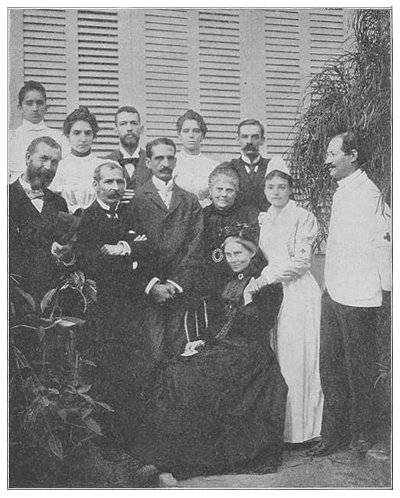
THE PHYSICIANS AND NURSES OF THE ORPHANAGE AND CLINIC IN HAVANA.
The negotiations between General Shafter and the Spanish army at Santiago were still going on. The flag of truce that threatened every day to come down still floated. The Spanish soldiers had been led by their officers to believe that every man who surrendered (and the people as well), would be butchered instantly the city should fall and the American troops should come in. But when General Shafter commenced to send back convoys of captured Spanish officers, their wounds faithfully dressed and carefully placed on stretchers and borne under flags of truce to the Spanish lines at Santiago and set down at the feet of the general as a tender gift back to him, and when in astonishment he learned the object of the flag of truce and sent companies of soldiers to form in line and present arms while the cortege of wounded were borne through by American troops, a lesson was learned that went far toward the surrender of that city.
I happened to know that it was not without some very natural home criticism that General Shafter persisted in his course in the face of the time-honored custom of “hostages.” One can readily understand that the voluntary giving up of prisoners, officers at that, in view of an impending battle might seem in the light of old-time army usages a waste, to characterize it by no harder term. It is possible that none of the officers on that field had ever read the articles of the Treaty of Geneva or fully realized that that treaty had become a law or that their commander, possibly without fully realizing it himself, was acting in full accord with its wise and humane principles.
The main talk of the camp was now “yellow fever.” On Monday night occurred one of the most fearful storms which I have ever seen—rain, thunder and lightning. Our tent had been well protected and deeply ditched, but the water rolled around it in the ditches like rivers. The thunder shook the ground; the lightning blazed like a fire. As I have said, the camp was as level as a floor. No water could really run off. During the most of that night the men in the tents laid in five to six inches of water. Before daybreak the rain had ceased, some water had run away—some soaked in—and the ground was passable. The next day followed another rain. It was now discovered by the medical authorities that from there having been at first one case of fever, there were now one hundred and sixteen; that a fever camp would probably be made there and the wounded gotten away. It was advisable then that we return to our ship and attempt, as far as possible, to hold that free from contagion. I was earnestly solicited to do this in view of what was expected of our ship and of what was expected of us—that we not only protect ourselves, but our cargo and ship from all contamination and even suspicion. I faithfully promised this, and again we called for an army wagon, leaving all supplies that were useful for the men here, sending to Caney what was most needed there and taking only our personal effects, we again placed ourselves in an army wagon with a tarpaulan over us and started for Siboney. In less than twenty minutes the rain was pouring on us and for two hours it fell as from buckets. The water was from a foot and a half to two feet deep in the road as we passed along. At one time our wagon careened, the mules were held up, and we waited to see whether it should go over or could be brought out—the water a few inches only from the top of the lower side. It was scarcely possible for us to stir, hemmed in as we were, but the men from the other wagons sprang to our wheels, hanging in the air on the upper side, and we were simply saved by an inch. The mud and water was at least two and one-half feet deep where we should have gone down.
But like other things, this cleared away. We came into Siboney about three o’clock, in a bright glare of sunshine, to find the town utterly burned, all buildings gone or smoking, Dr. and Mrs. Lesser and the faithful Sisters as well, in a “yellow fever” hospital a mile and a half out of the city, reached by rail. All customary work was suspended. The atmosphere was thick and blue with smoke. Men ran about the grounds smutted and bareheaded like children. My medical knowledge was not sufficient to allow me to judge if everybody there had the yellow fever, but general observation would go far toward convincing a very ordinary mind that everybody had gone crazy.
All effort was made to hold our ship free from suspicion. The process of reasoning leading to the conclusion that a solid cargo, packed in tight boxes in the hold of a ship, anchored at sea, could become infected in a day from the land or a passing individual, is indeed, an intricate process; but we had some experience in this direction, as, for instance, Captain McCalla in his repeated humane attempts to feed the refugees around Guantanamo had called again for a hundred thousand rations, saying that if we could bring them to him soon, he could get them to the thousands starving in the woods. We lost no time, but got the food out and started with it in the night. On reaching Guantanamo we were met at a distance out and called to, asking if anyone on our ship had been on shore at Siboney within four days, if so, our supplies could not be received, and we took them away, leaving the starving to perish.
On Friday morning the constantly recurring news of the surrender of Santiago was so well established that we drew anchor and came up to the flagship and the following letter was addressed to Admiral Sampson:
“State of Texas,” July 16, 1898.
Admiral Sampson, Commanding United States Fleet off Santiago, Flagship “New York”:
Admiral:—It is not necessary for me to explain to you my errand, nor its necessity; both your good head and heart divine it more clearly than any words of mine can represent.
I send this to you by one of our men, who can tell you all you will wish to know. Mr. Elwell has resided and done mercantile and shipping business in Santiago for the last seven years; is favorably known to all its people; has in his possession the keys to the best warehouses and residences in the city, to which he is bidden welcome by the owners. He is the person appointed four months ago to help distribute this food, and did so with me until the blockade. There seems to be nothing in the way of our getting this 1400 tons of food into a Santiago warehouse and giving it intelligently to the thousands who need and own it. I have twenty good helpers with me. The New York Committee is clamoring for the discharge of the “State of Texas,” which has been raised in price to $400 a day.
If there is still more explanation needed, I pray you, Admiral, let me see you.
Respectfully and cordially, (Signed) Clara Barton.
This was immediately responded to by Captain Chadwick, who came on board, assuring me that our place was at Santiago—as quickly as we could be gotten there.
On Saturday, the sixteenth, feeling that it might still be possible to take the supplies to Guantanamo, requested by Captain McCalla, a letter was addressed as follows:
Steamship “State of Texas,” July 16, 1898.
Captain Chadwick, Flagship “New York” off Santiago:
Captain:—If there is a possibility of going into Santiago before to-morrow morning, please let me know, and we will hold just where we are and wait.
If there is no possibility of this, we could run down to Guantanamo and land Captain McCalla’s 100,000 rations in the evening and be back here to-morrow morning.
Will you please direct me.
Yours faithfully, Clara Barton.
Reply to the above:
U.S. Flagship “New York,” 1st Rate, Off Santiago de Cuba, July 17, 1898.
Dear Miss Barton:—We are now engaged in taking up mines, just so soon as it is safe to go in your ship will go. If you wish, you can anchor in near us, and send anything up by boats, or, if we could get lighters, drawing less than eight feet, food may be sent by the lighters, but it is not yet possible for the ship to go in. There are four “contact” mines, and four what are known as “observation” mines, still down.
Yours very truly, (Signed) F.E. Chadwick
It was after this that we turned back again and steamed to Guantanamo to unload our supplies at night and return the next morning.
These were anxious days. While the world outside was making up war history, we thought of little beyond the terrible needs about us—if Santiago had any people left, they must be in sore distress, and El Caney—terrible El Caney—with its thirty thousand homeless, perishing sufferers, how could they be reached?
The diary at this point says: On returning from our fruitless journey to Guantanamo we stopped at Siboney only long enough to get our dispatches, then ran down directly in front of Santiago and lay with the fleet. A personal call from Admiral Schley, Captain Cook and other officers served to show the interest and good will of those about us. Between three and four o’clock in the afternoon a small Spanish steamer—which had been among the captures of Santiago—ran alongside and informed us that an officer wished to come aboard. It proved to be Lieutenant Capehart, of the flagship, who brought word from Admiral Sampson that if we would come alongside the “New York,” he would put a pilot on board. This was done and we moved on through waters we had never traversed—past Morro Castle, long, low, silent and grim—past the Spanish wrecks on the right—past the “Merrimac” in the channel, which Hobson had left. We began to realize that we were alone, of all the ships about the harbor there were none with us. The stillness of the Sabbath was over all. The gulls sailed and flapped and dipped about us. The lowering summer sun shot long golden rays athwart the green hills on either side, and tinged the waters calm and still. The silence grew oppressive as we glided along with scarce a ripple. We saw on the right as the only moving thing a long slim boat or yacht dart out from among the bushes and steal its way up half hidden in the shadows. Suddenly it was overtaken by either message or messenger, and like a collared hound glided back as if it had never been. Leaning on the rail half lost in reverie over the strange quiet beauty of the scene, the thought suddenly burst upon me: Are we really going into Santiago—and alone? Are we not to be run out and wait aside and salute with dipping colors while the great battleships come up with music and banners and lead the way? As far as the eye could reach no ship was in sight. Was this to remain so? Could it be possible that the commander who had captured a city declined to be the first to enter—that he would hold back his flagship and himself and send forward and first a cargo of food on a plain ship, under direction of a woman? Did our commands, military or naval, hold men great enough of soul for such action? It must be true—for the spires of Santiago rise before us, and turning to the score of companions beside me I asked, “Is there any one here who will lead the doxology?” In an instant the full rich voice of Enola Gardner rang out: “Praise God, from whom all blessings flow.” By that time the chorus was full, and the tears on many a face told more plainly than words how genuine was that praise, and when in response to a second suggestion “My Country, ’Tis of Thee” swelled out on the evening air in the farewell rays of the setting sun, the “State of Texas” was nearing the dock, and quietly dropping her anchors she lay there in undisputed possession of the city of Santiago.
It has been remarked that Mr. Elwell had been a resident of Santiago and connected with its shipping for several years. It was only the work of an hour after landing to find his old-time help. A hundred and twenty-five stevedores were engaged to be on the dock at six o’clock next morning, to work for pay in rations.
The dock had its track and trucks running to its open warehouses. As we had entered we saw it bare of every movable or living thing. Want had swept it of all that could be carried away, and the remaining people dared not approach us. Six o’clock next morning changed the scene. The silence was no longer oppressive. The boxes, barrels and bales pitched out of that ship, thrown onto the trucks and wheeled away told the story of better days to come; and it was something to see that lank, brawny little army of stevedores take their first breakfast in line alongside of the ship.
The city was literally without food. In order to clear it for defence, its inhabitants had been ordered out, ten days before, to El Caney, a small town of some five hundred people, where it was said thirty thousand persons were gathered, without food, shelter, or place of rest. Among these were the old-time residents—the wealthy and the best people of Santiago. Its British consul, Mr. Ramsden, and his family were of them, and the care and hardship of that terrible camp cost his life. A message from the headquarters of General Shafter, telegraphed to us even after leaving Siboney, said:
“The death rate at El Caney is terrible. Can you send food?”
Word went back to send the thirty thousand refugees of El Caney at once back to Santiago;—we were there and could feed them—that the “State of Texas” had still on board twelve hundred tons of supplies for the reconcentrados. That day poured in upon us all that had strength to make the journey, of the thirty thousand starving wrecks of El Caney. If there were any at night who had not received food, no one knew it. The fires were rekindled in the great steam soup kitchens of Mr. H. Michaelsen—that name should be carved in marble and lettered in gold in Santiago—that had run uninterrupted for nearly two years, until within a few weeks of the surrender, when there was no more food for its kettles. Ten thousand persons had hot soup there the first day, and it was estimated that ten thousand more had dry food of crackers, meat and meal. To the sick were distributed condensed and malted milk as fast as it could be gotten to them.
Of the districting of the city, the formation of committees for the distribution of food, the care, the justice, and the success with which it was done, I leave to the reports of my experienced staff officers and assistants and to the committee of Santiago, which nobly volunteered its aid. These persons performed this work—they were a part of it—and no one can describe it so well as they. I refer the reader to the reports of Dr. Hubbell, Dr. Egan, Mr. Cottrell, Miss Fowler, now the wife of Baron Van Schelle of Belgium, and the committee of Santiago composed of H. Michaelsen, vice-consul for Germany, Robert Mason, Chinese consul and vice-consul for England, and Wm. Ramsden, son of the late Frederick Ramsden, British consul. With these latter gentlemen, together with twenty of the leading ladies of Santiago, was left, one month later, the supplies remaining in our warehouses, and the oversight of the poor of the city, over whom their care had extended so tenderly and so wisely in the past, and on whom as helping them back into citizenship it must largely devolve in the future.
Returning to our first day in Santiago, it is remembered that this narration has thus far left the navy, its flagship and commander at the entrance of the harbor in obscurity. It would seem but just that it reproduce them.
Until ten o’clock on Monday the eighteenth we saw no sign of life on the waters of the bay—neither sail, steam nor boat—but suddenly word passed down from the watch on deck that a ship was sighted. Slowly it came in view—large, fine, full masted—and orders went to salute when it should pass. At length here was something to which we could pay deference. The whistles were held, the flag was ready for action, ropes straight and without a tangle—all stood breathless—but she does not pass, and seems to be standing in. In a minute more a stout sailor voice calls out: “Throw us a rope,” and here, without salute, whistle or bell, came and fastened to the stern of our boat this glittering and masted steamship from whose decks below Admirals Sampson and Schley and their respective staffs shouted up their familiar greetings to us.
The view from their ship enfiladed, to speak in military parlance, our entire dock. There was every opportunity to see how our work was done and if we were equal to unloading our ship. The day was spent with us till four o’clock in the afternoon; and when about to leave and the admiral was asked what orders or directions he had for us, the reply was, “You need no directions from me, but if anyone troubles you, let me know.”
Many months have passed since that day, and I write this without ever having seen again the face of the commander who had been so courteous and kind, and so helpful in the work I went to do.
Under date of July 23 is found the following entry in the diary which sums up the entire matter of facts, dates and figures in few words:
“The discharge of the cargo of the ‘State of Texas’ of over twelve hundred tons, commenced at six o’clock Monday, July 18. One hundred and twenty-five stevedores were employed and paid in food issued as rations.
“On Thursday, the twenty-first, at six o’clock p.m. the discharge was completed, and the following morning, Friday, July 22, the ship left for New York.
“During that time the people had returned to Santiago, numbering thirty thousand, and all were fed—ten thousand a day from the soup kitchen of Mr. Michaelsen, the others with bread, meat and milk.
“The present general committee was formed, the city districted into sections, with a commissioner for each district, selected by the people themselves living there.
“Every family or person residing in the city is supplied by the commissioner of that district. All transient persons are fed at the kitchen, the food being provided by the Red Cross.
“Although the army has entered the city during the latter part of that time, there has been no confusion, no groups of disorderly persons seen, no hunger in the city more than in ordinary times. We wait the repairs of the railroads to enable us to get food and clothing to the villages enclosed within the lines of the surrender.”
We had done all that could be done to advantage at that time in Santiago. The United States troops had mainly left; the Spanish soldiers were coming in to their waiting ships, bringing with them all the diseases that unprovided and uncleanly camps would be expected to hold in store. Five weeks before we had brought into Santiago all the cargo of fourteen hundred tons of the “State of Texas,” excepting the light hospital supplies which had been used the month previous among our own troops at Siboney, General Shafter’s front and El Caney during the days of fighting. To any one accustomed to apportioning food, it would be at once apparent that these twelve hundred tons of heavy supplies, of meal, meat, beans and flour, etc., were too much for distribution at one time for a little town of thirty thousand, which naturally partly fed itself. But it must all be stored.
The “State of Texas” discharged her cargo and left for New York on the fifth day, leaving us without a particle of transportation, and in the pressure and confusion none could be obtained. Let those who tried it testify. The two railroads leading out of the town were destroyed. The ports were not open, and the country portions of the province reached only by pack mules. Later, forty large, fine healthy mules were shipped to us, but the half score of fully equipped ambulances, harnesses and between four hundred and five hundred bushels of oats were on the transports which brought them, could not be lightered off, and up to the time of our departure were never seen.
The schooner “Morse,” which, following the behest of an angelic thought of some lovely committee of home ladies, had come in laden with a thousand tons of ice. The tug “Triton,” which towed her all the way from Kennebec, and was to have been held for our use, was at once seized by the government. Santiago had neither an ice house nor a pile of dry sawdust, and the ice remained on the “Morse” till discharged order by order among the transports of sick, wounded and convalescing as they sailed one after another with their freight of human woe. Slowly, painfully waiting, but gladly, piece by piece, the ice went out, filling to repletion the box of every transport sailing north, and something glistened on the weather-beaten bronzed cheek of more than one of those long-serving, faithful, north Atlantic captains, as he tried to say what it would be to the poor fever-burnt sufferers he must take.
Visions, of the schooner “Morse” when she should be unloaded constituted our only transportation up to the day we left Santiago. I cannot say that other visions did not obtrude at times. In our perplexity, memory pictured, as in another life, the hundreds of strong-built, luxuriantly-furnished, swift-running steam tugs, yachts and house boats of the restful “Thousand Islands,” and the health and pleasure-giving resorts of the lovely Jersey coast; but they were only visions, quickly put aside for the stern realities of the inevitable surroundings. The “Morse” did well its blessed work, but never came to us.
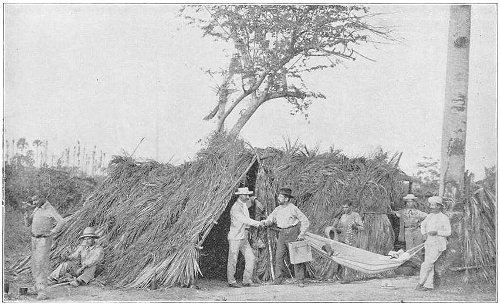
A CUBAN THATCH HUT.
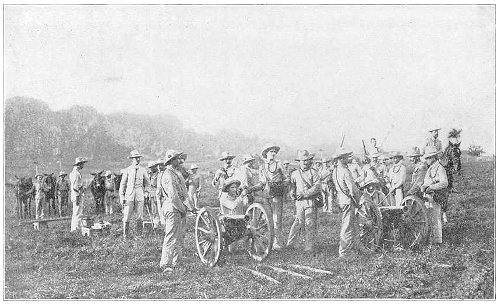
A BATTERY OF CUBAN ARTILLERY.
Neither for love nor money could transportation be gotten. I did, however, near the last, obtain the use of a leaky lighter for two hours to get off some mules, but I might specify that it was on neither of the above considerations.
Some reporter is responsible for the statement that a large ship seen floating near the dock that morning had been seized. While it might not be possible to verify this statement by actual facts, it was not so very far out of the way in theory.
These were the last days of General Shafter in Santiago, who was, as he had at all times been, the kind and courteous officer and gentleman.
General Wood, alert, wise and untiring, with an eye single to the general good of all, toiled day and night.
The government warehouses were so filled with supplies that there seemed no room for more. The harbor filling with merchant ships for the trade, would soon come to regard with a jealous eye any body of persons who dispensed anything without price to even the poorest and most destitute.
But all this did not stay the marching stride of the native fever, so persistent in its grasp as scarcely to merit the appellation of intermittent. Day by day I watched my little band ever growing less; out of twenty which the good “State of Texas” brought, seven were on their feet; twelve had sickened, been nursed and gotten off home, and one had gone to heaven. Of our own band of the national Red Cross workers, none had actually gone down; of those who had joined us as assistants, few remained.
At this juncture news came that Havana was open. In all the country I knew but one person who had the power to order one of those waiting transports to take myself, staff and some supplies to Havana, and my dispatch went to President McKinley, with the suggestion kindly and thoughtfully made by Major Osgood who had just come in on the “Clinton,” that in order to economize time and labor, possibly the President might furnish a ship already loaded with government supplies, and let us repay from our supplies on shore. This dispatch brought the following prompt reply from the Secretary of War. It was a glad reminder of the kindly courtesy and friendship of many years. I give the text of both the dispatch of the Secretary and my reply, in order to set right a misunderstanding on the part of the public, which I have observed with pain:
Washington, August 18, 1898.
Miss Clara Barton, Santiago de Cuba:
“Clinton” cannot be used until unloaded. Stores aboard were sent on special request and are necessary for the comfort of officers and men at Santiago. The government will send as soon as ship can be loaded at Port Tampa two thousand tons of supplies for relief of destitute. This accomplishes same result and in shorter time. Will not this meet your wishes even better than recommended in your cablegram yesterday? Would it be asking too much for you to go to Havana to superintend the distribution of these stores under the law? Only the destitute and those in immediate danger of perishing can receive these supplies.
R.A. Alger, Secretary of War.
Santiago de Cuba, August 18, 1898.
Pierson, War Department, Washington:
Tell Secretary Alger I appreciate to the greatest possible extent his responsive and practical sympathy. His suggestions are better than I had asked, and are promptly accepted. If the “Clinton” is unloaded in time, I will leave here Saturday morning. Will take forty mules from here. Need ten additional wagons and harness for all my mules. Please give me some horsefeed from here.
Clara Barton.
The reloading was quickly accomplished, the direction of our remaining affairs placed in proper hands, and on the twenty-first of August, just five weeks to an hour since entering the harbor, we retraced the waters we had sailed over coming from Siboney to Santiago. The same golden sunshine rested on the hills and tinged the still waters of the bay, but we were no longer the only ship. The transports to take our soldiers home lay there; the great Spanish liners to take the Spanish soldiers to Spain; the hospital ships with their fevered weight of glad woe “going home,” dotted the sea and skirted the shore.
All who understood our movement saluted, and with tearful glances back to the little spot of earth which had given so much pain, made so many homes in both lands desolate, we ordered on full steam and glided away. Five days of continuous sunshine and scarcely wind to fill a sail brought us to Havana. I had cabled the Spanish authorities on our departure from Santiago and notified them of our arrival, and was courteously referred to the Civil Governor of Havana, on whom I called and received in return a most cordial visit, with the added respect of bringing his entire staff with him.
No supplies from Port Tampa having arrived we spent the second day in Matanzas, receiving from the good Governor and his amiable household such a welcome as one might expect from those they had known longest and loved most. We then hoped to go there at once and leave the supplies they so badly needed.
Next day there came into harbor the steamship “Comal,” from Port Tampa, laden with sixteen hundred tons of government supplies for distribution. We exchanged visits with her gentlemanly and sensible officers, who had governmental instructions to take their cargo to Havana and distribute it, but no instructions to act in conjunction with us or with any one; and we, on the other hand, received no intimation that her supplies were in any way intended for our use.
Both ships alike met the restriction of the customs duties, and while I felt that it might be well for a governmental cargo to test its position with the law of nations, under the circumstances, it was by no means the course for the Red Cross to take—an organization which never leads, but follows, in all military matters.
No commissioners had arrived, and feeling that we might become a source of irritation to them by remaining, and being unable to distribute our supplies, we decided to withdraw. Our captain, having been trained in the merchant service and being unaccustomed to military shipping, had neglected some little formality on leaving Santiago, which admitted, or perhaps called for, a fine of five hundred dollars. This we promptly paid, and with the best understanding with all parties, Spanish, Cuban and our own, no coercion on the part of any one, impelled by nothing but our own sense of the situation, we decided our course. In fact, strenuous efforts were made by the Spanish officials, notably the Secretary of State, to open the way for us; and while they could not override the law and positively remit a duty, they offered in this case to pay the duty themselves, and take part in the distribution. We appreciated the courtesy, but still felt that we might in some way become a hindrance to the pending negotiations by remaining, and after careful consideration, decided to draw anchor and steam for Port Tampa, leaving the “Comal” with its full cargo and efficient officers to meet the situation in the good governmental way, we were sure they would do.
This explanation is given to set right the general impression that the “Comal” was a Red Cross ship. There was no connection whatever between the “Comal” and ourselves, excepting through good will and good fellowship; and again the impression that we were mistreated by the Spanish government at Havana, subjected to discourtesy or requested to leave is a mistaken one. The facts are quite the contrary. We entered under the supposition that Havana was open, as Santiago was open; but it was not an open port. We were in Spanish waters, subject to Spanish laws and customs, and so regarded them, as we should have expected to do in any country, remembering experimentally that our own country is not too much inclined to easily remit its custom duties.
Dividing the time of our Cuban campaign into sections, the incoming days fall exclusively to Santiago. Days of an army in one sense inactive, in another rushed and crowded beyond its powers to meet or control. Days when everything is needed and nothing can be gotten at. No one knows where anything is—must have a formal order to obtain it when it is found, and cannot get the order. Officers clamor for their needy men, the sick list increases, complaints are rife, patience gives place to desperation, and a time of general confusion follows.
Again I would say that to those taking the first lessons in army life, all these things seem incomprehensible, to say the least, and “Who’s to blame?” seems to be floating in the very atmosphere about them.
Deplore such a state of things as we will, it is still a part of army life. It belongs to war, and the grey-haired military chief, whom all would recognize were I to name him, was correct when he once said to me: “Strange as it may seem, the days of ‘rest’ at an active field are its hardest days.”
The ofttimes perplexed officers at Santiago will neither exclaim nor disclaim against this little statement, if it should ever meet their eyes. They will realize, however, that there were others, near them having no power, or scarcely place, who could yet comprehend their perplexities, and sympathize with the distressing conditions surrounding them.
They will also recall that from this source no unreasonable request was ever made of them, no impatient word spoken—only thanks for needed facilities that could be granted, for those withheld, respectful acquiesence.
To every officer on that first conquered field of Cuba, who extended to the organization I had there the honor to represent, or to myself personally, the smallest recognition or kindness, if it were only a mere courtesy, I tender in behalf of the Red Cross, honoring gratitude and heartfelt thanks. As soldiers, they performed their duty; as men, they sustained their own manly self-respect.
Knowing that several of my aides have kept their own notes during the entire campaign, especially as pertaining to the department occupied by each, I have for the sake of accuracy and perspicuity, invited them to contribute, from their notes, reports to this hastily written volume. These reports must perforce so completely cover the time of this rather uneventful period, until we should again enter upon some more active operations, I decide to leave this space to them, referring the reader, if he have the interest to follow, to these reports, and especially to the letter from our Santiago committee, composed of the leading men of the city, whose faithful service, wisdom and care for the interests of their community, lends a halo of grateful remembrance to the very mention of their names.
REPORT OF DR. A. MONAE LESSER.
In response to a call from the president of the American National Red Cross, I left this city with Mrs. Lesser for Key West on June 15. On my trip South, a train of recruits commanded by First Lieutenant Heavey, First Infantry, joined us on their way to Tampa. There were a number of sick on this train; I offered my services to the lieutenant, which he accepted, and I attended the sick. Most of them had bowel troubles; either diarrhœa or constipation; several had fever, and some sore throats. One private was very ill, and lay on a short bench in a Southern Railroad coach. His temperature was high, and his condition somewhat alarming. I engaged a section in a sleeping car, saw that he was made comfortable, gave him medicine, and Mrs. Lesser nursed him until we arrived in Tampa. The lighter cases as well as the one special case were much improved when we arrived at Tampa, still I mentioned that the patient be taken in an ambulance which the lieutenant ordered by telegraph before we reached Tampa. We then proceeded to the steamer “Mascot,” bound for Key West. On board were a number of marines of the United States Navy, several of them suffering from the same troubles as Lieutenant Heavey’s recruits. Among them was one case of erysipelas, due to improper care of a vaccinated pox. We attended him, and left him and all the others comparatively well in Key West, where Mrs. Lesser and myself joined Miss Barton and staff on the steamship “State of Texas.”
The following morning, June 20, we started for Cuba, reaching Santiago after a six days’ journey. On June 26, Mr. George Kennan, vice-president of the American National Red Cross, interviewed Admiral Sampson for instructions, and the steamship “State of Texas” was directed to Guantanamo, where we remained over night.
The following morning, June 27, a correspondent of a New York paper boarded the “Texas” and informed Miss Barton that a battle had been fought at the front, and that there were a number of sick and wounded at Siboney.
Miss Barton gave orders for the ship to return immediately to Siboney (a little village between Santiago and Guantanamo), at which place we arrived at 9.20 p.m.
Work in the Field.
Upon arriving at Siboney, although it was late in the evening, I was directed by Miss Barton to go ashore to inquire into the needs of the hospital, and if any, to present her compliments, and to make the following offer:—Although the “State of Texas” was sent to feed the refugees and starving Cubans, it carried some persons and articles that might serve for hospital purposes, and that the Red Cross considers its first duty to be to help those who are nearest.
There was a large barn to which I was directed when I asked for the hospital. I introduced myself and staff to the physician, extended the compliments of the president of the Red Cross offering the services of her staff, as well as needed supplies. The physician in charge very courteously answered that he had been ordered to go to the front the following morning, and not needing anything, thanked the Red Cross for its offer.
Westward from the landing place was a pond of stagnant water. Upon a little hill across a railroad track stood a number of wooden cottages. The first large one, which seemed to have been some kind of a store, and a barn westward from it was pointed out to me as another hospital. (It was the same house which later was used as a post-office, in which Postmaster Brewer contracted yellow fever, but which was never used by the Red Cross.) There were a number of sick soldiers lying around on the floor, Surgeon-Major Havard being in command. I made the same offer to the major as I had made in the first place, and the condition of affairs being apparent, I tendered him the services of the Sisters, as well as cots and blankets for his sick; for which he thanked me, adding that he would accept the cots and blankets, but that he did not require nurses. I invited him to the steamship “State of Texas” to see Miss Barton, so that he might select such articles or service as he desired. From there I went with the staff to Dr. Virano, surgeon-in-chief of the Cuban Hospital, making the same statement and offers to him. He introduced us to General Garcia and his staff, and thankfully accepted the offer of the Red Cross. His patients were lying on cots and on the floor, little care apparently having been given to put the house in fit and proper condition. This ended our duty of the evening, and we returned to the ship.
The next morning, June 28, Major Surgeon Havard visited Miss Barton on the “Texas,” as also did a Cuban delegation; the former made a request for cots, and the latter for the assistance of nurses, and food for the sick. Sister Isabel, Sister Minnie, Sister Annie and Sister Blanch under the direction of Mrs. Lesser went to the Cuban Hospital, taking with them proper nourishment for the sick, and utensils for preparing the same. The work of relief then began at the Cuban Hospital, and beds and blankets were sent on shore for Major Havard.
The same morning Miss Barton directed me to go to the front and find out if anything was needed at the camps, and accompanied by Mr. George Kennan and Mr. Elwell I started about 10.00 a.m. A large detachment of infantry which the night before had camped along the shore of Siboney, had gone on the road up the hill about a thousand feet in height, while another detachment of infantry and artillery took the lower road in the valley, being the only road for vehicles which leads from Siboney to Santiago. The men looked well, although the heat prostrated a number of them on the march. We walked along the latter road as far as the Camp of Rough Riders, which on that day was the furthest in front, a distance of eight miles from Siboney. It was several days after the battle between the Rough Riders and the Spaniards.
The next day, June 29th, I returned to the shore with the Sisters, whose work and value had been observed by others. Siboney with a large water supply and a sea breeze was selected for the Reserve Divisional Hospital of the Fifth Corps. Surgeon-Major La Garde, of the regular army service, was the chief of the department. His supply was small, and conveniences still smaller, which he said was owing to the fact that through military necessity medical and hospital supplies of the army were still on the transports, with no means of unloading. There were but few hospital tents, and the cots in them were occupied by a number of patients, in whom Dr. Fauntleroy took great interest. I offered the services of the Red Cross, as directed by the president. The major, a man with humane ideas, unable to get such supplies as were needed, accepted any reasonable aid that he could receive.
Our offer came at a moment when we could be of help. Surgeon-Major Havard with his staff had been ordered to the front and was unable to place the cots we had landed. His patients, who were suffering from typhoid fever, measles and other diseases, were transferred to Major La Garde’s camp. Battle was expected every day, and the major in order to be as well prepared as possible, accepted the offer of assistance made by the Red Cross, and placed a house at our disposal to serve as a hospital. He addressed a formal letter to Miss Barton, who answered at once in kind words and deeds. We also immediately sent word to Miss Barton, describing the requirements. The Sisters cleaned the muddy house, then disinfected it; Miss Barton sent from the “State of Texas” cots and bedding; food, stoves and utensils to prepare the same. In a few hours our house was disinfected and in order, and about thirty-nine patients were carried to it; most of them had typhoid fever and a few had measles.
The night of July 1, however, our work had to be changed. The major called for all assistance possible to attend the wounded who were arriving from the battlefield of Santiago. Large numbers of the wounded were brought down, many of whom walked miles. Men with bullet wounds through their lungs walked and crept for hours to get to the hospital. There were hospitals nearer to the front, but all seemed to have been overcrowded by the work of that day, and many soldiers had lost their way in the undergrowth and wandered about until they found the nearest road to a hospital. Many walked because they complained that the rough roads and heavy wagons increased their pains with every jolt. Surgeon-Major La Garde’s management can never be too highly praised. The wounded men that came down in the wagons were examined by him and laid somewhere to be comfortable until they could have attendance. By “comfortable” I mean as far as the situation would permit.
Every surgeon and nurse was put to work. Mrs. Lesser and the Sisters were called to assist at an operating table, and Sister Annie McCue and Mrs. Trumbull White were left in charge of the hospital building. At first I had the pleasure of assisting a very able army surgeon, Dr. Fauntleroy, but the same evening a table was assigned to me by Major La Garde. There were six tables in the tent, which were in charge of the following surgeons: Drs. Fauntleroy, Ireland, Nancrede, Munson, Parker, Howard and myself, some coming later than others. The work continued all night, each operator having one assistant and one of the Sisters at his table, continuing all of the following day. As the wounded came down in numbers, and there were not cots for them, they had to be left in any position around the ground. Major La Garde and Chaplain Gavitt were at all times kept busy having long flies put up to protect them in case it should rain.
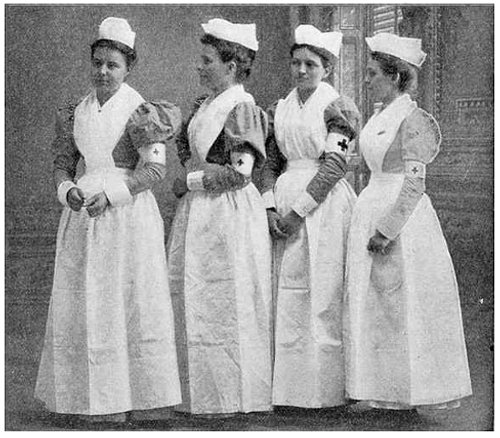
Copyright, 1898, by Clara Barton.
A GROUP OF RED CROSS SISTERS
The four sisters of the New York Red Cross Hospital of Dr. and Mrs. A. Monae Lesser, who nursed sick reconcentrados and their orphans in Havana, and afterward assisted the surgeons on the ships and in the hospitals of Siboney in dressing the wounds of Cuban, Spanish and American soldiers and sailors, until they fell victims of the fever and went into hospital themselves.
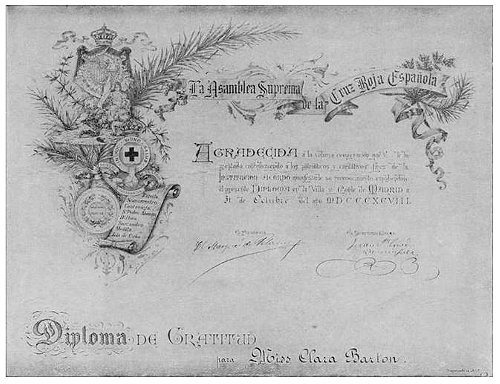
DIPLOMA OF GRATITUDE FOR MISS CLARA BARTON FROM THE RED CROSS OF SPAIN.
[Translation of Text.]
The Supreme Assembly of the Red Cross of Spain Grateful for the powerful co-operation which you have given, contributing to the patriotic and humanitarian ends of the institution, has resolved to manifest its recognition thereof, by issuing to you the present diploma in the city of the Court of Madrid on the 31st day of October in the year M.D.C.C.C.X.C.V.I.I.I. (1898).
The President, Marquis of Paloma.
The Secretary General, Juan P.C. Domingues.
Every moment news of another battle was expected; the experience of the first, with no better means as yet at hand, was a matter of great concern and worry to all present. Suggestions were made and discussed. Finally it was agreed to request more Red Cross aid by telegraph. A call for one hundred Sisters was suggested, and Mrs. Lesser was consulted in the matter. We had fifty trained nurses and assistants on our lists, also women to act as matrons to distribute nourishment; we promised to send for that number immediately, as we had sent for twenty-five already. That morning Miss Barton, with Mr. Kennan and several of her staff, had gone to the front, and before leaving, Miss Barton instructed her secretary, Mr. C.H.H. Cottrell, that, at our request, he should cable in her name for such persons and material as should be needed in the Hospital Department. We cabled for fifty nurses, ten assistants, a number of immune physicians, complete hospital equipment, and a quantity of surgical material, sufficient to make at least five hundred patients comfortable.
The work was performed almost without intermission, every surgeon employing all his energies. The feeling in the hospital among the members of the surgical staff was an excellent one.
The night of the third we expected to be able to rest a few hours, but during the day the fleet had fought its battle, and a number of Spanish wounded prisoners were taken off by the various ships. Dr. Lewis, chief surgeon of the “Harvard,” who assisted in attending the wounded at the hospital at Siboney, invited Dr. Parker, myself and the Sisters to help him in attending the wounded Spaniards, to which we gladly responded and spent the night on the “Harvard.”
The wounded continued to arrive for four days, many of them telling that they had been shot on the first day of the battle, July 1, and as yet had received no care except from some comrade who had with him the little emergency package.
Permit me to say here that I believe the little emergency package has saved many a man from death through bleeding.
Most notable and commendable was the desire of the surgical staff to save limbs when at all possible; and I have seen and often joined Drs. Fauntleroy, Nancrede, Ireland and Parker in the work, spending an hour for resection of the part in order to prevent amputation. Of course all endeavored to do the same, and out of the total number of 1415 wounded treated in the Siboney Hospital after the battle, there were but three amputations of the thigh, two of the leg and one of the forearm, that I observed in the camp. The death rate was also very small, as most of the shots made clean wounds, and only when they affected most vital parts did they cause death.
The dressing of wounds and the operating upon the wounded, however, were not all the service required by the injured. Shelter, comfortable cots and blankets were needed, very few of which had been landed. Still, as the wounded came, and the needs became greater, I saw Surgeon-Major La Garde, most ably assisted by Chaplain Gavitt, hunt about for canvas or anything that would act as cover for a tent, and have it put up along the tents and flies. Their work was unceasing. In those days every officer and member of the medical staff gave up his cot and tent that the wounded might find some kind of shelter and proper resting place; but in spite of that they were inadequate. The largest number of wounded lay on the ground, some on blankets, others on canvas, or if very severely wounded, on a litter.
The steamship “State of Texas” had a number of cots (I believe 350) which were originally meant for Cuban relief, many of which we used in the Red Cross Hospital at Siboney; when I informed Miss Barton of the condition of affairs, all cots that were in the ship were unloaded and sent to the hospital, and the most seriously wounded received comfortable resting places.
The gauze, particularly the iodoform gauze, and bandages soon gave out. The “State of Texas” carried a quantity of surgical dressings. All that was necessary was to ask Miss Barton for them, who immediately sent on land any article needed if in her possession.
Among our patients were several cases of gunshot wound through the skull and brain near the eyes; the eyes were inflamed, and ice had to be applied continuously to relieve excruciating pain. Dr. Fauntleroy suggested that the cases be sent to the Red Cross Hospital, we had there the only ice in the field at that time; it also came from the “State of Texas,” from which we received a daily supply. The eye cases were carefully attended by Mrs. White, the wife of Dr. Trumbull White, of the Chicago Record, who deserves much praise for the constant attention which she gave them. It was necessary to make continuous application of ice every few minutes, which she did with constant and unceasing care. Mrs. White is not a trained nurse, but a gentle, wise woman. I agree with the remarks of Dr. Fauntleroy when he said that her attention and the ice relieved much suffering and saved quite a few from blindness. Captain Mills, who was one of the wounded in that manner, may tell of his own experience.
Most of the cases of gunshot wounds gave very little work to the surgeons, as the bullet entered at one place and made its exit at another, thus leaving a clean wound. Even through vital parts of the body, such as the brain and abdomen, bullets passed without apparently giving the patient any great distress. The simple cases did not need much attention; cleanliness and a cushioned dressing well protected was all they usually required. In fact, many of the smaller wounds came to us bandaged with a little emergency pad, progressing in healing. These were always shots from the Mauser bullet. Many of the men that I saw were shot in the shoulder, the bullets making exits through the back. Some gunshot wounds had two places of exit and entrance in their course. For instance, I had cases in which the bullet had gone into the upper and lateral part of the cranium, come out behind the ear, went into the shoulder and came out behind and below the shoulder blade; or had made its course through the left arm, again entering the right chest and coming out at the back. It would perhaps be out of place to enumerate or describe in this report the many courses which the bullets have taken, but as stated, most of them required little attention. There were, however, some serious wounds, such as compound comminuted fractures, in the treatment of which great skill was shown by the various surgeons in the hospital. Those were the cases which in former years would have resulted in amputation, but drainage and cleanliness, plainly speaking, have given the patients the advantage of keeping their limbs.
In the simple cases one could work alone, with the assistance of a Sister or a hospital steward, but in the more difficult cases good surgical skill was required, and it was often a source of great gratification to see two eminent surgeons, of equally good reputation, assisting each other in a difficult case; one advising, the other acting; thus the greatest harmony existed among the members of the staff. The Sisters being required in the operating tents as also the stewards there were no nurses in the tents to care for the wounded.
No food had been prepared for the large number of wounded lying on the cots or on the ground on blankets or canvas; a great many of them were too helpless even to turn. Surgeon-Major La Garde did me the honor of consulting me in regard to the nursing, and I suggested that some of the Sisters leave the operating tables, which were by that time supplied with other assistants.
The major then sent for Mrs. Lesser, who suggested that the worst cases be brought into one or two rows of tents, as the small staff of Sisters brought into Cuba was not sufficient to take charge of all and do them justice. The rows of tents were then placed in her charge, and she portioned the work of caring for them among the Sisters assisted by hospital corps men. The soldiers were nearly famished; some had not received a morsel of food for two days. Oatmeal gruel, coffee and quantities of prune juice and other articles of relish were at once prepared at the Red Cross Hospital in big cans which had come from the “State of Texas,” and with the assistance of the ever active indefatigable Chaplain Gavitt, and several newspaper correspondents, the wounded soldiers received such food as their conditions allowed.
Unfortunately the surgeons lost track of the greater number of their cases. The patient marked for redressing was placed on any table, and the surgeon in charge of that table redressed the wound; thus it was hard to say what result one or the other had obtained, with the exception of a few cases, which by special request one was allowed to continue to observe. Some of the patients came down with their wounds dressed in some hospital at the front, and I may here mention that I saw excellent work coming from the hospital in command of Dr. Woods.
When the rush was over, I was called to the camp where the Spanish prisoners were located. I prescribed for their ailments, while the Sisters supplied their food. In addition, I answered the calls which came from Cuban families in Siboney. Some Spanish prisoners were wounded and others suffered from fevers. Those who were wounded had their wounds dressed at the scene of battle, and although some of the dressings were temporary, they feared to have any person touch them, until assured that they would be treated as gently as possible. The patients had now all been operated upon and attended; only some of the wounds needed redressing. They were taken to the transport hospital ships as soon as their condition permitted. It was about that time the hospital ship Relief arrived, bringing more food for invalids and more equipped cots.
Dr. Guiteras, who visited all the hospitals daily, informed me one afternoon that he had found a case of yellow fever in camp (not in our hospital), developed in a place near Siboney. There were two or more suspicious cases which he had watched, and he believed that yellow fever would develop very rapidly. I called the Sisters together, presented the situation to them, that they might decide whether to stay in the field or return to the “State of Texas.” Their unanimous decision to stay and face the consequences made them continue their work without any hesitation. The Red Cross Hospital building became crowded, one room was set aside for doubtful cases, while the other rooms were occupied with typhoid patients. The porch in front of the house, shaded with canvas, and a little isolated room to the right, sheltered the wounded.
My work at the Red Cross Hospital became continuous, as a large number of patients came from the various camps to receive attention, and still a larger number from our camp came for consultation and treatment. The number of such consultations I discontinued to write down after three hundred were attended, Americans, Spanish and Cubans together.
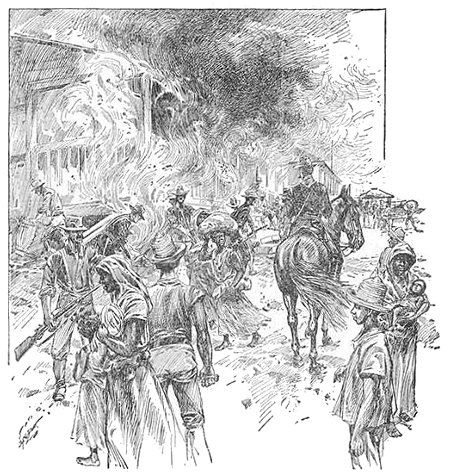
THE BURNING OF SIBONEY—RED CROSS HOSPITAL IN THE FOREGROUND.
Every case of typhoid fever and other disease which was placed in our charge from the day we opened the hospital, has recovered. The last of them were brought home well on the “Concho;” those that came later were on the way to recovery when I left for the fever hospital. Among our patients were two who had measles, complicated with pneumonia, and there was a large number of patient suffering with Cuban malarial fever. I also wish to state that not one patient in our hospital became infected with yellow fever; the cases that had it came there with the disease, but were closely observed, and as soon as the first positive sign was noticed, they were isolated and brought to the fever hospital. The total number of sick permanent and transient thus attended was 234. Most of the medicines we had brought with us, but received some from army stores.
When the “State of Texas” left for Jamaica to get ice, in order to save time we took a dwelling in one of the houses at Siboney, which was believed by experts not to be infected. The family living in it was very clean, and it appeared that the house would serve as well, and perhaps better than any other. Our tents, in which we should have preferred to live, had not arrived, nor did we have any cots, all having been given to the sick and wounded.
When the houses at Siboney were ordered to be burned down, we left for the yellow fever camp. Before leaving I requested Dr. Senn to operate upon two Spanish prisoners whom I had not seen for several days.
On the seventh day after our arrival at the camp we were able to return to Siboney. Our ailments, although not prevented, had been made light by prophylactic methods, and our recovery was consequently rapid. After our return to Siboney I again offered to serve.
In the meantime word from Assistant Surgeon-General Greenleaf was received at Siboney, stating that forty-five Red Cross nurses, surgeons and other assistants, had arrived at Guantanamo, waiting to come to us, and as we returned the same day from the fever camp, Surgeon-Major La Garde telegraphed and telephoned repeatedly for them to come, but he received no reply.
Feeling that under the existing circumstances and exhausted from work and illness we could not continue to work without more assistance, I applied for our return. Surgeon-Major La Garde upon this placed me in charge of the steamship “Concho” which left for the North on July 23, of which voyage a special report has been presented.
Before my departure from Siboney, Surgeon-Major La Garde handed me a document, a copy of which I herewith present:
Reserve Divisional Hospital, Fifth Corps, Siboney, Cuba, July 23, 1898.
This is to certify that Dr. A. Monae Lesser, surgeon-in-chief of the American National Red Cross, offered his services to the Medical Department of the army on the twenty-ninth day of June. From the latter date to the present day Dr. Lesser has been connected with this hospital as a surgeon and patient. When the wounded commenced to arrive on July 1, and during the rush of work which lasted four days in the care of the wounded, Dr. Lesser was assigned one of the six tables in the operating room. His work was skillful and most continuous. His suggestions to me on more than one occasion, concerning administration details, were of the highest value. After the rush of work in the operating room Dr. Lesser continued to take charge of a hospital, a building which was pronounced free from infection, in which he treated wounded and sick soldiers. His work was the admiration of every one who had the good fortune to be under the watchful care of himself and the Sisters under him. Unfortunately the building—in which they lived—soon showed signs of yellow fever infection. Dr. Lesser, his wife and four of the Sisters—his entire staff—were taken one by one with the fever. They were removed to our yellow fever hospital. They are now convalescing, though weak; they leave us for the North to-day for a much needed rest. I have no words at my command which could in any way express my appreciation of the work of Dr. Lesser and his heroic staff. Had it not been for their assistance and the quantities of supplies furnished by the “State of Texas,” the sufferings of the hundreds of wounded would have been magnified more than I can now venture to express.
In commenting on our lack of supplies, attendants, etc., I desire to state that our unprepared condition to meet the rush of work which came with such surprising rapidity was due to those military conditions which often transpire in war when blood, suffering and death seem to be inevitable, or beyond the scope of man to anticipate.
May God’s blessing be with him and his.
Louis A. La Garde, Major and Surgeon, U.S.A., Commanding Hospital.
RELIEF WORK IN CUBA. REPORT OF C.H.H. COTTRELL, FINANCIAL SECRETARY.

Early in February, 1898, after the President of the United States had called Clara Barton to several conferences on the question of relieving the sufferings of the Cuban reconcentrados; and the Central Cuban Relief Committee had been formed to take charge of the funds and supplies which it was known that the generous American people were anxious to donate for this purpose, it was decided that Miss Barton should go to Cuba at once to assist in the prompt and efficient distribution of the succor which was so near at hand. It is her habit to act quickly when her plans have been matured, and not a moment’s time was lost in preparing for her journey to Havana.