CUBA AND THE CUBAN CAMPAIGN. (continued 3)
Reading edition
On her arrival at Havana Miss Barton communicated with the American Consul General, the Spanish officials, and some of the best known and benevolently disposed citizens; and after freely conferring with them, and learning the existing conditions, the city was divided into distribution districts, and a committee of citizens, who were fully acquainted with the people and their wants, was appointed to take charge of each district. Abundant space in a very large warehouse had already been secured by the Consul General, which was, with the use of its employes, given free of charge to the Red Cross.
Several of the villages near Havana and as far east as Matanzas were then visited and arrangements similar to those made in Havana were perfected for the distribution of food and clothing; and these communities were supplied as quickly as possible.
Shortly after Miss Barton’s arrival in Havana the deplorable “Maine” disaster occured, killing, drowning and injuring so many of our brave sailors and marines. As soon as she heard of this awful calamity she visited the hospital where the victims who were not killed outright were lying, and arranged to have them provided with every possible attention, and the best of everything needed that money and sympathy could procure.
As the situation developed and the needs of the country became known, it was found to be necessary to largely increase the working force of the Red Cross, and arrangements were accordingly made to have some of the oldest and most experienced workers of that organization, with some new recruits, come to Havana. A large house for their accommodation was secured in the suburb of Cerro, about three miles from the business centre of the city, where they were pleasantly and comfortably established. The party when completed consisted of the following named ladies and gentlemen:
Miss Clara Barton, Mr. J.K. Elwell, Dr. J.B. Hubbell, Dr. E. Winfield Egan, Dr. A. Monae Lesser, Mrs. A. Monae Lesser, known as “Sister Bettina,” Misses Annie McCue, Minnie Rogall, Blanche McCorresten and Isabelle Olm, Red Cross nurses or “sisters;” Mr. J. A. McDowell and Mr. C.H.H. Cottrell.
Many of the best citizens of Havana, ladies and gentlemen, Spaniards and Cubans, gave us a most hearty welcome and every encouragement, many of them volunteering their services in any capacity in which they could be made useful, and we were thus enabled to secure a number of doctors and nurses, who gave excellent service, and who received the well-deserved thanks of the Red Cross.
Relief Distribution From the San José Warehouse.
Mr. Elwell was put in charge of the warehouse with an able corps of assistants, and his work there was all that could be desired, as it was something that he was perfectly familiar with from long experience; he had the great advantage of knowing the Spanish language and the character of the people with whom he was dealing. Many hundred tons of the finest supplies, including everything that a generous and sympathetic public could think of that would be suitable for a famishing people, were given out as fast as orders were issued for them; but in every instance the utmost care was exercised that nothing should go out that might reach the hands of irresponsible persons; and every possible safeguard of check and receipt was adopted and successfully used.
Opening a Hospital and Orphanage.
The large number of orphan children that had been left unprovided for appealed to the sympathies of some worthy people for whom Consul-General Lee was the spokesman, and Miss Barton was asked by them to provide a hospital and home for these waifs. She therefore rented and furnished a large private residence on Tulipan street in Cerro, near the Red Cross residence, which was opened and named the “Lee Orphanage.” The house was completely arranged and had a capacity for seventy-five inmates, besides the attendants, and it was soon filled. Dr. and Mrs. Lesser were placed in charge of the orphanage, assisted by several Cuban doctors and nurses. The greater part of the children who were brought there were in an extreme state of exhaustion from lack of nourishment, many being unable to sit up, and the greatest care and watchfulness had to be observed to save their lives. A few of them died after they reached the hospital; but by careful and unremitting attention the larger part of them were gradually brought back to health, and it is to be hoped that some of them will eventually find homes in good families.
Los Fosos, the Horrible!
An old ramshackle building long before abandoned as unsafe and undesirable was owned by the city and known as Los Fosos. Being worthless and unwatched, it had become the lodging place of a horde of beggars and tramps, and when the unfortunate reconcentrados were driven into the city from their homes in the country hundreds of them flocked to this miserable place. Miss Barton found there men, women and children crowded together in a most pitiable and disgusting mass; and suffering from disease and exhaustion and in such a state of filth that her party was unable to endure the stench and had to get out after a very short stay. These poor victims of cruel war were lying on the bare floor in their dirty rags, and entirely helpless except for such poor aid as they could render each other. Many of them died daily and their corpses would lie for hours before being removed. Altogether it was one of the most horrible pictures imaginable.
Permission was obtained by the Red Cross to repair the building and make a hospital of it, and carpenters were put to work to strengthen the swaying floors and batten up the sides and make the roof rainproof. Three rooms were partitioned off for a dispensary, store room and kitchen. Scrub women were put to work and a plentiful supply of soap, water and disinfectants soon made a great change for the better. When the place had been cleansed, new cots were brought in and clean bedding put on them. Up to the time of their forced departure those devoted nurses worked faithfully from early morn till late in the day to keep the place decently clean and instill habits of neatness into those miserable beings. Deprived of the pride and care of those trained women, it is easy to believe that within a week after they left, Los Fosos had resumed its former reputation as the most unsavory spot in all Havana.
During the time that Los Fosos was under the care of the Red Cross the best medical skill obtainable was given to the inmates, and the untiring care and attention of as faithful a body of trained nurses as the world has ever known was freely given them, and the best of nourishing food and delicacies were abundantly supplied; and if fate had willed that this body of self-sacrificing men and women should remain, there is no doubt that, in the course of time, this old pesthouse would have become a famous hospital with a reputation second to none.
Relief Work Discontinued.
One of the most comprehensive systems of charitable work had been thus inaugurated and was doing incalculable good, and was receiving praise and gratitude from all classes, when it was announced that the official relations between Spain and the United States, which had been strained for some time, were about to be broken. The American Consul-General announced that he did not think that it was safe for American citizens to remain in Cuba while the excited state of feeling existed, and that he should leave on a certain day, and he advised all Americans in Cuba who wished to go to the States that he would provide transportation for them. The time given for settling affairs and preparing to leave was less than a week, and accordingly there was much excitement and great sacrifices had to be made, which in many cases meant ruin and beggary. Quite a number of the refugees afterward became entirely dependent upon the bounty of the Red Cross at Key West and Tampa, Florida.
When it thus became necessary to decide whether the Red Cross should abandon its work in Cuba, Miss Barton called her staff around her (as is her invariable custom in deciding all important matters), and asked for their individual opinions as to the advisability of their leaving, and a full discussion of all the points involved ensued, and a unanimous decision was arrived at. All Spanish officials, national and municipal, had never failed to show the utmost courtesy to all our members, and time after time they had shown their sincerity by repeated acts of kindness, and none of us believed that they were likely to change their attitude toward us. But when it was considered that war was almost inevitable, and that if we remained in Cuba we should be shut up in an enemy’s country and unable to communicate with our friends and relatives, who would be daily harrowed by sensational stories, it was decided that we should withdraw when the Consul-General was ready to leave.
When it became known that we were about to leave Miss Barton received some very hearty assurances of regard and protection from high Spanish officials, and many Spanish and Cuban ladies and gentlemen called on her and assured her of their high regard and deep gratitude for all she had done for their suffering people.
Archbishop of Havana Blesses Lee Orphanage.
The day before we were to leave Cuba the Archbishop of Havana came to the Lee Orphanage, where quite a number of the best people of the city had assembled, and gave his blessing to the little institution; which was, with those Catholic people, an augury equivalent to a guaranty that the success and protection of the undertaking was fully assured; and, indeed, we learned several months after the war had begun that the Spanish authorities had not only taken the most scrupulous care of this hospital, and all its abundance of provisions with which the Cuban Relief Committee had supplied it, but they had also placed a guard around Miss Barton’s residence and had kept it inviolate from all predatorily disposed persons. After the war some of our party visited the residence and the orphanage, and found provisions which had been left at both places were still on hand.
Of course it was to be expected that the hospital, being deprived of the example of the trained Red Cross nurse, with her habits of order and neatness, would naturally retrograde in many ways, and our party therefore was prepared for the many evidences of neglect and disorder that met their eyes on their return visit.
The Central Cuban Relief Committee, of New York, which had been appointed by the President of the United States, had abundant means to maintain this work that had been so successfully inaugurated, and it is greatly deplored that the unfortunate declaration of war prevented the carrying out of all the plans that had been so carefully matured, and which would have saved the lives of thousands of men, women and children who now lie under the sod.
Having made the best possible arrangement for the maintenance of the institutions we had brought into being and had fostered in Havana; and with the saddest regrets that we should have to abandon a work so well begun, we boarded the ship “Olivette” on April 11, and started for the United States. After a great deal of discomfort, caused by the overcrowding of passengers and the heavy seas, we reached Tampa, Fla., on April 13. After a day or two of rest, Miss Barton proceeded to Washington with Drs. Hubbell and Egan, the remainder of the party stopping in Tampa.
There were at that time probably about fifteen hundred Cuban refugees in Tampa and eight or nine hundred in Key West, who were entirely dependent. The Red Cross took upon itself the task of maintaining these poor people, and for a period of seven months its agents provided for them. It should be said, however, that the citizens of both these cities appointed committees and did all they could to relieve the necessities of these large bodies of indigent people.
Early in April it had been decided to charter a steamer in New York and to load her with supplies and send her to different ports in Cuba, where her cargo could be unloaded in such quantities as might be required. Accordingly, the steamer “State of Texas,” of about eighteen hundred tons burden, was chartered from Messrs. Mallory & Co., of New York, and notwithstanding the fact that our party had been obliged to leave Havana, and that subsequently war had been declared, the preparations for sailing were kept up, and the steamer was loaded with a cargo of fourteen hundred tons, which embraced a fine assortment of substantials and delicacies, and many household articles, medicines and hospital stores. When she was finally loaded in the latter part of April, the “Texas” sailed for Key West in charge of Dr. J.B. Hubbell, with Captain Frank Young as sailing master, arriving there on the twenty-eighth of that month.
Reception at Tampa.
In the meantime, Dr. Jos. Gardner and wife, of Bedford, Ind., had joined our party at Tampa; and soon after Miss Barton, Dr. Egan, Mr. D.L. Cobb and Miss Lucy M. Graves came along, and it was arranged that the entire party was to leave Tampa on the evening of April 28, to go aboard the steamer “State of Texas,” at Key West, and remain on her until the army had made a landing in Cuba, when it was expected that we should be able to resume our work there. The day of the evening we were to leave Tampa, Mrs. J.M. Towne, the lady at whose house our party was stopping, gave a reception in honor of Miss Barton, to which General Wade and the army officers who were then stationed there, and many ladies and gentlemen of that fine little city, were invited. It was a most brilliant and enjoyable occasion, the uniforms of the officers and the lovely toilets of the ladies making a picture that will long remain in the memories of those who saw it.
The Relief Party Returns to Key West.
On our arrival at Key West, on the afternoon of April 29, we were met by Dr. Hubbell and Mr. C.C. Bangs, who had been sent by the New York committee to assist in our work; and Mr. A. Butler Duncan, a well-known gentleman of New York, and were taken aboard the steamer “State of Texas,” where we were welcomed by Captain Young, and where we subsequently passed many pleasant weeks together. A few days later we were joined by Mr. Geo. Kennan, First Vice-President of the American National Red Cross, and his wife.
Key West at that time was a very busy place, the harbor being filled with naval vessels which came in there daily from the Cuban blockading squadron for coal and provisions. Miss Barton immediately paid her respects to Captain Harrington, of the monitor “Puritan,” who was the senior commander of the port, and presented her credentials from the State and Navy Departments. Subsequently she placed herself in communication with Commodore Sampson, and stated her desire to reach Cuba at the earliest possible moment.
Many naval officers and citizens of Key West called on Miss Barton daily, and this attention, combined with her enormous correspondence, kept her time fully occupied till late in the night. There was scarcely a day that some accident of more or less severity did not happen to some of the sailors or workmen on the many auxiliary craft that were in the harbor; and the Red Cross doctors were at all times in demand. In order to keep every one in the best preparation for possible contingencies of any kind, everybody on the ship was instructed and drilled in the various phases of his or her particular kind of work; and thus all were kept happily and busily engaged. The doctors inaugurated a series of lectures for the benefits of the nurses and others, and clinics were of frequent occurrence, and every member of the party benefited by the practical knowledge thus attained in bandaging and taking care of various kinds of injuries.
Doctor E. Winfield Egan, of Boston, one of the foremost of our surgeons, effected some wonderful operations here and at Port Tampa, and won the warm friendship of many a poor fellow, who, but for his skillful ministrations would have fared badly. Some of the injured men were so badly hurt that days and weeks elapsed before they were fully recovered, and during the time of their convalescence, they were carefully attended and watched by the Red Cross nurses; and at all times of the day the Red Cross boat, with its well-known flag floating, could be seen going from one transport to another on its errands of mercy.
Feeding Spanish Prisoners.
While we were lying at Key West there was scarcely a day passed that some of our vigilant blockading squadron did not bring in from one to three captured prizes; sometimes large steamships, and from that class through the various grades of shipping down to fishing smacks; and in the course of a couple of weeks there were between thirty and forty of these boats lying at anchor in the harbor, with their crews aboard under guard. Somehow it was forgotten that these poor foreigners must eat to live; or else perhaps somebody thought that somebody else was responsible for this very important matter; be that as it may, they were unprovided for. The boats, of course, had a small amount of provisions aboard when they were captured, and while that lasted all went well; but in a few days their supply was exhausted and calls were made on the United States Marshal, in whose charge the prisoners were, for food. That officer, having no contingent fund on which to draw, was in despair, and came to Miss Barton, who at once reassured him by saying that she would attend to the matter and would provide for all the prisoners until such time as he could get his petition through the departments at Washington. Accordingly several boatloads of provisions were hastily gotten together and taken in tow by a steam launch which landed them alongside of each prize. Miss Barton personally visited these boats, and with the aid of an interpreter she learned the needs of the crews, and not only supplied them with food, but she arranged to take letters from all who wished to communicate with friends and relatives in Spain and elsewhere, and forwarded the letters to their destination.
All governmental relations between Spain and the United States having been broken by the declaration of war, it was necessary, where letters were to go to Spain, to send them to the Red Cross of Portugal, which organization kindly acted as the intermediary friend all through the war. And here I may say that the Red Cross adopted this method wherever there were Spanish prisoners, and through its kind offices thousands of anxious hearts received news of their absent ones who were “held by the enemy.”
New York Red Cross Relief Committee.
About the middle of May the friends of the Red Cross in New York City, conceived the idea of forming a relief committee for the collection of money and supplies to be used in aiding the soldiers in camp and field. The committee was formed, with some of the richest and most prominent people of the country on its list, and it became necessary for Miss Barton to go to New York to empower the committee with authority to act in the name of the Red Cross. Accordingly the steamer “State of Texas” left Key West and proceeded to Port Tampa, where Miss Barton took train for the North, leaving the remainder of the party on the steamer.
Emergency Relief at Port Tampa.
At this time there were several camps at Tampa and Port Tampa, and several thousand troops were preparing for the invasion of Cuba; transports were daily arriving at Port Tampa and were being placed in readiness to carry this vast host to the “Pearl of the Antilles.” Those were busy days for everybody, and the Red Cross doctors and nurses were called upon hourly to render service to many victims of injury and disease.
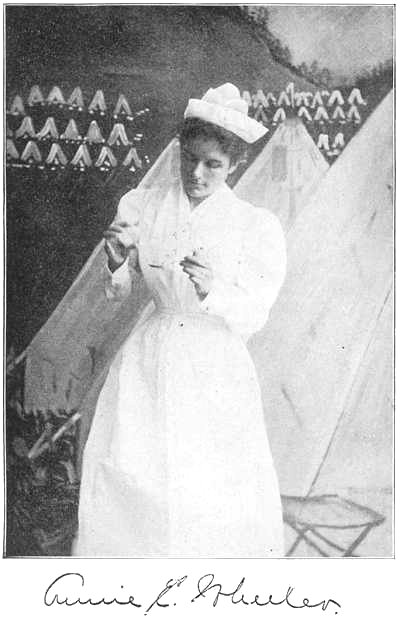
In charge of Red Cross nurses at Nautical Club Hospital, Santiago de Cuba.
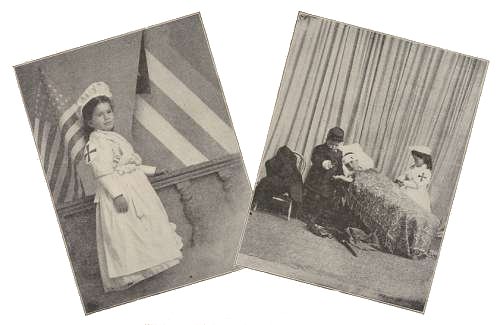
THE YOUNGEST RED CROSS NURSE, 4 YEARS OLD.
While we were waiting at Port Tampa we were joined by Miss Janet Jennings, of Washington, and Mrs. Trumbull White, of Chicago, both of whom afterward did excellent work in the hospitals at Siboney.
Miss Barton rejoined our party on June 16, being accompanied by Mrs. J. Addison Porter, the wife of the secretary to President McKinley, who went with us on the “State of Texas.”
Miss Barton had been the recipient of such assurances on her recent trip to Washington from the heads of the various government departments, that she believed that the Red Cross would receive the most cordial recognition from the army and navy as an auxiliary aid, and would be able to co-operate with them in the utmost harmony. Although the mission of the steamer “State of Texas” was to render relief to the Cuban reconcentrados, it was tacitly understood and believed by all that every possible aid would be extended to the army and navy forces whenever it was necessary or called for.
All of the government transports carrying General Shafter’s army had sailed from Port Tampa, bound for Cuba, when, on June 17, the “State of Texas” weighed her anchor and started for Key West, where we arrived on the following afternoon.
It was learned at Key West that the cargo of a captured ship, consisting of South American “tasajo,” or jerked beef, was about to be sold by the United States Marshal; and as we knew this was a favorite food of the Cubans, and that we could get all that we needed at a very low figure, Miss Barton decided to take aboard twenty tons of it.
A telegram had been sent from Port Tampa to the Secretary of the Navy, under whose authority the “State of Texas” was then sailing, notifying him that we were going to Key West, where he could communicate with us, and thence on to Cuba, if orders to the contrary were not received.
Sailing for Cuba.
On June 20, everything being in readiness, and no orders having been received from the Secretary of the Navy, it was decided to sail and find Sampson’s fleet near Santiago de Cuba, where it was generally believed that General Shafter would try to effect a landing; so at 10.15 a.m. we started, taking the westerly course around Cape Antonio. Just as we were about to leave, Mr. W.S. Warner joined our party and afterwards became one of our most useful and valued workers.
After a pleasant but uneventful voyage on the morning of June 25 we arrived off Morro Castle, at the entrance of the Bay of Santiago. The Spanish flag was flying over the land fortifications and Sampson’s fleet was stationed in the adjacent waters. Miss Barton sent a representative aboard the flagship “New York,” who presented her compliments to Admiral Sampson and asked for orders, or an expression of his wishes regarding the position to be taken by the Red Cross ship. The Admiral sent back word saying that General Shafter’s army had disembarked at Daiquiri, a point about twelve miles east of Morro Castle, and he advised Miss Barton to take her ship to Guantanamo Bay, where she would find good anchorage and calm water; and where she would be able to learn more of what was taking place on land, as there was constant communication from there with the invading army. Accordingly we drew away and arrived that evening at Playa del Este, which is about forty miles from Santiago, and situated just inside the mouth of Guantanamo Bay.
Captain McCalla, the naval commander of the port, with several other naval officers came aboard the “Texas” that evening, and warmly welcomed Miss Barton. Among these officers were the captain and medical staff of the United States naval hospital ship “Solace” which was lying at anchor near us, and they extended an invitation to all the members of our party to visit their ship on the following morning. The invitation was accepted, and the next day the launches of the “Solace” came for us, and we passed a couple of very enjoyable hours looking over one of the most complete and handsome ships we had ever seen.
Departure for Siboney.
After our return to the “State of Texas” two representatives of New York papers called on Miss Barton, informing her that they had just come in from Siboney, where there was great need of supplies and medical aid. They said that the men who were wounded in the fight between the Rough Riders and the Spaniards on the previous Friday had just been brought in and that they were suffering from the lack of everything in the way of comforts and conveniences. Our steamer was at once headed westward and started within a few minutes for the scene of suffering. A two months’ sojourn in tropical waters had enabled the busy little cirripeds to attach themselves in millions to the bottom of our ship, and, in nautical parlance, she was very “foul,” and consequently our speed was reduced from a normal of about ten knots an hour to between seven and eight knots, so we did not reach Siboney until after eight o’clock that night.
Soon after our ship was anchored a boat was lowered and a party of our doctors started for the shore. As the night was dark and there was no wharf nor other landing place, save one small bit of sandy beach which was bounded on each side by precipitous rocky ledges, and no lights other than those of the ships which were anchored safely away from the shore, and the uncertain and misleading flare of an occasional camp fire some distance away from the beach, the landing was a matter of some difficulty and anxiety. A heavy ground swell was running quite high and dashed itself against the rocks with a roar that deafened us; however the officer who was in charge of the boat was an old sailor, who was used to landing in strange places, and by constant “ahoying” to every sign of life on ship or shore, we managed to strike the one soft spot in that vicinity and soon had our boat drawn up on the sand.
By inquiring of several sentinels, we found our way to the army hospital, which was a rough wooden building that had evidently been used for a store or warehouse in more peaceful times. On a veranda in front of the hospital a group of officers was standing, and on our asking for the surgeon in charge, Major Havard stepped forward. Drs. Gardner and Lesser introduced themselves and the other members of the party to Major Havard and formally offered him, in the name of Clara Barton and the Red Cross, the personal services of all our doctors and nurses, and any of our supplies that might be needed. Major Havard very courteously thanked them for their offers and said that he fully appreciated the value of such services, but he thought that he and his assistants would be able to take care of all the sick and wounded that were there at that time; and as for supplies, he knew there was an abundance of them on the transports, and he hoped they would be landed the next day. During these speeches our members were looking through the miserable place that bore the name of hospital, and the sights that met us brought tears to our eyes. There were half a dozen cots in a building where there were, perhaps, fifty or sixty patients, the greater number of whom were lying on the floor, some with a blanket under them, but a great many were lying on the bare boards. Sheets, pillows and bedclothes were unknown, and those poor fellows who were not dressed in their uniforms were lying almost naked. There were some wounded men, and others who were sick with fever; and in the dim light of a few lanterns we could see them turning from side to side in their discomfort and agony and hear their moans, and in some cases imprecations against a Government that would so illy provide for such a contingency. One of the nurses(?), a young fellow who sat out on the veranda in his shirt sleeves complacently smoking a cigarette, told us that he couldn’t do very much for the boys, as he didn’t have anything to do with; besides one nurse couldn’t do very much for forty men, all wanting him at the same time, and he thought there ought to be more help. I couldn’t help contrasting this good natured but rather indolent chap, who was performing his duty in such a careless and perfunctory manner, with the brave, clean, intelligent and energetic young women whom I knew, who, when on duty, never took a minute’s rest, but were constantly busy, and who anticipated every want of a patient; and who by their bright faces and cheerful voices drove away all feelings of despondency and homesickness among the sufferers, and in this way helped them quite as far on the road to recovery as the medicine that the doctors might prescribe.
Cubans Gladly Accept Assistance.
With saddened hearts we turned away and entered the Cuban army hospital near by. This house was better furnished with beds and bedding and other hospital appliances than the place we had just left, as it had been a regular army hospital when the Spaniards were in possession of the place, and they in their quick retreat had left nearly everything intact. So that these patients were in a much better condition. But how dirty it was! And how badly it smelled! The Surgeon in charge of the Cuban hospital was a very intelligent Cuban who spoke good English, and he welcomed us warmly, and insisted on taking us to see General Calixto Garcia, whose headquarters were near by. That fine old warrior, with his gentlemanly and courtly manners, received us with the greatest cordiality, introducing us to the members of his staff who were present, and in every way made us feel that we were more than welcome. He had no hesitation in accepting any aid we had to offer; said that his men had suffered so terribly during the past three years that he welcomed our coming as a perfect godsend. So it was arranged that the Red Cross should take hold of the Cuban hospital the next day and do what it could to make it healthier and pleasanter; although the surgeons in charge begged that the ladies, i.e., the nurses, should not come until the place had been cleaned. But Red Cross nurses are trained in a school that makes the annihilation of dirt its first principle; and early the following morning they appeared with pails, scrubbing brushes, soap, whitewash and disinfectants, and the way in which they went to work elicited the admiration and astonishment of all who saw them. After thoroughly washing and disinfecting the floors, walls and furniture, they took the beds and put them through the same process, and afterwards put new mattresses, pillows and bedding on them. Then the patients were taken in hand, and carefully bathed and put in clean clothing, and then into clean, sweet-smelling beds. The looks and words of gratitude that were given to those little women in blue will always remain a happy recollection to them.
This grand transformation of the dirty Cuban hospital was watched with great interest by the American officers and men, and when it was finally finished it presented such a noticeable contrast of peace, cleanliness and comfort to the United States Army hospital, where everything was the very opposite, in all its hideousness of neglect, squalor and suffering, that there was a universal grumble in the camp, and men were heard to mutter: “What kind of people are these Red Cross folks that come down here and give the best of everything to the Cubans, and pass by our own boys, who are dying for the want of these very attentions?” When it was explained to them that the Red Cross had first gone to our own hospital and offered all it had to our own army surgeons, and that they had declined assistance, there was an immediate and widespread inquiry, “Why?” and as no answer that would satisfy could be given, and the grumble was becoming more general and forcible all the time, a little later the army surgeons thought best to allay further irritation by a general acceptance of whatever was needed from the Red Cross stores, and any personal assistance that might be offered.
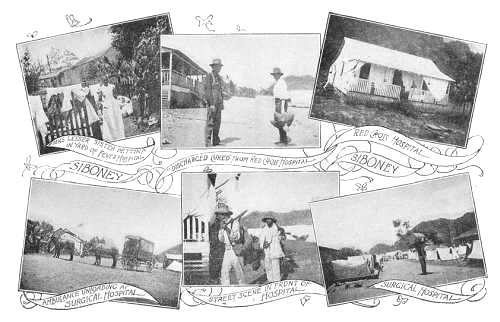
As a result of this change of mind everything that was needful to make the American hospital the equal of the Cuban hospital was gladly given by the Red Cross, and from that time on to the end of the war the army surgeons and the Red Cross worked in perfect harmony and with mutual respect and admiration. A Red Cross hospital was opened at Siboney and immediately filled to its capacity with American soldiers and government employes; and the Red Cross surgeons were given operating tables in the army hospital and on the field, and with the aid of Red Cross nurses rendered splendid service in the bloody days that soon followed.
Urgent Call for Help at the Front.
As General Shafter pressed forward with his troops, the fighting became more severe, and his chief surgeon, Colonel Pope, sent word to Miss Barton asking for aid to be sent out to the front. She responded immediately and personally led a party consisting of Mr. George Kennan, Mrs. J. Addison Porter, Dr. and Mrs. Gardner, Dr. E. Winfield Egan, Dr. J.B. Hubbell, and Mr. J.A. McDowell, going forward in army wagons and on foot over a road whose badness could not be exceeded anywhere; and they soon had their tents up and their kettles boiling, and for several days they devoted all their time to relieving the sufferings of the wounded men on the field. They made gruels and soups, and all the delicacies that could be prepared with the facilities at hand, and distributed fruits and cooling drinks. These poor wounded soldiers were lying on the field where they were left after their wounds had been dressed; and as there was no food for them to eat except the regular army ration of salt meat, hardtack and coffee, which many of them were unable to swallow, in some instances they had not taken any nourishment for three days, and were nearly starved.
The “rainy season” had just set in and these “martyrs to the cause of Cuban liberty,” who were helpless and in many cases without clothing of any kind, were left without protection, except such as could be had from small bushes and trees; and they were subjected daily to alternate “sunshine and shower;” and when it is said that those words are not to be taken in a poetical sense, but that they mean intense heat and deluging rains, the suffering that ensued can be understood. And it may be well to say that in that locality at that time of the year, when the sun sets the cold air from the mountains drops down into the valleys and the nights become uncomfortably chilly before morning.
That the statement of the sufferings of these men may not be thought overdrawn, I shall introduce here an extract from the testimony of Major William Duffield Bell, an army surgeon, as given on this point in his report for the War Department:
The First division of the Fifth Army Corps Hospital was the only one in the field. The surgical force in this hospital was insufficient to meet the demands upon it, and numbers of the wounded lay unattended for twelve and even twenty-four hours on the bare ground before their turn came. There was an insufficient supply of proper food for invalids, due to lack of transportation, though there was no lack of surgical supplies at the hospital, thanks to the energy and business like efforts of Major Wood, chief surgeon of the Division Hospital.
Another great want was the scarcity of clothing and blankets. In many cases soldiers were soaked with rain and stiffened with mud from the trenches, so that their clothes had to be removed before an operation or dressing, and could not be put on again. Men were often taken from the operating table and of necessity in many cases were laid upon the wet ground without shelter, and in the majority of cases without even a blanket, and with little or no nourishment for two awful days until the Red Cross Society, under Miss Barton, appeared on the scene.
With no intention to place the blame for the condition of things existing, it is only just to state that had some officers of the commissary and quartermaster’s departments displayed the same zeal and enthusiasm as did Major Wood and his officers and men, such things need not have happened, and the poor sick and wounded sufferers would not have had to feel, as many did, that they were almost forgotten by God and man.
A Yellow Fever Scare.
It is not to be wondered at that in such conditions our soldiers began to fall victims to calentura, a prevalent fever from which very few people there escape, even though surrounded by the best sanitary conditions. The yellow fever scare had taken hold of a part of our soldiers before they left the states; and as there were a great many contract surgeons in the army, who were inexperienced in diagnosing tropical fevers, it was not long before it was reported that the yellow fever had broken out, and considerable demoralization ensued. The Red Cross party which was at the front was requested to return to the steamer; and all the buildings at Siboney, including the hospital, were ordered to be burned “to stop the spread of the fever.” Dr. and Mrs. Lesser and Sister Minnie Rogal had already fallen victims to the fever, and were at that time lying in the Red Cross Hospital at Siboney. A temporary fever camp had been started in the hills at the back of Siboney, and they were taken there, accompanied by Sisters Isabelle and Annie both of whom afterward had the fever.
Right here let me say that a Dr. Gray connected with the Medical Department of the Army has been quoted in the papers as saying that the Red Cross was to blame for the outbreak of the yellow fever in Siboney, inasmuch as that organization had opened a hospital in a building that had been condemned, before any army hospital had been opened. It is only necessary to say that the Red Cross Hospital was not opened until over a week after the American and Cuban Army Hospitals had been opened in buildings that had been previously condemned by army officers.
Referring to this subject, Major Louis A. La Garde, Surgeon U.S.A., has given this testimony:
The Cubans deceived Dr. Pope, as they had deceived Dr. Guiteras, by telling him that there had been no yellow fever in Siboney. Dr. Guiteras believed this. On one occasion he told me that Siboney didn’t look like a yellow fever locality, as the place was hilly and well drained, except in a small section to the northeast of the town, where there was a stream. Dr. Guiteras advised that hospitals be established in houses in Siboney, and he thought there was no danger of infection because of such action.
As I write this report the War Investigating Commission is holding its sessions, and the country is impatiently awaiting its decision as to where the blame rests for the many shortcomings that were developed during the Santiago campaign, I have just been reading the testimony of Dr. Frank Donaldson, Assistant Surgeon of Roosevelt’s Rough Riders, in which he remarks:
“My experience is that the reason the Rough Riders fared so well was because we hustled for ourselves.”
When Dr. Donaldson arrived in Siboney he immediately came aboard the Red Cross steamer and announced that he was about to join the Rough Riders, and would like some supplies to take out with him. He was given everything that he wanted that we had in our stores; and the next day he came with two more members of his regiment, and after having breakfast with us, made another requisition for an increased amount of good things. These were cheerfully given and, in addition, shoes and underclothing from the private wardrobes of the members of the Red Cross were added, to meet the required needs that could not be filled otherwise, owing to the fact that these things were not in the steamer’s cargo.
I esteem it a privilege to be able to testify to the exactness of the doctor’s testimony as to his ability and success as a “hustler,” and still more to be able to show where he “hustled,” which appears to have escaped his memory.
A few days previous to the fever scare our supply of ice, coffee, fruit and other needful articles running short, the steamer “State of Texas” was ordered to go to Jamaica to replenish her stores. While in Kingston we met many refugees from Santiago, among them Mr. Louis Brooks and Mr. Robt. Douglas, Sr. Both these gentlemen placed their residences in Santiago at the disposal of Miss Barton; she accepted that of Mr. Douglas, and we afterwards spent several very happy and comfortable weeks within its hospitable walls. Mr. Douglas also offered the Red Cross the use of his warehouses in Santiago which was accepted, and we are indebted to these gentlemen for many other favors and their kindness is remembered with gratitude and pleasure.
Relief for Cubans, Guantanamo Bay.
Commander McCalla of Guantanamo Bay had already made calls upon the Red Cross for relief supplies for the Cubans in that vicinity, and the “State of Texas” had made two trips there, leaving five thousand rations at one time and ten thousand at another. The commander then called for fifty thousand rations, and we started at once to deliver them. On our arrival at Playa del Este the commander met us in his steam launch as we were coming into the harbor, and before we had cast anchor he demanded to know if we had come from Siboney, and if any of our members had been ashore there recently. Being answered in the affirmative, he said that he could not expose the men of his fleet to the risk of taking yellow fever from us, and ordered our ship to turn about and leave at once.
While we were lying at Siboney Messrs. Elwell and Warner were kept busy with a crew of from fifty to seventy-five Cuban soldiers, in landing supplies from the steamer; and the work they did and the success they achieved calls for the highest praise, for it was accomplished under the most adverse conditions and with most inadequate facilities.
At the near-by village of Firmeza were thousands of Cuban refugees and residents, who were in abject need and many were sick and dying. Through the energetic efforts of the above named gentlemen and Dr. J.B. Hubbell all these people were fed and clothed, in addition to many more who came into Siboney.
Exodus from Santiago.
During the siege of Santiago General Shafter sent word to General Toral, the Spanish Commander, that unless the city was surrendered within twenty-four hours, he should bombard it. Notice was given to the citizens of that place, and the surrender was refused. An exodus of non-combatants, men, women and children, hurriedly took place; it was said there were thirty thousand of them, and they fled to the country to the north and east, some twenty thousand crowding into the little village of El Caney which normally has not over five hundred inhabitants.
The city of Santiago at that time was in a destitute condition, several people having already starved to death, and there was consequently little or no provisions for the people to take away. So this vast horde of hungry wretches overwhelmed the little country places that they come to, and the suffering that ensued was something frightful.
The officers at General Shafter’s headquarters notified Miss Barton of the conditions at El Caney, and she immediately sent Mr. Elwell there to form a citizens’ committee to assist in distributing the food that was to follow as quickly as we could get transportation to carry it. Every horse, mule, vehicle of any kind that could be borrowed, begged or hired, was impressed into the service, and tons of supplies were taken there at the earliest possible moment. For about two weeks the Red Cross force worked night and day in relieving this place. Mr. C. C. Bangs, an elderly gentleman from Brooklyn, N.Y., who had been sent to the Red Cross by the New York Cuban Relief Committee, was given charge of the relief supplies at El Caney, and he remained there until the surrender of Santiago, when the city people returned to their homes, faithfully working as cook and dispenser from sixteen to eighteen hours a day. The hard work, lack of sleep, and poor sanitary conditions, were too hard a strain on him and he came to us at Santiago sick and very much broken. He was attacked by the calentura and removed to a hospital where in a few days he died. He was buried by the Red Cross in the Santiago cemetery, his funeral being attended by the members of that body.
The Relief Expedition Enters Santiago.
The surrender of Santiago having been arranged to take place at ten o’clock on the morning of July 17, and Miss Barton being anxious to get to that city at the earliest moment, knowing full well the terrible conditions that existed there, the steamer “State of Texas” steamed down from Siboney that day to the entrance of Santiago Bay. Miss Barton sent word to Admiral Sampson that she was ready to go in to the city whenever he was ready to have her; and he answered that he would send her a pilot to take her ship in as soon as the channel was made safe by the removal of torpedos that had been planted by the Spaniards.
Accordingly about 4.30 in the afternoon a Cuban pilot came aboard the “Texas” from the flagship “New York” and we were soon on our way to Santiago, where we arrived just before sundown. We came to anchor just off the main wharf and Messrs. Elwell and Warner went ashore to make arrangements for warehouse room and to engage men to unload the ship on the morrow.
Early the next morning the “Texas” was drawn up beside the principal wharf and one hundred Cuban stevedores began the work of discharging her. These poor fellows were a sorry looking crowd of undersized and half starved men, the effects of their long fast being plainly visible in their hollow cheeks and thin arms and legs. Many women and children were on the wharf ready to sweep up any stray bits of meal or beans that might escape from leaky sacks or boxes.
As the stores came from the ship they were loaded on hand cars and rolled to the land end of the wharf, where they were placed under a large shed and a guard of soldiers was placed over them to keep back the hungry people and dogs who hung around like a pack of famished wolves.
The same plan of distribution that we had so successfully pursued in Havana was adopted in Santiago, and with the aid of such splendid men as Mr. William Ramsden, son of the English Consul; Mr. Robert Mason, Chinese Consul and vice British Consul; and Mr. Michelson, German Vice Consul, we were soon possessed of full knowledge of the place and in perfect touch with its best people.
General McKibben, the Military Governor of the city, and many other army officers and citizens called on Miss Barton, giving her a warm welcome and offering their assistance in any way they could be of service to her.
A central committee of citizens was appointed, to whom was deputed the duty of dividing the city into districts, and of appointing sub-committees of responsible persons to distribute the supplies to the needy. All applications for relief from the sub-committees had to be approved by the general committee, and then brought to the Red Cross warehouse, where they were filled in bulk and sent back to the district committees for distribution. In this way all confusion was avoided, and our headquarters kept comparatively free from crowding.
By steady work and long hours the cargo of the “State of Texas” was discharged, and she left on her return trip to New York on the fifth day after her arrival; and we were thus left without any means of transportation that we could depend upon in any direction, the railroads being broken, and there being none but government ships in the harbor.
The government not having many delicacies for its sick men, and such as it had being so hard to get that those in quest of them could hardly get their orders filled until their patients had died or recovered, it was only natural that they should come to the Red Cross when they needed anything of that kind, where it was only necessary to state the need and write a requisition to be supplied with anything that we had in stock. That this privilege was appreciated can be attested by hundreds of chaplains, surgeons and officers; and if it was abused in rare instances, there is little to complain of when it is remembered how many lives were thus saved, and how many poor fellows were made comfortable and happy.
While we were at Santiago we were joined by Mrs. Fanny B. Ward of Washington, D.C.; Miss Annie M. Fowler of Springfield, Ill., and Miss Annie Wheeler, of Alabama, a daughter of General Joe Wheeler, the celebrated and much-liked cavalry leader. All of these ladies did splendid work in their several fields, and hundreds of soldiers will gratefully remember their kindly ministrations.
General Shafter, General Wheeler, General McKibben, General Wood, General Bates and Colonel Roosevelt; Admiral Sampson, Admiral Schley, Captain Chadwick, and in fact, almost every military and naval officer with whom we had any business relations, did everything they could for the Red Cross, and it is our proud satisfaction to feel that we met their wishes to the extent of our ability, and that the most perfect reciprocity of good feeling and mutual regard existed.
Spanish Hospitals Cared For.
Miss Barton visited all the Spanish hospitals in Santiago and made a thorough inspection and inquiry into their needs; and subsequently furnished them with everything required that we had in our stores. The Spanish Red Cross had no active workers with the Spanish army in Cuba that we could find, and whatever was done for their soldiers by that organization must have been done through the officials of the army. It was said that Spain was well furnished with army hospitals at home, all of which were carried on by the Red Cross; and that it was the custom, previous to the breaking out of the Spanish-American War, to send all invalid soldiers back to Spain to recover.
Municipal Hospital and Free Dispensaries.
The municipal hospitals of Santiago were also visited and their inmates made happy by a plentiful supply of good food and clean clothing.
The Red Cross opened a free dispensary where Drs. Gills, Carbonel, Solloso and Zuniga attended many hundred of the sick poor and dispensed medicine and delicacies to all needing them. These faithful doctors also visited the sick in their homes wherever they could find them, and did a great deal of good work.
An expedition was sent inland some seventy miles to Holguin, and the needs of all the intervening communities were carefully investigated. Miss Barton and several members of her staff also went to San Luis, and made arrangements with some of the most prominent citizens of that place to take charge of a large quantity of stores; and word was sent to all the adjacent country for forty miles on each side, notifying the people that all who were in need of help could receive supplies by coming to San Luis.
Dr. Hubbell went to Baracoa and Sagua de Tanamo before the Spanish soldiers and the inhabitants of those places had learned of General Toral’s surrender; and he was obliged to go in under a flag of truce and was not generally believed when he told the people that the Province was then under the domination of the Americans. But they were in such straits of sickness and hunger that they gladly accepted the medicine and food that he proffered them.
There was at both Siboney and Santiago a great congestion of government steamers, causing much confusion and consequent delay in getting commissary and quartermaster stores ashore. The government, of course, had charge of everything, including wharves and lighters; and as we were unable to command these facilities several shipments of goods sent to the Red Cross at Santiago were never allowed to land there and were returned to the United States. They were not needed, however, as we had an ample supply for all the demands that were then made upon us. At the suggestion of Mr. D. L. Cobb of the Red Cross, a large schooner was chartered and loaded with Kennebec ice and sent to Santiago in tow, by the “Ice Auxiliary” of New York. Certainly no other of the many methods of relief that had been suggested, was more welcome or acceptable to the suffering heroes of Santiago. No single article that was sent to the soldiers gave one quarter the satisfaction to them that was given by this cooling and comforting necessity. Owing to the lack of facilities for landing, as stated above, we were unable to get the ice ashore to deliver to the hospitals; but as transports, loaded with sick and wounded soldiers were leaving almost daily for the States, we notified the captains of all those steamers that they could have all the ice they might need, and as they could easily run alongside the schooner and take it aboard they all availed themselves of the privilege until the cargo was exhausted.
When the schooner that had brought the ice to Cuba was discharged, she was towed alongside the transport “Port Victor,” that had on board some seven hundred tons of Red Cross supplies, which it was impossible to land, and they were taken aboard the schooner and subsequently sent to Gibara on the northern coast.
Distribution of the Ice.
The following is summary of orders (for ice) upon which the cargo of the “Mary E. Morse” was delivered:
Tons.
August1,Captain J.H. Dizer, S.S. “Berkshire”7
2,Captain P.H. Hanlon, S.S. “Grand Duchess”30
1,Captain J.F. Lewis, S.S. “Mattewan”8
1,Captain Downs, S.S. “Orizaba”10
1,Captain Googins, S.S. “Gate City”15
3,Captain ——, S.S. “Fanita”5
2,Captain J.H. Byrne, S.S. “Mexico”20
3,Swift & Co.’s representative50
5,Captain ——, S.S. “Olivette”20
4,Mr. Douglass2
5,Captain ——, S.S. “Mattewan”6
1,Captain McIntosh, S.S. “Vigilancia”15
5,Captain ——, S.S. “Tarpon”10
6,Captain Brickley, S.S. “Port Victor”50
10,Captain Brickley, S.S. “Port Victor”100
8,Captain Paul Konow, S.S. “Arnrum”1
9,Captain ——, S.S. “Grand Duchess”50
8,Captain Genis (Spanish), S.S. “Alicante”7
9,Captain A.T. Anderson, S.S. “Marie”1
9,Captain J. Hanlon, S.S. “Mortero”6
9,Captain J.H. Dizer, S.S. “Berkshire”3
5,Captain A.S. Johnston, S.S. “San Juan”5
9,Captain ——, S.S. “Olivette”20
9,Captain Charles A. Furlong, S.S. “Catinia”15
11,Captain S. Layland, S.S. “Mobile”25
11,Captain ——, S.S. “Vigilancia”50
12,Captain ——, S.S. “Arcadia”15
2,Captain John Evans, S.S. “Specialist”7
13,Captain ——, S.S. “City of Macon”10
8,Swift & Co.’s representative40
1,Captain Kimball, S.S. “Louisiana”12
10,Captain Antonio, “Alemani,” “Isla Luzon”7
13,“Olivette”10
10,Captain Peters, transport “Miller”20
16,Captain Aldamis, S.S. “M.D. Villarverde”5
16,Captain Mir, S.S. “Montevideo”10
14,Captain Antonia Jascia, S.S. “Isle Pinay”5
10,Commander Jacobsen, German man-of-war, “Geier”5
16,Captain ——, S.S. “Berkshire”10
15,Captain Bie, S.S. “Sewanne”5
14,Captain Tomaso, S.S. “Latrusgui”12
15,Captain of S.S. “Burton”indefinite quantity
3,Master steam lighter “Bessie”1piece
3,To “Miami”2boat loads
6,Representative Swift & Co.2cakes
5,Government boat “Sewanne”1ton
5,S.S. “Olivette”1,000pounds
10
Cargo of “Mary E. Morse” contained792
Delivery as per above schedule722
Charged to melting, etc.70
After a five weeks stay in Santiago it became apparent that the distribution of further general relief was unnecessary and inadvisable, as the more pressing wants had been supplied, and the presence of the army, and the returning commercial and industrial prosperity had given employment to all the available laborers, who were now amply able to provide for themselves and their families. In these circumstances, it was decided to restrict the distribution henceforth to such people as might be vouched for by the various members of the committee as having no means of support.
Immense Stores in Santiago.
The Red Cross had at that time in its warehouse at Santiago about eight hundred tons of stores, and the New York committee was sending more all the time. The government warehouses and wharves were overcrowded with quartermaster and commissary stores, although the troops, both sick and well, were being sent North as fast as steamers could be secured to carry them. General Wood, the military governor, was devoting all of his time to the betterment of the general condition of the people; and in addition to cleaning the streets and yards and disinfecting all foul spots, he was exercising a general oversight for the moral and physical welfare of the community.
With all this great abundance of provisions and clothing, and the small number of needy people that were within reach, and the perfect arrangements that had been made that no one needing relief should be overlooked, a longer stay of the full Red Cross staff seemed unwise and useless; so it was decided that we should go to some other field where our services could be utilized to better advantage. As a further precaution, that there might be no possibility of any needy person being overlooked, Miss Barton appointed a committee of ladies, who should by house to house inspection discover and report to the general committee any cases of suffering that might escape notice otherwise.
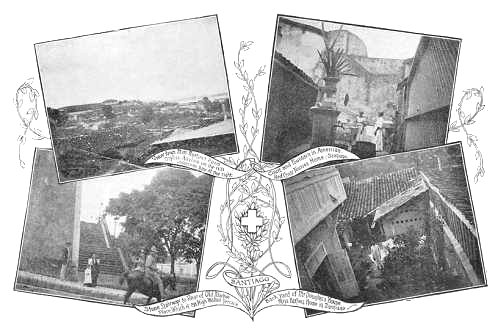
President McKinley Furnishes Transportation.
Having heard that the port of Havana was open, it was natural that our party should be eager to return there and take up the work that we had been compelled to relinquish during the previous spring. The only means of transportation that was at our disposal to use in reaching Havana was the schooner “Mary E. Morse,” and as she had been already destined for another port, and was withal so slow that she would not have served our requirements, we had no other recourse than to appeal to the government. Miss Barton accordingly telegraphed President McKinley, asking for the use of a transport, and he promptly placed at her disposal the Morgan Line steamer “Clinton,” which was then in the government service. Within the following four days we loaded the “Clinton” with thirty-four mules that had been sent to us by one of the Red Cross auxiliary committees of New York, and about three hundred tons of general stores, which we hoped would serve as a starter in the distribution at Havana, other supplies having been promised to meet us at that place.
We sailed away from Santiago on the afternoon of August 21, and after a pleasant voyage we arrived at Havana on the morning of the twenty-fifth.
We learned on entering the harbor that we were as much in Spanish waters as we had been during our previous sojourn in Havana, and that there was no marked change in anything. The same customs’ officers whom we had known before the war boarded our boat, and we were treated with the old-time courtesy, but there was no let up in the rigid enforcement of all the requirements of the law; the necessary clearance papers, manifests, etc., being demanded. As we were on a government transport, and carrying a cargo intended for charitable distribution, we expected to be admitted without hindrance or ceremony, but we were disappointed. We were informed that we should have to pay full duties on our cargo, which amounted to as much as the original cost of the goods; and that as we had failed to make a specific manifest of every article we had on board we must pay a fine of five hundred dollars before we should be allowed to land our cargo or to leave the harbor.
Miss Barton called upon the Governor of Havana, who received her with great urbanity, but when she told him the nature of her visit he insisted that there was no need of aid in that city, that there was no suffering, that the people were all well fed and had been all through the blockade. This call was very courteously returned by the general and staff.
No possible endeavor was omitted that gave any hope of enabling us to land our cargo, and we brought every influence to bear that we could command. After a couple of days had elapsed one of the government officials came aboard our ship and told Miss Barton that the Colonial Council had held a meeting, and that its members had voted to take the amount of money needed from some special fund that was available and pay the duties on the cargo of her ship, provided she would turn it over to their agents to distribute. Finding that there was no likelihood of any better terms being offered Miss Barton decided that it was useless to remain longer. Then again, the American Evacuation Commissioners were expected to arrive in a few days, and it was thought that the presence of this boatload of Cuban relief might be an embarrassment to them in dealing with the Spanish commission, and that we had better pay our fine and quietly withdraw until such time as we might return without hindrance.
During our stay in Havana hundreds of the best people of that city, including Spaniards and Cubans, came aboard the “Clinton” and assured Miss Barton of their warmest friendship and heartiest welcome, and it is believed that they did their utmost to persuade the officials to allow Miss Barton to resume her work in Havana. They told the most harrowing stories of the suffering in and about the city, and they said that with the exception of some “soup houses,” which the government was ostentatiously supporting, and which gave out to the poor, miserable sufferers who called for it a small quantity of an alleged soup, in which there was not enough nourishment to keep a chicken alive, there was no other distribution of food, and that people were daily dying in the streets. We knew that this was true, as we all had seen scores of these people every time we had gone ashore.
On September first we paid our fine of five hundred dollars and arranged all other matters, so that we were ready to sail at seven o’clock that evening, and with many regrets, we started for Egmont Key, Florida, where we knew we would have to go into quarantine, before entering the United States.
As our ship’s charter would expire on September 7 and she ought to be in New Orleans, where she belonged, on that date, it was decided to unload her cargo of goods at Egmont Key, and have it transferred from there to Tampa. The mules were to be left aboard, and taken to New Orleans, where they had been purchased.
Captain Wertsch and the entire crew of the steamer “Clinton,” having exerted themselves to make all of our party comfortable and happy, and having succeeded in an eminent degree, Miss Barton was pleased to make acknowledgment of their courtesy in a letter, a copy of which follows.
On Board Steamer “Clinton,” En Route Havana to Egmont Key, September 1, 1898.
Capt. P.C. Wertsch, Steamer “Clinton:”
Dear Sir:—As we draw near the end of our voyage on the steamer “Clinton,” I cannot refrain from giving expression to the feeling of satisfaction and gratitude that all the members of the Red Cross party entertain for you and your crew. If you have any influence with the gods of wind and wave, you must certainly have exerted it, for verily we have been “sailing o’er summer seas” during the past weeks, and a pleasanter time than we have had could not well be imagined. It gives me great pleasure to say to you that the uniform courtesy and consideration that have been shown our people and the general comfort of the “Clinton” are highly appreciated. We congratulate the Morgan Line on having such a ship and such a crew.
In saying good-bye, permit me to thank you most heartily for your many kindnesses and your unfailing courtesy, and to wish you and all the members of your crew a long life and the best of everything in it.
Sincerely yours, Clara Barton.
Captain Wertsch replied in the happy manner following:
On Board Steamer “Clinton,” September 2, 1898.
Miss Clara Barton, President American National Red Cross:
Dear Madam:—Your very kind note, in which you commend my ship and crew, is received, and I have to return my most grateful thanks. A commander’s duties not only embrace the safe navigation of his craft, but the comfort and happiness of his passengers and crew, and it is a great pleasure to know that my efforts in that direction, combined with the propitious conditions of the elements, have met with your approval, and I shall always treasure your approbation as one of the bright spots in my rather monotonous calling. I esteem it one of the greatest honors to have as passenger and friend one who has so distinguished and endeared herself to all the civilized world by her many years of faithful and never-ceasing devotion to suffering humanity, and it is my sincere hope that God may grant you many years more in which to continue your work of love, and that every success may crown your efforts. I have the honor to subscribe myself,
Your devoted friend, P.C. Wertsch, Captain.
We arrived at Egmont Key on the morning of September 3, and the party went into camp for a five days’ quarantine, which, barring the heat and mosquitoes, was rather a pleasant rest after the worry and suspense of the past week. Dr. Geddings, of the Marine Hospital Service, the surgeon in charge of the quarantine station, did everything in his power to make our stay agreeable, and he succeeded far better than we had anticipated.
As our party was about to break up, after a pleasant union of seven months, in which we had become like one family, and had conceived a mutual esteem and regard for each other, it seemed fitting that some little expression of good feeling should be manifested in a way that would be lasting and memorable. The following address to Miss Barton was accordingly drawn up, signed by all the members present and read to her:
To Miss Clara Barton.
Now that our work has ceased for a time, and our party which has labored so long and so harmoniously together, is returning home, we, the members of the Cuban relief expedition, desire to express to you, our leader, as delicately and fittingly as may be, our unbounded confidence and admiration, and our sincere and heartfelt gratitude and love. As we look back over the past few months, and recall the many scenes of suffering and death that we have witnessed, and remember how ceaselessly, faithfully and tirelessly you have worked, and how much you have accomplished under the most unpromising circumstances, our wonder grows and we cannot help but reverence and admire your wisdom, patience and industry. No more trying position than you have occupied during the past seven months, could well be imagined, and no one not possessed of nerves of steel and of ripest wisdom and the rarest judgment, combined with a purpose as fixed as the stars could have made the great success that you have made of the work we had in hand. When it is remembered how many thousands of brave soldiers have been saved from suffering and death through your efforts, and how many starving and sick people have been brought back to health and happiness, and all with so little cost of actual money, our warmest admiration is excited, and we cannot withhold that praise which you so justly deserve.
Personally each of us wishes to express his or her acknowledgment of your unfailing kindness and interest in our comfort and general welfare, and we have to thank you for thousands of those little considerations of word and look that go so far to brighten one’s thoughts and make life a pleasure. We all have the greatest satisfaction in knowing that all the work we were permitted to do has been done with thoroughness and economy, and we are vain enough to think that no one could have done more under the conditions that existed. We shall soon separate and go our several ways, and it will be with the deepest sorrow and regret that we shall say good by to our leader; but throughout life it will always be a pleasure to call to mind her image and remember all the happy moments we have passed with her. So in parting, it will no doubt be a satisfaction to you to have the assurance that you hold our warmest love and good will, and that at any time each and all of us will be ready to serve you in any way that lies within our power.
A. Von Schelle, Membre du Comité Directeur de la Croix Rouge de Belgique, Membre de l’Association Nationale de la Croix Rouge des Etats Unis l’Amerique. J.B. Hubbell, General Field Agent of the American National Red Cross. E. Winfield Egan, Surgeon American National Red Cross. C.H.H. Cottrell, Financial Secretary. Lucy M. Graves, J.A. McDowell, Chas. R. Gill, M.D., C.D. Cottrell, Annie M. Fowler, J.K. Elwell, Geo. J. Hassett.
At the conclusion of this kind and just tribute to our beloved leader there was a moment of profound silence, our feelings being too deep for utterance. At length, when Miss Barton had subdued her emotions sufficiently to speak clearly, she responded in most graceful terms, expressing her warm and sincere appreciation of the work performed, and the loyal support that had ever been accorded her; that no words could fully express the gratitude she felt for this thoughtful little memento of our comradeship, and she should prize it quite as much as any badge or decoration she had ever received.
Farewells were said, and the party separated, going to their several homes; and so ended our first Cuban expedition.
Financial.
It is a very hard matter to express in dollars and cents the value of the relief distributed, as it was all donated in either material or money which was turned into material; and the kinds were so varied, the market value so fluctuating, and the data so scattered, that only an approximation can be ventured. It is probably underestimating the amount of relief stores that have been sent to Cuba by the Central
Cuban Relief Committee and the American National Red Cross to place it at six thousand tons, approximating in value half a million dollars in New York. Had these same goods been bought in Cuba, their cost would easily have been doubled.
In estimating the cost of distribution great difficulties present themselves, as large numbers of laborers, sometimes as many as two hundred per day were paid in food taken from the stores; but such labor can only be paid in that way while the need is extreme; and the moment the direst wants are satisfied money is demanded for every service.
We found a considerable number of people who had once been wealthy, but who were utterly helpless after being despoiled of their riches, and gave up in despair, and would have died without making any adequate effort to save themselves, had not relief been brought to them. There were, however, many sterling families who had cast their fortunes with the revolution; had sacrificed everything for “Cuba libre,” and were willing to give life itself, if necessary; these people accepted relief reluctantly and sparingly, and with warmest gratitude.
For nearly two months after our arrival in Havana the entire expenses of the relief work were borne by Miss Barton from her private purse. It is but just to state that when this fact was discovered, by the committee the money was refunded. Then the Central Cuban Relief Committee began to furnish her with means which came thereafter in abundance, and nothing that was needed that money could procure was ever omitted. Volunteers for work were plentiful, but they were generally without experience and therefore not available. For this reason, and considering the magnitude of the work to be attempted and the celerity with which it must be carried on in order to be effective, it was necessary to override a time-honored precedent of the Red Cross, and pay salaries to certain grades of professional workers who could not be obtained otherwise. It should be stated though, that all these people who were engaged required no more money than was sufficient to meet the necessities of those who were dependent on them; and the few salaries that were paid were very low considering the high grade of ability that was secured.
The first funds sent for our use were in drafts payable in Spanish gold at Havana. Gold was then held at a premium of about thirty-five per cent over Spanish silver, with which the greater part of the ordinary business of the country was carried on.
On entering Santiago we found both American and Spanish money in circulation, and consequently considerable confusion resulted on account of the fluctuation in values, there being no established standard. The military governor made an arbitrary ruling that there should be a premium of one hundred per cent on American money over Spanish silver, or, in other words, that one dollar in American money should be worth two dollars in Spanish silver. Spanish gold and American gold were on a par in ordinary transactions of limited amounts, but in large amounts American gold was worth a small percentage more than the Spanish.
While we were in Santiago our supply of condensed milk ran short, owing to the large amount that was used in the hospitals. Fortunately there was at that time in the harbor a merchant ship loaded with groceries which could not be disposed of satisfactorily, and we were able to purchase at a very reasonable figure quite a large amount of that greatly needed delicacy, and continue filling all requisitions.
The following is a statement of our accounts at the end of the expedition:
Financial Statement.
Central Cuban Relief Committee, cash $11,296.55
Contributions 172.93
Exchange 236.83
Household Expenses$1,521.41
General Expenses2,040.92
Cuban Relief Expenses3,699.79
Traveling Expenses968.22
Telegrams105.02
Office Expenses, Stationery, etc.22.45
Salaries2,541.24
American National Red Cross Relief Committee Army807.26
$11,706.31$11,706.31
The expense accounts will generally explain themselves by their titles, with a few exceptions which will be noted. “Cuban Relief Expenses” covered all charges for labor outside of that performed by our own party, and for supplies, etc., that were purchased outside of those we had brought from New York. “American Red Cross Expenses” included expenses of nurses and hospitals on account of army work, as distinct from Cuban relief work; also the maintenance of forty mules that had been sent us by that organization. “Household Expenses” covered house rent, servant hire, and maintenance of the entire party, which numbered as high as thirty people at times, and averaged twenty most of the time, making an average of less than $2.50 expense per week for each person. “General Expenses” included work on hospitals and other buildings necessary to make them habitable and comfortable, and all other expenses not properly chargeable to any other account.
On an estimated distribution of relief supplies, valued at half a million dollars, the cost of distribution, covering a period of seven months, exclusive of the charter price for the steamer “State of Texas,” amounts to less than three per cent of the value of the goods distributed.
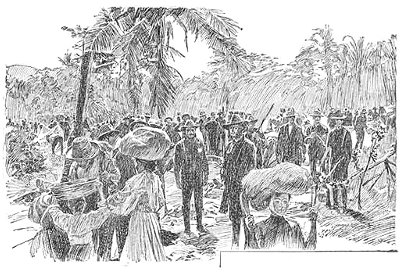
REFUGEES FROM SANTIAGO.