THE SEA ISLANDS HURRICANE. (continued 2)
Reading edition
Observe among your people which one succeeds best in any undertaking, whether it is in the raising of a particular kind of crop, or the saving of it, the successful curing of his meat, the raising of fruit, the breeding of good stock, or having attractive home—go to that one for that particular kind of information or instruction that you want. Strive to improve the moral standing, which is necessary for physical as well as social advancement.
No one who has been with these people, worked with them as we have, but must be pleased to observe their gratitude, their gentle manner of expressing it, their desire to improve and their attention to instruction or suggestion, their cheerful disposition and their faith in God and the Red Cross.
ON THE CHARLESTON GROUP.
Among those who lived the storm and later brought their experience and quickened sympathy to us for such help as they could give to their still suffering companions in danger and woe, was our tireless and faithful assistant, Mr. H.L. Bailey, of Charleston.
It has never been my good fortune to find one who—entirely new to the work and to its conception—has grasped more readily the field of labor presented to him. The success attending his work and the satisfaction attested by his beneficiaries are rich stores of memory for a lifetime. The Red Cross could not have asked for better service.
Report of Mr. H.L. Bailey.
In order to make the following narrative more complete I deem it not amiss to preface it with a short account of my own experience in the great Cyclone of 1893, and a few incidents relating thereto.
In August, 1893, I was doing business on that part of Edisto Island, known as “Little Edisto,” and spending the nights at a small place “just across the creek” called “Brick House,” said place taking its name from an old and substantial brick house which had been built on that spot, at a time ante-dating the Revolutionary War, and much honored in that locality on account of its antiquity and the good material of which it was built, the bricks, etc., having been imported from Holland.
On Saturday morning, August 30th, I went to my business on “Little Edisto” as usual, and on arriving I remarked to Mr. Whaley (my employer) how promising the crops were looking, and the bright prospects of a fine harvest. His answer was “Yes; but I am afraid a storm is brewing, and one of unusual severity, too, because the signs of the last few days have been ominous of such, and I feel very uneasy.” I, being young and skeptical, of course took no heed of his prophetic words, and alas, only a few hours more convinced me that something of unusual magnitude was upon us. I retired that night, and on awaking next morning (Sunday) took breakfast, and parted from Mr. W. to spend the day at “Brick House,” promising him to return that evening and remain all night. But circumstances intervened (which prevented me from doing so for several days later) so appalling that even as I write them now, a cold shudder comes over me, and all the horrors of that awful time come back.
Sunday morning dawned dull and hazy with a stiff breeze blowing from the east and in crossing the creek, I remarked to my companion that we would have bad weather, and on reaching “Brick House” we all began speculating on the approaching storm (no one ever dreaming such a storm was coming), etc., etc., and so the day wore on, the wind rising higher and higher every moment, and towards afternoon the trees began to bend and sway in a terrible manner, branches and limbs flying in all directions. By sunset we were all thoroughly alarmed and moved over to the previously mentioned “Brick House,” deeming that the safest place to pass the night, and in a few hours’ time the whole population of the village was gathered under its protecting roof, all feeling thankful a safe shelter was provided for us. How we passed that night of terror, only God knows, for the winds blew, the rain fell, and the tide rose, until towards midnight it seemed as if everything was lost; but the old house stood and carried us through until dawn of another day, and then what a sight met our anxious eyes. What had been a smiling pretty village, was nothing but a pile of wreckage and a mass of ruins, some houses having been washed away completely, and those that remained, so badly damaged as to be uninhabitable. To make matters worse even our food had been swept away, and there we were, cut off from the island on this point of land, wrecked, desolate and hungry, some of us with only the clothing on our backs, all the balance gone; and as far as the eye could reach there was nothing to see but water, and those spots from which the tide had receded, covered with portions of houses, trunks of clothing broken open and scattered, drowned poultry, and every crop ruined and prostrated. After a little while we found some grist that had been saved by a colored man, and cooking this with some saltwater and “drowned” chicken, we subsisted till evening, when help came in the shape of water and food.
By Wednesday I returned to “Little Edisto” and Mr. Whaley, who I had been so anxious about during the storm. I found the brave old man “holding the fort,” and trying to save, by drying out, etc., what the storm had left; but oh! how different everything looked. What had been of so much promise and beauty had been literally swept from the face of the earth, nothing remaining but ruin, desolation and death for those whose all had been taken from them if help did not come quickly. It is hard for those who were not there to realize such a condition of things; but just imagine a whole island completely covered with water (and a raging sea, at that) from three to six feet in depth. Can you wonder that so many poor creatures were drowned or that anything was saved at all?
Fortunately Mr. Whaley had saved some provisions which were stored in his house out of the reach of the tide, and gathering up all else we could find, we began issuing food to the poor hungry negroes around us, who had been entirely bereft of their all. And there I stayed on that little island for some time after the cyclone, giving out each day of our own little store, food, medicine and comfort to those who came, trusting that when that supply was exhausted, other means would be provided to carry on the good work, thus so nobly begun; for it must be understood that those who had, freely gave to those who had not, and the men of that section worked hand to hand and heart to heart to help those of their colored brethren, who otherwise must have died of hunger, sickness and exposure.
Such then, was the condition of affairs when news was received that the Red Cross would take the field, and a sigh of relief, and a prayer to God went up from thousands of homeless, hungry, helpless and demoralized people, who had gone through so much, it seemed a miracle they were still alive. I then went to Charleston and immediately wrote to Miss Barton offering her my services, telling her of my knowledge of the people and the islands, and how glad I would be to help her in any way to relieve the necessities of the thousands that were begging for help. My offer was accepted; a telegram summoning me to Beaufort, the Red Cross Headquarters, and there I made the acquaintance of the noble lady who had come to our stricken people with her valued corps of assistants, to perform a task that was gigantic in its contemplation.
I was retained by Miss Barton in Beaufort three weeks, and by practical teaching was soon able to grasp intelligently the true intents and purposes of the Red Cross, and able then to undertake any duty assigned me. I was then sent to take charge of the district composed of Edisto, Wadmalaw, John’s and Kiawah Islands, the first three named being very large islands, with a combined population of nearly 10,000 souls.
Kiawah being directly on the sea was almost entirely submerged by tidewater, and on the other islands, those portions which were directly exposed to the sea and the tributary streams suffered in like manner. Cotton, the main dependence of the people, was almost totally destroyed, and only in some localities were any potatoes and corn saved, and these badly damaged. I found many people hungry, destitute, without suitable habitation or sufficient clothing and badly demoralized. Such, then, was the condition of things when I took charge, and how to meet the various problems that arose, and to cover this territory in the most intelligent and speedy way of course became my first object. After planning a little I soon arrived at a happy solution, and proceeded to organize the territory into working condition.
Rockville, on Wadmalaw Island, had been selected as the most central point to work from, and making this my headquarters and basis of supplies, I secured a house and was soon comfortably fixed, with sufficient supplies on hand to meet the immediate wants of the people. To reach all these people quickly and often was the next point to be settled (scattered as they were over an area of vast dimensions, divided in many places by streams, at times dangerous to navigate). This difficulty was overcome by thoroughly canvassing each island, and establishing one or more sub-stations at the most central location, and from these stations I would each week make my distribution of rations, receive reports, arrange work for the coming week and transact other business. All this time petitions of various kinds had been coming in, and my time was fully occupied in seeking out those who were in immediate want, among the old people and children especially, and I soon got that settled sufficiently to give me a chance to start all able-bodied men, that needed help, in ditching, house-building, bridge-building and any other work I could find that would benefit the general community; and soon I had large forces at work on each island. A school for children was established at Rockville, which was successfully conducted for some time, and a wharf built, which is as unique as it is substantial, having been built by native workmen with raw materials cut and hewn out of the woods, the piles being driven by a pile driver of our own construction. This wharf stands to-day, a monument of strength and an object lesson to those who were doubtful of its completion. On the several islands much good work was done; new dams being thrown up; bridges rebuilt and abandoned lands reclaimed. I occupied this field for over eight months, and during that time visited every district one day of each week and personally distributed all rations given out, thus being certain that nothing was misappropriated. From Monday until Saturday I would travel by team and boat, on an average of twenty miles a day, never allowing rain, wind or anything else to keep me from going, as some of these poor people had to walk miles to reach the point of distribution, and I could not disappoint them and cause them to go back empty handed. The distribution of seeds, as they came in season, was started from the beginning, and soon gardens of various dimensions began to spring up in all directions, thus making another valuable food supply which was practically inexhaustible, as long as no frosts interfered. Happily the season was propitious, and the people by these little gardens were well supplied with vegetables of all kinds. Corn, bean and Irish potato seed were also supplied. Knowing these people as well as I did (having been amongst them from childhood), I had a peculiar sympathy for them, and in every possible way so conducted my affairs as to benefit and instruct them in the highest possible manner, the results obtained fully repaying me for all my exertions in their behalf. I never at any time found them anything but kind, respectful and extremely grateful for what was bestowed upon them, and the evidences shown to-day, amply testify to the good that was done by Red Cross methods and teachings. Of course troubles and trials would arise, but these were soon overcome, and things would go on smoothly again.
The methods adopted by Miss Barton, and through me carried out, gave universal satisfaction, and all able-bodied men were willing and anxious to work for their rations. The clothing (a large quantity), with the exception of that given by me in exchange for labor, was distributed through the sewing societies formed by Miss Barton.
This field was taken in December, 1893, and held till August, 1894, when I left there, feeling satisfied that all danger from want and privation was over. Vegetables had been abundant, still coming in, the rivers furnishing their portion in abundance of fish, etc.; all crops promising a good harvest, the people in the meantime having been brought safely through the most trying period of their lives. Many incidents could be mentioned of the trials and sufferings endured by these people, and when the whole story is told, those who bestowed their charity in this, the most appalling disaster that has ever visited our coast, will not feel that it was injudiciously expended, or their kindness misplaced.
Too much cannot be said in praise of Miss Barton, that great and wise general, on this most peculiar and difficult field, for there never was a man or woman who labored more zealously or untiringly in a work so varied in its character or harder to perform. Enough has been said to tell the arduous duties to be performed, and the cares and anxieties attendant upon a work of this kind, but after a hard day’s work, the consciousness of having made so many poor souls happy would take away all feeling of fatigue, and long in the night would we be packing and unpacking goods and clothing, and sometimes all day Sunday, thus showing that no amount of time or effort was spared in behalf of those dependent upon us.
In regard to the good accomplished by the Red Cross (a question so often asked), can more be said than this? That human life was saved from death by starvation; the homeless were housed, and the naked were clothed, and by our words of counsel and cheer we were enabled to give new hope and life to a people who were in a most pitiable condition. Some who were not on that hard fought field have been so bold as to criticise us, but we who were there with these people in their hour of need, and worked with them heart to heart and shoulder to shoulder, know what we did and the everlasting good accomplished.
I kept a complete record of all goods received and everything given out, from a pint of grits to a barrel of clothing. Committees composed of the most intelligent men and women were formed to investigate and report for each plantation, and as each new applicant appeared, their home was immediately visited, and relief extended according to their needs. In justice to all who came, I can truly say that in very few instances was I imposed upon, as they very seldom stated other than the truth in regard to their condition. This narrative could be extended indefinitely, there is so much to write about, but fear I must come to a close, as my patient readers must be tired by this time. Sincerely trusting that these lines will convey their true meaning to those interested, I will subscribe myself as a sincere admirer of Miss Barton and that grand institution she so fittingly represents.
Eight thousand one hundred and nine souls were in the wards of the Red Cross in this district, in the following proportions on each island:
Edisto1,812
Wadmalaw2,123
South John’s1,650
North John’s2,469
Kiawah55
8,109
Upwards of 200 packages of clothing (barrels, boxes and cases) were given out, besides blankets, comforters, etc., special attention being given to those who were sick, old or helpless. Food stuff was distributed in the following amount:
Grits1,527bushels.
Meal163bushels.
Rice672pounds.
Wheat flour23,980pounds.
Bacon7,000pounds.
and other sundries, such as tea, sugar, canned beef, etc. Seeds were supplied, such as peas, tomatoes, okra, melon, bean, corn, etc., of the following amounts:
Corn140bushels.
Bean60bushels.
Irish potato75bushels.
Assorted seed30bushels.
Assorted seed3crates.
Garden seed3boxes.
Statement of Work Done on Each Island.
WADMALAW ISLAND.
Twenty miles of ditching.
One-half mile of road work.
One house repaired and others rebuilt.
Three chimneys repaired and others rebuilt.
Five hundred shingles cut and split.
Six thousand feet of planking and timber hewn and cut.
Wharf built at Rockville of the following dimensions: One hundred and ten feet long. Ten feet wide with a bulkhead twenty by thirty feet.
A school started and carried on for several months.
EDISTO ISLAND.
Two hundred and eleven and one-half miles of ditching.
One thousand four hundred and seventy feet of causeway, twelve by two feet, built.
Two hundred feet of timber cut and hewn.
One bridge eighty feet long and twelve feet wide rebuilt.
KIAWAH ISLAND
One bridge thirty-four feet long and ten feet wide rebuilt and put in order.
One bridge fifty feet long and ten feet wide rebuilt and put in order.
Lumber to do same cut and hewn out of woods.
Nine hundred feet of causeway repaired and put in good order.
The above account does not include the hundreds of little things which would come up from day to day, and the many cares that were upon us at all times, requiring immediate attention.
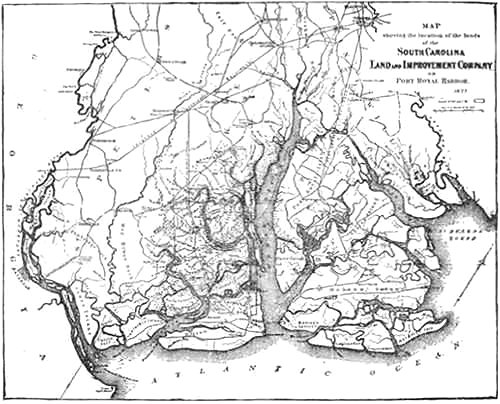
THE ISLAND DISTRICT FROM SAVANNAH TO BEAUFORT.
THE CLOTHING DEPARTMENT.
Whilst food for the nourishment of these thousands of human bodies was of the first and highest importance, it was followed so closely by the necessity of something to cover them, that the two seemed well nigh inseparable; and while our men stood over the boxes of meats and the bags of grain, by the carload and the trainload, it was no less imperative, that some one stand by the boxes and barrels of clothing sent from, everywhere—sent by the great, warm, pitying hearts of our blessed, generous countrywomen, from the church, with its towering steeple and the soft-toned bell that calls to prayer, the blazing bazaar, with its galaxies of beauty, animate and inanimate, the dimly lighted, one little room of the woman who has toiled out all day and returns weary and heavy laden to the waiting family of little ones, who, in the midst of their own hard life and the need of much, still bless God for a fate better than those they hear of—from all of these alike come the gifts of Dorcas. In tons they come, and some one must, “stand and deliver,” as hour by hour goes out the appeal: “Closen marm—please give me some closen. I’s lost all I had!” How literally true this was may be judged by the fact that here as at Johnstown, there were those who came out of that terrific strife for life with no thread left on the body but the shirt band about the neck, which a strong, well-sewed button had served to hold.
Copyright, 1898, by Clara Barton.
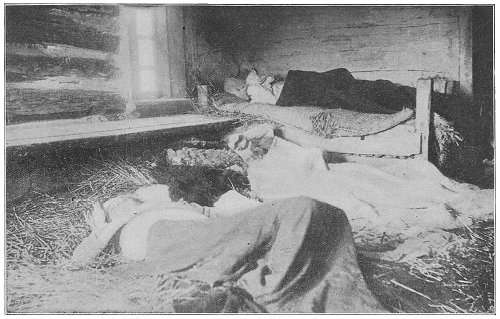
SICK WITH THE FAMINE FEVER.
Copyright, 1898, by Clara Barton.
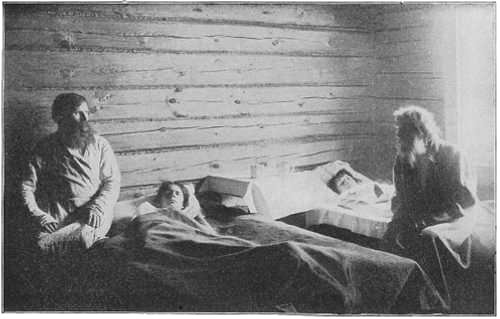
HUNGER STRICKEN.
Again, as always, we turned to our “Mistress of the Robes,” Mrs. Dr. Gardner, whose quick and clear judgment seems to double the value of all she handles. She goes to every field, helps to organize, and remains as long as the strength in her slender, wiry body permits. She left her unpretending report as far as she was able to do, or to make it:
Mrs. Gardner’s Report.
On the first day of October, 1893, the American National Red Cross took charge of the relief work of the Sea Islands of South Carolina. During the month before this and just after the storm, the clothing department had been in the hands of a very efficient local committee composed of some of the most prominent ladies and gentlemen of the section around Beaufort.
In the first days after a disaster of this kind, the necessity of relief work is so great, that it is impossible to keep a correct record of supplies that pour in from every part of the country, and this was no exception, with both hearts, and hands full, distributing to the thousands of destitute who were imploring them on every hand for help, this committee had nothing to tell of what had been received.
After we took charge, a faithful record was kept, and when there was a mark of any kind to show us where the goods came from, an acknowledgment was sent at once. Many, many things came without a sign of any directions to tell where they were from. In these cases close watch was kept for any writing inside to give some clew. I have even taken the newspaper the box, barrel or parcel was lined with, and tried in that way to reach the donors.
The people of the United States are a most generous people, and yet so modest with it, that they very often miss the verification of the saying that “it is more blessed to give than to receive.” Could they stand, as do the members of the National Red Cross, and look into the glad, grateful faces of the relieved ones, there would be no need of our president sending out circulars and letters all over the country, praying that articles for the relief be plainly marked. Would it be out of place for me to urge the good people who read this report to remember this when sending to the next field?
The distribution of the clothing had to be systematically planned. Here was a territory 150 miles long by 50 miles wide, not on the main land, but on islands, surrounded by water, with the most treacherous channels, and many impossible to even get into. The people to be helped, kind and industrious, but they had been dependent from their cradles, and were in such a dazed condition, they hardly knew what had overtaken them.
The clothing, plenty of it, but all for adults. What was to become of the little waifs of the wind, rain and high tide? Evidently these goods had to be fashioned into little garments.
Bedding, comparatively none, and every few minutes the plea, “Please miss, just a little bedding to keep the chilluns warm at night.”
I have stood at my table from 7 a.m. until way into the night, opening boxes, barrels and parcels, and not one piece of bedding to come to my hands. The people on half rations, thinly clothed and nothing to keep them warm of a night.
This, as well as all other puzzling questions, were referred to our most honored president, and I have asked her to tell how she came to the rescue, and by her wise forethought not only assisted her own workers, but placed a responsibility upon the people that made them help each other, and gave them a self-respect that they would have gained in no other way.
THE SEWING CIRCLES.
There are many points in the administration of relief that will never present themselves until forced upon the mind by the absolute necessities of the case. It was not long until we were confronted with a condition of things that called for ingenious methods and diplomatic action. All foods sent or purchased were always of good quality and in readiness for immediate distribution and use—these could be given to the committeeman, who in turn sent them out as veritable rations a specified quantity to each. There was no question, no judgment required, no opportunity for favoritism, no chance for reserve. But with the clothing all these conditions changed and securities vanished. The committeeman who came for the rations of food, took also the boxes of clothing, and naturally claimed the privilege of distribution. The clothing sent was very largely, as is always the case, for women and children. This rough negro, however well versed in corn meal, hominy and bacon, was not likely to prove a skillful manipulator of women’s wardrobes. Jealousies would arise and criminations follow. Again the clothing was almost entirely secondhand, sent hastily, and usually so out of repair as to be nearly useless for actual wear until overlooked, mended, strengthened and put into proper condition. How was this to be done? Thirty thousand people to clothe, winter at hand, little shelter, and almost no bedding—surely we could not undertake this labor. That a poor, untaught negro laboring women, would never of herself mend a hole, or sew on a button, even if she had a button, a needle, and thread, and a place to do it in. How to formulate some system by which this could be done, how to get them under intelligent direction, to get the women interested and into the work and the men out of it, for the committeemen were fast gaining in importance and influence among the other men by reason of patronage, a kind of “political pull,” one might say.
I struggled with this problem some days, until finally—it might have been the spirit of the Widow Bedott that come to my assistance—for suddenly there flits through my perplexed mind the idea of “sewing societies.” No amendment was required, and the resolution was put and motion carried in far less time than it had taken to evolve the idea. Word went out at once that the president of the Red Cross, accompanied by her staff, of ladies especially, would be pleased to meet the women of one of the most important islands; that the meeting would be held in the interest of the women; that they might consider it their meeting—but men were not forbidden—would they kindly appoint a day, and place of meeting, and the hour most convenient for themselves. The church which had been repaired was selected, and its clergyman notified us.
It was a sunny autumn day when our party crossed over the ferry and landed on the sandy beach of Coosaw, and took our pathways through the clumps of shrubs and trees, basking in the sunshine, but ripening and reddening with the dying year. Soon groups of women commenced to appear from the by paths and the little trails on either side, dressed in the best we had given them, and traveled on with cheery faces, full of expectation.
After a journey of perhaps two miles, the little “ractified” church came in sight, or rather would have come in sight but for the crowd of people gathered about it. The entrance was politely held clear for us. The little edifice, which would seat with its gallery perhaps two hundred persons, was packed with a waiting audience. The platform and desk had been reserved for the “extinguished visitors,” and we took our places. The entire space filled and echoed with the sweet, plaintive melody that the negro voice alone can give. This was followed by earnest prayer by the pastor; then a little speech of welcome by the elder, and we were introduced to our audience. And, who could ask a more attentive or sympathetic audience than this! The president, who has addressed some bodies of people, never stood before one that she enjoyed or honored more. Here was the simplicity of nature, the earnestness of truth, the innate trust in the love and care of the living God of Heaven that even its winds and waves could not shake, and the glorious spirit of resignation that could suffer and be glad, if not strong.
But to business. The situation was fully explained to them, and they were told that in spite of all we had for them, they alone could comfortably clothe themselves through the winter. Then the plan of a well arranged sewing society, with its constitution, laws, officers and regulations was explained, and their approval and co-operation asked. On a unanimous assent, they were required to select twenty-five women from among them, who should retire for twenty minutes and discuss the subject among themselves, selecting their chief officers, and so far as possible, give us the points of their organization.
In the body of women that rose and retired for consultation one saw good ground for hope of success. A part were the strong, matronly women, whose childhood and youth had been passed in the service of the hospitable home of the master in the old days of elegant luxury “’fo de wa’,” and who needed no one to teach them courtesy or what belonged to a family household; others were sewing girls, some of whom had partially learned trades, and a few were teachers, for the great majority of the children of ten years and upwards on these islands had been taught to read. These women needed only the proper instruction, encouragement, the way opened for them, the suitable material distributed, and the liberty of action and conscience, with no patronage or politics invading their premises.
The system formulated for one society became the system for all; each district which received rations of food had its regularly organized sewing society for the clothing sent to them on requisition. First some room was found, with a fire, shelves arranged for garments and tables for work. Of the twenty-five official women, each should give one week of her time in every month, but changing regularly in order that at no time should there be more than one-fourth of the number new to the work in hand. Four women should visit and inspect applicants for assistance, and two should attend entirely to the wants of the feeble and old and the sick, to see that they were in no way neglected.
Of those in the sewing room, a part cut over garments for children, as there are never enough of these; others repaired and mended. As the barrels and boxes went in from the committeemen, they were received and opened on one side of the room; when repaired they were placed on the shelves on the opposite side and given out from there on the recommendation of the visiting inspectors. Along with the clothing went thread, needles, pins, thimbles, wax, shears, knives and pieces for mending. For the bedding, besides two thousand heavy wool blankets which were donated, as many more purchased; cotton batting and calico, or muslin, by the ton were bought, and the societies instructed in tying “comforts,” which in many instances served as both cover and bed.
There was never any complaint with these women about the time given to, or the labor performed, in this service for the common weal, and seldom any difficulty arose between them. If so, a few words set it right, and the offending individual was discovered, pointed out, and put out of the society, with the usual explanatory remark: “She want too much rule; she done always do make trouble.” But whatever trials the day might bring to them, they were solaced and forgotten in the nice afternoon lunch, and the steaming cups of tea and coffee prepared by one of the members from the rations so wisely planned and faithfully sent by Mrs. Gardner.
Next to the absolute necessity for the distribution of food supplies, and the great essentials of life itself, I regard the sewing societies as perhaps the most important feature of the field. From these they learned not alone the lesson of self-help, but of mutual help, which they had never known before. It had never occurred to them to look about and see who was in need, and find a way to help it; and it was a glad satisfaction to hear their voluntary pledges when we left them, never to give up the custom of these societies, and the habit of caring for their poor.
Appended to Mrs. Gardner’s report are long, tiresome lists of names of recipients, which, however necessary and business like in their time and place, we may well spare the reader in these belated years; but one little list appeals to me with such loving interest, that I am constrained to ask the privilege of inserting it. It is a partial roll of the presidents of the sewing societies, of whose tireless, faithful work no adequate description could be given. And when we read among them the name of Mrs. Admiral Beardslee, and that missionary of scholarship and teaching on St. Helena, Miss Ellen Murray, the lovable and accomplished late wife of Robert Small, and Mrs. John MacDonald, who humbly and magnanimously placed themselves side by side with poor, unlettered, but honest and faithful Patty Frazier, and her kind, the reader will feel with me that it is indeed a roll of honor:
Society.President.
Coosaw Works Mrs. Mary Chaplain
Beaufort Mrs. General Small
Hilton Head Mrs. John MacDonald
Wadmalaw Mrs. Frank Whaley
Ladies’ Island Mrs. Sam Green
St. Helena Miss Ellen Murray
Coosaw Island Maria Rivers
Bennet’s Point C.C. Richardson
Musselboro Mrs. Phillips
Hutchinson, Bolders, Beef, Warren W. Rivers

Rockville H.L. Bailey
Edisto Amanda Brown
Tommy Johns Mary Jenkins
Johns Island Mrs. Chas. Wilson
Big State Plantation Jackson Field
Jericho, Rhetts F.C. Garrett
Dixonville General Saunders
Paris Island Mrs. Beardslee
Tommy Rhodes Patty Frazier
Christmas, which two months before had seemed but a veil of future blackness, opened bright and cheerful. Most of the churches had been in some way reopened, and Christmas Eve brought again its melody, its prayer and its praise.
There was in all this a Christian spirit, so sweet, so much to be commended, that I could not refrain from passing in my little contribution of a Christmas carol, for which they at once found a tune and sang it with a will. Light-hearted, happy race.
A CHRISTMAS CAROL.
For my 30,000 Sea Island Friends.
A Loving Greeting and Merry Christmas.—Clara Barton.
Lo! The Christmas morn is breaking, Bring the angels bright array, For the Christian world is waking, And the Lord is born to-day. Shout then, brothers; shout and pray, For the blessed Lord is born to-day. No more tears and pain and sorrow, Hark! I hear the angels say Blessed be the bright to-morrow, For the Lord is born to-day. Shout then, sisters; shout and pray, For the blessed Lord is born to-day. Forget your night of sad disaster, Cast your burdens all away, Wait the coming of the Master, For the Lord is born to-day. Shout then, children; shout and pray, For the blessed Lord is born to-day. In the sunlight, soft and golden, Round the babe the angels play; List, their notes so grand and olden, Lo! The Lord is born to-day. Shout, all people; shout and pray. For the blessed Lord is born to-day.
CLOTHING DEPARTMENT—Continued.
As the work dropped from the weary hand of Mrs. Gardner, another, stronger, more fresh and new in the work, took it up. Mrs. Harriette L. Reed, of Boston, who, while never permanently with us, seldom allows a field to escape her. We regard it as a loss to any field where her genial presence, clear perception and sound judgment take no part. Mrs. Reed, like our beloved and brilliant countrywoman, Mrs. Logan, went to the civil war of 1861, a bride. Her gallant young husband, Captain J. Sewall Reed, took the first detachment of volunteer cavalry from California, known as the “California One Hundred.” He fell in an ambuscade, in the Army of the Potomac, 1864. His brave young wife was always with him at the front, and received his dead body when brought in. Thus early bereft, she took up the march of life alone, and faithfully and tirelessly has she made it, with a cheering word and an outstretched hand to every weary comrade in the tedious march of more than three decades, and still she serves, and still they call her blessed.
Her graceful report, which has lain in my portfolio since 1893, now comes to light with its waiting companions:
Mrs. Reed’s Report.
The preceding account of the distribution of clothing, relates to the early part of the work covering a period of several months, and was under the charge of Mrs. Dr. Gardner, of Bedford, Ind., who was called home.
Coming upon the scene about this time, I was more than glad to take up her work to a small extent, and for three months it was my privilege to labor in this field of the Red Cross work, bringing so often to my mind the words of the Master, “for I was naked and ye clothed me.”
And what a strange, unusual and extraordinary field of labor it was and how unlike anything I had ever seen before. Let me briefly picture a few of the regular types of “sufferers” besieging headquarters, the old, decrepit uncle of the days “befo’ the wah” with white head and bent shoulders; the little one, toddling along behind the young mother, hiding in her tattered garments, with great black eyes peering through the rags; the strong young man, barefoot or with pieces of shoes tied on with strings, coat and pants that looked like relics of a bygone time and a conspicuous absence of under garments; the old-time “mammy” shivering with cold and begging for a little “closen” to keep her warm, all these and more were our daily, hourly visitors, imploring our aid and needing it oh, how sorely! And what heartrending tales of loss and sorrow and fearful destitution were brought to us by these messengers from a stricken people! Many of them, before the cyclone, had comfortable little homes and clothing sufficient for their simple needs; occasionally a sewing machine was owned, and sometimes, in more favored homes, an organ. Now, there was absolutely nothing of all this. Parents, children, friends were gone—not a vestige left of the home; horses, mules, cows, hens swept away, and scarcely clothing enough left to cover part of the family. It was not an infrequent tale that fell upon our ears, that the little band that had left the home were all that could find sufficient clothing to come in and the rest were left nearly naked in consequence.
Very early in the morning a motley crowd gathered in the street, in the vicinity of headquarters, and all day long they were coming and going and it was far into the evening before the last one had departed. And, what a good-natured, patient, orderly crowd it was! Seldom was there any loud talking, screaming, quarreling such as is ordinarily heard in a like gathering, in scenes with which I had been more familiar. The shadow of the terrible calamity that had befallen them had in no wise departed from them, and not yet had the dawn of the new day restored the happy, careless, cheery manner that seems to be natural to them.
When they were admitted to the office, singly or in small groups, as was necessary, for our quarters were limited, how quietly, respectfully, they made their entrance! No crowding nor jostling to get the best places or be served first, but patiently waiting their turn, entering with a low bow or deep courtesy, they received the slip of paper that meant so much to them and, with words and tears of gratitude, withdrew as quietly as they came.
It is simply impossible within the limits of this report, and indeed words are inadequate, to convey even a faint idea of the immensity of the labor required in this department. Kind hearts all over our land had been stirred by the appeals that had been made for those needy ones, and boxes, barrels, bundles, all sorts and descriptions of these came pouring in upon us. All of these must be unpacked and sorted and again repacked before they could reach those for whom they were intended. Think of this, careful housekeepers, as you sort over and pack away your family wardrobe and household goods. Think what it would mean to sort over and pack away clothing for the use of thirty thousand people.
As I think it will not be without interest to our readers, to give a little closer view of the people among whom we worked; for this purpose I shall make a few extracts from various letters received at Red Cross headquarters. The first is a plea for help and is a fair sample of these papers, I copy words and spelling with no attempt at correction:
Miss Clara Barton the queen of the Red cross Society.
we ar now, making a Plead before you mam. we are the suffers of the Storm. we beg you mam to helph we to som clothing. mam we ar all naked. mam, there is Som old People is there mam can not helph thom Self Some motherlis children is there can not helph them Self Waiting for Som clothing If you Please mam. Thanks you mam for the Rashon (rations) we get it mam But no clothing we Get We is the committee of the clothing.
This is signed by the three women of the committee.
As pleas for help came by mail, so also did letters of thanks and a few of these will tell their own story much better than any description of mine could possibly hope to do. Here is one:
we the people of this Plantation have sen much thank to you Dear madam for the closing (clothing) what you have send for ous the very children sen there thanks to you for the shoes an closing that you have sent for them an we the people pray Day and night that the god of heaven will keep you an gard you an when this short life is pass heaven will be your home nothing more to say at present. Signed by one member of the committee, a woman.
As an instance of the desire of many of the committees in charge of the distribution of clothing, to be honest and fair, I copy another letter:
Miss Barton:
Dear Madam: Mrs. Diana Williams president of Sewing Society No. 1 Say she coming over for Clothing on Monday I dont think eny clothing need not right away I would like to see on my Section how many needy person are not serve in Clothing yet and plese dont send over no clothing before for it will take me some time. when clothing are need to go over I will let you now (know) for further information I can explain it something I like to say to you before eny more clothing go over.
I have thus far mentioned the more pleasant features of this work, but no one will be surprised if I touch lightly upon some of its trials. Life was not always “one long, bright, sunny day” in the Sea Islands, any more than it is in the more favored sections of our land. This great work of relief had its reverse side; the usual trials, disappointments and discouragements attending most lines of philanthropic work were not lacking here. Not all were entirely content with the necessary restrictions and methods; not all were wholly satisfied with such things as could be found for them just at that time; not all committees worked in absolute peace and harmony, and the common faults of humanity in general were not wholly absent.
I well remember one instance which will illustrate these conditions. Two rival committees presented themselves before our president, both anxious to establish their rights and claims, and with great earnestness and vehemence related their grievances. With her usual wisdom and patience, sitting in their midst like a judge in his court, she pronounced the sentence which was that no more clothing should be issued to either side for the present. This will explain the following letter:
Hon. Miss Barton:
Dear Madam: We the people of this Island give you grate thanks, for what you are Doing for us. as the cormittee We have put Before us, are Doing all in their power and knowdge (knowledge) We Believe, and Dear Madam the committee of the cloth (clothes) Who Went before you with the corruption We Dont recunize (recognize) them in that for We the people of this island are very happy for all that you are Doing for us. Now Dear Madam We ask you, as we lern that the close are stop on account of the fust (fuss) that the cormittee made among themselves this we nows nothing about this nether the cormittee We put before us these don’t no anything about it
This is signed by twenty-two men of the Island.
Scenes of this sort were not of frequent occurrence and were the exception to the rule of general satisfaction which prevailed everywhere. As the months went by, smiles returned to their faces and hope to their hearts, and by every method in their power, they evinced a most sincere desire to do something for their benefactors. Delegations of men and women came from long distances, sailing in their boats days and nights, oftentimes to express their gratitude and thanks.
With the coming of spring, they brought us early vegetables from their gardens, seeds having been furnished them by the Red Cross; they searched the woods and the fields for the beautiful wild flowers so abundant there, till our rooms were filled with beauty and fragrance and our hearts gladdened by their brightness.
I have tried in this very imperfect report to give a little idea of our life at the Sea Islands and the manner of our work. Its great magnitude, its far-reaching results must be imagined, for they cannot be told. The history of philanthropy has few brighter pages to record and its pleasant memories will gladden our hearts long after its weary hours are forgotten.
LEAVING THE FIELD.
If it be desirable to understand when to commence a work of relief, to know if the objects presented are actually such as to be benefited by the assistance which would be rendered, it is no less desirable and indispensable that one knows when to end such relief, in order to avoid, first, the weakening of effort and powers for self-sustenance; second, the encouragement of a tendency to beggary and pauperism, by dependence upon others which should be assumed by the persons themselves. It has always been the practice of the Red Cross to watch this matter closely and leave a field at the suitable moment when it could do so without injury or unnecessary suffering, thus leaving a wholesome stimulus on the part of the beneficiaries to help not only themselves individually, but each other.
Seldom a field, or any considerable work of relief which may have attracted public notice, comes to a close that there does not some person or body of persons arise and propose to continue the work under some new form, but using the former well established sources of supplies; to put out new appeals to old patrons, detailing great need, newly discovered, and thus keep the sympathetic public forever on the anxious seats of never-ending pity and help. We have been compelled to guard against this at the close of every long-continued field, notably Johnstown, where it became necessary for the citizens to organize a “Home Relief” to keep sensational strangers off the ground, and their well arranged “Benevolent Union” of to-day is the result.
The Sea Islands were no exception, and at the last moment of our stay a well-drawn petition was discovered (for it was to be kept concealed until we were gone), and was checked only by the vigorous aid of the Charleston News and Courier, of June 25, 1894, always our stay and friend in time of trouble. I append a letter to that journal which followed a visit from their able correspondent. The last weeks of our stay in that place were passed in Charleston, hence the letter dates from there:
To the Editor of the “News and Courier,” Charleston, S.C.:
If no other service called for my pen this morning it would be sufficient motive that it comes to thank you for the graceful, manly and cordial note of yesterday, which will always hold its place among my treasures of elegant literature, asking for a personal audience for your correspondent for some facts concerning the work which has recently been brought to a close. * * *
It is little to say that, without the strong, honest support given in notes of no uncertain sound, bearing in every line the courage of its convictions, of the Charleston News and Courier, no work of relief of this great disaster could have lived and been carried on to any success. * * *
The rations issued have been as follows: St. Helena, 5,724 persons; Ladies’ Island, including Coosaw, Corn, Morgan and adjoining smaller islands, 3,500; Hilton Head, including the twelve islands in the group and adjoining mainland, including Bluffton, 2,875; Paris Island, 597; Port Royal Island, 2,666; Kean’s Neck, situated on the mainland, including Coosaw and Pacific phosphate districts, 1,437; Hutchinson Island district, including Bennett’s and Musselboro Points, Fenwick, Seabrook, Baird’s, Sampson and other smaller islands, 3,238; Edisto, Wadmalaw, John’s and adjacent islands, 8,000. The above figures do not include the special issue on the mainland of 34,000 in number nor the regular labor rations of 6,500, which is a double ration.
I say I was more than willing to leave all this needful detail to other hands, inasmuch as the subject which I desired to present is of a different nature, concerning the general points of welfare, and, may I say, reputation of South Carolina, and addressed to the people of all this grand and goodly State of old renown. Proud and chivalrous, all the world knows that it must be hard and distasteful for her to accept help under any conditions, and it is only in the fury of an elemental rage, as when the earth crumbles under her, or the seas roll over her, that anyone essays to attempt it; and it was for this reason, if no other had been needed, that I came personally to stand among my workers, and see to it that the Red Cross, at least, bear in all it did a demeanor of delicacy and respect, where it must extend its aid. I believe it has done this.
It cannot be necessary to repeat at this late day that I was asked by your governor to accept the charge of the relief of the sufferers of the Sea Islands, of whom it was said there were thirty thousand who would need aid until they could raise something to subsist upon themselves. This was accepted with great hesitancy, and only in view of the fact that no other body of persons in all the land appeared to assume the responsibility, and with the cordial, unselfish and generous support of the advisory committee of Charleston and Beaufort, to whom our earnest thanks are due, the work has been carried on to a successful conclusion. It later developed that an equal number of persons, both white and colored, residing on the seagirt coast of the State, now known as the “mainland,” were nearly as destitute as the islanders, and many of them equally storm swept. Finding these people appealing to us, and well knowing that, in the depressed financial condition of the entire United States, we could not safely take on this double charge, we memorialized the South Carolina Legislature in November; the people, also under our advice, petitioned for a little aid to get them through the winter. The governor also recommended the suggestion.
For some reason, which we never knew, no response was given. We never questioned this, but redoubled our exertions to meet the wants as they came by single rations issued upon application, until our books show an issue up to June 1 of over 34,000 to the needy white and colored on the mainland of the State, from Charleston to Savannah. No applicant, unless detected in absolute imposition, and this after having been repeatedly served with all he needed for the time, has ever been declined. Our thirty thousand Sea Islanders have received their weekly rations of food, they have been taught to distribute their own clothing, making official report, and have done it well. They are a well clothed people, and over 20,000 garments have gone to the mainland. Thousands of little homes have been rebuilt or repaired, and are occupied. Over 245 miles of ditches have been made, reclaiming and improving many thousands of acres of land; nearly five tons of garden seeds, producing all varieties of vegetables in their well-fenced gardens of from a quarter of an acre to one acre and more for each family, with 800 bushels of peas and beans, have been provided. These seeds have been distributed on the islands and to every applicant from the mainland; 1,000 bushels of Irish potato seed, 400 bushels of which went to the mainland; 1,800 bushels of seed corn, 800 bushels of this distributed on the mainland. Those provisions, together with a revival of the phosphate industries, the fish in the rivers and their boats in repair, have served to make the 30,000 Sea Islanders, whom we were asked to take charge of nine months ago, a prosperous and self-helping people. They know this and realize that they can take care of themselves, and we cannot but regard any attempt at throwing them again upon the charities of the outside world as demoralizing, misleading and fatal to them, as a self-supporting and independent class of industrial people, and a matter which should concern the State whose wards they are.
* * * * *
Clara Barton.
Charleston, S.C., June 24, 1894.
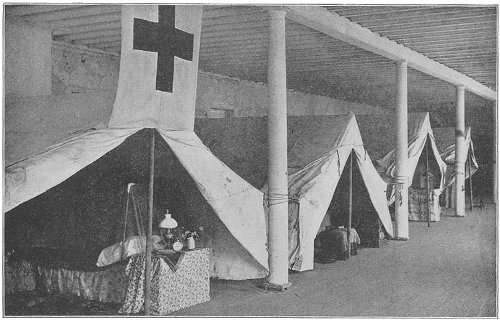
MISS BARTON’S ROOM.
Sleeping apartments, on living floor, Charleston Red Cross headquarters and warehouse.
Copyright, 1898, by Clara Barton.
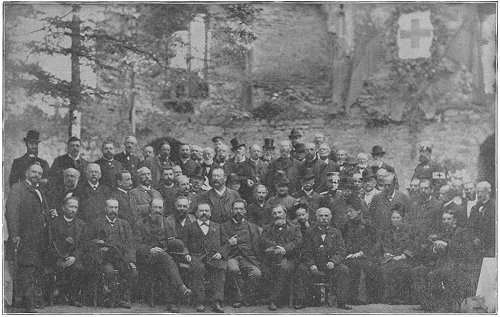
IN THE OLD SCHLOSS OF BADEN.
A Group of the Fourth International Red Cross Conference held at the Court of Carlsruhe, Baden, 1887.

February 26, 1895.
Copy of Circular Letter Sent to Each Clergyman and Committeeman of Our Sea Island Relief Work the Season After We Came Away from the Islands.
Although the claims upon our time are more than we can meet by working all the day and much of the night, the memory and the interest of our faithful Sea Island friends with whom we worked last year, through the months that followed the great storm, still claim much of our thoughts.
Another planting season is approaching, and we are hoping that your people have been doing the preparatory work of ditching for the raising of good crops. If any have not begun this work, will you see those who would take an active interest in the public good, like yourself, and get them to start the work again at once, so that there may be as great an advance over last year’s improvements as last year was over previous years.
Get the neighbors to join together and clean out the old ditches, make all the new main ditches and canals that they can, and then make the smaller ones to connect with them; this will help to give them better health, less fever, larger crops and better ones.
We hope they will give particular attention to their gardens and have even better ones this year than they did last, improving each season by experience and by learning from one another, particularly from those who have been most successful.
Dr. Hubbell has made a list of seeds profitable to plant, in two groups, as follows:
For Early Planting.
Early purple-top strap-leaf turnip, early cabbage, lettuce, rutabaga turnips.
In a hot-bed or in a protected place, where they can be covered at night when it is cold, the cabbage plants and tomato plants should be started at once, to be ready for transplanting when the ground is warm.
For Planting When the Time for Frost is Past.
Early Rose potatoes, onions (sets and seed), early turnip, blood beet, early corn, English peas, snap or wax beans, bush Lima or Sevier beans, early squash, okra, tomatoes, carrots, cucumbers, collards, late cabbage, taniers, and large sugar beet for stock. (Some of these may be planted in the field.)
In the field (with corn or cotton) pumpkins and large squashes, cantaloupes and watermelons may be planted.
The garden should be well fertilized and no weeds or grass allowed to grow. The weeds take the nourishment from the plants, use up and waste the fertilizers.
There should be a good fence to keep the chickens out; then the garden, with the chickens and their eggs, will furnish most of a good living for a family until the regular crops can be harvested and save from debt.
A good garden and a variety of crops are as necessary for the prosperity of a farmer as they are for his health.
Every Sea Islander should plant now a few fig cuttings and a few grape cuttings, and such fruit trees as he may be able to get; peaches, pears, pecans. In a few years these plantings (if protected from the goats, pigs and cattle) will give plentiful fruit through the “dry season” (particularly the fig), and the grapes and other fruit will be a luxury and profit in their season, besides keeping the people in health.
With good ditches everywhere, with plenty of vegetables from the gardens, figs and grapes, there should be almost no sickness on those prosperous islands, and every one should be happy.
Regarding the other crops, as cotton, corn, rice, sweet potatoes, peanuts and cow peas, the people should be encouraged to get and save the best seed. Select from the earliest and best of their own or their neighbor’s raising. Fertilize as much as possible with those fertilizers that they can get by their own labor, such as marsh-grass, sea mud, stable compost, fish, oyster shell lime, ashes, etc. (and some commercial fertilizer).
They should strive to raise the best of everything. The best yields the most for the same labor, and brings the highest price, gives the greatest satisfaction to him who grows it and him who buys it. That means prosperity, which we wish for you all in largest measure.
Enjoin the people to keep out of debt, to “owe no man anything;” this course will make the road of honesty and integrity easier and shorten the way to plenty and prosperity; speak no evil of thy neighbor, then all will work together happily in their public work of ditches, bridges, roads, wells, etc., and live happy in their homes.
The people should not forget the fact that water from wells not thoroughly cleaned will breed fever and other sickness, and that good pure water will in a large degree keep the fever off.
To encourage the general continuance of this work of improvement your people so readily took up at our request and carried on of yourselves to our gratification and to the astonishment of your old-time neighbors, I will have copies of this letter sent to other leading Sea Island citizens, thus all may be at work at the same time and all will receive the benefits of your united labors by lessened sickness and increased crops.
May the good Lord bless the efforts of a faithful people is the wish of
Your friend, Clara Barton, President of the American Red Cross.