Chapter I · (continued 2)
Reading edition
It may be said that this treaty jeopardizes our traditional policy, which jealously guards against entangling alliances abroad; that as we are exempt by our geographical position from occasions for war this treaty must bring us not benefits but only burdens from other people’s calamities and wars—calamities and wars which we do not create and of which we may properly reap the incidental advantages. But this treaty binds none to bear burdens, but only to refrain from cruelties; it binds not to give but to allow others to give wisely and to work humanely if they will, while all shall guarantee to them undisturbed activity in deeds of charity. There is then in the Red Cross no “entangling alliance” that any but a barbarian at war can feel as a restraint. This inculcated wariness of foreign influences, wonderfully freshened by the conduct of foreign rulers and writers during the rebellion and deepened by the crimes and the craft directed primarily at Mexico and ultimately at us, made the people of America in 1864 and 1868 devoutly thankful for the friendly and stormy sea that rolled between them and the European states. And it is not perhaps altogether strange that American statesmen, inspired by such a public opinion, should then have been but little inclined to look with favor upon any new international obligations however specious in appearance or humane in fact. But the award of Geneva surely opened the way for the Red Cross of Geneva. Time and success have made plain the nation’s path. The postal treaty since made among all nations and entered into heartily by this has proved salutary to all. It has removed every valid state reason for opposition to the harmless, humane and peaceful provisions of the treaty of the Red Cross.
But in the midst of the rugged facts of war come sentimental objections and objectors. For, deplore it as we may, war is the great fact of all history and its most pitiable feature is not after all so much the great numbers slain, wounded and captured in battle, as their cruel after treatment as wounded and prisoners, no adequate provision being made for their necessities, no humane care even permitted, except at the risk of death or imprisonment as spies, of those moved by wise pity or a simple religious zeal.
Among these hard facts appears a conscientious theorist and asks, Is not war a great sin and wrong? Ought we to provide for it, to make it easy, to lessen its horrors, to mitigate its sufferings? Shall we not in this way encourage rulers and peoples to engage in war for slight and fancied grievances?
We provide for the victims of the great wrong and sin of intemperance. These are for the most part voluntary victims, each in a measure the arbiter of his own fate. The soldier has generally no part, no voice, in creating the war in which he fights. He simply obeys as he must his superiors and the laws of his country. Yes, it is a great wrong and sin, and for that reason I would provide not only for, but against it.
But here comes the speculative theorist! Isn’t it encouraging a bad principle; wouldn’t it be better to do away with all war? Wouldn’t peace societies be better? Oh, yes, my friend, as much better as the millennium would be better than this, but it is not here. Hard facts are here; war is here; war is the outgrowth, indicator and relic of barbarism. Civilization alone will do away with it, and scarcely a quarter of the earth is yet civilized, and that quarter not beyond the possibilities of war. It is a long step yet to permanent peace. We cannot cross a stream until we reach it. The sober truth is, we are called to deal with facts, not theories; we must practice if we would teach. And be assured, my friends, there is not a peace society on the face of the earth to-day, nor ever will be, so potent, so effectual against war as the Red Cross of Geneva.
The sooner the world learns that the halo of glory which surrounds a field of battle and its tortured, thirsting, starving, pain-racked, dying victims exists only in imagination; that it is all sentiment, delusion, falsehood, given for effect; that soldiers do not die painless deaths; that the sum of all human agony finds its equivalent on the battlefield, in the hospital, by the weary wayside and in the prison; that, deck it as you will, it is agony; the sooner and more thoroughly the people of the earth are brought to realize and appreciate these facts, the more slow and considerate they will be about rushing into hasty and needless wars, and the less popular war will become.
Death by the bullet painless! What did this nation do during eighty agonizing and memorable days but to watch the effects of one bullet wound? Was it painless? Painless either to the victim or the nation? Though canopied by a fortitude, patience, faith and courage scarce exceeded in the annals of history, still was it agony. And when in his delirious dreams the dying President murmured, “The great heart of the nation will not let the soldier die,” I prayed God to hasten the time when every wounded soldier would be sustained by this sweet assurance; that in the combined sympathies, wisdom, enlightenment and power of the nations, he should indeed feel that the great heart of the people would not let the soldier die.
Friends, was it accident, or was it providence which made it one of the last acts of James A. Garfield in health to pledge himself to urge upon the representatives of his people in Congress assembled, this great national step for the relief and care of wounded men? Living or dying it was his act and his wish, and no member in that honored, considerate and humane body but will feel himself in some manner holden to see it carried out.
ACTION OF THE GOVERNMENT OF THE UNITED STATES.
The president of the American Red Cross, Clara Barton, in November, 1881, laid before President Arthur the matter of the Treaty of Geneva, and the unfulfilled desire of President Garfield that the United States should give its adhesion to that international compact. To this President Arthur gave a cordial and favorable response, and made good his words by the following paragraph in his first annual message, sent to the forty-seventh Congress:
At its last extra session the Senate called for the text of the Geneva Convention for the relief of the wounded in war. I trust that this action foreshadows such interest in the subject as will result in the adhesion of the United States to that humane and commendable engagement.
This part of the message was immediately taken up in the Senate and referred to the Committee on Foreign Relations, consisting of the following named gentlemen, to wit: William Windom, Minnesota; George F. Edmunds, Vermont; John T. Miller, California; Thomas W. Ferry, Michigan; Elbridge G. Lapham, New York; John W. Johnston, Virginia; J.T. Morgan, Alabama; George H. Pendleton, Ohio; Benjamin H. Hill, Georgia.
During the consideration of the subject an invitation was extended to the president of the American Association, its counsel and other associate members to meet the above named Senate Committee at the capitol, for conference, and for an explanation of such points as still remained obscure, to aid their deliberations, and to facilitate investigations.
On the seventeenth of May, 1881, Hon. Omar D. Conger submitted to the United States Senate the following resolution, which was considered by unanimous consent and agreed to:
Resolved, That the Secretary of State be requested to furnish to the Senate copies (translations) of Articles of Convention signed at Geneva, Switzerland, August 22, 1864, touching the treatment of those wounded in war, together with the forms of ratification employed by the several governments, parties thereto.
On the twelfth of December, 1881, in response to the above resolution, President Arthur addressed to the Senate a message transmitting a report of the Secretary of State, with accompanying papers, touching the Geneva convention for the relief of the wounded in war, which message, report and accompanying papers were as follows:
(Senate Ex. Doc. No. 6, 47th Congress, 1st Session.)
Message from the President of the United States, transmitting in response to Senate resolution of May 17th, 1881, a report of the Secretary of State, with accompanying papers, touching the Geneva convention for the relief of the wounded in war.
December 12, 1881.—Referred to the Committee on Foreign Relations and ordered to be printed.
To Senate of the United States:
I transmit herewith, in response to the resolution of the Senate of the seventeenth of May last, a report of the Secretary of State, with accompanying papers, touching the Geneva convention for the relief of the wounded in war.
Chester A. Arthur,
Executive Mansion, Washington, December 12, 1881.
To the President:
The Secretary of State, to whom was addressed a resolution of the Senate, dated the seventeenth of May, 1881, requesting him “to furnish to the Senate copies (translations) of Articles of Convention signed at Geneva, Switzerland, August 22, 1864, touching the treatment of those wounded in war, together with the forms of ratification employed by the several governments, parties thereto,” has the honor to lay before the President the papers called for by the resolution.
In view of the reference made, in the annual message of the President, to the Geneva convention, the Secretary of State deems it unnecessary now to enlarge upon the advisability of the adhesion of the United States to an international compact at once so humane in its character and so universal in its application as to commend itself to the adoption of nearly all the civilized powers.
James G. Blaine.
Department of State, Washington, December 10, 1881.
THE “ADDITIONAL ARTICLES” CONCERNING THE RED CROSS FOR THE NAVY.
The governments of North Germany, Austria, Baden, Bavaria, Belgium, Denmark, France, Great Britain, Italy, the Netherlands, Sweden and Norway, Switzerland, Turkey and Würtemberg, desiring to extend to armies on the sea the advantages of the convention concluded at Geneva the twenty-second of August, 1864, for the amelioration of the condition of wounded soldiers in armies in the field, and to further particularize some of the stipulations of the said convention, proposed and signed the following additional articles:
Additional Articles to the Convention of Geneva of the twenty-second August, 1864, signed at Geneva the twentieth of October, 1868.
Article I. The persons designated in Article II. of the convention shall, after the occupation by the enemy, continue to fulfill their duties, according to their wants, to the sick and wounded in the ambulance or the hospital which they serve. When they request to withdraw, the commander of the occupying troops shall fix the time of departure, which he shall only be allowed to delay for a short time in case of military necessity.
Art. II. Arrangements will have to be made by the belligerent powers to ensure to the neutralized person, fallen into the hands of the army of the enemy, the entire enjoyment of his salary.
Art. III. Under the conditions provided for in Articles I. and IV. of the convention, the name “ambulance” applies to field hospitals and other temporary establishments, which follow the troops on the field of battle to receive the sick and wounded.
Art. IV. In conformity with the spirit of Article V. of the convention, and to the reservations contained in the protocol of 1864, it is explained that for the appointment of the charges relative to the quartering of troops and of the contributions of war, account only shall be taken in an equitable manner of the charitable zeal displayed by the inhabitants.
Art. V. In addition to Article VI. of the convention, it is stipulated that, with the reservation of officers whose detention might be important to the fate of arms, and within the limits fixed by the second paragraph of that article, the wounded fallen into the hands of the enemy shall be sent back to their country, after they are cured, or sooner if possible, on condition, nevertheless, of not again bearing arms during the continuance of the war.
Art. VI. The boats which, at their own risk and peril, during and after an engagement pick up the shipwrecked or wounded, or which, having picked them up, convey them on board a neutral, or hospital ship, shall enjoy, until the accomplishment of their mission, the character of neutrality, as far as the circumstances of the engagement and the position of the ships engaged will permit.
The appreciation of these circumstances is entrusted to the humanity of all the combatants. The wrecked and wounded thus picked up and saved must not serve again during the continuance of the war.
Art. VII. The religious, medical and hospital staff of any captured vessel are declared neutral, and, on leaving the ship, may remove the articles and surgical instruments which are their private property.
Art. VIII. The staff designated in the preceding article must continue to fulfill their functions in the captured ship, assisting in the removal of wounded made by the victorious party; they will then be at liberty to return to their country, in conformity with the second paragraph of the first additional article.
The stipulations of the second additional article are applicable to the pay and allowance of the staff.
Art. IX. The military hospital ships remain under martial law in all that concerns their stores; they become the property of the captor, but the latter must not divert them from their special appropriation during the continuance of the war.
The vessels not equipped for fighting, which during peace the government shall have officially declared to be intended to serve as floating hospital ships, shall, however, enjoy during the war complete neutrality, both as regards stores, and also as regards their staff, provided their equipment is exclusively appropriated to the special service on which they are employed.
Art. X. Any merchantman, to whatever nation she may belong, charged exclusively with removal of sick and wounded, is protected by neutrality, but the mere fact, noted on the ship’s books, of the vessel having been visited by an enemy’s cruiser, renders the sick and wounded incapable of serving during the continuance of the war. The cruiser shall even have the right of putting on board an officer in order to accompany the convoy, and thus verify the good faith of the operation.
If the merchant ship also carries a cargo, her neutrality will still protect it, provided that such cargo is not of a nature to be confiscated by the belligerents.
The belligerents retain the right to interdict neutralized vessels from all communication, and from any course which they may deem prejudicial to the secrecy of their operations. In urgent cases, special conventions may be entered into between commanders-in-chief, in order to neutralize temporarily and in a special manner the vessels intended for the removal of the sick and wounded.
Art. XI. Wounded or sick sailors and soldiers, when embarked, to whatever nation they may belong, shall be protected and taken care of by their captors.
Their return to their own country is subject to the provisions of Article VI. of the convention, and of the additional Article V.
Art. XII. The distinctive flag to be used with the national flag, in order to indicate any vessel or boat which may claim the benefits of neutrality, in virtue of the principles of this convention, is a white flag with a red cross. The belligerents may exercise in this respect any mode of verification which they may deem necessary.
Military hospital ships shall be distinguished by being painted white outside, with green strake.
Art. XIII. The hospital ships which are equipped at the expense of the aid societies, recognized by the governments signing this convention, and which are furnished with a commission emanating from the sovereign, who shall have given express authority for their being fitted out, and with a certificate from the proper naval authority that they have been placed under his control during their fitting out and on their final departure, and that they were then appropriated solely to the purpose of their mission, shall be considered neutral, as well as the whole of their staff. They shall be recognized and protected by the belligerents.
They shall make themselves known by hoisting, together with their national flag, the white flag with a red cross. The distinctive mark of their staff, while performing their duties, shall be an armlet of the same colors.
The outer painting of these hospital ships shall be white, with red strake.
These ships shall bear aid and assistance to the wounded and wrecked belligerents, without distinction of nationality.
They must take care not to interfere in any way with the movements of the combatants. During and after the battle they must do their duty at their own risk and peril.
The belligerents shall have the right of controlling and visiting them; they will be at liberty to refuse their assistance, to order them to depart, and to detain them if the exigencies of the case require such a step.
The wounded and wrecked picked up by these ships cannot be reclaimed by either of the combatants, and they will be required not to serve during the continuance of the war.
Art. XIV. In naval wars any strong presumption that either belligerent takes advantage of the benefits of neutrality, with any other view than the interest of the sick and wounded, gives to the other belligerent, until proof to the contrary, the right of suspending the Convention Treaty, as regards such belligerent.
Should this presumption become a certainty, notice may be given to such belligerent that the convention is suspended with regard to him during the whole continuance of the war.
Art. XV. The present act shall be drawn up in a single original copy, which shall be deposited in the archives of the Swiss Confederation.
An authentic copy of this act shall be delivered, with an invitation to adhere to it, to each of the signatory powers of the convention of the twenty-second of August, 1864, as well as to those that have successively acceded to it.
In faith whereof, the undersigned commissaries have drawn up the present project of additional articles and have affixed thereunto the seals of their arms:
Von Roeder,Westenberg,
F. Löffler,F.N. Staaff,
Köhler,G.H. Dufour,
Dr. Mundy,G. Moynier,
Steiner,A. Coupvent des Bois,
Dr. Dompierre,H. de Préval,
Visschers,John Saville Lumley,
J.B.G. Galiffe,H.R. Yelverton,
D. Felice Baroffio,Dr. S. Lehmann,
Paalo Cottrau,Husny,
H.A. Van Karnebeck,Dr. C. Hahn,
Dr. Fichte.
[International Bulletin, January, 1882. THE GENEVA CONVENTION IN THE UNITED STATES.
The friends of the Red Cross are not ignorant that the list of States which have signed the Geneva Convention presents a grave and lamentable lack. One of the most civilized nations of the world, and consequently one of the best prepared to subscribe to the principles of this treaty, that is to say, the United States of America, does not appear there. Their absence is so much the more surprising because the proceedings of the Geneva Convention have only been, in some respects, the partial reproduction of the celebrated “Instructions of the American Army,” edited by the late Dr. Lieber, and adopted by President Lincoln (April 24, 1863), and put in practice by the armies of the North during the war of secession. More than this, it is remembered that the Government at Washington had been represented at the Diplomatic Conference of Geneva in 1864 by two delegates at the debates relative to the Geneva Convention, but without being furnished with sufficient power to sign it. [Protocol of the session of August 9, 1864.] These were Messrs. George J. Fogg, United States Minister at Berne, and Charles S.P. Bowles, European Agent of the American Sanitary Commission.
It was expected, then, that the adhesion of the United States would soon follow, but nothing came of it. Nevertheless, in the hope that this result would not be too long delayed, an aid society was formed at New York in 1866, when the civil war had come to an end, to gather in some way the heritage of the Sanitary Commission, which had just filled with much brilliancy, and during several years, the rôle of a veritable Red Cross Society.
One might have thought that the Berlin Conference in 1869 would be a determining circumstance which would induce the United States to enter into the European concert.
The invitation to assist at the Conference at Berlin in 1869 was addressed to the Government of the United States, which declined it with thanks, as not having taken part in the Convention of Geneva. The society of which we have just spoken was in like manner invited, but it also was not represented.
This double absence called out a proposition from M. Hepke, privy counsellor of the legation, a proposition, supported by the signatures of thirty-eight other delegates present, and adopted unanimously by the members of the Conference.
The text of it was as follows:
“The Conference having arrived at the end of their labors, express a lively regret at having been deprived of the precious assistance of the delegates from the United States of North America, convinced that the great and noble nation which, one of the first in the world, has rendered eminent services to the great humanitarian work, will welcome with sympathy the results of their labors, the Conference desires that the protocols of these sessions shall be addressed by their President to the Government of the United States of North America, and to the different aid committees which exist in that country.”
That step unfortunately remained without results. The society which had its seat at New York, comprehending that its existence would be unnatural and its position false so long as the government refused to sign the convention, finished by dissolving towards the end of 1872.
Since then, the International Committee, which would not despair of success, made upon its part several new attempts, which invariably met with absolute non-attention. Happily the history of the Red Cross was there to prove that the most tenacious resistance is not indefinite, and that sooner or later the sentiments of the most recalcitrant governments are modified under the control of circumstances. How many we have seen who at first believed their adhesion useless, or even dangerous, and who have been led to repentance on the occurrence of wars in which their armies were to be, or had been, engaged, because they comprehended at that moment only to what point their fears were chimerical or their indifference injurious to those depending upon them for protection.
In the United States time has done its work as elsewhere, though peace has long reigned there. The change of sentiment which has been produced in regard to the Red Cross has revealed itself recently on the sixth of December, 1881, in the message of President Arthur at the opening of the fourth session of the Forty-seventh Congress. We read there the following paragraph:
“At its last extra session the Senate demanded the text of the Geneva Convention for aiding the wounded in time of war. I hope that this fact proves the interest which the Senate feels in this question, and that there will result from it, the adhesion of the United States to this humane and commendable treaty.”
It seems, then, that we touch the port; the matter is seriously considered, and it will be with lively satisfaction that we shall register the result which has been so long the end of our desires.
We will not terminate these retrospective considerations, without telling what we know of the causes which have recently led to decisive steps in the question.
It is, above all, to a woman that this result is owing, and the name of that woman is not unknown to our readers. We spoke to them several years ago of Miss Clara Barton, one of the heroines of the American war, where she reproduced the charitable exploits of Miss Nightingale; she was honored at the conclusion of the war with a national recompense.[A]
Then, being in Europe at the time of the French and German war, she again flew to the battlefield. Returning at last to her own country with enfeebled health, she determined to give what strength remained to her to the service of the Red Cross, and took for her task to plead its cause with the influential men of the American government. Quitting her home at Dansville, she passed long months at Washington to carry conviction to the minds of the President, of his ministers, of members of Congress, writing for the journals, publishing pamphlets to spread the ideas the triumph of which she had at heart. She had need of much perseverance and energy to avoid renouncing her plan, for she waited long before finding a favorable opportunity. It was not until the accession of President Garfield that she could catch a glimpse of success. She then found in the Chief Magistrate of the nation a man who warmly espoused her cause, and in the Secretary of State, Mr. Blaine, an auxiliary as zealous as he was devoted. We have seen by the quotation which we have borrowed from the last Presidential message that Mr. Arthur shares the sentiments and ideas of his predecessor on the subject of the Geneva Convention, and it is hardly probable that he will encounter upon this point opposition from Congress.
The name of Miss Barton will probably not figure in the official documents which will be the fruit of her labors, but here, where we have entire liberty to render homage to her devotion, we are happy to be able to proclaim her imperishable title to the gratitude of the Red Cross.
To the name of Miss Barton we should join that of M. Edouard Seve, who, after having rendered important service to the Red Cross in South America, where he represented Belgium to Chili, has continued to use his activity in favor of the same cause in the United States since he has been called to the position of consul-general at Philadelphia. His efforts have certainly contributed to render the Government at Washington favorable to the Geneva Convention.
The preceding article was already printed when we received from the indefatigable Miss Barton a new pamphlet upon the Red Cross and the Geneva Convention. This little work is destined to initiate the Americans into the origin and history of the work, with which they are as yet but imperfectly acquainted, and for which it is the aspiration of the author to awaken their interest; in particular, we find there the confirmation of the steps of which we have spoken above, and especially the text of the two letters addressed by the International Committee, one on the ninth of August, 1877, to President Hayes, the other on the thirteenth of June, to Secretary of State Blaine.
The pamphlet which we have announced has been published by the American National Society of the Red Cross, with which we have not yet had occasion to make our readers acquainted. This society, recently established at the suggestion of Miss Barton, and of which she has been made president, is only waiting for the official adhesion of the United States to the Geneva Convention to put itself in relation with the societies of other countries. We will wait until then to speak of it and to give the details of its organization.
ACCESSION OF THE UNITED STATES TO THE TREATY OF GENEVA AND TO THE ADDITIONAL ARTICLES.
On the first day of March, 1882, the President, by his signature, gave the accession of the United States to the Treaty of Geneva of August 22, 1864, and also to that of October 20, 1868, and transmitted to the Senate the following message, declaration, and proposed adoption of the same:
Message from the President of the United States, transmitting an accession of the United States to the Convention concluded at Geneva on the twenty-second August, 1864, between various powers, for the amelioration of the wounded of armies in the field, and to the additional articles thereto, signed at Geneva on the twentieth October, 1868.
March 3, 1882.—Read; accession read the first time referred to the Committee on Foreign Relations, and, together with the message, ordered to be printed in confidence, for the use of the Senate.
March 16, 1882.—Ratified and injunction of secrecy removed therefrom.
To the Senate of the United States:
I transmit to the Senate for its action thereon, the accession of the United States to the convention concluded at Geneva on the twenty-second August, 1864, between various powers, for the amelioration of the wounded of armies in the field, and to the additional articles thereto, signed at Geneva on the twentieth of October, 1868.
Chester A. Arthur.
Washington, March 3, 1882.
Whereas, on the twenty-second day of August, 1864, a convention was concluded at Geneva, in Switzerland, between the Grand Duchy of Baden and the Swiss Confederation, the Kingdom of Belgium, the Kingdom of Denmark, the Kingdom of Spain, the French Empire, the Grand Duchy of Hesse, the Kingdom of Italy, the Kingdom of the Netherlands; the Kingdom of Portugal, the Kingdom of Prussia, and the Kingdom of Würtemberg, for the amelioration of the wounded in armies in the field, the tenor of which convention is as follows:
(See treaty and additional articles, already inserted.)
Now, therefore, the President of the United States of America, by and with the advice and consent of the Senate, hereby declares that the United States accede to the said convention of the twenty-second August, 1864, and also accede to the said convention of October 20, 1868.
Done at Washington this first day of March in the year of our Lord one thousand eight hundred and eighty-two, and of the Independence of the United States the one hundred and sixth.
(Seal.)
Chester A. Arthur.
By the President. Fred’k T. Frelinghuysen, Secretary of State.
The same day the president of the American Association sent by cablegram to President Moynier, of the International Committee at Geneva, the glad tidings that the United States had at last joined in the great humane work of the world by ratifying the treaties of the Red Cross; and on the twenty-fourth of the same month, President Moynier replied as follows:
Comite International de Secours Aux Militaires Blesses, Geneva, March 24, 1882.
Miss Clara Barton, President of the American Society of the Red Cross, Washington:
Mademoiselle: At last, on the seventeenth instant, I received your glorious telegram. I delayed replying to it in order to communicate its contents to my colleagues of the International Committee, so as to be able to thank you in the name of all of us and to tell you of the joy it gives us. You must feel happy too, and proud to have at last attained your object, thanks to a perseverance and a zeal which surmounted every obstacle.
Please, if opportunity offers, to be our interpreter to President Arthur and present him our warmest congratulations.
I suppose your government will now notify the Swiss Federal Council of its decision in the matter, and the latter will then inform the other Powers which have signed the Red Cross Treaty.
Only after this formality shall have been complied with can we occupy ourselves with fixing the official international status of your American society. We have, however, already considered the circular which we intend to address to all the societies of the Red Cross, and with regard thereto we have found that it will be necessary for us as a preliminary measure to be furnished with a document certifying that the American society has attained the second of its objects, i.e., that it has been (officially) recognized by the American Government.
It is important that we be able to certify that your government is prepared to accept your services in case of war; that it will readily enter into co-operation with you, and will encourage the centralization under your direction of all the voluntary aid. We have no doubt that you will readily obtain from the competent authorities an official declaration to that effect, and we believe that this matter will be merely a formality, but we attach the greatest importance to the fact in order to cover our responsibility, especially in view of the pretensions of rival societies which might claim to be acknowledged by us.
It is your society alone and none other that we will recognize, because it inspires us with confidence, and we would be placed in a false position if you failed to obtain for it a privileged position by a formal recognition by the government.
We hope that you will appreciate the motives of caution which guide us in this matter, and that you may soon enable us to act in the premises.
Wishing to testify to you its gratitude for the services you have already rendered to the Red Cross, the committee decided to offer to you one of the medals which a German engraver caused to be struck off in 1870 in honor of the Red Cross. It will be sent to you in a few days. It is of very small intrinsic value indeed, but, such as it is, we have no other means of recompensing the most meritorious of our assistants. Please to regard it only as a simple memorial, and as a proof of the esteem and gratitude we feel for you.
Accept, mademoiselle, the assurance of my most distinguished sentiments.
G. Moynier, President.
The requirements contained in the foregoing letter, in regard to the recognition of the American Association of the Red Cross, were fully and generously complied with by the various branches of the Government of the United States, and the documents conveying the official recognition were transmitted by the Honorable Secretary of State to the American consul at Geneva, with instructions to deliver them to the International Committee.
The following is the proclamation by President Arthur announcing to the people the adoption by the United States of the Treaty of Geneva, and the Additional Articles concerning the Navy:
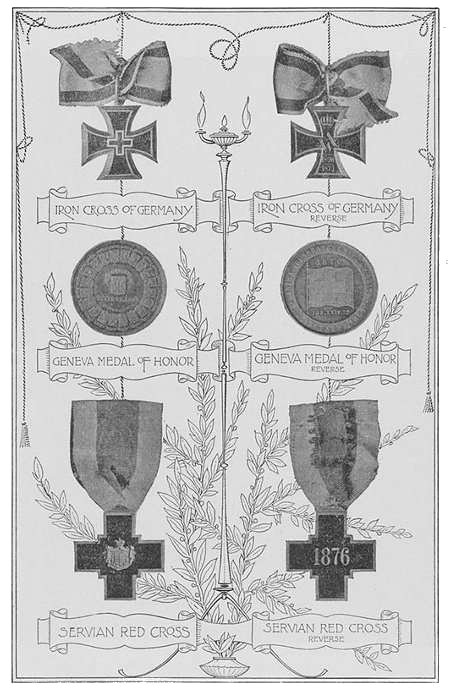
Copyright 1898, by Clara Barton.
SOME RED CROSS DECORATIONS PRESENTED TO CLARA BARTON.
The Iron Cross of Merit presented by Emperor William I. and Empress Augusta, in recognition of services in the Franco-German War of 1870-71. The German Medal of Honor presented by the Comité International in recognition of services in securing the adhesion of the United States to the treaty of the Red Cross. The Servian Red Cross presented by Queen Natali of Servia.
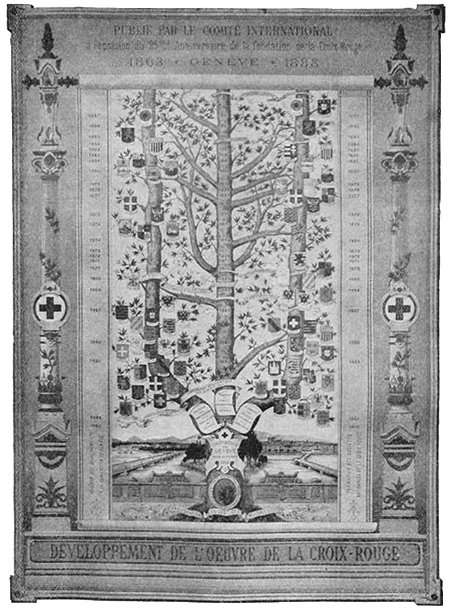
Copyright 1898, by Clara Barton.
CHRONOLOGICAL HISTORIC TREE.
Showing the development of the Red Cross during the first twenty-five years of its existence. The city of Geneva, its origin. The central branch represents the work of the Comité International. The right branch the formation of the national societies or committees. The left branch the date of adhesion to the treaty by the various nations.
By the President of the United States of America:
A PROCLAMATION.
Whereas, on the twenty-second day of August, 1864, a convention was concluded at Geneva, in Switzerland, between the Grand Duchy of Baden and the Swiss Confederation, the Kingdom of Belgium, the Kingdom of Denmark, the Kingdom of Spain, the French Empire, the Grand Duchy of Hesse, the Kingdom of Italy, the Kingdom of the Netherlands, the Kingdom of Portugal, the Kingdom of Prussia, and the Kingdom of Würtemberg, for the amelioration of the wounded in armies in the field, the tenor of which convention is hereinafter subjoined:
And whereas, the several contracting parties to the said convention exchanged the ratification thereof at Geneva on the twenty-second day of June, 1865;
And whereas, the several states hereinafter named have adhered to the said convention in virtue of Article IX. thereof, to wit:
Sweden, December 13, 1864; Greece, January 5–17, 1865; Great Britain, February 18, 1865; Mecklenburg-Schwerin, March 9, 1865; Turkey, July 5, 1865; Würtemberg, June 22, 1866; Hesse, June 2, 1866; Bavaria, June 30, 1866; Austria, July 21, 1866; Persia, December 5, 1874; Salvador, December 30, 1874; Montenegro, November 17–29, 1875; Servia, March 24, 1876; Bolivia, October 16, 1879; Chili, November 15, 1879; Argentine Republic, November 25, 1879; Peru, April 22, 1880.
And whereas, the Swiss Confederation, in virtue of the said Article IX. of said convention, has invited the United States of America to accede thereto;
And whereas, on the twentieth October, 1868, the following additional articles were proposed and signed at Geneva, on behalf of Great Britain, Austria, Baden, Bavaria, Belgium, Denmark, France, Italy, Netherlands, North Germany, Sweden and Norway, Switzerland, Turkey and Würtemberg, the tenor of which Additional Articles is hereinafter subjoined (see page 74);
And whereas, the President of the United States of America, by and with the advice and consent of the Senate, did, on the first day of March, one thousand eight hundred and eighty-two, declare that the United States accede to the said convention of the twenty-second of August, 1864, and also accede to the said convention of October 20, 1868;
And whereas, on the ninth day of June, one thousand eight hundred and eighty-two, the Federal Council of the Swiss Confederation, in virtue of the final provision of a certain minute of the exchange of the ratifications of the said convention at Berne, December 22, 1864, did, by a formal declaration, accept the said adhesion of the United States of America, as well in the name of the Swiss Confederation as in that of the other contracting states;
And whereas, furthermore, the Government of the Swiss Confederation has informed the Government of the United States that the exchange of the ratifications of the aforesaid Additional Articles of the twentieth October, 1868, to which the United States of America have, in like manner, adhered as aforesaid, has not yet taken place between the contracting parties, and that these articles cannot be regarded as a treaty in full force and effect;
Now, therefore, be it known that I, Chester A. Arthur, President of the United States of America, have caused the said Convention Treaty of August 22, 1864, to be made public, to the end that the same and every article and clause thereof may be observed and fulfilled with good faith by the United States and the citizens thereof; reserving, however, the promulgation of the hereinbefore mentioned Additional Articles of October 20, 1868, notwithstanding the accession of the United States of America thereto, until the exchange of the ratifications thereof between the several contracting states shall have been effected, and the said Additional Articles shall have acquired full force and effect as an international treaty.
In witness whereof I have hereunto set my hand, and caused the seal of the United States to be affixed.
Done at the city of Washington, this twenty-sixth day of July, in the year of our Lord one thousand eight hundred and eighty-two, and of the Independence of the United States the one hundred and seventh.
(L.S.)Chester A. Arthur.
By the President,
Fred’k T. Frelinghuysen, Secretary of State.
United States of America, Department of State, to all to whom these presents shall come, greeting:
I certify that the foregoing is a true copy of the original on file in the Department of State.
In testimony whereof I, John Davis, Acting Secretary of State of the United States, have hereunto subscribed my name and caused the seal of the Department of State to be affixed.
Done at the city of Washington, this ninth day of August, A.D. 1882, and of the Independence of the United States of America the one hundred and seventh.
(L.S.)John Davis.
Thus was the American branch of the Red Cross welcomed into the fellowship of kindred associations in thirty-one other nations, the most prosperous and civilized on the globe, its position assured, and its future course made simple, direct and untroubled.
The official bulletin of the International Committee also hailed the accession of the United States to the treaty, in an article of characteristic caution and of great significance. In that article, which is quoted in full hereafter, the distinction was carefully pointed out between that which had already been fully agreed to, and had become invested with all the force and solemnity of international treaties, and the proposed amendment which had been drawn up and considered with a view to ultimate adoption. This proposed amendment had received the sanction and signatures of the International Committee at Geneva, without ever having been formally adopted by any nation. The United States had, at the same moment adopted both, thus becoming the thirty-second nation to adhere to the treaty of August 22, 1864, and the first to adopt the proposed amendment of October 20, 1868.
[International Bulletin for April, 1882.] ADHESION OF THE UNITED STATES TO THE CONVENTION OF GENEVA.
Referring to the article inserted in our preceding bulletin, p. 42, we are happy to be able to announce that the act of adhesion which we presented was signed at Washington the sixteenth of March, in pursuance of a vote by which the members of the Senate gave their approval with unanimity. Our readers will doubtless be surprised, as we are, that after the long and systematic resistance of the Government of the United States against rallying to the Convention of Geneva, there cannot be found in the American legislature a single representative of the opposition. So complete a reversal of opinion cannot be explained, unless we admit that the chief officers of the nation had cherished, up to the present time, prejudices in regard to the Convention of Geneva—prejudices which vanished as soon as they fully comprehended what was expected of them, and recognized that there was nothing compromising in it to the political condition of their country.
With the zeal of new converts, they have even gone beyond the mark, inasmuch as they have voted their adhesion not only to the convention of the twenty-second of August, 1864, but also to the plan of Additional Articles of the twentieth of October, 1868, which was not the matter in question, since they had never had the force of law; we give this news only under every reserve, because we have received contradictory information on the subject. If this defect in form is found in the official document which will be sent to the Swiss Federal Council one could fear it might retard the so much desired conclusion of this important affair, but it need not be too much regretted, since it will enable us to understand the opinion of the great Transatlantic Republic upon maritime questions as they relate to the Red Cross.
The action of the United States, mentioned in this article, was perhaps somewhat characteristic. It seemed to give itself to the movement of the Red Cross with a gracious earnestness seldom seen in the cautious forms of diplomatic action, and it certainty was in very decided contrast with its former hesitancy.
No doubt could now rest in any mind that the adhesion of the United States was, at last, hearty and sincere, and calculated to allay any distrust which its former isolation and declination of the treaty might have anywhere engendered.
This action of the Government of the United States also rendered the position of the National Association exceptionally satisfactory, and introduced it to the International Committee at Geneva and all the affiliated societies under circumstances calculated to promote in the greatest degree its usefulness and harmony, and to add to the gratification of all who personally have any part in the operations of the American Association.
For all this it is indebted to the judicious and thoughtful care and exalted statesmanship of the President of the United States, his cabinet and advisers, and the members of the Forty-seventh Congress, who, without one breath of criticism, or one moment of delay, after they came to fully understand the subject and comprehend its purposes and object, granted all that was then asked of them, in the adhesion to the treaties, in the recognition of the National Association, and the provisions for printing and disseminating a knowledge of its principles and practical work.
Perhaps no act of this age or country has reflected more credit abroad upon those specially active in it, than this simple and beneficent measure. It must, in its great and humane principles, its far-reaching philanthropy, its innovations upon the long established and accepted customs and rules of barbaric cruelty, its wise practical charity, stand forever next to the immortal proclamation of freedom to the slaves that crowns the name of Abraham Lincoln.
Special thanks are peculiarly due to those who have been its active, wise and unwavering friends, who have planned its course so truly, and set forth its purposes so clearly, that it will hereafter be misunderstood only by those who are unwilling to learn, or who are actively hostile to its beneficent aims.
Perhaps at the risk of seeming invidious—for we would by no means ignore, and have no less gratitude for the legion of generous helpers we cannot name—we might state that among those who have been foremost to aid and encourage us have been the Hon. Omar D. Conger, of Michigan, who, first in the House, and afterward in the Senate, has been conspicuous for persistent and courageous work; also, Hon. William Windom, of Minnesota, Chairman of the Committee on Foreign Affairs, who was first to investigate and take the matter up as a member of President Garfield’s cabinet; Senator E.P. Lapham, of New York, who has spared neither time nor thought, patience nor labor, in his legal investigations of the whole matter; and probably no person has done more than he to throw light upon obscure parts and point out the true and proper course to be pursued in the accomplishment of the work, and the acceptance of the treaty. Senators Morgan, of Alabama; Edmunds, of Vermont; Hawley, of Connecticut; Anthony, of Rhode Island; Hoar, of Massachusetts, all accorded to it their willing interest and aid. Indeed, all sections and parties have seemed eager to help the Red Cross; a result that might, perhaps, have been anticipated, since it asks only an opportunity to faithfully work according to methods approved by thoughtful experience, and toward ends that all humane persons must approve.
To the American newspaper press, and perhaps to the New York Herald more than to any other newspaper, through its international character, wonderful enterprise, and far-reaching circulation, the Red Cross is indebted for timely aid and noble furtherance of its objects and aims. It has been quick to discern their substantial character, and generous and full in commending them. Still, the same difficulty confronts us in regard to publications as persons—where all have been so willing it is difficult to distinguish. Not less than three hundred periodicals and papers have, within the last two years, laid upon our desk their graceful tribute of encouraging and fitly spoken words, and it has been given as an estimate of an experienced city editor, gathered through his exchanges, that over five hundred editorial notices were given of our little Red Cross book of last year, and these, invariably, so far as met our eyes, kindly approving and encouraging. The capacity of the Red Cross to carry on most wisely and well its beneficent work must in the future, as it has done in the past, depend largely upon the active and cordial co-operation of the newspaper press; and we do not doubt that it will continue to receive the same prompt and efficient assistance so long as it shall continue to deserve it.
By the combined assistance of all these powerful friends of the Red Cross, the country has at last been rescued from the position in which it had been standing for the last seventeen years—a puzzling wonder to its admiring friends, a baffling enigma to all, treating its enemies subdued with romantic generosity, and its enemies taken captive in war with all the tenderness of friends, and yet, clinging, apparently with intense fierceness, to an unsocial isolation, to savage rules and regulations of war that only barbarians would ever wish to practice, pouring out its beneficence in astonishing prodigality, and in untold volume, variety and value upon strangers, and yet seemingly hesitating only when it was proposed by international law and system to use and not waste its magnificent voluntary offerings, but to entrust them all to responsible agents, trained in the very torrent and tempest of battle, to wisely apply this generosity to the great and awful needs of war—agents held to business rules, with calm accountability amid distraction and panic, trained to protect material, to give and take receipts, and at last to account faithfully for everything entrusted to them, like the officers of a well-regulated bank.
The final adhesion of the United States to the treaty of the Red Cross has created a lively sense of satisfaction in all its affiliated societies wherever, throughout the world, its beneficent work is carried on; particularly, by the International Committee of Geneva, has this wise and simple act of beneficence and common sense and common humanity been regarded with sentiments of gratitude and renewed hope. The American National Association has received the following expression of the sentiments of the noble and philanthropic president of the International Committee, written upon the receipt from the United States of the official documents of recognition:
Comite International de Secours Aux Militaires Blesses, Geneva, September 6, 1882.
Miss Clara Barton, Washington, D.C.:
Mademoiselle: I come to thank and congratulate you cordially upon your new success. I have read your letters of the 11th and 14th with the most lively interest, and I have also received, through the medium of the United States consul at Geneva, all the official documents which you have announced to me.
The position of your society is now entirely (tout á fait) correct, and nothing more opposes itself; so that by a circular we can now make it known to the societies of other countries. I am already occupied in the preparation of this document, but I am obliged to leave for Turin, where I go to attend the reunion of the International Institute of Law, and it will not be until my return, say about the twentieth of September, that I can press the printing of the circular. In any case, it will be ready before the end of the month.
Accept, mademoiselle, the assurance of my distinguished sentiments.
G. Moynier, President.
The circular alluded to in this letter of M. Moynier announces the adhesion of the United States to the great international compact of the Red Cross, and authenticates and opens the way for the voluntary action of the people and the government in international humanitarian action, through the medium of the American Association of the Red Cross, and is in the following terms:
INTERNATIONAL CIRCULAR. INTERNATIONAL COMMITTEE. FOUNDATION OF THE AMERICAN SOCIETY OF THE RED CROSS. Fiftieth Circular to the Presidents and Members of the National Central Committees.
Geneva, September 2, 1882.
Gentlemen: When on the twenty-third of August, 1876, we announced to you by our thirty-fourth circular, that the American society for aid to the wounded had had only an ephemeral existence, and had finished by dissolution, we still entertained the hope of seeing it revive, and we asked the friends of the Red Cross to labor with us for its resuscitation.
To-day we have the great satisfaction of being able to tell you that this appeal has been heard, and that the United States is again linked anew to the chain of our societies.
Nevertheless it is not the old association which has returned to life. That which we present to you at this time has a special origin upon which we ought to give you some details.
Its whole history is associated with a name already known to you, that of Miss Clara Barton. Without the energy and perseverance of this remarkable woman we should probably not for a long time have had the pleasure of seeing the Red Cross revived in the United States. We will not repeat here what we have said elsewhere of the claims of Miss Barton to our gratitude, and we will confine ourselves to mentioning what she has done to reconstruct a Red Cross society in North America.
After having prepared the ground by divers publications, she called together a great meeting at Washington on the twenty-first of May, 1881; then a second, on the ninth of June, at which the existence of the society was solemnly set forth. On the same day President Garfield nominated Miss Barton as president of this institution.
The International Committee would have desired from that time to have given notice of the event to all the central committees, but certain scruples restrained it.
Remembering that the first American society had been rendered powerless by the distinct refusal of the cabinet at Washington to adhere to the Geneva Convention, it took precaution and declared it would wait, before recognizing the young society, until the government should have regularly signed the treaty of 1864. Miss Barton, understanding the special propriety of this requirement, redoubled her efforts to attain this end, and we know that on the first of March she gained a complete victory upon this point.
There remained another question with respect to which the International Committee did not feel itself sufficiently informed. Just how far was the American Government disposed to accept the services of this society? We have often said, and we repeat it, that a society which would be exposed, for the want of a previous understanding, to find itself forbidden access to its own army in case of war, would be at fault fundamentally, and would not be qualified to take its place in the International concert. Further upon this point Miss Barton and the members of the American Central Committee, sought to enter into our views. They conferred with the competent authorities. The desired recognition was very difficult to obtain, for it was contrary to American customs and traditions. It was, nevertheless, accomplished after considerable discussion. On this point Miss Barton has stated to us that the government, in acquiescing in the decision which had been expressed, was entering upon a path altogether new, and that the official recognition of the Red Cross Society was for the latter a very exceptional honor.
Certain documents resulted therefrom which have been communicated to us directly by the Secretary of State, at Washington, showing:
1st. That the American Association of the Red Cross has been legally constituted by an Act of Congress.
2d. That President Arthur has declared himself in full sympathy with the work, and very willingly has accepted the presidency of the Board of Consultation.
3d. That the principal members of the cabinet have consented to become members of a board of trustees, empowered to receive subscriptions and to hold the funds for the society.
4th. Finally, that Congress unanimously, without discussion or opposition, has voted a sum of one thousand dollars, to be expended by the government in printed matter, designed to inform the people of the United States of the organization of the Red Cross. The initiation of this last measure was not the work of the society but of the Committee on Foreign Relations of the Senate; consequently it bears witness to the spontaneous impulse with which the Houses of Congress came into accord with the views of Miss Barton.
We must add that the International Committee attaches so much the more importance to the fact that this society took an official position, because there was created, at nearly the same time in the United States, two other institutions, claiming to pursue a similar object, but of which the Committee of Geneva is absolutely ignorant. One, called “The Woman’s National Relief Association,” which concerns itself with all public calamities, among other things with the calamities of war, but more especially with shipwrecks, and has for its distinctive emblem a blue anchor; the other has taken the name of “The Order of the Red Cross.” Dr. James Saunders is the president of it, with the title “Supreme Commander.” This order proposes to organize more or less in a military way and appears desirous of imitating the orders of chivalry in ancient times.
The American Central Committee of the Red Cross has its seat at Washington, but has already founded branches in other localities, at Dansville, Rochester, Syracuse, etc. Soon, doubtless, cities of the first class will also take their turn.
We will give in our next bulletin the complete text of the constitution and by-laws of the American society, which, as will be seen, has not believed it ought to limit its program to assistance in case of war, but has comprised within it, in conformity with a suggestion of the conference at Berlin, the other great calamities which might befall the country and its inhabitants.
As for ourselves, we have greeted with joy the addition of the United States to the countries already enrolled under the Red Cross; it is for our work an important and long desired reinforcement, and we doubt not our impressions in this regard will be shared by the twenty-eight central committees to which we address these lines.
We also hope that next year some representatives of the American society will cross the Atlantic in order to fraternize with the delegates of the other nations, who will certainly be happy to meet them at the conference at Vienna.
Receive, gentlemen, the assurances of our distinguished consideration.
For the International Committee of the Red Cross.
President: G. Moynier.
Secretary: G. Ador.
The foregoing pages deal only with the official history of the Red Cross and its inauguration in this country, closing with the accession of the United States to the Treaty and its promulgation in 1882. The original formation of the Red Cross was had previous to the adoption of the Treaty by the government, and, indeed, primarily for that very purpose. That was the corner-stone upon which rested the entire structure of the Red Cross in America at that date, and constituted almost entirely the work undertaken by it to perform.
During the first ten years of the existence of the organization it had accomplished all that had been promised, and a great deal more; and had proved the utility of its work on almost continuous fields of national calamity of the character defined in the “American Amendment” to the Treaty. But the American government had not given the Red Cross the official recognition that it desired and was entitled to; and it could not take its appropriate place by the government of which it was so eminently a part. As long as government provides for war, so long must it recognize its adopted twin sister of peace, the Red Cross; as long as it finds it necessary to deliberately mutilate men, so long should it take part in healing them.
In order to strengthen the organization, and make its influence more widely felt, the members decided to adopt a plan that would enable them to work on a somewhat broader basis; accordingly, on April 17, 1893, the Red Cross was reincorporated and has continued its labors up to the present time under the provisions of the instrument a copy of which follows:
THE RE-INCORPORATION OF THE AMERICAN NATIONAL RED CROSS.
Certificate of Incorporation of the American National Red Cross.
Know all men by these presents, that we, Clara Barton, Julian B. Hubbell, Stephen E. Barton, Peter V. DeGraw and George Kennan, all being persons of full age, citizens of the United States, and a majority residents of the District of Columbia, being desirous of forming an association to carry on the benevolent and humane work of “The Red Cross” in accordance with the Articles of the International Treaty of Geneva, Switzerland, entered into on the twenty-second day of August, 1864, and adopted by the Government of the United States on the first day of March, 1882, and also in accordance with the broader scope given to the humane work of said treaty by “The American Association of the Red Cross,” and known as “The American Amendment,” whereby the suffering incident to great floods, famines, epidemics, conflagrations, cyclones, or other disasters of national magnitude, may be ameliorated by the administering of necessary relief; and being desirous of continuing the noble work heretofore performed by “The American Association of the Red Cross,” incorporated in the District of Columbia for the purpose of securing the adoption of the said Treaty of Geneva by the United States, for benevolent and charitable purposes, and to co-operate with the Comite International de Secours aux Militaires Blesses.
Now, therefore, for the purpose of creating ourselves, our associates and successors, a body politic and corporate in name and in fact, we do hereby associate ourselves together under and by virtue of sections 545, 546, 547, 548, 549 and 550 of the Revised Statutes of the United States relating to the District of Columbia, as amended and in force at this time; and do make, sign and acknowledge this Certificate of Incorporation, as follows, to wit:
First.—The name by which this association shall be known in law is: “The American National Red Cross.”
Second.—The principal office of the association shall be in the City of Washington, District of Columbia.
Third.—The term of its existence shall be fifty years from the date of this certificate.
Fourth.—The objects of this association shall be, in addition to the purposes set forth in the above preamble, as follows, to wit:
1. To garner the store materials, articles, supplies, moneys, or property of whatsoever name or nature, and to maintain a system of national relief and administer the same in the mitigation of human suffering incident to war, pestilence, famine, flood, or other calamities.
2. To hold itself in readiness for communicating and co-operating with the Government of the United States, or any Department thereof, or with the “Comite International de Secours aux Militaires Blesses,” of Geneva, Switzerland, to the end that the merciful provisions of the said “International Treaty of Geneva” may be more wisely and effectually carried out.
3. To collect and diffuse information concerning the progress and application of mercy, the organization of national relief, the advancement of sanitary science and the training and preparation of nurses or others necessary in the application of such work.
4. To carry on and transact any business, consistent with law, that may be necessary or desirable in the fulfillment of any or all of the objects and purposes hereinbefore set forth.
5. The affairs and funds of the corporation shall be controlled and managed by a Board of Directors, and the number of the directors for the first year of the corporation’s existence, and until their successors are lawfully elected and qualified, is five, and their names and addresses are as follows, to wit:
Clara Barton, Washington, D.C.; Peter V. DeGraw, Washington, D.C.; Dr. Julian B. Hubbell, Washington, D.C.; Dr. Joseph Gardner, Bedford, Ind., and Stephen E. Barton, Newtonville, Mass.
The names and addresses of the full membership of the association, who shall be designated as charter members, are as follows, to wit:
Clara Barton, Washington, D.C.; Hon. William Lawrence, Bellefontaine, Ohio; Peter V. DeGraw, Washington, D.C.; George Kennan, Washington, D.C.; Dr. Julian B. Hubbell, Washington, D.C.; Colonel Richard J. Hinton, Washington, D.C.; Mrs. Henry V. Boynton, Washington, D.C.; Rev. Rush R. Shippen, Washington, D.C.; Rev. Alexander Kent, Washington, D.C.; Rev. William Merritt Ferguson, Washington, D.C.; General Edward W. Whitaker, Washington, D.C.; Joseph E. Holmes, Washington, D.C.; Mrs. Peter V. DeGraw, Washington, D.C.; Mrs. George Kennan, Washington, D.C.; Mrs. R. Delavan Mussey, Washington, D.C.; Mrs. Omar D. Conger, Washington, D.C.; A.S. Solomons, Washington, D.C.; Walter P. Phillips; New York, N.Y.; Joseph Sheldon, New Haven, Conn.; John H. Van Wormer, New York, N.Y.; Albert C. Phillips, New York, N.Y.; Mrs. Walter P. Phillips, New York, N.Y.; Mrs. Joseph Gardner, Bedford, Ind.; Dr. Joseph Gardner, Bedford, Ind.; Miss Mary E. Almon, Newport, R.I.; Dr. Lucy Hall-Brown, Brooklyn, N.Y.; John H. Morlan, Bedford, Ind., and Stephen E. Barton, Newtonville, Mass. But the corporation shall have power to increase its membership in accordance with by-laws to be adopted.
In witness whereof, we have hereto subscribed our names and affixed our seals in triplicate, at the City of Washington, District of Columbia, this seventeenth day of April, A.D. 1893.
Witness:
Stephen E. Barton,
Clara Barton,
Julian B. Hubbell,
P.V. DeGraw.
George Kennan,
S.G. Hopkins,
F.H. Smith,

(Seal.)
I, S.G. Hopkins, a Notary Public in and for the said District of Columbia, do hereby certify that Clara Barton, Julian B. Hubbell, Stephen E. Barton, P.V. DeGraw and George Kennan, whose names are signed to the foregoing and annexed “Certificate of Incorporation of the American National Red Cross” bearing date of April 17, A.D. 1893, personally appeared before me, in the said District of Columbia, the said Clara Barton, Julian B. Hubbell, Stephen E. Barton, P.V. DeGraw and George Kennan, being personally well known to me as the persons who executed the said certificate, and each and all acknowledged the same to be his, her and their act and deed for the purpose therein mentioned.
Given under my hand and official seal, this seventeenth day of April, A.D. 1893.
(Signed.) S.G. Hopkins, Notary Public.
Immediately following our accession to the Treaty of Geneva, March 1, 1882, the president of the Red Cross was asked by the Committee on Foreign Relations of the Senate, to prepare a history of the Red Cross for publication by them through the government printing office. This was done, and a book of two hundred and twenty-seven pages was issued, giving an account of the origin of the organization, the steps by which it became a treaty, of our own initiation, and not only the exact text by which our accession was made, but that of every other nation within the treaty up to that time, 1882.
A bill for a reprint by Congress of fifty thousand copies of this book was lost in the session of 1898 through lack of time.
No consecutive book has been published by us since that date, but the history has been perhaps even more fully told, and that scores of times, in public addresses which its president and assistants have been called to make before great assemblies, selections from some of which will appear in this volume, as the fullest information given in the most compact manner that we can render in the short space of time allotted us.
The very title of the organization, viz.: “Relief in War,” has been a misnomer, and through all the early years especially was very generally misunderstood by the public. I have not unfrequently been invited and innocently urged to attend peace meetings and large charity gatherings for the poor and afflicted on the ground of needing instruction myself; inasmuch as I “was engaged in advocating war, wouldn’t it be well to hear something on the other side?” And I have been invited to become party to a discussion in which the merits of peace and war should be compared.
Large organizations of women, the best in the country, and, I believe, the best in the world, have faithfully labored with me to merge the Red Cross into their society as a part of woman’s work; without the smallest conception or realization of its scope, its international character, its treaty obligations, and the official ground it was liable at any time to be called to occupy.
Many charming invitations, from ladies even more charming, to address their convention or meeting, have still contained some well chosen word which might imply a question, if indeed the Red Cross really were the humane and philanthropic institution it claimed to be; naturally the address usually dealt with the question as it was put.
I name these facts as mere relics of the past, amusing now, but instructive to you of the present day (when no child even questions the motives of the Red Cross), as showing what it had to meet and live through in order to live at all.
In order to show the enthusiastic devotees of the present year how questionable the beneficence of the Red Cross appeared to the best people only a few years ago, I introduce the following address, read, by request, before a congress of women, 1895 or 1896, hoping that the charitably disposed reader will understand and appreciate the state of mind engendered by the title of the request made, and forgive any seeming acerbity:
ADDRESS. WHAT IS THE SIGNIFICANCE OF THE RED CROSS IN ITS RELATION TO PHILANTHROPY?
I am asked to say something upon the “Significance of the Red Cross in its Relation to Philanthropy.” I am not sure that I understand precisely what is desired.
If a morning paper should announce that three or four of the greatest political bosses or greatest railroad kings in the country had quietly met somewhere, and sat with closed doors till long after midnight, and then silently departed, people would ask, “What is the significance of that? What mischief have they been devising in secret?” In that sense of the word, significance—which is a very common one—the Red Cross has none that I ever heard of. It has no rich offices to bestow, no favorites to reward, no enemies to punish. It has no secrets to keep, no mystic word or sign. Its proceedings would, and do, make a valuable library, accessible to all men and all women from Norway to New Zealand.
I will not say that it is so simple and common in character that he who runs may read, but surely she who desires information can sit down, read and obtain it. The Red Cross has been quietly doing its work for thirty years and is now established in forty independent nations. No other institution on earth, not even Christianity, has a public recognition so nearly universal. None has ever adhered more closely to its one single purpose of alleviating human suffering. Has that any significance or any connection with philanthropy? Let us see.
An institution or reform movement that is not selfish, must originate in the recognition of some evil that is adding to the sum of human suffering, or diminishing the sum of happiness. I suppose it is a philanthropic movement to try to reverse the process. Christianity, temperance and sanitary regulations in general are examples. Great evils die hard; and all that has yet been done is to keep them within as narrow limits as possible. Of these great evils, war is one. War is in its very nature cruel—the very embodiment of cruelty in its effects—not necessarily in the hearts of the combatants. Baron Macaulay thought it not a mitigation but an aggravation of the evil, that men of tender culture and humane feelings, with no ill will, should stand up and kill each other. But men do not go to war to save life. They might save life by keeping the peace and staying at home. They go solely with intent to inflict so much pain, loss and disaster on the enemy that he will yield to their terms. All their powers to hurt are focused upon him.
In a moving army the elements of destruction, armed men and munitions of war, have the right of way; and the means of preserving and sustaining even their own lives are left to bring up the rear as they best can. Hence, when the shock and crash of battle is over, and troops are advancing or retreating and all roads are blocked, and the medical staff trying to force its way through with supplies, prompt and adequate relief can scarcely ever reach the wounded. The darkness of night comes down upon them like a funeral pall, as they lie in their blood, tortured with thirst and traumatic fever. The memory of such scenes set a kindly Swiss gentleman to thinking of ways and means for alleviating their horrors. In time, and by efforts whose history must be familiar to many of you, there resulted the Geneva Convention for the relief of the sick and wounded of armies. I shall not trace its history, as it seems to be more to the present purpose to explain briefly what it proposed to do, and how it proceeded to do it.
The convention found two prime evils to consider. First, the existence of war itself; second, the vast amount of needless cruelty it inflicted upon its victims. For the first of these, with the world full of standing armies, every boundary line of nations fixed and held by the sword, and the traditions of four thousand years behind its customs, the framers of the convention, however earnest and devoted, could scarcely hope to find an immediate, if indeed, a perceptible mitigation. Only time, prolonged effort, national economics, universal progress and the pressure of public opinion could ever hope to grapple with this monster evil of the ages.
But the second—if it were not possible to dispense with the needless cruelties heretofore inflicted upon the victims of war, thus relieving human misery to that extent, seemed to the framers of the convention a reasonable question to be considered. This is what it proposed to do. A few sentences will explain how it proceeded to do it.
A convention was called at Geneva, Switzerland, for the fourth of August, 1864, to be composed of delegates accredited by the heads of the governments of the world, who should discuss the practices of war and ascertain to what extent the restraints of the established military code in its dealing with the sick and wounded of armies were needful for the benefit of the service; and to what extent they were needless, of benefit to no one, causing only suffering, of no strength to the service, and might be done away with; and to what extent war-making powers could agree to enter into a legal compact to that end. The consideration, discussion and concessions of two weeks produced a proposed agreement which took the form of a compound treaty, viz: A treaty of one government with many governments—the first ever made—a compact known as the Treaty of Geneva, for the relief of the sick and wounded in war.
Its basis was neutrality. It made neutral all sick, wounded, or disabled soldiers at a field; all persons, as surgeons, nurses and attendants, who cared for them; all supplies of medicine or food for their use; all field and military hospitals with their equipments; all gifts from neutral nations for the use of the sick and wounded of any army; all houses near a battlefield that would receive and nurse wounded men: none of these should be subject to capture. It provided for the sending of wounded men to their homes, rather than to prison; that friend and foe should be nursed together and alike in all military hospitals; and, most of all, that the people who had always been forcibly restrained from approaching any field of action for purposes of relief, however needed (with the single exception of our Sanitary Commission, and that under great difficulties and often under protest) should not only be allowed this privilege, but should arm and equip themselves with relief of all kinds, with the right to enter the lines for the helpless; thus relieving not alone the wounded and dying, but the armies of their care.
It provided a universal sign by which all this relief, both of persons and material, should be designated and known. A Greek red cross on a field of white should tell any soldier of any country within the treaty that the wearer was his friend and could be trusted; and to any officer of any army that he was legitimately there and not subject to capture.
Some forty nations are in that treaty, and from every military hospital in every one of these nations floats the same flag; and every active soldier in all their armies knows that he can neither capture nor harm the shelter beneath it, though it be but a little “A” tent in the enemy’s lines, and every disabled man knows it is his rescue and his home.
It may be interesting to know the formula of this compact. It recognizes one head, the International Committee of Geneva, Switzerland, through which all communications are made. One national head in each country which receives such communications, transmitting them to its government. The ratifying power of the treaty is the Congress of Berne. The organization in each nation receives from its government its high moral sanction and recognition, but is in no way supported or materially aided by it. The Red Cross means not national aid for the needs of the people, but the people’s aid for the needs of the nation. The awakening patriotism of the last few years should, I think, make this feature more readily apprehended.
As the foreign nations furnish the only illustrations of the value and material aid of the Red Cross in war, let us glance at what it has accomplished.
The first important war after the birth of the Treaty of Geneva, was between Germany, Italy and Austria. Austria had not, at that time, entered the treaty, and yet its objects were understood and its spirit found a responsive chord in the hearts of the people. Over $400,000, beside a great amount of material, were collected by that country, and made use of for the relief of the combatants. Italy was fairly well organized and rendered excellent service, furnishing much substantial assistance. Germany, which was in the vanguard of the treaty nations, was thoroughly organized and equipped. She was the first to demonstrate the true idea of the Red Cross—people’s aid for national, for military, necessity. Great storehouses had been provided at central points, where vast supplies were collected. In an incredibly short time, between $3,000,000 and $4,000,000 were raised for relief purposes, and large numbers of volunteers came to help the already organized corps of workers. Great trains of supplies were sent to the front. The wounded enemy was tenderly cared for, and everything was accomplished so well and so systematically, that it proved the incalculable value of organized, authorized, civil aid. French and Swiss Red Cross workers also rendered great assistance, this being the first instance of neutrals taking an active part.
In the Franco-Prussian War the German Red Cross performed even better service, it having learned many valuable lessons in the German-Austrian conflict, and through their efforts an infinite amount of good was accomplished and great suffering averted. Not only were the wounded and sick soldiers tenderly cared for, but the unprovided families of soldiers were also supplied. The French Red Cross at the breaking out of the war was poorly organized and penniless. Within one month, however, hospitals had been established, ambulances and a large amount of field supplies were at the front, with a considerable relief force to care for the sick and wounded. The French Association, not including the branches in the provinces, spent over $2,000,000 and assisted 110,000 wounded. Many neutral Red Cross nations assisted in rendering aid and relief in this great war. England alone sent a million and a half dollars, besides twelve hundred cases of stores. Eighty-five thousand sick, wounded and famishing French soldiers entered Switzerland, and were cared for by the Central Committee at Berne. The International Committee at Geneva, in one instance, asked for and obtained 2500 seriously wounded French soldiers, supplied their wants, and sent them to their own country.
In the great Russo-Turkish War, the Red Cross of Russia, splendidly equipped, with ample means and royal patronage, was, at the beginning of hostilities, greatly hampered by the jealousy of the military. The relief organizations were assigned places well in the rear; but ere many months had passed the military surgeons gladly accepted the Red Cross aid, and colossal work did it perform. Over $13,000,000 were raised, and all that was necessary spent in supplying relief. The neutral Red Cross countries furnished valuable assistance in this war also.
In the recent war between Japan and China, you undoubtedly read of the wonderful work performed by the Japanese Red Cross. This society followed the precedent of Germany, in tenderly caring for the wounded enemy, even though fighting against a nation not in the treaty. Japan had a cruel, merciless enemy to fight, and yet her soldiers were instructed to have respect even for a dead enemy.
It is needless to give further illustrations; history records the wonderful achievements of this greatest of relief organizations, though it cannot record the untold suffering which has been averted by it.
Is the Red Cross a humanitarian organization? What is the significance of the Red Cross? I leave these two questions for you to answer.
But war, although the most tragic, is not the only evil that assails humanity. War has occurred in the United States four times in one hundred and twenty years. Four times its men have armed and marched, and its women waited and wept. That is on an average of one war every thirty years. It is now a little over thirty years since the last hostile gun was fired; we fondly hope it may be many years before there is another. A machine, even a human machine, called into active service only once in thirty years is liable to get out of working order; hence to keep it in condition for use, no less than for the possible good it might do, the American Society of the Red Cross asked to have included in its charter the privilege of rendering such aid as it could in great public calamities, as fires, floods, cyclones, famines and pestilence.
In a time of profound peace that has been the only possible field of activity. It is not for me to say whether that field has been successfully cultivated, but a few of the facts will determine whether the innovation upon the treaty will commend itself to your judgment, as it has to those of the older societies of Europe.
Naturally it required not only diplomacy but arguments to obtain a privilege never before officially considered in the unbroken customs of an international treaty. They must be submitted to a foreign congress. The same argument pertained fifteen years ago that pertains to-day, namely, that in all our vast territory, subject to incalculable disasters, with all our charitable, humane and benevolent associations, there was not one which had for its object and duty to hold itself in preparation and training to meet and relieve the woes of these overmastering disasters. All would gladly aid, but there were none to lead. Everybody’s business was nobody’s business, and the stricken victims perished.
We asked that under the Red Cross Constitution of the United States its national organization should be permitted to act in the capacity of Red Cross relief agents, treating a national disaster like a field of battle, proceed to it at once with experienced help, equipped with all the needful supplies and means to commence relief, overlook and learn the needs of the field, make immediate statements of the true condition and wants to the people of the country, who, knowing the presence of the Red Cross there, could, if desirable, make it the medium of their contributions for relief either in money or material. To relieve the necessities in every way possible, keep the people at large in possession of reliable information, hold the field until relief has been given, and retire when all needed aid has been rendered. This privilege was graciously granted by the ratifying Congress at Berne, and is known as the “American amendment” of the Red Cross. Nations since that date, on becoming signatory to the treaty, have included that amendment in their charters.
This is the principle upon which we have acted. The affording of relief to the victims of great disasters anywhere in the United States, is what the National Red Cross has proceeded to do, and it has confined itself strictly to its privileges, acting only in disasters so great as to be national. It never asks aid; never makes an appeal; it simply makes statements of the real condition of the sufferers, leaving the people free to exercise their own humanity through any medium they may prefer.
In the thirteen years of relief work by the Red Cross in the United States, every dollar and every pound that has been received and distributed by it, has been the free-will offering of the people, given for humanity without solicitation, and dispensed without reward. It has received nothing from the government. No fund has been created for it. No contributions have been made except those to be distributed as relief at its fields. Its officers serve without pay. There is not, nor ever was, a salaried officer in it, and even its headquarters meets its own costs. Among the various appropriations made by Congress for relief of calamities in the past years, as in great river floods, not a dollar so appropriated has ever been applied through the Red Cross, although working on the same field. I name these facts, not by way of complaint, or even comment, but to correct popular errors of belief, which I know you would prefer to have corrected. True to its method, this is simply a statement of the real condition of things, and left to the choice of the people—the Red Cross itself is theirs, created for them, and it is peculiarly their privilege to deal with it as they will.
The following list of calamities with the approximate value of material furnished, as well as money, will give you some appreciation of the services rendered in the cause of humanity by the American National Red Cross. Limit of time and space forbids even an attempt at description of its various fields. I can only name the most important, with estimated values distributed on each:
Michigan Forest Fires, 1881, material and money$ 80,000
Mississippi Floods, 1882, money and seeds8,000
Mississippi Floods, 1883, material and seeds18,500
Mississippi Cyclone, 1883, money1,000
Balkan War, 1883, money500
Ohio and Mississippi Floods, 1884, feed for stock and people, clothing, tools, house furnishings175,000
Texas Famine, 1885, appropriations and contributions on statements made upon personal investigation120,000
Charleston Earthquake, 1886, money500
Mt Vernon, Ill., Cyclone, 1888, money and supplies85,000
Florida Yellow Fever, 1888, physicians and nurse15,000
Johnstown Disaster, 1889, money and all kinds of material, buildings and furnishings250,000
Russian Famine, 1891-92, mainly food125,000
Pomeroy, Iowa, Cyclone, 1893, money and nurses2,700
South Carolina Islands, 1893-94, money and all kinds of supplies and materials, tools, seeds, lumber, etc.65,000
$946,200
Only about one-eighth of the above estimates represent cash; the balance represents material.
In each of these emergencies something has been added to the sum of human happiness, something subtracted from the sum of human woe; the naked have been clothed, the hungry fed, new homes have sprung up from the desolated ruins, crops revived, and activities and business relations resumed. In a neighboring State and its adjacent islands scarcely two hundred miles distant from this, could to-day be found several thousand human beings, living in their homes, enjoying their family lives, following their ordinary avocations, cultivating the ground, who, if asked, would unhesitatingly tell you that but for the help of the Red Cross, they would two years ago have been under the ground they now cultivate.
If the alleviation of human miseries, the saving of life, and the bringing of helplessness and dependence back to methods of self-sustenance and independence are counted among the philanthropic movements of the day, then to us, who have seen so much and worked so long and so hard among it, it would seem that the Red Cross movement has some “significance” in connection with philanthropy.
There remains but one question more. To whom is this movement due? Who instituted it? In what minds did it originate? I wish I could say it was all woman’s work; but the truth compels the fact that this great, humane idea originated with men; the movement was instituted by them. They thought it out, and they wrought it out, and it was only meet and proper that they should, for the terrible evil that made it necessary was theirs as well. Women as a rule are not war-makers. For centuries the caprices of men have plunged the world in strife, covered the earth’s surface with armies, and enriched its soil with the best blood that ever flowed in human veins. It is only right that at length, in the cycle of ages, something should touch man’s heart and set him humbly down to find out some way of mending as much of his mischief as he could. Perhaps he “builded better than he knew,” for in that one effort he touched the spring that sooner or later will mend it all. No grander or truer prophecy has ever been made than uttered in that first convention: “The Red Cross shall teach war to make war upon itself.” It is the most practical and effective peace-maker and civilizer in the known world. It reaches where nothing else can. If proof of this be wanting, study the action of Japan in its late war.
But is man doing this work alone? No—gladly, no! Scarcely had he made his first move, when the jeweled hands of royal woman glistened beside him, and right royally have they borne their part. Glance at the galaxy—the great leader and exemplar of them all, Empress Augusta of Germany, her illustrious daughter, the Grand Duchess of Baden, Eugenia, Empress Frederick, Victoria and Princess Louise of England, Margherita of Italy, Natalia of Servia and the entire Court of Russia, and to-day the present Empress of Germany, and the hard-working Empress of Japan, with her faithful, weary court, even now busy in the hospitals of convalescing Chinese. The various auxiliary societies of women of all the principal Red Cross nations are a pride and a glory to humanity.
These nations have all two important features in their movement, which, thus far, have not been accorded to us. Their governments have instituted laws protecting the insignia and name of the Red Cross from misuse and abuse as trademarks by unscrupulous venders, and appropriation by false societies for dishonest purposes. This lack, and this alone, has thus far rendered general organization in the United States impracticable and unsafe. For seven years the most strenuous efforts at protection have failed; the loss has been to the people in general.
The second advantage of other nations is that citizens, the men of wealth in those countries, have created a Red Cross fund for its use, varying in amounts from a hundred thousand to several millions of dollars. Russia, I believe, has a fund of some three millions. It seems never to have occurred to our wealth-burdened men that possibly a little satisfaction might be gained, some good accomplished, and some credit done the nation by a step in that direction. It will dawn upon them some day, not, perhaps, in mine, but in some of yours, and then, ladies, you can well join hands with them, and discern more clearly than now the “significance of the Red Cross as related to philanthropy.”