Chapter I
Reading edition

On June 24, 1859, occurred the memorable battle of Solferino, in which the French and Sardinians were arrayed against the Austrians. The battle raged over a wide reach of country and continued for sixteen hours; at the end of which sixteen thousand French and Sardinian soldiers and twenty thousand Austrians lay dead or were wounded and disabled on that field. The old and ever-recurring fact reappeared: the medical staff was wholly inadequate to the immense task suddenly cast upon them. For days after the battle the dead in part remained unburied, and the wounded where they fell, or crawled away as they could for shelter and help.
A Swiss gentleman, Henri Dunant by name, was then traveling near that battlefield, and was deeply impressed by the scenes there presented to him. He joined in the work of relief, but the inadequacy of preparation and the consequent suffering of the wounded haunted him afterwards and impelled him to write a book entitled “A Souvenir of Solferino,” in which he strongly advocated more humane and extensive appliances of aid to wounded soldiers. He lectured about them before the “Society of Public Utility” of Geneva. M. Gustav Moynier, a gentleman of independent fortune, was then president of that society. Dr. Louis Appia, a philanthropic physician, and Adolph Ador, a counsellor of repute in Geneva, became interested in his views. They drew the attention of Dufour, the general of the Swiss army, to the subject, and enlisted his hearty co-operation. A meeting of this society was called to consider “a proposition relative to the formation of permanent societies for the relief of wounded soldiers.” This meeting took place on the ninth of February, 1863. The matter was laid fully before the society. It was heartily received and acted upon and a committee was appointed with M. Moynier at its head to examine into methods by which the desired results might be obtained. So fully did this committee realize its responsibility and the magnitude, grandeur and labor of the undertaking, that the first steps were made even with timidity. But overcoming all obstacles, it decided upon a plan which seemed possible, and announced for the twenty-sixth of the following October a reunion to which were invited from many countries men sympathizing with its views or able to assist in its discussions. This international conference was held at the appointed time, and continued its sessions four days. At this meeting it was decided to call an international convention to be held at Geneva during the autumn of the following year (1864). At this convention was brought out the Geneva Treaty, and a permanent international committee with headquarters at Geneva was formed, and the fundamental plan of the national permanent relief societies adopted.
One of the first objects necessary and desired by the International Committee for the successful prosecution of its work was the co-operation by some of the more important states of Europe in a treaty which should recognize the neutrality of the hospitals established, of the sick and wounded, and of all persons and effects connected with the relief service; also the adoption of a uniform protective sign or badge. It inquired with care into the disposition of the several governments, and was met with active sympathy and moral support. It first secured the co-operation of the Swiss Federal Council and the Emperor of France. It shortly after procured the signatures of ten other governments, which were given at its room in the city hall of Geneva, August 22, 1864, and was called the Convention of Geneva.
Its sign or badge was also agreed upon, namely, a red cross on a white ground, which was to be worn on the arm by all persons acting with or in the service of the committees enrolled under the convention.
The treaty provides for the neutrality of all sanitary supplies, ambulances, surgeons, nurses, attendants, and sick or wounded men, and their safe conduct when they bear the sign of the organization, viz: the Red Cross.
Although the convention which originated the organization was necessarily international, the relief societies themselves are entirely national and independent; each one governing itself and making its own laws, according to the genius of its nationality and needs.
It was necessary for recognition and safety, and for carrying out the general provisions of the treaty, that a uniform badge should be agreed upon. The Red Cross was chosen out of compliment to the Swiss republic, where the first convention was held, and in which the central committee has its headquarters. The Swiss colors being a white cross on a red ground, the badge chosen was these colors reversed.
There are no “members of the Red Cross,” but only members of societies whose sign it is. There is no “Order of the Red Cross.” The relief societies use, each according to its convenience, whatever methods seem best suited to prepare in times of peace for the necessities of sanitary service in times of war. They gather and store gifts of money and supplies; arrange hospitals, ambulances, methods of transportation of wounded men, bureaus of information, correspondence, etc. All that the most ingenious philanthropy could devise and execute has been attempted in this direction.
In the Franco-Prussian war this was abundantly tested. That Prussia acknowledged its beneficence is proven by the fact that the emperor affixed the Red Cross to the Iron Cross of Merit. The number of governments adhering to the treaty was shortly after increased to twenty-two and at the present date there are forty-two.
The German-Austria war of 1866, though not fully developing the advantages of this international law, was yet the means of discovering its imperfections. Consequently, in 1867 the relief societies of Paris considered it necessary that the treaty should be revised, modified and completed. Requests were issued for modification. The International Committee transmitted them to the various governments, and in 1868 a second diplomatic conference was convened at Geneva at which were voted additional articles, improving the treaty by completing its design and ext
During the war of 1866 no decisive trial of the new principles involved in the treaty could be made, for Austria at that time had not adopted it. But in 1870-71 it was otherwise. The belligerents, both France and Germany, had accepted the treaty. Thus it became possible to show to the world the immense service and beneficent results which the treaty, through the relief societies, might accomplish.
The dullest apprehension can partially appreciate the responsibility incurred by relief societies in time of war. The thoughtful mind will readily perceive that these responsibilities involve constant vigilance and effort during periods of peace. It is wise statesmanship which suggests that in time of peace we must prepare for war, and it is no less a wise benevolence that makes preparation in the hour of peace for assuaging the ills that are sure to accompany war. We do not wait till battles are upon us to provide efficient soldiery and munitions of war. Everything that foresight and caution can devise to insure success is made ready and kept ready against the time of need. It is equally necessary to hold ourselves in readiness for effective service in the mitigation of evils consequent upon war, if humane work is to be undertaken for that purpose.
Permanent armies are organized, drilled and supported for the actual service in war. It is no less incumbent if we would do efficient work in alleviating the sufferings caused by the barbarisms of war, that we should organize philanthropic efforts and be ready with whatever is necessary, to be on the field at the sound of the first gun. An understanding of this truth led the conference of 1863 to embody in its articles as one of its first cardinal characteristics the following: “In time of peace the committee will occupy itself with means to render genuine assistance in time of war.”
The International Committee assumed that there should be a relief association in every country which endorsed the treaty, and so generally was the idea accepted that at the end of the year 1864, when only ten governments had been added to the convention, twenty-five committees had been formed, under each of which relief societies were organized. It was, however, only after the wars of 1864, 1866 and 1870 that the movement began really to be popular. These conflicts brought not only contestants, but neutral powers so to appreciate the horrors of war, that they were quite ready to acknowledge the beneficence and wisdom of the Geneva Treaty. Many who approved the humane idea and expressed a hearty sympathy for the object to be obtained, had heretofore regarded it as Utopian, a thing desirable but not attainable, an amiable and fanatical illusion which would ever elude the practical grasp. Nevertheless, the work accomplished during the wars referred to won over not only such cavillers, but persons actually hostile to the movement, to regard it as a practical and most beneficent undertaking. The crowned heads of Europe were quick to perceive the benign uses of the associations, and bestowed upon the central committees of their countries money, credit and personal approbation. The families of sovereigns contributed their sympathy and material support. The list of princes and princesses who came forward with personal aid and assumed direction of the work, was by no means small, thus proving correct the augury of the Conference of 1863, that “The governments would accord their high protection to the committees in their organization.”
From one of the bulletins of the International Committee we make the following hopeful extract:
“The whole of Europe is marshaled under the banner of the Red Cross. To its powerful and peaceful sign the committee hopes to bring all the civilized nations of the earth. Wherever men fight and tear each other in pieces, wherever the glare and roar of war are heard, they aim to plant the white banner that bears the blessed sign of relief. Already they have carried it into Asia. Their ensign waves in Siberia, on the Chinese frontier, and in Turkestan, and, through the African committee, in Algeria and Egypt. Oceanica has a committee at Batavia. Japan accepted the Treaty of Geneva in 1886, and on the breaking out of hostilities between Japan and China, the Minister of War issued a notification to the Japanese army, September 22, 1894, calling their attention to the substance of the treaty.”
ORGANIZATION AND METHODS OF WORK.
One of the things considered indispensable, and therefore adopted as a resolution by the Conference of 1863, was the centralization of the work in each country separately by itself.
While the treaty must be universally acknowledged and its badge accepted as a universal sign, it was equally essential that the societies of the different countries should be simply national and in no respect international. It was therefore ordained by the conference that all local committees or organizations desirous of working with the Red Cross, should do so under the auspices of the Central Committee of their own nation, which is recognized by its government and also recognized by the International Committee from which the sign of the Red Cross emanates. Singularly enough, the International Committee has had considerable difficulty in making this fully understood, and frequently has been obliged to suggest to local committees the necessity for their subordination to the Central or National Committee. Once in three months the International Committee publishes an official list of all central committees recognized by it as national. In this way it is able to exercise a certain control, and to repress entanglements and abuses which would become consequent on irresponsible or counterfeit organizations. To recapitulate: the Commission of Geneva, of which M. Moynier is president, is the only International Committee. All other committees are simply national or subordinate to national committees. The Conference of 1863 foresaw that national differences would prevent a universal code of management, and that to make the societies international would destroy them, so far as efficiency was concerned. They therefore adopted a resolution that “Central committees should organize in such a manner as seemed the most useful and convenient to themselves.” Every committee being its own judge, has its own constitution and laws. To be efficient, it must have the recognition of its own government, must bear the stamp of national individuality and be constructed according to the spirit, habits and needs of the country it represents. No hierarchy unites the national societies; they are independent of each other, but they have each an individual responsibility to the treaty, under the ensign of which they work, and they labor in a common cause. It is desirable that they should all be known by one name, namely, the Society of the Red Cross. The functions of the International Committee, whose headquarters are at Geneva, were also determined by the Conference of 1863. It is to serve provisionally as an intermediate agent between national committees, and to facilitate their communications with each other. It occupies itself with the general interests of the Red Cross in correspondence, and the study of theoretical and practical methods of amelioration and relief.
The national committees are charged with the direction and responsibility for the work in their own countries. They must provide resources to be utilized in time of need, take active measures to secure adherents, establish local societies, and have an efficient working force always in readiness for action, and in time of war to dispatch and distribute safely and wisely all accumulations of material and supplies, nurses and assistants, to their proper destination, and, in short, whatever may be gathered from the patriotism and philanthropy of the country. They must always remember that central committees without abundant sectional branches would be of little use.
In most countries the co-operation of women has been eagerly sought. It is needless to say it has been as eagerly given. In some countries the central committees are mixed, both sexes working together; in others, sub-committees are formed by women, and in others, such as the Grand Duchy of Baden, woman leads.
As a last detail of organization, the Conference of 1863 recommended to the central committees to put themselves en rapport with their respective governments, in order that their offers of service should be accepted when required. This makes it incumbent upon national societies to obtain and hold government recognition, by which they are endowed with the immunities and privileges of legally constituted bodies and with recognition from other nations in time of war, not otherwise possible to them.
OCCUPATIONS OF RELIEF SOCIETIES IN TIMES OF PEACE.
Organization, recognition and communication are by no means all that is necessary to insure the fulfillment of the objects of these associations. A thing most important to be borne in mind is that if money be necessary for war, it is also an indispensable agent in relief of the miseries occasioned by war. Self-devotion alone will not answer. The relief societies need funds and other resources to carry on their work. They not only require means for current expenses, but, most of all, for possible emergencies. To obtain and prudently conserve these resources is an important work. The Russian Society set a good example of activity in this direction. From the beginning of its organization in 1867 it systematically collected money over the whole empire and neglected nothing that tended to success. It put boxes in churches, convents, armories, railroad depots, steamboats, in every place frequented by the public. Beside the collection of funds, the Conference of 1863 recommended that peace periods should be occupied in gathering necessary material for service. In 1868 there were in Geneva alone five depots where were accumulated one thousand two hundred and twenty-eight shirts, besides hosiery, bandages, lint, etc., for over one thousand wounded. There were also large collections in the provinces, and now, thirty years later, these accumulations have probably greatly increased. In other countries the supplies remaining after wars were gathered in depots and were added to abundantly. Thus, in 1868, the Berlin Committee was in possession of supplies worth over twenty-five thousand dollars. Especial care is taken to acquire familiarity with the use of all sanitary material, to eliminate as far as possible whatever may be prejudicial to sick or wounded men, to improve both sanitary system and all supplies to be used under it, to have everything of the very best, as surgical instruments, medicine chests, bandages, stretchers, wagons, tents and field hospitals.
We would refer to the effort made in the national exhibitions of the various countries, where the societies of the Red Cross have displayed their practical improvements and inventions in competitive fields, taxing to the utmost human ingenuity and skill. Some countries have taken grand prizes. An exposition at The Hague was held in 1867 exclusively for the work of the Red Cross. Permanent museums have been established where all sorts of sanitary material for relief are exhibited, as may be seen in Stockholm, Carlsruhe, St. Petersburg, Moscow and Paris. The museum of Paris is the most important of all, and is international, other countries having participated in its foundation. Another method is the publication of works bearing upon this subject, some of which are scientific and very valuable. Not less important is the sanitary personnel. Of all aid, efficient nurses are the most difficult to obtain. There are numbers of men and women who have the will and devotion necessary to lead them into hospitals or to battlefields, but very few of them are capable of performing well the duties of nurses. Therefore, but a small portion of the volunteers are available. The relief societies soon found that women were by nature much better fitted for this duty than men can be, and to enable them to fulfill to the best advantage the mission for which they are so well adapted, it was decided to afford them the best possible professional instruction. For this purpose, during peace training schools were established from which were graduated great numbers of women who are ready at a moment’s notice to go upon the battlefield or into hospitals. These professional nurses find no difficulty during times of peace in securing remunerative employment. Indeed, they are eagerly sought for by the community to take positions at the bedside of the sick, with the proviso that they are to be allowed to obey the pledge of their society at the first tocsin of war. There are schools for this purpose in England, Germany, Sweden, Holland, Russia and other European countries, and nothing has been neglected to make them thorough and to place them on a strong and solid basis.
SERVICES IN TIME OF WAR.
Notwithstanding the readiness with which most persons will perceive the beneficent uses of relief societies in war, it may not be amiss to particularize some of the work accomplished by the societies of the Red Cross. Not to mention civil disturbances and lesser conflicts, they participated in not less than five great wars in the first ten years, commencing with Schleswig-Holstein, and ending with the Franco-German. Russia and Turkey have followed, with many others since that time, in all of which these societies have signally proved their power to ameliorate the horrors of war. The earlier of these, while affording great opportunity for the beneficent work of the societies, were also grand fields of instruction and discipline to the committee, enabling them to store up vast funds of practical knowledge which were to be of great service.
The Sanitary Commission of the United States also served as an excellent example in many respects to the relief societies of Europe, and from it they took many valuable lessons. Thus in 1866 Europe was much better prepared than ever before for the care of those who suffered from the barbarisms of war. She was now ready with some degree of ability to oppose the arms of charity to the arms of violence, and make a kind of war on war itself. Still however there was a lack of centralization. The provincial committees worked separately, and consequently lost force. Notwithstanding these drawbacks, large amounts of money were gathered, and munificent supplies of material brought into store. The Austrian Committee alone collected 2,170,000 francs, and a great supply of all things needed in hospital service. The Central Committee was of great use in facilitating correspondence between the different peoples comprising the Austrian Empire, the bureau maintaining correspondence in eleven different languages.
Italy was not backward in the performance of her duty. She used her abundant resources in the most effectual way. Not only were her provincial societies of relief united for common action, but they received external aid from France and Switzerland. Here was exhibited the first beautiful example of neutral powers interfering in the cause of charity in time of war—instead of joining in the work of destruction, lending their aid to repair its damages. The provincial committees banded together under the Central Committee of Milan. Four squads, comprising well-trained nurses and assistants, were organized and furnished with all necessary material to follow the military ambulances or field hospitals, whose wagons were placed at their disposal.
Thus the committee not only reinforced the sanitary personnel of the army, but greatly increased its supplies. It provided entirely the sanitary material for the Tyrolese volunteers, and afforded relief to the navy, and when the war was over it remained among the wounded. In addition to the supplies this committee afforded, it expended in money not less than 199,064 francs.
But after all it was Germany standing between the two armies which distinguished herself. Since the Conference of 1863 she had been acting on the rule of preparation, and now found herself in readiness for all emergencies. The Central Committee of Berlin was flooded with contributions from the provincial committees. In the eight provinces of Prussia 4,000,000 of thalers were collected, and the other states of Germany were not behind. So munificently did the people bestow their aid, that large storehouses were provided in Berlin and in the provinces for its reception, and at the central depot in Berlin two hundred paid persons, besides a large number of volunteers, and nearly three hundred ladies and misses were employed in classifying, parceling, packing up, and dispatching the goods. Special railroad trains carried material to the points of need. In one train were twenty-six cars laden with 1800 to 2000 cwt. of supplies. Never had private charity, however carefully directed, been able to accomplish such prodigies of benevolence. It was now that the beneficence of the Treaty and the excellence of the organization were manifested. But the committee did not confine itself to sending supplies for the wounded to the seat of war. It established and provisioned refreshment stations for the trains, to which those unable to proceed on the trains to the great hospitals without danger to life, were admitted, nursed and cared for with the tenderest solicitude until they were sufficiently recovered to be removed, or death took them. At the station of Pardubitz from six hundred to eight hundred were cared for daily for two months, and lodging provided for three hundred at night. This example suffices to show the extraordinary results of well-organized plans and concerted action. During the war, the relief societies had also to contend with the terrible scourge of cholera. There can be no estimate of the misery assuaged and deaths prevented by the unselfish zeal and devotion of the wearers of the Red Cross.
In the interval between the wars of 1866 and 1867, and that of 1870-71, the time had been improved by the societies existing under the Geneva Treaty, in adding to their resources in every possible manner. Improvements were made in all articles of sanitary service; excellent treatises regarding the hygiene of the camp and hospital were widely circulated; the press had greatly interested itself in the promulgation of information regarding all matters of interest or instruction pertaining to sanitary effort, and almost universally lent its powerful influence to build up the societies. Ten new societies were formed during this time. In Germany the work of the Red Cross was so thoroughly organized, that at the first signal from Berlin, committees arrived as if by magic at all required points, forming a chain which extended over the whole country, and numbered over two thousand persons. This is more remarkable since Germany was a neutral power. Constant communication was kept up between these committees and the central bureau, and the most perfect order and discipline were maintained. Relief was sent from one or another of these stations as was needed. The state afforded free transport, and the voluntary contributions of the people kept up the supplies of sanitary material, so that there was never any lack or danger of failure. With the government transports, whether by land or water, there went always the agents of the Red Cross, protected by their badges and flag, to wait on the invoices, hasten their progress, see to their being kept in good order, and properly delivered at their destination. Depots of supplies were moved from place to place as exigencies demanded. The greatest care was taken to prevent disorder or confusion, and the best military circumspection and regularity prevailed. The great central depot at Berlin comprised seven sections, viz: Camp material; clothing; dressing, for wounds; surgical apparatus; medicines and disinfectants; food and tobacco; and hospital furnishings. Did space allow, it would be desirable to give statistics of the contributions in money and supplies to this service. Suffice it to say, the humanity of peoples is far beyond that of governments. Governments appropriate immense sums to carry on destructive conflicts, but the work of relief societies the world over, and especially during the war of 1870-71, has shown that the philanthropy of the people equals their patriotism. The sums given to assuage the miseries of the Franco-Prussian war were simply fabulous. In 1863, fears were expressed that there would be difficulty in collecting needful funds and supplies to carry out the designs of the treaty. These misgivings proved groundless. After the war of 1870-71, notwithstanding nothing had been withheld in the way of relief, the societies settled their accounts with large balances in their treasuries.
In France not nearly so much had been previously done to provide for the exigencies which fell upon them, but the committee worked with such vigor and so wrought upon the philanthropy of individuals, that active measures of relief were instantly taken. Gold and supplies poured into the hands of the committee at Paris. One month sufficed to organize and provide seventeen campaign ambulances or field hospitals, which immediately joined the army and accompanied it through the first period of the war, or until the battle of Sedan. In Paris ambulances were stationed at the railroad depots to pick up the wounded, and a bureau of information was created for soldiers’ families. When the siege of Paris was about to take place, the committee threw, without delay, a commission into Brussels charged with the direction and help of flying hospitals. Nine committees were established in the provinces, with power to act for the Central Committee and to invite the people to help. Meanwhile the committee in Paris did its utmost to mitigate the distress that reigned there, and to prepare for the result of the siege. History has recorded the sufferings, the horrors of misery that accompanied and followed that siege; but history can never relate what wretchedness was averted, what agonies were alleviated, what multitudes of lives were saved, by the presence and effort of the relief societies! What the state of France must have been without the merciful help of the Red Cross societies the imagination dare not picture. After the armistice was signed there were removed from Paris, under the auspices of the relief societies, ten thousand wounded men, who otherwise must have lingered in agony, or died from want of care; and there were brought back by them to French soil nine thousand men who had been cared for in German hospitals.
HELP FROM NEUTRAL COUNTRIES.
Neutral countries also during this war were ready and bountiful with help; and those working under the treaty did most effectual service. England contributed 7,500,000 francs, besides large gifts of sanitary supplies; in one hundred and eighty-eight days’ time she sent to the seat of war twelve thousand boxes of supplies through the agents of the Red Cross.
To give an idea of the readiness and efficacy with which the committees worked even in neutral countries, one instance will suffice. From Pont-a-Mousson a telegram was sent to London for two hundred and fifty iron beds for the wounded, and in forty-eight hours they arrived in answer to the request. England kept also at the seat of war agents to inform the committee at home of whatever was most needed in supplies. The neutral countries sent also surgeons, physicians and nurses, and in many other ways gave practical testimony to the benign efficacy of the Geneva treaty.
As will be seen by the foregoing pages, the objects and provisions of the Geneva convention and the societies acting under it, are designed for, and applicable to, the exigencies of war only. The close contact of the nations hitherto signing this treaty, renders them far more liable to the recurrence of war among them than our own, which by its geographical position and distance from neighboring nations, entertains a feeling of security which justifies the hope that we may seldom, if ever again, have occasion to provide for the exigencies of war in our land.
This leads the American Red Cross to perceive the great wisdom, foresight and breadth of the resolution adopted by the convention of 1863, which provides that “Committees shall organize in the manner which shall seem most useful and convenient to themselves;” also in their article on the organization of societies in these pages occurs the following: “To be efficient, societies must have government recognition, must bear the stamp of their national individuality, and be constructed according to the spirit, habits, and needs of the country they represent. This is essential to success.”
As no work can retain its vitality without constant action, so in a country like ours, with a people of so active a temperament, an essential element in endearing to them a work, is to keep constantly before them its usefulness. With this view the question of meeting the want heretofore felt on all occasions of public calamity, of sufficient extent to be deemed of national importance, has received attention at the hands of this association. For this purpose the necessary steps have been inaugurated to organize auxiliary societies, prepared to co-operate with the central association in all plans for prompt relief; whilst the volunteers who shall render personal aid will be expected to hold themselves in the same readiness as in the case of an international call.
It must, however, be distinctly understood that these additional functions for local purposes shall in no manner impair the international obligation of the association; but on the contrary it is believed will render them more effective in time of need.
It may appear singular that a movement so humane in its purposes, so wise and well considered in its regulations, so universal in its application, and every way so unexceptional, should have been so long in finding its way to the knowledge and consideration of the people of the United States. This fact appears to have been the result of circumstances rather than intention. While eminently a reading people, we are almost exclusively confined to the English language. The literature of the Red Cross is entirely in other languages, largely French, and thus has failed to meet the eye of the reading public.
It will be observed that the first convention was called during our war; no delegates were especially sent by the United States, but our Minister Plenipotentiary to Switzerland, acting as delegate, sent a copy of the doings of the convention to our government for recognition. In the midst of civil war as we were at the time the subject was very naturally and properly declined.
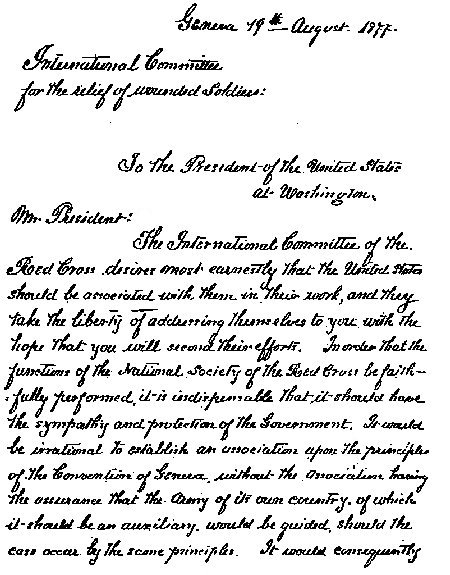
FIRST LETTER FROM M. GUSTAV MOYNIER TO THE PRESIDENT OF THE UNITED STATES, URGING THE ADOPTION OF THE TREATY OF GENEVA.
[Original autograph translation by Clara Barton.]
AUTOGRAPH ENDORSEMENT BY PRESIDENT GARFIELD.
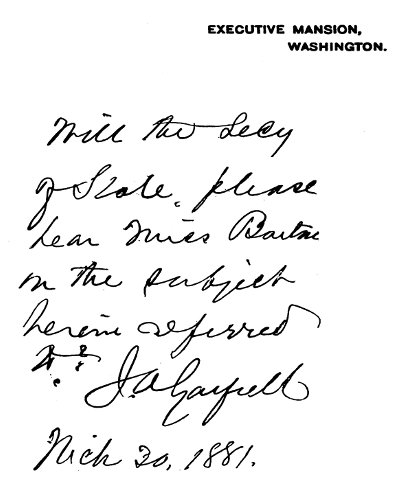
It was again most fittingly presented in 1866 through Rev. Dr. Henry W. Bellows, and by this eminent gentleman and philanthropist a Society of the Red Cross was actually formed; but for some cause it failed, and the convention was not recognized. The International Committee became in a manner discouraged in its efforts with the United States, but finally it was decided to present it again through Miss Clara Barton, and accordingly the following letter was addressed to President Hayes during the first year of his administration:
International Committee for the Relief of Wounded Soldiers, Geneva, August 19, 1877.
To the President of the United States, at Washington:
Mr. President: The International Committee of the Red Cross desires most earnestly that the United States should be associated with them in their work, and they take the liberty of addressing themselves to you, with the hope that you will second their efforts. In order that the functions of the National Society of the Red Cross be faithfully performed, it is indispensable that it should have the sympathy and protection of the government.
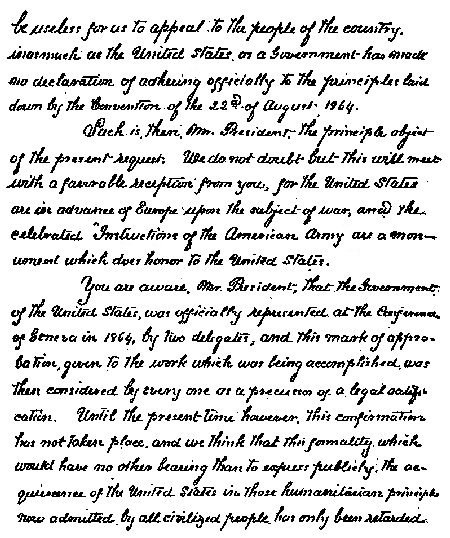
It would be irrational to establish an association upon the principles of the Convention of Geneva, without the association having the assurance that the army of its own country, of which it should be an auxiliary, would be guided, should the case occur, by the same principles. It would consequently be useless for us to appeal to the people of the country, inasmuch as the United States, as a government, has made no declaration of adhering officially to the principles laid down by the convention of the twenty-second August, 1864.
Such is then, Mr. President, the principal object of the present request. We do not doubt but this will meet with a favorable reception from you, for the United States is in advance of Europe upon the subject of war, and the celebrated “Instructions of the American Army” are a monument which does honor to the United States.
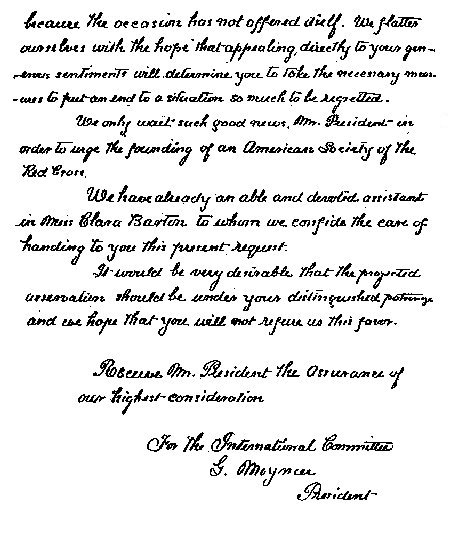
You are aware, Mr. President, that the Government of the United States was officially represented at the Convention of Geneva, in 1864, by two delegates, and this mark of approbation given to the work which was being accomplished was then considered by every one as a precursor of a legal ratification. Until the present time, however, this confirmation has not taken place, and we think that this formality, which would have no other bearing than to express publicly the acquiescence of the United States in those humanitarian principles now admitted by all civilized people, has only been retarded because the occasion has not offered itself. We flatter ourselves with the hope that, appealing directly to your generous sentiments, will determine you to take the necessary measures to put an end to a situation so much to be regretted. We only wait such good news, Mr. President, in order to urge the founding of an American Society of the Red Cross.
We have already an able and devoted assistant in Miss Clara Barton, to whom we confide the care of handing to you this present request.
It would be very desirable that the projected asseveration should be under your distinguished patronage, and we hope that you will not refuse us this favor.
Receive, Mr. President, the assurance of our highest consideration.
For the International Committee:G. Moynier, President.
This letter was sent to Miss Barton, who, having labored with committees of the Red Cross during the Franco-Prussian war, thus becoming familiar with its methods, was very naturally selected as the bearer of the letter, and the exponent of the cause. Moreover, foreign nations had secured her promise to present it to the government on her return to her country and endeavor to make its principles understood among the people.
Accordingly the letter was presented by Miss Barton to President Hayes and by him referred to his Secretary of State, but as no action was taken, and no promise of any action given, it was not deemed advisable to proceed to the organization of societies formed with special reference to acting under the regulations of a governmental treaty having no present existence, and no guaranty of any in the future.
Thus it remained until the incoming of the administration of President Garfield when a copy of the letter of Mr. Moynier was presented by Miss Barton to President Garfield, very cordially received by him, and endorsed to Secretary Blaine; from whom after full consideration of the subject the following letter was received:
Department of State, Washington, May 20, 1881.
Miss Clara Barton, American Representative of the Red Cross, etc., Washington:
Dear Madam: I have the honor to acknowledge the receipt of the letter addressed by Mr. Moynier, President of the Red Cross International Convention, to the President of the United States, bearing the date of the nineteenth August, 1877, and referred by President Garfield on the thirtieth March, 1881, to this department.
It appears, from a careful perusal of the letter, that Mr. Moynier is anxious that the Government of the United States should join with other governments of the world in this International Convention.
Will you be pleased to say to Mr. Moynier, in reply to his letter, that the President of the United States, and the officers of this government, are in full sympathy with any wise measures tending toward the amelioration of the suffering incident to warfare. The constitution of the United States has, however, lodged the entire war-making power in the Congress of the United States; and, as the participation of the United States in an International Convention of this character is consequent upon and auxiliary to the war-making power of the nation, legislation by Congress is needful to accomplish the humane end that your society has in view. It gives me, however, great pleasure to state that I shall be happy to give any measures which you may propose careful attention and consideration, and should the President, as I doubt not he will, approve of the matter, the administration will recommend to Congress the adoption of the international treaty which you desire.
I am, madam, with very great respect, your obedient servant,
James G. Blaine.
On the twenty-fifth of June the following letter from Mr. Moynier, president of the International Committee of Geneva, in reply to the preceding letter of Secretary Blaine, was received by Miss Barton, and duly presented at the State department:
Geneva, June 13, 1881.
To the Honorable Secretary of State, James G. Blaine, Washington:
Sir: Miss Clara Barton has just communicated to me the letter which she has had the honor to receive from you, bearing date of May 20, 1881, and I hasten to express to you how much satisfaction I have experienced from it. I do not doubt now, thanks to your favorable consideration and that of President Garfield, that the United States may soon be counted among the number of signers of the Geneva Convention, since you have been kind enough to allow me to hope that the proposition for it will be made to Congress by the administration.
I thank you, as well as President Garfield, for having been willing to take into serious consideration the wish contained in my letter of August 19, 1877, assuredly a very natural wish, since it tended to unite your country with a work of humanity and civilization for which it is one of the best qualified.
Since my letter of 1877 was written, several new governmental adhesions have been given to the Geneva Convention, and I think that these precedents will be much more encouraging to the United States from the fact that they have been given by America. It was under the influence of events of the recent war of the Pacific that Bolivia signed the treaty the 16th of October, 1879, Chili on the 15th of November, 1879, Argentine Republic on the 25th of November, 1879, and Peru on the 22d of April, 1881. This argument in favor of the adhesion of your country is the only one I can add to my request, and to the printed documents that Miss Barton has placed in your hands, to aid your judgment and that of Congress.
I now await with full confidence the final result of your sympathetic efforts, and I beg you to accept, sir, the assurance of my high consideration.
G. Moynier, President.
The very cordial and frank expressions of sympathy contained in Secretary Blaine’s letter gave assurance of the acceptance of the terms of the treaty by the government at no distant day, and warranted the formation of societies. Accordingly a meeting was held in Washington, D.C., May 21, 1881, which resulted in the formation of an association to be known as the American [National] Association of the Red Cross. A constitution was adopted, a copy of which follows:
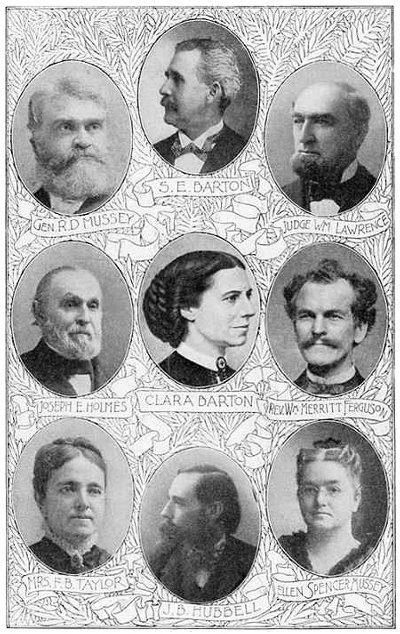
SOME OF THE FIRST MEMBERS OF THE AMERICAN NATIONAL RED CROSS. GEN. R.D. MUSSEY S.E. BARTON JUDGE WM. LAWRENCE JOSEPH E. HOLMES CLARA BARTON REV. WM. MERRITT FERGUSON MRS. F.B. TAYLOR J.B. HUBBELL ELLEN SPENCER MUSSEY
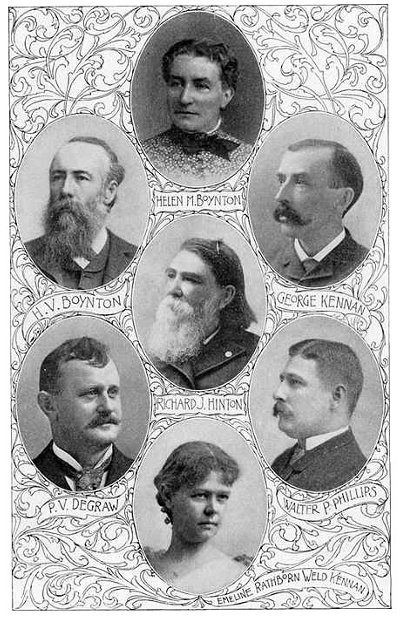
A GROUP OF AMERICAN NATIONAL RED CROSS MEMBERS.
HELEN M. BOYTNTON H.V. BOYNTON GEORGE KENNAN RICHARD J. HINTON P.V. DEGRAW WALTER P. PHILLIPS EMELINE RATHBORN WELD KENNAN
CONSTITUTION.
Name, Location.
Article 1. This Association shall be known as the American Association of the Red Cross, with its office located at Washington, D.C., and shall consist of the subscribers hereunto, and such other persons as shall hereafter be elected to membership; and it shall constitute a Central National Association with power to organize state and territorial associations auxiliary to itself.
Objects of Association.
Art. 2. The objects of the National Association are,
First, To secure the adoption by the Government of the United States of the Treaty of August 22, 1864.
Second, To obtain recognition by the Government of the United States, and to hold itself in readiness for communicating therewith at all times, to the end that its purposes may be more widely and effectually carried out.
Third, To organize a system of national relief and apply the same in mitigating the sufferings caused by war, pestilence, famine and other calamities.
Fourth, To collect and diffuse information touching the progress of mercy, the organization of national relief, the advancement of sanitary science and hospital service, and their application.
Fifth, To co-operate with all other national societies, for the furtherance of the articles herein set forth, in such ways as are provided by the regulations governing such co-operation.
Duties.
Art. 3. This association shall hold itself in readiness in the event of war or any calamity great enough to be considered national, to inaugurate such practical measures, in mitigation of the suffering and for the protection and relief of sick and wounded, as may be consistent with the objects of the association as indicated in Article 2.
Officers.
Art. 4. The officers of this association shall consist of a president; first vice-president; other vice-presidents, not to exceed one from each State, Territory, and the District of Columbia; a secretary; treasurer; an executive board; a board for consultation, which shall consist of the following officers of the United States Government, viz: The President and his cabinet: General of the Army; Surgeon General; Adjutant General, and Judge Advocate General, and such other officers as may hereafter be deemed necessary.
THE AMERICAN ASSOCIATION OF THE RED CROSS.
Original Incorporation.
The undersigned, all of whom are citizens of the United States of America, and a majority of whom are citizens of the District of Columbia, desirous of forming an association for benevolent and charitable purposes to co-operate with the Comité International de Secours aux Militaires Blessés of Geneva, Switzerland, do, in pursuance of sections 545, 546, 547, 548, 549, 550 and 551 of the Revised Statutes of the United States, relating to the District of Columbia, make, sign and acknowledge these:
Articles of Incorporation.
1.
The name of this association shall be the American Association of the Red Cross.
2.
The term of its existence shall be for twenty (20) years.
3.
The objects of this association shall be:
1st. To secure by the United States the adoption of the treaty of August 22, 1864, between Italy, Baden, Belgium, Denmark, Holland, Spain, Portugal, France, Prussia, Saxony, Wurtemberg, and the Federal Council of Switzerland.
2d. To obtain recognition by the Government of the United States, and to hold itself in readiness for communicating therewith at all times, to the end that its purposes may be more wisely and effectually carried out.
3d. To organize a system of national relief and apply the same in mitigating the sufferings caused by war, pestilence, famine and other calamities.
4th. To collect and diffuse information touching the progress of mercy, the organization of national relief, the advancement of sanitary science, and their application.
5th. To co-operate with all other similar national societies for the furtherance of the articles herein set forth, in such ways as are provided by the regulations governing such co-operation.
4.
The number of this association, to be styled the “Executive Board,” for the first year of its existence, shall be eleven (11).
In witness whereof we have hereunto set our hands and seals at the city of Washington this first day of July, A.D. 1881.
THE FIRST INTERNATIONAL CONFERENCE.
The proceedings of this Conference and what led up to it we learn chiefly from the historical report of the Conference by Mr. Gustav Moynier and Dr. Louis Appia, of the International Committee of the Red Cross. It was the work of this Conference that laid the foundation for the Treaty of Geneva, adopted in the following year.
In the year 1864, Europe was covered, as if by enchantment, with a network of committees for the relief of wounded soldiers; and this phenomenon would have led the least discerning persons to suspect that this special work was entering on a new phase. Several of these committees had already begun to exercise their functions in the Schleswig-Holstein war, yet all unanimously proclaimed that they would constitute themselves as permanent institutions, and, in a great measure, they seemed to obey one watch-word. All, in fact, declared in their charter of establishment, that they would conform to the resolutions of the Geneva Conference.
What, then, was this conference, whose magic wand had, so to speak, electrified all nations? It seems too important an historical fact to be passed over in silence, because we feel certain that an inquiry into its nature, and how it arose, will prove highly interesting.
1. It originated with the Société Genevoise d’utilité publique, which had undertaken to contribute toward the progress of philanthropy. At its sitting of the ninth of February, 1863, it discussed the question, in accordance with the proposition of one of its members, M. Henri Dunant, whether means might not be found to form, during a time of peace and tranquillity, relief societies, whose aim should be to help the wounded in time of war by means of volunteers, zealous, devoted and well qualified for such work.
Although it had no very clear idea of what should be done, in order to obtain the result which seemed desirable, the society took the matter under its patronage, and entrusted the examination of it to a special commission, with full power to act.
The course to be pursued was long debated in this little committee, the members of which finally agreed to submit the question to more competent judges. It was, in fact, necessary, before encouraging the formation of societies of volunteers, to know whether any need for them had been felt, and whether they would not be regarded with a jealous eye by the administrative or military authorities. It was also necessary to determine what should be the nature of their action under various social and political forms of government. In order not to venture recklessly on a road bristling with obstacles, it was therefore evident that they ought to take as guides experienced men, versed in the practice of war, and belonging to different nationalities. An International Conference appeared to be indispensable to the work, as a basis or starting point. If, after this ordeal, the first idea, upon which the most divergent opinions were even then professed, should be recognized as impracticable, its partisans would at least possess the consolation of having done their best. We shall have, said one of them, the approval of our consciences, and the feeling that we have done that which it is right men should do who love their neighbor. If, on the contrary, the thing were pronounced to be good, useful and acceptable, what encouragement such a decision would afford them to launch out upon their course! What moral force they who should first put themselves in the breach would receive! It was not a time to hesitate. The circular convoking the meeting was issued on the first of September, 1863.
Nothing was neglected that could give the greatest publicity to this appeal. It was brought specially to the notice of the International Statistical Congress, sitting at Berlin, in the month of September, 1863, which expressed an opinion entirely favorable to the project.
At length the day fixed for the opening of the Conference arrived. On the morning of the twenty-sixth of October, in the rooms of the Athenæum at Geneva, might be seen an assembly composed of eighteen official delegates, representing fourteen governments, six delegates of different associations, seven unaccredited visitors, with five members of the Geneva Committee. It was sufficient to glance over the list of the thirty-six members of the Conference, to understand that the expectation of its promoters was attained, and even surpassed, and that their initiative had already found its reward in the meeting of such a body. It was impossible that a deliberation among men so eminently qualified should not throw the fullest light on the question submitted to them. The committee tells us that the eagerness with which the invitation was responded to soon justified the propriety of the step it had taken. It became convinced that, in drawing public attention to the insufficiency of the official sanitary service, it had touched a sensitive chord, and had responded to a universal wish. It was also convinced that it was not pursuing a chimerical object. If, for a moment, it had feared that its project would only attract mere dreamers and Utopians, it was reassured on seeing that it had to deal with men in earnest, with medical and military magnates. It also received much encouragement from persons who were prevented from taking part in the debates, but who testified to the lively interest they took in them.
It was then, with the most happy auspices that General Dufour opened the Conference, which lasted four days, under the presidency of M. Moynier, president of the Genevoise Society of Public Utility, and the vice-presidency of His Highness Prince Henry XIII., of Reuss, the delegate of the Order of St. John of Jerusalem. Every one seemed animated by the best motives, and desirous not to lose so good an opportunity to open a new arena for the cause of charity. It was interesting to witness the general unanimity, as new as it was spontaneous, on a question of humanity instantaneously developed into one of philanthropic urgency. Dr. Landa, delegate of the Spanish Government, well expressed the sentiment of the assembly when he exclaimed, “Oh, that we may be so happy as to discover the basis which shall render the the useful institution we aspire to found durable and effectual!” The magnitude of the result which may be obtained, and the tears which may be wiped away, demand that we should devote all our efforts to attain it; and if this work be realized, it will be an event which all friends of humanity will be able to hail with the greatest joy. We feel, said the president of the Conference, that a great duty is imposed upon us, and we shall not rest until we have found means to lessen for our fellow-creatures the privations, the sufferings and the evils of all kinds which are the inevitable consequences of an armed contest.
So much good-will was not superfluous, in order to accomplish the arduous task of the Conference. For what, indeed, was it laboring? For nothing less than to reconcile two opposites—charity and war. The propriety of voluntary aid being admitted, it was necessary to leave it sufficiently free, in order that zeal might not be cooled by unreasonable conditions; yet, at the same time, to subject it to a certain discipline, so that it might have access to the army without being an encumbrance to it. Here was the real problem to be solved. Here was a link to be established between the civil and the military, which, though opposed, are not necessarily incompatible, and should be encouraged to live fraternally side by side. The experience of modern wars seemed to justify this inquiry, for it was averred that here the administration of voluntary offerings had been defective. Besides, the question presented itself in a new character, owing to the fact that a staff of volunteers occupied an important place in it. If this view of the case was to take precedence of all others, nothing less than a complete revolution was intended, and its importance being acknowledged, it would have been wrong to engage in it otherwise than earnestly. It was for discussion to reveal the opinion that was entertained of it.
Independently of all that was difficult in the very nature of the subject with which the conference was to occupy itself, it met with another obstacle, in the consideration which it was obliged to give to the different forms of government under which civilized nations dwell.
It is certain that a relief committee would be bound to modify its conduct, and its hands would be more or less free, according to the political or social circle in which it would have its existence. For example, where individual initiative is highly developed, as in Switzerland and America, there will be found liberty for the efforts of free societies which would not be tolerated to the same degree in France or Austria. The consequence of this situation was, that, called to draw up a code of military philanthropy for the use of all nations, the Conference could only advocate general principles, so that its decisions might be everywhere acceptable.
Here it took its stand, and following the advice of its president, it left to each society the duty of regulating minute details as it might judge expedient. It wisely confined its ambition to the construction of a solid foundation for the monument which it wished to erect, and which was perhaps destined to become one of the glories of our century.
Let us now give heed to the voice of the Conference, and let us cast our eyes over the resolutions, placed side by side with the propositions presented by the Geneva Committee, under the title of Projet de Concordat. It is evident, indeed, from a comparison of these two documents that the first ideas were true, since they have only been slightly modified. The authors of this project, however, offer it as the eminently perfectible fruit of their first meditations, and as a basis which they deemed it right to furnish to the Conference, in order to guide it in its labors.
General Provisions.
Article 1. There shall be, in each of the contracting countries, a national committee, whose duty shall consist in remedying, by all the means in its power, the inadequacy of the official sanitary service of the armies in active service.
This committee shall organize itself in the manner which may appear to it the most useful and expedient.
Art. 2. Sections, unlimited in number, shall be founded, in order to second the national committee. These shall be necessarily subordinate to the committee, to which alone shall belong the supreme direction.
Art. 3. Every national committee shall place itself in communication with the government of its own country, and shall ascertain that its efforts of service will be accepted in case of war.
Art. 4. In time of peace, the committees and their sections shall occupy themselves with improvements to be introduced in the military sanitary service, in the establishment of ambulances and hospitals, in the means of transports for the wounded, etc., and in pursuing the realization of these objects.
Art. 5. The committees and sections of the different countries shall reassemble in international congresses, in order to communicate the result of their experience, and to concert together on the measures to be taken in the interests of the work.
Art. 6. In the month of January every year, the national committees shall present a report of their labors during the past year, adding to it such communications as they may consider useful to be brought to the knowledge of the committees of other countries. The exchange of these communications and reports shall be managed through the medium of the Geneva committee, to whom they shall be addressed.
Special Provisions in Case of War.
Art. 7. In case of war, the committees of the belligerent nations shall furnish the necessary aid to their respective armies, and, in particular, shall provide for the formation and organization of corps of volunteer nurses.
They shall solicit the support of the committees belonging to neutral nations.
Art. 8. The volunteer nurses shall bind themselves to serve during a limited time, and not in any way to meddle in the operations of the war.
They shall be employed, according to their wish, in field service or in that of the hospitals. Females will necessarily be assigned to the latter.
Art. 9. The volunteer nurses shall wear a uniform in all countries, or an identical distinctive badge. Their person shall be sacred, and military chiefs shall afford them protection.
At the commencement of a campaign, the soldiers of both armies shall be informed of the existence of these corps, and of their exclusively benevolent character.
Resolutions of the Conference.
The International Conference, desirous to give aid to the wounded soldiers in all cases where the military medical service shall be inadequate, has adopted the following resolutions:
Article 1. There shall be in every country a committee whose duty it will be to co-operate in time of war by all the means in its power, with the sanitary service of the army.
This committee shall organize itself in the manner which may appear to it as the most useful and expedient.
Art. 2. Sections, unlimited in number, shall be formed, in order to second the committee, to which the general direction will belong.
Art. 3. Every committee shall place itself in communication with the government of its own country, in order that its offers of assistance, in case of need, may be accepted.
Art. 4. In time of peace the committees and sections shall be occupied with the means to make themselves really useful in time of war, especially in preparing material aid of every kind, and in endeavoring to train and instruct volunteer nurses.
Art. 5. In the event of war, the committees of the belligerent nations shall furnish relief to their respective armies in proportion to their resources; in particular, they shall organize and place the volunteer nurses on an active footing, and, in conjunction with the military authority, they shall arrange places for the reception of the wounded.
They shall solicit the assistance of the committees belonging to neutral nations.
Art. 6. On the demand, or with the concurrence, of the military authority, the committees shall send volunteer nurses to the field of battle. They shall there place them under the direction of the military chiefs.
Art. 7. The volunteer nurses employed with armies shall be provided, by their respective committees, with everything necessary for their maintenance.
Art. 8. They shall wear, in all countries, a white band around the arm with a Red Cross upon it, as a distinctive and uniform badge.
Art. 9. The committees and sections of the different countries shall meet in International Conference, in order to communicate to each other the results of their experience, and to decide on the measures to be adopted for the advancement of the work.
Art. 10. The exchange of communications between the committees of the different nations shall be made provisionally through the medium of the Committee of Geneva.
Independently of the above resolutions, the Conference expressed the following wishes:
A. That the governments should grant protection to the national committees which may be formed, and should, as far as possible, facilitate the accomplishment of their task.
B. That, in time of war, neutrality should be proclaimed by the belligerent nations for the field and stationary hospitals, and that it may also be accorded, in the most complete manner, to all officials employed in sanitary work, to volunteer nurses, to the inhabitants of the country who shall assist the wounded, and to the wounded themselves.
That an incidental distinctive sign be adopted for the medical corps of all armies, or, at least, for all persons attached to this service in the same army.
That an identical flag be also adopted for the field and stationary hospitals of all armies.
The innovation which is most striking, in reading these documents, is the pre-existence of the committees for war, and their creation and maintenance in times of peace.
If those societies which have hitherto labored had only conformed to this arrangement, they would have been spared much trouble, and would have been able to give to their resources a more judicious direction. If each of them had been enlightened by the experience of its predecessors; if each had known before hand that which it would have to do in such and such an emergency; if it had anticipated obstacles in order to remove them; and if it had been provided with money and material, it would have been able to render much greater services, and would not, to the same extent, have been a victim either to its inexperience or to its precipitation. The preliminary study of ways and means would have left traces of something more systematic and would have prevented much waste and many false calculations. Voluntary action will be so much more efficacious when it shall have preorganized. At a meeting of the different German relief committees held at Berlin, on the tenth of July, 1864, Baron Tinti, of Vienna, strongly insisted on this truth, and the Committee of Schwerin did the same in its report of 1865. When our generosity shall be less ignorant, it will know where and in what way it can be useful; we shall economize our means; we shall multiply our gifts by the good employment that we shall make of them, and by the direction that will be given to the public desire. Bis dat, qui cito dat. He who gives opportunely gives twice.
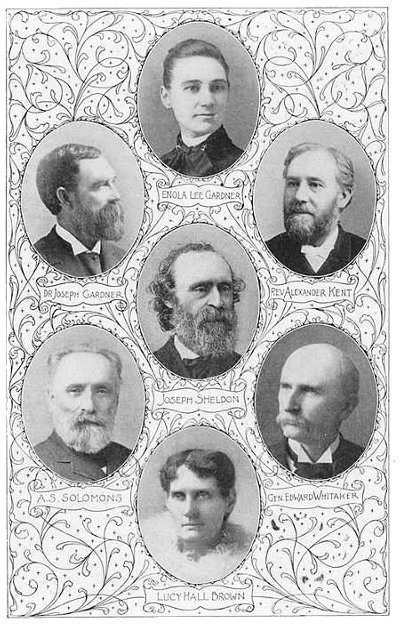
A GROUP OF NATIONAL RED CROSS MEMBERS.
ENOLA LEE GARDNER DR. JOSEPH GARDNER REV. ALEXANDER KENT JOSEPH SHELDON A.S. SOLOMON GEN. EDWARD WHITAKER LUCY HALL BROWN
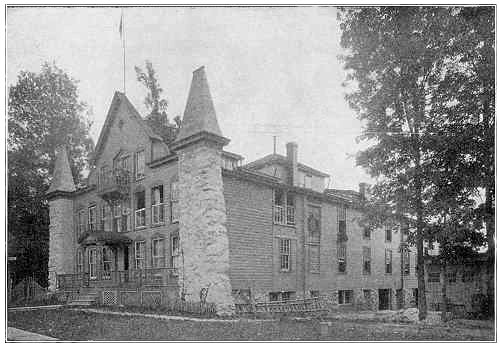
Copyright, 1898, by Clara Barton.
SUBURBAN HEADQUARTERS, AMERICAN NATIONAL RED CROSS.
THE INTERNATIONAL RED CROSS TREATY.
CONVENTION OF GENEVA.
For the Amelioration of the Condition of the Wounded in Armies at the Field, August 22, 1864.
The sovereigns of the following countries, to wit: Baden, Belgium, Denmark, Holland, Spain, Portugal, France, Prussia, Saxony, Würtemberg, and the Federal Council of Switzerland, animated by a common desire of mitigating, as far as in their power, the evils inseparable from war, of suppressing needless severities and of ameliorating the condition of soldiers wounded on fields of battle, having concluded to determine a treaty for this purpose, these plenipotentiaries, after the due interchange of their powers, found to be in good and proper form, have agreed upon the following articles, to wit:
Article 1. Ambulances (field hospitals) and military hospitals shall be acknowledged to be neutral, and as such shall be protected and respected by belligerents, so long as any sick or wounded may be therein. Such neutrality shall cease, if the ambulances or hospitals should be held by a military force.
Art. 2. Persons employed in hospitals and ambulances, comprising the staff for superintendence, medical service, administration, transport of wounded, as well as chaplains, shall participate in the benefit of neutrality whilst so employed, and so long as there remain any to bring in or to succor.
Art. 3. The persons designated in the preceding article may, even after occupation by the enemy, continue to fulfill their duties in the hospital or ambulance which they may have, or may withdraw in order to regain the corps to which they belong. Under such circumstances, when the persons shall cease from their functions, they shall be delivered by the occupying army to the outposts of the enemy. They shall have specially the right of sending a representative to the headquarters of their respective armies.
Art. 4. As the equipment of military hospitals remains subject to the laws of war, persons attached to such hospitals cannot, on withdrawing, carry away any articles but such as are their private property. Under the same circumstances an ambulance shall, on the contrary, retain its equipment.
Art. 5. Inhabitants of the country who may bring help to the wounded shall be respected and shall remain free. The generals of the belligerent powers shall make it their care to inform the inhabitants of the appeal addressed to their humanity, and of the neutrality which will be the consequence of it. Any wounded man entertained and taken care of in a house shall be considered as a protection thereto. Any inhabitant who shall have entertained wounded men in his house shall be exempted from the quartering of troops, as well as from a part of the contributions of war which may be imposed.
Art. 6. Wounded or sick soldiers shall be entertained and taken care of, to whatever nation they may belong. Commanders-in-chief shall have the power to deliver immediately to the outposts of the enemy, soldiers who have been wounded in an engagement, when circumstances permit this to be done, and with the consent of both parties. Those who are recognized after they are healed as incapable of serving, shall be sent back to their country. The others may also be sent back on the condition of not again bearing arms during the continuance of the war. Evacuations, together with the persons under whose directions they take place, shall be protected by an absolute neutrality.
Art. 7. A distinctive and uniform flag shall be adopted for hospitals, ambulances, and evacuations. It must on every occasion be accompanied by the national flag. An arm badge (brassard) shall also be allowed for individuals neutralized, but the delivery thereof shall be left to military authority. The flag and arm badge shall bear a red cross on a white ground.
Art. 8. The details of execution of the present convention shall be regulated by the commanders-in-chief of belligerent armies, according to the instructions of their respective governments, and in conformity with the general principles laid down in this convention.
Art. 9. The high contracting powers have agreed to communicate the present convention to those governments which have not found it convenient to send plenipotentiaries to the International Convention at Geneva, with an invitation to accede thereto; the protocol is, for that purpose, left open.
Art. 10. The present convention shall be ratified and the ratification shall be exchanged at Berne, in four months, or sooner, if possible.
In witness thereof the respective plenipotentiaries have signed the same, and have affixed thereto the seal of their arms.
Done at Geneva, the twenty-third day of August, 1864.
GOVERNMENTS ADOPTING THE TREATY.
List in chronological order of the governments which have adopted the articles of the Convention of Geneva, of the twenty-second of August, 1864:
FranceSeptember22, 1864.
SwitzerlandOctober1, 1864.
BelgiumOctober14, 1864.
NetherlandsNovember29, 1864.
ItalyDecember4, 1864.
Sweden and NorwayDecember13, 1864.
DenmarkDecember15, 1864.
SpainDecember15, 1864.
BadenDecember16, 1864.
GreeceJanuary17, 1865.
Great BritainFebruary18, 1865.
Mecklenburg-SchwerinMarch9, 1865.
PrussiaJune22, 1865.
TurkeyJuly5, 1865.
WürtembergJune2, 1866.
Hesse DarmstadtJune22, 1866.
BavariaJune30, 1866.
AustriaJuly21, 1866.
PortugalAugust9, 1866.
SaxonyOctober25, 1866.
RussiaMay22, 1867.
Pontifical StatesMay9, 1868.
RoumaniaNovember30, 1874.
PersiaDecember5, 1874.
San SalvadorDecember30, 1874.
MontenegroNovember29, 1875.
ServiaMarch24, 1876.
BoliviaOctober16, 1879.
ChiliNovember15, 1879.
Argentine RepublicNovember25, 1879.
PeruApril22, 1880.
United StatesMarch1, 1882.
BulgariaMarch1, 1884.
JapanJune5, 1886.
LuxemburgOctober5, 1888.
Hungary——
Congo Free StateDecember27, 1888.
Venezuela 1894.
SiamJune29, 1895.
South African RepublicSeptember30, 1896.
HondurasMay16, 1898.
NicaraguaMay16, 1898.
The following public address, written in 1881, is inserted because of its historical character, showing as it does, quite as well as anything that could now be written, the general apathy in America concerning the treaty, and the many obstacles that had to be overcome by years of struggle and weary waiting:
ADDRESS BY CLARA BARTON.
To the President, Congress, and People of the United States:
A brief statement of how I became acquainted with the Red Cross may serve to explain at once its principles and methods, as well as the present attitude of our government in regard to it.
The practical beneficence of the sanitary and Christian commissions of the United States attracted the attention of the civilized world. I had borne some part in the operations of field hospitals in actual service in the battles of the Civil War, and some public notice had been taken of that work. But, broken in health, I was directed by my physicians to go to Europe prepared to remain three years.
In September, 1869, I arrived at Geneva, Switzerland. In October I was visited by the president and members of the “International Committee for the relief of the wounded in war.” They wished to learn if possible why the United States had declined to sign the treaty. Our position was incomprehensible to them. If the treaty had originated with a monarchial government they could see some ground for hesitancy. But it originated in a Republic older than our own. To what did America object, and how could these objections be overcome? They had twice formally presented it to the government at Washington, once in 1864, through our Minister Plenipotentiary at Berne, who was present at the convention; again in 1868, through Rev. Dr. Henry W. Bellows, the great head of war relief in America. They had failed in both instances. No satisfactory nor adequate reason had ever been given by the nation for the course pursued. They had thought the people of America, with their grand sanitary record, would be the first to appreciate and accept it. I listened in silent wonder to all this recital, and when I did reply it was to say that I had never in America heard of the Convention of Geneva nor of the treaty, and was sure that as a country America did not know she had declined; that she would be the last to withhold recognition of a humane movement; that it had doubtless been referred to and declined by some one department of the government, or some one official, and had never been submitted to the people; and as its literature was in languages foreign to our English-speaking population, it had no way of reaching us.
You will naturally infer that I examined it. I became all the time more deeply impressed with the wisdom of its principles, the good practical sense of its details, and its extreme usefulness in practice. Humane intelligence had devised its provisions and peculiarly adapted it to win popular favor. The absurdity of our own position in relation to it was simply marvelous. As I counted up its roll of twenty-two nations—not a civilized people in the world but ourselves missing, and saw Greece, Spain, and Turkey there, I began to fear that in the eyes of the “rest of mankind” we could not be far from barbarians. This reflection did not furnish a stimulating food for national pride. I grew more and more ashamed. But the winter wore on as winters do with invalids abroad. The summer found me at Berne in quest of strength among its mountain views and baths.
On the fifteenth of July, 1870, France declared war against Prussia. Within three days a band of agents from the “International Committee of Geneva,” headed by Dr. Louis Appia (one of the prime movers of the convention), equipped for work and en route for the seat of war, stood at the door of my villa inviting me to go with them and take such part as I had taken in our own war. I had not strength to trust for that, and declined with thanks, promising to follow in my own time and way, and I did follow within a week. No shot had then been fired—no man had fallen—yet this organized, powerful commission was on its way, with its skilled agents, ready to receive, direct and dispense the charities and accumulations which the generous sympathies of twenty-two nations, if applied to, might place at its disposal. These men had treaty power to go directly on to any field, and work unmolested in full co-operation with the military and commanders-in-chief; their supplies held sacred and their efforts recognized and seconded in every direction by either belligerent army. Not a man could lie uncared for nor unfed. I thought of the Peninsula in McClellan’s campaign—of Pittsburg Landing, Cedar Mountain and second Bull Run, Antietam, Old Fredericksburg with its acres of snow-covered and gun-covered glacee, and its fourth-day flag of truce; of its dead, and starving wounded, frozen to the ground, and our commissions and their supplies in Washington, with no effective organization to go beyond; of the Petersburg mine, with its four thousand dead and wounded and no flag of truce, the wounded broiling in a July sun—died and rotted where they fell. I remembered our prisons, crowded with starving men whom all the powers and pities of the world could not reach even with a bit of bread. I thought of the widows’ weeds still fresh and dark through all the land, north and south, from the pine to the palm; the shadows on the hearths and hearts over all my country. Sore, broken hearts, ruined, desolate homes! Was this people to decline a humanity in war? Was this a country to reject a treaty for the help of wounded soldiers? Were these the women and men to stand aloof and consider? I believed if these people knew that the last cloud of war had forever passed from their horizon, the tender, painful, deathless memories of what had been would bring them in with a force no power could resist. They needed only to know.
As I journeyed on and saw the work of these Red Cross societies in the field, accomplishing in four months under their systematic organization what we failed to accomplish in four years without it—no mistakes, no needless suffering, no starving, no lack of care, no waste, no confusion, but order, plenty, cleanliness and comfort wherever that little flag made its way—a whole continent marshaled under the banner of the Red Cross—as I saw all this, and joined and worked in it, you will not wonder that I said to myself “If I live to return to my country I will try to make my people understand the Red Cross and that treaty.” But I did more than resolve, I promised other nations I would do it, and other reasons pressed me to remember my promise. The Franco-Prussian war and the war of the commune were both enormous in the extent of their operations and in the suffering of individuals. This great modern international impulse of charity went out everywhere to meet and alleviate its miseries. The small, poor countries gave of their poverty and the rich nations poured out abundantly of their vast resources. The contributions of those under the Red Cross went quietly, promptly through international responsible channels, were thoughtfully and carefully distributed through well-known agents, returns, accurate to a franc, were made and duly published to the credit of the contributing nations, and the object aimed at was accomplished.
America, filled with German and French people, with people humane and universal in their instincts of citizenship and brotherhood, freighted ships with supplies and contributions in money prodigal and vast. They arrived in Europe, but they were not under the treaty regulations. No sign of the Red Cross authorized any one to receive and distribute them. The poor baffled agents, honest, well meaning and indefatigable, did all that individuals without system or organization could do. But for the most part the magnificent charity of America was misapplied and went as unsystematized charity always tends to go, to ruin and to utter waste. The object aimed at was not accomplished. At the end of the report of the international organization of the Red Cross occurs something like this: “It is said that the United States of America also contributed something for the sick and wounded, but what, or how much, or to whom, or when or where, it is impossible to tell.”
In the autumn of 1873, I returned to America more broken in health than when I left in 1869. Then followed years of suffering in which I forgot how to walk, but I remembered my resolve and my promise. After almost five years I was able to go to Washington with a letter from Monsieur Moynier, president of the International Committee of Geneva, to the President of the United States, asking once more that our government accede to the articles of the convention. Having been made the official bearer of this letter, I presented it in 1877 to President Hayes, who received it kindly, referring it to his Secretary of State, Mr. Evarts, who in his turn referred it to his assistant secretary as the person who would know all about it, examine and report for decision. I then saw how it was made to depend not alone upon one department, but one man, who had been the assistant secretary of state in 1864 and also in 1868, when the treaty had been on the two previous occasions presented to our government. It was a settled thing. There was nothing to hope for from that administration. The matter had been officially referred and would be decided accordingly. It would be declined because it had been declined. If I pressed it to a decision, it would only weigh it down with a third refusal. I waited. My next thought was to refer it to Congress. That step would be irregular, and discourteous to the administration. I did not like to take it, still I attempted it, but could not get it considered, for it promised neither political influence, patronage, nor votes.
The next year I returned to Washington to try Congress again. I published a little pamphlet of two leaves addressed to the members and senators, to be laid upon their desks in the hope they would take the trouble to read so little as that, and be by so much the better prepared to consider and act upon a bill if I could get one before them. My strength failed before I could get that bill presented, and I went home again in midwinter. There then remained but a portion of the term of that administration, and I determined, if possible, to outlive it, hoping another would be more responsive. Meanwhile I wrote, talked, and did whatever I could to spread the idea among the people, and March, 1881, when the administration of President Garfield came in, I went again to Washington. The subject was very cordially received by the President and carefully referred by him to Secretary Blaine, who considered it himself, conferred fully with me, and finally laid it before the President and the cabinet. Perhaps the most satisfactory account of that transaction will be found in the letter of Mr. Blaine addressed to me, (see page 41), which gives the assurance that President Garfield would recommend the adoption of the treaty in his message to Congress.
What were the provisions of that treaty which had been so conspicuously and persistently neglected and apparently rejected by this whole government, whose people are as humane as any people in the world, and as ready to adopt plain and common sense provisions against evils sure to come upon themselves and those whom they hold most dear? It was merely the proposed adoption of a treaty by this government with other nations for the purpose of ameliorating the conditions incident to warfare, humanizing its regulations, softening its barbarities, and so far as possible, lessening the sufferings of the wounded and sick who fall by it. This treaty consists of a code of ten articles, formed and adopted by the International Convention of Geneva, Switzerland, held August 22, 1864, which convention was composed of delegates, two or more from each of the civilized nations of the world, and was called at the instance of the members of the Society of Public Utility of Switzerland.
The sittings of the convention occupied four days, and resulted, as before stated, in a code of ten articles, to be taken by the delegates there present, back to the governments of their respective countries for ratification. Four months were allowed for consideration and decision by the governments, and all acceding within that time were held as having signed at the convention. At the close of this period, it was found that twelve nations had endorsed the terms of the treaty and signed its articles. The protocol was left open for such as should follow. The articles of this treaty provide, as its first and most important feature, for the entire and strict neutrality of all material and supplies contributed by any nation for the use of the sick and wounded in war; also that persons engaged in the distribution of them, shall not be subject to capture; that all hospitals, general or field, shall be neutral, respected and protected by all belligerents; that all persons comprising the medical service, surgeons, chaplains, superintendents, shall be neutral, continuing their work after the occupation of a field or post the same as before, and when no longer needed be free to retire; that they may send a representative to their own headquarters if needful; that field hospitals shall retain their own equipments; that inhabitants of a country who entertain and care for the wounded of either side, in their houses, shall be protected; that the generals of an army shall so inform the people; that commanders-in-chief shall have the power to deliver immediately to the outposts of the enemy soldiers who have been wounded in an engagement, both parties consenting to the same; that the wounded, incapable of serving, shall be returned when healed; that all transports of wounded and all evacuations of posts or towns shall be protected by absolute neutrality. That the sick and wounded shall be entertained regardless of nationality; and that commanders-in-chief shall act in accordance with the instructions of their respective governments, and in conformity to the treaty. In order that all may understand, and no mistake be possible, it also provides that one uniform international flag shall mark all hospitals, all posts of sick and wounded, and one uniform badge or sign shall mark all hospital material, and be worn by all persons properly engaged in the hospital service of any nation included within the treaty; that this international flag and sign shall be a red cross on a white ground, and that the nations within the compact shall not cease their endeavors until every other nation capable of making war shall have signed this treaty, and thus acceded to the general principles of humanity in warfare recognized by other peoples.
Thirty-one governments have already signed this treaty, thirty-one nations are in this humane compact. The United States of America is not in it, and the work to which your attention is called, and which has occupied me for the last several years, is to induce her to place herself there.
This is what the Red Cross means, not an order of knighthood, not a commandery, not a secret society, not a society at all by itself, but the powerful, peaceful sign and the reducing to practical usefulness of one of the broadest and most needed humanities the world has ever known.
These articles, it will be observed, constitute at once a treaty governing our relations with foreign nations, and additional articles of war governing the conduct of our military forces in the field. As a treaty under the constitution, the President and Senate are competent to deal with them; as additional articles of war, Congress must sanction and adopt them before they can become effective and binding upon the government and the people. For this reason I have appealed to Congress as well as to the Executive Department.
On the breaking up of the original convention at Geneva, the practical work of organizing its principles into form and making them understood and adopted by the people, devolved upon seven men, mainly those who had been instrumental in calling it. These men were peculiarly fitted for this work by special training, enlarged views, and a comprehensive charity, no less than by practical insight, knowledge of the facts and needs of the situation, and a brave trust in the humane instincts of human nature. They are known to-day the world over as “The International Committee of Geneva for the relief of the sick and wounded in war.” This committee is international, and is the one medium through which all nations within the treaty transact business and carry on correspondence.
The first act of each nation subsequent to the treaty has been to establish a central society of its own, which of course is national, and which has general charge and direction of the work of its own country. Under these comes the establishment of local societies. It will be perceived that their system, aside from its international feature, is very nearly what our own war relief societies would have been had they retained permanent organizations. Indeed, it is believed that we furnished for their admirable system some very valuable ideas. The success of the Red Cross associations consists in their making their societies permanent, holding their organizations firm and intact, guarding their supplies, saving their property from waste, destruction and pillage, and making the persons in charge of the gifts of the people as strictly responsible for straightforward conduct and honest returns, as they would be for the personal property of an individual, a business firm, or a bank.
In attempting to present to the people of this country the plan of the Red Cross societies, it is proper to explain that originally and as operating in other countries they recognize only the miseries arising from war. Their humanities, although immense, are confined to this war centre. The treaty does not cover more than this, but the resolutions for the establishment of societies under the treaty, permit them to organize in accordance with the spirit and needs of their nationalities. By our geographical position and isolation we are far less liable to the disturbances of war than the nations of Europe, which are so frequently called upon that they do well to keep in readiness for the exigencies of war alone. But no country is more liable than our own to great overmastering calamities, various, widespread and terrible. Seldom a year passes that the nation from sea to sea is not, by the shock of some sudden, unforeseen disaster, brought to utter consternation, and stands shivering like a ship in a gale, powerless, horrified, and despairing. Plagues, cholera, fires, flood, famine, all bear upon us with terrible force. Like war these events are entirely out of the common course of woes and necessities. Like death they are sure to come in some form and at some time, and like it no mortal knows where, how or when.
What have we in readiness to meet these emergencies save the good heart of our people and their impulsive, generous gifts? Certainly no organized system for collection, reception nor distribution; no agents, nurses nor material, and, worst of all, no funds; nowhere any resources in reserve for use in such an hour of peril and national woe; every movement crude, confused and unsystematized, every thing as unprepared as if we had never known a calamity before and had no reason to expect one again.
Meanwhile the suffering victims wait! True, in the shock we bestow most generously, lavishly even. Men “on Change” plunge their hands into their pockets and throw their gold to strangers, who may have neither preparation nor fitness for the work they undertake, and often no guaranty for honesty. Women, in the terror and excitement of the moment and in their eagerness to aid, beg in the streets and rush into fairs, working day and night, to the neglect of other duties in the present, and at the peril of all health in the future—often an enormous outlay for very meagre returns. Thus our gifts fall far short of their best, being hastily bestowed, irresponsibly received and wastefully applied. We should not, even if to some degree we might, depend upon our ordinary charitable and church societies to meet these great catastrophes; they are always overtaxed. Our communities abound in charitable societies, but each has its specific object to which its resources are and must be applied; consequently they cannot be relied upon for prompt and abundant aid in a great and sudden emergency. This must necessarily be the case with all societies which organize to work for a specific charity. And this is as it should be; it is enough that they do constantly bestow.
Charity bears an open palm, to give is her mission. But I have never classed these Red Cross societies with charities, I have rather considered them as a wise national provision which seeks to garner and store up something against an hour of sudden need. In all our land we have not one organization of this nature and which acts upon the system of conserved resources. Our people have been more wise and thoughtful in the establishment of means for preventing and arresting the destruction of property than the destruction of human life and the lessening of consequent suffering. They have provided and maintain at an immense cost, in the aggregate, a system of fire departments with their expensive buildings and apparatus, with their fine horses and strong men kept constantly in readiness to dash to the rescue at the first dread clang of the fire bell. Still, while the electric current may flash upon us at any moment its ill tidings of some great human distress, we have no means of relief in readiness such as these Red Cross societies would furnish.
I beg you will not feel that in the presentation of this plan of action I seek to add to the labors of the people. On the contrary, I am striving to lessen them by making previous, calm preparation do away with the strain and confusion of unexpected necessities and haste. I am providing not weariness, but rest.
And, again, I would not be understood as suggesting the raising of more moneys for charitable purposes; rather I am trying to save the people’s means, to economize their charities, to make their gifts do more by the prevention of needless waste and extravagance. If I thought that the formation of these societies would add a burden to our people I would be the last to advocate it. I would not, however, yield the fact of the treaty. For patriotism, for national honor, I would stand by that at all cost. My first and greatest endeavor has been to wipe from the scroll of my country’s fame the stain of imputed lack of common humanity, to take her out of the roll of barbarism. I said that in 1869 there were twenty-two nations in the compact. There are now thirty-one, for since that date have been added Roumania, Persia, San Salvador, Montenegro, Servia, Bolivia, Chili, Argentine Republic and Peru. If the United States of America is fortunate and diligent she may, perhaps, come to stand No. 32 in the roll of civilization and humanity. If not, she will remain where she at present stands, among the barbarians and the heathen.
In considering this condition of things it seemed desirable to so extend the original design of the Red Cross societies operating in other lands as to include not only suffering by war, but by pestilence, famine, fires or floods—in short, any unlooked-for calamity so great as to place it beyond the means of ordinary local charity, and which by public opinion would be pronounced a national calamity; but that this addition should in no way impair the original functions of the society, and that for their own well being they should be held firm by the distinguishing feature of the international constitution, which provides that local societies shall not act except upon orders from the National Association, which is charged with the duty of being so fully informed upon all such subjects, both at home and abroad, as to constitute it the most competent judge of the magnitude and gravity of any catastrophe.
During all these years no societies under the true banner of the Red Cross of Geneva were or could be organized, for the government had not yet ratified the treaty and no department of the government had then intimated that it ever would be ratified. It could not be a responsible or quite an honest movement on my part to proceed to the formation of societies to act under and in conformity to a treaty of special character so long as our government recognized no such treaty and I could get no assurance that it ever would or indeed could recognize it.
But this delay in the formation of societies, however embarrassing, was in no manner able to interfere with the general plan, or the working details for its operations, which had been arranged and decided upon before the presentation of the subject to the government in 1877, and published in pamphlet form in 1878, making it to cover, as it now does, the entire field of national relief for great national woes and calamities in time of peace, no less than in war. The wise provisions, careful preparations and thorough system which had been found so efficient in the permanent societies of the Red Cross in other countries, could not fail, I thought, to constitute both a useful and powerful system of relief in any class of disasters. I therefore ventured so far upon the generous spirit of their original resolutions in the plan of our societies as, mechanically speaking, to attach to this vast motor power the extra and hitherto dead weight of our great national calamities, in order that the same force should apply to all and serve to lighten I hoped, so far as possible, not only the woes of those directly called to suffer, but the burdens on the hearts and hands of those called to sympathize with their sufferings.
The time allowed for the practical test of this experiment has been short. Scarcely three months in which to organize and act, but the brave societies of the Red Cross of western New York, at this moment standing so nobly among their flame-stricken neighbors of Michigan— so generously responding to their calls for help, are quite sufficient I believe to show what the action and results of this combined system will be when recognized and inaugurated.