Chapter XXVIII · (continued 2)
Reading edition
Sufferings of the Colonists.—A Happy Change.—Capture of the Pigot by Talbot
to numbers, as distressing as in the Revolutionary war. There was scarce a family from which Death had not selected a victim." * Thus ended the first general Indian war in New England. Righteousness, sitting upon the throne of judgment, has long since decided the question of equity; and we, viewing the scene at a distance, can not fail to discern the true verdict against the avaricious white man.
Those dark days of distress and crime are passed away forever. The splendors of an October sun, which then shed a radiance over the forests and the waters, beautiful as now, no longer light up the ambuscade of the red men, or the hiding-places of the pale-faces lurking for blood. From the bald eminence on which I stand, the land of Philip and Canonchet, of Witamo and Miantonômoh, and the broad waters where they sported in peace, are spread out to the eye beautiful as the "Happy Valley," and upon the whole domain rest the beneficent influences of love, harmony, righteousness, and peace. Let us, then, endeavor to forget the gloomy past, and leave upon memory only the bright vision of the present.
The vision was bright indeed, but it was the sheen of the glacier. The unclouded sun and the uncurbed north wind wrestled for the mastery. The latter was the victor, and, until I was warmed at the table of Mr. Anthony, I could not fully comprehend the charms which I had beheld while half frozen among the mounds of the old fortress on the hill.
I returned to Newport by the way of Vaucluse, on the eastern road, where I sketched the great sycamore pictured on page 653, which is standing upon the bank of the Seaconnet or Eastern Channel. Near the mouth of this passage, a little below Vaucluse, occurred one of those events, characterized by skill and personal bravery, which make up a large portion of the history of our war for independence. In order to close up this channel, when the French fleet appeared off Newport, the British converted a strong vessel of two hundred tuns into a galley, and named it Pigot, in honor of the commander on Rhode Island. Its upper deck was removed, and on its lower deck were placed twelve eight-pounders, which belonged to the Flora, that was sunk in Newport harbor, and also ten swivels. Thus armed, she was a formidable floating battery. Major Silas Talbot, whose exploits had already won the expressed approbation of Congress, proposed an expedition to capture or destroy this vessel, for it effectually broke up the local trade of that section. General Sullivan regarded his scheme as impracticable, but finally consented to give Talbot permission to make the attempt. A draft of men for the purpose was allowed, and with sixty resolute, patriots, Talbot sailed from Providence in a coasting sloop called the Hawk, which he had fitted out for the purpose. Armed with only three three-pounders, besides the small arms of his men, he sailed by the British forts at Bristol Ferry, and anchored within a few miles of the Pigot. Procuring a horse on shore, he rode down the east bank and reconnoitered. The galley presented a formidable appearance, yet the major was not daunted. At nine o'clock in the evening, favored with a fair wind, and accompanied by Lieutenant Helm, of Rhode Island, and a small re-enforcement, Talbot hoisted the anchor of the Hawk and with a kedge-anchor lashed to the jib-boom to tear the nettings of the Pigot, he bore down upon 1778 that vessel. It was a very dark night in October. Under bare poles he drifted past Fogland Ferry fort without being discovered, when he hoisted sail and ran partly under the stem of the galley. The sentinels hailed him, but, returning no answer, a volley of musketry was discharged at the Hawk without effect. The anchor tore the nettings and grappled the fore-shrouds of the Pigot, enabling the assailants to make a free passage to her deck. With loud shouts, the Americans poured from the Hawk, and drove every man of the Pigot into the hold, except the commander, who fought desperately alone, with no other mail than shirt and drawers, until he perceived that resistance was useless. The Pigot was surrendered, with the officers and crew. Her cables were coiled over the hatchways, to secure the prisoners below, and, weighing anchor, Talbot, with his prize, entered the harbor of Stonington the next day. This bold adventure was greatly applauded, and, on the 14th of November following, Congress complimented Talbot and his men, and presented him with
* Bancroft, ii., 108, 109.
Promotion of Talbot.—Departure from Newport.—Adieu to New England.—Halleck's "Connecticut."
a commission of lieutenant colonel in the army of the United States. * He was afterward transferred to the navy, in which service we shall meet him again.

I reached Newport at four o'clock, and at sunset was on board the Empire State, a noble Sound steam-boat (which was partially destroyed by fire a few weeks afterward), bound for New York.
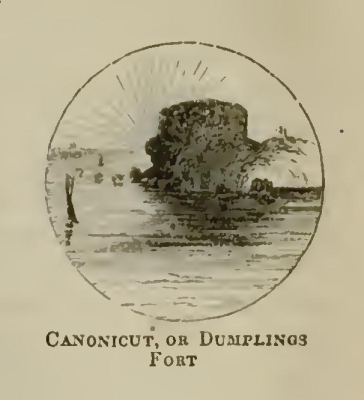
We passed old Fort Canonicut and Fort Adams, and out of the harbor at twilight; and at dark, leaving the Beaver-tail light behind, we were breasting the moon-lit waves of the ocean toward Point Judith. I now bade a final adieu to New England, to visit other scenes hallowed by the struggle of our fathers for liberty.
Often since has the recollection of my visit there come up in memory like a pleasant dream; and never can I forget the universal kindness which I received during my brief tarry among the people of the East.
"They love their land because it is their own,
And scorn to give aught other reason why;
Would shake hands with a king upon his throne,
And think it kindness to his majesty;
A stubborn race, fearing and flattering none.
Such are they nurtured, such they live and die,
All, but a few apostates, who are meddling
With merchandise, pounds, shillings, pence, and peddling;
"Or, wandering through the Southern countries, teaching
The ABC from Webster's spelling-book;
Gallant and godly, making love and preaching,
And gaining, by what they call 'hook and crook,'
And what the moralists call overreaching,
A decent living. The Virginians look
Upon them with as favorable eyes
As Gabriel on the Devil in Paradise.
"But these are but their outcasts. View them near,
At home, where all their worth and pride are placed;
And there their hospitable fires burn clear,
And there the lowliest farm-house hearth is graced
With manly hearts; in piety sincere;
Faithful in love, in honor stern and chaste,
In friendship warm and true, in danger brave,
Beloved in life, and sainted in the grave."
Halleck's "Connecticut."
* See Tuckerman's Life of Talbot; Journals of Congress, iv., 471.
The Hudson Highlands.—Newburgh.—The Indian Summer.—Its character