Chapter II · (continued 2)
Reading edition
"I could not go to sleep, as I had General Fraser and all the other wounded gentlemen in my room, and I was sadly afraid my children would wake, and, by their crying, disturb the dying man in his last moments, who often addressed me and apologized 'for the trouble he gave me.' About three o'clock in the morning I was told that he could not hold out much longer; I had desired to be informed of the near approach of this sad crisis, and I then wrapped up my children in their clothes, and went with them into the room below About eight o'clock in the morning he died.
"After he was laid out, and his corpse wrapped up in a sheet, we came again into the room, and had this sorrowful sight before us the whole day; and, to add to the melancholy scene, almost every moment some officer of my acquaintance was brought in wounded. The cannonade commenced again; a retreat was spoken of, but not the smallest motion was made toward it. About four o'clock in the afternoon I saw the house which had just been built for me in flames, and the enemy was now not far off. We knew that General Burgoyne would not refuse the last request of General Fraser, though, by his acceding to it, an unnecessary delay was occasioned, by which the inconvenience of the army was much increased. At six o'clock the corpse was brought out, and we saw all the generals attend it to the mountain. The chaplain, Mr. Brudenell, performed the funeral service, rendered
Burial of Fraser.—Humanity of the Americans.—Lady Harriet Ackland.
unusually solemn and awful from its being accompanied by constant peals from the enemy's artillery. Many cannon-balls flew close by me, but I had my eyes directed toward the mountain * where my husband was standing amid the fire of the enemy, and of course I could not think of my own danger."
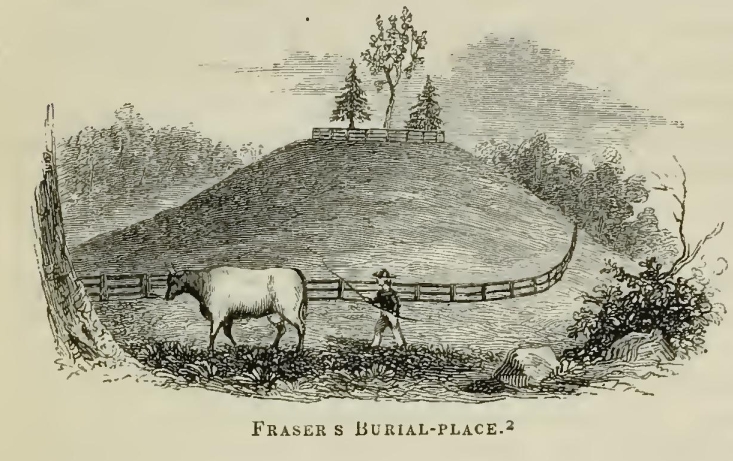

It was just at sunset, on that calm October evening, that the corpse of General Fraser was carried up the hill to the place of burial within the "great redoubt." It was attended only by the members of his military family and Mr. Brudenell, the chaplain; yet the eyes of hundreds of both armies followed the solemn procession, while the Americans, ignorant of its true character, kept up a constant cannonade upon the redoubt. The chaplain, unawed by the danger to which he was exposed, as the cannonballs that struck the hill threw the loose soil over him, pronounced the impressive funeral service of the Church of England with an unfaltering voice. *** The growing darkness added solemnity to the scene.
Suddenly the irregular firing ceased, and the solemn voice of a single cannon, at measured intervals, boomed along the valley, and awakened the responses of the hills. It was a minute-gun fired by the Americans in honor of the gallant dead. The moment information was given that the gathering at the redoubt was a funeral company, fulfilling, amid imminent perils, the last-breathed wishes of the noble Fraser, orders were issued to withhold the cannonade with balls, and to render military homage to the fallen brave.
How such incidents smooth the rough features of war! In contrast with fiercer ages gone by, when human sympathy never formed a holy communion between enemies on the battlefield, they seem to reflect the radiance of the future, and exhibit a glimpse of the time to which a hopeful faith directs our vision, when "nation shall not war against nation," when "one law shall bind all people, kindreds, and tongues, and that law shall be the law of UNIVERSAL BROTHERHOOD."
The case of Major Ackland and his heroic wife presents kindred features. He belonged to the corps of grenadiers, and was an accomplished soldier. His wife accompanied him to Canada in 1776, and during the whole campaign of that year, and until his return to England after the surrender of Burgoyne, in the autumn of 1777, endured all the hardships, dangers, and privations of an active campaign in an enemy's country. At Chambly, on the Sorel, she attended him in illness, in a miserable hut; and when he was wounded in the battle of Hubbardton, Vermont, she hastened to him at Skenesborough from Montreal, where she had been persuaded to remain, and resolved to follow the army thereafter. Just before crossing the Hudson, she and her husband came near losing their lives in consequence of their tent taking fire from a candle overturned by a pet dog. During the terrible engagement of the 7th of October she heard all the tumult and dreadful thunder of the battle in which her husband was engaged; and when, on the morning of the 8th, the British fell
* The height occupied by Burgoyne on the 18th, which ran parallel with the river till it approached General Gates's camp.
** The hill on which the "great redoubt" was erected, and where General Fraser was buried, is about one hundred feet high, and almost directly west from the house wherein he died. The relative situation of this eminence to the Hudson will be best understood by looking at the view of Burgoyne's encampment, page 57. The center hill in that drawing is the one here represented. The grave is within the inclosure on the summit of the hill.
*** Burgoyne's "State of the Expedition," p. 169. Lieutenant Kingston's Evidence, p. 107.
Courage and Fortitude of Lady Harriet Ackland.—Burgoyne's Request and Gates's Generosity.
Lady Harriet Ackland with the other women, was obliged to take refuge among the dead and dying, for the tents were all struck, and hardly a shed was left standing. Her husband was wounded, and a prisoner in the American camp. That gallant officer was shot through both legs when Poor and Learned's troops assaulted the grenadiers and artillery on the British left, on the afternoon of the 7th. Wilkinson, Gates's adjutant general, while pursuing the flying enemy when they abandoned their battery, heard a feeble voice exclaim, "Protect me, sir, against that boy." He turned and saw a lad with a musket, taking deliberate aim at a wounded British officer, lying in a corner of a worm fence. Wilkinson ordered the boy to desist, and discovered the wounded man to be Major Ackland. He had him conveyed to the quarters of General Poor (now the residence of Mr. Neilson), on the heights, where every attention was paid to his wants.
When the intelligence that he was wounded and a prisoner reached his wife, she was greatly distressed, and, by the advice of her friend, the Baroness Riedesel, resolved to visit the American camp, and implore the favor of a personal attendance upon her husband. On the 9th she sent a message to Burgoyne by Lord Petersham, his aid, asking October, 1777 permission to depart. "Though I was ready to believe," says Burgoyne, "that patience and fortitude, in a supreme degree, were to be found, as well as every other virtue, under the most tender forms, I was astonished at this proposal. After so long an agitation of spirits, exhausted not only for want of rest, but absolutely want of food, drenched in rains for twelve hours together, that a woman should be capable of such an undertaking as delivering herself to an enemy, probably in the night, and uncertain of what hands she might fall into, appeared an effort above human nature. The assistance I was enabled to give was small indeed; I had not even a cup of wine to offer her; but I was told she had found, from some kind and fortunate hand, a little rum and dirty water. All I could furnish to her was an open boat and a few lines, written upon dirty wet paper, to General Gates, recommending her to his protection." *
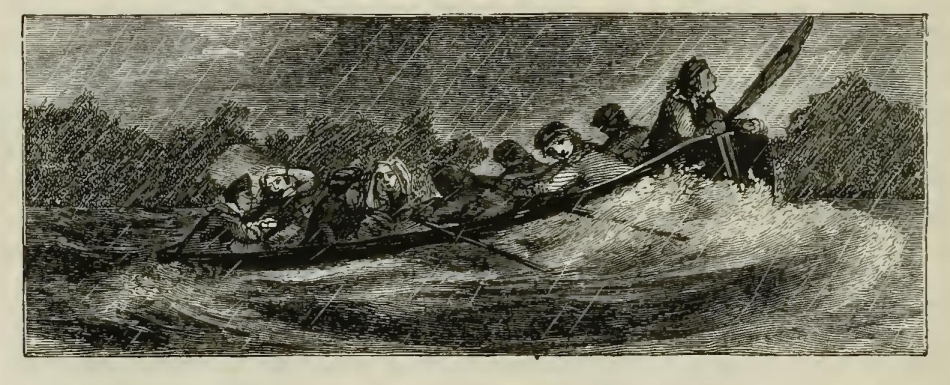
She set out in an open boat upon the Hudson, accompanied by Mr. Brudenell the chaplain, Sarah Pollard her waiting-maid, and her husband's valet, who had been severely wounded while searching for his master upon the battle-field. It was about sunset when they started, and a violent storm of rain and wind, which had been increasing since morning, rendered the voyage tedious and perilous in the extreme. It was long after dark when they reached the American outposts. The sentinel heard their oars and hailed them. Lady Harriet returned the answer herself. The clear, silvery tones of a woman's voice amid the darkness filled the soldier on duty with superstitious fear, and he called a comrade to accompany him to the river bank. The errand of the voyagers was made known, but the faithful guard, apprehensive of treachery, would not allow them to land until they sent for Major Dearborn. This delay was only for a few minutes, not "seven or eight dark and cold hours," as asserted by Burgoyne. They were invited by that officer to his quarters, where a cup of tea and other comforts were provided; and Lady Harriet was also comforted by the joyful tidings that her husband was safe. In the morning she experienced parental tenderness from General Gates, who sent her to her husband at Poor's quarters, under a suitable escort. There she remained until he was removed to Albany. **
* The following is a copy of the note from Burgoyne to General Gates: "Sir-Lady Harriet Ackland, a lady of the first distinction of family, rank, and personal virtues, is under such concern on account of Major Ackland, her husband, wounded and a prisoner in your hands, that I can not refuse her request to commit her to your protection. Whatever general impropriety there may be in persons in my situation and yours to solicit favors, I can not see the uncommon perseverance in every female grace and exaltation of character of this lady, and her very hard fortune, without testifying that your attentions to her will lay me under obligations. "I am, sir, your obedient servant,
"J. Burgoyne." ***
** Major Ackland reciprocated the generous treatment here extended, by doing all in his power, while on parole in New York, to alleviate the condition of distinguished American prisoners there. After his return to England, he warmly defended American courage, at a dinner party, against the aspersions of a Lieutenant Lloyd. High words passed, and a duel ensued. The major was shot dead; Lady Harriet became a maniac, and remained so two years. After her recovery, she married Mr Brudenell, the chaplain already mentioned.
*** The original is among Gates's papers (voL x.), in the possession of the New York Historical Society, from which this was copied.
Lines by Mrs. Morton.—Death of Major Ackland.—Second Marriage of Lady Harriet.
When we consider the delicate form, the gentleness and refinement in which she had been nurtured in the lap of rank and fortune, the shining virtues of connubial constancy, heroic devotion, and unbending fortitude stand out in bold relief in the character of Lady Harriet Ackland; and these, in their practical development in her case, furnish romance with a stranger page than imagination can command, and lend to poetry half its inspiration. They gave impulse to the lyre of the accomplished lady of Perez Morton, Esq.; and I will close this chapter with an extract from her poem, suggested by the events above noticed.
"To gallant Gates, in war serenely brave,
The tide of fortune turns its refluent wave;
Forced by his arms, the bold invaders yield
The prize and glory of the well-fought field:
Bleeding and lost, the captured Ackland lies,
While leaden slumber seals his Fraser's eyes;
Fraser! whose deeds unfading glories claim,
Endeared by virtues and adorned by fame.
.....
'Twas now the time, when twilight's misty ray
Drops the brown curtain of retiring day,
The clouds of heaven, like midnight mountains, lower,
Waft the wild blast and dash the drizzly shower,
Through the wet path her restless footsteps roam,
To where the leader spread his spacious dome.
Low-at his feet she pours the desperate prayer-
Give my lost husband to my soothing care,
Give me in yonder solitary cave,
With duteous love, his burning wounds to lave;
On the warm pillow which his breast supplies,
Catch his faint breath and close his languid eyes,
Or in his cause my proffered life resign-
Mine were his blessings, and his pains were mine."
Present Peacefulness at Saratoga.—Curious Meteorological Phenomena.—Departure for Schuylerville.