Chapter XXI · (continued 2)
Reading edition
** Peter Oliver, brother of Andrew Oliver, the stamp-master already noticed, was born in 1713, and graduated at Harvard in 1730. He was appointed judge of the Superior Court in 1756, and became chief justice when his brother-in-law, Hutchinson, was appointed governor. He was impeached by the Massachusetts Assembly in 1774. Judge Oliver soon afterward went to England. He died at Birmingham in October, 1791, aged nearly seventy-nine years.
Arrival of General Gage in Boston.—Meeting In Faneuil Hall.—Excitement among the People—. Newspaper Devices.
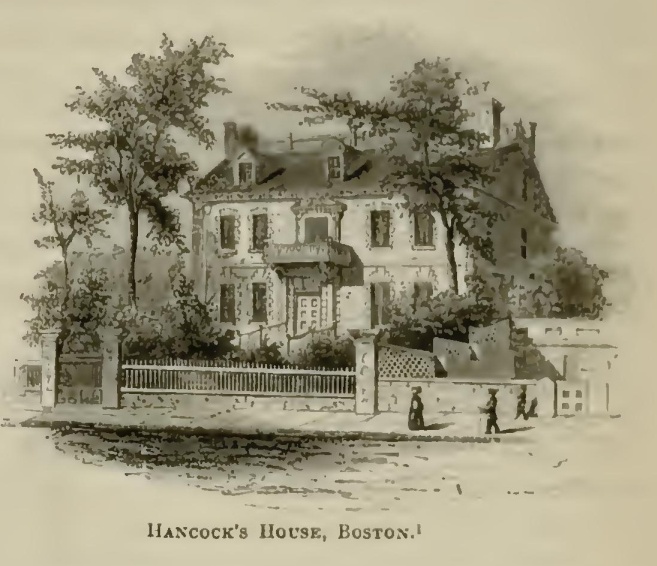
entered the harbor the town was greatly excited, news of the Port Bill having just May 13, 1774 arrived. He landed at Long Wharf, and was received with much respect by the immense crowd of people that met him. He was entertained by the magistrates and others at a public dinner, and on that evening Hutchinson was burned in effigy on the Common, in front of John Hancock's mansion.

The next day a numerously attended town meeting, at which Samuel Adams presided, was held in Faneuil Hall to consider the Port Bill. The people were, indeed, at their "wits' end." The decree had gone forth to blight the town; a governor, commissioned to execute the ministerial will, was present, and soldiers were on their way to support his authority.
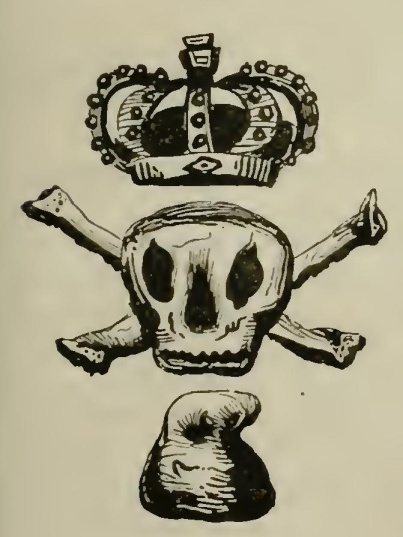
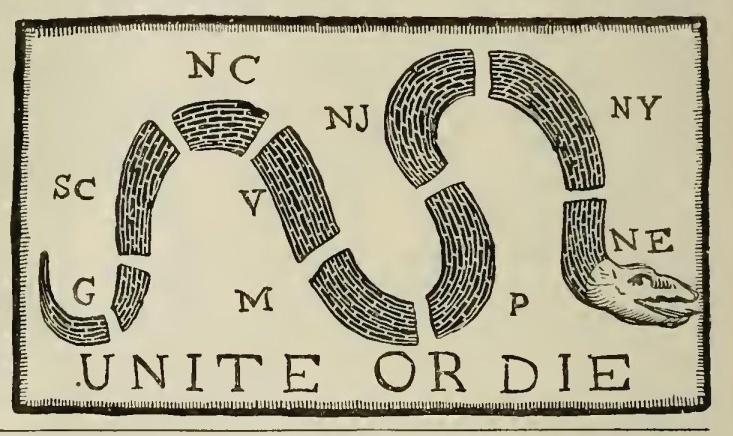
The meeting voted "That it is the opinion of the town that, if the other colonies come into a joint resolution to stop all importation from, and exportation to, Great Britain, and every part of the East Indies, till the act be repealed, the same will prove the salvation of North America and her liberties; and that the impolicy, injustice, inhumanity, and cruelty of the act exceed all our powers of expression; we, therefore, leave it to the just censure of others, and appeal to God and the world." Paul Revere, an artist and mechanic of Boston, and one of the most active patriots, was sent to New York and Philadelphia to invoke sympathy and co-operation. A vast number of copies of the act, printed with heavy black lines around it, and some of them having the sepulchral device of skull and cross-bones rudely engraved as a head-piece, were scattered over the country, and cried in cities and villages as the "Barbarous, cruel, bloody, and inhuman murder!" ** The whole country was inflamed, and every where the most lively sympathy for the people of Boston was awakened. Orators at public gatherings, ministers in the pulpits, and the newspaper press throughout the land, denounced the oppression laid upon Boston as a type of what was in store for the whole country Some of the newspapers placed at their head the significant device used during the Stamp Act excitement, a serpent cut in ten pieces, with the inscription "Join or die! or "Unite or die!"*** The cause of Boston became the
* This is a substantial stone building, situated upon Beacon Street, fronting the Common. It was erected by Thomas Hancock, an uncle of Governor Hancock, in 1737. The present proprietor is a nephew of the governor.
** The engraving is a fac-simile, one fourth the size of the original, of a device upon one of these papers. Over the skull is a rude resemblance of a crown, and beneath the bones that of the Cup of Liberty, denoting that all was death and destruction between the crown and liberty. This device is supposed to be the work of Paul Revere, who engraved the pictures of the naval investment of Boston in 1768, and the Boston Massacre in 1770. Revere was a very ingenious man, an active patriot, and, as grand master of the Masonic fraternity in Massachusetts, had extensive influence. Ho was a co-worker with Samuel Adams, Joseph Warren, and other compatriots in setting the ball of the Revolution in motion.
*** The cut upon the next page is a fac-simile of one of those illustrations. I copied it from the Pennsylvania Journal, 1774, where it appeared for nearly a year, or until the colonics were fairly united by a Continental Congress. The loyal papers loudly condemned the use of the device. A writer in Rivington's Royal Gazette, * who called it a "scandalous and saucy reflection," was answered as follows by a correspondent of the Journal:
*** "To the Author of the Lines in Mr. Rivington's Paper, on the Snake depicted in some of the American Newspapers.
"That New England's abused, and by sons of sedition, Is granted without either prayer or petition; And that is a scandalous, saucy reflection, That merits the soundest, severest correction,' Is readily granted. 'How came it to pass?' Because she is pester'd by snakes in the grass, Who, by lying and cringing, and such like pretensions, Get places once honor'd disgraced with pensions. And you, Mr. Pensioner, instead of repentance (If I don't mistake you), have wrote your own sentence; For by such snakes as this New England's abused, And the head of the serpents, 'you know, must be bruised."
*** "New Jersey." Rivington was the "king's printer" in New York city. His office was at the southeast corner of Pearl and Wall Streets. He had the entire confidence of the British authorities, and held the "rebels" in great contempt. He was a caustic writer, and his remarks were often remembered with bitterness for years. The following anecdote is illustrative of this fact:
*** Among those who cherished very hostile feelings toward Rivington was that dare-devil, General Ethan Allen, of Vermont, who swore he would "lick Rivington the very first opportunity he had." Rivington himself, aware of his intentions, gave a most humorous description of his interview with Allen, showing, at the same time, his exceeding cleverness and tact, which may even at this day be profitable to his editorial brethren. Rivington was a fine, portly-looking man, dressed in the extreme of fashion—curled and powdered hair, claret-colored coat, scarlet waistcoat trimmed with gold lace, buckskin breeches, and top boots—and kept the very best society.
*** The clerk below stairs saw Allen coming at a distance. "I was sitting," said Rivington, "after a good dinner, alone, with my bottle of Madeira before me, when I heard an unusual noise in the street, and a huzza from the boys. I was in the second story, and, stepping to the window, saw a tall figure in tarnished regimentals, with a large cocked hat and an enormous long sword, followed by a crowd of boys, who occasionally cheered him with huzzas, of which he seemed insensible. He came up to my door and stopped. I could see no more. My heart told me it was Ethan Allen. I shut down my window, and retired behind my table and bottle. 1 was certain the hour of reckoning had come. There was no retreat. Mr. Staples, my clerk, came in paler than ever, and clasping his hands, said, 'Master, he is come I' 'I know it.' 'He entered the store, and asked "if James Rivington lived there." I answered, "Yes, sir." "Is he at home?" "I will go and see, sir," I said; and now, master, what is to be done? There he is in the store, and the boys peeping at him from the street.' I had made up my mind. I looked at the bottle of Madeira—possibly took a glass. 'Show him up,' said I; ' and if such Madeira can not mollify him, he must be harder than adamant.' There was a fearful moment of suspense. I heard him on the stairs, his long sword clanking at every step. In he stalked. 'Is your name James Rivington?' 'It is, sir, and no man could be more happy than I am to see Colonel Ethan Allen.' 'Sir, I have come—' 'Not another word, my dear colonel, until you have taken a seat and a glass of old Madeira.' 'But, sir, I don't think it proper—' 'Not another word, colonel. Taste this wine; I have had it in glass for ten years. Old wine, you know, unless it is originally sound, never improves by age.' He took the glass, swallowed the wine, smacked his lips, and shook his head approvingly. 'Sir, I come—' 'Not another word until you have taken another glass, and then, my dear colonel, we will talk of old affairs, and I have some droll events to detail.' In short, we finished two bottles of Madeira, and parted as good friends as if we never had cause to be otherwise."
Real Weakness of the British Ministry.—Newspaper Poetry.—The Snake Device.
cause of all the colonies, and never were the British ministry really weaker in their government relations to America than when Lord North was forging, as he vainly thought, the fetters of majestic law to bind the colonies indissolubly to the throne.
In honorable concession alone lay his real strength, but of these precious locks the Delilah of haughty ambition had shorn him, and when he attempted to put forth his power, he found himself "like other men," weak indeed!
General Gage at Boston.—Proceedings of the Massachusetts Assembly.— Proposition for a General Congress