Chapter XXIV · (continued 2)
Reading edition
* It is said that both officers and soldiers regarded the Americans with a degree of superstitious fear, for many highly exaggerated tales of their power had been related. Dr. Thatcher says (Journal, p. 38) that, according to letters written by British officers from Boston, some of them, while walking on Beacon Hill in the evening, soon after the arrival of Gage, were frightened by noises in the air, which they took to be the whizzing of bullets. They left the hill with great precipitation, and reported that they were shot at with air-guns. The whizzing noise which so much alarmed these valiant officers was no other than the whizzing of bugs and beetles while flying in the air. Trumbull, in his M'Fingall, thus alludes to this ludicrous circumstance:
"No more the British colonel runs From whizzing beetles as air-guns; Thinks horn-bugs bullets, or, through fears, Mosquitoes takes for musketeers; Nor 'scapes, as if you'd gain'd supplies From Beelzebub's whole host of flies. No bug these warlike hearts appals; They better know the sound of balls."
** This was a well-built redoubt. The parapet was from six to fifteen feet broad; the ditch from fourteen to eighteen feet wide, and the banquet about four feet broad. The galleries and parapet before them were raised about twenty feet high, and the merlons at the six-gun battery in the center were about twelve feet high, a a, two temporary magazines; b b, barracks; c, guard-houses; di magazine; e, advanced ditch; h h, bastions.
*** A Mr. Carter, quoted by Frothingham, writing on the 19th of October, says, "We are now erecting redoubts on the eminences on Boston Common; and a meeting-house, where sedition has been often preached, is clearing out to be made a riding-school for the light dragoons." Gordon says, "In clearing every thing away, a beautiful carved pew, with silk furniture, formerly belonging to a deceased gentleman (Deacon Hubbard) in high estimation, was taken down and carried to Mr. John Armory's house, by the order of an officer, who applied the carved work to the erection of a hog-stye."
Harsh Measures, and Retaliation.—Congress Committee at Head quarters.—Little Navy organized.—Floating Batteries
measures from Washington. The first forbade all persons leaving the town without permission, under pain of military execution; the second prohibited persons who were permitted to go from carrying with them more than twenty-five dollars in cash, under pain of forfeiture—one half of the amount to be paid to the informer; and the third ordered all the inhabitants within the town to associate themselves into military companies. Washington retaliated by ordering General Sullivan, who was about departing for Portsmouth, New Hampshire, to seize all officers of government unfriendly to the patriots. Similar orders were sent to Governor Trumbull, of Connecticut, and Deputy-governor Cooke, of Rhode Island.

While Howe was thus engaged, Washington was not idle. A committee of Congress, consisting of Dr. Franklin, Thomas Lynch, and Benjamin Harrison (father of the late President Harrison), arrived at head-quarters on the 18th of October, to confer with the commander-in-chief respecting future operations. Deputy-governor Griswold and Judge Wales, of Connecticut; Deputy-governor Cooke, of Rhode Island; several members of the Massachusetts Council, and the President of the Provincial Congress of New Hampshire, were present at the conference, which lasted several days, and such a system of operations was matured as was satisfactory to General Washington. * A plan was agreed upon for an entirely new organization of the army, which provided for the enlistment of twenty-six regiments of eight companies each, besides riflemen and artillery. Already measures had been adopted to organize a navy. As early as June, Rhode Island had fitted out two armed vessels to protect the waters of that colony; Connecticut, at about the same time, one or two armed vessels; and, on the 26th of June, the Provincial Congress of Massachusetts resolved to provide six armed vessels. None of the latter had been got in readiness as late as the 12th of October, as appears by a letter from Washington to the President of the Continental Congress.
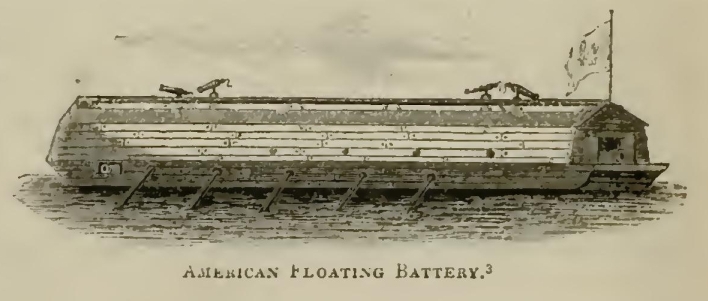
Having received no instructions from Congress on the subject, Washington took the responsibility, under his general delegated powers, of making preparations to annoy the enemy by water. Agents were appointed to superintend the construction of vessels, and to furnish supplies. Captain Broughton, of Marblehead, received a naval commission from Washington, dated September 2d, 1775, the first of the kind issued by the Continental Congress through its authorized agent. Before the close of October, six vessels of small size ** had been armed and manned, and sent to cruise within the capes of Massachusetts Bay. Two strong floating batteries were launched, armed, and manned in the Charles River; and, on the 26th of October, they opened fire upon Boston that produced great alarm and damaged several houses. The six schooners commissioned by Wash-
1775
* While Dr. Franklin was at head-quarters, the Provincial Congress of Massachusetts paid him the remaining moneys due him for services as agent for the colony in England, amounting to nine thousand two hundred and seventy dollars. Five hundred dollars had been sent to him from London as a charitable donation for the relief of the Americans wounded in the skirmishes at Lexington and Concord, and for the widows and orphans of those who were killed. This sum he paid over to the proper committee.
** The names of five of these vessels were Hannah, Harrison, Lee, Washington, and Lynch. The six commanders were Broughton, Selman, Manly, Martindale, Coit, and Adams.
*** I am indebted to the kindness of Peter Force, Esq., of Washington city (editor of "The American Archives"), for this drawing of one of the American floating batteries used in the siege of Boston. It is copied from an English manuscript in his possession, and is now published for the first time. I have never met with a description of those batteries, and can judge of their construction only from the drawing. They appear to have been made of strong planks, pierced, near the water-line, for oars; along the sides, higher up, for light and musketry. A heavy gun was placed in each end, and upon the top were four swivels. The ensign was the pine-tree flag, according to Colonel Reed, who, in a letter from Cambridge to Colonels Glover and Moylan, dated October 20th, 1775, said, "Please to fix some particular color for a flag, and a signal by which our vessels may know one another. What do you think of a flag with a white ground, a tree in the middle, the motto 'Appeal to Heaven?' This is the flag of our floating batteries."
Vessels of War authorized by Congress.—Letters of Marque and Reprisal.—Condition of the Army before Boston.
ington, and the floating batteries, sailed under the pine-tree flag. The Continental Congress a October 13, 1775 authorized two vessels to be fitted out and manned; (a) afterward two others, one b October 30. of twenty and one of thirty-six guns, were ordered. (b) On the 28th of November, a code of naval regulations was adopted. On the 1st of February following (1776), the navy, if so it might be properly called, was formed into a new establishment, being composed of four vessels—the Hancock, Captain Manly; the Warner, Captain Burke; the Lynch, Captain Ayres; and the Harrison, Captain Dyer. Captain Manly was the commodore of the little fleet. * In November, the Massachusetts Provincial Congress issued letters of marque and reprisal, and established courts of admiralty. Such was the embryo of the navy of the United States. A more detailed account of the organization of the navy and its operations during the Revolution, will occupy a chapter in another portion of this work. I have mentioned here only so much as related to operations connected with the siege of Boston.
The term of enlistment of many of the troops was now drawing to a close, and Washington felt great apprehensions for the result. Nearly six months had elapsed since the battle of Bunker Hill, yet nothing had been done, decisively, to alter the relations in which the belligerents stood toward each other. The people began to murmur, and the general Congress fretted. New enlistments were accomplished tardily, and in December not more than five thousand recruits had joined the army. It became excessively weakened in numbers and spirit, and as the cold increased, want of comfortable clothing and fuel became an almost insupportable hardship. Many regiments were obliged to eat their provisions raw, for the want of wood to cook them. Fences, and the fruit and shade trees for more than a mile around the camp, were used for fuel. The various privations in the camp produced frequent desertions. The Connecticut troops demanded a bounty, and being refused, resolved to leave the camp in a body on the 6th of December. Measures were taken to prevent the movement, yet many went off and never returned. The commander-in-chief was filled with the greatest anxiety. Still, he hopefully worked on in preparation for action, either offensive or defensive. A strong detachment under Putnam broke ground at Cobble Hill (now M'Lean Asylum); the works on Lechmere's Point were strengthened, and a call that was made upon the New England militia to supply the places of the troops that left the army in its hour of peril, was nobly responded to.
At the close of the year most of the regiments were full; and about ten thousand minute men, chiefly in Massachusetts, were held in ready reserve to march when called upon. The camp was well supplied with provisions; ** order was generally observed, and in the course of a fortnight a wonderful change for the better was wrought. The ladies of several of the officers arrived in camp; and the Christmas holidays were spent at Cambridge quite agreeably, for hope gave joy to the occasion. ***
* Sparks's Life and Writings of Washington, iii., 516.
** The rations for the soldiers were as follows: corned beef and pork four days in the week, salt fish one day, and fresh beef two days. Each man had a pound and a half of beef, or eighteen ounces of pork a day; one quart of strong beer, or nine gallons of molasses, to one hundred men per week; six pounds of candles to one hundred men per week; six ounces of butter, or nine ounces of hogs' lard per week; three pints of beans or pease, per man, a week, or vegetables equivalent; one pound of flour per day, and hard bread to be dealt out one day in the week.
*** Mrs. Washington arrived on the 11th of December, accompanied by her son, John Parke Custis, and his wife. Some persons thought her in danger at Mount Vernon, as Lord Dunmore was making the most determined hostile movements against republicanism in Virginia. It was feared that he might attempt to seize the person of Lady Washington, to be held as a hostage. As the commander-in-chief could not leave the army, she was requested to pass the winter with him at Cambridge. The expenses incurred by the occasional visits of Mrs. Washington to the camp during the war were charged to the government. Washington was careful to call attention to this fact, and in the rendition of his accounts for settlement he refers to it, and expresses a hope that the charges will be considered right, inasmuch as he had not visited his home during his time of service, a privilege which he was allowed by the terms of his appointment.
First unfurling of the Union flag.—Return of Colonel Knox, with heavy artillery.
TRANSCRIBER'S NOTE:
Among the several challenging issues with this two volume set were:
1. The duplication of the last eight chapters of Volume I. inserted at the beginning of Volume II.; and there given chapter numbers starting with Chapter I".
2. That the index in Volume I did not include any references to the last eight chapters. The index references to these duplicated chapters were however include in Volume II.
3. Spelling of many words and names in both volumes was inventive and variable from one paragraph to another. In proofing this file I began to believe the printer was short of "e's c's and o's" and began to substitute one for the others. I am sure I missed many of these.
4. The grammar used was often unacceptable today.
5. Nearly every page had long footnotes in extremely small print. Some of the footnotes referred to other footnotes. Many of the longer footnotes and footnotes to footnotes were placed at the bottom of succeeding pages, making the organization of these to the bottom of the page referring to them was challenging.
6. The extremely small and blurred print was often beyond the ability of the best Optical Character Recognition program available.
Volume II.