Chapter XXVI · (continued 2)
Reading edition
The dark vision of cruelty melts away; smiling fields, and laden orchards, and busy towns, the products of a more enlightened and peaceful Christianity than that of two centuries back, are around me. Russet corn-fields cover the hill—the royal seat of Sassacus—and in the bright harbor where the little English pinnaces, filled with bloody men, were just an-
* See Captain Mason's Brief History of the Pequot War, published in Boston in 1738, from which the principal facts in this narrative are drawn. It makes one shudder to read the blasphemous allusions to the interposition of God in favor of the English which this narrative contains, as if
"The poor Indian, whose untutor'd mind Sees God in clouds or hears him in the wind,"
* was not an object of the care and love of the Deity. Happily, the time is rapidly passing by when men believe that they are doing God service by slaughtering, maiming, or in the least injuring with vengeful feelings any of his creatures.
** The English lost only two men killed and sixteen wounded, while the Indians lost nearly six hundred men and seventy wigwams.
*** The ostensible cause of this destructive war upon the Pequots was the fact that in March of that year, Sassacus, jealous of the English, had sent an expedition against the fort at Saybrook. The fort was attacked, and three soldiers were killed. In April they murdered several men and women at Wethersfield, carried away two girls, and destroyed twenty cows. The English, urged by fear and interest, resolved to chastise them, and terrible indeed was the infliction. "There did not remain a sannup or a squaw, a warrior or a child of the Pequot name. A nation had disappeared in a day!" The Mohegans, under Uncas, then became the most powerful tribe in that region, and soon afterward, as we have seen, they and the Narragansets, who assisted in the destruction of the Pequots, began a series of long and cruel wars against each other.
Mrs. Anna Bailey.—Her Husband at Fort Griswold.—Her Mementoes and her Polities.
chored, spreads many a sail of peaceful commerce. The sun is near the meridian; let us descend to the earth.
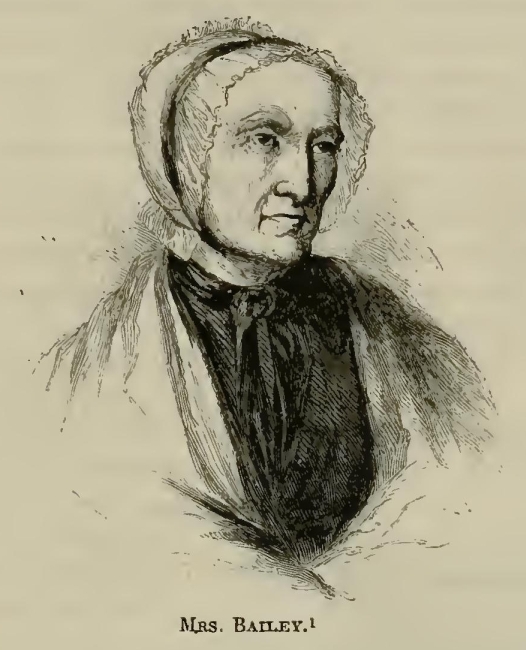

From the monument, after sketching the picture on page 46, I returned to the village of Groton, on the river bank, and visited the patriarch-ess of the place, Mrs. Anna Bailey, familiarly known as "Mother Bailey." Her husband, Captain Elijah Bailey, who died a few weeks previous to my visit, was appointed postmaster of the place by President Jefferson, and held the office until his death, a lapse of forty years. He was a lad about seventeen years old when New London was burned, and was in Fort Griswold just previous to the attack of Colonel Eyre. Young Bailey and a man named Williams were ordered by Led-yard to man a gun at the advanced redoubt, a little southeast of the fort. They were directed, in the event of not being able to maintain their ground, to retreat to the fort. They soon, found it necessary to abandon their piece. Williams fled to the fort and got within; but young Bailey, stopping to spike the gun, lost so much time, that when he knocked at the gate it was close barred, for the enemy were near. He leaped over the fence into a corn-field, and there lay concealed until the battle and massacre in the fort ended. "He was courting me at that very time, boy as he was," said Mrs. Bailey, who related this circumstance to me. She was then a girl six weeks older than her lover, and remembers every event of the "terrible day." I was agreeably surprised on being introduced to Mrs. Bailey, expecting to find a common, decrepit old woman. She sat reading her Bible, and received me with a quiet ease of manner, and a pleasant countenance, where, amid the wrinkles of old age, were lingering traces of youthful beauty. I had been forewarned that, if I wished to find any favor in her sight, I must not exhibit the least hue of Whiggery in politics—a subject which engrosses much of her thoughts and conversation. Her husband had been a Democrat of the old Jefferson school; and she possessed locks of hair, white, sandy, and grizzled, from the heads of Presidents Jackson and Van Buren, and of Colonel Richard M. Johnson, all of whom had honored her house by personal visits. With such precious mementoes, how could she be other than a Democrat? Almost, the first words she uttered on my entrance were, "What are Cass's prospects in New York?" Forewarned, forearmed, I summoned to the support of my conscience all the possibilities in his favor, and told her that Mr. Cass would doubtless be elected President—at any rate, he ought to be. These words unlocked her kind feelings, and I passed an hour very agreeably with her. Her mind was active, and she related, in an interesting manner, many reminiscences of her youth and womanhood, among which was the following, in which she was the chief heroine. When the British squadron which drove Decatur into the harbor of New London, in 1813, menaced the town with bombardment, the military force that manned the forts were deficient in flannel for cannon cartridges. All that could be found in New London was sent to the forts, and a Mr. Latham, a neighbor of Mrs. Bailey, came to her at Groton seeking for more. She started out and collected all the little petticoats of children that she could find in town. "This is not half enough," said Latham, on her return. "You
* While making this sketch, I remarked to Mrs. Bailey (and with sincerity, too) that I saw in her features evidence that Captain Bailey was a man of good taste. She immediately comprehended my meaning and the compliment, and replied, with a coquettish smile, "I was never ashamed of my face, and never mean to be." She lived happily with her husband for seventy years. Since the above was put in type, she has died. Her clothes took fire, and she was burned to death on the 10th of January, 1851, aged about 89
Mrs. Bailey's Patriotism.—Landing-place of Arnold.—Bishop Seabury's Monument.—First Printing in Connecticut
shall have mine too," said Mrs. B., as she cut with her scissors the string that fastened it, and taking it off, gave it to Latham. He was satisfied, and hastening to Fort Trumbull, that patriotic contribution was soon made into cartridges. "It was a heavy new one, but I didn't care for that," said the old lady, while her blue eyes sparkled at the recollection. "All I wanted was to see it go through the Englishmen's insides!" Some of Decatur's men declared that it was a shame to cut that petticoat into cartridge patterns; they would rather see it fluttering at the mast-head of the United States or Macedonian, as an ensign under which to fight upon the broad ocean! This and other circumstances make Mrs. Bailey a woman of history; and, pleading that excuse, I am sure, if she shall be living when this page shall appear, that she will pardon the liberty I have taken. I told her that the sketch of her which she allowed me to take was intended for publication.
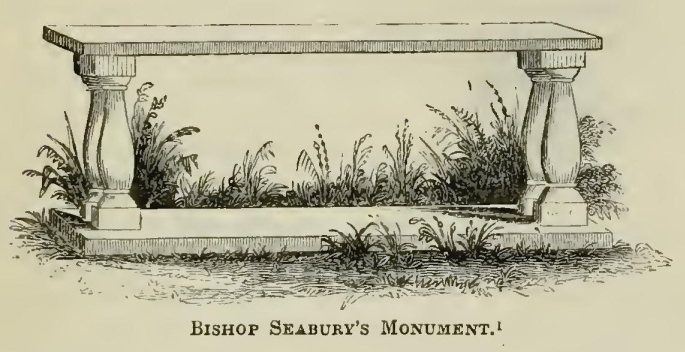
I recrossed the Thames to New London, and after an early dinner rode down to the lighthouse, near which Arnold landed, and made the drawing printed on page 43. Returning along the beach, I sketched the outlines of Fort Trumbull and vicinity, seen on page 42, and toward evening strolled through the two principal burial-grounds of the city. In the ancient one, situated in the north part of the town, lie the remains of many of the first settlers, in the other, lying upon a high slope, westward of the center of the city, is a plain monument of Bishop Seabury, whose name is conspicuous in our Revolutionary annals as that of an unwavering Loyalist. I shall have occasion to notice his abduction from West Chester county, and imprisonment in Connecticut, as well as his general biography, when I write of the events at White Plains.
We will now bid adieu to New London, not forgetting, however, in our parting words, to note the fact so honorable to its name and character, that the first printing-press in Connecticut was established there, according to Barber, forty-five years before printing was executed in any other place in the colony. Thomas Short, who settled in New London in 1709, was the printer, and from his press was issued The Saybrook Platform, ** in 1710, said to be the first book printed in the province. Short died in 1711, and there being no printer in the colony, the Assembly procured Timothy Green, a descendant of Samuel Green, of Cambridge, the first printer in America, to settle at New London. Samuel Green, the publisher of the "Connecticut Gazetteer" until 1845, the oldest newspaper in the state, is a descendant of this colonial printer.
Business demanding my presence at home, I left New London at ten in the evening, in the "Knickerbocker," and arrived in New York at nine the following morning.
* The following is the inscription upon the slab: "Here lieth the body of Samuel Seabury, D.D., bishop of Connecticut and Rhode Island, who departed from this transitory scene February 25th, Anno Domini 1796, in the 68th year of his age, and the 12th of his Episcopal consecration. "Ingenuous without pride, learned without pedantry, good without severity, he was duly qualified to discharge the duties of the Christian and the bishop. In the pulpit he enforced religion; in his conduct he exemplified it. The poor he assisted with his charity; the ignorant he blessed with his instruction. The friend of men, he ever designed their good; the enemy of vice, he ever opposed it. Christian! dost thou aspire to happiness? Seabury has shown the way that leads to it."
** This was a Confession of Faith or Articles of Religion arranged in 1708—Yale College was first established at Saybrook, and fifteen commencements were held there. To educate young men of talents and piety for the ministry was the leading design of the institution. The founders, desirous that the Churches should have a public standard or Confession of Faith, according to which the instruction of the college should be conducted, such articles were arranged and adopted after the commencement at Saybrook in 1708. and from that circumstance were called the Saybrook Platform. The standards of faith of the Congregational and Presbyterian Churches are substantially the same as the Saybrook Platform.
Voyage to Rhode Island.——Stonington.—Arrival at Providence