Chapter XIX · (continued 2)
Reading edition
As early as 1729 the conduct of Massachusetts caused a suggestion in the House of Commons that it was the design of that colony "to shake off its dependency." Governor Burnet, of New York, was appointed chief magistrate of the province in 1728. The display that attended his reception at Boston, and the appearance of general prosperity on every hand, determined him to demand a fixed and liberal salary from the Assembly, a demand which had involved Shute, his predecessor, in continual bickerings with that body. Burnet made the demand in his inaugural address, and the Assembly treated it in such a manner that immediately afterward the Council expressed their reprehension of the undutiful conduct of the members. So bold was the Assembly in denying royal prerogatives and refusing obedience 1731 to laws, that when Massachusetts petitioned the House of Commons, praying that they might be heard by counsel on the subject of grievances, that body resolved "That the petition was frivolous and groundless, a high insult upon his majesty's [George I.] government, and tending to shake off the dependency of the said colony upon this kingdom, to which, in law and right, they ought to be subject." *
In 1739 a proposition was made to Sir Robert Walpole to tax the American colonies, but
* Smith's History of New Jersey, p. 517.
** Smith's History of New York, p. 75.
Wisdom of Robert Walpole.—Restraining Acts.—Loyalty and Patriotism of the Colonics.—Heavy voluntary Taxation
that statesman took an enlightened and liberal view, and said, smiling, "I will leave that to some of my successors who have more courage than I have, and are less friends to commerce than I am. It has been a maxim with me, during my administration, to encourage the trade of the American colonies in the utmost latitude; nay, it has been necessary to pass over some irregularities in their trade with Europe; for, by encouraging them to an extensive growing commerce, if they gain five hundred thousand pounds, I am convinced that in two years afterward full two hundred and fifty thousand pounds of their gains will be in his majesty's exchequer, by the labor and produce of this kingdom, as immense quantities of every kind of our manufactories go thither; and as they increase in their foreign American trade, more of our produce will be wanted. This is taxing them more agreeably to their own Constitution and ours." Had these views continued to prevail in the British cabinet, George III. might not have "lost the brightest jewel in his crown had Walpole yielded, the republic of the United States might have existed almost half a century earlier.
Walpole's successors were "more courageous" than he, and "less friends to commerce," for in 1750 an act was passed, declaring "That from and after the 24th of June, 1750, no mill or other engine for slitting or rolling of iron, or any platting forge to work with a tilt-hammer, or any furnace for making steel, shall be erected, or, after such erection, continued, in any of his majesty's colonies in America." The Navigation Act of 1660 was retained in full force. Hatters were forbidden to have, at one time, more than two apprentices; the importation of sugar, rum, and molasses was not allowed without the payment of considerable duties; and the felling of pitch-pine-trees not within inclosures was prohibited. True, these revenue laws were administered with much laxity, as Walpole acknowledged, and the colonies were not much oppressed by them, yet they practically asserted the right to tax the Americans—a right that was strenuously denied. These things were, therefore, real grievances, for they foreshadowed those intentions to enslave America which were afterward more boldly avowed.
I have noticed the Colonial Congress (page 303) held at Albany in 1754, when Dr. Franklin submitted a plan for the union of the colonies for the general good, and when Massachusetts, ever jealous of her rights, instructed her representatives to oppose any scheme for taxing them. The war that had then just commenced (the Seven Years' War) soon diverted the attention of the colonists from the commercial grievances of which they complained, and as the common dangers multiplied, loyalty increased. Cheerfully did they tax themselves, and contribute men, money, and provisions, for that contest. They lost by the war twenty-five thousand of their robust young men, exclusive of sailors. Upon application of Admiral Saunders, the squadron employed against Louisburg and Quebec was supplied with five hundred seamen from Massachusetts, besides many who were impressed out of vessels on the fishing banks. During the whole war Massachusetts contributed its full quota of troops annually, and also, at times, furnished garrisons for Louisburg and Nova Scotia in addition. That colony alone contributed more than five millions of dollars, in which sum is not included the expense of forts and garrisons on the frontiers. Besides these public expenditures, there must have been almost an equal amount drawn from the people by extra private expenses and personal services. The taxes imposed to meet the pressing demands upon all sides were enormous, * and men of wealth gave freely toward encouraging the raising of new levies. This, it must be remembered, was the heavy burden laid upon one colony. Other provinces contributed largely, yet not so munificently as Massachusetts. Probably the Seven Years' War cost the aggregate colonies twenty millions of dollars, besides the flower of their youth; and in return Parliament granted them, during the contest, at different periods, about five mill-
* Such was the assessment in Boston one year during the war, that, if a man's income was three hundred dollars, he had to pay two thirds, or two hundred dollars, and in that proportion. If his house was valued at one thousand dollars, he was obliged to pay three hundred and sixty dollars. He had also to pay a poll tax for himself, and for every male member of his family over sixteen years of age, at the rate of nearly four dollars each. In addition to all this, he paid his proportion of excise on tea, coffee, rum, and wine, if he used them.—Gordon.
Designs of the British Ministry.—Expenditures of the British Government on Account of America.—Accession of George III
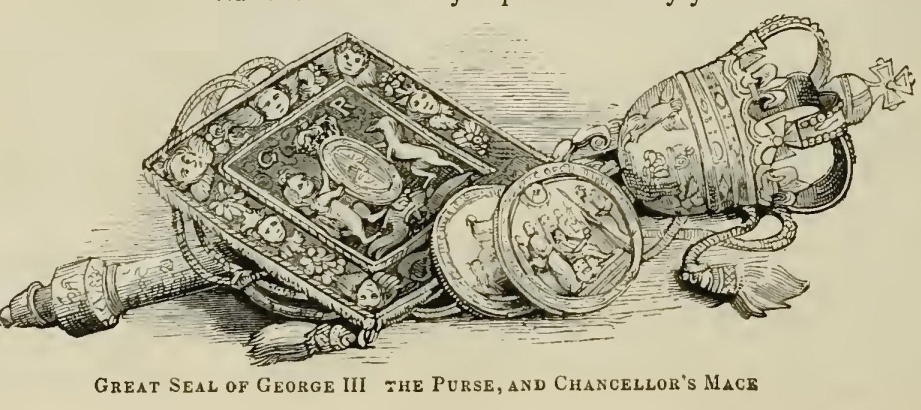
ions four hundred and nine thousand dollars. * Yet the British ministry, in 1760, while the colonies were so generously supporting the power and dignity of the realm, regarded their services as the mere exercise of a duty, and declared that, notwithstanding grants of money had been made to them, they expected to get it all back, by imposing a tax upon them after the war, in order to raise a revenue. Such was the language of Mr. Pitt in a letter to Lieutenant-governor Fauquier, of Virginia. The war ended favorably to Great Britain, and Massachusetts and other colonies looked forward with the full hope of uninterrupted prosperity. New men were at the helm of State. The old king was dead, and his grandson, the eldest October 26, 1760 son deceased Frederic, prince of Wales, had ascended the throne with the title of George III. This was the prince who ruled Great Britain sixty years, in which time was included our war for independence.
* Parliament subsequently voted one million of dollars to the colonies, but, on account of the troubles arising from the Stamp Act and kindred measures, ministers withheld the sum.—Pictorial History of the Reign of George III., i., 36.
* The following is a list of "The grants in Parliament for Rewards, Encouragement, and Indemnification to the Provinces in North America, for their Services and Expenses during the last [seven years] War:
* "On the 3d of February, 1756, as a free gift and reward to the colonies of New England, New York, and Jersey, for their past services, and as an encouragement to continue to exert themselves with vigor, voted $575,000.
* "May 19th, 1757. For the use and relief of the provinces of North and South Carolina, and Virginia, in recompense for services performed and to be performed, $250,000.
* "June 1st, 1758. To reimburse the province of Massachusetts Bay their expenses in furnishing provisions and stores to the troops raised by them in 1756, $136,900. To reimburse the province of Connecticut their expenses for ditto, $68,680.
* "April 30th, 1759. As a compensation to the respective colonies for the expenses of clothing, pay of troops, &c., $1,000,000.
* "March 31st, 1760. For the same, $1,000,000. For the colony of New York, to reimburse their expenses in furnishing provisions and stores to the troops in 1756, $14,885.
* "January 20th, 1761. As a compensation to the respective colonies for clothing, pay of troops, &c. $1,000,000.
* "January 26th, 1762. Ditto, $666,666.
* "March 15th, 1763. Ditto, $666,666.
* "April 22d, 1770. To reimburse the province of New Hampshire their expenses in furnishing provisions and stores to the troops in the campaign of 1756, $30,045. Total, $5,408,842."
* In a pamphlet entitled The Rights of Britain and Claims of America, an answer to the Declaration of the Continental Congress, setting forth the causes and the necessity of their taking up arms, printed in 1776, I find a table showing the annual expenditures of the British government in support of the civil and military powers of the American colonies, from the accession of the family of Hanover, in 1714, until 1775. The expression of the writer is, "Employed in the defense of America." This is incorrect, for the wars with the French on this continent, which cost the greatest amount of money, were wars for conquest and territory, though ostensibly for the defense of the Anglo-American colonies against the encroachments of their Gallic neighbors. During the period alluded to (sixty years) the sums granted for the army amounted to $43,899,625; for the navy, $50,000,000; money laid put in Indian presents, in holding Congresses, and purchasing cessions of land, $30,500,000; making a total of $123,899,625. Within that period the following bounties on American commodities were paid: On indigo, $725,110; on hemp and flax, $27,800; on naval stores imported in Great Britain from America, $7,293,810; making the total sum paid on account of bounties $8,047,320. The total amount of money expended in sixty years on account of America $131,946,945.

Death of George II. announced to his Heir.—Influence of the Earl of Bute.—Cool Treatment of Mr. Pitt.