Chapter XI · (continued 2)
Reading edition
* I was unsuccessful in my search for information respecting the career of General Herkimer in youth and early manhood. He left no children. Those of the family name are descendants of his only brother, George Herkimer. His family was among the early settlers of the German Flats, and, though opulent according to the standard of his times, he seems to have been quite uneducated. An old man whom I saw near the Flats remembered him as "a large, square-built Dutchman," and supposed him to have been about 05 years old when he died. Should this meet the eye of any of his descendants, they will confer a favor upon the author by communicating to him any information they may possess concerning the general and his immediate family.
** An aged resident of Fort Plain, Mr. David Lipe, whose house is near the canal, below the old fortification, went over the ground with me, and I made a survey of the outlines of the fort according to his directions. He aided in pulling down the block-house when it was demolished after the war, and his memory seemed to be very accurate. I am indebted to him for much of the information here recorded concerning Fort Plain.
***Explanation of the Plan.—The black line represents the parapet; a, the largo block-house; bbbb, small block-houses at each bastion; cc, barracks. There were two largo apple-trees within the fort, and on the northern side of the hill is the living spring that supplied the garrison with water.
Fort Plain Block-house.—Trial of its Strength.—Invasion of the Settlement.—True Location of Fort Plain
and across the neck, or isthmus, a breast-work was thrown up. The fort extended along the brow of the hill northwest of the village, and the blockhouse was a few rods from the northern declivity.
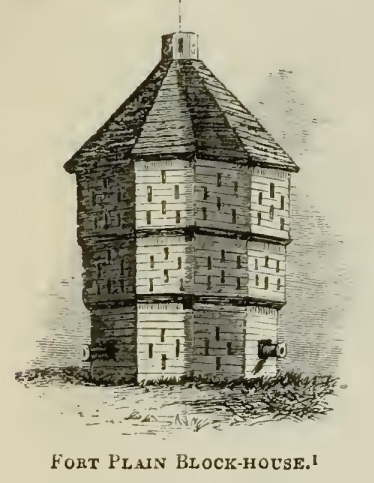

This blockhouse was erected in 1780, after the fort and barracks were found to be but a feeble defense, under the supervision of a French engineer employed by Colonel Gansevoort. The latter, by order of General Clinton, then in command of the Northern Department, had repaired thither with his regiment, to take charge of a large quantity of stores destined for Fort Schuyler. Ramparts of logs and earth were thrown up, and a strong block-house was erected, a view of which is here given. It was octagonal in form, three stories in height, and composed of hewn timbers about fifteen inches square. There were numerous port-holes for musketry, and in the lower story three or four cannons were placed. The first story was thirty feet in diameter, the second forty, and the third fifty. Each of the upper stories projected about five feet, and in the floor of each projection there were also port-holes, through which to fire perpendicularly upon an enemy below. The powder magazine of the fort was placed directly under the block-house for protection.
Some time after the completion of the work, doubts were expressed of its being cannonball proof. A trial was made with a six pounder placed at a proper distance. Its ball passed entirely through the block-house, crossed a broad ravine, and lodged in the hill on which the old parsonage stands, an eighth of a mile distant. This proved the inefficiency of the building, and its strength was increased by lining it with heavy planks. In order to form a protection for the magazine against hot shot, the little garrison that was stationed there in 1782 commenced throwing up a bank of earth around the block-house. Rumors of peace, and the quiet that then prevailed in that valley, caused the work to cease, and, August, 1848 happily, its resumption was never demanded. The mounds which were raised on the south side of the block-house were yet quite prominent when I visited the locality.
This place was included in the Canajoharie settlement, and in 1780 felt severely the vengeance of the Tories and Indians, inflicted in return for terrible desolations wrought by an army under Sullivan, the previous year, in the Indian country west of the white settlements. The whole region on the south of the Mohawk, for several miles in this vicinity, was laid waste. The approach of the dreaded Thayendanegea along the Canajoharie Creek, with about five hundred Indians and Tories, to attack the settlement at Fort Plain, was anAugust 2, 1780nounced to the people, then engaged in their harvest fields, by a woman who fired a cannon at the fort. The larger portion of militia had gone with Gansevoort to guard provisions on their way to Fort Schuyler, and those who remained, with the boys and old men, unable to defend their lives or property, fled into the fort for protection. In their approach the enemy burned every dwelling and barn, destroyed the crops, and carried off every thing of value. Regardless of the strength of the fort, they marched boldly up within cannon-shot of the intrenchments, burned the church, the parsonage, and many other build-
* There is considerable confusion in the accounts concerning Fort Plain, for which there is no necessity. There was a stockade about two miles southwest of Fort Plain, called Fort Clyde, in honor of Colonel Clyde, an officer in the Tryon county militia; and another about the same distance northwest, called Fort Plank, or Blank, from the circumstance that it stood upon land owned by Frederic Blank. The latter and Fort Plain have been confounded. Mr. Stone erroneously considered them as one, and says, in his Life of Brant (ii., 95), "The principal work of defense, then called Fort Plank, and subsequently Fort Plain, wras situated upon an elevated plain overlooking the valley, near the site of the village still retaining the name of the fortress." Other writers have regarded the block-house as the fort, when, in fact, it was only a part of the fortifications. The drawing here given is from one published in Stone's Life of Brant, with a description from the Fort Plain Journal of December 26th, 1837. Mr. Lipe considered it a correct view, except the lower story, which, it was his impression, was square instead of octagonal, and had four port-holes for heavy ordnance.
A Female's Presence of Mind.—Burning of the Church.—Indians deceived.—Tardiness of Colonel Wemple.
ings, and carried off several women and children prisoners. The house of Johannes Lipe, to a place of concealment in a hollow at the rear, and had made several deposits there. The last time she returned she met two prowling Indians at the gate. She was familiar with their language, and, without any apparent alarm, inquired of them if they knew any thing of her two brothers, who were among the Tories that fled to Canada. Fortunately, the savages had seen them at Oswegatehie, and, supposing her to be a Tory likewise, they walked off, and the house was spared.
The church spire had a bright brass ball upon it, which the Indians believed was gold.
While the edifice was burning, they waited anxiously for the steeple to fall, that they might secure the prize. When it fell, the savages rushed forward, scattered the burning timbers, and several of them in succession seized the glittering ball. It was speedily dropped, as each paid the penally of blistered fingers, and discovered that "all is not gold that glistens."
With the destruction of Fort Ariani the devastation was, for the time, stayed. In a day the fairest portion of the valley had been made desolate. Fifty-three dwellings and as many barns were burned, sixteen of the inhabitants were, slain, and between fifty and sixty persons, chiefly women and children, were made captives. More than three hundred cattle and horses were driven away, the implements of husbandry were destroyed, and the ripe grain-fields, just ready for the sickle, were laid in ashes. ** The smoke was seen as far as Johnstown, and the people immediately left the fields and joined the Albany and Schenectady militia, then marching up the valley, under Colonel Wemple. The colonel seemed to be one of those men who deem prudence the better part of valor, and was opposed to forced marches, particularly when in pursuit of such fierce enemies as were just then attracting his attention. He managed to reach Fort Plain in time to see the smouldering embers of the conflagration, and to rest securely within its ramparts that night. The work of destruction was over, and the Indians and Tories were away upon another war-path.
At Fort Plain I was joined by my traveling companions, whom I had left at Syracuse, and made it my headquarters for three days, while visiting places of interest in the vicinity. It being a central point in the hostile movements in Tryon county, from the time of the flight of St. Leger from before Fort Stanwix until the close of the war, we will plant our telescope of observation here for a time, and view the most important occurrences within this particular sweep of its speculum. The battle of Minisink, and the more terrible tragedy in the Valley of Wyoming, radii in the hostile operations of the Indians and Tories from our point of view, will be noticed in other chapters. It is difficult to untie the complicated knot of events here, and make all parts perspicuous, without departing somewhat from the plan of the work, and taking up the events in chronological order. Every thing being subordinate to the history, I shall, therefore, make such departure for the present, and reserve my notes of travel until the story of the past is told.
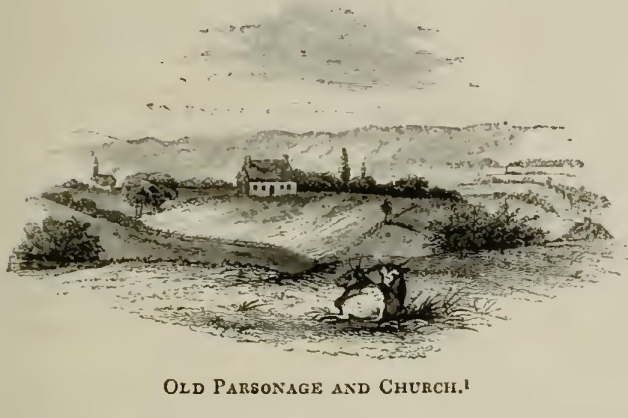
* This view is from the high plain on the right of the block-house, looking north. The building upon the hill across the ravine is the old parsonage, which was immediately built upon the ruins of the one that was burned. On the left I have placed a church in its proper relative position to the parsonage, as indicated by Mr. Lipe. It was about half a mile northwest of the fort. On the right are seen the Mohawk River and Plain, a train of cars in the distance, and the hills that bound the view on the north side of the Mohawk Valley, in the direction of Stone Arabia and Kloek's Field, where two battles were fought in 1780. These will be hereafter noticed.
** Letter of Colonel Clyde to Governor Clinton. The father of David, my informant, which is still standing, was saved from plunder and fire by the courage and presence of mind of his wife.
** She had been busy all the evening carrying her most valuable articles from her house.
Aspect of Affairs in Tryon County.—The Western Indians.—Girty and his Associates.—Fidelity of White Eyes.