Chapter IV · LEADING VARIETIES OF PEARS
Reading edition
ANDRÉ DESPORTES
1. Leroy Dict. Pom. 1:127, fig. 1867. 2. Mas Pom. Gen. 3:51, fig. 122. 1878. 3. Cat. Cong. Pom. France 138, fig. 1906.
This old French sort is sparingly grown in New York, and is still listed by a few American nurserymen. The pears are handsome and very good in quality, but they quickly soften at the center and neither keep nor ship well. While usually of medium size, or sometimes large, the pears often run small. The variety is well worth planting in a collection, but has no value in a commercial plantation, and there are many better sorts for home orchards.
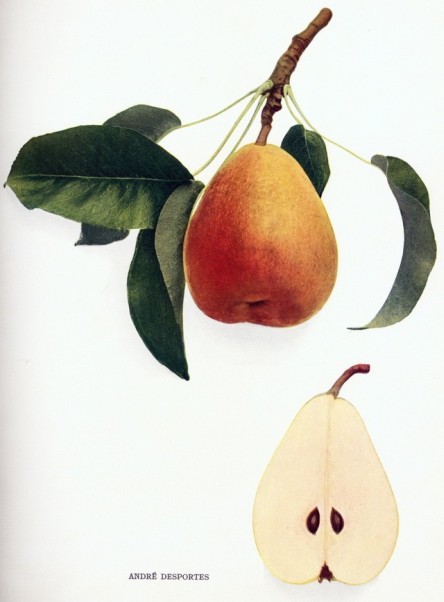
The parent tree of this variety grew in the seed beds of M. André Leroy, the well-known authority on pomology, at Angers, France. M. Leroy obtained it in 1854 from pips of Williams’ Bon Chrétien, or as it is better known here, the Bartlett pear. He named it after the son of M. Baptiste Desportes, manager of the business department of his establishment. The vigor and high quality of the fruit were quickly appreciated, and the variety was soon disseminated far and wide.
Tree characteristically upright and vigorous, rapid-growing, hardy, productive; branches slender, smooth, light brown overlaid with thin, grayish scarf-skin, marked with small lenticels; branchlets thick, long, with short internodes, reddish-brown, slightly streaked toward the tips with ash-gray scarf-skin, dull, smooth, glabrous, with numerous small, but very conspicuous, raised lenticels.
Leaf-buds large, pointed, plump, appressed. Leaves 2¾ in. long, 1⅝ in. wide, ovate, stiff, leathery; apex taper-pointed; margin glandular, slightly crenate; petiole 1½ in. long. Flower-buds large, long, conical, plump, free, arranged singly as lateral buds or on short spurs; flowers showy, 1¼ in. across, occasionally tinged pink, in dense clusters, averaging 9 flowers per cluster; pedicels ¾ in. long, thick, pubescent.
Fruit ripe in August; medium in size, 2⅞ in. long, 2¼ in. wide, obovate-obtuse-pyriform, symmetrical, uniform; stem 1 in. long, thick, curved; cavity obtuse, shallow, dotted with russet, often lipped; calyx small, open; lobes separated at the base, short, narrow, acute; basin shallow, narrow, obtuse, gently furrowed, symmetrical; skin thin, tender, smooth; color dull greenish-yellow, dotted and marbled with reddish-brown, blushed on the sunny side; dots numerous, small, light colored, obscure; flesh tinged with yellow, fine, tender and melting, buttery, juicy, sweet, aromatic; quality very good. Core large, closed, with clasping core-lines; calyx-tube short, wide, conical; seeds small, wide, plump, acute.
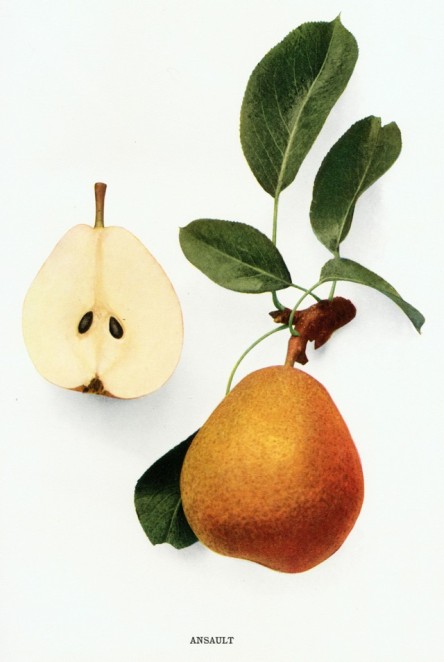
ANSAULT
1. Am. Pom. Soc. Cat. 36. 1883. 2. Can. Hort. 24:454, fig. 2169. 1901.
Bonne du Puits-Ansault. 3. Leroy Dict. Pom. 1:486, fig. 1867. 4. Downing Fr. Trees Am. 1st App. 123, fig. 1872. 5. Am. Pom. Soc. Cat. 34. 1877.
Well grown, the fruits of Ansault rival those of Seckel in quality. In particular, the flesh is notable, and is described by the term buttery, so common in pear parlance, rather better than that of any other pear. The rich sweet flavor, and distinct but delicate perfume contribute to make the fruits of highest quality. Unfortunately, the pears are not very attractive in appearance. They are small, and the green coat, nearly covered with russet dots and markings, is dull, though enlivened somewhat at full maturity by a rich yellow. The tree in good pear soils is vigorous, productive, bears annually, and is not more subject to blight than that of the average variety. While not at all suitable for commercial orchards, Ansault should find a place in every collection of pears for home use.
The pear Bonne du Puits-Ansault was raised from seed in the nurseries of M. André Leroy, Angers, France. The parent tree bore fruit in 1863, and M. Leroy states that the name which it bears is that of the enclosure where it was first raised. It was propagated in 1865. The American Pomological Society first listed this variety in its catalog in 1877, and in 1883 shortened the name to its present form.
Tree large, upright-spreading, hardy, very productive; trunk stocky, shaggy; branches thick, dull brownish-red, tinged with green and heavily covered with greenish scarf-skin, with numerous raised lenticels; branchlets long, reddish-brown, with traces of gray scarf-skin, smooth, glabrous, with few inconspicuous, small, slightly raised lenticels.
Leaf-buds plump, pointed, nearly free. Leaf-scars prominent. Leaves numerous, 2¾ in. long, 1½ in. wide, ovate or broadly oval, leathery; apex abruptly pointed; margin finely serrate, with small, reddish, sharp-pointed glands; petiole 1½ in. long, slender, glabrous. Fruit-buds large, conical, plump, free; flowers 1⅛ in. across, in dense clusters, 7 to 9 flowers in a cluster; pedicels ⅝ in. long, thick, greenish, lightly pubescent.
Fruit ripe in late September and early October; medium in size, 2⅜ in. long, 2⅛ in. wide, uniform, obtuse-obovate-pyriform, irregular; stem ⅝ in. long, short, thick; cavity obtuse, russeted, furrowed, ribbed; calyx partly open, large; lobes acute; basin somewhat abrupt, furrowed and wrinkled; skin roughened with russet markings and dots; color pale yellow, considerably russeted about the basin and cavity with russet dots, with scattered flecks and patches of russet; dots numerous, small, russet; flesh tinged with yellow, granular at the center, melting and tender, buttery, very juicy, sweet, aromatic; quality good to very good. Core closed, axile, the core-lines clasping; calyx-tube long, narrow, funnel-shaped; seeds rather short, plump, obtuse.
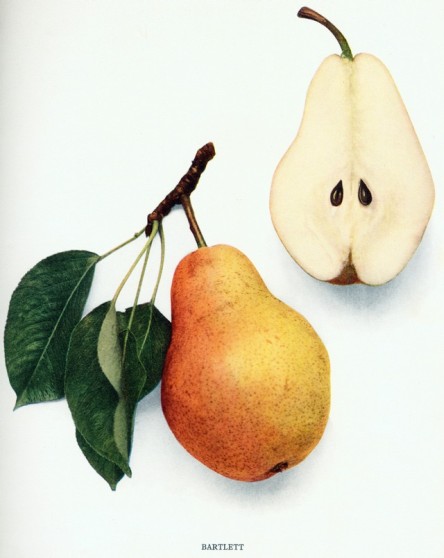
BARTLETT
1. Downing Fr. Trees Am. 334, fig. 134. 1845. 2. Horticulturist 2:169. 1847-48. 3. Proc. Nat. Con. Fr. Gr. 29. 1848. 4. Hovey Fr. Am. 2:11, Pl. 1851. 5. Horticulturist N. S. 3:350, Pl. 1853. 6. Field Pear Cult. 190, 276, fig. 66. 1858. 7. Downing Fr. Trees Am. 666, fig. 1869. 8. Ont. Dept. Agr. Fr. Ont. 148, fig. 1914.
Williams’ Bon Chrétien. 9. Lindley Guide Orch. Gard. 350. 1831. 10. Prince Pom. Man. 1:137. 1831. 11. Hogg Fruit Man. 664. 1884.
Williams’ Apothekerbirne. 12. Dochnahl Führ. Obstkunde 2:181. 1856.
Bon Chrétien Williams’. 13. Pom. France 1: No. 16, Pl. 16. 1863. 14. Mas Le Verger 2:23, fig. 10. 1866-73.
Williams. 15. Leroy Dict. Pom. 2:758, fig. 1869.
Williams Christbirne. 16. Lauche Deut. Pom. II: No. 18, Pl. 18. 1882. 17. Mathieu Nom. Pom. 298. 1889.
Bartlett leads all other pears in number of trees in New York, and vies with Kieffer for the greatest number in America. Its fruits are more common and more popular in American markets than those of any other pear. When the characters of the variety are passed in review, although several poor ones of fruit and tree appear, the popularity of Bartlett with growers and sellers, if not with consumers, seems justified. As with the leading variety of any fruit, the preëminently meritorious character of this one is its great adaptability to different climates, soils, and situations. Thus, Bartlett is grown with profit in every pear-growing region in America and in all is grown in greater quantities than any other sort excepting, perhaps, the notorious Kieffer. Another character which commends this variety to pear-growers is fruitfulness—barring frosts or freezes, the trees bear full crops year after year. Moreover, the trees are very vigorous, attain large size, bear young, live long, are easily managed in the orchard, and thrive on both standard and quince stocks. The pears are large, handsome, of good but not of the best quality, and keep and ship remarkably well.
Bartlett is not without serious faults, however. The trees blight badly, and are not much above the average in resistance to blight, the black plague of the pear. Neither are they as hardy to cold or to heat as those of some other varieties. They are scarcely hardier to cold than those of the peach, and cannot withstand the summer heat of the southern, or of the Mississippi Valley states. Another serious defect of the trees is that, more than those of any other standard variety, their blossoms require cross-fertilization. The fruits are satisfactory in all characters excepting quality. There are many better-flavored pears. The fruits lack the rich, perfumed flavor of Seckel on one hand, and the piquant, vinous taste of Winter Nelis on the other. But the pears are much above the average in quality, and since no other variety is so easily grown, nor so reliable in the markets, Bartlett promises long to continue its supremacy for home and commercial plantations. After Kieffer, it is the most desired of all pears by the canning trade. Bartlett is the parent of several other well-known varieties, and of many sorts of small importance.
This pear was found as a wilding by a Mr. Stair, a schoolmaster at Aldermaston, Berkshire, England. From him it was acquired by a Mr. Williams, a nurseryman at Turnham Green, Middlesex, and as it was propagated and distributed by him it became known by his name, although it is still known as Stair’s pear at Aldermaston. It was brought to this country in 1797 or 1799 by James Carter of Boston for Thomas Brewer who planted the variety in his grounds at Roxbury, Massachusetts, under the name of Williams’ Bon Chrétien, by which name it was then and still is known both in England and France. In 1817 Enoch Bartlett, Dorchester, Massachusetts, became possessed of the Brewer estate, and not knowing its true name allowed the pear to go out under his own. Henceforth it was known in America as Bartlett. The American Pomological Society added this variety to its catalog-list of fruits in 1848.
Tree medium in size, tall, pyriform, upright, hardy, very productive; branches stocky, smooth, reddish-brown overlaid with ash-gray scarf-skin, with few lenticels; branchlets short, with short internodes, reddish-brown, glossy, smooth, glabrous, with conspicuous lenticles.
Leaf-buds short, obtuse, pointed, mostly free; leaf-scars prominent. Leaves 2¾ in. long, 1⅖ in. wide, oval, leathery; apex taper-pointed; margin tipped with small dark red glands, finely serrate; petiole 1¾ in. long. Flower-buds large, conical, pointed, free; flowers showy, 1¼ in. across, in dense clusters averaging 7 buds in a cluster; pedicels 1⅛ in. long, slender, slightly pubescent.
Fruit matures in September; large, 3⅜ in. long, 2⅜ in. wide, oblong-obtuse-pyriform, tapering toward the apex, symmetrical, uniform; stem 1⅛ in. long, often curved, thick; cavity small, usually lipped, with thin, overspreading streaks of light russet, acute, shallow; calyx partly open; lobes separated at the base, narrow, acute; basin very shallow, narrow, obtuse, furrowed and wrinkled; skin thin, tender, smooth, often dull, the surface somewhat uneven; color clear yellow, with a faint blush on the exposed cheek, more or less dotted with russet and often thinly russeted around the basin; dots many, small, conspicuous, greenish-russet; flesh fine-grained although slightly granular at the center, melting, buttery, very juicy, vinous, aromatic; quality very good. Core large, closed, with clasping core-lines; calyx-tube long, wide, funnel-shaped; seeds wide, plump, acute.
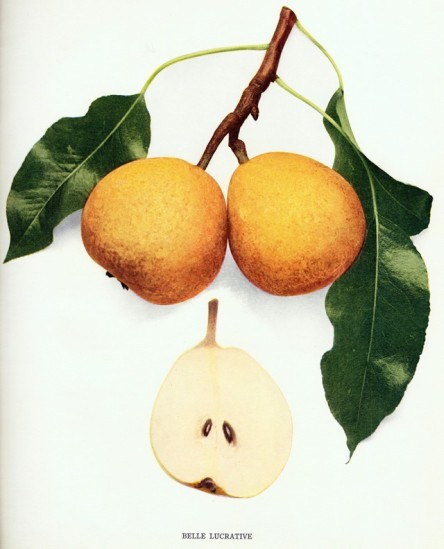
BELLE LUCRATIVE
1. Lindley Guide Orch. Gard. 364. 1831. 2. Kenrick Am. Orch. 135. 1841. 3. Hovey Fr. Am. 1:41, Pl. 1851. 4. Am. Pom. Soc. Rpt. 53. 1852. 5. Field Pear Cult. 194, fig. 68. 1858.
Fondante d’Automne. 6. Downing Fr. Trees Am. 387, fig. 168. 1845. 7. Hogg Fruit Man. 578. 1884.
Seigneur. 8. Ann. Pom. Belge 7:5, Pl. 1859. 9. Pom. France 1: No. 28, Pl. 28. 1863. 10. Mas Le Verger 3: Pt. 1, 21, fig. 9. 1866-73.
Bergamote Lucrative. 11. Leroy Dict. Pom. 1:247, figs. 1867.
Seigneur d’Espéren. 12. Guide Prat. 59, 303. 1876.
Esperen’s Herrenbirne. 13. Mathieu Nom. Pom. 212. 1889. 14. Gaucher Pom. Prak. Obst. No. 37, Pl. 85. 1894.
Lucrative. 15. Am. Pom. Soc. Cat. 36. 1889.
This good old pear has been a standard autumn sort for nearly a century. The internal characters of both flesh and flavor are nearly perfect, but externally much more might be desired as to shape and size. In flesh and flavor, the fruits are of the Bergamot type—fine-grained, buttery, juicy, and sugary, with a musky taste and perfume. The fruits are not as large as is desirable, and are variable in shape and color, external defects which a rather handsome color offsets in part. The trees are more satisfactory than the fruits. They bear enormously and almost annually on either standard or dwarfing stocks; they are very vigorous, with a somewhat distinct upright-spreading habit of growth; are hardier than the average variety of this fruit; and are rather more resistant to blight than the average variety. The fruits are too small for a good commercial product, but their delectable flavor and luscious flesh make them as desirable as any other pear for home use; besides which the trees grow so well, and are so easily managed that the variety becomes one of the very best for the home planter.
Belle Lucrative is of Flemish origin. In 1831 it was growing in the London Horticultural Society’s gardens at Chiswick, and was then described by Lindley as “another of the new Flemish pears.” It had been taken to England by a Mr. Braddick who received the cions from M. Stoffels of Mechlin. By some writers it is considered probable that it originated with M. Stoffels, but the leading Belgian and French writers say that it was raised by Major Espéren, also of Mechlin, about 1827. In this country it first fruited in the Pomological Garden of Robert Manning, Salem, Massachusetts, in 1835 or 1836. The American Pomological Society added the variety to its fruit catalog-list in 1852 under the name Belle Lucrative.
Tree medium in size, vigorous, upright-spreading, dense-topped, rapid-growing, hardy, productive; branches smooth, grayish-brown mingled with red, covered with scarf-skin, with numerous elongated lenticels; branchlets slender, short, light brown, glossy, smooth, glabrous, with few small, inconspicuous lenticels.
Leaf-buds small, short, conical, pointed, plump, appressed. Leaves 3 in. long, 1½ in. wide, stiff; apex abruptly pointed; margin finely serrate, tipped with very small, sharp glands; petiole 2 in. long. Flower-buds conical, pointed, plump, free, singly on very short spurs; flowers with an unpleasant odor, showy, 1½ in. across, average 7 buds in a cluster; pedicels 11⁄16 in. long, thick, thinly pubescent.
Fruit ripe in late September and October; medium in size, 2⅜ in. long, 2¼ in. wide, obovate, conical, with sides unequal; stem 1⅛ in. long; cavity very shallow and narrow, or lacking, the flesh drawn up about the base of the stem; calyx open, large; lobes long, narrow, acuminate; basin shallow, obtuse, smooth; skin thin, tender, smooth; color dull greenish-yellow, thickly sprinkled with small, russet dots, often overspread with russet around the basin; dots numerous, small, russet, conspicuous; flesh tinged with yellow, firm, fine-grained, crisp, buttery, juicy, sweet; quality very good. Core closed, abaxile; calyx-tube long, narrow, funnel-shaped; seeds narrow, plump, acute.
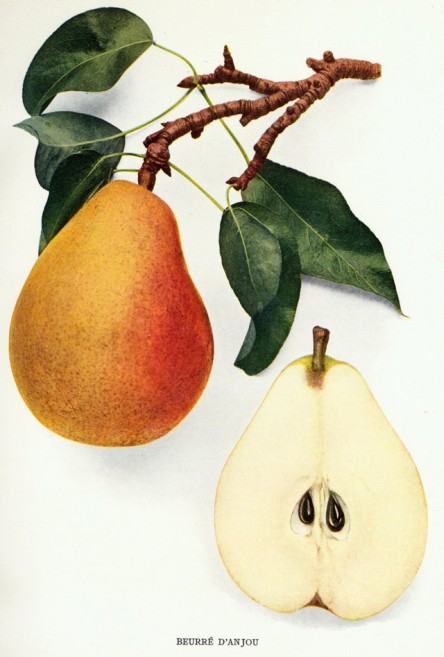
BEURRÉ D’ANJOU
1. Kenrick Am. Orch. 136. 1841. 2. Downing Fr. Trees Am. 360. 1845. 3. Hovey Fr. Am. 1:61, Pl. 1851. 4. Am. Pom. Soc. Rpt. 53. 1852. 5. Flor. & Pom. 5:1, Pl. 1866. 6. Downing Fr. Trees Am. 679, fig. 1869. 7. Hogg Fruit Man. 510. 1884.
Anjou. 8. Am. Pom. Soc. Cat. 36. 1883.
Winter Meuris. 9. Lucas Tafelbirnen 171, fig. 1894.
Nec plus Meuris. 10. Baltet Cult. Fr. 321, fig. 214. 1908. 11. Guide Prat. 49, 282. 1895.
Beurré d’Anjou is a standard market pear for late fall and early winter, its season lasting until well into January even in common storage. As an early winter pear, it has no superior and few equals in appearance and quality of fruit. In appearance, the pear is of distinct type—large, very uniform, the sides slightly unequal, smooth of skin, yellow, marked and dotted with russet, faintly blushed, and borne on a very short, thick stem. A fruit of this variety can never be mistaken for that of another. The internal characters are scarcely less notable than the external ones. The yellowish-white flesh is firm but tender, slightly granular, very juicy, sweet, spicy, with a rich, vinous flavor. Uniformity of shape and the smooth skin are marked and constant characters. In common with all varieties, the fruits of this pear are not always up to their best, but they are never poor in quality. The trees are vigorous, hardy, fairly free from blight, grow rapidly and come in bearing early, but have the serious fault of being uncertain croppers. In Europe and America, the trees thrive on the quince, and the variety is rated by all as a splendid one for dwarfing. Of all winter pears, none is more valuable for commercial or home orchards than Beurré d’Anjou. In particular, it is recommended for New York, where, possibly, it is more at home than in any other part of America.
Beurré d’Anjou is an old French pear the origin of which is obscure, although it is supposed to have originated in the vicinity of Angers. Early in the nineteenth century it was introduced into England by Thomas Rivers, noted author and pomologist. The variety was introduced into this country by Colonel Wilder[25] of Boston about 1842, and first fruited with him in 1845. The American Pomological Society added Beurré d’Anjou to its list of fruits recommended for general cultivation in 1852.
Tree large, vigorous, spreading, hardy, an uncertain bearer; trunk smooth; branches slightly zigzag, covered with gray scarf-skin over reddish-brown, with few small lenticels; branchlets long, with long internodes, reddish-brown tinged with green, smooth, glabrous, with many conspicuous, raised lenticels.
Leaf-buds small, short, obtuse, nearly free. Leaves 3½ in. long, 1½ in. wide, elongated-oval, thin, leathery; apex taper-pointed; margin nearly entire or crenate; petiole 2 in. long. Flower-buds large, long, conical, plump, free; flowers 1⅜ in. across, showy, in dense clusters, from 8 to 12 buds in a cluster; pedicels ½ in. long, very thick, pubescent, green.
Fruit ripe November to early January; large, 3½ in. long, 3 in. wide, uniform in size, oblong-obovate-pyriform, with surface irregular in outline, sides slightly unequal, uniform in shape; stem ½ in. long, short, very thick and woody; cavity obtuse, shallow, russeted and furrowed, usually lipped; calyx open; lobes separated at the base, long, narrow, acuminate; basin shallow, narrow, obtuse, smooth, symmetrical and regular; skin thin, tender, smooth, dull; color yellow, clouded with russet around the basin and occasionally with very fine russet lines and markings; dots many, small, russet, conspicuous; flesh yellowish-white, firm, but slightly granular, tender, buttery, very juicy, sweet and spicy, with a rich, aromatic flavor; quality very good. Core large, closed; core-lines clasping; calyx-tube short, wide, conical; seeds large, wide, long, plump, acuminate, tufted at the tips.
BEURRÉ D’ARENBERG[26]
1. Trans. Lond. Hort. Soc. 5:406. 1824. 2. Lindley Guide Orch. Gard. 392. 1831. 3. Prince Pom. Man. 1:51. 1831. 4. Kenrick Am. Orch. 188. 1832. 5. Ibid. 156. 1841. 6. Gard. Chron. 716, fig. 2. 1844. 7. Downing Fr. Trees Am. 423, fig. 195. 1845. 8. Proc. Nat. Con. Fr. Gr. 51. 1848. 9. Hovey Fr. Am. 1:1, Pl. 1851. 10. Mass. Hort. Soc. Rpt. 93, Pl. 1852. 11. Mas Le Verger 1:161, fig. 79. 1866-73. 12. Hogg Fruit Man. 510. 1884.
Orpheline d’Enghien. 13. Ann. Pom. Belge 3:35, Pl. 1855. 14. Guide Prat. 108, 292. 1876.
In favorable locations this pear seems to possess all of the characters which constitute a first-class fruit; but, notwithstanding, although it has been in the country nearly a century, it is now scarcely to be found in the nurseries, and orchard trees are becoming rare. The fruits are distinguished by their refreshing, vinous taste and long-keeping qualities. Very often, however, they do not ripen in eastern America, and when not properly ripened the pears are highly acidulous and so astringent as to be almost intolerable to the taste. The frequency with which these poor fruits are borne, always on heavy, cold clays and in cold climates, coupled with rather small, short-lived trees, condemn the variety for most pear regions in the East. In the far West, the crop ripens better, and the pears are splendid winter fruits. The merits of the variety are so varying in New York that it is not now worth while attempting to bring it into new life.
Beurré d’Arenberg, in the opinion of some European writers, holds first place among the pears produced by French and Belgian pomologists. Unfortunately, Beurré d’Arenberg and Glou Morceau are often mistaken the one for the other. Beurré d’Arenberg was raised by Monseigneur Deschamps, Abbé of the Orphan Hospital, Enghien, Belgium. At about the same time, M. Noisette, a nurseryman of Paris, sent out Glou Morceau, which he had procured from the gardens of the Duc d’Arenberg, under the name Beurré d’Arenberg, so that there were two distinct varieties in cultivation under the same name. The true Beurré d’Arenberg of the Abbé Deschamps came to this country about 1827, having been sent over by Thomas Andrew Knight, President of the London Horticultural Society, to the Hon. John Lowell of Boston. The American Pomological Society recommended this variety for cultivation in 1848, but in 1871 the name disappeared from the Society’s catalog.
Tree medium in size and vigor, upright, very hardy and very productive; trunk and branches medium in thickness and smoothness; branchlets slender, short, light brown mingled with green, smooth, glabrous, with numerous, small, raised lenticels. Leaf-buds small, short, plump, free; leaf-scars with prominent shoulders. Leaves 3 in. long; 1⅜ in. wide; apex taper-pointed; margin glandless, finely serrate; petiole 1⅞ in. long. Flower-buds small, short, sharply pointed, free, singly on short spurs.
Fruit ripe December to January; large, obovate-pyriform, ribbed; stem 1 in. long, thick, fleshy at the base, obliquely inserted; cavity lacking, drawn up in an oblique lip about the stem; calyx small, closed; lobes short, sometimes lacking; basin deep, smooth; skin roughish, thick, uneven; color yellow, with patches and tracings of russet especially around the calyx end; dots numerous, cinnamon-russet; flesh white, very juicy, melting, vinous or acidulous; quality very good. Core large; seeds large, roundish, plump.
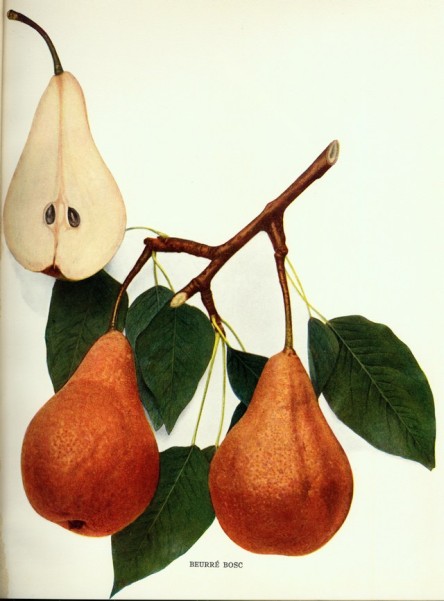
BEURRÉ BOSC
1. Kenrick Am. Orch. 161. 1832. 2. Downing Fr. Trees Am. 358, fig. 152. 1845. 3. Proc. Nat. Cong. Fr. Gr. 29, 51. 1848. 4. Hovey Fr. Am. 1:65, Pl. 1851. 5. Ann. Pom. Belge 5:79, Pl. 1857. 6. Leroy Dict. Pom. 1:320, fig. 1867. 7. Hogg Fruit Man. 514. 1884.
Bosc’s Butterbirne. 8. Dochnahl Führ. Obstkunde 2:100. 1856.
Beurré d’Apremont. 9. Pom. France 1: No. 26, Pl. 26. 1863. 10. Mas Le Verger 3: Pt. 2, 65, fig. 129. 1866-73. 11. Guide Prat. 48, 230. 1895.
Bosc. 12. Am. Pom. Soc. Cat. 36. 1883.
Bosc’s Flaschenbirne. 13. Lauche Deut. Pom. II: No. 75, Pl. 75. 1883. 14. Mathieu Nom. Pom. 188. 1889. 15. Deut. Obstsorten 2: Pt. 5, Pl. 1906.
The fruits of Beurré Bosc merit unqualified praise. They are nearly flawless in every character. The pears at once receive approbation from all who see them by virtue of their uniquely beautiful color and shape, in which characters they are wholly unlike any other pear. The shape is pyriform, with a very long, tapering neck, perfectly symmetrical and unequalled in trimness of contour. The color is a dark rich yellow overspread with cinnamon-russet, with here and there a spot of the yellow ground color visible. The quality is rated by all as “very good” or “best;” the Seckel alone surpasses it as a dessert fruit in the estimation of most pear fanciers. The flesh, while slightly granular, is tender and melting or almost buttery, very juicy, with a rich piquant flavor and a pleasing aroma. The fruits seldom crack, scab, or mildew. The characters of the tree fall far short of those of the fruits. Nurserymen complain that it is difficult to propagate the trees as they make a poor growth in the nursery and come to transplanting age with a root system of two or three prongs almost devoid of fibrous roots. The trees must be humored in soil and climate, and under favorable conditions make but moderate growth as young plants. Established trees in suitable soils, however, surpass most of their neighbors in size and luxuriance of foliage. Very old trees have a nobility of aspect possessed by few other pears. While slow in coming in bearing, after fruiting begins the trees bear regularly and abundantly. The variety does not succeed well on the quince unless double-worked. Unfortunately, the trees are tender to cold and somewhat too susceptible to blight. Beurré Bosc has long been a favorite in the pear regions of Europe and America, and its culture in this country may be recommended for the home, for local and general markets, and for exportation.
This pear is a native of Belgium, having been raised from seed in 1807 by Dr. Van Mons, the renowned pomologist of Louvain, and was in the first instance named by him Calebasse Bosc in honor of M. Bosc, a distinguished French naturalist. In 1820, it was received at the garden of the Horticultural Society of London under the name Beurré Bosc, and Robert Thompson, at that time Director of the gardens, thought it best to retain this name. The variety was early introduced into France. About 1832 or 1833, Robert Manning and William Kenrick received cions in the United States from Van Mons and from the London Horticultural Society. The variety was cataloged by the American Pomological Society at its first meeting in 1848.
Tree medium in size, vigorous, upright-spreading, hardy, productive, not an early bearer; trunk stocky; branches smooth, brownish, covered with ash-gray scarf-skin, with large lenticels; branchlets brownish, tinged with gray, glossy, smooth, nearly glabrous, with slightly raised, conspicuous lenticels.
Leaf-buds obtuse, pointed, appressed; leaf-scars prominent. Leaves 3 in. long, 1⅞ in. wide, ovate, thick, leathery; apex taper-pointed; margin finely crenate; petiole 1¼ in. long. Flower-buds large, conical, pointed, free; flowers open early, 1½ in. across, showy, in dense clusters, from 10 to 20 buds in a cluster; pedicels 1 in. long, slightly pubescent, light green.
Fruit ripe in late October and November; large, 3⅜ in. long, 2¾ in. wide, uniform in size, acute-obovate-pyriform, with a very long, tapering neck, uniform in shape and very symmetrical; stem 1½ in. long, curved; cavity very obtuse or lacking, occasionally very shallow and narrow, wrinkled, russeted, with a fleshy ring folded up around the stem, slightly lipped; calyx open, small; lobes short, broad, obtuse; basin very shallow, narrow, obtuse, smooth, symmetrical; skin slightly granular, tender, roughened by russet, dull; color dark yellow, overspread with thick, dark russet, laid on in streaks and patches, with a cheek of solid russet; dots small, light russet, obscure; flesh yellowish-white, slightly granular, tender and melting, buttery, very juicy, with a rich, delicious, aromatic flavor; quality very good to best. Core large, closed, with clasping core-lines; calyx-tube short, wide, conical; seeds wide, short, plump, obtuse.
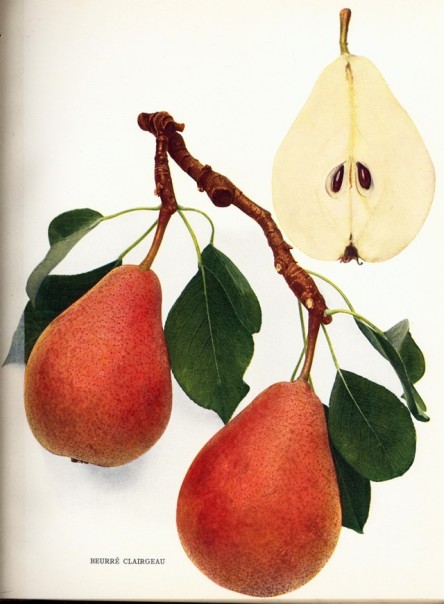
BEURRÉ CLAIRGEAU
1. Hovey Fr. Am. 2:73, Pl. 1851. 2. Ann. Pom. Belge 2:103, Pl. 1854. 3. Gard. Chron. 805. 1854. 4. Am. Pom. Soc. Rpt. 337. 1860. 5. Pom. France 1: No. 11, Pl. 11. 1863. 6. Mas Le Verger 1:39, fig. 26. 1866-73. 7. Jour. Hort. N. S. 12:211. 1867. 8. Leroy Dict. Pom. 1:335, fig. 1867. 9. Downing Fr. Trees Am. 678. 1869. 10. Gard. Chron. 1271. 1873. 11. Hogg Fruit Man. 517. 1884.
Clairgeau’s Butterbirne. 12. Dochnahl Führ. Obstkunde 2:127. 1856. 13. Lauche Deut. Pom. II: No. 7, Pl. 7. 1882. 14. Deut. Obstsorten 3: Pt. 9, Pl. 1907.
Clairgeau. 15. Am. Pom. Soc. Cat. 36. 1883.
Beurré Clairgeau is one of the mainstays in American pear-growing, and is an especially valuable variety in New York. It maintains its place among standard varieties chiefly because of splendid tree-characters, as the fruits, while handsome, are not of the best quality. The tree is second only to that of Buffum in vigor, health, and productiveness, and is nearly as handsome as an ornamental. It does equally well on quince or pear stock, although the Europeans maintain that the product is better on the dwarfing stock. On either stock, the trees bear young and annually. The fruits are large, smooth, symmetrical, and uniform in shape, with a handsome ground color of rich yellow at maturity and a bright crimson cheek. But here praises end, for the “deceptive cheek of the Clairgeau” is proverbial in pear-growing, the handsome coat covering rather coarse, granular flesh which is sometimes very good but more often commonplace. The core is very large, and the flesh surrounding it often rots or softens prematurely. The fruit is more suitable for cookery than dessert. The pears are heavy and often drop before maturity, and the trees should not be set in wind-swept situations. Despite these demerits of the fruits, the variety is well worth planting in commercial orchards for late markets.
The original tree of Beurré Clairgeau appears to have grown by chance about 1830 with Pierre Clairgeau, Nantes, France. M. Clairgeau’s first account of it was given in 1848 when he exhibited fruit. The reputation of the variety seems to have been at once established, for J. de Jonghe and others combined and purchased the stock of about 300 trees grafted on quince. Together with the parent tree, these were the same year removed to Brussels, and in 1852 the pear was placed on the market. Thus it happened that a French pear was first distributed by Belgian growers. The variety was introduced in America about 1854. The American Pomological Society placed it upon its list of recommended fruits in 1860.
Tree medium in size, vigorous, unusually upright, dense, slow-growing, hardy, productive, a regular bearer; trunk slender, shaggy; branches smooth, slightly zigzag, ashgray almost completely overspreading reddish-brown, with many lenticels; branchlets thick, short, with short internodes, greenish-brown, smooth, glabrous, with slightly raised lenticels.
Leaf-buds conical, pointed, appressed; leaves very numerous, 3 in. long, 2 in. wide, broadly oval, leathery; apex abruptly pointed; margin glandless, finely serrate; petiole 2 in. long, glabrous; stipules rudimentary or lacking. Flower-buds medium to long, conical, pointed; flowers 1½ in. across, showy, in dense clusters, averaging 7 buds to a cluster; pedicels ⅝ in. long, thick, pubescent, greenish.
Fruit in season, late October and November; large, 3⅝ in. long, 2⅝ in. wide, uniform in size, roundish-acute-pyriform, with a long, tapering neck, symmetrical, uniform in shape; stem ½ in. long, short, very thick and fleshy; cavity obtuse, very shallow and narrow, fleshy around the base of the stem, russeted, lipped; calyx open, large; lobes separated at the base, long, broad, acute or acuminate; basin shallow, narrow, obtuse, furrowed, often compressed; skin thick and granular, tough, smooth, glossy; color yellow, with bright red blush; dots many, small, russet, conspicuous; flesh white, quite granular, firm at first but becoming at maturity tender and melting, buttery, very juicy, sweet, aromatic, with a rich, vinous flavor; quality variable, good to best. Core large, closed, with clasping core-lines; calyx-tube short, wide, conical; seeds large, wide, long, plump, acute.
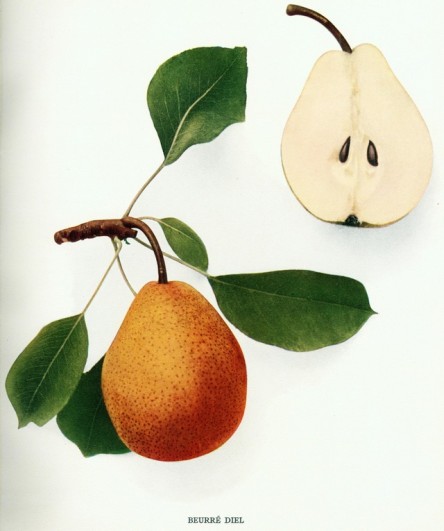
BEURRÉ DIEL
1. Pom. Mag. 1:19, Pl. 1828. 2. Ibid. 3:131, Pl. 1830. 3. Lindley Guide Orch. Gard. 392. 1831. 4. Kenrick Am. Orch. 189. 1832. 5. Ibid. 156. 1841. 6. Downing Fr. Trees Am. 360, fig. 153. 1845. 7. Gard. Chron. 856. 1845. 8. Hovey Fr. Am. 1:77, Pl. 1851. 9. Am. Pom. Soc. Rpt. 231. 1854. 10. Pom. France 1: No. 7, Pl. 7. 1863. 11. Mas Le Verger 1:137, fig. 67. 1866-73. 12. Leroy Dict. Pom. 1:349, fig. 1867. 13. Downing Fr. Trees Am. 686, fig. 1869. 14. Hogg Fruit Man. 518. 1884. 15. Guide Prat. 234. 1895.
Diel’s Butterbirne. 16. Liegel Syst. Anleit. 110. 1825. 17. Lauche Deut. Pom. 11: No. 8, Pl. 8. 1882. 18. Mathieu Nom. Pom. 203. 1889.
Diel. 19. Am. Pom. Soc. Cat. 36. 1883.
The catalogs and text-books supply Beurré Diel with several virtues which Nature denies it as the variety grows in New York. As grown in the eastern United States, the pears are dull and unattractive even at maturity when the pale lemon color is brightest. When the tree is happily situated as to soil and care, the quality of its product is excellent, its fruits being delicious and ranking among the very best, but when illy suited to soil, climate or care, the flesh is coarse, the flavor insipid and astringent, bringing the quality down to second or third rate. The pears keep and ship well. The tree is hardy, uncommonly vigorous and fruitful, but very subject to blight; it is characterized by its long twisting branches which need to be pruned back heavily. The variety is still being planted, but there are better autumn pears.
This variety came from a chance seedling found near Brussels in 1805 by M. Meuris, head gardener for Dr. Van Mons. Being unnamed and of fine quality, Van Mons dedicated it to his German friend, Diel, one of the most distinguished German pomologists. Van Mons sent cions of the variety to the London Horticultural Society in 1817. In 1823, Thomas Andrew Knight sent cions to the Massachusetts Agricultural Society whence it became disseminated generally throughout the United States. The American Pomological Society placed this variety upon its fruit catalog-list in 1854.
Tree medium in size and vigor, spreading, open-topped, slow-growing, hardy, productive; trunk slender, smooth; branches slender, twisting, reddish-brown mingled with grayish scarf-skin, with few lenticels; branchlets with short internodes, dark reddish-brown, smooth, glabrous, with few small, raised lenticels.
Leaf-buds obtuse, free; leaf-scars prominent. Leaves 2¾ in. long, 1¾ in. wide, oval, thick, leathery; apex abruptly pointed; margin finely serrate; petiole 1½ in. long. Flower-buds large, long, conical, rather plump, free; flowers open early, nearly 1⅜ in. across, showy, in dense clusters, 7 or 8 buds in a cluster; pedicels 1⅛ in. long, pubescent, greenish.
Fruit ripe in November; large, 3 in. long, 2⅜ in. wide, uniform in size, obovate-obtuse-pyriform, often irregular and usually with sides unequal; stem 1¼ in. long, thick, curved; cavity obtuse, shallow, very narrow, russeted, furrowed and uneven, often lipped; calyx partly open, large; lobes separated at the base, broad, acute; basin shallow, obtuse, furrowed and uneven; skin very thick and granular, somewhat roughened by russet markings and by dots; color lemon-yellow, with a faint pinkish-red blush and markings and flecks of russet; dots many, russet, very conspicuous; flesh yellowish-white, firm, becoming tender and melting, quite granular around the core, very juicy, sweet, aromatic and rich; quality very good. Core large, closed, with clasping core-lines; calyx-tube short, wide, conical; seeds large, wide, long, plump, often abortive, acute.
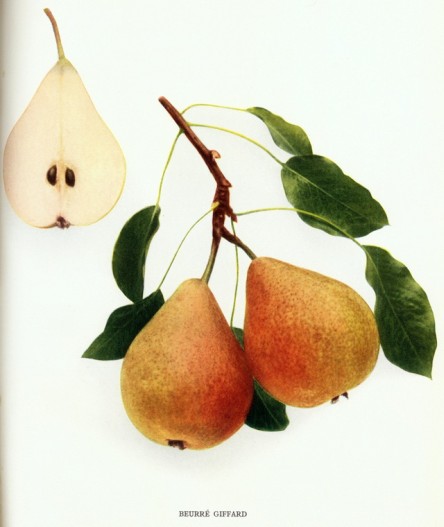
BEURRÉ GIFFARD
1. Gard. Chron. 69. 1848. 2. Mag. Hort. 18:433, fig. 30. 1852. 3. Ann. Pom. Belge 5:69, Pl. 1857. 4. Am. Pom. Soc. Rpt. 231. 1858. 5. Pom. France 1: No. 1, Pl. 1. 1863. 6. Mas Le Verger 2:39, fig. 18. 1866-73. 7. Leroy Dict. Pom. 1:369, fig. 1867. 8. Downing Fr. Trees Am. 689. 1869. 9. Hogg Fruit Man. 521. 1884. 10. Soc. Nat. Hort. France Pom. 374, fig. 1904.
Giffard’s Butterbirne. 11. Oberdieck Obst-Sort. 255. 1881. 12. Lauche Deut. Pom. II: No. 57, Pl. 57. 1883.
Giffard. 13. Gard. Chron. 415. 1863. 14. Am. Pom. Soc. Cat. 38. 1883.
This is one of the few summer pears with a distinctly vinous flavor, which, with the crisp and tender flesh, makes it one of the most refreshing of summer fruits. The pears are larger than those of most other sorts of its season, somewhat like those of Beurré Clairgeau in shape and color, and ripen at a time—just before Clapp Favorite—when good pears should be in demand for home and market. The fruits keep well for summer pears, and are remarkable for their small cores. The trees, while in no way remarkable, are quite up to the average in all characters, and surpass most of their orchard associates in hardiness and fruitfulness. The variety is desirable for both home and commercial orchards.
This early summer pear was found as a chance seedling in 1825 by Nicolas Giffard, Foussières, France. In 1840, M. Millet, president of the Society of Horticulture of Maine-et-Loire, wrote the first description of it in the Bulletins of the Society. It was introduced in America about 1850, and in 1858 was added to the fruit catalog-list of the American Pomological Society.
Tree of medium size, vigorous, spreading, open-topped, hardy, productive; branches reddish-brown, nearly covered with gray scarf-skin, with long and narrow, large lenticels; branchlets slender, new growth willowy, long, reddish-brown, smooth, glabrous except near the tips of the new growth, with conspicuous, raised, round lenticels.
Leaf-buds small, short, pointed, appressed. Leaves 2¾ in. long, 1½ in. wide, stiff; apex taper-pointed; margin entire, sometimes slightly pubescent; petiole 2½ in. long, slender, reddish-green; stipules very long and slender. Flower-buds small, plump, free, singly on very short spurs; flowers showy, 1¼ in. across, in dense clusters, average 8 buds in a cluster; pedicels ¾ in. long, pubescent.
Fruit ripe in late August; variable in size, averages 3 in. long, 2⅜ in. wide, obovate-acute-pyriform; stem ¾ in. long; cavity lacking, the flesh closing up symmetrically around the stem except when drawn up in a lip; calyx open, small; lobes separated at the base, narrow, accuminate; basin shallow, narrow, obtuse, almost smooth, symmetrical; skin thin, tender, smooth; color dull greenish-yellow, with a dotted, dull red blush, often without blush; dots numerous, small, greenish and russet, very conspicuous; flesh tinged with yellow, granular at the center, melting, very juicy, vinous, highly aromatic; quality very good. Core small, closed, with clasping core-lines; calyx-tube narrow, funnel-shaped; seeds plump, acute.
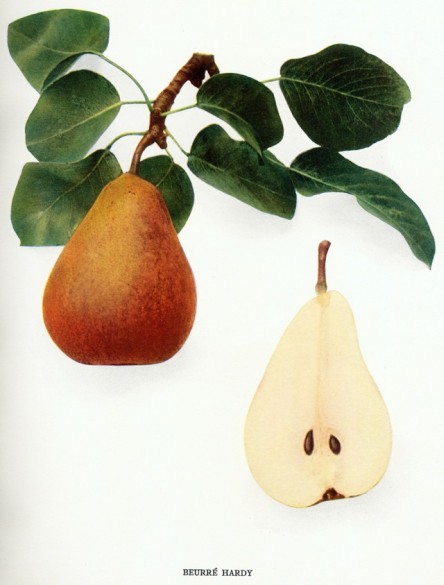
BEURRÉ HARDY
1. Barry Fr. Garden 314. 1851. 2. Downing Fr. Trees Am. 466. 1857. 3. Am. Pom. Soc. Rpt. 66. 1862. 4. Pom. France 2: No. 46, Pl. 46. 1864. 5. Mas Le Verger 3: Pt. 1, 11, fig. 4. 1866-73. 6. Leroy Dict. Pom. 1:379, fig. 1867. 7. Hogg Fruit Man. 521. 1884. 8. Soc. Nat. Hort. France Pom. 378, fig. 1904.
Hardy. 9. Gard. Chron. 463. 1863. 10. Am. Pom. Soc. Cat. 38. 1883.
Gellert’s Butterbirne. 11. Gaucher Pom. Prak. Obst. No. 38, Pl. 78. 1894.
Beurré Hardy is one of the good autumn pears. Both fruit and tree commend it. The fruits are usually large; are handsome in appearance; and the flesh and flavor are exceptionally fine. Thus, the flesh, while a little granular at the core, is melting, juicy, and richly aromatic,—as truly luscious as in any other pear. Unfortunately the fruits do not keep well, having a tendency to soften at the core as maturity advances. When poorly grown or not properly ripened, the pears are sometimes a little astringent, and there is always a smack of astringency. The trees, while not large, are vigorous, hardy, productive, and healthy except in being a little susceptible to blight. This is a favorite pear with nurserymen to bud or graft on the quince, Japanese pear stocks, or other stocks, since it makes a perfect union with any of those in common use. The tree is one of the best dwarfs, also, for its own crop. Wherever pears are grown, this is a good dessert sort, and in many regions it is a valuable fruit for commerce. Beurré Hardy does especially well in New York and in eastern United States.
This is a French pear raised about 1820 by M. Bonnet, Boulogne-sur-Mer, France. In 1830, it was acquired by M. Jean-Laurent Jamin, a nurseryman near Paris, who named it in honor of M. Hardy, Director and Professor of Arboriculture at the Garden of the Luxembourg. It was propagated, made known, and distributed by M. Jamin between 1840 and 1845. The American Pomological Society added Beurré Hardy to its list of recommended fruits in 1862.
Tree medium in size, vigorous, upright, dense-topped, hardy, productive; trunk stocky; branches smooth, dull brown overspread with gray, marked more or less with scarf-skin, with very numerous large, elongated lenticels; branchlets thick, greenish-brown, glossy, smooth, glabrous, with numerous small, raised, conspicuous lenticels.
Leaf-buds conical, pointed, plump, usually free; leaf-scars prominent. Leaves 2½ in. long, 2 in. wide, stiff; apex abruptly pointed; margin tipped with small glands, finely serrate; petiole 1½ in. long. Flower-buds small, short, conical, pointed, plump, free, singly or in small clusters on short spurs; flowers 1¼ in. across, well distributed, average 9 buds in a cluster; pedicels 1 in. long, pubescent, reddish-green.
Fruit in season, late September and early October; large, 3 in. long, 2¼ in. wide, uniform, obtuse-pyriform, with a rather long neck, symmetrical; stem ⅞ in. long, thick, slightly curved; cavity obtuse, very shallow and narrow, russeted, often uneven and gently furrowed, lipped; calyx large, open; lobes broad, acute; basin shallow, narrow, obtuse, gently furrowed; skin granular, tender, russet; color dull greenish-yellow, overspread with thin, brownish-russet, without blush; dots numerous, russet, small, very conspicuous; flesh granular, melting, buttery, very juicy, sweet, richly aromatic and somewhat vinous; quality very good to best. Core large, closed, with clasping core-lines; calyx-tube short, wide, conical; seeds large, wide, long, plump, acute.
BEURRÉ DE JONGHE
1. Mag. Hort. 28:258. 1857. 2. Gard. Chron. 147, fig. 1866. 3. Mas Le Verger 1:73, fig. 43. 1866-73. 4. Downing Fr. Trees Am. 683. 1869. 5. Jour. Hort. N. S. 32:408. 1877. 6. Hogg Fruit Man. 522. 1884. 7. Guide Prat. 64, 232. 1895. 8. Garden 49:225. 1896.
De Jonghe’s Butterbirne. 9. Mathieu Nom. Pom. 201. 1889.
A prime requisite in any pear of best quality is that there be no disagreeable after-taste in the flesh. The fruits of almost none of the winter pears meet this requirement. Almost all have more or less astringency in the after-taste. But the fruits of this variety are wholly free from this astringency and are, moreover, so sweet and rich that they are nearly as delectable as those of Seckel, the standard of excellence in quality. The pears ripen at Geneva in January and may be kept for a month or six weeks at a season when there are few other sweet, rich pears, the fruits of nearly all other pears of this season being vinous and piquant. The trees are hardy and productive, but are slow in coming in bearing, rather small, and not at all self-assertive and must be coddled somewhat. They are reported by many to do better on quince than on pear stocks. The variety is desirable only for the amateur.
According to Mas, the French pomologist, M. de Jonghe mentioned this pear in a pamphlet on new varieties published in 1865. It was described in the Magazine of Horticulture in 1857 as a new variety. In Gardener’s Chronicle, 1866, M. de Jonghe said that he saw this pear first in 1852 at Uccle, Belgium. The seedling had been planted there two years before.
Tree medium in size and vigor, spreading, slow-growing, hardy, very productive; trunk slender, shaggy; branches reddish-brown overspread with thick scarf-skin; branchlets thick, curved, short, with very short internodes, smooth except for the raised, conspicuous lenticels. Leaf-buds small, short; leaf-scars with prominent shoulders. Leaves 2¾ in. long, 1½ in. wide, thick; apex abruptly pointed; margin glandular, finely serrate; petiole 1½ in. long, reddish-green. Flower-buds large, long, very plump, free; flowers 1¼ in. across, 7 or 8 buds in a cluster; pedicels ½ in. long, thick.
Fruit ripe December to January; medium in size, 3 in. long, 2¼ in. wide, obovate-obtuse-pyriform, very regular; stem short, thick, inserted obliquely; cavity very shallow or none, the flesh often drawn up in a lip on one side of the stem; calyx small, open; basin shallow; skin thin; color dull yellow, thickly overspread with a pale, brownish-russet, often with traces of a russet-red blush; dots numerous, small, dull russet; flesh nearly white, fine-grained, melting, buttery, pleasant flavored, aromatic, sweet; quality very good.
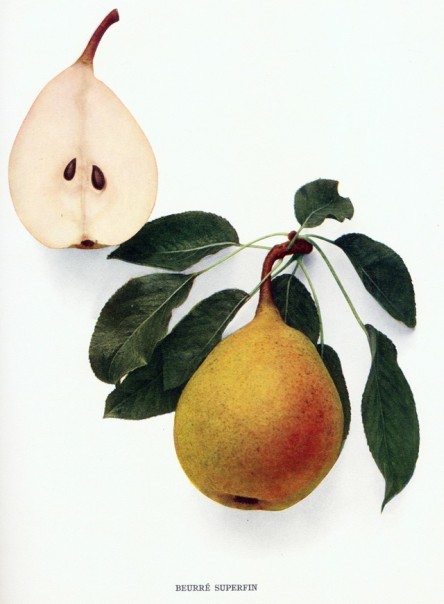
BEURRÉ SUPERFIN
1. Mag. Hort. 20:8, 135. 1854. 2. Horticulturist N. S. 5: 88. 1855. 3. Downing Fr. Trees Am. 465. 1857. 4. Am. Pom. Soc. Rpt. 231. 1858. 5. Leroy Dict. Pom. 1:432, fig. 1867. 6. Hogg Fruit Man. 529. 1884.
Hochfeine Butterbirne. 7. Lauche Deut. Pom. II: No. 59, Pl. 59. 1883. 8. Gaucher Pom. Prak. Obst. No. 47, Pl. 60. 1894.
Superfin. 9. Am. Pom. Soc. Cat. 40. 1883.
Tender in skin and delicate in flesh, the product of this variety is not for the markets, but that of few other sorts so admirably supplies those who want choicely good fruits. The pears are not as attractive in appearance as might be wished, but are hardly surpassed in flavor in their season. The flesh is notable for juiciness, rich vinous flavor, and pleasant perfume. The trees are large, healthy even as regards blight, very productive, and are easily suited as to soils. The trees do not bear early, but are regular in bearing after this life event begins. In Europe, the variety is commonly and successfully grown as a dwarf, and the pear-growers of a generation ago in America recommend this variety as one of the good sorts to work on the quince. The variety is a valuable one for home orchards, especially in New York where it grows exceptionally well.
Beurré Superfin was raised from a bed of pear seeds made at Angers, France, by M. Goubault, a well-known pomologist, in 1837. The parent tree so produced bore fruit in 1844 and the Committee of the Horticultural Society of Maine-et-Loire was requested to report on its merits, which it did in that year, and M. Millet, president of the society, named it Beurré Superfin. It was introduced in America about 1850. The variety was placed on the fruit catalog-list of the American Pomological Society in 1858.
Tree large, vigorous, upright-spreading, dense-topped, hardy, very productive; trunk stocky, rough; branches thick, rough and shaggy, zigzag, dull brownish-red, overspread with gray scarf-skin, sprinkled with numerous elongated lenticels; branchlets slender, light brown, glossy, smooth, glabrous, with small, raised, inconspicuous lenticels.
Leaf-buds small, short, conical, pointed, plump, appressed or free; leaf-scars prominent. Leaves 3¼ in. long, 1⅞ in. wide, stiff; apex abruptly pointed; margin tipped with small glands, coarsely serrate; petiole 1¾ in. long. Flower-buds conical, pointed, plump, free, singly on short branches and short spurs.
Fruit matures in October; large, 3¼ in. long, 2¾ in. wide, roundish-oblate, with a short, thick, rounded neck, symmetrical; stem 1⅛ in. long, very thick, curved; cavity very shallow and narrow or lacking, the flesh tapering into the stem or wrinkled in a fleshy fold about the base of the stem, often lipped; calyx open; lobes separated at the base, broad, narrow; basin narrow, obtuse, gently furrowed, symmetrical; skin very granular, tender, smooth; color yellow, netted and streaked with light russet, often with a slight brownish-russet cheek; dots numerous, small, russet, conspicuous; flesh tinged with yellow, granular, melting, buttery, very juicy, sweet yet with a rich, brisk, vinous flavor, aromatic; quality very good. Core large, closed, with clasping core-lines; calyx-tube short, wide, conical; seeds large, wide, long, plump, acute.
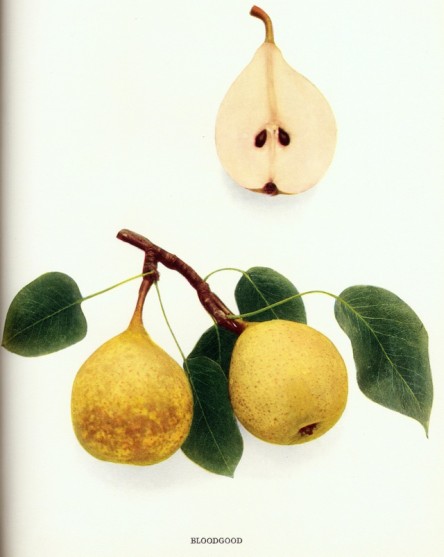
BLOODGOOD
1. Mag. Hort. 3:14. 1837. 2. Manning Book of Fruits 65. 1838. 3. Mag. Hort. 9:366, fig. 31. 1843. 4. Downing Fr. Trees Am. 332, fig. 132. 1845. 5. Proc. Nat. Con. Fr. Gr. 51. 1848. 6. Mas Le Verger 2:181, fig. 89. 1866-73. 7. Leroy Dict. Pom. 1:449, fig. 1867. 8. Hogg Fruit Man. 532. 1884.
Bloodgood’s Sommerbirne. 9. Mathieu Nom. Pom. 186. 1889.
Bloodgood has long been a standard summer pear in America. It surpasses any European associate of its season in both fruit- and tree-characters. In particular, the fruits are meritorious for flesh of fine texture, which, though a little granular, is melting and juicy, and has a rich, sweet, perfumed flavor. Complaints appear in the horticultural press that the quality is exceedingly variable. The reports of poor flavor may arise from the fact that the quality is always poor if the fruit is not picked as soon as full grown and ripened indoors. The season in New York is August. The trees are resistant to blight, healthy, bear young and regularly, are long-lived, and attain large size, although in some situations they are but medium in size. The variety has little or no value in commercial plantations, but is prized in every collection for home use.
The origin of this pear is unknown, but it is supposed to be a native of New York. It seems to have been brought to notice about 1835 by James Bloodgood of the nursery firm of Bloodgood and Company, Flushing, Long Island. According to Robert Manning, the variety was listed in Prince’s Catalogue for 1837 as Early Beurré. After being introduced by Bloodgood and Company, it was speedily recognized as one of the most valuable native sorts. The variety was placed upon the fruit catalog-list of the American Pomological Society in 1848.
Tree medium in size and vigor, upright, dense, slow-growing, productive; trunk medium in thickness and smoothness; branches zigzag, reddish-brown partly overspread with grayish scarf-skin, marked with few small lenticels; branchlets thick, very long, with long internodes, reddish-brown, the new growth greenish, with a brown tinge, glossy, smooth, with small, raised, conspicuous lenticels.
Leaf-buds broad at the base, small, short, sharply pointed, free; leaf-scars with prominent shoulders. Leaves 2¼ in. long, 1⅜ in. wide, oval, leathery; apex taper-pointed; margin finely serrate; petiole 1¼ in. long, slender, tinged red; stipules few, variable in size and shape, tinged red. Flower-buds medium in size and length, conical, plump, free, arranged singly on short spurs; flowers early, 1¼ in. across, in dense clusters, 7 or 8 buds in a cluster; pedicels often ⅞ in. long, pubescent.
Fruit matures in late August; medium in size, 2⅛ in. long, 2 in. wide, roundish-pyriform to acute-pyriform, symmetrical, uniform, with equal sides; stem ¾ in. long, thick; cavity russeted, lipped, drawn up in fleshy folds about the stem; calyx open, small; lobes separated at the base, short, broad, obtuse; basin narrow, obtuse, smooth, symmetrical; skin thick, tough, roughish; color bright yellow, with patches and nettings of russet, producing a mottled russet effect; dots many, small, russet, inconspicuous; flesh tinged yellow, granular, melting, buttery, rich, very juicy, sweet, highly flavored, aromatic; quality very good. Core small, closed, with clasping core-lines; calyx-tube short, narrow, conical; seeds small, short, plump, acute.
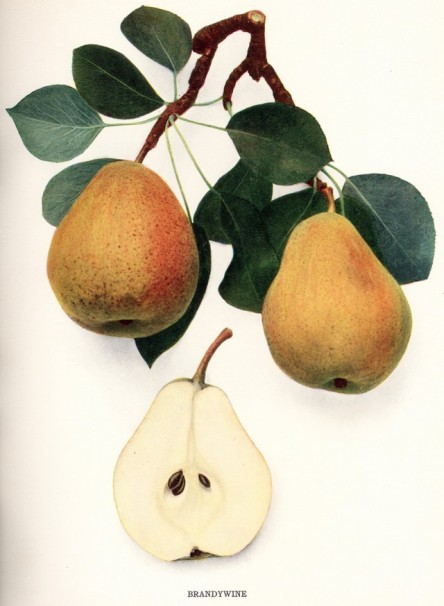
BRANDYWINE
1. Horticulturist 3:166, figs. 25 and 26. 1848-49. 2. Mag. Hort. 15:106. 1849. 3. Hovey Fr. Am. 2:51, Pl. 1851. 4. Mag. Hort. 19:450, fig. 30, 1853. 5. Am. Pom. Soc. Rpt. 231. 1858. 6. Leroy Dict. Pom. 1:496, fig. 1867. 7. Pom. France 4: No. 160, Pl. 160. 1867.
Were it not that Tyson is better in both tree and fruit, Brandywine, which ripens its crop with that of Tyson, could be put down as about the best pear of its season. Tyson is the better variety, however, in almost every soil and situation, and Brandywine has a place in American pear flora only because the pears have a distinct flavor which gives them the charm of individuality. The flesh is neither sweet nor perfumed, as is that of most pears at this season, but has the piquant smack of some of the winter pears which makes the fruits particularly refreshing. The tree is vigorous, with a handsome pyramidal top, but is not remarkable otherwise. Sometimes it is unproductive. The variety is worth planting for the sake of diversity in home orchards.
The original tree, a chance seedling, was found on the farm of Eli Harvey, Chaddsford, on the banks of the Brandywine River, Pennsylvania. This parent tree began to bear about 1820, but in 1835 wind broke it down near the surface of the ground. The present tree is a sucker from the original, and first fruited in 1844. This fact accounts for its not sooner having become known to cultivation. Dr. Brincklé of Philadelphia showed the fruits first at a meeting of the Massachusetts Horticultural Society in 1848 when it received high commendations. In 1858 the American Pomological Society added Brandywine to its list of recommended fruits.
Tree large, vigorous, very upright, dense-topped, productive; branches long, olive-gray, sprinkled with roundish lenticels; branchlets slender, curved, with short internodes, brownish-red overspread with scarf-skin, glabrous, with few small, obscure lenticels.
Leaf-buds medium in size and length, pointed, free. Leaves small, long-ovate; apex taper-pointed; margin serrate; petiole 1½ in. long. Flower-buds large, plump, conical, free, singly on spurs and as terminal buds; flowers ⅞ in. across, in dense clusters, average 9 buds in a cluster; pedicels ½ in. long, slender, pubescent.
Fruit ripens in late August and early September; medium in size, 2¾ in. long, 2½ in. wide, variable in shape but generally obovate-pyriform; stem 1½ in. long, fleshy, curved, obliquely attached; cavity lacking, the flesh drawn up in a wrinkled fold about the base of the stem; calyx large, open; lobes short, entire; basin small, shallow, usually smooth; skin roughish; color greenish-yellow, blushed with red on the sunny side, marked with tracings of russet especially near the cavity; dots numerous, large, conspicuous, russet; flesh whitish, or faintly tinged with yellow, granular, melting, juicy, aromatic, vinous; quality good to very good. Core small; seeds few, small, dark brown.
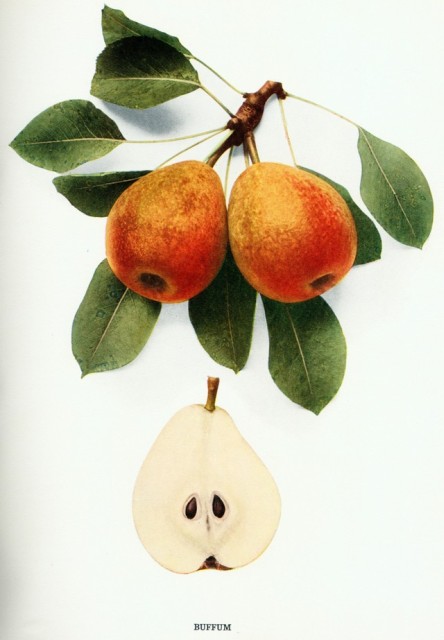
BUFFUM
1. Kenrick Am. Orch. 166. 1832. 2. Mag. Hort. 10:300, fig. 15. 1844. 3. Ibid. 16:297. 1850. 4. Hovey Fr. Am. 2:19, Pl. 1851. 5. Am. Pom. Soc. Rpt. 53. 1852. 6. Horticulturist N. S. 6:300, Pl. 1856. 7. Ibid. 25:104, fig. 1870. 8. Mas Le Verger 3: Pt. 1, 81, fig. 39. 1866-73.
Buffam. 9. Downing Fr. Trees Am. 356, fig. 150. 1845.
Without deserving a high place among pears, Buffum has several meritorious characters which should keep it in the list of standard varieties. The variety must depend chiefly on its tree-characters for approbation, and in these it excels nearly all of its orchard associates. The trees are remarkably vigorous, nearly free from blight, very productive, although they have a tendency to bear biennially; and by virtue of great size, symmetrical, pyramidal form, dark green, glossy foliage, and sturdy, ruddy wood in winter, they are among the most ornamental of all fruit trees. In full leaf, a Buffum tree might easily be taken for a Lombardy poplar. The quality of the fruits is very variable. At times the flesh is rich, aromatic, melting, and very good; again, the pears may be insipid or even illy flavored, devoid of perfume, coarse in texture, and poor. The fruits are never large and often run small. To attain good quality, the pears must be picked early and ripened in a moderately cool fruit-room. The culture of Buffum is on the wane, chiefly for the reason that its fruits ripen with those of Seckel and fail in competition, as the Seckels are nearly as large and much better in quality. But because of its admirable tree-characters the variety should not be lost.
Some confusion exists as to the origin of Buffum. Some writers state that the original tree stood on the grounds of Prescott Hall, Newport, Rhode Island. Hovey, however, in his Fruits of America, 1851, says that the variety originated in the garden of David Buffum, Warren, Rhode Island, shortly after the advent of the nineteenth century. In the opinion of Downing the variety came from seed of White Doyenné. Soon after the founding of the Massachusetts Horticultural Society in 1828, Robert Manning exhibited specimens of the Buffum pear, and through him the variety became known in the vicinity of Boston from which place it was disseminated throughout the country. Buffum was added to the fruit-list of the American Pomological Society in 1852.
Tree vigorous, very upright, dense, hardy, almost immune to blight, very productive; branches shaggy, zigzag, reddish-brown, overspread with grayish scarf-skin, with numerous small lenticels; branchlets short, reddish-brown, tinged with green and streaked with grayish scarf-skin, smooth, glabrous, with conspicuous, small, raised lenticels.
Leaf-buds small, short, conical, pointed, appressed; leaf-scars prominent. Leaves 3¼ in. long, 2 in. wide, oval, thin, leathery; apex abruptly pointed; margin glandular, finely serrate; petiole 2¼ in. long. Flower-buds large, conical, pointed, plump, free, arranged singly on short spurs and branchlets; flowers 1½ in. across, showy, in dense clusters, 6 to 8 buds in a cluster; pedicels ⅞ in. long, slender, pubescent, greenish.
Fruit ripe in late September and October; medium in size, 2¼ in. long, 2 in. wide, uniform in size and shape, oblong-obovate-pyriform, with unequal sides; stem ¾ in. long, very thick; cavity obtuse, very shallow, narrow, russeted, gently furrowed, often lipped; calyx open; lobes separated at the base, short, narrow, obtuse; basin shallow, obtuse, gently furrowed; skin thick, very tough and granular, smooth except for the russet markings, dull; color deep brownish-yellow, with a bright reddish blush on the exposed cheek toward the basin; dots many, small, brownish or russet, conspicuous; flesh white, tinged with yellow, firm, granular, stringy toward the center, juicy, sweet, aromatic; quality good. Core large, closed; core-lines clasping; calyx-tube short, wide, conical; seeds large, wide, plump, acute.
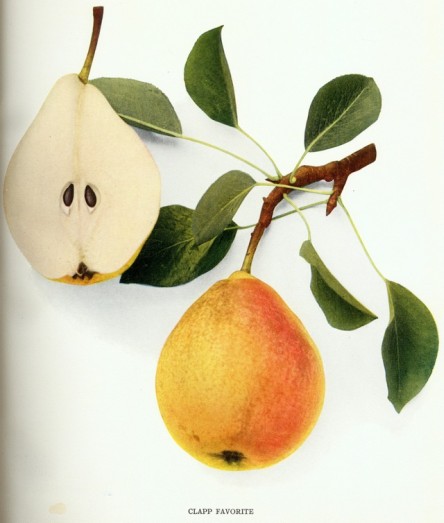
CLAPP FAVORITE
1. Mass. Hort. Soc. Rpt. 50. 1860. 2. Am. Pom. Soc. Cat. 20. 1867. 3. Pom. France 4: No. 170, Pl. 170. 1867. 4. Downing Fr. Trees Am. 720, fig. 1869. 5. Thomas Am. Fruit Cult. 452. 1897.
Favorite de Clapp. 6. Mas Le Verger 2:207, fig. 102. 1866-73.
Clapp’s Favourite. 7. Hogg Fruit Man. 548. 1884. 8. Bunyard-Thomas Fr. Gard. 134, 462, fig. 1904.
Clapp’s Liebling. 9. Gaucher Pom. Prak. Obst. No. 31, Pl. 46. 1894.
Clapp Favorite is by universal consent the standard late summer pear to precede Bartlett, which it much resembles in size, shape, color, and flavor. In most regions in the United States and Canada where pears are largely grown for the market, Clapp Favorite is the first pear to be put on the market. The season is usually a week or sometimes ten days before that of Bartlett. The chief fault of the fruits is that they soon soften at the center after ripening, to obviate which they should be picked at least ten days before they would ripen on the tree. This softening at the core debars the fruit from distant markets, and makes it suitable only for local trade. The illustration of the whole fruit in the accompanying plate is so foreshortened by the camera that size and shape are not shown correctly, but the half-fruit illustrates the size and shape very well. The fruits are usually a little larger than those of Bartlett. Except in one particular, the trees of Clapp Favorite are as nearly perfect as those of any variety in American orchards. The weak character, unfortunately, is a most important one, and all but debars the variety from some regions in which pear-growing is a large industry. The weakness is susceptibility to blight. No standard pear goes down so quickly as this one when blight is epidemic. Two good characters of the trees redeem the variety from failure because of blight. After those of Flemish Beauty and Tyson, the trees of this variety show greater hardihood to cold than those of any other standard sort; and of all pears grown in America, Kieffer not excepted, the trees of Clapp Favorite are most fruitful. Other merits of the tree are large size, great vigor, longevity, and earliness and regularity in bearing. The variety shows a predilection for heavy soils, and the trees may be set on the heaviest clays. Clapp Favorite is grown satisfactorily on dwarf as well as standard stocks. The variety is a desirable one wherever pears are grown, and is one of the half-dozen leading sorts in New York.
Clapp Favorite was raised by Thaddeus Clapp, Dorchester, Massachusetts, but the date of its origin is uncertain. It was favorably mentioned as a promising new fruit at the meeting of the Massachusetts Horticultural Society in 1860. By some writers this pear is supposed to be a cross between Flemish Beauty and Bartlett, but this supposition cannot be proved. The variety was early introduced into England and France where it almost immediately received favorable commendation. The American Pomological Society first listed Clapp Favorite in its fruit-catalog in 1867.
Tree large, upright-spreading, round-topped, very productive; trunk stocky, rough; branches characteristically shaggy, zigzag, reddish-brown overspread with gray scarf-skin, marked by few small, roundish, raised lenticels; branchlets short, dull reddish-brown, tinged with green, smooth, glabrous, with few small, inconspicuous lenticels.
Leaf-buds medium in size, short, conical, pointed; leaf-scars prominent. Leaves 2½ in. long, 1½ in. wide, oval, leathery; apex taper-pointed; margin glandular, finely serrate; petiole 2 in. long. Flower-buds large, conical, pointed, plump, free, arranged singly on short spurs and branches; flowers very showy, 1⅝ in. across, large, well distributed, averaging 7 buds in a cluster; pedicels 13⁄16 in. long, lightly pubescent.
Fruit ripe in late August and early September; large, 4 in. long, 3¼ in. wide, obovate-obtuse-pyriform, tapering slightly toward the apex, symmetrical; stem 1¼ in. long, very thick, curved, fleshy; cavity very shallow, narrow, lipped, with a fleshy ring around the stem; calyx large, open; lobes separated at the base, narrow, acuminate, usually erect and very stiff; basin shallow, wide, obtuse, corrugated and wrinkled; skin thick, tough, smooth, glossy; color pale lemon-yellow, mottled and dotted with bright red, deepening in highly colored specimens to a crimson blush, with occasional faint traces of russet; dots numerous, small, russet, conspicuous; flesh tinged with yellow, very granular and gritty at the center, tender and melting, buttery, juicy, sweet, rich, vinous, aromatic; quality very good. Core large, closed, with clasping core-lines; calyx-tube long, narrow, funnel-shaped; seeds medium in size and width, plump.
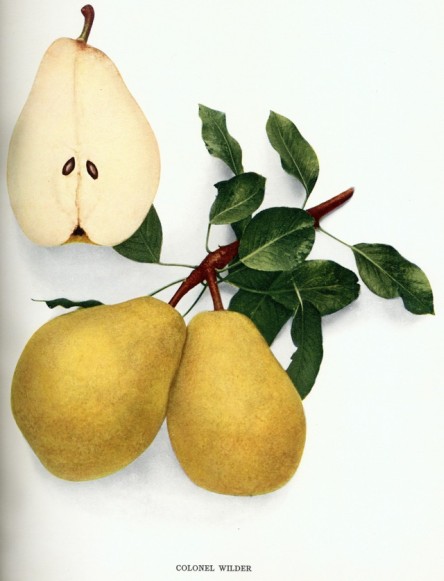
COLONEL WILDER
1. Mass. Hort. Soc. Rpt. Pt. 2. 119. 1875. 2. Downing Fr. Trees Am. 2nd App. 146, fig. 1876. 3. Am. Pom. Soc. Rpt. 23. 1881. 4. Me. Pom. Soc. Rpt. 114. 1891.
Colonel Wilder originated in California and was once a favorite there, but is now reported as being little planted. At one time it was prominent in eastern orchards because of its late season and large, handsome, well-flavored fruits. The variety came in competition with Beurré d’Anjou, however, the season and fruits of the two being similar, but the trees of Colonel Wilder were so greatly outmatched by those of Beurré d’Anjou that this variety is less and less planted in the East. Perhaps it is worth preserving in pear collections for the sake of variety.
This pear originated from seed sown by Bernard S. Fox, San Jose, California, about 1870. It was named after Marshall P. Wilder, Boston, Massachusetts. Just prior to his death Mr. Fox, in a letter to the editor of the Rural Press, wrote of three pears, P. Barry, Fox, and Colonel Wilder, as follows: “The list of pears is already large, and, unless something extremely good is offered, there is no use adding to it. But, after many years of trial here and elsewhere, I claim now, that, at their respective times of ripening, there are no large pears superior to them in size, flavor, and good shipping qualities.”
Tree medium in size, spreading and drooping, open-topped, hardy, an uncertain bearer; trunk shaggy; branches stocky, roughish, reddish-brown nearly covered with gray scarf-skin, marked with many lenticels; branchlets slender, willowy, light brown, with a slight reddish tinge, smooth, glabrous, with few small, slightly raised, obscure lenticels.
Leaf-buds small, short, sharply pointed, free or slightly appressed. Leaves 2¼ in. long, 1¼ in. wide, narrow, short, oval, leathery; apex abruptly pointed; margin glandless, finely serrate; petiole 2¼ in. long, slender, pale green or yellowish, sometimes with a tinge of pink; stipules light greenish-yellow, with a pink tinge. Flower-buds small, short, conical, plump, free, arranged singly on very short spurs; blossoms open very late; flowers 1¼ in. across, in dense clusters, 7 or 8 buds in a cluster; pedicels ½ in. long, pubescent, greenish.
Fruit in season, late December to February; large, 3 in. long, 2¼ in. wide, uniform in size, ribbed, oblong-obovate-pyriform, with unequal sides; stem ¾ in. long, thick, curved; cavity small, obtuse, shallow, narrow, furrowed, occasionally lipped; calyx large, open; lobes separated at the base, narrow, acute; basin shallow, narrow, abrupt, usually smooth, symmetrical; skin thick, tough, rough, dull; color light yellow, often with a faint orange-red blush on the exposed cheek, with nettings and markings of russet; dots numerous, small, grayish and russet-colored, conspicuous; flesh yellowish-white, granular around the core, melting, buttery, very juicy, sweet, aromatic, with a musky flavor; quality good. Core large, closed, with clasping core-lines; calyx-tube short, wide, conical; seeds wide, plump, acute.
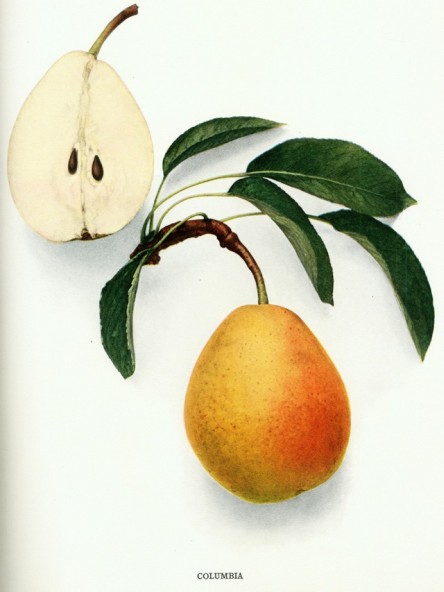
COLUMBIA
1. Mag. Hort. 2:37. 1836. 2. Kenrick Am. Orch. 159. 1841. 3. Mag. Hort. 9: 252, fig. 15. 1843. 4. Downing Fr. Trees Am. 430, fig. 198. 1845. 5. Horticulturist 1:20, 480, fig. 9. 1846-47. 6. Hovey Fr. Am. 2:17, Pl. 1851. 7. Am. Pom. Soc. Rpt. 66. 1862. 8. Leroy Dict. Pom. 1:589, fig. 1867. 9. Pom. France 4: No. 140, Pl. 140. 1867. 10. Downing Fr. Trees Am. 725. 1869.
Once a favorite in eastern United States, Columbia is planted now only in collections. The variety never was a leader as far north as the pear regions of New York and Massachusetts, but when pear-growing was being attempted in the southern states in the middle of the last century, before the advent of Kieffer, Garber, and Le Conte, Columbia was the most dependable sort for the South. The pears are not attractive in appearance, nor remarkably good in quality, but the trees are vigorous, healthy, and very fruitful, although they come in bearing late. The variety is above the average in both fruit and tree, and is too valuable to be discarded. This variety must not be confused with the Columbia now listed in many catalogs, the proper name of which is Barseck.
The original seedling grew on the farm of a Mr. Casser in Westchester County, thirteen miles from New York City. In 1835, Bloodgood and Company, nurserymen of Flushing, Long Island, secured fruit from the original tree, which was then fifteen inches in diameter, and sent it to the Massachusetts Horticultural Society. Later, the variety was propagated and distributed by the Bloodgood Nursery. Columbia was added to the fruit-catalog of the American Pomological Society in 1862.
Tree large, vigorous, upright-spreading, hardy, very productive; trunk stocky, roughish; branches thick, rough, shaggy, dull brownish-red overspread with much gray scarf-skin, marked with roundish lenticels; branchlets short, light brown intermingled with green, dull, smooth, glabrous, with few very small, slightly raised, lenticels.
Leaf-buds small, short, conical, pointed, plump, usually appressed. Leaves 3¼ in. long, 1½ in. wide, long-oval, thin; apex abruptly pointed; margin finely serrate, usually tipped with very small glands; petiole 2¼ in. long. Flower-buds small, short, conical, pointed, plump, free, arranged singly on short spurs; blossoms late; flowers 1¾ in. across, very showy, in dense clusters, 9 to 12 buds in a cluster; pedicels 1⅛ in. long, very thick, pubescent, light green.
Fruit ripe from late November to January; large, 3 in. long, 2⅜ in. wide, uniform in size, oblong-obovate-pyriform, broad at the middle, unequal sides, uniform in general shape; stem 1 in. long, curved, thick; cavity obtuse, very shallow and narrow, smooth; calyx partly open, large; lobes narrow, acuminate; basin shallow, obtuse, wrinkled; skin thick, granular, tough, roughish, dull; color yellowish-green, frequently with a dotted, dull red blush on the exposed cheek; dots many, of various colors, conspicuous; flesh yellowish-white, firm, granular, rather tough, very juicy, sweet, aromatic and rich; quality good. Core large, closed, with clasping core-lines; calyx-tube wide, conical; seeds narrow, very long, often flattened and abortive, acuminate.
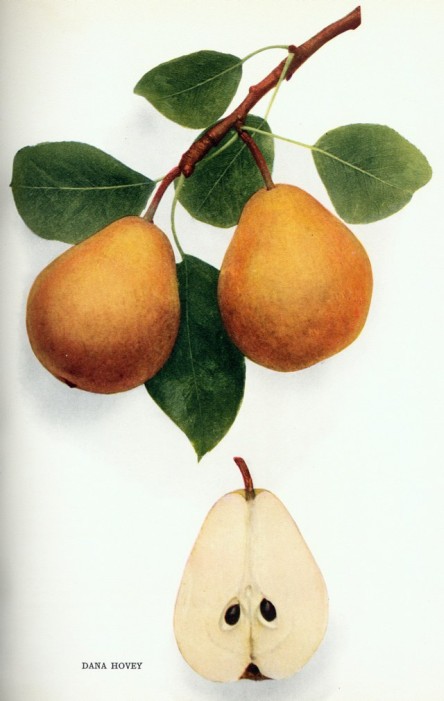
DANA HOVEY
1. Am. Pom. Soc. Cat. 48. 1891.
Dana’s No. 16. 2. Mag. Hort. 19:541. 1853. 3. Ibid. 20:136. 1854.
Dana’s Hovey. 4. Mag. Hort. 25:202, fig. 10. 1859. 5. Am. Pom. Soc. Rpt. 68. 1862. 6. Gard. Chron. 1191, fig. 1866. 7. Downing Fr. Trees Am. 730. 1869. 8. Hogg Fruit Man. 556. 1884. 9. Garden 49:226. 1896.
Danas Hovey. 10. Gard. Chron. 3rd Ser. 47:67, fig. 39. 1910.
Dana Hovey is a delicious little dessert pear, so juicy, sweet, and rich that it is a veritable sweetmeat. The fruits are so similar to those of Seckel that the variety is sometimes called “Winter Seckel.” Dana Hovey is one of the best pears to succeed Seckel. The fruits come in season about the middle of November and keep six weeks in ordinary storage. The flavor is that of Winter Nelis with a smack of Seckel. If the fruits are picked early and kept in a dry, cool place they ripen early in December with a rich, golden color strewn with russet. It is in the same class with Seckel as to size of fruit, although the pears average larger and are more uniform in size from different trees and in different seasons. The pears are also more brightly colored than those of Seckel. Superiority in size and color makes the fruits of this variety much more attractive than those of the better-known Seckel. The trees are hardy, vigorous, and thrive on various soils but are only moderately productive and are somewhat susceptible to blight, falling far short of those of Seckel in these characters, for which reason the last-named variety is the better for commercial plantations. Dana Hovey is one of few winter pears with fruits of high quality, and thus is very desirable for home plantations and ought to have value in commercial plantations.
Francis Dana, Roxbury, Massachusetts, was an indefatigable raiser of new fruits, there being no fewer than sixteen varieties of pears with the prefix “Dana’s,” of which the one under notice is the best of all. It was introduced to the public about 1854 under the name of Dana’s Hovey in honor of C. M. Hovey, the well-known nurseryman of Boston and author of The Fruits of America. Dana Hovey is so similar to Seckel that the latter is supposed to be one of its parents. The variety was added to the American Pomological Society’s fruit-list in 1862.
Tree large, vigorous, upright-spreading, rapid-growing, productive; trunk stocky; branches reddish-brown mingled with green which is almost completely overspread with gray scarf-skin, marked by few small lenticels; branchlets thick, short, light brown mingled with green, marked with ash-gray at the tips, smooth, glabrous, with small, scattering, slightly raised lenticels.
Leaf-buds small, short, pointed, plump, usually appressed. Leaves 3¼ in. long, 2⅛ in. wide, leathery; apex taper-pointed; margin glandless or with few reddish glands, finely serrate; petiole short, stocky, 1½ in. long, glabrous. Flower-buds short, conical but obtuse at the apex, plump, free, arranged singly on short spurs; flowers 1½ in. across, in dense clusters, average 8 buds in a cluster; pedicels ¾ in. long, slender, thinly pubescent.
Fruit matures in late October and November; medium in size, 2½ in. long, 2⅛ in. wide, obovate-obtuse-pyriform, symmetrical, uniform; stem ½ in. long, slender; cavity abrupt, shallow, very small, narrow, slightly lipped; calyx partly open, small; lobes short, narrow, acute; basin shallow, narrow, obtuse, smooth, symmetrical; skin thin, tender, smooth; color golden-yellow at maturity, covered with thin russet; dots numerous, small, greenish-russet; flesh tinged with yellow, granular at the center, tender and melting, juicy, sweet, highly perfumed; quality of the best. Core large, closed, abaxile; calyx-tube short, wide, conical; seeds wide, short, plump, obtuse.
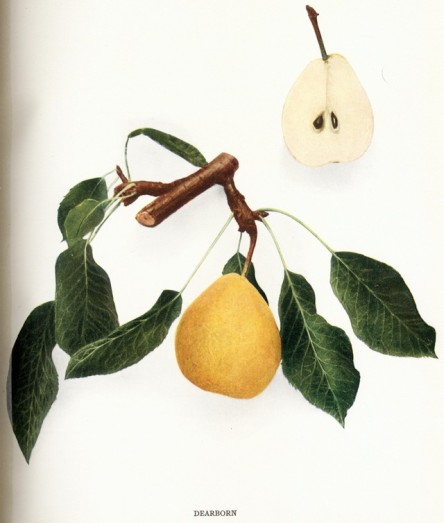
DEARBORN
1. Am. Pom. Soc. Cat. 36. 1883. 2. Ont. Dept. Agr. Fr. Ont. 155. 1914.
Dearborn’s Seedling. 3. Kenrick Am. Orch. 154. 1832. 4. Downing Fr. Trees Am. 336, fig. 135. 1845. 5. Proc. Nat. Con. Fr. Gr. 51. 1848. 6. Hovey Fr. Am. 1:63, Pl. 1851. 7. Elliott Fr. Book 336. 1859. 8. Mas Le Verger 2:17, fig. 7. 1866-73. 9. Leroy Dict. Pom. 2:7, fig. 1869.
Once a favorite, Dearborn is now nearly lost to cultivation, and few or no nurserymen grow the trees. It is too good a variety to be lost, however, because of splendid fruit- and tree-characters. The fruits ripen early and are of good quality, though hardly as richly flavored as those of Elizabeth which ripen at the same time. Unfortunately the pears run small, but they are attractive in shape and color. In season, the crop succeeds that of Bloodgood and precedes that of Bartlett. The trees are almost flawless, and therefore are well adapted to home orchards where fruits cannot receive the care of skilled hands. Besides being almost free from blight, the trees are hardy, vigorous, and very productive. The variety has many valuable qualities for a summer pear in home orchards.
This pear was found growing in a border of shrubs in 1818 at Brinley Place, Roxbury, Massachusetts, the home of General H. A. S. Dearborn,[27] first president of the Massachusetts Horticultural Society. In 1831, General Dearborn first exhibited fruit of the variety at the Massachusetts Horticultural Society where it was named Dearborn’s Seedling in honor of the originator. This variety should not be confused with a pear raised by Van Mons of Belgium and named by him Dearborn. The Dearborn of Van Mons is larger and ripens later than the American Dearborn, and was long since taken from lists of pears recommended for cultivation in America. Dearborn was included in the American Pomological Society’s first fruit-catalog in 1848, where it was called Dearborn’s Seedling. In 1883, the Society shortened the name to Dearborn. Since 1891, the name has failed to appear in the catalogs of this Society.
Tree large, vigorous, spreading, tall, very productive; trunk stocky; branches thick, zigzag, reddish-brown partly covered with a heavy, gray scarf-skin, marked by many reddish-brown lenticels; branchlets slender, very long, with long internodes, older wood brown, new growth greenish, nearly covered with reddish-brown, mottled with ash-gray scarf-skin, smooth, glabrous becoming pubescent near the tips of the new growth, with numerous small, brownish, round, raised, conspicuous lenticels.
Leaf-buds very small, short, pointed, plump, free. Leaves 3 in. long, 1½ in. wide, thin; apex obtusely-pointed; margin with very fine dark tips, finely and shallowly serrate; petiole tinged red, 1¾ in. long, glabrous. Flower-buds small, short, conical, plump, free, arranged singly on short spurs; flowers showy, 1¼ in. across, in dense clusters, 9 or 10 buds in a cluster; pedicels ¾ in. long, pubescent.
Fruit ripe in late August; small, 2 in. long, 2¼ in. wide, uniform, roundish-pyriform, with a slight neck, symmetrical, uniform; stem 1 in. long, slender; cavity obtuse, shallow, narrow, thinly russeted, often slightly lipped; calyx open, large; lobes separated at the base, narrow, acuminate; basin very shallow, obtuse, gently furrowed and wrinkled, symmetrical; skin thick, very tough, smooth, dull; color pale yellow, with russet specks; dots numerous, small, russet, conspicuous; flesh white, slightly granular at the center, tender and melting, very juicy, sweet but spicy, aromatic; quality good. Core large for the size of the fruit, closed, with clasping core-lines; calyx-tube short, wide, conical; seeds large, wide, long, plump, acute.
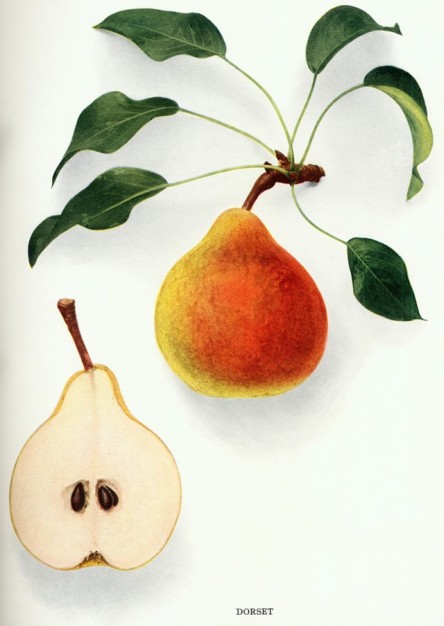
DORSET
1. Ellwanger & Barry Cat. 6, fig. 1895. 2. Ibid. 17, fig. 1900. 3. W. N. Y. Hort. Soc. Rpt. 118. 1900. 4. Ill. Hort. Soc. Rpt. 220. 1902.
Dorset has been on probation in New York for twenty-five years, and its status is not yet decided. The fruits resemble those of Seckel in shape and color, but are larger and come in season later. These external resemblances to Seckel have given it the name “Late Seckel,” which, however, is a misnomer, as a taste of the two fruits at once makes plain. Dorset is not nearly as richly flavored as Seckel. The tree-characters are all very good. Since there are few good late pears to follow Seckel, there may be a place for Dorset.
Dorset was raised from seed by Lemuel Clapp, Dorchester, Massachusetts, but the exact date of origin is unknown. The variety was introduced by Ellwanger and Barry, Rochester, New York, in 1895. During the next ten years it was placed on trial by several state experiment stations, and soon gained a reputation for the characters noted in the preceding paragraph.
Tree small, spreading, very productive, a regular bearer; trunk slender, shaggy; branches slender, smooth, reddish-brown mingled with dull ash-gray, marked with many large lenticels; branchlets slender, dark brown, smooth, glabrous, with large, raised, lenticels.
Leaf-buds medium to small, conical, pointed, free. Leaves 3 in. long, 1½ in. wide, oval, leathery; apex taper-pointed; margin crenate; petiole 1¾ in. long, slender. Flower-buds large, long, conical, pointed, free; blossoms open very early; flowers often 1⅜ in. across, showy, in dense clusters, from 8 to 12 buds in a cluster; pedicels 1 in. or less in length, pubescent, greenish.
Fruit matures in December; medium in size, 2¾ in. long, 2½ in. wide, uniform in size and shape, obovate-obtuse-pyriform, with unequal sides; stem ¾ in. long, curved, cavity almost lacking, obtuse, shallow, narrow, furrowed, compressed, often lipped; calyx open; lobes separated at the base, long, acute; basin narrow, obtuse or often quite abrupt, gently furrowed; skin thick, smooth; color dull greenish-yellow, marked with a dull bronze-red blush on the exposed cheek; dots many, small, grayish and russet, conspicuous; flesh yellowish-white, firm, granular at the center, tender, very juicy, very sweet and aromatic; quality good. Core closed, with clasping core-lines; calyx-tube short, wide, conical; seeds large, wide, long, plump, acute, broad at the base.
DOUGLAS
1. Kan. Hort. Soc. Rpt. 63. 1908-09. 2. Rural N. Y. 70:59, fig. 24. 1911. 3. U. S. D. A. Yearbook 267, Pl. 4. 1912. 4. Rural N. Y. 72:458, fig. 146. 1913. 5. Am. Pom. Soc. Rpt. 41, 42. 1915.
In regions where blight and heat make pear-growing precarious, and only pears with oriental blood, as Kieffer, Garber, and Le Conte, can be grown, Douglas, which belongs with the pears just named, might well be tried. Certainly it is better in flavor than any other variety of its class. The trees come in bearing remarkably early, and are as productive as those of Kieffer, though hardly as large or as vigorous. The trees are inclined to overbear, in which case the fruits run small. The variety has little to recommend it for New York, but those who grow Kieffer might put it on probation with the hope of growing a fruit passably fair for dessert.
Douglas is a seedling of Kieffer crossed, it is believed, with Duchesse d’Angoulême by O. H. Ayer, Lawrence, Douglas County, Kansas, about the year 1897. It fruited first in 1902 and attracted the attention of A. H. Griesa, also of Lawrence, who propagated it in 1907, and sent out specimens of it for appraisement in October, 1910, when it was very favorably reported on by many prominent horticulturists. In accordance with Mr. Griesa’s suggestion, it was named Douglas after the county of its origin.
Tree medium in size and vigor, upright, very productive; trunk slender, smooth; branches slender, dull brownish-red, mottled with gray scarf-skin; branchlets medium in thickness and length, smooth, glabrous, sprinkled with numerous raised, conspicuous lenticels. Leaf-buds large, long, pointed, plump, free; leaf-scars prominent. Leaves 3¼ in. long, 1½ in. wide, thick; apex taper-pointed; margin glandless, finely and shallowly serrate; petiole 1⅝ in. long. Flower-buds large, long, conical, plump, free; flowers 1¼ in. across, white or occasionally with a faint tinge of pink, 11 or 12 buds in a cluster; pedicels 1⅝ in. long.
Fruit matures in October; large, 3¼ in. long, 2¾ in. wide, obovate-pyriform, tapering at both ends like the Kieffer; stem 1⅝ in. long, slender; cavity deep, narrow, compressed, often lipped; calyx small, partly open; basin furrowed; skin thick, tough; color pale yellow, heavily dotted and sometimes flecked with russet; dots numerous, small, light russet or greenish; flesh tinged with yellow, firm but tender, granular, very juicy, sweet yet with an invigorating flavor; quality good. Core closed, axile; calyx-tube short, wide; seeds long, plump, acute.
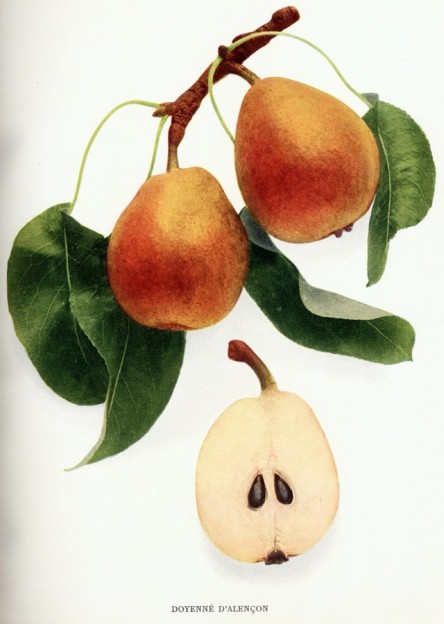
DOYENNÉ D’ALENÇON
1. Am. Pom. Soc. Rpt. 213. 1856. 2. Ibid. 231. 1858. 3. Ann. Pom. Belge 8:15, Pl. 1860. 4. Pom. France 2: No. 47, Pl. 47. 1864. 5. Mas Le Verger 1:23, fig. 10. 1866-73. 6. Downing Fr. Trees Am. 742. 1869. 7. Leroy Dict. Pom. 2:55, fig. 1869. 8. Jour. Hort. N. S. 20:135. 1871. 9. Guide Prat. 61, 264. 1876. 10. Hogg Fruit Man. 564. 1884.
Marmorirte Schmalzbirne. 11. Dochnahl Führ. Obstkunde 2:65. 1856.
Dechantsbirne von Alençon. 12. Mathieu Nom. Pom. 201. 1889.
This old French pear is worth planting, if the trees can be obtained, because of its very late fruits and long season. The pears come in season under ordinary conditions in December and keep until March. The fruits are not remarkable for either taste or appearance, but are good for a winter product when there is little competition with other varieties. The pears are admirably adapted for culinary purposes. In some seasons the pears fail to ripen, and the variety should be planted only on warm soils and in situations where the season is warm and long. Tree and fruit have a family resemblance to Easter Beurré; the latter, however, is generally a better pear than this one. This variety is much grown in Europe on the quince, and in the various fanciful forms Europeans make use of in training fruit trees.
Doyenné d’Alençon is reported to be a wilding discovered by the Abbé Malassis near Alençon, Orne, France, and propagated by M. Thuillier, a nurseryman at Alençon. There was, however, a pear of the same name and season found at Orléans in 1628, in the orchard of Le Lectier, the renowned pomologist. It is probable that the pear which M. Thuillier propagated was the one found many years previously by Le Lectier. The variety must have been introduced into America between 1840 and 1850, as it was mentioned by the American Pomological Society in 1856 as one of the promising new pears. In 1858, the Society added the variety to its fruit-catalog, but discontinued recommending it in 1897.
Tree medium in size and vigor, upright, dense-topped, productive; trunk thick, shaggy; branches stocky, reddish-brown lightly covered with gray scarf-skin; branchlets slender, curved, short, with short internodes, light brown, with a faint reddish tinge, smooth, pubescent near the tips of the new growth, with numerous small, raised, conspicuous lenticels.
Leaf-buds small, short, sharply pointed, plump, free; leaf-scars with prominent shoulders. Leaves 2¾ in. long, 1⅛ in. wide, thin; apex taper-pointed; margin with few glands, coarsely serrate; petiole 2⅝ in. long, glabrous, with tinge of red, slender. Flower-buds small, short, conical, plump, free, arranged singly on short spurs; flowers early, 1¼ in. across, in dense clusters, average 9 buds in a cluster; pedicels ⅝ in. long, lightly pubescent.
Fruit ripe December to February; 2⅞ in. long, 2⅜ in. wide, medium in size, obovate-obtuse-pyriform, symmetrical, uniform; stem ¾ in. long, thick, curved; cavity obtuse, shallow, symmetrical, often slightly lipped, small; calyx open, large; lobes not separated at the base, broad, narrow; basin narrow, abrupt, smooth, symmetrical; skin very thick, tough, roughish; color dull greenish-yellow, with a faint orange blush on the exposed cheek, marked with many brown and russet dots and netted with russet; dots numerous, small, brownish-russet, inconspicuous; flesh tinged with yellow, granular at the center, tender and melting, juicy, aromatic, with a lively vinous flavor; quality good. Core large, closed, axile, with clasping core-lines; calyx-tube short, wide, conical; seeds large, wide, long, plump, acute.
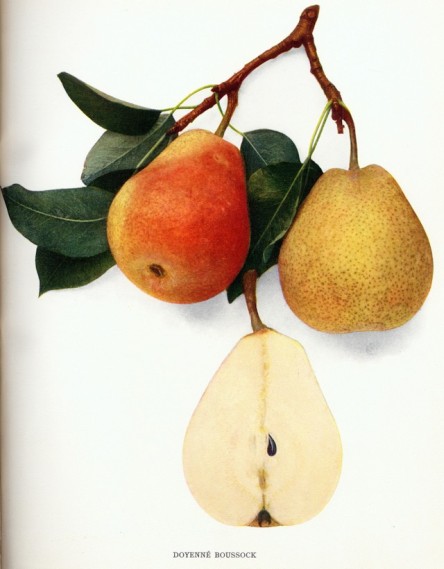
DOYENNÉ BOUSSOCK
1. Hovey Fr. Am. 1:31, Pl. 1851. 2. Am. Pom. Soc. Rpt. 210. 1856. 3. Downing Fr. Trees Am. 742, fig. 1869.
Doyenne Boussock Nouvelle. 4. Kenrick Am. Orch. 143. 1841.
Beurré de Mérode. 5. Ann. Pom. Belge 5:81, Pl. 1857.
Doyenné de Mérode. 6. Pom. France 2: No. 86, Pl. 86. 1864. 8. Guide Prat. 64, 266. 1876. 7. Mas Le Verger 3: Pt. 1, 171, fig. 84. 1866-73.
Doyenné Boussock. 9. Leroy Dict. Pom. 2:58, fig. 1869. 10. Hogg Fruit Man. 564. 1884.
Boussock. 11. Am. Pom. Soc. Cat. 36. 1883.
Doppelte Philippsbirne. 12. Mathieu Nom. Pom. 204. 1889. 13. Gaucher Pom. Prak. Obst. No. 33, Pl. 61. 1894.
This old Belgian pear is a leader in the second rank of commercial pears in this country. If the fruits were better in quality and kept a little longer, the variety would take rank among the best commercial pears, for the fruits are handsome and the trees are nearly flawless. As the color-plate shows, there are few pears more attractive than this one, but the briskly acid flavor is not pleasing to many, and the fruits become soft at the center soon after ripening. The pears are above medium in size and are sometimes large or very large. The seeds are often abortive. The trees are very large and vigorous, as hardy as those of any other pear to cold, less susceptible to blight than most of their orchard associates, and are remarkable for their prominent buds and large, thick, glossy-green leaves, which turn deep red in the autumn. On some soils the trees do not hold their crop well, and it is always best to plant them where there is some protection against heavy winds. The trees are prodigious bearers, and fruit regularly, characters which make the variety desirable for local markets.
This pear is supposed to have been raised by Van Mons at the beginning of the nineteenth century. It was placed on sale at Brussels about 1819. The variety was first given the name Doyenné de Mérode in honor of the Comté de Mérode of Waterloo, Belgium. In 1836, however, the name was changed to Doyenné Boussock. The catalog of the Horticultural Society of London shows that it was received in England in 1842. William Kenrick, on his return from Europe in the spring of 1841, brought the variety to America. In 1856 the American Pomological Society added this pear to its fruit-list.
Tree very large, vigorous, upright-spreading, tall, hardy, productive; trunk thick, shaggy; branches stocky, shaggy, grayish-brown; branchlets long, with long intemodes, light brown tinged with red, overspread with ash-gray, smooth, glabrous, with few elongated, raised, inconspicuous lenticels.
Leaf-buds small, short, sharply pointed, plump, free; leaf-scars with prominent shoulders. Leaves 3½ in. long, 1⅞ in. wide, leathery; apex abruptly pointed; margin very finely serrate; petiole 1½ in. long, slender. Flower-buds small, long and narrow, conical, free, singly on very short spurs; flowers early, showy, 1⅝ in. across, in dense clusters, average 8 buds in a cluster; pedicels 1⅛ in. long, thick, pubescent.
Fruit ripe in September; large, 3 in. long, 2¾ in. wide, uniform, obtuse-obovate-pyriform, symmetrical; stem 1 in. long, very thick; cavity obtuse, rather shallow, broad, often russeted, furrowed, lipped; calyx large, open; lobes separated at the base, broad, acute; basin shallow, wide, obtuse, gently furrowed and wrinkled; skin thin, tender, smooth except for the russet nettings; color pale yellow, occasionally with a mottled pinkish-red blush on the exposed cheek, more or less netted with russet; dots numerous, small, russet, conspicuous; flesh white, tender and melting, buttery, very juicy, briskly acid; quality good. Core large, closed, axile, with meeting core-lines; calyx-tube very short, wide, broadly conical; seeds black, narrow, long, flattened, often abortive.
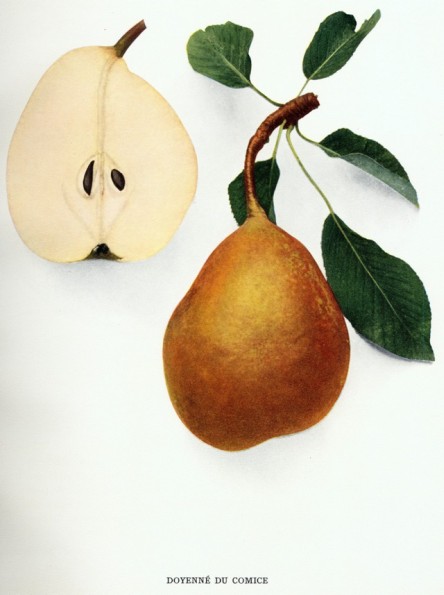
DOYENNÉ DU COMICE
1. Mag. Hort. 18:168, fig. 16. 1852. 2. Ann. Pom. Belge 8:47, Pl. 1860. 3. Am. Pom. Soc. Rpt. 68. 1862. 4. Pom. France 2: No. 58, Pl. 58. 1864. 5. Mas Le Verger 3: Pt. 1, 7, fig. 2. 1866-73. 6. Downing Fr. Trees Am. 744, fig. 1869. 7. Jour. Hort. N. S. 17:440, fig. 1869. 8. Leroy Dict. Pom. 2:60, fig. 1869. 9. Hogg Fruit Man. 565. 1884. 10. Rev. Hort. 447, Pl. 1908.
Beurré Robert. 11. Leroy Dict. Pom. 1:418, fig. 1867. 12. Ibid. 2:775. 1869.
Comice. 13. Am. Pom. Soc. Cat. 36. 1883.
Vereins Dechantsbirne. 14. Mathieu Nom. Pom. 293. 1889. 15. Gaucher Pom. Prak. Obst. No. 68, Pl. 36. 1894. 16. Deut. Obstsorten 5: Pt. 14, Pl. 1909.
This pear has been esteemed long and justly for the beauty and high quality of its fruits. If its tree-characters were better the variety would take high place in commercial orcharding as well as for the home orchard, to which it is now almost wholly confined. The fruits are very large, smooth except for russet markings, clear handsome yellow at maturity, sometimes brightened by a delicate blush, with yellow, fine-grained flesh which is tender, melting, very juicy, sweet, piquant, perfumed. The quality is so good that the fruits of this variety are called by many the best of all pears. The list of faults for the trees is as long as the list of merits for the fruits. The young trees make a poor growth in the nursery; young or old, the trees must be humored in soil, climate, and care; they are subject to blight; while usually productive, they are not always so even where vigorous, healthy, and hardy; lastly, they are a little below the average in hardihood to cold. The variety is seldom at home in New York, but where it thrives, as on the Pacific slope, it is a valuable commercial pear, and is always worthy a place in the home orchard or in the collection of the pear-fancier. In Europe, it is reported as doing especially well on the quince.
The parent tree of Doyenné du Comice was taken from the first seed bed made in the fruit-garden of the Comice Horticole, Angers, Department of Maine-et-Loire, France. In November, 1849, it produced its first fruit, which was at once so highly esteemed that it was named Doyenné du Comice. It was placed on the market with unusual promptitude and rapidly distributed in foreign lands, reaching America about 1850. The variety was recommended for general cultivation by the American Pomological Society in 1862.
Tree vigorous, characteristically upright, dense, usually productive; branches smooth, dull gray mingled with greenish-brown, marked with large lenticels; branchlets long, brown tinged with red, glabrous, with many small, slightly raised, conspicuous lenticels.
Leaf-buds large, medium to long, conical, pointed, nearly free; leaf-scars prominent. Leaves 3¼ in. long, 1½ in. wide, oval, leathery; margin finely serrate; petiole 2 in. long. Flower-buds short, conical, free; blossoms open late; flowers 1¼ in. across, in dense clusters, about 8 buds in a cluster; pedicels ⅞ in. long, slender, pubescent, light green.
Fruit ripe in late October and November; large, 3 in. long, 2¾ in. wide, obovate-obtuse-pyriform or roundish, with unequal sides; stem 1¼ in. long, very thick, usually curved; cavity obtuse, shallow, narrow, russeted and wrinkled, often with a fleshy ring around the base of the stem; calyx open; lobes separated at the base, long, narrow, acuminate; basin medium to wide, obtuse, often furrowed; skin tough and granular, smooth except for the russet markings, dull; color clear yellow, often with a very faint russet-red blush on the exposed cheek, the surface heavily covered with large patches and nettings of attractive russet; dots many, very small, dark brown, obscure; flesh tinged strongly with yellow, fine-grained near the outside but granular toward the core, melting, tender, buttery, very juicy, sweet and vinous, aromatic; quality very good to best. Core closed, with clasping core-lines; calyx-tube short, wide, conical; seeds large, wide, long, rather plump, acute, often abortive.
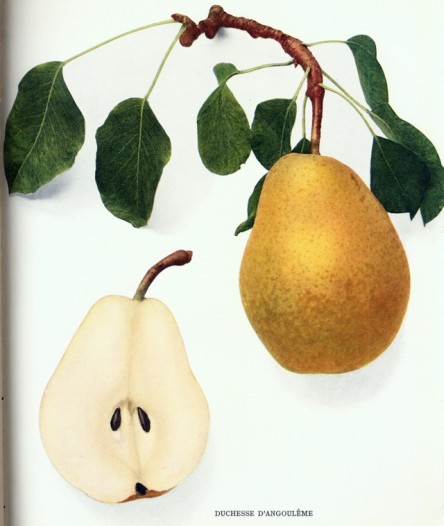
DUCHESSE D’ANGOULÊME
1. Kenrick Am. Orch. 171. 1832. 2. Downing Fr. Trees Am. 381. 1845. 3. Ann. Pom. Belge 1:21, Pl. 1853. 4. Am. Pom. Soc. Rpt. 68. 1862. 5. Pom. France 1: No. 17, Pl. 17. 1863. 6. Mas Le Verger 3: Pt. 2, 79, fig. 136. 1866-73. 7. Leroy Dict. Pom. 2:98, figs. 1869. 8. Jour. Hort. N. S. 24:26. 1873. 9. Guide Prat. 59, 267. 1876. 10. Hist. Mass. Hort. Soc. 1829-78. 224. 1880. 11. Hogg Fruit Man. 569. 1884.
Duchess of Angoulême. 12. Lindley Guide Orch. Gard. 371. 1831.
Angouleme. 13. Am. Pom. Soc. Cat. 36. 1883.
Herzogin von Angoulême. 14. Gaucher Pom. Prak. Obst. No. 46, Pl. 43. 1894.
The fruits of Duchesse d’Angoulême excite admiration and wonder by their enormous size. They may always be known by their great size, squat pyriform shape, and uneven knobby surfaces. Well grown, the pears have other virtues than size, as the flesh is buttery and melting with a rich and delicious flavor; but poorly grown, and on unfavorable soils, the flesh is granular, coarse-grained, but half-melting and nearly devoid of the richness that characterizes the fruits in happier situations. Size shrinks also when poorly grown, so that one may say that a small pear of this variety is seldom fit for dessert and too insipid for a good product in cookery. The trees are vigorous, hardy, and healthy, bear abundantly under favorable conditions, and succeed either as a standard or a dwarf. Possibly it is best grown as a dwarf, and in America at least is more often worked on the dwarfing quince than on the pear. In fact, this variety is the favorite dwarf-pear for garden and home orchard, and commercial orchards of dwarfed trees of it are not uncommon. On either stock, the tree makes a beautiful, symmetrical pyramid, comes in bearing early, and bears regularly. This variety is more popular in New York than in any other part of America, and while less planted than formerly, is still regarded as a standard late autumn variety. It is a particularly desirable sort for the pear-fancier.
The original tree of Duchesse d’Angoulême was a wilding growing in a garden near Angers, Maine-et-Loire, France. About 1808, M. Audusson, a nurseryman at Angers, appreciating the beauty and excellent quality of the pear, obtained the right to propagate it. In 1812 he began selling trees of the variety under the name of “Poire des Eparonnais.” In 1820, M. Audusson sent a basket of the fruit to the Duchesse d’Angoulême with a request for permission to name the pear in her honor, a request which was granted. At the exhibition of the Massachusetts Horticultural Society held in 1830, Samuel G. Perkins showed a specimen which measured eleven and three-tenths inches. It was the only one that grew on the tree, and was considered to be the first fruit of this variety produced in America. The American Pomological Society added Duchesse d’Angoulême to its catalog-list of fruits in 1862.
Tree medium in size, vigorous, upright-spreading, dense-topped, slow-growing, usually hardy, productive; trunk thick; branches stocky, shaggy, zigzag, dull reddish-brown overspread with scarf-skin, marked with small lenticels; branchlets thick, short, dull light brown, streaked with gray scarf-skin, smooth, glabrous, with many small, raised lenticels.
Leaf-buds small, short, conical, pointed, nearly free; leaf-scars prominent. Leaves 2¾ in. long, 1⅝ in. wide, oval, thick, leathery; apex taper-pointed; margin marked with minute dark brown glands, crenate or nearly entire; petiole 1¾ in. long. Flower-buds large, long, conical, plump, free, arranged singly or in small clusters on short branches and spurs; flowers 1⅜ in. across, 7 or 8 buds in each cluster; pedicels 1 in. long, slender, lightly pubescent, greenish.
Fruit ripe October to November; large, often very large, 4 in. long, 3 in. wide, uniform in size, oblong-obovate-pyriform, with irregular and uneven surface and with sides often unequal; stem frequently 1½ in. long, very thick, curved; cavity acute, deep, furrowed, irregular, often lipped; calyx partly open, small; lobes short, narrow, acute; basin medium to deep, abrupt, furrowed and uneven, often corrugated; skin thick, granular, roughened with russet; color dull yellow, streaked, spotted and netted with dull russet; dots numerous, russet, conspicuous; flesh white, firm becoming somewhat melting and quite tender when fully mature, granular, juicy, sweet, rich and delicious when fully mature; quality good to very good. Core closed, with clasping core-lines; calyx-tube short, wide, conical; seeds small, narrow, flat, acute, very often abortive.
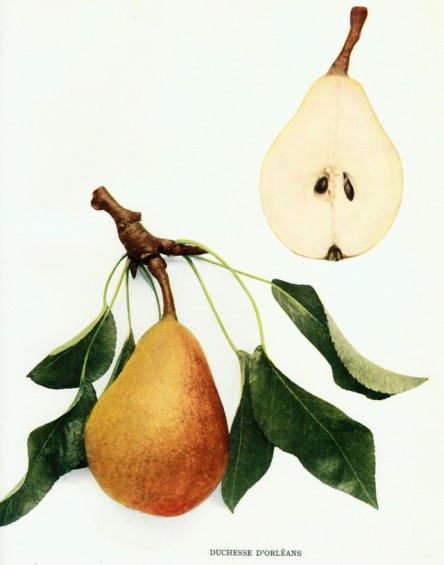
DUCHESSE D’ORLÉANS
1. Kenrick Am. Orch. 143. 1841. 2. Am. Pom. Soc. Rpt. 68. 1862. 3. Downing Fr. Trees Am. 749. 1869. 4. Hogg Fruit Man. 570. 1884.
Duchess of Orleans. 5. Hovey Fr. Am. 1:91, Pl. 1851.
Saint-Nicolas. 6. Pom. France 1: No. 33, Pl. 33. 1863. 7. Cat. Cong. Pom. France 343, fig. 1906.
Beurré de Saint-Nicolas. 8. Mas Le Verger 3: Pt. 1, 137, fig. 67. 1866-73. 9. Leroy Dict. Pom. 1:426, fig. 1867.
Butterbirne von Saint-Nicolas. 10. Mathieu Nom. Pom. 191. 1889.
In the middle of the last century this pear was heralded as one of the best of the French varieties which were then coming to this country in great numbers, but it is now almost lost to cultivation. While in no way remarkable, the variety is too valuable to be discarded. As the color-plate shows, the fruits are prepossessing in appearance. The pears are bright yellow, with a brilliant cheek, the whole fruit being more or less mottled with golden russet. Few pears are smoother of skin or more symmetrical in shape, and the fruits are more uniform in size than those of most varieties. The quality, as well as the appearance, is pleasing. While the flesh is a little dry and not as rich in flavor as that of most other varieties of its season, it is so crisp and refreshingly piquant in contrast to the sweeter, buttery pears with which it ripens, its season being just after that of Bartlett, that the variety finds favor with all who like pears. The variety fails in its tree-characters. Thus, the trees are late in coming in bearing; are not very vigorous; are somewhat tender to cold; and do not resist blight well. The variety has little value for commercial places, but if the trees can be obtained, is well worth planting in the home orchard.