Chapter IV · LEADING VARIETIES OF PEARS (continued 2)
Reading edition
This pear is a chance seedling found by M. Maurier near Angers, Maine-et-Loire, France, nearly a century ago. It was propagated by M. Flon, a nurseryman of Angers and fruited first in 1839. In England and America the variety has been chiefly known as Duchesse d’Orléans, but many French horticulturists have used the name Saint-Nicolas. The variety was added to the fruit-catalog list of the American Pomological Society in 1862, but was dropped from the list in 1871.
Tree medium in size and vigor, spreading, moderately productive; trunk slender, shaggy; branches medium in thickness and smoothness, reddish-brown partly overspread with thin gray scarf-skin, with few indistinct lenticels; branchlets short, with short internodes, light brownish-red mingled with green and partly covered with thin, gray scarf-skin, dull, smooth, glabrous, with conspicuous, raised lenticels.
Leaf-buds long, narrow, sharply pointed, plump, free. Leaves 3 in. long, 1½ in. wide; apex taper-pointed; margin tipped with small, brownish glands, coarsely serrate; petiole 2 in. long, glabrous, reddish-green. Flower-buds long, conical, sharply pointed, free, singly on numerous short spurs; flowers showy, 1⅜ in. across, in dense clusters, average 7 buds in a cluster, the petals widely separated at the base; pedicels 7⁄16 in. long, slender, lightly pubescent.
Fruit matures in late September and October; medium in size, 2⅞ in. long, 2¼ in. wide, obovate-acute-pyriform, symmetrical; stem 1 in. long, thick; cavity lacking, the flesh drawn up in a symmetrical fold about the stem; calyx small, open; lobes separated at the base, narrow, acute; basin very shallow, narrow, obtuse, smooth or slightly wrinkled; skin thin, tender, smooth; color yellow overlaid with a red blush, faintly mottled with golden russet; dots numerous, whitish or russet, conspicuous; flesh tinged with yellow, firm, granular, crisp, juicy, subacid; quality good. Core small, closed, axile, with meeting core-lines; calyx-tube short, conical; seeds long, plump, acute.
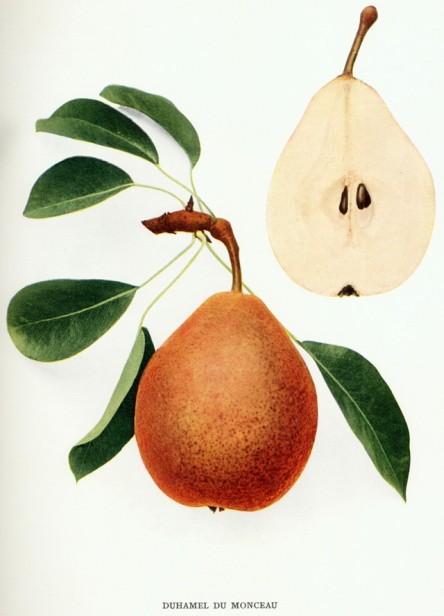
DUHAMEL DU MONCEAU
1. Leroy Dict. Pom. 2:114, fig. 1869. 2. Downing Fr. Trees Am. 2nd App. 146, fig. 1876. 3. W. N. Y. Hort. Soc. Rpt. 118. 1881.
Duhamel’s Butterbirne. 4. Mathieu Nom. Pom. 207. 1889.
Duhamel. 5. Budd-Hansen Am. Hort. Man. 2:241. 1903.
The unattractive little fruits of this pear would have small value were it not for the fact that they are delicious in quality and come into edible condition late. The fruits are of the type of those of Winter Nelis, differing in shape somewhat, but are even better in quality and keep longer. The fruits are further distinguished by a musky taste and perfume, which make them especially agreeable to those who like rich, sweet, perfumed pears. The trees, while in no characters remarkable, are better than most of their orchard associates, and far superior to the unmanageable trees of Winter Nelis with which this variety must compete. After a probationary period of a half century in America, Duhamel du Monceau has not found favor with commercial orchardists, but pear fanciers value it for its delectable late-keeping fruits. Nurserymen find the trees rather difficult to grow.
Duhamel du Monceau was obtained from seed by André Leroy, the eminent author and pomologist at Angers, France. In naming the variety, M. Leroy said that his purpose was to do honor to the memory of the illustrious professor who filled an important place in pomology, and who, in giving us the Traité des arbres fruitiers published in 1768, rendered and still renders valuable services to horticulturists. The original tree began to fruit in 1862 and was cataloged by Leroy in 1865. The variety seems to have been described first in America by Downing in 1876.
Tree vigorous, upright, dense, hardy; trunk stocky; branches thick, zigzag, dull brownish-red, covered with ash-gray scarf-skin, marked with numerous large lenticels; branchlets very thick, short, with short internodes, brownish-red, tinged with green, dull, smooth, glabrous, with many conspicuous, raised lenticels.
Leaf-buds long, obtuse, appressed; leaf-scars prominent. Leaves 3 in. long, 1⅞ in. wide, long, folded lengthwise with the margins curled under, leathery; apex taper-pointed; margin entire or coarsely crenate; petiole 2 in. long, slender. Flower-buds large, long, conical, plump, free, singly on short spurs; blossoms open late; flowers 1 in. across, well distributed, averaging 7 buds in a cluster; pedicels 13⁄16 in. long, slender, pubescent, pale green.
Fruit ripe October to November; above medium in size, 3⅛ in. long, 2½ in. wide, uniform in size, roundish-pyriform or at times oblong-pyriform, symmetrical, with equal sides; stem 1 in. long, slightly curved, thick; cavity lacking, the stem being attached to the smooth, flat surface; calyx open; lobes separated at the base, short, obtuse or acute; basin shallow, obtuse, gently furrowed, small; skin thin, tender, roughened by the russet skin, dull; color greenish-yellow overspread with solid russet, or splashed, spotted and sprinkled with russet, the cheek often solid russet; dots many, small, russet, obscure because of the russet color, slightly raised; flesh yellowish-white, granular especially around the core, melting, buttery, very juicy, vinous; quality very good. Core variable in size, closed, with clasping core-lines; calyx-tube short, wide, conical; seeds elongated-oval, wide, plump, acute.
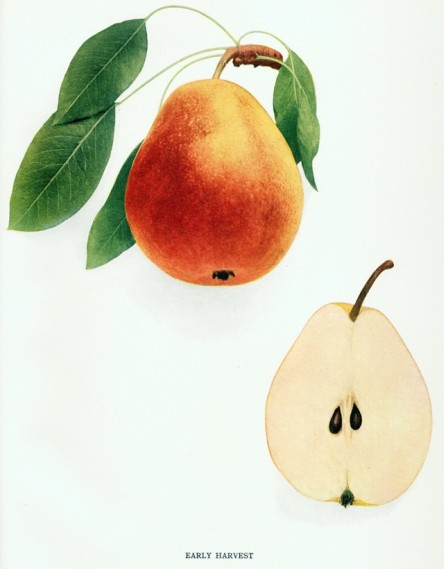
EARLY HARVEST
1. Neb. Hort. Soc. Rpt. 129. 1890. 2. Budd-Hansen Am. Hort. Man. 2:243. 1903. Chambers. 3. Horticulturist 25:263, fig. 1870. 4. Tilton Jour. Hort. 8:293. 1870. 5. Mass. Hort. Soc. Rpt. 157. 1874. 6. Am. Pom. Soc. Cat. 32. 1875. 7. Downing Fr. Trees Am. 3rd App. 174. 1881. 8. Can. Hort. 26:130. 1903. 9. Ont. Dept. Agr. Fr. Ont. 151, fig. 1914.
The fruits of Early Harvest are so poor in quality and rot at the core so soon after ripening, that the variety is hardly worth growing in New York, where there are many better pears of its season. To offset these defects, the pears are large and handsome for early fruits, and the trees are healthy and regular and heavy bearers. The pear is characterized by a thick, fleshy stem and a large closed core. Nurserymen report that the tree is difficult to propagate, and fruit-growers find that it is slow in coming in bearing; the growth is usually straggling and difficult to manage in nursery or orchard. The variety is more popular in the Middle West than in any other part of the country.
This variety appears to have been brought to Middletown, Kentucky, from Maryland by Captain William Chambers about 1800, with several other varieties. According to the rules of pomological nomenclature, this pear should be called Chambers as it was first known. The name Early Harvest was given the variety by Kentucky growers because of its extreme earliness, and became so closely associated with the variety that today it is the only one with which the public is familiar. In 1875 this variety was added to the fruit catalog-list of the American Pomological Society under the name Chambers.
Tree large, very vigorous, upright-spreading, dense-topped, very hardy, productive with age, long-lived; trunk very stocky, shaggy; branches thick, shaggy, zigzag, dull reddish-brown mingled with green and heavily covered with grayish scarf-skin, marked with numerous, large, elongated lenticels; branchlets very thick, straight, long, with long internodes, dull olive-green mingled with light brown, smooth, glabrous, with numerous very conspicuous, raised lenticels, variable in size.
Leaf-buds small, short, obtuse, appressed; leaf-scars prominent. Leaves 3⅛ in. long, 2⅜ in. wide; apex very abruptly pointed; margin glandless, varying from finely serrate to entire; petiole 1⅝ in. long, slender. Flowers open early, showy, 1⅛ in. across, well distributed, average 7 buds in a cluster; pedicels 1 in. long, thinly pubescent.
Fruit ripens in August; large, 3½ in. long, 3 in. wide, obovate-obtuse-pyriform, symmetrical; stem very thick, fleshy at its juncture with the cavity; cavity obtuse, shallow, narrow, often slightly wrinkled and drawn up in fleshy folds around the base of the stem; calyx small, open; lobes short, obtuse; basin shallow, narrow, obtuse, slightly wrinkled; skin thin, smooth; color pale yellow, more or less overspread on the exposed cheek with a pinkish blush, with stripes of carmine; dots numerous, small, greenish-russet, obscure; flesh yellowish, firm, granular, crisp, somewhat tough, variable in juiciness; quality poor. Core large, closed, axile, with clasping core-lines; calyx-tube very long, narrow; seeds wide, short, plump, obtuse.
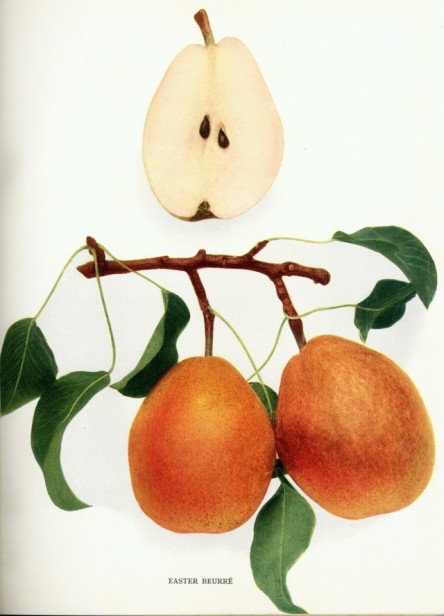
EASTER BEURRÉ
1. Pom. Mag. 2:78, Pl. 1829. 2. Lindley Guide Orch. Gard. 397. 1831. 3. Kenrick Am. Orch. 160. 1841. 4. Downing Fr. Trees Am. 425, fig. 196. 1845. 5. Gard. Chron. 168, fig. 1845. 6. Mag. Hort. 16:73. 1850. 7. Am. Pom. Soc. Rpt. 157. 1854. 8. Ibid. 66. 1862. 9. Downing Fr. Trees Am. 751, fig. 1869. 10. Hogg Fruit Man. 572. 1884. 11. Ont. Dept. Agr. Fr. Ont. 159, figs. 1914.
Bergamote de la Pentecôte. 12. Ann. Pom. Belge 4:41, Pl. 1856.
Doyenné d’Hiver. 13. Mas Le Verger 1:43, fig. 28. 1866-73. 14. Leroy Dict. Pom. 2:72, fig. 1869. 15. Guide Prat. 61, 265. 1876.
Beurré Rouppé. 16. Mas Pom. Gen. 4:87, fig. 236. 1879.
Winter Dechantsbirne. 17. Mathieu Nom. Pom. 300. 1889. 18. Gaucher Pom. Prak. Obst. No. 71, Pl. 34. 1894.
The fruit-books of Europe have so much to say in praise of Easter Beurré that the variety has been tried time and time again in America, but nearly always with unfavorable results. The variety grows well only in comparatively warm climates and on light, warm, limy soils, and refuses to ripen its crop in any others. There are occasional places in eastern America where Easter Beurré can be well grown, but for most part it is at home only on the Pacific slope. The fruits are of first rate excellence when at their best, and add much to the winter supply of pears, the product of few other winter pears surpassing that of this sort from January to March in regions where it does well. The pears are excellent shippers, keep well in common or cold storage, so that where the variety succeeds it is valuable for home, and distant and foreign markets. The trees are in every way satisfactory except that they bloom a little earlier than other sorts, and are somewhat more susceptible to the scab fungus in both fruit and foliage than a commercial variety should be. Although a little too susceptible to blight, the trees are above the average in immunity, and are hardy, vigorous, and productive. The variety is well worth planting in soils and climates where the crop matures properly.
In the gardens of the Capucin Monastery at Louvain, Belgium, there was, about 1823, an old pear tree known to the monks as the Pastorale de Louvain, which attracted the attention of Van Mons. He propagated the pear and in due course distributed it. By the year 1853, it was to be found pretty generally in the gardens of Belgium under the name of Pastorale. Since that time it has been very widely disseminated, but unfortunately has received a confusing variety of names, Leroy mentioning twenty-four and Mathieu fifty-five. The leading authorities, however, of England and this country have uniformly adopted the name Easter Beurré. It was received in the former country soon after its first dissemination, and it was brought to this country not later than 1837. Since 1862, Easter Beurré has appeared in the list of pears recommended for general cultivation by the American Pomological Society.
Tree medium in size, vigorous, upright-spreading, open-topped, slow-growing, hardy; branches reddish-brown overspread with gray scarf-skin, sprinkled with inconspicuous lenticels; branchlets variable in length, with short internodes, greenish-brown mingled with red, rough, glabrous, with small, round, raised lenticels.
Leaf-buds small, very short, obtuse, free. Leaves 2⅛ in. long, 1⅛ in. wide, thin; apex abruptly pointed; margin finely serrate, the teeth very short, tipped with red; petiole 2 in. long, slender. Flower-buds small, short, conical, plump, free, singly on short spurs; flowers 1¼ in. across, occasionally tinged with pink in the bud, becoming white when open, well distributed, average 9 buds in a cluster; pedicels ¾ in. long, slender, pubescent.
Fruit in season late December to February; 3 in. long, 2⅜ in. wide, obovate-pyriform, with a short, thick neck; stem ¾ in. long, thick, woody; cavity acute, very deep, narrow, furrowed, uneven, compressed; calyx open; lobes narrow, acute; basin deep, narrow, abrupt, furrowed and wrinkled; skin thick, tough, roughened by the dots, the surface uneven; color yellow, marked with many russet dots and with patches and veinings of russet, often with a dull brownish-red blush; dots numerous, small, very conspicuous, russet; flesh tinged with yellow, granular near the center and toward the calyx, tender and melting, juicy, buttery, sweet, with a rich, pleasant flavor, very aromatic; quality very good. Core large, closed, axile, with meeting core-lines; calyx-tube short, wide, conical; seeds large, wide, long, plump, acute.
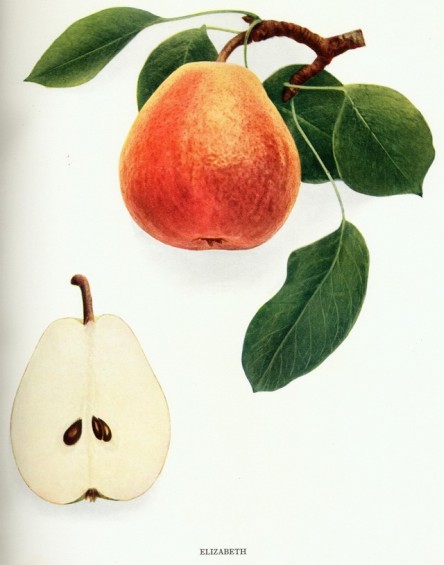
ELIZABETH
1. Mag. Hort. 8:57. 1842. 2. Ibid. 13:63, fig. 6. 1847. 3. Leroy Dict. Pom. 2:126, fig. 1869. 4. Am. Pom. Soc. Cat. 23. 1897.
Manning’s Elizabeth. 5. Downing Fr. Trees Am. 385. 1845. 6. Hovey Fr. Am. 2:41, Pl. 1851. 7. Am. Pom. Soc. Rpt. 231. 1854. 8. Downing Fr. Trees Am. 810, fig. 1869.
Elizabeth de Manning. 9. Mas Le Verger 2:105, fig. 51. 1866-73. 10. Guide Prat. 93, 269. 1876.
Nina. 11. Hogg Fruit Man. 623. 1884. 12. Mathieu Nom. Pom. 258. 1889.
Elizabeth is among the best summer pears for eastern America, either for home consumption or for the markets. The characters which commend it are: handsome, well-flavored fruits; and vigorous, hardy, productive trees, which are as resistant to blight as those of any other European pear, and which come in bearing early and bear annually. Faults are: the fruits are small, a fault that can be overcome somewhat by thinning; they are a little coarse in texture of flesh, which is a little too gritty; and the flavor, while good for an early pear, is not as sweet and rich as might be desired. The trees are nearly flawless, failing, if at all, in not attaining as great size as some other inhabitants of pear orchards. The crop is often borne in clusters—a defect by reason of which the fruits are so often small. But even with these defects, we must end as we began with the statement that this is one of the best summer pears.
In the year 1819, Van Mons established his famous nursery at Louvain, Belgium, and in the years 1830 and 1831 he sent from there two consignments of pear cions to the Massachusetts Horticultural Society, both of which were unfortunately lost in turn on the way. Three years later, Kenrick, Manning, and Dearborn, Massachusetts horticulturists, requested him to forward another collection. In the successive springs of 1835 and 1836, he sent two more collections which safely arrived in due course, though a large proportion of the cions died. These collections comprised originally about 150 named and 100 seedling unnamed varieties, and Van Mons granted Manning permission to name any of the latter that might prove worthy of cultivation. No. 154 of these, Mr. Manning[28] named Elizabeth (Van Mons). Later on it was disseminated as Manning’s Elizabeth, and soon after the name was shortened to i. The variety was placed in the fruit-list of the American Pomological Society in 1854.
Tree small, upright, dense-topped, hardy, very productive; trunk slender; branches brownish-green, partly overspread with thin, gray scarf-skin, marked by conspicuous, oval lenticels; branchlets slender, long, reddish-brown mingled with green, new growth exceptionally red, dull, smooth, glabrous except on the younger wood, with obscure, raised lenticels.
Leaf-buds small, short, pointed, plump, free. Leaves 3 in. long, 1½ in. wide, stiff; apex variable; margin almost entire; petiole 2 in. long, slender, reddish-green; stipules very small and slender when present. Flower-buds small, short, conical, plump, free, singly on short spurs; flowers early, showy, 1⅝ in. across, in dense clusters, average 8 buds in a cluster; pedicels 1 in. long, lightly pubescent.
Fruit ripe in late August; small, 2⅜ in. long, 2½ in. wide, obovate-obtuse-pyriform, symmetrical, uniform; stem 1 in. long, thick, curved; cavity acuminate, shallow, narrow, symmetrical, often lipped; calyx large, almost closed; lobes separated at the base, short, narrow, acuminate; basin shallow, obtuse, gently furrowed and wrinkled; skin tough, characteristically rough, glossy; color bright yellow, with a lively, red cheek, mottled with brownish, minute specks; dots numerous, very small, conspicuous, russet or brown; flesh tinged with yellow, slightly granular under the skin, strongly granular at the center, tender and melting, very juicy, sweet, vinous, aromatic; quality very good. Core large, closed, with clasping core-lines; calyx-tube short, wide, conical; seeds wide, plump, acute.
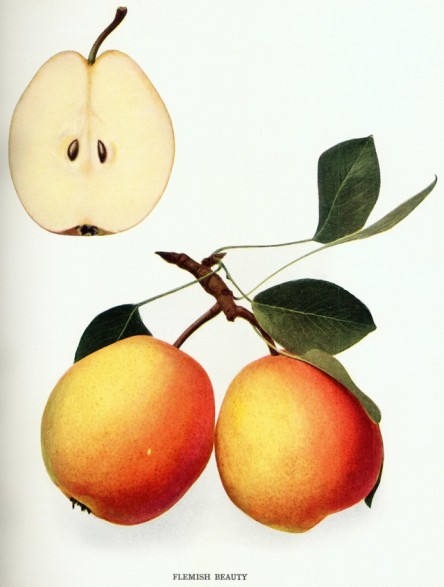
FLEMISH BEAUTY
1. Pom. Mag. 3:128, Pl. 1830. 2. Lindley Guide Orch. Gard. 373. 1831. 3. Downing Fr. Trees Am. 386, fig. 167. 1845. 4. Proc. Nat. Con. Fr. Gr. 51. 1848. 5. Hovey Fr. Am. 1:51, Pl. 1851. 6. Downing Fr. Trees Am. 760, fig. 1869. 7. Hogg Fruit Man. 578. 1884.
Belle de Flanders. 8. Kenrick Am. Orch. 172. 1832.
Fondante des Bois. 9. Ann. Pom. Belge 6:41, Pl. 1858. 10. Pom. France 1: No. 25, Pl. 25, 1863. 11. Mas Le Verger 3: Pt. 2, 55, fig. 124. 1866-73. 12. Leroy Dict. Pom. 2:166, fig. 1869. 13. Guide Prat. 58, 272. 1876. 14. Soc. Nat. Hort. France Pom. 412, fig. 1904.
Holzfarbige Butterbirne. 15. Mathieu Nom. Pom. 235. 1889. 16. Gaucher Pom. Prak. Obst. No. 49, Pl. 38. 1894.
At one time Flemish Beauty was a leading commercial variety in the pear regions of eastern America, but it has been supplanted by other varieties because the toll of blighted trees is too great, and the fruits are too often disfigured by the scab fungus. Perhaps the latter is the greater fault as in some seasons no applications of spray give the pears a clean cheek, and they are blackened, scabbed, cracked and malformed with this fungus. Not infrequently the scab-infected foliage drops before the crop matures. To offset these defects, the trees have to their credit great vigor, unusual fruitfulness and as great hardihood to cold as those of any other variety. The trees do not come in bearing early, and are not suitable for dwarfing as they overgrow the quince stock. The fruits are nearly perfect if scab-free and properly matured. To make sure of perfect maturity, the pears must be picked as soon as they attain full size and be permitted to ripen under cover. So treated, a bright-cheeked Flemish Beauty is as handsome as any pear, and is almost unapproachable in quality; the flavor is nicely balanced between sweetness and sourness, very rich, and has a pleasing muskiness. Blight and scab condemn tree and fruit for commercial orchards, but a lover of good pears should combat these troubles for the sake of the choice fruits.
The parent tree of this variety is said to have been a wilding found in a wood near Alost, East Flanders, Belgium, about the beginning of the nineteenth century. It was cultivated under the Flemish name of Bosc Peêr or Pear of the Woods. About 1810, the propagation of the variety was taken up by Van Mons who introduced it a few years later under the name Fondante des Bois by which name it was known in Europe for many years. Lindley, writing in 1831, described this variety under the name Flemish Beauty, and it appeared then to be in pretty general cultivation in England. Styling it Barnard, Hovey wrote, in 1851, that Flemish Beauty “had been known in Dorchester, Massachusetts, for nearly twenty years,” so that it is to be inferred that the variety was introduced to this country prior to 1830 and possibly by some one by the name of Barnard. The rapid distribution of this pear was promoted by Van Mons who gave numerous grafts of it to his friends and correspondents. The fact that the variety has over sixty synonyms may be taken as some testimony to its popularity and excellence. At the first meeting of the American Pomological Society held in 1848, Flemish Beauty was placed in the list of pears recommended for general cultivation, a place it has since retained.
Tree medium in size, vigorous, spreading, with drooping branches, hardy, productive; trunk smooth; branches thick, shaggy, bright reddish-brown, with dull gray scarf-skin, large lenticels; branchlets thick, short, with short internodes, reddish-brown, smooth, glabrous, with many large, raised lenticels.
Leaf-buds large, long, obtuse, pointed, nearly free; leaf-scars prominent. Leaves 3½ in. long, 1¾ in. wide, oval, thick, leathery; apex taper-pointed; margin finely serrate; petiole 2 in. long, usually slender. Flower-buds very large, long, conical or pointed, very plump, free; flowers 1¼ in. across, in dense clusters, usually 7 buds in a cluster; pedicels 1¼ in. long, slender, slightly pubescent, light green.
Fruit ripe in late September and early October; large, nearly 2¾ in. long, 2½ in. wide, uniform in size and shape, roundish or obovate-obtuse-pyriform, symmetrical, with nearly equal sides; stem 1⅛ in. long, thick; cavity acute, shallow to deep, narrow, slightly russeted, a little furrowed; calyx open; lobes partly separated at the base, short, obtuse; basin shallow, narrow, abrupt, symmetrical; skin thick, tough, roughish, dull; color clear yellow, overspread on the exposed cheek with a dotted and marbled red blush; dots numerous, russet, small, conspicuous; flesh yellowish-white, firm, becoming melting and tender, granular, juicy, sweet, aromatic, with a slight musky flavor; quality very good. Core closed, with clasping core-lines; calyx-tube short, wide, conical; seeds rather long, plump, acute.
FONDANTE DE NOËL
1. Mag. Hort. 21:267, fig. 9. 1855. 2. Ann. Pom. Belge 7:67, Pl. 1859. 3. Pom. France 1: No. 14, Pl. 14. 1863. 4. Mas Le Verger 1:65, fig. 39. 1866-73. 5. Downing Fr. Trees Am. 764. 1869. 6. Hogg Fruit Man. 580. 1884.
Belle après Noël. 7. McIntosh Bk. Gard. 2:459. 1855.
Weihnachtsbirne. 8. Dochnahl Führ. Obstkunde 2:62. 1856. 9. Mathieu Nom. Pom. 296. 1889.
Belle de Noël. 10. Leroy Dict. Pom. 1:209, fig. 1867.
It is doubtful whether this rather rare European pear can be purchased from American nurserymen now, but possibly it may be had, and at least it could be re-propagated from old trees. The fruit is distinguished by its trim, top-shaped form and handsome coat, usually enlivened with a dull color on the sunny side. The flesh, while gritty near the core, is tender, juicy, buttery, very rich, sweet, and aromatic. It is just the pear for those who prefer sweetness to vinousness or piquancy, and who object to even a trace of astringency. The trees, while only medium in size, are vigorous, hardy, healthy, and productive. If the variety grows elsewhere as well as it does on the grounds of the New York Agricultural Experiment Station it is too good to be lost. The fruits are in season and at their best for Christmas.
This pear was raised from seed by Major Espéren, Mechlin, Belgium. The tree fruited first in 1842 and was given the name Fondante de Noël to indicate the day on which it was tasted for the first time. In 1862 a pear called Souvenir d’Espéren, attributed to seed grown by Berckmans, a noted Belgian horticulturist living in the United States, was put forth, but after examination there did not appear to be any difference in either the fruit or the wood of this tree from that of the variety grown by Major Espéren. Because the name Souvenir d’Espéren appears in connection with Fondante de Noël, the variety has been confused with another pear which was raised by Major Espéren and named Souvenir d’Espéren. The two, however, are entirely distinct and the last-named sort has long been known and is still found growing in certain pear orchards of the eastern United States.
Tree medium in size and vigor, upright, hardy, productive; trunk thick, smooth; branches brownish-green, nearly covered with gray scarf-skin; branchlets slender, with long internodes, smooth, glabrous, marked with conspicuous, raised lenticels.
Leaf-buds large, long, conical, plump, free. Leaves 3½ in. long, 1½ in. wide; apex taper-pointed; margin glandless, finely serrate; petiole 2⅞ in. long. Flower-buds large, long, plump, free, singly on short spurs; flowers showy, 1½ in. across, white often tinged pink on the edges of the petals, average 9 buds in a cluster; pedicels ⅞ in. long.
Fruit matures December to January; large, 2½ in. long, 2¾ in. wide, roundish-turbinate, irregular; stem ¾ in. long, thick, woody, obliquely set; cavity obtuse, shallow, narrow, furrowed, often lipped; calyx small, nearly closed; basin narrow, obtuse, furrowed; skin roughened by russet dots and patches; color dull greenish-yellow, with many dots, flecks and patches of russet, often with a faint trace of brownish-red on the sunny side; dots numerous, small, russet, rather conspicuous; flesh white, gritty only near the core, tender, buttery, juicy, sweet, highly aromatic; quality good to very good; core large, with meeting core-lines; calyx-tube short, wide; seeds large, long, plump, acute.
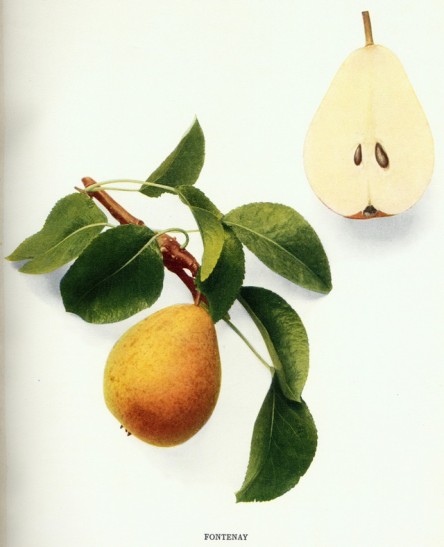
FONTENAY
1. Am. Pom. Soc. Cat. 38. 1883.
Jalousie de Fontenay Vendée. 2. Downing Fr. Trees Am. 396, fig. 173. 1845. 3. Am. Pom. Soc. Rpt. 68. 1862.
Belle de Esquermes. 4. Mag. Hort. 20:135. 1854.
Jalousie de Fontenay. 5. Pom. France 1: No. 44, Pl. 44. 1863. 6. Hogg Fruit Man. 303. 1866. 7. Mas Le Verger 3: Pt. 2, 157, fig. 175. 1866-73. 8. Leroy Dict. Pom. 2:295, fig. 1869. 9. Guide Prat. 64, 281. 1876.
Birn von Fontenay. 10. Mathieu Nom. Pom. 215. 1889. 11. Lucas Tafelbirnen 87, fig. 1894.
The reader will discover no noteworthy characters in the description of this pear; nor does the accompanying illustration make the variety particularly alluring, although the color-plate scarcely does the fruits justice in either size or color. The variety is to be found in many old orchards in eastern America, but was long since relegated by pear-growers to the limbo of nurserymen’s catalogs. The only reason for giving it a place in The Pears of New York is that the variety was once prominent, and references to it and comparisons with it are so common in horticultural literature that pear-growers are certain to want to know something about it. As the following description shows, the variety is but mediocre in tree and fruit.
Early in the eighteenth century M. Lévêque, an architect, acquired possession of an estate near Fontenay, France. A number of pear seedlings were growing upon this property, one of which was so good as to attract M. Lévêque’s attention and he began propagating it in 1828. Later he distributed cions of the variety to his friends under the name Poire de Fontenay. Soon afterward the name was changed to Jalousie de Fontenay, Leroy took the variety to the garden of the Horticultural Society of Angers about 1835, from which place it was still more widely disseminated. It soon found its way to America where it gained early popularity. In 1862 the American Pomological Society listed this variety in its fruit-catalog under the name Jalousie de Fontenay, but shortened the name, in 1883, to Fontenay. In 1899, however, the name disappeared from this catalog and has never been replaced.
Tree medium in size, vigorous, upright, dense-topped, hardy; trunk slender, smooth; branches slender, brown mingled with green, partly covered with thin, gray scarf-skin; branchlets thick, long, with short internodes, light brownish-green, faintly tinged with red, dull, the new growth pubescent near the ends, smooth, with numerous, conspicuous, small, raised lenticels.
Leaf-buds very small, short, sharply pointed, free; leaf-scars with large, prominent shoulders. Leaves 3 in. long, 1½ in. wide, very thick; apex taper-pointed; margin almost glandless, finely serrate; petiole 2 in. long, variable in size, glabrous; stipules very slender, tinged red. Flower-buds small, short, conical, free, singly on very short spurs; flowers late, showy, 1¾ in. across, in dense clusters, average 7 buds in a cluster; pedicels ⅝ in. long, lightly pubescent.
Fruit matures in October; small, 2⅝ in. long, 2 in. wide, oblong-acute-pyriform, symmetrical, with equal sides; stem ¾ in. long, curved; cavity lacking, the flesh folded around the base of the stem, often lipped; calyx partly open; lobes broad, acute; basin shallow, narrow, obtuse, slightly wrinkled, symmetrical; skin thick, tough, smooth; color dull yellowish-green, netted and patched with russet, with a tinge of red on the exposed cheek; dots numerous, small, russet, obscure; flesh strongly granular at the center, tender and melting, very juicy, subacid; quality good. Core large, closed, axile, with meeting core-lines; calyx-tube short, narrow, funnel-shaped; carpels emarginate; seeds large, wide, long, plump, acute.
FORELLE
1. Trans. Lond. Hort. Soc. 5:408, Pl. XVII. 1824. 2. Pom. Mag. 3:112, Pl. 1830. 3. Lindley Guide Orch. Gard. 399, 1831. 4. Prince Pom. Man. 1:130. 1831. 5. Downing Fr. Trees Am. 389, fig. 169. 1845. 6. Mag. Hort. 13:339, fig. 27. 1847. 7. Downing Fr. Trees Am. 765. 1869. 8. Leroy Dict. Pom. 2:183, figs. 1869. 9. Mas Pom. Gen. 1:115, fig. 58. 1872.
Forellenbirne. 10. Christ Handb. 514. 1817. 11. Dochnahl Führ. Obstkunde 2:12. 1856. 12. Lauche Deut. Pom. II: No. 23, Pl. 23. 1882.
Florelle. 13. Prince Treat. Hort. 13. 1828.
Trout Pear. 14. Gard. Chron. 804, fig. 1846.
The pear fancier prizes Forelle for its singularly handsome and distinctive fruits, which are also of very good quality. Forelle pleases the eye as well as any pear for bright colors, and is distinguished among fruits of its kind by its trout-like specklings from which comes the name Forelle, the German name for trout. Looks do not belie taste for the flesh is delicate and buttery, is highly flavored, and satisfies those who regard high quality a prime requisite in a pear. The trees are very satisfactory in warm soils and exposures, but fail in heavy clays and cold climates. The variety is worth growing for its beautiful and distinctive fruits.
Nothing is very certainly known of the origin of this pear, but it seems highly probable that it had its birth in northern Saxony at the beginning of the eighteenth century. From Germany it was taken to Flanders, and from there introduced into England. In the latter country, it was first fruited by Thomas Andrew Knight, President of the Horticultural Society of London, who, in 1823, sent cions to the Honorable John Lowell, President of the Massachusetts Horticultural Society. Forelle became quite widely disseminated in the eastern United States during the first half of the eighteenth century, and was considered by many pomologists a pear of merit. At the present time, however, the variety has almost disappeared from cultivation. Its place has been filled by Vermont Beauty, a pear introduced from Vermont more than forty years ago. It is not improbable that these two varieties are identical. Vermont Beauty may be the old German pear renamed.
Tree medium in size, vigorous, upright, very hardy and very productive; branches few, dark brownish-red, sprinkled with numerous lenticels; branchlets long, pubescent on the youngest shoots. Leaves small, flat, roundish-ovate; flowers open early.
Fruit ripens November to December; medium in size, 3 in. long, 2 in. wide, oblong-obovate-pyriform, with a neck variable in length; stem 1 in. long, slender; cavity shallow, oblique, narrow, often lipped; calyx small, open; lobes broad; basin shallow, narrow, abrupt; skin smooth; color yellow, more or less overlaid with red, deepening to rich crimson next to the sun, profusely covered with grayish-russet dots which are margined or rayed with crimson; dots numerous, large and small, russet or grayish; flesh white, fine-grained, although slightly granular at the center, melting, buttery, juicy, aromatic, with a rich, vinous flavor; quality good. Core medium in size; seeds nearly black, of medium size.
FOX
1. Budd-Hansen Am. Hort. Man. 2:245. 1903. 2. Ragan Nom. Pear, B. P. I. Bul. 126:123. 1908. B. S. Fox. 3. Downing Fr. Trees Am. 2nd App. 154. 1876. 4. Am. Pom. Soc. Rpt. 42, fig. 1877. 5. Gard. Mon. 22:369. 1880. 6. Mo. Hort. Soc. Rpt. 170. 1883.
Fox seems to have failed in the pear-growing regions of America, in spite of its having several excellent characters in both fruit and tree. The fruits are not quite attractive enough to sell on the markets or to grace the table of the amateur, their rough, russet skins detracting greatly from their appearance. When the skin is removed, however, a better late fall pear cannot be found. The flesh is white, fine in texture, very juicy, melting, and has a brisk, vinous flavor and a pleasant aromatic smell and taste that at once place the quality very high. The trees are but mediocre in the prime characters of a good orchard plant, and condemn the variety for any purpose other than the collector’s plantation.
Fox is one of many seedlings originated by B. S. Fox,[29] San José, California. Most of these seedlings were raised from seed of Belle Lucrative and Fox is among this number. The exact date of origin cannot be determined, but it is assumed to have been in the early seventies. The variety is considered to be one of the best of Fox’s seedlings.
Tree medium in size and vigor, upright-spreading, round-topped, moderately productive; trunk slender; branches stocky, smooth, greenish-brown overspread with grayish scarf-skin; branchlets thick, short, with short internodes, zigzag, glabrous, sprinkled with small, raised lenticels. Leaf-buds long, obtuse, pointed, free. Leaves 2⅛ in. long, 1¼ in. wide, thick; apex abruptly pointed; margin nearly entire to finely serrate. Flower-buds conical, pointed, free; flowers open early.
Fruit ripens October to November; large, 3⅛ in. long, 2⅛ in. wide, oblong-obovate-pyriform; stem 1½ in. long, very thick, curved, obliquely set; cavity very shallow or lacking, the flesh folded up around the base of the stem; calyx closed or slightly open, variable in size; lobes much separated at the base, short, broad, acute; basin shallow, narrow, very small, furrowed and compressed; skin thick, granular, tough, roughened by the russet dots; color russet-yellow, often with a russet-red blush on the side next to the sun, almost entirely overspread with russet; dots numerous, conspicuous, russet; flesh white, granular near the core, melting, very juicy, sweet mingled with a brisk, vinous flavor, richly aromatic; quality very good. Core large, closed; calyx-tube short, wide; seeds wide, plump, acute.
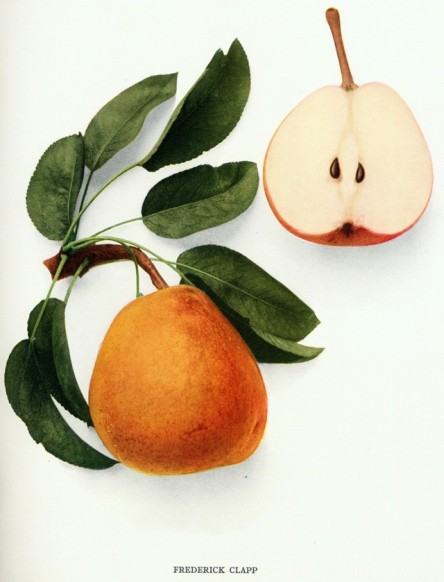
FREDERICK CLAPP
1. Downing Fr. Trees Am. 2nd App. 148, fig. 1876. 2. Mass. Hort. Soc. Rpt. Pt. II, 94. 1876. 3. Am. Pom. Soc. Cat. 34. 1877. 4. Budd-Hansen Am. Hort. Man. 2:245. 1903.
Clapp No. 22. 5. Mass. Hort. Soc. Rpt. 90. 1872. 6. Ibid. Pt. II, 153. 1874. 7. Am. Pom. Soc. Rpt. 38, 66, 119. 1875.
Frederick Clapp has a place on the pear list, because it is one of the few good varieties with acidulous fruits. The refreshing, piquant flavor, the tender, melting, very juicy flesh, and the bright lemon-yellow color with only a trace of red give sufficient charm and character to the fruits to make the variety desirable in every collection of good pears. The fruits come in season with those of Beurré Superfin, and surpass them in quality at least. The trees are vigorous and healthy and form open, shapely, wide-spreading heads that commend them for orchard management. They grow with rapidity and vigor, come in bearing early, and are unusually fruitful. The variety is seldom planted in commercial orchards, but it has a welcome place in every home orchard fortunate enough to have it.
This pear was raised about 1870 by Lemuel Clapp, Dorchester, Massachusetts, brother of Frederick and Thaddeus Clapp, all of whom were the producers of large numbers of pear seedlings, several of which have been named. In all probability this variety is a cross between Urbaniste and Beurré Superfin. At various exhibitions and meetings of the Massachusetts Horticultural Society in the years 1872, 1874, 1875, and 1876 it was shown and favorably reported on, and in 1875 received high praise in a report of the Massachusetts State Fruit Committee to the American Pomological Society. In 1877 the latter Society added Frederick Clapp to its list of fruits recommended for general cultivation.
Tree large, vigorous, upright-spreading, with open top, hardy; trunk thick, shaggy; branches stocky, shaggy, zigzag, dull reddish-brown, overspread with thick ash-gray scarf-skin, marked with many small lenticels; branchlets thick, dull reddish-brown, tinged with green, smooth except for the lenticels, glabrous, with many small, raised lenticels.
Leaf-buds small, short, conical or pointed, plump, usually free. Leaves 3 in. long, 1¾ in. wide, ovate, stiff; apex taper-pointed; margin finely serrate, tipped with very fine, sharp-pointed, reddish-brown glands; petiole 1½ in. long, slender, glabrous. Flower-buds small, short, conical, plump, free; flowers cup-shaped, often with a disagreeable odor, 1 in. wide, averaging 9 buds in a cluster; pedicels 1 in. long, thick, pubescent, pale green.
Fruit ripe in October; medium in size, more than 2 in. long, 2⅜ in. wide, variable in size, roundish or obovate, irregular in shape; stem ¾ in. long, thick; cavity variable in outline and smoothness, often with a fleshy fold drawn up around the base of the stem; calyx open; lobes short, broad, obtuse; basin deep, wide, abrupt, usually smooth, symmetrical; skin thin, tender, smooth; color lemon-yellow, often marked with flecks and mottlings of russet; dots numerous, small, russet, obscure; flesh with a very faint tinge of yellow, fine, tender, melting, characteristically juicy, sweet, with a rich sprightliness; quality very good. Core closed, axile, with clasping core-lines; calyx-tube very short, wide, broadly conical; carpels obovate; seeds large, wide, long, plump, acute.
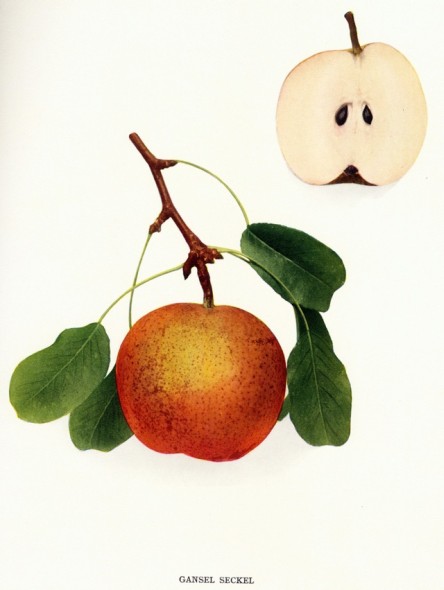
GANSEL SECKEL
1. Downing Fr. Trees Am. 502. 1857. 2. Ibid. 770. 1869.
Gansel-Seckle. 3. Jour. Hort. N. S. 20:30, fig. 1871. 4. Hogg Fruit Man. 585. 1884. 5. Jour. Hort. 3rd Ser. 23:464. 1891. 6. Bunyard Handb. Hardy Fr. 177. 1920.
There are no good reasons why this pear should be grown, it having received much more attention than it deserves during the half century it has been in America. Perhaps it suffices to say that the fruits and trees are in no way equal, except in size of fruit, to those of Seckel, with which variety it would compete, although the crop ripens a little later. While the pears are larger than those of Seckel, the yield is not as great as the trees do not bear as regularly, nor abundantly. The fruits are not as well flavored, nor as attractively colored. The variety is still offered by many nurserymen, most of whom, however, condemn it with faint praise.
According to Bunyard, Gansel Seckel was raised from seed a century ago by a Mr. Williams of Pitmaston, Worcester, England. It was obtained by crossing Seckel with Gansel Bergamot, whence its name.
Tree medium in size and vigor, upright-spreading, variable in yield; branches slender, zigzag, sprinkled with numerous lenticels; branchlets thick, light reddish-brown mingled with green, smooth, glabrous, with small, roundish, raised, conspicuous lenticels. Leaf-buds small, short, pointed, appressed. Leaves 2¼ in. long, 1½ in. wide; apex taper-pointed; margin tipped with few reddish glands, coarsely serrate; petiole 1¼ in. long. Flower-buds small, short, conical, plump, free; flowers open early, 1¼ in. across; pedicels ½ in. long.
Fruit ripens in late October and November; small to medium, 2½ in. long, 2⅜ in. wide, irregular, oblate-pyriform; stem ¾ in. long, stout; cavity variable in width, shallow, irregular; calyx small, closed; lobes erect, acute; basin variable in width, deep; skin roughened with russet, uneven; color pale yellow, overspread with thin cinnamon-russet, sometimes faintly blushed on the exposed cheek; dots distinct, cinnamon-russet; flesh yellowish-white, coarse, melting, buttery, juicy, highly aromatic, with a rich perfume, sweet, but without the spicy flavor of the Seckel; quality very good.
GARBER
1. Am. Pom. Soc. Cat. 48. 1891. 2. Budd-Hansen Am. Hort. Man. 2:247. 1903. 3. Chico Nur. Cat. 12. 1904. 4. Cornell Sta. Bul. 332:481. 1913.
Garber’s Hybrid. 5. Black Cult. Peach and Pear 229, 242. 1886. 6. Harcourt Fla. Fruits 255. 1886. 7. Hood Cat. 25. 1905.
A few trivial differences separate Garber from Kieffer—the fruits of both are poor. The pears ripen a week or two earlier than those of Kieffer, are a little rounder, flatter at the ends, and some say are a little better in quality—certainly they are no worse to eat out of hand. The tree is hardy to heat and cold, and is much planted in the southern states, and in the Mississippi Valley, North and South. The variety might be sparingly planted in New York as an ornamental.
Garber is one of many seedlings of the Chinese Sand pear, raised by J. B. Garber, Columbia, Pennsylvania, sometime previous to 1880. It is supposed to be of hybrid origin. The variety was added to the American Pomological Society’s list of recommended fruits in 1891 where it has since remained.
Tree medium in size, vigorous, upright-spreading, hardy, productive with age; branches smooth, zigzag, reddish-brown partly covered with grayish scarf-skin; branchlets thick, with long internodes, smooth, glabrous, sprinkled with small, round, very conspicuous, raised lenticels. Leaf-buds small, short, pointed and with curved tips, appressed. Leaves 3½ in. long, 2¼ in. wide, thick; apex taper-pointed; margin with very minute and reddish tips, finely serrate; petiole 2¼ in. long, thick. Flower-buds small, conical, sharply pointed, free.
Fruit ripe September to October; large, usually roundish-oblong and tapering toward both ends; stem 1 in. long, stout, obliquely set; cavity small, narrow, often deep and furrowed; calyx variable in size, partly open; lobes slender; basin broad, abrupt, deep, furrowed; color pale yellow, often with a brownish-red blush on the exposed cheek; dots small, numerous, russet; flesh white, granular, crisp but tender, juicy, neither sweet nor sour but with a peculiar, pleasant flavor; quality inferior.
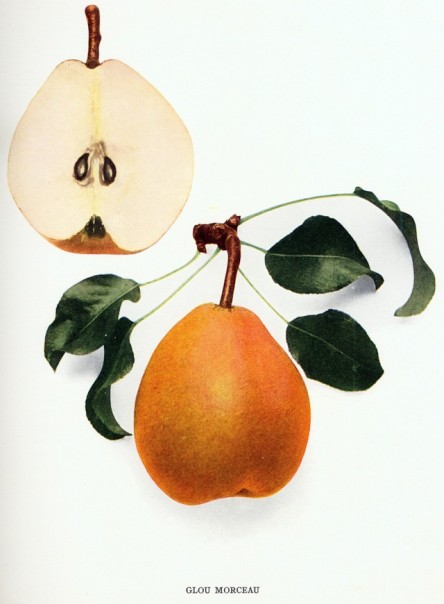
GLOU MORCEAU
1. Mag. Hort. 21:143. 1855. 2. Downing Fr. Trees Am. 503. 1857. 3. Ibid. 773. 1869. 4. Hogg Fruit Man. 586. 1884. 5. Jour. Hort. 3rd Ser. 14:203. 1887. 6. Bunyard Handb. Hardy Fr. 178. 1920.
Gloux Morceau. 7. Trans. Lond. Hort. Soc. 2nd App. 5:6. 1824. 8. Kenrick Am. Orch. 194. 1832.
Hardenpont’s Winter Butterbirne. 9. Liegel Syst. Anleit. 104. 1825. 10. Dochnahl Führ. Obstkunde 2:99. 1856. 11. Lauche Deut. Pom. II: No. 11, Pl. 11. 1882. 12. Mathieu Nom. Pom. 231. 1889.
Glout Morceau. 13. Lindley Guide Orch. Gard. 400. 1831. 14. Gard. Chron. 716, fig. 1. 1844. 15. Downing Fr. Trees Am. 437, fig. 201. 1845. 16. Hovey Fr. Am. 1:5, Pl. 1851. 17. Elliott Fr. Book 325. 1854. 18. Am. Pom. Soc. Rpt. 68. 1862.
Beurré d’Hardenpont. 19. Pom. France 1: No. 12, Pl. 12. 1863. 20. Mas Le Verger 1:5, fig. i. 1866-73. 21. Guide Prat. 60, 246. 1876. 22. Soc. Nat. Hort. France Pom. 370, fig. 1904.
Beurré d’Arenberg. 23. Leroy Dict. Pom. 1:301, fig. 1867.
This old winter pear is nearly lost to cultivation, but is worth growing because of the high quality of the fruit and because the pear comes in season in early winter when there are few others. The pears are not attractively colored, although in this character the illustration does not do the fruit justice. The fruits are rich and sugary without the least trace of acid, but when poorly grown are often astringent. All agree that the quality is better in fruit from dwarf trees in which form the variety grows very well; and that it is better, also, when grown on heavy soils than on light ones. The fruits keep and ship remarkably well. The trees are neither very large nor vigorous, but are usually productive. The variety is in disrepute in many localities because the crop does not always ripen well.
The Abbé of Mons, M. Hardenpont, a pioneer in pear-raising and a worthy forerunner of Van Mons, raised this pear from seed about 1750 in his garden at Mons, Belgium. The variety was introduced into France in 1806 by Louis Noisette, who had found it in the gardens of the Duc d’Arenberg. In France it was known, therefore, as Beurré d’Arenberg, and consequently became much confused with the true Beurré d’Arenberg raised by Monseigneur Deschamps. In order to overcome this confusion the name of the variety raised by M. Hardenpont was changed by a number of prominent Frenchmen to Beurré d’Hardenpont, but the variety has always been grown under both names in France. In 1820, M. Parmentier of Enghien, Belgium, sent this pear to England under the name Glou Morceau. (Glou, in the Walloon language, meaning delicious or dainty; morceau, French, morsel or bit; hence, the translation may be Delicious Morsel or Dainty Bit.) Glou Morceau has long been the popular name of the variety in England and America although, as Bunyard says, “It is regrettable that the memory of the pioneer of Pear raising, l’Abbé Hardenpont, is not commemorated in this fruit.” Glou Morceau was brought to America within a few years after its introduction in England and rapidly found favor here as attested by leading American pomologists. In 1862 the American Pomological Society added the variety to its catalog-list of fruits under the name Glou Morceau as it has since remained.
Tree medium in size and vigor, spreading, dense-topped, rapid-growing, productive; trunk stocky; branches thick, reddish-brown, nearly covered with gray scarf-skin, marked with numerous large lenticels; branchlets slender, short, light greenish-brown, overspread with gray scarf-skin, smooth, glabrous, with numerous, small, conspicuous, raised lenticels.
Leaf-buds small, very short, pointed, plump, appressed. Leaves 2¾ in. long, 1¾ in. wide, thick, leathery; apex taper-pointed; margin occasionally with very few, small glands, coarsely or finely serrate; petiole 2 in. long, thick, glabrous, greenish. Flower-buds small, short, conical, plump, free, singly on very short spurs; flowers late, showy, 1¼ in. across, in dense clusters, 8 to 11 buds in a cluster; pedicels ⅞ in. long, pubescent.
Fruit matures November to December; large, 3⅛ in. long, 2¾ in. wide, obovate-obtuse-pyriform, irregular, sides unequal, somewhat ribbed; stem ⅞ in. long, thick and woody, curved; cavity deep, narrow, russeted, deeply furrowed, compressed, lipped; calyx open; lobes long, narrow, acute; basin deep, smooth, broadly furrowed; skin tender, very gritty, dull, roughened by russet; color pale greenish-yellow, covered with large and small patches and mottlings of light russet; dots numerous, small, conspicuous, light russet; flesh tinged with yellow, fine-grained except near the core and under the skin, tender, buttery, sweet, with a rich, pleasant, aromatic flavor, astringent near the skin; quality good to very good. Core closed, axile, with clasping core-lines; calyx-tube short, broad, conical; seeds large, wide, long, plump, acute.
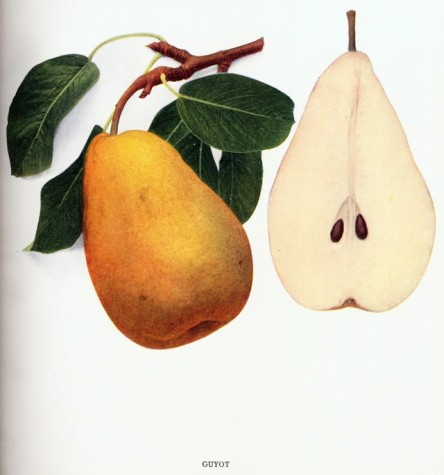
GUYOT
1. Ragan Nom. Pear, B. P. I. Bul. 126:139. 1908.
Dr. Jules Guyot. 2. Lauche Deut. Pom. II: No. 71, Pl. 71. 1883. 3. Hogg Fruit Man. 562. 1884. 4. Ga. Hort. Soc. Rpt. 54. 1892. 5. Garden 52:248. 1897. 6. Deut. Obstsorten 5: Pt. 5, Pl. 1906. 7. Garden 73:564, fig. 1909.
Docteur Jules Guyot. 8. Lucas Tafelbirnen 73, fig. 1894. 9. Cat. Cong. Pom. France 234. 1906.
The fruits of Guyot bear strong resemblance to those of Bartlett, but differ in being larger and rather more handsomely colored, ripen a little earlier, have coarser flesh, and are very differently flavored. The product can seldom compete with that of Bartlett, or even with that of Clapp Favorite with which it ripens, because its season is exceedingly transitory. Unless picked quite green and ripened indoors, the pears rot at the center, and even when ripened under the best conditions quickly become mealy and insipid. Taken at the proper moment, the pears are better flavored than those of Bartlett, as they are richer and have a more delicate taste and perfume than the musky fruits of Bartlett. The trees are quite as satisfactory as those of Bartlett, unless, possibly, they fall short somewhat in productiveness. The variety is well worth planting in collections for its early, handsome, well-flavored fruits.
Guyot was raised in the nurseries of the Baltet Brothers, Troyes, France, about 1870. Within the next decade it was quite widely distributed in France and England where it has since been esteemed as a pear of the Bartlett type. It was first brought to America about 1885.
Tree medium in size, vigorous, upright, hardy, productive, a regular bearer; branches brownish, overlaid with thick scarf-skin, marked by small, round, indistinct lenticels; branchlets slender, very long, curved, with long internodes, reddish-brown mingled with green, smooth, glabrous, sprinkled with raised, conspicuous lenticels.
Leaf-buds small, very short, pointed, appressed. Leaves 2⅞ in. long, 1¾ in. wide; apex taper-pointed; margin glandular, variable in serration; petiole 2 in. long, thick, reddish-green. Flower-buds small, short, conical, plump, free, singly on very short spurs; flowers open late, showy, 1¼ in. across, in dense clusters, from 5 to 8 buds in a cluster; pedicels ⅞ in. long, pubescent.
Fruit ripens in early September; large, 3¼ in. long, 2⅝ in. wide, oblong-obtuse-pyriform, irregular, with unequal sides; stem 1¼ in. long, thick, curved; cavity obtuse, shallow, narrow, slightly russeted, drawn up on one side of the stem in a prominent lip; calyx large, open; lobes separated at the base, short, broad, acute; basin shallow, narrow, obtuse, furrowed; skin very thin, tender, roughish; color yellow, more or less mottled and with traces of russet, with a red blush on the exposed cheek; dots numerous, small, russet, conspicuous; flesh yellowish-white, granular, tender, moderately juicy, sweet mingled with sprightliness, aromatic; quality good. Core closed, with clasping core-lines; calyx-tube short, wide, conical; seeds large, long, plump, acute.
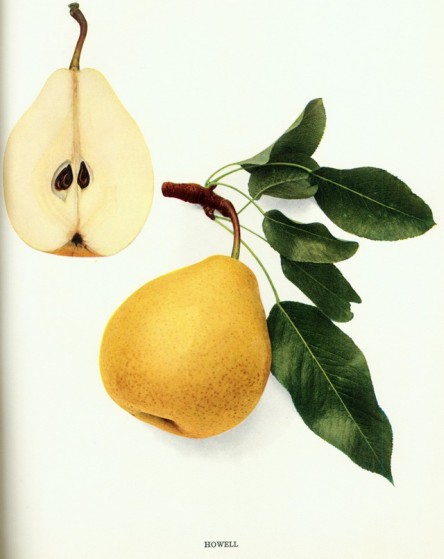
HOWELL
1. Mag. Hort. 15:69, fig. 12. 1849. 2. Hovey Fr. Am. 2:75, Pl. 1851. 3. Am. Pom. Soc. Rpt. 210. 1856. 4. Downing Fr. Trees Am. 510, fig. 1857. 5. Hoffy N. Am. Pom. 1: Pl. 1860. 6. Pom. France 3: No. 105, Pl. 105. 1865.
Howell’s Seedling. 7. Mag. Hort. 14:519. 1848.
Howell is everywhere condemned by faint praise. The variety is a little too good to be discarded and not quite good enough to be generally recommended. Its characters in tree and fruit are faulty by reason of their mediocrity. After having said that the trees are not above the average in vigor, healthfulness, hardiness, and fruitfulness, it remains only to be said that their spreading tops make them desirable orchard inhabitants and handsome dooryard ornamentals. The fruits cannot be praised for attractive appearance or good quality, but they are preëminently meritorious in that they are probably more often uniform in appearance, quality, and freedom from the ravages of the scab fungus than those of almost any other pear. These qualities make Howell a most estimable variety for the home orchard where intensive care cannot be given. The variety further commends itself to amateur growers, because the trees bear early, annually, and abundantly. Howell seems to be better suited to the middle western states than to the eastern states.
In 1829 or 1830, Thomas Howell, New Haven, Connecticut, planted in his garden seeds from a variety of pear known locally as the Jonah, a hard and tough winter sort which seldom matures sufficiently to be regarded as a dessert fruit. One of the trees resulting from these seeds came into bearing in 1842 or 1843. Specimens were exhibited in Faneuil Hall by the Massachusetts Horticultural Society in 1848 and were considered to be “of the first class and worthy of cultivation in every place where the soil and climate are congenial.” In 1856, the Howell pear was recommended for general cultivation by the American Pomological Society.
Tree large, vigorous, spreading, open-topped; trunk thick; branches stocky, reddish-brown, overspread with gray scarf-skin, with few small lenticels; branchlets thick, short, dull reddish-brown, smooth, glabrous, with a few large, raised lenticels.
Leaf-buds large, long, conical, free. Leaves 2 in. long, 1⅛ in. wide, oval, leathery; apex taper-pointed; margin finely serrate, hairy, tipped with very minute glands; petiole 1½ in. long. Flower-buds large, long, conical, rather plump, free; flowers open early, 1⅜ in. across, in dense clusters, from 7 to 15 buds in a cluster; pedicels 11⁄16 in. long, pubescent, greenish.
Fruit ripe in late September and October; medium in size, 2⅜ in. long, 2¼ in. wide, uniform in size and shape, round-obovate, symmetrical; stem 1 in. long, thick, straight; cavity obtuse, very shallow and narrow, often with almost no cavity, smooth, symmetrical; calyx open, small; lobes separated at the base, short, narrow, obtuse; basin obtuse, slightly furrowed, nearly symmetrical; skin smooth, dull; color pale lemon-yellow, marked on the side exposed to the sun with a trace of blush and with patches and tracings of russet; dots many, small, russet, very conspicuous; flesh yellowish-white, firm but tender, granular, melting, very juicy, sweet, with a rich, somewhat brisk, almost vinous flavor, aromatic; quality very good. Core rather large, closed, with clasping core-lines; calyx-tube short, wide, conical; seeds long, plump, acute, frequently abortive.
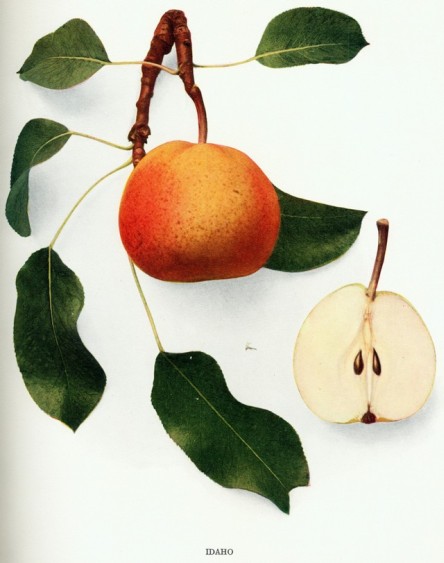
IDAHO
1. U. S. D. A. Rpt. 572, Pl. II. 1888. 2. Can. Hort. 12:2, fig. 1, Pl. 1889. 3. Wickson Cal. Fruits 341. 1889. 4. Thomas Am. Fruit Cult. 477, fig. 691. 1897. 5. Am. Pom. Soc. Cat. 36. 1899. 6. Rev. Hort. 60. 1901. 7. Budd-Hansen Am. Hort. Man. 2:249. 1903.
There is much difference of opinion as to the value of Idaho in America. Without question, the variety is of considerable worth in parts of the Pacific Northwest, and especially in regions where hardihood is a prime requisite. There, presumably, the fruits are larger and better flavored than in the East. As the accompanying plate shows, the pears are only medium in size on the grounds of this Station, but they are attractive in color and of excellent taste. The core is small, and the seeds are often abortive and sometimes wanting. The flesh is tender, buttery and almost free from granulation, with a rich, sweet, vinous flavor which make the rating for this fruit “good to very good.” In many regions the pears are large, rough, and gross—sometimes a facsimile of Duchesse d’Angoulême. The trees are dwarf and fruitful to a fault so that the pears often run small; they are hardier than those of almost any other pear and bear annually. To offset these good characters, however, the trees have the fatal fault of blighting, so that the variety is of value only in regions where blight is not an annual scourge of this fruit.
Idaho was raised from seed of an unknown variety about the year 1867 by a Mrs. Mulkey, Lewiston, Idaho, and, having been propagated by the Idaho Pear Company, was first brought to public notice in the autumn of 1886 by John H. Evans of Lewiston. In 1888 it was introduced to Europe and was shown at the congress of fruit growers held at Geneva, Switzerland, in 1899. Idaho is included in the American Pomological Society’s list of fruits recommended for general cultivation, having been added to this list in 1899.
Tree medium in size, vigorous, upright-spreading, hardy, very productive; trunk smooth; branches slender, smooth, reddish-brown overspread with much gray scarf-skin, sprinkled with many small lenticels; branchlets dull brownish-red, overlaid with scarf-skin, smooth, glabrous, with small lenticels.
Leaf-buds small, short, conical, pointed, free; leaf-scars prominent. Leaves 2¾ in. long, 14⁄5 in. wide, leathery; apex abruptly pointed; margin glandular, finely serrate; petiole 2 in. long. Flower-buds short, conical, very plump, free, singly on short spurs; flowers showy, 1⅛ in. across, in dense racemes, average 8 buds in a cluster; pedicels 1⅛ in. long, pubescent.
Fruit matures in late September and October; medium in size, 2 in. long, 2⅛ in. wide, roundish, slightly pyriform, symmetrical; stem 1 in. long, thick, slightly curved; cavity acute, narrow, furrowed, slightly lipped; calyx closed; lobes broad, acute; basin shallow, obtuse, somewhat furrowed; skin thick and granular, tough, roughish; color dull lemon-yellow, tinged with green, dotted and streaked with russet, splashed with russet patches; dots numerous, small, russet, conspicuous; flesh dull white, tinged with yellow, firm, tender, buttery, juicy, sweet, rich, almost vinous; quality good to very good. Core closed, with clasping core-lines; calyx-tube short, wide, conical; seeds wide, acute.
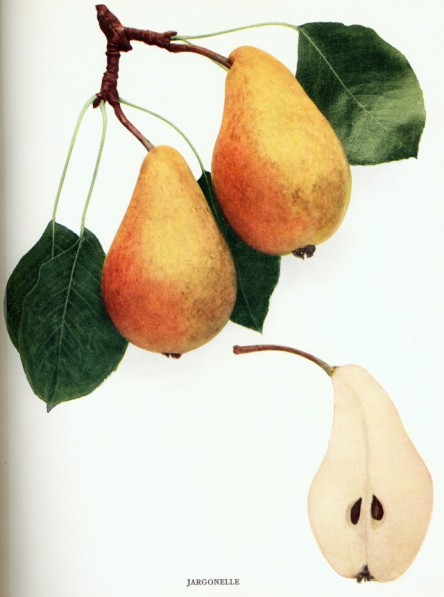
JARGONELLE
1. Knoop Pomologie 101, fig. 1771. 2. Coxe Cult. Fr. Trees 183, fig. 13. 1817. 3. Pom. Mag. 3:108, Pl. 1830. 4. Lindley Guide Orch. Gard. 341. 1831. 5. Mag. Hort. 9:363, fig. 30. 1843. 6. Downing Fr. Trees Am. 758. 1869.
Gergonell. 7. Parkinson Par. Ter. 593. 1629.
Épargne. 8. Duhamel Trait. Arb. Fr. 2:133. Pl. VII. 1768. 9. Coxe Cult. Fr. Trees 181, fig. 10. 1817. 10. Prince Pom. Man. 1:152. 1831. 11. Pom. France 2: No. 85, Pl. 85. 1864. 12. Mas Le Verger 2:19, fig. 8. 1866-73. 13. Leroy Dict. Pom. 2:135, fig. 1869. 14. Guide Prat. 62, 269. 1876.
Sparbirne. 15. Dochnahl Führ. Obstkunde 2:131. 1856. 16. Mathieu Nom. Pom. 286. 1889.
Wälsche Birne. 17. Dochnahl Führ. Obstkunde 2:144. 1856.
At one time the best second early pear, Jargonelle is now little grown in America, native varieties having crowded it out. The crop ripens two or three weeks before that of Bartlett, so that the pears come on the market with those of Bloodgood and Dearborn, which, for most situations, are better sorts. The fruits are as attractive as any of their season and are unique in shape and in having a long, curved stem. The quality leaves much to be desired. The flesh is coarse, rather gritty, and the flavor lacks the rich sugary taste on the one hand, or the refreshing piquancy on the other hand, of good pears. The fruits rot at the core and the season is short. The crop should be picked early and ripened in the house. The trees are large, vigorous and sometimes very productive, but are coarse, untidy bearers, especially when young, and are often uncertain in bearing. After setting the faults against the merits of this variety, one must conclude that is it too worthy to discard, but hardly good enough for a recommendation for other than the home orchard or in the plantings of collectors.
Jargonelle is a patriarch among pears, being one of the oldest of all varieties. Its name appears to be derived from Jargon, anciently Gergon, a corruption of Groecum; whence Merlet, writing in 1675, infers that the Jargonelle was the Pyrum Tarentinum of Cato and Columella, the Numidianum Groecum of Pliny, and the Groeculum of Macrobius. So far as we know the earliest mention of the Jargonelle in England is by John Parkinson, who, writing in 1629, mentions sixty-five varieties of pears, among them being the Peare Gergonell. Stephen Switser, who wrote in 1731, also names it. The vitality of the English Jargonelle is remarkable; the trees, it is said, often live for 200 years. In Scotland the variety is cultivated as far north as pears will grow. William Coxe, Burlington, New Jersey, writing in 1817 of the Jargonelle, said, “This pear has not been much cultivated in America, and almost always under false names.”
Tree large, vigorous, spreading, open-topped, rapid-growing, hardy, very productive, long-lived; trunk shaggy; branches reddish-brown overlaid with heavy gray scarf-skin, with large lenticels; branchlets slender, short, reddish-brown overlaid with gray, new growth brownish, dull, smooth, with numerous small, raised, very conspicuous lenticels.
Leaf-buds small, short, pointed, plump, appressed or free. Leaves 3¼ in. long, 2 in. wide, leathery; apex taper-pointed; margin tipped with few small, black glands, finely serrate; petiole 3 in. long, slender, tinged with red, glabrous; flower-buds small, very short, conical, plump, singly on short spurs; flowers late, showy, 1½ in. across, in dense clusters, from 8 to 14 buds in a cluster; pedicels 1⅜ in, long, pubescent.
Fruit ripe in late August; large, 3⅜ in. long, 23⁄16 in. wide, oblong-obovate-pyriform, with an acute neck; stem characteristically long and curved, 1⅝ in. long; cavity lacking, the flesh folding up around the base of the stem, russeted, lipped; calyx open; lobes separated at the base, long, broad, acute; basin very shallow and narrow, obtuse, gently furrowed, compressed; skin smooth; color yellow, with a bright blush laid thinly over the exposed cheek in streaks and splashes; dots numerous, greenish-russet, very small, obscure; flesh yellowish-white, granular under the skin, gritty at the center, melting, very juicy, subacid, aromatic, vinous; quality very good. Core large, open, with clasping core-lines; calyx-tube long, narrow, conical; seeds large, wide, long, plump, acute.
JARGONELLE (FRENCH)
1. Duhamel Trait. Arb. Fr. 2:123. 1768. 2. Prince Pom. Man. 1:154. 1831. 3. Downing Fr. Trees Am. 339. 1845. 4. Ibid. 767. 1869. 5. Leroy Dict. Pom. 2:303, fig. 1869. 6. Mathieu Nom. Pom. 237. 1889.
Bellissime d’Été. 7. Duhamel Trait. Arb. Fr. 2:203, Pl. XLII. 1768. 8. Mas Le Verger 2:193, fig. 95. 1866-73. 9. Leroy Dict. Pom. 1:216, fig. 1867. 10. Guide Prat. 70, 235. 1876.
Cuisse Madame. 11. Coxe Cult. Fr. Trees 181, fig. 11. 1817.
Red Muscadel. 12. Lindley Guide Orch. Gard. 346. 1831.
Bassin. 13. Hogg Fruit Man. 491. 1884.
Schönste Sommerbirne. 14. Mathieu Nom. Pom. 280. 1889.
This old sort, very different from Jargonelle, is worthy of description only to distinguish it from the much better and older pear of the same name. A generation ago this French Jargonelle was much grown in America, but has given way to better sorts. The pears are handsome, but are poor in quality and are edible only a day or two after maturity as they quickly rot at the center and become dry and mealy toward the periphery.
The name Jargonelle is used in France to denote a group of pears. This fact accounts for the confusion which exists among the names and synonyms of several varieties of this class. The French Jargonelle is said to have originated in Anjou, a former province in France, where it was much cultivated and highly esteemed toward the end of the fifteenth century.
Tree large, vigorous, upright, the younger branches inclined to droop, very productive; branches stocky, dark reddish-brown; branchlets often curved and drooping, short, sprinkled with elongated, inconspicuous lenticels. Leaf-buds large, conical, appressed. Leaves oval, enlarged at the base; apex abruptly pointed; margin coarsely serrate; petiole long, thick. Flower-buds large, long-conic; flowers medium in size.
Fruit ripens in August and September; medium to sometimes large, 3½ in. long, 2½ in. wide, obtuse-pyriform to oblong-pyriform; stem 1 in. long, slender, obliquely inserted; cavity obtuse, very shallow; calyx small, open; lobes long, projecting; basin variable in depth, small, irregular, furrowed; skin smooth, glossy; color lemon-yellow, blushed with red on the sunny side, occasionally marbled with thin orange-russet about the neck; dots light greenish or russet; flesh white, coarse, juicy, sweet, aromatic; quality good. Core large; seeds dark brown, small, narrow, long, often abortive.
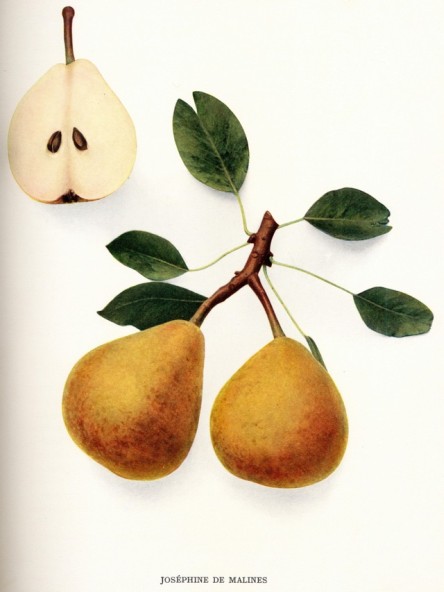
JOSÉPHINE DE MALINES
1. McIntosh Bk. Gard. 2:461. 1855. 2. Am. Pom. Soc. Rpt. 68. 1862. 3. Pom. France 2: No. 50, Pl. 50. 1864. 4. Jour. Hort. N. S. 14:67. 1868. 5. Downing Fr. Trees Am. 793, fig. 1869. 6. Leroy Dict. Pom. 2:310, fig. 1869. 7. Guide Prat. 61, 282. 1876. 8. Jour. Hort. 3rd Ser. 5:565, fig. 96. 1882. 9. Hogg Fruit Man. 599. 1884. 10. Bunyard Handb. Hardy Fr. 182. 1920.
Joséphine von Mecheln. 11. Dochnahl Führ. Obstkunde 2:93. 1856. 12. Mathieu Nom. Pom. 239. 1889. 13. Gaucher Pom. Prak. Obst. No. 50, Pl. 31. 1894.
Malines. 14. Am. Pom. Soc. Cat. 24. 1897.
This is another of the few good winter pears. The fruit-characters are so distinctive and meritorious that the variety should be grown in every home orchard, and it possesses much merit for commercial plantations. The fruits have a marked peculiarity. Cut through the shaded yellow-russet skin, flesh with a faint, rosy tint is displayed. Several red or rosy-fleshed pears are grown in Europe, but this is the only one described by American pomologists. The tree also, has a marked peculiarity; it thrives amazingly well on the white-thorn as well as on pear and quince stocks. But it is the quality of the fruits that commends the variety most highly. The flesh is buttery, juicy, sweet, and perfumed—pleasing in every character that gratifies the palate. The season is exceedingly variable, and is given by different pomologists from December to March and January to May. The fruits are not very pleasing in appearance, but the accompanying illustration scarcely does them justice in either size or color. In the orchard, the trees are satisfactory, but the nurserymen find them rather difficult to grow, this, no doubt, being the chief reason for the apparent neglect of this splendid pear. The trees thrive in almost any soil or situation suitable to pears, and are everywhere prodigiously fruitful, hardy, and resistant to blight. The variety deserves wider recognition than it now receives.
This pear originated about 1830 in the seed beds of Major Espéren, the well-known pomologist of Mechlin (Malines), Belgium, who named it Joséphine de Malines in honor of his wife. It was introduced in America prior to 1850, and in 1862 was added to the fruit-list of the American Pomological Society, a place it has since retained.
Tree large, vigorous, spreading, tall, dense-topped, rapid-growing, hardy, very productive; trunk stocky; branches thick, shaggy, reddish-brown overlaid with gray scarf-skin, marked with few lenticels; branchlets thick, dull reddish-brown, smooth, glabrous, with small, raised, inconspicuous lenticels.
Leaf-buds short, obtuse, plump, appressed. Leaves 2¼ in. long, 1¼ in. wide, leathery; apex taper-pointed; margin finely serrate; petiole 1¾ in. long. Flower-buds short, plump, free; flowers early, 1⅜ in. across, white, occasionally tinged with pink, well distributed, average 7 buds in a cluster; pedicels ¾ in. long, slender, thinly pubescent.
Fruit ripe December to February; medium in size, 2½ in. long, 2⅜ in. wide, turbinate, inclined to truncate; stem long, very thick; cavity obtuse, shallow, narrow, slightly furrowed; calyx large, open; lobes short, broad, obtuse; basin narrow, obtuse, smooth; skin thick, tough, dull; color pale greenish-yellow, netted and patched more or less with russet; dots numerous, small, brown or russet, conspicuous; flesh light salmon, granular, melting, buttery, very juicy, sweet, slightly aromatic; quality good. Core large, closed, axile, with clasping core-lines; calyx-tube short, wide; carpels pyriform; seeds large, wide, long, plump, acuminate.
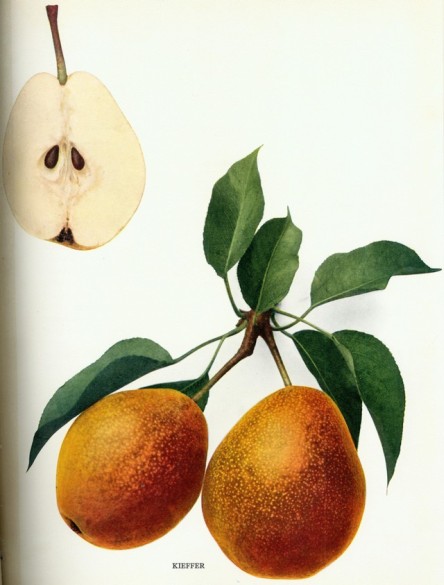
KIEFFER
1. Gard. Mon. 22:49, fig. 1880. 2. Am. Pom. Soc. Cat. 38. 1883. 3. Jour. Hort. 3rd Ser. 12:131. 1886. 4. Garden 68:398. 1905. 5. Ibid. 69:68. 1906. 6. Cornell Sta. Bul. 332:483. 1913. 7. Country Gent. 84:26, fig. 1919.
Kieffer’s Hybrid. 8. W. N. Y. Hort. Soc. Rpt. 53. 1879.
Keiffer. 9. Downing Fr. Trees Am. 3rd App. 179. 1881. 10. Mathieu Nom. Pom. 240. 1889. 11. Am. Pom. Soc. Rpt. 178. 1909.
Although the most pretentious cheat in the orchard, Kieffer is grown more commonly than any other pear in North America. Its popularity can be accounted for only by accepting Barnum’s dictum that “Americans love to be fooled.” Pears are grown to eat, but those of Kieffer are fit to eat only in culinary preparations, dire necessity alone compelling their consumption uncooked. Yet, pleased by a bright cheek and a fair form, regardless of the potato-like flavor, people buy and eat Kieffer pears and persist in doing so. There are several reasons why Kieffer is popular. No pear has been advertised so widely and so unqualifiedly, growers of trees often supplying virtues to the variety which Nature denies it, because of all pears the trees of Kieffer are most easily grown. Besides this virtue in the trees there are several others that commend the variety more highly. Thus, of all pears grown in America, the trees are uniformly the most vigorous, fruitful, endure heat best, are least susceptible to blight, and withstand best the ravages of San José scale. There are several faults, however; the trees are tender to cold, in some soils refuse to set fruit, are often self-sterile, and sometimes with the best of care bear only pears of small size. Worthless for dessert, much can be said for the fruits of Kieffer for culinary preparation. Cooking removes the disagreeable natural taste of the raw pear, and leaves a good product. Canned, the pears retain their shape, color, and flavor well; therefore, and because white and inviting, canned Kieffers are preferred by commercial canners. Use in the cannery is the true place for Kieffer pears in regions where better sorts can be grown for dessert. Now that the first flush of popularity is past, it would seem a wise precaution on the part of pear-growers to grow this fruit chiefly for the cannery, supplying the demands for dessert pears with worthier varieties, although as long as consumers buy it to eat out of hand, growers cannot be blamed for growing it in commercial orchards.
The seed parent of Kieffer was the Sand pear of China. Peter Kieffer,[30] who lived at Roxborough, near Philadelphia, for many years grew the Chinese Sand pear and sold the trees for ornamental purposes. In his garden there were also trees of Bartlett. Among chance seedlings, Mr. Kieffer observed one of peculiar growth which he saved. This tree bore fruit first in 1863. Later, it was exhibited at the Massachusetts Horticultural Society, and finally at the Centennial Exposition where in 1876 it was named Kieffer. The variety was added to the fruit-list of the American Pomological Society in 1883.
Tree of medium size, vigorous, upright, dense-topped, hardy, very productive; branches slender, nearly smooth, reddish-brown, covered with dull ash-gray scarf-skin, marked with few small lenticels; branchlets medium to long, reddish-brown mingled with green, smooth, slightly pubescent, with numerous, large, raised, very conspicuous lenticels.
Leaf-buds small, short, obtuse, slightly pointed, appressed. Leaves 3¼ in. long, 1¾ in. wide, oval, thick, leathery; apex taper-pointed; margin often finely serrate; petiole 1⅞ in. long. Flower-buds conical to pointed, free; flowers open early, 1⅝ in. across, fairly well distributed, varying from 3 to 11 buds in a cluster; pedicels 1⅛ in. long, thick, very slightly pubescent, green, rarely tinged red.
Fruit matures in late October and November; above medium to large, 2¾ in. long, 2¼ in. wide, oval, narrowing at both ends, symmetrical, uniform; stem 1 in. long, thick; cavity very small, smooth; calyx open; lobes separated at the base, short, narrow, acute; basin shallow, narrow, obtuse, nearly smooth; skin thick, tough, smooth; color yellow, blushed with dull red on the exposed cheek; dots numerous, small, russet, conspicuous; flesh yellowish-white, very granular and coarse, crisp, juicy, not sweet, often astringent; quality poor. Core large, closed, with clasping core-lines; calyx-tube short, wide, conical; seeds wide, plump, acute.
KINGSESSING
1. Mag. Hort. 13:450. 1847. 2. Ibid. 19:453, 516, fig. 32. 1853. 3. Am. Pom. Soc. Rpt. 231. 1858. 4. Downing Fr. Trees Am. 795. 1869.
A summing up of the characters of Kingsessing, as is so often the case with varieties of fruits, makes it appear a most desirable sort. Nevertheless, its culture does not make headway. Growers rate it as a “good pear,” but will not grow it, for the reason, no doubt, that it has no outstanding characters for any region, season, or purpose. As the pears grow on the grounds of the New York Agricultural Experiment Station they are a little under size for a good commercial fruit, and while the sweet, perfumed flavor is pleasant, it lacks individuality. The variety is grown chiefly along the Atlantic Coast from Long Island to Maryland.
This is a natural seedling which sprang up in the family burial ground of Isaac Leech, Kingsessing, a suburb of Philadelphia, about 1833. The tree first fruited about 1843. Dr. Brincklé, who introduced the variety, thought from its close resemblance to Chapman that it was probably a seedling from it, or of its parent, the Petre, as trees of both these varieties stood in the vicinity of the Kingsessing. The American Pomological Society placed Kingsessing on its fruit-list in 1858 but dropped it in 1899.
Tree very large and vigorous, upright-spreading, dense-topped, rapid-growing, hardy, medium in yield; trunk very thick; branches very stocky, grayish-brown, sprinkled with numerous large lenticels; branchlets thick, long, glossy, smooth, glabrous, with numerous rather small, raised, conspicuous lenticels.
Leaf-buds large, long, conical, free. Leaves 2¼ in. long, 1⅜ in. wide; apex abruptly pointed; margin glandular, finely serrate; petiole 1¾ in. long. Flower-buds large, conical, free.
Fruit ripens in September and October; medium in size, 2⅜ in. long, 2⅛ in. wide, obovate-obtuse-pyriform; stem ½ in. long, thick, usually curved, fleshy at the point of insertion in the fruit; cavity obtuse, shallow, slightly furrowed, occasionally lipped; calyx partly open; lobes separated at the base, short, narrow, acute; basin shallow, gently furrowed, usually symmetrical; skin granular, tender, roughish; color yellow, sprinkled and netted with russet, with a thin brownish-red blush on the exposed cheek; dots numerous, grayish or russet, small, conspicuous; flesh white, granular, tender and melting, sweet, aromatic; quality good. Core closed, with clasping core-lines; calyx-tube short, wide, conical; seeds wide, long, plump, acute.
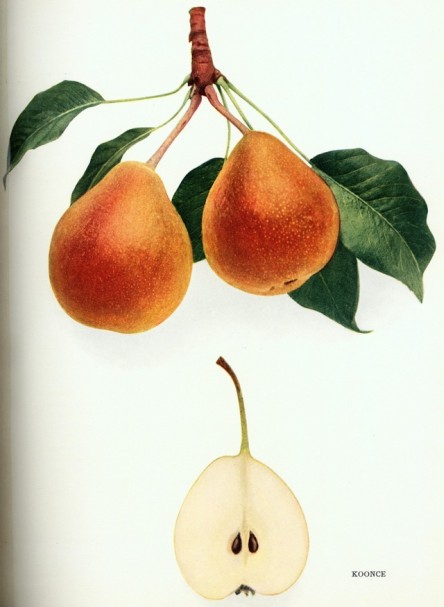
KOONCE
1. Ill. Hort. Soc. Rpt. 159. 1889. 2. Ibid. 55. 1895. 3. Am. Pom. Soc. Rpt. 44. 1897. 4. Budd-Hansen Am. Hort. Man. 2:251. 1903. 5. Chico Nur. Cat. 12. 1904. 6. Am. Pom. Soc. Cat. 41. 1909. 7. Ont. Dept. Agr. Fr. Ont. 168. 1914.
Koonce is a popular early variety grown rather commonly in nearly every pear region in the United States. It is listed by nearly all nurserymen. Its tree-characters are more notable than those of its fruits. The trees make a splendid showing in the nursery and are hardy and productive in the orchard, although of but medium size and rather straggling at maturity. The pears are better in quality than those of Early Harvest or Lawson, with which it often competes, but are hardly as attractive in appearance, being rather small and often irregular in shape. The color is unusually bright, especially on the red cheek. The pears decay quickly after maturity and are suitable only for home and local markets.
This pear originated in southern Illinois but no one seems to know by whom, or at what time, or in what locality in the State. The variety has been grown for more than thirty years. The American Pomological Society added Koonce to its list of fruits in 1909.
Tree medium in size and vigor, upright-spreading, scraggly, open-topped, hardy, productive; trunk shaggy; branches zigzag, dark brownish-red, covered with thick grayish scarf-skin, with few lenticels; branchlets thick, long, with long internodes, dull light brown, smooth, glabrous, sprinkled with small, raised, elongated lenticels.
Leaf-buds small, short, conical, pointed, plump, appressed; leaf-scars prominent. Leaves 2½ in. long, 1½ in. wide, stiff; apex taper-pointed; margin glandular, finely serrate; petiole 1½ in. long. Flower-buds short, obtuse or conical, plump, free; flowers showy, 1¼ in. across, in dense clusters, average 5 buds in a cluster; pedicels ⅞ in. long, slender, pubescent.
Fruit ripens in August; medium in size, 2⅜ in. long, 2¼ in. wide, obovate-obtuse-pyriform, with unequal sides; stem 1¼ in. long, thick; cavity obtuse, shallow, narrow, compressed, lipped or often drawn up in a wrinkled fold about the base of the stem; calyx open; lobes separated at the base, narrow, acuminate; basin obtuse, gently furrowed; skin thick, tough, roughish; color pale greenish-yellow, with a dull reddish-brown blush spreading over the exposed cheek; dots numerous, very small, greenish-russet, conspicuous; flesh whitish, granular especially at the center, medium tender, juicy, aromatic, sweet but vinous; quality good. Core small, closed, with clasping core-lines; calyx-tube short, wide, conical; seeds small, narrow, short, plump, acute.
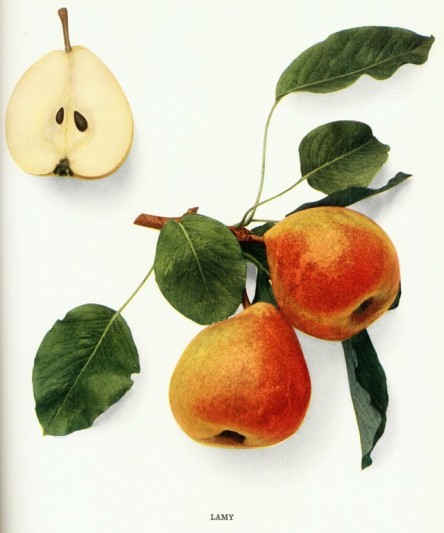
LAMY
1. Ragan Nom. Pear, B. P. I. Bul. 126:161. 1908.
Comte de Lamy. 2. Kenrick Am. Orch. 141. 1841. 3. Downing Fr. Trees Am. 371, fig. 158. 1845. 4. Gard. Chron. 20, fig. 1846. 5. Downing Fr. Trees Am. 727. 1869. 6. Jour. Hort. N. S. 38:359, fig. 52. 1880. 7. Hogg Fruit Man. 553. 1884.
Poire Dingler. 8. Ann. Pom. Belge 2:69, Pl. 1854.
Beurré Curtet. 9. Pom. France 2: No. 77, Pl. 77. 1864. 10. Leroy Dict. Pom. 1:341, figs. 1867. 11. Guide Prat. 65, 243. 1876.
Curtet’s Butterbirne. 12. Mathieu Nom. Pom. 200. 1889.
As the history shows, this is an old European pear which had its probationary period in America many years ago, and which never got out of the limbo of nurserymen’s catalogs and collections. On the grounds of the New York Agricultural Experiment Station, however, the pears are so handsome and so delectable in quality that the variety seems quite worth while describing and illustrating among the major sorts. It is a splendid pear for the home orchard, but the tree is not large nor robust enough for a commercial plantation. A few nurserymen still list it.
This variety was raised from seed about 1828 by M. Bouvier, Jodoigne, Belgium. It was first named Beurré Curtet in honor of M. Curtet, a physician and professor at Brussels. The London Horticultural Society first obtained the variety under the name Comte de Lamy, by which name it has best been known in England. Lamy was early introduced to America where trees have long been found in collections.
Tree small, spreading, open-topped, hardy, productive; trunk slender, shaggy; branches slender, shaggy, dull brown, overspread with thick scarf-skin, sprinkled with numerous lenticels; branchlets slender, curved, short, with short internodes, brown changing to reddish-brown on the newer growth, glossy, smooth, glabrous, with small, raised, conspicuous lenticels.
Leaf-buds small, short, conical, pointed, plump, free. Leaves 2¾ in. long, 1¾ in. wide, leathery; apex taper-pointed; margin finely serrate to nearly entire, tipped with few minute glands; petiole 1⅞ in. long, pinkish. Flower-buds large, thick, long, conical, very plump, free, singly as lateral buds or on very short spurs; flowers late, very showy, 1¾ in. across, in dense clusters, average 9 buds in a cluster; pedicels ⅝ in. long, thick, lightly pubescent.
Fruit matures in late October and early November; medium in size, 2⅛ in. long, 2 in. wide, obovate-obtuse-pyriform, often irregular and with unequal sides; stem 1⅛ in. long, thick; cavity almost lacking, very obtuse and shallow, narrow, russeted, often lipped; calyx open; lobes broad, acute; basin rather deep, obtuse or abrupt, gently furrowed, compressed; skin thin, smooth except for the russet dots, dull; color yellow, with a solid, dark red blush on the exposed cheek; dots numerous, large, brownish-russet, very conspicuous; flesh tinged with yellow, granular at the center, tender and melting, buttery, juicy, sweet, with a faint, vinous flavor, pleasantly aromatic; quality good to very good. Core large, closed, with clasping core-lines; calyx-tube short, very wide, conical; seeds large, wide, plump, acute.
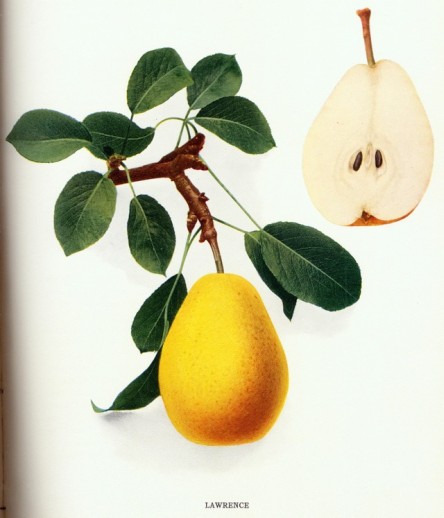
LAWRENCE
1. Kenrick Am. Orch. 169. 1841. 2. Mass. Hort. Soc. Rpt. 4. 1843. 3. Mag. Hort. 10:212. 1844. 4. Downing Fr. Trees Am. 442. 1845. 5. Mag. Hort. 12:432, fig. 29. 1846. 6. Hovey Fr. Am. 2:13, Pl. 1851. 7. Am. Pom. Soc. Rpt. 230. 1854. 8. Downing Fr. Trees Am. 440, fig. 1857. 9. Thomas Am. Fruit Cult. 480. 1897.
There is great diversity of opinion as to the value of Lawrence for a market pear, but no one denies it a place as one of the very best early winter pears for the home orchard. A generation ago it was held in high esteem as a market pear, but the more showy Kieffer, kept in cold storage, has elbowed the less conspicuous Lawrence off the fruit-stands and almost out of the markets. The tree is hardy, moderately vigorous and fruitful, an early, annual, and uniform bearer, and has the reputation of being one of the longest lived of all pear trees. The fruits are of but medium size, but are shapely in form, trim in contour, and are distinctive in shape because of the rounded, truncate stem end. In color, the pear is a bright, clean lemon-yellow marked with patches of russet and faintly blushed on the side to the sun. No yellow pear is more attractive. The fruits come in season in early winter and have the excellent character of keeping well under ordinary care for a full month or longer. The melting flesh abounds with a rich, sugary, perfumed juice, by virtue of which it is justly esteemed as the best-flavored pear of its season. Lawrence finds congenial soils and climates in nearly every part of New York, and should have a place in every home orchard in the State.
Lawrence is a native of Flushing, Long Island, and was first introduced to growers by Wilcomb and King of Flushing, who sent specimens of it in 1843 to the Massachusetts Horticultural Society, saying that it appeared to be a cross between the old Saint Germain and White Doyenné, “as it resembles both of them in wood, foliage, and fruit, and there is no other variety in the neighborhood.” The variety rapidly found favor among pear growers and was soon widely disseminated. The American Pomological Society added Lawrence to its fruit-catalog in 1854.
Tree of medium size, vigorous, spreading, with drooping branches, very hardy, productive; trunk shaggy; branches smooth, zigzag, reddish-brown mingled with ash-gray scarf-skin, with numerous large lenticels; branchlets reddish-brown, glossy, smooth, glabrous, with slightly raised, conspicuous lenticels.
Leaf-buds short, obtuse, plump, nearly free. Leaves 2½ in. long, 1¼ in. wide, oval, leathery; margin finely serrate; petiole 1¾ in. long, slender; stipules rudimentary. Flower-buds hardy, conical or pointed, free; flowers open early, 1⅜ in. across, in rather dense clusters, from 8 to 12 buds in a cluster; pedicels ⅞ in. long, lightly pubescent, greenish.
Fruit ripe November to December; medium in size, 2⅝ in. long, 2⅛ in. wide, uniform in size and shape, obovate-obtuse-pyriform, generally symmetrical; stem 1 in. long, thick, slightly curved; cavity small, obtuse, shallow, narrow, russeted, furrowed and irregular, often lipped; calyx large, partly open; lobes separated at the base, long, broad, acute; basin wide, obtuse, furrowed and sometimes corrugated; skin thick and granular, tough, roughish; color lemon-yellow, marked with occasional patches of russet and with a faint russet-red blush on the exposed cheek; dots numerous, small, russet, inconspicuous; flesh yellowish-white, firm, granular, tender and melting when fully mature, juicy, rich, sweet; quality very good. Core large, closed, with clasping core-lines; calyx-tube short, wide, conical; seeds large, long, plump, acute.
LAWSON
1. Rural N. Y. 43:651, fig. 385. 1884. 2. Gard. Mon. 27:282. 1885. 3. Rural N. Y. 44:693. 1885. 4. Gard. & For. 5:414. 1892. 5. Van Lindley Cat. 22. 1892. 6. Am. Pom. Soc. Cat. 36. 1899. 7. Ont. Dept. Agr. Fr. Ont. 168. 1914. 8. Cal. Com. Hort. Pear Grow. Cal. 7:266, fig. 67. 1918.
Comet. 9. Gard. Mon. 27:144. 1885.
Cometbirne. 10. Mathieu Nom. Pom. 198. 1889.
Of all early pears, the fruit of Lawson best satisfies the eye for bright colors. It is as brightly colored as the brilliant Vermont Beauty or as Mount Vernon. Another outstanding character is the small core, which, though the pears ripen early and quickly, seldom softens unduly. The pears are sometimes nearly or quite seedless. Unfortunately, the fruits are often irregular in shape, and in quality are never more than mediocre. The tree is fairly healthy, vigorous, hardy, and free from blight, and is characterized by its tall, upright growth. Although grown for more than a hundred years in New York, the variety has never made headway in this State, but seems to be attracting much attention on the Pacific slope.
This pear originated on the farm of a Mr. Lawson in Ulster County, New York, about 1800, judging from the appearance of the original tree which was standing in 1900. The variety was introduced toward the end of the nineteenth century under the name Comet by reason of its color, so that it is sometimes known as Lawson Comet. The American Pomological Society added Lawson to its fruit-catalog in 1899.
Tree medium in size, vigorous, upright, dense-topped, very productive; branches slender, zigzag, reddish-brown overlaid with grayish scarf-skin, marked with numerous raised, large lenticels; branchlets slender, very long, with characteristically long internodes, rough, zigzag, marked with numerous large, raised, conspicuous lenticels. Leaves 3¼ in. long, 1¾ in. wide; apex abruptly pointed; margin glandless, serrate; petiole 2 in. long. Flowers early, showy, 1½ in. across, in dense clusters, 6 or 8 buds in a cluster; pedicels 1 in. long, thick.
Fruit ripens in August; large, 2¾ in. long, 3¼ in. wide, varies from obovate-obtuse-pyriform to globular-obtuse-pyriform, with unequal sides; stem ⅞ in. long, thick, curved, woody; cavity very small and narrow, often with a lip drawn up around one side of the stem; calyx partly open; lobes narrow, often reflexed; basin narrow, obtuse, gently furrowed; skin thin, tender, smooth; color pale yellow, overspread on the exposed cheek with a bright red blush; dots numerous, small, greenish or russet, obscure; flesh whitish or often salmon-color, firm, tough, medium juicy, lacking sweetness; quality poor. Core unusually small, closed, with clasping core-lines; calyx-tube short, wide; seeds short, wide, plump, obtuse, few in number.
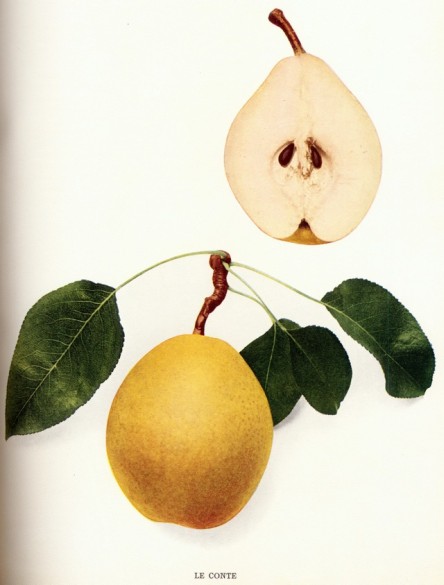
LE CONTE
1. Ga. Hort. Soc. Rpt. 8, 29. 1878. 2. Ia. Hort. Soc. Rpt. 303. 1879. 3. Am. Pom. Soc. Cat. 38. 1883. 4. Gard. Mon. 27:282. 1885. 5. Ga. Hort. Soc. Rpt. 55. 1885. 6. Black Cult. Peach & Pear 234. 1886. 7. Cornell Sta. Bul. 332:484. 1913. 8. Ont. Dept. Agr. Fr. Ont. 169. 1914.
Le Conte is a hybrid between the Chinese Sand pear and a European sort, therefore similar in parentage to Kieffer which it greatly resembles in both tree and fruit. The fruits are rather poorer in quality than those of Kieffer, if that be possible for an edible fruit, and the tree is in no way superior to that of its better-known rival, but seems to succeed better in warm climates and light soils. There is, therefore, a place for Le Conte in the South, and possibly on parts of Long Island, if a pear is wanted for culinary purposes only. The fruits sometimes rot badly at the core, and should usually be harvested as soon as they attain full size. The trees are more susceptible to blight than those of Kieffer. In the South, the trees are often, if not usually, propagated from cuttings.
Le Conte originated in America, and is probably a hybrid between the Chinese Sand pear and some native. It is supposed to have been carried from Philadelphia to Georgia about 1850 by Major Le Conte, and has since been extensively cultivated in the southern States for northern markets. In 1885 it was recommended by the Georgia Horticultural Society for cultivation in the middle region of that State. The American Pomological Society added Le Conte to its fruit-catalog in 1883.
Tree medium in size, vigorous, upright, very productive, a regular bearer; branches strongly zigzag, brownish-red mingled with green and covered with scarf-skin; branchlets thick, reddish-brown mingled with green, smooth, pubescent on the new growth which later becomes glabrous, with numerous very small, conspicuous, raised lenticels.
Leaf-buds small, short, pointed, appressed. Leaves 3¼ in. long, 1½ in. wide, long-ovate or long-oval, leathery; apex taper-pointed; margin finely serrate; petiole pale green, glabrous. Flower-buds small, short, conical, plump, free, arranged singly on very short spurs; flowers open very early, 1¼ in. across, in dense clusters, 7 to 10 buds in a cluster; pedicels 1 in. long, slender, lightly pubescent, pale green.
Fruit ripe late October to November; large, 31⁄16 in. long, 2⅝ in. wide, uniform in size and shape, roundish-oval, tapering at both ends, ribbed, symmetrical; stem 1⅛ in. long, very thick, often curved; cavity obtuse, very shallow and narrow, smooth, slightly furrowed and wrinkled, often compressed; calyx partly open; lobes usually dehiscent, separated at the base, short, narrow, acute; basin usually very deep, abrupt, gently furrowed; skin thick, tough, smooth; color pale yellow, occasionally marked with russet; dots numerous, small, russet, conspicuous; flesh white, firm, granular, stringy, tender, juicy, sweet, with a strong and disagreeable flavor; quality poor. Core very large, closed, axile, with meeting core-lines; calyx-tube short, wide, broadly conical; seeds large, 2 in each carpel, wide, long, very plump, acute.
LE LECTIER
1. Mathieu Nom. Pom. 246. 1889. 2. Guide Prat. 95. 1895. 3. Rev. Hort. 466. 1899. 4. Garden 59:14, 93, 124. 1901. 5. Soc. Nat. Hort. France Pom. 420, fig. 1904. 6. Cat. Cong. Pom. France 287, fig. 1906.
In size and beauty of fruit, Le Lectier surpasses most of its associates, and the quality is first rate in soils and climates to which the variety is suited. Unfortunately the tree, while very satisfactory in some situations, is capricious to both soils and climates, and is seldom at home on this side of the Atlantic. The season is December and January, when good pears are scarce, and it would seem that the fine, large fruits of this pear would be most acceptable for either home or market if it could be made to thrive. In Europe, it grows best on warm, rich soils.
Auguste Lesueur, a horticulturist at Orléans, France, obtained this late winter pear about 1882 as a cross between Bartlett and Fortunée. It was named after Le Lectier, the great pomologist of Orléans, who was growing in the year 1628 about 260 varieties of pears. The variety was introduced about 1889. In France, Le Lectier has been described as greatly superior in flavor, aroma, and sweetness to varieties of the same class having established reputations. In 1894, the Royal Horticultural Society of London recommended this variety for cultivation in England.
Tree medium in size, vigorous, upright, dense-topped, very productive; trunk and branches medium in thickness and smoothness; branchlets thick, curved, light brownish-red, tinged with green and overspread with grayish scarf-skin, glabrous, sprinkled with numerous raised, conspicuous lenticels.
Leaf-buds very small, short, pointed, plump, free. Leaves 2⅞ in. long, 1½ in. wide, thick; apex taper-pointed; margin glandular, finely serrate; petiole 2¼ in. long, slender. Flower-buds short, conical, plump, free, singly on very short spurs; flowers showy, 1½ in. across, 8 or 10 buds in a cluster; pedicels ⅞ in. long.
Fruit ripens December to January; large, elongated-obovate-pyriform, often with a narrow neck; stem slender, rather short, enlarged at both ends, inserted obliquely; cavity irregular, often lipped; calyx variable in size, partly open; basin variable in size, abrupt, irregular; skin glossy, thin, with uneven surface; color yellow, mottled and faintly blushed on the exposed cheek with yellowish-bronze; dots inconspicuous, small; flesh white, fine-grained, melting, juicy, sweet, pleasantly aromatic; quality very good.
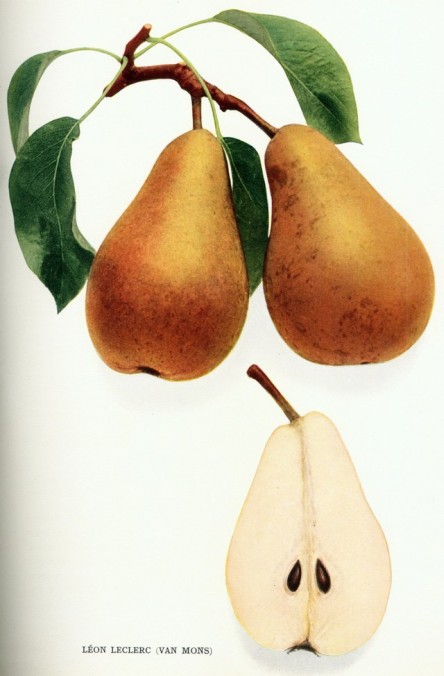
LÉON LECLERC (VAN MONS)
1. Mass. Hort. Soc. Rpt. 3. 1843. 2. Downing Fr. Trees Am. 419, fig. 192. 1845. 3. Hovey Fr. Am. 1:9, Pl. 1851. 4. Ann. Pom. Belge 5:51, Pl. 1857. 5. Am. Pom. Soc. Rpt. 70. 1862. 6. Pom. France 1: No. 29, Pl. 29. 1863. 7. Jour. Hort. N. S. 10:366. 1866. 8. Mas Le Verger 3: Pt. 1, 127, fig. 62. 1866-73. 9. Leroy Dict. Pom. 2:722, fig. 1869. 10. Jour. Hort. 3rd Ser. 1:573, fig. 103. 1880. 11. Cat. Cong. Pom. France 361, fig. 1906.
Van Mons Butterbirne. 12. Lauche Deut. Pom. II: No. 65, Pl. 65. 1883. 13. Mathieu Nom. Pom. 292. 1889.
A century ago this pear was being heralded in Europe as the best of all pears, and shortly afterward was introduced into the United States with highest praise. The variety is still popular in Europe, but its reputation there is not sustained here. The pear deserves a place among major varieties only because it fills a particular niche in the pear season, the crop coming in season between late fall and early winter at a time when there are few other good varieties. Were it not for one serious fault, however, the variety might take high rank in America. The fault is great susceptibility to the scab fungus. After Flemish Beauty, no other variety suffers as much both in fruit and foliage. Well grown in a congenial environment, on standard or quince stock, the pears are often as large as those of Duchesse d’Angoulême, with which they compare rather closely in shape. On well-grown specimens, also, the color is rich and beautiful. The flavor is sprightly and refreshing, which, with good flesh-characters, give the variety high rank for quality. There are no remarkable characters in the trees to recommend them, although they are quite up to the average in all characters either on pear or quince stocks. They are said to prefer a rich, deep soil. The variety is suitable only for collections.
This pear was obtained by M. Léon Leclerc, a distinguished pomologist living at Laval, France, who dedicated it to his friend Van Mons. Desiring to couple his own name with that of his friend, he gave it the name of Van Mons Léon Leclerc, by which appellation it has been known by most authors. The variety first fruited in 1828. There has been a good deal of confusion as to the identity of this pear, owing to the fact that Van Mons raised a pear in 1816 which he dedicated to Léon Leclerc. The proper name of the latter pear is Léon Leclerc de Laval. There is also a Léon Leclerc de Louvain. The variety under discussion was fruited in this country previous to 1843 by Marshall P. Wilder. The American Pomological Society added the variety to its fruit-catalog in 1862 but dropped it in 1869.
Tree medium in size, vigorous, spreading, open-topped, productive; trunk shaggy; branches roughish, reddish-brown, overspread with heavy, dull scarf-skin, with conspicuous, numerous, large lenticels; branchlets very slender and curved, short, with short internodes, light brown streaked with gray and tinged with green, dull, smooth, glabrous, with numerous small, conspicuous, raised lenticels.
Leaf-buds very small, short, pointed, appressed. Leaves 1½ in. long, 3¼ in. wide, leathery; apex taper-pointed; margin glandless, entire; petiole 1½ in. long, glabrous, reddish-green. Flower-buds small, short, conical, plump, free, singly on short spurs; flowers showy, 1¼ in. across, in dense racemes, 7 or 8 buds in a cluster; pedicels ⅝ in. long, pubescent.
Fruit ripe in late September and October; large, 3⅜ in. long, 2¼ in. wide, oblong-pyriform, tapering to a very long, narrow neck; stem 1 in. long, thick, curved; cavity very small, compressed, usually lipped; calyx large, open; lobes separated at the base, broad, acute; basin shallow, narrow, obtuse, symmetrical; skin thick, tough, roughened by russet specks; color dull yellow, covered with dots and tracings of russet and occasionally with a faint russet-red blush; dots numerous, small, russet, conspicuous; flesh granular under the skin, nearly melting, juicy, subacid or with a peculiar sprightliness; quality good. Core large, closed, with clasping core-lines; calyx-tube short, narrow, conical; seeds large, wide, long, acute.
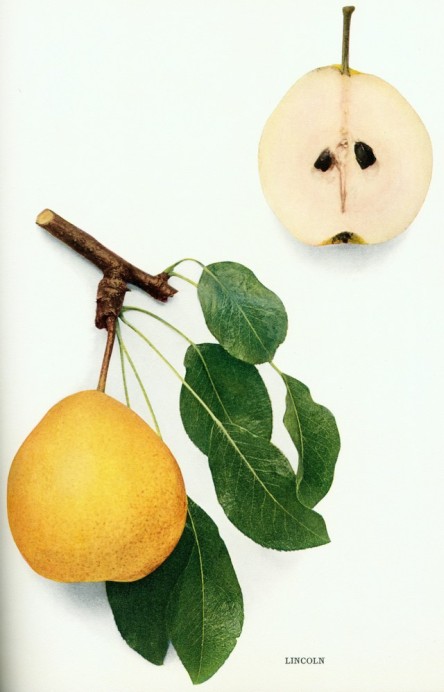
LINCOLN
1. Mass. Hort. Soc. Rpt. 88. 1845. 2. Ill. Hort. Soc. Rpt. 196, Pls. 1894. 3. Mich. Hort. Soc. Rpt. 141. 1894. 4. Ill. Hort. Soc. Rpt. 42. 1889. 5. Rural N. Y. 48:754, figs. 275 and 276. 1889. 6. Am. Pom. Soc. Cat. 36. 1899. 7. Budd-Hansen Am. Hort. Man. 2:253. 1903.
Nearly a hundred years old without having received favorable mention from pear growers, Lincoln has been brought from the limbo of lost fruits in recent years to take high rank in the list of pears for the Mississippi Valley. The variety is spoken of in such superlative terms for that region that judging from its behavior in New York, it would seem that western pear-growers give it attributes which Nature denies it. At best, in the East, the fruits are but mediocre in appearance and quality, falling below those of a dozen other varieties of the same season whether judged by the eye or the palate. In Illinois and Missouri, however, the fruits are spoken of as the handsomest and best. These are not regions in which many good pears grow, since the cold of winter, heat of summer, and pear-blight take toll from all but pears of the strongest constitution. Lincoln seems to possess a constitution to withstand these ills. At its best, the fruits of Lincoln seem comparable to those of Bartlett, which the western admirers of the variety say it resembles. In New York, comparisons of the fruits are all in favor of Bartlett, as are the trees in all characters excepting hardiness to heat and cold, and resistance to blight. The variety is valuable only in the Middle West.
This pear had its origin in a seedling grown in the spring of 1835 by Mrs. Maria Fleming, Corwin, Illinois, The original tree proved to be a vigorous grower as well as a heavy cropper, and was ultimately given the name of Lincoln. Augustine and Company of Normal, Illinois, propagated and distributed the variety about 1895. Young trees of the variety appear to be vigorous growers, free from blight and of high quality. The American Pomological Society added Lincoln to its list of fruits in 1899.
Tree large, vigorous, upright-spreading, open-topped, hardy, very productive; trunk stocky, smooth; branches zigzag, greenish-brown, partly overspread with thin gray scarf-skin, marked on the younger wood with very numerous large, round lenticels; branchlets slender, very long, willowy, brownish-green overlaid with thin gray, dull, the new growth reddish-green, with numerous large, roundish, raised lenticels.
Leaf-buds very small, short, pointed, appressed. Leaves 3½ in. long, 1½ in. wide, stiff; apex variable; margin glandless, finely serrate; petiole 2⅝ in. long, glabrous, tinged with red; stipules very long and slender, pinkish. Flower-buds small, short, conical, free, singly on short spurs; flowers 1⅜ in. across, well distributed, average 5 buds in a cluster; pedicels 1⅛ in. long, slender, pubescent.