Chapter IV · LEADING VARIETIES OF PEARS (continued 4)
Reading edition
Vicar. 9. Mawe-Abercrombie Univ. Gard. Bot. 1778. 10. Am. Pom. Soc. Cat. 40. 1883. 11. Ont. Dept. Agr. Fr. Ont. 183. 1914. Clion. 12. Kenrick Am. Orch. 159. 1841.
Le Curé. 13. Hovey Fr. Am. 1:47, Pl. 1851.
Curé. 14. Pom. France 1: No. 18, Pl. 18. 1863. 15. Leroy Dict. Pom. 1:610, fig. 1867. 16. Guide Prat. 61, 261. 1876. 17. Soc. Nat. Hort. France Pom. 396, fig. 1904. 18. Cat. Cong. Pom. France 221, fig. 1906.
Pastorenbirne. 19. Mathieu Nom. Pom. 262. 1889. 20. Gaucher Pom. Prak. Obst. No. 59, Pl. 49. 1894.
Though large and handsome, the pears of this variety vary so much in quality, often being wretchedly poor, that trees of it are now seldom planted in America. The variety is not liked, also, because the trees blight badly. The fruits, besides being large and handsome, keep well, and are excellent for all culinary purposes. They are in season from November to January. The pears have a strong musky smell, and are more or less astringent. The quality depends largely on the soil, and is best when the trees stand in a deep, warm loam. The fruits are long-pyriform, usually one-sided, and are further characterized by the peculiarity that the calyx is not in line with the axis, as in other pears, but is on one side, generally opposite to that in which the stalk is inserted as shown in the accompanying illustration. The trees, barring susceptibility to blight, are about all that could be desired—large, vigorous, handsome, and thrive both as standards and dwarfs. Many old trees of largest size of this variety are still to be found in New York, but young stock is now seldom set.
In 1760, this pear was found as a wilding by a French curate at Villiers-en-Brenne. In due course it was introduced into England by the Rev. W. L. Rahm, Vicar of Winkfield, in Berkshire, and from this circumstance it lost its proper name, Curé or Le Curé, and wrongly acquired that by which it is now known here and in England. The variety was introduced to America early in the nineteenth century. It was placed on the list of recommended fruits by the American Pomological Society in 1852.
Tree large, vigorous, upright-spreading, dense-topped, hardy, very productive, long-lived; trunk and branches stocky; branches zigzag, greenish-brown overspread with grayish scarf-skin, with lenticels variable in number and size; branchlets curved, thick, long and willowy, with long internodes, light greenish-brown which is mingled with red on the newer growth, smooth, glabrous except near the ends of the new growth, sprinkled with conspicuous, raised lenticels.
Leaf-buds small, short, pointed, free. Leaves 3 in. long, 2¼ in. wide, thick, leathery; apex abruptly pointed; margin tipped with minute scattering glands, finely serrate; petiole variable in length, pinkish-green; stipules short, tinged with pink. Flower-buds small, short, conical, plump, free, singly on very short spurs.
Fruit ripe December to January; large, 4¼ in. long, 3 in. wide, oblong-pyriform, with a long, tapering neck, with unequal sides; stem 1⅛ in. long, slender, curved; cavity lacking, with stem obliquely set without a depression and often with a fleshy fold around the base in the form of a lip; calyx large, open; lobes long, unusually broad, obtusely pointed; basin very shallow, narrow, obtuse, smooth, symmetrical; skin thick, tough, smooth, dull; color pale yellow, often with a faint trace of a brownish-red blush over the exposed cheek, marked with light russet around the calyx, and occasionally with russet flecks scattered over the surface; dots numerous, small, conspicuous, brownish-russet; flesh white, granular only near the center, tender and melting, juicy, somewhat astringent or with a sprightly muskiness, with no pleasant aroma; quality inferior for dessert but good for cooking. Core small, closed, axile, with clasping core-lines; calyx-tube long, narrow, funnel-shaped; carpels long-oval; seeds large, long, not very plump, often abortive.
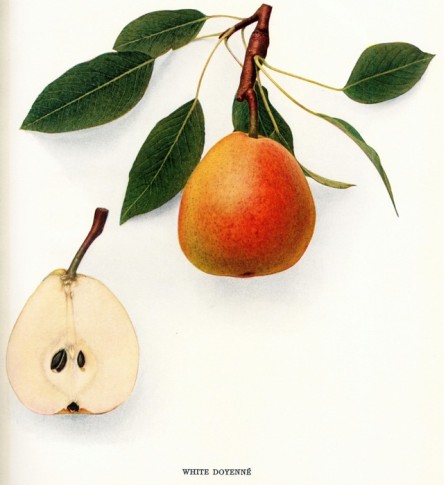
WHITE DOYENNÉ
1. Pom. Mag. 2:60, Pl. 1829. 2. Lindley Guide Orch. Gard. 385. 1831. 3. Prince Pom. Man. 1:43. 1831. 4. Downing Fr. Trees Am. 378, fig. 162. 1845. 5. Proc. Nat. Con. Fr. Gr. 51. 1848. 6. Hovey Fr. Am. 2:85, Pl. 1851. 7. Horticulturist N. S. 4:158, Pl. 1854. 8. Ibid. N. S. 6:406. 1856. 9. Downing Fr. Trees Am. 880, fig. 1869. 10. Hogg Fruit Man. 663. 1884.
Warwicke. 11. Parkinson Par. Ter. 592. 1629.
Doyenné. 12. Langley Pomona 132. 1729. 13. Duhamel Trait. Arb. Fr. 2:205, Pl. XLIII. 1768. 14. Miller Gard. Dict. 2: Pt. 1. 1807. 15. Brookshaw Pom. Brit. 2: Pl. 49. 1817. 16. Brookshaw Hort. Reposit. 2:175, Pl. 92. 1823. 17. Leroy Dict. Pom. 2:52, fig. 1869. 18. Rev. Hort. 51. 1898.
Virgalieu. 19. Prince Cat. 1771.
White Beurré. 20. Mawe-Abercrombie Univ. Gard. Bot. 1778.
Weisse Herbst Butterbirne. 21. Christ Handb. 511. 1817. 22. Liegel Syst. Anleit. 100. 1825. 23. Dochnahl Führ. Obstkunde 2:84. 1856. 24. Lauche Deut. Pom. II: No. 16, Pl. 16. 1882. 25. Mathieu Nom. Pom. 296. 1889.
Saint-Michael. 26. Coxe Cult. Fr. Trees 191, fig. 38. 1817.
Doyenné Blanc. 27. Trans. Lond. Hort. Soc. 5:135. 1824. 28. Kenrick Am. Orch. 121. 1841. 29. Pom. France 1: No. 74, Pl. 74. 1863. 30. Mas Le Verger 3: Pt. 2, 19, fig. 106. 1866-73. 31. Guide Prat. 63, 264. 1876. 32. Cat. Cong. Pom. France 236, fig. 1906.
Thorp. 33. Downing Fr. Trees Am. 553. 1857. 34. Mag. Hort. 24:516. 1858.
Bonne-Ente. 35. Noisette Man. Comp. Jard. 2:532. 1860.
This ancient and world-renowned pear, its fruits the most delectable of any that come from a pear orchard, is now rarely planted in America. It is being discarded because the small and comparatively unattractive fruits fail to satisfy commercial demands. In the middle of the last century, when there was almost a mania for the best of the European pears, when fruits were judged by the palate rather than the eye as now, White Doyenné was one of the most commonly planted varieties. Proof of its popularity at home and abroad is found in the great number of names under which it has been grown. A more serious fault than small and unattractive pears is that the fruits and foliage are inviting prey to the scab-fungus, which often cracks and scabs the pears and defoliates the trees. Except in susceptibility to scab, the trees are nearly perfect when grown in the soil which they prefer—a rich clay, heavy rather than light. On such a soil, tree and fruit attain perfection. The accompanying illustration shows this pear at its best in color and size—a handsome fruit rather than the unattractive product so often seen. Grown in a light soil, and when scab is unchecked, the fruits are small, green, cracked, and cankered—intolerable to sight and taste. Unfortunately, also, the trees are ravaged by blight when that disease is epidemic. The faults named have made the variety an outcast, but it should still receive attention for the superb quality of its fruits where scab and blight can be controlled.
This pear is one of the oldest of all varieties. It is impossible to state whether it originated in France or was brought to that country from Italy. A German, Henri Manger, who studied the origin of fruits, states in his Systematische Pomologie, 1780, that the White Doyenné originated with the Romans; he considered it to be their Sementinum. Agostino Gallo, 1559, called the variety Pera Ghiacciuola. In 1660, Claude Saint-Etienne described a Poire de Neige. Both of these descriptions represent White Doyenné. In the sixteenth century and for part of the seventeenth, the name Ghiacciuola was accepted for the variety in France with the synonym Saint-Michel. Leroy states that Le Lectier, in his catalog of the fruit trees which he grew at Orléans in 1628, changed the name to Giaccole de Rome, and Nicholas de Bonnefonds modified it in the first edition of his Jardinier Francais, 1652, to Giacciola di Roma. English pomologists have mentioned this pear under a variety of names since early in the seventeenth century. The names Poire Doyenné and White Doyenné have been most generally applied to it. The date of its introduction to America is not known, but it was probably brought to this country by the earliest French settlers. The first American catalogs mentioned the variety, and it was extensively grown in the vicinity of New York and Long Island where it was commonly called the Virgalieu pear. In the neighborhood of Boston, the name Saint-Michael was applied to it; while around Philadelphia it was called the Butter Pear. For nearly a century, however, the variety has been most generally known in this country as White Doyenné. At the Convention of Fruit-Growers held in New York, in 1848, White Doyenné was included in a short list of pears recommended for general cultivation. Since that date, the American Pomological Society has given the variety a place in its fruit-catalog.
Tree large, vigorous, upright, vasiform, hardy, very productive; trunk stocky, somewhat smooth; branches thick, dark gray, with many large lenticels; branchlets thick, reddish-brown, smooth, glabrous, with small, very slightly raised lenticels.
Leaf-buds obtuse, pointed, appressed. Leaves 2½ in. long, 1¾ in. wide, flattened, leathery; apex taper-pointed; margin finely serrate; petiole 1½ in. long, slender. Flower-buds large, long, conical or pointed, free; flowers early, 1⅛ in. across, in dense clusters, 7 or 8 buds in a cluster; pedicels ⅞ in. long, slender, pubescent, light green.
Fruit matures in early October; medium in size, 2¼ in. long, 2⅛ in. wide, uniform, obovate-obtuse-pyriform, symmetrical; stem ¾ in. long, thick, slightly curved; cavity obtuse, shallow, narrow, russeted, usually symmetrical; calyx small, open or closed; lobes short, narrow, obtuse; basin shallow, obtuse, nearly smooth, symmetrical; skin thick, tough, smooth, dull; color clear pale yellow, with a small, bright red blush on the exposed cheek; dots numerous, small, russet, conspicuous; flesh yellowish-white, granular, firm at first but becoming melting when fully ripe, juicy, sweet, with a rich, aromatic flavor; quality very good. Core closed, with clasping core-lines; calyx-tube short, wide, conical; seeds wide, plump, obtuse.
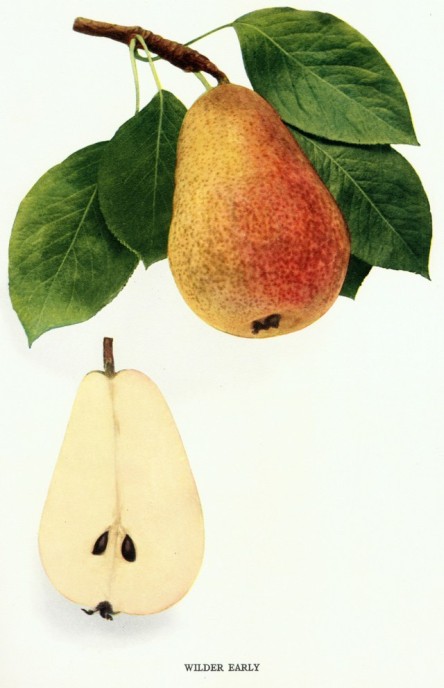
WILDER EARLY
1. Can. Hort. 12:286, fig. 73. 1889. 2. Ibid. 13:251, Pl. 1890. 3. Am. Pom. Soc. Cat. 37. 1899. 4. Budd-Hansen Am. Hort. Man. 2:268. 1903.
Early Wilder. 5. Ill. Hort. Soc. Rpt. 45. 1896.
Wilder. 6. Ont. Dept. Agr. Fr. Ont. 183, fig. 1914.
This is one of the good, early pears for the markets. It is more highly prized in the Mississippi Valley than in New York and the Eastern states where summer pears are raised in greater variety. The pears are very attractive in size, shape, and particularly in the bright lemon-yellow color, with a flaming cheek to the sun, the whole pear being characteristically marked with small, russet dots set in a pinkish circle. Of all summer pears the fruits of this one seem least inclined to rot at the center, and usually keep longer and ship better, although the skin is tender and bruises easily. The flesh is buttery, moderately juicy, sweet and rich, with a faint, pleasant perfume. The fruits are small but are usually larger than those of the well-known Seckel, and are edible almost to the very center. The tree is large, vigorous, prodigiously productive, as healthy as any, and a remarkably handsome ornamental. Despite this catalog of virtues, Wilder Early is not largely planted in New York.
Wilder Early is a chance seedling found by Charles A. Green, Rochester, New York, about 1884, in Chautauqua County, New York. At the time of its discovery the tree was already in bearing. The variety was named after Marshall P. Wilder, President of the Massachusetts Horticultural Society. The name first appeared in the fruit-catalog of the American Pomological Society in 1899.
Tree large, vigorous, upright, dense-topped, rapid-growing, hardy, very productive; branches zigzag, reddish-brown overspread with gray scarf-skin, with numerous lenticels; branchlets thick, very long, light greenish-brown, lightly streaked with ash-gray scarf-skin, dull, smooth, glabrous except near the tips of the new growth, sprinkled with many conspicuous, raised lenticels.
Leaf-buds small, short, pointed, appressed; leaf-scars prominent. Leaves 3¼ in. long, 1⅞ in. wide, leathery; apex taper-pointed; margin very finely serrate; petiole 2 in. long, glabrous. Flower-buds small, short, conical, plump, free, singly on short spurs; flowers late, 13⁄16 in. across, white or tinged with pink, in dense clusters, average 7 buds in a cluster; pedicels ½ in. long, pubescent.
Fruit ripe in late August; large, 2¾ in. long, 2⅜ in. wide, oblong-pyriform, symmetrical; stem ¾ in. long, very thick; cavity acute, narrow, russeted and with rays of russet extending over the sides, slightly compressed, rarely lipped; calyx large, open; lobes separated at the base, long, narrow, acuminate; basin very shallow, narrow, obtuse, wrinkled; skin thin, tender, smooth, dull; color pale lemon-yellow, with a pinkish blush on the exposed cheek often deepening to dark pink; dots characteristically distinct, very numerous, small, russet or russet-red; flesh white, stringy, tender and melting, buttery, moderately juicy, sweet, faintly aromatic; quality good. Core small, closed, with clasping core-lines; calyx-tube long, narrow, conical; seeds long, narrow, acute.
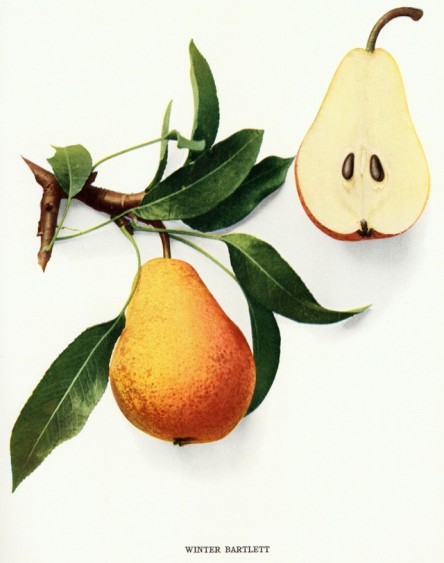
WINTER BARTLETT
1. Ore. Bd. Hort. Rpt. 42. 1895. 2. Ore. Nur. Cat. 19. 1903. 3. Am. Pom. Soc. Cat. 41. 1909. 4. Cal. Com. Hort. Pear Grow. Cal. 7: No. 5, 278, fig. 94. 1918.
Winter Bartlett is heralded from the Pacific Coast as a winter variety bearing fruits similar to those of Bartlett. As the fruits grow in New York there is a suggestion of Bartlett in the shape, color, and flavor of the fruits, but in size, as the color-plate shows, the newcomer falls far short of the older pear. The season is December and January, a time when there are a half-dozen other good pears, and since this one has no outstanding characters to make it notable, it is doubtful if it will outlive a brief period of probation in eastern orchards. The westerners say that the tree is very resistant to blight, a statement neither proved nor disproved in the East as yet. The variety is worth trying in a small way in New York.
This pear seems to have originated at Eugene, Oregon, some time prior to 1880, and to have been introduced by D. W. Coolidge of Eugene, although it must have been grown to some extent before Mr. Coolidge brought it to the front. Because of its resemblance to Bartlett, it is assumed that it is a seedling of that variety. The American Pomological Society added Winter Bartlett to its catalog of fruits in 1909.
Tree large, vigorous, upright, scraggly, open-topped, hardy, productive; branches stocky, smooth, light-brown overlaid with gray scarf-skin, with few lenticels; branchlets thick, curved, long, with long internodes, brownish-red, streaked with gray scarf-skin, glossy, smooth, glabrous, sprinkled with conspicuous, raised lenticels.
Leaf-buds large, long, conical, pointed, plump, free; leaf-scars with very prominent shoulders. Leaves 3¼ in. long, 1⅜ in. wide, stiff; apex taper-pointed; margin finely serrate; petiole 2¼ in. long. Flower-buds conical, plump, free, singly on spurs variable in length; flowers very late, 1½ in. across, in dense clusters, average 5 buds in a cluster; pedicels 1 in. long, thick, thinly pubescent.
Fruit ripe in December and January; large, 3 in. long, 2⅜ in. wide, oblong-obovate-pyriform; stem 1 in. long, thick, curved; cavity narrow, shallow, smooth, oblique; calyx small, nearly closed; lobes short; basin small, shallow, irregular; skin uneven in surface; color yellow, splashed with russet and often blushed on the exposed cheek with bright red; dots numerous, small, brownish-russet; flesh yellowish-white, fine-grained, tender, juicy, sweet, pleasant-flavored; quality good to very good. Core small, nearly closed, with meeting core-lines; calyx-tube short, wide; seeds large, long, plump, obtuse.
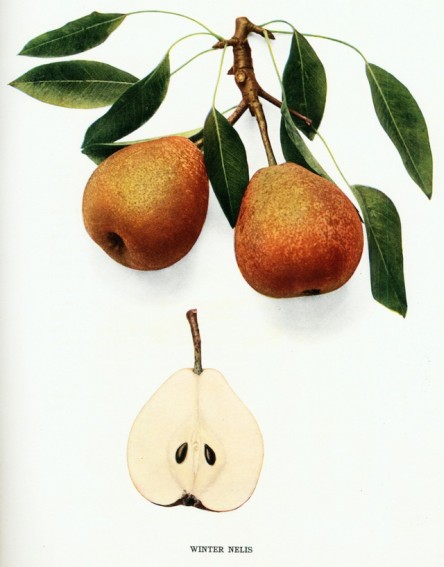
WINTER NELIS
1. Pom. Mag. 3:126, Pl. 1830. 2. Lindley Guide Orch. Gard. 409. 1831. 3. Kenrick Am. Orch. 199. 1832. 4. Mag. Hort. 10:127. 1844. 5. Downing Fr. Trees Am. 450, fig. 208. 1845. 6. Gard. Chron. 20, fig. 1845. 7. Proc. Nat. Con. Fr. Gr. 51. 1848. 8. Hovey Fr. Am. 1:15, Pl. 1851. 9. Downing Fr. Trees Am. 884, fig. 1869. 10. Oberdieck Obst-Sort. 339. 1881. 11. Lauche Deut. Pom. II: No. 49, Pl. 49. 1882. 12. Hogg Fruit Man. 667. 1884. 13. Mathieu Nom. Pom. 301. 1889. 14. Deut. Obstsorten 5: Pt. 15, Pl. 1909.
La Bonne Malinoise. 15. Trans. Lond. Hort. Soc. 4:276. 1822. 16. Ibid. 5:408. 1824.
Thouin. 17. Dochnahl Führ. Obstkunde 2:23. 1856.
Bonne de Malines. 18. Ann. Pom. Belge 6:77, Pl. 1858. 19. Pom. France 2: No. 53, Pl. 53. 1864. 20. Leroy Dict. Pom. 1:484, figs. 1867. 21. Guide Prat. 60, 252. 1876. 22. Cat. Cong. Pom. France 202. 1906.
Nélis d’Hiver. 23. Mas Le Verger 1:29 bis, fig. 21. 1866-73.
Winter Nelis is the standard winter pear in the United States. Both fruits and trees possess several serious faults, but these are outmatched by virtues which make the variety preëminent in its season. The fruits are small and are often so poorly colored as to be unattractive, but well grown they are sufficiently large for dessert fruits and are very handsome in a much-russeted coat and a ruddy cheek. Flesh and flavor are the chief assets of the fruits. The flesh is tender, melting, juicy, luscious, with a rich, sweet, aromatic flavor—one of the most delectable of all pears. The fruits keep, ship, and sell well. The season is from Christmas to March, but the pears can be kept until late spring in cold-storage. The trees begin badly, for no variety is more difficult to grow well in the nursery. They thrive only on standard stocks, refusing to do well on the quince unless double worked. In the orchard, the trees are among the unmanageables. They are small or of but medium size, with straggling, wayward tops with habits of growth so self assertive that no art nor skill of the pruner can bring the branches under control. The limbs are always crooked; some bend inward toward the main stem, some are upright, some droop, and no two behave in quite the same way. Notwithstanding the illy-shaped tops, the trees are often enormously productive so that the crop usually requires thinning. They bear almost annually; come in bearing young; are fairly hardy; and are adapted to almost any soil or situation provided, only, that the soil is fertile or well fertilized. They are as nearly immune to blight as those of any other European pear. The trees are characterized by two marked peculiarities: the old wood is thickly set with small, short spurs; and they are about the latest of all their kind in leafing out in the spring. There is no better winter pear for either the commercial pear-grower or the amateur, and the variety grows especially well in New York.
Winter Nelis was raised from seed by Jean Charles Nélis, Mechlin, Belgium, early in the nineteenth century. It was introduced into England by the London Horticultural Society under the name La Bonne Malinoise. Subsequently this name was cancelled and that of Winter Nelis adopted, the name which had been given the variety by Van Mons in honor of the originator. In 1823, Thomas Andrew Knight, President of the London Horticultural Society, sent cions of the variety to John Lowell, Roxbury, Massachusetts, who, in his turn, shared them with Robert Manning, Salem, Massachusetts, whence the sort was very generally disseminated in this country and attained great popularity. At the National Convention of Fruit-Growers held in New York in 1848, Winter Nelis was included in a short list of pears recommended for general cultivation. For more than half a century the name has appeared in the fruit-catalogs of the American Pomological Society.
Tree medium in size and vigor, spreading, hardy, very productive; trunk stocky; branches thick, zigzag, reddish-brown mingled with gray scarf-skin, marked with small lenticels; branchlets with short internodes, reddish-brown, dull, smooth, glabrous, with numerous raised, conspicuous lenticels.
Leaf-buds medium to large, long, conical or pointed, free. Leaves 3 in. long, 1⅛ in. wide, elongated-oval, leathery; apex taper-pointed; margin varies from crenate to serrate; petiole 1½ in. long, slender. Flower-buds conical or pointed, free; flowers open late, 1¾ in. across, 6 or 7 buds in a cluster; pedicels ⅞ in. long, rather slender, lightly pubescent, greenish.
Fruit ripe late November to early January; medium in size, 2¼ in. long, about 2¼ in. wide, uniform in size and shape, roundish-obovate to obtuse-obovate-pyriform, quite symmetrical except for the unequal sides; stem 1⅜ in. long, thick, curved; cavity obtuse, shallow, narrow, russeted, gently furrowed, occasionally lipped; calyx large, open; lobes separated at the base, short, broad, acute; basin shallow, obtuse, lightly furrowed, symmetrical; skin thick, tender, roughened with much russet, dull; color yellow with a tinge of green, dotted with grayish-russet and with many russet streaks and patches on the exposed cheek which is usually blushed with bright red; dots numerous, small, russet, conspicuous; flesh yellowish-white, quite granular at the center and underneath the skin, tender and melting, buttery, very juicy, sweet, aromatic; quality very good. Core large, closed, axile, with clasping core-lines; calyx-tube short, wide, conical; seeds large, wide, long, plump, acute.
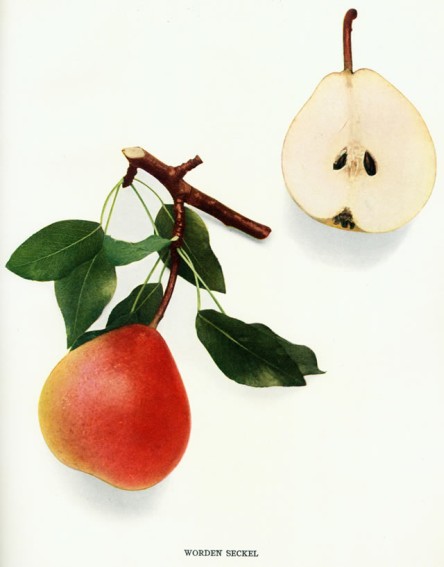
WORDEN SECKEL
1. Rural N. Y. 50:888, figs. 326 and 327. 1891. 2. Thomas Am. Fruit Cult. 465, fig. 675. 1897. 3. Franklin Davis Nur. Cat. 23. 1901. 4. Budd-Hansen Am. Hort. Man. 2:268. 1903. 5. Banker Cat. 19. 1915.
Worden. 6. Am. Pom. Soc. Cat. 41. 1909.
Possibly no pear has been more widely advertised during the last quarter-century than Worden Seckel. Nurserymen and pear-growers alike describe it as a better variety than Seckel, and say that it ought to take the place of that good old sort of which it is a seedling. But it is not driving Seckel out in most pear regions, though in many it is considered the more profitable pear of the two. It is a splendid pear, but falls short of Seckel in not being quite as dependable in different soils and climates; the trees are not as vigorous, though just as productive in many places, they are not quite as resistant to blight, and the fruits are not as high in quality. On the other hand, the pears are larger and handsomer. Well grown, the fruits of Worden Seckel are voluptuously handsome in form and color. The pears are smooth, glossy, trim of contour, well turned, unusually uniform, with a beautifully blushed cheek on a handsome green and yellow background. The accompanying illustration does not do the pear justice in size or color and shows a lack of symmetry not usually present. When the crop is thinned so that the fruits attain their largest size, no pear is handsomer or will bring a higher price on the fruit-stands. The crop comes in with Seckel, but keeps longer, lasting until December in cold-storage. The tree is very hardy and bears young, but does poorly in the nursery. Commercial growers should give this variety a thorough test, and amateurs everywhere will find it worth planting.
Worden Seckel, as its name suggests, is a seedling of Seckel, raised by Sylvester Worden, Minetto, Oswego County, New York, about 1881. Smiths and Powell, Syracuse, New York, placed it on the market about 1890. The American Pomological Society added the variety to its fruit-list in 1909.
Tree large, vigorous, upright-spreading, rapid-growing, very productive; trunk thick; branches reddish-brown, nearly covered with thin, gray scarf-skin, marked with numerous lenticels; branchlets short, with internodes variable in length, light greenish-brown, dull, glabrous except near the ends of the new growth, sprinkled with numerous small, conspicuous, raised lenticels.
Leaf-buds very small, short, pointed, appressed. Leaves 2½ in. long, 1½ in. wide, thick, leathery; apex taper-pointed; margin tipped with few minute glands, finely or coarsely serrate; petiole 1½ in. long, glabrous, slender, tinged with red; stipules very small when present. Flower-buds small, short, conical, sharply pointed, plump, free, singly on very short spurs; flowers showy, 1½ in. across, in dense clusters, 8 or 10 buds in a cluster; pedicels 1¼ in. long, slightly pubescent.
Fruit ripe late September to October; medium in size, 2½ in. long, 2⅛ in. wide, obovate-acute-pyriform, symmetrical; stem ¾ in. long, thick; cavity very shallow and obtuse or lacking, the flesh folded up around the base of the stem and often lipped; calyx open, large; lobes narrow, acute; basin shallow, narrow, obtuse, smooth or gently furrowed, symmetrical; skin thin, tender, smooth, glossy; color pale golden-yellow, blushed on the exposed cheek with solid bright red, becoming almost crimson in highly colored specimens; dots numerous, small, russet, obscure; flesh yellowish-white or dull white, fine-grained near the skin, granular at the center, tender and melting, buttery, very juicy, characteristically spicy and aromatic; quality very good. Core closed, axile, with meeting core-lines; calyx-tube conical; carpels ovate; seeds wide, plump, obtuse.