Chapter IV · LEADING VARIETIES OF PEARS (continued 3)
Reading edition
Fruit matures in late August and September; medium in size, about 2¼ in. in length and width, roundish, with an obtuse neck, tapering very slightly; stem 1⅛ in. long, slender; cavity a slight, narrow depression, occasionally lipped; calyx large, open; lobes separated at the base, long, acuminate; basin shallow, obtuse, smooth, symmetrical; skin thick, tender, roughish; color yellow, sprinkled with few russet lines and nettings; dots numerous, small, russet, conspicuous; flesh tinged with yellow, firm, coarse and granular, tender, very juicy, sweet, aromatic, pleasing but not richly flavored; quality good. Core unusually large, closed, with clasping core-lines; calyx-tube short, wide, conical; seeds large, very wide, long, plump, acuminate.
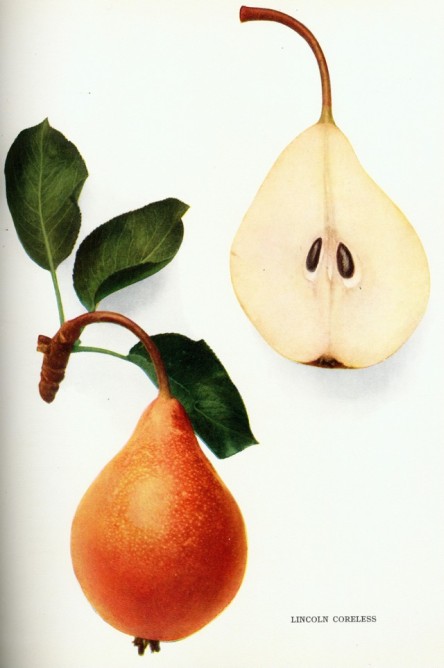
LINCOLN CORELESS
1. Parry Cat. 9, fig. 1891. 2. Ann. Hort. 185. 1892. 3. Ill. Hort. Soc. Rpt. 137. 1894. 4. Ibid. 52, 178. 1896. 5. Rural N. Y. 64:256. 1905.
The product of Lincoln Coreless is worthless for dessert, and but a coarse makeshift for culinary purposes. The variety receives attention only because the pear is a monstrosity and a curiosity. The fruits are enormous in size, outweighing all other pears unless it be those of the Pound. They are unique in having a very small core and few or sometimes no seeds. They are further characterized by very late maturity, ripening later than those of any other pear on the grounds of this Station and keeping until April. While usually rather dull greenish-yellow in color, the cheek is often enlivened by a bright blush which makes the fruits rather attractive despite their grossness. The catalogs describe the trees as “blight proof,” but they blight on the grounds of this Station. The variety is worth growing only as an interesting curiosity.
According to William Parry, Parry, New Jersey, Lincoln Coreless originated in Lincoln County, Tennessee, near the Alabama line, about 1830. The original tree was rated as productive and free from blight, and young trees propagated from it have been unusually healthy and vigorous. The variety was introduced about 1890 by William Parry.
Tree small, vigorous, upright, very dense, pyramidal, hardy, an uncertain bearer; trunk shaggy; branches smooth, zigzag, reddish-brown mingled with ash-gray, marked with small lenticels; branchlets short to medium, dull brown, smooth, glabrous, with conspicuous lenticels.
Leaf-buds large, obtuse, plump, appressed. Leaves 3 in. long, 1⅝ in. wide, elongated-oval, leathery; apex taper-pointed; margin finely serrate; petiole 1½ in. long, reddish; stipules very long. Flower-buds short, obtuse, plump, free; flowers 1¾ in. across, very large and showy, average 6 buds in a cluster; pedicels 1⅝ in. long, thick, pubescent, pale green.
Fruit ripe in February; very large, 4¾ in. long, 3 in. wide, uniform in size, obovate-acute-pyriform, somewhat ribbed, with unequal sides; stem 1⅜ in. long, thick, curved; cavity obtuse, shallow, narrow, russeted, furrowed, often lipped; calyx open, large; lobes separated at the base, narrow, acute; basin very shallow, narrow, obtuse, furrowed; skin very thick, tough, coarse and granular, smooth, dull; color greenish-yellow, with a handsome blush on the cheek exposed to the sun; dots many, brownish-russet, very conspicuous; flesh yellowish-white, very firm, granular at the core, crisp, tough, medium juicy, rather bitter and astringent; quality poor. Core closed, with clasping core-lines; calyx-tube long, wide, conical; seeds few, narrow, often abortive, acute.
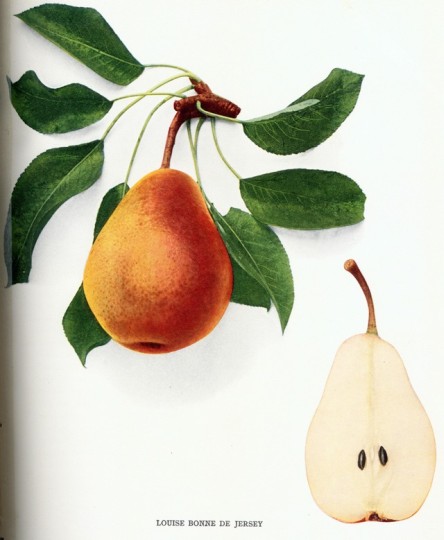
LOUISE BONNE DE JERSEY
1. Kenrick Am. Orch. 148. 1841. 2. Am. Pom. Soc. Rpt. 53. 1852. 3. Field Pear Cult. 218, fig. 81. 1858.
Louise Bonne of Jersey. 4. Downing Fr. Trees Am. 397, fig. 174. 1845. 5. Hovey Fr. Am. 1:39, Pl. 1851. 6. Jour. Hort. N. S. 38:161, fig. 26. 1880. 7. Hogg Fruit Man. 606. 1884.
Gute Louise von Avranches. 8. Dochnahl Führ. Obstkunde 2:138. 1856. 9. Mathieu Nom. Pom. 229. 1889.
Bonne Louise d’Avranches. 10. Ann. Pom. Belge 6:29, Pl. 1858. 11. Pom. France 1: No. 21, Pl. 21. 1863. 12. Mas Le Verger 3: Pt. 1, 67, fig. 32. 1866-73. 13. Leroy Dict. Pom. 1:482, fig. 1867. 14. Guide Prat. 286. 1876.
Louise. 15. Am. Pom. Soc. Cat. 23. 1897. 16. Ont. Dept. Agr. Fr. Ont. 170, fig. 1914.
Now known in America as Louise, a name given it by the American Pomological Society, this variety is described under the name given it in England to distinguish it from at least eight other varieties having Louise as the whole or a part of the name. The pear is an old one, having many excellent qualities of fruit and tree, which, however, are not sufficiently above the average to give it high place in the list of pears for the market. The pears are medium to large, handsome, of excellent quality, and keep and ship well. These qualities have given it some preëminence as a pear for the export trade. The trees are precariously hardy and somewhat subject to blight, but very vigorous, productive, and long-lived. In Europe, the testimony of prominent pomologists agrees that the fruits are better and the trees more productive when worked on the quince, and in America the variety is considered one of the best for dwarfing. This pear is a standard one for home collections, and finds favor in many commercial orchards in New York.
The parent tree of this pear was raised from seed about 1780 by M. de Longueval, Avranches, Normandy. Some authorities say that the variety was first named Bonne de Longueval; others, that M. de Longueval immediately dedicated the pear to his wife and called it Bonne Louise de Longueval. Later still, the Pomological Congress adopted the name of Bonne Louise d’Avranches, by which it became more generally known, though in England, it rather unfortunately became widely disseminated as Louise Bonne de Jersey, having, presumably, found its way there through the Channel Islands. The variety was brought to the United States early in the nineteenth century, and in 1852 was entered in the recommended list of fruits of the American Pomological Society. In 1897, this Society shortened the name to Louise.
Tree large, vigorous, upright, very tall, dense-topped, hardy, productive, long-lived; trunk stocky; branches slightly zigzag, reddish-brown mingled with very dark grayish scarf-skin, with numerous raised lenticels; branchlets slender, long, dark reddish-brown, nearly smooth, glabrous, with few small, slightly raised lenticels.
Leaf-buds pointed, semi-free. Leaves 3¼ in. long, 1¾ in. wide, much curled under at the margins, oval, leathery; apex slightly taper-pointed; margin glandless, finely serrate; petiole 1½ in. long, slender. Flower-buds small, conical or pointed, free; flowers with a disagreeable odor, 1½ in. across, white or tinged with pink along the edge of the petals, averaging 6 buds in a cluster; pedicels 1½ in. long, slender, pubescent, light green.
Fruit matures in October; medium to large, 2⅞ in. long, 2¼ in. wide, uniform in size and shape, oblong-pyriform, somewhat irregular, with unequal sides; stem 1 in. long, slender, usually curved; cavity obtuse, very shallow and very narrow, furrowed and wrinkled, often lipped, the flesh folded up around the stem; calyx open, large; lobes broad, acute; basin obtuse, furrowed and uneven; skin granular, smooth; color pale yellow, marked on the exposed cheek with a dull red blush and with streaks of russet; dots numerous, small, grayish or russet, conspicuous; fruit yellowish-white, somewhat granular, tender and melting, very juicy, sweet and vinous, aromatic, rich; quality very good. Core closed, with clasping core-lines; calyx-tube short, wide, conical; seeds large, wide, long, plump, acute.
LUCY DUKE
1. Am. Pom. Soc. Rpt. 153. 1885. 2. W. N. Y. Hort. Soc. Rpt. 65. 1889. 3. Van Lindley Cat. 22, Pl. 1892. 4. N. Y. Sta. Bul. 364:182. 1913.
Why Lucy Duke is neglected is hard to see. Tree and fruit are highly praised, Charles Downing thought the pear “not quite so fine as a first-class Seckel, but I must aver it is not far behind.” The pear has a rich, juicy, spicy, melting flesh that makes it one of the best. In form, the fruits resemble those of Bartlett, which is probably one of the parents; they are of but medium size, but are of a beautiful golden-russet color, which makes them as handsome as the handsomest. The skin is thick and the pears stand shipping well. The variety can be recommended for home and local markets, but the trees are a little too unproductive and too irregular in bearing for commercial orchards. The tree is hardy but only moderately vigorous and resembles Winter Nelis, supposed to be the other parent, in habit of growth. The variety is relatively free from blight.
Lucy Duke was grown about 1880 by Mrs. Lucy Duke, Beaufort County, North Carolina, from seed of a Bartlett pear which she had received from California, Its tree-characters are so nearly like those of Winter Nelis that the other parent is supposed to be that variety. Lucy Duke was introduced about 1892 by J. Van Lindley, Pomona, North Carolina.
Tree medium to large, variable in vigor, upright becoming slightly spreading, dense-topped, hardy, productive; trunk shaggy; branches thick, zigzag, marked by numerous elongated lenticels; branchlets strongly curved, with short internodes, dark brownish-red mingled with green, mottled with scarf-skin, smooth, glabrous, with small, elongated or roundish, conspicuous, raised lenticels.
Leaf-buds small, short, pointed, plump, usually free; leaf-scars prominent. Leaves 3 in. long, 1⅜ in. wide, thin; margin occasionally glandular, finely serrate or entire; petiole 1½ in. long, slender. Flower-buds large, long, pointed, plump, free, singly on short spurs; flowers open late, with an unpleasant odor, 1⅝ in. across; pedicels 1⅛ in. long.
Fruit ripens in late October and November; medium in size, acute-pyriform to oblong-pyriform, symmetrical; stem short, thick, curved; cavity obtuse, shallow, narrow, russeted, often wrinkled and occasionally lipped; calyx large, open, rounded and with a deeply-set center; basin obtuse, smooth, symmetrical; skin very tough, roughened with thick russet; color greenish-yellow, usually entirely overspread with solid, dark russet, changing to golden russet on the cheek exposed to the sun, with mottlings and flecks of russet; dots numerous, small, russet, obscure; flesh yellowish-white, fine, melting, rich, juicy, sweet; quality very good. Core large, closed, axile; calyx-tube short, wide, broadly conical; seeds large, wide, long, plump, acute.
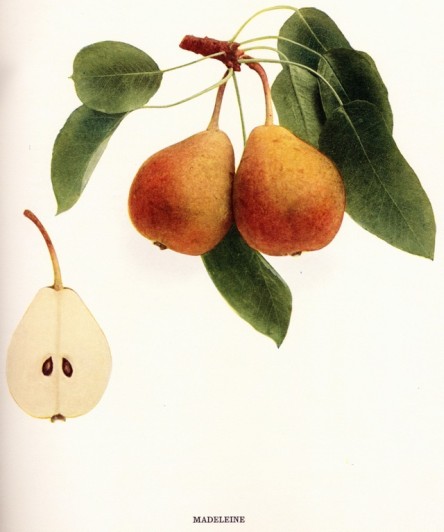
MADELEINE
1. Duhamel Trait. Arb. Fr. 2:124, Pl. IV. 1768. 2. Pom. Mag. 2:51, Pl. 1829. 3. Prince Pom. Man. 1:13. 1831. 4. Downing Fr. Trees Am. 341, fig. 138. 1845. 5. Proc. Nat. Con. Fr. Gr. 51. 1848. 6. Elliott Fr. Book 331, fig. 1854. 7. Mas Le Verger 2:59, fig. 28. 1866-73. 8. Guide Prat. 62, 287. 1876.
Sainte Madelaine. 9. Knoop Pomologie 76, Tab. 1, fig. 1771.
Grüne Sommer-Magdalene. 10. Dochnahl Führ. Obstkunde 2:150. 1856. 11. Lucas Tafelbirnen 47, fig. 1894.
Citron des Carmes. 12. Pom. France 3: No. 101, Pl. 101. 1865. 13. Leroy Dict. Pom. 1:563, fig. 1867. 14. Hogg Fruit Man. 548. 1884. 15. Cat. Cong. Pom. France 212, fig. 1906.
Grüne Magdalene. 16. Mathieu Nom. Pom. 228. 1889.
Madeleine has long been a dependable summer variety, the crop of which ripens just before that of Bloodgood. Many consider it the best very early summer pear, and if the product alone were to be considered it might well be called the best, but, unfortunately, the faults of the trees more than offset the virtues of the fruits. The pears are attractive in appearance, and very good in quality; but their season is short, their skins are tender, and the flesh quickly softens at the core. While the trees are productive, they are not resistant to blight, do not hold their crop well, are tender to cold, and are short-lived. The variety is worth planting only for the sake of succession in crop, and in large collections of pears. The variety is recommended on the Pacific slope for local markets.
The Madeleine pear is of ancient and somewhat uncertain origin. It was cultivated by M. Le Lectier in his garden at Orléans in 1628, but previously no other author had made mention of it, though M. Leroy, writing in 1867, deemed it presumable that it had originated in France. Besides its original names this pear has been known by some fifty others in different localities and at different times, but Madeleine is now its recognized name in this country. In England, it is known as the Citron des Carmes. When and by whom it was introduced to America is not clear, but it was a standard variety as early as 1831 when Prince first described it. At the national convention of fruit-growers held in 1848, Madeleine was recommended for general cultivation, and ever since this time the variety has appeared in the fruit-catalog of the American Pomological Society.
Tree large, vigorous, upright, open-topped, tender, productive; trunk shaggy; branches zigzag, light greenish-brown covered with gray scarf-skin; branchlets slender, long, reddish-brown mingled with green, mottled with ash-gray near the tips, smooth, glabrous, with small, raised, conspicuous lenticels.
Leaf-buds small, very short, pointed, appressed. Leaves 3 in. long, 1½ in. wide, thin; apex taper-pointed; margin glandless, finely serrate; petiole 1¾ in. long, glabrous, reddish-green. Flower-buds small, thick, short, conical, plump, free, distributed as lateral buds or on very short spurs; flowers showy, 1⅜ in. across, in dense clusters, average 11 buds in a cluster; pedicels 1¼ in. long, slightly pubescent.
Fruit ripens in early August; inferior in size, 2⅛ in. long, 2 in. wide, roundish-obtuse-pyriform; stem 1½ in. long, thick, curved; cavity very shallow and narrow, or lacking, the flesh folded in a lip on one side of the stem; calyx partly open; lobes separated at the base, short, narrow, acuminate; basin shallow, narrow, obtuse, gently furrowed, symmetrical; skin thin, smooth, very tender; color dull green, occasionally with a faint, dotted, brownish blush; dots numerous, greenish, obscure; flesh slightly tinged yellow, granular at the center, tender and melting, very juicy, sweet, vinous; quality good to very good. Core closed, with clasping core-lines; calyx-tube short, wide, conical; seeds wide, short, plump, acuminate.
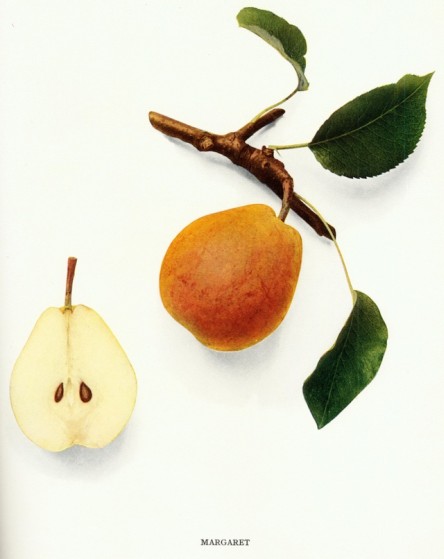
MARGARET
1. Horticulturist 21:172, 245, fig. 80. 1866. 2. Am. Pom. Soc. Rpt. 53. 1869. 3. Downing Fr. Trees Am. 811. 1869. 4. Mo. Hort. Soc. Rpt. 35, 36. 1890. 5. Guide Prat. 68, 279. 1895.
Mary. 6. Horticulturist 21:78, figs. 43 and 44. 1866.
The fruits of Margaret are early and attractive in color and shape. This is about all that can be said for them, as they run small in size, and in neither flesh nor flavor can they compete with the product of several other varieties of the same season. The trees are hardly more desirable than the fruits, since they are tender to cold, blight badly, and are short-lived, seldom attaining full size. Despite these defects of fruit and tree, the variety is a one-time favorite still rather commonly planted. Better summer pears can be found for New York, and for almost every part of the country.
In the middle of the nineteenth century, Christopher Wiegel, a German nurseryman of Cleveland, Ohio, planted some seeds which he believed to have been from a Seckel pear. Out of the trees grown from these he selected two for further trial “because of their early coming into bearing, their upright, vigorous habits of growth, profuse bearing, and good quality of fruit.” In 1866, Mr. Wiegel named one of these Mary but later changed the name to Margaret.
Tree medium in size, vigorous, spreading, somewhat drooping, open-topped, productive; trunk shaggy; branches brown mingled with much red, overspread with thin gray scarf-skin, marked by numerous lenticels; branchlets slender, long, with long internodes, light reddish-brown, streaked with ash-gray scarf-skin, glossy, smooth, glabrous except on the newer growth, with numerous small, roundish, raised, conspicuous lenticels.
Leaf-buds small, very short, pointed, appressed. Leaves 3 in. long, 1¾ in. wide, thin; margin tipped with few pinkish glands, finely serrate; petiole 1¾ in. long, green; stipules of medium size. Flower-buds small, short, conical, pointed, free, singly on short spurs; flowers showy, 1¾ in. long, large, in dense clusters, 6 or 8 buds in a cluster; pedicels 1⅛ in. long, thick, pubescent.
Fruit matures in late August and early September; medium in size, 3 in. long, 2¾ in. wide, oblong-obovate-pyriform, irregular; stem 1¼ in. long, thick, curved; cavity acuminate, deep, narrow, russeted, furrowed and compressed, often with a pronounced lip; calyx open, large; lobes separated at the base, broad, acute, reflexed; basin deep, abrupt, furrowed, often compressed; skin thin, tender, smooth; color dull greenish-yellow, often with a deep but dull reddish-brown blush and occasional patches of russet; dots numerous, small, green or russet, obscure; flesh fine under the skin but granular and gritty near the center; tender, buttery, very juicy, faintly vinous, slightly aromatic; quality good. Core large, closed, with clasping core-lines; calyx-tube long, wide, funnel-shaped; seeds large, wide, plump, obtuse or acute.
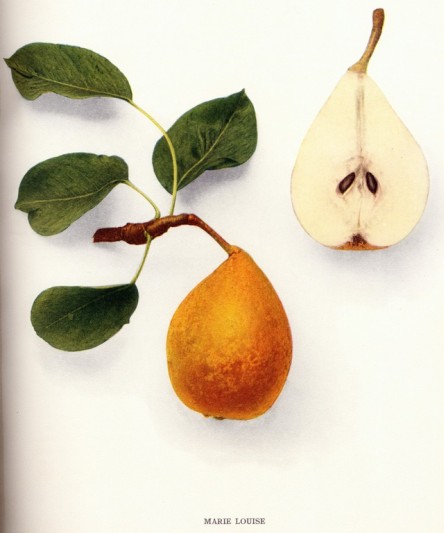
MARIE LOUISE
1. Pom. Mag. 3:122, Pl. 1830. 2. Prince Pom. Mag. 1:131. 1831. 3. Kenrick Am. Orch. 179. 1832. 4. Downing Fr. Trees Am. 399. 1845. 5. Hovey Fr. Am. 2:37, Pl. 1851. 6. Dochnahl Führ. Obstkunde 2:59. 1856. 7. Am. Pom. Soc. Rpt. 70. 1862. 8. Leroy Dict. Pom. 2:399, fig. 1869. 9. Guide Prat. 59, 287. 1876. 10. Lauche Deut. Pom. II: No. 38, Pl. 38. 1882. 11. Hogg. Fruit Man. 613. 1884. 12. Mathieu Nom. Pom. 251. 1889.
Marie-Louise Delcourt. 13. Pom. France 1: No. 19, Pl. 19. 1863. 14. Mas Le Verger 3: Pt. 1, 163, fig. 80. 1866-73.
The fruits of Marie Louise are among the perfections of Nature, and were the tree more certain in bearing and less fastidious as to environment and care, the variety would rank as one of the best of all pears. Pomologists generally agree that its fruits are the finest flavored of their season. The flesh is tender and melting, very juicy, and the flavor is a most delectable commingling of refreshing piquancy and scented sweetness. In shape, the pears resemble those of Beurré Bosc, having the same trim contour, but the color is very different—rich yellow, netted and sprinkled with russet, and sun-flecked with red on the sunny side. The fruit is somewhat susceptible to the scab fungus, and even the most careful spraying fails to give it a fair cheek in some seasons. The trees are hardy but only moderately vigorous, somewhat susceptible to blight, rather uncertain in bearing, and vary much from season to season in abundance and quality of product. Not at all suited for a commercial plantation, Marie Louise is one of the choicest sorts for a home collection or in the hands of a pear fancier.
The Abbé Duquesne, Mons, Belgium, raised this pear from seed in 1809 and dedicated it to Marie Louise, the second consort of Napoleon the First. The Abbé passed the pear on to Van Mons, who in 1816 sent it without a name to a Mr. Braddick of Thames Ditton, England, where in time it became one of the best-known pears. Thomas Andrew Knight sent cions of the variety from England to John Lowell, Roxbury, Massachusetts, in 1823, whence it became widely disseminated in America. The American Pomological Society placed Marie Louise in its list of fruits in 1862.
Tree medium in size, vigorous, spreading, open-topped, hardy, productive; trunk slender; branches dark reddish-brown mingled with thin gray scarf-skin, marked with many large lenticels; branchlets very slender and very short, with short internodes, light brown, tinged with brownish-red, glossy, smooth, glabrous, with very small, slightly raised lenticels.
Leaf-buds small, short, sharply pointed, plump, free. Leaves 2½ in. long, 1¼ in. wide, narrow, short, oval or somewhat elongated, leathery; apex obtusely or slightly taper-pointed; margin glandless, entire; petiole 2 in. long, greenish, glabrous, slender. Flower-buds small, conical, free, arranged singly as lateral buds or on short spurs; flowers very showy, 1¾ in. across, in dense clusters, 7 to 9 buds in a cluster; pedicels often 1⅛ in. long, slender, slightly pubescent, greenish.
Fruit ripe in late September and early October; above medium in size, 3⅛ in. long, 25⁄16 in. wide, variable in size, oblong-pyriform, irregular, usually with sides unequal; stem 1⅛ in. long, thick, curved; cavity very small and one-sided, russeted, often lipped; calyx large, open; lobes separated at the base, narrow, acuminate; basin obtuse, considerably furrowed; skin thin, tender, smooth, dull; color yellow, netted and sprinkled with russet especially on the exposed cheek; dots numerous, small, russet, somewhat obscure; flesh yellowish-white, granular, tender, buttery, very juicy, aromatic, with a rich, vinous flavor; quality very good. Core closed, with clasping core-lines; calyx-tube short, narrow, conical; seeds wide, acute.
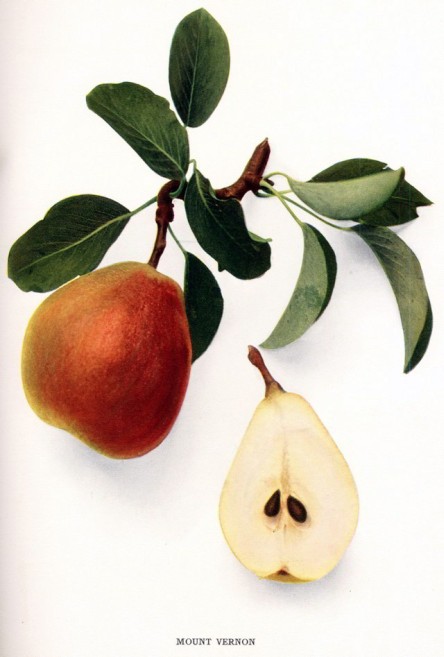
MOUNT VERNON
1. Am. Jour. Hort. 3:144, figs. 1868. 2. Downing Fr. Trees Am. 818. 1869. 3. Horticulturist 24:367, fig. 1869. 4. Ibid. 26:361. 1871. 5. Am. Pom. Soc. Cat. 20. 1871. 6. Horticulturist 27:204. 1872. 7. Budd-Hansen Am. Hort. Man. 2:256. 1903.
As a distinct type, and because the pears ripen at a season when there are few other varieties of this fruit, Mount Vernon has a prominent place in the list of worthy American pears. The top-shaped form and reddish-russet color give the pear a unique appearance, and with the greenish-yellow, granular, spicy, piquant flesh constitute very distinct characters in its quality. Unfortunately, the russet color is not well brought out in the accompanying color-plate. Lack of uniformity in shape and size are the chief defects in the appearance of the pears. The variety is valuable because it ripens its crop in early winter from which time, under good conditions, it may be kept until mid-winter, a season in which there are few good pears. The trees are unusually satisfactory in most of the characters of importance in a good pear-tree. The tree is vigorous but the head is small, with numerous, short, stocky branches, many of which droop. The aspect given the top by these peculiarities is quite distinct. The variety is worthy when a winter pear is wanted whether for home or market.
This pear, which is very distinct from any other variety, originated from a chance seedling in the garden of Samuel Walker, Roxbury, Massachusetts, at the end of the first half of the nineteenth century.
Tree large, vigorous, spreading, with many drooping branches, dense-topped, hardy, productive, long-lived; trunk stocky; branches thick, shaggy, reddish-brown, overcast with gray scarf-skin, marked by few large lenticels; branchlets thick, with short internodes, grayish-brown, smooth, glabrous, with a few large, raised lenticels.
Leaf-buds variable in shape, usually free. Leaves 2½ in. long, 1½ in. wide, oval, medium to thick, leathery; apex taper-pointed; margin crenate, tipped with rudimentary glands; petiole 1¼ in. long. Flower-buds large, long, conical or pointed, free; flowers 1⅜ in. across, in dense clusters, 7 to 9 buds in a cluster; pedicels ¾ in. long, slender, lightly pubescent, pale green, with a faint tinge of red.
Fruit ripe in late October and November; medium in size, 2½ in. long, 2⅛ in. wide, uniform in size, roundish-obtuse-pyriform, irregular, with unequal sides, variable in shape; stem 1 in. long, thick, usually curved; cavity obtuse, very shallow and narrow, russeted, furrowed, often very heavily lipped, so that the stem appears to be inserted under a fleshy enlargement; calyx open; lobes short, narrow, acute to acuminate; basin narrow, obtuse, smooth, usually symmetrical; skin granular, roughened by russet, dull; color light russet overspreading a greenish-yellow ground, with a brownish-red blush on the exposed cheek, dotted and netted with russet; dots numerous, small, russet, obscure; flesh white, with a faint tinge of yellow, often with a green tinge under the skin, granular, tender and melting, juicy, sweet, aromatic, with a vinous tendency; quality good to very good. Core large, closed, with clasping core-lines; calyx-tube short, wide, conical; seeds variable in size, wide, long, plump, acute, many abortive.
OLIVIER DE SERRES
1. Mas Le Verger 1:67, fig. 40. 1866-73. 2. Downing Fr. Trees. Am. 822. 1869. 3. Leroy Dict. Pom. 2:477, fig. 1869. 4. Tilton Jour. Hort. 9:377, fig. 1871. 5. Oberdieck Obst-Sort. 316. 1881. 6. Jour. Hort. 3rd Ser. 4:15, fig. 4. 1882. 7. Hogg Fruit Man. 624. 1884. 8. Gaucher Pom. Prak. Obst. No. 58, Pl. 51. 1894. 9. Deut. Obstsorten 5: Pt. 15, Pl. 1909.
This variety is rated in Europe as a delicious late-winter pear, and the pomological writers of the last century give it all of the virtues on this side of the Atlantic ascribed to it by Europeans. A closer study of the variety as grown in America shows that it does not possess the merits in this country given it by the French and English. The quality of the pear as grown in New York is below that of several other sorts of its season. The flesh is coarse and gritty and the flavor is mediocre. The tree-characters are good, but are not sufficiently good to offset the faults of the fruits.
Olivier de Serres was raised from seed of Fortunée about the middle of the nineteenth century by M. Boisbunel, Rouen, France. It fruited a few years later, but did not receive attention until about 1862. At that time it was brought to the notice of the French Society of Horticulture, and was pronounced a fruit of merit. At the suggestion of M. Boisbunel, it was named after the illustrious Frenchman, Olivier de Serres, who in France is called “The Father of Agriculture.” It was brought to America about 1865.
Tree medium in size, vigorous, dense-topped, upright-spreading, productive; trunk and branches marked with numerous lenticels; branchlets slender, short, curved, with short internodes, light reddish-brown, tinged with green, sprinkled with scattering, inconspicuous, very small, raised lenticels. Leaf-buds small, short, sharply pointed, free; leaf-scars with prominent shoulders. Leaves 2¾ in. long, 1¼ in. wide; apex taper-pointed; margin glandular, finely serrate; petiole 2 in. long, slender. Flower-buds small, short, sharply pointed, free, singly on short spurs; flowers with an unpleasant odor, showy, 19⁄16 in. across; pedicels 1 in. long, thinly pubescent.
Fruit ripens January to March; medium in size, 2½ in. long, 2¾ in. wide, roundish-obtuse-pyriform, truncate at both ends, irregular in outline; stem variable in length, averaging ¾ in. long, thick, enlarged at the top, curved; cavity broad, slightly furrowed; calyx large, slightly open; basin variable in depth, furrowed; skin tender; color greenish-yellow, partly overspread with cinnamon-russet and sometimes with a dull blush on the exposed cheek; flesh whitish, variable in texture, juicy, varying from sweet to a brisk, vinous flavor; quality poor unless grown under the most favorable conditions.
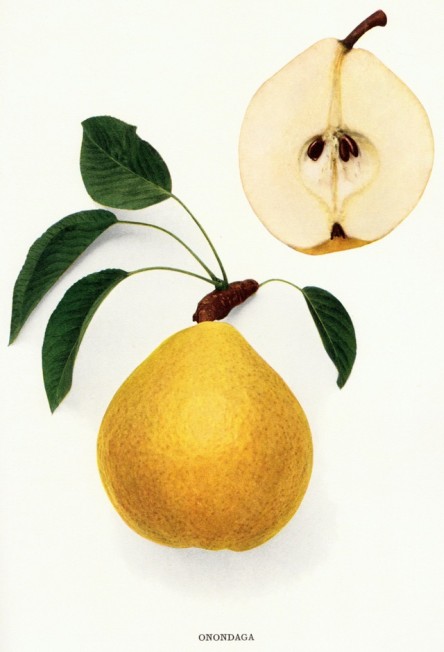
ONONDAGA
1. Horticulturist 1:322, fig. 77. 1846-47. 2. Am. Pom. Soc. Rpt. 231. 1858. 3. Mas Le Verger 3: Pt. 1, 179, fig. 88. 1866-73. 4. Downing Fr. Trees Am. 823. fig. 1869. 5. Leroy Dict. Pom. 2:480, fig. 1869. 6. Guide Prat. 74, 292. 1876. 7. Hogg Fruit Man. 625. 1884.
Swan’s Orange. 8. Mag. Hort. 13:243, fig. 19. 1847. 9. Hovey Fr. Am. 1:21, Pl. 1851.
Some seventy or eighty years ago this pear was widely introduced under the names Onondaga and Swan’s Orange, and for a generation and more was much grown in eastern pear regions. It has now practically passed from cultivation in commercial orchards, but is still to be found in collections and home plantings. The fruits are large, handsome, and of very good quality, resembling those of Bartlett in flavor and with even better flesh-characters. The trees are vigorous, hardy, fruitful—almost ideal in every character but one. The tree is so susceptible to blight that the variety can never have commercial value in American orchards. Whether or not it is worth planting in home orchards depends upon the planter’s willingness to suffer loss from blight.
It seems impossible to trace this variety to its ultimate source. We know, however, that Henry Case, Liverpool, New York, cut a graft during the winter of 1806 from a tree growing on land of a Mr. Curtiss at Farmington, Connecticut. In the spring of the same year, Mr. Case grafted this cion into a tree about three miles west of Onondaga Hill, New York, and in 1808 moved the tree to Liverpool where it grew and bore fruit. Many grafts were taken from this tree before it died in 1823. Up to this time, the variety appears to have received no name nor had it been generally disseminated. We hear nothing further of it until about 1840 when it was brought to notice by a Mr. Swan of Onondaga Hollow, who exhibited specimens of the variety in Rochester. Ellwanger and Barry were so impressed with the fruit that they secured cions and propagated it under the name Swan’s Orange which they changed later to Onondaga. Onondaga was given a place in the American Pomological Society’s fruit-catalog in 1858.
Tree medium in size, vigorous, spreading, open-topped, very productive; branches zigzag, reddish-brown, overspread with thin gray scarf-skin, marked with many large lenticels; branchlets slender, short, light brown, tinged with green and lightly streaked with ash-gray scarf-skin, dull, smooth, the new growth slightly pubescent, with small, raised, pinkish lenticels.
Leaf-buds small, short, sharply pointed, plump, free. Leaves 31⁄16 in. long, 1¼ in. wide, narrow, oval, stiff, leathery; apex taper-pointed; margin coarsely but shallowly serrate, tipped with many reddish glands; petiole 1⅞ in. long, light green mingled with red; stipules often lacking but when present very small, pale green. Flower-buds small, short, conical, plump, free, arranged singly on very short spurs; blossoms 1⅛ in. across, in dense clusters, 7 to 8 buds in a cluster; pedicels pubescent, greenish.
Fruit ripe in early October; above medium to large, 2¾ in. long, 2½ in. wide, ovate or obovate-obtuse-pyriform, symmetrical, with unequal sides; stem ⅝ in. long, thick, curved; cavity a slight depression, with a fleshy enlargement at one side of the stem; calyx closed; lobes narrow, acute; basin narrow, obtuse, furrowed, uneven; skin granular, tender, smooth, dull; color pale yellow, with few lines of russet and with many russet spots; dots numerous, small, russet, conspicuous; flesh yellowish, granular both near the skin and at the center, melting, buttery, very juicy, aromatic, with a sweet, rich, vinous flavor; quality very good. Core large, closed, with clasping core-lines; calyx-tube long, conical; seeds narrow, long, acute.
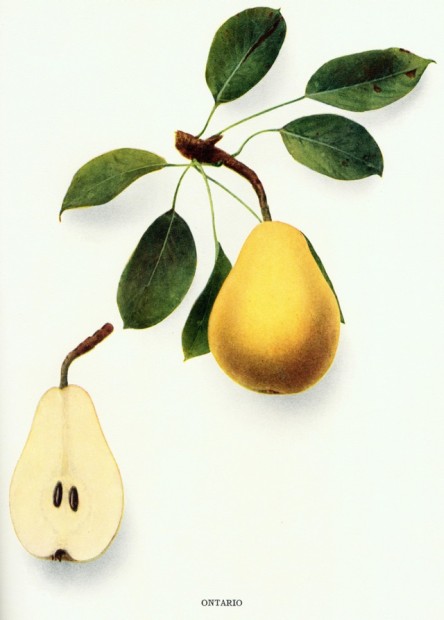
ONTARIO
1. Am. Pom. Soc. Rpt. 200, fig. 1856. 2. Downing Fr. Trees Am. 529. 1857. 3. Horticulturist N. S. 7:112, fig. 1857. 4. Mag. Hort. 23:110, fig. 3. 1857. 5. Mas Le Verger 3: Pt. 2, 85, fig. 139. 1866-73. 6. Horticulturist 23:331, fig. 102. 1868. 7. Downing Fr. Trees Am. 824. 1869. 8. Thomas Am. Fruit Cult. 463, fig. 672. 1897.
This variety was introduced nearly seventy years ago with the expectation that the crop would follow that of Bartlett and be in as great demand. While the variety did not come up to expectations, it seems to have been too good to discard, and is to be found in many collections in New York. The fruits are of the type of Bartlett, but are smaller and usually lack the blush found on the fruits of Bartlett. The trees are very satisfactory. The variety fails chiefly in the small size of the fruits, although these are not as small as the rather poor specimens illustrated in the accompanying plate, which were grown on the grounds of this Station where the pears run below the average.
This variety was raised from seed of Canandaigua in the nurseries of W. and T. Smith, Geneva, Ontario County, New York, and was first introduced at the meeting of the American Pomological Society, Rochester, New York, in 1856.
Tree large, vigorous, upright, open-topped, hardy, productive; trunk stocky; branches thick, roughish, dull reddish-brown, overspread with dark ash-gray scarf-skin, marked by small lenticels; branchlets thick, very short, with short internodes, light brown mingled with green, smooth, glabrous, with small, raised, conspicuous lenticels.
Leaf-buds small, short, pointed, free. Leaves 2 in. long, 1½ in. wide, oval, thin, leathery, slightly curled under along the margins; apex abruptly pointed; margin glandular toward the apex, very finely serrate; petiole 1½ in. long. Flower-buds small, short, conical or pointed, plump, free, singly or in small clusters on short branches or very short spurs; flowers 1⅛ in. across, in a scattering raceme, from 8 to 10 buds in a cluster; pedicels 1¼ in. long, slender, pubescent, light green.
Fruit in season from the middle to the last of September; medium in size, 2½ in. long, 1⅞ in. wide, uniform in size and shape, oblong-pyriform, with sides usually unequal; stem ¾ in. long, thick; cavity obtuse, shallow, narrow, often russeted and lipped; calyx open; lobes separated at the base, narrow, acute; basin shallow to medium, obtuse, gently furrowed, sometimes compressed; skin smooth, dull; color pale yellow, with small patches and streaks of light-colored russet; dots numerous, very small, russet, obscure; flesh whitish, with a yellow tinge at the core, granular, firm but tender, juicy, sweet, slightly aromatic; quality good. Core closed, with clasping core-lines; calyx-tube short, wide, conical; seeds large, wide, long, plump, acute.
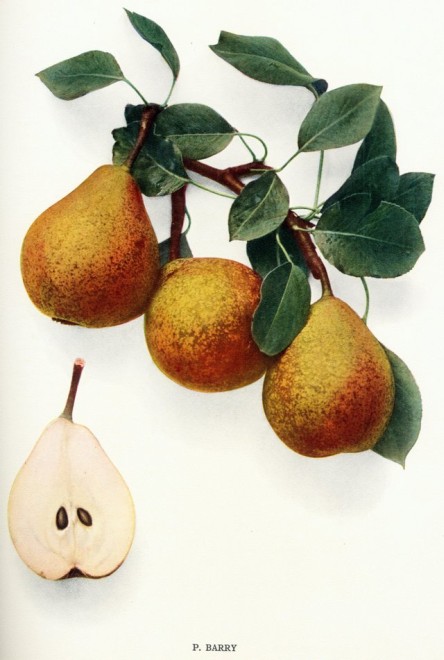
P. BARRY
1. Am. Pom. Soc. Rpt. 38. 1875. 2. Downing Fr. Trees Am. 2d App. 152, fig. 1876. 3. W. N. Y. Hort. Soc. Rpt. 18. 1882. 4. Wickson Cal. Fruits 340. 1889. 5. Ellwanger & Barry Cat. 20. 1892. 6. Am. Pom. Soc. Rpt. 17, 68. 1895. 7. Am. Pom. Soc. Cat. 41. 1909. 8. Wickson Cal. Fruits 273. 1919.
The fruits of P. Barry are among the latest of all the pears grown on the grounds of the New York Agricultural Experiment Station. They do not ripen here until mid-winter and then keep until spring. A serious defect is that they sometimes refuse to ripen but shrivel until decay sets in late in the spring. To make certain that the pears ripen properly, the fruit-room must not be too cold. The pears are excellent in flavor, have good flesh-characters, and when properly ripened are excelled in quality by no other winter pear. The variety should have a place in the collection of every pear fancier to extend the season for this fruit, and commercial pear growers might find it a profitable sort for local market. Unfortunately, the trees are small, fastidious as to environment, and somewhat uncertain in bearing.
Bernard S. Fox, San Jose, California, raised many pears from seed of Belle Lucrative. Among these seedlings was one which fruited in 1873 and was named P. Barry, in honor of Patrick Barry,[31] an eminent nurseryman and horticulturist of Rochester, New York. Of many scores of seedlings raised by Mr. Fox only this one, Fox, and Colonel Wilder were considered by the originator to be worthy of propagation. All these received Wilder medals from the American Pomological Society in 1875 and 1881. In 1909, this Society added P. Barry to its catalog-list of fruits.
Tree variable in size, lacking in vigor, spreading, open-topped, unusually hardy, medium in productiveness; trunk slender; branches stocky, zigzag, reddish-brown mingled with gray scarf-skin, marked with large lenticels; branchlets slender, long, with long internodes, reddish-brown, smooth, glabrous, with few small, very slightly raised lenticels.
Leaf-buds small, short, conical, free. Leaves 1¾ in. long, 1⅛ in. wide, leathery; apex abruptly pointed; margin finely serrate, tipped with few glands; petiole 1½ in. long. Flower-buds small, short, somewhat obtuse, free; flowers open late, 1¼ in. across, well distributed, averaging 7 buds in a cluster; pedicels 1 in. long, slender, slightly pubescent, pale green.
Fruit matures in late December to February; variable in size, averaging 2¾ in. long, 2¼ in. wide, oblong-obtuse-pyriform, irregular, with unequal sides; stem 1 in. long, thick, curved; cavity obtuse, narrow, furrowed, compressed, often lipped; calyx small, open; lobes separated at the base, short, narrow, obtuse; basin shallow, narrow, obtuse, smooth and regular; skin variable in smoothness, dull; color rich yellow, many specimens almost entirely overspread with russet or with russet coating around the cavity and with russet nettings and patches; dots numerous, small, russet, conspicuous; flesh yellowish-white, fine, melting, sweet, juicy, with a rich, vinous, aromatic flavor; quality good. Core large, closed, with clasping core-lines; calyx-tube short, conical; seeds large, wide, long, plump, acute.
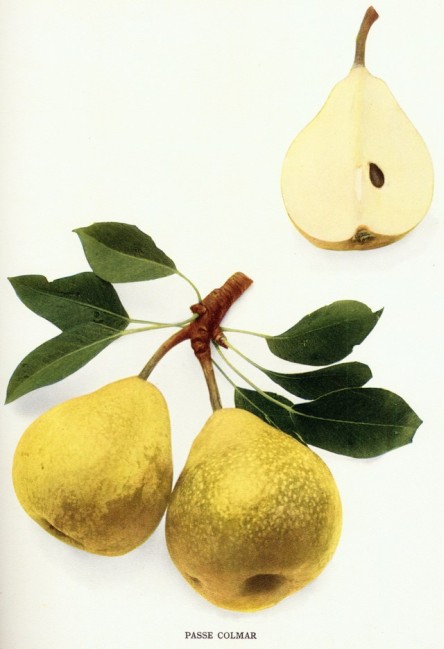
PASSE COLMAR
1. Trans. Lond. Hort. Soc. 5:410. 1824. 2. Lindley Guide Orch. Gard. 403. 1831. 3. Prince Pom. Man. 1:101. 1831. 4. Downing Fr. Trees Am. 444, fig. 205. 1845. 5. Gard. Chron. 185, fig. 1845. 6. Mag. Hort. 15:445, fig. 39. 1849. 7. Gard. Chron. 989. 1861. 8. Am. Pom. Soc. Rpt. 70, 1862. 9. Pom. France 1: No. 2, Pl. 2. 1863. 10. Mas Le Verger 1:121, fig. 59. 1866-73. 11. Leroy Dict. Pom. 2:499, figs. 1869. 12. Guide Prat. 60, 293. 1876. 13. Hogg Fruit Man. 627. 1884. 14. Soc. Nat. Hort. France Pom. 436, fig. 1904.
Preul’s Colmar. 15. Liegel Syst. Anleit. 104. 1825.
Regentin. 16. Dochnahl Führ. Obstkunde 2:103. 1856. 17. Mathieu Nom. Pom. 268. 1889. 18. Gaucher Pom. Prak. Obst. No. 61, Pl. 88. 1894.
Little known in America, this is one of the standard winter pears in England. The fruits are exceedingly sugary, mildly spiced with cinnamon, a flavor so unique, especially when compared with the piquant flavor most common in winter pears, that the variety is worth growing where it succeeds for the sake of diversity. The chief fault of the variety is variability of product. On unsuitable soils and under indifferent care, the pears are unattractive and poor in quality. The accompanying illustration, it is to be feared, shows the variety at its worst rather than at its best, since it does not thrive on the heavy, cold clay of the Station lands. Under conditions at this Station, the flesh is crisp and gritty, rather than buttery and fine as it seems to be under more suitable conditions. The trees are very vigorous on standard stocks and heavy soils, with the result that the fruits are many but small and poor; checking vigor by dwarfing on quince or planting on poor soil suits the variety. The trees are hardy and as free as the average pear from blight. The variety is a good winter sort for home or market.
This variety was raised in 1758 at Mons by the Abbé Hardenpont, the Belgian priest and horticulturist. Extensively cultivated in Belgium, it acquired a great diversity of names in different localities. From that country it passed first to Germany toward the end of the eighteenth century, and early in the nineteenth was taken to France. Soon after the close of the Napoleonic wars, about 1817, it was received in England. Within a few years after its introduction in England, the variety found its way to America where, for a time, it was quite extensively grown. The American Pomological Society added Passe Colmar to its fruit-list in 1862 but dropped it in 1899.
Tree medium in size, vigorous, upright, tall, rapid-growing, productive; trunk slender; branches medium in thickness and smoothness, reddish-brown almost entirely overspread with thick, gray scarf-skin, marked by large, conspicuous lenticels; branchlets thick, long, light brown mingled with green, dull, smooth, pubescent only near the ends of the new growth, sprinkled with few small, raised, inconspicuous lenticels.
Leaf-buds short, plump, free, thick at the base; leaf-scars with prominent shoulders. Leaves 3 in. long, 1½ in. wide, leathery; apex taper-pointed; margin tipped with few small glands, finely serrate to nearly entire; petiole 2 in. long, glabrous, pinkish-green. Flower-buds small, short, thick, conical, plump, free, singly as lateral buds or on very short spurs; flowers late, showy, 1¾ in. across, unusually large, in dense clusters, average 6 buds in a cluster; pedicels ¾ in. long, thick, thinly pubescent.
Fruit ripe December to January; medium in size, 2½ in. long, 2⅛ in. wide, obovate-obtuse-pyriform, somewhat irregular; stem 1 in. long, very thick; cavity obtuse, shallow, narrow, russeted, slightly furrowed; calyx partly open; lobes separated at the base, rather narrow, acute; basin shallow, narrow, obtuse, gently furrowed; skin thick, granular, tender, roughish; color greenish-yellow, sprinkled with reddish-brown and russet patches and nettings; dots numerous, small, russet, obscure; flesh tinged with yellow, granular, tender, buttery, very juicy, sweet, vinous, aromatic; quality very good. Core large, closed, with clasping core-lines; calyx-tube short, wide, conical; seeds large, wide, plump, acute.
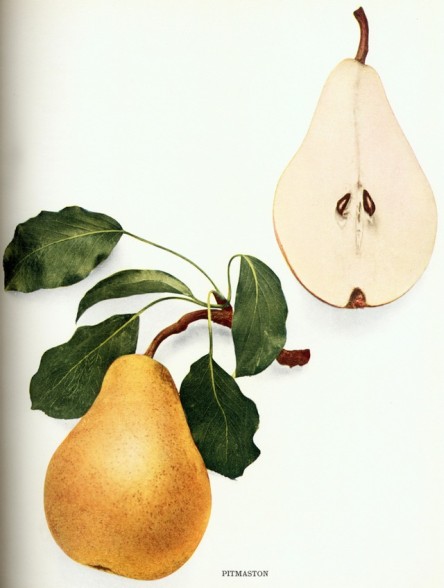
PITMASTON
1. Can. Hort. 26:129, fig. 2564. 1903. 2. Ont. Dept. Agr. Fr. Ont. 173, fig. 1914.
Pitmaston Duchesse d’Angoulême. 3. Gard. Chron. 1108, fig. 1864. 4. Am. Pom. Soc. Rpt. 55. 1871.
Pitmaston Duchess. 5. Jour. Hort. N. S. 18:11, fig. 1870. 6. Tilton Jour. Hort. 7:239, fig. 1870. 7. Jour. Hort. N. S. 38:201, fig. 30. 1880. 8. Hogg Fruit Man. 631. 1884. 9. Gard. Chron. 3rd Ser. 4:608. 1888. 10. Rev. Hort. 196, 651. 1900. 11. Bunyard Handb. Hardy Fr. 193. 1920.
Although this fine old English pear has more than ordinary merit, it seems to be little grown in America. In appearance, the pears are unsurpassed. The accompanying color-plate shows the shape and color very well, but not the size, as, well grown, the pears are larger. From the illustration, all must agree that the pears are handsome, fruits of few other sorts being so alluring in shape and color. On warm soils or in warm seasons, the flavor is choicely good giving the pears a rating of “good to very good;” but in cold soils and seasons, the flavor is often austere, or even acid and astringent. The season prolongs that of Bartlett, and as the fruits are flavored very differently, being more piquant and refreshing, and are ordinarily larger and handsomer, Pitmaston ought to make a good market variety where it thrives. The subacid flavor makes this one of the very best pears for culinary purposes. Such reports as are at hand state that the fruits keep and ship well. The variety seems not to have been grown widely in America, so that one cannot speak with assurance of the tree-characters; but on the grounds of this Station, the trees have fewer faults than those of most of the standard varieties. They are hardy, vigorous, fairly immune to blight, and while but moderately productive, bear annually, and the large size of the fruits makes them high yielders. The variety should be put on probation by those who grow for the markets, and is well worthy a place in all home orchards.
Pitmaston was raised by John Williams at Pitmaston, near Worcester, England, in 1841. It has been generally stated that it originated from a cross between Duchesse d’Angoulême and Glou Morceau, although an old gardener, who was employed by Mr. Williams, stated that there was no record whatever of its parentage, but that it was the best of a number of seedlings. For some time it was known as the Pitmaston Duchesse d’Angoulême on account of the theory of its derivation in part from the Duchesse d’Angoulême; but in 1870 its name was simplified in England to Pitmaston Duchess. In 1874 it obtained a first-class certificate from the Royal Horticultural Society, England. In this country it was first fruited by John Saul, Washington, District of Columbia, in 1870, and was noted and illustrated by Elliott in the Rural New Yorker under the name Pitmaston Duchesse d’Angoulême. Although favorably mentioned several times by the American Pomological Society, the variety has never received a place in the Society’s fruit-catalog.
Tree large, vigorous, spreading, dense-topped, moderately productive; trunk stocky, shaggy; branches thick, slightly zigzag, reddish-brown, overlaid with very dark grayish scarf-skin, marked with numerous large lenticels; branchlets long, dull, dark reddish-brown, roughish, glabrous, with numerous small, raised, conspicuous lenticels.
Leaf-buds short, obtuse, appressed; leaf-scars prominent. Leaves 2½ in. long, 1½ in. wide, leathery; apex abruptly pointed; margin finely serrate; petiole 1¾ in. long. Flower-buds short, conical, pointed, free; flowers showy, 1¾ in. across, well distributed, average 7 buds in a cluster; pedicels 1 in. long, pubescent.
Fruit ripe in October; large, 3¾ in. long, 3 in. wide, oblong-obovate-pyriform, symmetrical; stem 1 in. long, thick, often curved; cavity very shallow and very narrow, or lacking, the flesh drawn up in a wrinkled fold around the base of the stem, often lipped; calyx closed, large; lobes long, broad, acute; basin shallow, obtuse, furrowed and wrinkled; skin thin, granular, smooth, tender, dull; color pale lemon-yellow, dotted and somewhat patched with light russet especially around the stem, without blush; dots numerous, small, russet, conspicuous; flesh tinged with yellow, somewhat granular, melting, buttery, very juicy, piquant and vinous; quality good to very good. Core large, closed, with clasping core-lines; calyx-tube short, wide, conical; seeds narrow, long, flat, acute, very often abortive.
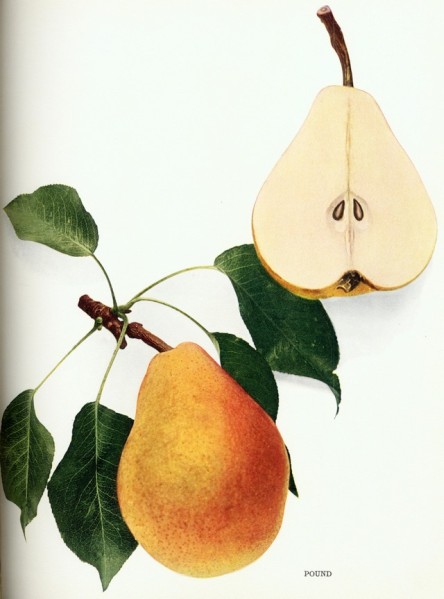
POUND
1. Coxe Cult. Fr. Trees 209, fig. 63. 1817. 2. Prince Pom. Man. 1:149. 1831. 3. Kenrick Am. Orch. 151. 1832. 4. Downing Fr. Trees Am. 445. 1845. 5. Ibid. 835. 1869. 6. Am. Pom. Soc. Cat. 22. 1871. 7. Wickson Cal. Fruits 326, 338, 344. 1889.
Pickering. 8. Langley Pomona 133, Pl. 71, fig. 1. 1729.
Union. 9. Miller Gard. Kal. 31, 54. 1734. 10. Miller Gard. Dict. 2: Pt. 1. 1807.
Uvedale’s St. Germain. 11. Lindley Guide Orch. Gard. 413. 1831. 12. Am. Pom. Soc. Rpt. 70. 1862. 13. Hogg Fruit Man. 657. 1884. 14. Jour. Hort. 3rd Ser. 13:465. 1886. 15. Bunyard Handb. Hardy Fr. 202. 1920.
Bruderbirne. 16. Dochnahl Führ. Obstkunde 2:148. 1856.
Winter Bell. 17. Watson Am. Home Gard. 404, fig. 264. 1859.
Belle Angevine. 18. Gard. Chron. 979. 1860. 19. Mas Le Verger 1:31 bis, fig. 22. 1866-73. 20. Gard. Chron. 138. 1869. 21. Guide Prat. 61, 233. 1876.
Schöne Angevine. 22. Mathieu Nom. Pom. 279. 1889.
Pound is grown in collections for its monstrous fruits, which have few virtues other than large size. The pears not infrequently weigh three pounds, and one is noted in the next paragraph weighing four pounds, nine ounces. The pears are coarse in form, texture and flavor—but one degree better in flavor than the potato-like fruits of Kieffer and even more sappy. The pears keep well and are said to be fairly good for culinary purposes. The trees are unusually satisfactory, because of which the variety should make a good parent from which to breed.
The name “Pound” has been applied to a number of varieties, notably Black Worcester, Angora, Verulam, and others. The variety now known as Pound in America is more generally known in Europe as Belle Angevine or Uvedale’s St. Germain. This sort appears to have been raised by a Dr. Uvedale, who was a schoolmaster at Eltham, England, in 1690. Miller in his Dictionary, in 1724, speaks of him as a Dr. Udal of Enfield, “a curious collector and introducer of many rare exotics, plants and flowers,” and Bradley, in 1733, speaks of the pear as “Dr. Udale’s great pear, called by some the Union pear.” William Robert Prince mentions the Pound pear in 1831 saying that “it often weighs from twenty-five to thirty ounces, and one was exhibited in New Jersey about four years since, weighing forty and a half ounces.” In 1870, according to Wickson, a Pound pear sent from Sacramento to the late Marshall P. Wilder, President of the American Pomological Society, weighed four pounds and nine ounces. In 1862, the American Pomological Society added this variety to its fruit-catalog under the name Uvedale’s St. Germain, but in 1871 changed the name to Pound. The name continued to appear in the Society’s catalogs until 1909 when it was dropped.
Tree medium in size, upright, dense-topped, hardy, very productive; trunk stocky, shaggy; branches thick, shaggy, zigzag, dull reddish-brown, heavily covered with gray scarf-skin, marked with many large lenticels; branchlets short, with short internodes, brownish-red, mottled with gray scarf-skin, smooth, glabrous, with few small, elongated lenticels.
Leaf-buds large, long, conical or pointed, plump, free; leaf-scars prominent. Leaves 4¼ in. long, 3¾ in. wide, ovate, thin, stiff; apex taper-pointed; margin glandular, finely serrate; petiole 1¾ in. long, slender. Flower-buds large, long, conical or pointed, very plump, free, usually singly on short spurs; flowers open early, 1⅜ in. across, large, well distributed, average 7 buds in a cluster; pedicels 1½ in. long, pubescent, pale green.
Fruit matures in February; large, 4 in. long, 2⅞ in. wide, uniform in size and shape, obovate-acute-pyriform, with unequal sides; stem long, thick, curved; cavity obtuse, very shallow, narrow, russeted, furrowed, drawn up in a fleshy ring about the stem; calyx large, open; lobes separated at the base, obtuse; basin shallow, narrow, obtuse, slightly furrowed, symmetrical; skin thick, tough, with patches of russet, dull, roughened by the dots and by the russet markings; color golden-yellow, often marked on the exposed cheek with a bronze or pinkish blush; dots numerous, russet, very conspicuous; flesh yellowish, firm, granular, very tough, subacid, inferior in flavor; quality very poor. Core large, closed, axile, with meeting core-lines; calyx-tube short, wide, conical; carpels pear-shaped; seeds very large, brownish-black, wide, long, acuminate.
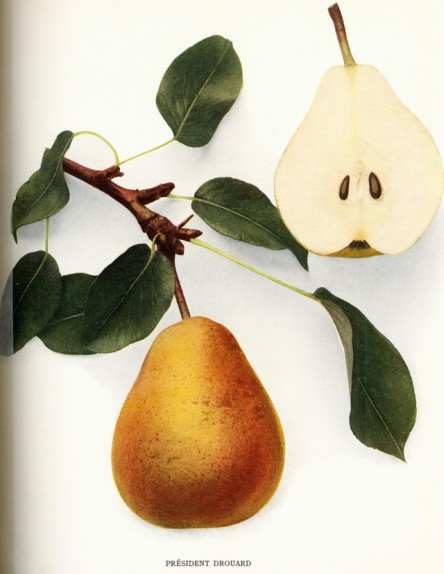
PRÉSIDENT DROUARD
1. Gard. Chron. N. S. 25:431. 1886. 2. Guide Prat. 51. 1895. 3. Cat. Cong. Pom. France 331, fig. 1906.
Präsident Drouard. 4. Lucas Tafelbirnen 211, fig. 1894.
Drouard. 5. Am. Pom. Soc. Cat. 35. 1899. 6. Budd-Hansen Am. Hort. Man. 2:241. 1903. 7. Mich. Sta. Sp. Bul. 27:22. 1903.
Président Drouard has been on probation in the United States for nearly thirty years, but does not seem to be in great demand in any part of the country. In the pear-growing region of New York to which it first came, it is scarcely known. The accompanying description shows that the fruits contain all of the requisites of a good pear. The flesh is juicy, melting, saccharine, rich, and perfumed. The trees, however, are not satisfactory. They lack vigor, blight badly, and are niggardly in bearing. With these faults, there is no place for the variety in commercial plantations, but it may well be planted in home orchards and in collections.
Président Drouard is a chance seedling found in the suburbs of Pont-de-Ce, Maine-et-Loire, France, by M. Olivier, gardener at the Fruit-Garden at Angers. It was sent out by M. Louis Leroy of Angers and was described in 1886 as a new pear. It seems to have been introduced in this country by Charles A. Green, Rochester, New York. The American Pomological Society added the variety to its list of fruits under the name Drouard in 1899.
Tree of medium size, spreading, open-topped, usually hardy; branches reddish-brown, nearly covered with gray scarf-skin, marked with small lenticels; branchlets thick, long, greenish-brown mingled with red, dull, smooth, pubescent on the new growth, with numerous small, brownish, raised, conspicuous lenticels.
Leaf-buds small, short, pointed, plump, free; leaf-scars with very prominent shoulders; Leaves 3 in. long, 1¾ in. wide, oval, thick, leathery; apex taper-pointed; margin glandless or with but few glands, entire or closely serrate; petiole glabrous, greenish, thick, 1⅝ in. long, tinged red; stipules very short, tinged with pink. Flower-buds short, conical, very plump, free, arranged singly on short spurs; flowers 1⅜ in. across, in dense clusters, 6 to 9 buds in a cluster; pedicels 1⅛ in. long, lightly pubscent, greenish.
Fruit in season from late November to December; large, 3½ in. long, 3 in. wide, oblong-obovate-pyriform, with unequal sides, uniform in shape; stem 1 in. long, very thick and woody; cavity obtuse, deep, irregular, furrowed, usually lipped; calyx large, open; lobes separated at the base, long, narrow, acuminate; basin deep, abrupt, usually smooth but sometimes gently furrowed; skin thick, tough, rough, dull; color clear lemon-yellow, with nettings and streaks of russet; dots numerous, small, russet, obscure; flesh tinged with yellow, very granular at the core, tender and melting, buttery, juicy, aromatic, sweet; quality good. Core large, closed, axile, with clasping core-lines; calyx-tube short, wide, conical; seeds large, wide, long, plump, acute, occasionally abortive.
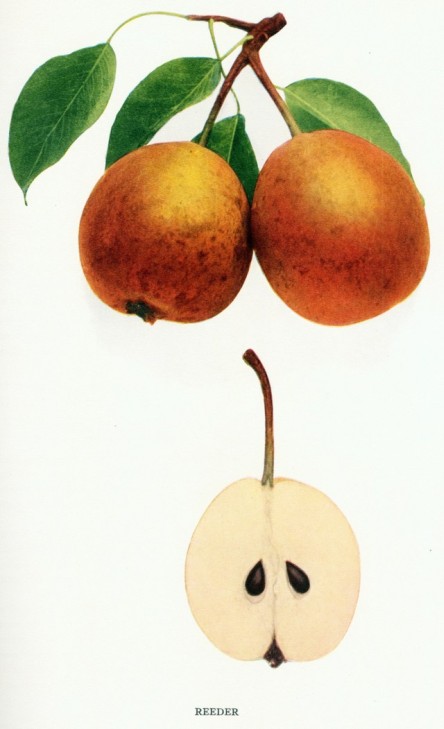
REEDER
1. Am. Pom. Soc. Cat. 40. 1883. 2. Budd-Hansen Am. Hort. Man. 2:260. 1903.
Reeder’s Seedling. 3. Am. Pom. Soc. Rpt. 150. 1867.
Doctor Reeder. 4. Downing Fr. Trees Am. 739, fig. 1869. 5. Am. Pom. Soc. Cat. 20. 1871.
Docteur Rhéder. 6. Rev. Hort. 87. 1889.
Reeder is another of the pears too good to discard, and not quite good enough to give an ardent recommendation. In quality, the fruits rank but little below those of Seckel; are about the same size as grown under average conditions; but are even duller and less attractive in color than the modest fruits of Seckel, which is probably one of its parents. The fruits have a place in the home and markets as a pear to follow Seckel, the crop coming in season just after that of Seckel passes out. The trees do poorly in the nursery, as they make but a short, slender growth until well established in the orchard, after which they become of medium size but very vigorous. The branches droop as do those of Winter Nelis, the other parent, although not so markedly. The variety is as nearly blight-proof as either of its parents.
Reeder is a seedling raised about 1855 by Dr. Henry Reeder, Varick, New York, from seed of Winter Nelis. The parent tree stood near a Seckel and it is considered that Reeder is a cross between the two varieties. The American Pomological Society added the variety to its fruit-catalog in 1871 under the name Doctor Reeder, but in 1883 changed the name to Reeder.
Tree medium in size, vigorous, spreading, drooping, open-topped, productive; branches zigzag, reddish-brown partly overspread with gray scarf-skin, sprinkled with numerous lenticels; branchlets slender, willowy, long, reddish-brown mingled with gray, the new growth reddish-green, dull, smooth, glabrous except near the tips of the new growth, with few very small, inconspicuous lenticels.
Leaf-buds small, short, pointed, appressed. Leaves 2¾ in. long, 1¼ in. wide, leathery; apex taper-pointed; margin crenate to nearly entire; petiole 2 in. long, tinged with red; stipules few, very small, reddish-green. Flower-buds small, short, conical, free, singly on short spurs; flowers 1¼ in. across, in dense clusters, average 9 buds in a cluster; pedicels ¾ in. long, slender.
Fruit ripe in October and November; small, 1¾ in. long, 1⅞ in. wide, globular-obtuse-pyriform, slightly ribbed and irregular; stem 1¼ in. long, slender, curved; cavity a very small depression in which is inserted the base of the stem, symmetrical; calyx large, open; lobes separated at the base, long, narrow, reflexed, acuminate; basin very shallow and narrow, smooth; skin thick, smooth, tender; color dull greenish-yellow, mottled and streaked with russet, blushed faintly on the exposed cheek with brownish-red; dots few, small, obscure, greenish or russet; flesh white, granular toward the center but fine-grained near the skin, tender, somewhat stringy, very juicy, aromatic; quality good. Core large, closed, with clasping core-lines; calyx-tube long, narrow, funnel-shaped; seeds unusually large, wide, long, plump, acute.
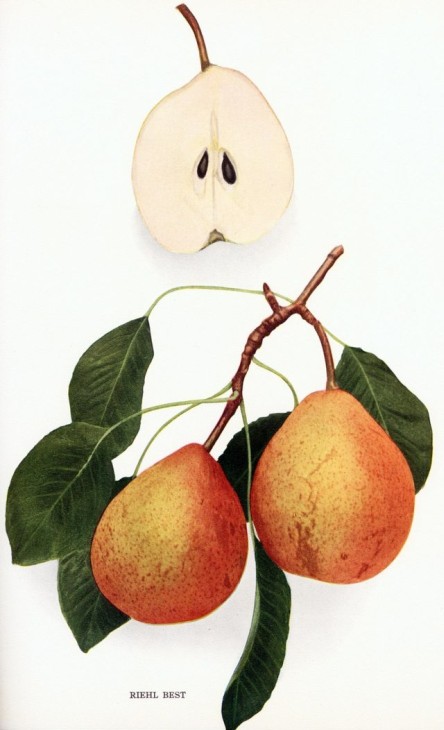
RIEHL BEST
1. Stark Bros. Cat. 18. 1912. 2. Ibid. 55. 1916.
Riehl Best is described among the major varieties because it is as nearly blight-proof as any other European pear. It might well be tried in localities where standard sorts cannot be raised because of blight, and is worth growing in breeding work as a parent to obtain blight-resistant varieties. The pears are rather unattractive in appearance, but are excellent in quality. The flesh is juicy, tender, vinous, free from grittiness and seldom rots at the core. The trees, besides being nearly free from blight, are hardy to heat and cold, and bear annually. The fruits fall far short of those of standard varieties in New York.
This pear was discovered by Edwin H. Riehl, Godfrey, Illinois, and was introduced by Stark Brothers, Louisiana, Missouri. Mr. Riehl says: “The farm on which the original tree stood was owned by a pioneer nurseryman who evidently imported from France a number of varieties, some perhaps without name. Riehl Best trees and several hundreds of other varieties represent the remains of three old orchards planted fifty years ago. Trees of other varieties are ruined by blight while Riehl Best is in perfect health and bears every season.” From this history it is probable that Riehl Best is an old European pear renamed.
Tree large, vigorous, upright, dense-topped, rapid-growing, productive; trunk stocky; branches thick, light reddish-brown, overspread with thin scarf-skin, marked with large, conspicuous, numerous lenticels; branchlets slender, often willowy, long, greenish-brown, dull, smooth, pubescent only near the ends of the new growth, sprinkled with small, slightly raised, inconspicuous lenticels.
Leaf-buds small, short, pointed, plump, free; leaf-scars with prominent shoulders. Leaves 3 in. long, 1¾ in. wide, thick; apex abruptly pointed; margin glandless, variable in serrations; petiole 2 in. long. Flower-buds small, short, conical, plump, free, singly on short spurs; flowers 1⅝ in. across, in dense clusters, average 6 buds in a cluster; pedicels ⅞ in. long, lightly pubescent.
Fruit ripens in October; medium in size, 2½ in. long, 2 in. wide, obovate-conic-pyriform, irregular, with unequal sides; stem 1⅛ in. long; cavity very shallow and narrow when present, or lacking, the flesh drawn up in a lip on one side of the stem; calyx open; lobes separated at the base, broad, obtuse; basin obtuse, furrowed; skin thick, roughened with russet; color dull yellow, largely overlaid with patches of russet, marked with distinct russet dots and with a faint trace of a pinkish-red blush on the cheek next the sun; dots numerous, russet, conspicuous; flesh tinged with yellow, granular under the skin, tender, moderately juicy, vinous; quality good. Core large, closed, axile, with meeting core-lines; calyx-tube short, wide, conical; carpels ovate; seeds medium in size, width, and plumpness, obtuse.
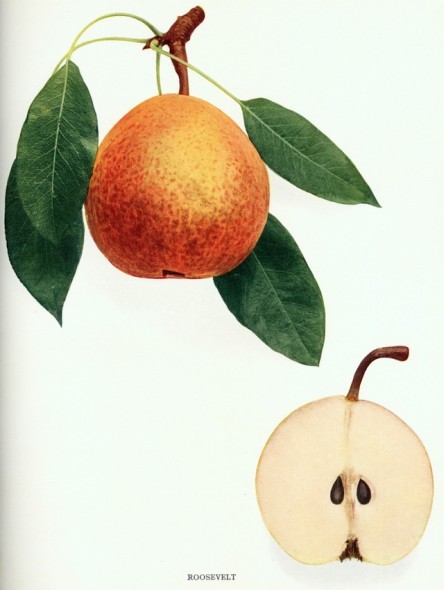
ROOSEVELT
1. Gard. Chron. 3rd Ser. 37:243, fig. 92. 1905. 2. Rev. Hort. 454. 1905. 3. Rural N. Y. 54:826, fig. 352. 1905. 4. Bunyard Cat. 43. 1913-14. 5. Bunyard Handb. Hardy Fr. 195. 1920.
This variety is still on probation in America, with the chances strongly against it proving worthy to bear the name of the man after whom it was called. On the grounds of the New York Agricultural Experiment Station, the fruits are too small, too poorly colored, and too poor in quality to compete with those of a score of other sorts of the same season. The core is remarkably small, and the seeds are few and small, but these are insufficient merits to count against the several defects named. The tree is robust and generally satisfactory. The variety may not be at its best on the grounds of this Station, as in Europe it was heralded as a most remarkable sort—one “destined to bring about a revolution in pear-growing.” It may be worth further trial in New York.
This pear was introduced in 1905 by the noted French pomologist Charles Baltet, Troyes, France, after he had tested it for several years. He named it after President Roosevelt. The variety was approved at Horticultural Congresses in Paris, Lyons, and Orléans, as well as by the Royal Horticultural Society of London. It was received in America shortly after its dissemination in France.
Tree medium to large, vigorous, very upright, dense-topped, rapid-growing, productive; trunk slender, smooth; branches slender, smooth, glossy reddish-brown, mottled and overlaid with gray scarf-skin, marked with numerous small, raised lenticels; branchlets characteristically thick, with blunt ends, long, with short internodes, dull reddish-brown mingled with gray scarf-skin, smooth, glabrous, with many large, raised lenticels.
Leaf-buds long, conical, sharply pointed, plump, free; leaf-scars with prominent shoulders. Leaves 3 in. long, 1⅜ in. wide, stiff; apex taper-pointed; margin usually glandless, finely serrate to almost entire; petiole 2 in. long, slender, curved. Flower-buds large, long, conical, pointed, free, singly on short spurs; flowers with a disagreeable odor, early, showy, 1⅝ in. across, in dense clusters, average 7 buds in a cluster; pedicels 1⅛ in. long, thick, pubescent.
Fruit ripens in late September and October; medium in size, about 27⁄16 in. in length and width, roundish-obtuse-pyriform, symmetrical; stem 1 in. long, thick; cavity very shallow, or lacking, faintly lipped; calyx very open, large; lobes separated at the base, narrow, acute; basin shallow, wide, obtuse, smooth, symmetrical; skin unusually thick, tough, smooth, dull; color pale lemon-yellow, mottled and netted with russet, with a faint blush; dots numerous, small, light russet, obscure; flesh light salmon, fine-grained except at the center which is granular, tender and melting, very juicy, mildly sweet, without much character; quality medium. Core small, closed, axile, with clasping core-lines; calyx-tube long, very wide, conical; carpels cordate; seeds wide, acute.
RUTTER
1. Am. Pom. Soc. Rpt. 151. 1867. 2. Am. Pom. Soc. Cat. 24. 1869. 3. Downing Fr. Trees Am. 848, fig. 1869.
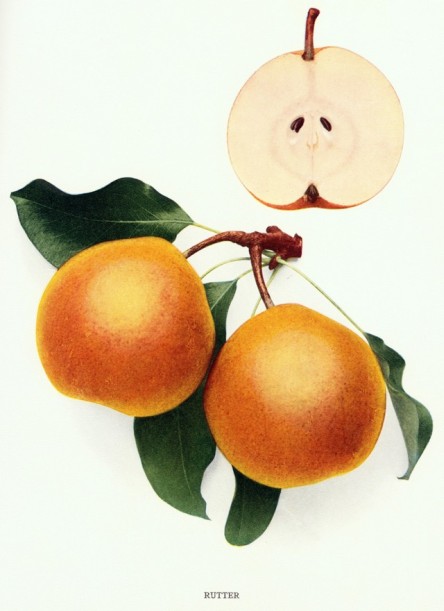
Rutter does not seem to have made a very high place for itself in the country at large, but about Geneva, New York, it is a most excellent late autumn variety. The pears are good or very good in quality, rather attractive, keep well, ship well, and sell well to those who know the variety. The trees have a combination of good characters that commend them most highly. Thus, they are comparatively immune to blight, enormously productive, bear early, grow rapidly, live long, and are hardy. The fruits hang exceptionally well to the trees, so that the variety is a valuable one for exposed situations. Rutter can be recommended for both home and market plantations.
This variety was raised by John Rutter, West Chester, Pennsylvania, from seed of Léon Leclerc (Van Mons) about sixty years ago. It was approved by the Committee on New Native Fruits of the American Pomological Society in 1867. This Society placed the variety on its list of recommended fruits in 1869.
Tree large, vigorous, upright, dense-topped, rapid-growing, productive; trunk stocky; branches thick, reddish-brown, covered with gray scarf-skin, sprinkled with very conspicuous lenticels; branchlets long, light brown mingled with green and streaked with ash-gray scarf-skin, smooth, glabrous, with small, conspicuous, raised lenticels.
Leaf-buds long, conical, pointed, plump, free. Leaves 3⅜ in. long, 1⅝ in. wide, thick, leathery; apex taper-pointed; margin nearly glandless, almost entire; petiole 2 in. long, glabrous, reddish-green. Flower-buds medium in size and length, conical, plump, free, singly on short spurs; flowers very showy, 1⅜ in. across, almost in racemes, 6 or 8 buds in a cluster; pedicels 1¼ in. long, pubescent.
Fruit matures in late October and early November; large, 3⅛ in. long, 3 in. wide, roundish-obtuse-pyriform, with a very thick, blunt neck, with unequal sides; stem ¾ in. long, thick, woody; cavity acuminate, unusually large, deep, russeted, occasionally furrowed and wrinkled, slightly lipped; calyx small, open; lobes separated at the base, short, narrow, acute; basin deep, obtuse, smooth, symmetrical; skin thick, gritty, roughish, dull; color yellow, overspread with light russet, mottled and flecked with russet; dots numerous, small, russet, conspicuous; flesh whitish, granular at the center, tender and melting, juicy, aromatic, sweet but refreshing; quality good to very good. Core small, closed, abaxile, with meeting core-lines; calyx-tube long, conical; seeds small, roundish, plump, obtuse.
SECKEL
1. Prince Pom. Man. 1:139. 1831. 2. Kenrick Am. Orch. 183. 1832. 3. Gard. Chron. 708, fig. 1842. 4. Downing Fr. Trees Am. 415, fig. 188. 1845. 5. Proc. Nat. Con. Fr. Gr. 51. 1848. 6. Hovey Fr. Am. 2:33, Pl. 1851. 7. Mag. Hort. 19:457, fig. 34. 1853. 8. Mas Le Verger 3: Pt. 1, 29, fig. 13. 1866-73. 9. Leroy Dict. Pom. 2:656, figs. 1869. 10. Guide Prat. 63, 303. 1876.
Seckle. 11. Coxe Cult. Fr. Trees 189, fig. 25. 1817. 12. Trans. Lond. Hort. Soc. 3:256, Pl. 9. 1820. 13. Pom. Mag. 2:72, Pl. 1829. 14. Hort. Reg. (Eng.) 1:488. 1833. 15. Pom. France 2: No. 64, Pl. 64. 1864. 16. Jour. Hort. 3rd Ser. 4:128. 1882. 17. Hogg Fruit Man. 644. 1884. 18. Bunyard Handb. Hardy Fr. 197. 1920.
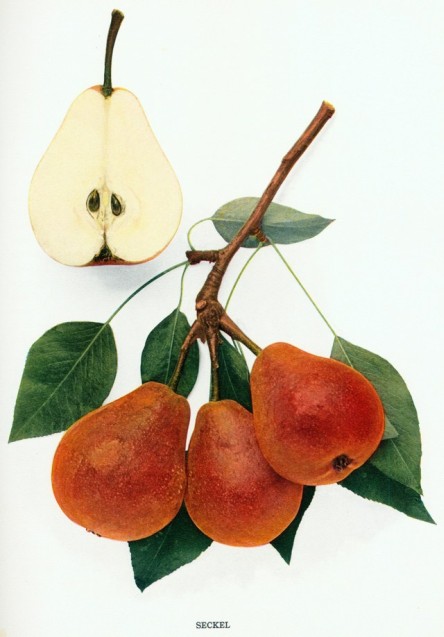
Seckel is an American pear distinct in type from any European variety. Among the several hundred pears that are grown on this side of the Atlantic, Seckel stands almost alone in vigor of tree, productiveness, and immunity to blight, and is equalled by no other variety in high quality of fruit. If the fruits were larger, Seckel would challenge the world as a pear for the markets as it now does as a pear for the home orchard. After Bartlett and the disreputable Kieffer, it is now more grown than any other variety in America, everywhere being used as the standard for excellence. The fruits are small, not highly colored, but attractive because clean and trim in contour. But it is the flesh-characters that give the fruits their high standing. The flesh is melting, juicy, perfumed and most exquisitely and delicately flavored, with the curious character of having much of its spicy, aromatic flavor in the skin, which should never be discarded in eating. The reddish-brown color of the fruit is another distinguishing character of Seckel. Unlike most other dessert pears, the fruits of this one are excellent for culinary purposes. Still another distinctive character is that the fruits do not lose much in quality by ripening on the tree. Besides being nearly iron-clad in resistance to blight and very productive, the trees are almost as hardy as those of any other pear, and are remarkable for their large, low, compact, broadly pyramidal tops. The tree is further distinguished by its short-jointed, stout, olive-colored wood, and its habit of bearing fruits in clusters on the ends of the branches. The trees do best in fertile soils which must not be a heavy clay. Its blossoms are markedly self-fertile. There are several faults of fruit and tree. The fruits are small and do not keep after maturity; it costs twice as much to pick them as it does the large-fruited Bartlett; fruit and foliage are susceptible to scab; the pears are too small for commercial canning; and the trees are late in coming in bearing. With these several faults, however, Seckel is usually a profitable commercial variety as a well-grown crop almost always commands a fancy price. For the home orchard, Seckel has no rival in any part of North America where European varieties are grown.
Toward the close of the eighteenth century, there lived in Philadelphia a well-known sportsman and cattle dealer known as “Dutch Jacob.” Every autumn, upon returning from shooting excursions, Dutch Jacob distributed among his neighbors pears of exceedingly delicious flavor. The place of their growth he kept secret. In time, a tract of land south of Philadelphia was disposed of in parcels, and Dutch Jacob secured the ground on which his favorite pear tree stood, a neck of land near the Delaware river. Shortly afterwards this land became the property of a Mr. Seckel, who gave the pear his name and introduced it. Later, the property was added to the estate of Stephen Girard, and the original tree long remained vigorous and fruitful. The new variety was soon widely disseminated and everywhere became popular. As early as 1819, Dr. Hossack of New York sent trees of the variety to the London Horticultural Society, whence it was later distributed in England. There is much difference of opinion as to the spelling of the name of this pear. Coxe, who lived in Philadelphia and probably knew the introducer of the pear, writing in 1817, spelled the name Seckle. English pomologists have followed Coxe. Nearly all of Coxe’s contemporaries, however, spelled it Seckel, the spelling now in common use. At the first meeting of the American Pomological Society, held in 1848, Seckel was recommended for general cultivation and the variety has ever held its place among the pears recommended by the Society.
Tree large and very vigorous, upright-spreading, dense-topped, hardy, very productive, long-lived; trunk very stocky; branches thick, reddish-brown mingled with dull gray scarf-skin, covered with small lenticels; branchlets thick, long, dark reddish-brown, dull, smooth, glabrous, with small, slightly raised lenticels.
Leaf-buds small, short, obtuse or pointed, appressed; leaf-scars prominent. Leaves 2½ in. long, 1½ in. wide, oval, leathery; apex taper-pointed; margin finely serrate; petiole 1½ in. long; stipules very long when present. Flower-buds small, short, conical, free; flowers 1¼ in. across, in dense clusters, 7 or 8 buds in a cluster; pedicels ⅝ in. long, slender, lightly pubescent, light green, slightly streaked with red.
Fruit ripe in October; small, 2¼ in. long, 2 in. wide, uniform in size and shape, obovate, symmetrical; stem ½ in. long, short, thick, often curved; cavity obtuse, with a very shallow, narrow depression, symmetrical; calyx small, partly open; lobes separated at the base, short, variable in width, acute; basin very shallow and narrow, strongly obtuse, symmetrical; skin smooth, dull; color yellowish-brown, lightly marked with pale russet and often with a lively russet-red cheek; dots numerous, very small, russet or grayish; flesh white, with a faint tinge of yellow, slightly granular, melting, buttery, very juicy; sweet, with an exceedingly rich, aromatic, spicy flavor; quality very good to best. Core small, closed, with clasping core-lines; calyx-tube short, conical; seeds small, short, not very plump, obtuse.
SHELDON
1. Mag. Hort. 17:252, fig. 25. 1851. 2. Am. Pom. Soc. Rpt. 151. 1854. 3. Ibid. 210. 1856. 4. Downing Fr. Trees Am. 444, fig. 1857. 5. Elliott Fr. Book 347. 1859. 6. Hoffy N. Am. Pom. 1: Pl. 1860. 7. Mas Le Verger 3: Pt. 2, 119, fig. 156. 1866-73. 8. Downing Fr. Trees Am. 855, fig. 1869. 9. Leroy Dict. Pom. 2:662, fig. 1869.
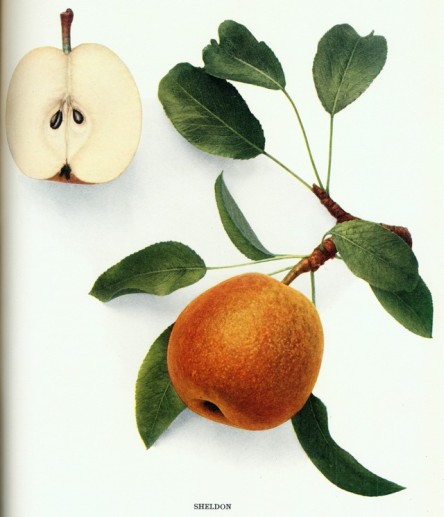
Were the fruits alone to be considered, Sheldon would take rank as one of the best of all pears. The fruits please both the eye and the palate. Those of no rival in season surpass them either in appearance or in characters that satisfy taste. While not large, the fruits are of sufficient size to meet the demands of a good dessert pear. The shape is a perfect turbinate, truncated at the base of the fruit, usually very symmetrical, and the fruits run uniform in shape. In color, the pears are distinctive in their russeted skin, with a handsome ruddy cheek. The accompanying color-plate does not do justice to the fruit in illustrating size, shape, or color. The flesh is melting and juicy, and deserves, more than that of almost any other pear, the adjective luscious. The flavor is sweet, vinous, and highly perfumed. The fruits keep well, ship well, and sell well during their season, and are esteemed both for dessert and for culinary purposes. The list of faults in the trees is as long as the list of virtues in the fruits. The trees, while large, vigorous, and hardy, blight as badly as any pear-tree in the orchard, are reluctant in coming in bearing, niggardly in production, and seldom hold their crop well. With these faults of the tree, Sheldon is not a commercial variety of high rank, but the splendid fruits make it worth growing by the pear-fancier, in the home orchard, or for the markets where the faults of the trees are not too marked. The variety grows better in New York, possibly, than in any other part of the United States.
This pear is a native of the town of Huron, New York. The original tree stood on the premises of Major Sheldon, having sprung from seed brought by his father from Washington, New York, about 1815. The fruit was first exhibited at the Pomological Convention in Syracuse in the autumn of 1849. In 1854, Sheldon was mentioned by the American Pomological Society as promising well, and in 1856 it was given a place in the Society’s fruit-catalog.
Tree large, vigorous, upright-spreading, rapid-growing, hardy, moderately productive; trunk stocky; branches thick, reddish-brown, overlaid with dull gray scarf-skin, marked with large lenticels; branches thick, dull brown, glabrous, with numerous slightly raised, conspicuous lenticels.
Leaf-buds large, above medium in length, obtuse or somewhat pointed, appressed. Leaves 2½ in. long, 1¼ in. wide, oval, leathery; apex taper-pointed; margin finely serrate; petiole 1½ in. long. Flower-buds conical or pointed, free; flowers 1⅛ in. across, in dense clusters, 13 or 14 buds in a cluster; pedicels ½ in. long, thick, pubescent, greenish.
Fruit matures in October; large, 2¾ in. long, 2½ in. wide, uniform in size and shape, turbinate, often with a tendency to oblateness, symmetrical; stem ¾ in. long, thick, nearly straight; cavity obtuse, deep, slightly furrowed, occasionally lipped; calyx large, open; lobes very broad, obtuse; basin wide, obtuse, symmetrical; skin thick, granular, tender, roughish; color dull greenish-yellow, with a brownish-red blush, overspread with russet nettings and streaks; dots numerous, small, russet; flesh whitish, somewhat granular, tender and melting, very juicy, sweet, and vinous, with a rich and pleasantly aromatic flavor; quality very good to best. Core large, closed, with clasping core-lines; calyx-tube short, wide, conical; seeds acute.
SOUVENIR DU CONGRÈS
1. Pom. France 4: No. 162, Pl. 162. 1867. 2. Am. Pom. Soc. Cat. 34. 1875. 3. Flor. & Pom. 37, Pl. 1875. 4. Jour. Hort. N. S. 38:120, fig. 19. 1880. 5. Hogg Fruit Man. 647. 1884. 6. Cat. Cong. Pom. France 350, fig. 1906.
Andenken an den Congress. 7. Oberdieck Obst-Sort. 237. 1881. 8. Mathieu Nom. Pom. 168. 1889. 9. Deut. Obstsorten 6: Pt. 16, Pl. 1910.
Souvenir. 10. Am. Pom. Soc. Cat. 24. 1897. 11. Ont. Dept. Agr. Fr. Ont. 179. 1914.
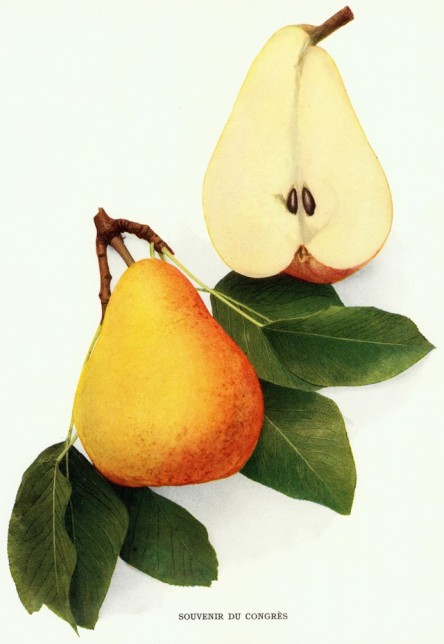
Very similar to Clapp Favorite and Bartlett, and not as good as either in fruit-characters, Souvenir du Congrès hardly merits a place in American pomology. The crop ripens between those of the two sorts with which it has been compared, and the fruits are larger and often handsomer. The fruits are said to be larger and of better quality when the tree is double-worked on the quince. The tree is remarkable for vigor, hardihood to cold, and healthfulness; and bears so abundantly that the crop must be thinned to prevent breaking of branches. The variety grows especially well in New York, and is deserving a place in home orchards and in fruit-collections. The accompanying color-plate illustrates the size, shape, and color of this pear remarkably well.
Souvenir du Congrès owes its origin to M. François Morel, Lyons, France. M. Morel grafted one of his pear-trees with cions taken from several other varieties, including Bartlett, and from the tree thus grafted he obtained fruit, seeds of which he sowed in 1852. One of the resultant trees bore fruit in 1863, and the pears had so many earmarks of Bartlett that it was at once assumed to be a seedling of that variety. The tree continued to do well and in due course the variety was judged to be worthy of dissemination by the Rhône Horticultural Society. Later, M. Morel dedicated the new pear to the Pomological Congress of France. The variety was introduced in the United States about 1870. The American Pomological Society placed Souvenir du Congrès on its fruit-catalog list in 1875.
Tree medium in size and vigor, upright-spreading, open-topped, very productive; branches zigzag, dull reddish-brown, heavily overspread with ash-gray scarf-skin, marked by small, raised lenticels; branchlets thick, long, reddish-brown, overspread with dull gray mingled with green, smooth, glabrous, with few small, slightly raised lenticels.
Leaf-buds small, short, pointed, plump, free. Leaves 1⅞ in. long, 1½ in. wide, roundish-oval, leathery; apex abruptly pointed; margin tipped with very few glands, finely serrate; petiole 1½ in. long, glabrous, tinged with red. Flower-buds short, conical or pointed, plump, free, arranged singly on very short spurs or branchlets; flowers with a disagreeable odor, 1⅛ in. across, pinkish-white as the buds unfold, becoming whitish, in dense clusters, 6 to 8 buds in a cluster; pedicels ¾ in. long, thick, heavily pubescent, light green.
Fruit ripe in September; large, 37⁄16 in. long, 211⁄16 in. wide, uniform in size and shape, oblong-acute-pyriform, symmetrical, with unequal sides; stem 1 in. long, short, thick, curved; cavity obtuse, almost lacking, very shallow, narrow, russeted, slightly furrowed, often with the stem inserted beneath a pronounced irregular lip; calyx open; lobes separated at the base, narrow, acute; basin wide, obtuse and flaring, slightly furrowed, symmetrical, smooth except for the thick, russet covering; color yellow, with a reddish blush on the exposed cheek, covered with nettings of russet and yellow patches; dots numerous, small, russet, conspicuous; flesh white, with a faint tinge of yellow, firm, granular, tender, very juicy, sweet, with a musky flavor; quality good. Core closed, with clasping core-lines; calyx-tube short, wide, conical; seeds large, wide, plump, acute.
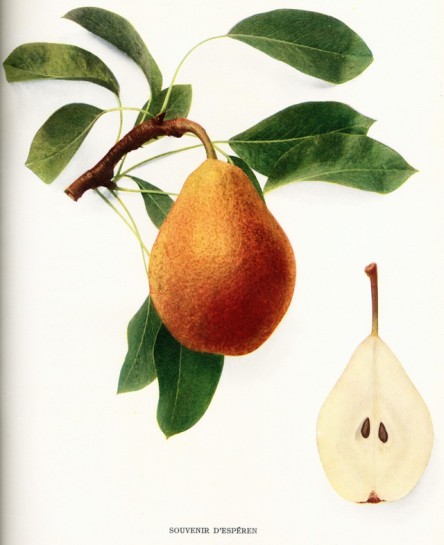
SOUVENIR D’ESPÉREN
1. Barry Fr. Garden 318. 1851. 2. Downing Fr. Trees Am. 857. 1869. 3. Tilton Jour. Hort. 6:14, fig. 1869.
Downing, in 1869, noted this old French pear as one of the best for either amateur or commercial grower, and at that time it was rather widely planted. Now, however, growers seldom set it. The trees are vigorous, hardy, healthy, and productive, and the fruits are attractive in appearance and rather good in quality, but neither tree nor fruit rise much above mediocrity, and the variety has no outstanding character to give it individuality. The crop comes in season in December, the pears keeping well until ripe, after which they quickly decay. The variety is worth planting only for the sake of diversity.
Major Espéren, Mechlin, Belgium, raised this pear from seed about the middle of the nineteenth century. The name Souvenir d’Espéren was at one time applied to Fondante de Noël in consequence of which confusion has existed as to the identity of the two sorts. The pear reached America about 1850.
Tree medium in size, upright, slightly spreading, dense-topped, productive; branches reddish-brown overlaid with thin scarf-skin, marked with very conspicuous but scattering lenticels; branchlets very thick and long, with long internodes, light brown mingled with green, dull, glabrous, sprinkled with small, conspicuous, raised lenticels.
Leaf-buds very small, short, pointed, plump, free. Leaves 3 in. long, 1⅝ in. wide; apex abruptly pointed; margin uneven, finely serrate; petiole 2⅝ in. long, tinged red. Flower-buds small, short, conical, plump, free, singly on very short spurs; flowers open late, showy, 1⅜ in. across, average 7 buds in a cluster; pedicels 1¼ in. long, slender.
Fruit ripe the last of November and December; large, 3½ in. long, 2⅝ in. wide, oblong-obovate-pyriform, the surface uneven; stem 1¼ in. long, slender; cavity very obtuse and shallow or lacking, the flesh drawn up about the base of the stem in a lip; calyx partly open, small; lobes separated at the base, short, narrow, acute; basin shallow, narrow, obtuse, wrinkled; skin thick, roughened with russet; color greenish-yellow, mottled and patched with russet, sprinkled with many russet dots and often with russet overspreading nearly the entire surface; dots numerous, russet, small; flesh yellowish, very granular near the center, firm, crisp but tender, juicy, with a pleasant, aromatic, vinous flavor; quality good to very good. Core large, closed, with clasping core-lines; calyx-tube short, wide, conical; seeds small, short, plump, acute, light brown.
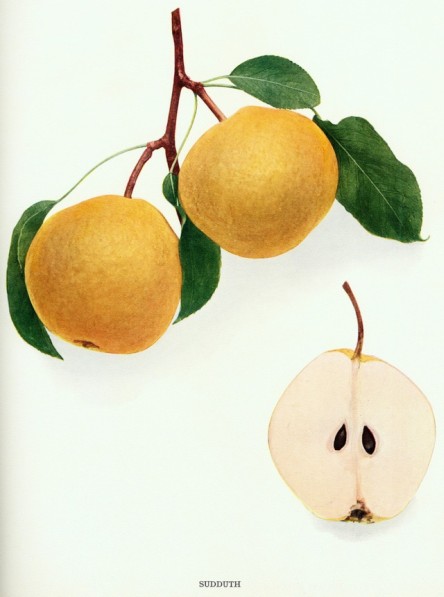
SUDDUTH
1. Ill. Hort. Soc. Rpt. 144, Pl. 1894. 2. Mich. Hort. Soc. Rpt. 141. 1894. 3. Can. Hort. 19:126, figs. 936 and 937. 1896. 4. Gard. Chron. 3rd Ser. 19:108. 1896. 5. Ill. Hort. Soc. Rpt. 9. 1897. 6. Budd-Hansen Am. Hort. Man. 2:264. 1903.
Sudduth has little to recommend it for New York or eastern pear regions, but it is a standard sort in parts of the Mississippi Valley. The characters which give it a place in the pear flora of the region just named are remarkable freedom from blight, hardiness to cold and heat, capacity to withstand drought, early bearing, and great productiveness. The fruits are neither attractive in appearance nor high in quality—hardly fit for dessert, being but a grade or two better than the disreputable Kieffer. Like those of the Kieffer, however, the fruits do very well for all culinary purposes. They do not keep well as they soften at the center soon after becoming edible. The trees are said to be nearly as hardy as those of the wild crab-apple. The variety is desirable only where hardiness and freedom from blight are prime requisites.
The Sudduth pear was introduced about 1895, although the parent tree was at that time fully seventy years old. It originated from seed planted by Thomas Constant in 1820, in Sangamon County, Illinois. Later, Judge Stephen A. Logan of Springfield, Abraham Lincoln’s first law partner, acquired the property on which the tree stood and from him Titus Sudduth bought the place in 1862. Sudduth was so impressed with the fruit that he had trees propagated by Augustine and Company, Normal, Illinois, and disseminated under his name.
Tree large, vigorous, upright becoming quite spreading, open-topped, hardy, productive; trunk stocky, shaggy; branches thick, smooth, dull reddish-brown, almost entirely covered with gray scarf-skin, sprinkled with numerous large, raised lenticels; branchlets slender, curved, long, with long internodes, dull reddish-brown, overspread with thin gray scarf-skin which is mingled with green, dull, smooth, glabrous, with conspicuous, raised lenticels.
Leaf-buds small, pointed, appressed, somewhat flattened. Leaves 3 in. long, 1⅝ in. wide, thin, velvety; apex taper-pointed; margin glandless, finely serrate; petiole 2 in. long, slender, tinged red, glabrous. Flower-buds small, short, conical, free, singly on very short spurs; flowers late, 1⅛ in. across, in dense clusters, average 8 buds in a cluster; pedicels ⅞ in. long, thick, pubescent.
Fruit ripe in late September and October; medium or below in size, 2¼ in. long, 2⅜ in. wide, roundish-oblate, slightly conical toward the apex; stem ⅞ in. long, slender; cavity acute, deep, narrow, smooth, sometimes lipped; calyx large, open; lobes separated at the base, long, acute; basin very shallow, narrow, obtuse, occasionally wrinkled; skin thin, tough, smooth, dull; color light green, without blush; dots very small, russet or greenish, very obscure; flesh greenish-white, firm, crisp, rather dry, subacid; quality medium to poor. Core large, closed, axile, with meeting core-lines; calyx-tube wide, conical; carpels ovate; seeds variable in size, wide, flat, obtuse.
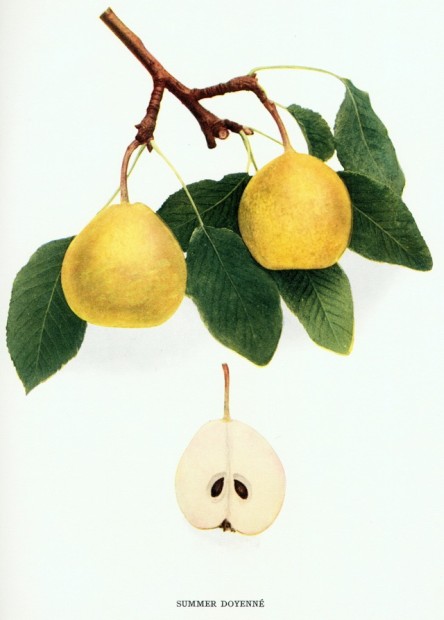
SUMMER DOYENNÉ
1. Am. Pom. Soc. Cat. 40. 1883. 2. Hogg Fruit Man. 651. 1884. 3. Ont. Dept. Agr. Fr. Ont. 180, fig. 1914.
Doyenné d’Été. 4. Downing Fr. Trees Am. 336. 1845. 5. Gard. Chron. 508, fig. 1847. 6. Mag. Hort. 13:66, fig. 8. 1847. 7. Hovey Fr. Am. 1:59, Pl. 1851. 8. Am. Pom. Soc. Rpt. 53. 1852. 9. Horticulturist N. S. 3:491, fig. 1853. 10. Downing Fr. Trees Am. 742, fig. 1869.
Sommerdechantsbirne. 11. Dochnahl Führ. Obstkunde 2:20. 1856.
Doyenné de Juillet. 12. Leroy Dict. Pom. 2:77, fig. 1869. 13. Guide Prat. 57, 266. 1876.
Juli Dechantsbirne. 14. Mathieu Nom. Pom. 239. 1889. 15. Gaucher Pom. Prak. Obst. No. 51, Pl. 108. 1894.
The extremely early and highly flavored fruits, which are borne in prodigious quantities, make this a very desirable pear for the home garden. The fruits have no value for the markets, as they are small, do not keep well, and are unattractive. The tree, while never large, is of medium size, comes in bearing early, is hardy, and is as free as most of its orchard associates from blight. Both fruit and foliage suffer badly from pear-scab, and no amount of spraying can give the fruits a fair cheek in seasons when this fungus is epidemic.
Van Mons is supposed to have originated this variety about 1800 as Diel mentioned it among his best pears in 1812. Summer Doyenné was first brought to the notice of American pomologists by William Kenrick, who compiled a description of it as early as 1836. It does not, however, appear to have been introduced until 1843. It was recommended for general culture in the United States by the American Pomological Society in 1852.
Tree variable in size, upright, vigorous, very productive; trunk slender; branches slender, slightly zigzag, brownish, overlaid with gray scarf-skin, marked with numerous conspicuous lenticels; branchlets slender, long, light brown mingled with green, the new growth tinged with red, smooth, glabrous except near the ends of the new growth, with numerous raised lenticels.
Leaf-buds small, short, sharply pointed, plump, free; leaf-scars with prominent shoulders. Leaves 2⅞ in. long, 1⅛ in. wide, thin, leathery; apex taper-pointed; margin finely serrate; petiole 1¾ in. long, tinged with pink. Flower-buds small, short, plump, free, singly on very short spurs; flowers showy, 1¼ in. across, in dense clusters, 7 to 9 buds in a cluster; pedicels 1¼ in. long, slender, pubescent.
Fruit ripe in early August; small, 1½ in. long, 1⅝ in. wide, obovate-obtuse-pyriform, symmetrical; stem 1⅛ in. long, slender; cavity obtuse, shallow, narrow, slightly furrowed, often lipped; calyx small, closed; lobes separated at the base, short, narrow, acuminate; basin shallow, obtuse, furrowed; skin thin, smooth, tender, waxen yellow, washed or blushed with bright red, deepening on the exposed cheek to crimson; dots numerous, small, russet, obscure; flesh tinged with yellow, fine-grained, tender and melting, juicy, variable in flavor and quality, pleasantly sprightly under favorable conditions; quality variable, good under the best conditions. Core closed, axile, with clasping core-lines; calyx-tube short, narrow, urn-shaped; carpels roundish-ovate; seeds small, narrow, flat, acute.
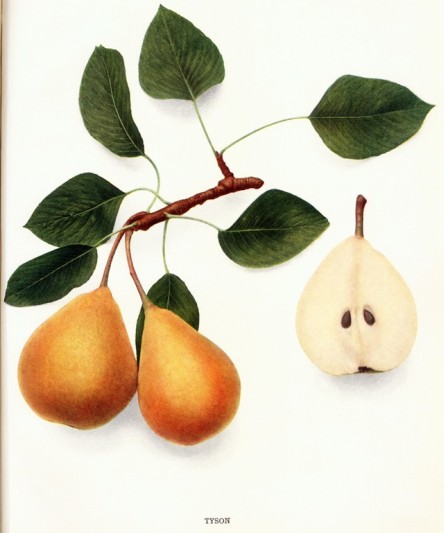
TYSON
1. Mag. Hort. 12:433, fig. 30. 1846. 2. Horticulturist 1:433. 1846-47. 3. Proc. Nat. Con. Fr. Gr. 51. 1848. 4. Hovey Fr. Am. 1:33, Pl. 1851. 5. Downing Fr. Trees Am. 444, fig. 1857. 6. Ibid. 870, fig. 1869. 7. Leroy Dict. Pom. 2:710, fig. 1869. 8. Oberdieck Obst-Sort. 333. 1881. 9. Lauche Deut. Pom. II: No. 95, Pl. 95. 1883. 10. Ont. Dept. Agr. Fr. Ont. 182, fig. 1914.
Tyson competes with Clapp Favorite as the precursor of the pear season which is really opened by Bartlett. In every character of fruit and tree excepting size and color of fruit, Tyson excels Clapp Favorite. The quality of the fruit far excels that of Clapp Favorite and it is better than that of Bartlett. Indeed, of commonly grown pears, the characters of flesh and flavor are second only to those of the fruits of Seckel. The flesh is melting and juicy, with a spicy, scented sweetness that gives the fruit the charm of individuality. The pears keep longer and ship better than those of Clapp Favorite; their season in New York is from the middle of August to the middle of September. Unfortunately, the pears are but medium in size, and are often poorly colored, both of which defects appear on the fruits of this variety as grown on the grounds of this Station and shown in the accompanying illustration. The tree is the most nearly perfect of that of any pear grown in America—the Kieffer, praiseworthy only in its tree, not excepted. The tree is certainly as hardy as that of any other variety, if not hardier, and resists better than that of any other sort the black scourge of blight. Add to these notable characters large size, great vigor, and fruitfulness, and it is seen that the trees are nearly flawless. The only fault is, and this a comparatively trifling one, that the trees are slow in coming in bearing. Tyson is the best pear of its season for the home orchard, and has much merit for commercial orchards. Were the fruits larger, it would rival Bartlett for the markets. No other variety offers so many good starting points for the pear-breeder.
Tyson originated as a wilding found about 1794 in a hedge on the land of Jonathan Tyson, Jenkintown, Pennsylvania. The tree first bore fruit in 1800. The pears proved to be so good that Mr. Tyson distributed cions among his neighbors, but the variety was not generally disseminated. About 1837, a Doctor Mease of Philadelphia sent cions to B. V. French, Braintree, near Boston, who in turn distributed them among his friends. The variety fruited here about 1842, and the fruit was exhibited before the Massachusetts Horticultural Society under the name Tyson. In 1848, at the National Convention of Fruit-Growers, Tyson was recommended for general cultivation, and since that date the name has appeared continuously in the catalogs of the American Pomological Society.
Tree very large, vigorous, upright-spreading, tall, dense-topped, hardy, productive; trunk very stocky, rough; branches thick, dull reddish-brown, overspread with gray scarf-skin, with few lenticels; branchlets slender, short, light brown mingled with green, smooth, glabrous, sprinkled with few small, inconspicuous lenticels.
Leaf-buds small, short, conical, pointed, plump, appressed or free. Leaves 2¾ in. long, 1½ in. wide, thin; apex abruptly pointed; margin finely and shallowly serrate; petiole 1⅝ in. long. Flower-buds small, short, conical, pointed, plump, free, singly on short spurs; flowers medium in season of bloom.
Fruit matures in late August; medium in size, 2⅛ in. long, 1¾ in. wide, roundish-acute-pyriform, with unequal sides; stem 1¾ in. long, curved; cavity very shallow, obtuse, roughened, usually drawing up as a lip about the base of the stem; calyx open, small; lobes separated at the base, short, narrow, acute; basin shallow, narrow, flaring, slightly furrowed, compressed; skin tough, smooth, slightly russeted, dull; color deep yellow, usually blushed; dots numerous, very small, obscure; flesh tinged with yellow, granular around the basin, otherwise rather fine-grained, tender and melting, very juicy, sweet, aromatic; quality very good. Core small, closed, with clasping core-lines; calyx-tube, short, wide, conical; seeds medium in size and width, plump, acute.
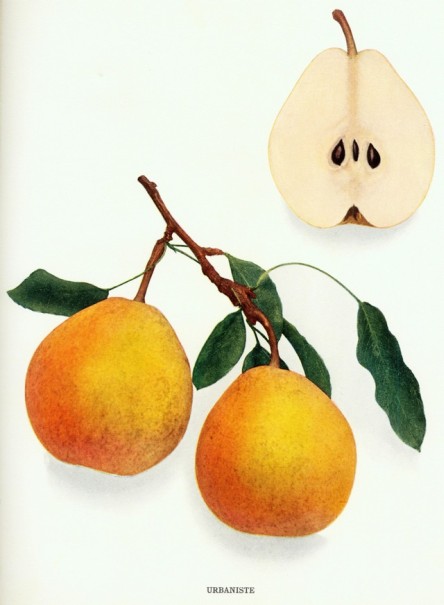
URBANISTE
1. Trans. Lond. Hort. Soc. 5:411. 1824. 2. Lindley Guide Orch. Gard. 384. 1831. 3. Kenrick Am. Orch. 186. 1832. 4. Mag. Hort. 10:131, fig. 1844. 5. Downing Fr. Trees Am. 417, fig. 190. 1845. 6. Gard. Chron. 68, fig. 1847. 7. Hovey Fr. Am. 2:21, Pl. 1851. 8. Am. Pom. Soc. Rpt. 53. 1852. 9. Pom. France. 1: No. 32, Pl. 32. 1863. 10. Mas Le Verger 3: Pt. 1, 193, fig. 95. 1866-73. 11. Downing Fr. Trees Am. 871, fig. 1869. 12. Guide Prat. 59, 308. 1876. 13. Hogg Fruit Man. 657. 1884.
Urbanister Sämling. 14. Dochnahl Führ. Obstkunde 2:116. 1856.
Poire des Urbanistes. 15. Leroy Dict. Pom. 2:712, fig. 1869.
Coloma’s Herbst Butterbirne. 16. Mathieu Nom. Pom. 197. 1889. 17. Lucas Tafelbirnen 109, fig. 1894.
Urbaniste is another variety desirable for home use because of its highly-flavored fruits—so sweet, rich, perfumed, and luscious as to be a natural sweetmeat. The fruits are of but medium size and not particularly handsome, but the taste excels the looks. The flesh is as tender, sweet, juicy, and as delicately perfumed as that of Seckel or White Doyenné, but with a distinct flavor and scent which give the fruits the added charm of individuality. The crop ripens in October, in a season when there are many other pears, but the fruits stand comparison with those of any other variety and are welcome additions to the fruit-basket. The trees have several defects, chief of which is tardiness in coming in bearing, to remedy which grafting on the quince is recommended. They are also susceptible to blight, and are not as hardy as might be wished. Of all pears, the tree of this variety is one of the handsomest—clean and tidy, slender and graceful, yet robust and productive. Fruit and tree make this a valuable variety for home plantings.
Urbaniste originated as a wilding in the gardens of the religious order of Urbanistes, Mechlin, Belgium. After the suppression of this order in 1783, their gardens remained uncultivated for some time and produced new seedlings of considerable merit. The beauty of one of these attracted the attention of Count de Coloma, a well-known pomologist, who acquired this property in 1786, and in due course propagated and disseminated the variety under the name Urbaniste. Early in the nineteenth century, Count de Coloma sent specimens of the pear to the London Horticultural Society, which organization afterwards distributed it in England about 1823. Thomas Andrew Knight sent cions to John Lowell, Roxbury, Massachusetts, through whom it became disseminated in the United States. The American Pomological Society added Urbaniste to its fruit-catalog list in 1852.
Tree medium in size, vigorous, upright-spreading, slow-growing, productive with age; trunk slender, shaggy; branches stocky, shaggy, zigzag, reddish-brown, overspread with gray scarf-skin, sprinkled with numerous lenticels; branchlets long, reddish-brown mingled with grayish scarf-skin, smooth, zigzag, glabrous, marked with conspicuous, raised lenticels.
Leaf-buds large, obtuse, semi-free. Leaves 2¼ in. long, ⅞ in. wide, thin, leathery; apex taper-pointed; margin finely serrate; petiole 1½ in. long, slender. Flower-buds short, variable in shape, free.
Fruit ripe in late October and early November; medium in size, 2⅜ in. long, 2 in. wide, obovate-obtuse-pyriform, with unequal sides; stem ⅝ in. long, short, thick; cavity obtuse, shallow, narrow, faintly russeted, furrowed, slightly lipped; calyx open; lobes separated at the base, narrow, obtuse; basin shallow, narrow, obtuse, slightly furrowed; skin thick, tough, roughened by the russet nettings, dull; color pale yellow, often with a faint russet-red blush on the exposed cheek and marked with nettings and patches of russet; dots numerous, small, russet, conspicuous; flesh tinged with yellow, granular especially around the core, tender and melting, buttery, juicy, sweet, pleasantly aromatic; quality very good. Core closed, with clasping core-lines; calyx-tube short, wide, conical; seeds medium in size and width, long, plump, acute.
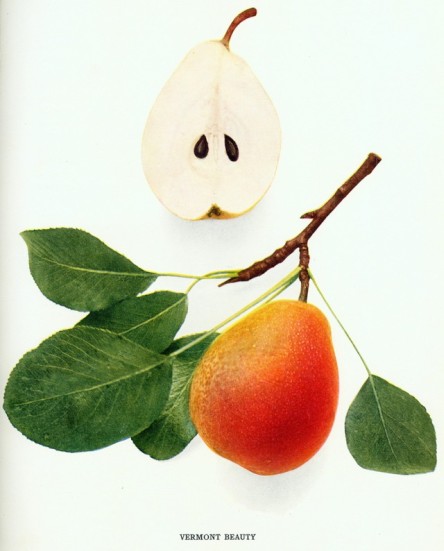
VERMONT BEAUTY
1. W. N. Y. Hort. Soc. Rpt. 65. 1889. 2. Ibid. 176. 1890. 3. Ibid. 134. 1891. 4. Can. Hort. 16:184. 1893. 5. Am. Pom. Soc. Cat. 37. 1899. 6. Ellwanger & Barry Cat. 18. 1900. 7. Budd-Hansen Am. Hort. Man. 2:267. 1903.
The fruits of Vermont Beauty elicit praise from all who see or taste them. The bright-cheeked pears are as alluring to the eye as those of any other, and are almost as delectable as those of Seckel, which they resemble in shape, but are larger and handsomer. Of all pears, those of this variety (or of Forelle, with which it may be identical) best satisfy the eye for bright color. The crop ripens a little later and keeps longer than that of Seckel, and for these reasons, and because of the handsome appearance, should sell better. The pears will probably be most used to grace the table and for dessert, but the somewhat more sprightly flavor makes them better suited for all culinary purposes than those of Seckel. The trees are scarcely less satisfactory than the fruits. They are preëminent among their kind by virtue of large size, rapidity of growth, productivity, and hardiness, the region from which the variety came bespeaking greater hardihood to cold than that possessed by the average variety. The trees rejoice in vigor and health as do those of almost no other variety, and while hardly as productive as those of Seckel, yet because of greater size the pears fill the basket nearly as quickly. Vermont Beauty is one of the best of the pears of its season, and deserves a place in the orchards of the country for home and market.
Vermont Beauty is supposed to have originated in the nursery of Benjamin Macomber, Grand Isle, Vermont, more than forty years ago. Macomber maintained a small nursery, and this pear was one of several hundreds planted for stock. The tree was budded in the usual manner, but the bud failed to grow, and the original tree was allowed to stand without another budding. After the variety fruited, it attracted so much attention that Macomber propagated it. Later, it was introduced by W. P. Rupert and Son, Seneca, New York. The American Pomological Society, recognizing its worth, added the variety to its fruit-catalog in 1899. There has long been doubt in the minds of the writers as to whether Vermont Beauty is distinct from Forelle. Careful comparison has been made of the fruit-and tree-characters of the two sorts, and it is found that they are so closely allied as to be indistinguishable. It is possible that a tree of the old German pear may have found its way into Macomber’s nursery and received the new name.
Tree medium in size, vigorous, upright-spreading, dense-topped, hardy, productive; trunk stocky, shaggy; branches zigzag, reddish-brown, thinly overspread with gray scarf-skin, with numerous large lenticels; branchlets very thick, long, reddish-brown mingled with green, thickly covered with ash-gray scarf-skin near the tips, smooth, glabrous except near the ends of the new growth, sprinkled with numerous small, roundish, conspicuous, raised lenticels.
Leaf-buds small, short, pointed, plump, free. Leaves 2¾ in. long, 1⅜ in. wide, leathery; apex abruptly-or taper-pointed; margin glandless, finely serrate; petiole 2 in. long, glabrous, slender, pinkish-green. Flower-buds small, short, conical, plump, free, singly on short spurs; flowers characteristically small, average 1 in. across, in dense clusters, about 6 buds in a cluster, the petals unusually small; pedicels ⅞ in. long, slender, pubescent.
Fruit ripe in late October and November; medium in size, 2½ in. long, 2 in. wide, obovate-acute-pyriform, symmetrical; stem ¾ in. long, curved; cavity extremely small or lacking, the flesh folded up around the base of the stem, occasionally lipped; calyx small, open; lobes separated at the base, short, narrow, acute; basin shallow, narrow, obtuse, smooth, symmetrical; skin thick, tough, smooth or with slight russet markings; color clear pale lemon-yellow, with a broad and brilliantly blushed cheek, fading at the sides into pinkish-red dots; dots numerous, very small, light russet, conspicuous; flesh tinged with yellow, granular at the center but fine-grained near the skin, tender and melting, very juicy, with a rich, vinous flavor; quality very good. Core closed, axile, with meeting core-lines; calyx-tube short, wide, conical; seeds large, wide, plump, acute.
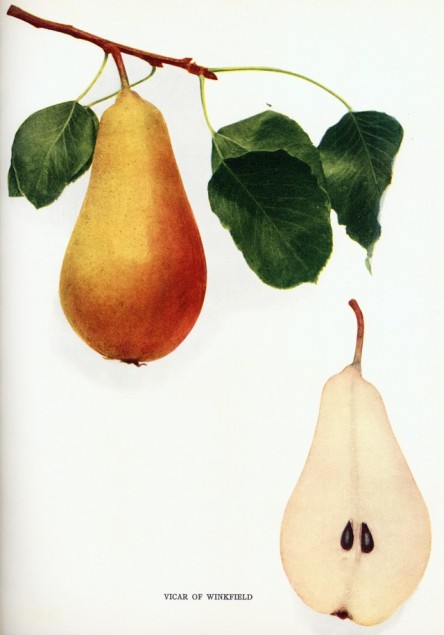
VICAR OF WINKFIELD
1. Card. Chron. 20, fig. 1843. 2. Mag. Hort. 9:129, 269. 1843. 3. Downing Fr. Trees Am. 448, fig. 208. 1845. 4. Am. Pom. Soc. Rpt. 53. 1852. 5. Elliott Fr. Book 344, fig. 1854. 6. Jour. Hort. N. S. 7:414. 1864. 7. Downing Fr. Trees Am. 875, fig. 1869. 8. Hogg Fruit Man. 660. 1884.