Volume 1 — Night the Third.
W. G. (William George) Waters translation

101

The Fables and Enigmas of Messer Giovanni Francesco Straparola da Caravaggio.
Night the Third.

Already the sister of the sun had begun her reign in the sky over the forests and the gloomy gorges of the hills, and showed her golden circle over the half of heaven; already the car of Phœbus had sunk beneath the western wave, the moving stars had lighted their lamps, and the pretty birds, ceasing their pleasant songs and bickerings, sought repose in their nests set amongst the green boughs, when the ladies and the gallant youths as well met on the third evening in the accustomed spot to renew their story-telling. And as soon as they were all seated according to their rank, the Signora Lucretia commanded that the vase should be brought forth as before, and in it she caused to be placed the names of five damsels, who, according to the order determined by lot, should that evening tell in turn their stories. The first name which was drawn from the vase was that of Cateruzza, the second that of Arianna, the third that of Lauretta, the fourth that of Alteria, and the fifth that of Eritrea. Then the Signora gave the word for the Trevisan to take his lute, and Molino his viol, and for all the rest to tread a measure to Bembo’s leading. And when the dance had come to an end, and the sweet lyre and the divine strings of the hollow lute were silent, the Signora directed Lauretta to begin her song, and she, anxious to obey the Signora in everything, took hands with her companions, and having made respectful salutation, sang in clear and mellow tone the following song:
102SONG.
Lady, while thy face I scan,
Where love smiling holds his court,
Lo! from out your beauteous eyes
Light so radiant doth arise,
That it shows us Paradise.
All my sighs and all my tears,
Which I foolish shed in vain;
All the anguish of my heart,
All my hidden woe and smart,
With my faint desire have part.
Then to love’s last mood I fly,
Recking nought that earth and sky
Stand beneath me and above;
So my soul is drawn by love
To the heights of passion free,
And I learn that fate’s decree
Binds me, whatsoe’er betide,
Dead or living, to thy side.
After Lauretta and her companions had given sign by their silence that their song had come to an end, the Signora, bending her gaze upon the fair and open countenance of Cateruzza, said that the task of making a beginning of the story-telling of that third evening fell upon her, and Cateruzza, with a becoming blush upon her cheek and laughing lightly, began in these terms.
THE FIRST FABLE.
A simple fellow, named Peter, gets back his wits by the help of a tunny fish which he spared after having taken it in his net, and likewise wins for his wife a king’s daughter.

There is proof enough, dear ladies, both in the chronicles of the past and in the doings of our own day, that a fool, whether by lucky accident or by sheer force of blundering, may sometimes score a success where a wise man might fail. Therefore it has come into my mind to tell you the story of one of these fools, who, through the issue of a very foolish deed, got for his 103wife the daughter of a king and became a wise man himself into the bargain.
In the Ligurian Sea there is an island called Capraia, which, at the time I am describing, was ruled by King Luciano. Amongst his subjects was a poor widow named Isotta, who lived with her only son Peter, a fisher-lad, but from Peter’s fishing she would scarce have kept body and soul together, for he was a poor silly creature known to all the neighbours as Peter the Fool. Though he went fishing every day he never caught anything, but in spite of his ill-success he would always come up from his boat shouting and bellowing so that all the town might hear him: ‘Mother, mother, bring out your tubs and your buckets and your pails; bring them out all, great and small, for Peter has caught a boatful of fish.’ The poor woman soon got to know the value of Peter’s bragging, but in spite of this she always prepared the vessels, only to find herself jeered at by the silly youth, who, as soon as he came near, would thrust out his long tongue in ridicule, and otherwise mock at her.
Now it chanced that the widow’s cottage stood just opposite to the palace of King Luciano, who had only one child, a pretty graceful girl about ten years old, Luciana by name. She, it happened, was looking out of the window of the palace one day when Peter came back from fishing, crying out to his mother to bring out her tubs and her buckets and her pails to hold the fish with which he was laden, and so much was she diverted at the silly antics of the fool, that it seemed likely she would die with laughing. Peter, when he saw that he was made sport of, grew very angry, and threw some ugly words at her, but the more he raged the more she—after the manner of wilful children—laughed and made mock at him. Peter, however, went on with his fishing day after day, and played the same trick on his mother every evening on his return; but at last fortune favoured him, and he caught a fine tunny, very big and fat. Overjoyed at his good luck, he began to shout and cry out over and over again, ‘Mother and I will have a good supper to-night,’ when, to his amazement, he heard the tunny which he had just caught begin to speak: ‘Ah! my dear brother, I pray you of your courtesy to give me my life. When once you have eaten me, what farther benefit do you think you will get from me? but if you will let me live there is no telling what service I may not render you.’ But Peter, whose thoughts just then were set only on his supper, hoisted the fish on his shoulders and set 104off homewards; but the tunny still kept on beseeching his captor to spare his life, promising him first as many fish as he could want, and finally to do him any favour he might demand. Peter was not hardhearted, and, though a fool, fancied he might profit by sparing the fish, so he listened to the tunny’s petition and threw him back into the sea. The fish, sensible of Peter’s kindness, and not wishing to seem ungrateful, told Peter to get into his boat again and tilt it over so that the water could run in. This advice Peter at once followed, and, having leant over on one side, he let the boat be half filled with water, which brought in with it such a huge quantity of fish that the boat was in danger of sinking. Peter was wellnigh beside himself with joy when he saw what had happened, and, when he had taken as many fish as he could carry, he betook himself homewards, crying out, as was his wont, when he drew near to the cottage: ‘Mother, mother, bring out your tubs and your buckets and your pails; bring out them all, great and small, for Peter has caught a boatful of fish.’ At first poor Isotta, thinking that he was only playing his old fool’s game, took no heed; but at last, hearing him cry out louder than ever, and fearing that he might commit some greater folly if he should not find the vessels prepared as usual, got them all ready. What was her surprise to see her simpleton of a son at last coming back with a brave spoil! The Princess Luciana was at the palace window, and hearing Peter bellowing louder than ever, she laughed louder than ever, so that Peter was almost mad with rage, and having left his fish, he rushed back to the seashore, and called aloud on the tunny to come and help him. The fish, hearing Peter’s voice, came to the marge of the shore, and putting his nose up out of the waves, asked what service was required of him. ‘What service!’ cried Peter. ‘Why I would that Luciana, that saucy minx, the daughter of our king, should find herself with child at once.’
What followed was a proof that the tunny had not made an empty promise to Peter, for before many days had passed the figure of the young girl, who was not twelve years old, began to show signs of maternity. Her mother, when she marked this, fell into great trouble, but she could not believe that a child of eleven could be pregnant, and rather set down the swelling to the working of an incurable disease; so she brought Luciana to be examined by some women expert in such cases, and these, as soon as they saw the girl, declared that she was certainly with child. The queen, overwhelmed by this terrible news, told it also to the king, and he, when he heard 105it, cried aloud for death rather than such ignominy. Strict inquisition was made to discover who could have violated the child, but nothing was found out; so Luciano, to hide her dire disgrace, determined to have his daughter secretly killed.
The queen, on hearing this, begged her husband to spare the unfortunate Luciana till the child should be born, and then do with her what he would. The king, moved with compassion for his only daughter, gave way so far; and in due time Luciana was delivered of a boy so fine and beautiful that the king could no longer harbour the thought of putting them away, but, on the other hand, gave order to the queen that the boy should be well tended till he was a year old. When this time was completed the child had become beautiful beyond compare, and then it came into the king’s mind that he would again make a trial to find out who the father might be. He issued a proclamation that every man in the city who had passed fourteen years should, under pain of losing his head, present himself at the palace bearing in his hand some fruit or flower which might attract the child’s attention. On the appointed day, in obedience to the proclamation, all those summoned came to the palace, bearing, this man one thing and that man another, and, having passed before the king, sat down according to their rank.
Now it happened that a certain young man as he was betaking himself to the palace met Peter, and said to him, ‘Peter, why are you not going to the palace like all the others to obey the order of the king?’ ‘What should I do in such a crowd as that?’ said Peter. ‘Cannot you see I am a poor naked fellow, and have hardly a rag to my back, and yet you ask me to push myself in amongst all those gentlemen and courtiers? No.’ Then the young man, laughing at him, said, ‘Come with me, and I will give you a coat. Who knows whether the child may not turn out to be yours?’ In the end Peter let himself be persuaded to go to the young man’s house, and having put on a decent coat, they went together to the palace; but when they arrived there Peter’s heart again failed him, and he hid himself behind a door. By this time all the men had presented themselves to the king, and were seated in the hall. Then Luciano commanded the nurse to bring in the child, thinking that if the father should be there the sense of paternity would make him give some sign. As the nurse carried the child down the hall everyone, as he passed, began to caress him and to give him, this one a fruit and that one a 106flower; but the infant, with a wave of his hand, refused them all. When the nurse passed by the entrance door the child began to laugh and crow, and threw himself forward so lustily that he almost jumped out of the woman’s arms, but she, not knowing that anyone was there, walked on down the hall. When she came back to the same place, the child was more delighted than ever, laughing and pointing with his finger to the door; so that the king, who had already noticed the child’s actions, called to the nurse, and asked her who was behind the door. The nurse, being somewhat confused, said that surely some beggar must be hidden there. By the king’s command Peter was at once haled forth, and everybody recognized the town fool; but the child, who was close to him, stretched out his arms and clasped Peter round the neck, and kissed him lovingly. The king, recognizing the sign, was stricken to the heart with grief, and having discharged the assembly, commanded that Peter and Luciana and the child should be put to death forthwith.
The queen, though assenting to this doom, was fearful lest the public execution of the victims might draw down upon the king the anger of the people; so she persuaded him to have made a huge cask into which the three might be put and cast into the sea to drift at random; then, at least, no one might witness their dying agony. This the king agreed to; and when the cask was made, the condemned ones were put therein, with a basket of bread and a flask of wine, and a drum of figs for the child, and thrust out into the rough sea, with the expectation that the waves would soon dash it to pieces against the rocks; but this was not to be their fate.
Peter’s poor old mother, when she heard of her son’s misfortune, died of grief in a few days; and the unhappy Luciana, tossed about by the cruel waves, and seeing neither sun nor moon, would have welcomed a similar fate. The child, since she had no milk to give it, had to be soothed to sleep with now and then a fig; but Peter seemed to care for nothing, and ate the bread and drank the wine steadily, laughing the while. ‘Alas! alas!’ cried Luciana in despair, ‘you care nothing for this evil which you have brought upon me, a poor innocent girl. You eat and drink and laugh without a thought of the danger around us.’ ‘Why,’ replied Peter, ‘this misfortune is more your own fault than mine. If you had not mocked me so, it would never have happened; but do not lose heart, our troubles will soon be over,’ ‘I believe that,’ cried Luciana, ‘for the cask 107will soon be split on a rock, and then we must all be drowned.’ ‘No, no,’ said Peter, ‘calm yourself. I have a secret, and were you to know what it is, you would be vastly surprised and vastly delighted too, I believe.’ ‘What secret can you know,’ said Luciana, ‘which will avail us in such danger as this?’ ‘I will soon tell you,’ Peter replied. ‘I have a faithful servant, a great fish, who will do me any service I ask of him, and there is nothing he cannot do. I may as well tell you it was through his working that you became with child.’ ‘That I cannot believe,’ said Luciana; ‘and what may this fish of yours be called?’ ‘His name is Signor Tunny,’ replied Peter. ‘Then,’ said Luciana, ‘to put your fish to the test, I will ask you to transfer to me the power you exercise over him, and to command him to do my bidding instead of yours.’ ‘Be it as you will,’ said Peter; and without more ado he called the tunny, who at once rose up near the cask, whereupon Peter commanded him to do everything that Luciana might require of him. She at once exercised her power over the fish by ordering him to make the waves cast the cask ashore in a fair safe cleft in the rocks on an island, a short sail from her father’s kingdom. As soon as the fish had worked her will so far, she laid other and much harder tasks upon him: one was to change Peter from the ugly fool he was into a clever, handsome gallant; another was, to have built for her forthwith a rich and sumptuous palace, with lofty halls and chambers, and girt with carven terraces. Within the court there was to be laid out a beautiful garden, full of trees which should bear, instead of fruit, pearls and precious stones, and in the midst of it two fountains, one of the freshest water and the other of the finest wine. All these wonders were wrought by the fish almost as soon as Luciana had spoken.
Now all this time the king and the queen were in deep misery in thinking of the cruel death they had contrived for Luciana and her child, how they had given their own flesh and blood to be eaten by the fishes; therefore, to find some solace in their woe, they determined to go to Jerusalem and to visit the Holy Land. So they ordered a ship to be put in order for them, and furnished with all things suited to their state. They set sail with a favouring wind, and before they had gone a hundred miles they came in sight of an island upon which they could see a stately palace, built a little above the level of the sea. Seeing that this palace was so fair and sumptuous, and standing, moreover, within Luciano’s kingdom, they were seized with a longing 108to view it more closely; so, having put into a haven, they landed on the island. Before they had come to the palace Luciana and Peter saw and recognized them, and, having gone forth to meet them, greeted them with a cordial welcome, but the king and queen did not know their hosts for the great change which had come over them. The guests were taken first into the palace, which they examined in every part, praising loudly its great beauty, and then they were led by a secret staircase into the garden, the splendour of which pleased them so amazingly that they swore they had never at any time before looked upon a place so delightful. In the centre of this garden there stood a noble tree, which bore on one of its branches three golden apples. These the keeper of the garden was charged to guard jealously against robbers, and now, by some secret working which I cannot unravel, the finest of these apples was transported into the folds of the king’s robe about his bosom, and there hidden. Luciano and the queen were about to take their leave when the keeper approached and said to Luciana, ‘Madam, the most beautiful of the three golden apples is missing, and I can find no trace of the thief.’
Luciana forthwith gave orders that the whole household should be searched, one by one, for such a loss as this was no light matter. The keeper, after he had searched thoroughly everyone, came back and told Luciana that the apple was nowhere to be found. At these words Luciana fell into great confusion, and, turning to the king, said: ‘Your majesty must not be wroth with me if I ask that even you allow yourself to be searched, for I prize the golden apple that is lost almost as highly as my life.’ The king, unsuspicious of any trick, and sure of his innocence, straightway loosened his robe, and lo! the golden apple fell from it to the ground.
The king stood as one dazed, ignorant as to how the golden apple could have come into his robe, and Luciana spoke: ‘Sire, we have welcomed you to our house with all the worship fitting to your rank, and now, as a recompense, you would privily rob our garden of its finest fruit. Meseems you have proved yourself very ungrateful.’ The king, in his innocence, attempted to prove to her that he could not have taken the apple, and Luciana, seeing his confusion, knew that the time had come for her to speak, and reveal herself to her father. ‘My lord,’ she said, with the tears in her eyes, ‘I am Luciana, your hapless daughter, whom you sentenced to a cruel death along with my child and Peter the fisher-boy. Though I bore a child, 109I was never unchaste. Here is the boy, and here is he whom men were wont to call Peter the Fool. You wonder at this change. It has all been brought about by the power of a marvellous fish whose life Peter spared when he had caught it in his net. By this power Peter has been turned into the wisest of men, and the palace you see has been built. In the same way I became pregnant without knowledge of a man, and the golden apple was conveyed into the folds of your robe. I am as innocent of unchastity as you are of theft.’
When the king heard these words his eyes were opened, and he knew his child. Then, weeping with joy, they embraced each other, and all were glad and happy. After spending a few days on the island, they all embarked and returned together to Capraia, where with sumptuous feastings and rejoicings Peter was duly married to Luciana, and lived with her in great honour and contentment, until Luciano died, and then he became king in his stead.
The story of Cateruzza had at one time moved the ladies to tears; but, when its happy issue was made known to them, they rejoiced and thanked God therefor. Then the Signora, when Cateruzza had ended, commanded her to continue in the order they had followed hitherto, and she, not willing to hold in suspense the attention of her hearers, smilingly proposed to them the following enigma:
Sir Redman stands behind a tree,
Now hidden, now in sight is he.
To him four runners speed along,
Bearing a warrior huge and strong.
Two darts into the trunk he wings,
And Redman from his lair upsprings,
And smites him from behind with skill;
Thus ten little men one giant kill.
Now he who shall this speech unfold,
Shall be a witty rogue and bold.
Cateruzza’s graceful and ingenious enigma was received by the whole company with applause. Many interpretations were put forth; but none came so near the mark as Lauretta: “Our sister’s enigma can have but one meaning—the wild bull of the forest,’ she said. ‘He has four runners to carry his huge bulk. The sight of a red rag maddens him, and thinking to rend it, he strikes his horns into the tree. Straightway the huntsman, who was hidden behind the trunk, comes forth and kills him with a dart sped by ten little men, that is, the ten fingers of his two hands.”
110This speedy solution of her riddle raised an angry humour in Cateruzza’s heart, for she had hoped it might prove beyond the wit of any; but she had not reckoned for Lauretta’s quickness. The Signora, who perceived that the two were fain to wrangle, called for silence, and gave the word to Arianna to begin a story which should please them all, and the damsel, somewhat bashful, began as follows.
THE SECOND FABLE.
Dalfreno, King of Tunis had two sons, one called Listico and the other Livoretto. The latter afterwards was known as Porcarollo, and in the end won for his wife Bellisandra, the daughter of Attarante, King of Damacus.

It is no light matter for the steersman, let him be ever so watchful, to bring his tempest-strained bark safely into a sheltered port when he may be vexed by envious and contrary fortune, and tossed about amongst the hard and ragged rocks. And so it happened to Livoretto, son of the great King of Tunis, who, after many dangers hardly to be believed, heavy afflictions, and lengthened fatigues, succeeded at last, through the valour of his spirit, in trampling under foot his wretched fortune, and in the end reigned peacefully over his kingdom in Cairo. All this I shall make abundantly clear in the fable I am about to relate to you.
In Tunis, a stately city on the coast of Africa, there reigned, not long ago, a famous and powerful king named Dalfreno. He had to wife a beautiful and wise lady, and by her begot two sons, modest, well-doing and obedient in everything to their father, the elder being called Listico, and the younger Livoretto. Now it happened that by royal decree, as well as by the approved usage of the state, these youths were barred in the succession to their father’s throne, which ran entirely in the female line. Wherefore the king, when he saw that he was by evil fortune deprived of female issue, and was assured by knowledge of himself that he was come to an age when he could hardly expect any further progeny, was sorely troubled, and felt his heart wrung thereanent with unbounded grief. And his sorrow was 111all the heavier because he was haunted by the dread that after his death his sons might be looked at askance, and evilly treated, and driven with ignominy from his kingdom.
The unhappy king, infected by these dolorous humours, and knowing not where might lie any remedy therefor, turned to the queen, whom he loved very dearly, and thus addressed her: ‘Madam, what shall we do with these sons of ours, seeing that we are bereft of all power to leave them heirs to our kingdom both by the law and by the ancient custom of the land?’ The sagacious queen at once made answer to him in these words: ‘Sire, it seems to me that, as you have a greater store of riches than any other king in the world, you should send them away into some foreign country where no man would know them, giving them first a great quantity of money and jewels. In such case they may well find favour in the sight of some well-disposed sovereign, who will see that no ill befall them. And if (which may God forbid) they should happen to come to want, no one will know whose sons they are. They are young, fair to look upon, of good address, high-spirited, and on the alert for every honourable and knightly enterprise, and let them go where they will they will scarcely find any king or prince or great lord who will not love them and set great store upon them for the sake of the rich gifts which nature has lavished upon them.’ This answer of the prudent queen accorded fully with the humour of King Dalfreno, and having summoned into his presence his sons Listico and Livoretto, he said to them: ‘My well-beloved sons, you must by this time know that, after I am dead, you will have no chance of succeeding to the sovereignty of this my kingdom; not, indeed, on account of your vices or from your ill manner of living, but because it has been thus determined by law and by the ancient custom of the country. You being men, created by mother nature and ourselves, and not women, are barred from all claim. Wherefore your mother and I, for the benefit and advantage of you both, have determined to let you voyage into some strange land, taking with you jewels and gems and money in plenty; so that whenever you may light upon some honourable position you may gain your living in honourable wise, and do credit to us at the same time. And for this reason I look that you shall show yourselves obedient to our wishes.’
Listico and Livoretto were as much pleased at this proposition as the king and the queen themselves had been, because both one and 112other of the young men desired ardently to see new lands and to taste the pleasures of the world. It happened that the queen (as is not seldom the way with mothers) loved the younger son more tenderly than she loved the elder, and before they took their departure she called him aside and gave him a prancing high-mettled horse, flecked with spots, with a small shapely head, and high courage shining in its eye. Moreover, in addition to all these good qualities with which it was endowed, it was gifted with magic powers, but this last fact the queen told only to Livoretto, her younger son.
As soon, then, as the two sons had received their parents’ benediction, and secured the treasure prepared for them, they departed secretly together; and after they had ridden for many days without lighting upon any spot which pleased them, they began to be sorely troubled at their fate. Then Livoretto spoke and addressed his brother: ‘We have all this time ridden in one another’s company, and narrowly searched the country without having wrought any deed which could add aught to our repute. Wherefore it seems to me wiser (supposing what I propose contents you also) that we should separate one from the other, and that each one should go in search of adventures for himself.’
Listico, having taken thought of his brother’s proposition, agreed thereto, and then, after they had warmly embraced and kissed each other, they bade farewell and went their several ways. Listico, of whom nothing more was ever heard, took his way towards the West, while Livoretto journeyed into the East. And it happened that, after he had consumed a great space of time in going from one place to another, and seen almost every country under the sun, and spent all the jewels and the money and the other treasures his good father had given him, save and except the magic horse, Livoretto found himself at last in Cairo, the royal city of Egypt, which was at that time under the rule of a sultan whose name was Danebruno, a man wise in all the secrets of statecraft, and powerful through his riches and his high estate, but now heavily stricken in years. But, notwithstanding his advanced age, he was inflamed with the most ardent love for Bellisandra, the youthful daughter of Attarante, the King of Damascus, against which city he had at this time sent a powerful army with orders to camp round about it, and to lay siege to it, and to take it by storm, in order that, either by love or by force, he might win for himself the princess to wife. But Bellisandra, who had already 113a certain foreknowledge that the Sultan of Cairo was both old and ugly, had made up her mind once for all that, rather than be forced to become the wife of such a man, she would die by her own hand.
As soon as Livoretto had arrived at Cairo, and had gone into the city, and wandered into every part thereof, and marvelled at all he saw, he felt this was a place to his taste, and seeing that he had by this time lavished all his substance in paying for his maintenance, he determined that he would not depart thence until he should have taken service with some master or other. And one day, when he found himself by the palace of the sultan, he espied in the court thereof a great number of guards and mamelukes and slaves, and he questioned some of these as to whether there was in the court of the sultan lack of servants of any sort, and they answered him there was none. But, after a little, one of these, calling to mind that there was room in the household for a man to tend the pigs, shouted after him, and questioned him whether he would be willing to be a swineherd, and Livoretto answered ‘Yes.’ Then the man bade him get off his horse, and took him to the pigsties, asking at the same time what was his name. Livoretto told him, but hereafter men always called him Porcarollo, the name they gave him.
And thus it happened that Livoretto, now known by the name of Porcarollo, settled himself in the court of the sultan, and had no other employ than to let fatten the pigs, and in this duty he showed such great care and diligence that he brought to an end easily in two months tasks which would have taken any other man six months to accomplish. When, therefore, the guards and the mamelukes and the slaves perceived what a serviceable fellow he was, they persuaded the sultan that it would be well to provide some other employment for him, because his diligence and cleverness deserved some better office than the low one he now held. Wherefore, by the decree of the sultan, he was put in charge of all the horses in the royal stables, with a large augmentation of his salary, a promotion which pleased him mightily, because he deemed that, when he should be the master of all the other horses, he would be the better able to see well to his own. And when he got to work in his new office he cleaned and trimmed the horses so thoroughly, and made such good use of the currycomb, that their skins shone like satin.
Now, amongst the other horses there was an exceedingly beautiful high-spirited young palfrey, to which, on account of its good looks, 114he paid special attention in order to train it perfectly, and he trained it so well that the palfrey, besides going anywhere he might be told to go, would curve his neck, and dance, and stand at his whole height on his hind legs and paw the air so rapidly that every motion seemed like the flight of a bolt from a crossbow. The mamelukes and slaves, when they saw what Livoretto had taught the palfrey to do by his training, were thunderstruck with amazement, for it seemed to them that such things could hardly ensue in the course of nature. Wherefore they determined to tell the whole matter to the sultan, in order that he might take pleasure in witnessing the marvellous skill of Porcarollo.
The sultan, who always wore an appearance of great melancholy, whether from the torture of his amorous passion or by reason of his great age, cared little or nothing for recreation of any sort; but, weighed down by his troublesome humours, would pass the time in thinking of nothing else besides his beloved mistress. However, the mamelukes and the slaves made so much ado about the matter, that before long the sultan was moved to take his stand at the window one morning, and there to witness all the various wonderful and dexterous feats of horsemanship which Porcarollo performed with his trained palfrey, and, seeing what a good-looking youth he was, and how well formed in his person, and finding, moreover, that what he had seen was even more attractive than he had been led to expect, he came to the conclusion that it was mighty ill management (which now he began greatly to regret) to have sent so accomplished a youth to no better office than the feeding and tending of beasts. Wherefore, having turned the matter over in his mind, and considered it in every light, he realized to the full the eminent qualities, hitherto concealed, of the graceful young man, and found there was nothing lacking in him. So he resolved at once to remove him from the office he now filled, and to place him in one of higher consideration; so, having caused Porcarollo to be summoned into his presence, he thus addressed him: ‘Porcarollo, it is my will that you do service no longer in the stables, as heretofore, but that you attend me at my own table and do the office of cupbearer, and taste everything that may be put before me, as a guarantee that I may eat thereof without hurt.’
The young man, after he had duly entered upon the office of cupbearer to the sultan, discharged his duties with so great art and skilfulness that he won the approbation, not only of the sultan, but of all those about the court. But amongst the mamelukes and slaves there 115arose against him such a bitter hatred and envy on account of the great favour done to him by the sultan that they could scarce bear the sight of him, and, had they not been kept back by the fear of their master, they would assuredly have taken his life. Therefore, in order to deprive the unfortunate youth of the favour of the sultan, and to let him either be slain or driven into perpetual exile, they devised a most cunning and ingenious plot for the furtherance of their design. They made beginning in this wise. One morning a slave named Chebur, who had been sent in his turn to do service to the sultan, said, ‘My lord, I have some good news to give you.’ ‘And what may this be?’ inquired the sultan. ‘It is,’ replied the slave, ‘that Porcarollo, who bears by right the name of Livoretto, has been boasting that he would be able to accomplish for you even so heavy a task as to give into your keeping the daughter of Attarante, King of Damascus.’ ‘And how can such a thing as this be possible?’ asked the sultan. To whom Chebur replied, ‘It is indeed possible, O my lord! but if you will not put faith in my words, inquire of the mamelukes and of the other slaves, in whose presence he has boasted more than once of his power to do this thing, and then you will easily know whether the tale I am telling you be false or true.’ After the sultan had duly assured himself that what the slave had told to him was just, he summoned Livoretto into his presence, and demanded of him whether this saying concerning him which was openly bruited about the court, was true. Then the young man, who knew nothing of what had gone before, gave a stout denial, and spake so bluntly that the sultan, with his rage and animosity fully aroused, thus addressed him: ‘Get you hence straightway, and if within the space of thirty days you have not brought into my power the Princess Bellisandra, the daughter of Attarante, King of Damascus, I will have your head taken off your shoulders.’ The young man, when he heard this cruel speech of the sultan, withdrew from the presence overwhelmed with grief and confusion, and betook himself to the stables.
As soon as he had entered, the fairy horse, who remarked at once the sad looks of his master and the scalding tears which fell so plentifully from his eyes, turned to him and said: ‘Alas! my master, why do I see you so deeply agitated and so full of grief?’ The young man, weeping and sighing deeply the while, told him from beginning to end all that the sultan had required him to perform. Whereupon the horse, tossing his head and making signs as if he were laughing, 116managed to comfort him somewhat, and went on to bid him be of good heart and fear not, for all his affairs would come to a prosperous issue in the end. Then he said to his master: ‘Go back to the sultan and beg him to give you a letter patent addressed to the captain-general of his army who is now laying siege to Damascus, in which letter he shall write to the general an express command that, as soon as he shall have seen and read the letter patent sealed with the sultan’s great seal, he shall forthwith raise the siege of the city, and give to you money and fine clothing and arms in order that you may be able to prosecute with vigour and spirit the great enterprise which lies before you. And if peradventure it should happen, during your voyage thitherward, that any person or any animal of whatever sort or condition should entreat you to do them service of any kind, take heed that you perform the favour which may be required of you, nor, as you hold your life dear to you, refuse to do the service asked for. And if you should meet with any man who is anxious to purchase me of you, tell him that you are willing to sell me, but at the same time demand for me a price so extravagant that he shall give up all thought of the bargain. But if at any time a woman should wish to buy me, bear yourself gently towards her, and do her every possible courtesy, giving her full liberty to stroke my head, my forehead, my eyes and ears, and my loins, and to do anything else she may have a mind to, for I will let them handle me as they will without doing them the least mischief or hurt of any kind.’
When he heard these words the young man, full of hope and spirit, went back to the sultan and made a request to him for the letter patent and for everything else that the fairy horse had named to him. And when he had procured all these from the sultan, he straightway mounted the horse and took the road which led to Damascus, giving by his departure great delight to all the mamelukes and slaves, who, on account of the burning envy and unspeakable hate they harboured against him, held it for certain that he would never again come back alive to Cairo. Now it happened that, when Livoretto had been a long time on his journey, he came one day to a pool, and he marked, as he passed by the end thereof, that the shore gave forth a very offensive smell, the cause of which I cannot tell, so that one could hardly go near to the place, and there upon the shore he saw lying a fish half dead. The fish, when it saw Livoretto approaching, cried out: ‘Alas! kind gentleman, 117I beseech you of your courtesy to set me free from this foul-smelling mud, for I am, as you may see, wellnigh dead on account of it. The young man, taking good heed of all that the fairy horse had told him, forthwith got down from his saddle and drew the fish out of the ill-smelling water, and washed it clean with his own hands. Then the fish, after it had returned due thanks to Livoretto for the kindness he had done for it, said to him: ‘Take from my back the three biggest scales you can find, and keep them carefully by you; and if at any time it shall happen that you are in need of succour, put down the scales by the bank of the river, and I will come to you straightway and will give you instant help.’
Livoretto accordingly took the three scales, and, having thrown the fish, which was now quite clean and shining, into the clear water, remounted his horse and rode on until he came to a certain place where he found a peregrine falcon which had been frozen into a sheet of ice as far as the middle of its body, and could not get free. The falcon, when it saw the young man, cried out: ‘Alas! fair youth, take pity on me, and release me from this ice in which, as you see, I am imprisoned, and I promise, if you will deliver me from this great misfortune, I will lend you my aid if at any time you should chance to stand in need thereof.’ The young man, overcome by compassion and pity, went kindly to the succour of the bird, and having drawn a knife which he carried attached to the scabbard of his sword, he beat and pierced with the point thereof the hard ice round about the bird so that he brake it, and then he took out the falcon and cherished it in his bosom in order to bring back, somewhat of warmth to its body. The falcon, when it had recovered its strength and was itself again, thanked the young man profusely for his kindness, and as a recompense for the great service he had wrought, it gave him two feathers which he would find growing under its left wing, begging him at the same time to guard and preserve them most carefully for the sake of the love it bore him; for if in the future he should chance to stand in need of any succour, he might take the two feathers to the river and stick them in the bank there, and then immediately it would come to his assistance. And having thus spoken the bird flew away.
After Livoretto had continued his journey for some days he came to the sultan’s army encamped before the city, and there he found the captain-general, who was vexing the place with fierce 118assaults. Having been brought into the general’s presence, he drew forth the sultan’s letter patent, and the general, as soon as he had mastered the contents thereof, immediately gave orders that the siege should be raised, and this having been done he marched back to Cairo with his whole army. Livoretto, after watching the departure of the captain-general, made his way the next morning into the city of Damascus by himself, and having taken up his quarters at an inn, he attired himself in a very fair and rich garment, all covered with most rare and precious gems, which shone bright enough to make the sun envious, and mounted his fairy horse, and rode into the piazza in front of the royal palace, where he made the horse go through all the exercises he had taught it with so great readiness and dexterity, that everyone who beheld him stood still in amazement and could look at nought beside.
Now it happened that the noise made by the tumultuous crowd in the piazza below roused from sleep the Princess Bellisandra, and she forthwith arose from her bed. Having gone out upon a balcony, which commanded a view of all the square beneath, she saw there a very handsome youth; but what she marked especially was the beauty and vivacity of the gallant and high-mettled horse on which he sat. In short, she was seized with a desire to get this horse for her own, just as keen as the passion of an amorous youth for the fair maiden on whom he has set his heart. So she went at once to her father and besought him most urgently to buy the horse for her, because ever since she had looked upon his beauty and grace she had come to feel that she could not live without him. Then the king, for the gratification of the fancy of his daughter, whom he loved very tenderly, sent out one of his chief nobles to ask Livoretto whether he would be willing to sell his horse for any reasonable price, because the only daughter of the king was taken with the keenest desire to possess it. On hearing this Livoretto answered that there was nothing on earth precious and excellent enough to be accounted as a price for the horse, and demanded therefor a greater sum of money than there was in all the dominions which the king had inherited from his fathers. When the king heard the enormous price asked by Livoretto, he called his daughter and said to her: ‘My daughter, I cannot bring myself to lavish the value of my whole kingdom in purchasing for you this horse and in satisfying your desire. Wherefore have a little patience, and live happy and contented, for I will 119make search and buy you another horse even better and more beautiful than this.’
But the effect of these words of the king was to inflame Bellisandra with yet more ardent longing to possess the horse, and she besought her father more insistently than ever to buy it for her, no matter how great might be the price he had to pay for it. Then the maiden, after much praying and intercession, found that her entreaties had no avail with her father, so she left him, and betook herself to her mother, and feigning to be half dead and prostrate with despair, fell into her arms. The mother, filled with pity, and seeing her child so deeply grief-stricken and pale, gave her what gentle consolation she could, and begged her to moderate her grief, and suggested that, as soon as the king should be out of the way, they two should seek out the young man and should bargain with him for the purchase of the horse, and then perhaps (because they were women) he would let them have it at a more reasonable price. The maiden, when she heard these kindly words of her beloved mother, was somewhat comforted, and as soon as the king was gone elsewhere the queen straightway despatched a messenger to Livoretto, bidding him to come at once to the palace and to bring his horse with him; and he, when he heard the message thus delivered to him, rejoiced greatly, and at once betook himself to the court. When he was come into the queen’s presence, she forthwith asked him what price he demanded for the horse which her daughter so much desired to possess, and he answered her in these words: ‘Madam, if you were to offer to give me all you possess in the world for my horse it could never become your daughter’s as a purchase, but if it should please her to accept it as a gift, she can have it for nothing. Before she takes it as a present, however, I had rather that she should make trial of it, for it is so gentle and well-trained that it will allow anybody to mount it without difficulty.’ With these words he got down from the saddle and helped the princess to mount therein; whereupon she, holding the reins in her hand, made it go here and there and managed it perfectly. But after a little, when the princess had gone on the horse about a stone’s throw distant from her mother, Livoretto sprang suddenly upon the crupper of the horse, and struck his spurs deep into the flanks of the beast, and pricked it so sharply that it went as quickly as if it had been a bird flying through the air. The maiden, bewildered at this strange conduit, began to cry out: ‘You wicked and 120disloyal traitor! Whither are you carrying me, you dog, and son of a dog?’ However, all her cries and reproaches were to no purpose, for there was no one near to give her aid or even to comfort her with a word.
It happened as they rode along that they came to the bank of a river, and in passing this the maiden drew off from her finger a very beautiful ring which she wore thereon, and cast it secretly into the water. And after they had been for many days on their journey, they arrived at last at Cairo, and as soon as Livoretto had come to the palace he immediately took the princess and presented her to the sultan, who, when he saw how lovely and graceful and pure she was, rejoiced greatly, and bade her welcome with all sorts of kindly speeches. And after a while, when the hour for retiring to rest had come, and the sultan had retired with the princess to a chamber as richly adorned as it was beautiful in itself, the princess spake thus to the sultan: ‘Sire, do not dream that I will ever yield to your amorous wishes unless you first command that wicked and rascally servant of yours to find my ring which fell into the river as we journeyed hither. When he shall have recovered it and brought it back to me you will see that I shall be ready to comply with your desire.’ The sultan, who was by this time all on fire with love for the deeply injured princess, could deny her nothing which might please her; so he turned to Livoretto and bade him straightway set forth in quest of the ring, threatening him that if he should fail in his task he should be immediately put to death.
Livoretto, as soon as he heard the words of the sultan, perceived that these were orders which must be carried out at once, and that he would put himself in great danger by running counter to his master’s wishes; so he went out of his presence deeply troubled, and betook himself to the stables, where he wept long and bitterly, for he was altogether without hope that he would ever be able to recover the princess’s ring. The fairy horse, when he saw his master thus heavily stricken with grief and weeping so piteously, asked him what evil could have come to him to make him shed such bitter tears; and after Livoretto had told him the cause thereof, the horse thus addressed his master: ‘Ah, my poor master! cease, I pray you, to talk in this strain. Remember the words that the fish spake to you, and open your ears to hear what I shall say, and take good heed to carry out everything as I shall direct you. Go back to the sultan and ask him for all you 121may need for your enterprise, and then set about it with a confident spirit, and have no doubts.’ Livoretto therefore did exactly what the horse commanded him to do, no more and no less; and, after having travelled for some time, came at last to that particular spot where he had crossed the river with the princess, and there he laid the three scales of the fish on the green turf of the bank. Whereupon the fish, gliding through the bright and limpid stream, leaping now to this side and now to that, swam up to where Livoretto stood with every manifestation of joy and gladness, and, having brought out of his mouth the rare and precious ring, he delivered it into Livoretto’s hand, and when he had taken back his three scales he plunged beneath the water and disappeared.
As soon as Livoretto had got the ring safely back, all his sorrow at once gave place to gladness, and without any delay he took his way home to Cairo, and when he had come into the sultan’s presence and had made formal obeisance to him, he presented the ring to the princess. The sultan, as soon as he saw that her wishes had been fulfilled by the restoration of the precious ring she had desired so ardently, began to court her with the most tender and amorous caresses and flattering speeches, hoping thereby to induce her to lie with him that night; but all his supplications and wooings were in vain, for the princess said to him: ‘Sir, do not think to deceive me with your fine words and false speeches. I swear to you that you shall never take your pleasure of me until that ruffian, that false rascal who entrapped me with his horse and conveyed me hither, shall have brought me some of the water of life.’ The sultan, who was anxious not to cross or contradict in any way this lady of whom he was so much enamoured, but did all in his power to please her, straightway summoned Livoretto, and bade him in a severe tone to go forth and to bring back with him some of the water of life, or to lose his head.
Livoretto, when he heard the impossible demand that was made upon him, was terribly overcome with grief; moreover, the wrath which was kindled in his heart burst out into a flame, and he complained bitterly that the sultan should offer him so wretched a return as this for all the faithful service he had given, and for all the heavy and prolonged fatigue he had undergone, putting his own life the while in the most imminent danger. But the sultan, burning with love, was in no mind to set aside the purpose he had formed for 122satisfying the wishes of the lady he loved so much, and let it be known that he would have the water of life found for her at any cost. So when Livoretto went out of his master’s presence he betook himself, as was his wont, to the stables, cursing his evil fortune and weeping bitterly all the while. The horse, when he saw the heavy grief in which his master was, and listened to his bitter lamentations, spake to him thus: ‘O my master! why do you torment yourself in this fashion? Tell me if any fresh ill has happened to you. Calm yourself as well as you can, and remember that a remedy is to be found for every evil under the sun, except for death.’ And when the horse had heard the reason of Livoretto’s bitter weeping, it comforted him with gentle words, bidding him recall to memory what had been spoken to him by the falcon which he had delivered from its frozen bonds of ice, and the valuable gift of the two feathers. Whereupon the unhappy Livoretto, having taken heed of all the horse said to him, mounted it and rode away. He carried with him a small phial of glass, well sealed at the mouth, and this he made fast to his girdle. Then he rode onward and onward till he came to the spot where he had set the falcon at liberty, and there he planted the two feathers in the bank of the river according to the direction he had received, and suddenly the falcon appeared in the air and asked him what his need might be. To this Livoretto answered that he wanted some of the water of life; and the falcon, when he heard these words, cried out, ‘Alas, alas, gentle knight! the thing you seek is impossible. You will never get it by your own power, because the fountain from which it springs is always guarded and narrowly watched by two savage lions and by two dragons, who roar horribly day and night without ceasing, and mangle miserably and devour all those who would approach the fountain to take of the water. But now, as a recompense for the great service you once rendered me, take the phial which hangs at your side, and fasten it under my right wing, and see that you depart not from this place until I shall have returned.’
When Livoretto had done all this as the falcon had ordered, the bird rose up from the earth with the phial attached to its wing, and flew away to the region where was the fountain of the water of life, and, having secretly filled the phial with the water, returned to the place where Livoretto was, and gave to him the phial. Then he took up his two feathers and flew away out of sight.
123Livoretto, in great joy that he had indeed procured some of the precious water, without making any more delay returned to Cairo in haste, and, having arrived there, he presented himself to the sultan, who was passing the time in pleasant converse with Bellisandra, his beloved lady. The sultan took the water of life, and in high glee gave it to the princess, and, as soon as she could call this precious fluid her own, he recommenced his entreaties that she would, according to her promise, yield herself to his pleasure. But she, firm as a strong tower beaten about by the raging winds, declared that she would never consent to gratify his desire unless he should first cut off with his own hands the head of that Livoretto who had been to her the cause of so great shame and disaster. When the sultan heard this savage demand of the cruel princess, he was in no degree moved to comply with it, because it seemed to him a most shameful thing that, as a recompense for all the great labours he had accomplished, Livoretto should be thus cruelly bereft of life. But the treacherous and wicked princess, resolutely determined to work her nefarious purpose, snatched up a naked dagger, and with all the daring and violence of a man struck the youth in the throat while the sultan was standing by, and, because there was no one present with courage enough to give succour to the unhappy Livoretto, he fell dead.
And not content with this cruel outrage, the bloody-minded girl hewed off his head from his shoulders, and, having chopped his flesh into small pieces, and torn up his nerves, and broken his hard bones and ground them to a fine powder, she took a large bowl of copper, and little by little she threw therein the pounded and cut-up flesh, compounding it with the bones and the nerves as women of a household are wont to do when they make a great pasty with a leavened crust thereto. And after all was well kneaded, and the cut-up flesh thoroughly blended with the powdered bones and the nerves, the princess fashioned out of the mixed-up mass the fine and shapely image of a man, and this she sprinkled with the water of life out of the phial, and straightway the young man was restored to life from death more handsome and more graceful than he had ever been before.
The sultan, who felt the weight of his years heavy upon him, no sooner saw this amazing feat and the great miracle which was wrought, than he was struck with astonishment and stood as one confounded. Then he felt a great longing to be made again a youth, 124so he begged Bellisandra to treat him in the same way as she had treated Livoretto. Then the princess, who tarried not a moment to obey this command of the sultan, took up the sharp knife which was still wet with Livoretto’s blood, and, having seized him by the throat with her left hand, held him fast while she dealt him a mortal blow in the breast. Then she commanded the slaves to throw the body of the sultan out of the window into the deep ditch which ran round the walls of the palace, and thus, instead of being restored to youth as was Livoretto, he became food for dogs after the miserable end he made.
After she had wrought this terrible deed the Princess Bellisandra was greatly feared and reverenced by all in the city on account of the strange and marvellous power that was in her, and when the news was brought to her that the young man was a son of Dalfreno, King of Tunis, and that his rightful name was Livoretto, she wrote a letter to the old father, giving him therein a full account of all the amazing accidents which had befallen his son, and begging him most urgently to come at once to Cairo in order that he might be present at the nuptials of herself and Livoretto. And King Dalfreno, when he heard this good news about his son—of whom no word had been brought since he left Tunis with his brother—rejoiced greatly, and, having put all his affairs in good order, betook himself to Cairo and was welcomed by the whole city with the most distinguished marks of honour. After the space of a few days Bellisandra and Livoretto were married amidst the rejoicings of the whole people, and thus with the princess as his lawful spouse, with sumptuous triumphs and feastings, and with the happiest omens, Livoretto was made the Sultan of Cairo, where for many years he governed his realm in peace and lived a life of pleasure and tranquillity. Dalfreno tarried in Cairo a few days after the nuptials, and then took leave of his son and daughter-in-law and returned to Tunis safe and sound.
As soon as Arianna had come to the end of her interesting story, she propounded her enigma forthwith, in order that the rule which governed the entertainment might be strictly kept:
Small what though my compass be,
A mighty furnace gendered me.
The covering which round me clings,
Is what from marshy plain upsprings.
My soul, which should be free as air,
125Is doomed a prisoner close to fare.
It is a liquor bland and sweet.
No jest is this which I repeat:
All silken are my festal clothes,
And man will put me to his nose,
To make me all my charms disclose.
All those assembled listened with the keenest attention to the ingenious enigma set forth by Arianna, and they made her repeat it over and over again, but not one of the whole company proved to have wit sharp enough for the disentangling thereof. At last the fair Arianna gave the solution in these words: “Ladies and gentlemen, my enigma is supposed to describe a little flask of rose water, which has a body of glass born in a fiery furnace. Its covering comes from the marshes, for it is made of straw, and the soul which is contained within is the rose water. The gown or robe with which it is surrounded is the vessel, and whosoever sees it puts it under his nose to enjoy the odour thereof.”
As soon as Arianna had given the solution of her enigma, Lauretta, who was seated next to her, remembered that it was her turn to speak. Wherefore without waiting for any further command from the Signora she thus began.
THE THIRD FABLE.
Biancabella, the daughter of Lamberico, Marquis of Monferrato, is sent away by the stepmother of Ferrandino, King of Naples, in order that she may be put to death; but the assassins only cut off her hands and put out her eyes. Afterwards she, her hurts having been healed by a snake, returns happily to Ferrandino.

It is praiseworthy, or even absolutely necessary, that a woman, of whatever state or condition she may be, should bear herself with prudence in each and every undertaking she may essay, for without prudence nothing will bring itself to a commendable issue. And if a certain stepmother, of whom I am about to tell you, had used it with due moderation when she plotted wickedly to take another’s life, she would not herself have 126been cut off by divine judgment in such fashion as I will now relate to you.
Once upon a time, now many years ago, there reigned in Monferrato a marquis called Lamberico, very puissant, both on account of his lordships and his great wealth, but wanting in children to carry on his name. He was, forsooth, mighty anxious for progeny, but this bounty of heaven was denied to him. Now one day it chanced that the marchioness his wife was walking for her pleasure in the palace garden, and, being suddenly overcome by sleep, she sat down at the foot of a tree and slumber fell upon her. While she slept gently there crept up to her side a very small snake, which, having passed stealthily under her clothes without arousing her by its presence, made its way into her body, and by subtle windings penetrated even into her womb, and there lay quiet. Before long time had elapsed the marchioness, with no small pleasure to herself, and with the highest delight of all the state, proved to be with child, and, when the season of her lying-in came, she was delivered of a female child, round the neck of which there was coiled three times something in the similitude of a serpent. When the midwives, who were in attendance upon the marchioness, saw this, they were much affrighted; but the snake, without causing any hurt whatsoever, untwined itself from the infant’s neck, and, winding itself along the floor and stretching itself out, made its way into the garden.
Now when the child had been duly cared for and clothed, the nurses having washed it clean in a bath of clear water and swathed it in snow-white linen, they began to see, little by little, that round about its neck was a collar of gold, fashioned with the most subtle handiwork. So fine was it, and so lovely, that it seemed to shed its lustre from between the skin and the flesh, just as the most precious jewels are wont to shine out from a closure of transparent crystal, and, moreover, it encircled the neck of the infant just as many times as the little serpent had cast its folds thereabout. The little girl, to whom, on account of her exceeding loveliness, the name of Biancabella was given, grew up in such goodliness and beauty that it seemed as if she must be sprung from divine and not from human stock. When she had come to the age of ten years it chanced that one day she went with her nurse upon a terrace, from whence she observed a fair garden full of roses and all manner of other lovely flowers. Then, turning towards the nurse who had her in charge, she demanded 127of her what garden that was which she had never seen before. To this the nurse replied that it was a place which her mother called her own garden, and one, moreover, in which she was wont often to take her recreation. Then said the child to her: ‘I have never seen anything so fair before, and I had fain go into it and walk there.’ Then the nurse, taking Biancabella by the hand, led her into the garden, and, having suffered the child to go a little distance apart from her, she sat down under the shade of a leafy beech-tree and settled herself to sleep, letting the little girl take her pleasure the while in roaming about the garden. Biancabella, who was altogether charmed with the loveliness of the place, ran about, now here and now there, gathering flowers, and, at last, when she felt somewhat tired, she sat down under the shadow of a tree. Now scarcely had the child seated herself upon the ground when there appeared a little snake, which crept up close to her side. Biancabella, as soon as she saw the beast, was mightily alarmed, and was about to cry out, when the snake thus addressed her: ‘Cry not, I beg you, neither disturb yourself, nor have any fear, for know that I am your sister, born on the same day as yourself and at the same birth, and that Samaritana is my name. And I now tell you that, if you will be obedient to what I shall command you, I will make you happy in your life; but if, on the other hand, you disobey me, you will come to be the most luckless, the most wretched woman the world has ever yet seen. Wherefore, go your way now, without fear of any sort, and to-morrow cause to be brought into this garden two vessels, of which let one be filled with pure milk, and the other with the finest water of roses. Then you must come to me by yourself without companions.’
When the serpent was gone the little girl rose up from her seat and went back to seek her nurse, whom she found still sleeping, and, having aroused her, she returned with her to the palace without saying aught of what had befallen her. And when the morrow had come Biancabella chanced to be with her mother alone in the chamber, and the mother remarked that the child bore upon her face a melancholy look. Whereupon she said: ‘Biancabella, what ails you that you put on so discontented a face? You are wont to be lively and merry enough, but now you seem all sad and woebegone.’ To this Biancabella replied: ‘There is nothing amiss with me; it is only that I want to have taken into the garden two vessels, of which one shall be filled with pure milk and the other of the finest water of roses.’ The 128mother answered: ‘And why do you let yourself be troubled by so small a matter as this, my child? Do you not know that everything here belongs to you?’ Then the marchioness caused to be brought to her two vessels, large and beautiful, filled, the one with milk and the other with rose water, and had them carried into the garden.
When the hour appointed by the serpent had come, Biancabella, without taking any other damsel to bear her company, repaired to the garden, and, having opened the door thereof, she went in and made fast the entrance, and then seated herself upon the ground at the spot where the two vessels had been placed. Almost as soon as she had sat down the serpent appeared and came near her, and straightway commanded her to strip off all her clothes, and then, naked as she was, to step into the vessel which was filled with milk. When she had done this, the serpent twined itself about her, thus bathing her body in every part with the white milk and licking her all over with its tongue, rendering her pure and perfect in every part where, peradventure, aught that was faulty might have been found. Next, having bid her come out of the vessel of milk, the serpent made her enter the one which was filled with rose water, whereupon all her limbs were scented with odours so sweet and restorative that she felt as if she were filled with fresh life. Then the serpent bade her put on her clothes once more, giving her at the same time express command that she should hold her peace as to what had befallen her, and to speak no word thereanent even to her father and mother. For the serpent willed that no other woman in all the world should be found to equal Biancabella in beauty or in grace. And finally, after she had bestowed upon her every good quality, the serpent crept away to its hiding-place.
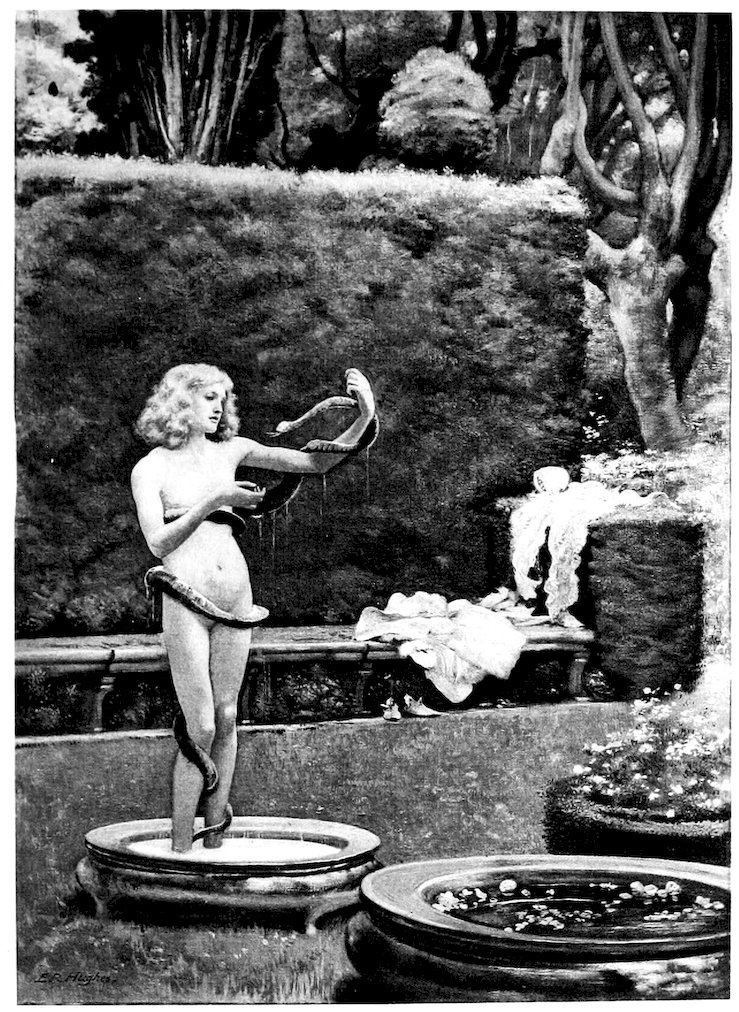
129When this was done Biancabella left the garden and returned to the palace. Her mother, when she perceived how her daughter had become more lovely and gracious than ever, and fairer than any other damsel in the world, was astonished beyond measure and knew not what to say. Wherefore she questioned the young girl as to what she had done to indue herself with such surpassing loveliness; but Biancabella had no answer to give her. Hereupon the marchioness took a comb and began to comb and dress her daughter’s fair locks, and forthwith from the girl’s hair there fell down pearls and all manner of precious stones, and when Biancabella went to wash her hands roses and violets and lovely flowers of all sorts sprang up around them, and the odours which arose from these were so sweet that it seemed as if the place had indeed become an earthly paradise. Her mother, when she saw this marvel, ran to find Lamberico her husband, and, full of maternal pride, thus addressed him: ‘My lord, heaven has bestowed upon us a daughter who is the sweetest, the loveliest, and the most exquisite work nature ever produced. For besides the divine beauty and grace in her, which is manifest to all eyes, pearls and gems and all other kinds of precious stones fall from her hair, and—to name something yet more marvellous—round about her white hands spring up roses and violets and all manner of flowers which give out the sweetest odours to all those who may come near her to wonder at the sight. All this I tell to you I assuredly would never have believed had I not looked thereon with my own eyes.’
Her husband, who was of an unbelieving nature, was at first disinclined to put faith in his wife’s words, and treated her speech as a subject for laughter and ridicule, but she went on plying him without ceasing with accounts of what she had witnessed, so that he determined to see for himself how the matter really stood. Then, having made them bring his daughter into his presence, he found about her even more marvellous things than his wife had described, and on account of what he saw he rejoiced exceedingly, and in his pride swore a great oath that there was in the whole world no man worthy to be united to her in wedlock.
Very soon the fame and glory of the supreme and immortal beauty of Biancabella began to spread itself through the whole world, and many kings and princes and nobles came together from all parts in order to win her love and favour and have her to wife, but not one of all these suitors was counted worthy to enjoy her, inasmuch as each one of them proved to be lacking in respect of one thing or another. But at last one day there came a-wooing Ferrandino, King of Naples, who by his prowess and by his illustrious name blazed out resplendent like the sun in the midst of the smaller luminaries, and, having presented himself to the marquis, demanded of him the hand of his daughter in marriage. The marquis, seeing that the suitor was seemly of countenance, and well knit in person, and full of grace, besides being a prince of great power and possessions and wealth, gave his consent to the nuptials at once, and, having summoned his daughter, without further parleying the two were betrothed by joining of hands and by kissing one another.
130Scarcely were the rites of betrothal completed, when Biancabella called back to mind the words which her sister Samaritana had so lovingly spoken to her, wherefore she withdrew herself from the presence of her spouse under the pretext that she had certain business of her own to see to, and, having gone to her own chamber, made fast the door thereof from within, and then passed by a secret thoroughfare into the garden. When she had come into the garden, she began to call upon Samaritana in a low voice. But the serpent no more manifested herself as heretofore, and Biancabella, when she perceived this, was mightily astonished, and, after she had searched through every part of the garden without finding a trace of Samaritana, a deep grief fell upon her, for she knew that this thing had happened to her because she had not given due attention and obedience to the commands which her sister had laid upon her. Wherefore, grieving and bewailing heavily on account of the mischance that had befallen her, she returned into her chamber, and having opened the door, she went to rejoin her spouse, who had been waiting a long time for her, and sat down beside him. When the marriage ceremonies were completed, Ferrandino led his bride away with him to Naples, where, with sumptuous state and magnificent festivities and the sound of trumpets, they were welcomed by the whole city with the highest honour.
It happened that there was living at Naples Ferrandino’s stepmother, who had two daughters of her own, both of them deformed and ugly; but, notwithstanding this, she had set her heart on marrying one of them to the king. But now, when all hope was taken from her of ever accomplishing this design of hers, her rage and anger against Biancabella became so savage that she could scarcely endure to look upon her. But she was careful to conceal her animosity, feigning the while to hold Biancabella in all love and affection. Now by a certain freak of fortune the King of Tunis at this time began to set in array a mighty force of armed men for service by land and likewise on sea, in order that he might incite Ferrandino to make war (whether he did this because Ferrandino had won Biancabella to wife, or for some other reason I know not), and at the head of a very powerful army he had already passed the bounds of the kingdom of Naples. On this account it was necessary that Ferrandino should straightway take up arms for the defence of his realm, and hurry to the field to confront his foe. Therefore, having 131settled his affairs, and made provision of all things necessary for Biancabella (she being now with child), he gave her over to the care of his stepmother and set forth with his army.
Ferrandino had not long departed when this malevolent and froward-minded woman made a wicked design on Biancabella’s life, and, having summoned into her presence certain retainers who were entirely devoted to her, she charged them to conduct Biancabella with them to some place or other—feigning that what they were doing was done for her recreation—and that they should not leave her until they had taken her life. Moreover, in order that she might be fully assured that they had discharged their duty, they were to bring back to her some sign of Biancabella’s death. These ruffians, prompt for any sort of ill-doing, at once prepared to carry out the commands of their mistress, and making pretence of conducting Biancabella to some place where she might recreate herself, they carried her away into a wood, and forthwith began to make preparation to kill her. But when they perceived how lovely she was, and gracious, they were moved to pity and had not the heart to take her life. So they cut off both her hands and tore her eyes out of her head, and these they carried back to the stepmother as certain proofs that Biancabella had been killed by them. When this impious and cruel woman saw what they brought in their hands, her joy and satisfaction were unbounded, and, scheming still in her wicked heart to carry out her nefarious designs, she spread through all the kingdom a report that both her own daughters were dead, the one of a continued fever, and the other of an imposthume of the heart, which had caused her death by suffocation. Moreover, she went on to declare that Biancabella, disordered by grief at the king’s departure, had miscarried of a child, and had likewise been seized with a tertian fever which had wasted her so cruelly that there was more cause to fear her death than to hope for her recovery. But the scheme of this wicked cunning woman was to keep one of her own daughters in the king’s bed, maintaining the while that she was Biancabella, shrunken and distempered by the fever.
Ferrandino, after he had attacked and put to rout the army of his foe, marched homeward in all the triumph of victory, hoping to find his beloved Biancabella full of joy and happiness, but in lieu of this he found her (as he believed) lying in bed shrivelled, pale, and disfigured. Then he went up to the bed and gazed closely at her 132face, and was overcome with astonishment when he looked upon the wreck she had become, and could hardly persuade himself that the woman he saw there could really be Biancabella. Afterwards he bade her attendants comb her hair, and, in place of the gems and the precious jewels which were wont to fall from the fair locks of his wife, there came forth great worms which had been feeding on the wretched woman’s flesh, and from the hands there came forth, not the roses and the sweet-smelling flowers which ever sprang up around Biancabella’s, but a foulness and filth which caused a nauseous sickness to all who came near her. But the wicked old stepmother kept on speaking words of consolation to him, declaring that all this distemper sprang from nothing else than the lengthened course of the ailment which possessed her.
In the meantime the ill-fated Biancabella, bereft of her hands and blind in both her eyes, was left alone in that solitary place, and, finding herself in such cruel affliction, she called over and over again upon her sister Samaritana, beseeching her to come to her rescue; but no answer came to her except from the resounding voice of Echo, who cried aloud through all the place. And while the unhappy Biancabella was left in the agony of despair, conscious that she was cut off from all human aid, there came into the wood a venerable old man, kindly of aspect and no less kindly in his heart. And he, when he listened to the sad and mournful voice which smote upon his hearing, made his way step by step towards the place whence it came, and stopped when he found there a blind lady with her hands cut off who was bitterly mourning the sad fate which had overtaken her. When the good old man looked upon her, and saw how sad was her condition, he could not bear to leave her thus in this wilderness of broken trees and thorns and brambles, but, overcome by the fatherly pity within him, he led her home with him to his house, and gave her into the charge of his wife, commanding her very strictly to take good care of the sufferer. Then he turned towards his three daughters, who verily were as beautiful as three of the brightest stars of heaven, and exhorted them earnestly to keep her company, and to render to her continually any loving service she might require, and to take care that she wanted for nothing. But the wife, who had a hard heart, and none of the old man’s pity, was violently moved to anger by these words of her husband, and, turning towards him, cried out: ‘Husband, what is this you would have us do with this 133woman, all blind and maimed as she is? Doubtless she has been thus treated as a punishment for her sins, and for no good behaviour.’ In reply to this speech the old man spake in an angry tone: ‘You will carry out all the commands I give you. If you should do aught else, you need not look to see me here again.’
It happened that while the unhappy Biancabella was left in charge of the wife and the three daughters, conversing with them of various things, and meditating over her own great misfortunes, she besought one of the maidens to do her a favour and comb her hair a little. But when the mother heard this she was much angered, forasmuch as she would not allow either of her children to minister in any way to the unfortunate sufferer. But the daughter’s heart was more given to pity than was her mother’s, and moreover she called to mind what her father’s commands had been, and was conscious of some subtle air of dignity and high breeding which seemed to emanate from Biancabella as a token of her lofty estate. So she straightway unfastened the apron from her waist, and, having spread it on the floor beside Biancabella, began to comb her hair softly and carefully. Scarcely had she passed the comb thrice through the blond tresses before there fell out of them pearls and rubies and diamonds and all sorts of precious stones. Now the mother, when she saw what had happened, was seized with dread, and stood as one struck with amazement; moreover, the great dislike which at first she had harboured towards Biancabella, now gave way to a feeling of kindly affection. And when the old man had come back to the house they all ran to embrace him, rejoicing with him greatly over the stroke of good fortune which had come to deliver them from the bitter poverty which had hitherto oppressed them. Then Biancabella asked them to bring her a bucket of clear water, and bade them wash therewith her face and her maimed arms, and from these, while all were standing by, roses and violets and other flowers in great plenty fell down; whereupon they all deemed she must be some divine personage, and no mortal woman.
Now after a season it came to pass that Biancabella felt a desire to return to the spot where first the old man had found her. But he and his wife and his daughters, seeing how great were the benefits they gathered from her presence, loaded her with endearments, and besought her very earnestly that she would on no account depart from them, bringing forward many reasons why she should not carry out 134her wish. But she, having resolutely made up her mind on this point, determined at all hazards to go away, promising at the same time to return to them hereafter. The old man, when he saw how firmly she was set on her departure, took her with him without any further delay back to the place where he had come upon her. And when they had reached this spot she gave directions to the old man that he should depart and leave her, bidding him also to come back there when evening should have fallen, in order that she might return with him to his house.
As soon as the old man had gone his way the ill-fated Biancabella began to wander up and down the gloomy wood, calling loudly upon Samaritana, so that her cries and lamentations rose up even to the high heavens. But Samaritana, though she was all the while nigh to her sister, and had never for one moment abandoned her, refused as yet to answer to her call. Whereupon the wretched Biancabella, deeming that she was scattering her words upon the heedless winds, cried out, ‘Alas! what further concern have I in this world, seeing that I have been bereft of my eyes and of my hands, and now at last all human help is denied to me.’ And as she thus spoke there came upon her a sort of frenzy, which took away from her all hope of deliverance from her present evil case, and urged her, in despair, to lay hands upon her own life. But because there was at hand no means by which she could put an end to her miserable being, she found her way to a pool of water, which lay not far distant, in the mind there to drown herself. But when she had come to the shore of the pool, and stood thereon ready to cast herself down into the water, there sounded in her ears a voice like thunder, saying: ‘Alas, alas, wretched one! keep back from self-murder, nor desire to take your own life, which you ought to preserve for some better end.’ Whereupon Biancabella, alarmed by this mighty voice, felt as it were every one of her hairs standing erect on her head, but after a moment it seemed to her that she knew the voice; so, having plucked up a little courage, she said: ‘Who are you who wander about these woods, proclaiming your presence to me by your kindly and pitiful words?’ Then the same voice replied: ‘I am Samaritana, your sister, for whom you have been calling so long and painfully.’ And Biancabella, when she listened to these words, answered in a voice all broken by agonized sobs, and said: ‘Alas, my sister! come to my aid, I beseech you; and if at any past time I have shown myself disregardful of 135your counsel, I pray you to pardon me. Indeed I have erred, and I confess my fault, but my misdeed was the fruit of my ignorance, and not of my wickedness; for be sure, if it had come from wickedness, divine justice would not have suffered me, as the author of it, so long to cumber the earth.’ Samaritana, when she heard her sister’s woes set forth in this pitiful story, and witnessed the cruel wrongs that had been done her, spake some comforting words, and then, having gathered divers medicinal herbs of wonderful power and virtue, she spread these over the places where Biancabella’s eyes had been. Then she brought to her sister two hands, and having joined these on to the wounded wrists, at once made them whole and sound again. And when she had wrought this marvellous feat Samaritana threw off from herself the scaly skin of the serpent, and stood revealed as a maiden of lovely aspect.
The sun had already begun to veil its glittering rays, and the evening shadows were creeping around, when the old man with anxious hasty steps returned to the wood, where he found Biancabella sitting beside a maiden wellnigh as lovely as herself. And he gazed steadily into her beauteous face, standing the while like to a man struck with wonder, and could scarcely believe it was Biancabella he looked upon. But when he was sure it was really she, he cried: ‘My daughter, were you not this morning blind and bereft of your hands? How comes it that you have been thus speedily made whole again?’ Biancabella answered him: ‘My cure has been worked, not by anything I myself have done, but by the virtue and the kind ministering of this my dear sister who sits here beside me.’ Whereupon both the sisters arose from the place where they were seated, and rejoicing greatly they went together with the old man to his house, where the wife and the three daughters gave them a most loving and hospitable welcome.
It came to pass after the lapse of many days that Samaritana and Biancabella, and the old man with his wife and his three daughters, left their cottage and betook themselves to the city of Naples, purposing to dwell there, and, when they had entered the city, they chanced to come upon a vacant space hard by the palace of the king, where they determined to make their resting-place. And when the dark night had fallen around them, Samaritana took in her hand a twig of laurel and thrice struck the earth therewith, uttering certain mystic words the while, and almost before the sound of these 136words had ceased there sprang up forthwith before them a palace, the most beautiful and sumptuous that ever was seen. The next morning Ferrandino the king went early to look out of the window, and when he beheld the rich and marvellous palace standing where there had been nothing the night before, he was altogether overcome with amazement, and called his wife and his stepmother to come and see it; but these were greatly disturbed in mind at the sight thereof, for a boding came upon them that some ill was about to befall them.
While Ferrandino was standing, scanning closely the palace before him, and examining it in all parts, he lifted his eyes to a certain window, and there, in the chamber inside, he beheld two ladies of a beauty more rich and dazzling than the sun. And no sooner had his eyes fallen upon them than he felt a tempest of passion rising in his heart, for he assuredly recognized in one of them some similitude of that loveliness which had once been Biancabella’s. And when he asked who they were, and from what land they had come, the answer which was given him was that they were two ladies who had been exiled from their home, and that they had journeyed from Persia, with all their possessions, to take up their abode in the noble city of Naples. When he heard this, Ferrandino sent a messenger to inquire whether he would be doing them any pleasure in waiting upon them, accompanied by the ladies of his court, to pay them a visit of welcome, and to this gracious message they sent an answer, saying that it would indeed be a very precious honour to be thus visited by him, but that it would be more decorous and respectful if they, as subjects, should pay this duty to him, than that he, as lord and king, should visit them.