Volume 1 — Night the Third. (continued 2)
W. G. (William George) Waters translation
Hereupon Ferrandino bade them summon the queen and the other ladies of the court, and with these (although at first they refused to go, being so greatly in fear of their impending ruin) he betook himself to the palace of the two ladies, who, with all friendly signs of welcome and with modest bearing, gave him the reception due to a highly honoured guest, showing him the wide loggias, and the roomy halls, and the richly ornamented chambers, the walls of which were lined with alabaster and fine porphyry, while about them were to be seen on all sides carven figures which looked like life. And when they had exhibited to the king all parts of the sumptuous palace, the two fair young women approached Ferrandino and besought him most gracefully that he would deign to come one 137day with his queen and dine at their table. The king, whose heart was not hard enough to remain unaffected by all he had seen, and who was gifted moreover with a magnanimous and liberal spirit, graciously accepted the invitation. And when he had tendered his thanks to the two ladies for the noble welcome they had given him, he and the queen departed together and returned to their own palace. When the day fixed for the banquet had come, the king and the queen and the stepmother, clad in their royal robes and accompanied by some of the ladies of the court, went to do honour to the magnificent feast set out in the most sumptuous fashion. And after he had given them water to wash their hands, the seneschal bade them conduct the king and the queen to a table apart, set somewhat higher, but at the same time near to the others, and having done this, he caused all the rest of the guests to seat themselves according to their rank, and in this fashion they all feasted merrily and joyfully together.
When the stately feast had come to an end and the tables had been cleared, Samaritana rose from her seat, and turning towards the king and the queen, spake thus: ‘Your majesties, in order that the time may not be irksome to us, as it may if we sit here idle, let one or other of us propose something in the way of diversion which will let us pass the day pleasantly.’ And when the guests heard what Samaritana said, they all agreed that she had spoken well, but yet there was found no one bold enough to make such a proposition as she had called for. Whereupon Samaritana, when she perceived they were all silent, went on: ‘Since it appears that no one of this company is prepared to put forward anything, I, with your majesty’s leave, will bid come hither one of our own maidens, whose singing perchance will give you no little pleasure.’ And having summoned the damsel, whose name was Silveria, into the banqueting-room, Samaritana commanded her to take a lyre in her hand and to sing thereto something in honour of the king which should be worthy of their praise. And the damsel, obedient to her lady’s command, took her lyre, and, having placed herself before the king, sang in a soft and pleasant voice while she touched the resounding strings with the plectrum, telling in her chant the story of Biancabella from beginning to end, but not mentioning her by name. When the whole of the story had been set forth, Samaritana again rose to her feet, and demanded of the king what would be the fitting punishment, what 138torture would be cruel enough for those who had put their hands to such an execrable crime. Then the stepmother, who deemed that she might perchance get a release for her misdeeds by a prompt and ready reply, did not wait for the king to give his answer, but cried out in a bold and confident tone, ‘Surely to be cast into a furnace heated red hot would be but a light punishment for the offences of such a one.’ Then Samaritana, with her countenance all afire with vengeance and anger, made answer to her: ‘Thou thyself art the very same guilty and barbarous woman, through whose nefarious working all these cruel wrongs have been done; and thou, wicked and accursed one, hast condemned thyself to a righteous penalty out of thine own mouth.’ Then Samaritana, turning towards the king with a look of joy upon her face, said to him, ‘Behold! this is your Biancabella, this is the wife you loved so dearly, this is she without whom you could not live.’ Then, to prove the truth of her words, Samaritana gave the word to the three daughters of the old man that they should forthwith, in the presence of the king, begin to comb Biancabella’s fair and wavy hair, and scarcely had they begun when (as has been told before) there fell out of her tresses many very precious and exquisite jewels, and from her hands came forth roses exhaling the sweet scents of morning, and all manner of odoriferous flowers. And for yet greater certainty she pointed out to the king how the snow-white neck of Biancabella was encircled by a fine chain of the most delicately wrought gold, which grew naturally between the skin and the flesh, and shone out as through the clearest crystal.
When the king perceived by these manifest and convincing signs that she was indeed his own Biancabella, he began to weep for the joy he felt, and to embrace her tenderly. But before he left that place he caused to be heated hot a furnace, and into this he bade them cast the stepmother and her two daughters. Thus their repentance for their crimes came too late, and they made a miserable end to their lives. And after this the three daughters of the old man were given honourably in marriage, and the King Ferrandino with Biancabella and Samaritana lived long and happily, and when Ferrandino died his son succeeded to his kingdom.
During the telling of Lauretta’s story divers of the listeners were several times moved to tears, and, when she had brought it to an end, the Signora bade her follow the example of those who had 139gone before her, and set forth her enigma. Therefore she, not waiting for any further command, gave it in the following words:
A proud and cruel maid I spied,
As through the flowery meads she hied.
Behind her trailed a lengthy train,
Upreared her head in high disdain.
And swiftly on her way she took,
And sharp her touch, and eke her look.
What though her tongue moves all around,
She utters neither voice nor sound.
She is long, and thin, and wise,
He can tell her name who tries.
All the company listened attentively to the enigma which Lauretta gave to them in her sportive way, and she, when she saw there was little likelihood that anyone would find the solution thereof, spake thus: “Dear ladies, so as not to keep you any longer in suspense, or to weary yet more your minds, which must needs be somewhat harassed on account of the pathetic story I have just told you, I will tell you the answer straightway, if such be your pleasure. The damsel I described therein is nothing else than the serpent which, when it goes through the flowery meadows, keeps its head erect and its tail trailing on the ground behind it, and frightens with its sharp eye everyone who may happen to behold it.”
As soon as Lauretta had finished her speech everyone was much astonished that the solution of the riddle had not been guessed by some one or other. And when she had resumed her seat the Signora made a sign to Alteria that she should tell them her fable, and she, having risen and made obeisance to the Signora, began it forthwith.

140
THE FOURTH FABLE.
Fortunio, on account of an injury done to him by his supposed father and mother, leaves them, and after much wandering, comes to a wood, where he finds three animals, who do him good service. Afterwards he goes to Polonia, where he gets to wife Doralice, the king’s daughter, as a reward for his prowess.

There is a saying, very frequent in the mouths of common people, that it is not seemly to jest at affliction nor to make a mock at the truth; forasmuch as he who keeps his eyes and ears open, and holds his tongue, is not likely to injure his fellows, and may hope himself to live in peace.
Once upon a time there lived in one of the remoter districts of Lombardy a man called Bernio, who, although he was not over well endowed with the gifts of fortune, was held to be in no way wanting with respect to good qualities of head and heart. This man took to wife a worthy and amiable woman named Alchia, who, though she chanced to be of low origin, was nevertheless of good parts and exemplary conduct, and loved her husband as dearly as any woman could. This married pair greatly desired to have children, but such a gift of God was not granted to them, peradventure for the reason that man often, in his ignorance, asks for those things which would not be to his advantage. Now, forasmuch as this desire for offspring still continued to possess them, and as fortune obstinately refused to grant their prayer, they determined at last to adopt a child whom they would nurture and treat in every way as if he were their own legitimate son. So one morning early they betook themselves to a certain spot where young children who had been cast off by their parents were often left, and, having seen there one who appeared to them more seemly and attractive than the rest, they took him home with them, and brought him up with the utmost care and good governance. Now after a time it came to pass (according to the good pleasure of Him who rules the universe and tempers and modifies everything according to His will) that Alchia became with child, and when her time of delivery was come, was brought to bed 141with a boy who resembled his father exactly. On this account both father and mother rejoiced exceedingly, and called their son by the name of Valentino.
The infant was well nurtured, and grew up strong and healthy and well-mannered; moreover, he loved so dearly his brother—to whom the name of Fortunio had been given—that he was inclined almost to fret himself to death whenever they chanced to be separated the one from the other. But the genius of discord, the foe of everything that is good, becoming aware of their warm and loving friendship, and being able no longer to suffer their good understanding to continue, one day interposed between them, and worked her evil will so effectively that before long the two friends began to taste her bitter fruits. Wherefore as they were sporting together one day (after the manner of boys) they grew somewhat excited over their game, and Valentino, who could not bear that Fortunio should get any advantage over him in their play, became inflamed with violent anger, and more than once called his companion a bastard and the son of a vile woman. Fortunio, when he heard these words, was much astonished, and perturbed as well, and turning to Valentino, he said to him, ‘And why am I a bastard?’ In reply, Valentino, muttering angrily between his teeth, repeated what he had already said, and even more. Whereupon Fortunio, greatly grieved and disturbed in mind, gave over playing and went forthwith to his so-called mother, and asked her whether he was in sooth the son of Bernio and herself. Alchia answered that he was, and, having learned that Fortunio had been insulted by Valentino, she rated the latter soundly, and declared that she would give him heavy chastisement if he should repeat his offence. But the words which Alchia had spoken roused fresh suspicion in Fortunio, and made him wellnigh certain that he was not her legitimate son; indeed, there often came upon him the desire to put her to the test, to see whether she really was his mother or not, and thus discover the truth. In the end he questioned and importuned her so closely that she acknowledged he was not born of her, but that he had been adopted and brought up in their house for the love of God and for the alleviation of the misfortune which had been sent upon herself and her husband. These words were as so many dagger-thrusts in the young man’s heart, piling up one sorrow upon another, and at last his grief grew beyond endurance; but, seeing that he could not bring himself to seek refuge from his trouble by a violent death, he 142determined to depart from Bernio’s roof, and, in wandering up and down the world, to seek a better fortune.
Alchia, when she perceived that Fortunio’s desire to quit the house grew stronger every day, was greatly incensed against him, and, as she found herself powerless to dissuade him from his purpose, she heaped all sorts of curses upon him, praying that if ever he should venture upon the sea he might be engulfed in the waves and swallowed up by the sirens, as ships are often swallowed up by storms. Fortunio, driven on by a headlong access of rage, took no heed of Alchia’s malediction, and, without saying any further words of farewell, either to her or to Bernio, departed, and took his way towards the east. He journeyed on, passing by marshes, by valleys, by rocks, and all kinds of wild and desert spots, and at last, one day between sext and none, he came upon a thick and densely-tangled forest, in the midst of which, by strange chance, he found a wolf and an eagle and an ant, who were engaged in a long and sharp contention over the body of a stag which they had lately captured, without being able to agree as to how the venison should be divided amongst themselves. When Fortunio came upon the three animals they were in the midst of their stubborn dispute, and not one was disposed in any way to yield to the others; but after a while they agreed that this young man, who had thus unexpectedly come amongst them, should adjudicate the matter in question, and assign to each one of them such part of the spoil as he might deem most fitting. Then, when they had assented to these preliminaries, and had promised that they would be satisfied with and observe the terms of any award he might make, even though it might seem to be unjust, Fortunio readily undertook the task, and after he had carefully considered the case, he divided the prey amongst them in the following manner. To the wolf, as to a voracious animal and one very handy with his sharp teeth, he gave, as the guerdon of his toil in the chase, all the bones of the deer and all the lean flesh. To the eagle, a rapacious fowl, but furnished with no teeth, he gave the entrails, and all the fat lying round the lean parts and the bones. To the provident and industrious ant, which had none of that strength which nature had bestowed upon the wolf and the eagle, he gave the soft brains as her share of reward for the labour she had undergone. When the three animals understood the terms of this just and carefully-considered decision, they were fully satisfied, and thanked 143Fortunio as well as they could for the courtesy he had shown them.
Now these three animals held—and with justice—that, of all the vices, ingratitude was the most reprehensible; so with one accord they insisted that the young man should not depart until they should have fully rewarded him for the great service he had done them. Wherefore the wolf, speaking first, said: ‘My brother, I give you the power, if at any time the desire should come upon you to be a wolf instead of a man, to become one forthwith, merely by saying the words, “Would that I were a wolf!” At the same time you will be able to return to your former shape whenever you may desire.’ And in like manner both the eagle and the ant endowed him with power to take upon him their form and similitude.
Then Fortunio, rejoicing greatly at the potent virtues thus given to him, and rendering to all three of the animals the warmest gratitude for their boon, took his leave and wandered far abroad, until at last he came to Polonia, a populous city of great renown, which was at that time under the rule of Odescalco, a powerful and valorous sovereign, who had but one child, a daughter called Doralice. Now the king was ambitious to find a noble mate for this princess, and it chanced that, at the time when Fortunio arrived in Polonia, he had proclaimed throughout his kingdom that a grand tournament should be held in the city, and that the Princess Doralice should be given in marriage to the man who should be the victor in the jousts. And already many dukes and marquises and other powerful nobles had come together from all parts to contend for this noble prize, and on the first day of the tournament, which had already passed, the honours of the tilting were borne off by a foul Saracen of hideous aspect and ungainly form, and with a face as black as pitch. The king’s daughter, when she viewed the deformed and unseemly figure of the conqueror of the day, was overwhelmed with grief that fate should have awarded to such a one the victory in the joust, and, burying her face, which was crimson with shame, in her tender delicate hands, she wept and lamented sore, execrating her cruel and malignant destiny, and begging that death might take her rather than that she should become the wife of this misshapen barbarian. Fortunio, when he entered the city gate, noted the festal array on all sides and the great concourse of people about the streets, and when he learned the cause of all this magnificent display he was straightway possessed with an ardent desire to prove his 144valour by contending in the tournament, but when he came to consider that he was lacking in all the apparel needful in such honourable contests, his heart fell and heavy sorrow came over him. While he was in this doleful mood it chanced that his steps led him past the palace of the king, and raising his eyes from the ground he espied Doralice, the daughter of the king, who was leaning out of one of the windows of her apartment. She was surrounded by a group of lovely and highborn dames and maidens, but she shone out amongst them all on account of her beauty, as the radiant glorious sun shines out amidst the lesser lights of heaven.
By-and-by, when the dark night had fallen, and all the ladies of the court had retired to their apartments, Doralice, restless and sad at heart, betook herself alone to a small and exquisitely ornamented chamber and gazed once more out into the night, and there below, as luck would have it, was Fortunio. When the youth saw her standing solitary at the open window, he was so overcome by the charms of her beauty that he forthwith whispered to himself in an amorous sigh: ‘Ah! wherefore am I not an eagle?’ Scarcely had these words issued from his lips when he found himself transformed into an eagle, whereupon he flew at once into the window of the chamber, and, having willed to become a man again, was restored to his own shape. He went forward with a light and joyful air to greet the princess, but she, as soon as she saw him, was filled with terror and began to cry out in a loud voice, just as if she were being attacked and torn by savage dogs. The king, who happened to be in an apartment not far distant from his daughter’s, heard her cries of alarm and ran immediately to seek the cause thereof, and, having heard from her that there was a young man in the room, he at once ordered it to be searched in every part. But nothing of the sort was found, because Fortunio had once more changed himself into an eagle and had flown out of the window. Hardly, however, had the father gone back to his chamber when the maiden began to cry aloud just the same as before, because, forsooth, Fortunio had once more come into her presence.
But Fortunio, when he again heard the terrified cries of the maiden, began to fear for his life, and straightway changed himself into an ant, and crept into hiding beneath the blond tresses of the lovely damsel’s hair. Odescalco, hearing the loud outcries of his daughter, ran to her succour, but when he found nothing more this second time than he had found before, he was greatly incensed against her, and threatened 145her harshly that if she should cry out again and disturb him he would play her some trick which would not please her, and thus he left her with angry words, suspecting that what had caused her trouble was some vision of one or other of the youths who for love of her had met their deaths in the tournament. Fortunio listened attentively to what the king said to his daughter, and, as soon as he had left the apartment, once more put off the shape of an ant and stood revealed in his own form. Doralice, who in the meanwhile had gone to bed, was so terror-stricken when she saw him that she tried to spring from her couch and to give the alarm, but she was not able to do this, because Fortunio placed one of his hands on her lips, and thus spake: ‘Signora, fear not that I have come here to despoil you of your honour, or to steal aught that belongs to you. I am come rather to succour you to the best of my power, and to proclaim myself your most humble servant. If you cry out, one or other of two misfortunes will befall us, either your honour and fair name will be tarnished, or you will be the cause of your death and of my own. Therefore, dear lady of my heart, take care lest at the same time you cast a stain upon your reputation and imperil the lives of us both.’
While Fortunio was thus speaking, Doralice was weeping bitterly, her presence of mind being completely overthrown by this unexpected declaration on his part, and the young man, when he perceived how powerfully agitated she was, went on addressing her in words gentle and persuasive enough to have melted the heart of a stone. At last, conquered by his words and tender manner, she softened towards him, and consented to let him make his peace with her. And after a little, when she saw how handsome the youth was in face, and how strong and well knit in body and limb, she fell a-thinking about the ugliness and deformity of the Saracen, who, as the conqueror in the jousts, must before long be the master of her person. While these thoughts were passing through her mind the young man said to her: ‘Dear lady, if I had the fitting equipment, how willingly would I enter the jousts to tilt on your behalf, and my heart tells me that, were I to contend, I should surely conquer.’ Whereupon the damsel in reply said: ‘If this, indeed, were to come to pass, if you should prove victorious in the lists, I would give myself to you alone.’ And when she saw what a well-disposed youth he was, and how ardent in her cause, she brought forth a great quantity of gems and a heavy purse of gold, and bade him take them. Fortunio accepted them with his 146heart full of joy, and inquired of her what garb she wished him to wear in the lists to-morrow. And she bade him array himself in white satin, and in this matter he did as she commanded him.
On the following day Fortunio, encased in polished armour, over which he wore a surcoat of white satin richly embroidered with the finest gold, and studded with jewels most delicately carven, rode into the piazza unknown to anybody there present. He was mounted on a powerful and fiery charger, which was caparisoned and decked in the same colours as its rider. The crowd, which had already come together to witness the grand spectacle of the tournament, no sooner caught sight of the gallant unknown champion, with lance in hand all ready for the fray, than every person was lost in wonderment at so brave a sight, and each one, gazing fixedly at Fortunio, and astonished at his grace, began to inquire of his neighbour: ‘Ah! who can this knight be who rides so gallantly and splendidly arrayed into the lists? Know you not what is his name?’ In the meantime Fortunio, having entered the lists, called upon some rival to advance, and for the first course the Saracen presented himself, whereupon the two champions, keeping low the points of their trusty lances, rushed one upon the other like two lions loosened from their bonds, and so shrewd was the stroke dealt by Fortunio upon the head of the Saracen, that the latter was driven right over the crupper of his horse, and fell dead upon the bare earth, mangled and broken up as a fragile glass is broken when it is thrown against a wall. And Fortunio ran his course just as victoriously in encountering every other champion who ventured to oppose him in the lists. The damsel, when she saw how the fortune of the day was going, was greatly rejoiced, and kept her eyes steadily fixed on Fortunio in deepest admiration, and, thanking God in her heart for having thus graciously delivered her from the bondage of the Saracen, prayed to Him that this brave youth might be the final victor.
When the night had come they bade Doralice come to supper with the rest of the court; but to this bidding she made demur, and commanded them bring her certain rich viands and delicate wines to her chamber, feigning that she had not yet any desire for food, but would eat, perchance, later on if any appetite should come upon her. Then, having locked herself in her chamber and opened the window thereof, she watched with ardent desire for the coming of her lover, and when he had gained admittance to the chamber by the same 147means as he had used the previous day, they supped joyfully together. Then Fortunio demanded of her in what fashion she would that he should array himself for the morrow, and she made answer that he must bear a badge of green satin all embroidered with the finest thread of silver and gold, and that his horse should be caparisoned in like manner. On the following morning Fortunio appeared, attired as Doralice had directed, and, having duly presented himself in the piazza at the appointed time, he entered the lists and proved himself again as valiant a champion as he had proved to be on the day before. So great was the admiration of the people of his prowess, that the shout went up with one voice that he had worthily won the gracious princess for his bride.
On the evening of that day the princess, full of merriment and happiness and joyous expectations, made the same pretext for absenting herself from supper as she had made the day before, and, having locked the door of her chamber, awaited there the coming of her lover, and supped pleasantly with him. And when he asked her once more with what vestments he should clothe himself on the following day, she answered that she wished him to wear a surcoat of crimson satin, all worked and embroidered with gold and pearls, and to see that the trappings of his horse were made in the same fashion; adding that she herself would, on the morrow, be clad in similar wise. ‘Lady,’ replied Fortunio, ‘if by any chance I should tarry somewhat in making my entry into the lists, be not astonished, for I shall not be late without good cause.’
When the morning of the third day had come, the spectators awaited the issue of the momentous strife with the most earnest expectation, but, on account of the inexhaustible valour of the gallant unknown champion, there was no opponent found who dared to enter the lists against him, and he himself for some hidden reason did not appear. After a time the spectators began to grow impatient at his non-appearance, and injurious words were dropped. Even Doralice herself was assailed by suspicions as to his worth, although she had been warned by Fortunio himself that probably his coming would be delayed; so, overcome by this hidden trouble of hers—concerning which no one else knew anything—she wellnigh swooned with grief. At last, when it was told to her that the unknown knight was advancing into the piazza, her failing senses began to revive. Fortunio was clad in a rich and sumptuous dress, and the trappings of 148his horse were of the finest cloth of gold, all embroidered with shining rubies and emeralds and sapphires and great pearls. When the people saw these they affirmed that the price of them would be equal to a great kingdom, and when Fortunio came into the piazza, every one cried out in a loud voice: ‘Long live the unknown knight!’ and after this they all applauded vigorously and clapped their hands. Then the jousting began, and Fortunio once more carried himself so valiantly that he bore to earth all those who dared to oppose him, and in the end was hailed as the victor in the tournament. And when he had dismounted from his noble horse, the chief magnates and the wealthy citizens of the town bore him aloft on their shoulders, and to the sound of trumpets and all other kinds of musical instruments, and with loud shouts which went up to the heavens, they carried him into the presence of the king. When they had taken off his helmet and his shining armour the king perceived what a seemly graceful youth he was, and, having called his daughter into his presence, he betrothed them forthwith, and celebrated the nuptials with the greatest pomp, keeping open table at the court for the space of a month.
After Fortunio had lived for a certain space of time in loving dalliance with his fair wife, he was seized one day with the thought that he was playing the part of an unworthy sluggard in thus passing the days in indolence, merely counting the hours as they sped by, after the manner of foolish folk, and of those who consider not the duties of a man. Wherefore he made up his mind to go afield into certain regions, where there might be found due scope and recognition for his valour and enterprise; so, having got ready a galley and taken a large treasure which his father-in-law had given him, he embarked after taking leave of his wife and of King Odescalco. He sailed away, wafted on by gentle and favourable breezes, until he came into the Atlantic Ocean, but before he had gone more than ten miles thereon, there arose from the waves the most beautiful Siren that ever was seen, and singing softly, she began to swim towards the ship. Fortunio, who was reclining by the side of the galley, bent his head low down over the water to listen to her song, and straightway fell asleep, and, while he thus slept, the Siren drew him gently from where he lay, and, bearing him in her arms, sank with him headlong into the depths of the sea. The mariners, after having vainly essayed to save him, broke out into loud lamentations 149over his sad fate, and, weeping and mourning, they decked the galley with black ensigns of grief, and returned to the unfortunate Odescalco to tell him of the terrible mischance which had befallen them during their voyage. The king and Doralice, when the sad news was brought to them, were overwhelmed with the deepest grief—as indeed was everyone else in the city—and all put on garments of mourning black.
Now at the time of Fortunio’s departure Doralice was with child, and when the season of her delivery had come she gave birth to a beautiful boy, who was delicately and carefully nurtured until he came to be two years of age. At this time the sad and despairing Doralice, who had always brooded over her unhappy fate in losing the company of her beloved husband, began to abandon all hope of ever seeing him again; so she, like a brave and great-souled woman, resolved to put her fortune to the test and go to seek for him upon the deep, even though the king her father should not consent to let her depart. So she caused to be set in order for her voyage an armed galley, well fitted for such a purpose, and she took with her three apples, each one a masterpiece of handicraft, of which one was fashioned out of golden bronze, another of silver, and the last of the finest gold. Then, having taken leave of her father the king, she embarked with her child on board the galley, and sailed away before a prosperous wind into the open sea.
After the sad and woe-stricken lady had sailed a certain time over the calm sea, she bade the sailors steer the ship forthwith towards the spot where her husband had been carried off by the Siren, and this command they immediately obeyed. And when the vessel had been brought to the aforesaid spot, the child began to cry fretfully, and would in no wise be pacified by his mother’s endearments; so she gave him the apple which was made of golden bronze to appease him. While the child was thus sporting with the apple, he was espied by the Siren, who, having come near to the galley and lifted her head a little space out of the foaming waves, thus spake to Doralice: ‘Lady, give me that apple, for I desire greatly to have it.’ But the princess answered her that this thing could not be done, inasmuch as the apple was her child’s plaything. ‘If you will consent to give it to me,’ the Siren went on, ‘I will show you the husband you have lost as far as his breast.’ Doralice, when she heard these words, at once took the apple from the child and handed it courteously to the Siren, for she longed above all 150things else to get sight of her beloved husband. The Siren was faithful to her promise, and after a little time brought Fortunio to the surface of the sea and showed him as far as the breast to Doralice, as a reward for the gift of the apple, and then plunged with him once more into the depths of the ocean, and disappeared from sight.
Doralice, who had naturally feasted her eyes upon the form of her husband what time he was above the water, only felt the desire to see him once more grow stronger after he was gone under again, and, not knowing what to do or to say, she sought comfort in the caresses of her child, and when the little one began to cry once more, the mother gave to it the silver apple to soothe its fancy. Again the Siren was on the watch and espied the silver apple in the child’s hand, and having raised her head above the waves, begged Doralice to give her the apple, but the latter, shrugging her shoulders, said that the apple served to divert the child, and could not be spared. Whereupon the Siren said: ‘If only you will give me this apple, which is far more beautiful than the other, I promise I will show you your husband as far as his knees.’ Poor Doralice, who was now consumed with desire to see her beloved husband again, put aside the satisfaction of the child’s fancy, and, having taken away from him the silver apple, handed it eagerly to the Siren, who, after she had once more brought Fortunio to the surface and exhibited him to Doralice as far as his knees (according to her promise), plunged again beneath the waves.
For a while the princess sat brooding in silent grief and suspense, trying in vain to hit upon some plan by which she might rescue her husband from his piteous fate, and at last she caught up her child in her arms and tried to comfort herself with him and to still his weeping. The child, mindful of the fair apple he had been playing with, continued to cry; so the mother, to appease him, gave him at last the apple of fine gold. When the covetous Siren, who was still watching the galley, saw this apple, and perceived that it was much fairer than either of the others, she at once demanded it as a gift from Doralice, and she begged so long and persistently, and at last made a promise to the princess that, in return for the gift of this apple, she would bring Fortunio once more into the light, and show him from head to foot; so Doralice took the apple from the boy, in spite of his chiding, and gave it to the Siren. Whereupon the latter, in order to carry out her promise, came quite close to the galley, bearing Fortunio upon her back, and having raised herself somewhat above the surface of the 151water, showed the person of Fortunio from head to foot. Now, as soon as Fortunio felt that he was quite clear of the water, and resting free upon the back of the Siren, he was filled with great joy in his heart, and, without hesitating for a moment, he cried out, ‘Ah! would that I were an eagle,’ and scarcely had he ceased speaking when he was forthwith transformed into an eagle, and, having poised himself for flight, he flew high above the sail yards of the galley, from whence—all the shipmen looking on the while in wonder—he descended into the ship and returned to his proper shape, and kissed and embraced his wife and his child and all the sailors on the galley.
Then, all of them rejoicing at the rescue of Fortunio, they sailed back to King Odescalco’s kingdom, and as soon as they entered the port they began to play upon the trumpets and tabors and drums and all the other musical instruments they had with them, so that the king, when he heard the sound of these, was much astonished, and in the greatest suspense waited to learn what might be the meaning thereof. And before very long time had elapsed the herald came before him, and announced to the king how his dear daughter, having rescued her husband from the Siren, had come back. When they were disembarked from the galley, they all repaired to the royal palace, where their return was celebrated by sumptuous banquets and rejoicings. But after some days had passed, Fortunio betook himself for a while to his old home, and there, after having transformed himself into a wolf, he devoured Alchia, his adoptive mother, and Valentino her son, in revenge for the injuries they had worked him. Then, after he had returned to his rightful shape, he mounted his horse and rode back to his father-in-law’s kingdom, where, with Doralice his dear wife, he lived in peace for many years to the great delight of both of them.
As soon as Alteria had brought to an end her long and interesting story the Signora bade her at once to set forth her enigma, and she, smiling pleasantly, obeyed the command.
Far from this our land doth dwell
One who by turns is fair or fell;
Springing from a twofold root,
One part woman, one part brute.
Now like beauty’s fairest jewel,
Now a monster fierce and cruel.
Sweetest song on vocal breath,
To lead men down to shameful death.
152Alteria’s most fitting and noteworthy enigma was answered in divers fashion by the listeners, some giving one interpretation of it and some another, but not one of them came upon its exact meaning. Therefore, when the fair Alteria saw there was little chance of anyone finding the true answer, she said: “Ladies and gentlemen, the real subject of my enigma is the fascinating Siren who is fabled to dwell in the deep sea. She is very fair to look upon, for her head and breast and body and arms are those of a beautiful damsel, but all the rest of her form is scaly like a fish, and in her nature she is cunning and cruel. She sings so sweetly that the mariners, when they hear her song, are soothed to slumber, and while they sleep she drowns them in the sea.” When the listeners heard this clever and subtle solution given by Alteria, they praised it warmly with one accord, declaring the while that it was most ingenious. And she, smiling with pleasure and gratitude, rose from her chair and thanked them for their kindness in thus lending their attention to her story. As soon as she had taken her seat, the Signora made a sign to Eritrea to follow in the due order with her story, and she, blushing like a morning rose, began it in these words.
THE FIFTH FABLE.
Isotta, the wife of Lucaferro Albani of Bergamo, devises how she may trick Travaglino the cowherd of her brother Emilliano and thereby show him to be a liar, but she loses her husband’s farm and returns home worsted in her attempt, and bringing with her a bull’s head with gilded horns.
So great is the strength of truth, our infallible guide, that, according to the testimony of Holy Writ, it would be easier for heaven and earth to pass away than for truth to fail. And so far-reaching a charter has truth, as is written by all the wise men of the world, that she is ever the victor of time, and time never victor over her. Like as oil, if it be poured in a vessel together with water, will always rise to the top, so will truth always assert herself over falsehood. Wherefore on this account let no one be amazed over this prologue of mine, seeing that I have 153set it down, moved thereto by the malignity of a wicked woman, who, deeming that she might, by the means of her false allurements, lead on a young fellow to tell a lie, only induced him to speak the plain truth to her own confusion, the which, wicked woman as she was, she well merited. All this I propose to set before you in this story of mine, which I hope, both as to time and place, will prove more profitable than hurtful to all of you.
I will first tell my worthy hearers that in Bergamo, an ancient city of Lombardy, there lived not a great time ago a man of wealth and standing whose name was Pietromaria di Albani. To this man were born two sons, of whom one was called Emilliano, and the other Lucaferro. He possessed also two farms in a township not far removed, one of them known by the name of Ghorem, and the other by that of Pedrench. The two brothers, that is to say, Emilliano and Lucaferro, divided the farms between them by lot after the death of Pietromaria their father, and Pedrench fell to the share of Emilliano, and Ghorem to Lucaferro. Now Emilliano owned a very fine flock of sheep, and a herd of lusty young bullocks, and likewise a second herd of productive cows, and over the whole of these cattle one Travaglino had charge as herdsman, a man of the most approved truth and loyalty, who, however dear he held his life, would not have told a lie to save it, and who, moreover, as a herdsman had not his equal in all the world. With his herd of cows Travaglino kept several very fine bulls, amongst which there was one especially beautiful in appearance, and so great a favourite was this bull with Emilliano that he caused its horns to be gilded over with the finest gold. And as often as Travaglino might go to Bergamo after his affairs, Emilliano would never fail to question him as to the welfare of his favourite bull with the gilded horns.
It happened one day that while Emilliano was entertaining and holding converse with his brother Lucaferro and with divers other of his friends, Travaglino came anigh the company and made a sign to Emilliano his master that he wanted to speak with him. Whereupon the latter forthwith withdrew from the presence of his brother and his friends, and, having gone apart with Travaglino, held him there some long time in conversation. And after this it would happen full often that Emilliano would do the like, and leave his friends and family who might be about him, and betake himself aside to confer with his herdsman; so that at last Lucaferro, his brother, 154lost patience at such doings, and could endure them no longer. On one occasion, therefore, hot with wrath and indignation, he spake to Emilliano in these words: ‘Emilliano, I am astonished beyond measure at your behaviour, that you make more account of this rascally cowherd of yours than you make of your own brother and of your many trusted friends; because, forsooth, not once, but a thousand times, if I may so express myself, you have gone away from us when we were together in the piazza, or over our games, as if we had been so many beasts only fit to be driven to the shambles, to go and foregather with this lubberly ruffian of a Travaglino, your hireling, and to have long converse with him, making believe that the affairs you had to discuss with him were of the highest importance, while in fact nothing you talked about mattered a single straw.’ To this Emilliano made answer: ‘Lucaferro, my good brother, there is surely no need for you to fly into so hot a passion with me, while you heap all these injurious words upon poor Travaglino, who, after all, is a very worthy young fellow, and one on whom I set great store, both on account of his efficiency in his calling and for his staunch loyalty towards myself; moreover, he has yet another and special good quality, inasmuch as he would not, to gain all the wealth there is in the world, speak a word which was not the truth. And furthermore he has many other excellent traits on account of which I hold him in high esteem; therefore there is no reason why you should be astonished at my fondness for him, or that I should treat him kindly.’
This answer given by Emilliano only served to stir yet deeper his brother’s bile, and they straightway began to bandy angry words from one to the other, so that they narrowly escaped coming to blows. In the end Lucaferro, on account of the high commendation pronounced by Emilliano over Travaglino’s good qualities—the which is written above—thus spake: ‘You speak loud enough to-day of the efficiency, and the good faith, and the truthfulness of this cowherd of yours, but I tell you that he is the most bungling, the most disloyal loon in the world, as well as the biggest liar that nature ever made. And moreover I will pledge myself to bring all this to your notice, and to let you hear him tell a falsehood before your very face.’ After they had spent much time in wrangling, they ended by wagering their respective farms over the question, settling the affair in this fashion, namely, that if Travaglino should be proved to be a liar, the farm of Emilliano should pass to Lucaferro; but if, on the other 155hand, he should be found truthful, Emilliano should become the owner of Lucaferro’s. And over this matter, having called in a notary, they caused to be drawn up a legal instrument ratified by all the forms which are required in such cases.
After the brothers had parted one from the other, and after their wrath and indignation had gone down somewhat, Lucaferro began to be sore repentant of the wager he had made, and of the legal instrument he had requested to be enacted under the seal of the notary. Wherefore he found himself mightily troubled over the affair, and haunted by the fear lest at the end of it he might find himself deprived of his farm, out of which alone he had to find sustenance for himself and for his family. One day, when he was in his house, his wife, whose name was Isotta, remarked that he was in a very melancholy mood, and, not knowing the reason thereof, she said to him: ‘Heigho, my good husband! what can be the matter with you that you are so dismal and woebegone?’ And Lucaferro made answer to her: ‘Wife, hold your tongue, for goodness sake, and do not heap any fresh trouble upon me in addition to what I am plagued with already.’ Whereupon Isotta began to be very curious to know what this trouble might be, and she plied her husband so skilfully with questions that in the end he told her everything. Then she said to him, with her face all radiant with joy and satisfaction: ‘And is it really on account of this apprehension that you have got into such a taking of fear and agitation? Keep up a good heart, for you will see that I have wit enough in me to make this lout Travaglino tell to his master’s face, not one lie, but a thousand.’ And Lucaferro, when he heard these words, was much comforted.
Isotta, knowing perfectly well that the beautiful bull with the gilded horns was an especial favourite of Emilliano, her brother-in-law, determined, first of all, to lay out her lures in that direction. So, having dressed herself after a fashion calculated to kindle a man’s desire, and daintily painted her face, she took her way by herself out of Bergamo and went to Pedrench, where was situated the farm of Emilliano, and, having gone into the farmhouse, she found therein Travaglino, who was busy making cheese and curds of butter-milk, and greeted him, saying: ‘Travaglino, my good fellow, you see I am come to pay you a visit, to take a draught of milk and to eat some of your fine curds.’ ‘Indeed, I am very glad to see you, my mistress,’ Travaglino replied, and, having made her sit down, he began to get 156ready the table, and to place thereon his cheese of ewe’s milk and divers other good cheer, to do the lady honour. And after a while the youth, seeing her there all alone and very fair to look upon, was somewhat taken aback, forasmuch as it was in no way her wont thus to visit him, and could hardly persuade himself that she could be in truth Isotta, the wife of his master’s brother. However, because he had often before seen her, he did his best to please her and to pay her such honour as would have been due to any lady, let her be whosoever she might.
After the meal was despatched and the table cleared, Isotta, observing that Travaglino was about to go to his cheese-making and to strain his whey, said to him: ‘Travaglino, my good fellow, I would fain lend you a hand in making your cheese.’ And he answered her: ‘Yes, if it would please you, signora.’ Then, without saying another word, she tucked up her sleeves as far as her elbows, thus laying bare her fair, wanton, well-rounded arms, which shone out as white as snow, and set to work with a will to help Travaglino to make his cheese, letting him now and again get a peep at her swelling bosom, where he might also see her breasts, which seemed as round and firm as two fair globes. And, besides this, she artfully brought her own rosy cheek mighty close to Travaglino’s face, so that occasionally one touched the other. Now Travaglino, notwithstanding that he was only a simple countryman and a cowherd, was by no means wanting in wit, and, although he understood well enough from the looks and the demeanour of the lady that she was fired by lecherous passion, he did nothing more in the way of a return than beguile her by ordinary speech and glances, making believe the while to wot nothing of making love. But Isotta, who began to persuade herself that the young man was all on fire with love for her, felt herself straightway so mightily inflamed with amorous desire towards him that she could with difficulty hold herself within bounds. Although Travaglino perceived well enough what was the drift of the lady’s lascivious wishes, he did not dare to say a word to her thereanent, fearing lest he might unduly trouble her and perhaps give offence. Wherefore the lovesick dame, by way of making an end of Travaglino’s bashful dallying, said to him: ‘Travaglino, what is the reason that you stand there so mum and thoughtful, and do not venture to say a word to me? Peradventure there has come into your head the wish to ask some favour of me. Take good care and do not keep your desire a secret, whatever it may be, since by so doing you will work an injury to yourself, and not me, seeing that I am completely at your pleasure and wish.’ Travaglino, when he heard these words, put on a more sprightly manner and made a pretence of being greatly wishful to enjoy her. The besotted dame, when she saw that the young man at last gave signs of being moved to amorous intent, determined that the time had come to set about the business on which she was bent, so she spake to him thus: ‘Travaglino, I am going to ask you to do me a great favour, and, if you should be churlish enough to refuse to grant it, I tell you plainly that it will look as if you held very light the love I bear you; moreover, your refusal will perchance be the cause of my ruin, or even of my death.’
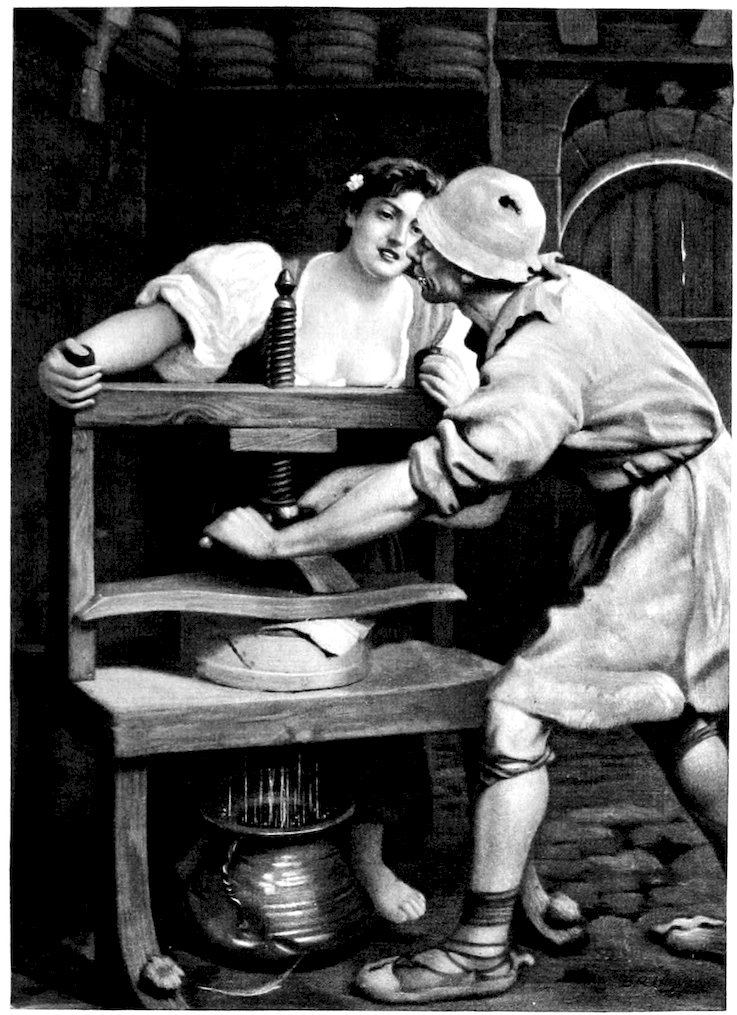
157To this speech Travaglino answered: ‘Signora, for the love I have for you I am ready to devote my life and all I possess in the world to your service, and if it should chance that you demand of me to carry out some enterprise of great difficulty, nevertheless, on account of my own love and of the love which you have shown for me, I will easily accomplish it.’ Then Isotta, taking courage from these words of Travaglino, said: ‘If indeed you are my friend, as I well believe you to be, I shall know full soon.’ ‘Lay what command on me you will, signora,’ replied Travaglino, ‘and you will see clearly enough whether I am your friend or not.’ ‘All that I want of you,’ said Isotta, ‘is the head of that bull of yours which has his horns gilded. Give me this, and you may do with me what you please.’ Travaglino, when he heard this request, was wellnigh overcome with amazement; but, inflamed by the pricks of fleshly desire, and by the allurements of the lustful woman before him, he made answer to her: ‘Signora, can it be that this is all you want of me? You shall have, not only the head of the bull, but the body as well; nay, I will hand over my own self into your keeping.’ And after he had thus spoken, Travaglino plucked up heart and folded the lady in his arms, and they together took part in the sweetest delights of love. When this was done, Travaglino cut off the bull’s head, and, having put it in a sack, handed it over to Isotta, who, well satisfied that she had accomplished her purpose and got much pleasure and delight besides, made her way back to her house, bearing with her more horns than farms in her sack.
Now Travaglino, as soon as the lady had taken her departure, began to feel somewhat troubled in mind and to cast about for some 158excuse which he might bring forward to his master when he should be called upon to account for the death of the bull with the gilded horns, which was so greatly beloved by Emilliano. While the wretched Travaglino was held by these torments of his mind, knowing neither what to say or to do, it came into his head at last to take a branch of one of the pruned trees which grew about, and to dress this up with some of his own poor garments, and to make believe that it was Emilliano. Then, standing before this scarecrow, he proposed to make trial of what he should do and say when he should be brought face to face with his master. Wherefore, after he had set up the tree branch thus bedizened in a chamber of the house with his own cap on its head and with certain of his garments upon its back, Travaglino went out from the chamber for a short space of time, and then came back and entered, saluting the branch as he went in, and saying, ‘Good day, my master!’ and then, making answer out of his own mouth, he replied, ‘I am glad to see you, Travaglino. How do you find yourself, and how are things going on at the farm? It is a long time since I have seen anything of you.’ ‘I am very well,’ replied Travaglino, ‘but I have been so busy of late that I have not been able to find time to come and see you.’ ‘How did you leave the bull with the gilded horns?’ asked Emilliano, and then Travaglino made as if he would answer: ‘Master, I have to tell you that your favourite bull has been eaten of wolves while he was straying in the woods.’ ‘Then where are his skin and his gilded horns?’ Emilliano inquired. And when he had come to this point poor Travaglino could not hit upon any answer he could possibly give; so, wellnigh overcome with grief, he left the chamber. After a little he came in again and recommenced his discourse by saying, ‘God keep us all, good master!’ ‘And you also, Travaglino,’ said Emilliano, ‘and how prosper things at the farm? how is the bull with the gilded horns?’ ‘I am very well,’ said Travaglino, ‘but one day lately the bull broke out of the yard, and having fallen a-fighting with some of the other bulls, was so heavily mauled by them that he died of his injuries straightway.’ ‘Then where are his skin and his gilded horns?’ asked Emilliano. Whereupon Travaglino knew no better what answer he should give to this question than before. Finally, having gone through the same discourse several times, he had to give up the matter in despair, through not being able to devise any reply which sounded at all reasonable.
159Now Isotta, as soon as she had returned to her house, said to her husband: ‘What will that poor lout Travaglino do when he shall set about excusing himself to Emilliano with regard to the death of that bull with the gilded horns which was such a pet with his master? How will he clear himself of such a trouble as this without telling a lie or two? See, here is the head of the bull, which I have brought back with me to use as a testimony against him when he shall begin with his false tales.’ But the dame said not a word to her husband as to how she had made for his own benefit two fine horns, bigger than those of a hart royal. Lucaferro, when he saw the bull’s head, was overjoyed and could hardly contain himself for glee, making sure that he would now win his wager, but the issue of the affair fell out in mighty different fashion, as you will learn later on.
Travaglino, after he had essayed divers bouts of questions and answers with his scarecrow man, discoursing just as if he were in conversation with the master himself, and finding in the end that they none of them would serve the end he had in view, made up his mind without further ado to go and seek his master forthwith, no matter what might happen. Wherefore, having set forth towards Bergamo, he presented himself before his master, to whom he gave a hearty salute. Emilliano, after he had greeted his herdsman in return, said to him, ‘And what business has been taking up all your time and thoughts of late, Travaglino, that you have let so many days pass without coming here or without letting us have any news of you?’ Travaglino replied, ‘Master, the many jobs I have had in hand have kept me fully occupied.’ Then said Emilliano, ‘And how goes on my bull with the gilded horns?’
When he heard these words, poor Travaglino was overcome with the direst confusion, and his face flushed with shame as red as a burning furnace, and he was fain to find some excuse for his fault and to hide the truth. But in the end the fear of saying aught which might sully his honour stood him in good stead, and made him take heart of grace and tell his master the whole story from beginning to end: how Isotta had beguiled him, and how his dealings with her had ensued in the death of the bull. Emilliano was amazed beyond measure as he listened to this story, which, however great his fault might have been, at least proved Travaglino to be a truthful fellow and one of good character. So in the end Emilliano won the 160wager with regard to the farm, and Lucaferro gained nothing but a pair of horns for his own head, while his good-for-nothing wife Isotta, in trying to dupe another, was finely duped herself, and got nothing but shame for her trouble.
When this instructive fable was finished, every one of the worthy company of listeners was loud in blame of the dissolute Isotta, and equally loud in commendation of Travaglino, holding up to ridicule the silly loose-minded woman, who had in such vile manner given herself away to a herdsman, of which ill-doing the real cause was her innate and pestilential avarice. And seeing that Eritrea had not as yet propounded her enigma, the Signora, glancing at her, made a sign that she must not interrupt the procedure they had followed so far. Whereupon Eritrea, without any farther delay, gave her enigma:
I saw one day in fine spring weather,
A head and a breech full close together.
Another breech I likewise found
Squatting at ease upon the ground.
And one, as strong as any mule,
Stood quiet, subject to the rule
Of two, who in the head shone bright,
And looked with pleasure on the sight.
Meantime the head pressed closer still,
And ten there were who worked with will,
With dexterous grasp, now up, now down.
No prettier sight in all the town.
Though the ladies made merry enough over the fable, they held the enigma to be no less of a jest. And, because there was not one of them who seemed likely to be able to solve it, Eritrea spake as follows: “My enigma, ladies and gentlemen, is intended to describe one who sits down under a cow and sets to work to milk her. And for the same reason he who milks the cow must keep his head close to the cow’s breech, and the milker, for his good convenience, sits with his breech on the ground. She is very patient, and is kept in restraint by one, namely, he who milks her, and is watched by two eyes, and is stroked by two hands and the ten fingers, which draw from her the milk.” This very clever enigma pleased them all mightily, as well as the interpretation thereof; but, seeing that every star had now disappeared from the heaven, save only a certain one 161which still shone in the whitening dawn, the Signora gave order that every one of the company should depart whithersoever he would, and take rest until the coming evening, commanding at the same time that each one should duly appear again at the appointed place under pain of her displeasure.
The End of the Third Night

163
