Volume 1 — Night the Fourth.
W. G. (William George) Waters translation

165
The Fables and Enigmas of Messer Giovanni Francesco Straparola da Caravaggio.
Night the Fourth.
Already the golden-haired Apollo in his radiant chariot had sped away from this hemisphere of ours, and, having sunk beyond the distant line of sea, had betaken himself to the antipodes, and all those who had been labouring in the fields, now weary with their hard toil, felt no desire for aught save to repose quietly in their beds, when the worshipful and highborn company assembled themselves joyfully once more in the accustomed spot. And after the ladies and gentlemen had spent a short time in mirthful converse, the Signora Lucretia, when silence had been restored, bade them bring forth the golden vase. Then, having written with her own hand the names of five of the ladies and cast them into the vase, she called to the Signor Vangelista and directed him to draw out of the vase the names one by one, in order that they might clearly know to which of their companions the duty of story-telling on that same night would be assigned. Then Signor Vangelista, rising from his seat and breaking off the pleasant discourse he was holding with Lodovica, went obediently towards the Signora, and, having sunk down upon his knees reverently at her feet, he put his hand in the vase and drew out first the name of Fiordiana, then that of Vicenza, then that of Lodovica, next that of Isabella, and last the name of Lionora. But before they made a beginning of their story-telling 166the Signora gave the word to Molino and to the Trevisan that they should take their lutes and sing a ballad. The two gentlemen did not wait for any further command, but forthwith tuned their instruments and sang to a joyous strain the following verse:
SONG.
There is a face which is my sun of love,
In whose kind warmth I breathe and move,
Or faint beneath its scorching ray;
And when it shines amongst the fairest fair,
My lady reigns beyond compare,
And all around her bend beneath her sway.
Happy, thrice happy, is that favoured one,
Who sees no face but hers alone,
And passion’s nectar eager sips,
Who listens to the music of her tongue,
More sweet than lay by seraphs sung,
In words that fall like jewels from her lips.
But happier still were I if she benign
Would place her lily hand in mine,
And mark me worthy such a prize to claim.
Dull clod of earth although I be,
Then should I full fruition see
Of every hope, and end of every aim.
The song was attentively listened to and warmly commended by every one of the company. And when the Signora saw that it had come to an end she directed Fiordiana, to whom had been assigned the first turn of story-telling on this the fourth night, that she should begin hers straightway, and follow the order which had been observed since the beginning of their entertainment; and the damsel, who was no less eager to speak than the rest of the company were to listen, thus began her fable.
167
THE FIRST FABLE.
Ricardo, King of Thebes, had four daughters, one of whom, having become a wanderer and altered her name of Costanza to Costanzo, arrived at the court of Cacco, King of Bettinia, who took her to wife on account of the many worthy deeds wrought by her.

I must first tell you, fair and gracious ladies, that the fable which Eritrea told to us on the evening last past has brought me into so bashful a mood that I feel but little in the humour to act the story-teller to-night. Nevertheless, the sense of obedience I have for every command of the Signora, and the respect I feel for the whole of this honourable and gracious company, compels and encourages me to make trial with a certain story which, though it assuredly will not be found as pleasing as the one recently related by Eritrea, I will give you for what it is worth. You shall hear how a certain damsel, endowed with a noble soul and high courage, one who in the course of her noteworthy adventures was far better served by fortune than by reason, held it preferable to become a servant than to fall into a base manner of life; how, after enduring servitude for some time, she became the wife of King Cacco, and lived content with her reward. All this will be set forth to you in the story I am about to tell you.
In Egypt is situated the great and splendid city of Thebes, a place richly ornamented with noble buildings, public as well as private, situated in a country rich in cornfields growing white for the sickle, and favoured with fresh water in abundance; abounding, moreover, in all those things which go to make up a glorious city. In times long past this city was under the rule of a king called by name Ricardo, a man profoundly wise, of great knowledge, and of the highest valour. Now this monarch, desiring greatly to have an heir to his kingdom, took to wife Valeriana, the daughter of Marliano, King of Scotland, a lady who was, in truth, perfection itself, very fair to look upon, and exceedingly gracious. Of her he begot three daughters, who were gentle in their manners, full of grace, and fair as rosebuds in the morning. Of these one was called Valentia, another Dorothea, and the third Spinella. In the course of time it 168became manifest to Ricardo that Valeriana his wife had come to that season of life when women commonly cease from child-bearing, and that his three daughters were all of them ripe for marriage, wherefore he determined forthwith to dispose of the three princesses in honourable wedlock, and at the same time to divide his kingdom into three parts, whereof he proposed to give one to each of his daughters, only keeping for himself so much as he judged would suffice for the entertainment of himself, and of his family, and of his court. And all these plans he carried out as he had deliberated with himself, so that the result of his project proved to be exactly what he had wished it to be.
In due time the three maidens were given in marriage to three powerful kings, one to the King of Scardona, another to the King of the Goths, and the third to the King of Scythia; and to each one of them was assigned, by way of dowry, a third part of their father’s kingdom, Ricardo himself keeping back only a very small portion thereof to serve to satisfy his vital needs. And thus the good king, with Valeriana, his well-beloved wife, lived righteously in peace and comfort. But it happened, after a few years had passed, that the queen, of whom the king expected no further offspring, proved to be with child, and at the end of her time was brought to bed with a very beautiful little girl, whom the king welcomed with affection and caresses as warm as he had given to the other three children. But the queen was not so well pleased with this last infant, not, however, on account of any dislike for the child herself, but because, seeing that the kingdom was now divided into three parts and given away, she feared that there would be no chance of furnishing this daughter with a dowry sufficient to win her a marriage worthy of their state. She desired at the same time that the child should receive the share due to a daughter of hers. But, having handed over the child to the care of a very competent nurse, she gave strict command to her to use the greatest care in her charge, to give the child good instruction, and to train her in the gentle and praiseworthy manners and carriage which become a fair and graceful maiden. The child, to whom the name of Costanza was given, grew day by day more lovely and her manners more engaging, nor could any subject from the most learned masters be brought forward which she would not at once apprehend most readily. By the time Costanza was twelve years of age she had already learned to embroider, to sing, to dance, to play the lute, and to do every one of those feats 169which are rightly held to mark a princess of rank. But, not content with these graces, she gave herself also to the study of polite letters, which proved to be to her so great a source of pleasure and delight that she would spend over them not merely the day, but the night as well, striving always to find out the exquisite beauties of the books she studied. And over and above all these excellencies she mastered completely the art of war in learning how to gentle horses, and to handle arms, and to run in the lists as if she had been a strong and well-trained man-at-arms and not a damsel. In jousting, indeed, she was so skilled that she ofttimes came out of the contest victorious, just as if she had been one of those valorous knights who are held worthy of the highest honour. Wherefore, on account of all these virtues, and on her own account as well, Costanza was greatly loved by the king and the queen and by all those around them, so that there seemed to be no limit to their affection.
When Costanza had come to a marriageable age, the king her father, finding that he had now neither the state nor the gold required to secure for her a match with some potent sovereign equal to her merits, was greatly troubled thereanent, and often took counsel with the queen concerning the matter; but the prudent Valeriana, in whose sight the good qualities of their child appeared to be so many and so great that no other lady in the land could in any way be put on a level with her, was not disquieted at all, and consoled the king with gentle and loving words, bidding him keep a light heart, and not to doubt at all but that in the end some powerful sovereign, fired with love by the many virtues of their daughter, would not disdain to take her to wife, even though they might not be able to give her a dowry.
Before many months had passed the damsel was sought in marriage by divers gallant gentlemen, amongst whom was Brunello, the son of the Marquis of Vivien, whereupon the king and the queen called their daughter to them into their chamber, and when they were all seated, the king spake thus: ‘Costanza, my well-beloved child, the time is now come when it is meet that you should be married, and we have found for you as a husband a youth who ought to please your taste. He is no other than the son of the Marquis of Vivien, our good friend and neighbour; his name is Brunello, and he is a graceful seemly youth, the report of his valorous deeds having spread already throughout the world. And moreover he asks of us nought besides our own goodwill and your fair sweet self, upon which I put a value exceeding 170that of all the pomp and treasure of the world. You must know that, though you are the daughter of a king, yet I cannot, on account of my poverty, find for you a more exalted alliance. Wherefore you must be content with this establishment and conform to our wishes.’ The damsel, who was very prudent and conscious that she was sprung from high lineage, listened attentively to her father’s words, and, without wasting any time over the matter, answered him as follows: ‘Sacred majesty, there is no need that I should spend many words in replying to your honourable proposal, but simply that I should speak as the question between us demands. And first I desire to testify to you my gratitude, the warmest I can express, for all the affection and benevolence you exhibit towards me in seeking to provide me with a husband without any request from me. Next—speaking with all submission and reverence—I do not purpose to let myself fall below the race of my ancestors, who from all time have been famous and illustrious, nor do I wish to debase the crown you wear by taking for a husband one who is our inferior. You, my beloved father, have begotten four daughters, of whom you have married three in the most honourable fashion to three mighty kings, giving with them great store of gold and wide domains, but you wish to dispose of me, who have ever been obedient to you and observant of your precepts, in an ignoble alliance. Wherefore I tell you, to end my speech, that I will never take a husband unless I can be mated, like my three sisters, to a king of a rank that is my due.’ Shortly after this, Costanza, shedding many tears the while, took leave of the king and queen, and, having mounted a gallant horse, set forth from Thebes alone, and determined to follow whatever road fortune might lay open to her feet.
While she was thus journeying at hazard she deemed it wise to change her name, so in lieu of Costanza she called herself Costanzo, and donned a man’s attire. She passed over many mountain ranges, and lakes, and marshes, and saw many lands, and heard the tongues and took heed of the ways and manners of certain races who live their lives after the fashion of brutes rather than of men. At last, one day at the set of sun, she arrived at a famed and celebrated city called Costanza, the capital of all the country round, and at that time under the rule of Cacco, King of Bettinia. And, having entered therein, she forthwith began to admire the superb palaces, the straight roomy streets, the running water, the broad rivers, and the clear, soft, trickling fountains. Then, when she had come near to the piazza, 171she saw the spacious and lofty palace of the king, adorned with columns of the finest marble and porphyry, and, having raised her eyes somewhat, she saw the king, who was standing upon a gallery which commanded a view of the whole piazza, and taking off her cap from her head she made him a profound reverence. The king, when he perceived the fair and graceful youth down below, had him called and brought into his presence, and as soon as Costanzo stood before him he demanded from what country he had come, and by what name he was called. The youth, with a smiling face, gave answer that he had journeyed from Thebes, driven thence by envious and deceitful fortune, and that Costanzo was his name. He declared, moreover, that he desired greatly to attach himself to the service of some gentleman of worth, pledging himself to serve any such lord with all the faith and affection that good service merited. The king, who meantime was mightily pleased with the appearance of the youth, said to him: ‘Seeing that you bear the name of this my city, it is my pleasure that you tarry here in my court with no other duty laid upon you than to attend to my person.’ The youth, who desired no better office than this, first rendered to the king his gratitude, and then joyfully accepted service under him as lord, offering at the same time to hold himself ready to discharge any duty which might be assigned to him.
So Costanza, in the guise of a man, entered into the service of the king, and served him so well and gracefully that every one who came near him was astonished beyond measure at his talents. And it chanced that the queen, when she had well observed and considered the graceful bearing, the pleasant manners, and the discreet behaviour of Costanzo, began to cast her eyes more diligently upon him, until at last, so hotly did she grow inflamed with love of him, neither by day nor by night did she turn her thoughts upon any other. And so soft and so loving were the glances that she would continually dart towards him, that not only a youth, but even the hardest rock, or the unyielding diamond even, might well have been softened. Wherefore the queen, being thus consumed with passion for Costanzo, yearned for nothing else than that she might some day find occasion to foregather with him alone. And before long it came to pass that chance gave her the opportunity of conversing with him, so she straightway inquired of him whether it would be agreeable to him to enter into her service, making it known to him likewise that by serving her he would gain, over and above the guerdon which she would 172give him, the approbation or even the reverence and respect of all the court.
Costanzo perceived clearly enough that these words which came out of the queen’s mouth sprang from no goodwill of hers for his advancement, but from amorous passion. Knowing moreover that, being a woman like herself, he could in no way satisfy the hot unbridled lust which prompted them, with unclouded face he humbly made answer to her in these words: ‘Signora, so strong is the obligation of service which binds me to my lord your husband, that it seems to me I should be working him a base injury were I to withdraw myself from my obedience to his will. Therefore I pray you to hold me excused, and to pardon me that I am not ready and willing at once to take service with you, and to accept, as the reason of this my refusal of your gracious offer, my resolve to serve my lord even unto death, provided that it pleases him to retain me as his man.’ And, having taken leave of the queen, he withdrew from her presence. The queen, who was well aware that men do not fell to earth a hard oak-tree with a single stroke, many and many a time after this made trial, with the deepest cunning and art, to entice the youth to take service under her, but he, as constant and as strong as a lofty tower beaten by the winds, was not to be moved. As soon as the queen became conscious of this, the ardent burning love in her was turned to mortal bitter hatred, so that she could no longer bear the sight of him. And, having now grown anxious to work his destruction, she pondered day and night how she might best set to work to clear him out of her path, but she was in great dread of the king, for that he continued to hold the youth in high favour.
In a certain district of the province of Bettinia there was to be found a strange race of beings, in whom one half of the body, that is to say, the upper part, was made after the fashion of a man, though they had ears like those of animals, and horns as well. But in their lower parts they had members resembling those of a rough shaggy goat, with a little tail, twisted and curling, of the sort one sees upon a pig. These creatures were called satyrs, and by their depredations they caused great loss and damage to the villages and the farms and the people living in the country thereabout. Wherefore the king desired greatly to have one of these satyrs taken alive and delivered over into his keeping, but there was found no one about the court with heart stout enough to undertake this adventure and capture a satyr for the 173king. By sending him on an errand of this sort the queen hoped to work Costanzo’s destruction, but the issue of the matter was not at all what she desired, for in this case, as in many others, the would-be deceiver, by the workings of divine providence and supreme justice, was cast under the feet of the one she purposed to beguile.
The treacherous queen, being well aware of the king’s longing, happened to be one day in converse with him concerning divers matters, and, while they were thus debating, she said to him: ‘My lord, have you never considered that Costanzo, your faithful and devoted servant, is strong and vigorous enough in body, and daring and courageous enough in soul, to go and capture for you one of these satyrs, and to bring him back to you alive, without calling on anyone else to aid him. If the matter should fall out in this wise, as I believe it would, you might easily make trial of it, and in the course of an hour attain the wish of your heart, and Costanzo, as a brave and valiant knight, would enjoy the honour of the deed, which would be accounted to him for glory for ever.’ This speech of the cunning queen pleased the king greatly, and he straightway bade them summon Costanzo into his presence. When the youth appeared the king thus addressed him: ‘Costanzo, if indeed you love me, as you make show of doing, and as all people believe, you will now carry out fully the wish I have in my heart, and you yourself shall possess the glory of the fulfilling thereof. You are surely aware that what I desire more than aught else in the world is to have a satyr alive in my own keeping. Wherefore, seeing how strong and active you are, I reckon there is no other man in all my kingdom so well fitted to work my will in this affair as you; so, loving me as you do, you will not refuse to carry out my will.’ The youth, who suspected not that this demand sprang from aught else than the king’s desire, was anxious to give no cause of vexation to the king, and with a cheerful and amiable face thus made answer: ‘My lord, in this and in everything else you may command me. However weak and imperfect my faculties may be, I will on no account draw back from striving to fulfil your wishes, even though in the task I should meet with my death. But, before I commit myself to this perilous adventure, I beg you, my lord, that you will cause to be taken into the wood where the satyrs abide a large vessel with a wide mouth of the same size as those which the servants use in dressing smooth the shifts and other kinds of body linen. And besides this I would have taken thither a large cask of 174good white wine, the best that can be had and the strongest, together with two bags full of the finest white bread.’ The king forthwith bade them get in readiness everything which Costanzo had described, and Costanzo then journeyed towards the wood in question. Having arrived there he took a copper bucket and began to fill it with white wine drawn from the cask, and this he poured into the other vessel which stood near by. Next he took some of the bread, and, having broken it in pieces, he put these into the vessel full of wine. This being done he climbed up into a thick-leaved tree which stood hard by, and waited to see what might happen next.
Costanzo had not been long up in the tree before the satyrs, who had smelt the odour of the fragrant wine, began to draw near to the vessel, and having come close to it, each one swilled therefrom a good bellyful of wine, greedy as the hungry wolves when they fall upon a fold of young lambs. And after they had filled their stomachs and had taken enough, they lay down to sleep, and so sound and deep was their slumber that all the noise in the world would not have roused them. Then Costanzo, seeing that the time for action had come, descended from the tree and went softly up to one of the satyrs, whose hands and feet he bound fast with a cord he had brought with him. Next, without making any noise, he laid him upon his horse and carried him off. And while Costanzo was on his way back, with the satyr tightly bound behind him, they came at the vesper hour to a village not far from the city, and the creature, who by this time had recovered from the effects of the wine, woke up and began to yawn as if he were rising from his bed. Looking around him he perceived the father of a family, who with a crowd around him was going to bury a dead child, weeping bitterly the while, and the priest, who conduced the service, was singing. When he looked upon this spectacle the satyr began to laugh mightily. Afterwards, when they had entered the city and were come to the piazza, the satyr beheld a great crowd of people who were staring open-mouthed at a poor lad who had just mounted the gallows to be hanged by the executioner, and the satyr laughed thereat even louder than he had laughed before. And afterwards, when they were come to the palace, a great joy seized upon the people standing by, and they all cried out ‘Costanzo! Costanzo!’ And the satyr, when he heard this shouting, laughed louder than ever.
When Costanzo was conduced into the presence of the king and 175of the queen and her ladies, he presented to the king the satyr, who thereupon laughed again, and so loud and long was his laughter that all those that were there present were not a little astonished. After this the king, seeing with what diligence Costanzo had fulfilled his dearest wish, held him in as high affection and esteem as ever lord extended to servant, but this humour of his only added fresh griefs to the load which already lay upon the queen’s heart; for that, having schemed to ruin Costanzo, she had done nothing but exalt him to yet greater honour. Wherefore the wicked queen, not being able to endure the sight of such great prosperity as had come to Costanzo, devised yet another snare for him, which was this. She knew that the king was wont to go every morning to the cell where the satyr was kept in hold, and for his diversion would essay to make the creature talk, but as yet he had in no wise succeeded in his efforts. Wherefore, having sought out the king, she said to him: ‘Sire, you have betaken yourself over and over again to the satyr’s cell, and you have wearied yourself in your endeavours to induce him to talk with you in order that you might take diversion therefrom, but the creature still shows no sign of speaking a word. Why, therefore, should you further worry your brains over this affair, for you may take it for certain that, if Costanzo were only willing, he could easily make the satyr converse and answer questions.’
The king, when he listened to these words, straightway bade them summon Costanzo into his presence, and when he came the king thus addressed him: ‘Costanzo, I am well assured that you know how great is the pleasure I get from the satyr you captured for me; nevertheless it irks me greatly to find that he is dumb, and will never make any answer to the words I say to him and the questions I put. If you would only do all that you might, I am sure that you would be able to make him speak.’ ‘Sire,’ Costanzo replied, ‘that the satyr is dumb is no fault of mine; it is not the office of a mortal, like me, to make him speak, but of a god. But if the reason of his muteness comes not from any natural or accidental defect, but from stubborn resolve to keep silence, I will do all that lies in my power to make him open his mouth in speech.’ Then, having gone together to the satyr’s prison, they gave him some dainty food, and some wine still better, and called out to him, ‘Eat, Chiappino’ (for this was the name they had given to the satyr). But the creature only stared at them without uttering a word. Then they went on: 176‘Come, Chiappino, tell us whether that capon and that wine are to your taste;’ but still he was silent. Costanzo, perceiving how obstinate the humour of the creature was, said, ‘So you will not answer me, Chiappino. Let me tell you you are doing a very foolish thing, seeing that I can if I will let you die of hunger here in prison.’ And at these words the satyr shot a side-glance at Costanzo. After a little Costanzo went on: ‘Answer me, Chiappino; for if you speak to me (as I hope you will) I will liberate you from this place.’ Then Chiappino, who had listened with eagerness to all that had been said, answered, as soon as he heard speak of liberation, ‘What will you of me?’ Costanzo then said, ‘Tell me, have you eaten and drunk well?’ ‘Yes,’ said Chiappino. ‘Now I want you, of your courtesy, to tell me,’ said Costanzo, ‘what thing it was that moved you to laughter in the village street when we met with the body of the child on its way to be buried?’ To this Chiappino answered, ‘I laughed, indeed, not at the dead child, but at the so-called father, to whom the child in the coffin was in fact no kin at all, and I laughed at the priest singing the office, who was the real father,’ by which speech the satyr would have them understand that the mother of the child had carried on an intrigue with the priest. Then said Costanzo, ‘And now I want to know, my Chiappino, what it was that made you laugh yet louder when we were come into the piazza?’ ‘I laughed then,’ replied Chiappino, ‘to see a thousand or more thieves, who had robbed the public purse of crowns by the million, who deserved a thousand gibbets, standing in the piazza to feast their eyes on the sight of a poor wretch led to the gallows, who, perchance, had merely pilfered ten florins wherewith to buy bread for himself and his poor children. That was why I laughed.’ Then said Costanzo, ‘And besides this, I beg you to tell me how it was that, when we were come into the palace, you laughed longer and louder than ever?’ ‘Ah, I beg you will not trouble me more at present,’ said Chiappino, ‘but go your way and come back to-morrow, and then I will answer you and tell you certain things of which perchance you have no inkling.’ When Costanzo heard this, he said to the king, ‘Let us depart and come back to-morrow, and hear what this thing may be.’ Whereupon the king and Costanzo took their leave, and gave orders that Chiappino should be given to eat and drink of the best, and that he should be allowed to chatter as he would.
177When the next day had come they both went to see Chiappino, and they found him puffing and blowing like a great pig, and, having gone close to him, cried out to him several times in a loud voice. But Chiappino, who had well filled his belly, answered nought. Then Costanzo gave him a sharp prick with a dart which he had with him, whereupon the satyr awoke and stood up and demanded who was there. ‘Now get up, Chiappino,’ said Costanzo, ‘and tell us that thing which yesterday you promised we should hear, and say why you laughed so loud when we came to the palace?’ To which question Chiappino made this reply: ‘For a reason which you ought to understand better than I. It was, forsooth, at hearing them all shouting “Costanzo! Costanzo!” while all the time you are Costanza.’ The king when he heard this could in no wise comprehend what this saying of Chiappino’s might mean; but Costanzo, who immediately recognized its import, in order to keep him from speaking more, at once stopped the way for him[25] by saying: ‘And when you had been brought into the very presence of the king and queen, what made you laugh then as if nothing could stop you?’ To this Chiappino made answer: ‘I laughed then so outrageously because the king, and you as well, believed that the maidens who were in service on the queen were really maidens, whereas the greater part of them were young men.’ And then he was silent.
When the king heard these words he knew not what to think, but he said nothing; and, having left the wild satyr, he went out with Costanzo, wishing to learn clearly what might be the meaning of what he had heard. And after he had made due inquiry he found that Costanzo was in truth a woman, and not a youth, and that the supposed damsels about the queen were sprightly young men, as Chiappino had said. And straightway the king bade them light a great fire in the middle of the piazza, and into it, in the presence of all the people, he caused to be cast the queen and all her paramours. And, bearing in mind the praiseworthy loyalty and the open faithfulness of Costanza, and marking moreover her exceeding beauty, the king made her his wife in the presence of all his barons and knights. When he knew who her parents were, he greatly rejoiced, and forthwith despatched ambassadors to King Ricardo and to Valeriana his wife, and to the three sisters of Costanza, to tell them how she was 178now the wife of a king; whereupon they all felt the joy due to such good news. Thus the noble Costanza, in recompense for the faithful service she rendered, became a queen and lived long with Cacco her husband.
When Fiordiana had brought her fable to an end, the Signora made a sign to her to give her enigma. The damsel, who was somewhat haughty, rather by chance than by nature, set it forth in the following words:
Over savage lions twain
A spirit soft and mild doth reign.
By her side four damsels move,
Prudence, Valour, Faith, and Love.
She bears a sword in her right hand;
Before it calm the righteous stand,
But wicked men and souls unjust
It smites and lays them in the dust.
Discord nor wrong with her may rest,
And he who loves her wins the best.
This clever enigma set forth by Fiordiana, who indeed was a damsel of subtle mind, won the praise of all, and some found its meaning to be one thing, and some another. But there was no one of all the company who rightly divined it, seeing that all their solutions were far wide of the true one. When Fiordiana saw this she said in a lively tone, “Ladies and gentlemen, I see you are troubling yourselves in vain, seeing that my enigma means nothing else than that infinite and equal justice which like a gentle spirit rules and restrains both the hungry, savage lions, and likewise the proud, unconquerable spirit of man. More than that, justice makes steadfast her faith, holding in her right hand a sharp sword, and accompanied always by four virgins, Prudence, Charity, Fortitude, and Faith. She is gentle and kind to the good, and severe and bitter to the perverse and bad.” When Fiordiana ceased speaking, the listeners were greatly pleased with the interpretation of her enigma. Then the Signora bade the gracious Vicenza to follow in her turn with a fable, and she, eager to obey this command, spake as follows.
179
THE SECOND FABLE.
Erminione Glaucio, an Athenian, takes to wife Filenia Centurione, and, having become jealous of her, accuses her before the tribunal, but by the help of Hippolito, her lover, she is acquitted and Erminione punished.
Of a truth, gracious ladies, there would be in all the world no condition more sweet, more delightful, or more happy than the service of love, were it not for that bitter fruit which springs from sudden jealousy, the foe which drives away gentle Cupid, the betrayer of kindly ladies, the foe who day and night tries to compass their death. Wherefore there comes into my recollection a fable which ought to be received by you with some satisfaction, seeing that from it you will be able readily to understand the hard and piteous fate which befell a gentleman of Athens, who, because of his impotent jealousy, sought the taking off of his wife by the sword of justice, but was instead condemned himself, and met his death thereby. Which judgment ought to please you, because, if I am not greatly in error, you are yourselves all of you more or less in love.
In Athens, the most ancient city of Greece, and one which was in times past the veritable home and resort of all learning, though now, through her flighty vanity, entirely ruined and overthrown, there resided once upon a time a gentleman named Messer Erminione Glaucio, a man of much consideration and repute in the city, rich in purse, but at the same time of mean intelligence. Now it chanced that when he was an old man, finding himself without progeny, he made up his mind to marry, and took to wife a damsel named Filenia, daughter of Messer Cesarino Centurione, of noble descent and gifted with marvellous beauty and with good qualities out of number. In short, there was in all the city no other maiden who was her equal. And, forasmuch as he was greatly in fear lest his wife, on account of her marvellous beauty, should be courted by divers of the gallants of the city, and perhaps give occasion for some disgraceful scandal, through which the finger of scorn might be pointed at him, he resolved to restrain her in a certain lofty tower of his palace, out of sight of all passers-by. And before long it happened that the 180wretched old dotard, without knowing why, let his jealousy rise to such a pitch that he mistrusted even himself.
There was residing in the city at this time a certain scholar of Crete, young in years, but very discreet, and greatly loved and esteemed by all who knew him on account of his amiability and grace. The name of this youth was Hippolito, and before Filenia was married he had paid suit to her, and, besides this, he was on intimate terms with Messer Erminione, who held him as dear as if he had been his own son. At a certain time during his scholar’s course he found himself somewhat disinclined for study; so, desiring to recruit his spirits, he took his departure from Athens, and having gone into Crete, he sojourned there for a time, to discover on his return that Filenia was married. On this account he fell into an access of melancholy, and he grieved the more because he was now deprived of all hope of seeing her at his pleasure, nor could he endure to remember that a maiden so lovely and graceful should be bound in marriage to a toothless, slobbering old man.
Wherefore the love-stricken Hippolito, finding himself no longer able to endure the burning pricks and the sharp arrows of love, set himself to find out some method, some hidden way by which he might enjoy the fulfilment of his desires. And after he had well considered the many schemes which presented themselves to him, he fixed at last upon a certain one which appeared to him the most fitting. To put this in execution he first betook himself to the shop of a carpenter, his neighbour, where he ordered to be made two chests of the same length and breadth and width, and of the same measure and quality, so that no one would be able to distinguish the one from the other. This done, he repaired to Messer Erminione’s house, and, making pretence of wanting something of him, spake in cunning wise the following words: ‘Messer Erminione, you know well enough that I love and reverence you as if you were my own father, and for my part if I were not well convinced of your affection for myself, I would never dare, with such assurance as I now use, to beg any favour of you; but, seeing that I have ever found you well disposed to me, I am wellnigh certain that I shall now get from you that service which my heart so greatly desires. It happens that I am constrained to leave Athens and to go to the city of Frenna to expedite some very important matters of business, and I must remain there until such time as these shall be completed. And because I 181have no one about me whom I can fully trust, seeing that I am served only by menials and hirelings, of whom I am in no way well assured, I would fain that you hold in charge for me—provided that it be your pleasure so to do—a certain chest of mine full of articles of value which I happen to possess.’ Messer Erminione, suspecting nought of the craft of the young scholar, made answer to him that he was well content to grant this favour, and that for greater security the chest should be deposited and kept in the same chamber in which he slept. On hearing this reply the scholar returned to Messer Erminione his thanks, the warmest he knew how to render, promising the while to keep in mind the memory of this great favour done to him as long as he should live. Then he begged the old man to do him the honour to go with him as far as his own dwelling, in order that he might exhibit to him the various articles which he had stored in the chest. Wherefore the two, having gone together to the house of Hippolito, the latter pointed out a chest filled with rich garments and jewels and necklaces of no small value, and then, having summoned a certain one of his servants and presented him to Messer Erminione, he said: ‘If at any time, Messer Erminione, this my servant should be seeing after the removal of my chest, you can trust him to the full as if he were my own self.’ And when Messer Erminione had taken his departure Hippolito hid himself in the other chest, which was exactly like the one filled with garments and jewels, and having fastened it from the inside, he bade his servant carry it to a certain place he knew of. The servant, who was privy to the affair, obedient to his master’s order called a porter, and having lifted the burden on the man’s back, ordered him to bear it to the tower in which was situated the chamber where Messer Erminione slept every night with his young wife.
Messer Erminione, being one of the chiefs of the city and a man of wealth and influence, it fell to his lot, on account of the worshipful state he filled, to go for a certain space of time to a place called Porto Pireo, distant about twenty stadi from the city of Athens, and there to compose certain suits and strifes which had arisen between the townsmen and the peasants round about—albeit he found this errand but little to his taste. Wherefore, when Messer Erminione had gone his way, tormented as ever by the jealousy which day and night weighed upon him, the youth, shut up in the chest which now stood in Madonna Filenia’s bedroom, was waiting for the favourable moment. 182More than once had he heard the fair dame weeping and sighing as she bemoaned her hard lot, and the place and the hour which had seen her given in marriage to a miserable old man who had proved to be the ruin of her life. And when it seemed to him that she was in her first sleep, he got out of the chest, and, having gone to the bedside, said in a soft voice: ‘Awake, my soul! for I, your Hippolito, am here.’ And when she was fully aroused, and saw him and knew who he was (for there was a candle burning in the chamber), she was inclined to cry out; but the young man, putting his hand upon her lips, would not allow this, and thus addressed her in a voice full of agitation: ‘Be silent, heart of mine! do you not see that I am Hippolito, your faithful lover? Of a truth I cannot live apart from you.’ The fair young woman was somewhat comforted by these words, and by the time she had found the opportunity for comparing the worth of her old husband with the youthful Hippolito, she was by no means ill-satisfied with the turn things had taken, and lay all night with her lover, spending the time in loving conversation and railing at the impotent ways of her doltish husband. Before they parted they agreed together to meet again in like manner, and when the morning began to dawn the youth got back into his chest, and every evening would issue therefrom and spend the night with the lady.
Now, after a good many days had elapsed, Messer Erminione, giving the business good speed both on account of the discomfort he himself suffered and of the rabid jealousy which never ceased to torment him, put an end to all the disputes he had been called upon to settle, and went back to his home. The servant of Hippolito, as soon as he heard the news of Messer Erminione’s return, went without losing time to his house, and, according to the agreement which had been settled, demanded of him in the name of his master Hippolito the return of the chest, and this Messer Erminione gave up to him without a word of demur. Wherefore, having summoned a porter, the servant caused the chest to be conveyed home. Then Hippolito, having come out of his hiding-place, went forthwith to the piazza, where he met with Messer Erminione, and after he had embraced him, he thanked him most courteously in the warmest terms he could find for the great kindness he had received, and at the same time declared that he himself and all that he possessed should ever be ready at Messer Erminione’s service.
It chanced that on a certain morning Messer Erminione remained 183in bed with his wife somewhat later than was his wont, and, lifting up his eyes, he remarked upon the wall and high above his head certain stains which looked as if they had been caused by someone spitting thereon. Wherefore his inveterate jealousy began once more to trouble him, and he was mightily amazed at what he saw, and began to turn it over in his mind in such wise that, after he had well considered the matter, he could not bring himself to believe that the marks on the wall in question were any work of his. Then, with strong apprehension as to their meaning, he turned to his wife and with an angry troubled face demanded of her: ‘What have you to say about those spit marks high up on the wall there? I am well assured they were never made by me, for I never spat up there in my life. I strongly suspect that you have betrayed my honour.’ Filenia, laughing the while at this speech, thus answered him: ‘Is there no other charge you would like to bring against me?’ Messer Erminione, when he saw her begin to laugh, grew more infuriated than ever, and said: ‘Ah, you laugh, do you, wicked woman that you are? Now, tell me quickly what it is that makes you laugh.’ ‘I am laughing,’ answered Filenia, ‘at your own foolishness.’ At these words Messer Erminione began to chafe with rage,[26] and, being anxious to make trial of his own powers and to see whether he could spit so high, with much coughing and gasping he strained with all his might to reach the mark on the wall by his spitting, but he wearied himself in vain, for the spittle always fell down again and lighted upon his visage, plastering him thickly with filth. And after the wretched old man had made this trial many times, he found that he only got in worse case every turn. So, by the light of this experience, he persuaded himself that his wife had assuredly played him false, and, turning to her, he began to assail her with the most rascally words that could be applied to a guilty woman, and, if he had not been in fear of the law and of his own neck, he would surely have slain her then and there with his own hands, but he managed to restrain himself, deeming it better to deal with her by legal process than to stain his hands in her blood. Not satisfied with the rating he had already given her, he betook himself, full of wrath and anger, to the tribunal, where he preferred before the judge a charge of adultery against his wife. But, seeing that it lay not within the power of the judge to pronounce condemnation upon 184her unless the legal statutes should have been duly observed, he ordered Filenia to be brought before him in order that he might narrowly examine her.
Now, there was in Athens a law, which was held in the highest reverence, providing that any woman who might be charged by her husband with adultery should be placed at the foot of a certain red column, round which was entwined a serpent, and there make oath whether or not the accusation of adultery brought against her were true. And after she had taken the oath she was required forthwith to put her hand in the serpent’s mouth, and then, if she should have sworn falsely, the serpent would at once bite off her hand; otherwise, she received no injury. Hippolito, who had already heard rumours of this charge before the tribunal, and that the judge had sent to fetch Filenia to put her on her defence, being a youth of resource at once took action to see that she should not run into the snares of ignominious death. By way of rescuing her from condemnation he first of all stripped off all his clothes and donned in their stead some rags befitting a madman, and then, without being seen by anyone, he left his own lodging and ran straight to the tribunal as if he had been someone out of his mind, acting well the part of a crazy man as he went along the streets.
Now it chanced that while the officers of the court were haling along the poor lady towards the tribunal, all the people of the city gathered themselves together to take note as to how the cause would end, and in the midst of the crowd the pretended madman, forcing his way now here, now there, worked himself so well to the front that he found opportunity to cast his arms round the neck of the woeful lady, and to press a kiss upon her lips, which caress she, seeing that her arms were bound behind her back, could in no wise escape. When the young woman had been brought into the presence of the tribunal the judge addressed her in these words: ‘As you may see, Filenia, your husband Messer Erminione is here to lay complaint against you that you have committed adultery, and furthermore prays that I should deal out to you the due penalty according to the statute; wherefore you must now make oath and say whether or not the charge which your husband brings against you is true.’ Then the young woman, who was very wary and keen of intellect, swore with confidence that no man had ever touched her save her husband and the madman who was now present before them all. Then, after she had sworn, the underlings of the court led her to the place where was the serpent, which, after Filenia’s hand had been placed in its mouth, did her no harm whatever, inasmuch as what she had sworn was really the truth, namely, that no man had ever given her caress of any sort except her husband and the so-called madman.
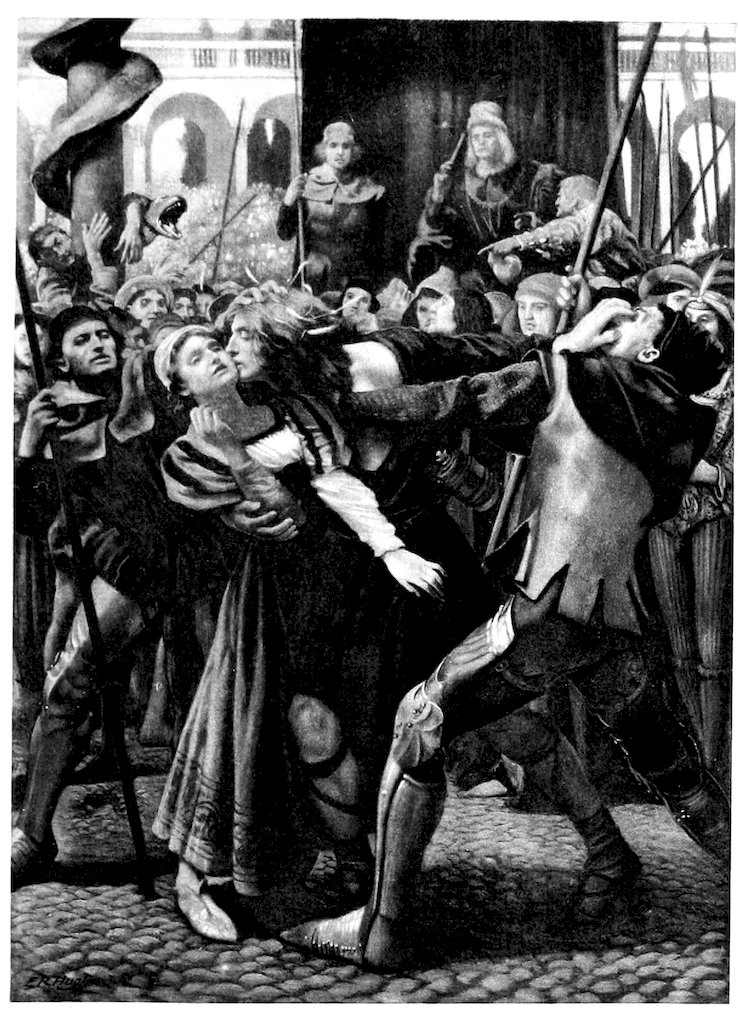
185When they perceived this, the crowd, and all her kinsfolk, who had come thither to see the solemn and terrible sight, at once set her down as innocent and wrongfully accused, and cried out that Messer Erminione deserved the same death which was the penalty of the crime imputed to his wife. But, for the reason that he was a noble, a man of high lineage, and one of the chiefs of the city, the president would not permit him to be publicly burned (for so much power the law gave him), but, in order that he might duly discharge his office, he sentenced Erminione to be thrown into prison, where, after a short space of time, he expired. This is the wretched end which Messer Erminione put to his senseless jealousy, and by these means the young wife was delivered from an ignominious death. Before great length of time had passed Hippolito made her his lawful wife, and they lived many years happily together.
When the story told by the discreet and modest Vicenza had come to an end—a story which pleased all the ladies mightily—the Signora bade her to propound her enigma in due course, and she, raising her pretty smiling face, instead of one of her songs gave the following riddle:
When hope and love and strong desire
Are born to set the world on fire,
That self-same hour a beast is born,
All savage, meagre, and forlorn.
Sometimes, with seeming soft and kind,
Like ivy round an elm-tree twined,
It clips us close with bine and leaf,
But feeds on heartache, woe, and grief.
Ever in mourning garb it goes,
In anguish lives, in sorrow grows.
And worse than worst the fate of him
Who falls beneath its talons grim.
Here Vicenza brought her enigma to an end. The interpretations of its meaning were diverse, and no one of the company was found clever enough to fathom its true import. When Vicenza saw this, she sighed a little impatiently, and then, with a smiling face, spake as follows: “The enigma I have set you to guess means 186nothing else than chilling jealousy, which, all lean and faded, is born at the same birth with love itself, and winds itself round men and women as well, just as the gently-creeping ivy embraces the trunk so dear to it. This jealousy feeds on heartache, seeing that a jealous one always lives in anguish and moves about in sombre garb on account of the continual melancholy that torments him.” This explication of the enigma gave great pleasure to all, and especially to Signora Chiara, whose husband had a temper somewhat jealous. But, to let no one say to himself that Vicenza’s enigma had been framed to fit his case, the Signora bade them at once put a stop to their laughter, and signed to Lodovica, whose turn it was to tell the next story, that she should forthwith begin, and the damsel opened her fable in the following words.
THE THIRD FABLE.
Ancilotto, King of Provino, takes to wife the daughter of a baker, and has by her three children. These, after much persecution at the hands of the king’s mother, are made known to their father through the strange working of certain water, and of an apple, and of a bird.

I have always understood, lovesome and gracious ladies, that man is the noblest and most capable of the living creatures fashioned by nature, seeing that God made him in His own image and similitude, and willed that he should rule and not be ruled. And on this account it is said that man is the perfect animal, and of greater excellence than any of the others, because all these, not even excepting woman, are subject to him. Therefore, those who by deceit and cunning compass the death of so noble a creature commit a foul crime. And there is no wonder if sometimes those who work for the bane of others run heedlessly into destruction themselves, as did four women I have to tell of, who, in trying to destroy others, were themselves cut off and made a wretched end. All this you will readily understand from the fable I purpose to tell you.
In Provino, a very famous and royal city, there lived in ancient times three sisters, fair of person, gracious in manners, and courteous 187in bearing, but of base lineage, being the daughters of a certain Messer Rigo, a baker who baked bread for other folk in his oven. Of these one was named Brunora, another Lionella, and another Chiaretta. It happened one day when the three sisters were in their garden, and there taking much delight, that Ancilotto the king, who was going to enjoy the diversion of hunting with a great company, passed that way. Brunora, the eldest sister, when she looked upon the fair and noble assemblage, said to her sisters Lionella and Chiaretta, ‘If I had for my husband the king’s majordomo, I flatter myself that I would quench the thirst of all the court with one glass of wine.’ ‘And I,’ said Lionella, ‘flatter myself that, if the king’s private chamberlain were my husband, I would pledge myself to make enough linen from a spindle of my yarn to provide shifts of the strongest and finest make for all the court.’ Then said Chiaretta, ‘And I, if I had the king himself for my husband, I flatter myself that I would give him three children at one birth, two sons and a daughter. And each of these should have long hair braided below the shoulders, and intermingled with threads of the finest gold, and a golden necklace round the throat, and a star on the forehead of each.’
Now it chanced that these sayings were overheard by one of the courtiers, who hastened to the king and told him of the young girls’ discourse, and the king, when he heard the tenour thereof, at once commanded that they should be brought before him, and this done, he examined them one by one as to what they had said in the garden. Whereupon each one, with the most respectful words, told the king what she had spoken, and he was much pleased thereat. So then and there he wedded Brunora to the majordomo and Lionella to the chamberlain, while he himself took Chiaretta to wife. There was no hunting that day, for the whole company returned to the city, where the marriages were celebrated with the greatest pomp. But the mother of Ancilotto was greatly wroth at his marriage, for however fair Chiaretta might be in face and figure, and graceful in her person, and sweet and modest in her conversation, the queen-mother held it to be a slight to the royal dignity that her daughter-in-law should be of vile and common descent, nor could she endure it that the majordomo and the chamberlain should be brothers-in-law of the king her son. These things kindled so hotly the rage of the queen-mother against Chiaretta that she could scarce 188endure her presence; nevertheless she hid her wrath so as not to offend her son. In due time (by the good pleasure of Him who rules over all), Chiaretta became with child, to the great joy of the king, whose fancy at once busied itself with the prospect of the lovely progeny he had been promised.
Just at the time when Chiaretta was expecting to be brought to bed, Ancilotto was forced to make a journey to a distant country and to abide there some days, and he directed that, during his absence, his mother should see to the welfare of the queen and of the children who, he hoped, would soon be born. The queen-mother, though she hated her daughter-in-law, let not the king see this, and assured him that she would take the greatest care of them all, while he might be away, and before the king had been gone many days (as Chiaretta when she was a virgin had pledged) three lovely children, two boys and a girl, were born. Likewise their hair was braided below their shoulders, and they bore golden chains on their necks and golden stars on their foreheads. The queen-mother, whose hatred against Chiaretta burned as malignantly as ever, no sooner cast her eyes upon the innocent children than she determined to have them put away privily, so that no one might know they had even been, and that Chiaretta might be disgraced in the sight of the king. And besides this, Brunora and Lionella had grown to regard their sister with violent hate and jealousy since she had become their sovereign, and lost no chance to aggravate, by all sorts of cunning wiles, the spite of the queen-mother against Chiaretta.
On the very same day that the queen was delivered, it chanced that there were born in the stable-yard three black mongrel pups, two dogs and a bitch, which, by some strange freak, had white stars on their foreheads and bore round their necks traces of a gorget. This coming to the knowledge of the two sisters, they took the pups away from the dam and brought them to the queen-mother, and with humble salutations said to her: ‘We know, madam, that your highness has little love for our sister, and quite justly; for she is of humble stock, and it is not seemly that your son and our king should have mated with such an one. Hence, knowing the mind you have towards her, we have brought you here three mongrel pups, which, as you will see, were born with a star on their foreheads, and you can deal with them as you list.’ At these words the queen-mother was 189much pleased, divining well their evil intent, and she contrived to bring to her daughter-in-law, who as yet had not seen the children she had borne, the three whelps, telling her at the same time they were her own offspring. And for the better hiding of this trick the wicked old woman bade the midwife to tell the same story to the queen. So when she herself and the two sisters and the midwife returned to the chamber, they presented to the queen the three mongrel whelps, saying, ‘See, O queen, the fruit of your womb! Cherish it well, so that the king, when he comes back, may rejoice in the fair gift you have made him.’ And with these words the midwife put the mongrels by her side, consoling her and telling her that such mischances as hers happened now and then to persons of high estate.
These wicked women having carried out this barbarous work, it only remained for them to contrive a cruel death for the three lovely children of the queen. But God mercifully held them back from soiling their hands with the blood of their kin. They made a box, which they waxed within, and, having put the children therein, they closed it and cast it into the river to be borne away by the stream. But God in His justice would not allow these innocents to suffer. As the box floated along it was espied by a certain miller named Marmiato, who haled it out and opened it, and found within three smiling children. Seeing how fair and graceful they were, he deemed them to be the children of some noble lady who, to hide her shame, had committed this crime. Having taken home the box he said to his wife, who was called Gordiana, ‘See here, wife, what I have found in the river; it is a present for you.’ Gordiana received the children joyfully, and brought them up as if they had been her own, giving to one the name of Acquirino, to another Fluvio—as they had been found in the river—and to the girl that of Serena.
Ancilotto, when he came back from his journey, was in high spirits, for he fully expected to find on his return that Chiaretta had fulfilled her pledge and given him the three fair children as she had promised; but the issue was not what he hoped, for the cunning queen-mother, when she saw her son drawing near, went to meet him, and told him that the wife he prized so highly had given him, instead of three children, three mongrel dogs. And having brought him into the chamber of the unfortunate Chiaretta, she showed him 190the pups which were lying beside her. The queen began to weep bitterly and to deny that the dogs were her offspring, but her wicked sisters came and declared that everything the old mother had said was the truth. The king when he heard this was greatly disturbed, and fell to the ground grief-stricken. After he had come to himself he could scarce believe such thing could be; but at last he gave ear to his mother’s false tale. But Chiaretta’s dignity and sweetness, and the patience with which she bore the insults of the courtiers, won him over to spare her life, and to sentence her to be kept in a cell under the place where the cooking pots and pans were washed, and to be fed on the garbage which was swept off the dirty sink.
While the unhappy queen passed her life in this filthy wise, feeding upon carrion, Gordiana, the wife of the miller Marmiato, gave birth to a son who was christened Borghino and brought up with the three foundlings. When Gordiana went to cut the hair of these there often fell out of it many precious stones and great white pearls; so with these riches Marmiato was able to give over the humble calling of a miller, and to live with his wife and the four children a life of ease and delicacy. But when the three foundlings had come to years of discretion they learned by chance that they were not the children of Marmiato and Gordiana, but had been found floating in a box on the river. As soon as they knew this they became very unhappy, and resolved to go their way and try their fortune elsewhere, much to the chagrin of their foster-parents, who saw they would no longer enjoy the rich harvest of jewels which was wont to fall from the children’s locks and starry foreheads. The brothers and their sister having left Marmiato the miller and Gordiana, they all wandered about for some days, and at last came by chance to Provino, the city of Ancilotto their father, where they hired a house and lived together, maintaining themselves by selling the jewels which still fell out of their hair. One day the king, who was riding into the country with some of his courtiers, chanced to pass the house where the three were living, and they, as soon as they heard the king was coming, ran down the steps and stood bareheaded to give him a respectful salutation. They had never seen Ancilotto, so his face was unknown to them. The king, whose eyes were as keen as a hawk’s, looked at them steadily, and remarked that on their foreheads there was something like a golden star, and immediately his heart was filled with strong passion, and he felt that they might prove to be his children. 191He stopped and said to them: ‘Who are you, and from whence do you come?’ And they answered humbly, ‘We are poor strangers who have come to dwell in this your city.’ Then said Ancilotto, ‘I am greatly pleased; and what are you called?’ Whereupon they replied that one was named Acquirino, and the other Fluvio, and the sister, Serena. The king then bade them to dinner with him next day; and the young people, though they were almost overcome by his gracious invitation, did not venture to decline it. When Ancilotto returned to the palace he said to his mother: ‘Madam, when I was abroad to-day I came by chance upon two handsome youths and a lovely maiden, who, as they had golden stars on their foreheads, must be I think the children promised to me by Queen Chiaretta.’
The wicked old woman smiled at the king’s words, making believe they were but fancy, but within she felt as if a dagger had smitten her heart. Then she bade them summon the midwife who had been present at the birth, and said to her in private, ‘Good gossip, do you not know that the king’s children, so far from being dead as we hoped, are alive, and are grown up as beautiful as the day?’ ‘How can this be?’ replied the woman; ‘were they not drowned in the river? Who has told you this?’ The queen-mother answered: ‘From what I gather from the words of the king I am almost sure they are alive. We must be up and doing at once, for we are in great danger.’ ‘Do not be alarmed, madam,’ said the midwife, ‘I have in mind a plan by which we can now assuredly compass the destruction of all the three.’
The midwife went out, and immediately found her way to the house of the king’s children, and, finding Serena alone, she saluted her and talked of many things. After she had held a long discourse with her, she said, ‘My daughter, I am curious to know if you have in your house any water which can dance.’ Serena, somewhat surprised at this question, answered that she had not any. ‘Ah, my daughter,’ said the gossip, ‘what delights you would enjoy if you had some of it! and if you could bathe your face in it you would become more beautiful even than you are now.’ Said the girl, with her curiosity aroused, ‘And how can I get it?’ ‘Have you not brothers?’ the gossip asked. ‘Send them to fetch it; they will easily find it, for it is to be had not far from these parts.’ And with these words she departed. After a little Acquirino and Fluvio came back, 192and at once Serena began to beseech them that they would do their best, for the love they bore her, to get for her some of the wonderful dancing water; but they laughed at her request as a silly fancy, and refused to go on a fool’s errand, seeing that no one could say where it was to be found. However, persuaded at last by the petition of their sister, whom they loved very dearly, they departed together to do her bidding, taking with them a phial to hold the precious water. When they had gone several miles they came to a fountain out of which a snow-white dove was drinking, and they were amazed when the bird spoke to them these words: ‘What seek ye, young men?’ To this Fluvio answered, ‘We seek the precious dancing water.’ ‘Wretched youths,’ said the dove, ‘who sends you on such a quest as this?’ ‘We want it for our sister,’ said Fluvio. ‘Then you will surely meet your deaths,’ said the dove, ‘for the water you are in search of is guarded by many fierce beasts and poisonous dragons, who will certainly devour you; but if you must needs have some of it, leave the task to me, for I will surely bring it back to you;’ and having taken the phial the dove flew away out of sight.
Acquirino and Fluvio awaited her return with the greatest anxiety, and at last she came in sight, bearing the phial filled with the magic water. They took it from her, and, having thanked her for the great service she had rendered them, returned to their sister and gave her the water, exhorting her never to impose such another task upon them, because they had nearly met their deaths in attempting it. A short time after this the king again met the two brothers and said to them: ‘Why did you not come to dine with me after accepting my invitation?’ ‘Gracious majesty,’ they answered with profound respect, ‘a pressing errand called us away from home.’ Then said the king, ‘To-morrow I shall expect to see you without fail.’ The youths having made their apology, the king returned to the palace, where he met his mother and told her he had once more seen the youths with the stars on their foreheads. Again the queen-mother was greatly perplexed, and again she bade them summon the midwife, to whom she secretly told all she had heard, and at the same time begged her to find a way out of the danger. The gossip bade her take courage, for she would so plan this time that they would be seen no more. The midwife went again to seek Serena, whom she found alone, and asked her whether she had got any of the dancing water. ‘I have it,’ the girl replied, ‘but the winning of it nearly 193caused the death of my brothers.’ ‘The water is fair enough,’ said the woman, ‘but you ought to have likewise the singing apple. You never saw fruit so fair to look upon, or listened to music so sweet as that which it discourses.’ ‘But how shall I get it?’ said Serena; ‘for my brothers will never go in search of it, seeing that in their last venture they were more in peril of death than in hope of life.’ ‘But they won the dancing water for you,’ said the woman, ‘and they are still alive; they will get for you the singing apple just as harmlessly;’ and, having spoken, she went her way.
Scarcely had the midwife gone when Acquirino and Fluvio came in, and again Serena cried out to them: ‘Oh, my brothers! I hear now of another wonder, more beautiful far than the dancing water. It is the singing apple, and if I cannot have it I shall die of vexation.’ When Acquirino and Fluvio heard these words they chid her sharply, affirming that for her sake they were reluctant to brave again the risk of death. But she did not cease her prayers, and she wept and sobbed so sorely that the brothers, seeing that this new desire of hers came from her inmost soul, again gave way and agreed to satisfy it at whatever risk. They mounted and rode on till they came to an inn, and demanded of the host whether he could let them know where was to be found the apple which sang so sweetly. He told them he knew thereof, and warned them of the perils which lay in the path of anyone bold enough to seek to pluck it. ‘It grows,’ he said, ‘in the midst of a fair garden, and is watched day and night by a poisonous beast which kills without fail all those who come nigh to the tree.’ ‘What then would you counsel us to do?’ said the youths; ‘for we are set upon plucking the apple at all cost.’ ‘If you will carry out my behests,’ said the host, ‘you may pluck the apple without fear of the poisonous beast or of death. You must take this robe, which, as you see, is all covered with mirrors, and one of you must put it on, and thus attired enter the garden, the door of which will be found unfastened; but the other must bide without and be careful not to let himself be seen. And the beast forthwith will make for the one who enters, and, seeing an exact similitude of himself reflected by the mirrors, will fall down to the ground, and then the adventurer may go quickly up to the tree and pluck tenderly the singing apple and without once looking behind him quit the garden.’ The young men thanked their host courteously, and observed all his directions so faithfully that they won the apple without mischance, and 194carried it back to Serena, and again besought her no more to compel them to run into such danger. Thus for a second time they failed to keep their engagement with the king, who, meeting them again a few days afterwards, said: ‘For what reason have you once more disobeyed my commands and failed to come and dine with me?’ Fluvio answered as before that some weighty matters of business had intervened and kept them from doing themselves the great honour the king had proposed for them. Then said the king, ‘You must come to-morrow, and see that you fail not.’ Acquirino promised obedience, and the king returned to his palace, where he met his mother and told her he had again seen the two youths, that he was more firmly persuaded than ever that they must be the children promised him by Chiaretta, and that he would feel no rest till they should have eaten at his table. The queen-mother when she heard that they yet lived was in sore terror, doubting not that her fraud had been discovered, and thus, struck with grief and terror, she sent for the midwife and said to her: ‘I surely thought the children were dead by this time, and that we should hear no more of them; but they are alive, and we stand in peril of death. Look therefore to our affair; otherwise we shall be lost.’ ‘Noble lady,’ said the midwife, ‘take heart. This time I will work their bane without fail, and you will bless me therefor, seeing that they will trouble you no longer;’ and the woman, full of rage at her failure, again repaired to the house of Serena, where she found the girl alone. With crafty speech she inquired of Serena whether she had indeed got the singing apple, and the girl made answer that she had. Then said the cunning woman: ‘Ah, my daughter, you must think that you have nothing at all if you do not get one thing more, the most beautiful, the most graceful thing in the world.’ ‘Good mother, what may this fair thing be?’ said the girl. The old woman replied: ‘It is the beautiful green bird, my child, which talks night and day, and speaks words of marvellous wisdom. If you had it in your keeping you might indeed call yourself happy;’ and, having thus spoken, she went her way.
Acquirino and Fluvio came in almost directly after she was gone, and Serena forthwith began to beg them to do her one last favour, whereupon they asked her what might be this boon which she desired. She answered that she wanted the beautiful green bird. Fluvio, who had plucked the apple guarded by the venomous beast, 195was still haunted by the peril of his adventure, and refused to go in quest of the bird. Acquirino, though for a long time he too turned a deaf ear, was finally moved by the brotherly love he felt and by the hot tears of grief which Serena shed, and determined to satisfy her wish. Fluvio also agreed to accompany him, and, having mounted their horses, they rode for several days, until at last they came into a flowery green meadow, in the midst of which stood a lofty tree surrounded with marble statues which mocked life by their marvellous workmanship. Through the meadow there ran a little stream, and up in the tall tree lived the beautiful green bird, which hopped about from bough to bough in lively fashion, uttering the while words which seemed rather divine than human. The young men dismounted from their palfreys, which they left to graze at will, and went close to the marble statues to examine them; but, as soon as they touched these, they themselves were turned into marble as they stood.
Now Serena, when for several months she had anxiously looked for the return of her dear brothers Acquirino and Fluvio, began to despair and to fear she would never see them more, and, overcome with grief at their unhappy fate, she resolved to try her own fortune. So she mounted a mettlesome horse, and rode on and on till she came to the fair meadow where the green bird was hopping about on the tall tree and softly talking. There the first things she saw were her brothers’ horses, which were grazing on the turf, and, casting her eyes upon the statues, she saw that two of them must be Acquirino and Fluvio, for the unhappy youths, though turned into marble, retained their features exactly as in life. Serena dismounted, and going softly up to the tree she laid hands on the green bird from behind, and he, finding himself a prisoner, besought her to let him go, and promised that at the right time and place he would remember her. But Serena answered that first of all he must restore her brothers to their former state, upon which the bird replied: ‘Look then under my left wing, and there you will find a feather much greener than any of the others and marked with yellow. Pluck it out and touch with it the eyes of the statues, and then your brothers will return to flesh and blood.’ Serena raised the wing and found the feather, and did as the bird had directed, and the statues of Acquirino and Fluvio at once became living men and embraced their sister joyfully.
This wonder being accomplished, the bird again besought Serena to give him his liberty, promising that if she would grant his prayer 196he would come to her aid whenever she might call upon him; but Serena was not to be thus cajoled, and declared that before she would let him go free he must help them to find their father and mother, and that until he had accomplished this task he must be her prisoner.
There had already arisen some dispute amongst the three as to who should have the bird in keeping, but in the end they settled that it should be left in charge of Serena, who tended it with great care and watched over it. The affair having come to this happy issue, they mounted their horses and rode home. Meantime Ancilotto had often passed by their house, and finding it empty was much astonished, and inquired of the neighbours what had become of them; but all he could learn was that nothing had been seen of them for many days. They had not been back long before the king again rode by, and, catching sight of them, asked how it was that nothing had been seen of them for so long, and why they had disregarded his commands so often. Acquirino answered with deep respect that some amazing troubles and adventures had befallen them, and that if they had not presented themselves at the palace before his majesty as he had desired it was through no want of reverence. They were all anxious to amend their conduct in the future.
The king, when he heard they had been in tribulation, was moved to pity, and bade them all accompany him back to the palace to dinner; but before they set forth Acquirino filled secretly a phial with the dancing water, Fluvio took the singing apple, and Serena the talking bird, and they rode back with the king and joyously entered the palace with him and sat down at the royal table. It chanced that the queen-mother and also the two sisters of Chiaretta marked them as they passed, and observing the beauty of the maiden and the handsome bright-eyed youths, they were filled with dread and suspicion as to who they might be. When the royal banquet had come to an end, Acquirino said to the king: ‘May it please your majesty that, before we take our leave, we should show your majesty some marvels which may delight you;’ and with these words he poured into a silver tazza some of the dancing water, while Fluvio put his hand into his bosom and drew therefrom the singing apple, which he placed beside the water. Serena also brought out the talking bird, and set it on the table. Immediately the apple began to sing most sweetly, and the wonderful water to dance, so that the king and all the courtiers were delighted and laughed aloud with pleasure; but the queen-mother and 197the wicked sisters were smitten with dire dismay, for they felt that their doom was near.
At last, when the apple and the water had ceased to sing and dance, the bird opened its mouth and said: ‘O sacred majesty! what doom should be dealt to those who once plotted death against two brothers and a sister?’ Then the cunning queen-mother, scheming to excuse herself, cried out: ‘No lighter doom than death by burning;’ and in this condemnation all those who were present agreed. To answer her the singing apple and the dancing water said straightway: ‘Ah, false and cruel woman! your own tongue has doomed yourself, and those wicked and envious sisters of the queen, and the vile midwife, to this horrible death.’
When the king heard these words his heart grew cold with terror; but before he could speak the talking bird began and said: ‘O sacred majesty! these are the three children you longed for, your children who bear the star on their foreheads; and their innocent mother, is she not to this day kept a prisoner under the filthy scullery?’ Then the king saw clearly how he had been tricked, and gave order that the unhappy Chiaretta should be taken out of her noisome prison and robed once more in her royal garments, and, as soon as this had been done, she was brought into the presence of the king and of his court. And though she had for so long time suffered such cruel usage, she retained all her former loveliness. Then the talking bird related the strange history from beginning to end, and the king, when he knew it all, embraced tenderly Chiaretta and their three children; but the dancing water and the singing apple and the talking bird, having been set at liberty, disappeared straightway.
The next day the king commanded to be lighted in the centre of the market a huge fire, into which he caused to be thrown, without pity, his mother and the two sisters of Chiaretta and the midwife, so that in the presence of everybody they might be burnt to death. And Ancilotto lived happily many years with his beloved wife and his beautiful children, and, having chosen for Serena an honourable husband, he left his two sons the heirs of his kingdom.
Lodovica’s story gave great delight to all the ladies, and the Signora, having commanded her to supplement it in due order, she propounded the following enigma:
When Sol pours down his fiercest heat,
High on Gheraldo’s lofty seat,
198A wight I marked, with roguish eye,
Shut fast within a closure high.
All through the day he prates and talks,
And clad in robes of emerald walks.
I’ve told you all except his name,
And that from your own wit I claim.
Many were the interpretations put upon this enigma, but no one came near to the mark save the charming Isabella, who, greatly pleased with herself, said in a merry tone: “There is no other possible signification of Lodovica’s enigma except to name the parroquet, which lives within a cage, the closure, and has plumage green as emerald, and talks all day long.” The clever solution of the riddle pleased everybody except Lodovica, who had flattered herself that no one would be clever enough to solve it, and who now became almost dumb with vexation. A little later, when the flush of anger had faded somewhat from her cheek, she turned to Isabella, whose turn it was to tell the fourth story, and said: “I am vexed, Isabella, not from envy of you, as the teller of the next story, but because I feel myself inferior to those other companions of yours who have had to give the solution of their riddles, the company not being able to solve them; whereas mine was guessed at once. Be assured, however, that if I can give you a Roland for your Oliver, I will not be caught napping.”[27] Isabella answered quickly, “You will do well, Signora Lodovica, but—” Here the Signora, who saw that the contention was like to grow warm between the two, commanded Isabella to go on at once with her story, which, with a smile, she began to tell as follows.

199
THE FOURTH FABLE.
Nerino, the son of Gallese, King of Portugal, becoming enamoured of Genobbia, wife of Messer Raimondo Brunello, a physician, has his will of her and carries her with him to Portugal, while Messer Raimondo dies of grief.

I must tell you, charming ladies, that there are very many men who, because they have consumed a great part of their time over the study of letters, are persuaded that they are mighty wise, whereas in truth they know little or nothing. And while men of this sort think they are marking their foreheads with lines of wisdom, they too often only scoop out their own eyes,[28] which thing happened to a certain physician, greatly skilled in his calling, for he, while he deemed he was about to put a cheat upon another, was himself most ignominiously duped, to his own great injury, all of which you will learn from the fable which I will presently tell you.
Gallese, King of Portugal, had a son whose name was Nerino, and in the bringing up of this boy he followed such a course that up to the time when he reached his eighteenth year Nerino had never once cast eyes upon a woman except his mother and the nurse who had the care of him. Wherefore when he had come to full age the king determined to send him to pursue his studies in the university of Padua, so that he might get a knowledge of Latin letters and of the tongue and manners of the Italians as well. And the plan which he had devised he duly carried out. When the young Nerino had come to Padua, he soon acquired the friendship of many of the scholars, and every day these would come to pay their respects to him, one of the above named being a certain Messer Raimondo Brunello, a physician. It chanced one day, as Nerino and this friend of his were conversing now about this thing and now about that, they engaged (as is the manner of sprightly youths) in a discourse anent the beauty of women, and on this subject the former took one view and the latter another. But Nerino, though he had never in 200times past cast eyes upon any woman save his mother and his nurse, declared with some heat that in his reckoning there could not be found in all the world any lady who should be more beautiful, more graceful, and more exquisite than was his own mother. And when, by way of putting this speech of his to the test, they brought divers ladies to his notice, he still declared that in comparison to his mother they were little better than carrion.
Now Messer Raimondo had to wife a lady who was one of the fairest nature ever created, and when he listened to this chattering he settled his gorget and said: ‘Signor Nerino, I happen to have seen a certain lady who is of such great loveliness that when you shall have beheld her I think it probable you will judge her to be not less but more beautiful than your mother.’ To this speech Nerino made answer that he could not believe there could be any woman more lovely than his mother, but at the same time it would give him great pleasure to look upon this one. Whereupon Messer Raimondo said: ‘Whenever it shall please you to behold her I will gladly point her out to you.’ Nerino replied: ‘I am much pleased at what you propose, and I shall ever be obliged to you.’ Then Messer Raimondo said at once: ‘Since it will give you pleasure to see her, take care to be present in the Church of the Duomo to-morrow morning, for there I promise you that you shall have sight of her.’
When he had returned to his house, Messer Raimondo said to his wife: ‘To-morrow morning see that you rise betimes, and deck carefully your head, and make yourself seem as fair as you can, and put on the most sumptuous raiment you possess, for I have a mind that you should go to the Duomo at the hour of high mass to hear the office.’ Genobbia (for this was the name of Messer Raimondo’s wife), not being in the habit of going now hither now thither, but rather to pass all her time at home over her sewing and broidery work, was much astonished at these words; but, seeing that her husband’s command fell in well with her own desire, she did all she was directed to do, and set herself so well in order and decked herself so featly that she looked more like a goddess than like a mortal woman. And when Genobbia, following the command which her husband had laid upon her, had entered into the holy fane, there came thither likewise Nerino, the son of the king, and when he had looked upon her he found that she was exceedingly fair. When the lady had gone her way, Messer Raimondo came upon the scene, and having 201gone up to Nerino spake thus: ‘Now how does that lady who is just gone out of the church please you? Does she seem to you to be one who ought to be compared with any other? Say, is she not more beautiful than your mother?’ ‘Of a truth,’ replied Nerino, ‘she is fair, and nature could not possibly make aught that is fairer; but tell me of your courtesy of whom is she the wife, and where does she dwell?’ But to this query Messer Raimondo did not answer so as to humour Nerino’s wish, forasmuch as he had no mind to give him the clue he sought. Then said Nerino, ‘My good Messer Raimondo, though you may not be willing to tell me who she is and where she dwells, at least you might do me such good office as to let me see her once more.’ ‘This I will do willingly,’ answered Messer Raimondo. ‘To-morrow come here again into the church, and I will so bring it to pass that you shall see her as you have seen her to-day.’
When Messer Raimondo had gone back to his house, he said to his wife, ‘Genobbia, see that you attire yourself to-morrow; for I wish that you should go to the mass in the Duomo, and if hitherto you have ever made yourself look beautiful or have arrayed yourself sumptuously, see that you do the same to-morrow.’ When she heard this, Genobbia (as on the former occasion) was greatly astonished, but since the command of her husband pointed to this matter, she did everything even as he had ordered. When the morrow came, Genobbia, sumptuously clothed and adorned more richly than was her wont, betook herself to the church, and in a very short time Nerino came likewise. He, when he saw how very fair she was, was inflamed by love of her more ardently than ever man had burned for woman before, and, when Messer Raimondo arrived, begged him to tell straightway what might be the name of this lady who seemed in his eyes to be so marvellously beautiful. But Messer Raimondo, making excuse that he was greatly pressed for time to give to his own affairs, was in no humour to thus inform Nerino on the spot, and was rather disposed to leave the galliard to stew for a time in his own fat; so he went his way in high spirits. Whereupon Nerino, with his temper somewhat ruffled by the mean account in which Messer Raimondo seemed to hold him, spake thus to himself: ‘Aha! you are not willing that I should have an inkling as to who she is and where she lives, but I will know what I want to know in spite of you.’