Volume 1 — Night the First.
W. G. (William George) Waters translation

11

Night the First.
THE FIRST FABLE.
Salardo, son of Rainaldo Scaglia, quits Genoa and goes to Montferrat, where he disobeys certain injunctions laid upon him by his father’s testament, and is condemned to death therefor; but, being delivered, he returns to his own country.

In every work, let it be good or bad, which we undertake, or propose to undertake, we ought first to consider the issue thereof. Wherefore, as we are now about to make beginning of our sportive and pleasant entertainment, I will protest that it would have been vastly more agreeable to me, had the lot willed it that some other lady should begin the story-telling; because I do not feel myself in any wise competent for the undertaking; because I am wanting in that fluency of speech which is so highly necessary in discourse of this kind, seeing that I have had scanter usage in the art of elocution than the charming ladies I see around me. But, since it pleases you, and has been decided by lot that I should be the first, I will begin—so as not to cause any inconvenience to this worshipful assemblage—my task of story-telling with the best of the faculties granted to me by divine providence. I will moreover leave open for those of my companions who shall come after me a wide and spacious field so that they may be able to relate their fables in an easier and more graceful style than I have at command.
Blessed, nay most blessed that son must be held to be who obeys his father with all due reverence, forasmuch as he thereby carries out the commands of the Eternal God, and lives long in the land, and prospers in all his works. And on the other hand he who is disobedient 12may be reckoned unhappy, nay most unhappy, seeing that all his undertakings come to a wretched and ill-starred end, as you will easily understand from the fable I am about to relate to you.
You must know then, gentle ladies, that at Genoa (a very ancient city, and as pleasant a one as there is in the world) there lived, not long ago, a gentleman named Rainaldo Scaglia, a man of great wealth, and endowed no less generously with wit and knowledge. He had a son called Salardo, whom he loved beyond all his other possessions, and this youth he had caused to be educated in every worthy and liberal art, letting him want nothing which might serve for his training and advancement. It happened that in his old age a heavy sickness came upon Rainaldo, who, seeing that his end was near, called for a notary, and made his will, which gave to Salardo all his goods. Beyond this he begged his son to honour his memory by keeping certain precepts ever in his mind, and never to act counter thereto. The first precept was that, no matter how great might be the love he had for his wife, he should never trust her with any important secret. The second was that he should never adopt another man’s child as his own, supposing his marriage to be a fruitless one. The third was that he should never abide in a state, of which the chief magistrate wielded powers of life and death unchecked. Having given to his son these precepts, Rainaldo turned his face to the wall, and breathed his last.
After his father’s death, Salardo, a young, rich, well-born gallant, grieved but moderately; and, in lieu of troubling about the administration of his estates or taking to heart his father’s precepts, was in hot haste to find a wife, and began to search for one of sufficiently good descent, and with a person to his taste. Before his father had been a year dead, he married Theodora, the daughter of Messer Odescalco Doria, a Genoese noble of the first rank. She was very beautiful and of virtuous mind, though somewhat haughty, and Salardo was so deeply enamoured of her that he could not bear, night or day, to let her go out of his sight. For several years they lived together without a child being born to them; and then Salardo, yearning for an heir and disregarding the counsel of his father, determined to adopt a child and to bring him up as his heir. Having gained his wife’s consent, he lost no time in carrying out his purpose, and adopted the son of a poor widow, calling the boy by the name of Postumius, and educating him with the utmost care.
13In the course of time it happened that Salardo grew weary of Genoa, and determined to seek a home elsewhere, not because he did not find the city all that was fair and pleasant, but simply because he was infected with that desire for change which, not seldom, seizes upon those who live for pleasure alone. Therefore, with great store of money and jewels, and with sumptuous equipage, he left Genoa with Theodora his beloved wife, and his adopted son Postumius, and having traversed Piamonte, made a halt at Montferrat. Here he soon began to make the acquaintance of divers of the citizens, through going with them to the chase, and in other social gatherings in which he took great delight; and, in consequence of his wealth and generosity, he soon achieved a position of honour and repute.
The rumour of Salardo’s splendid hospitality came before long to the ears of the ruling prince, the Marquis of Montferrat, who, when he saw that the newcomer was a handsome young man, well born, rich, of courtly manners, and ready for any gallant enterprise, took him into high favour and would seldom let a day pass without seeing him. At last, so great was the influence of Salardo over the marquis, it fell out that anyone who wanted a favour done to him by the latter would always manage to let his petition pass through Salardo’s hands. Wherefore Salardo, mindful of the favour he enjoyed, was ever eager to devise some new pleasure for his patron, who, as became a young man, was much given to field sports, and kept a great number of falcons and hounds for the chase, and all appurtenances of venery, worthy of his high estate. But he would never go hunting or hawking save in the company of Salardo.
One day Salardo, being alone, began to consider the great fortune which had befallen him through the favour of the prince, and by-and-by his thoughts turned to his son Postumius, how discreet, and dutiful, and upright, and graceful he was. ‘Ah!’ he said to himself, ‘my poor old father was indeed sorely in error about these precepts of his. He must, like many old men, have become imbecile with age; either this cause, or some frenzy, must have urged him to command me so particularly not to adopt a strange child as my own, or to become the subject of an absolute prince. I now see the folly of his precepts, for what son born to a father could be more sober, courteous, gentle, and obedient, than Postumius, whom I have adopted, and where should I find greater affection and more honourable treatment than is given to me by the marquis, an absolute prince 14and one knowing no superior? And, exalted as he is, he pays me so much worship and love that it seems sometimes as if I stood in the highest place, and he in one beneath me. Of a truth I know not what to think of it; of a truth it is a common trick of old people to forget the tastes and inclinations of their youth, and to lay down for their children rules and regulations, imposing thereby burdens which they themselves would not touch with the tips of their fingers. And this they do, moved not by love, but by the craving to keep their offspring longer in subjection. Now, because I have disburdened myself of two of the pledges imposed upon me by my father without any evil consequence, I will quickly get rid of the third; for I am assured that when I shall be free from it my dear wife will only love me the more. And she herself, whom I love more than the light of my eyes, will give ample proof of the imbecility, or even madness, of wretched old age, which finds its chief joy in imposing, with its dead hand, intolerable restrictions on the living. Truly my father must have been insane when he made his will, for to whom is my trust due if not to her who has left her home and kinsfolk and become of one heart and soul with me. Surely I may confide to her any secret, however important it may be; so I will put her fidelity to the test, not on my own account, for I doubt it not, but to prove her strength, and to give an example to those foolish ones who rate disobedience to the wishes of dead and gone dotards as an unpardonable sin.’
In these terms Salardo girded at his father’s wise injunctions, and deliberated how he might best rid himself of them entirely. After a little he left his house and went over to the mews at the palace, where the falcons of the marquis were kept, and of these he took one which was a great favourite of its owner, and secretly conveyed it to the house of a friend of his whose name was Francesco. He handed over the bird to his friend, and begged him, for the sake of the love there was between them, to hold it for him till the time should come when he might disclose the object of his request. Then, when he had returned to his home, he took a falcon of his own, and, having privily killed it, he bore it to his wife, saying: ‘Theodora, my beloved wife, I, as you well know, find it hard to get a moment’s rest on account of the many hours I am compelled to spend in attendance on the marquis, hunting, or fowling, or jousting, or in some other sport; and sometimes I hardly know whether I am dead or 15alive. Wherefore, to keep him from spending all his time over the chase, I have played him a trick he will relish but little. However, it may perhaps keep him at home, and give us and others some repose.’ To this his wife said: ‘And what have you done?’ ‘I have killed his best falcon,’ Salardo replied, ‘the favourite of all; and when he looks for it in vain I believe he will die of rage.’ And here he lifted his cloak and took out the falcon which he had killed, and, having handed it over to his wife, directed her to have it cooked for supper. When Theodora heard this speech, and saw the dead falcon, she was deeply moved to grief, and, turning to Salardo, reproached him severely for his foolish jest. ‘For what reason have you committed such a grave offence,’ she said, ‘and put such an insult on the marquis, who holds you so dear, and heaps such high favour upon you, and sets you above all others? Alas! Salardo, I fear our ruin is near. If, peradventure, the marquis should come to know what you have done, you would assuredly be in great danger of death.’ Salardo answered: ‘But how can he ever know this? The secret is yours and mine alone, and, by the love you have borne and still bear me, I pray you be careful not to reveal it, for if he should learn it our ruin would be complete.’ ‘Have no fear of this,’ said Theodora, ‘I would rather die than disclose it.’
The falcon was cooked and served at supper, and Salardo and his wife took their seats, but the lady refused to eat of the bird, though Salardo, with gentle words, enticed her thereto. At last, as she remained obstinate, he gave her such a buffet on the face that her cheek became scarlet from the blow. Wherefore she began to weep and lament bitterly that he should thus misuse her, and at last rose from the table, muttering beneath her breath that she would bear in mind that blow as long as she might live, and that in due time she would repay him. When morning was come, she stole early from her bed, and hastened to tell the marquis of the falcon’s death, which news so fired him with rage that he ordered Salardo to be seized forthwith, and to be hanged without trial, and all his goods to be divided into three parts, of which one should be given to his wife as accuser, another to his son, and the remaining one to the man who should act as hangman.
Now Postumius, who was now a lusty well-grown youth, when he heard his father’s doom and the disposition of his goods ordered by the marquis, ran quickly to Theodora and said to her: ‘Mother, 16would it not be wiser for me to hang my father myself, thus gaining the third of his goods which would otherwise pass to a stranger.’ And to this Theodora replied: ‘Truly, my son, you speak well, for if you do this, your father’s riches will remain with us intact.’ So Postumius went straightway to the marquis to ask leave to hang his father, and thus earn the hangman’s share, which boon the marquis graciously allowed.
Now Salardo had confided the whole of his secret to his faithful friend Francesco, and at the same time had begged him, when the hangman should be ready to do his work, to go to the marquis and beg him to let Salardo be brought before him, and graciously to listen to what he might have to say in his defence, and Francesco was loyal in carrying out this request. Meantime, the wretched Salardo, loaded with fetters, was awaiting in prison the hour which should see him led to a disgraceful death on the scaffold. ‘Now I know,’ he cried, with bitter weeping, ‘that my good old father in his wisdom gave me those precepts for my profit. He gave me sage counsel, and I, senseless ribald as I am, cast it aside. He, mindful of my safety, warned me against my domestic enemies, and I have delivered myself into their hands, and handed over to them my riches to enjoy. He, well skilled in the disposition of despots, who in the space of an hour will love and hate, exalt and abase, counselled me to shun them; but I, as if eager to sacrifice at once my substance, my honour, and my life, thrust my head into the jaws of this marquis, and put my faithless wife to the proof. Ah, Salardo, better had it been for you to follow in your father’s footsteps, and let others seek the company of princes! Now I see into what strait my foolish confidence in myself, in my wife, in my wicked son, and, above all, in this ungrateful marquis, has led me. Now I see the value of the love of this prince for me. How could he deal more cruelly with me than by robbing me of my goods, my life, and my honour in one blow, showing thus how his love has turned to hate? I recognize now the truth of the proverb which says that a prince is like wine in a flagon, sweet in the morning and sour at eve. Where is now my nobility and my kinsmen? Is this the end of my loyalty, uprightness, and courtesy? O my father, I believe that, dead though you be, when you gaze into the mirror of eternal goodness, and see me about to be hanged, because, forsooth, I disbelieved and disregarded your wise and loving counsel, you will pray to God to have compassion on my youthful errors, and I, your disobedient and ungrateful son, pray to you also for pardon.’
17While the unhappy Salardo was thus communing with himself, Postumius, with the air of a practised hangman, went with a body of police to the prison, and, arrogantly presenting himself to Salardo, spake thus: ‘My father, forasmuch as you are bound to be hanged by the order of the marquis, and as the third part of your goods is to go to him who ties the noose, I am sure, for the love you bear me, you will not be wroth at the part I have chosen to play, seeing that thereby your goods, in lieu of passing to strangers, will remain with your own family.’
Salardo, after listening attentively to this speech, replied: ‘God bless you, my son; the course you have chosen pleases me much, and if at first the thought of death terrified me, I am now content to die after listening to your words. Do your office, therefore, quickly.’ Postumius first implored his father’s pardon, and then, having kissed him, put the halter about his neck, and exhorted him to meet death with patience. Salardo, when he saw the turn things were taking, stood astonished, and, after a little, was led out of prison with his arms bound and a halter round his neck, and, accompanied by the hangman and the officers, was hurried towards the place of execution. Arrived there, he turned his back towards the ladder which stood against the gibbet, and in this attitude he mounted step by step. When he had reached the top he looked down courageously upon the assembly, and told them at full length the cause which had brought him there, and with gentle words he implored pardon for any affront he might have given, and exhorted all young people to be obedient to their fathers. When the people heard for what cause Salardo was condemned, there was not one who did not lament his unhappy fate and pray he might yet be pardoned.
While the events above named were taking place, Francesco betook himself to the palace, and, having been introduced, thus addressed the marquis: ‘Most worshipful sir, if ever you have been prompted to show pity towards anyone, you are now doubly bound to deal mercifully with the case of this friend of yours who is now, for no fault of his, led out to suffer a shameful death. Consider, my lord, for what reason you condemned Salardo, who loved you so dearly, and never by thought or deed wrought an offence against you. Most gracious prince, only suffer your faithful friend to be brought into your presence, and I will clearly demonstrate to you his innocence.’ The marquis, with his eyes aflame with rage at 18Francesco’s petition, made an effort to thrust him out of his presence, but the suppliant threw himself down at the feet of the marquis, and, embracing his knees, cried out with tears: ‘As you are a just prince, have pity, O noble marquis! and let not the guiltless Salardo die because of your anger. Calm yourself, and I will prove his innocence; stay your hand but one hour, for the sake of that justice which you and your fathers have always reverenced, lest it be said of you that you put your friend to death without cause.’
The marquis, violently angered against Francesco, now broke silence: ‘I see you wish to go the way of Salardo. If you go on enraging me thus I will assuredly have you set by his side.’ ‘My lord,’ Francesco replied, ‘I ask for no greater boon than to be hanged alongside Salardo, if, after having made inquiry, you do not find him innocent.’ This last speech moved the marquis somewhat, for he reasoned that Francesco would never have spoken thus without being assured of Salardo’s innocence, seeing that he thereby ran the risk of the halter himself. Wherefore he accorded the hour’s delay, and, having warned Francesco that he must look to be hanged if he should fail to prove his friend’s innocence, he sent a messenger straightway to the place of justice with an order to delay the execution, and to bring Salardo, bound as he was and with the rope about his neck, and the hangman and officers as well, into his presence without delay.
Salardo, on being brought before the marquis, noted that his face was still clouded with anger, and outspake at once with clear voice and undaunted carriage: ‘My lord, the service I freely gave you, and the love I bore you, scarcely deserved such a reward as the shame and indignity you have put upon me in thus condemning me to a disgraceful death. I admit that my folly, so to call it, deserved your anger; but I was guilty of no crime heinous enough to warrant you in condemning me thus hastily and unheard. The falcon, on account of which your anger was kindled, lives safe and sound. It was never in my mind to kill it or to insult you. I wanted to use it as a means of trying an experiment, the nature of which I will now disclose to you.’ Having thus spoken, Salardo bade Francesco go fetch the falcon and return it to its master; and then he told the marquis the whole story of the precepts he had received from his father, and how he had disregarded every one. The marquis, when he listened to this frank and candid speech, and saw his falcon, handsome and well nourished as ever, was, for the moment, struck dumb; but when he 19had fully realized his error of having condemned a guiltless man to death unheard, he raised his eyes, which were full of tears, and turned them on Salardo, saying: ‘Salardo, if you could clearly realize all I feel at this moment, you would know that the pain you have suffered from the halter round your neck and the bonds about your arms is as nought compared with the anguish which now torments me. I can hardly hope ever to be happy again after having done so grievous an injury to you, who loved and served me so faithfully. If it were possible that all should be undone, how gladly would I undo it; but, since this is out of the question, I will do my utmost to wipe out my offence, and to give you all the reparation I can.’
Having thus spoken, the marquis with his own hands unfastened the halter from Salardo’s neck, and loosened his bonds, embracing him the while with the greatest tenderness; and, having taken him by the right hand and led him to a seat by his own, he ordered the halter to be put round the neck of Postumius, and the youth to be led away to execution, because of his wicked conduct; but this Salardo would not permit. ‘Postumius,’ he said to the wretched youth, ‘what shall I now do with you, whom, for the love of God, I have nurtured from childhood, only to be so cruelly deceived? On one side is my past love for you; on the other, the contempt I feel for the wicked deed you planned to do. One calls upon my fatherly kindness to forgive you, the other bids me harden my heart against you. What then shall I do? If I pardon you, men will jeer at my weakness; if I punish you as you deserve, I shall go counter to the divine exhortation to forgiveness. But that men may not tax me either with too great leniency, or too great severity, I will neither make you suffer in your person, nor will I myself endure the sight of you any more; and in place of my wealth, which you so greedily desired, you shall have the halter which you knotted round my neck, and keep it always as a remembrance of your wicked deed. Now begone, and let me never see you or hear of you again.’
With these words he drove out the wretched Postumius, of whom nothing more was ever heard. Theodora, as soon as she was told of Salardo’s liberation, fled to a certain convent, where she soon ended her days miserably, and Salardo, when he heard the news of her death, took leave of the marquis and returned to Genoa, where, after having given away all the wealth he did not want for his own use, he lived long and happily.
20During the telling of Lauretta’s story divers of the hearers were moved to tears, but when they heard that Salardo had been delivered from the gibbet, and Postumius ignominiously expelled, and of Theodora’s flight and ill-starred end, they were heartily glad. The Signora gave the word to Lauretta to propound her enigma, so that the order of entertainment agreed upon the previous evening might be observed, and the damsel with a smiling face gave it in these words:
In a prison pent forlorn,
A tiny son to me was born.
Ah, cruel fate! The savage elf,
Scarce bigger than a mite himself,
Devoured me in his ravenous lust,
And changed me into sordid dust.
A mother fond I was of late,
Now worse e’en than a slave’s my fate.
The fair Lauretta, when she saw that no one was likely to solve her riddle, said, “This enigma of mine concerns the dry bean which is imprisoned between two husks; where, later on, she engenders a worm no bigger than a mite. This worm feeds upon her, and finally consumes her, so that not only is she destroyed as a mother, but not even the condition of a servant is possible for her.” All were pleased at Lauretta’s explanation, and Alteria, who sat next to her, having been selected as the next speaker, began at once her story without awaiting the Signora’s command.
THE SECOND FABLE.
Cassandrino, a noted robber, and a friend of the prætor of Perugia, steals the prætor’s bed and his horse Liardo, but afterwards becomes a man of probity and good repute.

The wit of man, dear ladies, is so keen and subtle, that one would be hard set to find a task arduous enough to baffle it. There is, indeed, a familiar saying of the common people, that a man does what he wishes to do; and this same proverb it is which has suggested to me the tale I am about to tell you. Although it is somewhat ridiculous, it may yield 21you some pleasure, or even instruction, by demonstrating to you the cunning of those who are thieves by profession.
In Perugia, an ancient and noble city of Romagna, renowned for its learning and for sumptuous living, there abode, not very long ago, a handsome young scapegrace named Cassandrino. So ill was his reputation with the citizens, on account of his many robberies, that frequent and lengthy complaints thereanent were made to the prætor by men of all stations in the city; but this latter, though he rated Cassandrino soundly for his misdeeds, seemed loath to punish him. Now, though Cassandrino was, past gainsaying, a thievish knave, he had one virtue which at least got him credit with the prætor, that is, he did not rob for the mere love of pelf so much as to be able, now and then, to spend magnificently and to offer handsome gifts to those who favoured him. Wherefore, and because he was affable, courteous, and witty, the prætor looked upon him so kindly that he would rarely let pass a day without seeing him.
But since Cassandrino persisted in these more or less reprehensible courses, the prætor was forced to give ear to the complaints which, with full justice, were laid against him. Being still reluctant to bring the culprit to justice, on account of the kindly feeling in his heart, he summoned Cassandrino one day into an inner chamber, and began to admonish him with friendly words, and to exhort him to have done with his evil ways, warning him of the perils he was risking thereby. Cassandrino listened attentively to the prætor’s words, and spake thus in reply: ‘Sir, I hear and clearly understand the good counsel which you, of your great courtesy, have given to me, and I know full well that it springs from the generous affection in which you hold me, and for which I am most grateful. I am indeed grieved that we should be plagued with certain foolish people jealous of others’ well-being, and ever ready to blast their honour with spiteful words. These busybodies, who bear such tales about me, would do better to keep their venomous tongues between their teeth than to let them run on to my hurt.’ The prætor, swayed by his affection for the speaker, needed very little persuasion to believe Cassandrino’s story and to turn a deaf ear to the plaints of his ravages made by the citizens. It chanced soon after that Cassandrino, being a guest at the prætor’s table, told him of a youth who was so marvellously light-fingered that he could steal anything he had a mind to, however carefully guarded and protected it might be. The 22prætor, when he heard this, laughed and said: ‘Cassandrino, this youth can be no other than you yourself, for there cannot be another such a crafty trickster; but, to put you to the test, I will promise you a hundred golden florins if you succeed to-night in stealing the bed out of the chamber in which I sleep.’ Cassandrino seemed somewhat disturbed at these words, and then answered: ‘Sir, you evidently take me for a thief; but let me tell you I am not one, nor the son of one. I live by the sweat of my brow, and by my own industry, such as it is, and do for myself the best I can. But if it be your will to bring me to the gallows on this score, I will go there gladly for the sake of the regard I have ever had, and still have, for you.’ After this speech Cassandrino withdrew, for he was very anxious to humour the prætor’s whim, and he went about all day cudgelling his brains to devise how he might steal the prætor’s bed from under him without betraying himself. At last he hit on the following scheme. A certain doctor of the city had lately died, and on that very day had been buried in his family vault. After midnight Cassandrino stole to the burying-place, and, having opened the vault, drew therefrom the dead body of the doctor by the feet, and, after he had stripped it, dressed it again in his own clothes, which fitted so well that anyone would have taken it for Cassandrino and not for the doctor. He hoisted the corpse upon his shoulders as well as he could, and, having made his way safely to the palace, he scaled the roof, with the doctor’s body on his back, by a ladder which he had provided, and began noiselessly to remove the tiles with an iron crowbar, finally making a large hole in the ceiling of the room in which the prætor was sleeping.
The prætor, who was wide awake, heard distinctly all that was going on, and laughed to himself, though his roof was being pulled to pieces, for he expected every moment to see Cassandrino enter the room and attempt to carry off the bed. ‘Ah! Messer Cassandrino,’ he said to himself, ‘you will not steal my bed to-night.’ But while he was thus chuckling and expecting the attempt, Cassandrino let fall the dead body of the doctor through the breach in the ceiling into the prætor’s room. The noise it made caused him to jump out of bed and light a candle, and then he saw what he took to be the body of Cassandrino (because it was dressed in that worthy’s clothes) lying mangled and huddled together on the floor. When he recognized the garments, he was profoundly grieved, and cried out, ‘Ah, what 23a wretched sight is here! To gratify my silly caprice I have killed this man. What will men say if it be noised abroad that he met his end in my house? Of a truth one needs to be careful.’ The prætor, lamenting thus, went to rouse a faithful servant of his, and having awakened him, told him of the unhappy mischance, and begged him go dig a hole in the garden and bury therein the dead body, so as to prevent scandal. Whilst the prætor and his servant were burying the dead body in the garden, Cassandrino, who had silently watched the prætor’s movements, as soon as the coast was clear let himself down by a rope, and having made a parcel of the bed, carried it away with all possible haste. After he had buried the body, the prætor returned to his room; but when he prepared to get into bed, no bed was there. He slept little that night, wherefore he had plenty of time to ponder over the cunning and dexterity of his friend Cassandrino.
The next day Cassandrino, according to his wont, went to the palace and presented himself to the prætor, who, as soon as he had set eyes on him, said: ‘In truth, Cassandrino, you are the very prince of thieves! who else would have contrived so cunningly to steal my bed?’ Cassandrino was silent, feigning the utmost astonishment, as if he had had no part in the affair. ‘You have played an excellent trick upon me,’ the prætor went on to say, ‘but I must get you to play me yet another, in order that I may judge how far your ingenuity can carry you. If you can manage to-night to steal my horse Liardo—the best I ever had—I will give you another hundred florins, in addition to the hundred I have already promised you.’ Cassandrino, when he heard of this fresh task which was put upon him, feigned to be much troubled, and loudly lamented that the prætor should hold him in such ill repute, begging him at the same time not to be his ruin. The prætor, deeming that Cassandrino refused assent to his request, grew angry, and said, ‘Well, if you will not do as I bid you, look for no other fate than to hang by a halter from the city wall.’ Cassandrino, who now saw that his case was dangerous, and in no small measure,[20] replied: ‘I will do all I can to gratify you in what you ask, but believe me the task you propose is one beyond my power;’ and with these words he departed.
As soon as he was gone, the prætor, who was resolved this time to put Cassandrino’s ingenuity to no light trial, called one of his 24servants and thus addressed him: ‘Go to the stable, and saddle and bridle my horse Liardo; then mount him, and keep all night on his back, taking good heed the while that he be not stolen.’ And he gave orders to another to see that all the doors of the palace were well secured with bolts. That night Cassandrino took all his implements, and repaired to the principal gate of the palace, where he found the porter quietly dozing; but, because he knew well all the secret issues of the place, he let the porter sleep on, and, making use of another passage, he gained the courtyard, and thence passed on to the stables, which he found fast locked. With very little trouble he unfastened the door, and having opened this, he perceived, to his amazement, that a man was sitting on the prætor’s favourite horse, with the reins in his hand, but when he approached he saw the fellow was sound asleep. The crafty rascal, noting that the sleeping varlet was senseless as a statue, at once hit upon a plan, clever beyond belief. He carefully measured the height of the horse, and then stole away into the garden, from whence he brought back four stout poles, such as are used in supporting vines on a trellis; and having sharpened them at the ends, he cunningly cut the reins, which the sleeping servant held in his hand, and the breast-strap, and the girths, and the crupper, and every other bond which stood in his way. Then, having fixed one of the poles in the ground, with the upper end dexterously inserted under one corner of the saddle, he did exactly the same on the other side, and repeated the operation at the other two remaining corners. Next he raised the saddle off the horse’s back (the servant being sound asleep all the while), and let it rest entirely on the four poles which were firmly fixed in the ground. Then, there being no obstacle in his way, he haltered the horse and led it off.
The prætor was astir early the next morning, and repaired forthwith to the stable, where he expected to find his horse all safe; but the sight which met his eyes was his servant, still sitting fast asleep on the saddle propped up by four poles. The prætor, having awakened him, loaded him with abuse, and, half dazed with what he had seen, quitted the stable and returned to the palace. At the usual hour in the morning Cassandrino betook himself to the palace, and gave the prætor a merry salute when he appeared. ‘Cassandrino,’ said the latter, ‘assuredly you carry off the palm amongst thieves. I may indeed dub you with the title of “King of the thieves,” but still should like to ascertain whether you are a man of wit and cleverness. 25You know, I think, Messer Severino, the priest of Sangallo, a village hard by. Well, if you bring him here to me tied up in a sack, I promise to give you as much money again as you have already earned; but if you fail in this, be sure that I will hang you up by the neck.’ This Messer Severino was a man of holy life, and of the best repute, but in no wise experienced in worldly affairs, seeing that he cared for nought else but the service of his church. Cassandrino, perceiving that the prætor had set his mind on working him an injury, said to himself: ‘This man, I plainly see, is bent on doing me to death; but in this he will find himself mistaken, for I will execute this task if it is to be done.’ Cassandrino, being thus anxious to do the prætor’s bidding, cast about how he might play a trick upon the priest which would serve the purpose he had in view, and ultimately fixed on the following stratagem. He borrowed from a friend of his a priest’s alb, long enough to come down to his heels, and a well-broidered stole, and these he took home to his lodging. Then he got ready a pair of beautiful wings, painted in divers colours, which he had fashioned out of pasteboards, and also a diadem of tinsel, which shone radiantly. At nightfall he stole out of the town with his gewgaws, and went towards the village where Messer Severino abode, and there he hid himself in a thicket of sharp thorns, and lay close till the day began to dawn. Then Cassandrino put on the alb, and the stole round about his neck, and set the diadem on his head, and fixed the wings on his shoulders. Having done this, he hid himself again, and stirred not till the time had come when the priest should go forth to ring the bell for the Ave Maria. Scarcely had Cassandrino vested himself, when Messer Severino, with his acolyte, arrived at the church door, which he left open, and went in to do his morning office. Cassandrino, who was on the watch, saw that the door of the church was standing open while the good priest was ringing the bell, crept out of his hiding-place, stole softly into the church, and, when he had entered, went up to the altar and stood upright, holding open a large sack in his hands. Next he cried out in a low chanting voice: ‘Whoever wishes to enter into the joys of paradise, let him get into this sack;’ and these words he repeated over and over again. While he was performing this mummery, the acolyte came out of the sacristy, and, when he saw the snow-white alb, and the diadem shining brilliant as the sun, and the wings as gorgeous as a peacock’s—to say nothing of the words he heard—he was altogether 26amazed; but when he had somewhat recovered, he went off to find the priest, and said to him: ‘Sir, sir, I have just seen in the church an angel of heaven, holding a sack in his hands, who said: “Whoever wishes to enter into the joys of paradise, let him get into this sack;” and I, for my part, have made up my mind to do as he bids me.’
The priest, who was not over well furnished in the upper storey, gave full credence to the acolyte’s tale, and, as soon as he had issued from the sacristy, saw the angel standing there, clad in celestial garb, as the acolyte had said. Now Messer Severino was powerfully moved by the angel’s words, and being mightily anxious to get safe to paradise, and at the same time somewhat in fear lest the clerk should forestall him by getting first into the sack, made believe to have left his breviary behind him at his lodging, and said to the acolyte: ‘Go quickly home and search my chamber diligently, and bring back my breviary which I have left somewhere.’
And while the acolyte was gone to search for the breviary the priest approached the angel, making the while a deep reverence, and crept into the sack. Cassandrino, who was full of sharp cunning and mischief, seeing that the game was going as he wished, closed the sack’s mouth at once and tied it firmly. Then he took off the alb, the diadem, and the wings, and having made a bundle of these and hoisted it, together with the sack, on his shoulders, he set out for Perugia, where he arrived as soon as it was clear daylight, and at the accustomed hour presented himself before the prætor with the sack on his back. Having untied the mouth, he lugged out Messer Severino, who, finding himself in the presence of the prætor, and more dead than alive—conscious likewise that a fool’s trick had been played with him—made a weighty charge against Cassandrino, crying out at the top of his voice that he had been robbed and inveigled by craft into the sack, to his great loss and humiliation, and begging the prætor to make an example of him, nor to let so great a crime go without severe punishment, so as to give a clear warning to all other malefactors. The prætor, who had already fathomed the business from beginning to end, could not contain his laughter, and turning to Messer Severino thus addressed him: ‘My good father and my friend, say not another word and do not distress yourself, for you shall never want any favour, nor fail to have justice done to you; although, as I see quite clearly, you have just been made the victim of a joke.’ The prætor had to say and do his best to pacify the good priest, and, having taken a little packet 27wherein were several pieces of gold, he gave it to him and directed that he should be escorted out of the town. Then, turning to Cassandrino, he said to him: ‘Cassandrino, Cassandrino, of a truth your knavish deeds outdo your knavish reputation which is spread abroad. Wherefore, take these four hundred golden florins which I promised you, because you have fairly gained them, but take care that you bear yourself more decently in the future than you have borne yourself in the past, for if I hear any more complaints of your knavish pranks, you shall certainly be hanged.’
Cassandrino hereupon took the four hundred golden florins, and having duly thanked the prætor for them, went his way, and with this money he traded skilfully and successfully, and in time became a man of business highly respected by all.
The ladies and gentlemen were much pleased with Alteria’s story, and she being called upon by the Signora gave her enigma in the following terms:
While I my nightly vigil kept,
A man I spied, who softly crept
Adown the hall, whereon I said,
“To bed, Sir Bernard, get to bed.
Two shall undress you, four with care
Shut fast the doors, and eight up there
Shall watch, and bid the rest beware.”
While these deceiving words I said,
The thievish wight in terror fled.
Alteria, seeing that the hour was late and that no one was likely to solve her riddle, gave this explanation: “A gentleman had gone into the country with all his household, and had left in his palace an old woman, who prudently made a practice of going about the house at nightfall to see if she might espy any thieves, and one evening it chanced that she saw a robber on a balcony, who watched her through a hole. The good old woman refrained from crying out, and wisely made believe that her master was in the house, and a throng of servants as well. So she said: ‘Go to bed, Messer Bernardo, and let two servants undress you, and four shut the doors, while eight go upstairs and guard the house.’ And while the old woman was giving these orders, the thief, fearing to be discovered, stole away.” When Alteria’s clever riddle had been solved, Cateruzza, who was seated next to her, remembered that the third story of this first night was to be told by her, so with a smiling face she began.
28
THE THIRD FABLE.
Pre Scarpafico, having been once duped by three robbers, dupes them thrice in return, and lives happily the rest of his days.

The end of Signora Alteria’s story, which she has set forth with so great skill, supplies me with a theme for my own, which peradventure may please you no less than hers, though on one point it will show a variance, inasmuch as she pictured to us Pre Severino neatly entrapped by Cassandrino; while in the story I am about to tell you, Pre Scarpafico threw the net no less adroitly over divers knaves who were trying to get the better of him.
Near to Imola, a city always plagued by factious quarrels and ultimately destroyed thereby, there lived once upon a time a priest named Scarpafico, who served the village church of Postema. He was well to do, but miserly and avaricious beyond measure, and he had for housekeeper a shrewd and clever woman named Nina, who was so alert and pushing that she would never scruple to tell any man whatever might come into her mind. And because she was faithful and prudent in administering his affairs he held her in high esteem.
Now when good Pre Scarpafico was young he was as jolly a priest as there was to be met in all the country round; but at this time age had made walking on foot irksome to him, so the good Nina was always persuading him to buy a horse, in order that his days might not be shortened through too great fatigue. At last Scarpafico, overborne by the persuasions of his servant, went one day to the market, and having seen there a mule which appeared exactly to suit his need, bought it for seven golden florins.
It happened that there were three merry fellows at the market that day, of the sort which liefer lives on the goods of others than on its own earnings—as sometimes happens even in our own time—and, as soon as they saw the bargain struck, one said to the others, ‘Comrades, I have a mind that the mule yonder should belong to us.’ ‘But how can that be managed?’ said the others. Then 29the first speaker replied, ‘We must post ourselves along the road he will take on his journey home, about a quarter of a mile apart one from another, and as he passes each one must affirm positively that the mule he has bought is not a mule at all, but an ass, and if we are brazen enough in our declaration the mule will be ours.’
Accordingly they started from the market and stationed themselves separately on the road, as they had appointed, and when Pre Scarpafico approached the first of the thieves, the fellow, feigning to be on the road to the market, said, ‘God be with you, sir!’ to which Scarpafico replied, ‘And welcome to you, my brother.’ ‘Whence come you, sir?’ said the thief. ‘From the market,’ Scarpafico answered. ‘And what good bargains have you picked up there?’ asked the thief. ‘This mule,’ said Scarpafico. ‘Which mule?’ exclaimed the robber. ‘Why, the mule I am riding,’ returned Scarpafico. ‘Are you speaking in sober truth, or do you mock me?’ asked the thief; ‘because it seems to me to be an ass, and not a mule.’ ‘Indeed,’ Scarpafico answered, and without another word he went his way. Before he had ridden far he met the next robber, who greeted him, ‘Good morrow, sir, and where may you come from?’ ‘From the market,’ answered Scarpafico. ‘And was there aught worth buying?’ said the robber. ‘Yes,’ answered Scarpafico, ‘I bought this mule which you see.’ ‘How, sir,’ said the robber, ‘do you mean to say you bought that for a mule, and not for an ass? What rascals must be about, seeing you have been thus cheated!’ ‘An ass, indeed,’ replied Scarpafico; ‘if anyone else should tell me this same tale, I will make him a present of the beast straightway.’ Then going his way, he soon met the third thief, who said to him, ‘Good morrow, sir. You come mayhap from the market?’ ‘I do,’ replied Scarpafico. ‘And what may you have bought there?’ asked the robber. ‘I bought this mule which I am riding,’ said Scarpafico. ‘Mule,’ said the fellow; ‘do you really mean what you say? Surely you must be joking when you call that beast a mule, while it is really an ass.’ Scarpafico, when he heard this tale, said to the fellow, ‘Two other men I have met told me the same story, and I did not believe them, but now it appears certain that the beast is an ass,’ and having dismounted from the mule, he handed it over to the thief, who, having thanked the priest for it, went off to join his companions, leaving good Pre Scarpafico to make his way home on foot.
As soon as he came to his house he told Nina how he had bought 30a nag at the market, thinking it to be a mule, but that it had proved to be an ass; and how, having been told that he had mistaken one beast for the other by several people he had met on the road home, he had given the beast to the last of them. ‘Ah, you poor simpleton!’ cried Nina. ‘Cannot you see they have played you a trick? I thought you were cleverer than this. In truth, they would not have fooled me thus.’ ‘Well, it is no use to grieve over it,’ said Scarpafico. ‘They may have played me a trick, but see if I do not play them two in return. Be sure that these fellows, after having once fooled me, will not rest content with that, but will soon be weaving some new plot whereby they may plunder me afresh.’
Not far from Pre Scarpafico’s house there lived a peasant, who had amongst his goats two which were so much alike that it was impossible to tell one from the other. These two goats the priest bought, and the next day ordered Nina to prepare a good dinner for himself and some friends he proposed to invite—some boiled veal, and roast fowls and meat, and to make savoury sauces thereto, and a tart of the sort she was accustomed to serve him with. Then he took one of the goats and tied it to a hedge in the garden, and having given it some fodder, he put a halter round the neck of the other and led it off to the market, where he was at once accosted by the three worthies of the late escapade. ‘Welcome, good sir, and what may be your business here to-day? You are come, no doubt, to make another good purchase?’ To which Scarpafico replied, ‘I have come to buy divers provisions, for some friends are coming to dine with me; and if you will consent to join our feast it will please me greatly.’ The cunning rascals willingly accepted Scarpafico’s invitation, and he, when he had bought everything he required, bestowed all his purchases on the back of the goat, and said to the beast, ‘Now go home and tell Nina to boil this veal, and to roast the fowls and the meat, and tell her, moreover, to make savoury sauce with these spices, and a fair tart. Do you understand? Now go in peace.’ And with these words he drove off the laden goat, which, being left to go where it would, wandered away, and what befell it no one knows. Scarpafico and his companions and some other friends of his strolled about the market-place till the hour of dinner, and then they all repaired to the priest’s house, where the first thing they saw on entering the garden was the goat which Scarpafico had tied to the hedge, calmly ruminating after its meal of herbage. The three adventurers 31at once set it down as the goat which Pre Scarpafico had despatched home with his purchases, being beyond measure amazed thereat; and when they were all come in, the priest said to Nina, ‘Have you prepared everything as the goat told you?’ and she, understanding his meaning, replied, ‘Yes, sir, in a few minutes the roast loin and the fowls and the boiled veal will be ready, and the sauce made with spices, and the tart likewise; all as the goat told me.’
The three robbers, when they saw set forth the roast and boiled and the tart, and heard what Nina said, were more astonished than ever, and at once began to cast about how they might get possession of the goat by theft; but when the dinner had come to an end, and they found themselves as far as ever from compassing their felonious purpose, they said to Scarpafico, ‘Sir, will you do us the favour to sell us that goat of yours?’ But Scarpafico replied that he had no wish to part with it, for it was worth more money than the world held; but, after a little, he consented to oblige them, and to take in exchange for it fifty golden florins. ‘But,’ he added, ‘take warning, and blame me not afterwards if the goat does not obey you as it obeys me, for it knows you not or your ways.’
But the three adventurers heeded not this speech of Scarpafico, and, without further parley, carried off the goat, rejoicing in their bargain. When they came to their homes, they said to their wives, ‘See that you prepare no food to-morrow save that which we shall send home by the goat.’ On the morrow they went to the piazza, where they purchased fowls and divers other viands, and these they packed on the goat’s back, and directed it to go home, and to tell to their wives all they ordered. The goat, thus laden, when it was set at liberty, ran away into the country and was never seen again.
When dinner-hour was come the three confederates straightway went home and demanded of their wives whether the goat had come back safely with the provisions, and whether they had duly cooked these according to the directions given. The women, amazed at what they heard, cried out, ‘What fools and numskulls you must be to suppose that a beast like that would do your bidding! You surely have been prettily duped. With your cheating other people every day, it was quite certain you would be caught yourselves at last.”
As soon as the three robbers saw that Scarpafico had verily made fools of them, besides having eased their pockets of fifty golden florins, they were hotly incensed against him, and, having caught up 32their arms, they set forth to find him, swearing they would have his life. But the cunning priest, who fully expected that the robbers would seek vengeance upon him when they should discover how he had tricked them, had taken counsel with Nina thereanent. ‘Nina,’ he said, ‘take this bladder, which you see is full, and wear it under your dress; then, when these robbers come, I will put all the blame on you, and in my rage will make believe to stab you; but I will thrust the knife in this bladder, and you must fall down as if you were dead. The rest you will leave to me.’
Scarcely had Scarpafico finished speaking when the confederates arrived, and at once made for Scarpafico as if to kill him. ‘Hold, brothers,’ he cried, ‘what you would bring against me is none of my doing, but the work of this servant of mine, most likely on account of some affront of which I know nothing.’ And, turning towards Nina, he struck his knife into the bladder, which he had previously filled with blood, and she forthwith feigned to be dead and fell down, while the blood gushed in streams about where she lay. Then the priest, looking upon his work, made great show of repentance, and bawled out lustily, ‘Oh, wretched man that I am! what have I done in thus foolishly slaying this woman who was the prop of my old age? How shall I manage to live without her?’ But after a little he fetched a bagpipe, made according to a fancy of his own, and blew a tune upon it, until at last Nina jumped up safe and sound, as if recalled to life.
When the robbers saw what happened they forgot their anger in their astonishment, and, after a little chaffering, they purchased the bagpipe for two hundred florins, and went highly delighted to their homes. A day or two after it chanced that one of them fell out with his wife, and, becoming enraged, stabbed her in the breast with his knife and killed her. The husband at once took the bagpipe which had been bought of Scarpafico, and blew into them as Scarpafico had done in hopes of reviving her; but he spent his wind to no purpose, for the poor woman had verily passed from this life to the next. When the second thief saw what his comrade had done, he cried out, ‘What a fool you are! you have bungled the affair. Wait and see how I do it.’ And with these words he seized his own wife by the hair, and cut her throat with a razor. Then, taking the bagpipe, he blew with all his might, but with no better result than the first. The third fellow, who was standing by, nothing daunted by the failure of 33the others, served his own wife in the same way to no better purpose; so the three were all alike wifeless. With hotter anger against Scarpafico than ever, they hurried to his house, resolved that this time they would pay no heed to his plausible tales, and seized him and thrust him into a sack, purposing to drown him in a neighbouring river. But as they bore him along something gave them an alarm, and they ran to hide themselves for a while, leaving Pre Scarpafico in his sack by the wayside.
They had not been gone many minutes before a shepherd, driving his flock to pasture, went by; and, as he drew nigh, he heard a plaintive voice saying, ‘They want me to take her, but I will have none of her; for I am a priest, and have no concern with such matters.’ The shepherd stopped short, somewhat frightened, because he could not discover whence came the voice, which kept repeating the same words over and over again; but, having looked now here, now there, his eye at last fell on the sack in which Scarpafico was tied up. The shepherd opened the sack and let the priest come forth, demanding why he had been thus tied up, and what he meant by the words he kept uttering. Whereupon Scarpafico declared that the seigneur of the town insisted on marrying him to one of his daughters, but that he himself had no stomach for the match, because, besides being a priest, he was too old to wive. The shepherd, who, like a simpleton, believed every word the cunning priest told him, at once cried out, ‘Good father, do you think the seigneur would bestow her upon me?’ ‘I believe he would,’ said Scarpafico, ‘provided you get into this sack and let me tie you up.’ The silly shepherd at once crept in, and Scarpafico, having fastened the sack, got away from the place as quickly as he could, driving the poor shepherd’s flock before him.
When an hour or so had passed the three thieves returned, and, without examining the sack, they bore it to the river and threw it in, thus sending the wretched shepherd to the fate they had destined for Pre Scarpafico.
They then took their way homewards, and, as they were conversing, they perceived a flock of sheep grazing hard by, and at once began to scheme how they might easiest carry off a couple of lambs. But when they drew anigh, judge their amazement at seeing Pre Scarpafico, whom they believed to be lying at the bottom of the river, tending the flock as a shepherd. As soon as they had recovered from their amazement, they demanded of him how he had 34managed to get out of the river, and he straightway answered: ‘Away with you! you have no more sense than so many jackasses. If you had thrown me a little farther into the stream, I should have come back with ten times as many sheep as you see here.’ When the robbers heard this they cried out, ‘Ah! Pre Scarpafico, will you at last do us a good turn? Will you put us into sacks and throw us into the river? Then, you see, we shall no longer have need to be footpads and rascals, and will live as honest shepherds.’ ‘Well,’ answered Scarpafico, ‘I will do so much for you; indeed, there is no favour in the world I would not grant you, on account of the love I bear you;’ and, having got three good sacks of strong canvas, he tied the three thieves therein so firmly that there was no chance of their getting out, and threw them into the river. Thus they went to the place which was their due, and Scarpafico went back to Nina with good store of gold and cattle, and lived many years in happiness and prosperity.
Cateruzza’s tale gave great pleasure to all the company, and won high praise, especially the part of it which dealt with Pre Scarpafico’s cunning scheme whereby, in exchange for the mule he gave away, he gained much money and a fine flock of sheep. Cateruzza then set forth her enigma:
A sturdy blacksmith and his wife,
Who lived a simple honest life,
Sat down to dine; and for their fare
A loaf and a half of bread was there.
But ere they finished came the priest,
And with his sister joined the feast.
The loaf in twain the blacksmith cleft,
So three half loaves for the four were left.
Each ate a half, each was content.
Now say what paradox is meant.
The solution of Cateruzza’s enigma was, that the blacksmith’s wife was the priest’s sister. When the husband and wife had sat down to their meal, the priest came in and joined them, and then, apparently, there were four of them, to wit, the blacksmith and his wife, and the priest and his sister; but in reality there were but three. As each one had a third of the bread they were all contented. After Cateruzza had explained her very ingenious enigma, the Signora gave the signal to Eritrea to give them her story, and she forthwith began.
35
THE FOURTH FABLE.
Tebaldo, Prince of Salerno, wishes to have his only daughter Doralice to wife, but she, through her father’s persecution, flees to England, where she marries Genese the king, and has by him two children. These, having been slain by Tebaldo, are avenged by their father King Genese.

I cannot think there is one amongst us who has not realized by his own experience how great is the power of love, and how sharp are the arrows he is wont to shoot into our corruptible flesh. He, like a mighty king, directs and governs his empire without a sword, simply by his individual will, as you will be able to understand from the tenour of the story which I am about to tell to you.
You must know, dear ladies, that Tebaldo, Prince of Salerno, according to the story I have heard repeated many times by my elders, had to wife a modest and prudent lady of good lineage, and by her he had a daughter who in beauty and grace outshone all the other ladies of Salerno; but it would have been well for Tebaldo if she had never seen the light, for in that case the grave misadventure which befell him would never have happened. His wife, young in years but of mature wisdom, when she lay a-dying besought her husband, whom she loved very dearly, never to take for his wife any woman whose finger would not exactly fit the ring which she herself wore; and the prince, who loved his wife no less than she loved him, swore by his head that he would observe her wish.
After the good princess had breathed her last and had been honourably buried, Tebaldo indulged in the thought of wedding again, but he bore well in mind the promise he had made to his wife, and was firmly resolved to keep her saying. However, the report that Tebaldo, Prince of Salerno, was seeking another mate soon got noised abroad, and came to the ears of many maidens who, in worth and in estate, were no whit his inferiors; but Tebaldo, whose first care was to fulfil the wishes of his wife who was dead, made it a condition that any damsel who might be offered to him in marriage should first try on her finger his wife’s ring, to see whether it fitted, 36and not having found one who fulfilled this condition—the ring being always found too big for this and too small for that—he was forced to dismiss them all without further parley.
Now it happened one day that the daughter of Tebaldo, whose name was Doralice, sat at table with her father; and she, having espied her mother’s ring lying on the board, slipped it on her finger and cried out, ‘See, my father, how well my mother’s ring fits me!’ and the prince, when he saw what she had done, assented.
But not long after this the soul of Tebaldo was assailed by a strange and diabolical temptation to take to wife his daughter Doralice, and for many days he lived tossed about between yea and nay. At last, overcome by the strength of this devilish intent, and fired by the beauty of the maiden, he one day called her to him and said, ‘Doralice, my daughter, while your mother was yet alive, but fast nearing the end of her days, she besought me never to take to wife any woman whose finger would not fit the ring she herself always wore in her lifetime, and I swore by my head that I would observe this last request of hers. Wherefore, when I felt the time was come for me to wed anew, I made trial of many maidens, but not one could I find who could wear your mother’s ring, except yourself. Therefore I have decided to take you for my wife, for thus I shall satisfy my own desire without violating the promise I made to your mother.’ Doralice, who was as pure as she was beautiful, when she listened to the evil designs of her wicked father, was deeply troubled in her heart; but, taking heed of his vile and abominable lust, and fearing the effects of his rage, she made no answer and went out of his presence with an untroubled face. As there was no one whom she could trust so well as her old nurse, she repaired to her at once as the surest bulwark of her safety, to take counsel as to what she should do. The nurse, when she had heard the story of the execrable lust of this wicked father, spake words of comfort to Doralice, for she knew well the constancy and steadfast nature of the girl, and that she would be ready to endure any torment rather than accede to her father’s desire, and promised to aid her in keeping her virginity unsullied by such terrible disgrace.
After this the nurse thought of nothing else than how she might best find a way for Doralice out of this strait, planning now this and now that, but finding no method which gained her entire approval. She would fain have had Doralice take to flight and put long distance 37betwixt her and her father, but she feared the craft of Tebaldo, and lest the girl should fall into his hands after her flight, feeling certain that in such event he would put her to death.
So while the faithful nurse was thus taking counsel with herself, she suddenly hit upon a fresh scheme, which was what I will now tell you. In the chamber of the dead lady there was a fair cassone, or clothes-chest, magnificently carved, in which Doralice kept her richest dresses and her most precious jewels, and this wardrobe the nurse alone could open. So she removed from it by stealth all the robes and the ornaments that were therein, and bestowed them elsewhere, placing in it a good store of a certain liquor which had such great virtue, that whosoever took a spoonful of it, or even less, could live for a long time without further nourishment. Then, having called Doralice, she shut her therein, and bade her remain in hiding until such time as God should send her better fortune, and her father be delivered from the bestial mood which had come upon him. The maiden, obedient to the good old woman’s command, did all that was told her; and the father, still set upon his accursed design, and making no effort to restrain his unnatural lust, demanded every day what had become of his daughter; and, neither finding any trace of her, or knowing aught where she could be, his rage became so terrible that he threatened to have her killed as soon as he should find her.
Early one morning it chanced that Tebaldo went into the room where the chest was, and as soon as his eye fell upon it, he felt, from the associations connected with it, that he could not any longer endure the sight of it, so he gave orders that it should straightway be taken out and placed elsewhere and sold, so that its presence might not be an offence to him. The servants were prompt to obey their master’s command, and, having taken the thing on their shoulders, they bore it away to the market-place. It chanced that there was at that time in the city a rich dealer from Genoa, who, as soon as he caught sight of the sumptuously carved cassone, admired it greatly, and settled with himself that he would not let it go from him, however much he might have to pay for it. So, having accosted the servant who was charged with the sale of it, and learnt the price demanded, he bought it forthwith, and gave orders to a porter to carry it away and place it on board his ship. The nurse, who was watching the trafficking from a distance, was well pleased with the issue thereof, though she grieved sore at losing the maiden. Wherefore she consoled herself 38by reflecting that when it comes to the choice of evils it is ever wiser to avoid the greater.
The merchant, having set sail from Salerno with his carven chest and other valuable wares, voyaged to the island of Britain, known to us to-day as England, and landed at a port near which the country was spread out in a vast plain. Before he had been there long, Genese, who had lately been crowned king of the island, happened to be riding along the seashore, chasing a fine stag, which, in the end, ran down to the beach and took to the water. The king, feeling weary and worn with the long pursuit, was fain to rest awhile, and, having caught sight of the ship, he sent to ask the master of it to give him something to drink; and the latter, feigning to be ignorant he was talking to the king, greeted Genese familiarly, and gave him a hearty welcome, finally prevailing upon him to go on board his vessel. The king, when he saw the beautiful clothes-chest so finely carved, was taken with a great longing to possess it, and grew so impatient to call it his own that every hour seemed like a thousand till he should be able to claim it. He then asked the merchant the price he asked for it, and was answered that the price was a very heavy one. The king, being now more taken than ever with the beautiful handicraft, would not leave the ship till he had arranged a price with the merchant, and, having sent for money enough to pay the price demanded, he took his leave, and straightway ordered the cassone to be borne to the palace and placed in his chamber.
Genese, being yet over-young to wive, found his chief pleasure in going every day to the chase. Now that the cassone was transported into his bedroom, with the maiden Doralice hidden inside, she heard, as was only natural, all that went on in the king’s chamber, and, in pondering over her past misfortunes, hoped that a happier future was in store for her. And as soon as the king had departed for the chase in the morning, and had left the room clear, Doralice would issue from the clothes-chest, and would deftly put the chamber in order, and sweep it, and make the bed. Then she would adjust the bed-curtains, and put on the coverlet cunningly embroidered with fine pearls, and two beautifully ornamented pillows thereto. After this, the fair maiden strewed the bed with roses, violets, and other sweet-smelling flowers, mingled with Cyprian spices which exhaled a subtle odour and soothed the brain to slumber. Day after day Doralice continued to compose the king’s chamber in this pleasant fashion, without being seen of anyone, and thereby gave Genese much gratification; for every day when he came back from the chase it seemed to him as if he was greeted by all the perfumes of the East. One day he questioned the queen his mother, and the ladies who were about her, as to which of them had so kindly and graciously adorned his room, and decked the bed with roses and violets and sweet scents. They answered, one and all, that they had no part in all this, for every morning, when they went to put the chamber in order, they found the bed strewn with flowers and perfumes.
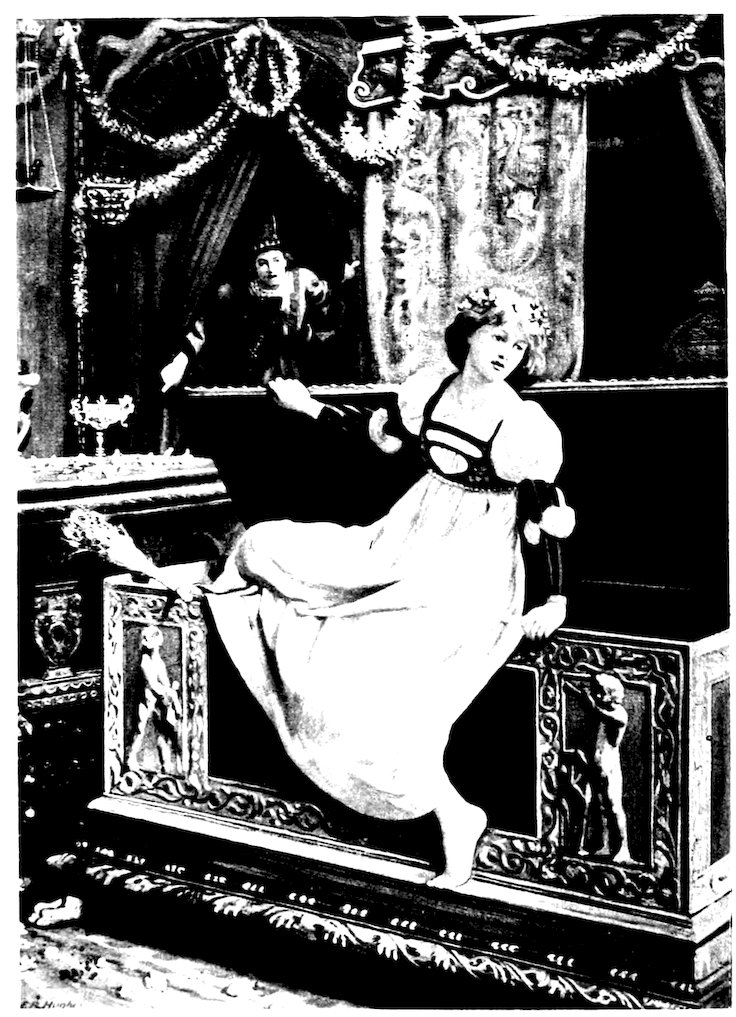
39Genese, when he heard this, determined to clear up the mystery, and the next morning gave out that he was going to hunt at a village ten leagues distant; but, in lieu of going forth, he quietly hid himself in the room, keeping his eyes steadily fixed on the door, and waiting to see what might occur. He had not been long on the watch before Doralice, looking more beautiful than the sun, came out of the cassone and began to sweep the room, and to straighten the carpets, and to deck the bed, and diligently to set everything in order, as was her wont. The beautiful maiden had no sooner done her kindly and considerate office, than she made as if she would go back to her hiding-place; but the king, who had keenly taken note of everything, suddenly caught her by the hand, and, seeing that she was very fair, and fresh as a lily, asked her who she was; whereupon the trembling girl confessed that she was the daughter of a prince. She declared, however, that she had forgotten what was his name, on account of her long imprisonment in the cassone, and she would say nothing as to the reason why she had been shut therein. The king, after he had heard her story, fell violently in love with her, and, with the full consent of his mother, made her his queen, and had by her two fair children.
In the meantime Tebaldo was still mastered by his wicked and treacherous passion, and, as he could find no trace of Doralice, search as he would, he began to believe that she must have been hidden in the coffer which he had caused to be sold, and that, having escaped his power, she might be wandering about from place to place. Therefore, with his rage still burning against her, he set himself to try whether perchance he might not discover her whereabouts. He attired himself as a merchant, and, having gathered together a great store of precious stones and jewels, marvellously wrought in gold, quitted Salerno unknown to anyone, and scoured all the nations and 40countries round about, finally meeting by hazard the trader who had originally purchased the clothes-chest. Of him he demanded whether he had been satisfied with his bargain, and into whose hands the chest had fallen, and the trader replied that he had sold the cassone to the King of England for double the price he had given for it. Tebaldo, rejoicing at this news, made his way to England, and when he had landed there and journeyed to the capital, he made a show of his jewels and golden ornaments, amongst which were some spindles and distaffs cunningly wrought, crying out the while, ‘Spindles and distaffs for sale, ladies.’ It chanced that one of the dames of the court, who was looking out of a window, heard this, and saw the merchant and his goods; whereupon she ran to the queen and told her there was below a merchant who had for sale the most beautiful golden spindles and distaffs that ever were seen. The queen commanded him to be brought into the palace, and he came up the stairs into her presence, but she did not recognize him in his merchant’s guise; moreover, she was not thinking ever to behold her father again; but Tebaldo recognized his daughter at once.
The queen, when she saw how fair was the work of the spindles and distaffs, asked of the merchant what price he put upon them. ‘The price is great,’ he answered, ‘but to you I will give one of them for nothing, provided you suffer me to gratify a caprice of mine. This is that I may be permitted to sleep one night in the same room as your children.’ The good Doralice, in her pure and simple nature, never suspected the accursed design of the feigned merchant, and, yielding to the persuasion of her attendants, granted his request.
But before the merchant was led to the sleeping chamber, certain ladies of the court deemed it wise to offer him a cup of wine well drugged to make him sleep sound, and when night had come and the merchant seemed overcome with fatigue, one of the ladies conducted him into the chamber of the king’s children, where there was prepared for him a sumptuous couch. Before she left him the lady said, ‘Good man, are you not thirsty?’ ‘Indeed I am,’ he replied; whereupon she handed him the drugged wine in a silver cup; but the crafty Tebaldo, while feigning to drink the wine, spilled it over his garments, and then lay down to rest.
Now there was in the children’s room a side door through which it was possible to pass into the queen’s apartment. At midnight, when all was still, Tebaldo stole through this, and, going up to the bed 41beside which the queen had left her clothes, he took away a small dagger, which he had marked the day before hanging from her girdle. Then he returned to the children’s room and killed them both with the dagger, which he immediately put back into its scabbard, all bloody as it was, and having opened a window he let himself down by a cord. As soon as the shopmen of the city were astir, he went to a barber’s and had his long beard taken off, for fear he might be recognized, and having put on different clothes he walked about the city without apprehension.
In the palace the nurses went, as soon as they awakened, to suckle the children; but when they came to the cradles, they found them both lying dead. Whereupon they began to scream and to weep bitterly, and to rend their hair and their garments, thus laying bare their breasts. The dreadful tidings came quickly to the ears of the king and queen, and they ran barefooted and in their night-clothes to the spot, and when they saw the dead bodies of the babes they wept bitterly. Soon the report of the murder of the two children was spread throughout the city, and, almost at the same time, it was rumoured that there had just arrived a famous astrologer, who, by studying the courses of the various stars, could lay bare the hidden mysteries of the past. When this came to the ears of the king, he caused the astrologer to be summoned forthwith, and, when he was come into the royal presence, demanded whether or not he could tell the name of the murderer of the children. The astrologer replied that he could, and whispering secretly in the king’s ear he said, ‘Sire, let all the men and women of your court who are wont to wear a dagger at their side be summoned before you, and if amongst these you shall find one whose dagger is befouled with blood in its scabbard, that same will be the murderer of your children.’
Wherefore the king at once gave command that all his courtiers should present themselves, and, when they were assembled, he diligently searched with his own hands to see if any one of them might have a bloody dagger at his side, but he could find none. Then he returned to the astrologer—who was no other than Tebaldo himself—and told him how his quest had been vain, and that all in the palace, save his mother and the queen, had been searched. To which the astrologer replied, ‘Sire, search everywhere and respect no one, and then you will surely find the murderer.’ So the king searched first his mother, and then the queen, and when he took the dagger which 42Doralice wore and drew it from the scabbard, he found it covered with blood. Then the king, convinced by this proof, turned to the queen and said to her, ‘O, wicked and inhuman woman, enemy of your own flesh and blood, traitress to your own children! what desperate madness has led you to dye your hands in the blood of these babes? I swear that you shall suffer the full penalty fixed for such a crime.’ But though the king in his rage would fain have sent her straightway to a shameful death, his desire for vengeance prompted him to dispose of her so that she might suffer longer and more cruel torment. Wherefore he commanded that she should be stripped and thus naked buried up to her chin in the earth, and that she should be well fed in order that she might linger long and the worms devour her flesh while she still lived. The queen, seasoned to misfortune in the past, and conscious of her innocence, contemplated her terrible doom with calmness and dignity.
Tebaldo, when he learned that the queen had been adjudged guilty and condemned to a cruel death, rejoiced greatly, and, as soon as he had taken leave of the king, left England, quite satisfied with his work, and returned secretly to Salerno. Arrived there he told to the old nurse the whole story of his adventures, and how Doralice had been sentenced to death by her husband. As she listened the nurse feigned to be as pleased as Tebaldo himself, but in her heart she grieved sorely, overcome by the love which she had always borne towards the princess, and the next morning she took horse early and rode on day and night until she came to England. Immediately she repaired to the palace and went before the king, who was giving public audience in the great hall, and, having thrown herself at his feet, she demanded an interview on a matter which concerned the honour of his crown. The king granted her request, and took her by the hand and bade her rise; then, when the rest of the company had gone and left them alone, the nurse thus addressed the king: ‘Sire, know that Doralice, your wife, is my child. She is not, indeed, the fruit of my womb, but I nourished her at these breasts. She is innocent of the deed which is laid to her charge, and for which she is sentenced to a lingering and cruel death. And you, when you shall have learnt everything, and laid your hands upon the impious murderer, and understood the reason which moved him to slay your children, you will assuredly show her mercy and deliver her from these bitter and cruel torments. And if you find that I speak falsely 43in this, I offer myself to suffer the same punishment which the wretched Doralice is now enduring.’
Then the nurse set forth fully from beginning to end the whole history of Doralice’s past life; and the king when he heard it doubted not the truth of it, but forthwith gave orders that the queen, who was now more dead than alive, should be taken out of the earth; which was done at once, and Doralice, after careful nursing and ministration by physicians, was restored to health.
Next King Genese stirred up through all his kingdom mighty preparations for war, and gathered together a great army, which he despatched to Salerno. After a short campaign the city was captured, and Tebaldo, bound hand and foot, taken back to England, where King Genese, wishing to know the whole sum of his guilt, had him put upon the rack, whereupon the wretched man made full confession. The next day he was conducted through the city in a cart drawn by four horses, and then tortured with red-hot pincers like Gano di Magazza, and after his body had been quartered his flesh was thrown to be eaten of ravenous dogs.
And this was the end of the impious wretch Tebaldo; and King Genese and Doralice his queen lived many years happily together, leaving at their death divers children in their place.
All the listeners were both amazed and moved to pity by this pathetic story, and when it was finished Eritrea, without waiting for the Signora’s word, gave her enigma:
I tell you of a heart so vile,
So cruel, and so full of guile,
That with its helpless progeny
It deals as with an enemy.
And when it sees them plump and sleek,
It stabs them with its cruel beak.
For, lean itself, with malice fell,
It fain would make them lean as well.
So they grow thin with wasting pain,
Till nought but plumes and bones remain.
The ladies and gentlemen gave various solutions to this enigma, one guessing this and another that, but they found it hard to believe there could be an animal so vile and cruel as thus barbarously to maltreat its own progeny, but at last the fair Eritrea said with a smile, “What cause is there for your wonder? Assuredly there are 44parents who hate their children as virulently as the rapacious kite hates its young. This bird, being by nature thin and meagre, when it sees its progeny fat and seemly—as young birds mostly are—stabs their tender flesh with its hard beak, until they too become lean like itself.”
This solution of Eritrea’s pointed enigma pleased everybody, and it won the applause of all. Eritrea, having made due salutation to the Signora, resumed her seat. Then the latter made a sign to Arianna to follow in her turn, and she rising from her chair began her fable as follows.
THE FIFTH FABLE.
Dimitrio the chapman, having disguised himself as a certain Gramottiveggio, surprises his wife Polissena with a priest, and sends her back to her brothers, who put her to death, and Dimitrio afterwards marries his serving-woman.

We often see, dear ladies, great inequality in the degree of mutual love. How often will the husband love the wife entirely, and she care little for him; and, on the other hand, the wife will love the husband to find nothing but hatred in return. In conditions like these is born the passion of sudden jealousy, the destroyer of all happiness, rendering a decent life impossible; likewise dishonourings and unseemly deaths, which often shed deep disgrace over all our sex. I will say nothing of the headlong perils, of the numberless ills, into which both men and women rush on account of this accursed jealousy. It would weary rather than divert you were I to recount them all to you one by one; but, as it is my task to bring to an end this evening of pleasant discourse, I will tell you a story of Gramottiveggio, now told for the first time, and I believe you will gather therefrom no less pleasure than edification.
The noble city of Venice, famed for the integrity of its magistrates, for the justice of its laws, and as being the resort of men from every nation of the world, is seated on the bosom of the Adriatic sea, and is named the queen of cities, the refuge of the unhappy, the 45asylum of the oppressed. Her walls are the sea and her roof the sky; and, though the earth produces nought, there is no scarcity of anything that life in a great city demands.
In this rich and magnificent city there lived in former days a merchant whose name was Dimitrio, a good and trustworthy man of upright life, though of low degree. He was possessed with a great desire of offspring, wherefore he took to wife a fair and graceful girl named Polissena, whom he loved as dearly as ever man loved woman, letting her clothe herself so sumptuously that there was no dame in all the city—save amongst the nobles—who could outvie her in raiment, or in rings, or in pearls of price. And besides he took care to let her have abundance of delicate victuals, which, not being suitable to one of her humble degree, gave her the look of being more pampered and dainty than she should have been.
It chanced one day that Dimitrio, who on account of his business was often constrained to travel by sea, determined to take ship with a cargo of goods for Cyprus, and, when he had got ready his apparel and stocked the house with provisions and everything that was needful, he left his dear wife Polissena with a fair and buxom serving-maid to bear her company, and set sail on his voyage.
After his departure Polissena went on living luxuriously and indulged herself with every delicacy, and before very long found she was unable to endure further the pricks of amorous appetite, so she cast her eyes upon the parish priest and became hotly enamoured of him. The priest on his part, being young, lively, and well-favoured, came at last to divine the meaning of the glances Polissena cast towards him out of the corner of her eye, and, seeing that she was gifted with a lovely face and a graceful shape, and further endowed with all the charms men desire in a woman, he soon began to return her amorous looks. Thus love grew up between them, and many days had not passed before Polissena brought the young man privily into the house to take her pleasure with him. And thus, for the course of many months, they secretly enjoyed the delights of love in close embraces and sweet kisses, letting the poor husband fare the best he might in the perils of sea and land.
Now when Dimitrio had been some time in Cyprus, and had made there a reasonable profit on his goods, he sailed back to Venice, and, having disembarked, he went to his home and to his dear Polissena, who, as soon as she saw him, burst into tears, and when 46Dimitrio asked her the reason of her weeping, she replied, ‘I weep because of some bad news which came to me of late, and also for the great joy I feel in seeing you again; for I heard tell by many that all the ships which had sailed for Cyprus were wrecked, and I feared sorely lest some terrible misadventure should have overtaken you. But now, seeing you have by God’s mercy returned safe and sound, I cannot keep back my tears for the joy I feel.’ The simple Dimitrio, who had returned to Venice to make up—as he thought—to his wife for the solitary time she had passed during his long absence, deemed that the tears and sighs of Polissena sprang from her warm and constant love for him; but the poor dupe never suspected that all the while she was saying in her heart, ‘Would to Heaven that he had been drowned at sea! for then I might the more safely and readily take my pleasure with my lover who loves me so well.’
Before a month had passed Dimitrio was forced to set out on his travels once more, whereat Polissena was filled with joy greater than can be imagined, and forthwith sent word to her lover, who showed himself to be no less on the alert; and, when the settled hour for their foregathering had come, he went secretly to her. But the comings and goings of the priest could not be kept secret enough to escape for long the eye of a certain Manusso, a friend of Dimitrio, who lived just opposite. Wherefore Manusso, who held Dimitrio in high esteem for that he was a pleasant companion and one ever ready to do a friendly service, grew mightily suspicious of his young neighbour, and kept a sharp watch over her. When he had satisfied himself that, with a given sign at a certain hour, the door would always be opened to the priest, and that after this the lovers would disport themselves with less circumspection than prudence demanded, he determined that the business, which was as yet a secret, should not be brought to light so as to stir up a scandal, but to let his project have time to ripen by awaiting the return of Dimitrio.