Volume 1 — Night the Second.
W. G. (William George) Waters translation

57

The Fables and Enigmas of Messer Giovanni Francesco Straparola da Caravaggio.
Night the Second.
Phœbus had already plunged his golden wheels into the salt waves of the Indian ocean, his rays no longer gave light to the world, his horned sister now ruled the universe with her mild beams, and the sparkling stars had spread their fires thickly over the sky, when the courtly and honourable company met once more at the accustomed spot. And when they had seated themselves according to their rank, the Signora Lucretia gave the word that they should observe, this night, the same order in their entertainment as hitherto. And, seeing that five of the damsels had not told their stories, the Signora bade the Trevisan to write the names of these on paper, then to place the billets in a golden vase, and to draw them out one after another, as they had done last night. The Trevisan hastened to obey her command, and the first paper which was taken out of the vase bore the name of Isabella, the second that of Fiordiana, the third that of Lionora, the fourth that of Lodovica, and the fifth that of Vicenza. Then the flutes struck up a tune, and they all began to sing and dance in a circle, Antonio Molino and Lionora leading the revel; and they all laughed so loud and heartily, that meseems the sound of their merriment is still to be heard. And when the measure had come to an end they all sat down, and the damsels sang a fair carol in praise of the Signora.
58SONG.
What once we sang we sing to-day,
And ever will we tune our lay,
To praise thee, lady, as the queen
Of beauty, and of all our bene;
The loftiest theme the poet sings,
The sweetest chord that shakes the strings,
The fairest shape the painter gives,
The peer of all in thee survives.
He who never owns the spell
Which moves us now thy praise to tell,
Wins no kindly word from me.
He the bliss shall never see
That flows on earth from faithful love,
And waits on spirits blest above.
At the close of this pleasant song Isabella, who had been chosen to begin the entertainment of the second night, began to tell the story which follows.
THE FIRST FABLE.
Galeotto, King of Anglia, has a son who is born in the shape of a pig. This son marries three wives, and in the end, having thrown off his semblance, becomes a handsome youth.
Fair ladies, if man were to spend a thousand years in rendering thanks to his Creator for having made him in the form of a human and not of a brute beast, he could not speak gratitude enough. This reflection calls to mind the story of one who was born as a pig, but afterwards became a comely youth. Nevertheless, to his dying day he was known to the people over whom he ruled as King Pig.
You must know, dear ladies, that Galeotto, King of Anglia, was a man highly blest in worldly riches, and in his wife Ersilia, the daughter of Matthias, King of Hungary, a princess who, in virtue and beauty, outshone all the other ladies of the time. And Galeotto was a wise king, ruling his land so that no man could hear complaint against him. Though they had been several years married they had 59no child, wherefore they both of them were much aggrieved. While Ersilia was walking one day in her garden she felt suddenly weary, and remarking hard by a spot covered with fresh green turf, she went up to it and sat down thereon, and, overcome with weariness and soothed by the sweet singing of the birds in the green foliage, she fell asleep.
And it chanced that while she slept there passed by three fairies who held mankind somewhat in scorn, and these, when they beheld the sleeping queen, halted, and gazing upon her beauty, took counsel together how they might protect her and throw a spell upon her. When they were agreed the first cried out, ‘I will that no man shall be able to harm her, and that, the next time she lie with her husband, she may be with child and bear a son who shall not have his equal in all the world for beauty.’ Then said the second, ‘I will that no one shall ever have power to offend her, and that the prince who shall be born of her shall be gifted with every virtue under the sun.’ And the third said, ‘And I will that she shall be the wisest among women, but that the son whom she shall conceive shall be born in the skin of a pig, with a pig’s ways and manners, and in this state he shall be constrained to abide till he shall have three times taken a woman to wife.’
As soon as the three fairies had flown away Ersilia awoke, and straightway arose and went back to the palace, taking with her the flowers she had plucked. Not many days had passed before she knew herself to be with child, and when the time of her delivery was come, she gave birth to a son with members like those of a pig and not of a human being. When tidings of this prodigy came to the ears of the king and queen they lamented sore thereanent, and the king, bearing in mind how good and wise his queen was, often felt moved to put this offspring of hers to death and cast it into the sea, in order that she might be spared the shame of having given birth to him. But when he debated in his mind and considered that this son, let him be what he might, was of his own begetting, he put aside the cruel purpose which he had been harbouring, and, seized with pity and grief, he made up his mind that the son should be brought up and nurtured like a rational being and not as a brute beast. The child, therefore, being nursed with the greatest care, would often be brought to the queen and put his little snout and his little paws in his mother’s lap, and she, moved by natural affection, would caress him by stroking 60his bristly back with her hand, and embracing and kissing him as if he had been of human form. Then he would wag his tail and give other signs to show that he was conscious of his mother’s affection.
The pigling, when he grew older, began to talk like a human being, and to wander abroad in the city, but whenever he came near to any mud or dirt he would always wallow therein, after the manner of pigs, and return all covered with filth. Then, when he approached the king and queen, he would rub his sides against their fair garments, defiling them with all manner of dirt, but because he was indeed their own son they bore it all.
One day he came home covered with mud and filth, as was his wont, and lay down on his mother’s rich robe, and said in a grunting tone, ‘Mother, I wish to get married.’ When the queen heard this, she replied, ‘Do not talk so foolishly. What maid would ever take you for a husband, and think you that any noble or knight would give his daughter to one so dirty and ill-savoured as you?’ But he kept on grunting that he must have a wife of one sort or another. The queen, not knowing how to manage him in this matter, asked the king what they should do in their trouble: ‘Our son wishes to marry, but where shall we find anyone who will take him as a husband?’ Every day the pig would come back to his mother with the same demand: ‘I must have a wife, and I will never leave you in peace until you procure for me a certain maiden I have seen to-day, who pleases me greatly.’
It happened that this maiden was a daughter of a poor woman who had three daughters, each one of them being very lovely. When the queen heard this, she had brought before her the poor woman and her eldest daughter, and said, ‘Good mother, you are poor and burdened with children. If you will agree to what I shall say to you, you will be rich. I have this son who is, as you see, in form a pig, and I would fain marry him to your eldest daughter. Do not consider him, but think of the king and of me, and remember that your daughter will inherit this whole kingdom when the king and I shall be dead.’
When the young girl listened to the words of the queen she was greatly disturbed in her mind and blushed red for shame, and then said that on no account would she listen to the queen’s proposition; but the poor mother besought her so pressingly that at last she yielded. 61When the pig came home one day, all covered with dirt as usual, his mother said to him, ‘My son, we have found for you the wife you desire.’ And then she caused to be brought in the bride, who by this time had been robed in sumptuous regal attire, and presented her to the pig prince. When he saw how lovely and desirable she was he was filled with joy, and, all foul and dirty as he was, jumped round about her, endeavouring by his pawing and nuzzling to show some sign of his affection. But she, when she found he was soiling her beautiful dress, thrust him aside; whereupon the pig said to her, ‘Why do you push me thus? Have I not had these garments made for you myself?’ Then she answered disdainfully, ‘No, neither you nor any other of the whole kingdom of hogs has done this thing.’ And when the time for going to bed was come the young girl said to herself, ‘What am I to do with this foul beast? This very night, while he lies in his first sleep, I will kill him.’ The pig prince, who was not far off, heard these words, but said nothing, and when the two retired to their chamber he got into the bed, stinking and dirty as he was, and defiled the sumptuous bed with his filthy paws and snout. He lay down by his spouse, who was not long in falling to sleep, and then he struck her with his sharp hoofs and drove them into her breast so that he killed her.
The next morning the queen went to visit her daughter-in-law, and to her great grief found that the pig had killed her; and when he came back from wandering about the city he said, in reply to the queen’s bitter reproaches, that he had only wrought with his wife as she was minded to deal with him, and then withdrew in an ill humour. Not many days had passed before the pig prince again began to beseech the queen to allow him to marry one of the other sisters, and because the queen at first would not listen to his petition he persisted in his purpose, and threatened to ruin everything in the place if he could not have her to wife. The queen, when she heard this, went to the king and told him everything, and he made answer that perhaps it would be wiser to kill their ill-fated offspring before he might work some fatal mischief in the city. But the queen felt all the tenderness of a mother towards him, and loved him very dearly in spite of his brutal person, and could not endure the thought of being parted from him; so she summoned once more to the palace the poor woman, together with her second daughter, and held a long discourse with her, begging her the while to give her daughter in marriage. At last the 62girl assented to take the pig prince for a husband; but her fate was no happier than her sister’s, for the bridegroom killed her, as he had killed his other bride, and then fled headlong from the palace.
When he came back, dirty as usual and smelling so foully that no one could approach him, the king and queen censured him gravely for the outrage he had wrought; but again he cried out boldly that if he had not killed her she would have killed him. As it had happened before, the pig in a very short time began to importune his mother again to let him have to wife the youngest sister, who was much more beautiful than either of the others; and when this request of his was refused steadily, he became more insistent than ever, and in the end began to threaten the queen’s life in violent and bloodthirsty words, unless he should have given to him the young girl for his wife. The queen, when she heard this shameful and unnatural speech, was wellnigh broken-hearted and like to go out of her mind; but, putting all other considerations aside, she called for the poor woman and her third daughter, who was named Meldina, and thus addressed her: ‘Meldina, my child, I should be greatly pleased if you would take the pig prince for a husband; pay no regard to him, but to his father and to me; then, if you will be prudent and bear patiently with him, you may be the happiest woman in the world.’ To this speech Meldina answered, with a grateful smile upon her face, that she was quite content to do as the queen bade her, and thanked her humbly for deigning to choose her as a daughter-in-law; for, seeing that she herself had nothing in the world, it was indeed great good fortune that she, a poor girl, should become the daughter-in-law of a potent sovereign. The queen, when she heard this modest and amiable reply, could not keep back her tears for the happiness she felt; but she feared all the time that the same fate might be in store for Meldina as her sisters.
When the new bride had been clothed in rich attire and decked with jewels, and was awaiting the bridegroom, the pig prince came in, filthier and more muddy than ever; but she spread out her rich gown and besought him to lie down by her side. Whereupon the queen bade her to thrust him away, but to this she would not consent, and spoke thus to the queen: ‘There are three wise sayings, gracious lady, which I remember to have heard. The first is that it is folly to waste time in searching for that which cannot be found. The second is that we should believe nothing we may hear, except those things which bear the marks of sense and reason. The third is that, when once you have got possession of some rare and precious treasure, prize it well and keep a firm hold upon it.’
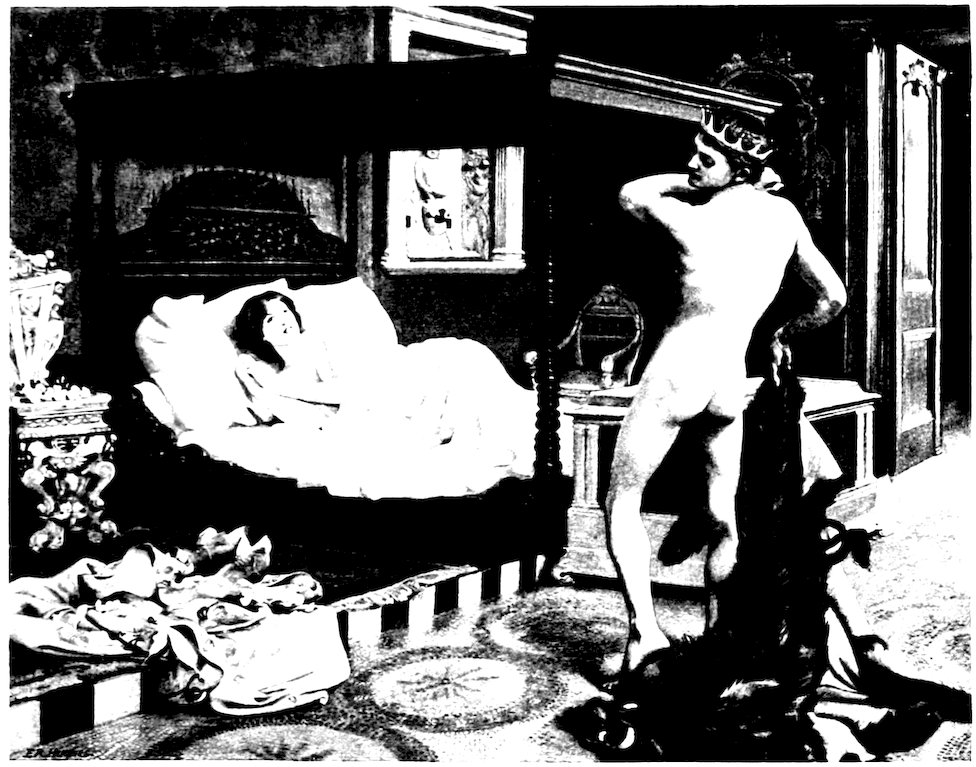
63When the maiden had finished speaking, the pig prince, who had been wide awake and had heard all that she had said, got up, kissed her on the face and neck and bosom and shoulders with his tongue, and she was not backward in returning his caresses; so that he was fired with a warm love for her. As soon as the time for retiring for the night had come, the bride went to bed and awaited her unseemly spouse, and, as soon as he came, she raised the coverlet and bade him lie near to her and put his head upon the pillow, covering him carefully with the bed-clothes and drawing the curtains so that he might feel no cold. When morning had come the pig got up and ranged abroad to pasture, as was his wont, and very soon after the queen went to the bride’s chamber, expecting to find that she had met with the same fate as her sisters; but when she saw her lying in the bed, all defiled with mud as it was, and looking pleased and contented, she thanked God for this favour, that her son had at last found a spouse according to his liking.
One day, soon after this, when the pig prince was conversing pleasantly with his wife, he said to her: ‘Meldina, my beloved wife, if I could be fully sure that you could keep a secret, I would now tell you one of mine; something I have kept hidden for many years. I know you to be very prudent and wise, and that you love me truly; so I wish to make you the sharer of my secret.’ ‘You may safely tell it to me, if you will,’ said Meldina, ‘for I promise never to reveal it to anyone without your consent.’ Whereupon, being now sure of his wife’s discretion and fidelity, he straightway shook off from his body the foul and dirty skin of the pig, and stood revealed as a handsome and well-shaped young man, and all that night rested closely folded in the arms of his beloved wife. But he charged her solemnly to keep silence about this wonder she had seen, for the time had not yet come for his complete delivery from this misery. So when he left the bed he donned the dirty pig’s hide once more. I leave you to imagine for yourselves how great was the joy of Meldina when she discovered that, instead of a pig, she had gained a handsome and gallant young prince for a husband. Not long after this she proved to be with child, and when the time of her delivery came she 64gave birth to a fair and shapely boy. The joy of the king and queen was unbounded, especially when they found that the new-born child had the form of a human being and not that of a beast.
But the burden of the strange and weighty secret which her husband had confided to her pressed heavily upon Meldina, and one day she went to her mother-in-law and said: ‘Gracious queen, when first I married your son I believed I was married to a beast, but now I find that you have given me the comeliest, the worthiest, and the most gallant young man ever born into the world to be my husband. For know that when he comes into my chamber to lie by my side, he casts off his dirty hide and leaves it on the ground, and is changed into a graceful handsome youth. No one could believe this marvel save they saw it with their own eyes.’ When the queen heard these words she deemed that her daughter-in-law must be jesting with her, but Meldina still persisted that what she said was true. And when the queen demanded to know how she might witness with her own eyes the truth of this thing, Meldina replied: ‘Come to my chamber to-night, when we shall be in our first sleep; the door will be open, and you will find that what I tell you is the truth.’
That same night, when the looked-for time had come, and all were gone to rest, the queen let some torches be kindled and went, accompanied by the king, to the chamber of her son, and when she had entered she saw the pig’s skin lying on the floor in the corner of the room, and having gone to the bedside, found therein a handsome young man in whose arms Meldina was lying. And when they saw this, the delight of the king and queen was very great, and the king gave order that before anyone should leave the chamber the pig’s hide should be torn to shreds. So great was their joy over the recovery of their son that they wellnigh died thereof.
And King Galeotto, when he saw that he had so fine a son, and a grandchild likewise, laid aside his diadem and his royal robes, and advanced to his place his son, whom he let be crowned with the greatest pomp, and who was ever afterwards known as King Pig. Thus, to the great contentment of all the people, the young king began his reign, and he lived long and happily with Meldina his beloved wife.
When Isabella’s story was finished, the whole company broke into laughter at the notion of the pig prince, all dirty and muddy as he was, kissing his beloved spouse and lying by her side. “But let us give over laughter,” cried Signora Lucretia, “in order that Isabella’s enigma 65may be given in due course.” And forthwith Isabella, with a smile, propounded her riddle.
I prithee, sir, to give to me,
What never did belong to thee,
Or ever will, what though thy span
Of life exceed the wont of man.
Dream not this treasure to attain;
Thy longing will be all in vain;
But if you deem me such a prize,
And pine for me with loving eyes,
Give me this boon, my wish fulfil,
For you can grant it if you will.
When Isabella had set forth her cunningly devised enigma, the listeners were all in a state of bewilderment, for no one could understand how a man could give what he did not possess or ever could possess. But Isabella, when she saw that they were troubled overmuch, said, with much good taste and judgment: “There is no reason for wonder, my good friends, for a man certainly can give to a woman that which he has not or ever will have; that is to say, a man has no husband nor ever will have one, but it is an easy matter for him to give one to a lady.” The whole company received this solution with much applause, and when silence had once more been imposed on the assembly, Fiordiana, who sat next to Isabella, arose from her seat and, smiling merrily, said: “Signora, and you gentle folks all, does it not seem meet to you that Signor Molino, our good friend, should enliven this honourable company with one of his merry conceits; and I say this, not because I want to escape the task of telling my own story (for I have ready more than one), but because I feel that a tale, told with all his accustomed pleasant grace and style, would, just now, give the company the greater delight. He, as you well know, is ingenious and full of wit, and gifted with all those good parts which pertain to a man of breeding. And as for ourselves, dear ladies, it is better that we should ply our needles than be always telling stories.”
All agreed with these prudent and well-timed words of Fiordiana, and warmly applauded them, and the Signora, casting her eyes towards Molino, said: “Come, Signor Antonio, it is now your turn to enliven us with an example of your graceful wit.” And she signed to him to begin. Molino, who had not reckoned on being named as a story-teller for this evening, first gave his thanks to Fiordiana for the flattering 66words she had spoken of him, and then in obedience to the Signora’s direction began his fable.
THE SECOND FABLE.
Filenio Sisterno, a student of Bologna, having been tricked by certain ladies, takes his revenge upon them at a feast to which he has bidden them.

I should never have believed or imagined that the Signora would have laid upon me the task of telling a story, seeing that in the due order of things we should call upon Signora Fiordiana to give us one. But since it is the pleasure of the company, I will take upon myself to tell you something which may peradventure fit in with your humour. But if by chance my narrative (which God forbid) should prove tiresome to you, or should overstep the bounds of civility, I must crave your indulgence therefor, and that the blame may be laid on Signora Fiordiana, to whom it is in fact due.
In Bologna, the chief city of Lombardy, the parent of learning, and a place furnished with everything needful for its high and flourishing estate, there lived a young scholar of graceful and amiable parts named Filenio Sisterno, born in the island of Crete. It chanced one day that a magnificent feast was given, to which were invited the most beautiful and distinguished ladies of Bologna, and many gentlemen, and certain of the scholars, amongst whom was Filenio. After the manner of gallants, he went dallying now with this and now with that fair dame, and finding no difficulty in suiting his taste, resolved to lead out one of them for a dance. His choice fell upon the Signora Emerentiana, the wife of a certain Messer Lamberto Bentivogli, and she, who was very gracious, and no less sprightly than beautiful, did not say him nay. During the dance, which Filenio took care should be very gentle and slow, he wrung her hand softly, and thus addressed her in a whisper: ‘Ah! Signora, how great is your beauty; surely it transcends any that has yet met my eye; surely the lady does not live who could ensnare my heart as you have ensnared it. If only I might hope you would give me back the like, I should be 67the happiest man in the world; but if you should prove cruel, you will soon see me lying dead at your feet, and know yourself as the cause of my bane. Seeing that I love you so entirely—and indeed I could do no other thing—you ought to take me for your servant, disposing both of my person and of the little I can call mine as if they were your own. Higher favour from heaven I could not obtain than to find myself subject to such a mistress, who has taken me in the snare of love as if I had been a bird.’ Emerentiana, while she listened earnestly to these sweet and gracious speeches, like a modest gentlewoman made as though she had no ears, and held her peace. When the measure had come to an end, Emerentiana sat down, and straightway Filenio led out another lady as his partner, but the dance had scarcely begun before he began to address her in like fashion: ‘Of a truth, most gracious Signora, there is no need for me to waste words in setting forth how deep and ardent is the love I have for you, and ever shall have, so long as this soul of mine inhabits and rules my unworthy frame. And I would hold myself blest indeed if I could possess you as the lady of my heart and my peculiar mistress. Therefore, loving you as I do, and being wholly yours, as you may easily understand, I beg you will deign to take me for your most humble servant, seeing that my life and everything I have to live for depends on you and on no other.’ The young lady, whose name was Panthemia, although she understood all this, made no reply, but modestly went on with the dance, and, when it had come to an end, she sat down with the other ladies, smiling a little the while.
But short time had passed before the gallant scholar took a third partner by the hand; this time the most seemly, the most gracious, and the fairest lady in Bologna, and began to tread a measure with her, making all those who pressed round to admire her, give way; and before the dance was ended he thus addressed her: ‘Most estimable lady, perhaps I shall seem to you out of measure presumptuous to reveal the secret love which I have borne, and still bear towards you, but for this offence blame not me, but your own beauty, which raises you high above all others, and makes me your slave. I speak not now of your delightful manners, nor of your surpassing virtues, which are great enough and many enough to bring all the world to your feet. If then your loveliness, the work of nature, and owing nought to art, fascinates everyone, there is no 68wonder that it should constrain me to love you and to guard your image in my inmost heart. I beseech you then, sweet lady, the one comfort of my life, to spare some tenderness for one who dies for you a thousand times a day. If you grant me this grace I shall know I owe my life to you; so to your kindness I now recommend myself.’
The fair lady, who was called Sinforosia, when she heard the sweet and loving words which came from Filenio’s ardent bosom, could not forbear sighing, but taking heed of her honour as a married woman she answered him nought, and when the dance was come to an end returned to her seat.
It happened that all these three ladies found themselves sitting in a ring close to one another, and disposed for sprightly talk, when Emerentiana, the spouse of Messer Lamberto, moved by jocund humour and not by spite, said to her two companions, ‘Dear friends, I have to tell you of a diverting adventure which has this evening befallen me.’ ‘And what is it?’ they inquired. Said Emerentiana, ‘This evening, in the course of the dancing, I have gotten for myself a cavalier, the handsomest, the trimmest, the most gracious you could find anywhere, who protests himself to be so hotly inflamed with my beauty that he can find no rest day or night.’ And word by word she related all that the scholar had said to her. As soon as Panthemia and Sinforosia heard her story, they told her that the same had happened to them, and before they left the feast they had satisfied themselves that it was the same gallant who had made love to all three of them. Wherefore they clearly comprehended that the words of this gallant sprang not from loyal feeling, but from deceit and feigning of love, and they gave to them no more credence than one is wont to give to the babblings of a sick man or to the romancer’s fables, and they did not go from thence before they had agreed, each one of them, to put a trick upon him such as he would not readily forget; for ladies, too, may play jokes. Filenio meantime was bent on amorous design, and went on making love now to one lady now to another. Judging from their carriage that they looked not unkindly upon him, he set himself the task, if it were possible, of moving each one of them to grant him the supremest favour of love, but the issue of the affair was not according to his desire, for all his schemes went astray.
Emerentiana, who could no longer bear with the mock love-making 69of the silly scholar, called to a pretty buxom handmaid of hers, and charged her to find some excuse for speaking with Filenio, in order to disclose to him the love which her mistress had conceived for him, and to let him know that he might whenever he would spend a night with her in her own house. When Filenio heard this he was much elated, and said to the maid, ‘Hasten home forthwith and commend me to your mistress, and tell her in my behalf that she may expect me this evening at her house, provided that her husband be not at home.’ When this word had been brought to Emerentiana, she straightway caused to be collected a great store of prickly thorns, and having strewn these under the bed where she lay at night, she awaited the coming of her gallant. When it had become dusk the scholar took his sword and stole towards the house of his fancied mistress, and the door, when he had given the password, was immediately opened. Then, when the two had held some little converse and supped daintily, they withdrew into the bedchamber for the night.
Scarcely had Filenio taken off his clothes to go to bed when Messer Lamberto was heard without, and hereupon the lady, feigning to be at her wits’ end where she should hide her lover, bade him get under the bed. Filenio, seeing how great the danger was, both to the lady and to himself, made haste to betake himself thither, without putting on any more clothes than the shirt he wore, and was in consequence so grievously pricked by the thorns prepared for him that there was no part of his body, from the crown of his head to the sole of his foot, which was not running with blood. And the more he essayed in this dark hole to defend himself from the pricks, the more grievously was he wounded, and he dared not make a sound lest Messer Lamberto should hear him and slay him. I leave you to figure in what plight the poor wretch found himself that night, seeing that he dared not call out, though he was like to lose a good part of his breech through the torment he was suffering. When the morning was come, and the husband had left the house, the wretched scholar clothed himself as best he could, and made his way back to his lodging, bleeding and in great fear lest he should die. But being well treated by his physician, he got well and recovered his former health.
Many days had not passed before Filenio essayed another bout of love-making, casting amorous eyes on the other two ladies, Panthemia and Sinforosia, and went so far as to find one evening an occasion to 70address Panthemia, to whom he rehearsed his continued woes and torments, and besought her that she would have pity upon him. Panthemia, who was full of tricks and mischief, while feigning to compassionate him, made excuse that it was not in her power to do his will; but at last, as if vanquished by his tender prayers and ardent sighs, she brought him into her house. And when he was undressed, and ready to go to bed with her, she bade him go into a cabinet adjacent, where she kept her orange water and perfumes, to the intent that he might well perfume his person, and then get to bed. The scholar, never suspecting the cunning of this mischief-working dame, entered the cabinet, and, having set his foot upon a board unnailed from the joist which held it up, he and the board as well fell down into a warehouse below, in which certain merchants kept their store of cotton and wool, and although he fell so far he suffered no ill. The scholar, finding himself in this dark place, began to search for some ladder or door to serve his exit, but coming upon none he cursed the hour and the place where he had first set eyes on Panthemia. The morning dawned at last, and then the unhappy wight began to realize by degrees the full treachery of Panthemia. He espied on one side of the storehouse certain outlets in the wall, through which streamed in a dim light, and, finding the masonry to be old and moss-grown, he set to work with all his strength to pull out the stones in the spot which had fallen most to decay, and soon made a gap big enough to let him out. And, finding himself in an alley, clad only in his shirt, and stockingless, he stole back to his lodging without being seen of any.
And next it happened that Sinforosia, having heard of the tricks which the two others had played the scholar, resolved to treat him with a third, no less noteworthy; so, the next time she saw him, she began to ogle him with the tail of her eye, by way of telling him that a passion for him was burning her up. Filenio, forgetting straightway his former mishaps, began to walk up and down past her house, and play the lover. Sinforosia, when she saw from this that he was deeply smitten with love for her, sent him a letter by an old woman to let him know that he had so completely captured her fancy by his fine person and gracious manners that she could find rest neither night nor day, and to beg him that, whenever it might please him, he would come and hold converse with her, and give her a pleasure greater than any other. Filenio took the letter, and having mastered the contents, was at once filled with more glee and happiness than he had ever known 71before, clean forgetting all the tricks and injuries he had suffered hitherto. He took pen and ink, and wrote a reply, that, though she might be enamoured of him, he, on his part, was just as much in love with her, or even more, and that at any time she might appoint he would hold himself at her service and commands. When she had read this reply, Sinforosia made it her business to find full soon an opportunity for the scholar to be brought to her house, and then, after many feigned sighs, she said: ‘O my Filenio, of a truth I know of no other gallant who could have brought me into such plight, but you alone; since your comeliness, your grace, and your discourse have kindled such fire in my heart that I burn like dry wood.’ The scholar, while he listened, took it for certain that she was melting with love for him, and, poor simpleton as he was, kept on some time bandying sweet and loving words with her, till it seemed to him that the time had come to go to bed and to lie down beside her. Then Sinforosia said: ‘Before we go to bed it seems meet that we should regale ourselves somewhat.’ And having taken him by the hand, she led him into an adjoining cabinet, where there was a table spread with sumptuous cakes and wines of the finest, in which the mischievous dame had caused to be mingled a certain drug, potent to send her gallant to sleep for a certain time. Filenio took a cup and filled it with wine, and suspecting no fraud he emptied it straightway. Enlivened by the banquet, and having washed himself in orange water and dainty perfumes, he got into bed, and then immediately the drug began to work, and he slept so sound that even the uproar of great artillery would scarce have awakened him. Then, when Sinforosia perceived that he was in a heavy slumber and that the drug was doing its work well, she called one of her maids, a strong wench whom she had made privy to the jest, and the two of them took Filenio by the legs and arms, and, having opened the door softly, they placed him in the street, about a stone’s cast from the house, and there left him.
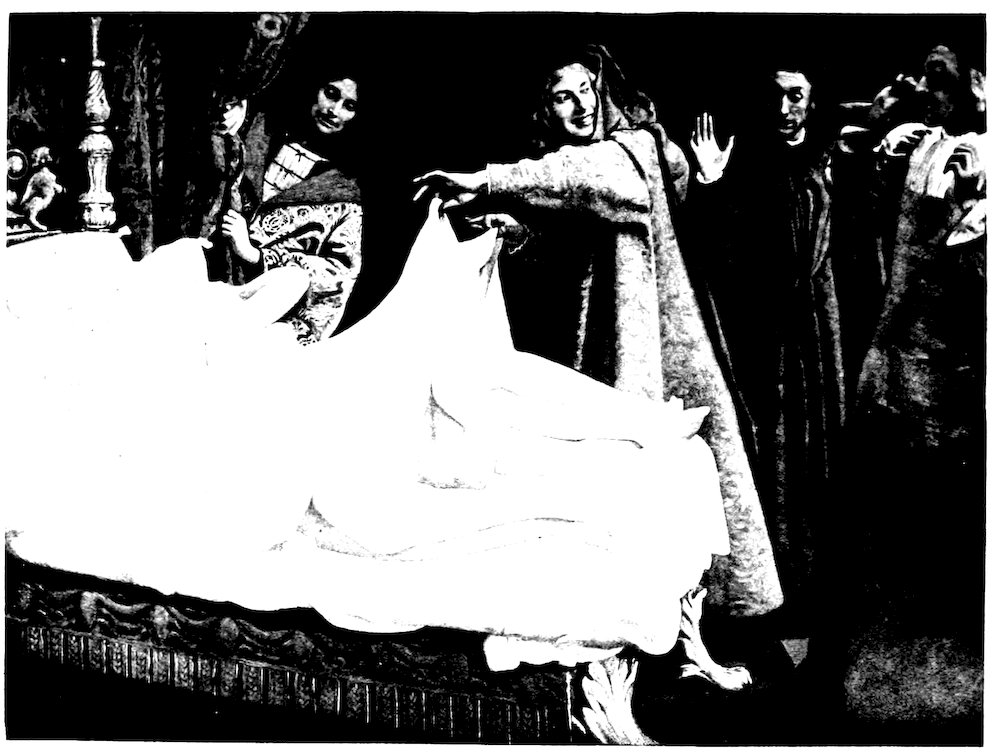
It was about an hour before dawn when, the drug having spent its force, the poor wretch came to himself, and, believing that he had been in bed with the lady, found himself instead stockingless, and clad only in his shirt, and half dead with cold through lying on the bare ground. Almost helpless in his arms and legs, he found it a hard matter to get on his feet, and, when he had done so much, it was with difficulty that he kept from falling again; but he managed, as best he could, to regain his lodging and to care for his health. 72Had it not been for his lusty youth, he would surely have been maimed for life; but he regained his former health, and when he went abroad again he showed no signs of remembering the injuries and vexations which had been put upon him; but, on the other hand, he bore himself towards the three ladies as if he loved them as well as ever, and feigned, now to be enamoured of one, and now of another. The ladies, never suspecting malice on his part, put a good face on the matter, and treated him graciously as if they were dealing with a real lover. Filenio was many times tempted to give his hand free play, and to mark their faces for them, but he prudently took thought of the condition of the ladies, and of the shame that would be cast on him should he offer violence to them, and restrained his wrath. Day and night he considered how he might best wreak his vengeance on them, and when he could hit on no plan he was in great perplexity. But in the course of time he devised a scheme by which he might readily work his purpose, and fortune aided him to prosecute it as he had designed. He hired for himself in the city a very fine house, containing a magnificent hall and many dainty chambers, and in this he purposed to give a great and sumptuous feast, and to invite thereto a company of gentlefolk, Emerentiana, and Panthemia, and Sinforosia amongst the rest. They accepted the scholar’s invitation without demur, suspecting nothing sinister in the same, and when they were come to the feast the wily scholar led them with many courteous speeches into a room and begged them to take some refreshment. As soon as the three ladies—foolish and imprudent indeed—had entered the room, Filenio locked the door, and, advancing towards them, said: ‘Now, my pretty ladies, the time is come for me to take my revenge upon you, and to give you some repayment for all the ills you put upon me, just because I loved you so well.’ When they heard these words, they seemed more dead than alive, and began to repent heartily that they had ever abused him, and at the same time to curse their own folly in having trusted the word of one they ought to have treated as a foe. Then the scholar with fierce and threatening looks commanded them that they should, if they set any store on their lives, strip themselves naked, and the ladies, when they heard this speech, exchanged glances one with the other and began to weep, begging him the while, not only for the sake of love, but also for the sake of his natural gentleness, that their honour might be left to them. Filenio, exulting in his 73deed, was exceedingly polite to them, but at the same time informed them that he could not suffer them to remain clothed in his presence. Hereupon the ladies cast themselves down at Filenio’s feet, and with piteous weeping humbly besought him not to be the cause of so great shame to them. But he, whose heart was now grown as hard as a stone, cried out that what he would do to them was in no sense blameworthy: it was nothing but just revenge; so the ladies were forced to take off their clothes and to stand as naked as when they were born, in which condition they appeared fully as fair as when apparelled. When this had come to pass even Filenio began to feel some pity for them; but, remembering his recent wrongs, and the mortal perils he had undergone, he chased away his pitying humour and once more hardened his heart. He then craftily conveyed all the clothes and linen they had lately worn into a neighbouring cabinet, and bade them with threatenings all to get into one bed. The ladies, altogether astounded and shaking with terror, cried out, ‘Wretched fools that we are! What will our husbands and our friends say when it shall be told to them that we have been found here slain in this shameful case?’ The scholar, seeing them lying one by the other like married folk, took a large sheet of linen, very white, but not fine enough to suffer their bodies to be seen and recognized, and covered them therewith from head to foot; then he left the chamber, locking the door behind him, to go and find the three husbands, who were dancing in the hall. Their dance being finished, Filenio led them with him into the chamber where the ladies were lying in the bed, and said to them: ‘Gentlemen, I have brought you hither for your diversion, and to show you the prettiest sight you have ever seen;’ and, having led them up to the bed with a torch in his hand, he began softly to lift up the covering at their feet, and to turn it back so as to disclose the fair limbs beneath it as far as the knees, thus giving the three husbands something wondrous fair to look upon. Next he uncovered them as far as their stomachs, which he then disclosed entirely by lifting the sheet in the same way. I leave you to imagine how great was the diversion the three gentlemen got from this jest of Filenio’s, also in what distressful plight these poor wretched ladies found themselves when they heard their husbands join in mocking them. They lay quite still, not daring even to cough, lest they should be discovered, while their husbands kept urging the scholar to uncover their faces; but he, wiser in other men’s wrongs 74than in his own, would not oblige them so far. Not content with this, he brought forth their garments, which he showed to their husbands, who, when they looked thereon, were astonished and somewhat perturbed at heart, and, after examining them closely, said one to another: ‘Is not this the gown which I once had made for my wife?’ ‘Is not this the coif which I bought for her?’ ‘Is not this the pendant that she hangs round her neck? Are not these the rings she wears on her fingers?’
At last Filenio brought the three gentlemen out of the chamber, and bade them, so as not to break up the company, to remain to supper. The scholar, learning that the supper was ready and everything set in order by the majordomo, gave the word for everyone to take his place. And while the guests were setting their teeth to work, Filenio returned to the chamber where the three ladies were, and as he uncovered them said: ‘Good evening, fair ladies; did you hear what your husbands were saying? They are now without, waiting impatiently to see you. Get up; surely you have slept enough; give over yawning and rubbing your eyes. Take your clothes and don them without delay, and go into the hall where the other guests await you.’ With such words as these he mocked them; while they, disconsolate and despairing, feared lest this adventure might come to some fatal issue, and wept bitterly. At last, full of anguish and terror and looking for nothing less than death at his hands, they arose and turning to the scholar said to him: ‘Filenio, you have taken more than vengeance upon us. Now nothing remains but for you to draw your sword and make an end of our lives, for we desire death beyond any other thing. And if you will not grant us this boon, at least suffer us to return unobserved to our homes, so that our honour may be saved.’
Filenio, seeing that he had carried the affair far enough, gave them back their garments, and directed them to clothe themselves quickly, and when this was done he sent them out of the house by a secret door, and they went back to their homes. At once they laid aside their fine clothes, which they had lately worn, and put them away in their presses, and with great prudence sat down to work instead of going to bed. When the feast had come to an end, the three husbands thanked the scholar for the fine entertainment he had given them, and in particular for the sight of the beauties laid out for their benefit in the chamber, beauties surpassing the sun himself, and, 75having taken leave of him, they returned to their homes, where they found their wives sewing beside the hearth. Now the sight of the clothes, and the rings, and the jewels, which the scholar had exhibited to them, had made them somewhat suspicious; so each one now demanded of his wife where she had spent that evening, and where her best garments were. To this questioning each lady replied boldly that she had not left the house that evening, and, taking the keys of the coffers wherein was disposed her apparel, she showed this to her husband, with the rings and other jewels which he had given her. When the husbands saw these they were silent, and knew not what to say, but after a little they told their wives word by word what they had seen that evening. The ladies made as if they knew nothing of it, and, after jesting a little over the matter, they undressed and went to bed. And in after times Filenio often met the three ladies in the streets, and would always inquire of them: ‘Which of you was in the greatest fear? and did I suffer most from your jests, or you from mine?’ But they always held their eyes down on the ground, and said nothing. And in this fashion the scholar avenged himself as well as he could of the tricks he had suffered, without violence or outrage.
When they had listened to the story of Molino, the Signora and all the other ladies declared that the revenge, worked upon the three gentlewomen by the scholar for the tricks they had played him, was no less revolting than cowardly; but when they came to consider the severe punishment which the poor fellow had suffered in couching upon the thorns, and the danger of breaking his bones he had incurred in falling down into the warehouse, and the biting cold he had been exposed to when laid out in the open street to sleep upon the bare earth clad only in his shirt, they admitted that his vengeance was no heavier than was due. The Signora, though she had excused Fiordiana from telling her story in due order, now demanded of her that she should at least give her enigma, which ought to have some reference to the story of the scholar; and she, in obedience to this word, said: “Signora, it happens that the enigma which I have to submit to the company has nothing in keeping with deeds of grave and terrible vengeance such as the ingenious Signor Antonio has set forth in his fable, but at the same time it will be one which may be of interest to every studious youth.” And without further delay she propounded her enigma:
76From two dead blocks a living man
Gave life to one whose spirit ran
To vivify another wight,
Who thus from darkness rose to light.
Two living ones together bide,
The creature by the maker’s side,
And by the creature’s radiance led,
The master communes with the dead.
This subtle riddle of the Signora Fiordiana was interpreted in various wise, but not one of the company hit upon its exact meaning. And seeing that Fiordiana kept on shaking her head at the essays made by the company, Bembo remarked with a quiet smile, “Signora Fiordiana, it seems to me to be foolishness to waste our time in this fashion. Tell us what you will, and we shall be contented.” “Since this noble company decrees,” replied Fiordiana, “that I should be my own interpreter, I will gladly do this; not because I deem myself in any way competent for this task, but because I wish to oblige all you here, to whom I am bound by so many kindnesses. My enigma shows simply a student who rises from bed early in the morning, and he, a living thing, by the working of two dead things, the flint and the steel, gives life to the dead tinder, and this in its turn enlivens the dead candle. Thus the first living one, the student, by the help of these other two living ones who lately were dead, sits down to converse with the dead, that is, with the books writ by learned men of times long past.” The explication of this most ingenious riddle by Fiordiana pleased the company greatly, and the Signora directed Lionora to begin her story at once.

77
THE THIRD FABLE.
Carlo da Rimini vainly pursues Theodosia with his love, she having resolved to live a virgin. In striving to embrace her he meets with divers misadventures, and is well beaten by his own servants to boot.

Dear ladies, the clever story just told to us by Molino has made me give up all thought of relating to you the one I had in my mind, and to offer in its place another which, if I am not mistaken, will be equally pleasing to you ladies as Molino’s was to the gentlemen. Mine will certainly be shorter than his, and, I think I may say, more decent in the subject it treats.
I must tell you then that Carlo da Rimini—as I think many of you know—was a man whose trade was fighting, a despiser of God, a blasphemer of the saints, brutal and a cutthroat, and at the same time given over to all kinds of effeminate luxury. So great indeed was his malignity and the corruption of his nature, that his equal could not be found. Now in the days when he was a handsome, seemly young man, it chanced that he became hotly enamoured of a certain maiden, the daughter of a poor widow, who, though she was very poor and only contrived to find a living for herself and her child with much difficulty, would rather have died with hunger than have consented to live on the wages of her daughter’s sin.
The maiden, whose name was Theodosia, was very fair and graceful in her person, and no less honest and discreet in her conduct; moreover, she was of a prudent, sober temper, and had already determined to devote herself to the religious life and to prayer, holding all worldly things to be of small account. Carlo, therefore, burning with lascivious passion, was in the habit of molesting her with his attentions every day, and on any day when he might not chance to see her he was like to die of vexation.
With flatteries and gifts and solicitations he made frequent trial to win the maiden’s consent to his wishes, but all his importunities were in vain; for, like a wise and good girl, she would have none of his presents, and every day she prayed to God to turn away from his heart these dishonest wishes. At last there came a time when he 78could no longer hold within bounds his ardent lust and bestial desire, and, feeling gravely affronted at these continual rebuffs by one whom he loved more dearly than his own life, he made up his mind to ravish her and satisfy his lecherous appetite, let the consequence be what it might. But he feared to stir up a commotion through any public scandal, lest the people, who held him in great hatred, should rise and slay him.
But at last, being overcome by his unbridled desire, with his mind distempered with rage as if he had been a mad dog, he made a plan with two of his underlings—desperate ruffians both of them—to carry her off and then to ravish her. Therefore one day, when the evening dusk had fallen, he armed himself and went with the two desperadoes to the young girl’s dwelling-place, the door of which he found open; but before entering he charged his men to keep on the alert, and to take care, as they valued their own lives, that no other person should enter the house or come out therefrom until he himself should rejoin them. The two ruffians, who were full willing to obey their leader’s behests, gave answer that whatever he might command should be carried out.
But Theodosia (by some means unknown to me) had got tidings of Carlo’s intent, and had shut herself up in a small kitchen, and Carlo, when he had mounted the staircase of the poor little house, found there the old mother, who, suspecting nothing of any such surprise, had taken to her spinning. He demanded forthwith where was her daughter, for whom he had such great love and desire, and the poor old woman, as soon as she perceived that the young lecher was fully armed and manifestly more inclined to evil than to good, was greatly confounded in her mind, and her face became as white as the face of a corpse, and she was on the point of screaming aloud; but, perceiving that her outcries would be of no use, she determined to hold her peace, and put her honour in the keeping of God, whom she altogether trusted. So, plucking up her courage, she turned to Carlo and said: ‘Carlo, I know not what humour or what insolent spirit may have brought you here to defile the soul of this girl, who desires to live honestly. If by chance you should be come with righteous intent, then may God grant you fulfilment of every just and honourable wish; but if it should be otherwise, which God forbid, you are guilty of a great wickedness in trying to attain by outrage that which can never be yours. Therefore, cast away and have done with this unbridled 79lust, and no longer strive to ravish from my daughter that which you can never give back to her, to wit, the chastity of her body. And the more you lust after her, the more she will hate you, seeing that her mind is firm set to dedicate herself to virginity.’
Carlo, when he heard these moving words spoken by the poor old mother, instead of being awakened to pity or turned away from his evil intent, raged like a madman, and began to search for Theodosia in every corner of the house, without finding any trace of her, until he came to the little kitchen, where, seeing that the door was fast close, he thought (and thought rightly) that she must be concealed. Then, spying through a crack in the door, he perceived Theodosia, who was at her prayers, and with honeyed words he began to beseech her that she would open to him the door, addressing her in these terms: ‘Theodosia, life of my life, be sure that I am not come here to sully your honour, which is more dear to me than my own self and my own good name, but to take you as my wife, provided that my offer be acceptable to you and to your good mother. And, beyond this, I swear I will have the life of anyone who may in any way affront your honour.’
Theodosia, who listened attentively to Carlo’s speech, answered him straightway in these terms: ‘Carlo, I beseech you to give over this obstinate prosecution of your desire. I can never marry you, seeing that I have offered my virginal service to Him who sees and governs us all. And if cruel fortune should suffer you to defile violently this body of mine, at least you will have no power to blacken the purity of my soul, which from the hour of my birth I have dedicated to my Creator. God has given you freedom of will so that you may know the evil from the good, and may do that which seems best to you. Follow, therefore, after the good, and you will be of good report, and turn aside from evil.’ Carlo, when he found that his flattery availed him nothing, and that the maiden refused to have aught to say to him, could no longer keep under the fire which was burning in his heart, and, more maddened than ever, trusted no longer to words, but resorted to violence, bursting open by force the door, which, being none of the strongest, soon gave way as he willed.
When Carlo entered the little kitchen and cast his eyes upon the maiden, so full of grace and fair beyond belief, his passion grew hotter than ever, and, thinking only of satisfying to the full his inordinate lust, he threw himself upon her from behind, just as if he had been an 80eager famishing greyhound, and she a timid hare. And the ill-fated Theodosia, with her golden hair loose over her shoulders, and grasped tightly round the neck by Carlo, grew pale, and felt so deadly a languor coming over her that she could scarcely move. Then she commended her soul to heaven and demanded help of God above, and scarcely had she finished her mental prayer, when, in miraculous wise, her body seemed to melt away out of Carlo’s grip; and at the same time God dazzled so completely his eyesight and understanding that he no longer knew rightly what were the things around him, and while he deemed he was holding the maid in his embrace and covering her with kisses and endearments, he was, in sooth, embracing nothing better than the pots and pans, spits and cauldrons, and other kitchen gear lying about the place. Though his lust was in some measure satisfied, he soon felt his wounded heart stirring again, and again he flew to embrace a huge kettle, fancying all the while that he held in his arms the fair form of Theodosia. In thus handling the kettles and cauldrons his hands and face were so besmirched with soot that he looked less like Carlo da Rimini than the devil. In the end, feeling that his desire was for the nonce satisfied, and conscious that it was time to retreat, he made his way out by the staircase all blackened as he was, but the two ruffians, who were keeping guard near the door lest anyone should enter or leave the house, when they saw him thus transformed, with his face all disfigured, and looking more like a beast than a human being, imagined that he must be some ghost or evil spirit, and were fain to take to their heels and save themselves from this monster. But having taken heart to stand up to him, and to look closely into his face, which seemed to them mightily disfigured and ugly, they began to drub him with cudgels and with their fists, which were as hard as iron, so that they mangled cruelly his face and his shoulders with hearty goodwill, and left not a hair on his head. Not content with this, they threw him down on the ground, stripping off the clothes from his back, and dealing him as many kicks and cuffs as he could endure, and the blows fell so thick and fast that Carlo had no time allowed him to open his mouth and ask the reason of his cruel chastisement. Nevertheless, he made shift at last to break away from their hold, when he ran as for his life, always suspecting, however, that the ruffians were close behind him.
Thus Carlo, having been soundly beaten[23] by his servants, his eyes 81being so discoloured and swollen from their lusty pummelling that he could scarcely see, ran towards the piazza, clamouring and complaining loudly of the ill-handling he had got from his own men. The town-guard, when he heard these shouts and lamentations, went towards him, and, marking his disfigured state and his face all bedaubed with dirt, took him for a madman. And since no one recognized him, the whole crowd began to mock at him, and to cry: ‘Give it to him, give it to him, for he is a lunatic.’ Then some hustled him, others spat in his face, and others took dust and cast it in his eyes; and they kept on maltreating him thus for a good space of time, until the uproar came to the ears of the prætor, who, having risen from his bed and gone to the window which overlooked the piazza, demanded what had happened to cause so great a tumult. One of the guards thereupon answered that there was a madman who was turning the piazza topsy-turvy, and the prætor gave order that he should be securely bound and brought before him, which command was forthwith carried out.
Now Carlo, who up to this time had been the terror of all, finding himself thus bound and ill-treated and insulted, without a notion as to the cause of it, was utterly confounded in his mind, and broke out into so violent a rage that he wellnigh burst the bonds that held him. But as soon as he was brought before the prætor, the latter recognized him straightway as Carlo da Rimini, and at once set down the filthy condition of his prisoner as the work of Theodosia, for he was privy to the fact that Carlo was inflamed with passion for the girl. Therefore he at once began to use soft speech and to soothe Carlo, promising to make smart sharply those who had brought upon him such a shameful mischance. Carlo, who suspected not that his face was like that of a blackamoor, could not at first gather the purport of these words, but in the end, when it had been made known to him how filthy his condition was, how that he resembled a brute beast rather than a man, he, like the prætor, attributed his discomfiture to Theodosia, and, letting his rage have free course, he swore an oath that unless the prætor would punish her he would take revenge by his own hand. When the morning was come, the prætor sent for Theodosia, deeming that she had wrought this deed by magic arts. But she gave good heed to the plight in which she stood, and completely realized the great danger thereof; so she betook herself to a convent of nuns of holy life, where she abode secretly, serving God for the rest of her days with a cheerful heart.
82It happened after this that Carlo was sent to lay siege to a strong place, and, when in the assault he pressed on to a more desperate essay than he had power to accomplish, he found himself caught like a rat in a trap; for, as he mounted the walls of the citadel to plant thereon the banner of the Pope, he was smitten by a great stone, which crushed him and dashed him to pieces in such manner that no time was allowed to him to make his peace with heaven. Thus the wicked Carlo made a wretched end of his days, according to his deserts, without having plucked that fruit of love he desired so ardently.
Before Lionora had come to the end of her concisely-told fable, all her good companions began to laugh over the stupidity of Carlo in kissing and embracing the pots and kettles, thinking all the while that he was enjoying his beloved Theodosia; nor did they make less merry in the case of the cuffs and blows he got from the hands of his own men in the rough handling they gave him. And after a good spell of laughter Lionora, without waiting for further word from the Signora, set forth her enigma:
I am fine and pure and bright,
At my best am snowy white.
Maid and matron scourge and flout me,
Yet they cannot do without me,
For I serve both young and old,
Shield their bodies from the cold.
A parent mighty mothered me,
Mother of all mothers she.
And, my time of service past,
I’m torn and beaten at the last.
This cleverly-worded enigma won the praise of all the company, but since it seemed to be beyond the power of anyone to solve it, Lionora was requested to divulge its meaning; whereupon she said with a smile: “It is scarcely becoming that one of parts so slender as mine should presume to teach you, ladies and gentlemen, who are so much better versed in knowledge. But since this is your will, and since your will to me is law, I will tell you forthwith what I mean by my enigma. It means nothing else than linen cloth, fine and white, which is by ladies pierced by scissors and needles, and beaten. And it serves as a covering to us all, and comes from the mother of us all, the earth; moreover, when it grows old we no longer send it to the fuller, but let it be torn up small and made into paper.”
83Everyone was pleased with the interpretation of this clever enigma and commended it highly. The Signora having already remarked that Lodovica, who was chosen to tell the next story, was troubled with a bad headache, turned to the Trevisan and said, “Signor Benedetto, it is indeed the duty of us ladies to provide the stories to-night; but seeing that Lodovica is gravely troubled in her head, we beg you to take her place this evening, and grant you free field to tell whatever may please you best.” To which speech the Trevisan thus replied: “It happens, Signora, that I am little skilled in these matters; nevertheless (since your will commands my entire obedience) I will use my best effort to satisfy you all, begging you at the same time to hold me excused if I fail therein.” And having made due salutation, he rose from his seat and began his story in the following words:
THE FOURTH FABLE.
The devil, having heard divers husbands railing over the humours of their wives, makes trial of matrimony by espousing Silvia Balastro, and, not being able to endure his wife for long, enters into the body of the Duke of Malphi.

The frivolity and want of judgment which nowadays is to be found amongst most women (I speak of those who, without heed, give full licence to their eyes and fancy in straining to compass their unbridled lust), offers me occasion to tell to this noble concourse a story which may not be familiar. And, although you may find it somewhat short, and ill put together, it may, nevertheless, serve as a wholesome lesson to you wives to be less irksome and exacting to your husbands than you have been heretofore. And if I seem to lay on the lash too heavily, blame not me, who am but the humble servant of all you others, but make your complaint to the Signora, who, as you have heard, has given me leave to set before you whatever story might commend itself to my taste.
I will first tell you, gracious ladies, that many years ago the devil, becoming weary of the unceasing and clamorous accusations made by husbands against their wives, determined to test the truth of 84these by making trial of marriage himself, and, that he might the better compass this design, he took the shape of a goodly young man of courtly manners, and well furnished with lands and gold, Pancrazio Stornello by name. As soon as the bruit of his intention got abroad in the city, divers matchmakers waited upon him with plentiful choice of comely women, well dowered, for his wife, and from amongst these he settled upon Silvia Balastro, a noble maiden. Never before had the city witnessed such magnificent nuptials and rejoicings. The kinsfolk of the bride came from far and near, and for the best man the bridegroom chose one Gasparino Boncio, a townsman of repute. A few days after the marriage the devil addressed Sylvia, saying, ‘My dear wife, I need scarcely tell you that I love you better than I love myself, seeing that I have already given you many tokens of my affection; therefore, for the sake of this love of mine, I am about to beg of you a favour which will be easy for you to grant, and most acceptable to me. This favour is nought else than that you should demand of me all that you want now, and all that you will ever be likely to want, of raiment, jewellery, pearls, and other things of the same sort which ladies love; for I have determined, on account of the great love I have for you, to give you all you may demand, though it may cost a kingdom. I make but one condition, which is, that you shall never trouble me about such matters again; so be careful that you get all you can possibly require for the rest of our married life, and be careful likewise never to demand aught of me more, for you will ask in vain.’ Silvia begged for time to consider this proposition, and, having betaken herself to Signora Anastasia, her mother, a worldly-wise old lady, she laid bare the offer of her husband, and asked for advice thereanent. Anastasia, who knew well enough how to play a game of this sort, took pen and paper and wrote out a list of articles, such as would need two days to describe by word of mouth, and said to Silvia, ‘Take this paper, and ask your husband to give you everything that is here written down. If he agrees, you may be well content with him.’ Hereupon Silvia departed, and, having found her husband, she asked him to give her all that was written on the list, and he, when he had carefully read it over, said, ‘Are you quite sure, dearest Sylvia, that you have put down here all you want—that there is nothing missing for which at some future time you may have to ask me? for I warn you that, if this should be so, neither your prayers nor your sighs nor your tears will avail to get it for you.’
85Silvia could think of nothing else to ask for, and agreed to the conditions of her husband, who at once commanded to be made vast store of rich vestments studded with big pearls, and rings and all sorts of jewels the most sumptuous that were ever seen. And over and above these he gave her coifs and girdles embroidered with pearls, and all manner of other dainty baubles which can be better imagined than described. When Silvia was arrayed in these, and conscious of being the best dressed woman in the city, she became somewhat saucy. There was nothing else she could ask her husband for, so well had he cared for her needs.
It chanced, soon after this, that the city was all agog concerning a great feast to which were bidden all the nobles of the place, and amongst these was naturally included Silvia, who was amongst the most beautiful and distinguished ladies in the city. And the more to honour this festival, the other ladies met and devised all sorts of new fashions of dress, altering them so much that anyone accoutred in those in vogue heretofore would hardly have been recognized. There was no mother’s daughter in the town—just as if it had happened to-day—who was not bent on mounting the newest fashion to do honour to the festival, and each one vied to outdo the other in pomp and magnificence.
When there came to Silvia’s ears the news that the fashion of dress was to be changed, she was at once beset with fear that the store of raiment she had lately received from her husband would be found of unfashionable shape and unfit to be worn at the feast, and, in consequence, fell into a melancholy humour, neither eating nor sleeping, and making the house resound with her sighs and groans. The devil, who fathomed the trouble in his wife’s heart, feigned to know nothing of it, and one day addressed her: ‘What is troubling you, Silvia, that you look so unhappy? Have you no heart for the coming festival?’ Silvia, seeing her opportunity, plucked up courage and said: ‘What is the festival to me? How can I go there in these old-fashioned clothes of mine? I am sure you will not force me thither to be mocked at by the others.’ Then said Pancrazio to her: ‘Did I not give you everything you would want for the rest of your days? How comes it that you now ask me for more after agreeing to the conditions I then made?’ These words only made Silvia weep the more, and, bewailing her unhappy fate, cry out that she could not go to the feast because she had no clothes fit to wear. 86Then said the devil, ‘I gave you at first all that was necessary for the rest of your days, but I will once more gratify your wishes. You may ask of me for anything you want, and your request shall be granted; but never again. If, after this, you make a like petition, the issue will be something you will never forget.’
Silvia straightway put off her peevish humour, and wrote out another list of braveries as long as the last, which Signor Pancrazio procured for her without delay. In the course of time the ladies of the city once more set to work to make another change in the fashion of dress, and once more Silvia found herself clad in dresses of outworn cut. No other lady could boast of jewels so costly, or of robes of such rich and sumptuous web; but this was no solace to her, and she went mourning all day long, without daring to make another appeal to her husband, who, marking her tristful face, and knowing well enough what was vexing her, said, ‘Silvia, my love, why are you so sad?’ Then she took courage and said, ‘Is there not cause enough for me to be sad, seeing that I have no raiment in the new fashion, and that I cannot show my face amongst the other ladies of the city without their making a mock of me, and bringing reproach upon you as well as upon myself? and the respect and fidelity I have towards you do not merit such a return of shame and humiliation.’ At these words the devil was terribly wroth and said: ‘What cause have you for complaint? Have I not twice over given you all you have asked for? Your desires are insatiable, and beyond my power to satisfy. I will once more give you everything you may demand, but I will straightway go away and you will never see my face again.’ The devil was as good as his word, and, after he had given Silvia a goodly store of new garments, all after the latest fashion, he left her without taking leave of her, and went to Malphi, where, for a diversion, he entered into the body of the duke and tormented him grievously.
Now it chanced that, soon after this, Gasparino Boncio, the gallant who had acted at Pancrazio’s nuptials as best man, was forced to fly from his city on account of some offence against good manners. Wherefore he betook himself to Malphi, where he managed to live by gambling and by a lot of cunning tricks of which he was master, and rumour would have it that he was a man of parts, though he was indeed nought but a sorry knave. One day, when at the cards with some gentlemen of the place, he went a step too far, and roused their 87wrath so hotly that, but for fear of the law, they would certainly have made an end of him. One of these, smarting under some special wrong, vowed that he would bring Master Gasparino into such a plight as he would never forget. And forthwith he betook himself to the duke, and, having made a profound obeisance, he said: ‘Your excellency, there is in this town a man named Gasparino, who makes boast that he can cast out evil spirits—whether of this world or of the nether one—which may have entered the bodies of men; therefore, methinks, you would do wisely to bid him try his skill to deliver you from your torment.’ On hearing these words the duke sent forthwith for Gasparino, who, being summoned, went into the duke’s presence at once.
‘Signor Gasparino,’ said the duke, ‘they tell me you profess to be an exorcist of evil spirits. I, as no doubt you have heard, am sorely tormented by one of these, and I pledge my faith to you that, if you will work your spells upon him and drive him out, I will deal with you so that you may live for the rest of your days free from care.’ Gasparino was utterly confounded by this speech, and, as soon as the duke was silent, he began to stammer and to protest loudly that he knew nought of such matters, and had never boasted of any such power; but the gentleman, who was standing by, came forward and said: ‘Do you not remember, Signor Gasparino, that, on a certain day, you told me this and that?’ Gasparino persisted in denying any such speech, and, while they were wrangling together, the duke broke in and said: ‘Come, come, hold your peace, both of you! As for you, Master Gasparino, I give you three days to work up your charms, and, if you can deliver me from this misery, I promise you the most beautiful castle in my dominions, and you may ask of me whatever you will. But, if you fail in this, before eight days have passed I will have you strangled between two of these columns.’
Gasparino, when he listened to the duke’s command, was utterly confounded and filled with grief, and, having withdrawn from the duke’s presence, began to ruminate day and night as to how he might accomplish the task laid upon him. On the day fixed for the incantation he went to the palace, and, having ordered to be spread on the floor a large carpet, began to conjure the evil spirit to come out, and to cease his torment. The devil, who was quite at his ease in the duke’s body, did not reply, but breathed so strong a 88blast of wind through the duke’s throat that he was like to choke him. When Gasparino renewed his conjurations the devil cried out: ‘My friend, you can enjoy your life; why can’t you leave me at peace here, where I am very comfortable? Your mummery is all in vain.’ And here the devil began to deride him. But Gasparino was not to be daunted by this, and for the third time he called upon the devil to come out, asking him so many questions that at last he got to know the evil spirit to be no other than his whilom friend, Pancrazio Stornello. ‘And I know you, too,’ the devil went on; ‘you are Gasparino Boncio, my very dear friend. Don’t you remember those merry nights we spent together?’ ‘Alas! my friend,’ said Gasparino, ‘why have you come here to torment this poor man?’ ‘That is my secret,’ answered the devil; ‘why do you refuse to go away and leave me here, where I am more at my ease than ever I was before?’ But Gasparino went on with his questioning so long and so adroitly that he induced the devil at last to tell him the story of his wife’s insatiable greed, of the violent aversion he had conceived for her thereanent, and how he had fled from her and taken up his abode in the body of the duke, and that no consideration would induce him to return to her. Having learnt so much, Gasparino said: ‘And now, my dear friend, I want you to do me a favour.’ ‘What may it be?’ the devil inquired. ‘Nothing more than to get you gone from the body of this poor man.’ ‘Friend Gasparino,’ quoth the devil, ‘I never set you down as a wise man, but this request of yours tells me you are a downright fool.’ ‘But I beg you, I implore you for the sake of the merry bouts we have enjoyed together, to do as I ask,’ said Gasparino. ‘The duke has heard that I have power to cast out spirits, and has imposed this task upon me. Unless I fulfil it I shall be hanged, and you will be chargeable with my death.’ ‘Pooh!’ said the devil, ‘our camaraderie lays no such duties upon me. You may go to the lowest depths of hell for all I care. Why didn’t you keep your tongue between your teeth, instead of going about boasting of powers you do not possess?’ And with this he roared most horribly, and threw the poor duke into a fit which nearly made an end of him.
But after a little the duke came to himself again, and Gasparino thus addressed him: ‘My lord, take courage; for I see a way of ridding you of this evil spirit. I must ask you to command all the players of music in the city to assemble at the palace to-morrow 89morning, and at a set moment to strike their instruments, while the bells all ring loudly, and the gunners let off their cannon as a sign of rejoicing for victory. The more noise they make the better for my purpose. The rest you may leave to me.’
The next morning Gasparino went to the palace, and duly began his incantations, and, as it had been settled, the trumpets and cymbals and tambours gave out their music, and the bells and artillery clanged and roared so loud and long that it seemed as if the uproar would never cease. At last the devil asked Gasparino, ‘Isn’t there a hideous medley of sound about the place? What is the meaning of it? Ah, I begin to hear it plain now!’ ‘Begin to hear it!’ said Gasparino. ‘Surely there has been clamour enough for the last half-hour to have deafened even you.’ ‘I dare say,’ the devil replied; ‘but you must know that the bodies of you mortals are gross and dull enough to shut out the sound from the hearing of one in my place; but, tell me, what is the reason of this noise?’ ‘I’ll tell you in a very few words,’ said Gasparino, ‘if in the meantime you let the duke have a little ease.’ ‘It shall be as you wish,’ said the devil. And then Gasparino brought out his story.
‘You must know, my dear friend and former comrade,’ he began, ‘that it has come to the duke’s ears how you were forced to run away from your wife on account of the woes you suffered through her greed for attire, and he has in consequence invited her to Malphi. The noise you hear is part of the rejoicing of the city over her arrival.’ ‘I see your hand in this, honest Signor Gasparino,’ said the devil. ‘Well, you have outdone me in cunning. Was there ever a loyal friend? Was I not right in belittling the claims of comradeship? However, you have won the game. The distaste and horror in which I hold my wife are so great that I will do your bidding and betake myself elsewhere; indeed, rather than set eyes on her again, I prefer to depart for the nethermost hell. Farewell, Gasparino, you will never see me or hear of me again.’
Immediately after these words the poor duke began to throttle and choke, and his eyes rolled about in ghastly wise; but these frightful tokens only gave warning that the evil spirit had at last taken flight. Nothing remained to tell of his presence save an appalling smell of sulphur. Gradually the duke came to himself, and, when he had regained his former health, he sent for Gasparino, and, to prove his gratitude, gave him a stately castle, and a great 90sum of money, and a crowd of retainers to do him service. Though assailed by the envy of certain of the courtiers, Gasparino lived happily for many years; but Silvia, when she saw all the treasures her husband had given her turn to smoke and ashes, lost her wits, and died miserably.
The Trevisan told his story with great wit, and the men greeted it with hearty applause and laughter; but the ladies demurred somewhat thereat, so that the Signora, hearing them murmuring amongst themselves while the men kept on their merriment, commanded silence and directed the Trevisan to give his enigma, and he, without excusing himself to the ladies for the sharp pricks against their sex dealt out in his story, thus began:
In our midst a being proud
Lives, with every sense endowed.
Keen his wit, though brainless he,
Reasoning with deep subtlety.
Headless, handless, tongueless too,
He kens our nature through and through.
Born but once and born for ever,
Death shall touch or mar him never.
The abstruse riddle of the Trevisan was no light task for the wit of the company, and it was in vain that each one essayed its unravelling. At last the Trevisan, seeing that their guesses were all wide of the mark, said: “It does not seem meet for me to perplex any longer the ingenuity of this honourable company. By your leave I will now unfold its meaning, unless you had rather wait for some cunning wit to fathom it.” With one voice they prayed him to unveil its purport, and this he did in these terms: “My enigma signifies nothing else than the immortal soul of man, which, being spiritual, has neither head nor hands nor tongue, yet it makes its working known to all, and, whether it be judged in heaven or in hell, lives eternally.” This learned unfolding of the Trevisan’s obscure riddle pleased the company vastly.
Inasmuch as the night was now far spent, and the clamour of the cocks foretelling the dawn was heard, the Signora made sign to Vicenza, who was bespoken to tell the finishing story of the second night, to begin her task. But Vicenza, red in the face through choler at the Trevisan’s story, and not from bashfulness, cried out: “Signor Benedetto, I looked for a better turn from you than this, that 91you would aim at something higher than the character of a mere railer against women; but since you take so bitter a tone, meseems you must have been vexed by some lady who has asked more of you than you could give. Surely you lack justice if you judge us all alike; your eyes will tell you that some of us, albeit all of the same flesh and blood, are gentler and more worshipful than others. If you rate us in such wise, wonder not if some day you find your beauty marred by some damsel’s finger-nails. Then you will sing your songs in vain.”
To her the Trevisan replied: “I did not tell my story to hurt the feelings of anyone, nor for spite of my own; but to give counsel and warning to those ladies who may be going to marry, to be modest and reasonable in the calls they make on their husbands.” “I care nought what may have been your object,” said Vicenza, “nor do these ladies either; but I will not sit silent and let it be thought I allow these charges of yours against women to have any worth. I will tell you a story which you may find to be one for your own edification,” and having made obeisance she began.
THE FIFTH FABLE.
Messer Simplicio di Rossi is enamoured of Giliola, the wife of Ghirotto Scanferla, a peasant, and having been caught in her company is ill-handled by her husband therefor.
One cannot deny, dear ladies, the gentle nature of love, but love rarely accords a happy issue to the enterprises it inflames us to undertake. And thus it fell out in the case of the lovesick Messer Simplicio di Rossi, who, when he flattered himself that he was about to enjoy the person of the woman he desired so ardently, had to fly from her laden with as many buffets as he well could carry. All this history I will duly set forth, if, as is your gracious custom, you will lend your ears to the fable I purpose to relate to you.
In the village of Santa Eufemia, situated just below the plain of San Pietro, in the territory of the famous and illustrious city of Padua, there lived, some years ago, one Ghirotto Scanferla, a man rich and influential enough for a man in his station, but at the same time a 92factious, wrangling fellow, and he had for a wife a young woman named Giliola, who, albeit that she was peasant born, was very fair and graceful. With her Simplicio di Rossi, a citizen of Padua, fell violently in love. Now it happened that he had a house which stood not far removed from that of Ghirotto, and he was accustomed frequently to roam about the neighbouring fields with his wife, a very beautiful lady, whom however he held in but little esteem, although she had many good qualities which ought to have bound him to her. So great was his passion for Giliola that he got no rest day or night, but he let this passion lie closely hidden in his heart, partly because he feared lest he might in any way arouse the husband’s wrath, partly on account of Giliola’s good name, and partly for fear of giving offence to his own wife. Now close to Messer Simplicio’s house there was a fountain from which gushed forth a stream of water, much sought by all the people round, and so clear and delicious that even a dead man might have been tempted to drink thereof; and hither every morning and evening Giliola would repair, with a copper pail, to fetch water for her household needs. Love, who of a truth spares nobody, spurred on Messer Simplicio in his passion; but he, knowing what her life was and the good name she bore, did not venture to manifest his love by any sign, and simply sustained himself and comforted his heart by gazing now and then upon her beauty. For her part she knew nothing of all this, nor was she cognizant at all of his admiration; for, as became a woman of honest life, she gave heed to nothing else but to her husband and her household affairs.
Now one day it happened that Giliola, when she went according to her custom to fetch water, met Messer Simplicio, to whom she said, in her simple, courteous way, as any woman might, ‘Good morrow, Signor,’ and to this he replied by uttering the word ‘Ticco.’ His thought was to divert her somewhat by a jest of this sort, and to make her familiar with his humour. She, however, took no heed thereof, nor said another word, but went straightway about her business. And as time went on the same thing happened over and over again, Simplicio always giving back the same word to Giliola’s greeting. She had no suspicion of Simplicio’s craftiness, and always went back to her home with her eyes cast down upon the ground; but after a time she determined that she would tell her husband what had befallen her. So one day, when they were conversing pleasantly together, she said to him, ‘Oh! my husband, there is something I should 93like to tell you, something that perhaps will make you laugh.’ ‘And what may this thing be?’ inquired Ghirotto. ‘Every time I go to the well to draw water,’ said Giliola, ‘I meet Messer Simplicio, and when I give him the good morning he answers to me “Ticco.” Over and over again I have pondered over this word, but I cannot get at the meaning thereof.’ ‘And what answer did you give him?’ said Ghirotto, and Giliola replied that she had answered him nothing ‘Well,’ said Ghirotto, ‘take care that when he next says “Ticco” to you you answer him “Tacco.” See that you give good heed to this thing I tell you, and be sure not to say another word to him, but come home according to your wont.’ Giliola went at the usual time to the well to fetch the water, and met Messer Simplicio and gave him good day, and he, as hitherto, answered her ‘Ticco.’ Then Giliola, according to her husband’s directions, replied ‘Tacco,’ whereupon Messer Simplicio, suddenly inflamed, and deeming that he had at last made his passion known to her, and that he might now have his will of her, took further courage and said, ‘And when shall I come?’ But Giliola, as her husband had instructed her, answered nothing, but made her way home forthwith, and being questioned by him how the affair had gone, she told him how she had carried out everything he had directed her to do; how Messer Simplicio had asked her when he might come, and how she had given him no reply.