Volume 1 — Night the Fifth. (continued 2)
W. G. (William George) Waters translation
When Ser Zambo entered the house and marked how dishevelled and worried his wife seemed to be, he was mightily upset in his mind and said: ‘Why do you look so frightened? What ails you? I suppose there is no gallant hidden anywhere in the house?’ But she replied in a faint voice that there was nought the matter with her. Ser Zambo, who was regarding her sharply the while, said: ‘Certes, there is something the matter with you. Are those brothers of mine by any chance in the house?’ But she answered boldly that they were not; whereupon he began to give her a taste of the stick, according to his custom. Bertaz and Santì, who were under the pig-trough, could hear all the hurlyburly, and, so terrified were they, that they wet their breeches like children in a fright, and did not venture to move. Ser Zambo, when he at last put down his stick, began to search the house in every corner to see whether he could find anyone hidden, but finding nought he calmed himself somewhat and went about the ordering of certain of his affairs, and so long was 255he occupied thereanent (thus keeping his luckless brothers in their hiding-place) that Bertaz and Santì, either through fear, or through the great heat, or on account of the foul stench of the pig-trough, straightway gave up the ghost.
When the hour had come at which Ser Zambo was wont to repair to the piazza, there to transact business with the other merchants, he went out of the house, and as soon as he had taken his departure Madonna Felicetta went to the pig-trough to devise some scheme for getting rid of her brothers-in-law, so that Ser Zambo might have no suspicion that she had given them shelter. But when she uncovered the trough she found them lying there both stark dead, and looking exactly like two pigs. The poor woman, when she saw what had happened, fell into a terrible taking of grief and despair, and, in order that her husband might be kept altogether in ignorance of what had occurred, she spent all her force in trying to throw them out of the house, so that the mishap might be hidden from Ser Zambo, and from all the rest of the city as well.
I have heard people say that in Rome there is a certain custom according to which, should the dead body of any stranger or pilgrim be found in the public streets or in any man’s house, it is straightway taken up by certain scavengers[43] appointed for this purpose and carried by them outside the walls of the city and then cast into the Tiber, so that of such unfortunates nothing more is ever heard or seen. Now Madonna Felicetta, having gone to look out of the window to see whether by chance any friends of hers might be passing by who would lend aid in getting rid of the two dead bodies, by good luck espied one of these corpse-bearers, and called to him to come in, telling him that she had a corpse in the house, and that she wanted him to take it away at once and cast it into the Tiber, according to the custom of the place. Already Madonna Felicetta had pulled out one of the corpses from under the cover of the trough, and had left it lying on the floor near thereto; so, when the corpse-bearer had come upstairs, she helped him to load the dead body on his shoulders, and bade him come back to the house after he had thrown it into the river, when she would pay him for his services. Whereupon the corpse-bearer went outside the city wall and threw the body into the Tiber, and, having done his work, he returned to Madonna Felicetta 256and asked her to give him a florin, which was the customary guerdon. But while the corpse-bearer was engaged in carrying off the first body, Madonna Felicetta, who was a crafty dame, drew out from the trough the other body and disposed it at the foot of the trough in exactly the same place where the first had lain, and when the corpse-bearer came back to Madonna Felicetta for his payment, she said to him: ‘Did you indeed carry the corpse I gave you to the Tiber?’ And to this the fellow replied, ‘I did, madonna.’ ‘Did you throw it into the river?’ said the dame; and he answered: ‘Did I throw it in? indeed I did, and in my best manner.’ At this speech Madonna Felicetta said: ‘How could you have thrown it in, as you say you have? Just look and see whether it be not still here.’ And when the corpse-bearer saw the second dead body, he really thought it must be the one he had carried away, and was covered with dismay and confusion; and, cursing and swearing the while, he hoisted it upon his shoulders, and, having carried it off, he cast it into the Tiber, and stood for a while to watch it as it floated down the stream.[44] And whilst he was once more returning to Madonna Felicetta’s house to receive his payment, it chanced that he met Ser Zambo, who was on his way home, and when the corpse-bearer espied the man who bore so strong a likeness to the two other hunchbacks whom he had carried to the Tiber, he flew into such a violent fit of rage that he seemed, as it were, to spit forth fire and flames on all sides and gave a free rein to his passion. For in truth he deemed the fellow before him to be no other than the one whom he had already twice cast into the river, and that he must be some evil spirit who was returning to his own place; so he stole softly behind Ser Zambo and dealt him a grievous blow on the head with an iron winch which he carried in his hand, saying: ‘Ah! you cowardly, villainous loon, do you think that I want to spend the rest of my days in haling you to the river?’ and as he thus railed he mishandled him so violently that poor Zambo, on account of the cudgelling he got, was soon a dead man and went to talk to Pilate.[45]
When the corpse-bearer had got upon his shoulders the third corpse, which was still warm, he bore it away and threw it into the Tiber after the two others, and thus Zambo and Bertaz and Santì miserably ended their lives. Madonna Felicetta, when she heard the news of this, was greatly delighted thereat, and felt no small content 257that she was freed from all her hardships and might again enjoy her former liberty.
Molino’s fable here came to an end. It had pleased the ladies so mightily that they could not forbear from laughing thereat and talking it over. And although the Signora more than once bade them be silent, she found it no easy matter to put an end to their merry laughter. At last, in order to bring the company once more into a sedater mood, she commanded Molino to set them to guess an enigma in the same dialect, and he, ever ready to obey her, gave his riddle in the following words:
Out of their prison grave so dark
Arise the bones of dead men stark,
And ’twixt the hours of tierce and sext,
By signs will tell to mortals vext
What chance’s smiles or frowns of fate
May bless or ban till time grows late.
Savage and deep the misers curse,
Marking the signs of chance averse;
But he, untouched by lust of gold,
Unmoved will fortune’s freaks behold.
Next one with beard of flesh upsprings,
And beak of bone, and warning sings
To bid the watchers bury deep
Their bodies in a downy sleep,
And lie, poor fools by care unstirred,
On welcome boon of foolish bird.
Though Molino’s fable forsooth pleased the company much, this ingenious but somewhat gruesome enigma diverted them yet more; but forasmuch as no one had gathered any inkling of its meaning, the ladies with one voice begged him earnestly that he should give the solution thereof in the same dialect he had used in his narration. Molino, when he perceived that this was the general wish of the company, in order that he might not appear to be niggard of his gifts, solved the enigma in the following terms: “My enigma, dear ladies, signifies the game of hazard, and the bones of the dead which leave their graves are the dice which fall out of the dice-box, and when they mark tray, deuce, and ace, these are the points which show good luck, and will not such points as these put spirit into the play and money into the purse of the man who often wins the throw thereby? Does the loser ever like to go away a loser, and does not all this come by the change and variations of fortune? The avaricious 258player who always seeks to win will now and again curse and swear so fiercely that I cannot think why the earth does not open and swallow him up. And, at such times as the game goes on all through the night, the cock, who has a beard of flesh and a beak of bone, will get up and crow ‘Cock-a-doodle-do,’ thus letting the gamesters know that it is past midnight and they ought to repair to their beds of goose down. When they lie in these is it not like sinking into a deep grave? Are you all content with this my explanation?”
The explanation of this subtle enigma was received by the whole company with great laughter; so hearty was it in sooth that they could scarce forbear from rolling about on their seats. And after the Signora had commanded everyone to keep silent, she turned towards Molino and said: “Signor Antonio, as the fair orb of Dian outshines all other stars, so the fable just told to us by you, together with your enigma, bears off the palm from all others which we have hitherto heard.” Molino answered: “The praise you give me, Signora, cannot surely be due on account of my skill; it comes rather from the great courtesy which always abides in you. But if it should happen that the Trevisan were willing to tell you a story in the dialect of his country, I am sure you would listen to this with still greater pleasure.” The Signora, who desired greatly to hear a story told in this fashion, said: “Signor Benedetto, do you hear what our Molino says? Certainly you would do him a great wrong were you to make false these words of his. Put, therefore, your hand in your pouch and draw therefrom some peasant story to enliven us all.” The Trevisan, to whom it appeared unseemly that he should occupy the place of Arianna, whose turn came next, at first excused himself, but seeing that he could not weather[46] this point, began his fable in the following words.

259
THE FOURTH FABLE.
Marsilio Vercelese, being enamoured of Thia, the wife of Cechato Rabboso, is taken by her into her house during her husband’s absence. He having come back unexpected, is cozened by Thia, who feigns to work a spell, during which Marsilio silently takes to flight.[47]

In good sooth, what more would you have, my lady mistress and fair damsels all? Has not Messer Antonio acquitted himself well? Has he not told you an excellent story? But, by the blood of a dog, I will do my best to match him, and to gather the best credit I may.
We villagers have always heard tell, that amongst gentlemen of the world, one man will manage his affairs in this way, and another in that. But I, who am an ignorant loon, and who know nothing of letters, tell you what I have always heard said by our elders, namely, that he who dances badly raises the loudest laugh;[48] so if you will have patience, I will do my best to amuse you. But do not think that I say these words because I wish to escape the trouble of telling you a tale, for I am not in the least fearful on this score. And, over and beyond this, I would have you understand that the story which Messer Antonio has told you, with so good a grace that it would be hard to beat, has fired me with so much courage that now, when I see I am indeed launched on my task, it seems to me a thousand years until I shall be able to begin. Perhaps indeed this fable of mine will be no less pleasing and laughable than Messer Antonio’s, especially as I purpose to tell you of the ingenuity of a peasant woman who played a trick upon her fool of a husband; wherefore, if you will listen to me and give me your kind attention, I will tell it to you as well as I can.
Above the domain of Piove de Sacco, which is, as I need hardly tell you, a territory of Padua, seeing that this must be well known to all of you, is situated a village called Salmazza, wherein there lived, a very long time since, a peasant called Cechato Rabboso, who, although he was a fellow with a big head and body, was nevertheless 260a poor fool and over-trustful of his own powers. This Cechato Rabboso had to wife the daughter of a farmer called Gagiardi, who lived in a village called Campelongo, and she was a wily, crafty, and mischievous young woman, called by the name of Thia. Besides being so shrewd, she was in her person a stout wench and handsome of face, so that it was commonly said there was not another peasant woman for miles round who could be compared with her. And because she was so sprightly and nimble at country dances, the young gallants who saw her would not seldom lose their hearts to her straightway. Now it happened that a certain young man, who was himself handsome and of a sturdy figure, a prosperous citizen of Padua, by name Marsilio Vercelese, became enamoured of this Thia, and so ardently was he consumed by the flame of his love that whenever she went to a village dance this youth would be sure to follow her thither, and for the greater part of the time he would dance with her, devoting himself entirely to her and never dancing with any other woman. But although this young gallant was so fiercely enamoured of her, he kept his love a secret as well as he could, so as not to let it be known to anybody, nor to become a matter of common gossip to all the neighbours round about.
Marsilio, knowing quite well that Cechato, Thia’s husband, was a poor man, supporting his house by the work of his hands, and from the early morning till late at night labouring hard, now at this, now at that work, began to prowl about Thia’s house, and, by constantly plying her with soft glances, he soon found an opportunity of addressing her. Now, although Marsilio had determined in his mind to disclose the love which he bore her, still he doubted whether she might not be angered and refuse to see him again in case he should declare his passion, for it did not seem to him that she looked upon him so kindly as he deserved, seeing how great was the love he had for her. And, besides this, he was afraid of being discovered by some malicious person who would caution Cechato her husband, who on this account might very likely do him some evil turn; for Cechato, although he was such a numskull, was sharp enough to be jealous.
Marsilio, therefore, spent his days in assiduously haunting the house where Thia lived, and he would gaze at her so long and so intently that at last she could not fail to be aware that he was enamoured of her. But, for certain reasons best known to herself, she forbore to look favourably upon him, or show that she was in any way inclined 261to return his passion, and although she was in her secret mind quite willing to meet his wishes, she feigned to be indifferent to him, and turned her back upon him.
One day it chanced that Thia was sitting all alone on a wooden bench placed near the outer door of the house, and holding under her arm the distaff on which some flax was wound—she was, indeed, busy doing some spinning for her landlady—when Marsilio, who had taken a little heart of grace, came forward and said to her: ‘God be with you, my friend Thia!’ And Thia answered: ‘Welcome, young gentleman!’ ‘How is it that you do not know,’ said Marsilio, ‘that I am consumed of love for you, and am like to die, and you on your part make no account of it, and care not in the least about my cruel sufferings?’ To this Thia answered: ‘How should I know whether you love me or not?’ Said Marsilio: ‘If you never knew it before, I will now let you know that such is my case, for I am consumed with all the grief and passion that a man can feel.’ And Thia answered him: ‘Well, of a surety you have let me know it now.’ Then Marsilio said, ‘And you? Ah, tell me the truth, by the faith you have! Do you love me too?’ Thia, with a smile, answered, ‘Perhaps I love you a little.’ Then said Marsilio, ‘Heaven help you, tell me how much?’ ‘I love you very much,’ answered Thia. Then Marsilio cried, ‘Alas, Thia! if you really loved me as much as you say, you would show it to me by some sign, but I cannot believe that you love me at all.’ Thia answered, ‘Well, and what sign would you have me give you?’ ‘Oh, Thia!’ said Marsilio, ‘you know very well what is in my mind without my telling you.’ ‘No, I cannot possibly know it unless you tell me,’ said Thia. Then Marsilio replied, ‘I will tell you if you will listen to me, and not be angered.’ Thia then answered, ‘Say on, sir, for I promise you on my soul that, if it is a good thing and not against my honour, I will not be angered with you.’ Then Marsilio said, ‘Then, my love, when will you give me the chance of holding you in my arms in lover’s fashion?’ ‘I now see clearly enough,’ said Thia, ‘that you are only deceiving me, and making a mock of me. How can I be fitted for you, who are a gentleman and a citizen of Padua, whilst I am a peasant of the village? You are rich, and I am poor; you are a signor, and I am a working woman; you can have fine ladies to your taste, and I am of low condition. You are wont to walk gaily with your embroidered surcoat, and your bright-coloured hose, all worked with wool and silk, and I, 262as you see, have nought but a dimity petticoat, old, torn, and mended. I have nothing better when I go to dances than this old garment and this linen head-cloth. You eat wheaten loaves, and I rye-bread and beans and polenta, and even then I have often not enough to satisfy my hunger. I have no pelisse for the cold winter, poor wretch that I am! nor do I know which way to turn to get one, for I have neither money nor goods to sell that will enable me to buy the few necessaries that I want. We have not enough corn to eat to keep us alive till Easter, and I know not what we shall do during the great dearth. And besides all this, there are the forced dues that we have to pay to Padua every day. Oh, we poor peasants! what pleasure have we in life? We toil hard to till the earth and to sow our wheat, which you fine folk consume, whilst we poor people have to make the best shift we can with rye-bread. We tend the vines and make the wine, of which you drink the best, and we have to be satisfied with wine lees or water.’
In answer to Thia’s speech Marsilio said: ‘Do not distress yourself on account of this, for if you will grant me the favour I desire I will see that you want for nothing that can give you delight.’ Thia replied: ‘Ah! this is what you cavaliers always say until we have done your pleasure; then you go away and we never see any more of you, and, fools as we are, are left in the lurch, deceived and duped and shamed in the world’s esteem. You, meantime, go your ways, bragging of your good fortune and washing out your mouths, as far as concerns us and all that belongs to us,[49] treating us as if we were carrion only fit to be cast out on the dunghill. I know full well the tricks you worthy citizens of Padua can play.’ Then said Marsilio: ‘Enough, now let us have done with words for good and all. I ask you once more whether you will grant me the favour I desire?’ ‘Go away, for the love of God, I pray you,’ cried Thia, ‘before my husband comes back, for nightfall is drawing near and he will certainly be here in a few minutes. Come back some time to-morrow, and we will talk as long as you will, for in sooth I love you well.’ But Marsilio, who was indeed passionately in love with her, was loath to leave off this pleasant conversation, and still remained by her side; so she said once more, ‘Go away immediately, I beg you, and do not stay here any longer.’ When Marsilio saw that Thia was thus strongly moved, he cried out, ‘God be with you, Thia, my sweet soul! I recommend 263my heart to you, for it is surely in your keeping.’ ‘May God go with you, dearest hope of my life!’ said Thia, ‘I commend you to His care.’ ‘By His good help,’ said Marsilio, ‘we will meet again to-morrow.’ ‘Very well, let it be so,’ said Thia; and with these words Marsilio took his leave.
When the morrow had come Marsilio, to whom the time until he should once more repair to Thia’s house seemed a thousand years, went thither forthwith and found her busy in the garden digging and mulching round about certain vines which grew therein, and as soon as they saw one another they exchanged greetings and began to talk lovingly together. And when this conversation had gone on for some time Thia said to Marsilio: ‘Dear heart of mine, to-morrow morning early Cechato my husband will have occasion to go to the mill, and he will not return hither until the next day; wherefore, if it should be your pleasure, you may come here late in the evening. I will be on the watch for you; only be sure that you come without fail, and do not deceive me.’ When Marsilio heard this good news, there was no man in all the world so happy as he was; he jumped and danced about for very gladness, and took leave of Thia, half out of his wits for joy.
As soon as Cechato had come home, the crafty Thia went up to him and said, ‘Cechato, my good man, you must needs go to the mill straightway, for we have nothing more in the house to eat.’ ‘Very well, very well, I will see about it,’ answered Cechato. ‘I tell you that you must go to-morrow, whatever happens,’ said Thia. ‘Very well, then,’ replied Cechato, ‘to-morrow morning before I go I will borrow a cart with two oxen from the people for whom I work, then I will come back to load it, and go off to the mill at once.’
In the meantime Thia went to prepare the corn and to put it into sacks, so that on the morrow Cechato should have nothing to do but to load his cart therewith, and to go on his way singing. On the following morning Cechato took the corn which his wife had put into sacks the night before, and loaded it on the cart and went on his way towards the mill. And seeing that it was now the season of short days and long nights, and that the roads were broken up and in bad condition, and that the weather was foul with rain and ice and intense cold, poor Cechato found himself obliged to remain that night at the mill, and this in sooth fell in most opportunely with the plans that Thia and Marsilio had devised for their own satisfaction.
264As soon as the dark night had fallen, Marsilio, according to the agreement he had made with Thia, took a pair of fine well-cooked capons and some white bread and wine unspoilt by any drop of water therein, all of which he had carefully prepared before he left his home, and stole secretly across the fields to Thia’s house. Then, having opened the door, he found her sitting by the fireside winding thread. After greeting one another they spread the table and both sat down to eat, and after they had made an excellent meal off Marsilio’s good cheer, they went to lie down in the bed; thus, whilst that poor fool of a Cechato was having his corn ground at the mill, in his bed at home Marsilio was sifting flour.
When the time of sunrise was near, and the day was beginning to break, the two lovers awoke and rose from their bed, fearing lest Cechato might return and find them there together; but while they were still amorously talking, Cechato drew near to the house, whistling aloud the while, and calling upon Thia, saying: ‘Oh, my Thia! make up a good fire, I pray you, for I am more than half dead with cold.’ Thia, who was a clever, artful minx, was somewhat frightened when she heard her husband’s voice, and feared amain lest some evil should befall Marsilio, and injury and shame be put upon herself; so she quickly opened the door, managing the while to allow Marsilio to hide himself behind it; then with a merry face she ran to meet her husband, and began to embrace him. And after Cechato had come into the courtyard, he cried out once more to his wife: ‘Make a fire at once, good Thia, for I am wellnigh frozen to death. By the blood of St. Quintin, I was almost starved to death by cold last night up at that mill; so cold was it, indeed, that I was not able to sleep a wink or even to close an eye.’ Whereupon Thia went without delay to the wood-house, and having taken therefrom a good armful of billets she lighted a fire whereat Cechato might warm himself, herself occupying craftily that spot by the hearth from whence Marsilio might perchance be seen by Cechato.
Then Thia, chatting with her husband of this and of that, said: ‘Ah! Cechato, my good man, I have a fine bit of news to give you.’ ‘What has happened?’ inquired Cechato. To this Thia replied, ‘Whilst you were away at the mill a poor old man came to the house begging alms of me for the love of God, and as a recompense for some bread I gave him to eat and a small cup of wine, he taught me an incantation wherewith to throw a spell over that greedy kite which 265often comes hereabouts, and never in my life have I heard anything more beautiful than his words, which I have learnt well by heart.’ ‘What is this thing you are telling me?’ said Cechato; ‘is it really the truth?’ Thia replied, ‘It is true, by my faith, and I can tell you that I set great store by it.’ ‘Then tell it to me at once,’ said Cechato, ‘and do not hold me longer in suspense.’ Whereupon Thia said to her husband, ‘You must lie down flat on the ground stretched out your full length, just as if you were dead (which thing may God avert!), and having done this you must turn your head and your shoulders towards the door, and your knees and feet towards the stove, and then I must spread a white cloth over your face, and put our corn measure over your head.’
‘But I am quite sure,’ said Cechato, ‘that my head will never go into our corn measure.’ ‘I am sure it will,’ replied Thia; ‘just look here!’ And with these words she took the measure, which happened to be close at hand, and put it over his head, saying, ‘Nothing in God’s world could be a better fit than this. And now you must keep yourself quite still, neither moving a limb nor saying a word, otherwise we shall be able to do nothing. Then I will take our tamis sieve in my hand, and will begin to jump and dance around you, and whilst I am thus dancing I will speak the incantation which the old man taught me. And in this fashion the spell may be well and truly worked. But again I tell you that you must on no account stir a finger until I shall have repeated the incantation thrice, for it must be said three times over you in order that it may have any effect. After this we shall see whether the kite gives us any more trouble, or comes to steal our chicken.’ To this Cechato replied: ‘Would to God that what you say might be true, so that we might have a little rest and breathing space. You know well enough how hard we find it to bring up any chicken at all, on account of that fiend of a kite which devours every one we hatch. Never have we been able to rear enough chicken to sell, and with the money gained thereby to pay our landlord and the tax-gatherer, and to buy oil and salt and any other stores we may want for housekeeping.’
‘Let us begin quickly then,’ said Thia, ‘for in this fashion we shall be able to do ourselves a good turn. Now, Cechato, lie down quickly.’ And Cechato straightway laid himself down on the floor. ‘Now stretch yourself out well to your full length,’ said Thia. And Cechato at once did his best to stretch himself out as far as ever he 266could. ‘That is right,’ said Thia, and hereupon she took a cloth of thick white linen and shrouded his face therewith. Next she took the corn measure and rammed it down on his head, and then caught up the tamis sieve and began to dance and skip around him and to repeat in the following wise the incantation which she said had been taught her by the old beggar:
Thievish bird, I charge you well,
Hearken to my mystic spell.
While I dance and wave my sieve,
All my tender chicks shall live.
Not a bird from all my hatch,
Thievish rascal, shall you snatch.
Wolf nor rat his prey shall seek,
Nor bird with sharp and crooked beak.
Thieves who stand behind the door,
Hearken, fly, and come no more.
If my speech you cannot read,
Surely you are fools indeed.
When Thia had come to the end of her mummery she still went on dancing round Cechato, keeping her eyes fixed upon the outer door the while, and making signs to Marsilio, who was there concealed, that he had better run away at once. But Marsilio, who was neither nimble-minded nor quick to catch her meaning, failed to comprehend what might be the purport of the gestures she was making or what she meant by going through these rites of exorcism; so he kept still in his hiding-place and did not budge an inch. Meantime Cechato, being now half stifled and mightily weary of lying stretched out on the floor, was anxious to get up, and spake thus to Thia: ‘Well, is it all over now?’ But Thia, who had not been able to induce Marsilio to move from his place behind the door, answered Cechato in these words: ‘Stay where you are, for heaven’s sake, and move not at your peril. Did I not tell you that I should have to repeat the incantation three times? I hope you may not have wrecked everything, as it is, by wanting to get up.’ ‘No, no, surely not,’ said Cechato. And Thia made him lie down stretched out as he was before, and began to chant her incantation anew.
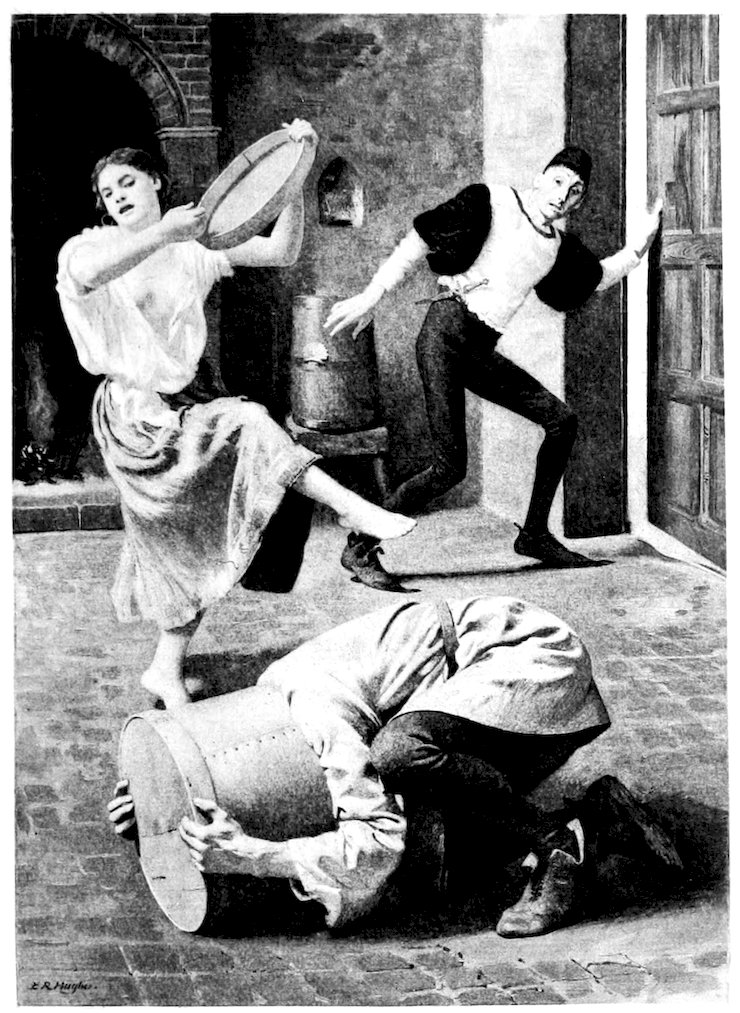
267Now by this time Marsilio had at last come to understand how matters really stood, and what was the meaning of Thia’s mummery, so he seized the opportunity to slip out from his hiding-place, and to run away as fast as his legs could carry him. Thia, when she saw Marsilio take to his heels and run out of the courtyard, finished her form of exorcism against the kite, and when she had brought it to an end she suffered her cuckoldly fool of a husband to get up from the ground. Then with Thia’s help he began forthwith to unload the flour which he had brought back from the mill. Now Thia when she went with Cechato outside into the courtyard to help unload the flour, saw Marsilio in the distance hurrying away at the top of his speed, whereupon she began to shout after him in a lusty voice: ‘Ah, ah! what a wicked bird! Ah, ah! begone, get away! For, by my faith, I will send you packing with your tail between your legs if ever you show yourself here again. Away then, I tell you! Is not he a greedy wretch? Do you not see that the wicked beast was bent on coming back? Heaven give him a bad year!’
And in this fashion it happened, that every time the kite came and flew down into the courtyard to carry away a chick or two, he would first have a bout with the hen herself,[50] who would afterwards set to work with her conjuration as before. Then he would take to flight with his tail down, but all the while the fowls belonging to Cechato and Thia suffered no damage at all from his harrying.
This fable, given by the Trevisan, was found to be so mirthful and amusing that the ladies, and the gentlemen as well, almost split their sides with laughter; so well did he mock the rustic speech that there was no one of the company who would not have judged him to be a peasant of Treviso. And when the merriment had abated somewhat, the Signora turned her fair face towards the Trevisan and spake to him thus: “In truth, Signor Benedetto, you have this evening diverted us in such featly wise that with one voice we declare your fable may deservedly be held to be the equal of Molino’s in merit. But to fill up the measure of my content and that of this honourable company, I entreat you—an it displease you not—that you will set forth to us an enigma which shall be as graceful in form as amusing in matter.” The Trevisan, when he saw how the Signora was inclined, was unwilling to disappoint her; so, standing up, with a clear voice and with no hesitation of any sort, he began his riddle in the following words:
268Sir Yoke goes up and down the field,
To every tug is forced to yield.
One on the left, one on the right
Plods on, and next there comes a wight,
A cunning rascal who with power
Beats one who goes on carriers four.
Now if an answer you can give,
Good friends, we will for ever live.
When the Trevisan, with the true manner and bearing of a peasant, had finished his enigma, which was comprehended by few or none of the company, he thus gave the interpretation thereof in peasant dialect in order that its meaning might be made clear to them all: “I must not keep this gentle company waiting any longer. Tell me, do you understand the meaning of my enigma? If you do not know, I will tell you. Sir Yoke goes to and fro, that is to say, the yoke, to which the oxen are attached, goes up and down the fields and roads, and is dragged hither and thither by them. Those who fare, the one on this side and the other on that side of it, are the oxen. He who beats one who stands on four, means that the ploughman who walks behind lashes the bull, who has four legs, with his leathern whip. And to end my explanation, I tell you once more that the answer to my riddle is the yoke, and I hope you will all understand it.”
Everyone was greatly interested over this riddle dealing with country life, and, laughing heartily thereat, they praised it highly. But the Trevisan, remembering that only one more story remained to be told this night, to wit, that of the charming Cateruzza, turned with a smiling face towards the Signora and spake thus: “Signora, it is not for the reason that I wish to disturb the settled order of this our entertainment, or to dictate to your highness, my mistress and sovereign lady, but merely to satisfy the desire of this devoted company, that I beg your excellency to make us the sharers of some fair fancies of your own, by telling us, for our delight and recreation, a story with your wonted grace. And if I peradventure have been more presumptuous (which God forbid) in making this request than is suitable to my humble estate, I beg you will forgive me, seeing that the love I bear towards this gracious assembly has been the chief cause why I have been led to prefer it.”
The Signora, when she heard the courteous petition of the Trevisan, at first cast her eyes down upon the ground; not, however, for any 269fear or shame that she felt, but because she deemed that, for divers reasons, it was more seemly for her to listen than to discourse. But after a time, with a gracious and smiling look, as if her humour were a merry one, she turned her bright face towards the Trevisan and said: “Signor Benedetto, what though your request is a pleasant and seemly one, it appears to me that you are somewhat too insistent a beggar, forasmuch as the duty of story-telling pertains rather to these young damsels round about than to me; therefore you must hold me excused if I decline to give way at once to your demand, and bid Cateruzza, who has been chosen by lot to tell the fifth story of this evening, to favour you with her discourse.” The merry listeners, who were mightily eager to hear the Signora tell her story, forthwith all rose to their feet and began to support the request of the Trevisan, begging her most earnestly that she would in this matter favour them with her courtesy and kindness, and not stand too severely by the exalted dignity of her position, for time and place will allow anyone, however high in rank, to speak freely whatever thing may be pleasing. The Signora, when she heard the gentle loving terms of this petition, in order that she might not seem ungracious in her bearing, smilingly replied: “Since this is the wish of all of you, and your pleasure withal, that I should conclude this evening with some little story of my own, I will gladly grant your wish.” And without further demur she blithely began to tell her fable.
THE FIFTH FABLE.
Madonna Modesta, wife of Messer Tristano Zanchetto, in her young days gathers together a great number of shoes, offerings made by her various lovers. Having grown old, she disposes of the same to divers servants, varlets, and other folk of mean estate.

It commonly happens that ill-gotten wealth, and indeed all riches which have been acquired by evil ways, are scattered abroad and dissipated in brief space of time, for by the divine will it has been decreed that, quickly as such riches come, quickly they shall depart. This, indeed, proved to be the case with a certain woman of Pistoia, who, had she been honest and wise in 270the same degree as she was dissolute and foolish, would never have given occasion for the story which I am now about to tell to you. And although perhaps this fable of mine is one hardly suitable for your ears, forasmuch as it comes to an end in a picture of shame and dishonour, which obscures and tarnishes the fame of those who live honest lives, nevertheless I will not hesitate to relate it to you, for at the right time and place it may serve (I speak here to those to whom it may apply) as a useful incentive for all to pursue the ways of uprightness and well-doing, and to eschew all wicked courses and lewd inclinations.
I must first tell this worshipful company that, not far from these our days, there lived in Pistoia, an ancient city of Tuscany, a young woman called by name Madonna Modesta, but this name, on account of her reprehensible manner of life and the shameful courses she followed, was one in no wise befitting her. In person, indeed, this woman was very lovely and graceful, though she was of mean condition.
She had a husband called Tristano Zanchetto[51] (a name as well suited to him as his wife’s was unfitting to her), a good-tempered fellow, given to merry company, and thinking of little else save of his business of buying and selling, whereby he gained a good living for himself. Madonna Modesta, who was by nature of a lecherous temper, and inclined for nought else but amorous sport, when she saw that her husband was given up heart and soul to commerce, and careful only about the matters appertaining thereto, took it into her head that she too would embark in merchandise and set up a new trade, concerning which her husband, Messer Tristano, should know nothing.
Wherefore every day she was wont to go out upon the balcony for her amusement, now on one side, now on the other, and throw glances at any gallant who might be passing in the street, and when her eye might chance to fall upon anyone whose appearance pleased her, she would strive by divers suggestive signs and gestures to arouse his curiosity and desire, and to lure him to her. And in the course of time it proved that Madonna Modesta had no mean skill in the art of traffic; indeed, so diligent was she in the display of her merchandise, and so carefully did she attend to the needs of her customers, that there was to be found in all the city no one, rich or poor, noble or plebeian, who was not anxious to take and taste of her goods. When, therefore, 271Madonna Modesta had attained a position of great notoriety in her calling, and had gathered together much wealth thereby, she made up her mind to exact only a very small guerdon from anyone who might come to her as a claimant for her favours. That is to say, she made it her custom to demand from her lovers no greater reward than a pair of shoes, stipulating, however, that each one should give shoes of a sort such as he might in an ordinary way wear himself. Thus, if the lover who had been with her happened to be a noble, she would expect from him a pair of velvet shoes; if a burgher, she would ask for a pair of shoes made of fine cloth; if a mechanic, a pair made of leather. So great a concourse of clients flocked to this good woman’s place of business that it was rarely or never empty, and seeing that she was young and beautiful and of fine figure, seeing likewise that the price which she demanded for her favours was such a modest one, all the men of Pistoia freely repaired to her house and took their pleasure therein. At the time of which I am writing, Madonna Modesta had already filled a very large storehouse with shoes, the wealth she had gathered together in her tender amorous calling, and so mighty was the tale of shoes of every sort and quality, that if any man here in Venice had searched diligently every shop in the city he would not have found a third part of the number of shoes which Madonna Modesta had heaped up in her storehouse.
It happened one day that Messer Tristano her husband had need to use this same storehouse for the stowing away of certain chattels and merchandise which by chance had been consigned to him at the same time from divers parts of the world; so, having called Madonna Modesta his beloved wife, he asked her to hand over to him the keys of the warehouse. And she, like the crafty jade that she was, presented them to him without excuse of any sort; and the husband, when he opened the storehouse, which he expected would be empty, found it quite full of shoes (as has already been told) of divers qualities. When he saw this he was mightily astonished thereat, and could in no wise understand whence had come this great quantity of shoes of all sorts; so, having called his wife, he put a question to her as to where these shoes with which his warehouse was filled had come from. To this the astute Madonna Modesta answered in these words: ‘What think you of this, good Messer Tristano my husband? Did you in sooth set yourself down as the only merchant in this city? Certes, if you did, you were hugely mistaken, for be sure that 272we women likewise know somewhat concerning the art of traffic; and, although you may be a great merchant, accustomed to concern yourself with many and weighty ventures, I content myself with commerce on a smaller scale. Wherefore I have stored my merchandise in this warehouse, and put it safely under lock and key in order that it may be kept secure. So I beg you to keep your care and watchfulness for the benefit of your own goods and your own traffic, and I will do the same with regard to mine.’ Messer Tristano, who knew nothing more than what his wife told him, and asked no further questions, was gratified amain with the exceeding ingenuity and great foresight of his clever and far-seeing wife, and besought her to prosecute with diligence the enterprise she had undertaken. Madonna Modesta therefore continued in secret to carry on her amorous trade, and, as in the exercise thereof she prospered mightily, she gathered together so vast a store of shoes that she could have easily supplied the wants not only of Pistoia, but of any other great city as well.
Thus whilst Madonna Modesta remained young and full of grace and beauty her trade showed no sign of falling off. But in the process of years cruel Time, the master of all things and all men, who fixes ever a beginning, a middle, and an end for all, so dealt with Madonna Modesta, who had been heretofore fresh and plump and lovely, that he changed the semblance of her face, and of her hair[52] likewise—leaving her desire unsubdued the while—and traced many wrinkles upon her forehead, and disfigured her countenance. Her eyes became rheumy and her breasts all dry and empty as shrivelled bladders, and whenever she happened to smile the skin of her face became so puckered that anyone who looked at her was fain to laugh and hold her in ridicule. And when the time came that Madonna Modesta was grown old and grey-headed, and lovers no longer sought her to pay court to her as formerly, she found that she added no more shoes to her store, and she lamented bitterly in her heart thereanent. From the first years of her youth until the present hour she had given herself over entirely to the vice of luxury, the destructive enemy of the body and of the purse as well, and she had likewise become more accustomed to dainty living and libidinous life than any other 273woman in the world, therefore she could find no method or means by which she might withdraw herself from these noxious ways. And although in her body, from day to day, the vital fluid, through which all plants and living things take root and grow, failed more and more, nevertheless the desire of satisfying her wicked and unrestrained appetite was as violent as ever. Therefore Madonna Modesta, seeing that she was entirely bereft of youthful beauty, and was no longer one to be flattered and caressed by handsome young gallants as in former days, made up her mind to order her plans anew. For the furtherance of these she once more went out upon the balcony, and began to ogle and to spread her lures to catch any varlets or porters or peasants or chimney-sweepers or idle fellows of any sort, who might be passing by, and any of these whom she might attract she would entice into her house for her own purposes, and with them take such pleasure as she had hitherto been wont to take. And as in times past she had always demanded from each one of her lovers a pair of shoes of a quality according with the donor’s condition as the reward for her favours granted, now, on the other hand, she found herself obliged to give a pair of shoes from her stock to anyone who would come to her. Madonna Modesta had now sunk into such a shameful state that all the lowest ruffians of Pistoia would betake themselves to her dwelling, some to have their pleasure of her, others to make mock of her and to befool her, and others to receive the disgraceful guerdon which she was wont to give.
In this manner of life pursued by Madonna Modesta, it came to pass that the storehouse, which had once been crammed full of shoes, became wellnigh void. Messer Tristano one day, having a mind to go by stealth and see how his wife was prospering in her commerce, and whether her store of merchandise was increasing, took the key of the warehouse without his wife’s knowledge and opened the door, only to find, when he looked in, that nearly all the shoes were gone. Wherefore Messer Tristano was beyond measure amazed, for he could not understand how his wife could have disposed of the many pairs of shoes he had formerly seen there. On this account he began to fancy that by this time his wife must, as it were, be made of gold by reason of her prosperous traffic, and he felt himself mightily consoled at the thought; for he deemed that he might hereafter be a sharer in her wealth. So he straightway called her to him and thus addressed her: ‘Modesta, I have always rated you as a wise and prudent 274woman, but this day I chanced to open your storehouse, wishing to see how your commerce was thriving, and deeming that by this time your stock of shoes must have greatly increased, but I found, instead of any increase, that your wares had nearly all disappeared. At first I was mightily astonished thereat, but afterwards it came into my mind that you must have trafficked them away and received therefor a great sum of money, whereupon I was greatly reassured, and if this notion of mine should prove to be correct I shall hold that you have traded at great profit.’
Madonna Modesta, when her husband had finished his speech, heaved a deep sigh and thus made answer to him: ‘Messer Tristano, my husband, do not be amazed at what you have lately seen, for I must tell you that all those shoes you saw some long time ago in my warehouse, have walked away in the same fashion in which they came to me. And over and above this let me tell you that those things which are ill got will, for the most part, ill go in a very brief space of time. Therefore I bid you once more not to wonder or be surprised at what you have seen.’ Messer Tristano, who did not in any way fathom the meaning of his wife’s words, fell into a great state of fright and confusion, fearing hugely lest a similar mischance might befall the goods and merchandise he himself had collected. However, he forbore to discuss the matter with her farther, but bestirred himself anxiously to see that his own merchandise might not vanish as his wife’s had vanished.
Madonna Modesta finding herself now slighted by men of all sorts and conditions, and entirely beggared of all the shoes she had gained in the course of her lecherous youth, fell into a grave malady, and in a very brief space of time died miserably of consumption. And in this manner Madonna Modesta, who took so little heed for the future, made a shameful end of her life and also of the possessions she had gathered together, leaving nothing behind her to serve as an example to the rest of the world, but rather a disgraceful memory.
When the Signora had ended her short fable all the company began to laugh aloud, and heaped abundant blame upon Madonna Modesta, who lived moderately enough in all things save only in the matter of lecherous indulgence. And again they could not help laughing when they recalled to mind the story of the shoes which were so easily got and so easily spent. But because it was on Cateruzza’s account that the Trevisan had urged the Signora to tell 275this fable, the latter now began to spur on the damsel with words which, though gently spoken, had a sting therein, and afterwards, as a penalty for having failed to tell her fable, expressly commanded Cateruzza to propound an enigma which should not be irrelevant to the subject of the fable they had just heard. Whereupon Cateruzza, when she heard the command of the Signora, rose from her seat, and turning herself towards her spake thus: “Dear Signora, the biting rebukes which you have just addressed to me are not in any way displeasing to me; on the contrary, I gladly take them home to myself with my whole heart. But the task of making my enigma agree in some measure with the fable you have just told us is no light one, seeing that I am entirely unprepared. Since, however, it pleases you to punish in this fashion my fault, if indeed it be a fault, I, as an obedient girl and your most complaisant handmaiden, will begin at once.
My lady seats her in a chair,
And raises then her skirt with care;
And as I know she waits for me,
I bring her what she fain would see.
Then soft I lift her dainty leg,
Whereon she cries, ‘Hold, hold, I beg!
It is too strait, and eke too small;
Be gentle, or you’ll ruin all.’
And so to give her smallest pain,
I try once more, and eke again.”
The enigma told by Cateruzza provoked as great laughter as the ingenious fable which the Signora had recently given; but, for the reason that certain of the listeners put thereupon a somewhat lewd interpretation, she set herself at once to make the honesty of her intent clear to them in as civil terms as she could use: “Noble ladies, the real subject of my enigma is nothing greater or less than a tight shoe; for when the lady has sat down, the shoemaker, with the shoe in his hand, raises her foot, whereupon she tells him to put the shoe on gently, as it is too tight, and causes her much pain. Then he takes it off and puts it on again and again till it fits her well, and she is content therewith.”
When the explication of Cateruzza’s enigma had been brought to an end and highly praised by the whole company, the Signora, seeing that the hour was now late, gave order that under pain of her displeasure no one should leave the place, and, having bidden them 276summon into her presence the trusty steward of the household, she directed him to set out the tables in the great hall. And while the feast was in course of preparation she proposed that the ladies and gentlemen should divert themselves with the dance, and, after the dancing was finished, they sang two songs. Then the Signora rose to her feet and went into the supper room, having the Signor Ambassador on one hand and Messer Pietro Bembo on the other, the rest of the company following in their due order. And when they had all washed their hands, each one sat down according to his rank at the table, which was richly spread with rare and delicate dishes and new wines. When this merry feast had come to end amidst the loving discourse of the guests, each one being in blither mood than ever, they rose from the board and forthwith began to sing and dance in a circle. But forasmuch as the rosy light of dawn was now beginning to appear, the Signora bade the servants to kindle the torches and go in attendance on the Signor Ambassador as far as the steps, having first begged him and all the others to return to the meeting-place at the appointed hour.
The End of the Fifth Night.

TRANSCRIBER’S NOTES
Typos fixed; non-standard spelling and dialect retained.
Used numbers for footnotes, placing them all at the end of the last chapter.