Volume 1 — Night the Fifth.
W. G. (William George) Waters translation

219

The Fables and Enigmas of Messer Giovanni Francesco Straparola da Caravaggio.
Night the Fifth.

The sun, the glory of the smiling firmament, the measurer of our fleeting time, and the true eye of the universe, from whom likewise the horned moon and all the stars receive their radiance, had at last hidden his red and burning rays beneath the waters of the sea, and the chaste daughter of Latona, circled around by bright and beaming stars, was already lighting up the clustering shadows of the obscure night, and the shepherds, quitting the wide and open fields and the fresh herbage and the cool and limpid streams, had taken their way back with their flocks to their wonted folds, and, worn out and weary as they were, had sunk into deep slumber on the beds of soft and yielding rushes, when the fair and noble troop of companions, letting go thought of everything else, hastened to the place of meeting. And when it had been signified to the Signora that all had come, and that it was now time to recommence the story-telling, she, escorted in courteous and reverent wise by the other ladies, went joyful and smiling with soft and measured step to the hall of meeting. Then having graciously greeted the company of friends with gladsome face, she ordered them to bring out the vase of gold. In this were put the names of five ladies, and of these the first to come out was that of Eritrea, the second that of Alteria, the third that of Lauretta, the fourth that of Arianna, and the last that of Cateruzza. When this was done they all began to dance 220to the music of the flutes, and to pass from one to another pleasant and loving words. Immediately after the end of the dance, three damsels, by the leave of the Signora, began the following song.
SONG.
Madonna, when the springs of passion rise,
And through thy fair sweet bosom surge and swell;
And in those lucent sacred eyes,
Which tell me I may live, and eke my death may tell;
From those gracious looks and kind,
A gracious hope my longings find.
Now calm, and now spurred on by rage,
With hope and fear a fight I wage;
Eftsoons my hope the vantage gains,
And I am rid of all my pains,
And know no stroke of fate can lure,
Or drive me from my course secure.
Wherefore I bless the passing days;
Great nature, and the stars I praise,
That thy fair self my passion fired,
Thy service sweet my song inspired.
As soon as the three damsels had brought to an end their amorous canzonet, which seemed to break up the air around into sighs of passion, the Signora made a sign to Eritrea, who had been chosen for the first place this evening, that she should make a beginning of her story-telling. The damsel, seeing that she could in no wise excuse herself, put aside all bashfulness, and began to speak in turn that the order which had hitherto prevailed might not be disturbed.

221
THE FIRST FABLE.
Guerrino, only son of Filippomaria, King of Sicily, sets free from his father’s prison a certain savage man. His mother, through fear of the king, drives her son into exile, and him the savage man, now humanized, delivers from many and measureless ills.

I have heard by report, and likewise gathered from my own experience, most gracious and pleasure-loving ladies, that a kindly service done to another (although at the time the one served may seem in no sense grateful for the boon conferred) will more often than not come back to the doer thereof with abundant usury of benefit. Which thing happened to the son of a king who, having liberated from one of his father’s prisons a wild man of the woods, was more than once rescued from a violent death by the captive he had freed. This you will easily understand from the fable which I intend to relate to you, and for the love I bear to all of you I will exhort you never to be backward in aiding others; because, even though you be not repaid by those in whose behalf you have wrought, God Himself, the rewarder of all, will assuredly never leave your good deed unrecompensed; nay, on the contrary, He will make you partakers with Him of His divine grace.
Sicily, my dear ladies (as must be well known to all of you), is an island very fertile and complete in itself, and in antiquity surpassing all the others of which we have knowledge, abounding in towns and villages which render it still more beautiful. In past times the lord of this island was a certain king named Filippomaria, a man wise and amiable and of rare virtue, who had to wife a courteous, winsome, and lovely lady, the mother of his only son, who was called Guerrino. The king took greater delight in following the chase than any other man in the country, and, for the reason that he was of a strong and robust habit of body, this diversion was well suited to him.
Now it happened one day that, as he was coming back from hunting in company with divers of his barons and huntsmen, he saw, coming out of a thick wood, a wild man, tall and big and so deformed and ugly that they all looked upon him with amazement. In strength 222of body he seemed no whit inferior to any of them; wherefore the king, having put himself in fighting trim, together with two of the most valiant of his barons, attacked him boldly, and after a long and doughty struggle overcame him and took him a prisoner with his own hands. Then, having bound him, they conveyed him back to the palace, and selected for him a safe lodging, fitted for the purpose, into which they cast him, and there under strong locks he was kept by the king’s command closely confined and guarded. And seeing that the king set high store upon his captive, he ordained that the keys of the prison should be held in charge by the queen, and never a day passed when he would not for pastime go to visit him.
Before many days had gone by the king once more put himself in array for the chase, and, having furnished himself with all the various things which are necessary thereto, he set forth with a gallant company of courtiers, but before he left he gave into the queen’s care the keys of the prison. And during the time that the king was absent on his hunting a great longing came over Guerrino, who was at that season a young lad, to see the wild man of the woods; so having betaken himself all alone, carrying his bow, in which he delighted greatly, to the prison grating, the creature saw him and straightway began to converse with him in decent orderly fashion. And while they talked thus, the wild man, who was caressing the boy, dexterously snatched out of his hand the arrow, which was richly ornamented. Whereupon the boy began to weep, and could not keep back his tears, crying out that the savage ought to give him back his arrow. But the wild man said to him: ‘If you will open the door and let me go free from this prison I will give you back your arrow, but if you refuse I will not let you have it.’ The boy answered, ‘How would you that I should open the door for you and set you free, seeing that I have not the means therefor.’ Then said the wild man, ‘If indeed you were in the mood to release me and to let me out of this narrow cell, I would soon teach you the way in which it might be done.’ ‘But how?’ replied Guerrino; ‘tell me the way.’ To which the wild man made answer: ‘Go to the chamber of the queen your mother, and when you see that she is taking her midday sleep, put your hand softly under the pillow upon which she is resting, and take therefrom the keys of the prison in such wise that she shall not notice the theft, and bring them here and open my prison door. When you shall have done this I will give you back your 223arrow forthwith, and peradventure at some future time I may be able to make you a return for your kindness.’
Guerrino, wishing beyond everything to get back his gilded dart, did everything that the wild man had told him, and found the keys exactly as he had said, and with these in his hand he returned to the prison, and said to him: ‘Behold! here are the keys; but if I let you out of this place you must go so far from hence that not even the scent of you may be known, for if my father, who is a great huntsman, should find you and capture you again, he would of a surety kill you out of hand.’ ‘Let not that trouble you, my child,’ said the captive, ‘for as soon as ever you shall open the prison and see me a free man, I will give you back your arrow and will get me away into such distant parts that neither your father nor any other man shall ever find me.’ Guerrino, who had all the strength of a man, worked away at the door, and finally threw open the prison, when the wild man, having given back to him his arrow and thanked him heartily, went his way.
Now this wild man had been formerly a very handsome youth, who, through despair at his inability to win the favour of the lady he ardently loved, let go all dreams of love and urbane pursuits, and took up his dwelling amongst beasts of the forest, abiding always in the gloomy woods and bosky thickets, eating grass and drinking water after the fashion of a brute. On this account the wretched man had become covered with a great fell of hair; his skin was hard, his beard thick and tangled and very long, and, through eating herbs and grass, his beard, his hairy covering, and the hair of his head had become so green that they were quite monstrous to behold.
As soon as ever the queen awoke from her slumbers she thrust her hand under her pillow to seek for the keys she had put there, and, when she found they were gone, she was terrified amain, and having turned the bed upside down without meeting with any trace of them, she ran straightway like one bereft of wit to the prison, which was standing open. When on searching further she found no sign of the wild man, she was so sore stricken with grief and fear that she was like to die, and, having returned to the palace, she made diligent search in every corner thereof, questioning the while now this courtier and now that as to who the presumptuous and insolent varlet was who had been brazen enough to lay hands upon the keys of the prison without her knowledge. To this questioning they one and all declared that they knew nought of the matter which thus disturbed her. And 224when Guerrino met his mother, and remarked that she was almost beside herself in a fit of passion, he said to her: ‘Mother, see that you cast no blame on any of these in respect to the opening of the prison door, because if punishment is due to any thereanent it is due to me, for I, and I alone, unlocked it.’ The queen, when she heard these words, was plunged in deeper sorrow than ever, fearing lest the king, when he should come back from his hunting, might kill his son through sheer anger at the fault he had committed, seeing that he had given into her charge the keys, to guard them as preciously as her own person. Wherefore the queen in her desire to escape the consequences of a venial mistake fell into another error far more weighty, for without the shortest delay she summoned two of her most trusty servants, and her son as well, and, having given to them a great quantity of jewels and much money and divers fine horses, sent him forth to seek his fortune, at the same time begging the servants most earnestly to take the greatest care of Guerrino.
A very short time after the son had departed from the presence of his mother, the king came back to the palace from following the chase, and as soon as he had alighted from his horse he betook himself straightway to the prison to go and see the wild man, and when he found the door wide open and the captive gone, and no trace of him left behind, he was forthwith inflamed with such violent anger that he determined in his mind to cause to be slain without fail the person who had wrought such a flagrant misdeed. And, having sought out the queen, who was sitting overcome with grief in her chamber, he commanded her to tell him what might be the name of the impudent, rash, and presumptuous varlet who had been bold enough of heart to open the doors of the prison and thereby give opportunity to the wild man of the woods to make his escape. Whereupon the queen, in a meek and trembling voice, made answer to him: ‘O sire! be not troubled on account of this thing, for Guerrino our son (as he himself has made confession to me) admits that he has done this.’ And then she told to the king everything that Guerrino had said to her, and he, when he heard her story, was greatly incensed with rage. Next she told him that, on account of the fear she felt lest he should slay his son, she had sent the youth away into a far distant country, accompanied by two of their most faithful servants, and carrying with him rich store of jewels and of money sufficient to serve their needs. The king, when he listened to this speech of the 225queen, felt one sorrow heaping itself upon another, and he came within an ace of falling to the ground or of losing his wits, and, if it had not been for the courtiers who fell upon him and held him back, he would assuredly have slain his unhappy queen on the spot.
Now when the poor king had in some measure recovered his composure and calmed the fit of unbridled rage which had possessed him, he said to the queen: ‘Alas, my wife! what fancy was this of yours which induced you to send away into some unknown land our son, the fruit of our mutual love? Is it possible that you imagined I should hold this wild man of greater value than one who was my own flesh and blood?’ And without awaiting any reply to these remarks of his, he bade a great troop of soldiers mount their horses forthwith, and, after having divided themselves into four companies, to make a close search and endeavour to find the prince. But all their inquest was in vain, seeing that Guerrino and his attendants had made their journey secretly, and had let no one know who they might be.
Guerrino, after he had ridden far and traversed divers valleys and mountains and rivers, making a halt now in one spot and now in another, attained at last his sixteenth year, and so fair a youth was he by this time that he resembled nothing so much as a fresh morning rose. But after a short time had passed, the servants who accompanied him were seized with the devilish thought of killing him, and then taking the store of jewels and money and parting it amongst themselves. This wicked plot, however, came to nought, because by the working of divine justice they were not able to agree amongst themselves. For by good fortune it happened that, one day while they were devising this wickedness, there rode by a very fair and graceful youth, mounted upon a superb steed, and accoutred with the utmost magnificence. This youth bowed and graciously saluted Guerrino, and thus addressed him: ‘Most gracious sir, if it should not prove distasteful to you, I would fain make my journey in your company.’ And to this Guerrino replied: ‘Your courtesy in making your request will not permit me to refuse it and the pleasure of your company. Therefore I give you cordial thanks, and I beg you as a special favour that you will accompany us on our road. We are strangers in this country and know but little of its highways, and you may be able of your kindness to direct our paths therein. Moreover, as we ride on together we can discuss the various chances which have befallen us, and thus our journey will be less irksome.’
226Now this young man was no other than the wild man whom Guerrino had set free from the prison of King Filippomaria his father. This youth, after wandering through various countries and strange lands, met one day by chance a very lovely and benignant fairy, who was at that time suffering from a certain distemper. She, when she looked upon him and saw how misshapen and hideous he was, laughed so violently at the sight of his ugliness that she caused to burst an imposthume which had formed in the vicinity of her heart—an ailment which might well have caused her death by suffocation. And at that very moment she was delivered from all pain and trouble of this infirmity, as if she had never been afflicted therewith in the past, and restored to health. Wherefore the good fairy, in recompense for so great a favour done to her, said to him, not wishing to appear ungrateful to him: ‘O thou creature, who art now so deformed and filthy, since thou hast been the means of restoring to me my health which I so greatly desired, go thy ways, and be thou changed from what thou art into the fairest, the wisest, and the most graceful youth that may anywhere be found. And, besides this, I make you the sharer with me of all the power and authority conferred upon me by nature, whereby you will be able to do and to undo whatsoever you will according to your desire.’ And having presented to him a noble horse endowed with magic powers, she gave him leave to go whithersoever he would.
Thus as Guerrino journeyed along with the young man, knowing nothing as to who he might be, but well known of him the while, they came at last to a mighty and strong city called Irlanda, over which at that time ruled King Zifroi. This King Zifroi was the father of two daughters, graceful to look upon, of modest manners, and in beauty surpassing Venus herself, one of them named Potentiana and the other Eleuteria. They were held so dear by the king their father that he could see by no other eyes than theirs. As soon as Guerrino entered the city of Irlanda with the unknown youth and with his train of servants, he hired a lodging of a certain householder who was the wittiest fellow in the whole of Irlanda, and who treated his guests with cheer of the best. And on the day following, the unknown youth made believe that he must needs depart and travel into another country, and went to take leave of Guerrino, thanking him in hearty wise for the boon of his company and good usage, but Guerrino, who had conceived the strongest love and friendship for 227him, would on no account let him go, and showed him such strong evidence of his good feeling that in the end the young man agreed to tarry with him.
In the country round about Irlanda there lived at this time two very fearful and savage animals, one of which was a wild horse, and the other a mare of like nature, and so ferocious and cruel were these beasts that they not only ravaged and devastated all the fair cultivated fields, but likewise killed all the animals and the men and women dwelling therein. And through the ruin wrought by these beasts the country had come to such piteous condition that no one was found willing to abide there, so that the peasants abandoned their farms and the homes which were dear to them and betook themselves to find dwelling-places in another land. And there was nowhere to be found any man strong and bold enough to face them, much less to fight with them and slay them. Wherefore the king, seeing that the whole country was being made desolate of all victuals, and of cattle, and of human creatures, and not knowing how to devise any remedy for this wretched pass, gave way to dolorous lamentations, and cursed the hard and evil fortune which had befallen him. The two servants of Guerrino, who during the journey had not been able to carry out their wicked intent through want of concord between themselves, and on account of the arrival of the unknown youth, now deliberated how they might compass Guerrino’s death and remain possessors of the money and jewels, and said one to the other: ‘Let us now see and take counsel together how we may easiest take the life of our master.’ But not being able to find any means thereto which seemed fitting, seeing that they would stand in peril of losing their own lives by the law if they should kill him, they decided to speak privily with their host and to tell him that Guerrino was a youth of great prowess and valour; furthermore, that he had often boasted in their presence that he would be ready to slay this wild horse without incurring any danger to himself. Thus they reasoned with themselves: ‘Now this saying may easily come to the ears of the king, who, being so keenly set on the destruction of these two animals and on safeguarding the welfare of his country, will straightway command them to bring Guerrino before him, and will then inquire of the youth in what manner he means to accomplish this feat. Then Guerrino, knowing nothing what to say or to do, will at once be put to death by the king, and we shall remain sole 228masters of the jewels and the money.’ And they forthwith set to work to put this wicked plan of theirs into action.
The host, when he listened to this speech, rejoiced amain, and was as glad as any man in all the world, and without losing a moment of time he ran swiftly to the palace, and having knelt down before the king and made due reverence, he said to him secretly, ‘Gracious king, I have come to tell you that there is at present sojourning in my hostel a fair and gallant knight errant, who is called by name Guerrino. Now whilst I was confabulating about divers matters with his servants they told me, amongst other things, how their master was a man of great prowess and well skilled in the use and practice of arms, and that in this our time one might search in vain to find another who could be compared with him. Moreover, they had many and many a time heard him boast that of his strength and valour he could without difficulty overcome and slay the wild horse which is working such dire loss and damage to your kingdom.’
When King Zifroi heard these words he immediately gave command that Guerrino should be brought before him. Whereupon the innkeeper, obedient to the word of the king, returned at once to his inn and said to Guerrino that he was to betake himself alone into the presence of the king, who greatly desired to speak with him. When Guerrino heard this he went straightway to the palace and presented himself to the king, and after saluting him with becoming reverence begged to be told for what reason he had been honoured with the royal commands. To this Zifroi the king made answer: ‘Guerrino, the reason which has induced me to send for you is that I have heard you are a knight of great valour, and one excelling all the other knights now alive in the world. They tell me, too, that you have many and many a time declared that you are strong and valorous enough to overcome and slay the wild horse which is working such cruel ruin and devastation to this my kingdom, without risk of hurt to yourself or to others. If you can pluck up courage enough to make trial of an emprise so full of honour as this, and prove yourself a conqueror, I promise you by this head of mine to bestow upon you a gift which will make you a happy man for the rest of your days.’
Guerrino, when he heard this proposition of the king, so grave and weighty, was mightily amazed, and at once denied that he had ever spoken such words as had been attributed to him. The king, who was greatly disconcerted at this answer of Guerrino, thus addressed 229him: ‘Guerrino, it is my will that you should without delay undertake this task, and be sure if you refuse and fail to comply with my wishes I will take away your life.’ The king, having thus spoken, dismissed from his presence Guerrino, who returned to his inn overwhelmed with deep sorrow, which he did not dare to disclose to anyone. Whereupon the unknown youth, marking that Guerrino, contrary to his wont, was plunged in melancholy, inquired the reason why he was so sad and full of grief. Then Guerrino, on account of the brotherly love subsisting between them, and finding himself unable to refuse this just and kindly request, told him word for word everything that had happened to him. As soon as the unknown youth heard this, he said, ‘Be of good cheer, and put aside all doubts and fears, for I will point out to you a way by which you will save your life, and be a conqueror in your enterprise, and fulfil the wishes of the king. Return, therefore, to the king, and beg of him to grant you the services of a skilful blacksmith. Then order this smith to make for you four horseshoes, which must be thicker and broader by the breadth of two fingers than the ordinary measure of horseshoes, well roughed, and each one to be fitted behind with two spikes of a finger’s length and sharpened to a point. And when these shoes are prepared, you must have my horse, which is enchanted, shod therewith, and then you need have no further fear of anything.’
Guerrino, after he had heard these words, returned to the presence of the king, and told him everything as the young man had directed him. The king then caused to be brought before him a well-skilled marshal smith, to whom he gave orders that he should carry out whatever work Guerrino might require of him. When they had gone to the smith’s forge, Guerrino instructed him how to make the four horseshoes according to the words of the young stranger, but when the smith understood in what fashion he was required to make these shoes, he mocked at Guerrino, and treated him like a madman, for this way of making shoes was quite strange and unknown to him. When Guerrino saw that the marshal smith was inclined to mock him, and unwilling to serve him as he had been ordered, he went once more to the king, and complained that the smith would not carry out his directions. Wherefore the king bade them bring the marshal before him, and gave him express command that, under pain of his highest displeasure, he should at once carry out the duties which had been imposed upon him, or, failing this, he himself should forthwith make 230ready to carry out the perilous task which had been assigned to Guerrino. The smith, thus hard pressed by the orders of the king, made the horseshoes in the way described by Guerrino, and shod the horse therewith.
When the horse was thus shod and well-accoutred with everything that was necessary for the enterprise, the young stranger addressed Guerrino in these words: ‘Now mount quickly this my horse, and go in peace, and as soon as you shall hear the neighing of the wild horse dismount at once, and, having taken off from him his saddle and his bridle, let him range at will. You yourself climb up into a high tree, and there await the issue of the enterprise.’ Guerrino, having been fully instructed by his dear companion in all that he ought to do, took his leave, and departed with a light heart.
Already the glorious news had been spread abroad through all the parts of Irlanda how a valiant and handsome young knight had undertaken to subjugate and capture the wild horse and to present him to the king, and for this reason everyone in the city, men and women alike, all flew to their windows to see him go by on his perilous errand. When they marked how handsome and young and gallant he was, their hearts were moved to pity on his account, and they said one to another, ‘Ah, the poor youth! with what a willing spirit he goes to his death. Of a surety it is a piteous thing that so valiant a youth should thus wretchedly perish.’ And they could none of them keep back their tears on account of the compassion they felt.
But Guerrino, full of manly boldness, went on his way blithely, and when he had come to the spot where the wild horse was wont to abide, and heard the sound of his neigh, he got down from his own horse, and having taken the saddle and bridle therefrom he let him go free, and himself climbed up into the branches of a great oak, and there awaited the fierce and bloody contest.
Scarcely had Guerrino climbed up into the tree when the wild horse appeared and forthwith attacked the fairy horse, and then the two beasts engaged in the fiercest struggle that the world had ever seen, for they rushed at one another as if they had been two unchained lions, and they foamed at the mouth as if they had been bristly wildboars pursued by savage and eager hounds. Then, after they had fought for some time with the greatest fury, the fairy horse dealt the wild horse two kicks full on the jaw, which was put out of joint thereby; wherefore the wild horse was at once disabled, and could no longer 231either fight or defend himself. When Guerrino saw this he rejoiced greatly, and having come down from the oak, he took a halter which he had brought with him and secured the wild horse therewith, and led him with his dislocated jaw back to the city, where he was welcomed by all the people with the greatest joy. According to his promise he presented the horse to the king, who, together with all the inhabitants of the city, held high festival, and rejoiced amain over the gallant deed wrought by Guerrino.
But the servants of Guerrino were greatly overcome with grief and confusion, inasmuch as their evil designs had miscarried; wherefore, inflamed with rage and hatred, they once more let it come to the hearing of King Zifroi that Guerrino had vaunted that he could with the greatest ease kill the wild mare also whenever it might please him. When the king heard this he laid exactly the same commands on Guerrino as he had done in the matter of the horse, and because the youth refused to undertake this task, which appeared to him impossible, the king threatened to have him hung up by one foot as a rebel against his crown. After Guerrino had returned to his inn, he told everything to his unknown companion, who smilingly said: ‘My good brother, fret not yourself because of this, but go and find the marshal smith, and command him to make for you four more horseshoes, as big again as the last, and see that they are duly furnished with good sharp spikes. Then you must follow exactly the same course as you took with the horse, and you will return here covered with greater honour than ever.’ When therefore he had commanded to be made the sharply-spiked horseshoes, and had caused the valiant fairy horse to be shod therewith, he set forth on his gallant enterprise.
As soon as Guerrino had come to the spot where the wild mare was wont to graze, and heard her neighing, he did everything exactly in the same manner as before, and when he had set free the fairy horse, the mare came towards it and attacked it with such fierce and terrible biting that it could with difficulty defend itself against such an attack. But it bore the assault valiantly, and at last succeeded in planting so sharp and dexterous a kick on the mare that she was lamed in her right leg, whereupon Guerrino came down from the high tree into which he had climbed, and having captured her, bound her securely. Then he mounted his own horse and rode back to the palace, where he presented the wild mare to the king, amidst the rejoicings and acclamations of all the people. And everyone, attracted by wonderment 232and curiosity, ran to see this wild beast, which, on account of the grave injuries she had received in the fight, soon died. And by these means the country was freed from the great plague which had for so long a time vexed it.
Now when Guerrino had returned to his hostel, and had betaken himself to repose somewhat on account of the weariness which had come over him, he found that he was unable to get any sleep by reason of a strange noise which he heard somewhere in the chamber. Wherefore, having risen from his couch, he perceived that there was something, I know not what, beating about inside a pot of honey, and not able to get out. So Guerrino opened the honey-pot, and saw within a large hornet, which was struggling with its wings without being able to free itself from the honey around it. Moved by pity, he took hold of the insect and let it go free.
Now Zifroi the king had as yet given to Guerrino no reward for the two valiant deeds which he had wrought, but he was conscious in his heart that he would be acting in a very base fashion were he to leave such great valour without a rich guerdon, so he caused Guerrino to be called into his presence, and thus addressed him: ‘Guerrino, by your noble deeds the whole of my kingdom is now free from the scourge, therefore I intend to reward you for the great benefits you have wrought in our behalf; but as I can conceive of no other gift which would be worthy and sufficient for your merits, I have determined to give you one of my two daughters to wife. But you must know that of these two sisters one is called Potentiana, and she has hair braided in such marvellous wise that it shines like golden coils. The other is called Eleuteria, and her tresses are of such texture that they flash brightly like the finest silver. Now if you can guess—the maidens being closely veiled the while—which is she of the golden tresses, I will give her to you as your wife, together with a mighty dowry of money; but if you fail in this, I will have your head struck off your shoulders.’
Guerrino, when he heard this cruel ordeal which was proposed by Zifroi the king, was mightily amazed, and turning to him spake thus: ‘O gracious sovereign! Is this a worthy guerdon for all the perils and fatigues I have undergone? Is this a reward for the strength I have spent on your behalf? Is this the gratitude you give me for having delivered your country from the scourge by which it was of late laid desolate? Alas! I did not merit this return, which of a truth 233is not a deed worthy of such a mighty king as yourself. But since this is your pleasure and I am helpless in your hands, you must do with me what pleases you best.’ ‘Now go,’ said Zifroi, ‘and tarry no longer in my presence. I give you till to-morrow to come to a decision.’
When Guerrino went out of the king’s presence full of sadness, he sought his dear companion, and repeated to him everything that the king had said. The unknown youth when he heard this seemed but little troubled thereanent, and said: ‘Guerrino, be of good cheer, and do not despair, for I will deliver you from this great danger. Remember how a few days ago you set free the hornet which you found with its wings entangled in the honey. Now this same hornet will be the means of saving you, for to-morrow, after the dinner at the palace, when you are put to the test, it will fly three times buzzing and humming round the head of her with the golden hair, and she with her white hands will drive it away. And you, when you shall have marked her do this action three times, may know for certain that this is she who is to be your wife.’ ‘Ah me!’ cried Guerrino to his companion, ‘when will the time come when I shall be able to make you some repayment for all the kind offices you have done me? Certes, were I to live for a thousand years, I should never have it in my power to recompense you the very smallest portion thereof. But that one, who is the rewarder of all, will in this matter make up for me in that respect in which I am wanting.’ To this speech of Guerrino his companion made answer: ‘Guerrino, my brother, there is in sooth no need for you to trouble yourself about making any return to me for the services I may have wrought you, but assuredly it is now full time that I should reveal to you, and that you should know clearly who I am. For in the same fashion as you delivered me from death, I on my part have desired to render to you the recompense you deserve so highly at my hands. Know, then, that I am the wild man of the woods whom you, with such loving compassion, set free from the prison-house of the king your father, and that I am called by name Rubinetto.’ And then he went on to tell Guerrino by what means the fairy had brought him back into his former state of a fair young man. Guerrino, when he heard these words, stood like one bemused, and out of the great tenderness and pity he had in his heart he embraced Rubinetto, weeping the while, and kissed him, and claimed him as his own brother.
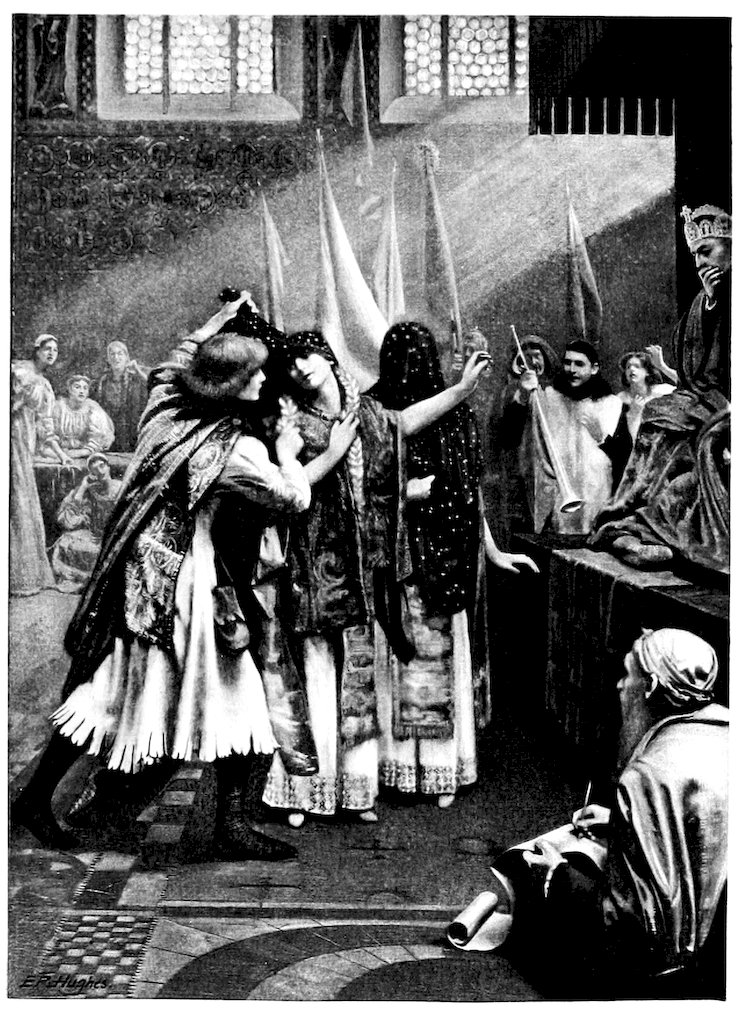
234And forasmuch as the day was now approaching for Guerrino to solve the question to be set to him by King Zifroi, the two repaired to the palace, whereupon the king gave order that his two beloved daughters, Potentiana and Eleuteria, should be brought into the presence of Guerrino covered from head to foot with white veils, and this was straightway done. When the two daughters had come in so much alike in seeming that it was impossible to tell the one from the other, the king said: ‘Now which of these two, Guerrino, do you will that I should give you to wife?’ But Guerrino stood still in a state of doubt and hesitation, and answered nothing, but the king, who was mightily curious to see how the matter would end, pressed him amain to speak, crying out that time was flying, and that it behoved him to give his answer at once. To this Guerrino made answer: ‘Most sacred majesty, time forsooth may be flying, but the end is not yet come to this day, which is the limit you have given me for my decision.’ And all those standing by affirmed that Guerrino only claimed his right.
When, therefore, the king and Guerrino and all the others had stood for a long time in expectation, behold! there suddenly appeared a hornet, which at once began to fly and buzz round the head and the fair face of Potentiana of the golden hair. And she, as if she were afeared of the thing, raised her hand to drive it away, and when she had done this three times the hornet flew away out of sight. But even after this sign Guerrino remained uncertain for a short time, although he had full faith in the words of Rubinetto, his well-beloved companion. Then said the king, ‘How now, Guerrino, what do you say? The time has now come when you must put an end to this delay, and make up your mind.’ And Guerrino, having looked well first at one and then at the other of the maidens, put his hand on the head of Potentiana, who had been pointed out to him by the hornet, and said, ‘Gracious king, this one is your daughter of the golden tresses.’ And when the maiden had raised her veil it was clearly proved that it was indeed she, greatly to the joy of all those who were present, and to the satisfaction of the people of the city. And Zifroi the king gave her to Guerrino as his wife, and they did not depart thence until Rubinetto had wedded the other sister. After this Guerrino declared himself to be the son of Filippomaria, King of Sicily, hearing which Zifroi was greatly rejoiced, and caused the marriages to be celebrated with the greatest pomp and magnificence.
235When this news came to the father and the mother of Guerrino they felt the greatest joy and contentment, seeing that they had by this time given up their son as lost. When he returned to Sicily with his dear wife and his well-loved brother and sister-in-law, they all received a gracious and loving welcome from his father and mother, and they lived a long time in peace and happiness, and he left behind him fair children as the heirs to his kingdom.
This touching story told by Eritrea won the highest praise of all the hearers, and she, when she saw that all were silent, proposed her enigma in the following words:
A cruel beast of nature dread
From out a tiny germ is bred.
In hate all beings else it holds,
And each one trembles who beholds
Its form of fear. Death all around
It spreads, and oft itself is found
The victim of its fatal rage,
And war on all the world will wage.
Beneath its breath the trees decay,
The living plants will fade away.
A beast more cruel, fierce, and fell,
Ne’er rose from out the pit of hell.
When the enigma set to the worshipful company by the clever damsel had been considered and highly praised by everyone, some found one solution therefor and some another, but not one of them gave the one which rightly explained its meaning. Wherefore Eritrea, seeing that her riddle had not been understood, said, “It seems to me that the cruel animal I have described cannot be anything else than the basilisk, which hates all other living beasts in the world, and slays them with its sharp and piercing glances. And if peradventure it should chance to see its own form mirrored anywhere, it straightway dies.” When Eritrea had come to the end of the interpretation of her enigma, the Signor Evangelist,[33] who sat by her side, said to her smiling: “Of a truth you yourself are this basilisk, signora, for with your beautiful eyes you bring soft death to all those who gaze upon you.” But Eritrea, with her cheeks suffused with the lovely tint of nature, answered nought. Alteria sat near by, and, as soon as she perceived that the enigma was now completed, having been highly praised 236by all, she called to mind that it was now her turn to tell a story according to the Signora’s pleasure, so she began in the following wise a fable which proved in the end to be fully as mirthful as it was commendable.
THE SECOND FABLE.
Adamantina, the daughter of Bagolana Savonese, by working of a certain doll becomes the wife of Drusiano, King of Bohemia.
So powerful, so commanding, so subtle is the wit of man that without doubt it may be held to overtop and to exceed every other human force to be found in the world; wherefore it has been said, not without just cause, that the wise man is the governor of the stars. This saying recalls to my memory a fable, by the telling of which I hope to make quite clear to you how a young girl, of mean estate and very poor, was succoured by fortune, and in the end became the wife of a mighty king. Although my fable will be very short, it may, if I mistake not, be found to be none the less pleasing and diverting on that account. I beg you therefore to lend me your ears attentively, and listen to me, as hitherto you have listened to our very worthy associates, who, of a surety, have merited from you praise rather than blame.
In the country of Bohemia, dear ladies, there lived not a long time ago a little old woman known by the name of Bagolana Savonese, miserably poor in her way of life, and the mother of two daughters, one of whom was called Cassandra and the other Adamantina. Now this woman, though she had scarce anything to call her own, was anxious to set her affairs in order, so that she might die in peace, and as the whole of the wealth that she had to dispose of in her house and out of it consisted of a small coffer filled with tow, she made her will and gave this coffer and what it contained to her two daughters, begging them at the same time to live peacefully together after she should be dead.
These two sisters, though they were very poor in any of the endowments of fortune, were by no means wanting in mental gifts, so that in all virtues and in righteous behaviour they were no whit inferior to other women. After the old woman was dead and her 237body had been buried, Cassandra, who was the elder sister of the two, took a pound of the tow and sat down and began to spin the same with great care, and, as soon as she had spun it, she gave the thread she had made to Adamantina, her younger sister, bidding her to take it out into the piazza and to sell it, and with the proceeds of the sale to purchase some bread wherewith they might keep themselves alive. Thereupon Adamantina took the thread, and, having put it under her arm, she went her way into the piazza to sell her wares, according to the commandment of her sister Cassandra; but, as chance would have it, what she did ran entirely counter to her own wishes and to those of her sister, for as she was walking in the piazza she happened to meet there an old woman who was carrying in her apron the most beautiful and most perfectly made doll that had ever been seen. So much indeed was Adamantina’s fancy taken by the doll that, after she had looked at it and feasted her eyes upon it, her thoughts were more occupied in considering how she might become the owner thereof, than how she should dispose of her yarn. Therefore Adamantina, letting her thoughts run on in this wise, and not knowing how to get possession of the doll by anything she might say or do, made up her mind at last to tempt fortune and to see whether she could not obtain the doll through exchange. So having gone up to the old woman she spake thus: ‘Good mother, if it seem a fair thing to you, I will gladly give you this thread of mine in barter for your doll.’ The old woman, when she saw that this fine handsome young girl was so eager to have the doll for her own, was not disposed to baulk her fancy; so, having taken the thread, she handed the doll over to Adamantina.
As soon as the girl could call the doll her own, she went back to her home as joyous and content as anyone in all the world, and her sister Cassandra, when she saw her, at once inquired of her whether she had sold the yarn. To this Adamantina replied that she had sold it. ‘But where is the bread which you have bought with the price you got for the thread?’ inquired Cassandra. Then Adamantina opened wide the apron she was wearing and showed Cassandra the doll which she had got by barter of her own ware. Cassandra, who was sorely hungry and eager for the bread, when she saw the doll was filled with such violent anger and indignation that she seized Adamantina by the hair of her head, and belaboured her so grievously with cuffs and blows that the unfortunate girl could scarcely move. 238Adamantina took the blows with patience, and, without making any attempt to defend herself, she went away and hid herself in another room, taking her doll with her.
When the evening had come Adamantina, according to the habit of young girls, sat down by the fireside, and, having taken some oil out of the lamp, she anointed therewith the doll’s stomach and loins. Then she wrapped the doll carefully in some bits of tattered cloth, and placed it in her own bed, and a very short time afterwards she went to bed herself and lay down beside the doll. Scarcely had Adamantina fallen into her first sleep when the doll began to cry out: ‘The stool, mother, the stool.’ Whereupon Adamantina, wakening from her sleep, said: ‘What is the matter with you, my daughter?’ and to this the doll replied in the same words as before. Then Adamantina said: ‘Wait a little, my daughter;’ and she straightway arose and ministered to the doll as if it had been a young child, and to her amazement she found that the doll filled the stool with a great quantity of coins of all sorts.
As soon as Adamantina saw what had happened she straightway awakened her sister Cassandra and showed her the money which had come to her in this strange fashion. Cassandra, when she marked what a great sum of money was there, stood as one stricken with wonder, and rendered hearty thanks to God for sending them such welcome succour in their want and misery, and, turning to Adamantina, she begged pardon of her for the blows which she had so cruelly and unjustly given to her, and she took the doll and caressed it tenderly and kissed it, holding it closely in her arms. And when the next day had come, the two sisters took of the money and purchased therewith bread and wine and oil and wood, and all other sorts of provisions which are suitable to a well-ordered house, taking care every evening to anoint the stomach of the doll with oil, and to wrap it in a piece of the finest linen, and the doll on its part never failed to supply them with money in abundance whenever they had need thereof.
It chanced on a certain day that one of their neighbours, having gone into the house of the two sisters, remarked that their home was well furnished with all the necessaries of life in great abundance, and on this account began to wonder how it was that they could have become rich in so short a time, remembering, moreover, how miserably poor they had been hitherto, and knowing full 239well that no one could say otherwise than that they were honest and upright in all their ways. Wherefore the neighbour, having given the matter due consideration, determined to find out the source from which they might have gathered such gain; so having betaken herself once more to the house of the two sisters, she thus addressed them: ‘My daughters, I beg you to tell me by what means you have been able to furnish your house so plentifully, seeing that but yesterday you were in sore poverty.’ To this question Cassandra, the elder sister, made reply: ‘Good neighbour, we have done all this by the means of a single pound of flaxen yarn, which we gave in exchange for a doll, and this doll gives us money in abundance, and supplies us with everything we need.’ The neighbour, when she heard these words, was greatly disturbed in her mind, and was so filled with envy of the good fortune which had befallen the girls that she determined to steal the doll. As soon as she returned to her house, she told her husband how the two sisters had a certain doll which every night was accustomed to give them great store of gold and silver, and that she had made up her mind to steal the doll from them come what might.
Now although the husband made mock of his wife’s words at first, she went on telling her story with such a show of reason that in the end she convinced him that it was nought but the truth. But he said to his wife: ‘And how do you mean to steal it?’ To this the good woman made answer: ‘To-night you must feign to be drunk, and, having caught up your sword, you must run after me threatening to take my life, but at the same time only striking the wall. And I, pretending to be in great terror of you, will run out of the house into the street, and the two sisters, who are kindly and compassionate by nature, will assuredly open their door to me, and take me in and shelter me. I will stay there for the night, and will do the best I can for the furtherance of my plan.’
And when the evening had come, the husband of this good dame took a rusty old sword of his, and, laying about with it now against this wall and now against that, ran after his wife, who, screaming and crying with a loud voice, fled out of the house. The two sisters, when they heard this hurlyburly, ran to look out into the street to see what might be the cause thereof, whereupon they recognized the voice of their neighbour, who was screaming lustily. They at once rushed away from the window, and ran down to the door giving on 240to the street, and having opened this they pulled her into the house. The good woman, when she had been questioned by them for what reason her husband had pursued and assaulted her with such anger, thus made reply: ‘This evening he came home so dazed with wine-bibbing that he wots not anything that he does. And only for the reason that I reproved him on account of his drunkenness, he seized his sword and ran after me threatening to kill me; but as I am more nimble and swift of foot than he, I was only too ready to get out of his way, so as to keep him from working some scandalous deed, and here I am in your charge.’ When they heard these words both the sisters said: ‘You did well, my mother, and you must assuredly bide this night with us, lest you should fall into some fresh danger of your life, and in the meantime your husband’s drunken humour will dissipate itself.’ And when they had prepared the supper they all sat down together.
Adamantina, when she went to bed, anointed the doll according to her wont, and afterwards at the same hour of the night the doll cried out as before, and Adamantina, when she had attended to its wants, found that a large quantity of money had come from the doll in the same marvellous wise as before. The good woman who had sought refuge with the sisters was mightily astonished at what she saw, and every hour which must pass until she could steal the doll, and work this miracle for her own benefit, seemed a thousand years.
When the morning had come the good woman rose secretly from her bed, leaving the two sisters still sleeping, and stole the doll from Adamantina’s side without letting the girl know aught of the theft. Then having aroused the girls she begged leave of them to return to her home, affirming that by this time her husband would doubtlessly have got rid of the fumes of the wine with which he had so inordinately filled himself. Therefore, when she had returned to her home, she said to her husband, with a joyful face: ‘My husband, we have at last alighted upon our good fortune, for see, here is the doll I told you about, which can work such wonders.’ And one hour seemed a thousand years till the night should come, and she should be able to work the charm that would make her a rich woman. And when the night had fallen the woman took the doll, and, having lighted a good fire in her chamber, she anointed with oil the stomach and loins of the doll, and wrapped it carefully in child’s clouts. Then, having taken off her own clothes, she got into bed and placed it by her side.
241After the first sleep of the night was over the doll woke up and cried out: ‘The stool, madonna, the stool!’ (it did not call her mother, inasmuch as it did not know who she was), and the good woman, who was anxiously awaiting the result which was to follow, rose from her bed and attended to the doll as if it had been a young child; but this time it happened that, in lieu of coins of gold and silver, the doll filled the chamber with so offensive a smell that the good woman was fain to get as far away from it as she could. The husband, when he perceived what had happened, said to her: ‘See, fool that you are, what a pretty trick this doll has played you, and I myself am just as big a fool for having lent an ear to such crazy trash.’ But the wife, waxing angry with her husband on account of these reproaches, affirmed with many an oath that she had seen with her own eyes the vast quantity of money that the doll had given to the two sisters. However, seeing that she was mightily anxious to make a fresh experiment on the following night, the husband, who was in no humour to face again the discomfort he had lately felt, began to abuse her roundly, and launched against her the most opprobrious speeches that ever man applied to woman. Not content with this, he seized the doll in his hand, and having opened the window, he hurled it out into the street, letting it fall upon a heap of sweepings which lay below. Soon after he had done this, it happened that some peasants who tilled the ground outside the city loaded on their cart this heap of refuse, and without knowing what they did loaded up the doll likewise, and when they had filled their cart they returned to the country, and spread the load of sweepings over their fields in order to enrich the soil.
Not many days after this, it chanced that Drusiano the king, who had gone out into the country to seek diversion in the chase, was seized with a sharp pain of his intestines, and forthwith sought relief of the same by the remedy of nature, but not having upon him wherewith to accommodate himself afterwards, he called to him one of his servants and charged him to go search for something which might serve his ends. Whereupon the servant went towards the manure heap which the peasants aforesaid had collected, to see whether he might be able to find anything which would be suitable for the purpose, and, looking now on this side and now on that, his eye fell upon the doll, and having picked it up, he bore it at once to the king, who, without any fear or suspicion, took hold of it and proceeded to apply it to the 242use for which he wanted it. But the next moment the king broke out into loud cries and bellowings of pain, for the doll had seized upon his hinder parts with its teeth, and held on thereto with so tight a grip that he screamed out with agony at the top of his voice. And when those of his train heard these terrible cries, they forthwith all ran towards the king to lend him their aid. Seeing him lying on the ground more dead than alive, they were hugely astonished to find that he was suffering pain on account of the doll which had fastened on to him, and they began at once with their united strength to try to disengage it from his hinder parts; but all their strivings were in vain, for the more violently they tugged to get the thing away, the greater torment it inflicted on the poor king, and there was not one of them who could disturb its hold, much less make it let go. And now and again the doll would claw him with its sharp fingers so grievously that he seemed to see all the stars of the firmament, although it was yet high noon.
When the unfortunate king had returned to his palace with the doll still hanging on to him, and was still unable to find any means of getting rid of his plague, he caused to be put forth a proclamation declaring that any man, no matter what his condition might be, who should have the wit and courage to remove the doll should be rewarded by a gift of one third part of the king’s dominions, and if it should chance that any maiden might be found able to perform this work he would take her for his beloved wife. And in addition to this King Drusiano swore by his crown, and bound himself by the most solemn oaths to keep every promise he had made in the proclamation above named. As soon as the king’s proclamation was made public, a vast crowd of people repaired to the palace in the hope of obtaining the promised reward, but to not one of them was granted the good fortune of being able to rid the king of his trouble; on the contrary, as soon as anyone chanced to come near the king the doll tormented him more grievously than ever, so the wretched Drusiano, thus cruelly vexed and tortured, and unable to light upon any remedy for his strange and incomprehensible affliction, lay there almost as if he were a dead man.
Cassandra and Adamantina, who in the meantime had shed many tears over the loss of their doll, as soon as they heard the terms of the proclamation which had been issued, went straightway to the palace and presented themselves before the king. Then Cassandra, 243who was the elder of the two, began at once to fondle and caress the doll with signs of the greatest affection, but thereupon, so far from loosening its hold, it only vexed the poor king yet more sorely with its teeth and claws. Then Adamantina, who stood somewhat apart from the others, now came forward and said: ‘Gracious king! I beg you that you will now suffer me to try my fortune in ridding you of this ill,’ and, having gone close to the doll, she spake thus: ‘Ah, my child! leave my lord the king in peace now, and do not torment him any longer.’ And with these words she took hold of it by its clothes, and began to fondle and caress it. The doll, as soon as it recognized its own little mother, who had been in the habit of tending and caring for it, at once let go its hold on the king’s person and sprang into Adamantina’s arms. And when Drusiano perceived what was done, he was utterly astonished and amazed, and forthwith lay down to get some repose, for during many and many nights and days he had not been able to find either rest or peace on account of the sharp agony he had undergone.
When King Drusiano was at length healed of the ills that had befallen him on account of the biting of the doll, in order that he might not fail in the fulfilment of the promise he had made, he caused Adamantina to be brought into his presence, and, seeing that she was a fair and graceful young maiden, he married her in the presence of all his people. A short time afterwards he honourably bestowed her elder sister Cassandra in marriage with sumptuous feastings and triumphs, and they all lived long together in peace and happiness.
The doll, when it saw how both of the sisters had been so honourably and richly married, and how everything had come to a happy issue, suddenly disappeared, and whither it went and what became of it no man ever knew. But in my opinion it merely disappeared after the common fashion of phantoms.
The fable told by Alteria, which here came to an end, gave great pleasure to all the company, and the laughter was loud and long as they recalled to mind the beneficent ways and habits of the doll, and in what fashion the thing hung with its teeth and its claws upon the hinder parts of the king. And when the laughter had somewhat abated, the Signora at once gave the word to Alteria to follow the customary rule and propound her enigma, which the damsel gave in the following words, smiling pleasantly the while:
244Just a span in length is he,
And plump in form in due degree.
Full of eagerness and pride,
And ready aye with men to bide.
Very fair his seeming shows;
Capote red he wears and hose;
Bells also. A thing of pleasure
To those who love him in due measure.
As soon as Alteria had spoken the last word of her gracefully turned and difficult enigma, the Signora, who by this time had put off her kindly mood and was casting angry looks upon the damsel, cried out that it was most unseemly to speak such immodest words to the ears of honest women in her presence, and that for the future she must be careful not to trespass in like manner. Whereupon Alteria, blushing somewhat, rose from her seat, and having turned her bright face towards the Signora, spake thus: “Signora, of a truth the enigma which I have just proposed is not in any way immodest as you seem to believe, and this I shall make quite clear to you by giving you the real interpretation thereof, which I will straightway make known to you and to the rest of my gracious hearers. For be it understood my enigma signifies nothing else except the falcon, which is a bird at once tractable and bold, and comes readily to the falconer’s call. It wears on its feet jesses and bells, and it will give great pleasure and diversion to anyone who goes out fowling therewith.” When the real interpretation of this clever riddle, which had been set down by the Signora as being unseemly, had been given, all the listeners praised it heartily, and the Signora, having by this time laid aside every sinister imagining she had harboured concerning Alteria’s riddle, turned her face towards Lauretta and made a sign to her that she should approach her, and the damsel at once came in obedience to the command. And because Lauretta stood next in turn to follow with her fable, the Signora thus addressed her: “It is my wish that you refrain for a while from telling us your story, and that you should instead listen to that which the others may say. It is not because I hold you in light esteem that I speak thus to you, or rate your powers less than those of your companions, but in order that we may be entertained this evening in a fashion that is beyond our wont.” To this Lauretta made reply: “Signora, any word of yours is to me as a command,” and having made a profound obeisance to the Signora she went back to her place.
245Then the Signora, turning an earnest gaze upon Molino’s face, made a sign to him thus with her hand to bid him come to her, whereupon he got up quickly from his seat and went most respectfully towards her. To him she spake in these words: “Signor Antonio, this last evening of the week is for us a special time, a season of privilege for anyone to say whatsoever he may wish to say, so for my own pleasure and for the pleasure of this honourable company, I would that you yourself should relate to us a fable in your best and happiest vein and manner, and I further beg you that you will tell us this story in the speech of Bergamo. And if—as I hope you will—you grant us this favour, we shall all of us be held by a lasting obligation to you.” Molino, when he rightly understood the Signora’s speech, stood at first as one confounded, but when he realized that he had sailed up to a point he could not weather, he said: “Signora, it is for you to command and for us to obey, but I would warn you not to expect from me aught that shall give you any great pleasure, seeing that the illustrious damsels I see around me have brought the art of story-telling to such a high pitch of excellence that there is little or no chance for one like me to contribute aught to our diversion. Nevertheless, such as I am, I will do my best to give you satisfaction, not, indeed, so great as you wish, or as I would, but according to the measure of my humble powers.” And having thus spoken, Molino went back to his seat and began his story in the following words.
THE THIRD FABLE.
Bertholdo of Valsabbia has three sons, all of them hunchbacks and much alike in seeming. One of them, called Zambo, goes out into the world to seek his fortune, and arrives at Rome, where he is killed and thrown into the Tiber, together with his two brothers.[34]
It is indeed hard, sweet ladies and gracious Signora! hard, indeed, I say it is, to kick against the pricks, for the kick of an ass is a cruel thing; but still more cruel is the kick of a horse, and for this reason, since fortune has willed it that I should undertake to tell a tale, I had best 246obey; for patience beatifies us, but obstinacy damns us, and, should we prove obstinate, we go straight to the devil. So if it should chance that I tell you something which may prove in no wise to your taste, do not give the blame to me, but to the Signora over yonder who has thus willed it.
It often happens that a man goes a-seeking that which he had better leave alone, and in consequence not seldom lights upon certain things which he never looked to find, and in the end will be left with his hand full of flies.[35] Thus, indeed, it happened some time ago to Zambo, the son of Bertholdo of Valsabbia, who sought to dupe two of his brothers, but by his brothers was himself duped. True it is that in the end they all three died miserably, as you will hear if you will lend me your ears, and with your minds and your understandings listen to the story which I am now about to relate.
I must tell you, therefore, that Bertholdo of Valsabbia, in the province of Bergamo, had three sons, all three hunchbacks, and all resembling each other so closely that it was impossible to tell the one from the other; they might, indeed, have been likened to three shrivelled pumpkins.[36] One of these sons was called Zambo, another Bertaz, and the third Santì; and Zambo, who was the eldest, had not yet attained his sixteenth year. It came one day to Zambo’s ears that Bertholdo his father, by reason of the great dearth there was in the parts round about and in all the rest of the land besides, wished to sell for the sake of his family the small property which was his patrimony (in sooth, there were few or none to be found in that country who had any belongings of their own); wherefore Zambo, addressing himself to Bertaz and Santì, his younger brothers, spoke to them as an elder brother in the following words: ‘It would surely be a wiser plan, my dear brothers, that our father should retain the little bit of property which we happen to have, so that after his death we may have something whereby to gain a sustenance, and that you should go out into the world and try to earn something upon which we may keep up our house. I, in the meantime, will remain at home with the old man, taking good care of him, and thus we shall have no need to waste our substance, and by such management may be able to tide over the season of scarcity.’
Bertaz and Santì, the younger brothers, who were no less crafty 247and cunning than Zambo, at once made answer to their brother: ‘Zambo, dear brother that you are, you spring a surprise upon us somewhat suddenly, and question us in such wise that we scarcely know how to answer you. Give us thinking time for this one night; then we will consider the matter, and to-morrow will let you have our reply.’
The two brothers, Bertaz and Santì, had been brought forth at one birth, and between these two there was a greater sympathy than between either of them and Zambo. And if Zambo were to be reckoned a rascal of twenty-two carats, Bertaz and Santì were rascals of twenty-six; for it not seldom happens that, where nature fails, ingenuity and malice supply the want.
When the following morning had come, Bertaz, by agreement with Santì his brother, went to find Zambo, and opened discourse with him in these words: ‘Zambo, my dear brother, we have well thought over and considered the case in which we stand, and, seeing that you are (as you will not deny) the elder brother, we think it would be more seemly for you to go first into the world, and that we who are younger should stop here to look after our father. And we would counsel you that if, in the meantime, you should come across any good fortune for yourself and for us, you should write to us here, and we would come at once to join you.’ Zambo, who had hoped to get the better of Bertaz and Santì, was greatly disconcerted when he heard this answer, and, muttering to himself, he said: ‘These two are more cunning and malicious loons than I had imagined.’ For he had hoped to be rid of his two brothers, and himself be left master of all their property, trusting that they might both of them die of hunger by reason of the dearth prevailing in the land; moreover, their father was not long for this world, and had already one foot in the grave. But the issue of this affair proved to be vastly different from anything Zambo had expected. When, therefore, Zambo heard the answer given to him by Bertaz and Santì, he made a small bundle of the few rags he possessed, and, having filled a pouch with some bread and cheese and a small flask of wine, he put on his feet a pair of shoes of red pigskin, and departed thence and went towards Brescia. But not finding anything to suit him there, he went on to Verona, where he came across a master cap-maker, who asked him whether he knew how to make caps, to which question he answered no; and, seeing that there was 248nothing for him to do there, he left Verona, and, having passed through Vicenza, he came to Padua, where certain doctors saw him and asked him whether he knew how to take care of mules, and he answered them no, but that he could till the land and tend vines; but, as he could not come to any understanding with them, he went on his way to Venice.
Zambo had wandered about the city for a long time without lighting on any employ to his taste, and, seeing that he had about him neither a coin, nor anything to eat, he felt that he was indeed in evil case. But after he had walked a long distance, he was brought by God’s pleasure to the port, but because he was penniless no one would assist him. Wherefore the poor fellow knew not which way he should turn, but having remarked that the ragged wastrels who turned the machines for drawing boats ashore gained a few pence by this labour, he took up this calling himself. But Fortune, who always persecutes the poor, the slothful, and the wretched, willed that one day when he was working one of these machines the leather strap should break. This in untwining caught a spar, which hit him in the chest and felled him to the ground, where for a time he lay as one lifeless. Indeed, had it not been for the timely aid given to him by some kind-hearted fellows, who haled him into their boat by his legs and arms and rowed him back to Venice, he assuredly would have died.
When Zambo had recovered from the ill effects of this mischance he went in search of someone who might give him employment, and as he passed by a grocer’s shop he was remarked by the master thereof, who was pounding in a mortar almonds wherewith to make marzapan. Whereupon the grocer asked him whether he was minded to come and serve in the shop, and Zambo replied that he was; so, having entered, he was at once set to work by the grocer at dressing certain comfits, and instructed how to separate the black from the white, working the while beside another apprentice. This fellow and Zambo (greedy gluttons, forsooth), in the course of their task of comfit dressing, set to work in such a manner that they stripped off and used the outer rind of the sweet almonds and ate the kernels themselves. The grocer, when he saw what was going on, took a stick in his hand and gave each of them a sound beating, saying: ‘If you are set on plunder, you thievish knaves, I would that you pilfered your own stores and not mine,’ and having thus spoken he belaboured them still more and bade them go to the devil.
249Zambo, smarting from the blows dealt him by the grocer, took his departure and went to St. Mark’s Place, and as he passed by the spot where herbs and vegetables are set out for sale, he met by good luck a herbalist from Chiozza, Vivia Vianel by name, who straightway demanded of him whether he would be willing to enter his service, where he would get good food and good treatment as well. Zambo, who at this time wore the armorial bearings of Siena[37] on his back, and was longing for a good meal, replied that he was; so, when Vianel had sold his few last bunches of herbs, they took a boat and returned to Chiozza, where Zambo was at once set to work in the garden and bidden to tend the vines.
Now Zambo, after he had gone up and down in Chiozza for a certain time, became acquainted with divers of his master’s friends, and when the season for the first ripe figs had come, Vivia took the three finest he could pluck from his garden, and, having put them on a platter, sent them as a present to a friend of his in Chiozza whose name was Peder. He called Zambo and gave him the three figs, and said to him: ‘Zambo, take these three figs and carry them to my friend Ser Peder, and ask him to accept them for love of me.’ Zambo in obedience to Vivia’s command replied: ‘With pleasure, my master,’ and taking the figs he merrily went his way. But it chanced by ill luck that as Zambo was going along the street a greedy humour took possession of him, and having looked at the figs over and over again he thus addressed gluttony: ‘What shall I do? shall I eat or shall I refrain?’ To this gluttony replied: ‘A starving man observes no law; wherefore eat.’ And for the reason that Zambo was greedy by nature and very hungry to boot, he listened to these counsels of gluttony, and having taken in his hands one of the figs, he began to rend the skin from the neck thereof. Then he took a bite here and a bite there, saying the while, ‘It is good; it is not good;’ and so he went on till he had consumed it all in tasting, and nought but the skin remained.
When Zambo had eaten the fig he began to wonder whether, perchance, he might not have transgressed somewhat, but for the reason that gluttony still urged him on, he did not stand long in balancing chances, but took the second fig in his hand and treated it as he had treated the first. After the greedy fellow had made an end of the second fig he was again assailed by fears, and hardly knew 250whether, on account of his fault, he should go on or turn back; but after a short term of indecision he took courage and determined to go on. As soon as he had come to Ser Peder’s door he knocked thereat, and as he was well known there the door was quickly opened. Having entered he went to find Ser Peder, who was walking up and down, and when he saw him the good man thus addressed him: ‘What has Zambo come to tell me? What good news does he bring?’ ‘Good morrow, good morrow,’ answered Zambo; ‘my master gave me three figs to bring to you, but of these three I have eaten two.’ ‘But how could you do such a thing as this?’ said Ser Peder. ‘I did it in this fashion,’ said Zambo, and with these words he took the last fig and ate it deliberately, and so it fell out that all three of the figs found their way into Zambo’s belly. When Ser Peder saw this saucy jest he said to Zambo: ‘My son, tell your master that I thank him, but that in future he need not trouble himself to send me presents of this sort.’ Zambo answered, ‘No, no, Messer Peder, say not so, for I shall never weary of such errands,’ and with these words he left Messer Peder and went home.
When the report of Zambo’s smart trick came to Vivia’s ears, and when he learned furthermore how finely lazy he was and a glutton as well, guzzling when he was hungry till he was ready to burst, and how he would never work save when he was driven thereto, the good man chased the hunchback out of his house. So Zambo, poor devil, when he found himself driven out of his employ, knew not whither to turn; thus after a little he determined to go to Rome in the hope that he might there find better fortune than he had hitherto come across, and this plan of his he duly carried out.
Zambo, when he had arrived in Rome, went about seeking here and there a master, and at last met a certain merchant who was called Messer Ambros dal Mul, who kept a great shop full of cloth goods. With him Zambo took service, and was set to mind the shop, and seeing that he had suffered much in the past, he made up his mind to learn the trade and to live a decent life for the future. Though he was deformed and ugly, he was nevertheless very shrewd, and in a short time he made himself so useful in the shop that his master seemed to take no more trouble himself about buying or selling, but trusted everything to him and made use of him for service of all kinds. Now it chanced that one day Messer Ambros had occasion to go to the fair of Recanati with a stock of cloth, but perceiving that 251Zambo had made himself so competent in the business and had proved himself worthy of trust, he determined to send Zambo to the fair, and bide at home himself and mind the shop.
After Zambo’s departure it happened by ill fortune that Messer Ambros was seized with so grave and insidious an illness that after the lapse of a few days he died. When his wife, who was called Madonna Felicetta, found that she was a widow, she wellnigh died herself, of grief[38] for the loss of her husband, and of anxiety on account of the breaking up of her business. As soon as Zambo heard of the sad news of his master’s death, he returned straightway and bore himself as a godly youth should, and diligently went about the affairs of the shop. Madonna Felicetta, as time went on, remarked that Zambo behaved himself well and uprightly, and was diligent over the business. She considered, likewise, that a year had now rolled away since the death of Messer Ambros her husband, and, as she feared to lose Zambo some day, together with divers of the customers of her shop, she took counsel with some of her gossips whether she should marry or not, and in case she should resolve to marry, whether it would be well for her to take for a husband Zambo the factor of her business, who had been for a long time in the service of her first husband, and had gathered much experience in the conduct of her affairs. These worthy gossips deeming her proposition a wise one, counselled her to marry Zambo; and between the word and the deed but little time[39] intervened, for the nuptials were celebrated at once, and Madonna Felicetta became the wife of Ser Zambo and Ser Zambo the husband of Madonna Felicetta.
When Ser Zambo perceived himself raised to this high estate, how he had a wife of his own and a fine shop well stocked with all manner of cloth goods, he wrote to his father, telling him he was now in Rome, and of the great stroke of luck which had befallen him. The father, who since the day of Zambo’s departure had heard no tidings of his son, nor had ever received a written word from him, now gave up the ghost from sheer joy, but Bertaz and Santì were mightily pleased and consoled with the news.
One day it chanced that Madonna Felicetta found herself in need of a new pair of stockings, because the ones she wore were rent and torn, wherefore she said to Ser Zambo her husband that he must have 252made for her another pair. To this Zambo replied that he had other business to do, and that if her stockings were torn, she had better go and mend them and patch them and put new heels thereto. Madonna Felicetta, who had been greatly pampered by her late husband, replied that it had never been her wont to go shod in hose which had been mended and heeled, and that she must have a new pair. Then answered Ser Zambo that in his country customs were different, and that she must do without. Thus the bout of wrangling began, and, flying from one angry word to another, it came to pass in the end that Ser Zambo lifted his hand and cuffed her over the head so heavily that she fell to the ground.[40] Madonna Felicetta, planning the while how she might give back these blows of Ser Zambo, was little disposed to come to terms with him or to pacify him in any way, so she began to hurl foul words at him. Ser Zambo, feeling that his honour was impugned thereby, belaboured her so soundly with his fists that the poor woman was constrained to hold her peace.
When the summer had passed, and the cold weather had set in, Madonna Felicetta asked Ser Zambo to let her have a silken lining wherewith to repair her pelisse, which was in very bad condition, and in order that he might be assured that she spoke the truth she brought it to him to see; but Ser Zambo did not trouble to cast his eye over it, but simply said that she must mend it and wear it as it was, for that in his country people were not used to so much pomp. Madonna Felicetta, when she heard these words, was mightily wroth, and affirmed that she must have granted to her what she asked at any cost. Ser Zambo, however, answered that she must hold her peace and be careful not to arouse his anger, otherwise it would be the worse for her. But Madonna Felicetta went on insisting that she must have it, and they one and the other worked themselves up into such a fury that they were well nigh blinded with rage. Whereupon Ser Zambo, according to his wont, began to thump her with his stick, and gave her as shrewd a jacketting of blows as she could bear, and she lay half dead.[41] When Madonna Felicetta saw how hugely Zambo’s humour towards herself had changed, she began to blaspheme and to curse the day and the hour when she had first spoken to him, nor did she forget those who had advised her to take him for a husband. ‘Is this the way 253you treat me,’ she cried, ‘you poltroon, you ungrateful rascal, hangman, Goth, and villainous scoundrel? Is this the reward you return to me for the many benefits you have received? for, from the base hireling you formerly were, have I not made you the master not only of my wealth but of my person as well? And yet you deal with me in this wise. Hold your peace, traitor, for I will make you pay smartly for this.’ Ser Zambo, hearing how his wife waxed more and more wroth, and poured out her abuse of him more copiously than ever, made farther shrewd play upon her back with his cudgel to give her a finishing touch, whereupon Madonna Felicetta was reduced to such a state of fear, that when she heard the sound of Zambo’s voice or footstep, she trembled like a leaf in the wind, and became all wet with terror.
When the winter had passed and the summer was coming on, it chanced that Ser Zambo had need to go to Bologna on account of business, and to collect certain sums of money due to him. As this journey would occupy some days, he said to Madonna Felicetta: ‘Wife, I would have you know that I have two brothers, who are both hunchbacks as I am myself, and so closely do we all resemble one another that if anyone should see us all three together he would never know which was which. Now I bid you watch well lest they come here and attempt to lodge with us. See that you do not let them come over the threshold on any account, for they are wicked, deceitful, and crafty knaves, and would assuredly play you some evil trick. Then they would go to the devil and leave you with your hands full of flies.[42] If I should learn that you have harboured them in this house I will make you the most wretched woman in the world.’ And having said these words he departed.
A few days after Zambo’s departure the brothers Bertaz and Santì arrived, and went about asking for Ser Zambo’s shop, which was pointed out to them. When the two rascals saw the fine shop, furnished richly with all manner of cloth goods, they were astounded, and marvelled amain how it was that he could have gathered together all this wealth in so short a time. And, lost in wonderment, they went to the shop and said they desired to have speech with Ser Zambo, but were told that he was gone into the country; if, however, they had need of aught they could ask for it. Whereupon Bertaz said they much wished to speak with him, but as he was not at home they 254would speak with his wife, so they bade the servant call Madonna Felicetta, and when she came into the shop she knew at once that the men before her were her brothers-in-law. Bertaz, when he saw her, straightway inquired of her, ‘Madonna, are you the wife of Zambo?’ And she made answer that she was. Then said Bertaz: ‘Madonna, shake hands, for we are the brothers of your husband, and therefore your brothers-in-law.’ Madonna Felicetta, who well remembered the words of Ser Zambo as well as the belabouring he had given her, refused to touch their hands, but they went on plying her with so many affectionate words and gestures that in the end she shook hands with them. As soon as she had thus greeted them, Bertaz cried out: ‘Oh, my dear sister-in-law! give us somewhat to eat, for we are half famished.’ But this she refused to do. The rogues, however, knew so well how to use the trick of flattery, and begged so persistently, that Madonna Felicetta was moved to pity, and took them into the house and gave them food and drink in plenty, and even allowed them to sleep in a certain corner. Scarcely had three days passed since Bertaz and Santì had come to Madonna Felicetta’s house when Ser Zambo returned. His wife, as soon as she heard of this, was almost beside herself with terror, and she hardly knew what to do so as to keep the brothers out of Ser Zambo’s sight, and as she could hit upon no better plan she made them go into the kitchen, where was a trough in which they were accustomed to scald pigs, and in this she bade them conceal themselves.