VOLUME IV PART 2
Reading edition
EBERT to ESTREMADURA
PLATES
Page
Electrical Machinery 200
Entomology (coloured) 267
MAPS IN COLOUR
England and Wales 242
KEY TO PRONUNCIATION
The method of marking pronunciations here employed is either (1) by marking the syllable on which the accent falls, or (2) by a simple system of transliteration, to which the following is the Key:—
VOWELS
ā, as in fate, or in bare.
ä, as in alms, Fr. âme, Ger. Bahn = á of Indian names.
a˙, the same sound short or medium, as in Fr. bal, Ger. Mann.
a, as in fat.
a¨, as in fall.
a, obscure, as in rural, similar to u in but, ė in her: common in Indian names.
ē, as in me = i in machine.
e, as in met.
ė, as in her.
ī, as in pine, or as ei in Ger. mein.
i, as in pin, also used for the short sound corresponding to ē, as in French and Italian words.
eu, a long sound as in Fr. jeûne = Ger. long ö, as in Söhne, Göthe (Goethe).
eu, corresponding sound short or medium, as in Fr. peu = Ger. ö short.
ō, as in note, moan.
o, as in not, soft—that is, short or medium.
ö, as in move, two.
ū as in tube.
u, as in tub: similar to ė and also to a.
u¨, as in bull.
ü, as in Sc. abune = Fr. û as in dû, Ger. ü long as in grün, Bühne.
u˙, the corresponding short or medium sound, as in Fr. but, Ger. Müller.
oi, as in oil.
ou, as in pound; or as au in Ger. Haus.
CONSONANTS
Of the consonants, b, d, f, h, j, k, l, m, n, ng, p, sh, t, v, z, always have their common English sounds, when used to transliterate foreign words. The letter c is not used by itself in re-writing for pronunciation, s or k being used instead. The only consonantal symbols, therefore, that require explanation are the following:—
ch is always as in rich.
d, nearly as th in this = Sp. d in Madrid, &c.
g is always hard, as in go.
h represents the guttural in Scotch loch, Ger. nach, also other similar gutturals.
n˙, Fr. nasal n as in bon.
r represents both English r, and r in foreign words, which is generally much more strongly trilled.
s, always as in so.
th, as th in thin.
th, as th in this.
w always consonantal, as in we.
x = ks, which are used instead.
y always consonantal, as in yea (Fr. ligne would be re-written lēny).
zh, as s in pleasure = Fr. j.
Ebert, Fritz, first President of the new German Republic, born at Heidelberg in 1870, the son of a tailor. Having received an elementary education in his youth, he first worked in his father's shop, and was then apprenticed to a saddler. He spent his spare time in reading and acquiring knowledge, entered journalism, and in 1892 became editor of the Bremer Bürgerzeitung. In 1908 he was elected to the Reichstag, and in 1916 became president of the Socialist group of this Assembly. He appealed for peace in the Reichstag in Sept., 1918, and having thus become rather prominent, he succeeded Prince Max of Baden as Chancellor of the Empire. The office was suppressed a few days later, and Ebert became Provisional President of Germany. He crushed the efforts made by the Spartacus group to prevent the elections for the National Assembly, and altogether showed tact and energy in those critical days. The National Assembly met at Weimar, and elected Ebert as first President of the Reich on 11th Feb., 1919.
E´bionites (Heb. ebyonim, poor), a sect of the first century, so called from their leader, Ebion. Irenæus described them as Jewish Christians. They held several dogmas in common with the Nazarenes, united the ceremonies of the Mosaic institution with the precepts of the gospel, and observed both the Jewish Sabbath and Christian Sunday. They denied the divinity of Christ and rejected many parts of the New Testament.
Eblis, or Iblis, in Mohammedan mythology, the chief of the evil spirits; also the name given to the prince of darkness, or Satan.
Eb´oli, a city of Campania, Southern Italy, a few miles from the Gulf of Salerno. Pop. 12,741.
Eb´ony, the popular name of various plants of different genera, agreeing in having wood of a dark colour. The best-known ebony is derived from plants of the genus Diospyros, nat. ord. Ebenaceæ. The most valuable is the heart-wood of D. Ebĕnum, which grows in great abundance in the flat parts of Ceylon, and is of such size that logs of its heart-wood 2 feet in diameter and from 10 to 15 feet long are easily procured. Other varieties of valuable ebony are obtained from D. melanoxylon of Coromandel, D. tesseleria of Mauritius, and other species. Ebony is hard, heavy, and durable, and admits of a fine polish or gloss. The most usual colour is black, red, or green. The best is jet black, free from veins, very heavy, astringent, and of an acrid pungent taste. On burning coals it yields an agreeable perfume, and when green it readily takes fire from its abundance of fat. It is wrought into toys, and used for mosaic and inlaid work.
Ebony Lore. In ancient times ebony was a sacred wood. The Indians carved from it images of gods and drinking-cups. It was first used by the ancient Egyptians, who called it heben, and imported it from 'God-land' (Punt). The Hebrew name is hobnīm, the Greek ebenos, the Hindi ābanūsa. Ezekiel (xxvii, 15) connects ebony with Tyre. The ebony displayed in Rome by Pompey in his triumph over Mithridates came, according to Solinus, from India. The Chinese call it Wu-men ('black-streaked wood'), and anciently imported it from India and Indo-China.
E´bro (Lat. Ibērus), one of the largest rivers in Spain, which has its source in the province of Santander, about 25 miles S. of the Bay of Biscay, and after a south-easterly course of about 500 miles enters the Mediterranean. Its navigation is much interrupted by rapids and shoals, to avoid which a canal about 100 miles long has been constructed nearly parallel to its course. Saragossa is the principal town on the river.
Écarté (ā-kär´tā), a card-game for two players, is played with thirty-two cards, the smaller ones, from two to six inclusive, not being used. The remaining cards rank as follows: king (highest), queen, knave, ace, ten, &c. In the English mode of playing, the players cut for the deal, which is decided by the lowest card. The dealer gives five cards to either player, three and two at a time, and turns up the eleventh card for trump. If he turns up a king he scores one; and if a king occurs in the hand of either player, the holder may score one by announcing it before the first trick. The non-dealer leads; trumps take all other suits, but the players must follow suit if they can. Three tricks count one point, five tricks two points; five points make game. Before play begins, the non-dealer may claim to discard (écarter) any of the cards in his hand, and to replace them by fresh ones from the pack. This claim the dealer may or may not allow. Should he allow it, he can himself discard as many cards as he pleases. Sometimes only one discard is allowed, sometimes more. Cf. Cavendish, The Laws of Écarté adopted by the Turf Club.
Ecbat´ana, the chief city or ancient metropolis of Media, the summer residence of the Median and Persian and afterwards of the Parthian kings. It was a place of great splendour at an early period. Its site can no longer be fixed with certainty, though many explorers agree in identifying it with the modern Hamadan.
Ecce Homo (ek´sē; Lat., 'Behold the man!'), a name often given to crucifixes and pictures which represent Christ bound and crowned with thorns. The most celebrated of these paintings are by Sodoma, Correggio (in the National Gallery), Titian, Tintoretto, Guido Reni, and Murillo. The expression is derived from the words spoken by Pilate when he showed Christ to the multitude before he was led forth to Crucifixion (John, xix, 5).
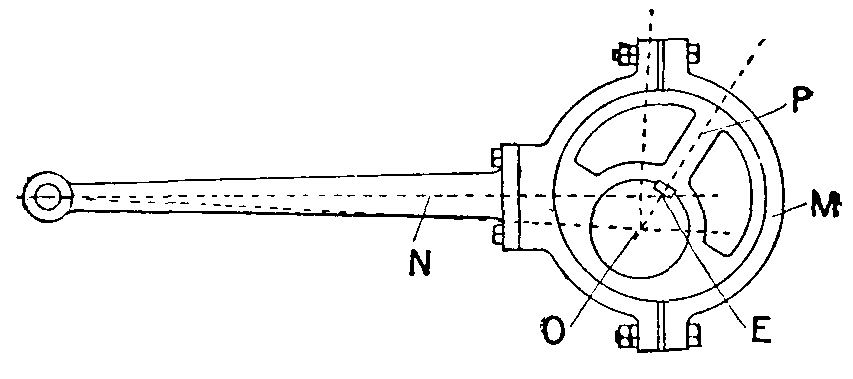
Eccentric and Rod
P, Pulley. M, Strap. N, Rod. O, Centre of shaft. E, Centre of eccentric. O, E, Is the throw or radius of the eccentric.
Eccen´tric, a term in mechanics applied to contrivances for converting circular into reciprocating (backwards and forwards) rectilinear motion, consisting of circular discs attached to a revolving shaft, not centrally, i.e. eccentrically.
Ecchymosis is extravasation of blood into the tissues underlying the skin. It is most frequently produced as the result of a bruise from injury, but may be due to some pathological condition.
Ecclefechan (ek-l-feh´an), a Scottish village in Dumfriesshire, near the Caledonian Railway main line, noteworthy as the birth-place and burial-place of Thomas Carlyle. Pop. 670.
Eccles, a town of England, in Lancashire, 4 miles from Manchester, of which it may be considered a suburb. The town, engaged in textile industries, is famous for its cakes. Since 1918 it returns one member to Parliament. Pop. 41,946.
Ecclesias´tes (-tēz), the title by which the Septuagint translators rendered the Hebrew Koheleth ('the gatherer of the people'), a symbolic name explained by the design of the book and the dramatic position occupied by Solomon in it, one of the canonical books of the Old Testament. The book consists of 12 chapters, being a series of discourses on the vanity of earthly things, and the tone, which is sceptical, is such as is found in Omar Khayyám. According to Jewish tradition, it was written by Solomon; but the best modern criticism has decided that its style and language, no less than its thought, belong to a much later date.
Ecclesiastical Commissioners, in England, a body corporate, constituted in 1836, with extensive powers in regard to the organization of the Church, the distribution of episcopal duties, and the formation of parishes. It consists of all the bishops of England and Wales, five cabinet ministers, four judges, and twelve others. Their decisions are ratified by orders in council, and acquire the force of Acts of Parliament. The Commissioners deal with an annual income of about 2 million pounds.
Ecclesiastical Courts, courts in which the canon law is administered and which deal with ecclesiastical cases, affecting benefices and the like. In England they are the Archdeacon's Court, the Consistory Courts, the Court of Arches, the Court of Peculiars, the Prerogative Courts of the two archbishops, the Faculty Court, and the Privy Council, which is the court of appeal, though its jurisdiction may by Order in Council be transferred to the new Court of Appeal. No separate ecclesiastical courts existed in England before the Norman Conquest, but by a charter of William I a distinction was made between courts civil and courts ecclesiastical. In Scotland the ecclesiastical courts are the Kirk-session, Presbytery, Synod, General Assembly (which is the supreme tribunal as regards doctrine and discipline), and the Teind Court, consisting of the judges of the Court of Session, which has jurisdiction in all matters affecting the teinds of a parish. In the Isle of Man ecclesiastical courts still have, as formerly in England, jurisdiction in probate and matrimonial cases.
Ecclesiastical Law may, in the broad sense of the term, be taken to include the regulations existing in any Church or sect, however small, for the formation of its own polity and for the control of its members. It is, however, more generally applied to those legal bonds which exist between Established Churches and the State. The Roman Catholic Church claims to be the one and only true Church, regards her laws as being of universal application, and herself as an equal with the State; nevertheless she has, in non-Catholic countries, no higher legal standing than any small and obscure dissenting congregation, and is in this respect a 'free' Church. Protestant ecclesiastical law claims no such sovereign power, and in no way interferes with the State law. In England the Convocations of York and Canterbury have no authority to change the law, their power being limited to the making of recommendations. All changes in Church law are made by Parliament. Laymen can be, and often are, officials of the ecclesiastical courts. The civil law is subject to the canon law, above which is the common law, with, yet higher, statute law. Over all is the nominal supremacy of the Crown. Ecclesiastical law deals with such affairs and property of the Church of England as ecclesiastical parishes, churches, and matters matrimonial; but only so far as these are not controlled by common or statute law. It has long ceased to have any practical control of the laity. In Ireland, ecclesiastical law disappeared with the disestablishment of the Church.
Ecclesias´ticus, a book placed by Protestants and Jews among the apocryphal scriptures. The author calls himself Jesus the son of Sirach, Originally written in Hebrew, it was translated into Greek by the author's grandson in the second century B.C. In 1896 fragments of four MSS. in the Hebrew original were discovered in the Geniza, or hiding-place for worn out copies of biblical books, in the synagogue at Cairo. Another fragment was discovered in Palestine by Mrs. Agnes Lewis.—Cf. Schechter and Taylor, The Wisdom of Ben Sira: Portions of the Book Ecclesiasticus.
Échelles, Les (lā-zā-shāl; 'the Ladders'), a village, France, department of Savoie, 12 miles south-west of Chambéry, in a valley from which egress at one end was formerly by means of ladders, but now by a tunnel. Pop. 798.
Échelon (esh´e-lon), a formation of successive and parallel units facing in the same direction, each on a flank and to the rear of the unit in front of it.
Echeneis, the type genus of a small family (Echeneididæ) of aberrant spiny-finned fishes, in which the first dorsal fin is modified into a transversely ridged suctorial disc. See Remora.
Echeveria (ech-e-vē´ri-a), a genus of succulent plants, ord. Crassulaceæ (house-leek), chiefly natives of Mexico, but now cultivated in European and other gardens and greenhouses, some for their flowers, others for their foliage.
Echidna (ē-kid´na), a genus of Australian toothless mammals, in size and general appearance resembling a large hedgehog, excepting that the spines are longer and the muzzle is protracted and slender, with a small aperture at the extremity for the protraction of a long flexible tongue. The habits of the Echidna are nocturnal; it burrows, having short strong legs with five toes, and feeds on insects, which it catches by protruding its long sticky tongue. It is nearly allied to the Ornithorhynchus, the two forming a peculiar class of animals, having in their structure some peculiarities at once of mammals, birds, and reptiles. In 1884 it was found that, as Geoffrey St. Hilaire had suspected, the Echidna, the closely related Proechidna of New Guinea, and the Ornithorhynchus constitute the lowest sub-class of mammals, the Prototheria or Monotremata, which present many reptilian characters. They possess a cloaca into which the intestine and urinogenital ducts open and are oviparous. During the breeding season a temporary pouch is formed, and into this the milk-glands open, but there are no teats. The egg when laid is put into the pouch by the mother, and is there hatched in a very immature state. It feeds by licking up the milk in the pouch. Later on, the mother digs a burrow, where she leaves the young at night, returning during the day to suckle it. One species (E. hystrix), from its appearance is popularly known as the porcupine ant-eater.
Echinocactus (e-kī´-), a genus of cactaceous plants inhabiting Mexico and South America, and remarkable for their peculiar forms, being globular, oblong, or cylindrical, and without leaves, fluted and ribbed, with stiff spines clustered on woolly cushions. Some of them are very bulky. The flowers are large and showy. See Cactus.
Echinococcus, the very large compound cyst which forms the bladder-worm stage in the life-history of a small tapeworm (Tænia echinococcus) living in the intestine of the dog. The cysts are found in various abdominal organs of herbivorous animals, and sometimes infest human beings, especially in Iceland.
Echinodermata (e-kī-nō-dėr´ma-ta), a phylum or sub-kingdom of invertebrate animals characterized by having a tough integument in which lime is deposited in scattered plates (sea-cucumber), flexibly articulated plates (star-fishes), or so as to form a rigid test or shell like that of the sea-urchin; and by the radial arrangement of many of the parts of the adult. Movable spines are commonly present. There is a system of tubes into which seawater is admitted (ambulacral system), and commonly tube-feet, that are put into use by being distended with fluid. Some of them, as the encrinites or sea-lilies, are permanently fixed by a stalk when adult. Their development is accompanied by metamorphosis, and the embryo shows a distinctly bilateral aspect, though the radiate arrangement prevails in the adult. By some they are classed with the Scolecida in the sub-kingdom Annuloida. The phylum is divided into nine classes: Asteroidea (star-fishes); Ophiuroidea (brittle-stars), Echinoidea (sea-urchins), Holothuroidea (sea-cucumbers), Crinoidea (sea-lilies, feather-stars, the latter free-moving), Thecoidea or Edrioasteroidea (extinct, stalkless but fixed), Carpoidea (extinct, stalked), Cystoidea (extinct, stalked), Blastoidea (extinct, stalked). All are marine.
Echinomys, or Spiny Rat, a genus of South American rodent mammals distinguished by the presence of spines among the coarse fur. The long tail is covered by scales and hair intermixed, the ears are large, and all the extremities possess five digits.
Echinus (e-kī´nus), Sea-urchin, or Sea-egg, a genus of marine animals, the type of an order (Echinoidea) of the phylum Echinodermata (see above). In this type the body is spheroidal and invested in a test or shell composed of regularly arranged plates closely united together. It is covered with movable spines articulated by ball-and-socket joints. The mouth is situated in the centre of the under surface, and there is a complicated masticatory apparatus (Aristotle's lantern) consisting of five chisel-ended teeth supported by an elaborate framework. The anus is similarly placed on the upper side, and is surrounded by a circlet of ten plates (apical disc), one of which bears a furrowed tubercle (madreporite) perforated by small holes through which water enters the water-vascular system. Locomotion is effected by meridional rows of tube-feet, aided by the spines. E. esculentus and some other species are edible. See Sea-urchin.
Echinus
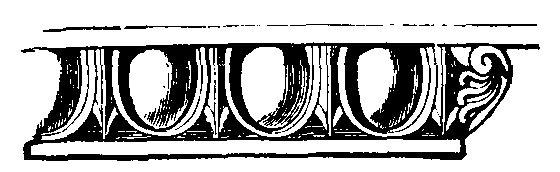
Echinus (e-kī´nus), in architecture, the ovolo or quarter-round convex moulding, seen in capitals of the Doric order. It is especially frequently found carved with the egg-and-dart ornament.
Echo (ek´ō), the repetition of a sound caused by the reflection of sound-waves from some surface, as the wall of a building. The echo may, however, be very distinct when the reflecting surface is very irregular, and it is probable that the resonance of the obstacles and the masses of air which they enclose contribute in producing the echo. The waves of sound on meeting the surface are turned back in their course according to the same laws that hold for reflection of light. In order that the echo may return to the place from which the sound proceeds, the reflection must be direct, and not at an angle to the line of transmission, otherwise the echo may be heard by others but not by the transmitter of the sound. This may be effected either by a reflecting surface at right angles to the line of transmission, or by several reflecting surfaces which in the end bring the sound back to the point of issue. Sound travels about 1125 feet in a second; consequently, an observer standing at half that distance from the reflecting object would hear the echo a second later than the sound. Such an echo would repeat as many words and syllables as could be heard in a second. As the distance decreases, the echo repeats fewer syllables till it becomes mono-syllabic. The most practised ear cannot distinguish in a second more than from nine to twelve successive sounds, so that a distance of not less than 60 feet is needed to enable an average ear to distinguish between the echo and the original sounds. At a near distance the echo only clouds the original sounds, and this often interferes with the hearing in churches and other large buildings. Woods, rocks, and mountains produce natural echoes in every variety, for which particular localities have become famous.
Echo, in Greek mythology, a mountain nymph (one of the Oreads). Legend relates that by her talking she detained Hera, when the latter sought to surprise Zeus among the mountain nymphs. To punish her the goddess deprived her of speech, unless first spoken to. She subsequently fell in love with Narcissus, and because he did not reciprocate her affection she pined away until nothing was left but her voice.
Echuca (e-chö´ka), an Australian town, colony of Victoria, on the Murray, over which is an iron railway and roadway bridge, connecting it with Moama in New South Wales; trade (partly by the river) in timber and wool. Pop. 4137.
Écija (ā-thē-ha˙), an ancient town of Southern Spain, province of Seville, on the Genil, with manufactures of textile fabrics and a good trade. It is one of the hottest places in Spain. Pop. 23,217.
Eck, Johann Maier von, the celebrated opponent of Luther, born in 1486, died in 1543. Having obtained a reputation for learning and skill in disputation, he was made doctor of theology, canon in Eichstädt, and pro-chancellor of the University of Ingolstadt. He went to Rome in 1520, and returned with a Papal bull against Luther, in attempting to publish which he met with violent popular opposition. In 1530, while at the Diet of Augsburg, he made the remarkable admission that he could confute the Augsburg Confession by the fathers but not by the Scriptures. Eck was present also at the Diets of Worms (1540) and Ratisbon (1541).
Eck´ermann, Johann Peter, German writer, born in 1792, died in 1854. In 1813 he served in the army against the French, and was afterwards appointed to a small governmental post. He finally settled in Weimar, where he became private secretary to Goethe. After Goethe's death he published his Conversations with Goethe, a book which has been translated into all European languages.
Eckmühl (ek´mül), a village of Bavaria, circle of Lower Bavaria, on the Gross Laber, 13 miles S.S.E. of Ratisbon, the scene of a sanguinary battle between the French and Austrians on 22nd April, 1809, in which the latter were defeated.
Eclamp´sia, a medical term applied to convulsions that seem to be of an epileptic character, but differ from true epilepsy as being due to some special poison. The use of the term is now practically restricted to puerperal eclampsia, convulsions occurring in pregnant women, generally those suffering from kidney disease.
Eclec´tics (Gr. eklektikos, select) is a name given to all those philosophers who do not follow one system entirely, but select what they think the best parts of all systems. The system is called eclecticism. In ancient philosophy Cicero was the most conspicuous representative of eclecticism, and in modern times the eclectic method found a notable supporter in the French philosopher Victor Cousin.
Eclipse (ek-lips´; Gr. ekleipsis, a failing, ekleipō, I fail), an interception or obscuration of the light of the sun, moon, or other heavenly body by the intervention of another and non-luminous body. A star or planet may be hidden by the moon; in this case the phenomenon is called an occultation.
Diagrams illustrating the Theory of Eclipses
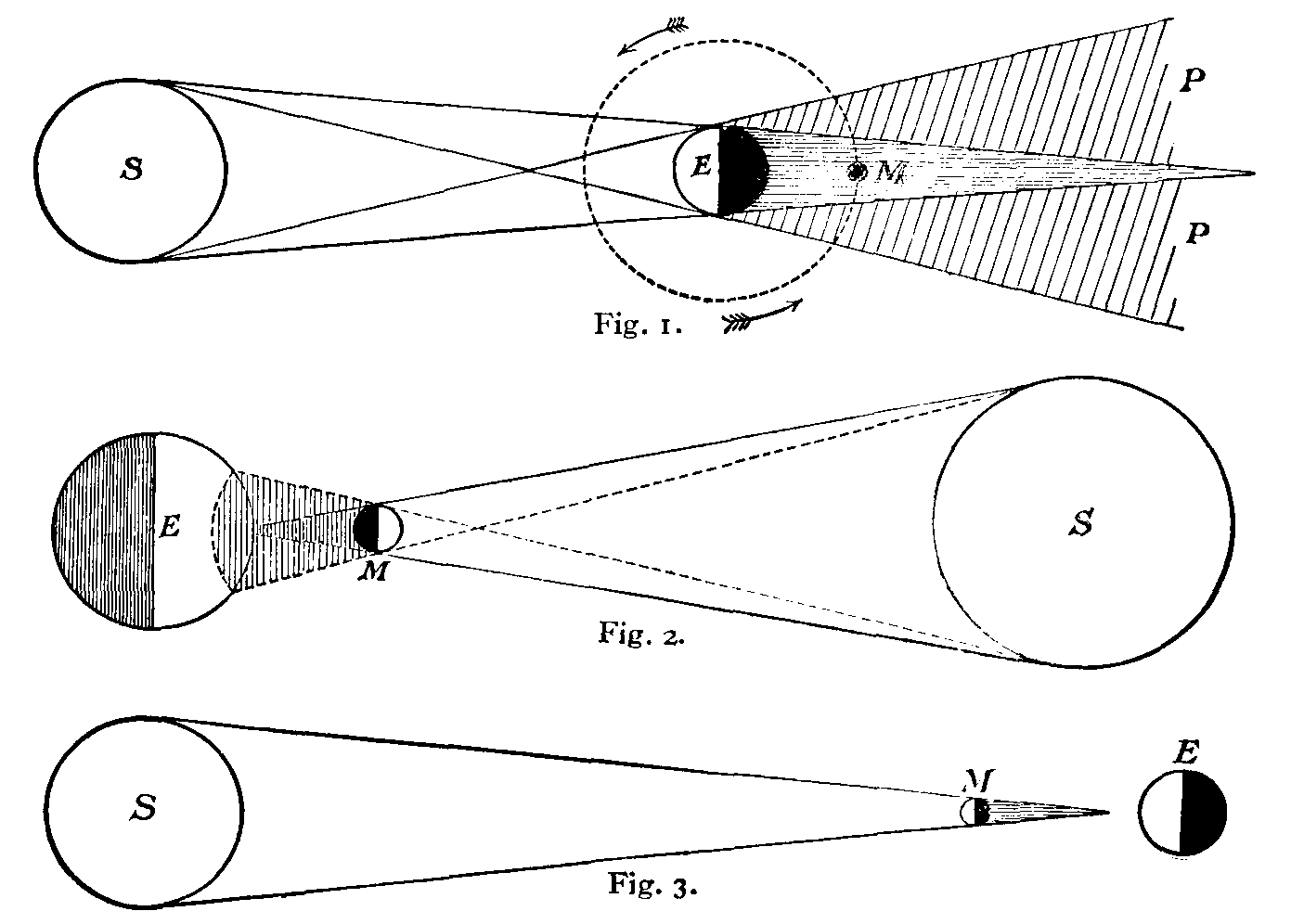
An Eclipse of the Moon is an obscuration of the light of the moon occasioned by an interposition of the earth between the sun and the moon; consequently, all eclipses of the moon happen at full moon. Further, the moon's direction from the earth must make only a very small angle with the axis of the earth's shadow, or line joining centres of sun and earth produced. But as the moon's orbit makes an angle of more than 5° with the plane of the ecliptic, it frequently happens that though the moon is in opposition it does not come within the shadow of the earth. The theory of lunar eclipses will be understood from fig. 1, where S represents the sun, E the earth, and M the moon. If the sun were a point of light, there would be a sharp outlined shadow or umbra only, but since the luminous surface is so large there is always a region in which the light of the sun is only partially cut off by the earth, which region is known as the penumbra (P P). Hence during a lunar eclipse the moon first enters the penumbra, then is totally or partially immersed in the umbra, then emerges through the penumbra again.
An Eclipse of the Sun is an obscuration of the whole or part of the face of the sun, occasioned by an interposition of the moon between the earth and the sun; thus all eclipses of the sun happen at the time of new moon. Fig. 2 is a diagram showing the cause of a solar eclipse. The dark or central part of the moon's shadow, where the sun's rays are wholly intercepted, is here the umbra, and the light part, where they are only partially intercepted, is the penumbra; and it is evident that if a spectator be situated on that part of the earth where the umbra falls, there will be a total eclipse of the sun at that place; in the penumbra there will be a partial eclipse, and beyond the penumbra there will be no eclipse. As the moon is not always at the same distance from the earth, and as the moon is a comparatively small body, if an eclipse should happen when the moon is so far from the earth that her shadow falls short of the earth, a spectator situated on the earth in a direct line with the centres of the sun and moon would see a ring of light round the dark body of the moon. Such an eclipse is called annular, as shown in fig. 3; when this happens, there can be no total eclipse anywhere. An eclipse can never be annular longer than 12 minutes 24 seconds, nor total longer than 7 minutes 58 seconds. The longest possible entire duration of an eclipse of the sun is a little over 4 hours.
An eclipse of the sun begins on the western side of his disc and ends on the eastern; and an eclipse of the moon begins on the eastern side of her disc and ends on the western. The largest possible number of eclipses in a year is seven, four of the sun and three of the moon, or five of the sun and two of the moon. The smallest is two, both of the sun. But a solar eclipse affects only a limited area of the earth, while a lunar eclipse is visible from more than a terrestrial hemisphere, as the earth rotates during its progress. Therefore at any given place eclipses of the moon are more frequently visible than those of the sun.—Bibliography: R. Buchanan, The Theory of Eclipses; W. T. Lynn, Remarkable Eclipses.
Eclip´tic, the sun's path, the great circle of the celestial sphere, in which the sun appears to describe his annual course from west to east—really corresponding to the path which the earth describes. (See Earth.) The Greeks observed that eclipses of the sun and moon took place near this circle; whence they called it the ecliptic. The ecliptic has been divided into twelve equal parts, each of which contains 30°, and which are occupied by the twelve celestial signs, viz.:
Aries (the Ram), 21st March. Taurus (the Bull), 20th April. Gemini (the Twins), 21st May. Cancer (the Crab), 21st June. Leo (the Lion), 23rd July. Virgo (the Virgin), 23rd Aug. Libra (the Balance), 23rd Sept. Scorpio (the Scorpion), 23rd Oct. Sagittarius (the Archer), 22nd Nov. Capricornus (the Goat), 22nd Dec. Aquarius (the Water-carrier), 20th Jan. Pisces (the Fishes), 19th Feb.


These are also called signs of the zodiac, the zodiac being a belt of the heavens extending 9° on each side of the ecliptic. The days of the month annexed show when the sun, in its annual revolution, enters each of the signs of the zodiac. From the First Point of Aries, or the place of the sun at the vernal equinox, the degrees of the ecliptic are counted from west to east. The plane of the ecliptic is that by which the position of the planets and the latitude and longitude of the stars are reckoned. The axis of the earth is not fixed in direction in space, but performs a slow conical motion about the pole of the ecliptic in about 26,000 years. In consequence of this the points at which the equator intersects the ecliptic, viz. the First Point of Aries and First Point of Libra, recede westwards upon the ecliptic at the rate of about 50 seconds a year. The signs of the zodiac, therefore, do not now coincide, as they did some 2000 years ago, with the constellations of the same names, and the First Point of Aries has now regressed through the greater part of the constellation Pisces. The angle at which the ecliptic and equator are mutually inclined is also variable, and has been diminishing for about 4000 years at the rate of about 50 seconds in a century. Laplace gave a theory to show that this variation has certain fixed limits, and that after a certain time the angle will begin to increase again. See Precession and Nutation.
Eclogue (ek´log), a term usually applied to what Theocritus called idyls—short, highly finished poems, principally of a descriptive or pastoral kind, and in which the loves of shepherds and shepherdesses are described. Eclogues flourished among the ancients (Bucolics of Virgil), and, under the name of pastorals, were fashionable in the sixteenth century, Spenser's Shepherds' Calendar being a good example. They were revived in the eighteenth century by Pope.
École des Beaux Arts ('School of Fine Arts'), the French Government school of fine arts at Paris, founded by Mazarin in 1648, and provided with an extensive staff of teachers. The competitions for the grands prix de Rome take place at this school. All artists between the ages of fifteen and twenty-five, whether pupils of this school or not, may compete, after passing two preliminary examinations. The successful competitors receive an annual allowance from the State for three or four years, two of which must be passed at Rome. The Palais des Beaux Arts, the home of the École, was begun in 1820 and finished in 1863.
École Normale Supérieure ('Superior Normal School'), a school at Paris for the training of those teachers who have the charge of the secondary education in France, founded by decree of the Convention in 1794, reorganized by Napoleon in 1808, and again in 1830 by the Government of Louis-Philippe. By the decree of 1903 the school forms part of the University of Paris. It maintains a hundred students and has a course of three years' duration.
École Polytechnique ('Polytechnic School'), a school in Paris established with the purpose of giving instruction in matters connected with the various branches of the public service, such as mines, roads and bridges, engineering, the army and the navy, and Government manufactures. It was founded in 1794, and is under the direction of the Minister of War. Candidates are admitted only by competitive examination, and have to pay for their board 1000 francs a year. The pupils who pass satisfactory examinations at the end of their course are admitted to that branch of public service which they select.
Ecology, or Œcology, the study of the relations of plants to their surroundings, a branch of plant geography.—Bibliography: Horwood, British Wild-flowers; Tansley, Types of British Vegetation; Warming, Œcology.
Economics is the name applied, in substitution for the older one of political economy, to the scientific study of men in relation to the production, exchange, distribution, and consumption of wealth. The origin of both names lies in the analogy between provision for the needs of a household and for those of a State. To the former the term 'economy' was originally applied, as in Xenophon's treatise on the subject. But it was soon adopted to describe that branch of the art of government which dealt with public revenue and expenditure, and a matter intimately connected therewith, the enrichment of the community as a whole.
This conception of economics inspired all economic writings until late in the eighteenth century, a typical example being Thomas Mun's England's Treasure by Foreign Trade (1664), containing an exposition of the mercantile system which sought to increase natural wealth by regulation of the balance of trade. The treatment of economics as a science had its origin in the writings of the Physiocrats, a group of French philosophers of whom Quesnay (1694-1774) was the most prominent, and with whom Turgot (1727-81), the great minister of Louis XVI, held many doctrines in common. The Physiocrats argued that the wealth of the community was raised to the maximum, not by State regulation, but by entire freedom in the economic sphere. But the chief importance of the Physiocrats lay in their paving the way for Adam Smith (1723-90), who in 1776 published The Wealth of Nations, a book which has exercised profound and widespread influence on thought and action, and is still a leading authority on the subject. Adam Smith definitely retained the conception of economics as part of the art of government. "Political economy", he says, "proposes two distinct objects: first, to provide a plentiful revenue or subsistence for the people ... and secondly, to supply the State or Commonweal with a revenue sufficient for the public service. It proposes to enrich both the people and the sovereign." But the book is also largely occupied with an investigation of the production, distribution, and exchange of wealth when free from all regulation and restriction, together with a powerful indictment of such regulation. This doctrine of non-interference by the State came to be known as the laissez-faire doctrine, from a phrase used by Gournay, one of the Physiocrats. Mainly through Adam Smith's influence, it became the orthodox view of the State's relation to trade and industry. This meant that the aims of economics, in its older sense, were best achieved without State action at all; and, consequently, economics came to mean simply the study of what are in fact men's activities in relation to wealth. This conception is clearly expressed in such writers as Ricardo (1772-1823), whose Principles of Political Economy and Taxation enunciates the theory of rent which has formed the basis of all subsequent reasoning on the subject, and states a theory of wages which gave colour to Karl Marx's doctrine of the exploitation of wage-earners by capitalists. It is also evident in the work of Nassau Senior (1790-1864), in the important Principles of Political Economy of John Stuart Mill (1806-73), and is most fully expressed by J. E. Cairnes (1823-78).
This conception has formed the basis of all modern economics, despite important differences in the method of treating material. The modern view of the matter is well stated by Dr. Alfred Marshall in his Principles of Economics, a most important contribution to the subject, which has exercised much influence. Economics he defines as "a study of mankind in the ordinary business of life; it examines that part of individual and social action which is most closely connected with the attainment and with the rise of material requisites of well-being". The separation between economics and the investigation of social phenomena in general is not so rigidly maintained to-day as in the past. It is realized that men's activities in relation to wealth are affected by other than purely economic considerations, and that political, moral, religious, and æsthetic forces must be taken into account. At the same time, the science deals only with what is, and not with what ought to be done; and is therefore distinct from Ethics, which is concerned with moral judgments. Of late years, interest in the application of ethical considerations to economic problems has increased considerably, using the conclusions of economic science as its material, mainly in connection with problems of distribution, especially wages. One of the most important of modern political movements, Socialism, makes a just distribution of wealth the keynote of its doctrines. In so far as man's conduct is studied in economics, the science is concerned with psychological considerations; but it is distinct from psychology, taking the principles thereof as data rather than establishing them as conclusions. The traditional arrangement of the subject matter of economics into the production, exchange, and distribution of wealth is still maintained; but in recent years consumption, the end of almost all man's productive activity, has received much attention, notably from W. S. Jevons (1835-82) and Marshall. Important conceptions in this connection are those of the diminishing utility to an individual or group of individuals of each successive increment of any commodity received beyond a certain point; and of consumer's surplus, measured by the difference between the price a person pays for a thing and what he would pay rather than go without it. Any rigid distinction between the different branches of economics is, however, impossible. For example, all processes of exchange may be considered as part either of distribution or of production.
The central problem of economics is really that of how the exchange value of commodities and services is determined; since in this determination all the forces regulating production, distribution, and consumption are brought to a focus, and their action and interaction can be investigated. The study of value covers that of all forces affecting either the demand for or the supply of a commodity, including its cost of production. On the side of production, technical processes are not studied in detail, though some knowledge of them is indispensable; but matters common to all production are dealt with, such as the so-called laws of increasing and diminishing return, which are statements of the relation between the amounts of labour, land, and capital used in production, and the amount of product. Other questions considered are transport, markets of all kinds, banking, currency, finance, and trusts and combinations. The study of distribution includes the methods by which wages, interest and profits, and rent are determined; and since each of these is payment for a service (of labour, capital, and land respectively) it is really an aspect of the study of value. Distribution also covers such subjects as trade unionism, co-operation, and labour disputes. Economics also deals with public finance (including taxation), treating of the effects of different methods of collecting and expending the State revenue. In considering the above-mentioned subjects, the method of economics is strictly that of a science, in that it aims partly at a descriptive analysis of material, and partly at a statement of cause and effect. The laws of economics are, like other scientific laws, statements of tendencies. They are not laws such as the commands or prohibitions of the State, though they are often loosely referred to in this way. That economics should be able to generalize and to predict about the action of men is due to its dealing not with individuals, but with large groups, so that individual peculiarities can be neglected and the general characteristics of the group ascertained. It is in this connection that considerable controversy has arisen. The older writers on economics were mainly deductive in method, i.e. they took a few general principles, such as that every man follows his own interest and knows where that interest lies, and made certain assumptions, such as the existence of free competition; and on this basis worked out a group of principles which were sometimes quite unrelated to actual facts. This method is undoubtedly a most powerful one, and of great value provided that the original assumptions are kept clearly in mind, and variations from them in a particular case allowed for in applying conclusions. But the unreality of some of its results produced a reaction, of which an early instance is the famous Essay on the Principle of Population by T. R. Malthus, published in 1798. This book inaugurated the rise of a school of economists who treated their subject from an inductive and historical point of view. The historians, who have been especially prominent in Germany, and of whom representatives are Roscher (1817-94), de Laveleye (1822-92), and Cliffe Leslie (1825-82), hold that economics should in the main be descriptive, and not attempt to formulate laws. The inductive school, of whom J. S. Mill is an important member, base their work upon more extensive investigation than the older writers, and constantly test their conclusions by reference to facts. Another important reaction against the early economists arose from the identification of the latter with the doctrine of laissez-faire. Alexander Hamilton (1757-1804) and Friedrich List (1789-1840) argued in favour of an extension of State activity, especially for the purpose of protecting industry against foreign competition, and may be considered the fathers of modern protectionist doctrine. In most modern treatment of economics, the deductive and inductive methods are employed side by side. The study of economic history has developed as a separate branch, but economists recognize that it provides them with much valuable material. Important recent developments in method are the increased use of statistics, made possible by their more widespread and careful compilation, and the application of mathematical methods to economic data. It is recognized that, with due care, many conceptions which are with difficulty expressed in words can be treated on mathematical lines to yield results of great service. In this work the researches of Italian writers, such as Pantaleoni and Pareto, are of conspicuous importance.—Bibliography: A. C. Pigou, Wealth and Welfare; Preferential and Protective Import Duties; E. Cannan, Wealth; J. N. Keynes, Scope and Method of Political Economy; G. Cassel, Nature and Necessity of Interest; W. Smart, Distribution of Income; C. R. Fay, Co-operation; A. Andreades, History of the Bank of England; H. Levy, Monopoly and Competition; C. F. Bastable, Public Finance.
Écraseur is a wire loop or chain for amputating a growth suitably situated for such an instrument. The chain is passed round the base or pedicle of the growth, and gradually tightened by a screw till the growth falls off. Its application in surgery is limited.
Ectocarpaceæ, a family of Brown Algæ, section Phæosporeæ. The typical genus is Ectocarpus, comprising small, branched, filamentous plants of salt or brackish water. According to the species, growth of the filaments may be apical, intercalary, or common to all cells, whereas among the more advanced members of the Brown Algæ either apical or intercalary growth is characteristic of entire families. The gametes show every gradation from complete similarity (isogamy) to a condition like that of Cutleria.
Ecuador (ek-wa˙-dōr´) (Republica Del Ecuador), a republic of South America, situated under the equator, whence it takes its name, between Peru and Colombia. It is of triangular shape, its base resting on the Pacific, but the boundaries between it and its neighbours are not very definitely fixed; estimated area, about 116,000 sq. miles. The state has still a boundary dispute with Peru, that with Colombia having been settled by treaty in 1917. The country is divided into fifteen provinces, one territory—'El Oriente'—and the Archipelago of Galapagos, officially called 'Colon'. It falls, as regards the surface, into three sections: the comparatively narrow and low-lying coast regions, the mountain region, and the extensive plains on the east. The mountain region is formed by a double range of snow-clad mountains—several of them active volcanoes—which enclose a longitudinal valley or tableland, with a breadth of 20 to 40 miles, and varying in elevation from 8500 to 13,900 feet. The most elevated of these mountains are, in the western range, Chimborazo, Pichincha, and Cotacachi, Chimborazo being 20,703 feet high. In the eastern range are Cayambe, Antisana, and Cotopaxi (19,500 feet). The cultivated land and the population of Ecuador lie chiefly in this elevated region, which extends along between the summits of the Cordillera, and may be considered as divided by transverse ridges or dikes into the valleys of Quito, Hambato, and Cuenca. The chief towns here are Quito, the capital, with a pop. of 70,000, Riobamba, and Cuenca, all situated at a height of 9000 feet or more above the sea. The chief ports of Ecuador are Guayaquil and Esmeraldas. The most considerable rivers, the Tigre, Napo, Pastaza, &c., belong to the basin of the Amazon; and some of them, notably the Napo, are navigable for long distances. On the western slope of the Andes the chief rivers are the Esmeraldas and the Guayaquil. Ecuador is comparatively poor in Mammalia; although various kinds of deer as well as tapirs and peccaries are found in the forests. Parrots and humming-birds are also numerous, but perhaps the most remarkable of the birds in Ecuador is the condor, which dwells on the slopes of the Andes. Reptiles, including serpents, are numerous. The forests yield cinchona bark, caoutchouc, sarsaparilla, and vegetable ivory. The climate on the plains, both in the east and the west, is moist, hot, and unhealthy. In the higher regions the climate is rough and cold, but in great part the elevated valleys, as that of Quito, enjoy a delightful climate. Here the chief productions are potatoes, barley, wheat, and European fruits. In the lower regions are grown all the food-products of tropical climates, cocoa, coffee, and sugar. The foreign commerce is not large, the exports and imports being annually about £2,700,000 and £1,670,000 respectively. In 1919 the imports from Ecuador to the United Kingdom amounted to £1,257,350, and the exports to Ecuador to £373,346. Cocoa forms three-fourths (or more) of the whole export; the remainder is made up of tagua or ivory-nuts, rubber, straw hats, coffee, and gold. A little gold is mined, and Panama hats are made. The State recognizes no religion, but grants freedom of worship to all. A system of education was organized in 1897 and improved in 1912. There are three universities: the Central University, at Quito; the Guayas University, in Guayaquil; and the Azuay University, in Cuenca. There are schools for higher education and primary schools. The executive government is vested in a President elected for four years, who is assisted by a Council of State. The Congress is the legislative body, and consists of two Houses, one formed of Senators, two for each province, the other of Deputies, one for every 30,000 inhabitants, both elected by universal suffrage. The Congress has extensive privileges, and cannot be dissolved by the President. The seat of government is Quito. In 1920 both the revenue and expenditure amounted to nearly £2,000,000. The debt amounts to about £5,620,000. The monetary standard is gold, the gold condor of ten sucres being equivalent to a sovereign. The metric system of weights and measures is the legal one. Railways and telegraphs have made little progress.—Ecuador at the time of the conquest of Peru by the Spaniards formed part of the great empire of the Incas. As the Presidency of Quito it was long included in the Vice-Royalty of Peru. From 1710 it became part of the Presidency of New Granada (or Santa Fé de Bogotá). In the revolutionary war against Spain, Ecuador, along with the neighbouring territories, secured its independence (1822), and was ultimately erected into a separate Republic in 1831. The present Constitution of the Republic was promulgated on 6th May, 1906. Of the present population, the aboriginal red race form more than half; the rest are negroes, mulattoes, mestizoes, a degenerate breed of mixed negro and Indian blood, and Spanish Creoles or whites. The last-named are the chief possessors of the land, but are deficient in energy. Pop. (estimated) 2,000,000.—Bibliography: F. Garcia-Calderon, Latin America: its Rise and Progress; C. R. Enock, Ecuador; T. H. Stabler, Travels in Ecuador.
Ecumenical Council, a general ecclesiastical council regarded as representing the whole Christian world or the universal Church; specially applied to the general councils of the early Christian Church, beginning with that of Nicæa in 325, and later to those of the Roman Catholic Church, of which the most recent was the Vatican Council at Rome in 1870.
Ec´zema is a skin eruption marked by the appearance of papules or vesicles and accompanied by irritation of the affected part, frequently very severe. The characteristic watery discharge of the disease is produced by the bursting of the vesicles. There is difference of opinion among dermatologists as to whether or not it is primarily caused by germs. Various predisposing causes, like digestive disturbances, anæmia, and nervous disorders are important factors in determining the course of the disease. Eczema may affect practically any part of the skin, but is most frequently seen on the scalp, ears, face, hands, nipples, armpits, and the genital regions.
Ed´am, a town of North Holland, near the Zuider Zee, 12 miles N.N.E. of Amsterdam, noted for its cheese markets; but 'Edam cheese' is mostly made elsewhere. Pop. 6623.
Edda (meaning 'great-grandmother'), the name given to two ancient collections of Icelandic literature, the one consisting of mythological poems, the other being mainly in prose. The first of these collections, called the Elder or Poetic Edda, was compiled in the thirteenth century, and discovered in 1643 by Brynjulf Sveinsson, an Icelandic bishop. For a long time an earlier date was given, the compiler being erroneously believed to have been Sæmund Sigfusson, a learned Icelandic clergyman, who lived from about 1056 to 1133. It consists of thirty-three pieces, written in alliterative verse, and comprising epic tales of the Scandinavian gods and goddesses, and narratives dealing with the Scandinavian heroes. These poems are now assigned to a period extending from the ninth to the eleventh century. The Prose Edda, or Younger Edda, presents a kind of prose synopsis of the Northern mythology; a treatise on the Scaldic poetry and versification, with rules and examples; and lastly a poem (with a commentary) in honour of Haco of Norway (died 1263). In its earliest forms this collection is ascribed to Snorri Sturlason, who was born in Iceland in 1178, and was assassinated there in 1241 on his return from Norway, where he had been scald or court poet. Cf. S. Bugge, Home of the Eddic Poems.
Eddy, Mary Baker, founder of Christian Science (q.v.), born at Bow, New Hampshire, United States, 16th July, 1821, died 3rd Dec., 1910. She was married three times, to Mr. Glover, Mr. Patterson, and Mr. Asa Gilbert Eddy, all of whom she survived. She began to teach her system of psychotherapeutics in 1866, and founded the first Christian Science Church in Boston in 1879. In 1881 she established the Metaphysical College at Massachusetts. Her works, besides Science and Health with Key to the Scriptures, include: Unity of God, No and Yes, Pulpit and Press, The First Church of Christ, Christian Science versus Pantheism.—Cf. G. Milmine, Life of M. B. G. Eddy and the History of Christian Science.
Eddystone Lighthouse, a lighthouse in the English Channel, erected to mark a group of rocks lying in the fair-way from the Start to the Lizard. The rocks are covered only at the flood. The first lighthouse was of wood, and built by Henry Winstanley in 1696. It was carried away in the storm of 1703. Another lighthouse, also of wood, was built in 1709 by Rudyerd, but was burned down in 1755. It was succeeded by one built by Smeaton between 1757 and 1759, a circular tower 85 feet high; but, as the foundations on which it stood became much weakened, a new structure, designed by Sir J. N. Douglass, was built between 1879 and 1882 on the neighbouring reef. Its light is visible 17½ miles.
Edelweiss (ā-dėl-vīs; Ger., 'noble white'), Leontopodium alpīnum, a composite plant inhabiting the Alps, and often growing in the most inaccessible places. Its flower-heads are surrounded by a spreading foliaceous woolly involucre, and its foliage is also of the same woolly character. It is not difficult to cultivate, but is apt to lose its peculiar woolly appearance.
E´den (Heb. eden, delight), the original abode of the first human pair. It is said to have had a garden in the eastern part of it, and we are told that a river went out of Eden to water this garden, and from thence it was parted into four heads, which were called respectively Pison, Gihon, Hiddekel, and Euphrates (Phrat), but this does not enable us to identify the locality. It was not the whole of Eden that was assigned to man for his first habitation, but the part towards the east, to which the translators of the Authorized Version have given the name of the Garden of Eden, and which Milton, in Paradise Lost, calls Paradise, that word (originally Persian) having in its Greek form (paradeisos) been applied to the Garden of Eden by the translators of the Septuagint.
Eden, a river in England, in Westmorland and Cumberland, falling into the Solway Firth after a course of 65 miles.—Also, a river in Fifeshire, Scotland.
Edenta´ta (ē-), or Toothless Animals, the name applied to a primitive order of mammals mostly native to the neotropical region, but also represented in South Africa and South Asia. The body is often covered by horny scales or bony plates, the digits are clawed, and the teeth either imperfect or absent altogether. I. New World forms.—(1) Ant-eaters. Toothless, with long narrow snout, and protrusible tongue. Covered with dense fur. The great ant-eater (Myrmecophăga jubata) lives on the ground; the much smaller Tamandua and Cycloturus are arboreal. (2) Sloths. Toothed arboreal leaf-eaters, covered by coarse fur, and provided with very strong curved claws, by which they hang upside down from branches. The three-toed sloth (Bradypus) has three digits in the fore-limb, the two-toed sloth (Cholæpus) only two. (3) Armadillos. Burrowing forms protected by a strong carapace of bony plates, and possessing numerous imperfect teeth. (4) Extinct types. The so-called ground sloths were of large size, Megatherium being nearly as large as an elephant, and Mylodon not much smaller. Glossodon, allied to the latter, survived into the human period. Glyptodon resembled a gigantic armadillo. II. Old World forms.—(1) The aard-vark (Orycteropus) is a burrowing African form about the size of a pig, covered with coarse hair; long ears and snout; 20 imperfect grinding teeth. (2) Scaly ant-eaters or pangolins (Manis), native to South Africa and South Asia, are toothless forms not unlike the American ant-eaters in build, but the body is covered dorsally and laterally by large overlapping scales.
Edes´sa, the name of two ancient cities.—1. The ancient capital of Macedonia, and the burial-place of its kings, now Vodhena. It is probably the same as the still more ancient Aegæ. Philip II was murdered at Edessa in 336 B.C.—2. An important city in the north of Mesopotamia, which, subsequent to the establishment of Christianity, became celebrated for its theological schools. In 1098, in the first Crusade, Edessa came into the hands of Baldwin, but ultimately became part of the Turkish Empire. It is thought to be the modern Urfah or Orfa.
Edfu, or Edfoo´ (ancient Apollinopolis), a village in Upper Egypt, province of Assouan, on the left bank of the Nile, with manufactures of cottons and pottery. Its ancient magnificence is attested by several remains, especially a temple, founded by Ptolemy Philopator (181-145 B.C.), the largest in Egypt after those of Karnak and Luxor. Pop. 12,594.
Ed´gar (the Peaceful), one of the most distinguished of the Saxon Kings of England, was the son of King Edmund I. He succeeded to the throne in 959, and managed the civil and military affairs of his kingdom with great vigour and success. In ecclesiastical affairs he was guided by Dunstan, Archbishop of Canterbury, and he was a great patron of the monks. He died in 975, and was succeeded by his son Edward the Martyr.
Edgar Atheling, grandson of Edmund Ironside and son of Edward the Outlaw, was born in Hungary, where his father had been conveyed in infancy to escape the designs of Canute. After the battle of Hastings, Edgar (who had been brought to England in 1057) was proclaimed King of England by the Saxons, but made peace with William and accepted the earldom of Oxford. Having been engaged in some conspiracy against the king, he was forced to seek refuge in Scotland, where his sister Margaret became the wife of Malcolm Canmore. Edgar subsequently was reconciled to William and was allowed to live at Rouen, where a pension was assigned to him. In 1097, with the sanction of William Rufus, he undertook an expedition to Scotland for the purpose of displacing the usurper Donald Bane, in favour of his nephew Edgar, son of Malcolm Canmore, and in this object he succeeded. He afterwards took part in Duke Robert's unsuccessful struggle with Henry I, but was allowed to spend the remainder of his life quietly in England.
Edgehill, a ridge in Warwickshire, England, 7 miles north-west of Banbury, where was fought a fierce but indecisive battle on 23rd Oct., 1642, between the Royalists under Charles I and the forces of the Parliament under the Earl of Essex.
Edgeworth, Maria, Irish novelist, born at Black Bourton, Oxfordshire, 1st Jan., 1767, died 22nd May, 1849, at Edgeworthstown. She was the daughter of Richard Lovell Edgeworth (1744-1817) of Edgeworthstown, County Longford, Ireland. Her first novel, Castle Rackrent, a tale of Irish life, published in 1800, immediately established her reputation. Her later works include: Belinda, Moral Tales, Leonora, Popular Tales, Tales of Fashionable Life, Patronage, Harrington, Ormond, and Helen, besides an Essay on Irish Bulls, and a work on Practical Education, largely based on Rousseau's Émile. Miss Edgeworth's characteristics are a simple and lucid style and considerable power of observation, but she was not a great creative artist.
Ed´inburgh, the metropolis of Scotland, and one of the finest as well as most ancient cities in the British Empire, lies within 2 miles of the south shore of the Firth of Forth. It is picturesquely situated, being built on three eminences which run in a direction from east to west, and surrounded on all sides by lofty hills except on the north, where the ground slopes gently towards the Firth of Forth. The central ridge, which constituted the site of the ancient city, is terminated by the castle on the west, situated on a high rock, and by Holyrood House on the east, not far from which rise the lofty elevations of Salisbury Crags, Arthur's Seat (822 feet high), and the Calton Hill overlooking the city. The valley to the north, once the North Loch, but now drained and traversed by the North British Railway, leads to the New Town on the rising ground beyond, a splendid assemblage of streets, squares, and gardens. The houses here, all built of a beautiful white freestone found in the neighbourhood, are comparatively modern and remarkably handsome. The principal streets of the New Town are Princes Street, George Street, and Queen Street. From Princes Street, which is lined by fine gardens adorned with Sir W. Scott's monument and other notable buildings, a magnificent view of the Old Town with its picturesque outline may be obtained. The principal street of the Old Town is that which occupies the crest of the ridge on which the latter is built, and which bears at different points the names of Canongate, High Street, Lawnmarket, and Castle Hill. This ancient and very remarkable street is upwards of one mile in length, rising gradually with a regular incline from a small plain at the east end of the town, on which stands the palace of Holyrood, and terminating in the huge rock on which the castle is built, 437 feet above sea-level. The houses are lofty and of antique appearance. Amongst the notable buildings are the ancient Parliament House, since the Union the seat of the supreme courts of Scotland; St. Giles' Church or Cathedral, an imposing edifice in the later Gothic style, dating from the fourteenth century and carefully restored between 1879 and 1883; the Tron Church; Victoria Hall (where the General Assembly of the Established Church meets), with a fine spire; and also John Knox's House, besides some of the old family houses of the Scottish nobility and other buildings of antiquarian interest. From this main street descend laterally in regular rows numerous narrow lanes called closes, many of them extremely steep, and very few at their entrances more than 6 feet wide; those which are broader, and admit of the passage of carriages, are called wynds. In these and the adjacent streets the houses are frequently more than 120 feet in height, and divided into from six to ten stories, or flats, the communication between which is maintained by broad stone stairs, winding from the lowest part of the building to the top. In the Old Town the most remarkable public building is the castle, an extensive mass, of which the oldest portion—and the oldest building in the city—is St. Margaret's Chapel, the private oratory of the Saxon princess Margaret, queen of Malcolm Canmore; another portion being a lofty range of old buildings, in a small apartment of which Queen Mary gave birth to James VI in 1566; while in an adjoining apartment are kept the ancient regalia of Scotland. Here is also the old Parliament Hall, restored during 1888 and 1889. The castle as a fortress contains accommodation for 2000 soldiers, and the armoury space for 30,000 stand of arms. An old piece of ordnance built of staves of malleable iron, cask fashion, and known as Mons Meg, stands conspicuous in an open area. The palace of Holyrood, or Holyrood House as it is more generally called, stands, as already mentioned, at the lower or eastern extremity of the street leading to the castle. No part of the present palace is older than the time of James V (1528), while the greater portion of it dates only from the time of Charles II. In the north-west angle of the building are the apartments which were occupied by Queen Mary, nearly in the same state in which they were left by that unfortunate princess. Adjoining the palace are the ruins of the chapel belonging to the Abbey of Holyrood, founded in 1128 by David I. On the south side of the Old Town, and separated from it also by a hollow crossed by two bridges (the South Bridge and George IV Bridge), stands the remaining portion of the city, which, with the exception of a few unimportant streets, is mostly modern. Besides the buildings already noticed, Edinburgh possesses a large number of important edifices and institutions, chief amongst which are the Royal Institution (accommodating the Royal Society and other bodies), a beautiful Grecian building; the National (Picture) Gallery, another fine building in the Greek style, the two buildings standing on a conspicuous site between East and West Princes Street Gardens; the National Portrait Gallery, a building due to private munificence and accommodating also the National Museum of Antiquities; the Museum of Science and Art; the Episcopal Cathedral of St. Mary's, one of the largest religious edifices of modern times; the university buildings, including those of the medical department, standing apart from the others; the infirmary buildings; the high school, register office, and others. Amongst the more prominent educational institutions are the university, the high school, the academy, the United Free Church New College, the Edinburgh School of Medicine (connected with the Royal College of Physicians and the Royal College of Surgeons), Medical College for Women, College of Agriculture, the Edinburgh Veterinary College, Fettes College, the Heriot-Watt College, normal schools, technical, commercial, and other institutions, and endowed secondary schools. The Advocates' Library, the largest in Scotland, contains upwards of 550,000 printed volumes and 3000 MSS.; the university library, 200,000; the library of Writers to the Signet, 100,000. There is also a rate-supported public library in a building erected at the expense of the late Andrew Carnegie. Printing, bookbinding, coach-building, type-founding, machine-making, the making of rubber goods, furniture-making, ale-brewing on a very large scale, and distilling are the principal industries. Edinburgh is the head-quarters of the book trade in Scotland, and the seat of the chief Government departments. It is a great resort of tourists and other travellers. On account of its picturesque and commanding situation and its literary fame, Edinburgh is often called the 'Modern Athens'. The origin of Edinburgh is uncertain. Its name is by many thought to be derived from Eadwinsburh, the Burgh of Edwin, a powerful Northumbrian king of the early seventh century, who absorbed the Lothians in his rule. The town was made a royal burgh in the time of David I; but it was not till the fifteenth century that it became the recognized capital of Scotland, and from that time it was the scene of many important events in Scottish history. The city is now governed by a council, which elects from its members a Lord Provost, a city treasurer, and seven bailies. It returns five members to Parliament, and within the municipal boundaries are included Portobello, Granton, Liberton, Duddingston, and since 1920 also the port of Leith. Pop. 420,281.—Bibliography: J. B. Gillies, Edinburgh, Past and Present; M. O. Oliphant, Royal Edinburgh, Her Saints, Kings, Prophets, and Poets; W. H. O. Smeaton, Edinburgh and its Story; H. E. Maxwell, Edinburgh: a Historical Study.
Edinburgh, County of, or Midlothian, is bounded north by the Firth of Forth, along which it extends 11 or 12 miles; and by the counties of Linlithgow, Haddington, Berwick, Lanark, Peebles, Selkirk, and Roxburgh; area, 234,926 acres, over half of which is arable or under permanent pasture. The south-south-east and south-west parts of the county are diversified with hills, of which the two principal ranges are the Pentlands and Moorfoots, the former stretching across the county to within 4 miles of Edinburgh. The principal rivers are the North and South Esks and the Water of Leith, all running into the Forth. The lowlands towards the Forth are the most fertile; the farms are of considerable size, and the most approved methods of agriculture are in use. The hilly parts are chiefly under pasturage and dairy farming. The chief crops are oats, barley, turnips, and potatoes. The manufactures are comparatively limited, but include ale, whisky, gunpowder, paper, and tiles. The fisheries are valuable. The chief towns are: Edinburgh, Dalkeith, and Musselburgh. Midlothian and Peebles return two members to Parliament. Pop. 506,378.
Edinburgh, Duke of, H.R.H. Prince Alfred Ernest Albert, K.G., K.T., K.P., &c., Duke of Saxe-Coburg-Gotha, the second son of Queen Victoria, was born at Windsor Castle, 6th Aug., 1844, died in 1900. At the age of fourteen he joined the navy as naval cadet, and served on various foreign stations. In 1862 he declined the offer of the throne of Greece. On his majority he received £15,000 a year from Parliament, and was created Duke of Edinburgh, Earl of Kent, and Earl of Ulster. In 1867 he was appointed to the command of the frigate Galatea, in which he visited Australia, Japan, China, and India. In 1873 he received an additional annuity of £10,000, and next year he married the Grand-Duchess Marie, only daughter of the Emperor of Russia. In 1882 he was made a vice-admiral, and subsequently held important commands. In 1898 he succeeded his uncle as ruler of Saxe-Coburg-Gotha, and resigned £15,000 of his annuity and his other privileges as an English prince, but retained his rank of admiral. He had one son (who predeceased him) and four daughters. He was succeeded as Duke of Saxe-Coburg by his nephew, Leopold Charles, Duke of Albany.
Edinburgh Review, The, a quarterly review established in 1802. It had an immediate and striking success, the brilliancy and vigour of its articles being much above the standard of the periodical literature of that time. In politics it was Whig, and did good service to the party. The Review was founded by a knot of young men living in Edinburgh, the more prominent of whom were Brougham, Jeffrey, Sydney Smith, and Francis Horner. It was edited from 1803 to 1829 by Jeffrey, under whom it was very successful. In reply to his criticisms Byron wrote his English Bards and Scotch Reviewers. Among the famous contributors to the Review were Lord Macaulay, Lord John Russell, and John Stuart Mill.
Edinburgh University, the latest of the Scottish universities, was founded in 1582 by a charter granted by James VI. The number of professors and other teachers is now over 240. The university is a corporation consisting of a chancellor, rector, principal, professors, registered graduates and alumni, and matriculated students. Its government is administered by the University Court, the Senatus Academicus, and the General Council, as in the other Scottish universities, in all of which new ordinances have been introduced under the Universities (Scotland) Act of 1889. The University Court, which is the supreme governing body of the university, consists of the rector, who is president, the principal, the Lord Provost of Edinburgh, and eleven assessors. The Senatus superintends the teaching and discipline of the university, and consists of the principal and professors. The General Council consists of the chancellor, who is president, the members of the University Court and Senatus, and the graduates of the university. It takes cognizance of matters generally affecting the well-being of the university. The chancellor is the official head of the university, and it is through him or his deputy, the vice-chancellor, that degrees are conferred. He is elected for life by the General Council. The principal is the resident head of the university and president of the Senatus, and is appointed for life (at Edinburgh by a body called the 'Curators', elsewhere by the Crown). The lord rector is elected for three years by the matriculated students. There are six faculties in the university, viz. arts, science, divinity, law, medicine, and music. Some of the professors are appointed by the Crown, others by special electors, and a considerable number by the curators, who represent the university court and the town council. The number of students in 1919-20 was over 4300. Candidates for degrees in the different faculties must now pass an entrance examination before attendance upon classes. Women are admitted to all courses and degrees, equally with men, except in the faculty of divinity. Those desirous of taking the degree of Master of Arts (M.A.) must attend classes and pass examinations in at least seven subjects, selected from four departments, viz. language and literature, mental philosophy, science, history and law, the course of study extending over three academic years at least. There is a considerable restriction in choice of subjects, since four of them must be (a) Latin or Greek; (b) English or a Modern Language; (c) Logic or Moral Philosophy; (d) Mathematics or Natural Philosophy; and the whole subjects must include both of (a) or both of (c), or two out of the three—mathematics, natural philosophy, and chemistry. Four medical degrees are conferred: Bachelor of Medicine (M.B.), Bachelor of Surgery (Ch.B.), Master of Surgery (Ch.M.), and Doctor of Medicine (M.D.). Before any of these degrees can be obtained the candidate must have been engaged in medical study for at least five years. The degrees in law are Bachelor of the Law (B.L.), Bachelor of Laws (LL.B.), and Doctor of Laws (LL.D.), the last being purely honorary. In divinity the degrees are Bachelor and Doctor of Divinity (B.D. and D.D.), the latter being honorary. In science the degrees are likewise Bachelor and Doctor (B.Sc. and D.Sc.), both conferred in the three departments of pure science, engineering, and public health. There is also a B.Sc. in agriculture. The degree of Doctor of Philosophy (D.Phil.) is conferred for proficiency in mental science, and that of Doctor of Letters (D.Litt.) for proficiency in literary, philological, and linguistic studies. The degrees of Bachelor and Doctor of Music (Mus.B. and Mus.D.) are also conferred. There is a joint board of examiners for the four Scottish universities, having the control and supervision of the preliminary examinations. The university has splendid laboratories and museums. The foundation stone of a new science laboratory was laid by King George on 6th July, 1920. The library contains 200,000 volumes. There are bursaries, scholarships, and fellowships, amounting annually to about £12,500. Since 1918 the University of Edinburgh unites with the other Scottish universities in returning three members to Parliament. The constituency consists of the General Council.—Bibliography: J. Kerr, Scottish Education, School and University, from Early Times to 1908; University Calendar; Sir Alex. Grant, The Story of the University of Edinburgh from Early Times to 1908.
Ed´ison, Thomas Alva, an American inventor, born in Ohio in 1847. He was poorly educated, became a newsboy on the Grand Trunk Railway, and afterwards, having obtained some type, issued a small sheet of his own known as the Grand Trunk Herald, printing it in a freight car. He then set himself to learn telegraph work, and in a short time became an expert operator. In 1863, while at Indianopolis, he invented an automatic telegraph repeater. This was the first of a long series of improvements and inventions. He opened an extensive establishment at Newark for the manufacture of electrical, printing, automatic, and other apparatus. In 1876, his health breaking down, he gave up manufacturing and devoted himself to investigation and invention. Amongst his numerous inventions are the quadruplex and sextuplex telegraph, the carbon telephone transmitter, the 'Edison system' of lighting, the electric fire-alarm, the 'Edison electric railway', the phonograph, and the megaphone. His improvements in the cinematograph made it practicable, though he did not originate the idea of it.
Ed´monton, an urban district and parliamentary borough in England, county of Middlesex, 7½ miles north of London, with an extensive trade in timber, carried on by the Lea River navigation. The 'Bell at Edmonton' has become famous by association with the adventures of Cowper's John Gilpin. The borough returns one member to Parliament. Pop. 64,820.
Edmonton, a town of North-Western Canada, on the North Saskatchewan (here navigable). Since 1905 it is the capital of the province of Alberta, and has grown considerably in recent years. It is an important station on the Canadian Pacific, Grand Trunk Pacific, and Canadian Northern railway systems, and is the distributing centre of an immense area, being also the centre of an excellent farming district. Easily-mined coal is worked here. Pop, 61,000.
Ed´mund, St., King of the East Angles, began to reign in 855, died in 870. He was revered by his subjects for his justice and piety. In 870 his kingdom was invaded, and he himself slain, by the Danes. The Church made him a martyr, and a town (Bury St. Edmunds) grew up round the place where he was buried.
Edmund I, King of England, an able and spirited prince, succeeded his brother Athelstan in 940. He conquered Cumbria, which he bestowed on Malcolm, King of Scotland, on condition of doing homage for it to himself. He was slain at a banquet 26th May, 946.
Edmund II, surnamed Ironside, King of England, the eldest son of Ethelred II, was born in 989. He was chosen king in 1016, Canute having been already elected king by another party. He won several victories over Canute, but was defeated at Assandun in Essex, and forced to surrender the midland and northern counties to Canute. He died after a reign of only seven months.
Edom, in the New Testament Idumæa, in ancient times a country lying to the south of Palestine. The Edomites are said in Genesis to be the descendants of Esau, who was also called Edom (a word signifying 'red'), and who dwelt in Mount Seir, the mountain range now called Jebel Shera, stretching between the Dead Sea and the Gulf of Akabah. Edom is frequently mentioned in the Assyrian inscriptions. The Edomites were subdued by King David, and after the separation of the ten tribes remained subject to the Kingdom of Judah until the reign of Jehoram, when they revolted and secured their independence for a time. They were again subdued about half a century later by Amaziah, and again, in the reign of Ahaz, recovered their independence, which they maintained till the time of the invasion of Judea by Nebuchadnezzar. They fell under the rule of the Persians, and afterwards their fortunes were merged in those of Arabia. The chief city in this region was Petra, which now presents remarkable ruins, as well as several rock-cut temples.
Edred, King of England, son of Edward the Elder, succeeded to the throne on the murder of his brother, Edmund I, in May, 946. He quelled a rebellion of the Northumbrian Danes, and died in 955.
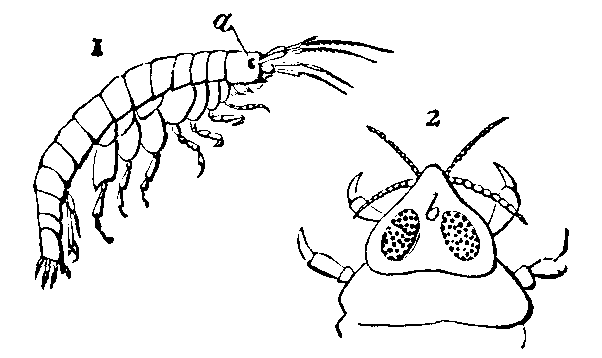
Edriophthalmata
1, Fresh-water shrimp (Gammarus pulex). a, Single eye. 2, Head of Cymothoa. b, Clusters of simple eyes.
Edriophthal´mata, one of the great divisions of the Crustacea, including all those genera which have their eyes sessile, or embedded in the head, and not fixed on a peduncle or stalk as in the crabs, lobsters, &c. It is divided into two orders. (1) Amphipoda, laterally flattened, as in the marine sandhopper (Talitrus), and the fresh-water shrimp (Gammarus). (2) Isopoda, flattened from above downwards. Sea-slaters or wood-lice (Ligia and Idothea); fish parasites (Cymothoa); fresh-water wood-lice (Asellus); land wood-lice (Oniscus, Porcellio, Armadillidium, which can roll up).
Edri´si, Abu-Abdallah Mohammed, a famous Arabian geographer, a descendant of the ancient princely family of the Edrisites, born about A.D. 1100, died about 1180. He studied at the Moorish university of Cordova, after which he travelled through various countries. At the request of King Roger II of Sicily he constructed a globe with a map of the earth, which represented all the geographical knowledge of the age. He accompanied this with a descriptive treatise completed about 1154, and still extant. The work was published at Rome in Arabic (1592), and in 1619 a Latin translation of it, under the title of Geographia Nubiensis, appeared in Paris.
Education is the name applied to the systematic instruction given by each succeeding generation to the young of the race to fit them for the work of life. The word itself is derived from the Latin verb educare, which means to rear, to nourish, to bring up, and also to educate. Long before the dawn of civilization men saw that the young had to be prepared for the battle of life; had to learn how to make and how to use the offensive and defensive weapons employed against their enemies; how to form or build shelters to protect themselves against the weather and against their foes; how to make traps or snares for the wild things on which they fed; how, in fact, to use their powers of mind and body in such a way as to secure for themselves the fullest and most satisfactory life possible under the circumstances in which they found themselves.
While education thus understood would be the story of man on the earth, an account of his more or less satisfactory, but always continuous, efforts to perfect the relations between his desires and his environment, it would have to embrace also an account of the conflict between the demands of communities and the rights of individuals. Education, however, as we understand it, is more limited in its scope. It is the instrument employed by the State for the training of its citizens.
The Greeks were the first Europeans to treat education as a science. The results they obtained were good, and have to a certain extent determined the course taken by European education ever since. Plato defined the aim of the education of which he gives us an account in the Republic, to be the "development in the body and in the soul of all the perfection which it is possible for them to attain". This was the Greek ideal of what education should aim at; a high ideal indeed; but one that omits an element of immense importance which we find introduced in Milton's definition of the 'end of learning', that is, the aim of education. Milton boldly declares this to be: "To repair the ruin of our first parents by regaining to know God aright, and out of that knowledge to love Him, as we may the nearest by possessing our souls of true virtue, which being united to the heavenly grace of faith makes up the highest perfection". Perfection is the end sought in both cases, and which seems the nobler it is unnecessary to say. This impression is deepened when he proceeds to declare that as "Our understanding cannot ... arrive so clearly to the knowledge of God and things invisible, as by orderly conning over the visible and inferior creatures, the same method is necessarily to be followed in all discreet teaching".
By Aristotle the order of education was: first, education of the body, the just and proportionate development of its powers. The instrument employed for this purpose was gymnastics; not the gymnastics employed in training professional athletes, but more moderate exercises; for, as the philosopher insists, too strenuous bodily exertion is apt to spoil the child, because body and mind must not be hard worked at the same time. Music, according to him, had various aims: education proper, the training of the affections, and the occupation of leisure. Drawing was taught as a branch of music for the purpose of developing the child's sense of beauty, mathematics were taught to cultivate his intellect, and dialectic (logic and philosophy) to prepare the pupil for a scientific training.
To the idealistic philosopher Plato, the whole life of man, at least the whole of what we may call the active life, was educative. Education was State-controlled, and at the end of the first six years, spent by the child in the seclusion of family life, the State took charge. The aim of the education proposed by Plato was to develop in the child the cardinal virtues—honour to parents, love of fellow-citizens, courage, truthfulness, and self-control. From the seventh to the tenth year the training was mainly in gymnastics; from the tenth to the thirteenth the child learned to read and to write; from the thirteenth to the sixteenth his affections and his sense of the beautiful were cultivated through learning poetry and studying music; from the seventeenth to the twentieth year he applied himself mainly to athletics, so that he might be qualified to take his share in the defence of the State. At twenty men were called upon to choose their occupation; to turn their minds to the study of the sciences; and to shape by practical military and other services to the State that character which it was the aim of education to form. From thirty to thirty-five Plato supposes the citizens of his ideal republic to devote themselves to the study of Dialectics, the method of purely intellectual knowledge, by which reason, using hypothesis, arrives at the first principles of things. From thirty-five to fifty the life of the citizen was to be given up to public service, that is, to the promotion in the position for which he was best fitted of the general well-being.
The training set forth by the Greek philosophers was the training thought necessary to fit a man to be a ruler. As the Greek city states were slave states, and most of the manual work was performed by slaves, that necessary part of the training of the youth of the community is ignored. This fact has had, undoubtedly, an enormous influence on the ideas of education put forward since. The preliminary training demanded by the Greeks included, besides gymnastics, grammar and music. At a later time these were understood to include the seven arts: Grammar, Rhetoric, Dialectic (Trivium), and Arithmetic, Music, Geometry, and Astronomy (Quadrivium). To the Greeks, myths were the instruments of the earliest education, the aim of which was the development of a character in the citizen which would lead him to give his best and most loyal services to the State.
The aim of Greek education was the formation of the philosophic thinker, the man fitted by nature and training to guide and direct the energies of the man of action. Roman education, on the other hand, directed its efforts mainly to the moulding of the man of action himself. The Romans adopted the form rather than the spirit of Greek education. The aim of Roman education was to make a man who could do things; a practical man, a man full of energy, who was ever ready to sacrifice himself in the interests of the State; a man who knew the laws and who regulated his conduct by them; who reverenced his father and his country's gods; and found his chief pleasure in the complete overthrow and utter destruction of his country's foes. He could discourse eloquently and not unphilosophically; and he spared neither himself nor others in his effort to maintain the freedom of his country, and to bring destruction on the enemies of Rome. Roman education began in the home, and during the earlier years was largely directed by the mother. Later the preparation of the boy for life was taken over by the father; but it is probable that, from very early times many, if not most, Romans boys were sent to school, where, under the magister literarius (elementary teacher), the grammaticus (advanced teacher), and the rhetor (professor), they acquired the knowledge and accomplishments it was needful for them to obtain.
The Roman schools, elementary and secondary, seem to have been conducted in a verandah, and boys and girls seem to have been taught in the same school. The chief Roman writers on education are Cicero, Seneca, and Quintilian. Quintilian tells us that Cato also wrote a treatise on the subject, but that that work had been lost. The oratorical training of which Quintilian was the expositor seems to have been largely out of connection with real life; and, though he claims that the orator must be a widely cultured, wise, and honourable man, seems to have developed a tendency to the bombastic abuse of ornate and stilted speech. The practical effects, too, of the corruption of family education were far from satisfactory. Moral degradation followed, and humanity seems to have been rescued only by the introduction of a new ideal of life, which substituted for the pagan self-reliance, self-control, moderation, and proportion, self-denial, self-forgetfulness, and humility; which made the last, indeed, the chief virtue, and looked on pride and self-confidence as spiritual sins.
The introduction of Christianity was followed by the inroads into the Roman Empire of barbarous tribes from the north and east. Before these attacks the Western Roman Empire collapsed, and with it to a greater or less extent the educational system of the time.
It must be remembered that between three and four hundred years elapsed between the downfall of the Western Roman Empire and the beginnings of the Holy Roman Empire under Charlemagne. Classical or pagan culture, as profane learning, was at a discount, and the aim of the monasticism which grew out of the introduction of Christianity was mystic absorption in the contemplation of God.
This interval was followed by the efforts of Charlemagne to revive Roman culture, and to establish schools throughout Western Europe. In this he was aided by Alcuin and other scholars from England, where in the comparative quiet that followed the conquest of Britain there had grown up a system of education. Throughout his dominions three classes of schools were established by Charlemagne, the Palace School, the Bishop's School, and the Monastery School. These were intended to take the place of the splendid system of public schools that had grown up under the Roman Empire. The course of studies established in these mediæval schools, following the practice of Greece and Rome, was divided into two parts: the Trivium, including Grammar, Dialectic, Rhetoric; and the Quadrivium, which embraced Geometry, Arithmetic, Music, and Astronomy. Education in the palace or castle schools had a different aim. It sought to develop the bodily powers, and to awake in the pupils that respect for the weak which was shown in the worship of women, and that love of justice, and belief in its supremacy, which characterized the chivalry of the Middle Ages.
The scholastic education of this time laid special stress on formal logic and metaphysics. Latin was taught, was, indeed, the universal language of the period. Questions about the nature of the unseen and the spiritual occupied much of men's minds; while their time was taken up in discussing the character of universals, the true realities which lay behind the individual manifestations of experience. As a rule, the physical world was ignored, and human intelligence disregarded; but there were notable exceptions, among which the teachings of Bishop Grosseteste (died 1253) and of Roger Bacon (1214 to 1294) take a prominent place.
It was during the period of scholasticism that universities, in imitation of the trade guilds of the time, sprung up in different parts of Europe, particularly in Spain, Italy, France, and England. To the famous schools both in England and on the Continent scholars flocked from all parts, and their instruction presented little difficulty, as Latin, the language in which the instruction was given, was the common language of scholars in Western Europe. The establishment of universities in different countries was a sign rather than a cause or result of that intellectual and spiritual awakening which, after nearly a thousand years of almost complete stagnation, manifested itself among the peoples of Europe.
It is usual to date the Renaissance from 1453, the fall of Constantinople; but it must not be forgotten that owing to the clash between East and West, the struggle between Christianity and Mohammedanism (the Crusades, as these religious wars were called), there had from the end of the eleventh century been a considerable change of outlook among the nations of Western Europe. This was specially the case in Italy, where city states, not unlike those of Greece in their character, had sprung up, and where, as in Greece in the time of Pericles, there had been the great outburst of literary activity which is associated with the names of Boccaccio, Dante, and Petrarch. In Northern and Western Europe the intelligence stimulated by the new learning was directed towards the improvement of the method of study. All study was linguistic. Latin was the instrument of common intercourse; Greek and Hebrew were sacred as the tongues in which the Scriptures had been conveyed; it was no wonder, therefore, that the humanistic education was almost entirely confined to the study of languages. Sturm (1507 to 1589) drew up a scheme of studies which had long a great influence on the school courses of instruction throughout Europe.
The reaction against authority which marked the Reformation period was specially noted for the reaction against the purely verbal education given to the young, whose education, as we learn from Locke, was calculated to teach them "not to believe, but to dispute", and to fit them "for the university, not for the world". On the Continent Rabelais (1483 to 1533) led this realistic movement, which was continued by Montaigne (1533 to 1592) in France, and under the influence of Bacon by Brinsley and Hoole in England, and Ratke and Comenius on the Continent. Up to this time the chief English writers on the subject of education had been Sir Thomas Elyot in his Governour, Roger Ascham in his Scholemaster, and Richard Mulcaster in his Positions.
The intellectual activity which marked in England the closing decades of the sixteenth and the first part of the seventeenth century saw the issue of Milton's Tractate, one of the most famous books on education ever produced. The Tractate discusses only the kind of education that should be given to gentlemen's sons between the ages of twelve and twenty-one, so that it is strictly limited in its application, as it does not deal with the education of the people, nor with the education of women. The ideal which Milton put before him as the aim of "a complete and generous education" was "to fit a man to perform justly, skilfully, and magnanimously all the offices both private and public of peace and war". Milton in his Tractate discusses studies, exercise, and diet, showing that he clearly understood that education was concerned with the body as well as the mind and spirit.
Towards the close of the seventeenth century Locke, an English physician and philosopher, published (1693) his Thoughts concerning Education, a book which influenced immensely the character and direction of future educational studies. As he informs his readers in his letter to Edward Clarke, he counsels everyone "after having well examined and distinguished what fancy, custom, or reason advises in the case ... to promote everywhere that way of training up youth ... which is the easiest, shortest, and likeliest to produce virtuous, useful, and able men in their distinct callings". He begins his essay with the statement, "A sound mind in a sound body is a short but full description of a happy state in this world", and the suggestions he makes as to the physical, moral, and intellectual training of the young are for the most part sound. He decried a too severe discipline, maintaining that "If the mind be curbed and humbled too much in children, ... they lose all their vigour and industry". On the other hand, he held that if you "Remove hope and fear, there is an end of all discipline"; and he held that, as far as possible, "Childish actions are to be left perfectly free and unrestrained". He applied the science of psychology to the study of child nature, and of the methods to be employed in training it; and so prepared the way for the modern methods of education. "Interest is the secret of Herbart", according to one of his devoted admirers. Locke seems to have anticipated this when he declares that "None of the things they are to learn should ever be made a burden to them, or imposed on them as a task".
Though his attitude towards the universe was utterly opposed to the attitude of Locke, Rousseau drew almost all that was practical in his scheme for the education of the young from the English writer. Rousseau's work, though largely inspired by Locke, was essentially of a revolutionary kind. It held that man is the great corrupter; that "Everything is good as it comes from the hands of the Creator; and that man's handling makes everything worse". In effect he said, leave the child as much as possible alone. An attempt constantly to direct him can only result in stupefying him. It is true we receive our education from nature, from men, and from things; but nature must be our guide in determining the use of the other two. As few restraints as possible must be imposed on the child, and the use of books should be prohibited. For the child there should be "no other book but the world", and "no other instruction but facts". The child's education he divides into four stages, infancy, childhood, boyhood, and youth. The first two stages last till the beginning of the thirteenth year, when the boy is supposed to be fit for instruction. From such instruction the teaching of words must disappear, and the teaching of things must take its place. The subjects most suitable for instruction were, Rousseau declared, measuring, drawing, geometry, speaking, and singing. Books, he declares, are useless, are, indeed, altogether harmful. The method he advocates is the method of self-teaching and the use of the senses, which Rousseau held would work to the profit of the intelligence. The child's knowledge should rest on his own observation, and not on belief in authority, and each child should be taught a manual trade.