VOLUME IV PART 2 (continued 5)
Reading edition
Embar´go, in commerce, an arrest on ships or merchandise by public authority; or a prohibition of State, commonly on foreign ships, in time of war, to prevent their going out of or coming into port. A breach of embargo, under knowledge of the insured, discharges the underwriters of all liability.
Em´bassy, in its strict sense, signifies a mission presided over by an ambassador, as distinguished from a legation or mission entrusted to an envoy. An ambassador, as the representative of the person of his sovereign, can demand a private audience of the sovereign to whom he is accredited, while an envoy must communicate with the Minister for Foreign Affairs.
Ember-days, in the Anglican and Roman Catholic Churches, fast-days occurring at the times in the year appointed for ordinations. As now observed they are the Wednesday, Friday, and Saturday after the first Sunday in Lent, after the feast of Pentecost or Whitsunday, after the festival of the Holy Cross (14th Sept.), and after the festival of St. Lucia (13th Dec.). The weeks in which these days fall are called Ember-weeks.
Ember-goose (Colymbus septentrionalis), an aquatic bird, known also as the great northern diver and loon. The latter name, however, is also applied to the great crested grebe.
Emberizī´dæ, a family of small perching birds, typical genus Emberīza. It includes the buntings, the snow-flake, the yellow-hammer, and reed sparrow. The ortolan belongs to this family. By some naturalists it is classified as a sub-family of the finches.
Embez´zlement is the appropriation, by a clerk or servant, to himself, of money or property put into his hands in trust. In English law it is a felony punishable by penal servitude for not more than fourteen years, or by imprisonment; and in the case of a male under the age of sixteen, by whipping in addition to the imprisonment.
Em´blements (Fr. emblaver, to sow with grain), in law, the crops actually growing at any time upon land. They are considered in law as personal property, and pass as such to the executor or administrator of the occupier, if the latter die before he has actually cut, or reaped, or gathered the same.
Em´bolism is the obstruction of a blood-vessel by an embolus, the name given to a blood-clot or other body carried by the blood-stream, and obstructing the circulation at the point of lodgment. An embolism in a vital organ gives rise to serious symptoms which may cause death in a short time, or more remotely by the production of gangrene or pyæmia.
Embos´sing, the art of producing raised figures upon plane surfaces, such as on leather for bookbinding; on paper for envelopes; on wood or bronze, in architecture or sculpture. Embossing in needlework is effected by embroidery over figures padded with wool felt.
Embra´cery, an attempt to corrupt or influence a jury by money, promises, letters, entertainments, persuasions, or the like.
Embra´sure, in fortification, an opening in the breastwork or parapet of a battery or fortress, to admit of a gun being fired through it.
Embroi´dery (O. Fr. embroder, from bord, border), figured work in gold, or silver, or silk thread, wrought by the needle, upon cloths, stuffs, or muslins. In embroidering stuffs a kind of stretching-frame is used, because the more the piece is stretched the easier it is worked. The art was common in the East in very ancient times. The Jews appear to have acquired it from the Egyptians; Homer makes frequent allusion to it; and Phrygia was celebrated for its embroidery, which was in great demand at Rome. The Nineveh mural reliefs in the British Museum show Assyrian robes with floral ornaments, and a relief (now in the Louvre, Paris) from the palace of Darius I shows Persian robes with embroidery. The Anglo-Saxons had a Continental reputation, and from the eleventh to the sixteenth century the art of pictorial needlework was of the highest importance both as a recreation and as an industry. Embroidery is commonly divided into two classes: white embroidery applied to dress and furniture, in which the French and the Swiss excel; and embroidery in silk, gold, and silver, chiefly in demand for ecclesiastical vestments. The Chinese, Hindus, Persians, and Turks excel in such work.—Cf. Christie, Embroidery and Tapestry Weaving.
Embrun (a˙n-bru˙n), a picturesque walled town, France, department Hautes-Alpes, on a rocky eminence on the Durance. It was sacked successively by Vandals, Huns, Saxons, and Moors, by the Protestants in 1573, and by the Duke of Savoy in 1692. It has a fine cathedral. Pop. 3556.
Em´bry, an immature organism, especially in the earlier stages of development from the fertilized ovum onwards. The embryo of a mammal (except in the egg-laying duck-bill and spiny ant-eater), which develops internally, is known as a fœtus. The dormant plantlet in a seed is also known as an embryo.
Embryol´ogy, the branch of biology concerned with the fertilization of the ovum and its development into the adult. Aristotle and Galen made some observations on the subject, as regards animals, while Harvey and his successors considerably advanced our knowledge, but as a distinct and important subject embryology only dates from the nineteenth century. In the course of its development an organism repeats the evolution of its group in an abbreviated fashion, thus furnishing a clue to its actual affinities. The subject also throws light on the problems of heredity.
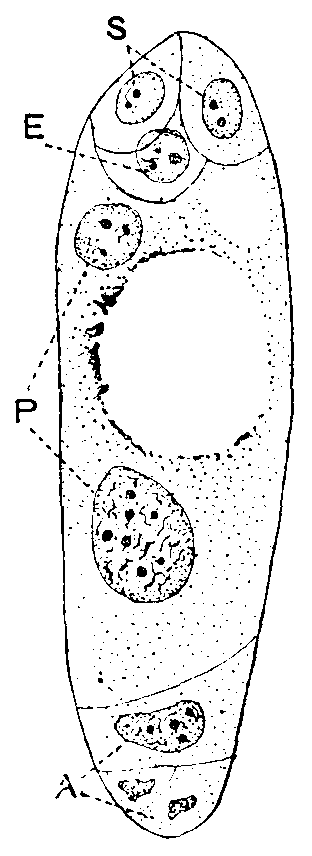
Almost Ripe Embryo-sac of Lilium Martagon
A, Antipodals. P, Polar nuclei. E, Egg-cell. S, Synergidæ.
Embryo-sac, the name given to the megaspore of seed-plants. In Angiosperms the ripe embryo-sac is typically a large ovoid sac enclosed in a thin membrane and lined by cytoplasm; it contains seven or sometimes eight nuclei with associated masses of cytoplasm, distributed in a characteristic manner. At the apical end, next the micropyle, is the egg-apparatus, comprising the egg-cell or ovum flanked by the two synergidæ or helping-cells, while the basal or chalazal end is occupied by the three antipodal 'cells'. The cavity of the sac is filled with cell-sap traversed by stout protoplasmic strands, suspended in which, near the centre, are two polar nuclei, or a single fusion-nucleus formed by the union of these. A characteristic feature of Angiosperms is the process of 'double fertilization'. The pollen-tube contains two male gametes, both functional; one fertilizes the egg-cell, the resulting zygote or oospore giving rise by cell-division and growth to the embryo; the other unites with the fusion-nucleus (or the two polar nuclei), and the product is the origin of the special nutritive tissue or endosperm, which is used up by the embryo, either during ripening of the seed (exalbuminous seeds), or at germination (albuminous seeds). See Gymnosperms; Ovule.
Em´den, a town of Prussia, province of Hanover, near the mouth of the Ems, occupying a low flat intersected by numerous canals. It was raised to the rank of a free Imperial city in 1595, was made a free port in 1751, was incorporated with the kingdom of Hanover in 1815, and in 1866 was united to Prussia. The principal building is the great church, built in 1455. The harbours admit large vessels, and several canals run inland. It exports grain, dairy produce, and gin, and has shipbuilding yards, and manufactures hosiery and leather. Pop. 24,000.
Em'erald, a variety of beryl, a well-known gem of pure green colour, somewhat harder than quartz; specific gravity, 2.67 to 2.73. It is a silicate of aluminium and the rare element glucinum or beryllium, which was detected in it by Vauquelin after it had been discovered by the same chemist in the beryl. Its colour is due to the presence of chromium, of which there may be 0.2 to 0.3 per cent present. Its natural form is either rounded or that of a short six-sided prism. It is one of the softest of the precious stones, but is not acted on by acids. Emeralds of large size and at the same time free from flaws are rare and more valuable than diamonds or rubies; the largest on record is said to have been possessed by the inhabitants of the valley of Manta in Peru when the Spaniards first arrived there. It was as big as an ostrich egg, and was worshipped as the mother of emeralds. The ancients, who valued them, especially for engraving, are said to have procured them from Ethiopia and Egypt. The finest are now obtained from Colombia. The Oriental emerald is a variety of the ruby, of a green colour, and is an extremely rare gem.
Emerald Green, a vivid light-green pigment, an aceto-arsenite of copper, used both in oil and water-colour painting. It is extremely poisonous. Hydrated chromium sesquioxide is another mineral emerald green. There is also an aniline dye of this name.
Emerald Lore The emerald as a sacred stone was anciently believed to blind a serpent which gazed at it, but to strengthen human eyes, and was, according to Theophrastus, worn as a ring-stone on account of this property. It was confused with 'false emerald', a kind of malachite. This fact explains the reference to ancient kings presenting blocks of emerald 1 or 2 cubits long to temples. The Babylonian name was barraktu, the Sanskrit marakata, the Hebrew bareket or barkat, the Greek maragdos or smaragdos.
Emergences, in botany. See Hairs of Plants.
Em´erson, Ralph Waldo, an American poet and prose writer, born at Boston, 25th May, 1803, died 27th April, 1882. He graduated at Harvard in 1821, for five years taught in a school, and in 1829 became minister of a Unitarian Church in Boston, but in 1832 resigned his charge. He spent the greater part of 1833 in Europe, and on his return began his career as a lecturer on various subjects, in which capacity he acted for a long series of years. In 1835 he took up his permanent residence at Concord, Mass., and in 1836 published a small volume called Nature. He was one of the original editors of The Dial, a transcendental magazine begun in 1840. Two volumes of his essays were published, in 1841 and 1844, and his poems in 1846. His miscellaneous addresses had been published in England in 1844, and on visiting Great Britain in 1847 he was welcomed by a large circle of admirers. In 1850 he published Representative Men; in 1856, English Traits; in 1860, The Conduct of Life; in 1869, May Day and Other Poems, and Society and Solitude; in 1871, Parnassus, a collection of poems; in 1876, Letters and Social Aims. Emerson showed certain similarities with Carlyle, of whom he was a friend and correspondent. Their correspondence appeared in 1883. He was not only one of the most original and influential writers that the United States have produced, but also one of the most helpful and influential ethical teachers of the nineteenth century. His gospel of self-reliance, his insistence on the duty of self-respect, and the obligation to listen to the voice of one's own soul, have exerted a wide influence which has grown steadily.—Bibliography: J. E. Cabot, Emerson's Complete Works (11 vols.); G. W. Cooke, Ralph Waldo Emerson: his Life, Writings and Philosophy; J. Elliott Cabot, A Memoir of Ralph Waldo Emerson; R. Garnett, Life of Ralph Waldo Emerson; G. S. Woodberry, Ralph Waldo Emerson; J. A. Hill, Emerson and his Philosophy.
Em´ery (formerly emeril, from O. Fr. emeril; Gr. smiris, emery), an impure variety of corundum, of blackish or bluish-grey colour, chiefly found in shapeless masses and mixed with other minerals. It contains about 82 per cent of alumina, and a small portion of iron; is very hard; is practically infusible, and is not attacked by acids. The best emery is brought from the Levant, chiefly from the Island of Naxos. It is employed in cutting and polishing precious stones; in smoothing the surface of the finer kinds of lenses preparatory to their being polished; in the polishing of marble; by cutlers, locksmiths, glaziers, and other artisans. For all these purposes it is pulverized in large iron mortars or in steel mills, and the powder, which is rough and sharp, is carefully washed and sifted into eight or ten different degrees of fineness. Emery-paper and emery-cloth are made by laying a thin coat of glue upon the fabric, and dusting the emery from a sieve of the required size.
Emet´ic is a substance given to produce vomiting, either acting directly on the nerves of the stomach, or indirectly through the bloodstream on the vomiting centre in the brain. In the first group are common salt, mustard, ipecacuanha, and sulphate of zinc; and apomorphine, which is given hypodermically, is an example of the second. Emetics are not now so widely used, as in many cases the stomach can be more effectively emptied and then washed out by the passage of the stomach-tube.
Em´etine is an alkaloid present in ipecacuanha. It is a powerful emetic, and whether given by the mouth or hypodermically produces vomiting with nausea and depression. It acts chiefly as a local irritant to the lining of the stomach. In minute doses it stimulates expectoration from the lungs.
Emeu or Emu (Dromæus novæ-hollandiæ)
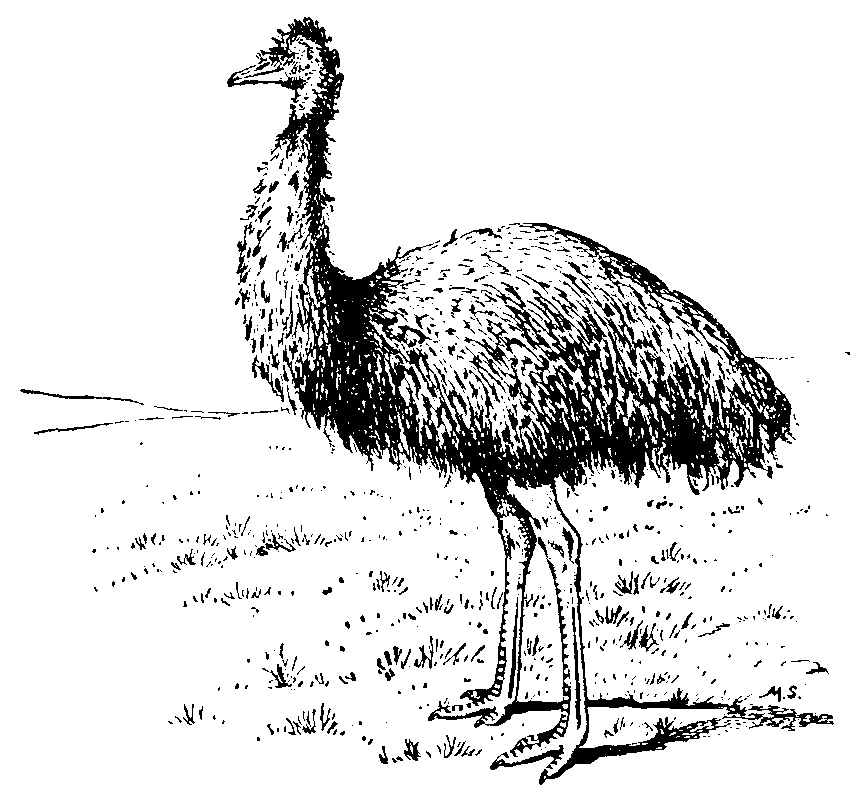
Emeu, or Emu, a large flightless running bird (Dromæus novæ-hollandiæ, and D. irroratus), formerly dispersed over the whole Australian continent, but now almost extinct in many districts. It is allied to the cassowary, but is distinguished by the absence of a 'helmet' on the top of the head. It nearly equals the ostrich in bulk, being thicker in the body, though its legs and neck are shorter. Its feet are three-toed (the ostrich has two toes), and its feathers, which are double, are of a dull sooty-brown colour, those about the neck and head being of a hairy texture. The wings are small and useless for flight, but the bird can run with great speed. The flesh of the young emeu is by some considered a delicacy. The emeu is a bird of the plain, the cassowary of the forest. It is easily tamed, and may be kept out of doors in temperate climates. It feeds on vegetable matter, fruits, and roots.
Emeu Wren (Stipitūrus malachūrus), a small Australian bird allied to the warblers, somewhat similar to a wren, but having the tail-feathers long, soft, and thinly barbed, similar to emeu feathers.
Emigration, the movement of individuals or groups from one state or country to a colony or another country, to be distinguished from migration, which describes the movement of peoples or races from one geographical area to another, and from colonization, which implies the foundation of a new state or extension of the sway of the colonists' state of origin. Thus the term does not strictly apply to the migrations of prehistoric times; nor to the movements of the Indo-European races (to which reference occurs in the Old Testament) which took place before the state as a territorial conception had developed; nor does it describe the great barbarian invasions of the early Christian era. There was comparatively little emigration among the Greeks and Romans, movement among the former being usually for the foundation of colonies or new states, and among the latter as a means of consolidating conquests. In Europe up to the seventeenth century, emigration was sporadic, notable instances being the movement from Flanders to England in the fourteenth century, and of Protestants from France to England in the sixteenth and seventeenth centuries. In the seventeenth century, with the growth of European colonies in America and the East, there was much emigration to those places, notably from Spain, Portugal, and Great Britain to America, and from the Netherlands to the East. In the eighteenth century the movement slackened, but in the nineteenth century, largely as the result of the industrial revolution and the decay of agriculture, the great era of emigration began, especially from the United Kingdom. During the nineteenth century the main stream has flowed westward into America from Europe. Particularly important have been the emigration of Irish to the United States, and of Germans to South America. There has also been considerable movement from Russia into the United Kingdom, in many cases as a half-way house to the United States. In the East, emigration from China and Japan to the United States and Australia, and from India to British tropical colonies, has been important. It is noticeable that the Latin and Yellow races as a rule emigrate with the idea of returning ultimately to their native country; with the Anglo-Saxon, Teutonic, and Slav races the aim of a permanent domicile is predominant.
The most important causes of emigration are love of adventure, political or religious difficulties, and economic pressure. Forced emigration, in the shape of transportation, was formerly of some importance, especially in the case of America and Australia, but is now negligible; and before the European War, emigration from Russia was chiefly for political or religious reasons. To-day economic forces are the most powerful. The direction of the flow of emigration is partly determined by its causes. When these are political or religious, emigrants go where they expect to find freedom, as with the Huguenots in the seventeenth century. When economic forces are at work, emigration takes place towards newer and less developed countries, where pressure on the means of subsistence is less marked than elsewhere. Assistance given to emigrants, such as grants of land, loans of capital, and passages at reduced rates also has an influence, likewise the regulations of the countries concerned regarding emigration and immigration. In Australia and the United States, regulations forbidding the entrance of Yellow races have checked the movement of Chinese and Japanese to those countries; and the Government of India discourages emigration save under adequate safeguard for proper pay and treatment.
The results of emigration vary with the economic and other circumstances of the countries concerned. The country from which the movement takes place loses intellectual and physical labour power which the other country gains; but may benefit by relief given to a congested labour market. This was the case with the Netherlands in the seventeenth century, and the United Kingdom in the early nineteenth century. The general tendency is for emigration to benefit the world as a whole by enabling labour to go where it can be most productively employed. This increases world production, opens up new markets, and so indirectly benefits the older countries. Sometimes, however, emigration may cause an industry merely to be transferred from one country to another, as in the case of the fourteenth-century Flemish emigration to England. The importance of these results of emigration in any particular case depends on the class of people who emigrate, and on the volume of emigration. Deportation of criminals obviously benefited only the deporting country. Emigration on political or religious grounds has frequently deprived one country of, and given to another, a vigorous and industrious stock, as in the case of the French Huguenots driven from France to England in the late seventeenth century by the revocation of the Edict of Nantes. Economic pressure tends to send abroad agricultural and other unskilled labour. The majority of emigrants from Great Britain in the nineteenth century belonged to this class. Youth and adaptability, however, are more important qualities for an emigrant than a high level of skill in any trade; and it is probable, therefore, that on the whole emigration has relieved Europe of labour whose supply was in excess of the demand for it, and has never given newer countries the material they require. The political consequences of emigration may also be important. Some writers claim that it has assisted the spread of democracy. Whether this is an advantage is a matter for individual judgment. But emigration may certainly have much influence in creating and maintaining friendly relations between States; or, as shown by Irish influence in the United States, it may embitter the feeling between them.—Bibliography: Mayo-Smith, Emigration and Immigration; S. C. Johnson, History of Emigration from the United Kingdom to North America, 1763-1912.
Émigrés (ā-mi-grās), a name given more particularly to those persons who left France during the Revolution of 1789. At the head of these emigrants stood the royal princes of Condé, Provence, and Artois, the first of whom collected a part of the fugitives to co-operate with the allied armies in Germany for the restoration of the monarchy. At Coblentz a particular court of justice was established to settle causes relating to the French émigrés. The corps of Condé was finally taken into the Russian service, and was disbanded in the Russian-Austrian campaign of 1799. When Napoleon became emperor he granted permission to all but a few of the emigrants to return to their country; but many declined to return until after his downfall. By the Charter of 1814 they were shut out from the recovery of their estates and privileges; and though, by a law of 27th April, 1825, some compensation was decreed to them, the grant was withdrawn again after the July revolution.
Emilian Provinces, a term applied to certain Italian provinces annexed to the kingdom of Sardinia in 1860. They comprised the northern part of the States of the Church (Romagna) and the Duchies of Modena and Parma.
Em´inence, an honorary title formerly applied to the Emperor and higher officials of the Empire, but restricted in 1630 by Pope Urban VIII to cardinals. Up to that time they had been called illustrissimi and reverendissimi.
Emir (em´ēr), the title given by Mohammedans to independent chiefs or princes, Amir or Ameer being the same word (the Amir of Afghanistan). When associated with other words it may designate various dignitaries. Thus the caliphs styled themselves Emir-al-Mumenin, Prince of the Faithful; Emir-al-Omrah, Prince of Princes, was the title of governors of certain provinces. The title is also given in Turkey to all the real or supposed descendants of Mohammed, through his daughter Fatimah.
Emmerich (em´e-rih), a town, Rhenish Prussia, on the right bank of the Rhine, 5 miles N.E. of Cleves. It joined the Hanseatic League in 1407. It carries on an active trade chiefly with Holland. Pop. 13,418.
Em´met, Robert, an Irish rebel, born at Cork in 1778. He was expelled from Trinity College, Dublin, in 1798, on the ground of exciting disaffection and rebellion, and having become an object of suspicion to the Government, quitted Ireland. He returned there on the repeal of the suspension of the Habeas Corpus Act, and became a member of the Society of United Irishmen for the establishment of the independence of Ireland. In July, 1803, he was the ringleader in the foolish rebellion in which Lord Kilwarden and others perished. He was arrested a few days afterwards, tried, and executed. His fate excited special interest from his attachment to Sarah Curran, daughter of the celebrated barrister. Their sad fates were commemorated by his college friend, Moore, in Oh, Breathe Not his Name, and She is Far from the Land where her Young Hero Sleeps.
Emotion, a term variously used by psychologists; sometimes as one of the divisions of feeling, the other being sensation; sometimes as opposed to feeling when the latter is identified with sensation, and sometimes as distinct from both sensation and feeling, when the last term is rigidly confined to the sense of pleasure or pain. In any of these uses, however, emotions are distinguished from sensations in that sensations are primary forms of consciousness arising by external excitation, are comparatively simple and immediately presentative phenomena, and are definite in character and capable of localization; while emotions are secondary or derived forms of consciousness, are complex and representative, and are vague and diffused. Sensations are said to be 'peripherally initiated', while emotions are centrally initiated. When, in addition to its being distinguished from sensation, it is also distinguished from feeling, emotion is applied to the whole physical condition accompanying the sense of pleasure or pain (feeling). The muscles of the body and the organic functions of the system are often considerably influenced by emotion, which naturally seeks an outward expression unless held in check by what Darwin has called serviceable associated habits.—Bibliography: A. Bain, The Emotions and the Will; J. M‘Cosh, The Emotions.
Emped´ocles (-klēz), a Greek philosopher of Agrigentum, in Sicily, born about 490 B.C. He is said to have introduced the democratic form of government into his native city, and the Agrigentines regarded him with the highest veneration as public benefactor, poet, orator, physician, prophet, and magician. Aristotle states that he died in obscurity, at the age of sixty years, in the Peloponnesus; but he is also said to have thrown himself into the crater of Mount Etna, in order to make it be believed, by his sudden disappearance, that he was of divine origin, and had been translated to heaven alive (cf. Matthew Arnold's Empedocles on Etna). According to Lucian, however, his sandals were thrown out from the volcano, and the manner of his death revealed. Empedocles held earth, water, fire, air, as the four fundamental and indestructible elements from whose union and separation everything that exists is formed. To these material elements are added the two moving or operative principles of love and hatred, or attraction and repulsion. He wrote his philosophy in verse; of his chief work, On Nature, about 400 lines out of the original 5000 are preserved.
Em´peror (from the Lat. imperātor; in Ger. Kaiser, from Cæsar), the title of the highest rank of sovereigns. The word imperator, from imperāre, to command, in its most general sense signified the commander of an army. After the overthrow of the Roman republic imperator became the title of the rulers or emperors, and indicated their supreme power. Victorious generals were still, however, sometimes saluted with the title imperator, in its original sense. With the fall of Rome the title was lost in the West, but was kept up in the Eastern or Byzantine Empire for nearly ten centuries. In 800 it was renewed in the West when Charlemagne was crowned, by Leo III, as 'Carolus Augustus, the God-sent, pious, and great emperor of Rome'. It was, however, for many centuries considered necessary to be crowned at Rome, in order to be formally invested with the title of emperor. The imperial dignity became extinct in the East after the conquest of Constantinople in 1453, but the title was adopted by Peter I of Russia in 1721. Napoleon I adopted the old idea of an empire as a general union of states under the protection, or at least political preponderance, of one powerful state; and he was followed in this by his nephew, Napoleon III. In 1806 the first German Empire, 1000 years old, became extinct, and the German Emperor, Francis II, adopted the title of Francis I, Emperor of Austria. In Dec., 1870, the second German Empire was formed, King William of Prussia having accepted the imperial office and title offered him at Versailles. This empire came to an end in Nov. 1918. Britain is considered as an empire, the crown as imperial, and the Parliament is styled the Imperial Parliament of Great Britain and Ireland. Queen Victoria assumed the title of Empress of India in 1876, but the British sovereign has not the imperial title in reference to the home dominions. The sovereigns of Japan and Morocco are often, though with little propriety, called emperors.—Cf. Articles Imperator and Princeps in Smith's Dictionary of Greek and Roman Antiquities.
Emperor Moth (Saturnia pavonia) a British moth belonging to a family Saturniidæ, of which some Indian species produce tussore silk. The colour is greyish-brown, with a faint purple tinge. The wings are about 3 inches in expanse, and in the centre of each is a large eye-like spot. The larva is of a bright-green colour, and studded with large rose-coloured or yellow tubercles.
Empetra´ceæ, a small nat. ord. of heath-like Dicotyledons, of which the type is the crow-berry.
Em´phasis, in rhetoric, a special stress or force given to some syllable, word, or words in speaking, in order to impress the hearers in some desired manner, thus differing from accent, the position of which is fixed.
Emphyse´ma is a distention of the tissues with air or other gases. Several forms are recognized: pulmonary emphysema, due to dilatation of the minute air-passages with loss of elasticity of the lung tissues; surgical emphysema, due to distention of the subcutaneous tissues by air, seen in certain wounds and injuries; atrophic emphysema, due to a senile condition of the lung tissues.
Empire Day, a British imperial celebration which is held annually on the 24th of May, the birthday of Queen Victoria. The celebration was officially held for the first time in 1904, and has since gained wide recognition, mainly owing to the unremitting efforts of the twelfth Earl of Meath.
Empir´ic (Gr. empeiria, experience) was used in medical history to denote one of a sect of physicians who held that observation and experience were the basis of medicine. The modern use of the term, medically, is restricted to one who practises medicine without any professional education or training.
Empiricism (Gr. empeiria, experience), the philosophical theory according to which sense-experience is the source of all knowledge, i.e. that we can investigate the world only through the experience of our senses. It denies the existence of any a priori possibility of knowledge, and maintains that the mind is at first a tabula rasa, a clean slate, upon which all the characters are inscribed by experience. The term empiricism is, however, now applied to any philosophical system which finds all its material in experience. The philosophy of empiricism has been particularly developed by English writers of the seventeenth, eighteenth, and nineteenth centuries, such as Locke, Hume, and J. S. Mill. John Locke was the first to express the view in a systematic form. Among more modern empiricists are William James and John Dewey.—Bibliography: Green, Prolegomena to Ethics; James, Essays in Radical Empiricism.
Employers' Liability Act, a British Act of Parliament passed in 1880, by which, within certain limits, an injured workman or, in event of his death, his relatives or representatives may claim from the employer compensation for injuries received in his service. The law on this subject was improved by the Workmen's Compensation Act (1897) and its amending Act (1900). These applied to those employed on, in, or about railways, factories, mines, quarries, engineering works, buildings, and to agricultural labourers. An Act of 1906 added other classes of workers, including domestic servants. The maximum compensation on death is three years' earnings or £150, whichever is larger, but not more than £300. Contracting-out is carefully safeguarded. The maximum weekly benefit was raised from £1 to £1, 5s. in 1917, and £1, 15s. in 1920, in cases of total incapacity. Recommendations by the Board of Trade Departmental Committee were made public in July, 1920. These suggest greater powers of Government control, compulsory insurance, and greatly increased compensation in cases of death and total incapacity.
Employment Bureaus were first established on a considerable scale in the United Kingdom by the Labour Exchanges Act, 1909. They were to some extent based upon the German public labour exchanges, which came into being after 1893 in most large towns, and were either municipal or maintained by voluntary associations and supported by the municipality. Their chief object was to put employers and work-people into touch with a view to employment. Before 1909 a few public employment bureaus had been established in Great Britain. An Act of 1905 established distress committees in boroughs and urban districts, which were given power to establish labour exchanges. These powers were in some cases exercised, either by taking over existing bureaus or establishing new ones. Only in London was the system of importance. The 1909 Act gave the Board of Trade power to establish labour exchanges; and, by regulations under the Act, the United Kingdom has been divided into divisions in each of which are a number of exchanges of different grades. The system is industrial and not eleemosynary, aiming solely at providing a recognized market-place for labour. No fees are charged, and use of the exchanges is voluntary. Work-people may register at an exchange between certain hours, and, when a suitable vacancy occurs, the applicant is sent to the employer. Applications for work-people are generally received by telephone, and are recorded if no suitable applicant is available. An important part of the work of the labour exchange is in connection with Unemployed Insurance, under Part II, National Insurance Act, 1911. This provided for payment of unemployed benefit in a limited number of occupations. Subsequent Acts (notably that of 1920) have extended the system to cover the majority of occupations. The scheme is contributory, but the State shares the cost with employers and work-people.—Bibliography: W. H. Beveridge, Unemployment; F. A. Keller, Out of Work: a study of unemployment.
Em´poli, a town in North Italy, on the left bank of the Arno, 16 miles W.S.W. of Florence; it has an old collegiate church with good paintings, and manufactures of straw-bonnets. Pop. 21,500.
Empo´ria, a town of the United States, in Kansas, on the Neosho River, with a normal school, and a good trade in grain and cattle. Pop. 9050.
Empyreu´ma, the smell arising from organic matter when subjected to the action of fire, but not enough to carbonize it entirely. The products of imperfect combustion, as from wood heated in heaps or distilled in close vessels, are frequently distinguished as empyreumatic.
Ems, or Bad Ems, a beautiful watering-place in the Prussian province of Hesse-Nassau, on the River Lahn, not far from its confluence with the Rhine. Its mineral waters are warm—from 70° to 118° F.,—contain large quantities of carbonic acid gas, and are used in chronic catarrhs, pulmonary complaints, diseases of the stomach, gout, and some diseases of the urinary vessels. There are about 8000 visitors each season. Pop. 6850.
Ems, a river of North-West Germany, which flows north-west through Rhenish Prussia and Hanover, and falls into the Dollart Estuary near Emden; length 230 miles.
Emu. See Emeu.
Emul´sine, or Synaptase, originally the name given to the mixture of enzymes in bitter and sweet almonds. Emulsine has the property of being able to hydrolyse the glucoside amygdalin to glucose, benzaldehyde, and hydrocyanic acid.
E´mys, a genus of water-tortoises native to Europe and North America, and belonging to the family Testudinidæ, which includes most reptiles of the tortoise kind.
Enaliosau´rians ('sea-lizards'), a group of gigantic Mesozoic reptiles of which the ichthyosaurus and plesiosaurus were the chief.
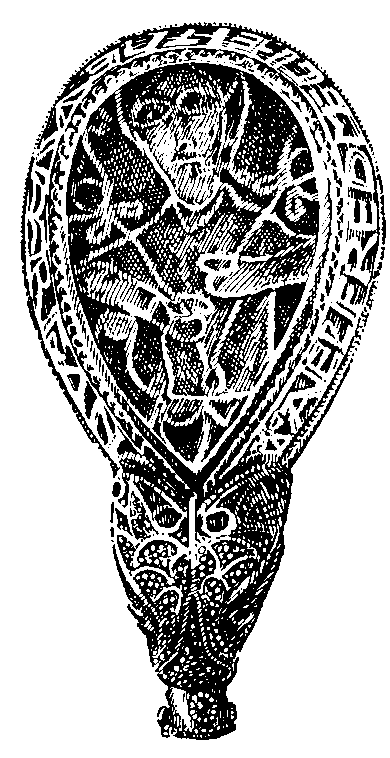
Alfred's Jewel
A jewel of blue enamel enclosed in a setting of gold, with the words round it: "Ælfred had me wrought", found at Athelney, Somersetshire, in the seventeenth century.
Enam´el, a vitreous glaze coloured with metallic oxides, and, when first introduced, made to adhere by fusion on metals, &c. The ancient Babylonians enamelled bricks. No finer enamelling on bronze was done than that done in early Britain. The ancient Britons achieved great skill in decorating bronze shields, armlets, chariot pieces, helmets, &c., with red, blue, and white enamels during the Late Celtic (Early Iron Age) period and later. Indeed it is believed that the champlevé process of excavating hollows for enamel on metal in various flowing and artistic designs of symbolic character was developed in pre-Roman Britain. Philostratus, a third-century classical writer, referring to the enamelled trappings of horses, remarks that "the barbarians who reside in Ocean pour these colours on heated bronze, so that they adhere and become hard as stone". Beautiful specimens of enamelled bronze found in England, Scotland, and Ireland, preserved in the British Museum, include the Battersea and Witham shields, bridle-bits from Dumfries, and Rise, near Hull, and an enamelled 'terret' from the Fayum, Egypt, whither, archæologists believed, it was taken by some Roman soldier. Enamelling on bronze and iron was practised in Central Europe and at Koban in the Caucasus at an earlier date than in Italy and Egypt. Byzantine enamels on gold date from the tenth century. M. Salomon Reinach was the first to point out that red enamels were used as substitutes for coral, which, by the way, had a religious value as a 'life giver' and 'protector'. The later blue enamel may have been a substitute for lapis-lazuli, and other enamels, white, violet, green, and yellow, for other sacred stones. The ancient enamels are more or less opaque. Transparent enamels were favoured in the thirteenth century by Italian goldsmiths. A favourite method of applying enamel is known as cloisonné, which means inlaid between partitions. The design is outlined in bent-wire fillets, which are fastened to the plate by means of silver solder or the enamel itself. In champlevé work the plate itself is scooped out into channels for the enamel. The distinction between cloisonné and champlevé work, therefore, is something like the distinction between a breastwork and a trench. Enamelled glass is really deeply coloured glass. Bicycle enamel is made of asphalt or resin dissolved in oil, each coat being hardened by heat. Enamel paint is made by mixing copal varnish, &c., with metallic oxides. A special preparation is applied to leather which is afterwards heated—this is 'patent leather'. Enamel painting dates back to the sixteenth century and is used nowadays chiefly for street signs and advertisements. The term 'enamel' is applied to the hard protective coating of teeth.—Bibliography: E. Molinier, Dictionnaire des émailleurs; H. Cunynghame, Art of Enamelling; A. Fisher, The Art of Enamelling upon Metal; H. M. Chapin, How to Enamel.
Ena´ra, a lake in the north of Finland, about 50 miles long by 30 miles broad. It is studded by innumerable islets, receives several streams, and is connected by the Patsjoki with the Arctic Ocean. At its south-west extremity is a small fishing-town of the same name, with an annual fair.
Enare´a, a region belonging to the country of the Gallas, south of Abyssinia. Sakha is the principal town. Coffee and ivory are the chief exports. The inhabitants are the most civilized of the Gallas.
Encarpus, from Palazzo Niccolini, Rome
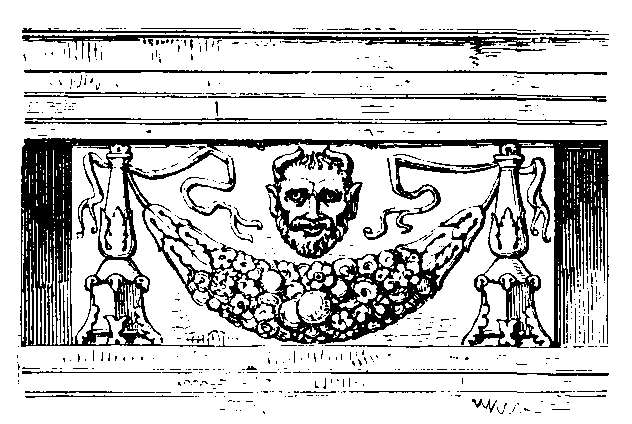
Encar´pus, in architecture, a sculptured ornament in imitation of a garland of fruits, leaves, or flowers, suspended between two points. The garland is widest in the middle, and diminishes gradually to the points of suspension, from which the ends generally hang down. The encarpus is sometimes composed of an imitation of drapery similarly disposed, and sometimes of an assemblage of musical instruments, implements of war or of the chase.
Encaustic Painting, a kind of painting practised by the ancients, for the perfecting of which heating or burning-in was required. Pliny distinguishes three species, in all of which wax was used with colours, and applied either with bronze instruments (cauteria), a sharp-pointed tool (cestrum), or brushes. The art has been revived in modern times, but has not been greatly employed. As the chief aim in encaustic painting was the securing of permanence and durability by the application of heat, the word encaustic has been applied to other and widely different processes. Thus it has been used for painting on earthen vessels, for painting on porcelain and work in enamel; and in the same way it was given to the painting on glass of the Middle Ages.—Cf. A. P. Laurie, Greek and Roman Methods of Painting.
Encaustic Tiles, ornamental paving-tiles of baked pottery, much used during the Middle Ages in the pavements of churches and other ecclesiastical buildings. The encaustic tile, strictly so-called, was decorated with patterns formed by different coloured clays inlaid in the tile and fired with it. The art appears to have originated in the latter part of the twelfth century, to have attained its highest perfection during the thirteenth, and to have sunk into disuse in the fifteenth. During the whole of this period it was principally carried on in England and Normandy. After a long lapse the art was revived in England in 1830 by Wright, a Shelton potter. In modern manufacture two methods are employed, the 'plastic' and the 'semi-dry' or 'dust' method. The first is, in all essentials, that used in the Middle Ages, except, perhaps, in the perfection of modern moulding appliances; the second consists in ramming pulverized clay with a minimum of moisture into metal dies, the subsequent firing of tiles thus consolidated being attended with less risk from shrinkage.
Ence´nia, festivals anciently commemorative of the founding of a city or the dedication of a church; and in later times periodical ceremonies, as at Oxford, in commemoration of founders and benefactors.
Encephalartos, a genus of Cyeads, natives of Africa. Meal (Kaffir-bread) is made from the pith by the natives.
Enchanter's Nightshade, a name common to plants of the genus Circæa, nat. ord. Onagraceæ, of which there are two British species, C. lutetiāna and C. alpīna. The former is about a foot and a half high, and has delicate ovate leaves, small white flowers tinged with pink, and small roundish fruits covered with hooked bristles. It abounds in shady woods. C. alpīna, which is similar, but smaller and more delicate, is found in Scotland and north of England. They have no affinity with the nightshades.
Enchorial (en-kō´ri-al) Writing, the form of writing used by the old Egyptians for the common purposes of life, as distinct from the hieroglyphic and hieratic (used by the priests). It is also called Demotic.
Encke (en´ke), Johann Franz, German astronomer, born at Hamburg in 1791, died in 1865. He studied under the astronomer Gauss at Göttingen. During the War of Liberation (1813-5) he served as artillerist in the German army, and after the peace became assistant in the observatory of Seeberg, near Gotha. Here he calculated the orbit of the comet observed by Mechain, Miss Herschel, and Pons, predicted its return, and detected a gradual acceleration of movement, ascribed by him to the presence of a resisting medium. The comet is now known as Encke's comet. The fame of his works Die Entfernung der Sonne (The Distance of the Sun) and Der Venusdurchgang von 1769 (Transit of Venus of 1769) led to his appointment as director of the Berlin Observatory (1825), a position which he held till his death. From 1830 he edited the Berliner Astronomisches Jahrbuch.
Encke's Comet. This object was seen in 1786, and at some subsequent returns, before it was discovered by Encke in 1819 to be a periodic comet. It has since been observed at numerous returns. It revolves round the sun in about three and one-third years, having the shortest period of any comet known. It has exhibited very prominently the feature, shown by many comets, of a contraction of the head or coma on approaching the sun. Encke's comet long manifested the most remarkable feature of a shortening of its period by about two and a half hours in each revolution. The suggestion was made that this was due to resistance by a rare medium generally diffused in the solar system, which had the effect of reducing its aphelion distance and diminishing its orbit. This, however, is improbable, as other comets show no similar effect. The cause remains undiscovered, and a further extraordinary fact is that the shortening of period is found since 1868 to have been only half of its previous amount.
Enclave (a˙n-klāv), a term used in German and French to denote a place or country which is entirely surrounded by the territories of another power.
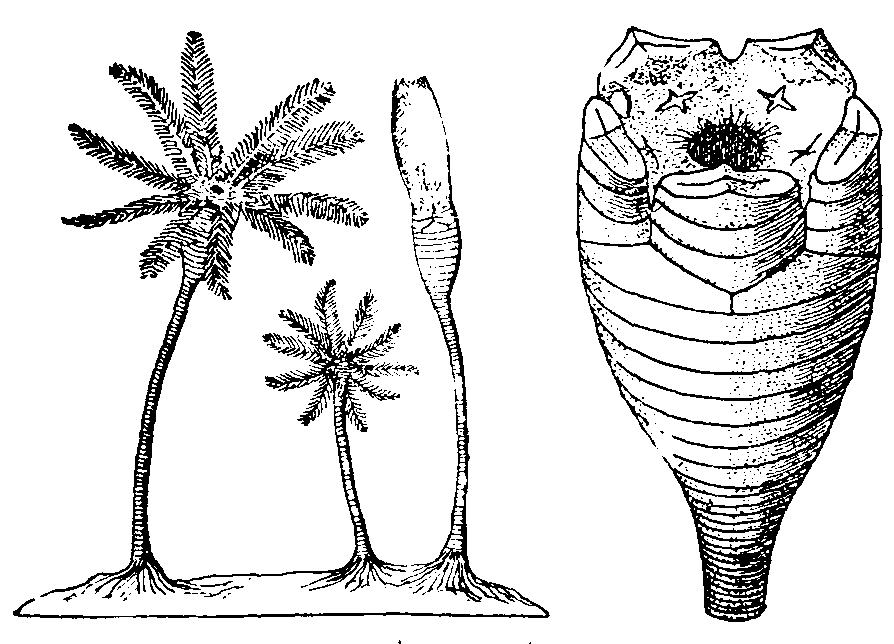
Fossil Encrinites
Group of Pear-encrinites, much reduced, on left, and part of a Pear-encrinite, reduced, on right.
En´crinite, or Crinoidea (Gr. krinon, lily, and eidos, form), a name often applied to all the marine animals of the class Crinoidea or stone-lilies, phylum Echinodermata, except feather-stars; but more specifically restricted to the genera having rounded, smooth stems attached to the bottom, and supporting the body of the animal, which has numerous jointed arms radiating from a central disc, in which the mouth is situated. Encrinites were exceedingly numerous in past ages of the world's history; of those still existing our knowledge has been greatly increased of recent years through deep-sea dredging. Some of these forms are very graceful and interesting. See Crinoidea; Echinodermata.
Ency´clical, a sort of circular letter or manifesto issued by a pope, and directed to the Roman Catholic clergy generally or to those of a certain country or area, giving instructions as to conduct to be observed at certain conjunctures, condemning erroneous doctrines, &c. The encyclical, which is a somewhat less formal document than a bull, was especially favoured by Pope Pius IX and Leo XIII. Pope Pius IX issued one in 1864, wherein he condemned eighty alleged errors in modern ideas of religion and civilization, and Pius X issued another in 1907, wherein he condemned modernism. A number of encyclicals was issued by Pope Leo XIII on Bible Study, Socialism, Capital and Labour.
Encyclopedia (Gr. en, in, kyklos, a circle, and paideia, instruction), a systematic view of the whole extent of human knowledge or of particular departments of it, with the subjects arranged generally in alphabetic order. Varro and Pliny the elder, among the Romans, attempted works of an encyclopedic nature, the latter in his well-known Historia Naturalis, or Natural History. Other ancient encyclopedic works were those of Stobæus and Suidas, and especially of Marcianus Capella. In the thirteenth century a work on a regular plan was compiled by the Dominican Vincent of Beauvais (died 1264), in which was exhibited the whole sum of the knowledge of the Middle Ages. His work was entitled Speculum Historiale, Naturale, Doctrinale, to which an anonymous author added, some years later, a Speculum Morale. Roger Bacon's Opus Majus also belonged to the encyclopedic class. An exceedingly popular work was the De Proprietatibus Rerum of Bartholomeus de Glanvilla, an English Franciscan friar, which maintained its reputation from 1360 to the middle of the sixteenth century. In the seventeenth century various encyclopedic works were compiled, such as the Latin one of Johann Heinrich Alsted (in 7 vols., Herborn, 1620). In 1674 appeared the first edition of Moreri's Le Grand Dictionnaire Historique; in 1677 Johann Jacob Hoffmann published at Basel his Lexicon Universale; and in 1697 appeared Bayle's famous Dictionnaire Historique et Critique, which is still of great value. The first English alphabetical encyclopædia was the Lexicon Technicum, published in 1704. Among the chief English works of this kind are: 1. Ephraim Chambers's Cyclopædia, or A Universal Dictionary of Arts and Sciences, published in 1728 in 2 vols. folio. 2. The Encyclopædia Britannica, published in Edinburgh, in nine editions—the first in 1788, the ninth in 1875-88 (24 vols. 4to, with supplement, 11 vols., 1902-3). The tenth edition was published in 1902, and the eleventh issued in 1910-11 by the University Press, Cambridge. 3. Rees' Cyclopædia, 39 vols. 4to, illustrated, 1802-20. 4. Edinburgh Encyclopædia, 1810-30, 18 vols. 4to, conducted by Sir David (then Dr.) Brewster. 5. Encyclopædia Metropolitana, London, 29 vols. 4to, and containing some valuable complete treatises. 6. The London Encyclopædia, by Thomas Curtis, 22 vols. 4to; London, 1829. 7. The Penny Cyclopædia, in 28 vols. small folio, 1833-43; since recast under the name of the English Cyclopædia. 8. Chambers's Encyclopædia, in 10 vols. 9. The Popular Encyclopædia, issued in 14 vols. 10. Harmsworth's Universal Encyclopedia. 11. Nelson's The New Age Encyclopædia. 12. The New Gresham Encyclopedia, 12 vols. (one being index). The chief American encyclopædias are the Encyclopædia Americana, in 13 vols.; the New American Cyclopædia, in 16 vols.; Johnson's Universal Cyclopedia, 8 vols.; The New International Encyclopædia, 25 vols. Of the French cyclopædias the most famous is the great Dictionnaire Encyclopédique, by Diderot and D'Alembert (see next article); the Encyclopédie Méthodique, ou par Ordre des Matières, Paris, 1781-1832, in 201 vols. 4to, of which 47 are plates; the Encyclopédie Moderne, 1824-32, 26 vols.; the Encyclopédie des Gens du Monde, 1835-44, 22 vols.; the Dictionnaire de la Conversation et de la Lecture, 1851-58; the excellent Grande Encyclopédie, 31 vols.; and the large and valuable Grand Dictionnaire Universel du XIXe Siècle, published by Larousse, 16 vols. folio (with supplementary vols.); The Nouveau Larousse Illustré, 7 vols. Numerous works of this kind have been published in Germany, the most popular being the Conversations-Lexikon of Brockhaus; Meyer's Konversations-Lexicon; Pierer's Konversations-Lexikon; and that issued by Spamer. The most comprehensive is the Allgemeine Encyklopädie, originally edited by Professors Ersch and Gruber, begun in 1818, and not yet completed. The Rousskiy Entsiklopeditsheskiy Slovarj, the best Russian encyclopedia, in 43 vols, was published between 1905 and 1908.
Encyclopédie (a˙n-sik-lo-pā-dē), The French, one of the most important literary enterprises of the eighteenth century, originated in a French translation of Ephraim Chambers's Cyclopædia. Diderot was appointed to edit it, and enlisted the ablest men of the time as contributors. D'Alembert (who wrote the famous Discours préliminaire) edited the mathematics; Rousseau wrote the musical articles; Daubenton, those connected with natural history; the Abbé Yvon, those on logic, metaphysics, and ethics; Toussaint, those on jurisprudence; Buffon contributed the article Nature; and Montesquieu, Voltaire, Euler, Marmontel, D'Holbach, Turgot, Grimm, and Condorcet took some share in the great work. Diderot himself was a prolific contributor on a wide variety of topics. The prospectus appeared in Nov., 1750, and the first volume in 1751, the whole being completed, despite fierce opposition, in 1765. The contributors to the Encyclopédie, the majority of whom held unorthodox views on religious, political, and social subjects, are known as the Encyclopédistes.
Endem´ic (Gr. en and demos, people) is a term applied to diseases peculiar to people of a particular district or of a nation or country. The cause of this may be due to the physical characters of the place, or to the mode of living, habits, &c., of the people. Diseases endemic in one region may appear elsewhere when similar influences arise.
En´derby Land, an island in the Antarctic Ocean, long. 50° E., crossed by the Antarctic Circle. It was discovered by John Biscoe in 1831.
En´dive. See Chicory.
Endless Screw, a mechanical contrivance, consisting of a screw the thread of which gears into a wheel with skew teeth, the obliquity corresponding to the angle of pitch of the screw. It is generally employed as a means of producing slow motion in the adjustments of machines, rather than as transmitter of any great amount of power.
Endlicher (end´li-hėr), Stephen Ladislaus, Hungarian botanist, born at Presburg in 1804. He was successively court-librarian at Vienna, and keeper of the natural history museum; and in 1840 was appointed professor of botany in the University of Vienna, and director of the botanic garden, which he immediately began to reorganize. He took part on the popular side in the German revolution of 1848, and died by his own hand in 1849. Among his chief botanical works are his Genera Plantarum, a systematic treatise on botany; and his Enchiridion Botanicum, or Manual of Botany.
Endocardi´tis, is inflammation of the endocardium, which is the lining membrane of the internal surface of the heart.
Endodermis, the innermost layer of the cortex. It acts as a 'physiological barrier' between the vascular tissues and the cortex, its structure being such as to compel all interchange of water and other materials between the two to pass through the living protoplasm of the endodermal cells. Sec Tissues of Plants.
Endog´amy (Gr. endon, within, gamos, marriage), a custom among some savage peoples of marrying only within their own tribe: opposite to exogamy.
Endogenous Plants, old name for monocotyledons (q.v.).
Endogenous Structures, in botany, are those which arise in the interior of the parent organ. Lateral roots furnish the best example. Opposed to exogenous structures (see also Branching and Root).
En´domorph, a term applied to crystals of minerals enclosed in those of other minerals.
En´doparasite (Gr. endon, within), a parasite living within, and at the expense of, another organism, as opposed to an ectoparasite, which attacks its host from the exterior.
En´doskeleton, in anatomy, a term applied to the internal bony structure of man and other animals (Gr. endon, within), in contradistinction to exoskeleton, which is the outer and hardened covering of such animals as the crab and lobster.
En´dosmose, or Endosmo´sis, the transmission of liquids or gases through porous septa or partitions from the exterior to the interior of a vessel. When two different liquids or gases are separated by a porous vessel, the two fluids pass through the walls of the vessel at different rates, causing a change of volume and of pressure inside and outside the vessel. Endosmose is the name applied to the flow towards the fluid which is increasing in volume. When the transfer of liquid across the porous partition takes place in a cell through which an electric current is flowing the effect is called electrical endosmose.
En´dosperm, the tissue surrounding the embryo in many seeds and contained with it within the testa. It forms a supply of food for the germinating embryo, and is also called albumen.
Endym´ion, in Greek mythology, a huntsman, a shepherd, or a king of Elis, who is said to have asked of Zeus, or to have received as a punishment, eternal sleep. Others relate that Selēnē or Diana (the moon) conveyed him to Mount Latmos in Caria, and threw him into a perpetual sleep in order that she might enjoy his society whenever she pleased. Endymion is also supposed to be a personification of the sun, or of the plunge of the setting sun into the sea.—Cf. Keats, Endymion.
Energy, Physical, is the capacity which a body or system of bodies has for doing work. Work is done when a force is overcome, and it is measured by the product of the force and the distance through which it is overcome. A quantity of energy is therefore expressed in terms of the same units as work, e.g. the foot-pound and the erg. Energy exists in two forms. Potential energy is that which a body possesses in virtue of its position. For instance, by winding up a clock weight it is given a certain amount of potential energy, which it slowly expends in driving the clock; a bent spring and a mass of compressed air also possess energy in the potential form. This kind may also be noted in the voltaic cell and the charged condenser, and in a chemical form in coal and gunpowder. Kinetic energy is possessed by bodies in virtue of their motion. Thus a moving bullet and a falling hammer contain kinetic energy; bodies which are in a state of vibration are also sources of this form of energy, which is diffused from the body through the surrounding medium in the form of waves, whether of sound, heat, light, or the ether waves of radio-telegraphy. Energy may thus exist in any of the following forms: mechanical (potential, kinetic), sound, heat, light, magnetic, electrostatic, electromagnetic, chemical.
Energy may be transformed from one kind into another. When a pendulum is vibrating, there is a continual transformation of potential into kinetic energy, and vice versa. By rubbing the hands together we convert mechanical energy into heat. In an electric tramway system we may note a whole series of transformations. The chemical energy of the fuel is turned into heat in the furnace and boiler; this, again, into kinetic energy of the turbine and dynamo; the latter gives out electric current, the energy of which, after suffering slight losses as heat in the overhead wire, and as light and sound in the spark at the trolley, passes into the motor, to reappear as kinetic energy of the car.
The transformation of energy takes place according to a definite law. The principle of the conservation of energy states that the total amount of energy in a self-contained finite system is constant. This implies that energy cannot be destroyed, and that when a certain amount of energy disappears, an equal amount appears in another form. This principle is apparently contradicted in many cases of transformation, since it is impossible to transform energy by natural process, or by the use of mechanism, without doing work in overcoming frictional or resisting forces. In all such cases the energy spent is converted into heat, which is less available as useful energy. The experiments of Rumford, Davy, and Joule were instrumental in establishing the equivalence of mechanical energy and heat. Rumford showed that water could be boiled by means of the heat produced by rotating a blunt boring-tool within a cannon, and pointed out that the heat liberated was, in another form, the energy spent in driving the blunt drill. Davy caused two pieces of ice to be rubbed together within a vacuum at a temperature below zero, and melted the ice, thus showing that, since ice has to absorb heat in order to melt, the supply of heat could not have come from the ice itself, but must have resulted from the work done in rubbing. It has to be remembered that, in the time of Rumford and Davy, the belief was prevalent that heat or caloric was a material substance, and not a form of motion.
A further and most important step was made by Dr. J. P. Joule, of Manchester, who measured the amount of mechanical work which is spent in producing one unit of heat. This is known as the mechanical equivalent of heat, or Joule's equivalent. Two hanging weights were geared to a set of paddles which could rotate within a cylindrical copper vessel filled with water, and supplied with fixed vanes. The weights were released, and in descending a measured distance caused the paddles to churn the water in the vessel, and thus the water was slightly warmed. This operation was repeated several times, and the rise of temperature of the water was measured by means of a delicate thermometer. When corrections for friction, cooling, and other losses had been applied, Joule calculated that 772 foot-pounds of work were expended in raising 1 lb. of water 1° F. The experiment has been repeated in various forms, and the value now accepted for Joule's equivalent is 777.
Although energy cannot be destroyed, nor, it may be added, created, it may be rendered less available for use. The various forms of energy may be classified according to their availability, and in this respect mechanical energy is one of the most available, and low-temperature heat is one of the least available. The latter is therefore classed as a lower form of energy, and when energy is converted from a more available to a less available form, it is said to be dissipated or degraded. Now, during any transformation of energy, a part of the energy is spent in overcoming friction forces, and is thus degraded.
The problem of economizing our stores of energy is one which is now attracting more attention than it did formerly. With the greater scarcity of coal, and the future prospect of its complete absence, other natural sources of energy are being investigated. Oil has been discovered in this country, but not in large quantities. Waterfalls have long been employed for driving mills wherever this type of power could be obtained cheaply and conveniently; the resources of the Highlands in this respect have not been utilized to any great extent. At Kinlochleven, where the valley has been dammed across to obtain sufficient water-power, an aluminium industry has sprung up. There is a scheme on foot at the present time to make use of the tidal energy of the Severn. Here and there windmills may be seen which drive water-pumps employed for draining purposes. On the Severn, near Ironbridge, a ferry is in use which employs the force of the river current to propel the ferryboat across the river. In warmer countries batteries of mirrors have been employed to concentrate the sun's heat for use in the absence of fuel. In large towns the presence of unconsumed carbon (soot) in the atmosphere raises the question not only of fuel economy but also of public health.—Bibliography: Kelvin and Tait, Natural Philosophy; Balfour Stewart, Conservation of Energy; Deschanel, Heat, Light, &c.; E. Buckingham, Thermodynamics.
Enfantin (a˙n˙-fa˙n˙-tan˙), Barthélemy Prosper, one of the chief founders of St. Simonism; born at Paris 1796, died in 1864. In 1825 he became acquainted with St. Simon, who in dying confided to him the task of continuing the work. This he did with success until after the Revolution of 1830, when, as the representative of the social and religious theories of the school, he quarrelled with Bazard, the representative of its political ideas. Enfantin organized model communities, which quickly fell to pieces; the new organ of the sect, Le Globe, was a failure; their convent at Ménilmontant, of which Enfantin was 'supreme father', was broken up by the Government (1832). He himself was imprisoned as an offender against public morality (being an advocate of free love), and on his release attempted to found a model colony in Egypt, which was broken up in the second year. He then retired to Tain (Drôme), where he lived for some time as a farmer. In 1841 he was sent as member of a commission to explore the industrial resources of Algiers, and on his return published a work on the Colonization of Algiers (1848). On the Revolution of 1848 he started a new journal, Le Crédit Public, but after two years withdrew from public notice. He afterwards held a post on the Lyons and Mediterranean Railway until his death. Among his works are: Doctrine de St. Simon, La Religion St. Simonienne.
En´field, a town, England, county Middlesex, 9 miles N. by E. London. It is the seat of the Government manufactory of rifles and small-arms. It gives its name to the British rifle (Lee-Enfield), which helped to win the European War. Pop. 56,338.
Enfilade Fire, fire directed down the length of a trench or a line of troops from a point at right angles to their front. Its moral effect is very great, as it usually comes from an unexpected direction, and the target presented to it is generally more vulnerable. Trenches give much less protection against oblique or enfilade fire than they do against frontal fire, although the main purpose of 'bays' is to lessen the effect of enfilading.
En´gadine, a beautiful valley in Switzerland, in the Grisons, on the banks of the Inn, bordering on the Tyrol, about 50 miles long, but in some parts very narrow, divided into Upper and Lower. The pop. of the whole valley amounts to about 12,000. The language generally spoken is the Ladin, a branch of the Romanic tongue. The cold, dry climate and mineral springs have made the valley a favourite resort for invalids.
Engaged Column, in architecture, a column attached to a wall so that part of it (usually less than half) is concealed.
Engels, Friedrich, German Socialist, born at Barmen in 1820, died 1895. He was the son of a rich cotton-spinner, and although destined for a commercial career, he began to collaborate on the Deutsch-Franzosische Jahrbücher issued in Paris by Karl Marx and Arnold Ruge. He helped Marx to organize the Communist League in 1846, and took part in the Revolution of 1848 at Baden. From 1850 to 1869 he lived at Manchester as manufacturer. An intimate friend of Marx, he helped the latter to spread social democratic ideas, and was part author, of the Communist Manifesto. After the death of Marx he edited the second and third volumes of Das Kapital. Engel's own works include: The Condition of the Working Classes in England in 1844; The Origin of the Family; Private Property and the State; and Socialism, Utopian and Scientific.—Cf. Karl Kautsky, Friedrich Engels: his Life, his Work, and his Writings.
Enghien (a˙n˙-gi-a˙n˙), or Enguien, a town in Hainault, Belgium, between Brussels and Tournai. It has a superb castle, and gave the title of duke to a prince of the house of Bourbon Condé in memory of the victory gained here by the great Condé. Pop. 4540.
Enghien (a˙n˙-gi-a˙n˙), Louis Antoine Henri de Bourbon, Duke of, born at Chantilly in 1772; son of Louis Henry Joseph Condé, Duke of Bourbon. On the outbreak of the Revolution he quitted France, travelled through various parts of Europe, and went in 1792 to Flanders to join his grandfather, the Prince of Condé, in the campaign against France. From 1796 to 1799 he commanded with distinguished merit the vanguard of Condé's army, which was disbanded at the Peace of Lunéville (1801). He then took up residence as a private citizen at Ettenheim in Baden, where he married the Princess Charlotte de Rohan Rochefort. He was generally looked upon as the leader of the émigrés (q.v.), and was suspected by the Bonapartists of complicity in the attempt of Cadoudal to assassinate the first consul. An armed force was sent to seize him in Baden in violation of all territorial rights, and he was brought to Vincennes on the 20th March, 1804. A trial, which was a mere form, was held the same night; and on the following morning he was shot in the ditch outside the walls. It was this event which drew from Fouché the comment, since become proverbial: "C'est plus qu'un crime, c'est une faute" ("It is worse than a crime, it is a blunder").
En´gine. See Internal Combustion Engines; Steam-engines.
Engineering, the profession concerned in applying the forces of nature to the service of man. It is divided into two groups, civil engineering and military engineering. This grouping of the profession of engineering is adopted in the Charter of the Institution of Civil Engineers. Army engineers are organized as Royal Engineers. Candidates intending to become Royal Engineer officers have to pass the Army Entrance Examination to gain admission to Woolwich. At Woolwich they receive a course of technical instruction, and then proceed to military engineering duties in the Royal Engineers. Naval engineers enter the service as naval cadets. The education of all naval cadets is the same, no matter in what branch of the service they may ultimately specialize, up to the rank of sub-lieutenant, when specialization begins. The engineering lieutenants undergo a special course of engineering training at the Royal Naval College, Greenwich, and then go to sea. Naval engineers are called upon to undergo a severe medical examination, as the conditions of service call for robust men.
In the ordinary way the term civil engineering is not used in the technical sense explained above, but is the name given to one of the sections into which the whole group is divided. The 'civil' engineer undertakes the design and erection of constructional works, such as harbours, docks, railways, buildings, bridges, &c. A person entering the profession of civil engineering usually receives a technical education at a technical school, or at a university, and then enters the office of a practising civil engineer. He will spend a part of his time at the drawing-board, learning the details of design, and a part of his time actually in the field or on works, assisting in the supervision of the work. The other departments of the group of 'civil engineers'—as distinct from military engineers—are mechanical engineers, electrical engineers, motor engineers, telegraph engineers, radio engineers, mining engineers, aeronautical engineers, &c. With the exception of mining, the courses of training in these sections are very much the same, and consist of a technical course in a college or a university, followed by a practical training as a pupil in a works. The prior technical education is now being insisted upon by most of the large engineering firms, and, in many of the best works, special courses of instruction are given to apprentices as part of their training by the most experienced engineers of the company. In mining, the orthodox training consists of a technical course in one of the mining schools, followed by practical work in a mine. In this country every mining engineer who intends to take a position of responsibility must qualify by passing a Board of Trade examination. Sea-going marine engineering officers have, in addition to undergoing the usual training, to pass the sea-going engineers' examination of the Board of Trade. It will be seen from the above remarks that the courses of training for engineers depend entirely upon the particular branch of engineering which is to be entered. As this point is often not finally settled till fairly late in a young man's career, it is possibly unwise for him to take his initial training in too narrow a groove. A sound, general technical education, combined with three or four years' experience in a general engineering works, will fit him for specializing in very many sections of engineering, whereas if he intends to enter the mining or the civil engineering professions, a sound technical course, followed by a few years' experience in civil or mining engineering work abroad will usually fit him for a specialized post later on.
Engineers, Royal. Military engineers in one form or another, and under various names, have existed in England since the eleventh century. In those early days men of some education—often monks—were appointed as Ingeniatores Regis to undertake the manufacture of the king's engines of war, and to build his castles. In later years they became known as Attilators, and when, with the gradual introduction of gunpowder for military purposes, a combined train was formed, are considered to have given their name to what we now call artillery. In the early seventeenth century this train, composed of engineers and artillery, was merely a temporary corps raised for a particular war and disbanded on its conclusion; but in 1698, when the expediency of maintaining a standing army had been to some extent recognized, the first permanent train was raised. In 1716 a separate body of engineers was formed, but without military rank, and it was not till 1782 that military titles were conferred on the officers of engineers. In 1787 the Corps of Engineers became by Royal Warrant the Corps of Royal Engineers, with the mottoes Ubique and Quo fas et gloria ducunt, which are also borne by the Royal Regiment of Artillery. For a considerable period the rank and file of the corps were known as the 'Royal Sappers and Pioneers', and the term 'Sapper' is still used to denote a private of the corps. Among the present-day peace-time duties of the Royal Engineers are the construction and maintenance of barracks and military works generally, while for war purposes the corps is organized into mobile units known as field squadrons and companies for general field-work, and into more highly specialized units for mining, heavy bridging, and railway work. The corps is recruited almost entirely from among artisans and tradesmen, and a field company of a total strength of 184 all ranks has representatives of no fewer than nineteen trades in it.
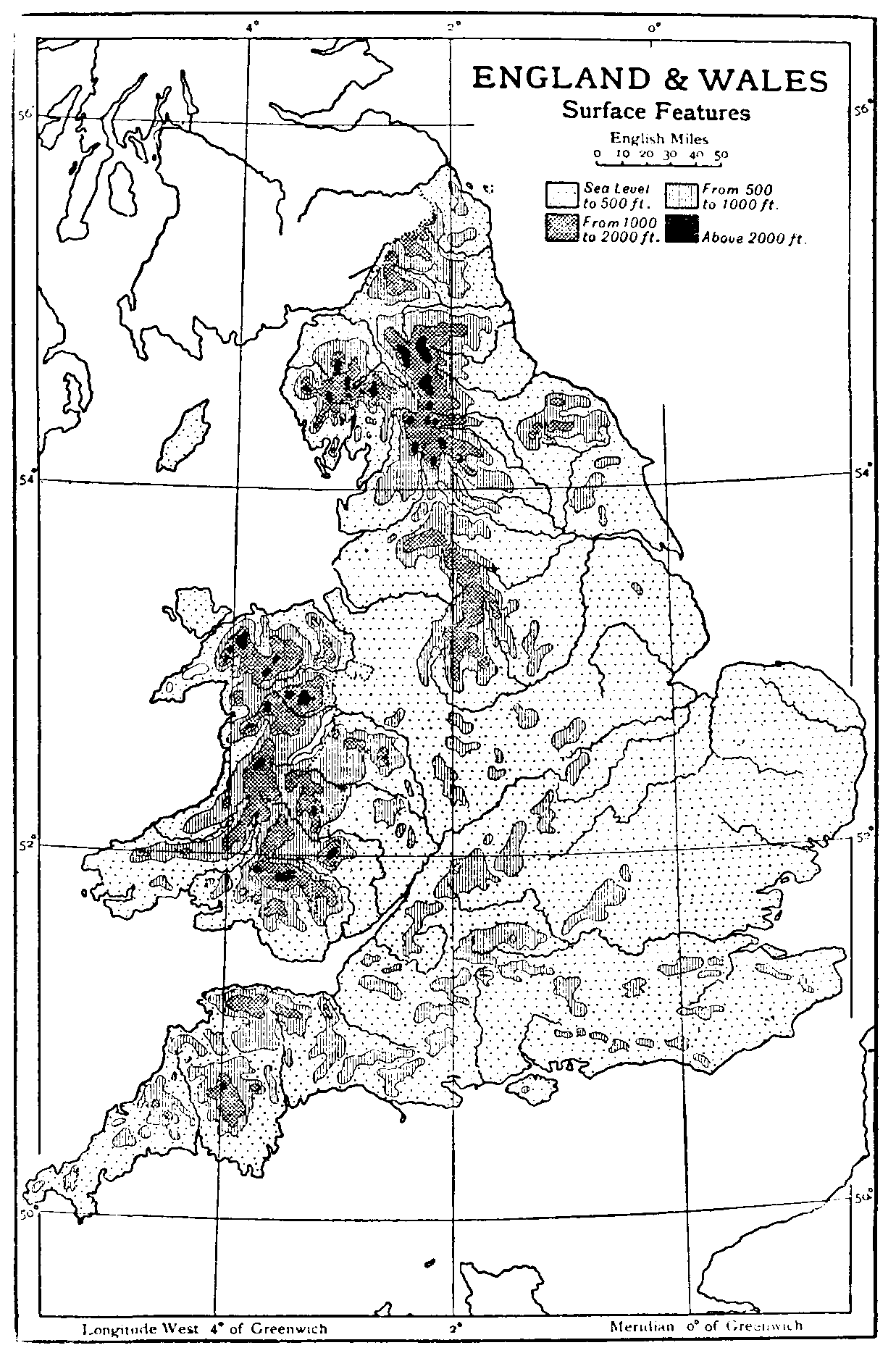
England, including Wales, the southern and larger portion of the Island of Great Britain, is situated between 50° and 55° 46' N. lat., and 1° 46' E. and 5° 42' W. long. On the north it is bounded by Scotland; on all other sides it is washed by the sea: on the east by the North Sea; on the south by the English Channel; and on the west by St. George's Channel and the Irish Sea. Its figure is, roughly speaking, triangular, but with many windings and indentations, the coast-line measuring not less than 2765 miles. The length of the country, measured on a meridian from Berwick nearly to St. Alban's Head, is 365 miles. Its breadth, measured on a parallel of latitude, attains its maximum between St. David's Head, in South Wales, and the Naze, in Essex, where it amounts to 280 miles. The area is 37,340,388 acres or 58,310 sq. miles, of which 32,559,868 acres or 50,874 sq. miles are in England, and 4,780,470 acres or 7466 sq. miles in Wales. This is exclusive of the Channel Islands and the Isle of Man, which together would add 193,647 acres or 302 sq. miles more to the area. The subdivision of England into shires or counties does not appear to have assumed a definite form till the time of Alfred. The existing division was first completed under Henry VIII. There are now 'administrative counties' and 'registration counties', differing in area from the old counties; London being now a county. The figures in the table (p. 241) refer to the old counties.
The capital of England and of the British Empire is London. The cities next in size (in order of population) are: Liverpool, Manchester and Salford, Birmingham, Leeds, Sheffield, Bristol, Bradford, Nottingham, and Hull.
Physical Features.—The chief indentations are: on the east, the Humber, the Wash, and the Thames estuary: on the west, the Solway Firth, Morecambe Bay, Cardigan Bay, and the Bristol Channel; those on the south are less prominent, though including some useful harbours. The greater part of the coast consists of cliffs, in some places clayey, in others rocky, and sometimes jutting out, as at Whitby and Flamborough Head on the east, Beachy Head, the Isle of Portland, the Lizard and Land's End on the south and south-west, St. David's Head and St. Bees Head on the west, into bold, lofty, and precipitous headlands. The most extensive stretches of flat coast are on the east, in the county of Lincoln, and from the southern part of Suffolk to the South Foreland in Kent, and in Sussex and Hants on the south coast. The chief islands are: Holy Island, the Farne Islands, Sheppey, and Thanet on the east coast; the Isle of Wight on the south; the Scilly Isles at the south-west extremity; and Lundy Island, Anglesey, Holy Island, and Walney on the west.
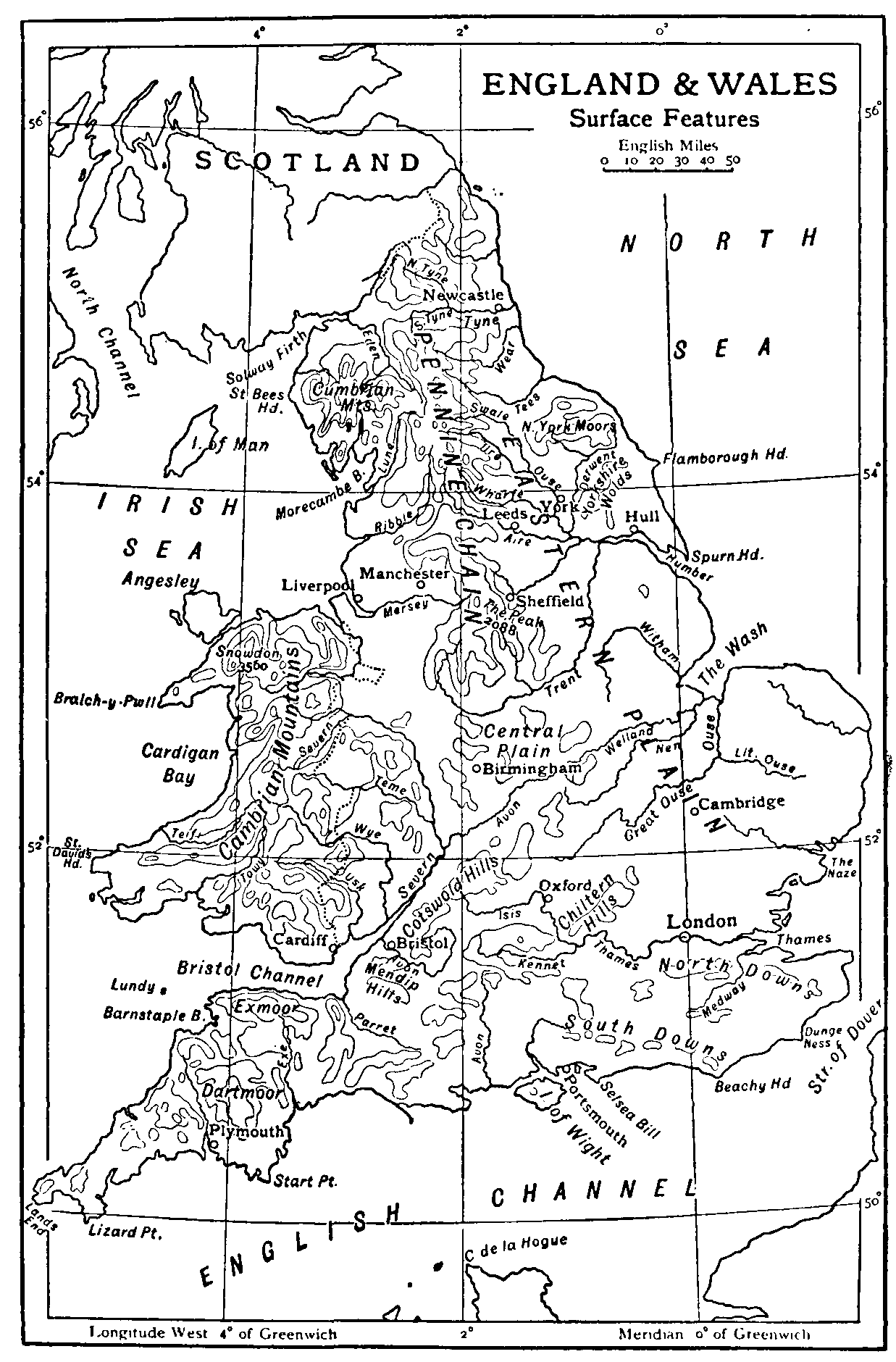
The loftiest heights of England and Wales are situated at no great distance from its western shores, and consist not so much of a continuous chain as of a succession of mountains and hills stretching, with some interruptions, from north to south, and throwing out numerous branches on both sides, but particularly to the west, where all the culminating summits are found. The northern portion of this range has received the name of the Pennine chain. It is properly a continuation of the Cheviot Hills, and, commencing at the Scottish border, proceeds south for about 270 miles till, in the counties of Derby and Stafford, it assumes the form of an elevated moorland plateau. In Derbyshire The Peak rises to the height of 2080 feet. By far the most important of its offsets are those of the west, more especially if we include in them the lofty mountain masses in North-Western England sometimes classed separately as the Cumbrian range. Amidst these mountains lie the celebrated English lakes, of which the most important are Windermere, Derwent Water, Coniston Lake, and Ullswater. Here also is the highest summit of Northern England, Scawfell (3210 feet). The Pennine chain, with its appended Cumbrian range, is succeeded by one which surpasses both these in loftiness and extent, but has its great nucleus much farther to the west, where it covers the greater part of Wales, deriving from this its name, the Cambrian range. Its principal ridge stretches through Carnarvonshire from N.N.E to S.S.W., with Snowdon (3571 feet) as the culminating point of South Britain. Across the Bristol Channel from Wales is the Devonian range. It may be considered as commencing in the Mendip Hills of Somerset, and then pursuing a south-westerly direction through that county and the counties of Devon and Cornwall to the Land's End, the wild and desolate tract of Dartmoor forming one of its most remarkable features (highest summit, Yes Tor, 2050 feet). Other ranges are the Cotswold Hills proceeding in a north-easterly direction from near the Mendip Hills; the Chiltern Hills taking a similar direction farther to the east; and the North and South Downs running eastward, the latter reaching the south coast near Beachy Head, the former reaching the south-east coast at Folkestone.
Area in Statute Acres, 1921 (Land and Inland Water). Counties, including County Boroughs, Census Population. Counties, including County Boroughs, 1911. Census Population. Counties, including County Boroughs, 1921.
England.
Bedfordshire 302,942 194,588 206,478
Berkshire 463,830 280,794 294,807
Buckinghamshire 479,360 219,551 236,209
Cambridgeshire 315,168 128,322 129,594
Isle of Ely 238,073 69,752 73,778
Cheshire 657,950 954,779 1,025,423
Cornwall 868,167 328,098 320,559
Cumberland 973,086 265,746 273,037
Derbyshire 650,369 683,423 714,539
Devonshire 1,671,364 699,703 709,488
Dorsetshire 625,612 223,266 228,258
Durham 649,244 1,369,860 1,478,506
Essex 979,532 1,350,881 1,468,341
Gloucestershire 805,842 736,097 757,668
Herefordshire 538,924 114,269 113,118
Hertfordshire 404,523 311,284 333,236
Huntingdonshire 233,985 55,577 54,748
Kent 975,965 1,045,591 1,141,867
Lancashire 1,194,555 4,767,832 4,928,359
Leicestershire 532,779 476,553 494,522
Lincolnshire
The parts of Holland 263,355 82,849 85,225
The parts of Kesteven 469,142 111,324 108,237
The parts of Lindsey 972,796 369,787 408,643
London 74,850 4,521,685 4,483,249
Middlesex 148,692 1,126,465 1,253,164
Monmouthshire 349,552 395,719 450,700
Norfolk 1,315,064 499,116 504,277
Northamptonshire 585,148 303,797 302,430
Soke of Peterborough 53,464 44,718 46,954
Northumberland 1,291,515 696,893 746,138
Nottinghamshire 540,123 604,098 641,134
Oxfordshire 479,220 189,484 189,558
Rutlandshire 97,273 20,346 18,368
Shropshire 861,800 246,307 242,959
Somersetshire 1,037,594 458,025 465,682
Southampton 958,896 862,393 910,333
Isle of Wight 94,146 88,186 94,697
Staffordshire 741,318 1,279,649 1,349,225
Suffolk, East 557,353 277,155 291,006
Suffolk, West 390,916 116,905 108,982
Surrey 461,833 845,578 930,377
Sussex, East 530,555 487,070 532,206
Sussex, West 401,916 176,308 195,795
Warwickshire 605,275 1,247,418 1,390,092
Westmoreland 504,917 63,575 65,740
Wiltshire 864,101 286,822 292,213
Worcestershire 458,352 387,688 405,876
Yorkshire, East Riding 750,115 432,759 460,717
" North Riding 1,362,058 419,546 456,312
" West Riding 1,773,529 3,045,377 3,181,654
Totals 32,559,868 34,045,290 35,678,530
Wales.
Anglesey 176,630 50,928 51,695
Brecknockshire 469,281 59,287 61,257
Cardiganshire 443,189 59,879 61,292
Carmarthenshire 588,472 160,406 175,069
Carnarvonshire 366,005 125,043 131,034
Denbighshire 426,080 144,783 154,847
Flintshire 163,707 92,705 106,466
Glamorganshire 520,456 1,120,910 1,252,701
Merionethshire 422,372 45,565 45,450
Montgomeryshire 510,110 53,146 51,317
Pembrokeshire 393,003 89,960 92,056
Radnorshire 301,165 22,590 23,528
Totals, Wales (12 counties) 4,780,470 2,025,202 2,206,712
Totals, England and Wales 37,340,338 36,070,492 37,885,242
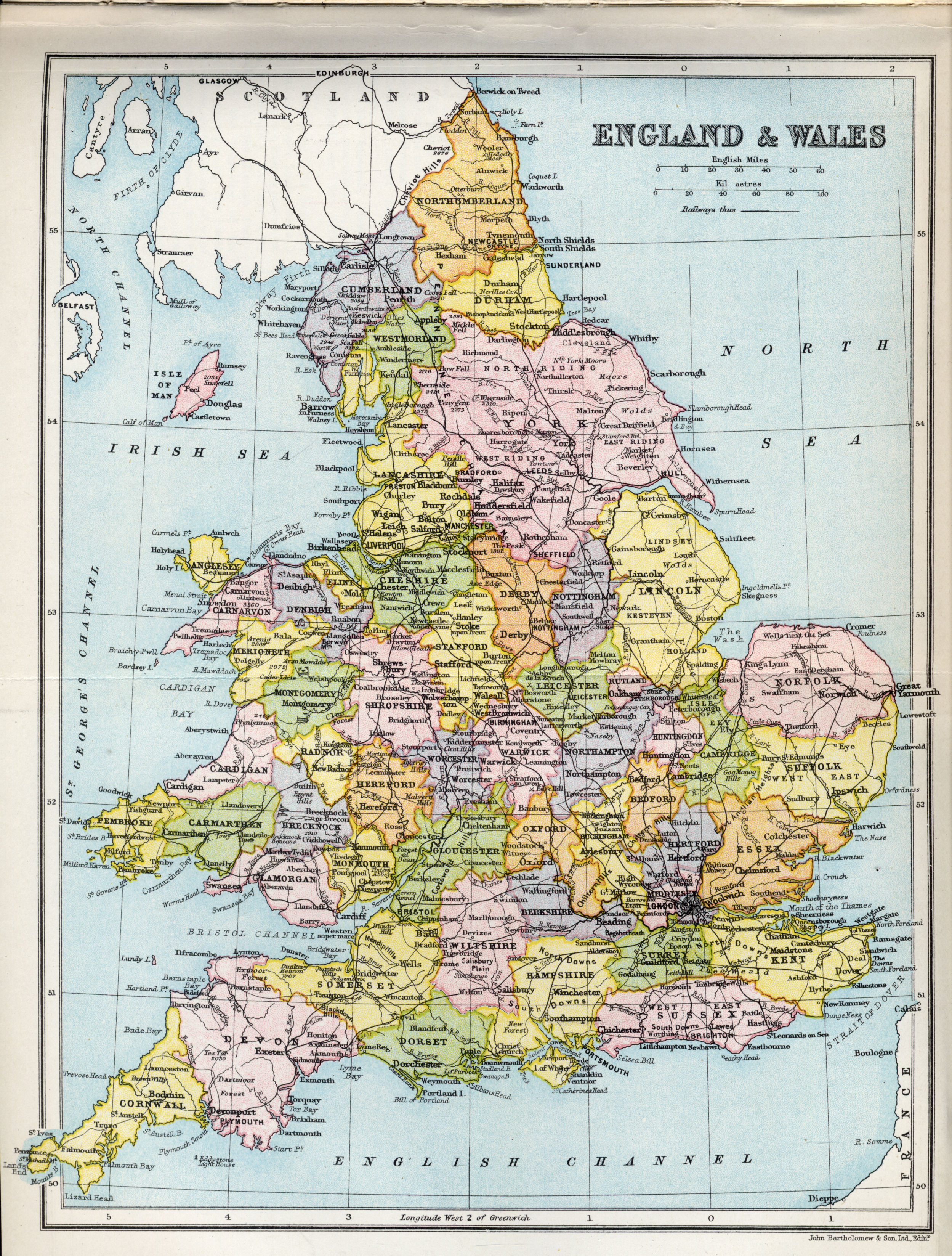
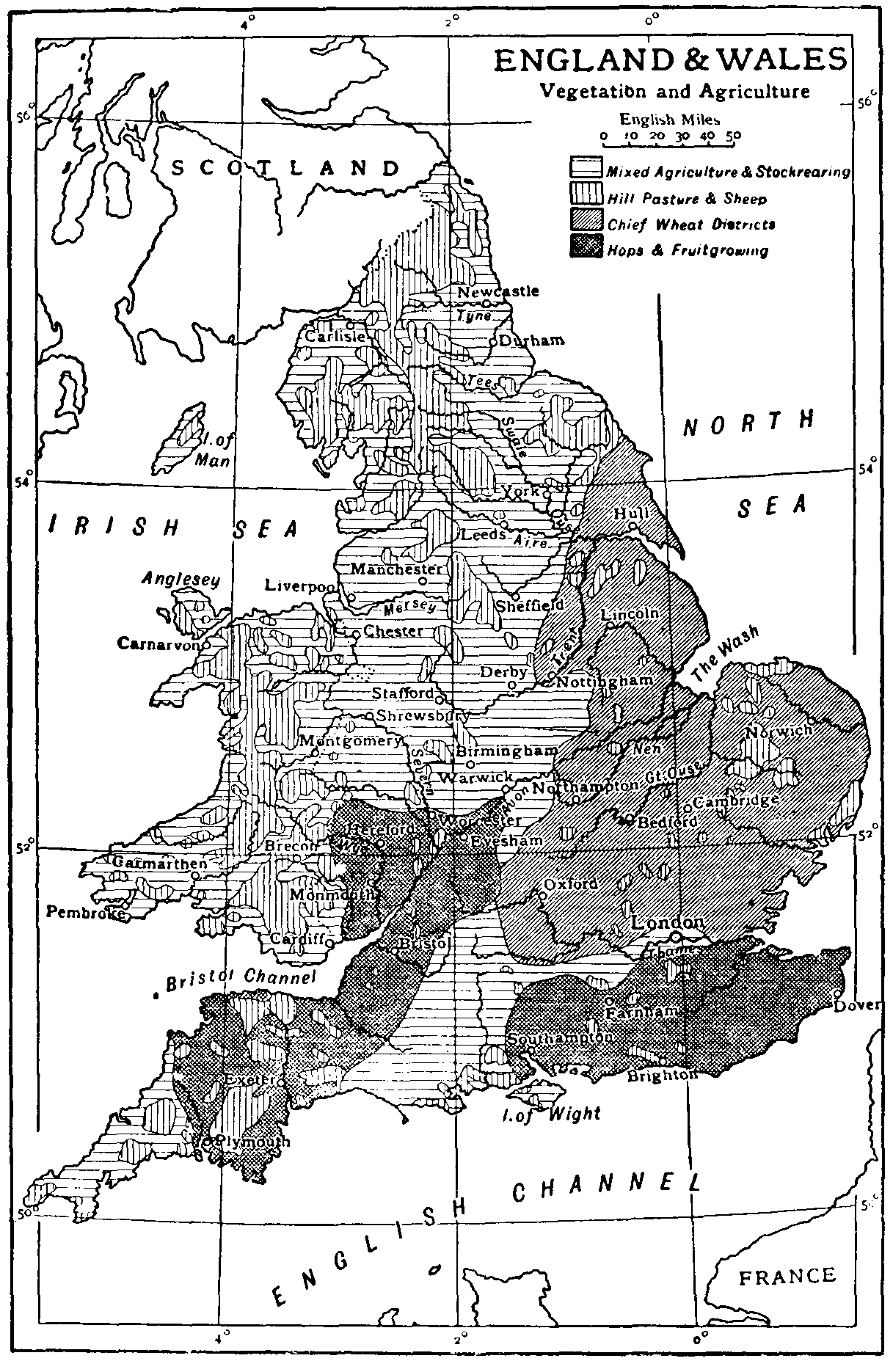
A large part of the surface of England consists of wide valleys and plains. Beginning in the north, the first valleys on the east side are those of the Coquet, Tyne, and Tees; on the west the beautiful valley of the Eden, which, at first hemmed in between the Cumbrian range and Pennine chain, gradually widens out into a plain of about 470 sq. miles, with the town of Carlisle in its centre. The most important of the northern plains is the Vale of York, which has an area of nearly 1000 sq. miles. Properly speaking it is still the same plain which stretches, with scarcely a single interruption, across the counties of Lincoln, Suffolk, and Essex, to the mouth of the Thames, and to a considerable distance inland, comprising the Central Plain and the region of the Fens. On the west side of the island, in South Lancashire and Cheshire, is the fertile Cheshire Plain. In Wales there are no extensive plains, the valleys generally having a narrow rugged form favourable to romantic beauty, but not compatible with great fertility. Wales, however, by giving rise to the Severn, can justly claim part in the vale, or series of almost unrivalled vales, along which it pursues its romantic course through the counties of Montgomery, Salop, Worcester, and Gloucester. South-east of the Cotswold Hills is Salisbury Plain, but it is only in name that it can be classed with the other plains and level lands of England, being a large elevated plateau, of an oval shape, with a thin chalky soil only suitable for pasture. In the south-west the only vales deserving of notice are those of Taunton in Somerset and Exeter in Devon. A large portion of the south-east may be regarded as a continuous plain, consisting of what are called the Wealds of Sussex, Surrey, and Kent, between the North and South Downs, and containing an area of about 1000 sq. miles. The south-east angle of this district is occupied by the Romney Marsh, an extensive level tract composed for the most part of a rich marine deposit. Extensive tracts of a similar nature are situated on the east coast, in Yorkshire and Lincoln, where they are washed by the Humber; and in the counties which either border the Wash, or, like Northampton, Bedford, Huntingdon, and Cambridge, send their drainage into it by the Nene and the Ouse. Many of these lands are naturally the richest in the kingdom, but have been utilized only by means of drainage.
England is well supplied with rivers, many of them of great importance to industry and commerce. Most of them carry their waters to the North Sea. If we consider the drainage as a whole, four principal river basins may be distinguished, those of the Thames, Wash, and Humber belonging to the North Sea; and the Severn belonging to the Atlantic. The basin of the Thames has its greatest length from east to west, 130 miles, and its average breadth about 50 miles, area 6160 sq. miles. The river itself, which is the chief of English rivers, has a length of 215 miles. The basin of the Wash consists of the subordinate basins of the Great Ouse, Nene, Welland, and Witham, which all empty themselves into that estuary, and has an area computed at 5850 sq. miles. The basin of the Severn consists of two distinct portions, that on the right bank, of an irregularly oval shape, and having for its principal tributaries the Teme and the Wye; and that on the left, of which the Upper Avon is the principal tributary stream. The area of the whole basin is 8580 sq. miles. The next basin, that of the Humber, the largest of all, consists of the three basins of the Humber proper, the Ouse, and the Trent, and its area is 9550 sq. miles, being about one-sixth of the whole area of England and Wales. Other rivers unconnected with these systems are the Tyne, Wear, and Tees in the north-east; the Eden, Ribble, Mersey, and Dee in the north-west. The south-coast streams are very unimportant except for their estuaries.
For the minerals, climate, agriculture, manufactures, &c., of England, see the article Britain.
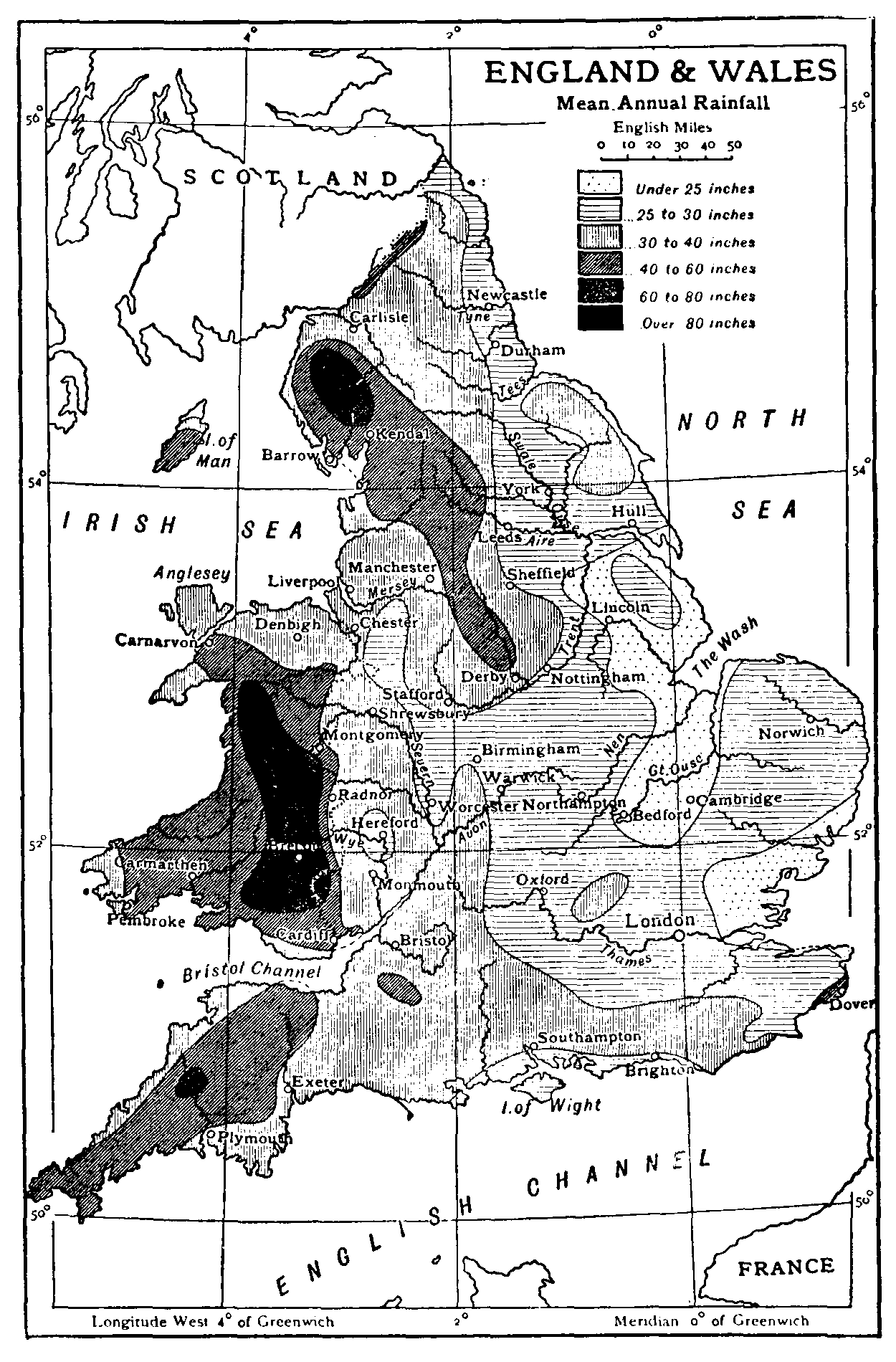
Civil History.—The history of England proper begins when it ceased to be a Roman possession. (See Britain.) On the withdrawal of the Roman forces, about the beginning of the fifth century A.D., the South Britons, or inhabitants of what is now called England, were no longer able to withstand the attacks of their ferocious northern neighbours, the Scots and Picts. They applied for assistance to Aëtius, but the Roman general was too much occupied in the struggle with Attila to attend to their petition. In their distress they appear to have sought the aid of the Saxons; and according to the Anglo-Saxon narratives three ships, containing 1600 men, were dispatched to their help under the command of the brothers Hengist and Horsa. Vortigern, a duke or prince of the Britons, assigned them the Isle of Thanet for habitation, and, marching against the northern foe, they obtained a complete victory. The date assigned to these events by the later Anglo-Saxon chronicles is A.D. 449, the narratives asserting further that the Saxons, finding the land desirable, turned their arms against the Britons, and, reinforced by new bands, conquered first Kent and ultimately the larger part of the island. Whatever the credibility of the story of Vortigern, it is certain that in the middle of the fifth century the occasional Teutonic incursions gave place to persistent invasion with a view to settlement. These Teutonic invaders were Low German tribes from the country about the mouths of the Elbe and the Weser, the three most prominent being the Angles, the Saxons, and the Jutes. Of these the Jutes were the first to form a settlement, taking possession of part of Kent and the Isle of Wight; but the larger conquests of the Saxons in the south and the Angles in the north gave to these tribes the leading place in the kingdom. The struggle continued 150 years, and at the end of that period the whole southern part of Britain, with the exception of Strathclyde, Wales, and West Wales (Cornwall), was in the hands of the Teutonic tribes. This conquered territory was divided among a number of small states or petty chieftaincies, seven of the most conspicuous of which are often spoken of as the Heptarchy. These were: 1. The kingdom of Kent; founded by Hengist in 455; ended in 823. 2. Kingdom of South Saxons, containing Sussex and Surrey; founded by Ella in 477; ended in 689. 3. Kingdom of East Angles, containing Norfolk, Suffolk, Cambridge, Ely (Isle of); founded by Uffa in 571 or 575; ended in 792. 4. Kingdom of West Saxons, containing Devon, Dorset, Somerset, Wilts, Hants, Berks, and part of Cornwall; founded by Cerdic 519; swallowed up the rest in 827. 5. Kingdom of Northumbria, containing York, Durham, Cumberland, Westmorland, Northumberland, and the east coast of Scotland to the Firth of Forth; founded by Ida 547; absorbed by Wessex in 827. 6. Kingdom of East Saxons, containing Essex, Middlesex, Hertford (part); founded by Erchew in 527: ended in 823. 7. Kingdom of Mercia, containing Gloucester, Hereford, Worcester, Warwick, Leicester, Rutland, Northampton, Lincoln, Huntingdon, Bedford, Buckingham, Oxford, Stafford, Derby, Salop, Nottingham, Chester, Hertford (part); founded by Cridda about 584; absorbed by Wessex in 827. Each state was, in its turn, annexed to more powerful neighbours; and at length, in 827, Egbert, by his valour and superior capacity, united in his own person the sovereignty of what had formerly been seven kingdoms, and the whole came to be called England, that is Angle-land.
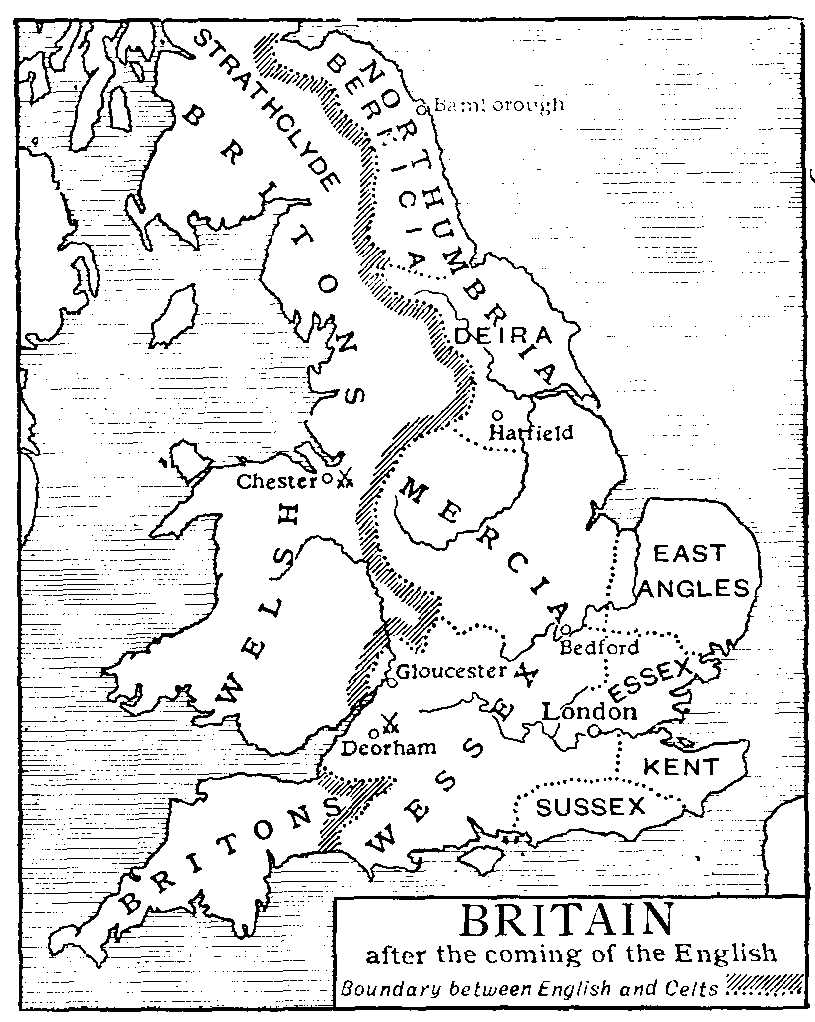
While this work of conquest and of intertribal strife had been in progress towards the establishment of a united kingdom, certain important changes had occurred. The conquest had been the slow expulsion of a Christian race by a purely heathen race, and the country had returned to something of its old isolation with regard to the rest of Europe. But before the close of the sixth century Christianity had secured a footing in the south-east of the island. Ethelberht, King of Kent and suzerain over the kingdoms south of the Humber, married a Christian wife, Bertha, daughter of Charibert of Soissons, and this event indirectly led to the coming of St. Augustine. The conversion of Kent, Essex, and East Anglia was followed by that of Northumberland and then by that of Mercia, of Wessex, of Sussex, and lastly of Wight, the contest between the two religions being at its height in the seventh century. The legal and political changes immediately consequent upon the adoption of Christianity were not great, but there resulted a more intimate relation with Europe and the older civilizations, the introduction of new learning and culture, the formation of a written literature, and the fusion of the tribes and petty kingdoms into a closer and more lasting unity than that which could have been otherwise secured.
The kingdom, however, was still kept in a state of disturbance by the attacks of the Danes, who had made repeated incursions during the whole of the Saxon period, and about half a century after the unification of the kingdom became for the moment masters of nearly the whole of England. But the genius of Alfred the Great, who had ascended the throne in 871, speedily reversed matters by the defeat of the Danes at Ethandune (878). Guthrum, their king, embraced Christianity, became the vassal of the Saxon king, and retired to a strip of land on the east coast including Northumbria and called the Danelagh. The two immediate successors of Alfred, Edward (901-925) and Athelstan (925-940), the son and the grandson of Alfred, both vigorous and able rulers, had each in turn to direct his arms against these settlers of the Danelagh. The reigns of the next five kings, Edmund, Edred, Edwy, Edgar, and Edward the Martyr, are chiefly remarkable on account of the conspicuous place occupied in them by Dunstan, who was counsellor to Edmund, minister of Edred, treasurer under Edwy, and supreme during the reigns of Edgar and his successor. It was possibly due to his policy that from the time of Athelstan till after the death of Edward the Martyr (978 or 979) the country had comparative rest from the Danes. During the tenth century many changes had taken place in the Teutonic constitution. Feudalism was already taking root; the king's authority had increased; the folkland was being taken over as the king's personal property; the nobles by birth, or ealdormen, were becoming of less importance in administration than the nobility of thegns, the officers of the king's court. Ethelred (978-1016), who succeeded Edward, was a minor, the government was feebly conducted, and no united action being taken against the Danes, their incursions became more frequent and destructive. Animosities between the English and the Danes who had settled among them became daily more violent, and a general massacre of the latter took place in 1002. The following year Sweyn invaded the kingdom with a powerful army and assumed the crown of England. Ethelred was compelled to take refuge in Normandy; and though he afterwards returned, he found in Canute an adversary no less formidable than Sweyn. Ethelred left his kingdom in 1016 to his son Edmund, who displayed great valour, but was compelled to divide his kingdom with Canute; and when he was assassinated in 1017 the Danes succeeded the sovereignty of the whole.
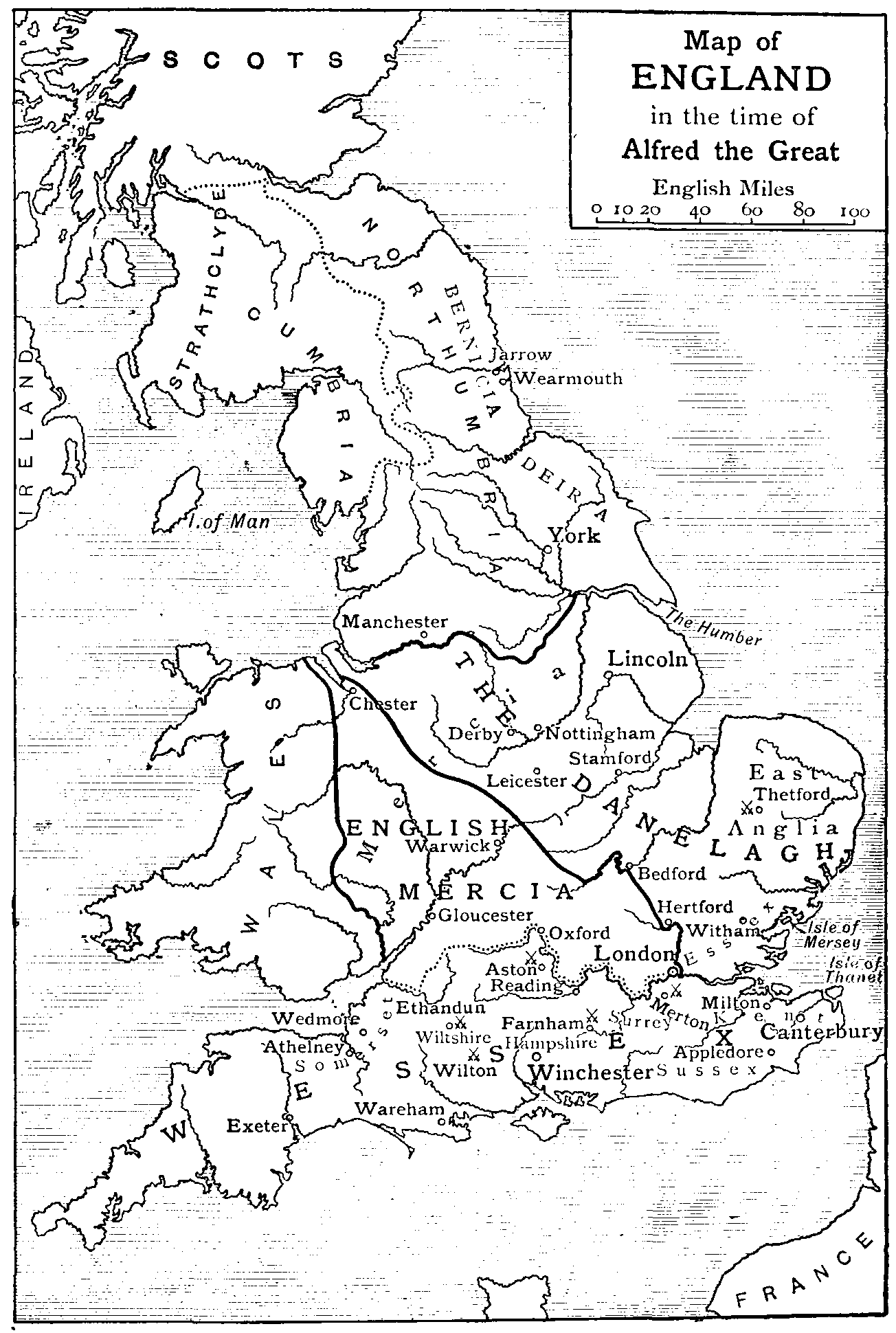
Canute (Knut), who espoused the widow of Ethelred, that he might reconcile his new subjects, obtained the name of Great, not only on account of his personal qualities, but from the extent of his dominions, being master of Denmark and Norway as well as England. In 1035 he died, and was followed in England by two other Danish kings, Harold and Hardicanute, whose joint reigns lasted till 1042, after which the English line was again restored in the person of Edward the Confessor. Edward was a weak prince, and in the latter years of his reign had far less real power than his brother-in-law Harold, son of the great Earl Godwin. On Edward's death in 1066 Harold accordingly obtained the crown. He found, however, a formidable opponent in the second-cousin of Edward, William of Normandy, who instigated the Danes to invade the northern counties, while he, with 60,000 men, landed in the south. Harold vanquished the Danes, and hastening southwards met the Normans near Hastings, at Senlac, afterwards called Battle. Harold and his two brothers fell (14th Oct., 1066), and William (1066-87) immediately claimed the government as lawful King of England, being subsequently known as William I, the Conqueror. For some time he conducted the government with great moderation; but being obliged to reward those who had assisted him, he bestowed the chief offices of government upon Normans, and divided among them a great part of the country. The revolts of the native English which followed were quickly crushed, Continental feudalism in a modified form was established, and the English Church reorganized under Lanfranc as Archbishop of Canterbury.
At his death, in 1087, William II, commonly known by the name of Rufus, the Conqueror's second son, obtained the crown, Robert, the eldest son, receiving the duchy of Normandy. In 1100, when William II was accidentally killed in the New Forest, Robert was again cheated of his throne by his younger brother Henry (Henry I), who in 1106 even wrested from him the duchy of Normandy. Henry's power being secured, he entered into a dispute with Anselm the Primate, and with the Pope, concerning the right of granting investure to the clergy. He supported his quarrel with firmness, and brought it to a not unfavourable issue. His reign was also marked by the suppression of the greater Norman nobles in England, whose power (like that of many Continental feudatories) threatened to overshadow that of the king, and by the substitution of a class of lesser nobles. In 1135 he died in Normandy, leaving behind him only a daughter, Matilda.
By the will of Henry I his daughter Maud or Matilda, wife of Geoffrey Plantagenet, Count of Anjou, and frequently styled the Empress Matilda, because she had first been married to Henry V, Emperor of Germany, was declared his successor. But Stephen, son of the Count of Blois, and of Adela, daughter of William the Conqueror, raised an army in Normandy, landed in England, and declared himself king. After years of civil war and bloodshed an amicable arrangement was brought about, by which it was agreed that Stephen should continue to reign during the remainder of his life, but that he should be succeeded by Henry, son of Matilda and the Count of Anjou. Stephen died in 1154, and Henry Plantagenet ascended the throne with the title of Henry II, being the first of the Plantagenet or Angevin kings. A larger dominion was united under his sway than had been held by any previous sovereign of England, for at the time when he became King of England he was already in the possession of Anjou, Normandy, and Aquitaine.
Henry II found far less difficulty in restraining the licence of his barons than in abridging the exorbitant privileges of the clergy, who claimed exemption not only from the taxes of the State, but also from its penal enactments, and who were supported in their demands by the Primate Becket. The king's wishes were formulated in the Constitutions of Clarendon (1164), which were at first accepted and then repudiated by the Primate. The assassination of Becket, however, placed the king at a disadvantage in the struggle, and after his conquest of Ireland (1171) he submitted to the Church, and did penance at Becket's tomb. Henry was the first who placed the common people of England in a situation which led to their having a share in the Government. The system of frank-pledge was revived, trial by jury was instituted by the Assize of Clarendon, and the Eyre courts were made permanent by the Assize of Nottingham. To curb the power of the nobles he granted charters to towns, freeing them from all subjection to any but himself, thus laying the foundation of a new order in society.
Richard I, called Cœur de Lion, who in 1189 succeeded to his father, Henry II, spent most of his reign away from England. Having gone to Palestine to join in the third crusade, he proved himself an intrepid soldier. Returning homewards in disguise through Germany, he was made prisoner by Leopold, Duke of Austria, but was ransomed by his subjects. In the meantime John, his brother, had aspired to the crown, and hoped, by the assistance of the French, to exclude Richard from his right. Richard's presence for a time restored matters to some appearance of order; but having undertaken an expedition against France, he received a mortal wound at the siege of Châlons, in 1199.
John was at once recognized as King of England, and secured possession of Normandy; but Anjou, Maine, and Touraine acknowledged the claim of Arthur, son of Geoffrey, second son of Henry II. On the death of Arthur, while in John's power, these four French provinces were at once lost to England. John's opposition to the Pope in electing a successor to the see of Canterbury in 1205 led to the kingdom being placed under an Interdict; and, the nation being in a disturbed condition, he was at last compelled to receive Stephen Langton as archbishop, and to accept his kingdom as a fief of the papacy (1213). His exactions and misgovernment had equally embroiled him with the nobles. In 1213 they refused to follow him to France, and, on his return defeated, they at once took measures to secure their own privileges and abridge the perogatives of the Crown. King and barons met at Runnymede, and on 15th June, 1215, the Great Charter (Magna Charta) was signed. It was speedily declared null and void by the Pope and war broke out between John and the barons, who were aided by the French king. In 1216, however, John died, and his turbulent reign was succeeded by the almost equally turbulent reign of his son Henry III.
During the first years of the reign of Henry III the abilities of the Earl of Pembroke, who was regent until 1219, retained the kingdom in tranquillity; but when, in 1227, Henry assumed the reins of government he showed himself incapable of managing them. The Charter was three times reissued in a modified form, and new privileges were added to it, but the king took no pains to observe its provisions. The struggle, long maintained in the Great Council (henceforward called Parliament) over money grants and other grievances, reached an acute stage in 1263, when civil war broke out. Simon de Montfort, who had laid the foundations of the House of Commons by summoning representatives of the shire communities to the Mad Parliament of 1258, had by this time engrossed the sole power. He defeated the king and his son Edward at Lewes in 1264, and in his famous Parliament of 1265 still further widened the privileges of the people by summoning to it burgesses as well as knights of the shire. The escape of Prince Edward, however, was followed by the battle of Evesham (1265), at which Earl Simon was defeated and slain, and the rest of the reign was undisturbed.