VOLUME IV PART 2 (continued 6)
Reading edition
On the death of Henry III, in 1272, Edward I succeeded without opposition. From 1276 to 1284 he was largely occupied in the conquest and annexation of Wales, which had become practically independent during the barons' wars. In 1292 Baliol, whom Edward had decided to be rightful heir to the Scottish throne, did homage for the fief to the English king; but when, in 1294, war broke out with France, Scotland also declared war. The Scots were defeated at Dunbar (1296), and the country placed under an English regent; but the revolt under Wallace (1297) was followed by that of Bruce (1306), and the Scots remained unsubdued. The reign of Edward was distinguished by many legal and legislative reforms, such as the separation of the old king's court into the Court of Exchequer, Court of King's Bench, and Court of Common Pleas, and the passage of the Statute of Mortmain. In 1295 the first perfect Parliament was summoned, the clergy and barons by special writ, the commons by writ to the sheriffs directing the election of two knights from each shire, two citizens from each city, two burghers from each borough. Two years later the imposition of taxation without consent of Parliament was forbidden by a special Act (De Tallagio non Concedendo). The great aim of Edward, however, to include England, Scotland, and Wales in one kingdom proved a failure, and he died in 1307 marching against Robert Bruce.
The reign of his son Edward II was unfortunate to himself and to his kingdom. He made a feeble attempt to carry out his father's last and earnest request to prosecute the war with Scotland, but the English were almost constantly unfortunate; and at length, at Bannockburn (1314), they were defeated by Robert Bruce, which ensured the independence of Scotland. The king soon proved incapable of regulating the lawless conduct of his barons; and his wife, a woman of a bold, intriguing disposition, joined in the confederacy against him, which resulted in his imprisonment and death in 1327.
The reign of Edward III was as brilliant as that of his father had been the reverse. The main projects of the third Edward were directed against France, the crown of which he claimed in 1328 in virtue of his mother, the daughter of King Philip. The victory won by the Black Prince at Crécy (1346), the capture of Calais (1347), and the victory of Poitiers (1356), ultimately led to the Peace of Brétigny in 1360, by which Edward III received all the west of France on condition of renouncing his claim to the French throne. (See Brétigny.) Before the close of his reign, however, these advantages were all lost again, save a few principal towns on the coast.
Edward III was succeeded in 1377 by his grandson Richard II, son of Edward the Black Prince. The people of England now began to show, though in a turbulent manner, that they had acquired just notions of government. In 1380 an unjust and oppressive poll-tax brought their grievances to a head, and 100,000 men, under Wat Tyler, marched towards London (1381). Wat Tyler was killed while conferring with the king, and the prudence and courage of Richard appeased the insurgents. Despite his conduct on this occasion, Richard was deficient in the vigour necessary to curb the lawlessness of the nobles. In 1398 he banished his cousin, Henry Bolingbroke; and on the death of the latter's father, the Duke of Lancaster, unjustly appropriated his cousin's patrimony. To avenge the injustice Bolingbroke landed in England during the king's absence in Ireland, and at the head of 60,000 malcontents compelled Richard to surrender. He was confined in the Tower, and despite the superior claims of Edmund Mortimer, Earl of March, Henry was appointed king (1399), the first of the House of Lancaster. Richard was, in all probability, murdered early in 1400.
The manner in which the Duke of Lancaster, now Henry IV, acquired the crown rendered his reign extremely turbulent, but the vigour of his administration quelled every insurrection. The most important—that of the Percies of Northumberland, Owen Glendower, and Douglas of Scotland—was crushed by the battle of Shrewsbury (1403). During the reign of Henry IV the clergy of England first began the practice of burning heretics under the Act de haeretico comburendo, passed in the second year of his reign. The Act was chiefly directed against the Lollards, as the followers of Wycliffe now came to be called. Henry died in 1413, leaving his crown to his son, Henry V, who revived the claim of Edward III to the throne of France in 1415, and invaded that country at the head of 30,000 men. The disjointed councils of the French rendered their country an easy prey; the victory of Agincourt was gained in 1415; and after a second campaign a peace was concluded at Troyes in 1420, by which Henry received the hand of Katherine, daughter of Charles VI, was appointed regent of France during the reign of his father-in-law, and declared heir to the throne on his death. The two kings, however, died within a few weeks of each other in 1422, and the infant son of Henry thus became King of England (as Henry VI) and France at the age of nine months.
England, during the reign of Henry VI, was subjected, in the first place, to all the confusion incident to a long minority, and afterwards to all the misery of a civil war. Henry allowed himself to be managed by anyone who had the courage to assume the conduct of his affairs, and the influence of his wife, Margaret of Anjou, a woman of uncommon capacity, was of no advantage either to himself or the realm. In France (1422-53) the English forces lost ground, and were finally expelled by the celebrated Joan of Arc, Calais alone being retained. The rebellion of Jack Cade in 1450 was suppressed, only to be succeeded by more serious trouble. In that year Richard, Duke of York, the father of Edward, afterwards Edward IV, began to advance his pretensions to the throne, which had been so long usurped by the House of Lancaster. His claim was founded on his descent from the third son of Edward III, Lionel, Duke of Clarence, who was his great-great-grandfather on the mother's side, while Henry was the great-grandson on the father's side of John of Gaunt, Duke of Lancaster, the fourth son of Edward III. Richard of York was also grandson on the father's side of Edmund, fifth son of Edward III. The wars which resulted, called the Wars of the Roses, from the fact that a red rose was the badge of the House of Lancaster and a white one that of the House of York, lasted for thirty years, from the first battle of St. Albans, 22nd May, 1455, to the battle of Bosworth, 22nd Aug., 1485. Henry VI was twice driven from the throne (in 1461 and 1471) by Edward of York, whose father had previously been killed in battle in 1460. Edward of York reigned as Edward IV from 1461 till his death in 1483, with a brief interval in 1471; and was succeeded by two other sovereigns of the House of York, first his son Edward V, who reigned for eleven weeks in 1483; and then by his brother Richard III, who reigned from 1483 till 1485, when he was defeated and slain on Bosworth field by Henry Tudor, of the House of Lancaster, who then became Henry VII.
Henry VII was at this time the representative of the House of Lancaster, and in order at once to strengthen his own title, and to put an end to the rivalry between the Houses of York and Lancaster, he married, in 1486, Elizabeth, the sister of Edward V and heiress of the House of York. His reign was disturbed by insurrections attending the impostures of Lambert Simnel (1487), who pretended to be a son of the Duke of Clarence, brother of Edward IV, and of Perkin Warbeck (1488), who affirmed that he was the Duke of York, younger brother of Edward V; but neither of these attained any magnitude. The king's worst fault was the avarice which led him to employ in schemes of extortion such instruments as Empson and Dudley. His administration throughout did much to increase the royal power and to establish order and prosperity. He died in 1509.
The authority of the English Crown, which had been so much extended by Henry VII, was by his son Henry VIII exerted in a tyrannical and capricious manner. The most important event of the reign was undoubtedly the Reformation; though it had its origin rather in Henry's caprice and in the casual situation of his private affairs than in his conviction of the necessity of a reformation in religion, or in the solidity of reasoning employed by the reformers. Henry had been espoused to Catherine of Spain, who was first married to his elder brother Arthur, a prince who died young. Henry became disgusted with his queen, and enamoured of one of her maids of honour, Anne Boleyn. He had recourse, therefore, to the Pope to dissolve a marriage which had at first been rendered legal only by a dispensation from the Pontiff; but, failing in his desires, he broke away entirely from the Holy See, and in 1534 got himself recognized by Act of Parliament as the head of the English Church. He died in 1547. He was married six times, and left three children, each of whom reigned in turn. These were: Mary, by his first wife, Catherine of Aragon; Elizabeth, by his second wife, Anne Boleyn; and Edward, by his third wife, Jane Seymour.
Edward, who reigned first, with the title of Edward VI, was nine years of age at the time of his succession, and died in 1553, when he was only sixteen. His short reign, or rather the reign of the Earl of Hertford, afterwards Duke of Somerset, who was appointed regent, was distinguished chiefly by the success which attended the measures of the reformers, who acquired great part of the power formerly engrossed by the Catholics. The intrigues of Dudley, Duke of Northumberland, during the reign of Edward, caused Lady Jane Grey to be declared his successor; but her reign, if it could be called such, lasted only a few days. Mary, daughter of Henry VIII, was placed upon the throne, and Lady Jane Grey and her husband were both executed. Mary, a bigoted Catholic, seems to have wished for the crown only for the purpose of re-establishing the Roman Catholic faith. Political motives had induced Philip of Spain to accept of her as a spouse; but she could never prevail on her subjects to allow him any share of power. She died in 1558.
Elizabeth, who succeeded her sister Mary, was attached to the Protestant faith, and found little difficulty in establishing it in England. Having concluded peace with France (1559), Elizabeth set herself to promote the confusion which prevailed in Scotland, to which her cousin Mary had returned from France as queen in 1561. In this she was so far successful that Mary placed herself in her power (1568), and after many years imprisonment was sent to the scaffold (1587). As the most powerful Protestant nation, and as a rival to Spain in the New World, it was natural that England should become involved in difficulties with that country. The dispersion of the Armada by the English fleet under Howard, Drake, and Hawkins was the most brilliant event of a struggle which abounded in minor feats of valour. In Elizabeth's reign London became the centre of the world's trade, the extension of British commercial enterprise being coincident with the ruin of Antwerp in 1585. The Parliament was increased by the creation of sixty-two new boroughs, and its members were exempted from arrest. In literature not less than in politics and in commerce the same full life displayed itself, and England began definitely to assume the characteristics which distinguish her from the other European nations of to-day.
To Elizabeth succeeded (in 1603) James VI of Scotland and I of England, son of Mary Queen of Scots and Darnley. His accession to the crown of England in addition to that of Scotland did much to unite the two nations, though a certain smouldering animosity still lingered. His dissimulation, however, ended in his satisfying neither of the contending ecclesiastical parties—the Puritans or the Catholics; and his absurd insistence on his divine right made his reign a continuous struggle between the prerogative of the Crown and the freedom of the people. His extravagance kept him in constant disputes with the Parliament, who would not grant him the sums he demanded, and compelled him to resort to monopolies, loans, benevolences, and other illegal methods. The nation at large, however, continued to prosper through the whole of his reign. His son Charles I, who succeeded him in 1625, inherited the same exalted ideas of royal prerogative, and his marriage with a Catholic, his arbitrary rule, and illegal methods of raising money provoked bitter hostility. Under the guidance of Laud and Strafford things went from bad to worse. Civil war broke out in 1642 between the king's party and that of the Parliament, and the latter proving victorious, in 1649 the king was beheaded.
A Commonwealth or republican government was now established, in which the most prominent figure was Oliver Cromwell. Mutinies in the army among Fifth-monarchists and Levellers were subdued by Cromwell and Fairfax, and Cromwell, in a series of masterly movements, subjugated Ireland and gained the important victories of Dunbar and Worcester. At sea Blake had destroyed the Royalist fleet under Rupert, and was engaged in an honourable struggle with the Dutch under van Tromp. But within the governing body matters had come to a deadlock. A dissolution was necessary, yet Parliament shrank from dissolving itself, and in the meantime the reform of the law, a settlement with regard to the Church, and other important matters remained untouched. In April, 1653, Cromwell cut the knot by forcibly ejecting the members and putting the keys of the House in his pocket. From this time he was practically head of the Government, which was vested in a council of thirteen. A Parliament—the Little or Barebones Parliament—was summoned, and in the December of the same year Cromwell was installed Lord Protector of the Commonwealth of England, Scotland, and Ireland. With more than the power of a king, he succeeded in dominating the confusion at home, and made the country feared throughout the whole of Europe. Cromwell died in 1658, and the brief and feeble protectorate of his son Richard followed.
There was now a widespread feeling that the country would be better under the old form of government, and Charles II, son of Charles I, was called to the throne by the Restoration of 1660. He took complete advantage of the popular reaction from the narrowness and intolerance of Puritanism, and even endeavoured to carry it to the extreme of establishing the Catholic religion. The promises of religious freedom made by him before the Restoration in the Declaration Breda were broken by the Test and Corporation Acts, and by the Act of Uniformity, which drove two thousand clergymen from the Church and created the great dissenting movement of modern times. The Conventicle and Five-mile Acts followed, and the 'Drunken Parliament' restored Episcopacy in Scotland. At one time even civil war seemed again imminent. The abolition of the censorship of the press (1679) and the reaffirmation of the Habeas Corpus principle are the most praiseworthy incidents of the reign.
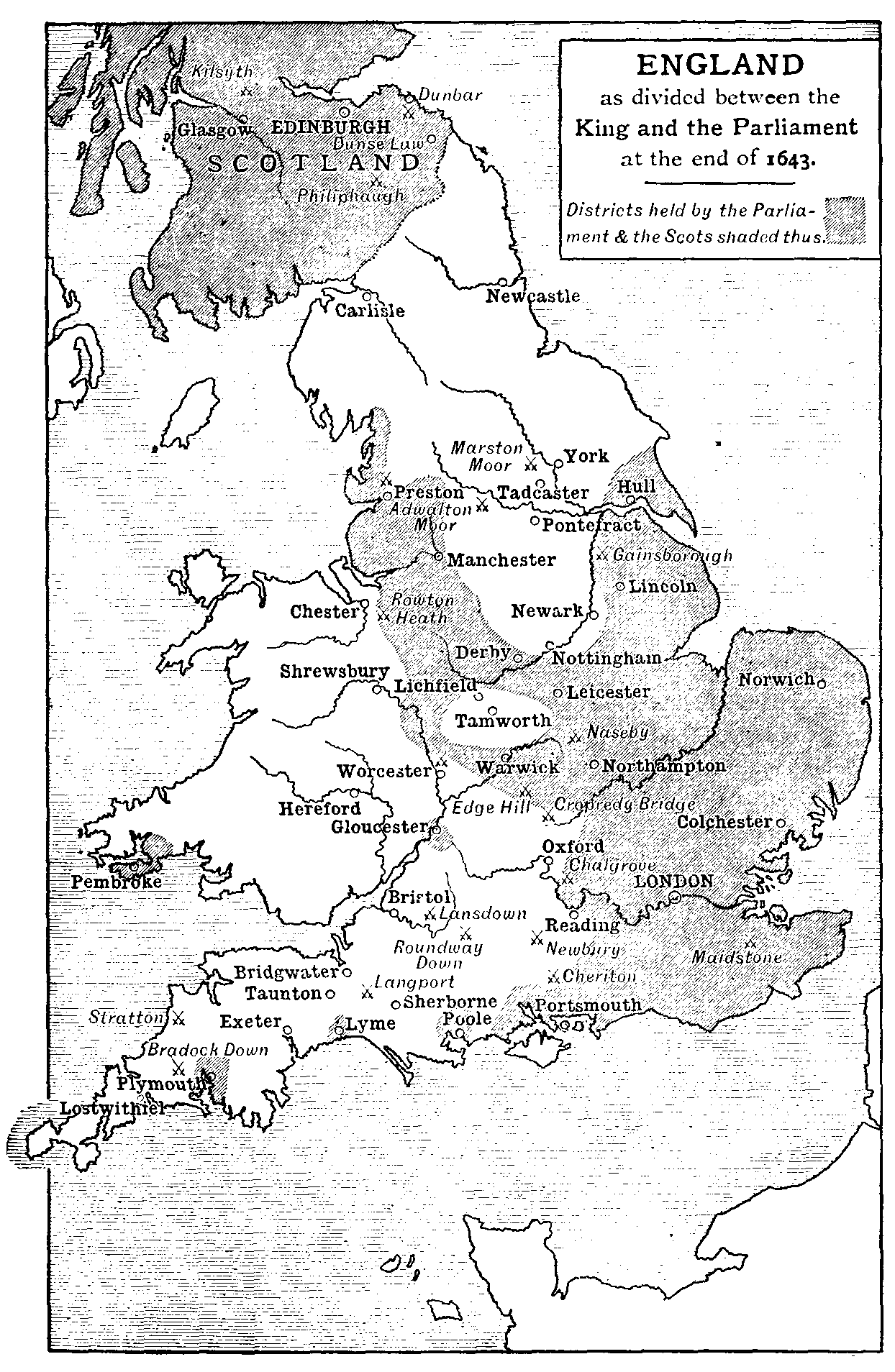
As Charles II left no legitimate issue, his brother the Duke of York succeeded him as James II (1685-8). An invasion by an illegitimate son of Charles, the Duke of Monmouth who claimed the throne, was suppressed, and the king's arbitrary rule was supported by the wholesale butcheries of such instruments as Kirke and Jeffreys. The king's zealous countenance of Roman Catholicism and his attempts to force the Church and the universities to submission provoked a storm of opposition. Seven prelates were brought to trial for seditious libel, but were acquitted amidst general rejoicings. The whole nation was prepared to welcome any deliverance, and in 1688 William of Orange, husband of James's daughter Mary, landed in Torbay. James fled to France, and a convention summoned by William settled the crown upon him, he thus becoming William III. Annexed to this settlement was a Declaration of Rights circumscribing the royal prerogative by depriving him of the right to exercise dispensing power, or to exact money, or maintain an army without the assent of Parliament. This placed henceforward the right of the British sovereign to the throne upon a purely statutory basis. The Toleration Act, passed in 1689, released dissent from many penalties. An armed opposition to William lasted for a short time in Scotland, but ceased with the fall of Viscount Dundee, the leader of James's adherents; and though the struggle was prolonged in Ireland, it was brought to a close before the end of 1691. The following year saw the origination of the national debt, the exchequer having been drained by the heavy military expenditure. A Bill for triennial Parliaments was passed in 1694, the year in which Queen Mary died. For a moment after her death William's popularity was in danger, but his successes at Namur and elsewhere, and the obvious exhaustion of France, once more confirmed his power. The Treaty of Ryswick followed in 1697, and the death of James II in exile in 1701 removed a not unimportant source of danger. Early in the following year William also died, and by the Act of Settlement Anne succeeded him.
The closing act of William's reign had been the formation of the grand alliance between England, Holland, and the German Empire, and the new queen's rule opened with the brilliant successes of Marlborough at Blenheim (1704) and Ramilies (1706). Throughout the earlier part of her reign the Marlboroughs practically ruled the kingdom, the duke's wife, Sarah Jennings, being the queen's most intimate friend and adviser. In 1707 the history of England becomes the history of Britain, the Act of Union passed in that year binding the Parliaments and Realms of England and Scotland into a single and more powerful whole. See Britain.
Ecclesiastical History.—The first religion of the Celts of England was Druidism. It has been conjectured that Christianity may have reached Britain by way of France (Gaul) before the conclusion of the first, or not long after the commencement of the second century, but the period and manner of its introduction are uncertain. It had, however, made considerable progress in the island previous to the time of Constantine the Great (306-337). Several bishops from Britain sat in the Councils of Nice (325), Sardica (347), and Ariminum, in Italy (359); and in 519 an ecclesiastical synod of all the British clergy was held by St. David, Archbishop of Caerleon, for extirpating the remains of the Pelagian heresy.
A period of almost total eclipse followed the inroad of the pagan Saxons, and it was not till A.D. 570 that signs of change showed themselves in the new nationality. On the coming of Austin, or St. Augustine, sent over in 596 by Gregory the Great, a residence at Canterbury was assigned to him, and Ethelberht, King of Kent, and most of his subjects, adopted Christianity. Other missionaries followed; East Saxons were soon after converted by Mellitus; and a bishop's see was established at London, their capital, early in the seventh century. The Northumbrians were next converted, an event accelerated by the marriage of their king, Edwin, with a daughter of Ethelberht, and by the labours of the missionary Paulinus. The influence of Edwin and Paulinus also secured the conversion of Carpwald, King of the East Angles; and, as a reward to Paulinus, Edwin erected a see at York, and obtained an archbishop's pall for him from Pope Honorius I, who sent one at the same time to Canterbury. The conversion of the other kingdoms followed in the course of the seventh century.
As Kent and Wessex received Christianity from Roman and Frankish missionaries, and Mercia and Northumberland through the Scottish St. Aidan (for Northumbria had apostatized after the death of its first Christian king, and received Christianity anew from a Scottish source), there were certain differences between the Churches, especially concerning the time of keeping Easter. To promote the union of the Churches thus founded in England with the Church of Rome, a grand council was summoned by Theodore of Tarsus, Archbishop of Canterbury, at Hertford, A.D. 673, when uniformity was secured among all the English Churches, and the see of Canterbury made supreme.
The clergy in course of time attained, particularly after the Norman Conquest, to such a height of domination as to form an imperium in imperio. Under Anselm (1093-1109) the Church was practically emancipated from the control of the State, and the power of the Pope became supreme. The result was a considerable increase of monasticism in England, and the prevalence of the greatest abuses under the cloak of Church privilege. Several monarchs showed themselves restive under the Papal control, but without shaking off the yoke; and though Henry II succeeded in abating some evils, yet the severity of the penance exacted from him for the murder of Becket is a striking proof of the power that the Church then had in punishing offences committed against itself. The reaction set in during the reign of Henry III, when the vigorous independence of Robert Grosseteste did much to stimulate the individual life of the English Church. With the reign of Edward I the new system of Parliaments came as an effective rival of the Church Synods, and various Acts restrained the power of the clergy. In the fourteenth century the teaching of Wycliffe promised to produce a thorough revolt from Rome; but the difficulties of the House of Lancaster—which drove its members to propitiate the Church—and the Wars of the Roses, prevented matters coming to a head.
A steady decay of vital power set in, however, and when Henry VIII resolved to recast the English Church there was no effective protest. In 1531 the convocation of the clergy addressed a petition to Henry VIII as the chief protector and only and supreme lord of the English Church. Not very long after, the Parliament abolished appeals to the see of Rome, dispensations, licences, bulls of institution for bishoprics and archbishoprics, the payment of Peter's-pence, and the annates. In 1534 the Papal authority was set aside by Act of Parliament, and by another Act of Parliament, passed in 1535, Henry assumed the title of supreme head of the Church of England. These Acts, although they severed the connection between the English Church and the Holy See, did not alter the religious faith of the Church. But under Edward VI the Duke of Somerset, the protector of the realm during the minority of the king, caused a more thorough reform of the doctrines and ceremonies of the Church to be made. At his instigation Parliament in 1547 repealed the statute of the six articles promulgated by Henry VIII, and in 1551 a new confession of faith was embodied in forty-two articles, denying the infallibility of councils, keeping only two sacraments, baptism and the Lord's Supper, and rejecting the real presence, the invocation of saints, prayer for the dead, purgatory, and the celibacy of the clergy. At the same time a new liturgy was composed, in which English was substituted for Latin.
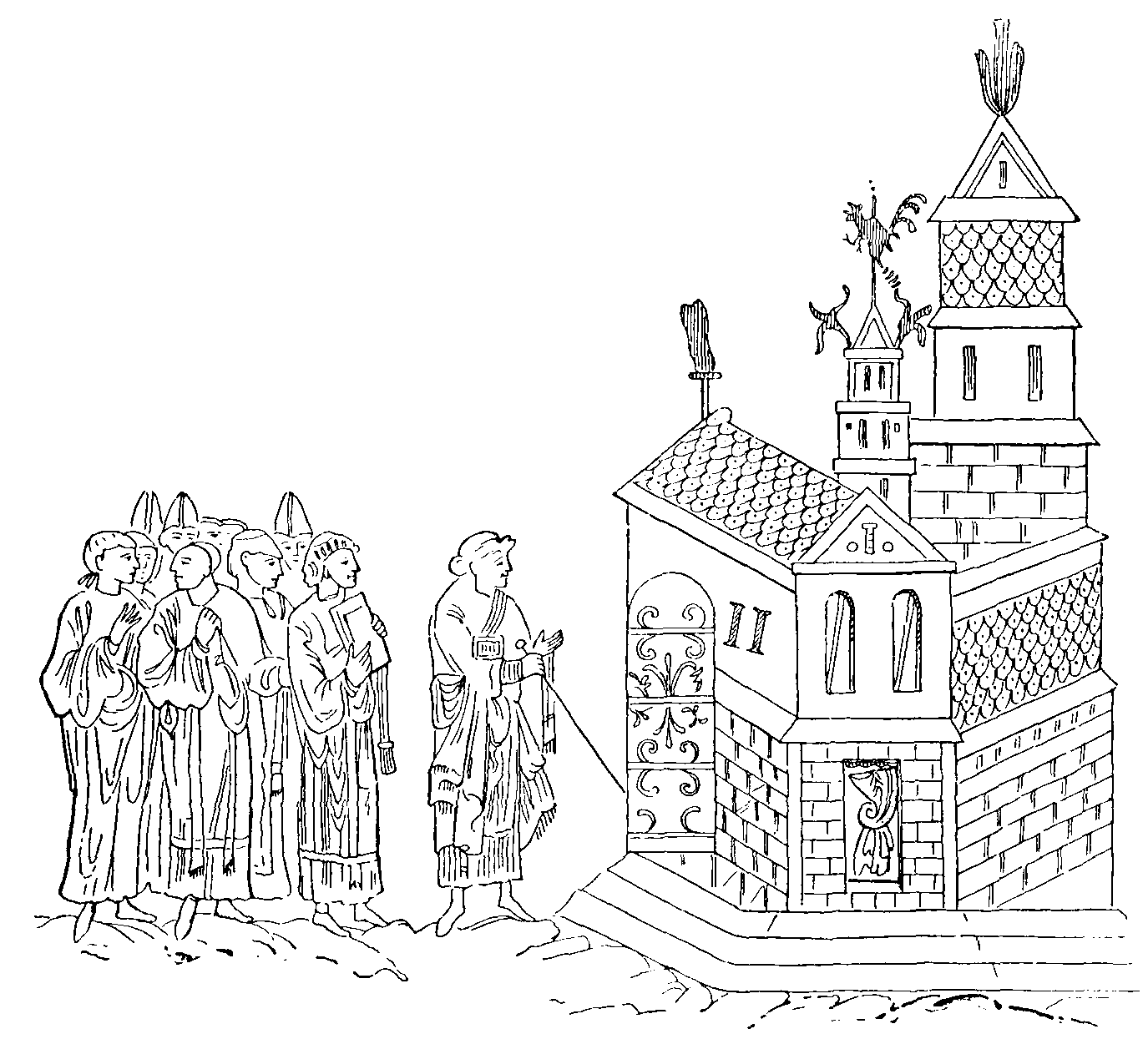
Consecration of a Saxon Church
From an ancient manuscript of Cædmon's poems.
With the reign of Mary the old religion was re-established; and it was not till that of Elizabeth that the Church of England was finally instituted in its present form. The doctrines of the Church were again modified, and the Forty-two Articles were reduced to thirty-nine by the convocation of the clergy in 1563. As no change was made in the episcopal form of government, and some rites and ceremonies were retained which many of the reformed considered as superstitious, this circumstance gave rise to many future dissensions. In 1559, before the close of the first year of Elizabeth's reign, the Acts of Supremacy and Uniformity were passed with the object of bringing about the entire subjection of the Church and the people in religious matters to the royal authority.
From James I some relief was anticipated by Puritans and Nonconformists, but they were disappointed. Under Charles I the attempt was made, through the instrumentality of Laud, to place all the Churches of Great Britain under the jurisdiction of bishops. But after the death of Laud the Parliament abolished the episcopal government, and condemned everything contrary to the doctrine, worship, and discipline of the Church of Geneva. As soon as Charles II was restored, the ancient forms of ecclesiastical government and public worship were re-established, and three severe measures were passed against nonconformity, namely, the Corporation Act of 1661, the Act of Uniformity, passed in 1662, and the Test Act, passed in 1673 (see Act of Uniformity, Corporation and Test Acts). In the reign of William III, and particularly in 1689, the divisions among the friends of Episcopacy gave rise to the two parties called the high-churchmen or non-jurors, and low-churchmen. The former maintained the doctrine of passive obedience to the sovereign; that the hereditary succession to the throne is of divine institution; and that the Church is subject to the jurisdiction of God alone. The gradual progress of civil and religious liberty since that time has settled practically all such controversies. The measures of relief granted to those outside the Established Church include the repeal of the Corporation and Test Acts (1828), Catholic emancipation (1829), and the opening of the old universities to Dissenters (1871).
The Established Church of England has always adhered to Episcopacy. Under the sovereign as supreme head, the Church is governed by three archbishops and forty bishops, of Canterbury, York, and Wales. The Archbishop of Canterbury is styled the Primate of all England, and to him belongs the privilege of crowning the kings and queens of England. The province of Canterbury comprehends 30 bishoprics; in the province of the Archbishop of York, who is styled Primate of England, there are 12 bishoprics, the province comprising Cheshire, Lancashire, Yorkshire, and the other northern counties. Wales has now been formed into a separate archbishopric. An Act was passed in 1914 disestablishing and disendowing the Church in Wales and Monmouthshire. The Act, suspended during the European War, came into force on 31st March, 1920. Archbishops and bishops are appointed by the sovereign by what is called acongé d'élire or leave to elect, naming the person to be chosen and sent to the Dean and Chapter. The National Assembly of the Church of England (Powers) Act of 1919 instituted a National Assembly in England consisting of the House of Bishops, a House of Clergy, and a House of Laymen, which has power to legislate in Church matters. The archbishops and bishops, to the number of 24, have seats in the House of Lords, and are styled Lords Spiritual. The following are the bishops' sees: London, Winchester, Bangor, Bath and Wells, Birmingham, Bradford, Bristol, Chelmsford, Chichester, Coventry, Ely, Exeter, Gloucester, Hereford, Ipswich, Lichfield, Lincoln, Llandaff, Norwich, Oxford, Peterborough, Rochester, St. Albans, St. Asaph, St. David's, Salisbury, Southwark, Southwell, Truro, Worcester, Durham, Carlisle, Chester, Liverpool, Manchester, Newcastle, Ripon, Sheffield, Wakefield, Sodor and Man. To every cathedral belong several prebendaries and a dean; these together, spoken of as 'the Dean and Chapter', form the council of the bishop. The bishops are aided in their work by 36 suffragan and assistant bishops in England and Wales. The ordinary clergy are the priests, whether curates, vicars, or rectors. A parson is a priest in full possession of all the rights of a parish church; if the great tithes are impropriated, the priest is called a vicar; if not, a rector; a curate (in popular speech) is one who exercises the spiritual office under a rector or vicar. The deacons form the third order of ordained clergy. The doctrines of the Church are contained in the Thirty-nine Articles; the form of worship is directed by the Book of Common Prayer. The revenue of the Church from endowments is over £6,000,000 annually. The clergy number about 27,000.—Bibliography: Wakeman, Introduction to the History of the Church of England; Newbolt and Stone, Church of England.
English Art.—As regards architecture little can be said with regard to the style prevalent between the invasion of the Anglo-Saxons and the Norman Conquest, from the fact that the remains of buildings erected in England before the Conquest are few and insignificant. The Norman style was introduced in the reign of Edward the Confessor, though the workmen, both then and after the Conquest, being English, the earlier work preserved many native characteristics. The Norman period proper extends from about 1090 to 1150, some of the best examples being parts of the cathedrals of Rochester, Winchester, Durham, and Canterbury. In the brief period 1160 to 1195 a marked change took place in the adoption of the pointed arch and what is known as the Early English style. Improved methods of construction led to the use of lighter walls and pillars instead of the heavy masses employed in the Norman style. Narrow lancet-shaped windows took the place of the round arch; bold projecting buttresses were introduced; and the roofs and spires became more lofty and more pointed, while in the interiors pointed arches rested on lofty clustered pillars. The best Early English type is Salisbury Cathedral. The Early English style has been regarded as lasting from 1190 to 1270, when the Decorated style of Gothic began to prevail. The transition to the Decorated style was gradual, but it may be considered as lasting to 1377. Exeter Cathedral is an excellent example of the earliest Decorated style. Between 1360 and 1399 the Decorated style gave place to the Perpendicular, which prevailed from 1377 to 1547, and was an exclusively English style. Gothic architecture, though it lingered on in many districts, practically came to an end in England in the reign of Henry VIII. The Elizabethan and Jacobean styles, which followed, were transitions from the Gothic to the Italian, with which these styles were more or less freely mixed. Many palatial mansions were built in these styles. In the reign of Charles I Inigo Jones designed, among other buildings, Whitehall Palace and Greenwich Hospital in a purely classic style. After the great fire in London (1666) Sir Christopher Wren designed an immense number of churches and other buildings in Classic style, particularly St. Paul's Cathedral, the Sheldonian Theatre of Oxford, and Chelsea Hospital. Various phases of Classic or Renaissance continued to prevail during the eighteenth and earlier part of the nineteenth century. About 1836 the Gothic revival commenced, and that style has been employed with considerable success in the churches erected in recent times. The Houses of Parliament, erected between 1840 and 1860 in the Tudor style, the Law Courts of Salford, St. Pancras railway station, and the Law Courts of London (opened 1882) in the Gothic served to sustain an impetus that had been given to the use of that style. At the present day Gothic is much employed for ecclesiastical and collegiate buildings, and a modified type of Renaissance for civil buildings. Of late years a style that has received the name of 'Queen Anne' is much in vogue for private residences. It is very mixed, but withal highly picturesque. The most striking novelties in the nineteenth century have been induced by the extensive use of iron and glass, as exemplified in the Exhibition building of 1851, the Crystal Palace, Sydenham, and the great railway stations.
Very little is known of the state of the art of painting among the Anglo-Saxons; but in the ninth century Alfred the Great caused numerous MSS. to be adorned with miniatures, and about the end of the tenth century Archbishop Dunstan won reputation as a miniature painter. Under William the Conqueror and his two sons the painting of large pictures began to be studied, and Lanfranc, Archbishop of Canterbury, adorned the vault of his church with paintings. Numerous miniatures of the thirteenth and fourteenth centuries have come down to us, rude in execution, but not without originality. From this period down to the eighteenth century a succession of foreign painters resided in England, of whom the chief were Mabuse, Hans Holbein, Federigo Zucchero, Cornelius Jansen, Van Dyck, Lely, and Kneller. Of native artists few are of importance prior to that original genius William Hogarth (1697-1764). Throughout the eighteenth century English artists attained higher eminence in portrait painting than in other departments, and it culminated in Sir Joshua Reynolds (1723-92), Thomas Gainsborough (1727-88), and Romney (1734-1802). These were followed by Raeburn (1756-1823) and Lawrence (1769-1830). Barry (1741-1806), West (1738-1820), and Copley (1737-1815) gained distinction in historical compositions, especially in pictures of battles. Landscape painting was represented by Richard Wilson (1714-82), who painted classical scenes with figures from heathen mythology, and by Gainsborough, already mentioned, who painted scenes of English nature and humble life. The Royal Academy of Arts, of which Reynolds was the first president, was established in London in 1769. Sir David Wilkie (1785-1841), in what is known abroad as genre painting, gained a European reputation that is unsurpassed. In the same class of art C. R. Leslie (1794-1859), Newton (1795-1835), Collins (1788-1847), and Mulready (1786-1863) gained great distinction. In landscape the reputation of Turner (1775-1857) stands alone. Other distinguished landscape painters are Clarkson Stanfield (1798-1867); David Roberts (1796-1864), who greatly excelled in picturesque architecture; Wm. Müller (1812-45); and John Constable (1776-1837), whose works exercised great influence in France; and Calcott (1799-1844). In historical painting Hilton (1786-1839), Eastlake (1793-1865), Etty (1787-1849), E. M. Ward (1816-79), C. W. Cope (1811-90), and D. Maclise (1811-70) attained celebrity. John Philip (1817-67) greatly distinguished himself by his scenes from Spanish life and by his mastery in colour. Landseer (1802-73) stands by himself as a painter of animals.
In 1824 the nucleus of the National Gallery was formed by the purchase of the Angerstein collection, and in 1832 the vote was passed for the erection of the National Gallery building. The competitions held in Westminster Hall in 1843, 1844, and 1847, with a view to the decoration of the Houses of Parliament, exercised great influence on art. Up to this time English pictures were rather distinguished for colour and effect of light and shade than for carefulness of modelling and exactness of drawing. In aiding to bring about a more accurate and careful style of work, the Pre-Raphaelites (1840-60), while seeking to restore in their practice an early phase of Italian art, exercised a beneficial influence, while they themselves ultimately abandoned the style to which at the first they had been devoted.
The modern group of British painters may be held to date from about 1850. Prominent among these the following may be named: In historical painting Leighton, Alma-Tadema, Watts, Poynter, Long, Goodall, Holman Hunt, Noel Paton, Burne-Jones, and Madox Brown, as also W. P. Frith, whose Derby Day and Railway Station, so descriptive of modern life, may well be classed as historical. In figure painting or genre T. Faed, Erskine Nicol, Fildes, Orchardson, Herkomer, Millais, and Pettie. In portraiture Millais, Frank Holl, Ouless, and Richmond. In landscape Linnell, Hook, W. J. Müller, Peter Graham, John Brett, Vicat Cole, H. Moore, Keeley Halswelle. In water-colours the most eminent artists have been Girtin (1773-1802), Cotman (1782-1842), Liverseege (1803-32), Stothard (1755-1834), Turner, David Cox (1788-1859), De Wint (1784-1849), Copley Fielding (1787-1855), Samuel Prout (1783-1852), W. H. Hunt (1790-1864), Louis Haghe (1806-85), W. L. Leitch (1804-83), Sam Bough (1822-78), John Gilbert (1817-97).—Bibliography: R. Muther, History of Modern Painting; S. Reinach, Apollo.
English sculpture was long merely an accessory to architecture, and few English sculptors are known by name till comparatively modern times. During the Renaissance period Torregiano came from Italy and executed two masterpieces in England, the tomb of the mother of Henry VII, and that of Henry himself at Westminster. The troubles of the reign of Charles I and the Commonwealth produced a stagnation in the art, and were the cause of the destruction of many valuable works. After the Restoration two sculptors of some note appeared, Grinling Gibbons, a wood-carver, and Caius Gabriel Cibber. During the eighteenth century there was no English sculptor of great eminence till John Flaxman (1755-1826). He had for rival and successor Sir Francis Chantrey (1781-1841), who acquired renown by the busts and statues which he made of many of the eminent men of his time. John Carew, Sir Richard Westmacott (1775-1856), E. H. Baily (1788-1867), John Gibson (1790-1866), P. MacDowell (1799-1870), H. Weekes (1807-77), J. H. Foley (1818-74), J. Edgar Boehm (1834-90), and Thomas Woolner (1825-92) are a few of the eminent sculptors of the nineteenth century. W. H. Thorneycroft, E. Onslow Ford, C. B. Birch, Alfred Gilbert, G. F. Watts, Henry H. Armstead, G. Simons, Sir Thomas Brock, Harry Bates, and Sir George Frampton are among the foremost sculptors of the present time. The sculptures of the English school in general are characterized by a sort of romantic grace which is their distinguishing mark, and by extraordinary delicacy and finish in detail; but they frequently exhibit weakness in their treatment of the nude.—Bibliography: Wilhelm Lübke, History of Sculpture; E. H. Short, History of Sculpture.
English Language.—The language spoken in England from the settlement of the Anglo-Saxons to the Norman Conquest (say 500-1066) is popularly known as Anglo-Saxon, though simply the earliest form of English. (See Anglo-Saxons.) It was a highly inflected and purely Teutonic tongue presenting several dialects. The Conquest introduced the Norman-French, and from 1066 to about 1250 two languages were spoken, the native English speaking their own language, the intruders speaking French. During this period the grammatical structure of the native language was greatly broken up, inflexions fell away, or were assimilated to each other; and towards the end of the period we find a few words written in a language resembling the English of our own day in grammar, but differing from it by being purely Saxon or Teutonic in vocabulary. Finally, the two languages began to mingle, and form one intelligible to the whole population, Normans as well as English, this change being marked by a great infusion of Norman-French words, and English proper being the result. English is thus, in its vocabulary, a composite language, deriving part of its stock of words from a Teutonic source and part from a Latin source, Norman-French being in the main merely a modified form of Latin. In its grammatical structure and general character, however, English is entirely Teutonic, and is classed with Dutch and Gothic among the Low German tongues. If we divide the history of the English language into periods, we shall find three most distinctly marked: first, the Old English or Anglo-Saxon, extending down to about 1100; second, the Middle English, 1100-1400 (to this period belong Chaucer, Wycliffe, Langland); third, Modern English. A more detailed subdivision would give transition periods connecting the main ones. The chief change which the language has experienced during the modern period consists in its absorbing new words from all quarters in obedience to the requirements of advancing science, more complicated social relations, and increased subtlety of thought. At the present time the rapid growth of the sciences already existing, and the creation of new ones, have caused whole groups of words to be introduced, chiefly from the Greek, though unfortunately not a few are hybrid words, coined by some scientist who had small Latin and less Greek.—Cf. H. Sweet, New English Grammar, Logical and Historical.
English Literature.—Before any English literature, in the strict sense of the term, existed, four literatures had arisen in England—the Celtic, Latin, Anglo-Saxon, and Anglo-Norman. The first includes such names as those of Taliesin, Llywarch Hen, Aneurin, and Merlin or Merddhin. The Latin literature prior to the Conquest presents those of Aldhelm, Bede, Alcuin, Asser, Ethelwerd, and Nennius. For Anglo-Saxon literature, see the article Anglo-Saxons. With the coming of the Normans, although the Anglo-Saxon Chronicle was continued until 1154, the native language practically ceased for a time to be employed in literature, Latin being used in law, history, and philosophy, French in the lighter forms of literature. The Norman trouvère displaced the Saxon scop, or gleeman, introducing the Fabliau and the Romance. By the Fabliau the literature was not greatly influenced until the time of Chaucer; but the Romance attained an early and striking development in the Arthurian cycle, founded upon the legends of Geoffrey of Monmouth's Latin History of the Britons (1147), by Geoffrey Gaimar, Wace, Walter Map, and other writers of the twelfth century. The Latin literature included important contributions to the Scholastic philosophy by Alexander Hales (died 1245), Duns Scotus (died 1308) and William of Occam (died 1347); the philosophic works of Roger Bacon (1214-92); the Golias poems of Walter Map; and a long list of chronicles or histories, either in prose or verse, by Eadmer (died 1124); Ordericus Vitalis (died 1142), William of Malmesbury (died 1143), Geoffrey of Monmouth (died 1154), Henry of Huntingdon (died after 1154), Joseph of Exeter (died 1195), Gervase of Tilbury (twelfth century), Roger of Wendover (died 1237), Roger de Hoveden (twelfth and thirteenth centuries), Giraldus Cambrensis (died 1222), Joscelin de Brakelonde (twelfth and thirteenth centuries), and Matthew Paris (died 1259).
Apart from a few brief fragments, the first English writings after the Conquest are the Brut of Layamon (about 1200), based on the Brut of Wace; and the Ormulum, a collection of metrical homilies attributed to Orm or Ormin, an Augustine monk. Next in importance come the rhyming chroniclers Robert of Gloucester (time of Henry III, Edward I) and Robert of Brunne or Mannyng (died 1340), other writers being Dan Michel of Northgate (Ayenbite of Inwyt, 1340); Richard Rolle of Hampole (Pricke of Conscience, 1340); Laurence Minot (author of eleven military ballads; died 1352); and several works of uncertain authorship, including the Ancren Riwle (? Richard Poor, died 1237), The Owl and the Nightingale (? Nicholas of Guildford), The Land of Cockayne (? Michael of Kildare), the song against the King of Almaigne, and a dialogue between the Body and the Soul. To this pre-Chaucerian period belong also several English translations of French romances—Horn, Tristrem, Alisaunder, Havelok, and others. Between the beginning and middle of the fourteenth century the English speech had entered upon a new phase of development in the absorption of Norman-French words. A rapid expansion of the literature followed, having as the foremost figure that of Chaucer (1340-1400), who, writing at first under French influences, and then under Italian, became in the end the most representative English writer of the time. Contemporary with him was the satirist William Langland or Langley (1332-1400), the indefatigable John Gower (1325-1408), and the Scot John Barbour (1316-95). In prose the name of John Wycliffe (1324-84) is pre-eminent, the English version of Mandeville's Travels being apparently of later date.
The period from the time of Chaucer to the appearance of Spenser, that is, from the end of the fourteenth to near the end of the sixteenth century, is a very barren one in English literature, in part probably owing to foreign and domestic wars, the struggle of the people towards political power, and the religious controversies preceding and attending the Reformation. The immediate successors of Chaucer, Occleve (1370-1454) and Lydgate (died 1460), were neither men of genius, and the centre of poetic creation was for the time transferred to Scotland, where James I (1394-1437) headed the list which comprises Andrew de Wyntoun (fifteenth century), Henry the Minstrel or Blind Harry (died after 1492), Robert Henryson (died before 1508), William Dunbar (1460-1520), Gavin Douglas (1474-1522), and Sir David Lyndsay (1490-1557). In England the literature was chiefly polemical, the only noteworthy prose prior to that of More being that of Reginald Pecock (1390-1460); Sir John Fortescue (1395-1485); the Paston Letters (1422-1505), which are, however, much more interesting for their subject matter than their style; and Malory's Morte d'Arthur (completed 1469-70); the only noteworthy verse, that of John Skelton (1460-1529).
It was now that several events of European importance combined to stimulate life and enlarge the mental horizon—the invention of printing, or rather of movable types, the promulgation of the Copernican system of astronomy, the discovery of America, the Renaissance, and the Reformation. The Renaissance spread from Florence to England by means of such men as Colet, Linacre, Erasmus, and Sir Thomas More (1480-1535), the last noteworthy as at the head of a new race of historians. Important contributions to the prose of the time were the Tyndale New Testament, printed in 1525, and the Coverdale Bible (1535). The first signs of an artistic advance in poetic literature are to be found in Wyatt (1503-42) and Surrey (1516-47), who nationalized the sonnet; Surrey was also a pioneer in the use of blank verse. The drama, too, had by this time reached a fairly high stage of development. The mystery and miracle plays, after the adoption of the vernacular in the fourteenth century, passed from the hands of the clergy into those of the laity, and both stage and drama underwent a rapid secularization. The morality began to embody matters of religious and political controversy, historical characters mingled with the personification of abstract qualities, real characters from contemporary life were introduced, and at length farces on the French model were constructed, the Interludes of John Heywood (died 1565) being the most important examples. To Nicholas Udall (1504-56) the first genuine comedy, Ralph Roister Doister, was due, this being shortly afterwards followed by John Still's Gammer Gurton's Needle (1566). The first tragedy, the Ferrex and Porrex, or Gorboduc of Sackville (died 1608) and Norton (died 1600), was performed in 1561, and the first prose play, the Supposes of Gascoigne (died 1577) in 1566. Gascoigne and Sackville were noteworthy amongst the earlier Elizabethans apart from their plays; but the figures which bulk most largely are those of Sidney (1554-86) and Spenser (1552-99). In drama Lyly, Peele, Greene, Nash, and Marlowe (1564-93) are the chief immediate precursors of Shakespeare (1564-1616), Marlowe alone, however, being at all comparable with the great master. Contemporary and later dramatic writers were Ben Jonson (1573-1637), the second great Elizabethan dramatist, Middleton (died 1627), Marston (better known as a satirist), Chapman (1557-1634), Thomas Heywood, Dekker (died 1639), Webster (seventeenth century), Ford (1586-1639), Beaumont (1586-1616) and Fletcher (1576-1625), and Massinger (1584-1640). The minor poets include Michael Drayton (1563-1631), Samuel Daniel (1562-1619), John Davies (1570-1626), John Donne (1573-1631), Giles Fletcher (1580-1623), and Phineas Fletcher (1584-1650), Drummond of Hawthornden (1585-1649). In Elizabethan prose the prominent names are those of Roger Ascham (1515-68), John Lyly (1553-1606), Hooker (1554-1600), Raleigh (1552-1618), Bacon (1561-1626), the founder in some regards of modern scientific method, Burton (1576-1640), Herbert of Cherbury (1581-1648), and Selden (1584-1654), with Overbury, Knolles, Holinshed, Stowe, Camden, Florio, and North. The issue of the Authorized Version of the Bible in 1611 may be said to close the prose list of the period, as it represents the finest flower of English prose.
After the death of James I the course of literature breaks up into three stages, the first from 1625 to 1640, in which the survivals from the Elizabethan Age slowly die away. The 'metaphysical poets', Cowley, Wither, Herbert, Crashaw, Habbington, and Quarles, and the cavalier poets, Suckling, Carew, Denham, all published poems before the close of this period, in which also Milton's early poems were composed, and the Comus and Lycidas published. The second stage (1640-60) was almost wholly given up to controversial prose, the Puritan revolution checking the production of pure literature. In this controversial prose of the time Milton was easily chief. With the Restoration a third stage was begun. Milton turned his new leisure to the composition of his great poems; the drama was revived, and Davenant and Dryden, with Otway, Southerne, Etherege, Wycherley, Congreve, Vanbrugh, and Farquhar in their first plays, and minor playwrights, are the most representative writers of the period. Butler established a genre in satire, and Marvell as a satirist in some respects anticipated Swift; Roscommon, Rochester, and Dorset contributed to the little poetry; while in prose we have Hobbes, Clarendon, Fuller, Sir Thomas Browne, Walton, Cotton, Pepys and Evelyn, John Bunyan, Locke, Sir William Temple, Owen Feltham, Sir Henry Wotton, James Harrington, and a crowd of theological writers, of whom the best known are Jeremy Taylor, Richard Baxter, Robert Barclay, William Penn, George Fox, Isaac Barrow, John Tillotson, Stillingfleet, Bishop Pearson, Sherlock, South, Sprat, Cudworth, and Burnet. Other features of the last part of the seventeenth century were the immense advance in physical science under Boyle, Isaac Newton, Harvey, and others, and the rise of the newspaper press.
Dryden's death in 1700 marks the commencement of the so-called Augustan Age in English literature. During it, however, no greater poet appeared than Pope (1688-1744), in whom sagacity, wit, and fancy take the place of the highest poetic faculty, but who was a supreme artist within the formal limits of his conception of the art of poetry. Against these formal limits signs of reaction are apparent in the verse of Thomson (1700-48), Gray (1716-71), Collins (1720-59), Goldsmith (1728-74), and in the productions of Macpherson and Chatterton. The poets Prior (1664-1721), Gay (1688-1732), and Ambrose Phillips (1671-1749) inherit from the later seventeenth century, Gay being memorable in connection with English opera; and there are many minor poets—Garth, John Philips, Blackmore, Parnell, Dyer, Somerville, Green, Shenstone, Blair, Akenside, Falconer, Anstey, Beattie, Allan Ramsay, and Robert Fergusson. It is in prose that the chief development of the eighteenth century is to be found. Defoe (1661-1731) and Swift (1667-1745) led the way in fiction and prose satire; Steele (1672-1729) and Addison (1672-1719), working on a suggestion of Defoe, established the periodical essay; Richardson (1689-1761), Fielding (1707-54), Smollett (1721-71), and Sterne raised the novel to sudden perfection. Goldsmith also falls into the fictional group as well as into that of the poets and of the essayists. Johnson (1709-84) exercised during the latter part of his life the power of a literary dictator, with Boswell (1740-95) as his 'Secretary of State'. The other chief prose writers were Bishop Berkeley (1685-1753), Arbuthnot (1675-1735), Shaftesbury (1671-1713), Bolingbroke (1678-1751), Burke, the historians David Hume (1711-76), William Robertson (1721-93), Edward Gibbon (1737-94); the political writers Wilkes and 'Junius', the economist and moral philosopher Adam Smith (1723-90); the philosophical writers Hume, Bentham (1749-1832), and Dugald Stewart (1753-1828); the scholars Bentley (1662-1742), Sir William Jones (1746-94), and Richard Porson (1759-1808); the theologians Atterbury, Butler (1692-1752), Warburton, and Paley; and some playwrights, of whom the most important was Sheridan, but who also included Rowe, John Home, Colley Cibber, Colman the elder, and Foote.
With the French Revolution, or a few years earlier, the modern movement in literature may be said to have commenced. The departure from the old traditions, traceable in Gray and Collins, was more clearly exhibited in the last years of the century in Cowper (1731-1800) and Burns (1759-96), and was developed and perfected in the hands of Blake (1757-1828), Bowles (1762-1850), and the 'Lake poets' Wordsworth (1770-1850), Coleridge (1772-1834), and Southey (1774-1843); but there were at first many survivals from the poetic manner of the seventeenth century, such as Erasmus Darwin (1731-1802), Dr. John Wolcot (1738-1819), and Samuel Rogers (1763-1855). Amongst the earlier poets of the nineteenth century, also, were George Crabbe (1754-1832), Sir Walter Scott (1771-1832), Hogg (1772-1835), Campbell (1777-1844), James Montgomery, Mrs. Hemans, Bryan Waller Procter ('Barry Cornwall'), Joanna Baillie, Robert Montgomery. A more important group was that of Byron (1788-1824), Shelley (1792-1822), and Keats (1796-1821), with which may be associated the names of Leigh Hunt (1784-1859), Thomas Moore (1779-1852), and Landor (1775-1864). Among the earlier writers of fiction there were several women of note, such as Maria Edgeworth (1767-1849) and Jane Austen (1775-1817). The greatest name in fiction is unquestionably that of Scott. Other prose writers were Malthus, Hallam, James Mill, Southey, Hannah More, Cobbett, William Hazlitt, Sydney Smith, Francis Jeffrey, Lord Brougham. In the literature since 1830 poetry has included as its chief names those of Praed, Hood, Sidney Dobell, Gerald Massey, Charles Mackay, Philip James Bailey, William Allingham, Elizabeth Barrett Browning, Coventry Patmore, the second Lord Lytton ('Owen Meredith'), Arthur Hugh Clough, Matthew Arnold, Dante G. Rossetti, Robert Buchanan, Wm. Morris, Lewis Morris, Jean Ingelow, Swinburne, and last and greatest, Tennyson and Browning. Among more modern English poets are Stephen Phillips (1868-1915), Francis Thompson (1860-1907), Sir William Watson (born 1858), John Davidson (1857-1909), and R. Kipling (born 1865). A brilliant list of nineteenth-century novelists includes Marryat, Michael Scott, the first Lord Lytton, Ainsworth, Benjamin Disraeli (Earl of Beaconsfield), Dickens, Thackeray, Charles Kingsley, Charlotte Brontë, Lover, Lever, Wilkie Collins, Mayne Reid, Charles Reade, George Eliot, Anthony Trollope, William Black, Thomas Hardy, R. D. Blackmore, George Meredith, R. L. Stevenson, Miss Braddon, Mrs. Craik (Miss Mulock), Mrs. Oliphant, Miss Yonge, and others. Towards the end of the nineteenth and at the beginning of the twentieth century there was a deepening interest in the drama, and the list of brilliant dramatists includes the names of Barrie, H. A. Jones, G. B. Shaw, Pinero, Granville Barker, and others. The tendency in the fiction of the twentieth century is a concrete and imaginative presentation of the social, ethical, and sentimental problems of the day. This tendency is clearly seen in the novels of John Galsworthy and H. G. Wells. To the historical and biographical list of the nineteenth century belong Macaulay, Buckle, Carlyle, Thirwall, Grote, Milman, Froude, Lecky, S. R. Gardiner, Kinglake, John Richard Green, E. A. Freeman, Stubbs, Dean Stanley, John Morley, Leslie Stephen. In science and philosophy among the chief writers of the nineteenth century have been Whewell, Sir W. Hamilton, Mansel, John Stuart Mill, Alexander Bain, Hugh Miller, Charles Darwin, Huxley, Tyndall, Max Müller, Herbert Spencer, T. H. Green.—Bibliography: Cambridge History of English Literature; Taine, History of English Literature; Saintsbury, Short History of English Literature; Chambers, Cyclopædia of English Literature.
English Architecture, Art, Church, Language, Literature, &c. See England.
English Channel (Fr. La Manche, the sleeve), the arm of the sea which separates England from France, extending, on the English side, from Dover to Land's End; and on the French, from Calais to the Island of Ushant. On the east it communicates with the North Sea by the Straits of Dover, 21 miles wide; and on the west it opens into the Atlantic by an entrance about 100 miles wide. At its greatest breadth it is about 150 miles. The pilchard and mackerel fisheries are very important. The advantages of a railway tunnel under the Channel at or near its narrowest part have been frequently urged; and an English company, formed in 1887 for constructing a tunnel from Dover, to meet a similar tunnel starting from near Calais, has pushed an excavation under the sea for over 2000 yards. The plan, opposed by the British Government for military reasons in 1907, has now been approved of. Plans have also been put forward for a railway bridge across the Straits of Dover.
Engraving, the art of drawing or writing on metal, wood, precious stones, &c., by means of incisions made with instruments variously adapted to the substances operated upon and the description of work intended. The term is also applied to the work so performed, and to impressions taken on paper or similar material from the engraved work. Impressions from metal plates are called engravings, prints, or plates; those printed from wood being termed indifferently wood engravings or wood-cuts. While, however, these impressions are not altogether dissimilar in appearance, the processes are distinct. As a rule, in prints from metal the lines intended to print are incised, and in order to take an impression the plate is daubed over with a thick ink which fills all the lines. The surface is then wiped perfectly clean, leaving only the incised lines filled with ink. A piece of damp paper is then laid on the face of the plate, and both are passed through the press, which causes the ink to pass from the plate to the paper. This operation needs to be repeated for every impression. In the wood block, on the contrary, the spaces between the lines of the drawing are cut out, leaving the lines standing up like type, the printing being from the inked surface of the raised lines, and effected much more rapidly than plate printing. This process has also been used to a certain extent with metal.
Engraving on wood, intended for printing or impressing from, long preceded engraving on metals. The art is of Eastern origin, and at least as early as the tenth century engraving and printing from wood blocks was common in China. We first hear of wood engraving being cultivated in Europe by the Italians and Germans for impressing patterns on textiles, but no paper impressions earlier than the fourteenth century are known. For a hundred years there is small indication of the practice of the art, which was at first confined to the production of block-books, playing-cards, and religious prints. According to Vasari, the art of printing from engraved plates was discovered in Florence by Maso Finiguerra about 1460, but engravings of earlier date are known to exist. Engraving had long been used as a means of decorating armour, metal vessels, &c., the engravers generally securing duplicates of their works before laying in the niello (a species of metallic enamel) by taking casts of them in sulphur, and rubbing the lines with black. The discovery of the practicability of taking impressions upon paper helped the development of engraving upon copper plates for the purpose of printing from. The date of the earliest known niello proof upon paper is 1452. The work of the Florentine engravers, however, was almost at once surpassed in Venice and elsewhere in North Italy by Andrea Mantegna (1431-1506), Girolamo Mocetto, Jacopo de' Barbari, and others. In Marc Antonio Raimondi (1475-1534), who wrought under the guidance of Raphael, and reproduced many of his works, the art reached its highest point of the earlier period, and Rome became the centre of a new school, which included Marco da Ravenna (died 1527), Giulio Bonasone (1531-72), and Agostino de Musis (flourished 1536). In the meantime, in Germany the progress of the art had been not less rapid. Of the oldest school the most important engraver is Martin Schongauer (1420-88). He was, however, surpassed a generation later by Albert Dürer (1471-1528), who excelled both in copper and wood engraving, especially in the latter, and also etched a few plates. Among his most famous contemporaries and successors were Burgkmair and Lucas Cranach. The Dutch and Flemish schools, of which Dürer's contemporary Lucas van Leyden was the head, did much to enlarge the scope of the art, either by paying increased attention to the rendering of light and shade, and the expression of tone and surface quality, as in the case of Cornelius Cort and Bloemart; or by developing freedom and expression of line, as in the case of Goltzius and his pupils. Rubens (1577-1640) influenced engraving through the two Bolswerts, Vorstermann, Pontius, and P. de Jode, who engraved many of his works on a large size. Towards the end of the seventeenth century etching, which had before been rarely used, became more common, and was practised with supreme mastery by Rembrandt (1607-69) and other painters of that period. In France, Noel Garnier founded a school of engraving about the middle of the sixteenth century; but it produced no work of any high distinction until the reign of Louis XIV, when Robert Nanteuil, his follower Gerard Edelinck, and Antoine Masson produced many fine portraits, and Gerard Audran engraved works by Nicolas Poussin and Le Brun. Jacques Callot also produced some admirable etchings. These were followed about the middle of the eighteenth century by Wille (1717-1807), a German resident in Paris, who gave new vitality to a waning art, and by the school of French illustrators. Before the middle of the seventeenth century England produced little noteworthy work, availing herself principally of the work of foreign engravers such as Wenzel Hollar, of whom many took up temporary and even permanent residence. The first English engraver of marked importance was William Hogarth (1697-1764), whose works are distinguished for a power of vivid characterization. Vivares (1712-82), a Frenchman by birth, laid the foundation of the English school of landscape engraving, which was still further developed by William Woollet (1735-85), who was also an excellent engraver of the human figure. In historical engraving a not less remarkable advance was made by Sir Robert Strange (1721-92); and Richard Earlom (1743-1822), Valentine Green, and J. R. Smith produced some admirable works in mezzotint. In succession to these came William Sharp (1746-1824), James Bazire (1730-1802), Bartolozzi (1727-1815), who practised stipple engraving, James Heath, Bromley, Raimbach, and others. The substitution of steel for copper plates (1820-30) gave the power of producing a much larger number of fine impressions, and opened new possibilities for highly finished work. During the closing years of the eighteenth century, line engraving attained a depth of colour and fullness of tone in which earlier works are often deficient, and during the following century it reached a perfectness of finish which it had not previously attained. A picture, whether figure or landscape, came to be translated by line engraving with all its depth of colour, delicacy of tone, and effect of light and shade; the various textures, whether of naked flesh, silk, satin, woollen, or velvet, were all successfully rendered by ingenious modes of laying the lines and combinations of lines of varying strength, width, and depth. At the same time, original work by engravers declined in quality. Among engravers who have produced historical works of large size and in the line manner the names of Raphael Morghen (1758-1833), Longhi (1766-1831), Anderloni (1784-1849), Garavaglia (1790-1835), and Toschi, in Italy; of Forster (1790-1872), Henriquel-Dupont (born 1797), Bridoux (born 1812), and Blanchard (born 1819), in France; of John Burnet (1784-1868), J. H. Robinson (1796-1871), Geo. T. Doo (1800-86), J. H. Watt (1799-1867), and Lumb Stocks (1812-92), in England, stand pre-eminent. Among historical and portrait engravers in the stipple or dotted manner the names of H. T. Ryall, Henry Robinson, William Holl (1807-71), and Francis Holl may be mentioned. In the period 1820-60 landscape engraving attained a perfection in Great Britain which it had not attained in any other country, or at any other time. In fact, most of the work was done by etching, details being sharpened by the graver. Among landscape engravers the names of Geo. Cooke (1781-1834), William Miller (1796-1882), E. Goodall (1795-1870), J. Cousen (1804-80), R. Brandard (1805-62), and Wm. Forrest (born 1805) hold the foremost places. Most of these were associated with the reproduction of Turner's pictures, and owed much to his control and direction. In mezzotint engraving Samuel Cousins (1801-87) and David Lucas, who was associated with John Constable in the 'English Landscape' series, achieved considerable success. In the period 1830-45 various publications called Annuals, composed of light literature in prose and verse, and illustrated by highly finished engravings in steel, were very popular. The engravings were necessarily of small size, and are generally of great excellence. A number of them, both figure and landscape, are executed with such finish and completeness as to be esteemed perfect works. The illustrations of Rogers's Poems and Rogers's Italy after Turner and Stothard belong to this period. Many of the originals of the engravings in the Annuals were finished pictures of large size. A great part of the difficulty in engraving on a small scale from a large picture consists in determining what details can be left out, and still preserve the full effect and character of the original. The most noted engravers for work of this kind are Charles Heath, Charles Rolls, W. Finden, E. Finden, E. Portbury, J. Goodyear, F. Engleheart, Henry le Keux, E. Goodall, and W. Miller. Since 1870 many reproductions of paintings have been produced by means of etching, a comparatively cheap and rapid process. Such works have been fashionable and very popular with collectors. But while some of them have been excellent of their kind, the process is of limited resource, and the best works in this manner do not compare with the masterpieces of line engraving. In original work, however, etching and dry-point (q.v.) have produced some excellent work, notably in the hands of Charles Meryon, J. M. Whistler, Sir Seymour Haden, and Anders Zorn. A revival of mezzotint owes much to Sir Frank Short. Through lack of encouragement, change of fashion, and the adoption of other methods of reproduction, line engraving on metal has become almost a lost art in Great Britain, though a revival in wood engraving has taken place of recent years.
Line Engraving, as implied by the term, is executed entirely in lines. The tools are few and simple. They consist of the graver or burin, the scraper, to remove the burr left by the graver, and the burnisher; an oil-stone or hone, dividers, a parallel square, a magnifying lens; a bridge on which to rest the hand; a blind or shade of tissue paper, to make the light fall equally on the plate, callipers for levelling important erasures, a small steel anvil, a small pointed hammer, and punches. In etching, the following articles are required: a resinous mixture called etching-ground, capable, when spread very thinly over the plate, of resisting the action of the acids used; a dabber for laying the ground equally; an etching needle; a hand-vice; some brushes of different sizes; and bordering wax, made of burgundy-pitch, bees'-wax, and a little oil.
In etching, the plate, which is highly polished and must be free from all scratches, is first prepared by spreading over it a thin layer of ground. The surface is then smoked, and the outline of the picture transferred to it by pressure from the paper on which it has been drawn in fine outlines by a black-lead pencil. The picture is then drawn on the ground with the etching-needle, which removes the ground in every form produced by it, and leaves the bright metal exposed. Sometimes, however, the drawing is made direct, without the use of tracing. A bank of wax is then put round the plate and diluted acid poured on it, which eats out the metal from the lines from which the ground has been removed, but leaves the rest of the plate untouched. (See also Dry-point.) In landscape engraving, as practised in England in the early nineteenth century, the plate is then gone over with the graver, the etched lines clearly defined, broken lines connected, new lines added, &c. Sometimes the plate is rebitten more than once, those parts which are sufficiently bitten in the first treatment being stopped with varnish, and only the selected parts exposed to after-biting. Finally the burnisher is brought into play alternately with the graver and point to give perfectness and finish. In engraving proper, the lines are first drawn on the metal with a fine point and then cut in by the graver, first making a fine line, and afterwards entering and re-entering till the desired width and depth of lines is attained. Much of the excellence of such engravings depends on the mode in which the lines are laid, their relative thickness, and the manner in which they cross each other. In this method of engraving etching is but little used, if at all, and then only for accessories and the less important parts.
Soft-ground Etching.—The ground, made by mixing lard with common etching-ground, is laid on the plate and smoked as before, but its extreme softness renders it very liable to injury. The outline of the subject is drawn on a piece of paper larger than the plate. The paper is then damped, and laid gently over the ground, face upwards, and the margins folded over and pasted down on the back of the plate. When the paper is dry and tightly stretched, a bridge is laid across, and with a hardish pencil and firm pressure the drawing is completed in the usual manner. The pressure makes the ground adhere to the back of the paper at all parts touched by the pencil, and on the paper being lifted carefully off, these parts of the ground are lifted with it, and the corresponding parts of the plate thus left bare are exposed to the subsequent action of the acid. The granulated surface of the paper, causing similar granulations in the touches on the ground, gives the character of a chalk drawing. The biting-in is effected in the same manner as already described, and the subject may be finished by rebiting and dotting with the graver. See Etching.
Stipple, or Chalk Engraving, in its pure state, is exclusively composed of dots, made with a special form of graver, varying in size and form as the nature of the subject demands, but few stipple plates are now produced without a large admixture of line in all parts, flesh excepted. Etching is often used to put in the more important lines and tone masses.
The processes of Aquatint and Mezzotint will be found under their respective heads, the latter differing from all other styles of engraving in that the lights and gradations are scraped or burnished out of a plate prepared so that it would print quite dark all over, instead of the forms being corroded or cut into a plain surface.
The Mixed Style is based on mezzotint, which, still forming the great mass of shading, is in this method combined with etching in the darker, and stipple in the more delicate parts. By this combination a plate will produce a larger number of good impressions than it would if it were done entirely in mezzotint.
Engraving on Wood.—The wood best adapted for engraving is box. It is cut across the grain in thickness equal to the height of type, these slices being subjected to a lengthened process of seasoning, and then smoothed for use. Every wood engraving is the representative of a finished drawing previously made on the block, the unshaded parts being cut away, and the lines giving form, shading, texture, &c., left standing in relief by excavations of varied size and character, made between them by gravers of different forms. Drawings on wood are made either with black-lead pencil alone or with pencil and indian ink, the latter being employed for the broader and darker masses. It is now much the practice to photograph drawings made in black and white upon the wood instead of making the drawing on the wood block. When the drawing is put on the wood by washes or by photography, instead of being entirely done by pencil lines, the engraver has to devise the width and style of lines to be employed instead of cutting in facsimile, as is the case when the drawing is made entirely in lines. The tools required for wood engraving are similar but more numerous than those of the engraver on copper or steel. See also Die-sinking; Gems.—Bibliography: W. Y. Ottley, Early History of Engraving; G. Duplessis, History of Engraving in France; P. G. Hamerton, Graphic Arts; F. Wedmore, Fine Prints; A. M. Hind, A Short History of Engraving and Etching; J. H. Slater, Engravings and their Value; H. C. Levis, Engraving and Collecting of Prints: Bibliography.
Engrossing, Forestalling, and Regrating, terms formerly in use for the purchase of corn or other commodities in order to sell again at a higher price, or in order to raise the market price of the same. The modern equivalent is 'making a corner'. These practices were once regarded as criminal, and positive statutes against them were passed in England in 1266-7, in 1350-2, in 1552, in 1562, and in 1570. The offence of engrossing was described by the statute of Edward III as the "getting into one's possession, or buying up, large quantities of corn, or other dead victuals, with intent to sell them again"; forestalling, as the "buying or contracting for any cattle, merchandise, or victual, coming in the way to the market, or dissuading persons from bringing their goods or provisions there, or persuading them to enhance the price when there"; and regrating, "the buying of corn or other dead victual in any market and selling it again in the same market, or within 4 miles of the place". By the statute of Edward VI the engrossing of corn, which included the buying of it in one market to sell it in another, was made punishable by imprisonment and pillory; and no one could carry corn from one part of the kingdom to another without a licence. All the positive statutes against these offences were repealed in 1772, but they were still found to be punishable by common law, and it was not till 1844 that they entirely ceased to rank among offences.
Enharmon´ic, in music, is an epithet applied to intervals smaller than the regular divisions of the scale, i.e. less than semitones. Enharmonic intervals can be produced on stringed instruments, or on specially constructed fixed-tone instruments having more than twelve divisions in the octave.
Enkhuizen (engk´hoi-zn), a seaport of Holland, on a projection in the Zuider Zee, 29 miles north-east of Amsterdam. It had formerly a pop. of 40,000, but the silting up of the harbour has caused its decay, and its inhabitants number now about 7110.
Enlist´ment, the act of engaging oneself or another to perform any service. In general, the use of the word is confined to engagements for the public service, and more especially in the armed forces of the Crown. In earlier days enlistment of soldiers was either for an indefinite period, as, for instance, for a particular war or campaign, or for life. Up to the middle of the seventeenth century enlistments were made to serve the officer raising the force under a contract from the Crown; after this period all enlistments were to serve the king. In both cases they were for a particular regiment only. For the next hundred years troops continued to be raised both in peace and war on the contract system, which by now implied that the officer accepting the contract, in addition to having a considerable say in the matter of allotting commissions to his friends, received a lump sum to cover all expenses of recruiting, pay, and clothing, out of which he and his officers made what they could. The objections to such a system are palpable, and it was abolished in 1783, after which year all duties with regard to the enlistment of troops were placed in the hands of a Director of Recruiting and Organization. The contract system was last used in war as late as the fifties of the last century during the Crimean War. For some eighty years prior to 1847 the term of enlistment was ordinarily for life, but from that year onward to 1870 various systems of limited enlistment were in force. In 1870, with the idea of forming a reserve, the principle of short service was introduced by the Army Enlistment Act, and this principle has been continued by all succeeding legislation. The existing law as to enlistment is to be found in Part II of the Army Act, Sections 78 to 101; more detailed instructions are in the Recruiting Regulations. The Army Act, brought into force annually by the Army (Annual) Act, specifies the term of original enlistment to be twelve years, which may be either entirely in army (colour) service, or partly in colour service and partly in the reserve. In practice the normal terms are seven years' colour service and five years' reserve service for the infantry, with certain modifications in the case of other arms. Enlistment may be made for general service or for a particular corps, and in the latter case the recruit will be posted to that corps only, and will ordinarily spend his whole service in it. A man desiring to enlist should present himself at a recruiting office, where he will be given a notice setting forth the terms of service. If, after reading the conditions, he still desires to enlist, he will be directed to appear before a justice of the peace (a recruiting officer is ex officio a justice of the peace for this purpose) for attestation. Attestation consists in giving signed answers to certain questions contained in the Form of Attestation, and in taking the oath of allegiance. The completed form is then signed by the justice, and the man becomes a properly enlisted and attested soldier. The former practice of giving a shilling to every prospective recruit, and thereafter considering him for some purposes a soldier, is no longer recognized, and, at any time before signing the attestation paper, the man may decline to complete his bargain without rendering himself liable to any penalty. Should he, however, make a false answer to certain of the questions contained in his attestation paper, he is liable to punishment on conviction by court-martial.
Ennis, a town (formerly a parliamentary borough) in Ireland, County Clare, on the Fergus, 19 miles north-west of Limerick. It is irregularly built, the streets being narrow and crooked. There are remains of a Franciscan abbey founded in 1240. Some linen and flannel are manufactured, and there is a trade in agricultural produce. Pop. 5472.
Enniscor´thy, a town in Ireland, County Wexford, on the River Slaney, 77 miles south of Dublin. An old castle erected by one of the early Norman conquerors is in the centre of the town. Vinegar Hill in the immediate vicinity was the scene of a skirmish in 1798, when the town was stormed and burned by the rebels. Pop. 5495.
Enniskil´len, a town (formerly a parliamentary borough), Ireland, County Fermanagh, 34 miles north-east of Sligo, on an island in the river which connects the upper and lower sections of Lough Erne, with suburbs on both sides of the adjoining mainland, with which it communicates by two bridges; a well-built, clean, thriving town. Pop. 4847.
En´nius, Quintus, the father of Latin poetry, was born at Rudiæ, in Calabria, in 239 B.C., and died in 170 B.C. Like our own early poet Gower, he was trilingual, speaking Greek, Oscan, and Latin. He was of good family, and claimed descent from the legendary kings of Calabria. Little is known of his life; he served in the Second Punic War, and held the rank of centurion in 204 B.C.; at a later date he went to Rome, supported himself by teaching, and was friendly with the greatest of his contemporaries. He died of gout in his seventieth year. Ennius was a man of great versatility. He held perhaps the foremost place among writers of tragedies at Rome. He wrote good comedies. He wrote satires, and prepared the way for Lucilius. He wrote didactic poetry, and prepared the way for Lucretius. Most important of all, he wrote epic poetry—the Annales—and prepared the way for Virgil. He was the first to transplant the hexameter into Italy. His predecessors wrote in a rough kind of verse scanned by accent rather than quantity, and known as 'Saturnian verse'. Ennius contemptuously called this "the verse of fauns and soothsayers", and introduced the strong-winged music of Homer into his verse. He also brought in the elegiac couplet, which was to attain perfection at the hands of Propertius and Ovid. He left a permanent impress on the language. He made a systematic study of orthography, and invented a system of shorthand. He was fond of philosophical speculations, and made the Romans acquainted with the rationalism of Euripides and Euhemerus. He was, therefore, a remarkably versatile and prolific writer. His translations from the Greek tragedians were of the greatest importance in the history of Roman drama. His chief fame, however, rests upon his Annales, a great epic in eighteen books. Like all of the works of Ennius, it only survives in fragments quoted by later writers. It was a great national epic, recording the history of the Roman state from the landing of Æneas down to the poet's own time. The city itself—urbs quam dicunt Romam—may be said to have been the central figure of his poem, a nobler figure than the pious Æneas. The verse of Ennius is sometimes crude and harsh, but it contains many fine lines and grand passages. Some of these lines are world-famous, like those on Fabius Maximus beginning with
Unus homo nobis cunctando restituit rem,
or the great line
Moribus antiquis res stat Romana virisque,
which sums up some of the qualities which placed Rome at the head of the civilized world. In a famous simile Quintilian (Inst. Or. x, 1, 88) compares Ennius to a sacred grove of ancient oaks, whose massive immemorial trunks are awe-inspiring rather than beautiful. In his own epitaph Ennius boasted that he still lived as he passed to and fro through the mouths of men (volito vivu' per ora virum). Though his works are lost, this is still true, for he inspired Virgil and influenced all Latin literature.—Bibliography: W. Y. Sellar, Roman Poets of the Republic; L. Müller, Quintus Ennius; J. W. Duff, A Literary History of Rome.
Enns, a river in Austria, which rises in the Alps of Salzburg, flows N., then E.N.E., then N.N.W., entering Upper Austria (Ober der Enns), which for 15 miles it separates from Lower Austria (Unter der Enns), and finally enters the Danube a little below the town of Enns (4438 inhabitants). Total course about 150 miles.
Enoch (ē´nok), (1) the eldest son of Cain, who called the city which he built after his name (Gen. iv, 17). (2) One of the patriarchs, the father of Methuselah. He "walked with God; and he was not; for God took him" (Gen. v, 24) at the age of 365 years. The words quoted are generally understood to mean that Enoch did not die a natural death, but was removed as Elijah was.
Enoch, Book of, an apocryphal book of an assumedly prophetical character, to which considerable importance has been attached, particularly on account of St. Jude quoting it in the 14th and 15th verses of his Epistle. It is referred to by many of the early Fathers; is of unknown authorship, but was probably written by a Palestinian Jew in Hebrew or Aramaic, was translated into Greek, and from the Greek the existing Ethiopic version was made in the first or second century B.C. Till the end of the eighteenth century it was known in Europe only by the references of early writers. On his return, Bruce, the African traveller, brought with him from Abyssinia two manuscripts containing the Ethiopic translation of it. In 1821 Archbishop Laurence published a translation of the work, and in 1838 the Ethiopic text followed. The Book of Enoch has since been repeatedly published, translated, and criticized.
E´nos, a seaport in Thrace, 38 miles N.W. of Gallipoli, on the Ægean Sea, in the Gulf of Enos. Pop. 6940.—The Gulf of Enos is 14 miles in length by about 5 miles in breadth.
Enschede (ens´he-dā), a town of Holland, province of Overijssel, near the Prussian frontier, the chief seat of cotton manufacture in Holland. It has increased rapidly in recent years. Pop. 41,600.
Ensena´da (in Sp., a creek or natural harbour), a seaport of the Argentine Republic, province of Buenos Ayres, the port of the town of La Plata, with which it is connected by rail and tramway, with recently constructed harbour works.—Another place of the same name is a rising port of Mexico, in the northern part of the peninsula of California on the Pacific, in the Bay of Todos los Santos, with gold- and copper-mines adjacent.
En´sign, formerly, in the British army, the officer who carried the flag or colours of an infantry regiment; for this title, second lieutenant has been substituted since 1871. In naval language the ensign is the flag over the poop or stern which distinguishes the ships of different nations. In the Royal Navy of Britain it is a flag with a white field divided into quarters by the red cross of St. George, and having the union (or Union Jack, as it is commonly called) in the upper corner next the staff. A similar ensign with a red field is flown by the merchant service.
En´silage, in agriculture, a mode of storing green fodder or vegetables in receptacles called 'silos'. These are usually pits of quadrangular form, lined with wood, brick, concrete, or stone. The fodder is cut and mixed, placed in the silo, pressed down, and kept compressed by heavy weights placed on a movable wooden covering. It undergoes a slight fermentation, and attains a slightly acid taste and smell, which is particularly grateful to cattle. The modern system of ensilage dates from about 1875, but the practice was known to the ancient Romans, and the system has been common in Mexico for centuries. Such advantages are claimed for it, as that in a wet season grass can be made into ensilage instead of hay, and that there is little loss of nutritive elements, while it has great feeding powers. Successful experiments have shown that green fodder may be converted into ensilage without a pit by simply piling up and consolidating by pressure.
Entab´lature (Lat. in, and tabula, a tablet), in architecture, the horizontal, continuous work which rests upon a row of columns, and belongs especially to classical architecture. It consists of three principal divisions—the architrave immediately above the abacus of the column, next the frieze, and then the cornice. In large buildings projections similar to and known also as entablatures are often carried round the whole edifice, or along one front of it.
Entablature of Tuscan Column
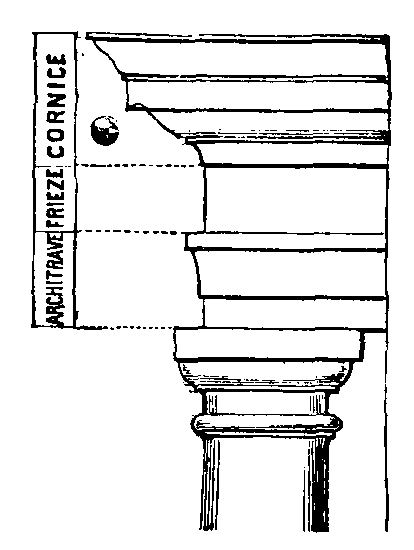
Enta´da, a genus of leguminous plants, subord. Mimoseæ, containing about a dozen species of climbing tropical shrubs, remarkable for the great size of their pods. E. scandens has pods which measure from 6 to 8 feet in length. They are sometimes carried from America to the coasts of Europe by the Gulf Stream. The seeds have a hard, woody, and beautifully polished shell, and are often made into snuff-boxes, scent-bottles, and other small articles.
Entail´, in law, the settlement of an estate by which a freehold is limited to a person and the heirs of his body, with such particular restrictions as the donor may specify. Entailed estates are divided into general and special, the former when the estate is given to the donee and the heirs of his body without exception, the latter when the estate is limited to certain heirs to the exclusion of others. By a Bill introduced into Parliament in 1920 it is proposed that a tenant in tail should have power of disposal by will.
En´tasis, in architecture, the delicate and almost imperceptible swelling of the lower part of the shaft of a column, to be found in almost all the Grecian examples, adopted to give a more pleasing effect to the eye.
Entel´lus, an East Indian species of monkey, of the genus Semnopithēcus (S. entellus). It has yellowish fur, with a face of a violet tinge, and a long and powerful tail, which, however, is not prehensile. It receives divine honours from the natives of India, by whom it is termed Hanuman. Costly temples are dedicated to these animals; hospitals are built for their reception, and large fortunes are bequeathed for their support. The entellus abounds in India; enters the houses and gardens of the natives, plunders them of fruit and eatables, and the visit is even considered an honour.
Entente Cordiale, a term applied in international politics to friendly relations existing between different countries and statesmen. It is not a formal alliance, but denotes the existing community of interests and friendly sentiments between two countries. The term has been especially applied to the friendly relations which existed between France and England ever since the reign of Edward VII down to the formal alliance concluded at the outbreak of the European War.
Enteric Fever, or Typhoid Fever, is an acute infectious fever, characterized by much general disturbance, and giving rise to ulceration in the small intestine. The distinction between this fever and typhus fever was only established in the middle of last century. It is due to a bacillus, difficult to detect, but during an attack found in many of the internal organs as well as in the stools, urine, and blood of the affected person. Enteric fever occurs in all parts of the world, and in most countries it is endemic, with occasional outbursts of epidemic prevalence. In Great Britain it is most common in the autumn, but epidemics may appear at any season. The great majority of cases occur between ten and twenty-five years of age; less common in middle life, it is rare after sixty. The most common source of infection is from the fæces and urine of infected persons, hence the channels of infection are contaminated water, milk, and food-stuffs. Much public interest has been roused by the infection, through contaminated sewage-water, of watercress, celery, oysters, and other shell-fish, and various outbreaks have arisen through these agents. A further danger is the 'enteric carrier', a person who has once had enteric fever, and who is harbouring the bacillus for many years in his gall-bladder or elsewhere, and whose stools and urine may be infectious for an indefinite period.
The incubation period is very variable, ranging from one to three weeks, while the onset of the disease itself is usually insidious. The patient complains of feeling out of sorts and of headache, soon followed by the signs of chill, due to the rising temperature, and associated with sleeplessness, occasionally severe head symptoms, and much digestive disturbance.
Attacks vary much in intensity, but during the first three weeks so-called mild cases may suddenly develop more severe symptoms. Convalescence is slow and protracted, as in severe cases emaciation and debility are marked. The chief complications during the acute stage of the illness are perforation of an ulcer through the bowel, demanding immediate surgical interference, and intestinal bleeding resulting from hæmorrhage from an ulcer. During convalescence relapses are frequent, brought on by indiscretions of diet, chill, and undue exposure, or some unknown cause. The most common sequelæ arising from the disease are thrombosis of a vein, usually in the thigh; bronchitis; one-sided parotitis; outbreaks of boils and superficial abscesses; and more occasionally heart weakness and disease of bone.
In its early stages enteric fever is difficult to diagnose, and confusion may arise between it and lobar- and broncho-pneumonia, influenza, diarrhœa associated with septic infection, typhus fever, appendicitis, or septicæmia.
In treatment, good nursing is of first importance. The patient must have suitable nourishment and stimulation, and requires to have the greatest care, whatever special form of treatment is being carried out, while constant watch must be kept for the appearance of any complication. Great differences in the treatment are observed in different countries and by different schools of medicine.
Enteri´tis (Gr. enteron, intestine) is inflammation of the intestines. It varies from a mild intestinal catarrh, causing slight symptoms, and yielding to treatment in a few days, to cases of severe vomiting and diarrhœa with extreme prostration. These severe forms are most frequently seen in infants and young children during the summer months, and frequently prove fatal. Removal of the cause of irritation and complete rest to the intestines are to be aimed at, as far as possible, in the treatment of the condition.
Enteromorpha, a genus of Green Algæ, similar to Ulva, but with a tubular thallus. E. intestinalis is common in fresh and brackish waters.
Entertainments Tax, first imposed by the Finance (New Duties) Act, 1916, is an ad valorem duty on payments for admission of persons as spectators or members of an audience to any entertainment. Entertainment is defined as including any exhibition, performance, amusement, game, or sport to which persons are admitted for payment. The tax is collected by means of stamped tickets of admission, or (in respect of places of regular entertainment, and in other cases on special cause shown) on the basis of returns furnished to the Board of Customs and Excise by arrangement previously made with the Board. Admission by complimentary ticket is not taxable if no indirect payment is a condition of such admission.
Exemption from the tax may be claimed in respect of any entertainment (1) where the gross receipts are entirely devoted to philanthropic or charitable purposes; or (2) where the purpose is the amusement of children, and the charge for admission does not exceed one penny per head; or (3) which is provided by or on behalf of a school or other educational institution for the furtherance of an object connected therewith, and at which the performers are children under sixteen years of age who have been or are in attendance thereat; or (4) which is wholly educational, or, being partly educational and partly scientific, is conducted by an association not established or carried on for profit, or, having for its aim the revival of national pastimes, is provided by such an association founded for that purpose.
Repayment of the tax may be claimed when the net proceeds of an entertainment are devoted to philanthropic or charitable purposes, and the total expenses met from the receipts do not exceed one-fifth of the receipts.
When admission to an entertainment is dependent upon payment of a contribution or subscription to a club, society, or association, tax is payable thereon, and where such payment carries with it the right of admission, the tax is due whether the right is exercised or not. If, however, the payment confers the right to other privileges besides admission to an entertainment, e.g. to the use of library, reading-room, &c., only such proportion thereof as the Board determines to represent the right of admission is taxable.
The amount yielded by the tax for the fiscal year 1916-7 was over £3,000,000, for 1917-8 nearly £5,000,000, while for 1919-20 it was approximately £10,485,000.
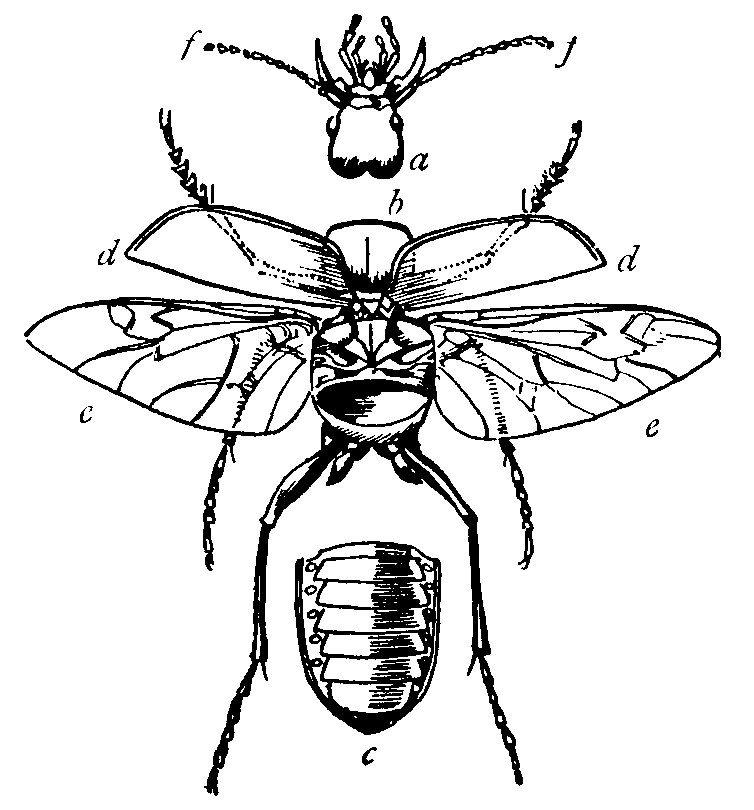
Diagram showing the Parts of Insects
a, Head. b, Thorax. c, Abdomen. dd, Front wings. ee, Hind wings. ff, Antennæ.
Biting Mouth Parts of an Insect
A, Upper lip. B, Mandibles. C, Maxillæ: c1, palp; c2, galea; c3, lacinia; c4, stipes. D, Lower lip: d1, submentum; d2, mentum; d3, labial palp; d4, glossa; d5, paraglossa.
Entomol´ogy, the branch of zoology which treats of insects, the name being from Gr. entŏma, animals 'cut in', the transverse division or segmentation of the body being their most conspicuous feature. The true insects are those animals of the phylum Arthropoda distinguished from the other classes of the phylum by the fact that the three divisions of the body—the head, thorax, and abdomen—are always distinct from one another. There are never more than three pairs of legs in the perfect insect, and these are all borne upon the thorax. Each leg consists of from six to nine joints. The first of these is called the 'coxa', and is succeeded by a short joint called the 'trochanter'. This is followed by a joint, often of large size, called the 'femur', succeeded by the 'tibia', and this has articulated to it the 'tarsus', which may be composed of from one to five joints. Normally two pairs of wings are present, but one or other, or both, may be wanting. The wings are expansions of the sides of the second and third sections of the thorax, and are strengthened by narrow thickenings called 'nervures'. In the beetles the anterior pair of wings becomes hardened so as to form protective cases for the posterior membranous wings, and are called in this condition 'elytra' or 'wing-cases'. The fore-wings are similarly transformed in the Orthoptera, while in many of the Hemiptera they are horny except at the tip. Respiration is effected by means of air-tubes or tracheæ, which open on the surface of the body by lateral apertures called 'stigmata' or 'spiracles', and ramify through every part of the body. The head is composed of several segments amalgamated together, and carries a pair of feelers or 'antennæ', a pair of eyes, usually compound (and often simple eyes in addition), and the appendages of the mouth. A, Sucking mouth of a Butterfly: p, proboscis; l, labium; l1, labial palps; m, mandibles. B, Piercing mouth of a Mosquito: a, labial palps; b, labium epi-pharynx; c, labium; d and e, maxillæ; f, labrum; g, antennæ; h and i, ocelli: hy, hypopharynx; j, labial palp. These last include an upper lip (labrum), and three pairs of jaws (mandibles, first maxillæ, second maxillæ), the third pair being more or less fused into a lower lip (labium). The thorax is composed of three segments, also amalgamated but generally pretty easily recognized. The abdominal segments are usually more or less freely movable upon one another, and never carry locomotive limbs; but the extremity is frequently furnished with appendages connected with generation, which in some cases serve as offensive and defensive weapons (stings). The organs of the mouth take collectively two typical forms, the masticatory and the suctorial, the former exemplified by the beetles, the latter by the butterflies, in which the mouth is purely for suction. The alimentary canal consists of the œsophagus or gullet, a crop, a gizzard, a stomach, and an intestine, terminating in a cloaca. There is no regular system of blood-vessels; the most important organ of the circulation is a contractile vessel situated dorsally and called the 'dorsal vessel'. The nervous system consists of a pair of cerebral ganglia (brain) in the head, these being the thickened upper part of a nerve-ring which encircles the gullet and passes below into a double ventral nerve-cord dilated into ganglia at intervals. The sexes are in different individuals, and most insects are oviparous. Reproduction is generally sexual, but non-sexual reproduction also occurs. (See Parthenogenesis.) Generally the young are very different from the full-grown insect, and pass through a 'metamorphosis' before attaining the mature stage. When this metamorphosis is complete, it exhibits three stages—that of the larva, caterpillar, or grub, that of the pupa or chrysalis, and that of the imago or perfect winged insect. Insects have been divided into three sections—Ametabŏla, Hemimetabŏla, and Holometabŏla, according as they undergo no metamorphosis, an incomplete one, or a complete one. The young of the Ametabŏla differ from the adult only in size. They are all destitute of wings; the eyes are simple and sometimes wanting. The Hemimetabŏla undergo an incomplete metamorphosis, the larva differing from the imago chiefly in the absence of wings and in size. The pupa, here termed a nymph, is usually active, or, if quiescent, capable of movement. In the Holometabŏla the metamorphosis is complete, the larva, pupa, and imago differing greatly from one another in external appearance and habits. The larva is worm-like and the pupa quiescent. The section Ametabŏla includes the order Aptĕra (tassel-tails and spring-tails). The section Hemimetabŏla comprises the orders Hemiptĕra (cicadas, bugs, plant-lice, &c.), Orthoptĕra (cockroaches, crickets, grasshoppers, locusts, earwigs, &c.), and Neuroptĕra (dragon-flies, may-flies, white-ants, &c.). The Holometabŏla comprises the orders Diptĕra (gnats, bot-flies, gad-flies, mosquitoes, house-flies, fleas, &c.), Lepidoptĕra (butterflies and moths), Hymenoptĕra (bees, wasps, and ants), and Coleoptĕra (lady-birds, glow-worms, cockchafers, weevils, and all of the beetle tribe). A division is sometimes made into Mandibulate and Haustellate groups, the oral apparatus of the former being adapted for mastication, the latter for imbibition of liquid food. Both types are, however, sometimes modified, and occasionally combined.