VOLUME IV PART 2 (continued 2)
Reading edition
At fifteen, according to Rousseau, real education begins; and it is the duty of the teacher to study the subject he has to act upon, in other words, to discover the nature of the pupil, which must in all cases determine the means and the method employed in his education. Two things must be taught. These are the true relations, racial and individual, that exist among men; and how to direct and control the emotions aroused by the environment so that the best results may arise. Here he finds occasion for the use of moral teaching and for instruction in religion. The facts of history must be placed before him; but he must be left to form his own judgment. He is now to be taught religion as a help to the regulation of the passions; but not the religion of any particular sect. His time is to be given up largely to reading and to the acquirement of taste; to the study of history and eloquence; and to attendance at the theatre.
The revolutionary doctrines preached by Rousseau in his Émile and in his other educational works had an immense effect on the Continent, and particularly on the work of one of his most ardent admirers, the Swiss farmer and schoolmaster Pestalozzi, an eccentric, dubbed by his schoolfellows "Harry Oddity of Fools-town". Thinking the education demanded for Émile by Rousseau vastly superior to that which he himself received, he very early became an ardent admirer of the system advocated by the French philosopher, and an eager reformer. Émile and the Contrat Social were condemned by the magistrates of Zurich, and Pestalozzi and some of his fellow-students were imprisoned for the Memorial in which they defended these works. Later Pestalozzi determined to be a farmer. He was married at the age of twenty-three, and started growing madder and vegetables on some poor land near Zurich. On the land he built for himself a house, the Neuhof.
In the winter of 1774 he hit upon the expedient of taking into his house some twenty poor children of the neighbourhood, whom he treated as his own. They worked with him in summer in the fields, and in winter in the house. Improved health for the children, increased intelligence, and a manifest devotion to their benefactor were some of the results speedily displayed, and the experiment drew much attention to itself. Urged on by his love for the children, Pestalozzi took in a larger number, and in a very short time found himself bankrupt. In this period of seeming disaster Pestalozzi turned author. The books which he produced were greedily read on the Continent, and aroused the greatest interest. After some work at Stanz and at Burgdorf, Pestalozzi settled to work in the castle of Yverdun on Lake Neuchâtel, which became in the early years of the nineteenth century a place of pilgrimage for European students and lovers of education. Forced to leave Yverdun in 1815, he continued his work at Clindy till 1824.
Friedrich Froebel spent the years 1807 to 1809 at Yverdun, and so fitted himself to carry on the work Pestalozzi had to some extent made popular. His name, however, is specially associated with the schools for very young children to which he gave the name of Kindergarten, that is, 'gardens of children', places where young children, like young plants, were properly watched and tended. For the children in these schools their employment was to be play, play from which and by which they acquired clear notions regarding themselves and their environment. "Education", he asserted, "should lead and guide man to clearness concerning himself and in himself, to peace with nature, and to unity with God." He held that powers were developed by exercise; that failure to use any part of the body or mind led to the shrinkage of the part, and sometimes even to its complete loss. He held that if we wish to develop the body we must exercise the body, and that, similarly, if we wish to develop the intellect or the emotions they must be exercised. He insists that teachers must be careful to interfere as little as possible; must remember at all times that the aim of teaching is "to bring ever more and more out of man rather than to put more and more into him". He based his system on action; agreed with Montaigne that "children's games were their most serious occupations"; and with Locke that "All the plays and diversions of children should be directed towards good and useful habits". Froebel was not the founder of infant schools. These were first established on the Continent and in Britain with the object of helping mothers. In Britain their establishment is associated with the names of the educational enthusiasts James Buchanan and Samuel Wilderspin.
Nearly ten years before Froebel's stay with Pestalozzi at Yverdun, Herbart, next to Kant and Hegel the most influential of German philosophers, visited the inspired educationist at Burgdorf, and found him employing methods based on the principles which he himself had worked out in his psychology. To both it was clear that there is a definite order in which subjects should be taught to the children, and that this order is determined, not merely by the relation of the subjects to each other, but by their power of satisfying the growing wants and capacities of the child. Pestalozzi had arrived intuitively at a method, and had practically applied it, which Herbart had scientifically worked out as applicable to the whole educational field. Three years later Herbart published pamphlets on Pestalozzi's best-known book, How Gertrude teaches her Children, and on The A.B.C. of Sense-perception, and in these showed what weight he attached to observation as an instrument of education. Two years later he published one of his most notable works on education, The Æsthetic Revelation of the World, and in 1806 General Pedagogy. In 1809 he was appointed professor of philosophy at Königsberg, where he remained till 1833, and where his services to the cause of education, both by his writings and by his establishment of normal schools and experimental schools, cannot be exaggerated. He warns teachers not to educate too much; to be careful not to destroy the individuality of the child, such individuality being that which characterizes individuals of the same class. He lays the greatest stress on the importance to the teacher of child study, maintaining that he will be unable to teach unless he knows the child as he is. For Herbart the aim of education is summed up in morality, "the highest aim of humanity and consequently of education", itself. "I have no conception", he writes, "of education without instruction, just as I do not acknowledge any instruction that does not educate." "Instruction", he says elsewhere, "will form the circle of thought, and education the character; the last is nothing without the first." A great deal, according to Herbart, depends upon the pupil himself, who "grasps rightly what is natural to him", and who must be saved from the tendency to one-sidedness in which following his bent would result, by the cultivation in him of many-sidedness. This cultivation involves the control of the pupil's mental activity, and the instrument for this control is interest, which causes the pupil's complete absorption in its object. For the attainment of this Herbart proposes certain formal steps of instruction. These steps are usually set forth as (1) Preparation, (2) Presentation, (3) Comparison, (4) Generalization, (5) Application.
The nineteenth century was a period of continuously increasing interest in education, and of a generally growing belief in its utility. It was taken up by the Governments of the different countries, and ordered and regulated almost out of existence. Seven years before the death of Pestalozzi the first public grant for education was made by the British Parliament, and from that time up to the present the Government has continued to extend its power over the education of the country. For a long time the Government in Britain was satisfied to subsidize elementary education; but later it insisted on hard-and-fast lines of instruction. So thoroughly were these regulated in most countries that a French Minister of Education could boast he was able to say what work every child in France was engaged in at that particular moment.
In Britain it was only bit by bit, and with very considerable reluctance, that the Government took upon itself the responsibility for the education of the country. In Scotland a national system of general education, constituted in 1560, remained in force until reconstructed by the Education Act of 1872. (See Scotland.) Compulsory education was introduced into England in 1870, together with what was described as payment by results; and, for some time, the aim which the teacher had to keep before him was the production at the annual examination of the largest number of pupils who could satisfy the tests in Reading, Writing, and Arithmetic, or, as they were called, the 'three R's', and so earn the Government grant. For between thirty and forty years this unnatural and mechanical system remained in force. From 1864 onwards Commission after Commission sought to reduce English secondary education to order. The most notable of these was The Bryce Commission of Enquiry into Secondary Education, 1894-5, whose recommendations have since been put into force by legislation. One of the results of the increasing interest in education throughout England was the founding, early in the latter half of last century, of great day schools, like the City of London, St. Paul's, and Merchant Taylors, in London and other large cities; and, after the passing of the Education Act of 1902, the establishment everywhere of Council Secondary Schools.
Of the immense number of works on education issued during the last half of the nineteenth century, perhaps the best known are those of Herbert Spencer and of Professor Bain. The former seeks to explain education from the Darwinian standpoint, and the latter to determine from psychology the intellectual value of the various subjects taught in school, and the average age at which they should be taught to children. Of practical English educators during the nineteenth century, the most outstanding names are undoubtedly those of Arnold of Rugby, Thring of Uppingham, and Abbott of the City of London School.
In recent times the advances made in the theoretical and practical studies of the sciences of anthropology, physiology, and psychology have exercised an enormous influence on educational theories and practices. Careful observations of young children by scientific observers like Darwin, Dearborn, and Preyer have added greatly to our knowledge of child-nature; and helped to suggest new methods of studying it and developing it. The result has been the promulgation within the present century of a number of educational methods, some of which, in contrast to the older practices, must seem almost revolutionary. Among these must be remembered the 'Heuristic Method' of teaching science put forward by Professor H. E. Armstrong. The object of the method is to put the student as completely as may be in the position of an original investigator; and it has been classed by writers on education as being, like so many other modern methods, a 'play method'. Froebel in his kindergarten was one of the first to introduce successfully the play method in education, and the 'gifts' by which the plan was carried through were of his own devising; but such cannot be said of Dr. Montessori, whose method of education engrosses so much attention at the present time. The Montessori apparatus was originally devised by Dr. Seguin for the instruction of mental defectives. Dr. Montessori used the apparatus first for the training of young children; but the cardinal feature of the Montessori system is the determined effort to make the child entirely responsible for his own education, and to interfere as little as possible with his development. The apparatus is so contrived that it can only be used in one way if the problem is to be solved; so the child is forced to attend to the differences in size and shape and carefully to compare the different pieces. In addition, the Montessori system attempts to cultivate the social virtues; teaches the children to live and to work and play with others, and so to learn to be well-mannered. The teacher in this system retires into the background, and the children are left to go their own way, to choose their own tasks, and to be their own critics. Great attention is also given to the physical development of the children.
Experimental education has been attempted both in Germany, where the need for it was first put forward by Kant, and in England; but it is in the United States of America that the chief advances in this direction have been made. There the Binet attempt to measure the intelligence of the child, to fix in fact a metric scale of intelligence, has been elaborated, and the Binet-Simon system of tests devised, and later modified by L. M. Terman. There, too, schools have been established which have tried the working out of what may be described as the non-interference with the pupil principle. Among these may be mentioned the 'George Junior Republic' and the Gary Schools. The latter, we are told by their founder, were "not instituted to turn out good workers for the steel company, but for the educational value of the work they involved". To this must be added the 'Dalton Laboratory Plan', tried lately as an experiment by Miss Helen Parkhurst in a public secondary day school in Dalton. By this plan, the time-table is abolished, the child undertakes to get up a certain amount of work each month in each particular subject, and is left free to distribute his time as he chooses, so that he can devote more time to those subjects in which he is backward. The school is divided into departments (laboratories) each under a specialist who gives the help needed, but leaves the pupil to himself as much as possible.—Bibliography: Bartley, The Schools for the People; Norwood and Hope, Higher Education of Boys in England; Quick, Essays on Educational Reformers; Browning, An Introduction to the History of Education Theories; Sleight, Educational Values and Methods; Nunn, Education: Its Data and First Principles; Wilton, What do we mean by Education? The New Teaching, edited by Adams; Kerr, Scottish Education; Morrison, Education Authorities' Handbook; Dewey, Schools of To-morrow; Rusk, Introduction to Experimental Education; Montessori, The Montessori Method and The Advanced Montessori Method.
Education Act, the name given to several Acts dealing with education in Great Britain. Among the principal Education Acts are: (1) that of 1870, which introduced compulsory education; (2) that of 1891, which reduced, or in some cases abolished, school fees; (3) that of 1902, which authorized the levying of an education rate; and (4) that of 1918, which raised the age for leaving school, and made education compulsory up to the age of eighteen by means of continuation schools. Pupils must attend these schools for 320 hours each year.
Edward, known as the Elder, King of England, son of Alfred the Great, born about 870, died in 925. He succeeded his father in 901, and his reign was distinguished by successes over the Danes. He fortified many inland towns, acquired dominion over Northumbria and East Anglia, and subdued several of the Welsh tribes.
Edward, surnamed the Martyr, King of England, succeeded his father, Edgar, at the age of fifteen, in 975. His reign of four years was chiefly distinguished by ecclesiastical disputes. He was treacherously slain in 979 by a servant of his stepmother, at her residence, Corfe Castle. The pity caused by his innocence and misfortune induced the people to regard him as a martyr.
Edward, King of England, surnamed the Confessor, was the son of Ethelred II, and was born at Islip, in Oxfordshire, about 1004. On the death of his maternal brother, Hardicanute the Dane, in 1041, he was called to the throne, and thus renewed the Saxon line. Edward was a weak and superstitious, but well-intentioned prince, who acquired the love of his subjects by his monkish sanctity and care in the administration of justice. His queen was the daughter of Godwin, Earl of Kent. He died in 1066, and was succeeded by Harold, the son of Godwin. Edward caused a body of laws to be compiled from those of Ethelbert, Ina, and Alfred, to which the nation was long fondly attached. He was canonized by Pope Alexander III in 1161.
Edward, Prince of Wales, surnamed the Black Prince, born 15th June, 1330, the eldest son of Edward III and Philippa of Hainault. In 1346 he commanded part of the forces at the battle of Crécy, and earned the praise of his warlike father. It was on this occasion that he adopted the motto Ich dien (I serve), used by all succeeding Princes of Wales. In 1355 he commanded the army which invaded France from Gascony, and distinguished himself the following year at the great battle of Poitiers. By the Peace of Brétigny the provinces of Poictou, Saintonge, Périgord, and Limousin were annexed to Guienne and formed into a sovereignty for the prince under the title of the Principality of Aquitaine. A campaign in Castile, on behalf of Pedro the Cruel, and the heavy taxes laid on Aquitaine to meet the expenses, caused a rebellion, and ultimately involved him in a war with the French king. His own health did not allow him to take the field, and having seen his generals defeated he withdrew into England, and after lingering some time died (1376), leaving an only son, afterwards Richard II.
Edward I (of the Norman line), King of England, son of Henry III, was born at Winchester in 1239, died 7th July, 1307. The contests between his father and the barons called him early into active life, and he finally quelled all resistance to the royal authority by the decisive defeat of Leicester at the battle of Evesham, in 1265. He then proceeded to Palestine, where he showed signal proofs of valour, although no conquest of any importance was achieved. His father's death in 1272 gave him the crown. On his return home he showed great vigour as well as a degree of severity in his administration. He commenced a war with Llewellyn, Prince of Wales, which ended in the annexation of that Principality to the English Crown in 1283. Edward's ambition was to gain possession of Scotland, but the death of Margaret, the Maid of Norway, who was to have been married to Edward's son, for a time frustrated the king's designs. But on 26th Dec., 1292, John Baliol was induced to do homage for his crown to Edward at Newcastle. Baliol was forced by the indignation of the Scottish people into war with England. Edward entered Scotland in 1296, devastated it with fire and sword, and placed the administration of the country in the hands of officers of his own. Next summer a new rising took place under William Wallace. Wallace's successes recalled Edward to Scotland with an army of 100,000 men. Wallace was at length betrayed into his hands and executed as a traitor. All Edward's efforts, however, to reduce the country to obedience were unavailing, and with the flight of Robert Bruce, Earl of Carrick, to Scotland, the banner of Scottish independence was again unfurled. Edward assembled another army and marched against Bruce, but only lived to reach Burgh-on-Sands, a village near Carlisle, where he died. Edward I was wise in council and vigorous in action. During his reign great progress was made in the establishment of law and order throughout the land.
Edward II, King of England, born at Carnarvon Castle in 1284, and the first English Prince of Wales, succeeded his father, Edward I, in 1307. He was of an agreeable figure and mild disposition, but indolent and fond of pleasure. After marching as far as Cumnock, in Ayrshire, with the army collected by his father, he returned, dismissed his troops, and abandoned himself entirely to amusements. His weakness for a clever but dissolute young Gascon, Piers Gaveston, on whom he heaped honours without limit, roused the nobles to rebellion. Gaveston was captured in Scarborough Castle, and executed as a public enemy on 19th June, 1312. Two years after this, Edward assembled an immense army to check the progress of Robert Bruce, but was completely defeated at Bannockburn. In 1322 he made another expedition against Scotland, but without achieving anything important. The king's fondness for another favourite, Hugh le Despenser, had made a number of malcontents, and Queen Isabella, making a visit to France, entered into a correspondence with the exiles there, and formed an association of all hostile to the king. Aided by a force from the Count of Hainault, she landed in Suffolk in 1326. Her army was completely successful. The Despensers, father and son, were captured and executed, and the king was taken prisoner and confined in Kenilworth, and ultimately in Berkeley Castle, where he was murdered 21st Sept., 1327.
Edward III, King of England, son of Edward II by Isabella of France, was born in 1312, died 21st June, 1377. On his father's deposition in 1327 he was proclaimed king under a council of regency, while his mother's lover, Mortimer, really possessed the principal power in the State. The pride and oppression of Mortimer led to a general confederacy against him, and to his seizure and execution (10th Oct., 1330). Edward now turned his attention to Scotland, and, having levied a well-appointed army, defeated the regent, Douglas, at Halidon Hill, in July, 1333. This victory produced the restoration of Edward Baliol, who was, however, again expelled, and again restored, until the ambition of the English king was diverted by the prospect of succeeding to the throne of France. Collecting an army and accompanied by the Black Prince, he crossed over to France. The memorable battle of Crécy followed, 25th Aug., 1346, which was succeeded by the siege of Calais. In the meantime David II, having recovered the throne of Scotland, invaded England with a large army, but was defeated and taken prisoner by a much inferior force under Lord Percy. In 1348 a truce was concluded with France; but on the death of King Philip, in 1350, Edward again invaded France, plundering and devastating. Recalled home by a Scottish inroad, he retaliated by carrying fire and sword from Berwick to Edinburgh. In the meantime the Black Prince had penetrated from Guienne to the heart of France, fought the famous battle of Poitiers, and taken King John prisoner. A truce was then made, at the expiration of which (1359) Edward again crossed over to France and laid waste the provinces of Picardy and Champagne, but at length consented to a peace. This confirmed him in the possession of several provinces and districts of France which were entrusted to the Prince of Wales (the Black Prince), but gradually all the English possessions in France, with the exception of Bordeaux, Bayonne, and Calais, were lost.
Edward IV, King of England, was born in 1442, died in April, 1483. His father, Richard, Duke of York, was grandson of Edmund, Earl of Cambridge and Duke of York, fourth son of Edward III, while the rival line of Lancaster descended from John of Gaunt, the third son. The York line had intermarried with the female descendants of Lionel, the second son, which gave it the preferable right to the Crown. Edward, on the defeat and death of his father at the battle of Wakefield, assumed his title, and, having entered London after his splendid victory over the troops of Henry VI and Queen Margaret at Mortimer's Cross, in Feb. 1461, was declared king by acclamation. The victory of Towton, soon after his accession, confirmed his title, and three years after this, on 4th May, 1464, the battle of Hexham completely overthrew the party of Henry VI. The king now made an imprudent marriage with Elizabeth, widow of Sir John Grey, at the very time when he had dispatched the Earl of Warwick to negotiate a marriage for him with the sister of the French king. He thus alienated powerful friends, and Warwick, passing over to the Lancastrian cause, gathered a large army, and compelled Edward to fly (in Sept. 1470). Henry's title was once more recognized by Parliament. But in 1471 Edward, at the head of a small force given him by the Duke of Burgundy, landed at Ravenspur in Yorkshire, and his army, being quickly increased by partisans, marched swiftly on London and took the unfortunate Henry prisoner. Warwick now advanced with an army to Barnet, where a battle was fought, 4th April, 1471, which ended in the death of Warwick and a decisive victory for Edward. Shortly afterwards Edward also met and defeated a Lancastrian army, headed by Queen Margaret and her son Edward, at Tewkesbury. The prince was murdered, and the queen was thrown into the Tower, where Henry VI soon after died. Edward was preparing for an expedition against France when he died.
Edward V, King of England, the eldest son of Edward IV, was in his thirteenth year when he succeeded his father in 1483. His uncle, the Duke of Gloucester, soon made himself king as Richard III, and caused the young king and his brother to be sent to the Tower, where he had them smothered by ruffians.
Edward VI, King of England, son of Henry VIII by Jane Seymour, was born in 1537, died in July, 1553. At his father's death he was only nine years of age. His education was entrusted to men of the first character for learning, under whose training he made great progress, and grew up with a rooted zeal for the doctrines of the Reformation. His reign was, on the whole, tumultuous and unsettled. In Oct., 1551, the Protector Somerset, who had hitherto governed the kingdom with energy and ability, was deposed by the intrigues of Dudley, Duke of Northumberland, who became all-powerful. He induced the dying Edward to set aside the succession of his sisters, Mary and Elizabeth, and settle the crown upon Lady Jane Grey, to whom he had married his son Lord Guildford Dudley. Edward VI restored many of the grammar schools suppressed by Henry VIII, and these schools are still known as King Edward's schools.
Edward VII, King of Great Britain and Ireland and Emperor of India, eldest son of Queen Victoria and the Prince Consort, was born at Buckingham Palace on 9th Nov., 1841, died 6th May, 1910. In Dec., 1841, he was created Prince of Wales. He was educated under private tutors and at Edinburgh, Oxford, and Cambridge; visited Canada and the United States in 1860; and underwent military training at the Curragh camp in 1861. Promoted to the rank of general in 1862, he visited Palestine and the East, and next year took his seat in the House of Lords. On 10th March, 1863, he was married in St. George's Chapel, Windsor Castle, to Princess Alexandra, eldest daughter of Christian IX of Denmark, and from this time onwards he discharged many public ceremonial functions. Attacked by typhoid fever in the winter of 1871, his life was for a time despaired of, but he recovered early in 1872, his recovery being made the occasion of a thanksgiving service in St. Paul's Cathedral. During 1875 and 1876 he visited India. He was a member of the Poor Law Commission of 1893. He promoted the establishment of the Imperial Institute as a memorial of Queen Victoria's jubilee (1887), and he commemorated her diamond jubilee (1897) by founding the Prince of Wales's (now King's) Hospital Fund for the better financial support of the London hospitals. On the death of Queen Victoria on 22nd Jan., 1901, he succeeded to the throne, and was crowned on 9th Aug., 1902. King Edward did much to promote friendly relations with foreign powers, especially with France and the United States. It was through his personal influence that the Entente Cordiale with France was brought about. To him and Queen Alexandra were born: Albert Victor Christian Edward, Duke of Clarence and Avondale, born 1864, died 1892; George Frederick Ernest Albert, who succeeded his father as George V, born 1865, married 1893, to Princess Victoria Mary of Teck; Princess Louise, now Princess Royal, born 1867, married 1889, to the Duke of Fife, who died 29th Jan., 1912; Princess Victoria, born 1868; and Princess Maud, born 1869, married 1896, to Prince Charles of Denmark, now King of Norway as Haakon VII.—Bibliography: Life of the King, by 'One of His Majesty's Servants'; Holt-White, The People's King; E. Legge, King Edward in his true Colours; J. P. Brodhurst, The Life and Times of Edward VII; W. H. Wilkins, Edward the Peacemaker.
Edward, Thomas, a Scottish naturalist, born 1814, died 1886. The son of poor parents, he was apprenticed to a shoemaker and worked at his trade till nearly the end of his life, but succeeded in acquiring much knowledge of natural history and some fame as a naturalist. An interesting biography of Edward (Life of a Scottish Naturalist), written by Samuel Smiles, appeared in 1876, and a pension of £50 a year was shortly afterwards conferred on him by Queen Victoria.
Edwards, Amelia Blandford, English novelist and Egyptologist, born in London in 1831, died in 1892. She gave early evidence of great literary ability by her contributions to periodicals, and attracted attention by her novel My Brother's Wife (1855). Among her best-known novels are: Hand and Glove (1859), Barbara's History (1864), Half a Million of Money (1865), Debenham's Vow (1870), and Lord Brackenbury (1880). Miss Edwards wrote also ballads and books of travel, and in 1882 founded the Egypt Exploration Fund and devoted herself to Egyptology, leaving funds to found a chair of Egyptology in University College, London.
Edwards, Bryan, English writer, born in Wiltshire in 1743, died in 1800. He inherited a large fortune from an uncle in Jamaica, where he long resided. His History, Civil and Commercial, of the British Colonies in the West Indies appeared in 1793.
Edwards, John Passmore, British philanthropist and journalist, born at Blackwater, Cornwall, in March, 1823, died on 22nd April, 1911. Trained as a journalist, he became representative of the paper The Sentinel, and was opposed to the Corn Laws. In 1862 he bought The Building News, and in 1876 the London Echo, of which he was director for twenty years. Although somewhat unpopular on account of his opposition to the Boer War, he is remembered as a public benefactor, having founded numerous Passmore Edwards institutions, public libraries, and settlements, and contributed largely to hospitals. He was a delegate to the peace congresses at Brussels, Paris, and Frankfort (1848-50), and twice refused a knighthood.
Edwards, Jonathan, American theologian and metaphysician, born 5th Oct., 1703, died 22nd March, 1758. He entered Yale College in 1716, and studied till 1722, when he received a licence as preacher. In 1723 he was elected a tutor in Yale College, but resigned in 1726 to be ordained as minister at Northampton (Mass.). After more than twenty-three years of zealous service here, he was dismissed by the congregation owing to the severity with which he sought to exercise church discipline. He then went as a missionary among the Indians at Stockbridge, in Massachusetts. Here he composed his famous work on the Freedom of the Will, which appeared in 1754. In 1757 he was chosen president of the college at Princeton, New Jersey, but died shortly afterwards.
Edwy, King of England, son of Edmund I, succeeded his uncle Edred in 955. Taking part with the secular clergy against the monks, he incurred the confirmed enmity of the latter. The Papal party, headed by Dunstan, was strong enough to excite a rebellion, by which Edwy was driven from the throne to make way for his brother Edgar. He died in 959, being probably not more than eighteen or nineteen years old.
Eecloo (āk-lō´), a town, Belgium, province of East Flanders, 11 miles north-west of Ghent, the seat of textile manufactures. Pop. 13,536.
Eel-bucks on the Thames
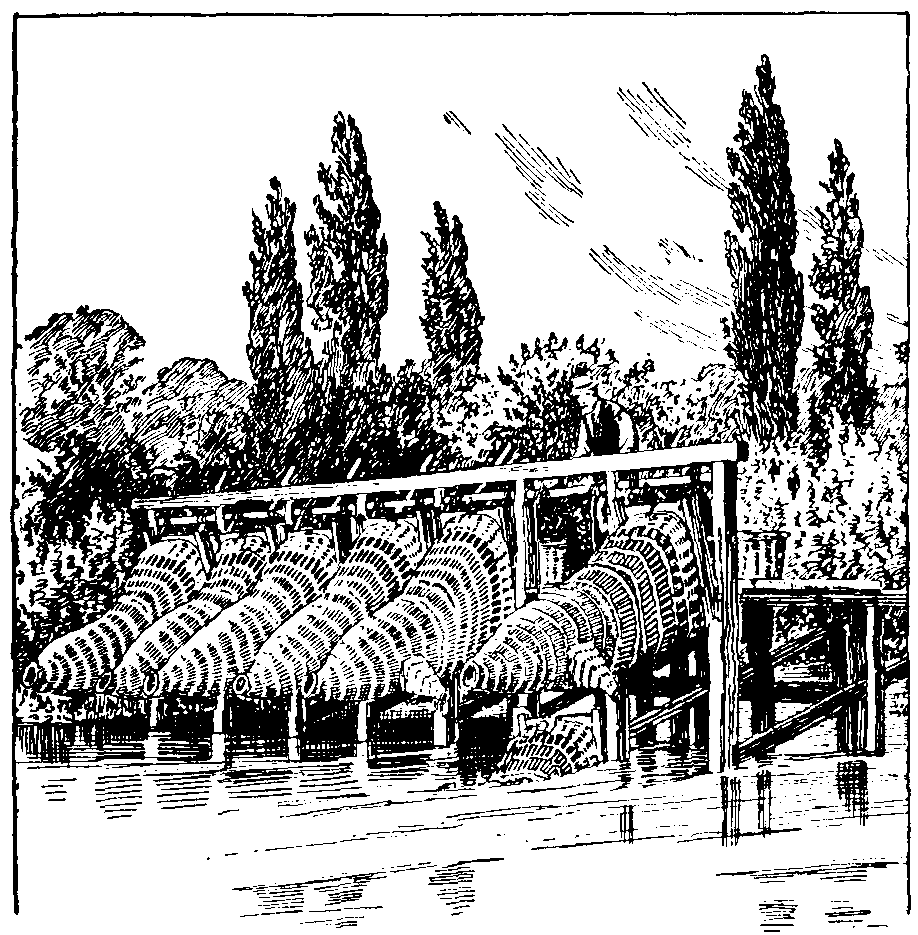
Eel, the popular name of fishes belonging to the teleostean sub-order Apodes. The common eel (Anguilla vulgaris) is the type of a special family (Anguillidæ) and has a very wide distribution in the fresh waters of the globe. It is snake-shaped, devoid of ventral fins, and the minute scales are embedded in the slimy skin. When five or six years old it migrates to the deep sea for spawning, after which it probably dies. Curious flattened larvæ (Leptocephalus) hatch out from the floating eggs, and undergo a metamorphosis to become young eels or elvers, which when a year old ascend rivers in vast numbers as 'eel fare'. Eels are esteemed as an article of food, and even elvers are compressed into a sort of cake. In England river eels are caught in great numbers by means of eel-bucks or eelpots, traps consisting of a kind of basket with a funnel-shaped entrance composed of willow rods converging towards a point, so that the eels can easily force their way in but cannot return. A stocking or tube of coarse cloth hanging from an aperture of a box down into the interior is also used. In England a kind of trident called an eel-spear is used also for taking them. A fisherman wades to the shallows, and, as he strikes his spear in the mud in every direction around him, the eels reposing on the bottom are caught between the prongs. They are also taken by hooks and lines and in other ways. See Conger-eel; Muræna. Electric eels belong to another group. See Electrical Fishes.
Effen´di, a Turkish title which signifies lord or master. It is particularly applied to the civil, as aga is to the military officers of the Sultan. Thus the Sultan's first physician is called Hakim effendi, and the priest in the seraglio Imam effendi.
Efferves´cence, the rapid escape of a gas from a liquid, producing a turbulent motion in it, and causing it to boil up. It, is produced by the actual formation of a gas in the liquid, as in fermentation, or by the liberation of a gas which has been forced into it, as in aerated beverages.
Efficiency, in mechanics and engineering, the ratio of the useful energy given out by a machine to the energy supplied to it. Energy cannot be created or destroyed, but it may assume various forms, and, within limits, can be changed from any one of these forms to any other. A machine or engine is an apparatus for converting energy in some given form into energy in another assigned form. In practice it is found impossible to convert the whole of the given energy into the form wanted, there being always a residue which is not of the right kind, and is, therefore, counted as useless. The smaller the residue, the more efficient is the machine. In the machines of elementary mechanics, such as the lever or the screw, the energy supplied is work done by the power or effort, and the energy wanted is work done on the load. If E is the effort, and W the load, then if there were no friction we would have E = Wr, where r is the velocity ratio, or ratio of the velocities of the points of application of load and effort. The relation found by experiment, however, is usually of the type E = Wr + C, where C is a constant. The efficiency is the fraction Wr/E or 1 - C/E, so that it increases with the load. In heat engines, energy in the form of heat is converted into mechanical energy. Heat is taken in at the source, part of it is changed into mechanical energy, and the remainder is rejected to the condenser. According to the second law of thermodynamics, the efficiency of such an engine has a definite upper limit which it cannot exceed, this being the ratio of the difference of the temperatures of the source and the condenser to the temperature of the source, these temperatures being measured on the absolute scale, that is, from -273° C. reckoned as the zero. The efficiency of a steam-engine is usually compared with that of an ideal engine working between the same temperatures, and going through a definite periodic set of operations called the Rankine cycle. If the thermal efficiency of an actual engine is 27 per cent, and that of an ideal engine working on the Rankine cycle is 30 per cent, obviously the important figure is the ratio of 27 to 30, or 90 per cent.
The performance of a steam-engine depends, not only on its thermal efficiency, but also on its boiler efficiency and its mechanical efficiency. The boiler efficiency is the percentage of the heat obtainable from the fuel consumed which is actually used in the engine; in a good boiler it may be 75 per cent. The mechanical efficiency is the ratio of the work given out at the crank-shaft to the work done on the piston; in other words, it is the ratio of brake horse-power to indicated horse-power. It may perhaps be 80 per cent. To arrive at the over-all efficiency, the various partial or component efficiencies must be multiplied together. In comparing one type of engine with another, what is important is obviously this over-all efficiency, or ratio of energy output to the theoretical energy value of the fuel employed. Thus, to take the case of marine engines, the Diesel oil-engine is inferior to the turbine and to the reciprocator in point both of thermal and of mechanical efficiency. But when the efficiency of the boilers is taken into account, the Diesel comes out very decidedly ahead of the others. Taking coal at 10,000 British thermal units per pound, and Diesel oil at 18,000 British thermal units per pound, Mr. T. R. Wollaston has given the following figures for the number of British thermal units consumed per brake horse-power hour: steam-engine 19,000; steam turbine 21,000; gas-engine 15,000; Diesel engine 9000. Electrical plant in general reaches a high standard of efficiency. Some figures are: transmission lines 85 to 95 per cent; motors and generators at full load 70 to 80 per cent from 1 to 5 h.p., 80 to 90 per cent from 5 to 50 h.p., and 95 per cent for large sizes. Electrical transformers are the most efficient of all machines. Their efficiency ranges from about 90 per cent in small sizes, up to perhaps 98.5 per cent for large machines at full load. See Energy; Internal-combustion Engines; Steam-engines; Thermodynamics.
Efflores´cence, the property which certain hydrated salts have of losing water when exposed to air. Thus washing-soda, Na2CO3, 10H2O, if left in air becomes opaque, loses its crystalline appearance, and finally falls to a powder by loss of water. The term is also applied in botany to the process of flowering.
Effluents, a general term applying to liquids, on being discharged, after undergoing some form of treatment. The term is more particularly applied to the purified liquid discharged into rivers and streams from sewage-works, the crude sewage having been freed of the grosser solids, and rendered clear and innocuous to animal and vegetable life.
Effodien´tia, the name proposed for a new order of mammals to include pangolins and aard-varks. See Edentata.
Égalité, Philippe. See Orleans, Louis Philippe Joseph.
Egbert, considered the first king of all England, was of the royal family of Wessex. He succeeded Brihtric in 802 as King of Wessex. He reduced the other kingdoms and rendered them dependent on him in 829, thus becoming their overlord. He died in 839.
Egede, Hans (ā´ge-dā), the apostle of Greenland, born in 1686 in Norway, died in 1758. In 1721 Egede set sail for Greenland with the intention of converting the natives to Christianity, and for fifteen years performed the most arduous duties as missionary, winning by his persevering kindness the confidence of the natives. In 1736 he returned to Copenhagen, where he was made a bishop and director of the Greenland Missions.
Eger (ā´gėr), a town of Bohemia, Czecho-Slovakia, on a rocky eminence above the Eger, 91 miles west of Prague; once an important fortress, though now quite dismantled. It has manufactures of woollens, cottons, leather, and soap. Wallenstein was assassinated there (1634). Pop. 26,620.
Ege´ria, a nymph who received divine honours among the Romans. Numa is said to have received from her the laws which he gave to the Romans.
Egersund (ā´gėr-su¨nd), a seaport on the south-west coast of Norway, some distance south of Stavanger, and connected with it by railway, has a large pottery-work, fishing and shipping trade. Pop. 3500.
Egerton, Francis. See Bridgewater, Duke of.
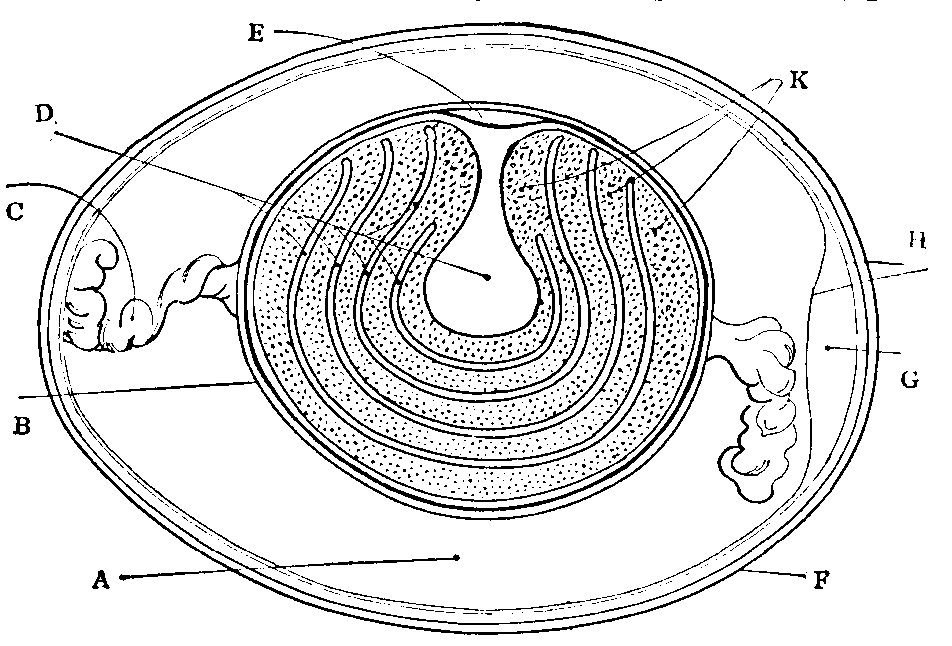
Section of Hen's Egg
A, White or albumen. B, Vitelline membrane. C, Chalaza. D, White yolk. E, Germinal disc. F, Shell. G, Air space. H, Shell membrane. K, Yellow yolk.
Egg, (1) in the narrower sense, the female reproductive or germ-cell, which after impregnation or fertilization by a male germ-cell (spermatozoon or sperm) develops into an embryo. (See Ovum.) (2) The term is applied, more broadly, to a more complicated reproductive body that consists of an ovum together with supplementary parts. The egg of a bird, for example, includes the fertilized and developing ovum (yolk), nutritive white (albumen), and protective double egg membrane covered by a porous calcareous shell. The eggs of animals lower than the birds have usually only three parts, viz. the germinal spot or dot, the germinal vesicle, and the vitellus or yolk; the first being contained in the vesicle, and that again in the yolk. The common domestic fowl, the turkey, the pea-hen, and the common duck produce the eggs which are commonest in the market. The eggs of the green plover (Vanellus cristatus) are esteemed as a delicacy. The hard roes of fishes are the ovaries, containing innumerable eggs (over nine millions in the cod). The salted hard roes of the sturgeon are known as caviare. A hen's egg of good size weighs about 1000 grams, of which the white constitutes 600, the yolk 300, and the shell 100. When the white of an egg is warmed it coagulates to a firm opaque mass. Eggs form an important article in British commerce; the number imported in 1919 amounted to the value of £8,613,000, mainly from Russia, Denmark, Austria, France, and Italy.
Egg, an island of Scotland. See Eigg.
Egga, a town of N. Nigeria, on the right bank of the Niger, about 70 miles above the junction of the Binue. Pop. 10,000.
Eggar, or Egger, a name given to moths of the family Lasiocampidæ. Lasiocampa trifolii, a well-known British moth, is called the grass-egger, and the L. quercus the oak-egger, from the food of their caterpillars.
Egg-bird, or Sooty Tern (Sterna fuliginosa), a bird of considerable commercial importance in the West Indies, as its eggs, in common with those of two other species of tern, form an object of profitable adventure to the crews of numerous small vessels.
Eggleston, Edward, American novelist and miscellaneous writer, born in 1837, died in 1902. He entered the ministry of the Methodist Church, was engaged in pastoral work for some years, afterwards as pastor of an independent church founded by himself. He wrote and edited much, among his books being: The Hoosier Schoolmaster (1871), which first appeared in Hearth and Home; The End of the World: A Love Story; Roxy, a highly popular novel (1878); The Hoosier Schoolboy; The Graysons; Household History of the United States; The Faith Doctor. His novels are marked by abundance of incident, skilful handling of dialect, and realistic portraiture.
Egg-plant, or Brinjal (Solānum melongĕna), nat. ord. Solanaceæ, an herbaceous plant, from 1 foot to 18 inches high, with large white or purplish flowers. The fruit is about the size of a goose's egg, and generally yellow, white, or violet, and when boiled or stewed is used as an article of food. It is cultivated in India, the United States, &c., and in European hothouses. There are several other species of egg-plants, as S. indicum and S. sodomeum.
Egham, an urban district of England, county of Surrey, on the Thames opposite Staines, about 21 miles from London, with the Royal Holloway College for women, and the Holloway Sanatorium. Near it is Runnymede, where King John signed Magna Charta.
Egil Skallagrim, an Icelandic bard or poet of the tenth century, who distinguished himself by his warlike exploits in predatory invasions of Scotland and Northumberland. Having fallen into the hands of a hostile Norwegian prince, he procured his freedom by the composition and recitation of a poem called Egil's Ransom, which is still extant.
Eginhard, or Einhard, friend and biographer of Charles the Great (Charlemagne), born in Maingau (East Franconia) about 770, died in 840. He was educated in the monastery at Fulda, and his capacity attracted the attention of Charles, who made him superintendent of public buildings, and of whom he became the constant companion. He also enjoyed the favour of his son Louis the Pious. His later years were passed at Mühlheim-on-the-Main, where he founded a monastery. His Vita Caroli Magni is a work of great value, and his letters are also important.
Eg´lantine, one of the names of the sweetbrier (Rosa rubiginosa), a kind of wild rose. The name has sometimes been erroneously used for other species of the rose and for the honeysuckle.
Eg´mont, Lamoral, Count, Prince of Gavre, was born in 1522, of an illustrious family of Holland. He adopted a military career, accompanied Charles V in his African expeditions, and distinguished himself under Philip II in the battles of St. Quentin (1557) and Gravelines (1558). Philip having gone to Spain, Egmont soon became involved in the political and religious disputes which arose between the Netherlands and their Spanish rulers. He tried to adjust the difficulties between both parties, and in 1565 went to Spain to arrange matters with Philip. He was well received, sent back with honour, but quite deceived as to the king's real intentions. In 1567 the Duke of Alva was sent with an army to the Netherlands to reduce the insurgents. One of his first measures was to seize Count Egmont and Count Horn. After a trial before a tribunal instituted by Alva himself they were executed at Brussels 5th June, 1568. A well-known drama of Goethe's is founded on the story of Egmont.
E´goism, as a philosophical doctrine, the view that the elements of all knowledge and the reality of the things known are dependent on the personal existence of the knower. This theory is also called Subjective Idealism or Solipsism. It maintains that his individual ego is the only being that a man can logically assert to exist. As an ethical theory (practical egoism) it is the opposite of altruism. It maintains that the governing principle of conduct for the individual is his own good on the whole, and that self-interest is the basis of morality. Egoism is to be distinguished from egotism, which denotes the practice of putting forward or dwelling upon oneself, of thinking, talking, or writing about oneself.
Egremont, a town of England, in Cumberland, in the valley of the Ehen, 3 miles from the sea, giving name to a parliamentary division. It has ruins of an ancient (twelfth century) castle associated with a legend that served Wordsworth as the subject of a poem. Iron-ore and limestone are worked. Pop. 6300.
Little Egret (Ardĕa garzetta)
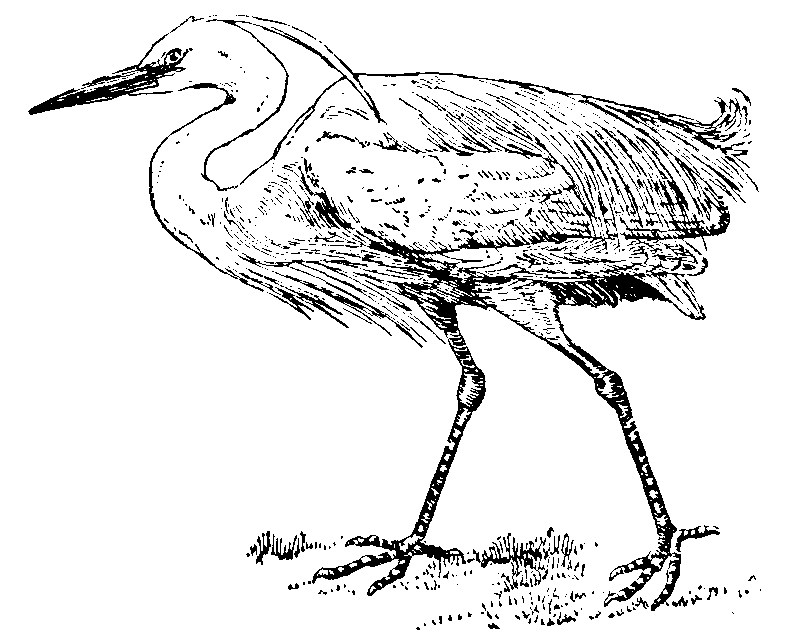
Eg´ret, a name given to those species of white herons which have the feathers of the lower part of the back elongated and their webs disunited, reaching to the tail or beyond it at certain seasons of the year. Their forms are more graceful than those of common herons. The American egret (Ardĕa egretta) is about 37 inches long to the end of the tail; plumage soft and blended; head not crested; wings moderate; the tail short, of twelve weak feathers. The European egret (A. alba) is about 40 inches long, of a pure white plumage; the bill is black or dark brown, yellow at the base and about the nostrils, and the legs are almost black. The little egret (A. garzetta) is about 22 inches long from bill to end of tail, the plumage is white. The term egret is used in the feather trade for a bunch of the loose plumes, valued as an ornament.
Diagrammatic Section across Egypt from Farafra Oasis to Sinai

Egypt (from Gr. Aiguptos) is, as Herodotus has said, "the gift of the Nile". This great river, about 4000 miles in length, rises as the White Nile, three degrees south of the equator, drawing its waters from the Central African lakes. To the south of Khartoum, and 1350 miles from the sea, it is joined by the Blue Nile, which rises in the mountains of Abyssinia, and about 140 miles farther on it is fed by the Atbara, its last tributary. On the tableland of Nubian sandstone between Khartoum and Elephantine the river forms two great loops, and is intercepted by shallows or cataracts, of which there are six in all. The 'first cataract'—the last on the journey northward—is at Assouan, where a ridge of intercepting granite crops up. At Edfu, about 68 miles farther north, the limestone formation is entered, and the Nile then flows uninterrupted between flanking hills that here and there attain the height of 1000 feet. Egypt proper extends from Assouan to the Mediterranean. At a distance of about 100 miles from the sea the Nile divides into the branches forming the Delta. To the south of Cairo it sends out the Bahr Yusuf, a branch about 200 miles long, which flows into the fertile Fayum. The narrow valley, the average breadth of which is 10 miles, is 'the land of Egypt'. Its cultivable area is not so large as Belgium, being under 10,000 sq. miles in extent. Rain falls to the north of Cairo, but in Upper Egypt there are showers only once in every three or four years. The fertility of the country is due to the Nile. Each year the great river rises in flood when the equatorial lakes are suddenly swollen by heavy tropical rains and the snow melts in the Abyssinian mountains. The mean summer heat is 83° F. in the Delta and 122° F. in the valley. It is a dry heat, not so oppressive as that of India, and malaria is practically unknown. The most trying part of the year is during the period of 'Low Nile'. Before the surplus waters were stored in the Assouan Dam, the river shrank so low that its flow seemed uncertain. For about two months the hot and blistering 'hanseen' (or 'sand-wind') keeps blowing. A new season is ushered in by the cool north wind—the Etesian wind of the Greeks—which clears the accumulated dust from vegetation. It is lauded in ancient texts by priestly poets and Pharaohs. About the same time the conspicuous star Sirius makes its appearance. It was anciently regarded as a form of the Mother Goddess. On the 'Night of the Drop', in June, a fertilizing tear was supposed to fall from this star, and thereafter the 'new Nile' was born. For about four days (before the Assouan Dam was constructed) the rising river flowed green, the slimy matter on the marshes of Upper Egypt being pushed forward by the 'new water'. This was the 'Green Nile'. Then the Nile turned blood-red with Abyssinian clay. This was the 'Red Nile'. As soon as the fertilizing 'new water' touched the parched sands, Egypt awoke to new life. Countless insects appeared, new grass and flowers sprang up, and trees and shrubs broke into brilliant blossoms that filled the air with sweet perfume. Bursting over its banks, the steadily rising river flooded the valley generously and refreshingly. According to the Coptic Calendar, the inundation season lasted from June till September, the seed-time from October till January, and the harvest began in February.
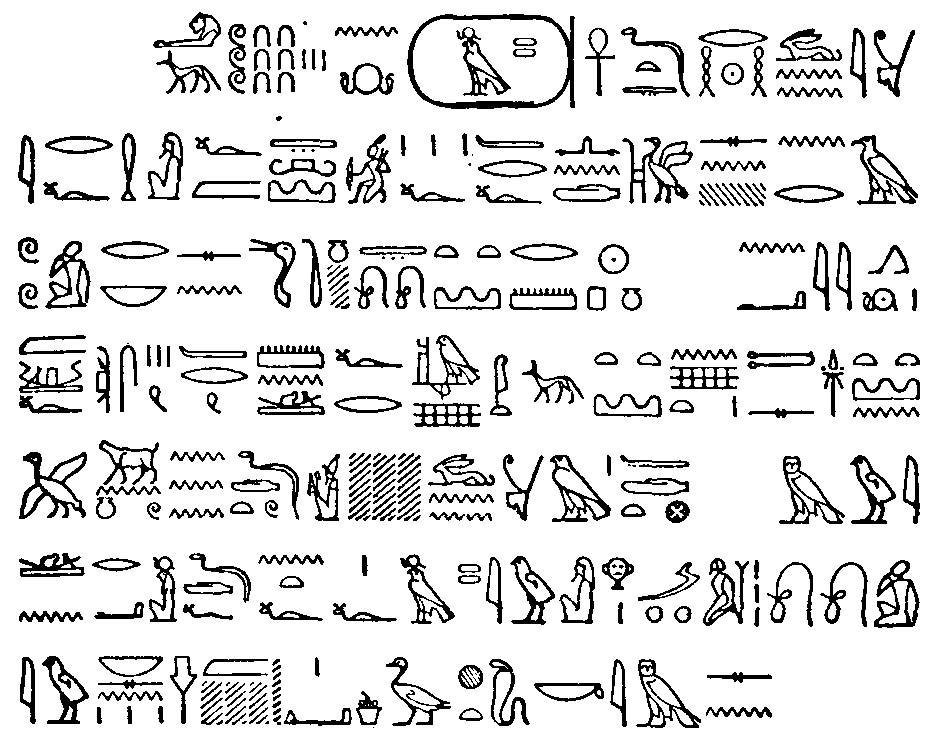
Part of the Hieroglyphic Legend of Heru-Behutet and the Winged Disk, cut on the Walls of the Temple of Edfû in Upper Egypt
Translation: In the three hundred and sixty-third year of Rā-Heru-Khuti, who liveth for ever and for ever, His Majesty was in TA-KENS, and his soldiers were with him; (the enemy) did not conspire (auu) against their lord, and the land (is called) UAUATET unto this day. And Rā set out on an expedition in his boat, and his followers were with him, and he arrived at UTHES-HERU, (which lay to) the west of this nome, and to the east of the canal PAKHENNU, which is called ( ... to this day). And Heru-Behutet was in the boat of Rā, and he said unto his father Rā-Heru-Khuti (i.e. Rā-Harmachis), "I see that the enemies are conspiring against their lord; let thy fiery serpent gain the mastery ... over them."—Reproduced by permission from Vol. XXXII of Books on Egypt and Chaldæa, by Sir E. A. Wallis Budge.
Early Religion and Civilization.—In its earliest phases the religion of ancient Egypt reflected the natural phenomena of the Nile Valley in their relation to the needs, experiences, and achievements of mankind. The flood was an annual 'miracle of mercy', and the early people tried to account for it. They concluded it was a gift of the gods. It ensured the food-supply; it brought health and relief from the oppressive heat endured when the sand-wind prevailed and the river was low. The new water was 'the water of life'; it fertilized the parched soil and caused barley and millet (which grew wild in the Delta) to spring up, trees to yield fruit, and curative herbs to appear on the river banks. In the prehistoric period the Nile was identified with Osiris, who, according to the traditions of the Delta people, once reigned as their king, and introduced the agricultural mode of life which made it possible for large and growing communities to dwell in the narrow valley. In the Pyramid Texts (c. 2700 B.C.) Osiris is the controller of the Nile, the principle of life in the Nile, and the Nile itself. In one of his phases the god is the 'Green One'—the Green Nile. A Pyramid Text reads: "Horus comes! He beholds his father in thee, Green One, in thy name of Water of Greenness". The soul-substance (literally 'the seed') of Osiris was the vital principle in the green or new water. Osiris was the serpent-soul in the water, and the serpent (leviathan) of the ocean which 'encircled the netherworld'. The god is addressed in a Pyramid Text: "Thou art great, thou art green in thy name of Great Green" (Mediterranean Sea). Osiris was slain by Set, and his life-blood was the Red Nile, which entered the soil and vegetation. Osiris was not regarded as the Green One because vegetation is green; the ancient Egyptians appear to have attributed the greenness of vegetation to the Green Nile, the soul-substance of Osiris. The sap of shrubs and trees was 'Blood'—the blood of the god. Osiris continued to live after death. On earth he was in barley, fruit, &c., and in the fertilized soil. He was in the other world Judge and King of the Dead. In his underworld Paradise the souls of the dead grew corn and cultivated fruit-trees—the 'food of life'. The Osirian cult had origin in the Delta of Lower Egypt. In Upper Egypt a solar cult exalted Horus, the falcon god, as chief deity. Their heaven was beyond the sky 'to the east'. In the Pyramid Texts there is clear evidence that the solar cult believed the souls of the dead went eastward, while the Osirian cult believed they went westward. Osiris was called 'First of the Westerners'. The 'Easterners' of the south (Upper Egypt) conquered the 'Westerners' of the north (Lower Egypt), and Egypt was united into a single kingdom by the traditional King Mena, with whom begins the dynastic history of Egypt. This conquest appears to have been due to the introduction of copper weapons.
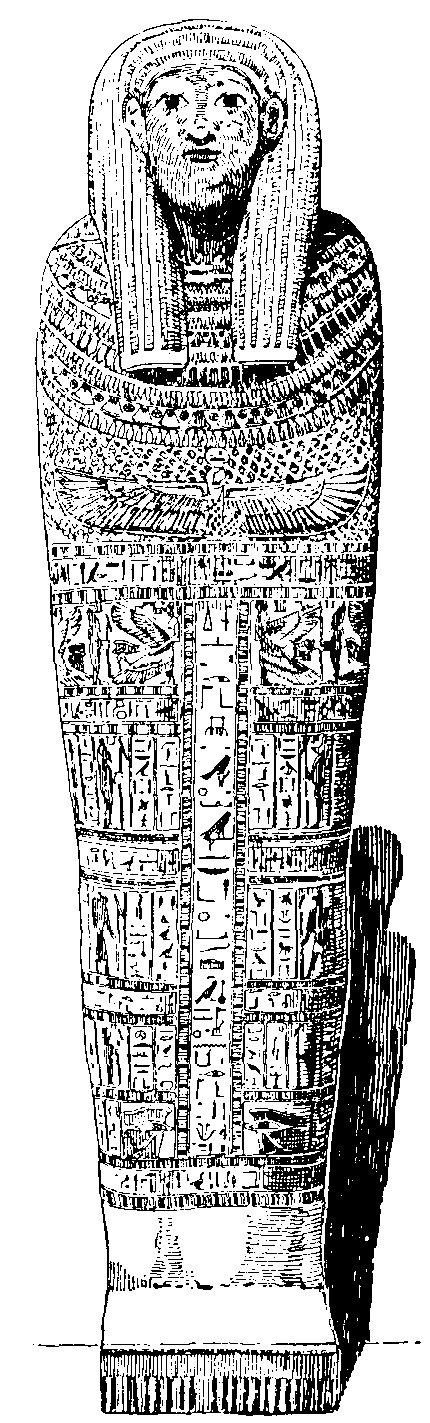
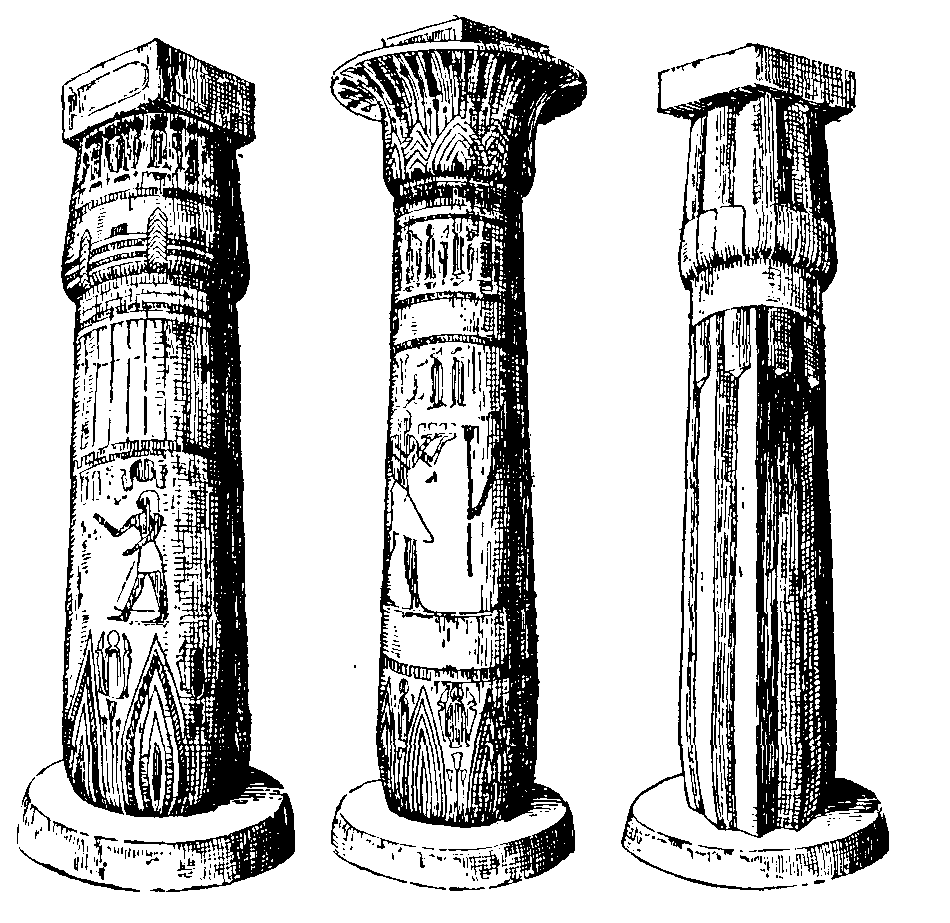
The idea that the Horites were invaders from Arabia or Mesopotamia has been abandoned. Copper was anciently found in the wadis of Upper Egypt and on the shores of the Red Sea. After boat-building and navigation were well advanced copper was mined in Sinai. According to Egyptian evidence, Edfu was the centre of the early copper industry and of the Horus cult. As Egyptian copper is naturally hard, it required no amalgam. Egypt, therefore, never had a Bronze Age, nor had it a Neolithic Age. The copper artifacts were imitations of Palæolithic forms of the Solutrian type. After the conquest there occurred fusions of religious cults. Local pantheons reflected local politics. But although the sun-cult of Heliopolis exalted Ra Painted inner wooden coffin of Pen-Amen-Neb-Nest-Taui, a prophet of the God Amen and of the Goddess Bast at Thebes. Types of Columns from Egyptian Temples. (or Re) as King of the Gods, the belief that all that existed originated in water persisted till the end. The water-mother was Hathor, who gave birth to Osiris. As the Nile was supposed to come from heaven, she was the sky-goddess; her animal was the primeval cow of a pre-dynastic cult, and she was the shell-spirit of water as well—the Egyptian Aphrodite. The shell, pearl, cow, sky, sun, moon, and stars were connected with Hathor as Nut. Ra, the sun-god, was, like Osiris, regarded as her son. Her attributes were in time absorbed by Isis. At the dawn of the Dynastic Age the religious beliefs of the Egyptian peoples were already well developed, the agricultural mode of life was established in the Nile Valley and in the Delta area, the calendar had been introduced, while copper weapons and implements were in use. The subsequent history of the official religion has a political aspect. Local cults rose into prominence as a city-state or ruling family achieved political ascendancy. Memphite theology and the Memphite god Ptah (the god of artisans) assumed importance when the city of Memphis became the capital of the united kingdom. Heliopolis ('the city of the sun') was the northern centre of the solar cult, which, during the fourth and fifth dynasties (c. 2900-2625 B.C.), became influential enough to impose its theology on the court. The popular Osirian faith was absorbed. Pharaohs were 'Sons of Ra', the sun-god, and Ra supplanted the southern sun-god Horus. Before the Pyramid Age the Osirian and Horite cults had been blended, and Horus became the son of Osiris. Although the living Pharaoh, however, was the son of Ra, he was also a Horus; after death he became an Osiris. The culture-blending process introduced many complexities. During the twelfth dynasty (2000-1788 B.C.) the name of the Theban god Amon entered into royal names. But the permanent political ascendancy of Amon of Thebes really followed upon the expulsion of the Hyksos military aristocracy about 1580 B.C. By this time the northern sun cult's influence had become sufficiently strong to have Ra blended with the Theban deity who was subsequently known as Amon-Ra. Before the close of the eighteenth dynasty (c. 1350 B.C.) a royal sun cult, promoted by Pharaoh Akhenaton (Amenhotep IV), exalted Aton, the sun-disc, as sole god of Egypt and the rest of the world. The Amon-Ra cult regained its political ascendancy with the rise of the nineteenth dynasty. In later times the chief gods of the reigning families were blended forms of Amon, Ra, Ptah, and Osiris. Not only the gods, but the rival Paradises, were blended. Osiris's under-world Paradise was transferred to the mythical other world beyond the horizon, and the sun-barque of the sun-god, which carried the soul of the Pharaoh, was supposed to touch at 'the port of Paradise'. It went westward and passed through the under-world, and emerged again next morning at dawn in the east. The contradictions in the Egyptian religious texts are believed to be mainly due to the blending of beliefs regarding the fate of man which were originally fundamentally different. Local deities were embraced in the official theology, but at their centres remained prominent and influential. But these, too, were in time so strongly influenced by the solar and Osirian faiths that they suffered in no small degree loss of identity except in name. The religious beliefs of Egypt as a whole were never completely systematized. There were no heresies because there were no orthodox beliefs. Any religious cult was tolerated, so long as it acknowledged the supremacy of the god or pantheon of the ruling family. In the later period the cult of Serapis (Asar Hapi), the bull form of Osiris, was popular.
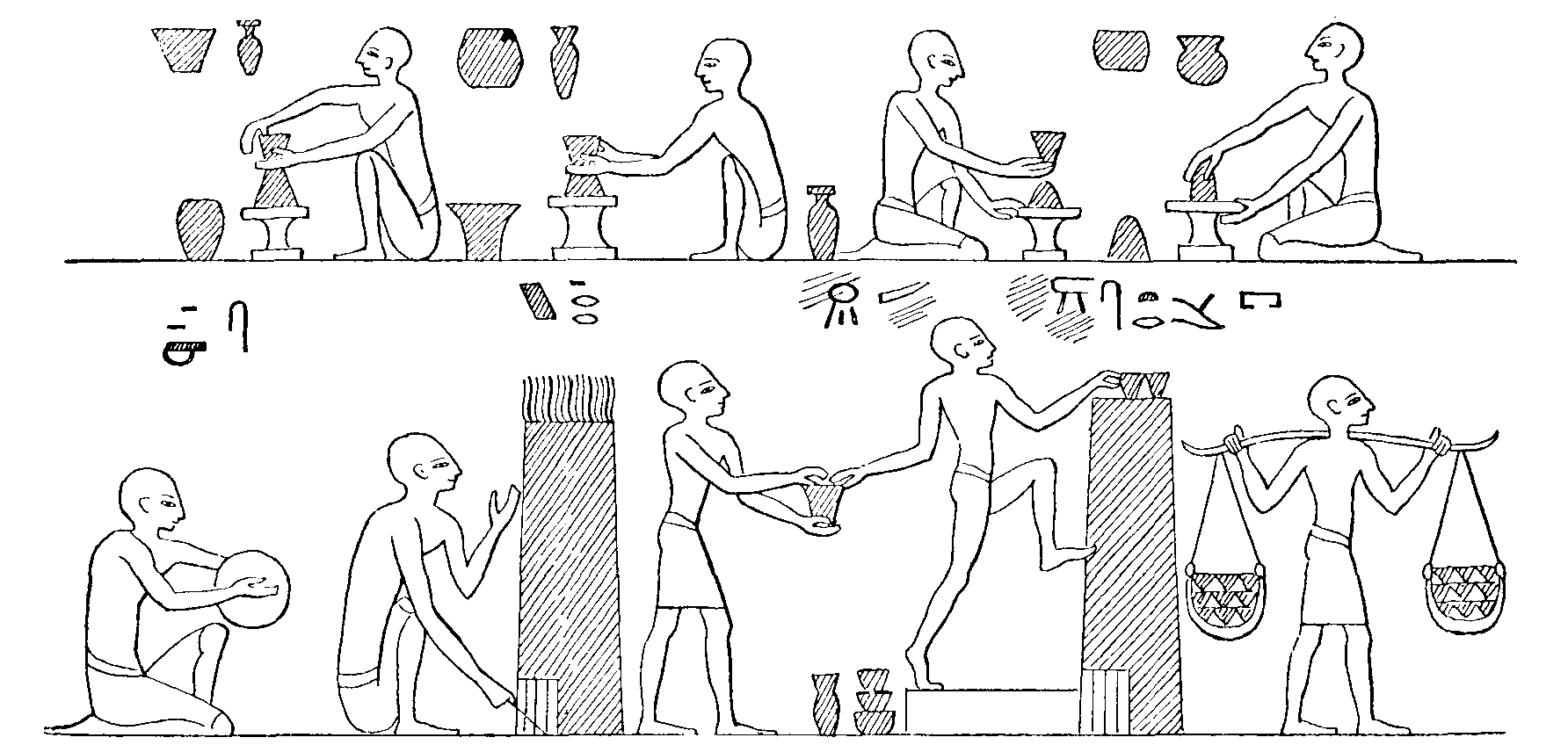
Egyptian Pottery-making
From a wall-painting in the tombs of Beni-Hassan.
Arts and Crafts.—Art developed in ancient Egypt under religious patronage. The earliest use made of Nubian gold was in manufacturing imitation luck-shells worn by the pre-dynastic peoples. Gold thus acquired a religious significance; at an early period it was associated with the sun-deity—the mother-goddess in her solar aspect was called 'Golden Hathor'. The hieroglyph for gold (nub) is a collar of beads. Exquisite gold ornaments in symbolic shapes were produced during the early dynasties. No finer gold ornaments have ever been produced anywhere than those of the twelfth dynasty (c. 2000 B.C.). These include chased gold pectoral ornaments and coronets and crowns inlaid with stones. When copper was first introduced it was used like gold. After implements were made of copper, vases of alabaster, diorite, &c., were worked with increasing skill and taste. The hardest stone was hewn and dressed for building purposes. No people have ever shown greater skill than the Egyptians in their stonework. The sculptors set themselves, when constructing temples, to imitate in stone the lashed palm-sticks, reeds, and papyrus stems used in the earliest shrines to stiffen the mud walls. Massive temple pillars were decorated with lotus petals, rose petals, &c. The early artists, who carved ivory, began to work in stone after copper implements were invented, and produced low reliefs in temples and tomb-chapels. Statuary in limestone, wood, and copper in the early dynastic period was vigorous and realistic. The sculptors were using the hardest material by the time of the Pyramid Age (c. 2700 B.C.). A great tomb-statue of Pharaoh-Khafra, in diorite, preserved in the Cairo Museum, is one of the triumphs of Egyptian sculpture. The Empire-period sculpture reached a high level of excellence. It was to provide 'soul-bodies' for dead Pharaohs that these great works of art were produced. A great advance in the manufacture of pottery was achieved during the Pyramid Age, when the potter's wheel was invented. To Egypt the ancient world owed this notable contrivance. It was introduced in time into Babylonia, Iran, India, China, Crete, Greece, and Western Europe. Shipbuilding is another Egyptian industry which promoted progress. Cretan and Phœnician vessels were of Egyptian design. In all histories of shipping and navigation the ancient Egyptians are credited with being the pioneers of maritime enterprise. The custom of mummification arose in Egypt, and promoted the study of anatomy. Surgery had its origin in mummification, as astronomy had in astrology, and chemistry had in alchemy. Connected with each temple were architects, artists and sculptors, metal-workers and dyers. Ships were constructed to obtain wood for temples and to import pearls, precious stones, herbs, incense-bearing shrubs and trees, &c., for religious purposes. In the history of early civilization the Egyptian priests play a prominent part as patrons of the arts and crafts.
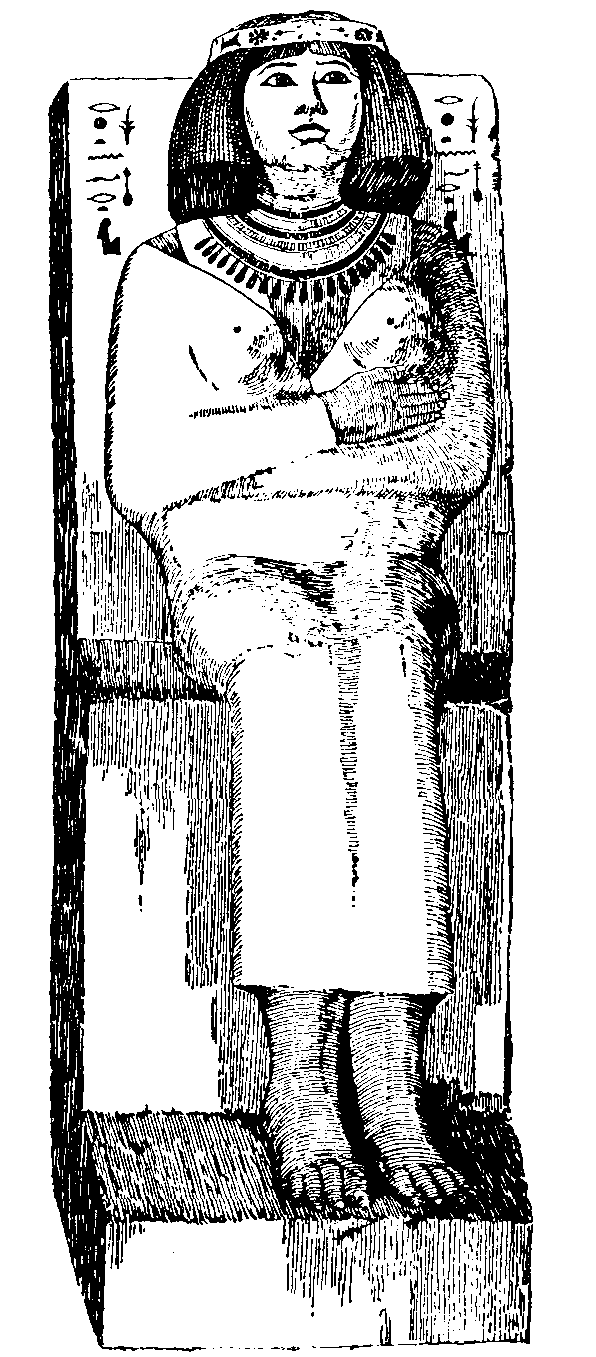
Nefert, a royal princess of the Old Kingdom period
From a limestone statue in the Cairo Museum.
History.—In the hot, dry sands of Upper Egypt, which preserve the dead from decay, have been found the bodies of large numbers of pre-dynastic Egyptians. They were of the type known as the 'Mediterranean race'. The contents of their stomachs have yielded husks of barley and millet and fragments of mammalian and fish bones. Circumcision was practised, and some men shaved. These people used malachite as an eyelid paint. When they discovered that copper could be extracted from malachite, it was used at first like gold, as has been stated. The production of copper implements and weapons was followed by the conquest of Lower Egypt by the copper-using Upper Egyptians. After the latter moved north, they found that the bodies of their dead decayed, and the practice of mummification was introduced. Before 3000 B.C. the broad-headed, long-bearded Armenoid type began to filter into Lower Egypt. The blending of Armenoids and Arabians in Syria produced 'the hybrid race of Semites'. In Egypt the ethnic fusion was most marked at the commercial capital, Memphis, and especially during the time of the pyramid builders (c. 2900-2750 B.C.). The spread of 'copper culture', and the importation into Egypt of timber from Lebanon, apparently brought the ancient races into close contact. Withal, shipbuilding and the art of navigation had advanced by leaps and bounds. Before the Pyramid Age there were sea-traders on the Mediterranean, and the Egyptians imported copper from Sinai across the Red Sea. The legendary Pharaoh who united Upper and Lower Egypt was Mena or Menes. From his time (c. 3400 B.C.) till the close of the sixth dynasty (c. 2475 B.C.) the capital was Memphis. This period is known as that of the 'Old Kingdom'. Among its outstanding monarchs were Khufu, Khafra, and Menkure of the fourth dynasty, the builders of the largest pyramids. Herodotus refers to them as Cheops, Chephren, and Mykerinos. The 'Middle Kingdom' begins with the rise of Thebes in Upper Egypt as the centre of political power. During this period the nobility became so influential that the Pharaohs had to recognize their rights and privileges. In the period of the famous twelfth dynasty (c. 2000-1788 B.C.) the Theban monarchs established a uniform control of Egypt. The later kings of this dynasty were unable, however, to withstand the inroads of Asiatics, and the Middle Kingdom came to an end with the Hyksos invasion. Of the Hyksos, the so-called 'Shepherd Kings', little is known. They were civilized Asiatics, and during their overlordship of Egypt, which embraced the thirteenth till the seventeenth dynasties (c. 1800-1575 B.C.), the horse and chariot were introduced into Egypt. A Theban royal house rose into prominence during the latter part of their sway, and the Hyksos were finally expelled by Pharaoh Aahmes, who founded the eighteenth dynasty. The Empire period was then inaugurated. Egypt's greatest emperor, Thothmes III (1515-1461 B.C.), extended his conquests to the borders of Asia Minor, and received tribute from the Hittites, and even from Cyprus and Crete. During the reign of Akhenaton, the Hittites and their allies, the Amorites, seized the Egyptian sphere of influence in Syria and Northern Palestine.
In the nineteenth dynasty (1350-1205 B.C.) much of the lost territory was recovered. Rameses II (1325-1258 B.C.) fought his Waterloo at Kadesh, but found it necessary about 1300 B.C. to conclude a treaty of peace with the Hittites, the Assyrian Power at the time becoming very powerful and aggressive. Rameses III of the twentieth dynasty was the last great Pharaoh of the Empire period. He successfully resisted the threatened invasions of naval and military peoples from Greece and Anatolia in 1200 B.C. It is believed that the Trojan War (1194-1184 B.C.) was waged by the same confederacy which had attempted to invade the Delta region. No fewer than nine Pharaohs named Rameses ruled in Egypt after Rameses III. Most of these were priest-kings. A Libyan dynasty held sway for about two centuries (950-750 B.C.). One of its Pharaoh-Sheshhonks was the 'Shishak' who was an ally of Solomon; after the death of that monarch he invaded Palestine. The Ethiopians of Nubia (Sudan) subsequently overran Egypt. One of its Pharaohs, Shabaka, was the ally of King Hosea of Israel against Assyria; he was defeated at Raphia by Sargon in 720 B.C. The last Ethiopian Pharaoh, Taharka, was in 662 B.C. overcome by the invading army of the Assyrian Emperor, Ashur-banipal. The northern royal family of Sais then came into power, and the twenty-sixth dynasty, which lasted for about 130 years (662-525 B.C.), was inaugurated by Psamtik I. Pharaoh-Necho, referred to in the Bible, was the second ruler. It was during Necho's reign that his Phœnician mariners circumnavigated Africa. Egyptian culture was at the time spreading far and wide along sea and land routes. Trade was flourishing. The greatest world-power at the time, however, was Persia, and in 525 B.C. Egypt was conquered by Cambyses and became a Persian province, with short interruptions of weak native dynasties (the twenty-eighth to thirtieth), until in 332 B.C. Alexander the Great seized it and founded Alexandria. The Ptolemaic dynasty afterwards held sway for about three centuries. During this period learning and the arts flourished. Alexandria was not only a commercial town, but a centre of culture and the capital of Egypt. Osiris was worshipped there in the form of Serapis. During the latter part of the dynasty the native Egyptians were using Greek and Græcized names, and the whole country was more or less Hellenized. The fifteenth Ptolemy was the younger brother of the famous Cleopatra, the seventh of her name. He vanished, and was succeeded by Cleopatra's son, Cæsarion—Ptolemy XVI—whose father was Julius Cæsar. Both Cleopatra and her son perished when Egypt became a Roman province in 30 B.C. A daughter of Cleopatra and Antony became the wife of Juba, King of Morocco.
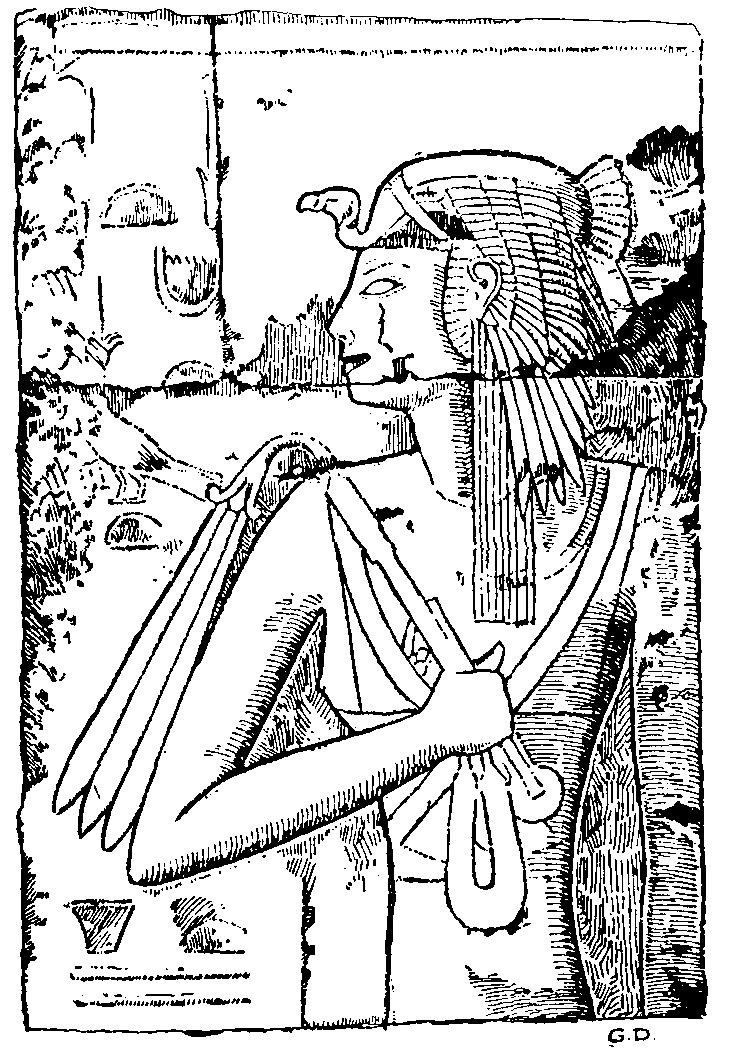
Queen Ahmes (wife of Thothmes I)
From a relief on the wall of the temple at Der-el-Bahari. The face is of Mediterranean type. She represents the royal line which soon afterwards fused with a foreign strain, so that the facial type changed.
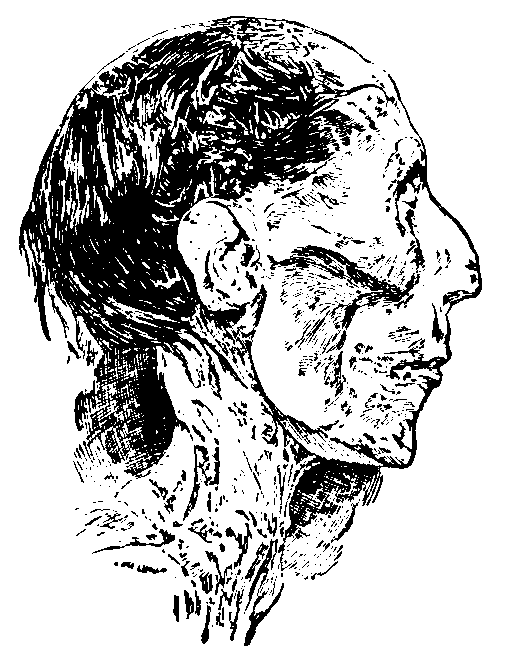
Head of Rameses II
From the mummy
The Romans drew vast quantities of gold from the mines of Nubia (nub means 'gold') and made Egypt their 'granary'. Egyptian religious beliefs and customs were perpetuated by the Roman emperors. Tiberius and Vespasian restored ancient Nilotic temples. The worship of Isis spread to Rome. Hadrian had to give a decision in a dispute between Memphis and Heliopolis regarding the sacred bull. But Egyptian native learning was decaying, and the knowledge of hieroglyphic writing was dying out. Christianity was introduced during the Roman period, and the Coptic Church established. In A.D. 642 the Romans finally abandoned Egypt, which, till 868, became a province of the successive Mohammedan caliphates of Medina, of Damascus, and Baghdad. The Turkish soldiery dominated Egypt for a period. The Shia heretics afterwards became powerful, and the Christians were well treated. In 1250 the Mamelukes (descendants of slaves) came into power. Their pomp-loving sultans and emirs lived in great splendour. They came under Turkish sway early in the sixteenth century, but when Napoleon conquered Egypt in the eighteenth century they were again semi-independent. The British drove the French out of Egypt. Mehemet Ali, an Albanian officer in a Turko-Albanian force, had himself declared Sultan of Egypt, but when he overran Syria and threatened to march to Constantinople, Russia intervened. Britain and France afterwards prevailed on Mehemet Ali to rule Egypt as the viceroy of the Sultan of Turkey. His successor and grandson, Abbas I, built the first railway in Egypt. The next viceroy, Said Pasha, son of Mehemet Ali, granted to a French company the right to construct the Suez Canal. Egypt became bankrupt under his successor, Ismail Pasha, the first Khedive (Prince), during whose reign the Suez Canal was opened. He was deposed when the British and French took over the control of Egyptian finance. During the term of his successor, Tewfik Pasha, the Arabi Pasha rebellion took place. The military occupation of Egypt by British troops was followed by peace and good government. But trouble broke out in the Sudan. Mohammed Ahmed declared himself the Mahdi (Messiah) of the Mohammedans, and conquered a great part of the Sudan. In Nov., 1883, General Hicks ('Hicks Pasha') led an army of 10,000 Egyptians against the false prophet, but while marching across the driest part of the Sudan, misled by spies who acted as guides, his thirst-stricken army was entirely destroyed by the Mahdi's force. This victory gave the false prophet great prestige. In Jan., 1884, General Gordon was sent to Khartoum as Governor-General of the Sudan, but was completely isolated there. Khartoum was captured and the gallant general slain on 26th Jan., 1885, before a relieving force could reach him. The Mahdi died in June, 1885, and was succeeded by Abdullah the Khalifa. After a period of reorganization and preparation in Egypt, the reconquest of the Sudan was begun. Lord (then Sir Herbert) Kitchener was Sirdar, or Commander-in-Chief of the Egyptian army, and his expeditionary force was strengthened by British regiments. In April, 1898, the Khalifa's army was defeated on the banks of the Atbara, and on 2nd Sept. Kitchener won a great victory near Omdurman. The Khalifa escaped, but was rounded up by Sir Reginald Wingate's force, and slain with his emirs at Umme Dubraykat on 24th Nov., 1899. Thereafter the Sudan came under the control of a British-Egyptian condominium, which appointed a Governor-General.
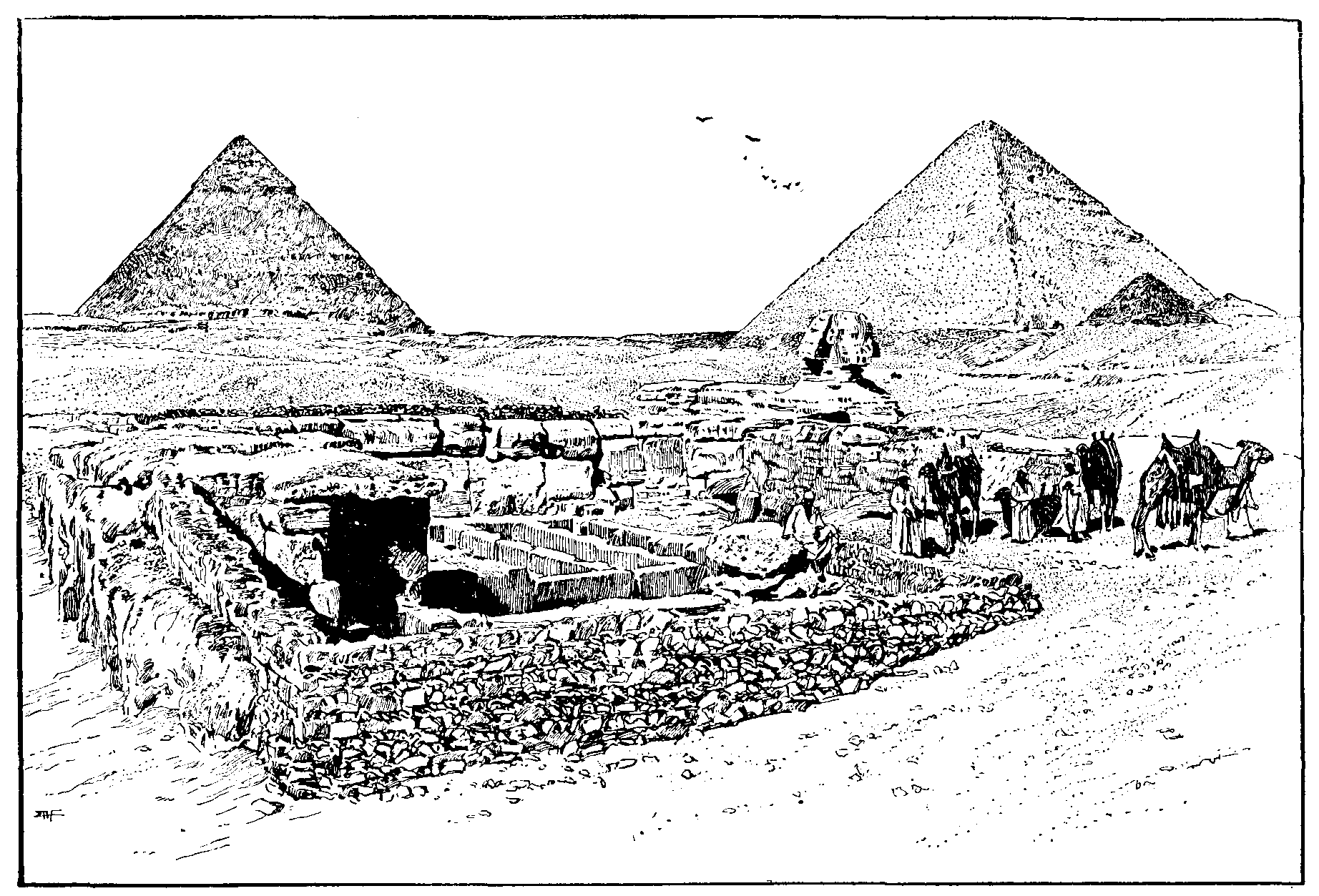
The Great Pyramids of Giza and the Sphinx
Built by Cheops (Khufu) and Cephron (Khafra) as their future tombs, in order to secure immortality by the preservation of the mummy.
At the time of the outbreak of the Great War, in the autumn of 1914, the Khedive of Egypt was in Constantinople. He sided with the Central Powers. He was consequently deposed by Britain, and Prince Hussein Kamil was declared Sultan of Egypt; the suzerainty of Turkey terminated at the same time. The new ruler of Egypt was the uncle of the deposed Khedive, Abbas Pasha Hilmi (second son of the first Khedive, Ismail Pasha, and brother of Tewfik Pasha, the second Khedive). Hussein Kamil died in 1917 and was succeeded by Ahmed Fuad Pasha. Under the Peace Treaty, Egypt is recognized as an independent kingdom protected by Great Britain. The capital of modern Egypt is Cairo, situated near the site of ancient Memphis. Thebes is represented by Luxor and Karnak.—Bibliography: (Religion) Breasted, Development of Religion and Thought in Ancient Egypt; Renouf, Book of the Dead; Budge, Gods of the Egyptians; Wiedemann, Religion of the Ancient Egyptians; Sayce, Religion of Ancient Egypt and Babylonia; G. Elliot Smith, The Migrations of Early Culture; (History)—G. Elliot Smith, The Ancient Egyptians; Breasted, A History of Egypt; Flinders Petrie, A History of Egypt; King and Hall, Egypt and Western Asia in the Light of Recent Discoveries; H. R. Hall, The Ancient History of the Near East; Sir A. Colvin, The Making of Modern Egypt; Lord Cromer, Modern Egypt.
Egyptian Blue, a brilliant and very permanent pigment used by the Romans in the early centuries of the Christian era. It has been found in ancient frescoes in the Vatican, and also at Pompeii. The chemist Fouqué proved by analysis that it is a double silicate of calcium and copper.
Egyptian Vulture (Neophron perenoptĕrus), a bird that frequents both shores of the Mediterranean, but rarely passes farther north, though it has been found in the British islands. It is one of the smaller vultures, about the size of a raven. The general colour is white, the quill feathers of the wing being dark brown. It frequents the streets of Eastern towns, where it is protected on account of its services as a scavenger. This vulture is sometimes known as Pharaoh's Hen, on account of its frequent representation in Egyptian hieroglyphics. In Spain it is called the quebranta-huesos (bone-smasher) in reference to its supposed habit of breaking up bones left by other vultures.
Ehrenberg (ā´rėn-berh), Christian Gottfried, a German scientist, born in 1795, died in 1876. After studying theology, medicine, and natural history, he joined in 1820 an expedition to Palestine, Egypt, and Abyssinia, returning to Berlin in 1825. In 1829 he accompanied Humboldt to the Ural and Altai ranges and to Central Siberia. His great work on Infusoria appeared in 1838, and was at once recognized as the highest authority on the subject. It was followed in 1854 by his Microgeology.
Ehrenbreitstein (ā´ren-brīt-stīn), a dismantled Prussian fortress formerly of great strength and situated opposite the confluence of the Moselle with the Rhine, on a precipitous rock 387 feet above the river, and inaccessible on three sides. It is connected with Coblentz on the opposite shore by a bridge of boats. The fortifications, which were erected between 1816 and 1820 at a cost of £1,200,000, could accommodate a garrison of 14,000 men, and possessed room for stores to last an army of 60,000 for a year.
Ehrlich, Paul, German physician, born in Silesia in 1854, died in 1915. Educated at Breslau, Strasburg, and Leipzig, he became privat-dozent at the University of Berlin in 1889, and in 1896 was appointed director of the Royal Institute for Serum Research at Steglitz, which was transferred to Frankfurt in 1899, and became the Royal Institute for Experimental Therapeutics. His studies in the histology of blood are very important, but his claim to fame is based upon his discovery of salvarsan (606) and of neosalvarsan (614), arsenic compounds which are very efficacious in the treatment of syphilis. He delivered the Croonian lectures in 1900 and the Harben lectures in 1907, received honorary degrees from the universities of Oxford and Chicago, and in 1908 shared the Nobel prize for medicine with Metchnikoff of the Institut Pasteur in Paris. His works include: Beiträge zu Histologie und Klinik des Blutes, Anæmie, Abhandlungen über Salvarsan, &c.
Eibenstock (ī´ben-stok), a town in the south-east of Saxony, with important manufactures of lace. Pop. 9528.
Eichhorn (īh´horn), Johann Gottfried, German Orientalist, historian, &c., born in 1752, died in 1827. He became professor of Oriental languages at Jena, and then at Göttingen. Amongst his works are: The Hebrew Prophets, History of Literature, History of the Last Three Centuries, Introductions to the Old and New Testaments and to the Apocrypha.
Eichstätt (īh´stet), an old town, Bavaria, in a deep valley of the Altmühl, 67 miles N.N.W. of Munich. Its principal edifice is a fine Gothic cathedral, founded in 1259. Pop. 8029.
Eider (ī´dėr), a river of Schleswig-Holstein, rises 8 miles S. of Kiel, and after a winding course falls into the North Sea at Tönning; length, 112 miles. By means of a canal it long gave communication between the North Sea and Baltic, but the new ship canal here has superseded this route.
Eider Duck (Somateria mollissĭma), female
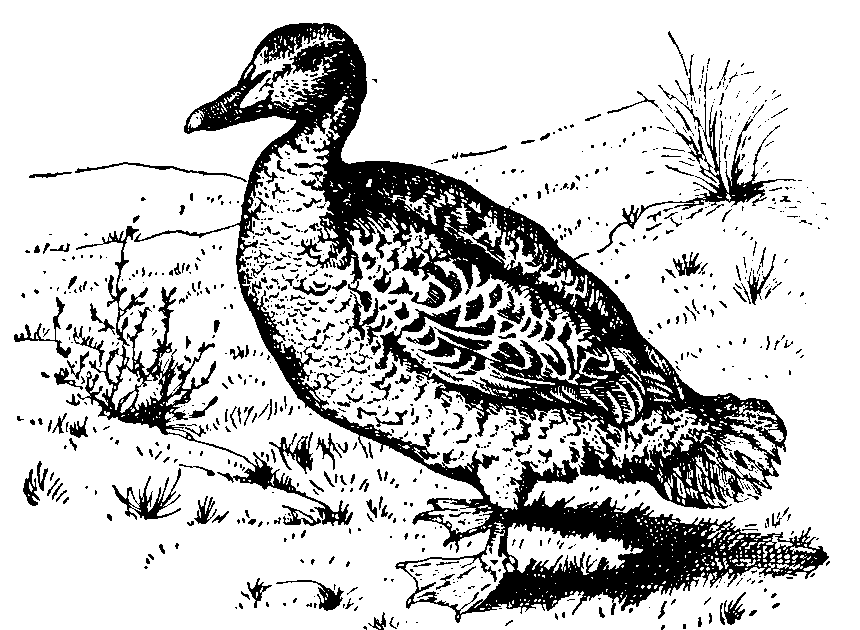
Eider Duck (Somateria mollissĭma), a species of duck found from 45° north to the highest latitudes yet visited, both in Europe and America. Its favourite haunts are solitary rocky shores and islands. In Greenland and Iceland they occur in great numbers, and also breed on the western islands of Scotland. The eider duck is about twice the size of the common duck, being about 2 feet 3 inches in length, 3 feet in breadth of wing, and from 6 to 7 lb. in weight. The male is black, head and back white, with a black crown. The female is reddish drab spotted with black, and with two white bands on the wings. They feed largely on shell-fish and crustaceans. Their nests are usually formed of drift grass or dry seaweed, lined with a large quantity of down, which the female plucks from her own breast. In this soft bed she lays five eggs, which she covers over with a layer of down. If this, with the eggs, is removed, the bird repeats the process. One female generally furnishes about ½ lb. of down, but the quantity is reduced by cleaning. This down, from its superior warmth, lightness, and elasticity, is in great demand for beds and coverlets; and the districts in Norway and Iceland where these birds abound are guarded with the greatest vigilance as a most valuable property. As found in commerce this down is in balls of the size of a man's fist, and weighing from 3 to 4 lb. It is so fine and elastic that 5 lb. of the best quality is sufficient for a whole bed. The down from dead birds is little esteemed, having lost its elasticity. The king eider duck (Somateria spectabílis) is another species resembling the preceding and inhabiting the same coasts.—Cf. J. G. Millais, British Diving Ducks.
Eiffel (ā-fel), Alexandre Gustave, French engineer, born in 1832; attended, from 1852 to 1855, the École Centrale des Arts et Manufactures at Paris, and devoted himself chiefly to the designing of large structures in iron, especially bridges and viaducts, the great bridge over the Douro being one of his works. His name is best known, however, from the lofty iron tower erected by him in connection with the Paris Exhibition of 1889, rising to the height of 985 feet on the Champ de Mars. He was condemned in 1893 to two years' imprisonment and a fine of 20,000 francs for misappropriation of funds belonging to the Panama Canal Company, but the judgment was set aside on technical grounds. In 1913 he published a work entitled Resistance of the Air. See next article.
Eiffel Tower, a structure named after the originator, one of the sights of Paris, is by far the loftiest structure in existence, surpassing the Washington Obelisk, the next highest (555 feet), by 430 feet. It cost about £260,000, and was erected partly at the cost of the State, partly by funds provided by Eiffel himself, who formed a company for the purpose. The company derived its profits from the fees which visitors had to pay, but the tower became the property of the State in 1909. The top may be reached by stairs and lifts. The first stage or platform is at the height of 189 feet, and forms a quadrilateral 213 feet square, fitted up as a restaurant. The next platform is at the height of about 380 feet, and is 98 feet square. The third platform is at the height of 906 feet, and is large enough to accommodate a good number of persons, affording a magnificent view. The lantern higher up is supplied with powerful electric searchlights, and on the very summit is a small area utilized chiefly for scientific observations. The tower has been utilized in experiments connected with the fall of bodies, vibration of the pendulum, and pressure of the air. In recent years the tower has become an important wireless telegraphy station.
Eigg (eg), an island on the west coast of Scotland, county of Inverness, about 10 miles from the mainland, and 5 miles long by about 3 broad. It has bold, rocky shores, and terminates to the south in a lofty promontory called the Scuir of Eigg, with a peak of columnar pitchstone porphyry 1339 feet above the sea, and on one side perpendicular as a wall. It is the scene of the massacre, towards the end of the sixteenth century, of 200 Macdonalds by the Macleods of Skye, who suffocated them in a cave where they had taken refuge. Pop. 211.
Eight-hour Day. The eight-hour day was proposed in England as early as 1833, and in 1869 the Trade Union Congress of Birmingham formulated the demand that this ideal working day should be adopted throughout the United Kingdom. The Trade Unions and the Socialists sought to secure the establishment of the eight-hour day through legislation, and it gradually came into force not only in coal-mining, but in various trades and industries. The agitation in favour of an eight-hour day became very strong in Europe towards the end of the nineteenth and at the beginning of the twentieth centuries, and in England it was granted to miners in 1908, and to railway employees in 1919. Since the European War the movement has made great headway, and it now forms part of the programme of the Labour parties in almost all European countries.—Bibliography: Hedfield and Gibbins, A Shorter Working Day; Robertson, The Eight Hour Question.
Eighty Club, The, a club formed in 1879 by a number of prominent English Liberals with a view to the promotion of the success of Liberalism at the general election of 1880, whence its name. The members lecture on political subjects and address Liberal associations throughout the country. Women were first admitted to membership in 1920.
Eikon Basilikē (ī´kon ba-sil´i-kē; Gr., 'the royal image'), the name of a book published shortly after the execution of Charles I in Jan., 1649, and supposed by some to have been written by the king himself. At the Restoration Gauden, afterwards Bishop of Worcester, laid claim to the authorship, and a memorandum in the copy of the Earl of Anglesea, Lord Privy Seal under Charles II, affirms his claim with the authority of Charles II and the Duke of York. The Royalist Clarendon, author of the History of the Rebellion, accepted this statement, but others refused to credit Gauden with the authorship. Within a year of its publication, 48,000 copies of the book were sold, and the republicans put forward Milton to answer it, his Eikonoklastes (that is 'image-breaker') appearing the same year, by order of Parliament. The Eikon Basilikē professes to be a sort of private journal of the king, written in an affectedly dignified strain, and containing numerous assertions of love for his misguided and ungrateful people.—Cf. Almack, Bibliography of the King's Book, or Eikon Basilikē.
Eildon Hills (ēl´don), a picturesque hill-mass with three summits, south of Melrose, Roxburghshire, Scotland, reaching a height of nearly 1400 feet, fabled to have been cleft in three by Michael Scott.
Eileithyia (ī-lī-thī´ya), the Greek name of the ancient Egyptian city Nekheb (the modern El-Kab), on the Nile, some distance above Esneh. Important remains have been obtained from rock-tombs in the neighbourhood, and there are several ruined temples.
Eilenburg (ī´lėn-bu¨rh), a town, Prussian Saxony, 26 miles N.N.E. of Merseburg, on an island of the Mulde. It has manufactures of calico. Pop. 17,400.
Eimbeck (īm´bek), or Einbeck, a town of Prussia, province of Hanover, 40 miles south of Hanover, once famous for its beer (Eimbecker Bier, whence Bock). Pop. 9430.
Einsiedeln (īn´zē-dėln), a village and district, Switzerland, in the canton and 9 miles north by east of Schwyz, 3000 feet above the sea, celebrated for its Benedictine abbey. An image of the Virgin, alleged to possess miraculous powers, annually attracts immense numbers of pilgrims. Pop. 8438.
Einstein, Albert (1879- ), physicist, was born at Ulm, Würtemberg, Germany, of German-Jewish parents. He was educated at the Gymnasium in Munich, and, on leaving school in his sixteenth year, accompanied his parents to Milan. Six months later, he enrolled at the Technical High School in Zurich, where he studied from 1896 to 1900. He held a post in the Swiss Patent Office from 1902 to 1909, then various professorships in Zurich till 1914, when he received a call to the Prussian Academy of Science, Berlin, as successor to van't Hoff. Einstein has been twice married. He has become famous as the author of the Theory of Relativity (q.v.). The 'special theory', which deals chiefly with electrodynamics and optics, was published in 1905, and the 'general theory' or theory of gravitation, about ten years later. His name became popularly known in 1919, after observations made during the solar eclipse of that year had verified his prediction of the bending of rays of light coming from a star and passing close to the sun. He has made other valuable contributions to Theoretical Physics, among these being a theory of the Brownian movements and various important applications of the modern quantum theory of energy. In 1921 he visited the United States and Britain, and delivered many lectures on Relativity.
Eisenach (ī´zėn-āh), a town of Germany, in the former grand-duchy of Saxe-Weimar, near the mountains of Thuringia, at the junction of the Nesse and Hörsel. It is an attractive town, and contains a palace erected in 1742. It has manufactures of pottery, leather, woollen yarn, &c. Sebastian Bach was born there in 1685. Near it lies the Wartburg, where Luther was kept for safety during 1521 and 1522. Pop. 38,362.
Eisenberg (ī´zėn-berh), a town of Germany, former duchy of Saxe-Altenburg, with a palace and various manufactures. Pop. 10,750.
Eisleben (īs´lā-bėn), a town, Prussian Saxony, 25 miles north-west of Merseburg, celebrated as the place where Luther was born and where he died. There are many memorials of Luther, and also a bronze statue of the reformer erected in 1883. Copper is extensively worked in the neighbourhood. Pop. 24,630.
Eisner, Kurt, Bavarian revolutionary leader, born in 1867 at Berlin, of a Jewish family. He studied at the University of Marburg, and early acquired a vast erudition. Entering journalism, he contributed to the Frankfurter Zeitung, where he published an article attacking the Kaiser. For this he was condemned to nine months' imprisonment. He then wrote for the Socialist press and eventually became editor-in-chief of the Vorwärts. In 1907 he published a work entitled The Fall of the Empire which attracted much attention, and in 1910 he attacked Prussian ascendancy in the Munich Post. Eisner took an active part in the Revolution of 1918, and was appointed Prime Minister of Bavaria. A revolutionary and a Socialist, he was, however, opposed to Bolshevism, which he did not hesitate to criticize violently. But his policy of separation, his aim of liberating the South German States, and his constant attacks upon the Kaiser and the whole military caste of Germany, brought him many enemies. Whilst on his way from his house to the Foreign Office he was shot at and killed by Count Arco Valley on 21st Feb., 1919.
Eisteddfod (ī-steth´vōd; W. eistedd, to sit, and bod, to be; pl. eisteddfodau), an ancient assembly of Welsh bards for the purpose of musical and poetical contests, the judges being originally appointed by commissions from the native princes, and after the conquest from the English kings. There are two kinds of eisteddfodau, the national or general, and the provincial gatherings which take place in many parts of Wales. The last commission was issued by Queen Elizabeth in 1568, but the eisteddfod fell into abeyance during the seventeenth century. In 1798 the ancient custom was revived by the Gwynnedigion Society, and on a more elaborate scale by the Cambrian Society, which grew out of the Gwynnedigion. Eisteddfodau are now held annually in North and South Wales alternately, and are attended by many thousands of people. The festivals of 1919 and 1920 were held at Corwen and at Barry, Glamorgan, respectively.—Cf. Rhys and Brynmor Jones, The Welsh People.
Eject´ment, in law, an action wherein the title to lands and tenements may be tried and the possession recovered. It is commenced by a writ addressed to the tenant in possession and all entitled to defend the possession, bearing that the plaintiff lays claim to the property in question, and calling upon all interested to appear within a certain time to defend their rights. In its older form the action was remarkable for the curious fictions on which procedure was based. The names of John Doe, an imaginary plaintiff, and of Richard Roe, an imaginary defendant, were familiar in cases of this kind in the English courts until 1852, when the Common Law Procedure Act abolished these fictitious suitors.
Ejector, in mechanical engineering, an appliance for ejecting gases, vapours, or liquids from closed spaces by the use of another gas, vapour, or liquid at a higher pressure. For instance, the air may be extracted from a condenser by an ejector. A jet of steam is directed along a short specially-shaped pipe leading from the condenser to the outside atmosphere. The velocity of the steam when it leaves the jet in the pipe is very high, and it blows out into the atmosphere in spite of the atmospheric pressure against it. In blowing out into the atmosphere it sucks the air in the condenser along with it, and after it has been in operation some time practically the whole of the air is sucked out of the condenser. The appliance works on the principle of momentum. The active jet mixes with the material to be ejected and imparts a common momentum to the mixture, which is sufficient to enable it to pass outside the vessel from which the ejection is taking place. The same principle is used in the mercury air-pump (see Air-pump).—Bibliography: W. E. Dalby, Steam Power; Modern Mechanical Engineering (The Gresham Publishing Company).
Ekat´erinburg, a town, Russia, in the government and 170 miles S.E. of Perm, founded in 1723 by Peter the Great. It is the mining and metallurgy centre of the Ural regions; and gem-cutting, the making of machinery, cloth, and candles are industries. Pop. 70,000.
Ekat´erinodar, a town of Russia in the Caucasus, chief town of the Kuban territory, on the River Kuban, a poorly-built place with a considerable trade. Pop. 107,360.
Ekat´erinoslav, a town of the Ukraine, capital of a government of the same name, on the right bank of the Dnieper, 250 miles N.E. of Odessa. Founded in 1787, it is a manufacturing centre, producing iron, machinery, tobacco, and beer. Pop. 220,100.—The government, which is intersected by the Dnieper and reaches the Sea of Azov, has great mineral wealth, especially in coal (Donetz basin), iron, manganese, and rock-salt; and its fertile black-earth soil produces abundant crops of wheat and other grains. Area, 24,478 sq. miles; pop. 3,537,300.
Elæagna´ceæ, the oleaster family of plants, a small nat. ord. of apetalous dicotyledons scattered over the northern regions. The only British member is the sea-buckthorn (Hippophaë rhamnoides).
Ela´in, the oily principle of fat obtained by submitting fat to the action of boiling alcohol, allowing the stearin to crystallize, and then evaporating the alcoholic solution. It is not unlike vegetable oil in its appearance and its properties, and forms soaps with alkalies.
E´lam, the ancient name of a country on the eastern border of Babylonia. Its civilization dates back beyond 3000 B.C. Before 2000 B.C. it was strong enough to subdue part of Babylonia. Its power was finally broken by the last Assyrian monarchs. The capital was Susa, which became prominent again after the rise of Cyrus. Its splendour during the Persian period is reflected in the Book of Esther, in which it is referred to as 'Shushan'.
Eland (Oreas canna)
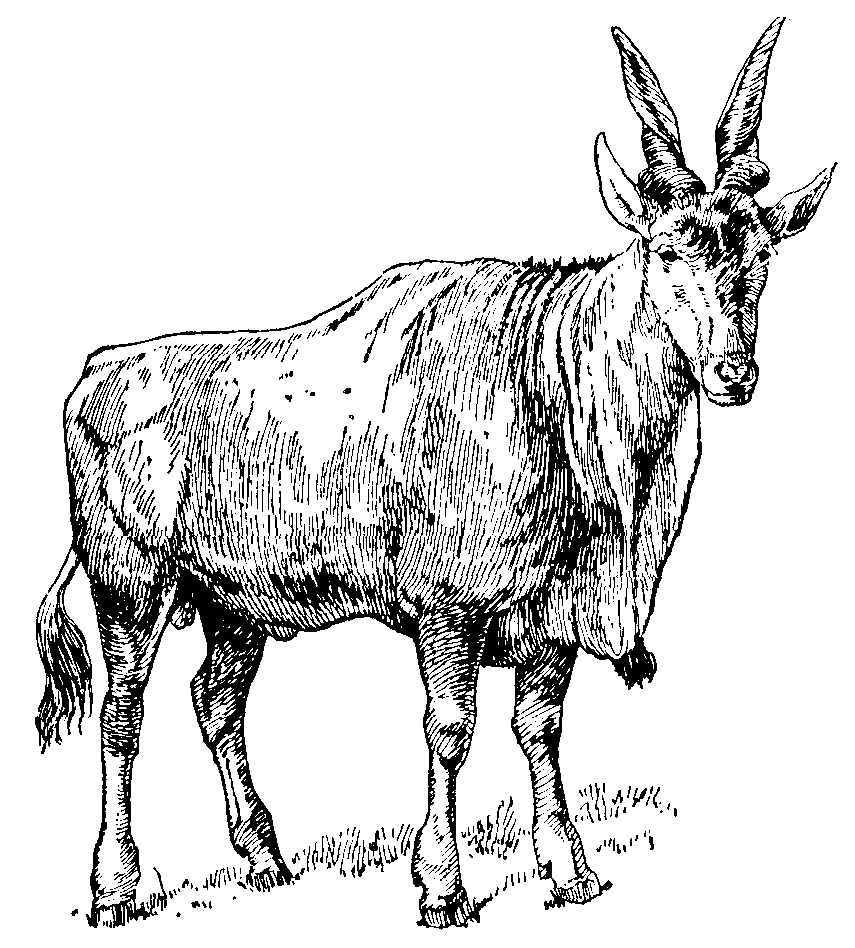
E´land, Oreas (Orias) canna, a species of antelope inhabiting Africa, the largest of all its kind, being about the size of an ox. Its flesh, especially that of the thighs, which are dried and used in this state, is highly prized. It is now almost extinct south of the Limpopo, but it is plentiful in the Kalahari. The colour is a light or greyish brown, and it possesses a short mane. The horns, which are about 18 inches long and nearly straight, are spirally keeled.
El´anus, the name of certain species of raptorial birds of the genus Elānus, belonging to the kites. The type species is the black-winged kite (E. cæruleus) of Africa and South Asia, which strays to South-West Europe. A very similar form (E. leucurus) is native to tropical and subtropical America, and other species (E. scriptus and E. axillaris) are Australian.
Elaphomyces, a genus of Ascomycetous fungi, section Plectascineæ, with closed, subterranean ascus-fruits resembling those of the genuine truffles (Tuberineæ), but not closely allied to that family. E. cervinus (Hart's truffle) is not infrequent in Britain; it forms 'mycorhiza' with roots of oak, beech, and various conifers.
E´laps, a genus of poisonous American snakes, the type of the family Elapidæ, to which belongs the cobra de capello.
El-Arish, Egyptian city on the Mediterranean, on the Wadi el-Arish, and chief city of the territory bearing the same name. It was taken by the French under Kléber in 1799, but abandoned the same year. Pop. about 5000.
Elasmobranchii (-brang´ki-i), a sub-class of fishes, including sharks, dog-fishes, rays (skates); and also Chimæra (q.v.) and its allies. They are predaceous forms, in which the mouth is a transverse slit on the under side of the head, the numerous simple teeth are in several rows (except in chimæroids), the short intestine possesses a spiral valve and opens into a cloaca. The tail is asymmetrical (heterocercal), and numerous placoid scales (dermal denticles) are embedded in the skin. The skeleton is cartilaginous; the heart possesses a muscular conus arteriosus with numerous rows of pocket-valves; and there are five (sometimes six or seven) pairs of gill-pouches opening by slits to the exterior, these not being covered by an external flap (operculum) except in chimæroids. Fertilization is internal, and the male is provided with a pair of copulatory organs (claspers) projecting backwards from the pelvic fins. The eggs sometimes develop within the body of the mother, but are usually laid in horny pouches (mermaids' purses). The group is of great antiquity, and many extinct fossil types are known.