VOLUME IV PART 2 (continued 4)
Reading edition
The effect of the European War has been enormous on the development of the electric furnace in this country, for prior to the war in 1914, although the use of the electric furnace for steel-making was increasing, there were only 5 furnaces in operation in Sheffield, and two or three more in other parts of the country, producing in all about 15,000 tons per annum. Soon after the commencement of the war, it became necessary to deal with the rapidly accumulating quantity of shell turnings, to make substitutes for Swedish iron and steel, which could not be imported, and to make large quantities of special alloy steel for various war purposes. As a result of these demands, within four years the number of electric furnaces increased to over 100, the steel produced being over 200,000 tons per annum. Since 1918 the number of furnaces has further increased, and probably reached 150 of various sizes and makes in 1920. In America a similar development has taken place, the number of furnaces increasing from 7 in 1907 to 363 in 1920, the output of electric steel in 1918 amounting to over 500,000 tons. In France, also, great strides have been made, and owing to the shortage of pig-iron, synthetic processes for its production from iron and steel scrap and ore were developed in open-pit arc-resistance furnaces, yielding 220,000 tons in 1916-8.
Electrolytic Processes.—The application of electrolysis for the production of metals from a fused electrolyte is most important in the case of aluminium. This metal cannot be produced by direct electrolysis in aqueous solution, but is deposited electrolytically from a fused bath of cryolite, containing alumina in solution. As the metallic aluminium is extracted from the molten bath, further quantities of purified oxide are added. The anodes consist of carbon blocks suspended in the molten bath, and the cathode consists of the carbon lining of the furnace. Calcium, cerium, lithium, magnesium, potassium, sodium, and strontium are obtained by the electrolysis of fused chlorides, sodium being also obtained from fused hydroxide and fused nitrate.
Metallic magnesium was obtained by the electrolysis of the fused chloride by Bunsen in 1852, but the application of electrolysis as a means of recovering metals from ores by means of aqueous solutions dates back to 1836, in which year Becquerel obtained copper from sulphide ores by first extracting the copper as sulphate or chloride, and then recovering the copper by the electrolysis of the solutions, using insoluble anodes. The method has since chiefly been applied to the treatment of copper ores and products, but has also been used for the recovery of nickel, gold, zinc, &c. The production of electrolytic zinc from solutions has been encouraged as a result of the shortage of pure zinc for war purposes, and several processes have been developed. In these processes the solution used consists either of zinc sulphate or of zinc chloride, the anodes consisting of metallic lead or of carbon, and the cathodes of pure zinc sheets.
It is in connection with the refining of metals that electrolytic processes become of prime importance. Elkington, in 1865, was the first to refine impure metallic copper electrolytically and recover the silver contained in it. Pure copper is now commonly obtained from impure copper anodes in an electrolyte of copper sulphate containing free sulphuric acid, a current density of 12 to 15 amperes per square foot being used at 0.34 to 0.44 volt. Gold is also refined by a similar process, the electrolyte used consisting of gold chloride solution containing free hydrochloric acid. In this case a current density of 100 amperes at 1 volt is used. Silver is likewise refined in a silver nitrate bath, iron by the electrolysis of sulphate or chloride solution, and lead in a solution of lead fluosilicate containing free hydrofluoric acid.
In all the above-mentioned processes the anode is cast from the impure metal to be refined, and the cathode consists of a sheet or plate on which the pure metal is deposited.
It will be seen that these refining processes are very similar to electroplating methods.
Electromotive Force, the name given to the force tending to produce a flow of electricity in an electric circuit. The electromotive force, or E.M.F., is measured in terms of the work done in carrying unit quantity of electricity once round the circuit.
Thus unit electromotive force (absolute) is said to exist in a circuit if 1 erg of work is done in carrying 1 coulomb of electricity once round the circuit. The potential difference, or P.D. (in electromagnetic units), between two points in an electric circuit is similarly defined in terms of the work done in carrying 1 coulomb of electricity from the one point to the other.
Production of an Electromotive Force.—There are several sources of E.M.F., e.g. (a) chemical action, as in primary and secondary cells; (b) thermo-electric action, as in the thermopile; (c) electro-magnetic action, as in generators, motors, transformers, and induction coils.
The electromotive force due to chemical action depends on the material of the electrodes and the nature of the electrolyte, and also to a slight extent on the temperature. Thus, for any given pair of materials (say zinc and copper) immersed in a certain electrolyte of given strength (say dilute sulphuric acid), the E.M.F. produced at a given temperature has a definite value. For a discussion of the electromotive force produced by thermo-electric action, see Thermo-electricity.
The principle of the electromagnetic generation of an E.M.F. may be stated in its most general form as follows: If lines of magnetic force are interlinked with an electric circuit, and if by any means the number of interlinkages of the lines of magnetic force with the circuit is made to change, then an E.M.F. will be generated in the circuit, the magnitude of this E.M.F. being proportional to the time rate of change of the interlinkages. Thus, if the interlinkages are changing at the rate of one per second, one absolute unit of E.M.F. will be generated; or if the interlinkages are changing at the rate of a hundred million per second, an E.M.F. of 1 volt will be generated. It is immaterial in what manner the change of interlinkages is brought about.
A permanent magnet may be moved so as to vary the lines of magnetic force linked with an electric circuit, as in magneto-generators; or the circuit may be moved through a magnetic field (see Generator; Electric Motors); or the magnetic field produced by a current in one coil linked with a second coil may be varied by varying the current in the first coil, as in static transformers and induction coils.
The electromagnetic generation of an E.M.F. is the fundamental principle which has made possible the generation and utilization of electrical energy on a large scale.
Electron, the atom of electricity, more especially of negative electricity. The first light on the question of the structure of electricity came from the laws of electrolysis (q.v.), established by Faraday. These laws are explained very naturally if we make the assumption that electricity, like matter, is atomic, the atom being the charge carried by the hydrogen ion. Clerk Maxwell even proposed to call this charge 'one molecule' of electricity, but added the remark that "it is extremely improbable that when we come to understand the true nature of electrolysis we shall retain in any form the theory of molecular charges, for then we shall have obtained a secure basis on which to form a true theory of electric currents, and so become independent of these provisional hypotheses". To-day, however, so far are we from discarding the hypothesis of the atomic nature of electricity that we find ourselves compelled by the pressure of experimental facts to interpret all electrical phenomena, in metals as well as in electrolytes, in terms of this very hypothesis. Any statical charge is supposed to be made up of a very great number of electrons, just as a material body is composed of atoms of matter. A metallic conductor is supposed to contain many free electrons, which normally bear much the same relation to the material molecules as a saturated vapour bears to the liquid in equilibrium with it. When an electromotive force is applied, it causes a drift of the electrons in the opposite direction to the force, the charge on the electrons being negative. It is this drift of electrons which constitutes an electric current.
The striking advances that have been made in our knowledge of the nature of electricity since the last years of the nineteenth century have been due chiefly to the study of the electric discharge in gases. Hittorf in 1869 and Crookes in 1879 examined the rays, now called the cathode rays, which stream from cathode to anode in a tube containing gas of very low pressure. The phenomena suggested to Crookes that the rays consist of material particles carrying a negative charge and moving at a high speed; but many physicists rejected this explanation, holding that the rays were due to some form of wave motion in the ether. About 1897 it was conclusively shown by Perrin, Wiechert, and Sir J. J. Thomson that Crookes's view was the correct one. Sir J. J. Thomson measured the velocity of the particles, and also the ratio of the charge e, to the mass m of each. His method was to subject a fine beam to the action of two fields of force, one magnetic, the other electric, and both perpendicular to the line of motion and also to each other. The electric field being X, and the magnetic field H, the forces on a particle were in the same direction, and equal to eX, evH. Either field by itself deflected a fine beam, as was shown by the motion of a spot of light where the beam struck a fluorescent screen. The value of X was adjusted till there was no deflection in the combined fields. Hence X = vH, and v was found from the measured values of X and H. The deflections under the two fields acting separately were also observed. Either of these deflections, when v is known, gives the value of the ratio e/m. The values of the velocity v were found to depend on the E.M.F. between the terminals of the discharge-tube. They varied from 1/30 to ⅓ of the velocity of light. The fraction e/m, however, had always the same negative value, no matter how the material of the cathode and the nature and pressure of the gas were varied.
Many other ways of obtaining these negatively charged particles, or electrons, are now known. The β-rays from radio-active substances (see Radio-activity) are simply electrons moving with great speeds, approaching sometimes within 2 or 3 per cent of the velocity of light. Hot metals give off electrons copiously: this property is used in the construction of the Coolidge X-ray tube and of the thermionic valve (q.v.). A metal plate illuminated by ultra-violet light, from an electric arc or spark, for instance, gives off electrons moving at all velocities below a certain maximum (see Photo-electric Effect). From whatever source the electrons are derived, their properties are found to be the same.
The determination of e and m separately is a much more difficult matter than the determination of their ratio. The first attempt to measure e directly was made by Townsend, and published in 1897. Townsend obtained his ions in the hydrogen and oxygen given off when caustic potash is electrolyzed. The charged gases when bubbled through water formed a cloud. This cloud could be completely removed by bubbling through concentrated sulphuric acid, but reappeared when the gas came out again into the atmosphere, owing to the condensation of water-vapour on the ions. Townsend determined the weight of the cloud and its total charge. He also found the average weight of the minute spherical drops forming the cloud by observing their rate of fall under gravity, and calculating their radius from a theoretical formula known as Stokes's law, viz. v = 2/9ga2ρ/η, where a is the radius, ρ the density, v the velocity of the drop, and η is the viscosity of air. The weight of the cloud divided by the weight of a drop gave the number of drops, which was presumably the same as the number of ions. Finally, dividing the total charge by the number of ions, Townsend found e, the average charge carried by an ion. His value came out about three-fifths of the value accepted now.
This pioneer method of Townsend's has been improved and modified in various ways by C. T. R. Wilson, Sir J. J. Thomson, H. A. Wilson, and notably by Millikan, of Chicago. Millikan's charge carriers were minute oil drops, which were given elementary charges by means of ionizing rays from radium. Observations were made of the equilibrium and motion of these charges under the combined influence of gravity and a strong vertical electric field, the intensity of which could be varied at will. A single drop could be kept in view for several minutes at a time, and note was taken of the effect of each new charge as it was picked up by the drop. On calculation, the charge was found in all cases to have very approximately the same value. It so happened, as a consequence of the method of producing the drops, that they carried a small frictional charge, and incidentally Millikan was able to verify that this was always an integral multiple of the electronic charge e. Millikan's result, which is most probably the best yet found, is that e = 4.774 × 10⁻¹⁰ absolute electrostatic units, or 1.591 × 10⁻²⁰ absolute electromagnetic units.
An indirect but very interesting method of determining e was devised independently by Regener and by Rutherford and Geiger. The special feature of this method is the actual counting of the number of α-particles (see Radio-activity) shot out per second through a given solid angle by a small speck of radium. Each α-particle produces a scintillation on a sensitive screen placed in its path, and these scintillations are counted one by one by the observer. The total quantity of electricity carried by the α-particles emitted in one second is measured independently. The charge on each particle is then found by simple division. This charge is found to be almost exactly twice Millikan's value for e, as it ought to be, as it is practically certain that the α-particle is an atom of helium which has lost two electrons.
The value of e/m, as determined by Thomson's method described above, is 1.76 × 10⁷ e.m.u. per gramme, or 5.29 × 10¹⁷ e.s.u. per gramme. Taking this with Millikan's value for e, we find n = 0.902 × 10⁻²⁷ grammes. The exact determination of e has made it possible to assign precise values to several other important physical constants, which formerly were only known roughly from data depending on the Kinetic Theory of Gases. Thus Avogadro's constant N, or the number of molecules in one gramme-molecule (molecular weight in grammes) of any gas can be connected with e by the exact measurements of electrolysis, which give Ne = 9650 e.m.u. It follows that N = 6.06 × 10²³, and that the number of gas molecules per cubic centimetre at 0° C and 76 centimetres pressure is 2.70 × 10¹⁹. We find at once also the mass of the hydrogen atom as 1.66 × 10⁻²⁴ grammes, the density of hydrogen being known to be .0899 grammes per litre. The mass of the electron is therefore about 1/1840 of the mass of the hydrogen atom, which till the isolation of the electron was the smallest mass known.
It is necessary, however, to scrutinize with some care the meaning of the word mass as applied to an electron. The determination of the mass of the hydrogen atom ultimately depends on weighing, that is, on finding its gravitational inertia. We cannot weigh an electron, but must determine its mass by experiments involving its motion, the word mass here meaning the ratio of the force acting on the electron to the acceleration produced, and the force being calculated from the charge and velocity of the electron on the principles of electrodynamics. An electron being entirely different in its physical nature from ordinary matter, the question arises whether its mass, as calculated in this way, is actually a definite constant, as it is for a material particle, according to the accepted principles of Newtonian dynamics. It can even be shown, as was first done by Sir J. J. Thomson, that a moving charged body possesses inertia in virtue of the mere fact that it carries a charge. The value of this inertia, or electromagnetic mass, when the velocity is small compared with that of light is, in a vacuum, for a small sphere of radius a, ⅔e2/a, where e is the charge. If the velocity is greater than, say, 1/10 the velocity of light, the formula for the electromagnetic mass is more complicated, and, indeed, cannot be calculated without some assumption as to the internal distribution of charge in the electron itself. Two formulæ for the mass have been given, one by Abraham, the other by H. A. Lorentz. Abraham started from the supposition that the electron is a rigid sphere carrying a uniform surface charge. Lorentz showed that a simpler theory could be obtained by the hypothesis that the electron contracts, in the direction of its motion, by a certain definite amount depending on its velocity. On both theories the value found for the mass depends on the relation between the direction of the force and the direction of the motion. On Lorentz's theory the longitudinal mass, or mass when the force is in the direction of the motion, is m0/(1-β2)3/2; and the transverse mass, or mass when the force is perpendicular to the velocity, is m0/(1-β2)½; where m0 is the mass for very small speeds, and β is v/c, the ratio of the velocity of the electron to the velocity of light. The two theories have been tested by various experimenters, with somewhat conflicting results. On the evidence of experiments by Bucherer, however, Lorentz's theory of the contractile electron is now generally accepted, and it is regarded as highly probable that electrons are devoid of all mass except the electromagnetic mass due to their charge of negative electricity.
No fundamental positive electron has been isolated which at all corresponds to the negative electron, or corpuscle, as it is called by Sir J. J. Thomson. The nearest approach to a positive electron is the nucleus of the hydrogen atom, which carries a positive charge of the same magnitude as the charge on an electron. Practically the whole mass of the atom resides in this nucleus. According to the modern theory of the structure of matter, the neutral atom of any element is built up of a comparatively small number of electrons and an equal number of these positive nuclei. Electrons being present everywhere, and their action influencing all natural phenomena, their properties will naturally come up for consideration from various points of view in other articles. See Ionization; Isotopes; Matter; Radio-activity; Rays, Electric.—Bibliography: J. A. Crowther, Ions, Electrons, and Ionizing Radiations; R. A. Millikan, The Electron; N. R. Campbell, Modern Electrical Theory; O. W. Richardson, The Electron Theory of Matter; H. A. Lorentz, Theory of Electrons.
Electro-plating, the process of depositing a coating of some selected metal on a given surface by means of electrolysis (q.v.). The most important classes of electro-plating commonly carried out are nickel-plating, used very largely for a variety of articles made of iron, steel, &c.; copper-plating, used for facing printing-blocks and as a first coating to non-metallic substances prior to silver- or gold-plating; silver-plating, for imitation silverware and for cutlery, &c.; gold-plating, for ornamental ware, jewellery, &c. Previous to plating it is necessary to remove all grease, dirt, oxide, &c., from the surface, this cleansing of the articles being the first step in the operations necessary. The exact procedure for cleansing varies with the nature of the articles to be plated, but for the removal of grease a strong caustic alkali bath is generally used. To remove oxide and dirt, scratch-brushing is used, also scouring with pumice-stone. Acid-dipping baths are also employed, muriatic acid or sulphuric acid for iron or steel articles, dipping-acid, which is a mixture of sulphuric acid and nitric acid, for brass. For the actual deposition an electrolytic cell is prepared, containing a solution of a suitable salt of the metal to be deposited, with an anode, generally consisting of a plate of the same metal, attached to the positive pole of the battery used, the article to be treated being connected with the negative pole and thus forming the cathode. When a current of electricity is passed through the solution, a thin coating of metal is deposited on the article forming the cathode, and an equivalent portion is carried into solution from the anode. In the case of nickel-plating, the solution used is made from the double chloride or sulphate of nickel and ammonium, to which salt, sal-ammoniac, &c., may be added. The bath is used at a temperature of 100° F., and cast-nickel plates are used as anodes. For copper-plating the bath used generally consists of an acid solution of sulphate or acetate of copper, cyanide of potash also being added; in case the article is made of zinc, an alkaline bath is used. The bath may be used cold, but is sometimes kept at about 120° F. For iron simple dipping is sometimes used, as copper is readily deposited on iron without the use of an electric current. For electroplating of copper, anodes of metallic copper, having a surface equal to that of the articles to be coated, are used. For silver-plating the solution consists of the double cyanide of silver and potash, and may be used either hot or cold. An article to be silver-plated is often prepared by a preliminary dip in a solution of nitrate of mercury, which causes a slight amalgamation with mercury. After this preliminary treatment it is placed in the bath and a slight deposit of silver obtained, after which it is removed, well brushed, washed, and replaced in the bath. A silver plate is used as an anode. A density of 1¼ to 1½ ounces of silver to the square foot gives an excellent plate about the thickness of common writing-paper. In gold-plating baths, a hot solution of the double cyanide of gold and potash is used at 170° F., and for the anode platinum foil is frequently used, the strength of the bath being maintained by the addition of fresh quantities of chloride of gold. After all kinds of plating as described above, the goods are thoroughly washed in water, and dried by means of saw-dust or in a drying-chamber. In ordinary circumstances the deposited metal presents a dead or matted appearance, and if a bright polished effect is desired, it is burnished and buff-polished. Certain chemicals added to the solution will cause the original deposit to have a metallic lustre.
Electrotype. The production of copper facsimiles by the electric current is called electrotype, and is the oldest branch of electro-metallurgy. One of its most important applications is the copying of type set up for printing, and of wood blocks for wood-cuts. A mould is first obtained in gutta-percha or some similar material. This, being a non-conductor, is brushed over with plumbago in its interior, so as to give it a conducting surface to receive the deposit. After several hours the deposit is detached from the mould and backed by pouring in melted solder, the surface being first moistened with chloride of zinc to make the solder adhere. In the copying of steel engravings the mould is obtained by electro-deposition of copper on the steel, the surface of which must first be specially prepared to prevent adhesion; and a second electro-deposition of copper, on the mould thus obtained, gives the required copy, from which impressions can be printed.
Elec´trum (Gr. ēlektron), in antiquity, a term applied to native gold, which frequently contains notable quantities of silver, copper, and other metals. According to Pliny, the term electron was applied to native gold containing at least 20 per cent of silver. The term was afterwards transferred from this native alloy to the artificial alloy of gold and silver on account of its colour and inferior lustre. The word originally meant 'amber', and was given to impure gold on account of a supposed resemblance. Electrum was used since the eighth or seventh century B.C.
Elec´tuary, or Confection, is a pharmacopœial preparation. It is solid, but of soft consistence, and contains sugar or honey, impregnated with some more active body. The best known is the confection of senna.
Ele´git, in English law, a writ by which a creditor who has obtained a judgment against a debtor, and is hence called the judgment-creditor, may be put in possession of the lands and tenements of the person against whom the judgment is obtained, called the judgment-debtor, until the debt is fully paid. The writ is addressed to the sheriff, who enforces it. The writ of elegit was first authorized by the Statute of Westminster the Second, which gave the judgment-creditor the right to choose between a writ against the debtor's land, and until 1883 his goods also, and an execution by writ against the latter's person or chattels. The new writ, representing the choice of the creditor, was therefore called an elegit, Lat., he has chosen. See Fieri Facias.
El´egy (Gr. elegos, mourning, song), a mournful and plaintive poem or funeral song, or any serious poem of a melancholy contemplative kind. In classic poetry what is known as elegiac verse is composed of couplets consisting of alternate hexameter and pentameter lines. In English we generally understand by elegies lyric poems which are laments over the dead, such as Milton's Lycidas, or Shelley's Adonais.
Elemen´tal Spirits, according to a belief common in the Middle Ages, spirits proper to and partaking of the four so-called elements, viz. salamanders or fire spirits, sylphs or aerial spirits, gnomes or earth spirits, and undines or water spirits.
El´ements, the simplest constituent principles or parts of anything; in a special sense, the ultimate indecomposable constituents of any kind of matter. In ancient philosophies the term was applied to fire, air, earth, and water. The mediæval chemists, however, absorbed in the study of metals and mineral substances, supposed that the metals consisted of an elemental sulphur and an elemental mercury mixed together more or less perfectly and in different proportions. To these were subsequently added salt and some others, so that about the middle of the seventeenth century the first principles amounted to five, divided into two classes; the active, consisting of mercury or spirit, sulphur or oil, and salt; and the passive, consisting of water or phlegm, and earth or the terrestrial part. The names remained, not so much as denoting substances or ultimate principles as gradually coming to denote functions; the first great modification being the expansion of the idea of elemental sulphur into phlogiston by Stahl, as the result of which the adherents of the phlogistic theory applied the term phlogiston to the gases then discovered, the mineral, vegetable, and animal acids, the alkalies, earths, and metallic calces, oil, alcohol, and water. The substances considered as simple naturally changed with the change of theory introduced by Lavoisier, who considered as elements, oxygen, nitrogen, hydrogen, sulphur, phosphorus, and carbon, the metals and the earths, and, as Boyle had already suggested, practically defined an element as a body not yet decomposed, the definition now commonly adopted. For list of known elements see Chemistry.
El´emi, the fragrant resinous exudation from various trees, such as the Canarium commune, from which the Eastern or Manila elemi is obtained; the Icīca Icīcarība, the source of the American or Brazilian elemi; and the Elaphrium elemifĕrum, from which the Mexican elemi comes. It is a regular constituent of spirit varnishes, and is used in medicine, mixed with simple ointment, as a plaster.
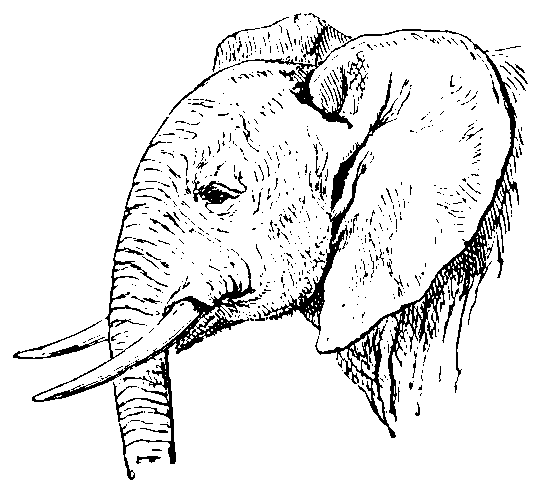
Head of African Elephant (Elephas africānus)
Head of Indian Elephant (Elephas indicus)
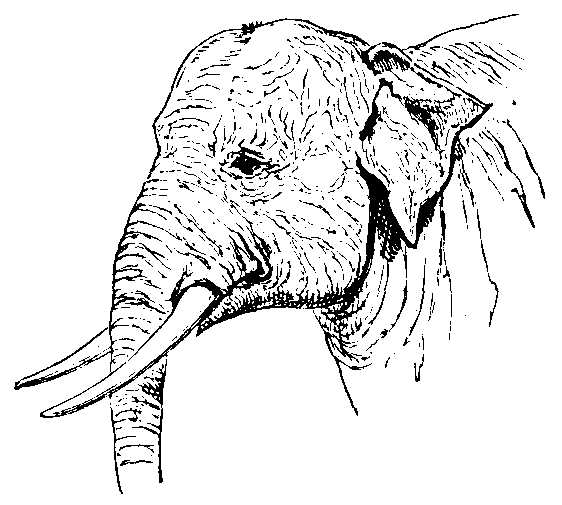
El´ephant, the popular name of a genus, family, or sub-order of five-toed proboscidian mammals, usually regarded as comprehending two species, the Asiatic (Elephas indicus) and the African (E. africānus). From a difference in the teeth, however, the two species are sometimes referred to distinct genera (Euelephas and Loxodon). The so-called white elephants are merely albinos. The African elephant is distinguished from the Asiatic species by its greater height, its larger ears, its less elevated head and bulging or convex forehead, the closer approximation of the roots of the tusks, and the greater density of the bone. It has also only three external hoofs on the hind-feet, while the Asiatic has four. All elephants are remarkable for their large, heavy, short bodies supported on columnar limbs, a very short neck, a skull with lofty crown and short face-bones, with the exception of the premaxillaries, which are enlarged to form tusk-sockets. To compensate for the short neck, they have the long proboscis, often 4 or 5 feet in length, produced by the union and development of the nose and upper lip. It is made up of muscular and fibrous tissue. The trunk is of great strength and sensibility, and serves alike for respiration, smell, taste, suction, touch, and prehension. The tusks, which are enormously developed upper incisor teeth, are not visible in young animals, but in a state of maturity they project in some instances 7 or 8 feet. The largest on record (undoubtedly that of an extinct species) weighed 350 lb. Elephants sometimes attain the height of 12 feet or more, but their general height is about 9 or 10 feet. Their weight ranges from 4000 to 9000 lb. The period of gestation is twenty months, and the female seldom produces more than one calf at a birth: this, when first born, is about 3 feet high, and continues to grow till it is sixteen or eighteen years of age. It is said that they live to the age of 150 years. They feed on vegetables, the young shoots of trees, grain, and fruit. They are polygamous, associating in herds of a considerable size under the guidance of a single leader. An elephant leaving or driven from a herd is not allowed to join another, but leads a lonely, morose, and destructive life. Such solitary elephants are known as 'rogues'. Elephants are caught either singly or in herds. In the former case it is necessary to catch adroitly one of the elephant's legs in the noose of a strong rope, which is then quickly attached to a tree; another leg is then caught, until all are securely fastened. His captors then encamp beside him, until under their treatment he becomes tractable. When a herd is to be caught a strong enclosure is constructed, and into this the elephants are gradually driven by fires, noise, &c. With the aid of tame elephants the wild ones are tied to trees and subjected to the taming process. The domesticated elephant requires much care, and a plentiful supply of food, being liable to many ailments. The daily consumption of a working elephant is, according to Sir J. E. Tennent, 2 cwt. of green food, about half a bushel of grain, and about 40 gallons of water. Their enormous strength, docility, and sagacity make them of great value in the East for road-making, building, and transport. They are used by the great on occasions of pomp and show, being often richly caparisoned, and bearing on their back a howdah containing one or more riders, besides the mahout or driver sitting on the animal's neck. Tiger-shooting is often practised from an elephant's back. Several extinct species are known, the most notable being the mammoth (E. primigenius), a contemporary of prehistoric man. The allied genus Mastodon was of very wide distribution, and the Tertiary deposits of the Fayum (Egypt) have yielded the remains of types that bridge over the gap between elephants and more typical quadrupeds. See Mammoth; Mastodon.—Bibliography: Andersson, The Lion and the Elephant; Sir. J. E. Tennent, The Wild Elephant in Ceylon; Sanderson, Wild Beasts of India; R. Lydekker, The Game Animals of Africa.
Elephan´ta Isle, or Gharapuri, a small island in the Bay of Bombay, between Bombay and the mainland, 6 miles north-east of the former; circumference about 5 miles. It consists of two long hills chiefly overgrown with wood. A city is supposed to have flourished on the island between the third and tenth centuries, but now it has only a few inhabitants, who rear sheep and poultry for the Bombay market. It is celebrated for its rock temples or caves, the chief of which is a cave-temple supposed by Fergusson to belong to the tenth century, 130 feet long, 123 broad, and 18 high. It is supported by pillars cut out of the rock, and containing a colossal figure of the trimurti or Hindu Trinity: Brahma, Vishnu, and Siva. The temple is still used by the Bania caste for the Sawa at certain festivals.
Elephant-fish (Callorhynchus antarcticus), a fish of the sub-class Elasmobranchii (rays and sharks), so named from a proboscis-like structure on the nose: called also Southern Chimæra. It inhabits the Antarctic seas, and is palatable eating.
Elephantiasis is a disease characterized by progressive enlargement of a limb, or portion of the body, and occurs most frequently in the legs. The enlargement begins below the knee and gradually involves the entire limb. The onset may be slow and painless, or sudden with fever and rapid swelling. The disease is common in all countries in which the Filariæ prevail. No drug destroys the embryos in the blood, and in infected districts the drinking-water should be boiled or filtered. In rapid cases rest, liquid diet, purgation, and firm bandaging of the legs are indicated. Surgical treatment for removal of adult Filariæ in enlarged glands has met with some success.
Elephanti´ne, the Greek name of a small island of Egypt, in the Nile, just below the First Cataract and opposite Assouan (Syene). It is partly covered with ruins of various origins—Egyptian, Roman, Saracen, and Arabic, the most important being a gateway of the time of Alexander, a small temple dedicated to Khnum and founded by Amenophis III, and the ancient Nilometer mentioned by Strabo. The latter was restored in 1870 by the Khedive Ismail Pasha. The northern part is low, the southern elevated and rocky.
Elephant Lore. The cult of the elephant is found among many nations in Asia and Africa. It exists in Indo-China, Cambodia, Abyssinia, Siam, and Sumatra. The Aryo-Indian god Indra rides on an elephant. Buddha had a white elephant form. One of the Sanskrit names for the elephant is Naga, which connects the animal with the sacred snake, possibly on account of its trunk; another name is Hastin, 'having a hand'. The Wambuwegs believe the elephant to be the abode of the souls of their ancestors. It is a bad omen, according to the Talmud, to dream of an elephant.
Elephant River, a river of Cape Colony, running into the Atlantic after a course of 140 miles,
Elephant-seal
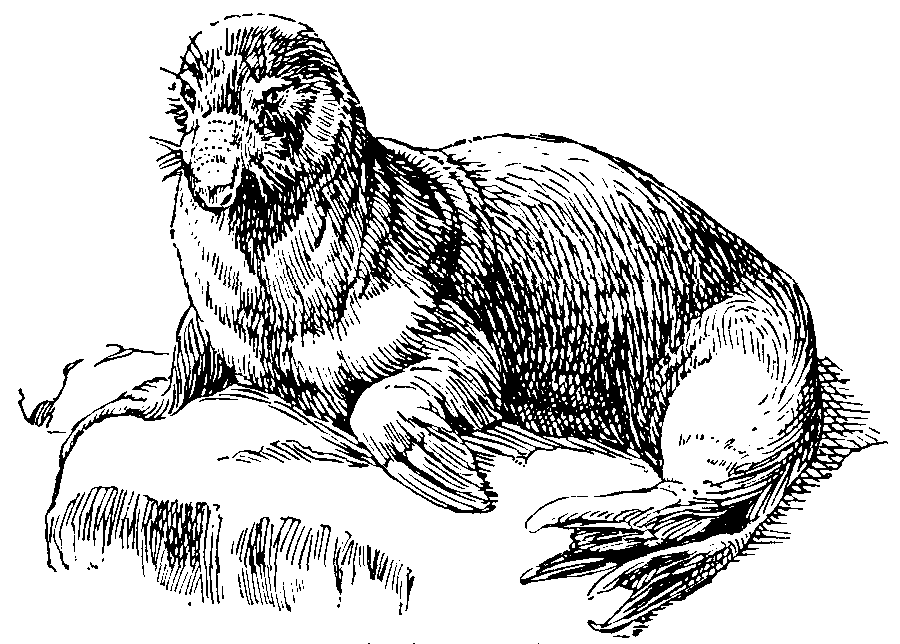
Elephant-seal, the Proboscis Seal, or Sea-elephant, the largest of the seal family (Phocidæ). There are probably two species, one (Macrorhinus angustirostris) found only on the coast of California and Western Mexico, the other (Macrorhinus leoninus) found in Patagonia, Kerguelen Island, Heard's Island, and other parts of the Southern Seas. They vary in length from 12 to 30 feet, and in girth at the chest from 8 to 18 feet. The proboscis of the male is about a foot long when the creature is at rest, but elongates under excitement. The females have no proboscis and are considerably smaller than the male. Both species are becoming rare owing to the wholesale slaughter of them which takes place.
Elephant's-foot, the popular name of Testudinaria elephantipes, a plant of the nat. ord. Dioscoreaceæ (yams, &c.), distinguished by the shape of its rootstock, which forms a nearly hemispherical mass rising a little above the ground, covered with a thick corky bark. It has a slender climbing stem growing to a length of 30 or 40 feet, with small heart-shaped leaves and greenish-yellow flowers. It is known in the Cape Province as Hottentots' Bread.
Eleusi´ne, a genus of grasses, several of which, e.g. E. coracana, are cultivated as grain plants in India, Japan, and Tibet.
Eleusinian Mysteries, the sacred rites anciently observed in Greece at the annual festival of Dēmētēr or Ceres, so named from their original seat Eleusis. According to the Homeric hymn to Dēmētēr, the goddess, while wandering in search of Persephone, came to Eleusis, where she was hospitably received by King Celeus. He directed the establishment of a temple in her honour, and showed the use of grain to Triptolemus and other princes. As a preparation for the greater mysteries celebrated at Athens and Eleusis, lesser Eleusinia were celebrated at Agræ on the Ilissus. The greater Eleusinia were celebrated in the month Boedromion (September-October), beginning on the 15th of the month and lasting nine days. The celebrations, which were varied each day, consisted of processions between Athens and Eleusis, torch-bearing and mystic ceremonies attended with oaths of secrecy. They appear to have symbolized the old conceptions of death and reproduction, and to have been allied to the orgiastic worship of Dionysus (Bacchus). They are supposed to have continued down to the time of Theodosius I.
Eleu´sis, in ancient geography, a small city of Attica, about 14 miles from Athens, near the shore opposite the Island of Salamis. Its temple of Dēmētēr was one of the most beautiful buildings of Greece. The sacred buildings were destroyed by Alaric in A.D. 396. In 1882 the Greek Archæological Society undertook excavations, and numerous remains have been unearthed. There is now a large straggling village here.
Eleu´thera, one of the largest of the Bahama Islands. It is of very irregular shape, its length being about 70 miles, and its breadth in general from 2 to 4 miles, though in one part 10. Pop. 6533.
Elevation. In astronomy, the elevation of an object above the horizon is measured by the arc intercepted between the horizon and the object on the circle which passes through the object and the zenith. In geometry, solids can be represented by means of two projections; one on a horizontal plane, and the other on a plane perpendicular to the horizontal. The former is called the plan, and the latter the elevation.
Elevation of the Host (Lat. hostia, a victim), in the ritual of the Mass, is the lifting up of the elements immediately after consecration, to be worshipped by the people. It was introduced into the Latin Church in the eleventh century, in consequence of the denial by Berengarius of the real presence in the sacrament. The Council of Trent ordered that the host should be worshipped with the highest adoration, that of latria, which is offered to God only.
El´evator, (1) a mechanical contrivance consisting of a series of boxes or buckets attached to a belt travelling round two drums, one above and one below, for hoisting grain, meal, coal, coke, &c. In America large buildings which contain such contrivances, and in which grain is stored, receive the same name. (2) An apparatus for raising or lowering persons or goods to or from different levels in warehouses, hotels, &c., consisting usually of a cage or movable platform worked by hydraulic power: also called a lift or hoist.
Elf-arrows, Elf-bolts, or Elf-shot, popular names in Europe for stone arrow-heads and axes. They were worn as charms against lightning; cattle and men are said to have been struck and wounded by them. In the Far East they are 'thunder-stones'.
Elgar, Sir Edward, English composer, was born at Broadheath, Worcestershire, 2nd June, 1857. For some time he acted as conductor of the Worcester Instrumental Society, and as organist at St. George's, Worcester, but when later he turned to composition he resigned both these positions. In 1892 he produced The Black Knight, and this was followed by several oratorios, cantatas, and other works, including The Light of Life, a short oratorio (Worcester Festival, 1896); King Olaf, a cantata (North Staffordshire Festival, 1896); Imperial March (1897); Te Deum (Hereford Festival, 1897); Caractacus (Leeds Festival, 1898); and Orchestral Variations (1899). In 1900 his famous sacred cantata, The Dream of Gerontius, was produced at the Birmingham Festival (repeated at Düsseldorf in 1901 and at the Niederrheinische Musik Fest in 1902), and added immensely to his already considerable reputation. In 1902 the Coronation Ode proved extremely popular, and in 1903 the Birmingham Festival introduced The Apostles, a fine oratorio, which, like the Gerontius, was honoured at the Niederrheinische Musik Fest the following year. In March, 1904, an 'Elgar Festival', lasting three days, was held at Covent Garden, London, at which, in addition to The Dream of Gerontius, The Apostles, and other compositions by Dr. Elgar, was produced Alassio, a new concert overture, the outcome of a visit to Italy. In 1904 Dr. Elgar was knighted. From 1905 to 1908 he was professor of music at Birmingham University. He has received musical and other degrees from Oxford, Cambridge, and Yale.
Elgin, James Bruce, eighth Earl of, and twelfth Earl of Kincardine, Governor-General of India, born in 1811, died in 1863. Educated at Eton and Christ Church, he entered Parliament in 1841 as member for Southampton, and in the same year succeeded to the earldom. He was appointed Governor-General of Jamaica in 1842, and in 1846 Governor-General of Canada. In 1849 he was raised to the British peerage as Baron Elgin of Elgin. In 1857 he went as special ambassador to China, and concluded the Treaty of Tientsin (1858). In 1859 he became Postmaster-General in Palmerston's Cabinet, in 1860 was sent on a special mission to Pekin, and in 1861 became Governor-General of India.—Victor Alexander Bruce, ninth Earl of Elgin, son of the preceding, born 1849, died 1917, was also Governor-General of India (1894-9), and Colonial Secretary in the Campbell-Bannerman Ministry from Dec., 1905, to April, 1908.
Elgin (el´gin), a royal and parliamentary burgh of Scotland, capital of Elgin County, situated on the Lossie, about 5 miles from its influx into the Moray Firth, 70 miles N.W. of Aberdeen. The town largely consists of mansions and villas. The most interesting edifice is the cathedral, now in ruins, which was once the most magnificent in Scotland. It was founded by Bishop Andrew Moray in 1224; plundered and burned in 1390 by the 'Wolf of Badenoch', and again in 1402 by Alexander, third son of the Lord of the Isles; restored 1390 to 1424; and again plundered in 1568. Until 1918 the Elgin Burghs sent one member to the House of Commons. Pop. 8656.—Elgin, county of, also called Morayshire, is a maritime county, bounded by the Moray Firth, Banffshire, Inverness-shire, and Nairnshire; area, 340,000 acres. Along the sea-coast, which extends for more than 30 miles, the surface is flat, but inland it rises into hills of moderate elevation, intersected by fine and fertile valleys. The chief rivers are the Spey, Lossie, and Findhorn, the Spey and Findhorn having excellent salmon fishing. Inexhaustible quarries of freestone (rich in fossils) are worked. The climate is noted for its general mildness, dryness, and salubrity. The lower tracts of land are fertile and highly cultivated, the principal crops being wheat, oats, potatoes, and turnips. The great majority of farms are small. A portion of the surface is still covered with native forests. The county unites with Nairnshire in returning one member to the House of Commons, Pop. 43,427.
Elgin, a town of the United States, in Illinois, on Fox River, 36 miles N.W. of Chicago. It has a watch-factory and various flourishing industries. Pop. 25,976.
Elgin Marbles, the splendid collection of antique sculptures brought chiefly from the Parthenon of Athens to England by the seventh Earl of Elgin (1766-1841) in 1814, and afterwards purchased by Parliament for the British Museum at the cost of £35,000. They consist of figures in low and high relief and in the round, representing gods, goddesses, and heroes; the combats of the Centaurs and Lapithæ; the Panathenaic procession, &c. They exhibit Greek sculpture at its highest stage, and were partly the work of Phidias. The historical and artistic value of the Elgin marbles was at first doubted, and Lord Elgin himself was not spared. His act in removing the marbles was denounced as vandalism.
El Hasa, a fertile district of Eastern Arabia, on the Persian Gulf. It produces dates, wheat, millet, and rice. Pop. estimated at 175,000.
Eli, one of the Hebrew judges, the predecessor of Samuel. He was high-priest and judge for forty years, but was less successful as head of his own household. His two sons having been slain, and the ark taken in battle by the Philistines, the news proved so severe a shock that he fell and broke his neck, at the age of ninety-eight. Little is really known of the history of Eli, since he is only shown to us in the weakness of old age, unable to control his sons Hophni and Phinehas, whose wickedness disgusted and alienated the people.
Eli´jah, the most distinguished of the prophets of Israel, flourished in the ninth century B.C., during the reigns of Ahab and Ahaziah, and until the beginning of the reign of Jehoram, his special function being to denounce vengeance on the kings of Israel for their apostasy. He incurred the anger of Jezebel, wife of Ahab, for slaying the prophets of Baal, but escaped to Horeb, afterwards returning to Samaria to denounce Ahab for the murder of Naboth. Elijah at length ascended to heaven in a chariot of fire, Elisha, his successor, being witness. See 1 Kings, xvii to xxi, and 2 Kings, i and ii.
Elimination, in mathematics, the process of treating a given set of equations so as to deduce from them an equation free from a selected letter, or from several selected letters. For instance, if the system of equations
a1x + b1y + c1z = 0, a2x + b2y + c2z = 0, a3x + b3y + c3z = 0,
has a solution in which one at least of x, y, z is different from zero, then
| a1, b1, c1 | | a2, b2, c2 | = 0. | a3, b3, c3 |
(See Determinant.)—Bibliography: Burnside and Panton, Theory of Equations; Salmon, Higher Algebra.
El´iot, George, the assumed literary name of Mary Ann, or, as she preferred to write the name in later years, Marian Evans, English novelist. She was the daughter of a Warwickshire land-agent and surveyor, was born at Griff, near Nuneaton, on 22nd Nov., 1820, and died on 22nd Dec., 1880. She received at Coventry an excellent education, comprising the classical and modern languages, and shortly after her twenty-first year became a convert to Rationalism. Her first literary undertaking was the completion of Mrs. Hennell's translation of Strauss's Life of Jesus (1846). Towards the end of her task she seems, however, to have wearied of it, and when the work appeared she declared herself 'Strauss-sick'. After spending two years abroad, she boarded at the house of John Chapman, editor of the Westminster Review, of which she became sub-editor. It was not, however, until January, 1857, that she came prominently into public notice, when the first of a series of tales entitled Scenes from Clerical Life appeared in Blackwood's Magazine. The series came to an end in Nov., 1857, and in the following year the publication of Adam Bede placed her in the first rank of writers of fiction. It was succeeded by The Mill on the Floss (1860), Silas Marner (1861), Romola (1863), Felix Holt (1866), Middlemarch (1872), and Daniel Deronda (1876). In addition to those prose works she published three volumes of poems, The Spanish Gypsy (1868), Agatha (1869), and The Legend of Jubal (1874). Her last work published during her life was the series of essays entitled The Impressions of Theophrastus Such (1879), but a volume of mixed essays was issued posthumously. For many years she was happily associated both in life and work with George Henry Lewes, though a legal union was impossible during the lifetime of Mrs. Lewes. In May, 1880, after Lewes's death, she married Mr. John Cross, but did not survive the marriage many months, dying rather suddenly at Chelsea.—Bibliography: Haton, George Eliot in Derbyshire; J. W. Cross (editor), George Eliot's Life as Related in Her Letters and Journals (3 vols.); O. Browning, Life of George Eliot; Deakin, The Early Life of George Eliot; Sir Leslie Stephen, George Eliot (in English Men of Letters Series).
Eliot, Sir John, one of the ablest of the popular leaders of Charles I's reign, of an old Cornwall family, born in 1592, died in 1632. He entered Parliament in 1614 as member for St. Germans, winning immediate reputation as an orator. As vice-admiral of Devon he was energetic in suppressing piracy. In the three Parliaments of 1623, 1625, 1626, he made his way to the front of the constitutional party, joined Hampden and the rest in refusing contributions to the forced loan, and took a prominent share in drawing up the Remonstrance and Petition of Right. He was imprisoned in the Tower in 1629, and died in confinement. During his imprisonment he wrote a work on constitutional monarchy entitled The Monarchie of Man. Among his other works are: An Apology for Socrates, and Negotium Posterorum (an account of the Parliament of 1625).
E´lis, a maritime state of ancient Greece in the west of the Peloponnesus, bordering on Achaia, Arcadia, and Messenia, and watered by the Rivers Alphēus and Penēus. Of its capital Elis (now Kaloskopi) there are few traces. Olympia, where the famous games were held, was near the Alpheus. Since 1899 Elis forms a nomarchy of Greece.
Eli´sha, a Hebrew prophet, the disciple and successor of Elijah. Many miracles of prediction and cure, and even of raising the dead, are ascribed to him, but his figure is less original and heroic than that of his master. He held the office of prophet for fully sixty-five years, from the reign of Ahab to that of Joash (latter half of ninth century B.C.).
Elix´ir, a word of Arabic origin (al iksir, the philosopher's stone), applied by the alchemists to a number of solutions employed in attempting the transmutation of metals into gold, and also to a potion, the elixir vitæ, or elixir of life, supposed to confer immortality. It is still used for various popular remedies, for the most part composed of various aromatic and stimulative substances held in solution by alcohol.
Elizabeth (Carmen Sylva), Dowager Queen of Roumania, born at Neuwied, principality of Wied, in 1843, died at Bucharest, 2nd March, 1916. In 1869 she was married to Prince Charles of Hohenzollern, who became King of Roumania in 1881. Queen Elizabeth, or, as she was generally known, Carmen Sylva (her pen-name), was not only a patron of Roumanian writers and artists, but herself a distinguished author. Among her works, which were all, with the exception of one, written in German, are: The Bard of the Dimbovitza, Pilgrim Sorrow, A Real Queen's Fairy Tales, and From Memory's Shrine. In 1914 she was made an honorary fellow of the Royal Society of Literature of Great Britain.
Elizabeth, Queen of England, daughter of Henry VIII and of Anne Boleyn, was born at Greenwich, 7th Sept., 1533, and almost immediately declared heiress to the crown. After her mother had been beheaded (1536) both she and her sister Mary were declared bastards, and she was finally placed after Prince Edward and the Lady Mary in the order of succession. On the accession of Edward VI Elizabeth was committed to the care of the Queen-Dowager Catherine; and after the death of Catherine and execution of her consort Thomas Seymour she was closely watched at Hatfield, where she received a classical education under William Grindal and Roger Ascham. At the death of Edward Elizabeth vigorously supported the title of Mary against the pretensions of Lady Jane Grey, but continued throughout the whole reign an object of suspicion and surveillance. In self-defence she made every demonstration of zealous adherence to the Roman Catholic faith, but her inclinations were well known. On 17th Nov., 1558, Mary died, and Elizabeth was immediately recognized queen by Parliament. The accuracy of her judgment showed itself in her choice of advisers, Parker, a moderate divine (Archbishop of Canterbury 1559), aiding her in ecclesiastical policy; while William Cecil, Lord Burleigh, assisted her in foreign affairs.
The first great object of her reign was the settlement of religion, to effect which a Parliament was called on 25th Jan., and dissolved on the 8th May, its object having been accomplished. The nation was prepared for a return to the Reformed faith, and the Parliament was at the bidding of the Court. The ecclesiastical system devised in her father's reign was re-established, the royal supremacy asserted, and the revised Prayer Book enforced by the Act of Uniformity. While, however, the formal establishment of the reformed religion was easily completed, the security and defence of the settlement was the main object of the policy and the chief source of all the struggles and contentions of her reign. Freed from the tyranny of Mary's reign, the Puritans began to claim predominance for their own dogmas, while the supporters of the Established Church were unwilling to grant them even liberty of worship. The Puritans, therefore, like the Catholics, became irreconcilable enemies of the existing order, and increasingly stringent measures were adopted against them. But the struggle against the Catholics was the more severe, chiefly because they were supported by foreign powers; so that while their religion was wholly prohibited, even exile was forbidden them, in order to prevent their intrigues abroad. Many Catholics, particularly priests, suffered death during this reign; but simple nonconformity, from whatever cause, was pursued with the severest penalties, and many more clergymen were driven out of the Church, by differences about the position of altars, the wearing of caps, and such like matters, than were forced to resign by the change from Rome to Reformation.
Elizabeth's first Parliament approached her on a subject which, next to religion, was the chief trouble of her reign, the succession to the Crown. They requested her to marry, but she declared her intention to live and die a virgin; and she consistently declined in the course of her life such suitors as the Duc d'Alençon, Prince Erik of Sweden, the Archduke Charles of Austria, and Philip of Spain. While, however, she felt that she could best maintain her power by remaining unmarried, she knew how to temporize with suitors for political ends, and showed the greatest jealousy of all pretenders to the English succession. With the unfortunate Mary, Queen of Scots, were connected many of the political events of Elizabeth's reign. On her accession the country was at war with France. Peace was easily concluded (1559); but the assumption by Francis and Mary of the royal arms and titles of England led to an immediate interference on the part of Elizabeth in the affairs of Scotland. She entered into a league with the Lords of the Congregation, or leaders of the Reformed party; and throughout her reign this party was frequently serviceable in furthering her policy. She also gave early support to the Huguenot party in France, and to the Protestants in the Netherlands, so that throughout Europe she was looked on as the head of the Protestant party. This policy roused the implacable resentment of Philip, who strove in turn to excite the Catholics against her both in her own dominions and in Scotland. The detention of Mary in England (1568-87), whither she fled to the protection of Elizabeth, led to a series of conspiracies, beginning with that under the Earls of Northumberland and Westmorland, and ending with the plot of Babington, which finally determined Elizabeth to make away with her captive. The execution of Queen Mary (1587), though it has stained her name to posterity, tended to confirm her power among her contemporaries. The state of France consequent on the accession of Henry IV, who was assisted by Elizabeth, obviated any danger from the indignation which the deed had caused in that country; and the awe in which King James stood of Elizabeth and his dread of interfering with his own right of succession to England made him powerless. But Philip of Spain was not to be so appeased, the execution of Mary lending edge to other grievances. The fleets of Elizabeth had galled him in the West Indies, her arms and subsidies had helped to deprive him of the Netherlands; the Armada was already in preparation. Accordingly he called the Queen of England a murderess, and refused to be satisfied even with the sacrifice she seemed prepared to make of her Dutch allies. The Armada sailed on 29th May, 1588. The war with Spain dragged on till the close of Elizabeth's long reign.
During her reign the splendour of her government at home and abroad was sustained by such men as Burleigh, Bacon, Walsingham, and Throgmorton; but she had personal favourites of less merit who were often more brilliantly rewarded. Chief of these were Dudley, whom she created Earl of Leicester, and whom she was disposed to marry, and Essex, whose violent passions brought about his ruin. He was beheaded in 1601, but Elizabeth never forgave herself his death. Her own health soon after gave way, and she died on 24th March, 1603, naming James VI of Scotland as her successor.—Bibliography: M. A. S. Hume (editor), Calendar of State Papers (Spanish Series); J. Bruce (editor), Letters of Elizabeth and James VI; W. Camden, History of Queen Elizabeth; J. A. Froude, History of England; M. Creighton, Queen Elizabeth; E. S. Beesley, Queen Elizabeth.
Elizabeth, a city of New Jersey, United States, 14 miles S.W. of New York, with which it has ample communication by railway and steamer. It is a favourite residence of New York business men. The Singer Sewing-machine Company has a large factory here, and there are also foundries and oil-cloth factories. Pop. 73,409.
Elizabeth, St., of Thuringia, daughter of Andreas II, King of Hungary, was born at Pressburg 1207, and in 1221 married to Louis IV, land-grave of Thuringia. She erected hospitals, fed a multitude of poor from her own table, and wandered about in a humble dress, relieving the wretched. Louis died on a crusade, and her own life terminated 19th Nov., 1231, in a hospital which she had herself established. The church over her tomb at Marburg is one of the most splendid Gothic edifices in Germany.
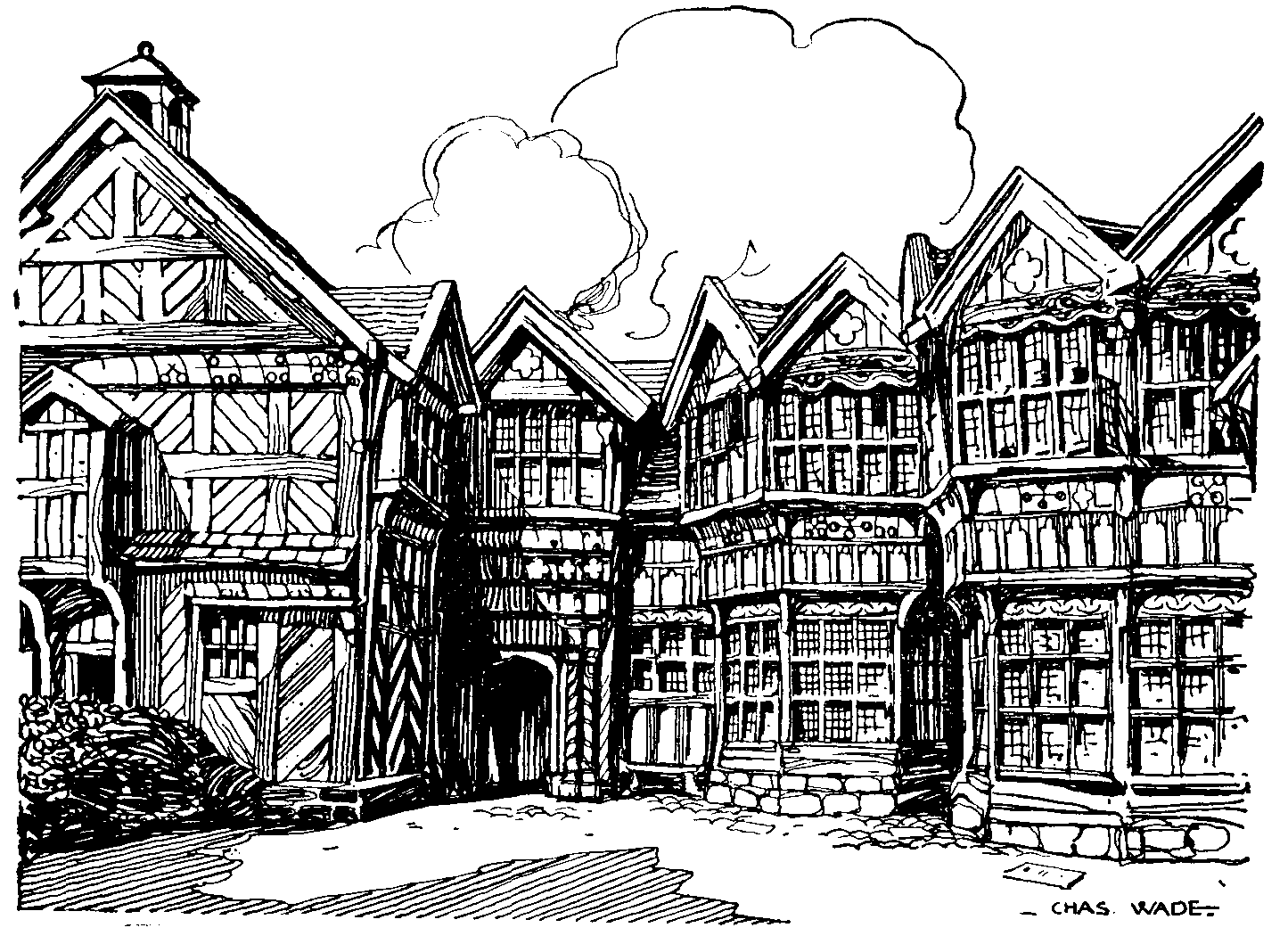
Elizabethan Architecture. Moreton Old Hall, Cheshire
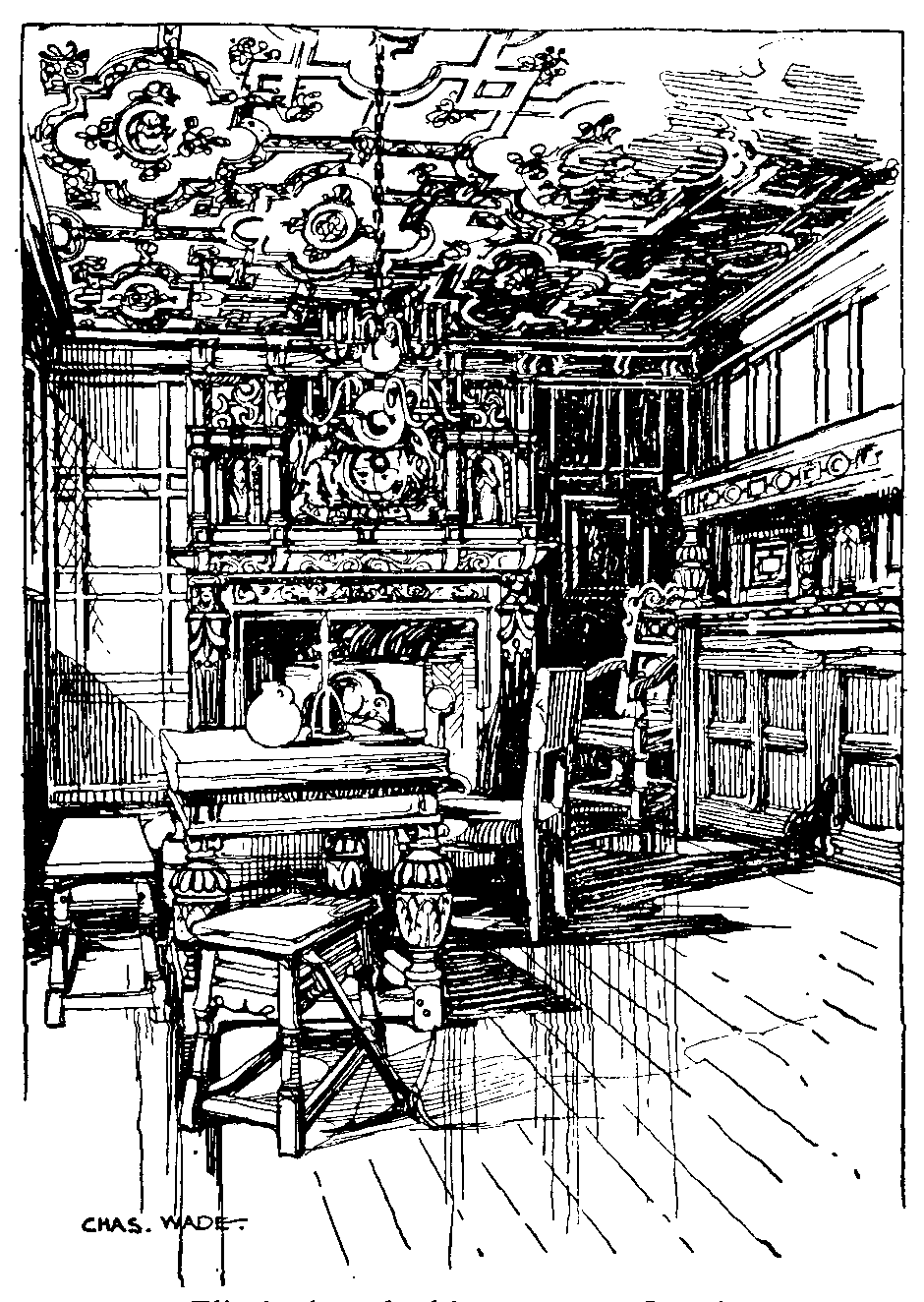
Elizabethan Architecture: an Interior
Reconstruction in the Victoria and Albert Museum, London.
Eliz´abethan Architecture, a style of architecture which prevailed in England during the reigns of Elizabeth and James I. It succeeded to the Tudor style, properly so called, with which it is sometimes confounded. The Elizabethan is a mixture of inferior Gothic and debased Italian, producing a singular heterogeneousness in detail, with, however, wonderful picturesqueness in general effect, and domestic accommodation more in accordance with the wants of an advancing civilization than was afforded by the styles which preceded it. The chief characteristics of Elizabethan architecture are: windows of great size both in the plane of the wall and deeply embayed, ceilings very richly decorated in relief, galleries of great length, very tall and highly-decorated chimneys, as well as a profuse use of ornamental strapwork in the parapets, window-heads, &c. The Elizabethan style is the last stage of the Tudor or Perpendicular, and from its corresponding in point of period with the Renaissance of the Continent has sometimes been called the English Renaissance. The epithet Jacobean has sometimes been given to the very latest stage of the Elizabethan, differing from the Elizabethan proper in showing a greater admixture of debased Italian forms. The princely houses which arose during the reign of Elizabeth are numerous, and many even yet remain to attest the splendour of the time. Of these may be mentioned Burghley House, Hardwick Hall, and Bramhall Hall.—Cf. Gotch and Brown, Architecture of the Renaissance in England.
Elizabeth Farnese (fa˙r-nā´zā), Queen of Spain, daughter of Edward II, Prince of Parma, born 1692, died in 1776. On becoming the second wife of Philip V she surprised those who had counselled the marriage by assuming the practical headship of the kingdom, and her ambition and that of her minister Alberoni disturbed the whole of Europe. Carlyle calls her a "termagant tenacious woman".
Elizabethgrad, a town of the Ukraine, on the Ingul, with an imperial palace, a theatre, manufactures of soap and candles, and several great fairs. Pop. 75,800.
Elizabeth Islands, a group of sixteen American islands south of Cape Cod, with a permanent population of about 150.
Elizabeth of Valois, or Isabella, Queen of Spain, was born in 1545, died in 1568. She was the daughter of Henry II of France and Catherine de' Medici. By the Treaty of Cateau-Cambrésis she was destined to be the wife of the Infante, Don Carlos, but his father, Philip II, being left a widower, became fascinated and married her himself. The stories of a romantic relationship existing between Elizabeth and Don Carlos are entirely groundless, but have furnished tragic subjects to Otway, Campistron, Chénier, Schiller, and Alfieri.
Elizabeth Petrovna, Empress of Russia, daughter of Peter the Great and Catherine, born in 1709 or 1710, died in 1762. She ascended the throne on 7th Dec., 1741, as the result of a conspiracy, in which Ivan VI, a minor, was deposed. Elizabeth is said to have rivalled her mother in beauty, and to have surpassed her in her love of pleasure, and her government was largely conducted by favourites. She was a patron of literature, founded the University of Moscow, and corresponded with Voltaire. A war with Sweden, in 1743, was advantageously concluded by the peace of Åbo. In 1748 she sent an army to assist Maria Theresa in the War of the Succession, and joined in the Seven Years' War against Prussia. She died before this war was concluded.—Bibliography: Nisbet Bain. The Daughter of Peter the Great; A. S. Rappoport, The Fair Ladies of the Winter Palace.
Elizabethpol, a town of Russia, in the Caucasus, capital of the government of same name, covering a great space of ground from the gardens and open areas it contains, but very unhealthy. Pop. 18,505.—The government has an area of 17,000 sq. miles, a pop. of 636,310. It is partly mountainous, partly steppes, and produces grain, cotton, tobacco, and wine.
Elizabeth Stuart, Queen of Bohemia, daughter of James I of England and VI of Scotland, born in Falkland Palace, Fifeshire, 1596, died on 13th Feb., 1662. Her marriage with the Palatine Frederick was celebrated at Whitehall in 1613. Her husband, then at the head of the Protestant interest in Germany, accepted in 1619 the Crown of Bohemia offered to him by the revolted Protestants of that country. After his defeat, however, by the imperalists at the battle of Prague in 1620, he and his wife were obliged to flee, first to Breslau and Berlin, and then to the Hague. Elizabeth returned to England at the Restoration with her nephew Charles II, but mingled very little in society. Elizabeth had thirteen children, of whom Charles Louis, the eldest surviving, was reinstated in the Palatinate by the Treaty of Westphalia in 1648. By her daughters, Elizabeth Charlotte and Sophia, she was the ancestress of Louis Philippe and of George I, and her sons, Rupert and Maurice, became famous Cavalier leaders.
Elk (Alces Machlis)
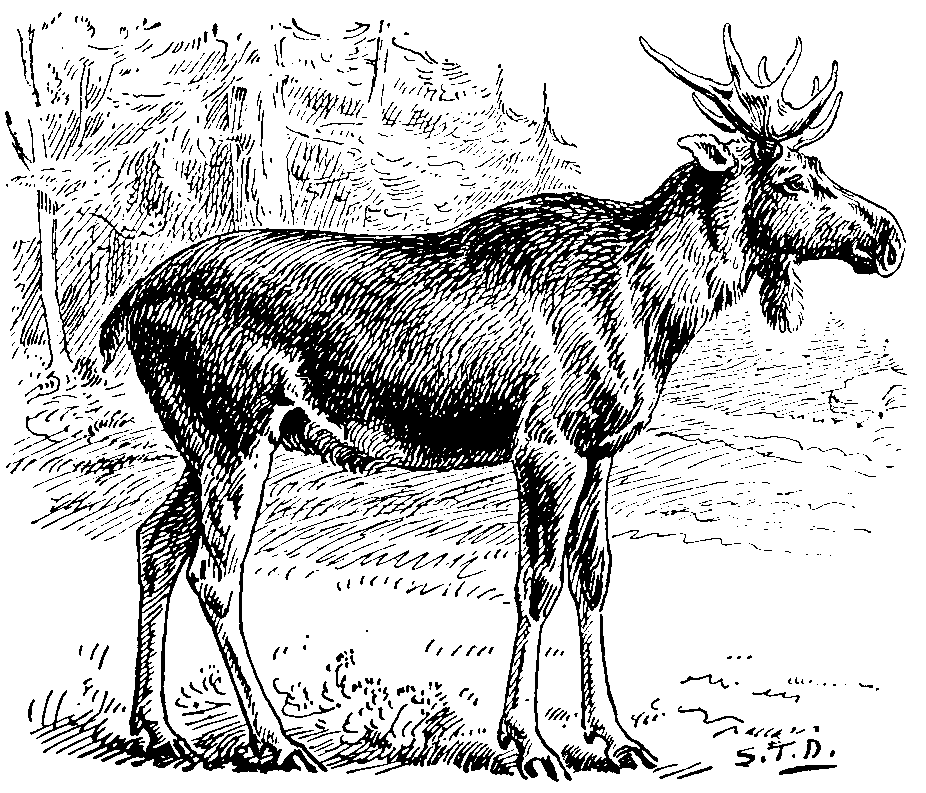
Elk, Moose, or Moose Deer (Alces Machlis), the largest of the deer family, a native of Northern Europe, Asia, and America. The American form (to which the name moose is usually given) is sometimes separated from the European as Alces americānus, but most naturalists find no specific difference between them. The elk or moose has a short compact body, standing about 6 feet in height at the shoulders, a thick neck, large clumsy head, and horns which flatten out almost from the base into a broad palmate form with numerous snags. In colour the elk is greyish brown, the limbs, sides of head, and coarse mane being, however, of a lighter hue. Its flesh resembles beef rather than venison. For the most part elks are inoffensive, and so exceedingly wary that they are approached only with difficulty. In America the Indians and half-breeds are the most skilful moose-hunters. By trampling down a restricted area of ground (moose-yard) and browsing on the edge of this, the moose is able to protect itself efficiently against the attacks of wolves. The moose has a wide range in Canada, extending from the Arctic Ocean and British Columbia to New Brunswick and Nova Scotia; and it is found also in Maine. It feeds largely on the shoots of trees or shrubs, such as the willow and maple, and on bark, &c. In Sweden its destruction is illegal, and in Norway there are many restrictions upon the hunting of it.
Antlers and Skull of Irish Elk
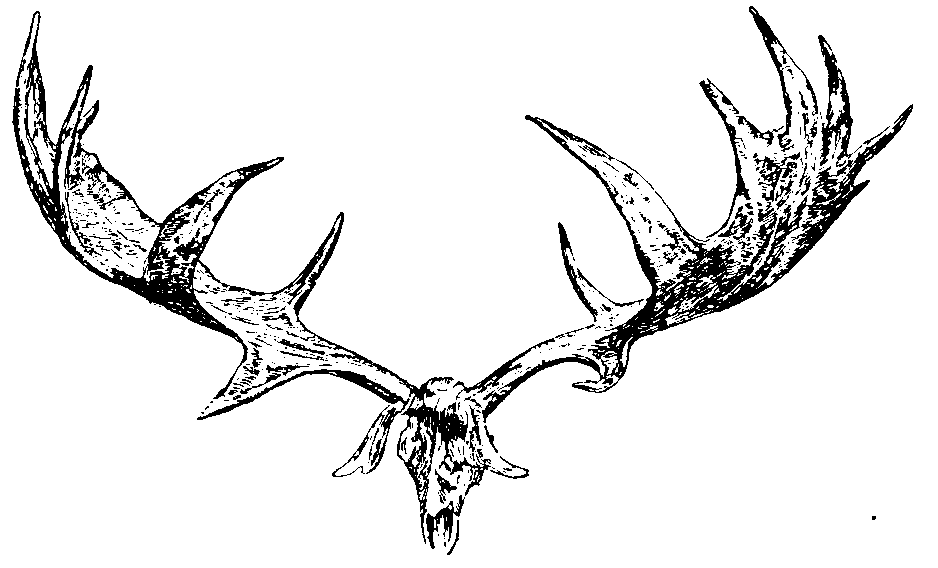
Elk, Irish (Megacĕros hibernĭcus, or Cervus giganteus), a large deer found in the Pleistocene strata, and distinguished by its enormous antlers, the tips of which are sometimes 11 feet apart. Though a true deer, its antlers differ from those of living species in that the beam is flattened into a palm. To sustain the great weight, unusually large and strong limbs and neck vertebræ were required. Its remains are found not only in Ireland but in Scotland and England, and on the Continent, where they occur in bogs, lacustrine deposits, brick-clay, and ossiferous caves.
El Khargeh. See Khargeh.
Elk´hart, a town of Indiana, United States, on Elkhart River, with railroad works and paper-mills. Pop. 19,282.
Ell (Lat. ulna, Gr. ōlenē, forearm), an old measure whereby cloths, stuffs, &c., are sometimes measured. The ell English is 5 quarters (45 inches), the ell Flemish 3 quarters (27 inches). In Scotland an ell contained 37.2 inches English.
Ell´and, a town of England, W. Riding of Yorkshire, between Halifax and Huddersfield, with an old church and town-hall, manufactures of cottons and woollens, and quarries. It gives its name to a parliamentary division. Pop. 10,676.
Ellenborough, Edward Law, Lord, English lawyer, Lord Chief Justice of the King's Bench, born in 1750 at Great Salkeld, Cumberland, died in 1818. He was educated at the Charterhouse and at Peterhouse, Cambridge, and called to the Bar in 1780. Not long afterwards he took silk, and at the trial of Warren Hastings, in 1785, acted as leading counsel. The defence did not come on until the fifth year of the trial, but after eight years Hastings was acquitted and Law's success assured. In 1801 he was made Attorney-General, and in 1802 became Lord Chief Justice of the King's Bench, and was created baron. He held the office of Chief Justice for fifteen years, resigning in 1818.
Ellenborough, Edward Law, first Earl of, son of Lord Chief Justice Ellenborough (see above), born in 1790, died in 1871. He was educated at Eton and St. John's College, Cambridge, and in 1818, having succeeded his father as second baron, he entered the House of Lords. In 1818 he took office as Lord Privy Seal, and was President of the Board of Control from 1828-30, and again in 1834. In 1841 he accepted the governor-generalship of India, and arrived in Calcutta in 1842, in time to bring the Afghan War to a successful issue. The annexation of Seinde in 1843 was followed by the conquest of Gwalior, but the conduct of the Governor-General gave dissatisfaction at home, and he was recalled early in 1844. On his return, however, he was defended by Wellington, and received the thanks of Parliament, an earldom, and the Grand Cross of the Bath. He then held the post of First Lord of the Admiralty (1845-6), and was President of the Board of Control from Feb. to June, 1858. His dispatch censuring the policy of Lord Canning as Governor-General of India led to his resignation, and he never resumed office.
Ell´ice Islands, or Lagoon Islands, a group of coral islands annexed to Britain in 1892, lying north of Fiji, and extending for 360 miles north-west to south-east. The islands were discovered by Maurelle in 1781. The inhabitants are of Samoan race and language, have long been Christians, and support themselves chiefly by the coco-nut. Pop. 3084.
Ellichpur (el-ich-pör´), a town of India, in Ellichpur district, Berar, once a large and prosperous town. There is a military cantonment within two miles. Pop. 27,500.
El´licott, Right Rev. Charles John, English divine, born 1819, died in 1905. Educated at Cambridge, he was professor of divinity in King's College, London, Hulsean lecturer and Hulsean professor of divinity at Cambridge, and Dean of Exeter, and in 1863 was appointed Bishop of Gloucester and Bristol. He was for eleven years chairman of the scholars engaged on the revision of the New Testament translation, and published commentaries on the Old and the New Testaments, as well as sermons, addresses, and lectures.
Elliott, Ebenezer, English poet, known as the 'Corn-law Rhymer', born in 1781 near Rotherham, Yorkshire, died in 1849. At the age of seventeen he published his first poem, The Vernal Walk, which was soon followed by others. In 1829 The Village Patriarch, the best of Elliott's longer pieces, was published. From 1831 to 1837 he carried on business as an iron merchant in Sheffield. His Corn-law Rhymes, periodically contributed to a local paper devoted to the repeal of these laws, attracted attention, and were afterwards collected and published with a longer poem entitled The Ranter. Commercial losses compelled him in 1837 to contract his business, and in 1841 he retired from it altogether. In 1850 two posthumous volumes appeared, entitled More Prose and Verse by the Corn-law Rhymer.
Ellipse
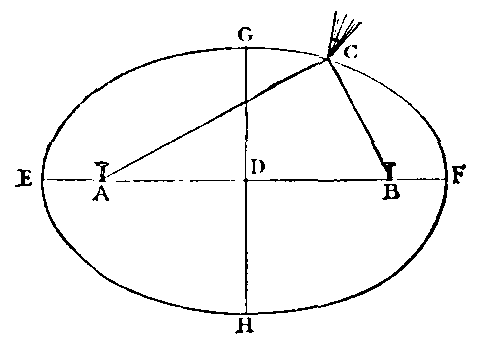
Ellipse´, one of the conic sections. The curve generated by a point which moves so that its distance from a fixed point bears a constant ratio (less than unity) to its distance from a fixed straight line. Kepler discovered that the paths described by the planets in their revolutions round the sun are ellipses, the sun being placed in one of the foci. To describe an ellipse: At a given distance on the surface on which the ellipse is to be described fix two pins, A and B, and pass a looped string round them. Keep the string stretched by a pencil, c, and move the pencil round, keeping the string at the same tension, then the ellipse EGFH will be described. A and B are the foci, D the centre, EF the major axis, GH the minor axis, and the fraction DA/DE the eccentricity of the ellipse. A line drawn from any point in the curve perpendicularly to the axis is an ordinate to the axis. Any straight line drawn through the centre and terminated both ways by the curve is called a diameter.
Ellipsoid, a surface bearing the same sort of relation to a spherical surface as an ellipse bears to a circle. The name is also given to the solid bounded by such a surface.
The equation of an ellipsoid, referred to its principal axes, is
x2 + y2 + z2 = 1.
a2 b2 c2
Here a, b, c, are the lengths of the principal semi-axes. A plane section is an ellipse, but there are two particular directions of the section for which the ellipse reduces to a circle.
The ellipsoid has important applications in dynamics, as a means of interpreting algebraic formulæ for physical quantities; examples are the ellipsoids of strain and of gyration, and Poinsot's momental ellipsoid.
Two ellipsoids in which the principal sections lie in the same planes, and have the same foci, are called confocal.
Ellipsoidal Harmonics are mathematical functions by means of which certain physical problems in heat and electricity relating to ellipsoidal surfaces can be solved. For ellipsoids of revolution, see Spheroid.
Elliptic Functions are generalizations of the circular functions sine, cosine, &c. If
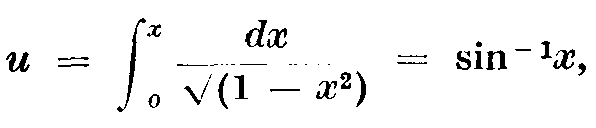
we have x = sin u. Similarly, if
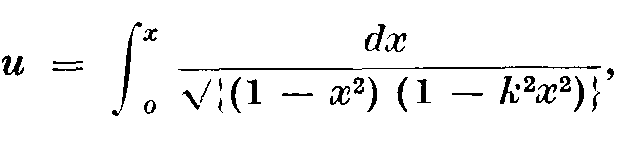
we may write x = sn u, √(1 - x2) = cn u, √(1 - k2x2) = dn u. These are Jacobi's elliptic functions. They obviously reduce to sin u, cos u, 1, when k is 0. The circular functions have the period 2π; the elliptic functions are doubly periodic, having both a real and a pure imaginary period when k2 is real and less than 1. Like the functions sine and cosine, the elliptic functions have addition theorems, e.g.
sn(u + v) = sn u cn v dn v + sn v cn u dn u .
1 - k2sn2u sn2v
Another method and notation has been introduced by Weierstrass, and is now much used. The functions are needed for the solution of many physical problems, such as those of the motion of a top and of a pendulum.—Bibliography: A. G. Greenhill, Elliptic Functions; Appell and Lacour, Fonctions Elliptiques; Whittaker and Watson, Modern Analysis.
Ellis, Alexander John, English philologist, born 1814 (name originally Sharpe), died in 1890. He was a distinguished graduate of Trinity College, Cambridge, was elected to the Royal Society in 1864, and was long a prominent member of the Philological Society, being more than once its president. Though phonetics was the subject in which he most highly distinguished himself, he was equally at home in mathematical and musical subjects. His chief published work is Early English Pronunciation (in five parts), between 1869 and 1889; but his publications in the form of books, pamphlets, papers, and articles on phonetics, music, and mathematics are numerous.
Ellis, George, English man of letters, born in 1753, died in 1815. Educated at Westminster School and Trinity College, Cambridge, he became one of the junta of wits concerned in the well-known political satire, The Rolliad, and contributed to the Anti-Jacobin. He also wrote a preface, notes, and appendix to Way's translation of Le Grand's Fabliaux, and published Specimens of the Early English Poets, with an Historical Sketch (1790), and Specimens of Early English Metrical Romances (1805). He was an intimate friend of Sir Walter Scott.
Ellis, William, English missionary, born 1794, died 1872. He was sent out to the South Sea Islands in 1816 by the London Missionary Society, and returned in 1825, one result of his labours being Polynesian Researches (1829). From 1830 to 1844 he was secretary to the society, and afterwards on its behalf made several visits to Madagascar, the longest being from 1861 to 1865. These visits led him to publish Three Visits to Madagascar (1858), Madagascar Revisited (1867), and the Martyr Church of Madagascar (1870).
Ellis Island, a small island in the upper New York Bay. Sold by the New York State to the United States, in 1808, it was for a long time used as a powder magazine, but in 1891 was made an immigrant station.
Ello´ra, or Elo´ra, a ruined village, Hindustan, Deccan, Nizam's Dominions, 13 miles north-west of Aurangabad, famous for its rock and cave temples excavated in the crescent-shaped scarp of a large plateau. They run from north to south for about a mile and a quarter, and consist of five Jain caves towards the north, seventeen Brahmanical caves at the centre, and towards the south twelve Buddhistic caves. Of the temples some are cut down through the rock, and left open above like isolated buildings, others are excavated under the hill in the manner of caves properly so called. The interior walls are often richly carved with mythological designs. The most magnificent of the whole is the Hindu temple called Kailasa or Cailasa, the central portion of which forms an isolated excavated mass or immense block 500 feet in circumference and 100 feet high. It is surrounded by galleries or colonnades at the distance of 150 feet, in which the whole Hindu pantheon is cut in the perpendicular rock. Another fine temple, much smaller, but cut under the hill, is the Buddhist cave of Visvakarma, the only one excavated with a curved roof. The date of the caves is not certainly known, but they were probably the work of the reigning families at the neighbouring Deoghir, now Daulatabad, which, prior to the Mohammedan conquest, A.D. 1293, was the capital of a powerful Hindu principality.—Cf. Fergusson and Burgess, The Cave Temples of India.
Ellore, a town of India, Godavari district, Madras presidency, once the capital of the Northern Circars. Pop. 29,500.
Ellwood, Thomas, an early writer among the Quakers, born in 1639, died in 1713. About 1660 he was induced to join the Society of Friends, and soon after published An Alarm to the Priests. He was imprisoned on account of his religion, but subsequently became reader to Milton, and upon reading the MS. of Paradise Lost is said to have suggested to the poet the idea of writing the Paradise Regained. In 1705 and 1709 he published the two parts of his Sacred History. His works include a poetical life of King David, the Davideis, Forgery no Christianity, and an autobiography, The History of the Life of Thomas Ellwood: written by his own hand.
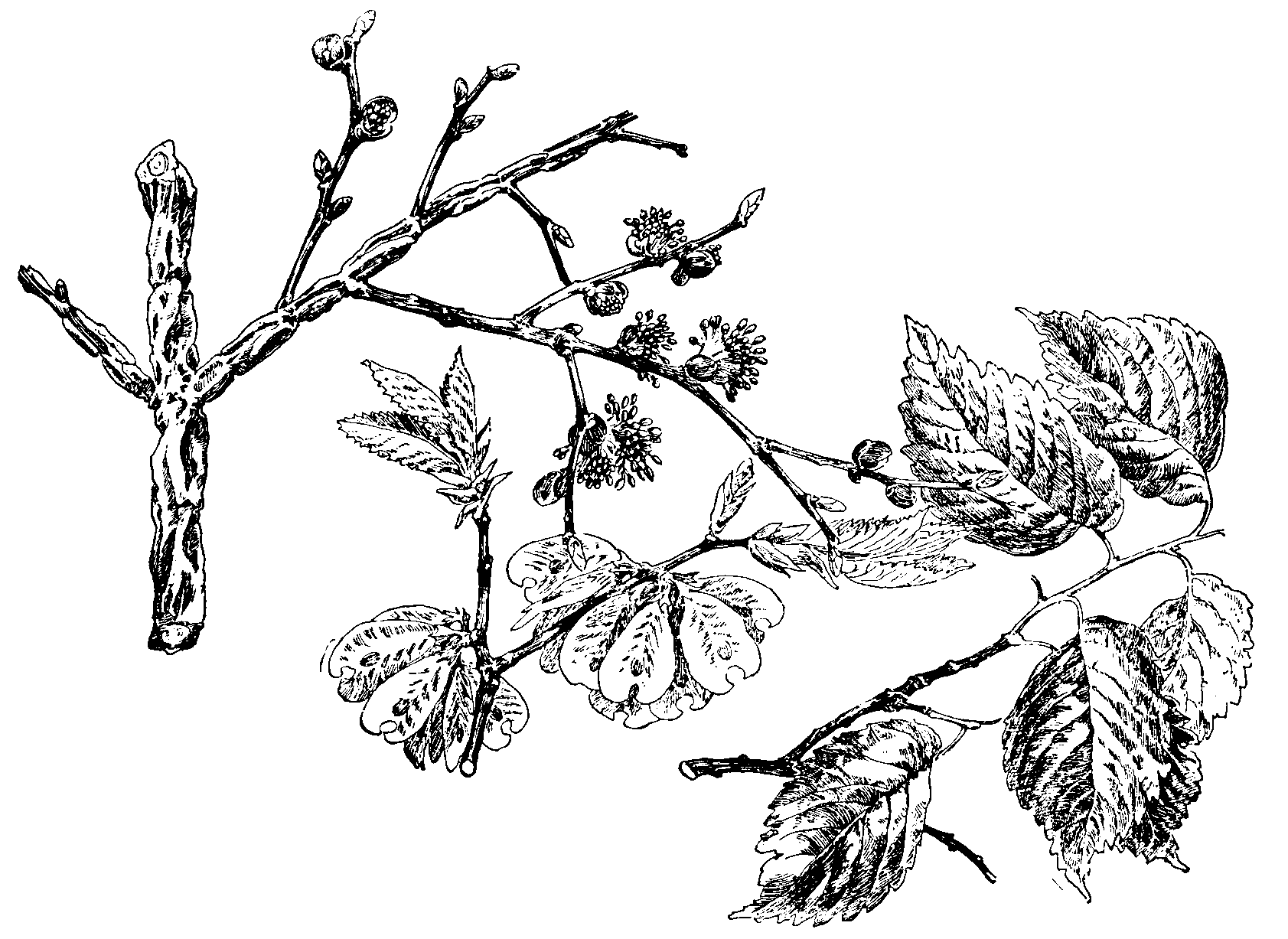
Common Elm (
Ulmus campestris
)
Fruit, flowers, and leaves.
Elm, a genus of trees (Ulmus; nat. ord., Ulmaceæ), consisting of eighteen species, natives of the northern temperate zone and mountains of Tropical Asia. They have bisexual flowers with a campanulate calyx, as many stamens as there are divisions in the limb of the calyx, and two styles. Two species are common in Britain, Ulmus campestris and Ulmus montāna, with many varieties. The Ulmus campestris, or common elm, is a fine tree, of rapid and erect growth, and yielding a tall stem, remarkable for the uniformity of its diameter throughout. It is very common as a timber tree in England; but as it rarely produces seed it is questionable whether it is indigenous. It is a native of the south and middle of Europe, and the west of Asia. The average height of a mature tree is 70 or 80 feet, but some reach a height of 150 feet. The wood is brown, hard, of fine grain, not apt to crack, and is used for many purposes. The tree generally attains maturity in seventy or eighty years. Ulmus montāna (the mountain or wych elm), a native of Scotland, grows to a less height than the English elm, is of slower growth, and yields a much shorter bole, but it is far bolder in its ramification and more hardy. It usually attains to the height of about 50 feet. It does not produce suckers, like the English elm, but yields seed freely. The timber is strong and elastic, and the tree often yields large protuberances of gnarled wood, finely knotted and veined, and much esteemed for veneering. Ulmus glabra, the smooth-leaved elm, is a variety common in some parts of Britain. It first appeared about the middle of the eighteenth century. The most ornamental tree of the genus is Ulmus montāna, variety pendŭla, the weeping elm. The American or white elm (Ulmus americāna) is abundant in the Western States, attaining its loftiest stature between lat. 42° and 46°; here it reaches the height of 100 feet, with a trunk 4 or 5 feet in diameter, rising sometimes 60 or 70 feet before it separates into a few primary limbs. Its wood is not much esteemed. The red or slippery elm (Ulmus fulva) is found throughout a great extent of country in Canada, Missouri, and as far south as lat. 31°; it attains the height of 50 or 60 feet, with a trunk 15 or 20 inches in diameter; the wood is of better quality than that of the white elm. The leaves and bark yield an abundant mucilage. The wahoo (Ulmus alāta), inhabiting from lat. 37° to Florida, Louisiana, and Arkansas, is a small tree, 30 feet high. The branches are furnished on two opposite sides with wings of cork 2 or 3 lines wide; the wood is fine-grained and heavy.
Elmi´na, a British town and seaport on the west coast of Africa, 8 miles west of Cape Coast Castle. It was acquired by Britain in 1872 with the other Dutch possessions on the Gold Coast, when it was claimed by the King of Ashanti, the result being the Ashanti Wars of 1873-4. Pop. 12,500.
Elmi´ra, a town of the United States, N. York, on the Chemung River; with a college for women, founded in 1855, the State reformatory, and a fine court-house. Its industrial establishments comprise rolling-mill, blast-furnace, foundries, and machine-works. Pop. 37,176.
Elmo's Fire, St., a meteoric appearance often seen playing about the masts and rigging of ships. If two flames are visible (Castor and Pollux) the sailors consider it a good omen; if only one (Helena), they regard it as a bad one. The name is derived from St. Elmo, or St. Erasmus, who was broken on the wheel A.D. 304.
Elmshorn, a town in Schleswig-Holstein, 20 miles north-west of Hamburg, on the Krückau, a navigable stream. Pop. 14,790.
Elmsley, Peter, D.D., English scholar, born in 1773, died in 1825. Educated at Oxford, he was one of the original contributors to the Edinburgh Review, and wrote occasionally, at a subsequent period, in the Quarterly. He finally settled at Oxford, on obtaining the headship of St. Alban's Hall and the Camden professorship of ancient history in 1823. He published editions of the Œdipus Tyrannus (1811), Heraclidæ (1815), Medea (1818), Bacchæ (1821), and Œdipus Coloneus (1823).
El Obeid. See Obeïd.
Elodea, a genus of submerged water-plants, nat. ord. Hydrocharitaceæ. E. canadensis, the Canadian water-weed, was accidentally introduced into Britain about 1840, and spread throughout Europe with extraordinary rapidity, and entirely by vegetative reproduction, as only the ♀ plant exists on this side of the Atlantic. The plant is much used for physiological experiments, e.g. for showing the movements of protoplasm.
Elo´him (plural of Eloah), one of the Hebrew names for God, of frequent occurrence in the Bible. Elohim is used in speaking both of the true God and of false gods, while Jehovah is confined to the true God. The plural form of Elohim has caused a good deal of controversy, some considering it as containing an allusion to the doctrine of the Trinity, others regarding it as the plural of excellence, others holding it as establishing the fact of a primitive polytheism. The Elohistic passages in the Pentateuch, or, in other words, the passages in which the Almighty is always spoken of as Elohim, are supposed to have been written at an earlier period than those in which he is spoken of as Jehovah. The Elohistic passages are simpler and more primitive in character than the Jehovistic; thus Gen. i, 27 is Elohistic; Gen. ii, 21-4 is Jehovistic.
El Paso ('the pass' or crossing), a town of the United States, in Texas, at an important ford or crossing of the Rio Grande del Norte, where there is now a railway bridge, with extensive railway connections and large trade with Mexico, the smaller Mexican town of same name being on the opposite bank of the river. Pop. (including suburbs), 39,280.
Elphinstone. Hon. Mountstuart, Indian administrator, son of the eleventh Lord Elphinstone, born in Scotland in 1778, died in 1859. He joined the Bengal Civil Service in 1795, was Ambassador to the Afghan Court in 1808, Resident at the Court of Poonah from 1810 to 1817, and British commissioner to that province from 1817 to 1819, when he became Governor of Bombay. During a government of seven years he established a code of laws, lightened taxes, and paid great attention to schools and public institutions. He resigned in 1827. A college established by the natives was called after him Elphinstone College. He was the author of an Account of the Kingdom of Cabul and its Dependencies (1815), and a History of India (1841). He was offered the governor-generalship of India in 1835, and afterwards that of Canada, both of which he declined.
Elphinstone, William, a Scottish prelate, founder of King's College and University, Aberdeen, born at Glasgow in 1431, died in 1514. He was educated at Glasgow College, and served four years as priest of St. Michael's in that city. He then went to France and became professor of law, first at Paris and subsequently at Orleans, but before 1474 he returned home at the request of Muirhead, Bishop of Glasgow, who made him commissary of the diocese. In 1478 he was made commissary of the Lothians, and in 1479 Archdeacon of Argyle. Soon after he was made Bishop of Ross; and in 1483 was transferred to the see of Aberdeen. In 1484 and 1486 he was commissioned to negotiate truces with England, and in 1488 was Lord High-Chancellor of the kingdom for several months. He was next sent on a mission to Germany, and after his return held the office of Lord Privy Seal till his death in 1514. In 1494 he obtained a papal bull for the erection of the university of King's College at Aberdeen.
Elsinore´ (Dan. Helsingör), a seaport of Denmark, in the Island of Seeland, at the narrowest part of the Sound, here only 3½ miles broad, 24 miles north by east of Copenhagen, opposite Helsingborg in Sweden, and connected with it by train-ferry. Near Elsinore is the castle of Kronberg, built by Frederick II of Denmark about 1580, and commanding the Sound. The castle, now chiefly used as barracks, is associated with Shakespeare's Hamlet. Before the abolition of the Sound dues in 1857 all merchant ships passing through were bound to pay toll here. Pop. 13,990.
Elster two German rivers, the White or Great Elster, a tributary of the Saale; the Black Elster, a tributary of the Elbe.
Elswick (els´ik), a suburb of Newcastle, England, containing the great ordnance-works of Armstrong, Mitchell, & Co. Pop. 58,352.
Elton, Charles Isaac, English jurist and archæologist, born 1839, died 1900. He was educated at Cheltenham and Oxford, became a barrister and a member of Parliament, and wrote various works on legal and other subjects, the most important being Origins of English History. In this work he traces the development of England and its inhabitants, from the earliest times regarding which we have any knowledge, to the acceptance of Christianity by the Anglo-Saxons, the investigation of the evidence furnished by Greek and Roman writers, and the discussion of prehistoric ethnology and archæology being especially thorough. Other works are: Commons and Waste Lands, and W. Shakespeare: His Family and Friends.
Elu´triation (Lat. elutriare, to wash out), the process of separating the finer particles of a clay, earth, or similar mass, from the coarser, consisting in stirring up the substance in water, letting the coarser particles subside, running off the liquid containing the finer particles, and then waiting till they subside.
Elvas, a fortified city of Portugal, province of Alemtejo, near the Spanish frontier, 12 miles north-west of Badajoz, on a height flanked by two others, each crowned by a castle. It has a cathedral, partly Moorish and partly Gothic, and a Moorish aqueduct, a magnificent work which brings water from a distance of 15 miles. Pop. 10,645.
Ely (ē´li), an episcopal city of England, in the county of Cambridge, on an eminence on the left bank of the Ouse. The ecclesiastical structures comprise the cathedral, one of the largest in England, and the churches of St. Mary, and the Holy Trinity, the last belonging to the time of Edward II, and one of the most perfect buildings of that age. The superb cathedral occupies the site of a monastery founded about the year 673 by Etheldreda, daughter of the King of East Anglia. Its entire length, east to west, is 517 feet, and its west tower is 270 feet high. The whole structure comprises an almost unbroken series of the various styles of architecture which prevailed in England from the Conquest to the Reformation, yet with no loss of impressiveness as a whole. It was begun in 1083, completed in 1534, and since 1847 has undergone extensive additions and restoration. A fine gateway, built in the reign of Richard II, forms the principal entrance to the cathedral precincts. There are a few manufactures, but most of the inhabitants are engaged in agricultural labour. Pop. 7917.
Ely, Isle of, a portion of the county of Cambridge, separated by the Ouse from the rest of the county, and forming itself a sort of county. It is about 28 miles long by 25 miles broad; area, 239,259 acres. The name is also given to a smaller tract, about 7 miles long by 4 miles broad. The soil is very fertile. Pop. 69,752.
Elymus, a genus of grasses, natives chiefly of the north temperate zone. The British species, E. arenarius (lyme grass) is a good sand-binder.
Elys´ium, or Elysian Fields, among the Greeks and Romans the regions inhabited by the blessed after death. They are placed by Homer at the extremities of the earth, by Plato at the antipodes, and by others in the Fortunate Islands (the Canaries). They were at last supposed to be in the interior of the earth, where Virgil described them as being. The happiness of the blessed consisted in a life of tranquil enjoyment in a perfect summer land, where the heroes, freed from all care and infirmities, renewed their favourite sports.
Ely´tra, the horny cases into which the front wings of beetles are modified, and which meet in a straight line down the middle of the back. The membranous hind-wings are here the organs of flight, and when not in use are folded longitudinally and transversely, and tucked away under the elytra.
Elze (el´tse), Karl, German writer, distinguished for his studies in English literature, born 1821, died 1889. He studied in Leipzig and Berlin, was long a teacher in the gymnasium of his birth-place, Dessau, and in 1875 was appointed to the chair of English language and literature at Halle. Among his writings were valuable biographies of Sir Walter Scott and Lord Byron (the latter translated into English), and a biographical and critical work on Shakespeare, also translated into English (1888).
El´zevir, or Elzevier, the name of a family of publishers and printers, residing at Amsterdam and Leyden, celebrated for the beauty of the editions of various works published by them, principally between 1595 and 1680. Louis, the founder of the family (born 1540, died 1617), settled in Leyden, and between 1583 and his death produced about 150 works. Five of his seven sons followed his business:—Matthæus at Leyden; Louis (II) at the Hague; Gilles at the Hague and afterwards at Leyden; Joost in Utrecht; and Bonaventure, who in 1626 associated himself with Abraham, the son of Matthæus. From the press of Abraham and Bonaventure issued the exquisite editions of the classics which have made the name of Elzevir famous. Of these the Livy and Tacitus of 1634, the Pliny of 1635, the Virgil of 1636, and the Cicero of 1642 are perhaps the most beautiful. The Elzevir books are distinguished by the types and the choice of the paper rather than by the critical preparation of their texts.
Emanation, in a specific sense, an idea at the centre of many philosophic systems which seek to explain the universe as an eternal efflux or emanation from the Supreme Being, comparable with the efflux of light from the sun. The idea of emanation came from the East, and traces of the doctrine are found in the system of Zoroaster. It had a powerful influence on the ancient Egyptian philosophy, as also on that of the Greeks, as may be seen in Pythagoras. It was subsequently developed by Plotinus,the Gnostics, Manicheans, Pantheists, and other sects.
Eman´uel the Great, King of Portugal, born in 1469, died in 1521. He ascended the throne in 1495, and during his reign were performed the voyages of discovery of Vasco da Gama, of Cabral, of Americus Vespucius, and the heroic exploits of Albuquerque, by whose exertions a passage was found to the East Indies, the Portuguese dominion in Goa was established, and the Brazils and Moluccas were discovered. The commerce of Portugal, under Emanuel, was more prosperous than at any former period. The treasures of America flowed into Lisbon, and the reign of Emanuel was justly called 'the golden age of Portugal'. He died at the age of fifty-two, deeply lamented by his subjects, but hated by the Moors and the Jews, whom he had expelled from the country. He was a patron of learned men, and himself left memoirs on the Indies. He married three times: in 1497 Isabella, daughter of Ferdinand and Isabella, heiress of Castile; in 1500 her sister Maria; and in 1519 Eleonora of Austria, sister of Charles V.
Embalming (em-bäm´ing; Gr. balsamon, balm), the process of so treating dead bodies with aromatic and antiseptic substances as to preserve them from corruption and decomposition. The ancient Egyptians employed this art on a great scale, embalming not only human corpses, but also the bodies of cats, ibises, crocodiles, and other animals held sacred. The mummy of King Mer-en-rē, who lived about 2500 years before our era, found in 1880, was in an excellent state of preservation. Other peoples, such as the Assyrians and Persians, also followed the practice, though hardly equalling Egyptian methods. The abdomen was emptied through an incision, and the brains drawn through the nostrils by means of a special instrument. The ancient Peruvians appear to have injected and washed the corpses with a fluid that flows from imperfectly burned wood, in which pyroligneous acid, creosote, and other antiseptics are present. Pliny alludes to the use of a similar fluid by the Egyptians. In more recent times bodies have been preserved for centuries by embalming, especially when they have remained at a low and uniform temperature and have been protected from the air. The corpse of Edward I, buried in Westminster Abbey in 1307, was found entire in 1770. Canute died in 1036, and his body was discovered very fresh in Winchester Cathedral in 1776. The bodies of William the Conqueror and of his wife Matilda were found entire at Caen in the sixteenth century. Of the various modern artificial means of preserving bodies, impregnation with corrosive sublimate appears to be one of the most effective, next to immersion in spirits. An injection of sulphate of zinc into the blood-vessels is also stated to be satisfactory; while natron, various spices, and other aromatic compounds are sometimes employed. The original reason for embalming was most probably the preservation of the body to await a resurrection and a future life.—Bibliography: W. Budge, The Mummy; G. Elliot Smith, A Contribution to the Study of Mummification in Egypt; Myers, Textbook of Embalming.
Embank´ment, a mound of earth, &c., thrown up either for the purpose of forming a roadway at a level different from that of the natural surface of the ground, or for keeping a large body of water within certain limits. When constructed wholly of earth or clay, it is triangular in cross-section, with the apex cut off parallel to the base line, the angle of the sloping sides varying with the nature of the material used. Thus the slope of loose rubble, chalk, stone, loamy sand, or gravel requires about 1½ base to 1 vertical; dry, loose, and ordinary clay, 2 horizontal to 1 vertical, while some clays require a much wider base. To prevent subsidence on marshy or peaty soils, either the weight of the heart of the embankment is diminished, as in Holland, by introducing layers of reeds or fascines, or artificial foundations are prepared. The embankment may be prevented from slipping laterally by forming steps in the earth of the subsoil, or by cutting deep trenches at the feet of the slopes. In cases where embankments are raised for the storage of water, a 'puddle-dike', that is, a water-tight wall, must be inserted through the whole depth of the bank down to the impermeable strata beneath. To resist the action of wind and rain, or of the waters of a slow-flowing stream, the banks should in all possible cases be covered with turf. Among the largest embankments hitherto executed are those on the banks of the Po, the Meuse, the Scheldt; on the shores of the Netherlands; the Oberhäuser embankment on the Augsburg and Lindau Railway, the Gadelbach cutting on the Ulm and Augsburg line, and the Tring cutting on the London and North-Western Railway.