VOLUME IV PART 2 (continued 7)
Reading edition
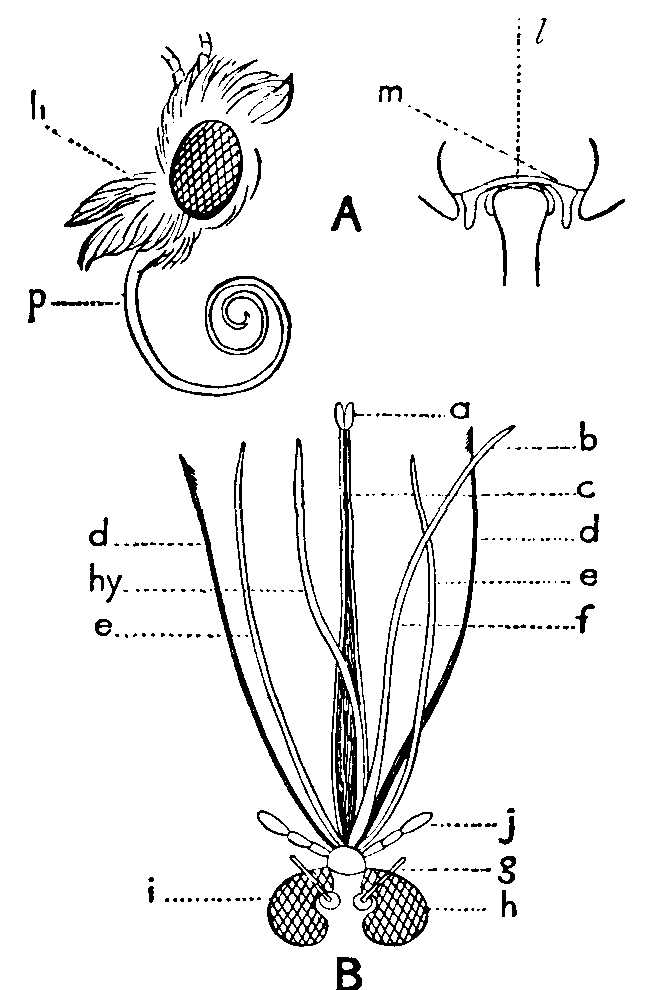
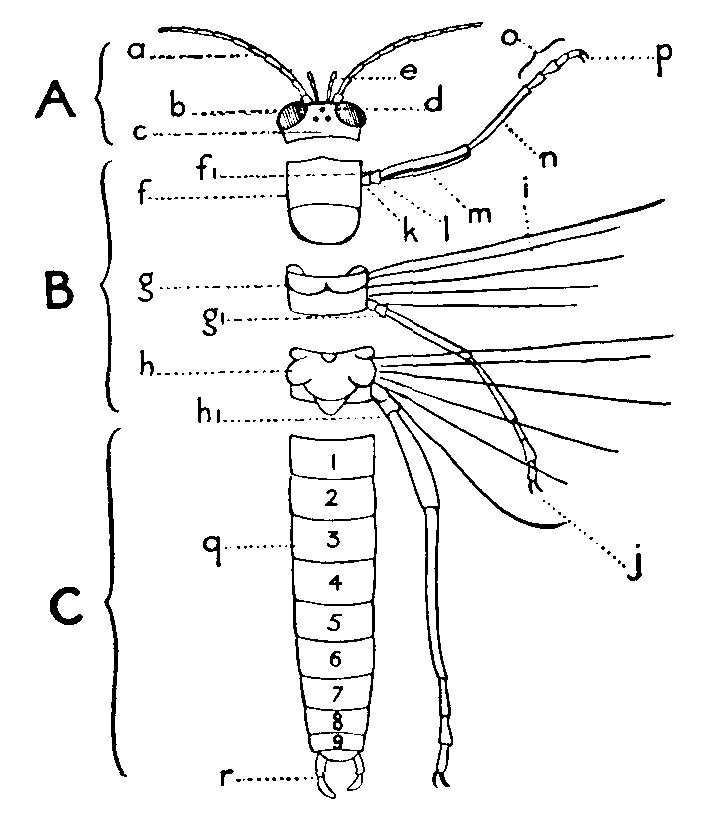
Structure of a Hexapod
A, Head: a, antennæ; b, compound eyes; c, occiput; d, ocelli; e, palpi. B, Thorax: f, pronotum; f1, prothoracic legs; g, mesonotum; g1, mesonotal leg; h, metathorax; h1, metathoracic leg; i, mesothoracic, and j, metathoracic, wings; k, coxa of leg; l, trochanter; m, femur; n, tibia; o, tarsus; p, ungues. C, Abdomen: q, body segments; r, genitalia.
Entomoph´aga ('insect eaters'), a term applied to (1) a group of hymenopterous insects whose larvæ feed upon living insects; (2) a tribe of marsupials, as the opossums, bandicoots, &c., which are insectivorous, though not exclusively so; (3) a section of the edentates, as the ant-eater and pangolin.
Entomophthorineæ, a curious family of Fungi, group Zygomycetes, all parasites on insects. The best known is Empusa Muscæ, which attacks the common house-fly. After thoroughly permeating and finally killing the infected fly, the fungus sends numerous hyphæ to the surface, from the ends of which conidia are shot forth by an 'explosive' process, to spread the infection if they alight on living flies. In autumn, flies killed by this parasite may often be found adhering to window-panes, surrounded by a halo of ejected conidia. It has been proposed to utilize this fungus in combating the fly nuisance.
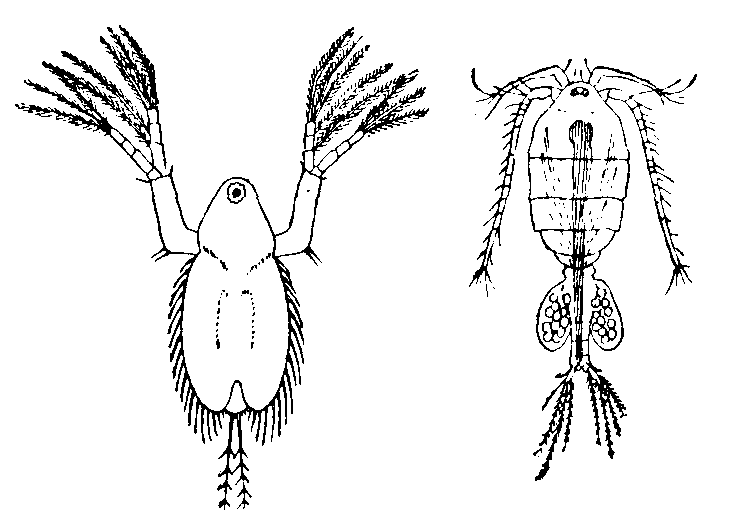
Entomostraca
Spiny-tailed water-flea (Daphnia) on left; Cyclops on right. Both enlarged.
Entomos´traca, a sub-class of crustacea, including forms which are mostly small, and comprising four orders: (1) Branchiopoda, brine-shrimps and water-fleas; (2) Copepoda, including the freshwater Cyclops, and numerous marine species contributing to the floating surface population (plankton); (3) Cirripedia, barnacles; (4) Ostracoda, types such as Cypris enclosed in a bivalve shell.
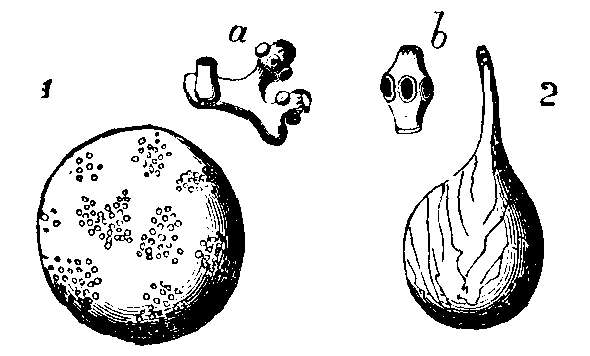
Entozoa magnified
1, Cœnūrus cerebrālis (producing the staggers in sheep). a, Heads (shown on the surface) separately.
2, Cysticercus cellulosæ (causing the measles in pigs). b, Head.
Entozo´a, a general name for the various parasitic worms that infest the bodies of other animals. Some are found in the intestines, others in the liver, brain, muscles, and other tissues. They pass through different stages in their development, and at each stage may occupy a different organ (or tissue), and usually a different animal. Thus the cystic or bladder-worm, whose presence in the brain of sheep causes staggers, is the immature form of a tapeworm of the dog, &c. The number of species is being reduced as the relations of the different forms are studied. They belong to the two phyla Platyhelminthes (flat-worms) and Nemathelminthes (thread-worms, &c.). The former embraces flukes (Trematoda) and tapeworms (Cestoda); while the latter includes thread-worms and round-worms (Nematoda), and spiny-headed worms (Acanthocephala).
Entrenchments. The employment of entrenchments, or earthworks, in connection with military operations dates from the earliest times. Entrenched camps, made by the Romans, are still to be seen in many parts of the country. The primary object, in early designs, was to offer a material obstacle to the assaulting enemy; the defenders manned a high parapet overlooking a formidable ditch, and a hand-to-hand conflict decided the issue. The development of fire-arms, and especially of artillery, depreciated the value of entrenchments as affording material obstacles, but gave them a gradually increasing value as a means of protecting the defenders from missiles. The provision of cover, that is to say, concealment from view or protection from fire, ultimately became the dominant factor in the design of earthworks. Obstacles were still necessary, but they had to be provided by other means. Successive improvements in firearms altered the nature of the cover which it was necessary and practicable to provide. A bullet-proof parapet has always been an essential feature, but whereas a few inches of earth sufficed to stop a musket-ball, the modern rifle-bullet will penetrate a thickness of nearly four feet. The introduction, during last century, of shrapnel shell, the bullets from which descend at a steep angle, was followed by the adoption of overhead cover as a standard feature in trench design. This persisted for several years, until the great increase in the power of high-explosive shell made it impossible to construct any form of roof which would withstand bombardment, even by the lighter artillery accompanying an army in the field, and still permit of the defenders using their rifles from below it. Modern fire-positions are made open, i.e. without overhead cover.
All past wars have proved that victory can only be won as the result of offensive action. Nevertheless, in any campaign it will not be possible to attack at all times and in all places. The provision of the strongest possible force at the vital point necessitates a defensive attitude on other parts of the front. Although entrenchments presuppose a defensive attitude locally, they play an important part in offensive operations. The ultimate aim is that, by a skilful use of entrenchments, a commander may be able to reduce to a minimum the strength of his force in actual combat with the enemy, and thus to retain at his disposal a reserve of troops for offensive action.
Entrenchments may be either hasty or deliberate. Hasty entrenchments are those made on the actual field of battle: by the attackers, to secure the ground won prior to another bound forward; by the defenders, to hold up the attack pending fresh dispositions of troops in rear. The amount of digging that can be done is necessarily small; existing cover must be utilized to the utmost. This may consist of ditches, hedges, sunken roads, railway embankments and cuttings, buildings, woods, shell-holes, &c. All of these are readily convertible into strong defences. The test of battle has proved, over and over again, that troops well trained in adapting natural cover to defence are very difficult to dislodge, once they have dug themselves in. Deliberate entrenchments are employed in the gradual building up of a trench system when once the opportunity of manœuvre has ceased to exist; or in the preparation of a defensive position somewhat remote from the scene of active operations.
The following are the salient features in the design of modern entrenchments: (1) A parapet 18 inches high, and upwards of 5 feet thick, in front of every fire-trench. (2) Longitudinal division of every trench, either by projecting buttresses of earth or by bends, so that no straight portion exceeds 10 yards in length. The effect of this is to give protection against flanking or enfilade rifle-fire, and to localize the burst of shell. (3) A parapet on the rear side (parados), to shield the defenders from the back-blast of shell which burst beyond the trench. (4) Wide trenches (6 feet at the top), to minimize the risk of men getting buried during bombardment. (5) Accommodation, in dug-outs and other refuges, for a proportion of the troops.
Arms of precision have, during the past twenty years, compelled careful attention to the concealment of entrenchments. Although systems of trenches cannot now be hidden from the eye of the aeroplane-camera, yet the enemy can be kept in doubt, by correct design and careful siting of trenches, as to the strength in which the various portions of a position are held. It is for this reason that the deep fire-trench, with a low parapet in front, has been universally adopted, despite the obvious objection that minor undulations restrict the field of fire because the rifle is brought nearer to the ground. Earthworks on a sky-line, or those seen by the enemy against a distant background, violate the first principles of siting.
Modern entrenchments are arranged in depth. The 'lines' of Wellington's time have given place to a broad belt of mutually supporting defences, organized in three zones. These merge imperceptibly into one another, and each zone extends upwards of a mile from front to rear. The foremost fringe of the outpost zone is in contact with the enemy; it is the high-water mark on which the troops advancing during the last action have come to a standstill and dug themselves in. Very lightly manned, as befits an area where heavy shelling is rife, this zone, nevertheless, plays an important rôle. It harbours the forward artillery observation posts, which control and direct the fire of the guns in rear. It furnishes a 'jumping-off' place for attacks. It takes the first shock of a hostile attack, and, although not strong enough to repulse a serious offensive, contributes to the enemy's ultimate defeat by depriving his onslaught of momentum. The battle zone is more elaborately organized, and capable of being very heavily manned. Within this area the defence intend to bring to a standstill the most determined offensive. It lies sufficiently far back from the fringe of the outpost zone to be reasonably immune from destructive bombardment. Lying still farther back is the third zone, which serves for the accommodation of reserves of troops, and is also prepared for defence, as a last resort, in case the enemy should penetrate the battle zone.
Entrepôt (a˙n˙-tr-pō; Fr.), a port where foreign merchandise which cannot enter the interior of a country is deposited in magazines under the surveillance of the custom-house officers till it is re-exported; also, any place where goods are sent to be distributed wherever customers are found.
Entre Rios (en´tre rē´os; 'between rivers'), a province of the Argentine Republic, lying between the Uruguay and the Paraná; area estimated at 29,240 sq. miles; pop. 425,370. The province is largely pastoral. Capital, Paraná, with a pop. of 25,000
Entro´pion is the inversion or turning in of the eyelid. It may be congenital, or arise as the result of some inflammatory process or burn of the conjunctiva. Entropion affecting the lower lid appears also as the result of extreme photophobia (intolerance to light).
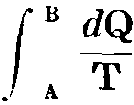
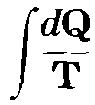
Entropy, a term introduced into physics by Clausius as the name of one of the two important thermodynamical properties of a substance which depend on its 'state'. Suppose we have 1 lb. of water at atmospheric pressure and 212° F., say, and suppose we apply heat to the water and change it into 1 lb. of steam at 212° F. The temperature does not change during this process, while the heat which must be added is the latent heat of the steam, namely, about 960 British Thermal Units. The increase of entropy from the first state to the second state is got by dividing the heat given to the substance, namely, 960 B.Th.U., by the absolute temperature at which that heat was given to the substance, namely, 461 + 212 = 673 degrees absolute, i.e. the increase of entropy is 960/673 = 1.43 units. If the temperature changes with the addition of heat, as it would usually do, we have to imagine the heat to be supplied in small quantities, and to take the average temperature of the body at which these tiny quantities of heat are supplied. The quotient heat ÷ temperature is taken for each small quantity of heat, and the results are added together. The summation is defined as the increase in entropy between the initial and the final states.
In mathematical language the increase in entropy between state A and state B is given by (φB - φA) = , where φ stands for the entropy, Q for the heat received by the body, and T for the absolute temperature at which the heat is received. The importance of the entropy function, namely, the integral , in thermodynamics is due to the fact that it is, like the internal energy of the substance, a function of the state of the substance only, and consequently in any temperature cyclic change in which the final state of the substance is the same as its initial state A, the total change, either of its internal energy or of its entropy, is zero. The fact that the total change in the internal energy of the substance is zero is practically equivalent to the First Law of Thermodynamics, while the fact that the total change of the entropy of the substance is zero is equivalent to the Second Law of Thermodynamics.—Bibliography: J. H. Poynting and J. J. Thomson, Textbook of Physics (vol. 3): Heat.
En´velopes, the paper covers that enclose letters or notes. They became common shortly after the introduction of the penny postage system; were at first made chiefly by hand, but are now not only shaped, but folded and gummed, by machinery.
Enver Pasha, Turkish soldier and politician, born at Constantinople in 1879. He entered the Turkish army in 1896, and in 1905 took part in the Young Turk movement at Salonica. He joined the revolutionaries in 1908, was for a short time military attaché in Berlin, but in 1909 returned to Salonica, and assisted in the deposition of Sultan Abdul Hamid. He then took part in the Tripoli War and the second Balkan War, and recaptured Adrianople from the Bulgarians in July, 1913. After being Minister of War, Enver subsequently became one of the leaders of the Committee of Union and Progress. A staunch pro-German, he was to a great extent responsible for Turkey's entry into the European War as an ally of Germany. After the armistice of 1918, Enver Pasha fled to the Caucasus, and was active in inciting his countrymen to resist the terms of the Peace Treaty of 1920.
Environment, in biology, the surroundings of an organism, including non-living factors, such as climate and weather; and also other organisms. Plants and animals are more or less adapted to their surroundings, a good example being the mutual adaptations of flowers and insects, but there has been much controversy as to the way in which such adaptations have come about. Among all but unicellular organisms any individual consists of (1) a general body (soma), by which the life of the individual is maintained, and (2) germ cells, capable of becoming fresh individuals, and thus providing for the continuance of the species. According to a school of thought founded by some of the pre-Darwinian evolutionists, notably Buffon, Lamarck, and Treviranus, modifications of the soma (acquired characters) of an individual, brought about by the action of the environment (e.g. thickening of parts of the skin as the result of constant pressure), or by use and disuse (e.g. increased size of muscles; diminished wings of poultry), can be inherited, leading to increasing alteration capable of ending in the production of new species. Most living biologists, however, hold with Weismann that only germinal variations, i.e. variations in the substances of the germ-cells, are heritable. Much further research is necessary before it is possible to pronounce with certainty on many of the complex details involved in these theories. As to the part played by the environment, cases are known where this acts directly on the germ-cells, so as to influence their variation. But these are among some of the lower animals, in which the eggs develop outside the body of the parent, and we know hardly anything about the action of the environment on germs that develop internally. It has been suggested that modifications of the soma undoubtedly brought about by the influence of the surroundings may react upon the germ-cells and cause these to vary, but of this no proof has so far been forthcoming. Even if we admit that modifications of the soma are not inherited, they may nevertheless play a part in evolution by aiding the development of germinal variations that take the same direction. The whole subject is one of more than academic interest, especially in regard to the further evolution of human beings. Comparatively rapid advance, either in desirable or undesirable directions, would be possible if modifications acquired by the soma of an individual were capable of being inherited. So far as we know at present, acquired improvements in physique and mentality of individuals are not inherited by their offspring, which seems rather disappointing, but, on the other hand, undesirable modifications, including those due to disease, appear to be in the same case, and there is little reason to think that the children of parents possessing undesirable acquired characters are unduly handicapped from the very start. We must, of course, exclude cases of antenatal infection by the microbes of certain infectious or contagious diseases to which one or both parents have fallen victims, and also those of direct poisoning of germ-cells as the result of alcoholism.
En´voy, a person deputed by a Government to negotiate a treaty,or transact other business, with a foreign Government. We usually apply the word to a public minister sent for one particular purpose; hence an envoy is distinguished from an ambassador, and is of inferior rank.
Enzymes. See Fermentation, Physiological Chemistry.
Map of Eocene System in England
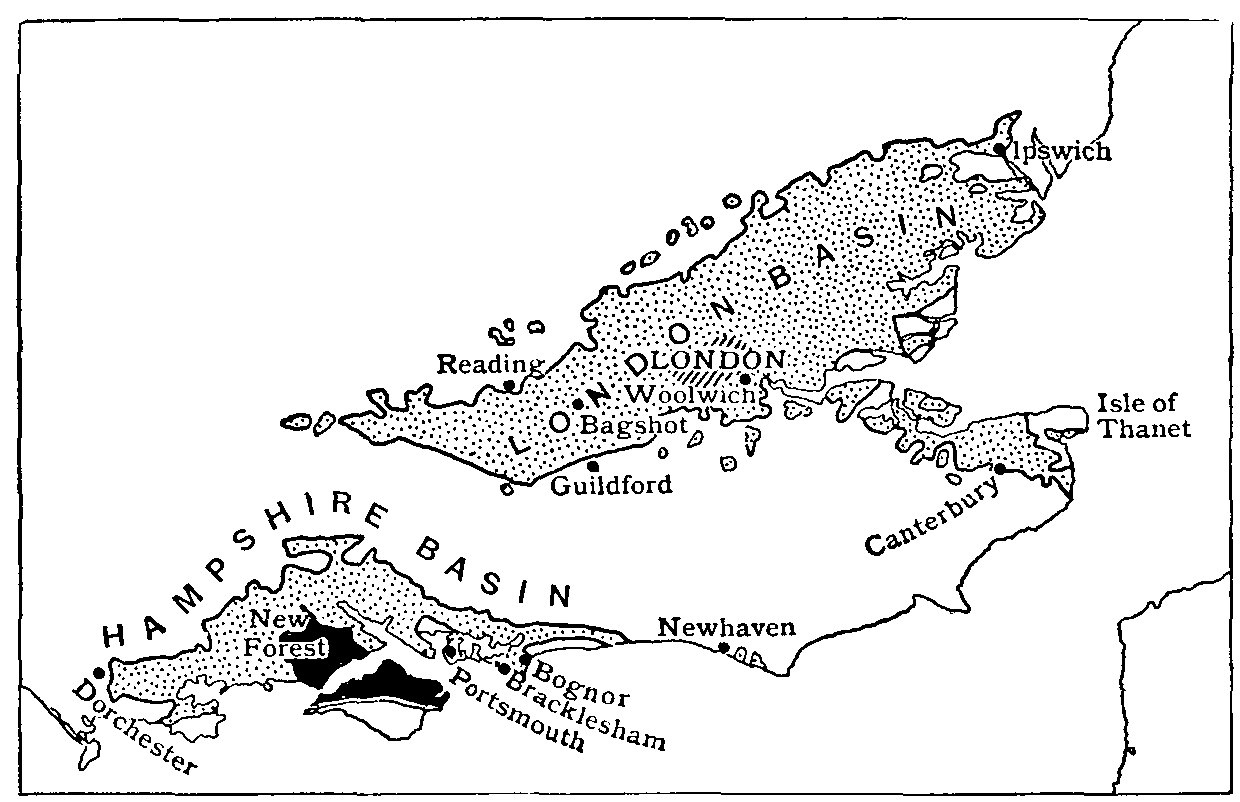
E´ocene, in geology, a term applied to the lower division of the Tertiary strata, from Gr. ēōs, dawn, and kainos, recent, because remains of existing organic species first occur here. The Eocene beds are arranged in two groups, termed the Lower and Upper Eocene; the strata formerly called Upper Eocene being now known as Oligocene. They consist of marls, limestones, clays, and sandstones, and are found in the Isle of Wight and in the south-east of England and north-west of France, in Central Europe, Western Asia, Northern Africa, and the Atlantic coast of North America.
Éon de Beaumont. See D'Éon de Beaumont.
E´os, among the ancient Greeks the goddess of the dawn. See Aurora.
Eötvös (eut´veush), Baron Joseph, a Hungarian statesman and author, born 1813, died 1871. He completed his studies at the University of Pesth in 1831. He had already, before leaving the university, produced three dramas—The Critics, The Wedding, and Revenge—the last a tragedy, all of which were well received. He became a friend of Kossuth, and distinguished himself as a journalist and orator of the popular party. In 1848, after the revolution of 15th March, he was appointed Minister of Public Instruction, resigned the same year, but was again appointed Minister of Public Instruction in 1867, and filled this office until his death. Among his works are the novels: The Carthusian, The Village Notary (translated into English), and Hungary in 1514—giving vivid pictures of Hungarian life in modern and more remote epochs.
Eozo´ic Rocks, the name given to the pre-Cambrian rocks, from their containing the first or earliest traces of life in the stratified systems.
Eozo´on, a supposed gigantic fossil foraminifer found in the limestone of the pre-Cambrian rocks of Canada, whence the name Eozoön canadense. The structure, however, which is recognized also in Bavaria and in County Galway, has proved to be due to a zonal development of serpentine during metamorphism of the ancient limestones concerned. A similar structure occurs in limestone associated with the volcanic focus of Vesuvius.
Ep´acris, a genus of gamopetalous Dicotyledons, the typical genus of the nat. ord. Epacridaceæ, distinguished by having a coloured calyx with many bracts, a tubular corolla with smooth limb, stamens affixed to the corolla, and a five-valved many-seeded capsule. The species are shrubby plants, with axillary, white, red, or purple flowers, generally in leafy spikes. Among those cultivated in Britain we may mention E. grandiflōra, which has flowers nearly an inch in length, of a brilliant reddish purple at the base and pure white at the apex. The order Epacridaceæ consists of plants allied to the heaths, chiefly natives of Australia. The fruit of some species is eaten under the name of Australian cranberry, and they are cultivated in greenhouses for their flowers.
Ep´act (Gr. epaktos, added), in chronology, the excess of the solar month above the lunar synodical month, and of the solar year above the lunar year of twelve synodical months. The epacts then are annual and menstrual or monthly. Suppose the new moon to be on the 1st of January: the month of January containing 31 days, and the lunar month only 29 days, 12 hours, 44 minutes, 3 seconds; the difference, 1 day, 11 hours, 15 minutes, 57 seconds, is the menstrual epact. The annual epact is nearly 11 days; the solar year being 365 days, and the lunar year 354. The epacts were once of some importance in ecclesiastical chronology, being used for finding when Easter would fall.
Epaminon´das, an ancient Greek statesman and general, who, for a short time, raised his country, Thebes, to the summit of power and prosperity. He was born about 418 B.C., and killed at the battle of Mantinea, 362 B.C. He took the leading part in the struggle during which Spartan supremacy in Greece was destroyed, and the supremacy of Thebes temporarily secured. Four times he successfully invaded the Peloponnesus at the head of the Thebans, but after his death Thebes soon sank to her former secondary condition. Throughout life Epaminondas was distinguished for the friendship subsisting between him and Pelopidas, with whom he served in the Spartan campaign, 385 B.C. His character is one of the finest recorded in Greek history. and his virtues have been praised by both Xenophon and Plutarch.
Eparch (ep´ärk), in Greece, the governor or prefect of a provincial division called an eparchy, a subdivision of a nomarchy or province of the kingdom. In Russia, an eparchy is the diocese or arch-diocese of a bishop or archbishop of the Greek Church.
Epaulement (e-pa¨l´ment: Fr. épaule, shoulder), in fortification, a term for the mass of earth or other material which protects the guns in a battery in front and on either flank.
Ep´aulet, or Ep´aulette (Fr. épaulette, dim. of épaule, the shoulder), an ornamental shoulder-piece belonging to a military or other dress. Epaulettes were worn in the British army till 1855, and in the United States as late as 1872, and are still worn in the navy by all officers of and above the rank of lieutenant, and by some civil officers.
Épée (ė-pā), Charles Michel, Abbé de l', French philanthropist, born in 1712, died 1789. He had chosen the clerical profession, but had to leave the Church on account of Jansenist opinions. The great object of his life was the instruction of the deaf and dumb, upon whom he spent his whole income, besides what was contributed by benevolent patrons. In 1770 he founded at his own expense an institution for the deaf and dumb. He left several works on his method of instruction, one of these being Institution des sourds et muets (1774).
Épéhy, a town of France, department of Somme, about 13 miles S.E. of Cambrai. It was the scene of fierce fighting during the European War, and was captured by the British in Sept., 1918.
Epeira (e-pī´ra), a genus of spiders, comprising the largest and best-known British species. E. diadēma, the common garden spider, is a handsomely marked species, which constructs a beautifully symmetrical wheel-shaped web.
Eperies (ep´er-yāsh), a town of Czecho-Slovakia, formerly in Hungary, on the Tarcza, the seat of a Greek Catholic bishop. Pop. 16,323.
Épernay (ep-er-nā; ancient Sparnacum, and the Roman Aquæ Perennes), a town of North-Eastern France, department of Marne, on the Marne, the central depot of the wine trade of Champagne. The vast wine-cellars of the town form a labyrinth of galleries cut in the tufa or calcareous soil of the district. Épernay was occupied for a short time by the Germans at the beginning of the European War, and was one of the enemy's objectives in the second battle of the Marne (July, 1918). Pop. 21,811.
E´phah, or Bath, a Hebrew measure of capacity, containing, according to one estimate or calculation, 8.6696 gallons; according to another, only 4.4286 gallons.
Ephedra, the principal genus of the Gnetales family of Gymnosperms. The species are shrubby switch-plants, natives of the warm temperate zone, found especially on sandy soil. The ripe seeding cones have fleshy scales, and those of E. distachya are eaten in South Russia.
Ephem´era, the typical genus of the neuropterous insects constituting the family Ephemeridæ, so named from the extreme shortness of their lives in the perfect state. They are known as may-flies or day-flies, and are characterized by the slenderness of their bodies; the delicacy of their wings, which are erect and unequal, the anterior being much the larger; the rudimentary condition of the mouth; and the termination of the abdomen in three filiform appendages. In the state of larvæ and pupæ they are aquatic and exist for years. When ready for their final change, they creep out of the water, generally towards sunset of a fine summer evening, beginning to be seen generally in May. They shed their whole skin shortly after leaving the water, propagate their species, and die, taking no food in the perfect state. The may-fly is well known to anglers, who imitate it for bait.
Ephe´sians, The Epistle to the, a canonical epistle addressed by the Apostle Paul to the Church which he had founded at Ephesus. It was written during his first captivity at Rome, immediately after he had written the Epistle to the Colossians (A.D. 62); and was sent by the hands of Tychicus, who also bore the message to the Church at Colossæ.
Eph´esus, an ancient Greek city of Lydia, in Asia Minor, one of the twelve Ionian cities, on the south side of the Caystrus, near its mouth. It was at one time the grand emporium of Western Asia, having a convenient and spacious harbour. The Apostle Paul visited Ephesus and established a Christian Church there, to which he dedicated one of his Epistles. It was famous for its temple of Artemis (Diana), called Artemision, the largest and most perfect model of Ionic architecture, and reckoned one of the seven wonders of the world. The first great temple, begun about 650 B.C. and finished after 120 years, was burnt by the notorious Herostratus in order to perpetuate his name, 356 B.C. (the night of Alexander the Great's birth). A second and more magnificent was then erected, which was burned by the Goths in A.D. 262. Some interesting remains have been discovered by excavation since 1896. Several Church councils were held here, especially the Third Ecumenical Council of 431, at which Nestorius was condemned. The site of the city is now desolate; near it is a poor village, Aiasoluk.
Eph´od, a species of vestment worn by the Jewish high-priest over the second tunic. It consisted of two main pieces, one covering the back, the other the breast and upper part of the body, fastened together on the shoulders by two onyx stones set in gold, on each of which were engraved the names of six tribes according to their order. A girdle or band, of one piece with the ephod, fastened it to the body. Just above the girdle, in the middle of the ephod, and joined to it by little gold chains, rested the square breastplate with the Urim and Thummim. The ephod was originally intended to be worn by the high-priest exclusively, but a similar vestment of an inferior material seems to have been in common use in later times among the ordinary priests.
Eph´ors, or Eph´ori (Gr. ephoroi, overseers), magistrates common to many Dorian communities of ancient Greece, of whom the most celebrated were the Ephori of Sparta. They were five in number, were elected annually, and both the judicial authority and the executive power were almost entirely in their hands. Their power became an intolerable burden, especially to the kings, and in 225 B.C. Cleomenes III murdered the whole college and abolished the office.
E´phraem Syrus, that is, 'Ephraim the Syrian', writer of the Syrian Church, born at Nisibis, in Mesopotamia, about A.D. 306, died at Edessa in 373 or 378. He wrote several commentaries on Scripture, numerous homilies, and other works (as well as hymns), which have come down to us partly in Syriac, partly in Greek, Latin, and Armenian translations. They were edited by Assemani at Rome between 1732 and 1746, and by Overbeck at Oxford in 1865.
E´phraim, the younger son of Joseph, and the founder of one of the twelve tribes of Israel. When the Israelites left Egypt, the Ephraimites numbered 40,500, and their possessions in the very centre of Palestine included most of what was afterwards called Samaria. Ephraim is also a town mentioned in John, xi, 54, and to which Jesus retired after His raising of Lazarus, when the Jewish authorities manifested their hostility against Him.
Ep´ic, a poem of the narrative kind, dealing with a series of events or actions of permanent interest. Some authorities restrict the term to narrative poems written in a lofty style and describing the exploits of heroes. Others widen the definition so as to include not only long narrative poems of romantic or supernatural adventure, but also those of an historical, legendary, mock-heroic, or humorous character. Epic poetry is distinguished from drama in so far as the author frequently speaks in his own person as narrator; and from lyrical poetry by making the predominant feature the narration of action rather than the expression of emotion. Among the more famous epics of the world's literature may be noted: Homer's Iliad and Odyssey, Virgil's Æneid, the German Nibelungenlied, the Anglo-Saxon poem of Beowulf, the French Song of Roland, Dante's Divina Commedia, Tasso's Gerusalemme Liberata, Ariosto's Orlando Furioso, Milton's Paradise Lost, Spenser's Faerie Queene, Camoens' Lusiads (Portuguese), and Firdusi's Shah Namah (Persian). Hesiod's Theogony, the Elder Edda, the Finnish Kalevala, and the Indian Mahâbhârata may be described as collections of epic legends. The historical epic has an excellent representative in Barbour's Bruce; and specimens of the mock-heroic and humorous epic are found in The Battle of the Frogs and Mice, Reynard the Fox, Butler's Hudibras, and Pope's Rape of the Lock.—Bibliography: Chassang and Marcou, Les Chefs-d'œuvre épiques de tous les peuples; W. M. Dixon, English Epic and Heroic Poetry; A. Lang, Homer and the Epic.
Epicharmus (ep-i-kär´mus), a Sicilian comic poet and philosopher of the Pythagorean school, born in the Island of Cos about 540 B.C., died 450 B.C. He removed to Syracuse, where at the court of Hieron he spent the remainder of his life. He is credited with the invention of written comedy, and Plato called him "a master of the comic type".
Epicte´tus, a Greek Stoic philosopher, born at Hierapolis, in Phrygia, about A.D. 60. He lived long at Rome, where, in his youth, he was a slave. Though nominally a Stoic, he was not interested in Stoicism as an intellectual system; he adopted its terminology and its moral doctrines, but in his discourses he appeared rather as a moral and religious teacher than as a philosopher. His doctrines approach more nearly to Christianity than those of any of the earlier Stoics, and although there is no trace in what is recorded of them of his having been directly acquainted with Christianity, it is at least probable that the ideas diffused by Christian teachers may have indirectly influenced them. The excellence of his system was universally acknowledged. When Domitian banished the philosophers from Rome (A.D. 94), Epictetus retired to Epirus, where he is supposed to have died. His disciple Arrian collected his opinions, which are preserved in two treatises called the Discourses of Epictetus, and the Manual or Enchiridion.
Epicu´rus, a Greek philosopher, founder of the Epicurean school, was born in the Island of Samos 342 B.C., died at Athens 270 B.C. He settled at Athens 306 B.C., and purchased a garden in a favourable situation, where he established a philosophical school. Here he spent the remainder of his life, living in a simple manner and taking no part in public affairs. His pupils were numerous and enthusiastically devoted to him. His theory of the universe was based on the atomic theory of Democritus. The fundamental principle of his ethical system was that pleasure and pain are the chief good and evil, the attainment of the one and the avoidance of the other of which are to be regarded as the end of philosophy. The term 'Epicurean' has come to signify one who is indulging his sensual appetites without measure, but this is really due to a misapprehension of the meaning of the word pleasure as used by the philosopher. Epicurus himself was not an 'Epicurean' in this sense, for he endeavoured to give a moral tendency to this doctrine. He exalted the pure and noble enjoyments derived from virtue, to which he attributed an imperishable existence, as incalculably superior to the passing pleasures which disturb the peace of mind, the highest good, and are therefore detrimental to happiness. Peace of mind, based on meditation, he considered as the origin of all good. It is, however, easy to see that his use of the word 'pleasure' was calculated to produce the mischievous results with which Epicureanism has been charged. The philosophy of Epicurus has, therefore, been violently opposed and frequently misrepresented; but while it is not open to the charges of gross sensualism which have been brought against it, it cannot be considered as much better than a refinement of sensualism. In ancient times his philosophy appears to have been more popular in Greece than in Rome, although his disciples were numerous in both, and the Latin poem of Lucretius, De Rerum Natura, is a poetical exposition of his doctrines. Epicureanism was resuscitated in France by Pierre Gassendi, and its principles have been professed by De la Rochefoucauld, Rousseau, and Voltaire. Epicurus was a very voluminous writer, but few of his writings are extant, what we possess comprising only some fragments of a Treatise on Nature, two letters, and detached passages. Lucretius, Cicero, Pliny, and Diogenes Laertius are our chief authorities for his doctrines.—Bibliography: Lange, History of Materialism; W. Wallace, Epicureanism; Guyau, La Morale d'Epicure; Taylor, Epicurus; W. Pater, Marius the Epicurean.
Ep´icycle, a conception of the ancient astronomy used to explain the irregular, and at times retrograde, motions of the planets. Corresponding to each planet there was supposed to be a circle called a deferent, which had the earth as its centre. Round this circle a point was imagined to revolve with uniform motion. That point formed the centre of a second and smaller circle, called an epicycle, and the actual planet was supposed to revolve with uniform motion round the circumference of the epicycle.
Epicy´cloid, in geometry, a curve generated by a point on the circumference of a circle which rolls on the convex side of another fixed curve. The curve generated by rolling on the concave side is called a 'hypocycloid'. If the point is not on the circumference, the generated curves are called 'trochoids'.
Epicycloidal Wheel
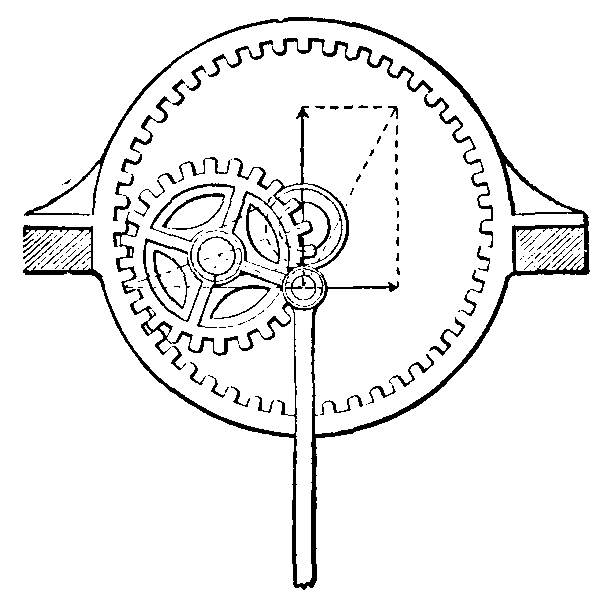
Epicycloi´dal Wheel, a wheel or ring fixed to a framework, toothed on its inner side, and having in gear with it another toothed wheel of half the diameter of the first, fitted so as to revolve about the centre of the latter. It is used for converting circular into alternate motion, or alternate into circular. While the revolution of the smaller wheel is taking place, any point whatever on its circumference will describe a straight line, or will pass and repass through a diameter of the circle, once during each revolution. In practice, a piston-rod or other reciprocating part may be attached to any point on the circumference of the smaller wheel.
Epidau´rus, a town and seaport of ancient Greece, situated in Argolis, in the Peloponnesus, particularly celebrated for its magnificent temple of Æsculapius, which stood on an eminence not far from the town. It had also temples of Artemis, Dionysus, Aphrodite, and Hera, and a splendid theatre still in fair preservation. The site is now occupied by the village Epidavro, where a congress met in 1822 and promulgated the 'Constitution of Epidaurus'.
Epidem´ic, or Epidemic Disease (Gr. epi, upon, and dēmos, people), signifies a disease which attacks a people, suddenly spreading from one to the other in all directions, prevailing a certain time and then dying away. It usually travels from place to place in the direction of the most-frequented lines of communication. The reason is that such diseases are commonly due to some infective material capable of being conveyed from one individual to another, and of being transported from place to place. In Britain smallpox and cholera are occasionally epidemic, whilst scarlet fever, measles, chickenpox, diphtheria, typhoid fever, &c., are almost invariably so. Certain diseases which appear to be more mental than physical sometimes occur so numerously as to assume an epidemic form, such as St. Vitus's dance, convulsionary diseases, or suicidal mania.
Epiden´drum (Gr. epi, upon, and dendron, a tree), a large genus of tropical American orchids, most of the species of which are epiphytic, growing on trees. The flowers are very handsome, and a large number of the species are in cultivation.
Epider´mis, in anatomy, the cuticle or scarf-skin of the body; a thin membrane covering the true skin of animals, consisting of two layers, an inner or mucous layer, called the rete mucosum, composed of active cells containing granules of colouring matter, and an outer or horny layer, consisting of flattened scale-like cells, dry, inactive, and effete, which are constantly being shed in the form of dust. Both layers are destitute of blood-vessels or nerves.
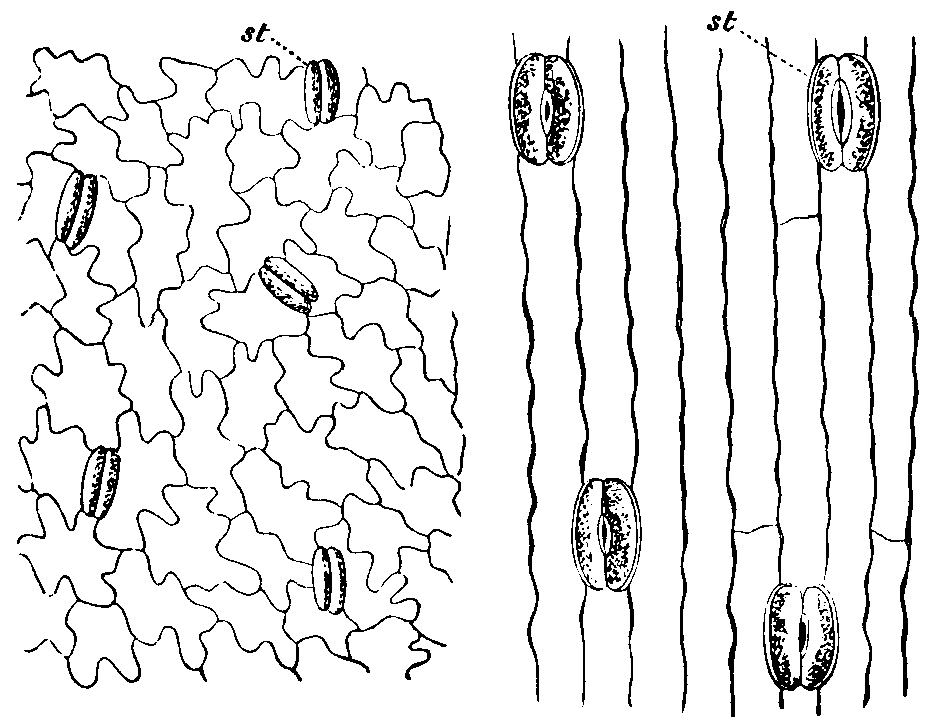
Surface View of Epidermis
st, Stomata.
Epidermis, in botany, the superficial layer of cells covering leaves and young stems. Its principal function is to restrict transpiration, for which purpose its outer wall is more or less cutinized, i.e. chemically modified so as to be very impervious to water and gases, especially the outermost part thereof, the so-called cuticle. Naturally both cuticle and epidermis as a whole are most strongly developed in drought-adapted plants or xerophytes (q.v.); and conversely the epidermis of submerged plants is not cutinized, nor is the superficial layer of ordinary roots. The epidermis frequently bears hairs of various kinds. Stems which undergo secondary growth in thickness soon cast off their epidermis, its rôle being assumed by cork or bark. The water- and gas-proof covering provided by the epidermis is not continuous, but is interrupted by numerous minute pores or stomata, capable of opening and closing, through which accordingly a regulated interchange of gases takes place.
Ep´idote, a mineral of a green or grey colour, vitreous lustre, and partial transparency, a member of the garnet family. The primary form of the crystals is a right rhomboidal prism. The crystals occur in Norway, Siberia, Tyrol, and the United States.
Epigæa (-jē´a), a genus of Ericaceous shrubs. E. repens, the trailing arbutus, is the May-flower of North America.
Epiglottis is a cartilaginous plate behind the tongue, which covers the glottis like a lid during the act of swallowing, and thus prevents foreign bodies from entering the larynx. In its ordinary position during respiration it is pointed upwards, but in the act of swallowing it is pressed downwards and backwards by the drawing up of the windpipe beneath the base of the tongue, and thus closes the entrance to the air-passages. See Larynx.
Ep´igram (Gr. epi, upon, graphein, to write), in a restricted sense, a short poem or piece in verse, which has only one subject, and finishes by a witty or ingenious turn of thought; in a general sense, a pointed or witty and antithetical saying. The term was originally given by the Greeks to a poetical inscription placed upon a tomb or public monument, and was afterwards extended to every little piece of verse expressing with precision a delicate or ingenious thought, as the pieces in the Greek Anthology. In Roman classical poetry the term was somewhat indiscriminately used, but the epigrams of Martial contain a great number with the modern epigrammatic character. Epigrams flourished in modern times after the Revival of Learning period, and all the Elizabethan versifiers tried their hand at them. Pope was a great master of the epigram, and the art was practised by Clément Marot, Boileau, Voltaire, Schiller, Goethe, Byron, and Moore, and more recently by Sir William Watson.—Cf. Dodd, Epigrammatists of Mediæval and Modern Times.
Epigraphy, a term used both for the study of inscriptions as a whole, and for the science which deals with their classification and decipherment. The attention of the epigraphist is given to inscriptions upon stone, brick, metal, and other comparatively permanent material, as compared with writings upon parchment, papyrus, or paper; but he excludes inscriptions upon coins, which are in the department of the numismatist. The science of epigraphy is of immense importance for a knowledge of the past, the subject including inscriptions so far apart in point of time as Egyptian records of the days of Mena (4700 B.C.), and the Greek hexameters that commemorate the death in Westmorland of a young Syrian soldier in the army of Septimius Severus. Of still more recent date are the Runic inscriptions discovered in Greenland, which seem to place beyond a doubt the fact of Icelandic explorers having reached that country in the eleventh or twelfth century. The most important inscriptions are Egyptian, Cuneiform (Babylonian and Assyrian), Semitic, Greek, Latin, Indian, and Runic. The inscribed writings include epitaphs on the dead, records of important events, dedications of public buildings, with such comparatively private matters as receipts, contracts, and other business transactions. While inscriptions form a valuable source of knowledge, they cannot be accepted as invariably reliable. Reasons might in some cases exist for making a false or misleading record, as in the case of a eulogistic tombstone, while mistakes in spelling and other details may be due to a careless workman. The literature which deals with the science of epigraphy is very large.
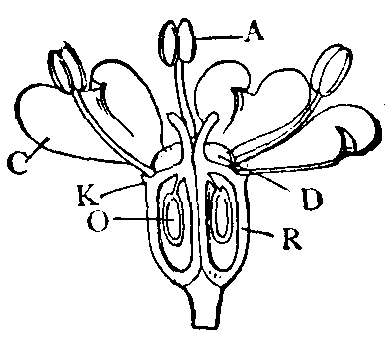
Vertical Section of an Epigynous Flower
R, Receptacle. K, Calyx. C, Corolla. A, Andrœcium. D, Disc. O, Ovule.
Epigynous (e-pij´i-nus) Flowers, those in which the gynæcium is inferior, i.e. embedded in, and adherent to, the hollowed-out receptacle, so that the other parts of the flower appear to be inserted on the top of the ovary.
Ep´ilepsy (Gr. epilēpsia, literally, a seizure), a nervous disease, the falling-sickness, so called because the patient falls suddenly to the ground. It depends on various causes, often exceedingly complicated and incapable of being removed; hence it is often an incurable periodical disease, appearing in single paroxysms. In its fully developed form, convulsions, attended by complete unconsciousness, are the prominent feature. Among the different causes may be mentioned intense emotional disturbance in early childhood, injury to the brain or its coverings at birth or subsequently, or some irritation within the skull itself, such as tumours, &c., developing later in life. Epileptiform fits due to the last-mentioned cause differ from those of true epilepsy, and are known as Jacksonian epilepsy (cf. Sir W. K. Gowers, The Borderland of Epilepsy). It is, for the most part, preceded by a tingling sensation, creeping up from the foot or hand to the breast and head, or some other premonitory symptom such as spectral illusions, headache, giddiness, confusion of thought, sense of fear, &c.; but sometimes there are no precursive symptoms. During the paroxysm all that is to be attended to is to prevent the patient from injuring himself; and this is to be accomplished by raising the head gently and loosening all tight parts of the dress. It is advisable to protect the tongue from being bitten by introducing a piece of india-rubber, cork, or soft wood between the teeth.
Epilo´bium, the willow-herbs, a genus of plants, nat. ord. Onagraceæ. The species are herbs or under-shrubs with pink or purple, rarely yellow, flowers, solitary in the axils of the leaves or in terminal leafy spikes. The seeds are tipped with a pencil of silky hairs, and are contained in a long four-celled capsule. There are more than fifty species scattered over the arctic and temperate regions of the world, ten of them being natives of Britain.
Epimen´ides (-dēz), an ancient Greek philosopher and poet, born in Crete in the seventh century before Christ, he was held for an infallible prophet, and by some is reckoned among the seven wise men, instead of Periander. He is supposed to be the prophet referred to by St. Paul in Titus, i, 12: "One of themselves, even a prophet of their own, said, The Cretians are alway liars, evil beasts, slow bellies".
Epimetheus (ep-i-mē´thūs), in Greek mythology, the son of Iapetus, brother of Prometheus, and husband of Pandora. Epimetheus may be translated 'afterthought', as Prometheus 'forethought'.
Épinal, a town of Eastern France, capital of the department of the Vosges, on the Moselle. It is well built and has handsome quays, an ancient Gothic church, a communal college, a public library of 30,000 volumes, a museum, and extensive fortifications. The town was occupied by the Germans in the Franco-Prussian War of 1870, and since that time a modern fortress has been constructed. The manufactures consist of articles in metal, cottons, linens, woollens, earthenware, and leather. The famous paper-mills of Archettes are in the vicinity. Pop. 30,000.
Épinay, Louise Florence Pétronille, Madame d', French authoress, born in 1726, died 1783. She became the wife of M. Delalive d'Épinay, who was collector-general of taxes. In 1748 she became acquainted with Rousseau, and gave him a cottage in which he passed many of his days. She was the author of Les Conversations d'Émilie, a companion-volume to Rousseau's Émile; Lettres à mon Fils; and Mes Moments heureux. She left interesting memoirs and correspondence.
Epipha´nius, St., was born in Palestine about 310, died 403. About 367 he was consecrated Bishop of Salamis or Constantia, in Cyprus. A zealous denouncer of heresy, he combated the opinions of Arius and Origen. His work Panarion gives the history, together with the refutation, of a great number of heresies. His festival is on the 12th of May.
Epiph´any (Gr. epiphaneia, a manifestation or showing forth), a festival, otherwise called the manifestation of Christ to the Gentiles, observed on the 6th of January in honour of the adoration of our Saviour by the three Magi, or wise men, who came to adore him and bring him presents, led by the star. As a separate festival it dates from 813.
Ep´iphyte (Gr. epi, on, phyton, a plant), a plant which grows and flourishes on the trunks and branches of trees, adhering to the bark, as a moss, lichen, fern, &c., but which does not, like a parasite, derive any nourishment from the plant on which it grows. Most orchids are epiphytes, and so are many Bromeliaceæ and Cactaceæ. Epiphytic Angiosperms are characteristic of humid tropical regions. Depending as they do entirely on atmospheric moisture, they show many curious adaptations, and are nearly always more or less xerophytic in structure.
Epi´rus (Gr. Epeiros), a country of ancient Greece corresponding to Southern Albania and the north-western division of modern Greece. The most interesting locality in it was Dodona. The inhabitants were only in part Greeks. The Molossians at last acquired the ascendancy, and the kings of this tribe took the name of kings of Epirus. The most celebrated King of Epirus was Pyrrhus, who made war upon the Romans. Epirus became a Roman province in 168 B.C., and shared the fortunes of Rome till it was conquered by the Turks. The population is about 250,000. In Nov., 1914, Greece, with the consent of the Great Powers, occupied North Epirus, and formally took possession of it in March, 1916. By the end of 1920, however, the occupation had not yet been recognized.—Epirus is also the name of an administrative province of Greece, formed after the Balkan campaigns (1912-3) out of the territory acquired by the country.
Epistemol´ogy (Gr. epistēmē, knowledge), that department of metaphysics which investigates and explains the doctrine or theory of knowing. It deals with the validity of knowledge rather than with the analysis of the knowing mind, and is thus distinguished from psychology. It is also distinguished from ontology, which investigates real existence or the theory of being.
Epis´tolæ Obscuro´rum Viro´rum (Letters of Obscure Men), the title of a collection of satirical letters which appeared in Germany in 1515, and professed to be the composition of certain ecclesiastics and professors in Cologne and other places. It is considered as one of the most masterly pieces of sarcasm in the history of literature, and its importance is enhanced by the effect it had in promoting the cause of the Reformation. The authorship of this satire has been a fertile subject of controversy, and is yet apparently far from being settled. It was ascribed to Reuchlin, and afterwards to Reuchlin, Erasmus, and Hutten. By a Papal bull the work was placed on the Index of forbidden books.
Ep´itaph (Gr. epi, upon, and taphos, tomb), an inscription upon a tomb or monument in honour or memory of the dead. Epitaphs were in use both among the Greeks and Romans. The Greeks distinguished by epitaphs only their illustrious men. Among the Romans they became a family institution, and private names were regularly recorded upon tombstones. The same practice has generally prevailed in Christian countries. On Christian tombstones epitaphs usually give brief facts of the deceased's life, sometimes also the pious hopes of survivors in reference to the resurrection or other doctrines of the Christian faith, &c. Many so-called epitaphs are mere witty jeux d'esprit, which might be described as epigrams, and which were never intended seriously for monumental inscriptions. Dr. Johnson and William Wordsworth wrote essays on epitaphs.—Cf. Andrews, Curious Epitaphs.
Epithalamium (Gr. epi, on, and thalamos, a chamber), a nuptial song or poem in praise of a bride and bridegroom. Among the Greeks and Romans it was sung by young men and maids at the door of the bridal chamber of a newly-married couple. Epithalamia have been written by Spenser, Ben Jonson, and Donne.
Epithe´lium, in anatomy, the cellular layer which lines the internal cavities and canals of the body, both closed and open, as the mouth, nose, respiratory organs, blood-vessels, &c., and which is analogous to the cuticle of the outer surface. There are several varieties of epithelium. The epithelium lining the blood-vessels is called sometimes endothelium.
Epizo´a, a term applied to those parasitic animals which live upon the bodies of other animals, as lice, the itch-mite, &c.
Epizoöt´ic, or Epizoötic Disease, a disease that at some particular time and place attacks great numbers of the lower animals just as an epidemic attacks man. Pleuro-pneumonia is often an epizoötic, as is also the rinderpest.
Epoch, or Era, is a fixed point of time, commonly selected on account of some remarkable event by which it has been distinguished, and which is made the beginning or determining point of a particular year from which all other years, whether preceding or ensuing, are computed. The creation and the birth of Christ are the most important of the historical epochs. The creation has formed the foundation of various chronologies, the chief of which are: (1) The epoch adopted by Bossuet, Ussher, and other Catholic and Protestant divines, which places the creation in 4004 B.C. (2) The Era of Constantinople (adopted by Russia), which places it in 5508 B.C. (3) The Era of Antioch, used till A.D. 284, placed the creation 5502 B.C. (4) The Era of Alexandria, which made the creation 5492 B.C. This is also the Abyssinian Era. (5) The Jewish Era, which places the creation in 3760 B.C. The Greeks computed their time by periods of four years, called Olympiads, from the occurrence every fourth year of the Olympic games. The first Olympiad, being the year in which Corœbus was victor in the Olympic games, was in the year 776 B.C. The Romans dated from the supposed era of the foundation of their city (Ab Urbe Condita, A.U.C.), the 21st of April, in the third year of the sixth Olympiad, or 753 B.C. (according to some authorities, 752 B.C.). The Christian Era, or mode of computing from the birth of Christ as a starting-point, was first introduced in the sixth century, and was generally adopted by the year 1000. This event is believed to have taken place earlier, perhaps by four years, than the received date. The Julian epoch, based on the coincidence of the solar, lunar, and indictional periods, is fixed at 4713 B.C., and is the only epoch established on an astronomical basis. The Mohammedan Era, or Hejĭra, commences on 16th July, 622, and the years are computed by lunar months. The Chinese reckon their time by cycles of 60 years. Instead of numbering them as we do, they give a different name to every year in the cycle.
Epping, a village of England, in Essex (giving name to a parliamentary division), 17 miles from London, in the midst of an ancient royal forest which one time covered nearly the whole of Essex. The unenclosed portion (5600 acres) was bought by the Corporation of London in 1882, and secured to the public as a free place of recreation. Pop. 4253.
Epsom, a town in the county of Surrey, England, 15 miles S.W. of London, formerly celebrated for a mineral spring, from the water of which the well-known Epsom salts were manufactured. The principal attraction Epsom can now boast of is the grand race-meeting held on the Downs, the chief races being the Derby and Oaks. Epsom gives name to one of the seven parliamentary divisions of the county. Pop. 19,156.
Epsom Salts, sulphate of magnesium (MgSO47H2O), a cathartic salt which appears in capillary fibres or acicular crystals. It is found covering crevices of rocks, in mineral springs, &c.; but is commonly prepared by artificial processes from magnesian limestone by treating it with sulphuric acid, or by dissolving the mineral kieserite (MgSO4H2O) in boiling water, allowing the insoluble matter to settle, and crystallizing out the Epsom salts from the clear solution. It is employed in medicine as a purgative, and in the arts. The name is derived from its having been first procured from the mineral waters at Epsom.
Epworth, a small town of N. Lincolnshire, 9 miles N. of Gainsborough, the birth-place of John Wesley, the founder of Methodism. Pop. 1836.
Equation, in algebra, a statement that two expressions have the same numerical value. An equation may be either identical or conditional. An example of an identical equation, or identity, is (x + y)(x - y) = x2 - y2. The left side here can be transformed into the right side, simply by applying the laws of algebra so as to carry out the operations indicated, without taking account in any way of the numerical values of x and y. An identical equation is, therefore, true for all values of the variables which appear in it. A conditional equation is not true unless certain special values are assigned to the variables. Thus the equation 4x + 7 = 15 is not true for any value of x except 2. This value 2 is called a root, or solution, of the equation. An equation may have more than one root, e.g. x2 + 6x = 7 has two roots, 1 and -7; and 2x3 + 3x2 = 2x + 3 has three roots, 1, -1, 3/2.
Rational Integral Equations (one Variable).—The three equations just given are special cases of the class of rational integral algebraic equations. The general form of these is axn + bxn-1 + ... + kx + l = 0, where n is a positive integer, and a, b, ... k, l are given numbers. This equation is said to be of degree n. The branch of mathematics called the Theory of Equations is conventionally restricted to equations of this type. The fundamental result in this subject is that every rational integral equation has a root, a theorem which it is by no means easy to prove. It follows without difficulty that an equation of degree n has exactly n roots, real or imaginary. Two or more of the roots, however, may be equal to each other. To solve an equation is to find its roots. The general equation of degree n can always be solved to any degree of approximation desired, when the numerical values of the coefficients a, b, ... are assigned. Graphical methods of solution are often the best (see Graph). When the coefficients a, b, ... are arbitrary, the general equation can be solved algebraically if n does not exceed 4, but not for greater values of n. It is not that the algebraical solution, or algebraic formula for the roots, when n is greater than 4, has not been discovered; it does not exist. This was proved more than a hundred years ago by Abel and Galois, two mathematicians of the highest distinction, who both died before they were thirty. For n = 2, the roots of the quadratic equation ax2 + bx + c = 0 are (-b ± √( b2 - 4ac))/2a. For n = 3, the cubic equation ax3 + bx2 + cx + d = 0 is reduced to the form z3 + pz + q = 0 by putting x = z - b/3a ; the solution of z3 + pz + q = 0 can be verified to be z = u - p/3u, where u is any one of the three cube roots of the quantity ½q + √(¼q2 + 1/27p3). For n = 4, the biquadratic equation is solved with the help of the solution of the cubic. The cubic was first solved by the Italian mathematician Tartaglia, who communicated the solution to Cardan, after binding him to keep it a secret. Cardan, however, gave the solution in his Algebra, published at Nürnberg in 1545.
Equations with more than one Variable.—A solution of an equation which contains more than one variable is a set of values of the variables making the equation true. Thus the equation x2 - y2 = 9 has solutions (x = 5, y = 4), (x = 3, y = 0), (x = 5, y = -4), and an unlimited number of others. When several variables occur, there are usually also several simultaneous equations connecting them; a solution of these is a set of values of the variables making all the equations true. When the number of equations is equal to the number of variables, there is in general a limited number of solutions of the system. Thus, e.g. the system of equations x2 - y2 = 9, 2x - y = 6 has two solutions (x = 3, y = 0) and (x = 5, y = 4), and no others. A useful rule is that the number of solutions of a system of this type is equal to the product of the degrees of the equations. Exceptions may arise when two solutions coalesce, or when infinite values of the variables occur.
Equations are of great importance in applied mathematics. The data of a problem generally lead to an equation, or a set of equations, among the quantities concerned. In practice a certain number of these quantities are known in any given case; the unknown quantities are then found by the solution of an equation or equations. Non-algebraic equations occur frequently—equations involving trigonometrical functions, for example. For a modern practical method of solving equations of many types, see Nomography.—Bibliography: A. E. Layng, Elementary Algebra; C. Smith, Algebra. More advanced works are: G. Chrystal, Algebra; W. S. Burnside and A. W. Panton, Theory of Equations.
Equation, Personal, the accustomed error, almost a constant quantity in the case of a practised observer, in timing a celestial phenomenon.
Equation of Payments, an arithmetical rule for the purpose of ascertaining at what time it is equitable that a person should make payment of a whole debt which is due in different parts, payable at different times.
Equation of the Centre, the difference between the actual heliocentric longitude of a planet revolving in an elliptic orbit and that which it would have at the same instant if it revolved in a circular orbit. It is zero at perihelion and aphelion.
Equation of Time, the difference between mean and apparent time, or the difference of time as given by a clock and as given by a sun-dial, arising chiefly from the varying velocity of the earth in its orbit and the eccentricity of the orbit. The sun and the clock agree four times in the year; the greatest difference between them at the beginning of November is fully sixteen minutes. See Day.
Equa´tor, that great circle of our globe every point of which is 90° from the poles. All places which are on it have invariably equal days and nights. Our earth is divided by it into the northern and southern hemispheres. From this circle is reckoned the latitude of places both north and south. There is also a corresponding celestial equator in the plane of the terrestrial, an imaginary great circle in the heavens the plane of which is perpendicular to the axis of the earth. It is everywhere 90° distant from the celestial poles, which coincide with the extremities of the earth's axis, supposed to be produced to meet the heavens. During his apparent yearly course the sun is twice in the celestial, that is, vertically over the terrestrial equator, on 21st March and 23rd September. Then the day and night are equal all over the earth, whence the name equinox.—The magnetic equator is a line at every point of which the vertical component of the earth's magnetic force is zero; that is to say, a dipping needle carried along the magnetic equator remains horizontal. It is hence also called the aclinic line. It has a slightly devious course, but upon the whole keeps fairly near the geographical equator.
Equato´rial, an astronomical instrument contrived for the purpose of directing a telescope upon any celestial object, and of keeping the object in view for any length of time, notwithstanding the diurnal motion of the earth. For these purposes a principal axis resting on firm supports is mounted exactly parallel to the axis of the earth's rotation, and consequently pointing to the poles of the heavens, being fixed so as to turn on pivots at its extremities. To this there is attached a telescope moving on an axis of its own in such a way that it may either be exactly parallel to the other axis, or at any angle to it; when at right angles it points to the celestial equator. The two axes carry graduated circles, with the help of which, even during the day, the telescope can be pointed to any star whose declination and right ascension are known. By means of clockwork the instrument is given such a motion round its principal axis that the star is kept stationary in the field of view.
Eq´uerry, in Britain, the name of certain officers of the royal household, in the department of the Master of the Horse, whose duties consist in attendance when the sovereign rides abroad. Equerries also form part of the establishments of the members of the royal family.
Equestrian Order, the order of 'Knights' in ancient Rome. The equites or knights originally formed the cavalry of the army. They are said by Livy to have been instituted by Romulus, who selected 300 of them from the three principal tribes. About the time of the Gracchi (123 B.C.) the equites became a distinct order in the state, and the judges and the farmers of the revenue were selected from their ranks. They held their position in virtue of a certain property qualification, and towards the end of the Republic they possessed much influence in the state. They had particular seats assigned to them in the circus and theatre, and the insignia of their rank, in addition to a horse, were a gold ring and a robe with a narrow purple border (the clavus angustus). Under the later emperors the order grew less influential, and finally disappeared.
Eq´uidæ, the horse family, a division of the odd-toed (perissodactyle) Ungulates or hoofed mammals. There is but one existing genus, Equus, distinguished by the possession of a mane; hard pads (callosities) on the inner side of each fore-limb (and sometimes of the hind-limb); a single functional digit (the third or middle one) terminating in a large curved hoof; a simple stomach; 44 teeth, including 12 incisors with pitted crowns, 4 canines (tushes) reduced in the female, and 28 grinding teeth with broad crowns, except the first (wolf tooth), which is rudimentary. The forms included are horses, asses, and zebras; the first being distinguished from the others by the presence of callosities ('chestnuts') on the hind-limbs as well as the fore. The domesticated horse (E. caballus) has a large flat tail abundantly hair-clad, and is not known with certainty in the wild state, though possibly the tarpan of South Russia (Tartary) may represent the original stock. Another candidate for this honour is the small wild species (E. przewalskii) native to the deserts of Central Asia. The domestic ass (E. asinus) is related to a number of wild species, such as the onager (E. onager) of South Asia, the kiang (E. hemionus) of Tibet, and two African species (E. africanus and E. somalicus). The striped zebras are purely African, and four species are generally recognized—the common or mountain zebra (E. zebra), Burchell's zebra (E. burchelli), Grevy's zebra (E. grevyi), and the quagga (E. quagga). The geological record enables us to derive horses from a small plantigrade five-toed form (Phenacodus), by gradual increase in size, complication of teeth, loss of digits, and elongation of limbs, to the unguligrade condition.
Equilib´rium, in statics, the condition when a body is acted on by two or more forces which balance one another. The body may be either at rest or moving with uniform speed in a straight line. In the first case, when the body, being slightly moved out of any position, always tends to return to its position, that position is said to be one of stable equilibrium; when the body, after a slight displacement, tends to move away from its previous position, the body is in unstable equilibrium. If, after displacement, the body tends to remain at rest, its state is one of neutral equilibrium.
Equinoc´tial, in astronomy, the circle in the heavens otherwise known as the celestial equator. When the sun is on the equator, there is equal length of day and night over all the earth: hence the name equinoctial.—Equinoctial gales, storms which have been supposed to take place about the time of the sun's crossing the equator, that is, at the vernal and autumnal equinoxes, in March and September.—Equinoctial points are the two points wherein the celestial equator and ecliptic intersect each other; the one, the first point of Aries, is called the vernal point; and the other, in Libra, the autumnal point. These points move backward or westward at the rate of 50" of arc in a year. This is called the precession of the equinoxes.
Eq´uinox, one of the equinoctial points. The term is also applied to the dates at which the sun passes through them, viz. 21st March and 23rd September, when day and night are of equal length all over the world. See Day; Earth; Equinoctial; Seasons.
Equisetales, a group of Pteridophytes, represented at the present day only by the genus Equisetum (q.v.). It was much more prominent in the Carboniferous flora, in which large woody horse-tails (Calamites) played an important part.
Equise´tum, a genus of vascular cryptogamous plants with hollow jointed stems, type of the group Equisetales, growing in wet places, and popularly called horse-tails.
Eq´uity (Lat. aequus, fair, equal), in English law, the system of supplemental law administered in certain courts, founded upon defined rules, recorded precedents, and established principles, the judges, however, liberally expounding and developing them to meet new exigencies. While it aims at assisting the defects of the common law, by extending relief to those rights of property which the strict law does not recognize, and by giving more ample and distributive redress than the ordinary tribunals afford, equity by no means either controls, mitigates, or supersedes the common law, but rather guides itself by its analogies, and does not assume any power to subvert its doctrines. The Court of Chancery was formerly in England the especial court of equity, but large powers were by the Judicature Act of 1873 given to all the divisions of the Supreme Court to administer equity, although many matters of equitable jurisdiction are still left to the chancery division in the first instance.—Bibliography: F. T. White and O. O. Tudor, Leading Cases in Equity; C. Thwaites, Student's Guide to Equity.
Equity of Redemption, in law, the advantage allowed to a mortgager of a reasonable time to redeem an estate mortgaged, when it is of greater value than the sum for which it is mortgaged.
Equiv´alent, in chemistry, the number of parts by weight of an element which will combine with or displace 8 parts by weight of oxygen or 1.008 parts by weight of hydrogen.
Eranthis. See Winter Aconite.
Érard, Sébastien, a celebrated musical-instrument maker, born at Strasbourg in 1752, died 1831. He went to Paris at the age of eighteen, and in concert with his brother, Jean Baptiste, produced pianofortes superior to any that had previously been made in France. He afterwards established a manufactory in London, and made considerable improvements in the mechanism of the harp.
Erasis´tratus, an ancient Greek physician and anatomist, said to have been a grandson of Aristotle. He lived in the third century before the Christian era, and was court physician of Seleucus Nicator, King of Syria. He was the first who systematically dissected the human body, and his description of the brain and nerves is much more exact than any given by his predecessors. He classified the nerves into nerves of sensation and of locomotion, and, it is said, almost stumbled upon the discovery of the circulation of the blood. Of his works only the titles and some fragments remain.
Eras´mus, Desiderius, a Dutch scholar, one of the greatest of the Renaissance and Reformation period, born at Rotterdam in 1467, died in 1536. His original name was Gerard, but this he changed according to a fashion of the time. After the death of his parents, whom he lost in his fourteenth year, his guardians compelled him to enter a monastery; and at the age of seventeen he assumed the monastic habit. The Bishop of Cambrai delivered him from this constraint. In 1492 he travelled to Paris to perfect himself in theology and literature. He became the instructor of several rich Englishmen (from one of whom—Lord Mountjoy—he received a pension for life), and accompanied them to England in 1497, where he was graciously received by the king. Returning soon after to the Continent, he took his doctor's degree, was relieved from his monastic vows by dispensation from the Pope, and published several of his works. In 1510 he returned to England, wrote his Praise of Folly while residing with Sir Thomas More, and was appointed Lady Margaret professor of divinity and Greek lecturer at Cambridge. In 1514 he returned to the Continent and lived chiefly at Basel, where he died. To extensive learning Erasmus joined a refined taste and a delicate wit, and rendered great and lasting service to the cause of reviving scholarship. Although Erasmus took no direct part in the Reformation, and was reproached by Luther for lukewarmness, he attacked the disorders of monasticism and superstition, and everywhere promoted the cause of truth. A humanist rather than a reformer or a theologian, he waged war upon ignorance and superstition. He edited various classics, the first edition of the Greek Testament from MSS. (with Latin translation), &c., but his best-known books are the Encomium Moriæ (Praise of Folly) and his Colloquies. His letters are very valuable in reference to the history of that period.—Bibliography: S. Knight, Life of Erasmus; C. Butler, Life of Erasmus; E. F. H. Capey, Life of Erasmus; P. S. Allen, The Age of Erasmus.
Eras´tus (Gr. erastos, lovely, translation of Ger. Lieber), the learned name of Thomas Lieber, a Swiss physician, who maintained the opinions from which the well-known epithet of Erastian, as now used, is derived. He was born at Baden in 1523, and died at Basel 1584. He was successively professor of medicine at Heidelberg, and of ethics at Basel. In his writings he maintained the complete subordination of the ecclesiastical to the secular power; and denied to the Church the right to exclude any one from Church ordinances, or to inflict excommunication.
Er´ato, in Greek mythology, one of the nine Muses, whose name signifies loving or lovely. She presided over lyric and especially amatory poetry, and is generally represented crowned with roses and myrtle, and with the lyre in the left hand and the plectrum in the right in the act of playing.
Eratos´thenes, an ancient Greek astronomer, born at Cyrene, in Africa, 276 B.C., died about 194 B.C. He was librarian at Alexandria, and gained his greatest renown by his investigations of the size of the earth. He rendered much service to the science of astronomy, and first observed the obliquity of the ecliptic. Of the writings attributed to him one only remains complete—Katasterismoi—which treats of the constellations.
Er´bium, a rare metal found along with yttrium, terbium, and other rare elements in some rare minerals. Its properties are but little known. It was discovered by Mosander in 1843.
Ercilla y Zuñiga (er-thil´ya˙ ē thö-nyē´ga˙), Don Alonso de, Spanish soldier and poet, born 1533, died 1595. He became page to the Infant Don Philip, accompanied him on his travels, and in 1554 went with him to England, on the occasion of his marriage with Queen Mary. After this he fought against the Araucanians of South America (Chile), and his epic La Araucana is based on the events of this war. It is written in excellent Spanish, and occupies an honourable position in the national literature. The first fifteen cantos were published in 1569, and the continuations, thirty-seven cantos, appeared in 1578 and 1589.
Erckmann-Chatrian (sha˙t-ri-än˙), the joint name of two French-Alsatian writers of fiction. Émile Erckmann, born at Pfalzburg 1822, studied law at Paris, and died in 1899. Alexandre Chatrian, born near Pfalzburg in 1826, died in 1890, was for some time teacher in the Pfalzburg College. They formed a literary partnership in 1847, but it was not till the appearance of L'Illustre Docteur Mathéus in 1859 that success attended them. Among their most popular books are: L'Ami Fritz, Madame Thérèse, Histoire d'un Conscrit de 1813, L'Histoire d'un Paysan, and Waterloo, most of which have been translated into English. Their drama Le Juif Polonais was made famous by Sir Henry Irving under the name of The Bells.
Erdmann, Johann Eduard, German philosopher, born 1805, died 1892. He studied theology at Dorpat and Berlin; in 1829 became a clergyman, but in 1832 returned to Berlin and took his degree in philosophy. In 1836 he became professor extraordinary of philosophy at Halle, being appointed ordinary professor in 1839. He wrote numerous philosophical works, mostly characterized by Hegelian tendencies, including: Body and Soul, Nature and Creation, Outlines of Psychology, Outlines of Logic and Metaphysics, Psychological Letters, and Belief and Knowledge. His greatest work is his Outlines of the History of Philosophy, which has been translated into English (3 vols., 1889).
Er´ebus, in Greek mythology, the son of Chaos and Darkness, and father of Æther and Hemera (day). The name Erebus was also given to the infernal regions.
Er´ebus, Mount, a volcano of the antarctic regions in S. Victoria Land; height, 12,400 feet; discovered by Ross, 1841.
Erechtheus (e-rek´thūs), in Greek mythology, a mythical king of Athens to whom a fine temple, the Erechthēum, was built on the Acropolis. In some representations of him he is depicted as half snake, so that he was one of the autochthones, the earth-born ancestors of the Athenians.
Erection, Lords of, in Scots history, those private owners into whose hands the ecclesiastical estates belonging to the clergy had passed during the religious changes of the Reformation period.
Er´furt (Lat. Erfordia, ford of Erpe, its legendary founder), an important town in the Prussian province of Saxony, on the River Gera, formerly a fortress with two citadels, now given up as such. It has a fine cathedral dating from the thirteenth century and several handsome Gothic churches. The university, founded in 1378 and suppressed in 1816, was long an important institution. There is still an academy of science and a library with 60,000 volumes. The monastery (now an orphanage) was the residence of Luther from 1501 to 1508. Erfurt is a busy industrial town and is in a very flourishing condition. The industries are varied, including clothing, machinery, leather, shoes, ironmongery, and chemicals. Flower-growing is extensively carried on in the neighbourhood, plants and seed being produced for sale in great quantities. Pop. 123,550.
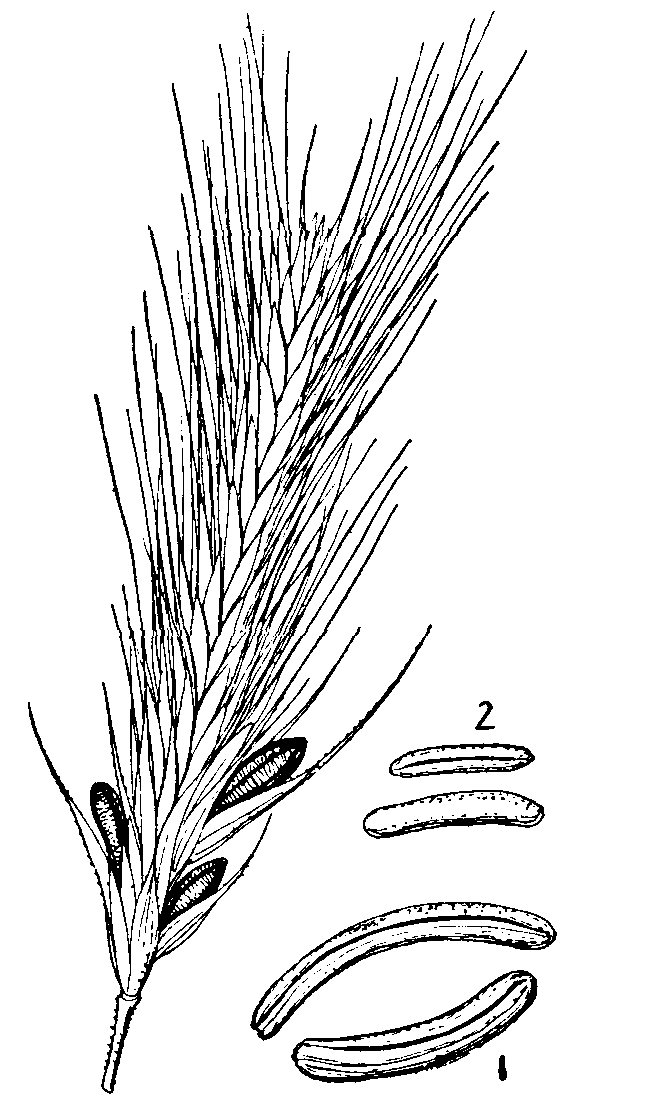
Ergot of Rye
1, Spanish ergot. 2, Russian ergot.
Er´got, the altered grain of rye and other grasses caused by the attack of an ascomycetous fungus called Claviceps purpurea. The grain is replaced by a dense fungoid tissue (sclerotium) largely charged with an oily fluid. In its perfect state this germinates and produces the Claviceps fructification. When diseased rye of this kind is eaten in food for some time, it sometimes causes death by a kind of mortification called dry gangrene. Ergot is used in obstetric practice to promote the contraction of the uterus.
Erica (e-rī´ka), the heaths, a large genus of branched rigid shrubs, type of the nat. ord. Ericaceæ, most of which are natives of South Africa, a few being found in Europe and Asia. The leaves are narrow and rigid; the flowers are globose or tubular, and four-lobed. Five species are found in Britain.
Ericaceæ, a nat. ord. of gamopetalous Dicotyledons. Representative genera: Calluna, Erica, Rhododendron.
Erichsen (er´ik-sen), Sir John Eric, surgeon, born 1818, died in 1890. He was the son of a Copenhagen merchant, but spent nearly all his life in England. He studied at University College, London, became a member of the Royal College of Surgeons in 1839, a fellow in 1845, and in 1850 professor of surgery and hospital surgeon at University College. In 1865 he succeeded Quain as professor of clinical surgery in the same college, but retired in 1875. Appointed president of University College in 1887, he also held that post till his death. He was chief surgeon extraordinary to Queen Victoria, and in 1895 was made a baronet. His most important work was his Science and Art of Surgery (1853), which has gone through many editions, and has been translated into several languages. He also published a volume on Concussion of the Spine (1875).
Er´icsson, John, engineer, born in Sweden 1803, died in 1889. He served for a time in the Swedish army; removed to London in 1826, and to New York in 1839. He is identified with numerous inventions and improvements in steam machinery and its applications. His chief inventions are his caloric engine, the screw propeller (1836), which has revolutionized navigation, and his turret-ships, the first of which, the Monitor, distinguished itself in the American Civil War, and inaugurated a new era in naval warfare. He afterwards devoted himself to studies of the earth's motion and the intensity of solar heat.
Eridanus, the River Eridanus (modern Po), one of the constellations of the ancient astronomy, in which Ptolemy catalogued thirty-four stars. Appropriately to its name, it covers a large expanse of the heavens, its northern portion, just to south-west of Orion, reaching the celestial equator. The part visible in our latitudes does not contain bright stars, but at the southern extremity is the first-magnitude Achernar, a conspicuous object to southern observers.
Erie (ē´ri), one of the great chain of North American lakes, between Lakes Huron and Ontario, about 265 miles long, 63½ miles broad at its centre, from 40 to 60 fathoms deep at the deepest part; area, 6900 sq. miles. The whole of its southern shore is within the territory of the United States, and its northern within that of Canada. It receives the waters of the upper lakes by Detroit River at its south-western extremity, and discharges its waters into Lake Ontario by the Niagara River at its north-east end. The Welland Canal enables vessels to pass from it to Lake Ontario. It is shallow compared with the other lakes of the series, and is subject to violent storms. The principal harbours are those on the United States side—Buffalo, Erie, and Cleveland.
Erie, a city, Pennsylvania, United States, an important railway and commercial centre on the southern shore of Lake Erie. There are numerous ironworks (including foundries, rolling-mills, and blast-furnaces), petroleum refineries, breweries, tanneries, and wood-working factories. The harbour is one of the best on the lake. Pop. 76,600.
Erie Canal, the largest in the United States, serving to connect the great lakes with the sea. It begins at Buffalo on Lake Erie, and extends to the Hudson at Albany. It is 363 miles long; has in all 72 locks; a surface width 70 feet, bottom width 42 feet, and depth 7 feet. It is carried over several large streams on stone aqueducts; cost nearly £2,000,000, and was opened in 1825. The navigation is free.
Erigena (e-rij´e-na), Joannes Scotus (Scotus, Scot, and Erigena, Irish-born), an eminent mediæval scholar and metaphysician, probably born of Scotch parentage in Ireland about 800-810, died in France about 875. He spent a great part of his life at the court of Charles the Bald of France, and was placed at the head of the school of the palace. The king further imposed upon him the double task of translating into Latin the Greek works of the pseudo Dionysius the Areopagite, and of composing a treatise against Godeschale on Predestination and Free-will. This treatise, and another, De Divisione Naturæ, contained many views in opposition to the teachings of the Church. They were condemned by the Councils of Valencia in 855 and of Langres in 859, and Pope Nicholas I demanded the immediate disgrace of the culprit. His subsequent history is not known.—Cf. Gardner, Studies in John the Scot.
Erin´na, a Greek poetess who lived about 600 B.C. She is said to have been an intimate friend of Sappho, and died at the age of eighteen. She acquired a high reputation for poetry, and her chief work was called Elakatē (The Distaff), of which nothing has come down to us. An epitaph or two which are still extant, and believed by some to be hers, are by others deemed spurious.
Erioden´dron, the wool tree, a genus of plants, nat. ord. Malvaceæ (mallows). There are eight species natives of America, but one belongs to Asia and Africa. The species are noble plants, growing from 50 to 100 feet high, having palmate leaves, and red or white flowers. The woolly coat of the seeds of some of the species is used in different countries for stuffing cushions and similar purposes.
Eris, in Greek mythology, the goddess of discord, the sister of Ares, and, according to Hesiod, daughter of Nyx (night). Not being invited to the marriage of Peleus, she revenged herself by means of the apple of discord.
Er´ith, a town of England, in Kent, on the Thames, about 14 miles east of London, a pleasant summer resort. Pop. 27,755.
Eritre´a, or Erythræ´a (from Gr. erythros, red, referring to the Red Sea), the official name of an Italian colonial possession stretching along the African shore of the Red Sea, and between it and Abyssinia, from the Egyptian coast territory to the French territory of Obok, at the Strait of Bab-el-Mandeb. The coast-line is about 670 miles in length, the area of the colony about 45,800 sq. miles. Pop., largely nomadic, about 450,000. The chief town is Massowah.
Er´ivan, a fortified city in Armenia, formerly the capital of a Russian government of the same name in Transcaucasia, on the Sanga, north of Mount Ararat. It has a citadel, barracks, a cannon foundry, and some manufactures. The Armenian Republic of Erivan was constituted in May, 1918. Pop. 34,000. The former Russian government of Erivan had an area of 10,725 sq. miles, and a pop. of 970,000.
Erlang´en, a town of Bavaria, 10 miles N.N.W. of Nürnberg. The Protestant university, founded in 1743, is the chief institution. The industries include cotton spinning and weaving, mirrors, hosiery, gloves, and combs. Pop. 24,874.
Erlau, or Eger, a town, Hungary, on the Eger, 65 miles E.N.E. of Budapest. It has sundry manufactures; and the red wines of the district, esteemed the best in Hungary, are largely exported. Pop. 28,050.
Erl-king, the English form of the name given in German and Scandinavian poetical mythology to a personified natural power which devises and works mischief, especially to children. Goethe's celebrated poem Der Erlkönig (literally 'elf-king') has rendered this malicious spirit universally known.
Ermines (Putorius ermineus)
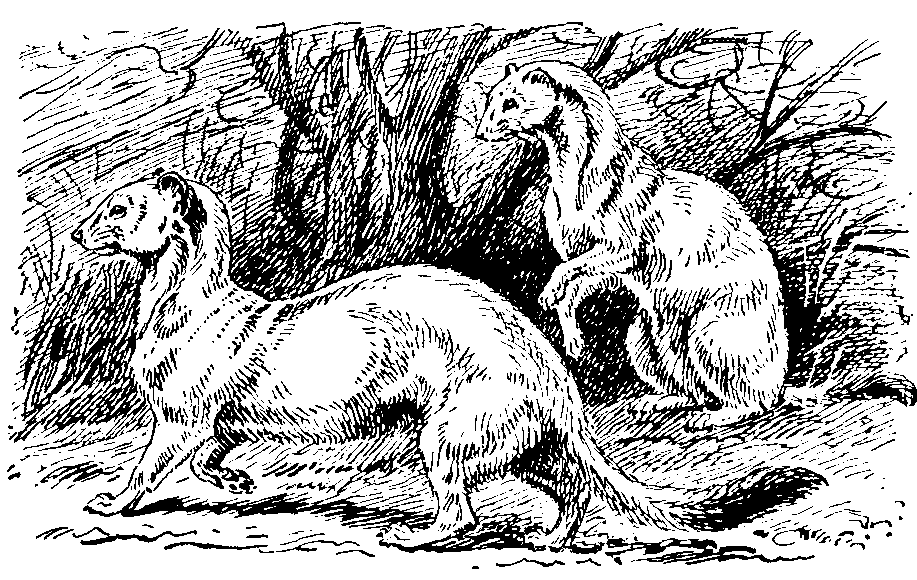
Er´mine, the stoat (Putorius ermineus), a mammal of the weasel family widely distributed through the northern parts of both hemispheres, with a considerable range to the south. It is not generally known that the ermine and stoat are the same. In winter, in cold countries or severe seasons, the fur changes from a reddish-brown to a yellowish-white, or almost pure white, under which shade the animal is recognised as the ermine. In both states the tip of the tail is black. Its fur is short, soft, and silky, the best skins being brought from Russia, Sweden, and Norway. It is in great request, and was formerly one of the insignia of royalty, and is still used by judges. When used as linings of cloaks the black tuft from the tail is sewed to the skin at irregular distances. Stoats are among the enemies of the poultry-keeper, but by keeping down small rodents they benefit agriculture to a considerable extent.—In heraldry, ermine is one of the furs, represented with its peculiar spots black on a white ground.
Ermine

Erne (ėrn), the name often given to all the eagles of the genus Haliaëtus, but more specifically to the white-tailed sea-eagle.
Erne, Lough, a lake, Ireland, County Fermanagh, consisting of a north or lower, and a south or upper lake (with the town of Enniskillen between), connected by a narrow winding channel, and properly forming only expansions of the River Erne. Its entire length is about 40 miles; average breadth, 6 miles. It contains numerous small islands, and is well stocked with fish.—The River Erne rises in Lough Gowna, in the county of Longford, flows through Loughs Oughter and Erne, and falls into Donegal Bay below Ballyshannon. Length, 72 miles.
Ernest Augustus, King of Hanover and Duke of Cumberland, the fifth son of George III, born 1771, died 1851. In 1799 he was created Duke of Cumberland, in England, and became a field-marshal in the British army. On the death of William IV in 1837 he ascended the throne of Hanover, in consequence of the succession to the sovereignty of that country being limited to heirs male. He was succeeded by his son, George V, the last of the Hanoverian kings.
Eros, an asteroid discovered in Aug., 1898. It completes its orbit in 642 days, and has a mean distance from the sun of 135½ million miles, or 6 million less than that of Mars, and was the first to be discovered of the class of minor planets which come within the orbit of Mars. It can approach at times to 13½ million miles from the earth. It is supposed to have a diameter of 20 miles or less.
Erosion Theory, in geology, the theory, now held by all geologists, that valleys are, in the great majority of cases, due to the wearing influences of subaerial agents, such as rivers and glaciers, as opposed to the theory which regards them as the result of fissures in the earth's crusts produced by strains during its upheaval.
Erot´ic (from the Gr. erōs, love), relating to love.—Erotic poetry, amatory poetry.—The name of erotic writers has been applied, in Greek literature, particularly to a class of romance writers, and to the writers of the Milesian Tales.
Errat´ics, or Erratic Blocks, in geology, boulders or large masses of angular rock which have been transported to a distance from their original positions by the action of ice during a glacial period. Thus on the slopes of the Jura Mountains immense blocks of granite are found which have travelled 60 miles from their original situation. Similarly, masses of Scottish and Lake-district granites and of Welsh rocks (some of which weigh several tons) occur not uncommonly in the surface soil of the Midland counties of England.
Erroman´go, or Erroman´ga, one of the more important of the New Hebrides Islands, with an area of about 400 sq. miles, hilly and not very fertile, but with spots well cultivated. Several missionaries have been murdered by the natives—including the missionary John Williams—but perhaps half of the 2500 natives are now Christians.
Errors of Observation. In scientific measurements, objects and instruments alike are so constituted that numerical results can only be approximate. We have to find the value of some quantity, not exactly, but to so many significant figures. Even so, when a number of measurements are made of the same quantity, it regularly happens that different values are obtained, the difference between a value as obtained and the true value being called an error of observation. It remains to combine the various measurements in such a way as to obtain the best result which they are capable of yielding.
The usual method is to take the arithmetic mean of the values obtained as the correct value. It is also customary in careful work to state the average deviation of the observed values from the mean. For example, various experimenters found the following numbers for the charge on an electron: 4.67, 4.77, 4.65, 4.79, 4.69. Here the mean is 4.71, and the average deviation from the mean, taken without regard to algebraic sign, is .05. The final result is stated as 4.71 ± .05. The ambiguous term ± .05 is sometimes called the probable error. The smaller the probable error, the more reliable is the mean result.
A case of much practical importance occurs when the results obtained by two distinct methods differ by greater amounts than can be accounted for by the uncertainty of either result. In this case there must be a constant error present in at least one of the sets of measurements. Recognition of a constant error has occasionally led to an important discovery; for instance, the hint which led to the detection of argon in the atmosphere came from the observed discrepancy in the densities of atmospheric nitrogen and nitrogen from ammonia.
In many measurements what is sought is not the value of a single quantity, but the relation between the values of two variable quantities. In such cases graphical methods are of great service. Corresponding values of the two variables are found and plotted; and a smooth curve, or it may be a straight line, is drawn to lie as evenly as possible among the plotted points. Where great accuracy is wanted, analytical methods are also available. See Squares, Method of Least; Probability.
Ersch (ersh), John Samuel, German bibliographer, born 1766, died 1828. He was principal librarian and professor of geography and statistics at Halle. Among his publications are: a Dictionary of French Writers; a Manual of German Literature; and, in connection with Gruber, the Universal Encyclopædia of Arts and Sciences.
Ers´kine, Ebenezer, the founder of the Secession Church in Scotland, born 1680, died 1754. He studied at Edinburgh, and was ordained minister of Portmoak, in Fife, in 1703, in which situation he continued for twenty-eight years, when he removed to Stirling. His attitude towards patronage and other abuses in the Church led to his being deposed, when, in conjunction with his brother and others, he founded the Secession Church. Erskine was the leader of the Burghers (q.v.). He is the author of several volumes of sermons.
Erskine, The Hon. Henry, Scottish barrister, was the third son of Henry David, tenth Earl of Buchan: born at Edinburgh 1746, died 1817. After studying at the Universities of St. Andrews, Edinburgh, and Glasgow, he adopted the legal profession, and in 1768 was called to the Bar. He twice held the office of Lord-Advocate, was for long the leader of the Scottish Bar, and held a high reputation as a wit.
Erskine, John, of Carnock, afterwards of Cardross, Scottish jurist, born 1695, died 1768. He was called to the Scottish Bar in 1719, and was author of Principles of the Law of Scotland, and the Institutes of the Law of Scotland, both works of authority.
Erskine, Ralph, brother of Ebenezer Erskine, born 1685, died 1752. He was ordained to the parish of Dunfermline in 1711, and in 1737 joined his brother, who had seceded from the Established Church. His Gospel Sonnets and other religious works were once very popular.
Erskine, Thomas, Lord Erskine, Scottish lawyer, the youngest son of the tenth Earl of Buchan, was born in 1750, and died in 1823. He was educated partly at the High School of Edinburgh, and partly at the University of St. Andrews. After serving four years in the navy and seven in the army, he commenced the study of law, and in 1778 both took his degree at Cambridge and was called to the Bar. His success was immediate. In May, 1783, he took silk, and the same year was elected member of Parliament for Portsmouth, a seat he held (except from 1784-90, when he had no seat) till 1806, when he was raised to the peerage. The rights of juries he firmly maintained on all occasions, but particularly in the celebrated trial of the Dean of St. Asaph for libel. In 1789 he defended Stockdale, a bookseller, for publishing what was charged as a libellous pamphlet in favour of Warren Hastings. In 1792, being employed to defend Thomas Paine, when prosecuted for the second part of his work The Rights of Man, he declared that, waiving all personal convictions, he deemed it right, as an English advocate, to obey the call: by the maintenance of which principle he lost his office of Attorney-General to the Prince of Wales. In the trials of Hardy, Tooke, and others for high treason in 1794, which lasted for several weeks, the ability displayed by Erskine was acknowledged by all parties. He was a warm partisan of Fox, and a strenuous opposer of the war with France. In 1802 the Prince of Wales not only restored him to his office of Attorney-General, but made him Keeper of Seals for the Duchy of Cornwall. On the death of Pitt, in 1806, Erskine was created a peer, and raised to the dignity of Lord Chancellor. During his short tenure of office the Bill for the abolition of slavery was passed. After he retired with the usual pension, he took little part in politics.
Eruptive Rocks, in geology, those which, as lavas, have broken through other rocks while in a molten state, and become eruptive at the surface.
Ervum. See Lentil.
Eryngium, a genus of plants belonging to the nat. ord. Umbelliferæ. There are upwards of 100 species found in temperate and sub-tropical climates, but chiefly in South America. E. maritĭmum, also called sea-holly, is the only truly native British species. It frequents sandy shores, and is distinguished by its rigid, spiny, glaucous, veined leaves, and its dense heads of blue flowers. The roots are sometimes candied, and are reputed to be stimulating and restorative, as well as to have aphrodisiac properties. It is mentioned by Shakespeare, Merry Wives, v. 5, 23, as an aphrodisiac.
Erysip´elas, Rose, or St. Anthony's Fire, is a contagious disease of the skin due to infection by a germ, the Streptococcus, and accompanied by severe general disturbance. Cold, damp weather favours its appearance. It rarely affects those under fifteen years, and is commoner in women than men. The disease is characterized by sudden onset, with shivering, headache, vomiting, and occasionally sore throat, followed by the appearance of the typical erysipelatous flush on the skin of the affected part, most usually the face. This part becomes deep red, and is much swollen, with a glossy, tender surface. It is definitely raised, and has a spreading edge merging into the normal parts around. In extreme cases there is marked disfigurement. Local treatment to allay pain and prevent spreading is by the application of lotions and ointments, and general treatment in the form of stimulating foods is given to maintain strength. Serum treatment has been used, but so far there have been very conflicting results. The disease is not so common nor so fatal as previously.