VOLUME I PART 2 (continued 9)
Reading edition
The standard inter-university meeting comprises ten events, namely, flat races—100 yards, ¼ mile, ½ mile, 1 mile, and 3 miles; 120-yards hurdle race; the high jump and long jump; putting the weight and throwing the hammer. These events appear in the programme of the Amateur Championship meeting, with the substitution of a 4-miles race for the 3 miles, and the addition of a 220-yards race, a 2-miles walking race, a 2-miles steeplechase (representing a miniature cross-country event), and the pole jump. A relay race, in which four representatives from each club run half a mile, a quarter of a mile, 220 yards, and 220 yards respectively, is also included as a standard event; whilst at the 1919 meeting a race of 440 yards over hurdles appeared for the first time, and will probably occupy a permanent place in the programme. Two additional Amateur Championship events, 7-miles walk and 10-miles flat race, are usually held at a separate meeting in the spring.
In addition to the preceding British meetings, a great International contest, the Olympic Games, is held every four years in a country selected by the Olympic committee. This meeting is truly international, the last before 1914 having taken place at Stockholm in 1912, when representatives from the most distant parts of the world competed with representatives from every country in Europe in a remarkably elaborate programme, which included, in addition to the preceding, such feats as throwing the javelin and the discus, and the classic 'Marathon race' over the traditional distance of 26¼ miles. The 1920 Olympic meeting was arranged to take place at Antwerp.
Although many excellently arranged athletic sports are held successfully upon a grass course, at any important meeting the races are contested upon a properly-constructed cinder-path, a quarter or a third of a mile in length, and in shape an oval flattened on two sides so as to include as much straight as possible. The width of the running path is variable, but 18 to 24 feet may be regarded as an average. The centre is of grass, and spaces are prepared for the hurdle race, for the jumps, and the other events which are described as the field, as opposed to track, events.
Flat races are classified as 'sprint races', 'middle distance' and 'long distance' races, although the distinction between these is somewhat arbitrary. Whether or no a man is actually capable of running the whole distance in question at full speed, the term 'sprint' is applied to those distances in which an attempt is made to put forth a continuous maximum effort. The limit is, by general consent, fixed at 300 yards. At any good meeting the 100-yards race will be run in 10 seconds; at the very best meeting this time will be beaten; and many runners have been credited with 94/5 seconds, a few, under exceptional conditions, with 93/5 seconds. The record for 220 yards is 211/5 seconds. Middle-distance running includes races from a quarter mile to a mile, and races are held at 440 yards, 600 yards, 880 yards, 1000 yards, 1 mile, and very occasionally at ¾ mile. With modern specialization, however, it is rare to find any one runner capable of supremacy at more than one of these distances. The ¼ mile is the common ground for the sprinter and the middle-distance runner, and 48 seconds has been beaten on several occasions, although it may be said that anything inside 50 seconds is a first-class performance. The record for 600 yards is 1 minute 11 seconds. The ½-mile race has demonstrated latterly, perhaps, the greatest advance of all; and whilst anything under 2 minutes may still be regarded as a good performance, a championship event will most always be won in 3 or 4 seconds faster time; whilst at an Olympic meeting the wonderful record of 1 minute 52½ seconds has been made. The mile, which was originally regarded as a long-distance event, is now legitimately considered as within the capacity of a middle-distance runner. At any first-class meeting 4 minutes 20 seconds will be accomplished, and any diminution of this time may be regarded as of superlative merit. The record, which has stood since 1886, is 4 minutes 12¾ seconds, although a recent performance in America, which is a tiny fraction of a second faster, has yet to be passed. Over 1 mile, long-distance running begins, and, as considerable staying-power is required, it is not unusual to find one man prove champion at 4 miles and 10 miles, and even the 1-mile race in the same year. No runner has yet achieved the capacity of running 12 miles within the hour, although two or three have been within a few hundred yards of this distance. About ten years ago the fashion became a craze of contesting 'Marathon races' in which all sorts of distances, quite independent of the classic 26¼ miles, were employed. At rare intervals very long-distance running, such as 50 miles, is indulged in. For any distance over 20 miles a special form of endurance is called for, rather than orthodox running in good style. As a competition 'walking' is an unsatisfactory exercise, because of the extreme difficulty in deciding when the athlete is still fulfilling the orthodox regulation as to what constitutes fair 'heel and toe', inasmuch as the style of a man who is ostensibly walking, yet actually progressing at a rate faster than 9 miles an hour (faster than the average untrained person can run), is exceedingly difficult to analyse. About fifteen years ago long-distance walking became exceedingly popular, and hundreds of competitors attempted the classic walk to Brighton and back.
The usual hurdle race is over 120 yards, with ten flights of hurdles 10 yards apart, so that a distance of 15 yards separates the start from the first flight, and the same distance the last flight from the finish. The hurdles are 3½ feet high, with perfectly-level top rails. In correct 'hurdling' the 'three-stride method' is essential, that is to say, three strides are taken on the flat between the hurdles, and the athlete rises 6 feet from the obstacle, taking it in his stride, so that retardation of speed is reduced to a minimum. The skill and accuracy of an accomplished hurdler is remarkable, and the race is frequently run inside 16 seconds; a record of 15 seconds, and even a trifle less, has been accomplished.
In this country, running long jump and high jump (and to a less extent the pole jump) alone are practised to any extent, although as occasional events the standing high and long jumps are contested, and, still less frequently, the old-fashioned hop, step, and jump. In the long jump the athlete employs all the impetus he can acquire by a sprint of about 30 yards. The ideal aimed at is to run at the fastest speed which is consistent with reaching the taking-off board with accuracy, and then to leap as high as possible. A fraction of an inch under 25 feet has been cleared on two occasions, although it may be said that anything over 24 feet is exceptional, and that any jumper capable of 23 feet consistently has a good chance to win an Amateur Championship. The high jump requires skill of a very peculiar character. Whilst the novice regards this feat as dependent on momentum, and takes a correspondingly long run to acquire speed, the crack performer employs his capacity of manipulating his body and limbs so as to cross the bar in a horizontal position. In this way the prodigious height of 6 feet 7 inches has been cleared. In general it may be said that first-class jumping begins at 6 feet.
Pole jumping, a particularly pretty event to watch, has never been practised to any great extent in this country, and, in fact, does not even appear to be so popular here as twenty years ago. The pole employed is of light but strong bamboo about 14 feet long, with a sharp ferrule at one end, which is stuck firmly into the ground. By the help of the pole, which is firmly grasped near the other end, the jumper elevates himself to the bar, over which he throws his legs and his body, finally relinquishing his hold of the pole, to fall on the opposite side. Recent years have witnessed the development of great skill in this event, particularly by the Americans, Canadians, and Swedes, and 13 feet has been cleared.
The weight or shot is an iron ball weighing 16 lb., which must be put with one hand only from the shoulder within a circle of 7 feet diameter. Although great strength is essential, skill in utilizing the whole of the body plays a very important part. Over 50 feet has been put on several occasions.
The 'hammer' is a ball of lead or iron attached by a wire to a handle. The total length must not exceed four feet; the weight of the whole must be at least 16 lb. The performer grasps the handle with one or both hands, and, standing within a 7-foot circle, swings the ball round and round to acquire impetus, which is then increased by rapid rotatory movements of his body. Once again skill and co-ordination must be wedded to strength. A crack performer has thrown over 175 feet.
Throwing the javelin and discus are classical rather than popular events, and their cultivation is fashionable only when an Olympic contest is imminent. Among other 'strong-men' contests, which have long been favourite sports in Scotland, are tossing the caber and putting the stone. The latter is usually a very heavy implement weighing about 56 lb.; the 'caber' is the trunk of a fir or other tree, freed from branches, which is held upright close to the chest by the smaller end, and thrown so as to alight on the heavier end.—Bibliography: Encyclopædia of Sports and Games; Annual Sporting and Athletic Register; F. A. M. Webster, The Evolution of the Olympic Games, 1829 B.C.-A.D. 1914; G. Le Roy, Athlétisme; E. W. Hjertberg, Athletics in Theory and Practice; P. Withington, The Book of Athletics.
Athlone´, a town of Ireland, divided by the Shannon into two parts, one in Westmeath, the other in Roscommon; about 76 miles west of Dublin. Its position has made it one of the chief military depots, and a centre of trade by river, canal, and railway. It manufactures woollen goods, linens, &c. Up to 1885 it sent one member to Parliament. Pop. 7500.
Ath´oll, or Athole, a mountainous and romantic district in the north of Perthshire, Scotland, giving the title to a duke of the Murray family who owns a large area there.
Athor, Hathor, or Het-her, an Egyptian goddess, identified with Aphrodītē or Venus. Her symbol was the cow bearing on its head the solar disc and hawk-feather plumes. Her chief temple was at Denderah. From her the third month of the Egyptian year derived its name.
A´thos (now Hagion Oros or Monte Santo, that is, Holy Mountain), a mountain 6700 feet high, terminating the most eastern of the three peninsulas of Macedonia that jut in parallel directions into the Archipelago. The name, however, is frequently applied to the whole peninsula, which is about 30 miles long by 5 broad. It is covered with forests, and plantations of olive, vine, and other fruit-trees. Both the surface and coast-line are irregular. The Persian fleet under Mardonius was wrecked here in 493 B.C., and to avoid a similar calamity Xerxes caused a canal, of which traces may yet be seen, to be cut through the isthmus that joins the peninsula to the mainland. On the peninsula there are situated about twenty monasteries and a multitude of hermitages, which contain from 6000 to 8000 monks and hermits of the order of St. Basil. The libraries of the monasteries are rich in literary treasures and manuscripts. Every nation belonging to the Greek Church has here one or more monasteries of its own, which are annually visited by pilgrims. After having passed in the fifteenth century from the sovereignty of the Greek Emperors of Byzantium to that of the Sultans, it fell again into the hands of the Greeks, who occupied it in Nov., 1912. Each of the twenty monasteries is a little republic in itself, and until 1912 they used to pay an annual tribute of nearly £4000 to the Turks, and were governed by a synod of twenty monastic deputies and four presidents meeting weekly. They are now ruled either by abbots chosen for life, or by a board of overseers elected for a certain number of years. The revenue of the community is derived from pilgrims, and from a considerable trade in amulets, rosaries, crucifixes, images, and wooden furniture.
Athy´, a town in Ireland, county of Kildare, 37 miles south-west of Dublin, on the Barrow, which is here joined by the Grand Canal. Its chief trade is in corn. Pop. 3535.
Atit´lan, a lake and mountain of Central America in Guatemala. The lake is about 24 miles long and 10 broad; the mountain is an active volcano 12,160 feet high.
Atlan´ta, a city in the United States, capital of Georgia, on an elevated ridge, 7 miles south-east of the Chattahoochee River. It is an important railway centre; carries on a large trade in grain, paper, cotton, flour, and especially tobacco, and possesses flour-mills, paper-mills, ironworks, &c. Here are Atlanta University for negro men and women, a theological college, a medical college, &c. Atlanta suffered severely during the Civil War, and a battle was fought there on 22nd July, 1864. A fire which broke out on 21st May, 1917, caused damage estimated at more than £1,000,000. Pop. (1920), 200,600.
Atlan´tes, or Telamōnes, in architecture, male figures used in place of columns or pilasters for the support of an entablature or cornice. Female figures so employed are termed caryatides.
Atlantic City, a fashionable watering-place of the United States, on the coast of New Jersey. It is an important air port, and has an aerodrome covering about 160 acres. Pop. 50,682.
Atlantic Ocean, the vast expanse of sea lying between the west coasts of Europe and Africa and the east coasts of North and South America, and extending from the Arctic to the Antarctic Ocean; greatest breadth, between the west coast of Northern Africa and the east coast of Florida, 4150 miles; least breadth, between Norway and Greenland, 930 miles. The total area of the North Atlantic (including the inland seas) is 13,262,000 sq. miles; the area of the South Atlantic is 12,627,000 sq. miles. The principal inlets and bays are Baffin's and Hudson's Bays, the Gulf of Mexico, the Caribbean Sea, the North Sea, the Bay of Biscay, and the Gulf of Guinea. The principal islands north of the equator are Iceland, the Faroe and British Islands, the Azores, Canaries, and Cape Verde Islands, Newfoundland, Cape Breton, and the West India Islands; and south of the equator, Ascension, St. Helena, and Tristan da Cunha.
The great currents of the Atlantic are the Equatorial Current (divisible into the Main, Northern, and Southern Equatorial Currents), the Gulf Stream, the North African and Guinea Current, the Southern Connecting Current, the Southern Atlantic Current, the Cape Horn Current, Rennel's Current, and the Arctic Current. The current system is primarily set in motion by the trade-winds which drive the water of the intertropical region from Africa towards the American coasts. The Main Equatorial Current, passing across the Atlantic, is turned by the S. American coast, along which it runs at a rate of 30 to 50 miles a day, till, having received part of the North Equatorial Current, it enters the Gulf of Mexico. Issuing thence between Florida and Cuba under the name of the Gulf Stream, it flows with a gradually-expanding channel nearly parallel to the coast of the United States. It then turns north-eastward into the mid-Atlantic, the larger proportion of it passing southward to the east of the Azores to swell the North African and Guinea Current created by the northerly winds off the Portuguese coast. The Guinea Current, which takes a southerly course, is divided into two on arriving at the region of the north-east trades, part of it flowing east to the Bight of Biafra and joining the South African feeder of the Main Equatorial, but the larger portion being carried westward into the North Equatorial drift. Rennel's Current, which is possibly a continuation of the Gulf Stream, enters the Bay of Biscay from the west, curves round its coast, and then turns north-west towards Cape Clear. The Arctic Current runs along the east coast of Greenland (being here called the Greenland Current), doubles Cape Farewell, and flows up towards Davis' Strait; it then turns to the south along the coasts of Labrador and the United States, from which it separates the Gulf Stream by a cold band of water. Immense masses of ice are borne south by this current from the Polar seas. In the interior of the North Atlantic there is a large area comparatively free from currents, called the Sargasso Sea, from the large quantity of sea-weed (of the genus Sargassum) which drifts into it. A similar area exists in the South Atlantic. In the South Atlantic the portion of the Equatorial Current which strikes the American coast below Cape St. Roque flows southward at the rate of from 12 to 20 miles a day along the Brazil coast under the name of the Brazil Current. It then turns eastward and forms the South Connecting Current, which, on reaching the South African coast, turns northward into the Main and Southern Equatorial Currents. Besides the surface currents, an under current of cold water flows from the poles to the equator, and an upper current of warm water from the equator towards the poles.
The greatest depth as yet discovered is north of Porto Rico, in the West Indies, namely 27,360 feet. Cross-sections of the North Atlantic between Europe and America show that its bed consists of two great valleys lying in a north-and-south direction, and separated by a ridge, on which there is an average depth of 1800 fathoms. The mean depth of the North Atlantic is 2047 fathoms, that of the South Atlantic 2067 fathoms. A ridge, called the Wyville-Thomson Ridge, with a depth of little more than 200 fathoms above it, runs from near the Butt of Lewis to Iceland, cutting off the colder water of the Arctic Ocean from the warmer water of the Atlantic. The South Atlantic, of which the greatest depth yet found is over 3000 fathoms, resembles the North Atlantic in having an elevated plateau or ridge in the centre with a deep trough on either side. The saltness and specific gravity of the Atlantic gradually diminish from the tropics to the poles, and also from within a short distance of the tropics to the equator. In the neighbourhood of the British Isles the salt has been stated at one thirty-eighth of the weight of the water. The North Atlantic is the greatest highway of ocean traffic in the world. It is also a great area of submarine communication, by means of the telegraphic cables that are laid across its bed. See Oceanography.
Atlantic Telegraph. See Telegraph.
Atlan´tides (-dēz), a name given to the Pleiades, which were fabled to be the seven daughters of Atlas or of his brother Hesperus.
Atlan´tis, an island which, according to Plato, existed in the Atlantic over against the Pillars of Hercules (Straits of Gibraltar), was the home of a great nation, and was finally swallowed up by the sea. The legend has been accepted by some as fundamentally true; but others have regarded it as the outgrowth of some early discovery of the New World.
Atlan´tosaurus, a gigantic fossil reptile, ord. Dinosauria, obtained in the upper Jurassic strata of the Rocky Mountains, attaining a length of 110 feet or more.
Atlas, an extensive mountain system in North Africa, starting near Cape Nun on the Atlantic Ocean, traversing Morocco, Algiers, and Tunis, and terminating on the coast of the Mediterranean; divided generally into two parallel ranges, running W. to E., the Greater Atlas lying towards the Sahara and the Lesser Atlas towards the Mediterranean. The principal chain is about 1500 miles long, and the principal peaks rise above or approach the line of perpetual congelation, Miltsin in Morocco being 11,400 feet high, and Tizi Likumpt being 13,150. The highest elevation is perhaps Tizi Tamyurt, estimated at fully 15,000 feet. Silver, antimony, lead, copper, iron, &c., are among the minerals. The vegetation is chiefly European in character, except on the low grounds and next the desert.
Atlas, in Greek mythology, the name of a Titan whom Zeus condemned to bear the vault of heaven.—The same name is given to a collection of maps and charts, and was first used by Gerard Mercator in the sixteenth century, the figure of Atlas bearing the globe being given on the title-pages of such works.
Atlas, in anatomy, is the name of the first vertebra of the neck, which supports the head. It is connected with the occipital bone in such a way as to permit of the nodding movement of the head, and rests on the second vertebra or axis, their union allowing the head to turn from side to side.
At´las, a kind of silk or silk-satin fabric of Eastern manufacture.
Atmidom´eter, an instrument for measuring the evaporation from water, ice, or snow. It somewhat resembles Nicholson's hydrometer, being constructed so as to float in water and having an upright graduated stem, on the top of which is a metal pan. Water, ice, or snow is put into the pan, so as to sink the zero of the stem to a level with the cover of the vessel, and as evaporation goes on the stem rises, showing the amount of evaporation in grains.
Atmom´eter, an instrument for measuring the amount of evaporation from a moist surface in a given time. It is often a thin hollow ball of porous earthenware in which is inserted a graduated glass tube. The cavity of the ball and tube being filled with water and the top of the tube closed, the instrument is exposed to the free action of the air; the relative rapidity with which the water transuding through the porous substance is evaporated is marked by the scale on the tube as the water sinks.
At´mosphere, primarily the gaseous envelope which surrounds the earth; but the term is applied to that of any orb. Twilight effects show that the atmosphere is sufficiently dense up to a height of 40 miles to scatter or reflect to an appreciable degree the sun's rays, while the phenomena of meteors, which are rendered luminous through friction, show that it extends, though in extremely attenuated form, to 100 or even 200 or more miles. It exerts on every part of the earth's surface a pressure of about 15 (14.73) lb. per sq. inch. The existence of this atmospheric pressure was first proved by Torricelli, who thus accounted for the rush of a liquid to fill a vacuum, and who, working out the idea, produced the first barometer. The average height of the mercurial column counterbalancing the atmospheric weight at the sea-level is a little less than 30 inches; but the pressure varies from hour to hour, and, roughly speaking, diminishes in geometrical progression with arithmetical increase in altitude. Of periodic variations there are two maxima of daily pressure, occurring when the temperature is about the mean of the day, and two minima, when it is at its highest and lowest respectively; but the problems of diurnal and seasonal oscillations have yet to be fully solved. The pressure upon the human body of average size is no less than 14 tons, but as it is exerted equally in all directions no inconvenience is caused by it. It is sometimes convenient to take the atmospheric pressure as a standard for measuring other fluid pressures; thus the steam pressure of 30 lb. per sq. inch on a boiler is spoken of as a pressure of two atmospheres.
The atmosphere, first subjected to analysis by Priestley and Scheele in the latter part of the eighteenth century, consists practically of oxygen and nitrogen in the almost constant proportion of 20.81 volumes of oxygen to 79.19 volumes of nitrogen, or, by weight, 23.01 parts of oxygen to 76.99 of nitrogen. The gases are associated together, not as a chemical compound, but as a mechanical mixture. Upon the oxygen present depends the power of the atmosphere to support combustion and respiration, the nitrogen acting as a diluent to prevent its too energetic action. It had long been known that atmospheric nitrogen appeared to have a very slightly greater density than nitrogen obtained from other sources. Lord Rayleigh and Sir William Ramsay found that the fact was due to a still more inert gas which forms nearly 1 per cent of the air, and which had not previously been separated from nitrogen. This has been named argon. Besides these gases, the atmosphere also contains aqueous vapour in variable quantity, ozone, carbonic acid gas, traces of ammonia, nitric acid, and, in towns, sulphuretted hydrogen and sulphurous acid gas. In addition to its gaseous constituents the atmosphere is charged with dust, bacteria, &c. For other gases which are present in traces, see Neon. See Climate; Meteorology.—Bibliography: C. Flammarion, L'Atmosphère; Sir Napier Shaw, The Weather Map.
Atmospheric Engine, name given by early inventors to engines in which the piston is restored to the bottom of its stroke by atmospheric pressure.
Atmospheric Railway, so called in consequence of the motive power being derived from the pressure of the atmosphere, or from compressed air. The idea of thus obtaining motion was first suggested by the French engineer Papin, about 200 years ago. In 1810, and again in 1827, Medhurst published a scheme for 'propelling carriages through a close-fitting air-tight tunnel by forcing in air behind them'; and in 1825 a similar project was patented by Vallance of Brighton. About 1835 H. Pinkus, an American residing in England, patented a pneumatic railway. The carriages were to travel on an open line of rails, along which a cast-iron tube of between 3 and 4 feet diameter was to be laid, having a longitudinal slit from 1 to 2 inches wide and closed by a flexible valve along its upper side, through which a connection could be formed between the leading carriage and a piston working within the tube. This method was improved by Messrs. Clegg & Samuda, who in 1840 tried some experiments on a portion of the West London Railway with sufficient success to induce the Government to advance a loan to the Dublin and Kingstown Railway Company, for the construction of a pneumatic line from Kingstown to Dalkey. It was opened for passenger traffic at the end of 1843, and was worked for many months. The London and Croydon Company subsequently obtained powers for laying down an atmospheric railway by the side of their other line from London to Croydon, and in experimental trips in 1845 a speed of 30 miles an hour was obtained with sixteen carriages, and of 70 miles with six carriages. But during the intense heat of the summer of 1846 the iron tube frequently became so hot as to melt the composition which sealed the valve, and the line had to be worked by locomotives. The mechanical difficulty of commanding a sufficient amount of rarefaction led to the abandonment of the system for railway purposes. It has been revived, however, for the conveyance of letters and parcels in towns by means of tubes of moderate diameter laid beneath the streets. See Pneumatic Dispatch.
Atoll
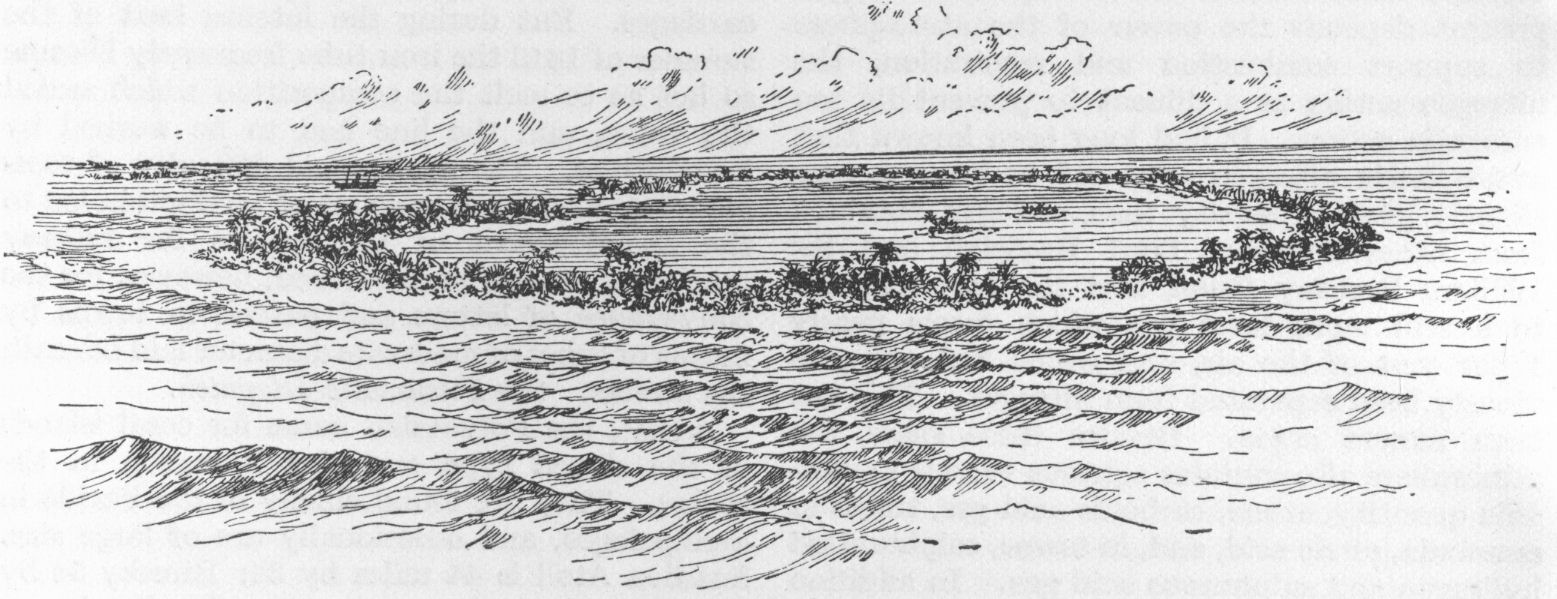
Atoll´, the Polynesian name for coral islands of the ringed type enclosing a lagoon in the centre. They are found chiefly in the Pacific in archipelagos, and occasionally are of large size. Suadiva Atoll is 44 miles by 34; Rimsky 54 by 20. See Coral.
Atomic Theory, a theory as to the existence and properties of atoms (see Atoms); especially, in chemistry, the theory accounting for the fact that in compound bodies the elements combine in certain constant proportions, by assuming that all bodies are composed of ultimate atoms, the weight of which is different in different kinds of matter. It is associated with the name of Dalton, who systematized and extended the imperfect results of his predecessors. On its practical side the atomic theory asserts three Laws of Combining Proportions: (1) The Law of Constant or Definite Proportions, teaching that in every chemical compound the nature and relative weights of the constituent elements are definite and invariable; thus water invariably consists of 8 parts by weight of oxygen to 1 part by weight of hydrogen; (2) The Law of Multiple Proportions, according to which the several proportions in which one element unites with a given weight of another invariably bear towards each other a simple relation; thus 1 part by weight of hydrogen unites with 8 parts by weight of oxygen to form water, and with 16 (i.e. 8×2) parts of oxygen to form peroxide of hydrogen; (3) The Law of Combination in Reciprocal Proportions, that the proportions in which two elements combine with a third also represent the proportions in which, or in some simple multiple of which, they will themselves combine; thus in olefiant gas hydrogen is present with carbon in the proportion of 1 to 6, and in carbonic oxide, oxygen is present with carbon in the proportion of 8 to 6, 1 to 8 being also the proportions in which hydrogen and oxygen combine with each other. The theory that these proportional numbers are, in fact, nothing else but the relative weights of atoms so far accounts for the phenomena that the existence of these laws might have been predicted by the aid of the atomic hypothesis long before they were actually discovered by analysis. In themselves, however, the laws do not prove the theory of the existence of ultimate particles of matter of a certain relative weight; and although many chemists, even without expressly adopting the atomic theory itself, have followed Dalton in the use of the terms atom and atomic weight, in preference to proportion, combining weight, equivalent, and the like, yet in using the word atom it should be held in mind that it merely denotes the combining weights of the elements. These will remain the same whether the atomic hypothesis which suggested the employment of the term be true or false. Dalton supposed that the atoms are spherical, and invented certain symbols to represent the mode in which he conceived they might combine. The latest atomic hypothesis is one which assigns an electrical structure to the atom. See Chemistry; Electricity; Matter. Cf. H. E. Roscoe and A. Harden, New View of Dalton's Atomic Theory; Sir J. J. Thomson, Atomic Theory.
Atomic Weights. See Chemistry; Molecular Weights.
Atomists. See Atoms.
Atoms, for many years regarded as the ultimate indivisible particles of the chemical elements. The idea originated with some of the ancient philosophers (the atomists), more especially Democritus (450 B.C.), Epicurus, and Lucretius (99-55 B.C.), and was developed into a definite theory by Dalton (1804). According to Dalton the atoms of any one element are alike in all their properties, but differ from the atoms of other elements, and when chemical combination occurs it takes place between the atoms of the combining elements (see Chemistry). Various views have been held with regard to the nature of atoms. Newton regarded them as hard, ponderable particles, perfectly unalterable, and concluded that the difference between substances was due to different kinds of atoms. Lord Kelvin propounded the view that the properties of atoms might be explained by those of vortices or vortex rings in a homogeneous frictionless fluid. As a result of the researches of British and French physicists on radium, the latest view is that matter and electricity are closely connected, that atoms are not indivisible, but complex aggregates containing positive and negative electrons, the differences between the atoms depending mainly on the numbers of these electrons and their velocity. See Radium.
Atonement, in Christian theology, the special work of Christ effected by His life, sufferings, and death. The first explicit exposition of the evangelical doctrine of the atonement is ascribed to Anselm, Archbishop of Canterbury, in 1093.
Atrato (a˙-trä´tō), a river of S. America, in the north-west of Colombia, emptying itself by nine mouths into the Gulf of Darien; it is navigable by steamers of some size for 250 miles, and has long been the subject of schemes for establishing water-communication between the Atlantic and Pacific.
Atrauli, a town of India, United Provinces, Aligarh district, clean, well built, and with a good trade. Pop. 16,560.