VOLUME I PART 2 (continued 4)
Reading edition
Apollodo´rus, a Greek writer who flourished 140 B.C. Among the numerous works he wrote on various subjects, the only one extant is his Bibliothecē, which contains a concise account of the mythology of Greece down to the heroic age.
Apollo´nius of Perga, Greek mathematician, called the 'great geometer', flourished about 240 B.C., and was the author of many works, only one of which, a treatise on Conic Sections, partly in Greek and partly in an Arabic translation, is now extant.
Apollo´nius of Rhodes, a Greek rhetorician and poet, flourished about 230 B.C. Of his various works we have only the Argonautica, an epic poem of considerable merit, though perhaps written with too much care and labour. It deals with the story of the Argonautic expedition.
Apollo´nius of Ty´ana, in Cappadocia, a Pythagorean philosopher who was born in the beginning of the Christian era, early adopted the Pythagorean doctrines, abstaining from animal food and maintaining a rigid silence for five years. He travelled extensively in Asia, professed to be endowed with miraculous powers, such as prophecy and the raising of the dead, and was on this account set up by some as a rival to Christ. His ascetic life, wise discourses, and wonderful deeds obtained for him almost universal reverence, and temples, altars, and statues were erected to him. He died at Ephesus about the end of the first century. A narrative of his strange career, containing many fables, with, perhaps, a kernel of truth, was written by Philostratus about a century later.
Apollo´nius of Tyre, the hero of a tale which had an immense popularity in the Middle Ages and which indirectly furnished the plot of Shakespeare's Pericles, Prince of Tyre. The story, originally in Greek, first appeared in the third century after Christ.
Apoll´os, a Jew of Alexandria, who learned the doctrines of Christianity at Ephesus from Aquila and Priscilla, became a preacher of the gospel in Achaia and Corinth, and an assistant of Paul in his missionary work. Some have regarded him as the author of the Epistle to the Hebrews.
Apoll´yon ('the Destroyer'), a name used in Rev. ix, 11 for the angel of the bottomless pit.
Apologetics (-jet´iks), this term, as used in Christian theology, does not carry with it the idea of excuse or regretful acknowledgment, but signifies a defensive or vindicatory statement, which accords with its meaning in the original Greek. In the conventional division of systematic theology apologetics comes first in order, and is followed by the disciplines of dogmatics and ethics, which expound Christian belief and Christian duty respectively. There is a tendency, however, in the more recent treatment of systematic theology, to include the defence or vindication of the various Christian doctrines within the dogmatic scheme, leaving to apologetics—in so far as it may be regarded as a separate discipline from dogmatics—the discussion of such general themes as religion and revelation, authority and inspiration, and the essence and truth of Christianity. Such discussions belong essentially to what is now often called philosophy of religion. The preference of the term philosophy of religion to that of apologetics is indicative at once of the wider theological outlook of our time and of the conciliatory, adaptable, and more sympathetic spirit in which the Christian apologist approaches the new thought and culture.—Bibliography: A. B. Bruce, Apologetics; R. Mackintosh, First Primer of Apologetics; J. R. Illingworth, Reason and Revelation; A. E. Garvie, A Handbook of Christian Apologetics.
Apologue (ap´o-log), a story or relation of fictitious events intended to convey some useful truths. It differs from a parable in that the latter is drawn from events that take place among mankind, whereas the apologue may be founded on supposed actions of brutes or inanimate things. Æsop's fables are good examples of apologues.
Apol´ogy, a term at one time applied to a defence of one who is accused, or of certain doctrines called in question. Of this nature is the Apology of Socrates written by Plato; also a work with the same title sometimes attributed to Xenophon. The name passed over to Christian authors, who gave the name of apologies to the writings which were designed to defend Christianity against the attacks and accusations of its enemies, particularly the pagan philosophers, and to justify its professors before the emperors. Of this sort were those by Justin Martyr, Athenagoras, Tertullian, Tatian, and others.
Aponeuro´sis, in anatomy, a name of certain greyish-white shining membranes, composed of interlacing fibres, sometimes continuous with the muscular fibre, and differing from tendons merely in having a flat form. They serve several purposes, sometimes attaching the muscles to the bones, sometimes surrounding the muscle and preventing its displacement, &c. See Anatomy.
Apophthegm (ap´o-them), a short pithy sentence or maxim. Julius Cæsar wrote a collection of them, and we have a collection by Francis Bacon.
Apoph´yllite, a species of mineral of a foliated structure and pearly lustre, called also fish-eye stone. It belongs to the Zeolite family, and is a hydrated silicate of lime and potash, containing also fluorine.
Ap´oplexy, sudden abolition of consciousness, followed after recovery of consciousness by persistent disturbance of sensation or voluntary motion, from suspension of the functions of the cerebrum, resulting from blocking or rupture of the blood-vessels of the brain. In a complete apoplexy the person falls suddenly, is unable to move his limbs or to speak, gives no proof of seeing, hearing, or feeling, and the breathing is stertorous or snoring, like that of a person in deep sleep. The premonitory symptoms of this dangerous disease are drowsiness, giddiness, dulness of hearing, frequent yawning, disordered vision, noise in the ears, vertigo, &c. It is most frequent between the ages of fifty and seventy. A large head, short neck, full chest, sanguine and plethoric constitution, and corpulency are generally considered signs of predisposition to it; but the state of the heart's action, with a plethoric condition of the vascular system, has a more marked influence. Out of sixty-three cases carefully investigated only ten were fat and plethoric, twenty-three being thin, and the rest of ordinary habit. The common predisposing causes are disease or senile changes in the blood-vessels and affections of the valves of the heart; but other factors may possibly play some part either as exciting or predisposing causes, such as long and intense thought, continued anxiety, habitual indulgence of the temper and passions, sedentary and luxurious living, sexual indulgence, intoxication, &c. More or less complete recovery from a first and second attack is common, but a third is almost invariably fatal.—Cf. Grasset, Traité du système nerveux.
Aposiope´sis, in rhetoric, a sudden break or stop in speaking or writing, usually for mere effect or a pretence of unwillingness to say anything on a subject; as, 'his character is such—but it is better I should not speak of that', or Virgil's "Quos ego—sed motos praestat componere fluctus" (Aen. I, 135).
Apos´tasy (Gr. apostasis, a standing away from), a renunciation of opinions or practices and the adoption of contrary ones, usually applied to renunciation of religious opinions. It is always an expression of reproach. What one party calls apostasy is termed by the other conversion. Catholics, also, call those persons apostates who forsake a religious order or renounce their religious vows without a lawful dispensation.
A posterio´ri. See A priori.
Apos´tles (literally, persons sent out, from the Gr. apostellein, to send out), the twelve men whom Jesus selected to attend him during his ministry, and to promulgate his religion. Their names were as follows: Simon Peter, and Andrew his brother; James, and John his brother, sons of Zebedee; Philip; Bartholomew; Thomas; Matthew; James, the son of Alpheus; Lebbæus his brother, called Judas or Jude; Simon, the Canaanite; and Judas Iscariot. To these were subsequently added Matthias (chosen by lot in place of Judas Iscariot) and Paul. The Bible gives the name of apostle to Barnabas also, who accompanied Paul on his missions (Acts, xiv, 14). In a wider sense those preachers who first taught Christianity in heathen countries are sometimes termed apostles; for example, St. Denis, the apostle of the Gauls; St. Boniface, the apostle of Germany; St. Augustine, the apostle of England; Francis Xavier, the apostle of the Indies; Adalbert of Prague, apostle of Prussia Proper. During the life of the Saviour the apostles more than once showed a misunderstanding of the object of His mission, and during His sufferings evinced little courage and firmness of friendship for their great and benevolent Teacher. After His death they received the Holy Ghost on the day of Pentecost, that they might be enabled to fulfil the important duties for which they had been chosen. According to one interpretation of Matthew, xvi, 18, Christ seems to appoint St. Peter the first of the apostles; and the Pope claims supreme authority from the power which Christ thus gave to St. Peter, of whom all the Popes, according to the Catholic dogma, are successors in an uninterrupted line.
Apostles' Creed, a well-known formula or declaration of Christian belief, formerly believed to be the work of the apostles themselves, but it can only be traced to the fourth century. See Creed.
Apostol´ic, or Apostol´ical, pertaining or relating to the apostles.—Apostolic Church, the Church in the time of the apostles, constituted according to their design. The name is also given to the four churches of Rome, Alexandria, Antioch, and Jerusalem, and is claimed by the Roman Catholic Church, and occasionally by the Episcopalians.—Apostolic Constitutions and Canons, a collection of regulations attributed to the apostles, but generally supposed to be spurious. They appeared in the fourth century, are divided into eight books, and consist of rules and precepts relating to the duty of Christians, and particularly to the ceremonies and discipline of the Church.—Apostolic fathers, the Christian writers who during any part of their lives were contemporary with the apostles. There are five—Clement, Barnabas, Hermas, Ignatius, Polycarp.—Apostolic king, a title granted by the Pope to the kings of Hungary, first conferred on St. Stephen, the founder of the royal line of Hungary, on account of what he accomplished in the spread of Christianity.—Apostolic see, the see of the Popes or Bishops of Rome: so called because the Popes profess themselves the successors of St. Peter, its founder.—Apostolic succession, the uninterrupted succession of bishops, and, through them, of priests and deacons (these three orders of ministers being called the apostolical orders), in the Church by regular ordination from the first apostles down to the present day. All Episcopal churches hold theoretically, and the Roman Catholic Church and many members of the English Church strictly, that such succession is essential to the officiating priest, in order that grace may be communicated through his administrations.
Apostol´ics, Apostolici, or Apostolic Brethren, the name given to certain sects who professed to imitate the manners and practice of the apostles. The last and most important of these sects was founded about 1260 by Gerhard Segarelli of Parma. They went barefooted, begging, preaching, and singing throughout Italy, Switzerland, and France; announced the coming of the kingdom of heaven and of purer times; denounced the papacy, and its corrupt and worldly church; and inculcated the complete renunciation of all worldly ties, of property, settled abode, marriage, &c. This society was formally abolished, 1286, by Honorius IV. In 1300 Segarelli was burned as a heretic, but another chief apostle appeared—Dolcino, a learned man of Milan. In self-defence they stationed themselves in fortified places whence they might resist attacks. After having devastated a large tract of country belonging to Milan they were subdued, A.D. 1307, by the troops of Bishop Raynerius, in their fortress Zebello, in Vercelli, and almost all destroyed. Dolcino was burned. The survivors afterwards appeared in Lombardy and in the south of France as late as 1368.
Apo´strŏphē (Gr., 'a turning away from'), a rhetorical figure by which the orator changes the course of his speech, and makes a short impassioned address to one absent as if he were present, or to things without life and sense as if they had life and sense. The same term is also applied to a comma when used to contract a word, or to mark the possessive case, as in 'John's book'.
Apothecaries' weight, the weight used in dispensing drugs, in which the pound (lb.) is divided into 12 ounces (), the ounce into 8 drachms (), the drachm into 3 scruples (), and the scruple into 20 grains (grs.), the grain being equivalent to that in avoirdupois weight.


Apoth´ecary, in a general sense, one who keeps a shop or laboratory for preparing, compounding, and vending medicines, and for the making up of medical prescriptions. In England the term was long applied (as to some little extent still) to a regularly licensed class of medical practitioners, being such persons as were members of, or licensed by, the Apothecaries' Company in London. The apothecaries of London were at one time ranked with the grocers, with whom they were incorporated by James I in 1606. In 1617, however, the apothecaries received a new charter as a distinct company. They were not yet regarded as having the right to prescribe, but only to dispense, medicines; but in 1703 the House of Lords conferred that right on them, and they afterwards became a well-established branch of the medical profession. In 1815 an Act was passed providing that no person should practise as an apothecary in any part of England or Wales unless after serving an apprenticeship of five years with a member of the society, and receiving a certificate from the society's examiners. As in country places every practitioner must be to some extent an apothecary, this Act gave the society an undue influence over the medical profession. Dissatisfaction therefore long prevailed, but nothing of importance was done till the Medical Act of 1858, which brought the desired reform. The Apothecaries' Society, governed by a master, two wardens, and twenty-two assistants, has prescribed a course of medical instruction and practice which candidates for the licence of the society must pass through. Since 1874 apprenticeship has not been necessary.
Apothe´cium, in botany, the receptacle of lichens, consisting of the spore-cases or asci, and of the paraphyses or barren threads.
Apotheo´sis (deification), a solemnity among the ancients by which a mortal was raised to the rank of the gods. The custom of placing mortals, who had rendered their countrymen important services, among the gods was very ancient among the Greeks. The Romans, for several centuries, deified none but Romulus, and first imitated the Greeks in the fashion of frequent apotheosis after the time of Cæsar. From this period apotheosis was regulated by the decrees of the senate, and accompanied with great solemnities. Almost all the Roman emperors were deified.
Appalachian Mountains (ap-pa-lā´chi-an), also called Alleghanies, a vast mountain range in N. America extending for 1300 miles from Cape Gaspé on the Gulf of St. Lawrence, s.w. to Alabama. The system has been divided into three great sections: the northern (including the Adirondacks, the Green Mountains, the White Mountains, &c.), from Cape Gaspé to New York; the central (including a large portion of the Blue Ridge, the Alleghanies proper, and numerous lesser ranges), from New York to the valley of the New River; and the southern (including the continuation of the Blue Ridge, the Black Mountains, the Smoky Mountains, &c.), from the New River southwards. The chain consists of several ranges generally parallel to each other, the altitude of the individual mountains increasing on approaching the south. The highest peaks rise over 6600 feet (not one at all approaching the snow-level), but the mean height is about 2500 feet. Lake Champlain is the only lake of great importance in the system, but numerous rivers of considerable size take their rise here. Magnetite, hematite, and other iron ores occur in great abundance, and the coal-measures are among the most extensive in the world. Gold, silver, lead, and copper are also found in small quantities, while marble, limestone, fire-clay, gypsum, and salt abound. The forests covering many of the ranges yield large quantities of valuable timber, such as sugar-maple, white birch, beech, ash, oak, cherry tree, white poplar, white and yellow pine, &c., while they form the haunts of large numbers of bears, panthers, wild cats, and wolves.
Appalachicola (-chi-cō´la), a river of the United States, formed by the Chattahoochee and Flint Rivers, which unite near the northern border of Florida; length, about 100 miles; it flows into the Gulf of Mexico, and is navigable.
Appam, the name of a British merchant ship of the Elder-Dempster line captured by the German raiding cruiser Moewe (Sea-gull) on 16th Jan., 1916. A German prize crew succeeded in bringing the Appam westward, and was able to pass the British cordon off Chesapeake Bay and to reach Norfolk, Virginia. The vessel was carrying, among others, an ex-governor of Sierra Leone and some military officers from the west coast of Africa, but the passengers were at once released and allowed to return to England.
Appanage. See Apanage.
Appa´rent, among mathematicians and astronomers, applied to things as they appear to the eye, in distinction to what they really are. Thus they speak of apparent motion, magnitude, distance, height, &c. The apparent magnitude of a heavenly body is the angle subtended at the spectator's eye by the diameter of that body, and this, of course, depends on the distance as well as the real magnitude of the body; apparent motion is the motion a body seems to have in consequence of our own motion, as the motion of the sun from east to west, &c.
Appari´tion, according to a belief held by some, a disembodied spirit manifesting itself to mortal sight; according to the common theory an illusion involuntarily generated, by means of which figures or forms, not present to the actual sense, are nevertheless depicted with a vividness and intensity sufficient to create a temporary belief in their reality. Such illusions are now generally held to result from an over-excited brain, a strong imagination, or some bodily malady. In perfect health the mind not only possesses a control over its powers, but the impressions of the external objects alone occupy its attention, and the play of imagination is consequently checked, except in sleep, when its operations are relatively more feeble and faint. But in an unhealthy state of the mind, when its attention is partly withdrawn from the contemplation of external objects, the impressions of its own creation, or rather reproduction, will either overpower or combine themselves with the impressions of external objects, and thus generate illusions which in the one case appear alone, while in the other they are seen projected among those external objects to which the eyeball is directed. This theory explains satisfactorily a large majority of the stories of apparitions; still there are some which it seems insufficient to account for.—See Crystal Gazing, Hypnotism, Spiritualism.—Bibliography: F. Podmore, Modern Spiritualism; F. W. H. Myers, Human Personality, and its survival of bodily Death.
Appeal´, in legal phraseology, the removal of a cause from an inferior tribunal to a superior, in order that the latter may revise, and if it seem needful reverse or amend, the decision of the former. The supreme court of appeal for Great Britain is the House of Lords. Certain defects in connection with the settlement of appeals by this body were remedied by the Appellate Jurisdiction Act, 1876, while a new court of appeal was established as a division of the Supreme Court of Judicature. In Ireland there is also a Court of Appeal similar to that in England; while in Scotland the highest court is the Court of Session. From the decisions of the Indian and all colonial courts, and the courts of the Isle of Man and the Channel Islands, appeal may be made to the Privy Council. Appeals from the decisions of justices of a borough or county may be made to the quarter-sessions of either respectively, in cases of summary jurisdiction, or upon a point of law to divisional courts of the High Court of Justice, which was established at the same time as the Court of Appeal; from quarter-sessions, county and other inferior courts, to the High Court. In Scotland the Court of Session reviews the decisions of the county courts, there being an appeal from its decisions to the House of Lords.—In France the court of final appeal in all cases is the cour de cassation.—In the United States the system of appeals differs in different States.
Appearance in law is the first formal act incumbent on a defendant who intends to resist the claim in the writ or action served upon him. It consists usually in lodging in court a written notice stating simply that the defendant intends to dispute the claim. Failure to enter appearance within the prescribed time entails decree passing against the defendant in absence, but procedure exists in all courts for enabling such decrees to be recalled within a limited period. Appearance should be entered under protest if it is desired to dispute the jurisdiction of the court or the regularity of the writ.
Appendicitis, a disease which has become well known in recent times through the more accurate methods of diagnosis and the increased safety of surgical operation. It is caused by inflammation of the vermiform appendix, a narrow, hollow, worm-like body from 2 to 4 inches long, opening at one end into the large intestine and forming a cul-de-sac at the other. In appendicitis the inflammation begins in the appendix and frequently spreads to the neighbouring parts, causing inflammation of the cæcum, a condition known as perityphlitis. The most frequent cause of appendicitis is a hard piece of insufficiently-digested food becoming lodged in the appendix. Occasionally orange pips, grape stones, &c., are the cause, though not so often as is popularly supposed.
The symptoms are: abdominal pain (especially low down at the right side), fever, nausea, vomiting, constipation; these varying according to the intensity of the attack. Three types are recognized:
1. A mild type, when the symptoms subside in a few days and the patient soon appears to be in normal health.
2. A severe type, in which, if left alone, the appendix bursts into the abdominal cavity and death from general peritonitis results.
3. Another type, in which the inflammation in the appendix leads to the formation of a localized abscess, sometimes of great size.
The treatment for the severe and for the abscess-forming types is essentially immediate operation; while for the mild type operation may either be performed at once or after the attack has passed off. Anyone who has had one attack of appendicitis is liable to have it repeated in a much severer form, hence the advisability of having the appendix removed after the first attack, however slight. During an attack, prior to surgical interference, complete rest in bed is essential. Abdominal pain should be treated with frequent hot fomentations, and the diet should be reduced to small quantities of fluid.
Appenzell (a˙p'pen-tsel), a Swiss canton, wholly enclosed by the canton of St. Gall; area, 162 sq. miles. It is divided into two independent portions or half-cantons, Outer-Rhoden, which is Protestant, and Inner-Rhoden, which is Catholic. It is an elevated district, traversed by branches of the Alps; Mount Säntis in the centre being 8250 feet high. It is watered by the Sitter and by several smaller affluents of the Rhine. Glaciers occupy the higher valleys. Flax, hemp, grain, fruit, &c., are produced, but the wealth of Inner-Rhoden lies in its herds and flocks—that of Outer-Rhoden in its manufactures of embroidered muslins, gauzes, cambrics, and other cotton stuffs; also of silk goods and paper. The town of Appenzell (Ger. Abtenzelle, abbot's cell) is the capital of Inner-Rhoden, on the Sitter, with about 4300 inhabitants. Trogen is the capital of Outer-Rhoden, Herisau the largest town (pop. 11,000). Pop. Outer-Rhoden, 60,000; Inner-Rhoden, 15,000.
Apperception. See Metaphysics.
Ap´petite, in its widest sense, means the natural desire for gratification, either of the body or the mind; but is generally applied to the recurrent and intermittent desire for food. A healthy appetite is favoured by work, exercise, plain living, and cheerfulness; absence of this feeling, or defective appetite (anorexia), indicates diseased action of the stomach, or of the nervous system or circulation, or it may result from vicious habits. Depraved appetite (pica), or a desire for unnatural food, as chalk, ashes, dirt, soap, &c., depends often in the case of children on vicious tastes or habits; in grown-up persons it may be symptomatic of dyspepsia, pregnancy or chlorosis. Insatiable or canine appetite or voracity (bulimia) when it occurs in childhood is generally symptomatic of worms; in adults common causes are pregnancy, vicious habits, and indigestion caused by stomach complaints or gluttony, when the gnawing pains of disease are mistaken for hunger.
Ap´pian, a Roman historian of the second century after Christ, a native of Alexandria, was governor and manager of the imperial revenues under Hadrian, Trajan, and Antoninus Pius, in Rome. He compiled in Greek a Roman history, from the earliest times to those of Augustus, in twenty-four books, of which only eleven have come down to us. Appian's style is not attractive, but he gives us much valuable information.
Appia´ni, Andrea, a painter, born at Milan in 1754, died in 1817. As a fresco-painter he excelled every contemporary painter in Italy. He displayed his skill particularly in the cupola of Santa Maria di S. Celso at Milan, and in the paintings representing the legend of Cupid and Psyche prepared for the walls and ceiling of the villa of the Archduke Ferdinand at Monza (1795). Napoleon appointed him royal court painter, and portraits of almost the whole of the imperial family were painted by him.
Appian Way, called Regina Viarum, the Queen of Roads: the oldest and most renowned Roman road, was constructed during the censorship of Appius Claudius Cæcus (313-310 B.C.). It was built with large square stones on a raised platform, and was made direct from the gates of Rome to Capua, in Campania. It was afterwards extended through Samnium and Apulia to Brundusium, the modern Brindisi. It was partially restored by Pius VI, and between 1850 and 1853 it was excavated by order of Pius IX as far as the eleventh milestone from Rome.
Appius Claudius, surnamed Cæcus, or the blind, a Roman patrician, elected censor 312 B.C., which office he held four years. While in this position he made every effort to weaken the power of the Plebs, and constructed the road and aqueduct named after him. He was subsequently twice consul, and once dictator. In his old age he became blind, but in 280 B.C. he made a famous speech in which he induced the senate to reject the terms of peace fixed by Pyrrhus. He is the earliest Roman writer of prose and verse whose name we know.
Appius Claudius Crassus, one of the Roman decemvirs, appointed 451 B.C. to draw up a new code of laws. He and his colleagues plotted to retain their power permanently, and at the expiry of their year of office refused to give up their authority. The people were incensed against them, and the following circumstances led to their overthrow. Appius Claudius had conceived an evil passion for Virginia, the daughter of Lucius Virginius, then absent with the army in the war with the Æqui and Sabines. At the instigation of Appius, Marcus Claudius, one of his clients, claimed Virginia as the daughter of one of his own female slaves, and the decemvir, acting as judge, decided that in the meantime she should remain in the custody of the claimant. Virginius, hastily summoned from the army, appeared with his daughter next day in the forum, and appealed to the people; but Appius Claudius again adjudged her to Marcus Claudius. Unable to rescue his daughter, the unhappy father stabbed her to the heart. The decemvirs were deposed by the indignant people 449 B.C., and Appius Claudius died in prison or was strangled.
Apple (Pyrus Malus), the fruit of a well-known tree of the nat. ord. Rosaceæ, or the tree itself. The apple belongs to the temperate regions of the globe, over which it is almost universally spread and cultivated. The tree attains a moderate height, with spreading branches; the leaf is ovate; and the flowers are produced from the wood of the former year; but more generally from very short shoots or spurs from wood of two years' growth. The original of all the varieties of the cultivated apple is the wild crab, which has a small and extremely sour fruit, and is a native of most of the countries of Europe. Apples have been used as food and cultivated for upwards of 4000 years, and were probably introduced into Britain by the Romans. The greater number of the varieties now grown have, however, been cultivated only within the last century or so. To the facility of multiplying varieties by grafting is to be ascribed the amazing extension of the sorts of apples, the number of varieties known being over 2000. Many of the more marked varieties are known by general names, as pippins, codlins, rennets, &c. The oldest apple in cultivation is a variety called 'the lady', which originated in Britain early in the seventeenth century. Apples for the table are characterized by a firm juicy pulp, a sweetish acid flavour, regular form, and beautiful colouring; those for cooking by the property of forming by the aid of heat into a pulpy mass of equal consistency, as also by their large size and keeping properties; apples for cider must have a considerable degree of astringency, with richness of juice. The propagation of apple trees is accomplished by seeds, cuttings, suckers, layers, budding, or grafting, the last being almost the universal practice. The tree thrives best in an open situation where it will receive the maximum amount of sunshine and protection from cold winds. The protection is particularly necessary in districts where cold winds and frosts prevail during the flowering season. The wood of the apple tree or the common crab is hard, close-grained, and often richly coloured, and is suitable for turning and cabinet work. The fermented juice (verjuice) of the crab is employed in cookery and medicine. Apples are largely imported into Great Britain from the Continent and the United States and Canada. The designation apple, with various modifying words, is applied to a number of fruits having nothing in common with the apple proper, as alligator-apple, love-apple, &c.—Cf. A. E. Wilkinson, The Apple.
Ap´pleby, county town of Westmorland, England, on the Eden, 28 miles S.S.E. of Carlisle. Disfranchised in 1832, it gave its name to a parliamentary division of the county until 1918. It has an old castle, the keep of which, called Cæsar's Tower, is still fairly well preserved. Pop. (1921), 1786.
Apple of discord, according to the story in Greek mythology, the golden apple thrown into an assembly of the gods by the goddess of discord (Eris) bearing the inscription 'for the fairest'. Aphrodītē (Venus), Hera (Juno), and Athēnē (Minerva) became competitors for it, and its adjudication to the first by Paris so inflamed the jealousy and hatred of Hera to all of the Trojan race (to which Paris belonged) that she did not cease her machinations till Troy was destroyed.
Apple of Sodom, a fruit described by old writers as externally of fair appearance, but turning to ashes when plucked; probably the fruit of Solānum sodomēum.
Ap´pleton, a city of Wisconsin, United States, 100 miles N.W. of Milwaukee by rail. It has many flour, paper, saw, and woollen mills, and other manufactories, and is the seat of a collegiate institute and of the Lawrence University. Pop. (1920), 19,561.
Appliqué, in needlework or metal-work, a design or feature having the appearance of being independently made and attached to the surface of the object it adorns. When the ornament is sunk into the body of the object it is called inlay.
Appoggiatura (a˙p-poj-a˙-tö´ra˙), in music, a small additional note of embellishment preceding the note to which it is attached, and taking away from the principal note a portion of its time.
Appoint´ment, a term in English law signifying the exercise of some power, reserved in a conveyance or settlement, of burdening, selling, or otherwise disposing of the lands or property conveyed. Such a reserved power is termed a power of appointment.
Appomatt´ox Court-house, a village in Virginia, United States, 20 miles E. of Lynchburg. Here, on 9th April, 1865, General Lee surrendered to General Grant, and thus virtually concluded the American Civil War.
Apponyi, Albert, Count, Hungarian statesman, born in 1846. Leader of the Conservative National party, he joined the Liberal party in 1899, and in 1901 was elected President of the Chamber of Deputies. He was Minister of Education in 1906 and 1917, and again in 1918. In 1920 he was at the head of the delegation which came to Paris to settle the peace-terms with Hungary.
Apposi´tion, in grammar, the relation in which one or more nouns or substantive phrases or clauses stand to a noun or pronoun, which they explain or characterize without being predicated of it, and with which they agree in case; as Cicero, the orator, lived in the first century before Christ; the opinion, that a severe winter is generally followed by a good summer, is a vulgar error.
Apprai´ser, a person employed to value property, and duly licensed to do so by licence taken out every year. The valuation must be duly set down in writing, and there is a certain fixed scale of charges for the appraiser's services.
Apprehen´sion, the seizing of a person as a criminal whether taken in the act or on suspicion, and with or without a warrant, a warrant being necessary when the person apprehending is not present at the commission of the offence. See Arrest.
Appren´tice, one bound by indenture to serve some particular individual or company of individuals for a specified time, in order to be instructed in some art, science, or trade. In England a person under the age of twenty-one cannot bind himself apprentice, and accordingly the usual way is for a relation or friend to become a contracting party to the indenture, and engage for the faithful performance of the agreement. An infant cannot be bound apprentice by his friends without his own expressed consent. In Scotland a boy under fourteen or a girl under twelve years of age cannot become a party to an indenture without the concurrence of a parent or guardian; above that age they may enter into an indenture of themselves, and thereby become personally bound. An indenture is determinable by the consent of the parties to it, and also by the death, bankruptcy, or retirement from business of the master. Parish apprentices are bound out by the guardians of the poor to suitable persons, and in this case the consent of the apprentice is not necessary. The system of apprenticing by indenture is now much less common than formerly.—Cf. R. A. Bray, Boy Labour and Apprenticeship.
Approach´es, in field-engineering, an old-fashioned name for what are now called 'communication trenches'.
Appropria´tion. See Impropriation.
Appro´ver (ap-prö´vėr), in English law, any accomplice in a crime who is allowed by the judges of jail-delivery to become king's evidence, that is, to be examined in evidence against his accomplices, it being understood that the approver will himself be pardoned upon making a full and open confession.
Approxima´tion, a term used in mathematics to signify a continual approach to a quantity required, when no process is known for arriving at it exactly. Although, by such an approximation, the exact value of a quantity cannot be discovered, yet, in practice, it may be found sufficiently correct; thus the diagonal of a square, whose sides are represented by unity, is √2, the exact value of which quantity cannot be obtained; but its approximate value may be substituted in the nicest calculations.
Appuleius. See Apuleius.
Ap´ricot (Prunus Armeniăca), a fruit of the plum genus which was introduced into Europe from Asia more than three centuries before Christ, and into England from Italy in 1524. It is a native of Armenia and other parts of Asia and also of Africa. The apricot is a low tree, of rather crooked growth, with somewhat heart-shaped leaves and sessile flowers. The fruit is sweet, more or less juicy, of a yellowish colour, about the size of a peach, and resembling it in delicacy of flavour. Some of the best varieties are 'Frogmore Early', 'Moorpark', 'Royal', &c. The wood is coarsely grained and soft. Apricot trees are chiefly raised against walls, and are propagated by budding and grafting.
Apries (ā´pri-ēz), Pharaoh-Hophra of Scripture, the eighth king of the twenty-sixth Egyptian dynasty. He succeeded his father Psammetichus in 590 or 589 B.C. The Jews under Zedekiah revolted against their Babylonian oppressors and allied themselves with Apries, who was, however, unable to raise the siege of Jerusalem, which was taken by Nebuchadnezzar. A still more unfortunate expedition against Cyrene brought about revolt in his army, in endeavouring to suppress which Apries was defeated and slain about 570 B.C.
A´pril (Lat. Aprīlis, from aperire, to open, because the buds open at this time), the fourth month of the year. The strange custom of making fools on 1st April by sending people upon errands which end in disappointment, and raise a laugh at the expense of the person sent, prevails throughout Europe. It has been connected with the miracle plays of the Middle Ages, in which the Saviour was represented as having been sent, at this period of the year, from Annas to Caiaphas and from Pilate to Herod. This explanation, however, is perhaps itself a piece of April fooling. In France the party fooled is called un poisson d'avril, 'an April fish'; in Scotland, a 'gowk', or cuckoo.
A prio´ri ('from what goes before'), a phrase applied to a mode of reasoning by which we proceed from general principles or notions to particular cases, as opposed to a posteriori ('from what comes after') reasoning, by which we proceed from knowledge previously acquired. Mathematical proofs are of the a priori kind; the conclusions of experimental science are a posteriori. It is also a term applied to knowledge independent of all experience.
Apse—Church of Sta Maria in Trastevere, Rome
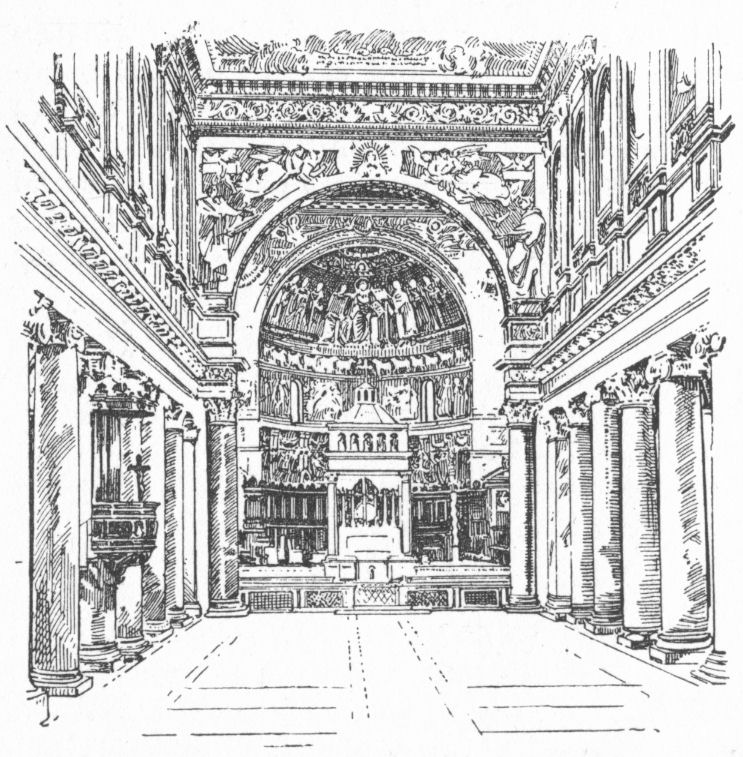
Apse, a portion of any building forming a termination or projection semicircular or polygonal in plan, and having a roof forming externally a semi-dome or semi-cone, or having ridges corresponding to the angles of the polygon; especially such a semicircular or polygonal recess projecting from the east end of the choir or chancel of a church, in which the altar is placed. The apse was developed from the somewhat similar part of the Roman basilicæ, in which the magistrate (prætor) sat.
Ap´sheron, a peninsula on the western shore of the Caspian Sea formed by the eastern extremity of the Caucasus Mountains. It extends for about 40 miles, and terminates in Cape Apsheron. It yields immense quantities of petroleum. See Baku.
aa, Apsides
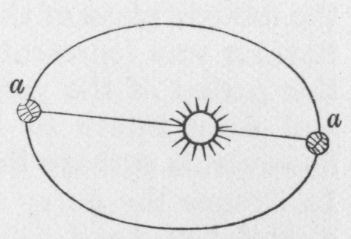
Apsis, pl. Ap´sides or Apsi´des, in astronomy, one of the two points of the orbit of a heavenly body situated at the extremities of the major axis of the ellipse formed by the orbit, one of the points being that at which the body is at its greatest and the other that at which it is at its least distance from its primary. In regard to the earth and the other planets, these two points are called the aphelion and perihelion; and in regard to the moon they are called the apogee and perigee. The line of the apsides has a slow forward angular motion in the plane of the planet's orbit, being retrograde only in the case of Venus. This in the earth's orbit produces the anomalistic year. See Anomaly.
Apt (ät; ancient Apta Julia), a town of Southern France, department Vaucluse, 32 miles east by south of Avignon, with an ancient Gothic cathedral. Pop. 6336.
Ap´tera (Gr. apteros, wingless), wingless insects, such as lice and certain others, popularly called Spring-tails, and composed of two groups, Collembola and Thysanura.
Apteryx (Apteryx Mantelli)
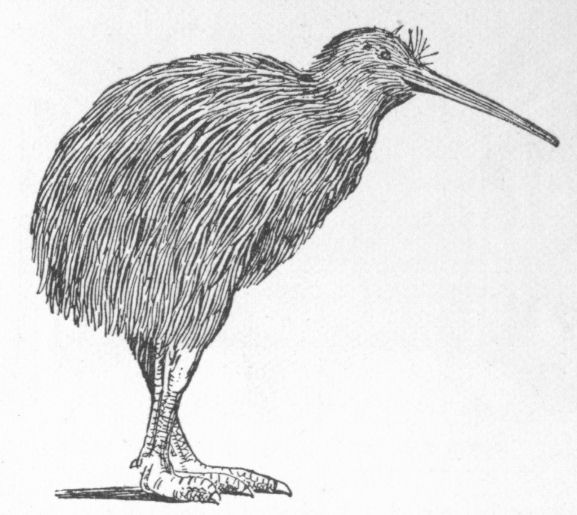
Ap´teryx, a nearly extinct genus of cursorial birds, distinguished from the ostriches by having three toes with a rudimentary hallux, which forms a spur. They are natives of the South Island of New Zealand; are totally wingless and tailless, with feathers resembling hairs; about the size of a small goose; with long curved beak something like that of a curlew. They are entirely nocturnal, feeding on insects, worms, and seeds.—A. austrālis, called Kiwi-kiwi from its cry, is the best-known species.
Apuleius, or Appuleius (ap-ū-lē´us), author of the celebrated satirical romance in Latin called the Golden Ass, born at Madaura, in Numidia, about A.D. 125; the time of his death is unknown. He studied at Carthage, then at Athens, where he became warmly attached to the Platonic philosophy, and finally at Rome. Returning to Carthage he married a rich widow, whose relatives accused him of gaining her consent by magic, and the speech by which he successfully defended himself is still extant. Besides his Golden Ass (which is also known as the Metamorphoses, and which was translated into English by W. Adlington in 1566), with its fine episode of Cupid and Psyche, he was also the author of many works on philosophy and rhetoric, some of which are still extant.
Apu´lia, a department or division in the south-east of Italy, on the Adriatic, composed of the provinces of Foggia, Bari, and Lecce; area, 7376 sq. miles. Pop. 2,237,791.
Apure (a˙-pö´rā), a navigable river of Venezuela, formed by the junction of several streams which rise in the Andes of Colombia; it falls into the Orinoco.—Apure, one of the States of Venezuela, has a pop. of 30,008.
Apurimac (a˙-pö-rē-ma˙k´), a river of South America, which rises in the Andes of Peru, and, being augmented by the Vilcamayu and other streams, forms the Ucayale, one of the principal head-waters of the Amazon.—The department of Apurimac in Peru has an area of 8187 sq. miles, and a pop. of 177,887.
Aq´ua (Lat. for water), a word much used in pharmacy and old chemistry.—Aqua fortis (= strong water), a weak and impure nitric acid. It has the power of eating into steel and copper, and hence is used by engravers, etchers, &c.—Aqua marina, a fine variety of beryl. See Aquamarine.—Aqua regia, or aqua regalis (= royal water), a mixture of nitric and hydrochloric acids, with the power of dissolving gold and other precious metals.—Aqua Tofana, a poisonous fluid made about the middle of the seventeenth century by an Italian woman Tofana or Toffania, who is said to have procured the death of no fewer than 600 individuals by means of it. It consisted chiefly, it is supposed, of a solution of crystallized arsenic.—Aqua vitæ (= water of life), or simply aqua, a name familiarly applied to the whisky of Scotland, corresponding in meaning with the usquebaugh of Ireland, the eau de vie (brandy) of the French.
Aq´uamarine, a name given to some of the finest varieties of beryl of a sea-green or blue colour. Varieties of topaz are also so called.
Aqua´rium, a vessel or series of vessels constructed wholly or partly of glass and containing salt or fresh water in which are kept living specimens of marine or fresh-water animals along with aquatic plants. In principle the aquarium is based on the interdependence of animal and vegetable life; animals consuming oxygen and exhaling carbonic acid, plants reversing the process by absorbing carbonic acid and giving out oxygen. The aquarium must consequently be stocked both with plants and animals, and for the welfare of both something like a proper proportion should exist between them. The simplest form of aquarium is that of a glass vase; but aquaria on a larger scale consist of a tank or a number of tanks with plate-glass sides and stone floors, and contain sand and gravel, rocks, sea-weeds, &c. By improved arrangements light is admitted from above, passing through the water in the tanks and illuminating their contents, while the spectator is in comparative darkness. The most important aquarium is at the zoological station at Naples. There is also one, on a smaller scale, at Plymouth, maintained by the Marine Biological Association of the United Kingdom. Aquaria on a large scale have been constructed in connection with public parks or gardens, and the name is also given to places of public entertainment in which large aquaria are exhibited.—Cf. G. C. Bateman, Fresh-water Aquaria; M. J. Newbigin, The Aquarium.
Aquarius (Lat., the Water-bearer), a sign of the zodiac which the sun enters about the 21st of Jan.: it now enters the formerly coincident constellation Aquarius about a month later.
Aquatint, a method of etching on copper by which a beautiful effect is produced, resembling a fine drawing in sepia or Indian ink. The special character of the effect is the result of sprinkling finely-powdered resin or mastic over the plate, and causing this to adhere by heat, the design being previously etched, or being now traced out. The nitric acid (aqua fortis) acts only in the interstices between the particles of resin or mastic, thus giving a slightly granular appearance.
Aqua Tofa´na. See Aqua.
Aqua vitæ. See Aqua.
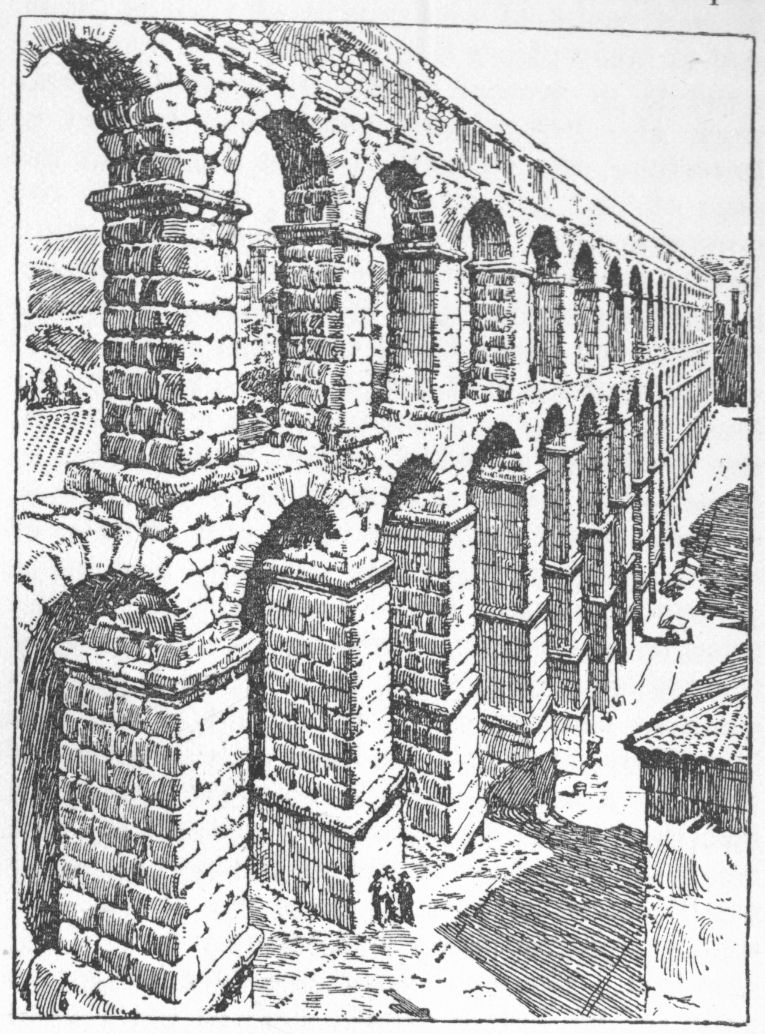
Aq´ueduct (Lat. aqua, water, duco, to lead), an artificial channel or conduit for the conveyance of water from one place to another: more particularly applied to structures for conveying water from distant sources for the supply of large cities. Aqueducts were extensively used by the Romans, and many of them still remain in different places on the Continent of Europe, some being still in use. The Pont du Gard in the south of France, 14 miles from Nîmes, is still nearly perfect, and is a grand monument of the Roman occupation of this country. The ancient aqueducts were constructed of stone or brick, sometimes tunnelled through hills, and carried over valleys and rivers on arches. The Pont du Gard spans the River Gard, and was built to convey to Nîmes the water of springs rising in the neighbourhood of the modern Uzés. It is built of great blocks of stone; its height is 160 feet; length of the highest arcade, 882 feet. The aqueduct at Segovia, originally built by the Romans, has in some parts two tiers of arcades 100 feet high, is 2921 feet in length, and is one of the most admired works of antiquity. One of the most remarkable aqueducts of modern times is that constructed by Louis XIV for conveying the waters of the Eure to Versailles. The extensive application of metal pipes has rendered the construction of aqueducts of the old type less necessary; but what may be called aqueduct bridges are still frequently constructed in connection with canals and also with water-works for the supply of towns. Where canals exist canal aqueducts are common, since the water in any section of a canal must be kept on a perfect level.
Aqueduct at Segovia
Many large towns now derive a supply of water from sources at a great distance, and in bringing the water to the place where it is required much tunnelling is often necessary as well as digging and excavating in the open. A tunnel furnishing a water channel may be driven through miles of rock strata of various kinds, and in many places it may have to be lined with concrete or cement wholly or partially, brick-work also being much employed. Instead of tunnelling, the channel may be formed on the plan of 'cut and cover', being first cut in the ground and then covered over, leaving the surface much in the same state as before. And, of course, iron piping is often used in connection with such tunnels, the water being conveyed so far in an aqueduct of one kind, and so far in one of another kind, according as is deemed most suitable. In the Thirlmere aqueduct, which brings water to Manchester, there are 45 miles of cast-iron pipes, 37 miles of cut-and-cover work, and 14 miles of tunnels proper. Pipes are naturally laid where valleys occur, and the water simply enters the pipes at one end and flows out at the other by the influence of gravity, there being a suitable chamber constructed at either end of the pipe line where there is a junction with a section of tunnel. Aqueduct bridges were first introduced into England in the eighteenth century, the first being the aqueduct at Barton Bridge conveying the Bridgewater Canal across the Irwell. In such bridges the water-channel may be made of cast iron. There are great aqueduct bridges on some of the Indian canals, such as the Nadrai bridge on the Lower Ganges Canal. In America water is often carried long distances in flumes or open wooden channels, supported, where necessary, on trestles. Great wooden pipes are also common there, built of large staves and hooped round with iron or steel. These often rest on the surface of the ground without any covering.—Bibliography: C. Herschel, Frontinus; Wegmann, Water-supply of City of New York; J. F. Bateman, The Manchester Waterworks; J. M. Gale, The Glasgow Waterworks; A. Prescott Folwell, Water Supply Engineering.
Aq´ueous humour, the limpid watery fluid which fills the space between the cornea and the crystalline lens in the eye.
Aqueous rocks, composed of matter deposited by water from suspension or solution. Called also sedimentary rocks. See Geology.
Aquifolia´ceæ, a nat. ord. of plants; the holly tribe. The species consist of trees and shrubs, and the order includes the common holly (Ilex Aquifolium) and the I. paraguayensis, or Paraguayan tea tree.
Aquila (a˙k´wē-la˙), a town in Italy, capital of the province of Aquila, 55 miles north-east of Rome, the seat of a bishop, an attractive and interesting town with spacious streets and handsome palaces. In 1703 and 1706 it suffered severely from earthquakes. Pop. 22,050.—The province has an area of 2493 sq. miles. Pop. 422,634.
Aq´uila, a companion of St. Paul (Acts, xviii, 2, 3). Expelled from Rome, he and his wife, Priscilla, settled in Corinth, where Paul stayed with them. They were converted to Christianity by the Apostle.
Aq´uila, a native of Pontus, flourished about A.D. 130. He became a Jewish proselyte, and made a close and accurate translation of the Hebrew Scriptures into Greek, extant only in fragments.
Aq´uila, name of a constellation in the northern hemisphere. See Constellations.
Aquila´ria. See Aloes-wood.
Aquile´gia. See Columbine.
Aquileia (ak-wi-lē´ya), an ancient city near the head of the Adriatic Sea, in Upper Italy, built by the Romans in 182 or 181 B.C. Commanding the N.E. entrance into Italy, it became important as a commercial centre and a military post, and was frequently the base of imperial campaigns. In 425 it was destroyed by Attila. The modern Aquileia or Aglar is a small place of some 1700 inhabitants, consisting chiefly of fishermen.
Aquinas (a-kwī´nas; i.e. of Aquino), St. Thomas, a celebrated scholastic divine, born in 1225 or 1227, most probably at the castle of Rocco Secca, near Aquino. His father was Count of Aquino, in the kingdom of Naples. He was educated at the Benedictine monastery of Monte Casino, and at the University of Naples, where he studied for six years. About the age of seventeen he entered a convent of Dominicans, much against the wishes of his family. He attended the lectures of Albertus Magnus at Cologne, in whose company he visited Paris in 1245 or 1246. Here he became involved in the dispute between the university and the Begging Friars as to the liberty of teaching, advocating the rights claimed by the latter with great energy. In 1257 he received the degree of doctor from the Sorbonne, and began to lecture on theology, rapidly acquiring the highest reputation. In 1263 he is found at the Chapter of the Dominicans in London. In 1268 he was in Italy, lecturing in Rome, Bologna, and elsewhere. In 1271 he was again in Paris lecturing to the students; in 1272 he was professor at Naples. In 1263 he had been offered the archbishopric of Naples by Clement IV, but refused the offer. He died, in 1274, on his way to Lyons to attend a general council for the purpose of uniting the Greek and Latin Churches. He was called, after the fashion of the times, the angelic doctor, and was canonized by John XXII. The most important of his numerous works, which are all written in Latin, are the Summa Theologica, which, although only professing to treat of theology, is in reality a complete and systematic summary of the knowledge of the time, and the Summa Philosophica. The work of St. Thomas consisted in an effort to harmonize the new scientific teachings of the age—derived from Arabian and Byzantine sources—with the doctrine of the Church, and to refute heresy. His disciples were known as Thomists. See Thomism.—Cf. P. Conway, St. Thomas Aquinas; and article in Hastings' Encyclopedia of Religion and Ethics.
Aquita´nia, later Aquitaine, a Roman province in Gaul, which comprehended the countries on the coast from the Garonne to the Pyrenees, and from the sea to Toulouse. It was brought into connection with England by the marriage of Henry II with Eleanor, daughter of the last Duke of Aquitaine. The title to the province was for long disputed by England and France, but it was finally secured by the latter (1453).
Arabah´, a deep rocky valley or depression in north-western Arabia, between the Dead Sea and Gulf of Akabah, a sort of continuation of the Jordan valley.
Arabesque (ar´a-besk), a species of ornamentation for enriching flat surfaces, often consisting of fanciful figures, human or animal, combined with floral forms. There may be said to be three periods and distinctive varieties of arabesque—(a) the Roman or Græco-Roman, introduced into Rome from the East when pure art was declining; (b) the Arabesque of the Moors as seen in the Alhambra, introduced by them into Europe in the Middle Ages; (c) Modern Arabesque, which took its rise in Italy in the Renaissance period of art. The arabesques of the Moors, who are prohibited by their religion from representing animal forms, consist essentially of complicated ornamental designs based on the suggestion of plant-growth, combined with extremely complex geometrical forms.
Arabgir (a˙-ra˙b-gēr´), or Arabkir´, a town in Asia, 147 miles W.S.W. of Erzerum, noted for its manufacture of silk and cotton goods. Pop. between 20,000 and 30,000.
Ara´bia, a vast peninsula in the S.W. of Asia, bounded on the N. by the great Syro-Babylonian plain, N.E. by the Persian Gulf and the Sea of Oman, S. or S.E. by the Indian Ocean, and S.W. by the Red Sea and Gulf of Suez. Its length from N.W. to S.E. is about 1800 miles, its mean breadth about 600 miles, its area approximately 1,200,000 sq. miles, its population probably less than 5,000,000. Roughly described, it exhibits a central table-land surrounded by a series of deserts, with numerous scattered oases, while around this is a line of mountains parallel to and approaching the coasts, and with a narrow rim of low grounds (tehāma) between them and the sea. In its general features Arabia resembles the Sahara, of which it may be considered a continuation. Like the Sahara, it has its wastes of loose sand, its stretches of bare rocks and stones, its mountains devoid of vegetation, its oases with their wells and streams, their palm-groves and cultivated fields—islands of green amidst the surrounding desolation. Rivers proper there are none. By the ancients the whole peninsula was broadly divided into three great sections—Arabia Petræa (containing the city Petra), Deserta (desert), and Felix (happy). The first and last of these answer roughly to the modern divisions of the region of Sinai in the N.W. and Yemen in the S.W., while the name Deserta was vaguely given to the rest of the country. (See Explorations, Modern.) The principal divisions at the present are Madian in the north-west; south of this, Hejaz, Assir, and Yemen, all on the Red Sea, the last named occupying the south-western part of the peninsula, and comprising a tehāma or maritime lowland on the shores of the Red Sea, with an elevated inland district of considerable breadth; Hadramaut on the south coast; Oman occupying the south-east angle; El-Hasa and Koveït on the Persian Gulf; El-Hamad (Desert of Syria), Nefûd, and Jebel Shammar in the north; Nejd, the Central Highlands, which occupies a great part of the interior of the country, while south of it is the great unexplored Dahkna or sandy desert. Between 1902-5 a joint commission of British and Turkish officers laid down a boundary line defining the limits between Turkish territory and that of the independent Arab tribes in political relations with Great Britain. Nearly the whole of Southern Arabia came within the sphere of British influence. Madian belongs to Egypt; the Hejaz, Yemen, Bahr-el-Hasa, Koveït, &c., were more or less under the suzerainty of Turkey until 1914. The rest of the country is ruled by independent chiefs—sheikhs, emirs, and imâms—while the title of sultan has been assumed by the chief of the Wahabis in Nejd, the sovereign of Oman (who has a subsidy from the Indian Government), and some petty princes in the south of the peninsula. On 9th June, 1916, the Grand Shereef of Mecca declared himself independent of the Turkish Government, and an Arab revolt spread rapidly. The Grand Shereef Hussein then announced to the Moslem world that the Shereefate of Mecca was henceforth independent, and on 4th Nov., 1916, he had himself formally proclaimed King, or Sultan, of Arabia. The status of the whole of Arabia was determined by the Peace Conference. (See Hejaz, Mesopotamia, Syria, Sykes-Picot Treaty.) The chief towns are Mecca, the birthplace of Mahomet; Medina, the place to which he fled from Mecca (A.D. 622), and where he is buried; Hodeida, a seaport exporting Mocha coffee; Aden, on the S.W. coast, belonging to Britain; Sana, the capital of Yemen; and Muscat, the capital of Oman. The chief towns of the interior are Haïl, the residence of the Emir of Jebel Shammar; Oneizah, under the same ruler; and Rijadh, capital of Nejd and Hasa. The most flourishing portions of Arabia are in Oman, Hadramaut, and Nejd. In the two former are localities with numerous towns and villages and settled industrious populations like that of India or Europe.
The climate of Arabia in general is marked by extreme heat and dryness. Aridity and barrenness characterize both high and low grounds, and the date-palm is often the only representative of vegetable existence. There are districts which in the course of the year are hardly refreshed by a single shower of rain. Forests there are few or none. Grassy pastures have their place supplied by steppe-like tracts, which are covered for a short season with aromatic herbs, serving as food for cattle. The date-palm furnishes the staple article of food; the cereals are wheat, barley, maize, and millet; various sorts of fruit flourish; coffee and many aromatic plants and substances, such as gum-arabic, benzoin, mastic, balsam, aloes, myrrh, frankincense, &c., are produced. There are also cultivated in different parts of the peninsula, according to the soil and climate, beans, rice, lentils, tobacco, melons, saffron, colocynth, poppies, olives, &c. Sheep, goats, oxen, the horse, the camel, ass, and mule supply man's domestic and personal wants. Among wild animals are gazelles, ostriches, the lion, panther, hyena, jackal, &c. Among mineral products are saltpetre, mineral pitch, petroleum, salt, sulphur, and several precious stones, as the carnelian, agate, and onyx. The people of Arabia, according to their own traditions, are derived from two stocks, the pure Arabs and the naturalized Arabs or Mustarab. They are leading either a settled agricultural life or a nomadic existence. In Southern Arabia the Jews form a large element in the towns' population. Commerce is largely in the hands of foreigners, among whom the Jews and Banians (Indian merchants) are the most numerous.
The history of Arabia previous to Mahomet is obscure. The earliest inhabitants are believed to have been of the Semitic race. Jews in great numbers migrated into Arabia after the destruction of Jerusalem, and, making numerous proselytes, indirectly favoured the introduction of the doctrines of Mahomet. With his advent the Arabians revolted and united for the purpose of extending the new creed; and under the caliphs—the successors of Mahomet—they attained great power, and founded large and powerful kingdoms in three continents. (See Caliphs.) On the fall of the caliphate of Bagdad in 1258 the decline set in, and on the expulsion of the Moors from Spain the foreign rule of the Arabs came to an end. In the sixteenth century Turkey subdued Hejaz and Yemen, and received the nominal submission of the tribes inhabiting the rest of Arabia. The allegiance of Hejaz was renounced early in the European War; but Yemen achieved its independence in the seventeenth century, and maintained it till 1871, when the territory again fell into the hands of the Turks. In 1839 Aden was occupied by the British. Oman early became virtually independent of the caliphs, and grew into a well-organized kingdom. In 1507 its capital, Maskat or Muscat, was occupied by the Portuguese, who were not driven out till 1659. The Wahabis appeared towards the end of the eighteenth century, and took an important part in the political affairs of Arabia, but their progress was interrupted by Mohammed Ali, pasha of Egypt, and they suffered a complete defeat by Ibrahim Pasha. He extended his power over most of the country, but the events of 1840 in Syria compelled him to renounce all claims to Arabia. The Hejaz thus again became subject to Turkish sway, and until 1914 Turkey continually extended its rule not only over Yemen, but also over the district of El-Hasa on the Persian Gulf.—Bibliography: Sir R. F. Burton, Pilgrimage to Medina and Mecca; E. Reclus, Les Arabes; C. M. Doughty, Arabia Deserta, and Wanderings in Arabia; G. W. Bury, Arabia Infelix; S. M. Zwemer, Arabia, the Cradle of Islam.
Arabian Language and Literature.—The Arabic language belongs to the Semitic dialects, among which it is distinguished for its richness, softness, and high degree of development. By the spread of Islam it became the sole written language and the prevailing speech in all South-Western Asia and Eastern and Northern Africa, and for a time in Southern Spain, in Malta, and in Sicily; and it is still used as a learned and sacred language wherever Islam is spread. Almost a third part of the Persian vocabulary consists of Arabic words, and there is the same proportion of Arabic in Turkish. The Arabic language is written in an alphabet of its own, which has also been adopted in writing Persian, Hindustani, Turkish, &c. As in all Semitic languages (except the Ethiopic), it is read from right to left. The vowels are usually omitted in Arabic manuscripts, only the consonants being written.
Poetry among the Arabs had a very early development, and before the time of Mahomet poetical contests were held and prizes awarded for the best pieces. The collection called the Moallakât contains seven pre-Mahommedan poems by seven authors. Many other poems belonging to the time before Mahomet, some of equal age with those of the Moallakât, are also preserved in collections. Mahomet gave a new direction to Arab literature. The rules of faith and life which he laid down were collected by Abu-Bekr, first caliph after his death, and published by Othman, the third caliph, and constitute the Koran—the Mahommedan Bible. The progress of the Arabs in literature, the arts and sciences, may be said to have begun with the government of the caliphs of the family of the Abbassides, A.D. 749, at Bagdad, several of whom, as Harun al Rashid and Al Mamun, were munificent patrons of learning: and their example was followed by the Ommiades in Spain. In Spain were established numerous academies and schools, which were visited by students from other European countries; and important works were written on geography, history, philosophy, medicine, physics, mathematics, arithmetic, geometry, and astronomy. Most of the geography in the Middle Ages is the work of the Arabs, and their historians since the eighth century have been very numerous. The philosophy of the Arabs was of Greek origin, and derived principally from that of Aristotle. Numerous translations of the scientific works of Aristotle and other Greek philosophers were made, principally by Christian scholars who resided as physicians at the Courts of the caliphs. These were diligently studied in Bagdad, Damascus, and Cordova, and, being translated into Latin, became known in the west of Europe. Of their philosophical authors the most celebrated are Alfarabi (tenth century), Ibn Sina or Avicenna (died A.D. 1037), Alghazzali (died 1111), Ibn Roshd or Averroes (twelfth century), called by pre-eminence The Commentator, &c. In medicine they excelled all other nations in the Middle Ages, and they are commonly regarded as the earliest experimenters in chemistry. Their mathematics and astronomy were based on the works of Greek writers, but the former they enriched, simplified, and extended. It was by them that algebra was introduced to the Western peoples, and the Arabic numerals were similarly introduced. Astronomy they especially cultivated, for which famous schools and observatories were erected at Bagdad and Cordova. The Almagest of Ptolemy in an Arabic translation was early a textbook among them. Alongside of science poetry continued to be cultivated, but after the ninth or tenth centuries it grew more and more artificial. Among poets were Abu Nowas, Asmai, Abu Temmam, Motenabbi, Abul-Ala, Busiri, Tograi, and Hariri. Tales and romances in prose and verse were written. The tales of fairies, genii, enchanters, and sorcerers in particular passed from the Arabians to the Western nations, as in The Thousand and One Nights. Some of the books most widely read in the Middle Ages, such as The Seven Wise Masters, the Fables of Pilpay (or Bidpai), and the Romance of Antar found their way into Europe through the instrumentality of the Arabs. At the present day Arabic literature is almost confined to the production of commentaries and scholia, discussions on points of dogma and jurisprudence, and grammatical works on the classical language. There are a few newspapers published in Arabic.—Bibliography: C. Huart, History of Arabic Literature; R. A. Nicholson, Literary History of the Arabs.
Arabian Architecture. See Moorish Architecture, Saracenic Architecture.
Arabian Gulf. See Red Sea.
Arabian Nights, or The Thousand and One Nights, (Ar. Alf Layla wa-Layla), a celebrated collection of Eastern tales, based upon an old work, called Hazar Afsana, long current in the East, and supposed to have been derived by the Arabians from India, through the medium of Persia. They were first introduced into Europe in the beginning of the eighteenth century by means of the French translation of Antoine Galland. Of some of them no original MS. is known to exist; they were taken down by Galland from the oral communication of a Syrian friend. The story which connects the tales of The Thousand and One Nights is as follows: The Sultan Shahriyar, exasperated by the faithlessness of his bride, made a law that every one of his future wives should be put to death the morning after marriage. At length one of them, Sheherazade, the generous daughter of the grand-vizier, succeeded in abolishing the cruel custom. By the charm of her stories the fair narrator induced the sultan to defer her execution every day till the dawn of another, by breaking off in the middle of an interesting tale which she had begun to relate. In the form we possess them these tales belong to a comparatively late period, though the exact date of their composition is not known. Lane, who published a translation of a number of the tales, with valuable notes, is of opinion that they took their present form some time between 1475 and 1525. Sir Richard Burton's complete English translation was issued in 16 vols. (1885-8).
Arabian Sea, the part of the Indian Ocean between Arabia and India.
Arabic Figures, the characters 1, 2, 3, 4, 5, 6, 7, 8, 9, 0; of Indian origin, introduced into Europe by the Moors. They did not come into general use till after the invention of printing.
Ara´bi Pasha, Egyptian soldier and revolutionary leader, born 1839. In Sept., 1881, he headed a military revolt, and was for a time virtually dictator of Egypt. Britain interfered, and after a short campaign, beginning with the bombardment of Alexandria and ending with the defeat of Arabi at Tel-el-Kebir, he surrendered, and was banished to Ceylon, being pardoned in 1900. He died in obscurity in Cairo in 1911.
Arable Land, land which is fit for ploughing, and capable of being cultivated, as distinguished from grass-land, wood-land, common pasture, mountains, forests, morasses, and waste. In Government returns the term is applied to land that is actually under regular cultivation. The land capable of being cultivated amounts in England and Wales to about 25 per cent, and in Ireland to about 13 per cent. In the course of the last thirty or forty years there has, however, been a considerable diminution in the area of land actually cultivated, as a result of large foreign imports of grain and other agricultural products.
Arabs. The Arabs, as a race, are of middle stature, of a powerful though slender build, and have a skin of a more or less brownish colour; in towns and the uplands often almost white. Their features are well cut, the nose straight, the forehead high. They are naturally active, intelligent, and courteous; and their character is marked by temperance, bravery, and hospitality. The first religion of the Arabs, the worship of the stars, was supplanted by the doctrines of Mahommedanism, which succeeded rapidly in establishing itself throughout Arabia. Besides the two principal sects of Islam, the Sunnites and the Shiites, there also exists, in considerable numbers, a third Mahommedan sect, the Wahabis, which arose in the latter half of the eighteenth century, and for a time possessed great political importance in the peninsula. The mode of life of the Arabs is either nomadic or settled. The nomadic tribes are termed Bedouins (or Bedawins), and among them are considered to be the Arabs of the purest blood.
Aracacha, or Arracacha (ar-a-kä'cha), a genus of umbelliferous plants of Southern and Central America. The root of A. esculenta is divided into several lobes, each of which is about the size of a large carrot. These are boiled like potatoes and largely eaten in South America.
Aracan (ar-a-kan'), the most northern division of Lower Burmah, on the Bay of Bengal; chief town and seaport Akyab. It was ceded to the English in 1826, as a result of the first Burmese war.
Araçari (a˙-ra˙-sä'rē), native name of a genus of brilliant birds (Pteroglossus) closely allied to the toucans, but generally smaller; natives of the warm parts of South America.
Aracati (a˙-ra˙-ka˙-tē'), a Brazilian river-port, State of Ceará, on the River Jaguaribe, about 10 miles from its mouth. Exports hides and cotton. Pop. about 10,000.
Ara´ceæ, a nat. ord. of monocotyledonous plants, mostly tropical, having the genus Arum as the type. Most of the species have tuberous roots abounding in starch, which forms a wholesome food after the acrid juice has been washed out. See Arum, Caladium, Dumb-cane.
Arachis (ar´a-kis), a genus of leguminous plants much cultivated in warm climates, and esteemed a valuable article of food. The most remarkable feature of the genus is that when the flower falls the stalk supporting the small undeveloped fruit lengthens, and bending towards the ground pushes the fruit into the ground, when it begins to enlarge and ripen. The pod of A. hypogœa (popularly called ground, earth, or pea nut) is of a pale-yellow colour, and contains two seeds the size of a hazel-nut, in flavour sweet as almonds, and yielding when pressed an excellent oil.
Arachnida (a-rak´ni-da; Gr. arachnē, a spider), a class of Arthropoda or higher Annulose animals including the Spiders, Scorpions, Mites, Ticks, &c. They have the body divided into a number of segments or somites, some of which have always articulated appendages (limbs, &c.). There is often a pair of nervous ganglia in each somite, although in some forms (as spiders) the nervous system becomes modified and concentrated. They are oviparous and somewhat resemble insects, but they have a united head and thorax, and do not undergo a metamorphosis similar to insects. They respire by tracheæ, by pulmonary sacs, or by the skin.
Ar´ack, or Ar´rack, a spirituous liquor manufactured in the East Indies from a great variety of substances. It is often distilled from fermented rice, or it may be distilled from the juice of the coco-nut and other palms. Pure arack is clear and transparent, of a yellowish or straw colour, and with a peculiar but agreeable taste and smell; it contains at least 52 to 54 per cent of alcohol.
Arad (o'rod), a town of the former kingdom of Hungary, on the Maros, 30 miles north of Temeswar, divided by the river into O (Old) Arad and Uj (New) Arad, connected by a bridge; it has a fortress, and is an important railway centre, with a large trade and manufactures. The town is now within the confines of Roumania, Uj Arad being called Arodul Neo. Population of Old and New Arad together, 63,166.
Ar´adus (now Ruad), an inlet about a mile in circumference lying 2 miles off the Syrian coast, 35 miles N. of Tripolis; the site of the Phœnician stronghold Arvad, a city second only to Tyre and Sidon; now occupied by about 3000 people, mainly fishermen.
Arafat´, or Jebel er Rahmeh ('Mountain of Mercy'), a hill in Arabia, about 200 feet high, with stone steps reaching to the summit, 15 miles south-east of Mecca; one of the principal objects of pilgrimage among Mahommedans, who say that it was the place where Adam first received his wife Eve after they had been expelled from Paradise and separated from each other 120 years. A sermon delivered on the mount constitutes one great ceremony of the Hajj; or pilgrimage to Mecca, and entitles the hearer to the name and privileges of a Hajji or pilgrim.
Ar´ago, Dominique François, a French physicist, born in 1786, died at Paris in 1853. After studying in the Polytechnic School at Paris, he was appointed a secretary of the Bureau des Longitudes. In 1806 he was associated with Biot in completing in Spain the measurements of Delambre and Méchain to obtain an arc of the meridian. Before he got back to France he had been shipwrecked and narrowly escaped being enslaved at Algiers. In 1809 he was elected to the Academy of Sciences and appointed a professor at the Polytechnic School. He distinguished himself by his researches in the polarization of light, galvanism, magnetism, astronomy, &c. His discovery of the magnetic properties of substances devoid of iron, made known to the Academy of Sciences in 1824, procured him the Copley medal of the Royal Society of London in 1825. A further consideration of the same subject led to the equally remarkable discovery of the production of magnetism by electricity. He took part in the revolution of 1848, and held the office of Minister of War and Marine in the provisional Government. At the coup d'état of Dec., 1852, he refused to take the oath to the Government of Louis Napoleon, but the oath was not pressed. His works, which were posthumously collected and published, consist, besides his Astronomie Populaire, chiefly of contributions to learned societies, and biographical notices (éloges) of deceased members of the Academy of Sciences.
Arago, Emmanuel, son of Dominique François, French advocate and politician, was born at Paris in 1812; called to the bar 1837; took part in the revolution of 1848; renounced politics after the coup d'état of Dec., 1852, but continued to practise at the bar. After the fall of the Empire he again took a prominent part in public affairs, and held several important offices. He is author of a volume of poems and many theatrical pieces. He died in 1896.
Arago, Étienne, brother of Dominique Arago, born 1802, died 1892. He founded the journals La Réforme and Le Figaro; was director of the Théâtre du Vaudeville, 1829; took part in the revolution of 1848; was condemned to transportation, 1849; fled from France, but returned in 1859; was mayor of Paris during the Franco-Prussian war, and appointed archivist to the École des Beaux Arts, 1878. He was author of upwards of 100 dramas, La Vie de Molière, Les Bleus et les Blancs, and other works.
Aragon´, Kingdom of, a former province or kingdom of Spain, now divided into three provinces of Teruel, Huesca, and Saragossa; bounded on the N. by the Pyrenees, N.W. by Navarre, W. by Castile, S. by Valencia, and E. by Catalonia; length about 190 miles, average breadth 90 miles; area, 18,298 sq. miles. It was governed by its own monarchs until the union with Castile on the marriage of Ferdinand and Isabella (1469).
Arago´na, a town in Sicily, 8 miles N.N.E. of Girgenti. Pop. 16,000. In the neighbourhood is the mud volcano of Macculuba.
Aragonite, a mineral formed of calcium carbonate crystallized in the rhombic system; specific gravity 2.94 (compare Calcite). Aragonite passes into calcite in the course of geological time, but is important as the mineral precipitated to form the oolitic limestones of warm seas, and from being the material of most molluscan shells. It was first found in Aragon.
Araguaya (a˙-ra˙-gwī'a˙), a Brazilian river, principal affluent of the Tocantins; rises about the 18th degree of S. lat.; in its course northwards forms the boundary between the two States of Matto Grosso and Goyaz, and falls into the Tocantins near lat. 6° S.; length, about 1300 miles, of which over 1000 are navigable.
A´ral, a salt-water lake in Asia, in Russian territory, about 150 miles W. of the Caspian Sea, between 43° 42´ and 46° 44´ N. lat., and 58° 18´ and 61° 46´ E. long.; length 270 miles, breadth 165; area, 26,650 sq. miles (or not much smaller than Scotland). It stands 240 feet above the level of the Caspian, and 160 feet above the Mediterranean. It receives the Amu Darya or Oxus and the Syr Darya or Jaxartes, and contains a multitude of sturgeon and other fish. It is encircled by desert sandy tracts, and its shores are without harbours. It has no outlet. The Aral contains a large number of small islands; steamers have been placed on it by the Russians.
Ara´lia, a genus of plants with small flowers arranged in umbels and succulent berries, the type of the nat. ord. Araliaceæ, which is nearly related to the Umbelliferæ, but the species are of a more shrubby habit. They are natives chiefly of tropical or sub-tropical countries, and in Britain are represented by the ivy; ginseng belongs to the order. From the pith of A. papyrifĕra is obtained the Chinese rice-paper.
A´ram, Eugene, a self-taught scholar whose unhappy fate has been made the subject of a ballad by Hood and a romance by Lord Lytton, was born in Yorkshire, 1704, executed for murder, 1759. In 1734 he set up a school at Knaresborough. About 1745 a shoemaker of that place, named Daniel Clarke, was suddenly missing under suspicious circumstances; and no light was thrown on the matter till full thirteen years afterwards, when an expression dropped by one Richard Houseman, respecting the discovery of a skeleton supposed to be Clarke's, caused him to be taken into custody. From his confession an order was issued for the apprehension of Aram, who had long quitted Yorkshire, and was at the time acting as usher at the grammar-school at Lynn. He was brought to trial on 3rd Aug., 1759, at York, where, notwithstanding an able and eloquent defence which he made before the court, he was convicted of the murder of Clarke, and sentenced to death. He was among the first to recognize the affinity of the Celtic to the other European languages, and under favourable circumstances might have done some valuable work in philological science.—Cf. W. Bristow, The Genuine Account of the Life and Trial of Eugene Aram.
Aramæ´an, or Aramaic. See Semitic Languages, Syriac.
Ar´an, an island lying off the W. coast of Donegal, Ireland, has an area of 4335 acres, a lighthouse, and a pop. of 1308, chiefly engaged in fishing.—Also called North Island of Aran, or Arranmore.
Arane´idæ, the spider family.
Aran Islands, or South Islands of Aran, three islands at the mouth of Galway Bay, off the W. coast of Ireland. The largest, Aranmore or Inishmore, comprises 7635 acres, and has a pop. of 2592; the next, Inishmaan, 2252 acres, pop. 473; and the least, Inishere, 1400 acres, pop. 456. They are remarkable for a number of architectural remains of a very early date. The inhabitants are chiefly engaged in agriculture and fishing.
Aranjuez (a˙-ra˙n-hu¨-eth´), a small town and palace in Spain, 30 miles from Madrid, with splendid gardens laid out by Philip II. The Court used to reside here from Easter till the close of June, when the number of people increased from 4000 to 20,000. It has a wireless station. Pop. 12,000.
Arany (o-ron´y), Janos, Hungarian poet, born 1817, died 1882. He was for some time a strolling player, but became professor of Latin at the Normal School of Szalonta, professor of Hungarian literature at Nagy Körös, and secretary of the Hungarian Academy. Author of The Lost Constitution, Katalin, and a series of three connected narrative poems on the fortunes of Toldi.
Arap´ahoes, a tribe of American Indians located near the head-waters of the Arkansas and Platte Rivers. They number in all about 2000.
Arapaima (a-ra-pī´ma), a genus of South American fresh-water fishes, ord. Physostomi, family Osteoglossidæ, one species of which (A. gigas) grows to the length of 15 or 16 feet, and forms a valuable article of food in Brazil and Guiana. It is covered with large bony scales, and has a bare and bony head.
Ar´arat, a celebrated mountain in Armenia, an isolated volcanic mass showing two separate cones known as the Great and Little Ararat, resting on a common base and separated by a deep intervening depression. The elevations are: Great Ararat, 16,916 feet; Little Ararat, 12,840 feet; the connecting ridge, 8780 feet. Vegetation extends to 14,200 feet, which marks the snow-line. According to the Bible Mount Ararat was the resting-place of the Ark when the waters of the Flood abated.
Araro´ba, or Arraroba, the powdered bark of Andīra ararōba. See Andira.
A´ras (the ancient Araxes), a river of Asia Minor, rising S. of Erzerum at the foot of the Bingol-dagh; it flows for some miles through South Caucasia, turning eastwards to the Erivan plain N. of Ararat. It then sweeps in a semi-circle mostly between Caucasia and Persia round to its confluence with the Kur, 60 miles from its mouth in the Caspian; length, 500 miles.
Ara´tus, a Greek poet, born at Soli in Cilicia; lived about 270 B.C.; was a favourite of Ptolemy Philadelphus. His poem Phænomena is a version of a prose work on astronomy by Eudoxus; one verse of it is quoted by St. Paul in his address to the Athenians (Acts, xvii, 28).
Ara´tus of Sicyon, a statesman of ancient Greece, born 272 B.C. In 251 B.C. he overthrew the tyrant of Sicyon and joined that city to the Achæan League, which he greatly extended. He accepted the aid of Antigonus Doson, King of Macedon, against the Spartans, and became in time little more than the adviser of the Macedonian king, who had now made the League dependent on himself. He is said to have been poisoned by Philip V of Macedon, 213 B.C.
Arauca´nians, a South American native race in the southern part of Chile, occupying a territory stretching from about 37° to 40° of S. lat. They are warlike and more civilized than many of the native races of S. America, and maintained almost unceasing war with the Spaniards from 1537 to 1773, when their independence was recognized by Spain, though their territory was much curtailed. Their early contests with the Spaniards were celebrated in Ercilla's Spanish poem Araucana. With the Republic of Chile they were long at feud, and in 1861 had at their head a French adventurer named Antoine de Tounens, who claimed the title of king. In 1882 they submitted to Chile. The Chilian province of Arauco receives its name from them.
Chile pine (Araucaria imbricāta)
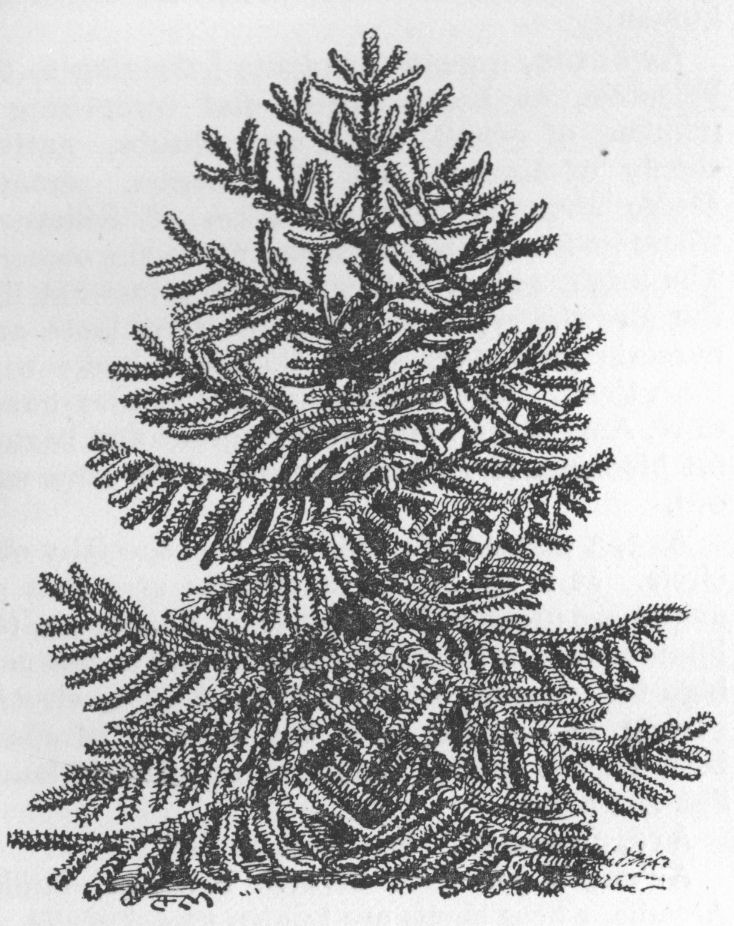
Arauca´ria, a genus of trees of the coniferous or pine order, indigenous to Australasia and South America. The species are large evergreen trees with pretty large, stiff, flattened, and generally imbricated leaves, verticillate spreading branches, and bearing large cones, each scale having a single large seed. The species A. imbricāta (the Chile pine or monkey-puzzle), with hard, sharp, pointed leaves, was introduced into Britain in 1796. It is a native of the mountains of Southern Chile, where it forms vast forests and yields a hard durable wood. Its seeds are eaten when roasted. The Moreton Bay pine of New South Wales (A. Cunninghamii) supplies a valuable timber used in house and boat building, in making furniture, and in other carpenter work. A species, A. excelsa, or Norfolk Island pine, abounds in several of the South Sea Islands, where it attains a height of 220 feet with a circumference of 30 feet, and is described as one of the most beautiful of trees. Its foliage is light and graceful, and quite unlike that of A. imbricata, having nothing of its stiff formality. Its timber is of some value, being white, tough, and close-grained.
Arau´co, a province of Chile, named from the Araucanian Indians; area, 2189 sq. miles; pop. 73,260; capital, Lebu.
Araval´li Hills, a range of Indian mountains running N.E. and S.W. across the Rajputána country, which they separate into two natural divisions—desert plains on the N.W. and fertile lands on the S.E.; highest point, Mount Abu (5653 feet).
Araxes. See Aras.
Ar´băces, one of the generals of Sardanapälus, King of Assyria. He revolted and defeated his master, and became the founder of the Median Empire in 846 B.C.
Ar´balist. See Cross-bow.
Arbe´la (now Erbil), a place in the vilayet of Bagdad, giving name to the decisive battle fought by Alexander the Great against Darius, at Gaugamela, about 50 miles distant from it, 1st Oct., 331 B.C.
Arbitrage (a˙r´bi-tra˙zh), or Arbitration of Exchanges, an operation or calculation by which the currency of one country is converted into that of another through the medium of intervening currencies, for the purpose of ascertaining whether direct or indirect drafts and remittances are preferable.—Arbitrageur (a˙r´bi-tra˙-zheur) is one who makes calculations of currency exchanges. See Stock Exchange.
Arbitra´tion, the hearing and determination of a cause between parties in controversy, by a person or persons chosen by the parties. This may be done by one person, but it is common to choose more than one. Frequently two are nominated, one by each party, with a third, the umpire (or, in Scotland, sometimes the oversman), who is called on to decide in case of the primary arbitrators differing. In such a case the umpire may be agreed upon either by the parties themselves, or by the arbitrators when they have received authority from the parties to the dispute to settle this point. The determination of arbitrators is called an award. By the law of England the authority of an arbitrator cannot be revoked by any of the parties without the leave of the court or of a judge.—Bibliography: Russell, Arbitration; Redman, Arbitration; Scots Law, see Bell, On Arbitration; American Law, see Morse, Law of Arbitration; R. G. Morris, International Arbitration.
Ar´blast. See Cross-bow.
Arbo´ga, an old Swedish city, province of Westmannland; once an important commercial town, now only of historical interest from having been at one time a residence of the family of Vasa, the scene of Church assemblies and national diets, and for the antiquities in its neighbourhood. Pop. 5050.
Arbois (a˙r-bwä), a town of France, department of Jura; famous for its wines. Pop. 5000.
Arbor Day, a day officially set apart in the United States for the annual planting of trees by the people, and especially by school-children. The custom was instituted in 1872.
Arbore´tum (Lat. arbor, a tree), a place in which a collection of different trees and shrubs is cultivated for scientific or educational purposes. The largest arboretum in Britain, perhaps the finest in the whole world, is that of the Royal Gardens, at Kew, inaugurated in 1762, to which 180 acres are now devoted. Next in celebrity are the arboreta at Edinburgh (Inverleith) and at Dublin (Glasnevin), the Botanical Gardens at Oxford, and the Botanic Gardens at Glasgow. Other arboreta are that of the Jardin des Plantes, Paris, and the Arnold Arboretum, at Jamaica Plain, Boston. The term arboretum has also been applied in a restricted sense, as in the Arboretum Fruticetum Britannicum, the monumental work by J. C. Loudon.
Ar´boriculture includes the culture of trees and shrubs, as well as all that pertains to the preparation of the soil, the sowing of the seeds, and the treatment of the plants in their young state, the preparation of the land previous to their final transplantation, their just adaptation to soil and situation, their relative growth and progress to maturity, their management during growth, and the proper season and period for felling them.
Arbor Vitæ (literally, 'tree of life'), the name of several coniferous trees of the genus Thuja, allied to the cypress, with flattened branchlets, and small imbricated or scale-like leaves. The name is derived from valuable medicinal properties having formerly been ascribed to the aromatic resin they mostly yield. Those generally cultivated in Britain are: the common Arbor Vitæ (Thuja occidentālis), a native of North America, where it grows to a height of 40 or 50 feet, introduced into Britain about 1566; the giant Arbor Vitæ or Red Cedar (Thuja gigantea), introduced in 1854; and the Chinese Arbor Vitæ (Thuja orientālis).
Arbroath (ar-brōth´), or Aberbrothock, a royal municipal and police burgh and seaport in the county of Forfar, Scotland, at the mouth of the small River Brothock. Its ancient abbey, founded by William the Lion in 1178, and dedicated to Saints Mary and Thomas à Becket, is now a picturesque ruin. There are numerous flax and hemp spinning-mills and factories, and much canvas and linen is made; also tanning, shoemaking, and fishing, and a small shipping trade, but the harbour is bad. Pop. 19,499. It unites with Montrose, Forfar, Brechin, and Inverbervie (the Montrose burghs) in sending a member to Parliament.
Arbuth´not, John, an eminent physician and distinguished wit, born at Arbuthnot, Kincardineshire, Scotland, 1667, died 1735. He received the degree of Doctor of Medicine at the University of St. Andrews, and went to London, where he soon distinguished himself by his writings and by his skill in his profession. In 1704 he was chosen Fellow of the Royal Society, and soon after he was appointed physician extraordinary, and then physician in ordinary to Queen Anne. About this time he became intimate with Swift, Pope, Gay, and other wits of the day. His writings, other than professional or scientific, include his contributions (in conjunction with Swift and Pope) to the Memoirs of Martinus Scriblerus, History of John Bull, Art of Political Lying, &c. He was conspicuous not only for learning and wit, but also for worth and humanity.
Ar´butus, a genus of plants belonging to the Ericaceæ, or heath order, and comprising a number of small trees and shrubs, natives chiefly of Europe and N. America. Arbŭtus Unĕdo abounds near the lakes of Killarney, where its fine foliage adds charms to the scenery. The bright red or yellow berries, somewhat like the strawberry, have an unpleasant taste and narcotic properties. The Corsicans make wine from them. The trailing arbutus or may-flower of N. America, a plant with fragrant and beautiful blossoms, is Epigæa repens, of the same nat. ord.
Arc, a portion of a curved line, especially of a circle. It is by means of circular arcs that all angles are measured.—Electric or Voltaic arc, the luminous arc of intense brightness and excessively high temperature which is formed by an electric current in crossing over the interval of space between the carbon points of an electric lamp. See Arc-light.
Arc, Jeanne d'. See Joan of Arc.
Ar´ca, a genus of bivalve molluscs, family Arcadæ, whose shells are known as ark-shells.
Arcachon (a˙r-ka˙-shōn˙), a town of S.W. France, department Gironde, on the almost landlocked basin of Arcachon, a much-frequented bathing-place, with great oyster-breeding establishments. It is connected by railway with Bordeaux. Pop. 10,266.
Arcade, a series of arches supported on piers or pillars, used generally as a screen and support of a roof, or of the wall of a building, and having beneath the covered part an ambulatory as round a cloister, or a footpath with shops or dwellings, as frequently seen in old Italian towns. Sometimes a porch or other prominent part of an important building is treated with arcades. At the present day Bologna, Padua, and Berne have fine examples of mediæval arcaded streets, and among more modern work various streets in Turin, and the Rue de Rivoli, Paris, are lined with arcades, with shops underneath. In mediæval architecture the term arcade is also applied to a series of arches supported on pillars forming an ornamental dressing or enrichment of a wall, a mode of treatment of very frequent occurrence in the towers, apses, and other parts of churches. In modern use the name arcade is often applied to a passage or narrow street containing shops arched over and covered with glass, as for example the Burlington Arcade, London, the Royal Arcade at Newcastle, and the Gallería Vittorio Emmanuele in Milan.
Arca´dia, the central and most mountainous portion of the Peloponnesus (Morea), the inhabitants of which in ancient times were celebrated for simplicity of character and manners. Their occupation was almost entirely pastoral, and thus the country came to be regarded as typical of rural simplicity and happiness. At the present day Arcadia forms a nomarchy of the kingdom of Greece. Area, 2028 sq. miles. Pop. 162,324.
Arca´dius, born in 377, died 408; son of the Emperor Theodosius, on whose death in 395 the empire was divided, he obtaining the East, and his brother Honorius the West. He proved a feeble and pusillanimous prince.
Arcanum, The Great (meaning secret), a term applied in the Middle Ages to the highest problems of alchemy and the discovery of the supposed great secrets of nature, such as the philosopher's stone and the elixir of life. See Alchemy.
Arcature, in architecture, a small arcade built into a wall or applied against it, decorative rather than structural. Arcatures occur in Anglo-Norman churches of the twelfth and thirteenth centuries.
Arcesilaus (a˙r-ses-i-lā´us), a Greek philosopher, the founder of the second or middle academy, was born about 315 B.C., died 239 B.C. He left no writings, and of his opinions so little is known that it has been doubted whether he was a strict Platonist or a sceptic.
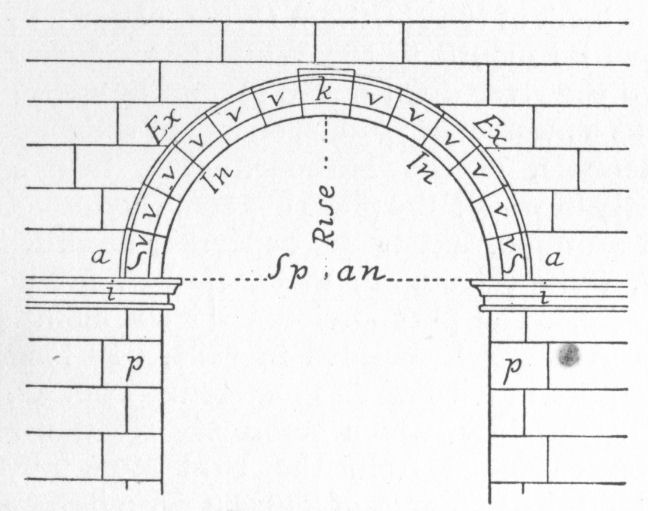
Parts of an Arch
a. Abutments. i. Impost. p. Piers. v. Voussoirs or arch-stones. k. Keystone. s. Springers. In. Intrados. Ex. Extrados.
Arch, a structure composed of separate pieces, such as stones or bricks, having the shape of truncated wedges, arranged on a curved line, so as to retain their position by mutual pressure. The separate stones which compose the arch are called voussoirs or arch-stones; the extreme or lowest voussoirs are termed springers, and the uppermost or central one is called the keystone. The under or concave side of the voussoirs is called the intrados, and the upper or convex side the extrados of the arch. The supports which afford resting and resisting points to the arch are called piers and abutments. The upper part of the pier or abutment, where the arch rests—technically where it springs from—is the impost. The span of an arch is in circular arches the length of its chord, and generally the width between the points of its opposite imposts whence it springs. The rise of an arch is the height of the highest point of its intrados above the line of the imposts; this point is sometimes called the under side of the crown, the highest point of the extrados being the crown. Arches are designated in various ways, as from their shape (circular, elliptic, &c.), or from the resemblance of the whole contour of the curve to some familiar object (lancet arch, horse-shoe arch), or from the method used in describing the curve, as equilateral, three-centred, four-centred, ogee, and the like; or from the style of architecture to which they belong, as Roman, pointed, and Saracenic arches.—Triumphal arch, originally a simple decorated arch under which a victorious Roman general and army passed in triumph. At a later period the triumphal arch was a richly-sculptured, massive, and permanent structure, having an archway passing through it, with generally a smaller arch on either side. The name is sometimes given to an arch, generally of wood decorated with flowers or evergreens, erected on occasion of some public rejoicing, &c.