VOLUME I PART 2 (continued 2)
Reading edition
Androclus, or Androcles, a Roman slave who once pulled a thorn out of a lion's paw and dressed the wound. Androclus was afterwards condemned to be thrown to the lions in the Circus Maximus, and encountered the same lion that he had helped; the beast, instead of attacking him, fawned on him and caressed him. The story is told by Aulus Gellius, Noctes Atticæ, v, 14.
Andrϫcium, in botany, the male system of a flower; the aggregate of the stamens.
Andromache (an-drom´a-kē), in Greek legend, wife of Hector, and one of the most attractive women of Homer's Iliad. The passage describing her parting with Hector, when he was setting out to battle, is well known and much admired (Iliad, vi, 369-502). Euripides and Racine have made her the chief character of tragedies.
Androm´ĕda, in Greek mythology, daughter of the Ethiopian king Cepheus and of Cassiopeia. Cassiopeia having boasted that her daughter surpassed the Nereids, if not Hēra (Juno) herself, in beauty, the offended goddesses prevailed on their father, Poseidōn (Neptune), to afflict the country with a horrid sea-monster, which threatened universal destruction. To appease the offended god, Andromeda was chained to a rock, but was rescued by Perseus; and after death was changed into a constellation. The legend forms the subject of tragedies by Euripides and Sophocles, and Ovid introduced it into his Metamorphoses.
Androm´eda. See Ericaceæ.
Androni´cus, the name of four emperors of Constantinople.—Andronicus I, Comnenus, born 1110, murdered 1185.—Andronicus II, Palæologus, born 1258, died 1332. His reign is celebrated for the invasion of the Turks.—Andronicus III, Palæologus the Younger, born 1296, died 1341.—Andronicus IV, Palæologus, reigned in the absence of John IV. In 1373 he gave way to his brother Manuel, and died a monk.
Androni´cus, Livius, the most ancient of the Latin dramatic poets; flourished about 240 B.C.; by origin a Greek, and long a slave. A few fragments of his works have come down to us.
Androni´cus of Rhodes, a peripatetic philosopher who lived at Rome in the time of Cicero. He arranged Aristotle's works in much the same form as they retain in present editions.
Androni´cus Cyrrhestes (sir-es´tēz), a Greek architect about 100 B.C., who constructed at Athens the Tower of the Winds, an octagonal building, still standing. On the top was a Triton, which indicated the direction of the wind. Each of the sides had a sort of dial, and the building formerly contained a clepsydra or water-clock.
Andropo´gon, a large genus of grasses, mostly natives of warm countries. A. Schœnanthus is the sweet-scented lemon-grass of conservatories. Others also are fragrant.
An´dros (now Andro), one of the islands of the Grecian Archipelago, the most northerly of the Cyclades; about 25 miles long and 6 or 7 broad; area, 100 sq. miles. A considerable trade is done in silk, wine, olives, figs, oranges, and lemons. Andro or Castro, the capital, has a good port. Pop. 18,809.
Andros Islands, a group of isles belonging to the Bahamas, lying south-west of New Providence, not far from the east entrance to the Gulf of Florida. The passages through them are dangerous. Pop. 7545.
Andrussovo, a Russian village in the government of Smolensk. A treaty was signed here between Poland and Russia (1667).
Andujar (a˙n-dö-här´), a town in Spain, in Andalusia, 50 miles E.N.E. of Cordova, on the Guadalquivir, which is here crossed by a fine bridge; manufactures a peculiar kind of porous earthen water-bottles and jugs (alcarazas). Pop. 16,500.
An´ecdote, originally some particular about a subject not noticed in previous works on that subject; now any particular or detached incident or fact of an interesting nature; a single passage of private life.
Anega´da, a British West Indian island, the most northern of the Virgin group, 10 miles long by 4½ broad; contains numerous salt ponds, from which quantities of salt are obtained. Pop. 200.
Anelectric, a body not easily electrified.
Anelectrode, the positive pole of a galvanic battery.
Beckley's Improved Robinson Cup Anemometer
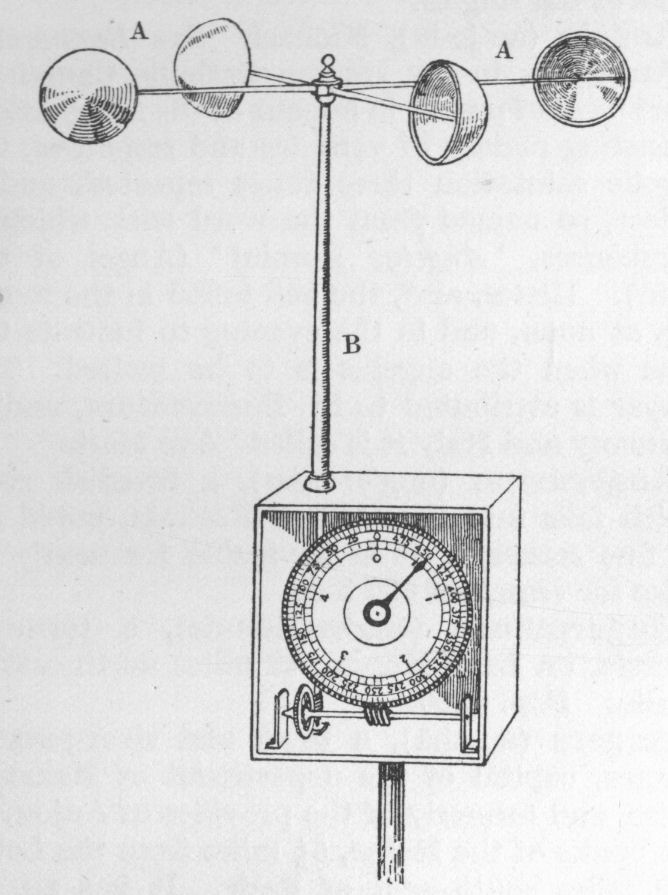
Anemom´eter (Gr. anĕmos, wind, metron, measure), an instrument for measuring the force and velocity of the wind. This force is usually measured by the pressure of the wind upon a square plate attached to one end of a spiral spring (with its axis horizontal), which yields more or less according to the force of the wind, and transmits its motion to a pencil which leaves a trace upon paper moved by clockwork. Various instruments have been devised for this purpose, but the one most commonly adopted by meteorological stations is after the type invented by Dr. Robinson of Armagh. It consists of four hemispherical cups A attached to the ends of equal horizontal arms, forming a horizontal cross which turns freely about a vertical axis B. By means of an endless screw carried by the axis a train of wheelwork is set in motion; and the indication is given by a hand which moves round a dial; or in some instruments by several hands moving round different dials like those of a gas-meter. It is found that the centre of each cup moves with a velocity which is almost exactly one-third of that of the wind. There are various other forms of the instrument, one of which is portable, and is especially intended for measuring the velocity of currents of air passing through mines, and the ventilating spaces of hospitals and other public buildings. The direction of the wind as indicated by a vane can also be made to leave a continuous record by various contrivances; one of the most common being a pinion carried by the shaft of a vane, and driving a rack which carries a pencil.
Anem´ŏnē (Gr. anĕmos, wind), wind-flower, a genus of plants belonging to the Buttercup family (Ranunculaceæ), containing about ninety species, found in temperate regions, three of them occurring in Britain: the white-flowered (A. nemorōsa), the only one truly native; the blue-flowered (A. apennīna); and the yellow-flowered (A. ranunculoides), a common European species naturalized in some parts of Britain. Several species are cultivated as florists' flowers.
Anemoph´ilous, said of flowers that are fertilized by the wind conveying the pollen.
Anem´oscope, any contrivance indicating the direction of the wind; generally applied to a vane which turns a spindle descending through the roof to a chamber where, by means of a compass-card and index, the direction of the wind is shown.
Aneroid Barometer. See Barometer.
Ane´thum, a genus of plants; dill.
Aneu´rin, a poet and prince of the Cambrian Britons who flourished in the seventh century, author of an epic poem, the Gododin, relating the defeat of the Britons of Strathclyde by the Saxons at the battle of Cattraeth. See Celtic Literature.
An´eurism, or Aneurysm (Gr. aneurysma, a widening), the dilatation or expansion of some part of an artery. Aneurisms arise partly from the too violent motion of the blood, and partly from degenerative changes occurring in the coats of the artery, diminishing their elasticity. They are therefore more frequent in the great branches; in particular, in the vicinity of the heart, in the arch of the aorta, and in the extremities, where the arteries are exposed to frequent injuries by stretching, violent bodily exertions, thrusts, falls, and contusions. An internal aneurism may burst and cause death.
Angara´, a Siberian river which flows into Lake Baikal at its N. extremity, and leaves it near the S.W. end, joining the Yenisei as the Lower Angara or Upper Tunguska.
Angel (Gr. angelos, a messenger), one of those spiritual intelligences who are regarded as dwelling in Heaven and employed as the ministers or agents of God. To these the name of good angels is sometimes given, to distinguish them from bad angels, who were originally created to occupy the same blissful abode, but lost it by rebellion. The Old Testament represents them as messengers of the Divine will, and Christ spoke of them more than once (St. Matt. xviii, 10; St. Luke, xv, 10). Generally, however, Scripture speaks of angels with great reserve, Michael and Gabriel alone being mentioned by name in the canonical books, while Raphael is mentioned in the Apocrypha. The angels are represented in Scripture as in the most elevated state of intelligence, purity, and bliss, ever doing the will of God so perfectly that we can seek for nothing higher or better than to aim at being like them. There are indications of a diversity of rank and power among them, and something like angelic orders—Michael, Gabriel, Raphael, Uriel, &c., seraphim and cherubim. They are represented as frequently taking part in communications made from heaven to earth, as directly and actively ministering to the good of believers, and shielding or delivering them from evils incident to their earthly lot. That every person has a good and a bad angel attendant on him was an early belief, and is held to some extent yet. Roman Catholics, since St. Ambrosius, who died in 397, show a certain veneration or worship to angels, and beg their prayers and their kind offices. The New Testament, however, formally forbidding such veneration (Col. ii, 18, &c.), Protestants consider this unlawful.
Angel of Queen Elizabeth
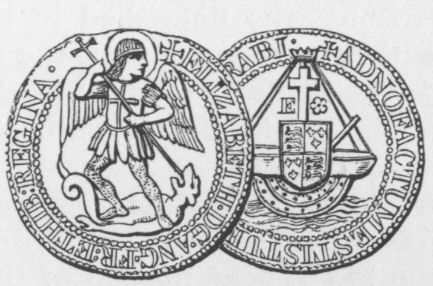
Angel, a gold coin introduced into England in the reign of Edward IV, and coined down to the Commonwealth, so named from having the representation of the archangel Michael piercing a dragon upon it. It had different values in different reigns, varying from 6s. 8d. to 10s.
Angel-fish, a fish, Squatīna angĕlus, nearly allied to the sharks, very ugly and voracious, preying on other fish. It is from 6 to 8 feet long, and takes its name from its pectoral fins, which are very large, extending horizontally like wings when spread. This fish connects the rays with the sharks, but it differs from both in having its mouth placed at the extremity of the head. It is common on the south coasts of Britain, and is also called Monk-fish and Fiddle-fish.
Angel´ica, a genus of umbelliferous plants, one of which, A. sylvestris, a tall plant bearing large umbels of white flowers tinged with pink, is common in wet places in Britain, and was formerly believed to possess angelic properties as an antidote to poison, a specific against witchcraft, &c. The name is also given to an allied plant, the Archangelica officinālis, found on the banks of rivers and ditches in the north of Europe, once generally cultivated as an esculent, and still valued for its medicinal properties. It has a large fleshy aromatic root, and a strong-furrowed branched stem as high as a man. It is cultivated for its agreeable aromatic odour and carminative properties. Its blanched stems, candied with sugar, form a very agreeable sweetmeat, possessing tonic and stomachic qualities.
Angelico (a˙n-jel´i-kō), Fra, the common appellation of Fra Giovanni da Fiesole, one of the most celebrated of the early Italian painters. Born 1387, he entered the Dominican order in 1407, and was employed by Cosmo de' Medici in painting the monastery of St. Mark and the church of St. Annunziata with frescoes. These pictures gained him so much celebrity that Pope Nicholas V invited him to Rome to ornament his private chapel in the Vatican, and offered him the archbishopric of Florence, which Angelico declined. He died at, Rome 1455. He has been called the 'painter of seraphic dreams'. His works were considered unrivalled in finish and in sweetness and harmony of colour, and were made the models for religious painters of his own and succeeding generations.
Angeln (a˙ng´eln), a district in Schleswig of about 300 sq. miles, bounded N. by the Bay of Flensburg, S. by the Schlei, E. by the Baltic, the only continental territory which has retained the name of the Angles.
Angelo (a˙n´je-lō), Michael. See Buonarotti.
An´gelus, in the Roman Catholic Church, a short form of prayer in honour of the incarnation, consisting mainly of versicles and responses, the angelic salutation three times repeated, and a collect, so named from the word with which it commences, 'Angelus Domini' (Angel of the Lord). Hence, also, the bell tolled in the morning, at noon, and in the evening to indicate the time when the angelus is to be recited. The prayer is attributed to St. Bonaventura, and in Germany and Italy it is called 'Ave Maria'.
Ångermann (ong´er-ma˙n), a Swedish river which falls into the Gulf of Bothnia, noted for its fine scenery. It is navigable for nearly 70 miles for vessels of 600 tons.
Angermünde (a˙ng´er-mün-de), a town in Prussia, on Lake Münde, 42 miles north-east of Berlin. Pop. 8200.
Angers (a˙n˙-zhā), a town and river-port of France, capital of the department of Maine-et-Loire, and formerly of the province of Anjou, on the banks of the Maine, 5½ miles from the Loire, 150 miles south-west of Paris. It has an old castle, built by Louis IX, once a place of great strength, now used as a prison, barrack, and powder-magazine; a fine cathedral of the twelfth and thirteenth centuries, with very fine old painted windows; is the seat of a bishop, and has a school of arts and manufactures; a public library, an art-gallery, a large modern hospital, the remains of a hospital founded by Henry II of England in 1155; courts of law, theatre, &c. It manufactures sail-cloth, hosiery, leather, and chemicals; foundries, &c. In the neighbourhood are immense slate-quarries. Pop. 83,786.
Angevins (an´je-vins), natives of Anjou, often applied to the race of English sovereigns called Plantagenets (q.v.). Anjou became connected with England by the marriage of Matilda, daughter of Henry I, with Geoffrey V, Count of Anjou. The Angevin kings of England were Henry II, Richard I, John, Henry III, Edward I, Edward II, Edward III, and Richard II.
Angilbert, St., the most celebrated poet of his age, secretary and friend of Charlemagne, whose daughter, Bertha, he married. In the latter part of his life he retired to a monastery, of which he became abbot. Died 814.
Angina Pectoris (an´ji-na pek´to-ris), or Heart-spasm, a disease characterized by an extremely acute constriction, felt generally in the lower part of the sternum, and extending along the whole side of the chest and into the corresponding arm, a sense of suffocation, faintness, and apprehension of approaching death: seldom experienced by any but those with organic heart-disease. The disease rarely occurs before middle age, and is more frequent in men than in women. Those liable to attack must lead a quiet, temperate life, avoiding all scenes which would unduly rouse their emotions. The first attack is occasionally fatal, but usually death occurs as the result of repeated seizures. The paroxysm may be relieved by opiates, or the inhalation, under due precaution, of anæsthetic vapours.
Angiosperm (an´ji-o-spėrm), a term for any plant which has its seeds enclosed in a seed-vessel. Exogens are divided into those whose seeds are enclosed in a seed-vessel, and those with seeds produced and ripened without the production of a seed-vessel. The former are angiosperms, and constitute the principal part of the species; the latter are gymnosperms, and chiefly consist of the Coniferæ and Cycadaceæ.
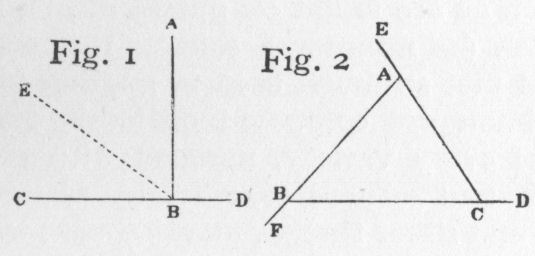
Angle, the point where two lines meet, or the meeting of two lines in a point. A plane rectilineal angle is formed by two straight lines which meet one another, but are not in the same straight line; it may be considered the degree of opening or divergence of the two straight lines which thus meet one another. A right angle is an angle formed by a straight line falling on another perpendicularly, or an angle which is measured by an arc of 90 degrees. When a straight line, as A B (fig. 1), standing on another straight line C D, makes the two angles A B C and A B D equal to one another, each of these angles is called a right angle. An acute angle is that which is less than a right angle, as E B C. An obtuse angle is that which is greater than a right angle, as E B D. Acute and obtuse angles are both called oblique, in opposition to right angles. Exterior or external angles, the angles of any rectilineal figure without it, made by producing the sides; thus, if the sides A B, B C, C A of the triangle A B C (fig. 2) be produced to the points F D E, the angles C B F, A C D, B A E are called exterior or external angles. A solid angle is that which is made by more than two plane angles meeting in one point and not lying in the same plane, as the angle of a cube. A spherical angle is an angle on the surface of a sphere, contained between the arcs of two great circles which intersect each other.
Angler (Lophius piscatorius), also from its habits and appearance called Fishing-frog and Sea-devil, a remarkable fish often found on the British coasts. It is from 3 to 5 feet long; the head is very wide, depressed, with protuberances, and bearing long separate movable tendrils; the mouth is capacious, and armed with formidable teeth. Its voracity is extreme, and it is said to lie concealed in the mud, and attract the smaller fishes within its reach by gently waving the filamentous appendages on its head.
Angles, a Low German tribe who in the earliest historical period had their seats in the district about Angeln, in the duchy of Schleswig, and who in the fifth century and subsequently crossed over to Britain along with bands of Saxons and Jutes (and probably Frisians also), and colonized a great part of what from them has received the name of England, as well as a portion of the Lowlands of Scotland. The Angles formed the largest body among the Germanic settlers in Britain, and founded the three kingdoms of East Anglia, Mercia, and Northumbria.
Anglesey (ang´gl-sē), or Anglesea ('the Angles' Island'), an island and county of North Wales, in the Irish Sea, separated from the mainland by the Menai Strait; 20 miles long and 17 miles broad; area, 176,630 acres. The surface is comparatively flat, and the climate is milder than that of the adjoining coast. The chief agricultural products are oats and barley, wheat, rye, potatoes, and turnips. Numbers of cattle and sheep are raised. Anglesey yields a little copper, lead, silver, ochre, &c. The Menai Strait is crossed by a magnificent suspension-bridge, 580 feet between the piers and 100 feet above high-water mark, and also by the great Britannia Tubular Railway Bridge. The chief market-towns are Beaumaris, Holyhead, Llangefni, and Amlweh. The county returns one member to Parliament. Pop. (1921), 51,695.
Anglesey, Henry William Paget, Marquess of, English soldier and statesman, was the eldest son of Henry, first Earl of Uxbridge, and was born in 1768. He was educated at Oxford, and in 1790 entered Parliament as member for the Carnarvon boroughs. In 1793 he entered the army, and in 1794 he took part in the campaign in Flanders under the Duke of York. In 1808 he was sent into Spain with two brigades of cavalry to join Sir John Moore, and in the retreat to Coruña commanded the rear-guard. In 1812 he became, by his father's death, Earl of Uxbridge. On Napoleon's escape from Elba he was appointed commander of the British cavalry, and at the battle of Waterloo, by the charge of the heavy brigade, overthrew the Imperial Guard. For his services he was created Marquess of Anglesey. In 1828 he became Lord-Lieutenant of Ireland and made himself extremely popular, but was recalled in consequence of favouring Catholic Emancipation. He was again Lord-Lieutenant in 1830, but lost his popularity by his opposition to O'Connell and his instrumentality in the passing of the Irish Coercion Acts; and he quitted office in 1833. From 1846-52 he was Master-General of the Ordnance. He died in 1854.
Anglicanism, the term is capable of a wider use, but is usually employed as descriptive of the type of doctrine formulated by the Church of England in the period of the Protestant Reformation. The two most notable formularies of that period are the Confession of Faith, known as the Thirty-nine Articles, which assumed its present shape in 1571, and the Liturgy, known as the Book of Common Prayer, issued in 1559 in what was substantially its present shape. By the Clerical Subscription Act of 1865 assent is required to both Prayer Book and Articles. The Articles are not and never were binding upon laymen.—Bibliography: Mgr. Moyes, Aspects of Anglicanism; F. Y. Kinsman, Principles of Anglicanism.
Angling, the art of catching fish with a hook or angle (A. Sax. angel) baited with worms, small fish, flies, &c. We find occasional allusions to this pursuit among the Greek and Latin classical writers; it is mentioned several times in the Old Testament, and it was practised by the ancient Egyptians. The first reference to angling in England is a passage in a tract, entitled Piers Fulham, supposed to have been written about the year 1420. The oldest work on the subject in English is the Treatyse of Fysshinge with an Angle, printed by Wynkyn de Worde in 1496, along with a treatise on hunting and hawking, the whole being ascribed to Dame Juliana Berners or Barnes, prioress of a nunnery near St. Albans. Walton's inimitable discourse on angling was first printed in 1653. The chief appliances required by an angler are a rod, line, hooks, and baits. Rods are made of various materials, and of various sizes. The cane rods are lightest, and where fishing-tackle is sold they most commonly have the preference; but in country places the rod is often of the angler's own manufacture. Rods are commonly made in separate joints, so as to be easily taken to pieces and put up again. They are made to taper from the butt end to the top, and are usually possessed of a considerable amount of elasticity. In length they may vary from 10 feet to more than double that length, with a corresponding difference in strength—a rod for salmon being necessarily much stronger than one suited for ordinary burn trout. The reel, an apparatus for winding up the line, is attached to the rod near the lower end, where the hand grasps it while fishing. The best are usually made of brass, are of simple construction, and so made as to wind or unwind freely and rapidly. That part of the line which passes along the rod and is wound on the reel is called the reel line, and may vary from 20 to 100 yards in length, according to the size of the water and the habits of the fish angled for; it is usually made of twisted horse-hair and silk, or of oiled silk alone. The casting line, which is attached to this, is made of the same materials, but lighter and finer. To the end of this is tied a piece of fine gut, on which the hook, or hooks, are fixed. The casting or gut lines should decrease in thickness from the reel line to the hooks. The hook, of finely-tempered steel, should readily bend without breaking, and yet retain a sharp point. It should be long in the shank and deep in the bend; the point straight and true to the level of the shank; and the barb long. Their sizes and sorts must of course entirely depend on the kind of fish that is angled for. Floats formed of cork, goose and swan quills, &c., are often used to buoy up the hook so that it may float clear of the bottom. For heavy fish or strong streams a cork float is used; in slow water and for lighter fish quill floats. Baits may consist of a great variety of materials, natural or artificial. The principal natural baits are worms: common garden worms, brandlings, and red worms, maggots, or gentles (the larvæ of blow-flies such as are found on putrid meat), insects, small fish (as minnows), salmon roe, &c. The artificial flies so much used in angling for trout and salmon are composed of hairs, furs, and wools of every variety, mingled with pieces of feathers, and secured together by plaited wire, or gold and silver thread, marking-silk, wax, &c. The wings may be made of the feathers of domestic fowls, or any others of a showy colour. Some angling authorities recommend that the artificial flies should be made to resemble as closely as possible the insects on which the fish is wont to feed, but experience has shown that the most capricious and unnatural combinations of feather, fur, &c., have been often successful where the most realistic imitations have failed. Artificial minnows, or other small fish, are also used by way of bait, and are so contrived as to spin rapidly when drawn through the water in order to attract the notice of the fish angled for. Angling, especially with the fly, demands a great deal of skill and practice, the casting of the line properly being the initial difficulty. Nowhere is the art pursued with greater success and enthusiasm than in Britain and the United States.—Bibliography: Fishing (vol. i), Salmon and Trout (vol. ii), Pike and Coarse Fish (Badminton Library); H. G. Hutchinson, Fishing (2 vols., Country Life series); Viscount Grey, Fly Fishing; Gathorne-Hardy, The Salmon; Marquess of Granby, The Trout; H. T. Sheringham, Elements of Angling; W. M. Gallichan, The Complete Fisherman.
Anglo-Catholic, a term sometimes used to designate those churches which hold the principles of the English Reformation, the Anglican or Established Church of England and the allied churches. The term is also applied to that party in the English Church which favours doctrines and religious forms closely approaching those of the Roman Catholic Church, objects to be called Protestant, and corresponds closely with the Ritualistic section of the Church.
Anglo-Egyptian Sudan. See Sudan.
Saxon Architecture. Doorway, Earl's Barton, Northampton
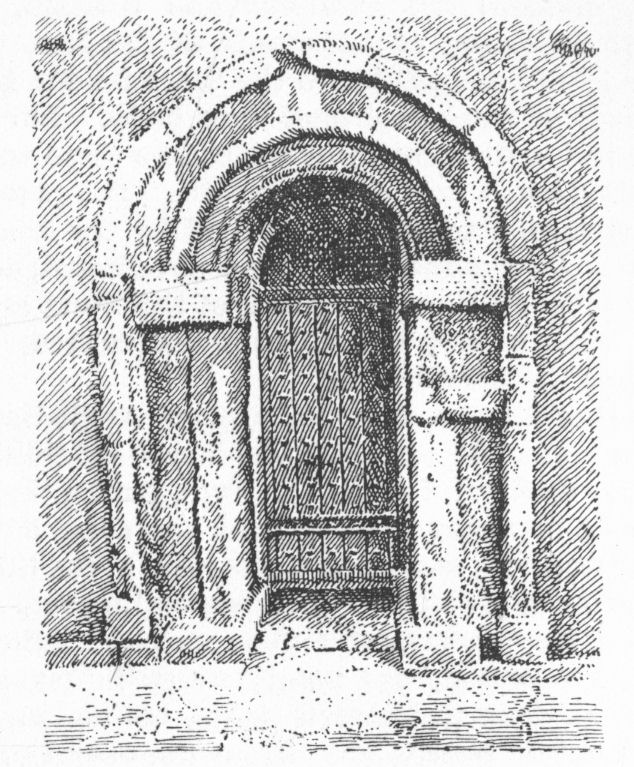
Anglo-Saxons, the name commonly given to the nation or people formed by the amalgamation of the Angles, Saxons, and Jutes, who settled in Britain in the fifth and sixth centuries after Christ, the Anglo-Saxons being simply the English people of the earlier period of English history. The tribes who were thus the ancestors of the bulk of the English-speaking nationalities came from North Germany, where they inhabited the parts about the mouths of the Elbe and Weser, and the first body of them who gained a footing in Britain are said to have landed in 449, and to have been led by Hengist and Horsa. From the preponderance of the Angles the whole country came to be called Engla-land, that is, the land of the Angles or English.
Many scholars object to the term 'Anglo-Saxon' as being inaccurate and open to misinterpretation. Correctly used, Anglo-Saxon means English-Saxon, as distinguished from the Old-Saxon of the Continent; incorrectly used, as it has been too frequently, it is taken as = Angle + Saxon, a union of Angle and Saxon. Camden (1551-1623) is responsible for the widespread use of the term; ignorance is responsible for the misuse. Many scholars prefer to apply the term 'Old English' to the language and people of England before A.D. 1100, partly because this term is more accurate and partly because its use helps to emphasize the essential continuity of the language.
The whole Anglo-Saxon community was frequently spoken of as consisting of the eorls and the ceorls, or the nobles and common freemen. The former were the men of property and position, the latter were the small landholders, handicraftsmen, &c., who generally placed themselves under the protection of some nobleman, who was hence termed their hláford or lord. Besides these there was the class of the serfs or slaves (theówas), who might be either born slaves or freemen who had forfeited their liberty by their crimes, or whom poverty or the fortune of war had brought into this position. They served as agricultural labourers on their masters' estates, and were mere chattels, as absolutely the property of their master as his cattle.
The king (cyning, cyng) was at the head of the State; he was the highest of the nobles and the chief magistrate. He was not looked upon as ruling by any Divine Right, but by the will of the people, as represented by the witan (wise men) or great council of the nation. The new king was not always the direct and nearest heir of the late king, but one of the royal family whose abilities and character recommended him for the office. He had the right of maintaining a standing army of household troops, the duty of calling together the witan, and of laying before them public measures, with certain distinctions of dress, dwelling, &c., all his privileges being possessed and exercised by the advice and consent of the witena-gemót or parliament (literally, 'meeting of the wise'). Next in rank and dignity to the king were the ealdormen, who were the chief witan or counsellors, and without whose assent laws could not be made, altered, or abrogated. They were at the head of the administration of justice in the shires, possessing both judicial and executive authority, and had as their officers the scír-geréfan or sheriffs. The ealdormen led the fyrd or armed force of the county, and the ealdorman, as such, held possession of certain lands attached to the office, and was entitled to a share of fines and other moneys levied for the king's use and passing through his hands. The whole executive government may be considered as a great aristocratical association, of which the ealdormen were the members, and the king little more than the president. The ealdorman and the king were both surrounded by a number of followers called thegnas or thanes, who were bound by close ties to their superior. The king's thanes were the higher in rank; they possessed a certain quantity of land, smaller in amount than that of an ealdorman, and they filled offices connected with the personal service of the king or with the administration of justice. The scir-geréfa (shire-reeve or sheriff) was also an important functionary. He presided at the county court along with the ealdorman and bishop, or alone in their absence; and he had to carry out the decisions of the court, levy fines, collect taxes, &c. The shires were divided into hundreds and tithings, the latter consisting of ten heads of families, who were jointly responsible to the State for the good conduct of any member of their body. For the trial and settlement of minor causes there was a hundred court held once a month. The place of the modern Parliament was held by the witena-gemót. Its members, who were not elected, comprised the æthelings or princes of the blood royal, the bishops and abbots, the ealdormen, the thanes, the sheriffs, &c.
One of the peculiar features of Anglo-Saxon society was the wergyld, which was established for the settling of feuds. A sum, paid either in kind or in money, was placed upon the life of every freeman, according to his rank in the State, his birth, or his office. A corresponding sum was settled for every wound that could be inflicted upon his person; for nearly every injury that could be done to his civil rights, his honour, or his domestic peace, &c. From the operation of this principle no one from king to peasant was exempt.
Ploughing From an Anglo-Saxon Calendar in the British Museum.
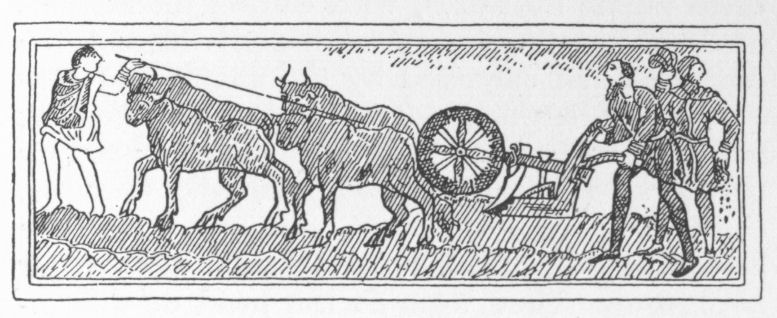
Agriculture, including especially the raising of cattle, sheep, and swine, was the chief occupation of the Anglo-Saxons. Gardens and orchards are frequently mentioned, and vineyards were common in the southern counties. The forests were extensive, and valuable both from the mast they produced for the swine, and from the beasts of the chase which they harboured. Hunting was a favourite recreation among the higher ranks, both lay and clerical. Fishing was largely carried on, herrings and salmon being the principal fish caught; and the Anglo-Saxon whaling vessels used to go as far as Iceland. The manufactures were naturally of small moment. Iron was made to some extent, and some cloth, and saltworks were numerous. In embroidery and working of gold the English were famous over Europe. There was a considerable trade at London, which was frequented by Normans, French, Flemings, and the merchants of the Hanse towns. Our Anglo-Saxon forefathers were notorious for their excess in eating and drinking, and in this respect formed a strong contrast to their Norman conquerors. Ale, mead, and cider were the common beverages, wine being limited to the higher classes. Pork and eels were favourite articles of food. The houses were rude structures, but were often richly furnished and hung with fine tapestry. The dress of the people was loose and flowing, composed chiefly of linen, and often adorned with embroidery. The men wore their hair long and flowing over their shoulders. Christianity was introduced among the Anglo-Saxons in the end of the sixth century by St. Augustine, who was sent by Pope Gregory the Great, and became the first Archbishop of Canterbury. Kent, then under King Ethelred, was the first place where it took root, and thence it soon spread over the rest of the country. The Anglo-Saxon Church long remained independent of Rome, notwithstanding the continual efforts of the Popes to bring it under their power. It was not till the tenth century that this result was brought about by Dunstan. Many Anglo-Saxon ecclesiastics were distinguished for learning and ability, but the Venerable Bede holds the first place.
Anglo-Saxon Language.—The Anglo-Saxon language, which is simply the earliest form of English, claims kinship with Dutch, Icelandic, Danish, Swedish, and German, especially with the Low German dialects (spoken in North Germany). It was called by those who spoke it Englisc (English). The existing remains of Anglo-Saxon literature show different dialects, of which the northern and the southern were the principal. The former was the first to be cultivated as a literary language, but afterwards it was supplanted in this respect by the southern or that of Wessex. It is in the latter that the principal Anglo-Saxon works are written. The Anglo-Saxon alphabet was substantially the same as that which we still use, except that some of the letters were different in form, while it had two characters either of which represented the sounds of th in thy and in thing. Nouns and adjectives are declined much as in German or in Latin. The pronouns of the first and second person had a dual number, 'we two' or 'us two' and 'you two', besides the plural for more than two. The infinitive of the verb is in -an, the participle in -ende, and there is a gerund somewhat similar in its usage to the Latin gerund. The verb had four moods—indicative, subjunctive, imperative, and infinitive, but only two tenses, the present (often used as a future) and the past. Other tenses and the passive voice were formed by auxiliary verbs. Anglo-Saxon words terminated in a vowel much more frequently than the modern English, and altogether the language is so different that it has to be learned quite like a foreign tongue. Yet, notwithstanding the large number of words of Latin or French origin that our language now contains, and the changes it has undergone, its framework, so to speak, is still Anglo-Saxon. Many chapters of the New Testament do not contain more than 4 per cent of non-Teutonic words, and as a whole it averages perhaps 6 or 7.
The existing remains of Anglo-Saxon literature include compositions in prose and poetry, some of which must be referred to a very early period, one or two perhaps to a time before the Angles and Saxons emigrated to England. The most important Anglo-Saxon poem is the ancient epic of Beowulf, extending to more than 6000 lines. Beowulf is a Scandinavian prince, who slays a monster named Grendel, after encountering supernatural perils, and is at last slain in a contest with a frightful dragon. Its scene appears to be laid entirely in Scandinavia. Its date is uncertain; parts of it may have been brought over at the emigration from Germany, though in its present form it is much later than this. The poetical remains include a number of religious poems, or poems on sacred themes; ecclesiastical narratives, as lives of saints and versified chronicles; psalms and hymns; secular lyrics; allegories, gnomic poems, riddles, &c. The religious class of poems was the largest, and of these Cædmon's (flourished about 660) are the most remarkable. His poems consist of paraphrases of considerable portions of the Bible history, and treat of the creation, the temptation, the fall, the exodus of the Israelites, the story of Daniel, the incarnation, and the harrowing of hell, or release of the ransomed souls by Christ. Other most interesting poems are those ascribed to Cynewulf, the Christ, Elene, and Juliana, the subjects respectively being Christ, the finding of the cross by the Empress Helena, and the life of Juliana. Rhyme was not used in Anglo-Saxon poetry, alliteration being employed instead, as in the older northern poetry generally. The style of the poetry is highly elliptical, and it is full of harsh inversions and obscure metaphors.
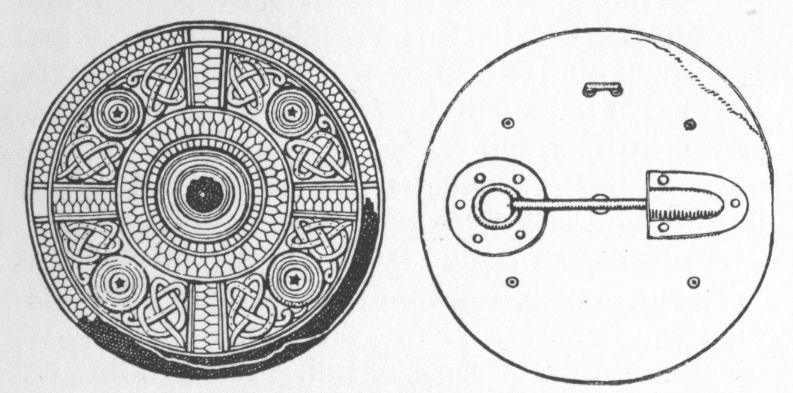
Anglo-Saxon Brooch
Ornament on front (left) is formed by means of plates of thin gold and wire, with bosses of ivory and red glass.
The Anglo-Saxon prose remains consist of translations of portions of the Bible, homilies, philosophical writings, history, biography, laws, leases, charters, popular treatises on science and medicine, grammars, &c. Many of these were translations from the Latin. The Anglo-Saxon versions of the Gospels, next to the Moeso-Gothic, are the earliest scriptural translations in any modern language. The Psalms are said to have been translated by Bishop Aldhelm (died 709), and also under Alfred's direction; and the Gospel of St. John by Bede; but it is not known who were the authors of the extant versions. A translation of the first seven books of the Bible is believed to have been the work of Ælfric, who was Abbot of Ensham and lived about the beginning of the eleventh century. We have also eighty homilies from his pen, several theological treatises, a Latin grammar, &c. King Alfred was a diligent author, besides being a translator of Latin works. We have under his name translations of Boethius' De Consolatione Philosophiæ, the Universal History of Orosius, Bede's Ecclesiastical History, the Pastoral Care of Gregory the Great, &c. The most valuable to us of the Anglo-Saxon prose writings is the Saxon Chronicle, as it is called, a collection of annals recording important events in the history of the country, and compiled in different religious houses. Of this Chronicle there are seven MSS. in existence, and the latest text comes down to 1154. A considerable body of laws remains, as well as a large number of charters. The whole of the literature has never yet been printed. For Anglo-Saxon history, see England.—Bibliography: (History) H. M. Chadwick, The Origin of the English Nation (Cambridge); (Language) Sweet, Anglo-Saxon Primer and Reader; (Literature) B. ten Brink, Geschichte der Englischen Litteratur; Stopford A. Brooke, English Literature, from the beginning to the Norman Conquest; Henry Morley, English Writers (vols. i and ii).
Anglo-Saxon Law. Series of laws written in the vernacular, and unique among Teutonic peoples, were issued from the seventh century onwards by Æthelberht, Hlothhere, Eadric, and Withraed, Kings of Kent, by Ine, King of Wessex, by Alfred, Edward the Elder, Athelstan, Edmund, Edgar, Æthelred, and Canute, in addition to a number of important by-laws and regulations of various kinds, which bear no king's name. We hear, also, of laws issued by other kings which have been lost, and there must have been a considerable body of traditional law which was never committed to writing. What laws are extant, show us a society mainly agricultural, divided by birth into a noble, a free peasant, and a servile class. There was also a dependent class in Kent, intermediate between the freeman and the slave. The strongest social ties were those of the kindred, and the relationship between lord and man.
The laws were issued by the king and his councillors. Cases were decided by the production of oaths which varied in value according to the rank of the swearer, or by the several forms of the ordeal. No distinction was made between civil and criminal law, and even homicide could be atoned for by payment of a sum varying according to the social status of the dead man. The object of the laws was to restrict private vengeance, to prevent and punish theft (primarily of cattle), to stop dishonest trading, to secure the persons and residences of the people, to enforce the mutual obligations of relatives, and masters and men, to provide adequate defence for the kingdom by means of garrisoned boroughs and a well-armed mounted infantry, to protect the helpless, and to safeguard the rights of the Church and its servants.
The early laws present considerable difficulty owing to their antiquity. The laws of Æthelberht are the earliest records in the English language, though, like many of the other laws, they are only preserved in a MS. of the twelfth century. The standard edition is Liebermann's Gesetze der Angelsachsen (Halle, A. S. Max Niemeyer).—Bibliography: Pollock and Maitland, History of English Law; H. M. Chadwick, Studies in Anglo-Saxon Institutions.
Ango´la, a Portuguese territory in Western Africa, south of the Congo, extending from the sea to Rhodesia, and from about lat. 6° S. to lat. 17° S. (area, 484,800 sq. miles; pop. 4,119,000). It is a country of varied features, and its resources, as yet hardly known, are probably very great. The province is rich in malachite, copper, iron, petroleum, and salt; rubber supplies are becoming exhausted. The Coanza (Kwanza) is the largest river. The capital is the seaport of Loanda; other ports are Benguella (or Benguela) and Mossamedes. Three railways now run inland from these places. It exports coffee, hides, gum, rubber, wax, &c.
Angola Pea (Cajānus indicus). See Pigeon Pea.
Ango´niland, a district of South Africa, lying to the west of the southern half of Lake Nyassa, and partly in British Central Africa, partly in Rhodesia. It is a plateau with an average height of 4000 feet, the name being derived from the Angoni, a race of mixed Zulu blood, who used to make murderous raids on their neighbours, and have given much trouble to the missionaries and others.
Ango´ra (ancient, Ancy´ra), a town in Asia Minor, 215 miles E.S.E. of Constantinople, with considerable remains of Byzantine architecture, and relics of earlier times, both Greek and Roman, such as the remnants of the Monumentum Ancyranum, raised in honour of the Emperor Augustus, and giving us much valuable information about his public life and work. All the animals of this region are long haired, especially the goats (see Goat), sheep, and cats. This hair forms an important export as well as the fabric called camlet here manufactured from it; other exports being goats' skins, dye-stuffs, gums, honey and wax, &c. A railway connects it with Skutari. Pop. 32,000. In 1920 Kemal Pasha set up a National Government at Angora, and refused to recognize the Treaty of Sèvres. A treaty concluded with France was ratified by the Angora Government on 23rd Oct., 1921.
Angostu´ra, or Ciudad Bolivar, a city of Venezuela, capital of the province of Bolivar, on the Orinoco, about 240 miles from the sea, with governor's residence, a college, a handsome cathedral, and a considerable trade, steamers and sailing-vessels ascending to the town. Exports: gold, cotton, indigo, tobacco, coffee, cattle, &c.; imports: manufactured goods, wines, flour, &c. Pop. 17,535.
Angostura Bark, the aromatic bitter medicinal bark obtained chiefly from Galipēa officinālis, a tree of 10 to 20 feet high, growing in the northern regions of South America; nat. ord. Rutaceæ. The bark is valuable as a tonic and febrifuge, and is also used for a kind of bitters. From this bark being adulterated, indeed sometimes entirely replaced, by the poisonous bark of Strychnos Nux-Vomica, its use as a medicine has been almost given up.
Angoulême (a˙n˙-gö-lām), an ancient town of Western France, capital of department Charente, on the Charente, 60 miles N.N.E. of Bordeaux, on the summit of a rocky hill. It has a fine old cathedral, built in the twelfth century and restored in 1875, a beautiful modern town hall, built in 1858, a lyceum, public library, natural history museum, &c. There are manufactures of paper, woollens, and linens; distilleries, sugar-works, tanneries, &c. Calvin lived here for three years (1527-30). Pop. 38,211.
Angra do Heroismo, the chief seaport of Terceira, one of the Azores, with the only convenient harbour in the whole group. It has a cathedral, a military college and arsenal, &c., and is the residence of the Governor-General of the Azores, and of the foreign consuls. Pop. 10,057.
Angra Pequena (a˙n´gra˙ pe-kā´na˙; Port. 'little bay'), a bay on the coast of former German S.W. Africa, where the Bremen commercial firm Lüderitz in 1883 acquired a strip of territory and established a trading station. In 1884, notwithstanding some weak protests of the British, Germany took under her protection the whole coast territory from the Orange River to 26° S. lat., and soon after extended the protectorate to the Portuguese frontier, but not including the British settlement of Walvis Bay. Angra Pequena, called by the Germans Lüderitzbucht, was captured by the South African forces in Sept., 1915. See South-West Africa.
Angri (a˙n´grē), a town of Southern Italy, 12 miles N.W. of Salerno, in the centre of a region which produces grapes, cotton, and tobacco in great quantities. In the vicinity of Angri, Teias, King of the Ostrogoths, was defeated by Narses. Pop. 11,574.
Anguilla (an-gwil´la). See Eel.
Anguilla (ang-gil´a), or Snake Island, one of the British West India Islands, 60 miles N.E. of St. Kitts; about 20 miles long, with a breadth varying from 3 to 1¼ miles; area, 35 sq. miles. A little sugar, cotton, tobacco, and maize is grown. There is a saline lake in the centre, which yields salt. Pop. 4075, of whom 100 are white.
Anguis (ang´gwis). See Blind-worm.
Angus (ang´gus), a name of Forfarshire.
An´halt, formerly a duchy of North Germany, lying partly in the plains of the Middle Elbe, and partly in the valleys and uplands of the Lower Harz, and almost entirely surrounded by Prussia; area, 888 sq. miles. All sorts of grain, wheat especially, are grown in abundance; also flax, rape, potatoes, tobacco, hops, and fruit. Excellent cattle are bred. The inhabitants are principally occupied in agriculture, though there are some iron-works and manufactures of woollens, linens, beet-sugar, tobacco, &c. The dukes of Anhalt traced their origin to Bernard (1170-1212), son of Albert the Bear. In time the family split up into numerous branches, and the territory was afterwards held by three dukes (Anhalt-Köthen, Anhalt-Bernburg, and Anhalt-Dessau). In 1863 the Duke of Anhalt-Dessau became sole heir to the three duchies. The united principality, incorporated in the German Empire, had one vote in the Bundesrath and two in the Reichstag. The executive power, previous to the changes resulting from the European War, was vested in the duke, and the legislative in a Diet of thirty-six members. The reigning duke in 1918 was Eduard, who succeeded his brother on 21st April, 1918. With the outbreak of the revolution in Germany in 1918 Anhalt became a republic, but its status in the German Republic still remains to be determined. Pop. (1919), 331,258, almost all Protestants. The chief towns are Dessau, Bernburg, Köthen, and Zerbst.
An´holt, an island belonging to Denmark, in the Cattegat, midway between Jutland and Sweden, 7 miles long, 4½ broad, largely covered with drift-sand, and surrounded by dangerous banks and reefs. Pop. 300.
Anhy´dride, a chemical term synonymous with acidic oxide (see Chemistry) and applied to those oxides which unite with water to form acids. They were formerly called anhydrous acids.
Anhy´drite, anhydrous sulphate of calcium, a mineral presenting several varieties of structure and colour. The vulpinite of Italy possesses a granular structure, resembling a coarse-grained marble, and is used in sculpture. Its colour is greyish-white, intermingled with blue.
Ani (ä´nē), a ruined city in Armenia, formerly the residence of the Armenian dynasty of the Bagratidæ, having in the eleventh century a population of 100,000 and 1000 churches. In the thirteenth century it was taken by the Tartars, and was destroyed by an earthquake in 1319.
Aniche (a˙-nēsh), a town or village in the French department Nord, arrondissement Douai, with coal-mines, glass-works, chemical-works, &c. Pop. 6927.
Aniene (a˙-nē-ā´nā). See Anio.
An´iline, C6H5NH2, is an extremely important substance as it forms the starting-point in the preparation of a large number of substances. It was first prepared by Unverdorben, in 1826, by distillation of indigo. Aniline is present in small quantity in coal-tar, and is prepared commercially from benzene by transforming it by means of nitric acid into nitro-benzene and reducing this with scrap-iron and hydrochloric acid. The substance can also be prepared by reducing nitro-benzene electrolytically. It is a liquid of peculiar odour, boiling at 182° C., colourless when quite pure, but rapidly darkening in colour on standing, so that commercial aniline is usually dark-brown. It is a basic substance, and forms crystalline salts with acids. The salts, like aniline itself, become coloured on exposure to air. Aniline contains the characteristic chemical group NH2, the amino group, and substances containing this group react with nitrous acid at 0° C., forming diazonium compounds; these combine readily with phenols, naphthols, and other amino compounds to form azo compounds, highly-coloured compounds many of which are dyes. Many dyes are prepared from aniline, e.g. rosaniline, magenta, methylene blue, aniline blue, &c., also some explosives, e.g. tetranitraniline, which is a powerful explosive prepared by nitrating aniline and the substance tetranitromethylaniline, "tetryl", used in detonators. Several medicinal substances are also prepared from aniline, for instance, antifebrin and atoxyl.
An´ilism, aniline poisoning, a name given to the aggregate of symptoms which often show themselves in those employed in aniline works, resulting from the inhalation of aniline vapours. It may be either acute or chronic. In a slight attack of the former kind, the lips, cheeks, and ears become of a bluish colour, and the person's walk may be unsteady; in severe cases there is loss of consciousness. Chronic anilism is accompanied by derangement of the digestive organs and of the nervous system, headaches, eruptions on the skin, muscular weakness, &c.
Animal, an organized and sentient living being. Life in the earlier periods of natural history was attributed almost exclusively to animals. With the progress of science, however, it was extended to plants. In the case of the higher animals and plants there is no difficulty in assigning the individual to one of the two great kingdoms of organic nature, but in their lowest manifestations the vegetable and animal kingdoms are brought into such immediate contact that it becomes almost impossible to assign them precise limits, and to say with certainty where the one begins and the other ends. From form no absolute distinction can be fixed between animals and plants. Many animals, such as the sea-shrubs, sea-mats, &c., so resemble plants in external appearance that they were, and even yet popularly are, looked upon as such. With regard to internal structure no line of demarcation can be laid down, all plants and animals being, in this respect, fundamentally similar; that is, alike composed of molecular, cellular, and fibrous tissues. Neither are the chemical characters of animal and vegetable substances more distinct. Animals contain in their tissues and fluids a larger proportion of nitrogen than plants, whilst plants are richer in carbonaceous compounds than the former. In some animals, moreover, substances almost exclusively confined to plants are found. Thus the outer wall of the Sea-squirts contains cellulose, a substance largely found in plant-tissues; whilst chlorophyll, the colouring-matter of plants, occurs in Hydra and many other lower animals. Power of motion, again, though broadly distinctive of animals, cannot be said to be absolutely characteristic of them. Thus many animals, as oysters, sponges, corals, &c., in their mature condition are rooted or fixed, while the embryos of many plants, together with numerous fully-developed forms, are endowed with locomotive power by means of vibratile, hair-like processes called cilia. The distinctive points between animals and plants which are most to be relied on are those derived from the nature and mode of assimilation of the food. Plants feed on inorganic matters, consisting of water, ammonia, carbonic acid, and mineral matters. They can only take in food which is presented to them in a liquid or gaseous state. The exceptions to these rules are found chiefly in the case of plants which live parasitically on other plants or animals, in which cases the plant may be said to feed on organic matters, represented by the juices of their hosts. Animals, on the contrary, require organized matters for food. They feed either upon plants or upon other animals. But even carnivorous animals can be shown to be dependent upon plants for subsistence; since the animals upon which Carnivora prey are in their turn supported by plants. Animals, further, can subsist on solid food in addition to liquids and gases; but many animals (such as the Tapeworms) live by the mere imbibition of fluids which are absorbed by their tissues, such forms possessing no distinct digestive system. Animals require a due supply of oxygen gas for their sustenance, this gas being used in respiration. Plants, on the contrary, require carbonic acid. The animal exhales or gives out carbonic acid as the part result of its tissue-waste, whilst the plant, taking in this gas, is enabled to decompose it into its constituent carbon and oxygen. The plant retains the former for the uses of its economy, and liberates the oxygen, which is thus restored to the atmosphere for the use of the animal. Animals receive their food into the interior of their bodies, and assimilation takes place in their internal surfaces. Plants, on the other hand, receive their food into their external surfaces, and assimilation is effected in the external parts, as is exemplified in the leaf-surfaces under the influence of sunlight. Cf. T. J. Parker and W. A. Haswell, Text-Book of Zoology; Cambridge Natural History.
Animal Chemistry. See Chemistry.
Animalcule (an-i-mal´kūl), a general name given to many forms of animal life from their minute size. The larger examples are just visible to the naked eye, but most of them are strictly microscopic. Some are pigmented, but the majority are colourless. The term is not applicable to a particular zoological type, but it is customary to confine it to the 'Protozoa', 'Rotifera', or 'Wheel Animalcules'.
Animal Heat. All animals possess a certain amount of heat or temperature which is necessary for the performance of vital action. The only classes of animals in which a constantly-elevated temperature is kept up are birds and mammals. The bodily heat of the former varies from 39.4° to 43.9° C., and of the latter from 35.5° to 40.5° C. The mean or average heat of the human body is about 99° F., and it never falls much below this in health. Below birds, animals are named 'cold-blooded', this term meaning in its strictly-physiological sense that their temperature is usually that of the medium in which they live, and that it varies with that of the surrounding medium. The temperature of 'warm-blooded' animals is remarkably constant, although there are individual variations. In man this variation is slight, amounting only to fractions of a degree. The cause of the evolution of heat in the animal body is referred to the union (by a process resembling ordinary combustion) of the carbon and hydrogen of the system with the oxygen taken in from the air in the process of respiration.
Animal Magnetism. See Hypnotism, Mesmer.
Animals, Cruelty to, an offence against which societies have been formed and laws passed in England and other countries. According to English law, if any person shall cruelly beat, ill-treat, overdrive, abuse, or torture any domestic animal, he shall forfeit a sum not exceeding £5 for every such offence. Bull-baiting, cock-fighting, and the like are also prohibited. Provision is also made for the punishment of persons unlawfully and maliciously killing, maiming, or wounding cattle, dogs, birds, beasts, and other animals.
Animal Worship, a practice found to prevail, or to have prevailed, in the most widely-distant parts of the world, both the Old and the New, but nowhere to such an amazing extent as in ancient Egypt, notwithstanding its high civilization. Nearly all the more important animals found in the country were regarded as sacred in some part of Egypt, and the degree of reverence paid to them was such that throughout Egypt the killing of a hawk or an ibis, whether voluntary or not, was punished with death. The worship, however, was not, except in a few instances, paid to them as actual deities. The animals were merely regarded as sacred to the deities, and the worship paid to them was symbolical.
An´ima Mun´di. See Pantheism.
Animé (an´i-me), a resin obtained from the trunk of an American tree (Hymenæa Courbaril). It is of a transparent amber colour, has a light, agreeable smell, and is soluble in alcohol. It strongly resembles copal, and, like it, is used in making varnishes. See Copal.
An´imism, the system of medicine propounded by Stahl, and based on the idea that the soul (anima) is the seat of life. In modern usage the term is applied to express the general doctrine of souls and other spiritual beings, and especially to the tendency, common among savage races, to attribute souls or spirits to inanimate things, and to explain phenomena not due to obvious natural causes by attributing them to spiritual agency. Amongst the beliefs of animism is that of a human apparitional soul, bearing the form and appearance of the body, and living after death a sort of semi-human life.—Bibliography: Sir J. G. Frazer, The Golden Bough; Andrew Lang, Myth, Ritual, and Religion.
Anio (now Aniēne or Teverōne), a river in Italy, a tributary of the Tiber, which it enters from the east a short distance above Rome, renowned for the natural beauties of the valley through which it flows, and for the remains of ancient buildings there situated, as the villas of Mæcenas and the Emperor Hadrian.
Anise (an´is; Pimpinella Anīsum), an annual plant of the nat. ord. Umbelliferæ, a native of Eastern Asia, Egypt, and the Mediterranean coasts, and cultivated in Spain, France, Italy, Malta, &c., whence the fruit, popularly called aniseed, is imported. This fruit is ovate, with ten narrow ribs, between which are oil-vessels. It has an aromatic smell, and is largely employed to flavour liqueurs (aniseed or anisette), sweetmeats, &c. Star-anise is the fruit of an evergreen Asiatic tree (Illicium anisātum), nat. ord. Magnoliaceæ, and is brought chiefly from China. Its flavour is similar to that of anise, and it is used for the same purposes. An essential oil is obtained from both kinds of anise, and is used for scenting soaps and in the preparation of cordials.
Anjou (a˙n˙-zhö), an ancient province of France, now forming the department of Maine-et-Loire, and parts of the departments of Indre-et-Loire, Mayenne, and Sarthe; area, about 3000 sq. miles. In 1060 the province passed into the hands of the House of Gatinais, of which sprang Count Godfrey V, who, in 1127, married Matilda, daughter of Henry I of England, and so became the ancestor of the Plantagenet kings. Anjou remained in the possession of the English kings up to 1204, when John lost it to the French king Philip Augustus. In 1226 Louis VIII bestowed this province on his brother Charles; but in 1328 it was reunited to the French Crown. John I raised it to the rank of a duchy, and gave it to his son Louis. Henceforth it remained separate from the French Crown till 1480, when it fell to Louis XI.
Ankarström (a˙n´ka˙r-streum), Jan Jakob, the murderer of Gustavus III of Sweden, was born about 1762, and was at first a page in the Swedish Court, afterwards an officer in the royal bodyguard. He was a strenuous opponent of the sovereign's measures to restrict the privileges of the nobility, and joined Counts Horn and Ribbing in a plot to assassinate Gustavus. The assassination took place on 15th March, 1792. Ankarström was tried, tortured, and executed in April, dying boasting of his deed.
Anker, an obsolete measure used in Britain for spirits, beer, &c., containing 8½ imperial gallons. A measure of similar capacity was used in Germany and elsewhere in Europe.
An´klam, a town in Prussia, province of Pomerania, 47 miles north-west of Stettin, on the River Peene, which is here navigable. Shipbuilding, woollen and cotton manufactures, soap-boiling, tanning, &c., are carried on. Pop. 15,280.
Anko´bar, or Anko´ber, a town in Abyssinia, former capital of Shoa, on a steep conical hill 8200 feet high. Pop. 2000.
Ankylo´sis, or Anchylo´sis, stiffness of the joints caused by a more or less complete coalescence of the bones through ossification, often the result of inflammation or injury. False ankylosis is stiffness of a joint when the disease is not in the joint itself, but in the tendinous and muscular parts by which it is surrounded.
Ankylostomi´asis, a 'worm disease' to which miners are subject in some localities, is caused by vast numbers of small parasitic worms (Ankylostoma or Anchylostoma duodenale) in the duodenum or upper portions of the intestinal canal. Deriving their sustenance from the system, these worms produce anæmia or bloodlessness (that is, deficiency of the red corpuscles of the blood), the sufferers being pallid, feeble, short-breathed, liable to faint, and unequal to any laborious work, and death may result if a cure is not effected. Fortunately the disease is not difficult to cure if the remedies are applied—remedies such as will expel the worms from the intestine. The disease is said to be common in tropical and sub-tropical countries all over the world. In Europe it was perhaps first observed in 1879 in the case of workmen engaged in excavating the St. Gothard tunnel. Since 1896 it has been well known in some of the German mines; and in 1903 it was detected among the miners engaged in the Dolcoath mine in Cornwall. The eggs of the worms are carried from the body with the fæces; under favourable circumstances they develop into larvæ, which may gain entrance again into the human body by the mouth (perhaps in drinking-water), to attain full development in the intestine. Careful sanitary arrangements are a preventive of the disease, which is also known as 'miner's worm', 'miner's anæmia', &c.
Ann, or Annat, in Scottish law, the half-year's stipend of a living, after the death of the clergyman, payable to his family or next of kin. The right to the ann is not vested in the clergyman himself, but in his representatives; and, accordingly, it can neither be disposed of by him nor attached for his debts.
Anna, an Anglo-Indian money of account, the sixteenth part of a rupee, and of the value of one penny; it is divided into four pice.
An´naberg, a town in Saxony, 47 miles south-west of Dresden. Mining (for silver, cobalt, iron, &c.) is carried on, and there are manufactures of lace, ribbons, fringes, buttons, &c. Pop. 17,025.
Anna Comne´na, daughter of Alexius I, Comnenus, Byzantine emperor. She was born 1083, and died 1148. After her father's death she endeavoured to secure the succession for her husband, Nicephorus Briennius, but was baffled by his want of energy and ambition. She wrote (in Greek) a life of her father Alexius (The Alexiad, a work in fifteen books). She is a character in Sir Walter Scott's Count Robert of Paris.
Anna Ivanov´na, Empress of Russia, born in 1693, the daughter of Ivan, the elder half-brother of Peter the Great. She was married in 1710 to the Duke of Courland, in the following year was left a widow, and in 1730 ascended the throne of the tsars on the condition proposed by the senate, that she would limit the absolute power of the tsars, and do nothing without the advice of the council composed of the leading members of the Russian aristocracy. But no sooner had she ascended the throne than she declared her promise null, and proclaimed herself autocrat of all the Russias. She chose as her favourite Ernest John von Biren or Biron, who was soon all-powerful in Russia, and ruled with great severity. Several of the leading nobles were executed, and many thousand men exiled to Siberia. In 1737 Anna forced the Courlanders to choose Biren as their duke, and nominated him at her death regent of the empire during the minority of Prince Ivan (of Brunswick). Anna died in 1740. See Biren.
An´nals, a history of events in chronological order, each event being recorded under the year in which it occurred. The name is derived from the first annual records of the Romans, which were called annāles pontificum or annāles maxĭmi, drawn up by the pontifex maximus (chief pontiff). The practice of keeping such annals was afterwards adopted also by various private individuals, as by Fabius Pictor, Calpurnius Piso, and others. The name hence came to be applied in later times to historical works in which the matter was treated with special reference to chronological arrangement, as to the Annals of Tacitus.
Annam´, a country of Asia occupying the east side of the South-eastern or Indo-Chinese Peninsula, along the China Sea. It comprises Tonquin in the north, Annam (in a narrower sense), and Cochin-China farther south; with the inland territory of the Laos tribes: together, area, 170,000 sq. miles; pop. 15,000,000, 9,000,000 being in Tonquin. In the narrow sense Annam now denotes the country between Tonquin and French Cochin-China, under the nominal rule of a native king (the present ruler, Khai-Dinh, succeeded to the throne in 1916). Annam has an area of 52,100 sq. miles. Pop. (1919), 5,952,000, including 2117 Europeans. The coast is considerably indented, especially at the mouths of the rivers, where it affords many commodious harbours. Tonquin is mountainous on the north, but in the east is nearly level, terminating towards the sea in an alluvial plain yielding good crops of rice, cotton, fruits, ginger, and spices, and a great variety of varnish trees, palms, &c. The principal river is the Song-ka, which has numerous tributaries, many of them being joined together by canals, both for irrigation and commerce. Tonquin is rich in gold, silver, copper, and iron. Annam (in the narrow sense) is, generally speaking, unproductive, but contains many fertile spots, in which grain, leguminous plants, sugar-cane, cinnamon, &c., are produced in great abundance. Agriculture is the chief occupation, but many of the inhabitants are engaged in the spinning and weaving of cotton and silk into coarse fabrics, the preparation of varnish, iron-smelting, and the construction of ships or junks. The inhabitants are said to be the ugliest of the Mongoloid races of the peninsula, being under the middle size and less robust than the surrounding peoples. Their language is monosyllabic, and is connected with the Chinese. The religion of the majority is Buddhism, but the educated classes hold the doctrines of Confucius. The principal towns are Hanoi, the capital of Tonquin, and Huë, the capital of the kingdom and formerly of the whole empire. Annam was conquered by the Chinese in 214 B.C., but in A.D. 1428 it completely won its independence. The French began to interfere actively in its affairs in 1847 on the plea of protecting the native Christians. By the treaties of 1862 and 1867 they obtained the southern and most productive part of Cochin-China, subsequently known as French Cochin-China; and in 1874 they obtained large powers over Tonquin, notwithstanding the protests of the Chinese. Finally, in 1883, Tonquin was ceded to France, and next year Annam was declared a French protectorate. After a short period of hostilities with China the latter recognized the French claims, and Tonquin is now a French colony, while the kingdom of Annam is, since 1886, entirely under French direction. Cf. F. R. Eberhardt, Guide de l' Annam.
Annamaboe (-bō´), a seaport in Western Africa, on the Gold Coast, 10 miles east of Cape Coast Castle, with some trade in gold-dust, ivory, palm-oil, &c. Pop. about 5000.
An´nan, a royal and police burgh in Scotland, on the Annan, a little above its entrance into the Solway Firth, one of the Dumfries district of burghs. Pop. 3928.—The River Annan is a stream 40 miles long running through the central division of Dumfriesshire, to which it gives the name of Annandale.
Annap´olis, the capital of Maryland, United States, on the Severn, near its mouth in Chesapeake Bay. It contains a college (St. John's), a state-house, and the United States Naval Academy. Pop. (1920), 11,214.
Annap´olis, a small town in Nova Scotia, on an inlet of the Bay of Fundy, with an important traffic by railway and steamboat. It is one of the oldest European settlements in America, dating from 1604.
Ann Arbor, a town of Michigan, United States, on the Huron River, about 40 miles west of Detroit; the seat of the State university. It has flour-mills, and it manufactures woollens, iron, and agricultural implements. Pop. 19,516.
Annates (an´nāts), a year's income claimed for many centuries by the Pope on the death of any bishop, abbot, or parish priest, to be paid by his successor. In England they were at first paid to the Archbishop of Canterbury, but were afterwards appropriated by the Popes. In 1532 the Parliament gave them to the Crown; but in 1703 Queen Anne restored them to the Church by applying them to the augmentation of poor livings. See Queen Anne's Bounty.
Annatto (Bixa Orellāna)
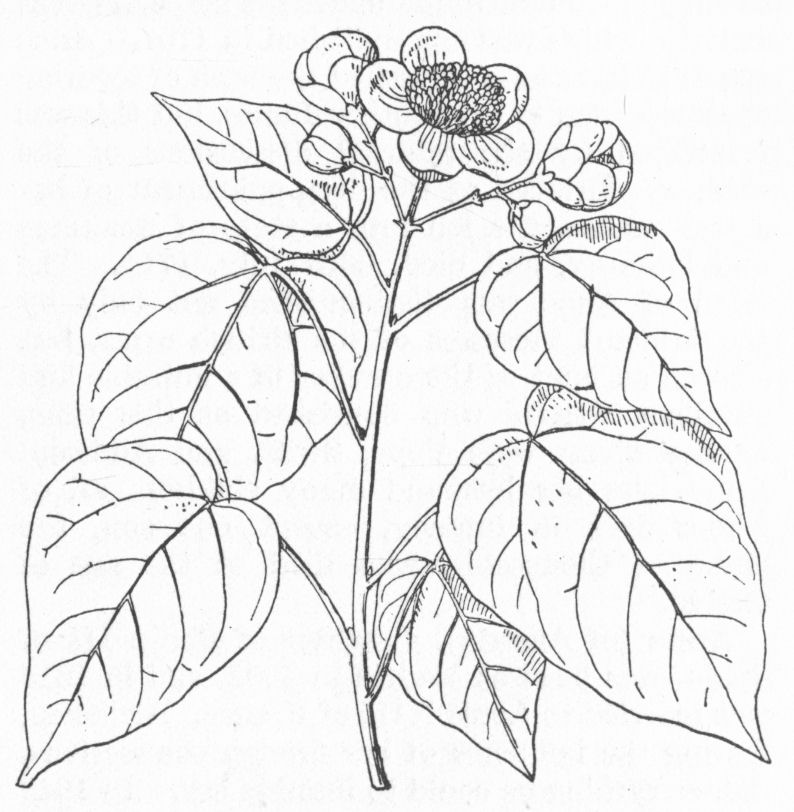
Annat´to, or Annato, an orange-red colouring matter, obtained from the pulp surrounding the seeds of Bixa Orellāna, a shrub native to tropical America, and cultivated in Guiana, St. Domingo, and the East Indies. It is sometimes used as a dye for silk and cotton goods, though it does not produce a very durable colour, but it is much used in medicine for tinging plasters and ointments, and to a considerable extent by farmers for giving a rich colour to milk, butter, and cheese. The colour given by annatto approaches very nearly the natural colouring matter of milk fat. It is guaranteed to preserve the same colour throughout the year, and is considered to be a legitimate colouring matter.
Anne, Queen of Great Britain and Ireland was born at Twickenham, near London, 6th Feb., 1664. She was the second daughter of James II, then Duke of York, and Anne, his wife, daughter of the Earl of Clarendon. With her father's permission she was educated according to the principles of the English Church. In 1683 she was married to Prince George, brother of King Christian V of Denmark. On the arrival of the Prince of Orange in 1688, Anne wished to remain with her father; but she was prevailed upon by Lord Churchill (afterwards Duke of Marlborough) and his wife to join the triumphant party. After the death of William III in 1702 she ascended the English throne. Her character was essentially weak, and she was governed first by Marlborough and his wife, and afterwards by Mrs. Masham. Most of the principal events of her reign are connected with the war of the Spanish Succession. The only important acquisition that England made by it was Gibraltar, which was captured in 1704. Another very important event of this reign was the union of England and Scotland under the name of Great Britain, which was accomplished in 1707. Anne seems to have long cherished the wish of securing the succession to her brother James, but this was frustrated by the internal dissensions of the cabinet. Grieved at the disappointment of her secret wishes, she fell into a state of weakness and lethargy, and died, 20th July, 1714. The reign of Anne was distinguished not only by the brilliant successes of the British arms, but also on account of the number of admirable and excellent writers who flourished at this time, among whom were Pope, Swift, and Addison. Anne bore her husband many children, all of whom died in infancy, except one son, the Duke of Gloucester, who died at the age of twelve.
Anne (of Austria), daughter of Philip III of Spain, was born at Madrid in 1602, and in 1615 was married to Louis XIII of France. Richelieu, fearing the influence of her foreign connections, did everything he could to humble her. In 1643 her husband died, and she was left regent, but placed under the control of a council. But the Parliament overthrew this arrangement, and entrusted her with full sovereign rights during the minority of her son Louis XIV. Having brought upon herself the hatred of the nobles by her boundless confidence in Cardinal Mazarin, she was forced to flee from Paris during the wars of the Fronde. She ultimately quelled all opposition, and was able in 1661 to transmit to her son unimpaired the royal authority. She spent the remainder of her life in retirement, and died 20th Jan., 1666.
Annealing (an-ēl´ing), a process to which many articles of metal and glass are subjected after making, in order to render them more tenacious and which consists in heating them and allowing them to cool slowly. When the metals are worked by the hammer, or rolled into plates, or drawn into wire, they acquire a certain amount of brittleness, which destroys their usefulness, and has to be remedied by annealing. The tempering of steel is one kind of annealing. Annealing is particularly employed in glass-houses, and consists in putting the glass vessels, as soon as they are formed and while they are yet hot, into a furnace or oven, in which they are suffered to cool gradually. The toughness is greatly increased by cooling the articles in oil.
Annecy (a˙n-sē), an ancient town in France, department of Haute-Savoie, situated on the Lake of Annecy, 21 miles s. of Geneva; contains a cathedral and a ruinous old castle once the residence of the counts of Genevois; manufactures of cotton, leather, paper, and hardware. Pop. 15,622.—The lake is about 9 miles long and 2 broad.
Lobworm (one of the Annelida)
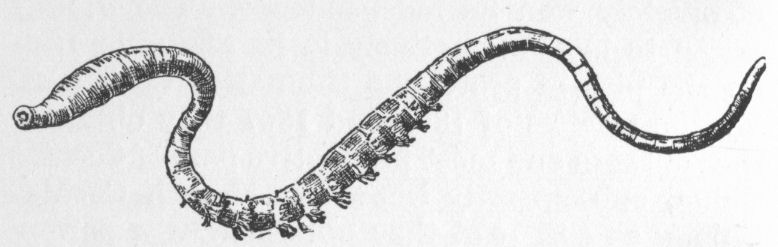
Annel´ida, or Annulata, an extensive division or class of Annulosa or articulate animals, so called because their bodies are formed of a great number of small rings, the outward signs of internal segmentation. The earth-worm, the lobworm, the nereis, and the leech belong to this division. They have red, rarely yellow or green, blood circulating in a double system of contractile vessels, a double ganglionated nervous cord, and respire by external branchiæ, internal vesicles, or by the skin. Their organs of motion consist of bristles or setæ, which are usually attached to the lateral surfaces of each segment, the bristles being borne on 'foot processes' or parapodia. The number of body segments varies. As many as 400 may be found in some sea-worms. A complete digestive system is developed, consisting of a mouth—armed with horny jaws and a protrusible proboscis—gizzard, stomach, and intestine. See Earth-worm, Leech, &c.
Annexation, a term applied to the acquisition by a State of territory previously belonging to another Power, or independent. It is applicable not only to the extension of a State's sovereignty over adjoining territory, but also to an acquisition of a remote territory. The inhabitants of the annexed territory are absolved from their allegiance to their former sovereign. Such annexations in modern history were those of Alsace-Lorraine by Germany in 1871, of California by the United States, of Bosnia and Herzegovina by Austria in 1908, and of the Boer Republics by Great Britain.
Annfield Plain, a straggling colliery town (urban district) of England, Durham, about 7 miles south-west of Gateshead. Pop. (1921), 16,524.
Annobon´, or Annobom, a beautiful Spanish island of Western Africa, south of the Bight of Biafra, about 4 miles long by 2 miles broad, and rising abruptly to the height of 3000 feet, richly covered with vegetation. Pop. 2000.
Annonay (a˙n-o-nā), a town in southern France, department of Ardèche, 37 miles S.S.W. of Lyons, in a picturesque situation. It is the most important town of Ardèche, manufacturing paper and glove leather to a large extent, also cloth, felt, silk stuffs, gloves, hosiery, chemical manures, glue, gelatine, brushes, chocolate, and candles. There is an obelisk in memory of Joseph Montgolfier of balloon fame. Pop. 16,660.
An´nual, in botany, a plant that springs from seed, grows up, produces seed, and then dies, all within a single year or season. Among annual grasses may be noted all our cereals, barley, wheat, rye, and oats.
An´nual, in literature, the name given to a class of publications which at one time enjoyed an immense yearly circulation, and were distinguished by great magnificence both of binding and illustration, which rendered them much sought after as Christmas and New Year presents. Their contents were chiefly prose tales and ballads, lyrics, and other poetry. The earliest was the Forget-me-not, started in 1822, and followed next year by the Friendship's Offering. The Literary Souvenir was commenced in 1824, and the Keepsake in 1827. Among the names of the editors occur those of Alaric A. Watts, Mrs. S. C. Hall, Harrison Ainsworth, Lady Blessington, Mary Howitt, &c. The popularity of the annuals reached its zenith about 1829, when no less than seventeen made their appearance; in 1856 the Keepsake, the last of the series, ceased to exist.
Annual Register, an English publication commenced in 1758 by Dodsley, the publisher, and since continued in yearly volumes down to the present day. There was also an Edinburgh Annual Register, the historical part of which was for several years contributed by Sir Walter Scott and afterwards by Robert Southey. It commenced in 1808 and came to a close in 1827.
Annu´ity, a periodical payment, made annually, or at more frequent intervals, and continuing either a certain number of years, or for an uncertain period, to be determined by a particular event, as the death of the recipient or annuitant, or that of the party liable to pay the annuity; or the annuity may be perpetual. An annuity is usually raised by the present payment of a certain sum as a consideration whereby the party making the payment, or some other person named by him, becomes entitled to an annuity, and the rules and principles by which this present value is to be computed have been the subjects of careful investigation. The present value of a perpetual annuity is evidently a sum of money that will yield an interest equal to the annuity, and payable at the same periods; and an annuity of this description, payable quarterly, will evidently be of greater value than one of the same amount payable annually, since the annuitant has the additional advantage of the interest on three of the quarterly payments until the expiration of the year. In other words, it requires a greater present capital to be put at interest to yield a given sum per annum, payable quarterly, than to yield the same annual sum payable at the end of each year. The present value of an annuity for a limited period is a sum which, if put at interest, will at the end of that period give an amount equal to the sum of all the payments of the annuity and interest; and, accordingly, if it be proposed to invest a certain sum of money in the purchase of an annuity for a given number of years, the comparative value of the two may be precisely estimated, the rate of interest being given. But annuities for uncertain periods, and particularly life annuities, are more frequent, and the value of the annuity is computed according to the probable duration of the life by which it is limited. Such annuities are often created by contract, whereby the Government or a private annuity office agrees, for a certain sum advanced by the purchaser, to pay a certain sum in yearly, quarterly, or other periodical payments to the person advancing the money, or to some other named by him, during the life of the annuitant. Or the annuity may be granted to the annuitant during the life of some other person, or during two or more joint lives, or during the life of the longest liver or survivor among a number of persons named. If a person having a certain capital, and intending to spend this capital and the income of it during his own life, could know precisely how long he should live, he might lend his capital at a certain rate during his life, and by taking every year, besides the interest, a certain amount of the capital, he might secure the same annual amount for his support during his life in such manner that he should have the same sum to spend every year, and consume precisely his whole capital during his life. But since he does not know how long he is to live, he agrees with the Government or an annuity office to take the risk of the duration of his life, and they agree to pay him a certain annuity for life in exchange for the capital which he proposes to invest in this way. The probable duration of his life therefore becomes a subject of computation; and for the purpose of making this calculation tables of longevity are made by noting the proportion of deaths at certain ages in the same country or district. Founding on a comparison of many such tables, the British Government has empowered the Postmaster-General to grant annuities at the following rates, which are probably more closely adjusted to their actual value than those of insurance companies and other dealers in annuities: To secure an immediate annuity of £100, the cost is, for males of 20 years, £2279, 3s. 4d.; for females of same age, £2482, 10s.; for males of 30 years, £2045, 8s. 4d., for females, £2258, 6s. 8d.; for males of 40 years, £1789, 6s. 8d.; for females, £1990; for males of 60, £1148, 6s. 8d.; females, £1275, 8s. 4d.; and so on. Deferred annuities, that is, such as have their first payments postponed for a greater or less number of years, are also granted. We give the rates for an annuity of £100 deferred 20 years: Males aged 20, £848, 6s. 8d.; females, £1014, 13s. 4d.; males aged 35, £557, 1s. 8d.; females, £697, 1s. 8d.; and so on. If a person on whose life the deferred annuity is to depend should die before payment commences, the purchase-money may be returned to his or her representatives, provided that an agreement to that effect had been made in the first instance, but in this case the purchase-money is necessarily higher. See Insurance.—Bibliography: Baily, Life Annuities and Assurances; J. Henry, Government Life Annuity Commutation Tables.
Annuloi´da, one of Professor Huxley's eight primary groups, a division (sub-kingdom) of animals, including the Rotifera, Scolecida (tape-worms, &c.), all which are more or less ring-like in appearance, and the Echinodermata, whose embryos show traces of annulation.
Annulo´sa, a division (sub-kingdom) of animals regarded by some as synonymous with the Arthropoda or Articulata; according to other systematists, including both the Articulata and Annulata or worms.
Annunciation, the declaration of the angel Gabriel to the Virgin Mary informing her that she was to become the mother of our Lord.—Annunciation or Lady Day is a feast of the Church in honour of the annunciation, celebrated on the 25th of March.—The Italian order of Knights of the Annunciation was instituted by Amadeus VI, Duke of Savoy, in 1360. The king is always grand-master. The knights must be of high rank, and must already be members of the order of St. Mauritius and St. Lazarus. The decoration of the order consists of a golden shield suspended from a chain or collar of roses and knots, the letters F. E. R. T. being inscribed on the roses, and standing for Fortitudo ejus Rhodum tenuit (its bravery held Rhodes).—There are two orders of nuns of the Annunciation, one originally French, founded in 1501 by Joanna of Valois; the other Italian, founded in 1604 by Maria Vittoria Fornari of Genoa.
Annunzio (a˙n-nu¨nt´syō), Gabriele d', Italian poet, novelist, and dramatist, born at Pescara in 1863, his patronymic being Rapagnetta. He was educated at Prato and in Rome, and early took to literature and journalism. In 1898 he was elected a member of the Italian Chamber of Deputies, in which he joined the Socialist party. He came before the public when a schoolboy with a volume of verse called Primo Vere, to which others—naturally much more mature—were subsequently added. Several of his novels have been published in English, as: The Child of Pleasure, The Victim, The Triumph of Death, The Virgin of the Rocks, The Fire of Life. Some of these have been very successful, though disfigured to some extent by coarse realism and voluptuousness. He began to write plays later in life. Among them Gioconda, The Dead City, and Francesca da Rimini may be read in English versions, and Gioconda and Francesca have been performed on the English stage. His more recent works include: Le Martyr de Saint Sebastien (1911), Le Chèvrefeuille (1914), La Beffa di Buccari (1918), Notturno (1918). D'Annunzio is the most prominent Italian writer of the present day, and in wealth of language and distinction of style stands far ahead of all others. He served in the European War from 1915-18, and was wounded. In Sept., 1919, he led a raid and occupied the port of Fiume. See European War and Fiume.
An´oa, an animal (Anoa depressicornis) closely allied to the buffalo, about the size of an average sheep, very wild and fierce, inhabiting the rocky and mountainous localities of the Island of Celebes. The horns are straight, thick at the root, and set nearly in a line with the forehead.
Ano´bium, a genus of coleopterous insects, the larvae of which often do much damage by their boring into old wood. By means of their heads they produce a loud, ticking sound in the wood, the so-called death-watch ticking. A. striātum, a common species, when frightened, is much given to feigning death.
An´ode, (Gr. ana, up, hodos, way), the positive pole of the voltaic current, being that part of the surface of a decomposing body which the electric current enters: opposed to cathode (Gr. kata, down, hodos, way), the way by which it departs.
An´odon, or Anodon´ta, a genus of lamellibranchiate bivalves, including the fresh-water mussels, without or with very slight hinge-teeth. See Mussel.
An´odyne, a medicine, such as an opiate or narcotic, which allays pain.
Anointing, rubbing the body or some part of it with oil, often perfumed. From time immemorial the nations of the East have been in the habit of anointing themselves for the sake of health and beauty. The Greeks and Romans anointed themselves after the bath. Wrestlers anointed themselves in order to render it more difficult for their antagonists to get hold of them. In Egypt it was common to anoint the head of guests when they entered the house where they were to be entertained. In the Mosaic law a sacred character was attached to the anointing of the garments of the priests, and things belonging to the ceremonial of worship. The Jewish priests and kings were anointed when inducted into office, and were called the anointed of the Lord, to show that their persons were sacred and their office from God. In the Old Testament also the prophecies respecting the Redeemer style him Messias, that is, the Anointed, which is also the meaning of his Greek name Christ. The custom of anointing still exists in the Roman Catholic Church in the ordination of priests and the confirmation of believers and the sacrament of extreme unction. The ceremony is also frequently a part of the coronation of kings.
Anomalure (Anomalurus Peli)
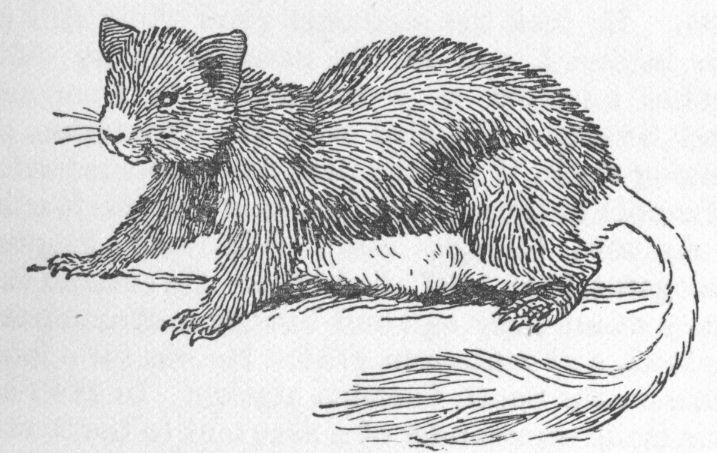
Anom´alure (Anomalūrus), a genus of rodent animals inhabiting the west coast of Africa, resembling the flying-squirrels, but having the under surface of the tail furnished for some distance from the root with a series of large horny scales, which, when pressed against the trunk of a tree, may subserve the same purpose as those instruments with which a man climbs up a telegraph pole to set the wires.
Anom´aly, a deviation from the common rule. In astronomy, the angle which a line drawn from a planet to the sun has passed through since the planet was last at its perihelion or nearest distance to the sun. The anomalistic year is the interval between two successive times at which the earth is in perihelion, or 365 days 6 hours 13 minutes 48 seconds. In consequence of the advance of the earth's perihelion among the stars in the same direction as the earth's motion, and of the precession of the equinoxes, which carries the equinoxes back in the opposite direction to the earth's motion, the anomalistic year is about 4 minutes 40 seconds longer than the sidereal year, and about 25 minutes longer than the tropical or common year. The time of a complete revolution of the perihelion is computed at 108,000 years.
Anomu´ra, a section of the crustaceans of the ord. Decapoda, with irregular tails not formed to assist in swimming, including the hermit-crabs and others.
Anona or Sour-sop (Anōna muricāta)
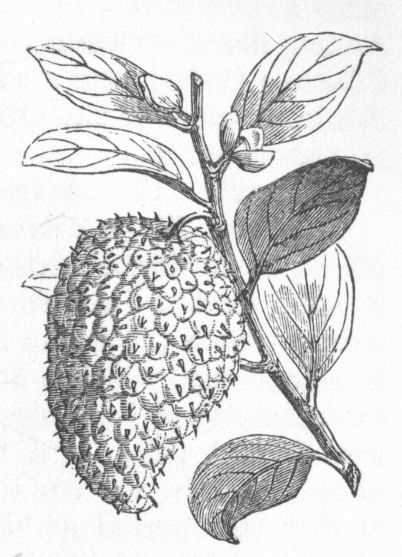
Ano´na, a genus of plants, the type of the nat. ord. Anonaceæ. A. squamōsa (sweet-sop) grows in the West Indian Islands, and yields an edible fruit having a thick, sweet, luscious pulp. A. muricāta (sour-sop) is cultivated in the West and East Indies; it produces a large pear-shaped fruit, of a greenish colour, containing an agreeable slightly-acid pulp. The genus produces other edible fruits, as the common custard-apple or bullock's heart, from A. reticulāta, and the cherimoyer of Peru, from A. Cherimolia.
Anona´ceæ, a nat. ord. of trees and shrubs, having simple, alternate leaves, destitute of stipules, by which character they are distinguished from the Magnoliaceæ, to which they are otherwise closely allied. They are mostly tropical plants of the Old and the New World, and are generally aromatic. See Anona.
Anoplothe´rium, an extinct genus of the Ungulata or Hoofed Quadrupeds, forming the type of a distinct family, which were in many respects intermediate between the swine and the true ruminants. These animals were pig-like in form, but possessed long tails, and had a cleft hoof, with two rudimentary toes. Some of them were as small as a guinea-pig, others as large as an ass. Six incisors, two canines, eight premolars, and six molars existed in each jaw, the series being continuous, no interval existing in the jaw. A. commūne, from the Eocene rocks, is a familiar species.
Anoplu´ra, an order of apterous insects, of which the type is the genus Pedicŭlus or louse,
Anopshehr. See Anupshahr.
Anorexia. See Appetite.
Anos´mia, a disease consisting in a diminution or destruction of the power of smelling, sometimes constitutional, but most frequently caused by strong and repeated stimulants, as snuff, applied to the olfactory nerves.
Anoura. See Anura.
Anquetil-Duperron (a˙nk-tēl-du˙-pā-ron˙), Abraham Hyacinthe, a French orientalist, born 1731, died 1805. He studied theology for some time, but soon devoted himself to the study of Hebrew, Arabic, and Persian. His zeal for the Oriental languages induced him to set out for India, where he prevailed on some of the Parsee priests to instruct him in the Zend and Pehlevi and to give him some of the Zoroastrian books. In 1762 he returned to France with a valuable collection of MSS. In 1771 he published his Zend-Avesta, a translation of the Vendidad, and other sacred books, which aroused much interest. Among his other works are L'Inde en rapport avec l'Europe (1790), and a selection from the Vedas. His knowledge of the Oriental languages was by no means exact.
Ansbach. See Anspach.
An´selm, St., a celebrated Christian philosopher and theologian, born at Aosta, in Piedmont, in 1033, died at Canterbury 1109. At the age of twenty-seven (1060) he became a monk at Bec, in Normandy, whither he had been attracted by the celebrity of Lanfranc. Three years later he was elected prior, and in 1078 he was chosen abbot, which he remained for fifteen years. During this period of his life he wrote his first philosophical and religious works: the dialogues on Truth and Free-will, and the treatises Monologion and Proslogion; and at the same time his influence made itself so felt among the monks under his charge that Bec became the chief seat of learning in Europe. In 1093 Anselm was offered by William Rufus the archbishopric of Canterbury, and accepted it, though with great reluctance, and with the condition that all the lands belonging to the see should be restored. William II soon quarrelled with the archbishop, who would show no subservience to him, and would persist in acknowledging Pope Urban II in opposition to the antipope Clement. William ultimately had to give way. He acknowledged Urban as Pope, and conferred the pallium upon Anselm. The king became his bitter enemy, however, and so great were Anselm's difficulties that in 1097 he set out for Rome to consult with the Pope. Urban received him with great distinction, but did not venture really to take the side of the prelate against the king, though William had refused to receive Anselm again as archbishop, and had seized on the revenues of the see of Canterbury, which he retained till his death in 1100. Anselm accordingly remained abroad, where he wrote most of his celebrated treatise on the atonement, entitled Cur Deus Homo (Why God was made Man). When William was succeeded by Henry I Anselm was recalled; but Henry insisted that he should submit to be reinvested in his see by himself, although the Popes claimed the right of investing for themselves alone. Much negotiation followed, and Henry did not surrender his claims till 1107, when Anselm's long struggle on behalf of the rights of the Church came to an end. Anselm was a great scholar, a deep and original thinker, and a man of the utmost saintliness and piety. Anselm's great achievement in philosophy was his ontological argument for the existence of God; and his importance in the ecclesiastical history of England cannot be exaggerated. The chief of his writings are the Monologion, the Proslogion, and the Cur Deus Homo. The first is an attempt to prove inductively the existence of God by pure reason without the aid of Scripture or authority; the second is an attempt to prove the same by the deductive method; the Cur Deus Homo is intended to prove the necessity of the incarnation. Among his numerous other writings are more than 400 letters. His life was written by his domestic chaplain and companion, Eadmer, a monk of Canterbury, and is edited by M. Rule for the 'Rolls Series'. See Scholasticism. Cf. Père Ragey, Histoire de Saint Anselme; J. M. Rigg, Anselm of Canterbury.
Ans´gar, or Anshar, called the Apostle of the North, born in 801 in Picardy, died in 864 or 865. He took the monastic vows while still in his boyhood, and in the midst of many difficulties laboured as a missionary in Denmark and Sweden. He died with the reputation of having made, if not the first, the most successful attempts to propagate Christianity in the North.
An´son, George, Lord, celebrated English navigator, born 1697, died 1762. He entered the navy at an early age and became a commander in 1722, and captain in 1724. He was for a long time on the South Carolina station. In 1740 he was made commander of a fleet sent to the South Sea, directed against the trade and colonies of Spain. The expedition consisted of five men-of-war and three smaller vessels, which carried 1400 men. After much suffering and many stirring adventures he reached the coast of Peru, made several prizes, and captured and burned the city of Paita. His squadron was now reduced to one ship, the Centurion, but with it he took the Spanish treasure galleon from Acapulco, and arrived in England in 1744 with treasure to the amount of £500,000, having circumnavigated the globe. His adventures and discoveries are described in the well-known Anson's Voyage, compiled from materials furnished by Anson. A few days after his return he was made rear-admiral of the blue, and not long after rear-admiral of the white. His victory over the French admiral Jonquière, near Cape Finisterre in 1747, raised him to the peerage, with the title of Lord Anson, Baron of Soberton. Four years afterwards he was made First Lord of the Admiralty. In 1758 he commanded the fleet before Brest, protected the landing of the British at St. Malo, Cherbourg, &c., and received the repulsed troops into his vessels. Finally, in 1761, he was appointed to convey the queen of George III to England.