VOLUME I PART 2 (continued 5)
Reading edition
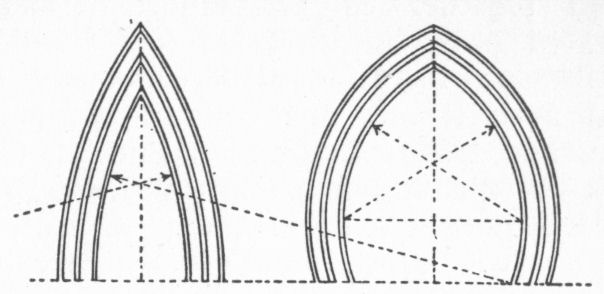
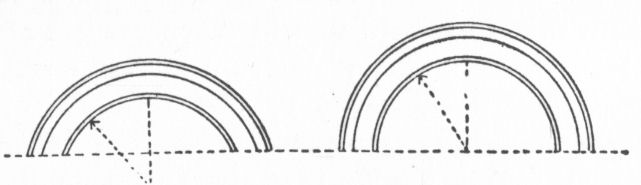
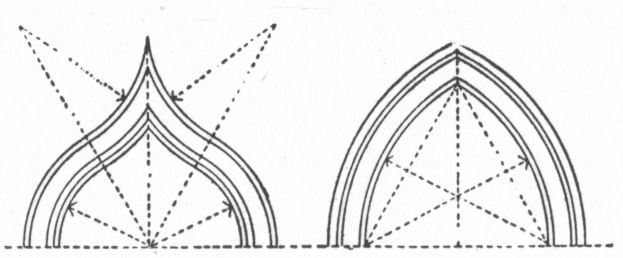
Archæan (är-kē´an) Rocks (Gr. archaios, ancient), the oldest rocks of the earth's crust, mostly crystalline in character, and embracing granites, gneisses, mica-schists, &c., all devoid of fossil remains. These rocks underlie a group of stratified and igneous masses that are usually distinguished from them as Huronian; the first beds with a well-marked fauna (lowest Cambrian) lie above the Huronian, and the Huronian and the Archæan groups are often conveniently classed together as pre-Cambrian, and are separated from the stratified and fossiliferous formations, which indeed have chiefly taken origin from them. The core of the Malvern range, and the rocks of N.W. Sutherland, are examples of Archæan masses in Great Britain.
Archæol´ogy (Gr. archaios, ancient, and logos, a discourse), the study of antiquity, or the science which takes cognizance of the history of nations and peoples as evinced by the remains, architectural, implemental, or otherwise, which belong to the earlier epoch of their existence. In a more extended sense the term embraces every branch of knowledge which bears on the origin, religion, laws, languages, science, arts, and literature of ancient peoples. It is to a great extent synonymous with prehistoric annals, as a large if not the principal part of its field of study extends over those periods in the history of the human race in regard to which we possess almost no information derivable from written records. Archæology divides the primeval period of the human race, more especially as exhibited by remains found in Europe, into the stone, the bronze, and the iron ages, these names being given in accordance with the materials employed for weapons, implements, &c., during the particular period. The stone age has been subdivided into the palæolithic and neolithic, the former being that older period, in which the stone implements were not polished as they are in the latter and more recent period. The bronze age, which admits of a similar subdivision, is that in which implements were of copper or bronze. In this age the dead were burned and their ashes deposited in urns or stone chests, covered with conical mounds of earth or cairns of stones. Gold and amber ornaments appear in this age. The iron age is that in which implements, &c., of iron begin to appear, although stone and bronze implements are found along with them. The word age in this sense (as explained under Age) simply denotes the stage at which a people has arrived. The phrase stone age, therefore, merely marks the period before the use of bronze, the bronze age that before the employment of iron, among any specific people. See Excavations; Crete; Egypt; &c—Bibliography: Sir J. Evans, Stone Implements of Great Britain; Boyd-Dawkins, Early Man in Britain; J. Geikie, Prehistoric Europe; R. Munro, Lake Dwellings of Europe; Sir W. Ridgeway, Early Age of Greece; H. R. Hall, Ægean Archæology; W. M. Flinders Petrie, Methods and Aims in Archæology; A. P. F. Michaelis, A Century of Archæological Discoveries.
Archæopteryx macrura, a fossil lizard-tailed bird
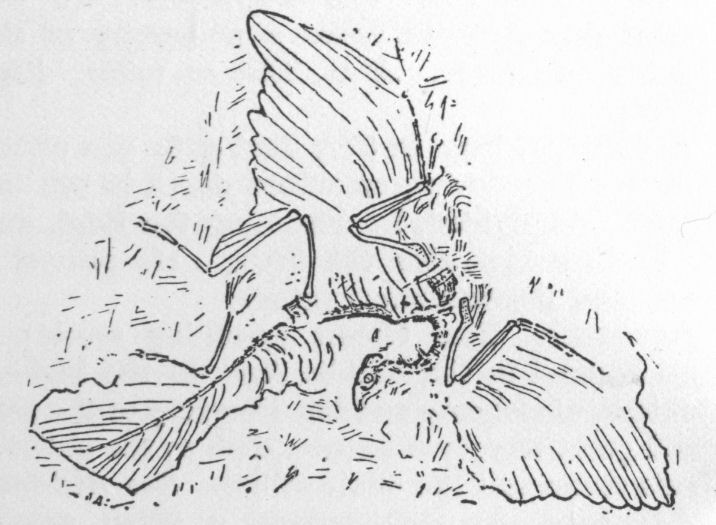
Archæopteryx (är-kē-op´te-riks), a fossil bird from the oolitic limestone of Solenhofen, of the size of a rook, and differing from all known birds in having two free claws representing the thumb and forefinger projecting from the wing, and about twenty tail vertebræ free and prolonged as in mammals.
Archangel (ärk´ān-jel; Gr. prefix, arch-, denoting chief), an angel of superior or of the highest rank. The only archangel mentioned by name in Scripture is Michael in the Epistle of Jude.
Archangel (ärk-ān´jel), a seaport, capital of the Russian government of same name, on the right bank of the Northern Dvina, about 20 miles above its mouth in the White Sea. Below the town the river divides into several branches and forms a number of islands, on one of which, called Sollenbole, is the harbour. The houses are mostly of wood; the place has some manufactures and an important trade, exporting linseed, flax, tow, tallow, train-oil, mats, timber, pitch and tar, &c. The port is closed for six months by ice. Archangel, founded in 1584, was long the only port which Russia possessed. Pop. 43,388.—The province, which before the Russian revolution extended from the Ural Mountains to Finland, had an area of 326,063 sq. miles. Pop. 483,500.—For the Archangel Expedition of 1918, see Murmansk, Russia.
Archangel´ica. See Angelica.
ARCHÆOLOGY: ANTIQUITIES OF THE STONE, BRONZE, AND IRON AGES
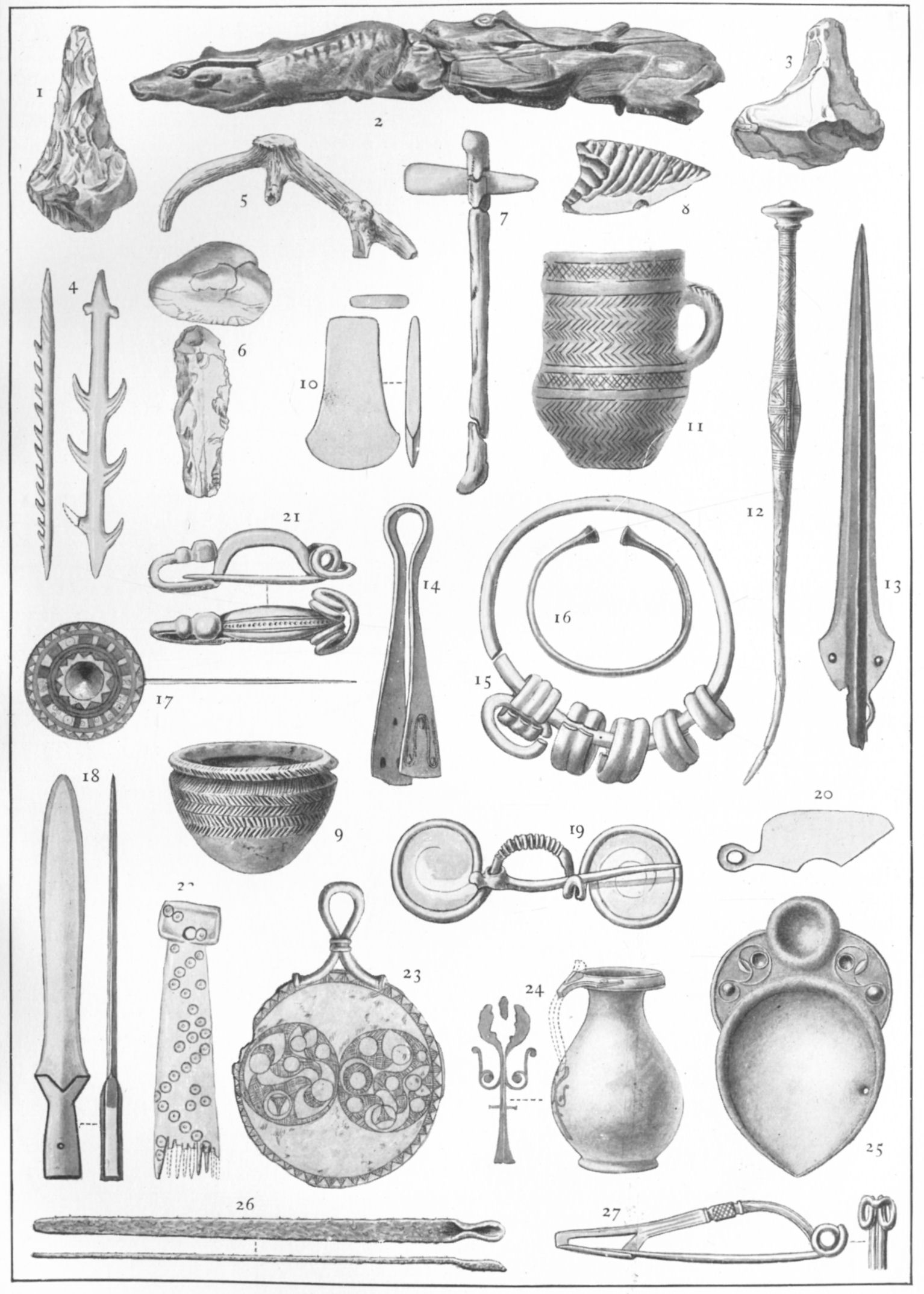
OLDER STONE AGE: 1, Flint Pick. 2, Carved Mammoth Tusk. 3, Double Scraper. 4, Barbed Harpoon Heads. LATER STONE AGE: 5, Pick of Deer Antler. 6, Flint and Pyrites. 7, Stone Celt in Haft. 8, Arrowhead. 9, Bowl. BRONZE AGE: 10, Celt. 11, Drinking-cup. 12, Ornamental Pin. 13, Spear-head. 14, Bronze Tweezers. 15, 16, Gold Bracelets. 17, Engraved Pin. 18, Short Sword. 19, Spectacle Brooch. 20, Razor. EARLY IRON AGE: 21, Bronze Brooch. 22, Bone Hand-comb for weaving. 23, Bronze Mirror. 24, Bronze Jug. 25, Bronze Spoon. 26, Iron Currency Bars. 27, Bronze Brooch.
Archbishop (ärch-), a chief bishop, or bishop over other bishops; a metropolitan prelate. The establishment of this dignity is to be traced up to an early period of Christianity, when the bishops and inferior clergy met in the capitals to deliberate on spiritual affairs, and the bishop of the city where the meeting was held presided. In England there are two archbishops—those of Canterbury and York; the former styled Primate of all England, the latter Primate of England. The Archbishop of Canterbury is the first peer of the realm, having precedence before all great officers of the Crown and all dukes not of royal birth. He crowns the sovereign, and when he is invested with his archbishopric he is said to be enthroned. He can grant special licences to marry at any time or place, and can confer degrees otherwise to be obtained only from the universities. He is addressed by the titles of your grace and most reverend father in God, and writes himself by divine providence, while the Archbishop of York and the bishops only write by divine permission. The first Archbishop of Canterbury was Augustine, appointed A.D. 598 by Ethelbert. Next in dignity is the Archbishop of York, between whom and the Archbishop of Canterbury the Lord High-Chancellor of England has his place in precedency. The first Archbishop of York was Paulinus, appointed in 622. The incomes of the sees are £15,000 and £10,000 respectively. An Archbishop of Wales was first appointed in 1920. Scotland had two archbishops—St. Andrews and Glasgow. Ireland had four, but the Episcopal Church has but two—Armagh and Dublin, the former being Primate of all Ireland, the latter Primate of Ireland. There are four Roman Catholic archbishops in England and Wales—Westminster, Cardiff, Birmingham, and Liverpool; two in Scotland—St. Andrews and Edinburgh, and Glasgow; four in Ireland—Armagh, Dublin, Cashel, and Tuam.
Archdeacon (ärch-), in England, an ecclesiastical dignitary next in rank below a bishop, having a certain jurisdiction over a part of the diocese. From two to four archdeacons are appointed by the bishops, under whom they perform their duties, and they hold courts which decide cases subject to an appeal to the bishop.
Archduke, a title peculiar to the royal family of Austria—the Habsburgs, who ruled until 1918.
Archelaus (a˙r-kē-lā´us), the name of several personages in ancient history, one of whom was the son of Herod the Great. He received from Augustus the sovereignty of Judea, Samaria, and Idumea. The people, tired of his tyrannical and bloody reign, accused him before Augustus, who banished him to Gaul.
Archer, William, journalist and miscellaneous writer, born at Perth, Scotland, in 1856. Educated at Edinburgh University, he went to London after some experience of journalism at Edinburgh, and after a visit to Australia was called to the bar, and was dramatic critic for The World from 1884 to 1905. Subsequently he has been dramatic critic for The Tribune and The Nation. He has done much to introduce Ibsen to the English public, by translating his dramas and otherwise, and has written English Dramatists of To-day; A Life of Macready; About the Theatre: Essays and Studies; Masks or Faces?: a Study on the Psychology of Acting; The Theatrical World (a collection of his dramatic criticisms) (5 vols.); Study and Stage; America To-Day (the result of a visit in 1900); Poets of the Younger Generation; Real Conversations (the result of a series of interviews with persons of note); Through Afro-America (1910); The Life, Trial, and Death of Francisco Ferrer (1911); Play-Making (1912); The Thirteen Days (1915); India and the Future (1917); War is War.
Archer-fish, a name given to the Toxŏtes jaculātor, a scaly-finned, acanthopterygian fish, about 6 inches long, inhabiting the seas around Java, which has the faculty of shooting drops of water to the distance of 3 or 4 feet at insects, thereby causing them to fall into the water, when it seizes and devours them. The soft, and even the spiny portions of their dorsal fins are so covered with scales as to be scarcely distinguishable from the rest of the body.
Assyrian Archer
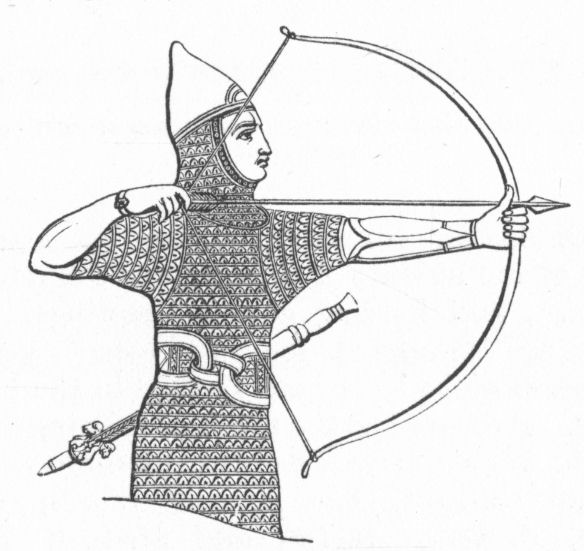
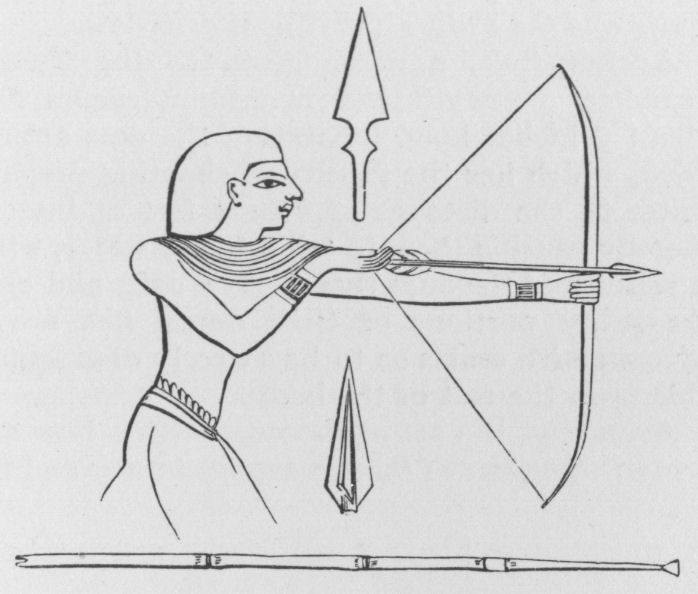
Arch´ery, the art of shooting with a bow and arrow. The use of these weapons in war and the chase dates from the earliest antiquity. Ishmael, we learn from Gen. xxi, "became an archer". The Egyptians, Assyrians, Persians, Parthians, excelled in the use of the bow; and while the Greeks and Romans themselves made little use of it, they employed foreign archers as mercenaries. Coming to much more recent times, we find the Swiss famous as archers, but they generally used the arbalist or cross-bow, and were no match for their English rivals, who preferred the long-bow. (See Bow.) The English victories of Cressy, Poietiers, and Agincourt, gained against apparently overwhelming odds, may be ascribed to the bowmen. Archery disappeared gradually as firearms came into use, and as an instrument of war or the chase the bow is now confined to the most savage tribes of both hemispheres. But though the bow has been long abandoned among civilized nations as a military weapon, it is still cherished as an instrument of healthful recreation, encouraged by archery clubs or societies, which have been established in many parts of Britain. The oldest, and by far the most historically important of these societies, is the Royal Company of Archers, called also the King's Body-guard for Scotland, formed originally, it is said, by James I, but constituted in its present form by an Act of the Privy Council of Scotland, in 1676, and having its head-quarters in Edinburgh, counting among its members many of the nobility and gentry of the northern kingdom, and holding annual meetings, where prizes are competed for. In recent years a number of clubs have been formed in the United States. Archery has the merit of forming a sport open to women as well as men.—BIBLIOGRAPHY: William Garrard, The Arte of Warre; E. S. Morse, Archery, Ancient and Modern; H. A. Ford, The Theory and Practice of Archery.
Egyptian Archer with arrow-heads and stone-tipped reed arrow
Arches, Court of, the chief and most ancient consistory court, belonging to the archbishopric of Canterbury, for the debating of spiritual causes. It is named from the church in London, St. Mary le Bow, or Bow Church (so called from a fine arched crypt), where it was formerly held. The jurisdiction of this court extends over the province of Canterbury. The office of president or dean is now merged in that of the judge appointed by the Public Worship Regulation Act (1874). The court now sits in the library of Lambeth Palace.
Archil, or Orchil (a˙r´kil, or´kil), a red, violet, or purple colouring matter obtained from various kinds of lichens, the most important of which are the Roccella tinctoria and the R. fuciformis, natives of the rocks of the Canary and Cape Verde Islands, Mozambique and Zanzibar, South America, &c., and popularly called dyer's-moss. The dye is used for improving the tints of other dyes, as from its want of permanence it cannot be employed alone; but the aniline colours have largely superseded it. Cudbear and litmus are of similar origin.
Archilochus (a˙r-kil´o-kus) of Paros, one of the earliest Ionian lyric poets, the first Greek poet who composed iambic verses according to fixed rules. He flourished about 700 B.C. His iambic poems were renowned for force of style, liveliness of metaphor, and a powerful but bitter spirit of satire. In other lyric poems of a graver character he was also considered as a model. All his works are lost but a few fragments.
Archiman´drite, in the Greek Church, an abbot or abbot-general, who has the superintendence of many abbots and convents. The title dates from the fourth century.
Archime´dean Screw, a machine for raising water, said to have been invented by Archimedes. It is formed by winding a tube spirally round a cylinder so as to have the form of a screw, or by hollowing out the cylinder itself into a double or triple-threaded screw and enclosing it in a water-tight case. When the screw is placed in an inclined position and the lower end immersed in water, by causing the screw to revolve, the water may be raised to a limited extent.
Archimedes (a˙r-ki-mē´dēz), a celebrated ancient Greek physicist and geometrician, born at Syracuse, in Sicily, about 287 B.C. He devoted himself entirely to science, and enriched mathematics with discoveries of the highest importance, upon which the moderns have founded their admeasurements of curvilinear surfaces and solids. Archimedes is the only one among the ancients who has left us anything satisfactory on the theory of mechanics and on hydrostatics. He first taught the hydrostatic principle to which his name is attached, "that a body immersed in a fluid loses as much in weight as the weight of an equal volume of the fluid", and determined by means of it that an artist had fraudulently added too much alloy to a crown which King Hiero had ordered to be made of pure gold. He discovered the solution of this problem while bathing; and it is said to have caused him so much joy that he hastened home from the bath undressed, and crying out, Eurēka! Eurēka! 'I have found it, I have found it!' Practical mechanics also received a great deal of attention from Archimedes, who boasted that if he had a fulcrum or stand-point he could move the world. He is the inventor of the compound pulley, probably of the endless screw, the Archimedean screw, &c. During the siege of Syracuse by the Romans he is said to have constructed many wonderful machines with which he repelled their attacks, and he is stated to have set on fire their fleet by burning-glasses. At the moment when the Romans gained possession of the city by assault (212 B.C.), tradition relates that Archimedes was slain while sitting in the market-place contemplating some mathematical figures which he had drawn in the sand.
Archipel´ago, a term originally applied to the Ægean, the sea lying between Greece and Asia Minor, then to the numerous islands situated therein, and subsequently to any cluster of islands. In the Grecian Archipelago the islands nearest the European coast lie together almost in a circle, and for this reason are called the Cyclades (Gr. kyklos, a circle); those nearest the Asiatic, being farther from one another, the Sporades ('scattered'). (See these articles, and Negropont, Scio, Samos, Rhodes, Cyprus, &c.) The Malay, Indian, or Eastern Archipelago, on the east of Asia, includes Borneo, Sumatra, and other large islands.
Architec´ture, in a general sense, is the art of designing and constructing houses, bridges, and other buildings for the purposes of civil life; or, in a more limited but very common sense, that branch of the fine arts which has for its object the production of edifices not only convenient for their special purpose, but characterized by unity, beauty, and often grandeur.—The first habitations of man were such as nature afforded, or cost little labour to the occupant—caves, huts, and tents. But as soon as men rose in civilization and formed settled societies they began to build more commodious and comfortable habitations. They bestowed more care on the materials, preparing bricks of clay or earth, which they at first dried in the air, but afterwards baked by fire; and subsequently they smoothed stones and joined them at first without, and at a later period with, mortar or cement. After they had learned to build houses, they erected temples for their gods on a larger and more splendid scale than their own dwellings. The Egyptians are the most ancient nation known to us among whom architecture had attained the character of a fine art. Other ancient peoples among whom it had made great progress were the Babylonians, whose most celebrated buildings were temples, palaces, and hanging gardens; the Assyrians, whose capital, Nineveh, was rich in splendid buildings; the Phœnicians, whose cities, Sidon, Tyre, &c., were adorned with equal magnificence; and the Israelites, whose temple was a wonder of architecture. But comparatively few architectural monuments of these nations have remained till our day.
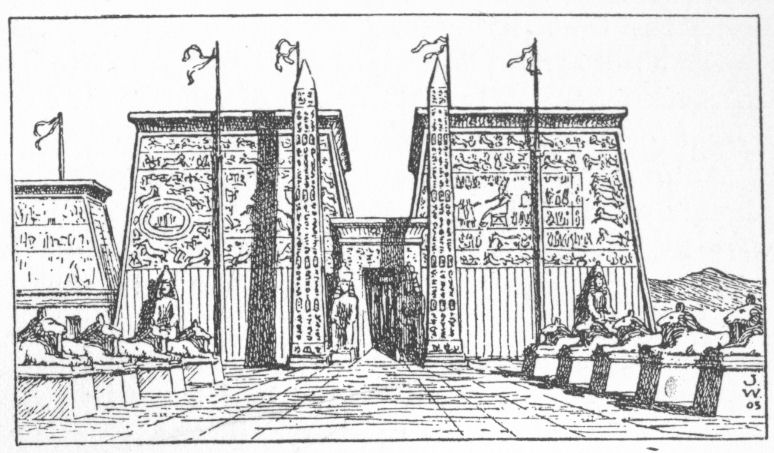
This is not the case with the architecture of Egypt, however, of which we possess ample remains in the shape of pyramids, temples, sepulchres, obelisks, &c. Egyptian chronology is far from certain, but the greatest of the architectural monuments of the country, the pyramids of Ghizeh, are at least as old as 2800 or 2700 B.C. The Egyptian temples had walls of great thickness and sloping on the outside from bottom to top; the roofs were flat, and composed of blocks of stone reaching from one wall or column to another. The columns were numerous, close, and very thick, generally without bases, and exhibiting great variety in the designs of their capitals. The principle of the arch, though known, was not employed for architectural purposes. Statues of enormous size, sphinxes carved in stone, and on the walls sculptures in outline of deities and animals, with innumerable hieroglyphics, are the decorative objects which belong to this style.
Egyptian—Restoration of Temple of Luxor
The earliest architectural remains of Greece are of unknown antiquity, and consist of massive walls built of huge blocks of stone. In historic times the Greeks developed an architecture of noble simplicity and dignity. The discoveries in Crete and Argolis have shown that Greek architecture owes much less than was supposed to Egyptian and Chaldæan architecture. It is considered to have attained its greatest perfection in the age of Pericles, or about 460-430 B.C. The great masters of this period were Phidias, Ictinus, Callicrates, &c. All the extant buildings are more or less in ruins. The style is characterized by beauty, harmony, and simplicity in the highest degree. Distinctive of it are what are called the orders of architecture, by which term are understood certain modes of proportioning and decorating the column and its superimposed entablature. The Greeks had three orders, called respectively the Doric, Ionic, and Corinthian. (See articles under these names.) Greek buildings were abundantly adorned with sculptures, and painting was extensively used, the details of the structures being enriched by different colours or tints. Lowness of roofs and the absence of arches were distinctive features of Greek architecture, in which, as in that of Egypt, horizontality of line is another characteristic mark. The most remarkable public edifices of the Greeks were temples, of which the most famous is the Parthenon at Athens. Others exist in various parts of Greece as well as in Sicily, Southern Italy, Asia Minor, &c., where important Greek communities were early settled. Their theatres were semicircular on one side and square on the other, the semicircular part being usually excavated in the side of some convenient hill. This part, the auditorium, was filled with concentric seats, and might be capable of containing 20,000 spectators. A number exist in Greece, Sicily, and Asia Minor, and elsewhere. By the end of the Peloponnesian War (c. 400 B.C.) the best period of Greek architecture was over; a noble simplicity had given place to excess of ornament. After the death of Alexander the Great (323 B.C.) the decline was still more marked.
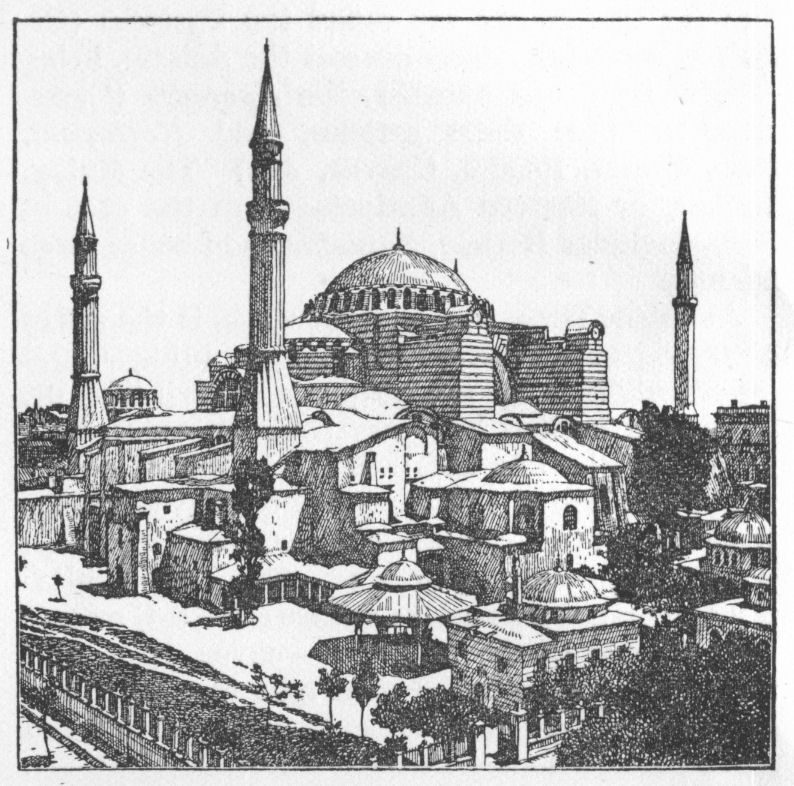
Byzantine—Church of St. Sophia, Constantinople
Among the Romans there was no original development of architecture as among the Greeks, though they early took the foremost place in the construction of such works as aqueducts and sewers, the arch being in early and extensive use among this people. As a fine art, however, Roman architecture had its origin in copies of the Greek models, all the Grecian orders being introduced into Rome, and variously modified. Their number, moreover, was augmented by the addition of two new orders—the Tuscan and the Composite. The Romans became acquainted with the architecture of the Greeks soon after 200 B.C., but it was not till about two centuries later that the architecture of Rome attained (under Augustus) its greatest perfection. Among the great works now erected were temples, aqueducts, amphitheatres, magnificent villas, triumphal arches, monumental pillars, &c. The amphitheatre differed from the theatre in being a completely circular or rather elliptical building, filled on all sides with ascending seats for spectators and leaving only the central space, called the arena, for the combatants and public shows. The Coliseum is a stupendous structure of this kind. The thermæ, or baths, were vast structures in which multitudes of people could bathe at once. Magnificent tombs were often built by the wealthy. Remains of private residences are numerous, and the excavations at Pompeii in particular have thrown great light on the internal arrangements of the Roman dwelling-house. Almost all the successors of Augustus embellished Rome more or less, erected splendid palaces and temples, and adorned, like Hadrian, even the conquered countries with them. But after the period of Hadrian (A.D. 117-138) Roman architecture is considered to have been on the decline. The refined and noble style of the Greeks was neglected, and there was an attempt to embellish the beautiful more and more. This decline was all the more rapid at a later time owing to the disturbed state of the Empire and the incursions of the barbarians.
In Constantinople, after its virtual separation from the Western Empire, arose a style of art and architecture which was practised by the Greek Church during the whole of the Middle Ages. This is called the Byzantine style. The church of St. Sophia at Constantinople, built by Justinian (reigned 527-565), offers the most typical specimen of the style, of which the fundamental principle was an application of the Roman arch, the dome being the most striking feature of the building. In the most typical examples the dome or cupola rests on four pendentives.
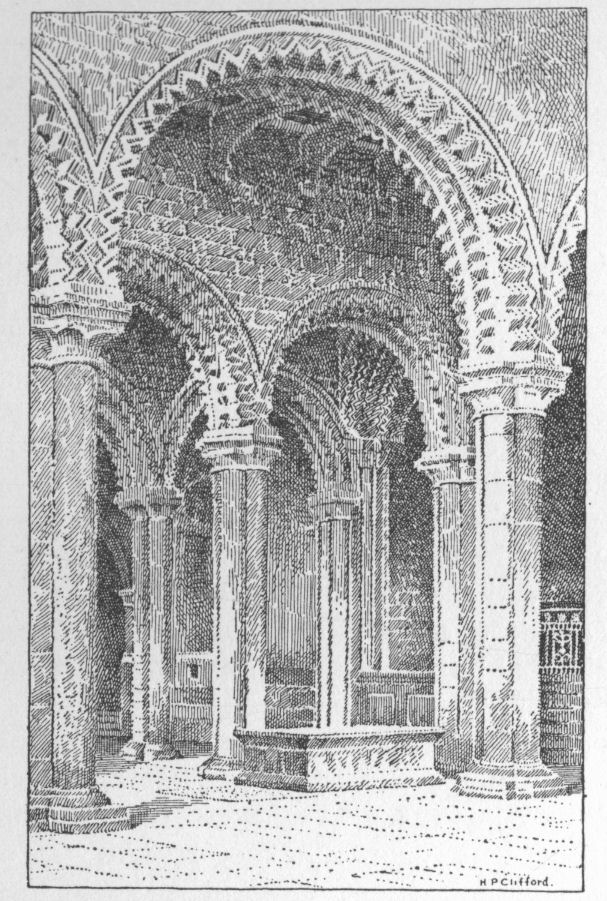
After the dismemberment of the Roman Empire the beautiful works of ancient architecture were almost entirely destroyed by the Goths, Vandals, and other barbarians in Italy, Greece, Asia, Spain, and Africa; or what was spared by them was ruined by the fanaticism of the Christians. A new style of architecture now arose, two forms of which, the Lombard and the Norman Romanesque, form important phases of art. The Lombard prevailed in North Italy and South Germany from the eighth or ninth to the thirteenth century (though the Lombard rule came to an end in 774); the Norman Romanesque flourished, especially in Normandy and England, from the eleventh to the middle of the thirteenth century. The semicircular arch is the most characteristic feature of this style. With the Lombard Romanesque were combined Byzantine features, and buildings in the pure Byzantine style were also erected in Italy, as the church of St. Mark at Venice.
ARCHITECTURE
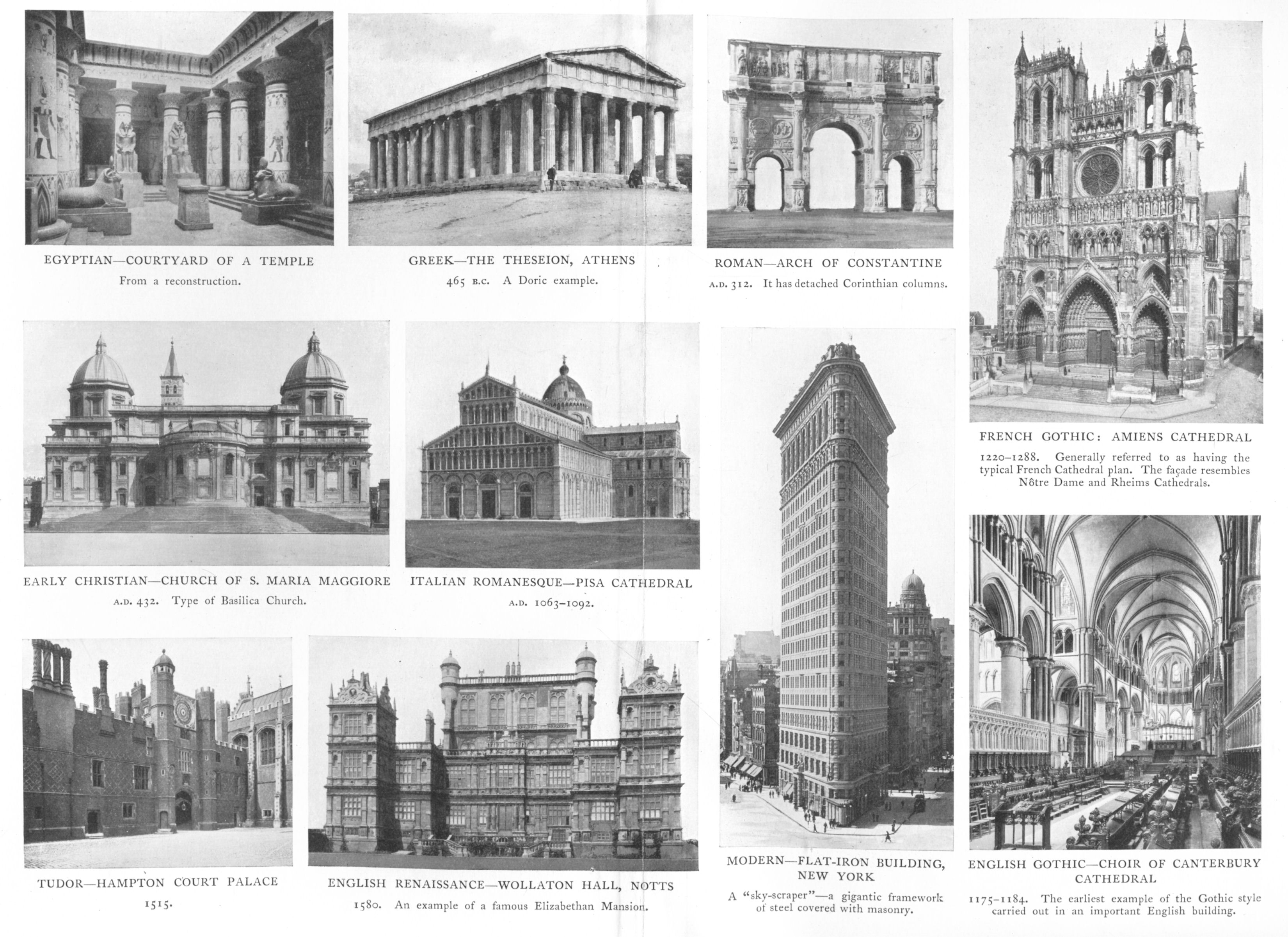
The conquests of the Moors introduced a fresh style of architecture into Europe after the eighth century—the Moorish or Saracenic. This style accompanied the spread of Mahommedanism after its rise in Arabia in the seventh century. The edifices erected by the Moors and Saracens in Spain, Egypt, and Turkey are distinguished, among other things, by a peculiar form of the arch, which forms a curve constituting more than half a circle or ellipse. A peculiar flowery decoration, called arabesque, is a common ornament of this style, of which the building called the Alhambra (q.v.) is perhaps the chief glory.
Norman Romanesque—Galilee Chapel, Durham Cathedral
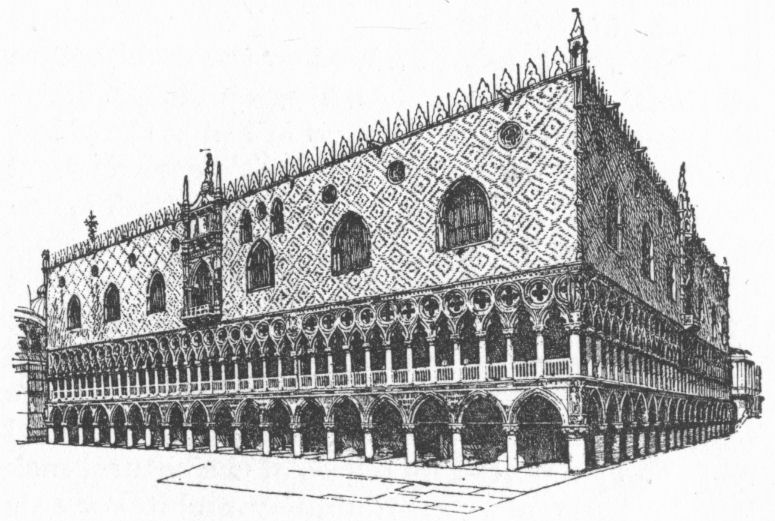
The Germans were unacquainted with architecture until the time of Charlemagne. He introduced into Germany the Byzantine and Romanesque styles. Afterwards the Moorish or Arabian style had some influence upon that of the Western nations, and thus originated the mixed style which maintained itself till the middle of the thirteenth century. Then began the modern Gothic style, which grew up in France, England, and Germany. Its striking characteristics are its pointed arches, its pinnacles and spires, its large buttresses, clustered pillars, vaulted roofs, profusion of ornament, and, on the whole, its lofty, bold character. Its most distinctive feature, as compared with the Greek or the Egyptian style, is the predominance in it of perpendicular or rising lines, producing forms that convey the idea of soaring or mounting upwards. Its greatest capabilities have been best displayed in ecclesiastical edifices. The Gothic style is divided into four principal epochs: the Early Pointed, or general style of the thirteenth century; the Decorated, or style of the fourteenth century; the Perpendicular, practised during the fifteenth and early part of the sixteenth centuries; and the Tudor, or general style of the sixteenth century. This style lasted in England up to the seventeenth century, being gradually displaced by that branch of the Renaissance or modified revival of ancient Roman architecture which is known as the Elizabethan style, and which is perhaps more purely an English style than any other that can be named.
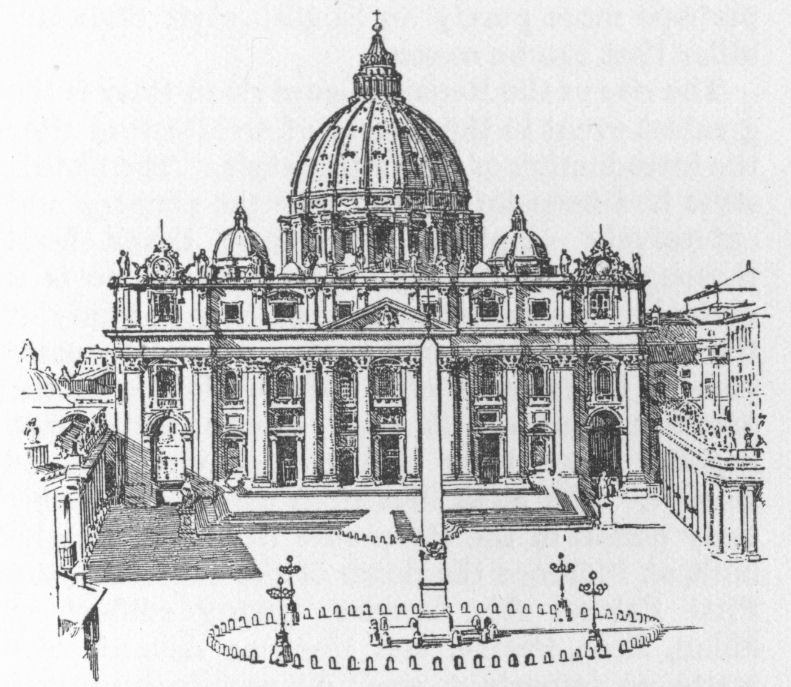
The rise of the Renaissance style in Italy is the greatest event in the history of architecture after the introduction of the Gothic style. The Gothic style had been introduced into the country and extensively employed, but had never been thoroughly naturalized. The Renaissance is a revival of the classic style based on the study of the ancient models; and having practically commenced in Florence about the beginning of the fifteenth century, it soon spread with great rapidity over Italy and the greater part of Europe. The most illustrious architects of this early period of the style were Brunelleschi, who built at Florence the dome of the cathedral, the Pitti Palace, &c., besides many edifices at Milan, Pisa, Pesaro, and Mantua; Alberti, who wrote an important work on architecture, and erected many beautiful churches; Bramante, who began the building of St. Peter's, Rome, and Michael Angelo, who erected its magnificent dome. On St. Peter's were also employed Raphael, Peruzzi, and San Gallo. The noblest building in this style of architecture in Britain is St. Paul's, London, the work of Sir Christopher Wren.
Italian Gothic—Doges' Palace, Venice
Since the Renaissance period there has been no architectural development requiring special note. In buildings erected at the present day some one of the various styles of architecture is employed according to taste. Modern dwelling-houses have necessarily a style of their own as far as stories and apartments and windows and chimneys can give them one. In general the Grecian style, as handed down by Rome and modified by the Italian architects of the Renaissance, from its right angles and straight entablatures, is more convenient, and fits better with the distribution of our common buildings, than the pointed and irregular Gothic. But the occasional introduction of the Gothic outline and the partial employment of its ornaments has undoubtedly an agreeable effect both in public and private edifices; and we are indebted to it, among other things, for the spire, a structure exclusively Gothic, which, though often misplaced, has become an object of general approbation and a pleasing landmark to cities and villages. The works most characteristic of the present day are the large bridges, viaducts, &c., in many of which iron is the sole or most characteristic portion of the material.
Renaissance—St. Peter's, Rome
A few words may be added on the architecture of India and China. Although many widely-differing styles are to be found in India, the oldest and only true native style of Indian ecclesiastical architecture is the Buddhist, the earliest specimens dating from 250 B.C. Among the chief objects of Buddhist art are stupas or topes, built in the form of large towers, and employed as dágobas to contain relics of Buddha or of some noted saint. Other works of Buddhist art are temples or monasteries excavated from the solid rock, and supported by pillars of the natural rock left in their places. Buddhist architecture is found in Ceylon, Tibet, Java, &c., as well as in India. The most remarkable Hindu or Brahmanical temples are in Southern India. They are pyramidal in form, rising in a series of stories. The Saracenic or Mohammedan architecture afterwards introduced into India is, of course, of foreign origin. The Chinese have made the tent the elementary feature of their architecture; and of their style any one may form an idea by inspecting the figures which are depicted upon common chinaware. Chinese roofs are concave on the upper side, as if made of canvas instead of wood. (For further information see Greek, Roman, Gothic, English, French, Russian Architecture; and Building, Fine Arts, Arch, Column, Aqueduct, Corinthian, Doric, Ionic, Theatre, &c.)—Bibliography: J. Ruskin, Seven Lamps of Architecture; E. A. Freeman, History of Architecture; Viollet-le-Duc, How to build a House; J. T. Micklethwaite, Modern Parish Churches; H. H. Statham, Architecture for General Readers and Critical History of Architecture; J. Fergusson, History of Architecture in all Countries; F. M. Simpson, A History of Architectural Development; Cyclopedia of Architecture.
Architrave (är´ki-träv), in architecture, the part of an entablature which rests immediately on the heads of the columns, being the lowest of its three principal divisions, the others being the frieze and the cornice.
Archives (är´kīvz). See Records.
Archivolt (är´ki-volt), in architecture, the ornamental band of mouldings on the face of an arch and following its contour.
Archons (är´konz), the chief magistrates of ancient Athens, chosen to superintend civil and religious concerns. They were nine in number; the first was properly the archōn, or archōn epōnўmos, by whose name the year was distinguished in the public records; the second was called archōn basileus, or king archon, who exercised the functions of high priest; the third, polemarchos, or general of the forces. The other six were called thesmothĕtai, or legislators.
Archytas (a˙r-kī´tas), an ancient Greek mathematician, statesman, and general, who flourished about 400 B.C., and belonged to Tarentum in Southern Italy. The invention of the analytic method in mathematics is ascribed to him, as well as the solution of many geometrical and mechanical problems. He constructed various machines and automata, among the most celebrated of which was his flying pigeon. He was a Pythagorean in philosophy, and Plato and Aristotle are said to have been both deeply indebted to him. Only inconsiderable fragments of his works are extant.
Arcis-sur-Aube (a˙r-sē-su˙r-ōb), a small town of France, department Aube, at which, in 1814, was fought a battle between Napoleon and the Allies, after which the latter marched to Paris. Pop. 3000.
Arc-light, a certain kind of electric light in which the illuminating source is the current of electricity passing between two sticks of carbon kept a short distance apart, one of them being in connection with the positive, the other with the negative terminal of a battery or dynamo.
Arco, a town of Tyrol, near Lake Garda, a favourite winter resort of invalids. Pop. 3800.
Arcole (a˙r´ko-la˙), a village in North Italy, 15 miles S.E. of Verona, celebrated for the battles of 15th, 16th, and 17th Nov., 1796, fought between the French under Bonaparte and the Austrians, in which the latter were defeated with great slaughter.
Arcos´ de la Fronte´ra, a city of Spain, 30 miles E. by N. from Cadiz, on the Guadalete, here crossed by a stone bridge, on a sandstone rock 570 feet above the level of the river. On the highest part of the rock stands the castle of the dukes of Arcos, partly in ruins. The principal manufactures are leather, hats, and cordage. Pop. 13,980.
Ar´cot, two districts and a town of India, within the Presidency of Madras.—North Arcot is an inland district with an area of 7616 sq. miles. The country is partly flat and partly mountainous, where intersected by the Eastern Gháts. Pop. 2,200,000.—South Arcot lies on the Bay of Bengal, and has two seaports, Cuddalor and Porto Novo. Area 5217 sq. miles. Pop. 2,170,000.—The town Arcot is in North Arcot, on the Palar, about 70 miles W. by S. of Madras. There is a military cantonment at 3 miles' distance. The town contains handsome mosques, a nabob's palace in ruins, and the remains of an extensive fort. Arcot played an important part in the wars which resulted in the ascendancy of the British in India. It was taken by Clive, 31st Aug., 1751, and heroically defended by him against an apparently overwhelming force under Raja Sahib. Pop. 11,475.
Arctic (a˙rk´tik), an epithet given to the north pole from the proximity of the constellation of the Bear, in Greek called arktos. The Arctic Circle is an imaginary circle on the globe, parallel to the equator, and 23° 28´ distant from the north pole. This and its opposite, the Antarctic, are called the two polar circles.
Arctic Expeditions. See North Polar Expeditions.
Arctic Ocean, that part of the water surface of the earth which surrounds the north pole, and washes the northern shores of Europe, Asia, and America; its southern boundary roughly coinciding with the Arctic Circle (lat. 66° 30´ N.). It encloses many large islands, and contains large bays and gulfs which deeply indent the northern shores of the three continents. Its great characteristic is ice, which is perpetual nearly everywhere.
Arctic Regions, the regions round the north pole, and extending from the pole on all sides to the Arctic Circle in lat. 66° 30´ N. The Arctic or North Polar Circle just touches the northern headlands of Iceland, cuts off the southern and narrowest portion of Greenland, crosses Fox's Strait north of Hudson's Bay, whence it goes over the American continent to Behring's Strait. Thence it runs to Obdorsk at the mouth of the Obi, then crossing Northern Russia, the White Sea, and the Scandinavian Peninsula, returns to Iceland. Though much skill and heroism have been displayed in the exploration of this portion of the earth, there is still an area round the pole estimated at 2,500,000 sq. miles, which is a blank to geographers. Many have adopted the belief in the existence of an open polar sea about the north pole. But this belief is not supported by any positive evidence. Valuable minerals, fossils, &c., have been discovered within the Arctic regions. In the archipelago north of the American continent excellent coal frequently occurs. The mineral cryolite is mined in Greenland. Fossil ivory is obtained in islands at the mouth of the Lena. In Scandinavia, parts of Siberia, and north-west America, the forest region extends within the Arctic Circle. The most characteristic of the natives of the Arctic regions are the Esquimaux. The most notable animals are the white-bear, the musk-ox, the reindeer, and the whalebone whale. Fur-bearing animals are numerous. The most intense cold ever registered in those regions was 74° below zero F. The aurora borealis is a brilliant phenomenon of Arctic nights. See North Polar Expeditions.
Arc´tium. See Burdock.
Arc´tomys. See Marmot.
Arctu´rus, or Alpha Boötis, a fixed star of the first magnitude in the constellation of Boötes (the Ploughman), is one of the brightest stars in the northern heavens, yellow in colour. Its light is believed to be intrinsically at least 140 times as brilliant as the sun's, and to take over 40 years to reach us. It is notable as having a comparatively large proper motion.
Ardahan´, a small fortified town about 6400 feet above the sea, between Kars and Batúm in Armenia. It was captured by the Russians in 1877, and ceded to them by the Berlin Treaty, 1878. It was handed over to Turkey by the Treaty of Brest-Litovsk in 1918, but the Turkish troops evacuated it after the armistice in 1918.
Ar´dea, the genus to which the heron belongs, type of the family Ardēidæ, which includes also cranes, storks, bitterns, &c.
Ar´debil, or Ardabil, a Persian town, province of Azerbaijan, near the Karasu, a tributary of the Aras, about 40 miles from the Caspian, in an elevated and healthy situation; it has mineral springs and a considerable trade. Pop. 16,000.
Ardèche (a˙r-dāsh), a department in the south of France (Languedoc), on the west side of the Rhone, taking its name from the River Ardèche, which rises within it, and falls into the Rhone after a course of 46 miles; area, 2144 sq. miles. It is generally of a mountainous character, and contains the culminating point of the Cevennes. Silk and wine are produced. Annonay is the principal town, but Privas is the capital. Pop. (1921), 294,308.
Arden, Forest of, a wood in Warwickshire. Shakespeare is supposed to have used it as a setting for As You Like It.
Ardennes (a˙r-den´), an extensive tract of hilly land stretching over a large portion of the north-east of France and south-west of Belgium. Anciently the whole tract formed one immense forest (Arduenna Silva of Cæsar); but large portions are now occupied by cultivated fields and populous towns.
Ardennes (a˙r-den´), a frontier department in the north-east of France; area, 2027 sq. miles, partly consisting of the Forest of Ardennes. There are extensive slate-quarries, numerous ironworks, and important manufactures of cloth, ironware, leather, glass, earthenware, &c. It was the scene of many battles during the European War (1914-8). Chief towns, Mézières (the capital), Rocroi, and Sedan. Pop. 277,791.
Ardnamurchan (-mur´han) Point, the most westerly point of the Island of Great Britain, in Argyllshire, having a lighthouse, 180 feet above sea-level, visible 18 to 20 miles off.
Ar´doch, a parish in south Perthshire, celebrated for its Roman remains, one, a camp, being the most perfect existing in Scotland.
Ardross´an, a seaport of Scotland, in Ayrshire, on the Firth of Clyde. It has a large harbour and shipbuilding yards, and is a centre of steamship services with Arran, Ireland, and Douglas, I.O.M. Pop. (1921), 7214.
Ards´ley, East and West, an urban district or town of England, W. Riding of Yorkshire, several miles north-west of Wakefield, with collieries, iron-mines, ironworks, &c. Pop. (1921), 7058.
Are (är), the unit of the French land measure, equal to 100 sq. metres, or 1076.44 English sq. feet. A hectare is 100 ares, equal to 2.47 English acres. The tenth part of an are is called a déciare, and a hundredth part a centiare.
A´rea, the superficial content of any figure or space, the quantity of surface it contains in terms of any unit. See Mensuration.
Are´ca, a genus of lofty palms with pinnated leaves, and a drupe-like fruit enclosed in a fibrous rind. A. Catĕchu of the Coromandel and Malabar coasts is the common areca palm which yields areca or betel-nuts, and also the astringent juice catechu. A. oleracĕa is the cabbage tree or cabbage palm of the West Indies. With lime and the leaves of the betel-pepper, the areca-nuts when green form the celebrated masticatory of the East. They are an important article in Eastern trade.
Arecibo (a˙-re-thē´bō), a seaport town on the north coast of the Island of Porto Rico. Pop. 9612.
Areiopagus. See Areopagus.
Are´na, the enclosed space in the central part of the Roman amphitheatres, in which took place the combats of gladiators or wild beasts. It was usually covered with sand or saw-dust to prevent the gladiators from slipping, and to absorb the blood. See Amphitheatre.
Arenaceous Rocks include all sediments in which quartz sand is the most important constituent. Owing to its resistance to comminution and to chemical attack, quartz accumulates in sea-beaches while other mineral matter becomes removed. Hence sands gather near a shore and ultimately become consolidated by various natural cements into sandstones, those cemented by silica being styled quartzites. Sand-dunes in deserts or on coasts are unconsolidated arenaceous rock-masses.
Ar´endal a seaport of Southern Norway, exporting timber, wood pulp, and iron, and owning numerous ships. It is a well-built place, having been rebuilt since the great fire of 1868. Wood pulp, paper, and cotton are manufactured. Pop. 11,000.
Arenenberg Castle (mediæval, Narrenberg), a castle and estate in the Swiss Canton Thurgau, the possession of Queen Hortense, who died there in 1837. In 1855 it became the property of the Empress Eugénie.
Arenga, a term sometimes used as the generic name of the areng or gomuti palm, which is then botanically designated Arenga saccharifera. See Gomuti.
Arenic´ola. See Lobworm.
Are´olar Tissue, an assemblage of fibres in bundles, pervading almost every part of the animal structure, and connected with each other so as to form innumerable small cavities, the whole serving as a means by which the various organs and parts of organs are connected together. It is called also Cellular Tissue and Connective Tissue. The fibres are of two kinds—white fibrous tissue and yellow elastic fibrous tissue, and interspersed among the bundles or occupying the cellular cavities are cells and corpuscles of several kinds. It is a tissue found in large quantities under the skin, covering the muscles, the blood-vessels, and nerves, and in various parts forming a kind of protective covering for delicate and important organs. It is because of its general distribution, and because of its binding various structures together, that it is called connective.—In botany the term is sometimes applied to the non-vascular substance, composed entirely of untransformed cells, which forms the soft substance of plants.
Areom´eter (from Gr. araios, thin, metron, a measure), an instrument for measuring the specific gravity of liquids; a hydrometer (q.v.).
Areop´agus, the oldest of the Athenian courts of justice, an assembly having a position more august than an ordinary court, and in its best days exercising a general supervision over public morals. It obtained its name from its place of meeting, on the Hill of Ares (Mars), near the Acropolis or citadel of Athens. Another explanation connects the word with Aræ (Curses), commonly known as Semnæ (Awful Goddesses), who were the guardians of the hill. It existed from very remote times, and the crimes tried before it were wilful murder, poisoning, robbery, and arson, while it had under its control also dissoluteness of morals, and innovations in the State and in religion. Its meetings were held in the open air, and its members were selected from those who had held the office of archon. The tribunal eventually lost many of its powers, but it continued to exist in name at least as late as the time of Cicero or later, having had an existence of seven or eight hundred years.
Arequipa (a˙-rā-kē´pa˙), a city of Peru, capital of a province of same name, situated in a fertile valley, 7850 feet above sea-level, at a distance of about 55 miles from the coast and on the railway which runs from its port Mollendo inland to Puno on Lake Titicaca. Behind the city rises the volcano of Arequipa, or Peak of Misti (20,328 feet). The climate is healthy but the locality is liable to earthquakes, one of which almost completely destroyed the town in 1868, after which it was rapidly rebuilt. A considerable trade is carried on through Mollendo, there being a large transit trade with the interior, and the town carries on various industries, manufacturing cotton and woollen goods, &c. It was founded in 1540. Pop. 35,000 to 40,000.—The province has an area of 21,947 sq. miles, and a pop. of 229,007.
Ares (ā´rēz). See Mars.
Arethu´sa, in Greek mythology, a daughter of Nereus and Doris, a nymph changed by Artĕmis into a fountain in order to free her from the pursuit of the river-god Alpheus. This fountain was said to exist in the small Island of Ortygia, near Syracuse, and was fabled to have a subterranean connection with the River Alpheus in Greece.
Aretino (ä-rā-tē´nö), Guido. See Guido.
Aretino, Pietro, Italian poet, born at Arezzo 1492, died at Venice 1556, the natural son of a nobleman called Luigi Bacci. He early displayed a talent for satirical poetry, and when still a young man was banished from Arezzo on account of a sonnet against indulgences. He went to Perugia, and thence to Rome (1517), where he secured the papal patronage, but subsequently lost it through writing licentious sonnets. Through the influence of the Medici family he found an opportunity to insinuate himself into the favour of Francis I. In 1527 Aretino went to Venice, where he acquired powerful friends, among them the Bishop of Vicenza. By his devotional writings he regained the favour of the Roman Court. He called himself 'the divine', and 'the scourge of princes', but he was also their abject flatterer, and that solely to obtain money. The obscenity of some of his writings was such that his name has become proverbial for licentiousness. Among them are five comedies and a tragedy.
Arezzo (a˙-ret´sō; ancient Arretium), a city of Central Italy, capital of a province of the same name in Tuscany, near the confluence of the Chiana with the Arno. It has a noble cathedral, containing some fine pictures and monuments; remains of an ancient amphitheatre, &c. It was one of the twelve chief Etruscan towns, and in later times fought long against the Florentines, to whom it had finally to succumb. It is the birthplace of Mæcenas, Petrarch, Pietro Aretino, Redi, and Vasari. Pop. 50,093.—The province of Arezzo contains 1274 sq. miles, and 292,763 inhabitants (1915).
Ar´gal, Argol, or Tartar, a hard crust formed on the sides of vessels in which wine has been kept, red or white according to the colour of the wine. It is an impure bitartrate of potassium.
Argali (Ovis ammon)
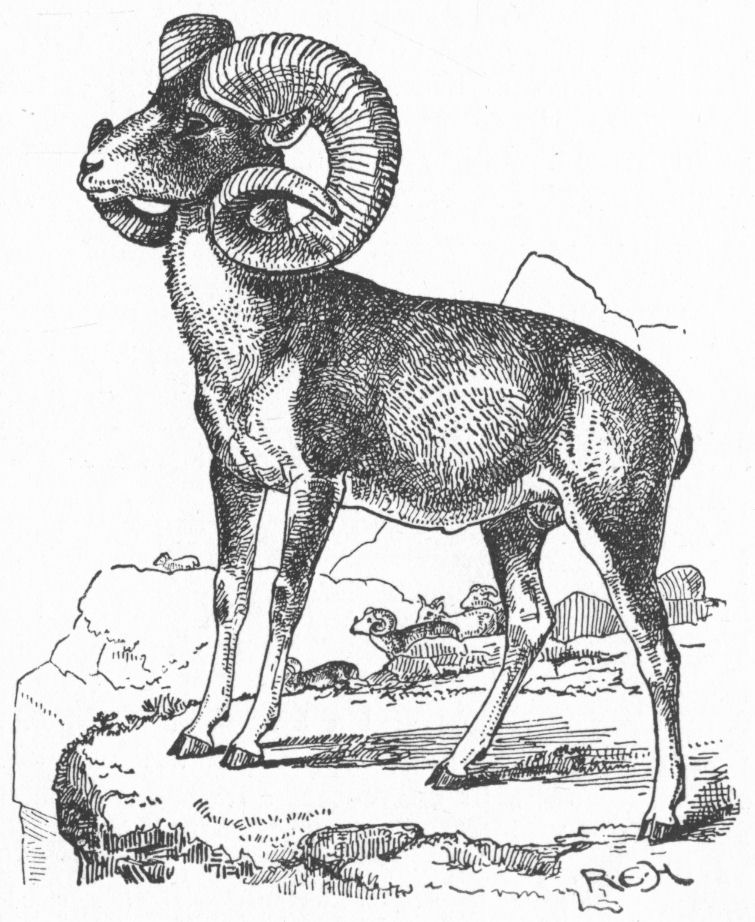
Ar´gali, a species of wild sheep (Caprŏvis Argăli or Ovis ammon) found on the mountains of Siberia, Central Asia, and Kamtchatka. It is 4 feet high at the shoulders, and proportionately stout in its build, with horns nearly 4 feet in length measured along the curve, and at their base about 19 inches in circumference. It lives in small herds. This true argali must not be confounded with the North-African wild sheep, called the bearded argali and known as the arni, the Algerian moufflon, and the Barbary sheep.
Ar´gall, Sir Samuel (1572-1639), one of the early English adventurers to Virginia. He planned and executed the abduction of Pocahontas, the daughter of the Indian chief Powhattan, in order to secure the ransom of English prisoners. He was deputy-governor of Virginia (1617-9), and was accused of many acts of rapacity and tyranny. In 1620 he served in an expedition against Algiers, and was knighted by James I.
Ar´gand Lamp, a lamp named after its inventor, Aimé Argand, a Swiss chemist and physician (born 1755, died 1803), the distinctive feature of which is a burner forming a ring or hollow cylinder covered by a chimney, so that the flame receives a current of air both on the inside and on the outside.
Argaum (a˙r-ga˙´u¨m), a village of India, in Berar, celebrated for the victory of General Wellesley (Duke of Wellington) over the Mahrattas under Scindia and the Rajah of Berar, 29th Nov., 1803.
Ar´gelander, Friedrich Wilhelm August, German astronomer, born in 1799. He added to the knowledge of the progressive motion of the solar system in space, and published a catalogue of 560 stars having 'proper motion'. His works include: Atlas des nördlichen gestirnten Himmels (1857), Neue Uranometrie (1843), &c. He died in 1875.
Argemone (a˙r-jem´o-nē), a small genus of ornamental American plants of the poppy order. From the seeds of A. mexicāna is obtained an oil very useful to painters. The handsomest species is A. grandiflōra, which has large flowers of a pure white colour.
Argensola (a˙r-hen-sō´la˙), Lupercio and Bartolomé Leonardo de, brothers, born at Barbastro, in Aragon, the former in 1565, died in 1613; the latter born in 1566, died in 1631. Lupercio produced tragedies and lyric poems; Bartolomé a number of poems and a historical work, The Conquest of the Moluccas. Their writings are singularly alike in character, and are reckoned among the Spanish classics. The tragedies are of the heavy Senecan type, but the satirical writings of both brothers are full of pungent wit of a pleasing kind.
Argenson (a˙r-zha˙n˙-sōn˙), Marc Pierre de Voyer, Comte d', celebrated French statesman, born in 1696, died 1764. After holding a number of subordinate offices he became minister for foreign affairs, and succeeded in bringing about the Congress of Breda, which was the prelude to that of Aix-la-Chapelle. He was present at the battle of Fontenoy, and was exiled to his estate for some years through the machinations of Madame Pompadour. His Considérations sur le Gouvernement de la France was a very advanced study on the possibility of combining with a monarchic form of government democratic principles and local self-government. Les Essais, ou Loisirs d'un Ministre d'État, published in 1785, is a collection of characters and anecdotes in the style of Montaigne.
Ar´gent, in coats of arms, the heraldic term expressing silver: represented in engraving by a plain white surface.
Argentan (a˙r-zha˙n˙-tän˙), a French town, department of Orne (Normandy), with an old castle and some manufactures. Pop. 6300.
Argenteuil (a˙r-zha˙n˙-teu-yė), a town in France, department Seine-et-Oise, 7 miles below Paris; it has an active trade in wine, fruit, and vegetables. Pop. 24,282.
Argentie´ra, or Kimōli (ancient, Cimōlus), an island in the Grecian Archipelago, one of the Cyclades, about 18 miles in circumference, rocky and sterile. It produces a detergent chalk called Cimolian earth (q.v.), used in washing and bleaching. Pop. 1337.
Ar´gentine, a silvery-white slaty variety of calc-spar, containing a little silica with laminæ usually undulated. It is found in primitive rocks and frequently in metallic veins.—Argentine is also the name of a small British fish (Scopĕlus boreālis) less than 2 inches long and of a silvery colour.
Ar´gentine Republic, formerly called the United Provinces of La Plata, a vast country of South America, the extreme length of which is 2300 miles, and the average breadth a little over 500 miles, the total area 1,153,119 sq. miles. It consists of fourteen provinces, ten territories, and one federal district. It is bounded on the N. by Bolivia; on the E. by Paraguay, Brazil, Uruguay, and the Atlantic; on the S. by the Antarctic Ocean; and on the W. by the Andes. It comprises four great natural divisions: (1) the Andine region, containing the provinces of Mendoza, San Juan, Rioja, Catamarca, Tucuman, Salta, and Jujuy; (2) the Pampas, containing the provinces of Santiago, Santa Fé, Cordova, San Luis, and Buenos Ayres, with the territories Formosa, Pampa, and Chaco; (3) the Argentine 'mesopotamia', between the Rivers Paraná and Uruguay, containing the provinces of Entre Rios and Corrientes, and the territory Misiones; (4) Patagonia, including the eastern half of Tierra del Fuego. With the exception of the N.W., where lateral branches of the Andes run into the plain for 150 or 200 miles, and the province of Entre Rios, which is hilly, the characteristic feature of the country is the great monotonous and level plains called 'pampas'. In the north these plains are partly forest-covered, but all the central and southern parts present vast treeless tracts, which afford pasture to immense herds of horses, oxen, and sheep, and are varied in some places by brackish swamps, in others by salt steppes. The great water-course of the country is the Paraná, having a length of fully 2000 miles from its source in the mountains of Goyaz, Brazil, to its junction with the Uruguay, where begins the estuary of La Plata. The Paraná is formed by the union of the Upper Paraná and Paraguay Rivers, near the N.E. corner of the State. Important tributaries are the Pilcomayo, the Vermejo, and the Salado. The Paraná, Paraguay, and Uruguay are valuable for internal navigation. Many of the streams which tend eastward terminate in marshes and salt lakes, some of which are rather extensive. Not connected with the La Plata system are the Colorado and the Rio Negro, the latter formerly the southern boundary of the State, separating it from Patagonia. The source of the Negro is Lake Nahuel Huapi, in Patagonia (area, 1200 sq. miles), in the midst of magnificent scenery. The level portions of the country are mostly of tertiary formation, and the river and coast regions consist mainly of alluvial soil of great fertility. In the pampas clay have been found the fossil remains of extinct mammalia, some of them of colossal size.
European grains and fruits, including the vine, have been successfully introduced, and large areas are now under wheat, maize, flax, and other crops, another source of wealth consisting in the countless herds of cattle and horses and flocks of sheep, which are pastured on the pampas, and which multiply there very rapidly. Gold, silver, nickel, copper, tin, lead, and iron, besides marble, jasper, precious stones, and bitumen, are found in the mountainous districts of the N.W., while petroleum wells have been discovered on the Rio Vermejo; but the development of this mineral wealth has hitherto been greatly retarded by the want of proper means of transport. As a whole there are not extensive forests in the State except in the region of the Gran Chaco (which extends also into Bolivia), where there is known to be 60,000 sq. miles of timber. Thousands of square miles are covered with thistles, which grow to a great height in their season. Cacti also forms great thickets. Peach and apple trees are abundant in some districts. The native fauna includes the puma, the jaguar, the tapir, the llama, the alpaca, the vicuña, armadillos, the rhea or nandu, a species of ostrich, &c. The climate is agreeable and healthy, 97° being about the highest temperature experienced. The rainfall is very scanty in some districts, and is nowhere very large.
As a whole this vast country is very thinly inhabited, some parts of it as yet being very little known. The native Indians were never very numerous, and have given little trouble to the European settlers. Tribes of them yet in the savage state still inhabit the less-known districts, and live by hunting and fishing. Some of the Gran Chaco tribes are said to be very fierce, and European travellers have been killed by them. The European element is strong in the republic, more than half the population being Europeans or of pure European descent. Large numbers of immigrants arrive from Southern Europe, the Italians having the preponderance among those of foreign birth. The typical inhabitants of the pampas are the Gauchos, a race of half-breed cattle-rearers and horse-breakers; they are almost continually on horseback, galloping over the plains, collecting their herds and droves, taming wild horses, or catching and slaughtering cattle. In such occupations they require a marvellous dexterity in the use of the lasso and bolas.
The River La Plata was discovered in 1512 by the Spanish navigator Juan Diaz de Solis, and the La Plata territory had been brought into the possession of Spain by the end of the sixteenth century. In 1810 the territory cast off the Spanish rule, and in 1816 the independence of the United States of the Rio de la Plata was formerly declared, but it was long before a settled government was established. The present constitution dates from 1853, being modified in 1866 and 1898. The executive power is vested in a president—elected by the representatives of the fourteen provinces for a term of six years. A national congress of two chambers—a Senate and a House of Deputies—wields the legislative authority, and the republic is making rapid advances in social and political life. The national revenue for 1918 amounted to about £32,860,306, while the expenditure amounted to £34,407,074; the public debt was, at the end of 1916, about £120,000,000. There are about 22,000 miles of railway opened. The external commerce is important, the chief exports being beef and mutton, wheat, maize, and linseed, wool, skins and hides, tallow. The imports are chiefly manufactured goods. The trade is largely with Britain and France, and is increasing rapidly, the exports having advanced from £9,000,000 in 1876 and £73,200,000 in 1908 to £201,360,000 in 1920. The imports in 1920 were £170,820,000. The chief denomination of money is the dollar or peso, value (in gold) 4s. Buenos Ayres (or Aires) is the capital. Other towns are Rosario, Cordova, La Plata, Tucuman, Mendoza, and Santa-Fé. The population of the republic, which is rapidly increasing by immigration, was, in 1905, 5,678,197, and 8,284,266 in 1918; of the capital, 1,637,155 (1918).—Bibliography: C. E. Akers, History of South America, 1854 to 1904; W. H. Hudson, The Naturalist in La Plata; Keane and Markham, Central and South America (in Stanford's Compendium of Geography and Travel); Martinez and Lewandowski, Argentine in the Twentieth Century; Sir John Foster Fraser, The Amazing Argentine; H. Stephens, Illustrated Descriptive Argentina; The Argentine Year Book.
Ar´gentite, sulphide of silver, a blackish or lead-grey mineral, a valuable ore of silver found in the crystalline rocks of many countries.
Argentometer. See Hydrometer.
Argillaceous Rocks are rocks in which clay prevails (including shales and slates).
Argives (a˙r´jīvz), or Argivi, the inhabitants of Argos; used by Homer and other ancient authors as a generic appellation for all the Greeks.
Ar´go. See Argonauts.
Argol. See Argal.
Argolis. See Argos.
Argon, a gas which is fairly widely distributed in the free state and is a constant constituent of the atmosphere, of which it forms about 1 per cent by volume. It was discovered by Lord Rayleigh and Professor Ramsay in 1894. During their determinations of the density of nitrogen they noticed that the density of nitrogen derived from the air differed from the density of nitrogen derived from ammonia and other compounds of nitrogen, and after a series of very careful experiments they succeeded in isolating a new gas, which they named Argon. The gas occurs in sea and river water, in plants, in the blood of animals, and the gases issuing from volcanoes and mineral springs. It is always in the free state and never in combination, and is associated with nitrogen. It is colourless, odourless, and tasteless, and may be liquefied and solidified. It is heavier than air, and is chemically a very inert substance. It is usually referred to as one of the rare gases of the atmosphere. Argon is manufactured in fairly large quantity from air, making use of the inertness of the substance compared to oxygen and nitrogen, the chief constituents of the air. Several methods are in use, e.g. nitrogen may be removed by passing it repeatedly over red-hot magnesium; thus the nitrogen is absorbed and the argon left. When oxygen and nitrogen of air are absorbed by a mixture of 90 per cent calcium carbide and 10 per cent calcium chloride previously heated to redness in vacuo, a gas becoming richer and richer in argon is obtained. Another method of preparing argon is by fractionation of liquid air. It is used for filling electric bulbs.
Argonaut—Female
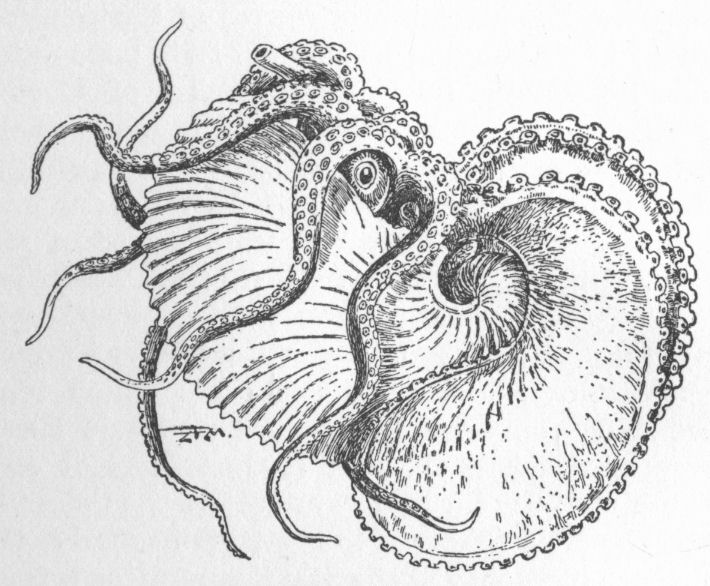
Ar´gonaut, a molluscous animal of the genus Argonauta, belonging to the dibranchiate or two-gilled cuttle-fishes, distinguished by the females possessing a single-chambered external shell, not organically connected with the body of the animal. The males have no shell and are of much smaller size than the females. The shell is fragile, translucent, and boat-like in shape; it serves as the receptacle of the ova or eggs of the female, which sits in it with the respiratory tube or 'funnel' turned towards the carina or 'keel'. This famed mollusc swims only by ejecting water from its funnel, and it can crawl in a reversed position, carrying its shell over its back like a snail. The account of its floating on the surface of the sea, with its sail-shaped arms extended to catch the breeze, and with the six other arms as oars, is a mere fable. The argonaut, or paper-nautilus, must be carefully distinguished from the pearly-nautilus or nautilus proper (Nautilus Pompilius).
Argonauts, in the legendary history of Greece, those heroes who performed a hazardous voyage to Colchis, a far-distant country at the eastern extremity of the Euxine (Black Sea), with Jason in the ship Argo, for the purpose of securing a golden fleece, which was preserved suspended upon a tree, and under the guardianship of a sleepless dragon. By the aid of Medea, daughter of the King of Colchis, Jason was enabled to seize the fleece, and, after many strange adventures, to reach his home at Iolcos in Thessaly. Among the Argonauts were Hercules, Castor and Pollux, Orpheus and Theseus.—Bibliography: A. R. Hope Moncrieff, Classic Myth and Legend; Kingsley, The Heroes; N. Hawthorne, The Wonder-book.
Argo-Navis, the southern constellation of the Ship, is almost entirely invisible in Britain. It contains Canopus, next to Sirius the brightest fixed star. In the great nebula in Argo is situated the remarkable star Eta Argûs. It is variable, generally faint, but in 1837 it became temporarily one of the brightest stars in the sky.
Argonne, a district of France, between the Rivers Meuse, Marne, and Aisne, celebrated for the campaign of Dumouriez against the Prussians in 1792, and for the military movements and actions which took place therein previous to the battle of Sedan, in 1870.
Argonne, Battle of. When, in the autumn of 1914, the Allies retreated towards the Marne, the German Crown Prince's army endeavoured to invest Verdun. His right wing advanced through the thick and extensive forest of Argonne, but took precipitate flight after the battle of the Marne before the army of General Sarrail. In the summer of 1915 the Crown Prince endeavoured to hack his way through the French Argonne lines, using much heavy artillery, poison-gas, liquid-fire, and tear-shells. A final effort to break through was made in September, between Le Four de Paris and Vienne-le-Château, but, after gaining a footing in the first line of French trenches, the Germans were hurled back by a dashing counter-attack. The great salient from the Argonne to St. Mihiel was the salvation of Verdun.
Ar´gos, a town of Greece, in the north-east of the Peloponnesus, between the Gulfs of Ægina and Nauplia or Argos. This town and the surrounding territory of Argolis were famous from the legendary period of Greek history onwards. Here, besides Argos, was Mycenæ, where Agamemnon ruled. Modern Argos is a straggling place of 10,000 inhabitants, with some ancient remains. The territory Argolis forms a nomarchy of Greece. Pop., Argolis and Corinthia, 153,172. The capital is Nauplia.
Argos´toli, a city of the Ionian Islands, capital of Cephalonia, and the residence of a Greek bishop. Pop. 14,000.
Ar´gosy, a poetical name for a large merchant-vessel; derived from Ragusa, a port which was formerly more celebrated than now, and whose vessels did a considerable trade with England. It is popularly but erroneously connected with the ship Argo in which Jason sailed. See Argonauts.
Argot (Fr.; a˙r-gō), the jargon, slang, or peculiar phraseology of a class or profession; originally the conventional slang of thieves and vagabonds, invented for the purpose of disguise and concealment. Some of François Villon's poems are written in argot.—Cf. W. von Knoblauch, Dictionary of Argot.
Arguim, or Arguin (a˙r-gwim´, a˙r-gwin´), a small island on the west coast of Africa, not far from Cape Blanco, formerly a centre of trade. Its possession was violently disputed between the Portuguese, Dutch, English, and French.
Ar´gument, a term sometimes used as synonymous with the subject of a discourse, but more frequently appropriated to any kind of method employed for the purpose of confuting or at least silencing an opponent. Logicians have reduced arguments to a number of distinct heads, such as the argumentum ad judicium, which founds on solid proofs and addresses to the judgment; the argumentum ad verecundiam, which appeals to the modesty or bashfulness of an opponent by reminding him of the great names or authorities by whom the view disputed by him is supported; the argumentum ad ignorantiam, the employment of some logical fallacy towards persons likely to be deceived by it; and the argumentum ad hominem, an argument which presses a man with consequences drawn from his own principles and concessions, or his own conduct. See Fallacy, Logic.
Argument of the People, the document set forth by the Council of the Army on 15th Jan., 1649, fifteen days before the execution of King Charles I. See Levellers.
Ar´gus, in Greek mythology, a fabulous being, said to have had a hundred eyes, placed by Juno to guard Io. Hence 'argus-eyed', applied to one who is exceedingly watchful.
Argus-pheasant (Argus gigantēus)
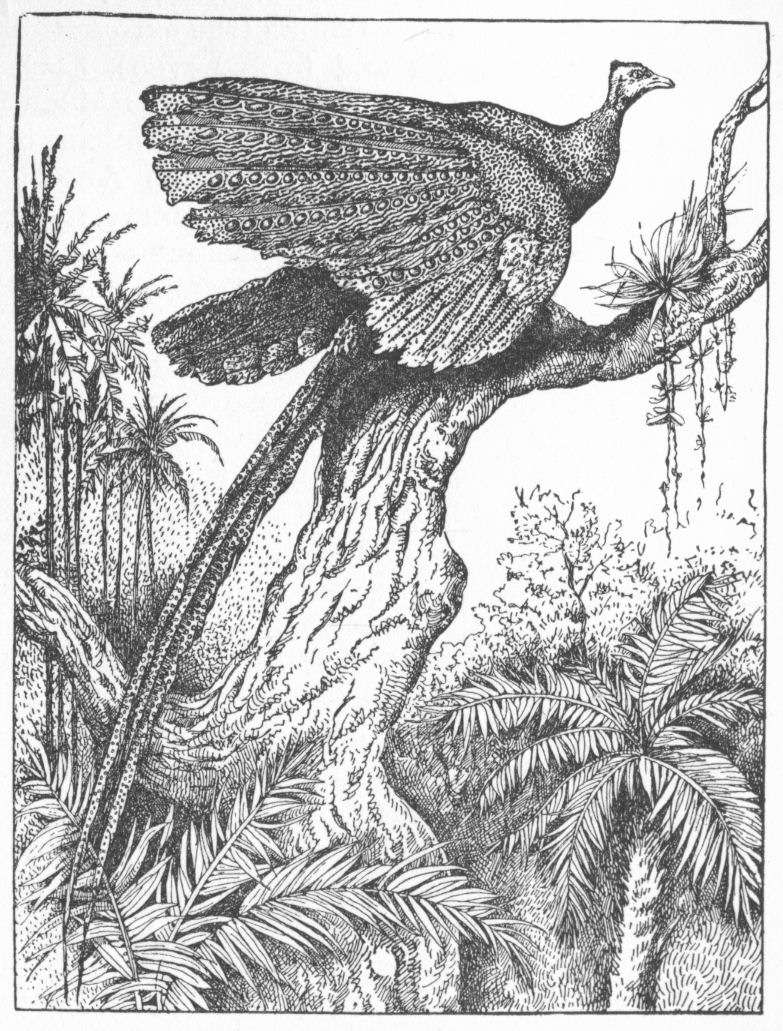
Argus-pheasant (Argus gigantēus), a large, beautiful, and very singular species of pheasant, found native in the south-east of Asia, more especially in Sumatra and some of the other islands. The males measure from 5 to 6 feet from the tip of the beak to the extremity of the tail, which has two greatly-elongated central feathers. The plumage is exceedingly beautiful, the secondary quills of the wings, which are longer than the primary feathers, being each adorned with a series of ocellated or eye-like spots (whence the name—see Argus) of brilliant metallic hues. The general body plumage is brown.
Argyll, or Argyle (a˙r-gīl´), an extensive county in the south-west of the Highlands of Scotland, consisting partly of mainland and partly of islands belonging to the Hebrides group, the chief of which are Islay, Mull, Jura, Tiree, Coll, Luing, Lismore, and Colonsay, with Iona and Staffa. On the land side the mainland is bounded north by Inverness; east by Perth and Dumbarton; elsewhere surrounded by the Firth of Clyde and its connections and the sea; area, 3255 sq. miles (or over 2,000,000 acres), of which the islands comprise about 1000 sq. miles. It is greatly indented by arms of the sea, which penetrate far inland, the most important of these being Loch Sunart, Loch Linnhe (the extremities of which are Loch Eil and Loch Leven), Loch Etive, Loch Fyne, Loch Tarbert, Loch Riddon, Loch Striven, and Loch Long. The mainland is divided into six districts of Northern Argyle, Lorn, Argyle, Cowal, Knapdale, and Kintyre; the two first being subdivided into the sub-districts of Lochiel, Ardgour, Sunart, Ardnamurchan, Morven, and Appin. The county is exceedingly mountainous, the chief summits being Bidean-nam-Bian (3766 feet), Ben Laoigh (3708 feet), Ben Cruachan (3611 feet), Benmore, in Mull (3185 feet), the Paps of Jura (2565 feet), and Ben Arthur or the Cobbler (2891 feet). There are several lakes, the principal of which is Loch Awe. Cattle and sheep are reared in numbers, and fishing is largely carried on, as is also the making of whisky. There is but little arable land. The chief minerals are slate, marble, limestone, and granite. County town, Inveraray; others, Campbeltown, Oban, and Dunoon. Pop. (1921), 76,856.
Argyll, Campbells of, a historic Scottish family, raised to the peerage in the person of Sir Duncan Campbell of Lochow, in 1445. The more eminent members are: Archibald, 2nd Earl, killed at the battle of Flodden, 1513.—Archibald, 5th Earl, attached himself to the party of Mary of Guise, and was the means of averting a collision between the Reformers and the French troops in 1559; was commissioner of regency after Mary's abdication, but afterwards commanded her troops at the battle of Langside; died 1575.—Archibald, 8th Earl and 1st Marquess, born 1598: a zealous partisan of the Covenanters; created a marquess by Charles I. It was by his persuasion that Charles II visited Scotland, and was crowned at Scone in 1651. At the Restoration he was committed to the Tower, and afterwards sent to Scotland, where he was tried for high treason, and beheaded in 1661.—Archibald, 9th Earl, son of the preceding, served the king with great bravery at the battle of Dunbar, and was excluded from the general pardon by Cromwell in 1654. On the passing of the Test Act in 1681 he refused to take the required oath except with a reservation. For this he was tried and sentenced to death. He managed to escape to Holland, from whence he returned with a view of aiding the Duke of Monmouth. His plan, however, failed, and he was taken and conveyed to Edinburgh, where he was beheaded in 1685.—Archibald, 10th Earl and 1st Duke, son of the preceding, died 1703; took an active part in the Revolution of 1688-9, which placed William and Mary on the throne, and was rewarded by several important appointments and the title of duke.—John, 2nd Duke and Duke of Greenwich, son of the above, born 1678, died 1743; served under Marlborough at the battles of Ramillies, Oudenarde, and Malplaquet, and assisted at the sieges of Lisle and Ghent. He incurred considerable odium in his own country for his efforts in promoting the union. In 1712 he had the military command in Scotland, and in 1715 he fought an indecisive battle with the Earl of Mar's army at Sheriffmuir, near Dunblane, and forced the Pretender to quit the kingdom. He was long a supporter of Walpole, but his political career was full of intrigue. He is the Duke of Argyll in Scott's Heart of Midlothian.—George Douglas Campbell, K.G., K.T., &c., 8th Duke (of United Kingdom, 1892), was born in 1823. He early took a part in politics, especially in discussions regarding the Presbyterian Church of Scotland. In 1852 he became Lord Privy Seal under Lord Aberdeen, and again under Lord Palmerston in 1859; Postmaster-General in 1860; Secretary for India from 1868 to 1874; again Lord Privy Seal in 1880, but retired, being unable to agree with his colleagues on their Irish policy. He died in 1900. He wrote The Reign of Law, Scotland as it Was and as it Is, &c.—John Douglas Sutherland Campbell, 9th Duke of, son of the 8th Duke and a daughter of the 2nd Duke of Sutherland, was born in 1845, and succeeded his father in 1900. He completed his education at Trinity College, Cambridge, sat in Parliament as member for Argyllshire, 1868-78, was Governor-General of Canada from 1878 to 1883, and again sat in Parliament as member for South Manchester from 1895 to 1900, as a Liberal-Unionist. He married the Princess Louise of Great Britain, fourth daughter of Queen Victoria, in 1871. He died in 1914. His works include: The United States after the War, Imperial Federation, Canadian Pictures, Memories of Canada and Scotland, Life of Lord Palmerston, Tales and Poems, The Psalms in English Verse, Life and Times of Queen Victoria, Yesterday and To-day in Canada, &c.
Argyll and Sutherland Highlanders (Princess Louise's), raised by the 5th Duke of Argyll (1794), received their present title in 1872. The regiment served under Sir David Baird in Cape Colony, and at Balaklava made itself immortal as Sir Colin Campbell's 'thin red line'. It was further distinguished in the European War at Gheluvelt, Le Cateau, and the second battle of Ypres.
Argyro-Castro (a˙r´gi-rō-), a town in Albania, 40 miles north-west of Janina; built on three ridges intersected by deep ravines, across which are several bridges. It was occupied by the Greeks in 1916. Pop. about 10,000.
Argyropu´los, Johannes, one of the principal revivers of Greek learning in the fifteenth century. Born in Constantinople 1415, died at Rome 1486.
Aria, in music. See Air.
Ariadne (a-ri-ad´ne), in Greek mythology, a daughter of Minos, King of Crete. She gave Theseus a clue of thread to conduct him out of the labyrinth after his defeat of the Minotaur. Theseus abandoned her on the Isle of Naxos, where she was found by Dionysus, who married her.
Aria´na, the ancient name of a large district in Asia, forming a portion of the Persian Empire; bounded on the north by the provinces of Bactriana, Margiana, and Hyrcania; east by the Indus; south by the Indian Ocean and the Persian Gulf; west by Media.
Ariano (ä-rē-ä´nō), a town in South Italy, province of Avellino, 44 miles north-east of Naples, the seat of a bishop, with a handsome cathedral. Pop. 17,650.
Ar´ians, the adherents of the Alexandrian presbyter Arius, who, about A.D. 318, promulgated the doctrine that Christ was a created being inferior to God the Father in nature and dignity, though the first and noblest of all created beings; and also that the Holy Spirit is not God, but created by the power of the Son. Arianism has been defined as an attempt to determine the relations of the Persons of the Trinity on a basis of distinction and subordination. It does not seem to have sprung from any strong ethical impulse; its philosophy was pagan, and the object of the leaders political rather than religious. The doctrines were condemned by the Council of Nicæa in 325. Arius died in 336, and after his death his party gained considerable accessions, including several emperors, and for a time held a strong position. Since the middle of the seventh century, however, the Arians have nowhere constituted a distinct sect, although similar opinions have been advanced by various theologians in modern times. The Arian controversy was revived in England during the eighteenth century by William Whiston and Dr. Samuel Clarke.—Bibliography: H. M. Gwatkin, Studies of Arianism; J. H. Newman, Arians of the Fourth Century; J. H. Colligan, Arian Movement in England.
Arica (a˙-rē´ka˙), a seaport of Chile, 30 miles S. of Tacna; previous to 1880 it belonged to Peru. It has suffered frequently from earthquakes, being in 1868 almost entirely destroyed, part of it being also submerged by an earthquake wave. Pop. about 4000. It has a wireless station.
Arica. See Tacna-Arica Dispute.
Arichat (-shat´), a seaport town and fishing station of Nova Scotia, on a small bay, south coast of Madame Island. Pop. about 2500.
Ariège (a˙-rē-āzh), a mountainous department of France, on the northern slopes of the Pyrenees, comprising the ancient countship of Foix and parts of Languedoc and Gascony. The principal rivers are the Ariège, Arize, and Salat, tributaries of the Garonne. Sheep and cattle are reared; the arable land is small in quantity. Chief town, Foix. Area, 1892 sq. miles. Pop. (1921), 172,851.
A´riel, a symbolic name for Jerusalem in the Old Testament; in the demonology of the later Jews a spirit of the waters. In Shakespeare's Tempest, Ariel was the "tricksy spirit" whom Prospero had in his service.
Aries (ā´ri-ēz; Lat.), the Ram, a northern constellation. It is the first of the twelve signs of the zodiac, which the sun enters at the vernal equinox, about the 21st of March. The "First Point in Aries" is where the equator cuts the ecliptic in the ascending node, from which point the right ascensions of heavenly bodies are reckoned on the equator, and their longitudes upon the ecliptic. Owing to the precession of the equinoxes the sign Aries no longer corresponds with the constellation Aries, which it did 2000 years ago.
Aril, Fruit of Nutmeg
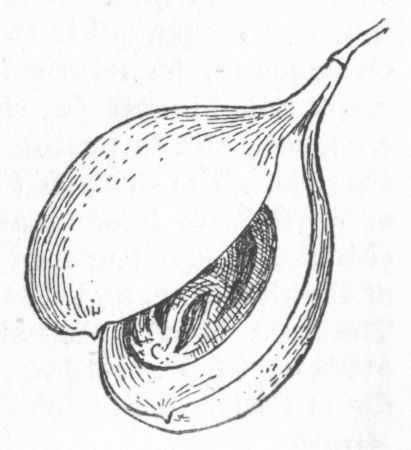
Ar´il, or Aril´lus, in some plants, as in the nutmeg, an extra covering of the seed, outside of the true seed-coats, proceeding from the placenta, partially investing the seed, and falling off spontaneously. It is either succulent or cartilaginous, coloured, elastic, rough, or knotted. In the nutmeg it is known as mace.
Arimas´pians, in ancient Greek traditions, a people who lived in the extreme north-east of the ancient world. They were said to be one-eyed and to carry on a perpetual war with the gold-guarding griffins, whose gold they endeavoured to steal. Cf. Milton, Paradise Lost, II, 943.
Arimathæ´a, a town of Palestine, identified with the modern Ramleh, 22 miles W.N.W. of Jerusalem.
Ari´on, an ancient Greek poet and musician, born at Methymna, in Lesbos, flourished about 625 B.C. He lived at the Court of Periander of Corinth, and afterwards visited Sicily and Italy. Returning from Tarentum to Corinth with rich treasures, the avaricious sailors resolved to murder him. Apollo, however, having informed him in a dream of the impending danger, Arion in vain endeavoured to soften the hearts of the crew by the power of music. He then threw himself into the sea, when one of a shoal of dolphins, which had been attracted by his music, received him on his back and bore him to land. The sailors, having returned to Corinth, were confronted by Arion and convicted of their crime. The lyre of Arion, and the dolphin which rescued him, became constellations in the heavens. A fragment of a hymn to Poseidon, ascribed to Arion, is extant.
Arios´to, Ludovi´co, one of the most celebrated poets of Italy, was born at Reggio, in Lombardy, 8th Sept., 1474, of a noble family; died 6th June, 1533. His lyric poems in the Italian and Latin languages, distinguished for ease and elegance of style, introduced him to the notice of the Cardinal Ippolito d'Este, son of Duke Ercole I of Ferrara. In 1503 Ippolito employed him in his service and used his counsel in the most important affairs. In this service he began and finished, in ten or eleven years, his immortal poem, the Orlando Furioso, which was published in 1515, and immediately became highly popular. He afterwards entered the service of Alfonso I, Duke of Ferrara, the cardinal's brother, a lover of the arts, who put much confidence in him. After quelling disturbances that had broken out in the wild and mountainous Garfagnana, he returned to Ferrara, where he employed himself in the composition of his comedies, and in putting the last touches to his Orlando. The Orlando Furioso is a continuation of the Orlando Innamorato of Bojardo, details the chivalrous adventures of the paladins of the age of Charlemagne, and extends to forty-six cantos. The best English translation is that of Rose (1823). Cf. E. Gardner, Ariosto: the Prince of Court Poets; J. S. Nicholson, Life and Genius of Ariosto.
Arish. See El Arish.
Aristæus, in Greek mythology, son of Apollo and Cyrene, the introducer of bee-keeping. Cf. Virgil, Georgics, IV, 315-558.
Aristarchus (a-ris-tär´kus), an ancient Greek grammarian, born at Samothrace 220 B.C., died at Cyprus 143 B.C. He edited Homer's poems with the greatest acuteness and ability, endeavouring to restore the text to its genuine state, and to clear it of all interpolations and corruptions; hence the phrase, Aristarchian criticism. His edition of Homer furnished the basis of all subsequent ones.
Aristarchus, an ancient Greek astronomer belonging to Samos, flourished about 155 B.C., and first asserted the revolution of the earth about the sun; also regarded as the inventor of the sun-dial.
Aris´teas, a personage of ancient Greek legend, represented to have lived over many centuries, disappearing and reappearing by turns.
Aristides (a-ris-tī´dēz), a statesman of ancient Greece, for his strict integrity surnamed the Just. He was one of the ten generals of the Athenians when they fought with the Persians at Marathon, 490 B.C. Next year he was eponymous archon, and in this office enjoyed such popularity that he excited the jealousy of Themistocles, who succeeded in procuring his banishment by ostracism (about 483). Three years after, when Xerxes invaded Greece with a large army, the Athenians hastened to recall him, and Themistocles now admitted him to his confidence and councils. In the battle of Platæa (479) he commanded the Athenians, and had a great share in gaining the victory. To defray the expenses of the Persian war he persuaded the Greeks to impose a tax, which should be paid into the hands of an officer appointed by the States collectively, and deposited at Delos. The confidence which was felt in his integrity appeared in their entrusting him with the office of apportioning the contribution. He died at an advanced age about 468 B.C., so poor that he was buried at the public expense.
Aristip´pus (c. 425-366 B.C.), a disciple of Socrates, and founder of a philosophical school among the Greeks, which was called the Cyrenaic, from his native city Cyrēnē, in Africa; flourished 380 B.C. His moral philosophy differed widely from that of Socrates, and was a science of refined voluptuousness. His fundamental principles were—that all human sensations may be reduced to two, pleasure and pain. Pleasure is a gentle, and pain a violent emotion. All living beings seek the former and avoid the latter. Happiness is nothing but a continued pleasure, composed of separate gratifications; and as it is the object of all human exertions, we should abstain from no kind of pleasure. Still we should always be governed by taste and reason in our enjoyments. His doctrines were taught only by his daughter Arĕtē, and by his grandson Aristippus the younger, by whom they were systematized. Other Cyrenaics compounded them into a particular doctrine of pleasure, and are hence called Hedonici. His writings are lost.
Aristoc´racy (Gr. aristos, best, kratos, rule), a form of government by which the wealthy and noble, or any small privileged class, rules over the rest of the citizens. The term has now become almost entirely social in meaning, and is mostly applied to the nobility or chief persons in a State.
Aristogeiton (-gī´ton), a citizen of Athens, whose name is rendered famous by a conspiracy (514 B.C.) formed in conjunction with his friend Harmodius against the tyrants Hippias and Hipparchus, the sons of Pisistratus. Both Aristogeiton and Harmodius lost their lives through their attempts to free the country, and were reckoned martyrs of liberty.
Aristolochia (-lō´ki-a), a genus of plants, the type of the ord. Aristolochiaceæ, which consists of dicotyledonous monochlamydeous plants, with an inferior 3-6-celled fruit, found for the most part in the hotter parts of the world, and in many cases used medicinally on account of their tonic and stimulating properties. The genus has emmenagogic qualities, especially the European species A. rotunda, A. longa, and A. Clematītis. A. bracteāta is used in India as an anthelminthic; A. odoratissima, a West Indian species, is a valuable bitter and alexipharmic. A. serpentaria is the Virginian snake-root, popularly regarded as a remedy for snake bites.
Aristophanes (-tof´a-nēz), the greatest comic poet of ancient Greece, born at Athens probably about the year 455 B.C., died 375 B.C. Little is known of his life. He appeared as a poet in 427 B.C., and having indulged in some sarcasms on the powerful demagogue Cleon, was ineffectually accused by the latter of having unlawfully assumed the title of an Athenian citizen. He afterwards revenged himself on Cleon in his comedy of the Knights, in which he himself acted the part of Cleon, because no actor had the courage to do it. Of fifty-four (or forty-four) comedies attributed to him, eleven only remain; believed to be the flower of the ancient comedy, and distinguished by wit, humour, and poetry, as also by grossness. In them there is constant reference to the manners, actions, and public characters of the day, the freedom of the old Greek comedy allowing an unbounded degree of personal and political satire. The names of his extant plays are Acharnians, Knights, Clouds, Wasps, Peace, Birds, Lysistrata, Thesmophoriazusæ, Frogs, Ecclesiasuzæ, and Plutus.—Bibliography: B. B. Rogers, Complete Works of Aristophanes, with verse translation (by far the best translation); Hookham-Frere, Translation (five plays only); Couat, Aristophane et l'ancienne comédie attique.
Ar´istotle (Gr. Aristot´eles), a distinguished philosopher and naturalist of ancient Greece, the founder of the Peripatetic school of philosophy, was born in 384 B.C. at Stagira, in Macedonia; died at Chalcis, 322 B.C. His father, Nicomachus, was physician to Amyntas II, King of Macedonia, and claimed to be descended from Æsculapius. Aristotle had lost his parents before he came, at about the age of seventeen, to Athens to study in the school of Plato. With that philosopher he remained for twenty years, became pre-eminent among his pupils, and was known as the 'Intellect of the School'. Upon the death of Plato, 348 B.C., he took up his residence at Atarneus, in Mysia, on the invitation of his former pupil Hermeias, the ruler of that city, on whose assassination by the Persians, 343 B.C., he fled to Mitylene with his wife Pythias, a near relative of Hermeias. During his residence at Mitylene he received an invitation from Philip of Macedon to superintend the education of his son Alexander, then in his fourteenth year. This relationship between the great philosopher and the future conqueror continued for five or six years, during which the prince was instructed in grammar, rhetoric, poetry, logic, ethics, and politics, and in those branches of physics which had even then made some considerable progress. On Alexander succeeding to the throne Aristotle continued to live with him as his friend and councillor till he set out on his Asiatic campaign (334 B.C.). He returned to Athens and established his school in the Lyceum, a gymnasium attached to the temple of Apollo Lyceius, which was assigned to him by the State. He delivered his lectures in the wooded walks of the Lyceum while walking up and down with his pupils. From the action itself, or more probably from the name of the walks (peripatoi), his school was called Peripatetic. Pupils gathered to him from all parts of Greece, and his school became by far the most popular in Athens. The statement that he had two circles of pupils, the exoteric and the esoteric has given rise to much controversy. By some it has been held that Aristotle published during his lifetime popular discourses with a view to make way for his doctrines in Athenian society, then impregnated with Platonic theories, and that these are called exoteric in contradistinction to those in which are embodied his matured opinions. It was during the time of his teaching at Athens that Aristotle is believed to have composed the great bulk of his works. But it is not possible to speak with any certainty about the chronology of his writings, as the references may be additions of editors. On the death of Alexander a revolution occurred in Athens hostile to the Macedonian interests with which Aristotle was identified. He therefore retired to Chalcis, where he soon after died. Sir Charles Walston, in 1891, opened a tomb near Eretria which he supposed to be that of Aristotle. According to Strabo he bequeathed all his works to Theophrastus, who, with other disciples of Aristotle, amended and continued them. They afterwards passed through various hands, till, about 50 B.C., Andronicus of Rhodes put the various fragments together and classified them according to a systematic arrangement. Many of the books bearing his name are spurious, others are of doubtful genuineness. The whole are generally divided into logical, theoretical, and practical. The logical works are comprehended under the title Organon (Instrument). The theoretical are divided into physics, mathematics, and metaphysics. The physical works (including those on natural history) are on the General Principles of Physical Science, The Heavens, Generation and Destruction, Meteorology, Natural History of Animals, On the Parts of Animals, On the Generation of Animals, On the Locomotion of Animals, On the Soul, On Memory, Sleep and Waking, Dreams, Divination. In mathematics there are two treatises, On Indivisible Lines and Mechanical Problems. The Metaphysics consist of fourteen books; the title (Ta meta ta Physika, 'the things following the Physics',) is the invention of an editor. The practical works embrace ethics, politics, economics, and treatises on art, and comprise the Nicomachæan Ethics (so called because dedicated to his son, Nicomachus), The Politics, Œconomics, Poetry, and Rhetoric. Among the lost works are the dialogues and others termed exoteric. A treatise On the Constitution of Athens was discovered in 1891. His style is devoid of grace and elegance. His works were first printed in a Latin translation, with the commentaries of Averroes, at Venice in 1489; the first Greek edition was that of Aldus Manutius (5 vols., 1495-8). See Peripatetic Philosophy.—Bibliography: Blakesley, Life of Aristotle; S. H. Butcher, Poetics (with translation and excursus); R. Shute, History of the Aristotelian Writings; J. C. Wilson, Aristotelian Studies; E. Zeller, Aristotle and the Earlier Peripatetics; E. Barker, Political Thought of Plato and Aristotle.
Aristox´enus, an ancient Greek musician and philosopher of Tarentum, born about 324 B.C. He studied music under his father Mnesias, and philosophy under Aristotle, whose successor he aspired to be. He endeavoured to apply his musical knowledge to philosophy, and especially to the science of mind, but it only appears to have furnished him with far-fetched analogies and led him into a kind of materialism. We have a work on the Elements of Harmony by him.
Arith´metic (Gr. arithmos, number) is primarily the science of numbers. As opposed to algebra it is the practical part of the science. Although the processes of arithmetical operations are often highly complicated, they all resolve themselves into the repetition of four primary operations—addition, subtraction, multiplication, and division. Of these the two latter are only complex forms of the two former, and subtraction again is merely a reversal of the process of addition. Little or nothing is known as to the origin and invention of arithmetic. Some elementary conception of it is in all probability coeval with the first dawn of human intelligence. In consequence of their rude methods of numeration, the science made but small advance among the ancient Egyptians, Greeks, and Romans, and it was not until the introduction of the decimal scale of notation and the Arabic, or rather Indian, numerals into Europe that any great progress can be traced. In this scale of notation every number is expressed by means of the ten digits, 1, 2, 3, 4, 5, 6, 7, 8, 9, 0, by giving each digit a local as well as its proper or natural value. The value of every digit increases in a tenfold proportion from the right towards the left; the distance of any figure from the right indicating the power of 10, and the digit itself the number of those powers intended to be expressed: thus 3464 = 3000 + 400 + 60 + 4 = 3 × 10³ + 4 × 10² + 6 × 10 + 4. The earliest arithmetical signs appear to have been hieroglyphical, but the Egyptian hieroglyphics were too diffuse to be of any arithmetical value. The units were successive strokes to the number required, the ten an open circle, the hundred a curled palm-leaf, the thousand a lotus flower, ten thousand a bent finger. The letters of the alphabet afforded a convenient mode of representing figures, and were used accordingly by the Chaldeans, Hebrews, and Greeks. The first nine letters of the Hebrew alphabet represented the units, the second nine tens, the remaining four together with five repeated with additional marks, hundreds; the same succession of letters with added points was repeated for thousands, tens of thousands, and hundreds of thousands. The Greeks followed the same system up to tens of thousands. They wrote the different classes of numbers in succession as we do, and they transferred operations performed on units to numbers in higher places; but the use of different signs for the different ranks clearly shows a want of full perception of the value of place as such. They adopted the letter M as a sign for 10,000 and by combining this mark with their other numerals they could note numbers as high as 100,000,000. The Roman numerals, which are still used in marking dates or numbering chapters, were almost useless for purposes of computation. From one to four were represented by vertical strokes , , , , five by , ten by , fifty by , one hundred by , afterwards , five hundred by , a thousand by . These signs were derived from each other according to particular rules, thus was the half of , being also used; was likewise the half of . was artistically written and and , afterwards , became five hundred. represented 5000, 10,000, 50,000, 100,000. They were also compounded by addition and subtraction, thus stood for four, for six, for thirty, for forty, for sixty. Arithmetic is divided into abstract and practical: the former comprehends notation, numeration, addition, subtraction, multiplication, division, measures and multiples, fractions, powers and roots; the latter treats of the combinations and practical applications of these and the so-called rules, such as reduction, compound addition, subtraction, multiplication, and division, proportion, interest, profit and loss, &c. Another division is integral and fractional arithmetic, the former treating of integers, or whole numbers, and the latter of fractions. Decimal fractions were invented in the sixteenth century, and logarithms, embodying the last great advance in the science, in the seventeenth century.





Arithmet´ical, pertaining to arithmetic or its operations.—Arithmetical mean, the middle term of three quantities in arithmetical progression, or half the sum of any two proposed numbers; thus 11 is the arithmetical mean to 8 and 14.—Arithmetical progression, a series of numbers increasing or decreasing by a common difference, as 1, 3, 5, 7, &c.—Arithmetical signs, certain symbols used in arithmetic, and indicating processes or facts. The common signs used in arithmetic are the following: signifying that the numbers between which it is placed are to be added; - that the second is to be subtracted from the first; that the one is to be multiplied by the other; that the former is to be divided by the latter; signifies that the one number is equal to the other; are the signs placed between the members of a proportional series, as 4 : 6 :: 8 : 12. A small figure placed on the right hand of another at the top signifies the corresponding power of the number beside which it is placed, as 52, 43, meaning the square of 5 and the cube of 4. placed before or over a number signifies the square root of that number; with a figure it signifies the root of a higher power, as , which means cube root. A period placed to the left of a series of figures indicates that they are decimal fractions.





A´rius, the originator of the Arian heresy. See Arians.
Arizo´na, a former territory of the United States, admitted into the union as a sovereign State on 14th Feb., 1912, is bounded south by Mexico, west by California and Nevada (the River Colorado forming the greater part of the boundary), north by Utah, and east by New Mexico; area, 113,956 sq. miles. The surface is generally mountainous, but many fertile and well-watered valleys lie between the ridges. Part of the surface consists of deserts often entirely destitute of vegetation. The territory belongs to the basin of the Colorado, which passes through a portion of it, besides forming the boundary; while the Gila and Little Colorado, tributaries of the Colorado, traverse it from east to west. The canyons of the Colorado form a wonderful feature, the river flowing for hundreds of miles in a deep rocky channel with walls rising perpendicularly to the height of 1500 to 6000 feet. In some parts timber is plentiful. The rainfall is small, and irrigation has been employed for agricultural purposes. Large tracts of elevated land have been found excellently adapted as pastures for sheep and cattle. The territory is rich in copper, gold, silver, lead, and other minerals, and mining is largely carried on, with much copper smelting and refining. The capital is Phœnix. Pop. 29,053. The Southern and the Santa Fé Pacific Railways traverse it. Pop. (1920), 333,903 (of which 171,468 are white), exclusive of Apaches and other Indians on reservations (area, 29,017 sq. miles; pop. (1920), 42,400).
Arjish Dagh, the loftiest peak of the peninsula of Asia Minor, at the western extremity of the Anti-Taurus Range, 13,150 feet; an extinct volcano; on the N. and N.E. slopes are extensive glaciers.
Ark, the name applied in our translation of the Bible to the boat or floating house in which Noah resided during the flood or deluge; to the floating vessel of bulrushes in which the infant Moses was laid; and to the chest in which the tables of the law were preserved—the ark of the covenant. This last was made of shittim-wood, overlaid within and without with gold, about 3¾ feet long by 2¼ feet high and broad, and over it were placed the golden covering or mercy-seat and the two cherubim. It was placed in the sanctuary of the temple of Solomon; before his time it was kept in the tabernacle, and was moved about as circumstances dictated. At the captivity it appears to have been either lost or destroyed.