VOLUME I PART 2 (continued 7)
Reading edition
Ar´ran, an island of Scotland, in the Firth of Clyde, part of Bute county; length, north to south, 20 miles; breadth, about 10 miles; area, 165 sq. miles, or 105,814 acres, of which about 15,000 are under cultivation. It is of a wild and romantic appearance, particularly the northern half, where the island attains its loftiest summit in Goatfell, 2866 feet high. The coast presents several indentations, of which that of Lamlash, forming a capacious bay, completely sheltered by Holy Island, is one of the best natural harbours in the west of Scotland. On the small island of Pladda, about a mile from the south shore, a lighthouse has been erected. The geology of Arran has attracted much attention, as furnishing within a comparatively narrow space distinct sections of the great geological formations; while the botany possesses almost equal interest, both in the variety and the rarity of many of its plants. Among objects of interest are relics of Danish forts, standing stones, cairns, &c. Lamlash and Brodick are villages. The island is a favourite resort of summer visitors, and is reached by steamer from Ardrossan. Pop. 8294.
Arran, Earls of. See Hamilton, Family of.
Arrangement, in music, the adaptation of a composition to voices or instruments for which it was not originally written; also, a piece so adapted.
Ar´ran Islands. See Aran.
Arraro´ba. See Araroba.
Arras (a˙-rä), a town of France, capital of the department Pas-de-Calais, well built, with several handsome squares and a citadel, cathedral, public library, botanic garden, museum, and numerous flourishing industries. In the Middle Ages it was famous for the manufacture of tapestry, to which the English applied the name of the town itself (arrazo). The battle of Arras was fought and Vimy Ridge taken by the Allies on 9th April, 1917. Pop. 24,200.
Arrest´ is the apprehending or restraining of one's person, which, in civil cases, can take place legally only by process in execution of the command of some court or officers of justice; but in criminal cases any man may arrest without warrant or precept, and every person is liable to arrest without distinction, but no man is to be arrested unless charged with such a crime as will at least justify holding him to bail when taken. Magna Charta and the Habeas Corpus Act are the two great statutes for securing the liberty of the subject against unlawful arrests and suits.
Arrest´ment, in Scots law, a process by which a creditor may attach money or movable property which a third party holds for behoof of his debtor. In 1870 an Act was passed for Scotland which provides that only that part of the weekly wages of labourers, and of workpeople generally, which is in excess of 20s. is liable to arrestment for debt.
Arrest of Judgment, in law, the staying or stopping of a judgment after verdict, for causes assigned. Courts have power to arrest judgment for intrinsic causes appearing upon the face of the record; as when the declaration varies from the original writ; when the verdict differs materially from the pleadings; or when the case laid in the declaration is not sufficient in point of law to found an action upon.
Arre´tium. See Arezzo.
Arrhenath´erum, a genus of oat-like grasses, of which A. elatius, sometimes called French rye-grass, is a valuable fodder plant.
Arrhenius, Svante August, famous Swedish physicist and chemist, born 19th Feb., 1859, at Wyk, near Upsala. He was educated at the Universities of Upsala (1876-81) and Stockholm (1881-4), spent two years in travelling, and after doing much original research was appointed professor of physics at the University of Stockholm. To him is due the establishment of the theory of electrolytic dissociation, supplying a reasonable explanation of many chemical phenomena otherwise insoluble. He subsequently extended the application of the electrolytic theory to the phenomena of atmospheric electricity. His dissertation Sur la conductibilité galvanique des électrolytes appeared in 1884. Among his other works is Worlds in the Making (English translation, 1908).
Ar´ria, the heroic wife of a Roman named Cæcīna Pætus. Pætus was condemned to death in A.D. 42 for his share in a conspiracy against the emperor Claudius, and was encouraged to suicide by his wife, who stabbed herself and then handed the dagger to her husband with the words, 'It does not hurt, Pætus!'
Ar´rian, or Flavius Arrianus, a Greek historian, native of Nicomedia, flourished in the second century, under the emperor Hadrian and the Antonines. He was first a priest of Ceres; but at Rome he became a disciple of Epictetus, was honoured with the citizenship of Rome, and was advanced to the senatorial and even consular dignities. His extant works are: The Expedition of Alexander, in seven books; a book On the Affairs of India; an Epistle to Hadrian; a Treatise on Tactics; a Periplus of the Euxine Sea; a Periplus of the Red Sea; and his Enchiridion, a moral treatise, containing the discourses of Epictetus.
Ar´ris, in architecture, the line in which the two straight or curved surfaces of a body, forming an exterior angle, meet each other.
Arro´ba (Spanish), a weight formerly used in Spain, and still used in the greater part of Central and South America. In the States of Spanish origin its weight is generally equal to 25.35 lb. avoirdupois; in Brazil it equals 32.38 lb.—Also a measure for wine, spirits, and oil, ranging from 2¾ gallons to about 10 gallons.
Arröe, Danish island. See Aeröe.
Arrondissement. See France.
Arrow. See Archery, Bow.
Arrowhead (Sagittaria), a genus of aquatic plants found in all parts of the world within the torrid and temperate zones, nat. ord. Alismaceæ, distinguished by possessing barren and fertile flowers, with a three-leaved calyx and three coloured petals. The common arrowhead (S. sagittifolia), the only native species in Britain, is known by its arrow-shaped leaves with lanceolate straight lobes.
Arrowheaded Characters. See Cuneiform Writing.
Arrow Lake, an expansion of the Columbia River, in British Columbia, Canada; about 95 miles long from N. to S.; often regarded as forming two lakes—Upper and Lower Arrow Lake.
Arrowrock Dam. See Dams and Reservoirs.
Arrow-root (Maranta arundinācĕa)
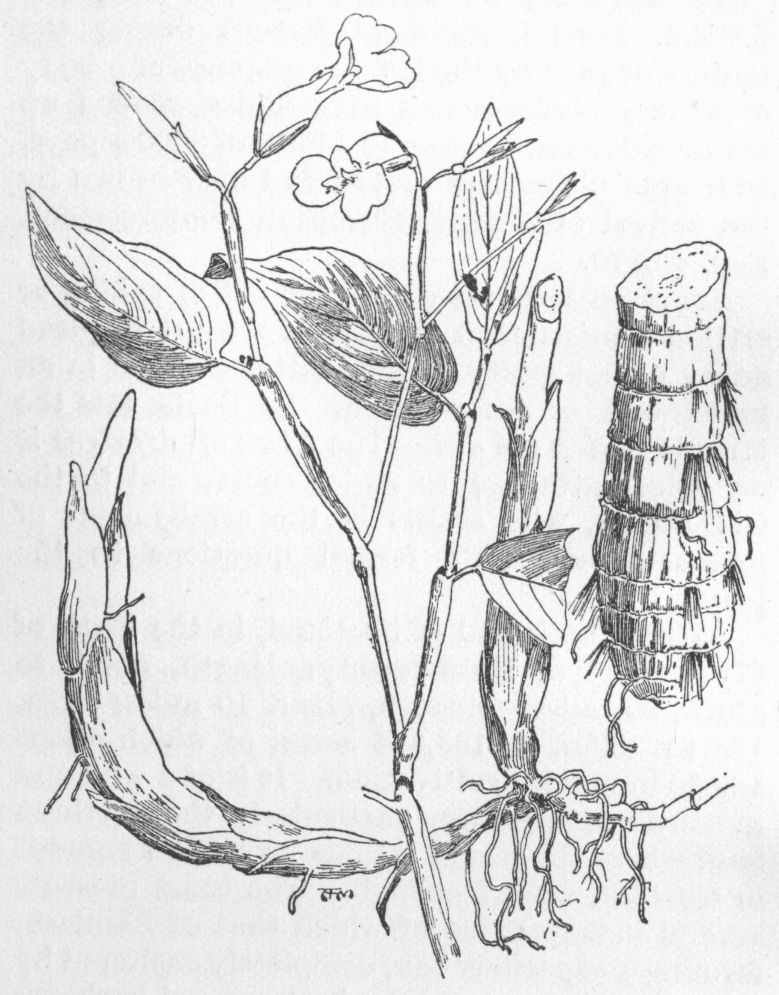
Arrow-root, a starch largely used for food and for other purposes. Arrow-root proper is obtained from the rhizomes or rootstocks of several species of plants of the genus Maranta (nat. ord. Marantaceæ), and perhaps owes its name to the scales which cover the rhizome, which have some resemblance to the point of an arrow. Some, however, suppose that the name is due to the fact of the fresh roots being used as an application against wounds inflicted by poisoned arrows, and others say that arrow is a corruption of ara, the Indian name of the plant. The species from which arrow-root is most commonly obtained is M. arundinācĕa, hence called the arrow-root plant. Brazilian arrow-root, or tapioca meal, is got from the large fleshy root of Manihot utilissima, after the poisonous juice has been got rid of; East Indian arrow-root, from the large rootstocks of Curcŭma angustifolia; Chinese arrow-root, from the creeping rhizomes of Nelumbium speciōsum; English arrow-root, from the potato; Portland arrow-root, from the corms of Arum maculātum; and Oswego arrow-root, from Indian corn. Analyses made in 1902 and 1906 show that the idea generally held of the nourishing qualities of arrow-root is a delusion, and that the proteids, which are true muscle-builders, are present in an extremely small extent. Arrow-root, however, mixed with eggs, milk, and flavourings, is largely used in the dietary of invalids.
Arrowsmith, Aaron, a distinguished English chartographer, born 1750, died 1823; he raised the execution of maps to a perfection it had never before attained.—His nephew, John, born 1790, died 1873, was no less distinguished in the same field; his London Atlas of Universal Geography may be specially mentioned.
Arroyo (a˙r-rō´yo), the name of two towns of Spain, in Estremadura, the one, called Arroyo del Puerco (pop. 5727), about 10 miles west of Caceres; the other, called Arroyo Molinos de Montanches, about 27 miles south-east of Caceres, memorable from the victory gained by Lord Hill over a French force under General Gerard, 28th Oct., 1811.
Ar´ru (or Aroo) Islands, a group belonging to the Dutch, south of western New Guinea, and extending from north to south about 127 miles. They are composed of coralline limestone, nowhere exceeding 200 feet above the sea, and are well wooded and tolerably fertile. The natives belong to the Papuan race, and some of them are Christians. The chief exports are trepang, tortoise-shell, pearls, mother-of-pearl, and edible birds'-nests. Pop. of group about 20,000.
Arsa´ces, the founder of a dynasty of Parthian kings (256 B.C.), who, taking their name from him, are called Arsacidæ. There were thirty-one in all. See Parthia.
Ar´samas, a manufacturing town in the Russian government of Nijni-Novgorod, on the Tesha, 250 miles east of Moscow, with a cathedral and large convent. Pop. 12,000.
Ar´senal, a royal or public magazine or place appointed for the making, repairing, keeping, and issuing of military stores. An arsenal of the first class should include factories for guns and gun-carriages, small-arms, small-arms ammunition, harness, saddlery, tents, and powder; a laboratory and large store-houses. In arsenals of the second class workshops take the place of the factories. The Royal Arsenal, Woolwich, which manufactures warlike implements and stores for the army and navy, was formed about 1720, and comprises factories, laboratories, &c., for the manufacture and final fitting up of almost every kind of arms and ammunition. Great quantities of military and naval stores are kept at the dockyards of Chatham, Portsmouth, Plymouth, and Pembroke. In France there are various arsenals or depots of war-material, which is manufactured at Mézières, Toulouse, Besançon, &c.; the great naval arsenals are Brest and Toulon. Until 1919 the chief German arsenals were at Spandau, Strassburg, and Dantzig. The chief Austrian arsenal was the immense establishment at Vienna, which included gun-factory, laboratory, small-arms and carriage factories, &c. Russia had her principal arsenal at Petrograd, with supplementary factories of arms and ammunition at Briansk, Kiev, and elsewhere. In Italy Turin is the centre of the military factories. There are a number of arsenals in the United States, but individually they are of little importance.
Ar´senic (symbol As, atomic weight 75), a common element usually found combined with metals as arsenides, the commonest of which is arsenical pyrites, FeAsS. It has a steel colour and high metallic lustre, and tarnishes on exposure to the air, first changing to yellow, and finally to black. In hardness it equals copper; it is extremely brittle, and very volatile, beginning to sublime before it melts. It burns with a blue flame, and emits a smell of garlic. Its specific gravity is 5.76. It forms compounds with most of the metals. Combined with sulphur it forms orpiment and realgar, which are the yellow and red sulphides of arsenic. Orpiment is the true arsenicum of the ancients. With oxygen arsenic forms two compounds, the more important of which is arsenious oxides or arsenic trioxide (As4O6), which is the white arsenic, or simply arsenic of the shops. It is usually seen in white, glassy, translucent masses, and is obtained by sublimation from several ores containing arsenic in combination with metals, particularly from arsenical pyrites. Of all substances arsenic is that which has most frequently occasioned death by poisoning, both by accident and design. The best remedies against the effects of arsenic on the stomach are ferric hydroxide or magnesic hydroxide, or a mixture of both, with copious draughts of bland liquids of a mucilaginous consistence, which serve to procure its complete ejection from the stomach. Oils and fats generally, milk, albumen, wheat-flour, oatmeal, sugar or syrup, have all proved useful in counteracting its effect. Like many other virulent poisons it is a safe and useful medicine, especially in skin diseases, when judiciously employed. It is used as a flux for glass, and also for forming pigments. The arsenite of copper (Scheele's green) and a double arsenite and acetate of copper (emerald green) were formerly largely used to colour paper-hangings for rooms; but as poisonous gases are liable to be given off, the practice has been to a great extent abandoned. Arsenic compounds have been used for colouring confectionery, and other articles, bright green, but their chief industrial use is in the preparation of insecticides. Arsenic is found in crude oil of vitriol, and occasionally in products such as grape-sugar, beer, &c., in the manufacture of which oil of vitriol is employed. Plants die when placed in a solution of arsenic, but corn is often steeped in such a solution, previous to planting, for preventing smut, and the growth of the future plant is not injured thereby.
Arshin (a˙r-shēn´), a Russian measure of length equal to 28 inches.
Arsin´oë, a city of ancient Egypt on Lake Mœris, said to have been founded about 2300 B. C., but renamed after Arsinoë, wife and sister of Ptolemy II of Egypt, and called also Crocodilopolis, from the sacred crocodiles kept at it.
Ar´sis, a term applied in prosody to that syllable in a measure where the emphasis is put; in elocution, the elevation of the voice, in distinction from thesis, or its depression. Arsis and thesis, in music, are the strong position and weak position of the bar, indicated by the down-beat and up-beat in marking time.
Ar´son, in English law, the malicious burning of a dwelling-house or outhouse of another man, which by the common law is felony, and which, if any person is therein, is capital. Also, the wilful setting fire to any church, chapel, warehouse, mill, barn, agricultural produce, ship, coal-mine, and the like. In Scotland it is called wilful fire-raising, and in both England and Scotland it is a considerable aggravation of the crime if the burning is to defraud insurers.
Art, in its most extended sense, as distinguished from nature on the one hand and from science on the other, has been defined as every regulated operation or dexterity by which organized beings pursue ends which they know beforehand, together with the rules and the result of every such operation or dexterity. Science consists in knowing, art in doing. In this wide sense it embraces what are usually called the useful arts. In a narrower and purely æsthetic sense it designates what are more specifically termed the fine arts, as architecture, sculpture, painting, music, and poetry. The useful arts have their origin in positive practical needs, and restrict themselves to satisfying them. The fine arts minister to the sentiment of taste through the medium of the beautiful in form, colour, rhythm, or harmony. See Fine Arts, Painting, Sculpture, &c.—In the Middle Ages it was common to give certain branches of study the name of arts.—Cf. A. C. R. Carter, History of Art, The Year's Art.
Art Collections. See Collections, Artistic.
Art, Teaching of. With the advent of the present industrial age the teaching of art has undergone a profound change. The fine and the industrial arts have been equally affected. In mediæval times, and in the earlier classic ages, the system of apprenticeship prevailed, and all teaching of the arts and of the artistic crafts was given by masters of the various arts or trades to the apprentices who worked under their guidance as assistants. Standards of excellence were maintained by trade guilds, who enforced rules as to workmanship as well as rules for the economic conditions of each trade or craft. The painter of pictures, or of mural decorations, was trained in the same way as any other craftsman, working as an apprentice under a master.
When, in the last century, machinery driven by steam-power took the place of hand labour in industry, the small independent workshops gradually disappeared, as the industrial centres increased in those localities where coal or raw material was most easily obtained; and, as the processes of each trade or craft became more and more subdivided and specialized, the old system of apprenticeship, which had become unnecessary, broke down. The teaching and tradition of the small independent craft workshops had no counterpart in the new centralized industrial systems. Even the painters of pictures needed no longer to prepare their own materials, for special industries arose, and mechanical processes were developed, for the work which formerly had been done in the artists' workshops by apprentices. The fine arts in this way suffered the loss of their old systems of teaching and instruction.
To meet the need for a revival of art teaching in the crafts and other industries, there arose a movement towards the centralization of teaching in schools of art during the latter half of the nineteenth century. Following the impulse given to that movement by the great exhibition in 1850, the British Government founded the schools of science and art in London and in most of the important provincial towns. Earlier in the century bodies of artists had founded national academies for the teaching of art; and the teaching of drawing was gradually adopted as a part of ordinary school education. Step by step training in schools of art or technical schools took the place of the teaching formerly given during apprenticeship in every craft workshop. The ancient guilds were replaced by the new trades unions, but these took no part in the maintenance of artistic standards nor of quality in workmanship.
At the present time the teaching of art begins with the early school lessons in drawing, and is carried on in special technical classes or schools of art, where teachers of the 'fine arts' and of the artistic crafts give instruction to students preparing for professional work. In a few of the artistic trades the system of apprenticeship still survives, but the teaching given by that means is usually supplemented by attendance at a school of art or technical school. Under the Education Act of 1918 attendance at technical classes in the daytime became compulsory for apprentices in all industrial trades.
The subject of art teaching was formerly disregarded by the universities, but has become definitely within their province since the founding of the Slade professorships at Oxford, Cambridge, and London Universities, and of the professorship of fine art at the University of Edinburgh.
The chief schools of art in Great Britain are the schools of the Royal Academy in London, the Slade School at University College, London, and the Royal College of Art at South Kensington, also the Central School of Arts and Crafts, and the other large metropolitan schools of the London County Council.
In most of the English provincial towns are municipal or other schools of art under the control of the Board of Education.
In Scotland the chief schools are the four central institutions—the Edinburgh College of Art, and the schools of art of Glasgow, Aberdeen, and Dundee. In each of these a diploma is given on the satisfactory completion of a prescribed course of study.
In Ireland the chief schools are those of the Royal Hibernian Academy in Dublin, and the provincial schools of art under the Department of Agriculture and Technology.
On the Continent the chief centre of artistic training has for many years been in Paris. Advanced students from most European and American art schools spend some of the later period of their study in the schools of Paris, in painting, in sculpture, or in architecture. There is, naturally, a valuable incentive and stimulation due to this gathering together of advanced students from all countries, as well as to the high academic tradition and sense of style of the French.
The 'atelier' system, which is followed in the French schools, is simple and personal. The expenses of an 'atelier', or studio, are borne by a group of students by the consent and under the guidance of an artist of reputation, who visits the 'atelier' at stated intervals, but is not concerned in its administration. In this way the relations between the professor and his pupils are extremely direct and personal. Most of the distinguished artists of Paris are attached to some 'atelier' to which chosen pupils are admitted.
There are also in Paris excellent schools for training in the applied arts, schools for furniture-making, printing, jewellery, and other artistic trades. These are on private foundations, but also receive State aid.
The teaching of art that is given at the present day as a part of ordinary general education attempts little more than a training in the elements of drawing, with some practice in the use of colour. The purpose of the drawing lesson is the attainment of skill in the representation of objects rather than the training of the æsthetic sense, or of artistic judgment or taste.
In the schools of art opportunities are provided for training in drawing and painting, sculpture, and architecture, and in the general principles of design in these arts, and in many of the artistic crafts and industrial processes. In some localities, where particular industries or artistic trades are concentrated, special schools for artistic and technical training are provided. The present tendency is towards the development of special schools for particular artistic trades or professions.
A complete system of training in any art must of necessity include: (1) actual technical practice; (2) teaching of the canons of workmanship of the art; (3) acquaintance with its historical development, especially with the notable examples and the highest achievements of past masters in the art.
Arta (ancient Ambracia), a gulf, town, and river of north-western Greece. The town was transferred by Turkey to Greece in 1881 (pop. 8000). It stands on the River Arta, which for a considerable distance above its mouth formed a part of the boundary between Greece and Turkey.—The province of Arta has an area of 395 sq. miles, and a pop. of 52,400.
Artaxerx´es (Old Pers. Artakhsathra, 'the mighty'), the name of several Persian kings:—1. Artaxerxes, surnamed Longimănus, succeeded his father Xerxes I, 465 B.C. He subdued the rebellious Egyptians, terminated the war with Athens, governed his subjects in peace, and died 425 B.C.—2. Artaxerxes, surnamed Mnemon, succeeded his father Darius II in the year 405 B.C. After having vanquished his brother Cyrus he made war on the Spartans, who had assisted his enemy, and forced them to abandon the Greek cities and islands of Asia to the Persians. On his death, 359 B.C., his son Ochus ascended the throne under the name of—3. Artaxerxes Ochus (359 to 339 B.C.). After having overcome the Phœnicians and Egyptians, and displayed great cruelty in both countries, he was poisoned by his general Bagoas.
Arte´di, Peter, a Swedish naturalist, born 1705, drowned at Amsterdam 1735. He studied at Upsala, turned his attention to medicine and natural history, and was a friend of Linnæus. His Bibliotheca Ichthyologica and Philosophia Ichthyologica, together with a life of the author, were published at Leyden in 1738.
Artel, a name for co-operative associations in Russia. These associations were known in ancient Russia as drushina or wataga. The artels originally consisted of bodies of men associating for the purpose of jointly undertaking a piece of work and dividing the profits. Artels were formed in the thirteenth and fourteenth centuries for the co-operation of their members in hunting and fishing. Inspired and stimulated by the Schulze-Delitzsch associations established in Germany, the Russian artels have extended their activity to various branches of industrial life. There are now consum artels, credit artels, and insurance artels, but the most important are the artisan and industrial artels. Some of the artels, however, are little more than trade guilds with mutual responsibility.
Ar´tĕmis, an ancient Greek divinity, identified with the Roman Diana. She was the daughter of Zeus (Jupiter) and Leto or Latona, and was the twin sister of Apollo, born in the Island of Delos. She is variously represented as a huntress, with bow and arrows; as a goddess of the nymphs, in a chariot drawn by four stags; and as the moon-goddess, with the crescent of the moon above her forehead. She was a maiden divinity, never conquered by love, except when Endymion made her feel its power. She demanded the strictest chastity from her worshippers, and she is represented as having changed Actæon into a stag, and caused him to be torn in pieces by his own dogs, because he had secretly watched her as she was bathing. The Artemisia was a festival celebrated in her honour at Delphi. The famous temple of Artemis at Ephesus was considered one of the wonders of the world, but the goddess worshipped there was very different from the huntress goddess of Greece, being of Eastern origin, and regarded as the symbol of fruitful nature.
Artemi´sia, Queen of Caria, in Asia Minor, about 352-350 B.C., sister and wife of Mausōlus, to whom she erected in her capital, Halicarnassus, a monument, called the Mausolēum, which was reckoned among the seven wonders of the world.
Artemi´sia, a genus of plants of numerous species, nat. ord. Compositæ, comprising mugwort, southernwood, and wormwood. Certain alpine species are the flavouring ingredient in absinthe. See Wormwood.
Artemi´sium, a promontory in Eubœa, an island of the Ægean, near which several naval battles between the Greeks and Persians were fought, 480 B.C.
Ar´temus Ward. See Browne, Charles Farrar.
Ar´teries, the system of cylindrical vessels or tubes, membranous, elastic, and pulsatile, which convey the blood from the heart to all parts of the body, by ramifications which, as they proceed, diminish in size and increase in number, and terminate in minute capillaries uniting the ends of the arteries with the beginnings of the veins. There are two principal arteries or arterial trunks: the aorta, which rises from the left ventricle of the heart and ramifies through the whole body, sending off great branches to the head, neck, and upper limbs, and downwards to the lower limbs, &c.; and the pulmonary artery, which conveys venous blood from the right ventricle to the lungs, to be purified in the process of respiration.
Arteriot´omy, the opening or cutting of an artery for the purpose of blood-letting, as, for instance, to relieve pressure of the brain in apoplexy.
Artesian Well. A. A. Outcrops of pervious stratum (C) acting as collecting areas. B and D. Impervious stratum.
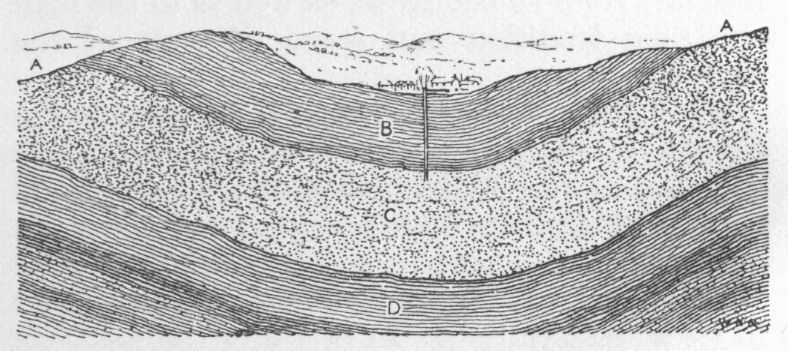
Arte´sian Wells, so called from the French province of Artois, where they appear to have been first used on an extensive scale, are perpendicular borings into the ground through which water rises to the surface of the soil, producing a constant flow or stream, the ultimate sources of supply being higher than the mouth of the boring, and the water thus rising by the well-known law. They are generally sunk in valley plains and districts where the lower pervious strata are bent into basin-shaped curves. The rain falling on the outcrops of these saturates the whole porous bed, so that when the bore reaches it the water by hydraulic pressure rushes up towards the level of the highest portion of the strata. The supply is sometimes so abundant as to be used extensively as a moving power, and in arid regions for fertilizing the ground, to which purpose artesian springs have been applied from a very remote period. Thus many artesian wells have been sunk in the Algerian Sahara, which have proved an immense boon to the district. The water of most of these is potable, but a few are a little saline, though not to such an extent as to influence vegetation. The hollows in which London and Paris lie are both perforated in many places by borings of this nature. At London they were first sunk only to the sand, but afterwards into the chalk. One of the most celebrated artesian wells is that of Grenelle, near Paris, 1798 feet deep, completed in 1841, after eight years' work. Artesian wells are now common in many countries, and have been sunk to the depth of a mile or more. As the temperature of water from great depths is invariably higher than that at the surface, artesian wells have been made to supply warm water for heating manufactories, greenhouses, hospitals, fish-ponds, &c. They have also been made in the United States and Australia for the purpose of irrigation. Petroleum wells are generally of the same technical description. Artesian wells are now made with larger diameters than formerly, and altogether their construction has been rendered much more easy in modern times. See Boring.
Arteveld, or Artevelde (a˙r´te-velt, a˙r´te-vel-de), the name of two men distinguished in the history of the Low Countries.—1. Jacob van, a brewer of Ghent, born about 1300, was selected by his fellow-townsmen to lead them in their struggles against Count Louis of Flanders. In 1338 he was appointed captain of the forces of Ghent, and for several years exercised a sort of sovereign power. A proposal to make the Black Prince, son of Edward III of England, Governor of Flanders led to an insurrection in which Arteveld lost his life (1345).—2. Philip, son of the former, at the head of the forces of Ghent gained a great victory over the Count of Flanders, Louis II, and for a time assumed the state of a sovereign prince. His reign proved short-lived. The Count of Flanders returned with a large French force, fully disciplined and skilfully commanded. Arteveld was rash enough to meet them in the open field at Roosebeke, between Courtrai and Ghent, in 1382, and fell with 25,000 Flemings.
Arthri´tis (Gr. arthron, a joint), any inflammatory distemper that affects the joints, particularly chronic rheumatism or gout.
Arthro´dia, a species of articulation, in which the head of one bone is received into a shallow socket in another; a ball-and-socket joint.
Arthrop´oda, one of the two primary divisions (Anarthropoda being the other) into which modern naturalists have divided the sub-kingdom Annulosa, having the body composed of a series of segments, some always being provided with articulated appendages. The division comprises Crustaceans, Spiders, Scorpions, Centipedes, and Insects.
Arthrozo´a, a name sometimes given to all articulated animals, including the arthropoda and worms.
Arthur, Chester Alan, twenty-first President of the United States, born 1830, died 1886, was the son of Scottish parents, his father being pastor of Baptist churches in Vermont and New York. He chose law as a profession, and practised in New York. As a politician he became a leader in the Republican party. During the civil war he was energetic as quarter-master-general of New York in getting troops raised and equipped. He was afterwards collector of customs for the port of New York. In 1880 he was elected Vice-President, succeeding as President on the death of Garfield in 1881.
Ar´thur, King, an ancient British hero of the sixth century, son of Uther Pendragon and the Princess Igerna, wife of Gorlois, Duke of Cornwall. He married Guinevere, or Ginevra; established the famous order of the Round Table; and reigned, surrounded by a splendid Court, twelve years in peace. After this, as the poets relate, he conquered Denmark, Norway, and France, slew the giants of Spain, and went to Rome. From thence he is said to have hastened home on account of the faithlessness of his wife, and Modred, his nephew, who had stirred up his subjects to rebellion. He subdued the rebels, but died in consequence of his wounds, on the Island of Avalon. The story of Arthur is supposed to have some foundation in fact, and has ever been a favourite subject with our romanticists and our poets. It is generally believed that Arthur was one of the last great Celtic chiefs who led his countrymen from the west of England to resist the settlement of the Saxons in the country. But many authorities regard him as a leader of the Cymry of Cumbria and Strath-Clyde against the Saxon invaders of the east coast and the Picts and Scots north of the Forth and the Clyde. See Grail, Merlin, Round Table.—Bibliography: J. Rhys, Studies in the Arthurian Legend; W. Lewis Jones, King Arthur in History and Legend.
Arthur's Seat, a picturesque hill within the King's Park in the immediate vicinity of Edinburgh; has an altitude of 822 feet; descends rollingly to the N. and E. over a base each way of about five furlongs; presents an abrupt shoulder to the S., and breaks down precipitously to the W. It is composed of a diversity of eruptive rocks, with some interposed and up-tilted sedimentary ones; and derives its name somehow from the legendary King Arthur.
Ar´tiad (Gr. artios, even-numbered), in chemistry, a name given to an element of even equivalency, as a dyad, tetrad, &c.: opposed to a perissad, an element of uneven equivalency, such as a monad, triad, &c.
Artichoke (Cynăra Scolўmus), sometimes called 'the Globe Artichoke', a well-known plant of the nat. ord. Compositæ, somewhat resembling a thistle, with large divided prickly leaves. The erect flower-stem terminates in a large round head of numerous imbricated oval spiny scales which surround the flowers. The fleshy bases of the scales with the large receptacle are the parts that are eaten. Artichokes were introduced into England early in the sixteenth century. The Jerusalem artichoke (a corruption of the It. girasole, a sunflower), or Helianthus tuberōsus, is a species of sunflower, whose roots are used like potatoes; it was introduced into England in the early part of the seventeenth century.
Article, in grammar, a part of speech used before nouns to limit or define their application. In English a or an is usually called the indefinite article (the latter form being used before a vowel sound), and the, the definite article, but they are also described as adjectives. An was originally the same as one, and the as that. In Latin there were no articles, and Greek has only the definite article.
Articles, Lords of the, in Scottish history, a committee chosen equally from each estate or division of Parliament to prepare the various measures, which, when completed, were laid before the Parliament for adoption or rejection. They were first appointed in 1369, and gradually became a recognized part of the Scottish legislative machinery. Abolished 1690.
Articles, The Six, in English ecclesiastical history, articles imposed by a statute (often called the Bloody Statute) passed in 1541, the thirty-third year of the reign of Henry VIII. They decreed the acknowledgment of transubstantiation, the sufficiency of communion in one kind, the obligation of vows of chastity, the propriety of private masses, celibacy of the clergy, and auricular confession. Acceptance of these doctrines was made obligatory on all persons under the severest penalties; the Act, however, was relaxed in 1544, and repealed in 1549.
Articles, The Thirty-nine, of the Church of England, a statement of the particular points of doctrine, thirty-nine in number, maintained by the English Church; first promulgated by a convocation held in London in 1562-3, and confirmed by royal authority; founded on and superseding an older code issued in the reign of Edward VI. The first five articles contain a profession of faith in the Trinity; the incarnation of Jesus Christ, His descent to hell, and His resurrection; the divinity of the Holy Ghost. The three following relate to the canon of the Scripture. The eighth article declares a belief in the Apostles', Nicene, and Athanasian creeds. The ninth and following articles contain the doctrine of original sin, of justification by faith alone, of predestination, &c. The nineteenth, twentieth, and twenty-first declare the Church to be the assembly of the faithful; that it can decide nothing except by the Scriptures. The twenty-second rejects the doctrine of purgatory, indulgences, the adoration of images, and the invocation of saints. The twenty-third decides that only those lawfully called shall preach or administer the sacraments. The twenty-fourth requires the liturgy to be in English. The twenty-fifth and twenty-sixth declare the sacraments effectual signs of grace (though administered by evil men), by which God excites and confirms our faith. They are two: baptism and the Lord's supper. Baptism, according to the twenty-seventh article, is a sign of regeneration, the seal of our adoption, by which faith is confirmed and grace increased. In the Lord's supper, according to article twenty-eight, the bread is the communion of the body of Christ, the wine the communion of his blood, but only through faith (article twenty-ninth); and the communion must be administered in both kinds (article thirty). The twenty-eighth article condemns the doctrine of transubstantiation, and the elevation and adoration of the host; the thirty-first rejects the sacrifice of the mass as blasphemous; the thirty-second permits the marriage of the clergy; the thirty-third maintains the efficacy of excommunication. The remaining articles relate to the supremacy of the king, the condemnation of Anabaptists, &c. They were ratified anew in 1604 and 1628. All candidates for ordination must subscribe these articles, but they are not binding upon laymen, except judges and certain university officials. This formulary is now accepted by the Episcopalian Churches of Scotland, Ireland, and America.
Articles of Association are the rules framed by a company for the administration of its affairs. Public companies usually have separate articles of their own, but this is not essential. When a registered company has no articles, its business procedure is regulated by the statutory form, found in Schedule 1 of the Companies (Consolidation) Act, 1908, and known as Table A. When separate articles are used they must be printed, signed, stamped, and filed along with the memorandum of association. Unlike the memorandum, the articles may be altered at any time, by special resolution, provided the alteration is within the powers given by the memorandum. Thus, where preferred shares are created by the memorandum, their privileges are more secure than if merely issued under the articles. The articles are intended merely for internal administration, and, while binding in questions between the company and its members as such, they do not affect third parties, unless the company has acted ultra vires and this was discoverable from the articles, which the public can inspect at a nominal fee.—Bibliography: Sir F. B. Palmer, Company Law; A. Coles, Guide for the Company Secretary; A. F. Topham, Principles of Company Law.
Articles of War. See Military Law.
Articula´ta, the third great section of the animal kingdom according to the arrangement of Cuvier, applied to invertebrates such as insects and worms, in which the body displays a jointed structure. The name is now obsolete. See Arthropoda.
Articula´tion, in anatomy a joint; the joining or juncture of the bones. This is of three kinds: (1) Diarthrōsis, or a movable connection, such as the ball-and-socket joint; (2) Synarthrōsis, immovable connection, as by suture, or junction by serrated margins; (3) Symphysis, or union by means of another substance, by a cartilage, tendon, or ligament.
Artificial Limbs. Artificial limbs of a primitive kind have been in use from very early times; but, as the material of which they were made was perishable, few specimens have been preserved. In the museum of the Royal College of Surgeons in London there is a good specimen of a Roman artificial leg which is believed to date back to the third century B.C. This leg is made of wood, covered with thin bronze; it has an iron sole-plate, and was fastened on by means of a waist-belt.
In Irish legend we are told of Nuada, who led the tribe of the Dananns back to Ireland, having an artificial hand made of silver; from this he received the name of Argetlam or Silver-handed. In mediæval times Goetz von Berlichingen, who lost his right hand at the siege of Landshut (1505), had a hand made of iron to supply its place.
Great improvements have been made in the manufacture of artificial limbs during the last fifty years. After the Franco-Prussian war the French Government adopted an artificial arm and hand known as the 'Beaufort' and issued it to the soldiers who required it. This hand had a movable thumb controlled by a cord passing up the arm and fastened to a loop band over the opposite shoulder. An Englishman named Heather Bigg invented a hand with a movable thumb which was worked by a piston and controlled by a rubber ball fastened under the arm-pit. These designs have been improved upon from time to time, and an artificial hand can now be made which is capable of opening and closing at will, and of lifting and holding light articles.
Artificial legs vary in design, from the simple pin leg to ingenious contrivances such as the 'Anglesey' leg, which is made of seasoned willow wood with steel ankles and knee-joints. This 'Anglesey' leg is the standard best-quality limb in Great Britain. The German artificial-limb makers use leather instead of wood. These leather legs fit comfortably, but are too heavy, as they have to be supported by steel bands.
Artillery, all ordnance such as guns and howitzers as opposed to small arms and machine-guns. The term is also used for the troops who serve these arms.
Generally speaking, artillery is divided into field, heavy, and siege artillery. For details of organization see Army. The earliest form of artillery was a metal tube which was placed in a convenient position on the ground. The charge of gunpowder was ignited by placing a match to a hole bored at the closed end, and the resulting explosion forced the projectile—a stone—more or less in the required direction. Later on this primitive weapon was provided with wheels. In another form one man fired it while a second man supported it on his shoulder. In the later Middle Ages guns of various calibres were known by the names of birds of prey or reptiles; among such were falcons and falconets, culverins and demi-culverins. The fourteenth century saw the development of artillery for siege purposes—chiefly by the Germans—and in the next century it began to be employed in open warfare; while in 1537 the present Honourable Artillery Company was formed in London to encourage the use of all 'weapons of volley'. These weapons of volley were not even confined to fire-arms, but included bows and cross-bows. The earliest English troops raised as artillery personel were called the Regiment of Firelocks. Of late years artillery science has made almost inconceivable progress, thanks to which, inter alia, it is no longer necessary for the target to be visible from the gun-position. This fact, combined with the use of smokeless powder, makes the locating of hostile batteries exceedingly difficult. All field artillery, by which is meant guns and howitzers, which accompany mobile troops are designed on the quick-firing principle, by which the inevitable recoil at the moment of firing is absorbed by an arrangement known as the recoil-carriage, thus preventing any movement of the gun-carriage proper, and avoiding unnecessary labour for the gun-detachments, while at the same time allowing the men composing it to remain under cover of the shield with which the guns are provided. With the quick-firing gun, propellent and projectile are combined in one cartridge similar to that in use with small arms; with the howitzer they are separated. This difference is due to the fact that whereas guns are designed for a flat trajectory with a deep zone of fire-effect, howitzers are intended for high-angle fire with an almost vertical fall of shrapnel-bullets. This effect is produced by varying the charge for different ranges. A field battery consists of 6 guns or howitzers and 12 ammunition-wagons. Both guns and wagons are of the limbered type, i.e. in two detachable parts, and the weight behind the team of an English gun is approximately 2 tons.
As to tactical principles, it is recognized that the function of artillery is to assist the other arms, that it cannot by itself win a battle, and that its true métier is to prepare the way for and assist the infantry. During 1914-18 some 700,000 officers and men served with the Royal Regiment.
Artillery Company, The Honourable, the oldest existing body of volunteers in Great Britain, instituted in 1537, revived in 1610. It comprises six companies of infantry, besides artillery, and furnishes a guard of honour to the sovereign when visiting the city of London. Previous to 1842 the Company elected their own officers, but since that date they have been appointed by the Crown.
Artillery Schools, institutions established for the purpose of giving a special training to the officers, and in some cases the men, belonging to the artillery service. In Great Britain the artillery schools are at Woolwich and Shoeburyness. The Department of Artillery studies at Woolwich give artillery officers the means of continuing their studies after they have completed the usual course at the Royal Military College, and of qualifying for appointments requiring exceptional scientific attainments. The School of Gunnery at Shoeburyness gives instruction in gunnery to officers and men, and conducts all experiments connected with artillery and stores. The sands at the mouth of the Thames afford ample opportunity for artillery practice and firing at long ranges. The Royal Artillery Institution at Woolwich contains a museum, lecture-room, and printing-press, from which professional and scientific papers are periodically issued.
Artiodac´tyla (Gr. artios, even numbered, daktўlos, a finger or toe), a section of the Ungulata or hoofed mammals, comprising all those in which the number of the toes is even (two or four), including the ruminants, such as the ox, sheep, deer, &c., and also a number of non-ruminating animals, as the hippopotamus and the pig.
Artisans' and Labourers' Dwellings Act, an English Act of Parliament passed in 1868 to empower town councils and other local authorities to demolish or improve dwellings unfit for human habitation, and to build and maintain better dwellings in lieu thereof. Other Acts for the same object were passed in 1875, 1879, and 1882. See Housing.
Artocarpa´ceæ, a nat. ord. of plants, the bread-fruit order, by some botanists ranked as a sub-order of the Urticaceæ or nettles. They are trees or shrubs, with a milky juice, which in some species hardens into caoutchouc, and in the cow-tree (Brosĭmum Galactodendron) is a milk as good as that obtained from the cow. Many of the plants produce an edible fruit, of which the best known is the bread-fruit (Artocarpus).
Artois (a˙r-twä), a former province of France, anciently one of the seventeen provinces of the Netherlands, now almost completely included in the department of Pas-de-Calais.
Artois, The Battle of. See European War.
Arts, the name given to certain branches of study in the Middle Ages, originally called the 'liberal arts' to distinguish them from the 'servile arts' or mechanical occupations. These arts were usually given as grammar, dialectics, rhetoric, music, arithmetic, geometry, and astronomy. Hence originated the terms 'art classes', 'degrees in arts', 'Master of Arts', &c., still in common use in universities, the faculty of arts being distinguished from those of divinity, law, medicine, or science. See University.
Artsybashev, Mikhail, Russian author, born in 1878. After a number of short stories he wrote, at the age of twenty-five, a novel entitled Sanin, published in 1907, which placed him at once among the most famous contemporary Russian authors. Whatever opinion literary critics may hold of this novel, his wonderful realism, simplicity of style, and psychological analysis cannot be disputed.
Art Unions, associations for encouraging art, an object which they mainly pursue by disposing of pictures, sculptures, &c., by lottery among subscribers. They seem to have originated in France during the time of Napoleon I. They soon afterwards took root in Germany, where they have been very successful. The first art union established in Britain was that at Edinburgh in 1834. Art unions were legalized by the Art Unions Act, 1846 See Lottery.
Artvin, a town in the Republic of Georgia, in the Caucasus, about 35 miles inland from Batum. Pop. 6720.
Aruba (a˙-rö´ba˙), an island off the north coast of Venezuela, belonging to Holland (a dependency of Curaçoa), about 30 miles long and 7 broad; surface generally rock, quartz being abundant, and containing considerable quantities of gold; a phosphate which is exported for manure is also abundant. The climate is healthy. Pop. 9481 (1916).
Aru Islands. See Arru Islands.
Cuckoo Pint or Wake Robin (Arum maculātum). 1, Spadix. 2, Stamen. 3, Female flower. 4, Fruit.
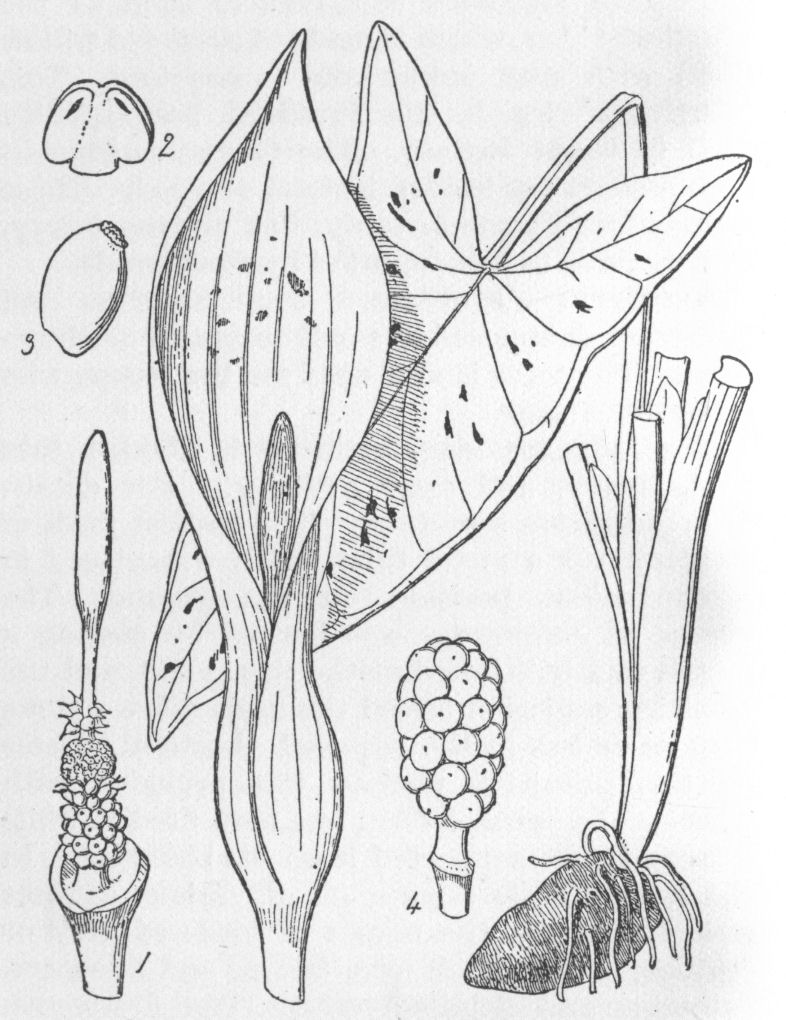
A´rum, a genus of plants, nat. ord. Araceæ. A. maculātum (the common wake-robin, lords-and-ladies, or cuckoo pint) is abundant in woods and hedges in England and Ireland, but is rare in Scotland. It has acrid properties, but its corm yields a starch which is known by the name of Portland sago or arrowroot. At one time this was prepared to a considerable extent in Portland Island. All the species of this genus develop much heat during flowering.
Ar´undel, a town in Sussex, England, on the River Arun, 4 miles from its mouth, the river being navigable to the town for vessels of 250 tons. The castle of Arundel, the chief residence of the dukes of Norfolk, stands on a knoll on the north-east side of the town. Pop. (1921), 2741.
Ar´undel, Thomas, third son of Richard FitzAlan, Earl of Arundel, born 1352, died 1413. He was Chancellor of England and Archbishop of Canterbury. He concerted with Bolingbroke to deliver the nation from the oppression of Richard II, and was a bitter persecutor of the Lollards and followers of Wycliffe.
Arundelian Marbles, a series of ancient sculptured marbles discovered by William Petty, who explored the ruins of Greece at the expense of and for Thomas Howard, Earl of Arundel, who lived in the time of James I and Charles I, and was a liberal patron of scholarship and art. After the Restoration they were presented by the grandson of the collector to the University of Oxford. Among them is the Parian Chronicle, a chronological account of the principal events in Grecian, and particularly in Athenian, history, during a period of 1186 years, from the reign of Cecrops (1450 B.C.) to the archonship of Diognetus (264 B.C.).
Arun´do. See Phragmites.
Aruspices (a-rus´pi-sēz), or Haruspices, a class of priests in ancient Rome, of Etrurian origin, whose business was to inspect the entrails of victims killed in sacrifice, and by them to foretell future events.
Aruwimi, a large river of equatorial Africa, a tributary of the Congo, on the north bank.
Arval Brothers (Fratres Arvāles), a college or company of twelve members elected for life from the highest ranks in ancient Rome, so called from offering annually public sacrifices for the fertility of the fields (Lat. arvum, a field).
Arve (a˙rv), a river rising in the Savoyan Alps, passes through the valley of Chamonix, and falls into the Rhone near Geneva, after a course of about 50 miles.
Arvic´ola, a genus of rodent animals, sub-ord. Muridæ or Mice. There are three British species. A. amphibia is the water-vole (or water-rat), and A. agrestis is the field-vole or short-tailed field-mouse. They are prolific animals, having three or four litters in the year, each consisting of from four to ten young.
A´ryan, or Indo-European Family of Languages. See Indo-European Family.
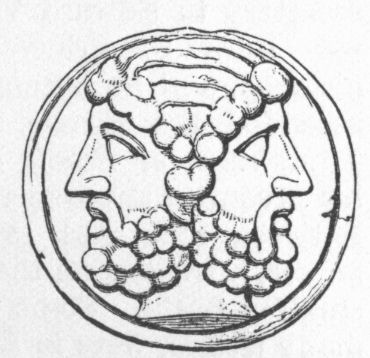
As, a Roman weight of 12 ounces, answering to the libra or pound, and equal to 237.5 grains avoirdupois, or 327.1873 grammes French measure. In the most ancient times of Rome the copper or bronze coin which was called as actually weighed an as, or a pound, but in 264 B.C. it was reduced to 2 ounces, in 217 to 1 ounce, and in 191 to ½ ounce.
As (half real size)—Specimen in British Museum
A´sa, great grandson of Solomon and third King of Judah; he ascended the throne at an early age, and distinguished himself by his zeal in rooting out idolatry with its attendant immoralities. He died after a prosperous reign of forty-one years.
Asafe´tida, or Asafœtida, a fetid inspissated sap from Central Asia, the solidified juice of the Narthex Asafetida, a large umbelliferous plant. It is used in medicine as an anti-spasmodic, and in cases of flatulency, in hysteric paroxysms, and other nervous affections. Notwithstanding its very disagreeable odour it is used as a seasoning in the East, and sometimes in Europe. An inferior sort is the product of certain species of Ferula.
Asagræ´a. See Sabadilla.
Asa´ma, an active volcano of Japan, about 50 miles north-west of Tokio, 8260 feet high.
A´saph, a Levite and psalmist appointed by David as leading chorister in the divine services. His office became hereditary in his family, or he founded a school of poets and musicians, which were called, after him, "the sons of Asaph". See Psalms.
Asaph, St., a small cathedral city and bishop's see in Wales, 15 miles north-west of Flint; founded about 550 by St. Kentigern or St. Mungo, bishop of Glasgow, and named after his disciple St. Asaph, from whom both the diocese and town took their name. The cathedral was built about the close of the fifteenth century; it consists of a choir, a nave, two aisles, and a transept. Pop. 1833.
Asarabac´ca, a small hardy European plant, nat. ord. Aristolochiaceæ (Asărum europœum). Its leaves are acrid, bitter, and nauseous, and its root is extremely acrid. Both the leaves and root were formerly used as an emetic. It entered into the composition of medicated snuffs recommended in cases of headache.
As´arum. See Asarabacca.
Asben, Air, or Ahir, a kingdom of Africa, in the Sahara. It consists of a succession of mountain groups and valleys, with a generally western slope, and attains in its highest summits a height of over 5000 feet. The valleys are very fertile, and often of picturesque appearance. The inhabitants are Tuaregs or Berbers, with an admixture of negro blood. They live partly in villages, partly as nomads. The country is nominally ruled over by a sultan, who resides in the capital, Agades. Pop. about 60,000.
Asbes´tos, or Asbestus, a remarkable and highly-useful mineral, a fibrous variety of several members of the hornblende family, composed of separable filaments, with a silky lustre. The fibres are sometimes delicate, flexible, and elastic; at other times stiff and brittle. It is incombustible, and anciently was wrought into a soft, flexible cloth, which was used as a shroud for dead bodies. In modern times it has been manufactured into incombustible cloth, gloves, felt, paper, &c.; is employed in gas-stoves; is much used as a covering to steam boilers and pipes; is mixed with metallic pigments, and used as a paint on wooden structures, roofs, partitions, &c., to render them fire-proof, and is employed in various other ways, the manufacture having recently greatly developed. Some varieties are compact, and take a fine polish, others are loose, like flax or silky wool. Ligniform asbestos, or mountain-wood, is a variety presenting an irregular filamentous structure, like wood. Rock-cork, mountain-leather, fossil-paper, and fossil-flax are varieties. Asbestos is found in many parts of the world, but is chiefly supplied by Italy, Canada, and Australia. Mineralogically it is distinct from chrysotile, which is used for similar purposes.
Asbjörnsen (a˙s´byeurn-sen), Peter Kristen, born 1812, died 1885, a distinguished Norwegian naturalist and collector of the popular tales and legends, fairy stories, &c., of his native country.
Asbury Park, a small town on the coast of New Jersey, United States, a great summer resort. Its population increases during the summer months from 10,000 to 100,000.
As´calon, or Ash´kelon, a ruined town of Palestine, on the sea-coast, 40 miles W.S.W. of Jerusalem. It was occupied by the Crusaders under Richard I after a great battle with Saladin (1192) and by General Allenby's troops in Nov., 1917.
Asca´nius, the son of Æneas and Creusa, and the companion of his father's wanderings from Troy to Italy.
As´caris. See Nematoda.
Ascen´sion (discovered on Ascension Day), an island of volcanic origin belonging to Britain, near the middle of the South Atlantic Ocean, about lat. 7° 55' S.; long. 14° 25' W.; 700 miles north-west of St. Helena; area, about 34 sq. miles. Pop. 196 (1914). It is retained by Britain as a naval sanatorium, coaling and victualling station, and store depot. It has a steam factory, naval and victualling yards, hospitals, and a coal depot. It is celebrated for its turtle, which are the finest in the world. Wild goats are plentiful, and oxen, sheep, pheasants, guinea-fowl, and rabbits have been introduced, and thrive well. The village of Georgetown, the seat of government, stands on the west side of the island, which is governed under the admiralty by a naval officer.
Ascension, Right, of a star or other heavenly body, in astronomy, the arc of the equator intercepted between the first point of Aries and that point of the equator which comes to the meridian at the same instant with the star.
Ascension Day, the day on which the ascension of the Saviour is commemorated, often called Holy Thursday: a movable feast, always falling on the Thursday but one before Whitsuntide.
Ascet´icism and Ascet´ics (from the Gr. askēsis, meaning practice, bodily exercise, or athletic training). The early Christians, who devoted themselves to severe exercises of piety and strove to distinguish themselves from the world by abstinence from sensual enjoyments and by voluntary penances, adopted the name to signify the practice of spiritual things. Ascetics and asceticism have played an important part in the Christian Church, but the principle of striving after a higher and more spiritual life by subduing the animal appetites and passions has no necessary connection with Christianity. Thus there were ascetics among the Jews previous to Christ, and asceticism was inculcated by the Stoics, while in its most extreme form it may still be seen among the Brahmans and Buddhists. Monasticism was but one phase of asceticism. It must also be borne in mind that in the history of asceticism, pagan, Christian, Jewish, and Mohammedan, we are often dealing not only with religious but distinctly abnormal temperaments. See Monasticism.
Asch (a˙sh), a town of Czecho-Slovakia, in the extreme north-western corner of former Bohemia, with manufactures of cotton, woollen, and silk goods, bleachfields, dyeworks, &c. Pop. 21,583.
Aschaffenburg (a˙-sha˙f´en-börh), a town of Bavaria, on the Main and Aschaff, 26 miles E.S.E. of Frankfort. The chief edifice is the castle of Johannisberg, built between 1605 and 1614, and for centuries the summer residence of the Elector. There are manufactures of coloured paper, tobacco, liqueurs, &c. Pop. 29,891.
Ascham (as´kam), Roger, a learned Englishman, born in 1515 of a respectable family in Yorkshire, died 1568. He was entered at St. John's College, Cambridge, 1530, and was elected fellow in 1534 and tutor in 1537. He was Latin secretary to Edward VI and also to Mary. He was tutor to Princess Elizabeth during her girlhood, and he became her secretary after she ascended the throne. In 1544 he wrote his Toxophilus, or Schole of Shooting, in praise of his favourite amusement and exercise—archery. Between 1563 and 1568 he wrote his Scholemaster, a treatise on the best method of teaching children Latin. Some of his writings, including many letters, were in Latin. He wrote the best English style of his time. His life was written by Dr. Johnson to accompany an edition of his works published in 1769.
Aschersleben (a˙sh´ėrz-lā-ben), a town of Prussian Saxony, in the district of Magdeburg, near the junction of the Eine with the Wipper. Industries: woollens, machinery and metal goods, sugar, paper, &c. Pop. 28,968.
Ascid´ia (Gr. askos, a wine-skin), the name given to the 'Sea-squirts' or main section of the Tunicata, a class of animals of low grade, resembling a double-necked bottle, of a leathery or gristly nature, found at low-water mark on the sea-beach, and dredged from deep water attached to stones, shells, and fixed objects. One of the prominent openings admits the food and the water required in respiration, the other is the excretory aperture. A single ganglion represents the nervous system, placed between the two apertures. Male and female reproductive organs exist in each ascidian. They pass through peculiar phases of development, the young ascidian appearing like a tadpole-body. They may be single or simple, social or compound. In social ascidians the peduncles of a number of individuals are united into a common tubular stem, with a partial common circulation of blood. In these animals evolutionists see a link between the Mollusca and the Vertebrata.
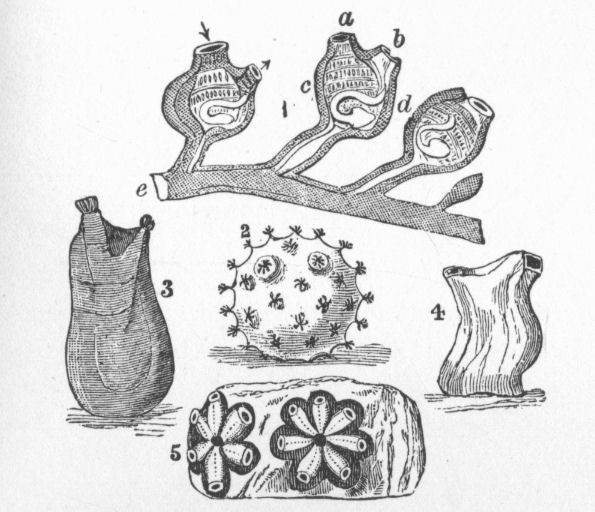
Ascidians
1, Perophora: a, mouth; b, vent; c, intestinal canal; d, stomach; e, common tubular stem. 2, Ascidia echinata. 3, Ascidia virginea. 4, Cynthia quadrangularis. 5, Botryllus violaceus.
Asclepliada´ceæ, an order of gamopetalous Dicotyledons, the distinguishing characteristic of which is that the anthers adhere to the five stigmatic processes, the whole sexual apparatus forming a single mass. The pollination arrangements are peculiar, recalling those of orchids. The members of this order are shrubs, or sometimes herbaceous plants, occasionally climbing, almost always with a milky juice. Many of them are employed as purgatives, diaphoretics, tonics, and febrifuges, and others as articles of food. Asclepias is the typical genus. See Asclepias, Calotropis, Stapelia, Stephanotis.
Ascle´piades (-dēz), the name of a number of ancient Greek writers—poets, grammarians, &c—of whom little is known, and also of several ancient physicians, the most celebrated of whom was Asclepiades, of Bithynia, who acquired considerable repute at Rome about the beginning of the first century B.C.
Ascle´pias, or Swallow-wort, a genus of plants, the type and the largest genus of the nat. ord. Asclepiadaceæ. Most of the species are North American herbs, having opposite, alternate, or verticillate leaves. Many of them possess powerful medicinal qualities. A. decumbens is diaphoretic and sudorific, and has the singular property of exciting general perspiration without increasing in any sensible degree the heat of the body; A. curassavica is emetic, and its roots are frequently sent to England as ipecacuanha; the roots of A. tuberōsa are famed for diaphoretic properties. Many other species are also used as medicines, and several are cultivated for the beauty of their flowers.
Asclepios. See Æsculapius.
As´coli, or Ascoli Piceno (ancient, Ascŭlum), a province in Central Italy.—The capital of the province, also called Ascoli Piceno, episcopal see of the Marches (the ancient Ascŭlum), is situated 90 miles north-east of Rome and contains, among several handsome new buildings, the remains of temples, an ancient theatre, &c. It has also many fine pre-Renaissance buildings, such as the Gothic Church S. Francesco and the Palazzo del Commune. At Castel Trosino, near Ascoli, a necropolis of the seventh century was discovered in 1895. Population of the town, 28,882; of the province, 261,835 (1915).
As´coli Satriano (ancient, Ascŭlum Apŭlum), a town of S. Italy, province Foggia. Pop. 9700.
Ascomyce´tes (-tēz), one of the main subdivisions of the Eumycetes or Higher Fungi, distinguished by their principal spores being produced in organs called asci. Typically, an ascus is a cylindrical or club-shaped structure containing at maturity eight ascospores, which are usually liberated explosively and thereafter dispersed by the wind. As a rule numerous asci are massed together in a layer or ascus-hymenium, which is variously disposed on a more or less massive fruit-body, according to the form and structure of which the group is further subdivided into a number of sections and families, the chief being Erysiphales, Plectascineæ, Pyrenomycetes, Discomycetes (q.v.).
Asco´nius (Quintus A. Pedianus), a Roman writer of the first century A.D., who wrote a life of Sallust, a reply to the detractors of Virgil, and commentaries on Cicero's orations, some of which are extant.
As´cot, an English race-course adjacent to the S.W. extremity of the great park of Windsor. The races, which take place in the second week in June, constitute, for value of stakes and quality of horses, the best meeting of the year, as it is the most fashionable.
As´gard (literally, gods' yard, or the abode of the gods), in Scandinavian mythology the home of the gods or Æsir, rising, like the Greek Olympus, from midgard, or the middle world, that is, the earth. It was here that Odin and the rest of the gods, the twelve Æsir, dwelt—the gods in the mansion called Gladsheim, the goddesses dwelling in Vingulf. Walhalla, in which heroes slain in battle dwelt, was also here. Below the boughs of the ash tree Yggdrasill the gods assembled every day in council.
Asgill (as´gil), John, an eccentric English writer, a lawyer by profession, born 1659, died 1738. In 1699 he published a pamphlet to prove that Christians were not necessarily liable to death, death being the penalty imposed for Adam's sin and Christ having satisfied the law. Having crossed over to Ireland, he was beginning to get into a good practice, and was elected to the Irish House of Commons, when his pamphlet was ordered to be burned by the public hangman, and he himself was expelled the House. His whole subsequent life was passed in pecuniary and other troubles, mostly in the Fleet or within the rules of the King's Bench.
Ash (Fraxĭnus), a genus of deciduous trees belonging to the nat. ord. Oleaceæ, having imperfect flowers and a seed-vessel prolonged into a thin wing at the apex (called a samara). There are a good many species, chiefly indigenous to North America. The common ash (F. excelsior), the only species indigenous to Central and Northern Europe, has a smooth bark, and grows tall and rather slender. The branches are flattened; the leaves have five pairs of pinnæ, terminated by an odd one, dark-green in colour; lanceolate, with serrated edges. The flowers are produced in loose spikes from the sides of the branches, and are succeeded by flat seeds which ripen in autumn. It is one of the most useful of British trees on account of the excellence of its hard tough wood and the rapidity of its growth, but often suffers greatly from a canker caused by the fungus Nectria ditissima. There are many varieties of it, as the weeping-ash, the curled-leaved ash, the entire-leaved ash, &c. The flowering or manna ash (F. Ornus), by some placed in a distinct genus (Ornus), is a native of the south of Europe and Palestine. It yields the substance called manna, which is obtained by making incisions in the bark, when the juice exudes and hardens. Among American species are the white ash (F. americana), with lighter bark and leaves; the red or black ash (F. pubescens), with a brown bark; the black ash (F. sambucifolia), the blue ash, the green ash, &c. They are all valuable trees. The mountain-ash or rowan belongs to a different order.
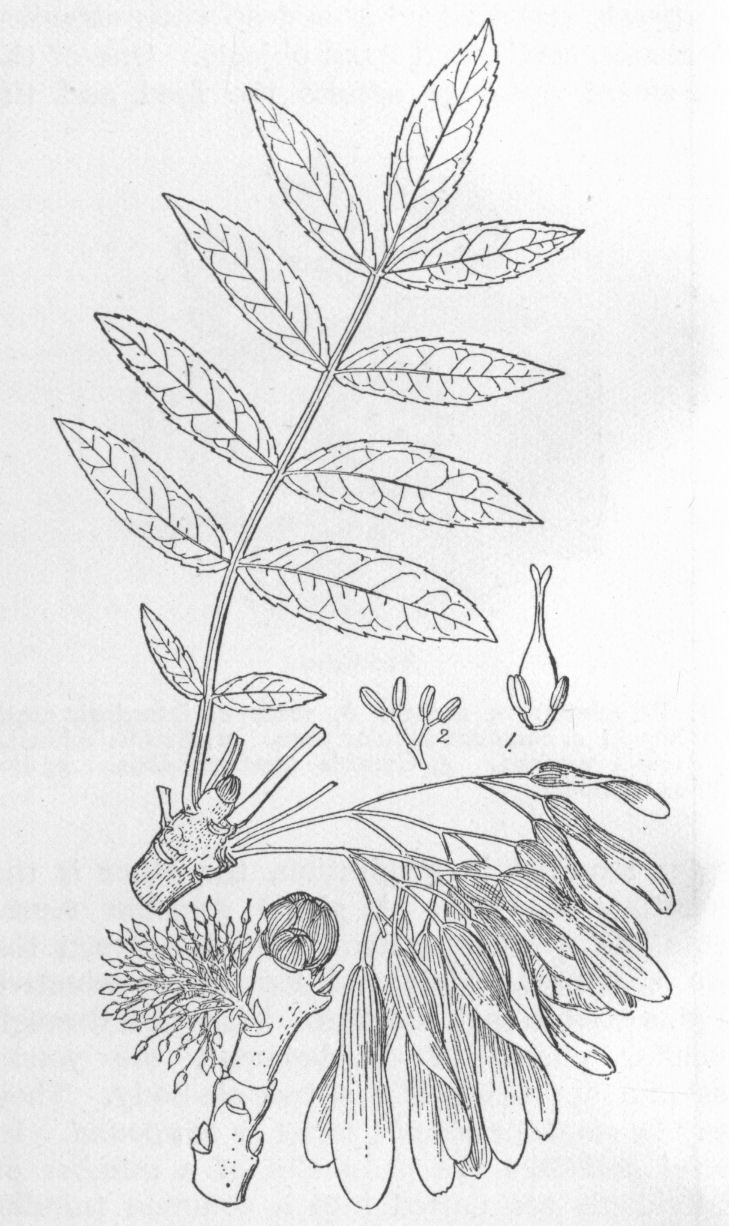
Common Ash (
Fraxĭnus excelsior
)
1, Hermaphrodite flower. 2, Anthers of male flower.
Ash, or Ashes, the incombustible residue of organic bodies (animal or vegetable) remaining after combustion; in common usage, any incombustible residue of bodies used as fuel; as a commercial term, the word generally means the ashes of vegetable substances, from which are extracted the alkaline matters called potash, pearl-ash, kelp, barilla, &c.
Ashan´go, a region in the interior of Southern Africa between lat. 1° and 2° S., and between the Ogowe and the Lower Congo, a mountainous country in the French territory. The inhabitants belong to the Bantu stock, and among them are a dwarfish people, the Obongo, said to be about 4½ feet high at most.
Ashanti´, a British territory in West Africa belonging to the Gold Coast Colony, of which it forms a large inland portion, under a chief commissioner; area about 20,000 sq. miles. It is in great part hilly, well-watered, and covered with dense tropical vegetation, and rich forests with excellent timber trees. The country round the towns, however, is carefully cultivated. The crops are chiefly rice, maize, millet, sugar-cane, cocoa, and yams, the last forming the staple vegetable food of the natives. Rubber is also a product. The domestic animals are cows, horses of small size, goats, and a species of hairy sheep. The wild animals include the elephant, rhinoceros, buffalo, lion, hippopotamus, &c. Birds are numerous, and crocodiles and other reptiles abound. Gold is abundant, and mining concessions are now successfully worked. The Ashantis make excellent cotton and silk cloths, articles in gold and other metals, earthenware, leather, &c. Ashanti used to form a kingdom ruled despotically, human sacrifices being very common. It is now under British administration, and attention is given to education, sanitation, agriculture, means of communication, &c. There are Government schools at Coomassie and Sunyani and a number of missionary schools. The chief town is Coomassie (or Kumassi), now reached by a railway from the coast (length 168 miles); its population is 24,000. The British first came in contact with the Ashantis in 1807, and hostilities continued off and on till 1826, when they were driven from the sea-coast. Immediately after the transfer of the Dutch settlements on the Gold Coast to Britain in 1872—when the entire coast remained in British hands—the Ashantis reclaimed the sovereignty of the tribes round the settlement of Elmina. This brought on a war, leading to a British expedition in 1874, in which Coomassie was captured. In 1896 the country became a British protectorate. In 1901 a rebellion had to be put down, and next year Ashanti was fully annexed. Pop. 287,814 (1911).—Cf. R. A. Freeman, Travels and Life in Ashantee and Jaman.
Ash´bourne, a town of England, in Derbyshire, 12 miles N.W. of Derby, with manufactures of cottons and lace. Pop. 4039.
Ash´burton, a town in Devonshire, England, 16 miles S.W. of Exeter, a parliamentary borough till 1868, and till 1918 giving name to a parliamentary division. Pop. (1921), 2362.
Ash´burton, Alexander Baring, Lord, a British statesman and financier, born 1774, died 1848. A younger son of Sir Francis Baring, he was bred to commercial pursuits, which for some years kept him in the United States and Canada, and in 1810 he became head of the great firm of Baring Brothers & Co. He sat in Parliament from 1806 to 1835, when he was raised to the peerage, after being a member of Peel's Government (1834-5).
Ash´burton Treaty, a treaty concluded at Washington, 1842, by Alexander Baring, Lord Ashburton, and the President of the United States; it defined the boundaries between the States and Canada, &c.
Ashby-de-la-Zouch (ash´bi-del-a-zöch´), a town in Leicestershire, England, on the borders of Derbyshire, with manufactures of hosiery, leather, &c. Pop. (1921), 4983.
Ash´dod, a place on the coast of Palestine, formerly one of the chief cities of the Philistines, now an insignificant village.
A´sher, one of Jacob's sons, and founder of the tribe called after him, who occupied a fertile territory in Palestine along the coast between Carmel and Lebanon.
Ashe´ra, an ancient Semitic goddess whose symbol was the phallus. In the Revised Version of the Old Testament this word is used to translate what in the Authorized Version is translated "grove", as connected with the idolatrous practices into which the Jews were prone to fall.
Ash´ford, a thriving town of England, in Kent, situated near the confluence of the upper branches of the River Stour, with large locomotive and railway-carriage works. It gives name to a parliamentary division of the county. Pop. (1921), 14,355.
Ashington, an urban district or town of England, Northumberland, north-east of Morpeth, and about 2 miles from the sea, in a district of collieries. Pop. (1921), 29,406.
Ashi´ra, a native race or people of Western Equatorial Africa, to the south of the Ogowe River, in the French Congo Territory.
Ash´land, a city of the United States, in Wisconsin. Pop. (1920), 11,334.—Also a city of Kentucky. Pop. (1920), 14,729.
Ash´lar, masonry consisting of stones squared and smoothed in front and built in regular courses.
Ashley, Lord. See Shaftesbury, First Earl of.
Ashmead-Bartlett, Sir Ellis, English politician, born in 1849. He entered Parliament in 1880, and was Civil Lord of the Admiralty from 1885 to 1892. He served in the Græco-Turkish and South African wars, and was knighted in 1892. He died in 1902.
Ash´mole, Elias, English antiquary, born 1617, died 1692. He became a chancery solicitor in London, but afterwards studied at Oxford, taking up mathematics, physics, chemistry, and particularly astrology. He published Theatrum Chymicum in 1652. On the Restoration he received the post of Windsor Herald, and other appointments both honourable and lucrative. In 1672 appeared his History of the Order of the Garter. He presented to the University of Oxford his collection of rarities, to which he afterwards added his books and MSS., thereby commencing the Ashmolean Museum.
Ash´taroth. See Astarte.
Ashton-in-Makerfield, a town of Lancashire, England, 4 miles from Wigan, with collieries, cotton-mills, &c. Pop. (1921), 22,489.
Ashton-under-Lyne, a municipal and parliamentary borough of Lancashire, England, 6 miles east of Manchester, on the north bank of the River Tame, a well-built place, with handsome streets and public buildings. The chief employment is the cotton manufacture, but there are also collieries and ironworks, which employ a great many persons. Pop. 51,080; (municipal borough) (1921), 43,333.
Ashton-upon-Mersey, a town or urban district of England, Cheshire, on the south side of the Mersey, several miles south-west of Manchester. Pop. (1921), 7780.
Ashura´da, a small island in the S.E. corner of the Caspian, formed by Russia into a trading station.
Ash-Wednesday, the first day of Lent, so called from a custom in the Western Church of sprinkling ashes that day on the heads of penitents, then admitted to penance. The period at which the fast of Ash-Wednesday was instituted is uncertain; but it probably dates from the eighth century at least. In the Roman Catholic Church the ashes are now strewn on the heads of all the clergy and people present. In the Anglican Church Ash-Wednesday is regarded as an important fast day.
Asia, the largest of the great divisions of the earth; length, from the extreme south-western point of Arabia, at the Strait of Bab-el-Mandeb, to the extreme north-eastern point of Siberia—East Cape, or Cape Vostochni, in Behring's Strait—6900 miles; breadth, from Cape Chelyuskin, in Northern Siberia, to Cape Romania, the southern extremity of the Malay Peninsula, 5300 miles; area estimated at 17,250,000 sq. miles, about a third of all the land of the earth's surface. On three sides, N., E., and S., the ocean forms its natural boundary, while in the W. the frontier is marked mainly by the Ural Mountains, the Ural River, Caspian Sea, the Caucasus, the Black Sea, the Mediterranean, the Suez Canal, and the Red Sea. There is no proper separation between Asia and Europe, the latter being really a great peninsula of the former. Asia, though not so irregular in shape as Europe, is broken in the S. by three great peninsulas, Arabia, Hindustan, and Farther India, while the east coast presents peninsular projections and islands, forming a series of sheltered seas and bays, the principal peninsulas being Kamtshatka and Corea. The principal islands are those forming the Malay or Asiatic Archipelago, which stretch round in a wide curve on the S.E. of the continent. Besides the larger islands—Sumatra, Java, Borneo, Celebes, Mindanao, and Luzon (in the Philippine group)—there are countless smaller islands grouped round these. Other islands are Ceylon, in the S. of India; the Japanese Islands and Sakhalin on the E. of the continent; Formosa, S.E. of China; Cyprus, S. of Asia Minor; and New Siberia and Wrangell, in the Arctic Ocean.
The mountain systems of Asia are of great extent, and their culminating points are the highest in the world. The greatest of all is the Himálaya system, which lies mainly between long. 70° and 100° E. and lat. 28° and 37° N. It extends, roughly speaking, from north-west to south-east, its total length being about 1500 miles, forming the northern barrier of Hindustan. The loftiest summits are Mount Everest, 29,002 feet high, Godwin-Austen, 28,265, and Kanchinjinga, 28,156. The principal passes, which rise to the height of 18,000 to 20,000 feet, are the highest in the world. A second great mountain system of Central Asia, connected with the north-western extremity of the Himálaya system by the elevated region of Pamir (about long. 70°-75° E., lat. 37°-40° N.), is the Thian-Shan system, which runs north-eastward for a distance of 1200 miles. In this direction the Altai, Sayan, and other ranges continue the line of elevations to the north-eastern coast. A north-western continuation of the Himálaya is the Hindu Kush, and farther westward a connection may be traced between the Himálaya mass and the Elburz range (18,460) feet, south of the Caspian, and thence to the mountains of Kurdistan, Armenia, and Asia Minor.
There are vast plateaux and elevated valley regions connected with the great central mountain systems, but large portions of the continent are low and flat. Tibet forms the most elevated table-land in Asia, its mean height being estimated at 15,000 feet. On its south is the Himálayan range, while the Kuen-Lun range forms its northern barrier. Another great but much lower plateau is that which comprises Afghanistan, Baluchistan, and Persia, and which to the north-west joins into the plateau of Asia Minor. The principal plain of Asia is that of Siberia, which extends along the north of the continent and forms an immense alluvial tract sloping to the Arctic Ocean. Vast swamps or peat-mosses called tundras cover large portions of this region. South-west of Siberia, and stretching eastward from the Caspian, is a low-lying tract consisting to a great extent of steppes and deserts, and including in its area the Sea of Aral. In the east of China there is an alluvial plain of some 200,000 sq. miles in extent; in Hindustan are plains extending for 2000 miles along the south slope of the Himálaya; and between Arabia and Persia, watered by the Tigris and Euphrates, is the plain of Mesopotamia or Assyria, one of the richest in the world. Of the deserts of Asia the largest is that of Gobi (long. 90°-120° E., lat. 40°-48° N.), large portions of which are covered with nothing but sand or display a surface of bare rock. An almost continuous desert region may also be traced from the desert of North Africa through Arabia (which is largely occupied by bare deserts), Persia, and Baluchistan to the Indus.
POLITICAL MAP OF ASIA
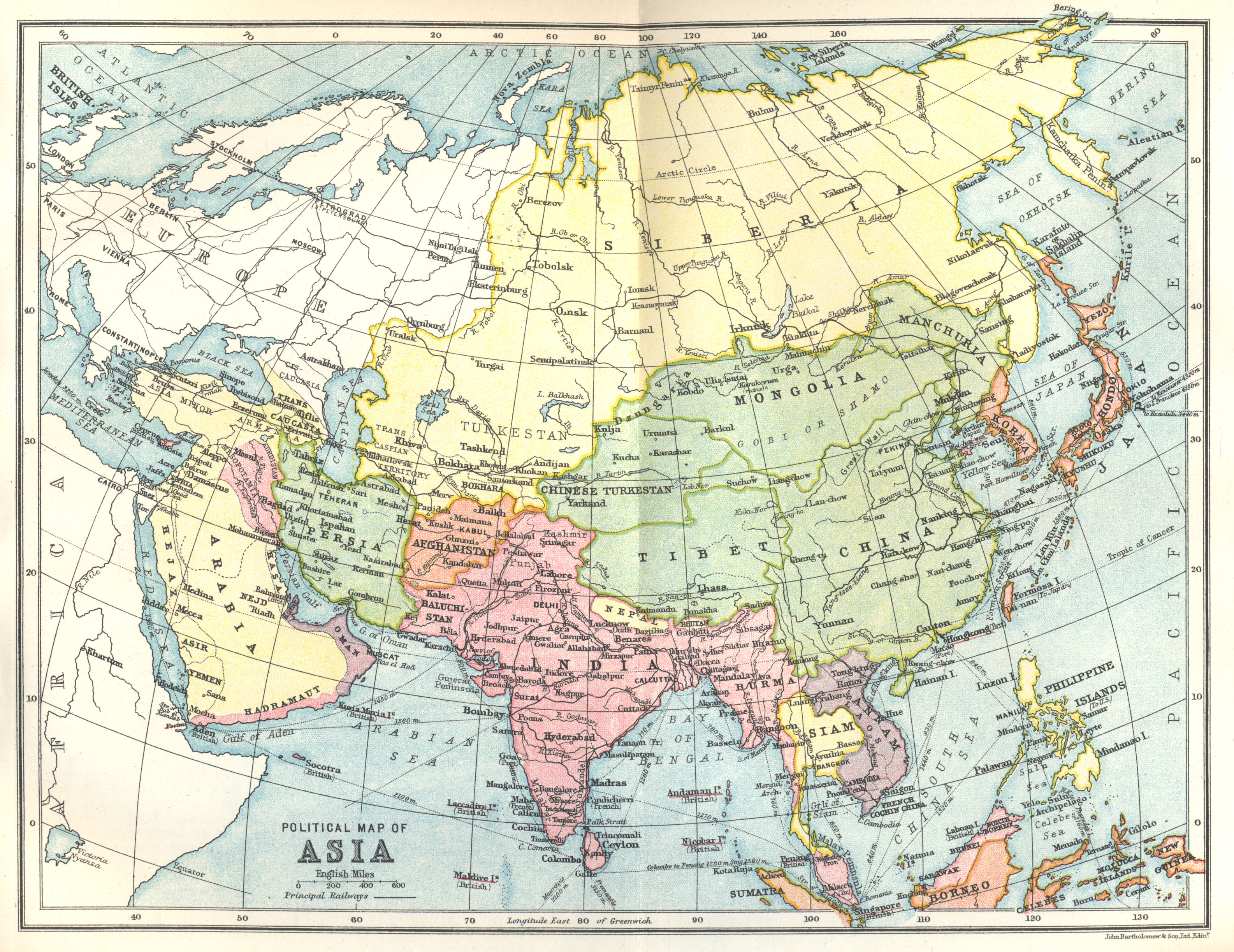
Some of the largest rivers of Asia flow northward to the Arctic Ocean—the Obi, the Yenisei, and the Lena. The Hoang-Ho and Yang-tse, and the Amoor, are the chief of those which flow into the Pacific. The Ganges, Brahmaputra, Irawadi, and Indus flow into the Indian Ocean. The Persian Gulf receives the united waters of the Euphrates and the Tigris. There are several systems of inland drainage, large rivers falling into lakes which have no outlet.
The largest lake of Asia (partly also European) is the Caspian Sea, which receives the Kur from the Caucasus (with its tributary the Aras from Armenia), and the Sefid Rud and other streams from Persia (besides the Volga from European Russia, and the Ural, which is partly European, partly Asiatic). The Caspian lies in the centre of a great depression, being 83 feet below the level of the Sea of Azov. East from the Caspian is the Sea of Aral, which, like the Caspian, has no outlet, and is fed by the Rivers Amu-Darya (Oxus) and Syr-Darya. Still farther east, to the north of the Thian-Shan Mountains, and fed by the Ili and other streams, is Lake Balkhash, also without an outlet and very salt. Other lakes having no communication with the ocean are Lob Nor, in the desert of Gobi, receiving the River Tarim, and the Dead Sea, far below the level of the Mediterranean, and fed by the Jordan. The chief fresh-water lake is Lake Baikal, in the south of Siberia, between long. 104° and 110° E., a mountain lake from which the Yenisei draws a portion of its waters.
Geologically speaking, large areas of Asia are of comparatively recent date, the lowlands of Siberia, for instance, being submerged during the tertiary period, if not more recently. Many geologists believe that subsequently to the glacial period there was a great sea in Western Asia, of which the Caspian and Aral Seas are the remains. The desiccation of Central Asia is still going on, as is also probably the upheaval of a great part of the continent. The great mountain chains and elevated plateaux are of ancient origin, however, and in them granite and other crystalline rocks are largely represented. Active volcanoes are only met with in the extreme east (Kamtchatka) and in the Eastern Archipelago. From the remotest times Asia has been celebrated for its mineral wealth. In the Altai and Ural Mountains gold, iron, lead, and platinum are found; in India and other parts rubies, diamonds, and other gems are, or have been, procured; salt in Central Asia; coal in China, India, Central Asia, &c.; petroleum in the districts about the Caspian and in Burmah; bitumen in Syria; while silver, copper, sulphur, &c., are found in various parts.
Every variety of climate may be experienced in Asia, but as a whole it is marked by extremes of heat and cold and by great dryness, this in particular being the case with vast regions in the centre of the continent and distant from the sea. The great lowland region of Siberia has a short but very hot summer, and a long but intensely cold winter, the rivers and their estuaries being fast bound with ice, and at a certain depth the soil is hard frozen all the year round. The northern part of China to the east of Central Asia has a temperate climate with a warm summer, and in the extreme north a severe winter. The districts lying to the south of the central region, comprising the Indian and Indo-Chinese Peninsulas, Southern China, and the adjacent islands, present the characteristic climate and vegetation of the southern temperate and tropical regions modified by the effects of altitude. Some localities in Southern Asia have the heaviest rainfall anywhere known. As the equator is approached the extremes of temperature diminish till at the southern extremity of the continent they are such as may be experienced in any tropical country. Among climatic features are the monsoons of the Indian Ocean and the eastern seas, and the cyclones or typhoons, which are often very destructive.
The plants and animals of Northern and Western Asia generally resemble those of similar latitudes in Europe (which is really a prolongation of the Asiatic continent), differing more in species than in genera. The principal mountain trees are the pine, larch, and birch; the willow, alder, and poplar are found in lower grounds. In the central region European species reach as far as the Western and Central Himálaya, but are rare in the Eastern. They are here met by Chinese and Japanese forms. The lower slopes of the Himálaya are clothed almost exclusively with tropical forms. Higher up, between 4000 and 10,000 feet, are found all the types of trees and plants that belong to the temperate zone, there being extensive forests of conifers. Here is the native home of the deodar cedar. The south-eastern region, including India, the Eastern Peninsula, and China, with the islands, contains a vast variety of plants useful to man and having here their original habitat, such as the sugar-cane, rice, cotton, and indigo, pepper, cinnamon, cassia, clove, nutmeg, and cardamoms, banana, coco-nut, areca, and sago palms; the mango and many other fruits, with plants producing a vast number of drugs, caoutchouc, and gutta-percha. The forests of India and the Malay Peninsula contain oak, teak, sâl, and other timber woods, besides bamboos, palms, sandal-wood, &c. The palmyra palm is characteristic of Southern India; while the talipot palm flourishes on the western coast of Hindustan, Ceylon, and the Malay Peninsula. The cultivated plants of India and China include wheat, barley, rice, maize, millet, sugar-cane, tea, coffee, indigo, cotton, jute, opium, tobacco, &c. In North China and the Japanese Islands large numbers of deciduous trees occur, such as oaks, maples, limes, walnuts, poplars, and willows, the genera being European but the individual species Asiatic. Among cultivated plants are wheat, and in favourable situations rice, cotton, the vine, &c. Coffee, rice, sugar, &c., are extensively grown in some of the islands of the Asiatic Archipelago. In Arabia and the warmer valleys of Persia, Afghanistan, and Baluchistan aromatic shrubs are abundant. Over large parts of these regions the date palm flourishes and affords a valuable article of food. Gum-producing acacias are, with the date palm, the commonest trees in Arabia. African forms are found extending from the Sahara along the desert region of Asia.
Nearly all the mammals of Europe are found in Northern Asia, with numerous additions to the species. Central Asia is the native land of the horse, the ass, the ox, the sheep, and the goat. Both varieties of the camel, the single and the double humped, are Asiatic. To the inhabitants of Tibet and the higher plateaux of the Himálaya the yak is what the reindeer is to the tribes of the Siberian plain, almost their sole wealth and support. The elephant, of a different species from that of Africa, is a native of tropical Asia. The Asiatic lion, which inhabits Arabia and Persia, and still exists in the north-west of India, is smaller than the African species. Bears are found in all parts, the white bear in the far north, and other species in the more temperate and tropical parts. The tiger is the most characteristic of the larger Asiatic Carnivora. It is found in Armenia and throughout the entire continent, being absent, however, from the greater portion of Siberia and from the high table-land of Tibet; it is found also in Sumatra, Java, and Bali. In South-Eastern Asia and the islands we find the rhinoceros, buffalo, ox, deer, squirrels, porcupines, &c. In birds nearly every order is represented. Among the most interesting forms are the hornbills, the peacock, the Impey pheasant, the tragopan or horned pheasant, and other gallinaceous birds, the pheasant family being very characteristic of South-Eastern Asia. It was from Asia that the common domestic fowl was introduced into Europe. The tropical parts of Asia abound in monkeys, of which the species are numerous. Some are tailed, others, such as the orang, are tailless, but none have prehensile tails like the American monkeys. In the Malay Archipelago marsupial animals, so characteristic of Australia, first occur in the Moluccas and Celebes, while various mammals common in the western part of the Archipelago are absent. A similar transition towards the Australian type takes place in the species of birds. (See Wallace's Line.) Of marine mammals the dugong is peculiar to the Indian Ocean; in the Ganges is found a peculiar species of dolphin. At the head of the reptiles stands the Gangetic crocodile, frequenting the Ganges and other large rivers. Among the serpents are the cobra de capello, one of the most deadly snakes in existence; there are also large boas and pythons, besides sea and fresh-water snakes. The seas and rivers produce a great variety of fish. The Salmonidæ are found in the rivers flowing into the Arctic Ocean. Two rather remarkable fishes are the climbing perch and the archer-fish. The well-known goldfish is a native of China.
Asia is mainly peopled by races belonging to two great ethnographic types, the Caucasic or fair type, and the Mongolic or yellow. To the former belong the Aryan, or Indo-European, and the Semitic races, both of which mainly inhabit the south-west of the continent; to the latter belong the Malays and Indo-Chinese in the S.E., as well as the Mongolians proper (Chinese, &c.), occupying nearly all the rest of the continent. To these may be added certain races of doubtful affinities, as the Dravidians of Southern India, the Cingalese of Ceylon, the Ainos of Yesso, and some negro-like tribes called Negritos, which inhabit Malacca and the interior of several of the islands of the Eastern Archipelago. The total population is estimated at 823,000,000, or more than half that of the whole world, of which 330,000,000 inhabit Chinese territory, 302,000,000 British, and 25,000,000 Russian. Portions of Asia are under the control of European Powers (Russia, Great Britain, Holland, France), of the United States of America, China, and Japan. The chief States are China, Japan, Corea, Siam, Afghanistan, Persia, and Arabia. The chief religions are the Brahmanism of India, the Buddhism of Burmah, China, &c., the creeds of Confucius and Lao-tse in China, and the various forms of Mahommedanism in Arabia, Persia, India, &c. More than a half of the whole population profess some form of Buddhism. Several native Christian sects are found in India, Armenia, Kurdistan, and Syria.
Asia is generally regarded as the cradle of the human race. It possesses the oldest historical documents, and, next to the immediately contiguous kingdom of Egypt, the oldest historical monuments in the world. The Old Testament contains the oldest historical records which we have of any nation in the form of distinct narrative. The period at which Moses wrote was probably 1500 or 1600 years before the Christian era. His and the later Jewish writings confine themselves almost exclusively to the history of the Hebrews; but in Babylonia, as in Egypt, civilization had made great advances long before this time. The earliest seat of the Aryan race some assign to the banks of the Oxus. Hence, perhaps from the pressure of the Mongolian tribes to the north, they spread themselves to the south-east and south-west, finally occupying Northern India, Persia, and other parts of Western Asia, and spreading into Europe, perhaps about 2000-1500 B.C. In China authentic history extends back probably to about 1000 B.C., with a long preceding period of which the names of dynasties are preserved without chronological arrangement. The kingdoms of Assyria, Babylonia, Media, and Persia predominated by turns in South-Western Asia. In regard to the history of these monarchies, much light has been obtained from the decipherment of the cuneiform inscriptions. The arms of the Pharaohs extended into Asia, but their conquests there were short-lived. From Cyrus (559 B.C.), who extended the empire of Persia from the Indus to the Mediterranean, while his son, Cambyses, added Egypt and Libya to it, to the conquest of Alexander (330 B.C.) Persia was the dominant Power in Western Asia. Alexander's great empire became broken up into separate kingdoms, which were finally absorbed in the Roman Empire, and this ultimately extended to the Tigris. Soon after the most civilized portions of the three continents had been reduced under one empire, the great event took place which forms the dividing-line of history, the birth of Christ and the spread of Christianity. In A.D. 226 a protracted struggle began between the newer Persian Empire and the Romans, which lasted till the advent of Mahomet, and the conquests of the Arabians. Persia was the first great conquest of Mahomet's followers. Syria and Egypt soon fell before their arms, and within forty years of the celebrated flight of Mahomet from Mecca (the Hejra), the sixth of the caliphs, or successors of the Prophet, was the most powerful sovereign of Asia. The Mongols next became the dominant race. In 999 Mahmud, whose father, born a Turkish slave, became Governor of Ghazni, conquered India, and established his rule. The dynasty of the Seljuk Tartars was established in Aleppo, Damascus, Iconium, and Kharism, and was distinguished for its struggles with the Crusaders. Othman, an emir of the Seljuk sultan of Iconium, established the Ottoman Empire in 1300. About 1220 Genghis Khan, an independent Mongol chief, made himself master of Central Asia, conquered Northern China, overran Turkestan, Afghanistan, and Persia; his successors took Bagdad and abolished the caliphate. In Asia Minor they overthrew the Seljuk dynasty. One of them, Timur or Tamerlane, carried fire and sword over Northern India and Western Asia, defeated and took prisoner Bajazet, the descendant of Othman (1402), and received tribute from the Greek emperor. The Ottoman Empire soon recovered from the blow inflicted by Timur, and Constantinople was taken and the Eastern Empire finally overthrown by the Sultan Mohammed II in 1453. China recovered its independence about 1368 and was again subjected by the Manchu Tartars (1618-45), soon after which it began to extend its empire over Central Asia. Siberia was conquered by the Cossacks on behalf of Russia (1580-4). The same country effected a settlement in the Caucasus about 1786, and has since continued to make steady advances into Central Asia. The discovery by the Portuguese of the passage to India by the Cape of Good Hope led to their establishment on the coast of the peninsula (1498). They were speedily followed by the Spanish, Dutch, French, and British. The struggle between the two last Powers for the supremacy of India was completed by the destruction of the French settlements (1760-5). At present the forms of government in Asia range from the primitive rule of the nomad sheik to the constitutional monarchy of Japan.—Bibliography: Sven Hedin, Through Asia; H. F. Blanford, Elementary Geography of India, Burma, and Ceylon; Max. Müller, The Sacred Books of the East; A. Little, The Far East; R. Cobbold, Innermost Asia; Colonel A. Durand, The Making of a Frontier; J. G. C. Chamberlain, Continents and their Peoples; E. Huntington, The Pulse of Asia; E. C. Hannah, Eastern Asia.
Asia, Central, a designation loosely given to the regions in the centre of Asia east of the Caspian, also called Turkestan, and formerly Tartary. The eastern portion belongs to China, the western to Russia. Russian Central Asia comprises the Kirghiz Steppe (Uralsk, Turgai, Akmolinsk, Semipalatinsk, &c.), and what was the government-general of Turkestan till 1918, besides the territory of the Turkomans, or Transcaspia and Merv. See Turkestan, Republic of.
Asia Minor, the most westerly portion of Asia, being the peninsula lying west of the Upper Euphrates, and forming part of Asiatic Turkey. It forms an extensive plateau, with lofty mountains rising above it, the most extensive ranges being the Taurus and Anti-Taurus, which border it on the south and south-east, and rise to over 10,000 feet. There are numerous salt- and freshwater lakes. The chief rivers are the Kizil-Irmak (Halys), Sakaria (Sangarius), entering the Black Sea; and the Sarabat (Hermus) and Menderes (Mæander), entering the Ægean. The coast regions are generally fertile, and have a genial climate; the interior is largely arid and dreary. Valuable forests and fruit-trees abound. Smyrna is the chief town. Anatolia is an equivalent name. See European War; Turkey.
Asiago, a town in Italy in the province of Vicenza, capital of the Seven Communes (Sette Communi). In the great European War several battles were fought on the Asiago Plateau. The town was evacuated by the Italians on 28th May, 1916, but retaken on 25th June, 1916. See European War.
Asiatic Societies, learned bodies instituted for the purpose of collecting information respecting the different countries of Asia, such as the Asiatic Society of Bengal, founded in 1784 by Sir William Jones; and the Royal Asiatic Society of Great Britain and Ireland, established by Colebrooke, and opened in 1823. There are similar societies on the European Continent and in America, such as the Société Asiatique at Paris, founded in 1822; the Oriental Society of Germany (Deutsche Morgenländische Gesellschaft), founded in 1845; and the Oriental Society at Boston, founded in 1842.
Asiphona´ta, or Asiphon´ida, an order of lamellibranchiate, bivalve molluscs, destitute of the siphon or tube through which, in the Siphonata, the water that enters the gills is passed outwards. It includes the oysters, the scallop-shells, the pearl-oyster, the mussels, and in general the most useful and valuable molluscs.
Asir. See Hejaz.
Askabad´, the administrative centre of the Russian province of Transcaspia, situated in the Akhal Tekke oasis, and occupied by Skobelev in Jan., 1881, after the sack of Geok Tepé. Its distance from Merv is 232 miles, from Herat 388 miles. Pop. 54,000.
As´kew, Anne, a victim of religious persecution, born 1521, martyred 1546. She was a daughter of Sir William Askew of Lincolnshire, and was married to a wealthy neighbour named Kyme, who, irritated by her Protestantism, drove her from his house. In London, whither she went probably to procure a divorce, she spoke against the dogmas of the old faith, and, being tried, was condemned to death as a heretic. Being put to the rack to extort a confession concerning those with whom she corresponded, she continued firm, and was then taken to Smithfield, chained to a stake, and burned.
Askja (a˙sk´ya˙), a volcano near the centre of Iceland, first brought into notice by an eruption in 1875. Its crater is 17 miles in circumference, surrounded by a mountain-ring from 500 to 1000 feet high, the height of the mountain itself being between 4000 and 5000 feet.