VOLUME I PART 2 (continued 6)
Reading edition
Arkansas (ar´kan-sa¨ or ar-kan´sas), one of the United States of America, bounded north by Missouri; east by the Mississippi, which separates it from the States of Mississippi and Tennessee; south by Louisiana and Texas; and west by the Indian Territory and Texas; area, 53,335 sq. miles. The surface in the east is low, flat, and swampy, densely wooded, and subject to frequent inundations from the numerous streams which water it. Towards the centre it becomes more diversified, presenting many undulating slopes and hills of moderate elevation. In the west it rises still higher, being traversed by a range of hills called the Ozark, which attains a height of 2000 feet, some peaks rising to 3000. In various parts the prairies are of great extent; the forests also are extensive, principally of oak, hickory, ash, cotton, linden, maple, locust, and pine. Coal and other minerals are worked. The principal rivers, all tributaries of the Mississippi, are the Arkansas, the Red River, the St. Francis, and the Washita. Near the centre of the State are warm springs, much resorted to for chronic rheumatic and paralytic affections. The climate is subject to great extremes of heat and cold, and in the lower districts is unhealthy to new settlers. The staple products are cotton and maize; fruit is tolerably abundant. Many districts are admirably adapted for grazing, and great numbers of excellent cattle are reared. Arkansas was colonized as early as 1685 by the French. As part of Louisiana it was purchased by the United States in 1803. It was made into a separate territory in 1819, and admitted into the Union in 1836. It was one of the seceding States. The capital is Little Rock. The enumerated population in 1920 was 1,750,995.
Arkansas, a river of the United States, which gives its name to the above State, the largest affluent of the Mississippi after the Missouri. It rises in the Rocky Mountains, about lat. 39° N., long. 107° W., flows in a general south-easterly direction through Colorado, Kansas, the Indian Territory, and lastly through the State of Arkansas, and after a course of 2170 miles enters the Mississippi. During greater part of the year it is navigable for steamboats for 800 miles.
Arkite. See Explosives.
Ark´low, a town in Ireland, County Wicklow, on the right bank of the Avoca, which falls into the sea about 500 yards below the town; the scene of a severe fight during the rebellion of 1798. Fishing is the chief industry. Pop. 5042.
Arkwright's Water Frame
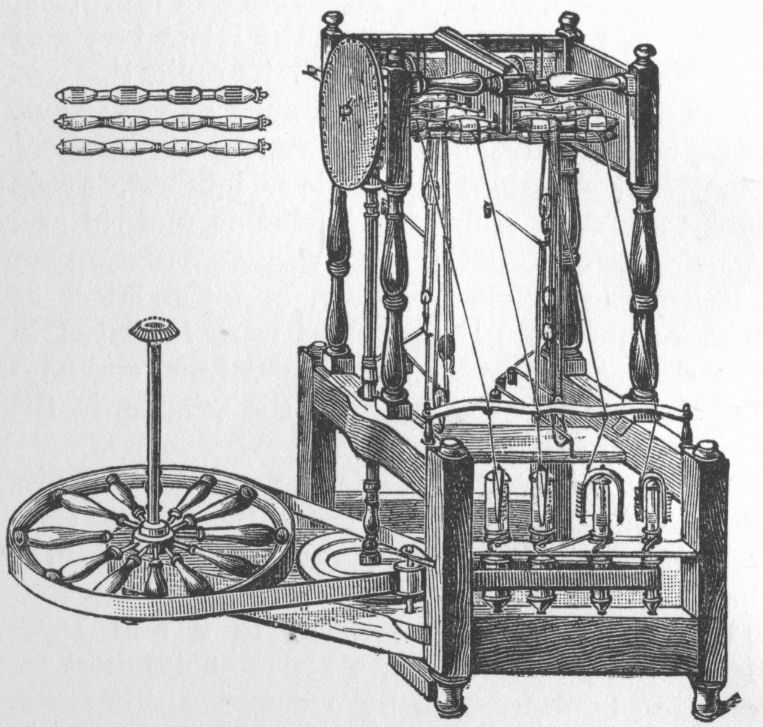
Ark´wright, Sir Richard, famous for his inventions in cotton-spinning, was born at Preston, in Lancashire, in 1732, died 1792. The youngest of thirteen children, he was bred to the trade of a barber. When about thirty-five years of age he gave himself up exclusively to the subject of inventions for spinning cotton. The thread spun by Hargreaves' jenny could not be used except as weft, being destitute of the firmness or hardness required in the longitudinal threads or warp. But Arkwright supplied this deficiency by the invention of the spinning-frame, which spins a vast number of threads of any degree of fineness and hardness, leaving the operator merely to feed the machine with cotton and to join the threads when they happen to break. His invention introduced the system of spinning by rollers, the carding, or roving as it is technically termed (that is, the soft, loose strip of cotton), passing through one pair of rollers, and being received by a second pair, which is made to revolve with (as the case may be) three, four, or five times the velocity of the first pair. By this contrivance the roving is drawn out into a thread of the desired degree of tenuity and hardness. His inventions being brought into a pretty advanced state, Arkwright removed to Nottingham in 1768 in order to avoid the attacks of the same lawless rabble that had driven Hargreaves out of Lancashire. Here his operations were at first greatly fettered by a want of capital; but two gentlemen of means having entered into partnership with him, the necessary funds were obtained, and Arkwright erected his first mill, which was driven by horses, at Nottingham, and took out a patent for spinning by rollers in 1769. As the mode of working the machinery by horse-power was found too expensive, he built a second factory on a much larger scale at Cromford, in Derbyshire, in 1771, the machinery of which was turned by a water-wheel. Having made several additional discoveries and improvements in the processes of carding, roving, and spinning, he took out a fresh patent for the whole in 1775, and thus completed a series of the most ingenious and complicated machinery. Notwithstanding a series of law-suits in defence of his patent rights, and the destruction of his property by mobs, he amassed a large fortune. He was knighted by George III in 1786.
Arlberg (a˙rl´berh), a branch of the Rhætian Alps, in the west of Tyrol, between it and Vorarlberg, pierced by the fourth longest railway tunnel in the world. It is 6½ miles long, and was finished in Nov., 1883, and connects the valley of the Inn with that of the Rhine, and the Austrian railway system with the Swiss railways.
Ar´lecdon, an urban district of England, in Cumberland, 4 miles east of Whitehaven, with coal and iron mines. Pop. (1921), 5152.
Arles (a˙rl; ancient, Arelāte), a town of Southern France, department Bouches du Rhône, 17 miles south-east of Nismes. It was an important town at the time of Cæsar's invasion, and under the later emperors it became one of the most flourishing towns on the farther side of the Alps. It still possesses numerous ancient remains, of which the most conspicuous are those of a Roman amphitheatre, which accommodated 24,000 spectators. It has a considerable trade, manufactures of silk, &c., and furnishes a market for the surrounding country. Pop. 16,746.
Ar´lington, Henry Bennet, Earl of, member of the Cabal ministry, and one of the scheming creatures of Charles II, born 1618, died 1685. He is supposed to have lived and died a Roman Catholic.
Ar´lon, a Belgian town, capital province of Luxemburg, a thriving town, with manufactures of ironware, leather, tobacco, &c. Pop. 12,012.
Arm, the upper limb in man, connected with the thorax or chest by means of the scapula or shoulder-blade, and the clavicle or collar-bone. It consists of three bones, the arm-bone (humĕrus), and the two bones of the fore-arm (radius and ulna), and it is connected with the bones of the hand by the carpus or wrist. The head or upper end of the arm-bone fits into the hollow called the glenoid cavity of the scapula, so as to form a joint of the ball-and-socket kind, allowing great freedom of movement to the limb. The lower end of the humerus is broadened out by a projection on both the outer and inner sides (the outer and inner condyles), and has a pulley-like surface for articulating with the fore-arm to form the elbow-joint. This joint somewhat resembles a hinge, allowing of movement only in one direction. The ulna is the inner of the two bones of the fore-arm. It is largest at the upper end, where it has two processes, the coronoid and the olecranon, with a deep groove between to receive the humerus. The radius—the outer of the two bones—is small at the upper and expanded at the lower end, where it forms part of the wrist-joint. The muscles of the upper arm are either flexors or extensors, the former serving to bend the arm, the latter to straighten it by means of the elbow-joint. The main flexor is the biceps, the large muscle which may be seen standing out in front of the arm when a weight is raised. The chief opposing muscle of the biceps is the triceps. The muscles of the fore-arm are, besides flexors and extensors, pronators and supinators, the former turning the hand palm downwards, the latter turning it upwards. The same fundamental plan of structure exists in the limbs of all vertebrate animals.
Arma´da, the Spanish name for any large naval force; usually applied to the Spanish fleet vaingloriously designated the Invincible Armada, intended to act against England A.D. 1588. It was under the command of the Duke of Medina-Sidonia, and consisted of 130 great war vessels, larger and stronger than any belonging to the English fleet, with 30 smaller ships of war, and carried 19,295 marines, 8460 sailors, 2088 slaves, and 2630 cannon. It had scarcely quitted Lisbon on 29th May, 1588, when it was scattered by a storm, and had to be refitted in Corunna. It was to co-operate with a land force collected in Flanders under the Prince of Parma, and to unite with this it proceeded through the English Channel towards Calais. In its progress it was attacked by the English fleet under Lord Howard, who, with his lieutenants, Drake, Hawkins, and Frobisher, endeavoured by dexterous seamanship and the discharge of well-directed volleys of shot to destroy or capture the vessels of the enemy. The great lumbering Spanish vessels suffered severely from their smaller opponents, which most of their shot missed. Arrived at length off Dunkirk, the armada was becalmed, thrown into confusion by fire-ships, and many of the Spanish vessels destroyed or taken. The Duke of Medina-Sidonia, owing to the severe losses, at last resolved to abandon the enterprise, and conceived the idea of reconveying his fleet to Spain by a voyage round the north of Great Britain; but storm after storm assailed his ships, scattering them in all directions, and sinking many. Some went down on the cliffs of Norway, others in the open sea, others on the Scottish coast, others on the coast of Ireland. In all, seventy-two large vessels and over 10,000 men were lost.—Bibliography: J. A. Froude, Spanish Story of the Armada; Sir J. K. Laughton, State Papers relating to the Defeat of the Spanish Armada; J. R. Hale, Story of the Great Armada.
Armadale, a town of Scotland, Linlithgowshire, in coal and iron district. Pop. 4739.
Armadillos—Left, Hairy Armadillo. Right, Kappler's Armadillo
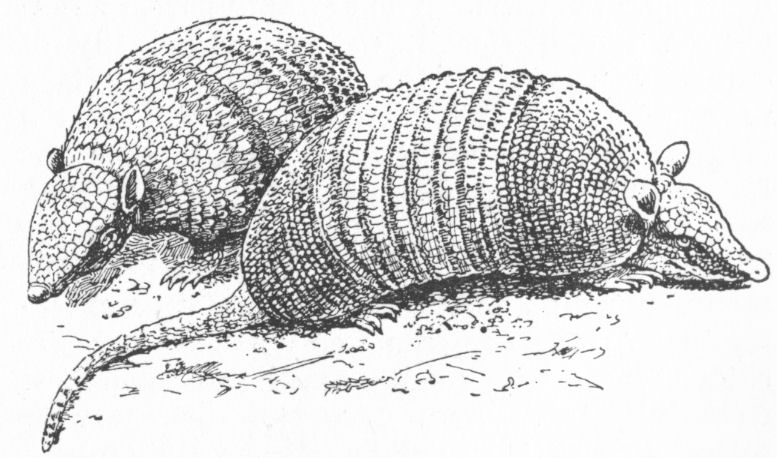
Armadi´llo (genus Dasўpus), an edentate mammal peculiar to South America, consisting of various species, belonging to a family intermediate between the sloths and ant-eaters. They are covered with a hard bony shell, divided into belts, composed of small separate plates like a coat of mail, flexible everywhere except on the forehead, shoulders, and haunches, where it is not movable. The belts are connected by a membrane which enables the animal to roll itself up like a hedgehog. These animals burrow in the earth, where they lie during the daytime, seldom going abroad except at night. They are of different sizes: the largest, Dasypus gigas, being 3 feet in length without the tail, and the smallest only 10 inches. They subsist chiefly on fruits and roots, sometimes on insects and flesh. They are inoffensive, and their flesh is esteemed good food.—There is a genus of isopodous Crustacea called Armadillo, consisting of animals allied to the wood-lice, capable of rolling themselves into a ball.
Armageddon (-ged´don), the great battlefield of the Old Testament, where the chief conflicts took place between the Israelites and their enemies—the table-land of Esdraelon in Galilee and Samaria, in the centre of which stood the town of Megiddo, on the site of the modern Lejjun: used figuratively in the Apocalypse to signify the place of 'the battle of the great day of God'. It may, however, be har migdo, his fruitful mountain, 'the mountain land of Israel'. The phrase 'an Armageddon' expresses any great slaughter or final conflict, and has been frequently applied to the Great War of 1914-8. During this war severe fighting took place in Sept., 1918, on the field of Armageddon, the entrance to the passes of Megiddo. The battle ended in an overwhelming victory for General Allenby's armies. See Megiddo.
Armagh (a˙r-mä´), a county of Ireland, in the province of Ulster; surrounded by Monaghan, Tyrone, Lough Neagh, Down, and Louth; area, 328,086 acres, of which about a half is under tillage. The north-west of the county is undulating and fertile. The northern part, bordering on Lough Neagh, consists principally of extensive bogs. On the southern border is a range of barren hills. The chief rivers are the Blackwater, which separates it from Tyrone; the Upper Bann, which discharges itself into Lough Neagh; and the Callan, which falls into the Blackwater. There are several small lakes. The manufacture of linen is carried on very extensively. Armagh, Lurgan, and Portadown are the chief towns. The county sends three members to Parliament. Pop. 120,291.—The county town, Armagh, is situated partly on a hill, about half a mile from the Callan. It has a Protestant cathedral crowning the hill, a Gothic building dating from the eighth century, repaired and beautified recently; a new Roman Catholic cathedral in the pointed Gothic style, and various public buildings. It is the see of an archbishop of the Protestant Episcopal Church, who is primate of all Ireland, and is a place of great antiquity. Pop. 7356.
Armagnac (a˙r-ma˙-nya˙k), an ancient territory of France, in the province of Gascony, some of the counts of which hold prominent places in the history of France. Bernard VII, son of John II, surnamed the Hunchback, succeeded his brother, John III, in 1391, and was called to Court by Isabella of Bavaria, with the view of heading the Orleans in opposition to the Burgundian faction, where he no sooner gained the ascendancy than he compelled the queen to appoint him Constable of France. He showed himself a merciless tyrant, and became so generally execrated that the Duke of Burgundy, to whom Isabella had turned for help, found little difficulty in gaining admission into Paris, and even seizing the person of Armagnac, who was cast into prison in 1418, when the exasperated populace burst in and killed him and his followers. John V, grandson of the above, who succeeded in 1450, made himself notorious for his crimes. He was assassinated in his castle of Lectoure in 1473 by an agent of Louis XI, against whom he was holding out.
Ar´mature, a term applied to the piece of soft iron which is placed across the poles of permanent or electro-magnets for the purpose of receiving and concentrating the attractive force. In the case of permanent magnets it is also important for preserving their magnetism when not in use, and hence it is sometimes termed the keeper. It produces this effect in virtue of the well-known law of induction, by which the armature, when placed near or across the poles of the magnet, is itself converted into a temporary magnet with reversed poles, and these, reacting upon the permanent magnet, keep its particles in a state of constant magnetic tension, or, in other words, in that constrained position which is supposed to constitute magnetism. A horse-shoe magnet should therefore never be laid aside without its armature; and in the case of straight bar-magnets two should be placed parallel to each other, with their poles reversed, and a keeper or armature across them at both ends. The term is also applied to the core and coil of the electro-magnet, which revolves before the poles of the permanent magnet in the magneto-electric machine.
Arme Blanche, a term applied to the rapier and duelling-foil, and frequently also to all weapons other than fire-arms. The phrase is particularly applied to the sabres and lances carried by cavalry, but also to the bayonet.
Arme´nia, a mountainous country of Western Asia, of great historical interest as the original seat of one of the oldest civilized peoples in the world. The name Armenia occurs in the Vulgate, but the Hebrew name is Ararat. It has an area of about 120,000 sq. miles, and is intersected by the Euphrates, which divides it into the ancient divisions, Armenia Major and Armenia Minor. The country is an elevated plateau, enclosed on several sides by the ranges of Taurus and Anti-Taurus, and partly occupied by other mountains, the loftiest of which is Ararat. Several important rivers take their rise in Armenia, namely, the Kur or Cyrus, and its tributary the Aras or Araxes, flowing east to the Caspian Sea; the Halys or Kizil-Irmak, flowing north to the Black Sea; and the Tigris and Euphrates, which flow into the Persian Gulf. The chief lakes are Van and Urumiyah. The climate is rather severe. The soil is on the whole productive, though in many places it would be quite barren were it not for the great care taken to irrigate it. Wheat, barley, tobacco, hemp, grapes, and cotton are raised; and in some of the valleys apricots, peaches, mulberries, and walnuts are grown. The inhabitants are chiefly of the genuine Armenian stock, a branch of the Aryan or Indo-European race; but besides them, in consequence of the repeated subjugation of the country, various other races have obtained a footing. The total number of Armenians is estimated at 2,900,000, of whom one-half are in Armenia. The remainder, like the Jews, are scattered over various countries, and are generally engaged in commercial pursuits. They everywhere retain, however, their distinct nationality.
Little is known of the early history of Armenia, but it was a separate State as early as the eighth century B.C., when it became subject to Assyria, as it also did subsequently to the Medes and the Persians. It was conquered by Alexander the Great in 325 B.C., but regained its independence about 190 B.C. Its king, Tigranes, son-in-law of the celebrated Mithridātes, was defeated by the Romans under Lucullus and Pompey between 69-66 B.C., but was left on the throne. Since then its fortunes have been various under the Romans, Parthians, Byzantine emperors, Persians, Saracens, and Turks. Until quite recently Armenia had no political existence, having been partitioned between Turkey, Persia, and Russia, the last acquiring considerable portions in 1829 and 1878. The hope of the Armenians to see their country formed into an autonomous province administered by Christians was frustrated by the Treaty of Berlin in 1878. The advanced party amongst the Armenians, therefore, determined to obtain their object by the production of disturbances and the spread of a revolutionary movement. The Porte retaliated by wholesale massacres of the Armenians in 1896, 1904, and 1908. The Armenian revolutionary and national parties in the meantime continued their activity and propaganda. Armenia proclaimed its independence in Aug., 1918. In Jan., 1920, the Supreme Council of the Allied Governments recognized the Armenian Republic of Erivan. A mandate for Armenia was also offered to the United States of America, but it was refused by the American Senate in May, 1920. On 18th March, 1922, Soviet Russia concluded a treaty with Turkey, giving to the latter most of Armenia. Batum was attached to Georgia. See Erivan, Russia, Turkey.
The Armenians received Christianity at an early date, most probably at the beginning of the third century, although native historians maintain that several of the apostles preached in Armenia. The real apostle of Armenia was Gregory the Illuminator, in the third century. During the Monophysitic disputes they held with those who rejected the twofold nature of Christ, and being dissatisfied with the decisions of the Council of Chalcedon (451) they separated from the Greek Church in 536. The Popes had at different times attempted to gain them over to the Roman Catholic faith, but have not been able to unite them permanently and generally with the Roman Church. There are, however, small numbers here and there of United Armenians, who acknowledge the spiritual supremacy of the Pope, agree in their doctrines with the Catholics, but retain their peculiar ceremonies and discipline. But the far greater part are yet Monophysites, and have remained faithful to their old religion and worship. Their doctrine differs from the orthodox chiefly in their admitting only one nature in Christ, and believing the Holy Spirit to proceed from the Father alone. Their sacraments are seven in number. They adore saints and their images, but do not believe in purgatory. Their hierarchy differs little from that of the Greeks. The Catholicus, or head of the Church, has his seat at Etchmiadzin, a monastery near Erivan, the capital of former Russian Armenia, on Mount Ararat.
The Armenian language belongs to the Indo-European family of languages, and is most closely connected with the Iranic group. The Old Armenian or Haikan language, which is still the literary and ecclesiastical language, is distinguished from the New Armenian, the ordinary spoken language, which contains a large intermixture of Persian and Turkish elements. The most flourishing period of Armenian literature extended from the fourth to the fourteenth century. It then declined, but a revival began in the seventeenth century, and at the present day wherever any extensive community of Armenians has settled they have set up a printing-press. The Armenian Bible, translated from a Syriac version, and revised by means of the Septuagint, by Isaac the Great and St. Mesrop, early in the fifth century, is a model of the classic style.—Bibliography: E. N. and H. Buxton, Travel and Politics in Armenia; N. T. Gregor, History of Armenia; W. L. Williams, Armenia, Past and Present.
Armentières (a˙r-ma˙n˙-tyār), a town in France, department Nord, 10 miles W.N.W. of Lille, on the Lys. The town had extensive manufactures of linen and cotton goods and an extensive trade. The Germans captured Armentières by massed assault early in April, 1918, after methodically shelling the town for about two years and destroying almost every building in it. The enemy's offensive was intended to achieve greater results. Indeed, its object was to break through to the Channel ports. It began on 9th April, after artillery preparation, from La Bassée to Armentières. When, however, the battle of Armentières died down, the enemy plan to break through to the coast had been definitely and finally frustrated. German losses were extremely heavy, their attacks having been made with massed troops. (See Ypres.) Pop. 28,086.
Arm´felt, Gustav Moritz, Count of, Swedish soldier, born 1757, died 1814. Though he had been highly favoured and loaded with honours by Gustavus III, he incurred the enmity of the Duke of Sudermania, guardian of the young king, Gustavus IV, and was deprived of all his titles and possessions. He was restored to his fortune and honours in 1799, when Gustavus IV attained his majority, and held several high military posts. Ultimately, however, he entered the Russian service, was made count, chancellor of the University of Abo, president of the department for the affairs of Finland, member of the Russian Senate, and served in the campaign against Napoleon in 1812.
Armida (a˙r-mē´da˙), a beautiful enchantress in Tasso's Jerusalem Delivered, who succeeds in bringing the hero Rinaldo, with whom she had fallen violently in love, to her enchanted gardens. Here he completely forgets the high task to which he had devoted himself, until messengers from the Christian host having arrived at the island, Rinaldo escapes with them by means of a powerful talisman. In the sequel Armida becomes a Christian.
Ar´millary Sphere (Lat. armilla, a hoop), an astronomical instrument consisting of an arrangement of rings, all circles of one sphere, intended to represent the principal circles of the celestial globe, the rings standing for the meridian of the station, the ecliptic, the tropics, the arctic and antarctic circles, &c., in their relative positions. Its main use is to give a representation of the apparent motions of the celestial bodies.
Armin´ians, a sect or party of Christians, so called from Jacobus Arminius or Harmensen. (See Arminius.) They were called also Remonstrants, from their having presented a remonstrance to the States-general in 1610. The Arminian doctrines are: (1) Conditional election and reprobation, in opposition to absolute predestination. (2) Universal redemption, or that the atonement was made by Christ for all mankind, though none but believers can be partakers of the benefit. (3) That man, in order to exercise true faith, must be regenerated and renewed by the operation of the Holy Spirit, which is the gift of God; but that this grace is not irresistible and may be lost, so that men may relapse from a state of grace and die in their sins. Arminianism being a revolt against certain aspects of Calvinism, especially the absolutism of the eternal decrees, its doctrines were vehemently attacked by the Calvinists of Holland, and were condemned by the Synod of Dort in 1619. The Arminians, in consequence, were treated with great severity; many of them fled to, and spread in, other countries, and though there is no longer any particular sect to which the name is exclusively applied, many bodies are classed as Arminians, as being opposed to the Calvinists on the question of predestination.—Bibliography: Regenboog, Historie der Remonstranten; Caspar Brandt, Life of Arminius (English translation by J. Guthrie); W. B. Pope, Compendium of Christian Theology (3 vols.).
Armin´ius, an ancient German hero celebrated by his fellow-countrymen as their deliverer from the Roman yoke, born about 18-16 B.C., assassinated A.D. 19. Having been sent as a hostage to Rome, he served in the Roman army, and was raised to the rank of eques. Returning home, he found the Roman governor, Quintilius Varus, making efforts to Romanize the German tribes near the Rhine. Placing himself at the head of the discontented tribes he completely annihilated the army of Varus, consisting of three legions, in a three days' battle fought in the Teutoburg Forest. For some time he baffled the Roman general Germanicus, and after many years' resistance to the vast power of the Empire he drew upon himself the hatred of his countrymen by aiming at the regal authority, and was assassinated. A national monument to his memory was inaugurated on the Grotenburg, near Detmold, in 1875.—Bibliography: see Tacitus, Annals (translated by Murphy); O. Kemmer, Arminius; F. W. Fischer, Armin und die Römer.
Arminius, Jacobus (properly Jakob Harmensen), founder of the sect of Arminians or Remonstrants, born in South Holland in 1560, died 1609. He studied at Utrecht, in the University of Leyden, and at Geneva, where his chief preceptor in theology was Theodore Beza (1582). On his return to Holland he was appointed minister of one of the churches in Amsterdam, and chosen to undertake the refutation of a work which strongly controverted Beza's doctrine of predestination; but he happened to be convinced by the work which he had undertaken to refute. Elected in 1603 professor of divinity at Leyden, he openly declared his opinions, and was involved in harassing controversies, especially with his fellow professor Gomarus. These contests, with the continual attacks on his reputation, at length impaired his health and brought on a complicated disease, of which he died. See Arminians.
Ar´mitage, Edward, English historical painter, born 1817, died 1896. He studied under Delaroche at the École des Beaux Arts, Paris, was one of the ablest pupils of that painter, and in 1842 exhibited at the Salon (in the Louvre) a picture of Prometheus Bound. At the exhibition of cartoons for historical pictures in Westminster Hall (1843) he obtained a premium of £300 for his design of Cæsar's First Invasion of Britain. Other similar premiums were gained by his Spirit of Religion (1845), and Battle of Meeanee (1847—£500). He now went to study at Rome, and exhibited at the Academy in 1848 his Henry VIII and Katherine Parr, and his Trafalgar (Death of Nelson). He had pictures in most of the subsequent Academy exhibitions up nearly to the time of his death. In 1867 he was elected an associate, and in 1872 a full academician. He did much for the restoration of fresco painting in England. A large number of his pictures were biblical in subject, such as Ahab and Jezebel, Esther's Banquet, The Remorse of Judas, Joseph and Mary, Herod's Birthday Feast, &c. As professor of painting to the Royal Academy he delivered lectures on painting, which were published in 1883. In 1898 appeared a volume of his Pictures and Drawings.
Armor´ica (from two Celtic words signifying 'upon the sea'), a name anciently applied to all north-western Gaul, afterwards limited to what is now Brittany. Hence Armoric is one name for Breton or the language of the inhabitants of Brittany, a Celtic dialect closely allied to Welsh.
Armour. See Arms.
Armoured Car, a self-propelled car completely protected by bullet-proof armour-plating. Such a car is a stage in the development of mechanical warfare, i.e. warfare by means of a self-propelled, armed, and manned machine. The idea is a very ancient one, some form of protected vehicle having been in use among the Chinese in almost prehistoric times. The modern armoured car is constructed on a strongly-engined chassis, and is provided with a bullet-proof armour-plating both for engine and crew. This armour is continued low down over the wheels. The armament of such a car consists of two heavy machine-guns, firing through slits in the armour-plating of the body of the car.
Armour-plates, iron or steel plates with which the sides of vessels of war are covered with the view of rendering them shot-proof. See Iron-clad Vessels.
Arms, Coat of, or Armorial Bearings, a collective name for the devices borne on shields, on banners, &c., as marks of dignity and distinction, and, in the case of family and feudal arms, descending from father to son. They were first employed by the Crusaders, and became hereditary in families at the close of the twelfth century. They took their rise from the knights painting their banners or shields each with a figure or figures proper to himself, to enable him to be distinguished in battle when clad in armour. See Heraldry.
Arms, College of. See Herald.
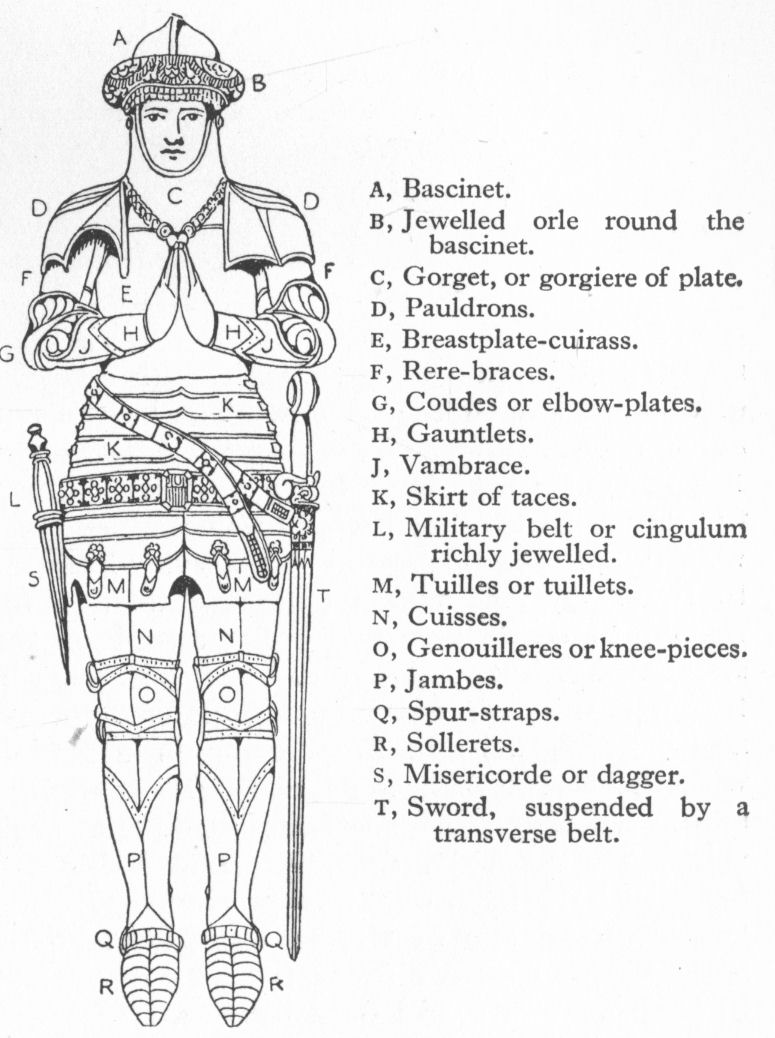
Armour, from the effigy of Sir Richard Peyton, in Tong Church, Shropshire
Arms and Armour. The former term is applied to weapons of offence, the latter to the various articles of defensive covering used in war and military exercises, especially before the introduction of gunpowder. Weapons of offence are divisible into two distinct sections—firearms, and arms used without gunpowder or other explosive substance. The first arms of offence would probably be wooden clubs, then would follow wooden weapons made more deadly by means of stone or bone, stone axes, slings, bows and arrows with heads of flint or bone, and afterwards various weapons of bronze. Subsequently a variety of arms of iron and steel was introduced, which comprised the sword, javelin, pike, spear or lance, dagger, axe, mace, chariot scythe, &c.; with a rude artillery consisting of catapults, ballistæ, and battering-rams. From the descriptions of Homer we know that almost all the Grecian armour, defensive and offensive, in his time was of bronze; though iron was sometimes used. The lance, spear, and javelin were the principal weapons of this age among the Greeks. The bow is not often mentioned. Among ancient nations the Egyptians seem to have been most accustomed to the use of the bow, which was the principal weapon of the Egyptian infantry. Peculiar to the Egyptians was a defensive weapon intended to catch and break the sword of the enemy. With the Assyrians the bow was a favourite weapon; but with them lances, spears, and javelins were in more common use than with the Egyptians. Most of the large engines of war—chariots with scythes projecting at each side from the axle, catapults, and ballistæ—seem to have been of Assyrian origin. During the historical age of Greece the characteristic weapon was a heavy spear from 21 to 24 feet in length. The sword used by the Greeks was short, and was worn on the right side. The Roman sword was from 22 to 24 inches in length, straight, two-edged, and obtusely pointed, and as by the Greeks was worn on the right side. It was used principally as a stabbing weapon. It was originally of bronze. The most characteristic weapon of the Roman legionary soldier, however, was the pilum, which was a kind of pike or javelin, some 6 feet or more in length. The pilum was sometimes used at close quarters, but more commonly it was thrown. The favourite weapons of the ancient Germanic races were the battle-axe, the lance or dart, and the sword. The weapons of the Anglo-Saxons were spears, axes, swords, knives, and maces or clubs. The Normans had similar weapons, and were well furnished with archers and cavalry. The cross-bow was a comparatively late invention introduced by the Normans. Gunpowder was not used in Europe to discharge projectiles till the beginning of the fourteenth century. Cannon are first mentioned in England in 1338, and there seems to be no doubt that they were used by the English at the siege of Cambrai in 1339. The projectiles first used for cannon were of stone. Hand fire-arms date from the fifteenth century. At first they required two men to serve them, and it was necessary to rest the muzzle on a stand in aiming and firing. The first improvement was the invention of the match-lock, about 1476; this was followed by the wheel-lock, and about the middle of the seventeenth century by the flint-lock, which was in universal use until it was superseded by the percussion-lock, the invention of a Scottish clergyman early in the nineteenth century. The needle-gun dates from 1838. The only important weapon not a fire-arm that has been invented since the introduction of gunpowder is the bayonet, which is believed to have been invented about 1650. See Cannon, Musket, Rifle, &c.
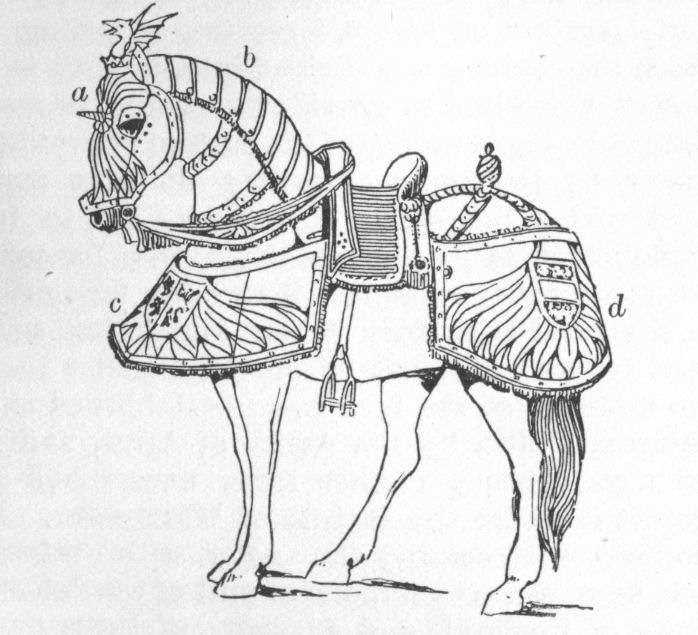
Horse-armour of Maximilian I of Germany a, Chamfron. b, Manefaire. c, Poitrinal, poitrel, or breastplate. d, Croupiere or buttock-piece.
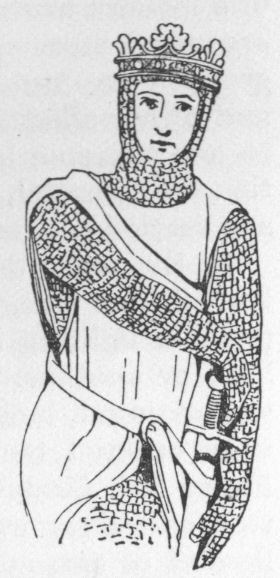
Chain Armour
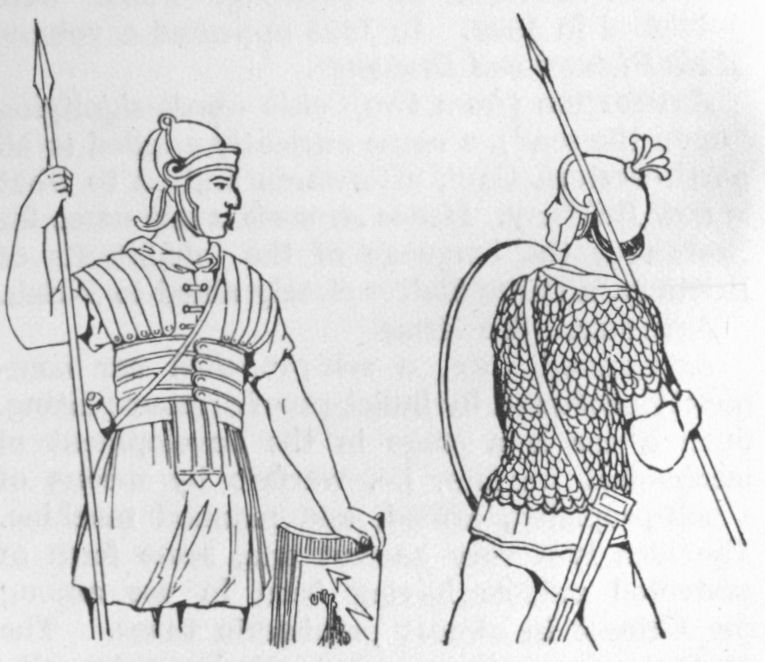
Roman Armour—Soldiers wearing Cuirass
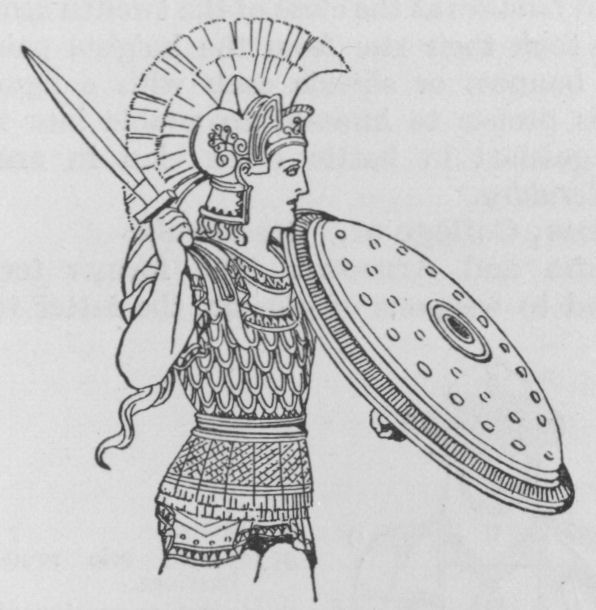
Greek Armour
Allecret (Light Plate) Armour, A.D. 1540
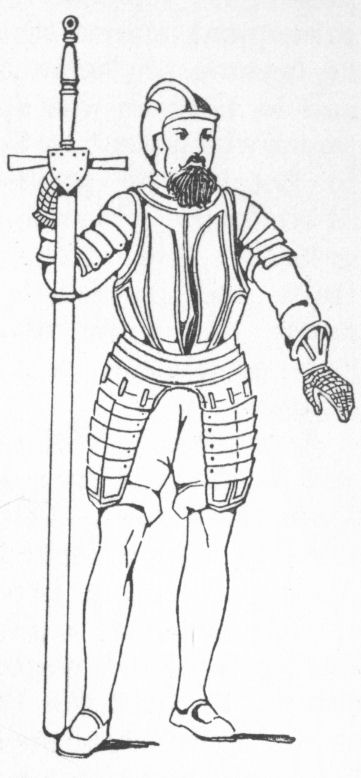
Some kind of defensive covering was probably of almost as early invention as weapons of offence. The principal pieces of defensive armour used by the ancients were shields, helmets, cuirasses, and greaves. In the earliest ages of Greece the shield is described as of immense size, but in the time of the Peloponnesian War (about 420 B.C.) it was much smaller. The Romans had two sorts of shields: the scutum, a large oblong rectangular highly-convex shield, carried by the legionaries; and the parma, a small round or oval flat shield, carried by the light-armed troops and the cavalry. In the declining days of Rome the shields became larger and more varied in form. The helmet was a characteristic piece of armour among the Assyrians, Greeks, Etruscans, and Romans. Like all other body armour it was usually made of bronze. The helmet of the historical age of Greece was distinguished by its lofty crest. The Roman helmet in the time of the early emperors fitted close to the head, and had a neck-guard and hinged cheek-pieces fastened under the chin, and a small bar across the face for a visor. Both Greeks and Romans wore cuirasses, at one time of bronze, but afterwards of flexible materials. Greaves for the legs were worn by both, but among the Romans usually on one leg. The ancient Germans had large shields of plaited osier covered with leather; afterwards their shields were small, bound with iron, and studded with bosses. The Anglo-Saxons had round or oval shields of wood, covered with leather, and having a boss in the centre; and they had also corselets, or coats of mail, strengthened with iron rings. The Normans were well protected by mail; their shields were somewhat triangular in shape, their helmets conical. In Europe generally metal armour was used from the tenth to the eighteenth century, and at first consisted of a tunic made of iron rings firmly sewn flat upon strong cloth or leather. The rings were afterwards interlinked one with another so as to form a garment of themselves, called chain-mail. Another variety of this flexible armour was known as banded-mail. This consisted of rings sewn upon a fabric foundation, the whole being covered with leather. In addition to this, 'scale armour', which had been in use from the very earliest periods of history, was still in common fashion in the thirteenth century. By degrees the suit of mail was reinforced by the addition of pieces of plate on the breast, knees, elbows, and arms, and by the end of the fourteenth century the full suit of plate had been evolved, the mail being only worn as a skirt round the waist or as a coif attached to the helmet. The golden age of plate armour is the middle of the fifteenth century, when the design was light and graceful, and at the same time fully protective. In the sixteenth century, when 'shock tactics' of cavalry were the order of the day, the 'war harness' became heavier. This was particularly noticeable in the armour for the joust or tournament, in which sport the aim of the contestants was to score points and not to inflict injury. Many of these jousting armours weigh over 80 lb. The weapons in use through the whole of the plate-armour period were the lance, the sword, the axe or war-hammer, the long-bow, and the cross-bow. The introduction of fire-arms in the fourteenth century was one of the causes which led to the increase of weight in armour, for the armourer was continually improving and strengthening his products to make them proof against musket and pistol, and he generally succeeded, but by doing so increased the weight till it became insupportable. In the seventeenth century leg armour was abandoned, and by the end of the civil war the popular defence was the steel cap and breastplate. In the eighteenth century armour entirely disappeared, except for ceremonial, and was thought to be entirely obsolete till it was revived in the recent war in the form of the steel shrapnel-helmet, which was favoured by all the Allies and also by the enemy. The German troops occasionally used heavy body armour. Daggers and clubs, weapons likewise thought to be obsolete, were frequently used by all combatants, especially on raids.—Bibliography: A. Hutton, The Sword of the Centuries; H. S. Cowper, The Art of Attack; C. ffoulkes, Armour and Weapons; C. H. Ashdown, British and Foreign Arms and Armour; C. Hall, Modern Weapons of War by Land.
Armstrong, John, Scottish poet and physician, born about 1709, died 1779. After studying medicine in Edinburgh he settled in London. In 1744 he published his chief work, the Art of Preserving Health, a didactic poem. This work raised his reputation to a height which his subsequent efforts scarcely sustained. In 1746 he became physician to a hospital for soldiers, and in 1760 he was appointed physician to the forces which went to Germany. After his return to London he published a collection of his Miscellanies, which contained, however, nothing valuable. He afterwards visited France and Italy, and published an account of his tour under the name of Lancelot Temple. His last production was a volume of Medical Essays.
Armstrong, William George, Lord, engineer and mechanical inventor, born at Newcastle-on-Tyne, 10th Nov., 1810. He was trained as a solicitor, and practised as such for some time. Among his early inventions were the hydro-electric machine, a powerful apparatus for producing frictional electricity, and the hydraulic crane. In 1847 the Elswick works, near Newcastle, were established for the manufacture of his cranes and other heavy iron machinery, and these works are now among the most extensive of their kind. Here the first rifled ordnance gun which bears his name was made in 1854. His improvements in the manufacture of guns and shells led to his being appointed engineer of rifled ordnance under Government, and he was knighted in 1858. This appointment came to an end in 1863, since which time his ordnance has taken a prominent place in the armaments of different countries. He was made a peer, as Baron Armstrong, in 1887. He died 27th Dec., 1900.
Armstrong Gun, a kind of cannon, so called from its inventor. It has an inner tube or core of steel, rifled with numerous shallow grooves, the tube being surrounded by a jacket of spirally-coiled bars of wrought iron, so disposed as to bring the metal into the most favourable position for the strain to which it is to be exposed. His first guns were small, but larger ones were soon made, and afterwards those of the very highest calibre. The breech-loading principle was also adopted in them, and special provision to effect this satisfactorily was invented by him. The improved shells introduced by him were of the elongated and pointed type now so well known, the charge being inserted in a special chamber behind the bore.
Army, a collection of bodies of men armed, disciplined, and organized for war. The essence of a modern army is that it shall be composed of organized units each under its own commander, grouped in formations of ever-increasing size, and owing allegiance through these commanders to one supreme head. Discipline and organization are essential, or such a force becomes merely a collection of armed men.
In the early days of our history every able-bodied man was, to a greater or lesser extent, a possible fighting man, and all had arms of one kind or another. Consequently, when an army was required, landowners and county authorities were ordered to provide the troops necessary. Every free landowner between the ages of sixteen and sixty was liable to service, which was limited to two months in a year. This was the Saxon 'fyrd' system. Later it was improved on by the institution of 'Thane's Service', which made it incumbent on the more considerable landowners to appear fully armed and mounted, and to serve for the whole campaign. The horse, however, was only used as a means of locomotion: for fighting purposes their riders dismounted, as did the dragoons of the seventeenth century and the mounted infantry of still more modern times. The fyrd was an unorganized and undisciplined force and entirely ephemeral in its nature, so that we find the Danish kings of England casting about for some more permanent force, which came into existence under the title of the 'House Carles', or Royal Guard. With the Norman Conquest the fyrd was largely supplanted by the feudal system of knight's service, according to which the country was divided into knight's fees, each of which had to provide its quotum of men. The gradual appearance of the custom of avoiding service by payments of money—in time regulated under the name of scutage—led to the employment of paid mercenaries, who for some two centuries were almost invariably foreigners. In the twelfth century it was found that sufficient troops could not be provided under these two systems, so the fyrd was re-established as a National Militia by the Assize of Arms, and in the next century further steps were taken to protect it under the Statute of Winchester. In the fourteenth century the archer, with his longbow, became a very important part of the fighting forces of England, and an army of those days consisted of the heavily-armed and armoured knights and men-at-arms for shock action, and the unarmoured archers for 'volley action', to use a later term. With the gradual disappearance of the foreign mercenaries, it became the custom for the king to issue indents to certain influential subjects for the raising of paid troops. From this custom arose the free companies, which, in time, became nothing more or less than commercial undertakings. The indents were accepted, and the men enlisted primarily for what could be got out of the business of fighting, either in the shape of ransom or the sack of towns. Some attempt was also made at tactical organization, and an army of the period was divided into vanguard, battle, and rearguard. Artillery also was beginning to be developed in Germany for siege purposes. The sixteenth century saw the first formation of companies into regiments, though as yet of no fixed strength. Arms were also modernized, and by the end of the century muskets, 18-feet pikes, and swords, were the arms of infantry instead of the varied assortment of halberds, pikes, muskets, harquebuses, and longbows common at the beginning. Elizabeth introduced the press-gang as an aid to recruiting, and abolished the white coat of the soldier in favour of a long red or blue cassock. In the next century Cromwell's new model army became the first standing army of England, and, though it was disbanded by Act of Parliament at the Restoration, one of its regiments—Monk's—remained, and is now the Coldstream Guards. After this regiments were raised from time to time on one pretext or another, and the nucleus of a standing army became a fait accompli, though it was for a long time considered more as an appanage of the king than as a national institution. With the standing army came the first beginnings of civilian control, a Secretary-at-War being appointed in 1660. He had, however, no responsibility, and was subordinate to the commander-in-chief, and it was not till 1710 that he assumed his present responsibility to Parliament. During the eighteenth century the strength of the army rose or fell according to the state of the military barometer and the success or otherwise of the various recruiting expedients, among which was the first attempt at a short-service system in 1703. In 1871-2 the old numbering in regiments was abolished and a territorial designation substituted. According to this scheme, the first twenty-five regiments, all of which had already two battalions, were grouped together, the rest being joined arbitrarily to form new regiments under county designations. With these regiments were affiliated the militia and volunteer battalions, which have now been amalgamated into the Special Reserve and the Territorial Force.
For the requirements of the war of 1914-8 the Empire, as a whole, including India, raised and maintained a total of 8,654,467 men, of which the contribution of the United Kingdom was over 6,000,000. Casualties for the whole Empire were 3,060,616, of which the United Kingdom has for her share nearly 2,500,000, including 666,083 killed, 1,644,786 wounded, and 140,312 missing.
During 1918 the combatant strength of all arms of the British army in France fluctuated between 1,293,000 in March and 1,164,790 in November, while the rifle or infantry strength was from 616,000 to 416,748 during the same periods. From the date of the armistice to 31st Dec., 1919, the following number of demobilizations and discharges were effected:—
Demobilized.—Officers, 144,144; other ranks, 3,332,882.
Discharged as medically unfit.—Officers, 23,476; other ranks, 207,500.
Discharged from reserves.—Other ranks, 143,603.
The modern British army is governed by the Army Council (instituted 1904), presided over by the Secretary of State for War. This Council, which consists of five military and five civilian members, including the president, works through the War Office, of which the principal departments are in charge of one or other of the members of the Council. On the military side these departments are those of the Chief of the Imperial General Staff, the Adjutant-General to the Forces, the Quartermaster-General to the Forces, and the Master-General of the Ordnance. For administrative and training purposes the United Kingdom is divided into seven Commands and the London District. When necessary, Commands are further subdivided into Districts. The army, generally speaking, consists of (1) the Regular Army, (2) the Territorial Force, and (3) the Reserves. The service battalions, which formed such a large and important part of the army in the war, do not, properly speaking, form part of the permanent military forces, though the organization of the army as a whole is such that it is capable of expansion to any extent by the process of raising new battalions and affiliating them to existing regular or territorial units. The regular army comprises the Household Cavalry, Cavalry of the Line, the Royal Regiment of Artillery, the Corps of Royal Engineers, the Brigade of Guards, and Infantry of the Line. In addition there are administrative troops and services such as the Royal Army Service Corps, the Royal Army Medical Corps, with its allied service Queen Alexandra's Imperial Military Nursing Service, the Royal Army Ordnance Corps, and others. Other corps brought into existence during the war, such as the Tank and Machine-gun Corps, have at present no permanent status. In the future, however, machine-gun companies will form an integral portion of each battalion of the regular army.
Under the conditions of the war the old national method of voluntary recruitment was found to be insufficient, and recourse was had to the principle of universal military service. Under the Military Service Acts the age limit was gradually raised till it finally included all men up to the age of fifty. Exceptions were made in the case of munition-workers, or those employed on work of national importance. Since the signature of the Treaty of Peace the army so raised was gradually demobilized till, by 31st March, 1920, it had decreased to 400,000, including 100,000 Indians paid by the Imperial Government. Concurrently with demobilization, voluntary enlistment was reintroduced, and the post-war army is once more a voluntary one, in which men serve under very much improved conditions as to pay and prospects. The period of service under this system is twelve years, of which seven normally are with the colours and five in the reserve: in certain cases modifications of these periods are allowed, and, in addition, a soldier may be allowed to extend his colour service to the full twelve years, or, in exceptional cases, to complete twenty-one years for pension. Discharge or transfer to the reserve is ordinarily granted on completion of the agreed period of service. Pay of all ranks was very materially improved in 1919. Whereas formerly a private soldier on enlistment received 1s. a day, he now receives 2s. 9d., and after two years' service 3s. 6d. To this last amount is added, under very reasonable conditions, a further daily sum of 6d. proficiency pay. A sergeant now gets 7s. a day instead of from 2s. 4d. to 3s. 4d., and a regimental sergeant-major 14s. instead of 5s. or 6s. Add to these rates of pay free rations, free housing, free medical attendance, and, in the future, doubtless free education, and it must be admitted that the present-day soldier is not badly paid. The rate of pay is a flat rate for all arms, special allowances being given where necessary.
The Household Cavalry comprises the 1st and 2nd Life Guards and the Horse Guards (Blues). In peace-time they serve only in London and Windsor. They alone retain the old cavalry rank of corporal of horse instead of sergeant. Cavalry of the line consists of dragoon guards, dragoons, hussars, and lancers. The dragoon guards are numbered separately from 1 to 7, while dragoons, hussars, and lancers run consecutively from 1 to 21. A regiment of cavalry is commanded by a lieutenant-colonel and consists of 25 officers and 497 other ranks. Each regiment is organized in three squadrons commanded by majors, while a squadron is divided into four troops, each under a subaltern officer, troops being further subdivided into sections under non-commissioned officers. Cavalry regiments, except hussars, carry guidons or standards for ceremonial purposes. These differ from the colours of infantry in that they are not consecrated and are carried by non-commissioned officers instead of by officers. Hussars carry no standards. There are six cavalry depots for recruiting and preliminary-training purposes, i.e. for lancers at Woolwich, hussars at Scarborough, Bristol, and Dublin, and dragoons at Newport (Mon.) and Dunbar. The Cavalry Special Reserve consists of the Irish Horse and King Edward's Horse, and during the war reserve cavalry regiments were maintained.
The Royal Regiment of Artillery comprises batteries of horse artillery designated by letters of the alphabet, and batteries of field, siege, heavy, and mountain by numbers. A battery, with some exceptions in the case of the heaviest type, consists of six guns or howitzers, horse artillery having 13-pounder guns, and field artillery 18-pounder guns or 4.5-inch howitzers. Horse artillery is intended to act with cavalry, and is therefore provided with a rather lighter gun. It can go anywhere that cavalry can go, and all the gun detachments are mounted. Field artillery works with infantry, and the gun detachments either walk or are carried on the limbers, only the officers, certain non-commissioned officers, and specialists such as scouts, range-finders, and trumpeters being mounted.
A battery is commanded by a major, with a captain as second-in-command, and is organized in three sections of two guns each under a subaltern. These sections are again subdivided into subsections of one gun each under a sergeant. Each gun is drawn by six horses, the driver of the leading pair being responsible for direction and pace. A corporal in the Royal Artillery is known as a bombardier, and the rank and file as gunners or drivers, according to their special duties, though drivers are also trained to some extent as gunners.
Heavy and siege artillery have come into their own in the late war, and consist roughly of all armament heavier than that of field artillery. Sixty-pounders and 4.7-inch howitzers form heavy batteries, while guns of 6 inch and upwards drawn by mechanical transport or mounted on railway trucks are known as siege batteries. Mountain artillery, of which most of the batteries are in India, is armed with 2.95-inch screw guns capable of being dismantled and carried piecemeal on mules. Another form is found on the west coast of Africa, where carriers take the place of mules. These guns are brought into action very quickly, but their shell-power is small.
The corps of Royal Engineers is responsible for the construction and maintenance of barracks, fortifications, and other military works, and for the personnel required for search-lights and electrical communications of the coast and anti-aircraft defences. With few exceptions the personnel of the corps is recruited entirely from skilled tradesmen and artisans. For service in the field, Royal Engineer units known as field squadrons and field companies accompany the fighting troops, and carry a certain amount of bridging material and tools. More highly specialized units carry out such services as mining, heavy bridging, railway, survey, and sound-ranging work. An important feature of Royal Engineer work in war is the supply of materials and stores, for which purpose an elaborate organization is provided in addition to the units already noted.
The Brigade of Guards—the infantry of the household troops—comprises the five regiments of foot-guards. These are the Grenadier, the Coldstream, the Scots, the Irish, and the Welsh Guards of from one to three battalions each. Being household troops these regiments are subject to certain special regulations and have certain privileges. As a general rule they serve only in London, Windsor, or Aldershot, and only leave England for active service, though individual battalions have served in the past both in Cairo and Gibraltar.
The infantry, of which there are sixty-eight regiments of from two to four battalions each, provides the bulk of the army. Infantry is formed into regiments for recruiting and territorial distribution purposes, but the battalion is the actual unit both for fighting and administration. In many cases the Army List gives the name of an officer holding the appointment of colonel of the regiment: this is in all cases a purely honorary appointment and entails no duties or responsibilities. An infantry battalion is commanded by a lieutenant-colonel and consists of 32 officers and 1000 other ranks. Both in peace and war a battalion is divided into head-quarters and four companies, each of the latter having six officers, including the company commander, who is a major or senior captain. Subalterns command platoons. For recruiting purposes for infantry of the line the country is divided into Regimental Districts, in which are located the depots of the regiment concerned: these depots are commanded by a senior officer of one of the battalions of the regiment with the necessary staff for training purposes. Recruits are usually first trained at the depot and later transferred to the battalion requiring them. The Regimental Districts are again combined into larger districts in which are situated the Record Offices dealing with the regiments of the district. The denomination of the district dealing with any particular regiment is shown in the Army List in brackets. The principles of interior organization are the same throughout the army, and as they can be best illustrated with the example of an infantry battalion a short description of this organization follows. Owing to the continual growth of military science, the improvement in arms and means of destruction generally, and the confusion and noise inseparable from a modern battle, the size of the personally-controlled unit has gradually decreased till, in the present day, in the British army, it is accepted as an axiom that no larger number of men than six can be conveniently controlled in battle by one man. In former days companies, battalions, and even larger formations were both controlled and received their executive orders direct from their commanders—and to such an extent was this carried that Fortescue, in his History of the British Army, notes that Marlborough was in the habit of putting his whole army through the platoon exercise by means of flags and bugle-calls. This, of course, was not actually in face of the enemy, but the principle is the same. The stress of modern war now makes individual control of large bodies impossible, and the British army is therefore organized both for peace and war in a series of units of ever-increasing size, each under its own commander, who is responsible to his immediate superior for the well-being, training, and leading of his command. Taking the infantry organization as an example, we find that in the lowest stage, that of the 'section', the command is both personal and direct, in that the corporal controls and commands the six men composing his fighting unit personally and directly by word of mouth. In peace-time, and for administrative and training purposes, the section may reach to ten men, who live, work, and play together. In the next stage—that of the 'platoon', consisting of four sections—we find the control is rather less personal and direct, in that the platoon commander, a subaltern, controls his command largely through his subordinates, the section commanders. A further stage is that of the 'company', which consists of four platoons and company head-quarters. A company is commanded by a major or senior captain, has a captain as second-in-command, and a company sergeant-major and quartermaster-sergeant to assist in running it. Here again the control is less direct though still personal. The next stage is the amalgamation of companies into a battalion, consisting of a head-quarters and four companies. Battalion head-quarters consist of a lieutenant-colonel commanding, a major second-in-command, an adjutant, and a quartermaster. Certain other officers, when required, and the regimental sergeant-major and quartermaster-sergeant, and various other ranks make up the total of some 130. The commanding officer of a battalion is directly responsible for the well-being of his command, for its training, discipline, equipment, and general efficiency. In carrying on his duties he works through his company commanders, and with the assistance of the regimental staff mentioned above, so that we have a direct chain of command and responsibility from the corporal commanding a section of six to ten men through platoons and companies to the lieutenant-colonel commanding a battalion of some thousand men. A detail of armament made possible by the enormous increase of machine-guns necessitated during the war is interesting. Thirty-two Lewis-guns are now provided for each infantry battalion, and are distributed to alternate sections in a platoon. Thus in each platoon two sections are known as rifle sections and two as Lewis-gun sections, and these arms are normally used by the respective sections; but men of all sections are trained in the use of both rifle and Lewis-gun.
When we come to formations larger than a battalion, we find the system of control and command becoming less and less personal and direct, as in all such formations the commander works to a less or greater extent through his staff. Roughly speaking, the staff is of two divisions, the one consisting of the general staff branch and the other of the branch of the adjutant and quartermaster-general. Again speaking very generally, the general staff is charged with duties bearing directly on military operations, while officers of the adjutant and quartermaster-general's branch deal more with administrative questions. Officers of the general staff are known as general staff officers, while those of the other branch are called, for example, assistant or deputy-assistant adjutant or quartermaster-general, according to their several duties.
The formation in which distinct and separate units are first collected under one superior commander is known as a brigade. This, according to present establishment, consists of three battalions and a trench-mortar battery, the whole under a general officer called a brigadier-general, assisted by a staff of two officers—a brigade-major and a staff-captain. Since March, 1920, however, the title of brigadier-general has been altered to 'colonel-commandant'. The strength of a brigade is something over 3000 of all ranks. In a division, which is the next highest formation, and which is commanded by a major-general with a staff of three general staff officers and three officers belonging to the A.G. and Q.M.G. branch, we find the first appearance of a mixed force. It is not a force of 'all arms', as cavalry is not included, but, in addition to infantry (three brigades), it has a considerable strength in artillery, besides engineers and the necessary administrative troops. Two or more divisions, together with a cavalry regiment and certain other troops, form an 'army corps', and two or more corps go to make up an 'army'. These are not at present peace-time formations of the British army.
Of the administrative troops and services already mentioned, the Royal Army Service Corps provides for the material wants of the army both in the way of food and transport. It is organized in companies designated by numerals.
The Royal Army Medical Corps provides the personnel and organization for the medical and sanitary services of the army. In peace-time this service is organized on a garrison basis, hospitals being established where required for the use of all troops in that particular garrison. For war purposes medical officers are still attached to regiments, and in addition the corps provides the personnel and organization necessary for field ambulances, casualty clearing-stations, hospital trains and ships, and various classes of fixed hospitals. The corps is organized in numbered companies, and the rank and file are trained in first aid and ambulance duties generally. It is administered by a director-general of Army Medical Services with the rank of lieutenant-general, who is an officer of the adjutant-general's department.
The other departments and administrative services of the army consist of the Royal Army Ordnance Corps, dealing generally with munitions of war; the Army Pay Department; the Royal Army Chaplains' Department; and the Royal Army Veterinary Corps, of which the functions are sufficiently designated by their title. In addition, there are manufacturing establishments at Woolwich Arsenal and elsewhere.
The Army Reserve consists of men who have completed their term of colour service, or service with a unit, and have thus passed into civil life, though still remaining liable for a period of years to be recalled to the colours if mobilization is ordered.
The Special Reserve was formed under the Territorial and Reserve Forces Act of 1907 out of the old militia. It consists generally of one battalion to each regiment of infantry, and is numbered consecutively with regular battalions of the regiment. It will, in the future, probably be again known as the Militia.
The Royal Marines—artillery and infantry, or the 'blue' and the 'red' marines, Kipling's "soldier and sailor too"—are not part of the army proper, as they are administered entirely by the Admiralty. They are, however, amenable to the Army Act when serving ashore. The term of service is for twelve years, which may be extended to make up twenty-one. Men may be transferred to or from the army at their own request.
The Territorial Force, or, as it is to be called in future, the Territorial Army, is raised entirely on a county or territorial basis. It was originally created by the Territorial and Reserve Forces Act of 1907 out of a nucleus of the old yeomanry and volunteers. It is raised and administered by County Associations in each county and principal city. These associations consist of a president, chairman, military representative, and co-opted members. The administration of the Territorial Army is carried out by the County Associations in accordance with schemes provided by the Army Council, while all questions of training are reserved to the War Office. The Territorial Army consists of all arms, including machine-gun corps and the necessary administrative services: its full war establishment is fixed at approximately 345,000 of all ranks, though, for the present, only some 60 per cent of them are to be enlisted. The rejuvenated Territorial Army is to be in all respects a true second line of imperial defence, self-contained and self-supporting, while the regular army and its special reserve of militia battalions form the first line. Defence entails a certain amount of offence to bring it to a successful issue: it has therefore been decided that the new Territorial Army will not be relegated merely to the duty of guarding the country from invasion, but will, in a national emergency, be entitled to take its place under its own organization in the fighting line in any part of the world where its services may be required. This will entail enlistment for general service, but the interest of the force and of individuals composing it are safeguarded by the proviso that before the Territorial Army can be ordered out of the country an Act authorizing the movement be passed by Parliament. It is further provided that the Territorial Army will on no account be called on to supply drafts for regular regiments, and that in case fresh regiments have to be raised on the lines of the New Army, the machinery of the Territorial Army will be used to organize them. Enlistment will be for three or four years, according to whether a man has served during the European War (1914-8) or not; age limits are normally between 18 and 38. The army is to be organized in one cavalry (yeomanry) division of 12 regiments, and 14 infantry divisions each under a selected general officer, either regular or territorial. Pay and allowances during training periods will be as in the regular army, and in addition certain bounties will be obtainable. Training periods will be fifteen days in camp annually, besides a minimum number of drills and a musketry course. On completion of colour service a man will pass to the Territorial Reserve.
The New Army, consisting of the 'service battalions' of existing regiments, is a product of the war. When, on the outbreak of war, many new regiments were rapidly raised, they were affiliated to regular regiments with consecutive numbers after the territorial battalions, and this organization was continued and extended to cope with the personnel obtained under the Military Service Acts.
Educational establishments connected with the army include the Staff College, the Royal Military College at Sandhurst, and the Royal Military Academy at Woolwich. At the Staff College officers obtain a course of instruction and study to fit them for service on the staff of the army. At Sandhurst, where the course of instruction is two years, some 700 gentlemen cadets are trained for commissions in the guards, cavalry, and infantry of the line, and the Indian army. At Woolwich gentlemen cadets desirous of entering the Royal Artillery or the Royal Engineers receive their training. In addition to these there are schools of gunnery and engineering, the Small Arms School at Hythe, the School of Physical Training at Aldershot, and many others: while, for sons and orphans of soldiers, there are the Duke of York's Royal Military School and the Royal Hibernian School. The Royal Hospital, Chelsea, and the Royal Hospital, Kilmainham, Dublin, are institutions for the care of old and distressed soldiers. In every garrison there are garrison schools for soldiers under fully qualified army schoolmasters, while in the future there is likely to be a very great increase in educational facilities of all kinds for the rank and file of the army. The training of the British army for war now embraces a variety of subjects, and at the Royal Military College and Academy the gentlemen cadets are not only taught the principles and practice of their future profession, but are also instructed in the methods of imparting their knowledge to others. For example, the course of training at the Royal Military College embraces drill and weapon training—under which head is included musketry (both theory and practice) and bayonet work—physical training, and riding. As part of the physical-training course they receive instruction as to the best methods of organizing regimental assaults-at-arms and sports. Among the more academic subjects are military history and tactics, field sketching and topography, field engineering, military law and administration, and elementary hygiene. A great deal of practical work is done, and the course of two years is designed to fit a young officer, on joining his regiment, to undertake the entire charge and training of his troop or platoon. At the Royal Military Academy extra subjects, such as artillery work and more advanced engineering, are also taught.
As to the soldier's training generally, drill is insisted on as an aid to discipline, which it undoubtedly is, and exact performance of the various movements ordered is expected. In other branches of training more individuality is allowed, and the days when the bayonet-exercise was performed by a battalion to the music of the regimental band having passed, considerable latitude as to positions and execution is permitted in this particular branch, attention being principally concentrated on inculcating the 'offensive spirit'. The modern soldier also learns how to use a Lewis-gun, to throw or fire a grenade, what to do in case of a gas attack, the rudiments of field engineering, and how to keep himself healthy.
In addition to the more generally-known units of the army there are certain corps which, though raised in the colonies, still form part of the army, and which are administered by the imperial authorities. Under this head are the Royal Malta Artillery (local service); the West India Regiment (two battalions) and the West African Regiment, both for general service and both administered by the War Office. Among other colonial corps maintained by the imperial Government, though not forming part of the regular army, are the West African Frontier Force (Nigeria) and the King's African Rifles (East Africa). Both these are administered by the Colonial Office.
Dominions.—The military forces of the self-governing dominions are raised and organized under the laws of such dominions.
Those of the Commonwealth of Australia are organized on a system of compulsory military training for all males between the ages of twelve and twenty-six. In the earlier stages boys are trained in cadet corps, from which they pass to the Citizen Army, and from there, having attained the age of twenty-six, to recognized rifle clubs. The annual period of training in the Citizen Army is sixteen days. When the scheme is in full working order this force will consist of twenty-three 4-battalion brigades of infantry, twenty-three regiments of light horse, fifty-six 4-gun batteries, and the necessary complement of engineers and administrative troops. During the war this organization was in abeyance, and regiments were raised as required for overseas service, and, though proposals for conscription were negatived, the commonwealth still managed to send some 330,000 men to the various theatres of war out of 417,000 raised. The casualties, killed, wounded, and missing, were 210,724.
The Commonwealth also maintains a small permanent force of trained professional soldiers.
The New Zealand forces are also organized on the principle of universal training for all males. The details differ somewhat from those in favour in Australia, but the principle is the same, i.e. that every male should be trained for home defence. Boys of from twelve to eighteen years of age are trained in cadet corps, from which they pass to regiments of the Territorial Force, and from twenty-five to thirty belong to the reserve. Cadets do annually a specified number of drills, while the territorial training extends to seven clear days, a musketry course, and certain drills every year. For the purposes of the war, conscription was introduced in 1916, and 220,000 men were raised between 1914 and 1918, out of which the casualties were nearly 57,000.
Canada, unlike Australia and New Zealand, has no system of graduated military training. The military forces of the dominion are organized as a militia under a Minister of Militia and Defence working with a Council. This militia is recruited by voluntary enlistment, and, on the outbreak of war, consisted of a permanent force of 3000 and some 60,000 men who had received militia training. This made possible the rapid dispatch to France of a division which, by 1916, had increased to a corps of four divisions and a cavalry brigade. Like the Mother Country and New Zealand, Canada introduced conscription in 1917, and during the war raised nearly 641,000 men and suffered 206,149 casualties, of which 56,110 were killed, 149,733 wounded, and 306 missing.
The Union of South Africa divides its military forces into the permanent force and the citizen force. There is also a coast-defence force. The permanent force consists of the five regiments of the South African Mounted Rifles. South Africa's greatest military effort during the war was directed towards German South-West and East Africa, but some 27,000 men were enlisted for and sent to Europe out of a total number of 136,000 raised. This total does not include coloured troops. The casualties were 18,000.
In other self-governing portions of the Empire troops were raised as required, and in the West and East African colonies the existing formations of native troops were considerably increased for service in suitable portions of the various theatres of war. The official statement of troops raised shows under the heading of 'other colonies' 134,837, including coloured troops from South Africa and the West Indies. The casualties among them amounted to 7519.
The Army in India.—The military forces in India consist of those units of British cavalry, artillery, and infantry temporarily serving in the country, and the Indian army proper, consisting of regiments recruited from among the native inhabitants and normally serving there. Enlistment is voluntary and for general service, one of the promises made by a man on enrolment being "to go wherever ordered by land and sea and not to allow caste usages to interfere with his duties as a soldier". The Indian army, as a disciplined and organized force, dates from the years between 1748 and 1758. In 1748 Major Stringer Lawrence arrived in Madras with a commission from the Company as commander-in-chief. His first act was to form the existing European independent companies into regiments; his second to raise certain native independent companies. In 1758 he formed these companies in their turn into battalions, which he designated 'coast sepoys', and which still exist under their present names of the 61st Pioneers and following numbers. His system was extended to the other presidencies, and at the period of the mutiny, in 1857, the native army in India consisted of some 230,000 regular troops, besides irregulars. When the post-mutiny reconstruction took place, the army was reorganized on an irregular basis instead of as regular regiments on the British model. According to this new system, the number of British officers in a regiment was considerably reduced; native officers were given command of troops and companies, while the British officer's command became the squadron, or wing. Native artillery, with the exception of certain mountain batteries, was abolished, and cavalry was reconstituted on the Silladar system, whereby, in consideration of a larger monthly pay than was given to the infantry sepoy, the trooper, or sowar, provided his own horse and sword. The system thus introduced virtually remains to the present day, though it has been modified and improved to suit later conditions. The infantry officer's command has decreased from the wing of four companies to the double company of two, and it is now known as a company and is organized in four platoons on the British service model, platoons being commanded by Indian officers. Of late years the number of British officers with an Indian regiment has been increased to twelve, and at the present time a committee is sitting in India to deliberate on the future construction of the army. It is therefore impossible to give details of its future strength. This, just before the war, was some 160,000, organized in 38 regiments of cavalry, the corps of guides, 3 regiments of sappers and miners, 118 regiments of infantry of 1 battalion each, and 10 regiments of Gurkhas of 2 battalions each. There were also 13 mountain batteries. The 'Imperial Service Troops', of which many contingents took part in the war, are raised, paid, and maintained by princes and chiefs as a contribution to the defence of the country, while their training is supervised by British inspecting officers. The 'Indian Defence Force', which has lately replaced the volunteers, and in which service is compulsory for Europeans, is available for home defence only. During the war India, by voluntary enlistment, provided 1,401,350 men. Of these many new regiments were formed, and second, third, and fourth battalions added to existing regiments. Casualties were very nearly 114,000, including some 48,000 killed. Native Indian officers of cavalry are known as ressaldars, ressaiders, and jemadars, while those of the infantry are called subadars and jemadars. In each regiment the senior Indian officer is called ressaldar or subadar-major.
The army in India, by which is meant all military forces in India, is administered by a commander-in-chief, who is a member of council. The head-quarter staff includes a military secretary, the chief of the general staff, an adjutant and a quartermaster-general, director-general of ordnance and military works, and a director of medical services.—Bibliography: Hon. J. W. Fortescue, History of the British Army; C. W. C. Oman, A History of the Art of War: Middle Ages; C. H. Firth, Cromwell's Army; C. Walton, History of the British Standing Army, 1660-1700; War Office, Army Book for the British Empire; F. N. Maude, Evolution of Modern Strategy; G. F. R. Henderson, The Science of War; C. Romagny, Histoire générale de l'armée nationale; Heimann, L'Armée allemande.
Army Act. See Military Law.
Army Worm
Army Worm, the very destructive larva of the moth Heliophĭla or Leucania unipuncta, so called from its habit of marching in compact bodies of enormous number, devouring almost every green thing it meets. It is about 1½ inches long, greenish in colour, with black stripes, and is found in various parts of the world, but is particularly destructive in North America. The larva of Sciăra militaris, a European two-winged fly, is also called army worm.
Arnat´to, or Annotta. See Annatto.
Arnauld (a˙r-nō), the name of a French family, several members of which greatly distinguished themselves.—Antoine, an eminent French advocate, was born 1560, died 1619. Distinguished as a zealous defender of the cause of Henry IV, and for his powerful and successful defence of the University of Paris against the Jesuits in 1594. His family formed the nucleus of the sect of the Jansenists (see Jansenius) in France.—His son Antoine, called the Great Arnauld, was born 6th Feb., 1612, at Paris, died 9th Aug., 1694, at Brussels. He devoted himself to theology, and was received in 1641 among the doctors of the Sorbonne. He engaged in all the quarrels of the French Jansenists with the Jesuits, the clergy, and the Government, was the chief Jansenist writer, and was considered their head. Excluded from the Sorbonne, he retired to Port Royal, where he wrote, in conjunction with his friend Nicole, a celebrated system of logic (hence called the Port Royal Logic). On account of persecution he fled, in 1679, to the Netherlands. His works, which are mainly controversies with the Jesuits or the Calvinists, are very voluminous.—His brother Robert, born 1588, died 1674, retired to Port Royal, where he wrote a translation of Josephus, and other works.—Robert's daughter Angélique, born 1624, died 1684, was eminent in the religious world, and was subjected to persecution on account of her unflinching adherence to Jansenism.
Ar´nauts. See Albania.
Arndt (a˙rnt), Ernst Moritz, German patriot and poet, was born 1769, died 1860. He was appointed professor of history at Greifswald in 1806, and stirred up the national feeling against Napoleon in his work Geist der Zeit (Spirit of the Time). In 1812-3 he zealously promoted the war of independence by a number of pamphlets, poems, and spirited songs, among which it is sufficient to refer to his Was ist des Deutschen Vaterland?, Der Gott, der Eisen wachsen liess, and Was blasen die Trompeten? Husaren, heraus!, which were caught up and sung from one end of Germany to the other. In 1817 he married a sister of the theologian Schleiermacher, and settled at Bonn in order to undertake the duties of professor of history. He was, however, suspended till 1840 on account of his liberal opinions, when he was restored to his chair on the accession of Frederick William IV.
Arndt, Johann, celebrated German mystic theologian, born 1555, died 1621. His principal work, Wahres Christenthum (True Christianity), is still popular in Germany, and has been translated into almost all European languages. Another of his publications is Paradiesgaertlein, translated into English (The Garden of Paradise).
Arne (a˙rn), Thomas Augustine, English composer, born at London 1710, died 1778. His first opera, Fair Rosamond, was performed in 1733 at Lincoln's-Inn Fields, and was received with great applause. Then followed a version of Fielding's Tom Thumb, altered into The Opera of Operas, a musical burlesque. His style in the Comus (1738) is still more original and cultivated. To him we owe the national air Rule, Britannia, originally given in a popular piece called the Masque of Alfred. After having composed two oratorios and several operas he received the degree of Doctor of Music at Oxford. He composed, also, music for several of the songs in Shakespeare's dramas, and various pieces of instrumental music.
Arnee´, one of the numerous Indian varieties of the buffalo (Bubălus arni), remarkable as being the largest animal of the ox kind known. It measures about 7 feet high at the shoulders, and from 9 to 10½ feet long from the muzzle to the root of the tail. It is found chiefly in the forests at the base of the Himalayas.
Arn´hem, or Arnheim, a town in Holland, province of Gelderland, 18 miles south-west of Zutphen, on the right bank of the Rhine. Pleasantly situated, it is a favourite residential resort, and it contains many interesting public buildings; manufactures cabinet wares, mirrors, carriages, mathematical instruments, &c.; has paper-mills, and its trade is important. In 1795 it was stormed by the French, who were driven from it by the Prussians in 1813. Pop. 70,664 (1917).
Arnhem Land, a portion of the northern territory of S. Australia, lying west of the Gulf of Carpentaria, and forming a sort of peninsula.
Ar´ni, a town of Madras, on the Cheyair River, 16 miles south of Arcot; formerly a large military station; stormed by Clive in 1751, and scene of defeat of Hyder Ali by Sir Eyre Coote in 1782. Pop. 5050.
Ar´nica, a genus of plants, nat. ord. Compositæ, containing eighteen species, one of which is found in Central Europe, A. montāna (leopard's bane or mountain tobacco), but is not a native of Britain. It has a perennial root, a stem about 2 feet high, bearing on the summit flowers of a dark golden yellow. In every part of the plant there is an acrid resin and a volatile oil, and in the flowers an acrid bitter principle called arnicin. The root contains also a considerable quantity of tannin. A tincture of it is employed as an external application to wounds and bruises. It was introduced into English gardens about the middle of the eighteenth century.
Ar´nim, Elisabeth von, a German writer, also known as Bettina, wife of Louis Achim von Arnim, and sister of the poet Clemens Brentano; born at Frankfort in 1785, died at Berlin 1859. Even in her childhood she manifested an inclination towards eccentricities and poetical peculiarities of many kinds. She entered into correspondence with Goethe, for whom she entertained a violent passion, although he was then in his sixtieth year. In 1835 she published Goethe's Briefwechsel mit einem Kinde (Goethe's Correspondence with a Child), containing, among others, the letters that she alleged to have passed between her and Goethe. Her later writings dealt with subjects like the emancipation of the Jews, and the abolition of capital punishment. Her husband, Ludwig Achim von Arnim, born at Berlin in 1781, died 1831, distinguished himself as a writer of novels. In concert with her brother, Clemens Brentano, he published a collection of popular German songs and ballads entitled Des Knaben Wunderhorn.—Her daughter, Gisela von Arnim, is known in literature by her Dramatische Werke (3 vols., 1857-63).
Ar´no (ancient Arnus), a river of Italy which rises in the Etruscan Apennines, makes a sweep to the south and then flows westwards, divides Florence into two parts, washes Pisa, and falls, 4 miles below it, into the Tuscan Sea, after a course of 130 miles.
Arno´bius, an early Christian writer, was a teacher of rhetoric at Sicca Veneria, in Numidia, and in 303 became a Christian; he died about 326. He wrote seven books of Disputationes adversus Gentes (or Adversus Nationes), in which he refuted the objections of the heathens against Christianity. This work betrays a defective knowledge of Christianity, but is rich in materials for the understanding of Greek and Roman mythology.
Arnold, an urban district or town of England, Nottinghamshire, 3 miles north-east of Nottingham, with lace and hosiery manufactures, &c. It has a church built in the twelfth century, and a tower dating from the fifteenth century and restored in 1868 and 1877. Pop. 11,800.
Ar´nold, Benedict, a general in the American army during the War of Independence, born in 1741. He rendered his name infamous by his attempt to betray the strong fortress of West Point, with all the arms and immense stores which were there deposited, into the hands of the British. The project failed through the capture of Major André, when Arnold made his escape to the British lines. He received a commission as brigadier-general in the British army, and took part in several marauding expeditions. He subsequently settled in the West Indies, and ultimately came to London, where he died in 1801.
Ar´nold, Sir Edwin, K.C.I.E., poet, Sanskrit scholar, and journalist, born 1832. Educated at Oxford, where he took the Newdigate prize for a poem entitled the Feast of Belshazzar in 1852, he was successively second master in King Edward VI's College at Birmingham, and principal of the Sanskrit College at Poonah in Bombay. In 1861 he joined the editorial staff of the Daily Telegraph, with which he was henceforth connected. He died in 1904. He was author of Poems, Narrative and Lyrical; translations from the Greek and Sanskrit; The Light of Asia, a poem on the life and teaching of Buddha; The Light of the World; Pearls of the Faith; Lotus and Jewel, &c.
Ar´nold, Matthew, English critic, essayist, and poet, was born at Laleham, near Staines, 1822, being a son of Dr. Arnold of Rugby. He was educated at Winchester, Rugby, and Oxford, and became a Fellow of Oriel College. He was private secretary to Lord Lansdowne, 1847-51; appointed inspector of schools, 1851; professor of poetry at Oxford, 1858; published A Strayed Reveller and other poems, 1848; Empedocles on Etna, 1853; Merope, 1858; Essays in Criticism, 1865; On the Study of Celtic Literature, 1867; Schools and Universities on the Continent, 1868; St. Paul and Protestantism, 1870; Literature and Dogma, 1873; Last Essays on Church and Religion, 1877; God and the Bible, 1878; Discourses on America, 1885, &c. He received the degree of LL.D. from Edinburgh, and that of D.C.L. from Oxford, and lectured in Britain and in America. He died in 1888. A complete edition of his works in 15 vols. appeared in 1905.—Bibliography: H. W. Paul, Matthew Arnold (English Men of Letters Series); G. Saintsbury, Matthew Arnold (Modern English Writers Series); G. W. E. Russell, Matthew Arnold (Literary Lives Series); F. Bickley, Matthew Arnold and his Poetry.
Ar´nold, Thomas, headmaster of Rugby School, and professor of modern history in the University of Oxford, born at Cowes, in the Isle of Wight, in 1795, died 1842. He entered Oxford in his sixteenth year, and in 1815 he was elected Fellow of Oriel College, and both in that year and 1817 he obtained the chancellor's prize for Latin and English essays. After taking deacon's orders he settled at Laleham, near Staines, where he employed himself in preparing young men for the universities. In 1828 he was appointed headmaster of Rugby School, and devoted himself to his new duties with the greatest ardour. While giving due prominence to the classics, he deprived them of their exclusiveness by introducing various other branches into his course, and he was particularly careful that the education which he furnished should be in the highest sense moral and Christian. His success was remarkable. Not only did Rugby School become crowded beyond any former precedent, but the superiority of Dr. Arnold's system became so generally recognized that it may be justly said to have done much for the general improvement of the public schools of England. In 1841 he was appointed professor of modern history at Oxford, and delivered his introductory course of lectures with great success. His chief works are his edition of Thucydides, his History of Rome (unhappily left unfinished), and his Sermons. There is an admirable memoir of him by A. P. Stanley, Dean of Westminster (London, 2 vols., 1845).—Cf Lytton Strachey, Eminent Victorians.
Ar´nold of Brescia, an Italian religious and political reformer and martyr of the twelfth century. He was one of the disciples of Abélard, and attracted a considerable following by preaching against the corruption of the clergy. Excommunicated by Innocent II, he withdrew to Zürich, but soon reappeared in Rome, where he was taken and burned (1155).
Arnold-Forster, Hugh Oakeley, grandson of Dr. Arnold of Rugby, and adopted son of the late W. E. Forster, M.P., whose wife was his aunt, was born in 1855, died in 1909. He was educated at Rugby and University College, Oxford. He sat as member of Parliament for West Belfast from 1892, for Croydon from 1906, as a Liberal Unionist, was Parliamentary Secretary to the Admiralty from 1900 to 1903, then Secretary of State for War, a position which he held till Dec., 1905, having put forward sweeping proposals for the improvement of our army. He wrote on various subjects, especially books for popular instruction, including How to Solve the Irish Land Question, The Citizen Reader, This World of Ours, Things New and Old, In a Conning Tower, A History of England, English Socialism of To-day, Military Needs and Military Policy, &c.
Ar´non, a river in Palestine, the boundary between the country of the Moabites and that of the Amorites, afterwards of the Israelites, a tributary of the Dead Sea. It is now called Wady-el-Mojib.
Ar´not, or Ar´nut, a name of the agreeably flavoured farinaceous tubers of the earth-nut or pig-nut (Bunium flexuōsum and B. Bulbocastănum). See Earth-nut.
Ar´nott, Dr. Neil, an eminent physician and physicist, was born at Arbroath, 1788, died 1874. Having graduated as M.A. at Aberdeen, he then studied medicine, and was appointed a surgeon in the East India Company's naval service. In 1811 he commenced practice in London. In 1837 he was appointed extraordinary physician to the queen. In 1827 he published Elements of Physics, and in 1838 a treatise on Warming and Ventilation, &c. He is widely known as the inventor of a stove which is regarded as one of the most economical arrangements for burning fuel, a ventilating chimney-valve, and his water-bed for the protection of the sick against bed-sores. In 1869 he gave £1000 to each of the four Scottish universities and £2000 to London University for the promotion of the study of physics. He was a strong advocate of a scientific as opposed to a purely classical education.
Arnprior, a town of Canada, province Ontario, 35 miles west of Ottawa, on the right bank of the River Ottawa, where it is joined by the Madawaska, and with important railway connections. Pop. 4405.
Arnsberg (a˙rnz´berh), a town in Prussia, province Westphalia, capital of the district of same name, on the Ruhr. Pop. 10,256.—The district of Arnsberg has an area of 2972 sq. miles, and a population of 2,400,000.
Arnstadt (a˙rn´sta˙t), a town of Germany, in Schwarzburg-Sondershausen, 11 miles south by west of Erfurt, upon the Gera, which divides it into two parts. It has manufactures in leather, &c., and a good trade in grain and timber. Pop. 17,907.
Arnswalde (a˙rnz´va˙l-de), a town of Prussia, province Brandenburg, 39 miles south-east of Stettin. Pop. 8730.
Ar´nulf, great-grandson of Charlemagne, elected King of Germany in A.D. 887; invaded Italy, captured Rome, and was crowned emperor by the Pope (896); died A.D. 898.
Aroi´deæ. See Araceæ.
Ar´olsen, a German town, capital of Waldeck. Pop. 2793.
Aromat´ics, drugs, or other substances which yield a fragrant smell, and often a warm pungent taste, as calamus (Acōrus Calămus), ginger, cinnamon, cassia, lavender, rosemary, laurel, nutmegs, cardamoms, pepper, pimento, cloves, vanilla, saffron. Some of them are used medicinally as tonics, stimulants, &c.
Aromatic Vinegar, a very volatile and powerful perfume made by adding the essential oils of lavender, cloves, &c., and often camphor, to crystallizable acetic acid. It is a powerful excitant in fainting, languor, and headache.
Aro´na, an ancient Italian town near the south extremity of Lago Maggiore. Pop. 4474. In the vicinity is the colossal statue of San Carlo Borromeo, 70 feet in height, exclusive of pedestal 42 feet high.
Aroos´took, a river of the north-eastern United States and New Brunswick, a tributary of the St. John, length 120 miles.
Arou´ra, or Aru´ra, an ancient Egyptian measure of surface, according to Herodotus the square of 100 cubits, containing, 21,904 sq. feet.
Arpad, founder of the Magyar monarchy, born about 870, died 907. See Hungary.
Arpeggio (a˙r-pej´ō), the distinct sound of the notes of an instrumental chord; the striking the notes of a chord in rapid succession, as in the manner of touching the harp instead of playing them simultaneously.
Arpent (a˙r-pän˙), formerly a French measure of land, equal to five-sixths of an English acre; but it varied in different parts of France; the Parisian arpent contained 32,400 sq. feet, the common arpent 40,000 sq. feet.
Arpino (a˙r-pē´nō; ancient Arpinum), a town of Southern Italy, province of Caserta, celebrated as the birthplace of Gaius Marius and Cicero. It manufactures woollens, linen, paper, &c. Pop. 10,309.
Arqua (a˙r´kwa˙), a village of Northern Italy, about 13 miles south-west of Padua, where the poet Petrarch died, 18th July, 1374. A monument has been erected over his grave. Pop. 1700.
Ar´quebus, a hand-gun; a species of fire-arm of the sixteenth century, resembling a musket. It was fired from a forked rest, and sometimes cocked by a wheel, and carried a ball that weighed nearly 2 ounces. A larger kind used in fortresses carried a heavier shot.
Arraca´cha. See Aracacha.
Arracan´. See Aracan.
Ar´rack. See Arack.
Ar´ragon. See Aragon.
Ar´rah, a town of British India, in Shahabad district, Bengal, rendered famous during the mutiny of 1857 by the heroic resistance of a body of twenty civilians and fifty Sikhs, cooped up within a detached house, to a force of 3000 sepoys, who were ultimately routed and overthrown by the arrival of a small European reinforcement. Pop. 46,170.
Arraignment (ar-rān´-), the act of calling or setting a prisoner at the bar of a court to plead guilty or not guilty to the matter charged in an indictment or information. In Scots law the term is calling the diet.—The Clerk of Arraigns is an officer attached to assize courts and to the Old Bailey, who assists in the arraignment of prisoners, and puts formal questions to the jury.