VOLUME I PART 2 (continued 3)
Reading edition
Anso´nia, a town of the United States, Conn., on the Nangatuck, with manufactures of brass and copper, and especially clocks. Pop. 17,643.
Anspach (a˙n´spa˙h), or Ansbach, a town in Bavaria, at the junction of the Holzbach with the Lower Rezat, 24 miles south-west of Nürnberg. Anspach gave its name to an ancient principality or margravate, which had a territory of about 1300 sq. miles, with 300,000 inhabitants. in the end of the eighteenth century. The last margrave sold his possessions in 1791 to Prussia. It was occupied by the French in 1806, and transferred by Napoleon to Bavaria. The town has manufactures of trimmings, buttons, straw-wares, &c. Pop. 19,995.
An´sted, David Thomas, an English geologist, born 1814, died 1880. He was professor of geology at King's College, London, and assistant-secretary to the Geological Society, whose quarterly journal he edited for many years.
An´ster, John, LL.D., professor of civil law in the University of Dublin, born in County Cork, 1793, died 1867. He published a volume of poems, but is chiefly known by his fine translation of Goethe's Faust, Part I, 1835; Part II, 1864.
An´stey, Christopher, an English poet, born 1724, died 1805. He was author of The New Bath Guide, a humorous and satirical production describing fashionable life at Bath in the form of a series of letters in different varieties of metre, which had a great reputation in its day, but is now almost forgotten.
Anstruther (an´struth-ėr; popularly an´stėr), Easter and Wester, two small royal and police burghs of Scotland, in Fifeshire, forming, with the contiguous royal burgh of Cellardyke or Nether Kilrenny, one fishing and seaport town. Total pop. (1921), 4641.
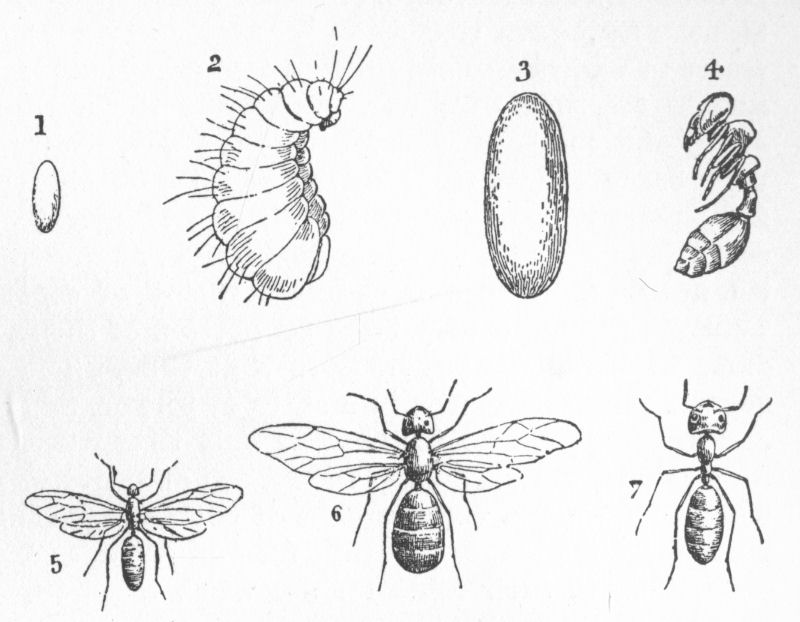
The Wood-ant (
Formica rufa
)
1. Egg. 2. Larva. 3. Cocoon of fine white silk. 4. Young ant, taken out of cocoon. 5. Male ant. 6. Female ant. 7. Worker ant. (All magnified.)
Ant, the common name of hymenopterous (or membranous-winged) insects of various genera, of the family Formicĭdæ, of which there are numerous species, at least 2000 being known. They are found in most temperate and tropical regions. They are small but powerful insects, and have long been noted for their remarkable intelligence and interesting habits. They are social insects, living in communities regulated by definite laws, each member of the society bearing a well-defined and separate part in the work of the colony. Each community consists of males; of females much larger than the males; and of barren females, otherwise called neuters, workers, or nurses. The neuters are wingless, and the males and females only acquire wings for their 'nuptial flight', after which the males perish, and the few females which escape the pursuit of their numerous enemies divest themselves of their wings, and either return to established nests, or become the foundresses of new colonies. The neuters perform all the labours of the ant-hill or abode of the community; they excavate the galleries, procure food, and feed the larvæ or young ants, which have not got organs of motion. In fine weather they carefully convey them to the surface for the benefit of the sun's heat, and as attentively carry them to a place of safety either when bad weather is threatened or the ant-hill is disturbed. In like manner they watch over the safety of the nymphs or pupæ about to acquire their perfect growth. Some communities possess a special type of neuters, known as 'soldiers', from the duties that specially fall upon them, and from their powerful biting jaws. There is a very considerable variety in the materials, size, and form of ant-hills, or nests, according to the peculiar nature or instinct of the species. Most of the British ants form nests in woods, fields, or gardens, their abodes being generally in the form of small mounds rising above the surface of the ground and containing numerous galleries and apartments. Some excavate nests in old tree-trunks. One little yellow ant (Myrmīca domestica) is common in houses in Britain in some localities. Some ants live on animal food, very quickly picking quite clean the skeleton of any dead animal they may light on. Others live on saccharine matter, being very fond of the sweet substance, called honey-dew, which exudes from the bodies of aphides, or plant-lice. These they sometimes keep in their nests, and sometimes tend on the plants where they feed; sometimes they even superintend their breeding. By stroking the aphides with their antennæ they cause them to emit the sweet fluid, which the ants then greedily sip up. Various other insects are looked after by ants in a similar manner, or are found in their nests. It has been observed that some species, like the European Red Ant (Formīca sanguinĕa), resort to violence to obtain working ants of other species for their own use, plundering the nests of suitable kinds of their larvæ and pupæ, which they carry off to their own nests to be carefully reared and kept as slaves. In temperate countries male and female ants survive, at most, till autumn, or to the commencement of cool weather, though a very large proportion of them cease to exist long previous to that time. The neuters pass the winter in a state of torpor, and of course require no food. The only time when they require food is during the season of activity, when they have a vast number of young to feed. Some ants of Southern Europe feed on grain, and store it up in their nests for use when required. Some species have stings as weapons, others only their powerful mandibles, or an acrid and pungent fluid (formic acid) which they can emit. The name ant is also given to the neuropterous insects otherwise called Termites (q.v.). Bibliography: Lord Avebury (Sir John Lubbock), Ants, Bees, and Wasps; H. W. Bates, A Naturalist on the Amazons; Cambridge Natural History.
Antac´id, an alkali, or any remedy for acidity in the stomach. Dyspepsia and diarrhœa are the diseases in which antacids are chiefly employed. The principal antacids in use are magnesia, lime, and their carbonates, and the carbonates of potash and soda.
Antæ´us, the giant son of Poseidon (Neptune) and Gē (the Earth), who was invincible so long as he was in contact with the earth. Heracles (Hercules) grasped him in his arms and stifled him suspended in the air, thus preventing him from touching the earth.
Antakieh, or Antakia. See Antioch.
Antal´kali, a substance which neutralizes an alkali, and is used medicinally to counteract an alkaline tendency in the system. All true acids have this power.
Antananarivo (an-tan-an-a-rē´vō), the capital of Madagascar, situated in the central province of Imérina, on rocky eminences rising from a plain. Until 1869 all buildings within the city were of wood or rush, but since the introduction of brick and stone, the whole city has been rebuilt. It contains two former royal palaces, immense timber structures; a Protestant and a Roman Catholic cathedral, mission churches, schools, &c. Antananarivo is the residence of the French governor of Madagascar, and there is a strong French garrison. It has manufactures of metal work, cutlery, silk, &c. Pop. (exclusive of the troops) 63,115.
An´tar, an Arabian warrior and poet of the sixth century, author of one of the seven Moallakas (poems) hung up in the Kaaba at Mecca; hero of a romance analogous in Arabic literature to the Arthurian legend of the English. The romance of Antar is composed in rhythmic prose interspersed with fragments of verse, many of which are attributed to Antar himself, and has been generally ascribed to Asmai (born A.D. 740, died about A.D. 830), preceptor to Harun-al-Rashid. It has been published in 32 vols. at Cairo (1889).
Antarctic (ant-ärk´tik), a term signifying the opposite of Arctic, and therefore relating to the southern pole or to the regions near it. The Antarctic Circle, which of course corresponds to the Arctic Circle, is a circle parallel to the equator and distant from the south pole 23° 28´, marking the area within which the sun does not set when on the tropic of Capricorn. The Antarctic Circle has been arbitrarily fixed on as the limits of the Antarctic Ocean, it being the average limit of the pack-ice; but the name is often extended to embrace a much wider area. The lands within or near the Antarctic Circle are but imperfectly known, and a very large area around the south pole is altogether unknown. The work of exploration has been hitherto baffled at various points by what seems an unsurmountable ice-barrier, which in some places is connected with masses of land and may as a whole belong to a great Antarctic continent. Among land-masses that have long been known to exist in the Antarctic Ocean, though our knowledge of them is very imperfect, are those to which have been attached the names Graham Land, Victoria Land, Wilkes Land, Enderby Land, South Shetland Islands, &c. The Antarctic regions are even colder and more inhospitable than the Arctic, and partly on account of their remoteness from the maritime nations there have been far fewer efforts at their exploration, the south pole being far less a goal of discovery than the north. See South Polar Expeditions.
Ant-eater (Myrmecophăga jubāta)
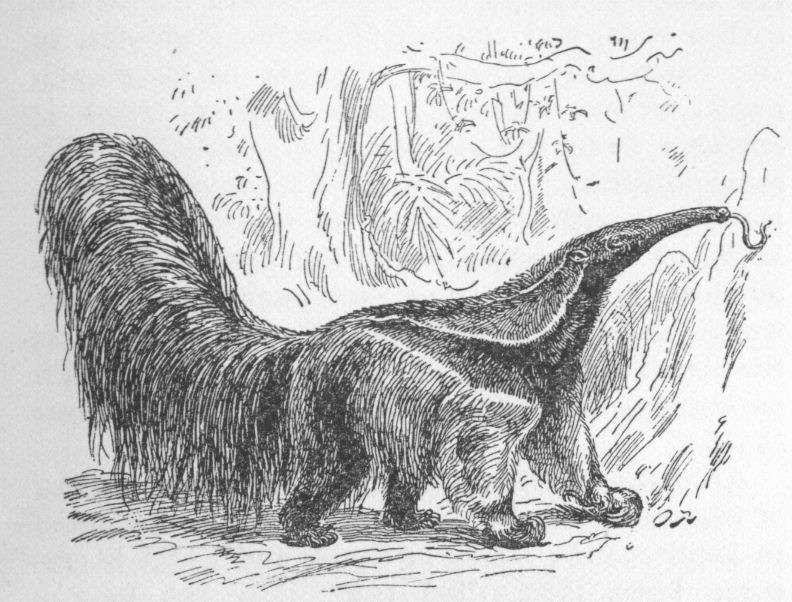
Ant-eater, a name given to mammals of various genera that prey chiefly on ants, but usually confined to the genus Myrmecophăga, ord. Edentata. In this genus the head is remarkably elongated, the jaws destitute of teeth, and the mouth furnished with a long, extensile tongue covered with glutinous saliva, by the aid of which the animals secure their insect prey. The eyes are particularly small, the ears short and round, and the legs, especially the fore-legs, very strong, and furnished with long, compressed, acute nails, admirably adapted for breaking into the ant-hills. The most remarkable species is the Myrmecophăga jubāta, or ant-bear, a native of the warmer parts of South America. It is from 4 to 5 feet in length from the tip of the muzzle to the root of the black bushy tail, which is about 2 feet long. The body is covered with long hair, particularly along the neck and back. It is a harmless and solitary animal, and spends most of its time in sleep. Some are adapted for climbing trees in quest of the insects on which they feed, having prehensile tails. All are natives of South America. The name ant-eater is also given to the pangolins and to the aardvark. The echidna of Australia is sometimes called porcupine ant-eater.
Antece´dent, in grammar, the noun to which a relative or other pronoun refers; as, Solomon was the prince who built the temple, where the word prince is the antecedent of who.—In logic, that member of a hypothetical or conditional proposition which contains the condition, and which is introduced by if or some equivalent word or words; as, if the sun is fixed, the earth must move. Here the first and conditional proposition is the antecedent, the second the consequent.
Antedilu´vian, before the flood or deluge of Noah's time; relating to what happened before the deluge. In geology the term has been applied to organisms, traces of which are found in a fossil state in formations preceding the Diluvial (Glacial epoch), particularly to extinct animals such as the palæotherium, the mastodon, &c.
An´telope, the name given to the members of a large family of Ruminant Ungulata or Hoofed Mammalia, closely resembling the Deer in general appearance, but essentially different in nature from the latter animals. They are included with the Sheep and Oxen in the family of the Cavicornia or 'Hollow-horned' Ruminants. Their horns, unlike those of the Deer, are not deciduous, but are permanent; are never branched, but are often twisted spirally, and may be borne by both sexes. They are found in greatest number and variety in Africa. Well-known species are the chamois (European), the gazelle, the addax, the eland, the koodoo, the gnu, the springbok, the sasin or Indian antelope, and the prongbuck of America.
Antennæ
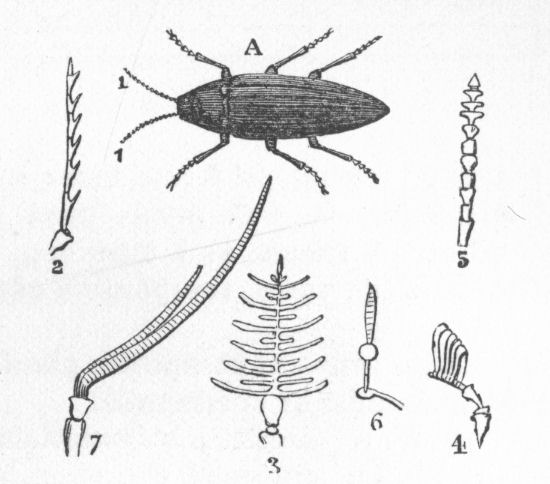
1,1. Filiform Antennæ of Cucujo Firefly of Brazil (Pyrophŏrus luminōsus). 2. Denticulate Antenna; 3. Bipinnate; 4. Lamellicorn; 5. Clavate; 6. Geniculate; 7. Antenna and Antennule of Crustacean.
Anten´næ, the name given to the movable jointed organs of touch and hearing attached to the heads of insects, myriapods, &c., and commonly called horns or feelers. They present a very great variety of forms.
Antequera (a˙n-te-kā´ra˙), a city of Andalusia, in Spain, in the province of Malaga, a place of some importance under the Romans, with a ruined Moorish castle. It manufactures woollens, leather, soap, &c. Pop. 32,360.
Ant´eros, in Greek mythology, the god of mutual love. According to some, however, Anteros is the enemy of love, or the god of antipathy; he was also said to punish those who did not return the love of others.
Anthe´lion, pl. Anthelia, a luminous ring, or rings, seen by an observer, especially in alpine and polar regions, around the shadow of his head projected on a cloud or fog-bank, or on grass covered with dew, 50 or 60 yards distant, and opposite the sun when rising or setting. It is due to the diffraction of light.
Anthelmin´thics, or Anthelmin´tics, a class of remedies used to destroy worms when lodged in the alimentary canal; classed as vermicides or vermifuges, according as the object is to kill the worms, or to expel them by purgation.
An´them, originally a hymn sung in alternate parts; in modern usage, a sacred tune or piece of music set to words taken from the Psalms or other parts of the Scriptures, first introduced into church service in Elizabeth's reign; a developed motet. The anthem may be for one, two, or any number of voices, but seldom exceeds five parts, and may or may not have an organ accompaniment written for it.
Anthemion
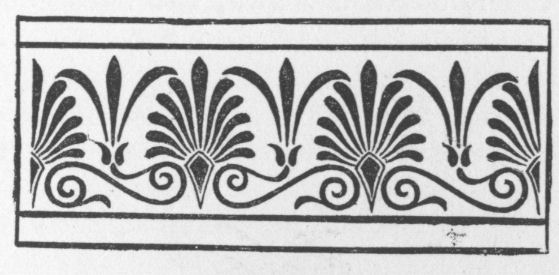
Anthe´mion, an ornament or ornamental series used in Greek and Roman decoration, which is derived from floral forms, more especially the honeysuckle. It was much used for the ornamentation of friezes and interiors, for the decoration of fictile vases, the borders of dresses, &c.
An´themis, a genus of composite plants, comprising the camomile or chamomile.
Anthe´mius, a Greek mathematician and architect of Lydia; designed the church of St. Sophia at Constantinople, and is credited with the invention of the dome; died A.D. 534.
The Reproductive Organs of the Lily
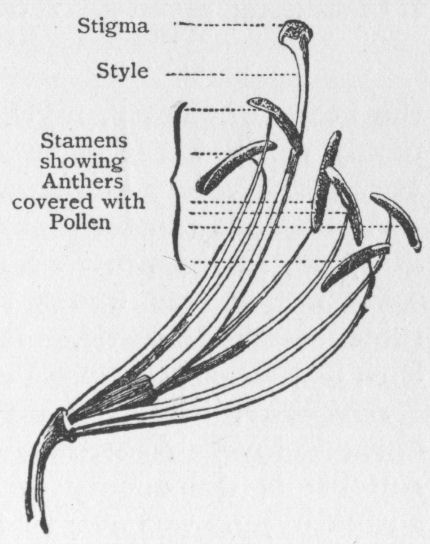
An´ther, the male organ of the flower; that part of the stamen which is filled with pollen.
Antheste´ria, an annual Greek festival held in honour of all the gods, but especially in honour of Dionysus. It celebrated the beginning of spring, and the season when the wine of the previous vintage was considered fit for use.
Anthocy´anin, the blue colour of flowers, a pigment obtained from those petals of flowers which are blue, by digesting them in spirits of wine.
Anthol´ogy (Gr. anthos, a flower, and legein, to gather), the name given to several collections of short poems which have come down from antiquity. The first to compile a Greek anthology was Meleager, a Syrian, about 60 B.C. He entitled his collection, which contained selections from forty-six poets besides many pieces of his own, the Garland; a continuation of this work by Philip of Thessalonica in the age of Tiberius was the first entitled Anthology. Later collections are that of Constantine Cephalas, in the tenth century, who made much use of the earlier ones, and that of Maximus Planudes, in the fourteenth century, a monk of Constantinople, whose anthology is a tasteless series of extracts from the Anthology of Cephalas, with some additions. The treasures contained in both, increased with fragments of the older poets, idylls of the bucolic poets, the hymns of Callimachus, epigrams from monuments and other works, have been published in modern times as the Greek Anthology. There is no ancient Latin anthology, the oldest being that of Scaliger (1573).
An´thon, Charles, LL.D., an American editor of classical school-books, and of works intended to facilitate the study of Greek and Latin literature; born 1797, died 1867. He was long a professor in Columbia College, New York.
An´thony, St. the founder of monastic institutions, born near Heraclea, in Upper Egypt, A.D. 251. Giving up all his property he retired to the desert, where he was followed by a number of disciples, who thus formed the first community of monks. He died at the age of 105.—St. Anthony's Fire, a name given to erysipelas.
An´thracene (C14H10) occurs in coal-tar in small quantity, about 0.25-0.45 per cent. During the distillation of tar a high-boiling fraction, boiling above 270° C., is obtained; this is crude anthracene oil, a greenish oily substance which, on further distillation, yields a crystalline mass, 50 per cent anthracene. This is carefully purified by distillation and chemical treatment to separate the anthracene from the other substances occurring with it, and the product obtained is finally purified by crystallization. When pure it forms colourless crystalline scales melting at 216° C., and having a violet fluorescence. It forms a series of derivatives, the most important being anthraquinone and alizarine and the numerous derivatives of these. Anthracene was originally a useless product in coal-tar distillation, but it became valuable as soon as it was discovered that alizarine—from which many dyes are manufactured directly or indirectly—could be prepared from it.
An´thracite, glance or blind coal, a non-bituminous coal of a shining lustre, approaching to metallic, and which burns without smoke, with a weak or no flame, and with intense heat. It consists of, on an average, 90 per cent carbon, 2 oxygen, 3 hydrogen, and 5 ashes. It has some of the properties of coal or charcoal, and, like that substance, represents an extreme alteration of vegetable substances by loss of gases, either during conditions of decay or after entombment among stratified rocks. It is found in England, Scotland, and Ireland, and in large quantities in the United States (Pennsylvania), and near Swansea (South Wales). See Coal.
An´thrax, a fatal disease to which animals are subject, always associated with the presence of an extremely minute micro-organism (Bacillus anthrăcis) in the blood. It attacks cattle more frequently than other animals; sheep, horses, pigs, dogs, and fowls are liable to anthrax, but not cats. The mode of infection in animals is chiefly by ingestion. It may also be contracted through a wound or scratch in the skin, but this mode of infection is commoner in human beings than in animals. It frequently assumes an epizootic form, and extends over large districts, affecting all classes of animals which are exposed to the exciting causes. It is also called splenic fever, and is communicable to man, appearing as carbuncle, malignant pustule, or wool-sorter's disease.
Anthropol´atry, the worship of man, a word always employed in reproach; applied by the Apollinarians, who denied Christ's perfect humanity, towards the orthodox Christians.
Anthro´polite, a petrifaction of the human body or skeleton, or of parts of the body, by the encrusting action of calcareous waters, and hence hardly to be considered fossil or sub-fossil.
Anthropol´ogy, the science of man, including the study of man's place in nature, that is, of the measurement of his agreement with and divergence from other animals and the history of the emergence of human characteristics; of the distinctive features and geographical distribution of the races of mankind, their customs and beliefs; of the remains of extinct types of the human family and the evidence relating to their modes of life. It puts under contribution all sciences which have man for their object, as anatomy, palæontology, psychology, archæology, history, and comparative religion. All the races of mankind that are now living, much as they differ in external appearance, such as colour of skin, character of hair, form of skull, face, and body, and stature, belong to one species, Homo Sapiens; but an earlier species of more brutal type, H. neanderthalensis, now completely extinct, is known from fossil remains found in Germany, Belgium, France, Gibraltar, and Croatia. Three more ancient and primitive types, probably representing distinct genera of the human family, have been discovered respectively at Piltdown, in Sussex (Eoanthropus), at Mauer, near Heidelberg (Palæanthropus), and in Java, the Ape-man (Pithecanthropus). The Piltdown man may represent the very remote, but direct, ancestor of modern man; but the Heidelberg man and the Ape-man were probably divergent 'sports' whose descendants never became men of the modern type.
In structure the gorilla reveals a close kinship with the human family, and was probably derived from a common ancestry which probably differentiated into man's forerunner and the gorilla's in Miocene times. Of existing races the aboriginal Australian is much the most primitive, and represents the survival of the earliest type of Homo Sapiens soon after this species became differentiated from men of the Neanderthal species. The negro, whose home is tropical Africa, is primitive in some respects, but in others is highly specialized. He is distinguished by his black skin, flat nose, prominent jaws and thick everted lips, and so-called 'woolly' or 'pepper-corn' hair. In stature he shows a wider range of variation than any other race, including, as he does, the tallest and the shortest varieties of mankind. The Bushman is a peculiarly distinct racial type now restricted to the deserts of South Africa. Though his skin is yellowish rather than black, he is akin to the negro. The Mongolian race probably assumed its distinctive features, yellowish skin, coarse black hair, and characteristic facial and bodily traits, in Eastern Asia; and the aboriginal population of America was sprung mainly from the less-specialized branch of this race. The so-called white races include three main stocks, a people of short stature, olive complexion, and long heads, the Mediterranean race; a taller people with fair hair and long heads, the Nordic race; and a short, thick-set, black-haired, broad-headed Alpine race, which made its way from Asia into Europe many centuries after the other two chief components of Europe's population. For long ages in every part of the world intermixture has been taking place in varying degrees between the different races of mankind, so that to-day probably no pure race exists. See Ethnography, Ethnology, Man, &c.—Bibliography: E. B. Tylor, Anthropology; D. G. Brinton, Races and Peoples; W. Z. Ripley, The Races of Europe; E. Carpenter, Anthropology; G. Elliott Smith, The Migrations of Early Culture; H. G. F. Spurrell, Modern Man and his Forerunners; Dictionnaire des Sciences Anthropologiques; The Journal of the Anthropological Institute of Great Britain.
Anthropom´etry, the systematic examination of the height, weight, and other physical characteristics of the human body. It was shown in the British Association Report of 1888 that variations in stature, weight, and complexion, existing in different districts of the British islands, are chiefly due to difference of racial origin.
The Scotch male adults stand first in height (68.71 inches), the Irish second (67.90 inches), the English third (67.66 inches), and the Welsh last (66.66 inches). In weight the Scotch take the first place (165.3 lb.), the Welsh the second (158.3 lb.), the English the third (155.0 lb.), and the Irish the last (154.1 lb.). The average height of adult females is 4.71 inches less than the male average, and their average weight 32.2 lb. under that of the males. The average height of the adult males of the principal races or nationalities of the world may be given as under; but it is acknowledged that more numerous measurements might alter some of the figures considerably: Polynesians 69.33 inches, Patagonians 69 inches, Negroes of the Congo 69 inches, Scotch 68.71 inches, Iroquois Indians 68.28 inches, Irish 67.90 inches, United States (whites) 67.67 inches, English 67.66 inches, Norwegians 67.66 inches, Zulus 67.19 inches, Welsh 66.66 inches, Danes 66.65 inches, Dutch 66.62 inches, American Negroes 66.62 inches, Hungarians 66.58 inches, Germans 66.54 inches, Swiss 66.43 inches, Belgians 66.38 inches, French 66.23 inches, Berbers 66.10 inches, Arabs 66.08 inches, Russians 66.04 inches, Italians 66 inches, Spaniards 65.66 inches, Esquimaux 65.10 inches, Papuans 64.78 inches, Hindus 64.76 inches, Chinese 64.17 inches, Poles 63.87 inches, Finns 63.60 inches, Japanese 63.11 inches, Peruvians 63 inches, Malays 62.34 inches, Lapps 59.2 inches, Bosjesmans 52.78 inches. General average, 65.25 inches.
Anthropomor´phism, the representation or conception of the Deity under a human form, or with human attributes and affections. Anthropomorphism is based upon the natural inaptitude of the human mind for conceiving spiritual things except through sensuous images, and in its consequent tendency to accept such expressions as those of Scripture when it speaks of the eye, the ear, and the hand of God, of his seeing and hearing, of his remembering and forgetting, of his making man in his own image, &c., in a too literal sense. In a general sense anthropomorphism is the assumption of man that his own characteristics are present in beings or things widely different from himself, more particularly in forces of nature and gods. The term is, therefore, also applied to that doctrine which attributes to animals mental faculties of the same nature as those of man, though much lower in degree: strictly called biological anthropomorphism, to distinguish it from anthropomorphism proper, or theological anthropomorphism. Cf. E. Caird, Evolution of Religion; J. R. Illingworth, Personality, Human and Divine.
Anthropoph´agi, man-eaters, cannibals. Cannibalism was practised in very ancient times; and though some peoples, as the New Zealanders and Fijians, have given it up in recent times, it is still practised over a wide area in Central Africa, where human flesh is a common article of food. Superstitious ideas are often associated with cannibalism among those who practise it. The Caribs were cannibals at the time of the Spanish conquest, and the word 'cannibal' is derived from their name. See Cannibalism.
Anthus. See Pipit.
Anti-aircraft guns are guns so mounted that they may be pointed upward to fire directly against objects in the air. During the European War these guns, fitted with special appliances and ammunition, were used for defence against air-raids of the enemy, against Zeppelins and Gothas. The anti-aircraft guns are of various types, ranging from light machine-guns up to batteries of 3-inch and 6-inch guns. Some of them have brought down enemy machines flying at a height of 10,000 or 12,000 feet.
Antibes (a˙n˙-tēb) (ancient Antipolis), a fortified town and seaport of France, department Alpes-Maritimes, on the Mediterranean, 11 miles S.S.W. of Nice; founded about 340 B.C. Pop. 12,198.
Anti-burgher Synod, a section of the Scottish Secession Church, which held its first meeting in Edinburgh in the house of Adam Gib on 10th April, 1747. It was formed in consequence of a breach resulting from a controversy respecting the religious clause of the oath taken by burgesses in Edinburgh, Glasgow, and Perth. Those in favour of the oath were designated Burghers, whilst their opponents, who condemned the oath of the burgesses, became known as Anti-burghers. The union of the burgher and anti-burgher sections was brought about in 1820 through the exertions of John Jamieson, minister at the Anti-burgher Church in Nicholson Street, Edinburgh. See United Free Church of Scotland.
An´tichlor, the name given to any chemical substance, such as hyposulphite of sodium, employed to remove the small quantity of chlorine which obstinately adheres to the fibres of the cloth when goods are bleached by means of chlorine.
An´tichrist, a word occurring in the first and second Epistles of St. John, and nowhere else in Scripture, in passages having an evident reference to a personage real or symbolical mentioned or alluded to in various other passages both of the Old and New Testaments. The idea itself, however, of Antichrist can be traced back to the second century B.C., and appears first of all in the Book of Daniel. In every age the Church has held through all its sects some definite expectation of a formidable adversary of truth and righteousness prefigured under this name. Thus Roman Catholics have found Antichrist in heresy, and Protestants in Romanism. In one point the sects have generally been agreed, namely, in regarding the various intimations on this subject in the Old and New Testaments as a homogeneous declaration or warning, inspired by the spirit of prophecy, of danger to the true religion from some disaffection and revolt organized in the latter days by Satan. Most modern critics take a different view of the matter. They do not regard the various Scriptural writers who have dealt with this subject as having had any common inspiration or design. They believe that each writer from his own point of view, guided by mere human sagacity, gives expression in his predictions to his own individual apprehensions, or narrates as prediction what he already knows. Originally Antichrist is nothing else than the incarnate devil, and the idea of the battle of God with a human opponent, endowed with devilish wickedness, arose under the influence of historical conditions. It is the near political horizon which suggests the danger, or contemporary history the substance of the prophecy; thus the Antichrist of Daniel is Antiochus Epiphanes, that of St. John Nero, that of St. Paul some adversary of Christianity about to appear in the time of the Emperor Claudius.—Bibliography: S. Baring-Gould, Curious Myths of the Middle Ages; W. Bousset, Antichrist.
Anticli´max, a sudden declension of a writer or speaker from lofty to mean thoughts or language, as in the well-known lines, quoted in Pope's Martinus Scriblerus on the Art of Sinking in Poetry as from an anonymous author:
And thou, Dalhousie, the great god of war, Lieutenant-colonel to the Earl of Mar.
Pope, Addison, and Fielding were masters in this art of sudden descent.
a, a. Anticlinal line. b. Synclinal line
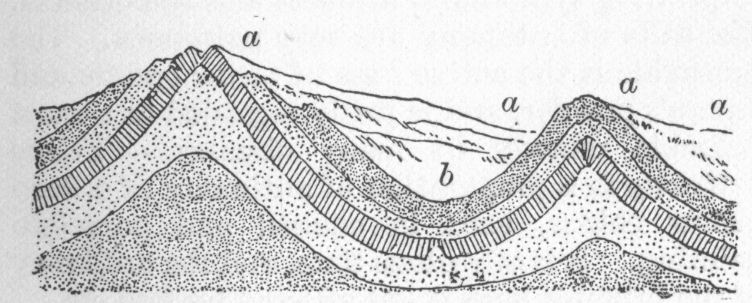
Anticli´nal line or axis, in geology, the ridge of a wave-like curve made by a series of superimposed strata, the strata dipping from it on either side as from the ridge of a house: a synclinal line runs along the trough of such a wave.
Anti-Corn-Law League, an association formed in England in 1836 to procure the repeal of the laws regulating or forbidding the importation of corn. The object of the league was attained in 1846.
Anticos´ti, an island of Canada, in the mouth of the St. Lawrence, 125 miles long by 30 miles broad. The interior is mountainous and wooded, but there is much good land, and it is well adapted for agriculture.
Anticy´clone, a phenomenon presenting some features opposite to those of a cyclone. It consists of a region of high barometric pressure, the pressure being greatest in the centre, with light winds flowing outwards from the centre, and not inwards as in the cyclone, accompanied with great cold in winter and with great heat in summer.
Anticyra (an-tis'i-ra), the name of two towns of Greece, the one in Thessaly, the other in Phocis, famous for hellebore, which in ancient times was regarded as a specific against insanity and melancholy. Hence various jocular allusions in ancient writers (Naviga Anticyram, sail to Anticyra).
An´tidote, a medicine to counteract the effects of poison.
Antietam (an-tē'tam), a small stream in the United States which falls into the Potomac about 50 miles N.W. of Washington; scene of an indecisive battle between the Federal and Confederate armies, 17th Sept., 1862.
Anti-Federalists, the political party in the United States which after the formation of the Federal constitution in 1787 opposed its ratification. Whilst the Federalists were striving to turn the federation into a united nation, and stood for a strong Government and centralizing tendencies, their opponents, the Anti-Federalists, either more democratic, or pretending that a strong Government meant a 'disguised' monarchic power, endeavoured to preserve a loose disintegrated federation. The Anti-Federalist party was gradually transformed into the Democratic-Republican party, led by Jefferson.
Antifriction Metal, a name given to various alloys of tin, zinc, copper, antimony, lead, &c., which oppose little resistance to motion, with great resistance to the effects of friction, so far as concerns the wearing away of the surfaces of contact. Babbitt's metal (50 parts tin, 5 antimony, 1 copper) is one of them.
Antigone (an-tig´o-nē), in Greek mythology, the daughter of Œdipus and Jocasta, celebrated for her devotion to her brother Polynices, for burying whom against the decree of King Creon she suffered death. She is the heroine of Sophocles' Œdipus at Colonus and his Antigone; also of Racine's tragedy Les Frères Ennemis.
Antig´onish, a town in the E. of Nova Scotia, in county of the same name; the seat of a Roman Catholic bishop, with a cathedral, a college, and a good harbour. Pop. 1787.
Antig´onus, one of the generals of Alexander the Great, born about 382 B.C. In the division of the empire, after the death of Alexander, Antigonus obtained Greater Phrygia, Lycia, and Pamphylia as his dominion. But he soon managed to extend his power, being assisted by his warlike son, Demetrius Poliorcētēs. Ptolemy, Seleucus, and Lysimachus, who had also been generals of Alexander, alarmed by his ambition, united themselves against him; and a long series of contests ensued in Syria, Phœnicia, Asia Minor, and Greece, ending in 301 B.C. with the battle of Ipsus in Phrygia, in which Antigonus was defeated and slain, his dominions being divided among the conquerors.
Antigonus Gon´atas, son of Demetrius Poliorcētēs, and grandson of the above, succeeded his father in the kingdom of Macedon and all his other European dominions, but did not obtain actual possession of them for some years. He died, after a reign of forty-four years, 239 B.C.
Antigua (an-tē´gwa), one of the British West Indies, the most important of the Leeward group; 28 miles long, 20 broad; area, 108 sq. miles. Its shores are high and rocky, and much indented by creeks and inlets furnishing several good harbours. The surface is diversified by hill and dale, but nowhere rises to a greater height than 1500 feet. A considerable portion of it is fertile, and the climate is healthy, but there is a scarcity of water, there being no streams and few springs, droughts are not infrequent, and hurricanes are apt to cause serious loss and damage. Chief products are sugar, cotton, and pineapples. The island has fairly good shipping connections with the United Kingdom, the United States, and Canada. Antigua is governed as a crown colony, the Islands of Barbuda and Redonda being attached to it. The capital, St. John, the residence of the governor of the Leeward Islands, stands on the shore of a well-sheltered harbour in the north-west part of the island. Falmouth (English Harbour) in the south has also an excellent harbour with a dockyard. The island was discovered by Columbus in 1493; the first settlement was made by the English in 1632. Since then, except for a short period of occupation by the French, it has been a British possession. Pop. 32,269 (1911).
Anti-Jac´obin, a famous magazine (1797-1818), the original object of which was to satirize the Jacobin principles of the Fox section of Whigs; principal contributors: Gifford, Canning, Frere, and Ellis.
Anti-Lebanon, the eastern of the two parallel ranges known as the Mountains of Lebanon in Palestine. See Lebanon.
Antilegom´ena (things spoken against or objected to), a term applied by early Christian writers to the Epistle to the Hebrews, 2 Peter, James, Jude, 2 and 3 John, and the Apocalypse, which, though read in the churches, were not for some time received into the canon of Scripture.
Antilles (an-til´ēz), another name for the West Indian Islands (excluding Bahamas). See West Indies.
Antilochus (an-til´o-kus), in Greek legend, a son of Nestor, distinguished among the younger heroes who took part in the Trojan War by beauty, bravery, and swiftness of foot. He was slain by Memnon, but Achilles avenged his death.
Antimacass´ar, a covering for chairs, sofas, couches, &c., made of open cotton or worsted work, to preserve them from being soiled, as by the oil applied to the hair.
Antimachus (an-tim´a-kus), a Greek poet who lived about 400 B.C., and wrote an epic called the Thebais on the mythical history of Thebes, and a long elegy called Lydē, inspired by a mistress or wife of that name. Both works were full of mythological details. Only fragments of his writings remain, and from these it can be gathered that his style was rather laboured and artificial. Yet the Alexandrian grammarians ranked him next to Homer.
An´timony (chemical symbol, Sb, from Lat. stibium; sp. gr. 6.7, atomic wt. 120.2), a brittle metal of a bluish-white or silver-white colour and a crystalline or laminated structure. It melts at 630.6° C., and burns with a bluish-white flame. The mineral called stibnite or antimony-glance, is a tri-sulphide (Sb2S3), and is the chief ore from which the metal is obtained. It is found in many places, including France, Spain, Hungary, Italy, Canada, Australia, and Borneo. The metal, or, as it was formerly called, the regulus of antimony, does not rust or tarnish when exposed to the air. When alloyed with other metals it hardens them, and is therefore used in the manufacture of alloys, such as Britannia-metal, type-metal, and pewter. In bells it renders the sound more clear; it renders tin more white and sonorous as well as harder, and gives to printing types more firmness and smoothness. The salts of antimony are very poisonous. The protoxide is the active base of tartar emetic and James's powder, and is justly regarded as a most valuable remedy in many diseases.—Yellow antimony is a preparation of antimony of a deep yellow colour, used in enamel and porcelain painting. It is of various tints, and the brilliancy of the brighter hues is not affected by foul air.
Antino´mianism ('opposition to the law'), the name given by Luther to the inference drawn by John Agricola (1492-1566), from the doctrine of justification by faith, that the moral law is not binding on Christians as a rule of life. The term antinomian has since been applied to all doctrines and practices which seem to contemn or discountenance strict moral obligations. The Lutherans and Calvinists have both been charged with antinomianism, the former on account of their doctrine of justification by faith, the latter both on this ground and that of the doctrine of predestination. The charge is, of course, vigorously repelled by both.
Antin´omy, the opposition of one law or rule to another law or rule; in the Kantian philosophy, that natural contradiction which results from the law of reason, when, passing the limits of experience, we seek to conceive the complex of external phenomena, or nature, as a world or cosmos.
Antinous (an-tin´o-us), a young Bithynian whom the extravagant love of Hadrian has immortalized. He drowned himself in the Nile in A.D. 122. Hadrian set no bounds to his grief for his loss. He gave his name to a newly-discovered star, erected temples in his honour, called a city after him, and caused him to be adored as a god throughout the empire. Statues, busts, &c., of him are numerous.
Antioch (an´ti-ok), a town in Syria, famous in ancient times as the capital of the Greek Kings of Syria, on the left bank of the Orontes, about 21 miles from the sea, in a beautiful and fertile plain. It was founded by Seleucus Nicator in 300 B.C., and named after his father Antiochus. In Roman times it was the seat of the Syrian governors, and the centre of a widely-extended commerce. It was called the 'Queen of the East' and 'The Beautiful'. Antioch is frequently mentioned in the New Testament, and it was here that the disciples of our Saviour were first called Christians (Acts, xi, 26). In the first half of the seventh century it was taken by the Saracens, and in 1098 by the Crusaders. They established the principality of Antioch, of which the first ruler was Bohemond, and which lasted till 1268, when it was taken by the Mameluke Sultan of Egypt. In 1516 it passed into the hands of the Turks. The modern Antioch, or Antakieh, has recently grown from a small place to a flourishing town. Pop. estimated at 30,000.—There was another Antioch, in Pisidia, at which St. Paul preached on his first missionary journey.
Medal of Antiochus Epiphanes
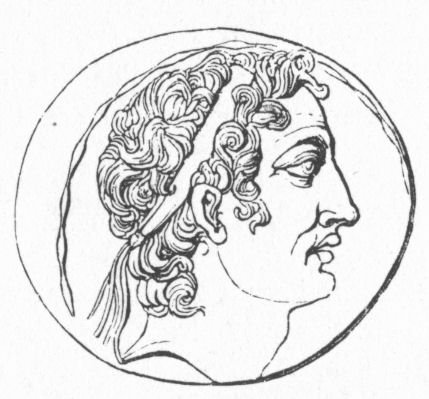
Antiochus (an-tī´o-kus), a name of several Græco-Syrian kings of the dynasty of the Seleucĭdæ.—Antiochus I, called Sōtēr ('saviour'), was the son of Seleucus, general of Alexander the Great, and founder of the dynasty. He was born about 324 B.C., and succeeded his father in 280 B.C. During the greater part of his reign he was engaged in a protracted struggle with the Gauls who had crossed from Europe, and by whom he was killed in battle, 261 B.C.—Antiochus II, surnamed Theos (god), succeeded his father, lost several provinces by revolt, and was murdered in 246 B.C. by Laodicē, his wife, whom he had put away to marry Berenīcē, daughter of Ptolemy.—Antiochus III, surnamed the Great, grandson of the preceding, was born 242 B.C., succeeded in 223 B.C. The early part of his reign embraced a series of wars against revolted provinces and neighbouring kingdoms, his expeditions extending to India, over Asia Minor, and afterwards into Europe, where he took possession of the Thracian Chersonese. Here he encountered the Romans, who had conquered Philip V of Macedon, and were prepared to resist his further progress. Antiochus gained an important adviser in Hannibal, who had fled for refuge to his Court; but he lost the opportunity of an invasion of Italy while the Romans were engaged in war with the Gauls, of which the Carthaginian urged him to avail himself. The Romans defeated him by sea and land, and he was finally overthrown by Scipio at Mount Sipўlus, in Asia Minor, 190 B.C., and very severe terms were imposed upon him. He was killed while plundering a temple in Elymais to procure money to pay the Romans.—Antiochus IV, called Epiphănes, youngest son of the above, is chiefly remarkable for his attempt to extirpate the Jewish religion, and to establish in its place the polytheism of the Greeks. This led to the insurrection of the Maccabees, by which the Jews ultimately recovered their independence. He died 164 B.C.
Antioquia (a˙n-tē-ō-kē´a˙), a town of South America, in Colombia, on the River Cauca; founded in 1542. Pop. 8730. It gives name to a department of the republic; area, 22,752 sq. miles. Pop. 739,434. Capital, Medellin.
Antip´aros (ancient, Oliăros), one of the Cyclades Islands in the Grecian Archipelago, containing a famous stalactitic grotto or cave. It lies south-west of Paros, from which it is separated by a narrow strait, and has an area of 10 sq. miles, and about 700 inhabitants.
Antip´ater, a general and friend of Philip of Macedon, father of Alexander the Great. On the death of Alexander, in 323 B.C., the regency of Macedonia was assigned to Antipater, who succeeded in establishing the Macedonian rule in Greece on a firm footing. He died 317 B.C., at an advanced age.
Antip´athy, a special dislike exhibited by individuals to particular objects or persons, usually resulting from physical or nervous organization. An antipathy is often an unaccountable repugnance to what people in general regard with no particular dislike, as certain sounds, smells, articles of food, &c., and it may be manifested by fainting or extreme discomfort.
Antiphlogis´tic, a term applied to medicines or methods of treatment that are intended to counteract inflammation, such as bloodletting, purgatives, diaphoretics, &c.
An´tiphon, a Greek orator, born near Athens; founder of political oratory in Greece. His orations are the oldest extant, and he is said to have been the first who wrote speeches for hire. He was put to death for taking part in the revolution of 411 B.C., which established the oligarchic government of the Four Hundred. Antiphon seems to have specialized in homicide cases; his most celebrated speech is On the Murder of Herodas. Cf. Sir R. C. Jebb, Attic Orators; J. F. Dobson, The Greek Orators.
Antiphon, or Antiph´ony ('alternate song'), in the Christian Church a verse first sung by a single voice, and then repeated by the whole choir; or any piece to be sung by alternate voices.
Antipodes (an-tip´o-dēz), the name given relatively to people or places on opposite sides of the earth, so situated that a line drawn from one to the other passes through the centre of the earth and forms a true diameter. The longitudes of two such places differ by 180°. The difference in their time is about twelve hours, and their seasons are reversed.
Antipodes Islands, a group of small uninhabited islands in the South Pacific Ocean, about 460 miles S.E. by E. of New Zealand; so called from being nearly antipodal to Greenwich. Antipodes Island rises to 1300 feet, and is largely covered with coarse grass; huts have been fitted up to shelter castaways.
An´tipope, the name applied to those who at different periods have produced a schism in the Roman Catholic Church by opposing the authority of the Pope, under the pretence that they were themselves Popes. The Roman Church cannot admit that there ever existed two Popes; but the fact is, that in several cases the competitors for the papal chair were equally Popes; that is to say, the claims of all were equally good. Each was frequently supported by whole nations, and the schism was nothing but the struggle of political interests. Twenty-nine antipopes are enumerated in Church history; the last of them is Felix V, 1439-49.
Antipyret´ics, medicines given for the purpose of reducing fever by lowering the patient's temperature, whether by causing perspiration or otherwise. Quinine, antipyrin, phenacetin, are common antipyretics. An aperient or purgative often serves the same purpose.
Antipy´rin, a drug obtained from coal-tar products, valuable in reducing fever and in relieving pain, being much used in nervous headache and neuralgia.
An´tiquaries, those devoted to the study of ancient times through their relics, as old places of burial, remains of ancient habitations, early monuments, implements or weapons, statues, coins, medals, paintings, inscriptions, books, and manuscripts, with the view of arriving at a knowledge of the relations, modes of living, habits, and general condition of the people who created or employed them. Societies or associations of antiquaries have been formed in all countries of European civilization. In Britain the Society of Antiquaries of London was founded in 1572, revived in 1717. and incorporated in 1751. The Society of Antiquaries of Scotland was founded in 1780, incorporated in 1783, and has the management of a large national antiquarian museum in Edinburgh. One of the best-known antiquarian societies in Europe is the Société Royale des Antiquaires du Nord at Copenhagen.
Antiques (an-tēks'), a term specifically applied to the remains of ancient art, as statues, paintings, vases, cameos, and the like, and more especially to the works of Grecian and Roman antiquity.
Antirrhinum (an-ti-rī´num) (from anti, instead of, and rhis, snout), a genus of annual or perennial plants of the nat. ord. Scrophulariaceæ, commonly known as snapdragon, on account of the peculiarity of the blossoms, which, by pressing between the finger and thumb, may be made to open and shut like a mouth. They all produce showy flowers, and are much cultivated in gardens. Many varieties of some of them, such as the great or common snapdragon (Antirrhinum majus), have been produced by gardeners. The lesser snapdragon grows in sandy soil, and is found in cornfields in the south of England and Ireland.
Antisana (a˙n-tē-sä´na˙), a volcano in the Andes of Ecuador, 35 miles S.E. by E. of Quito. Whymper, who ascended it in 1880, makes its height 19,260 feet.
Antis´cians (Gr. anti, over against, skia, a shadow), those who live under the same meridian, at the same distance N. and S. of the equator, and whose shadows at noon consequently are thrown in contrary directions.
Antiscorbu´tics, remedies against scurvy. Lemon-juice, ripe fruit, milk, salts of potash, green vegetables, potatoes, fresh meat, and raw or lightly-boiled eggs, are some of the principal foodstuffs containing antiscorbutic vitamines.
Anti-Sem´itism, hostility to the Jews (Semites), actively exhibited in severities and attacks of various kinds. The movement assumed vast proportions about 1880 and manifested itself in various countries, especially Russia, Austria-Hungary, Germany, Roumania, and France. It may be attributed to different motives in different countries, but on the whole owed its origin not only to the fact of the Jews being a 'peculiar people' by race and religion, but also to the comparatively high position won by them in modern times in the financial and political worlds. The religious element is quite prominent in the popular attacks on the Jew, although modern anti-Semitism is essentially social and economic. In Western Russia there was a great outburst against the Jews in 1881, in which men, women, and children were slaughtered. The Government of the Tsar, by its anti-Jewish policy, may be said to have sanctioned this murderous outbreak, which was followed by harsh laws and actual persecutions, though afterwards there was a mitigation of the severity shown towards the Jews. Yet in 1903 the world was startled by a terrible massacre of Jews at Kishinev, in Bessarabia, connived at by the authorities on the spot; and towards the end of 1905, in connection with the Russian revolutionary movement, there were dreadful massacres of Jews in Odessa, Kishinev, and other towns, the authorities being similarly involved. In Roumania, until 1919, the position of the Jews resembled what it was elsewhere in mediæval times, and was less favourable than it was even under the Turks. In Germany the movement has been worked chiefly by politicians for their own ends, though the racial and religious question has also had some influence; and among the ignorant the belief that the Jews murder Christian children for ritual purposes has been revived, as also in Austria and in Hungary. In these countries the movement has been partly political, partly social and economic, partly religious. In France anti-Semitism has been employed chiefly as a weapon by monarchists and clericals as against republicanism, and by the Socialists as against capitalism, racial antipathy having also its influence on the movements. It reached its height in 1895 at the time of the Dreyfus affair. In Britain, too, anti-Semitism has of late made itself felt.—Bibliography: A. Leroy-Beaulieu, Israel among the Nations; Bernard Lazare, L'anti-sémitisme, son histoire et ses causes.
Antisep´tic (Gr. anti, against, and sēpein, to rot), an agent which destroys the germs of putrefaction or suppuration is called an antiseptic. Many substances act thus, e.g. chlorine, iodine, hypochlorous acid, sulphurous acid, camphor, creosote, iodoform, nascent oxygen ('Sanitas'), corrosive sublimate, formaldehyde ('Formalin'), potassium permanganate ('Condy's Fluid'), carbolic acid (Lysol, Izal, Cyllin); lately aniline dyes have become prominent: of these flavine has proved the most useful addition to surgery of recent years. It was much used in the European War (1914-8).—Antiseptics are also used for purifying surgical instruments, &c., and commercially as disinfectants. When introduced by Lister into surgical practice they led to revolutionary advances in surgery. The tendency of late years has been to abandon antiseptic for aseptic (sterile) mode of technique, but during the war (1914-8) there was a general return to antiseptic methods in surgery.
Antispasmod´ic, a medicine for the cure of spasms and convulsions; such belong largely to the class of ethers, as sulphuric ether, chloric ether, nitric ether, &c.
Antisthenes (an-tis´the-nēz), a Greek philosopher and the founder of the school of Cynics, born at Athens about 444 B.C. He was first a disciple of Gorgias and then of Socrates, at whose death he was present. His philosophy was a one-sided development of the Socratic teaching. He held virtue to consist in complete self-denial and in disregard of riches, honour, or pleasure of every kind. He himself lived as a beggar. He died in Athens at an advanced age.
Antis´trophe. See Strophe.
Anti-submarine. See Submarine.
Anti-Taurus, a mountain range of Anatolia, Asia Minor, extending from the Cicilian Taurus towards the north-east, and connecting the Taurus mountain system with Mount Ararat, Mount Elbruz, and the Caucasus. See Taurus.
Antith´esis (opposition), a figure of speech consisting in a contrast or opposition of words or sentiments; as, 'When our vices leave us, we flatter ourselves we leave them'; 'The prodigal robs his heir, the miser robs himself'.
Antitoxin, the name given to a class of bodies of unknown nature having the capacity of neutralizing the poisonous substances (toxins) by which certain bacteria produce disease. If such a toxin be introduced every few days in increasing doses, into, e.g., the horse, and if, after some months of this treatment, the animal be bled, its serum contains the antitoxin to the toxins used. The use of the antitoxin to the toxin of diphtheria is most efficacious in curing that disease, and the treatment has caused a great fall in the death-rate. It ought to be applied as soon as possible after signs appear in the throat. An antitoxic treatment is also applicable in cases of tetanus (lock-jaw), a disease liable to follow any wound contaminated with dirt, especially with manured soil. Less success has been achieved when the disease is fully established, but if the antitoxin be injected immediately after the wound has been incurred, then the subsequent development of the disease is prevented. This preventive treatment has been attended with marked effect in the case of wounds received in war, which it is almost impossible to keep free from contamination. Antitoxins were extensively used during the European War. (1914-8). In bacterial diseases other than those mentioned, sera have been produced by injecting into large animals dead and living bacteria, e.g. the organisms of epidemic cerebro-spinal meningitis (spotted fever), pneumonia, blood-poisoning, &c., and these sera probably depend for their action on the presence of bodies similar to antitoxins. See Bacteria, Diphtheria.
Anti-trade Winds, a name given to any of the upper tropical winds which move northward or southward in the same manner as the trade-winds which blow beneath them in the opposite direction. These great aerial currents descend to the surface after they have passed the limits of the trade-winds, and form the south-west or west-south-west winds of the north temperate, and the north-west or west-north-west winds of the south temperate zones.
Antitrinita´rians, all who do not receive the doctrine of the divine Trinity, or the existence of three persons in the Godhead; especially applied to those who oppose such a doctrine on philosophical grounds, as contrasted with Unitarians, who reject the doctrine as not warranted by Scripture.
An´titype, that which is correlative to a type; by theological writers the term is employed to denote the reality of which a type is the prophetic symbol.
An´tium, in ancient Italy, one of the most ancient and powerful cities of Latium, the chief city of the Volsci, and often at war with the Romans, by whom it was finally taken in 338 B.C. It was 38 miles distant from Rome, a flourishing seaport, and became a favourite residence of the wealthy Romans. It was destroyed by the Saracens, but vestiges of it remain at Porto d'Anzo, near which many valuable works of art have been found.
Antivari (a˙n-tē´va˙-rē), a seaport town on the eastern shore of the Adriatic, ceded to Montenegro by the Treaty of Berlin (1878). Antivari was opened as a free port on 23rd Oct., 1909. It was occupied by the Austrians in 1916, and by the Italians in Nov., 1918. Pop. 2500.
Antlers, the horns of the deer tribe, or the snags or branches of the horns.
Ant-lion, the larva of a Neuropterous insect (Myrmelĕon formicārius), which in its perfect state greatly resembles a dragon-fly; curious on account of its ingenious method of catching the insects—chiefly ants—on which it feeds. It digs a funnel-shaped hole in the driest and finest sand it can find, and when the pit is deep enough, and the sides are quite smooth and sloping, it buries itself at the bottom with only its formidable mandibles projecting, and waits till some luckless insect stumbles over the edge, when it is immediately seized, its juices sucked, and the dead body jerked out. It inhabits Southern Europe.
Antofagas´ta, a Chilian seaport on the Bay of Morena, and a territory of the same name taken from Bolivia in the war of 1879-82, and definitely ceded to Chile in 1885. The territory has an area of 46,408 sq. miles; pop. (1919), 235,506. The port is connected by railway with the silver and other mines lying inland, and exports silver, copper, cubic nitre, &c., partly from Bolivia. Pop. (1919), 69,175.
Antoinette (a˙n˙-twa˙-net), Marie. See Marie Antoinette.
Antokolski, Mark, Russian sculptor of Jewish extraction, born at Vilna in 1843. He studied at the Petrograd Academy of Fine Arts, and his earliest success was a wooden statue The Jewish Tailor (1864). In 1868 he received a grant for travelling, and whilst in Italy he finished his famous statue, Ivan the Terrible. He was made an academician, and in 1878 was awarded the first prize for sculpture at the Paris International Exhibition. In 1888 he settled permanently in Paris, where he died in 1902. His works include: Peter the Great (1872), Christ before the People (1874), The Death of Socrates (1876), Spinoza (1882), Yermak and The Sleeping Beauty (1900).
Antommarchi (-mär´kē), Carlo Francesco, Italian physician, born in Corsica in 1780, died in Cuba 1838. He was professor of anatomy at Florence when he offered himself as physician to Napoleon at St. Helena. Napoleon at first received him with reserve, but soon admitted him to his confidence, and testified his satisfaction with him by leaving him a legacy of 100,000 francs. On his return to Europe he published Les Derniers Moments de Napoléon (2 vols., 8vo, 1823).
Antonell´i, Giacomo, cardinal, born 1806, died 1876. He was educated at the Grand Seminary of Rome, where he attracted the attention of Pope Gregory XVI, who appointed him to several important offices. On the accession of Pius IX in 1846 Antonelli was raised to the dignity of cardinal-deacon; two years later he became president and Minister of Foreign Affairs, and in 1850 was appointed Secretary of State. During the sitting of the Œcumenical Council (1869-70) he was a prominent champion of the papal interest. He strongly opposed the assumption of the united Italian crown by Victor Emanuel.
Antonell´o (of Messina), an Italian painter who died at Venice, probably in 1493, and is said to have introduced oil-painting into Italy, having been instructed in it by Jan Van Eyck. Three works by him are in the National Gallery, London.
Antoni´nus, Itinerary of. See Itinerary.
Antoni´nus, Marcus Aurelius. See Aurelius.
Antoni´nus, Wall of, a barrier erected by the Romans across the isthmus between the Forth and the Clyde, in the reign of Antoninus Pius. Its western extremity was at or near Dunglass Castle, its eastern at Carriden, and the whole length of it exceeded 27 miles. It was constructed A.D. 140 by Lollius Urbicus, the imperial legate, and consisted of a ditch 40 feet wide and 20 feet deep, and a rampart of stone and earth on the south side 24 feet thick and 20 feet in height. It was strengthened at either end and along its course by a series of forts and watch-towers. It may still be traced at various points, and is commonly known as Graham's Dyke.
Coin of Antoninus Pius
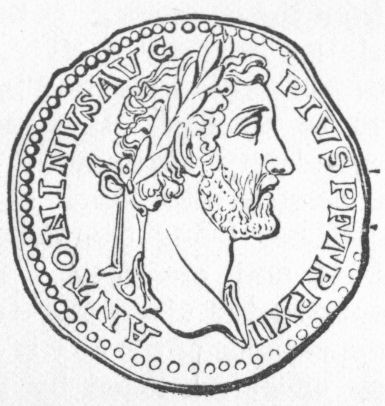
Antoni´nus Pius, Titus Aurelius Fulvus, Roman emperor, was born at Lavinium, near Rome, A.D. 86, died A.D. 161. In 120 A.D. he became consul, and he was one of the four persons of consular rank among whom Hadrian divided the supreme administration of Italy. He then went as proconsul to Asia, and after his return to Rome became more and more the object of Hadrian's confidence. In A.D. 138 he was selected by that emperor as his successor, and the same year he ascended the throne. He speedily put down the persecutions of the Christians, and carried on but a few wars. In Britain he extended the Roman dominion, and, by raising a new wall (see preceding article), put a stop to the invasions of the Picts and Scots. The senate gave him the surname Pius, that is, dutiful or showing filial affection, because to keep alive the memory of Hadrian he had built a temple in his honour. He was succeeded by Marcus Aurelius, his adopted son.
Anto´nius, Marcus (Mark Antony), Roman triumvir, born 83 B.C., was connected with the family of Cæsar by his mother. Debauchery and prodigality marked his youth. To escape his creditors he went to Greece in 58, and from thence followed the consul Gabinius on a campaign in Syria as commander of the cavalry. He served in Gaul under Cæsar in 52 and 51. In 50 he returned to Rome to support the interests of Cæsar against the aristocratical party headed by Pompey, and was appointed tribune. When war broke out between Cæsar and Pompey, Antony led reinforcements to Cæsar in Greece, and in the battle of Pharsalia he commanded the left wing. He afterwards returned to Rome with the appointment of Master of the Horse and Governor of Italy (47). In 44 B.C. he became Cæsar's colleague in the consulship. Soon after Cæsar was assassinated, Antony, by the reading of Cæsar's will, and by the oration which he delivered over his body, excited the people to anger and revenge, and the murderers were obliged to flee. After several quarrels and reconciliations with Octavianus, Cæsar's heir (see Augustus), Antony departed to Cisalpine Gaul, which province had been conferred upon him against the will of the Senate. But Cicero thundered against him in his famous Philippics; the Senate declared him a public enemy, and entrusted the conduct of the war against him to Octavianus and the consuls Hirtius and Pansa. After a campaign of varied fortunes Antony fled with his troops over the Alps. Here he was joined by Lepidus, who commanded in Gaul, and through whose mediation Antony and Octavianus were again reconciled. It was agreed that the Roman world should be divided among the three conspirators, who were called triumviri. Antony was to take Gaul; Lepidus, Spain; and Octavianus, Africa and Sicily. They decided upon the proscription of their mutual enemies, each giving up his friends to the others, the most celebrated of the victims being Cicero the orator. Antony and Octavianus departed in 42 for Macedonia, where the united forces of their enemies, Brutus and Cassius, formed a powerful army, which was, however, speedily defeated at Philippi. Antony next visited Athens, and thence proceeded to Asia. In Cilicia he ordered Cleopatra, Queen of Egypt, to apologize for her insolent behaviour to the triumviri. She appeared in person, and her charms fettered him for ever. He followed her to Alexandria, where he bestowed not even a thought upon the affairs of the world, till he was aroused by a report that hostilities had commenced in Italy between his own relatives and Octavianus. A short war, followed, which was decided in favour of Octavianus before the arrival of Antony in Italy. A reconciliation was effected, which was sealed by the marriage of Antony with Octavia, the sister of Octavianus. A new division of the Roman dominions was now made (in 40), by which Antony obtained the East, Octavianus the West. After his return to Asia Antony gave himself up entirely to Cleopatra, assuming the style of an Eastern despot, and so alienating many of his adherents and embittering public opinion against him at Rome. At length war was declared at Rome against the Queen of Egypt, and Antony was deprived of his consulship and government. Each party assembled its forces, and Antony lost, in the naval battle at Actium, 31 B.C., the dominion of the world. He followed Cleopatra to Alexandria, and on the arrival of Octavianus his fleet and cavalry deserted, and his infantry was defeated. Deceived by a false report of her death which Cleopatra had disseminated, he fell upon his own sword (30 B.C.).—Bibliography: Mommsen, Roman History; Plutarch, Lives (translated by Langhorne); De Quincey, Essay on the Cæsars.
Antonoma´sia, in rhetoric, the use of the name of some office, dignity, profession, science, or trade instead of the true name of the person, as when his majesty is used for a king, his lordship for a nobleman; or when, instead of Aristotle, we say, the philosopher; or, conversely, the use of a proper noun instead of a common noun; as, a Solomon for a wise man.
Antony, Mark. See Antonius (Marcus).
Antony, St. See Anthony.
An´trim, a county of Ireland, province of Ulster, in the north-east of the island; area, 702,654 acres, of which about a third are arable. The eastern and northern districts are comparatively mountainous, with tracts of heath and bog, but no part rises to a great height. The principal rivers are the Lagan and the Bann, which separate Antrim from Down and Londonderry respectively. The general soil of the plains and valleys is strong loam. Flax, oats, and potatoes are the principal agricultural produce. Cattle, sheep, swine, and goats are extensively reared. There are salt-mines and beds of iron-ore, which is worked and exported. A range of basaltic strata stretches along the northern coast, of which the celebrated Giant's Causeway is the most remarkable portion, the vast aggregates of natural rock pillars there being very striking. The interior also contains some scenes of picturesque beauty, particularly the fertile valley of the Lagan, between Belfast and Lisburn. Much of the scenery of the county, however, is dreary and monotonous. Lough Neagh, the largest lake of the United Kingdom, is principally in Antrim. Its waters are carried to the sea by the Bann, which is of no use for navigation, being obstructed by weirs and rocks. The spinning of linen and cotton yarn, and the weaving of linen and cotton, are the staple manufactures, but the cotton manufacture is small compared with that of linen. The principal towns are Belfast, Lisburn, Ballymena, Larne, and Carrickfergus. In 1898 Belfast, the former capital, was constituted into a county borough. About fifty per cent of the inhabitants are Presbyterians, being the descendants of Scottish immigrants of the seventeenth century. The county sends four members to Parliament; Belfast returns nine. Pop. (excluding Belfast) 193,864 (1911).—The town of Antrim, at the north end of Lough Neagh, is a small place with a pop. of 1826.
Ant-thrush, a name given to certain passerine or perching birds having resemblances to the thrushes and supposed to feed largely on ants. They all have longish legs, short wings, and a short tail. The true ant-thrushes of the Old World belong to the genus Pitta. They chiefly inhabit southern and south-eastern Asia and the Eastern Archipelago, but are also found in Africa and Australia, and are birds of brilliant plumage, exhibiting black, white, scarlet, blue, and green in vivid contrast, there being generally no blending of colours by means of intermediate hues. These birds are not now regarded as allied to the thrushes, nor are they allied to the ant-birds, or ant-thrushes of the New World, which live among close foliage and bushes. Some of these are called ant-shrikes and ant-wrens. They belong to several genera.
Ant´werp (Du. and Ger. Antwerpen, Fr. Anvers), the chief port of Belgium, and one of the first on the Continent, the capital of a province of the same name, on the Scheldt, about 50 miles from the open sea. It lies in a fertile plain at an abrupt turn of the river, which is here from 160 to 280 yards wide, and has a depth varying from 25 to 50 feet. It is strongly fortified, being completely surrounded on the land side by a semicircular inner line of fortifications, the defences being completed by an outer line of forts and outworks. Fine quays have been constructed along the river banks. The general appearance of the city is exceedingly picturesque, an effect produced by the numerous churches, convents, and magnificent public buildings, the stately antique houses that line its older thoroughfares, and the profusion of beautiful trees with which it is adorned. The older streets are tortuous and irregular, but those in the newer quarters are wide and regular. Some of the squares are very handsome. The cathedral, with a spire 400 feet high, one of the largest and most beautiful specimens of Gothic architecture in Belgium, contains Rubens' celebrated masterpieces, The Descent from the Cross, The Elevation of the Cross, and The Assumption. The other churches of note are St. James's, St. Andrew's, and St. Paul's, all enriched with paintings by Rubens, Vandyck, and other masters. Among the other buildings of note are the exchange, the town hall, the palace, the theatre, academy of the fine arts, picture and sculpture galleries, &c. The harbour accommodation is extensive and excellent, large new docks and quays having been recently built, and other works being under construction or contemplated. The shipping trade is now very large, Antwerp being a great centre of the world's commerce, and the goods being largely in transit. The entries of vessels in a year aggregate over 13,000,000 tons. Much of the trade is with Britain. There are numerous but not very important industries. Antwerp is mentioned as early as the eighth century, and in the eleventh and twelfth it had attained a high degree of prosperity. In the sixteenth century it is said to have had a pop. of 200,000, and it had then an extensive foreign trade. The wars between the Netherlands and Spain greatly injured its commerce, which was almost ruined by the closing of the navigation of the Scheldt in accordance with the peace of Westphalia (1648). It was only in the nineteenth century that its prosperity revived. In the European War (1914-8), the Germans, under General von Beseler, entered Antwerp on 7th Oct., 1914, and remained there until Nov., 1918. Pop. (1919), 322,857.—The province consists of a fertile plain 1093 sq. miles in area, and has a pop. of over 1,000,000.
Anubis
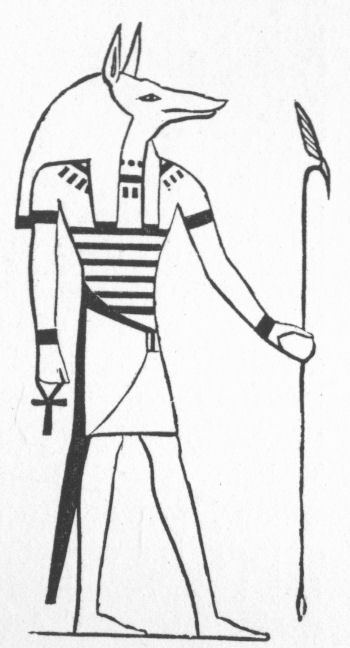
Anu´bis (Anepo on the monuments), one of the deities of the ancient Egyptians, the son of Osiris by Isis. The Egyptian sculptures represent him with the head, or under the form, of a jackal, with long pointed ears. His office was to conduct the souls of the dead from this world to the next, and in the lower world he weighed the actions of the deceased previous to their admission to the presence of Osiris.
Anúpshahr (a-nöp´shär), a town of Hindustan, United Provinces, on the Ganges, 75 miles S.E. of Delhi, a resort of Hindu pilgrims who bathe in the Ganges. Pop. 15,000.
Anu´ra, or Anou´ra (Gr. an, negative, oura, a tail), an ord. of Batrachians which lose the tail when they reach maturity, such as the frogs and toads.
Anuradhapura. See Anarajapura.
A´nus, the opening at the lower or posterior extremity of the alimentary canal through which the excrement or waste products of digestion are expelled.
An´vil, an instrument on which pieces of metal are laid for the purpose of being hammered. The common smith's anvil is generally made of seven pieces, namely, the core or body; the four corners for the purpose of enlarging its base; the projecting end, which contains a square hole for the reception of a set or chisel to cut off pieces of iron; and the beak or conical end, used for turning pieces of iron into a circular form, &c. These pieces are each separately welded to the core and hammered so as to form a regular surface with the whole. When the anvil has received its due form, it is faced with steel, and is then tempered in cold water. The smith's anvil is generally placed loose upon a wooden block. The anvil for heavy operations, such as the forging of ordnance and shafting, consists of a huge iron block deeply embedded, and resting on piles of masonry.
Anville, Jean Baptiste Bourguignon d' (jän˙ ba˙p-tēst bōr-gē-nyön˙ dän˙-vēl), a celebrated French geographer, born 1697, died 1782; published a great number of maps and writings illustrative of ancient and modern geography.
Anynaks, a negro tribe inhabiting the banks of the Upper Sobat (a tributary of the White Nile), between the Egyptian Sudan and Abyssinia. They rebelled against British authority in 1912.
Anzacs, a composite word used as the name of the British colonial troops in the Gallipoli undertaking. The men being from Australia and New Zealand, their organization was officially known as the Australian-New Zealand Army Corps. The full title, however, was much too cumbersome, and a clerk in one of the head-quarters offices at Zeitoun, where the troops were in training, hit upon the word Anzacs, formed from the initial letters of the long title. The Anzacs landed near Gaba Tepe, Gallipoli, on the morning of 25th April, 1915, and had their first encounter with the Germans on the Western Front on 6th May, 1916. In 1916 the word Anzac was officially adopted by the War Office.
Anzin (a˙n˙-zan˙), a town of France, department of Nord, about 1 mile north-west of Valenciennes, in the centre of an extensive coal-field, with blast-furnaces, forges, rolling-mills, foundries, &c. Pop. 14,325.
Aonia, in ancient geography a name for part of Bœotia in Greece, containing Mount Helicon and the fountain Aganippe, both haunts of the muses.
A´orist, the name given to one of the tenses of the verb in some languages (as the Greek), which expresses indefinite past time.
Aor´ta, in anatomy, the great artery or trunk of the arterial system, proceeding from the left ventricle of the heart, and giving origin to all the arteries except the pulmonary. It first rises towards the top of the breast-bone, when it is called the ascending aorta; then makes a great curve, called the transverse or great arch of the aorta, whence it branches off to the head and upper extremities; thence proceeding towards the lower extremities, under the name of the descending aorta, it branches off to the trunk; and finally divides into the two iliacs, which supply the pelvis and lower extremities.
Aosta (a˙-os´ta˙; ancient Augusta Prætoria), a town of north Italy, 50 miles N.N.W. of Turin, on the Dora-Baltea, with an ancient triumphal arch, remains of an amphitheatre, &c. Pop. 7000.
Aoudad (a-ö´dad), the Ammotrăgus tragelăphus, a quadruped allied to the sheep, most closely to the mouflon, from which, however, it may be easily distinguished by the heavy mane, commencing at the throat and falling as far as the knees. It is a native of North Africa, inhabiting the loftiest and most inaccessible rocks.
Apaches (a˙-pä´chez), a warlike race of North-American Indians, numbering between 5000 and 6000, and inhabiting Arizona, New Mexico, and Oklahoma. The final surrender of the tribe took place in 1886, but a few in Mexico still maintain their independence and hostility to the whites. The name Apache was assumed by Parisian hooligans, notorious for their criminal outrages.
Ap´anage, an allowance which the younger princes of a reigning house in some European countries receive from the revenues of the country, generally together with a grant of public domains, that they may be enabled to live in a manner becoming their rank.
Ap´atite, a translucent but seldom transparent mineral, which crystallizes in a regular six-sided prism, usually terminated by a truncated six-sided pyramid. It passes through various shades of colour, from white to yellow, green, blue, and occasionally red, scratches fluor-spar but is scratched by felspar, and has a specific gravity of about 3.5. It is a compound of calcium phosphate with calcium fluoride or chloride. It occurs principally in igneous rocks, particularly diorites. The very coarse-grained granites of Ontario contain apatite crystals of corresponding size, which have been picked out as a source of artificial phosphate manures. Apatite supplies to soils almost all the phosphorus available for plants in a state of nature.
Ape, a common name of a number of quadrumanous animals inhabiting the Old World (Asia and the Asiatic Islands, and Africa), and including a variety of species. The word ape was formerly applied indiscriminately to all quadrumanous mammals; but it is now limited to the anthropoid or man-like monkeys. The family includes the chimpanzee, gorilla, orang-outang, &c., and has been divided into three genera, Troglodўtes, Simia, and Hylobătes. See Chimpanzee, Gibbon, Gorilla, Monkey, Orang, &c.
Apeldoorn (ä´pel-dōrn), a town of Holland, province of Guelderland, 17 miles north of Arnhem, with manufactures of paper. The royal palace Loo is here. Pop. 44,474.
Apelles (a-pel´ēz), the most famous of the painters of ancient Greece and of antiquity, was born in the fourth century B.C., probably at Colophon. Ephorus of Ephesus was his first teacher, but attracted by the renown of the Sicyonian school he went and studied at Sicyon. In the time of Philip he went to Macedonia, and there a close friendship between him and Alexander the Great was established. The most admired of his pictures was that of Venus rising from the sea and wringing the water from her dripping locks. His portrait of Alexander with a thunderbolt in his hand was no less celebrated. He died about the end of the century. Among the anecdotes told of Apelles is the one which gave rise to the Latin proverb, 'Ne sutor ultra crepidam'—'Let not the shoemaker go beyond the shoe'. Having heard a cobbler point out an error in the drawing of a shoe in one of his pictures he corrected it, whereupon the cobbler took upon him to criticize the leg, and received from the artist the famous reply.
Ap´ennines (Lat. Mons Apenninus), a prolongation of the Alps, forming the 'backbone of Italy'. Beginning at Savona, on the Gulf of Genoa, the Apennines traverse the whole of the peninsula and also cross over into Sicily, the Strait of Messina being regarded merely as a gap in the chain. The average height of the mountains composing the range is about 4000 feet, and nowhere do they reach the limits of perpetual snow, though some summits exceed 9000 feet in height. Monte Corno, called also Gran Sasso d'Italia (Great Rock of Italy), which rises among the mountains of the Abruzzi, is the loftiest of the chain, rising to the height of 9541 feet, Monte Majella (9151) being next. Monte Gargano, which juts out into the Adriatic from the ankle of Italy, is a mountainous mass upwards of 5000 feet high, completely separated from the main chain. On the Adriatic side the mountains descend more abruptly to the sea than on the western or Mediterranean side, and the streams are comparatively short and rapid. On the western side are the valleys of the Arno, Tiber, Garigliano, and Volturno, the largest rivers that rise in the Apennines, and the only ones of importance in the peninsular portion of Italy. They consist almost entirely of limestone rocks, and are exceedingly rich in the finest marbles. On the south slopes volcanic masses are not uncommon. Mount Vesuvius, the only active volcano on the continent of Europe, is an instance. The lower slopes are well clothed with vegetation, the summits are sterile and bare.
Apenrade (ä´pen-rä-de), a seaport in Schleswig-Holstein, on a fiord of the Little Belt, beautifully situated, and carrying on a considerable fishing industry. Pop. 7800.
Ape´rient, a medicine which, in moderate doses, gently but completely opens the bowels: examples, castor-oil, Epsom salts, senna, &c.
Apet´alous, a botanical term applied to flowers or flowering-plants which are destitute of petals or corolla.
Aphanip´tera, an order of wingless insects, composed of the different species of fleas. See Flea.
Apha´sia (Gr. a, not, and phasis, speaking), in pathology, a symptom of certain morbid conditions of the nervous system, in which the patient loses the power of expressing ideas by means of words, or loses the appropriate use of words, the vocal organs the while remaining intact and the intelligence sound. There is sometimes an entire loss of words as connected with ideas, and sometimes only the loss of a few. In one form of the disease, called aphemia, the patient can think and write, but cannot speak; in another, called agraphia, he can think and speak, but cannot express his ideas in writing. In a great majority of cases, where post-mortem examinations have been made, morbid changes have been found in the left frontal convolution of the brain.
Aphe´lion (Gr. apo, from, and hēlios, the sun), that point of the orbit of the earth or any other planet which is remotest from the sun.
Aphe´mia. See Aphasia.
Aphides (af´i-dēz). See Aphis.
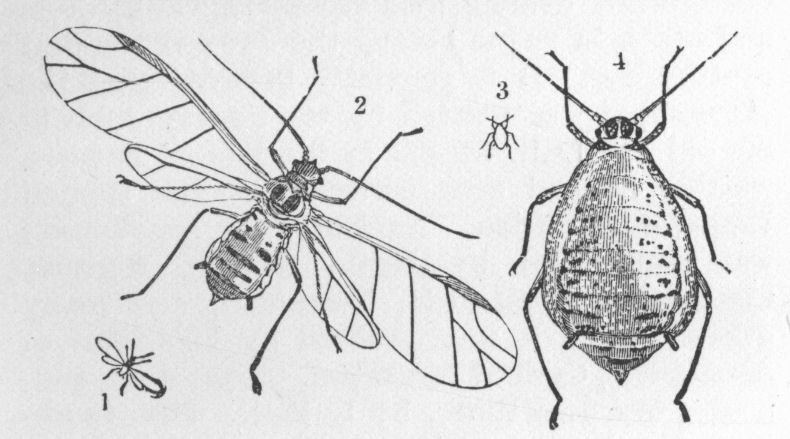
Aphides
Cabbage-leaf Plant-louse (Aphis brassicæ)—1, 2. Male, natural size and magnified. 3, 4, Female, natural size and magnified.
Aphis, a genus of insects (called plant-lice) of the ord. Hemiptera, the type of the family Aphĭdēs. The species are very numerous and destructive. The A. rosæ lives on the rose; the A. fabæ on the bean; the A. humŭli is injurious to the hop, the A. granaria to cereals, and A. lanigĕra or woolly aphis equally so to apple trees. The aphides are furnished with an inflected beak, and feelers longer than the thorax. In the same species some individuals have four erect wings and others are entirely without wings. The feet are of the ambulatory kind, and the abdomen usually ends in two horn-like tubes, from which is ejected the substance called honey-dew, a favourite food of ants. (See Ant.) The aphides illustrate parthenogenesis; hermaphrodite forms produced from eggs produce viviparous wingless forms, which again produce others like themselves, and thus multiply during summer, one individual giving rise to millions. Winged sexual forms appear late in autumn, the females of which, being impregnated by the males, produce eggs.
Apho´nia (Gr. a, not, and phōnē, voice), in pathology, the greater or less impairment, or the complete loss of the power of emitting vocal sound. The slighter and less permanent forms often arise from extreme nervousness, fright, and hysteria. Slight forms of structural aphonia are of a catarrhal nature, resulting from more or less congestion and tumefaction of the mucous and submucous tissues of the larynx and adjoining parts. Severer cases are frequently occasioned by serous infiltration into the submucous tissue, with or without inflammation of the mucous membrane of the larynx and of its vicinity. The voice may also be affected in different degrees by inflammatory affections of the fauces and tonsils; by tumours in these situations; by morbid growths pressing on or implicating the larynx or trachea; by aneurisms; and most frequently by chronic laryngitis and its consequences, especially thickening, ulceration, &c.
Aph´orism, a brief, sententious saying, in which a comprehensive meaning is involved, as 'Familiarity breeds contempt'; 'Necessity has no law'.
Aphrodite (af-ro-di´tē), the goddess of love among the Greeks; counterpart of the Roman Venus. A festival called Aphrodisia was celebrated in her honour in various parts of Greece, but especially in Cyprus. See Venus.
Aphthæ (af´thē), a disease occurring especially in infants, but occasionally seen in old persons, and consisting of small white ulcers upon the tongue, gums, inside of the lips, and palate, resembling particles of curdled milk: commonly called thrush or milk-thrush.
A´pia, the chief place and trading centre of the Samoa Islands, on the north side of the Island of Upolu. It has a wireless station.
A´piary (Lat. apis, a bee), a place for keeping bees. The apiary should be well sheltered from strong winds, moisture, and the extremes of heat and cold. The hives should face the south or south-east, and should be placed on shelves 2 feet above the ground, and about the same distance from each other. There is no place for handling bees like the open air in suitable weather, and for this reason bee-houses, or bee-sheds, formerly in use, are not much in vogue now. As to the form of the hives and the materials of which they should be constructed there are great differences of opinion. The old dome-shaped straw skep is still in general use among the cottagers of Great Britain. Its cheapness and simplicity of construction are in its favour, while it is excellent for warmth and ventilation; but it has the disadvantage that its interior is closed to inspection, and the honey can only be got out by stupefying the bees with the smoke of the common puff-ball or chloroform, or by fumigating with sulphur, which entails the destruction of the swarm. Wooden hives of square box-like form are now gaining general favour among bee-keepers. They usually consist of a large breeding chamber below and two sliding removable boxes called 'supers' above for the abstraction of honey without disturbing the contents of the main chamber. It is of great importance that the apiary should be situated in the neighbourhood of good feeding grounds, such as gardens, clover-fields, or heath-covered hills. When their stores of honey are removed, the bees must be fed during the winter and part of spring with syrup or with a solution consisting of 2 lb. loaf-sugar to a pint of water. In the early spring slow and continuous feeding (a few ounces of syrup each day) will stimulate the queen to deposit her eggs, by which means the colony is rapidly strengthened and throws off early swarms. New swarms may make their appearance as early as May and as late as August, but swarming usually takes place in the intervening months. See Bee-keeping, Hives.
Apic´ius, Marcus Gabius, a Roman epicure in the time of Augustus and Tiberius, who, having exhausted his vast fortune on the gratification of his palate, and having only about £80,000 left, poisoned himself that he might escape the misery of plain diet. The book of cookery published under the title of Apicius was written by one Cælius, and belongs to a much later date.
A´pion, a Greek grammarian, born in Egypt, lived in the reigns of Tiberius, Caligula, and Claudius, A.D. 15-54, and went to Rome to teach grammar and rhetoric. Among his works, one or two fragments only of which remain, was one directed against the Jews, which was replied to by Josephus.
A´pios, a genus of leguminous climbing plants, producing edible tubers on underground shoots. An American species (A. tuberōsa) has been used as a substitute for the potato, but its tubers, though numerous, are small.
Apis
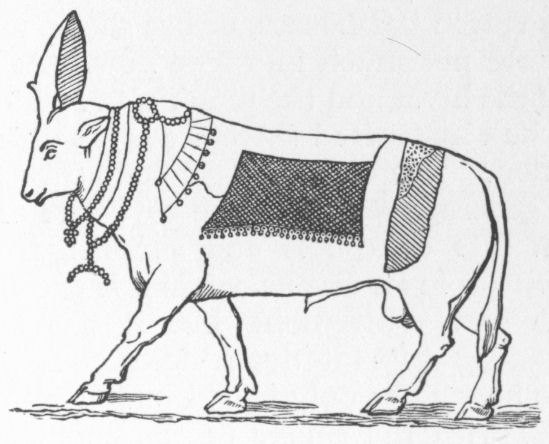
A´pis, a bull to which divine honours were paid by the ancient Egyptians, who regarded him as a symbol of Osiris. At Memphis he had a splendid residence, containing extensive walks and courts for his entertainment, and he was waited upon by a large train of priests, who looked upon his every movement as oracular. He was not suffered to live beyond twenty-five years, being secretly killed by the priests and thrown into a sacred well. Another bull, characterized by certain marks, as a black colour, a triangle of white on the forehead, a white crescent-shaped spot on the right side, &c., was selected in his place. His birthday was annually celebrated, and his death was a season of public mourning. See Animal Worship.
A´pis, a genus of insects. See Bee.
A´pium, a genus of umbelliferous plants, including celery.
Aplacen´tal. See Placenta, Marsupialia, and Echidna.
Aplanat´ic. See Optics, Photography.
Aplysia. See Sea-hare.
Apoc´alypse (Gr. apokalypsis, a revelation), the name given to the last book of the New Testament, in the English version called The Revelation of St. John the Divine. Although a Christian work, the Apocalypse belongs to a class of literature dealing with eschatological subjects and much in vogue among the Jews of the first century B.C. It is generally believed that the Apocalypse was written by the apostle John in his old age (A.D. 95-97) in the Isle of Patmos, whither he had been banished by the Roman Emperor Domitian. Anciently its genuineness was maintained by Justin Martyr, Irenæus, Clement of Alexandria, Tertullian, and many others; while it was doubted by Dionysius of Alexandria, Cyril of Jerusalem, Chrysostom, and, nearer our own times, by Luther. The Apocalypse has been explained differently by almost every writer who has ventured to interpret it, and has furnished all sorts of sects and fanatics with quotations to support their creeds or pretensions. The modern interpreters may be divided into three schools—namely, the historical school, who hold that the prophecy embraces the whole history of the Church and its foes from the time of its writing to the end of the world; the Præterists, who hold that the whole or nearly the whole of the prophecy has been already fulfilled, and that it refers chiefly to the triumph of Christianity over Paganism and Judaism; and the Futurists, who throw the whole prophecy, except the first three chapters, forward upon a time not yet reached by the Church—a period of no very long duration, which is immediately to precede Christ's second coming. See Bible.—Bibliography: R. H. Charles, Studies in the Apocalypse; F. C. Burkitt, Jewish and Christian Apocalypses.
Apocalyptic Number, the mystic number 666 found in Rev. xiii, 18. As early as the second century ecclesiastical writers found that the name Antichrist was indicated by the Greek characters expressive of this number. By Irenæus the word Lateinos was found in the letters of the number, and the Roman Empire was therefore considered to be Antichrist. Protestants generally believe it has reference to the Papacy, and, on the other hand, Catholics connect it with Protestantism. It is, however, almost certain that the number refers to Nero, for by transliterating the Greek Kaisar Neron into Hebrew, and adding together the sums denoted by the Hebrew letters, we obtain the number 666.
Apocar´pous, in botany, a term applied to such fruits as are the produce of a single flower, and are formed of one carpel, or a number of carpels free and separate from each other.
Apoc´rypha (Gr., 'things concealed or spurious'), a term applied in the earliest churches to various sacred or professedly inspired writings, sometimes given to those whose authors were unknown, sometimes to those with a hidden meaning, and sometimes to those considered objectionable. The term is specially applied to the fourteen undermentioned books, which were written during the two centuries preceding the birth of Christ. They were written, not in Hebrew, but in Greek, and the Jews never allowed them a place in their sacred canon. They were incorporated into the Septuagint, and thence passed to the Vulgate. The Greek Church excluded them from the canon in 360 at the Council of Laodicea. The Latin Church treated them with more favour, but it was not until 1546 that they were formally admitted into the canon of the Church of Rome by a decree of the Council of Trent. The Anglican Church says they may be read for example of life and instruction of manners, but that the Church does not apply them to establish any doctrine. All other Protestant churches in Britain and America ignore them. The following fourteen books form the Apocrypha of the English Bible: The first and second Books of Esdras, Tobit, Judith, the rest of the Book of Esther, the Wisdom of Solomon, the Wisdom of Jesus the son of Sirach, or Ecclesiasticus, Baruch the Prophet, the Song of the Three Children, Susanna and the Elders, Bel and the Dragon, the Prayer of Manasses, and the first and second Books of Maccabees. Besides the Apocryphal books of the Old Testament there are many spurious books composed in the earlier ages of Christianity, and published under the names of Christ and his apostles, or of such immediate followers as from their character or means of intimate knowledge might give an apparent plausibility to such forgeries. These writings comprise: 1st, the Apocryphal Gospels, which treat of the history of Joseph and the Virgin before the birth of Christ, of the infancy of Jesus, and of the acts of Pilate; 2nd, the Apocryphal Acts of the Apostles; and 3rd, the Apocryphal Apocalypses, none of which have obtained canonical recognition by any of the churches.—Bibliography: Wace, The Apocrypha; Porter, in Hastings' Bible Dict., i, pp. 111-23; W. D. F. Oesterley, Book of the Apocrypha; R. H. Charles, Religious Development between the Old and the New Testaments.
Apocyna´ceæ, a nat. ord. of dicotyledonous plants, having for its type the genus Apocўnum or dog-bane. The species have opposite or sometimes whorled leaves without stipules; the corolla monopetalous, hypogynous, and with the stamens inserted upon it; fruit two-celled. The plants yield a milky juice, which is generally poisonous; several yield caoutchouc, and a few edible fruits. The bark of several species is a powerful febrifuge. To the order belongs the periwinkle (Vinca). See Cow-tree, Periwinkle, Oleander, Tanghin.
Ap´oda. See Proteolepadidæ.
Ap´odal Fishes, the name applied to such malacopterous fishes as want ventral fins. They constitute a small natural family, of which the common eel is an example.
Apo´dösis, in grammar, the latter member of a conditional sentence (or one beginning with if, though, &c.) dependent on the condition or protăsis; as, if it rain (protasis) I shall not go (apodosis).
Ap´ogee (-jē; Gr. apo, from, and gē, the earth), that point in the orbit of the moon or a planet where it is at its greatest distance from the earth; also the greatest distance of the sun from the earth when the latter is in aphelion.
Apol´da, a town of Germany, in Saxe-Weimar, at which woollen goods are extensively manufactured. Pop. 22,610.
Apollina´rians, a sect of Christians who maintained the doctrine that Christ had a human body and a human sensitive soul, but no human rational mind, the Divine Logos (the Word) taking the place of the mind, and that God was consequently united in him with the human body and the sensitive soul. Apollinaris, the author of this opinion, was, from A.D. 362 till at least A.D. 382, Bishop of Laodicea, in Syria, and a zealous opposer of the Arians. As a man and a scholar he was highly esteemed, and was among the most popular authors of his time. He formed a congregation of his adherents at Antioch, and made Vitalis their bishop. The Apollinarians, or Vitalians, as their followers were called, soon spread their settlements in Syria and the neighbouring countries, established several societies, with their own bishops, and one even in Constantinople; but many adherents drifted away to Monophysitism, and the sect soon became extinct.
Apollina´ris Water, a natural aerated water, belonging to the class of acidulated soda waters, and derived from the Apollinarisbrunnen, a spring in the valley of the Ahr, near the Rhine, in Rhenish Prussia, forming a highly-esteemed beverage.
Apollo Belvedere (Vatican, Rome)
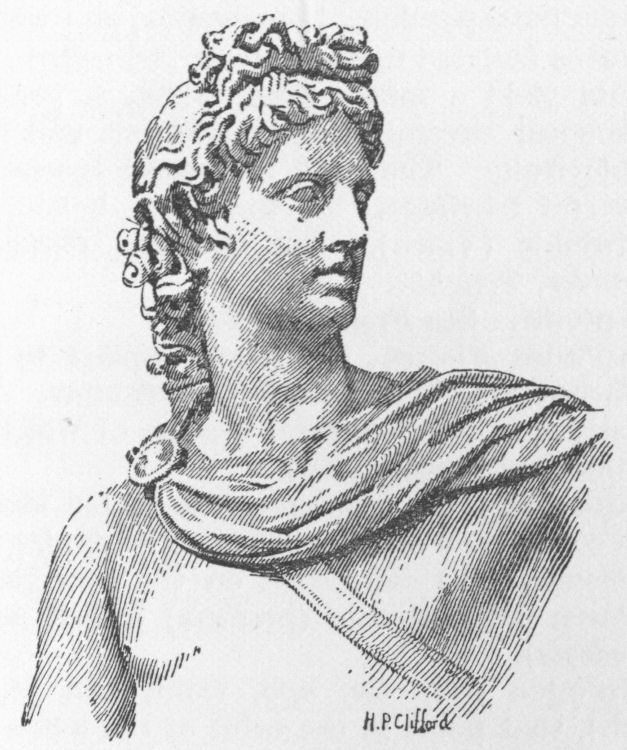
Apol´lo, son of Zeus (Jupiter) and Leto (Latona), who, being persecuted by the jealousy of Hera (Juno), after tedious wanderings and nine days' labour, was delivered of him and his twin sister, Artĕmis (Diana), on the Island of Delos. Skilled in the use of the bow, he slew the serpent Python on the fifth day after his birth; afterwards, with his sister Artĕmis, he killed the children of Niobē. He aided Zeus in the war with the Titans and the giants. He destroyed the Cyclopes, because they forged the thunderbolts with which Zeus killed his son and favourite Asklepios (Æsculapius). According to some traditions he invented the lyre, though this is generally ascribed to Hermes (Mercury). The brightest creation of polytheism, Apollo is also the most complex, and many aspects of the people's life were reflected in his cult. He was originally the sun-god; and though in Homer he appears distinct from Helios (the sun), yet his real nature is hinted at even here by the epithet Phœbus, that is, the radiant or beaming. In later times the view was almost universal that Apollo and Helios were identical. From being the god of light and purity in a physical sense, he gradually became the god of moral and spiritual light and purity, the source of all intellectual, social, and political progress. He thus came to be regarded as the god of song and prophecy, the god that wards off and heals bodily suffering and disease, the institutor and guardian of civil and political order, and the founder of cities. His worship was introduced at Rome at an early period, probably in the time of the Tarquins. Among the ancient statues of Apollo that have come down to us, the most remarkable is the one called Apollo Belvedere, from the Belvedere Gallery in the Vatican at Rome. This statue was discovered at Frascati in 1455, and purchased by Pope Julian II, the founder of the Vatican museum. It is a copy of a Greek statue of the third century B.C., and dates probably from the reign of Nero.