NATURAL HISTORY OF CAGE BIRDS. (continued 8)
Reading edition
The female is smaller, of a redder brown, and confusedly streaked across; the feet are yellowish.
Habitation.—When wild it is found all over Europe, and particularly frequents mountainous and woody places. It does not quit us, but remains in winter, as in summer, near our dwellings.
In the house, on account of its liveliness, it is given rather a large cage, the bars of which should be very near together. If allowed to range it may easily escape through small openings, as it is very fond of penetrating such crevices.
Food.—At liberty, it consists throughout the year of small insects, which it seeks in winter in barns, stables, cellars, holes in walls, and piles of wood. In autumn, however, it will eat both unripe and black elderberries.
As soon as it is brought into the house it must be plentifully supplied with meal-worms, flies, elderberries, and then gradually add nightingales' paste, which will soon become its ordinary food. It is only by adopting this method that I have been successful in preserving one of these birds.
Breeding.—Any nook appears to suit the wren to build its large nest in; which may be found in a hole of a tree, amongst the roots, under a roof, or a cavity under ground; every place is suitable, provided the nest can be concealed. This is oval, covered with moss on the outside, and lined with feathers and hair. It has an opening at the top or side to go in and out by. The female lays from six to eight pretty little white eggs, speckled with red. The young ones are rusty red, spotted with black and white. They may be reared on ants’ eggs, adding, as soon as they can fly, the universal paste; but they always prefer ants’ eggs.
Mode of Taking.—If in winter, a white-throat trap is set in a place much frequented by these birds, and meal-worms scattered within and around it. In this the wrens will surely be caught. They may be entrapped in autumn with spring traps and springes, by hanging elderberries before; but, after every precaution, they generally break their legs.
Attractive Qualities.—Its sprightliness is pleasing, and its actions gay and varied. It has a very powerful voice for its size, and its song is continued throughout the year; it is soft, and mingled with some notes of the canary, which are the more pleasing as they consist of distinct loud tones always descending. Its call is tzrr, tzetzererr! I have never preserved one more than a year, but other amateurs say they may be kept two or three.
THE GOLD-CRESTED WREN.
Motacilla Regulus, Linnæus; Le Poul, ou Roitelet huppé, Buffon; Das Goldhähnchen, Bechstein.
This is the smallest of European birds. It is three inches and a half in length, of which the tail measures one and a quarter. The beak is four lines, slender, very sharp, and black, having the nostrils covered with a feather divided like a comb; the iris is dusky; the shanks are eight lines in height, and brownish flesh-coloured; the forehead is yellowish brown; a black streak extends from the corners of the beak to the eyes, above which is a white streak, and below them a white speck; the top of the head is saffron yellow, each side edged with golden yellow, beyond which is a black band.
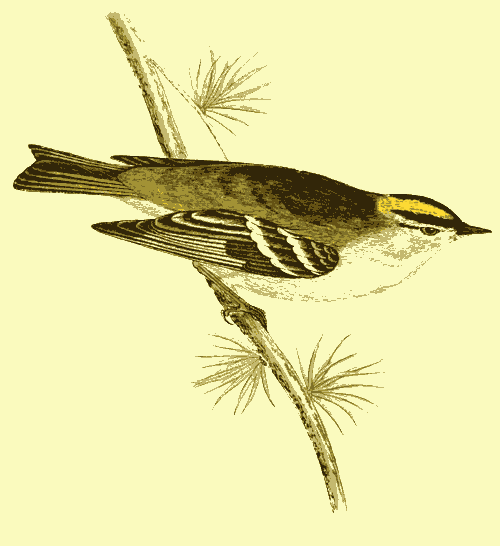
GOLD-CRESTED WREN.
The female has the top of the head golden yellow, the forehead and wings grey.
Habitation.—When wild these pretty little birds are diffused throughout the old world, principally frequenting pine and fir forests, and do not appear to migrate, excepting those that inhabit northern countries, and go towards the south in October, and return in March; at least, they are then observed on their passage, in Germany, the hedges being full of them in spring; but those established among us remain, as they are seen all the year. They assemble in small flights in winter, and fly about here and there, like the tits, seeking places where their food is most abundant.
In the house a bell-shaped cage appears to suit them best. Several may be kept together in a part of a room enclosed with trellis work, and with a small fir tree for them to perch on. Reared from the nest, they may be allowed to perch on a tree in the room, which they enjoy so much that they are never far from it; if there are many they will perch in a row, press close side by side, and sleep in this manner.
Food.—In the wild state it feeds on all kinds of small insects and their grubs; they are, however, able to swallow large flies, as the beak has a wide opening.
In the house the gold-crests are soon accustomed to the nightingales' paste, by throwing amongst it at first flies deprived of their wings, or half dead, and at length they will be satisfied with bruised hemp-seed; but they must have insects occasionally, flies, meal-worms cut small, ants’ eggs, &c.; finally, to keep them healthy, their paste should be neither too stiff nor too moist, and care must be taken to avoid their swallowing rape or camelin seed, which would immediately kill them106.
Breeding.—The nest, fixed to the extremity of a branch, is round, and very soft, built of moss, caterpillar’s cocoons, and tufts of thistle down; it is generally found in low underwood or meadows with woods adjoining, on the first tree towards the east. About nine eggs are laid, the size of a pea, and pale blush red. Those young ones intended to be reared must not be taken from the nest till they are fledged, and it is best to catch them just as they are leaving the nest. They eat readily meal-worms cut small, flies, ants’ eggs, and white bread soaked in boiled milk.
Mode of Taking.—As they are not fearful, they may easily be caught by gently approaching the tree where one is perched, and merely striking it with a limed twig fastened to a pole long enough to reach it. It may be brought down also with water, in the manner adopted by M. Le Vaillant, that is, by first putting into a gun the common charge of powder, then a wadding of silk, then, as soon as the bird is within reach, two spoonfuls of water are poured in and covered with a second wadding of silk, which must not be rammed down hard, lest the water should reach the powder below. This load, discharged at the distance of twenty paces, is capable of wetting the bird so completely that it may be taken by the hand; but if there are hedges in the neighbourhood, or if a stronger bird be fired at, a chaffinch, for instance, it may easily escape.
Many gold-crested wrens may be caught by means of a hut set for any small birds, when the way to attract them is known. They come in great numbers to the water trap, and by their often repeated call of tzitt, tzitt, give notice of sunset and the arrival of larger birds.
They will soon grow tame enough to eat out of the hand. On account of their delicacy, many often die before a person succeeds in rearing one; but when once accustomed to the house they will live a long time, at least if not hurt by other birds, and if they do not swallow what they cannot digest.
Attractive Qualities.—The smallness of their size, their elegance and beauty, render them a pleasant acquisition; but their song adds to their attractions, for though weak it is very melodious, and resembles that of the canary.
THE HON. AND REV. W. HERBERT’T ACCOUNT OF THE GOLD-CRESTED WREN.
The golden-crested wren and the common brown wren are both very impatient of cold. In confinement, the least frost is immediately fatal to them. In a wild state they keep themselves warm by constant active motion in the day, and at night they secrete themselves in places where the frost cannot reach them; but I apprehend that numbers do perish in severe winters. I once caught half a dozen golden wrens at the beginning of winter, and they lived extremely well upon egg and meat, being exceedingly tame. At roosting time there was always a whimsical conflict amongst them for the inside places, as being the warmest, which ended of course by the weakest going to the wall. The scene began with a low whistling call amongst them to roost, and the two birds on the extreme right and left flew on the backs of those in the centre, and squeezed themselves into the middle. A fresh couple from the flanks immediately renewed the attack upon the centre, and the conflict continued till the light began to fail them. A severe frost in February killed all but one of them in one night, though in a furnished drawing-room. The survivor was preserved in a little cage by burying it every night under the sofa cushions; but having been one sharp morning taken from under them before the room was sufficiently warmed by the fire, though perfectly well when removed, it was dead in ten minutes. The nightingale is not much more tender of cold than a canary bird. The golden-crowned wren very much frequents spruce fir trees and cedars, and hangs its nest under their branches; it is also fond of the neighbourhood of furze bushes, under which it probably finds warm refuge from the cold. The brown wren is very apt in frosty weather to roost in cow-houses, where the cattle keep it warm.
THE ALPINE WARBLER.
Sturnus collaris, Linnæus; Motacilla Alpina, Linnæus; La Fauvette des Alpes, Buffon; Der Alpensänger, Bechstein.
The characteristics of this bird are so equivocal that it is sometimes ranked with the larks, sometimes with the starlings, and sometimes with the Motacillæ. It is six inches and a half in length, but the tail alone measures nearly three. The beak is six lines, and is dark brown above and orange beneath; the mandibles are flattish at the sides; the iris is yellow; the shanks are an inch high, and pale brown; a whitish ash grey predominates on the head, neck, and back, but the latter is streaked with dark brown, the others with pale brown.
The female and young ones are variegated with dark brown on the belly; the back is dark, and the spots on the throat less apparent.
Observations.—This species frequents the secondary mountains of Switzerland and southern Germany, and is as common there as the field larks on our plains107. In winter it descends into the valleys, and approaches villages and barns, around which these birds may be caught, in as great numbers as yellowhammers. They are generally seen on the ground, running as swiftly as the wagtail, and will sometimes hop on stones, but rarely perch on trees.
They feed on seeds and insects, and in the house they should be given bruised hemp-seed, poppy-seed, white bread, and ants’ eggs. On this food they may be preserved for several years. Their song is sweet, but sad and melancholy; their attitudes are graceful, and often when they hop they flutter their wings and tail. They build on the ground or in clefts of rocks, which has given them the name of rock larks108.
THE OXEYE, OR GREATER TIT109.
Parus major, Linnæus; La grosse Mésange, ou Charbonnière, Buffon; Die Kohlmeise, Bechstein.
This well-known bird is five inches and five-sixths in length, of which the tail measures two and a half. The beak is blackish, conical, firm, pointed, and without slope, as are the beaks of the other tits; the iris is dark brown; the shanks are nine lines high, and lead blue; the claws are sharp, and adapted for climbing; the upper part of the head is of a brilliant black, which is joined to the black of the throat by a line of the same colour that borders and sets off the white of the cheeks and temples; the nape is greenish yellow, with some mixture of white; the back is fine olive, and the rump pale ash grey; the breast and belly are a yellowish green, divided lengthways by a black line.
The female is smaller, the black on the head and the yellow on the nape are less bright; the line that runs down the belly is narrower and shorter, at least it is lost at the part where in the male it is widest; this marks the difference between young males and females, which are alike in other respects.
Habitation.—In its wild state it is found throughout the old world, but in the greatest numbers in mountainous countries, where orchards and groves abound, and woods of beech, oak, and similar trees, are found alternately with those of fir. Though these birds do not migrate, yet in autumn they assemble and pass the winter together, seeking their food amongst orchards and woods. In autumn, as soon as the bird-catchers see these flights of tits succeed each other quickly, they call it their passage, and immediately prepare snares for taking them. In March each pair separates and prepares for breeding.
In the house, if kept in a cage, this should be of iron wire, and bell-shaped, for the advantage of seeing the birds twirl about, and drop from one stick to another like monkeys. If they be allowed to range, it is necessary to supply them with abundance of the food they like, for if this fails they will attack the other birds, and pierce their heads to eat the brain; when once they have tasted this food there is no longer safety for the birds around them, whatever their size may be. I have seen an oxeye attack a quail and kill it in this way. Some bird-catchers say that the tits with forked tails are alone addicted to this, but they are mistaken; it is certainly true that some are more cruel than others, experience teaches us this every day.
Food.—When wild they feed on insects, seeds, and berries, destroy many smooth caterpillars, flies, grasshoppers, gnats, and small butterflies, and climb about the trees like woodpeckers, seeking in the moss the eggs and grubs of insects. In autumn and winter they eat all kinds of seeds, especially hemp-seed, fir, and pine-seed, oats, kernels of fruit, mast nuts, and occasionally flesh. They hold these things in their claws, tear them with their beak, and skin them with their tongue.
In the house they will eat any thing on the table, meat, bread, cheese, vegetables, sweet almonds, walnuts, filberts, lard, and all sorts of fat, all pastes adapted for other birds; so that we must not attribute their early death to the delicacy of the tits, but to the want of care in those that have them. The more they eat the more they sing, and the less inclined they are to attack their companions. They drink often, and enjoy bathing.
Breeding.—The oxeye builds in a hole of a tree or wall, sometimes in the forsaken nest of a squirrel, crow, or woodpecker. It lays on an artless bed of moss, wool, and feathers, eight or ten whitish eggs, sprinkled with large and small spots mixed with streaks of dark red, particularly at the large end, where they form a coronet. The young do not quit the nest till they can fly well. The under parts of the body are pale yellow; and the black about them is not glossy as in the old birds.
Diseases.—In a cage, this species is subject to vertigo or giddiness, occasioned by feeding too much on hemp-seed, which heats it and makes it twirl about too much. To cure the disorder, the bird should be kept for some time in a small square cage, or permitted to range the room. From the same cause often arises atrophy, consumption, and even gout, all which proves the injurious qualities of hemp-seed; but with care on this point and a little attention it may live eight or ten years.
Mode of Taking.—The chase after tits, is, according to bird-catchers, one of the most agreeable, and is pursued in many ways; but I shall confine myself to two or three of the surest methods, specifying the best for taking those birds that are for the house.
In autumn and spring, the bird-catcher should go into an orchard, or any other place much frequented by oxeyes, carrying one with him as a decoy; this must be placed on the ground in a small square cage, and some sticks, with lime-twigs fastened to them, fixed obliquely around it. The tits, attracted by curiosity, or the desire of approaching one of their own species that calls them, quickly descend, and are caught in the lime-twigs. A whistle made of the bone of a goose’s leg succeeds still better; with this instrument all the tits in the neighbourhood are quickly assembled; for the tone being stronger than the natural call, it is heard farther; if there are but few of these birds near, they are sure to be all caught.
They are easily attracted, in winter, to a trap, by the kernels of nuts, lard, and oats. This trap should be placed in a garden, with a little oat straw fastened under in such a way that it may be seen at a distance, as the tits are instantly attracted thereby. It is a small box a foot in length, and eighteen inches in height and width, the sides of which, when not made of small boards painted green, are formed of small elder sticks, tied or screwed to the four corner sticks; in this case only two small boards are required, one for the bottom, the other for the cover, which must be fastened on with packthread, and turn as with hinges; from the middle of the bottom rises a peg supporting a cross stick, with a nut kernel at one end, and a little lard at the other; this cross stick supports a small perpendicular one, which keeps the cover open three or four inches. When a tit hops on the cross stick and begins pecking the nut or lard, the cover falls, and the bird is caught.
The oxeye, like the other tits, assembles in numbers at the water-trap, commonly from seven to nine in the morning, and from four to five in the evening.
In autumn these birds are taken in nooses and common bird-traps, baited with berries, but the snare must be of horse hair, for if of thread, the bird, as soon as it feels itself caught, will try to bite through it, as mice do.
Attractive Qualities.—The sprightliness and activity of these birds are very pleasing, but their gay and lively song still more so: in it are agreeably mingled the call “fick, fick” and the shrill “tzizerr.” Nothing, in my opinion, is more pleasing than to hear repeated fifteen or twenty times following these striking notes, “sitzida, sitzida, stiti, stiti.” One may judge of the capability of young ones to imitate the song of other birds, from the facility with which the full-grown birds learn detached parts, and particularly different calls.
Some people amuse themselves by making these birds perform many little manœuvres, such as drawing up their food with a chain, turning a cylinder110 which has the appearance of being moved by two miners, and hopping after a nut suspended to a thread.
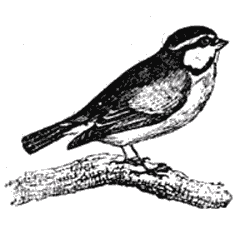
THE COLE TIT.
Parus ater, Linnæus; La petite Charbonnière, Buffon; Die Tannenmeise, Bechstein.
The length of this bird is four inches and one-sixth, of which the tail measures one and three-quarters, and the beak one quarter. The back is black, with the tip lighter; the iris is dusky; the shanks are eight lines high, and lead blue; the upper part of the head and neck are black; there is rather a broad streak of white at the back of the head and down the nape of the neck; the cheeks and sides of the neck are also white, forming, when the bird is at rest, a triangular spot; the back is dark bluish ash grey.
The female is not easily distinguished from the male, unless both are before you; its being a little less black on the breast, and a little less white on the sides, are the only differences.
Habitation.—When wild these birds are seen in great numbers in pine forests, and seldom, except during their wanderings in autumn, winter, and spring, are they met with in other kinds of woods, groves, and orchards. They often pass from one pine forest to another in large flights during the winter111. They appear to like the society of the gold-crested wrens, which are always found in these flights, as also some crested tits, which serve as guides.
In the house it is pleasanter to allow them to range with the other birds than to keep them in a cage, yet there is some danger to their companions from their cruelty.
Food.—When wild, besides insects and their grubs, they feed on the seeds of different resinous trees; but as they are often deprived of this food in winter from the trees being loaded with snow and hoar frost, nature has given them the instinct to provide against this emergency: they hide a great quantity of these seeds in fissures, and under the large scales of the bark of pine trees, to which store they have recourse when in want.
The instinct just alluded to is manifested also in the house, even when they have abundance of all kinds of food; where they are observed to rob the other birds of seeds and bits of nuts, and run and hide them immediately in any crevices they may find, often visiting these stolen stores afterwards to see if they are safe. The blue tit and the oxeye are also accustomed to carry part of their food into a corner, but they do not hide with so much care, or from the same cause, as the cole tit. These birds are commonly fed on the universal paste, but they are accustomed to it with difficulty.
Breeding.—This species generally places its nest either in some hole deserted by a mole or mouse, or under the overhanging edges of some deep wheel-rut in an old disused road, rarely in holes of trees or walls. The nest is composed of a layer of moss covered over with the fur of the hare, roe-buck, and stag. There are two broods in the year, each of six or eight white eggs, prettily speckled with pale red. The plumage of the young differs from that of the old only in having the black duller and less glossy.
Diseases.—Decline is the most common disorder of these birds, and it is sometimes prevented by giving them fresh ants’ eggs, particularly when moulting. I kept a cole tit six years, and it then died of old age, having first become blind, and been often attacked with vertigo or giddiness.
Mode of Taking.—Less timid and distrustful than the oxeye, this species may be caught with greater ease. A limed twig fastened to a pole is often sufficient, with which you approach the tree on which the bird is, and, touching it with the twig, it becomes your prisoner. Its call is “tzip teune.” Like all the tits, it is delicate, and, in the house, often dies soon before being accustomed to the common paste.
Attractive Qualities.—This is a very amusing little bird; bold, lively always in motion, hopping and fluttering about continually. Its song is only a clashing of harsh tones, relieved by a clear sonorous “tzifi,” repeated twenty times in succession. It sometimes ends, however, with so reflective an air, that you would think it was going to give something very fine.
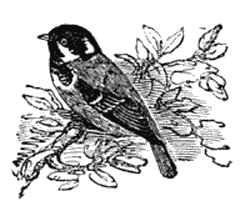
THE BLUE TIT, OR TOM TIT.
Parus cæruleus, Linnæus; La Mésange bleue, Buffon; Der Blaumeise, Bechstein.
This pretty bird is four inches and a half long, of which the tail measures two. The beak is three lines in length, and dusky, but whitish at the edges and tip; the iris is dark brown; the shanks are eight lines high, and lead blue; the front of the head and cheeks are white; a white line passing from the forehead above the eyes forms a border to the fine sky-blue of the top of the head; a black line crosses the eyes; the black of the throat becomes on the sides of the neck a dark blue band, which surrounds the head.
The female is rather smaller than the male, the streaks about the head not being so clearly defined, while the blue has the appearance of being tinged with ash grey. The line down the under part of the body is scarcely observable.
Habitation.—These birds, in their wild state, frequent woods, particularly those of beech and oak. During autumn and winter they wander from one place to another, and are often seen in considerable numbers in our orchards.
In the house they may be kept in a cage like the oxeye; but it is preferable to let them hop and flutter about at pleasure, as their plumage is then seen to the greatest advantage. They are as mischievous and quarrelsome as the oxeye, and pursue the other birds in the same manner, even killing them when they are strong enough.
Food.—When wild they feed on insects and their grubs, and in autumn on berries112.
In the house they should be given the same food as the oxeye, accustoming them to it at first by mixing bruised hemp-seed with it. They like to wash themselves.
Breeding.—The nest, placed at the top of a tree in an old hollow branch, is built of moss, hair, and feathers. This species lays from eight to ten reddish white eggs, speckled and spotted with brown. The plumage of the young birds differs from that of the older ones, only in being less bright and glossy.
Diseases.—Most of these birds that are caught in winter, are attacked with vertigo, or giddiness, after being in the house a few days, fall to the right and left, and being unable to find their food, soon die.
Mode of Taking.—They may be caught in the same way as the oxeye.
Attractive Qualities.—The blue tit is easily tamed, and lives two or three years. Its beauty and activity are more attractive than its song, which is merely an indistinct warbling, composed of a few strains, amongst which some higher notes are occasionally introduced.
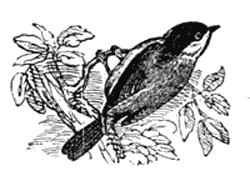
THE MARSH TIT.
Parus palustris, Linnæus; La Mésange des marais, Buffon; Der Sumpfmeise, Bechstein.
The length of this bird is four inches and a half, of which the tail measures nearly two; the beak is four lines in length, and black; the shanks are five lines high, and lead blue; the upper part of the head, as far as the nape, is black; the temples and cheeks are white; the upper part of the body is brownish grey; the throat is black.
The female has less black on the throat than the male.
Habitation.—In their wild state, these birds, during the summer, frequent groves and orchards; in winter, they assemble in flocks, and when they move from place to place, always fly in a line one behind the other113.
In the house they should be allowed to flutter and hop about freely; they are very delicate, and require a great deal of care at first.
Food.—When wild, they feed on insects, seeds, and elderberries, according to the season.
In the house they eat the same things as other tits; but at first, ants' eggs and elderberries must be added. The seeds of the sunflower (Helianthus major) have succeeded best with me, and preserved them in health longest. They will also eat hemp-seed and oats.
Breeding.—They lay ten or twelve rusty white eggs, spotted with reddish yellow, in a hole of a tree, on a bed of moss, hair, and feathers.
Mode of Taking.—In winter they will easily enter a trap baited with nut kernels or oats. A surer method is, to lay limed twigs on a sunflower plant, the seeds of which are ripe. If these tits do not enter the garden, a plant must be carried to a place much frequented by them. When once these birds have tasted these seeds, they appear quite contented in the house. It is only necessary to supply them freely; they will seize them eagerly directly after being taken.
Attractive Qualities.—Their pretty actions please, and their song is sweet. They relieve it occasionally by a lively strain, “diar, diar, hitzi, ailtz, ailtz!” which is their call in the pairing season.
I was never able to keep one in the house beyond two or three years.
THE CRESTED TIT.
Parus cristatus, Linnæus; La Mésange huppée, Buffon; Die Haubenmeise, Bechstein.
This bird is four inches and a half in length, of which the tail measures one and one third. The beak is four lines, and black; the shanks are seven lines high, and lead blue; the head is adorned with a crest, composed of feathers nearly an inch long, black tipped with white, which the bird can erect at pleasure in a conical form.
Habitation.—When wild these birds frequent all the pine and fir woods in Thuringia, but are not so numerous as the other species114. They fly about low bushes, and therefore delight in places where juniper bushes abound.
In the house they require the same treatment as the blue tit, and even greater attention; they can rarely be tamed when taken full grown115.
Food.—In a wild state it feeds in the same manner as the cole tit.
In the house it must be first fed on ants’ eggs, flies, and meal-worms. It will afterwards eat nuts and hemp-seed, like the other tits, but it seems to require insects occasionally.
Breeding.—The nest is formed like that of the cole tit, and placed in the hole of a tree, amongst some stones, or in large forsaken nests. The brood consists of from six to ten snow-white eggs, spotted with bright red. The young must be reared on meal-worms cut small and ants’ eggs.
Mode of Taking.—This is the same which is adopted for catching the cole tits. Its call is “gærrky.”
Attractive Qualities.—Its song is not striking, but its form and habits are very pleasing.
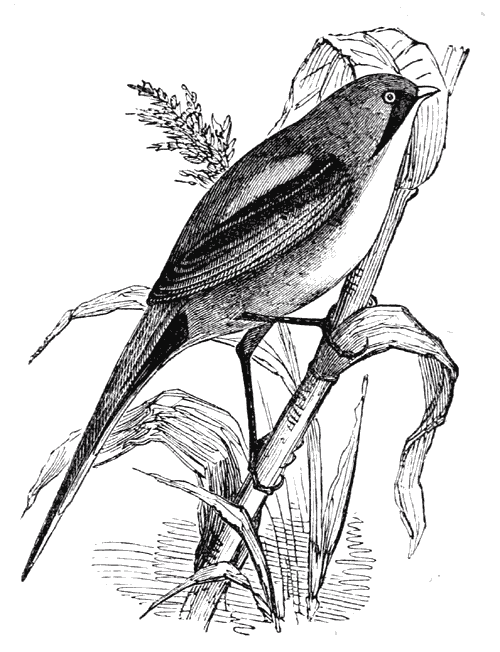
THE BEARDED TIT, OR REED BIRD.
Parus biarmicus, Linnæus; La Mésange barbue, Buffon; Die Bartmeise, Bechstein.
This singular species is somewhat in shape like the oxeye. It is six inches and a half in length, and measures ten and a quarter across the expanded wings; the tail is two and three quarters. The beak is four lines long, a little bent at the point, and is orange during life, but becomes pale yellow after death; it is surrounded at the base with black hairs. The iris is yellow; the shanks are one inch high, and black; the head is pale ash grey; a tuft of black feathers, which are placed under the eyes and terminate in a point, is no very slight imitation of a moustache. The tail is wedge-shaped, inclining to orange; the outer feathers are dark at the base and whitish at the tip; the third is tipped with white.
The female is without the beard, or moustache116; the top of the head is rust red, spotted with black; the vent is of the same colour as the belly.
Habitation.—In a wild state these birds are found where there are lakes, large ponds, and extensive marshes full of reeds and aquatic plants; they rarely show themselves in summer, keeping in pairs amongst the tufted reeds; but they are seen in winter, when food failing them in these retreats, they fly about in families, perching on the trees and bushes117.
In the house they must be kept in a large cage to allow them plenty of exercise, unless permitted to range the room, which is still better.
Food.—When wild this bird feeds principally on aquatic insects and the seeds of the common reed (Arundo phragmitis).
In the house they are generally first fed on poppy-seed, ants’ eggs, and meal-worms, and afterwards on bruised hemp-seed and the food common for the other tits. It is best to rear them from the nest, as it is very difficult to preserve those taken when full grown.
Breeding.—The knowledge on this head is very limited: the nest, placed in the interwoven stems of the reeds, is in the shape of a purse, and composed of dried grass and the down of several plants. In this the female lays four or five speckled eggs, with a pale red ground. The young birds should be taken from the nest when they are ready to fly, and fed on ants' eggs and meal-worms cut small.
Mode of Taking.—There is much difficulty in this. Fishermen who know the places frequented by this species place limed twigs on the reeds, and try gently to drive them towards one side, and sometimes catch a few118.
Attractive Qualities.—In this bird are united beautiful plumage, a graceful shape, and sprightliness. Its song resembles that of the blue tit, but its call is very different. It is a pity it is so difficult to obtain. Buffon says that all of this species that are found in England sprang from a pair the Countess of Albemarle suffered to escape; but most likely they had not been seen before from want of attention.
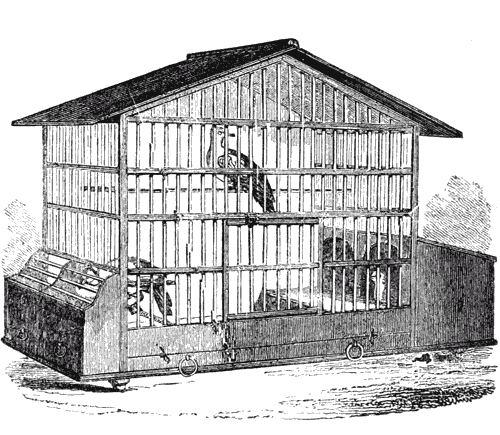
CATO’O DOVE’E BREEDING CAGE.
DOVES.
Characteristics.—The beak is slender, straight, rather bent at the point, swelled, and covered with a fleshy membrane at the base; the shanks are short; the toes are divided to their origin. Doves feed uniformly on grain, though some wild species also eat myrtle berries.
These birds are faithful to their mates, and produce only two young ones at each brood, which they feed on grain already softened in their own crops119. They are generally ranged amongst the passerine birds, or among poultry, but I think it best to make them a distinct order, since they have many distinguishing characteristics. The species I shall mention are indigenous, and easily tamed at any age.
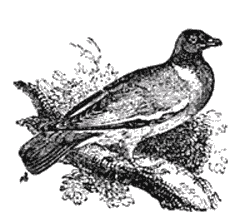
THE RING DOVE, OR CUSHAT.
Columba Palumbus, Linnæus; Le Pigeon Ramier, Buffon; Die Ringeltaube, Bechstein.
This is the largest of the European wild pigeons, being in length seventeen inches and a half. Some naturalists suppose this to be the parent stock of our large domestic pigeons; but it cannot be domesticated so easily as the stock dove, and never mixes with the common pigeons in the fields. It does not, moreover, retire into hollows, like these, but lives and builds in open and exposed places. The beak is reddish white; the iris is pale yellow; the shanks are reddish; the head and throat are dark ash grey; the front of the neck and the breast are purplish ash grey; the sides and back of the neck are fine iridescent purple; an almost crescent-shaped white streak adorns the sides of the neck towards the base, without quite surrounding it; the belly, the vent, and the thighs, are very pale grey; the sides are light ash grey; the upper part of the back, the scapulars, and the lesser wing-coverts, are light brownish ash grey; the coverts of the primary quill-feathers are black; the remaining greater coverts are pale ash grey; the tail is dark ash grey, deepening into black at the extremity.
In the female the streaks on the sides of the neck are not so wide as in the male; her breast is paler, and all the wing-coverts are an obscure grey.
Habitation.—This species, found in Europe and Asia within the temperate zone, is very common in the woods of Germany and Britain: it quits us the beginning of October, in small flights, and does not return till the middle of March, and sometimes later, always some weeks after the stock dove. During harvest it frequents small groves and detached thickets, to be nearer the corn fields.
Food.—It feeds on all kinds of corn and leguminous seeds, myrtle berries, with the seeds of pines and firs. When a ring dove is caught it must be first fed on wheat, and other species of corn should by degrees be mixed with it, but not oats. It will only live a few years in the house.
Breeding.—This species builds in trees, and forms its nest of dried branches, but so carelessly that a rather high wind will often blow it down. The female has two broods in the year, and lays two large white eggs each time. It succeeds very well to place these eggs under a domestic pigeon, and if care is taken to prevent the young birds from migrating in autumn they will afterwards remain in the pigeon house, going out and returning like the other pigeons that inhabit it; but I have never observed that they pair with them; I have sometimes seen the ring dove tread the domestic pigeon, but as yet nothing has resulted from it; future experiments may perhaps decide this point.
Mode of Taking.—This is the same as with the stock dove. Ring doves taken when old rarely eat, and die of hunger if they are not crammed, like young pigeons.
Attractive Qualities.—Besides being a fine bird, the male coos in a very pleasing and sonorous manner, moving all the time around his mate, now before, then behind, hopping close to her side, and turning his head in every direction. It may be rendered very tame.
THE TURTLE DOVE.
Columba Turtur, Linnæus; La Tourterelle, Buffon; Die Turteltaube, Bechstein.
This pretty species is ten or eleven inches in length. The beak is slender, and pale blue; the iris is reddish yellow; the naked circle round the eyes is blush red; the legs and feet are reddish purple; the forehead is whitish; the top of the head and upper part of the neck are pale blue; from this to the tail the blue is more dingy; on each side of the neck is a black spot striped with three of four crescent-shaped white lines, which has a pretty effect.
Habitation.—In their wild state these birds are found throughout the temperate parts of Europe and Asia, and also in many of the South Sea Islands. They always prefer woods, but never go far into those on great chains of mountains; they also frequent detached thickets, and even orchards when near forests. Being more delicate than the two preceding species, they do not arrive in our woods till the end of April or beginning of May, and quit us in September. They are often seen in great numbers in the forests of Thuringia when the pine seed has ripened well. In 1788 a prodigious number were seen; they have never since been so numerous there120.
In the house we keep them within a grated partition near the stove, where they can range freely. Young ones reared by a domestic pigeon are easily accustomed to the dovecot, but as they are very sensible to cold it is necessary to warm the place they are in during winter. These birds multiply fast, either paired amongst themselves or with the collared turtle dove.
Food.—The seeds of the pine seem to be their favourite food here, but they do not confine themselves to it; they eat peas, vetches, millet, hemp-seed, rye, and wheat. In the house they may be fed on bread and any grain at hand: they are easily preserved.
Breeding.—When wild, their nest, negligently formed of dried sticks, is tolerably secure when placed in a pine, but is often blown down when in a beech. The female lays two white eggs.
In the house the turtle dove is given a small straw basket, in which it builds, for, whether reared from the nest, or taken when full grown, it pairs without difficulty, and produces young ones. It will also pair with the collared turtle.
The cooing of the male is peculiar; he utters a deep prolonged sound, then bends his head and stops. The young birds are grey on the upper part of the body, and spotted with bluish black on the wings. Those sprung from a collared and a common turtle dove are more or less like either; generally they are reddish grey on the head, neck, and breast, the back and wing-coverts, with red appearing through the grey; the belly, the secondary quill-feathers, and the end of the tail, are white, and the primaries greyish brown. These birds are fruitful, and produce others; what is curious is that they are larger than the parent birds, and have a peculiar note. This is certainly also the case with other mule birds, as I have often observed.
Mode of Taking.—This is the same as with the two preceding species; snares placed where salt is strewed for deer are sufficient.
Attractive Qualities.—The inhabitants of our forest villages are very fond of having this turtle dove in their stove apartments, less on account of its agreeable qualities than from the persuasion that it cures their colds and rheumatisms. It is certainly true that this bird is generally ill during the illness of its masters121. It will, however, live six or eight years in the house.
THE COLLARED TURTLE.
Columba risoria, Linnæus; La Tourterelle à collier, Buffon; Die Lachtaube, Bechstein.
This bird is twelve inches in length; the beak is reddish white at the base, and dusky on the remaining part; the iris is golden yellow; the shanks are red; the upper part of the body is reddish white, the under part is pure white; the back of the neck is adorned with a black crescent, the points of which turn forward, and the lower part is edged with white; the shafts of the quill and tail feathers are dusky.
The female is whiter than the male.
Habitation.—This species is a native of India and China, from which it has been brought to Europe. It is very common among our peasants, who fancy it has the power of curing their colds and rheumatisms122. They assign these poor birds some grated place near the stove, sometimes under a bench; if they are allowed to range, their wings must be clipped, to prevent their flying against the windows, and breaking them. They will generally run under the stove, as they are fond of warmth. They may be accustomed to the dovecot, but their showy plumage often occasions them to fall a prey to carnivorous birds. It is also necessary either to warm the dovecot, or remove them to a heated room during the winter.
Food.—They prefer wheat, and this should be their common food; they will also eat millet, linseed, poppy, and rape-seed, and even bread. The peasants give them the siftings of their corn.
Breeding.—A piece of fur, or soft stuff, or still better, a little basket, serves as the foundation for their nests. To this they merely add a little straw, on which they lay two white eggs. They sit on these a fortnight, but rarely hatch more than one, either from the egg being unfruitful, or from the carelessness of the parent birds. It is therefore rare to see them rear six young ones in the year. These resemble the old ones, and the sex is known by the absence or presence of the reddish colour.
Diseases.—Besides decline, they are subject to all the diseases that attack the persons shut up in the same room; small-pox, when the children have it; swollen legs, when any one is attacked with this complaint; and tumours in the feet, when these are prevalent. Thus we see they partake of the diseases of their masters, but without curing them, which is contrary to the ridiculous persuasion of the ignorant peasant. Yet with all these evils they will live seven years.
Attractive Qualities.—These birds are very neat and gentle. Their cooing resembles laughter; but, besides this, the male has other tones still more tender, to invite his mate to come to the nest, and he passes the night close to her side. When he coos he does not turn like the domestic pigeon, but hops forward a little, then stops, bends his head to the ground, and swells his crop.
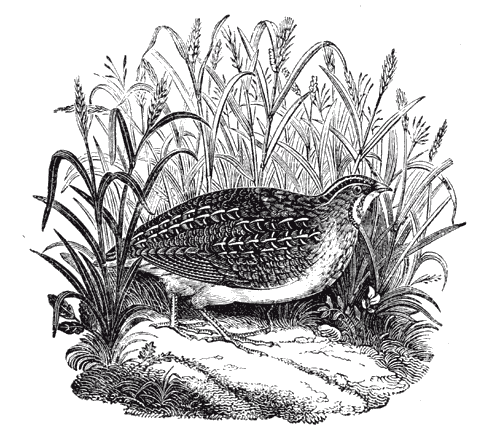
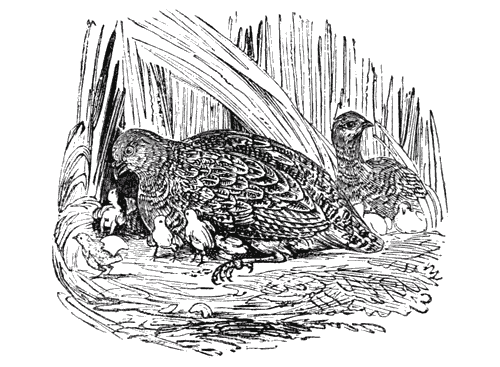
THE QUAIL.
POULTRY.
Characteristics.—These birds are characterised by the beak being raised, and the upper mandible being arched, so that the edges of it go beyond those of the under mandible. The nostrils are covered with a convex cartilaginous membrane; the tail is composed of more than twelve feathers; the toes are connected as far as the first joint. Most of the species feed on grain, which is softened in their crops. I only know of six species that can be tamed in the house.
THE COMMON PARTRIDGE.
Tetrao Perdrix, Linnæus; La Perdrix grise, Buffon; Das gemeine Rebhuhn, Bechstein.
This well known bird, which is very fleshy, and has but few feathers, measures twelve inches and a half. Its beak is bluish, the feet brownish blush red; under each eye is a naked skin of a bright scarlet colour; the general colour of the plumage is brown and ash grey, mixed with black; the forehead, a streak above the eyes, and the throat, are fine chestnut brown; the fore part of the neck and the breast are ash grey, with very fine black lines; below the breast is a deep chestnut brown streak in the shape of a horse shoe, which is not found in the female, or at least not so large nor so clearly defined; the quill-feathers are dusky, with cross bands of rust red; the tail-feathers are rust brown.
Habitation.—The common partridge is found throughout Europe, in fields and adjoining woods: when in the open country, thickets and bushes serve as a retreat during the night. In wide plains, where the frosts are severe, and the snow so deep that the game is in danger of perishing, it is customary, in winter, to catch in a net as many as possible of these birds, and keep them in a warmed room with a high ceiling. If such a room cannot be had, the top of the room and windows should be hung with cloth, to prevent the frightened birds from injuring themselves.
Food.—In the house, when permitted to range, partridges may be fed on barley and wheat. They will also eat bread, the common universal paste, cabbage, beet, and lettuce; for they like green vegetables, and these are almost indispensable to their health. In a state of liberty, they generally feed in winter on the tops of grass and young springing seeds. In the summer, they eat clover and other green plants, as well as all kinds of grain. They often roll in moist sand, which they should be allowed to do in the house.
Breeding.—The best way to domesticate the partridge, is to rear it young, in which case it becomes extremely tame, and its habits are very pleasing. These young birds must be fed at first on ants’ eggs and hens' eggs boiled hard and chopped up with salad; afterwards they will eat barley and other dry food. The covey often consists of twenty young ones, which follow the mother as soon as they are hatched, and often fall in the way of mowers, shepherds, and huntsmen. I am persuaded that it would not be difficult to render these birds quite domestic, if the eggs were hatched by our barn-door fowls, in an open, yet enclosed place, clipping the wings of the young ones, allowing them to range, during the summer, in a garden surrounded with walls, and giving them plenty of food. Supposing that this plan did not quite succeed the first summer, one would have at least half-tamed birds, which, by following the same plan, would gradually become more and more accustomed to domestic food, the society of man, and would certainly at last breed in the house, like our common fowls.
THE COMMON QUAIL.
Tetrao coturnix, Linnæus; La Caille, Buffon; Die Wachtel, Bechstein.
This species is the most common of wild poultry kept in the house. It is rather more than seven inches in length. The beak is short and horn-coloured, dusky in summer, and ash grey in winter, like the partridge’s and common fowl’l; the iris is olive brown; the feet pale bluish red; on the upper part of the body are dusky and rust-red spots, with some small white streaks; the throat is dusky, surrounded with two chestnut brown bands; the front of the neck and the breast are pale rust red, with some longitudinal dark streaks; the belly is dusky white; the thighs are reddish grey; the quill-feathers are dark grey, crossed by many rust red lines; the tail is short, dark brown, with pale rust red streaks across it.
The female differs sensibly; her throat is white, and her breast, paler than that of the male, is spotted with black like the thrush’h.
Habitation.—When wild the quail is found throughout the old world. Unlike the other species of poultry, it is a bird of passage, arriving in Europe in May, and departing the end of September. It keeps continually in corn fields, preferring those of wheat.
In the house, if allowed to range, its gentleness, neatness, and peculiar motions, are seen to advantage; but it is often kept in a cage of the following make:—A small box two feet long, one foot deep, and four high, of any shape which is preferred; in this are left two or three openings, one for drinking at, the other to give light; besides this all is dark; the bottom is a drawer, which should be covered with sand, and have a seed drawer at one end; the top is of green cloth, for as the quail often springs up it would hurt itself were it of wood. This case should be suspended during the summer outside the window, for the quail sings much more when confined in this manner than if allowed to range the room, where there are many things to call off its attention from its song123.
When a male without the female is allowed to run about the room, it is always necessary to shut it up in June (the pairing season), or else its ardent feelings tempt it to attack all the other birds, particularly those with a dark plumage, somewhat resembling its own. Larks, for example, it will follow, and pluck out their feathers till they are nearly bare.
Food.—In a wild state the quail feeds on wheat and other corn, rape-seed, millet, hemp-seed, and the like. It also eats green vegetables, as well as insects, and particularly ants’ eggs.
In the house it is fed on the same food, adding bread, barley meal mixed with milk, the universal paste, and occasionally salad or cabbage chopped up small, and, that it may want nothing to keep it in health, plenty of river sand for it to roll in and to peck up grains, which assist its digestion; but this sand must be damp, for if dry it will not touch it. It drinks a great deal, and the water, contrary to the opinion of some persons, should be clear, never turbid. It moults twice in the year, once in autumn, and again in spring; it then requires river sand, and greater attention than at other times.
Breeding.—The quail breeds very late, never before July. Its nest, if it can be called so, is a hole scratched in the earth, in which it lays from ten to fourteen bluish-white eggs, with large brown spots. These are hatched after three weeks’ incubation. The young ones, all hairy, follow the mother the moment they leave the shell. Their feathers grow quickly, for in the autumn they are able to depart with her to the southern countries. The males are so ardent, that if one is placed in a room with a female, he will pursue her immediately with extraordinary eagerness, tearing off her feathers if she resists in the least; he is less violent if he has been in the same room with her during the year. The female, in this case, lays a great many eggs, but rarely sits on them; yet if young ones are brought her from the fields, she eagerly receives them under her wings, and becomes a very affectionate mother to them. The young must be fed on eggs boiled hard and cut small, but the best way is to take the mother with the covey, which may be done with a net. She watches over them attentively, and they are more easily reared. During the first year one would think that all in the covey were females, the males resemble them so much, particularly before the brown shows itself on the throat.
Mode of Taking.—There are several different methods of taking quails, but I shall only mention the commonest and easiest. The male birds are generally caught in a net, called a quail-net, by means of a call which imitates the cry of the female in the breeding season; it is the way adopted by bird-catchers in the spring, when they wish to take a male that sings in a superior manner, that is, which repeats a dozen times following the syllables “pieveroie.” If the male has not yet met with a mate, and if he has not been rendered suspicious by some unskilful bird-catcher, he will run eagerly into the snare. The most important thing is to have a good call; they may be had cheap of turners at Nuremberg, who make them of leather, with a pipe turned from the bone of a cat or hare, or the leg of a stork; but they may easily be made by any body. The first thing necessary is a piece of calf-skin, one foot in length, and four inches in breadth, the sides must be sewed together within two inches of the end, and the bottom filled with a piece of wood an inch and a half in length, and rings composed of thick leather, the diameter of the interior opening not exceeding an inch and a half, are pushed into the sewed cylinder, and kept about a quarter of an inch apart; the whole may afterwards be pressed close together, making the rings touch each other; then a tube made of the bone of a goose or hare, and filled at the end like a common whistle, is fastened to the part of the cylinder left unsewed; the interior is then stopped with wax near the notch on the side of the leather, and a hole pierced through it with a knitting-needle; the upper part of the tube must also be stopped with wax, and lastly, the lower part, which is thus become a kind of whistle, is very firmly tied to the unsewn part of the cylinder. When the call is to be used, the lower end must be held firmly in one hand, and the leather cylinder worked up and down with the other, making the rings approach and separate, which produces the notes of the female, “peuk, peuk, pupu.”
As soon as the male quail is heard that you wish to procure, you must advance softly to within fifty paces of his station, and place the tray amongst the wheat in such a position as will suffer it to fall level with the ground, to prevent the bird’s passing under and escaping. Then retire a few steps back, when the quail will soon utter its song, to which reply with two or three notes, that when the quail is silent he may only hear one or two, from the call exactly resembling the cry of the female. If this is not done with care, the bird will suspect treachery, and will either retire or remain silent, and never after fall into such a snare; but if skilfully done, it is surprising to see how the bird proceeds directly to the call: if by chance he miss the trap, he will go so near as to be within reach of the hand; in this case it is best to retire softly to the other side of the trap and repeat the call, which will again attract it. There are some quails that know how to avoid the net, particularly if placed in too open and exposed a place. In this case it is safest to turn it in a corner at both ends, and thus when it tries to turn it becomes entangled.
It is proper to notice, that in damp weather, or when it rains, the quail does not run, but flies immediately towards the call. It does this also in dewy mornings and evenings; dry days should therefore be chosen for this chase. In the pairing season, two, three, or even four quails may be taken at the same place.
If no male is heard in the field, the call of the female must be well imitated on a larger and more powerful bird-call, and, if any males are within hearing, they will not fail to answer; the person must then advance quickly, placing the net so as to stop their road, and repeat the call.
When a female is to be caught, it is best to employ a common net, such as is used to take quails in autumn; but this chase should be deferred till towards the end of harvest, when most of the corn is cut, and only a few pieces left standing, which serve to harbour numbers of these birds. Several nets are used at once, as many as six or eight; some of them are placed across the field of corn, and the others parallel to them at the extremity of the same field: this being done, the party go to the opposite side and begin to drive the quails into the nets in the middle of the field by means of a packthread stretched across the corn, having little bells suspended to it by threads, so as almost to touch the ground, two persons holding it, and as they advance shaking it from time to time. As soon as the prisoners are secured, the march is continued towards the nets at the end of the field; and in this manner great numbers of quails, both male and female, are procured either for the house or for the table.
Attractive Qualities.—Besides beauty of form and plumage, the song of this bird is no slight recommendation to the amateur. In the breeding season, that of the male commences by repeating softly, tones resembling “verra, verra,” followed by the word “pieveroie,” uttered in a bold tone, with the neck raised, the eyes shut, and the head inclined on one side. Those that repeat the last syllables ten or twelve times consecutively, are the most esteemed. That of the female only consists of “verra, verra,” “pupu, pupu,” the two last syllables being those by which the male and the female attract each other’s attention; when alarmed or angry their cry resembles “guillah!” but at other times it is only a murmur, resembling the purring of a cat.
The quail never sings when left to run about in a light room, except during the night, but continually when in a darkened cage. Those reared from the nest begin to sing the end of December, and continue till September; whilst those taken full grown rarely commence till the beginning of May, and cease in August.
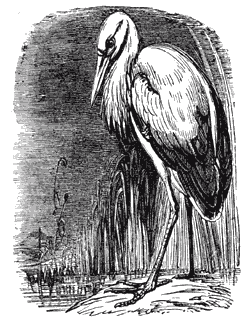
THE STORK.
WADING BIRDS.
The birds of this order are more or less bare above the knees; their legs are so long, that they have the appearance of standing on stilts. They may be tamed at any age, but this is best done when they are young. I shall only give here the following species.
THE WHITE STORK.
Ciconia alba, Linnæus; La Cicogne blanche, Buffon; Der Weisse Storch, Bechstein.
The stork may be considered as half domestic, since it constantly builds on the tops of houses, on churches or towers in the midst of villages, and even towns124. Its beak is long and
powerful, of a blood red colour, as are its legs and feet. It has a naked black ring round its eyes; the wings are black; the rest of the plumage white.
Observations.—It is a bird of passage, which quits Europe the end of September, and returns in April. It feeds on fish, amphibious animals, field-mice, moles, and even weasels, which it catches coming out of their holes. It also eats insects, especially bees, which it catches by the beakfull on flowers. Its nest is only a heap of dry sticks woven together, and it occupies the same nest every year, after repairing it a little. I have been assured, that some nests have lasted a hundred years; and the circumference often becomes covered with sparrows and swallows’ nests. The male and female never separate, and are a true model of conjugal fidelity. If the young ones are taken from the nest, and fed on frogs and meat, they may be rendered so tame that they will go a league from the house, and return again regularly. At the time of their flight, in September, the wings of those that are to be kept through the winter should be clipped, and they should be kept in a temperate place, as their feet are very sensible to cold. They become so familiar that they will enter the room during meals, to be fed on meat from the table. A clapping with their beak expresses either anger or affection. It is very pleasing to see a tame stork circling round the house, and descending insensibly in a long spiral line till it reaches the ground.
THE BLACK STORK.
Ardea nigra, Linnæus; Der schwarze Storch, Bechstein.
This species is nearly as large as the white stork, and is of the same form, but its limbs are weaker and more delicate. Its colour is a glossy brownish black, with the breast and belly white. It frequents woods in the neighbourhood of marshes, lakes, and large ponds, and makes its nest on the trees. Its habits and manner of feeding are similar to those of the white stork. In rearing the young ones, they may be accustomed to remain in the house, and will soon become familiar.
THE WOODCOCK.
Scolopax rusticola, Linnæus; La Bécasse, Buffon; Die Waldschnepfe, Bechstein.
The woodcock is found in every part of Europe where there are forests. The beak is three or four inches in length, straight, and reddish at the base; the back of the head is crossed with dusky bands; the upper part of the body and wings are rust brown, streaked with grey and black; the breast and belly are dusky white, with dark brown lines.
Observations.—The woodcock builds its nest on the ground in mountainous districts; lays three or four dusky pale yellow eggs, and feeds on worms, snails, and the grubs of insects, which it seeks in meadows, marshes, and fields. In October it quits the high lands for more temperate parts; this migration is called its passage, and as these birds constantly follow the same route, this is the time when fowlers, scattered in its destined path, prepare for a chase, either with guns or large nets made for the purpose, and await the moment when these birds quit the meadows for the woods, or the woods for the meadows. The flight of woodcocks is slow and awkward, but they are very fine game, the flesh being wholesome and of an excellent flavour; they are generally cooked without taking out the intestines.
In the house, by beginning with insects and ants’ eggs, the woodcock may be accustomed by degrees to the universal paste. Twenty years ago I saw, in an aviary at Carlsruhe, a tame woodcock that would come from his cage and show himself to strangers; it was a male, and appeared very willing to pair, if it could have found a mate.
THE COMMON SNIPE.
Scolopax Gallinago, Linnæus; La Bécassine, Buffon; Die Heerschnepfe, Bechstein.
This Snipe is nearly the size of the quail, and inhabits the northern countries of Europe, Asia, and America, migrating in autumn to more temperate parts. Its rough beak is black in the front; its feet are brown; the head is divided longitudinally by two reddish brown lines; the back is dark brown, with streaks across; the throat is white; the neck is brown, speckled with brick red; the belly is white; the vent is striped with black; the quill-feathers are dark brown, tipped with white; the tail-feathers are black from the base, tipped with orange, and having two dark brown streaks.
Observations.—The snipe darts through the air at a great height, and descends like an arrow, continually uttering the cry “maicherai.” It is found in marshy places, abounding with bushes and brambles; in a hole in the ground, washed by the water, it lays four or five dusky olive-coloured eggs, streaked with brown. Its common food is worms, and the grubs of insects, but it will eat corn, and the tender roots of marsh plants. Every one knows that it is delicate eating; but many are ignorant that it may be tamed, and that it is then a very pleasing bird.
THE LAPWING.
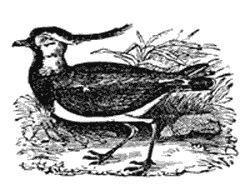
THE LAPWING.
Tringa Vanellus, Linnæus; Le Vanneu, Buffon; Der gemeine Kiebetz, Bechstein.
This bird is well known throughout Europe wherever there are water meadows. It is greenish on the back and wings; black on the breast; and has red feet, and a handsome crest.
Observations.—It feeds on all sorts of insects, small snails, worms, and even plants. The young ones are easily tamed. They are first fed on ants’ eggs, and then gradually accustomed to bread, and even bran mixed with milk. The eggs may be placed under pigeons, but care is necessary when they are hatched, as they run the moment they leave the shell. The old birds may be kept in the garden if the wings are clipped, where they destroy the insects and worms; but they must be brought into the house in the winter, and fed at first on bullocks’ heart cut in the form of worms, then with less care, till by degrees they become accustomed to other meat, and even to bread. As these birds are much esteemed game, snares are laid for them in places they frequent in large flocks. They are either taken in nets, throwing worms as baits, or with nooses made of horse hair, and set in the paths they trace in the rushes, or, which is cruel and destructive, in the neighbourhood of their nests.
THE RUFF.
Tringa pugnax, Linnæus; Le Combattant, ou Paon de Mer, Buffon; Die Kampfhahn, Bechstein.
The ruff is about the size of the lapwing, and is found in the north of Europe, near lakes, ponds, and extensive marshes. It is almost the only wild bird whose plumage varies like our domesticated ones, ash-grey, brown, black, and white, being combined in a thousand different ways, so that it is rare to meet with two birds alike. The following are the characteristics of the species:—1st, a kind of ruff or collar, formed of long feathers hanging around the neck, which are raised when the bird is angry, and stand out on all sides; 2nd, the face red, and covered with pimples; the beak and feet also red.
The colours of the females are more uniform:—pale brown, the back streaked with black, the breast and belly white, and the neck plain without the ruff.
It feeds on insects, worms, and roots, and makes its nest in a tuft of grass or rushes. The females are tolerably good for the table, but the male must be fattened before it is eatable. The irritable and quarrelsome disposition of these birds is astonishing. When two males meet they are often so enraged with each other that a net may be passed over them without their perceiving it. If several are placed in the same cage, they will kill one another. The young ones may easily be reared; but it is extraordinary, that in the house, their inclination to fight abandons them; whilst most other birds, pacific in a state of freedom, are continually quarrelling and pecking one another when confined. It is customary in the duchy of Bremen to put these birds into enclosed gardens to destroy worms and other insects, but they retire into the house for the winter; and here the old ones still quarrel both for food and the place they wish to lie down in. They are fed on bread soaked in milk, and meat.
THE PURR.
Tringa Cinclus, Linnæus; L’Llouette de Mer, Buffon; Der Meerlerche, Bechstein.
This is a marsh bird, about the size of the redwing, and is very common on the banks of rivers, lakes, and large ponds. When it rises in the air it cries continually “tzi, tzi, tzi, tzi.” Its beak is black, and its feet dark brownish green; the feathers on the upper part of the body are grey, glossy, and silky, with blackish bands notched on the sides, and bordered on the outer edge with rust red; a whitish streak passes above the eyes, whilst a narrow dark brown line crosses them; the under part of the body is pure white, but the breast is striped with dark brown; the quill-feathers are black, the anterior having a broad white streak on the inner web, the others having the same on the outer web; the greater coverts are tipped with white, which form two spots on the wings; the three middle feathers of the tail are grey brown with black bands; the others are white, with dark brown bands.
The female is rather larger, and her plumage is paler.
Observations.—It is easy to obtain this bird, which has many attractions for the amateur. It runs quickly, continually shaking the back part of its body, and repeating, particularly towards evening, its loud and tender call, “hidutzt.”
When wild it eats insects and worms, found near the water. In the house it will soon eat the universal paste, if a few meal-worms and ants' eggs are at first thrown amongst it. If there are other birds in the same room, the water vessel should be removed from the food, or another vessel devoted to it, for not being able to swallow what is not soft, it carries all its food to the water to soak, and thus renders it dirty. It catches insects very dexterously; it advances slowly like a cat, its head bent down, and then darts forward swiftly and slyly. I admire their habits so much that I have one generally in my house. I have observed that all the species of snipes have the habit of turning over any stones they meet with, to look for insects under. It is very easy to take the purr as soon as the stakes, sticks, and other places where they most commonly alight, are known; it is only to put bird-lime on them and drive the birds gently towards the part. This and the corn crake are the only two marsh birds that should properly be reckoned among house-birds.
THE MOOR HEN.
Fulica enloropus, Linnæus; La Poule d’dau, Buffon; Die grünfüssiges Meehuhn, Bechstein.
The length of this species is ten or twelve inches. The beak is greenish at the tip, red towards the base; the naked spaces above the knees are of the same colour; the feet are olive green; the claws are very long; the head, the upper part of the neck, the body, and the wing-coverts are dark olive green; the anterior quill-feathers and the tail are dark brown; the breast and belly are ash-grey; the vent and edges of the wings are white.
In the female the beak is olive brown towards the base, instead of red.
Observations.—Though not web-footed, this species swims as well as those birds that are, and has this advantage over them, that it can rest on trees and bushes by the water side, like land birds, and can also run when inclined. Its nest is placed among bushes that are in the water, or on reeds, and is built of water plants, especially reeds well interwoven; it is so firmly fastened, that if the water rises it floats, but is not carried away; the eggs are often surrounded with water. It feeds on insects, seeds, and aquatic plants. It is easily tamed, particularly when taken young; it likes white bread soaked in milk. I often have these birds in my poultry-yard among my fowls; they go to a neighbouring pond, and regularly return after a short time. I never took any trouble to tame them; they always kept near the water, by the dunghill, seeking after insects and grubs.
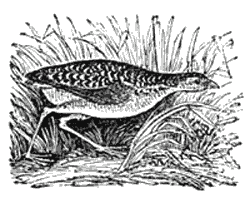
THE CORN CRAKE.
Rallus Crex, Linnæus; Le Rale de Cenet, ou Roi de Cailles, Buffon; Der Wachtelkönig, Bechstein.
The corn crake being always found with quails in proportionate numbers, departing with them in autumn, and returning at the same time in spring, no doubt deserves the name Buffon has given it of King of the Quails. It is ten inches in length. The beak is flattish, greyish brown above, and bluish red beneath; the feet are lead grey; the feathers of the head, of the back of the neck, of the back, and even of the tail, are black, edged with reddish grey; which gives them the appearance of being streaked; a grey ash-coloured streak passes above the eyes, another below them; the wing-coverts and anterior quill-feathers are chestnut brown; the front of the neck and the breast are dusky ash-grey; the belly is white, but the sides and vent are dark brown, spotted with rusty brown and white.
The breast of the female is pale grey, and the streaks near her eyes greyish white.
Observations.—The male is often heard uttering his kind of croaking notes, “arrp, schnarrp,” in the meadows and fields, in the evening and at night; but is rarely seen to fly. It feeds on insects and grain, for which bread soaked in milk may be substituted, when it is in the house. The female lays from eight to twelve greenish grey eggs, streaked with pale brown, on the bare ground; the young ones, when hatched, are covered with a kind of black down, the feathers of varied colours do not appear for three weeks. The hen sits with so much constancy, that she will often perish by the sithe rather than quit her eggs. The young, like the young quails, run under the oat sheaves, and may easily be caught there by the hand.
The agility of these birds, and their pleasing habits, render them much admired in the house; they chirp very much like chickens. I confess I like very much to hear the “arrp, schnarrp” of the male in the evening near me.
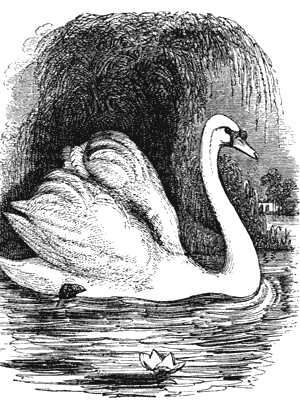
THE SWAN.
WEB-FOOTED BIRDS.
The birds arranged in this order are also known, under the name of aquatic birds. They are distinguished by their feet, the toes being united by a broad membrane, which assists them in swimming. Several live uniformly on the water, others in companies on the water and on the land. There are many that may be tamed, but I shall only speak of those that are able to live without being on the water. The number is thus confined to six species, easily tamed at any age.
THE SWAN.
Anas Olor, Linnæus; Le gigne, Buffon; Der Schwan, Bechstein.
Instead of the common name of tame swan, I prefer that of mute swan, in order to distinguish this from the whistling, also called the wild swan, but improperly, for in Russia it is more common to have that tamed than the one under notice. This, however, is found wild throughout most parts of Europe, and in great numbers in Siberia. In Germany, when a person wishes to have one on a piece of water, and to keep it there constantly, he chooses some young ones, and breaks or cuts the first bone in the wing, to disable them from flying, and consequently prevent their departing in the autumn with their wild companions.
The swan is larger than a domestic goose, it is four feet and a half in length, on account of its long neck, which it bends in the form of an S when it is swimming; it measures seven feet and a quarter from tip to tip of the wings, and weighs from twenty-five to thirty pounds. The beak is dark red, having at the base a large black callous knob, and at the tip something resembling the head of a nail, black, and rather bent; a bare black triangular streak extends from the beak to the eyes; the feet are black the first year, lead grey the second, and reddish lead grey at last; the plumage is a snowy white.
Observations.—The story of its melodious death-song is now quite exploded; the organisation of its windpipe permits only a slight hiss, a dull murmur, and a gentle croaking. Song, properly so called, belongs exclusively to the whistling swan; a poet may have heard it once, and without observing the difference between the birds, have attributed it to the common swan. The latter feeds on insects and aquatic plants; during the winter corn should be given it, and it must be kept in a temperate place. The female forms a large nest, of the stalks of rushes, reeds, and other plants, and lines it with feathers from her breast. She lays six or eight greenish white eggs, and sits on them five weeks. During this time, the male is always near her, driving away and pursuing all that would approach. He has such strength of wing, that a well-aimed blow of it would break a man’s leg. The young ones are at first grey. It is said that swans will live a hundred years. Their utility as well as their beauty would merit more attention than is commonly paid to their education, which is easier than that of geese. Lithuania, Poland, and eastern Prussia, send several quintals every year to the fair of Frankfort upon Oder. Many tame swans are also collected on the Sprey, round Berlin, Spandau, and Potsdam; particularly in May, to rob them of their down. The skins with the down on them are prepared for pelisses; powder puffs are also made of it.
THE SHELDRAKE.
Anas Tadorna, Linnæus; Le Tadorne, Buffon; Der Bruntente, Bechstein.
This species measures two feet from the tip of the beak to the extremity of the tail; the beak is smooth, flattish, and of a scarlet colour; a fleshy knob covers the upper base; the nostrils and nail at the end of the beak are black; the feet are bluish red; the head and upper part of the neck are duck green; the rest of the neck and belly are white; a wide orange brown band crosses the breast; the back, with the wing-coverts, is white; the scapulars are speckled with black; the first quill-feathers are black, the following violet, the middle ones rusty brown, and the last white; the speculum is green, reflecting a beautiful violet; the feathers of the tail are white, tipped with black.
Observations.—This species, found in the north of Europe and Asia, hollows out the sand by the sea-shore, or uses a forsaken rabbit’s hole, or some cavity in a rock, to form its nest in. The beauty of its plumage has attracted the attention of amateurs, who tame it, and keep it in the poultry-yard; but it is not useful, its flesh having an unpleasant smell and flavour. It feeds with the other ducks, and becomes very familiar; it ever appears intelligent.
THE WILD GOOSE.
Anas anser ferus, Linnæus; L’Lie sauvage, Buffon; Der wilde Gans, Bechstein.
This is the parent stock of our domestic goose, and though smaller, it has a longer neck and larger wings. The upper part of the body is brownish grey, the under part is greyish white; the breast is clouded with rusty brown; the beak is orange and black; the feet are red. Several domestic geese preserve this original plumage, even to the colours of the beak.
Observations.—This species frequents the shores of the North Sea during the summer; but in autumn departs in large flights disposed in a triangular form, and passes the winter in more southern countries, feeding on the blades of newly-sprung rye.
There are places in Thuringia where thousands of these birds collect in winter; they are very distrustful, placing sentinels as soon as they alight, which are so watchful, that it is very difficult to take or shoot them. If by chance the wing of one of these geese is shot, it may easily be kept in the yard with poultry; they are also taken in snares laid in places frequented by them during the night; they associate without difficulty with the domestic geese; but I only know one instance of a wild male pairing with a domesticated female.
THE SCAUP DUCK.
Anas marila, Linnæus; Le Milloninan, Buffon; Der Bergente, Bechstein.
This species, like the former, passes in autumn from the north to the south. They are caught and shot among the common wild ducks. The scaup duck may be tamed so far as to remain sociably among the domestic ones, will eat bread soaked in water, oats, and barley; in short, all that is given to common ducks. Its size also is similar, but it is black, with the belly and speculum white; five black transverse lines unite on the white ground of the upper part of the body; the wings and tail are dusky.
THE MALLARD.
Anas Boschas fera, Linnæus; Le Canoel sauvage, Buffon; Der wilde Ente Bechstein.
Our domestic ducks derive their origin from this species. It is spread throughout Europe on lakes, ponds, and rivers. Its length is two feet; its plumage ash grey, striped and waved transversely with white and brown; the head and neck are bright green, known by the name of duck-green; the breast is chestnut brown; the speculum violet green. The female is brown, like a lark.
Observations.—Like other birds of the same order, the wild ducks unite in large flights in the autumn, but divide into pairs in summer, and build their nests either near the water, among the reeds and bushes, in the trunks of old trees, or sometimes even in the depths of woods. They lay from twelve to sixteen eggs. In the forest districts of Thuringia, the young ones are met with in considerable numbers, being led to a neighbouring pond by the parent birds. If, after having mutilated or lamed the end of the wing, they are put into a pond with domestic ducks, they live and pair with them, become accustomed to their mode of life, follow them in winter into the house, without any decoy but being fed plentifully. Wild ducks are taken in nets, snares, and even with fishing-hooks.
By pairing a mallard with a female domestic duck, a very fine middle race is obtained, which remains domestic125.
THE TARROCK.
Larus tridactylus, Linnæus; Larus rissa, cinereus et nævius, Linnæus; La Monette cendrée, Buffon; Der Wintermeeve, Bechstein.
These birds, about fourteen inches in length, change their plumage till they are four years old, which occasions great variety. In the old ones, the beak is yellowish green on the outside, and orange within; the feet are olive, and are without the back toe; the head, throat, neck, the rest of the upper part of the body, and the tail, are white. There is often a blackish streak behind the ear; the back and wing-coverts are pale grey or bluish; the quill-feathers are white; the primaries are tipped with black; those that have a dark grey crescent on the neck have not attained their fourth year; those streaked are young ones.
Observations.—The tarrocks remain in the north of Europe during summer, and go south in winter. In February, when snow comes after mild weather, great numbers are seen to stop on the ponds and rivers in Germany, where many perish; they may then be taken with nets and snares placed on the banks, after removing the snow. Though their proper food is fish and aquatic insects, they are contented, in the poultry-yard, with bread and other food; are easily tamed, and live equally well on the water or the land; in winter, they should be kept in a moderately warm situation; they may even be left in the court, driving them in the evening into the place appropriated to them for the night.
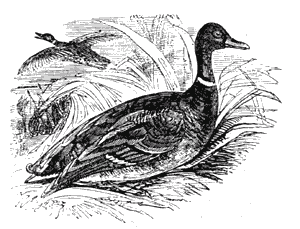
FOOTNOTES:
INDEX.
A.
Accentor modularis, Bechstein, 228
Alauda alpestris, Linnæus, 184
Alauda arborea, Linnæus, 179
Alauda arvensis, Linnæus, 174
Alauda Calandra, Linnæus, 185
Alauda cristata, Linnæus, 178
Alcedo Ispida, Linnæus, 83
Amandava, 104
Ampelis garrulus, Linnæus, 188
Anthus arboreus, Bechstein, 182
Anthus campestris, Bechstein, 184
Arbour Bird, 255
B.
Babillard, 247
Blackbird, 198
Blackbird (Ring), 200
Blackbonnet, 121
Blackcap, 222
Black Stork, 296
Blue-Breast, 233
Bohemian Chatterer, 188
Bullfinch, 92
Bunting (Corn), 116
Bunting (Dominican), 125
Bunting (Foolish), 120
Bunting (Mountain), 114
Bunting (Painted), 127
Bunting (Reed), 121
Bunting (Shaft-tailed), 125
Bunting (Snow), 112
Bunting (Sparrow), 123
Bunting (Whidah), 124
Butcher-bird (Great), 31
C.
Calandra Lark, 185
Canary, 158
Carrion Crow, 39
Ceram Lory, 73
Chaffinch, 128
Chiff-Chaff (Common), 258
Chiff-Chaff (Rufous), 261
Cinclus aquaticus, Bechstein, 190
Cirl-Bunting, Latham, 119
Cockatoo (Banksian), 70
Cockatoo (Great red-crested), 69
Cockatoo (Great White), 68
Cockatoo (Lesser White), 69
Cockatoo (Red-vented), 70
Columba Palumbus, Linnæus, 285
Columba risoria, Linnæus, 287
Columba Turtur, Linnæus, 286
Common Partridge, 290
Common Quail, 291
Common Snipe, 297
Coracias garrula, Linnæus, 44
Corn Crake, 300
Corvus Caryocatactes, Linnæus, 42
Corvus Corax, Linnæus, 37
Corvus Cornix, Linnæus, 39
Corvus Corone, Linnæus, 39
Corvus frugilegus, Linnæus, 39
Corvus glandarius, Linnæus, 40
Corvus Monedula, Linnæus, 40
Corvus Pica, Linnæus, 43
Crossbill, 89
Cuckoo, 51
Cuculus canorus, Linnæus, 51
Cuculus Persa, Linnæus, 82
Curruca garrula, Brisson, 249
Cushat, 285
D.
Dipper, 190
Doves, 284
Dominican, 106
Dunncock, 228
E.
Emberiza Cia, Linnæus, 120
Emberiza Ciris, Linnæus, 127
Emberiza Cirlus, Linnæus, 119
Emberiza citrinella, Linnæus, 114
Emberiza cyanea, Linnæus, 126
Emberiza Elœathorax, 119
Emberiza hortulana, Linnæus, 117
Emberiza miliaria, Linnæus, 116
Emberiza montana, Linnæus, 114
Emberiza nivalis, Linnæus, 112
Emberiza paradisea, Linnæus, 124
Emberiza passerina, Linnæus, 123
Emberiza regia, Linnæus, 125
Emberiza Schœniclus, Linnæus, 121, 267
Emberiza serena, Linnæus, 125
F.
Falco tinnunculus, Linnæus, 27
Fauvette, 225
Fieldfare, 195
Finch (Angola), 172
Finch (Banded), 110
Finch (Blue), 108
Finch (Blue-bellied), 171
Finch (Brazilian), 171
Finch (Brown-cheeked), 111
Finch (Caffrarian), 108
Finch (Cape), 107
Finch (Citril), 156
Finch (Glossy), 169
Finch (Lapland), 156
Finch (Liver-brown), 172
Finch (Malacca), 111
Finch (Mountain), 136
Finch (Purple), 169
Finch (Snow), 157
Flusher, 35
Fringilla amandava, Linnæus, 104
Fringilla Angolensis, Linnæus, 172
Fringilla Bengalus, Linnæus, 171
Fringilla Canaria, Linnæus, 158
Fringilla cannabina, Linnæus, 140
Fringilla Carduelis, Linnæus, 146
Fringilla citrinella, Linnæus, 156
Fringilla Cœlebs, Linnæus, 128
Fringilla cyanea, Wilson, 126
Fringilla Granatina, Linnæus, 171
Fringilla hepatica, Linnæus, 172
Fringilla Laponica, 156
Fringilla Linaria, Linnæus, 144
Fringilla Linota, Linnæus, 140
Fringilla Melba, Linnæus, 173
Fringilla montana, Linnæus, 140
Fringilla montifringilla, Linnæus, 136
Fringilla nitens, Linnæus, 169
Fringilla nivalis, Linnæus, 157
Fringilla petronia, Linnæus, 153
Fringilla purpurea, Linnæus, 169
Fringilla serinus, Linnæus, 154
Fringilla Spinus, Linnæus, 151
Fringilla tristis, Linnæus, 170
G.
Golden Oriole, 46
Goldfinch, 146
Goldfinch (American), 170
Goldfinch (Green), 173
Gowry Bird, 110
Graecula religiosa, Linnæus, 52
Grakle (Minor), 52
Grasshopper Bird, 265
Green Bird, 97
Grenadier, 106
Grosbeak (Cardinal), 102
Grosbeak (Paradise), 105
Grosbeak (Pine), 99
Grosbeak (Yellow-bellied), 109
Guinea-Sparrow, 64
H.
Hawfinch, 100
Hay-Bird, 262
Hooded Crow, 39
Hoopoe, 48
I & J.
Indigo Bird, 126
Jackdaw, 40
Jay, 40
K.
Kestril, 27
Kingfisher (Common), 83
L.
Lanius erythrocephalus, Linnæus, 34
Lanius Excubitor, Linnæus, 31
Lanius minor, Linnæus, 32
Lanius spinitorquus, Bechstein, 35
Lapwing, 297
Large-beaked Birds, 54
Lark (Crested), 178
Lark (Shore), 184
Lark (Sky), 174
Lark (Wood), 179
Linnet (Common), 140
Little Owl, 29
Little Shrike, 32
Locustella avicula, Ray, 265
Lory (Black-capped), 74
Lory (Blue-capped), 73
Loxia Astrild, Linnæus, 103
Loxia Caffra, Linnæus, 108
Loxia canora, Linnæus, 111
Loxia Capensis, Linnæus, 107
Loxia Cardinalis, Linnæus, 102
Loxia Chloris, Linnæus, 97
Loxia coccothraustes, Linnæus, 100
Loxia cærulea, Linnæus, 108
Loxia curvirostra, Linnæus, 89
Loxia Dominicana, Linnæus, 106
Loxia Enuclator, Linnæus, 99
Loxia erythrocephala, Linnæus, 105
Loxia fasciata, Linnæus, 110
Loxia flaviventris, Linnæus, 109
Loxia Malacca, Linnæus, 111
Loxia orix, Linnæus, 106
Loxia orycivora, Linnæus, 102
Loxia punctularia, Linnæus, 110
Loxia pyrrhula, Linnæus, 92
Loxia sanguinirostris, Linnæus, 105
M.
Maccaw (Blue and Yellow), 57
Magpie, 43
Mallard, 305
Moor Hen, 300
Motacilla alba, Linnæus, 235
Motacilla Boarula, Linnæus, 237
Motacilla dumetorum, Linnæus, 247
Motacilla flava, Linnæus, 238
Motacilla Fruticeti, Linnæus, 227
Motacilla Luscinia, Linnæus, 206
Motacilla Luscinia major, Linnæus, 220
Motacilla Œnanthe, Linnæus, 239
Motacilla Phœnicurus, Linnæus, 252
Motacilla Regulus, Linnæus, 270
Motacilla rubecula, Linnæus, 230
Motacilla Rubetra, Linnæus, 241
Motacilla Suecica, Linnæus, 233
Motacilla Tithys, Linnæus, 250
Motacilla Troglodytes, Linnæus, 269
N.
Nightingale, 206
Nightingale (Greater), 220
Nut-Cracker, 42
Nuthatch, 85
O.
Oriolus Galbula, Linnæus, 46
Ortolan, 117
Oxeye, 274
P.
Parrakeet (Blossom-headed), Latham, 62
Parrakeet (blue and green), 66
Parrakeet (Borneo), 63
Parrakeet (green, long-tailed), 58
Parrakeet (red and blue headed), 67
Parrakeet (red-crescented), 67
Parrakeet (red-headed Guinea), 63
Parrakeet (rose-headed ring), 62
Parrakeet (rose-ringed), 64
Parrot (Amboina), 59
Parrot (ash-coloured), 71
Parrot (blue-faced), 75
Parrot (blue-headed), 59
Parrot (Cardinal), 62
Parrot (Carolina), 65
Parrot (Common Amazon), 75
Parrot (grey-breasted), 66
Parrot (Illinois), 57
Parrot (Pavouan), 64
Parrot (purple), 60
Parrot (whiskered), 61
Parrot (white-fronted), 74
Parrot (yellow-headed Amazon), 76
Parrot (yellow), 59
Parus ater, Linnæus, 277
Parus biarmicus, Linnæus, 282
Parus cæruleus, Linnæus, 278
Parus cristatus, Linnæus, 281
Parus major, Linnæus, 274
Parus palustris, Linnæus, 280
Passer domestica, Ray, 137
Passer montana, Ray, 139
Passerine Birds, 88
Picus major, Linnæus, 79
Picus medius, Linnæus, 80
Picus minor, Linnæus, 80
Picus viridis, Linnæus, 78
Pies, 31
Pipit (Field), 184
Psittacus æstivus, Linnæus, 75
Psittacus Amboinensis, Linnæus, 59
Psittacus autumnalis, Linnæus, 75
Psittacus Ararauna, Linnæus, 57
Psittacus Banksii, Linnæus, 70
Psittacus bimaculatus, Sparrmann, 61
Psittacus canicularis, Linnæus, 67
Psittacus Carolinensis, Linnæus, 65
Psittacus cristatus, Linnæus, 68
Psittacus cyanocephalus, Linnæus, 59
Psittacus domicilla, Linnæus, 73
Psittacus erithacus, Linnæus, 71
Psittacus erythrocephalus Bengalensis, Linnæus, 62
Psittacus erythrocephalus Borneus, Linnæus, 63
Psittacus erythrocephalus, Linnæus, 62
Psittacus garrulus, Linnæus, 73
Psittacus garrulus Auroræ, Linnæus, 59
Psittacus Guianensis, Linnæus, 64
Psittacus leucocephalus, Linnæus, 74
Psittacus Lory, Linnæus, 74
Psittacus Ludovicianus, Linnæus, 65
Psittacus lunatus, Bechstein, 67
Psittacus Macao, Linnæus, 54
Psittacus Manillensis, Bechstein, 63
Psittacus Moluccensis, Linnæus, 69
Psittacus murinus, Linnæus, 66
Psittacus nobilis, Linnæus, 76
Psittacus ochrocephalus, Gmelin, 76
Psittacus passerinus, Linnæus, 66
Psittacus Pennanti, Latham, 60
Psittacus pertinax, Linnæus, 57
Psittacus Philippinarum, Linnæus, 70
Psittacus pullarius, Linnæus, 64
Psittacus rufirostris, Linnæus, 58
Psittacus solstitialis, Linnæus, 59
Psittacus sulphureus, Linnæus, 69
Purr, 299
R.
Ramphastos picatus, Linnæus, 77
Ramphastos piscivorus, Linnæus, 77
Ramphastos Tucanus, Linnæus, 76
Raven, 37
Red and Blue Maccaw, 55
Redbill, 105
Red-Breast, 230
Redpole (Lesser), 144
Redstart (Black), 250
Redstart (Common), 252
Redwing, 196
Reed Bird, 282
Reed Warbler, 266
Ring Dove, 285
Ring Parrakeet (Rose-headed), Latham, 62
Roller, 44
Rose Ouzel, 197
Ruff, 298
S.
Scaup Duck, 305
Sedge Bird, 268
Serin-finch, 154
Sheldrake, 304
Siskin, 151
Sitta Europœa, Linnæus, 85
Sparrow (House), 137
Sparrow (Java), 102
Sparrow (Ring), 153
Sparrow (Tree), 139
Starling, 186
Strix passerina, Linnæus, 29
Sturnus collaris, Linnæus, 273
Sturnus vulgaris, Linnæus, 186
Swan, 303
Sylvia arundinacea, Latham, 266
Sylvia atricapilla, Bechstein, 222
Sylvia cinerea, Bechstein, 244
Sylvia Curruca, Bechstein, 247
Sylvia Fitis, Bechstein, 262
Sylvia Hippolais, Montagu, 258 Bechstein, 255
Sylvia hortensis, Latham, 225
Sylvia icterina, Vieillot, 258
Sylvia Locustella, Latham, 265
Sylvia Loquax, Herbert, 258
Sylvia Phragmitis, Bechstein, 268
Sylvia polyglotta, Ranzani, 255
Sylvia rufa, Bechstein, 261
Sylvia salicaria, Latham, 268
Sylvia sibilatrix, Bechstein, 263
Sylvia Trochilus, Latham, 262, 263
T.
Tarrock, 306
Thrush (Blue), 204
Thrush (Missel), 191
Thrush (Reed), 204
Thrush (Rock), 201
Thrush (Solitary), 203
Thrush (Song), 193
Tit (Bearded), 282
Tit (Blue), 278
Tit (Cole), 277
Tit (Crested), 281
Tit (Greater), 274
Titlark, 182
Tit (Marsh), 280
Tom Tit, 278
Tourako, 82
Tucan (Brazilian), 77
Tucan (Preacher), 77
Tucan (Yellow-breasted), 76
Turdus arundinaceus, Linnæus, 204, 207
Turdus cyaneus, Linnæus, 204
Turdus Iliacus, Linnæus, 196
Turdus merula, Linnæus, 198
Turdus musicus, Linnæus, 193
Turdus pilaris, Linnæus, 195
Turdus roseus, Linnæus, 197
Turdus saxatilis, Linnæus, 201
Turdus solitarius, Linnæus, 203
Turdus torquatus, Linnæus, 200
Turdus viscivorus, Linnæus, 191
Turtle (Collared), 287
Turtle Dove, 286
U.
Upupa Epops, Linnæus, 48
W.
Wagtail (Common), 235
Wagtail (Grey), 237
Wagtail (Yellow), 238
Warbler (Alpine), 273
Warblers, 174
Waxbill, 103
Wheatear, 239
Whinchat, 241
Whitebreast, 227
White-throat, 244
White Stork, 295
Wild Goose, 304
Woodchat, 34
Woodcock, 296
Woodpecker (Greater-spotted), 79
Woodpecker (Green), 78
Woodpecker (Lesser spotted), 80
Woodpecker (Middle spotted), 80
Woodpeckers, 78
Wren, 269
Wren (Gold-crested), 270
Wren (Willow), 262
Wren (Wood), 263
Wryneck, 81
Y.
Yellowhammer, 114
Yunx torquilla, Linnæus, 81
THE END.
Crown 8vo, elegantly bound, gilt edges, Illustrated with 12 beautifully Coloured Engravings, price 3s. 6d., post free.
THE CANARY
Its VARIETIES, MANAGEMENT, and BREEDING;
With Portraits of the Author’s own Birds.
By the REV. FRANCIS SMITH
Contains descriptions of all the Different Varieties of this popular Household Favourite, Illustrated with Coloured Portraits of Birds in the possession of the Author. With this book every care has been taken to produce the most Complete Manual; while the Illustrations, general appearance of the volume, and low price at which it is issued, will render it the most popular work on the subject.
CONTENTS.
A PLEA FOR THE CANARY OUR CINNAMONS
ORIGIN OF OUR OWN CANARIA OUR TURNCRESTS
THE WILD CANARY THE DOMINIE AND THE GERMANS
OUR LIZARDS PREPARATIONS FOR BREEDING
OUR YORKSHIRE SPANGLES NEST BOXES AND NESTS
OUR NORWICH YELLOWS OUR FIRST BIRDS
OUR LONDON FANCY BIRDS OUR MISFORTUNES
OUR BELGIANS OUR INFIRMARY
OUR GREEN BIRDS ON CAGES
Opinions of the Press.
“To the reverend gentleman who gives us this book we owe much; it is so admirably done as to be thoroughly perfect as far as the subject goes. He tells us everything about the canary, and in the pleasantest manner, enlivening his story with many anecdotes. It is written in a tender and loving spirit; lucky are the birds who have so sympathetic and considerate a master, and fortunate is the master who owns so many beautiful birds; for the charming pictures that decorate the volume are so many portraits of ‘the author’s own pets.' Mr. Smith is not a writer who has produced a book ‘to order;’ he has obviously loved his task. Years of thought and study, and familiarity with his subject in all its bearings, have enabled him to tell us everything needful to be known by those who keep the bird—one or many; how best to be its friend and its doctor; how to improve without impairing nature; how, in a word, the extremest amount of enjoyment may be derived from the cultivation of those delicious little inmates of our homes. The book is a delightful book; it may give pleasure to those who do not keep the birds; but to those who do it will be indispensable.”—Art Journal.
“A tasteful little book, written evidently by an enthusiast in the study of the beautiful and innocent creatures whose habits he describes. It is likely to make the canary a greater favourite than ever.”—Morning Star.
“A large amount of pleasure combined with much curious information, may be easily enjoyed by families or young folks who choose to follow Mr. Smith’s directions. The book is written in a pleasing style, and will take its place as a popular manual and an ornament for the drawing-room table.”—The Student.