NATURAL HISTORY OF CAGE BIRDS. (continued 4)
Reading edition
The male has the top of the head red, with a grey longitudinal streak in the middle, and many black spots arising from the deeper shade of the feathers which appears in every direction; a dusky reddish white line passes from the nostrils above, and also a little under the eyes, and widening behind on the temples, a chestnut brown colour breaks through a deep black, which reaches the sides of the neck and becomes a spot there.
The colours of the female are in general lighter, and the black does not appear on the top of the head; a reddish white streak passes above the eyes, another descends from the base of the beak down the sides of the neck, a third, but of a dusky black, extends from each side of the chin to beyond the middle of the neck.
When kept in the house the black disappears from the head of the male, and the upper part of the neck becomes greyish white, spotted longitudinally with dusky black.
Observations.—Thick woods and bushes in a mountainous country are the favourite haunts of the sparrow bunting. It is a bird of passage, which quits us in October or November and returns in April. It is not rare in Thuringia, particularly at the time of passage; formerly it was only known in Russia. Its food, when wild, is insects and all kinds of grain.
In the house, it is fed on the same food as the reed bunting, which it very much resembles in its song and habits: it is taken in the same manner.
THE WHIDAH BUNTING.
Emberiza paradisea, Linnæus; La Veuve à collier d’dr, Buffon; Der Paradiesammer, Bechstein.
This beautiful and rare species is the size of a linnet. Reckoning from the beak to the end of the side tail-feathers, it is five inches and a half in length. The beak is lead-coloured; the iris chestnut; the feet are flesh-coloured; the head, chin, front of the neck, back, wings, and tail are black; the back of the neck pale orange; the breast, thighs, and upper part of the belly are white, the lower part is black; the two intermediate tail-feathers measure four inches, are very broad, and terminate in a long filament; the two that follow, above three inches long, are very broad in the middle, narrower and pointed at the end, from their shaft springs also a filament more than an inch long; the other side feathers are only two inches and a half in length; the two in the middle amongst the longest a little diverging, and arched like a cock’k, are glossy, and more brilliant than the others.
The female is entirely brown, almost black, and does not acquire its proper plumage until the third year; whilst young it very much resembles the winter plumage of the male.
This bird moults twice in the year. At the first, which takes place in November, the male loses its long tail for six months, its head is streaked with black and white, the rest of its plumage is a mixture of black and red; at the second, which takes place late in the spring, it resumes its summer dress, such as it has been described above, but the tail-feathers do not attain their full length till July and drop in November.
Observations.—This beautiful species comes from Angola, and other parts of Africa, and is particularly common in the kingdom of Whidah, or Juida, in Guinea, and hence it takes its name. Though it was formerly brought in great numbers into Germany, it still costs there thirty or forty rix dollars. These birds are very lively, and constantly in motion, always waving their long tail up and down, often arranging their feathers and amusing themselves with bathing. Their feeble song, though somewhat melancholy, is however very agreeable. They may be preserved from eight to twelve years if fed on canary seed, millet, barley meal, and the like, not forgetting to add from time to time lettuce, endive, or other green food. They must be given a large cage, to prevent their spoiling their fine tail.
THE DOMINICAN BUNTING.
Emberiza serena, Linnæus; La Veuve Dominicaine, Buffon; Der Dominikanerammer, Bechstein.
This species, six inches and three quarters in length, is smaller, more rare, and nearly twice as dear as the preceding. It comes from Africa likewise. The beak is red; the feet grey; the upper part of the head is black, but the top is reddish white, which extends over the whole of the under part of the body, the chin, and temples, and even the under part of the tail; sometimes this tint fades into pure white: the upper part of the neck and the back are black, but the feathers are edged with dusky white; the inner wing coverts being white, give the wings the appearance of being so when folded, but they are black, the quill-feathers alone are edged with white; the tail is also black; the two middle feathers terminate in a point, and are two inches longer than the others, which gradually diminish in length the farther they are from the middle, the three first only have the points white, but the two outer ones have the beard white and the edge pale orange.
The female is entirely brown, and the tail-feathers are of equal length. This species also moults twice in the year: the male loses its tail for six months, and the white of its plumage becomes less pure.
Observations.—This bird requires the same treatment as the former, and sings in the same very agreeable manner.
THE SHAFT-TAILED BUNTING.
Emberiza regia, Linnæus; La Veuve à quatre brins, Buffon; Der Königsammer, Bechstein.
This is also more rare than the Whidah bunting. Its length to the end of the short feathers of the tail is nearly four inches and a half. The beak and feet are red; the upper part of the body black; the sides of the head, the eyes, neck, and under part of the body are orange.
The female is brown, and has no long feathers in the tail. The winter plumage of the male is grey, like the linnet, but rather brighter.
Observations.—This bird comes from Africa, and is not less admired than the preceding.
THE INDIGO BIRD.
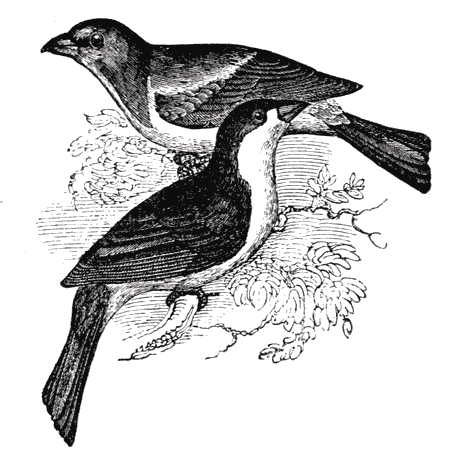
Emberiza cyanea, Linnæus; Fringilla cyanea, Wilson; La Veuve bleue, or le Ministre, Buffon; Der Indigo Ammer, Bechstein.
The length of this bird is five inches. The beak dark lead-coloured; the feet brown; the whole plumage is of the most beautiful blue, deeper and still more brilliant at the top of the head; the great quill-feathers are brown edged with blue; the tail brown, with a pale tint.
The female very much resembles the linnet in its colour, as the male does during moulting, for it is only blue when in full feather; but the male may be distinguished easily at all times by the sides of the wings being of a lighter grey than in the female.
Observations.—This species is most commonly found in Carolina, but is not rare about New York, where it arrives the beginning of April. It frequents the orchards when they are in bloom, and appears to prefer mountainous parts. Its agreeable song, which very much resembles that of the linnet, and the beauty of its plumage, render it a favourite with bird-fanciers. Its food is canary seed, millet, poppy seed, and bruised hemp seed.
THE PAINTED BUNTING.
Emberiza Ciris, Linnæus; Le Pape, Buffon; Der gemahlte Ammer, Bechstein.
This bird owes its name to its plumage. It is five inches and a half in length, of which the tail measures two. The beak is greyish brown, the iris nut brown; the feet brown; the head and neck are violet, the circle round the eyes is red; the upper part of the back and the scapulars are yellowish green, the lower part, the rump, and all the under part of the body are of a fine red; the lesser wing-coverts violet brown with a red tinge, the greater of a dull green; the pen-feathers brown, some bordered with grey, others with red; the tail-feathers are also brown, but the two middle ones are of a changeable red, and the outer border of the others is of the same colour.
The upper part of the body of the female is of a dull green, the under part yellow green; her pen-feathers are brown edged with green, as are also the tail-feathers.
As the plumage of this bird does not come to perfection before the third year, there must naturally be several varieties. During the first year the male and female are of the same colour; the head of the male does not become a violet blue till the second year, and the rest of its plumage is then a blue green, as are also the edges of the quill and tail-feathers, which are elsewhere brown.
The female at this time is of a fine changeable blue. If to these differences arising from age are added the two moultings which take place every year, we shall not be surprised rarely to meet with two birds alike. There is besides another variety, having the under part of the body yellowish, except a red spot on the breast; and again another, which in the time of moulting is entirely white.
Observations.—These birds are found from the frontiers of Canada to Guiana and Brazil; none, however, are seen in Carolina less than one hundred and thirty miles from the sea. They only show themselves in summer, and build principally on orange or similar trees. English and Dutch sailors take home many of these birds, and it has been said that in England they have succeeded in making them breed in aviaries in gardens, spacious enough to contain orange trees, on which they have constructed their nests. When in a cage they are fed on millet, canary-seed, endive, and poppy-seed, on which they may be preserved from eight to ten years. Their song is soft and agreeable.
THE CHAFFINCH.
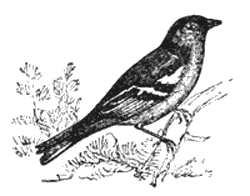
Fringilla Cœlebs, Linnæus; Le Pinson commun, Buffon; Der Buch-Fink, Bechstein.
This delightful songster of spring, famed for the sprightliness of its warbling,—this favourite of most of our bird-fanciers, is so generally known that I should be tempted to suppress its description if the uniformity of this work and the wish to render it complete, did not impel me to give it. This will also offer some particulars worthy the attention of the naturalist.
The passion for this bird is carried to such an extent in Thuringia, and those which sing well are sought for with so much activity that scarcely a single chaffinch that warbles tolerably can be found throughout the province. As soon as one arrives from a neighbouring country whose notes appear good, all the bird-catchers are after it, and do not give up the pursuit till they have taken it. This is the reason why the chaffinches in this province are so indifferent songsters: the young ones have only bad masters in the old ones, and they in their turn cannot prove better.
This bird is six inches and one-third in length, of which the tail measures two and three quarters. The beak is conical, pointed, and white in winter; but as soon as spring, the season of pairing and song, arrives, and till the time of moulting, it is of a deep blue, and one may know by this whether it has sung or not. The iris is chestnut brown; the legs, nine lines high, are dusky; the claws are very sharp, and grow so fast in a cage that it is necessary to cut them every six weeks, if you do not wish to see the poor bird some day caught by them, and perish miserably unless rescued. The forehead is black, the top of the head and nape of the neck are greyish blue, in very old males deep blue, and then thick downy hairs are perceived.
After moulting, at the beginning of winter, the colours become lighter, the front of the head is only deep brown; the top and the nape of the neck a changeable greyish and olive brown; the red brown of the breast is brighter; this is also the plumage of the young ones in the second year, particularly if of the last brood; they are called grey-heads, by bird-catchers, who can easily distinguish, in the spring, the young from the old males, and very much prefer them, because, if properly caught, they may be taught to improve their song when confined in the house; while the others never learn, or change very little, at least rarely, the song they have acquired in their wild state.
The female is very different, being smaller, while the head, neck, and upper part of the back are greyish brown, and all the under part of the body is a dusky white, rather reddish grey on the breast; and the beak, greyish brown in spring, becomes greyish white in winter.
There are some remarkable varieties of this species, one quite white, another with a white collar, a third streaked, spotted, &c. There is no distinction between the wood chaffinches and those of the gardens and orchards, as has been alleged.
Habitation.—In its wild state, the chaffinch frequents forests, copses, and orchards, and ought to be reckoned among birds of passage, though there are always some that remain the winter with us. The time of passage, in autumn, continues from the beginning of October to the middle of November, and in spring during the month of March. These birds perform their journey in large flocks. In the spring the males arrive in separate flights, fifteen days before the females; our bird-catchers know this so well, that as soon as they perceive these they put up their implements, their sport being then over.
In the house, though each may vary the form of the cage to his taste, the best, in my opinion, is an oblong cage nine inches long, seven in depth, and seven in height, with the food and water at the two farthest sides, and the perches placed opposite. A bell-shaped cage does not suit the chaffinch, as it prefers jumping down in front, and swinging itself round, to remaining at the top. If there are several in one room they must be placed so as not to see each other, or their song will be injured. Those only are allowed to range whose song is very inferior, and must be provided with a grated place to retire to, or some branches to perch on. These never sing so well as those in cages, their song appearing to require the greatest attention, and hence there should be nothing to distract them.
Food.—When wild, their food in spring is all sorts of insects, which they carry to their young in their beaks; later in the season they eat various kinds of seeds, pine and fir seeds, when they inhabit forests that contain them, linseed, oats, rape, cabbage, and lettuce, which they know well how to procure and shell.
In the house they are fed all the year on rape seed, dried in summer, or, which is better, soaked and swelled in water, on which food they appear to thrive. Every day a sufficient quantity should be soaked for the next, and given them fresh every morning. In the spring they are allowed a little hemp-seed, or the seed of the nettle-hemp (Galeopsis Tetrahit), to excite their song, and this plant is therefore very much prized in Thuringia; but these seeds should not be mixed with the rape, as in trying to find them they soon scatter their food; it is best to put it in a separate drawer fastened to the iron wires of the cage, between which it may be slipped. It must not be omitted to supply them with green vegetables, chickweed, lettuce, and the like; and in winter a piece of apple, meal-worms, and ants' eggs agree with them. They must have fresh water regularly every day, both to drink and bathe in.
Those that range the room live on the different sorts of food they meet with, bread, meat, and all sorts of seeds.
Breeding.—The nest of the chaffinch is one of the most beautiful of birds’ nests, and formed in the most skilful manner. It is the shape of a half globe flattened on the upper part, and so perfectly rounded that it has the appearance of having been turned on a lathe. Cobwebs36 and wool fasten it to the branch, bits of moss with small twigs entwined form the ground-work; the lining is composed of feathers, thistle-down, the hair of horses and other animals, whilst the outer covering is formed of the different lichens that grow on the tree in which it is placed, the whole firmly united and well cemented. This outer finish is no doubt intended to deceive an enemy’s eye; in fact, it is very difficult, even with great attention, to distinguish the nest from the bark of the branch on which it is fixed.
The female has two broods in the year; she lays from three to five eggs, of a pale bluish grey, spotted and streaked with brown: the first brood (and this is confirmed in general by observations of other birds) rarely produces any but males, the second only females. Bird-fanciers can distinguish the one from the other before they leave the nest; the breast of the male already discovering a reddish tint, the circle round the eyes being yellower, the wings blacker, and the lines that cross them whiter, though in other respects it resembles its mother. If you wish to be quite sure, pluck some feathers from the breast of the bird you have taken from the nest, in a fortnight they will be replaced, and the presence or absence of red will infallibly decide whether it is male or female. As soon as the tail-feathers begin to appear they must be taken from the nest, to prevent the possibility of their ear being injured by hearing an imperfect song, for scarcely are the wings and tail half grown than these birds begin to warble, and to imitate the song of those around them.
They must be fed on rape seed soaked in water and the crumb of white bread; it is very easy to rear them and preserve them healthy till the time of moulting, but then numbers perish, particularly if not quickly relieved by being given meal-worms and ants’ eggs, or any other animal food, as bread boiled in or soaked in boiled milk.
Chaffinches that have been reared with care become very familiar, and sing at command, or when one approaches their cage in a friendly manner. If they are wished to learn quickly and accurately, they should be kept in an obscure corner of the room, and only hung up at the windows in May; this is the surest way to prevent their learning any thing imperfect. By these means chaffinches that have been taken full grown have forgotten their former song and adopted a better. The whole artifice consists in keeping the bird in such retirement as will remove everything that might distract it when listening to a fine songster, and take away the wish to sing itself.
There have been examples of chaffinches pairing with female canaries, and it has been said with a female yellowhammer. The distinction between wood and garden chaffinches is unfounded, at least as to species; the eggs of both are of the same whitish pink colour.
Diseases.—The disorders to which the chaffinch is most subject are the obstruction of the rump gland37 and diarrhœa. To cure this an old nail or a little saffron should be put in the water.
When the scales on the feet become too large, the upper ones must be cut skilfully with a sharp knife, or else the bird would either lose the use of his limbs or become gouty; but this operation must be performed with great care.
Blindness also is not uncommon, particularly where they are fed much on hemp seed. This does not, however, injure their song, and as it comes on gradually, it does not prevent their finding their food and hopping about the perches. By means of proper care a chaffinch may be preserved twenty years.
Mode of Taking.—With good baits the chaffinch may easily be drawn within the area or decoy from Michaelmas to Martinmas, and in spring throughout March. Those that remain the winter, or return early in the year, may be taken in a net baited with oats.
bird-catchers use in spring lures and lime twigs, and the sport lasts as long as the time of flight, which begins at daybreak and ends at nine o’olock. These birds employ the rest of the day in seeking food in the fields, in resting, and singing. In the same manner are taken linnets, goldfinches, siskins, yellowhammers, and bullfinches.
Some make use of the excessive jealousy of the males to procure those whose song is very superior. As soon as a bird-catcher who likes this way discovers a fine songster wild, he immediately seeks another male that is in the habit of often repeating its natural cry, fink, fink, ties his wings, and fastens to his tail a little forked stick, half a finger long, well covered with bird-lime; thus prepared, he fastens him under the tree on which the one he is watching is perched; this no sooner sees and hears the false rival than he becomes enraged, pounces on him like a bird of prey, and is caught with the bird-lime; his attack is often so violent that sometimes the bird of call is killed by the stroke of its adversary. The following is a surer method:—a soft, narrow leather band is fastened round a male, to which is attached a string a foot long, fastened by a peg, which allows it but a short space to range. This bird, as we have already said, is called, in bird-catchers’ language, a percher. A circle of bird-lime is made just beyond its reach, and a cage with a chaffinch, accustomed to sing either in the shade or exposed, is placed under a neighbouring bush; as soon as this last begins his song, which should be a natural one, not any learned in confinement, the chaffinch that is to be procured darts from the tree like an arrow on the percher, which it mistakes for the songster, and remains fixed by the bird-lime. This new prisoner will sing the same year if it is caught before Whitsuntide: if after, it will never sing, but will die, evidently from grief at being separated from its female and young ones. A bird-catcher, cruel as he is stupid, who, without the least reflection, only thinks of gratifying his ridiculous passion for bird-catching, may in an hour deprive ten or twelve females of their beloved companions, their protectors, and numerous young ones of their father, purveyor, and support: such thoughtless cruelty is, alas! only too common in Germany. As soon as the young chaffinches have left the nest, the bird-catchers are very active in discovering the places where at noon they are accustomed to drink; there they set perches covered with bird-lime, and by this means many of these little unwary creatures are taken. However little memory one of these birds may have, it is capable of learning a good song, and being more robust than those brought up from the nest, bird-dealers make a good deal of them. They collect a great many, being sure that some will succeed amongst them.
Attractive Qualities.—The first of these is undoubtedly the song of the bird; but our amateurs are not less attentive to the different notes that express its passions and wants. The note of tenderness, and which is also thought to indicate a change of weather, is trif, trif: its call, or the rallying note it makes use of on its passage, and which so often draws it within the snares of our bird-catchers, is ïak, ïak, repeated several times; the cry fink, fink, which it often repeats, and from which its German name is derived, appears, if we may so call it, to be mechanical and involuntary. But what makes it appear to still more advantage among other birds are its clear and trilling tones, that seem almost to approach to words; in fact, its warbling is less a song than a kind of battement, to make use of a French word, and is expressed in German by the word schlag (trill), which is used to designate its song as well as the nightingale’e. Some chaffinches have two, three, four, and even five different battemens, each consisting of several strains, and lasting several minutes. This bird is so great a favourite in Germany, that not a single tone of its voice has escaped the experienced ears of our bird-fanciers. They have observed its nicest shades, and are continually endeavouring to improve and perfect it. I confess I am myself one of its warmest admirers; I have constantly around me the best songsters of its species, and if I liked I could write a good sized volume on all the details of its music, but I will confine myself to that which bears most on this subject.
The song of the chaffinch bearing an evident relation to articulate sounds, its has been thought to distinguish its different variations by the final syllable of the last strain. The most admired in Thuringia are the following, which I shall give in their order, and in their different degrees of superiority.38
1. The Double Trill of the Hartz in Lower Saxony is composed of six strains, rather long, the last of which is ended by dwelling on the two final syllables, which I shall express here by the word “weingeh39.” I doubt if ever a bird in its wild state has executed this so perfectly as I heard it at Ruhl40 and at my own house. Art has certainly created it. It is with difficulty that a chaffinch attains it, if, with the best abilities, it has not been instructed from its earliest youth. Rarely can it give it complete without leaving any part out. On this account a high price must be given for the little prodigy that sings it through, full, entire, and in all its strength.
2. The Reiterzong, or rider’s pull, first heard among the mineral mountains of Saxony and Voigtland, has been known but a short time in Thuringia. It may be heard from a chaffinch in its wild state, but those that have been instructed execute it in a fuller, stronger, and less precipitate manner. This song consists of four strains, the first of which commences in a high key, and gradually descends. When in perfection there is a cadenced pause before the two last syllables, which articulate tolerably clearly reitzing with a zap or clapping, as our amateurs express it. An amateur who has never heard the double trill of the Hartz would not believe that a chaffinch could sing in a superior manner to this; however, in this, as in many other things, each has his taste.
3. The Wine Song is divided into four kinds, 1. the fine, or Längsfeld wine song41, is very beautiful, but little known except in two or three places in Thuringia. It is composed of four strains, and to be perfect ought to resemble a hautboy, the two last syllables articulating “weingeh.” This song has never been heard from a wild chaffinch, but is one accidentally produced in the house, and endeavoured to be propagated by education.
2. The bad wine song is not in itself disagreeable, but it is so named when compared with the former. It is composed of three strains, of which the penultimate ought to sound zap five times, and the two last syllables articulate “weingeh.” When once a wild chaffinch has been heard to utter this in Germany it is not long ere it is caught. 3. The sharp wine song is not ended by “weingeh,” but “weingieh.” It is subdivided into the common sharp, such as is sometimes heard in the woods, and the Ruhl sharp, which is an entirely artificial song, confined to Ruhl and a few other villages of Thuringia. It has but two strains, of which the first syllables ought to sound as though flowing into each other, and the penultimate to have an accent.
4. The Bräutigam, or bridegroom song, is also divided into good and bad: the good is only heard in the house, and consists of two simple strains; it begins piano, afterwards forte, and, continuing crescendo, ends in the most brilliant sound. After the double trill of the Hartz it appears to my ear the finest of all. The bad is occasionally heard in the woods, and is composed of three strains; but though not devoid of sweetness, does not please so much as the former.
5. The Double Trill is formed of two long strains, divided by a cadenced pause, which is named the shake. They distinguish, 1. the common, subdivided into four; a, the strong, b, the clear, c, the long, and d, the short. These are heard sometimes in the woods and orchards; but chaffinches that sing a or b soon become the prey of our bird-catchers. 2. The double trill of Iambach42; this is only to be acquired in the house, and is so deep and powerful that one can scarcely conceive how the larynx of so small a bird can produce such sounds. It begins piano, and swelling its tones successively in crescendo, makes of the trilling a strain of five piercing tones, afterwards repeats “pfaff” four or five times, and ends by dwelling on “Rüdidia.” A chaffinch that possesses this song, either alone, or united with the good bridegroom’s song, such as are educated in Iambach, sells here for eighteen French francs.
6. The Gutjahr, or good year song, is so named from the two last syllables, and is also divided, 1. into the common, that has but two strains, of which the second ought to roll five times before articulating “gutjahr.” It is not uncommon in our woods. 2. The good year of the Hartz, which has been acquired in the house, and consists of two very singular strains, in my opinion not very agreeable. Chaffinches are very rare now which sing this, united to that of the wine song of Ruhl, or the sharp song, and their price is consequently high. They are rarely found but at Ersenach and Ruhl.
7. The Quakia song is so called from its last syllables, and is double or single, one with one strain, the other with two. This song was formerly very much admired. It was heard in the woods and house, but it is now lost, as all the wild chaffinches that sung it have been taken, and those in confinement have been taught in preference the good wine song: I believe I possess the only bird that is now to be found which sings this. To be admired, the quakia must be united with the double trill. This my chaffinch sings also.
8. The Pithia or Trewethia, is a very uncommon and agreeable song, which is never heard but in the depths of the Thuringian mountains. The bird-catchers of the villages about the forests of Hesse seek for birds that possess it, and actively pursue the songsters. It is first a sonorous strain, followed by several repetitions of the word “zack.” Some birds unite to it the common sharp wine song, and are more valued. The last syllables ought to sound “trewididæ.”
These eight varieties, or rather melodies, are those most thought of in Saxony and Hesse. I have said that some of them are heard in the woods; but it is very rarely that they are sung with so clear and strong a voice, or that they are so long and perfect. A chaffinch that knows only one of these varieties generally sings it slowly, and introduces a greater number of syllables. Its voice, in fact, executes it with more strength and depth; if it adds to the last strain the sound “fink,” which our bird-catchers translate by amen, it is of the highest value, no price will be taken for it.
There are a dozen varieties in all; but as they are not uncommon, and what are everywhere heard, they are less admired; they have even been given in contempt the name of plain.
One thing worth remarking is that the song of the chaffinch varies almost as much as the countries it inhabits. It is not the same in Thuringia as in the Hartz, and the taste of amateurs differs equally43. In Austria several named melodies are admired, but I have never heard them.
The chaffinch has so great a facility in learning, that it not only imitates perfectly the song of another chaffinch near which it has been placed from youth, but being hung near a nightingale or canary it learns several parts of their songs, and would no doubt give them completely if its larynx were so formed that it could render notes so long and sustained; in fine, a great difference in memory is observed in these birds, as well as in all others of the singing species. Some require six months to learn an air that others catch on first hearing, and can repeat almost immediately; these can scarcely retain one of the songs given above; those can imitate three, four, and, should you wish it, five different ones. There are also some that cannot give one song without a fault, and we find others that will add to it, perfect it, and embellish it.
One thing peculiar to chaffinches is the necessity of teaching them their song every year, and this in the manner proper for them, during the four or five weeks this exercise lasts. They first utter a murmur, or weak warbling, to which they add at first, in an under voice, one or two, and afterwards several syllables of their song; they are then said to record. A chaffinch that takes only a week or fortnight to repeat this lesson for fully bringing out its voice, is reckoned among the geniuses of its species. It is known that other birds whose power of singing is confined to a particular season, also warble feebly, and mingle with their warbling some foreign notes, especially harsh and confused sounds; but none produce sounds so peculiar, and that have so little relation to their own song. If we pay a little attention, however, we shall find that this exercise is intended less to awaken the memory than to render the throat, stiffened by a tolerably long state of inaction, more pliant, and to bring back its natural flexibility.
Wild chaffinches, on their return in spring, do not delay to record; those in the house soon learn, but they are obliged to exercise themselves for nearly two months before they can execute their song to perfection. The singing season does not generally extend beyond June, but young chaffinches brought up in a room prolong it to October, and sometimes later.
Some amateurs of the song, rather than friends of the bird, to procure the pleasure of hearing it night and day in all its strength, employ a very cruel and inhuman contrivance. They first place the cage in a very obscure place, and accustom the poor little creature to find its food in the dark; they then blind it, either by destroying the pupils of the eyes with a red hot iron wire, or by passing it over the edges of the eyelids, unite and paste them completely together.
Others shut up these poor mutilated creatures in a cool place, almost without air, during the summer, in order that when in autumn they are brought to the window, and breathe the fresh air, they may express their joy by their lively and repeated song. What can we think of the heart and morals of people who for a slight amusement thus enjoy the sufferings of a sensitive being that is unfortunately in their power?
THE MOUNTAIN FINCH.
Fringilla montifringilla, Linnæus; Le Pinson d’drdenne, Buffon; Der Bergfink, Bechstein.
This bird is six inches and a quarter in length, of which the tail measures two and a half and the beak half an inch; this is yellow, with a black tip. The feet, nine lines high, are dark flesh-coloured; all the feathers of the head and cheeks are black with reddish edges, wider and more distinct in young males, and becoming fainter from age, almost disappear in old ones, whose heads become quite black; the tail rather forked, and black.
The colours of the female are more uniform; she is brown where the male is black, and only a rusty colour where he is red.
Independently of the varieties produced by age, and which are tolerably numerous, without being very remarkable, there are some more remarked, such as those with a white head, a back quite white, &c.
Habitation.—In their wild state this species is scattered throughout Europe; however, it is most probable that in the summer they only inhabit the northern parts. During the three other seasons they are found everywhere in Germany, particularly where there are large forests. When beech-mast is plentiful in Thuringia the mountain finches assemble in immense numbers, it is supposed more than 100,000.
In the house they are kept in a cage or not, according as they are esteemed; where they are common they are not thought worthy of one, but allowed to range at will.
Food.—Wild, and in confinement, it is the same as the chaffinch’h.
Mode of Taking.—This bird’s note of call is ïak, ïak, quääk, and as the two first sounds are the same as that of the chaffinch, they will come at its call, and fly in its company. They also afford the best sport with a net, for in autumn hundreds may be taken at one cast. In winter they are caught near barns under nets, or even under common sieves; and in spring on a decoy bush, at the call of the chaffinch, if one of its own species cannot be procured.
Attractive Qualities.—We cannot boast of sweetness in the song of this bird, as it consists of low whistling, or a kind of warbling, intermixed at intervals with a shrill “raitch,” the whole somewhat resembling the first exercises of the chaffinch; but this wretched warbling may be improved by education. A mountain finch placed by the side of a chaffinch that sung well, learnt to imitate it tolerably, but I must confess that it never attained great perfection. I should warn bird-fanciers who wish to keep these birds for the beauty of their plumage, not to let them range with many companions, for they are quarrelsome, and very lavish in distributing severe pecks, especially if food is not very abundant. In Thuringia they are kept in cages to be employed as lures in the area or decoy enclosure. It is said that it is easier to teach them to go and come than the chaffinch.
THE HOUSE SPARROW.
Passer domestica, Ray; Le Moineau franc, Buffon; Der Haussperling, Bechstein.
Though this and the following species cannot be reckoned among those that are pleasant in a room, yet I must not omit them on account of their being easily preserved, and though distinguished neither for their song nor their colours, yet they make up for the want of these by agreeable qualities, that many, much more admired, do not possess.
It is almost superfluous to describe a species so well known. The total length is five inches and three quarters; the beak thick and blue black; the feet greyish brown; the top of the head and cheeks greyish ash-coloured with a broad chestnut streak behind the eyes, elsewhere surrounded with black.
The female differs a good deal, the upper part of the body being greyish red, spotted with black on the back, and the under part of a dusky greyish white.
The young males before their first moulting very much resemble their mothers.
The varieties known here are the white, the yellow, the tawny, the black, the blue, the ash-coloured, and the streaked.
Habitation.—In its wild state, it haunts the vicinity of houses; when confined, it is allowed to range the room.
Food.—If, unfortunately, it is too true that the sparrows cause great injury in ripe fields of wheat, barley, and peas, it must be acknowledged that they are very useful in our orchards and gardens, by destroying, in the spring, thousands of insects, on which they feed their young ones as well as themselves44. In the house, they feed on any kind of food: oats, hemp seed, or rape seed.
Breeding.—Small openings under the tiles, crevices in walls, empty martin’s nests, are the places they appropriate for breeding, and they line their nest thickly with feathers. The female has two or three broods every season, and has from five to seven young ones at a time.
Mode of Taking.—Sparrows are so cunning that it is difficult to attract them within the net or on lime twigs. They may be caught in numbers however on the brambles in a field where sheep are kept, by sticking plenty of bird-lime about them. They may be taken also by placing a net before those that have retired to cherry trees and under the tiles to sleep for the night.
Attractive Qualities.—The bird-fancier who enjoys seeing several birds running about the room, will, with pleasure, admit the sparrow among them, and may amuse himself especially by observing it breed and produce mules with the hen tree-sparrow. A jar or cup placed in a corner will serve as their nuptial bed. A male tree-sparrow with a hen sparrow does not succeed.
The sparrow may be easily taught to go and come at command, by choosing winter as the time to effect it. It is necessary first to keep it a month near the window in a large cage supplied with the best food, such as millet, meal, or white bread soaked in milk. It will even go there to deposit its eggs if a small box is placed in the cage, with an opening for it to enter at. Finally, no bird becomes more familiar, or testifies more attachment to its master. Its actions are very lively, confiding, and delicate. A soldier, says Buffon, had a sparrow which followed him every where, and knew him in the midst of the regiment.
THE TREE SPARROW, Lath.
Passer montana, Ray; Friquet, ou Moineau des haies, Buffon; Der Feldsperling, Bechstein.
This species is more beautiful than the preceding. In length it is five inches and a half; the beak is dusky; the feet are bluish flesh-coloured; the upper part of the head as far as the nape of the neck is reddish brown; the cheeks are white with a black spot; a white ring surrounds the neck; the back is spotted with black and red; the lower part of the back and the rump are grey brown; the throat white, the breast light ash-coloured; the belly dusky white; the quill feathers and tail are dark brown; the lesser wing-coverts rust-red; the greater, black with red edges and white tips, which form two transverse bars.
Two varieties are known, the white and streaked.
Habitation.—In their wild state, they are not only found throughout Europe, but also in the north of Asia and America. In Germany and England it is not so common as the house sparrow, for in some provinces it is never seen. It frequents gardens, orchards, and fields abounding with trees and hedges. In September, large flights are seen to fall upon the ripe fields of barley and oats.
In the house it is let run about like the former, which it does very awkwardly from having short legs, and this gives it the appearance of dragging along on its belly. It is only kept in a cage in countries where it is very rare.
Food.—This is the same as that of the preceding.
Breeding.—The nest must be sought in the holes of fruit trees, or in hollow willows at the water’s edge; it breeds twice in the year.
Mode of Taking.—This is the same as the preceding; but being less distrustful and cunning, it is easily enticed under a sieve placed before a barn in winter.
Attractive Qualities.—Its plumage is prettier than the preceding, its song is also less short and monotonous; but it is weak, and when it might be sweet, it is lost among the other songs in the room. The tree sparrow might be accustomed in the country to go and come at command by treating it in the manner described with respect to the house sparrow. It is more difficult to preserve it, and it generally dies of decline.
THE COMMON LINNET.
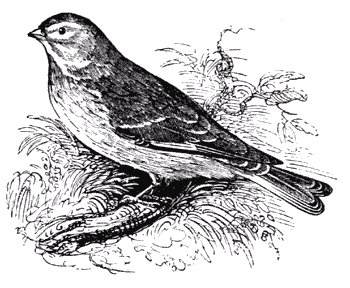
Fringilla cannabina, Linnæus; La Linotte, Buffon; Der Lanning, Bechstein.
The length of this well-known bird is more than five inches, of which the tail measures two inches and a half. The beak, six lines long, is dusky blue in summer, and in winter greyish white, with the point brown; the iris dark brown; the feet, eight lines high, are black. There are some very striking varieties produced by the season and age in the plumage of the male, which are not observed in the female, and these have caused great confusion in works on birds, so much, that bird-catchers are still persuaded these birds, in a different dress, are distinct species.
Instructed by long experience and the observations of many years, I hope to show in my description that our common linnet (Fringilla Linota, Linnæus), the greater redpole (Fringilla cannabina, Linnæus), and, according to all appearance, the mountain linnet (Fringilla montana, Linnæus), are one and the same species. A male three years old or less, is distinguished in spring by the following colours, and by the name of redpole. The forehead is blood red, the rest of the head reddish ashcoloured, the top rather spotted with black; the cheek, sides of the neck, and the circle round the eyes, have a reddish white tint; the feathers of the back are chestnut with the edges lighter; the upper tail-coverts are black edged with reddish white; the throat and under part of the neck are yellowish white, with some dashes of reddish grey; the sides of the breast are blood red edged with reddish white, the sides of the belly are pale rust-coloured; the rest of the under part of the body is reddish white; the greater wing coverts are black, bordered with reddish white, the others are rusty brown with a lighter border. The quill-feathers are black tipped with white, the first are edged with white nearly to the point, the narrow beard forms a parallel white streak to the quill-feathers; the tail is black and forked, the four outer feathers on both sides have a broad white border, that of the two middle feathers is narrower, and reddish white.
After moulting, in autumn, little red is seen on the forehead, because the feathers become coloured from the bottom to the top; the breast has not yet acquired its red tint, for the white border is still too wide; but when winter comes its colours appear.
Males one year old have no red on the head, and more dashes of black; the breast is pale red waved with pale and dark, the under part of the feathers on the breast is only a bright reddish grey brown, the edges of these feathers are of a reddish white; the back rust-colour has some detached spots of dark brown and reddish white. These birds are known under the name of grey linnets.
After the second moulting, if the reddish grey feathers are blown aside, blood red specks may be discovered on the forehead, and the red of the breast is only hidden by the wide yellowish white borders to the feathers; these are the yellow linnets, or the rock linnets, as they are called in Thuringia.
I have myself taken linnets whose foreheads and breasts have been bright reddish yellow instead of blood red, a colour, in fact, that sometimes, in the house, becomes blood red. Bird-catchers give these also the name of yellow linnets. It is a deterioration of the red caused by illness during moulting, or by old age, and they are not wrong in regarding them as the best and the finest singers. I have taken several, but on account of their scarcity, I have always kept them for myself. Their song was very fine and clear, but they cannot be tamed, and have generally died soon of sorrow and melancholy, from which I conclude that they were very old.
Besides these three different varieties of plumage of the males, there are several clouded, produced by the seasons and old age; for instance, the older they become, the redder the head is. I have in my cabinet all the gradations of this change. Birds brought up in the house never acquire the fine red on the forehead and breast, but remain grey like the males of one year old; on the other hand, old ones, red when brought into the house, lose their beautiful colours at the first moulting, and remaining grey like the young ones, are no more than grey linnets.
This difference of colour does not take place in the females, which are smaller than the males; the upper part of the body is grey streaked with dusky brown and yellowish white, on the rump with greyish brown and reddish white; these spots are more numerous on the breast; the wing-coverts are a dusky chestnut. The females are distinguished in the nest by the back being more grey than brown, and by the number of streaks on the breast, which resembles that of the lark; bird-fanciers leave these in the nest and take only the males.
Habitation.—In its wild state the linnets are spread throughout Europe. In the summer they frequent the skirts of large forests, thickets, hedges, and bushes, particularly furze; but as soon as September arrives, they pass in large flights to the fields. They are wandering birds, that in winter go hither and thither seeking food in places free from snow, but in March they return to their native places.
In confinement it is best to keep them in square cages, as they are less subject to giddiness in these than in round ones, and sing better. They are not often allowed to range the room, as they are very indolent, remaining immoveable in the same place, and running the risk of being trodden on; but if a small tree or a roost be placed in a corner, they may be let out of the cage with safety, as they will remain perched there, only leaving it to eat or drink, and will sing all day long.
Food.—When wild, their food is all kinds of seeds that they can shell, and these remain in the crop some time to be moistened before passing into the stomach. In the house, it is only summer rape seed,45 which need not be soaked in water for them, as for the chaffinch, since, having a much stronger crop and stomach, they can digest much better. It is not necessary always to give them hemp seed with it, and they must not be fed abundantly, for taking little exercise, they easily become fat, and sometimes die from this cause; but a little salt mixed with their food is useful, as it preserves them from many diseases, and they like it. When linnets are allowed to run about, they will feed with the other birds on the common universal paste; but they must be given green vegetables, water, and sand, as they are very fond of bathing and dusting themselves.
Breeding.—Linnets have two broods in the year. They lay from four to six eggs for each, of a bluish white, speckled with reddish brown, especially at the large end. Their nest placed in a hedge, a white or black-thorn, or, if in a country where they are common, on a vine, or a furze bush, is composed of small twigs, dried grass and moss, and lined with wool, the hair of horses, and other animals. The parent birds feed their young ones from their beaks, and do not discontinue it if prisoners in the same cage. If the young ones are to be taught a new song, they must be taken from the nest when the shafts of the feathers are just appearing, that they may have no idea of their parents’ song. The males may be easily distinguished by their white collar, and from having the most white about the wings and tail.
Diseases.—The most common disorders of this species are constipation, atrophy, and epilepsy. A linnet, however, will, in general, live from ten to twelve years in the house.
Mode of Taking.—These birds are distrustful and suspicious, and, notwithstanding decoys and perching birds, it is very difficult to entice them within the decoy or area, and never many together. In the spring, by means of a good decoy-bird, a few may be taken on a decoy-bush. In the autumn, by fastening snares or lime twigs to the stalks of lettuces, of the seeds of which the linnets are very fond, several may be taken. Our shepherds turn and support the cribs, used to feed the sheep from, in such a manner, that the linnets, coming to gather the grains of salt, easily overturn them on themselves. The call of the linnet is “gäcker.”
Attractive Qualities.—The agreeable, brilliant, and flute-like song of the linnet, consists of several strains, succeeding each other very harmoniously. Our amateurs consider its beauty to depend on there being often mingled with it some acute and sonorous tones, that a little resemble the crowing of a cock, and have made people say that this bird crows. Its song is only interrupted during the year by moulting. A young one taken from the nest, which may be easily brought up on a mixture of the wetted crumb of white bread, soaked rape seed, and eggs boiled hard, not only learns the songs of different birds that it hears in the room, such as nightingales, larks, and chaffinches, but if kept by itself, airs and melodies that are whistled to it, and will even learn to repeat some words. Of all house birds, this, from the softness and flute-like sound of its voice, gives the airs that it is taught in the neatest and most agreeable manner. It is also one of those that pay best; some here cost from three to five rix-dollars when they can warble an air preceded and followed by a grand flourish as of trumpets. The weavers and shoemakers often bring up many of these birds. It is very pleasing and surprising to hear a young linnet that is well taught by a nightingale. I have one, whose imitations are as perfect as possible. It amuses me throughout the year, but especially when my nightingales are silent.
Linnets may be accustomed to go and come at command, by treating them in their youth, or in the winter, as I have directed for the house-sparrow; but as they are more timid, it is necessary to be more careful.
It is common for a male linnet to pair with a hen canary, and their progeny can scarcely be distinguished from the grey canary. They sing delightfully, and learn different airs with great facility.
It is well known, that among linnets, some are finer warblers than others, and that, as with many other birds, the old ones sing better than the young; on which account, yellow linnets, being the oldest, are the most valued.
THE LESSER REDPOLE.
Fringilla Linaria, Linnæus; Le Sizerin, ou Petite Linotte des Vignes, Buffon; Der Flachsfink, Bechstein.
In its plumage this bird resembles the linnet; but in its actions and shape it more resembles the siskin. It is five inches and one quarter in length, of which the tail measures two and one quarter; the beak, four lines long, is very sharp and yellow; its shanks, eight lines high, are black; the top of the head is a brilliant crimson; the upper part of the body is dark brown, spotted with white and rust yellow; the rump is rose-coloured; the throat black; the feathers on the under part of the neck and breast are bright rose-coloured, edged with white; the rest of the under part is white. The plumage of the female is lighter; the breast is not rose-coloured, except that when very old it acquires a slight tint, as well as the rump; the upper part of the body is spotted with white and deep brown, and the breast is rather speckled with the same colours. The latter characteristics serve to distinguish the females from young males, that also are without the rose-colour on the breast, but have the rust-coloured and dark brown back of the older birds. The males, confined to the house, lose, at the first moulting, the fine rose-coloured breast, and, at the second, the crimson of the head, which generally changes to a greenish yellow. I have a male bird, the top of whose head became, at the third moulting, of a fine golden yellow, and has retained its brilliancy for six years.
Habitation.—In its wild state the lesser redpole is found in every part of Europe; yet we must consider the north as its native home, Scotland, Sweden, Lapland, Norway, and Greenland. Great flights arrive amongst us at the end of October, and leave us in March and April. In winter, they frequent places planted with alders, the seeds of which they appear very fond of. They are principally found in company with siskins.
In the house, it shows off its beautiful plumage, which, alas! does not retain that beauty long, it is often placed in a pretty cage, but most commonly allowed to range through a room.
Food.—When at liberty, the seed of the alder is what these birds seek most eagerly; but they do not despise the seeds of flax, hemp, and even fir, and many other kinds. Being entirely grain-eating birds, their crop has the power of softening the food before it passes into the stomach.
In the house, if in a cage, they eat poppy, rape, and hemp seed; when at large, the first universal paste.
Breeding.—Occasionally a few stragglers breed with us, but this is rare.
Diseases.—The disorders of this species are the same as those of the siskin; but their feet are oftener diseased, and the toes skin off one after the other. They may be kept from eight to ten years.
Mode of Taking.—In the spring and autumn, the lesser redpoles may be taken in flocks in the area, or barn-floor trap, with a decoy of their own species, or even with a siskin. Many may also be caught with such a decoy on a decoy-bush. They are so silly, or so confiding, that they will even allow themselves to be taken close by the bird-catcher, who is collecting their entrapped companions. This stupidity, or simplicity, is common in all birds that come from the more remote northern parts. Brought up far from man, and out of reach of his pursuit, they know not that fear and distrust which is felt by those that inhabit populous countries. Their call is “peweet” and “crec, creck hewid.”
Attractive Qualities.—The lesser redpole pleases the eye more than the ear; its feeble warbling being only, if I may thus express it, a low continued clicking. It may be taught to draw water more easily than the goldfinch, and it will also learn many other little manœuvres, for it becomes very familiar, and will eat as soon as it is let loose after its capture. The mutual tenderness of the male and female is very pleasing. They are continually caressing each other with their bills, and even do the same to siskins, linnets, goldfinches, and canaries, from which it appears very likely that they would pair with these birds.
THE GOLDFINCH.
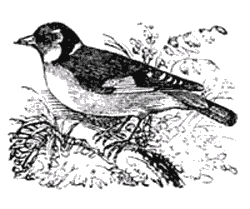
Fringilla Carduelis, Linnæus; Le Chardonneret, Buffon; Der Distelfink, Bechstein.
“Beauty of plumage,” says Buffon, “softness of voice, quickness of instinct, remarkable cleverness, proved docility, tender affection, are all united in this delightful little bird; and if it were rare, or if it came from a foreign country, it would then be valued as it deserves.” It is five inches and three quarters in length, of which the tail measures two. The beak, five lines long, very pointed, and rather flattish at the sides, is whitish, with the point horn-coloured. The shanks, six lines high, are delicate and brownish. The front of the head is a fine crimson, sometimes scarlet; a wide border of the same colour surrounds the under base of the beak; the bridle, as it is called, is black; the top of the head is black, which colour extends downwards, from the nape on each side, dividing the white on the cheeks from the white spot on the hinder part of the neck; the under part of the neck is white; the hinder part and the back are fine brown.
The female is rather smaller, and has not so much red round the bill; the bridle is brownish; the cheeks are mixed with light brown; the lesser wing coverts are brown; the back dark brown. The size, or the want of some white spots at the tips of the feathers, do not serve to distinguished the male from the female, as some bird-catchers say; nor ought we either to imagine that the size or number of these spots constitute different varieties; for all these distinctions are accidental, and depend on physical strength and age. Our bird-catchers think the large ones that are nearly the shape of the greater redpole form a distinct species, and they give them the name of Fir Goldfinches, because they say they always build in fir forests. Those that do not exceed the size of the red-breast, they call Orchard Goldfinches, because they suppose they always build in orchards. But these differences and pretences are imaginary, because both are found of different sizes, the orchard goldfinch large, and the fir, or wood goldfinch, quite small. The young ones that are hatched first are always stronger and larger than those hatched last, because they often carry off the food intended for the latter, and, therefore, being better fed, they become larger and stronger. This is sufficient to explain the difference of size in different individuals of the same species.
The following varieties are better established:—1. The goldfinch, with a yellow breast; 2. With a white head; 3. With the head black—four young ones of this variety were found in the same nest; 4. The white goldfinch; 5. And the black goldfinch, this being either entirely black, which often happens in a cage, from giving it too much hemp seed, or from old age; or it only retains the yellow spot on the wings, which is also occasioned by captivity. M. Schilbach, superintendant of the menagerie of Cassel, tried an experiment on a whole brood. He deprived the birds of the light of the sun, even covered the cage with a piece of cloth, and, by these means, obtained very black goldfinches, with only the yellow spot on the wings; but they changed colour after moulting. Those in which the black does not change are very old. It is, in fact, a sign of approaching death.
Habitation.—In their wild state goldfinches are found in all parts of Europe, frequenting orchards, brambles, thickets, and mountainous districts, interspersed with wood and fields, during the summer. These birds are stationary, not changing their haunts in winter; they merely assemble in the autumn in families, or rather in little flocks of fifteen or twenty, seeking here and there places abounding in thistles, and only when the snow becomes too deep leaving such localities for others more accessible.
In the house, if kept in a cage, this should be a square one, because these birds do not like hopping about the upper part, as they would be forced to do, if in a bell-shaped cage, and also inclined to swing round. When they run on the floor they should be given a small artificial tree for a roost; for they like to perch on this whilst singing as well as sleeping.
Food.—Their food, when wild, consists of all kinds of small seeds, such as lettuce, goats'-beard, scorzonera, thistle, radish, and canary seed.
With us, in the house, they are principally fed on poppy, hemp seed, properly varied with lettuce, rape, and canary seed. If allowed to range, the second universal paste agrees very well with them. I have a goldfinch, which appears in good health, and eats not only of all the vegetables brought to table, but also meat, though, in their wild state, these birds never touch insects46. They must have green food occasionally, such as chickweed, water-cresses, lettuce, or endive. These birds feed largely, when loose in the room, rarely leaving the food-dish, and driving off, if they can, with loud cries, any of their companions who wish to approach. They will allow those birds, however, to feed peaceably with them, that bear some analogy to their species, at least, in the nature of the stomach, such as the canary, siskin, and especially the lesser redpole, without distinction of male or female.
Breeding.—The goldfinch prefers building in large orchards, at the tops of trees, on weak and terminal branches. It makes the most beautiful nest of any of our birds, except the chaffinch, it being finely rounded, very elegant and firm. The outer part is constructed of fine moss, lichens, stalks of grass, and slender twigs; the whole being interwoven with the greatest nicety. The interior is lined with wool, horse-hair, and the cotton or down of the thistle47, or willow. The female has rarely more than one brood in the year, unless she has been disturbed, and, in this case, the number of eggs is always diminished; on this account goldfinches never appear to increase in number. On a sea-green ground, the eggs have pale red spots and speckles, mingled with streaks of reddish black, which often form a circle at the large end. The parent birds disgorge the food into the young ones’ throats. Before the first moulting the heads of the young birds are grey. If it is only wished to take male birds from the nest, all that have a whitish ring round the root of the beak, must be left. They must be brought up on poppy-seed and the crumb of white bread, soaked in milk or water. Of all the natural songs of birds, they imitate most easily and perfectly that of the canary; they also pair with the canary, and produce together fruitful young ones. For this purpose, a male goldfinch is paired with one or two female canaries, which succeeds better than by placing a male canary with a female goldfinch; the former being more amorous, most favours this union, particularly if educated from youth. The fruit of this union are not less distinguished for the beauty of their plumage, often yellow, with the head, wings, and tail, of the goldfinch, than for the sweetness of their song, whether natural or acquired.
If you are afraid that a pair of canaries you value, may not hatch their eggs as you wish, place them in the nest of a goldfinch in your orchard, and you may be certain that they will be properly matured, and the young ones brought up in the best manner. When they are ready to fly, place them in a cage, and suspend it by the side of the nest till they can feed themselves. By this means you will have no trouble with their education.
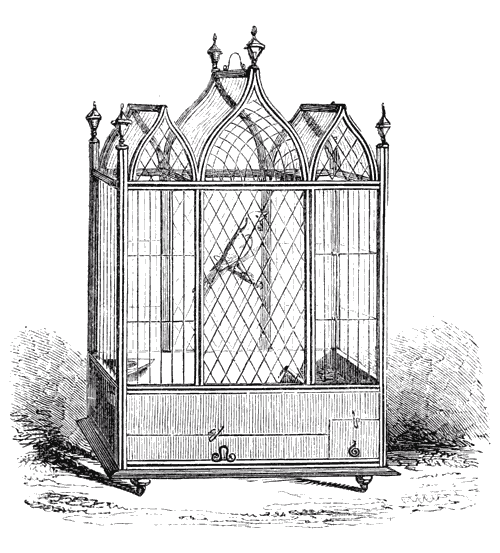
CANARY CAGE FOR PARLOUR.
Diseases.—Epilepsy is one of the commonest disorders of this bird. If the eyes are weak and swollen, anoint them with fresh butter. Stupor and giddiness being very properly attributed to too great a use of hemp seed, it is best to suppress it entirely, and supply its place with the seed of lettuce and thistles. This latter is so beneficial, that it would be well to give them, from time to time, a head to pluck the seeds for themselves.
Old age makes them blind, and deprives them of their beautiful colours; yet, notwithstanding all the evils with which they are afflicted, in a cage a goldfinch has been known to live sixteen years, and even twenty, or twenty-four years.
Mode of Taking.—In spring these birds are taken on a lure bush, with a decoy bird of their own species. They will also enter the area, or barn-floor trap, with chaffinches, if bundles of thistles are placed there; but it is not without difficulty, for they are very watchful to avoid nets and lime-twigs. In the winter, by building up bundles of thistles, and placing snares and traps on them, several may be caught; but in autumn and spring lime-twigs should be placed on them in preference. It is a still better plan to place bundles of thistles in a tree stuck about with lime-twigs. The goldfinch’s call is “tziflit,” or “sticlit,” which is its name in Bohemia.
Attractive Qualities.—The goldfinch is a very beautiful, lively, active bird, always in motion, and turning continually to the right and left. Its agreeable song, which is only discontinued during moulting, is a mixture of tones and harmonies, more or less dwelt upon, and the oftener the sound “fink” is introduced the more it is admired amongst us. There are some goldfinches that utter it only once or twice in their strains, whilst others will repeat it four or five times following. This species learn with difficulty to repeat airs from the flageolet, or other birds’ songs, and in this respect is inferior to canaries and linnets; but it is remarkable for its docility. Goldfinches have been seen to let off a small cannon, and imitate death. When properly instructed they will draw up their food and water. They are taught this by means of a chain or pulley, furnished with a soft leather band, two lines wide, pierced with four holes, through which the wings and feet are to be passed; the two ends meeting under the belly, and are retained there by a ring, to which is fastened the chain that supports the bucket containing the water or food. Whenever the little waterman wants either, he draws up the chain with his beak, fixing it at intervals with his foot, and thus succeeds in obtaining what he wishes; but if his little buckets are suspended to a pulley, raising one makes the other descend, and he can only enjoy his food and water in turn.
I have also seen goldfinches and siskins, placed in different cages, that have little bells fixed to the seed drawer in such a way that the bird cannot take its food without ringing them; the bells being harmonised, tolerably agreeable chimes are produced, but one is soon tired of such trifles.
The goldfinch is taught to go and come at command, without any danger of losing it, much sooner than the linnet, though the latter learns quite as soon to build in the room. To accomplish this feat the winter should be chosen, and the cage, containing a goldfinch that has not been rendered tender by having been too long accustomed to the heat of the room, must be placed on the outside of the window every day, or on a shelf intended for it, and where the mice cannot reach it. Hemp seed must be scattered round, and a bunch of thistle heads fastened by the side, the seeds of which should be mixed with the hemp seed. Presently one or more goldfinches, attracted by the call of the prisoner, collect, to take advantage of the scattered food; as soon as you have succeeded so far it is useless to let the decoy remain any longer exposed to the cold, which may injure it. It will be quite sufficient to place the cage within the window, and to put on the outside a cage as a trap, not for the sake of catching these birds, but to scare away the sparrows, that would soon eat up all the seed unless thus prevented; and in order that the trap may only close when you wish, the door should be supported by a string, passing into the room, and loosened, to catch the sparrows, but the goldfinches should be allowed to go in and out at pleasure, till the snow is on the point of disappearing, then close the trap on those you wish to keep: the birds thus captured should be placed in a cage, where they will soon grow tame, and learn to go and return to it. Whatever form this cage is of, the door should be hung so as to remain open as long as is required, and be closed without noise or alarming the bird, either by means of a spring, that may be acted on by the bird, without his perceiving it, or by his pushing the door of it open on the inside. When a goldfinch has been thus trained it may be let fly without fear the following August, at the time of moulting. It is true that it will be lost for some time, but it will not fail to return in December, when the ground is covered with snow, and it will sing much more sweetly than it would had it been kept prisoner. As soon as it has flown, a cage should constantly be hung outside the window, and seeds placed in it, that, if it should chance to return, it may find food; but it is rarely seen again till winter: at that time the cage should be so arranged that the door may be closed as soon as the bird enters, as it used to do in the room; the surest way is to attract it by a call bird. It must not be allowed to come out so often as before, and it will remain, without injury, shut up till the season arrives for giving it its liberty again. The same course may be pursued for the tit, and with still more success for the chaffinch, which does not enter the snares of the bird-catcher as easily as the others. If it is feared that it may be caught in a neighbouring area or barn-floor trap, it may be frightened from this snare in future, by stretching a net once, in the orchard or garden near. The greenfinch is the best for this manœuvre, as it is extremely fond of hemp seed, is more rarely taken, and returns less wild than the chaffinch. The birds that enjoy their liberty in the summer sing more finely than without this advantage, and, what is almost incredible, though taken to a distance of several leagues, they have always found their master’s house again48.
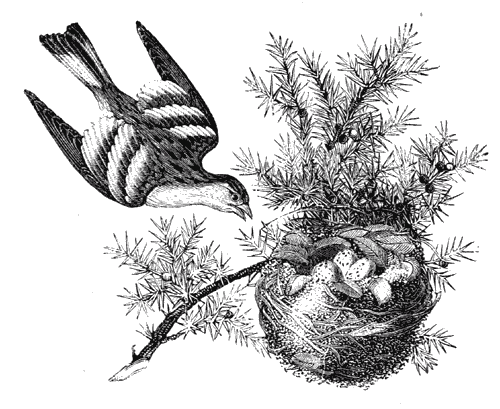
THE SISKIN.
Fringilla Spinus, Linnæus; Le Tarin, Buffon; Der Zeisig, Bechstein.
This bird is four inches and three quarters in length, of which the tail measures one and three quarters. The beak, four lines long, becomes narrower towards the tip, which is very sharp and brown; the rest is light grey, and in winter white. The shanks, eight lines in height, are dusky; the top of the head and throat are black; the cheeks, the back of the neck, and back are green; the latter streaked with a dusky colour; the rump, breast, under part of the neck, and the line that passes over the eyes, are greenish yellow.
The throat of the male rarely becomes black till the second year; the older it becomes the more of yellow and beauty it attains.
The varieties are the black siskin, the white siskin, and the speckled siskin. I have occasionally killed these birds with a breast entirely black.
Habitation.—In its wild state it is found throughout Europe; it is very common in Germany, where it remains all the year49, but in winter it wanders about in search of food, and most frequents the parts well planted with alders. In the house, whether in a cage or not, it soon becomes very familiar.
Food.—When wild it varies according to the season; in summer it eats in the woods the seeds of the pine and fir; in autumn, of hops, thistles, burdock; in winter, of the alder and the buds of trees.
In the house its food is poppy-seed and a little hemp-seed bruised. If allowed to range, the first universal paste suits it. It is a complete glutton, and, though so small, eats more than the chaffinch; it is at the seed drawer from morning till night, constantly eating, and driving off all its companions. It does not drink less, and requires abundance of fresh water; yet it bathes but little, only plunging the beak in the water, and thus scattering it over its feathers, but it is very assiduous in arranging them; it may be called a fop, always engaged with finery.
Breeding.—The siskin rarely builds its nest among the alders, but generally in the pine forests, placing it at the extremity of the highest branches, and fixing it there with cobwebs, the threads of insects and lichens. The outer part is well formed of small twigs, and the lining is formed of finely divided roots. It has two broods in the year, each of five or six eggs, of a light grey, strongly spotted with purplish brown, particularly at the large end. The young males become finer each year till the fourth.
The mules, produced by the siskin pairing with the canary, partake of the two species, and are very prettily spotted if the canary is yellow; but this union is not so easy as that with the green canary, which appears to bear a nearer relation to the siskin.
Diseases.—To the other maladies common to the birds of this family we must add epilepsy, of which these birds often die50. They may, however, be kept from eight to twelve years.
Mode of Taking.—With good traps and nets made for this purpose, several dozen of these birds may be taken at once in the winter. They also collect in numbers, in the spring, on the decoy bush, and they are so fearless, that in the villages a person, who has his house situated near a stream bordered with alders, need only place a siskin in the window, near a stick covered with bird-lime, and he may catch as many as he wishes. I have caught some at my window in a cage strewed with hemp and poppy-seed, by letting the door fall by means of a string, when the birds had entered, one of the decoy birds in my room serving to attract them. When the place where they drink at noon is discovered amongst the alders, numbers may be caught by merely laying across the stream some branches covered with bird-lime.
Attractive Qualities.—Their plumage and song are both attractive, though with the latter several tones are mingled, that somewhat resemble the noise made by a stocking-loom. This makes them great favourites with stocking-weavers. They imitate tolerably the song of other birds, such as that of the tit, the chaffinch, and the lark; but they cannot give a musical air. Their carolling is only interrupted during moulting, and very much tends to excite their companions to warble in their turn. The loss of their liberty affects them so little, that they will eat as soon as let out of the hand, after being caught, and on the second day will allow any one to approach their cage without alarm. They are soon taught to draw up little buckets, and many other little manœuvres that they execute gaily; there is no difficulty in accustoming them to go and return if the winter is chosen; the cage should be kept open at the window, and hemp and poppy-seed scattered at the entrance; they will return there in general, and bring several companions with them. This plan will not succeed so well in March, September, and October, the time when these birds roam through the country in search of food, though I have seen some tamed in this manner return after a long absence.
THE RING SPARROW.
Fringilla petronia, Linnæus; La Soulci, Buffon; Der Graufink, Bechstein.
Independently of the beak, this bird may be taken for a female yellowhammer, as it resembles it so much in its shape and plumage. Its length is five inches three-quarters, of which the tail measures two. The beak, five lines long, is thick at the base, grey brown above, and white below. The feet, ten lines high, are grey brown; the whole head is of a reddish ash-colour, but a dirty white ring surrounds it from one eye to the other.
The female is greyer on the upper part of the body, and the front of the neck is only pale yellow.
Observations.—Ring sparrows are found in most European forests, or woods; they are common enough in several parts of Germany51, those that inhabit the northern parts removing in winter; but the others are stationary.
They live on seeds and insects like the house sparrow, and make their nests in hollows of trees. In the house they are fed on rape and poppy-seeds; they also readily eat the first universal paste. They are less prized for their warbling, which is insignificant, than for their beauty or rarity.
THE SERIN FINCH.
Fringilla serinus, Linnæus; Le Serin vert, ou le Cini, Buffon; Der Girlitz, Bechstein.
This bird is smaller than the siskin, its length not exceeding four inches and a quarter, of which the tail measures one inch and a third. The beak is short and thick, brown above and white below; the iris is dark chestnut. The shanks are six lines high, and are of a flesh colour. The plumage of the male very much resembles that of the grey canary; the front of the head, the circle round the eyes, a kind of collar, the breast and belly, are pale jonquil-coloured, mixed with a little green; the nape of the neck, the cheeks, the temples, and lesser wing-coverts, are of a canary green, mingled with rust colour and black.
The spots scattered over the plumage are not isolated, but united to each other by an undulating line; they are so small on the head, that it is only speckled.
It is necessary to examine the female very closely to distinguish it from the siskin, for, with the exception of a reddish grey tint, the colours are the same; but its beak is shorter, its tail longer, and its shape freer.
From my latest observations this bird appears to be the same as the citril finch; comparing them together in cabinets has confirmed my opinion; but that which has decided me is the testimony of my friend, Dr. Meyer, of Offenbach, who has often seen and even fed in his house several of these birds. From him I derive the rest of this article.
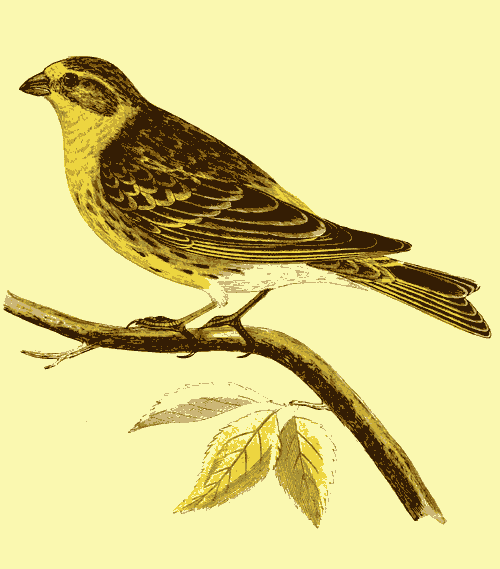
SERIN FINCH.
Habitation.—It is not more than ten years since the serin was observed between Frankfort and Offenbach. They arrive every year in large flights, during March, and depart in October; but there are always some that remain all the winter. Several were taken in January, 1800, when the thermometer was at twenty-one degrees Réaumur, and I myself have seen some near Offenbach at the end of February. They appear to prefer fruit trees, yet in woods they also appear attached to beech and oak trees; but I have never met with them by the sides of rivers or streams planted with willows.
Food.—They feed on all the small seeds found in fields and orchards, particularly groundsel, plantain, garden pimpernel, and others of the same kind.
In the house, rape, mixed with a little poppy seed, agrees very well with them; a few grains of hemp seed and husked oats may be added from time to time.
Breeding.—Their nest is generally placed on the lower branches of apple and pear trees, sometimes on beeches and oaks, but never on willows by the water-side. It is constructed of fine and divided roots, mosses, lichens, principally of those which are farinaceous, the whole being entwined with great nicety, and lined with a thick bed of feathers, horse-hair, and pigs’ bristles. They lay three or four, rarely five, eggs of the form of, but rather smaller than, those of the canary; white, but having at the large end a circle of spots and dots of a bright reddish brown. The hen sits on the eggs thirteen or fourteen days, during which time the male feeds her. He also helps to feed the young ones, which is done by disgorging the food; the young perfectly resemble the grey linnet; they may be reared easily on soaked rape seed; but it is best to take the parent birds, and place them in the cage with their little ones, which they will continue to feed. The young birds remain grey till after moulting, they then attain their full plumage, as described before, but are never so beautiful in the house as in their wild state. After being kept a few years in a cage, the yellow in those taken full grown becomes pale, and fades at length to nearly white. This bird will pair with the canary, siskin, linnet, or goldfinch.
Mode of Taking.—These birds are easily taken in the area, or barn-floor trap, on a decoy bush, and with lime twigs placed near the stalks of plantain.
Diseases.—With the exception of consumption, of which one I had died, I know of no disease they are subject to.
Observations.—Of all house birds, these are the most sprightly and indefatigable songsters. Their voice is not strong, but it is very melodious. The song, with the exception of a few passages, is like the lark’k, and might be mistaken for the canary’y. In their wild state they sing incessantly, either perched on the outer branches of a tree, or whilst rising in the air, and gently sinking again to their former situation, or whilst flying from tree to tree. Their call resembles that of the canary, and their habits are also similar to that species.
They are of a very affectionate character; when allowed to range the room with siskins, linnets, and similar birds, they will caress all with the beak, but seem to prefer the company of the goldfinch, whose tones they will imitate, and improve their warbling by it. They are indeed very attractive birds.
THE CITRIL FINCH.
Fringilla citrinella, Linnæus; Le Venturon, Buffon; Der Citronenfink, Bechstein.
This bird very nearly resembles the canary in its colour, shape, song, and habits; but it is smaller and its notes weaker. Its resemblance, however, is so marked, that I should be inclined to suppose it the primitive wild stock, if the canary had not its representative in those islands from which it takes its name. The length of the citril finch is five inches, of which the tail measures two. The beak is short, the feet flesh-coloured, the plumage on the upper part of the body yellowish green, streaked with brown; the under part of the rump greenish yellow; the principal tint on the breast yellow.
The female is less spotted, and the general shade of colour is lighter.
Observations.—This species, inhabiting the south of Europe, occasionally strays into the southern parts of Germany52, and the sweetness of their song makes them much sought after. They should be treated in the same manner as canaries.
THE LAPLAND FINCH.
Fringilla Laponica, Linnæus; Le Grand Montain, Buffon; Der Lerchenfink, Bechstein.
This would be mistaken for a lark at first sight, as much from its plumage as from the length of its spur. We should also see them much oftener in Germany if the bird-catchers, who catch them in their lark’s nests, did not take or kill them both indifferently. Their decoys are the same as the buntings (Emberizæ, Linn.), for though we cannot observe them much whilst alive, we cannot be deceived as to their pairing with finches (Fringillæ, Linn.) buntings and larks. They are about the size of the yellowhammer, six inches and a half in length, of which the tail measures two. The beak is yellow, with a black tip; the feet dark brown; the head blackish, spotted with reddish white, sometimes quite black; a white line passes from the base of the bill above the eyes, down each side of the neck, curving towards the breast; the upper part of the body is red, with brown spots; the throat and breast are pale red; some males are black in the middle of the lower part.
The female is paler in its colours; its breast is spotted with grey and black; in fact its plumage resembles the field lark’k.
Observations.—This bird is always found in the north, both in the old and new world, and goes towards the south in winter. It is met with by us on its arrival with the larks, and on its return with the snow bunting, but it is oftenest taken with larks. Its call is a kind of shrill whistle, and its song is very similar to the linnet’t; the female also warbles, but only in the bullfinch’s style. It ranges the room like the lark, and if in a cage hops about its perches like the chaffinch. It is fed on rape, hemp, and poppy seed, which appear to agree with it very well. It may be fed at less expense on the first universal paste, as it also likes meal worms. I think that in its wild state it lives, like the chaffinch, on seeds and insects.
THE SNOW FINCH.
Fringilla nivalis, Linnæus; Le Niverole, ou Pinson de neige, Buffon; Der Schneefin, Bechstein.
The name has been given it as much from its being found on high mountains and the colour of its plumage, as for its resemblance to the snow bunting. Its total length is seven inches and a quarter, of which the tail measures two and a half; the beak six lines long, very pointed, but thick at the base, and of a glossy black; the feet ten lines high, dark chestnut colour: its plumage is pretty; the top of the head, cheeks, temples, nape, back, and sides of the neck are dark ash-coloured.
The female only differs from the male in the grey of the head having a reddish tint, and the whole of the under part of the body, being white; the breast has also a dirtier shade, and the sides are spotted with black.
Observations.—The snow finch inhabits the southern Alps, but is found as far north as the middle of Germany. I have even seen them in Thuringia, in company with the mountain finch; it is a sprightly bird, and very fearless in a cage. It may be fed on rape, millet, and hemp seed; but it appears to prefer the seed of the fir and nettle hemp (Galeopsis cannabina): one would think that in its wild state it also fed on insects, as it readily takes meal worms when offered them. Its call is “kipp, kipp.” It sings a great deal, but its song is not more agreeable than the mountain finch’h, to which it appears allied, and like that is only kept in the house for its beauty and rarity.
THE CANARY.
Fringilla canaria, Linnæus; Le Serin de Canarie, Buffon; Der Canarienvogel, Bechstein.
This pleasing bird had its origin in the pleasant climate and delightful valleys of the Canary Islands, and is now spread throughout Europe, part of Asia, and as far as Siberia. The beauty of its form, its plumage, and its song, united with its great docility, soon gained it admittance into the most magnificent abodes, where every one delights in rearing and preserving it, whilst the fairest hands are often eager to present it with the most delicate food. It was brought into our climate as early as the beginning of the sixteenth century. The arrival of the canary in Europe, is thus described:—A vessel, which besides its merchandise was bringing a number of these birds to Leghorn, was shipwrecked on the coast of Italy, opposite the island of Elba, where these little birds, having been set at liberty, took refuge. The climate being favourable, they increased, and would certainly have become naturalised, had not the wish to possess them occasioned their being caught in such numbers, that at last they were extirpated from their new country. From this cause Italy was the first European country where the canary was reared. At first their education was difficult, as the proper manner of treating them was unknown; and what tended to render them scarce was, that only the male birds were brought over, no females.
The grey of its primitive colour, darker on the back and greener on the belly, has undergone so many changes from its being domesticated, from the climate, and from the union with birds analogous to it (in Italy with the citril finch, the serin; in our country with the linnet, the green finch, the siskin, and the goldfinch), that now we have canaries of all colours. If we had not sufficient proof that canaries came originally from the Fortunate Islands, we should think the citril finch, the serin, and the siskin, were the wild stock of this domesticated race. I have seen a bird, whose parent birds were a siskin and serin, which perfectly resembled a variety of the canary which is called the green. I have also seen mules from a female grey canary, in which was no trace of their true parentage. The grey, the yellow, the white, the blackish, and the chestnut, are the principal varieties, and it is from their combination, and from their tints, that we derive the numerous varieties that we now possess.
Those canaries, that have the upper part of the body of a dusky grey or linnet brown, and the under part the yellowish green of the green-bird, with dark brown eyes, are the strongest, and most nearly resemble the primitive race53. The yellow and white often have red eyes, and are the most tender. The chestnut are the most uncommon, and hold a middle rank for strength and length of life between the two extremes. But as the plumage of the intermediate ones is a mixture of these principal colours, their value depends on the pretty and regular manner in which they are marked. The canary that is most admired amongst us now, is one with the body white or yellow, the head, particularly if crested, wings and tail, yellowish dun; the second in degree is of a golden yellow, with the head, wings and tail black, or at least dusky grey. Next follow the grey or blackish, with a yellow head and collar; the yellow, with a blackish or green tuft, which are very much valued. As for those that are irregularly spotted, speckled, or variegated, they are much less sought after, and are used to pair with those of one colour, white, yellow, grey, brown-grey54, and the like.
The female can scarcely be distinguished from the male, but the male has generally deeper and brighter colours, a head rather larger and longish, a longer body, a more elegant form, neck not quite so short, and higher shanks. There is a feather under the beak, of the shape of a bean, placed lower than the rest, and the temples and circle round the eyes are of a deeper yellow than the other parts of the body.