NATURAL HISTORY OF CAGE BIRDS. (continued 7)
Reading edition
The female, which is rather smaller, is not so orange-coloured on the forehead, and this colour is not so bright upon the breast; the shanks are a purplish brown; yellow spots are almost always absent from the wing-coverts; the old females alone having very small yellow marks.
The males of the first year, which are caught in the spring, very much resemble the females: they have but very small yellow spots, and sometimes none; the breast is saffron yellow; but the feet are the distinguishing mark, being always very dark brown.
This species has varieties, as the white red-breast and the variegated red-breast. In confinement, by sometimes removing successively the quill-feathers and tail-feathers out of the moulting season, they will at last be replaced by white ones. These birds are very pretty; I have had several in this way, but I have observed that these last feathers are so weak and delicate that they are easily injured and broken. This repeated operation must give pain to the little creatures, on which account it should be avoided.
Habitation.—When wild, these birds are found in abundance during the period of migration, on hedges and bushes, but in summer they must be sought in the woods. “This retreat,” it has been said, “is necessary to their happiness: the male is engrossed with the society of his mate, all other company is troublesome; he pursues eagerly the birds of his species, and drives them from the district he has chosen for himself; the same bush never contains two pairs of these birds.” The red-breasts return to us (in Germany) about the middle of March92; they stop for about a fortnight in the hedges, and then proceed into the woods. In October they return towards the bushes, which they busily search as they travel, and proceed gradually to their destination. Some delay their departure till November, some will even remain here and there throughout the winter, but generally to their cost, as their life is usually sacrificed by these delays. Necessity then forces them to draw near to houses, dunghills, and stables, where they are generally caught by men or cats, or die of hunger and cold if the frost is long and severe, and the snow deep. Care must be taken in hard weather not to transport them suddenly into a warm room, the rapid change from cold to heat invariably kills them. They should at first be put in a cold room, and be gradually accustomed to warm air; with these precautions they will do as well as those which are caught in the autumn or spring.
In confinement the inhabitants of my neighbourhood like to see red-breasts hopping about the room, and they make a roost for them of oak or elm branches. They find that this bird destroys flies and even bugs. Such a situation appears to agree with him very well, as he lives in this way from ten to twelve years. He is so jealous and unsociable that he must not have a companion; he must be quite alone; a second would cause battles which would end only with the death of one of the combatants; if, however, they are equal in strength, and in a large room, they will divide it, and each taking possession of his half, they remain in peace, unless one should pass his limits, in which case war begins, and is maintained to the last extremity.
In order the better to enjoy their pretty song, they are provided with a cage generally resembling that of the nightingale.
Food.—When wild the red-breast feeds on all sorts of insects, which are pursued with great skill and agility; sometimes this bird is seen fluttering like a butterfly round a leaf on which is a fly, or if he sees an earth-worm he hops forward flapping his wings, and seizes it. In autumn he eats different sorts of berries.
In confinement, by giving him at first some earth or meal worms, and in the autumn elderberries, he soon gets accustomed to eat anything: he picks up crumbs of bread, the little fibres of meat, and the like, but cheese appears his favourite food. When hopping about the bird-room he likes the universal paste very much93. He chiefly requires a regular supply of fresh water, both for drinking and bathing; and he makes himself so wet as to conceal the colours of his plumage.
Breeding.—The red-breast lays twice a year. The nest, placed near the ground, either among moss, in the crevices of stones, among the roots of a tree, or in the hole of an old felled trunk, is carelessly formed of moss, lined with fine hay, hair, and feathers. She lays from four to six eggs, of a yellowish white, with lines and spots joined and mixed together of a reddish colour; the colours become deeper as the spots approach the large end, where they form a crown of a light brown colour. The young birds are at first covered with yellow down, like chickens, they then become grey, and their feathers are edged with dusky yellow; they do not acquire the orange red till they have moulted. They are easily reared on white bread soaked in boiled milk. When their cage is placed beside a nightingale they acquire some parts of his song, which, introduced into their own, make a very pretty mixture.
Diseases.—Their most common disorder is diarrhœa, for which some spiders are administered. Decline is often cured with plenty of ants’ eggs and meal-worms; but indigestion often proves fatal, especially when it arises from having eaten too many earth-worms. It may, however, be cured by making the bird swallow spiders and meal-worms.
Mode of Taking.—In spring, when the red-breasts frequent the hedges and bushes, sticks are passed transversely through them, on which limed twigs are fastened, then two persons gently beat the hedge or bush to drive the birds towards the twigs, where they are soon caught, for red-breasts have the habit of perching on all the little low projecting branches, in order that they may discover earth-worms. This sort of red-breast chase is very common in Thuringia, where many persons keep them. Limed twigs may also be put in a bare place with earth or meal-worms, just as for the dunnock. The small nightingale net and the white-throat trap catch many. They are also caught at the water trap; but the greatest number are caught in autumn with the noose, baited with elderberries, which are at that season their favourite food. If they are caught for the room (and it is a pity to hunt so pretty a bird for the table), it is necessary, in order to preserve their feet, to cover the springes with felt or cork.
Attractive Qualities.—His pretty plumage, tricks, and great sociability would be enough to make him charming. He is soon tamed, so as to come upon the table and eat from a plate or the hand; his cheerfulness and agility must also give pleasure, always in motion, and bowing after every hop and calling “sisri;” but he is particularly valued on account of his song. This song is generally more perfect and altogether superior when he is caged than when hopping about the room. There are however exceptions. The red-breast sings throughout the year, but in spring his voice is most brilliant and his melody most enchanting. In a country residence it is very easy to teach this bird to go and come, whether reared from the nest or caught full grown.
THE BLUE-BREAST.
Motacilla Suecica, Linnæus; La Gorge bleue, Buffon; Das Blaukehlchen, Bechstein.
This bird may be considered as intermediate between the redstart and the common wagtail, having very strong points of resemblance with both. Its length is five inches and a half, of which the tail occupies two and a quarter. The beak is sharp and blackish, yellow at the angles; the iris is brown; the shanks are fourteen lines high, of a reddish brown, and the toes blackish; the head, the back, and the wing-coverts are ashy brown, mottled with a darker tint; a reddish white line passes above the eyes; the cheeks are dark brown, spotted with rust red, and edged at the side with deep ash grey; a brilliant sky blue covers the throat and half way down the breast; this is set off by a spot of the most dazzling white, the size of a pea, placed precisely over the gullet, which, enlarging and diminishing successively, by the movement of this part when the bird sings, produces the most beautiful effect.
Some males have two little white spots on the throat, some even have three, while others have none; these latter are probably very old, for I have observed that as the bird grows older the blue deepens, and the orange band becomes almost maroon.
It is easy to distinguish the female; when young she has a celestial blue tint on the sides of the throat; this tint deepens with age, and forms two longitudinal lines on the sides of the neck; no orange band; the throat and gullet are yellowish blue, edged longitudinally with a black line; the feet are flesh-coloured.
Habitation.—When wild this species exists all over Europe94. It is a bird of passage, and when returning towards the north, in the beginning of April, it stops in large flights near streams, in hedges, and damp fields, comes even into courts, and on the dunghills of farms, if surprised by snow and a severe return of cold. In the summer it frequents those parts among the mountains abounding with water; in August it approaches cabbage fields enclosed by hedges or bushes. It is very seldom that one or two pairs build in our country.
In confinement it may be let run about; it soon grows so tame as to come when called, and feed from the hand. Its rapid motions and races are amusing; but it must not be allowed to fly high enough to get on the tables and furniture, as it would soon dirty them. It sings better and longer when caged. The cage should be, like the nightingale’e, large enough for the bird not to spoil its beautiful feathers; the tail-feathers easily drop if they are rubbed.
Food.—When wild the blue-breast feeds on all sorts of insects; it also eats elderberries.
In confinement it must at first be fed with ants’ eggs, meal-worms, and even some earth-worms. If it is kept uncaged these things must be thrown upon the universal paste, which it will thus learn to relish; but though it is easily reconciled to it, ants’ eggs, earth and meal-worms, must nevertheless be occasionally supplied, or it will soon die in decline. When caged it is fed like nightingales, and on that food it will live seven or eight years. It is a great eater, and can devour in a day its own weight of the first universal paste, so that it mutes incessantly. It requires a constant supply of fresh water for drinking and bathing: it wets itself so much that it is completely drenched. I have observed for several successive years that it never bathes till the afternoon95.
Diseases.—Diarrhœa and decline are its commonest disorders. The treatment has been pointed out in the Introduction.
Mode of Taking.—I often hear it said that the blue-breast is a rare bird; that in some parts of Germany it appears only every five, or even ten, years, but I can declare that this opinion arises from a want of observation. Since I have taught my neighbours to be more attentive to the time of their passage, they every year catch as many as they please. If in the first fortnight of April, up to the 20th, cold and snow return, plenty may be found by merely following the streams, rivers, and ponds, especially in the neighbourhood of a wood. A proper place is chosen, near the water and a bush, meal and earth worms are thrown there, with limed twigs, and soon these poor birds, if ever so little pushed towards it fall blindly into the snare; they also fall into white-throat traps and nightingale nets. In autumn, when they frequent cabbage grounds to hunt for caterpillars, plenty may be caught by planting here and there sticks with limed twigs fastened to them, baited with meal-worms. At this season they sometimes go to the water trap, but this is not usual. If it happens that any are caught in nooses or spring traps baited with elderberries, hunger must have been the cause, and they must have been entirely destitute of food.
Attractive Qualities.—Its beauty, sprightliness, sociability, and song, unite in rendering the blue-breast delightful. It runs very swiftly, raises its tail with a jerk, and extends it like a fan, keeping it and the wings in perpetual motion, uttering the cry of “fide, fide” and “tac, tac.” It is unfortunate that it gradually loses the fine blue on the breast in successive moultings, when confined to the house, and becomes at length of a whitish grey. In a few days it will become tame enough to eat meal-worms from the hand, and it will not be long before it comes for them when called by the voice or whistle. Its song is very agreeable; it sounds like two voices at once; one deep, resembling the gentle humming of a violin string, the other the soft sound of a flute.
When at liberty in the room it always seeks the sunshine, and sleeps on its belly. Its notes very much resemble those of the common wagtail, but much improved by a violin-like hum.
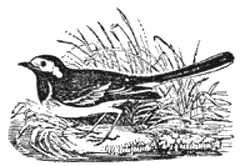
THE COMMON WAGTAIL.
Motacilla alba, Linnæus; La Lavandière, Buffon; Die weisse Bachstelze, Bechstein.
This species, well known throughout the old world, is seven inches in length, of which the tail measures three and a half. The beak, five lines long, is black, and very pointed; the iris is dark; the shanks, an inch in height, are slender, and black; the upper part of the head, as far as the nape, is black, but the rest of the upper part of the body, the sides of the breast, and lesser wing-coverts, are bluish ash grey; the forehead, cheeks, and sides of the neck are white as snow; the throat, as far as the middle of the breast, is black.
The female is without the white forehead and cheeks, the black top to the head being somewhat smaller. Some females have been found with very little of the black cap, and even without it, the head then being of the same colour as the back.
The young ones, which are seen in large flocks with the yellow wagtail around herds of cattle, are so different before the first moulting, that they have been considered a distinct species, under the name of the grey wagtail (Motacilla cinerea). In fact, the whole of the upper part of the body is grey, more or less pale; the throat and belly dusky white; the breast is generally crossed by a band, sometimes entire, sometimes broken, of a grey or brownish colour, and the quill-feathers are whitish on the outer edge.
It is not surprising to find varieties amongst birds so numerous. Some are quite white, others variegated, or speckled with white.
Habitation.—When wild it is found equally near houses, in the fields and mountains, and in every place where insects and worms are in plenty. It is in Germany a bird of passage, which assembles in autumn on the tiles, like the swallow, to prepare for its departure in the first fortnight of October96. It returns towards the end of February or beginning of March, though the weather be not mild; it may come thus early without danger, as it does not fear to approach houses, on the walls of which it finds flies that the spring sun has drawn from their retreat; and in the streams it also finds abundance of aquatic insects.
In the house it may be kept in a cage, or allowed to range; but in either case it is necessary to scatter plenty of sand about, as it is a very dirty little bird.
Food.—When wild, it feeds on gnats, water-spiders, aquatic insects, flies, and insects that fasten on cattle, round which it often roams. It also follows the ploughman to feed on the insects turned up by the plough.
In the house nothing tames it so soon as ants’ eggs, meal-worms, flies, and other insects. By degrees it acquires a taste for other food. In the cage it must be fed in the same manner as the nightingale.
Breeding.—This species breeds two or three times in the course of the season. Its nest, placed in a hole, in a crevice between stones, or even under a tile, is carelessly formed of moss, small roots, hay, or something of the kind, and lined with hair and wool. It lays five or six eggs, of a bluish white, spotted with black. The young ones brought up from the nest become so tame, that they will go and return like a pigeon, build in the room, and seek for food for their little ones in the fields.
Diseases.—Though very subject to diarrhœa, this and the two following species may be preserved in a room five or six years.
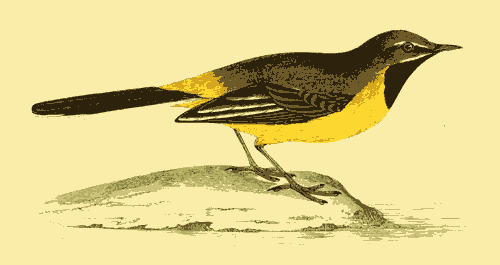
GREY WAGTAIL.
Mode of Taking.—If there is snow on the ground on their return in March, it is only necessary to clear a place (below the window will do), and scatter meal-worms amongst limed twigs, or place these on stones or wood where the birds assemble, or even fasten a meal-worm to a limed twig, loosely stuck in the earth, and you may soon catch a wagtail.
Attractive Qualities.—Its handsome plumage, its sprightliness, its quick and elegant motions, please one as much as its pretty song, which, without being striking, is varied, and continues the whole year, except during moulting. I always keep a wagtail amongst my birds, and when the blackcap, the blue-breast, the lark, and the linnet sing, it seems to form a counter-tenor.
THE GREY WAGTAIL.
Motacilla Boarula, Linnæus; La Bergeronette, Buffon; Die graue Bachstelze, Bechstein.
This beautiful species, like the preceding, is seven inches in length, of which the tail alone measures four. The beak is black; the iris brown; the legs, nine lines high, dark flesh-coloured; the upper part of the body, including the lesser wing-coverts, dark ash-grey; the head slightly tinted with olive, and the rump a fine yellow green; there is a white streak above the eyes, and another, beginning at the inferior base of the beak, descends the sides of the neck, whilst a black streak extends from the superior base as far as the eyes; the chin and throat are black, but the breast and under part of the body are of the finest yellow.
The throat of the female is not black, but pale orange; her colours are generally less bright.
Males a year or two old are without the fine black throat; it is clouded with white.
Habitation.—In their wild state, these wagtails are found throughout Europe; but in the greatest number in mountainous and wooded parts, where the brooks flow over beds of pebbles. They are birds of passage, and return amongst us the end of February or beginning of March. A few have been observed to remain during mild winters, when they take up their abode near dunghills or warm springs.
In the house they should be kept in a nightingale’s cage, and treated like one; they are so delicate, that with the greatest care they can rarely be preserved two years.
Food.—When wild they prefer aquatic insects, and are continually chasing them among the plants and stones by the water-side.
In the house they should be fed on the same food as the nightingale, to which they may be gradually accustomed, by throwing amongst it meal-worms and ants’ eggs.
Breeding.—Their nests, placed by the water-side, in mill-dikes, or heaps of stones, are formed with rather more art than those of the preceding species. They begin to lay as early as March, five or six white eggs, mottled with flesh-colour. The young ones must be reared on ants’ eggs and the crumb of white bread, soaked in boiled milk.
Mode of Taking.—This is very simple; it is only to plant sticks with limed twigs and meal-worms attached to them, on the banks, or in the middle of a stream which they frequent; you will not have to wait long before some are caught.
Attractive Qualities.—They are as pleasing as the common wagtail; but their plumage is more brilliant, and their voice stronger. Their beautiful clear trilling sound renders their song agreeable, though rather short.
THE YELLOW WAGTAIL.
Motacilla flava, Linnæus; La Bergeronette du printemps, Buffon; Die gelbe Bachstelze, Bechstein.
This might almost be mistaken for the female of the preceding species; but it is smaller, or rather shorter, as its tail is not so long, measuring only two inches and a half. The total length of this bird is six inches and a half; the beak is dusky; the iris nut brown; the shanks ten lines high, and black; the upper part of the body reddish grey, with a decided olive tint, which on the rump becomes a canary green; the head inclines more to grey than green, and above the eyes is a reddish white streak; the under part of the body is of a fine yellow, which becomes citron from age, and is palest at the throat and breast.
The back of the female is greyer; the belly of a less beautiful yellow; the throat whitish, and, with the breast as far as the belly, spotted with red or rust colour, in the male.
Habitation.—When wild, this species, better known than the preceding, is found throughout the plains of Europe, running about the pastures amongst the sheep and cattle. They assemble in September, and depart for warmer countries in large flights, uttering the cry “sipp, sipp!” in a clear tone; they return in March.
It must be treated like the grey wagtail, in the house; but it is not so delicate.
Food.—When wild it feeds on flies and other insects that tease the cattle.
In the house it must be fed like the preceding.
Breeding.—Its nest, made of stubble, and lined with wool, is placed at the water-side, or in a deserted mole-hill, sometimes in the grass, or corn, like the lark’k. It breeds twice in the year, each time laying five or six eggs, grey-blue, spotted all over with reddish grey, and very like those described above. The under parts of the young birds are much paler than in the old ones. They must be reared on ants’ eggs and white bread soaked in boiled milk.
Mode of Taking.—These birds are not very easily caught; at least, I have always found it very difficult to succeed; and, therefore, one is reduced to the necessity of placing limed twigs on the nest, which is cruel. If snow should fall, however, after their return in spring, some of them may be taken, by clearing a convenient place, and scattering there meal-worms amongst limed twigs, if you succeed in bringing the birds near.
Attractive Qualities.—Its beauty and agreeable song make this bird a desirable acquisition; but with every possible attention, I have never been able to keep one more than two years.
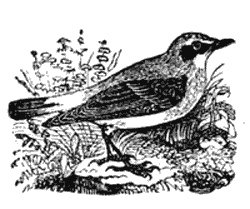
THE WHEATEAR.
Motacilla Œnanthe, Linnæus; L'Œnanthe, ou Le Culblanc, Buffon; Der Weisschwanz, Bechstein.
This bird, found throughout Europe and the northern parts of Asia, resembles the wagtail in size and air; but its tail being only an inch and ten lines, its total length is only five inches and a half. The beak, seven lines long, is black, as well as the iris and feet; the shanks are an inch high; the forehead white, and a white streak passes above the eyes, crossed by a black line springing from the nostrils, which also tints the cheeks; all the upper parts of the body and the scapulars are of a light ash-grey colour, slightly tinged with a reddish hue.
The back of the female is reddish grey, and the under parts of the body darker than in the male; the lesser wing-coverts are edged with rust-red, and the white of the tail is not so clear as in the male, but is of a reddish tint.
The young ones, before moulting, are spotted with red on a dark brown ground, on the upper part of the body; on the under speckled with orange and black. After moulting, both males and females retain for another year the colour of the female on the back, that is to say, reddish grey.
Habitation.—When wild this species frequents stony and mountainous places; and, during their migration, they may be seen resting in the fields, on the tops of isolated stakes, and other similar places; rarely on trees or bushes. They take their departure during the first fortnight in September, and return towards the middle of April, when white frosts cease.
In the house these birds must be kept in nightingales’ cages, or shut up behind a grating, and not suffered to range until accustomed in their prison to their new food; for, unless taken good care of at first, they will soon die. They can rarely be tamed.
Food.—When wild they feed on flies and other insects, which they catch as they run along.
In the house they must be given plenty of meal-worms and ants’ eggs as soon as they are taken; for, if not fed profusely, they will die, and what is rather astonishing, of diarrhœa, although they have not eaten any of the common house-food. Afterwards they may be fed on nightingales' food, and occasionally on white bread soaked in boiled milk; yet, with every attention, they can rarely be preserved more than two years.
Breeding.—Their nests, formed of stalks of grass and feathers, are generally placed in the crevices of some stone-quarry, sometimes in holes on the banks of streams or rivers, or in an empty mole-hill, or even on a heap of stones. They lay from five to six eggs, of a greenish white. To rear the young ones, they must be taken when half-fledged, and fed on ants’ eggs and white bread soaked in boiled milk.
Mode of Taking.—Limed twigs must be placed on the stones or stakes where these birds rest, or even on sticks fixed in the ground for the purpose, and they must be driven gently towards the snares.
Attractive Qualities.—No one would take the trouble to tame a full-grown wheatear, unless passionately fond of keeping birds. I have one, that, by the use of plenty of fresh ants’ eggs, has been accustomed to range the room. Its plumage is pleasing, its actions graceful; it is continually waving and spreading its fine tail. Its song is passable, but is interrupted every now and then by a kind of scream.
MR. SWEET’T ACCOUNT OF THE WHEATEAR.
The present interesting species generally arrives in this country about the middle of March, and leaves it again the latter end of September or the beginning of October, though I one year saw a pair in Hyde Park as late as the 17th of November.
In a wild state they are generally to be found on downs and commons, and in Sussex some hundred dozens are caught annually by the shepherds, who sell them for the sake of their flesh, which is very delicious, particularly in autumn, when they become very fat.
This is a very interesting bird in confinement, and is almost continually singing; it will also sing by night as well as by day, if there is a light in the room where it is kept; it has a very pleasant, variable, and agreeable song, different from all other birds, which, in confinement, it continues all the winter. When a pair of them are kept together in a large cage or aviary, it is very amusing to see them at play with each other, flying up and down, and spreading open their long wings in a curious manner, dancing and singing at the same time. I have very little doubt but a young bird, brought up from the nest, might be taught to talk, as they are very imitative.
When wild the present species feeds entirely on insects, so that the more it has given it when in confinement, the better. There are very few sorts of insects that it will refuse, except the common earth-worm; small beetles, cockroaches, crickets, grasshoppers, most sorts of caterpillars, butterflies, moths, earwigs, woodlice, the common maggots, and almost all other sorts of insects it is very fond of, and the more that is given it, the finer will be its song. Its common food is bruised hemp-seed and bread, intermixed with fresh, raw, lean meat; also a little of the yolk of an egg boiled hard occasionally for a change.
THE WHINCHAT.
Montacilla Rubetra, Linnæus; Le Tarier, ou Le Grand Traquet, Buffon; Der Braunkehliger Steinschmätzer, Bechstein.
This is a delicate bird that is met with throughout Europe, among scattered bushes and abrupt declivities. It is four inches ten lines in length, of which the tail measures an inch and a half. The beak is black, as also the legs, which are nine lines high; the upper parts of the body are dusky, in very old birds black, but streaked with pale rust-red, as all the feathers are edged with this colour; a white line, beginning at the nostrils, passes above the eyes as far as the ears; the cheeks are dusky, spotted with chestnut; the throat and breast are yellow, inclining to orange, the former edged with white on the sides and chin.
The colours are paler in the female, the streak above the eyes is yellowish; the upper part of the body dark brown, spotted with rust; the cheeks dark brown; the throat reddish-white; the breast pale orange, with small round, black and brown spots, which gradually disappear from age.
These birds vary till the third year. The young ones, which may be seen perched on cabbages and other plants, even on strong wheat stalks, have the whole of the upper part of the body covered with red and blackish spots, and each feather edged with this colour before the first moulting; the under part of the body is like the female. I killed two in their second year, that still had dusky spots on the breast, though they had become darker on the back; in general, the two sexes may be distinguished by the deep brown of the cheeks and back.
Habitation.—When wild they generally frequent the skirts of woods. They appear amongst us the beginning of May, and depart towards the end of September. In August they may be seen scattered over the fields, on the stalks of plants, or detached bushes.
In the house they must be kept in a nightingale’s cage.
Breeding.—The nest, constructed of dried grass mixed with moss, lined with hair and feathers, is commonly placed in a tuft of grass in the middle of a meadow or orchard. The females lay five or six eggs, of a fine light blue. Young ones reared on ants’ eggs succeed much better than those taken full grown.
Mode of Taking.—In spring, when some of these birds are seen in a field or meadow, sticks, furnished with limed twigs, should be stuck there, and the birds gently driven to that side, to induce them to settle, which they will soon do. In summer, the noose, spring-trap, and limed twigs, must be employed in the following manner:—If the noose is used, a stake must be set up, about three feet high, slit at the top to put in crossways a stick three inches long, and the noose is placed an inch and a half above, to be of the height of the bird’s breast when it is perched on the stick.
If limed twigs are used, forked switches three feet long should be employed: the fork, four inches in length, must be covered with bird-lime. Spring-traps or gins must be suspended to small stakes or cabbage stalks. As soon as a sufficient number of these spring-traps, snares, and limed twigs, are prepared, they must be carried to a cabbage garden, when a number of these whinchats has been seen; there fix the stakes in cross lines, two or three paces apart; then go to the end of the garden and drive the birds gently towards the snares; they jump from one cabbage stalk to another till they approach the stakes; then you stop, and in a short time the birds are caught one after another. When they are caught, the prisoners must be taken out and the snares arranged again; then go to the other end and again drive the birds forward as before, and thus continue till the sport is over.
Attractive Qualities.—However gay this bird may appear when free, it becomes sad and melancholy in the house. If permitted to range, it only moves to procure food, and then returns to its accustomed place, and keeps its head sunk on its breast. Its pleasing song very much resembles the goldfinch’h; but what makes it more admired, is, that it is not only heard during the day, but also in the evening, and sometimes during the night.
MR. SWEET’T ACCOUNT OF THE WHINCHAT.
This pretty species is also known by the name of Furze Chat, and is very often confounded with the stonechat, which is a very different species. It generally visits this country in the beginning of April, and leaves us towards the end of September. All the fore part of the season it visits commons, where it may be seen on the furze bushes, flying backwards and forwards after the insects that pass. It builds its nest on the ground in a thicket, which it covers up with dry grass, so that it is impossible to find it without watching the old ones, either in carrying materials to build, or food to their young. I have generally found them with six or seven young ones, which, with care, are easily bred up from the nest, keeping them warm, dry, and clean, and feeding them with the same sorts of food as recommended for the old ones; they should not be taken till quite fledged, and should at first be placed in a little basket with covers, as they will then readily open their mouths for food. I consider those reared from the nest much the best, or such as are caught very young, as they may then be taught any tune, or will learn the song of any bird they hear, their own song not being a very good one.
This bird may be considered as one of the tenderest of the tribe, being very susceptible of cold. It is one of my greatest favourites. One that I bred from the nest by hand, learnt the song of the white-throat, the redstart, willow-wren, nightingale, and also that of a missel-thrush, which it frequently heard singing in a garden near by; of this latter song it was so fond, that we were frequently obliged to put our favourite out of the room, not being able to bear its loud notes; it was certainly the best bird I ever kept of any kind, singing nearly the whole year through, and varying its song continually; the only fault was its strong voice. At last, our favourite was turned out of its cage by a mischievous servant on a cold winter day, when we were from home for about an hour, and we could not entice it back; it most probably died of the cold, or took its flight to a warmer region. I scarcely entertain any hopes of ever getting such another; the food of the present species is precisely the same as the last.
MR. SWEET’T ACCOUNT OF THE STONECHAT.
This, like the preceding, is generally to be found on hills and commons, harbouring chiefly amongst the furze bushes, and feeds, as far as I have observed, entirely on insects. It is not so tender as the whinchat, some few of them occasionally stopping in this country all the winter. It feeds, when wild, on small beetles, flies, as also all sorts of butterflies, moths, caterpillars, woodlice, and various other insects.
In confinement their food must be the same as the whinchat’s. They soon become very tame, and if bred up from the nest will learn the notes of other birds, which are in general better than their own. Their own song, though loud, is very short, but they have a strong voice to repeat the notes of another bird.
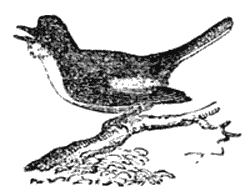
THE WHITE-THROAT.
Sylvia cinerea, Bechstein; Le Fauvette grise ou Grisette, Buffon; Die gemeine Grasmücke, Bechstein.
This bird is five inches and a half in length, of which the tail measures two and three-quarters. The beak, five lines long, is dusky above and greyish beneath, with the corners and interior of the throat yellow; the iris is greyish brown; the shanks are brownish flesh-coloured, and ten lines high; the head is ash-grey: the cheeks, neck, back, rump, tail-coverts and lesser wing-coverts, are also ash-grey, but tinged with brown, deeper on the back than elsewhere; the throat and belly are fine white.
The female, rather smaller and lighter, rust-coloured on the wings, has not a fine white throat like the male.
Habitation.—When wild the white-throat is spread through Europe. They leave us the beginning of October, and are then observed to retire from bush to bush, and from hedge to hedge. They reappear towards the middle of April, fluttering about the bushes in the fields, the brambles, thickets, underwood of the low mountains, and the orchards, running about very swiftly.
In the house they must be treated in the same manner as the fauvette; but they are much more delicate. An amateur had better rear young birds, and treat them like nightingales. It is the only way to keep them many years.
Food.—When wild these birds are constantly seeking among the bushes for all kinds of insects, grubs, and especially small caterpillars. When, from the air becoming cooler, the supply of this sort of food lessens, they immediately substitute for it currants, cherries, and elderberries.
In the house they must be fed, as we said before, on nightingales’ food. They may, however, be given, occasionally, barley meal and white bread soaked in boiled milk; but this food alone will not agree with them, for they will upon it gradually lose their feathers, till at length they become quite bare. It is a good thing in summer to give them elderberries, though they may be red, and in winter dried ones, after soaking them in water.
Breeding.—The nest is formed of small grass stems and moss, and lined with horse-hair. It is placed in a thick bush, near the ground, or among roots at the water side, sometimes even in tufts of grass. The eggs, from four to six in number, are greenish white, spotted with olive green, and speckled at the large end with dark ash-grey. The young leave the nest so soon that it is difficult to take them from it. Their first plumage resembles full-grown ones, and the females may be known by the fainter tint of fawn brown with which the wing-feathers are edged. I have reared them easily on ants’ eggs. They soon learn to peck alone, and are tolerably satisfied with bread soaked in boiled milk; but to keep them long in health they must be fed in the same manner as the nightingale. They are pretty, engaging birds, thus reared, becoming so tame that they will perch and sing on the finger.
Diseases.—These are the same as those of the blackcap, which may be referred to.
Mode of Taking.—The easiest way is to place limed twigs on the nest, but this is repugnant to persons not cruel. Towards the end of summer, spring-traps may be set, with elderberries and gooseberries hung near them. It is difficult to take these birds at the water-trap.
Attractive Qualities.—This bird, gay, lively, and constantly in motion, is a pleasing object in the country. Its song, prolonged far into the night, consists of several strains, which rapidly succeed each other, but must be near for all its beauties to be distinguished, since the soft low tones are only occasionally interrupted by louder notes, which are shrill and follow quickly one after the other. The bird rises in the air as it sings, as if to be better heard, circles round as it ceases, and sinks again into its bush. Its call is a loud tze. When the white-throat is alone in a room, its song appears very melodious.
MR. SWEET’T ACCOUNT OF THE WHITE-THROAT.
This is one of the most delightful and pleasing birds that can be imagined. If kept in a large cage with other birds it is so full of antics, in flying and frisking about, and erecting its crest, generally singing all the time, certainly nothing can be more amusing. It is also quite as hardy as the blackcap, and if a good one be procured, it is little inferior in song: but in this they vary considerably, the wild ones as well as those in a cage. I have now one in my possession that I have had about eleven years, in as good health, and singing as well as ever; and certainly no song need be louder, sweeter, or more varied. It is of the same temper as a nightingale, never suffering itself to be outdone. It will indeed sing for hours together against a nightingale, now in the beginning of January, and it will not suffer itself to be outdone; when the nightingale raises its voice, it also does the same, and tries its utmost to get above it; sometimes in the midst of its song it will run up to the nightingale, and stretch out its neck as if in defiance, and whistle as loud as it can, staring it in the face; if the nightingale attempts to peck it, away it is in an instant flying round the aviary, and singing all the time.
In a wild state, the present species is generally to be found in hedges and gardens, and is the most common of our British warblers, visiting us the beginning or middle of April, and leaving us towards the end of September; sometimes a solitary one may be seen in October, but not frequently. It is particularly fond of flies, or a rose-branch covered with aphides will please it very much.
THE BABILLARD.
Sylvia curruca, Bechstein; Motacilla dumetorum, Linnæus; La Fauvette babillarde, Buffon; Das Müllerchen, Bechstein.
This bird somewhat resembles the white-throat, but is smaller, and has less rust colour on the wings. It is five inches long, the tail measuring more than two. The beak is five lines in length, very pointed, black above, and bluish below; the iris has two rings, the outer one pale yellow, the inner a brilliant golden yellow; the shanks, seven lines high, are raven black; the head and rump are dark ash grey; the rest of the upper part of the body is grey, with a reddish tint; the cheeks and the part behind the ears are darker than the head; the throat and under part of the body are white, but the sides of the breast are tinged with reddish grey, and those of the belly with reddish brown.
The birds must be before you to be able to distinguish the two sexes; you can then only perceive that the head of the female is of a lighter colour, and the feet rather blue than black.
Habitation.—When wild this species is found throughout Europe, except the north. It is common in the hedges in Germany, disappearing in September, and returning the middle of April. Its taste for currants often draws it to the garden hedge. It is not very often seen in young coppice wood, scarcely ever on trees97, continually on low bushes.
In the house it must be lodged like the fauvette, and taken the same care of; it is so delicate, that when taken rather old it can rarely be preserved.
Food.—When wild it is the same as the preceding species.
In the house these birds cannot be kept long, unless fed on nightingales' food, mingled with ants’ eggs and meal-worms.
Breeding.—The nest is generally found on a thick gooseberry bush, or white-thorn, and on young fir trees in fir woods. It is formed of coarse dried grass, lined with small roots mixed with hogs’ bristles. There are five or six eggs, white, spotted at the large end with grey and yellow brown in a circle. The female’s attachment to her brood may be known from her dropping from her nest almost fainting as soon as any one approaches, uttering anxious cries, fluttering on the ground, and slowly retiring from the nest. Scarcely are the young ones fledged, when, if looked at, they will dart like an arrow from the nest, and run and hide themselves among the bushes. If you wish to rear them, they must be taken as I have directed for the fauvette, remembering that the male and female cannot then be distinguished.
Diseases.—These are the same as in the fauvettes.
Mode of Taking.—If snow should fall after their return, a place near a hedge should be cleared, and limed twigs fastened to the lower branches; after having thrown meal-worms there, the birds should be gently driven towards it, and for the sake of the worms they will creep under the limed twigs, and remain caught.
Attractive Qualities.—Though the plumage is not very striking, yet this bird is very pretty. Some clacking tones, rather like the noise of a mill, have given it in Germany the name of the little Miller; as these notes are heard more distinctly than the others, they are erroneously thought to be its whole song; but the rest, certainly very weak, is so soft, so varied, so melodious, that it surpasses other warblers. Whilst singing in this under tone it is continually hopping about the bushes, but when going to utter clap, clap, it stops and employs the whole strength of the larynx to pronounce this syllable. To enjoy the beauty of its song it should be alone in a room, and then no other singing bird is more agreeable, as it rarely utters its call.
MR. SWEET’T ACCOUNT OF THE BABILLARD.
This is a handsome, little, lively species, more elegant and smaller than the white-throat, and of a purer colour; its throat being as white as snow. It generally visits us the beginning or middle of April, and leaves us again the end of August or beginning of September. Its song is not so agreeable as most of the other species of warblers; but it is soft and pretty, and very different from any other. It is also more valuable by being much more rare; some seasons very few visit us, in others they are sufficiently plentiful. Its habits are somewhat similar to those of the white-throat, but it is much more quarrelsome, sometimes so much so, that it must be taken from the other birds or it will worry them to death, even if they are double its size.
In confinement it will soon become tame and familiar, and will readily take to feed on bread and milk, and also on bruised hemp-seed and bread. One that I bred up from the nest became so attached to its cage, that it could not be prevailed upon to quit it for any length of time. When the door of it was set open, it would generally come out quickly, and first perch on the door, then mount to the top of the cage, thence it would fly to any other cages that were in the room, and catch any flies that came within its reach; sometimes it would descend to the floor, or perch on a table or chair, and would fly up and take a fly out of the hand, or drink milk out of a spoon if invited: of this it was very fond. As soon as it was the least frightened, it would fly immediately to its cage, first on the top, thence to the door, and would enter in exactly as it came out. I have often hung it out at the window perched on the top of its cage, with the door open, and it would never attempt to fly away. Sometimes if a fly should happen to pass near it, it would fly off and catch it, and return with it to the top of the cage: after remaining there a considerable time, it would either return into it, or fly in at the window, and perch on the cages of the other birds. It is rather more tender than the white-throat.
MR. BLYTH’H ACCOUNT OF THE BABILLARD.
The warble of the babillard (Curruca garrula, Brisson) is pretty and lively, but its song is rendered monotonous in the spring and summer by the constant repetition of its loud note of defiance, analogous to the clear lively note with which the blackcap generally concludes: this may be expressed by the monosyllable see, repeated nine or ten times in quick succession, and at times very loudly: it is a note, which, though agreeable enough when only heard occasionally, becomes quite tiresome when continually reiterated. This species, however, can warble very sweetly if it please, and, in confinement, during the first months of the year, its song is heard to great advantage in a room; it then rarely repeats its loud see see see, and when, at that time, the above-mentioned note is uttered, it forms, indeed, an agreeable variety. The song of the babillard is formed of a number of soft chirping notes, many of which are extremely sweet and musical, and though at times tolerably loud, yet they are generally delivered in a very low tone, scarcely audible at a little distance. The male is almost perpetually singing, erecting his crest and the feathers of his throat in the manner of a white-throat, and, like that species and the furze warbler, he is in constant motion the whole time, throwing himself into a variety of odd gesticulations. The song of this bird is very superior to that of many white-throats, but not to all; he has none of those harsh sounding notes which so often disfigure the white-throat’s song. He seems also to be always in such high spirits as not to know how to contain himself, taking frequently a long circuitous flight from tree to tree, and back again, a dozen times, seemingly for no other purpose than mere exercise; but he never mounts singing into the air, like the white-throat. There are yet many persons, I believe, who consider this species to be “a mere variety” of the white-throat. These two species differ from each other in size, in make, in colour, in their manners, their habits, their song, in the structure of their nest, and in the marking of their eggs; and surely, “if all these circumstances (as Wilson observes, after making similar remarks on two American birds, one of which had been considered a ‘bastard’ production of the other) be not sufficient to designate this (the babillard) as a distinct species, by what criterion, I would ask, are we to discriminate between a variety and an original species, or, to assure ourselves, that the great horned owl is not, in fact, a bastard goose, or the carrion crow a mere variety of the humming bird?”
THE BLACK REDSTART.
Motacilla Tithys, Linnæus: Le Rouge-queue, Buffon; Der Wistling, Bechstein.
Length five inches and one quarter, of which the tail alone measures two and one quarter. The beak is five lines long, very pointed and black, the inside and corners yellow; the iris is dusky; the shanks are nine lines high, and black; the upper part of the body is dark bluish, or blackish gray; the rump is red; the cheeks, throat, and breast, are black; the belly and sides are of the same dark colour as the back, but tinged with white; the vent is reddish yellow.
The upper part of the body in the female is dusky ash grey; the under part ash grey, with a reddish tinge.
The colours of this bird vary during the first eight years; the oldest ones, with the exception of the tail and wings, are in general black, but deeper on the under part than the upper; the very oldest have a greyish breast.
Those a year or two old very much resemble the females, having the upper part of the body ash grey, but the under rather more of a reddish colour; the quill-feathers have a more decided border. After two years the depth of the colour gradually increases. Several bird-catchers, and from them some authors, have considered these birds of different ages as different species.
Habitation.—In its wild state the black redstart is found in the temperate parts of Europe and in Asia in the same latitudes98. They seem to prefer mountainous districts to wide plains, and they are seen in great numbers on bare chalk-hills; if found in woods, it is only in those that are on rocks. They frequent towns and villages, perching on the highest buildings, towers, steeples, churches, and castles99. In spring and autumn it hops about the hedges. It arrives early in the spring, its song is heard in the beginning of March, and it quits us in small flights towards the middle of October. It possesses one quality, not common among singing birds, that of singing all the year, or, at least, whilst in our country, however cold and stormy the weather may be.
In the house it should be kept in a nightingale’s cage, or at least not permitted to range the room.
Food.—When wild it feeds on flies, drawn by the warmth of spring from their retreat, and settled on walls; afterwards on cabbage caterpillars and other insects, and in autumn on berries.
In the house they may be kept in health a long time, if the above insects are procured for them, or if fed on nightingales’ food, adding occasionally ants’ eggs and meal-worms.
Old birds taken in autumn may sometimes be tamed and accustomed to eat the common food in the room, by putting amongst elderberries, in autumn, ants’ eggs, and meal-worms at other seasons. They have been known to live five or six years in a cage.
Breeding.—This bird makes its nest in the holes of rocks and walls, particularly in high buildings, on the timbers of barns, and places it at a distance from any other. It is constructed of hay, mixed with the hair of animals. Each laying (for there are two in the year) consists of five or six white eggs. The young have a reddish grey plumage, and should be taken from the nest when the tail is half grown, if it is wished to rear them. They should be fed on ants’ eggs, and white bread soaked in boiled milk.
Diseases.—These are the same as those of the fauvette.
Mode of Taking.—Limed twigs, with meal-worms fastened to them, should be laid wherever these birds are most frequently found. Towards winter they may be caught in spring-traps with elderberries hung opposite.
Attractive Qualities.—Its call, “fitza,” being very similar to the nightingale’e, has given rise most probably to its name of Wall Nightingale, which it has in common with the following species. Its song certainly cannot enter into comparison with that of the nightingale, for it is sad, and consists of only three strains, the middle one scarcely more than croaking; the other two may boast of a few high clear tones; it may be heard from early in the morning till night. It is always gay and active, its motions light and nimble; it shakes its tail quickly from side to side at every hop or spring, and utters continually the cry “fitza100!”
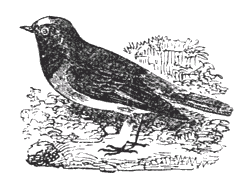
THE COMMON REDSTART.
Motacilla Phœnicurus, Linnæus; Le Rossignol de muraille, Buffon; Das Gemeiner oder Garten-Rothschwänzchen, Bechstein.
Its length is five inches and a quarter, of which the tail measures two and a quarter. The beak is five lines, the tip is blunt, black on the outside, yellow within and at the corners; the iris is black; the shanks are of the same colour, and ten lines high; the base of the upper mandible and cheeks are black, as also the throat, but this is speckled with white; the white on the front of the head unites with a streak of the same colour, which extends above the eyes; the back of the head and neck, the back and lesser wing-coverts, are dark ash grey tinged with a reddish colour; the rump, breast, and sides, are red inclining to orange.
The female is very different, very much resembling that of the black redstart, yet its colours are rather lighter. The upper part of its body is reddish ash grey; the whitish throat is not clouded with black till the fifth or sixth year; the breast is dusky rust-red waved with white; the belly is dusky white; the rump is reddish yellow101.
It is not till after the first moulting that the distinction between the plumage of the males and females is obvious; even then the breast of the male retains the black tinged with white, but loses this tint in the course of the following summer; the males also have for some time a white streak on the forehead, that passes above the eyes, and the belly is more white than rust-red.
Habitation.—In a wild state these birds are found in Europe and Asia, and are very common in Germany and England. They leave us the beginning of October, and return the end of March or beginning of April. At this time and in autumn they haunt hedges and bushes; but in summer they principally frequent gardens, the banks of streams planted with willows, and even forests. Those that frequent gardens also enter towns, and will perch on the roofs of the houses, enlivening the inmates with their song from morning till night.
In the house, if given a cage, it should be of such light wire work as not to conceal the beauty of the plumage.
Food.—When wild they feed on all kinds of insects, earth-worms, currants, and elderberries.
In the house, if taken in autumn, they may sometimes be induced to feed on elderberries, rarely on the poultry paste. To entice them to this meal-worms must be mixed with it at first, and some thrown in when it is eaten; ants’ eggs must be added in spring. These birds are delicate, and always require to be supplied with insects; but never give them earth-worms, as they do not digest them easily. If kept in cages they should be given nightingales’ food; yet fed in this way it is rare to preserve them above three or four years; they generally die of consumption or atrophy.
Breeding.—The redstart generally places its nest in a hole of a tree or wall; it is negligently formed of moss, stalks of grass, feathers, and hair. The female has two broods in the year, and each time she lays from five to seven eggs, of an apple green. Scarcely have the tail-feathers begun to grow ere the young ones hop from the nest and perch on some neighbouring branch, where they receive food from the parent birds till they are able to seek it for themselves. Their plumage before moulting is ash grey spotted with white. The young females resemble the nightingale so much in autumn that they are often mistaken for it. Bird-fanciers should rear these birds on ants’ eggs, with white bread soaked in boiled milk occasionally, and thus accustom them to the common universal paste. They learn to repeat parts of the songs of their companions.
Diseases.—Diarrhœa and atrophy carry off the greatest number.
Mode of Taking.—Sticks covered with bird-lime should be placed across the hedges frequented by these birds; they must then be driven gently towards them. They are also attracted under nets, and amongst limed twigs baited with meal-worms. In autumn they may be taken in nooses, by suspending elderberries near them, either in orchards or thickets. Those intended for the house should be taken in bird-traps or springes, taking care that the wooden part be covered with felt or cork, to prevent the legs being broken. The young ones of the first year are the easiest to preserve. They also go to the water-trap without difficulty.
Attractive Qualities.—Its plumage, and still more its song and sprightliness, render this a delightful bird. It is always in motion, bowing, and moving its tail from side to side at every step; all its actions are lively and graceful. It can improve its song, composed of some very pretty strains, by adding to it parts of the songs of birds that are found near it. For instance, those that build under my roof imitate tolerably the chaffinch that hangs in a cage at my window; and a neighbour of mine has one in his garden that repeats some strains of a blackcap that has its nest near. This facility in appropriating the song of other birds is rare in birds that live in a state of liberty, and seems peculiar to this species. They become so tame that they will take meal-worms from the hand.
MR. SWEET’T ACCOUNT OF THE REDSTART.
This is one of the handsomest of our British birds, visiting us the latter end of March or beginning of April; the earliest arrival ever noticed was the 25th of March, and they generally leave us the beginning of September. When they first arrive they mostly frequent old buildings or out-houses, for the sake of flies and small insects that often abound there. They build their nest in a hole or crevice of a wall, or in a hollow tree. They frequently ascend to the top of the highest tree within their haunt, and there sit sometimes for a considerable time, pouring out their quick and sort of fretful song. When kept in confinement I consider it the most sensible, and, if brought up from the nest, the most attached of all small birds; but it may be considered the most tender of the whole tribe. It is a real mocker, and if bred up from a young one, will learn the note or call of almost any other bird; it will also learn a tune that is whistled or sung to it, and will sing by night as well as day if a light be kept in the room where it is.
I was in possession of a handsome male bird of this species, which I kept more than six years. It became very tame, though an old wild bird when first caught, and it was so attached to its cage, that one day, having got its liberty, it flew away into the gardens, where it stayed six or seven hours, after which it returned to its cage again. In the year 1825 I saw a female bird of this species so late as the 21st of November, flying about as lively as at midsummer; it had probably escaped or been turned out of a cage. When in confinement it is particularly partial to ants’ eggs, and also to the common maggots.
THE ARBOUR BIRD.
Sylvia polyglotta, Ranzani; Sylvia Hippolais, Bechstein; Le Bec-fin à poitrine jaune, Temminck; Die Gelbbrust, Bechstein; Die Spotvogel, Wichterich.
This pleasing bird, which is met with wherever there are groves and bushes102, is five inches and a half in length, of which the tail measures two and a quarter. The beak, seven lines long, is straight, blunt, bluish grey above, and yellow tinged with flesh-colour beneath, with yellowish corners, and the entrance of the throat citron yellow; the iris is dark brown; the shanks, ten lines high, are lead-coloured. The head is pointed in front; the back, rump, and lesser wing-coverts, are olive ash grey; a yellow line extends from the nostrils to the eyes; the whole of the under part of the body is a fine light yellow; the tail and wings are dark brown; the secondary quill-feathers have so wide a white border that it forms a spot on the closed wings.
Habitation.—In its wild state it frequents orchards, groves, and brambles; but with us it seems to prefer small woods that are interspersed with resinous trees. It arrives the end of April, and quits us as early as the end of August, before the moulting season.
In the house it is kept in a nightingale’s cage, in which no change must be made, still less must another be given it, for it would not survive these disturbances. It is so delicate, that if taken when full grown it is almost impossible to tame it.
Food.—When wild its food is all kinds of insects, smooth caterpillars, flies, gnats, &c.; and if these are scarce, berries103.
In the house it prefers these insects and meal-worms. It is only with great patience and management that it can be given a taste for the nightingale’e food. In general it will eat nothing but insects.
Breeding.—The nest of the arbour bird is one of those that are so well and curiously formed, commonly placed eight feet above the ground, in the fork of a tree. It is built of pieces of the white bark of the birch tree, dried plants, caterpillars’ webs, wool, and the upper layer of down. All these white materials give it the appearance of being made of paper. It is lined with the finest hay. The female lays five eggs, which are at first of a pale rose red, but after having been sat upon some days acquire a dark flesh-coloured tint, speckled with dark red. This species has but one brood in the year, and if the nest is approached two or three times it will desert it, whether the young ones are hatched or not.
If a person wish to have this pleasing bird in the house, as it is often seen in Hesse, he must take the young ones early from the nest, feed them on ants’ eggs and bullock’s heart chopped small, and always keep them in a warm place. As soon as the arbour bird has been placed in the situation destined for it, it must be left there constantly; its cage ought not to be changed, at least there should be no difference in the one given it afterwards, as without this attention it becomes sad, eats no longer, and dies in a short time. I may observe here, that it moults in December or January, whence we may infer that it passes the winter in a southern climate.
Diseases.—These are the same as the nightingale’e.
Mode of Taking.—This can rarely be accomplished but by placing limed twigs on the nest, which is a cruel method, and the nest is often deserted as soon as it has been approached. Neither will these birds go to the water-trap: they may be caught occasionally in bird-traps in August, by baiting them with currants104. The surest way then is to take them young, especially as the old ones cannot be tamed.
Attractive Qualities.—The song of the arbour bird is sweet, varied, full of power and melody, long sustained; yet some harsh strains have been remarked, and some resembling the notes of the chimney swallow. Whilst singing its throat is much dilated. Its call is dak, dak! hyovie, hyovie! Its plumage is pretty.
ACCOUNT OF THE ARBOUR BIRD, FROM THE “FIELD NATURALIST’T MAGAZINE.”
“British writers, since the time of Pennant and White, have rendered the history of several of our smallest birds a mass of confusion, which even now it will be difficult to clear up, though I feel confident I possess the means of loosening two at least of the knots of the controverted points, as I shall presently show.
“When I was residing, in the summer of 1832, at Bonn, on the Rhine, my friend M. Wichterich brought me a pair of birds with their young, which at first sight, judging from colour and size, I took to be pale canaries, till I looked at their bills; I perceived then that it was a species with which I was unacquainted, and certainly not known as British. I was accordingly not a little surprised when he told me it was the Sylvia Hippolais of Bechstein, and astonished when he said it was one of the finest song birds in Europe, very superior to the blackcap and fauvette, and in some respects even to the nightingale. I thence concluded that it was the species whose splendid song had charmed and puzzled me in an orchard at Schiedam, in Holland, and again in the gardens of Prince Maximilian, at Neuwied, on the Rhine; the rich intonation and multitudinous variety of the notes fully bearing out my friend’s opinion. This circumstance alone would go far to prove that the species is not British, for it would be impossible so fine a song bird could be concealed, particularly as it haunts gardens, and is rarely found in woods. The very contrary of the statement of Temminck, whose authority, how high soever it may be in other matters, is, with respect to habits and field observations, of not the slightest weight: he might have seen the bird, if he ever looked beyond his cabinet, in most of the gardens about Leyden, where he resides.
“I kept the old birds with their young, which they fed in a cage for some time, but to my great regret they fell a sacrifice to the common enemy of cage birds. About the same time I was delighted to find a nest of the same species in a lilac-tree in my own garden, about half a dozen yards from my parlour windows. Three of the young after leaving this nest were secured, and their mother was caught to feed them, which she did successfully, and I brought them all, and three others, home with me to England. The nest was about seven feet high from the garden level, and ten from the base of a low wall, over which the branch where it was built leaned. The workmanship of the nest is very superior to that of the blackcap, coming nearer in character to that of the finches. The frame-work is rather thick, made of dried grass stems, sewing thread, fine wood shavings, birch bark, and small pieces of linen rag. The inside is very neatly lined with roots, hair, and a few feathers and small locks of wool.
“In the full grown male the bill is about half an inch long, straight, somewhat blunt, broad and flat at the base. The upper mandible has an exceedingly indistinct notch, and is greyish blue; the under mandible yellowish, with a tinge of red; the angles yellowish, and the opening of the mouth lemon yellow. The tongue is yellow, abrupt at the point, and furnished with three bristles. The iris is dusky brown. The forehead is low, flat, angular, and pointed. The eyebrows and eyelids are yellow, and a yellow line runs from the nostrils to the eyes. The crown of the head, neck, back, and wing-coverts are olive grey, inclining more to green on the rump. The shoulder of the wing (campterium, Illiger) is yellow: the primary quill-feathers are dusky brown, with a slight fringe of olive grey; the rest of the quill-feathers have a broader fringe of greyish white, which, when the wing is closed, forms a whitish patch. The tail is two inches long, the feathers being of equal length, and of very nearly the same colours and tinge as the wing-quills. All the under parts of the body are of a fine clear lemon colour. The legs are five-sixths of an inch high, and of a lead colour; the claws greyish brown. The whole length is five inches and a half; the extent of the wings nine inches.
The female is sometimes, but not always, rather paler than the male. The young have the yellow parts very pale.
A species very similar to this has been discovered in Italy by Prince C. Buonaparte—the Sylvia icterina? of Vieillot, which frequents marshy places.
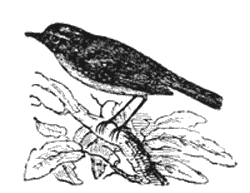
THE COMMON CHIFF-CHAFF.
Sylva loquax, Herbert; S. Hippolais, Montagu; but not the S. Hippolais of the Continental authors, which is S. polyglotta.
COLONEL MONTAGU AND MR. SWEET’T ACCOUNT OF THE CHIFF-CHAFF.
This bird weighs about two or nearly three drachms; the length varies from four inches and a half to five inches.
This species is nearly the same size as the hay-bird. In its plumage it so much resembles that bird, that we shall only make mention here of some essential marks of distinction, and refer our readers to the hay-bird.
Its general colour is not so much tinged with yellow, and the legs are dusky, which in the other are brown.
The plumage of the sexes are alike.
These two birds have been, and are, frequently confounded, and with them the wood wren of this work; but this last is at once distinguished by the under tail-coverts being a pure white, and the plumage of a more lively green on the upper parts than either of the others. The nest, eggs, and notes, will be found also different by consulting and comparing the history of each. This is the first of all the migrative warblers (Sylviadæ) in its annual visit, and is, perhaps, the only one that has occasionally been observed with us during the winter, and that only in the milder parts of England. It is generally heard on or before the first of April repeating its song, if that may be so called which consists only of four notes, which seem to express the words chip, chop, cherry, churry, four or five times successively. It is a busy, restless bird, always active among the trees and bushes in search of insects. From its early cry in our neighbourhood, we long suspected it would be found that this hardy little bird did not wholly quit us, and in this opinion we were confirmed by seeing one in the garden about Christmas, 1806. In the following January, we observed two of these little creatures busied in catching the small insects which a bright day had roused in great abundance about some fir trees, by springing upon them from the ends of the branches, one of which we succeeded in shooting. Another, which we killed in 1808, on the same spot, while feeding upon a small species of culex, weighed one drachm thirty-three grains; this will easily account for the very early cry of this bird in the spring, as it is highly probable that they remain with us the whole year, but are wholly silent in the winter. The earliest we ever heard was on the 14th of March, 1804, when vegetation was unusually early.
The nest of this species is oval, with a small hole near the top, composed externally of dry leaves, and then coarse dry grass, and lined with feathers; and is generally placed on or near the ground, frequently on a ditch bank, in a tuft of grass or low bush. The eggs are six in number, white, speckled with purplish red at the larger end only, with here and there a single speck on the sides.
It seems to be the hardiest and most generally diffused of all our summer visitants; and is found in all parts of the kingdom where wood or hedges afford it shelter and food. Its note is heard long after the hay-bird is silent. Dr. Latham says this is called in Dorsetshire the hay-bird; but as we are inclined to believe the three species before mentioned have been confounded, it is more probable that our hay-bird should obtain that name, as its nest is composed of that material.
Mr. Sweet tells us, “it is readily taken in a trap baited with small caterpillars. They soon get familiar in confinement; when first caught, they should, if possible, be put with other birds, and they will readily take to feed on bruised hemp-seed and bread, and on bread and milk, which must at first be stuck full of small insects, or a quantity of aphides may be shaken off a branch upon it; when they have once tasted it they will be very fond of it. One that I caught took to eat it directly, and became so familiar, that in three or four days it would take a fly out of the hand. It also learnt to drink milk out of a tea-spoon, of which it was so fond, that it would fly after it all round the room, and perch on the hand that held it, without showing the least symptoms of fear. It would also fly up to the ceiling, and bring down a fly in its mouth every time. At last it got so very tame, that it would sit on my knee by the fire and sleep; and when the windows were open, it would never attempt, nor seemed to have the least inclination, to fly out; so that I at last ventured to entice it out in the garden, to see whether it would return. I with difficulty enticed it out at the door with a spoon of milk; it returned twice to the room; the third time it ventured into a little tree; it then fled and perched on my hand, and drank milk out of the spoon; from thence it flew to the ground on some chickweed, in which it washed itself, and got into a holly-bush to dry. After getting among the leaves, I could see no more of it, but heard it call several times. I suppose after it got quite dry that it left the country directly, as I could never see or hear it afterwards, and it was then the end of November, when all the others had left for some time105.”
THE RUFOUS CHIFF-CHAFF.
Sylvia rufa, Bechstein; La Fauvette rousse, Buffon; Der Weidenzeisig, Bechstein.
This and the gold-crested wren are the smallest of our European birds.
The full-grown male has the bill a third of an inch in length, very narrow, and pointed; of a blackish brown, except at the edges and within, where it is yellow. The iris is dusky brown. From the base of the bill on each side there runs a narrow yellowish white streak, and there is another straight streak of a dusky yellow over the eye. The sides of the head are of a very clear brown. The upper part of the head, neck, and back, are greyish brown, with a slight tinge of olive. The throat is greyish white; the breast light grey, with a very pale tinge of red, or rather rust brown. The belly is greyish white, with faint yellowish streaks.
The females and the young males, before the first moult, have the upper parts of a clear olive green, and the under parts reddish white.
I have never met with the nest; but it is said to be built on the ground amongst fallen leaves, domed, with a side entrance, and lined with feathers. The eggs are said to be from four to seven, white, with reddish black dots, most crowded at the larger end.
The young branchers may be caught in autumn by means of the owl, with limed twigs, and fed on ant’s eggs and small meal-worms. They will also soon take to bread and milk, or German paste, and become exceedingly tame, but are very impatient of cold.
It is most probably a native of Britain, like the preceding; but is not yet distinctly proved to be so.
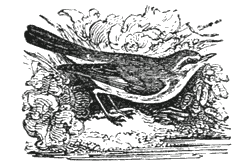
THE HAY-BIRD, OR WILLOW WREN.
Sylvia Fitis, Bechstein; S. Trochilus, Latham; Le Bec-fin Pouillot, Temminck; Der Fitis Sanger, Meyer; Der Weidenblatt, Bechstein.
This species weighs about two drachms and three quarters; length five inches and a quarter. The bill is dusky above, yellowish beneath; irides hazel. The whole upper parts of the plumage are of a greenish yellow brown: the under parts are white, tinged with yellow; on the breast are a few yellow streaks; legs light brown.
This is a plentiful species in some parts; frequents wooded and enclosed situations, especially where willows abound; is frequently found with the wood wren, but does not extend so far to the west in England, as it is rarely met with in Cornwall. It comes to us early in April, and soon begins its usual song, which is short, with little variety. About the latter end of the same month, or beginning of May, it makes a nest of an oval shape, with a small opening near the top, composed of moss and dried grass, and lined with feathers. This is placed in the hollow of a ditch, or in a low bush close to the ground.
MR. SWEET’T ACCOUNT OF THE HAY-BIRD.
This is another little favourite songster, and a most deserving one it is. It visits us the latter end of March, or beginning of April, and leaves us again at the end of September, or beginning of October. On its first arrival, it enlivens our woods and groves with its lively piercing song and gay frolics, flying about from tree to tree, and catching the small gnats and flies that come in its way. It builds its nest on the ground in a thicket amongst dead leaves and moss, with a covering on the top, of the same materials as those lying all around, so that it is impossible to find it without watching one of the old ones to the nest, which in general consists of six or seven young ones. These may either be brought up from the nest, or if an old one be caught wild it is easily tamed. When first put in the cage with a tame bird, the general food, bread and milk, and eggs, should be stuck full of small flies, aphides, small caterpillars, or other small insects, in picking out which it will taste the other food, and soon take to eat it readily, and will soon become very tame in confinement. One that I caught in September was, in three days afterwards, let out of the aviary into the room to catch the flies, that were numerous at that season. After amusing itself for some time in catching flies, it began singing; and it did the same several other times when it was let out, and in a few days began to sing in its aviary. It soon became so familiar, that it would take flies out of the hand; and when out in the room, if a fly was held towards it, would fly up, and take it immediately.
Although the present species is so small a bird, it is very courageous, being generally the master of the cage, and as it is so fine a songster, and almost continually in song, no little bird can be more desirable in a cage with other birds; its note, when in full song, being so loud and shrill, that its voice is plainly heard above the nightingale’s when both are in full song.
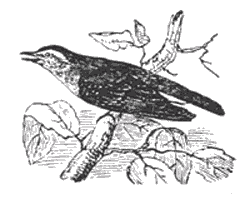
THE WOOD WREN.
Sylvia sibilatrix, Bechstein; Le Bec-fin Siffleur, Temminck; Der grüne Sanger, Meyer.
This bird remained long unnoticed as a distinct species, from its resemblance to the hay-bird (Sylvia Trochilus), with which it is still frequently confounded. It measures in length five inches and a half; bill horn-colour; upper mandible bent at the tip, and rather longer than the under; irides hazel; nostrils beset with bristles; top of the head, neck, back, and tail-coverts olive green; throat and cheeks yellow, paler on the breast; belly and vent of a most beautiful silvery white; through the eye passes a yellow line; legs rather more than an inch long, of a horn-colour, claws paler.
MR. SWEET’T ACCOUNT OF THE WOOD WREN.
This elegant and beautiful little species ranks itself amongst my list of favourites. It visits this country the beginning of April, and leaves it in August, or the beginning of September. It is generally to be found in summer amongst tall trees in woods and plantations, where it is readily detected on its arrival, by a shrill shaking sort of note that may be heard at a great distance, and cannot be confounded with any other bird. On its first arrival it sings the greater part of the day, and continues its song, more or less, through the summer, except at the time it is engaged in feeding its young. Its nest is built on the ground in a thicket amongst moss and dead leaves, so that it is impossible to find it without watching one of the old ones to the nest, which is easily done when they have young. They may either be tamed when old, or reared from the nest, and are not difficult to be caught when young with a little bird-lime at the end of a fishing-rod, as may several other species of this interesting group.
As the present species feeds entirely upon insects when wild, the greater part of which it catches on the wing, it will be useless to give it any sort of fruit or berry; but bread and milk, bruised hemp-seed and bread, with bits of fresh lean meat cut very small and mixed up in it, will be its general food. It is also very fond of the yolk of an egg boiled hard, and crumbled small, or stirred up with the point of a knife that it may peck it out of the shell as it likes. Sometimes these birds are apt to get off their other food, and will live on egg several days; at such a time if a few flies could be procured for them, it would be the most likely to restore their appetite.
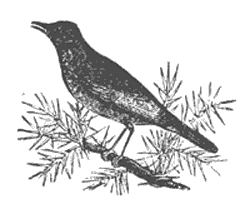
THE GRASSHOPPER BIRD.
Locustella avicula, Ray; Sylvia locustella, Latham; L’Llouette locustelle, Buffon; Der Fleuschrechensanger, Meyer.
This species is less than the white-throat; length five inches and a half; weight about three drachms and a quarter. The bill is dusky above, whitish beneath; irides light hazel. The whole upper parts of the bird are olivaceous brown; the middle of each feather dusky, except on the back of the neck, which gives it a pretty spotted appearance; the tail is much cuneiform, and the feathers somewhat pointed, which is a very marked and peculiar character in this species; the outer feather being full an inch shorter than the middle ones, and nearly rounded at the tips, the wing remarkably short, reaching very little beyond the base of the tail; legs very pale brown; claws light-horn colour; hind claw short and crooked.
In shape, the grasshopper warbler very much resembles the sedge-bird; is rather inferior in size, and at once distinguished by its spotted back.
MR. SWEET’T ACCOUNT OF THE GRASSHOPPER BIRD.
The present species is known amongst bird-catchers by the name of the grasshopper lark, and it was originally placed amongst the larks by ornithologists, but has been very properly removed from them by later authors, as it wants the most characteristic mark of that family, namely, its long claw. It is a very rare bird in the neighbourhood of London, and I have never been able to procure but one of them, which I lost the first winter, by letting it wash too much; in confinement it requires the same sort of management as recommended for the two last species, and it will succeed very well. I am not acquainted with their song, never having lived in any neighbourhood where they visit, but I have been credibly informed that they have none but a note like the chirping of the grasshopper; this may probably be the case, but I have often heard the same report of some of our finest songsters, which people had confused with very common birds, there being very few who do not confuse, under the general name of white-throats, the common fly-catcher, both white-throats, the greater pettychaps, and the blackcaps, when young; and many even confuse with these the willow wren, wood wren, and lesser pettychaps: this tribe of birds being only summer visitants, are less known than any others.
These birds are not uncommon in several parts of England; they are said to be plentiful on Malmesbury Common, Wiltshire, in summer, where they breed; they are also frequently seen in Norfolk and Suffolk, and in various other parts, where they build their nest among some high grass or sedge, in which it is so concealed that it is with difficulty found, except by watching the old birds carrying food to their young ones; or when building, they may be seen carrying materials to construct their nest.
In a wild state these birds feed entirely on insects, such as flies, moths, butterflies, spiders, ants; and their eggs, small beetles, and numerous other sorts, so that in confinement they will frequently require insect food.
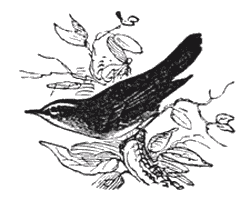
THE REED WARBLER.
Sylvia arundinacea, Latham; La Fauvette des Roseaux, Buffon; Der Teichsänger oder Sumpfsänger, Bechstein.
This species has been confounded, not only with others with a greenish plumage that are analogous, but in describing it with the reed thrush (Turdus arundinaceus, Linn.), and in its manner of life with the black-bonnet, or reed bunting (Emberiza Schæniclus, Linn.). It is five inches in length, of which the tail measures two. The beak, seven lines long, resembles that of the arbour bird, brown above and yellowish beneath; the iris is chestnut brown; the shanks are eight lines high, and ash grey; the forehead is very long, greenish grey; the rest of the upper part of the body, including the wing-coverts, are of the same colour, tinged with olive; the rump is paler; a straw-coloured line extends above the eyes; the cheeks are olive brown; the under part of the body is yellowish white; the knees are olive grey; the anterior quill-feathers are dusky; the secondary are dark brown; all are edged with olive grey; the tail-feathers have the same colour as the quill-feathers, but with a wider olive grey border; the tail is very much rounded, and nearly wedge-formed.
There is little difference in the female. Her head is pale brown: a white line passes across the eyes; the upper part is reddish grey, tinged with olive; the under part, except the throat, which is white, is pale grey, tinged with yellow; the quill-feathers are darker brown than the tail, with an olive grey border.
Habitation.—When wild they are found throughout Europe, wherever rushes and reeds abound. They arrive in Germany towards the middle of April, and leave it the beginning of September. As they are very delicate, in the house they must be kept in a nightingale’s cage.
Food.—When wild it feeds on all kinds of aquatic insects, and, when these fail, on berries. In the house, independently of nightingale’s food, it requires in a cage all the insects that can be caught, as flies, water-spiders, and gnats.
Breeding.—The nest, rather long and very ingeniously fastened to the stems of the reeds or the branches of bushes by the water side, is constructed of pieces of dried grass, of which the largest are on the outside, and the finer within; these are sometimes mixed with wool and hair. The eggs, five or six in number, are greenish white, streaked and speckled with olive green. The young ones can only be reared on ants’ eggs.
Mode of Taking.—These birds are sometimes caught by placing lime twigs on a place cleared of the turf, and throwing meal-worms there.
Attractive Qualities.—The song of the reed warbler very much resembles that of the arbour bird, but is not so full; what renders it so agreeable is, that its varied melody is heard during evening and morning twilight.
MR. SWEET’T ACCOUNT OF THE REED WARBLER.
This is a very variable bird in its colours, some being of a very pale colour, and others altogether as dark, and those that are pale one season frequently become dark the ensuing one. It is a curious little lively bird, known often by the name of reed wren. It generally makes its appearance with us the beginning of April, and leaves us in September. Its early or late departure seems to depend a good deal on the warmth or coolness of the seasons. It is a very merry bird, almost continually singing, and will sing by night as well as by day, sitting amongst the reeds, or in some bush or tree near the water, where it feeds on the gnats and other insects that infest moist situations. It is very fond of flies, spiders, small caterpillars, moths, grasshoppers, crickets, and many other insects, and will swallow a larger one than could be imagined for so small a bird. In confinement it will feed readily on the general food, and is also very fond of the yolk of an egg boiled hard, so that it may be crumbled on the top of the other food, or put in the cage in an empty egg-shell. It should also be supplied with a few insects occasionally, such as flies, spiders, small caterpillars, moths, or butterflies. Being an inhabitant of the sides of ditches and rivers, it is very partial to washing, which it must not be allowed to do in winter, or it will wash itself until it is so weak that it can never recover.
THE SEDGE BIRD.
Sylvia Phragmitis, Bechstein; S. salicaria, Latham; Le Bec-fin Phragmite, Temminck; Der Schilsänger, Meyer.
The weight of this species is about three drachms; length five inches and a half; bill dusky above, whitish beneath; irides hazel; crown of the head and whole upper parts of a yellowish brown, plain on the back and sides of the neck, rump, and upper tail-coverts; tail like the quills a little cuneiform, which, when spread, gives it a rounded shape; legs dusky.
MR. SWEET’T ACCOUNT OF THE SEDGE BIRD.
In habit and manner the present species approaches to the former, but is a much handsomer bird; though not so rare, it frequents the sides of ditches, ponds, and rivers, like the last species, where it pours forth its variable diurnal and nocturnal song almost incessantly, on its first arrival in this country, which is generally the beginning of April, leaving us again about the middle of September. It builds its nest in a thicket of reeds, or other tall water-grass, on which it is fastened up with the webs of caterpillars, similar to that of the former, which is fastened to the branches of trees, so that no wind or storm can move it.
The song of the present species is somewhat similar to that of the last, but is more shrill and chattering; some people prefer it to that of the latter species, but I do not, as it wants some fine deep notes that the other possesses: it is also an imitative bird, its song being intermixed with the call of the sparrow and parts of the songs of other birds. Its food is precisely the same as that of the last species; and in confinement the treatment for both must be exactly alike.
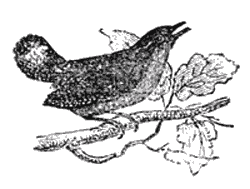
THE WREN.
Motacilla Troglodytes, Linnæus; Le Roitelet, ou Troglodite, Buffon; Der Zaunkönig, Bechstein.
This, except the rufous chiff-chaff and the gold-crested wren, is the smallest bird of our climate. It is only three inches and a half in length, of which the tail measures one and a half. The beak is five lines, rather curved at the point, dusky above, yellowish white below, and yellow within; the iris is hazel brown; the shanks are seven lines high, and greyish brown; the upper part of the body is dusky rust brown, with indistinct dark brown streaks across.