NATURAL HISTORY OF CAGE BIRDS. (continued 2)
Reading edition
Food.—When wild, the magpie lives on worms, insects, fruits, or roots, and sometimes eats eggs and young birds in their nest.
In the house, it likes bread, meat, and anything that comes from table; in short, when once tamed it does not fail to enter by the window at meal times to take its share. If it obtain too much, it hides what it does not eat for another time. This propensity is seen in young ones as soon as they can feed alone.
Peculiar Qualities.—Although in its wild state the magpie is so suspicious that it is difficult to catch it, it is, however, more easily tamed than any other bird; it will let itself be touched and taken in the hand, which even the most docile of other birds will seldom suffer. When reared from the nest it learns to speak even better than the raven, and becomes as domestic as the pigeon. It gets so fond of raw meat, bread, and other refuse of the table, that it does not wish any other food; this is the cause of its frequenting dwelling-houses: if it find any worms or insects it only eats them as dainties.
The time of taking magpies in order to bring them to this point is fourteen or fifteen days after coming out of the shell: this is the principal thing to remember with respect to any bird which is to be taught to go and come. It must be given at first bread soaked in milk or water; by degrees a little chopped meat is added, afterwards it will eat anything from the kitchen, even apples and baked pears, and any refuse. As soon as the young birds begin to fly high enough to rise to a neighbouring tree they may be let do so when they have had a good meal, soon calling them back again to the place fixed for their habitation; this practice may be repeated till they have all their feathers, and can fly well, when some of their wing-feathers must be cut, till the winter, a season in which they may be pulled out. Whilst the feathers are growing again, they become so well accustomed to the house and their master that they may be let go for several hours together without any danger of their wandering or not returning. If they speak they will only be the more agreeable.
Old magpies, which may easily be taken in winter with lime-twigs placed near some bits of meat, can be taught to remain in the yard by keeping the wings cut till the following autumn, when they may be let grow; from this time there is no fear of their not coming with the poultry, and in spring they will not fail to build near the house, and seek food for their young in the kitchen. I must repeat again that nothing shining must be left in the way of these birds, as they will carry it off immediately, and hide it with great care, let them have as much food as they like besides.
I have lately received a letter from one of my friends, in which he expresses himself thus:—“I have reared a magpie which comes like a cat to rub itself against me until I caress it. It has learnt of itself to fly into the country and return. It follows me everywhere, even for more than a league, so that I have much trouble to rid myself of it, and when I do not wish its company in my walks and visits I am obliged to shut it up: though wild with any other person, it marks in my eyes the least change in my temper. It will sometimes fly to a great distance with other magpies, without however connecting itself with them.”
THE ROLLER.
Coracias Garrula, Linnæus; Le Rollier d’durope, Buffon; Die Mandelkrähe, Bechstein.
This bird resembles the jay in size and form, and is twelve inches in length, of which the tail measures four and a half; the beak is blackish, before and behind the eyes is a blackish triangular spot, formed by the naked skin; the iris of the eye is grey; the whole of the head, the neck, the throat, the breast, the belly, the large wing-coverts, and all the under-coverts, are of a beautiful bluish green; the tail is of a dusky blue green near the base, becoming gradually lighter towards the end.
The female and young ones of the first year have the head, neck, breast, and belly of a reddish grey tinged with bluish green; the back and the last quill-feathers are of a light greyish brown; the rump is green, tinged with indigo; the tail blackish with a tint of blue green; the rest like the male.
Habitation.—In its wild state the roller may be found in Europe and the northern parts of Africa; it only frequents a few spots in Germany, and prefers forests and sandy plains to high mountains: elsewhere it is only seen during the time of its passage19.
In the house it may be let range at will after the wings are clipt.
Food.—When wild, its principal food is insects and worms; it also eats small frogs, bulbous roots, acorns, and grains of corn.
Breeding.—The nest, placed in the hole of a tree, is made of small twigs, hay, feathers, and bristles. It lays from four to seven white eggs, on which the male takes his turn to sit during eighteen or twenty days. The young ones do not acquire their fine colours till the second year; previous to this period the head, neck, and breast are of a whitish grey.
I had till lately thought that this bird was untamable; but Dr. Meyer of Offenbach has convinced me to the contrary, having himself reared them several times, and kept them in his room. This is his method:
The young ones must be taken from the nest when only half grown, and fed on little bits of cow’s heart, or any other meat which is lean and tender, till they can eat alone; small frogs, worms, and insects may then be added. The means which it takes to kill and swallow these insects are curious enough; it begins by seizing and crushing them with its beak, and then throws them into the air several times, in order to receive them in its throat, which is very capacious. When the piece is too large, or the insect still alive, it strikes it hard against the ground, and begins again to throw it in the air, till falling not across, but so as to thread the throat, it may be easily swallowed.
After having been fed thus long enough, a little barley-meal may be mixed with the meat. I have even brought it to eat bread, vegetables, and softened oatmeal, but it always prefers cow’s heart. I have never seen it drink.
It knows the person who takes care of it, comes at his call to eat from his hands, without however letting itself be caught: but it never becomes quite tame, and often defends itself with its beak. It makes very few movements unless to seek its food, and generally remains quite still in the same place. If it ever hops about the room it is in an awkward and cramped manner, on account of its short feet; on the other hand, it flies very well; but it must not be left completely at liberty in the room, or quite shut up in the cage, because it is so easily startled, and in its fright gives itself such violent blows on the head as would soon kill it. The best way is to clip one wing, and then let it range the room. These birds quarrel with one another, particularly in the evening, for their places on the perch. I have kept them for some time in a large aviary with small and great birds, and once with my pigeons which I kept shut up; generally I have them in my room, where they mix with several other birds: but whether alone or with companions they appeared equally healthy and active.
Attractive Qualities.—They have few other attractions besides their beautiful plumage, for their voice is only a harsh croaking “crag, crag, craag20.”
THE GOLDEN ORIOLE.
Oriolus Galbula, Linnæus; Le Loriot, Buffon; Der Pirol, Bechstein.
This species, the male of which is very beautiful, is about the size of a blackbird. Its length is nine inches, of which the tail measures three and a half, and the beak one. The head, neck, back, breast, sides, and lesser wing-coverts, are of a brilliant golden yellow; the wings and the tail are black, with yellow gradually increasing to the outer feathers.
The female is not so brilliant, the golden yellow is only visible at the tip of the olive feathers in the tail, and in the lesser and under wing-coverts. All the upper part of the body is of the green colour of the siskin, the lower part greenish white with brown streaks, and the wings grey black.
Habitation.—When wild, it generally frequents lonely groves, or the skirts of forests, always keeping among the most bushy trees, so that it is rarely seen on a naked branch; it always frequents orchards during the time of cherries. It is a bird of passage, departing in families in August, and not returning till the following May21.
In the house, if it cannot be let range at pleasure, it must be confined in a large wire cage.
Food.—When wild, its food is insects and berries. In confinement, and if an old one be caught by means of the owl, like the jays, it must be kept at first in a quiet and retired place, offering it fresh cherries, then adding by degrees ants’ eggs, and white bread soaked in milk, or the nightingale’s food. But I confess there is great difficulty in keeping it alive, for with every attention and the greatest care, I do not know a single instance of one of this species having been preserved for more than three or four months.
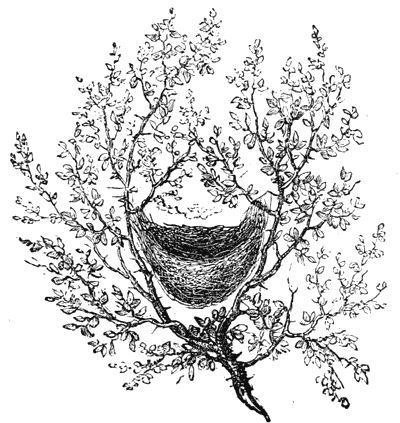
NEST OF THE GOLDEN ORIOLE.
Breeding.—The scarcity of the golden oriole arises from its breeding but once a year. Its nest, hung with great art in the fork of a small bushy branch, is in shape like a purse, or a basket with two handles. The female lays four or five white eggs, marked with a few black streaks and spots. Before the first moulting, the young ones are like their mother, and mew like cats. If any one wishes to rear them they must be taken early from the nest; fed on ants’ eggs, chopped meat and white bread soaked in milk, varying these things as their health requires, and as their excrements are too frequent or too soft. In short, they may be accustomed to the nightingale’s food. I must here remark that a very attentive person alone can hope to succeed22.
Attractive Qualities.—I have seen two golden orioles that were reared from the nest, one of which, independent of the natural song, whistled a minuet, and the other imitated a flourish of trumpets. Its full and flute-like tones appeared to me extremely pleasing. Unfortunately the fine colours of its plumage were tarnished, which almost always happens, above all if the bird be kept in a room filled with smoke, either from the stove or from tobacco. One of my neighbours saw two golden orioles at Berlin, both of which whistled different airs.
Its note of call, which in the month of June so well distinguishes the golden oriole from other birds, may be well expressed by “ye, puhlo23.”
THE HOOPOE.
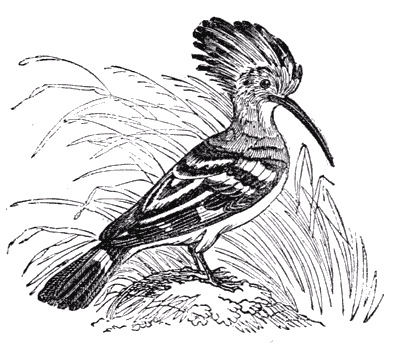
Upupa Epops, Linnæus; La Huppe, Buffon; Der gemeine Wiedehopf, Bechstein.
The length of this bird is twelve inches, of which the tail measures four, and the bill, which is black, two and a half.
The iris is blackish brown. The feet are black and very short. There is a tuft on the head like a fan, formed of a double row of feathers, all of them tipped with black.
Habitation.—In its wild state, the hoopoe remains, during summer, in woods near meadows, and pasture land. In the month of August, after hay-harvest, it goes in flocks into the plains; it departs in September, and does not return till the end of the following April. It is more frequently seen on the ground than perching24.
In the house, it is not kept in a cage, but let range at will; it is very chilly, at least it is so fond of warmth that it is constantly on the stove, and would rather let its beak be dried up than come away from it.
Food.—When wild, it may be continually seen in fields, searching for its favourite insects among cow dung and the excrements of other animals. Some people put it into their granaries to clear them of weevils and spiders; this has succeeded very well, but to say that it also eats mice, is certainly an error.
In the house, it may be easily reared on meat, and white bread soaked in milk, to which meal worms must be added from time to time.
Breeding.—The hoopoe lays from two to four eggs; its nest, placed in the hole of some tree, is a mixture of cow dung and small roots. The young are easily reared on the flesh of young pigeons; but they cannot pick it up well, because their tongue, about the size of half a bean, and heart-shaped, is too short to turn the food into the throat. They are obliged to throw their food in the air, holding the beak open to receive it.
Mode of Taking.—In the month of August, when a field has been observed which the bird frequents most, a small well-limed rod of about eight inches in length must be placed on a mole-hill, having two or three meal worms fastened to it by means of a thread about three inches long. As soon as the hoopoe sees the worms it darts upon them, and thus makes the lime twig fall upon itself, which embarrasses it. But these birds, whether taken young or old, can very rarely be preserved.
Attractive Qualities.—Independently of its beauty, its droll actions are very amusing. For instance, it makes a continual motion with its head, tapping the floor with its beak, so that it seems as if it walks with a stick, at the same time shaking its crest, wings, and tail25. I have had several of them in my house, and have always been diverted by their singular grimaces. When any one looks at them steadily, they immediately begin their droll tricks.
The following is an extract from a letter written by M. von Schauroth on the hoopoe, which I think it is well to insert here:
“With great care and attention, I was able last summer to rear two young hoopoes, taken from a nest which was placed at the top of an oak tree. These little birds followed me everywhere, and when they heard me at a distance showed their joy by a particular chirping, jumped into the air, or as soon as I was seated climbed on my clothes, particularly when giving them their food from a pan of milk, the cream of which they swallowed greedily; they climbed higher and higher, till at last they perched on my shoulders, and sometimes on my head, caressing me very affectionately: notwithstanding this, I had only to speak a word to rid myself of their company, they would then immediately retire to the stove. Generally they would observe my eyes to discover what my temper might be, that they might act accordingly. I fed them like the nightingales, or with the universal paste, to which I sometimes added insects; they would never touch earth-worms, but were very fond of beetles and May-bugs, these they first killed, and then beat them with their beak into a kind of oblong ball; when this was done, they threw it into the air, that they might catch it and swallow it lengthways; if it fell across the throat they were obliged to begin again. Instead of bathing, they roll in the sand. I took them one day into a neighbouring field, that they might catch insects for themselves, and had then an opportunity of remarking their innate fear of birds of prey, and their instinct under it. As soon as they perceived a raven, or even a pigeon, they were on their bellies in the twinkling of an eye, their wings stretched out by the side of their head, so that the large quill feathers touched: they were thus surrounded by a sort of crown, formed by the feathers of the tail and wings, the head leaning on the back, with the beak pointing upwards; in this curious posture they might be taken for an old rag. As soon as the bird which frightened them was gone they jumped up immediately, uttering cries of joy. They were very fond of lying in the sun; they showed their content by repeating in a quivering tone, “vec, vec, vec;” when angry their notes are harsh, and the male, which is known by its colour being redder, cries “hoop, hoop.” The female had the trick of dragging its food about the room, by this means it was covered with small feathers and other rubbish, which by degrees formed into an indigestible ball in its stomach, about the size of a nut, of which it died. The male lived through the winter; but not quitting the heated stove, its beak became so dry that the two parts separated, and remained more than an inch apart; thus it died miserably.”
“I once saw,” says Buffon, “one of these birds which had been taken in a net, and being then old, or at least adult, must have had natural habits: its attachment to the person who took care of it was very strong, and even exclusive. It appeared to be happy only when alone with her; if strangers came unexpectedly it raised its crest with surprise and fear, and hid itself on the top of a bed which was in the room. Sometimes it was bold enough to come from its asylum, but it fled directly to its beloved mistress, and seemed to see no one but her. It had two very different tones; one soft, as if from within, and seemed the very seat of sentiment, which it addressed to its mistress; the other sharp, and more piercing, which expressed anger and fear. It was never kept in a cage by day or night, and was permitted to range the house at pleasure: however, though the windows were often open, it never showed the least desire to escape, its wish for liberty not being so strong as its attachment.
“This pretty bird accidentally died of hunger. Its mistress had kept it for four months, feeding it only on bread and cheese.”
THE CUCKOO.
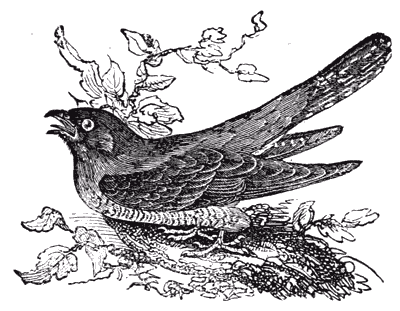
Cuculus canorus, Linnæus; Le Coucou, Buffon; Der gemeine Kukuk, Bechstein.
Although it is not larger than the turtle-dove, its length is fourteen inches, but seven of these are included in the tail, three quarters of which are covered by the folded wings. The beak, black above, and bluish beneath; the feet have two claws before and two behind. The head, the top of the neck, and the rest of the upper part of the body are of a dark ash colour, changing like the throat of the pigeon on the back and wing-coverts.
In the female, which is smaller, the upper part of the body is of a dark brown, with dirty brown spots, which are scarcely visible. The under part of the neck is a mixture of ash grey and yellow, crossed with dark streaks. The belly is of a dirty white, with dark transverse lines.
Habitation.—When wild, it is a bird of passage, which arrives in April and departs in September, and even much sooner, according to an English observer.
In the house, it may be let run about, or confined in a large wooden cage.
Food.—When wild, it eats all sorts of insects, particularly caterpillars on trees.
When confined, it is fed with meat, insects, and the universal paste made of wheat-meal.
Breeding and Peculiarities.—Every one knows that the female cuckoo never sits upon her eggs, but intrusts that care to other birds, particularly those which feed on insects, laying one or two eggs in their nest.
In order to tame a cuckoo, it must be taken from the nest: I never tried myself, but several of my friends have. As this is a curious bird, and most bird-fanciers like to have it in their room or aviary, I shall here insert some observations on this subject, by M. von Schauroth, who was before quoted.
“The cuckoo possesses hardly any qualities which would render it fit to be a house bird: if old, it is too obstinate and voracious, generally it is furious, sullen, and melancholy. I have reared several; the last was taken from the nest of a yellowhammer: its eyes were not opened when I took it, yet it darted at me with fury. Before I had had it six days it would swallow in a passion everything that came near it. I fed it on bird’s flesh, and was obliged to continue this food for a long time before it could feed itself. Its motions were so quick in jumping or moving that it would overthrow any cups of food which happened to be in its way. Its tail grew very slowly. It was never entirely tamed; it would dart at my hands and face, attacked every thing which came too near it, and even the other birds. It ate the poultry paste in great quantities, and discharged in proportion, which made it very dirty; I have even seen it, like the ostrich, eat its own excrements. Its short and climbing feet are so awkward that it cannot walk; it makes two or three jumps, but flies very well.”
“Though cunning and solitary,” says Buffon, “the cuckoos may be given some sort of education. Several persons of my acquaintance have reared and tamed them. They feed them on minced meat, either dressed or raw, insects, eggs, soaked bread, and fruit. One of these tamed cuckoos knew its master, came at his call, followed him to the chase, perched on his gun, and if it found a cherry tree in its way it would fly to it, and not return till it had eaten plentifully; sometimes it would not return to its master for the whole day, but followed him at a distance, flying from tree to tree. In the house it might range at will, and passed the night on the roost. The excrement of this bird is white, and in great quantities; this is one of the disagreeables in rearing it. Great care must be taken to keep it from the cold from autumn till winter; this is the critical period for these birds, at least it was at this time that I lost all which I had tried to rear, besides many other birds of a different species.”
THE MINOR GRAKLE.
Graccula religiosa, Linnæus; Mino ou Mainate, Buffon; Der Mino oder Plauderer, Bechstein.
This bird is the size of a blackbird, ten inches and a half long, of which the tail measures three, and the beak one and a half. The feathers on the side of the head are short, like velvet, but on the top, descending towards the back of the head, they are the general length; on both sides of the head there is naked skin, which begins under the eyes, and extends to the back of the head, but without uniting; its breadth is uneven, near the eyes it is wide and yellow, but when the bird is pleased or is angry this colour varies. Black is the predominant colour of the body, with some tints of purple, violet, or green, according to the different light it is in; the feathers of the tail have a white streak.
Observations.—The minor grakle is found in both the Indies, in Jamaica, as well as in the islands beyond the Ganges, as far as Java. Their food is vegetable: those which are brought to Europe willingly eat cherries and raisins; if these be shown them without being given directly they begin to cry and weep like a child. They become exceedingly tame and confiding; they whistle exceedingly well, and chatter better than any parrot. The Chinese ladies are very fond of them; they are sold very dear in Java. In the inland parts of Germany nothing is so rare as one of these birds.
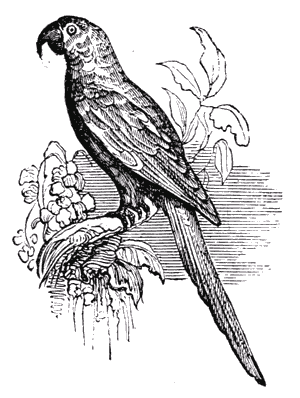
THE MACCAW.
LARGE BEAKED BIRDS.
The general characteristics of this group are, a beak large, but varying in size, very hollow, light, raised above, and hooked before; in the species immediately following, the legs are short, strong, and the feet formed for climbing; they are furnished with a tongue, thick, fleshy, and rounded like the human tongue, which renders articulation easy to them. All these birds are foreign, and ought to be reared from the nest when intended for speaking.
THE RED AND BLUE MACCAW.
Psittacus Macao, Linnæus; L’Lra Rouge, Buffon; Der rothe Aras, Bechstein.
The beauty of their plumage, and the facility with which they repeat words, are the two principal reasons for the introduction of parrots into parlours. Some imitate the songs of other birds and warble very sweetly. We have observed, that in order to speak distinctly the tongue must be thick, rounded, and the muscle loose enough to permit the requisite motion; hence it happens that parrots, above all those with a short tail, pronounce so very distinctly. The ravens, jack-daws, and jays come next to them; but the starlings and blackbirds surpass them in the formation of the larynx.
The red and blue maccaw is one of the largest of the parrot tribe, being two feet eight inches in length. The hardest stones of the peach cannot resist the strength of its beak, the upper mandible of which is very much hooked. The claws are directed forward, and two backward. The naked cheeks are covered with a wrinkled whitish skin. The head, neck, breast, belly, thighs, top of the back, and the upper wing-coverts are of the finest vermilion. The lower part of the back and the rump are light blue. The scapulars and large wing-coverts are a mixture of blue, yellow, and green.
The colours sometimes vary, especially in the wings and tail, but the species will not be the less easily known on that account.
The female very much resembles the male.
Habitation.—When wild it inhabits South America, and may be found in Brazil and Guiana, in damp woods, and always in pairs. In the house it may be let range at will, giving it a roost with several rings placed across. Like its fellows, it may be kept in a very large strong wire cage, high and wide enough to let it move with ease, and preserve its handsome tail in all its beauty.
Food.—In its native country the fruit of the palm tree is its principal food; our fruit it also likes, but white bread soaked in milk agrees with it better; biscuit does not hurt it; but meat, sweetmeats, and other niceties are very injurious; and though at first it does not appear to be injured, it becomes unhealthy, its feathers stand up separate, it pecks and tears them, above all those on the first joint of the pinion, and it even makes holes in different parts of its body. It drinks little—this is perhaps occasioned by its eating nothing dry. Many bird-fanciers say that the best food for parrots is simply the crumbs of white bread, well baked, without salt, soaked in water, and then slightly squeezed in the hand. But though this appears to agree with them pretty well, it is however certain that now and then something else ought to be added. I have observed, indeed, that parrots which are thus fed are very thin, have hardly strength to bear moulting, and sometimes even do not moult at all; in that case they become asthmatic, and die of consumption. It is clear that feeding them only on this food, which has very little if any moisture in it, is not sufficient to nourish them properly, at least during the moulting season, and while the feathers are growing again. I never saw a parrot in better health than one which belonged to a lady, who fed it on white bread soaked in boiled milk, having more milk than the bread would absorb, which the parrot drank with apparent pleasure; there was also put into the drawer of its cage some sea biscuit, or white bread soaked in boiling water; it was also given fruit when in season. It is necessary to be very careful that the milk is not sour.
Some young maccaws are fed on hemp-seed, which must always be of the year before, as the new would be too warm and dangerous. Yet they must not be fed entirely on this food, but there must be added white bread soaked in milk or water, as has already been mentioned, some fruit and nuts, but never bitter almonds, as they will infallibly kill all young animals. In all cases the excrements of the bird will indicate the state of its health, and whether the food ought to be changed or not.
Although maccaws rarely want to drink, as their food is very moist, yet they must not be left without water, which is generally placed in one of the divisions of their tin drawer. It is also a good thing to entice them to bathe, nothing is more favourable to their health, or better facilitates the painful operation of moulting, or keeps their feathers in better order. A little attention to these favourites, deprived of their liberty, their natural climate, and food, cannot be too much trouble to amiable persons who are fond of them, and to whom these pretty birds become greatly attached.
Breeding.—The red and blue maccaws build their nests in the holes of old decayed trees; they enlarge and make the hole even with their beak, and line it with feathers. The female, like that of the other American parrots, breeds twice in the year, laying two eggs each time, which are exactly like those of the partridge. In Europe the females also lay well, but the eggs are generally unfruitful; when they are not so it is very difficult to make the mother sit; there are, however, a few examples of the female maccaw being so well inclined to perform this office, that she will sit on pigeons’ and hens’ eggs, which are hatched in due time.
The maccaws which we have in this country have generally been reared from the nest, particularly those which speak, for the old ones would be too savage and untractable, and would only stun one with their unbearable cries, the faithful interpreters of their different passions.
Diseases.—Amongst those to which maccaws are particularly subject, declines are the most frequent. Some cures for this are mentioned in the Introduction, which it would be well to employ. During the moulting season attention must be redoubled, not only to keep them in health but to preserve their beautiful plumage.
Attractive Qualities.—As maccaws are very dear they are generally only found in the possession of rich bird-fanciers. In the centre of Germany one costs from fifty to a hundred rix dollars, and in the maritime cities thirty or forty. Their beautiful plumage forms their principal attraction. They also learn to repeat many words, to go and come, and also to obey the least signal from their master. I confess, however, that their awkward walk, their heavy movements, and their constant inclination to help themselves along with their beak, added to their great uncleanliness, does not appear very agreeable. They are sometimes very wicked, taking dislike to some people, and may do great injury to children if left alone with them. Owing to their dung being very liquid, abundant, and fœtid, they must be cleaned regularly every day.
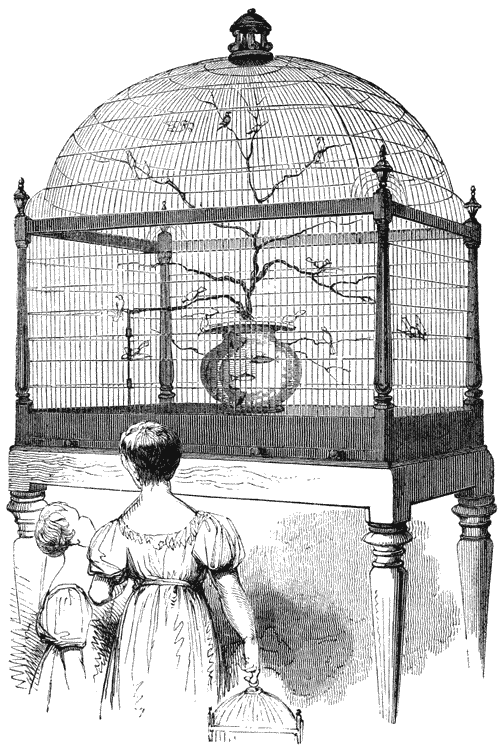
AVIARY FOR DRAWING ROOM.
THE BLUE AND YELLOW MACCAW.
Psittacus Ararauna, Linnæus; L’Lra Bleu; Der Blaue Aras, Bechstein.
This species, which is about the size of the former, appears to me much more beautiful, though the colours of its plumage are not so striking. Its beak is black, the feet dark grey; the cheeks flesh-coloured, streaked in the form of an S, with lines of short black feathers. The iris is light yellow; the throat ornamented with a black collar; the forehead, to the top of the head, the sides, and small wing-coverts are of a dark green; the rest of the upper part of the body is of a fine blue; all the colours are apt to vary.
Habitation.—Being, like the preceding one, a native of Surinam, Guiana, and Brazil, its way of living and qualities are much the same. It does not, however, learn to speak so easily, and cannot pronounce the word maccaw so distinctly; but it imitates perfectly the bleating of sheep, the mewing of cats, and the barking of dogs. Its custom of only drinking in the evening seems extraordinary.
THE ILLINOIS PARROT.
Psittacus pertinax, Linnæus; La Perruche Illinoise; Der Illinesische Sittich, Bechstein.
This is a species which almost all bird-sellers have. Its length is nine inches and a half. The beak is light grey, the eyes surrounded with a naked greyish skin, the iris is deep orange. The feet are dark grey. The principal colour on the top of the body is green, that under is yellowish grey. The forehead, cheeks, and throat are of a brilliant orange; the top of the head is dark green; this colour is lighter and yellowish on the back of the head; the top of the neck is greenish grey; there are some orange spots on the belly.
In the female, the forehead only is deep yellow, and there is no other mixture of yellow either on the head or belly.
Habitation.—This parrot is also a native of the hottest parts of South America, frequenting savannas, or any other open places, and building its nest even in the holes of the Termites (Termes fatalis, Linnæus.) These birds are so sociable that they may be seen in flocks of five or six hundred.
In the house, they must always be kept in pairs, and generally in cages. They show the tenderness of their attachment to each other by their continual caresses; this is in fact so great, that if one die the other soon languishes from grief.
Food.—When these birds go forth to steal chestnuts, acorns, peas, and similar fruits, which form their food, they always place a sentinel to warn them of the approach of an enemy: at the least alarm, they fly away, uttering loud cries. When confined, they are fed with nuts, and bread soaked in boiled milk.
Attractive Qualities.—Their handsome plumage, their affectionate and confiding ways, and the tenderness of attachment which these pretty birds have for each other, make them great favourites; but they learn scarcely any thing, and their continual cries are sometimes very annoying.
THE LONG-TAILED GREEN PARRAKEET.
Psittacus rufirostris, Linnæus; Le Sincialo, Buffon; Der rothschnäblige Sittich, Bechstein.
The length of this species is twelve inches and a half, but the tail alone measures seven inches and a half. This bird is not larger than a blackbird; the folded wings only cover one quarter of the tail, the centre feathers of which are nearly five inches longer than the exterior ones. The upper mandible of the beak is of a blood red, with the point black; the under one is entirely black. The circle of the eyes, the naked membrane of the beak, and the feet, are flesh-coloured; the irides are orange. The rest of the body is yellowish green, with the wings bordered with light yellow. There are varieties of different shades of green, the tail feathers of which are blue at the extremity.
This species inhabits the hottest part of South America. Its cry is noisy and frequent; it soon learns to speak, whistle, and imitate the sounds of most animals as well as birds. In the cage, where it cannot have much other exercise, it chatters and squalls so incessantly, that it is often very disagreeable. It must be treated like the preceding species, but does not appear so delicate.
THE BLUE-HEADED PARROT.
Psittacus cyanocephalus, Linnæus; La Perruche à tête bleu, Buffon; Der Blauköpfige Sittich, Bechstein.
This beautiful species is not more scarce than the preceding, and is about the size of a turtle dove, although its length is eleven inches and a half, six of which being included in the tail, half of this is covered by the folded wings. The naked skin round the eyes is yellow; the upper part of the body is green, the under part yellowish. The forehead has some tints of red; the head is blue; the throat violet, with a grey tint.
This parrot comes from India, and is only prized for its beauty, for it cannot learn to speak. It must be treated like the preceding species.
THE YELLOW PARROT.
Psittacus solstitialis, Linnæus; La Perruche jaune, Buffon; Der gelbe Sittich, Bechstein.
The whole length of this bird is eleven inches and a half. The tail is wedge-shaped, and the folded wings cover one-third of it. The beak and feet are green. The throat, the naked membranes of the beak, and the circle of the eyes, are light grey; the iris is yellow. The general colour of the body is orange, with olive spots on the back and wing coverts.
This parrot comes from Angola, and easily learns to speak. The food and treatment must be the same as the preceding.
THE AMBOINA PARROT.
Psittacus Amboinensis, Linnæus; Le Lory Perruche tricolor, Buffon; Der Amboinische Sittich-Lory, Bechstein.
This species somewhat resembles the Ceram lory, a variety of Le Lori Noir of Buffon (Psittacus garrulus auroræ, Linnæus); owing to this resemblance the French also call it l’lurore. Its length is sixteen inches, of which the tail, which is round, measures half. The beak is nine lines in length; there is no naked membrane, and the nostrils are in front; the iris is of a golden hue. The head, the nape of the neck, and all the lower part of the body, are the colour of vermilion. A ring of sky blue, very indistinct, surrounds the neck; all the feathers on the top of the body are of a beautiful green, with a fine edge of blue, or some dark colour.
In the female, the head is green; the throat, the under part of the neck, and the breast, are the same, but having a reddish tint. The small tail-coverts are dark green, edged with red; the tail itself is tinged with green. The beak is horn brown, with a reddish tint above and below.
Observations.—A pair of this beautiful species were sold to his Highness the Duke of Meiningen as coming from Botany Bay, but they are really natives of Amboina. Timid and wild, this bird has a sharp whistle and a cry like “gaick,” but cannot speak. The feathers are so loose that they generally come off in the hand when touched; but they grow again very quickly. It is kept and treated like the others.
THE PURPLE PARROT.
Psittacus Pennanti, Latham; La Purpure; Der Pennantsche Sittich, Bechstein.
In the male, which very much resembles the sparrow-hawk, the prevailing colour is a reddish purple, from which it derives its name among bird-sellers. The head and rump are dark crimson; the throat, as well as the small outer wing-coverts, and the centre pen-feathers, are of a most beautiful sky blue; all the under part of the body is bright crimson, shading to bluish on the thighs. The tail is of a deep blue.
In the female, which the bird-sellers pass as a different species, under the name of the Palm-tree Parrot, the prevailing colour is greenish yellow; it resembles the male sparrow-hawk in make. The head, the sides of the neck, and half the breast, are of a bright crimson; the throat pearl blue, shading a little to sky blue on the edges; the top of the neck, the back, shoulders, and last quill-feathers, are of a velvet black. All the feathers are edged with greenish yellow, except the scapulars and the feathers of the neck, the edges of which are the colour of sulphur. The rump and part round the vent are of parrot green, the long lower coverts of the tail crimson, edged with greenish yellow; the knee bands have a shade of sky blue. The under part of the body is of a brilliant yellow, with some irregular red dashes and spots, which show its relation to the former bird. The base of the tail is green, like the neck of the water-duck; the rest of the wings and tail are like the male.
Observations.—I have seen several of this superb species, which belonged to his Highness the Duke of Meiningen. It is a great pity that they are so wild, timid, and difficult to teach. Their note is a kind of chirping, which is rarely heard. Their feathers are as loose as the preceding species. They come from Botany Bay, and are very dear. Being more delicate, they require more attention than the other parroquets.
THE WHISKERED PARROT.
Psittacus bimaculatus, Sparrmann; Perruche à Moustache; Der Zweyfleckige, Sittich, Bechstein.
The length of this very beautiful parrot is fourteen inches, of which the tail measures more than half; its size is that of the turtle-dove, but very slender. The beak is large, orange-coloured, or pale blood red; the head of a fine ash colour, tinted with green on the top, and having a narrow black band on the forehead; the part near the eyes is naked, and pale flesh-coloured; the forehead light yellow; an almost triangular spot extends from the base of the beak across the cheeks to the throat; all the top of the body is meadow green, spotted with black. The under part of the body is of a deep rose colour.
There is a variety of this species with a black beak.
In the female, or what is supposed to be so, the forehead, the throat, the sides of the head and neck are pale orange colour; an oval black streak descends from the corners of the beak towards the throat; the nape, the top of the neck, the shoulders, back, rump, and upper part of the tail, are meadow green. The breast and belly, to the extremity, are of a fine green.
Observations.—This bird is very docile, amiable, and talkative. Its mildness is very pleasing, and it is extremely affectionate and caressing. Its cry is “gaie, gaie, gaie.” It comes from the Islands of the Southern Ocean and Botany Bay.
THE CARDINAL PARROT.
Psittacus erythrocephalus, Linnæus; La Perruche cardinale; Der Cardinal Sittich, Bechstein.
The length of this species is twelve inches, of which the tail, which is very wedge-shaped, measures six and three quarters. The beak is peach blossom, and the naked membrane ash coloured, the iris orange, and the feet grey. All the head is violet, tinted with blue and red; a black band surrounds the neck; the throat is black, the upper part of the body dark green, the under part light green.
In the female, the beak is yellow; the head of a dark blue ash-colour, without the ring round the neck; but the place of it is marked by a slight yellow tint. The young ones also have no ring, and the colour of the head is not marked; it varies from rose red to green.
VARIETIES OF THE CARDINAL PARROT.
1. The Blossom-headed Parrakeet, Latham; Psittacus erythrocephalus, Linnæus; Perruche à tête rouge de Gingi, Buffon; Der Rothköpfige Sittich aus Gingi, Bechstein.
The head is red, having on the back a mixture of light blue. A narrow black line passes from the chin to the nape of the neck; another line, of light green, below the former, forms with it a ring round the neck. The rest of the plumage is green, but the under part of the body has a tint of light yellow. The tail is green above, having the inner border light yellow.
2. The Rose-headed Ring Parrakeet, Latham; Psittacus erythrocephalus Bengalensis, Linnæus; Petite Perruche à tête couleur de rose longs brins, Buffon; Der Rothköpfige Sittich aus Bengalen, Bechstein.
The upper mandible is light yellow, the lower black, the membrane brownish. The top of the head and cheeks are rose coloured, the back of the head blue, the throat and ring like the preceding variety, as well as the red spot on the wing-coverts; the two centre feathers of the tail are blue, the others green, edged with blue.
3. The Borneo Parrakeet; Psittacus erythrocephalus Borneus, Linnæus; Perruche à tête rouge de pêcher de Borneo; Der Rothköpfige Sittich aus Borneo, Bechstein.
The upper mandible is red, the under black, the membrane ash-coloured, the iris the same; the whole head is peach-blossom, with a green tint on the forehead; there is a black line between the eyes, near the membrane of the beak; another extends from the lower mandible obliquely on each side of the neck, widening on the back. The upper part of the body to the tail is light green, shading to light yellow towards the middle of the wing-coverts; all the under part from the chin is peach blossom, tinged with chestnut colour; the feathers of the thighs, the tail-coverts, and the middle of the belly, are green; the feathers of the tail are the same, but the centre ones are rather brown, and all are spotted with white.
Observations.—This parrakeet, so easily distinguished by its plumage, is lively, fearful, and its cry is frequent. It learns nothing of itself, and it is with great difficulty that it can be made to repeat a few words. I have seen it, with the preceding and following species, among the beautiful collection of birds belonging to his Highness the Duke of Meiningen.
THE RED-HEADED GUINEA PARRAKEET.
Psittacus Manillensis, Bechstein; Perruche à collier couleur de rose, Buffon; Der Manilische Sittich, Bechstein.
This beautiful species, whose colours are soft and the feathers thick and silky, is hardly larger than the thrush, though its length is from fourteen to fifteen inches, two-thirds of which are included in the tail. The naked membrane is flesh-coloured, the eyelids very red. The plumage is, in general, light green. From the black throat there extends a ring round the neck, which is black at first, and afterwards pale rose colour; the back of the neck in old birds has a blue tint.
In the female the black of the throat is not so wide, there is no rose-coloured ring, and the under part of the body more nearly approaches yellow.
Observations.—This species, which is very mild, tame, and beautiful, is a native of the Philippines, particularly Manilla; some say that it is also very common in Africa. It is very pleasing, certainly, but rarely learns to speak, and then only a few words. It must be treated like other delicate species.
THE PAVOUAN PARROT.
Psittacus Guianensis, Linnæus; La Perruche Pavouane, Buffon; Der Guianische Sittich, Bechstein.
This species is only twelve inches in length, including the tail, which measures six and a quarter, and has the two centre feathers three inches longer than the others. The upper part of the body is dark green, the under lighter. The cheeks are not spotted with bright red till the third year.
Observations.—It is a native of Guiana, Cayenne, and the Caribbee Islands. Bird-sellers in Germany are generally provided with them, as they are not delicate or difficult to carry about. They must be treated like the former species.
“This,” says Buffon, “is, of all parrots from the new continent, the most easily taught to speak; nevertheless it is only tractable in this particular, for even after a long captivity it still preserves a native wildness and ferocity, and is sometimes stubborn and ill-humoured. But as it has a lively eye, is neatly and well formed, it is admired for its shape.”
THE ROSE-RINGED PARRAKEET.
Psittacus pullarius, Linnæus; La Perruche à tête rouge, Buffon; Der Rothköpfige Guineische Sittich, Bechstein.
Bird-sellers give the name of Guinea-sparrow to this little parrakeet, which is not larger than the common crossbill. The beak is red, but pale at the tip, the membrane at the base ash colour, as well as the circle round the eyes. The feet are grey, the iris bluish; the front part of the head and throat are red; the edge of the wings and rump blue. The upper side of the tail feathers is red, the under has a black streak, the tip is green; the two centre feathers are entirely green, like the rest of the body.
In the female, the colours are the same, though lighter, and the lower part of the wing is yellow.
These birds may be found in any part of the torrid zone in the old world, from Guinea to India. As most of them died on the voyage, there were formerly very few of them in Europe, but as the means of preserving them is now better known, most bird-sellers have them. Though they cannot learn to speak, and their cry is rather disagreeable, yet one cannot help admiring them as much for their beauty as their great mildness. They are so much attached to each other that they must always be had in pairs, and if one dies the other rarely survives it. Some people think that a mirror hung in the cage, in which the survivor may imagine that it still sees its lost companion, will console it. The male remains affectionately near the female, feeds her, and gives her the most tender caresses; she, in her turn, shows the greatest uneasiness if she be separated from him for an instant. In the countries which this species inhabits, it makes great havoc among the corn. In Europe it is fed on canary seed, millet, and white bread soaked in boiled milk.
THE CAROLINA PARROT.
Psittacus Carolinensis, Linnæus26; La Perruche à tête jaune, Buffon, pl. enl. 499; Der Carolinische Sittich, Bechstein.
This bird is about the size of a turtle-dove; its length is thirteen inches, of which the tail measures at least half. The beak is as white as ivory, the membrane and naked circle of the eyes, as well as the feet and claws, greyish white; the front of the head of a beautiful orange, the back, the nape of the neck, and the throat, light yellow; the rest of the neck, the back, breast, belly, and sides, are green; the tail is green, and very wedge-shaped.
Observations.—A native of Guiana; this pretty parrot also breeds in Carolina, and sometimes even penetrates into Virginia in large flocks during the fruit season, making great ravages among the nuts, of which it only eats almonds, rejecting all others. It is frequently brought to Europe; and in Paris it is the species of parrot which costs the most. It is fed, says Buffon, on hemp seed; but it is better to add white bread soaked in water, or boiled milk which is not sour, wheat, Indian corn, and the like. Its cry is frequent; it is rather wicked, and does not speak; but it well makes up for this by its beauty, the elegance of its form, its graceful movements, and its strong and almost exclusive attachment to its mistress; it likes to hang by the beak, even while sleeping, and will let itself be carried thus every where without moving for a very long time.
THE LITTLE BLUE AND GREEN PARRAKEET.
Psittacus passerinus, Linnæus; La Perruche passerine été, ou Toui été, Buffon; Der Sperlingsparkit, Bechstein.
Its size very little exceeds that of the sparrow. A beautiful light green is the predominant colour of its plumage; but the rump is blue, the large wing-coverts are the same; the small ones, again, are green. The beak, the membrane at the base, the circle of the eyes, and the feet, are often orange; it sometimes varies, however, to yellow, ash colour, and flesh colour.
Observations.—This species is as social and affectionate as the preceding, but much more rare and dear. It is a native of Brazil, and cannot speak. It must be fed on canary seed, millet, and hemp.
THE GREY-BREASTED PARROT.
Psittacus murinus, Linnæus; La Perruche à poitrine grise, Buffon; Der grünbrustige Sittich, Bechstein.
This pretty parrot, distinguished by its silvery grey colour, is about the size of a turtle-dove. Its ruffling the feathers of its head, particularly on the cheeks, added to the smallness and peculiar way in which it holds its bill, which is always buried in its breast, gives it somewhat the appearance of a small screech owl. Its length is ten inches, of which the wedge-shaped tail measures half. The beak is three-quarters of an inch in length, pearl grey, or whitish. The forehead, to about the middle of the top of the head, the cheeks, throat, breast, and half the belly are of a light silvery grey, with shades appearing like grey stripes; the upper part of the body and tail are of a brilliant siskin green.
Observations.—This species is very mild, speaks but little, and even seems to be of a melancholy turn. Its call, which is “keirshe,” is loud and sonorous. It is the same species which is mentioned in the Travels of Bougainville, by Pernetty. “We found it,” says he, “at Montevideo, where our sailors bought several at two piastres a-piece. These birds were very tame and harmless; they soon learnt to speak, and became so fond of the men that they were never easy when away from them.” The general opinion is, that they will not live more than a year and a half if kept in a cage; this prejudice is completely refuted by the bird from which this description is taken, and which may be seen in the collection of his Highness the Duke of Saxe Meiningen.
THE RED AND BLUE HEADED PARRAKEET.
Psittacus canicularis, Linnæus; La Perruche à front rouge, Buffon; Der rothstirnige Sittich, Bechstein.
This species, which is rather common among us, is ten inches in length, of which the tail measures half, of which the folded wings cover one third; the forehead is scarlet, the top of the head a fine sky blue, paler at the back; the upper part of the body meadow green, the under lighter.
The forehead is orange, and the circle of the eye pale yellow may be peculiar to the female.
Observations.—This parrot is handsome, but does not speak. Although a native of South America, is not very delicate or difficult to preserve. The food as usual.
THE RED-CRESCENTED PARAKEET.
Psittacus lunatus, Bechstein; Der Mondfleckige, Bechstein.
This species, which I have not found described by any author, may be seen in the collection belonging to his Highness the Duke of Saxe Meiningen. Its length is eleven inches and a half, of which the tail measures six. The beak, one inch in length. The forehead is deep red, a crescent of the same colour extends towards the upper part of the neck, ornamenting the top of the breast; the upper part of the body is leek green, becoming a little darker on the head. The under part of the body is light green, slightly tinted with red on the breast; the under part of the pen and tail feathers is dirty yellow.
Observations.—I do not know of what country this parrot is a native. It appears very lively, cries often and very loudly “goeur, goeur,” speaks prettily and distinctly, and appears very healthy. The bird from which the description is taken is certainly a proof that this species will attain a great age, for it is very old.
THE GREAT WHITE COCKATOO.
Psittacus cristatus, Linnæus; Kakatoes à huppe blanche, Buffon; Der gemeine Kakatu, Bechstein.
The size of this bird is that of a barn-door fowl, and its length seventeen inches. The beak is blackish, and the membrane at the base black; the iris is dark brown, the circle of the eye white. The whole of the plumage is white except the large quill-feathers and the exterior feathers of the tail, the inner beards of which are primrose-yellow to the centre. The tuft, which the bird raises and sinks at will, is five inches in length.
Observations.—At present, this species is only found in the Moluccas. The general custom in Germany is to give it a spacious cage in the form of a bell, from the top of which is hung a large metal ring, in which it likes to perch.
The food of the cockatoo is the same as that of the other large species of the same family; however, it appears to be very fond of vegetables, farinaceous grains, and pastry. For its qualities, I cannot do better than quote Buffon:
“Cockatoos,” says he, “which may be known by their tuft, are not easily taught to speak; there is one species which does not speak at all; but this is in some measure compensated for by the great facility with which they are tamed; in some parts of India they are even so far domesticated that they will build their nests on the roofs of the houses: this facility of education is owing to their intelligence, which is very superior to that of other parrots. They listen, understand, and obey; but it is in vain that they make the same efforts to repeat what is said to them: they seem to wish to make up for it by other expressions of feeling and by affectionate caresses. There is a mildness and grace in all their movements, which greatly adds to their beauty. In March, 1775, there were two, a male and female, at the fair of St. Germain, in Paris, which obeyed with great docility the orders given them, either to spread out their tuft, or salute people with a bend of the head, or to touch different objects with their beak and tongue, or to reply to questions from their master with a mark of assent which clearly expressed a silent yes: they also showed by repeated signs the number of persons in the room, the hour of day, the colour of clothes, &c.; they kissed one another by touching their beaks, and even caressed each other; this showed a wish to pair, and the master affirms that they often do so even in our climates. Though the cockatoos, like other parrots, use their bill in ascending and descending, yet they have not their heavy disagreeable step; on the contrary, they are very active, and hop about very nimbly.”
THE LESSER WHITE COCKATOO.
Psittacus sulphureus, Linnæus; Kakatoes à huppe jaune, Buffon; Der gelbhäubige Kakatu, Bechstein.
The length of this species is fourteen inches and a half. The beak, the naked membrane, and feet are blackish; the circle of the eye is rather white, and the iris inclining to red. The general colour of this species is also white, with a primrose-yellow tint on the wings and tail, as well as a spot of the same colour under the eyes. The tuft, which is pointed, and composed of soft thread-like feathers, is of lemon-colour.
It comes from the same country as the preceding, to which it yields neither in elegance, intelligence, docility, nor mildness. It is fond of caresses, and returns them with pleasure: all its motions are equally full of grace, delicacy, and beauty. There are two varieties of this species, which only differ in size.
THE GREAT RED-CRESTED COCKATOO.
Psittacus Moluccensis, Linnæus; Kakatoes à huppe rouge, Buffon; Der rothäubige Kakatu, Bechstein.
This species is a little larger than the common cockatoo, its size being almost equal to that of the red and blue maccaw. Its beak is bluish black, the membrane black, the circle of the eyes pearl grey, and the iris deep red. The feet are lead colour, the nails black. White, tinged with pale rose-red, is the prevailing colour; the tuft, which falls back on the head, is very large, most of the feathers being six inches in length; of which the under side is of a beautiful orange. In the side tail feathers, from the base to the centre of the interior beard, the colour is primrose-yellow; the under part of the pen-feathers has a tint of the same.
Observations.—This beautiful bird has a noble air; and, though often tamed, it is rarely so caressing as the common cockatoo; its cry, like that of the other species, is its own name; it also cries “tertingue” very loud, and like a trumpet, and imitates the voice of several animals, particularly the cackling of fowls and the crowing of cocks. When it cries it flaps its wings.
Though a native of the Moluccas, it is neither delicate nor difficult to rear.
THE RED-VENTED COCKATOO.
Psittacus Philippinarum, Linnæus; Le petit Kakatoes des Philippines, Buffon; Der rothbäuchige Kakatu, Bechstein.
This species, the size of the grey parrot, is but thirteen inches in length. The beak is white, or of a pale flesh colour, and grey at the base; the circle of the eyes is yellowish-red; the feet are of a silver-grey; the general colour of the body is white; the head is ornamented with a tuft, in which there is nothing remarkable but its raising it in the form of a shell.
Observations.—It is a native of the Philippines. Its beauty and great docility are its chief merits; for it cannot speak, and it also appears of a jealous nature, being angry when it sees the other parrots caressed, and making the unpleasant cry of “aiai, miai!” but never “cockatoo.”
THE BANKSIAN COCKATOO.
Psittacus Banksii, Linnæus; Le Kakatoes Noir, Buffon; Der Banksche Kakatu, Bechstein.
This certainly is the handsomest, rarest, and most precious of all the cockatoos. It is as large as the red and blue maccaw, its length being from twenty-two to thirty inches. The beak is thick, yellowish, and black at the point; the iris red, and the feet black. Black is the prevailing colour of its plumage; the tuft is rather long, but in a state of tranquillity lies flat on the head, as in the preceding cockatoo; each feather has a yellowish spot exactly on the tip; the wing-coverts are also terminated with a similar spot.
Varieties.—Of this beautiful species there are several varieties.
1. Those with the beak lead-coloured; the tuft of a moderate size, black mixed with the yellow feathers; the throat yellow; the sides of the neck spotted with yellow and black; the tail as above; all the rest black, without any streaks on the under part of the body.
2. Those with the beak bluish grey, plumage olive, or black, with a yellowish tint on the sides of the head, but having no feather with a yellow tip. The belly of one colour, without streaks; tail as above. This may possibly be a young one.
3. Those with the beak raven-grey; the head, the neck, and the under part of the body of a dark dirty brown colour. The feathers on the top of the head and nape of the neck are bordered with olive: the upper part of the body, the wings and tail, of a brilliant black; the centre feathers of the latter are of one colour; the others scarlet in the middle, but without streaks. This is perhaps a female.
Observations.—This noble and handsome bird is still rather rare in England, and still more so in Germany. It may be found in many parts of New Holland; its motions resemble those of the common cockatoo and the manner of treating it is the same.
THE ASH-COLOURED PARROT.
Psittacus erithacus, Linnæus; Le Perroquet cendré, ou le Jaco, Buffon; Der Gemeiner aschgrauer Papagay, Bechstein.
This parrot and the following are the most common and docile that we possess. Its length is nine inches. The beak is black, the membrane at its base, and the circle of the eyes have a powdered appearance. The feet are ash-coloured, the iris yellowish. A fine pearl grey and slate-colour tinges the whole body; the feathers of the head, neck, and belly are edged with whitish grey; the tail, which is short, and of a vermilion colour, terminates and relieves this shining and watered plumage, which also has a powdered appearance. The male and female are alike, and learn with equal facility. Most of the birds of this species are brought from Guinea, but they also inhabit the interior parts of Africa, as well as Congo and the coasts of Angola.
Food.—In its native country it lives on all kinds of fruit and grain; it will also become quite fat on the seed of the safflower, which to man is so violent a purgative. Here it eats any of our food; but white bread soaked in boiled milk, and fruits, are what it likes best. Meat, of which it is very fond, brings on diarrhœa, as in other parrots, and that kind of green sickness which makes it peck itself and tear out its feathers, &c.
There are some instances, when treated with care, of their having lived for sixty years.
Breeding.—In its native country this species builds in high trees. This is the first of this group of birds which has bred in Europe. “M. de la Pigeonnière,” says Buffon, “had a male and female parrot in the city of Marmanote, in Angenois, which used to breed regularly every spring for five or six years; the young ones of each brood were always reared by the parent birds. The female laid four eggs each time, three of which were fruitful, and the other not so. In order that they may breed at their ease, they must be placed in a room in which there is nothing but a barrel, open at one end, and partly filled with saw-dust; sticks must be placed inside and out of the barrel, that the male may ascend them whenever he likes, and remain near his companion. Before entering this room the precaution must be taken to put on boots, that the legs may be guarded from the attacks of the jealous parrot, which pecks at everything which approaches its female.” The P. Labat also gives an account of two parrots which had “several broods in Paris.”
Diseases.—This parrot becomes more subject to the different diseases in proportion as it is fed on choice food. Gout in the feet is the most general, and the specifics used for the bird are not more certain in their cure than those used for man. It is not difficult to prevent this evil by great cleanliness, and giving it no meat or other niceties.
Attractive Qualities.—This parrot, like the following, learns not only to speak and whistle, but also to make all kinds of gestures; and it even performs some tricks which require skill. It is particularly distinguished by its pleasing and caressing behaviour to its master. As an example of the talents of this species, Buffon gives an account of one which, “being instructed on its voyage by an old sailor, had acquired his harsh, hoarse voice so perfectly that it was often mistaken for him. Though it was afterwards given to a young person, and no longer heard the voice, it never forgot the lessons of its old master; and it was exceedingly amusing to hear it pass from a soft pleasing voice to its old hoarse sea tone. This bird not only has a great facility in imitating the voice of man, but it also seems to have a wish to do so, and this wish is shown in its great attention, the efforts which it makes to repeat the sounds it hears, and its constant repetition of them, for it incessantly repeats any words which it has just learnt, and endeavours to make its voice heard above every other. One is often surprised to hear it say words and make sounds, which no one had taught it, and to which it was not even suspected to have listened. It seemed to practise its lesson every day till night, beginning again on the next morning. It is while young that it shows this great facility in learning; its memory is then better, and the bird is altogether more intelligent and docile. This memory is sometimes very astonishing, as in a parrot which, as Rodiginus tells, a cardinal bought for one hundred crowns of gold, because it could repeat correctly the Apostles’ Creed; and M. de la Borde tells us of another which served as chaplain to the vessel, reciting the prayer to the sailors, and afterwards repeating the rosary.”
THE CERAM LORY.
Psittacus garrulus, Linnæus; Le Lori Noir variété dite de Ceram, Buffon; Der geschwätzige Lory, Bechstein.
It is of the size of a pigeon, its length being from ten to eleven inches. The colours vary very much; but the following are the most common. Beak orange-coloured, naked membrane at its base, and the circle of the eyes grey; the iris deep yellow, and feet brown. The predominating colour of the body is bright red; but the small wing-coverts are a mixture of green and yellow.
It comes from the Moluccas, and is treated like the preceding, which it equals in docility.
THE BLUE-CAPPED LORY.
Psittacus domicella, Linnæus; Le Lory demoiselle, ou à collier, Buffon; Der blauköpfige Lory, Bechstein.
This magnificent species is of the size of a pigeon, and ten inches and a half in length. The beak is orange, the membrane blackish, as well as the circle of the eyes. The top of the head is purple black, or rather black shading to purple, on the nape of the neck; a crescent of light yellow, more or less visible, ornaments the under part of the throat. The outer edge of the quill-feathers, and the small wing-coverts, are of a deep blue, shading to sky blue; the others of a meadow green. The tail is slightly wedge-shaped, and of a bluish purple, tinged with red brown.
In the female, which is smaller, the crescent is either not visible or only faintly marked; the blue on the head is very slight; the border of the wing is a mixture of blue and green; this is all the blue which there is in the wings.
Variety.—The lower part of the back and belly, the rump, and the thighs are white and rose colour; the upper and under tail-coverts red and white; the wing-coverts green, with a mixture of light yellow; the beak light yellow; the rest as usual.
Observations.—This species has the same attractions as the other lories, and to judge from the specimen which I have seen among the collection of the Duke of Meiningen, it appeared to be the mildest, most endearing, and amiable; in short, the most docile and talkative of all the parrots. It cries lory, and chatters incessantly, but in a hollow voice, something like that of a man who speaks from his chest; it repeats everything whistled to it in a clear tone; it likes to be always caressed and paid attention to; its memory is very good.
This delicate species, being preserved with difficulty during the voyage, is also very rare and dear; it is a native of the Moluccas and of New Guinea; it requires to be taken great care of, to be kept warm; and to have its food changed when necessary.
THE BLACK-CAPPED LORY.
Psittacus Lory, Linnæus; Lory des Philippines, Buffon; Der schwarzkappige Lory, Bechstein.
This is about the size of the preceding. Its beak is orange; the membrane and circle of the eyes of a dark flesh colour; the iris orange. The feet are black; the top of the head the same, with a blue tint; the whole body is scarlet, except a blue spot between the back and neck, and another below the breast; both of these spots have a few red feathers; the wings are green above.
Observations.—The black-capped lory is still more scarce in Europe than the preceding, therefore it is dearer, but appears to possess all its good qualities.
THE WHITE-FRONTED PARROT.
Psittacus leucocephalus, Linnæus; Perroquet Amazone à tête blanche; Der weissköpfige Amazonenpapagey, Bechstein.
This is one of the most talkative parrots usually kept. Its beak is whitish, the circle of the eyes white; the iris nut brown; the feet are dark brown. The top, or rather the back of the head, is light blue in the male, and green in the female. The general colour is green, but the edge of the feathers is brown, particularly in the front part of the body. The red edge of the wing is the distinguishing characteristic of the male in Buffon’s family of amazons.
This parrot is found in St. Domingo, Cuba, and even in Mexico. It is very mild and talkative, and imitates the cries of cats, dogs, and other animals to perfection.
It must be kept very clean, and not let suffer from cold.
THE BLUE-FACED PARROT.
Psittacus autumnalis, Linnæus; Le Crick à tête bleue, Buffon; Der Herbstkrickpapagey, Bechstein.
This is about the size of a pigeon. The beak is horn colour, with a long streak of orange on each side of the upper mandible; the whole circle of the head and the throat are blue; the top of the head and under part of the neck to the breast are red; the rest of the body is green, except the large quill-feathers, which are blue; some, however, are red, with a blue tip.
Varieties.—1. The head, instead of being red and blue, is red and white.
2. The forehead scarlet, the top of the head blue, an orange spot under the eyes, the upper border of the wings light yellow.
3. Forehead and throat red behind, and under the eyes blue, the top of the head greenish yellow, the lower border of the wings red, the end of the tail pale light yellow.
4. All the body blackish except the breast, the feathers of which are edged with dark brown and red.
Observations.—These birds inhabit Guinea, learn very little, and continually cry “guirr, guirr.”
COMMON AMAZON PARROT.
Psittacus æstivus, Linnæus; Der gemeine Amazonenpapagey, Bechstein.
This species is imported in so great numbers that it is found at every bird-seller’r, and is one of the cheapest. Its varieties are numerous. The following are the general colours: beak blackish; feet ash-coloured; iris golden yellow; forehead bluish, as well as the space between the eyes; head and throat yellow, but the throat-feathers are edged with a blue green; the body a brilliant green, inclining to yellowish on the back and belly.
This bird is common in the hottest parts of America, learns to speak, is very docile, sociable, and requires only common attention.
THE YELLOW-HEADED AMAZON PARROT.
Psittacus nobilis, Linnæus; Psittacus ochrocephalus, Gmelin; Amazone à tête jaune, Buffon; Der gelbköpfige Amazonenpapagey, Bechstein.
The length of this species is fifteen inches, of which the tail measures five; the beak one inch, the sides of the upper mandible and base of the lower are red, the rest of the beak is raven grey; the iris golden yellow; the feet greyish flesh colour, and claws black. The top of the head is golden yellow, the forehead yellowish green; the colour of the body is green, dark above, and more yellow under; the tail is but slightly wedge-shaped; but Linnæus considered it sufficiently so to class it among the long wedge-shaped tails.
Observations.—This bird is very mild, and sometimes chatters and utters a few dull sounds, but at other times it speaks but little.
Its native country is South America: it is treated like the preceding.
THE YELLOW-BREASTED TUCAN.
Ramphastos Tucanus, Linnæus; Toucan à gorge jaune du Brésil, Buffon; Der Tukan oder Pfeffervogel, Bechstein.
Tucans are distinguished by the great size of their beak, which is convex above, hooked towards the point, hollow, light, and toothed on the edges like a saw. The feet have two claws before and two behind. In summer these birds are brought from South America to England and Holland, whence they are taken to Germany, though not often. They eat fruit, berries, grapes, bread, meat, and in general any of our food. In order to swallow anything they throw it into the air, catching it in their throats. They are generally reared from the nest, which is placed in the hole of a tree, and only contains two young ones, which in a short time are domesticated, and become very attractive.
Of the nine inches, which is the whole length of this tucan, the beak alone measures five, and is grey at the base and black at the point. The upper part of the body is of a green black; the cheeks, throat, and front of the neck are orange, with a crimson band across the breast. The stomach is of a fine red, the belly and sides blackish, as well as the pen-feathers and tail. The upper tail-coverts are of a sulphur colour, the under ones are crimson; the feet and claws lead colour.
THE BRAZILIAN TUCAN.
Rhamphastos piscivorus, Linnæus; Le Toucan à gorge blanche du Brésil, Buffon; Der Brasilische Pfeffervogel, Bechstein.
This species is twenty inches in length, of which the beak measures six; the upper mandible is yellowish green, with the edges orange coloured and toothed; the under mandible is of a fine blue, and the points of both are red. The iris is light brown; the circle of the eyes greenish yellow; the top of the head, the neck, back, belly, wings, and tail are black; the throat, the breast, and sides yellowish white; the part about the stomach is ornamented with a beautiful red crescent.
It is a native of Cayenne and Brazil.
THE PREACHER TUCAN.
Rhamphastos picatus, Linnæus; Le Toucan à ventre rouge; Der Prediger Pfeffervogel, Bechstein.
The whole length of the bird is twenty inches, of which the beak measures six; the point is red, and all the rest is yellowish-green. The prevailing colour is a brilliant black, with tints of green before, and grey ash colour on the back part of the body. The breast is of a fine orange; the belly, sides, thighs, lesser tail-coverts, and the tips of the feathers, are of a lively red. This Tucan inhabits Africa and Brazil; its long and incessant cry has given it the name of Preacher. It is as easy to tame as to feed, for it will eat any thing.
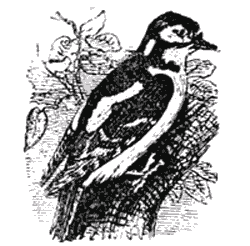
THE LESSER SPOTTED WOODPECKER.
WOODPECKERS.
The birds in this group in general have the beak rectangular, in a few instances very slightly hooked, never thick nor very long.
THE GREEN WOODPECKER.
Picus viridis, Linnæus; Le Pic vert, Buffon; Der Grünspecht, Bechstein.
The length of this bird is twelve inches and a half, but four and a half of these are included in the tail, almost half of which is covered by the folded wings. The beak, an inch and a half in length, is triangular, very pointed, and of a dark grey; the iris is grey; the tongue is five inches long, and furnished, like that of the other woodpeckers, with a horny tip, and strong hairs on each side, so as to be useful in catching and piercing insects. The top of the head to the nape of the neck is of a brilliant crimson; a black streak, which in old birds is often tinged with red, descends on each side of the neck; the upper part of the body is of a beautiful olive green, the under part of a dusky greenish white: some transverse lines may be seen on the belly, which become more distinct on the sides.
In the female the colours are paler, and there is less red on the head, which, when it is young, is only grey.
Habitation.—When wild, the green woodpecker, during summer, frequents woods and orchards which are near these, but when the air becomes cold, and the snow begins to fall, it approaches villages, and flies from one garden to another; it passes the night in the holes of trees; when it finds dead, decayed, or worm-eaten ones, it pierces them on all sides with its strong beak, in order to find the insects they conceal. It never attacks a healthy tree, therefore it is not right to kill it as being mischievous; it only taps the bark of trees to make the insects come out, and its strokes are then so quick that they resemble a humming.
In the house its fierce and impetuous character makes it necessary to keep it in close confinement.
Food.—In its wild state it constantly seeks the insects which live under the bark and in the wood of trees; it also eats ants, and in winter will even take bees from the hive.
In the house it is fed on nuts, ants’ eggs, and meat.
Breeding.—The female lays three or four perfectly white eggs in the hole of a tree; if the young are to be tamed they must be taken from the nest when only half fledged; it is impossible to tame adults or old ones; we cannot even make them eat.
Attractive Qualities.—The beauty of its plumage is all that can be said of it; for it is so fierce, quick, and stubborn, that it can only be kept by means of a chain. I know no instance in which every kind of attention has rendered it more docile and agreeable: it is always untractable. One or two of these chained birds, however, do not look bad as a variety. It is curious to see them crack the nuts.
THE GREATER SPOTTED WOODPECKER.
Picus major, Linnæus; L’Lpeiche, ou Pic varié, Buffon; Der Grosser Buntspecht, Bechstein.
This bird is rather larger than a thrush, nine inches long of which the tail measures three and a half, and the beak one. The legs are three lines high, and of a bluish olive; the iris is bluish, with a white ring; the forehead yellowish brown; the top of the head and the back black; the nape of the neck crimson; the shoulders white, the wings and tail black, and streaked with yellowish white; the belly of a dirty reddish white, the part about the vent crimson.
The female has no red on the nape of the neck.
Habitation and Food.—This woodpecker continually ranges woods and orchards in search of its food, which consists of insects, beech-mast, acorns, nuts, and the seed of pines and firs. In order to crack the nuts, it fixes them in the clefts of the trees. The female builds its nest in the hole of a tree, and lays from four to six white eggs. Before moulting the head of the young ones is red. They must be taken early from the nest if they are to be tamed. They are fed and treated like the green woodpecker.
THE MIDDLE SPOTTED WOODPECKER.
Picus medius, Linnæus; Le Pic varié à tête rouge, Buffon; Der Mittlerer Buntspecht, Bechstein.
This is only distinguished from the former by being rather smaller: the beak is more slender, and very pointed. The top of the head is crimson, and the region of the vent rose-coloured. It is, besides, less common, and the young which are reared are not so untractable, though never very docile27. They are generally kept in a cage, and fastened by a little chain.
THE LESSER SPOTTED WOODPECKER.
Picus minor, Linnæus; Le Petit Epeiche, Buffon; Der Kleiner Buntspecht, Bechstein.
This bird is the size of a lark, five inches and a half in length, two of which are included in the tail, and the beak measures seven lines. The feet are of a greenish black; the rump is white; the top of the head crimson; the nape of the neck black; the back white, with transverse streaks of black; the under part of the body is of a reddish white grey, and the sides are streaked with black.
The female had no red on the head.
Habitation and Food.—This rare species inhabits forests of beech and oak, skilfully catching the insects under the bark and moss of these trees; it even flies to the ground to seek the same food among the grass. While rearing the young ones, they must be kept in a cage.
THE WRYNECK.
Yunx torquilla, Linnæus; Le Torcol, Buffon; Der Gemeiner Wendehals, Bechstein.
Though it is six inches and a half in length, it is not larger than our lark, because its tail includes three inches and a quarter, and its beak nine lines. The iris is of a brownish yellow, the feet, two claws of which are before and two behind, are short, strong, and lead colour. The head is ash-coloured, speckled with small rust-coloured spots mixed with some white ones. The top of the head and half of the back are divided lengthwise by a broad black streak, edged with rust colour; the rest of the upper part of the body is of a fine grey, streaked and speckled with black, white, and rust colour. In the female the belly is paler than in the male.
Habitation.—When wild, it is a bird of passage, which departs during the first fortnight of September, and does not return till the end of April, frequenting groves and orchards. In August it goes into gardens and fields planted with cabbages and other vegetables.
In the house it is better to let it run about at will than to keep it in a cage, where it would soil its feathers, particularly those on the belly and breast, while playing.
Food.—In its wild state, the wryneck lives on insects, for catching which it has a very long cylindrical tongue, with a hard point, that can be insinuated into all the chinks and fissures of trees. Ants’ eggs are a very favourite food, and it does not dislike the ants themselves. Towards autumn, when the latter fail, it is contented with elderberries till the time of its departure which never varies.
In the house it must be first given ants’ eggs; and then by degrees the universal paste, to which it soon becomes accustomed; but, as it is delicate, in order to preserve it for some time, the nightingales’ food agrees better with it. It is very amusing to see it search all the cracks and crevices of the room for insects; and if a few ants’ eggs were now and then put there, it would give it the greatest pleasure.
Breeding.—Its nest, which it places in the hole of a tree, is formed of moss, wool, hair, and straw. It lays eight eggs, which are white, and very smooth. The adults and old ones are difficult to preserve and tame; but the young ones may be easily reared on ants’ eggs, and the universal paste, made of the crumb of white bread.
Mode of Taking.—In general it is caught by putting lime twigs round the nest; but if the weather be stormy, as in spring, when it is busy searching the bushes for insects, it may even be taken by the hand. The one I now have was brought to me by a little boy who had taken it in this manner.
Attractive Qualities.—Independently of its beautiful plumage, it is very amusing to see it make those movements which have given it its name of wryneck. It lengthens its neck, and turns round its head, so that the beak points down the back. Its general position is quite straight; the feathers of the head and throat very smooth, and the tail spread like a fan, at the same time bowing low. If it be irritated, or even if its food be brought, it slowly leans forward, raising the feathers on its head, lengthening and turning its neck, rolling its eyes; it then bows, spreads its tail, and murmurs some harsh sounds in its throat; in short, it puts itself in the most singular attitudes, and makes the most ridiculous grimaces. At other times it seems to have a melancholy disposition. In spring the male often cries in a full tone, gui, gui, gui, gui, to call its female.
M. de Schauroth informs me that two wrynecks which he reared became so tame, that they would hang about his clothes, and begin to warble as soon as they heard him, or saw him even at a distance. One day, being wearied and teazed with its incessant cries, he drove one out of the window; but having called it towards evening, it immediately replied to his voice, and permitted itself to be taken. One of these birds, which he let range about at will, having perched on a neighbouring tree, he had only to hold out and show it the box containing its food, and it returned immediately.
THE TOURAKO.
Cuculus Persa, Linnæus; Le Tourako, Buffon; Der Turako, Bechstein.
This Bird, which is about the size of a magpie, has been placed among the cuckoos by Linnæus, and those who have copied him, only because its cry is couc, couc; for in no other respect does it belong to this genus. Its beak is short and thick, and resembles that of the pigeon in shape; the upper is bent over the lower, and of a reddish brown; the nostrils are covered with feathers; the iris is nut-brown; the eyelids are edged with small red warts; the opening of the throat is wide, extending to the back of the ears; the nails of an ash grey; the head, throat, neck, top of the back, with the upper wing-coverts, the breast, upper part of the belly and sides, are covered with soft silky feathers, of a beautiful deep green; the feathers on the top of the head gradually lengthen into a large triangular tuft, which the bird raises at will, and the tip of which is red. The green in the tuft is sometimes mixed with white.
Observations.—The Tourako, which I have seen, belonging to his Highness the Duke of Saxe Meiningen, is one of the most elegant, mildest, and tamest of all foreign birds which I know. Its cry is couc, couc, couc, at first repeated slowly and distinctly, afterwards more quickly, and then in a rapid and continued succession. Notwithstanding the form of its feet it does not climb or hop, but runs as quickly as any partridge across the room, and often, pressing its wings against its body, makes several long leaps of ten feet.
Food.—The tongue is not perceptible on opening its beak, and it swallows every thing whole which is given it. It is fed on fruit and bread cut in small pieces; it has been remarked that it has a crop.
Buffon says, that one of these birds, which came from the Cape, ate rice; but that which I have seen would not touch it; on the contrary, it ate with avidity the stones of grapes, as well as bits of apple and orange; so that it may be concluded that fruit is its natural food. It is brought from Guinea, but may be found in other parts of Africa.
THE COMMON KINGFISHER.
Alcedo Ispida, Linnæus; L’Llcyon, ou Martin Pêcheur, Buffon; Der Eisvogel, Bechstein.
The length of this bird is seven inches, of which the short tail only measures one and a quarter, the legs are very short, being only four lines in height, and the outer claw is united to the centre one, as far as the first joint. The beak, an inch and a half in length, is strong, straight and pointed. The iris is dark brown; the top of the head and the wing-coverts are of a deep green; the one with transverse and the other with oval spots of a beautiful sky blue. The back and shoulders shine with the most beautiful blue. In the female the colours are darker, and the sky blue there is in them only meadow green.
Habitation.—When wild this is a solitary bird, which remains the whole year on the edges of ponds, streams, and rivers. During the winter it may be seen watching for its prey at the holes in the ice, placed on a stone or stick, or perched on the branch of a tree.
In the house it does not walk or hop, but flies or remains perched. It is very necessary to put some turf or branches in a corner, or it must be kept in a cage with a perch; it constantly remains in the same place.
Food.—In its wild state its food is small fish, leeches, and, indeed, all aquatic worms and insects. In the house it must be given as much as possible the same, accustoming it by degrees to eat meat. It is very rarely that those taken when old can be preserved. I have seen one, however, which ate even dead fish. The meat and small fish for its food must be put into a bowl of fresh water, large enough, or so firmly fixed, that it may not be easily overturned. When taking its food it does not hop to the bottom of the cage, but stretches itself downwards till it can reach the water with its beak, at least if it be not a young one reared in the house.—It will not eat while being looked at.
Mr. Paxton’s method of management.—“Having become possessed,” says Mr. Paxton, “of some young kingfishers last summer, we were very anxious to rear them; this we have accomplished, and, to the best of our information, it is the first time kingfishers were ever reared by hand. To accomplish this object we had a wire cage constructed about ten feet long, and four broad; the back part of the cage was made to imitate, as nearly as possible, the banks of a river;—through this cage a small stream of water was conducted, in which the birds received their food, &c. When the young birds were first taken from the nest, minnows and bullheads were their principal food; they have since been fed on almost every species of fresh-water fish, although they evince a marked preference for trout.
“Immediately on a quantity of small fish being put into the stream of water, they commence killing them, regardless of who may be near; and so surely do they strike, that, although we have repeatedly observed them, we never yet saw them miss their prey. As soon as they have caught a fish they kill it, by knocking its head against anything that may be near them. The quantity of fish consumed by each bird is almost incredible—we should think on the average not less than six ounces a day each; they could not exist twenty-four hours without food, so they quickly digest it. There can be no doubt that the sole reason of the kingfisher migrating to the sea-side on the approach of severe weather, arises from the voracity of its appetite.
“They are quite tame and domesticated, frequently sitting on the head or shoulder of the person who is in the habit of cleaning out their little dwelling. They are also very cleanly. We have observed them dive into the water as many as forty times incessantly, for the purpose of washing—this is generally done in the evening.
“Although they appear satisfied with their confinement, they are far from being friendly with each other; they fight with their wings, something after the manner of the swan; this is rather surprising, as they are very dexterous with their bills when seizing their prey.