NATURAL HISTORY OF CAGE BIRDS. (continued 6)
Reading edition
In the female the upper part of the beak is browner, the head and rump of a paler gray, the throat whitish, the back dingy rust colour, and the feet deep brown.
Of this species there are many varieties, the white, the spotted, the white headed, and the like.
Habitation.—When wild this species spreads not only all over Europe, but also over Syria and Siberia. In the summer it remains in the northern regions, where it builds in pine forests. It arrives in Germany and England in prodigious flights in November, and passes the winter in places producing the juniper; its return northward takes place in the first fine days of spring.
In confinement it is treated like the missel thrush, but it is generally only kept as a decoy bird. Heat being injurious, it is kept as far as possible from the stove.
Food.—When wild it feeds like the two preceding species.
In confinement it is fed in the same way; raw carrots grated with bread is added, which the others like also.
Mode of Taking.—The same as in the two preceding species.
Attractive Qualities.—Its song is a mere harsh disagreeable warble. I should not have introduced it among cage birds if the lovers of bird-catching did not in winter require its call when pursuing its species.
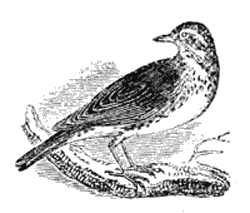
THE REDWING.
Turdus iliacus, Linnæus; Le Mauvis, Buffon; Die Rothdrossel, Bechstein.
This species is smaller than the song thrush, and has much resemblance to the fieldfare. Its length is eight inches, of which the tail occupies three and a quarter. The beak is nearly an inch long, blackish, and yellow only at the base and angles of the lower mandible; the iris is nut-brown. The shanks are an inch high, and light gray; the feet are yellow; the head, the upper part of the neck, the back, the rump, and the small coverts of the wings, are olive brown. The plumage is more brilliant than that of other thrushes, and the orange-hue under the wings, which has procured it the name of the redwing thrush, will always sufficiently distinguish this from those of the same genus.
The female is altogether lighter coloured. The line of the eyes is almost white; the spots on the sides of the neck light yellow; the under part of the body is white, the neck alone appearing yellowish; the spots on the breast are grayish brown, and there are none about the vent. This species also has its varieties, as white, streaked, and the like.
Habitation.—When wild it inhabits the north of Europe; it goes to the south only towards the end of October, and returns at the end of March or beginning of April.
In confinement the redwing is treated like the preceding; but it is not much valued, as its song is in no respect agreeable. It always requires fresh water and but little warmth.
Food, Mode of Taking, Diseases.—The same as in the preceding species.
Attractive Qualities.—The song of the male is as unmelodious as that of the fieldfare. These birds make a great noise when they are collected in large flights upon the alders, in March and April, but their warbling hardly deserves the name of song. I have known but one which succeeded in imitating, though very indifferently, the notes of the song thrush and some loud tones of the nightingale. It is not therefore their song which will gain these birds a place in the house; but they may please by their familiarity, their patience, their easy motions, and the readiness with which they obey orders. Bird catchers keep them principally as decoy birds. They are good eating.
THE ROSE OUZEL.
Turdus roseus, Linnæus; Le Merle Couleur de Rose, Buffon; Die Rosenfarbigedrossel, Bechstein.
This is a bird which from its beauty certainly merits a place in this work. Its length is nearly eight inches, of which the tail measures three, and the beak one. This latter is black, sometimes lead-coloured, from the base to the middle, and flesh or rose-coloured from the middle to the point; the iris is whitish; the shanks are fourteen lines high, lighter or darker flesh-coloured; the claws are blackish. The head, neck, and throat, are black, with the tips of the feathers white, very much like the starling, and changeable into green, blue, and purple; the feathers at the top of the head are long and narrow, and rise elegantly into a crest; the back, the rump, the shoulders, the breast, the belly, and the sides, are of a brighter or paler rose-colour, according to the age and season.
The female differs from the male only in being less highly and brilliantly coloured.
Habitation.—When wild these birds are to be met with in many parts of Europe and Asia. The inhabitants of Aleppo and the neighbourhood see with pleasure the arrival of large flights of them, in the months of July and August, to extirpate the clouds of locusts which then ravage the country. Great numbers are also seen in spring on the banks of the Don and Irtish, where they build and find abundance of food; also on the shores of the Caspian and the banks of the Wolga. In Europe they appear in Sweden as far as Lapland, in England, in Germany, in Switzerland, and France: rare indeed in all these countries, but least so in Italy.
In confinement this bird is kept in a cage of the same size as the blackbird’d.
Food.—When wild this bird appears to subsist entirely on insects.
In confinement it would doubtless thrive very well on the food which is given to the blackbird, which will be mentioned hereafter. It is better, however, to study it a little, and find out what suits it best.
Breeding.—It builds among rocks; but its nest has not yet been discovered in Europe, though some circumstances indicate that it propagates there. In 1784, in the duchy of Altenburg, three young ones were killed, but just out of the nest, and which consequently could not have come from far. This fact should excite the attention and vigilance of zealous observers.
Modes of Taking.—Skilful bird-catchers will soon discover the means of catching the bird: snares and limed twigs, with grasshoppers and other living and moving insects for bait, will probably accomplish this end. It would be hazardous to shoot the birds in the hope of wounding them but slightly, as is sometimes done with other birds, which soon recover, and remain tame, if, during their recovery, they have been well treated.
Observations.—A sportsman discovered, in 1794, in the environs of Meiningen, in Suabia, a flight of eight or ten rose ouzels, moving leisurely from south-west to north-east, and passing from one cherry-tree to another. He fired on these birds, only one fell, which was fortunately very slightly wounded, so that it soon quite recovered. Being immediately carried to M. Von Wachter, the rector of Frickenhausen, this clergyman took the greatest care of it; he gave it a spacious cage, and found that barley-meal moistened with milk was as wholesome as agreeable to it. His kindness tamed it in a short time so far that it would come and take from his hand the insects which he offered to it. It soon sang also, but its warbling consisted at first of but a few harsh sounds, pretty well connected however, and this became at length more clear and smooth. Connoisseurs in the songs of birds discover in this song a mixture of many others; one of these connoisseurs, who had not discovered the bird, but heard its voice, thought he was listening to a concert of two starlings, two goldfinches, and perhaps a siskin; and when he saw that it was a single bird, he could not conceive how all this music proceeded from the same throat. This bird was still alive in 1802, and the delight of its possessor.
THE BLACKBIRD.
Turdus merula, Linnæus; Le Merle, Buffon; Die Schwarzdrossel, Bechstein.
This species, the most docile of its genus, is nine inches and a half long, four of which belong to the tail. The beak is an inch long, and orange yellow; the iris is dark brown; the shanks are an inch high, and black. The whole plumage is of a pure velvety black; the eyelids alone are orange.
The female is of a brownish black, with the breast of a reddish hue, and the belly grayish; the throat is spotted with dark and light brown. It is also rather larger than the male, which has led some persons who were not well acquainted with it to make another species of it.
The white variety is very well known; there is besides the streaked, the black with a white head, and the pearl gray.
Habitation.—When wild the blackbird is found all over the old world, as well as in Germany; it is the only species of its genus which does not migrate thence.
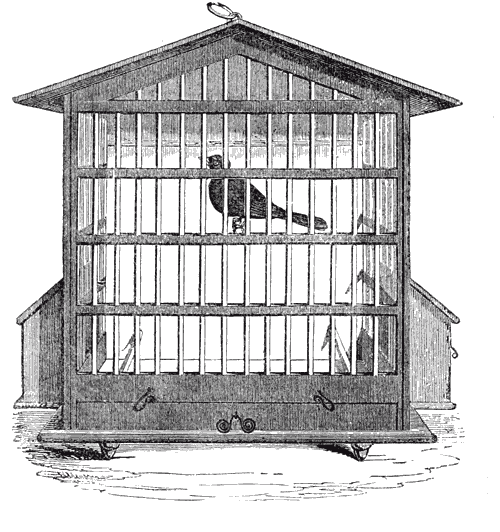
CATO’O BLACKBIRD’D CAGE
In confinement it is kept in a large cage; it is better to keep it separate because, whether from spite or jealousy, it is often inclined, like the tits, to pursue and kill its little companions of the aviary or room.
Food.—When wild the blackbird eats berries, and, in winter, when insects are scarce, he seeks them near warm springs.
In confinement he is satisfied with the first universal paste, but he also eats bread, meat, and anything which comes to table, such as a bit of apple. More delicate than the song thrush, he would not digest mere bran and water. He delights in bathing often, and should therefore be furnished with the means for so doing.
Breeding.—As the blackbird does not travel he pairs early in the spring, and the first young are hatched by the end of March. The nest, placed in a thick bush, or in a heap of boughs, is formed on the outside of stalks, then of moss and mud and lined in the inside with fine hay, hair, and wool. The female lays three times a year, from four to six eggs, of a greenish gray, spotted and streaked with light brown; when the young are hatched the males are always darker than the females, therefore bird-catchers can never be mistaken when they take the former and leave the latter. They are easily reared on white bread soaked in boiled milk, a little raw beef, and worms dipped in water. It is better to take them from the nest when the quills of the feathers are just beginning to develop, because, having then no idea of their natural song, they will retain more perfectly and distinctly the airs which may be taught them.
Diseases.—An obstruction in the rump gland is their most common disorder, and must be treated in the manner described in the Introduction. It would doubtless be prevented by never omitting to furnish the means of bathing. With care, and a proper variety of food, this bird will live in confinement ten or twelve years.
Method of Catching.—Timid and distrustful, the blackbird seldom enters the area or barn-floor trap, but it is easily caught in the winter with a noose or springe, by using service berries for a bait. It sometimes falls into the large traps set for tits, when the berries are spread over the bottom; limed twigs put with the berries in a place cleared from the snow, will catch many also; it also goes to the water-trap, but generally at night-fall. Its call is “tsizirr, tak, tak.”
Attractive Qualities.—The natural song of the blackbird is not destitute of melody; but it is broken by noisy tones, and is agreeable only in the open country. When wild it sings only from March to July; but when caged, during the whole year, except when moulting. Its voice is so strong and clear, that in a city it may be heard from one end of a long street to the other. Its memory is so good, that it retains, without mixing them, several airs at once, and it will even repeat little sentences. It is a great favourite with the lovers of a plaintive, clear, and musical song, and may, in these respects, be preferred to the bullfinch, whose voice is softer, more flute-like, but also more melancholy. The price of these two birds, if well taught, is about the same.
THE RING BLACKBIRD.
Turdus torquatus, Linnæus; Merle à Plastron blanc, Buffon; Die Ringdrossel, Bechstein.
This bird is larger than the common blackbird, being in length ten inches and a half, four of which belong to the tail. The beak is an inch long, raven gray, yellowish white at the base of the lower mandible, and yellow at the angles as well as inside: the iris is chestnut brown; the shanks dark brown, and fourteen lines high; the upper part of the body is black; and it is the principal colour of the under part also; but the feathers of the belly and the coverts of the wings are edged with white; the quill-feathers, and the outside feathers of the tail are grayish white; a white spot, tinged with red, and the size of the finger, placed transversely on the breast, serves to characterize the species, and gives it its name.
The female is of a brownish black; the transverse band on the breast is narrower, and of a reddish ash-colour, shaded with brown.
Those individuals which combine the brown colour of the female with the pectoral band, large, and of a reddish white, are young males; the others, in which it is scarcely discernible, are young females.
Observations.—Though the ring blackbird traverses the whole of Europe, it builds only in the north68. It arrives in Germany and England on the foggy days of the end of October and beginning of November. It moves always in small flights, stopping generally in spots covered with briers and juniper bushes, where it may be caught with a noose. Its food, when free and in confinement, is the same as that of the common blackbird, with which it has the most striking resemblance in its gait, the motion of its wings and tail, and its call, “tak.” Its voice, though hoarser and deeper, is nevertheless more harmonious and agreeable. It is so weak that a red-breast may overpower it. It continues singing at all times, except when moulting. It will live in confinement from six to ten years.
THE ROCK THRUSH.
Turdus saxatilis, Linnæus; Le Merle de Roche, Buffon; Die Steindrossel, Bechstein.
This rare and striking bird is unknown in many parts of Germany69. Though its principal characteristics place it in the genus of the blackbird, it has more resemblance to the starling, both in its manners and gait, which are varied and agreeable. Its length is seven inches and a half, two and three quarters of which belong to the tail. The beak, an inch long, and the shanks, an inch and a quarter high, are black. The head and neck are grayish blue, or ash blue, lighter in the old, and darker in the young birds; the top of the back is dark brown, often varying to a lighter brown, the middle a fine white; the rump, of a dark brown, has the feathers tipped with white; the breast is dark orange, the belly the same; but, according to the season, more or less spotted and undulated with white.
The female is dark brown on the upper part of the body, with edges of whitish gray to the feathers; those of the rump are rust-colour, with the same gray edge; the chin is white; the throat brown; the under part of the neck, and the whole under part of the body, of a dirty orange, with waving lines of brown and white; the tail is paler than that of the male, and the feet are dark brown.
Habitation.—When wild it is found in the south of Europe and Germany, in Austria, and the Tyrol. In France, in Bugey, and more to the south; and especially in the Alps and Pyrenees, frequenting rocks or old ruined castles. In its migrations it visits bare rocky mountains, searching for insects which take refuge among the stones. Its departure is in September and its return in March.
In confinement it is furnished with a cage larger than that of the nightingale.
Food.—When wild it appears to live entirely on insects.
In confinement it is fed like the nightingale; but with every care it cannot long be preserved.
Breeding.—The female builds her nest in an almost inaccessible crevice of the rocks, and lays five eggs. As the young are very susceptible of instruction, they are readily brought up when they can be obtained70; they are fed and treated like young nightingales.
Mode of Taking.—It is by fixing to the spots they frequent plenty of limed twigs, with meal-worms attached to them; it is said that in the Alps and Pyrenees they are caught with a bird-call.
Attractive Qualities.—It is considered one of the most agreeable singers; and if caught young it soon acquires the songs of the other birds of the chamber, learns to whistle tunes, and even, like the starling, to repeat words. “It begins to sing,” says Buffon, “a little before dawn, which it announces by noisy sounds. If its cage is approached during the night with a candle, it begins to sing; and when, during the day, it does not sing, it appears to be practising in an under tone, and preparing new songs.”
THE SOLITARY THRUSH.
Turdus solitarius, Linnæus; Le Merle solitaire, Buffon; Die Einsame Drossel, Bechstein.
This bird is eight inches and a half long, three of which belong to the tail. The beak is an inch and a quarter long, rather crooked at the point, dark brown without, and yellowish within; the iris is orange. The feet are thirteen lines high, and brown. The whole plumage is brown studded with little white spots, with a faint tint of blue on the sides of the head, the throat, under the body, on the breast and coverts of the wings; the rump is brown without spots, and the tail blackish.
The female differs from the male in having the little spots of a dirty yellow, and more numerous on the breast than elsewhere, and in being destitute of the blue tint; and finally, in having the pen-feathers and the tail-feathers simply brown.
Habitation.—When wild it seldom quits the mountains in the south of Europe; in spring, however, it advances as far as Burgundy, and returns in the end of August; it arrives, in the month of April, at the spot where it generally passes the summer, and returns constantly every year to the place where it first took up its abode. Two pairs are seldom found in the same district. Except in the pairing season it is a solitary bird.
In confinement it is furnished with a cage like that of the blackbird.
Food.—When wild it feeds on insects, berries, and grapes.
In confinement it is treated like the song thrush, adding ants’ eggs and meal-worms.
Breeding.—The nest, made of blades of grass and feathers, is generally placed at the top of a solitary chimney, or on the summit of an old castle, or on the top of a large tree, generally near a steeple or high tower. The female lays five or six eggs. The young ones, if taken from the nest soon enough, are capable of instruction; the flexibility of the throat fitting it either for tunes or words. They sing also by candle-light in the night. If treated with care they live in confinement eight or ten years. From the summit of a high tower or steeple the male utters for whole days the most beautiful and pathetic song, accompanying it by flapping his wings, moving his tail, and elevating the feathers of his head.
Attractive Qualities.—His beautiful voice is in great repute in all the countries he inhabits; it is, indeed, very sweet and flute-like; his song, though musical, is somewhat melancholy, as is usual with solitary birds; many persons, however, are very fond of it. This bird, when tamed, fetches a very high price at Milan, Constantinople, &c. In some countries it is so much respected that it is considered sacrilegious to kill it or destroy its nest.
THE BLUE THRUSH.
Turdus cyaneus, Linnæus; Le Merle bleu, Buffon; Die blau Drossel, Bechstein.
This bird is rather larger than the common blackbird, its length being eight inches, three of which belong to the tail. The beak, fourteen lines in length, is blackish, the iris dark nut brown, the eyelids yellow; the shanks, thirteen lines in height, are blackish; the whole plumage is of an ash blue, but each feather has near its tip a transverse brown line, and the tip itself is whitish. The individual birds vary in the depth of the blue, according to their age and sex.
The female is generally more uniform in colour than the male.
Habitation.—When wild the blue thrush is found in the Archipelago, in Dalmatia, Italy, Spain, and other southern countries, always among steep rocks.
In confinement it is provided with a convenient cage, like the preceding.
Food.—When wild it feeds on all sorts of insects.
In confinement it is fed like the nightingale.
Breeding.—Like the rock thrush it builds among rocks, on ruined or deserted towers, and the like. The young are reared in the same way as those of the nightingale.
Attractive Qualities.—Its pretty plumage and fine voice do not constitute its only attractions. It is very easily tamed, and is very capable of instruction, and amuses much by its natural gait and habits, which very much resemble those of the rock thrush.
THE REED THRUSH.
Turdus arundinaceus, Linnæus; La Rousserole, Buffon; Die Rohrdrossel, Bechstein.
This bird has so much resemblance to the white-throats, as to cause a hesitation whether it should be ranged with them or with the thrush; but the form of the beak and feet, and generally the whole colour of the body, are in favour of the latter. The total length is at most eight inches, four and a quarter of which belong to the tail, which is of a rounded wedge-shape. The beak is ten lines in length, and strong, flattish, brown at the point, yellowish at the base, and orange on the inside; the iris is dark maroon. The shanks are an inch high, strong, and brownish gray, blending into flesh-colour. This bird is so like the nightingale, that if the tail were reddish it would be mistaken for it. The top of the head and neck are dark gray, with a light olive tint; a line of dusky yellow extends above the eyes from the nostrils to the middle; the cheeks are brownish gray; the back and the coverts of the wings reddish gray, which becomes lighter, and passes at the rump into pure rust-colour.
The female differs from the male only in being smaller, rather darker on the upper, and lighter on the lower parts of the body; the white of the throat is less extensive, and the upper part of the head is tinged with red.
Habitation.—When wild it is found all over Europe, with the exception of the most northern parts; it is a stranger in those parts of Germany only where there are neither lakes, ponds, nor stagnant rivers abounding with rushes; for it is always on their banks and in large swamps that it resides, and more frequently on the ground than in trees71.
In confinement it is provided with a nightingale’s cage.
Food.—When wild it feeds on aquatic insects, the enormous multitude of which it seems intended to diminish. In order to catch these it is continually seen climbing the stems of the rushes and reeds: it also eats berries.
In confinement, hitherto, no food but that of the nightingale has succeeded with it, and that even for only four or six months. It is soon attacked by a disease which carries off great numbers of white-throats: the feathers falling off without being renewed, the bird declines and dies of atrophy72.
Breeding.—The nest is found fastened with wool to the stems of the rushes, or the branches of neighbouring bushes. On the outside it is formed of moss and stubble, firmly mixed, and lined on the inside with fine hay and hair. The eggs, five or six in number, are grayish white, spotted with black. The young, before the first moulting, have the appearance of a white-throat, with some dark spots on the breast. They are taken from the nest and reared, like young nightingales, on ants’ eggs; and if they are placed near this winged Orpheus, they learn his song so well and so perfectly that they become as excellent performers as their masters, with the additional advantage of possessing a noise more flute-like and less shrill than that of the nightingale.
Mode of Taking.—The great difficulty of catching this bird makes it scarce in our rooms. The only means is to ascertain well the place it frequents, then to scratch up the earth and throw upon it some meal-worms, and cover the place with limed twigs.
Attractive Qualities.—With a more beautiful and musical voice, its song is also more varied than that of the song-thrush, without being so long, so sustained, or so brilliant, as that of the nightingale, with which it most deserves to be compared. Some of its couplets resemble those of the blackcap, but broken, like those of the song-thrush. When caged it may be much improved by imitation of the notes of the nightingale, which the young easily copy. It is particularly in the morning and evening that the reed-thrush utters his beautiful warblings. Not only is his throat then in motion; his wings, his tail, and his whole body, are agitated as if to follow the cadence and the measure.
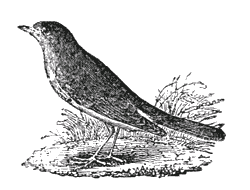
THE NIGHTINGALE.
Motacilla Luscinia, Linnæus; Le Rossignol, Buffon; Die Nachtigall, Bechstein.
This bird, whose plumage is very ordinary, is scarcely five inches long, two and a half of which belong to the tail. But, in confinement, when it is well fed, and especially when it has been bred from the nest, it is commonly larger, reaching sometimes the size of a lark. The straight beak is seven lines in length, thin, with the two mandibles of nearly the same size, and dark brown above, light gray below, flesh-coloured at the base, and yellow within; the iris is brownish grey. The shanks, three quarters of an inch high, are flesh-coloured; the upper part of the body is brownish gray, tinted with rust-red, and in very old birds is reddish ash-coloured.
Among individuals in confinement, some are lighter, others darker. When placed in the windows of a large well-lighted room, which is not exposed to smoke, they are in the upper parts dark gray, or light brownish gray, and the feathers have a reddish edge; below they are white, and grayish on the sides. But those which are shut up in small ill-lighted rooms, subject to smoke, soon lose their colours, the upper part of the body becoming dingy red, the under part grayish white, and the sides brownish gray.
Those accustomed to birds distinguish the female at a glance. Her shanks are not so high: she is not so erect; her head is not so long and pointed, but rounder; her neck is shorter, and more inclined back; her eye is smaller and less lively; and her throat is not so white. Notwithstanding these characteristics, no other than an experienced person could decide the sex unless he had them both before him.
Nightingales so strongly resemble the female redstart, that the latter is often caught and sold for a nightingale, while the nightingale in its turn is killed and eaten for a redstart. To avoid mistakes, we must observe the following particulars:—The female redstart is always smaller, and her plumage darker: her small feet and beak are blackish; the red of her tail is lighter, and the two middle feathers are blackish, or very dark brown; this long slender tail is in continual motion, while the nightingale moves his only at intervals, for example, when he has hopped a few steps, and he generally carries it raised higher than the point of his wings. His step and attitude are prouder, and his actions seem more deliberate. When he walks, it is by measured regular hops. After a certain number he stops, looks at himself, shakes his wings, raises his tail gracefully, spreads it a little, stoops his head several times, raises his tail again, and proceeds. If any object attracts his attention, he bends his head towards it, and generally looks at it with only one eye. It is true that he jumps hastily upon the insects which constitute his food; but he does not seize them so eagerly as other birds; on the contrary, he stops short, and seems to deliberate whether it is prudent to eat them or not. Generally he has a serious circumspect air, but his foresight is not proportioned to it, for he falls readily into all the snares which are laid for him. If he once escapes, however, he is not so easily caught again, and becomes as cunning as any other bird. The same, indeed, may be said of all birds pursued by man. Nightingales are called, in my opinion very unjustly, silly and curious; for a great number of new things may be offered them without exciting the least attention; but scratch or dig the earth, and they approach directly, because instinct or experience tells them that they shall there find insects, which they are very fond of. Many other species of this group do the same thing; for instance, the blackcap and the red-breast, without its having been mentioned. These birds do not, however, deserve so much of our attention as the nightingale.
Habitation.—When wild, nightingales are found throughout Europe, as far as the north of England and the middle of Sweden: in all Asia, as far as the temperate regions of Siberia; and in Africa on the banks of the Nile. They every where choose for their residence places which are shady, cool, but not cold, such as woods, thickets, and even mere hedges in the fields. They do not go beyond the skirts of the forests on high chains of mountains, and never stop on elevations where the air is too keen. Groves, thick brambles, tufted bushes near fields and meadows, are their favourite abodes. They also like gardens planted with untrimmed elm-hedges, which are consequently thick and bushy down to the ground. It is not true that they like watery situations, and if they frequent them it is not for the water, but because they generally produce thick tufted bushes. It must also be owned that their favourite food is more constantly abundant in such places, and if the cold destroys the insects elsewhere, plenty may always be found in them. It is not however the less certain that the water is not the attraction, or all would repair to its vicinity, which experience contradicts. The fact is, that each nightingale generally establishes himself in the place which gave him birth, whether near the water or not, whether in an orchard or on a mountain; and when once he has fixed on a spot, he returns to it every year, unless the place has lost its charm or advantage. If the wood for instance has been cut down, or has lost the thick shade, which was its chief merit, in such circumstances he seeks in the neighbourhood another spot more to his liking. But if, in a considerable circuit where no change has taken place, a nightingale is seen to establish himself in a spot which was unoccupied the preceding year, it may be concluded that it is a young bird which was born in the vicinity. Convenient places are so much valued, that if the possessors die or are caught, new comers seize upon them immediately; so that the bird which we hear to-day, is very possibly not the same which sang yesterday in the same place. Many other causes may also concur in producing this change of inhabitants, which an ear well versed in the language of these birds will always discover.
It may, perhaps, be asked why, in many places which appear so well adapted to attract nightingales, none are found73. I reply that these spots may be concealed by woods or mountains, and not lie perceived by the nightingales in their journeys, or they may be quite out of their route, for they have a regular one which they never quit, because, their progress being slow, and subject to interruptions, it is requisite that they should find on their passage every thing necessary for their subsistence, and too cold an atmosphere is painful to them. It may also happen that the nightingales which formerly frequented them, may have been altogether extirpated; and as it has been said that the young always establish themselves in the district which gave them birth, it is by no means surprising that they should not be chosen, at least there are many chances against it. Rather than wait in vain for this chance, there is a means of re-peopling such places with these charming birds. It is only necessary to bring up some broods of young ones, and not let them loose in the following spring till after the period of return is elapsed; because being no longer excited by the instinct which induces them to travel, and the instinct itself being subdued in a great measure by their imprisoned education, they will not wander, but will remain and propagate, provided they are not disturbed, and will return the year following with all their family. I must not omit to say that the young intended for this re-peopling must not be confined in a cage, as they would lose the use of their wings, and run the risk of perishing the first day of their liberation. As soon as they can feed themselves, they must be allowed an entire room, in which they may fly freely, and grow strong and bold. A sort of grove should be formed of branches or small trees, and nature should be imitated as much as possible also in feeding them, by throwing to them more insects and ants’ eggs than usual, to accustom them to seek for them.
The period of the nightingale’s return throughout the greater part of Germany, is the middle of April, rarely either earlier or later74: it is always when the white-thorn begins to expand its leaves. Advancing slowly and gradually, these birds are not so likely to suffer from bad weather as those which go straight to their destination by one stage. In the middle of August each family prepares to depart; this is done quietly, removing gradually, and passing from grove to grove to the end of their journey; then it is that these birds are caught with nooses or springes, by using elderberries or currants for a bait. The middle of September is the latest period at which they are seen in Germany. All then disappear imperceptibly, so that the time they employ in the rest of their journey is altogether unknown. Other birds, whose instinct leads them to travel in large flights, do not so easily escape observation. If by accident a nightingale is met with at the end of September, or in October, it must have been delayed by some peculiar circumstance; for instance, it may be a young one that has lost its way, or that was hatched late, or it may be an invalid.
In confinement nightingales may be allowed to fly freely, as I have often permitted them; but they do not then sing so well as when in a cage, where they are less subject to interruptions, and where also they live longer and more healthily, from being fed with more care and regularity. The nightingale’s cage, of whatever form, must not be less than a foot and a half in length, by about one in width, and one or more in height. The top should be made of linen or soft stuff, that when jumping and struggling, especially when first caught, he may not injure his head. The drinking-cup and feeding-trough are fastened on the outside, unless it is preferred to introduce the latter within, in the form of a drawer. The following are the best form and proportions for a nightingale’s cage, that I am acquainted with:—Length, one foot and a half; breadth, eight inches; height, fifteen inches in the middle; thirteen at the sides, because the roof is arched. The sides are made of osiers about a quarter of an inch thick; the bottom is made of the same material, but it is covered by a drawer an inch and a quarter in depth. In order to clean it more easily, I cover it with coarse paper, which I renew every time. The feeding-trough is introduced on one side, with edges high enough to prevent the bird’s spilling too much of the food. In the middle of the front of the cage, and extending from top to bottom, is a cylindrical projection in the form of a belfry, in which is suspended a large drinking-glass. The upper stick of the cage is confined here, terminating in a fork, or fixed to a semi-circle, that the projection may not be prevented from moving. This projection is made of osiers, like the rest of the cage. The middle and lower sticks are covered with green cloth, firmly sewed on, that the nightingale may have a softer perch, and not have his feet so soon injured, which is very common with imprisoned birds. The arched roof is also covered with green stuff, which is painted that colour with oil paint, as well as the whole of the cage. But it must be well dried, and quite free from smell before the bird is put into it.
My reasons for preferring this cage are, first, because being small, it occupies less room, without disadvantage to the bird or to the apartment; second, because the size of the osiers leave small intervals for the admission of light, and it is consequently darker; third, because the bird can bathe without wetting his cage or his perches: and consequently his feet remain cleaner and more healthy.
As to the situation of the cage, the prisoner’s taste must be consulted. Some nightingales dislike being in the window, and prefer a dark corner of the room; others like the light and the sun. If it is wished that a nightingale should sing everywhere, it is necessary, when he is moulting, and before he resumes his song, to accustom him to a change of place, by carrying him sometimes here, sometimes there. Some will sing only when they are alone, while others like to perform alternately with a neighbour; but they never sing so loud and well when there are several in a room. Perhaps jealousy is the chief cause of this. On these occasions, the first that begins generally maintains the superiority; the others sing only when he stops, and this but seldom, and in an under tone. Some are so sulky that they will not sing at all. Some of these obstinate pouters are occasionally, from their silence, mistaken for females, and consequently dismissed from the room, but when they find themselves alone they begin to sing at full stretch.
Food.—When wild nightingales feed on insects, especially little green caterpillars, of which they clear the bushes and trees, small butterflies, flies, and beetles, and the grubs of insects hid among moss or in the earth, which are discovered by turning it up. At their departure, towards the end of summer, they also eat elderberries and currants.
In confinement, meal worms and fresh ants’ eggs are the first things which should be offered to birds which are just caught; in place of these, when it is not possible to procure them, some persons prepare a mixture of hard eggs, ox heart, and white bread, some mouthfuls of which they force the birds to swallow, and then throw some meal worms on the rest, to induce the nightingale to eat it; but this artificial food is so unfit for these birds, especially at first, that it kills the greater number. They may also be injured by forcibly opening their delicate beak. When ants' eggs cannot be procured, it is better to set the birds at liberty than thus to sacrifice them. Their best food in summer is ants’ eggs, to which are daily added two or three meal worms75; when none of the former remain fresh they must be supplied by dried or rather roasted ox heart and raw carrot, both grated, and then mixed with dried ants’ eggs76. The carrot, which may be preserved fresh in sand in the cellar, prevents heat in the stomach and bowels; a little lean beef or mutton minced small may also be used sometimes; after different trials, it is in this way I feed my nightingales. The cheapest food is very ripe elderberries, dried and mixed with ants’ eggs, in the same way as the carrots and white bread.
Some bird-fanciers, in winter, bake a little loaf made of the flour of peas and eggs, which they grate, moisten, and then mix with dried ants’ eggs; others, who would still be more economical, pound poppy-seeds in a mortar to express the oil, and then mix them with the crumb of white bread; when accustomed to it the birds seem very fond of it, but a proof that it does not agree with them is that they soon fall into a decline and die. This plan has lately been introduced into Thuringia; but knowing, as I do from experience, that the stomach of the nightingale is not formed to digest such food, since he is not graminivorous, I take care never to administer it; and I think I ought to warn others against it. The best will always be the simplest, and that which is most conformable to nature. Those who adopt that which I have mentioned will have the satisfaction of finding their nightingales healthy, cheerful, active, and good singers.
I have already said that I have tried letting them run about the room, feeding them upon the common universal paste; but this food is not sufficiently nutritious for them: on this diet they can hardly pass six months without falling into a decline, and they would inevitably perish if they were not speedily restored to one which is fitter for them. They require fresh water every day, as well for bathing as drinking; they habitually bathe, when caged, after singing. They have also been observed to do so the first thing in the evening, when the candles were lighted.
Breeding.—Each nightingale has his little district; and if in the pairing season several males are found together, very angry battles take place, which end in the flight of the weakest. The commonest quarrels of this kind are between fathers and sons. The latter, having been born in the place, determine to fix themselves in it; all feeling of relationship is then extinguished, and they are strangers; the relations of father and son, those sweet ties, hitherto so close, are suddenly broken, never more to be felt.
The nest is built in a grove or orchard, among a heap of branches, or on a thorn bush, or the trunk of a tree surrounded by briars; or even on the ground when it may be hid by tall grass or thick bushes. Its form is simple and inartificial, on the outside dry leaves, on the inside hay, fine roots, with the hair of animals, is all the apparatus. The female lays from four to six eggs, of a brownish green, on which she sits a fortnight. The young are fed with small caterpillars and butterflies. As the low position of the nest exposes them to become the prey of carnivorous quadrupeds, they soon quit it, even before they can fly. Their plumage before moulting has no resemblance to that of the old birds except the red of the tail; the upper part of the body is of a reddish grey, spotted with yellowish white on the head and coverts of the wings; the under part is of a rusty yellow, spotted on the breast with dark brown; but after moulting the resemblance is so perfect that they can hardly be distinguished. If, therefore, any of these birds are caught towards the end of summer, they are carefully examined on the back of the head, round the eyes, and under the beak and neck, for, provided there remains in these places a small feather, or mere yellow point, it is sufficient to ascertain that they are young. As these are the only means of judging, if no marks appear, it is necessary to wait for a few days till the bird begins to sing. This, however, is not a sure sign, as the young females sing as well as the males, till the month of April, though in a weaker and more unconnected way, and without so visibly swelling their throats: it is by these nice observations that connoisseurs succeed in distinguishing them. It may also be remarked, as a help to those who wish to rear nightingales, that, when in the nest, those which are marked with white, and especially those which have a white throat, are males; the reddest and brownest being always females. The young, when taken, are fed with ants’ eggs mixed with white bread, grated and moistened. The males begin to warble even before their tails are quite grown: if the father and mother are taken at the same time as the young ones, they will, when caged, continue to feed them as before. It is said that nightingales sometimes build in the bird room; this, however, can only succeed by giving up to a tame healthy pair a whole room, in which a sort of grove should be formed of branches.
Diseases.—In general moulting amounts to a disease among nightingales: at this critical time they require a more succulent diet, and sometimes a spider by way of purgative. If their stomach is disordered they puff up their feathers, half shut their eyes, and remain for hours with their head under their wing. They are relieved and cured by ants’ eggs, some spiders, and by giving them occasionally water impregnated with saffron till it is of an orange colour, to drink.
As to those diseases which they have in common with other birds, they are treated according to the directions given in the Introduction. It is especially necessary, every three months, carefully to remove the large scales from their legs and toes. A nightingale may be kept in confinement fifteen years; whilst in a wild state they are never observed to exist so long in the same spot, which seems to prove that they do not attain so great an age when exposed to all sorts of accidents, both from birds of prey and bird-catchers. I have an instance of a nightingale which has lived twenty-five years in confinement. When they have reached six years they begin to sing less frequently and long, with less brilliancy and ornament; it is then better to set them at liberty in the month of May. The open air often invigorates them so much that they regain their song in all its force and beauty.
Mode of Taking.—Nothing is easier than to catch a nightingale in the season of pairing. If a little furrow, smooth at the bottom, is dug in a dark soil, and some meal worms or ants’ eggs are thrown into it, he will immediately fly to these delicacies. By putting also in the same place limed twigs, or a small net which may be easily dropped, he will soon be caught; it is even sufficient to fix over the furrow a bit of wood supported by a stick, which will fall as soon as the bird perches upon it. He is so unsuspicious that he observes the snare being laid, and then foolishly falls into it, when the bird-catcher has moved only a few steps from it; he will even allow himself to be led to it when at a little distance, if in a gentle manner. A bird-catcher may thus, in a few hours, depopulate a whole district of these delightful songsters. If, however, this is feared, there is a means of baffling his intentions, by anticipating him, and catching the nightingale we wish to preserve in our neighbourhood, either by a limed twig or in a net, and letting him go again. This experiment will prevent his falling so readily into the snare in future. In the greater part of Germany, indeed, it is forbidden, under a very heavy penalty, to catch nightingales. Another mode of taking them is by nooses and springes, and suspending for a bait, instead of berries, live meal-worms; but there is one disadvantage attending it, while struggling the bird almost always injures his feet, especially in springes.
Attractive Qualities.—The first good quality of a nightingale is undoubtedly its fine voice, and notes which I shall endeavour to describe. The nightingale expresses his different emotions by suitable and particular tones. The most unmeaning cry when he is alone appears to be a simple whistle fitt, but if the syllable crr is added, it is then the call of the male to the female. The sign of displeasure or fear is fitt repeated rapidly and loudly before adding the terminating crr; whilst that of satisfaction and pleasure such, for example, as conjugal endearments, or on the occasion of finding a delicate morsel, is a deep tack, which may be imitated by smacking the tongue.
In anger, jealousy, rivalry, or any extraordinary event, he utters hoarse disagreeable sounds, somewhat like a jay or a cat. Lastly, in the season of pairing, when the male and female entice and pursue each other, from the top of a tree to its base, and thence again to the top, a gentle subdued warbling is all that is heard.
Nature has granted these tones to both sexes; but the male is particularly endowed with so very striking a musical talent, that in this respect he surpasses all birds, and has acquired the name of the king of songsters. The strength of his vocal organ is indeed wonderful; and it has been found that the muscles of his larynx are much more powerful than those of any other bird. But it is less the strength than the compass, flexibility, prodigious variety, and harmony of his voice which make it so admired by all lovers of the beautiful. Sometimes dwelling for minutes on a strain composed of only two or three melancholy tones, he begins in an under voice, and swelling it gradually by the most superb crescendo to the highest point of strength, he ends it by a dying cadence; or it consists of a rapid succession of more brilliant sounds, terminated, like many other strains of his song, by some detached ascending notes. Twenty-four different strains or couplets may be reckoned in the song of a fine nightingale, without including its delicate little variations; for among these, as among other musicians, there are some great performers and many middling ones. This song is so articulate, so speaking, that it may be very well written. The following is a trial which I have made on that of a nightingale in my neighbourhood, which passes for a very capital singer77:—
Tioû, tioû, tioû, tioû. Spe, tiou, squa. Tiô, tiô, tiô, tiô, tio, tio, tio, tix. Coutio, coutio, coutio, coutio. Squô, squô, squô, squô. Tzu, tzu, tzu, tzu, tzu, tzu, tzu, tzu, tzu, tzi. Corror, tiou, squa, pipiqui. Zozozozozozozozozozozozo, zirrhading! Tsissisi, tsissisisisisisisis. Dzorre, dzorre, dzorre, dzorre, hi. Tzatu, tzatu, tzatu, tzatu, tzatu, tzatu, tzatu, dzi. Dlo, dlo, dlo, dlo, dlo, dlo, dlo, dlo, dlo. Quio, tr rrrrrrrr itz. Lu, lu, lu, lu, ly, ly, ly, ly, liê, liê, liê, liê78. Quio, didl li lulylie. Hagurr, gurr quipio! Coui, coui, coui, coui, qui, qui, qui, qui, gai, gui, gui, gui79 Goll goll goll goll guia hadadoi. Couigui, horr, ha diadia dill si! Hezezezezezezezezezezezezezezezeze couar ho dze hoi. Quia, quia, quia, quia, quia, quia, quia, quia, ti. Ki, ki, ki, ïo, ïo, ïo, ioioioio ki. Lu ly li le lai la leu lo, didl ïo quia. Kigaigaigaigaigaigaigai guiagaigaigai couior dzio dzio pi.80
If we could understand the sense of these words, we should doubtless discover the expression of the sensations of this delightful songster. It is true that the nightingales of all countries, the south as well as the north, appear to sing in the same manner; there is, however, as has been already observed, so great a difference in the degree of perfection, that we cannot help acknowledging that one has a great superiority over another. On points of beauty, however, where the senses are the judges, each has his peculiar taste. If one nightingale has the talent of dwelling agreeably on his notes, another utters his with peculiar brilliancy, a third lengthens out his strain in a particular manner, and a fourth excels in the silveriness of his voice. All four may excel in their style, and each will find his admirer; and, truly, it is very difficult to decide which merits the palm of victory. There are, however, individuals so very superior as to unite all the beauties of power and melody; these are generally birds of the first breed, which, having been hatched with the necessary powers, in a district well peopled with nightingales, appropriate what is most striking in the song of each, whence results this perfect compound, so worthy of our admiration. As the return of the males in spring always precedes that of the females by seven or eight days, they are constantly heard to sing before and after midnight, in order to attract their companions on their journey during the fine nights. If their wishes are accomplished they then keep silence during the night, and salute the dawn with their first accents, which are continued through the day. Some persist in their first season in singing before and after midnight, whence they have obtained the name of nocturnal nightingales; but they cannot be distinguished till after some time, when they are established in their district, and have the society of their females. After repeated experiments for many successive years, I think I am authorised in affirming that the nocturnal and diurnal nightingales form distinct varieties, which propagate regularly: for if a young bird is taken from the nest of a night singer, he, in his turn, will sing at the same hours as his father, not the first year, but certainly in the following81; while, on the other hand, the young of a day nightingale will never sing in the night, even when it is surrounded by nocturnal nightingales. I have also remarked that the night singers prefer mountainous countries, and even mountains themselves, whilst the others prefer plains, valleys, and the neighbourhood of water. I will also venture to affirm that all the night singers found in the plains have strayed from the mountains; thus in my neighbourhood, inclosed in the first chains of the mountains of Thuringia, we hear only night singers, and in the plains of Gotha they know only the day nightingale.
It is a pity that the time for this delightful bird’s song should be so short, that is to say, when wild. It endures hardly three months; and during this short interval it is not maintained with equal power. At its first arrival it is the most beautiful, continued, and impassioned; when the young are hatched, it becomes more rare; the attentions which they require occupying considerable time. If from time to time the nightingale’e song is heard, it is evident that the fire which animated it is much weakened. After midsummer all is ended, nothing is heard but the warbling of the young, which seem to study their father’s song, and try to imitate it. The nightingale sings much longer in confinement: birds which are caught full grown sometimes sing from November to Easter; those which are bred from the nest sing much longer, sometimes as long as seven months; but in order that they may sing well they must be put under the instruction of an old nightingale which is a good singer, otherwise they will be only stammerers, mutilating their natural song, and inserting in a confused manner tones and passages which they have caught from other birds. If, however, they have a good instructor, and a good memory, they imitate perfectly, and often add to their instructor’s song some beauties of their own, as is usual among young birds82.
I cannot help here mentioning the cruel and disgusting selfishness of some men, who, in order a little to prolong the song of this interesting bird, sacrifice to their transient gratification its eyes, by blinding it, as is done to the lark and the chaffinch.
It is said that a nightingale and a female red-breast running free in the room will sometimes pair, and produce mules, but I have no experience on this subject.
I cannot better complete my account of the nightingale’s song than by transcribing the delightful, though somewhat exaggerated picture, which has been given of it by Buffon. “There is no well organised man,” says he, “to whom the name of the nightingale does not recall some one of those fine nights in spring, when the sky being clear, the air calm, all nature silent, and as it were attentive, he has listened with delight to the song of this chorister of the woods. Several singing birds may be named whose voices in some respects may compete with that of the nightingale; the lark, the canary, the greenfinch, the blackcap, the linnet, the goldfinch, the common blackbird, the solitary thrush, the American mocking-bird, are all listened to with pleasure when the nightingale is silent: some have fine tones, others have their voice as clear as it is soft, others have as fine flourishes, but there is not one which the nightingale does not surpass in the complete union of all these different talents, and in the prodigious variety of his songs; so that the song of each of the above-named birds is, when taken in its whole extent, only one couplet of that of the nightingale. The nightingale always charms, and never copies himself servilely; if he repeats any passage it is animated with a new accent, embellished by new ornaments. He succeeds in all styles, he renders all expressions, he seizes all characters, and he also augments their effect by contrast. If this Coryphæus of the spring prepares to sing a hymn to nature, he begins by a timid prelude, by faint uncertain sounds, as if he would try his instrument and interest his audience; then gaining courage he becomes gradually animated, warmed, and he soon displays in their plenitude all the resources of his incomparable organ, brilliant bursts, lively delicate trills, volleys of notes whose distinctness equals their volubility; an internal dull murmur, not itself pleasing to the ear, but very fit to enhance the brilliancy of the agreeable strains, sudden, brilliant, and rapid runs, articulated with strength, and even a tasteful ruggedness, plaintive accents, tender cadences; sounds dwelt on without art, but swelling with sentiment; enchantingly penetrating notes, the true sighs of voluptuousness and love, which seem to come from the heart, and make all hearts palpitate; which produce in all who are not insensible a delightful emotion, a touching languor. In those impassioned tones are recognised the language of sentiment which a happy husband addresses to his beloved partner, and which she alone can inspire; while in other strains, more surprising perhaps, but less expressive, are discovered the simple wish of amusing and pleasing her, or of disputing before her the prize of singing with rivals jealous of his glory and happiness.
“These different strains are interspersed with pauses which in all styles of melody concur in producing great effects. We dwell on the beautiful notes we have just heard, and which still resound in our ears; we enjoy them the more because the pleasure is more limited, more exclusive, and undisturbed by new sensations. Soon we expect, we desire another strain; we hope it may be pleasing; if we are mistaken, the beauty of what we hear will not leave us room to regret that which is only delayed, and the interest of hope is maintained for the strains which will follow. One of the reasons why the song of the nightingale is so striking, and produces so much effect, is, as Mr. Barington has well said, because he sings in the night, which is the most favourable time, and he sings alone, whereby his voice is heard in all its splendour, and is undisturbed by any other voice. He eclipses all other birds, adds Mr. Barington, by his soft flute-like tones, and by the uninterrupted duration of his warble, which lasts sometimes for twenty seconds. The same observer reckoned in this warble sixteen different strains, well marked by their first and last notes, the intermediate notes being tastefully varied by the bird; and he ascertained that the space filled by the nightingale’s voice is no less than an English mile in diameter, especially when the air is calm: this equals the compass of the human voice.
“It is surprising that so small a bird, which weighs only half an ounce, should have such force in the vocal organs. Mr. Hunter has observed that the muscles of the larynx, or gullet, are stronger in proportion, in this species, than in any other, and also stronger in the male which sings, than in the female which does not sing.
“Aristotle, and Pliny after him, say, that the song of the nightingale lasts in all its strength for fifteen days and fifteen nights uninterruptedly, at the time that the trees are putting forth their leaves; this can refer only to wild nightingales, and must not be taken literally; for these birds are not silent either before or after the period fixed by Aristotle. It is true they do not continue to sing with so much ardour and constancy. They generally begin in the month of April, and do not completely end till the month of June, about the time of the solstice; but the time when their song diminishes most, is when the young are hatched, because they are then occupied in feeding them, and in the order of instincts, that which tends to the preservation of the species is pre-eminent. Captive nightingales continue to sing for nine or ten months, and their song is sustained not only for a longer time, but it is more perfect and studied. Hence Mr. Barington infers, that in this species, and in many others, the male does not sing to amuse the female, and enliven her fatigue when sitting; which appears a very just and probable inference. Indeed, the female when she sits performs her office from an instinct, or rather a passion, stronger in her than even the passion of love; she finds in it an internal satisfaction of which we can form no idea, but which she appears to feel sensibly, and we cannot therefore suppose that at such moments she is in any want of consolation. Since then it is neither from duty nor virtue that the female sits, neither is it on that account that the male sings: indeed he does not sing during the second incubation. It is love, and especially the first season of love, which inspires the song of the bird; it is in spring that they experience the want both to love and to sing; it is the males which have most desire, and it is they who sing the most. They continue to sing during the greater part of the year if we preserve around them a perpetual spring, which incessantly renews their ardour, without affording an occasion for extinguishing it; this happens to caged nightingales, and even, as it has been already mentioned, to those which have been taken full grown. Some have been known to begin to sing with all their strength a few hours after being caught. They must, however, have been insensible of their loss of liberty at first. They would starve the first seven or eight days if they were not fed, and would injure their heads against the top of the cage if their wings were not tied; but at last the passion for singing prevails, because it is produced by a still deeper passion.
“The songs of other birds, the sounds of instruments, the tones of a sweet sonorous voice, excite them much. They run, they approach, attracted by the sweet sounds; but duets attract them still more powerfully, which would seem to prove that they are sensible to the effects of harmony. They do not continue silent auditors, they join the performance, and use all their efforts to eclipse their rivals, to surpass all the other voices, and even all other sounds. It is said that they have been known to drop down dead at the feet of a person singing. Another has been seen fluttering, swelling his throat, and uttering an angry warble every time a canary which was near him, began to sing; he succeeded by his threats in imposing silence, so true is it, that superiority is not always free from jealousy. Can it be in consequence of the passion for pre-eminence, that these birds are so careful to seize every advantage, and that they prefer singing in a place favourable to sound, or within reach of an echo?
“All nightingales do not sing equally well. Some are so very inferior as not to be worth keeping. It has even been thought that the song of the nightingale is different in different countries. In England, those who are curious respecting these birds, prefer, it is said, those of the county of Surrey, to those of Middlesex; as they prefer the greenfinch of Essex, and the goldfinch of Kent. This diversity of song among birds of the same species has very rationally been compared to the different dialects of the same language. The true causes can hardly be assigned, as they are for the most part accidental. A nightingale may perhaps have heard other singing birds, or emulation may have caused him to perfect his song, which he thus transmits improved to his descendants, for every father is the singing master of his family; and it is easy to perceive that in succeeding generations the song may be still further improved or modified by similar accidents.
“After the month of June, the nightingale sings no more, and he retains only a hoarse cry, a sort of croaking, by which the melodious Philomel cannot be recognised, and it is not surprising that formerly, in Italy, they gave him a different name under these circumstances. He is indeed another bird, a bird altogether different in respect of voice, and even, in a great degree, in respect of the colour of his plumage.
“Among nightingales, as well as other species, some females are found participating in the constitution of the male, his habits, and especially in his musical powers. I have seen, in confinement, one of these female singers. Her warble resembled that of the male, but was neither so strong nor so varied. She preserved it till spring; but then subduing the exercise of her talent to the natural duties of her sex, she became silent, in order to build her nest, and to lay, though she was solitary. It appears that, in warm countries, such as Greece, it is very common to see these female singers, and respecting this species and many others we may draw the same inference from a passage of Aristotle. One would hardly imagine that so varied a song as that of the nightingale is confined within a single octave; this is, however, the result of the attentive observations of a man of taste (M. le docteur Remond). He remarked, indeed, some sharp tones which formed the double octave, and which were emitted like lightning; but this happens rarely, and when the bird by a powerful effort of the gullet raises his voice to the octave.
“The same observer discovered shakes on the third, fourth, and octave, but always from sharp to flat; cadences, generally in the minor, on almost every note; but no arpeggios, no coherent design.”
Independent of these talents, the nightingale possesses a quality very likely to augment the number of his friends; he is capable, after some time, of forming attachments. When once he has made acquaintance with the person who takes care of him, he distinguishes his step before seeing him; he welcomes him by a cry of joy; and, during the moulting season, he is seen making vain efforts to sing, and supplying by the gaiety of his movements, and the expression of his looks, the demonstrations of joy which his throat refuses to utter. When he loses his benefactor, he sometimes pines to death; if he survives it is long before he is accustomed to another83. His attachments are long, because they are not hasty, as is the case with all wild and timid dispositions.
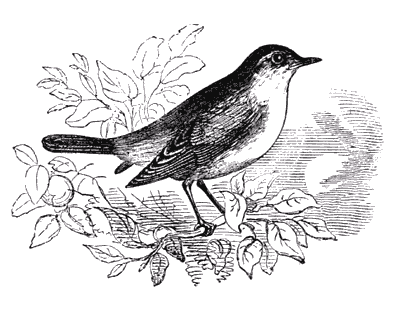
THE GREATER NIGHTINGALE.
Motacilla Luscinia major, Linnæus; Le Grand Rossignol, ou La Progné84, Buffon; Der Sprosser, Bechstein.
Naturalists make this bird only a variety, or at most, only a species of the common nightingale; but I find points of difference so numerous and so striking, that I think it right to make it a distinct species. 1. It is larger by an inch and a half in length, being six inches and a half, of which the tail, also half an inch longer, occupies two and three-quarters; 2. The head is larger, and the beak is thicker; 3. The colours are different; 4. The song is different. With respect to gait, manner, habits, and the like, it is true there is a resemblance, which exists, however, only in common with the white-throats, and the blackcap, which have never been considered as varieties of the nightingale.
The upper part of the body is a dusky brownish grey; the throat is white bordered with black; the breast is brown, with darker spots; the belly dirty white; the wings are deep brown, edged with dirty red; the tail and its upper large coverts dirty maroon, deeper than in the common nightingale; the whole plumage, in short, is generally and in all parts deeper and darker.
Observations.—The difference in the song is very remarkable. The greater nightingale has a much stronger, louder, and deeper voice; but it sings more slowly and more unconnectedly; it has not that astonishing variety, those charming protractions, and harmonious conclusions of the common nightingale; it mutilates all the strains; and, on this account, its song has been compared to the missel-thrush, to which, however, it is superior in softness and pureness. The common nightingale is superior in delicacy and variety, but inferior in force and brilliancy. The greater nightingale sings generally in the night, so that it is the real night-singer; while among nightingales this is rather uncommon. Its voice is so loud that it is almost impossible to bear it in a room. It is necessary to keep it always outside the window, either by hanging its cage there, or by opening from it a sort of passage into which it can remove.
Its call is also very different; hi! glack arrr! It seems also to pronounce David, Jacob, and generally begins its song by the latter word. If the song is complete, it consists of the following strains:—
Guia, gu, gu, gu. Hajai, hajai, dzu, dzu, dzu, dzu. Gorgué, guéguéguéguéguéh, Hoa goigoigoi gui. Dzicka, dzicka, dzicka. Davitt, davitt, davitt. Gogock, gogock. Guedum, guedum, guedum, guedum, gueï! Gai, goi, goi, goi, guirrrr. Golka, golka, golka, golk. Hia, guiaguiaguiaguia. Glockglockglockglockglockglock. Gueai, gueaigueai gui! Goi, guaguaguagua guagui. Heid, heid, heid, heid hi. Voi dada! voi dada! Gai, gai, gai, gai, guirr, guirr. Hoi, gueguegue gui. Hoi goi.
This bird is not found in any part of Thuringia. There are some in Silesia, Bohemia, Pomerania, near Wittenberg, Halle, and Dessau; but in Austria, Hungary, and Poland, they are in some districts more abundant than the common nightingale85. They generally settle among the bushes of the hills and plains, and especially near rivers. When caged they are fed like nightingales. They are less delicate, however, and live much longer.
They are chiefly brought from Vienna to Thuringia, whence they have the name of Vienna Nightingales. Some people make a business of fetching them from Hungary, in the beginning of April, where they buy them cheap, in order to sell them very dear, in Saxony and other remote provinces. Those from Hungary are preferred to the Polish. A distinguishing characteristic is, that they first pronounce the davitt or jacob only once when they call; while the second repeat davitt many times in succession.
At Thorn, and all along the Vistula, where the common and the large nightingale equally abound, the latter is called the Polish Nightingale, and the former, the Nightingale of Saxony. The nest of the greater nightingale is built like that of the nightingale; but the eggs are larger, and of an olive brown, with dark shades.
These birds are caught like nightingales; their diseases, also, are similar; but they appear to suffer still more when moulting; they become dull and ill, and often die under it. It is usual to give them at this crisis some spiders, and the grubs which gnaw wood; what, however, after many experiments, appears most salutary, is the Golden Tincture of Halle86, one or two drops of which are poured into the drinking-trough.
THE BLACKCAP.
Sylvia atricapilla, Bechstein; La Fauvette à tête noire, Buffon; Die schwarzköpfige Grasmücke, Bechstein.
This distinguished singer among birds, bears, in Germany, the name of Monk, or Moor, from the black or brown cap which covers the top of his head. These two colours have led some to divide them into two species, but it is quite certain that they only designate the sex; the black marking the male, and the brown the female. Its length is five inches and five-sixths, two and a half of which belong to the tail. The beak is five lines in length, formed like that of the nightingale, and is of a brownish blue, with the edges of the lower base and the interior of a yellowish white; the iris maroon; the feet ten lines high, are dark ash-colour; all the top of the head is black; the cheeks and upper part of the neck are light ash-colour; the upper part of the body, as well as the coverts of the wings, ash-colour, tending to olive; the under part of the body is light grey, fading to white under the belly and breast; the sides and thighs are the same colour as the back; the under coverts of the tail and wings are speckled gray and white; the pen-feathers and tail-feathers are dark brown, edged with the colour of the back.
The female is rather larger; her cap is reddish brown; the upper part of her body reddish grey, tending to olive; the cheeks and throat are light grey; the breast, the sides, and the thighs, are light grey, varying to light olive; the belly is reddish white.
The silky plumage of this bird is so delicate and frail, that it is rare to see one in confinement, whether hopping freely, or caged, which has not its tail or its wings disfigured.
Habitation.—When wild, this bird is found throughout Europe, inhabiting woods and orchards, or their vicinity; it particularly loves thick copse-wood. In September it leaves our climate, and returns about the middle of April, to enliven our woods by its brilliant and well supported song.
In confinement, when it is allowed to hop about, it is provided with a branch, or a roost furnished with several sticks, because it walks with difficulty, and prefers perching, on which account a cage is better adapted to it. At the time for departure, these birds, urged by the instinct to travel, are much agitated, especially in the night, by moonlight. The desire to rove is so strong, that they often fall ill and die.
Food.—When wild, the blackcap feeds on small caterpillars, butterflies, flies, in short, of all kinds, on insects and their grubs; in time of need, on berries and fruits also87.
In confinement this bird does very well on the universal paste, with which a little bruised hemp seed is mixed, and occasionally meal worms, ants’ eggs, or insects. In summer and autumn he is supplied with elder-berries, and they are also dried, in order that he may have some in winter, soaked in water, which is found very good for his health. He is a great eater, and when at liberty in the bird room partakes of everything, meat, bread, and even vegetables. As he is generally caught in the autumn he is soon accustomed to artificial food, by having elderberries and meal worms mixed with it for several successive days. He is fond of bathing, and must be always well supplied with fresh water.
Breeding.—This species generally lays but once a year, occasionally twice, and even thrice. His nest, placed near the ground, generally in a hedge or bush of white-thorn, is hemispherical, solid, and well built; the outside of stalks, deserted cocoons, and stubble, the inside of fine soft hay, mixed with hair. It contains from four to six eggs, of a yellowish white mottled with yellow and spotted with brown. The young are fed with small caterpillars, insects, and currants; those which are brought up by hand are fed with white bread and milk. The charming tone of their voice gives to their own song, as well as to that of the nightingale and canary, which they easily learn to imitate, a sweetness and grace which are enchanting. Before moulting there is so little difference between the young males and females that it requires great skill to distinguish them, for the cap of the former is only a slight shade darker of olive brown, and the back a greyish brown, rather more tinted with olive; but on the first moulting the head of the male begins to blacken first behind the beak, while that of the female retains its original colour, except that it becomes more bright and distinct. When it is wished to ascertain the sex of these young birds, the best plan is to pull out a few brown feathers from the head; if it is a male, black ones will come up in their place, and thus there will be no danger of taking females by mistake; these, however, would soon be known, because the males begin to warble as soon as they are able to fly and feed themselves.
Diseases.—The blackcap is subject to the same diseases as the nightingale, but is more frequently attacked by decline. As soon as the symptoms appear he must be fed with a great many meal worms and ants’ eggs, and his drinking water must be impregnated with iron, by putting a nail into it. Those which are left to run about the room are apt to lose their feathers. Under such circumstances they must be caged, and exposed to the warmth of the sun or the fire; they must be well fed, especially with the food given to nightingales; these methods generally restore them, and their feathers are gradually renewed. A tepid bath, repeated for two or three days, is very likely to help their development. In epileptic or paralytic attacks I make them swallow, with great success, two or three drops of olive oil; I lately had the pleasure of seeing the success of this remedy on a bird of this species suffering from an apoplectic fit, and which dragged his little paralysed foot about the room where he lived uncaged; he is now quite recovered, very gay, and active; his song was never before so delightful to me. These birds generally live in captivity as long as nightingales.
Modes of Taking.—Every taste but that of the palate must be destroyed if this charming bird is caught for the table. Besides, it is by no means numerous; but if it is desired as an ornament to the house, snares baited with currants must be laid for it in July and August, the greatest care being taken to save the feet, which are very likely to be broken. Patience is very necessary in order to succeed, for it is a very suspicious bird, approaching slowly, and falling into the snare only when pressed by hunger. The same suspicious disposition causes it to repair with repugnance to the water trap, though in other situations it delights in water, and often bathes. If it perceives anything unusual it will remain for hours without approaching, and will pass twenty times by currants which are hung up as a bait without touching them, though very greedy of this food; but if it sees another bird bathe, or drink, it takes courage, and soon falls into the trap. The young, before moulting, still foolish and inexperienced, are more careless, and may be taken in great numbers in autumn; and in the spring they are as easy to catch as the nightingale, by means of a net or limed twigs, in a place cleared from moss and turf, and baited with meal worms and ants’ eggs.
Attractive Qualities.—It is perhaps a sufficient eulogium to say that this bird rivals the nightingale, and many persons even give it the preference. If it has less volume, strength, and expression, it is more pure, easy, and flute-like in its tones, and its song is perhaps more varied, smooth, and delicate. It sings also for a much longer period, both when wild and in confinement, its song being hardly suspended throughout the year by day, and prolonged, like that of the nightingale, far into the night, though begun at dawn. The female sings also, but in a more limited degree, very much like the red-breast, which has caused it to be mistaken for a particular species with a redcap. The call is a sort of smart “tack,” repeated quickly several times. The sudden view of an unknown object, or of an imminent danger, makes it utter a hoarse disagreeable cry of fear, very like a cat when hurt88.
THE FAUVETTE.
Sylvia hortensis, Latham; La Fauvette, Buffon; Die graue Grasmücke, Bechstein.
The length of this bird is five inches, two and a half of which belong to the tail. The beak, five lines in length, and formed as in the preceding, is brown below, light lead-colour above, and whitish within; the iris is brownish grey; the feet, nine lines high, are strong, and lead-colour; the upper part of the body is reddish grey, tinted slightly with olive brown; the cheeks are darker, and round the eyes whitish; the under part of the body, including the breast and sides, is light reddish grey; the belly is white as far as the under coverts of the tail, which are tinged with reddish grey; the knees are grey; the pen-feathers and tail-feathers are brownish grey, edged with the colour of the back, and spotted with white at the tips; the under coverts of the wings are reddish yellow.
The female differs only in having the under part of the body, as far as the breast, of a lighter colour.
Habitation.—When wild, this bird, which is found all over Europe, appears to prefer the groves and bushes which skirt the forests, as well as orchards in their vicinity. He arrives some days before the nightingale, and departs at the end of September.
In confinement he is treated like the blackcap, and, being more delicate, must be furnished with a cage.
Food.—When wild the fauvette feeds on small caterpillars and the other little insects which are found on the bushes, where he is continually searching for them, uttering at the same time the sweetest and softest song. After midsummer he appears very fond of cherries; he eats the pulp up to the stone, and this causes his beak to be at this season always stained; he also likes red currants and elderberries.
In confinement he is so great an eater that if he is not caged he hardly ever quits the feeding-trough of the nightingale. Though he is more easily tamed than the blackcap, he seldom survives more than two or three years, and the artificial food is no doubt the cause. He appears very fond of the universal paste; but I have often observed that it causes the feathers to fall off to so great a degree that he becomes almost bare, and then I think he dies of cold rather than from any other cause89.
Breeding.—The nest of the fauvette, placed in a hedge or bush of white-thorn, at about three feet above the ground, is well built on the outside with blades of grass and roots, and inside with the finest and softest hay, very seldom with moss. The edges are fastened with spiders’ webs and dry cocoons. The female lays four or five eggs, of a yellowish white, spotted all over with light ash grey and olive brown. The young, which are hatched after fifteen days’ sitting, are no sooner fledged than they jump out of the nest the moment it is approached.
Diseases.—They are the same as in the blackcap; but the fauvette is still more subject to the loss of its feathers. It fattens so fast upon the first universal paste that it often dies from this cause.
Mode of Taking.—These birds may be caught during the whole of the summer with nooses and springes baited with cherries, red currants, or elderberries. They go also very readily to the water trap, from seven to nine in the morning, and in the evening a little before sunset.
Attractive Qualities.—“Of the inhabitants of our woods,” says Buffon, “fauvettes are the most numerous and agreeable. Lively, nimble, always in motion, they seem occupied only with play and pleasure; as their accents express only joy, it is a pretty sight to watch them sporting, pursuing, and enticing each other; their attacks are gentle, and their combats end with a song.”
THE WHITE-BREAST90
Motacilla Fruticeti, Linnæus; La Petite Fauvette, Buffon; Die rostgraue Grasmücke, Bechstein.
This bird, which is but little known, resembles in most points the preceding, but its figure is smaller and its plumage darker. Its length is four inches and three quarters, of which two and a half (being more than half of the whole) belong to the tail. The beak, four lines in length, is brown above and yellowish white below and on the edges; the iris dark brown; the feet, nine lines in height, are pale lead-colour; all the upper part of the body, comprising the wing-coverts, is dusky reddish grey, darker towards the head and lighter towards the rump.
I have never been able to discover any difference between the plumage of the male and female.
Observations.—This bird arrives among us towards the end of April. It frequents hilly places covered with bushes and briars, among which it builds its nest, about four or five feet from the ground, and among the thickest foliage. The eggs, five in number, are whitish, mottled with bluish brown, and speckled with dark maroon. Incubation lasts but thirteen days. At first the young are fed with the smallest caterpillars, afterwards with larger ones, flies, and other insects; but as soon as they can fly they accompany their parents in search of cherries, red currants, elderberries, and, later in the season, the berries of the service tree. The family departs together in the month of September, and then some are taken in nooses or springes baited with elderberries. But this species is not much valued, and does not therefore excite the attention of bird-catchers, who give the preference to the fauvette.
However, this bird is an excellent singer, and though his voice is not so clear and flute-like as that of the fauvette, yet by skilfully introducing his call into his warble, he produces a very striking and agreeable variety. This species is fed and treated like the preceding, but with still greater care, for it is even more delicate. With all my care I have never been able to preserve it more than two years at the utmost: the difficulty, however, does not appear to proceed from the diet, for being caught in the autumn it soon gets accustomed to the food of the nightingale, by first giving it the berries which it selects in a state of freedom.
THE DUNNOCK, OR HEDGE SPARROW.
Accentor modularis, Linnaeus; La Fauvette d’diver, ou Traine Buisson, Buffon; Die Braunelle, Bechstein.
This species, which in its gait resembles the wren, seems also a link between its own species and that of the lark, for it does not confine itself to insects; it eats all sorts of small seeds, such as those of the poppy and the grasses. Its length is five inches and a quarter, two and a quarter of which belong to the tail. The beak, five lines in length, is very sharp, black, whitish at the tip, and the inside rose-colour; the iris purple; the legs, nine lines in height, are yellowish flesh-colour; the narrow head is, together with the neck, dark ash-colour, marked with very dark brown, like that of the sparrow; the breast a deep slate-colour.
The breast of the female is lighter and bluish grey; she has also more brown spots on her head.
Habitation.—When wild it is found all over Europe, making its abode in thick deep forests. It is with us a bird of passage; but some individuals, which come from quite the north, remain during the winter near our dwellings, searching the heaps of wood and stones, the hedges and fences, and, like the wren, entering barns and stables. Those which leave us return at the end of March, stop for some time in the hedges, and then penetrate into the woods.
In confinement this bird is so wakeful and gay that it may be safely left at liberty in the room, having a roosting-place for the night; it is also kept in a cage.
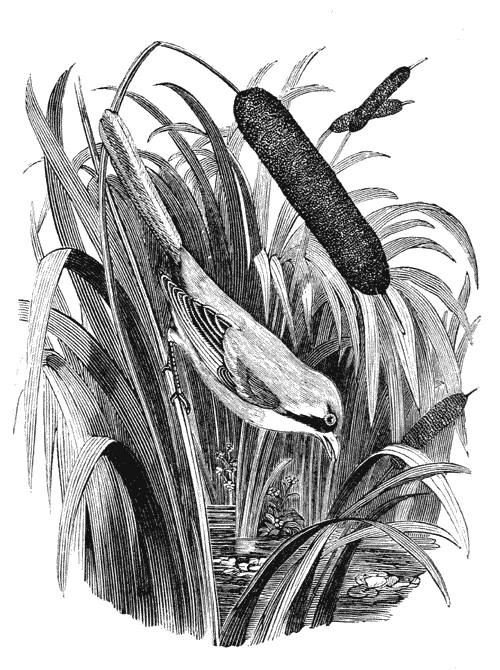
THE BEARDED TIT.
Food.—When wild, the great variety of things which serve it for food prevent its ever being at a loss throughout the year. It is equally fond of small insects and worms and small seeds. In spring it feeds on flies, caterpillars, grubs, and maggots, which it seeks for in the hedges, bushes, and in the earth. In summer it feeds chiefly on caterpillars; in autumn on seeds of all kinds and elderberries; and in winter, when the snow has covered all seeds, it has recourse to insects hid in the cracks and crevices of walls and trees.
In confinement it will eat anything that comes to table. It is fond of the universal paste, hemp, rape, and poppy-seeds, and refuses none of these things immediately on being imprisoned, and it soon seems as completely at ease as if accustomed to confinement91.
Breeding.—This species lays generally twice a year; placing its nest among the thickest bushes, about five or six feet from the ground; the outside is composed of mosses, and fibres of roots, and wood, and the inside is lined with the fur of deer, hares, and the like. The eggs, five or six in number, are bright bluish green. The young are no sooner fledged than, like the preceding, they quit the nest. Their plumage is then very different from that of their parents: the breast is spotted with grey and yellow, the back with brown and black; lastly, the nostrils and angles of the beak are rose-coloured. They are easily reared on white bread and poppy-seeds moistened with milk. As soon as they are tamed these birds have a great inclination to build in the room. The male and female collect all the little straws, threads, and similar materials which they can find, to build a nest among the boughs with which they are supplied for the purpose. The female lays even when solitary; they may be paired with red-breasts, and these unions succeed very well.
Diseases.—If it were generally true, that birds in a wild state are never ill, this species must be excepted; for, however strange it may appear, the young are subject to the small pox; they are attacked by it while in the nest, or even after they can fly. I have a young bird of this kind, which, at a time when this disease prevailed in my neighbourhood, took it; he recovered, however, tolerably well, but he entirely lost the tail-feathers, which were never afterwards renewed. Old ones are sometimes caught or killed whose feet and eyes are ulcerated, or have tumours on them; perhaps they may be only chilblains. Weavers’ stoves appear to be particularly injurious to these birds; in two or three months their eyes swell, and the feathers fall off all round them; the beak is attacked with scurvy, which spreads to the feet, then all over the body; but they nevertheless continue to live from eight to ten years in these rooms.
Mode of Taking.—This is very easy at their return in the spring. As soon as they appear in the hedges, where they soon discover themselves by the cry “issri,” a little place near, where the earth is bare, must be found; after having placed limed twigs, and thrown among them earth or meal worms for a bait, the dunnock is gently driven towards them without alarming him; as soon as he perceives the worms he darts upon them and falls into the snare. In the autumn they may be caught in the area and with a noose; in winter in the white-throat’s trap; but they resort in the greatest numbers to the water trap, not so much for the sake of bathing as to seek for dead insects or decayed roots.
Attractive Qualities.—However agreeable this bird may be in the room, from its good humour, agility, gaiety, and song, it does not deserve the name of winter nightingale, which it bears in some places; its song is too simple and short; it is a little couplet, composed of a strain of the lark and one of the wren. The sounds tchondi, hondi, hondi are repeated frequently and for a long time, always descending a sixth, and gradually diminishing in power. This song is accompanied with an uninterrupted movement of the wings and tail, and lasts through the year, except at the moulting season. Some young ones, reared in confinement, will, if placed beside a fine singing bird, learn enough of its song to embellish their own. But, whatever may be asserted on the subject, they never succeed in imitating the nightingale. When the dunnock disputes with its fellow captives for a place or for food its anger evaporates in a song, like the crested lark and the wagtail.
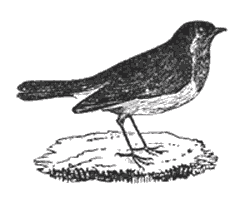
THE RED-BREAST.
Motacilla rubecula, Linnæus; Le Rouge-gorge, Buffon; Das Rothkelchen, Bechstein.
The red-breast is almost universally known in Europe. It is five inches and three quarters long, two and a quarter of which belong to the tail. The beak is five lines in length, and horn brown, with the lower base and the inside yellow; the iris is deep brown; the shanks, eleven lines in height, are of the same colour; the forehead, cheeks, and under part of the body, from the beak to the bottom of the breast, are orange red; the upper part of the body and the wing-coverts dingy olive; the first wing-coverts have at their tip a little triangular spot.