NATURAL HISTORY OF CAGE BIRDS. (continued 5)
Reading edition
The length of the canary is five inches, of which the tail measures two and a quarter: the beak, five lines long, is strong, very pointed, and whitish; the shanks, eight lines in height, are of a flesh-colour.
I shall end this description with an account of the different mule birds obtained from the canaries.
Mule Canaries.—1. Mules between a Canary and a Goldfinch, present in their plumage an agreeable mixture of the colours of their parents. The most beautiful which I have seen was greyish ash-colour in the middle of its crest, and silvery white on the rest of its head and nape; a broad orange border surrounded the beak, and the neck was adorned with a white collar; the back was a dusky grey, with black streaks; the rump white, the under part of the body of a snowy whiteness; the under tail-coverts, the wings and first quill-feathers white, but the others, as well as the coverts, black, edged with yellow; the middle of the wing was also adorned with a beautiful golden yellow spot; the white tail had a black spot on the sides, the white beak was tipped with black, the feet were white. The mother of this beautiful bird was white, with a greenish grey crest. In general, one may be sure of fine birds when yellow or white females are paired with goldfinches.
2. Mules between the Canary and the Siskin.—If the mother be a green canary, the mules will resemble a female siskin; but, if she is white or yellow, their colours are lighter, yet without differing greatly from those of the siskin, which they always resemble in shape.
3. Mules between a Canary and a Green-bird, or a Citril Finch.—If the hen canary is neither white nor yellow, the mules differ little from the common grey or green canary, except in being more slender, and having the beak shorter and thicker.
4. Mules between a Canary and a Linnet will be speckled if the mother is white or yellow, but if she is grey they will be like her, except that the tail will be longer.
The other mules are rarer, because more difficult to obtain, as we shall see elsewhere.
Habitation.—Except in the breeding season the male canaries are kept alone in separate cages, which, whatever the shape, ought not to be less than eight inches in diameter and a foot in height, with two sticks placed across for the bird to perch on. The females may be allowed to range the room with one wing clipped, or, what is better, kept in large cages, where, from having plenty of exercise, their health and strength are better preserved. In the small cages, glass vases should be placed on the outside, at the extremities of the lower stick, to hold the food and water. These may be surmounted with a cap of tin, or something of the kind, to prevent the seed from being so easily scattered. It is for this reason that the large seed drawers in an aviary are covered with iron wire-work, leaving only sufficient spaces for the heads of the birds to pass through. Cleanliness being a great preservative against most of their disorders, the bottom of the cage should be made to draw out, that it may the easier be cleaned and covered with sand. This should be done every day, or at least several times a week. These tender birds, being natives of a warm climate, and becoming more delicate instead of hardier from being kept in the house, require a temperature analogous to that of their native climate. They must be protected from the cold, and never allowed to remain in winter in a cold room, which would occasion many diseases, or even death. But, in summer, it is proper to place them in the open air, and they enjoy it very much. Never do they sing so gaily as on fine days, and their cages should therefore be placed at the open window, that they may have the advantage of the light and heat of the sun, which is particularly serviceable to them whilst bathing.
Food.—This is an important point, for, in proportion as it is simple and natural, it will be wholesome; and, on the contrary, the more it is mixed and rare, the more injurious and productive of disease will it be. What I have found the best is summer rape-seed; I mean that which is sown at the end of spring, which is small and brown, in distinction from the winter rape-seed, which is sown in the autumn, and which is large and black. This seed alone agrees with canaries as well as with linnets: but to give them the pleasure of variety, a little bruised hemp or canary, or poppy-seed, is added to it, especially in the spring, when they are intended to breed. Indeed a mixture of summer rape-seed, oatmeal and millet, or canary-seed, may be given them as a great treat. But whatever seeds they may have, they equally require green food, as chickweed in spring, lettuce and radish leaves in summer, endive, water-cress, and slices of sweet apple, in winter. As to that whimsical and complicated mixture, prescribed and used by many people, of rape, millet, hemp, canary seed, whole oats and oatmeal, poppy, lettuce, plantain, potentilla, and pink seeds, maize, sugar, cake, hard biscuit, cracknels, buns, and the like, so far from being wholesome, it injures the birds in every respect. It spoils their taste, weakens their stomachs, renders them feeble, sickly, and incapable of bearing moulting, under which they most frequently die. It is true, they may be accustomed to eat of everything which comes to table, but to teach this habit is also to prepare a poison for them, which though slow is not the less sure, and brings them to a premature death; whilst every day we see bird-fanciers who are poor, who hardly know the names of these delicacies, rear, on the simplest food, a considerable number of the healthiest, cleverest, and strongest canaries. We must, however, be guided in a great measure by the constitutions of the birds. They should be daily supplied with fresh water, as well for drinking as bathing, in which they delight. In the moulting season, a nail or bit of iron should be put into the water, in order to strengthen the stomach. Saffron and liquorice are in this case more hurtful than useful. Grains of the sand, with which the bottom of the cage is strewed, afford the birds a help to digestion. What has been said above, refers solely to the food of full-grown canaries; the young, which cannot feed themselves, require a different diet.
Breeding.—A very important branch in the history of the canary is its education, which is not without difficulties, but these are augmented by all the refinements and artificial plans which some persons follow with so much parade. A male of from two to five years of age should be chosen for pairing; for experience has taught, that if a young male is placed among older females, they will produce more males than females. A bird is known to be old by the blackish and rough scales of his feet, and by his long and strong claws.
Good males are valuable and scarce. Some are dull and melancholy, always sad, and seldom singing; indifferent to their mates, which are equally so to them; others are so passionate, that they beat or even kill their mates and their young; others are too ardent, and pursue their mates while they are sitting, tear the nest, destroy the eggs, or excite the females so much that they voluntarily abandon them.
The females have also their defects. Some, too ardent, only lay without sitting; others neglect to feed their young, beat them, and pick out their feathers, so that the wretched little creatures die miserably; to others, laying is so painful that they are too much fatigued to sit, or they lay each egg only after a long interval. Quacks (for we find them on this subject as on others) pretend to have specifics for the cure of these defects; but their pretended remedies are mere deceptions, and the use of them causes much trouble. The best plan is to remove the vicious birds, and to retain only those which have none of the above-named bad qualities.
To obtain the most brilliant colours, those birds which have them clear, and whose spots are distinct and regular, are paired together. This, of course, can only be done in separate cages. In aviaries, where the birds pair by choice, the offspring are generally mixed and blotted. A greenish or brownish bird, placed with a bright yellow one, often produces dim white, or other admired colours. It is better never to place together two crested birds, because the offspring is apt to have a part of the head bald or otherwise disfigured.
The best time for pairing canaries is the middle of April. Either one male, and one or two females, are placed in a large cage, or many of both sexes are united in a room or aviary, having the advantage of a south aspect. Nests made of turned wood, or osiers, are given them, as straw ones are too easily torn. It is a good plan to place in the room or aviary slips of pine, which being cut in February do not lose their leaves. If a little enclosure of wire-gauze can be fixed over the window, where the birds can enjoy the fresh air, nothing will more effectually contribute to render the young healthy and robust.
Birds, which are to be paired for the first time, should be previously placed in the same cage for seven or eight days, in order to become acquainted and accustomed to live together. If two females are to be caged with one male, it is especially necessary that they should be together long enough to leave off quarrelling, and the pairing cage should be divided into two equal parts, communicating by a sliding door. This being done, a lively male and one of the females should be placed in the first division; as soon as she has laid, the male should be moved into the other division, the door of separation being shut; but as soon as the other has also laid, the door may be left open: the male will then visit the females alternately, and they will not trouble themselves about each other; but without these precautions jealousy would incline them to fight, and destroy each other’s eggs. When it is intended to place a great many females, double or treble the number of males, in a room or aviary, the latter should always be first paired with a single female, which will ever after remain the favourite; and it will only be when she is about to sit that he will pair with the others, and this is all the notice he will take of them, for afterwards he will only notice their young. It is from these mothers, however, that the most and the best birds are generally procured.
If the floor of the room or aviary is well covered with moss, little else need be added for making the nests, otherwise they should be supplied with the hair of cows and deer, hogs’ bristles, fine hay, lint, wool cut two or three inches long, paper shavings, and the like. That which is coarsest serves for the outside, and the softest and finest for the inside. If they have shrubs, traces of the natural instinct of the canary are soon observed in the nests which they construct without the help of the turner or basket weaver; but they are of an inelegant form, and the outside is not very carefully finished. The females alone, as is usual among birds, are the builders, the males only choosing the situation and bringing the materials. It is in the nest, where the female is in continual motion, that the pairing takes place; she invites the male by constant little chirpings, repeated more quickly the nearer she is to laying. Seven or eight days are generally reckoned from the first pairing to the laying of the first egg; the other eggs, whose number varies, without exceeding six, are laid successively every following day, and often at the same hour. The laying ended, pairing continues during the first days of incubation.
If the pairs agree, they must be left entirely to themselves, without endeavouring to use art to help nature, as many do. It is usual to take away the first egg and substitute an ivory one, which is repeated with the others to the last, preserving them in the mean time in a box filled with fine dry sand; they are afterwards restored all together to the nest to be hatched55.
The females lay three or four times a year, from April till September; there are some even so prolific that moulting does not stop them. The eggs, of a sea-green colour, are at one end more or less spotted or marked with maroon or violet. The period of incubation is thirteen days.
If, owing to the weakness of the male or female, it is suspected that some of the eggs are barren, they should on the eighth day be examined by holding them lightly between the fingers in the sunshine or before a candle; the good ones will be already filled with blood-vessels, while the bad will continue clear, or even be already addled: these must be thrown away. It is rare for the male to sit in his turn during some hours of the day, the female seldom allowing it, for as soon as she has eaten she flies back to the nest. If the male gives up his place readily, so much the better; if not, she drives him away by force and by pecking him. She appears to know his want of skill in this employment.
The near discharge of a gun, a door slammed with violence, and other similar noises, will often kill the young in the shell; but their death happens generally through the fault of a bad sitter.
As soon as the young are hatched, a small jar is placed beside the usual feeding trough, which contains a quarter of a hard egg minced very fine, white and yellow together, with a bit of white bread steeped in water, and afterwards well pressed; another jar should contain rape seed which has been boiled, and then washed in fresh water, to remove all its acrimony. Some persons, instead of white bread, use biscuit, but this is unnecessary; what, on the contrary, is very essential, is to take care that this food does not turn sour, for it would then infallibly destroy the young nurslings. This food I find by experience to be the best.
Now is the time when the male assumes his important duties of nursing-father. These he fulfils indeed almost alone, in order to give his mate time to rest before a new sitting. When it is necessary to bring up the young by hand, a bit of white bread, or some biscuit, should be pounded very fine, and this powder should be mixed with well-bruised rape-seed. This composition serves, with a little yolk of egg and water, to make a paste, which is given to the young birds on a quill cut like a spoon; each nursling requires for a meal four beakfuls, well piled upon the quill, and these meals must not be fewer than ten or twelve a day.
The young should remain warmly covered by the mother as long as they continue unfledged56; that is to say, generally for twelve days: on the thirteenth day they begin to eat alone. In four weeks they may be placed in other cages of a sufficient size; but they must still for some weeks be fed with the above-mentioned paste, conjointly with the food of full-grown birds; for the sudden privation of this nourishment often occasions death, especially when moulting.
Experience proves that generally those canaries which are hatched in a large garden aviary, where they enjoy fresh air, and considerable space for the exercise of their wings, are more vigorous, more healthy, and more robust than those which are bred in rooms, and it is easy to understand the reason.
I must not omit to mention here an important observation, which has been often made, that if two females are given to one male, and one of them happens to die, the other immediately takes charge of the abandoned eggs, and assumes so completely the duties of foster-mother, that in order rigorously to fulfil them she avoids and even repulses the caresses of her mate.
Canaries pair not only among themselves in our aviaries and cages, they also form connexions foreign to their species, and, provided the analogy is not too remote, produce fruitful mules. Serins, citral finches, siskins, goldfinches, or linnets, are the species which succeed best57. To succeed, however, it is necessary that the birds should have been brought up from the nest. The custom is to give an old male of one of the above-named species to a female canary, the principal reason being that an old female of one of those species, though she would not object to the union, could never be induced to lay in an artificial nest, like a female canary. The offspring of these mixtures combine the colours of the father and mother, learn well enough if they descend from a linnet or goldfinch, but sing badly if they come from a siskin or lesser redpole.
They are easily brought up with the paste mentioned above for canaries. It is asserted that the mules of serins, citral finches, and goldfinches, are fruitful. It is remarked, however, that their first eggs are very small, and the young hatched from them very weak; but the next year the eggs become larger, and the young stronger and more robust.
No sooner can the young canaries eat alone, which happens on the thirteenth or fourteenth day, and sometimes even before they leave the nest, than the males begin to warble, and some females also, but in a less connected manner, which serves to point them out. As these pretty birds are so docile as to neglect entirely their natural song and imitate the harmony of our instruments, it is necessary immediately to separate from his companions and from every other bird the young one which is to be instructed, by putting him aside in a cage which is at first to be covered with a piece of linen, and afterwards with a darker cover. The air which is to be taught should be performed five or six times a day, especially in the evening and morning, either by whistling, or on a flageolet, or bird-organ; he will acquire it more or less readily, in from two to six months, according to his abilities and memory; if his separation from the other birds is delayed beyond the fourteenth day, he will retain some part of his father’s song, which he will always intermingle with his acquired air, and consequently never perform it perfectly. The opinion of some, that the grayish canaries have more facility in learning than the yellow or the white, is unfounded, their only advantage over those of a different hue being that they are generally more robust and vigorous. I have not either found that the true No. 3 suits them better than No. 1 or No. 2; these latter, on the contrary, have appeared to me to please them best.
There is too much trouble and risk in allowing canaries to go in and out of their cages for it to be worth the trouble of teaching them this. Notwithstanding all my attention, and the care which I have taken to follow exactly the prescribed rules, I have never succeeded; and the cleverest bird-fanciers have assured me that it should never be attempted but when they have young ones, and above all, there must be no canaries in the neighbouring houses, which might entice them away. Indeed it is no easy matter to accustom a bird to go and come. There, as in many other cases, conclusions in regard to the species have been drawn from individuals. It is certain that very few tame birds easily acquire this trick, and as I show in their histories, with respect to others, probabilities are too often stated as truths.
Diseases.—Birds which seldom enjoy the benefit of fresh and pure air, prisoners destitute in their confinement of the means of exercise, must be particularly subject to the common diseases which have been named, and also to many other peculiar ones. The following are some of the disorders incident to canaries.
1. Rupture, or Hernia: this is very common among young birds, and is a kind of plethora, which produces inflammation in the bowels. The symptoms of this disease are, thinness, the skin of the belly transparent and distended, covered with little red veins surcharged with blood, the bowels are black and knotted, and descend to the extremity of the body; there are no feathers on the diseased part; the invalid does not eat, and dies in a few days. Too nutritious, or too much food, being the cause of the disease, the only remedy is a very severe regimen, and even then it can be cured only in its first stages. The diseased birds must be immediately removed, and fed with nothing but lettuce or rape-seed, in very small quantities. A bit of iron should also be put in the water, and everything be done to invigorate and purify them. It is very rare for young birds which are brought up by their parents to suffer from this disease, as they never over-feed them. In bringing up by hand this moderation should be imitated, and they should neither be over-fed nor pampered.
2. The yellow gall in the head and eyes, arises from over heat; a cooling diet is therefore the only remedy. If the tumour has grown to the size of a grain of hemp-seed, it must be cut off, and the wound be anointed with a little fresh butter, or bathed with urine.
3. Sweating.—There are some females which, during the time of incubation, or while they are on their young, are subject to profuse perspiration; the feathers of the belly are in consequence so wet as to destroy the brood: as soon as this indisposition is perceived the invalid must be washed with salt water, and after a few minutes be plunged into pure water, to wash off the salt, and be dried in the sun as quickly as possible. This operation is to be repeated once or twice a day till recovery; but as relapses are frequent, it is better to separate the female, and not allow her to sit.
4. Asthma, or hard breathing, which arises from an oppressed stomach, generally yields to plantain and rape seeds moistened with water as the sole food.
5. Sneezing, produced by an obstruction in the nostrils, is removed by passing a very small quill up them to clear them.
6. Loss of voice.—It sometimes happens that after moulting a male suffers the loss of its voice; it must then be fed with the same paste as is prepared for young birds, adding some lettuce-seed, and, according to some bird-fanciers, a bit of bacon should be hung to the cage, for it to peck.
7. Constipation.—The remedy for this is plenty of green food, as lettuce leaves, water-cress, &c., not forgetting bread and milk.
8. Epilepsy, which is common among many kinds of birds, may be produced in canaries by particular causes, as great delicacy and timidity. We should therefore avoid alarming them, either by catching them too suddenly or violently, or by tormenting them in any way. They are to be cured as has been already directed in the Introduction.
9. Overgrown claws and beak.—When the claws or beak want paring, sharp scissors must be used, and care taken to avoid drawing blood, lest the bird should be maimed. They often injure themselves when their claws are too long, and get hooked in the wires of the cage, and continue thus hanging. The females, in the same way, get entangled in their nests.
10. Lice.—The parasite insects by which these little prisoners are often tormented, are generally produced by slovenliness. Besides frequent bathing, the cages must be cleaned with much care and vigilance, and have plenty of very dry sand strewed over the bottom. These lice, like bugs, retire during the day to cracks and crevices, which accounts for old wooden cages being often infested. To get rid of them, hollow sticks or stalks of rushes are used, which must be examined and changed every day. The plan is good, but by using only tin cages, which may, more easily than any others, be passed through boiling water, the object is more certainly attained.
It is rare for canaries which are kept for breeding to live longer than from seven to ten years; while others, if well used, may be preserved for eighteen or twenty years.
Attractive Qualities.—The plumage, pretty form, and docility, the charming familiarity which disposes it to nestle without fear or reserve beside us, as well as its melodious song, have long introduced the canary to all classes of society. Always before our eyes, the object of the most assiduous care, and constant attention, it has afforded a thousand occasions for studying its character, or rather the character and dispositions of the different individuals of its species. It has been discovered that among them, as among quadrupeds, and even man, some individuals are gay and others melancholy; some quarrelsome, others mild; some intelligent, others stupid; some with quick memories, others lazy; some greedy, others frugal; some petulant, others gentle; some ardent, others cold.
Its singing, as strong as varied, continues uninterrupted during the year, excepting at the time of moulting, and even this exception is not general. There are some individuals which sing also during the night58.
Those which introduce into their melody some passages of the nightingale’e song are the most esteemed of all canaries; they are called Tyrolean canaries, because they are considered natives of the Tyrol, where they breed many of these birds. The second are the English canaries, which imitate the song of the wood-lark. But in Thuringia the preference is generally given to those which, instead of a succession of noisy bursts, know how, with a silvery sonorous voice, to descend regularly through all the tones of the octave, introducing from time to time the sound of a trumpet. There are some males which, especially in the pairing season, sing with so much strength and ardour that they burst the delicate vessels of the lungs, and die suddenly.
The female, particularly in the spring, sings also, but only a few unconnected and unmusical sounds. Old ones which have done breeding often sing in this way at all seasons.
Canaries are particularly remarkable for quickness and correctness of ear, for the great ease with which they exactly repeat musical sounds, and for their excellent memory. Not only do they imitate all the birds in whose neighbourhood they have been placed when young59, mixing agreeably these songs with their own, whence have arisen those beautiful varieties which each family transmits to its descendants; but they also learn to repeat correctly two or three airs of a flute or bird-organ, and even to pronounce distinctly some short words. Females also have been known to perform airs which they had been taught.
I shall conclude this article on canaries by pointing out the best rules for obtaining and preserving good singers. The most essential is to choose from among the young that which promises a fine tone, and to seclude it from all other birds, that it may learn and remember nothing bad. The same precaution is necessary during the first and second moulting; for being likely to re-learn (if I may say so) its song, it would introduce into it with equal ease foreign parts. It must be observed whether the bird likes to sing alone, or in company with others, for there are some which appear to have such whims, liking to hear only themselves, and which pout for whole years if they are not humoured on this point. Others sing faintly, and display their powers only when they can try their strength against a rival. It is very important to distribute regularly to singing birds the simple allowance of fresh food which is intended for the day. By this means they will sing every day equally, because they will eat uniformly, and not pick the best one day and be obliged to put up with the refuse the next.
About two spoonfuls of the dry food mentioned above, is sufficient for the daily nourishment of a canary; what he leaves may be thrown to the birds which are free in the room, and will serve as a variety to those which have only the universal paste to satisfy their appetite.
THE GLOSSY FINCH.
Fringilla nitens, Linnæus; Le Moineau du Brésil, Buffon; Der glänzende Fink, Bechstein.
This bird is smaller than the house sparrow, being only four inches and a half long. The beak and feet are flesh-coloured; the iris is white. All the plumage is of a bluish black, or black with a hue of burnished steel; the female has the upper part of the body covered with blackish feathers, bordered with a yellowish brown; the rump gray, the under part of the body dark yellowish brown; the tail-feathers black with gray edges; the feet reddish; in some males the beak and feet are black.
Observations.—This bird is found in the woods of Cayenne, and the neighbourhood of Carthagena in America. Its clear note is very agreeable. It appears to sing with so much energy as to ruffle the feathers of the head and neck. Its food consists of all kinds of seeds and fruits. Though bread appears to be sufficient when caged, it is better to add rape, millet, and poppy seed. It is easily tamed.
THE PURPLE FINCH.
Fringilla purpurea, Linnæus; Bouvreuil violet de la Caroline, Buffon; Der Purpurfink, Bechstein.
The size of this bird is that of the common chaffinch, the length being five inches and a half; the plumage is of a deep violet, or reddish purple, mixed with a little dark brown; the quill-feathers are brown on the inside; the belly is white; the tail is rather forked.
The female is all over of a deep blue, except the breast, which is speckled.
Observations.—These birds are very numerous during the summer in Carolina, which they quit in the winter in small flights. Juniper berries are their principal food; and they eat them with pleasure when caged. They are generally fed with rape and canary seed; but are soon accustomed to all the food of the aviary. They are more admired for their plumage than their song.
THE AMERICAN GOLDFINCH.
Fringilla tristis, Linnæus; Le Chardonneret jaune, Buffon; Der Gelbe Stieglitz, Bechstein.
This bird is as large as a linnet, its length being about four inches and a third. The beak and feet are whitish; the iris is nut-brown; the forehead is black, and the rest of the body yellow.
The female has no black on the forehead; the upper part of her body is of an olive green; the throat, breast and rump of a bright yellow; the belly and vent white; the wings and tail blackish.
The young males at first exactly resemble the females, the only difference being the black forehead.
These birds build twice a year, in spring and autumn. Edwards says that they also moult twice, so that it is only during the summer that they are of the colours described above. In the winter the top of the male’s head is black; the throat, neck, and breast, yellow; the rump also yellow, but of a whitish hue; the feathers of the back olive brown, lighter at the edges; the wings and the tail black, with white edges to almost all the feathers.
The female is generally of a lighter colour, and the top of the head is not black: thus we perceive that in winter these birds very much resemble our siskins.
Observations.—These American birds repair in the summer in great numbers to the state of New York; they live on the seeds of different kinds of thistles, like our goldfinches, and eat the same food when caged. They are easily tamed, and sometimes even lay in captivity. Their eggs are of a pearl gray, but I am ignorant whether they are ever productive in confinement.
THE BRAZILIAN FINCH.
Fringilla granatina, Linnæus; Le Grenadin, Buffon; Der Brasilische Fink, Bechstein.
The length of this bird is four inches and three quarters, the beak is coral red; the iris is dark brown; the eyelids are scarlet; the feet are light gray; the sides of the head round; the eyes are purplish; the upper base of the beak is blue; the throat, the lower part of the belly, and the thighs, are black; the lower part of the head and the rest of the body are chestnut, with a varying brown on the back and shoulders.
The female has a red beak, and a little purple under the eyes; the top of the head orange; the back grayish brown; the throat and lower parts of the body light orange; the lower part of the belly whitish; the rest of the colours differ from those of the male only in being less brilliant.
Observations.—This beautiful species comes from Brazil, and is always very expensive. The form of the beak is nearly the same as that of the goldfinch; the food is also the same; its motions are quick, and its song very pleasing.
THE BLUE-BELLIED FINCH.
Fringilla Bengalus, Linnæus; Le Bengali, ou Fringille à ventre bleu, Buffon; Der Blaubäuchige Fink, Bechstein.
The length of this bird is four inches and a half, one and a half of which belong to the tail, which is wedge-shaped; the beak is one third of an inch long, flattish at the sides, very sharp, and flesh-coloured; the iris is nut-brown; the feet are light brown; the upper part of the head and body are ash-coloured, varying to purple; the sides of the head, the lower part of the neck, the breast, the belly, and the rump, are light blue. The female has no mark under the eyes. The varieties which are observable among these birds probably arise from difference of age: some are found gray on the back, and others on the lower parts of the body; and some in which the belly inclines to red.
Observations.—The blue-bellied finch is a native of Africa, and comes principally from Angola and Guinea: it is a pretty lively bird, with a sweet agreeable song. It is fed with canary-seed, bruised hemp, and poppy-seed.
THE LIVER-BROWN FINCH.
Fringilla hepatica, Linnæus; Der Leberfarbene Fink, Bechstein.
This is about the same size as the last, which it somewhat resembles in plumage; but its air and manner are very different. Its length is four inches, of which the wedge-shaped tail measures one and three quarters. The beak is like that of the sparrow in form, of a blood-red colour, tipped with black; the eyelids are yellowish and bare; the iris is reddish brown; the feet are flesh-coloured; on the cheeks is a dark purple spot; the throat, half the breast, the sides, and the rump, are of a dirty greenish blue: the upper part of the body is of a dark liver-brown, the belly of a lighter shade of the same colour; the wings are of a deep brown, with the edges of the pen-feathers of the same colour as the back; the under side tending to blue, with black tips. I do not know the female.
Observations.—This species inhabits the shores of Africa; it is very lively, and its call is “tzä.” Its weak but sweet song resembles that of the wood wren. It is fed on canary-seed.
THE ANGOLA FINCH.
Fringilla Angolensis, Linnæus; La Vengoline, Buffon; Der Angolische Hänfling, Bechstein.
This, in form and habits, very much resembles our redpole. Its length is four inches and a half, of which the forked tail contains one and three quarters. The beak is short, and not flattish, blunt at the tip, and of a dingy flesh-colour; the feet are flesh-coloured; the circumference of the beak is black; that of the eyes, with the sides of the throat, is spotted with white; the top of the head, the upper part of the throat, the back, and the little coverts of the wings, are of a brownish ash-colour.
Observations.—Angola is the native country of this bird. As to the song, it is sweet and flute-like, very like that of the linnet, but more melodious. It is fed with rape and canary seed. The young males have the same plumage as the females.
THE GREEN GOLDFINCH.
Fringilla Melba, Linnæus; Le Chardonneret vert, Buffon; Der grüne Stieglitz, Bechstein.
This bird is exactly of the form of our common goldfinch. Its length is four inches and a half, of which the tail measures one and a half. The beak is half an inch long, and of a carnation colour; the iris is chestnut; the feet gray; the front of the head, the back of the eye, and the throat, are of a bright red; the bridle is ash-colour; the upper part of the head, the neck, and the back, are yellowish green.
The female has a light yellow beak, the top of the head and the neck ash-colour; the little coverts of the wings and rump yellow-green; the feathers of the tail brown, edged with pale red; the rest like the male.
Observations.—This species is found in Brazil. The male pleases the ear by his song, as much as the eye by his plumage. It appears that by feeding them simply with rape and canary seed they may be preserved healthy for many years.
WARBLERS.
The characteristics of this group are a conical beak, sometimes tending to cylindrical, sharp, generally weak, and the upper mandible fixed. Insects are the food of the greater number; some also feed on berries and worms. The nests are for the most part well made, and the male sits alternately with the female.
THE SKY-LARK.
Alauda arvensis, Linnæus; L’Llouette, Buffon; Die Felderche, Bechstein.
This bird is very generally known. Its length is seven inches, of which the tail contains three. The beak is weak, straight, cylindrical, and terminating in a point; the mandibles are of an equal length, the lower one whitish, the upper black horn colour; the iris is grayish brown; the feet of the same colour, but yellower in the spring; the height of the shanks is nearly an inch, and the hind claw is much longer than the hind toe itself.
The female is distinguished by its smaller size, by the absence of the white line round the cheeks, by the great number of black spots on the back and breast, and by the purer white of the breast.
In the house we sometimes meet with the two following varieties:—
1. The white lark, which is either clear white or yellowish white. He is occasionally found wild.
2. The black lark. The whole body of this variety is black with a rusty tinge, and the belly feathers are edged with white. I am ignorant whether this variety has ever been found wild; but it is not uncommon in dwelling houses, especially when the cages are fixed in a dark place where the rays of the sun cannot penetrate; in moulting, their colour passes away to give place to the primitive plumage, which never happens to the white variety.
Habitation.—In a wild state, the sky-lark is found almost all over the world, frequenting fields and meadows, and by preference plains. It is a bird of passage which generally arrives in our regions in the beginning of February, and departs in great flights in the month of October60. No bird of passage returns so soon as the lark; but as it lives not only on insects, but eats all kinds of seeds and even grass, it can seldom be in want of provision even in the severest weather.
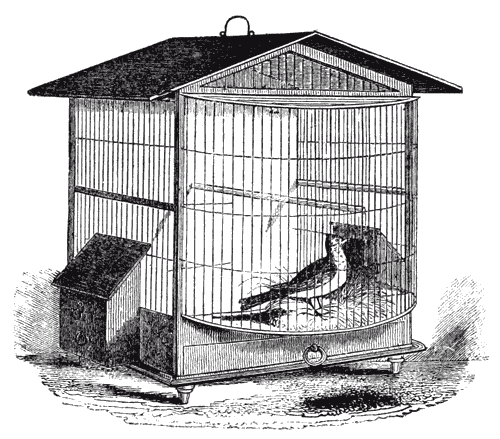
In rooms, it is common to let it hop about, giving it a retired corner to sleep; it is, however, also kept in cages, where it sings best. Whatever form may be given to these cages, they must be at least eighteen inches long, nine wide, and fifteen high; the bottom should have a drawer in which enough of river sand should be kept for this scratching bird to be able to roll and dust itself conveniently. It is also a good plan to have in a corner a little square of fresh turf, which is as beneficial as it is agreeable. The top of the cage must be of linen, since, from its tendency to rise for flight, it would run the risk of wounding its head against a covering of wood or iron wire, especially before it is well tamed. The vessels for food and drink must be outside, or, which I prefer, a drawer for the food may be introduced in the side of the cage: sticks are not necessary, as the lark does not perch. When it is allowed to hop free in a room, the latter must be very clean and neat, otherwise a thread or hair may entangle the feet, and if not removed it easily cuts the skin, maims the bird, and the entangled toes shrink and fall off.
Food.—When wild, the food consists of insects, especially ants’ eggs; also of all kinds of seeds, and in autumn of oats, which these birds skin by striking them against the ground, their beak being too weak to shell them alone. In the spring the sprouting seeds and young buds, also the blades of young grass, are eaten, and grains of sand help their digestion.
In the house, if the lark is hopping about, nothing is better than the first universal paste described in the Introduction; but if caged the second will suit it better. Poppy-seed, bruised hemp, crumb of bread, and plenty of greens, as lettuce, endive, cabbage, or water-cress, according to the season, must be added. A little lean meat and ants’ eggs are favourite delicacies, which make it gay and more inclined to sing. When old larks are first made prisoners, they must be fed only with oats and poppy-seed to reconcile them to captivity.
Breeding.—The lark lays but once a year in cold countries, twice in the temperate, and three times in the warmer climates. Its nest, formed on the ground in a little hollow, is made without much art of straw, and the wool and hair of animals, and by preference in hollow ground or among the summer crops of grain. The eggs, in number from three to five, are of a whitish gray, spotted and dotted with dark gray; incubation lasts fourteen days. By the end of April the young are often hatched, and are at first only fed with insects, and leave the nest before they can fly; but they nevertheless continue to be fed by the mother till they can follow her in her excursions. Before the first moulting all the upper part of the body is dotted with white; if it is wished to take nestlings, they must be removed from the nest when the tail is about three quarters of an inch long. They are fed with crumb of white bread, and poppy-seed steeped in milk; some ants’ eggs or a little minced lean meat will be a wholesome addition. The males are soon distinguished by their yellow colour. If it is intended to teach them to perform a tune, their instructor must commence before they are ready to fly, for by that time they already begin to record their natural song. They must also be completely separated from other singing birds, otherwise the great flexibility of their organs, joined to their memory, will infallibly cause them to adopt the song of such birds as they are near; and even old larks, brought into my bird-room, have learnt to imitate perfectly the nightingale and chaffinch. They vary, however, very much in this respect. Some females in confinement lay without the presence of a male, and others pair, but I have never yet succeeded in making them sit. One of my neighbours, notwithstanding the greatest care, has succeeded no better, though he had a female which laid from twenty to twenty-five eggs annually. There would undoubtedly be a better chance of success in a large garden aviary61.
Diseases.—Besides those which have been named in the Introduction, these birds are very subject to a kind of scurf or yellow crust round the base of the beak. The best remedy is to take care that they have good food; the second universal paste agrees with them particularly well; but greens, ants’ eggs, meal-worms, or other insects, must be added. With this food they may be preserved healthy for many years in the house. Instances have been known of larks which have lived in this way for thirty years.
Mode of Taking.—It would take too long a time to describe all the modes of catching larks which are in use. It is enough to say that with day and night nets, known by the name of lark nets, so large a number of these birds are taken alive in the open country, that it is easy to have a choice of both males and females. This lark snaring is accomplished by placing a considerable number of nets perpendicularly like walls, which are called day-nets, towards which, in the dusk, the birds are forced by means of a long rope, which is drawn along the ground, and drives them forward; in the night a square net called a night-net is carried to a spot where it is known that many larks are collected in the stubble, and there they are covered just when they begin to flutter.
If, in the spring, it is wished to procure a good singing male, for some are better than others, a lark whose wings are tied, and with a little forked lime-twig fixed to its back, must be carried to the place where such a bird is to be found. As soon as it is let loose, and the desired male has perceived it from high in the air, he will fall upon it like an arrow and attack it; but soon, the dupe of his jealousy, he will find himself caught by the lime.
Attractive Qualities.—The very pleasing song of the sky-lark consists of several stanzas or strains, composed entirely of trills and flourishes, interrupted from time to time by loud whistling. I have already said that the lark has great abilities for learning. The young readily imitate the notes of all the birds in the same room with them, and the old sometimes succeed also: this, however, is not general; for among birds as among men, memories vary in power. Some have a stronger and more melodious voice; there are some which, in confinement, begin to sing as early as December, and continue till they moult; while others, less lively, delay till the month of March, and cease to sing in the month of August. In its wild state, the lark begins to sing in the first fine days of spring, the season of pairing, and ceases at the end of July; this, however, is not without exceptions, as some individuals continue till the end of September. It belongs to the small number of birds which sing as they fly, and the higher it rises the more it appears to elevate its voice, so that it may be heard when it is out of sight. In the country, it very seldom sings when on the ground; in the room it often does, and with ease, and it becomes so tame as to come and eat from the table or the hand.
THE CRESTED LARK.
Alauda cristata, Linnæus; Le Cochevis, ou la grosse Alouette huppée; Die Haubenlerche, Bechstein.
This bird is stronger than the sky-lark, and its colour is lighter, but its length the same. The beak is lead-coloured, and brown at the point, is also rather longer; the iris is dark brown. The shanks are an inch high, and yellowish gray; the head, the cheeks, the upper part of the neck to the upper part of the back, are of a reddish gray, caused by the wide red edges of the feathers, which are brown in the middle; a reddish white line, hardly perceptible above the eyes, but very distinct beyond, extends from the nostrils to the ears; eight or ten long-pointed blackish feathers rising on the head form a beautiful perpendicular crest.
The crest of the female is lower, but her breast is covered with more numerous and rounder spots than the male.
Habitation.—When wild it is only in autumn and winter that they appear in Saxony in small or large flights, beside the high roads, on dunghills, near barns and stables, among sparrows and yellowhammers; they are also found all over Europe, from Sweden to Italy62; in summer, they frequent the thickets and bushes of the plains, fields, and meadows, or they inhabit the hollows of ditches, paths in woods, and elevated villages. They depart in October.
In the house they may be kept in cages, like the sky-lark, or be left to run about. I know no bird whose feathers grow so quickly; if the wings are kept clipped, this must be repeated every three or four weeks, as by that time they are so much grown that they may serve for flying about the room.
Food.—When wild this bird lives, like the sky-lark, on insects, different sorts of seeds, and oats. In the house it is fed with the same things, but it becomes more robust and healthy than the sky-lark.
Breeding.—This species forms its nest on the ground, under little dry bushes, under garden vegetables, on clay walls, and even on thatched roofs. The eggs, in number from four to five, are of a rusty gray, shaded and spotted at the upper end with dark brown. The first plumage of the young before moulting is variegated white. They are taken from the nest when the feathers are half grown to be tamed and taught airs, or to have them instructed by other birds whose song is admired; they learn every thing with the greatest ease.
Diseases.—They are the same as those of other larks. A lousy disease may be added. I possess two male crested larks, one of which has hardly any of the lice which so commonly torment birds, whilst the other, which is nevertheless as gay and musical, is so covered with them that he cannot be touched without having the hand filled with these nasty insects. He has been with me four years, and though he has maintained for a long time millions of these parasites, he continues in good health, which I attribute to his abundant supply of good food.
Is this produced by a difference in the cleanly dispositions of these two birds, or is it a constitutional difference?
Mode of Taking.—When, in winter, any spot has been remarked which the larks prefer, a place must be cleared from snow, some oats and poppy-seed be thrown upon it for a bait, and limed twigs, nets, or even a simple gauze, be conveniently arranged, and soon plenty will be caught.
Attractive Qualities.—The song of the crested lark is, in my opinion, very inferior to that of the sky-lark; it seems composed of the warbling of that and of the linnet; this bird sings also in the night. Its time of singing lasts from February to August, but longer in those birds which have been tamed from the nest. It has not the tottering gait of the sky-lark, but runs nimbly, and moves its crest in the most expressive way. It is rather quarrelsome, and has the peculiarity that when it fights it continues to sing.
THE WOOD-LARK.
Alauda arborea, Linnæus; Le Cujelier, ou L’Llouette des Bois, ou La Loulou, Buffon; Die Waldlerche, Bechstein.
This charming species is one-third smaller than the field-lark, and resembles it much in form and gait. The beak is black above, brown below, tending to carnation at the tip. The shanks, three quarters of an inch high, are of a brownish flesh-colour. The top of the head is reddish brown, with four dark brown lines; its long feathers render the head large, and they may be raised at pleasure into a crest, which from eye to eye is surrounded by a whitish ash-coloured line. The tail is very short.
The female, more beautiful, is of a paler ground, with darker ornaments; her breast more spotted; the crest on her head more prominent, and the line round the cheeks more distinct. It is a well attested observation made on all our indigenous species, that the individuals with the most spots on a lighter ground, and of a clearer white, are certainly females.
Habitation.—When wild these birds inhabit the temperate regions of Europe, in summer the woods of the plain, near fields and meadows, and in the woods of the hills they alternate between heaths and pasture lands. After breeding time they assemble in small flocks of ten or twelve. They are thus found in the stubble, at their departure in October, and their return in March.
In the house I prefer letting them run about, because my experience shows that they sing better in this way than when caged. They must be well supplied with river sand, as well to roll and dust themselves as to pick out grains necessary for their digestion.
Food.—When wild, in summer, the food consists of insects; in autumn, of rape, millet, seed, and oats; in spring, before they can find insects and worms, they are satisfied with the young buds of herbs, water-cresses, and, on an emergency, with the buds of the filbert.
In the house, as this species is more delicate than the preceding, it is well to vary the food, and to give it occasionally, independent of the universal paste, poppy-seed, oats, hemp, sprouting wheat, fresh curds, fresh and dried ants’ eggs, minced ox heart, meal worms, and the like. When one of these birds is caught by the net or otherwise, the best things to induce it to eat when it reaches the bird-room are poppy-seeds and ants’ eggs.
I have seen two wood-larks which had been kept in a cage for eight years, very healthy and gay, with their feet quite free from disease, and singing perfectly. Their food consisted of crumbs of white bread and pounded hemp-seed mixed together; a piece of white bread, enough for the day, soaked in milk, which was poured boiling over it every morning, was also furnished; and finally, some ants’ eggs, given two or three times a day as a treat. The bottom of the cage was also covered with sand, which was changed regularly every day, as well as the water. They were always kept in summer outside the window, exposed to the free air, screening them from the sun by covering the top of the cage with a sheet of paper or piece of linen by way of parasol. The success of this mode of treatment sufficiently proves its advantage. The cage was furnished with two bars, because the wood-lark perches.
Breeding.—The wood-lark builds among the heath, under juniper bushes, in hedges, high grass, or under a green hillock in fields near the woods, or in copse wood. The nest is made of dry blades of grass, mixed with moss, wool, and hair. The eggs are variegated with light gray and brownish violet. The young may be bred up with bread soaked in milk, and ants’ eggs. They readily learn the different songs of the birds with which they are imprisoned; but this medley is less agreeable to me than their natural song.
Diseases.—To the list of diseases already given, to which the wood-lark may be subject, I must add one which is peculiar to it. This attacks the feet and renders them extremely brittle. I cannot too strongly recommend to clean them carefully from everything which might entangle them; a single hair may cut them, so that the toes shrivel, or ulcerate and fall off. They become so brittle with age, that with all my cares I could never keep any beyond four years; the least thing breaks them. Most of the wood-larks which I have had perished from broken legs; and this peculiarity I have remarked in no other species of bird.
We see from these instances, that if birds allowed to hop about a room enjoy more space and free exercise, they are also subject to more inconveniences and disadvantages than caged birds. Their food is neither so appropriate or regular; they cannot be kept so clean; their feet are almost inevitably injured; and lice devour them, without the power of prevention.
Mode of Taking.—The wood-lark may be caught on the nest by means of limed twigs; but as it is very cruel to separate a pair, and thus to destroy a whole family, it is better to wait till autumn, and to use the night-net. They may be caught early in the spring, when there is snow on the ground, by placing limed twigs or nets in cleared places. This is the best method of catching them. It is true that this plan will not succeed in all years; but another may be substituted, if we have a decoy wood-lark, by placing it under a folding net, in a field frequented by a flight of this species, which will not fail to join it. The same means also may be used as with the chaffinch, namely, by tying the wings of a wood-lark with a limed twig on his back, and letting him run to the place where there is a male of the same species. By this means the bird-fancier may obtain whatever kind of singer he prefers.
Attractive Qualities.—Of all the species of larks the wood lark has the finest song, and to my taste it is, of all our indigenous birds (always excepting the nightingale), the one whose natural notes are the most delightful. Its clear flute-like voice executes a sonorous, tender, and somewhat melancholy air. In the country it rises from the tops of the trees so high in the air that the eye can scarcely discern it, and there remaining stationary, the wings and the tail expanded, it sings uninterruptedly for hours together; it sings in the same manner when perched on a tree.
In the house, it is from a retired corner, tranquil and motionless, that it utters the different modulations of its beautiful voice. The singing time in its wild state is from March to July; in the house, from February to August. The female, like other larks, sings also, but her strains are shorter and less sustained. These birds appear to be subject to whims: I have seen some which would never sing in a room or in the presence of an auditor. These perverse birds must be placed in a long cage outside the window. I have remarked that in general these obstinate birds are the best singers. Their abrupt step and various frolics, in which they raise the feathers of the head and neck, are also very amusing.
THE TITLARK.
Anthus arboreus, Bechstein; L’Llouette Pipi, Buffon; Die Waldpieper, Bechstein.
This is the smallest of our larks; its length is but five inches and a half, two and a half of which belong to the tail, which it carries and moves like a wagtail, and by this characteristic it seems to stand intermediate between the larks and the wagtails. The sharp beak is dark brown above and whitish below; the iris is brown. The shanks are three quarters of an inch high, and light flesh-coloured; the angle of the hind toe is short and crooked. The head, rather oval than round, is, with the neck, back, rump, and sides, of an olive brown with black wavy spots.
The female differs from the male only in the paler yellow of the throat, neck, and breast; the white spot in the second tail-feather is also smaller, and the two transverse bands on the wings are whiter. The young males of the first year have the under part of the body of a lighter yellow than those which are older.
Habitation.—When wild, with the exception of the most northern parts, this species is found all over Europe. They build in great numbers in Germany and England, in mountainous and woody places, and establish themselves by preference on the skirts of forests, in fields, and orchards, in their neighbourhood, or in the cleared parts of woods. In the month of August they arrive in small flights in fields and enclosures planted with cabbages, where caterpillars abound. In September they pass into the oat fields, and in October they are caught in the nets with the common larks. The time of their return is about the end of March; and if the cold is severe they collect by thousands in damp fields and near warm springs. One peculiarity of this species is the having during the rest of the year a call different from that of the breeding season. It no longer perches on trees and bushes, but remains on the ground, crying “pitt, pitt,” (or rather, I think, “guik, guik,”) while in the sitting time the cry is more tender, expresses more solicitude, “tzip, tzip,” and is heard only in the immediate neighbourhood of the nest. As soon, therefore, as this cry strikes the ear, we may be sure the nest is not far off; and if the young are hatched we shall soon see the father or mother with a beakful of insects, redoubling and increasing the cry as they approach their precious charge. The other cry of “pitt” or “guik” is never heard at this season; whence it happens that sportsmen and bird-catchers make two species of this same lark; one they name the heath lark, whose call in the woods is “tzip,” and the other the cabbage lark, which in the fields calls “guik.” I have never been able to convince these people of their error, but by showing them in my bird-room the same lark which called “guik” in the autumn and winter, and “tzip” in the summer. We may judge by this circumstance how many mistakes and errors may slip into natural history, when in the determination of species we meet with things which we can neither see nor verify.
In confinement, I have been accustomed to let the calling lark range freely among my other birds, because I would not trouble myself to give it a particular cage. I own, however, that it would be better so circumstanced, on all accounts, as well in regard to its health as its song. This cage should be long, like that of the sky-lark, and furnished with two sticks, because this kind perches.
Food.—When wild, the food consists of all sorts of flies, grasshoppers, caterpillars, butterflies, beetles, and ants’ eggs.
In confinement, as it is the most delicate of its species, the food must be frequently changed and varied. Besides the universal paste, we should sometimes give it the common food of the nightingale, sometimes bruised hemp, mouldy cheese, meal worms, and ants’ eggs.
It is very difficult to accustom it to take the food of the bird-room. As soon as it arrives, we must throw it some meal worms, ants’ eggs, or caterpillars; as soon as these are eaten, some must be mixed with the universal paste and with all its food; it will thus insensibly grow accustomed to the common food.
This lark does not roll in the sand, and dust itself like the others, but it thrusts its beak into water and sprinkles itself; another indication of its approximation to the wagtail, as was mentioned above.
Breeding.—The titlark lays twice a year. The nest, placed on the ground in a cleared part of the woods, or under a bush or hillock, in a tuft of grass, in a field or orchard, is made in the simplest manner; coarse hay outside and finer within, with some wool and hair, are all the materials. The eggs, in number from four to five, are gray mottled with brown; the young escape as soon as possible, having but too many enemies to fear on the ground.
They may be brought up with ants’ eggs and white bread soaked in boiled milk, to which a few poppy-seeds are added. They easily learn to imitate the songs of the birds in the same room with them, especially that of the canary, without however attaining any great perfection.
Diseases.—Independent of those which are common to the other birds of its species, it is particularly subject to the loss of its feathers out of the moulting season; if it is not at once supplied with food more nutritious, and better suited to its natural habits, as ants’ eggs, meal worms, and other insects, it soon dies of atrophy. At the best it can only be preserved five or six years63.
Mode of Taking.—To take the bird from its nest by a limed twig, and thus destroy the young family by hunger and misery, is a cruelty which none but a harsh insensible amateur could resolve upon. I prefer using the night-net in autumn; this bird is also caught in the water-trap in August and September.
Attractive Qualities.—The song of the titlark, though short, and composed of only three strains mixed with shakes and trills, is nevertheless very pleasing. It sings from the end of March to July, either from the top of a tree, where it is perched, or when rising perpendicularly in the air, where it remains a few minutes and then quietly descends, almost always to the same place. As it alights it repeats several times “tzia, tzia, tzia.” In the house it begins to sing a month earlier. It pleases also by its pretty ways; its step is somewhat grave, and the tail is in perpetual motion: it is always very clean and trim.
THE FIELD PIPIT.
Anthus campestris, Bechstein; La Spipolette, Buffon; Die Brachpieper, Bechstein.
In figure it is more slender than the sky-lark; the plumage resembles that of the crested lark, and the form that of the titlark. Its length is six inches and a half. The beak is strong and long, the line above the eyes distinctly marked, the breast yellowish white, with but few rays or lines. In summer it frequents marshy woods, in autumn the edges of the fields, high roads, and meadows, where it may be easily caught with the night-net. Its only known song is its constant cry “tsirru” and “datsida” while revolving in the air. It departs in September and returns in April. Its food is the same as that of the titlark; it also requires the same treatment when in confinement if it should be wished to keep it, but it has no qualities to make this desirable.
THE SHORE LARK.
Alauda alpestris, Linnæus; Alouette Haussecol noir, ou Alouette de Virginie, Buffon; Die Berglerche, Bechstein.
This species is seven inches long, rather stronger than the field pipit, and has the same plumage on the upper part of the body; but the throat is light yellow, as well as the rest of the under part of the neck, over which and the top of the breast passes a black band, which in the lower part is shaped like a horse-shoe. The beak, feet, and claws, are black.
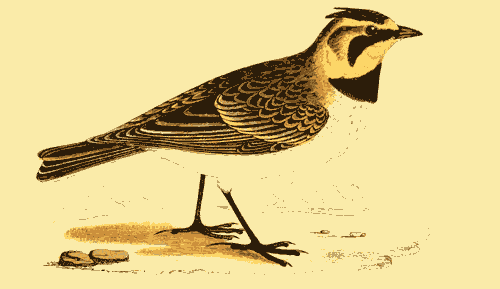
SHORE LARK.
Observations.—This species properly inhabits the north as well of Europe as of America, as far as Virginia; but in the winter it appears in Germany, where it may be seen by the road side picking for its food the undigested grains in horse-dung. It perches like the wood-lark. It is caught in the southern parts of Thuringia with lime twigs, or nets, at its return in March, when there has happened a heavy fall of snow; but at such times it is so thin and so weak for want of food as scarcely to have strength to eat what is offered to it. It may, no doubt, be preserved in confinement by treating it like other larks, but of this I have no experience, never having been able to procure a single living individual of this species, which also prevents my speaking of its song.
THE CALANDRA LARK.
Alauda Calandra, Linnæus; La Calandre, Buffon; Die Kalander, Bechstein.
Larger than the common lark, the Calandra is also furnished with a shorter and stronger beak, which enables it to shell its grain; in other respects the plumage, the form, and manners, are the same, the only difference being a very distinct and apparent spot on the lower part of the neck. The male is distinguished by being larger and blacker round the neck; the female has a very narrow collar, and sometimes none at all; some individuals, old ones doubtless, have a large black mark at the top of the breast. The tail is black, according to Linnæus, while in the preceding it is brown.
Habitation.—It appears that this species has much resemblance to the preceding; but it does not inhabit the North; it is found in Syria, Italy, Sardinia, and Provence: it is also said to frequent Carolina, in America.
In confinement it must be furnished with a long cage, the top made of linen, because it hops and jumps about a great deal, especially at first. It must be fed like the other larks.
Breeding.—It builds on the ground like the sky-lark, and lays four or five eggs. In order to have calandras which sing well, they must be bred up from the nest, and be fed in the same manner as the young of the sky-lark species; this is how they breed them in Provence.
Mode of Taking.—In the countries where it is found, the plan consists in spreading a net near the water where it drinks; this method is considered the best.
Attractive Qualities.—Its song is so admired in Italy, that “to sing like a calandra” is a common expression for to “sing well.” It also possesses the talent of imitating, like the sky-lark, the songs of many birds, such as the goldfinch, the linnet, the canary, and even the chirp of young chickens, the cry of the cat, in short, all sounds adapted to its organs, and which may be acquired when they are flexible.
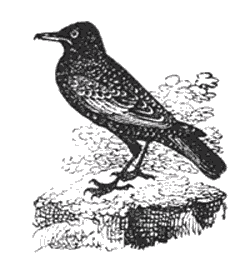
THE STARLING.
Sturnus vulgaris, Linnæus; L’Ltourneau, Buffon; Der gemeine Staar, Bechstein.
The length of this bird is eight inches and a half, two and a half of which belong to the tail, and one to the beak, which is awl-shaped, angular, flattish, and rather blunt, yellow, brown towards the end, and the tip blue. The iris is nut-brown; the claws an inch long, are deep flesh-coloured. All the plumage is of a blackish hue, changing to purple towards the front of the body, and to green towards the hind part, and on the wing-coverts. The old males are darker, having no white tips to the feathers of the head, cheeks, throat, or belly.
The beak of the female is rather brown than yellow; the light spots on the head, neck, and breast, are larger, and the edge of the feathers is wider, which gives it a lighter and more speckled appearance.
The starling, like all other species, has its varieties: such are the white, the streaked or variegated, the white-headed, that whose body is white with a black head, and the ash gray.
Habitation.—When wild the starling is found all over the old world. It prefers forests and little thickets, surrounded by fields and meadows; it is often seen, especially in spring, on towers, steeples, and churches; but it is never found either in high mountains or ridges. In our climate, it departs, in October, in great flights for the south, and returns in like manner in the beginning of March. During the journey, these birds pass the night among the rushes, where, on the least alarm, they make a great tumult.
In confinement it would be very amusing to let them run free; but let them be ever so neat themselves, they would render the room dirty. When caged, they must be furnished with a cage at least two feet long, and one and a half both in height and width. Very restless and always in motion, they require sufficient space to take exercise and keep their plumage uninjured.
Food.—When wild they eat not only caterpillars, snails, worms, insects, and the flies which torment the cattle in the field; but also cherries, grapes, berries of all sorts, and different sorts of grain, as millet and hemp seed.
In confinement they eat meat, worms, bread, cheese, the universal paste, indeed, any food, provided it is not sour. When first caught, they are supplied with earth and meal-worms, and they soon become as tame as if they had been brought up from the nest; but, as there is no rule without exceptions, we sometimes meet with individuals which obstinately refuse to eat, whatever pains may be taken to induce them, and which die of hunger. This bird delights in bathing often, it must therefore never be left without fresh water in a proper vessel.
Breeding.—The starling builds in the holes of trees, and even in boxes, or pots with long necks, suspended to trees, or under the roof, or in pigeon-houses. Its simple nest is composed of dry leaves, hay, and feathers. Like the swallow it returns to the same nest every year, only taking care to clean it out. It lays twice in the year, seven eggs each time, whose colour is ashy green. The young, before moulting, are of rather a yellowish soot colour, than pure black. The beak is dark brown; those which are bred from the nest, and which are easily reared on white bread soaked in milk, repeat the airs they are taught in a stronger and more distinct manner than bullfinches and linnets. They can, indeed, repeat a succession of couplets without changing or mixing them. In Voigtlande, the peasants use the starling like domestic pigeons; they eat the young, which they take before they can fly; by this means they obtain three broods, but they do not touch the last, both in order not to discourage and drive away the father and mother, and not to diminish this branch of economy.
Starlings have been seen to build in dwelling-houses, in an earthen vase with a long neck, appropriated to the purpose64.
Diseases.—I know none peculiar to them. These birds will live ten or twelve years in confinement.
Mode of Taking.—It is principally in autumn, and in places filled with reeds, that the bird-catchers take great numbers of starlings in nets prepared for the purpose. They may also be procured by means of an osier fish-net, placed among the reeds, which they frequent in the evening, and baited with cherries. Though this means is limited, as many as a hundred have been procured by it in one night.
In Thuringia it is never attempted to catch them for the house except in the month of March, when snow falls after their arrival. For this purpose limed twigs are put in places cleared from snow, and beside swampy ditches, with some earth-worms for a snare, into which they fall as easily as chickens.
Attractive Qualities.—The starling becomes wonderfully familiar in the house; as docile and cunning as a dog, he is always gay, wakeful, soon knows all the inhabitants of the house, remarks their motions and air, and adapts himself to their humours. In his solemn tottering step, he appears to go stupidly forward; but nothing escapes his eye. He learns to pronounce words without having his tongue cut, which proves the uselessness of this cruel operation. He repeats correctly the airs which are taught him, as does also the female, imitates the cries of men and animals, and the songs of all the birds in the room with him. It must be owned that his acquirements are very uncertain: he forgets as fast as he learns, or he mixes up the old and new in utter confusion; therefore, if it is wished to teach him an air, or to pronounce some words clearly and distinctly, it is absolutely necessary to separate him from other birds and animals, in a room where he can hear nothing. Not only are the young susceptible of these instructions, the oldest even show the most astonishing docility.
THE BOHEMIAN CHATTERER.
Ampelis garrulus, Linnæus; Le Jaseur de Bohème, Buffon; Der gemeine Seidenschwanz, Bechstein.
The length of this bird is eight inches, one and a quarter of which belong to the tail. The beak is three quarters of an inch long, black, short, straight, arched above, and large at the base, forming a large opening when the mandibles are separated; the iris is brown; the shanks nearly an inch high, and black. The whole body is covered with soft silky feathers; those at the top of the head are long, and rise in a crest; the head and the rest of the upper part of the body are of a reddish ash-colour, changing to gray at the rump; the middle coverts are dark ash gray, with the ends white also, besides which, the shaft of many has a horny tip, shining and red, like a little oval bit of sealing-wax. The female has at most but five of these waxen tips to each wing, while the male has from five to nine; the tail is black, terminated with primrose yellow; very old males have also upon it narrow red wax tips.
In the female, the black spot on the throat is smaller; the yellow at the end of the tail is also narrower and paler; the tips of the wings are of a yellowish white; lastly, the horny appendages are small, and often they do not appear at all.
Habitation.—When wild it does not build in Germany, but within the Arctic circle; it is found in Thuringia only in the winter, and if the season is mild in very small numbers, the greater portion remaining in the north; but in severe cold it advances farther south. In moderate seasons it is found in great flights in the skirts of the forests throughout the greater part of Germany and Bohemia.
In confinement, it is generally kept in a grated corner, where it may run about freely with the other birds which are also placed there, taking care to keep it at a distance from the stove, the heat of which is so distressing that it opens its beak and breathes with difficulty; this proves that a warm climate is not congenial to the bird. If kept in a cage, it requires one as large as the thrush; and, as it is a very dirty bird, the bottom must be regularly covered with a sufficient quantity of sand.
Food.—When wild we see it in the spring eating, like thrushes, all sorts of flies and other insects; in autumn and winter different kinds of berries; and, in times of need, the buds and sprouts of the beech, maple, and various fruit trees.
In confinement the two universal pastes appear delicacies to it; and it is even satisfied with bran steeped in water. It swallows every thing voraciously, and refuses nothing eatable, such as potatoes, cabbage, salad, fruits of all sorts, and especially white bread. It likes to bathe, or rather to sprinkle itself with water, for it does not wet itself so much as other birds.
Mode of Taking.—It is taken in nooses, to which berries are fixed, which, for this purpose, should always be kept in store till February; attracted by the bait it falls into the snare. It appears to be frightened at nothing, for it flies into nets and traps, though it sees its companions caught and hanging, and uttering cries of distress and fear.
Attractive Qualities.—Nothing but its beauty and scarcity can render the possession of it desirable; for it is a stupid, lazy bird. During the ten or twelve years that it can exist in confinement, and on very meagre food, it does nothing but eat and repose for digestion. If hunger induces it to move, its step is awkward, and its jumps so clumsy as to be disagreeable to the eye. Its song consists only of weak and uncertain whistling, a little resembling the thrush, but not so loud. While singing, it moves the crest up and down, but hardly moves the throat. If this warbling is somewhat unmusical, it has the merit of continuing throughout every season of the year. When the Bohemian chatterer is angry, which happens sometimes near the common feeding-trough, it knocks very violently with its beak. It is easily tamed, but is agreeable only by its beautiful colours, for it is very dirty. It is the greatest eater among birds that I know, being able to devour in a day a quantity of food equal to its own weight. It consequently passes hardly half digested, and, what is very disgusting, it is seen, like the ostrich, to eat again this excrement, if it is destitute of fresh food. I have observed it in this way swallow three times juniper berries which I had given it. In consequence of this voraciousness it must be cleaned very often to be kept sweet.
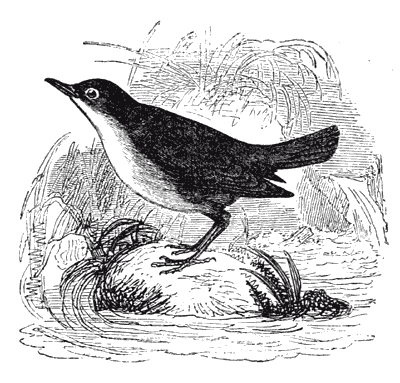
THE DIPPER.
Cinclus aquaticus, Bechstein; Le Merle d’dau, Buffon; Der Wasserschwätzer, Bechstein.
This bird resembles the starling in size, but the head is more pointed, and the body, in general, larger, while the wings and tail are shorter, the tail being only one inch and a quarter long, and the ends of the wings cover a fourth part of it; the beak is three quarters of an inch long, narrow, flattish at the sides, raised in the middle, sharp and black; the narrow nostrils are almost entirely closed by a membrane; the iris is light brown; the shanks are an inch high, and of a dark brown, and have the four toes united together; the head and upper part of the neck are of a dusky rust brown; the rest of the upper part of the body is black, with an ashy gray tint; the quill-feathers and tail are blackish; the neck to half-way down the breast is pure white; the rest of the breast is deep maroon, which shades into the black of the belly.
In the female the head and upper part of the neck are lighter, and the white of the breast is not so pure as in the male.
Habitation.—When wild it frequents by preference the banks of rivers and streams in mountainous countries, and remains all the year near those whose waters flow from springs which never freeze.
In confinement it has a cage like the thrush, unless it is by preference allowed to run about the room.
Food.—When wild it feeds upon aquatic insects, worms, and even small fish, which it is said to seize by diving.
In confinement it becomes insensibly accustomed to one of the universal pastes, by at first giving it worms, and the eggs of ants and flies.
Breeding.—The female lays from four to six eggs in a rather large nest, which she places in a crack of the rocks at the edge of the water, or in dikes under mill-dams, the wooden gutters of mills, or between the wings of old water-wheels which are not in use. The young may be reared on meal-worms, ants’ eggs, and white bread soaked in milk. It is just as well not to take them till they are ready to fly.
Mode of Taking.—Each pair has a chosen spot, which it seldom leaves: and they are generally seen there either on a trough, a stone, dike, or a bush growing near; by fixing close to these places limed twigs, to which are fastened worms, which writhe about and attract attention, it is very easy to catch them.
As soon as one of these birds is caught and caged, he must be put in a quiet place, be fed with earth and meal-worms, and thus be gradually accustomed to the common food.
Attractive Qualities.—The song of the dipper is not disagreeable; he has, indeed, some very sonorous strains, which in the distance and during winter have a very good effect. He also sings in the night.
THE MISSEL THRUSH.
Turdus viscivorus, Linnæus; La Draine, Buffon; Die Misteldrossel, Bechstein.
This is the largest of our thrushes, being in length eleven inches, three and a half of which belong to the tail. The beak is one inch in length, sharp, dark brown, with the lower base and opening yellow; the iris is brown; the shanks an inch high, and of a pale dusky yellow. All the upper part of the body is a brownish gray, with a reddish tint on the lower part of the back and rump; the sides of the head and the rest of the under part of the body are of a pale yellow, with blackish triangular spots on the breast, and oval spots in all other parts.
The female is generally lighter in all the colours.
Habitation.—When wild the missel thrush is found all over Europe, but more in the north than the south. It lives in forests, especially those of the mountains, and prefers those of fir to oak and beech. In Thuringia it is a bird of passage, disappearing in December and returning in the month of February, provided the weather is fine65.
In confinement it is common to assign it a grated corner of the room unless a cage is preferred, which must be at least three feet and a half long, and nearly as many high, a size necessary for it to take the exercise suited to its vivacity and petulance, without injuring its feathers. It would be still better if it could be allowed, as other birds of its size, an aviary or room to itself, where its copious excrements would be less troublesome.
Food.—When wild it feeds on insects and earth-worms, which it finds in abundance in fields and swamps during the spring and summer; in autumn and winter berries of all sorts make a great addition.
In confinement it is not dainty. The two universal pastes are very well liked, but it will put up with plain oatmeal, or even bran moistened with water. It is thus that our bird-fanciers feed it throughout the year, as well as many other large birds caught in traps, which they are obliged to keep as a lure for the snare. It is true, that if this meagre diet is sufficient to keep it alive, it will hardly serve to enliven it and make it sing; for this purpose it must be better fed, with bread and milk, meat, and other dishes served at table, none of which it refuses; and it must also be allowed to bathe, since nothing does it more good, or enlivens it so much.
Breeding.—Its nest, which it places higher or lower in the trees of the forest, is formed at bottom of herb-stalks and lichens, in the middle of earth, and in the interior of mosses, fine roots and hay: it lays twice a year, generally each time four greenish white eggs, a little speckled with violet and maroon. The young birds are gray above and very much spotted under, with a wide edge of rusty yellow on the wing feathers. Much less docile and susceptible of instruction than the blackbird, they hardly remember any little thing which they hear continually, but they become so familiar as to sing without difficulty on the hand. They are fed with white bread soaked in boiled milk.
Diseases.—The commonest disorders of this bird, are an obstruction of the rump gland, constipation, and atrophy66.
Mode of Taking.—These birds are taken in autumn with nets and snares, with berries for the bait, and they are caught in great numbers. They may also be taken in February, by placing under the trees on which the mistleto grows, perches with limed twigs. They may also be caught in the water-traps at sunset. Those which are yellowish under the body, being males, are chosen for confinement. During the first days of captivity, they are savage, sulky, and often refuse to eat, so that many perish in this way; those which are saved soon repay the trouble by their songs and familiarity.
Attractive Qualities.—Perched on the top of a tree in the woods, the missel thrush begins, in the month of February, to utter his melancholy but musical warblings, consisting of five or six broken strains, and continues singing for four or five months. As his song is too loud for the sitting-room, this bird should be placed in a large hall, or his cage should be hung outside a window. He lives in captivity from ten to twelve years. His call very much resembles “iis, r, r, r.”
THE SONG THRUSH.
Turdus musicus, Linnæus; La Grive, Buffon; Die Singdrossel, Bechstein.
We might, with Brisson, name this bird the small missel thrush, so much does it resemble the preceding in form, plumage, abode, manners, and gait. Its length is only eight inches and a half, three and a half of which belong to the tail. The beak is three quarters of an inch, horn brown, the under part yellowish at the base and yellow within; the iris is nut brown; the shanks are an inch high, and of a dingy lead-colour. All the upper part of the body is olive brown; the throat is yellowish white, with a black line on each side; the sides of the neck and breast are of a pale reddish white, variegated with dark brown spots, shaped liked a heart reversed; the belly is white, and covered with more oval spots.
In the female the two black lines on the throat are narrower, the breast is lighter, and of a plain yellowish white, and the reddish spots on the wing-coverts are smaller. These slight differences make it desirable for those whose eye is not accustomed to them, to have both sexes before them, if they wish to learn to distinguish them.
The white variety, that with a white head, the streaked, and the ash-coloured, are not very rare.
Habitation.—When wild this species is spread all over Europe, frequenting woods near streams and meadows. As soon as the autumnal fogs appear, they collect in large flights to seek a warmer climate67. The principal time of passage is from the 15th of September to the 15th of October, and of return about the middle or end of March; each pair then returns to its own district, and the male warbles his hymn to spring from the same tree where he had sung it the preceding year.
In confinement this bird is lodged like the missel thrush, and is much more worthy of being kept, as its voice is more beautiful, its song is more varied, and being smaller it makes less dirt.
Food.—When wild it lives on insects and berries, like the preceding.
In confinement, oatmeal moistened with milk is a very good food; and it requires also a great deal of fresh water, as well for bathing as drinking. When taken old it is often very difficult to induce these birds to eat, and the greater number die in consequence.
Breeding.—This species generally builds on the lower branches of trees; the nest being pretty large, and formed of moss mixed with earth or cow-dung. The hen lays twice a year, from three to six green eggs, speckled with large and small dark brown spots. The first brood is ready to fly by the end of April. The upper part of the body in the young ones is speckled with white. By taking them from the nest when half-grown they may be easily reared on white bread soaked in boiled milk; and they are easily taught to perform airs. As this thrush builds by preference in the neighbourhood of water, the nest may be easily found by seeking it in the woods beside a stream, and near it the male will be heard singing.
Mode of Taking.—This is the same as for the preceding species and the three which follow; of all the birds for which snares are laid, those for the thrush are most successful. A perch with a limed twig is the best method for catching a fine-toned male. In September and October these birds may also be caught in the water traps, where they repair at sunrise and sunset, and sometimes so late that they cannot be seen, and the ear is the only guide. When they enter the water haste must be avoided, because they like to bathe in company, and assemble sometimes to the number of ten or twelve at once, by means of a particular call. The first which finds a convenient stream, and wishes to go to it, cries in a tone of surprise or joy, “sik, sik, sik, siki, tsac, tsac, tsac;” immediately all in the neighbourhood reply together, and repair to the place: they enter the bath however with much circumspection, and seldom venture till they have seen a red-breast bathe without danger; but the first which ventures is soon followed by the others, which begin to quarrel if the place is not large enough for all the bathers. In order to attract them, it is a good plan to have a tame bird running and fluttering on the banks of the stream.
Attractive Qualities.—The song thrush is the great charm of our woods, which it enlivens by the beauty of its song. The rival of the nightingale, it announces in varied accents the return of spring, and continues its delightful notes during all the summer months, particularly at morning and evening twilight. It is to procure this gratification in his dwelling that the bird-fancier rears it, and deprives it of its liberty; and he thus enjoys the pleasures of the woods in the midst of the city. With care and properly varied food it may be preserved in captivity five or six years.
THE FIELDFARE.
Turdus pilaris, Linnæus; La Litorne, ou La Tourdelle, Buffon; Die Wachholderdrossel, Bechstein.
This bird is in size between the two preceding, its length being ten inches, of which the tail occupies four. The beak is an inch long, blackish at the point, otherwise yellow, as well as the opening of the throat and the tongue. The iris is dark brown. The shanks, an inch and a quarter high, are deep brown; the top of the head and neck, the cheeks, the bottom of the back, and the rump, are ash gray, with some blackish spots at the top of the head; a white line passes above the eyes; the back is rust brown; the throat and half the breast are rusty yellow, strewed with black heart-shaped spots; the rest of the under part of the body is white, with blackish heart-shaped spots on the sides, and longer ones towards the vent and tail.