NATURAL HISTORY OF CAGE BIRDS. (continued 3)
Reading edition
“We have tried to rear others in a common cage, feeding them partly on flesh, but never succeeded.”
Breeding.—A hole at the edge of the water is the place in which it builds its nest, which is formed on the outside of small roots, and lined with feathers. Its eggs in general are eight in number, and quite white. In the young ones, before the feathers grow, the stubs are so long and straight that they might be taken for so many little bristles. As soon as the young can see clearly, and before the feathers begin to sprout, is the time to take them from the nest; they must be fed first on ants’ eggs, meal worms, and other worms and afterwards accustomed by degrees to meat; they will be preserved in good health for a much longer time, if care be taken always to give them their food in fresh water, rather than let them pick it up from the ground.
Mode of taking.—When the place which one of these birds frequents most, and which is generally near an eddy in the water, is well known, a stake must be fixed to which the snare, called a springe, can be fastened; by this means the bird may be easily taken. Lime-twigs may also be put on a bush or stake near the water’s edge, provided it does not hang so much over the water as to risk the bird’s falling into it when fixed by the lime.
Attractive Qualities.—Its great attractions are its beauty, for it is not well proportioned, and all its motions are sudden.
THE NUTHATCH.
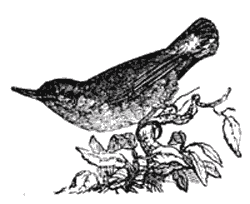
Sitta Europæa, Linnæus; La Sittele, ou le Torchepot, Buffon; Der Nusshacker, Bechstein.
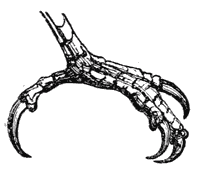
The length of this bird is six inches and a half, of which one and a half is included in the tail, and three-quarters in the beak, which is strong, straight, a little flat at the tip; the eyes are greyish brown; the feet yellowish grey, the claws very strong. The forehead is blue only in the male; the rest of the upper part of the body is of a blue grey; the cheeks and throat are white; a black streak passing across the eyes extends from the base of the beak to the neck; the belly and breast are of a dingy orange colour.
Habitation.—When wild it generally frequents woods. In the winter it approaches villages, and will even fly into barns and stables.
In the house it must be kept in a cage made entirely of wire, as wood cannot resist the strength of its beak28.
Food.—In its wild state it lives on insects, which it seeks for in the trees, being able to cling to and run about the branches in any way: it also eats nuts and beech mast, which it skilfully fixes in the chinks of the trees, that it may crack them more easily.
In the house, it may be fed on hemp seed, oats, barley meal, or even bread. The way in which it crushes the hemp seed and oats is very curious; it takes as many as it can in its beak, and ranges them in order in the cracks of the floor, always taking care to put the large end lowest, that it may break them more easily; it then begins to despatch them one after another with the greatest skill and agility.
The lady who has been occasionally mentioned in the introduction, amused herself in the winter, and particularly when the snow was on the ground, with throwing, several times a day, different kinds of seeds on the terrace below the window, in order to feed the birds in the neighbourhood. These soon became accustomed to this distribution, and arrived in crowds when they heard the clapping of hands, which was the signal used to call them. She put some hemp seed and cracked nuts even on the window-sill, and on a board, particularly for her favourites, the blue tits. Two nuthatches came one day to have their share in this repast, and were so well pleased that they became quite familiar, and did not even go away in the following spring, to get their natural food and to build their nest in the wood. They settled themselves in the hollow of an old tree near the house; as soon as the two young ones, which they reared here, were able to fly, they brought them to the hospitable window where they were to be nourished, and soon after disappeared entirely. It was very amusing to see these two new visiters hang or climb on the wall or blinds, whilst their benefactress put their food on the board. These pretty creatures, as well as the tits, knew her so well, that when she drove away the sparrows which came to steal what was not intended for them, they did not fly away also, but seemed to know that what was done was only to protect and defend them.
These nuthatches remained near the house for the whole summer, rarely wandering, till one fatal day, at the beginning of the sporting season, in autumn, they no sooner heard the report of a gun than they disappeared, and were never again seen. It is possible that fear alone had driven them so far that they could not find their way home again; they did not know that there they would have been in greater safety.
If these birds are left at liberty in the room, they are accustomed, like the tits, to hide the greater part of what is given to them, to keep it for another meal; but their trick of piercing holes in the wood makes them inconvenient, and therefore it is better to keep them in a cage.
Breeding.—The nuthatch builds its nest in the holes of old trees, and lays six or seven eggs spotted with red.
Mode of Taking.—As it has the same taste for hemp seed and oats as the tits, it may often be caught in the same snare; it may also be taken in the area or barn floor trap. Its call is “gru, dek, dek.”
Attractive Qualities.—Its plumage, liveliness, agility, and great cunning in catching and hiding its food, are its most agreeable qualities.
NUTHATCH CLAW.
GOLDFINCH.
PASSERINE BIRDS.
The birds of this group have the beak conical and pointed, in general rather strong, with both the mandibles moveable, and fit for peeling and cleaning grain. Their feet are slender, and their claws divided. Some of them do not confine themselves to grain, but also eat insects. Those which feed solely on seeds disgorge them into the crop of their young, the others simply put the food into their beaks. The greater part of them build their nests very skilfully. The females brood alone, or are very rarely assisted by the males in hatching.
This group and the following are peculiarly the real cage birds; those pretty and attractive little creatures which enliven our rooms with their songs.
Those which feed only on seeds may be tamed at any age.
THE CROSSBILL.
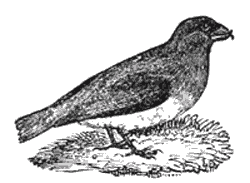
Loxia curvirostra, Linnæus; Le Beccroisé, Buffon; Der Kreuzschnabel, Bechstein.
The length of this bird is nearly seven inches, of which the tail measures two and a quarter. The beak, which is one inch in length, and very thick, has its two mandibles curving in opposite directions, and crossing each other at the points, whence the name. It is no fixed rule for the upper mandible to cross to the right or left, but its direction appears to be acquired when young. The shanks, which are eight lines high, and the beak, are brown; the iris is nut-coloured.
The change of colour, which some assert this bird is subject to three times a year, simply occurs as follows:—
The young male, which is at first of a greyish brown, with a little yellow, becomes after moulting entirely red, darker on the upper part of the body than on the lower, the quill and tail feathers excepted, which are blackish. This generally happens in April or May. At the second moulting this red colour becomes a greenish yellow, which is permanent; so that when red they may be known to be the young male birds, and when yellow the old ones.
The females are in general grey, with a little green on the head, breast, and rump, or irregularly speckled with those two colours.
From observations which have been made with great care and exactness, and which any one can repeat who wishes, it appears proved that an old male bird never changes its colour. In order to be exact as to these facts, it is necessary to observe the bird from the time of its leaving the nest; for, if one were to judge from those taken in a snare, one would certainly be disposed to think that not one bird resembled another: but all this variety depends on the different stages in moulting, which so very much affects the colours of the plumage.
Thus, in old male birds the forehead, cheeks, and eyebrows are spotted with grey, greenish yellow, and white. Wherever green and yellow are prevalent, the dark grey shows through, and has the appearance of spots on those parts, particularly on the back, for the tips alone are green and yellow.
The result of all this is, that when grey or speckled crossbills are spoken of, they are the young ones; when red, they have passed their first moulting; when crimson, they are near their second; and when spotted, red and yellow, they are two years old, and in full feather. To judge with exactness, these birds ought to be seen at the time of laying, but neither this nor the moulting has any fixed season; and this circumstance sufficiently explains the great variety and difference of colour which are found among this species.
These details also show that the crossbill is subject to nearly the same changes of colour as the linnet, and that the red colour which it bears for the first year is what peculiarly distinguishes it from other birds. One thing, which is rather remarkable, is, that the young ones reared in the house never take the red colour, but remain grey for the second year, or change directly into greenish yellow.
There are two kinds of crossbills, the greater and lesser; but the difference is not so great as some pretend, and nature is not more invariable in the size of birds than it is in that of men29.
Habitation.—When wild, the crossbill not only inhabits Europe, but also all the north of Asia and America, everywhere frequenting forests of pines and firs, where these trees, which are loaded with cones, furnish abundance of food.
In the house it may be let range at will, but a branch of fir, or any other tree, must be put near it, on which it can perch or sleep. If it be kept in a cage it must be made of wire; for, being so much disposed to peck and nibble, a wicker cage would soon be reduced to chips.
Food.—In its wild state the pine seed is its favourite food; the shape of its beak is peculiarly adapted for procuring these seeds, by separating the scales of the cones; it also gathers from the ground those which have fallen, and it does not neglect those of the fir, and even of the alder. When these fail it is contented with the buds of the same trees.
In the house, if it be let run about at liberty, the second universal paste will be sufficient; but if kept in a cage it must be fed on hemp, pine, and rape seed, and even elderberries.
Breeding.—The time of breeding is very remarkable, being generally in the depth of winter, from December to April. The nest, which is placed at the top of a pine or fir tree, is first formed of very fine small twigs, there is then a layer of coarse moss, but the interior is lined with the finest and softest moss; it is not glued with resin, as some have said. The young crossbills being in Thuringia the object of many ridiculous superstitions, the wood-cutters are always careful of the nests. The number of the eggs varies from three to five, they are of a greyish white, spotted, speckled, and streaked at the large end with red brown. The heating nature of their food enables the young and old birds to bear the severity of the season. The old birds feed their young with the food disgorged from their own stomach, as do all the grosbeaks. This species may be reared in the house on white bread soaked in milk, and mixed with a few poppy-seeds.
Diseases.—The accumulated vapour from a room with a stove has such an effect on the constitution of these birds, that they are almost always ill30. Weak eyes, swelled and ulcerated feet, are very common occurrences; hence the mountaineers of Thuringia have taken it into their heads that these poor birds can take upon themselves their diseases and pains: and it is this foolish idea that induces them always to keep one of these birds near them. Their superstitious extravagance carries them so far, that they are persuaded a bird whose upper mandible bends to the right, has the power of assuming to itself the colds and rheumatism from men; but when this mandible turns to the left, the bird renders the same service to the women. These simple and credulous people imagine that nothing is more efficacious against epilepsy, than every day to drink the water which the bird has left, because they see that these unfortunate victims are often attacked with this disease.
Mode of Taking.—With the decoy birds nothing is easier than to take the crossbills in the autumn and spring: one large rod, covered with strong bird-lime, is all that is necessary. It must be put in a glade in the wood which these birds frequent, with the decoy bird by the side; this, by its continual cry, will soon attract them. In Thuringia the people put nooses and spring traps on the top of some of the highest pines, and there hang the cage of the decoy bird; as soon as one crossbill has settled, the others follow; so that as many birds are taken as there are traps set, particularly if the stick of the spring traps be placed so that the bird must perch on it.
Attractive Qualities.—The crossbill is rather a silly bird; in the cage its motions are like those of the parrot; when lively it swings its body like the siskin, and sings a few sharp strains, which are more or less monotonous, according to the different powers of the songsters—for some of the males far surpass the others in this short melody. It is easily tamed, can be carried about anywhere on the finger, and will go and return again without wandering.
THE BULLFINCH.
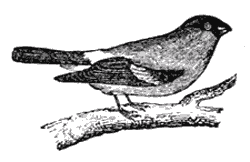
Loxia pyrrhula, Linnæus; Le Bouvreuil, Buffon; Der Gimpel, Bechstein.
This is one of the indigenous tame birds which is a favourite with the rich and noble. Its body is thick and short. Its whole length is six inches and three quarters, of which the tail measures two and three quarters; the beak is only six lines in length, short, thick, and black; the iris is chestnut-coloured; the shanks eight lines high, and black; the top of the head, the circle of the beak, the chin, and beginning of the throat, are of a beautiful velvet black; the upper part of the neck, the back, and shoulders, deep grey; the rump white; the under part of the neck, the wide breast, and to the centre of the belly, are of a fine vermilion, less bright, however, in the young than old; the blackish pen-feathers become darker towards the body; the secondaries have the outer edge of an iron blue, which in the hinder ones is reddish. The tail is rather forked, and of a brilliant black, tinged with iron blue.
The female is easily distinguished from the male, for what is red on him is reddish grey on her, while her back is of a brownish grey, and her feet are not so black; she is also smaller.
This species has some singular varieties; the principal are:—
1. The White Bullfinch, which is of an ashy white, or wholly white, with dark spots on the back.
2. The Black Bullfinch. These are most generally females, which become black, either with age, when they are only fed on hemp seed, or with having been kept when young in a totally dark place. Some resume at their moulting their natural colours; others remain black; but this black is not the same in all; some are of a brilliant raven black, others dull, and not so dark on the belly; in some the head only is of a raven black, the rest of the body being duller; in others the black is mixed with red spots on the belly, or the latter is entirely red. I have seen one in which the head and breast, as well as the upper and under parts of the body, were of a raven black, every other part of a dull black, with the wings and tail white; it was a very handsome bird, rather larger than a red-breast.
3. The Speckled Bullfinch. It is thus called, for, besides its natural colours, it is spotted with black and white, or white and ash colour.
4. The Mongrel Bullfinch. It is the offspring of a female reared in the house from the nest, and of a male canary. Its shape and colour partake of those of the parent birds; its note is very agreeable, and softer than that of the canary; but it is very scarce. This union rarely succeeds; but when tried, a very ardent and spirited canary should be chosen31.
5. The other varieties are: the Large Bullfinch, about the size of a thrush, and the Middling, or Common. As to dwarf birds, which are not as large as a chaffinch, it is a bird-catcher’r story, for this difference in size is observed in all kinds of birds. I can affirm it with the more certainty, having had opportunities every year of seeing hundreds of these birds, both wild and tame. I have even in the same nest found some as small as red-breasts, and others as large as a crossbill.
Habitation.—When wild, bullfinches are found over Europe and Russia. They are particularly common in the mountainous forests of Germany. The male and female never separate during the whole year. In winter they wander about everywhere in search of buds.
In the house those which are caught in a snare are often let run about. These birds not being very unruly or very active, a middling-sized cage will do, in which those which have learned songs are kept; but they must be kept in separate rooms, as they will mutually spoil their songs if left together.
Food.—When wild the bullfinch does not often suffer from the failure of its food; for it eats pine and fir seeds, the fruit of the ash and maple, corn, all kinds of berries, the buds of the oak, beech, and pear trees, and even linseed, millet, rape, and nettle seed.
In the house those which run about may be fed on the universal paste, and, for a change, rape seed may be added; those which are taught must be fed only on poppy seed, with a little hemp seed, and now and then a little biscuit without spice. It has been remarked that those which are fed entirely on rape seed soaked in water live much longer, and are more healthy. The hemp seed is too heating, sooner or later blinds them, and always brings on a decline. A little green food, such as lettuce, endive, chickweed, water-cresses, a little apple, particularly the kernels, the berries of the service tree, and the like, is agreeable and salutary to them.
Breeding.—These tenderly affectionate birds can hardly live when separated from one another. They incessantly repeat their call with a languishing note, and continually caress. They can sometimes be made to breed in the house, like the canary, but their eggs are rarely fruitful. In the wild state they breed twice every year, each time laying from three to six eggs, of a bluish white, spotted with violet and brown at the large end. Their nest, which they build in the most retired part of a wood, or in a solitary quickset hedge, is constructed with little skill, of twigs which are covered with moss. The young ones are hatched in fifteen days. Those which are to be taught must be taken from the nest when the feathers of the tail begin to grow; and must be fed only on rape seed soaked in water and mixed with white bread; eggs would kill them or make them blind. Their plumage is then of a dark ash-colour, with the wings and tail blackish brown; the males may be known at first by their reddish breast; so that when these only are wished to be reared they may be chosen in the nest, for the females are not so beautiful, nor so easily taught.
Although they do not warble before they can feed themselves, one need not wait for this to begin their instruction32, for it will succeed better, if one may say so, when infused with their food; since experience proves that they learn those airs more quickly, and remember them better, which they have been taught just after eating. It has been observed several times, that these birds, like the parrots, are never more attentive than during digestion. Nine months of regular and continued instruction are necessary before the bird acquires what amateurs call firmness, for if one ceases before this time, they spoil the air, by suppressing or displacing the different parts, and they often forget it entirely at their first moulting. In general it is a good thing to separate them from the other birds, even after they are perfect; because, owing to their great quickness in learning, they would spoil the air entirely by introducing wrong passages; they must be helped to continue the song when they stop, and the lesson must always be repeated whilst they are moulting, otherwise they will become mere chatterers, which would be doubly vexatious after having had much trouble in teaching them.
Diseases.—Those bullfinches which are caught in a snare or net are rarely ill, and may be preserved for eight years or more; but those reared from the nest are subject to many diseases, caused by their not having their natural food, or by those injurious delicacies which are always lavished on favourite birds; they rarely live more than six years. The surest means of preserving them healthy for a long time, is to give them neither sweets nor tit-bits of any kind, scrupulously to confine their food to rape seed, adding now and then a very little hemp seed to please them, and a good deal of the green food before mentioned. The bottom of their cages should be covered with river sand, as the bird there finds some stones which aid the functions of the stomach. Their most frequent diseases are moulting, costiveness, diarrhœa, epilepsy, grief, and melancholy, in which case they are quite silent, and remain immoveable, unless the cause can be discovered. They must not be given any delicacy, and must be fed entirely on soaked rape seed. A clove in their water, proper food, and particularly a good deal of refreshing green food, enables them to pass the moulting time in good health.
Mode of Taking.—There are few birds so easily attracted by the decoy bird as bullfinches. They may also be taken by any of the usual means. In winter numbers may be caught by a noose, by hanging to it such berries as the bird likes; in spring and autumn they may be caught in the area or barn floor trap; and provided they see berries there, the decoy bird is not wanted; it is sufficient if one imitates their soft cry of “tui, tui,” in the hut.
Attractive Qualities.—Although the song of the male and female bullfinch, in their wild state, is very harsh and disagreeable, yet if well taught while young, as they are in Hesse and Fulda, where there are schools of these little musicians, for all Germany, Holland, and England, they learn to whistle all kinds of airs and melodies with so soft and flute-like a tone, that they are great favourites with amateurs, and particularly with the ladies. There are some of these little birds which can whistle distinctly three different airs, without spoiling or confusing them in the least. Added to this attraction the bullfinch becomes exceedingly tame, sings whenever it is told to do so, and is susceptible of a most tender and lasting attachment, which it shows by its endearing actions; it balances its body, moves its tail from right to left, and spreads it like a fan. It will even repeat words, with an accent and tone which indicates sensibility, if one could believe that it understood them; but its memory must not be overloaded. A single air, with a prelude or a short flourish to begin with, is as much as the bird can learn and remember, and this it will execute to the greatest perfection. These little prodigies would be more interesting and agreeable, if their Hessian instructors possessed a little musical taste, but these are generally tradespeople, employed about the house with their different occupations and trades; and hymns, airs, and minuets of a hundred years old, public house songs, or some learnt of their apprentices, in general compose the whole of their music.
The bullfinch can also imitate the songs of other birds; but in general it is not permitted to do so, that it may only learn to repeat the airs which are taught it.
Different degrees of capacity are shown here, as well as in other animals. One young bullfinch learns with ease and quickness, another with difficulty and slowly; the former will repeat, without hesitation, several parts of a song; the latter will be hardly able to whistle one, after nine months' uninterrupted teaching. But it has been remarked that those birds which learn with most difficulty remember the songs, which have once been well learnt, better and longer, and rarely forget them, even when moulting. Mr. Thiem33, bird-seller, at Waltershausen, near Gotha, sends annually to Berlin and London one or two hundred bullfinches, instructed in this manner, at from one to several pounds sterling a-piece, according as they are more or less accomplished, whilst a wild one would cost only two or three pence. These, however, are also kept in the room and prized, both on account of their beauty and the great ease with which they are tamed; they soon learn to fly on the hand, to receive their food, or will even take it from the mouth, and become at last as familiar as if they had been reared from the nest. The following are the means which are employed to tame them:—As soon as a bullfinch is caught and brought into the room, it must be put into a cage with food sufficient for the first day only; for the loss of its liberty does not prevent its eating as soon as it is disengaged from the lime twigs or noose. The next day a band must be put round the body and wings, like that which bird-catchers put round a decoy bird, which they let run about out of doors; by means of this band the bullfinch may be fastened by a piece of packthread, a foot in length, to some place from which it cannot fall; this will prevent its beating itself to death with its wings; a little bell may be fastened to a box, which when filled with food must be given to the bird, at the same time ringing the bell; it must be then left that it may eat; this must be repeated several times in the day; the same must be done when it is given anything to drink. The poor little captive will not at first either eat or drink in any one’s presence; it is therefore necessary to retire for the two first days after having given it the box, and only approach it by degrees, till it is accustomed to eat in the presence of its master, which it will soon be, for generally on the third day, as soon as it hears the bell and sees the box, it hops forward, and eats without the least shyness. Then the distance must be increased by degrees to make it come farther and farther, when, as soon as it has eaten, it may be taken on the hand and carried here and there, though it may seem a little frightened, but not being able to escape it will soon become used to this treatment, and will even begin to come to eat on the hand by continuing to do this for the third and fourth days; it will fly of itself at the sound of the bell to the hand which holds the box; after this the fastening may be loosened, and if one only move from the bird gradually, it will fearlessly approach and perch on the hand. Should it escape, however, it must be again confined and left without food for some hours. By this means a wild bullfinch will in eight days become accustomed to fly immediately to the hand, or wherever it hears the bell; in order to finish its education, it is well to increase the difficulty of getting at its food, by putting it in a small bag with a very little opening; it must also only have rape seed in the cage, keeping the hemp seed, which it likes best, for the hand or little bag. It may be taught to drink out of one’s mouth by keeping it without water for five or six hours. It may even be accustomed to go and return, provided the house is not too near a wood. The surest means of preventing too long an absence is to put a female bullfinch in a cage in the window, or to leave her in the room with her wing clipped; its affection will soon bring it back to her, and it will certainly never abandon her altogether.
Tame bullfinches have been known (says Buffon) to escape from the aviary, and live at liberty in the woods for a whole year, and then to recollect the voice of the person who had reared them, return to her, never more to leave her. Others have been known, which when forced to leave their first master, have died of grief. These birds remember very well, and often too well, any one who has injured them. One of them having been thrown down, with its cage, by some of the lowest order of people, did not seem at first much disturbed by it, but afterwards it would fall into convulsions as soon as it saw any shabbily dressed person, and it died in one of these fits eight months after the first accident.
A bullfinch, belonging to a lady often mentioned before, being subject to very frightful dreams, which made it fall from its perch, and beat itself in the cage, no sooner heard the affectionate voice of its mistress than, notwithstanding the darkness of the night, it became immediately tranquil, and re-ascended its perch to sleep again. It was very fond of chickweed, and as soon as it perceived one bringing it to him, however much care was taken to prevent its finding it easily, it would show its joy by its actions and cries.
THE GREEN BIRD.
Loxia chloris, Linnæus; Le Verdier, Buffon; Der Grünling, Bechstein.
This bird is rather larger than the chaffinch, being six inches in length, of which the tail measures two and a half; the beak five lines in length. The iris is dark brown; the shanks are eight inches in height, and of a bluish flesh colour. The prevailing colour of the plumage is yellowish green, lighter on the lower part of the body, still more so on the rump and breast, and shading to white on the belly.
The female, which is smaller, is still more distinguished by the greenish brown of the upper part, and the ash-colour rather than yellowish green of the lower part of the body; she has besides some yellow spots on the breast, and the whole belly is rather white than yellow.
Sportsmen and bird-catchers mention three kinds of green birds, namely, the large, which is everywhere of a beautiful yellow; the middle sized, the under part of the body of which is light yellow; and the little, which they say is rather greenish than yellow; but all this variety depends upon the different ages of the bird, as well as its strength, and more or less beautiful tints of its plumage. What much more deserves to be remarked is the mule, which is the offspring of a green bird, and a female canary; it has a strong body; its colours are green and grey, mixed with yellow, when the female canary is yellow; but it is always a bad singer.
Habitation.—When wild, the green bird may be found over all Europe, though not often far north. It may be seen during summer, in hedges, and on the borders of woods, and always where there are several trees near together; during winter it wanders into different provinces, in large and numerous flocks; but in March it begins to return from these journeys.
In the house it may either be let range free, or be shut up in an aviary with other birds, where it is always very peaceable as long as it has sufficient food; but when that fails, it perches itself on the general food-drawer, and keeps it determinedly, pecking it with its beak so cleverly that no other bird can approach: should one venture, it is soon obliged to go away or lose its feathers; otherwise this bird is as quiet and tame in the house as it is wild and active when at liberty.
Food.—In its wild state it seems to like all kinds of seed, even that of the milk thistle, which all other birds dislike.
In the house, when it ranges at will, the second universal paste so well agrees with it that it becomes quite fat; however, as a variety, rape and hemp seed may be thrown to it; if in a cage it must only be fed in summer with rape seed, except a little hemp seed, which may be given after moulting, to make it sing. Lettuce, chickweed and other green food, always agree with it, and even the berries of the juniper tree.
Breeding.—Its nest, which is almost always placed in a hedge, on a large branch near the trunk of a tree, or on the top of an old willow-tree, is firmly built with wool, moss, and lichen, and lined with very fine roots and bristles. The female lays, twice a year, four or five pointed eggs, of a silver hue, spotted with light violet or brown. The young are at first of a greenish grey; some yellow tints, however, may already be seen in the male. When reared from the nest, it learns, though with difficulty, to imitate the different songs of house-birds; and, as it almost always happens with slow memories, having once learnt a thing it never forgets it. It also sings through the whole year; it should therefore be taught by a bird whose song is agreeable, for instance, a chaffinch, and then one would have the pleasure of hearing it without interruption through all the seasons.
Diseases.—The constitution of the green bird being very strong and healthy, it is rarely subject to disease. It may be kept in good health for twelve years.
Mode of Taking.—If the decoy bird be a good one, the green bird may be easily caught in the area or barn-floor trap, even in December. In the spring it may be taken with bird-lime on the lure-bush, when a linnet will do for the songstress. In order to make it eat soon, a little crushed hemp seed should be thrown in the bottom of its cage.
Attractive Qualities.—Without being handsome its song is not disagreeable; it may also be taught to repeat words; but its greatest merit is the wonderful ease with which it is tamed, equalling, and even surpassing the bullfinch in this particular. It may not only be accustomed to go and return again, but also to build in a room near an orchard, or in a summer-house in the garden. The following are the means which must be taken to make it do this:—
After having taken the young from the nest they must be put in a cage, and placed at the foot of the tree in which this nest is built, in a place dug for the purpose, and on the cage a tit as a decoy. When left there, the old birds come to feed their young, and are caught in the snare. As soon as they are taken, they must all be brought into the house, where the old and young must be put together in any aviary, or large cage, till the latter can fly; the window may then be opened for them to go out, but hunger will soon bring them back. As soon as they have exercised their wings, the old birds should be placed on the table in the window to call them back. In time, they become so familiar that they will accompany one in a walk, and there is no fear of their flying away. If they are not taken thus, it is necessary to wait for winter and snow to let them go out, and if they profit by the permission, to call them back by some of their species placed in a cage in the window. If you wish to be quite sure of success, you have only to put a board in the window, on which two females with their wings cut, can run about, go out, and return.
The green bird likes to build near canaries, and as these are good nurses, they are given the eggs of the green bird, which, like the goldfinches and siskins, learns to draw up its water and food.
THE PINE GROSBEAK.
Loxia Enuclator, Linnæus; Le Durbec, Buffon; Der Fichtenkernbeisser, Bechstein.
This is one of the largest species of grosbeak that we have, equalling the Bohemian chatterer in size. Its length is eight inches and a half, of which the tail measures three; the beak is short and thick, measuring only six lines; its colour is brown, the iris dark brown; the feet are from twelve to thirteen lines high, and blackish; the head, neck, breast and rump are of a light vermilion, with bluish tints; the feathers on the back and the lesser wing coverts are black, with reddish edges.
The female is generally of a greyish green, with some scattered reddish and yellowish tints, principally on the top of the head. It is not yet well known if this bird has the same changes of colour as the crossbill, since more yellow ones have been found than red. Experience shows that the same things take place in the house as out of doors. They acquire the yellow red, not only after the first moulting, but even before it. This change begins first round the beak, descends afterwards to the back and breast, and at last gradually extends over the whole body, so that what was red before becomes yellow; this yellow is darker than citron; all the red and yellow feathers are ash-colour at the base. The young are brownish, with a slight shade of yellow. During the first year the colour of the males is light red; it is only after this that they become darker vermilion or crimson; these birds are caught in autumn and winter, either in the noose or net, with elder or service berries as a lure.
Observations.—This bird is found in all the northern regions of Europe, Asia, and America, and in Europe rarely passes the fifty-third degree of latitude. It frequents the pine and fir forests, the seeds of which form its food; in winter it quits these places in search of berries; this is what ranks it among the erratic birds. They are so stupid, that in the north they are easily caught with a circle of brass wire fixed to the end of a long pole, to which are fastened some horse-hair rings, which are simply passed over the head of the bird. They are often caught and kept in cages, as they are liked, both on account of the ease with which they are tamed, and of their song, which is very agreeable; they will even sometimes sing in the night, and always preserve their song through the whole year, while the wild only sing in the spring.
HAWFINCH.
Loxia coccothraustes, Linnæus; Le Grosbec, Buffon; Der gemeine Kernbeisser, Bechstein.
One must be a very great bird fancier to wish to have this bird in the house. Its length is seven inches, of which the tail measures two inches and a third. The beak, which is very thick in proportion to the rest of the body, is like a large blunt cone, dark blue in summer, and flesh-coloured, with the tip black, in winter; the slim feet are nine lines in height, and of a pale crimson; the yellowish brown of the forehead unites with the light chestnut on the top of the head and cheeks; the circle of the head is black, and forms, under the chin, a large square spot; the nape of the neck and upper part of the back are of a fine ash-grey, the lower part is of a dark brown, with some shades of grey on the rump.
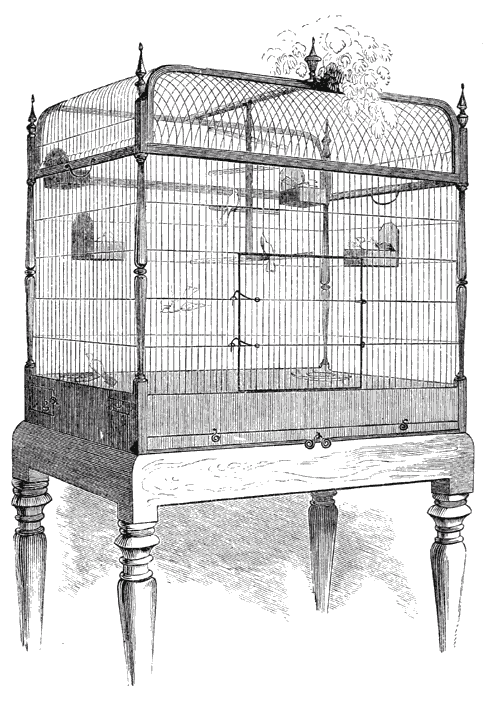
BREEDING CAGE.
In the females, the cheeks, head, and upper tail coverts are of a greyish chestnut colour; the throat, wings, and tail rather brown than black, the spot on the wings greyish, the under part of the body reddish grey, shading to white on the belly.
Habitation.—When wild, it may be found in all the temperate parts of Europe and Russia. It is very common among the mountainous countries of Germany, where the beech prevails in the forests. It is rather an erratic bird than a bird of passage, and its excursions are ended in March. Sonnini says, however, that he has seen it during winter, in Egypt, with the blackbirds and thrushes, and its excursions are ended in March.
In the house it is generally kept in a large wire cage, where it is soon tamed. It may also be let run about, provided it has not too many companions, and that it has food in abundance, for it is a very quarrelsome bird.
Food.—In its wild state it eats many different things; the fruit of the beech, elm, ash, and maple; the berries of the juniper, service-tree, and white-thorn; cherries and plums, the stones of which it breaks with the greatest ease, to eat the kernel; hemp seed, cabbage, radish, and lettuce seed also form a part of its food.
In the house, if confined in the cage, it is contented with rape and hemp-seed; and if it run about, with the second universal paste.
Breeding.—Its nest is well built; the eggs, from three to five in number, are greenish grey, spotted with brown, and streaked with blackish blue. The young, when reared from the nest, will become so tame as to eat from the hand, and will courageously defend itself with its beak against the dogs and cats; it may also be accustomed to go and come.
Mode of Taking.—The haste with which these birds come on hearing the call, makes it very easy to catch them in the net, by throwing berries or hemp seed on the trap. In autumn and winter they may be taken by the noose, with service-berries; in spring they may be caught by placing lime twigs on the nest. The loss of their liberty does not prevent their eating immediately rape or hemp seed.
Attractive Qualities.—I confess that it has very few; its song is less agreeable than any of the others', it is a kind of low whistling, mixed with some harsh tones; but its great tameness may please; it is necessary, however, to guard one’s self from its beak.
THE CARDINAL GROSBEAK, OR VIRGINIAN NIGHTINGALE.
Loxia cardinalis, Linnæus; Cardinal huppé, ou Rossignol de Virginie, Buffon; Der Cardinal Kernbeisser, Bechstein.
The length of this bird is eight inches, of which the tail measures three. Its beak is strong and light red, like its feet; the iris is dark brown; the head is ornamented with a tuft, which, when raised, is pointed; the throat and the part round the beak are black; the rest of the body is of a beautiful bright red; the pen and tail-feathers are less brilliant, and brown on the anterior part.
The female is in general of a reddish brown.
Observations.—The beautiful song of this grosbeak is so like that of the nightingale, that this name has been given it; but its voice is so strong that it pierces the ears. It sings through the whole year, except during the time of moulting.
In its wild state, its principal food is the seed of the Indian corn and buck-wheat; it collects a considerable quantity of this food, which it skilfully covers with leaves and twigs, only leaving a very small hole, as the entrance to this magazine. In the cage it is fed with millet, rape seed, hemp seed, and the like, which agree with it very well.
Some persons have endeavoured to make it breed in large aviaries in the middle of gardens, but I do not know that it has ever succeeded. In Germany it is very dear, being as much as six or eight pounds sterling for a pair.
THE JAVA SPARROW, OR RICE BIRD.
Loxia orycivora, Linnæus; Le Padda, ou Oiseau de Riz, Buffon; Der Reiskernbeisser, Bechstein.
This bird is about the size of a bullfinch, and five inches in length, of which the tail measures two. The beak is thick, and of a fine rose colour; the feet are paler; the eyelids naked, and edged with rose colour; the head, throat, and streak which surrounds the cheeks, are black; the cheeks are white; the rump, tail, and greater pen-feathers are black, but all the rest of the upper part of the body, the wing-coverts, hinder pen-feathers, and breast, are of a dark grey; the belly purple grey; the lower tail-coverts white. “The whole plumage,” says Buffon, “is so well arranged, that no one feather passes another, and they all appear downy, or rather covered with that kind of bloom which you see on plums; this gives them a very beautiful tint.”
In the female the colours are rather lighter on the back and belly: the young are not only paler, but also irregularly spotted with dark brown on the cheeks and lower part of the belly.
Observations.—There are few vessels coming from Java and the Cape of Good Hope that do not bring numbers of these birds, which have as bad a character in those countries, and particularly in China, their native place, as the sparrows have amongst us, on account of the ravages they make in the rice fields. They have nothing attractive but their beauty, for their song is short and monotonous. They cost four or five pounds sterling a pair in Germany.
THE WAXBILL.
Loxia Astrild, Linnæus; Le Sénégali rayé, Buffon; Der Gemeine Senegalist, Bechstein.
This bird is hardly larger than a golden-crested wren, its length being four inches and a half, of which the tail measures two inches; the beak is rather rough at the base, and of a dark red; the band which crosses the eyes, the centre of the breast and belly, are red; the upper part of the body is brown, and the lower reddish grey, the whole streaked with transverse blackish lines, which become finer as they approach the head; the quill-feathers are brown, as well as the tail, which is wedge-shaped, and streaked with darker transverse lines; the feet are brown. These birds change colour like the amandava finch; thus some are found with the tail entirely brown, others which have the rump crimson, and the rest of the body brown above and white below, and some have the belly yellow, and the back spotted with white; there are some, indeed, which have the neck and throat bluish, the under part of the body white, mixed with iron colour, and the upper part blue.
Observations.—They inhabit the Canary Islands, Senegal, Angola, the Cape of Good Hope, and may even be found as far as India, whence they are brought to Europe. Their beautiful shape, their amiable disposition, and the affection which they show to every one indiscriminately, render them such favourites, that a dozen may be often seen in one cage. Their song is scarcely any thing. They are fed on millet, which also forms their food in their native country, to the damage of the fields which are sown with it. They approach villages like our sparrows; they are caught in traps made of the shell of a gourd, and cut like a bowl, on which some millet is scattered.
THE AMANDAVA.
Fringilla amandava, Linnæus; Le Bengali Piqueté, Buffon; Der Getiegerte Bengalist, Bechstein.
This beautiful little bird, which is brought to Europe in great numbers from Bengal, Java, Malacca, and other tropical countries of Asia, is only four inches long, of which the tail measures one and a third. Most ornithologists class it with the sparrows, but it seems to me that it belongs rather to the grosbeaks. Its beak is short and thick, being only four lines in length, and the diameter at the base measuring three. Its colour is deep bright red; the iris is also red; the feet are six lines in height, and of a pale flesh-colour; in the male the head and under part of the body are of a fiery red, the upper part of a dark grey, but the feathers have a broad red edge, so that this colour seems to prevail; thus the edge of the feathers on the rump make it appear of a brilliant orange, though, like the belly, it is properly black; the feathers of the back, tail, sides of the breast and belly, the wing-coverts, hinder quill-feathers, and both tail-coverts, are terminated at the tip with shining white spots, which are largest on the hinder quill-feathers, and larger wing-coverts, the colour of which is otherwise black.
The female is one third smaller than the male; part of the upper mandible is black; the head and upper part of the body, including the wing-coverts, are of a dark ash-colour; the feathers on the rump have only an orange edge, with a light tip; the cheeks are of a light grey; the under part of the body is pale sulphur, the pen-feathers blackish; the greater and lesser wing-coverts are finely speckled with white; the tips of the tail-feathers are greyish white.
The male varies in its colours for several years before it permanently acquires those above described: it may be seen with the back grey, slightly tinted with red, the belly black, speckled with yellow; others with the back reddish grey, spotted with bright red, and the belly of a sulphur yellow, with black rings, and more or less speckled, &c.
Observations.—These birds are as sociable as the waxbills; if there should be twenty or thirty in the same cage, they perch close against one another on the same perch; and, what is more singular, they never sing together, but one after another, the rest keeping quite silent to listen to the songster. Their song resembles that of the hay bird, and continues through the winter. The females do not sing; those are wrong who think the contrary. They are very active, often bowing and spreading their tail like a fan. In their native country their food consists of different seeds, particularly millet; this is also given it in the cage, as well as canary seed. They eat and drink a great deal. They will live from six to ten years.
THE PARADISE GROSBEAK.
Loxia erythrocephala, Linnæus; Le Cardinal d’dngola, Buffon; Der Paridiese-Kernbeisser, Bechstein.
This species is about six inches long; the beak and feet are flesh-coloured, the head and chin red; the upper part of the neck, the back, rump, and wing-coverts, bluish grey; the upper tail-coverts are edged with grey; the under part of the body white, with dark brown spots on the sides; the wing-coverts white at the tip, which forms two transverse streaks on the wings; the pen and tail-feathers are of a dark grey, with lighter tips. The female does not differ from the male.
Observations.—The male sings through the whole year, but its voice is so weak that the least noise overpowers it. In England this species has been made to breed in an aviary. Its food is millet and rape seed, and sometimes a little hemp seed.
THE REDBILL.
Loxia sanguinirostris, Linnæus; Le Becsanguin, Buffon; Der Rothschäbliger Kernbeisser, Bechstein.
This pretty little bird is three inches and a half long, of which the tail measures one inch, and the beak four lines. The feet are nine lines in height, the middle claw measures five lines and the side ones four. The beak is strong, rather naked at the forehead, and of a dark blood red; the feet are of a very red colour, the claws black; the eyelids red, and irides orange; the circle of the beak, including the forehead, eyes, and chin, is black; the top of the head rust-colour, more or less approaching to red, scattered with blackish spots, formed by the black of the feathers; the under part of the body of a brownish red, clouded with white, and lighter on the sides and the lower part of the belly, the whole spotted with black in the young birds, but with no spots in the old ones.
The female is altogether lighter, and has no black on the head, but two dark grey streaks above and under the eyes; the under part of the body is only reddish grey.
Observations.—This species is found on the coasts of Africa, in Bengal, and other parts of Asia. It is a very agreeable bird, and though its voice is weak its song is only the more melodious. A male and female put together in a cage seem to be taken up with their mutual affection, always feeding and caressing each other. They are fed on crushed canary and hemp seed, which preserves them in good health for several years. The room in which they are kept must be heated during winter.
THE DOMINICAN.
Loxia Dominicana, Linnæus; Le Paroare, Buffon; Der Dominicaner Kernbeisser, Bechstein.
This bird is about the size of a lark. The upper part of the beak is brown, and the lower light flesh-colour; the feet are grey; the front of the head, the throat, and part of the neck red; the back of the head is blackish, with a slight mixture of white.
Observations.—This bird comes from Brazil, and possesses nothing attractive but its beauty. Its song is merely an occasional call. In Germany it costs three pounds sterling.
THE GRENADIER.
Loxia orix, Linnæus; Le Cardinal du Cap de Bonne Espérance, Buffon; Der Grenadier Kernbeisser, oder Feuervogel, Bechstein.
This bird is about the size of a sparrow. The beak is black; iris chestnut; feet dark flesh-colour; forehead, sides of the head, chin, lower part of the breast and belly blackish; the throat, top of the head and breast, rump, vent, and tail are of a fiery red, or brilliant carmine, and soft, like velvet.
Varieties.—1. A black spot on the chin; thighs red.
2. Tail dark brown, with a greyish white border.
In the female the beak is raven black, the upper part of the body dark brown, with light grey edges to the feathers; the head dark grey, with a whitish streak which passes above the eyes; the under part of the body light grey. From this it seems to be very like the house sparrow; its plumage is, however, altogether lighter.
The male takes these colours, in the house, at the second moulting, but the streaks are darker, the feathers of the upper part of the body being blackish, with broad borders of reddish grey; the streak above the eyes is of a pale sulphur. When wild, the males, immediately after pairing, which is in January, lose their red feathers, and become like the females, but have them again in July, about the time of the second breeding season. They are pretty whilst moulting, when the head and body are speckled, the tail and neck still remaining red.
Observations.—These birds, which are very numerous in all the colonies at the Cape of Good Hope, do as much mischief there to the flowers and ears of corn, as the sparrows do in Europe. When retiring by thousands in the evening, from the fields to the reeds, they make such a noise with their chirping as may be heard to a great distance. Their call is like the sparrows’ “dib, dib,” and their song as weak as that of the siskin; the nest is skilfully constructed with small twigs interwoven with cotton, and has but one opening, with two compartments, one above the other, the upper for the male and the lower for the female; the eggs are green.
These birds, when kept in a cage, are fed on canary seed. The male and female never like to be separated; there is no instance, however, of their breeding in these climates.
THE CAPE FINCH.
Loxia Capensis, Linnæus; Le Pinson noir et jaune, Buffon; Der Capsche Kernbeisser, Bechstein.
I have one of these birds, which is about the size of a bullfinch: its length is six inches and a quarter, of which the tail, which is rather wedge-shaped, measures two and a half. The beak is whitish above, very much compressed on the sides, and very pointed; the iris dark brown; feet dark flesh-colour. The head, neck, top of the back, all the under part of the body, and the tail are of a fine velvet black.
The female, which is light brown, has a black spot in the centre of each feather; the sides of the head and greater wing-coverts are grey white, streaked with black; the lesser coverts and the rump of a light yellow; the tail-feathers edged with grey; the beak pale or raven grey.
The plumage of the male after pairing is like that of the female.
Observations.—This bird, which comes from the Cape of Good Hope lives very well in the house; it is kept in a cage, alone or with the female, and fed with hemp and canary seed. In its native country it frequents the edges of streams and rivers, feeds on seeds, but is not so mischievous as the preceding. The eggs are grey, spotted with black. It is said to be nice to eat.
THE CAFFRARIAN FINCH.
Loxia Caffra, Linnæus; Le Caffre, Buffon; Der Mohren Kernbeisser, Bechstein.
This bird is very little larger than the bullfinch, but its long and raised tail is about twice the length of its body: it is only ornamented with it during the pairing season. The beak is brown grey; the feet grey; the prevailing colour of the plumage is velvet black; the shoulders are red; the coverts white; the pen-feathers brown grey, with a white border.
The female is always grey, and has only a little red on the shoulders. The male acquires its beautiful black plumage at the beginning of November, and loses it in January, to assume the colours of the female.
Observations.—This species, which is found in the interior of the country north of the Cape, lives and builds in marshes: it is rarely brought to Europe. The long tail of the male requires a large cage in order to preserve its beauty. In its wild state this length of tail is very inconvenient during the high winds; and during the rainy season it may be caught by the hand. It is fed with canary seed.
THE BLUE FINCH.
Loxia cœrulea, Linnæus; Le Bouvreuil bleu d’dmérique, Buffon; Der dunkelblaue Kernbeisser, Bechstein.
This bird is the size of the common grosbeak, about six inches and a half in length, of which the tail measures two. The beak, which measures six lines, is strong, and of a dark brown; the feet black; a black streak surrounds the chin, and extends to the eyes: the whole plumage is blue, except the greater wing coverts, the pen-feathers, and the central tail feathers, which are dark brown.
The female is entirely brown, with a slight mixture of blue.
Observations.—I have had an opportunity of observing this bird among the collection belonging to his Royal Highness the Duke of Saxe Meiningen, where it is fed on canary seed. It calls little, and its song is weak, but its plumage is beautiful. It is found in several parts of America, in Brazil, Cayenne, and even in Carolina.
YELLOW-BELLIED GROSBEAK.
Loxia flaviventris, Linnæus; Le Grosbec jaune du Cap de Bonne Espérance, Brisson; Der gelbafterige Kernbeisser, Bechstein.
I am not sure that this bird, which I have also seen amongst those of his Royal Highness the Duke of Saxe Meiningen, is the true Loxia flaviventris of Linnæus. It is of the size of the common chaffinch, and five inches long. The beak, which is moderately strong, very much resembles that of the chaffinch, and is of a horn brown. The feet are a dull brown. The head and neck are of a dull pale blue; the upper part of the body olive, the whole of the under part is a fine bright orange.
The Yellow Grosbeak of the Cape of Good Hope is thus described:—the head, upper part of the neck, and back are olive, with stripes of brown; the rump olive. The under part of the body deep yellow; on each side of the head is a yellow band which passes above the eyes; the wings and tail feathers are brown, edged with olive.
The female only differs in the colours being less vivid.
Variety.—The top of the head, the upper part of the body, and the breast are olive; the back of the neck, even to the throat, is ash-coloured; the belly yellow, but between the legs white. The wings are black, bordered with orange; the tail feathers dark green, but they are bordered with yellow, and are black up the middle.
Observations.—This bird has been sold as the female of the preceding, and placed in the same cage. It lived very sociably; but I should suspect it rather of being the female of that under notice. It is a native of the Cape of Good Hope.
THE GOWRY BIRD.
Loxia punctularia, Linnæus; Le Grosbec tacheté de Java, Buffon; Der getüpfelte Kernbeisser, Bechstein.
This bird is the size of a linnet, about four inches and a quarter in length. The beak and feet black; the whole of the upper part of the body, and the lower, as far as the breast, chestnut brown; the cheeks marked with a reddish purple tinge; the belly and sides white, but all the feathers bordered with black in the form of a heart.
The female has no red tinge on the cheeks, the beak and feet are deep brown; the sides white, tinged with deep brown: the back reddish brown.
Observations.—This species, which I have seen in the collection of His Royal Highness the Duke of Saxe Meiningen, comes from Java; it is kept in a cage and fed on canary seed. Its call is “deguay,” its feeble song somewhat resembles the siskin’n.
THE BANDED FINCH.
Loxia fasciata, Linnæus; La Collerette Buffon; Der gebänderte Kernbeisser, Bechstein.
This bird is the size of the preceding, about four inches and a half in length. The beak is bluish grey. The feet short and flesh-coloured; the upper part of the body dark reddish ash grey, each feather having two black transverse bands, only one of which is visible; the cheeks and lower mandible are surrounded by a band of dark reddish purple.
The female has not this collar, and its plumage is paler; the under part of its body is red brown, each feather edged with a deeper shade.
Varieties.—The one I have actually before me, and which I received from Mr. Thiem, bird-dealer at Waltershausen, is a fine male, whose plumage is as follows:—
The head is dull orange, with black stripes very near together; the upper part of the neck, the back and rump, are the same shade of orange, but each feather is intersected by a semicircular black line, and terminated by a spot of red brown; the scapular wing coverts and last pen-feathers are dark grey, with transverse angular black bands, and bordered at the tips with red brown.
2. This variety is thus described in Latham’s Synopsis of Birds.
The top of the head, upper part of the neck, and lesser wing coverts, light brown, with semicircular black lines; the cheeks plain brown, but edged at the lower part with bright crimson, below which is a black line; the breast and belly light brown, occasionally marked with semicircular lines; the pen-feathers and tail are brown.
Observations.—Bird-fanciers give to these the name of Indian sparrows, though they come from Africa; their cry is similar to that of the common sparrow, and their song not very different. They are fed on canary seeds.
THE BROWN-CHEEKED FINCH.
Loxia canora, Linnæus; Der braunwangige Kernbeisser, Bechstein.
This bird is the size of the siskin, and four inches in length. The beak short, strong, and horn brown. The feet flesh-colour. The cheeks brown, adorned with a yellow border from the throat to the back of the ear. The female has no yellow border to the cheeks.
Observations.—This pretty species comes from Mexico; its song is soft and clear; its actions are as lively as they are amusing. It is kept in a cage, and fed on canary seed and millet.
THE MALACCA FINCH.
Loxia Malacca, Linnæus; Le Jacobin, Buffon; Der Malackische Kernbeisser, Bechstein.
This bird is the size of the greenfinch, and four inches and a half in length, of which the tail measures one and a half. The beak thick, five lines in length, and bluish grey; the feet the same colour. The head, neck, a stripe, which extends up the belly to the vent, and the thighs, are black; the back, wings and tail, pale chestnut.
The following is mentioned as a variety.
The Chinese Grosbeak (Brisson’s Ornithology, III., page 235, No. 7), with the head, throat, and front of the neck black, the upper part of the body red brown or chestnut, the wings and tail similar to the one above.
I have seen this bird in a room several times, and have always regarded it as a male, on account of its song, and because, after moulting, its plumage returned unaltered, not becoming either white on the breast or black at the vent.
Edwards, who has represented it in his 355th plate, has added a female, which he kept in the same cage, and which was improved by its companion. The upper part of its body was grey brown, the sides of the head and under part of the body pinkish, or rather blush colour, the wing and tail feathers blackish, the feet flesh-colour.
The blackness of the wings and tail makes me suspect that this female belongs to another species; its attachment and familiarity prove nothing. We know, in fact, that nearly all granivorous birds hold communion together, and mutually caress each other with the bill.
Observations.—The Malacca Finch comes from the East Indies: it is very gentle, confiding, and lively. Its voice is strong; its cry, “tziapp,” pronounced in a loud clear tone. Though its song is somewhat nasal and rather noisy, it is not disagreeable.
Its food, when in confinement, is hemp and canary seed, which I have known preserve it for a long time in good health.
THE SNOW BUNTING.
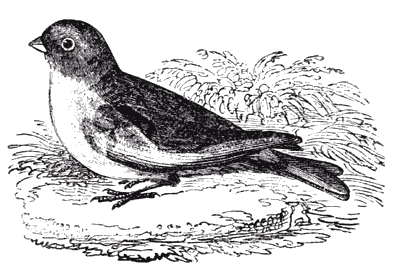
Emberiza nivalis, Linnæus; L’Lrtolan de neige, Buffon; Der Schneeamer, Bechstein.
Naturalists say that the plumage of this bird differs considerably in summer and winter; though, from analogy with others of its species, I am authorized in suspecting that this change arises rather from age. I shall leave the question undecided; and since we can never see this bird when it has retired in summer within the arctic circle, its native home, I shall content myself with describing its winter colours, such as we may see them in a room.
It is the size of a lark, six inches and a half in length, of which the tail measures two and two-thirds. The beak is five or six lines in length, with every characteristic of the bunting species, conical in form, rather bent at the sides, and having a bony tubercle like a grain of barley at the palate; its colour in the singing season is quite black, at other times the point alone is black, the rest yellow. The back and rump are black, the feathers of the back being edged with white, whilst those of the rump and scapulars are edged with yellowish brown, darker in spring than summer.
The female is rather smaller, the head and upper part of the neck white, with a mixture of cinnamon-brown, and transverse spots of the same colour form a kind of broken band across the white breast.
The young ones which are taken in winter are known by their dark brown beak; the lower part of the back is of the same colour, but their feathers are edged with a light grey. The male has the head most speckled with yellow brown, the cheeks of the female are of the same tint, and it has spots of this on the breast.
Observations.—When the winter is severe, these birds are seen from December to May in many parts of Germany, where they even approach the villages. I am persuaded that, if attention were paid to them, they might be seen in every direction, during March, on their passage to the North; whilst snow is on the ground they are found in company with larks, on the high roads and in the fields; they may then be taken with horse dung, placed in net, or covered with bird-lime, or by clearing a spot of ground of snow and strewing it with oats. I have had a pair six years in my room without a cage, and they are satisfied with the food common for other birds: if kept in a cage, they must be fed on hemp seed, oats, millet, rape, and poppy seeds. They appear much delighted whilst bathing; during the night they seem very uneasy, hopping and running about continually. Their strong and piercing cry resembles a loud whistle; their song would be rather agreeable were it not interrupted in a peculiar manner; it is a warbling mingled with some high noisy notes, descending slowly from shrill to deep, and a little strong and broken whistling. Heat is so contrary to their nature, that they cannot be preserved unless carefully guarded from it.
THE MOUNTAIN BUNTING.
Emberiza montana, Linnæus; L’Lrtolan de Montagne, Buffon; Der Bergammer, Bechstein.
This bird is smaller than the snow bunting, has a short, strong yellow beak, with a black point; the head is nearly flat, the frontal band light chestnut; the upper part of the neck and back grey, with black streaks, most numerous on the back, causing a resemblance to the female yellowhammer; feet black.
The breast of the female is of a deeper colour than the male’e.
Observations.—This species, inhabiting the cold regions of Europe, is never found in great numbers. In Thuringia, and some other provinces of Germany, they are seen generally every year, in March, the time of passage, settling in pairs along the high roads, searching for a few undigested grains in the dung of animals. Their song is shrill, tolerably pleasing, and interrupted like the yellowhammer’r. They may be easily kept in the house, either caged or not, feeding them on oats, bread, hemp, and other seeds. These birds also appear uneasy during the night, especially in the pairing season, uttering their call amidst the darkness. Some are occasionally met with of a dull orange on the upper part of the body, streaked with yellow on the head, and deep orange on the back. These are young birds. This species is caught in the same manner as the snow bunting.
THE YELLOWHAMMER.
Emberiza citrinella, Linnæus; Le Bruant, Buffon; Der Goldammer, Bechstein.
However well known this bird may be, it is still necessary that it should be described minutely, as the young males and old females are often confounded with one another. It is six inches and a half in length, of which the forked tail measures three. The beak, five lines long, is dark brown in summer, and ash grey in winter; the feet are of a light brown. The head of the old males is of a fine yellow, generally having some streaks of dark olive scattered over the top and on the cheeks; it is only in very old birds that the head and neck are of a golden yellow, without any mixture; the upper part of the neck is olive; the back black, mingled with reddish grey; the feathers have black up the middle, and the edges reddish grey; the rump is of a deep red; the throat, with the under part of the neck and the belly, are yellow, more or less golden; the breast, especially its sides, as well as the small coverts of the tail, is streaked with yellow and red.
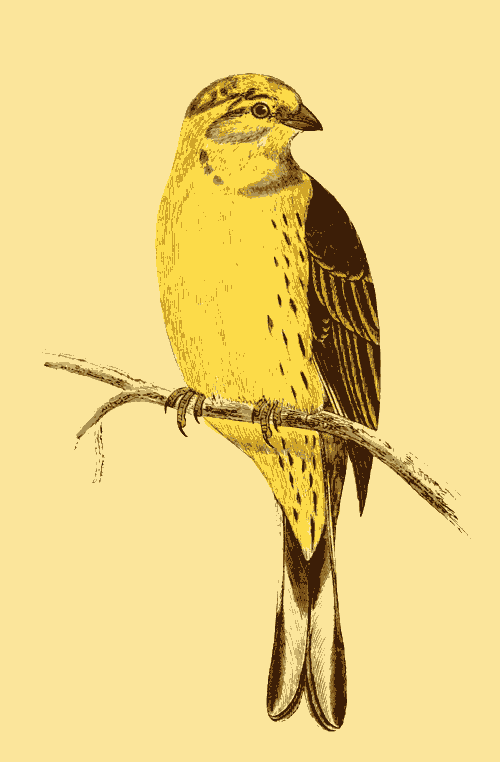
YELLOWHAMMER.
The female is rather smaller than the male; the yellow of the head, neck, and throat, is scarcely seen through the spots scattered over it, which are brown on the head and cheeks, and olive-coloured on the neck; the breast is only speckled with rust red, and the wing coverts with reddish white, so that at a distance it appears rather brown than yellow.
Young male birds, in spring, scarcely differ from old females, except that a spot of yellow may even then be seen on the top of the head, as well as a streak of the same colour above the eyes and on the throat; in fact, the breast and rump are rather of a deep reddish brown than rust red, and also without spots.
Habitation.—In its wild state the yellowhammer is found in all parts of Europe, and the north of Asia. It remains in summer about the skirts of forests and small woods. It overruns the fields in autumn, and in the winter approaches our buildings, particularly barns and stables.
When confined it is generally allowed to run about the room, but where it is rare, and therefore most valued, it is kept in a cage.
Food.—When wild these birds live on insects, particularly caterpillars, on which, like all the other species of this genus, they feed their young. In autumn and winter, they have recourse to all kinds of grain; but they prefer oats, which, with barley, wheat, and millet, they know how to get at very cleverly, notwithstanding the bony tubercle at their palate. They also feed upon rape, and other small seeds, when they can get them.
In the house, to preserve them in health, their food should be properly varied, giving them in turn oats, the crumb of white bread, meat, bruised hemp seed, poppy and rape seed. When running about, the second universal paste agrees very well with them. It is no doubt to assist their digestion, that they often swallow fresh black earth, as I have always seen those do that I have kept; this must not be forgotten to be given them, nor water for them to bathe in, which they enjoy very much.
Breeding.—This species breeds twice in the year, the first time in the end of March, or the beginning of April. The nest, which is placed in a hedge, bush, tuft of grass, or even in moss on the ground, is formed on the outside of straws, interwoven and lined within with the hair of horses and other animals. It contains from three to five eggs, of a dirty white, with zig-zag lines and spots of brown. When reared from the nest the young ones may be taught to imitate the song of the chaffinch, and a few notes of other birds.
Diseases.—The disease most common to this bird is decline. The time of moulting is very dangerous to them, as they suffer much, and sometimes die; to render this period less dangerous, they should have fresh ants’ eggs as soon as it commences, a remedy most useful to this species, to chaffinches, and to sparrows.
Mode of Taking.—The yellowhammer is easily taken in winter, near our dwellings, either in a net, with a stalk of oats as a bait, or under a basket or sieve, which may be thrown down, by drawing away the small stick that supports it, by means of a string. They will also enter the area or barn-floor trap, if a perching bird is fastened there, by a string attached to the leather band round its body; in spring they may be caught like other birds, by means of a bird-call.
Attractive Qualities.—The first of these is certainly the beauty of the bird, but the fine yellow which sets it off fades gradually when kept in the house, where it will live five or six years; the second is its song, which, without being very distinguished, is rather pleasing; its call, though not strong, is heard to some distance; but this bird, so gay, so spruce, so active when free, becomes dull, idle, and awkward in a cage.
THE CORN BUNTING.
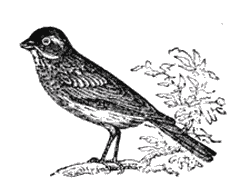
Emberiza miliaria, Linnæus; Le Proyer, Buffon; Der Gerstenammer, Bechstein.
This species, found throughout Europe and the north of Asia, has not so good a title to be admitted into the house as the preceding, not being distinguished either for its song or the beauty of its colours. With a plumage very similar to that of the sky-lark, it surpasses it in size, being seven inches and a half in length, of which the tail measures three. The beak, measuring six lines, is strong, yellowish on the under part in summer; the rest of the year the whole of it is grey brown; the feet the same, which stand six lines in height. The general tint of the plumage is pale, reddish grey on the upper part of the body, and yellowish white on the under, speckled like the lark’k, with blackish brown spots.
In the female the colours are rather lighter.
Habitation.—In its wild state this bird is common in most parts of Europe; in the more northerly parts it does not remain during the winter, and only appears at certain seasons; in March they are met with amongst the larks in the fields, meadows, and on the high roads, often perched on the tops of willows, or on a stake in a hedge, on a milestone, or a clod of earth.
In a room it may occupy a lark’s cage, but is more commonly let run about at liberty.
Food.—Both at liberty and in confinement its food is similar to that of the yellowhammer; it is however a more delicate bird.
Breeding.—Its nest, placed under a bush, does not rest on the ground but on the turf; it is constructed of the stalks of grass, and lined with horse-hair. The eggs are grey, speckled with chestnut and streaked with black.
Mode of Taking.—In autumn these birds may be taken in an area with a decoy bird; in winter, before the barn door, with bird-lime or a clapper; in the spring with a bird-call.
Attractive Qualities.—Their song, shorter and less soft than that of the yellowhammer, has only four or five notes; from their dwelling on the r in the last, they have been given the name of stocking weavers.
THE ORTOLAN.
Emberiza hortulena, Linnæus; L’Lrtolan, Buffon; Der Gartenammer, Bechstein.
It is necessary to give a very exact description of this species, as not only bird-catchers, but even some naturalists, give the name of Ortolan to several very different species. Under this name the former sell all rare birds of this kind. The true ortolan has a wider breast and stronger beak than the yellowhammer; it is six inches and a half in length, of which the tail measures two and a half; the beak, six inches long, is thick at the base, with a bony tubercle at the palate, and is of a yellowish flesh-colour; the iris dark brown. The legs, which stand ten lines in height, are flesh-coloured; the head and neck is greyish olive; the throat and a streak on the neck from the angle of the beak, deep yellow.
The female is rather smaller, of a changeable shining ash-colour on its head and neck, streaked with fine black lines. Its breast, and the upper and under part of its body, are lighter than in the male.
The throat of the young male birds, before the first moulting, is of a light yellow, with a mixture of grey; the breast and belly are of a reddish yellow, speckled with grey, which make them rather resemble young yellowhammers. A bird fancier will distinguish the two sexes even in the nest. There are white, yellow, speckled, and in the house sometimes even black varieties.
Habitation.—In its wild state the ortolan is principally found in the southern and temperate parts of Europe, and is not scarce in some of the provinces of Germany; but if attention were paid to them there, they might be seen in every direction on their passage; for though they may not remain during the summer in a district, yet they make some stay, never passing over a great space of country at a time. Their route is so exact and regular, that when one has been seen in a particular spot, especially if in spring, it is sure to be found there the following year at the same time. They fly rather in families than flocks: the time of their arrival in Germany is towards the end of April, or beginning of May; they are then met with in orchards, amongst brambles or in groves, where they build, particularly if millet is cultivated in the neighbourhood. During harvest they frequent the fields in families, and leave after the oats are gathered in34.
In the house, if much valued, they are given a cage; but in countries where they are common they are let run about free.
Food.—In their wild state they live on insects and grain. In the house they are fed, if in a cage, on millet, hemp seed, and prepared oats; if at liberty in a room the universal paste suits them very well. These birds, being rather delicate, cannot often be preserved beyond three or four years.
Diseases.—The most common disease of these birds is atrophy, to cure or prevent which it is necessary to know how properly to mix and vary animal with vegetable food; but this calls for a greater degree of attention and care than most persons are willing to give.
Manner of Taking.—In spring these birds are easily attracted to a decoy bush, by a female of their own species, or a yellowhammer. In August a turfy place should be chosen near brambles, to form a small area, as a decoy, like that made for chaffinches. It must be surrounded with a low hedge, with some oat-ears fastened to it. About the area should be placed one or several birds of call, especially a perching bird, that is to say, a bird of the same species, with a band of soft leather round it, and confined by a small string, fastened to a peg-stick in the ground, which prevents its going beyond the prescribed limits. Here it should be given plenty of food and water, in order that the birds to be caught may be the more easily attracted within the area, from seeing one of their own species in a place of abundance. This kind of decoy bird is often more necessary than any other.
Attractive Qualities.—The fine form and colours of the ortolan would be sufficient to render it desirable, but still more so its flute-like warbling, so clear and full, which has some resemblance to that of the yellowhammer, only that the last notes are much deeper.
Ever since ortolans have been known to epicures as a delicacy, they have been fattened with great care. The common way is to keep them in a room only lighted by lanterns, so that they cannot distinguish day from night: they are then plentifully fed on oats, millet, and the crumb of white bread, made up with good spice. In a short time they become so fat that they would be suffocated if not killed at once. An ortolan thus fed is a perfect ball of most delicious fat, weighing about three ounces.
THE CIRL-BUNTING, Lath.
Emberiza Cirlus, Linnæus; Le Zizi, ou Bruant de Haie, Buffon; Der Zaunammer, Bechstein.
Linnæus has described only the female, and by mistake I have called the male Emberizal Eæathorax, and have given a drawing of it and the female, in the second volume of my German translation of the English work of Latham, Synopsis of Birds, printed at Nuremberg, 1794.
Description.—This bird, scarce in many provinces of Germany and in Britain, but well known in Thuringia, is about the size of the yellowhammer, being five inches and a half in length, of which the tail measures two and a half. Its small and flattish beak is of a brownish blue on the upper part, and light brown on the under; the feet, eight lines in height, are flesh-coloured; the upper part of the head and neck olive green with small black strokes, a golden yellow streak extends from the angle of the upper mandible to the middle of the neck, passing under the eyes; another begins from the angle of the under mandible, and descending in a straight line, is crossed by a third, which is black, then curving round behind the yellow streak under the eyes, reunites with the black one on the throat; the back and smaller wing-coverts are cinnamon brown, mixed with black and yellow green; the rump is olive, with black streaks; the breast is a fine olive green, light chestnut on the sides; the rest of the under part of the body is of a golden yellow.
The female is known by its plumage being much paler: the head and upper part of the neck are olive, much streaked with black; the back is pale brown, the rump more streaked with black, the tail rather greyish black than black; two pale yellow lines pass one above the other below the eyes, and cross a black line which unites to the black border of the cheeks; the throat is brownish, with a lighter spot below; the breast is olive, with the sides brownish, the rest of the under part of the body is pale yellow.
The young ones, before their first moulting, have the upper part of the body light brown, speckled with black, the under pale yellow streaked with black; the older they grow the more of an olive tint the breast acquires.
Habitation.—In their wild state these birds dwell chiefly in the southern and temperate parts of Europe, where they frequent orchards, groves, and the skirts of forests.35 They are birds of passage, which leave in November and return in April; they are then met with very commonly among the chaffinches.
In the house they must be treated in the same manner as the ortolan.
Food.—In their wild state they feed on the cabbage caterpillar in summer, and when corn is ripe, on wheat, barley, millet, oats, and other grain.
Breeding.—They place their nest in a hedge or bush on the road side, and build it of small straws and line it with horse-hair. The eggs are greyish, speckled with chestnut. In the end of July, whole families are met with in the fields, particularly those planted with cabbages, and that have willows in the neighbourhood.
Diseases and Mode of Taking.—These are similar to what is said under ortolan.
Attractive Qualities.—The male surpasses the ortolan in beauty, but does not equal it in its song, as in this it more resembles the yellowhammer.
These birds, however, are very easily tamed, and may be preserved five or six years.
THE FOOLISH BUNTING.
Emberiza Cia, Linnæus; Le Bruant Fou, Buffon; Der Zipammer, Bechstein.
This bird is rather smaller than the yellowhammer, being only six inches long, of which the tail measures two and a half; the beak, five lines in length, is very sharp, blackish above, and greyish below; the iris is dusky; the legs, nine lines in height, are of a brownish flesh-colour. The head is grey, spotted with red, with small black streaks on the top, and an indistinct black line on the sides; the back is reddish brown, speckled with black, the rump light red brown; the throat pale ash-colour.
The female differs very little from the male: the head is grey with a reddish tint and black spots; she has also all the streaks that the male has, but less marked; the ash-coloured throat is streaked with black and has a reddish tint; in short, the whole of the under part of the body is lighter.
Habitation.—When wild, this species, which loves solitude, and prefers mountainous districts, inhabits the south of France, Italy, and the south of Austria. In some winters they quit these countries and proceed even to the middle of Germany, where they are found in March and April in elevated situations.
In the house they are either kept in a cage or left to range a room, and the latter seems to agree with them best, particularly if they have a grated and quiet place to rest in and pass the night.
Food.—When wild, these birds, like others of the genus, feed on insects and grain.
In the house they may be fed on the same food as the ortolan, on which they may be preserved in health above six years, as I have proved by a pair which I kept myself for that time.
Mode of taking.—These birds come without difficulty at the call of the yellowhammer, and enter into every kind of snare so heedlessly, that they have thence been given the name of foolish bunting.
Attractive qualities.—They are very fine and lively birds, whose voice is heard the whole year; in winter their note of call, and from spring to autumn, their cheerful song, shorter indeed, but clearer than that of the yellowhammer. They live very amicably in a room with other species of their genus, especially the yellowhammer; and where one goes the other follows, and if one chooses any particular food, the other prefers the same.
THE BLACK BONNET, OR REED BUNTING.
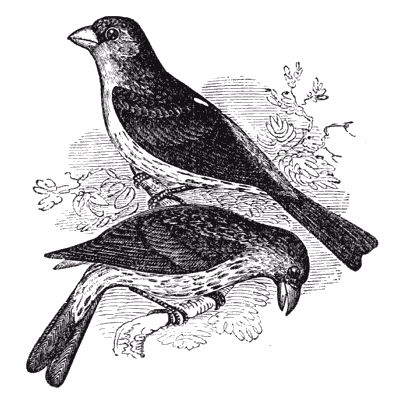
Emberiza Schœniclus, Linnæus; L’Lrtolan de Roscaux, Buffon; Rohrammer, Bechstein.
This bird is nearly the size of the mountain sparrow, its length being five inches three-quarters, of which the tail measures two and a half; the beak, four lines in length, is black on the upper part, and whitish on the under; the iris is dark brown; the legs, nine lines high, are dark flesh-coloured. The head is black, with reddish spots; a reddish white line extends from the base of the lower mandible quite round the head; the back is black, spotted with white and red, the rump alternately grey and reddish yellow; the throat is black spotted.
The feathers on the head of the male never return to as good a black after moulting, when in the house, as in its wild state, but remain always browner, and clouded with reddish white.
The head of the female is of a rusty brown, spotted with black; her brown cheeks are encircled with a reddish white streak, which, passing above the eyes, unites with another which commences at the base of the beak; a dark streak passes down the sides of the throat, which, with the under part of the body, is reddish white, much streaked on the breast with light brown; the colour of the back is lighter, but less clear than that of the male.
Habitation.—In their wild state this species is found throughout Europe and the north of Asia, flying in small flocks, and returning in March in great flights. The females follow the males, and do not remain behind, as some pretend. During winter some of these birds are met with here and there amongst the yellowhammers; they frequent moist places, the banks of ponds and rivers; they run nimbly up the stalks of aquatic plants, but rarely ascend trees.
In the house it is the custom here to let them range a room; but they may be kept in a cage.
Food.—When wild they feed on the seeds of rushes, bullrushes, reeds, and grasses, as well as on the numerous insects that frequent the water-side.
In the house they seem to relish the first universal paste and poppy seeds, on which food they will live five or six years; but afterwards they droop and die of atrophy or scurf, as I have remarked several times.
Breeding.—These birds make their nests among the reeds and brambles on the water-side. They lay five or six eggs of a dusky light grey, with dark grey spots and dusky lines rather indistinctly mingled.
Mode of Taking.—In autumn they enter the area or decoy with the chaffinch; in spring, when there is snow, they approach the barns and dunghills, and there, as well as in open places in the fields and on the hedges, they are very easily taken with a net or bird-lime.
Attractive Qualities.—Their song is alternately weak and strong. Three or four simple tones, mingled from time to time with a sharp r, distinguish it from every other; it is heard all the summer, even during the night. Of all the buntings, this is the most easily tamed; it is also a great amateur of music, approaching the instrument without fear, as I have observed several times, not of one only, but of many of these birds, testifying its joy by extending its wings and tail like a fan, and shaking them so that, by this exercise the feathers have been much injured. The female sings also, but its tones are weaker than those of the male.
THE SPARROW BUNTING.
Emberiza passerina, Linnæus; L’Lrtolan Passerin; Der Sperlingsammer, Bechstein.
This species must have been confounded with the preceding, or it would have been better known, as it is not rare either in autumn or spring. It is smaller and more slender than the former, being only five inches long, of which the tail measures two and a quarter; the beak is black above and light brown below; the iris is of a dark chestnut; the feet are nine lines in height and of a dusky flesh-colour; but the plumage in general is similar to that of the female of the preceding species.